Gwangju and Jeonnam International Magazine
August 2026 #294
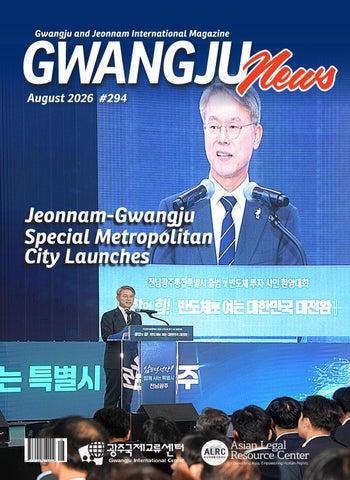
Jeonnam-Gwangju Special Metropolitan City Launches
ISSN 3140-3190
(GN with Microsoft Copilot)
3 Gwangju & South Jeolla International Magazine
August 2026, Issue 294 Published: August 1, 2026 Cover Image
Jeonnam-Gwangju Special Metropolitan City Launch Event Courtesy of Jeonnam-Gwangju Special City
Publisher
Dr. Shin Gyonggu
Editor-in-Chief & Copy-Editing Dr. David E. Shaffer Layout Editor & Online Editor Johanna Lezada The Gwangju News is the first English monthly magazine for the general public in Korea, first published in 2001. Each monthly issue covers local and regional issues, with a focus on the roles and activities of the international residents and local English-speaking communities. Copyright ©2026 by the Gwangju International Center. All rights reserved. No part of this publication covered by this copyright may be reproduced in any form or by any means – graphic, electronic, mechanical, photocopying, recording, or otherwise – without the written consent of the publisher. The Gwangju News is published by the Gwangju International Center: Jungang-ro 196-beon-gil 5 (Geumnam-ro 3-ga), Dong-gu, Gwangju 61475, South Korea
Registration No. 광주광역시 라. 00145 ISSN: 3140-3190 (online) Registration Date: February 22, 2010 The Gwangju News is co-sponsored by Asian Legal Resource Center (ALRC) Korea
I
have spent a large portion of my life living in Gwangju – first, when Gwangju was part of the surrounding Jeollanam-do province, and then for 40 years when Gwangju was a separate entity from the province. But I no longer live in “Gwangju.” No, I haven’t moved away. I live in the same apartment that I’ve lived in for two decades, but it’s no longer in Gwangju. As of July 1 of this year, Gwangju, as an administrative district in the Republic of Korea, has been dissolved. I now live in a different “city,” – one that has consolidated the old Gwangju and the old Jeollanam-do: Jeonnam-Gwangju Special Metropolitan City. It is both wordy in name and vast in the territory that it covers. What will this integrated special city of Jeonnam-Gwangju mean for its residents? Gwangju News publisher Dr. Shin Gyonggu breaks down the potential benefits that this merger will hopefully produce as well as the challenges that it will face. Elected as mayor of this newly formed city is Min Hyung-bae. Go to the biosketch on Min to see who he is and what his plans are for the special city. The past two months have been FIFA World Cup season. A Gwangju News writer has dispatched himself to Mexico to file a report. Take your own trip this summer; our article on traveling to Jeju Island describes the many attractions that the island paradise has to offer. What does the Gwangju International Residents Center (GIRC) have to offer? In this new column, the first service introduced is one-stop counseling. Read also what the Gwangju International Center (GIC) is doing, focusing on nurturing global leaders and the San Antonio Sister Cities Youth Summit. With the sun beating down on the heart of the summer season, it’s a prime time to talk about selecting your home solar energy and the effects of urban heat islands. We have for you an informative article on each of these topics. And there is so much more in this August issue: learning Korean, learning about Jinju, Korea’s 100-day “birthday,” Gwangju as an AI hub, café reviews, a book review, poetry, Blackpink K-pop, sports (Kia Tigers, Gwangju FC, Soop Supers, Pilates), and upcoming events. We hope this August issue helps to make your summer a refreshing and rewarding one. Enjoy!
David E. Shaffer Editor-in-Chief Gwangju News
GWANGJU NEWS, AUGUST 2026
Tel: (+82)-62-226-2733 Fax: (+82)-62-226-2731 Website: www.gwangjunewsgic.com Email: gwangjunews@gic.or.kr
From the Editor
Photo of the Month
4
City of Light: Gwangju at Dusk
GWANGJU NEWS, AUGUST 2026
A dramatic band of deep amber-orange blazed across the horizon between the dark mountain ridgeline and a thick cloud ceiling. The sharp contrast of the brooding cloud and the luminous orange below gave the sky a strangely architectural quality – as if light itself had been framed and hung there for us alone. My wife and I stood awe-struck by the sight as dusk settled over the northern reaches of Gwangju at 8:10 in the evening, June 24. The Photographer Shin Gyonggu is the director of the Gwangju International Center, senior advisor on Human Rights and International Collaboration for Gwangju City, and a former English professor at Chonnam National University. He is also the publisher of the Gwangju News. Capture Info: This photo was taken from Sotae-dong facing north. (Photo of the Month submissions are open to all readers: gwangjunews@gic.or.kr)
5 August 2026
CONTENTS
ISSUE 294
03 From the Editor 04 Photo of the Month 06 Special City News FEATURE 09 The Birth of Jeonnam-Gwangju Special Metropolitan City: A Reunion After 40 Years, Its Meaning, and Its Challenges KOREA IN FOCUS 14 Min Hyung-bae Steps Up to the Helm: Directing Korea’s Historic Special Metropolitan City as Its First Mayor GLOBAL FOCUS 15 More Than Football: The Friendships at the Mexico, US, Canada 2026 World Cup HISTORY & TRADITION 18 Korea’s 100-Day Celebration: The Baegil TRAVEL & DISCOVERY 22 Island Paradise: The Timeless Beauty of Jeju Island
OUR PLANET 38 The Environment: Chain of Thoughts – Solar Energy for the Home 40 The Heat Beneath Our Feet: Gwangju’s Summer Islands SCIENCE & TECHNOLOGY 43 AI in Gwangju: The City’s Vision for Becoming an AI Hub CULTURE & THE ARTS 46 The Calcuttan in Korea: Jinju – A City of Returning Histories 50 Book Review: The Corrections 52 Poetry: The Marbles We Lost to Time 55 Poetry: Gentle Hand of Night FOOD & BEVERAGE 56 Untergang: A Small Book Café with Big Conversations 59 D’s Café Column: Let's Jazz It Up – A Little Change from My Usual Café Reviews SPORTS & ENTERTAINMENT 60 More Than Just a Gym: How I Ended Up at the CNU Sports Center 62 Sports Focus: Gwangju FC Reloads for Second-Half Revival 64 Area Sports Roundup 67 Music: Blackpink – The Biggest Girl Group in South Korea 69 August Upcoming Events
GWANGJU NEWS, AUGUST 2026
COMMUNITY 26 Inside the GIRC: The GIRC's One-Stop Counseling Day – Where International Residents Get Real Answers 29 From the GIC: Nurturing Global Leaders – San Antonio Sister Cities Youth Summit 31 Inside the Gwangju News: The Merry Mexican with a Mission – Luis Andrés
TEACHING & LEARNING 35 Learning Korean Taught Me More Than Korea: Reflections on Korea’s Language Classrooms
Special City News
6
Special City News Jeonnam-Gwangju Special Metropolitan City: Creating Changes in Daily Life
city news, online civil services, policy documents and a “Mayor’s Office of the Special Metropolitan City” menu all in one place, while the existing Gwangju and Jeonnam portals continue to run in parallel for a time to avoid confusion. Equally important, basic documents and systems tied directly to daily life remain unchanged for now: resident registration cards, driver’s licenses, postal codes, and school districts are all still valid, and welfare and education support programs continue without interruption.
New signage for Jeonnam-Gwangju Special Metropolitan City Hall in Gwangju, marking the end of forty years of separate regional governance. (Screen capture: KBS Gwangju News)
W
GWANGJU NEWS, AUGUST 2026
ith the official launch of the JeonnamGwangju Special Metropolitan City on July 1, South Korea’s first integrated special city was created, replacing the former province of Jeollanam-do and Gwangju Metropolitan City and bringing 22 cities and counties plus five city districts under a single administrative framework. Over the first month since the birth of this new city, home to 3.2 million people and generating 159 trillion won in gross regional product, changes have begun to appear in residents’ daily lives. For ordinary citizens, the most visible changes have appeared not inside government offices but on maps and signboards. Address labels now carry the new name, as in “JeonnamGwangju Special Metropolitan City, Dong-gu” or “Jeonnam-Gwangju Special Metropolitan City, Hwasun-gun,” and the signs on major government buildings and boundary roads are being replaced accordingly. The new administrative system has also moved quickly to build a shared digital portal. Through a temporary integrated website, residents can access
Balanced Governance: Three Government Complexes and August Reorganization
J
eonnam-Gwangju Special Metropolitan City plans to implement balanced governance by distributing its main government complexes across three locations: Gwangju, Muan, and the Eastern Region. This so called “one city, three hubs” model is a three-complex system that allocates administrative functions to the Gwangju urban center; Muan, the existing provincial capital; and the Eastern Area. In this structure, the Gwangju complex is responsible for metropolitan strategy and urban policy, the Muan complex serves as an administrative hub where wide area departments are concentrated, and the Eastern complex handles local administration close to industrial belts and rapidly growing residential
The Eastern Government Complex located in the Sindae district of Haeryong-myeon, Suncheon. (Jeonnam-Gwangju Special City)
Special City News
7
Special City News zones. By spreading core functions across these three regions, the special city aims to narrow gaps in access to public services and prevent any single area from being seen as the sole “capital” of the unified special city. The August reorganization plan is effectively the blueprint for putting the “one city, three hubs” concept into everyday administrative practice. It calls for creating new departments in charge of strategic investment, science and technology, and integrated wide area planning, while adjusting the roles of existing departments so that each complex takes responsibility for its own region and also shares in managing the city as a whole. In addition, the city intends to establish a wide area administrative headquarters that will integrate transport, environmental, and industrial policies; coordinate decisions among the three complexes; and serve as a control tower that reflects more evenly the voices of urban, rural, and coastal communities.
Gwangju’s Five Districts Reveal the Character of the New City
S
Dong-gu simultaneously approved the “Mid- to Long-Term Plan for a Major Transition to an AI-Centered Economic City” and the “Plan for
Buk-gu, prompted by flooding along the Seobang-cheon during heavy rains, has made the prevention of disasters in flood-prone areas and the improvement of sewerage and drainage systems its top priorities. Working with the Yeongsan River Basin Environmental Office, the district is investing 43.1 billion won in a sewerage improvement project. Seo-gu, Nam-gu, and Gwangsan-gu have likewise revealed their own directions by making citizen participation, welfare for an aging society, and the co-design of everyday policies their first agenda items. Seo-gu is focusing on strengthening participatory democracy through citizens’ assemblies and citizens’ committees; Nam-gu is prioritizing responses to an aging society by expanding services such as welfare check-ins and care for older residents; and Gwangsan-gu is aiming to build a structure in which residents take part in setting agendas and monitoring implementation via permanent participation bodies, such as policy participation groups and citizen policy councils.
Jeonnam-Gwangju’s First Ordinance Sets a Semiconductor Course
O
n July 1, Jeonnam-Gwangju Special Metropolitan City held its first council meeting in the former Jeonnam Provincial
GWANGJU NEWS, AUGUST 2026
ince its launch, Jeonnam-Gwangju Special Metropolitan City has drawn attention with major agendas such as semiconductor investment, an integrated government complex, and ultra regional development strategies. However, the city’s real nature is just as clearly reflected in what each autonomous district chose as the very first item of business after the merger. The “first approvals” handled by Gwangju’s Donggu, Seo-gu, Nam-gu, Buk-gu, and Gwangsan-gu under the new special city framework show five different sets of priorities coexisting within a single city.
Establishing a Committee for a Major Transition to an AI-Centered Economic City” as its first decisions, signaling that an AI-based economic transition would be the core direction of the new district administration. By combining medical infrastructure, cultural and tourism assets, and local industries with AI technologies, the district plans to build an urban AI healthcare start up and testing valley, an AI Healthcare Tower, and a digital anti-aging industry demonstration center, effectively positioning itself as an “AI economic city laboratory” within the special city.
Special City News
8
Special City News Assembly chamber at the Namak Government Complex in Muan, where councilors processed 330 foundational local ordinances and regulations needed to operate the new unified government. Among these many items, the measure chosen as the symbolic first ordinance was the Ordinance on Supporting Global Semiconductor Strategic Investment for Jeonnam-Gwangju Special Metropolitan City.
The Jeonnam-Gwangju Special City Council holds its inaugural session on July 1, adopting first the semiconductor investment support ordinance. (Jeonnam-Gwangju Special City)
GWANGJU NEWS, AUGUST 2026
This choice clearly signaled that the special city intends to grow into Korea’s leading semiconductor hub outside the capital region. The ordinance is closely aligned with the national semiconductor strategy announced in late June, in which the central government outlined plans to foster Jeonnam and Gwangju as the country’s second major semiconductor production base through an 800-trillion-won investment package and the construction of new fabrication plants in the southwestern region involving Samsung Electronics and SK Hynix.
written into the special law: narrowing regional gaps, pursuing a “New Southern” strategy, honoring the spirit of May 18, and introducing policies such as basic income and a national medical school to strengthen public welfare. Debates over the location of the main government complex, organizational restructuring and how powers are distributed between districts and counties reveal both expectations and anxieties. Some residents fear recentralization, while others hope for more efficient governance, making questions of fairness in tax sharing and decisionmaking a core issue in discussions about the new system. The spaces of the city themselves help symbolize the future that residents imagine. May 18 Democracy Square stands for human rights and civic participation, while rural villages, ports, and airports evoke coexistence and openness to the wider world. Together, these places reflect the values citizens want the special city to embody: democracy rooted in history, mutual support between urban and rural communities, and an outward looking spirit of cooperation.
Residents’ Visions for the Special Metropolitan City
The Jeonnam-Gwangju Special Metropolitan City launch event. (Jeonnam-Gwangju Special City)
s the Jeonnam-Gwangju Special Metropolitan City takes shape, residents’ visions are converging on a theme of shared growth grounded in democracy and balanced development. Public opinion surveys show that citizens expect the new city to realize the goals
Content Creator
A
Jeong Chanjong has been working with the Gwangju International Center since March 2026. He is teaching humanities at Chonnam National University.
Feature
9
The Birth of Jeonnam-Gwangju Special Metropolitan City A Reunion After 40 Years, Its Meaning, and Its Challenges By Shin Gyonggu
July 1, 2026: A New City of 3.2 Million Is Born
On July 1, 2026, the map of southwestern Korea was redrawn. Gwangju Metropolitan City and Jeollanam-do (aka South Jeolla Province; aka Jeonnam) were merged into a single administrative body – “Jeonnam-Gwangju Special Metropolitan City” (short form: Gwangju Special City). It is a reunion occurring exactly forty years after Gwangju was separated from South Jeolla in 1986 and elevated into a “metropolitan city” in its own right. The new “special metropolitan city” has a population of about 3.2 million and a gross
regional domestic product (GRDP) of roughly 159 trillion won. This places it fifth in the country by population and third – after Seoul and Gyeonggi – by economic size. Its legal status is equivalent to that of the Seoul Metropolitan Government. The special city mayor holds ministerial rank, its four vice-mayors hold vice-ministerial rank, and the mayor is entitled to attend national cabinet meetings. For half a century, the Republic of Korea has been trapped in a “unipolar” structure that has concentrated population, capital, and opportunity in the Seoul metropolitan area, while pushing much of the rest of the country
GWANGJU NEWS, AUGUST 2026
“Overwhelming Growth! Living Together in the Special Metropolitan City – Jeonnam-Gwangju.” (Jeonnam-Gwangju Special City)
10
Feature
toward regional extinction. The Lee Jae-myung administration has vowed to break this pattern by reorganizing the national territory into five ultra-wide megacity “poles” and three “special autonomous provinces” – the so-called “5 Poles and 3 Special Zones” policy. The JeonnamGwangju Special Metropolitan City is the first – and so far, the only – success story of this policy.
Why Merge? The “5 Poles and 3 Special Zones” and the Push Beyond Seoul
On February 2, 2026, the Democratic Party submitted a special bill to the National Assembly to establish the special metropolitan city. Similar bills for a Chungnam–Daejeon merger and a Gyeongbuk–Daegu merger soon followed. Yet only Jeonnam and Gwangju actually crossed the finish line. Chungnam–Daejeon, though it moved first, stalled amid local disagreement and partisan conflict, and the Gyeongbuk–Daegu bill was shelved altogether. What set Jeonnam and Gwangju apart from the others was a combination of factors: a shared historical identity going back beyond the 1986 separation, the political will of Gwangju Mayor Kang Ki-jung and South Jeolla Governor Kim Yeong-rok, and the strong personal backing from President Lee Jae-myung.
GWANGJU NEWS, AUGUST 2026
The urgency for the merger came from the severity of the regional crisis. Gwangju’s population
peaked at 1.48 million in 2015 and has declined every year since, falling below 1.4 million in 2025. The steepest decline has been among the young: those aged 19 to 39 dropped from about 410,000 in 2020 to about 370,000 in 2024, a loss of more than 40,000 in only four years. South Jeolla’s condition is worse still. As of 2025, its population stood at about 1.78 million, shrinking by roughly 10,000 people a year in recent years. Twenty-nine percent of the population is 65 or older, while young children make up less than three percent. In a situation where neither the city of Gwangju nor the surrounding province of South Jeolla could survive on its own, the essential logic of the merger was to reverse the trend through economies of scale with the strong support of the central government.
What the Merger Brings
■ Twenty-Trillion Won over Five Years: Extraordinary Central Government Support Under the principle of “extraordinary support for those who move first,” the central government has committed roughly 20 trillion won (US$13.4 billion) in financial support to the new special metropolitan city, along with a substantial transfer of licensing and permitting authority. The city is now allowed to issue local bonds beyond the standard ceiling, and permitting procedures for development projects have been sharply streamlined. Sectoral incentives – for AI and energy industries, and for the transformation of the petrochemical and steel industries – are also written directly into the special act. ■ The 800-Trillion-Won Semiconductor Cluster: The Largest Investment in Korean Semiconductor History The most dramatic change is in semiconductors. Samsung Electronics and SK Hynix will each invest 400 trillion won – 800 trillion won (US$535 billion) in total – to build four memory-chip fabrication plants in this region. It is the largest single investment ever committed to the Korean semiconductor industry. The site chosen is the former military airbase in Gwangju: 8.2 million square meters, or about 2.5 million pyeong.
Feature
The central government will phase in a power supply of 6.3 gigawatts and 650,000 tons of industrial water per day. The site sits next to the KTX Gwangju-Songjeong Station, making it easy to draw skilled workers. Lee Jae-myung’s “corporate-friendly advanced city” policy has, in effect, taken root in Gwangju. ■ Relocation of the Military Airbase – and Relief from Decades of Noise Because the 800-trillion-won semiconductor cluster will occupy the current military airbase site, the fighter-jet noise that has plagued residents of Gwangsan-gu for decades will finally be resolved at its source. The airbase will be moved to Muan County, with relocation support funds and local development incentives provided to Muan in return. Because the site is already level, construction of the new fabrication plants will be able to begin unusually quickly. ■ The Consolidation of Gwangju Airport with Muan into an International Airport The civilian aviation function of Gwangju Airport will be moved to Muan International Airport by the end of 2027, timed to the opening of Phase 2 of the Honam High-Speed Rail (KTX). Muan International Airport has, until now, operated no domestic flights at all and has struggled to grow. Once Gwangju’s civilian operations move there and KTX service reaches the airport directly, Muan will be reborn as a full-fledged international gateway for southwestern Korea. Renaming it “Kim Daejung Airport” is under active consideration.
■ Reversing Population Decline and Attracting Talent Whether this merger can reverse the region’s demographic decline is one of the most closely watched questions. President Lee Jae-myung has been unusually direct concerning the historical injustice underlying that decline. “In 1945, the population of the Honam region was larger than that of Yeongnam,” he noted, “but as a result of regional discrimination, Honam today has less than half the population of Yeongnam.” He publicly promised targeted support for Gwangju Special City and declared that “when the central government relocates its agencies to the regions, they should be concentrated in Gwangju Special City if we want any real effect.”
“Jeonnam-Gwangju Special Metropolitan City is a testing ground for balanced development in Korea.” Min Hyung-bae, the first mayor of the newly formed special city, has framed the ambition this way: “The quality jobs that will emerge from semiconductor facilities, AI computing centers, and the offshore-wind and space-industry belts will be the stage on which our young people can pursue their dreams. We will make JeonnamGwangju a destination that even young people in the Seoul metropolitan area move to.” Gwangju City’s decision to invest 1.5 trillion won in its 2026 population policy points in the same direction. Vice Mayor for Administration Ko Kwang-wan also depicts the shift in a phrase: “JeonnamGwangju Special City will be favored by more young people and businesses over Seoul.” ■ Balanced Regional Development: An Old Dream Underlying all of the above is one enduring aspiration: balanced regional development.
GWANGJU NEWS, AUGUST 2026
■ A Chance to Resolve Gwangju’s Chronic Fiscal Deficits Gwangju has long been under financial pressure from two sources: chronic operating losses of 70 billion won, or US$50 million, annually on Subway Line 1 and Line 2, targeted for completion in 2030. As the newly formed special metropolitan city now enjoys financial privileges on par with Seoul and receives concentrated support from the central government, there is finally a realistic basis for resolving this longrunning structural deficit.
11
12
Feature
The July 1 launch festivities. (Jeonnam-Gwangju Special City)
GWANGJU NEWS, AUGUST 2026
To disperse the opportunities that have been concentrated in Seoul and the capital region, and to fill the southern land once again with the voices of its people. A column by Professor Jang Ha-sok of the University of Cambridge captures, with unusual grace, the long grief of a region that has been this country’s granary and moral home yet has also been consistently discriminated against: “For a thousand years, Honam has been this nation’s granary, yet it has never been the master of its own granary. It holds the most fertile fields but has remained the periphery the longest; it has given the most, yet been given back the least. Its fertile land became the very reason for its exploitation, and its generous spirit became the pretext for its marginalization – this paradox is the history that this land has endured. In the age of industrialization, factories bypassed it, highways bypassed it, and eventually even human footsteps turned away. Its young people, unable to find a future in their own land, had to leave, and in the places they left behind only the sunset, empty houses, and old promises remained. People speak of this land in terms of han – a deep, historic sorrow – but I would rather call it a promise long deferred. A promise that someone must come to repay, yet that for a thousand years no one has repaid.”
As Professor Jang’s voice reminds us, this newly formed special city is not about the interests of one region. It is a first step toward the balanced development of the nation as a whole, and toward setting straight a crooked past.
The Shadowed Side: There Are Losses, Too
Behind every bright picture, there are shadows. Gwangju citizens must face the following concerns with honesty. ■ The Administrative Unit of “Gwangju” No Longer Exists Under the special act, both Gwangju Metropolitan City and South Jeolla Province have been dissolved. Gwangju is now scattered across five autonomous districts – Dong-gu, Seogu, Nam-gu, Buk-gu, and Gwangsan-gu – and no single city hall now represents them as a whole. Mayor Min Hyung-bae has proposed creating a “Gwangju Administrative Office” to fill the resulting gap in metropolitan governance, but district mayors and district-council members are pushing back, calling it an inefficient extra layer, a “roof on top of a roof.” ■ Fear of a “Straw Effect” on Cities and Counties The rural cities and counties of South Jeolla
Feature
worry about a “straw effect” – the fear that their populations will be sucked into Gwangju, with its richer options for housing, education, and culture. The psychological and administrative distance built up over forty years of separation between South Jeolla and Gwangju will not vanish overnight. ■ The Identity of Gwangju as a Human Rights City Is Shaken The most painful and weighty issue is identity. Since the May 18 Democratic Uprising of 1980, Gwangju has been known to the world as Korea’s symbol of democracy and human rights. Since 2011, the World Human Rights Cities Forum (WHRCF) has been held in Gwangju every year, and since 2020, the UN Office of the High Commissioner for Human Rights and UNESCO have co-hosted the Forum together with the City of Gwangju. In these settings, the name “Gwangju” has become a global brand for the human rights city. “Gwangju Metropolitan City” was never merely a political or administrative label; it was a shared label for human rights, used across international civil society.
“Whether this merger can reverse the region’s demographic decline is one of the most closely watched questions.”
The Condition for Success: Direction, Not Size
Jeonnam-Gwangju Special Metropolitan City is a testing ground for balanced development in Korea. The outward conditions are in place: 20 trillion won (US$13.3 billion) in support, 800 trillion won (US$535 billion) in semiconductor investment, legal status on par with Seoul. But the real test now begins. Can the newly formed special city fully exercise substantive self-government authority over regional transportation, energy, wide-area infrastructure, large-scale investment attraction, and industrial transition? Can 3.2 million residents genuinely share, as a single community, the benefits it generates? And can the identity Gwangju has accumulated – as a home of democracy and human rights – be preserved within a new administrative name? In this new setting, the roles of the wider civil society that has connected this city to the world become more important than ever. The administrative map has been redrawn, but the names by which Gwangju is known to the world – Human Rights City, City of May 18, City of Democracy – must continue to live in the memory of its citizens and in international solidarity. Forty years ago, Gwangju was separated from South Jeolla. Forty years later, Gwangju has reunited with South Jeolla. May this reunion become Korea’s first successful model of balanced regional development – and, at the same time, an opportunity to carry the spirit of Gwangju as a global human rights city onto an even wider stage.
The Author
Shin Gyonggu has served the Gwangju International Center as its volunteer director for the past 27 years. He served as a professor for more than 30 years at Chonnam National University until his retirement in 2013. Dr. Shin is also the publisher of the Gwangju News.
GWANGJU NEWS, AUGUST 2026
That name “Gwangju Metropolitan City” has now been legally erased. How will we manage a situation in which the international human rights brand once carried by “Gwangju Metropolitan City” is replaced by “Jeonnam-Gwangju Special Metropolitan City”? Protecting the international assets Gwangju has accumulated as the city of May 18, as a human rights city, and as a city of democracy – so that these are not blurred by a change in administrative name – is a task the civil sector and Gwangju’s international partners must now shoulder together.
13
Korea in Focus
14
Min Hyung-bae Steps Up to the Helm Directing Korea’s Historic Special Metropolitan City as Its First Mayor
O
n July 1, 2026, Min Hyung-bae assumed office as the inaugural mayor of JeonnamGwangju Special Metropolitan City, marking a historic milestone in South Korea’s local governance. His election represents not only a personal triumph but also the dawn of a new era for the region, which reunites the province of Jeollanam-do and the city of Gwangju after four decades of separate governance.
GWANGJU NEWS, AUGUST 2026
Born in Haenam, Jeollanam-do, in 1961, Min Hyung-bae has long been a familiar figure in regional politics. He graduated from Mokpo High School and later received his master’s and PhD from Chonnam National University. In his early career, he was a newspaper journalist and editor (Jeonnam Ilbo), a civic activist (Participatory Autonomy 21), a Blue House aide under President Noh Moo-hyun, and a Blue House secretary under President Moon Jae-in. From 2010 to 2018, he served as head of the Gwangsangu district of Gwangju, overseeing initiatives that improved public services and strengthened local infrastructure. Later, as a member of the National Assembly from 2020 to 2026, he championed legislation aimed at regional development and social welfare, further cementing his standing as a leader committed to the needs of ordinary citizens. In the June 2026 election for mayor of this birthing special city, Min secured a decisive victory, winning nearly 80 percent of the vote. His closest rival, Lee Jeong-hyun of the People Power Party, trailed far behind with just over 10 percent. Other candidates, including Kang Eun-mi of the Justice Party and Lee Jong-wook of the Progressive Party, garnered only singledigit support. Voter turnout was 65.7 percent in Jeollanam-do and 54.3 percent in Gwangju. The overwhelming mandate gives Min a strong foundation to lead the newly formed city.
By David Shaffer Min’s campaign was built on the promise of a “citizen-sovereign government,” where residents would play a central role in shaping policy. He pledged to create opportunities for young people to thrive locally rather than seek employment elsewhere, ensure reliable care for families raising children, and provide accessible healthcare and safe living conditions for seniors. His economic vision is equally ambitious: Within one year, he aims to attract a global semiconductor factory to the region, positioning JeonnamGwangju as a hub of high-tech industry and innovation. As its first mayor, Min Hyung-bae carries the responsibility of proving that the merger can deliver tangible benefits to the new city’s residents. With his roots in the region, a proven track record in governance, and a sweeping electoral mandate, Min Hyung-bae enters office with both high expectations and significant challenges. His leadership, whether outstanding or otherwise, will shape not only the future of JeonnamGwangju but also the broader trajectory of regional development in South Korea.
The Author
David Shaffer is a long-time resident of Gwangju. He spent a career of four decades as a Chosun University professor. At present, Dr. Shaffer’s main involvement is as an officer in Korea TESOL, an English teaching association, and as editor-in-chief of the Gwangju News. Photograph courtesy of Jeonnam-Gwangju Special City.
Global Focus
15
More Than Football
The Friendships at the Mexico, US, Canada 2026 World Cup By Luis Andrés
B
efore the first whistle was blown, millions of people had already formed expectations. Mexico would be deserts and cacti, with lots of insecurity. Americans would be distant and unwelcoming. Canadians would be polite. The 2026 FIFA World Cup, the first ever hosted by three countries, spent an entire month proving how incomplete those assumptions were. I am not really a football fan or follower, but as a Mexican living in Korea, I naturally followed every match involving either country. Yet by the end of the tournament, I realized the best stories had little to do with goals or trophies. They were happening in the streets outside the stadiums, on subway rides, in public squares, and between complete strangers wearing different jerseys. This World Cup reminded us that football may be the excuse, but friendship is often the real event.
The same happened with people. Every stadium became a meeting place for cultures that rarely
Ecuadorian fans unfurl a huge national flag to celebrate Ecuador’s victory over Germany at New York/New Jersey Stadium. (Alejandro Martínez)
cross paths. In Philadelphia, French and Iraqi supporters filled the same stands under enormous national flags before kickoff. In New York and New Jersey, Ecuadorian fans transformed the area around the stadium into what almost felt like a home match despite being thousands of kilometers from Quito. In Monterrey, Swedish
GWANGJU NEWS, AUGUST 2026
One of the biggest surprises for many visitors was simply discovering Mexico itself. For decades, international media has often reduced the country to clichés of deserts, cacti, and dusty villages. Yet thousands of supporters arrived in cities like Monterrey and found something entirely different: a modern metropolis framed by the dramatic peaks of the Sierra Madre Mountains. The view of Estadio Monterrey sitting beneath Cerro de la Silla quickly became one of the tournament’s most shared images, with visitors admitting that Mexico looked nothing like they had imagined.
16
Global Focus
GWANGJU NEWS, AUGUST 2026
Mexico’s flag awaiting the unfurling of the Taegeukgi for the national anthem ceremony. (Alejandro Mendez)
and Tunisian supporters shared restaurants, public transportation, and photo opportunities with local families long before the referee blew the whistle. For a few weeks, national borders became little more than colors on a jersey.
Mexico’s infamous three-person kiss – a tradition that certainly doesn't represent Mexican culture but has somehow become an unofficial sign that foreigners have fully surrendered to Mexican party culture.
Perhaps nowhere was this spirit more visible than in the relationship between Mexico and Korea. Korea played all three of its group-stage matches in Mexico. Although the results on the pitch were mixed, the atmosphere outside the stadiums could hardly have been warmer.
Seeing Korean fans laugh, dance, and celebrate with such openness surprised many people back home. Maybe they had simply met the right Mexican friends. Football rivalries, after all, have an expiration date.
The Korean national team repeatedly thanked Mexico on social media for its hospitality. Korean supporters returned home with stories that had little to do with football tactics and everything to do with the people they met. Videos spread across Korean social media showing fans dancing with Mexicans in city squares, joining spontaneous drinking games, celebrating together after matches, and embracing complete strangers. One particularly viral clip even showed Korean visitors participating in
Mexico happened to be the team that complicated Korea’s path to the knockout stage. For ninety minutes, they were opponents. Only for ninety minutes. The friendship returned almost immediately. One small moment during the match captured this perfectly. Mexican head coach Javier Aguirre was seen joking in Spanish with Lee Kangin, whom he had coached years earlier at RCD Mallorca. Despite standing on opposite sides that day, both smiled. Their shared history mattered more than the scoreboard. Football has a funny
Global Focus
way of reminding us that today's rivals are often yesterday’s teammates. Mexicans have another way of expressing that idea. Whenever Korea has helped Mexico in previous World Cups – or whenever supporters from both countries meet in memorable ways – Mexican fans often chant: “¡Coreano, hermano, ya eres mexicano!” (Korean brother, you’re now Mexican). Whether in stadiums or public squares, the chant has become one of football’s most affectionate traditions, expressing something that many Mexicans genuinely feel: Korea is a country they enjoy cheering for almost as much as for their own.
17
than the late Professor Kim Jae-gi of Chonnam National University, whose work helped many of us better understand the ties between our two countries. (It is to his memory that I dedicate this article.) Perhaps that is the greatest achievement of any World Cup. Not the champion. Not the Golden Boot. Not even the unforgettable goals. It is giving countries that would otherwise rarely meet the opportunity to discover one another beyond headlines and stereotypes. Mexico and Korea are far from perfect. Mexico continues chasing the elusive dream of making a deep run at a World Cup while facing the same political and social challenges that never disappear simply because football begins. Korea, meanwhile, leaves this tournament with difficult conversations about coaching, management, and the relationship between players, supporters, and the media. But for one remarkable month, none of those differences prevented people from laughing together. I often think of Mexico and Korea as two friends with opposite personalities. Mexico is the loud one – the one who insists everyone should dance. Korea is the quieter one – the one who says no. Then, twenty minutes later, everyone is singing together. Maybe that is what the World Cup is really for.
The phrase carries an even deeper meaning when viewed alongside the long history connecting the two nations. More than a century has passed since the first Korean migrants arrived in Mexico, helping build communities while becoming part of Mexican society. Few scholars dedicated more effort to documenting that shared history
The Author
Luis Andrés González is a Mexican GKS scholar and master’s student in cultural anthropology at Chonnam National University. He advocates for LGBTQ+ rights and gender equality, and explores global affairs through pop culture. He is the founder of Erreizando, a digital magazine. Instagram: @luisin97 / @erreizando
GWANGJU NEWS, AUGUST 2026
Philadelphia Stadium, minutes before the match between France and Iraq began. (Alejandro Martínez)
History & Tradition
18
Korea’s 100-Day Celebration The Baegil
Typical baegil-sang.
By Diane Dooley
Introduction
GWANGJU NEWS, AUGUST 2026
We carefully arrange the table decorated with rice cakes, fruit, and delicate flowers. We take a step back. Our three-month-old son, dressed in a hanbok, is sitting at the center of the table, looking straight at us. We are trying to get his attention. His head droops to one side suddenly, betraying his not-quite-there-yet neck strength, but he smiles. The photographer hits the shutter quickly. While the rice cakes, fruit, and flowers on the table are fake, the significance of this occasion for us as parents is not. It is our son’s baegil (백일), the one-hundredth day since his birth, but we are celebrating more than just the passage of time.
mortality rates were extremely high until the early to mid-twentieth century, when developments in modern medicine, food production, and hygiene practices, improved outcomes significantly. In this context, after one-hundred days, a newborn was considered to have survived the most vulnerable stage of infancy and was therefore more likely to see his or her first birthday (and, ultimately, adulthood). Anxiety transformed into hope, and people were finally able to celebrate.
In many countries, a child’s first birthday is regarded as his or her first big milestone. In Korea, however, the one-hundredth-day celebration has traditionally held equal importance.
However, the baegil is more than an acknowledgement of survival. It reflects centuries of cultural development on the Korean peninsula, shaped by mythology, indigenous beliefs, Buddhism, and Neo-Confucian philosophy. Its customs, from sharing white rice cakes with neighbors to displaying symbolic foods on a ceremonial table, express broader ideas about family, community, and life and death.
This celebration emerged during a time when the birth of a child was fraught with uncertainty. For much of history, all over the world, infant
Although the social conditions that gave rise to the tradition have changed dramatically over the years, the baegil continues to be celebrated by
History & Tradition
families across Korea and throughout the Korean diaspora, connecting modern parents with generations of ancestors who observed the same celebration before them.
The Historical Origins of the Baegil
The precise origins of the baegil are unknown, and there are no surviving historical records that identify when the tradition began. This is because it was a folk tradition that developed gradually over time. In summary, the tradition emerged in response to the realities of life before modern medicine and was further influenced by indigenous beliefs, religions, and philosophies.
19
diseases such as smallpox, measles, dysentery, and respiratory illnesses such as tuberculosis, were common, and poor sanitation and hygiene, periodic famine, and limited access to medical treatment further exacerbated the issue. As a result, families often approached the first months of a baby’s life cautiously. Surviving infancy was far from a given. In these circumstances, it is easy to see why a baby’s onehundredth day was a cause for celebration.
“This celebration emerged during a time when the birth of a child was fraught with uncertainty.” The Dangun Myth and the Symbolism of 100 Days But why one hundred days? Although modern medicine has developed significantly, infants are still seen as extremely vulnerable for the first three months of life. This is the case not just in Korea but all over the world. Newborns have immature immune systems, are more vulnerable to infections, and undergo rapid growth during this period. Three months is just shy of one hundred days. Therefore, this is naturally an appropriate time for such a celebration.
In Korea, infant mortality rates were extremely high until the mid-twentieth century. In the early 1900s, the infant mortality rate was thought to have been somewhere around 500 per 1000 births. This figure did not drop below 100 until 1965. Life expectancy at birth during the Joseon Dynasty (1392–1910) was around 30 to 35 years. This low average is solely attributed to extremely high infant mortality rates. Infectious
In addition, the number one hundred also appears prominently in Korea’s founding myth as it is recorded in the Samguk Yusa (Memorabilia of the Three Kingdoms). In the legend, a tiger and a bear both wished to become human. Hwanung, a divine figure in the myth, told them to remain in a cave for one-hundred days, and to eat only mugwort and garlic. If they were successful, he would grant their wish and transform them into humans. The tiger left the cave before the one-hundred days was done, too hungry and impatient, while the bear was transformed into
GWANGJU NEWS, AUGUST 2026
Boy in traditional bachelor’s hanbok.
20
History & Tradition
a woman after only twenty-one days. In this example, the one-hundred-day period symbolizes patience, endurance, and transformation. There is little evidence that the baegil celebration was directly influenced by the Dangun myth, but both point to a broader cultural understanding of one-hundred days as a meaningful period of perseverance leading to some sort of reward or transition, reinforcing the symbolic significance of one-hundred days as an important milestone in Korean culture and society.
Religious and Philosophical Influences
Although the celebration likely started due to the fear and subsequent gratitude and hope created by the high infant mortality rates, it was also influenced by contemporary belief systems and social norms. Rather than being the product of a singular belief system, the celebration reflects the pluralism of folk beliefs, Buddhism, and Neo-Confucianism. Together, these traditions influenced how Korean families understood things like childbirth, familial relationships, and the hopes they held for a child’s future.
GWANGJU NEWS, AUGUST 2026
Many of Korea’s folk beliefs focus on well-being and protection. For example, many viewed the period immediately after birth as one of vulnerability. This prompted the emergence of protective customs such as limiting visitors, hanging a geumjul (sacred straw rope) outside the home. The straw rope was intended to prevent the
Infant mortality rate in South Korea since 1960.
entrance of uninvited visitors as they could carry with them diseases or evil spirits could follow them inside. Similarly, as Buddhism spread across the peninsula, families also sought blessings for healthy pregnancies and long lives for their children through prayers and acts of generosity, often making offerings at temples. During the Joseon Dynasty, Neo-Confucianism further shaped the baegil by emphasizing filial piety, family continuity, prudence, and the importance of life stages. Together, these traditions transformed the baegil from a celebration of survival into a meaningful expression of gratitude, communal support, and a display of hope for a healthy and prosperous life for the child.
The Baegil Table
How is the baegil actually celebrated? At the heart of the celebration is the baegil table (baegilsang, 백일상). Traditionally arranged by family members, today the baegil-sang is more often arranged by professional photographers or event planners. The table usually features a selection of symbolic food and other items that represent the family’s wishes for the child’s health and happiness. While the composition of the table varies among families, regions, and photography studios, the purpose of it remains the same: to give thanks for the baby’s healthy growth so far and to express wishes for the baby’s future.
History & Tradition
Special festive foods prepared for the table include a variety of rice cakes, such as baekseolgi, susupat-tteok, injeolmi, and songpyeon. Baekseolgi (steamed white rice cake) is symbolic because the first syllable, baek, can mean both “white” (白) and “one hundred” (百) Together, it symbolizes the wish for the child to live for one-hundred years. Its white color represents purity.
21
hanbok with long ties was worn by the baby, representing the wishes of the parents for the baby to live a long life. This hanbok was usually a patchwork made from one hundred pieces of cloth. Today, hanbok are usually rented for the occasion. The baekil-sang is still the main feature of the celebration today.
The Baegil in Contemporary Korea
Photo studios usually provide a variety of different backdrops and outfits.
Susupat-tteok (rice cakes coated with red bean paste) was believed to repel evil spirits thanks to its reddish color, and injeolmi (rice cakes coated in roasted soybean powder) represents sincerity. Two kinds of songpyeon (half-moon shaped rice cakes) are made, one with fillings and the other without, representing strength and generosity.
Some other elements of the traditional celebration are no longer regularly practiced. For example, a baby’s hair was often cut for the first time on his or her one-hundredth day. Similarly, a special
Sources Kendall, L. (1985). Shamans, housewives, and other restless spirits. University of Hawaii Press. Kim, S. (2017). The history of medicine use in the Joseon era. Korean Journal of Medical History, 26(2), 147–180. Kwon, T. H., & Shin, E. H. (1977). Demographic transition in Korea. Seoul National University Press. National Folk Museum of Korea. (2017a). Baegil. Encyclopedia of Korean Rites of Passage. National Folk Museum of Korea. (2017b). Geumjul. Encyclopedia of Korean Rites of Passage.
The Author
Diane Dooley is originally from Glasgow, Scotland. She has a BA in Korean and an MA in Korean literature from SOAS. She currently works in Gwangju as an English teacher. Photographs courtesy of the author.
GWANGJU NEWS, AUGUST 2026
Traditionally, the rice cakes were usually handed out not only to relatives and neighbors, but also to others who had not been formally invited to the event. It was believed that this would help the baby live a long life. The goal was to hand out rice cakes to one-hundred people, but it was not important to actually achieve this. The gesture itself was enough.
Today, the one-hundredth day celebration remains an important milestone that celebrates the child’s first one-hundred days. While low infant mortality rates have seen the celebration take a backseat to the child’s first birthday celebration, most families still celebrate their baby’s baegil. Many families now choose to take a few commemorative photos either at home or in a professional photography studio before sharing a simple meal and rice cakes with family. However, the baegil table and the significance and symbolism of its components has remained consistent. It all comes together in a carefully curated expression of gratitude for the baby’s safe arrival and good health, appreciation for the support of family and friends and wider community, and hopes for the child’s future.
Travel & Discovery: Exploring Korea
22 22
Island Paradise
The Timeless Beauty of Jeju Island Jeju’s iconic UNESCO World Heritage Site (Seongsan Ilchul-bong).
By Neha Bisht
N
estled off the southern coast of South Korea, Jeju Island is a breathtaking destination where volcanic landscapes, emerald-green tea fields, dramatic coastlines, and a rich cultural heritage come together to create an unforgettable travel experience. Known as the “Hawaii of South Korea,” Jeju attracts millions of visitors every year with its stunning natural beauty and unique attractions. Whether you are looking for adventure, relaxation, or cultural exploration, Jeju has something to offer every traveler.
GWANGJU NEWS, AUGUST 2026
Getting to Jeju from Gwangju
Traveling from Gwangju to Jeju is quick and convenient. The easiest option is to take a direct flight from Gwangju Airport (KWJ) to Jeju International Airport (CJU), which takes approximately 50 minutes. Several domestic airlines operate daily flights, making Jeju an ideal destination for both weekend getaways and longer vacations. Travelers can also choose the scenic sea route by taking a ferry from the mainland, although it requires considerably more travel time.
I visited Jeju Island to attend an international conference. My colleagues and I took a direct flight from Gwangju, and upon arriving at Jeju International Airport, we rented a taxi to reach our hotel. The journey from the airport offered a glimpse of Jeju’s beautiful coastal roads and volcanic landscape, making a wonderful first impression of the island.
Where to Stay
Jeju offers accommodation options for every budget and travel style. Jeju City is an excellent choice for visitors who prefer convenient access to shopping districts, restaurants, and the airport. Seogwipo, located on the southern coast, is known for its waterfalls, scenic coastline, and peaceful atmosphere. Travelers seeking luxury can stay in the Jungmun Tourist Complex, which features several premium hotels and resorts close to many of Jeju’s major attractions. During my visit, we stayed at Booyoung Jeju Hotel and Resort, a five-star establishment located near the Jungmun Tourist Complex. The resort offered excellent hospitality and modern facilities. Our
Travel & Discovery: Exploring Korea
spacious accommodation included a living room, bedroom, kitchen, and two bathrooms, making it an ideal place to relax after a full day of sightseeing.
Must-Visit Attractions
Jeju Island offers a remarkable blend of natural wonders, cultural heritage, and modern attractions. Nature lovers can explore Halla Mountain National Park, home to South Korea’s highest mountain, along with iconic landmarks such as Seongsan Ilchul-bong (Sunrise Peak), the Geomun-oreum Lava Tube System, Manjanggul Cave, Cheonjiyeon Waterfall, Jeongbang Waterfall, Daepo Jusang-jeolli Cliffs, Yakcheon Temple, Woljeong Beach, Camellia Hill, Jeju Stone Park, and the beautiful Seogwipo Healing Forest. For visitors interested in cultural and familyfriendly attractions, Jeju offers the Alive Museum, Teddy Bear Museum, Movie Land Wax Museum, Haenyeo Museum, Jeju Shinhwa World Theme Park, Snoopy Garden, 9.81 Park, Spirited Garden, Seongeup Folk Village, and the famous Osulloc Tea Museum. Visitors can also explore Dongmun Traditional Market, where they can enjoy fresh seafood, Jeju Black Pork, Hallabong oranges, local snacks, and handmade souvenirs.
23
Due to our limited time on the island, we were unable to visit all of these attractions. However, we had the opportunity to explore some of Jeju’s most popular destinations, which I have described in detail in the following sections based on my personal experience.
“Every corner of the museum offered a unique photography opportunity, making it impossible to stop taking pictures.” Alive Museum (Illusion Theme Park)
Located in the Jungmun Tourist Complex, the Alive Museum is one of Jeju’s most entertaining indoor attractions. The museum features hundreds of optical illusion paintings, interactive exhibits, and three-dimensional artworks that create unforgettable photo opportunities. From balancing on skyscrapers to escaping dinosaurs or surfing giant waves, every exhibit encourages visitors to become part of the artwork. During my visit, I was amazed by the realistic 3D effects. Every corner of the museum offered a unique photography opportunity, making it impossible to stop taking pictures. If you enjoy creative photography or social media content, Alive Museum is definitely a place you should not miss.
Gimnyeong Maze Park
A 3D art picture at Alive Museum.
One of the most memorable parts of my visit was the lovely garden at the entrance, where
GWANGJU NEWS, AUGUST 2026
For a unique outdoor adventure, Gimnyeong Maze Park is a must-visit destination. As South Korea’s first hedge maze, it features tall cypress trees forming winding pathways that challenge visitors to find their way to the exit. Observation towers provide panoramic views of the maze, while beautifully landscaped gardens create a peaceful environment for relaxation.
24
Travel & Discovery: Exploring Korea
The beautiful entrance of the Gimnyeong Maze Park.
many friendly cats freely roamed. Visitors receive complimentary cat food with their entrance ticket, along with simple instructions on how to approach and interact with the cats. Watching them wander through the maze made the experience even more enjoyable. The park is a perfect stop while exploring eastern Jeju and offers a delightful combination of nature and fun.
enjoy the shallow coastal waters. Although the intense summer heat prevented us from staying longer, the breathtaking scenery left a lasting impression. With its clear waters, dramatic volcanic cliffs, and spectacular coastal views, Seongsan Ilchul-bong is undoubtedly one of Jeju Island’s most unforgettable destinations and a paradise for photography enthusiasts.
Seongsan Ilchul-bong (Sunrise Peak)
Movieland Wax Museum
GWANGJU NEWS, AUGUST 2026
No trip to Jeju is complete without visiting Seongsan Ilchul-bong, also known as Sunrise Peak. This UNESCO World Natural Heritage Site was formed by a volcanic eruption approximately 5,000 years ago and rises 182 meters above sea level, offering spectacular panoramic views of Jeju’s eastern coastline. The hike to the summit takes around 30 minutes and rewards visitors with breathtaking scenery, especially during sunrise. At the base of the peak, visitors can watch demonstrations by Jeju’s famous haenyeo (female free divers), whose traditional diving culture has been recognized by UNESCO as an Intangible Cultural Heritage. During my visit, I was captivated by the crystalclear blue water surrounding the coastline. Ferry rides are available nearby, and visitors can also
The Jeju Movieland Wax Museum offers visitors an opportunity to meet remarkably lifelike wax figures of famous personalities from history, politics, sports, entertainment, and cinema. The realistic sculptures and themed galleries provide excellent opportunities for memorable photographs, making it a popular destination for families and tourists alike.
The Scenic Sea Trail Near ICC Jeju
Located near the International Convention Center (ICC) Jeju, the scenic coastal trail is one of Jeju’s hidden gems. Wooden pathways stretch along the volcanic coastline, offering magnificent views of the deep blue sea, black basalt cliffs, and lush greenery. The peaceful atmosphere makes it an ideal place for a morning walk or an evening stroll while
Travel & Discovery: Exploring Korea
enjoying the refreshing sea breeze. Observation decks along the trail provide excellent viewpoints for photography, particularly during sunset. During our walk, we came across several souvenir shops selling locally made handicrafts and Jeju specialties. To cool off from the summer heat, I enjoyed a glass of freshly squeezed Jeju tangerine juice, which was incredibly refreshing. I also bought a traditional Jeju orange hat as a souvenir to remember the trip. Small moments like these made the experience even more enjoyable.
25
offers pleasant weather, clear skies, and ideal conditions for sightseeing and hiking. Summer is perfect for enjoying beaches and water sports, whereas winter transforms Halla Mountain into a spectacular snowy landscape.
Final Thoughts
From the interactive exhibits of the Alive Museum and the adventurous pathways of Gimnyeong Maze Park to the volcanic beauty of Seongsan Ilchul-bong, the fascinating Jeju Wax Museum, and the scenic coastal trail near ICC Jeju, Jeju Island offers a perfect blend of nature, culture, and adventure. Although my visit to Jeju was primarily for attending an international conference, it gave me the opportunity to explore some of the island’s most iconic attractions and experience its unique charm. Every destination I visited offered something different – from breathtaking coastal landscapes and fascinating museums to peaceful walking trails and warm local hospitality.
A wax statue of Marvel Studio’s famous character The Hulk at the Wax Museum.
Experience Jeju’s Local Flavors
Best Time to Visit
Jeju is a year-round destination, but spring (March–May) and autumn (September– November) are considered the best seasons to visit. Spring brings beautiful cherry blossoms and vibrant canola flower fields, while autumn
Travel Tip: While public buses connect many popular attractions, renting a car is highly recommended because Jeju’s sightseeing destinations are spread across different parts of the island. A rental car offers greater flexibility and allows visitors to explore the island comfortably at their own pace.
The Author
Neha Bisht is a native of India, pursuing her PhD research at Chonnam National University’s School of Materials Science and Engineering. She loves to meet new people and make new friends. Neha endeavors to contribute to the well-being of society in whatever way she can. Follow @philla_korea Photographs courtesy of the author.
GWANGJU NEWS, AUGUST 2026
Jeju’s cuisine is as memorable as its landscapes. The island is famous for its tender Jeju black pork, freshly caught seafood, abalone porridge, grilled fish, and sea urchin dishes. Sweet Hallabong oranges are another local specialty and can be enjoyed fresh or in juices, chocolates, cakes, and desserts. Tea lovers should not miss sampling premium green tea and matcha desserts at the Osulloc Tea Museum, one of Jeju’s most iconic attractions.
Just a short flight from Gwangju, Jeju provides the perfect escape for travelers seeking spectacular scenery, memorable experiences, and a refreshing break from city life. Whether you are visiting for leisure, a family vacation, or even a business trip, Jeju Island promises unforgettable memories and leaves every traveler looking forward to returning.
Community: Inside the GIRC
26
The GIRC’s One-Stop Counseling Day Where International Residents Get Real Answers By Kim Minsu
A certified administrative agent advised international residents on visa- and residency-related matters.
GWANGJU NEWS, AUGUST 2026
S
ince May 2024, the Gwangju International Residents Center (GIRC) has held its OneStop Counseling Day on the second Sunday of every month, bringing together specialists in law, tax, labor, public safety, and health with whom international residents can address several concerns in a single visit rather than having to navigate to multiple institutions on their own. The Sunday sessions take place from 1:00 to 4:00 p.m. at the GIRC building in Gwangsan-gu. The need for this kind of consolidated support continues to grow, and the launch of the Jeonnam-Gwangju Special Metropolitan City on July 1 adds a new dimension to that need. Gwangju is currently home to 34,992 registered foreign residents, while Jeonnam has 70,363
(excluding naturalized Korean citizens) – a combined population of over 100,000 that now falls under a single administrative city. With the Jeonnam and Gwangju regions unified, residents who previously lived just outside of Gwangju’s city limits may find it easier to access programs like One-Stop Counseling Day, and demand for the service is likely to expand accordingly in the months ahead. Each counseling session brings together a distinct set of specialists, and what makes the program valuable is not just the number of people it reaches but the specific, practical nature of what each expert offers. A certified administrative agent advises international residents on visa changes and residency-related matters, helping
Community: Inside the GIRC
them complete the official procedures needed to change or maintain their status through proper channels – consistently the most popular consultation of the day. Attorneys from the Migrant Legal Support Team of the Gwangju District Bar Association provide consultations on a wide range of legal matters, from contracts and disputes to broader questions about rights and legal protections. Tax accountants assist with year-end tax settlement and comprehensive income tax filing, walking participants through paperwork that is often confusing even for Korean nationals, let alone someone navigating it in a second language. Over the program’s history, this tax counseling has resulted in numerous successful refund cases, returning meaningful sums of money to international residents who might otherwise never have known they were eligible.
Health services round out the day with a similarly practical focus. Dentists from Chosun University’s College of Dentistry provide oral health checkups and refer patients for further treatment – a service many residents would otherwise delay or skip entirely due to cost or unfamiliarity with the Korean healthcare system. The Gwangju Workers’ Health Center offers blood pressure and blood sugar screening, along
An attorney from the Migrant Legal Support Team advises international residents on legal conflicts, rights, and protections.
A tax accountant gives advice on tax filing and year-end settlement.
Police officials provide assistance on workplace safety, traffic accidents, and other public security.
GWANGJU NEWS, AUGUST 2026
Public safety and workplace concerns are also addressed directly. Officers from the Gwangju Metropolitan Police Agency provide guidance on traffic accidents and other public safety matters, helping residents understand what to do and who to contact when an incident occurs, and also offer practical legal education on everyday legal issues that residents commonly encounter in daily life. An official from the Gwangju Regional Headquarters of the Korea Workers’ Compensation and Welfare Service handles industrial accident claims, a service that has proven especially important for workers who are unfamiliar with how to file a claim after a workplace injury or illness and who might otherwise go without the compensation they are entitled to. They also handle visa change and administrative document preparation.
27
28
Community: Inside the GIRC
with hands-on guidance on stretching exercises designed to prevent musculoskeletal disorders, a common issue for residents in physically demanding jobs. Mental health counseling is also available through partner institutions, giving participants a rare, low-barrier opportunity to talk through stress or emotional difficulties with a professional.
Exercise instruction and musculoskeletal checks are provided by health center staff.
Gwangju’s Global Community groups take part as well, offering guidance shaped by their own lived experience and cultural background. For many participants, hearing advice from someone who has faced similar challenges after moving to Korea makes a real difference in how comfortable they feel raising personal or sensitive questions. What stands out most about One-Stop Counseling Day is that it treats international residents not as passive recipients of aid but as people capable of resolving their own problems once they have accurate information and a clear path to the right institution. By connecting residents directly with tax officers, lawyers, labor specialists, police officers, dentists, and health workers – and by making sure language is never a barrier – the GIRC has built something that goes well beyond a single Sunday afternoon of service. It has become a small but steady bridge between international residents and the public systems meant to support them, one that may soon reach even further as Gwangju and Jeonnam move forward as a single, special metropolitan city. If you have any questions or concerns, please feel free to visit the GIRC. To request a specific time slot or interpreter in advance, please contact the GIRC at 1644-3828.
GWANGJU NEWS, AUGUST 2026
Gwangju International Residents Center (광주외국인주민지원센터)
Blood pressure checks are one of the many health services offered at One-Stop Counseling.
None of this would be nearly as effective without language access. Interpreters for Russian, Uzbek, Tagalog, Khmer, Indonesian, Sinhala, and English are present at most sessions, with additional language support brought in as needed to match each month’s participants. Alongside professional interpretation, representatives from
One-Stop Counselling When: 2nd Sunday of month; 1 to 4 p.m. Where: Pungyeong-ro 145-beon-gil 82, Gwangsan-gu, Gwangju Phone: 1644-3828 Website: http://girc.or.kr
The Author Kim Minsu is the managing director of the Gwangju International Center (GIC), where she has worked since 2005. She oversees the overall management of both the GIC and the GIRC, with more of her time these days spent in support of the GIRC. Photographs courtesy of the GIRC.
Community: From the GIC
29
Nurturing Global Leaders San Antonio Sister Cities Youth Summit
S
By Lee Boram
ince the 1990s, globalization has transformed not only relations between countries but also cooperation among cities. As local governments gained greater autonomy, cities around the world began expanding international partnerships in areas such as culture, education, and economic development, recognizing that global engagement is essential to enhancing urban competitiveness. Gwangju Metropolitan City has actively embraced this trend. Beginning with its first sister-city relationship with Tainan, Taiwan, in 1968; Gwangju has established sister-city partnerships with San Antonio, USA (1981); Guangzhou, China (1996); Medan, Indonesia (1997); Sendai, Japan (2002); Changzhi, China (2004); and most recently Nghe An Province, Vietnam; and Yancheng, China, in 2025. Through these partnerships, the city continues to strengthen international cooperation and people-to-people exchange.
The COVID-19 pandemic further reshaped international exchange. While travel restrictions temporarily limited face-to-face interaction, new forms of exchange rapidly emerged.
Hybrid programs combining online and offline participation have become the new standard, and international exchange has expanded beyond cultural experiences to include collaborative projects, SDG initiatives, and joint efforts to solve global challenges. Against this backdrop, providing young people with opportunities to develop international communication skills, global citizenship, and real-world cross-cultural collaboration has become more important than ever. Reflecting these global trends, Gwangju's sister city, San Antonio, Texas, hosts the San Antonio Sister Cities Youth Summit, inviting young representatives from sister cities worldwide. This year’s summit, taking place from July 23 to 30, focuses on sustainability through handson exploration of San Antonio’s River Walk, including its water circulation system and resource management. Two youth representatives from Gwangju have been invited to participate. To prepare local youth for this valuable international opportunity, Gwangju City
GWANGJU NEWS, AUGUST 2026
As cities become increasingly interconnected, the qualities expected of future leaders have also evolved. Today’s global society requires more than foreign language proficiency; it seeks global citizens who can understand diverse cultures, collaborate across borders, and address shared global challenges. Following the adoption of the United Nations Sustainable Development Goals (SDGs) in 2015, fostering young leaders capable of tackling issues such as climate change, environmental sustainability, human rights, and inequality has become a global priority.
Gwangju youth at the completion ceremony for the Global Leader Training Program.
30
Community: From the GIC
organized a six-week Global Leader Training Program during April and May. The program was designed to cultivate globally minded young leaders and to select representatives for the Youth Summit.
circulation and environmental protection, gaining firsthand insight into local sustainability practices. To deepen their understanding of American society, participants attended sessions on U.S. culture and global etiquette led by an American instructor through the Fulbright English Teaching Assistant program. They also learned about the history and status of the sister-city partnership between Gwangju and San Antonio from an official of Gwangju City’s International Relations Division. Throughout the program, students engaged in discussions and presentations based on Gwangju’s sustainable urban policies and community initiatives. The curriculum was carefully designed to strengthen the global citizenship, communication, and problem-solving skills needed to actively participate in the San Antonio Sister Cities Youth Summit.
GWANGJU NEWS, AUGUST 2026
Lee Boram at the San Antonio River Walk.
Centered on the Summit’s sustainability theme, the Global Leader Program enhanced participants’ understanding of the SDGs while strengthening their English communication, discussion, and presentation skills. It also aimed to prepare students to engage confidently with young people from around the world.
All participants who successfully completed the program received certificates of participation. Following a comprehensive evaluation – including English presentations on a sustainable Gwangju and interviews assessing motivation, leadership potential, and active participation – two outstanding students were selected to represent Gwangju at the Summit.
Twenty students aged 14 to 18 from Gwangju, all interested in international exchange and sustainable development, participated in the training program. Following an orientation on April 25, participants attended four Saturday training sessions between May 2 and May 30, culminating in a final presentation.
As official youth representatives of Gwangju City, they will participate in the San Antonio Sister Cities Youth Summit, where they will exchange ideas with young people from San Antonio and its other sister cities on topics such as sustainable cities, environmental protection, and cultural understanding.
The program combined English discussion and presentation training led by a native-speaking English professor from Chonnam National University with lectures on green communities and the SDGs delivered by the Gwangju Council for Sustainable Development. Participants also visited nonprofit organizations and community initiatives promoting sustainable resource
More than simply an English language-learning course, the Global Leader Training Program serves as a platform for young people to explore sustainable solutions alongside their peers from around the world.
The Author
Lee Boram is team leader of the International Exchange Team at the Gwangju International Center.
Community: Inside the Gwangju News
31
Inside the Gwangju News
The Merry Mexican with a Mission Luis Andrés
Each month, this column spotlights one of our regular contributors to the Gwangju News, giving readers a chance to learn more about the diverse voices behind the magazine. These writer profiles take the form of interviews, offering a window unto their talents, perspectives, and stories — Editor
G
wangju News (GN): I’d like to begin, Luis, by thanking you for making time for this interview and by asking the first question. What did you do before coming to Korea, and where did you do it? Luis: Thank you, for having me. I feel honored. My main activity was, and maybe still is, to get burnout. Maybe it is the ADHD or maybe just my personality, but I’ve always done a ton of things at the same time. So, I was Representative in Latin America for the University of Groningen of the Netherlands. I was also a junior lecturer at my alma mater, UNAM, and at a recently created public university, the Rosario Castellanos in Mexico. And all this was as I was involved in the creation of the Erreizando online magazine, of which I am a co-founder, and trying to increase its visibility. I was also a substitute English and Spanish teacher for children ages 5 to 18.
All this is not to flash about my experience but as a reflection of why I see myself as commited, responsible, and hardworking. Why it can appear that I am on a mission. But I should be very clear on something: I don’t do anything that I don’t love, and I try my very best to enjoy everything and convert them into lessons that I can use latter in life.
Luis Andrés.
GN: That sounds like a mission to me! What was it that made you decide on coming to Korea to study when there are so many other countries to choose from?
GWANGJU NEWS, AUGUST 2026
Before that I was mainly a university student, teacher assistant, and participant and organizer of debate contests and Model United Nations.
32
Community: Inside the Gwangju News
Luis: The answer actually starts with the first time I came to Korea. I studied at Korea University as an exchange student in 2019, and honestly, the decision was a bit random. I knew I wanted to go abroad, but many options required languages other than English. England and Australia were very competitive, and there was a rumor that older students usually got those spots.
It is still not the most common approach, especially in Korean international relations, but that is also why I think it matters. I hope to continue this research through a doctorate and, hopefully, become a professor someday.
I was slightly interested in BTS because of my best friend in Mexico, and suddenly I saw Korea University on the list. I thought, “Why not?” I took a chance, got the exchange spot, and ended up having one of the best experiences of my life.
Luis: It has already been a year since I started writing for the Gwangju News. During the 2025 World Human Rights Cities Forum, Prof. Shin Gyonggu noticed that I was very interested in human rights and that I could express my ideas in English, so he asked if I would like to contribute.
During those six months, I started noticing questions that later became my undergraduate thesis topic: masculinities in Korean cultural industries. I became fascinated by how societies teach us what it means to “be a man.” I knew I wanted to come back, so I applied for the Global Korea Scholarship (GKS), which now supports my graduate studies at Chonnam National University. GN: At Chonnam, you are majoring in political science. What exactly does that discipline entail, and what specific area are you most interested in pursuing?
GWANGJU NEWS, AUGUST 2026
Luis: My bachelor’s degree is in international relations, which is basically the study of how countries, organizations, and international actors interact. Toward the end of my degree, I became more interested in culture, gender, and feminist approaches. Originally, I came to CNU to study cultural anthropology because I wanted to continue researching masculinities. Anthropology gave me amazing tools to understand culture, identity, and everyday life. However, after some time, my professors and I realized that my questions were still very connected to politics and international relations. So, I moved to political science and diplomacy, where I continue studying gender and masculinities from a feminist perspective.
GN: How, and why, did you get involved in writing for the Gwangju News?
“Maybe the problem is that people do not always see how human rights affect their daily lives.” My first article was an interview with the director of the Gwangju Foundation for Women and Family. Since gender and social issues are right up my alley, I really enjoyed writing it. Since then, I have written almost every month. I love writing, and I think I am good at it – not necessarily creating imaginary worlds but explaining reality, processing ideas, and trying to communicate a message through words. I also believe that through the Gwangju News, we create community: among foreigners, with Koreans, and with the city itself. We help build the place we live in through the stories we choose to tell. Hopefully, we also contribute a little bit against the pessimistic and hateful messages we see too often nowadays. GN: In the articles that you write for the Gwangju News, many focus on some aspect of human rights. Is it this interest in human rights that has led to the founding of your magazine, Erreizando, and your advocacy for LGBTQ+ rights?
Community: Inside the Gwangju News
Luis: Definitely. I get sad when I see the amount of negativity and misinformation around us. I want to show that there is also kindness, understanding, and people working together. Human rights, to me, are the foundation of freedom. And I do not mean freedom only in an individual sense. Freedom is being able to search for your own happiness while contributing to the happiness of others. I truly believe nobody is happy completely alone. We need friends, families, communities, coworkers, and even people who challenge us. Human rights are the basic standards that allow us to pursue well-being together.
Luis appeared in Gwangju KBS’s Imamttae (이맘때) as part of the Gwangju International Center’s Student Supporters.
My advocacy for LGBTQ+ people is obviously personal in some ways, but it also comes from something I have seen in many societies. Too many people struggle silently, hide important parts of themselves, or feel that they cannot live honestly. Of course, every context is different, and safety always matters. This is not about forcing anyone
to do anything they are not ready for. It is about slowly creating societies where people can exist truthfully and freely. I just want to think that someone out there is happier, freer, and safer partly because of something I did. GN: You not only wrote a duo of articles on this year’s World Human Rights Cities Forum; you also gave a presentation there. How would you describe that experience? Luis: It was a ride! What I wanted was to ask a question: How are we communicating human rights today? Sometimes people think human rights are old concepts that we already solved. But maybe the problem is that people do not always see how human rights affect their daily lives. They become abstract debates happening somewhere far away, like at the United Nations. That is why I am interested in cities and smaller communities. Human rights happen where people actually live. A forum should not only be a place where people speak and everyone goes home. It should create conversations, reflections, and new ideas. For me, writing about the Forum was a way to continue those conversations beyond the people who were able to attend. GN: And how would you describe your experience with the Gwangju News so far? Luis: I don’t get paid enough. [laughs] No, but seriously, I think that actually shows something beautiful about the magazine. We are volunteer writers. The editorial team also gives their time and effort because they believe in this project. My experience with the Gwangju News has reminded me that not all payment is monetary. Not every achievement is flashy. Not everything important gets noticed. We are a publication that believes in putting ideas out there, creating dialogue, and caring about our community. In many ways, I think that represents the spirit of Gwangju itself.
GWANGJU NEWS, AUGUST 2026
That is also the purpose of Erreizando. We explain international relations through pop culture. For example, why some political decisions look like a Monopoly game, or why football and the World Cup have huge political meanings behind them. We want serious conversations to become accessible.
33
34
Community: Inside the Gwangju News
For me, it has been a learning experience and an opportunity to put a positive message into the world. I really hope to continue for as long as possible. GN: What would be the article that you would like to write for our magazine if the opportunity arose? Luis: Recently, I have been thinking about interviewing Assemblywoman Son Sol regarding the comprehensive anti-discrimination law proposal. There have been many attempts to create anti-discrimination legislation in Korea, and there are many debates around the topic. I think sometimes people react to the idea without fully knowing what is actually being discussed. As foreigners living in Korea, we cannot vote and we are not directly represented in the National Assembly, but these conversations also affect us. I would like to explore how we can better understand and participate in the communities we are part of. GN: What do you see yourself doing in, say, five or so years from now? And where might you be doing it?
GWANGJU NEWS, AUGUST 2026
Luis: Hopefully with a PhD and teaching. I really love teaching. I love seeing people become curious, ask questions, and discover that learning does not have to be boring or disconnected from life. Maybe my approach could be a little disruptive to some traditional academic spaces, but I also think that can be refreshing. I hope I can plant some curiosity in future generations. GN: I imagine you have a bucket list. What items might be at the top of that list? Luis: If we talk about dreams: becoming a professor, writing a book, and becoming a parent someday. Those are the big ones. If we talk about the more literal “before I kick the bucket” list: I want to skydive from a plane, bungee jump from a bridge, visit every continent
Luis actively participates in Gwangju activities for foreigners. This photo was taken on the 2026 Together World Day.
that can be visited, fly in a hypersonic plane, and fly in a double-decker airplane. And maybe the most meaningful one: I want to speak at the United Nations General Assembly someday. GN: In wrapping up this interview, is there anything else that you would like to say to our readers? Luis: Many people from my generation remember Ellen DeGeneres ending her show with a simple phrase: “Be kind to one another.” People can have different opinions about Ellen, and I am not here to defend a celebrity. But I do defend that message. Be kind. Not only respectful. Not only tolerant. Kind. For me, kindness is connected to well-being, freedom, and happiness. It is what I try to practice in everything I do, and what I hope more of us can choose every day. GN: Thank you, Luis, for those closing, and thoughtful, words. And thank you for the entire interview of thoughtful and inspiring words! Interviewed by David Shaffer. Photographs courtesy of the author.
Teaching & Learning
35
Learning Korean Taught Me More Than Korean Reflections on Korea’s Language Classrooms By Reeti Roy
W
hen I enrolled in a Korean language program in Seoul, I expected to spend my days memorizing vocabulary lists, wrestling with unfamiliar grammar, and trying to distinguish between subtle differences in pronunciation. I did all of those things. What surprised me, however, was that I also found myself studying something entirely different and profoundly impactful: an educational philosophy. Having studied English literature in India before pursuing social anthropology in the United
Kingdom, I had already experienced markedly different approaches to higher education. My undergraduate years at Jadavpur University rewarded close reading, critical thinking, and vibrant debate. At the London School of Economics, seminars became spaces where ideas were collectively interrogated rather than simply received. Yet, learning Korean in Korea introduced me to another way of thinking about education altogether – one that was deeply structured, relentlessly practical, and remarkably effective at transforming absolute beginners into confident language users.
A page from Reeti’s Korean-learning notebook.
Initially, this felt uncomfortable. Like many students educated in rigid, examination-oriented systems, I was accustomed to believing that one should first acquire knowledge and only then demonstrate it. Korean language instruction inverted that assumption completely. Speaking
GWANGJU NEWS, AUGUST 2026
As a student of anthropology, it was impossible not to observe the classroom itself as a cultural space. Every educational system reflects deepseated assumptions about authority, participation, and the ultimate purpose of learning. Korean language education was no exception. One of the first things I noticed was its emphasis on communication from the very beginning. Even in our first week, when our vocabulary consisted of little more than greetings, numbers, and basic introductions, we were expected to speak. There was no waiting until we had mastered every grammatical rule before attempting conversation. Instead, the classroom assumed that fluency develops through active use rather than passive preparation.
36
Teaching & Learning
was not the reward for learning; it was one of the primary methods through which learning occurred. This emphasis on active participation shaped almost every lesson. New vocabulary was introduced alongside grammatical structures, which were immediately reinforced through pair work, role-playing, and guided conversations. Listening, reading, writing, and speaking were never treated as isolated skills. Instead, each reinforced the others in carefully sequenced lessons that built progressively upon previous lessons.
GWANGJU NEWS, AUGUST 2026
At first, I mistook this highly structured approach for rigidity. Coming from academic environments where discussion often wandered into unexpected directions, I wondered whether such careful planning left enough room for genuine curiosity or creativity. Over time, however, I realized that the structure itself was deeply pedagogical. Korean is a language built upon recurring patterns. Rather than encouraging students to improvise before they had internalized those patterns, instructors patiently equipped us with the linguistic tools required for meaningful communication. Creativity was not suppressed; it was simply postponed until a stronger foundation had been established. That experience challenged many assumptions I held about education. We often celebrate originality and spontaneous expression, yet both usually emerge from repetition and steady practice. Teachers corrected pronunciation and grammar without embarrassment or criticism, and classes moved on. Students laughed at their own mistakes without fear of judgement. Rather than signaling failure, mistakes became visible evidence that learning was actively taking place. Unlike many foreign language courses where learning ends once students leave the classroom, studying Korean in Seoul meant that every journey home became another lesson. Subway announcements reinforced listening comprehension. Menus became reading exercises. Convenience stores offered opportunities to practice numbers, vocabulary, and everyday
interactions. Public notices, advertisements, and station signs transformed into impromptu reading passages. The city itself functioned as an extension of the classroom.
Another page of Reeti’s language-learning notes.
This immersive environment is undoubtedly one of Korea’s greatest strengths in language education. Students do not simply study Korean; they live within it. Formal lessons are constantly reinforced through everyday encounters, allowing knowledge acquired in class to be applied almost immediately. Technology further strengthened this process without attempting to replace teachers. Online exercises, vocabulary applications, recorded dialogues, and digital homework complemented classroom instruction. Rather than treating technology as an educational solution in itself, Korean programs generally used it to reinforce face-to-face learning. That balance struck me as particularly effective. India possesses extraordinary linguistic diversity. Millions of us grow up navigating multiple languages with ease. Yet, our educational institutions have historically prioritized
Teaching & Learning
examinations over communication, particularly in language instruction. Students often spend years memorizing grammar and vocabulary but receive comparatively few opportunities to use language in authentic, real-world situations.
Reeti’s class was invited by the Korea Minting and Security Printing Corporation to provide strategic feedback on the development of products representing Korean national identity.
British higher education, by contrast, places considerable emphasis on discussion, independent learning, and critical engagement. Seminars encourage students to question, analyze, and debate. However, this model generally assumes that students already possess sufficient linguistic competence to participate confidently from the start.
to high standards, it can occasionally discourage experimentation, especially among learners who already struggle with confidence. Another challenge is that Korea’s success is closely linked to its immersive environment. What works exceptionally well in Seoul cannot always be replicated overseas, where students may have limited opportunities to encounter Korean beyond the classroom walls. Institutions teaching Korean abroad may need to create additional opportunities for conversation, cultural engagement, and practical application. Nevertheless, these limitations do little to diminish the overarching strengths of Korea’s approach. Studying Korean ultimately reminded me that language is not merely a body of knowledge to be memorized but a social practice to be lived. We learn languages by using them, by making mistakes, by listening carefully, and by participating repeatedly in conversations that initially feel well beyond our abilities. Months after leaving the classroom, I remember surprisingly little of the vocabulary tests that once occupied my evenings. What has remained with me instead is a deeper appreciation of what good teaching can accomplish. Good teaching does not eliminate uncertainty; it creates an environment in which uncertainty becomes productive. I traveled to Seoul expecting to learn Korean. I left with a renewed appreciation for education itself. This may be Korea’s most valuable lesson: Confidence is not something students acquire before they begin speaking. They develop it because they are encouraged to speak before they are confident.
The Author
Reeti Roy is a cultural commentator and the founder of Aglet Ink. A graduate of Jadavpur University and the London School of Economics, she is currently based between Korea and India, investigating Indo-Korean social architectures through an anthropological lens. Photographs by the author.
GWANGJU NEWS, AUGUST 2026
The Korean classroom occupied an interesting middle ground. It combined careful structure with constant participation. Students were not expected to produce sophisticated arguments immediately, but neither were they allowed to remain passive observers. Every lesson required active engagement. Of course, no educational system is without its limitations. The pace of instruction can be demanding, particularly for adult learners balancing work, research, or family responsibilities. Because lessons build rapidly upon one another, falling behind can feel overwhelming. Furthermore, while the emphasis on accuracy undoubtedly contributes
37
Our Planet: The Environment
38
Chain of Thoughts Solar Energy for the Home By Chung Hyunhwa
I
have been longing to use solar energy for my home, but it has not happened yet, except for little outdoor garden solar lamps. (They are extremely convenient because they do not need to be connected to a power outlet.) The easiest solution is to install solar panels connected to the grid, to KEPCO (the Korea Electric Power Corporation) here in Korea. There is financial support from the local government you could try applying for at the beginning of each year, but it takes some luck, since it is a popular program and has limited funds available. What is good is that the cost of a home solar power system has fallen, so it is now about three million won for 3kW, which is about the same cost that you would have had to pay a few years ago even with a subsidy. A lot of people nowadays just make the switch to a home solar system without waiting for government support, avoiding the hassle of applying and wait for results.
GWANGJU NEWS, AUGUST 2026
My First Thought: A 3kW Solar Power System Connected to the Grid
Normally, your solar panels need to be connected to KEPCO. That way, you can send excessive electricity or receive electricity when you are short. The problem with this is that the connecting infrastructure is limited, and so the first thing to do is to check availability. I learned that the power grid needs to be in a perfect balance between the power supply and its consumption because blackout can occur not only when the power is in short supply but also when there is too much. Solar generation sometimes needs to be curtailed or reduced due to excess sunlight on fine, clear days, especially when the consumption is low,
Solar power system thoughts. (GN with Copilot & ChatGPT)
such as on holidays when the industry slows down. It is a not-so-happy situation for the solar power plant owners. They want to earn money from their investment, but they can generate power only to the extent that it does not affect the entire grid system. Too often, curtailments can harm the solar inverters, so at this point, power generation is not the main issue, rather the efficient use of the power grid as a whole is.
My Second Thought: A Plug-in Micro Solar Power System?
I thought of how to avoid adding pressure to the power grid. From my research, I was happy to find that there are micro-solar-generation systems for homes that you can just plug in. Instead of 3kW, or 3000W, these are just 500W, 1000W, or 1200W; therefore, instead of installing five 600W panels, you could use only one or two panels, and instead of a 3kW inverter to change the electricity from DC to AC, you would need a 1000W or 1200W micro-inverter. It seemed simple, since it is a plug-in. And it was going to be cheaper but still useful in reducing
Our Planet: The Environment
one’s electricity bill, since it is based on a graduated pricing system. However, it wasn’t that simple, because if 500W panels were installed, you would have to consume all of the generated energy at all times so that there would be no leftover electricity to enter the power grid. If it were to enter without being officially connected, it could cause problems. Home baseload can be very low, especially when no one is at home. There may be only a refrigerator, an internet modem, and some home appliances that are hooked up but not being used. Then, sometimes it is only about 100W being used, since even a refrigerator uses only a little energy when its compressor is not running.
When I discovered the details of the plug-in solar power system, my initial excitement quickly waned. Even a solar power system as small as this needed to be connected to KEPCO? It seemed that it was a lot of work for so little.
My Third Thought: An ESS System?
My Final Thought: Back to the 3kW System
My whole point was to have an independent solar power system that does not threaten the power grid, and to use the energy I harvest during the day without throwing any away. However, safety also matters. Now, my thoughts go back to getting an electric vehicle to function as a battery system. I could charge it with the leftover energy harvested during the day. A hybrid inverter can make this possible. It would primarily allow the home appliances to use the energy from the panels, but if there is leftover energy, it would charge the electric car battery. I use a car only a couple of days a week, so if the weather is good, I could use the car after two days of charging without any problem. (Of course, this wouldn’t work for people who use their car daily.) When home generation is not enough, I could use a public fast charger to charge the car battery, which would take about 30 minutes. When I am not at home would be the only time my solar power system would send power to KEPCO. To minimize this, I could have the water heater boil water during the day using a timer switch, run the washing machine, turn on the air-conditioner or the heater, or save the energy in a small battery for emergencies. Now, I have a plan. All I need now is to install a solar panel system, and to buy an electric car and a car charger! Now, which car should I buy? Another chain of thoughts begins…
The Author
Chung Hyunhwa, a native of Gwangju, recently worked for a local horticultural company. She led the international ecohike group Gwangju Hikers at the GIC in 2020 and 2021. Previously, she taught English at Yantai American School and Yantai Korean School in China and worked in school administration at Branksome Hall Asia in Jeju. She holds a master’s degree in TESOL from TCNJ in the U.S. and has a license to teach Korean. She loves plants, birds, dogs, and repurposing items creatively.
GWANGJU NEWS, AUGUST 2026
I thought more. If I got excessive solar energy, I could save it in an ESS battery, so it would not enter the power grid. I looked for a battery that matched a 1000W panel system. 1000Wh batteries were expensive, if I wanted a KC-certified product. Maybe too expensive, compared to the 3kW solar power system connected to KEPCO. Also, my disappointment was that there were no KC-certified micro-solar inverters or batteries at decent prices. This is understandable, since the demand for them is not so high. I decided that I should not get an uncertified product, as it could be a fire hazard.
39
Our Planet
40
The Heat Beneath Our Feet Gwangju’s Summer Islands By Siddhant K.
GWANGJU NEWS, AUGUST 2026
The urban heat island effect. (GN with Gemini)
S
tep off the bus on Gwangju’s Geumnam-ro at 9 o’clock on a summer evening, and the day’s heat is still there, radiating up from the asphalt like the memory of an argument. Ten kilometers away on the lower slopes of Mt. Mudeung, the air has already softened into something breathable. Same city, same hour,
a difference you can feel on your skin. That difference has a name: urban heat island.
What Is an Urban Heat Island?
An urban heat island forms when a city becomes measurably warmer than the countryside around it. The mechanics are simple and stubborn.
Our Planet
Concrete, asphalt, and dark rooftops absorb solar radiation all day and release it slowly through the night. Buildings block the wind that would otherwise carry heat away. Cars, air conditioners, and industry add their own waste heat to the mix. And because paved surfaces shed rainwater into drains rather than holding it in soil and vegetation, cities lose the natural air conditioning that comes from evaporation and plant transpiration. The result is a city that cannot cool down. Daytime highs are only part of the story; the more dangerous signature of the heat island is the tropical night, when temperatures never drop below 25 degrees and the body gets no overnight recovery. For older residents, outdoor workers, and people in poorly insulated housing, that relentlessness is not a matter of comfort but of health. Korea’s heat waves have grown longer and more intense over the past decade, and dense urban districts feel every extra degree first. Gwangju is not exempt. Our city’s geography, a broad basin opening toward the west, with Mt. Mudeung standing to the east, means summer air can sit and stew over the urban core. The contrast between the leafy edges of the city and the hardsurfaced downtown is exactly the temperature gap that heat-island researchers measure. The Korea Meteorological Administration has even developed a neighborhood-level heat comfort index for Gwangju, modeling temperature and wind at 300-meter resolution across the city’s administrative dongs, an acknowledgement that in summer, your address matters.
Planting a Cooler City
The list of sites reads like a map of the city’s hottest corridors. Wind-path forests, plantings designed
to channel cooler air from the mountains through the urban core, are planned along Pilmun-daero in Dong-gu, in Pungam-dong in Seo-gu, along Hyocheon 3-ro and at Yuan Neighborhood Park in Nam-gu, and in Suwan-dong in Gwangsangu. Three elementary schools (Bangnim-dong, Wolsan-dong, and Seonun-dong) will receive child-safe green forests, and Chonnam National University will host a new neighborhood forest. City officials describe urban forests as essential infrastructure: They absorb carbon dioxide, filter fine dust, lower perceived temperatures during heat waves, and provide residents with shaded places to simply sit.
“An urban heat island forms when a city becomes measurably warmer than the countryside around it.” Science supports ambition. Mature street trees can dramatically lower surface temperatures beneath their canopies, and well-designed green corridors genuinely do move cooler air through a city. The honest caveat is time: A sapling planted this spring will not cast meaningful shade until the 2030s. Urban forestry is a promise to the next decade, not a fix for next month’s heat advisory.
The White Roof Experiment
Faster relief may come from above, specifically, from paint. “Cool roofs” are rooftops coated in highly reflective material, so they bounce solar radiation back instead of absorbing it. It is one of the cheapest heat interventions available, and Gwangju’s Nam-gu district has quietly become a local test bed. Last year, Nam-gu invested around 330 million won to expand its cool-roof program, coating the roofs of six neighborhood administrative welfare centers, a health support center, a children’s center, and 34 homes of climate-vulnerable
GWANGJU NEWS, AUGUST 2026
So, what is being done? The most visible answer is trees. This year, Gwangju is creating ten new urban forests with a budget of roughly 2.06 billion won, drawn from both national and city funds. The projects fall into two categories: fine-dust reduction forests, which double as heat-island mitigation, and green welfare forests, aimed at vulnerable communities.
41
Our Planet
42
households in Songam-dong. What makes the program noteworthy is that the district followed up: A survey of low-income residents who received cool roofs in an earlier round found that most reported cooler indoor temperatures and reduced air-conditioner use afterwards. That is the right way to do climate adaptation: Target the people most at risk, then check whether it worked.
National Disaster and Safety Portal (safekorea. go.kr) or the Safety Stepping Stone (안전디딤돌) app. This year, Gwangju is also running dozens of rest shelters specifically for mobile workers, delivery riders, designated drivers, and couriers, whose workplaces are the hot streets themselves. For international residents, the practical checklist is short: Know where your nearest shelter is, take heat-wave alerts on your phone seriously, check on elderly neighbors during tropical-night stretches, and treat the hours between 2 and 5 p.m. with respect. If your building has a flat, dark roof, ask your landlord or building committee whether a district cool-roof subsidy applies; the programs expand yearly, and demand helps them grow.
Do the Policies Stack Up?
GWANGJU NEWS, AUGUST 2026
(GN with ChatGPT)
The city government has also folded cool roofs into its broader climate-crisis programming alongside its carbon-neutrality drive. Gwangju has set itself a 2045 carbon-neutrality target, five years ahead of the national goal, and recently ranked first nationwide in the government’s Carbon Neutrality Point System, which rewards residents for low-carbon choices. Meanwhile, the International Climate and Environment Center, founded by the city in 2012, continues to connect Gwangju to a global network of cities working on urban climate resilience.
Surviving the In-Between Years
Policies measured in decades still leave the question of this summer. Here, the city’s answer is shelter, literally. Hundreds of designated heatwave shelters (무더위 쉼터), mostly in senior centers, community centers, and banks, operate from mid-May through the end of September. You can find the one nearest you through the
Measured against the scale of the problem, Gwangju’s response is real but modest. Ten urban forests and a few dozen white roofs will not dismantle a heat island built from decades of asphalt. What they represent is direction: A city that has stopped treating summer heat as weather and started treating it as infrastructure, something that can be designed, budgeted, and corrected. The deeper test will come in planning decisions we rarely connect to temperature: how much green space survives each redevelopment, whether wind corridors are protected from highrise walls, and whether adaptation money keeps flowing to the neighborhoods that need it most rather than the ones that photograph best. Heat islands are made one paved lot at a time. They will be unmade the same way.
The Author
Siddhant K. is a geochemical oceanographer and researcher at TMBL at the Gwangju Institute of Science and Technology (GIST). His work focuses on marine minerals, sediment chemistry, and paleoenvironmental change. He is passionate about communicating ocean science to broader communities in Korea.
Science & Technology
43
AI in Gwangju
The City’s Vision for Becoming an AI Hub By Muhammad Umar Tahir
G
wangju is preparing to turn the entire city into one enormous artificial intelligence laboratory. Roads, hospitals, government offices, cultural spaces, universities, and even ordinary neighborhoods could become places where new technologies are tested and improved. The ambition is clear: AI should not remain hidden inside research centers. It should appear in safer streets, faster public services, stronger local companies, and better opportunities for residents. For decades, Gwangju has been known as the city of democracy, human rights, and culture. It is now adding another identity to that historic reputation. Through major public investment, company attraction, talent development, and citywide testing programs, Gwangju is attempting to establish itself as one of South Korea’s leading AI cities – and eventually as an international center for cooperation in artificial intelligence.
The results have already begun to appear. Gwangju signed cooperation agreements with more than 350 companies, while over 160 businesses established headquarters or branch offices in the city. The growing ecosystem created 2,173 jobs, supported more than 2,000 research
Thousands of people have also completed AI education and professional training programs. These efforts are particularly important for a region that has struggled with the continued departure of young people seeking jobs in Seoul and other larger economic centers. By linking education with local companies and new industries, Gwangju hopes that more students will be able to study, work, and build their futures without leaving the region. However, Gwangju is no longer satisfied with simply owning major facilities or signing agreements with companies. The city is now entering a more decisive stage: proving that its AI investment can create real businesses, stable employment, and services that citizens can experience directly. Beginning in 2026, approximately 600 billion won is expected to be invested over five years in the AI Transformation (or AX) Demonstration Valley. The project will apply artificial intelligence to major regional industries such as mobility and energy while expanding support for startups, research, product testing, and commercialization. The long-term vision is to gather as many as 1,000 AI-related companies and create more than 6,000 jobs. One of the most ambitious elements is the proposed “Regulation-Free AI Demonstration
GWANGJU NEWS, AUGUST 2026
The foundation was built during the first phase of the AI-Centered City initiative from 2019 to 2024. At the heart of the project is the National AI Data Center, which provides powerful computing resources to companies, universities, and research institutions. This allows startups and researchers to develop advanced technologies without purchasing extremely expensive equipment on their own.
and development projects, and produced 687 patents. Fifteen regional companies have also received CES Innovation Awards, showing that Gwangju-based technologies are beginning to gain recognition beyond Korea.
44
Science & Technology
City.” Rather than limiting experiments to a single laboratory or short-term project, Gwangju intends to allow new AI services to be tested continuously across the city. Government agencies, universities, companies, and public institutions would work together to identify regulatory obstacles and move successful technologies more quickly toward commercial and public use.
prevent valuable technologies from remaining inside university laboratories and instead help them grow into businesses capable of attracting investment and creating jobs.
The first areas of focus are closely connected to everyday life: traffic safety, medical care, public administration, the living environment, and cultural services. This could include systems that reduce traffic accidents, improve emergency responses, assist elderly residents, support people with disabilities, or make public services more convenient. Gwangju’s autonomous-driving and smart-mobility projects are also expected to become part of this larger demonstration environment.
GWANGJU NEWS, AUGUST 2026
In simple terms, Gwangju wants to make the city itself a testing ground. A company developing an AI traffic system could test it on real roads. A healthcare startup could work with hospitals and public institutions. Researchers could use local data to address actual community problems. Successful services could then move from the testing stage to wider public use without the long delays that often prevent new technology from reaching the market. The startup sector will play a central role in this transformation. Gwangju was recently selected as one of South Korea’s four major technology startup cities, together with Daejeon, Daegu, and Ulsan. The city plans to create a unified support system connecting universities, research institutes, investors, and public organizations. By 2030, Gwangju aims to discover and nurture 500 promising deep-tech startups. Gwangju Institute of Science and Technology is expected to become a major center for this effort through the planned establishment of a Startup Institute and stronger support for professors and researchers who wish to launch companies. The goal is to
Gwangju’s AI strategy is also expanding beyond the boundaries of the former metropolitan city. The launch of the Jeonnam-Gwangju Special Metropolitan City has created a much larger regional platform combining Gwangju’s AI, research, mobility, and cultural strengths with Jeonnam’s renewable energy, agriculture, maritime industries, semiconductors, and largescale computing infrastructure. This combination gives the region an unusually diverse testing environment. AI services can be developed not only for busy urban districts but also for farms, islands, coastal communities, industrial complexes, and areas facing population decline. Technologies developed here could address challenges shared by many other regions, including aging populations, healthcare shortages, climate change, energy transition, food security, and the widening gap between urban and rural communities. The city’s ambitions are now reaching the international stage. A recent Gwangju Institute
Science & Technology
report proposed attracting a United Nations AI Hub to the region. The idea remains a policy proposal rather than a confirmed UN plan, but it reflects a significant change in direction. Gwangju no longer wants to compete only with other Korean cities. It wants to become a base for international AI cooperation, especially with developing countries. Under the proposal, the hub could provide AI education, computing support, and data services for UN organizations. It could also operate demonstration projects in healthcare, education, climate, energy, food security, and labor while supporting developing countries through international aid programs. Gwangju could eventually become a meeting point where governments, companies, researchers, and international organizations discuss global AI rules and standards. The city believes that its strongest advantage is not technology alone. Gwangju’s history as the home of the May 18 Democratization Movement gives it a powerful identity in discussions about human rights, democratic participation, and responsible government. As concerns grow worldwide over AI surveillance, discrimination, privacy, and cultural bias, Gwangju hopes to present a different model – one in which technology develops alongside public accountability.
Despite the impressive plans, becoming a true global AI hub will not be easy. Gwangju must convert public investment into sustainable companies, attractive jobs, and services that residents actually use. It must persuade talented
young people to remain in the region and convince companies not merely to open symbolic branch offices but to build lasting operations.
“Gwangju has already built the physical foundation of an AI city.” The city must also ensure that rapid technological development does not weaken privacy, fairness, or citizen participation. AI should not become something imposed on residents without explanation. For Gwangju’s vision to succeed, citizens must be able to understand how these systems work, question their use, and share in their benefits. Gwangju has already built the physical foundation of an AI city. The next chapter will determine whether that foundation can transform the regional economy and improve daily life. By combining technology with its traditions of democracy, human rights, and cultural inclusion, Gwangju is attempting something more ambitious than becoming another high-tech city. It is trying to show that the future of AI can be both advanced and deeply human. Resources Song B. (2026, July 4). Gwangju should leap forward as a hub for international cooperation by attracting the UN AI hub. The Asia Business Daily. Gwangju City and MSIT launch nation’s first “RegulationFree AI Demonstration City.” (2026, April 2). Smart City Korea. Gwangju selected as AI technology-centered startup city. (2026, April 28). Invest Korea. Gwangju AI ecosystem: Results produced, bigger leaps ahead. (2026, April). Invest Korea.
The Author
stimulation.
Muhammad Umar Tahir is an electrical engineer pursuing his PhD in the Artificial Intelligence Convergence Department at Gwangju Institute of Science and Technology (GIST). He is interested in applying AI to healthcare devices, particularly in advancing medical imaging technologies and brain
GWANGJU NEWS, AUGUST 2026
The Asian Culture Center and the city’s wider cultural network could also support this international role. Many modern AI systems are built mainly around English-language and Western-centered information. Gwangju’s position as an Asian cultural city could help encourage technologies that better recognize different languages, cultures, and social experiences, particularly those of developing countries.
45
Culture & The Arts: The Calcuttan in Korea
46
Jinju
A City of Returning Histories
J
By Reeti Roy
inju is one of those places that refuses to stay contained inside a single narrative. You arrive thinking you are looking at a regional Korean city, and you leave realizing you have been moving through layered histories of violence, labor, gender, exclusion, and resistance that feel uncomfortably familiar if you come from somewhere like India. Jinju sits along the Nam River. Today it is calm, commercial, even tourist-friendly in parts, known for lantern festivals and riverside walks. But underneath that surface is a dense archive of siege, famine, rebellion, and social movements that shaped modern Korean political consciousness.
GWANGJU NEWS, AUGUST 2026
The first layer of Jinju is military and mythic at the same time. During the Japanese invasions of Korea in the late 16th century, Jinju became one of the most important defensive sites in the south. The most well-known episode is the Siege of Jinju (1592–1593), where Korean forces resisted a vastly larger Japanese army. General Kim Si-min is remembered for organizing the defense and holding the fortress against overwhelming odds in the first siege. But Jinju is never just military history. It is also memory turning into story, and story turning into moral language. This is where Nongae enters. A gisaeng, trained in poetry, music, and performance, she is said to have lured a Japanese general to the edge of a cliff overlooking the Nam River and jumped off the cliff with him into the river below, killing him and herself. Whether one reads this as historical fact or cultural memory, what matters is the function it serves. It turns a woman, placed in a system of structured marginality, into an irreversible act of refusal.
Park Kyong-ni Elementary School.
The gisaeng system itself sits in contradiction. These were women trained in high culture, often deeply educated in literature and music, yet structurally denied social equality. They were central to aesthetic life and peripheral to social legitimacy at the same time. While gisaeng were often technically state-owned and operated in semi-autonomous households, this contradiction immediately reminded me of courtesan cultures in India, especially in Lucknow. India’s tawaifs occupied a similar paradoxical position. They were custodians of classical music, dance, poetry, and etiquette, shaping elite culture while
Culture & The Arts: The Calcuttan in Korea
47
Reeti outside the school where Park Kyong-ni studied.
being socially marginalized under colonial and postcolonial moral frameworks. Both systems reveal the same uncomfortable truth: Societies often depend on women’s cultural labor while refusing them full moral recognition. The second layer of Jinju is agrarian violence and administrative extraction. In the 19th century,
Jinju became the site of the Jinju Peasant Uprising (1862). This was not an abstract rebellion. It emerged from a taxation system that had become structurally predatory. Under the Samjeong system, peasants were taxed on falsified records, including land they did not own or family members who were already dead. The violence here is not spectacular. It is bureaucratic. It is paperwork that becomes more real than people. When peasants rose in Jinju, it was not because they had suddenly discovered ideology. It was because endurance had reached a limit where continuation was no longer possible. The uprising spread and eventually forced administrative reforms in Joseon governance.
GWANGJU NEWS, AUGUST 2026
Signboard over the entrance to Nongae’s Shrine.
Three years earlier, across the ocean, Bengal was experiencing something structurally similar in the form of the Indigo Revolt (1859). Farmers were being forced into cultivating indigo under British plantation systems. Indigo was not food. It was not survival. It was extraction disguised as agriculture, feeding global industrial demand while producing local hunger. While the Jinju uprising was a reaction to feudal administrative corruption and the Indigo Revolt was a response to market-driven colonial capitalism, the structures differ but the emotional outcome is similar: Refusal emerges when survival becomes mathematically impossible.
48
Culture & The Arts: The Calcuttan in Korea
Both uprisings led to partial reforms. The Jinju movement contributed to restructuring of taxation systems. The Indigo Revolt led to the Indigo Commission and the gradual decline of forced indigo cultivation. But in both cases, reform does not mean transformation. It means adjustment of extraction, not its disappearance. The third layer is social hierarchy and dignity. The baekjeong community in Korea faced entrenched discrimination linked to occupation and social status. Out of this emerged the Hyeongpyeong Movement in 1923, which demanded equity, not charity. Equality here is not symbolic. It is structural. This immediately resonates with Dalit struggles in India and the political philosophy of B. R. Ambedkar. In both contexts, the demand was not for inclusion into hierarchy but for the dismantling of hierarchy itself. Education, organization, and legal recognition became tools of resistance, not assimilation.
GWANGJU NEWS, AUGUST 2026
Jinju, in this sense, is not only about land or war. It is about who is allowed to be fully human within a social structure.
at every level. In India, texts like the Bengali play Nil Darpan performed a similar function for the indigo economy, exposing plantation violence in a way that turns economic systems into narrative reality.
“Societies often depend on women’s cultural labor while refusing them full moral recognition.” Both works show that when violence becomes structural, literature becomes a secondary site of testimony. Park Kyong-ni matters because she refuses to soften this. She does not romanticize peasants. She does not simplify elites. She writes systems. How land becomes power. How hunger
The fourth layer is resistance through fragmented armies. The Uibyeong, or righteous armies, were civilian and semi-formal militias composed of scholars, monks, and peasants who resisted invasion forces. They were not centralized institutions. They were improvisations under pressure. This resembles the fragmented resistance during the Indian uprising of 1857, where figures like Rani Lakshmibai became symbolic anchors for a much wider and less coordinated resistance landscape. In both cases, resistance is not a single unified structure. It is a constellation of responses to asymmetry. The fifth layer is literature as afterlife. Toji (The Land) by Park Kyong-ni is where Jinju’s historical memory becomes fully literary. The novel uses peasant uprisings and rural transformation to explore how land, identity, and power are entangled. It is not simply historical fiction. It is an attempt to map how systems of land ownership and social hierarchy shape human life
Flowers on a Jinju sidewalk.
Culture & The Arts: The Calcuttan in Korea
becomes structure. How survival becomes negotiation. When I visited Jinju, I also went to Park Kyongni Elementary School, a school named in her memory. What stayed with me there was not monumentality but normalcy. Children learning, classrooms functioning, everyday life continuing in a space named after a writer who documented dispossession and agrarian struggle. An elementary school is not designed as a memorial site. It is designed as repetition. But precisely because of that, it becomes a quiet form of memory transmission. Not dramatic. Institutional. Embedded.
49
This difference matters because Toji itself is about geography. About land as lived reality rather than abstract possession. When I think back to Jinju now, I do not remember it as a singular narrative of either beauty or violence. I remember it as accumulation. Siege layered over festival. Bureaucracy layered over rebellion. Art layered over marginality. Memory layered over present routine. And when I place it next to India, especially the Indigo histories and agrarian struggles, what emerges is not symmetry but resonance. Both contexts show systems that extract until they are interrupted. Both show rural populations pushed into refusal when survival thresholds collapse. Both show reform arriving late, partially, and often in ways that preserve the underlying structure. But there is one deeper connection that stays with me beyond comparison. In Jinju, a woman jumping into a river becomes memory. In Bengal, farmers refusing indigo become history. In both cases, literature arrives later to hold what systems could not contain.
A bowl of Jinju’s bibim-milmyeon (mixed wheat noodles).
The Author
Reeti Roy is a cultural commentator and the founder of Aglet Ink. A graduate of Jadavpur University and the London School of Economics, she is currently based between Korea and India, investigating Indo-Korean social architectures through an anthropological lens. Photographs courtesy of the author.
GWANGJU NEWS, AUGUST 2026
Standing there, I kept thinking about how different societies carry literary memory. In Korea, especially in places like Jinju, memory is often spatially integrated into civic life. Schools, libraries, rivers, and neighborhoods carry traces of writers and historical figures without separating them from daily function. In India, literary memory often becomes either highly canonized in academic or elite spaces, or regionally contained depending on language and access. The landscape itself is less frequently named after its writers in a way that is functionally integrated into everyday civic geography.
And Park Kyong-ni is part of that afterlife. Not as monument but as documentation of how long people can endure systems before language finally catches up. What Jinju and Indigo together reveal is simple and difficult at the same time. Resistance is not always dramatic. Sometimes it is just the point at which continuation stops being possible. And everything after that is history trying to explain why.
Culture & The Arts: Book Review
50
The Corrections Reviewed by Michael Attard The Corrections By Jonathan Franzen 566 pages, Picador, 2002 (Original 2001)
T
he family grew up in the American midwestern town of Saint Jude. Saint Jude is the patron saint of hopeless causes. The German philosopher Arthur Schopenhauer is referred to on several occasions. His writings challenge the value of human existence, and he is known as the philosopher of pessimism. A quick deduction tells you that this is not a happy story.
GWANGJU NEWS, AUGUST 2026
“All they need in life is a quick easy fix, or correction.” The main characters are all immediate family. Alfred and Enid have three grown children, Gary, Chip, and Denise. Without subtlety, none of them are likeable, and I almost stopped reading the book a few times. Enid is the least offensive, but her attempts at merriment are more about control. Alfred is being taken over by dementia, and he never was the agreeable sort. After retirement, sitting in his blue chair was the center of his life. The three adult children are all well-educated and appear materially successful. But, in the Schopenhauer vein, this is mere phenomena and the manifestation of a blind and irrational will. Chip, the anti-capitalist professor has had a series of broken relationships – where he is the one who gets dumped – and loses his teaching job for
screwing one of his students. He was hoping for tenure but had to settle for unemployment. He begins to make money by becoming a con man. Gary, the banker, is stressed. He believes that his wife, Caroline, is purposely turning his three sons against him, by telling them that Gary is depressed. She doesn’t deny this. He also accuses her of eavesdropping, to which she responds, “It
Culture & The Arts: Book Review
is your paranoia, not my eavesdropping.” Enid wants Gary and family to travel to Saint Jude from Philadelphia for Christmas, but Caroline refuses to go, ever. Gary ends up going alone.
“As the story moves on, it’s a bit of a guessing game as to who will make it to Saint Jude for Christmas.” Denise is the youngest, smart, beautiful, and a well-respected chef, although she is working all the time. She marries Emile, the relationship quickly sours, and “she took comfort in the idea that her trouble with Emile was his gender.” Subsequently, “she glommed onto the belief that she was gay.” Although after she becomes lovers with Robin, she also finds herself having an affair with Robin’s husband Brian. This didn’t help. “Whenever she was with Brian, she would pine for Robin’s body, and sincerity, and good works, and be repelled by Brian’s smug coolness; and whenever she was with Robin, she would pine for Brian’s good taste, and like-mindedness, and wish that Robin would notice how sensational she looked in black cashmere.” Is this the thinking of a reasonable person?
There is plenty of dialogue, but if someone isn’t claiming that they are right and that everyone else is wrong, then it’s mumbling under one’s breath about how crappy life is. Gary, against
his will, goes to buy a shower stool for his father. The friendly cashier remarks on how super it is. Amiable Gary responds with “You know what these stools would really be good for… would be to hang yourself.” Generally, the conversation is dreary, goes on for much too long, and ends up nowhere. The reader is given an abundance of information about other characters, leading one to believe that they are important to the story. But they aren’t, leaving the reader somewhat puzzled. The book doesn’t need to be 566 pages. And at page 557, life is still terrible as Alfred begs Chip to help him commit suicide. It seems that the author doesn’t know how to end the story. Alfred is put into a nursing home. Miraculously, the Earth shifts on its axis. Chip, who had been so anxious to get away, suddenly becomes a good son, stays behind, and fixes up the house. Only a few months after Christmas, Gary returns for another visit, this time bringing Enid’s favorite grandson along. And Denise moves to Brooklyn to work in a new restaurant. Everything is suddenly fine. Enid starts going out to play bridge, she speaks her mind and no longer worries about Denise not having a man in her life. And one more wonder of wonders, also in the last nine pages, Chip meets a “plain-looking Jewish girl from Chicago” whom he gets pregnant with twins and they marry. The author seems to have enjoyed dwelling on the negativity of life, and without a real story writes an ending totally contrary to the character of everyone involved. Those who praise the writing think that the author understands the misery of being. On the other hand, I think he misses the clarity of human spirit. The Reviewer
Michael Attard is a Canadian citizen but has lived in Gwangju for over twenty years. He has taught English as a second language in academies and within the public school system. He is officially retired and spends time reading, writing, hiking, and spending time with friends.
GWANGJU NEWS, AUGUST 2026
As the story moves on, it’s a bit of a guessing game as to who will make it to Saint Jude for Christmas and how the celebration will go. But there is another storyline. This involves a new, but as of yet unapproved, drug called Corecktall, being touted as a panacea covering Alzheimer’s, Parkinson’s, and depression. This is Enid’s big hope for Alfred, and Gary sees an opportunity to make a lot of money. All they need in life is a quick easy fix, or correction. What they seem to be missing, however, is that without fundamental internal changes, any fix is temporary at best.
51
52
Culture & The Arts: Poetry
The Marbles We Lost to Time By Tabbu Shaikh
GWANGJU NEWS, AUGUST 2026
Passing time… As it left, it stole so many of our things. And merely handed us the count of growing age upon our fingers. Now I cannot remember the last time shaved ice colored crimson on my tongue, or how we dissolved into laughter during games of hide-and-seek with the moon. I have forgotten the wild joy of letting the monsoon wet us completely, two paper boats trembling in roadside streams, carrying our secret wishes toward a childhood we believed would never end.
Culture & The Arts: Poetry
53
Now I don’t remember, when the last time was that I chased cottonwood fluff flying in the wind, Or wasted the golden afternoons trying to catch butterflies. Even the memory of sleeping without any worries in my mother’s lap, her fingers drawing rivers through my hair, has become a distant shore I can no longer reach. I never even realized when life replaced the marbles in my hands, With a heavy bundle of responsibilities. As they left, the growing age took some things away with it forever, And now, it has only left behind their memories... With every passing season, the child inside grows quieter, until one day we wake to find it gone… replaced by this careful, colorless stranger who calls itself maturity.
GWANGJU NEWS, AUGUST 2026
Culture & The Arts: Poetry
54 54
And now we walk bent, necks bowed under the architecture of adulthood, eyes fixed upon the cracked pavement of duty. We have forgotten how to look up, how the sky was once a generous page waiting for our clouds to become dragons.
GWANGJU NEWS, AUGUST 2026
Most accept this theft without protest. They name it “growing up” and move on. But some of us still feel the hollow where wonder used to live. We know the secret: The most sacred thing a soul can carry into old age is a small, stubborn, untamed piece of childhood kept alive like a firefly in a jar of glass and memory.
The Author
Tabbu Shaikh, an international research student from India, has spent her Spring 2026 exchange program at Chonnam National University in Gwangju. Deeply immersed in her academic research, Tabbu balances her analytical mind with the soul of a poetess, constantly finding inspiration in nature and translating her surroundings into verse. (Backgrounds: GN with Grok and Copilot)
Culture & The Arts: Poetry
55 55
Gentle Hand of Night By Tamara Pantović
When a terrible night with fiery wings crosses the river, calm waters begin to sing with a voice of endless pain and shudder. When the midnight wind shakes off the heavy darkness, from the dry reeds, the song of death I hear. A field full of clover, dead leaves falling on the road – like a gray cloud from the darkness, my soul appears at ease. I come to your window and lightly knock, stroking you with my tender, hand of death, gently as a mother. GWANGJU NEWS, AUGUST 2026
(GN with ChatGPT)
Food & Beverage
56
Untergang
A Small Book Café with Big Conversations By Saqib Sharif
O
n a sweltering evening last August, a friend invited me to the opening of a new book café. When I entered the address into my map, I imagined it would lead me to one of those sprawling countryside cafés surrounded by gardens, a cozy retreat tucked away in the Hwasun mountains, or perhaps a sleek, futuristic space in the heart of downtown Gwangju. Instead, the destination was an ordinary street in a quiet neighborhood not too far from Chonnam National University, and the café itself occupied a surprisingly modest space. Curiosity got the better of me, so I went.
GWANGJU NEWS, AUGUST 2026
The surprise began the moment I stepped inside. It was not the café’s size or décor that caught my attention, but its people. Artists chatted with musicians, filmmakers exchanged ideas with writers, and an art professor browsed shelves lined with books that would rarely appear in
mainstream bookstores. Many of the titles explored subjects such as political philosophy, social movements, history, and culture, giving the place an atmosphere reminiscent of films where young idealists gather to debate ideas that challenge the world around them. The evening unfolded with homemade food, a glass of wine, screenings of short films and music videos created by local artists, and conversations that stretched late into the night. For someone like me, a scientist who spends most days immersed in laboratories, simulations, and research papers, it was an unexpectedly refreshing encounter with Gwangju’s creative and intellectual community. That evening, I met the founder of the café, Kim Eunseong, a 27-year-old humanities and arts student at Chonnam National University.
Food & Beverage
57
A quiet room, dim lights, and a timeless black-and-white film bring the audience together for an evening at Untergang Café.
Her vision for the space was unlike any café I had visited before. It was not simply a place to read books or drink coffee; it was designed as a meeting point where literature, art, politics, film, and conversation could coexist.
“It was designed as a meeting point where literature, art, politics, film, and conversation could coexist.”
Saqib: What inspired you to open this book café, and what is the story behind it? Kim Eunseong: Through a combination of chance and an idea I had long held vaguely in my mind, and finally encountering material conditions that
Saqib: Your collection includes many books on topics such as Marxism, imperialism, communism, socialism, genocides, and dark political history. Why did you choose to focus on these subjects? Kim Eunseong: As the name itself suggests, Untergang Book Café is grounded in Marxism
GWANGJU NEWS, AUGUST 2026
Recently, I had a chance to connect with Kim and learn more about the story behind Untergang (운터강) Book Café, the ideas that inspired it, and the community she hopes to build.
made it realistically possible, this space came into being. I became involved in a project connecting the history of the old Imdong Textile Factory with the climate crisis, and while spending a lot of time exploring and researching the area around Imdong, by the riverside, I happened to come across a space that could be run on a very small budget. The conditions seemed almost too good to be true, so I felt I couldn’t let the opportunity pass. At the same time, I had long wished there were a place in Gwangju where people could develop, share, discuss, and present sharp perspectives on politics, society, culture, and art. That is why I decided to open this space. Whether it has lived up to that vision, however, is another question.
58
Food & Beverage
and critical theory. Because Marxism has long been closely connected to movements of social resistance, the bookstore carries many books on politics, society, and social movements. At the same time, it is not limited to those subjects. There is also a wide selection of books on art, culture, and literature. Even so, the books are chosen with a particular perspective in mind, they are works that reveal forms of struggle and conflict within their respective fields, rather than reducing everything to questions of beauty or matters of individual taste and freedom. Saqib: The café also hosts gatherings where people watch films and discuss music, art, and literature. What motivated you to create these events?
the Working Class in England. People with very different interests and professions gathered to work through these demanding books and texts that would not normally attract a broad audience. Because of that diversity, the discussions became especially rich, with participants constantly connecting the ideas in the books to their own experiences and examples from their lives. I would also mention the Indonesian Short Film Festival. It was Untergang’s first attempt to engage with the diverse artistic practices emerging from Asia. I think both of these events can be understood as efforts to expand Gwangju’s historical and geographical imagination, opening it up to broader conversations and connections beyond its familiar narratives.
Kim Eunseong: One of my biggest goals is to introduce experimental films and works of art that people cannot easily encounter in commercial cinemas or at mainstream cultural events. This is especially important because, outside the Seoul metropolitan area, opportunities to experience such works are even more limited. Of course, many of these works are unfamiliar and challenging for me as well, so it is not always easy. That is precisely why we always have a gathering after each event. During these informal conversations, we take time to discuss the work we have just experienced together, using it as a shared point of reference to exchange ideas and reflections.
GWANGJU NEWS, AUGUST 2026
Saqib: Have there been any books, films, or discussions that had a particularly strong impact on your community? Kim Eunseong: There is not yet a clearly defined or organized community around the bookstore. People from many different backgrounds continue to come through the space, bringing a wide range of perspectives. As a result, there is always a certain productive tension as new encounters and conversations emerge. One event that stands out in my memory is a reading group where we read Andreas Malm’s Fossil Capital alongside Friedrich Engels’ The Condition of
The Author
Saqib Sharif is a robotics engineer with a PhD in mechanical engineering, specializing in the design of smart healthcare devices and microrobots. With a strong background in medical technology and innovation, he is passionate about creating solutions that enhance smart healthcare. Dr. Sharif has been living in Gwangju for the past ten years. Currently, he serves as a senior researcher at Shinsung Tech Pvt. Ltd., Gwangju. Photographs courtesy of the author.
Food & Beverage: D’s Café Column
59
Let’s Jazz It Up A Little Change from My Usual Café Reviews By Dhivyaa S. P.
U
sually, I write about cafés. Cozy interiors, good coffee, and hidden gems around the city have always been my thing. But this time, I wanted to switch things up and introduce a place that offers something a little different. If you’re looking for an evening that’s less about scrolling through your phone and more about simply soaking in the moment, let me introduce you to In the Groove Jazz Bar. Tucked away in Gwangju, this charming little jazz bar feels like stepping into another era. The moment I walked in, I found myself looking around instead of reaching for the menu. Every corner seemed thoughtfully decorated with vintage lamps, ceramic vases, antique ornaments, framed portraits, violins, old books, and photographs of legendary jazz musicians. It didn't feel like a typical bar. It felt like someone had collected beautiful memories over the years and decided to share them with everyone. One thing to keep in mind before visiting is that reservations are essential. The venue has a limited number of seats, and it’s easy to see why they fill up quickly. The intimate setting is part of what makes the experience so special, allowing everyone to truly enjoy the music without distractions.
Even if jazz isn’t something you normally listen to, I’d still recommend giving it a chance. There’s
I walked in expecting good music but left remembering the atmosphere just as much. From the carefully curated vintage décor to the intimate performances, In the Groove offers an experience that’s difficult to find elsewhere. So yes, this may be a break from my usual café reviews, but sometimes the best discoveries happen when you decide to try something completely different. If you’re in Gwangju and looking for a unique way to spend an evening, make a reservation, bring a friend, and let the jazz do the rest. In the Groove (인더그루브) Address: 90-4 Hwanggeum-dong, Dong-gu (Gwangju) Web: https://naver.me/5kPtgMsj Business Hours: 8:00 p.m. – 3:00 a.m. Instagram: @inthegroove_official
The Author Dhivyaa is drawn to Korea’s café culture, often finding comfort in quiet corners where she can reflect, observe, or simply get lost in her research over a warm drink. Photograph by the author.
GWANGJU NEWS, AUGUST 2026
Speaking of music, live performances are held on selected evenings, and they are definitely the highlight of the visit. To watch a performance, there’s a 10,000 won cover charge, payable by either cash or bank transfer. Personally, I think it’s well worth it. You’re not just paying for entertainment; you’re supporting local musicians while enjoying live jazz in such a cozy atmosphere.
something incredibly relaxing about sitting under warm lights while live music fills the room. Conversations become quieter, time slows down, and for a little while, the outside world doesn’t seem quite so busy.
Sports & Entertainment
60
More Than Just a Gym How I Ended Up at the CNU Sports Center
S
By Dhivyaa S. P.
o lately, I’ve been overwhelmed with deadlines, research, and a few personal things that completely drained me. Both mentally and physically, I felt exhausted. At one point, I couldn’t even carry a carton of drinking water from the first floor to the second floor of my house. That was the moment I realized something had to change. A few days later, while walking to the university, I happened to pass by the CNU Sports Center. My brain immediately went, “Maybe I should just go in and see what programs they have.” Five minutes later, I found myself standing at the administration office, registering for Equipment Pilates. Safe to say, it was one of the best impulsive decisions I’ve made this year.
GWANGJU NEWS, AUGUST 2026
It’s been a little over a month now, and I’ve attended around twelve classes. The sessions are only 50 minutes long, but don’t let that fool you. They’re intense. Every class combines resistancebased exercises that work muscles you didn’t even know existed. By the end of some sessions, my entire body is literally trembling like a leaf in an autumn breeze. The best part? Equipment Pilates classes are limited to just five participants. That means the instructor has enough time to observe everyone individually. If your posture isn’t quite right, she’ll correct it immediately. If an exercise feels too challenging, she’ll modify it to a beginner friendly version until you’re comfortable. It made the whole experience much less intimidating, especially during those first few classes. The biggest surprise, though, wasn’t becoming stronger overnight. It was noticing the little
CNU Sports Center entrance.
things. Climbing stairs became easier. Carrying groceries no longer felt like a workout. I had more energy throughout the day, and even after spending hours in research, I didn’t feel as physically drained as before. That experience also made me curious about what else the Sports Center had to offer. As it turns out, the CNU Sports Center isn’t just for students. It’s open to students, faculty members, staff, and even the general public. Alongside its fitness center, it offers a variety of programs that cater to different interests and fitness levels. Equipment Pilates was my choice, and for good reason. It uses specialized machines with adjustable resistance to improve core strength, posture, balance, and overall body control. Mat Pilates focuses on body weight exercises performed on a mat. It’s a great option if you’re looking to strengthen your core while improving flexibility and stability.
Sports & Entertainment
61
Yoga combines stretching, breathing exercises, and mindfulness into one session. It’s perfect for unwinding after a long day of lectures, research, or staring at your laptop screen.
Pilates, you can use the fitness center free of charge during your enrollment period. So, you’re essentially getting both the guided classes and gym access, which makes the package even better.
Ballet Stretching isn’t about becoming a ballerina. Instead, it focuses on improving flexibility, posture, and graceful movement while gently strengthening your muscles.
If you’re planning to sign up, it’s worth keeping an eye on the registration schedule. Fitness center memberships are available through rolling recruitment, so you can register anytime. For all the other programs, including Pilates, yoga, and circuit training, registration opens at 6:00 a.m. on the 20th of each month on a “first come, first served” basis and continues until the 10th of the following month. From my experience, some classes fill up pretty quickly, so it’s a good idea to register as early as possible.
Circuit Training is ideal if you enjoy fast-paced workouts. Participants rotate through different exercise stations that target strength, endurance, and cardiovascular fitness, so every session feels a little different. If you prefer racket sports, tennis lessons are available for different skill levels, whether you’re picking up a racket for the first time or looking to improve your technique. It’s a fun way to stay active while learning something new. The Sports Center also houses a well-equipped fitness center with cardio machines, free weights, and resistance equipment for independent workouts. Beyond the building itself, there are plenty of outdoor facilities to enjoy. Students can rent futsal courts, practice at the golf range, book the tennis courts, or use the indoor gymnasium for recreational sports. They’re perfect for gathering a few friends after class and getting some exercise without leaving campus.
Here’s another little bonus I wasn’t expecting. If you register for Circuit Training or Equipment
So, if you’ve walked past the CNU Sports Center countless times like I had, maybe this is your sign to step inside. You don’t have to become a fitness enthusiast overnight. Sometimes, all it takes is one class, one workout, or one small decision. You never know where it might lead. Chonnam National University Sports Center 300 Yongbong-dong, Buk-gu (Gwangju) Website: https://sports.jnu.ac.kr/sites/sports /index.do Phone: 530-2581 (Administration office), 530-2586 (Gym).
The Author Dhivyaa believes that every action, no matter how small, contributes to a bigger change. Up Next: Flower Therapy. Photograph by the author.
GWANGJU NEWS, AUGUST 2026
One thing that genuinely surprised me was the affordability. Student gym membership costs 32,000 won for one month or 90,000 won for three months. Faculty and staff enjoy the same discounted rates, while general members pay 36,000 won for one month or 100,000 won for three months. Considering how expensive many commercial gyms are, having all these facilities right on campus at student-friendly prices feels like a pretty good deal.
Looking back, I only walked into the Sports Center because I felt physically exhausted and wanted to do something about it. I definitely wasn’t expecting it to become part of my weekly routine. But somewhere between shaky legs, corrected postures, and the satisfaction of slowly getting stronger, it did.
Sports & Entertainment: Sports Focus
62
Gwangju FC Reloads for Second-Half Revival By Zhang Jiuzhou (Julius)
GWANGJU NEWS, AUGUST 2026
Gwangju FC unveiled a series of new signings after the club’s player registration ban was lifted during the summer transfer window. (Gwangju FC)
G
wangju FC hopes to transform their season after a difficult first half, using an ambitious recruitment drive to overcome the setbacks caused by a player registration ban and a disappointing start to the K League 1 campaign.
emphasis has been on restoring defensive stability while adding greater quality in attack. Head coach Lee Jeong-kyu believes a stronger back line is the foundation for Gwangju’s possession-based football, allowing the team to build attacks with greater confidence.
Unable to strengthen the squad during the winter transfer window, Gwangju struggled with a thin roster, injuries, and inconsistent performances. Once the registration restrictions were lifted, however, the club acted quickly, signing 13 players to rebuild virtually every area of the team. The
The headline defensive signing is Dutch center back Teun van Grunsven. Standing 194 centimeters tall, the former captain combines aerial dominance with composure in possession and an ability to initiate attacks from deep. His playing style has inevitably drawn comparisons
Sports & Entertainment: Sports Focus
with fellow Dutchman Timo Letschert, whose outstanding performances helped Gwangju finish an unexpected third in K League 1 in 2023. Another important addition is Brazilian defender João Pedro, a versatile player capable of operating at left back, center back, or defensive midfield. Comfortable on the ball and tactically disciplined, João Pedro gives Lee far greater flexibility when organizing his defensive structure while also contributing to the team’s buildup play. Gwangju have also strengthened its attack with proven international talent. Australian striker John Iredale arrives after an impressive season with Seoul E-Land, where he scored 10 goals and added two assists in 27 appearances. Having previously played in Germany, the Netherlands, and Denmark, the 188-centimeter forward brings both European experience and the physical profile of a modern center forward. His movement, pressing ability, and finishing should help solve one of Gwangju’s biggest weaknesses during the opening half of the season. Joining him is Slovenia youth international Emir Saitoski, an energetic and versatile attacker capable of playing across the front line. Whether deployed as a winger, second striker, or center forward, Saitoski offers intelligent movement, direct dribbling, and clinical finishing with his favored left foot. His aggressive pressing also fits naturally into Lee’s high-intensity tactical approach.
Midfield leadership will be strengthened by Ri Yong-jik, a familiar name to K League supporters
following spells with FC Anyang and Busan IPark. Primarily a defensive midfielder but equally comfortable in central defense, Ri combines positional discipline with accurate long-range passing and excellent communication. His experience and leadership are expected to bring greater balance to a young Gwangju side while helping organize both the defense and the team’s buildup play. Alongside these marquee additions, Gwangju have also reinforced their squad with several experienced domestic players and promising academy graduates, improving competition across every position while significantly increasing the team’s overall depth. The challenge now is integrating so many newcomers within a short period. Yet, with greater competition for places, improved defensive options, and several proven attacking reinforcements, Gwangju finally possess the balanced squad they lacked during the opening months of the season. After enduring one of the most difficult starts in club history, Gwangju FC now believes the foundations have been laid for a much stronger second half. If the new signings adapt quickly and Lee Jeong-kyu’s tactical ideas take hold, the club could emerge as one of the league’s most improved teams during the remainder of the campaign.
The Author
Zhang Jiuzhou (Julius) is from Harbin, China. He began writing in 2022 and has contributed to the Chinese media in Gwangju. Julius currently serves at a sports data company and is pursuing a master’s degree in media and communications. He is also responsible for the Chinese Students Association at Chonnam National University.
GWANGJU NEWS, AUGUST 2026
On the wings, Ivorian winger Adriel Ba Loua brings perhaps the most accomplished résumé among the club’s summer arrivals. Having played professionally in Denmark, the Czech Republic, Poland, and France, Ba Loua possesses explosive pace, outstanding dribbling ability, and the versatility to operate on either flank or through the middle. His creativity is expected to provide Gwangju with the individual attacking quality it lacked during the first half.
63
Sports & Entertainment
64
Area Sports Roundup Baseball – Soccer – Volleyball By Zhang Jiuzhou (Julius)
Kim Do-yeong delivers a base hit during a KBO League game for the Tigers. (Kia Tigers)
Kim Do-yeong Eyes Strong Finish as Tigers Look Ahead
GWANGJU NEWS, AUGUST 2026
A
fter helping the Kia Tigers climb into the upper half of the KBO standings, Kim Doyeong believes the club’s greatest strength entering the second half of the season is its unity. “The first half wasn’t easy,” Kim said while reflecting on the opening months of the campaign. “But I think we truly came together as one team. We weren’t considered one of the favorites, yet we fought together and finished the first half in fourth place. We have to keep that same mentality for the rest of the season.” Kim admitted there is still room for improvement despite being satisfied with his overall effort. “Nothing is ever 100 percent perfect, but I gave everything I had,” he said. “The season isn’t over, and if we continue playing our best baseball, I believe good results will follow.”
One of the biggest adjustments has been at the plate. Kim revealed that he made several changes to his batting mechanics during the first half before finally finding a rhythm. “I changed quite a few things with my swing,” he explained. “There were many areas I needed to improve, but now I feel completely comfortable. I’m looking forward to the second half much more.” Manager Lee Bum-ho has also revealed longterm plans for the franchise star, announcing that Kim is expected to move to shortstop beginning with the 2027 season. However, Lee emphasized that no shortstop training will take place during the current campaign. With the playoff race tightening and Kim also scheduled to represent South Korea at the Asian Games before returning for the postseason, the Tigers have no intention of adding unnecessary physical demands. Considering Kim’s injury
Sports & Entertainment
history, the organization remains determined to protect both its cornerstone player and its longterm future by carefully managing his workload throughout the remainder of the season.
Gwangju FC Reinforced for Second-Half Push
G
wangju FC has entered the second half of the K League 1 season with renewed optimism following an extensive summer rebuilding project. After spending the first half battling a thin squad caused by FIFA’s player registration ban, the club has finally assembled a complete roster and significantly expanded its tactical options. During the opening months of the season, manager Lee Jeong-kyu often struggled to field enough players for full intrasquad training sessions. That situation has now changed dramatically. The arrival of multiple new signings has increased competition across every position. According to Lee, players now understand that poor performances could immediately cost them a place in the lineup, creating a far more competitive atmosphere throughout the squad. The tactical approach has evolved as well. During the World Cup break, Lee placed heavy emphasis
65
on both attacking movement and defensive organization after the team’s traditional system produced disappointing results during the first half. Rather than remaining conservative, Gwangju has adopted a more aggressive style designed to generate additional attacking opportunities. Training has focused on penetrating the halfspaces and increasing the number of dangerous crosses and corner kicks, areas where Gwangju previously ranked near the bottom of the league. Those adjustments already paid dividends when Moon Min-seo scored the equalizer against Ulsan HD on July 5 following a well-executed combination down the flank. Several injured players, including Shin Changmoo and Choe Kyoung-rok, are also nearing their return, providing another boost as the schedule intensifies. Lee remains confident that the disappointing first half does not accurately reflect his squad's ability. “Our players are much better than people think,” he said. “Now that everyone is available, we want to display the football we know we’re capable of playing. I’m sorry we disappointed our supporters earlier this season, but we’re determined to produce another strong comeback during the second half.”
GWANGJU NEWS, AUGUST 2026
Moon Min-seo celebrates after scoring the equalizer against Ulsan HD during K League 1 action. (Gwangju FC)
Sports & Entertainment
66
Soop Supers Race Against Time
S
outh Korea’s newest women’s professional volleyball club, the Soop Supers, is working against the clock as preparations continue for its inaugural V-League season. The club’s most pressing issue remains the selection of its permanent home city. According to local reports, the Soop Supers continue to maintain discussions with Gwangju regarding a long-term venue agreement.
GWANGJU NEWS, AUGUST 2026
The Soop Supers announced the signing of Chinese middle blocker Yizhi Xue as part of the club’s preparations for its inaugural season. (Soop Supers)
Under KOVO regulations, every club must officially designate its home city three months before the start of the V-League season. With the 2026–27 campaign scheduled to begin on October 31, Soop must finalize its decision before the end of July. Although negotiations have slowed because of ongoing local government restructuring, both sides remain committed to reaching an agreement. Officials expect meaningful progress before August. When the AI Peppers originally entered the league in 2021, Gwangju provided substantial support, including an 80 percent reduction in rental fees at Yeomju Gymnasium, facility maintenance assistance, and annual promotional
funding worth approximately 330 million won. Similar cooperation is expected to form part of the new negotiations, while Soop is also exploring opportunities to connect its digital content platform with Gwangju’s tourism and cultural resources. Once the venue agreement is finalized, renovations to Yeomju Gymnasium are expected to begin. Meanwhile, head coach Kim Se-jin has accelerated preparations on the volleyball side. Veteran outside hitter Jeon Sae-yan and promising rookie Song Eun-chae have recently joined the roster, while previously signed foreign players Audriana Fitzmorris and Yizhi Xue are expected to lead a faster, more dynamic offensive system than the club employed during the AI Peppers era. The current roster consists of 16 players, although replacing the production lost following the departures of Park Jeong-ah and Lee Han-bi remains a major challenge. Recruitment is still ongoing. Compared with other V-League clubs that began full preseason training shortly after free agency opened in April, the Soop Supers are roughly two months behind schedule. With limited time available to build chemistry, Kim Sejin and his coaching staff face the difficult task of accelerating player integration while preparing the team for opening night. Before attention can fully shift to volleyball, however, one question remains unanswered: Where will the Soop Supers call home? The answer is expected to shape not only the club’s inaugural season but also its long-term identity as Korea’s newest profession volleyball franchise.
The Author
to the city.
Zhang Jiuzhou (Julius) is a dedicated follower of Gwangju’s sports scene. He has regularly attended games of the Kia Tigers, Gwangju FC, and AI Peppers, closely observing the unique identity and competitive spirit each team has brought
Sports & Entertainment: Music
67
Blackpink
The Biggest Girl Group in South Korea By Paul Singh
B
lackpink is one of the most successful girl groups in the world. They obtained their success by combining the “girl crush” aesthetic from YG Entertainment with massive digital streaming presence and strategic Western collaborations. In addition, they have also had ambassadorships with high fashion brands and an “exclusivity” strategy turning every release into a massive cultural event. Since they were formed in 2010 and became active in 2016, they have released two albums: Their first album being The Album, which came out in 2020, and their second, Born Pink, released in 2022. Their most famous song is “Ddu-Du DduDu” from 2018. The meaning behind this song is supposed to mimic the sound of gunshots, and it is supposed to hit their audience with an impactful blow showing off their talent.
Rosé is seen swinging around a chandelier like she is in a bird cage. Birds represent freedom, but the cockatoos have their own meaning. Specifically, they are associated with the celebration of self-love and change. However, the Rosécolored cockatoos symbolize fearlessness and spontaneity.
Apart from the bird symbolization, Lisa brings out her katana sword with its pink scabbard, representing strength and determination, possibly channeling her inner samurai. Furthermore, she could be referencing the movie Kill Bill, featuring a katana-wielding heroine. The katana is widely known as the weapon of choice of ancient and feudal Japanese warriors. The most striking item in the music video, however, is Jisoo’s electric pink wig. It embodies rebellion, symbolizing her true self breaking through regardless of others’ expectations, while also reflecting the image the world imposes on her. Blackpink’s other famous song “Kill This Love” is about ending a toxic relationship. Blackpink fans speculate that the song could be referencing the breakup member Jennie had with Kai from EXO. The song is now a breakup anthem. This breakup is expressed in the pre-chorus which was translated to English on Genius:
GWANGJU NEWS, AUGUST 2026
The deeper meaning of this famous hit could be in the music video. Specifically, there is a burst of pink smoke that gives Lisa wings representing flight and freedom. The music video also uses bird symbolism to represent freedom with colored cockatoos that symbolize the celebration of self-love and change, and show the group’s true colors.
Blackpink performing at Coachella, April 2023. (@aanglerrr (aang), [1])
68
Sports & Entertainment: Music
“Look at me Look at you who will be in more pain? / You smart, who, you are / If you cry tears of blood from both eyes / So sorry, who, you are / What should I do, I can’t stand myself being so weak / While I force myself to cover my eyes / I need to bring an end to this love” But the most powerful verse of this song is the fourth verse. These lyrics signify the toxicity cycle from the bitter lows to the intoxicating highs that come with a dysfunctional romance: “Feelin’ like a sinner / It’s so fire with him I go boo hoo / He said you look crazy / Thank you baby / I owe it all to you / Got me all messed up / His love is my favorite / But you plus me sadly can be dangerous”
(GN with Copilot)
Along with the toxicity cycle, “Kill This Love” emphasizes self-preservation, such as the necessity for self-respect, and fierce independence, such as breaking free from emotional chains. The selfpreservation lyrics are expressed in the bridge:
GWANGJU NEWS, AUGUST 2026
“We all commit to love / That makes you cry / We’re all making love / That kills you inside” In the music video, the group deliver a fierce and sexy romp with Jisoo, Jennie, Lisa, and Rosé smashing their way through this banger in leather outfits performing military-inspired dance moves. In 2022, Blackpink released the song “Pink Venom,” which used traditional Korean instruments, such as the gayageum and the geomungo, and made it to the top of the global
chart. This hit portrays self-confidence, female empowerment, and the groups duality. In addition, the song represents the “Born Pink” identity, proving that they can deliver hardhitting rap with lovely melodies. While blending “pink” (representing beauty and sweetness) with “venom” (representing poison and danger), Blackpink cements their dominance in the music and fashion world. There is also the desire to communicate their individuality, which is a theme that is reflected in the Born Pink album. The group boldly takes risks, exuding both power and allure. According to Cosmopolitan, Jennie stated, “Since our album’s title is Born Pink, we wanted to relay our identity in the song as much as we could. ... Since ‘pink’ and ‘venom’ have contradicting images, we thought they were kind of reminiscent of us…we are named “Blackpink,” and contradiction is our charm – we wanted to show that. It’s pink venom, a lovely poison, it’s words that most express us.” Unfortunately, the song was met with mixed reviews among Blackpink fans, also known as “Blinks,” on Reddit, with one saying the hype “feels nothing new to me” and that “they are capable of much more.” Another Redditer said it was “easily” their worst single yet. While Blackpink has hits that receive overwhelmingly positive feedback from their audience, there are some songs that are not always as pleasing. However, this hardly affects the outstanding success that the group has received throughout the years.
The Author
Paul Singh is a British-American journalist who recently graduated from San Francisco State University with a BA in journalism. He specializes in the music scene in South Korea. In his free time, Paul loves to play the guitar and bass.
[1] https://creativecommons.org/licenses/by/4.0/
Sports & Entertainment
69
August Upcoming Events PLAYS & MUSICALS
CONCERTS
Fabulously Fun Grandmas
Go-Go-Sing Project: “Sound, in Harmony with Jazz”
Dates: August 14–16 (Fri.–Sun.) Times: Fri. 7:30 p.m. / Sat. 3:00 p.m., 7:00 p.m. / Sun. 2:00 p.m. Venue: Arts Theater, Theater 2 Tickets: Reservations at Foundation website / Box office / Call center
Overview: A cheerful celebration of life starring grandmothers who fall in love with Hangul and with writing. In this era of “text hip,” it tells the story of cool, poetry writing grandmas.
Baby Sound Theatre: “Shapes, Shapes”
Overview: A child's very first performance through traditional arts. An artistic experience for babies aged 8 to 16 months.
Overview: A special stage where tradition meets modernity, and gugak (Korean traditional music) blends with jazz to deliver a uniquely moving performance.
2026 “Art Concert & Five Senses Spoon” Schedule Bitgoeul Citizens’ Culture Center Dates: April 11 – October 10, Saturdays 11:00 a.m. Venue: Exhibition Hall Contact: 062-670-7941 Website: https://ticket.yes24. com/Perf/57979 Tickets & Info: Performance and exhibition viewing are free / Integrated pass 1,000 won Booking Page: Yes24 Ticket – [Gwangju] Art Concert & Five Senses Spoon
Overview: Art Concert and Five Senses Spoon is an integrated arts program that combines performances, exhibitions, and food experiences. It is operated as part of a specialization support project for cultural arts centers selected by the Ministry of Culture, Sports, and Tourism and the Korea Arts Management Service, and is meeting citizens in a total of 12 sessions between April and October.
GWANGJU NEWS, AUGUST 2026
Dates: August 21–23 (Fri.–Sun.) Times: 11:00 a.m., 3:00 p.m. Venue: Children’s Culture Center, Children’s Theater Target Audience: Babies 8–16 months old (born between April 2025 and December 2025) Seating: 10 families per performance Tickets & Info: A seats 25,000 won (1 infant + 1 guardian), B seats 30,000 won (1 infant + 2 guardians) Due to the nature of the performances for infants, a guardian must accompany the child.
Dates: August 26 (Wed.) Times: 11:00 a.m., 7:30 p.m. Venue: ACC Arts Theater, Theater 2 Ticket Prices: R seats 30,000 won / S seats 20,000 won. Discounts available. Reservations: Foundation website / Box office / Call center
Sports & Entertainment
70
PERFORMANCE Korean National Ballet: FullLength Ballet Le Corsaire with Commentary Date: August 19 (Wed.) Time: 7:30 p.m. Venue: ACC Arts Theater, Theater 1 Admission: Ages 7 and up (including those born in 2019 or earlier) Tickets & Info: General seating 20,000 won
ACC Choice: Lee Jaram Pansori – Snow, Snow, Snow Dates: September 18 & 19 (Fri. & Sat.) Times: Fri. 7:30 p.m. / Sat. 4:00 p.m. Venue: Arts Theater, Theater 2 Admission: Ages 7 and up Tickets & Info: R seats 40,000 won / S seats 30,000 won. Discounts available.
ART EXHIBITIONS The 29th Heo Baekryeon Art Award Winner’s Exhibition: “Jang Jinwon – Glory” Dates: June 26 – August 16 Venue: Gwangju Museum of Art, Exhibition Rooms 5 and 6 Overview: Jang Jinwon received the Grand Prize at the 29th Heo Baekryeon Art Awards as an artist who presents a new vision for Korean painting through original works that reinterpret traditional Korean painting techniques in a contemporary way. “Jang Jinwon – Glory” is an exhibition that highlights Jang Jinwon’s artistic world, built upon Korean painting and developed into a unique, personal visual language.
Goheung Art Center’s Song Pilyong Invitational Exhibition: “The Chronology of Water”
Overview: A new pansori work by Lee Jararm that tells its story in song through a single night lost on a vast snowy plain.
Baby Sound Theatre
GWANGJU NEWS, AUGUST 2026
Dates: August 21–23 (Fri.–Sun.) Admission: For infants aged 8 to 16 months. Overview: A journey from where life begins as a single dot; grows into circles, triangles, and squares; and gradually builds relationships with the world.
Admission: Free
Dates: July 7 – August 30 Times: Tue.–Sun., 9:00 a.m. – 6:00 p.m. Venue: Goheung Art Center (10 Heungyanggil, Goheung-eup, Goheung-gun) Contact: +82-61-835-9635, +82-61-830-5941
Overview: The Song Pilyong Invitational Exhibition “The Chronology of Water” has been organized to introduce the artistic world of Song Pilyong, a leading contemporary artist born in Goheung. This exhibition, the first to be held in his hometown, offers a valuable opportunity to encounter in one place the results of his long artistic journey and deeply considered reflections.
Sports & Entertainment
71
EXHIBITIONS
ACC Thematic Exhibition: “Cosmo, Asia, People” Dates: May 14 (Thu.) – August 23 (Sun.) Times: (Tue.–Sun.) 10:00 a.m. – 6:00 p.m., (Wed. & Sat.) 10:00 a.m. – 8:00 p.m. ※ Closed every Monday. Venue: ACC, Creative Culture Center Complex, Exhibition Halls 3 & 4 Participating Artists: 30+ artists from across Asia and beyond, including Latif Mohidin and Georgette Chen. Overview: This ACC thematic exhibition explores the figure and possibilities of “people” on a planet in crisis, through a cosmic perspective and Asian imagination.
ACC Film & Video: Devices of Asia Dates: March 19 – September 27 Times: Tue.–Sun. 10:00 a.m. – 6:00 p.m., Wed & Sat 10:00 a.m. – 8:00 p.m. ※ Closed every Monday. Venue: Culture Creation Center, Complex Exhibition Hall 2 Audience: All ages Admission: Free Overview: An exhibition that treats moving images as a kind of apparatus, reconfiguring the history and sensibilities of communities through processes of recording, representation, and rewriting.
Jeong Chanjong has been working with the Gwangju International Center since March 2026. He is teaching humanities at Chonnam National University.
GWANGJU NEWS, AUGUST 2026
Content Creator