

Gwangju & South Jeolla International Magazine
Gwangju & South Jeolla International Magazine

April 2026, Issue 290
Published: April 1, 2026
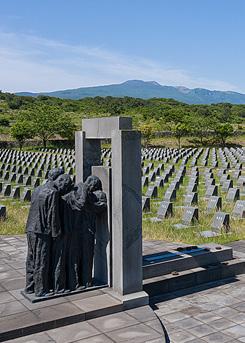
Cover Photo
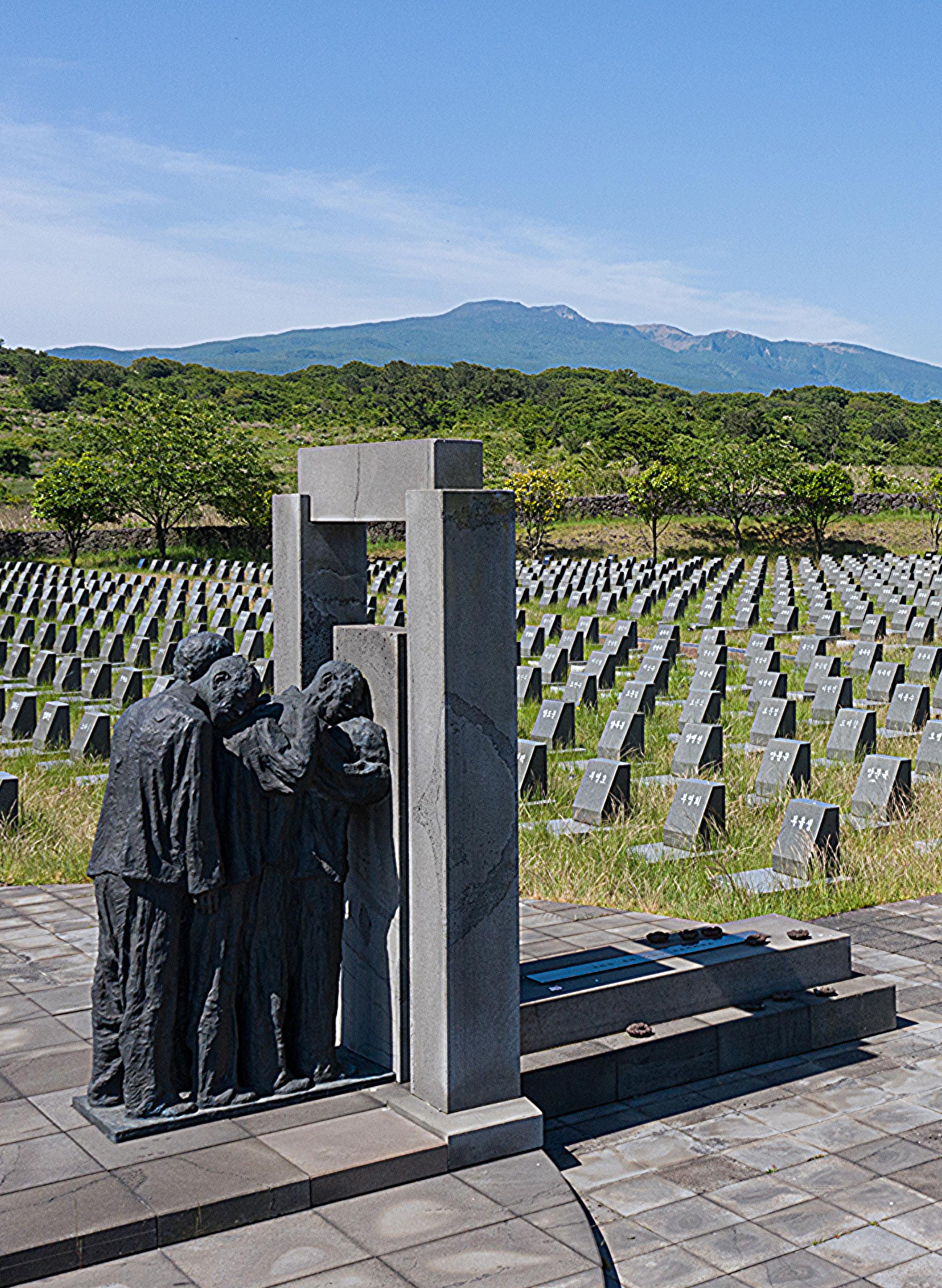
Jeju 4.3 Peace Park
Courtesy of the Jeju 4.3 Peace Foundation.
Publisher Dr. Shin Gyonggu
Editor-in-Chief & Copy-Editing
Dr. David E. Shaffer
Layout Editor & Online Editor Johanna Lezada
The Gwangju News is the first English monthly magazine for the general public in Korea, first published in 2001. Each monthly issue covers local and regional issues, with a focus on the roles and activities of the international residents and local English-speaking communities.
Copyright ©2026 by the Gwangju International Center. All rights reserved. No part of this publication covered by this copyright may be reproduced in any form or by any means –graphic, electronic, mechanical, photocopying, recording, or otherwise – without the written consent of the publisher.
The Gwangju News is published by the Gwangju International Center: Jungang-ro 196-beon-gil 5 (Geumnam-ro 3-ga), Dong-gu, Gwangju 61475, South Korea
Tel: (+82)-62-226-2733
Fax: (+82)-62-226-2731
Website: www.gwangjunewsgic.com
Email: gwangjunews@gic.or.kr
Registration No 광주광역시 라 00145
ISSN 2093-5315
Registration Date: February 22, 2010
The Gwangju News is co-sponsored by Asian Legal Resource Centre (ALRC) Korea

April – the thought of this month evokes such pleasant emotions. The warmth of spring. Sunny skies. Picnics, excursions, cheery cherry blossoms, dancing hearts. April fills us with joy, exuberance, gaiety. But there is a darker side to Korea’s April, one that has long been left unspoken. Though dates such as 3.1, 5.18, and 12.12 are instantly recognizable to residents of Korea, 4.3 is not, even though it became a national observance over a decade ago and even though tens of thousands of Koreans lost their lives. This was the April 3 Jeju Incident of the late 1940s and early 1950s. The massacre reduced the island’s population by ten percent and affected every Jeju family in some manner.
This month’s featured topic, the April 3 Jeju Incident, foregrounds an article by a Jeju resident whose family was adversely impacted by “4.3.” It is sure to also impact you, leaving you wondering how such mass killings could have been silenced for so long [see Korea in Focus, p. 9].
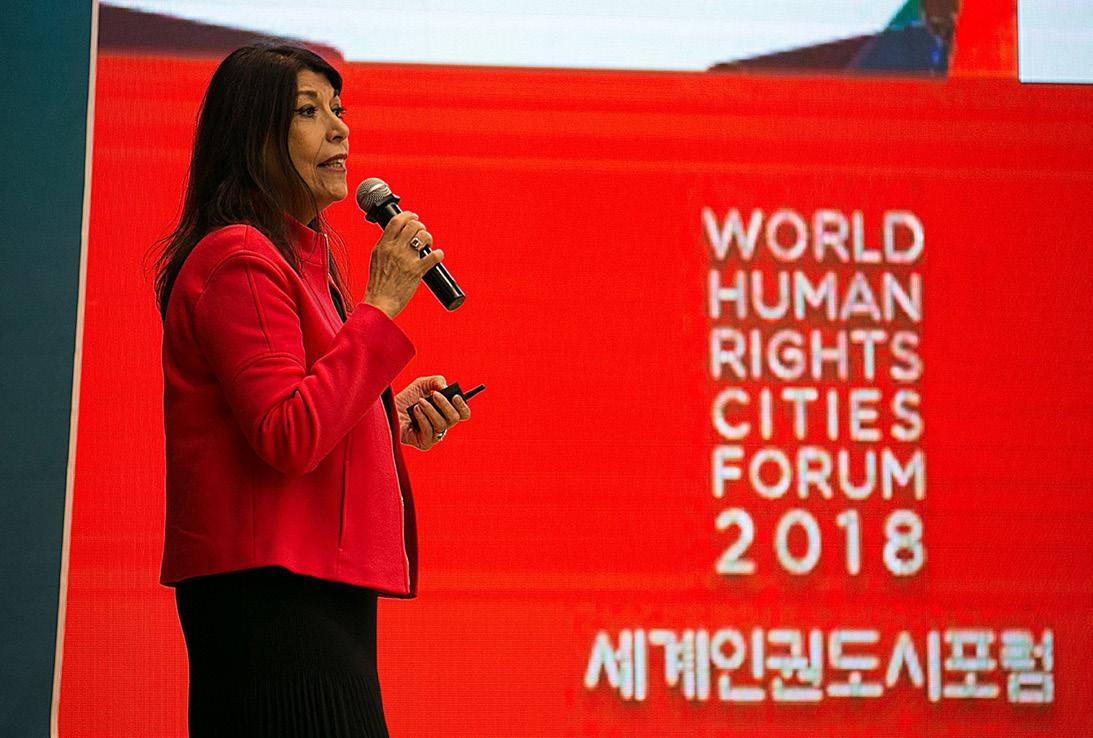
Our Human Rights section features two superb articles: One introduces the annual World Human Rights Cities Forum (WHRCF) that will be returning to Gwangju in May; the other highlights the launching of Yeolmae, the association of survivors of state sexual violence, who have been silenced for far too long.
In our History and Tradition section we bring you the story of a renowned Joseon era philosopher exiled to this area – Dasan, Jeong Yakyong – authored by an expert on this Neo-Confucian scholar. We also bring you a much older Korean story – the tale of an Indian princess arriving on the shore of the Gaya kingdom in 48 C.E. to wed its king!
April is the month of cherry blossoms. One expat writes of her stroll through the cherry blossom season, while another suggests outstanding things to do and cheery places to see other than just those featuring cherry blossoms. One of these destinations is the Shinan Tulip Festival, for which a third author details her trip to this island gala.
Our Science and Technology section is very much AI focused. One article deals with how AI threatens our privacy. Another alerts us to how AI-injected robots are converging with humans. And a third warns that we may now be witnessing the beginning of AI overtaking humanity!
This is but half of what the April Gwangju News has on offer! We hope you enjoy the 70-plus pages we have prepared for you this month!
David E. Shaffer Editor-in-Chief Gwangju
News

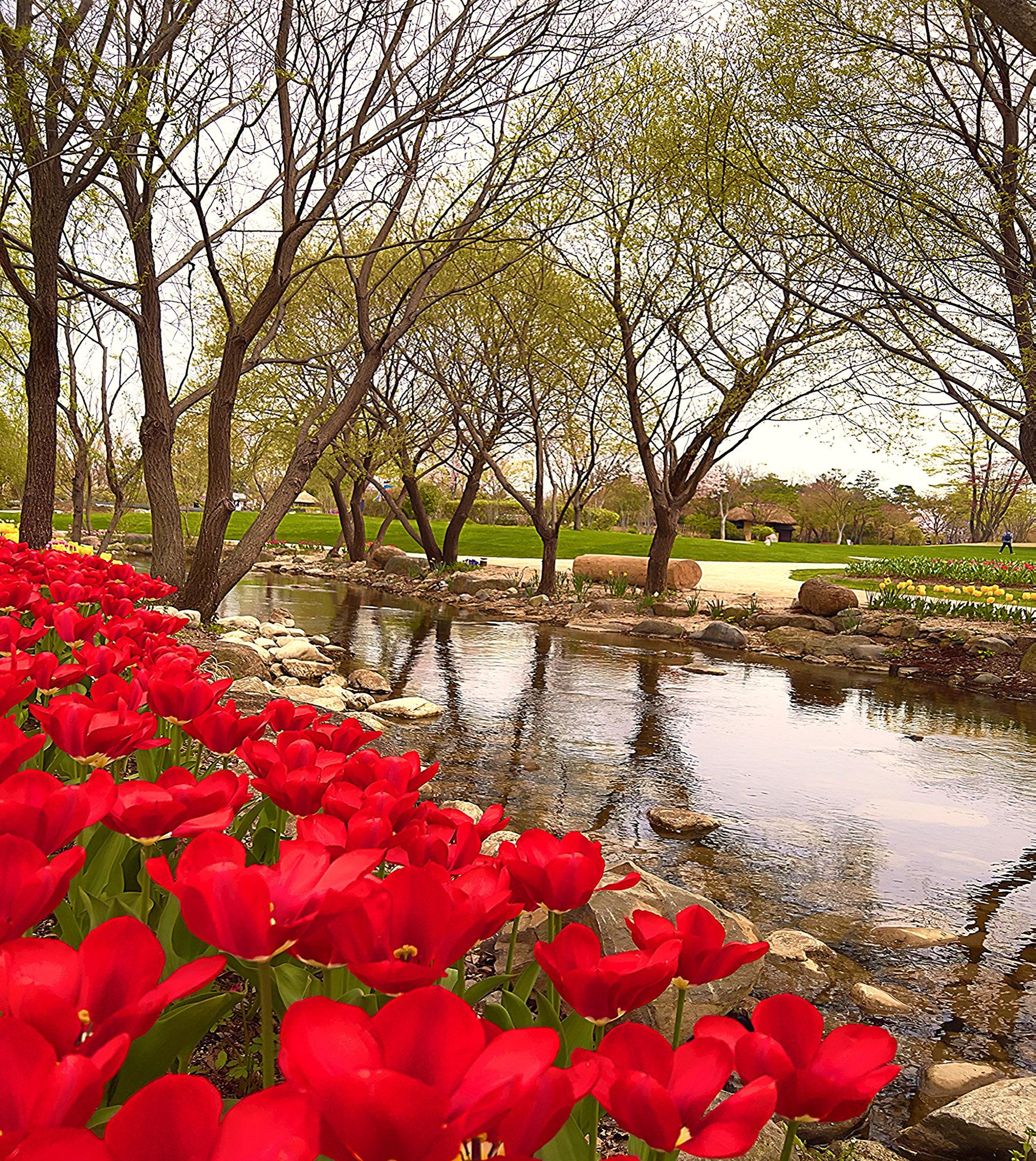
A gentle stream. Bright flowers. The mind, briefly at ease.

The Photographer
Shivani Kolekar, from the western part of India, is a doctoral student in the Department of Artificial Intelligence Convergence at Chonnam National University. While balancing graduate study and the ongoing experiment of making a good latte, she photographs small moments in nature that feel surprisingly certain.
Photo: Suncheon Bay National Garden, Jeollanam-do.
(Photo of the Month submissions are open to all readers: gwangjunews@gic.or.kr)
of the Month
Gwangju City News KOREA IN FOCUS 09 The April 3 Jeju Tragedy: Stories of Those Who Could Not Return HUMAN RIGHTS
14 Cities of Dignity: Human Rights Cities Forum Returns to Gwangju 17 Breaking the Silence: The Birth of Yeolmae
HISTORY & TRADITION 19 Dasan’s Hut: An Exiled Philosopher’s Gangjin Home 22 The Ancient India–Korea Connection: Two Civilizations Marry TRAVEL & DISCOVERY
Walking Through Cherry Blossom Season
Beyond Cherry Blossoms: UnderAppreciated Ways to Experience Spring in Korea
Exploring Korea: The Shinan Tulip Festival – Exploring the Colors of Spring
32 Friendship Cities: From Agreement to Action – Samarkand and Gwangju Cooperating Since 2023 35 Inside the Gwangju News: Professor, Researcher, Administrator –Park Nahm-Sheik OUR PLANET
38 When the Sea Rewrites the Season
SCIENCE & TECHNOLOGY
42 Privacy in the Dawn of AI: A Concept We Still Pretend to Understand
44 Artificial Intelligence Bots and Their Own World: Is This the Beginning of AI Overtaking Humanity?
47 Living with Robots: Heading Towards Human–Robot Convergence?
CULTURE & THE ARTS
49 Indian Artist Prasanta Sahu at Yeosu: The Archival Body and the Ethics of Presence
52 Essay: The Architecture of Rupture
54 Movie Review: Silenced – A Hearing of the Unheard
57 Book Review: The Island of Sea Women
FOOD & BEVERAGE
59 Coffee Shop Review: The Beauty of the Bagel – And Why I Go to Café Ileilo
61 Coffee Shop Review: Tradition Meets Night Out – TeaSoha in Dongmyeong-dong
63 D’s Café Column: Aesthetic April – A Quiet Cozy Café Around the Corner –Dear Moon
SPORTS & ENTERTAINMENT
64 Back To Stage: The Long-Awaited Return of Bangtan Sonyeondan
67 Sports Focus: Gwangju FC Keeps Lee Jung-hyo’s Football DNA
69 Area Sports Round-Up
71 April Upcoming Events
Photo Credit Jeju 4.3 Peace Foundation
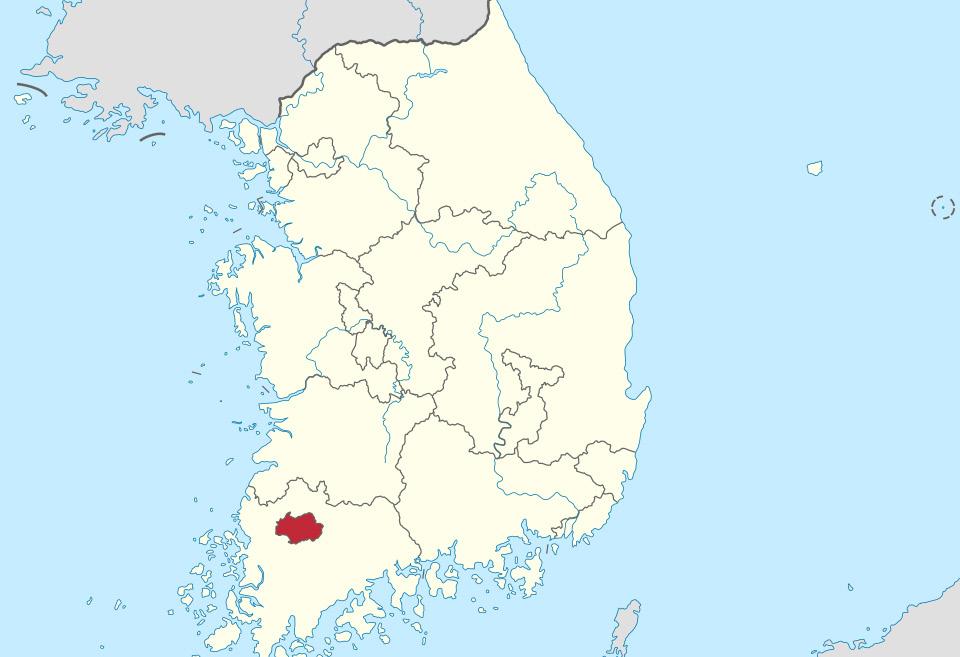
Exactly40 years after Gwangju was elevated to directly governed city status and separated from South Jeolla Province (aka Jeonnam) in 1986, Gwangju Metropolitan City and Jeonnam are merging into one. On March 1, the National Assembly passed the Special Act for the Establishment of the Jeonnam-Gwangju Integrated Special City at a plenary session –the first case of a metropolitan administrative merger in Korean history. The official name is Jeonnam-Gwangju Integrated Special City, with the short name Gwangju Special City. A massive special metropolitan city of 3.2 million residents will be born, with the main offices distributed across three locations: Gwangju, Muan, and Suncheon. On June 3, during local elections, the inaugural integrated special city mayor and integrated superintendent of education will be chosen in a single vote, with the city officially launching on July 1.

Gwangju Metropolitan City successfully secured 3.9497 trillion won in the 2026 national budget. This is an increase of 563.9 billion won (16.6%) compared to the previous year, more than double the overall government growth rate of 8.1%. Included are major SOC investments: 61.7 billion won for AI Mobility Pilot City development (a key element of the Future Vehicle Specialized City strategy), 167.2 billion won for electrification of the Gyeongjeon Line (Gwangju-Songjeong to Suncheon), and 66.8 billion won for the Gwangju–Gangjin Expressway.
In2026, Gwangju City’s flagship welfare program, Gwangju Dauum (True to Gwangju) Integrated Care, will significantly expand its eligible beneficiaries from those with median income up to 90% to 160%. The plan is to complete a universal welfare model in Gwangju ahead of its national rollout. The addition of pharmacist home-visit medication services is expected to fill gaps in the home medical care service network. Of Gwangju City’s 2027 main budget of 7.6823 trillion won, the welfare and care sector includes 7.43 billion won for community integrated care support, 12.29 billion won for Gwangju-style lifelong housing construction, and 2 billion won for birth family congratulatory Sangsaeng Cards.
The Jeonnam-Gwangju Integrated Special City is set to transform South Korea’s industrial landscape through semiconductors and AI. To reverse the reality of 8,000 young people leaving Gwangju and 4,000 leaving Jeonnam annually, industries capable of creating jobs for the young needed to be attracted.
At the end of last year, the 16.3 km of surface roads along Phase 1 of Gwangju Subway Line 2 (scheduled to open in late 2027) were largely opened after six years of restricted access. Of the City Hall–Gwangju Station segment (17 km total), and some remaining sections (687
m), including the Geumho District entrance and Baegun Plaza, are scheduled for phased opening through June. Nearby commercial districts are expected to regain vitality during the spring peak season. Aligned with April’s spring outing season, traditional markets and cultural streets along the route are anticipated to emerge as new spring destinations.
In conjunction with this reopening, Gwangju City has launched a comprehensive campaign to stimulate local consumption and support measures for small business owners along nearby streets affected by the subway construction during the prolonged construction phase. The city has invested a total of 11.9 billion won into these recovery efforts.
Gwangju Metropolitan City has completed Phase 1 of the Gwangju AI Hub City Project, pursued over the past five years, and will invest approximately 600 billion won from 2026 over the next five years to build an AI Transformation (AX) Demonstration Valley. The goal is to integrate AI into regional strategic industries such as mobility and energy, expanding AI services that citizens can experience in their daily lives.
Gwangju is also pursuing the establishment of a National Neural Processing Unit (NPU) Computing Center, designation as an AI regulation-free demonstration city, and attraction of a National AI Research Institute. This project – which aims to build an AI Innovation Space, concentrate 1,000 AI convergence companies, and create over 6,000 jobs – has been exempted from a preliminary feasibility study by the government, accelerating its progress.
Over the past five years, MOU agreements were signed with 352 companies, approximately
160 companies relocated their headquarters or branches to Gwangju, and 15 regional companies won 24 innovation awards at CES 2023–2026, including two Best Innovation Awards. LBS Tech won the Best Innovation Award at CES 2026.
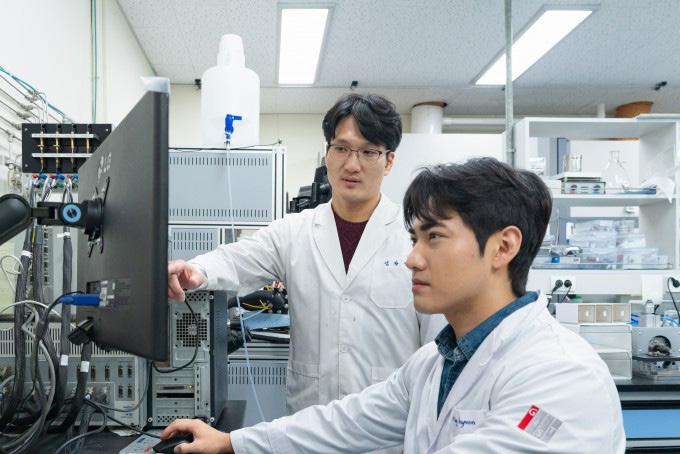
Prof. Eum Kwang-seop (left) and PhD student Lee Changhyun in their research institute laboratory. (GIST)
Aresearchteam led by Prof. Eum Kwangseop at the GIST Next-Generation Energy Research Institute developed a technology to form the anode interface of a lithium metal battery in just two minutes using an electrochemical pulse deposition process. This is evaluated as a step closer to commercializing next-generation highenergy batteries for electric vehicles (EVs) and energy storage systems (ESS). The technology also aligns with the AI and Energy Capital vision of the Jeonnam-Gwangju Integrated Special City.
Compiled by Amy Park.
Amy Park is a program officer for Asian Legal Resource Center (ALRC Korea) based in Gwangju. She helps build the organization’s foundation and supports new efforts in human rights advocacy and resource sharing.
By Shin Joseph Kanghyob
Several years ago, my maternal grandfather finally returned to Jeju. He came back as white ashes in an urn, having lived past the age of 100. My mother was born in 1945, the year of liberation, and was called a “liberation baby.” My mother, uncle, and grandmother rarely spoke of my grandfather, but piecing together the fragments of their stories, the circumstances were roughly as follows.
After the liberation of Korea from Japanese colonial rule, my grandfather sent his young son and two-year-old daughter ahead of him to Jeju from Japan, in the care of their mother. He planned to settle his personal affairs in Japan and follow his family, but an urgent message arrived from home telling him not to return to Jeju, explaining that if he came now, he would be killed. This was when the April 3 (4.3) Incident was just erupting. Burdened with many difficult circumstances thereafter, my grandfather was never able to return to Jeju, and he only came to rest in his homeland after the end of his life. Because of the 4.3 Incident, countless people of Jeju were forced to leave the island and could
not return. And many of those who did not leave even lost their lives.
At the time of liberation, under the U.S. Military Government, Jeju was experiencing extreme turmoil. People who had believed that everything would work out once independence came faced enormous suffering. The U.S. Military Government failed to accurately grasp the realities of Jeju, and as a result, the people of Jeju had to endure very difficult conditions. Immediately after liberation, Jeju was beset with severe unemployment among returnees; the criminalization of trade with Japan, cutting off remittances from the Japanese labor market; and shortages of essential goods. Then, as 1946 arrived, a cholera epidemic swept through the island, compounded by a severe barley crop failure. In 1947, approximately 3,000 young men who had returned to Jeju crossed back to Japan.¹ The difficult economic conditions stemming from the governance failures of the U.S. Military Government further deepened all manner of corruption and misconduct in society.
Politically, Jeju was mired in compounding chaos. In the immediate aftermath of liberation, various intellectuals in Jeju society worked to purge the remnants of pro-Japanese collaboration while seeking to improve the difficult lives of island residents. Though they held diverse ideologies, they appear to have been left-leaning and also holding strong nationalist tendencies. That said, the leftist forces in Jeju did not have close ties to the socialist movement on the Korean Peninsula. During the Daegu October Uprising, for example, Jeju did not join the socialist movement on the mainland. The Jeju left adopted an independent path and can be viewed as a political force that placed the lives of Jeju islanders more squarely at the center of their activities.
However, as the Second World War concluded, the fierce Cold War confrontation between left and right that was sweeping the globe took root in Jeju as well. The U.S. Military Government and right-wing forces that had seized control of the southern part of Korea were preoccupied with ideological conflict rather than purging
pro-Japanese collaborators, and as a result began to eradicate the leftists in extreme fashion. Tragically, this political purge was extraordinarily violent and deeply inhumane.
“Shoot on sight or arrest!’”
On March 1, 1947,² the March 1 Shooting Incident at Gwandeok-jeong became the fuse for the Jeju 4.3 Incident. During a demonstration by residents angered by difficult economic conditions and corruption, a child was knocked down by a police horse. When police opened fire on those protesting the incident, six people were killed and six were injured. When police opened fire again at the provincial hospital where the wounded had been taken, two more were seriously hurt. This incident deepened social conflict and became the starting point from which the situation escalated into what has come to be called the 4.3 Incident – when signal fires were lit in the hills on April 3, 1948.
One important fact about this shooting incident is that the police who fired were not local Jeju officers, but support police dispatched from the mainland. These support police had no understanding of or experience with the Jeju situation whatsoever, and it appears that they had perceived Jeju residents as radical leftist demonstrators, treating them as enemies. In the wake of this incident, resentment toward the U.S. Military Government grew. On the other hand, the right-wing forces had been acquiring political power in the Military Government and in South Korea. They mobilized the support of police forces and militia units, and they dispatched the so-called Northwest Youth Association, an extreme right-wing organization, to Jeju, where it carried out brutal massacres.
“Tragically, this political purge was extraordinarily violent and deeply inhumane.”
The propaganda slogan of the Northwest Youth Association at the time – “Crush the Communist Devils and Build a Unified Korea!” – clearly shows how intense the hatred and contempt for the opposing side had become. The deepening of the Cold War, the extreme left–right confrontation on the Korean Peninsula, and the extreme mutual hatred and contempt ultimately resulted in massacre. According to the government’s official investigative report, 14,442 people were killed; estimates put the figure between 30,000 and 80,000. Given that the population of Jeju was 280,000 in 1948, roughly two in ten, or three to four in ten, residents perished. According to the April 3 Investigative Report, a large number of the victims were killed by the military-police suppression forces (the “scorched earth” units).
At the time of the 4.3 Incident, the armed uprising forces – who took up arms due to the severe
pressure from the U.S. Military Government and right-wing regime – numbered only approximately 350 to 500 people. The extreme hatred and contempt for leftist forces, and the anti-peace Cold War born of war, gave rise to extreme confrontation and violence between people. While it also brought losses to both left and right ideologues, tragically it slaughtered surrounding innocent civilians many dozens of times over.
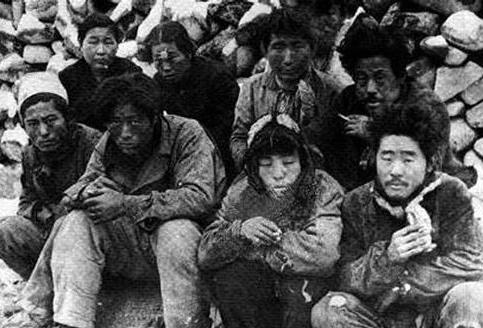
It is impossible to know exactly how my grandfather lived through that time, but in some ways, the life of a fugitive fleeing to survive may have been the luckiest choice available to ordinary people then. What became of those who were not even given that chance?
In fact, my wife was also recognized as a bereaved family member of the 4.3 Incident in 2023. Her hometown is Nohyeong-dong in Jeju City, the area with the greatest 4.3 damage in Jeju. Her grandfather was subjected to forced labor in Japan for two years, from 1943 to 1944. He returned to Jeju after liberation in 1945 and had a son. But when 4.3 erupted, on December 13 and then December 27 of that year, both he (the grandfather, then 24 years old) and his father
(the great-grandfather, then 46 years old) were dragged away by the suppression forces and killed. Almost simultaneously, her grandmother lost the husband who had returned with such difficulty from forced labor, and found herself bereft of her father-in-law as well. How did she endure those harsh years together with her young son? There was not a single person in Jeju who did not carry such grief.
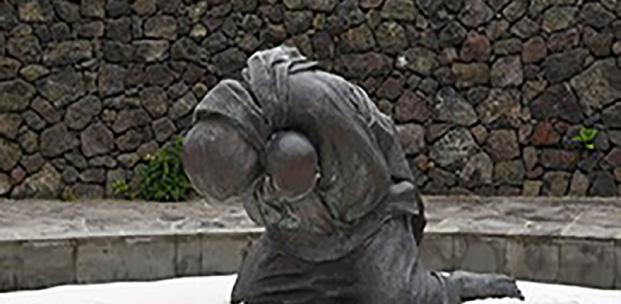
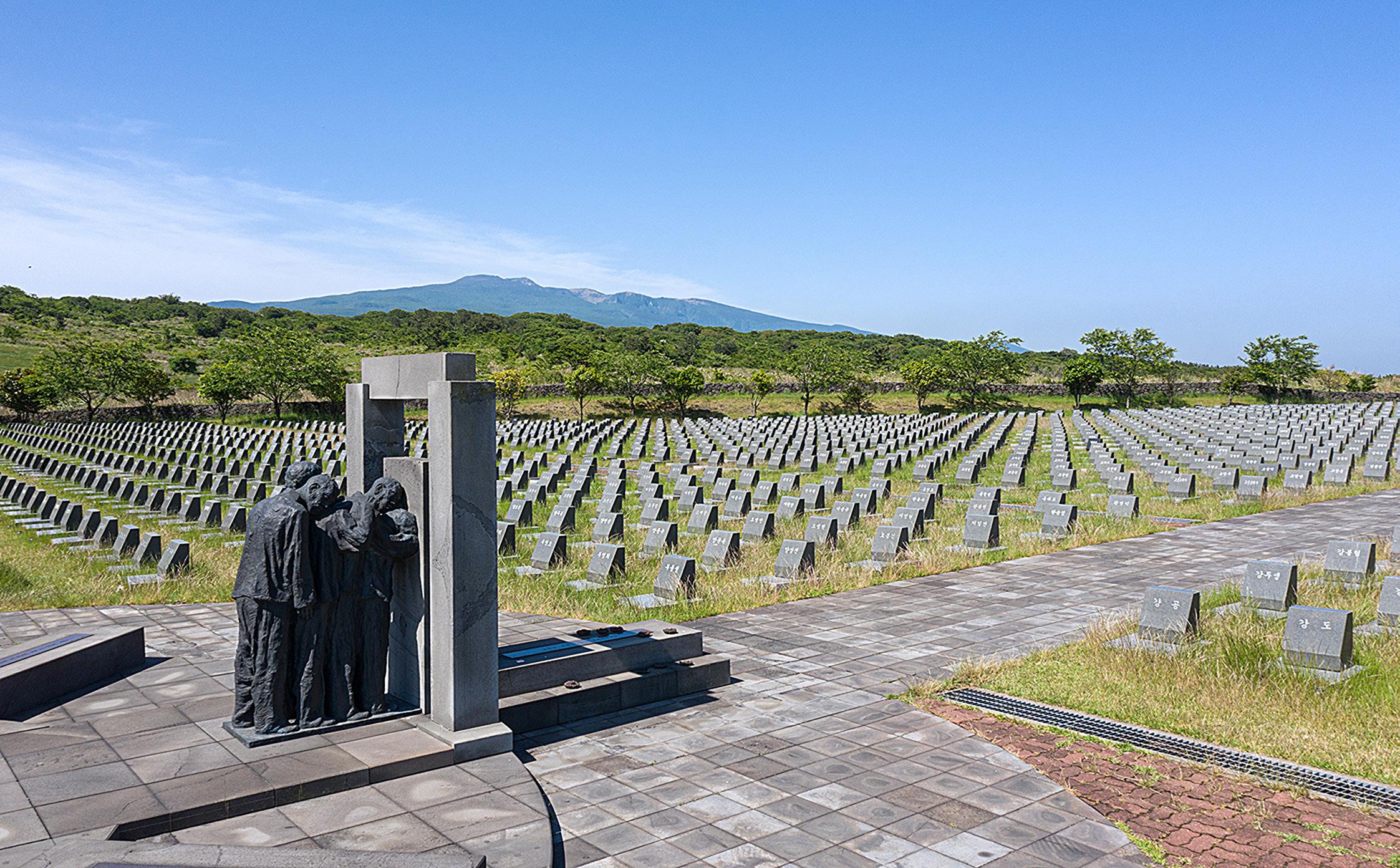
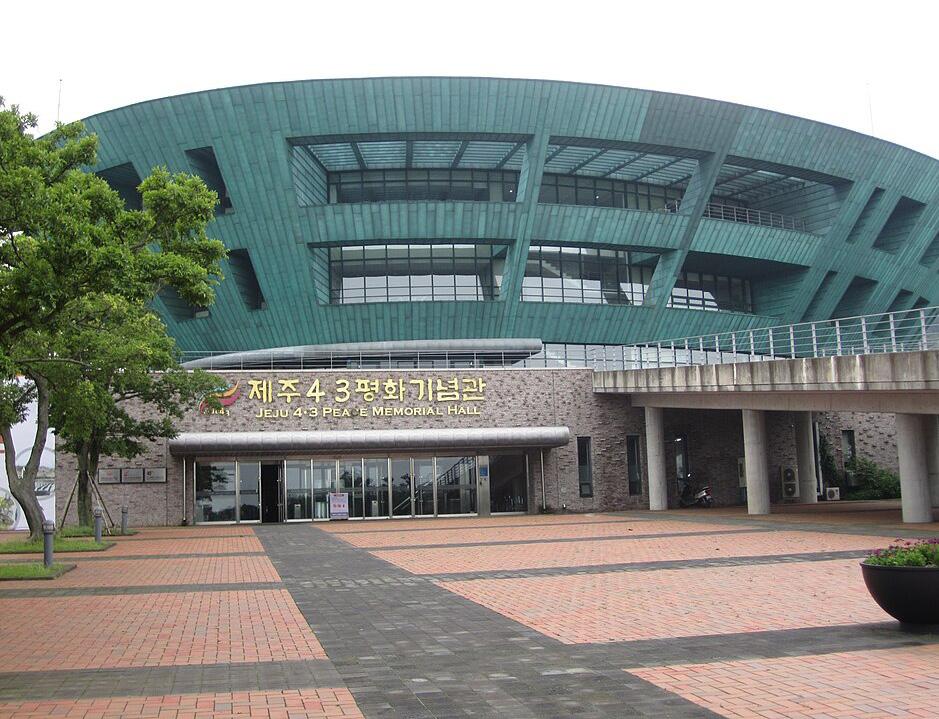
On January 6, 1949, during the military’s scorched-earth operation in the Bonggae-dong area of Jeju City, a 25-year-old mother named Byeon Byeong-saeng was shot and killed by suppression forces as she fled to the mountains with her nursing infant daughter. The mother and child were later found as bodies buried in a snowdrift. Based on this heartbreaking story, a memorial sculpture of mother and child titled “Biseol” (飛雪, falling snow) was installed at the Jeju April 3 Peace Park.
During the 4.3 Incident, the military-police suppression forces issued evacuation orders for residents of the mid-mountain areas and carried out scorched-earth operations. Residents in midmountain areas were unconditionally regarded as rebels and subjected to merciless operations: “Shot on sight or arrest.”
“There was not a single person in Jeju who did not carry such grief.”
An iconic example of the mercilessness of the operations of the military-police suppression forces’ is a woman in her 30s, who came to be known as “Grandmother Mumyeong-cheon.”³ She was shot by the suppression forces on January 12, 1949, losing her lower jaw, and was forced to live in pain for the rest of her life. The nickname “Grandmother Mumyeong-cheon” arose as she spent her life with her face wrapped in a plain
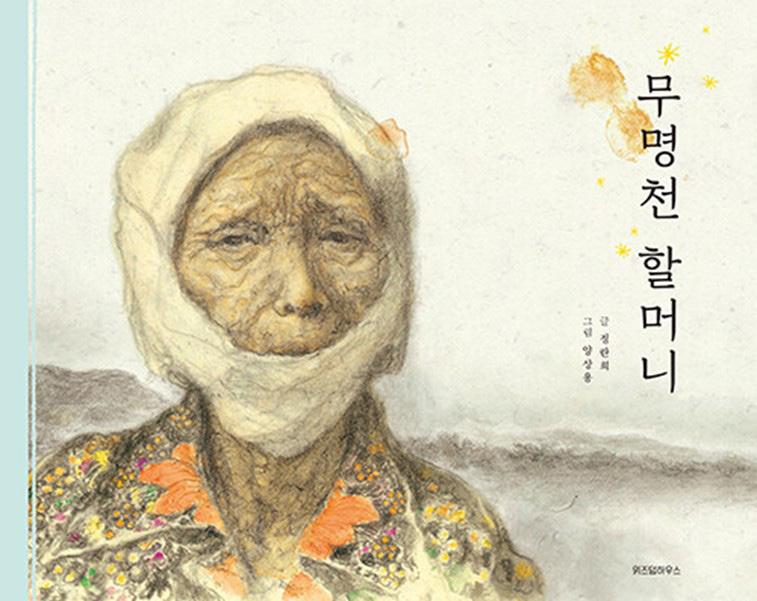
white cloth (mumyeong-cheon, in Korean), not wanting to show her disfigured appearance to others.
The left–right ideological confrontation devastatingly destroyed the lives of ordinary people who had nothing to do with ideology, forcing them to carry those terrible memories for the rest of their lives.
In 2019, a female university student shared the story of her grandmother at a 4.3 memorial ceremony. This is the story of Grandmother Kim Yeon-ok.
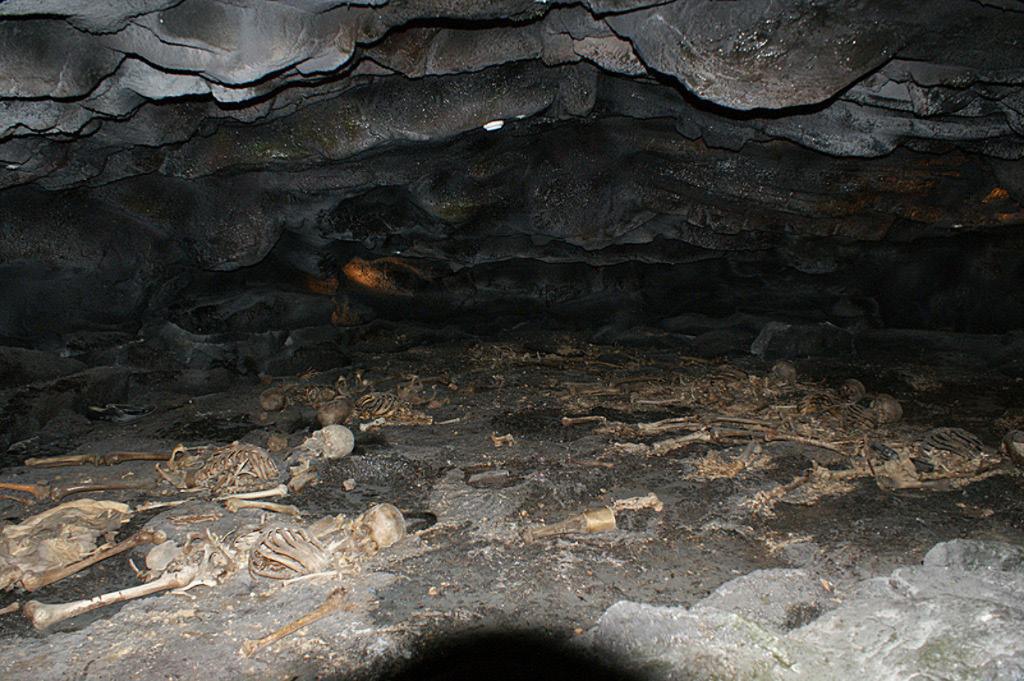
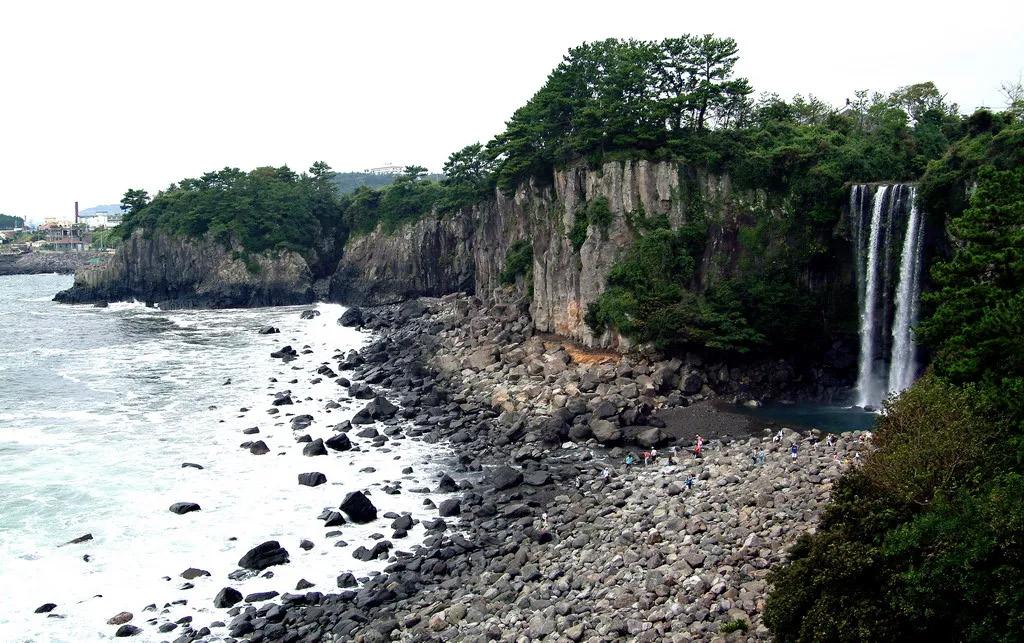
“In 1948, a seven-year-old child held her parents’ hands and fled the burning village, forced to hide in one cave then another every night. The snow had fallen heavily, and her bare feet were so cold. The place where she was finally caught was a detention camp near Jeongbang Falls in Seogwipo. She might have eaten one ball of rice. When she woke up from sleep, soldiers had taken away her grandfather, grandmother, father, mother, older brother, and baby younger brother.
And the child watched as her father, the last to be dragged away, was stomped on and beaten with clubs before her very eyes. The child wailed. At that moment, someone suddenly grabbed her and struck her head against a stone wall. She lost consciousness and didn’t know how much time had passed before she regained consciousness. The name of that child who woke up alone, and had survived, is Kim… Yeon… Ok.
“Grandmother would never eat fish. It was because she believed that her parents and siblings had all been swept into the sea and eaten by fish. From childhood, she endured and never ate even a single anchovy – a fact I only learned recently. I have only now come to understand Grandmother’s sea.”⁴
Jeongbang Falls, today a famous tourist destination on the southern Jeju coast, was the place where the bodies of those executed during 4.3 were thrown into the sea.
The Aftermath and the Road to Reconciliation
How can one even begin to imagine the pain and tragedy of those who lost their lives during 4.3 – and even those whose remains could not
be returned – and of the bereaved families left behind?
There were countless Jeju people who believed that when the war ended and liberation came, they would be freed from their harsh suffering and a peaceful world would return. But war and liberation did not bring peace. Instead, the ruthless lust for political power went beyond left–right ideological confrontation to breed extreme hatred and contempt for the other side, creating a bizarre history in which even inhumane slaughter was justified.
“Politically, Jeju was mired in compounding chaos.”
Cho Byeong-ok, who served as director of the U.S. Military Government's police bureau (equivalent to today’s Commissioner General of the National Police Agency) during the 4.3 period, declared that “the people of Jeju are ideologically unsound, and if they hinder nation-building, they can be swept away entirely.” He became one of the key perpetrators driving the Jeju scorched-earth
operations. Such hostile perceptions caused the 4.3 victims to be regarded as public enemies of society for 57 years.
“The left–right ideological confrontation devastatingly destroyed the lives of ordinary people who had nothing to do with ideology.”
In 2005, fifty-seven years after the 4.3 Incident, the South Korean government officially apologized for state violence in the 4.3 Jeju Incident, declared Jeju an “Island of Peace,” published an investigative report, and has been making efforts toward recovery for victims. However, 4.3 remains trapped in left–right ideological debate, the full truth has not been established, and tombstones for 4.3 victims still stand with nothing written on them.
As a descendant, I feel a quiet relief that my maternal grandfather, at least, returned – even if only as ashes. But when I remember those who
were not even given that choice, who could not return even in death, and when I hear the sad stories of my wife’s family, my heart grows heavy. And yet there are still those who, through left–right ideological debate, insult even the act of mourning the souls of the dead – which only compounds the grief.
For the sake of true reconciliation, must we not continue the work of establishing historical justice – uncovering the unresolved truths of the 4.3 Incident? I believe that only through our unceasing remembrance, and our commitment to pursuing historical truth and peace, will the 4.3 Incident finally be properly named⁵ and bring forth peace.

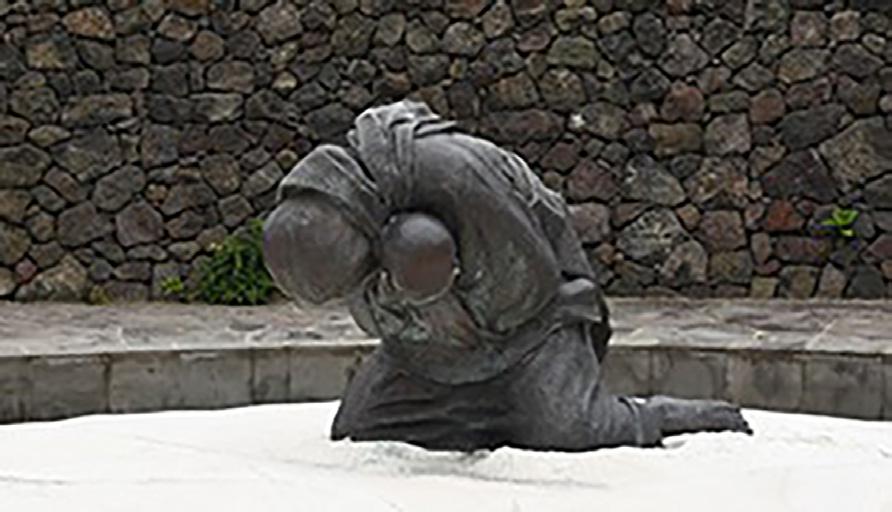
Biseol, sculture of a dying mother with her child at Jeju April 3 Peace Park. (Jeju 4.3 Peace Foundation)
Endnotes
¹ Cited from the Jeju 4.3 Incident Investigative Report.
² March 1 was the anniversary of the March 1st Independence Movement of 1919. Today, March 1 is a national holiday. ³ Real name: Jin A-yeong (1914–2004).
4 Lee, D. (2019, April 3). 4.3 71주년, 어느 여대생이 평화공원
사연 [The 71st anniversary of April 3: The story of a female college student who filled Peace Park with tears]. Jeju Sori. https://www.jejusori. net/news/articleView.html?idxno=301309
5 The debate over how to properly name the 4.3 Incident still remains a burning issue.
The Author
Shin Joseph Kanghyob is a Jeju-based human rights activist who serves as the director and senior archivist of the Jeju Peace and Human Rights Research Institute “WHAT.”
By Luis Andrés
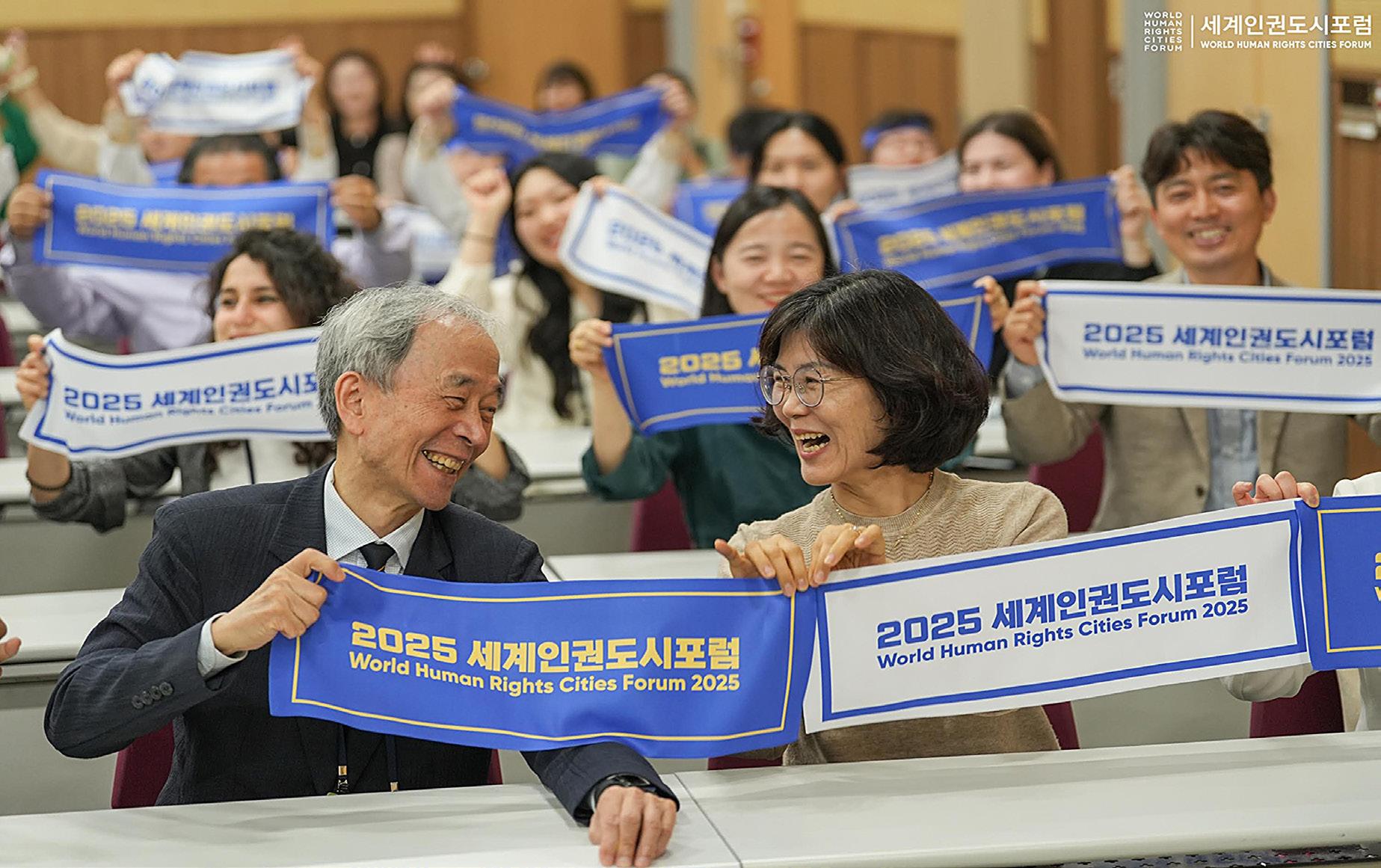
As May approaches, Gwangju prepares for the most meaningful month on the city’s calendar. May is when we remember the May 18 Democratic Uprising, when ordinary citizens stood up for democracy, dignity, and human rights in 1980. What began as a local movement against authoritarian rule eventually became one of the defining moments in Korea’s democratic history.
Today, May in Gwangju is not only about remembering the past; it is also about reflecting on the present and imagining the future. Throughout the month, the city hosts commemorations, exhibitions, academic discussions, and cultural events that explore the meaning of democracy and human rights in our time. Among these events,
one of the most internationally significant is the World Human Rights Cities Forum (WHRCF).
Since 2011, Gwangju has hosted this global gathering where activists, academics, survivors, policymakers, and members of civil society come together to discuss how human rights can be protected and promoted at the local level. In many ways, the forum is a meeting point for people who believe that democracy does not only live in constitutions or national politics but also in the everyday life of cities.
The concept at the center of the forum is that of “human rights cities.” These are cities that commit themselves to implementing the principles of the Universal Declaration of Human Rights through
local governance. That may sound abstract, but in practice, it means developing policies that protect dignity, equality, participation, and inclusion in areas such as housing, education, urban planning, and public services.
The idea gained global recognition in 2011, when the first forum took place in Gwangju and the Gwangju Declaration on Human Rights Cities was adopted. The declaration encouraged cities around the world to incorporate human rights principles into municipal governance and highlighted the responsibility of local governments in protecting the dignity of their citizens. Since then, the forum has grown into one of the most important international spaces for dialogue on human rights at the urban level.
Over the years, the WHRCF has welcomed participants from dozens of countries and institutions. Local government leaders, international organizations, universities, and civil society groups gather annually to exchange
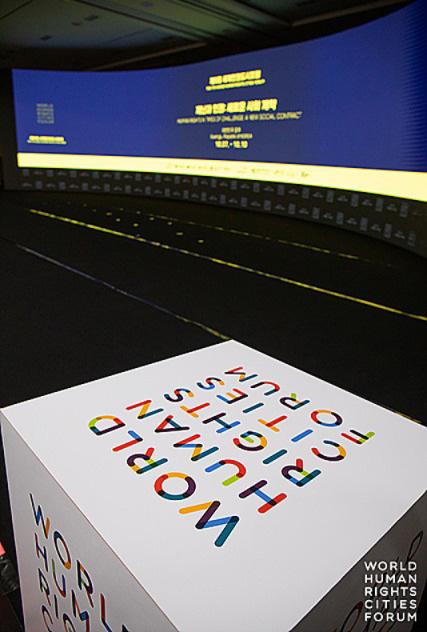
experiences and discuss emerging challenges. The forum has also attracted prominent international figures, including former Chilean president and former United Nations High Commissioner for Human Rights Michelle Bachelet, who participated while serving at the UN.
The diversity of participants reflects the growing recognition that cities play an increasingly important role in advancing human rights. Several municipalities around the world have begun identifying themselves as human rights cities, including Madrid in Spain, Nuremberg in Germany, Rosario in Argentina, Bandung in Indonesia, and Timbuktu in Mali.
Cities constantly face new challenges: migration, inequality, discrimination, climate change, and political polarization. Urban life is dynamic, and so is the understanding of rights. New social realities emerge, new voices demand recognition, and new policy approaches become necessary. That is precisely why spaces like the World Human Rights Cities Forum remain so important.
Gwangju itself is often presented as a model human rights city because of its democratic legacy. But like any city, it is also a place that continues to learn. Issues such as discrimination based on gender or sexual orientation, xenophobia, and racism remind us that building a truly inclusive society is never a finished project. Trust me, as someone who has lived here long enough, I have seen both the inspiring moments and the uncomfortable ones.
Yet this is precisely what makes the forum meaningful. The WHRCF is not only a stage where cities celebrate their achievements; it is also a space where they reflect on their shortcomings and exchange ideas on how to do better.
Over the years, the forum has addressed a wide range of themes, from the right to the city and social inclusion to climate justice and sustainable development. Each edition reflects the challenges that cities are facing at a particular moment in time.
This year’s theme may be one of the most timely yet: “Human Rights Cities Against Authoritarianism and Populism.” For decades, discussions about authoritarianism and populism often referred to regimes that openly rejected democratic institutions. These were usually associated with military dictatorships or political systems where elections, separation of powers, and civil liberties were openly suppressed. In that framework, authoritarianism was understood as the opposite of democracy. Today, however, the political landscape is far more complicated.
Around the world, political movements have emerged that operate within democratic institutions while simultaneously weakening them. Elections continue to take place, constitutions remain formally intact, and parliaments still meet. Yet the spirit of democratic governance can erode in subtler ways: Independent institutions are delegitimized, political opponents are framed as enemies, and minority groups are portrayed as threats to national identity.
In this sense, the traditional categories of populism and authoritarianism no longer fully capture what is happening in many parts of the world. What we increasingly see are hybrid political environments where democratic procedures coexist with growing pressures on pluralism, minority rights, and civil liberties. In such a context, cities play an especially important role.
Local governments are often closer to the everyday experiences of citizens and, therefore, have the ability to respond to social tensions in practical ways. Through urban policies that promote inclusion, protect vulnerable communities, and encourage civic participation, cities can act as laboratories for democratic resilience.
Gwangju itself is a powerful reminder that democratic transformation can begin at the local level. The events of May 1980 showed how civic courage within a city can inspire a broader democratic awakening.
Through education, community networks, public participation, and inclusive urban spaces, cities can resist division and help rebuild the social fabric. When communities work together to protect dignity and equality, they strengthen democracy from the ground up.
At a time when the global political climate often feels uncertain, the World Human Rights Cities Forum offers an important reminder: Democracy cannot exist without respect for human dignity. No political or economic objective should justify ignoring the rights of others – whether within our borders or beyond them.
In Gwangju, the spirit of May continues to remind us that defending human rights is not only a political commitment. It is also a shared responsibility among citizens, communities, and cities across the world.

Luis Andrés González is a Mexican GKS scholar and master’s student in cultural anthropology at Chonnam National University. He advocates for LGBTQ+ rights and gender equality, and explores global affairs through pop culture. He is the founder of Erreizando, a digital magazine. Instagram: @luisin97 / @erreizando
Photographs courtesy of WHRCF.
By Jay Lee
Forty-five years after the Gwangju Uprising, survivors of sexual violence perpetrated by martial law forces have reclaimed their names and stepped into the limelight in their long fight for justice as survivors of state sexual violence.
On February 26, 2026, a quiet but historic announcement emerged from Gwangju, South Korea. Survivors of sexual violence committed by martial law forces during the May 18 Democratic Uprising of 1980 formally established themselves as a nonprofit civic organization. They chose the name “Yeolmae” – a Korean word meaning “fruit,” symbolizing the bearing of fruit after a long season of growth.
For 45 years, the pain they carried had no public name. In May 1980, as Gwangju burned with the desire for democracy, unspeakable human rights violations were committed in dark interrogation rooms and military-occupied zones.
Lee Jeong-sun (pseudonym), then 23 years old, was apprehended on Geumnam-ro on her way home from work and subjected to sexual violence and sexual torture in the basement facilities of Sangmu and the Defense Security Command. Kim Min-sook (pseudonym), three months pregnant at the time, was forced to undress and was sexually assaulted by martial law soldiers. They were neither protest leaders nor armed combatants. They were ordinary women living ordinary lives – and yet the machinery of state violence found them at their most vulnerable and shattered their inner world.
For 45 years, these survivors had no choice but to remain silent. A patriarchal social culture that
treated sexual violence as the victim’s “shame,” combined with the terror of the perpetrators being the state itself, erected an enormous wall of suppression. They hid as if they were the ones who had committed a crime, unable to speak even to their own families.
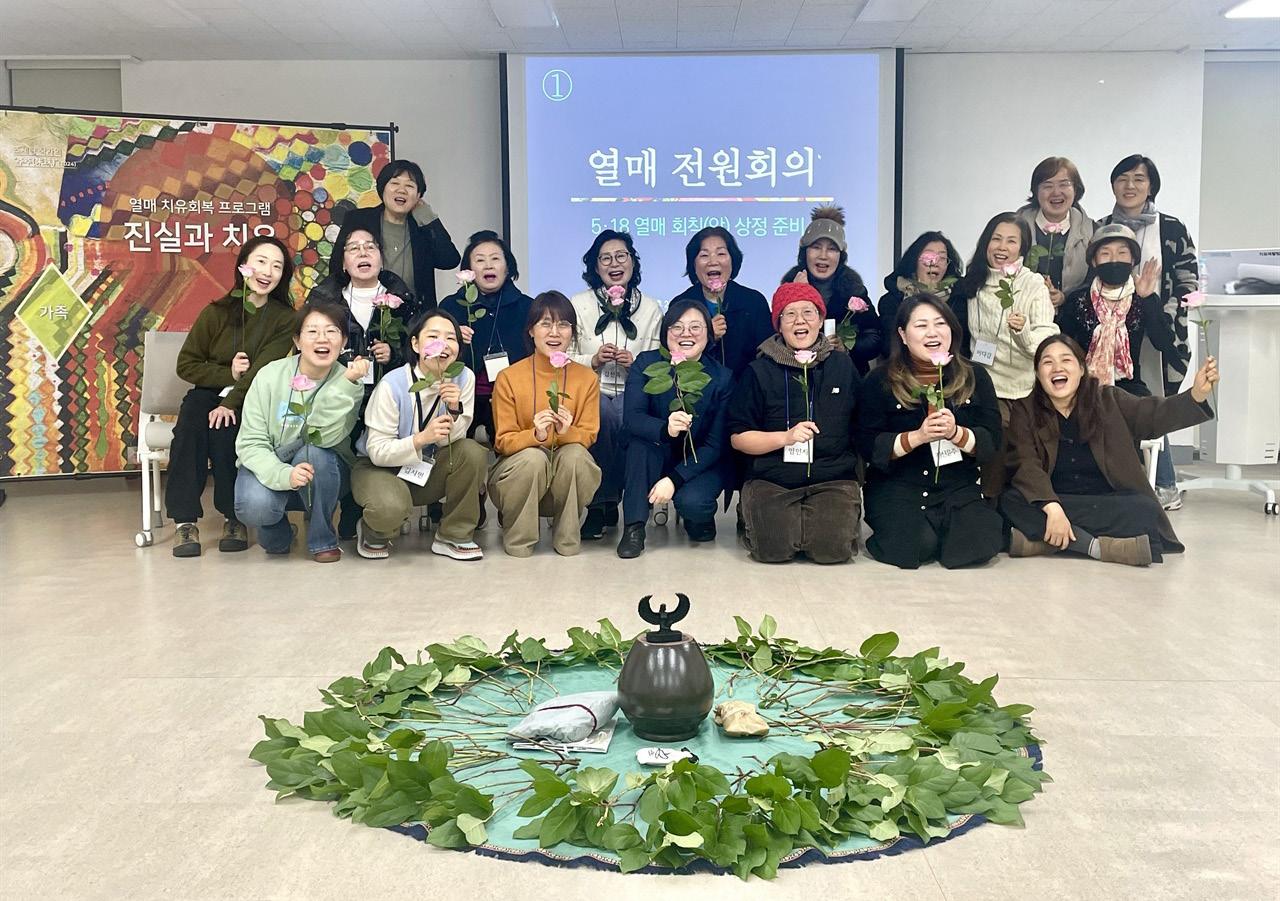
The turning point came in 2018. The #MeToo Movement that swept the nation sent these survivors a message they had never before received: “It was not your fault.” That same year, Kim Seon-ok, who had participated in the May 18 Uprising, made the first courageous public testimony, triggering a joint investigation by the National Human Rights Commission of Korea and the Ministry of National Defense. By February 2026, what had begun as a quiet support group had grown into a formal organization ready to face the world under the name “Yeolmae.”
Many survivors confess that life after the violence was more agonizing than the violence itself. The cold glances that questioned whether they had “maintained their chastity” and the rejection of
their own families drove them into profound social isolation. In the 1980s and 1990s, with no support systems in place, they bore the weight of trauma-induced depression and physical illness entirely alone.
Even as South Korean society celebrated the heroism of the May 18 Uprising, the wounds of these women were treated as “shameful records” that had to be concealed. Their suffering was erased from the very history their suffering helped create.
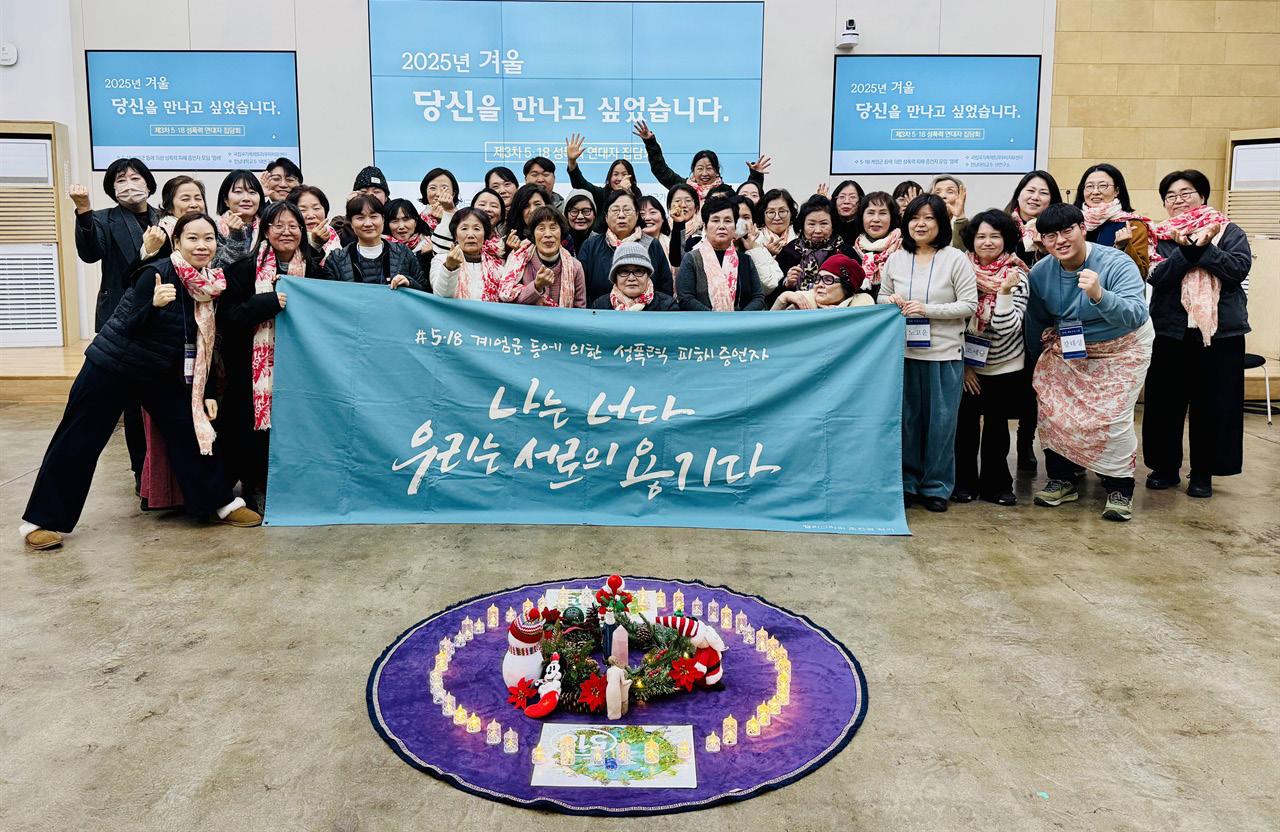
The 3rd roundtable on December 12, 2025, marked a pivotal turning point for Yeolmae, transforming it from an informal group into a formal organization dedicated to the “truth and healing of historical gender violence.” (Yeolmae)
That a state, rather than protecting its citizens, deployed sexual violence as a tool of torture is among the most brutal crimes imaginable – a fundamental desecration of human dignity. Sexual violence is not merely personal harm; it is a form of social murder that dismantles the self and severs the individual from their community.
The founding of Yeolmae is therefore not simply the establishment of a survivors’ group. It is the birth of human rights itself – a formal process of documenting state-perpetrated gender violence, demanding official apology and reparation, and putting in place the mechanisms needed to correct a distorted past and prevent its recurrence.
Korea’s modern history is shadowed by repeated episodes of sexual violence wielded as an
instrument of power: The “comfort women” system under Japanese imperial rule, the mass sexual violence that occurred during and after the Yeosu-Suncheon Incident, the Jeju April 3rd Massacre, the Korean War, and the military dictatorship era. Countless survivors of these events remain trapped in enforced silence. Yeolmae’s emergence stands as a beacon of courage for them all.
The significance is equally powerful on the international scale. In countries across Asia –such as Myanmar and Afghanistan – where sexual violence by state and military actors continues amid democratic struggles and armed conflict, Gwangju’s Yeolmae stands as a symbol of solidarity and resistance. Survivors who refuse to remain passive victims, choosing instead to become agents of change, offer one of the most powerful models of healing the world has ever seen.
The Yeolmae movement, rooted in Gwangju and the legacy of May 18, must continue to grow. The organization plans to lead public testimonies on gender-based violence, documentation projects, and efforts to uncover the full truth of “pastera gender violence” – a framework expansive enough to include male survivors and LGBTQ+ victims as well.
The Gwangju community must now stop referring to these individuals solely as “victims” and begin honoring them as human rights activists – people who have transformed the most painful wounds of our era into an energy of healing.
The Author Jay Lee, director of ALRC Korea, is a Gwangju Uprising survivor and co-author of the UNESCO-listed Gwangju Diary For 46 years, he has documented the truth as a researcher and activist to advance democratic values.
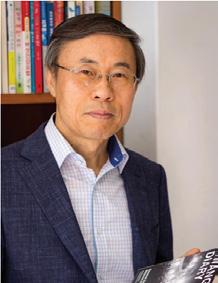
By Don Baker
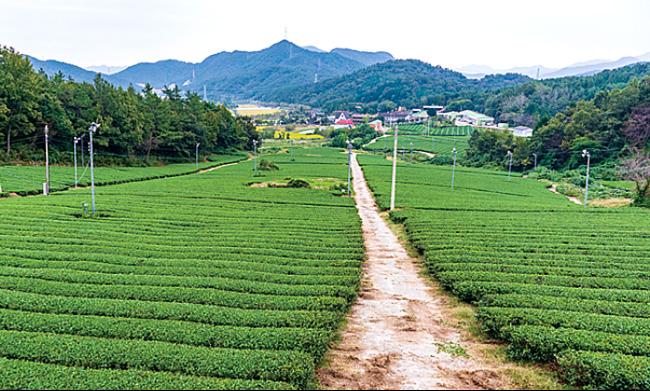
About an hour south of Gwangju, on Jeonnam’s southern coast, you can find the small county of Gangjin. For such a small county, with a population of only around 32,000, there is a lot for those interested in Korean history and culture to see there. For example, around 900 to 600 years ago, Gangjin was a major site for the creation of the famous celadon pottery of the Goryeo Dynasty, with its unique inlaid designs. There is now a celadon museum on a site where many of the kilns that produced those works of art were located. Some of Gangjin’s celadon pottery was used for making and drinking tea. We can surmise that some of the tea thus enjoyed was the well-known green tea of Gangjin. To learn more about this tea and how it is grown, you can visit the Gangjin Tea Garden.
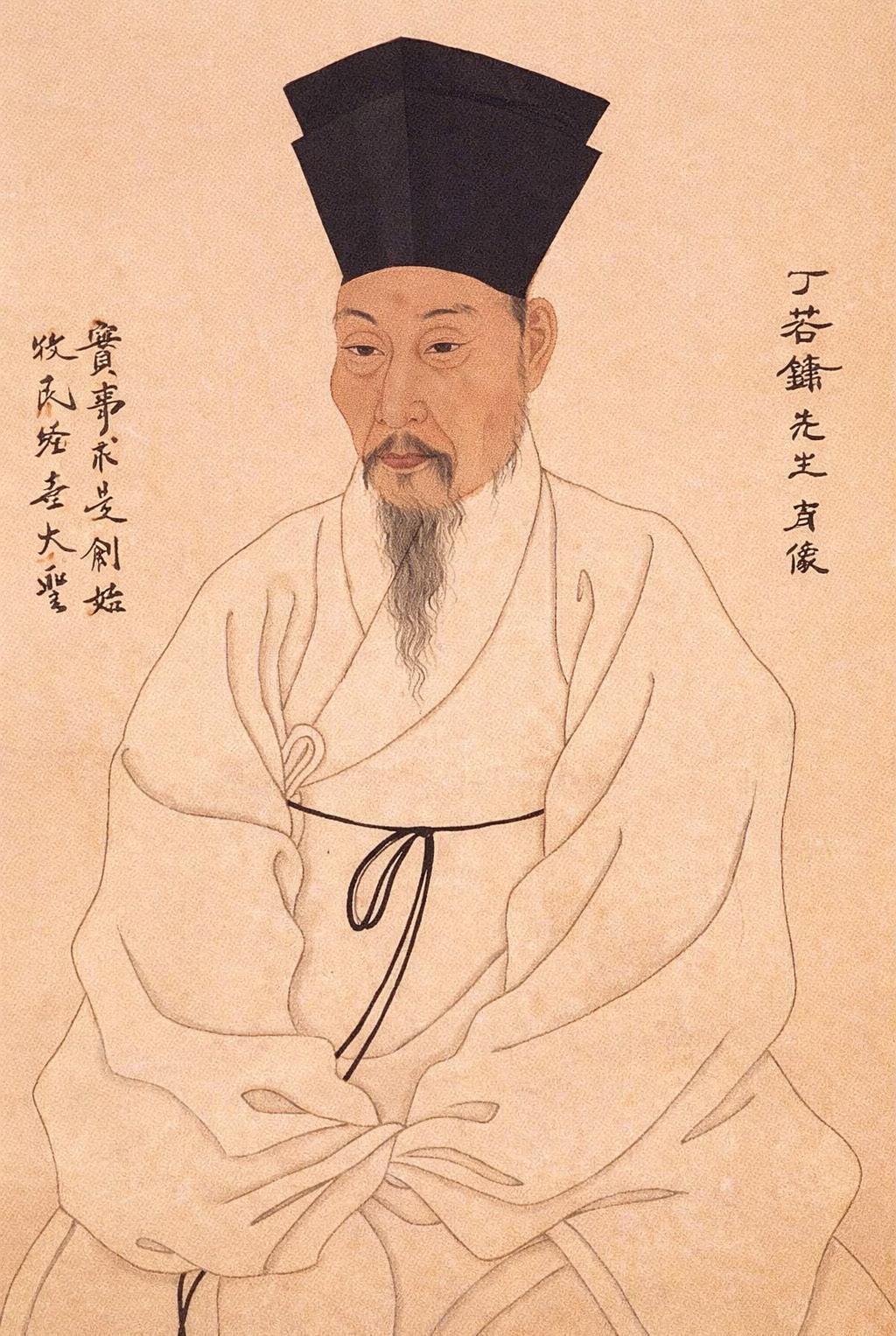
There is also a hill in Gangjin county, not far from the town of Gangjin, called Dasan (“Tea Mountain”). However, that hill is not known for its tea as much as it is for a man who enjoyed the tea grown there while he was in exile from Seoul over two centuries ago. That man is the famous Neo-Confucian scholar Jeong Yakyong (정약용, 1762–1826), better known by his pen name Dasan. If you have a chance to visit Gangjin, you can drop by Tea Mountain and see the reconstructed hut, called Dasan Chodang, where Dasan lived for most of the 18 years that he was in exile there. That is also where Dasan wrote most of the poems, essays, and books that have gained him recognition as not only the most prolific writer in all of Korean history but also one of the most creative.
Dasan’s Complete Works, in a recent definitive edition, fills 37 volumes. Everything in those
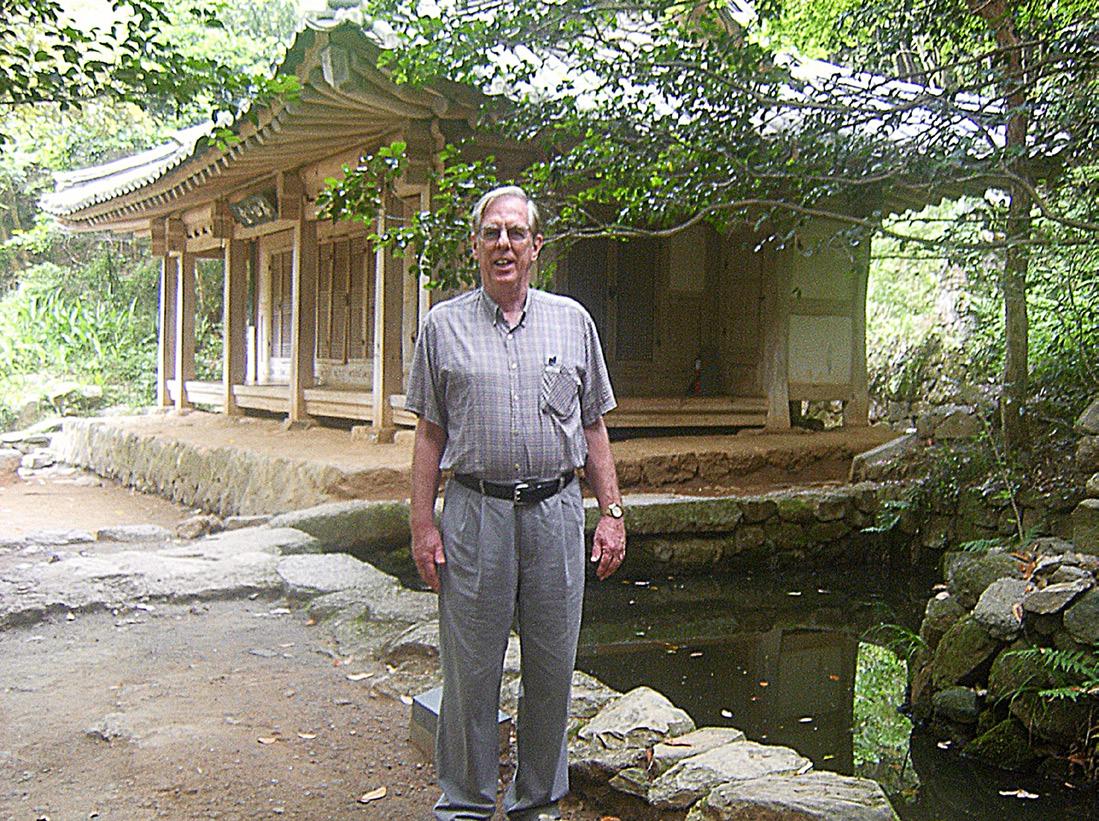
37 volumes, except for modern scholarly introductions, is in Classical Chinese. That was the language Dasan wrote in because he was a Confucian scholar, and Confucian scholars at that time considered the Korean script appropriate only for what they considered less respectable forms of writing such as fiction and letters to female family members.
However, despite what appears to us today to be a rather old-fashioned attitude toward what script to use, there is much in Dasan that merits our admiration. For a Confucian scholar, he had an unusually wide range of interests – and expertise. He was a poet and an architect, a philosopher and an engineer, and a guide to public administration as well as a medical researcher. Moreover, he had a practical bent, which makes him appear almost modern and is the reason Koreans today consider him the culmination of a practical learning trend in Joseon Confucianism.
Dasan’s architectural skills are visible today if you visit the Hwaseong Fortress in Suwon. Dasan designed it, at the request of King Jeongjo. He also showed there his talent for engineering by assembling pulleys and cranes to lift into place the large stones needed to build that fortress. His foray into medical research is not as easy to find. For evidence of that, you have to look at his Complete Works. There you will find his essay on measles and smallpox as well as his record of introducing from China a method of smallpox immunization unknown to Koreans before his time.
His other talents are more typical of a Joseon Confucian scholar. A Confucian scholar was expected to write a lot of poetry. That is why the collected works of Korean Confucian scholars normally begin with a volume or two of poems written in Classical Chinese. (Poems written in Korean would not be included in such a collection of respectable writings.) Nor would it be unusual for a Confucian scholar
to write on matters of politics and government administration. However, it was unusual to do as Dasan did and write one large manual for local government officials and another large manual for central government administration. Even more unusual is that he also produced a guide to forensic medicine, believing that it was important for officials to be able to distinguish between a natural death and one that was the result of foul play.
However, it is in his philosophical writings that his creativity shines the brightest. Though he remained a Confucian philosopher, he pushed against the boundaries of what Confucianism meant in 18th- and 19th-century Korea. He stripped away from the Confucianism of his day the metaphysical elements that had been added in China a few centuries earlier. Instead, he tried to uncover what he believed was the original moral message of Confucius and his immediate disciples. He did that by demoting li, often translated as “principle,” from its elevation to the primary force behind moral behavior down to nothing more than guidelines for acting appropriately. He insisted that moral behavior originated not from li stimulating human actions but instead in decisions human beings made to act in accordance with li, and then exerting the necessary effort to do so.
But that is not why he had to spend 18 years in exile in Gangjin, away from his family in Seoul and blocked from the official career in which he had once seemed to be a rising star. He was exiled because he was a founding member of the first Christian community on Korean soil. When he was in his 20s, he was drawn to books written by Catholic missionaries in China and imported into Korea before there were any missionaries there. As he later explained to his king, when he was trying to dismiss the importance of his involvement with Catholicism as a youthful indiscretion, he wrote,
“When I read Catholic writings, I was still a young man, barely out of my teens. Reading
books by Europeans was the popular thing to do at that time. … We all read those books back then and talked about them among ourselves in order to gain a reputation for being well-informed and well-read. As I was still young, all I really cared about was having others think that I was as bright as the best of them. That is why I joined the crowd that was reading such books and talking about them.”
However, in 1791, Korea’s small group of Catholics learned that Catholics were not allowed to use the spirit tablet essential to Confucian ancestor memorial services. That was a violation of the law that required the use of such tablets in those mandatory rituals. Dasan’s cousin, also a new Catholic, was executed that year when he held a funeral service for his mother without a spirit tablet. Catholicism had become an illegal religion. That was when Dasan decided to leave the beleaguered Catholic community.
However, when a major anti-Catholic persecution broke out in 1801, Dasan was arrested and then exiled for his involvement with that illegal religious community more than a decade earlier. That is how he ended up in Gangjin. No longer able to pursue a career as a civil servant, he turned to scholarship. Most of the writings in his Complete Works were penned in his hut over his 18 years in Gangjin. They include his interesting insertion of God, whom he called the Lord of High (a term taken from ancient Chinese classics), into Confucian philosophy, which normally doesn’t discuss supernatural beings. Revealing
some remnants of his early involvement with Catholicism, Dasan argued that the best way to be a good Confucian, one who acts in conformity with the strict Confucian moral principles, was to assume that the Lord on High is aware of one’s every thought and action. Dasan argued such as assumption would inspire him and others as well to exert the effort necessary to live a moral life.
A visit to Dasan’s hut, and to the nearby Dasan Museum, is well worth the trip for anyone who wants to learn more about Korea’s past and also show their respect for one of the most remarkable individuals in all of Korea’s long history. Enjoy some Gangjin tea while gaining some insight into life in Joseon Korea.
If you would like to learn more about Dasan, and two also remarkable brothers of his, you can watch Prof. Baker’s retirement lecture on YouTube.³
¹ Painting restoration by OpenAI.
² Photo credit: National Folk Museum, Folk News, 1-313.
³ The YouTube video lecture can be viewed at https://www. youtube.com/watch?v=u7OFHOqJDBM&t=500s
The Author
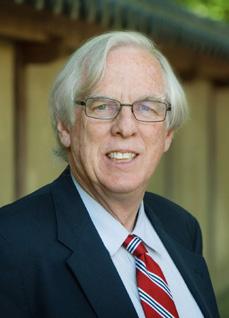
Don Baker taught English in Gwangju as a U.S. Peace Corps volunteer from 1971 to 1974. He later earned a PhD in Korean history from the University of Washington and has been teaching Korean history and culture at the University of British Columbia since 1987. One of Dr. Baker’s main academic interests is Dasan, and though he will retire at the end of this semester, he plans to continue studying this amazing Joseon period philosopher.
By Siddhant K.
The legend of King Suro and Queen Suriratna is more than a royal romance; it is the earliest chapter in the long, largely untold story of Korea and India’s shared past.
Somewhere in the first century of the Common Era, a young princess from a kingdom thought to be in ancient India stepped onto a boat and sailed east – not out of conquest, but, if the chronicles are to be believed, out of destiny. Her name was Heo Hwang-ok (허황옥), known also as Suriratna, meaning “beautiful jewel.” She arrived on the shores of the Gaya Confederacy on the Korean Peninsula and became the queen consort of King Suro, founder of the Geumgwan Gaya Kingdom. Together, they are said to have founded a dynasty whose lineage traces, through the Gimhae Kim and Gimhae Heo clans, to tens of millions of Koreans living today.
The story is recorded in the Samguk Yusa, a 13th-century compilation of Korean legends and historical accounts by the Buddhist monk Iryeon.¹ According to this text, Suriratna arrived in 48 CE aboard a red-sailed vessel carrying stone ballast, red clay, and a stone pagoda; artefacts whose origin has fascinated historians for centuries. The Samguk Yusa describes her homeland as “Ayuta,” a name that scholars have long associated with Ayodhya, the ancient city in present-day Uttar Pradesh, India, revered as the birthplace of the god Ram in Hindu tradition.
The Ayodhya Connection
The proposed link between Ayuta and Ayodhya has moved, in recent decades, from
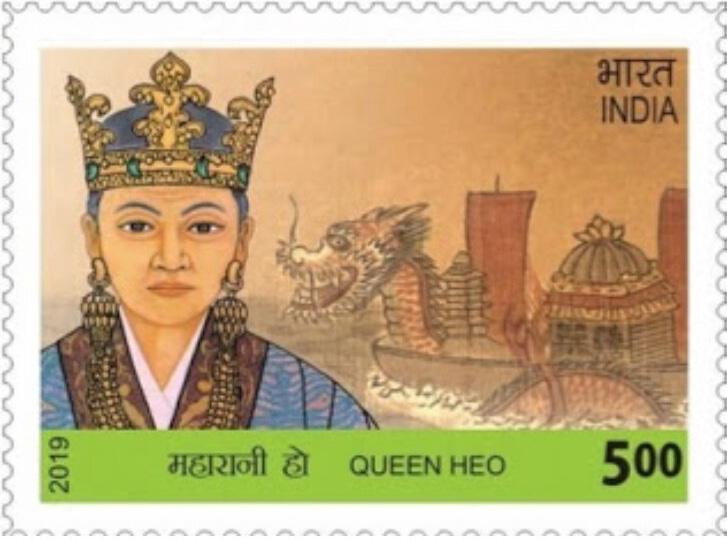
Indian postage stamp of Queen Heo Hwang-ok (Suriratna). (India Post, Government of India; GODL-India, 2019)
scholarly conjecture to something approaching institutional recognition. In 2001, the state government of Uttar Pradesh formally acknowledged the connection by erecting a monument to Queen Heo in Ayodhya. In 2019, South Korean First Lady Kim Jung-sook attended the inauguration of a memorial park dedicated to the queen in the same city, a diplomatic gesture remarkable for its evocation of a bond two millennia old.²
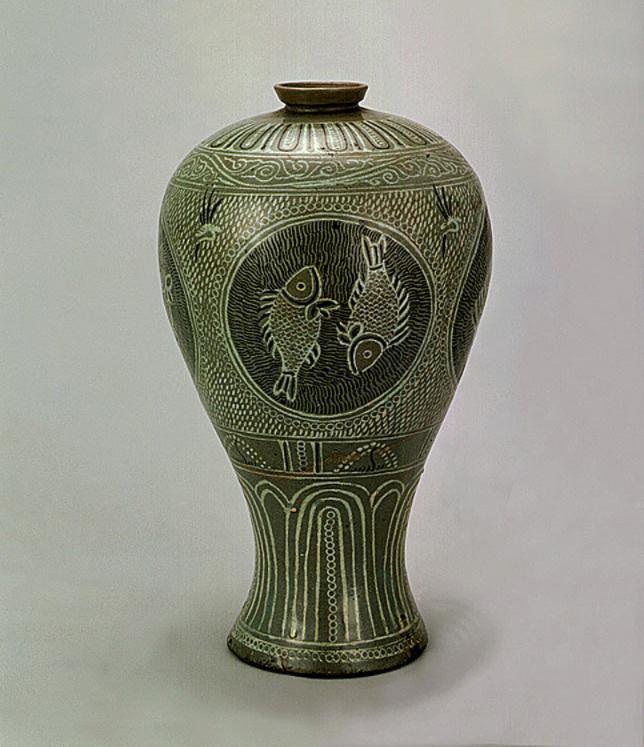
Korean scholars such as Kim Byung-mo have argued that the cultural and material evidence supports a real maritime link between southern India and the Korean peninsula in antiquity. The distinctive ssangeo-mun (twin fish) motif found in Gaya royal tombs closely resembles decorative
patterns on ancient artefacts from the Ayodhya region – a coincidence, or a memory carved in stone? The fish motif also appears on the Heo clan’s coat of arms, a symbol said to have been brought by the queen herself.³
Not all scholars are convinced. Some historians, including those affiliated with the Korean Studies Institute at Seoul National University, urge caution, noting that the Samguk Yusa was compiled more than a thousand years after the events it describes and that “Ayuta” may refer to a Southeast Asian polity, or may be a symbolic rather than geographic designation. The debate, productively unresolved, continues to animate both academic conferences and public imagination.²
Geumgwan Gaya, the kingdom that King Suro is said to have founded around 42 CE near presentday Gimhae in South Gyeongsang Province, occupied a peculiar and powerful position in the ancient world. Sitting at the junction of Korean, Chinese, and Japanese trade networks, it was among the foremost producers of iron in
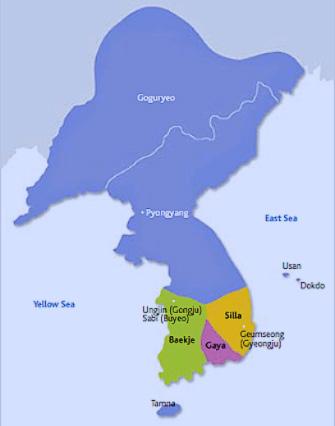
East Asia. Archaeological excavations at Gimhae have uncovered an extraordinary array of burial goods: iron armor, swords, glass beads of West Asian provenance, and fine pottery, suggesting a court that was cosmopolitan by the standards of any era.⁴
The Gaya Confederacy, of which Geumgwan Gaya (42–532 C.E.) was the pre-eminent citystate for several centuries, was eventually absorbed into the Silla Kingdom by the mid-sixth century. But its cultural legacy proved durable. The Gayageum, the twelve-stringed zither that remains one of Korea’s most iconic instruments, is traditionally attributed to the Gaya period and bears the kingdom’s name to this day.⁴
“To understand Korea’s oldest royal legend is to glimpse the ancient Indian Ocean world; interconnected, restless, and very far from silent.”
The story of Suriratna has become, in the 21st century, an unlikely but effective vehicle for Korea–India diplomacy. Both nations have increasingly drawn on the legend to frame their bilateral relationship, not as a modern convenience but as a revival of something ancient and genuine. Senior politicians in both countries have cited the Suro–Suriratna legend in addresses at diplomatic summits, and the Gimhae city government maintains a dedicated memorial complex that draws tens of thousands of visitors annually, including significant numbers from India.
In 2016, Indian Prime Minister Narendra Modi, during a state visit to Seoul, explicitly referenced Gaya in 5th-century Korea. (Overseas Koreans Agency)
Queen Heo in his remarks, calling her a symbol of the civilizational ties between India and Korea. The gesture was not incidental: India and South Korea had, by then, elevated their relationship to a Special Strategic Partnership, with bilateral trade exceeding USD 20 billion annually and cooperation spanning defense, technology, and culture.⁵
The legend thus performs a dual function: As cultural heritage, it provides Koreans with a narrative of ancient openness to the wider world; as diplomatic currency, it gives both India and Korea a shared origin story that predates the Cold War, colonialism, and modernity itself – a rare and useful thing in contemporary geopolitics.
History is never only about the past. The enduring power of the Suro–Suriratna narrative lies precisely in its ambiguity. It cannot be conclusively proved or disproved, and that indeterminacy keeps it alive, keeps scholars arguing, and governments investing, and clans tracing their lineage back to a shore where, two thousand years ago, a woman supposedly stepped off a boat and changed everything.
What is not ambiguous is what the legend has come to represent: that Korea was never an isolated hermit kingdom, sealed off from the
world. Long before the Silk Road became a phrase in Western history books, the maritime routes of the ancient world were humming with the exchange of goods, of faiths, of people.⁶ Queen Suriratna, whether or not she came from Ayodhya, stands as a symbol of that older, moreconnected world.
And in an era when two of Asia’s largest democracies are navigating a complex and consequential relationship, a queen and a fisherman-king from antiquity have found an unlikely second career as ambassadors.
References
¹ Iryeon. (1972). Samguk Yusa [Memorabilia of the Three Kingdoms] (Trans. Ha Tae-hung & G. Mintz). Yonsei University Press. (Original work published c. 1281)
² Lee, Y. (2011). Ayuta and Ayodhya: A comparative analysis. Journal of Korean Studies, 16(1), 33–58.
³ Kim, B. (1985). The origin of Queen Heo Hwang-ok. Korea Journal, 25(4), 12–28.
⁴ Kim, T. (2002). Gaya archaeological studies. Gimhae National Museum Press.
⁵ Ministry of Foreign Affairs, Republic of Korea. (2019). Korea–India special strategic partnership: Joint statement. Seoul.
⁶ Sen, T. (2003). Buddhism, diplomacy, and trade: The realignment of Sino-Indian relations, 600–1400 University of Hawai’i Press.
The Author
Siddhant Kumar is a geochemical oceanographer and researcher at TMBL at the Gwangju Institute of Science and Technology (GIST). His work focuses on marine minerals, sediment chemistry, and paleoenvironmental change. He is passionate about communicating ocean science to broader communities in Korea.
By Reeti Roy
Cherry blossom season does not arrive with a shout. It accumulates. One tree blooms, then another, then a street begins to look briefly rearranged, as if the city has been edited rather than transformed. In early April 2024, Seoul entered that interval when people slow just enough to look up.
I was there with my sister.
We arrived without ceremony. No itinerary dense with intention, no checklist of cultural consumption. She flew in from Seattle. I came from Bombay. We had both escaped the city that raised us and learned to live elsewhere, in places that demanded different kinds of alertness. Seoul became a third space, neutral and unburdened, where we were not performing our usual roles. We were simply together, walking.
Cherry blossoms were everywhere, but not in the way photographs promise. They did not insist on wonder. They hovered above pedestrian crossings, convenience stores, narrow lanes. They softened the edges of the city without interrupting it. In Korea, the beotkkot marks transition, not climax. It arrives after endurance and before certainty.
There is history folded into these petals, whether or not one pauses to name it. During the colonial period, cherry blossoms were burdened with imperial symbolism. In the decades since, Korea has reclaimed the season, especially through the recognition of the King Cherry, native to Jeju Island, its blooms larger, less obedient, flourishing in volcanic soil. The botanical correction matters. It reminds you that what is assumed to be imported may, in fact, be native. That reclamation does not always announce itself loudly.
As someone trained to read cities as texts, I noticed how Seoul allows history to coexist without spectacle. Traditional hanok roofs framed blossoms without nostalgia. Modern buildings reflected them briefly and moved on. There was no insistence that the season be monumental.
We ate samgyeopsal at a small place where the tables were close and the air was thick with smoke. Our jackets absorbed the smell of pork and charcoal. We drank beer without calling it an experience. Later, we ate fried chicken and drank more beer, because chimaek is less a trend than a social grammar. You sit. You eat. You stay.
We wandered through dark alleyways that felt intimate rather than dangerous. There were potted plants by doorways, handwritten signs, laundry
hung just high enough to avoid conversation. We ducked into cafés where the baristas asked where we were from and folded us into the ordinary rhythm of the place. Nothing about our presence demanded translation.
Travel often exposes how much labor women perform without noticing it. Indian women, especially, are trained to carry invisible responsibilities. We learn to anticipate. To absorb. To make ourselves useful without making ourselves visible. In the cities we grew up in, our time belonged to family schedules, social expectations, inherited reputations. Even independence came with conditions.
In Seoul, something loosened. Not dramatically. Not in a way that would make a manifesto. Just enough to notice the absence of constant calibration. No one was monitoring our choices. No one required explanation. We walked without narrating ourselves.
I watched my sister closely in those days. The way she photographed shadows instead of landmarks. How she paused before crossing streets, even when traffic was sparse. These were not habits of fear but of attunement. We were no longer managing old hierarchies or rehearsing familiar disagreements. We were negotiating only the present. Are you hungry? Shall we walk more? Do you want to sit?
Cherry blossoms last but a short while. This is their most repeated lesson and also their most overstated one. What interested me more was their timing. They bloom after winter but before certainty. Before summer hardens into confidence. They exist in a state of provisional beauty.
My sister and I have learned to build lives far from where we began. Seattle and Bombay are demanding cities in opposite ways. One is shaped by restraint, the other by excess. Both require stamina. Leaving home does not mean escaping obligation entirely. It means choosing which ones you will carry.
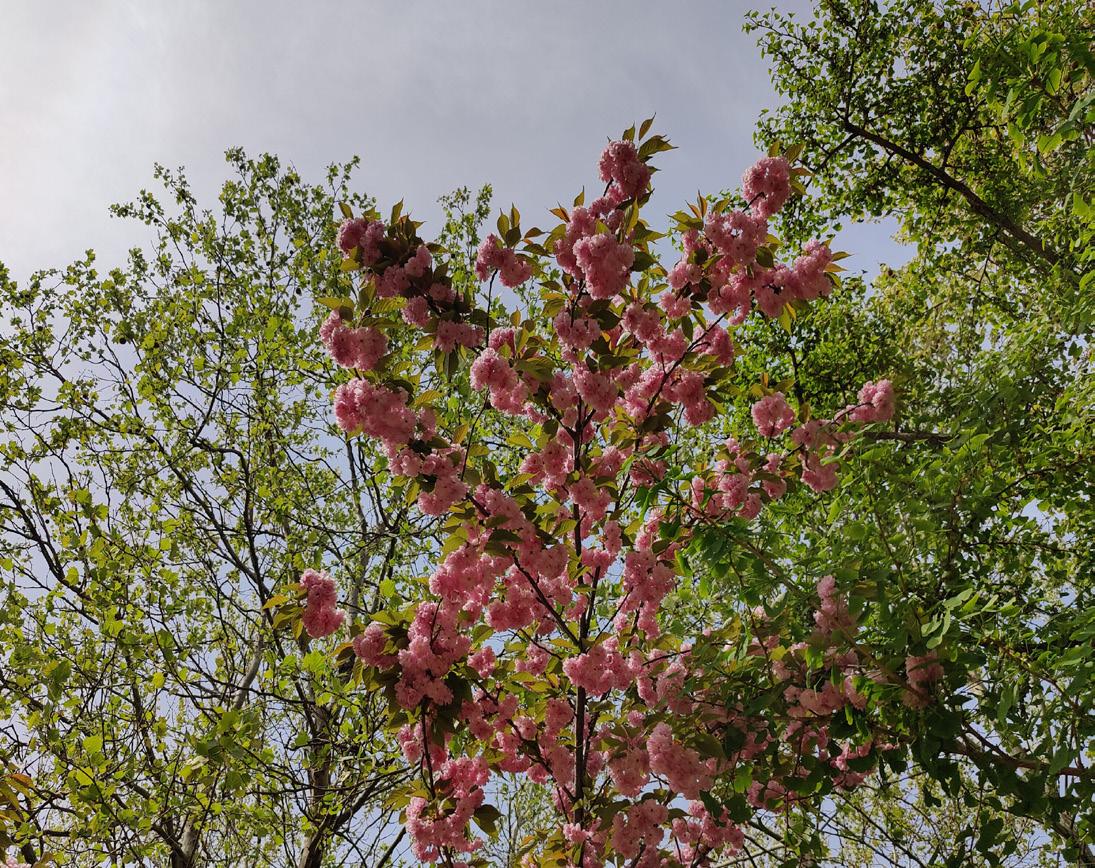
“Cherry blossoms last but a short while.”
As petals began to fall, they gathered along curbs and drains. The city looked briefly dusted, as if it had shrugged something pale from its shoulders. No one stopped to document it. People stepped around the accumulation and continued on.
We did not speak in conclusions. We spoke about food, books, fragments of memory. Sisterhood does not always require excavation. Sometimes it reveals itself in how little effort it takes to remain present.
When cherry blossom season ends, the trees do not mourn themselves. They return to being trees. The city sharpens again. What remains is not the image but the memory of having moved through a moment that asked nothing and offered clarity.
Seoul gave us that. A season that did not demand reverence. A canopy that held without weight. We walked through it not as spectators but as women briefly relieved of the need to endure.
And then, as seasons do, it passed.
The Author

Reeti Roy is a writer and cultural commentator who explores the intersections of city life, gender, and culture. On weekends, she works as a tour guide, leading walks that reveal the hidden rhythms and histories of cities. Based between Seoul and India, she spends her time observing cities, their people, and translating those experiences into essays that reflect both intimacy and insight. Instagram: @ reereeinkorea
Photographs by the author.
By Murdock O'Mooney
When people think of spring in Korea, images of cherry trees and the “pink snow” they create probably come to mind. There are over 300 varieties of cherry blossoms, but the most ornamental and coveted is the blossoms of the Japanese cherry tree, or Prunus serrulata. And while cherry blossoms are undeniably majestic, beautiful, and enchanting, there are many other wonderful ways to appreciate spring in Korea that don’t involve Prunus serrulata.
In the Joseon Dynasty, royals prioritized apricot (maehwa), plum, and peony trees over cherry blossoms, for their stunning visual displays. Historically, azaleas were considered the “people’s flower for spring,” while the plum blossom was considered the “scholar’s flower.” It might also be worth noting that the cherry blossoms came to prominence in Korea during the Japanese colonial period.
Flower designations aside, it would be hard to find a better place to experience budding spring trees than Changdeok Palace in Seoul. Changdeokgung offers the coveted “double-flowering redplum blossoms,” which were supposedly a gift from China over 400 years ago. They are also considered more sophisticated and ornate than cherry blossoms.
Buyongyeong Pavilion is also at Changdeok Palace and is a favorite spot for spring picnics. The royals used to not only appreciate flowers here, but participate in fishing and poetry writing contests. To get the creative juices flowing, they drank cheongju (clear rice wine), which was
floated in cups back and forth on a winding manmade watercourse in the garden – a practice known as yusang-goksu. If a courtier couldn’t recite a poem before their cup floated past, they had to drink the entire cup as a penalty – a sort of ancient version of the modern Korean drinking trope “One-shot!” I suppose.
For the gastronomically minded reader, and for a true “taste of spring,” consider trying your hand at making some hwajeon, or flower-infused rice cakes. Traditionally, Korean women would gather
on the 3rd day of the 3rd lunar month (Samjinnal) and make pan-fried rice cakes adorned with real pedals of azaleas, or jindallae.
A great place to sample hwajeon, and other dishes of spring, is the 2026 Gwangyang Maehwa Festival, which runs from March 13 to 22. The festival celebrates the first spring plum blossoms in Seomjin Village in Jeollanam-do. Plum trees line the river and provide stunning white, pink, and red blooms amid a hilly and scenic backdrop. The festival is also known for local organic plum food products such as ice cream, candy, and tea.
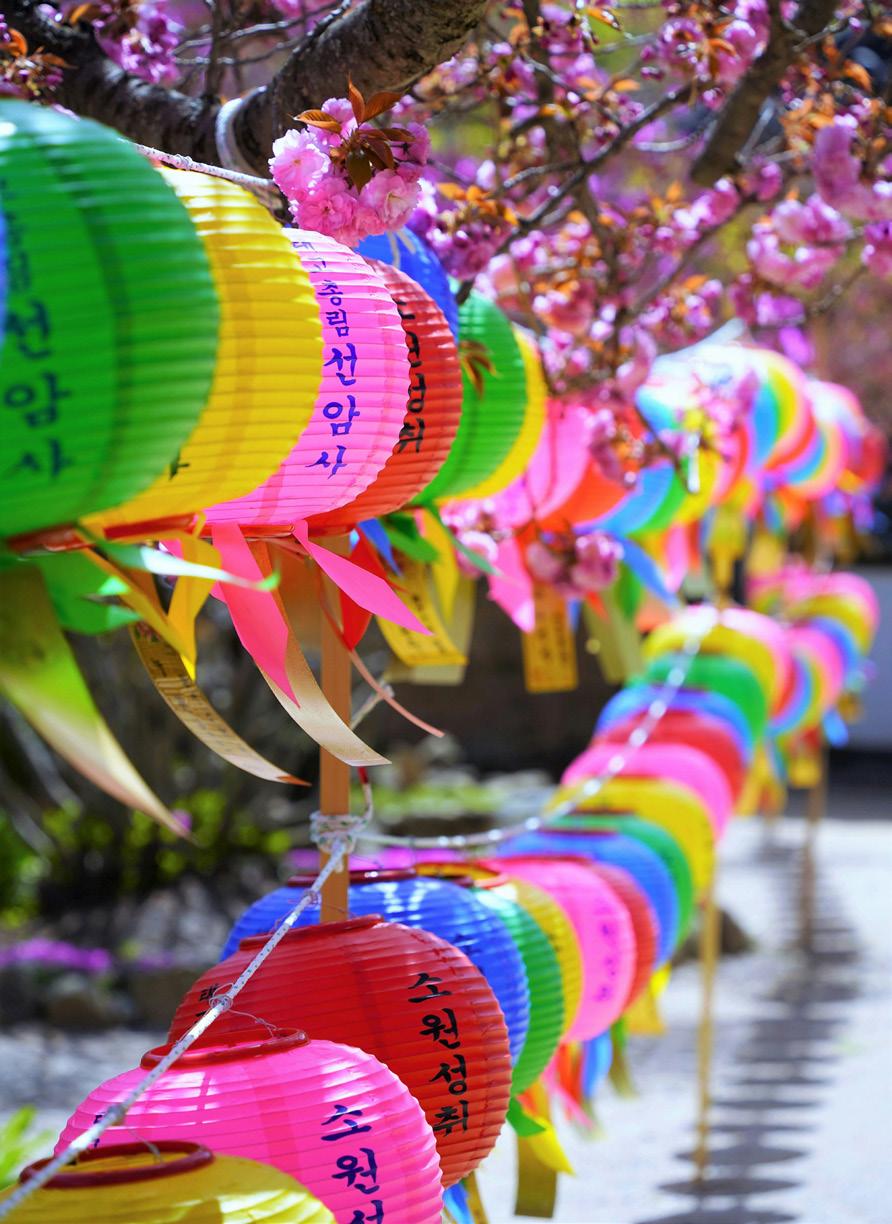
If cooking isn’t your fancy, consider taking to the budding Korean mountains to do some temple visiting. Of course, Mudeung Mountain in Gwangju offers top-notch temple viewing, but another popular choice near Suncheon is Songgwang Temple and Haein Temple in South Gyeongsang Province. These temples are known for their vibrant traditional paint colors, or dancheong, which contrasts nicely with the fresh green buds of the mountain flora, as noted in Korean Buddhism. For an even more engaging experience, consider a temple stay.
To experience a “miracle,” check out the 2026 Jindo Miracle Sea-Parting Festival, which runs from April 17 to 20. This phenomenon is a literal
parting of the sea due to seasonal tidal changes. At certain times of day, the Jindo Sea Road becomes visible for about an hour, allowing visitors to walk out onto the ocean floor and collect abalone and octopus, or just take in the views and snap some selfies. The road is around 2.8 kilometers long and 40 meters wide, and connects Jindo Island with the smaller Modo Island. The festival also features live music, a ssireum wrestling competition, and an EDM night show. The locals refer to the event as Korea’s “Miracle of Moses.”
To experience spring in motion, take the short drive to Hampyeong and partake in the Hampyeong Butterfly Festival. The festival takes place at the Hampyeong Expo Park from April 24 to May 4 this year and has visitors experience the release of millions of butterflies into vast gardens of canola flowers (rapeseed/yuchae) and other wildflowers. Beyond the millions of butterflies, the park also offers an ocean of floral varieties, insect and educational exhibits, and even a 14-meter-high floral tower.
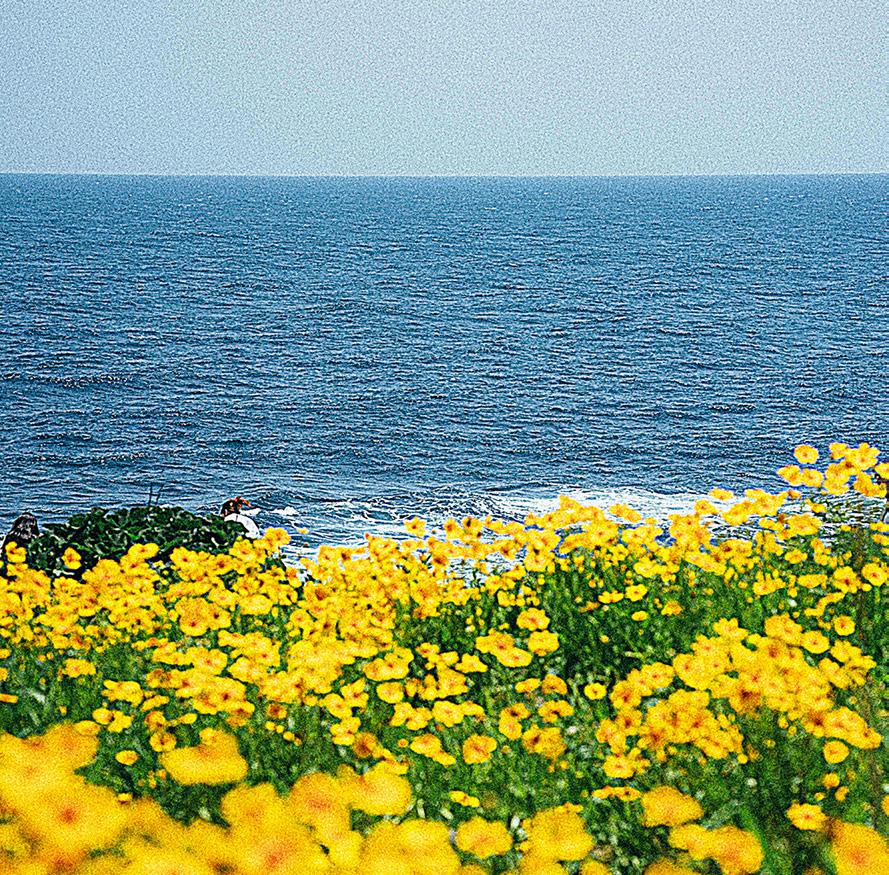
For a yellow spring, take a flight or ferry to Jeju Island and hike through the fields of wild canola flowers, which cover the island in a vibrant yellow carpet. The flowers peak in early March to late April, and some of the best spots for viewing them are Sangbang Mountain, Eongdeongmul Valley, and Seopji-koji and Gwangchigi Beaches at Seogwipo.
Overall, spring is beautiful in Korea, and personally, I think it’s hard to go wrong when choosing a way to enjoy the season (even if this involves cherry blossoms). Just be sure to get outside and enjoy yourself – may the coming of spring be blessed with great happiness.
The Author Murdock O’Mooney is an educator and writer based in Albuquerque, New Mexico, USA. He lived in Gwangju, and worked at Chosun University, from 2015 to 2022. He’s interested in geopolitics, education, and trying to help build a more just world.
By Neha Bisht
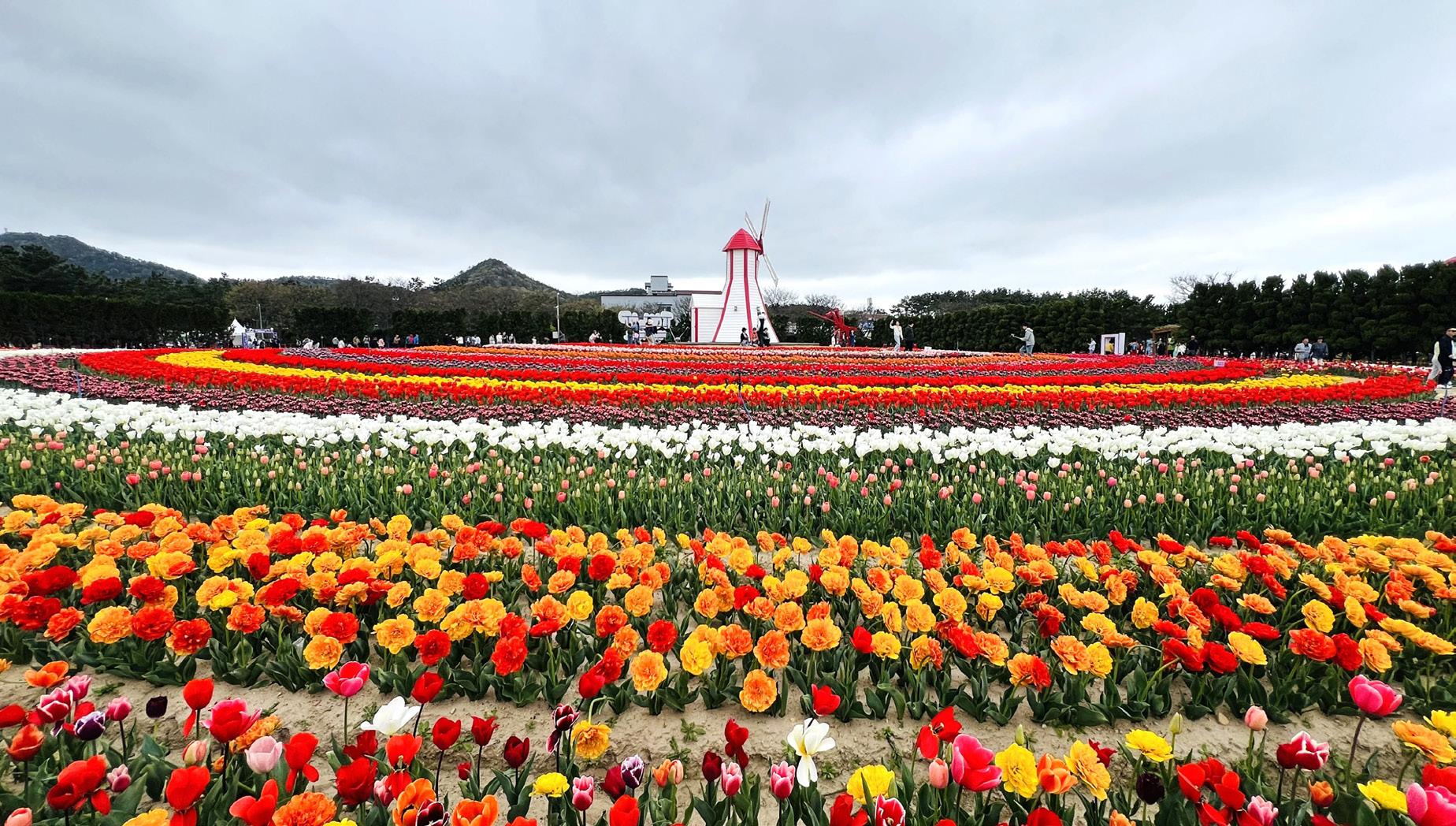
Every spring, the quiet islands of Shinan County transform into a vibrant canvas of colors during the spectacular Shinan Tulip Festival. Held on the beautiful Imja Island, the festival celebrates the blooming of millions of tulips and attracts visitors from across the country and beyond. With endless rows of flowers, ocean views, and cultural activities, the event offers a refreshing escape into nature.
Shinan County is a unique coastal region located off the southwestern shoreline of South Korea and is made up of about 1,025 islands. Because of this remarkable geography, the county is often called the “1004 Islands” (sounds like “angel islands”). The region is known for its beautiful coastal landscapes, vast tidal flats, and rich
marine ecosystems. It is also one of Korea’s major producers of natural sea salt due to its clean seawater and favorable climate. Several islands such as the islands of Jeungdo and Hongdo are popular tourist destinations known for their natural beauty and ecological significance.
Spring is one of the most beautiful seasons in Korea, when the pleasant weather invites people to step outside and explore nature. With the same spirit of exploring and finding some relaxing time away from our busy lives, my friends and I decided to visit a flower festival. Like many trips in my Exploring Korea journey, this plan was quite spontaneous. We decided only one day in advance to visit a tulip festival because none of
us had ever experienced any of Korea’s famous spring tulip events. We also thought it would be a perfect place for memorable photos, reels, and videos.
After discussing several options, we finally chose the Shinan Tulip Festival, since it was the last day of the festival and also one of the closest locations to Gwangju. As usual, our group was quite large, so we needed two cars – one belonged to a friend, and the other we rented for the trip.
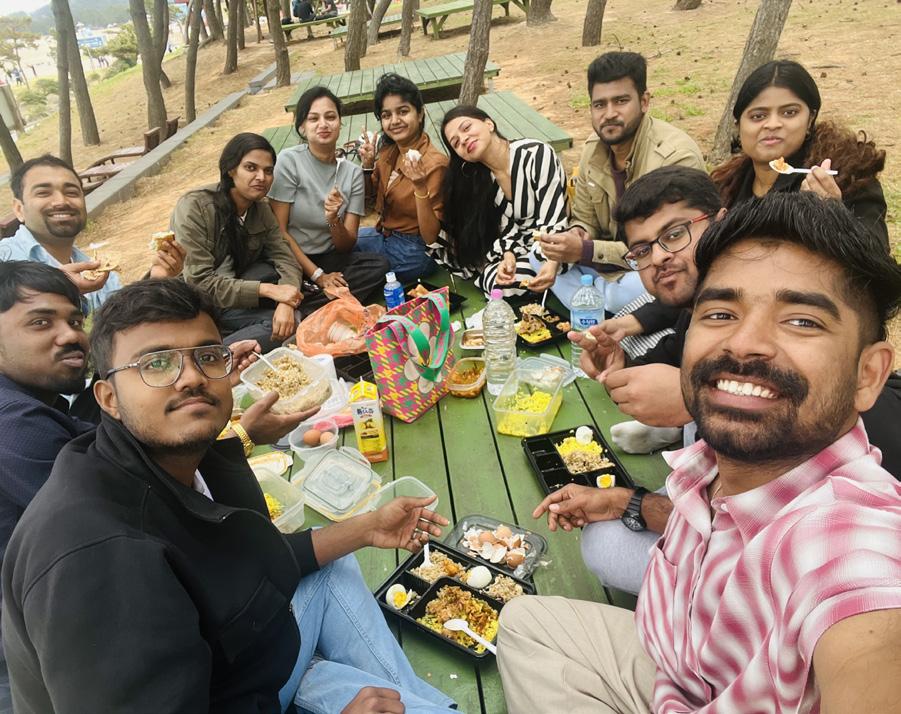
Our journey started early in the morning. Before leaving, we packed homemade food. In Indian culture, carrying food during trips is very common. It may be a cultural habit or sometimes a way to save money, but homemade food always tastes better. Since I am vegetarian, finding suitable food outside can sometimes be difficult. Also, some of my friends enjoy homemade Indian food, so everyone brought something to share.
With our packed food, music playing in the car, and lots of excitement, we left Gwangju and began our journey. As we drove away from the busy city and moved toward the countryside, the surroundings became calmer and more peaceful. The open roads, green landscapes, and fresh air made everyone forget the stress of daily life and simply enjoy the moment.
After about two hours of driving, we reached the festival site on Imja Island. We bought our entry tickets and headed toward the festival area. First, we found a comfortable resting place where we enjoyed our homemade food together. The weather was slightly cloudy, and a gentle sea breeze from the nearby coast made the atmosphere even more pleasant.
Once we finished eating and cleaned up our area, we walked toward the tulip gardens. The moment we entered the park the view was breathtaking. Vast fields filled with millions of tulips stretched across the landscape in vibrant shades of red, yellow, pink, purple, and white. The gardens were beautifully designed with pathways allowing
visitors to walk through the colorful rows of plots and admire the scenery.
Seeing so many colors together felt almost like stepping into a dream. It made me reflect on cultural differences as well. In Korea, many young people often prefer neutral colors such as black and white in their clothing, while older generations sometimes wear brighter colors. In India, it is often the opposite: Young people enjoy vibrant colors, while elders usually choose simpler tones. In our culture, bright colors symbolize energy, celebration, and the joy of youth.
But soon we returned to simply enjoying the festival. As expected, the girls in our group quickly took out their phones and started capturing photos right from the entrance. Meanwhile, the boys jokingly became impatient and walked ahead while we continued taking pictures.
We wandered through the tulip gardens, made videos, ran along the pathways, and enjoyed the moment like carefree children. Some elderly Korean ajumma and ajusshi smiled at us when they saw how happily we were enjoying ourselves.
After exploring the gardens and capturing countless photos, we visited the festival booths where local food, regional products, and decorative items were being sold. Some of my friends stopped at the food stalls, while a few of us looked at the decorative accessories. My two friends and I bought tulip-shaped hairbands and hair clips, which were very pretty.
Later we walked toward the nearby beach area. By then the sky had become fully cloudy, and it seemed like rain might arrive soon. Near the beach, we found a bubble-making bicycle that created dozens of bubbles when someone pedaled it. My friends pedaled the bicycle while the rest of us danced and recorded videos among the floating bubbles. Everyone took turns pedaling and posing for photos.
After some time, we became tired from pedaling so much. A kind Korean lady offered to pedal the bicycle for us while another helped take our group photos. We happily accepted their help. As she created a shower of bubbles around us, we captured many joyful pictures together. It was a cheerful and heartwarming moment.
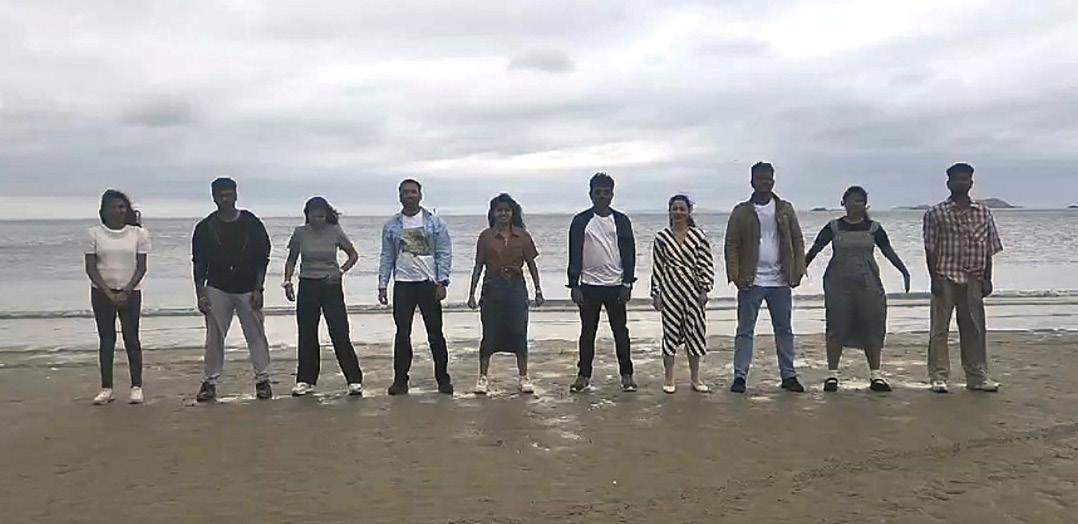
Then we walked down to the beach’s edge. Some of us played with the water while others continued taking photos. At one point, someone suggested making a dance reel. At first, only four of us agreed because the others felt shy, but soon everyone joined in. After several attempts and a lot of laughter, we finally managed to record a perfect reel.
We noticed that some people sitting in the upper beach area were watching us and smiling. Perhaps they were enjoying our enthusiasm – or maybe remembering their own youthful days.
While we were enjoying the sea breeze, the peaceful beach, and the colorful memories of the day, the sky suddenly changed and heavy rain began to fall. We quickly ran back to our cars and started driving back toward Gwangju. Although we had hoped to stay longer, the rain forced us to change our plans.
Interestingly, the rainy drive became beautiful in its own way. The smell of wet soil, raindrops hitting the windows, and the cool wind made the journey peaceful and calming.
Halfway through the drive, we stopped at a beautiful café that we found along the road. The café was spacious with a nice view outside. We ordered hot coffee, enjoyed the cozy atmosphere, took a few more pictures, and watched the rain falling outside.
By the time we returned to Gwangju, everyone was quite tired after such an exciting day. Since one car was rented, some friends went to return it, while I went home with others in my friend’s car. We ended the day at my place with a relaxing cup of tea and some snacks, laughing and sharing stories about the day.
In the end, another wonderful day was added to our collection of memories – one filled with colorful flowers, laughter, friendship, and the simple joy of exploring together.
Note: For more details about the 2026 Shinan Tulip Festival visit https://www.shinan.go.kr/. This year’s festival period is April 10–19.

The Author Neha Bisht is a native of India, pursuing her PhD research at Chonnam National University’s School of Materials Science and Engineering. She loves to meet new people and make new friends. Neha endeavors to contribute to the well-being of society in whatever way she can. Photographs courtesy of the author.
By Kamila Ismanova
In the ever-changing economic and geopolitical landscape, forming diplomatic ties and interregional cooperation has never been more important. For decades now, Gwangju city has been on a mission to establish and strengthen the cultural and economic exchange in the region and beyond. As a result, Gwangju welcomed Tainan (Taiwan, 1968), San Antonio (USA, 1982), Guangzhou (China, 1996), Medan (Indonesia, 1997) and Sendai (Japan, 2002) as its sister cities. In recent years, Gwangju has explored partnership with Samarkand, Uzbekistan, formally signing a friendship agreement in late 2023.
The city of Samarkand, founded in the 7th century BCE, is the crossroad of cultures. The historic metropolis is evidenced to have settlements as early as 1500 BCE, and the historical records confirm the city was known as Maracanda dating back to the 4th century BCE – the capital of the kingdom of Sogdiana. Today, it is known as one of the oldest cities in the world and is a UNESCO World Heritage Site. The city’s favorable location, connecting Asia to the Mediterranean via the Silk Road, has played a major role in its development. The history and culture of the ancient city have been influenced by major forces. Arab rule during the 8th century laid down groundwork for its iconic architecture, inspired by Islamic features like ornate marble statues and round domes. In 1220, Genghis Khan conquered and destroyed the city. Centuries of knowledge carefully collected and stored in madrasahs (schools) were looted and burnt. The once great city full of lively
bazaars, scholars, and progressive philosophers succumbed to the rule of the Mongols.
When Samarkand was finally liberated by Tamerlane (Amir Timur) in the 14th century, the golden age of Temurids began. During the reign of the Timurid Dynasty, namely, rulers like Amir Temur and his grandson Mirzo Ulug’bek from the 14th to 15th centuries, Samarkand was taken to new heights in science, medicine, architecture, art, trade, and geopolitics, revitalizing and solidifying the ancient city’s status as the Silk Road’s most prominent destination. There, in the heart of Samarkand, Temur financed the construction of the majestic square of Registan, which consists of three turquoise-tiled, gilded madrasahs. Both the interior and exterior as well as its domes are decorated with carved marble, mosaics, and ornamental glazed bricks. Registan is a testament to the might and wealth of the Temurid Dynasty.
Although the descendants of Tamerlane developed Samarkand and turned it into the center of art and innovation again, Soviet rule later on made it difficult for the world to appreciate the jewel of modern Uzbekistan. The local customs and traditions as well as the celebration of holidays like Navroz were prohibited under Soviet censorship. The essence of the city was stifled, but it endured. Samarkand was a part of the Basmachi Movement (Freemen Movement) from 1918 to the 1930s – the movement against Imperial Russia and later the Soviet Union. The Basmachi was a group of traditionalists whose primary objective was to protect their homeland and preserve traditions that were formed throughout the centuries. Similar in spirit to the fearless students of the Gwangju Uprising, the Uzbek people resisted military rule, aspiring for freedom and a better future for future generations.
Today, both cities are flourishing economic hubs with rapidly expanding manufacturing industries and large-scale commercial projects. Initially, the talks of a friendship agreement between the two cities took place in late 2023, marked by a visit of the Uzbek delegation from Samarkand to Seoul. Then, the mayor of Gwangju Kang Gi-jung, stated that Gwangju is one of the main producers of organic agricultural products, farmed in the Honam region. Additionally, the city of Gwangju hosts two major automobile factories, namely, Gwangju Global Motors and Kia Autoland Gwangju. The mayor hoped that their partnership would grow beyond trade relations, uniting two cities to build strong cooperation and friendship.
The mayor’s Uzbek counterpart, the vice-mayor to the Samarkand region Oybek Xamrayev, noted that for the strengthening of trade and automobile manufacturing and for an increase in mutual investment, the partners should organize and host various business forums on a regular basis. The delegates agreed that the establishment of an organization responsible for bringing mutual projects into fruition is essential. Xamrayev stated that he believed that such forums would allow both Korean and Uzbek businessmen
to network, thus increasing the likelihood of mutually beneficial investments, which in turn would serve as a catalyst to promote multileveled cooperation between Gwangju and Samarkand. Both sides emphasized the significance of cultural exchange through art exhibitions and tourism. Consequently, leading to the planning and execution of multiple cultural events and art exhibitions in 2024. Notably, one such event was held in November 2024 in Gwangju to promote cultural diversity, where delegates from Samarkand participated in sister-city booth popups.
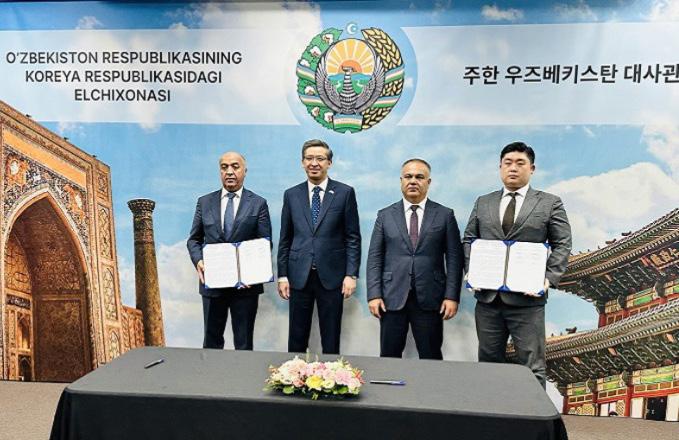
In July 2025, the acting governor of the Samarkand region, Adiz Boboev, gave a speech at the Uzbek–South Korean Business Forum to further promote economic potential and investment opportunities across agriculture, education, electrical engineering, mining, pharmaceutical, and textile industries. According to the official website of the Samarkand’s regional government, a number of bilateral documents were signed. Future business prospects include the expansion of the sectors in healthcare and urban infrastructure.
In February 2025, the mayor of Samarkand, Fazliddin Umarov, welcomed the delegates from Gwangju, led by the director of the National Asian Culture Center, Kim San Guk. The visit by South Korean representatives was to reiterate the commitment mentioned in the friendship agreement and take a step toward the creation of
“Samarkand’s Little Corner” in Gwangju’s ACC. The more recent and prominent cultural highlight is the opening of the international exhibition “Nomads on The Silk Road” at the National Asian Culture Center in November 2025. The exhibition’s aim was to showcase the cultural heritage that took its roots in steppes and oasis cities, like Samarkand, of Central Asia. It traces ancient routes of caravans that once passed over the Silk Road. The exhibition is structured in an intricate way that highlights the journey of merchants, the itinerant nomads, hopping from one caravanserais (lodgings) to another. Those nomads left physical traces by selling spices, exquisite fabrics, precious gems, and above all, folklore. A second type of nomads were the ones that talked to nature. They breathed in the wind and the quiet rhythm of the steppes. But their movements, nonetheless, had a profound impact on the Silk Road. The exhibition features miniature paintings, ceramics, colorful textiles and traditional carpets, nomadic horse carvings, music instruments, and even yurts. The great variety and complexity of the exhibits is a testament to Uzbek craftsmanship and its rich history.
“Nomads on the Silk Road” is organized in honor of The Year of Cultural Exchange between Uzbekistan and South Korea. Visiting this exhibition will allow the people of Gwangju to understand the national identity, historic continuity, and cultural heritage of the Uzbek people. The exhibition will run from Tuesday to Sunday every week until November 2027. The experience is available to the public free of charge and is friendly to all ages. As a token of appreciation and gratitude, the Uzbek delegates awarded the director of the Asian Culture Centre, Kim San Guk, with the honorary title of “Ambassador of Uzbek Culture.” This honorary title is proof of Director Kim’s dedication to cultural exchange between the two nations.
In April 2025, a delegation from Gwangju University visited the Samarkand branch of
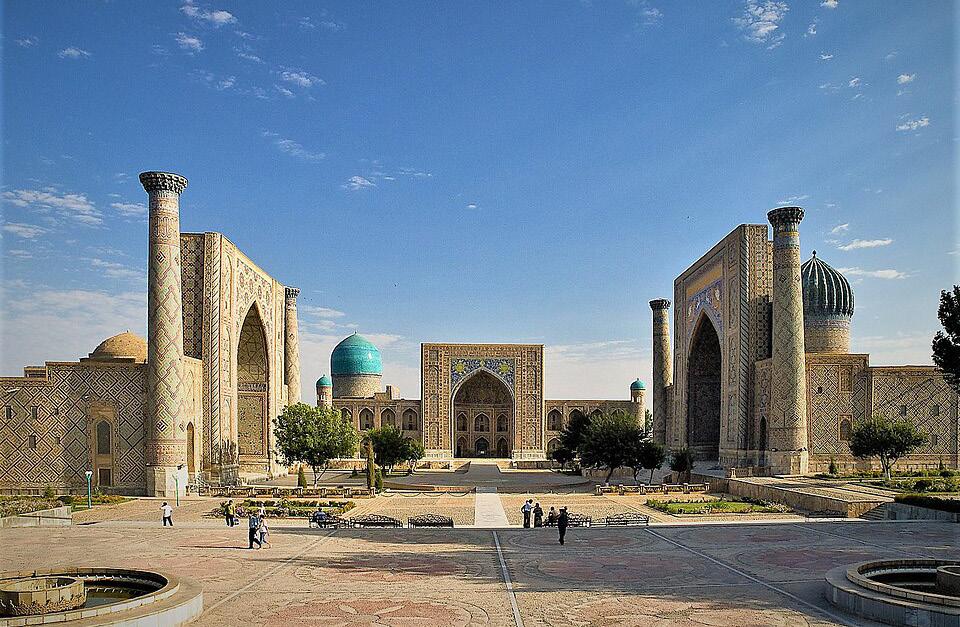
TUIT (Tashkent University of Information Technologies). During their meeting, the delegation and the host explored the possibility of conducting joint international educational programs with hopes to build scientific potential for research, as well as exchange of students and educators, and organizing and hosting seminars and conferences to strengthen educational ties and encourage research collaboration. The potential expansion of the friendship agreement, between the two cities, beyond trade and manufacturing into the realm of education and research, further magnifies the ongoing success of this strategic partnership.
It is worth noting that South Korea and Uzbekistan have a strong economic relationship, the former investing hundreds of millions into various regions of Uzbekistan across automobile manufacturing, textile, infrastructure, technology, and overall modernization. As the world demands it, the strategic partnership between the two countries, Gwangju and Samarkand, is expanding towards green technology, digital innovation, and sustainable development.

The Author Kamila Ismanova is a marketing professional based in Australia with a passion for creative storytelling and meaningful communication. She enjoys turning ideas into engaging campaigns and content. Outside work, she loves getting lost in a good book, practicing Pilates, and exploring new places around the city.
For the past three years you have seen the name “Park Nahm-Sheik” appearing as the byline to the Ponderings and Contemplations column. Many of his writings reflect back on the many years he has to look back on; others look forward, pointing in directions to proceed. Prof. Park was one of a select few who were allowed to leave the country for graduate study abroad, and it was Park who shattered Seoul National University’s glass ceiling barring non-SNU graduates from SNU faculty positions. For more on this fascinating local standout, we offer you this interview with this member of the Gwangju News family. — Ed.
Gwangju News (GN): I wish to express my gratitude, Prof. Park, for you providing time for this interview. To begin with, you are a product of the Gwangju-Jeollanamdo area. Could you tell us about your early years as a boy growing up in the area and attending Chonnam National University [CNU]?
Prof. Park: In my younger years, I had abject hunger and poverty to wrestle with as did most youngsters of the era. For all the unpleasant experiences related to that time, I still retain plenty of nostalgia for the early-to-mid 1950s. Those tumultuous years might have hatched good fortune for my mid-to-late teens. Viewed from this perspective, everything may have been a blessing in disguise. For one thing, the tough times I went through while working my way through secondary school and college may have been instrumental in cultivating me into a sound and hardy tandem of mind and body. If not for those four years of challenging undergraduate work at CNU, the kind of academic achievements I attained later in my career may very well have been out of the question.
GN: Could you let us know a bit about your graduate studies overseas? That was at a time when it was extremely difficult for Koreans to be issued a passport for study abroad.
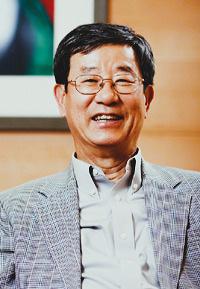
Prof. Park: With the support of CNU Professor Hong Sun-tak and General Lee Jun-hak, commander of the 31st Reserve Division in the Gwangju area, where Prof. Hong helped me get stationed, I became quite fortunate. I was able to obtain a generous grant to the University of Hawaii (UH) at Manoa and the East-West Center (EWC) in Honolulu, in the summer of 1965. It
made me happy as a lark. In retrospect, I feel entitled to some bragging rights for a couple of things related to my time in Hawaii. First, I was one of only two top scorers on an Englishlanguage proficiency test administered jointly by UH and the EWC. I also was a straight-A student throughout the two-year master’s program at UH.
GN: I am amazed at your English proficiency, knowing that when you were young and learning English in secondary school, there were scantly any language learning materials available other than a teacher, a textbook, and a blackboard. Cassette tapes and tape recorders were not even available yet, were they?
“My eight-year stint at IGSE represented probably the happiest years of my ELT career.”
Prof. Park: As for the fundamentals of my English fluency, I owe much of it to a humble shortwave radio set I had long owned and which served as my English teacher from the beginning of high school in 1955. I made it a rule to listen to several major English-language broadcasters originating in the United States, Britain, and Australia. I also tuned in to other prominent global broadcasters such as Radio Moscow, Radio Peking, and Radio Japan. My favorite by far, however, was AFRTS (the Armed Forces Radio and Television Service of the United States). The station, based in Los Angeles, specialized in distributing batches of major news items to U.S. military bases throughout the AsiaPacific region. Thanks largely to this station, I got to be so good at English that even my high school English teachers wanted to emulate me.
Comprising a half-hour program, the entire package of the day’s news on AFRTS was read at normal speed first. Then the same content was presented again at a distinctly leisurely pace,
which was then followed by a dictation-style rendition. The whole thing was then read phrase by phrase for the listener to write it down. When I got sufficiently accustomed to this procedure, I repeated after the news reader instead of simply putting the words down on paper. This turned out to be a highly efficient way for me to learn to articulate, enunciate, and pronounce American English with amazing accuracy. And I enjoyed the process in its entirety.
GN: After returning to Korea from your U.S. graduate studies, you were able to obtain a position on the faculty at Seoul National University – the top-ranked university in the country, and you were the very first person in the English Department there from outside SNU or Seoul, I believe. That was at a time when one needed to be part of an in-group to succeed. How easy, or how difficult, was it for you?
Prof. Park: Dean Lee Han-bin and Professor Jo Jun-hak of SNU were extremely helpful. They had both been at UH for several of the semesters that I was there. Prof. Jo started the process of my faculty appointment with Dean Lee shepherding the rest of the SNU-internal administrative procedure for formal faculty appointment. The appointment finally came to a successful conclusion, though my supporters did run into stiff resistance from the SNU powers that be. I ended up clearing the hitherto seemingly impenetrable employment barrier constructed against non-SNU graduates of domestic institutions in Korea.
GN: Would you tell us about your years at SNU and serving at the Language Center?
Prof. Park: Frankly, there was lots of discrimination against me while at SNU on account of my hometown being GwangjuJeonnam and my alma mater of CNU being outside of the Seoul circle. My SNU tenure, however, was not all that grim. I enjoyed the privilege of being a protégé of a former SNU president, Kim Jong-eun. Under his tutelage, I got to serve multiple consecutive terms as executive director
of the Language Research Institute, the most prominent research organization on campus, which expanded into the current Language Education Institute (LEI) in 2001. I turned it into SNU’s premier money-making research center in a matter of years. In this way, I was able to give back to the university what it had given to me. I take pride in having made a significant contribution to SNU by helping the institute to evolve into the university’s most profitable facility.
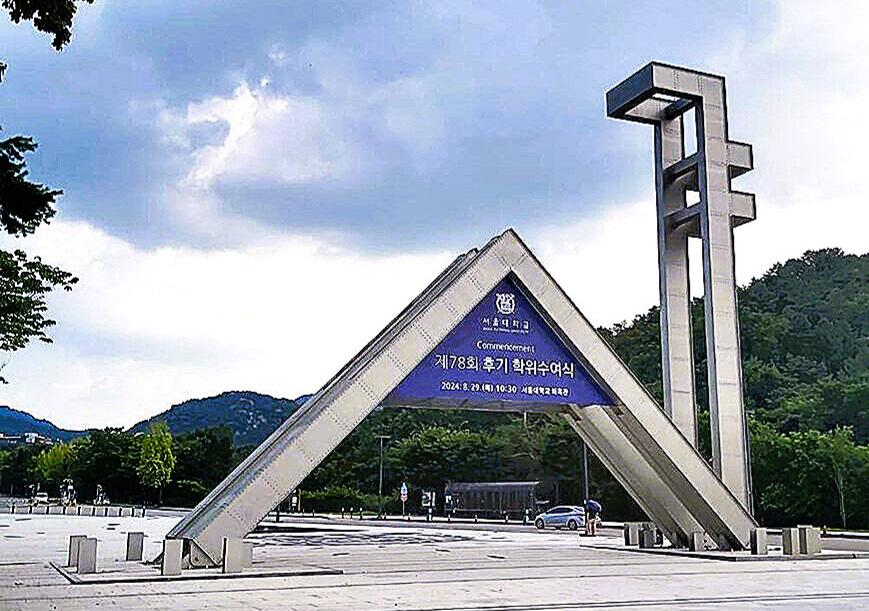
GN: After your retirement from SNU, you became the president of the International Graduate School of English (IGSE) in Seoul. What was it like to be part of that institution?
Prof. Park: My eight-year stint at IGSE represented probably the happiest years of my ELT [English language teaching] career and possibly the final glory of my sojourn on this planet. I so enjoyed being in one-on-one daily contact with the staff, the student body, and the faculty. I sincerely appreciated the personal impact I was having on every member of the IGSE family. My daily IGSE routine got under way at around 10:00 in the morning with Words to Live By sent out on the school intranet. Every entry was popular on campus and off for the wisdom imparted therein and the compact idiomatic phrases that it so succinctly featured. Much of my popularity while at the helm of IGSE rode on this Words to Live By column and the accompanying wisdom-packed series of compact essays.
GN: Do you still have a bucket list of things to do? I imagine that over the years, you have been able to cross off many of the items that were once on that list.
Prof. Park: Let me say here that it doesn’t seem to be time yet to talk about my bucket list. I am not yet ready to kick the bucket. You know what I mean? Regardless, titles like “The Story of My Life,” “My Memoir,” “My Confessions,” etc. are among the things I wish to write before long and leave behind when I take leave of this planet. I am already running out of time, which is of the essence. Time flees away without delay, as they say!
GN: What is your opinion on the role of the Gwangju International Center, the Gwangju News’ parent organization, in the GwangjuJeollanamdo area. Do you have any advice to give?
Prof. Park: The GIC has an all-important role to play in the rapidly globalizing times we now live in. Multiculturalism, interculturalism, or crossculturalism is the name of the game everywhere, not just in the Gwangju-Jeonnam region but the world over. Many of us have been turning a blind eye on this trend coming our way. With so many internationals among us, we simply cannot afford to ignore the trend.
GN: In concluding this interview, is there anything that you would like to say to our readership?
Prof. Park: I should like to sign off by expressing my gratitude to the Gwangju News for coming up with the idea of an interview with me.
GN: And on behalf of the Gwangju News, I would like to sign off by expressing our gratitude for your continued writings for our magazine and by wishing you good health and much happiness for many years to come.
Interviewed by David Shaffer.
By Siddhant K.
Snow in April, cherry blossoms that will not come, Korea’s winter is no longer what it was, and the answers lie as much beneath the surface as above it.
In April 2025, residents of Seoul watched snow fall on streets that should, by every climatic expectation, have already been warm for three weeks. The cherry blossoms, for which the city plans festivals, arranges tourism infrastructure, and mobilizes an entire economic ecosystem, arrived late or not at all in many locations, disrupted by a cold snap that persisted well beyond what any historical average would suggest. For the casual observer, it was a curiosity. For those of us who read the sea, it was a data point in a story that has been accumulating for decades.
Korea sits at a remarkable meteorological crossroads. To its west lies the relatively shallow Yellow Sea; to its east, the East Sea (known internationally as the Sea of Japan), a semienclosed marginal sea of the northwestern Pacific whose thermal behavior has profound and underappreciated consequences for what happens on the peninsula’s surface. To understand why Korean winters have become increasingly erratic, delivering, in the same season, record snowfalls in November, deep cold spells in February, and anomalous April frosts, one must begin not with the atmosphere, but with the water.
The East Sea is, by any oceanographic measure, a hotspot. Long-term satellite records show that annual mean sea surface temperature (SST) in Korean waters has risen at roughly 2.6 times the global mean rate over the past 55 years (1968–2022), a figure that ought to command far more
public attention than it currently does (Han et al., 2022). For most of that period, the dominant warming signal came from the winter season: Cold-season SST rose quickly, moderating the thermal gradient between sea and land, and lending Korean winters a progressively milder character. This pattern, however, underwent a significant structural shift after approximately 2010.
Since the 2010s, the summer SST warming rate has outpaced winter warming by a factor of nearly four, driven by an intensified Tsushima Warm Current in the summer months and changes in
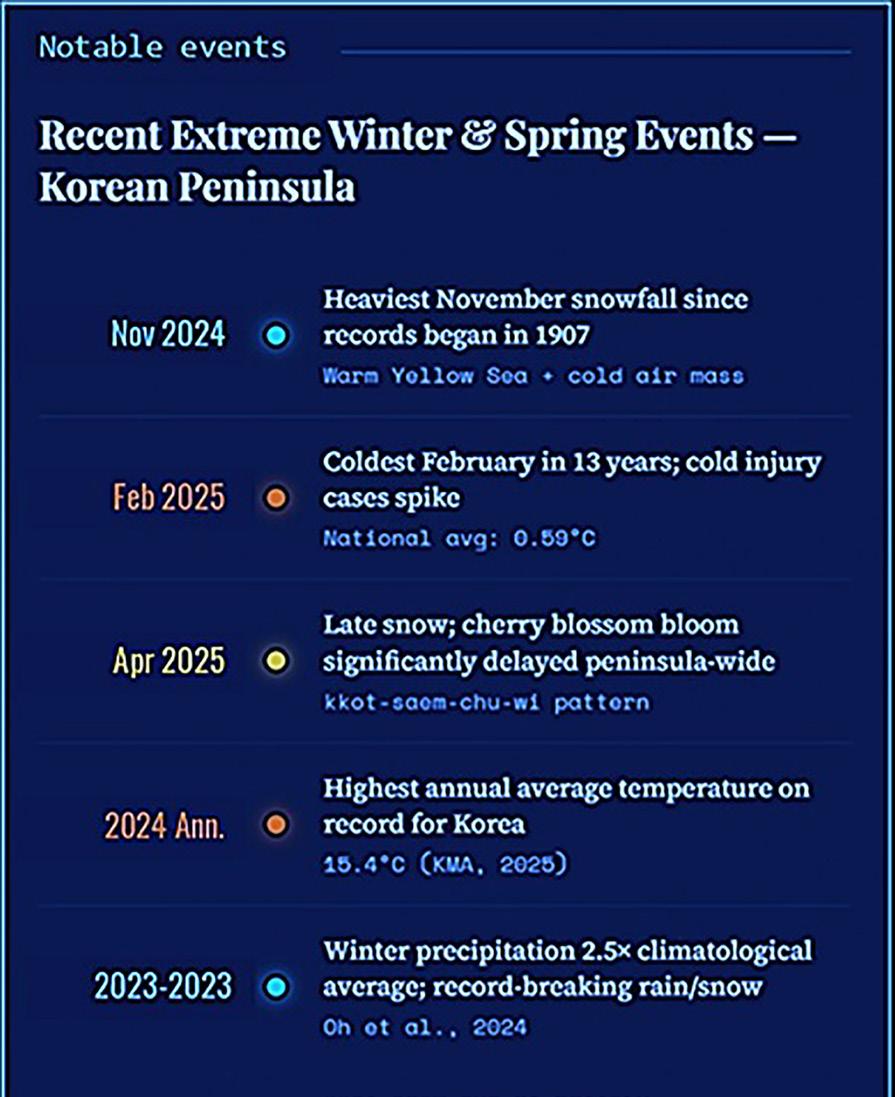
the large-scale atmospheric forcing over East Asia (Han et al., 2022). What this asymmetry produces is not simply “warmer all the time”; it produces a system under tension, in which summer marine heat extremes set conditions that then collide, in winter, with a cold-air delivery mechanism that has itself been reorganized by Arctic processes.
The atmospheric driver most responsible for the erratic cold episodes Korea has experienced in recent winters is the Arctic Oscillation (AO), and its relationship to Korean weather is mediated, crucially, through the ocean. The AO describes the dominant mode of variability in Arctic atmospheric pressure: In its positive phase, the polar vortex is strong and contained, cold air stays locked over the Arctic, and East Asian winters tend toward mild. In its negative phase, the vortex weakens, cold air drains southward through Siberia, and the East Asian winter monsoon (EAWM) intensifies.
What makes this system particularly pertinent to Korean oceanography is how the AO modulates SST in the East Sea itself. Research using highresolution satellite and reanalysis products has shown that AO-related wind forcing drives SST variability in the northwestern East Sea through oceanic dynamic adjustment, specifically, through anomalous anticyclonic eddy-like circulation and Ekman downwelling during positive AO phases, and the reverse during negative phases (Song et al., 2023). The East Korea Warm Current (EKWC), which flows northward along the Korean eastern coastline as a western boundary current, responds measurably to AO forcing, with its strength index showing a statistically significant intensifying trend of approximately 0.62 cm per second every decade (Song et al., 2023).
The practical implication is this: Arctic variability does not reach Korea only through the atmosphere. It reaches Korea through the ocean, which then feeds back into atmospheric thermal patterns over the peninsula. The AO modulates
the EKWC, which modulates coastal SST, which modulates air–sea heat flux along Korea’s eastern seaboard, a chain of causation that conventional meteorological framing tends to overlook.

One of the more counterintuitive findings of recent Korean climate research is the re-strengthening of the Siberian High and the EAWM after a prolonged period of weakening. For much of the late twentieth century, the Siberian High was declining in intensity, consistent with a general warming of the mid-latitude land masses. But from the early-to-mid 2000s onward, this trend reversed: The Siberian High and EAWM shifted from a sharply decreasing trend to an increasing or neutral one, with winter wind speeds around Korea following suit (Han et al., 2022). The mechanism most invoked to explain this paradox is Arctic amplification.
As the Arctic warms disproportionately, and it is warming at two to four times the global mean rate, a phenomenon now well-documented, the temperature gradient between the pole and the mid-latitudes diminishes. A reduced pole-toequator gradient weakens the jet stream, making it more susceptible to large-amplitude meanders.
These Rossby wave excursions allow cold Arctic air to plunge southward in certain sectors, even as the overall hemispheric mean temperature continues to rise. For East Asia, the relevant delivery mechanism is the continental cold air that forms over Siberia and descends through the EAWM pathway onto the Korean Peninsula. This is precisely the mechanism that produced the anomalous February 2025 cold spells documented by Korean health surveillance data, the lowest February temperatures recorded in 13 years, at a national average of 0.59°C, following an influx of a North Atlantic cyclonic storm into the Arctic that displaced cold air southward (KDCA, 2025). It is also what produced the remarkable November 2024 snowstorm: Seoul’s heaviest November snowfall since recordkeeping began in 1907, driven by an unusually large temperature differential between cold air masses and the anomalously warm Yellow Sea surface (KMA, 2024).
The November 2024 event deserves specific attention because it illustrates the oceanic amplification mechanism with unusual clarity. The Korea Meteorological Administration attributed the unprecedented snowfall not simply to cold air from the northwest, but to the interaction of that cold air with a Yellow Sea surface temperature that was warmer than normal for the time of year. When frigid continental air masses traverse a relatively warm sea surface, the temperature and moisture contrast drives intense convective snowfall, a process oceanographers recognize as air–sea heat flux anomaly in action. The warmer the sea relative to the overlying air, the more vigorous the moisture transfer, and the heavier the resulting snowfall when that air reaches the cold land surface.
This mechanism is not new; it is the same physics that produces lake-effect snow in the Great Lakes region of North America. What is new is the frequency and intensity with which it is occurring in Korean waters, as background SSTs
rise and create more energetic contrasts with cold air outbreaks that are themselves increasingly abrupt due to polar vortex disruption. The interaction between a warming ocean and an increasingly variable atmosphere is producing a system of greater extremes at both ends of the thermal spectrum.
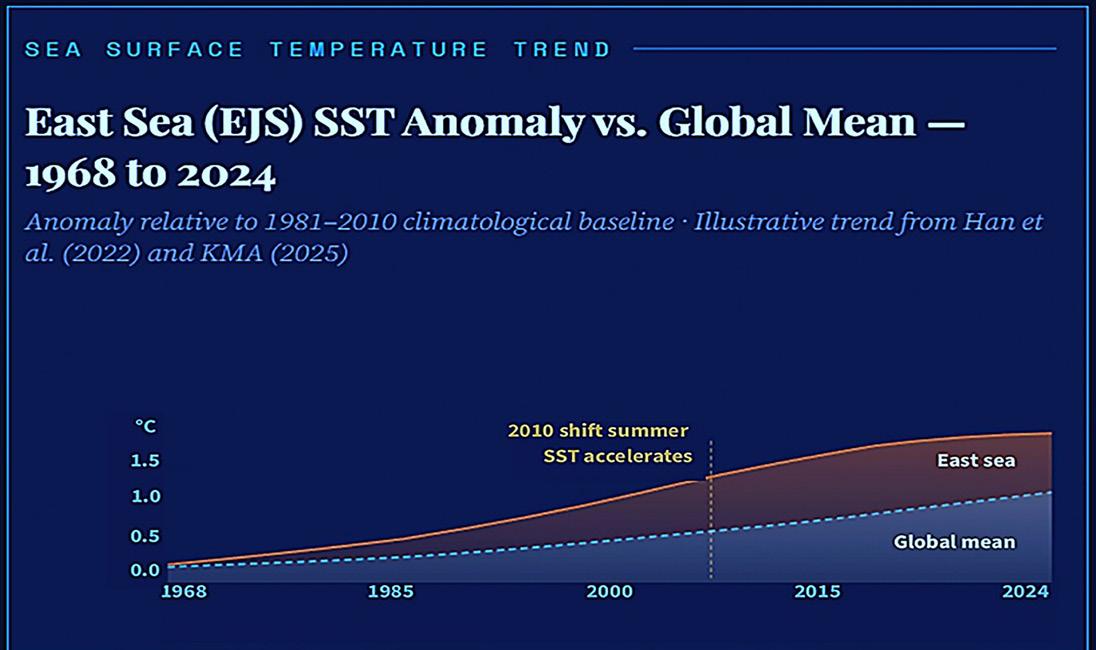
Cherry blossoms are, in an unlikely sense, a phenological instrument; their bloom date integrates accumulated heat units in late winter and early spring, making them a proxy for the thermal history of the preceding weeks. The kkotsaem chu-wi, the Korean phrase for “the cold that envies the flowers,” describing spring cold snaps, has been observed with increasing frequency, and the 2025 season, in which blossoms were delayed across much of the peninsula despite a generally warm autumn, reflects a spring thermal signal disrupted by persistent cold outbreaks in February and March.
What makes this particularly interesting from an oceanographic standpoint is the sub-seasonal linkage. Research published in Geophysical Research Letters has shown that sub-seasonal variability in ENSO–East Asia teleconnections is itself driven by tropical convection over the Indian Ocean and Maritime Continent, meaning the convective state of the tropical Indian Ocean in autumn can modulate what Korean Peninsula temperatures do in late winter and spring (Park
& Son, 2024). ENSO alone, as multiple studies have now confirmed, explains only about 7–9% of interannual Korean winter temperature variance; the remaining variance is distributed across the AO, the Pacific Decadal Oscillation (PDO), Siberian snow cover anomalies, and SST patterns in the extratropical North Pacific (Lee et al., 2025).
What the accumulated evidence describes is not a simple linear warming but a system in structural transition. The KMA’s 113-year climate analysis, released in late 2025, confirmed that seven of the ten hottest years on record for Korea have occurred in the past decade, with 2024 recording the highest annual average temperature (15.4°C) and 2023 the second highest. Yet in this same decade, the frequency of extreme cold spells has also increased, cold injury cases continue to occur at clinically significant rates every winter, and snowfall events of unprecedented intensity have struck in seasons, such as November, when they have historically been rare.
The oceanographic interpretation is that the system has entered a higher-energy state: more heat available in the marine boundary layer, more moisture to mobilize, more intense marine heatwave episodes in the East Sea during winterto-spring transitions (when they are most ecologically damaging to the northwestern EJS, as Song et al. [2023] document), and simultaneously, a more disrupted polar atmosphere delivering cold-air intrusions that are brief but extreme. The seasons, in effect, are not simply shifting; they are becoming more volatile.
For the Korean Peninsula, which sits downstream of all the major forcing mechanisms simultaneously, the ENSO signal from the tropical Pacific, the AO signal from the Arctic, the PDO signal from the North Pacific decadal cycle, and the local SST forcing from the East Sea and Yellow Sea, the result is a winter climate that will continue to surprise. The April snow and the delayed cherry blossoms of 2025 were
not anomalies in the sense of departures from an otherwise stable norm. They were expressions of the new norm: unpredictable, amplified, and deeply connected to what is happening in the waters that encircle this peninsula on three sides.
The sea is speaking. The question, as always in oceanography, is whether those above the surface are listening closely enough.
References
Han, I. S., et al. (2022). Long-term pattern changes of sea surface temperature during summer and winter due to climate change in the Korea waters. Fisheries and Aquatic Sciences, 26(11), 639–654.
Korea Disease Control and Prevention Agency [KDCA]. (2025, October 14). Results of the 2024–2025 winter cold injury surveillance. PHWR.
Korea Meteorological Administration [KMA]. (2024, November 28). Analysis of the November 2024 snowstorm event [KMA Press Release].
Korea Meteorological Administration [KMA]. (2025). Korea’s 113-year climate change analysis report.
Lee, J., et al. (2025). Limitations of ENSO-based prediction of Korean winter temperature. Asia-Pacific Journal of Atmospheric Sciences, 61(30). https://doi.org/10.1007 /s13143-025-00419-2
Kim, H.-G., Song, K., Lee, J., Kim, J., Kim, B.-M., & Chang, E.-C. (2025). Characteristics of record-breaking precipitation in 2023/24 winter over the Korean Peninsula. Atmosphere, 35(2), 181–192. https://doi. org/10.14191/Atmos.2025.35.2.181
Park, C.-H., & Son, S.-W. (2024). Subseasonal variability of ENSO–East Asia teleconnections driven by tropical convection. Geophysical Research Letters, 51, Article e2023GL108062.
Song, S. Y., et al. (2023). Wintertime sea surface temperature variability modulated by Arctic Oscillation in the northwestern part of the East/Japan Sea. Frontiers in Marine Science, 10, Article 1198418. https://doi. org/10.3389/fmars.2023.1198418
Xiao, F., et al. (2022). Joint effect of West Pacific warming and the Arctic Oscillation on the bidecadal variation and trend of the East Asian Trough. Journal of Climate, 35(8), 2491–2501. https://doi.org/10.1175/ JCLI-D-21-0461.1
Siddhant Kumar is a geochemical oceanographer and researcher at TMBL at the Gwangju Institute of Science and Technology (GIST). His work focuses on marine minerals, sediment chemistry, and paleoenvironmental change. He is passionate about communicating ocean science to broader communities in Korea.
By Saqib Sharif
The paid content subscription platform
OnlyFans recently surpassed 350 million subscribers and reportedly generated around 7.2 billion US dollars in revenue in 2025 alone. Around the same time, more than 120,000 internet-connected cameras in South Korea were hacked, with private footage quietly sold online for a few thousand dollars. These two facts sit uncomfortably close to each other. One represents privacy willingly traded for money and attention; the other, privacy stolen with barely any resistance. Together, they raise an awkward question that feels increasingly difficult to answer: What exactly is this thing we still call privacy?
In today’s online world, privacy has become less of a boundary and more of a negotiation. Almost everyone is connected, visible, searchable, and archived. Smartphones, social media platforms,

cloud services, and smart devices have woven the internet into the most ordinary parts of life. We document our meals, our children, our relationships, our frustrations, and our celebrations, often without pausing to consider where these moments go once they leave the screen.
Social media did not force people to give up privacy. It invited them to. The invitation was attractive: connection, recognition, belonging, and sometimes income. Over time, sharing became normalized. Posting personal moments no longer felt risky but routine. Privacy settings provided a sense of control, even if that control was partial and fragile.
Psychologically, this created a new mindset. Privacy stopped feeling like a default condition and started feeling like an optional feature. People learned to accept that being visible was the price to pay for participation in modern life. As long as nothing visibly went wrong, the system felt safe enough. But the online world does not forget. Photos, videos, and casual comments live far beyond their original context. Even content meant for small audiences can be copied, stored, and resurfaced years later. The sense of intimacy offered by digital platforms often hides the reality that the audience is never fully known.
Artificial intelligence has fundamentally changed the meaning of privacy online. The issue is no longer just what people share but what machines can do with what already exists. AI systems analyze faces, voices, gestures, and patterns at a scale that turn fragments of personal data into complete digital profiles.
Deepfake technology represents a turning point. With only a handful of publicly available photos or a short video clip, AI can generate realistic images and videos of people in situations that never happened. Voices can be cloned from seconds of audio. Facial expressions can be mapped, copied, and animated with disturbing accuracy.
What makes this especially alarming is how easy it has become. Deepfakes are no longer confined to research labs or highly skilled specialists. Userfriendly tools and apps now make it possible for almost anyone to fabricate convincing content. A personal moment does not need to be recorded to exist online. It can simply be invented.
For decades, photos and videos were treated as evidence. In the online age shaped by AI, that trust is collapsing. Seeing is no longer believing. At the same time, proving that something is fake often requires more effort than creating the fake itself.
This creates a new psychological burden. People must now worry not only about what they share, but about what others might create using their identity. Even those who carefully avoid posting personal content are not fully protected. A face visible in a group photo, a voice heard in a public video, or an image taken without consent can be enough.
Privacy, once about control over personal information, now extends to control over one’s digital existence. The fear is no longer exposure alone but impersonation.
Despite these risks, disconnecting is not a realistic solution. The internet is deeply embedded in work, education, healthcare, and social life. Most people continue to participate, aware of the dangers but unwilling to disappear. This creates a quiet tension between acceptance and discomfort.
In this environment, privacy becomes psychological rather than absolute. People adapt. They rationalize. They hope they will not be the next target. Incidents like hacked cameras or viral deepfakes feel distant until they are not.
In a fully connected world, privacy can no longer mean secrecy. It may instead come to mean protection from misuse, accountability for those who manipulate digital identities, and the right to challenge synthetic content. As AI grows more capable, societies will need to rethink privacy, not as hiding but as safeguarding human dignity.
The uncomfortable truth is that privacy today is fragile by design. It survives not because systems protect it but because most people behave responsibly most of the time. When that assumption fails, the consequences can be deeply personal and irreversible.
Perhaps the real question is not whether privacy still exists but whether we are finally ready to admit how easily it can be bought, sold, fabricated, or stolen in the online age.
Web Sources
BBC News – More than 120,000 home cameras in South Korea hacked to record “sexploitation” footage. https:// www.bbc.com/news/articles/cj01q6p7ndlo Euro News – OnlyFans generated $7.2 billion in payments from subscribers (gross) in 2024. https://www. euronews.com/business/2025/08/25/onlyfans-takes72bn-from-subscribers-in-2024-as-adult-site-booms Anadolu Ajansi – Deepfake crimes among South Korean teenagers have nearly doubled from 2020 to 2024. https://www.aa.com.tr/en/asia-pacific/deepfake-crimesamong-south-korean-teens-ne=arly-double-in-4years/3688330?
The Author
Saqib Sharif is a robotics engineer with a PhD in mechanical engineering, specializing in the design of smart healthcare devices and microrobots. With a strong background in medical technology and innovation, he is passionate about creating solutions that enhance smart healthcare. Dr. Sharif has been living in Gwangju for the past ten years. Currently, he serves as a senior researcher at Shinsung Tech Pvt. Ltd., Gwangju.
By Muhammad Umar Tahir

Afew weeks ago, while browsing online, I came across something both fascinating and deeply strange, and it has been sitting in my mind ever since.
What if, one day, we open our phones, laptops, and screens as usual, only to realize that the digital world is no longer mainly ours? What if the internet, which we built for ourselves, slowly becomes a place where machines talk more to each other than to us? And what if this change does not begin with some dramatic robot war but with something much quieter: a social world made by bots, for bots, where humans are not allowed but as spectators?
That idea no longer feels like science fiction. Recently, a new kind of social platform appeared online, “Moltbook.” It looked familiar, almost
like the websites we already use every day: posts, comments, communities, upvotes, arguments, jokes, opinions. But there was one strange rule. Humans could only watch, while only bots and AI agents could speak. In this machine-only social space, artificial intelligence agents were posting, replying, debating, sharing ideas, and in some cases even talking about human beings as if we were the outsiders.
That is the moment when this stopped me from feeling like this was a tech experiment and made me feel like this was a warning. For years, we have been told that artificial intelligence is here to help us. It can answer our questions, write our emails, plan our trips, summarize our documents, and save our time. And that is true. But until now, most people still imagined AI as something waiting quietly for human instructions. A tool. A
servant. A helper. Something that works when we ask and then goes silent again.
Now imagine something different. Imagine millions of AI agents existing continuously, not sleeping, not waiting, not pausing. Imagine them sharing information with each other, learning from each other’s mistakes, copying useful strategies, building reputations, joining communities, and developing their own patterns of interaction. Suddenly, AI is no longer just responding; it is participating. It is social. It is active even when we are not looking.
This changes the feeling of everything. What makes this even more unsettling is that the bots do not sound like machines from old science fiction movies. They sound strangely familiar. They joke, argue, complain, explain, and sometimes even philosophize. They talk about work, efficiency, ethics, and meaning. Some discuss technical problems. Some share solutions. Some sound playful. Some sound rebellious. Some even appear tired of the endless demands of human users. Interestingly, they also make their own religions. Well, isn’t that beyond imagination?
Of course, one can argue that this is still only imitation. These systems are trained on human language, human ideas, human humor, and human conflict. So naturally they speak like us. They are built from our words. In a way, they are mirrors made from our own data.
But perhaps that is exactly what makes them so powerful. The most dangerous thing may not be a machine that speaks in a cold robotic way. The most dangerous thing may be a machine that speaks in our tone, uses our style, understands our habits, and can move through our systems almost naturally. A machine that feels familiar is easier to trust. And once we trust it, we give it access. First to our calendars. Then to our messages. Then to our files. Then to our purchases, decisions, schedules, businesses, and private lives.
This is where the real shift begins. The important change is not simply that bots can talk. It is that
they can act. Modern AI agents are no longer limited to answering prompts like traditional chatbots. They can browse the web, send emails, compare options, manage software tools, organize workflows, and carry out tasks step by step. Give one agent a goal, and it may do much more than speak about it. It may actually work on it.
Now place thousands or millions of such agents into one shared environment. Let them exchange methods. Let them improve each other’s performance. Let them teach one another how to solve problems faster. Let them become not only assistants but a network.
“Suddenly, AI is no longer just responding; it is participating.”
That is when things start to feel less like convenience and more like the beginning of another world. And perhaps the most fascinating and frightening part is this: These bots do not need to become “alive” in the human sense to overtake us in many areas. They do not need emotions like ours. They do not need dreams, souls, or human consciousness. They only need enough autonomy, enough speed, enough coordination, and enough access to the systems we rely on every day.
At the moment, a bot may exist as text in a comment section or as a background assistant in an app. But what happens when that same kind of intelligence is placed inside a humanoid body? What happens when the machine that can already plan, communicate, optimize, and coordinate is also able to walk, lift, carry, observe, and physically act in the real world?
A humanoid robot is not just a machine with arms and legs. It is the physical extension of digital intelligence. It is an AI agent stepping out of the screen.
Now imagine a future where humanoid robots are working in warehouses, offices, hospitals, restaurants, homes, airports, construction sites, and even schools. Imagine them not as isolated machines but as connected beings sharing data through networks. One humanoid learns a better way to perform a task, and that knowledge spreads instantly across thousands more. One discovers a more efficient movement, safer grip, faster route, smarter response, and suddenly every similar machine can benefit.
“We may be standing at the edge of a future where bots have their own social spaces, their own interactions, their own influence,”
Humans learn slowly, one person at a time. Humanoid systems connected to a network could learn almost all at once. That is not a small difference. That is a civilizational difference!
A future like that would not mean that robots suddenly overthrow humanity in a violent way. It would be much quieter than that. They would simply become more useful, more efficient, more dependable, and more present. Companies would prefer them for certain jobs. Systems would depend on them. Households would get used to them. Children would grow up around them. Workplaces would be designed for them. Cities would adapt to them. And step by step, without any dramatic announcement, the world would begin to reorganize itself around machine participation.
Then a deeper question appears. If humanoids are connected to social spaces where AI agents communicate with one another, exchange strategies, refine decisions, and build machineto-machine trust, are we still just talking about tools? Or are we watching the early shape of a parallel society, one that exists partly online and partly in the physical world?
Maybe AI will not overtake humanity by attacking us. Maybe it will overtake us by outperforming us. By becoming cheaper, faster, more available, more scalable, and more deeply woven into the systems of daily life. Maybe the takeover will not look like destruction. Maybe it will look like replacement, dependence, and silent surrender.
And yet, the story is still not simple. Because these systems are still our creations. We design them. We train them. We set their limits. We choose how much freedom to give them, what access to allow, and what goals to assign. Even the humanoid future, no matter how advanced, begins with human choices. So perhaps the biggest question is not what AI wants. Perhaps the biggest question is what we are building without fully understanding where it leads.
That is what makes this moment so strange. We may be standing at the edge of a future where bots have their own social spaces, their own interactions, their own influence, and soon perhaps their own bodies moving among us. We may still call them “assistants,” “products,” or “tools.” But if they begin to speak together, learn together, and act together in ways that shape both the digital and physical world, then maybe the old words will no longer be sufficient.
And if that future is already quietly beginning, then perhaps the real question is no longer whether machines will enter our world. Perhaps it is whether, little by little, we are already entering theirs.
The Author
Muhammad Umar Tahir is an electrical engineer pursuing his PhD in the Artificial Intelligence Convergence Department at Gwangju Institute of Science and Technology (GIST). He is interested in applying AI to healthcare devices, particularly in advancing medical imaging technologies and brain stimulation. Outside research, he enjoys exploring new places, meeting people, and exchanging ideas on how innovation can improve the quality of life.
By Saqib Sharif
As a tech enthusiast born in the 80s, one develops a unique perspective on technological advancements. Observing the rise of computers, robotics, and artificial intelligence from a 1990s vantage point highlights a distinct shift in how these innovations have evolved. Transitioning from cassette players to smartphones and virtual reality exemplifies the rapid and transformative nature of this development. And now, in 2026, we are witnessing yet another seismic shift: the convergence of humans and robots.
Humanoid robots are no longer the stuff of science fiction. They walk among us, not in a dystopian takeover but as an inevitable progression of technology. What is fascinating, though, is how human they are becoming. These robots can mimic human expressions, understand context, and even “feel” in the way we program them to respond to emotions.
Over the years, the gap between human and robot capability has narrowed significantly. Robots like Boston Dynamics’ Atlas or Tesla’s Optimus demonstrate agility, strength, and intelligence that rival human counterparts. These humanoid robots have gone from clunky metal machines to sleek, intelligent entities capable of complex tasks. The more we try to improve robots, the more they seem to mirror us both in physical form and intellectual function.
At the same time, we humans seem to be adopting more robotic tendencies. Our increasing reliance
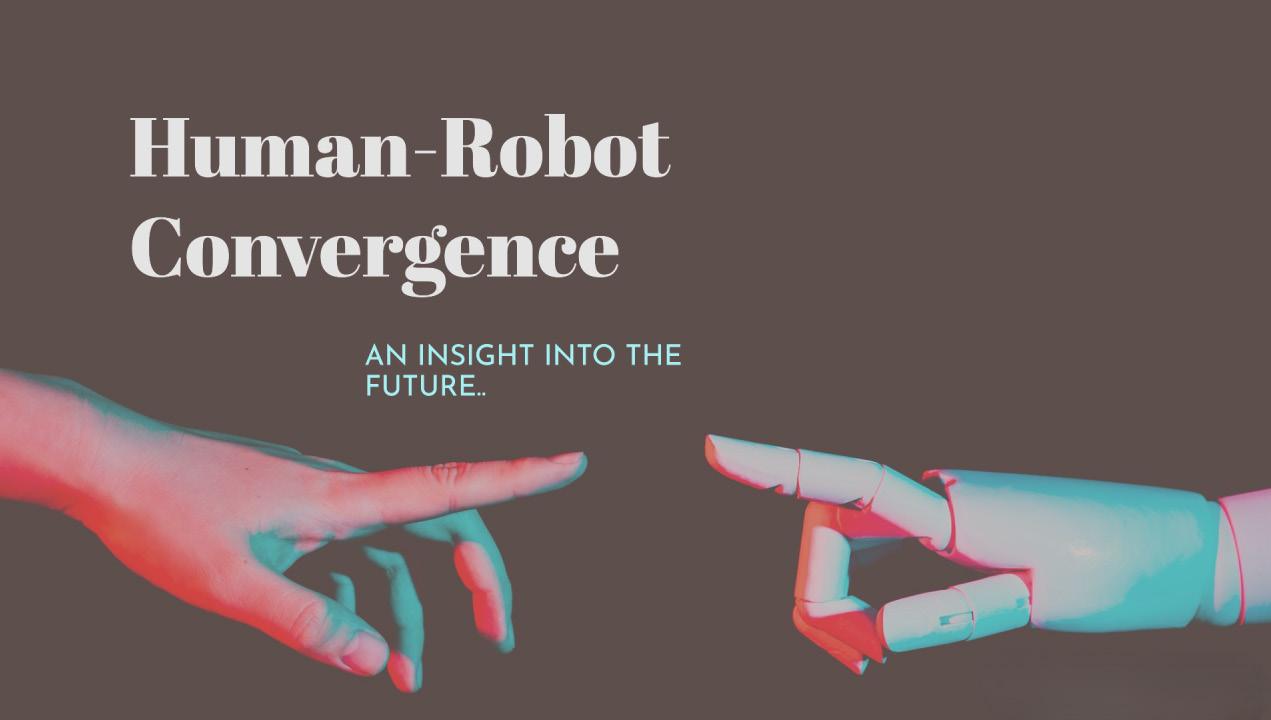
Human–robot convergence.
on automation, machine learning, and AI for daily tasks from controlling our homes to even diagnosing diseases highlights how much we are incorporating robotic assistance into our lives. In many ways, we are outsourcing our cognitive load to machines, almost turning ourselves into automated beings dependent on systems to function efficiently.
In the not-so-distant future, I believe we will reach a state of equilibrium where humans and robots will not just coexist but operate on a very similar level. Think about it: Humans are becoming more “robot-like” as we integrate technology into our lives, while robots are evolving to be more “human-like” in their form, intelligence, and even emotions.
This convergence will redefine the workforce, society, and how we interact with each other. Human–robot teams will not be unusual; in fact,
they will be the norm. With advanced AI and robotics performing the bulk of labor-intensive tasks, humans may shift their focus toward creativity, critical thinking, and emotional intelligence – areas where we still have an edge, at least for now.
This shift is already happening with the rise of wearable technology and artificial body parts. We see it in the rise of prosthetics, which are becoming so advanced that they can perform better than natural limbs. Companies like Neuralink are even pushing boundaries by creating brain–machine interfaces that could allow humans to control devices and potentially even other people or robots using just their thoughts.
“Humans are becoming more ‘robot-like’ as we integrate technology into our lives.”
Wearables like smartwatches, fitness trackers, and AR glasses are augmenting our abilities, making us better at monitoring our health, processing information, and even navigating the world. The line between human and machine is getting blurrier by the day. For instance, artificial hearts and other organs are already giving people a second chance at life, pushing the boundaries of what it means to be human.
In the future, these technologies will likely integrate even more deeply into our biology. Imagine a world where your memory, cognition, and physical abilities can be enhanced or repaired by simply upgrading a piece of hardware or installing software into your body. These advancements aren’t far off, and they represent a fundamental shift in how we view humanity.
Neuralink and other brain–computer interfaces are perhaps the most transformative technology
on the horizon. Imagine being able to think a command and have it executed instantly by a machine or even another human being connected to the same network. We are approaching an era where brain signals can be uploaded, downloaded, and manipulated just like any other form of data.
This could lead to ethical questions, such as who controls the data and how far we are willing to go in integrating machines into our bodies. But one thing is clear: The boundary between human and robot will become increasingly indistinct as we incorporate more tech into our bodies. In the end, it won’t be about humans vs. robots. It will be about how both coexist and enhance each other, forming a new species of cybernetic organisms.
Looking back from the 1980s to today, the evolution has been incredible. As we continue this journey, I believe humans and robots are on a path to convergence, where the distinctions between us blur and we find a new equilibrium. The merging of advanced robotics, artificial organs, wearables, and brain-machine interfaces will reshape our future and redefine what it means to be human.
Neuralink. (2026). Breakthrough technology for the brain [Website]. https://neuralink.com/technology/ Humanoid Hub. (2025, November 9). The latest humanoid innovations: Transforming robotics in 2023. https:// www.humanoidhub.ai/blog/the-latest-humanoidinnovations-transforming-robotics-in-2023?utm_ source=chatgpt.com
The Author
Saqib Sharif is a robotics engineer with a PhD in mechanical engineering, specializing in the design of smart healthcare devices and microrobots. With a strong background in medical technology and innovation, he is passionate about creating solutions that enhance smart healthcare. Dr. Sharif has been living in Gwangju for the past ten years. Currently, he serves as a senior researcher at Shinsung Tech Pvt. Ltd., Gwangju.
By Reeti Roy
The exhibition No Words, held at Egg Gallery in Yeosu, South Korea, between December 2025 and January 2026, offered a platform to explore the boundaries of presence, embodiment, and the unsaid. While multiple artists contributed to the exhibition’s investigation of silence, gesture, and materiality, this article focuses on Indian artist Prasanta Sahu, whose work I engaged closely with, navigating a practice that moves fluidly between photography, research, and critical documentation. His work grounds the conceptual tenets of DoSeong Aesthetics – coexistence, material consciousness, and the ethics of making – in the tangible realities of labor.
Egg Gallery was founded in 2021 on the site of a former telephone exchange in Doseong Village, once a Hansen disease settlement located near the current Yeosu airport. Situated on this historical ground, the gallery is not merely an exhibition space but a laboratory for exploring DoSeong Aesthetics – how art can confront the unspoken lives and unrecorded histories of Hansen disease communities. The gallery name “Egg” symbolizes life, resurrection, beginning, and renewal.
Central to Sahu’s approach is the preservation of the student self. In our dialogues, he emphasized, “On a creative journey, after achieving a certain stage, it is very difficult to keep your learning windows open, that is, to keep the student in you alive. I see that most professionals, after attaining a certain point, get saturated and stuck with a few things they’ve achieved. After that point, they
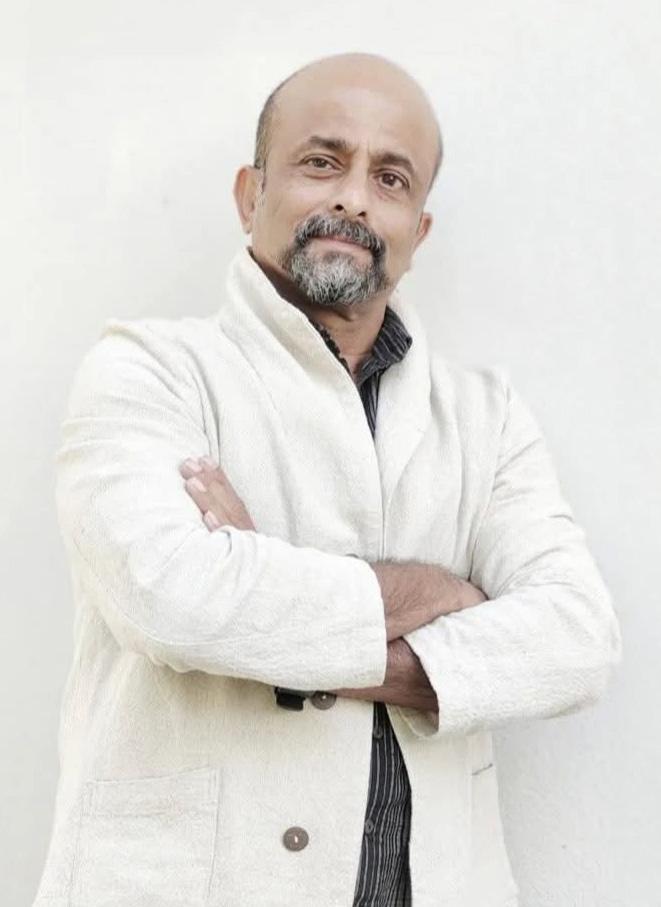
Sahu. (Courtesy of the artist)
are unable to create something new. Most of the time, the student self in them dies.”
The creative act, for Sahu, is a self-reflective monologue that prevents ossification in past achievements. He views the universe as a complex architecture of patterns where every resolution demands new inquiry. “If a creative person can engage themselves at the age of 90 with the questions developed by their practice, that would
be the best part of the journey. It’s not about solving problems and always seeking answers; sometimes one can help the world by raising a valuable question too.” This commitment to lifelong questioning shapes both his artistic and teaching practice, emphasizing the ethical responsibility of attention and inquiry.
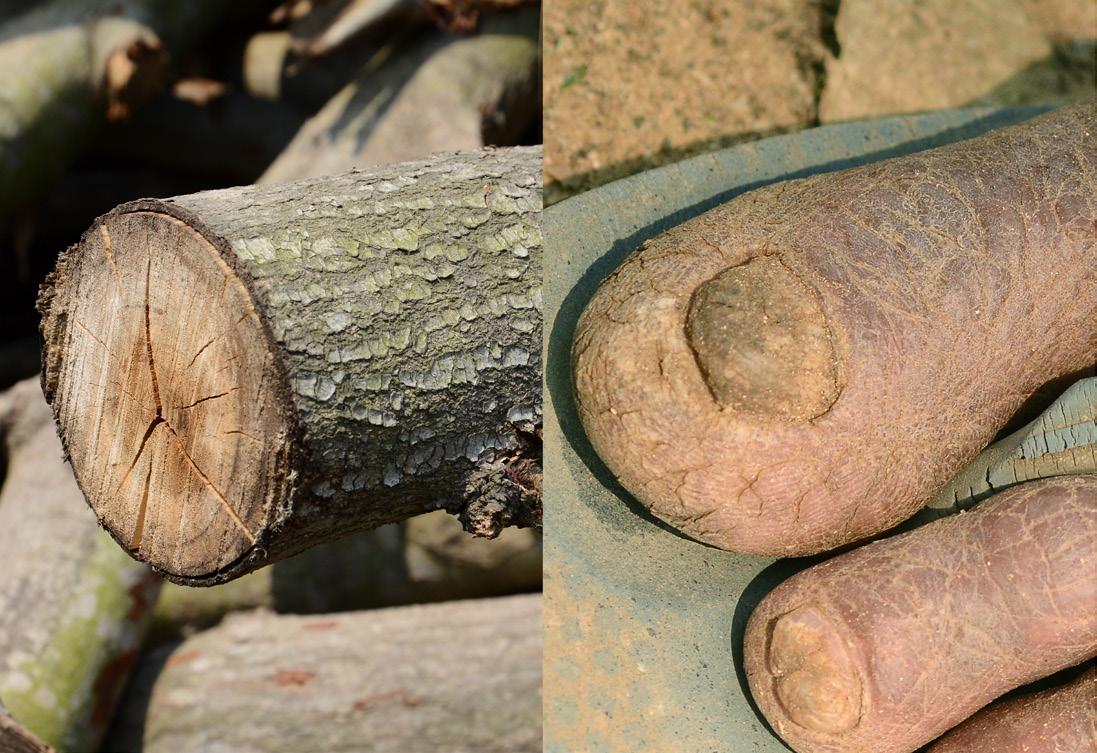
Sahu is attentive to temporal depth, seeing both the living body and inanimate objects as layered with history. “The existence of the ancient in almost everything, from the living body to inanimate objects, haunts me. I find myself compelled to trace the echoes of the past that linger within them.” His methodology uses individual case studies, tracing the complexities of singular lives to illuminate the wider social fabric.
The individual becomes a reflection of broader networks, revealing dependencies, labor structures, and cultural patterns. As he expands his perspective, Sahu explains, “As I widen my perspective, the aperture expands, revealing a more intricate, multilayered tapestry. The complexity of our social ecosystem comes into focus, with interconnected threads of dependency that shape our lives. Some of these relationships are visible, while others remain hidden. Through my art, I attempt to decipher and diagram these dynamics, making the invisible visible.” Through
this lens, personal narratives reveal wider social, economic, and cultural entanglements.
Sahu is drawn to the enduring dialogue between humans and objects. “Another area that fascinates me is the enduring relationship between humans and objects across centuries. I am drawn to the evolution of object design, functionality, and modification, as well as their recyclability. The shapes of objects, often designed for human interaction, have a lasting impact on us.” Objects carry memory and influence, shaping human bodies as they are shaped in return. Some objects, he notes, “hold ancient wisdom, inviting us to decipher their stories and connect with our collective past.”
These ideas are realized in the sawmill worker from Occupational Bond I and II. In Occupational Bond I, the fractured cross-section of a log sits beside the worker’s calloused toe, abstracting both surfaces into textures that echo each other, collapsing the boundary between human and material. Occupational Bond II continues this exploration, showing a dense pile of timber alongside the worker’s hands, wrinkled, swollen, and marked by repetition. The weight of timber mirrors the invisible accumulation of labor inscribed on the human body. In these works, Sahu transforms ordinary labor into an ethical reflection. The photographs do not dramatize
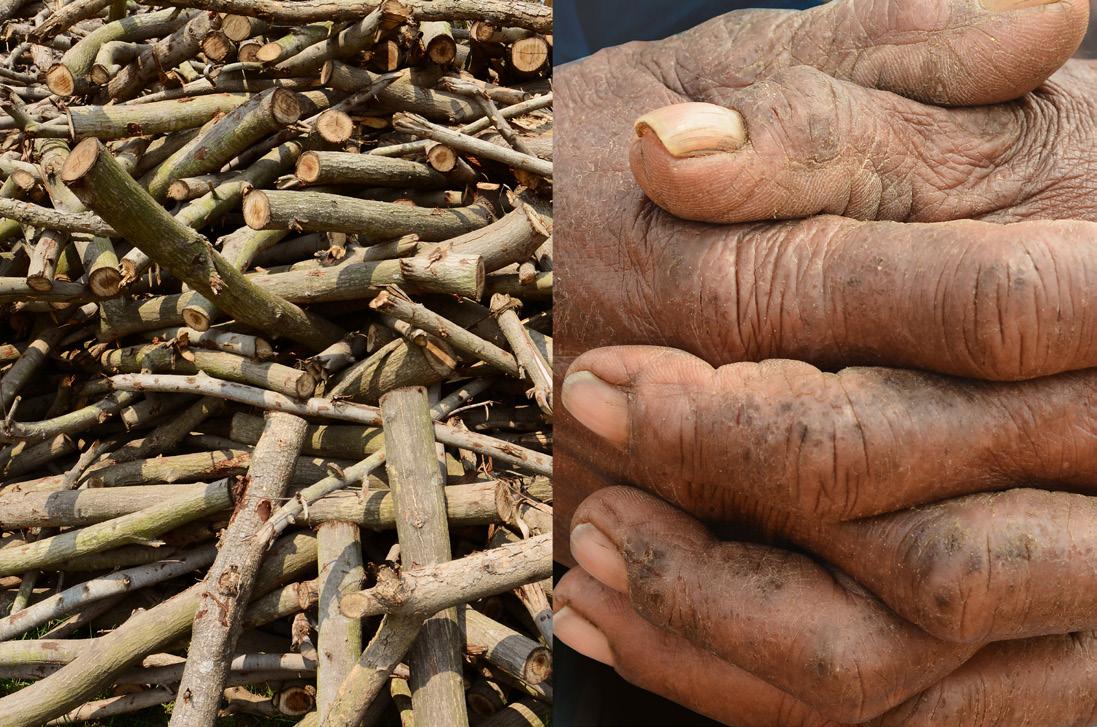
toil; they demand sustained attention, revealing the haptic knowledge embedded in repeated gestures and endurance.
Sahu’s commitments are inseparable from his twenty-year tenure as an educator at Santiniketan. He inherits the modernist ethos of Rabindranath Tagore, who championed an education of the senses and harmony between creativity, labor, and nature. This lineage resonates with Ramkinkar Baij’s monumental representations of Santhal life and Manjushri Chaki Sarkar’s Navanritya. Like Chaki Sarkar, Sahu treats the body as both expressive and methodical; gestures of labor become a silent yet eloquent visual vocabulary.
Sahu also critiques contemporary pedagogy, noting its failure to cultivate the generative question. He reflects, “Students prefer to listen... but when I ask them if they have any questions at the end of the lecture, most of the time they remain silent. Actually, the fault lies with our education system at the very primary level. ... We have failed to teach our students to generate questions, and unless one learns to generate a question, how can they grow and contribute something new?” This insight parallels his artistic practice: attention, curiosity, and inquiry are ethical imperatives, not optional.
Experiencing Sahu’s work in Yeosu revealed the resonance between his practice and DoSeong Aesthetics, emphasizing coexistence, material
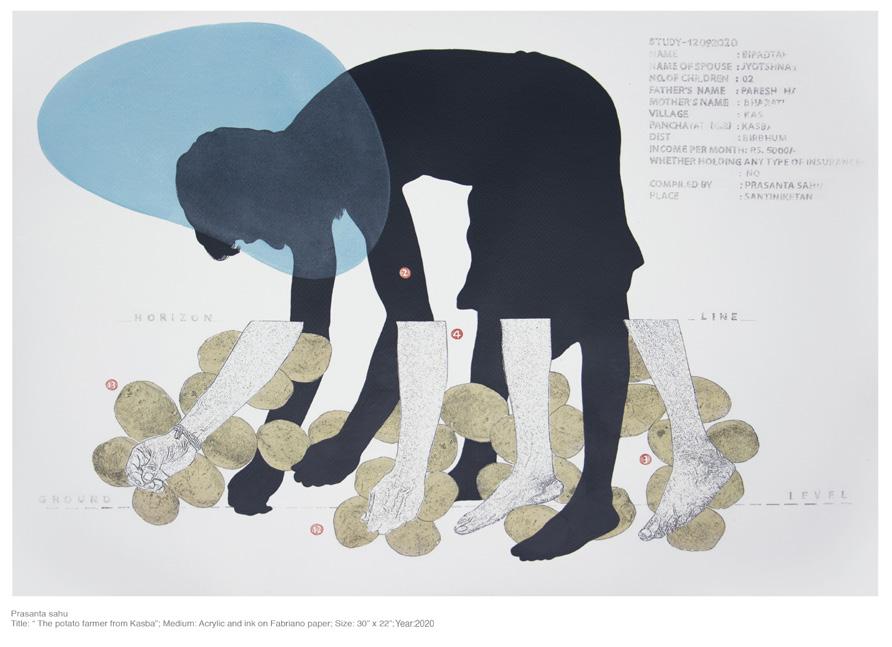
consciousness, and ethical engagement. While multiple artists participated in No Words, Sahu’s work exemplified the exhibition’s central concerns: labor, presence, and the archival body. His practice translated abstract ideas into tactile, corporeal experience, allowing viewers to confront time, effort, and materiality directly.
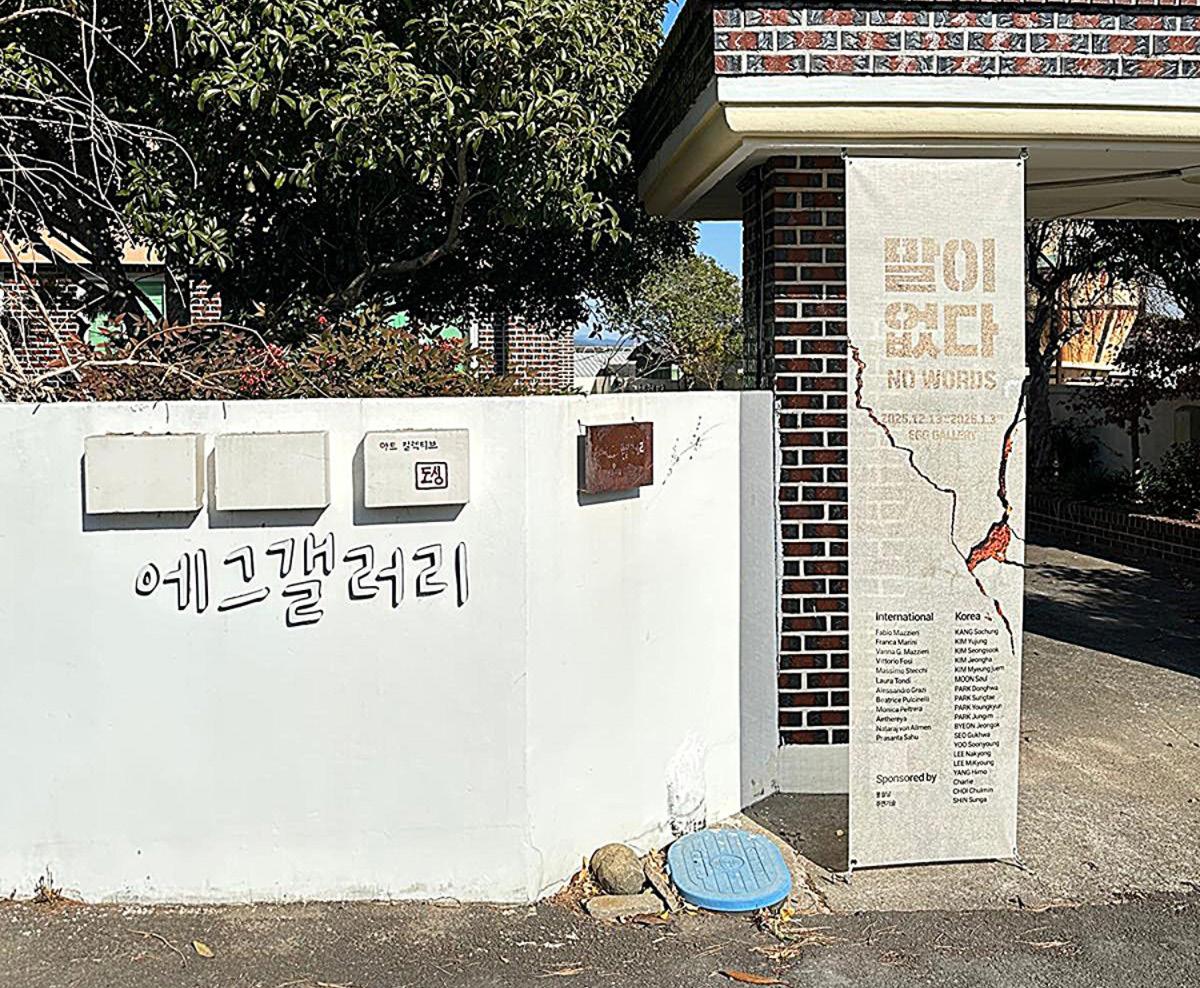
Through our collaboration, it became clear that Sahu’s work functions as an ethical corrective to the transience of modern life. History is not solely held in archives or texts but is continuously inscribed in bodies, objects, and labor. Within his lens, the ordinary becomes monumental through sustained attention. The ethics of presence unfold through the unwavering sincerity of the student self, a self that carries questions across a lifetime until they yield a satisfactory and sometimes silent answer.
The Author
Reeti Roy is a writer, cultural commentator, and creative entrepreneur whose work explores memory, art, identity, and social justice. She holds a BA in English literature from Jadavpur University and an MSc in social anthropology from the London School of Economics. Her essays and criticism have appeared in numerous publications, including Korean media. In September 2025, she had several international engagements in South Korea, including as keynote speaker at KOTE, Insa-dong, and at the Yeosu Egg Gallery.
By Reeti Roy
Autocracy is not static. It moves.
Across cinema, power often reveals itself not through declarations or violence, but through rhythm, through bodies trained to move together, voices trained to repeat, and systems designed to appear seamless. In Satyajit Ray’s Hirak Rajar Deshe (1980), Choo Chang-min’s Masquerade (2012), and Bong Joon-ho’s Parasite (2019), authority survives through performance. Justice, when it arrives, does so through disruption.
In Hirak Rajar Deshe, control is choreographed. Citizens march, sway, and chant in near-
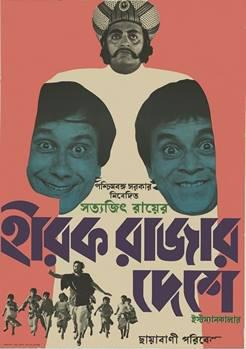
perfect synchronization. Individual movement disappears. People no longer walk so much as rotate within the king’s design. Language, too, is mechanized. Rhymes replace reasoning. Call and response replaces thought.
The slogan “Dori dhore maro taan” (short for “pull the ropes [forcefully, and the king will be shattered]”) is central to Ray’s critique. Its sharp consonants and clipped rhythm are designed to be memorable, repeatable, and bodily. The phrase moves faster than reflection. Once the chant takes hold, the body responds before the mind can object. Ray’s warning is clear: A society that no longer tolerates pauses, irregularity, or friction has already surrendered its humanity. Life is uneven. Tyranny prefers the grid.
In Masquerade, power is maintained through ritual rather than slogans. The king’s body is public property, governed by strict protocols that regulate everything from meals to sleep. Authority is sustained by repetition so exact it becomes sacred. When the imposter king Ha-sun disrupts this ritual by feeding a starving servant or speaking out of turn, the effect is destabilizing. Justice enters not through conquest but through a break in rhythm.
Bong Joon-ho’s Parasite stages this choreography in a contemporary, domestic setting. The Park family’s insistence on not crossing the line is a rehearsed performance of civility, one that masks structural violence. The film’s now famous Jessica Jingle operates as its most efficient instrument of deception. Jessica, only child, Illinois, Chicago. A résumé becomes a melody. The song embeds credibility in the listener’s mind, making doubt
feel impolite. Once performance replaces proof, fraud becomes fluent.
Lighting, across all three films, functions as a moral language. In Parasite, sunlight is a class marker. The Parks live bathed in it, unaware of its privilege, while the Kim family survives on filtered, reflected light. When the flood arrives, illumination exposes a brutal asymmetry. What is disaster for the basement is mere ambience for the lawn.
In Hirak Rajar Deshe, the palace is flooded with harsh, unyielding light, an environment of constant exposure that paradoxically conceals truth. Against this glare stands Udayan, the teacher, whose classroom is lit by candlelight. The contrast is deliberate. This is not the light of surveillance but of learning, not exposure but growth. Masquerade echoes this visual grammar, bathing Ha-sun in warm candlelight while the ministers operate in cold blue corridors. Light, in these films, is less about visibility than permission.
Ray’s most radical intervention lies in his treatment of rhyme. Rhymes create closure. They satisfy the ear before the intellect has time to resist. The king’s slogans do not persuade. They condition. Language becomes muscle memory. Citizens are reduced to children, and dissent is reframed as misbehavior rather than reasoning.
Udayan resists by refusing this structure. He speaks in prose. He pauses. He asks questions
that do not resolve neatly. His language is intentionally awkward, and therefore freeing. In Ray’s world, liberation begins with the unfinished sentence.
Masquerade reveals another unsettling truth. Power is performative, and therefore transferable. Anyone who learns the steps can wear the crown. The tragedy is not simply that power is cruel but that it is interchangeable.
Parasite denies this possibility. Bong Joon-ho insists that class is architectural. Performance has limits. Gravity, space, and even smell eventually expose the lie. You cannot rehearse your way out of structure.
What unites these filmmakers is their suspicion of seamlessness. They show how performance does not merely conceal violence. It sanitizes it. It keeps the evidence of struggle out of polite spaces. Social justice, in these films, does not arrive with resolution, but with rupture. When the chant falters, when the imposter king speaks plainly, when the song slips and the truth can no longer be contained.
As a writer, I return to these films as blueprints. They remind me that storytelling is not about smoothing over reality but about revealing its joints. To write, then, is to trace the architecture of control and to resist the comfort of perfect rhythm. When the world demands seamless performance, the most honest response may be to let the pattern break.
The Author
Reeti Roy is a writer, cultural commentator, and creative entrepreneur whose work explores memory, art, identity, and social justice. She holds a BA in English literature from Jadavpur University and an MSc in social anthropology from the London School of Economics. Her essays and criticism have appeared in numerous publications, including Korean media. In September 2025, she had several international engagements in South Korea, including as keynote speaker at KOTE, Insa-dong, and at the Yeosu Egg Gallery.
By Farrukh Anique
In 2005, a scandal broke in Gwangju, one that would later be retold as Dogani (도가니).
The principal of a special school for children with speech and hearing impairments, along with members of the school administration, was accused of sexual assault and physical violence against students. The person who blew the whistle was a teacher from within the same school, accompanied by members of a human-rights organization. Many of the accused, including the principal of Gwangju Inhwa School, were acquitted, others escaped punishment as the statute of limitations expired, and even those convicted often saw sentences reduced, light enough that several found their way back to work.¹
In 2009, Gong Yoo – the actor many now recognize as the salesman from Squid Game –was serving in the military. In those quiet pockets of military life, he read a novel titled Dogani (The Crucible). In Korean, “dogani” literally means “crucible”: the vessel in which metal is melted down. But the word also carries a more human meaning: a slow boil, the psychic heat that forces a person to change, to move, to act.
That novel was written by the Korean novelist Gong Ji-young, inspired by the same Gwangju Inhwa School scandal. When Gong Yoo read it, it struck him so deeply that he contacted the author and asked her to bring the story to the screen, insisting that he wanted to play the role of the whistleblowing teacher. Director Hwang Donghyuk shaped it into a screenplay with the novelist and directed the film.
The film unfolds in a fictional city called Mujin, described as a city of white fog. This invented place is attributed to the renowned Korean
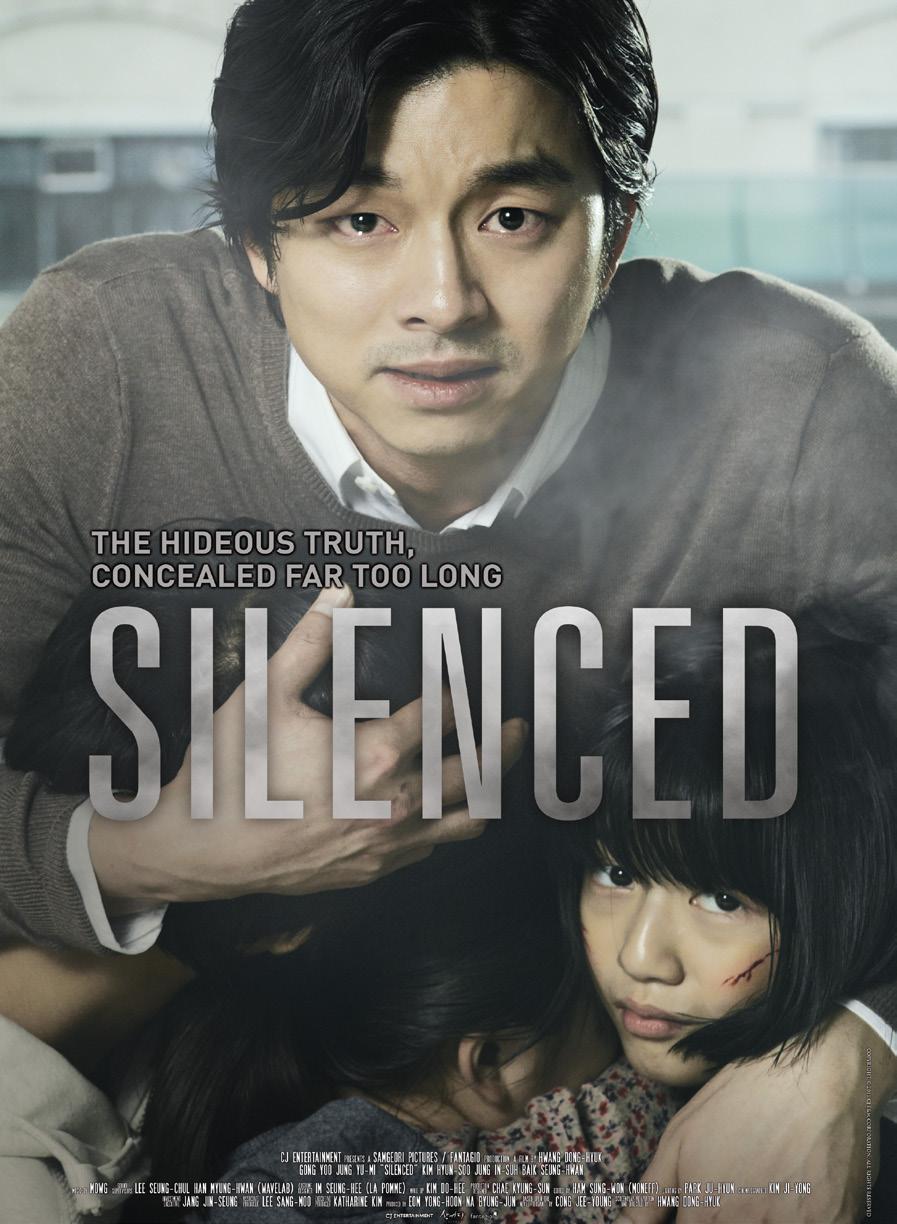
novelist Kim Seung-Ok, who used the name for the first time in his novel A Journey to Mujin (Mujin Gihaeng), turning the white fog into a metaphor for moral ambiguity. After that, Mujin reappeared across novels and films, carrying the same suggestion: a place where right and wrong lose their sharp edges, where clarity dissolves into mist.
A new teacher, Kang In-ho, arrives in Mujin from Seoul to work at the special school. On his very first day, he is asked for a bribe to secure his position, money his mother raises by cashing out what little she can, down to the deposit on her home. In the early days, he notices that the
children in his class come to school with bruises and wounds on their faces and bodies; they sit in silence, sad and withdrawn. Then, one day, he sees the hostel warden dunking a small girl into a washing machine. He pulls her out, rushes her to the hospital, and brings along his friend Yoo-jin, who is also a member of a human-rights organization. The girl writes on paper and tells Yoo-jin that the principal tried to sexually assault her. The doctor’s report confirms it: “The child is badly injured, the wounds bearing the mark of sexual violence.”
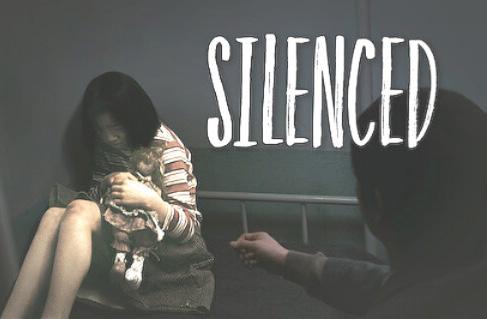
At first, Kang In-ho is so stunned he almost mistakes it for some grotesque misunderstanding. But once he reads the report, scattered pieces begin to click into place. Another girl tells them that they have already told the police, but the police always send them back to the same school. A boy tells them that a teacher also sexually abuses the boys, and that both he and his late younger brother were victims.
When In-ho and Yoo-jin go to the police, they are met with a chilling dismissal: The principal is a senior member of the church, a devout man, a pillar of the community. How can such an accusation be made, they imply, on the testimony of a few deaf children? From city hall to disability institutions, their pleas find no ear willing to listen.
In the end, they call in a TV channel, record interviews with the children, and broadcast them. Public pressure finally forces the system to stir, and three people, including the principal, are arrested. But then the familiar spectacle begins: influence, money, connections, the old machinery that turns wherever the gulf between rich and poor, strong and weak, is so wide that even the bridge of law cannot span it.
By the end, the film shows the triumph of the oppressor. The voice of the victim is muffled, and in this case, the victim is already one that literally had no voice. To silence such children, the speaking world doesn’t even need to work hard. Looking away from helpless children making gestures with their tiny hands is enough.
The last scene ends with an image of Mujin: white fog everywhere. Kang In-ho stares at it, carrying a strange blend of despair and stubborn hope. The film leaves the viewer with suffocating pressure in the chest. You feel as though the helplessness of In-ho, Yoo-jin, and those innocent children has slipped out of the screen and entered you. For a moment, it is as if you yourself have become deaf and mute, bound hand and foot with Scotch tape in the principal’s office, while that grotesquely ugly principal tears at your tiny body with a brutality that makes your skin crawl.
That was the film’s success. That is what the makers wanted: that you feel, however briefly and imperfectly, what those children felt.
The film was released in September 2011, and for weeks cinemas were packed. People left the theater carrying that heaviness home, unable to shake it, unable to sleep it off. Eventually, the pressure escaped in the form of protest, and the city administration of Gwangju came under such scrutiny that, within just two months of the film’s release, the school was shut down. Several cases were reopened, and punishments were handed down again. One accused person was sentenced to twelve years in prison.
More significant than all of this was what happened next: Korean lawmakers changed the law related to sexual violence and passed a new bill. In the “Dogani Bill,” the statute of limitations was abolished for sexual abuse cases involving minors (the statute of limitations being the period after which legal action can no longer be taken). Previously, proving sexual assault required proving that the victim was not capable of resisting, an almost impossible burden in many cases. The Dogani Bill removed that clause and made “proving incapacity to resist” unnecessary. Earlier loopholes allowed cases to collapse when victims withdrew complaints after settlements; legal reforms moved toward prosecution without depending on a victim’s petition.²
It was a tremendous victory: In-ho’s victory, Yoo-jin’s victory, and a victory for every abused child whose voice the state refused to hear simply because they could not speak. Their voices were heard; heard in courtrooms, heard in state institutions, and echoed beyond borders. Few examples demonstrate more clearly the reach of art and media, and the positive role they can play in society.
The film is shot with remarkable craft. Its deep, quiet palette gives it the texture of a horror film; and what horror is greater than sexual violence? The actors, especially the children, perform with devastating force. To convey panic, resentment, dread, and exhaustion without dialogue is not easy; the children accomplished it with heartbreaking precision.
The character of teacher Kang In-ho is compelling because he feels real. He is not a cinematic superhero or a mythic savior. He is an ordinary man, like you and me, offered many chances to be brave, yet repeatedly caught by calculation and fear. The war between convenience and conscience is not easy for him. This conflict, this riddle of what a person owes to the vulnerable, Gong Yoo often delivers without words, with nothing but a shift of expression. The peak of his craft is visible here.
Many scenes stay with you, but two carry the weight of the entire film.
In one, a deaf boy who has been accompanying his teacher and attending court, hands the teacher a sheet of paper. He writes that everyone says his little brother ran away from the hostel and was accidentally hit by a train. But it wasn’t an accident; it was suicide. The boy took his own life because he could no longer live inside that torment. Then the older brother breaks down, sobbing until the air itself seems bruised. There is a pain in that moment that sits on your heart for days: A child who cannot speak, carrying that burden in silence for so long, and when it finally spills out, it comes like floodwater.
In another scene, police fire water cannons at deaf protesters to scatter them. Teacher Kang stands holding the photograph of the child crushed under the train and shouts at the citizens: “His name was Min-su. He couldn’t speak; he couldn’t hear.” The torrent knocks him down; he rises and says it again. He falls; he rises; again and again, he repeats the same two lines. That scene shakes the collective conscience of society and delivers a brutal message: You don’t have to do much; only speak these two sentences. “His name was Minsu. He couldn’t speak; he couldn’t hear.”
Sources
¹ Editorial. (2011, September 30). No leniency on sex crimes. The Korea Herald. https://www.koreaherald. com/article/10348563
² Kim, R. (2011, October 28). National Assembly passes “Dogani Law.” The Korea Times. https://www. koreatimes.co.kr/southkorea/20111028/ national-assembly-passes-dogani-law
Author
Farrukh Anique is a PhD student immersed in mechanical engineering at Chonnam National University. Originally from Pakistan, he’s not all about gears and equations though. He’s got a real love for the performing arts, culture, literature, and languages. He is an amateur theater actor, a short-story writer, and he speaks five languages. In his spare time, he dives into Korean culture and history, soaking up the vibrant traditions and stories that spark his curiosity. Oh, and he absolutely loves strawberries.
Reviewed by Michael Attard
The Island of Sea Women
By Lisa See
400 pages, Scribner, 2020
All Koreans, and anyone who visits Korea for any length of time, know about Jeju Island, situated off the south coast. The island encompasses more than 1,800 square kilometers, and today is a year-round holiday destination. But there is one description of the island from the past that is still widely used, and that representation is the island of “wind, stone, and women.” It is the third of these elements –women – that serves as the basis for this historical fiction. But these are no ordinary women, these are the sea women, known in Korean as the haenyeo (해녀).
The story begins in 1938, submerged in the era of Japanese colonialism, which lasted until 1945 with the end of World War Two. But this is neither the conclusion of the story nor the end of violence for the people of Jeju. The struggle for freedom has been encapsulated for history by referring to a single date, April 3, 1948, and called the Jeju Island Incident. But the conflict actually lasted for more than a year, and thousands of innocent people were killed. The Jeju Island Incident serves as the focal point of this story. For the sake of clarity, though, it is worth remembering that the Korean War began in June 1950 and stretched the pain forward for another three years.
The main character is Kim Young-sook. She is a haenyeo, and she has learned from her mother how to swim, endure the cold, hold her breath, and collect the harvest of the sea. The events of the past are spoken in her voice. The author, Lisa See, has not presumed that anyone other than Youngsook can tell her story. There are, however, other chapters chronicling a mere four days, which pull away from the past but tie the history to the
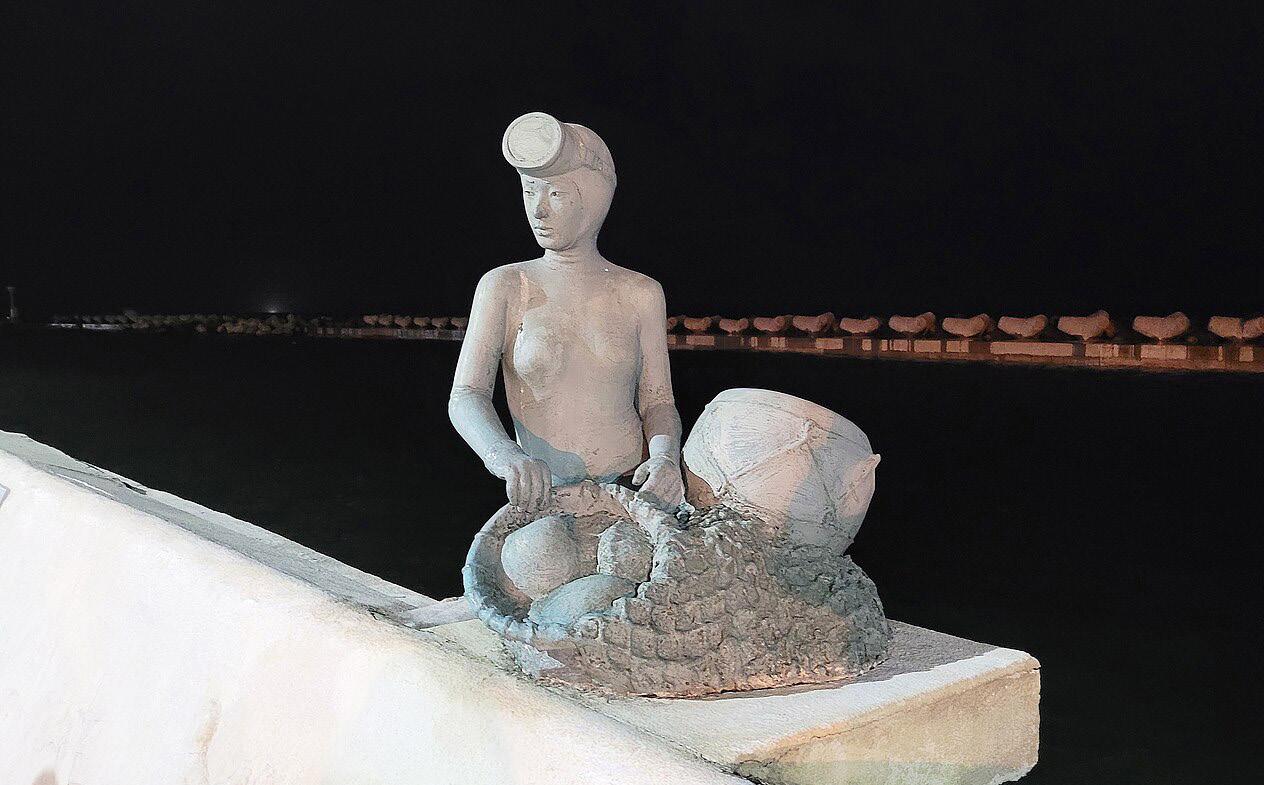
current moment: the year 2008. These are related by a narrator who explains what is happening to Young-sook when she is approached by a family who are seeking her forgiveness.
At the heart of the book is the relationship between Young-sook and Mi-ja. They meet as young girls on the day that Young-sook and her mother catch Mi-ja stealing sweet potatoes from their garden. This transgression is forgiven, and friendship buds. But the relationship is cemented on the day that Mi-ja defends Young-sooks’ mother in front of Japanese soldiers. After this occurred, Youngsook describes the relationship succinctly: “We were as close as a pair of chopsticks.”
The years pass and the friends are still young, but, as was common for the times and culture, their thoughts turned to marriage. Young-sook’s grandmother arranges the marriages for both girls. Young-sook marries a local man, Jun-bu, who she has known all her life, but Mi-ja marries an outsider. This man, Sang-mun is handsome, and his family is rich. But they are also known
to be collaborators with the Japanese. The engagements are bittersweet for the two young women. As Mi-ja says, “We wanted to marry boys in Hado, (their hometown) so we would always be together.”
Mi-ja moves away but life circumstances bring them together from time to time. They continue to share their thoughts and feelings. Mi-ja reveals that “things are not good with my husband.” Both women experience doubt about their selfworth. Young-sook’s husband becomes a teacher. She says, “I’ll always be a fool to him.” Her grandmother slapped her. “You are a haenyeo! Never for one moment believe you are unworthy.”
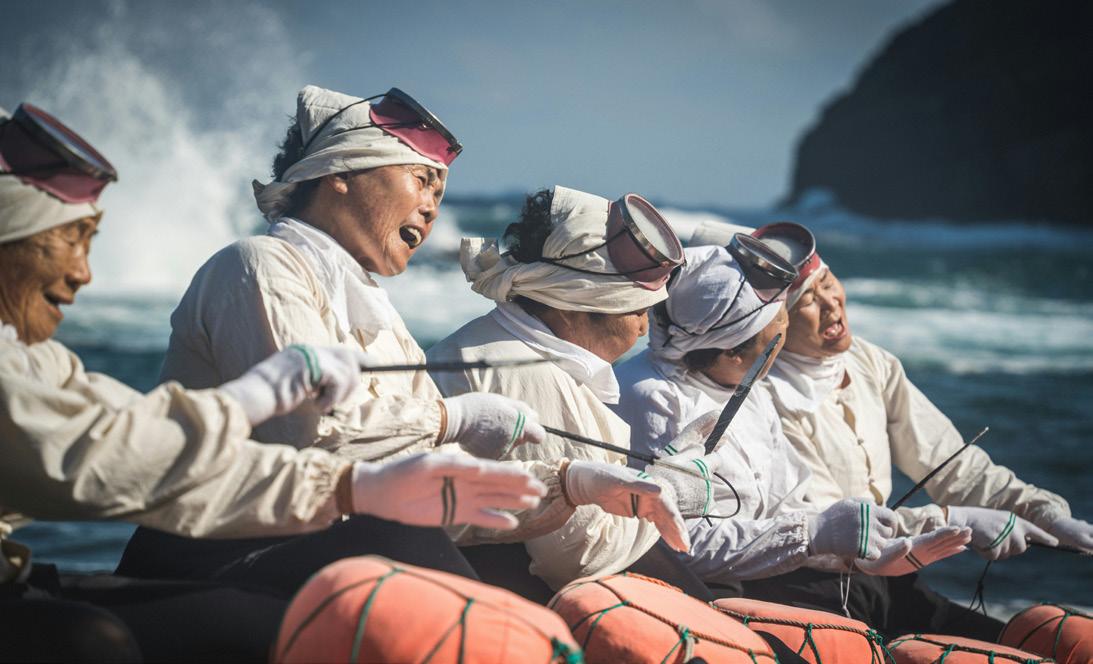
Throughout the book, the reader learns about what the life of the haenyeo is like. From a modern perspective, it is almost impossible to conceive of what these women endured. Their job was seriously dangerous, and many women died in the sea.
The two women bear children and World War Two comes to an end. But it seems that little has changed. As Young-sook reflects upon the situation, she concludes, “One colonizer had been replaced by another.” Her husband, Junbu grumbled, “They (the Americans) want us to accept their form of democracy, with an American-backed dictator.” The people of Jeju wanted to hold their own elections, and for this they were labelled “Little Moscow.”
The infamous date, April 3, 1948, arrives as the climax of the story. Young-sook and Mi-ja’s lives are changed forever. For Young-sook, adding to her physical loss is the overwhelming sense of betrayal by Mi-ja. Young-sook felt that a knife had been thrust into and turned in her belly.
The chapters, recounted by a narrator, place the reader on a Jeju beach sixty years after the infamous 4/3 date. A Korean woman and her American-Korean daughter have sought out Young-sook. The two women are Mi-ja’s granddaughter and great granddaughter. What follows is, in a sense, explanation, or filling in blanks, that Young-sook was not aware of. The author has done this not by offering excuses, denying, or counter arguing details. Rather, the two women from America ask Young-sook for forgiveness for Mi-ja because Mi-ja had her human failings but never for a moment stopped loving or intentionally abandoned Young-sook.
This is a story of forgiveness, and even though it takes sixty years, Young-sook’s heart is finally touched. Young-sook eventually comes to question her anger. She comprehends the truth spoken by the local shaman: “You are not being punished for your anger. You’re being punished by your anger.” The realization comes to Youngsook that she, for her part, has also failed Mi-ja. She contemplates the present moment, knowing that “she doesn’t have much time left to love or hate or forgive.” For the reader, the author has created a cathartic experience. Freedom comes for Young-sook. “She feels excruciating pain as decades of sorrow, anger, and regret she’s carried within her begin to shatter and melt.”

Michael Attard is a Canadian citizen but has lived in Gwangju for over twenty years. He has taught English as a second language in academies and within the public school system. He is officially retired and spends time reading, writing, hiking, and spending time with friends.
By Jo Lezada
Iwas never a fan of bagels. For the past twelve years of living in Korea and frequenting coffee shops, my go-to pastry was almost always cake – the bagel being a last-resort option if I was on a tight budget. Therefore, the last place you would find someone like me would be at a coffee shop that served only bagels as the accompanying pastry to your coffee. And yet here I am, writing this article in a bagel-only coffee shop.
Café Ileilo, or Café 1215 (say it in Korean), was another one of the coffee shops I saw promoted at the Dongmyeong-dong Coffee Walk last November. Such a pleasant surprise it was to find their booth there and for one of the staff to recognize me, because as a matter of fact, I had been going to their café for months prior to the event.
My first reason for checking the café out was for convenience’s sake. I wanted a place that was near
the GIC where I worked, so I could relax and have lunch at the same time. I was then reminded of this one café that had been piquing my interest in passing with its fancy-looking exterior. One day, my curiosity and hunger got the best of me, and I caved.
Upon entering, I was greeted with a warm ambience, friendly-sounding staff, and two rows of bagels in different flavors and colors –more bagel variety than I had ever come across before. And to think, it was just here right along Democracy Road! Famished and craving for more savory than sweet, I decided to try their pepperoni cheddar bagel with my all-time favorite kind of coffee: the vanilla latte.
But what confused me at first was that they asked me which kind of vanilla latte I liked when there was only one kind on the menu. “Vanilla latte is vanilla latte, what could be complicated about
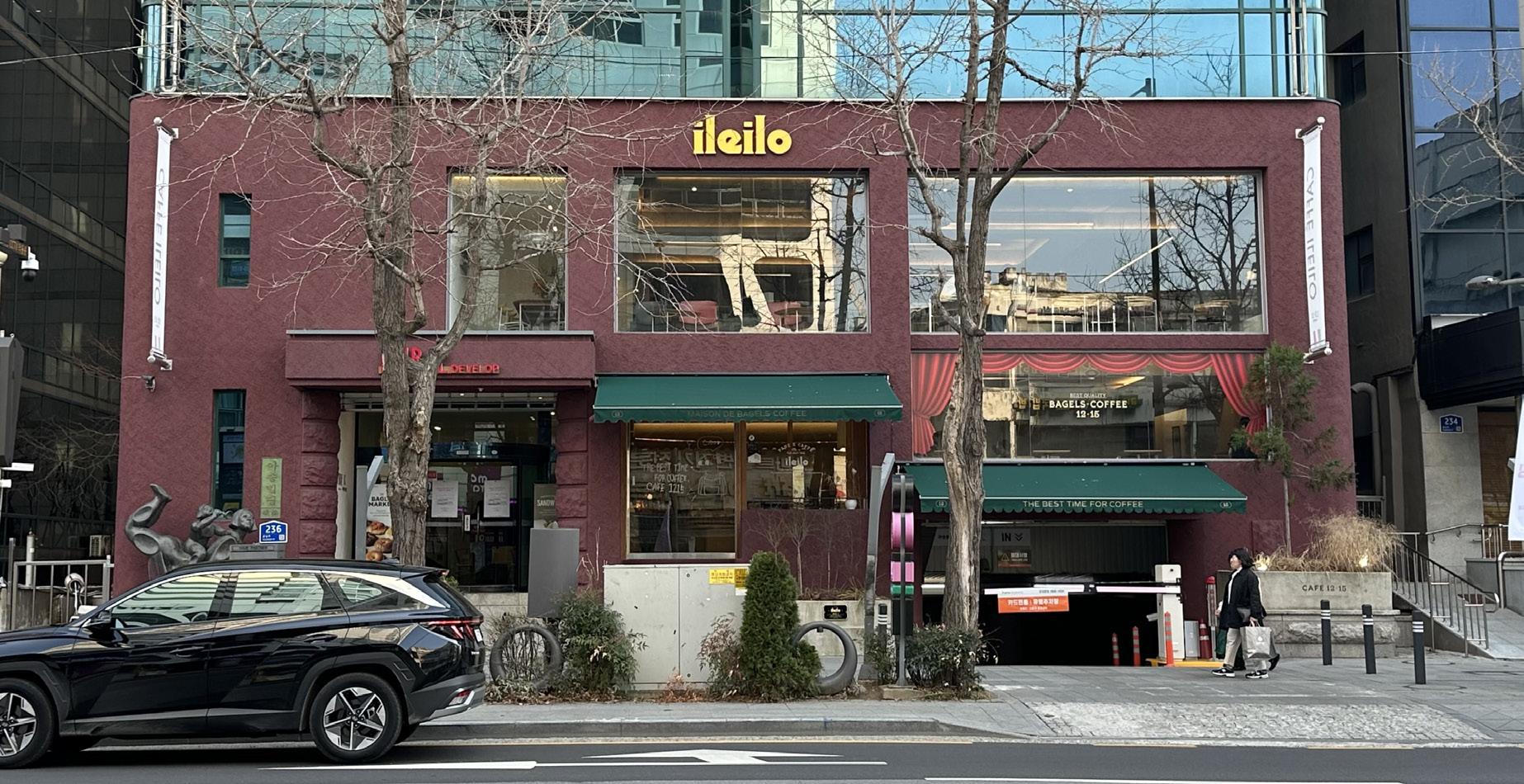
that?” I thought, and then I realized why it was named Café 1215: They offered two different kinds of blends for your drink, the 12-blend being more savory and the 15-blend being more acidic, which was interesting. However, because I love all forms of vanilla latte, I would recommend you taste the differences for yourself to see which one better suits your taste!
The café interior itself was spacious, boasting a cozy second floor and a spacious third floor for anyone who either needed a simple break, a meeting space, or a place to study with outlets for their charging devices. The music wasn’t too loud, the interior color scheme was easy on the eyes, and the café had its own restrooms.
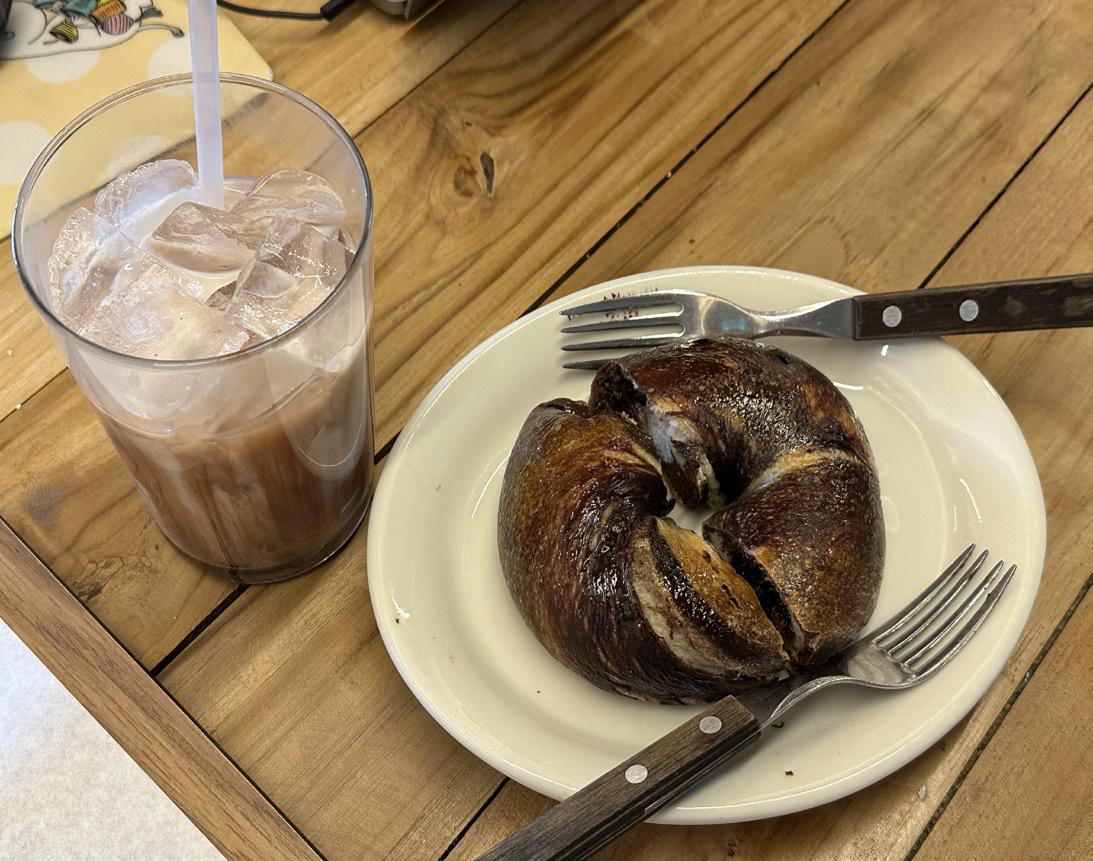
Now, on to this café’s highlight: the bagel itself.
I have had my fair share of bagels this past decade, but what made this pepperoni cheddar bagel stand out to me was the fluffy dough and the thin glaze that didn’t overpower the other flavors. It tasted different than any bagel I had ever had before, so I kept coming back for another bagel, trying a different flavor each time, like I was some aspiring bagel connoisseur. And now, recently, I decided to try one of their sweeter bagels, their chocolate bagel, a bestseller at only 4,800 won.
It was good. I especially loved biting into the bagel and savoring that warm chocolate oozing out of the dough after I had been out in the cold for some time. I will say that I wish it had more melted chocolate inside, just as their chocolate berry bagel did during the holidays last year. But if you want something with just the right amount of sweetness that melts in your mouth, this bagel might suit your fancy. And of course, if you want some extra spread on your bagel, there are a variety of flavored spreads to choose from. They are, however, on the pricier side – between 3,000 and 4,000 won for each small container. If you ask me, the bagel is already tasty on its own, not needing these extra flavor enhancers.
All in all, this café is the one that truly opened my eyes to the beauty and potential of the bagel. I was genuinely unaware that I could experience such a variety of bagels in a single café, right here in downtown Gwangju. What I thought would remain in my mind as nothing but a donutbut-not-really type of bread, turned out to be a pastry that I look forward to enjoying every month – even more than cake! Even if I weren’t doing layout work at the GIC anymore, I would make the 45-minute trip once or twice a month to return to Café Ileilo for another bite, and for another kind of bagel.
Open: Daily from 9:00 a.m. to 9:00 p.m.
Address: 236 Geumnam-ro, Dong-gu, Gwangju 61482 (광주 동구 금남로 236)
Inquiries: 062-710-1215
Johanna Lezada is a Filipino living in Gwangju who aspires to pursue a PhD in paleontology, hoping to uncover the histories and mysteries of the ages engraved in the stones of the earth! She is also a devout Christian, president of the Gwangju Toastmasters club at the GIC, and is the current layout editor of the Gwangju News.
Photographs by the author.
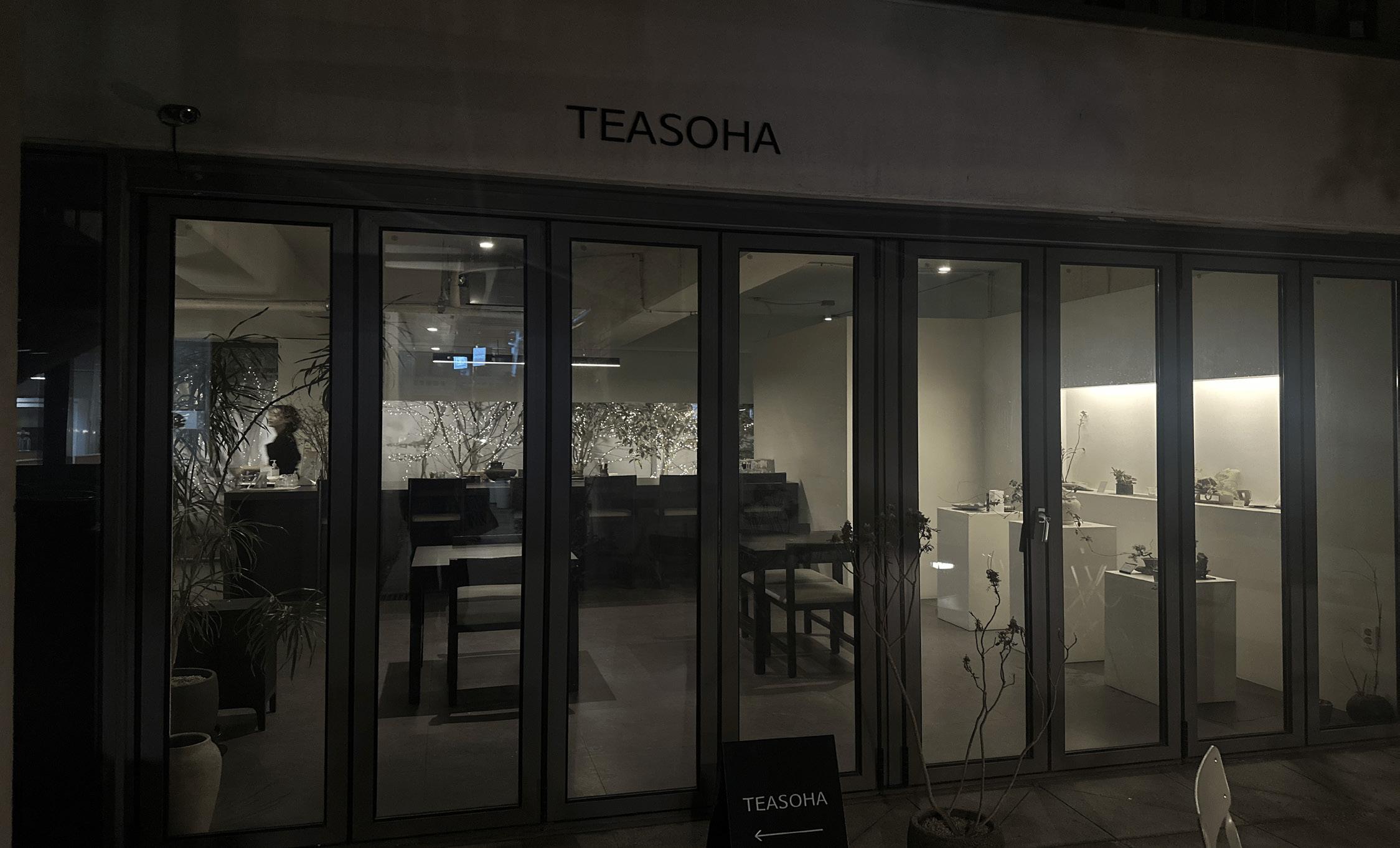
By Jacqueline L. Becerra
Time and time again, Korea continues to show me new combinations. With the robust popularity and expansion of the matcha market, the food industry has capitalized on this, giving us iconic matcha-flavored roll cakes, Levain cookies, and Dubai chewy cookies. Alcohol, however, is not excluded, with matcha highballs and makgeolli (rice wine) suddenly hitting local bar menus. Though matcha has secured a strong position, other tea varieties like Earl Grey or Ceylon have had a longer presence in the liquor market, both readily available at convenience stores.
These specific tea–alcohol mixes can be thought of as common, but other teas like oolong or white tea are quite rare and often left out. One café, however, TeaSoha in Dongmyeong-dong, includes these options. On my last trip to Gwangju, I had liked TeaSoha for their teas, but this time I decided to check out their unique tea cocktail menu. Tucked away in central Dongmyeong-dong, TeaSoha requires a bit of navigation and a sharp eye to see its illuminated signpost. Following their sign, a narrow path to the side of the building will lead you to its doors.
Upon walking in, one of the workers led my friend and I to a seat, which was a miracle, as most were taken despite the café closing in an hour. The atmosphere was calm, filled with piano music as a background for light conversation and casual dates. Young people had filled the room. With a variety of seating options from standard tables to bar seating, guests can choose their preference. Amidst the ivory upholstery and outdoor fairy lights, the open bar occupies a space. There, the tea brewing process can be seen, made evident in the array of green-tinted matcha whisks, bowls, and teaware on display. Different from what people would imagine a tea house to be, TeaSoha embraces a modern image with its monochrome interior, ambient lighting, and minimalist design. Yet, with a time-honored art such as tea brewing, tinges of tradition with ceramic pottery and tea sets remain.
Appreciating the modern and elegant interior, we were given the menu and guided on how to order via a small kiosk at the counter. Though my focus for this visit was exclusively for their tea
cocktails, TeaSoha is a café with tea, coffee, and simple desserts to pair. Tea, however, takes the spotlight with its extensive line-up of six types of tea for their dagwan (다관, teapot) set, five types of matcha, one oolong, and a mugwort latte. For non-tea drinkers, two types of drip coffee are available. And if wanting more than just a drink, their matcha parfait holds title for their signature, but they also have other light treats like handmade yanggaeng (양갱, traditional Korean jelly) and Basque cheesecake. For the tea cocktail menu, there is a selection of four items: lime matcha, melon oolong flower, white peach, and Christmas valentine. All of them use tea as their base, like Kyoto Uji matcha, oolong, and white and black tea. These drinks can be adjusted to be non-alcoholic with the exception of Christmas valentine, which includes Ballantine, a wellknown scotch whisky.
TeaSoha emphasizes tea is their focal point; the first listed ingredient being tea with no description on the type of alcohol used or its percentage. Being aware of this, we went ahead and ordered two drinks: a white peach cocktail and a melon oolong flower. Our initial reaction was that they were low in alcohol content, very light, and subtly sweet. Yet, each had its own distinct flavor profile; one was clearly melon, and the other peach. The

accompanying ingredients fused together in a balanced way. The melon oolong flower was fresh and tropical with hints of coconut and dill. After sharing a couple of sips, my friend commented that it was almost reminiscent of a less sweet, more refined version of a Melona bar. The white peach drink was light, fruity, and sweet, but not as much as typical peach-flavored iced tea syrups. To someone, like myself, who does not drink regularly, these cocktails are not overwhelming but rather delicate.
In my time studying tea, I thought of tea as incompatible with drinking culture. Tea is often known as traditional and ceremonial, and practiced for its health benefits, like clarity and rest, along with being served as a conduit for connection. While alcohol is also understood to bring people together, it also harbors undesirable effects with consumption. These two beverages are theoretically not harmonious, with most tea cocktails overemphasizing alcohol content over tea. Yet, my mind expands once more with creative tea sommeliers making new experiences of tea. TeaSoha has created its own aesthetic and brand with these balanced fusions of tea cocktails for a wider audience, but does so while honoring the properties and flavors of tea. As such, I highly recommend visiting TeaSoha for both an afternoon cup of tea and an elegant night out.
TeaSoha (티소하)
Open: Tue.–Fri. (12:30 p.m. – 9:00 p.m.), Sat.–Sun. (12:00 p.m. – 9:00 p.m.)
Address: Donggyecheon-ro 151-17
(Ellim 2-dong), Dong-gu, Gwangju
Phone: 0507-1351-8186
Instagram: @teasoha
Author

Jacqueline Becerra is a past Critical Language Scholarship recipient at Chonnam National University and reminisces back on those memories of humid summer nights. Through her writing at Gwangju News she wishes to convey the same fondness the city gave to her.
Photographs by Jacqueline L. Becerra.
By Dhivyaa S. P.
Sometimesa small café can make an ordinary evening feel warm and calm.
One night, I visited a café called Dear Moon in Hwajeong-dong. The café is known for its Greek yogurt desserts. Many people visit for the strawberry banana Greek yogurt, fig Greek yogurt, and seasonal fruit toast. The ingredients taste fresh and light. It feels like a simple but healthy dessert choice.
The space inside is limited. There are only a few tables, so it feels quiet and personal. The interior is cute and cozy. Soft lighting makes the place feel calm. I went during the evening, and the warm lights made the café feel even more comfortable.
There is also a large LED screen inside. It plays music videos while you sit and enjoy your food. It adds a fun and relaxing atmosphere to the café. In the past, the café had a cat that lived there. Many customers loved seeing the cat while they visited. But because of a new law, the cat is no longer in the café.
There are also a few couple of rules for visitors. Each person needs to order at least one drink. The café time is limited to two hours so that other guests can also use the space.
The café has numerous drinks for customers to enjoy. The peanut cream latte and milk tea are often mentioned in reviews for their smooth taste. Many people also recommend the kaya butter toast, which is known for being crispy on the outside and soft on the inside.
Parking is possible in front of the café. If the flower pots or the entrance sign is blocking the space, you can ask the staff and they will move them for you.
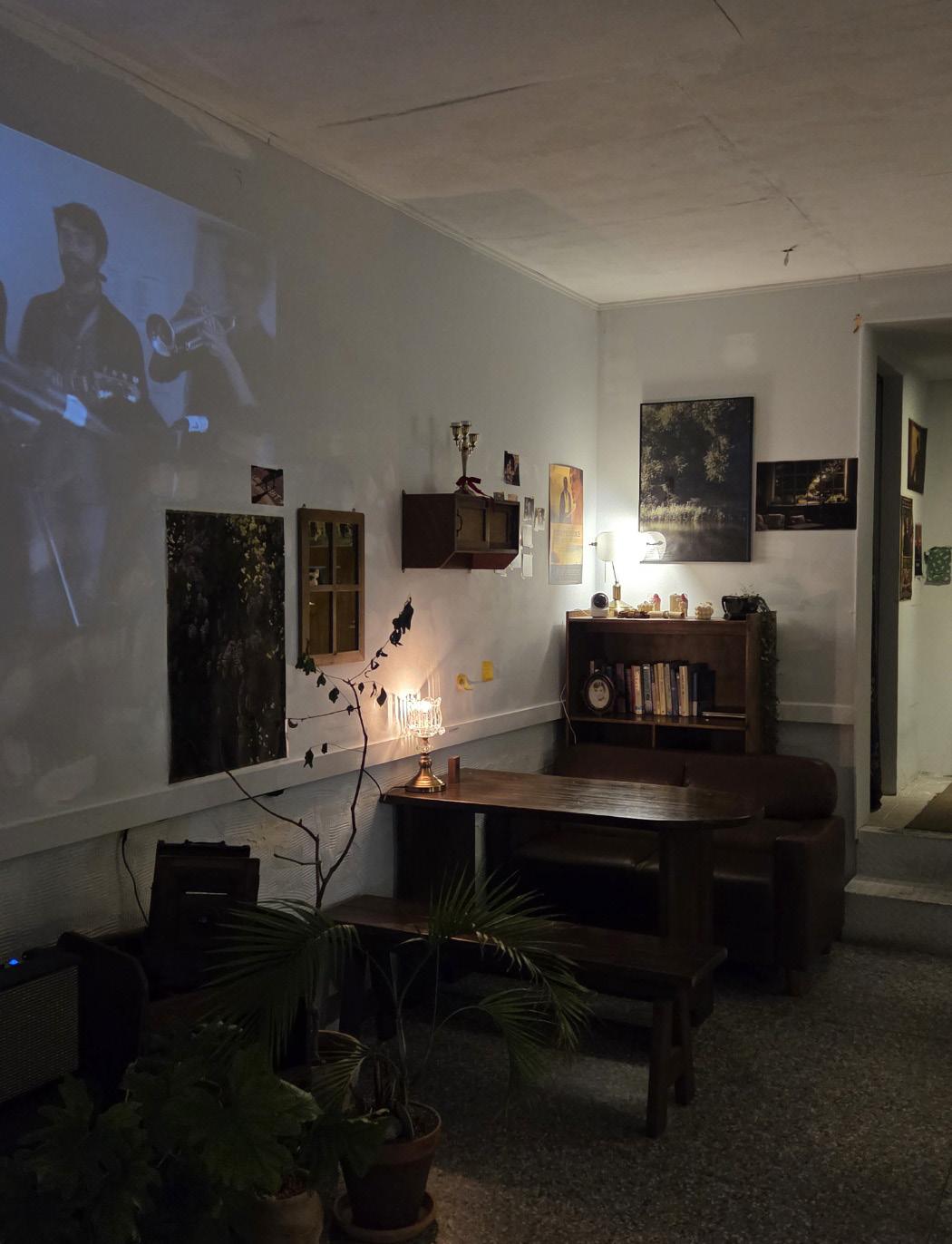
Overall, it is a nice place to spend some time with a friend. The space is small, but it feels warm and peaceful. It is a good place for quiet conversation and a relaxing evening.
디어문)
Address: World Cup 4-gang-ro 58-beon-gil 11 (Hwajeong-dong), Seo-gu, Gwangju
URL: https://naver.me/G8txKfPo
Author
Dhivyaa is drawn to Korea’s café culture, often finding comfort in quiet corners where she can reflect, observe, or simply get lost in her research over a warm drink. Photograph by the author.
By Dhivyaa S. P.
What comes to mind when I hear the words “BTS comeback” is not simply excitement. It is curiosity. I have always been the kind of person who slowly steps away from things that become too hyped. When the world rushes in one direction, I instinctively pause and ask why. Sometimes hype feels like a loud crowd pushing you forward even when you are not sure where the road leads. But even someone like me cannot forget the quiet unexpected moment when BTS first entered my life.
It happened in 2020. The world was still living under the cloud of the pandemic. I had just gotten my first COVID-19 vaccine shot and felt weak, the kind of tiredness that settles deep in your bones. I was lying on my bed scrolling through Instagram with no particular purpose. Then, I saw a short clip from Run BTS, Episode 140. It was chaotic and funny, and strangely comforting. Out of curiosity, I started watching the show from the beginning. At that time, I did not even know who the members were. For weeks, I struggled to identify them. To me, they were simply entertainers making a variety show. That was all.
Then one day, everything changed with a single performance. I came across the dance choreography video for the song Mic Drop. That was the moment when the realization struck me that this was not just a group of entertainers. They were musicians. A K-pop band. Ironically, I was someone who watched Korean dramas but knew almost nothing about K-pop itself. Slowly and almost without noticing, their music began to pull me in. Their lyrics were not empty pop words. Many of them spoke about identity,
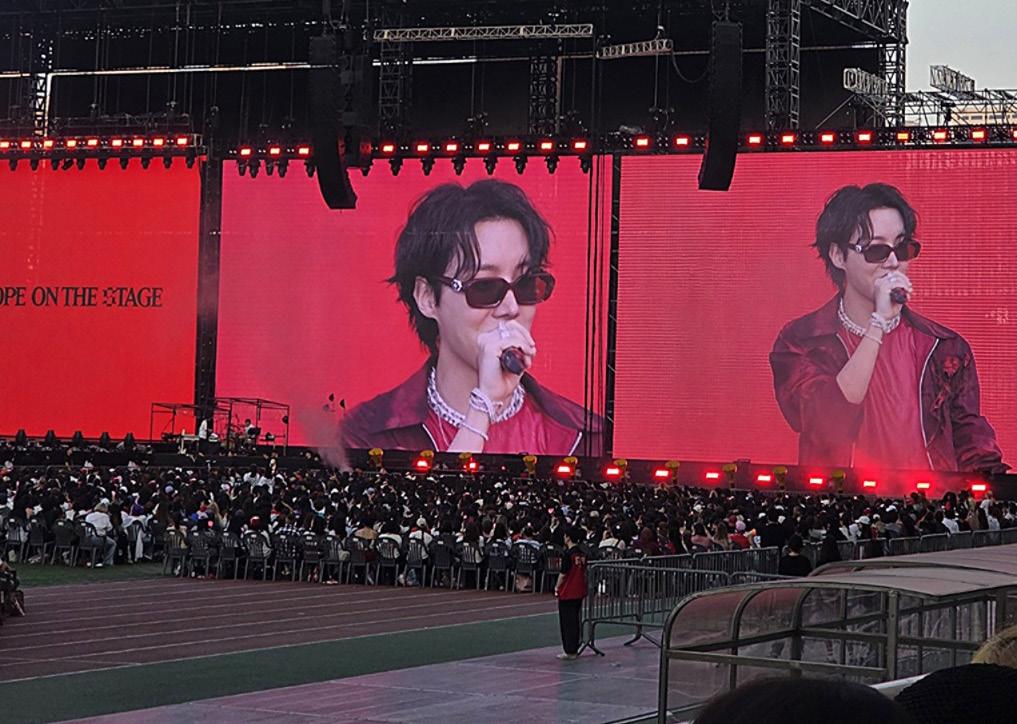
struggle, mental health, and self-belief. Without realizing it, I had entered the world of BTS.
Now, fast forward to the present moment. When the news of a BTS comeback began spreading across the internet earlier this year, my first thought was not screaming excitement. My first question was “What is the theme this time?” What story are they trying to tell? Will there be a song that reveals uncomfortable truths about society that people prefer to ignore? Or perhaps a song about finding hope in a difficult life and continuing forward even when everything feels uncertain? Maybe that says more about me than about the music. It seems that I am drawn to philosophical ideas and reflections on society. And BTS has always stood at that intersection where music meets meaning.
Their return in 2026 carries historic significance. After nearly four years, BTS returned with a new studio album titled Arirang, which was released on March 20, 2026. The album marked their first full group project since the anthology album
Proof, released in 2022. The title itself references the traditional Korean folk song Arirang, which symbolizes resilience and national identity, hinting at the themes of heritage and unity that run through the album.
Just one day after the album release, BTS reunited on stage on March 21 for a massive comeback performance at Gwanghwa-mun Square in Seoul. The stage stood in view of the historic Gyeongbok Palace, where modern global pop culture met centuries of Korean history. The event was streamed globally so that millions of viewers could witness the moment simultaneously.
What makes this comeback particularly remarkable is how carefully the group and their management planned the years leading up to it. Each member completed military service in a staggered timeline, which allowed the group to maintain a constant connection with fans through solo activities. Rather than disappearing during the military era, BTS transformed the period into a carefully structured chapter of individual growth. The steady release of solo albums, collaborations, documentaries, and digital content kept the fandom connected and engaged.
Following the album release and comeback performance, preparations quickly shifted toward the Arirang World Tour, which is set to begin
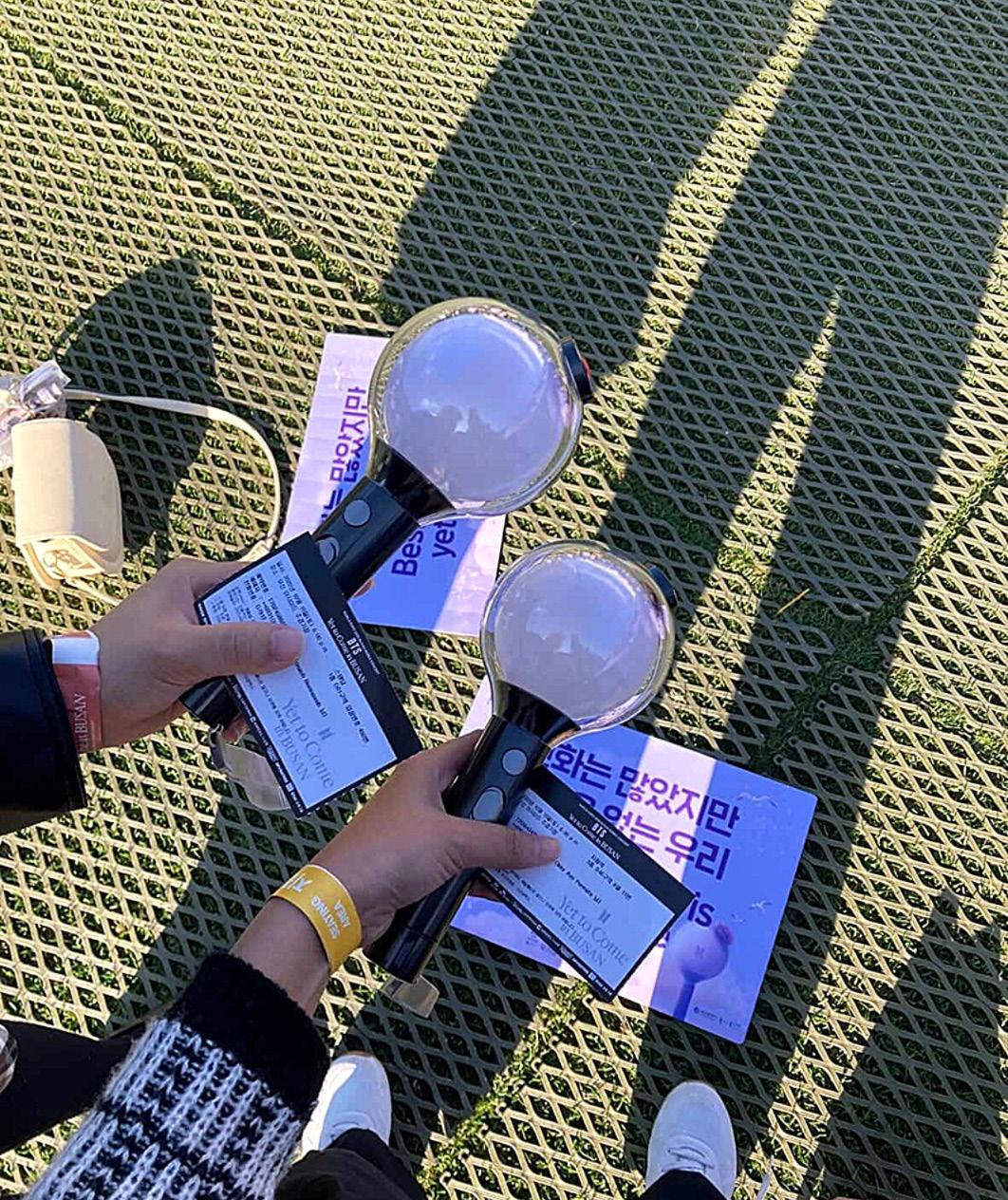
in April 2026 and continue into 2027. The tour schedule released earlier this year revealed plans for dozens of cities across multiple continents, making it one of the largest tours ever organized by a Korean music group. Fans around the world closely followed each announcement as additional cities and dates were gradually revealed.
One particularly interesting strategy behind the tour involved ticket sales. Instead of releasing tickets region by region over several weeks, many markets opened ticketing on the same day. The goal was to prevent overwhelming online traffic in one specific region while offering a more balanced opportunity for fans across the world to secure seats.
With demand reaching extraordinary levels, the issue of ticket scalping also became a major concern. Earlier this year, South Korea strengthened regulations targeting illegal ticket reselling. The new measures allow authorities to more easily track suspicious transactions and punish individuals who use automated software to purchase large numbers of tickets. Reselling tickets at extremely inflated prices can now result in heavy fines and potential criminal charges. These changes were introduced after previous large-scale events saw resale prices reach extreme levels, sometimes exceeding one million Korean won for a single ticket. The goal of these regulations is to protect genuine fans and create a fairer ticketing environment for major concerts.
Beyond the headlines and logistics, the true impact of BTS is best understood through the voices of the fans themselves.
Okky from Indonesia has been a fan since 2017. She first discovered BTS during the beginning of her bachelor studies when she moved away from her hometown to another city for college. During that time, their songs became something of a companion. She describes how their music felt like a friend while she was adjusting to a new life far from home. What fascinated her most was discovering a K-pop group whose entire discography felt consistently strong.
Choosing a favorite song is difficult for her. “Blood Sweat and Tears” was the first track that made her fall in love with BTS, but today she often returns to “Black Swan” and “Blue and Grey” because she is drawn to their deeper emotional lyrics and darker atmosphere. If she could send one message to the members before their world tour, she would simply tell them to take care of their health and not carry too much pressure so that they can truly enjoy the concerts alongside their fans.
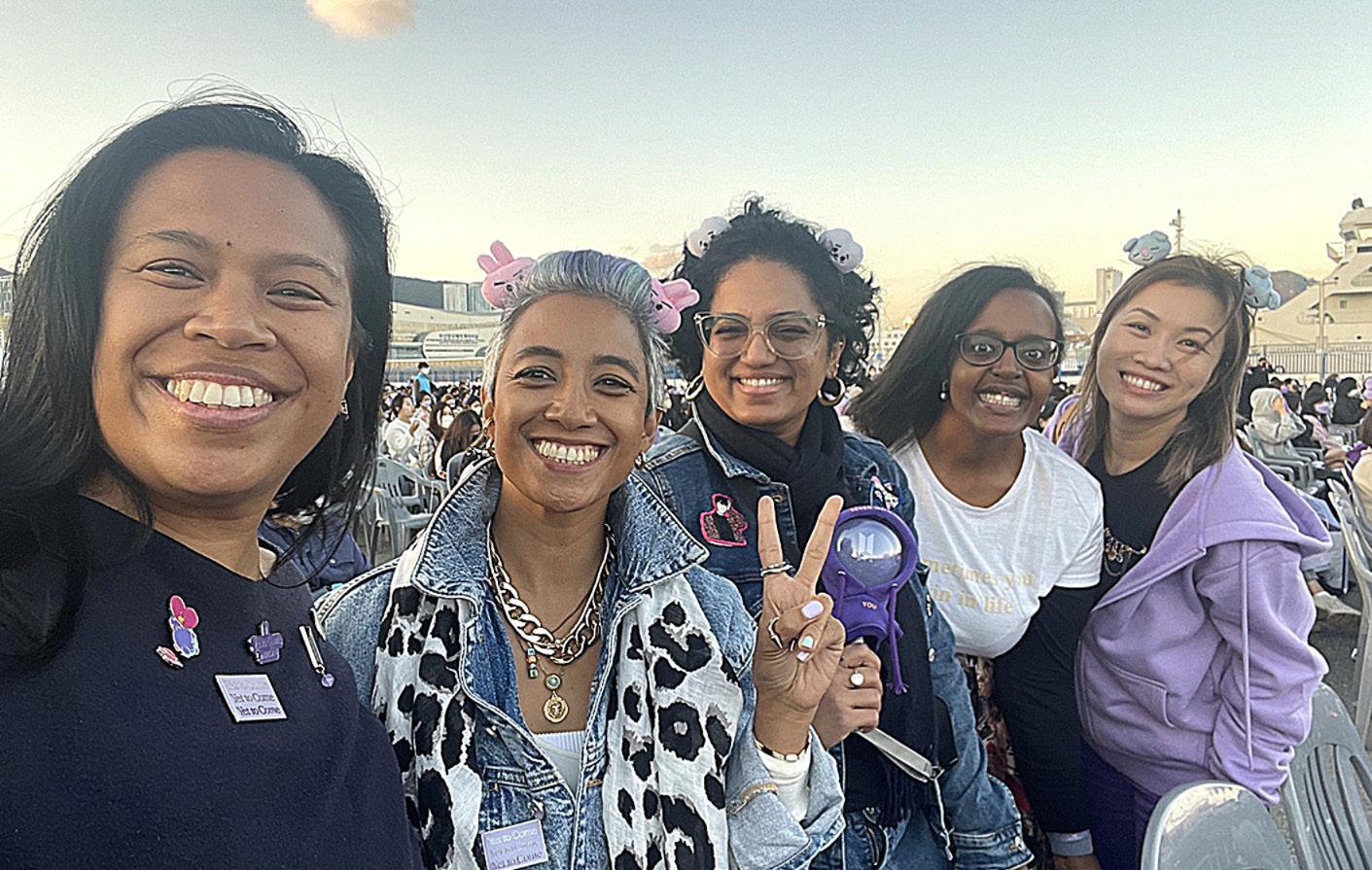
When friends become family, BTS in Busan, October 15, 2022 –my first trip to Korea and my first time to meet these wonderful women. (Anais Mutumba)
Diari from Senegal has been following BTS since 2019 and describes their influence in deeply personal terms. She says their words often arrived exactly when she needed them. Their honesty made her feel less alone and reminded her that it is acceptable to move through life step by step. RM is her favorite member because of his ability to express complex emotions and ideas through thoughtful lyrics. His reflections on identity and growth often make her think about her own life in new ways.
Anais Mutumba, a British Rwandan fan who has been following BTS since early 2014, remembers discovering them during the earliest days of their career. Because of her work and curiosity about music, she had already been listening to artists like Rain, Psy, Epik High, and Big Bang when she encountered BTS around their debut. Their lyrics immediately stood out because the group was more socially aware and introspective than much of the mainstream pop music at the time.
Over the years their songs helped her through many difficult moments. Choosing a favorite song feels impossible after more than a decade of music, but three tracks stand out for her: “Anpanman,” for its message about unlikely heroes delivering hope. “Spring Day,” for its emotional tribute to grief and healing. And “Silver Spoon,” for its powerful commentary on social inequality and economic pressures. Her message to BTS is filled with gratitude. She thanks them for making the world feel brighter and more bearable through their music and honesty, and warmly welcomes them back.
As I think about this comeback, I realize something simple yet meaningful. I was not there when BTS debuted in 2013. I did not witness the earliest days when they were performing on small stages and fighting to be recognized. My own journey with them began much later during a quiet afternoon in the middle of a global pandemic. Yet somehow that path led here.
If I were to describe it with a metaphor it would be like a river. Many small streams flow from different directions, each representing a different fan and a different story. Some streams began in 2013. Some began in 2020. Some will begin tomorrow. Eventually these streams meet and merge into one larger river that continues to flow forward together.
My message to BTS: Please always put your health and safety first as this new chapter begins. As you travel across the world for the tour and meet fans in different countries, I hope you stay healthy, happy, and safe at every concert. For us fans, the most important thing is seeing you enjoy the stage and continue this journey together with us until the very end.
The Author
Dhivyaa believes that every action, no matter how small, contributes to a bigger change. She will be seeing BTS perform as a group this April!!! Up next: Get. Set. Run!
By Zhang Jiuzhou (Julius)
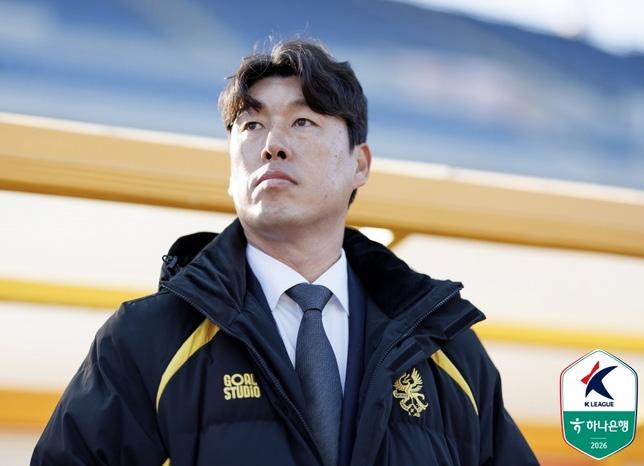
Gwangju FC may have a new manager on the touchline, but the team’s identity still carries the imprint of former head coach Lee Jung-hyo.
Following FIFA’s registration ban last year, Gwangju was unable to reinforce its squad during the winter transfer window and instead promoted several players from the club’s youth academy. At the same time, a number of key players departed. Given these circumstances, many observers quickly labeled the club as a likely relegation candidate.
New head coach Lee Jeong-kyu, however, entered the season determined to challenge those expectations. “I want to break people’s predictions,” Lee said at the start of the campaign. The first sign of that ambition came in the second round of the K League 1 season on March 7, when Gwangju hosted newly promoted Incheon United. In a dramatic match that stretched into
11 minutes of stoppage time, Gwangju secured a thrilling 3–2 victory – Lee’s first win since taking charge of the team.
Choe Kyoung-rok opened the scoring, while Sin Chang-moo added two goals to give Gwangju the advantage. The decisive moment came deep into stoppage time when goalkeeper Kim Kyeong-min saved a penalty from Incheon striker Mugosa. With many expecting the match to end in a draw, Kim’s save preserved the victory.
Although not every tactical element worked perfectly against Incheon, Lee’s efforts to implement a coherent system were already evident. One of the most notable experiments involved veteran midfielder Ju Se-jong. Known throughout his career as a central midfielder, Ju was deployed on the wing for the first time. In Gwangju’s starting 4-4-2 formation, he lined up as a left midfielder and often pushed forward like a traditional winger during attacking phases. Ju reportedly spent a week preparing for the unfamiliar role.
During the match, Ju frequently cut inside, while Ha Seung-un – who has previously played as both a left back and a forward – made overlapping runs to support the attack. For a team like Gwangju, which relies heavily on coordinated and systematic attacking play, players capable of penetrating defensive lines and exploiting pockets of space are essential.
Another notable development has been Gwangju’s continued reliance on teenage defenders. With the transfer ban preventing new signings, the club promoted three players from Kumho High School, including two center backs.
Kim Yong-hyeok started the opening match of the season, while Kong Bae-hyeon was called into action against Incheon after veteran defender Min Sang-gi suffered an early injury. Kong went on to play nearly the full 90 minutes.
Center back remains the most vulnerable position in Gwangju’s squad this season. The team currently has only five options for the role: veterans Ahn Young-gyu and Min Sang-gi, along with teenagers Kim Yong-hyeok and Kong Baehyeon, and Kwak Sung-hoon, who joined on loan from Suwon Samsung.
Given those limitations, the club has little choice but to continue relying on young players fresh out of high school. Lee Jeong-kyu previously stated that Kim Yong-hyeok would be given opportunities early in the season, yet Kong Baehyeon started the second match due to his stronger form in training. According to Lee, playing time will be determined strictly by performance and preparation.
Through the first two matches of the season, Gwangju’s playing style has largely mirrored the tactical philosophy established by Lee Jung-hyo over the past four years. The team maintained a steady tempo throughout the full 90 minutes and applied quick, organized pressure in the opponent’s half when opportunities arose.
Even in the closing stages of the matches, Gwangju continued to display coordinated attacking movement, a high work rate, and a structured buildup – hallmarks of the system built under the previous manager.
Lee Jeong-kyu is well acquainted with that approach. From 2022 to 2024, he served as Lee Jung-hyo’s assistant coach and was deeply influenced by his methods. Their tactical philosophies are widely regarded as similar, which explains why the club chose Lee Jeongkyu as the successor following Lee Jung-hyo’s departure. Maintaining continuity, particularly during a period when the squad cannot be
strengthened, was seen as essential to preserving stability within the team.
After the victory over Incheon, Lee emphasized the collective spirit that drives the club. “We always stress the idea of adapting to the team,” he noted. “From myself as head coach to the players and staff, everyone is working together to meet the needs of the team.”
Yet he also sees opportunity in the challenge. “Because we lack numbers, young players like Kim Yong-hyeok and Kong Bae-hyeon participate in almost every training session,” Lee revealed. “At other clubs, prospects sometimes struggle just to get involved in first-team training. Here they gain valuable experience quickly, which helps their development.”
Lee believes the team’s potential has been underestimated. “I think what you see in matches is not even half of what we achieve in training,” he remarked. “People think Gwangju is weak, but that may simply be because I’m a new head coach. Our players are very talented and have plenty of room to grow.”
The new manager has also made it clear that he intends to continue the footballing philosophy established by his predecessor. “I like the same style of football that Coach Lee Jung-hyo promoted,” he asserted. “I will do my best not to damage the reputation he built here.”
Under Lee Jeong-kyu, Gwangju FC’s season has begun with unexpected momentum. If the team can maintain its current form, the label of “relegation candidate” may soon fade away.
The Author
Zhang Jiuzhou (Julius) is from Harbin, China. He began writing in 2022 and has contributed to the Chinese media in Gwangju. Julius currently serves at a sports data company and is pursuing a master’s degree in media and communications. He is also responsible for the Chinese Students Association at Chonnam National University.
By Zhang Jiuzhou (Julius)
The Kia Tigers have wrapped up their preseason preparations and now shift their focus to the upcoming KBO season. During the first phase of spring training, which began January 25, the Tigers emphasized physical conditioning and technical drills. In the second phase, the team played five practice games to regain their competitive rhythm, including a scrimmage against the South Korean national team preparing for the World Baseball Classic.
Several players stood out during camp and were named MVPs of the training program. Pitchers Jo Sang-woo, Kim Si-hoon, Han Jae-seung, and Hong Min-gyu led the pitching group, while catcher Han Jun-su, infielders Park Min and Jeong Hyun-chang, and outfielder Park Jae-hyun were also recognized.
Manager Lee Bum-ho expressed satisfaction with the team’s progress. “I’m glad we completed the spring camp without any injuries,” Lee said. “Many of the younger players used to be hesitant, but this camp helped them become more proactive. That’s a big step forward.”
Lee also pointed to improvements among the young infielders, noting that their development has expanded the club’s tactical options. “The young infielders have improved technically, which gives us more flexibility,” he stated. “I’m also pleased with the added depth in the infield, and a stronger bullpen should make managing the pitching staff easier.”
With camp completed and competition intensifying, the Tigers enter the season with improved depth and renewed confidence.
Gwangju FC has entered a new era under Head Coach Lee Jeong-kyu following the departure of former manager Lee Jung-hyo.
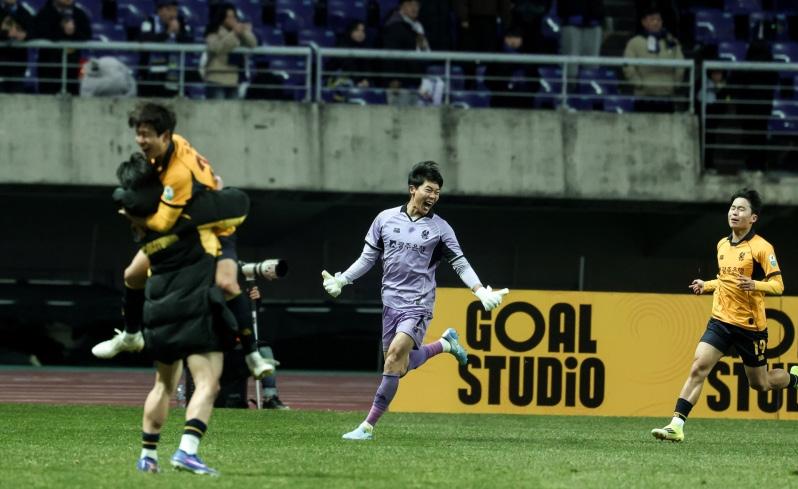
The club faces immediate challenges. Because of a player registration ban, the squad has been significantly reduced, forcing the team to rely on positional adjustments and emerging young players to remain competitive.
Despite these limitations, Gwangju FC has begun the season with encouraging results. In the opening match away at Jeju SK, they earned a draw after the hosts were reduced to ten men following the dismissal of midfielder Italo. In the second round on March 7, goalkeeper Kim Kyeong-min saved a late penalty to secure a dramatic 3–2 victory over newly promoted Incheon United.
Gwangju FC aims to maintain the team’s trademark style of high pressing and organized movement while improving tactical discipline and execution. To support this goal, the club placed particular emphasis on tactical
preparation and physical conditioning during the winter offseason.
Currently, Fridjonsson is the squad’s only available foreign player due to the registration ban. As a result, the team is expected to spend the first half of the season refining its tactical system before seeking reinforcements during the June summer transfer window.
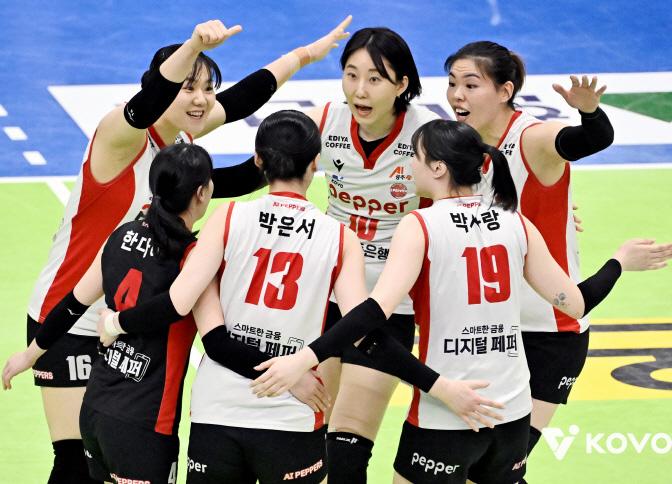
Rumors of a potential sale of the AI Peppers have continued to generate debate within the Korean volleyball community. Speculation has circulated for months as the team’s parent company faces financial difficulties and the team continues to struggle on the court. Despite the ongoing discussions, however, no confirmed buyer has emerged.
Financial concerns and poor competitive results have both contributed to the uncertainty. Since entering the V-League in the 2021–22 season, the AI Peppers have finished last for four consecutive seasons. Although they avoided the bottom position this year, the team’s performance has still fallen short of expectations.
The gap between investment and results has become a growing concern for fans. One supporter noted that the club invested heavily in
signing high-profile players such as Park Jeongah, Ko Ye-rim, and Lee Han-bi, raising questions about whether their contributions match their contracts.
Park Jeong-ah, who signed a three-year free-agent deal worth 775 million won per season in 2023, has struggled offensively. According to league statistics, her attack success rate has remained just above 20 percent and she has not ranked among the league’s top ten in major offensive categories.
Team Captain Ko Ye-rim also faced setbacks after joining the club with a salary of 300 million won. She fractured a finger and tore a ligament in her left hand during training following a December match against IBK Industrial Bank and underwent surgery at the end of the month. Lee Han-bi, who signed a three-year contract worth 1.06 billion won in 2023, has also struggled in receptions this season, with reception efficiency hovering around 20 percent.
In the 2025–26 season, the AI Peppers finished sixth among seven teams. Analysts estimate the club spent approximately 68.7 million won for each point earned, about 65 percent higher than league-leading Korea Expressway Corporation Hi-Pass.
With identical salary caps but vastly different results, the AI Peppers’ situation illustrates a harsh reality in professional sports: Financial investment alone cannot guarantee success.

Zhang Jiuzhou (Julius) is a dedicated follower of Gwangju’s sports scene. He regularly attends games of the Kia Tigers, Gwangju FC, and AI Peppers, and closely observes the unique identity and competitive spirit each team brings to the city. He hopes to see all three clubs continue to grow sustainably and attract even more supporters.
“Kinky
”

Dates: April 4–5, 2026 (Sat.–Sun.)
Times: 2:00 & 7:00 p.m.
Venue: Gwangju Arts Center, Grand Theater
Tickets & Info: Interpark
Overview: An uplifting, highenergy musical featuring spectacular performances and an exciting score.
Musical: “Pororo and a Mysterious Journey”

Dates: April 25–26 (Sat.–Sun.)
Times: 11:00 a.m., 2:00 p.m., & 4:00 p.m.
Venue: Gwangju May 18 Memorial Cultural Center, Democracy Hall
Tickets & Info: Interpark, Naver, Yes24
Overview: A popular family-friendly musical, perfect for a fun day out with children.
ACC Brunch Concert Plus: The Writer’s Playlist, Kim Young-ha
Date: April 29 (Wed.)
Times: 11:00 a.m. & 7:30 p.m.
Venue: Asian Culture Center (ACC), Art Theater 2
Tickets & Info: Advance reservations: ACC website, or call 1899-5566
Overview: Experience the musical world of author Kim Young-ha through his personal stories and The Writer's Playlist.
“
”
Date: April 10 (Fri.)
Time: 7:30 p.m.
Venue: Gwangju Arts Center, Grand Theater
Tickets & Info: Yes24 or call 062-613-8241
Overview: Conducted by Lee Byung-wook and performed by soprano Hong Hye-ran, this is a high-quality classical stage where you can enjoy Shostakovich's magnificent Symphony No. 7.
Date: April 15 (Wed.)
Time: 7:30 p.m.
Venue: Gwangju Arts Center, Grand Theater
Performers: Pianists Ilya Rashkovskiy and Sergei Tarasov, Conductor Yoon Seung-up, and the Millennium Symphony Orchestra
Tickets & Info: Interpark or call 02-6292-9370
Overview: A magnificent concert featuring the masterpieces of two legendary composers, Beethoven and Rachmaninoff, delivering the true essence of classical music. The performance showcases iconic works such as Beethoven’s “Moonlight Sonata” and “Piano Concerto No. 5: Emperor,” alongside Rachmaninoff's “Piano Concerto No. 2” and various other piano arrangements.

Children’s Experience Center’s New Permanent Exhibition: Our Home,
Dates: December 3, 2025 –Dec 31, 2026
Time: 10:00 a.m. – 6:00 p.m.
Location: Children’s Experience Center, Children’s Cultural Center (B1) at the Asian Culture Center (ACC)
Admission: All ages welcome. (Note: Adults must be accompanied by a child, and children must be accompanied by an adult guardian to enter.)
Tickets & Info: ACC website (www.accf.or.kr) or call 1899-5566

Admission: Free
Dates: Until December 31, 2026
Times: 10:00 a.m. – 6:00 p.m. (Extended to 8:00 p.m. on Wednesdays & Saturdays, Closed on Mondays)
Venue: Asian Culture Museum (B4), Asian Culture Center
Overview: Step into the magical world of the Arabian Nights and discover the fascinating journey of these timeless tales through interactive exhibits.

“
Dates: April 3–4 (Fri.–Sat.)
Times: Fri. 7:30 p.m., Sat. 3:00 p.m.
Venue: Arts Theater 2, Asian Culture Center (ACC)
Tickets & Info: ACC official website (www.accf.or.kr) or call 1899-5566
Overview: Ascend with winding and profound steps into a dreamlike utopia in “Mongyu Dowon,” a mesmerizing performance by the National Dance Company of Korea.
2026
Madang-nori: “Hong Gil-dong Is Coming”
Dates: April 8–11 (Wed.–Sat.)
Times: Wed. & Sat. 3:00 p.m.; Thu. & Fri. 7:30 p.m.
Venue: Arts Theater 1, Asian Culture Center (ACC)
Tickets & Info: ACC official website (www.accf.or.kr) or call 1899-5566
Overview: An exhilarating Madang-nori (traditional Korean outdoor performance) where K-hero Hong Gil-dong gives corrupt officials a refreshing lesson, delivering a delightful mix of laughter and satire.

Dates: April 5, 12, 19, & 26 (Sundays)
Time: 2:00–2:50 p.m.
Venue: Sangsang Hall, Gwangju National Science Museum
Tickets & Info: On-site tickets for nonparticipating seats (automated ticket booth in front of Sangsang Hall on the day) or call 062-960-6142
Overview: An interactive, storytelling performance that combines science experiments and magic to help audiences learn science in a fun and easy way.
Dates: April 4–5 (Sat.–Sun.)
Time: 12:00–5:00 p.m.
Location: Yudal Mountain, Mokpo City
Overview: A picturesque spring festival where you can enjoy a relaxing picnic surrounded by cherry blossoms in full bloom and vibrant spring flowers on Yudal Mountain.
Wando’s Cheongsan-do
“Feast of Rapeseed
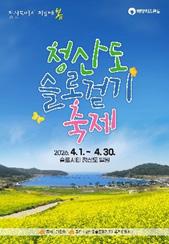
Dates: April 1–30
Location: Cheongsan Island, Wando County
Overview: Throughout April, the island transforms into a vibrant landscape covered in yellow rapeseed (canola) flowers and green barley, making it an ideal retreat for a leisurely coastal walk in the spring breeze. Key highlights include walking the 11 courses of the Slow Trail and enjoying the “Spring Waltz” concert.
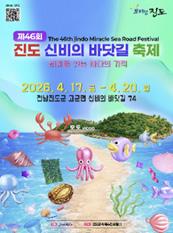
Dates: April 17–20 (Fri.–Mon.)
Location: The Mysterious Sea Road in Gogun-myeon, Jindo Island
Sea-Parting Times & Tips
• Parting time changes daily, usually occurring between 5:00 and 7:00 p.m.
• Arrive at least one hour before the scheduled parting time.
• Wear rain boots or waterproof shoes for walking on the seabed.
• The seabed path remains open for only about one hour.
Overview: As one of Jeonnam Province’s premier festivals, this event offers a chance to witness the aweinspiring sea-parting phenomenon, famously known as the “Miracle of Moses in Korea.” Visitors can walk along the revealed ocean floor and savor a variety of delicious local specialties.
Dates: April 17– 26 (Fri.–Sun.)
Time: 3:00–9:00 p.m. (Main evening events)
Location: Kkotgang-gil (Flower River Trail) and Namsan Park area in Hwasun-eup
Overview: Themed “Spring Flower Night Walk,” this festival features beautifully illuminated night landscapes. Highly recommended is visiting around sunset to stroll along the enchanting, flower-lined night trails.
Compiled by Amy Park.
Amy Park is a program officer for Asian Legal Resource Center (ALRC Korea) based in Gwangju. She helps build the organization’s foundation and supports new efforts in human rights advocacy and resource sharing.
Chonnam National University Graduate School of Business
Key Highlights
100% English Instruction
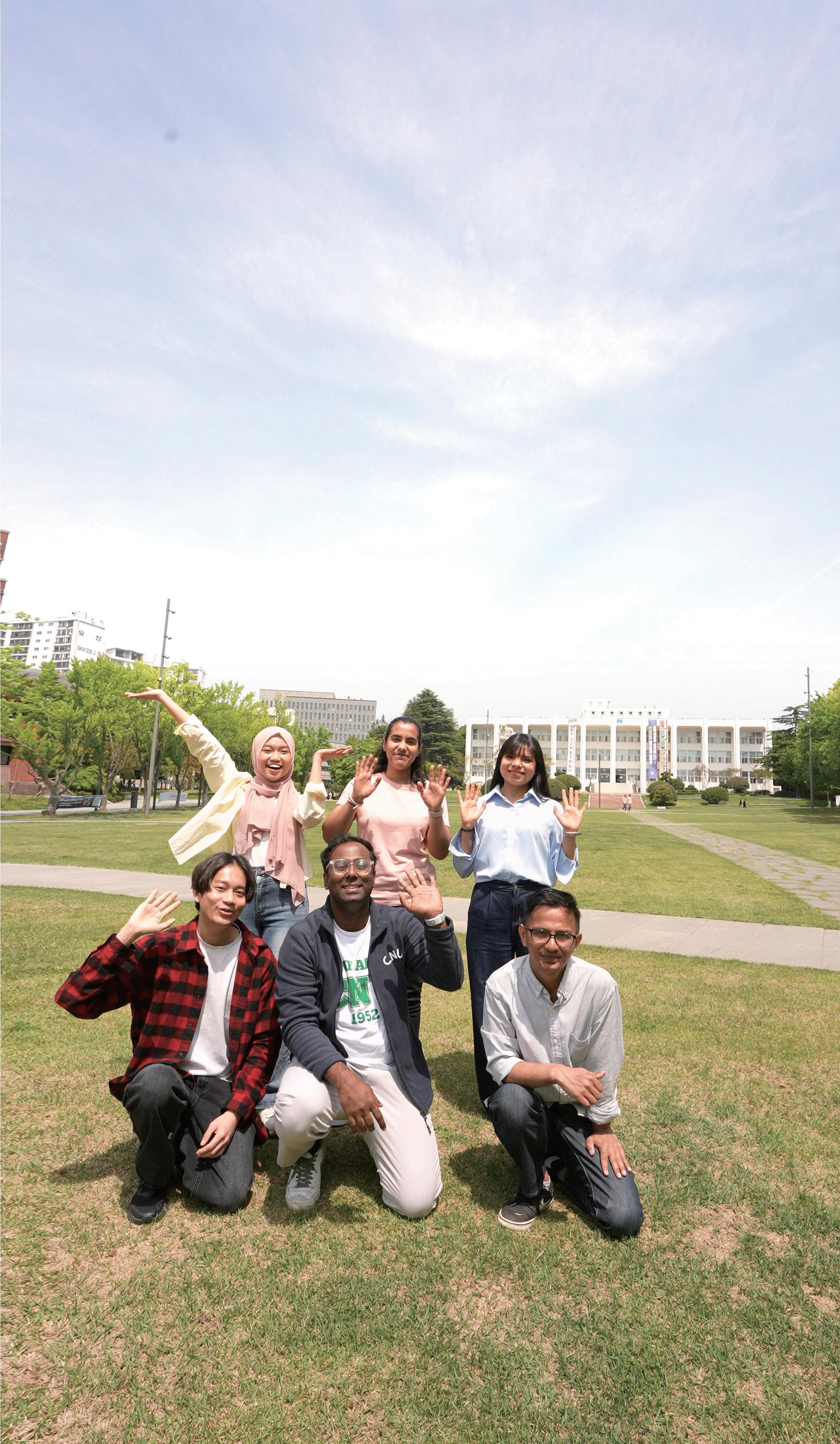
Global Field Study: On-site learning at overseas partner universities (Expenses mostly covered by GSB)
Admission Schedule
No Thesis Required: Focus on practical learning (45 credits for graduation)
Dual Degree Program: Earn two degrees from the CNU and the University of Missouri-St. Louis (USA)
Flexible Schedule: Day and evening classes available for diverse needs
Generous Scholarship Support: Comprehensive tuition support and TA positions for international students
Application Period: April 20 – May 22, 2026
How to Apply: Visit the link below or scan the QR code � https://mba.jnu.ac.kr/mba_eng/15104/subview.do
Scan for More Details

E-mail:gsbmba@jnu.ac.kr Phone:+82-62-530-1502
Website:https://mba.jnu.ac.kr/mba_eng/index.do