15
GUYANA CHRONICLE Thursday, April 6, 2017
A Guyana Chronicle publication in tribute to women
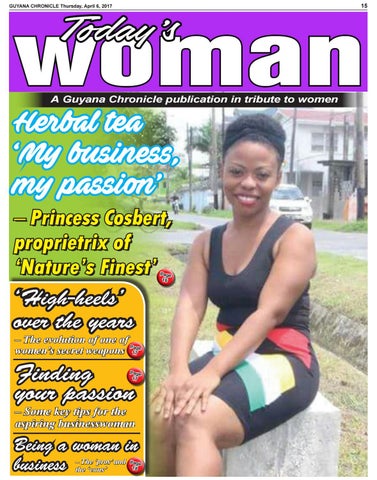
‘Women can do it’ – Princess Cosbert, Herbal tea ‘My business, my passion’ … First Lady urges proprietrix of greater self-belief, ‘Nature’s Finest’ determination Page 16
#BeBoldForChange ... ‘High-heels’ ‘Womenthe of Kaieteur’ over years –embraces The evolution of one of IWD, women’s secret weapons and fearlessly
Page 17
Page 20
Finding The ever-evolving your passion role of the woman
Page 17
Page 19
– Some key tips for the aspiring businesswoman
Remembering Being a woman in the indomitable – The ‘pros’ and business Kowsillathe ‘cons’ Page 18
Page 18
Page 21
16
GUYANA CHRONICLE Thursday, April 6, 2017
Herbal tea ‘My business, my passion’
- Princess Cosbert, proprietrix of ‘Nature’s Finest’ THE use of herbs has for centuries been believed by some schools of thought to be one of the most effective forms of alternative medicine. Today, with access to endless amounts of information, many persons have begun to shy away from “modern medicine” and their sometimes lethal side effects, and opt for herbal remedies. In Guyana, the use of herbs is practically part of our culture, with many of us growing up on “bush tea”, much of which were brewed from herbs growing right in our backyards, and forced upon us by our elders. So, in this modern age, it seems as though the world has finally caught up with what has always been part of Guyanese culture. It is for this reason that 31-year-old Princess Cosbert’s business of homemade herbal teas
has, within just nine short months, blossomed into a lucrative venture. ‘NATURE’S FINEST’ Sold under the brand, ‘Nature’s Finest’, Princess’ teas can be found on the shelves of five supermarkets and two gas stations around Georgetown, and is even being sold by individual retailers in other parts of the country. A firm believer in God, Princess attests that it is His wisdom that planted the idea in her head and turned what was once just something she did for personal reasons into her primary means of income today. “I used to make powdered seasonings at home, but that didn’t work out. One day I had some herbal tea ground up, and I used one of those straining cloths that the folks used long ago to strain tea and I strained it and gave
it to a friend of mine,” Princess said about how the idea came to her. “At the time, she was mixing it with another tea, but she ran out. Then one day she used my tea by itself, and she called me and told me how much she loved it, and encouraged me to get into business with it.” At the time, Princess was scheduled to go to Trinidad and Tobago for an extended period of time, but, unable to shake the idea and the encouragement, she cut short her trip and returned home to start her venture. After packaging her teas, she approached the Guyana Marketing Corporation (GMC), which agreed to have her product on display, so long as it was made solely in Guyana. From then on, ‘Nature’s Finest’ teas slowly began to appear on other shelves in supermarkets
around town. SEVEN FLAVOURS For tea lovers who are curious, the brand offers seven mixed local flavours, including ginger and garlic, and lemon grass and ‘teaseum’. Princess admits that she did not expect the response that she has been getting so far, but she is proud that this personal hobby has turned into a business. “My mom always said that women should be independent and not depend on men,” Princess said, adding: “I feel that when we put our guards down, we get abused in so many ways and can’t provide for our children. So now that I am grown, I, too, believe that every woman should be independent and that would allow them to better provide for their children.” Her advice to other
women is that they need to have God in their lives and a clear vision of what they want to do when entering into business. “I think in every woman, if there is something they want to do, they just need to take that step. “To start a business starts with an idea, and you just need to act on it,” she said. She also wishes to encourage women not to be afraid to at least start conceptualising their business if they don’t yet have the capital to do so. “Some people think they have to wait, but you just need to use what you have, and God will provide,” Princess said. “I started my business with $20,000. It is not about what you have, but how you use what you have and everything will fall into place,” she added. As she seeks to expand her product and have it in more local supermarkets, she admits
that there are some barriers that stop her from doing so, among which are racial preferences. “I am surprised that there is a racial barrier in some supermarkets because I am a different race… They would say they don’t have space on their shelves, but if I give it to an Indian person, they would gladly take it,” she said. She said, too, that she wishes that there were other bodies that provide business guidance for women in business. The next step for ‘Nature’s Finest’ is herbal capsules, and Princess said that she has already begun making these and advertising them as dietary supplements. She believes that herbs have many health benefits, and though without being scientifically tested, she is unable to advertise them as such, she suggests that reading up about the benefits of these herbs could inform the user.
17
GUYANA CHRONICLE Thursday, April 6, 2017
‘High-heels’ over the years - The evolution of one of women’s secret weapons IT was Marilyn Monroe who said: “I don’t know who invented the high heel, but women owe him a lot.” High heels have been the source of much pleasure and pain for women through the centuries, and though they can be “killers” for a woman’s busy feet, many cannot deny that heels make them feel sexy. The history of high heels is actually quite interesting, and according to an article in The New York Post, they weren’t really invented. Instead, they are an apparatus that has evolved over time, thanks to Venetian prostitutes, British queens and French designers. Here’s a brief history of how high heels became synonymous with feminine sexuality over the years: CHOPINES, circa 1400s Wo m e n ’s p l a t f o r m shoes, or chopines, are thought to have originated with prostitutes in Venice. The shoes, which reached heights of up to 18 inches, raised a woman above her rivals and gave her a sen-
became lower and lower at the beginning of the 19th Century, until it disappeared altogether. Popular styles were squaretoed slippers with ribbon ties, forerunners of the ballet slipper.
Chopines
The first heels
suous gait for prospective clients. Eventually, they became popular among the aristocracy, both in Italy and the Ottoman Empire. They indicated that you were so wealthy you didn’t need to work, or really walk. THE FIRST HEELS, circa 1590 The origin of high heels is debatable. Some think they evolved from chopines; others say they originated in the Near East from male equestrian footwear meant to straddle the stirrup. Either way, the first documented wearer of European high heels is Queen Elizabeth I.
of France who started many fashion trends, from red heels to soles. From his early 20s until he was at least 63 years old, Louis XIV had his heels covered in red Morocco leather, or painted that colour.
The stiletto VIVE LA DIFFÉRENCE! Circa 1660 Men’s and women’s shoe styles were roughly the same until about 1660. After that point, men’s shoes tended to be more
practical, while women’s shoes became more ornate, with silks, brocades, braids and velvet. THE RED HEEL, circa 1670 It was King Louis XIV
THE POMPADOUR, circa 1750 The French, or Pompadour heel, was named after Madame de Pompadour, mistress to King Louis XV. The narrow, curved heels were notoriously difficult to walk in, but nevertheless made for a fantastic boudoir shoe. GOING FLAT, circa 1840S Perhaps spurred by revolutions in America and France and the rejection of royalty, the heel on women’s footwear
RETURN OF THE HEEL, circa 1850 After the slipper fad died out, heels started to creep back up, to ½-inch in 1851, and 2½ inches by 1860. Brass-heel pieces began to appear in the later half of the 19th Century, which supported even higher heels. It was during this period that the “classic women’s court shoe”, what Americans would call the “pump”, emerged. THE STILETTO, circa 1953 Christian Dior brought back French shoe style after WWII, lifting the heels on court shoes and making them more ornate. Shoe designer Roger Vivier, who worked for Dior, took credit for inventing the stiletto heel, using plastic innovations to create a slender heel of incredible strength, which he called “The Needle”. The shoes helped create the modern sex symbol, as Marilyn Monroe was said to shave a quarter-inch off one of her stilettos so that she could walk with a wiggle.
Finding your passion - Some key tips for the aspiring businesswoman MORE and more, the spirit of entrepreneurship is being pushed in Guyana as one of the key means of job generation. Moreover, women are being encouraged through various initiatives to lean towards entrepreneurship to not only earn their own income, but to develop independence. And while there will always be barriers for women entrepreneurs the world over, mentors continue to encourage women to seek out avenues where they can become business owners, even in cases where resources are limited. The following are just a few tips to help you find that niche: FIND YOUR PASSION It is not just about starting
many women can make a living by turning something they do at home into something that earns them money. When you are passionate, it shows! And your enthusiasm and belief in what you are doing translates to your customers, sparking their enthusiasm about what you are offering.
a business because you want to make money. Experts have said that one of the ingredients to running a successful business is by doing so with a product or service that fuels the business owner’s passion. It is easy for small and micro-businesses to start up using hobbies, and
MAKE IT FIT Running a business must align with your goals in life, lest they clash with your personal aspirations. What is the reason for starting a business? Is it a just a means of income, or are you looking for a full time business? And how will these things affect your schedule? Choose a business and business style that suits
your picture of a fulfilling life. KEEP THEM SEPARATE It is important to set aside time for both personal and work lives, in order to give each the attention it deserves. Set specific office hours; and unless there is an emergency, stick to them. Create a separate work area, whether inside the home or in an outside office space. And shut the door to the office after hours! MAKE GENUINE CONNECTIONS It can be difficult working alone, so the connections you make will prove invaluable, and not only for business. Find a mentor, or create a women’s support group and share your
ideas, goals and frustrations. Use the “village” to help you navigate the business landscape. Join a business association or support group if any are available to you for professional support and resources. DEFINE YOUR BRAND Carefully define your brand and stick to it. Make everything
you do and offer conform to the brand, from colour schemes, logo design, packaging, correspondence and presentations to customer service and the company culture and mission. Do not deviate from your brand! It is the message and consistency by which your clients know, remember and trust you.
18
GUYANA CHRONICLE Thursday, April 6, 2017
Being a woman in business
-The ‘pros’ and the ‘cons’ A WOMAN who is economically empowered is one who can contribute to her home and can gain independence. Moreover, women can use this independence to make a difference in their own lives, the lives of their children, and in their communities. In Guyana, many women gain economic empowerment through entrepreneurship, and Credit Guarantee Fund Manager of the Small Business Bureau (SBB), Gillian Gittens-Edwards believes that this type of empowerment plays an important role in the lives of women. At the SBB, 60 per cent of its microbusiness portfolio comprises women, which suggests that women are actively pursuing entrepreneurship as a means of income, even while they maintain their homes. “Many of the women are at home and have to take care of their children, and getting into their own business helps to make them fi-
nancially stable; the impact that it has on their family is direct,” Gittens-Edwards said. She believes that entrepreneurship not only raises the standard of living for women, particularly for single-parent mothers, but can also serve as a stepping stone out of unfortunate situations. “Women who, for example, are victims of domestic violence can pull themselves out of that environment. It is possible that if she starts earning her own money, this type of independence can serve as self-encouragement to leave that situation. Entrepreneurship can serve as a means of ‘getting out’ in such cases,” she said. A PASSION OF HERS Evidence of these benefits has been seen in the many years that Gittens-Edwards has operated in the micro-financing sector within the SBB and other organisations. A single-parent herself, she said that that small
business development has been a passion of hers for many years. “At one point, I was the lone female field officer while working at IPED,” she said. “I have also worked in the banking sector for years, but I have always come back to microenterprise and small-business development; it is where I am most comfortable.” Gittens-Edwards has, over the past year, served as Acting Officer in Charge of the SBB, even as the organisation is on the verge of hiring a new Chief Executive Officer in the near future. “It’s a challenge being Officer in Charge of an office like this, but I have grown a lot in terms of exposure, being able to manage and multi-task. I have grown, based on my being exposed to these responsibilities, and I welcome the challenges,” she said, adding: “I don’t look at these hard
She’s had to work twice as hard IT WAS in the early ‘80s that Stephanie Fraser really got serious about being a swimming instructor. Now 61, she has managed to rack up quite an impressive list of accomplishments as a coach and administrator in the sport of swimming, not the least of which was being awarded the Medal of Service in 2011 for her longstanding service to the sport. These days, she’s contemplating scaling back her involvement as a coach, and passing on the mantle to the younger coaches. And in doing so, she’ll be leaving behind a proud legacy of having not only helped to develop the sport of swimming overall, but making an upstanding representation for women. Looking back at her journey over the years, Coach Stephanie is happy with how accepting swimming, and even other disciplines, are of female involvement, something she says wasn’t always there. But fighting to hold her own in a male- dominated arena was a character trait she’d already been nurturing at a younger age when she was competing against her male cousins back in Moruca, Region One, where she grew up and first learned to swim.
“I think as a woman in the area of sports, you have to work doubly harder than the male officials,” Coach Stephanie said. A MAN’S PROFESSION “In my field of coaching, it was a man’s profession. And so, for me as a female, getting in there was a lot of opposition. And I had to go through a lot; people kind of sidelined me in a way. “I had to work harder; and I don’t think it was only me. Sometimes I even felt marginalised,” she mused as she marvelled at how times have changed. But that’s not to say that there still aren’t things that need to be worked on, she says, as women still need to be taken just a little more seriously. “It has changed a bit in some areas, but in some areas it has remained the same. We have more female coaches now, and they are more or less being accepted into the mainstream, even in male-dominated sport, as officials,” she said. “But you find... at least me in my area, I find that the male feels threatened by the females; especially in the management area. “With decision making,
Stephanie Fraser you find that even if a woman makes a decision, and it is the best decision, the male would over-ride us and go with theirs. “And then eventually, months down the line, they realise that they have made a wrong decision; that maybe they should have gone that way. But they wouldn’t make it as if the woman was right all along; that it boils down to the fact that the female had the right decisions.” Notwithstanding the difficulties she eventually overcame, Stephanie would not back down; she found too much pride and joy in what she was doing to let obstacles get in her way. “When I looked at the kids and how they were performing, that was my reward. And it motivated me to push harder. And as such, it was mainly
Gillian Gittens-Edwards tasks as something a man alone can do. Women can do anything; it depends on their attitude and once you have a good, strong team.” This businesswoman, who herself has provided many women with the opportunity of starting their own business, is also personally aware of the challenges of balancing a busy work life with home life. “You have to work hard, because you want to provide the best for them, but as a result, some things end up suffering,” she said.
It is against this background that she believes that micro-financing bodies such as the SBB should develop programmes where they consider such dynamics, and seek to assist women entrepreneurs on how to deal with them. And though the SBB doesn’t currently offer any gender-based programmes, she said that these are considerations that will be kept in mind by the Small Business Council which governs the SBB, should such programmes be held in the future. This notwithstanding, she also believes that while focus on women is important due to the need for equality and empowerment, it is also important that focus be placed on programmes that can benefit young boys and men due to the challenges that they face in society as well. GO FOR IT! As a bit of personal and
professional advice to women, Gittens-Edwards suggests that women who wish to start their own businesses pursue it at all costs, but that they first do the relevant consultation with an organisation like the SBB or even a businessperson with years of experience. “They need to look at their skills and what opportunities are available. It is also important for them to have a plan. Women should know that they are free to come into the SBB to discuss their options,” she said. One of the most important things that they can start with, she suggested, is that they look right in their communities for what services or products may be lacking and match those needs with their relevant skills. Once they realise that they can fill that gap, all it takes is perseverance and some know- how for a woman to empower herself and become a business owner.
- but it all paid off in the end for the love of the sport and for these kids to reach their goal. And when they did reach their goals, I was just as happy as them,” she recalls. GOOD THING SHE STAYED And it was such a good thing, she stayed, because, with Stephanie Fraser, swimming just might not have been able to develop to where it is today. It was Stephanie who was part of the team that was pivotal in the resuscitation of the Guyana Amateur Swimming Association (GASA), and swimming in Guyana as a competition sport back in 1993, after the sport had been dormant for some 15 years or so with the closing of the Luckhoo Pool. The GASA became affiliated to the Guyana Olympic Association that same year, then a few years later got affiliated to International Swimming Federation (FINA), and went on to see Guyana represent in swimming at the Olympics Games and World Championships. She’s worked as the national coach, travelling alongside athletes attending world meets. The FINA Level II also founded the Dorado Swim Club, another one of her prides and joys, which she says she can still boast of being the club to produce the
most Olympians. Those like Olympians Niall Roberts, Britany van Lange and Hannibal Gaskin are all the fruits of Stephanie’s labour. All three are still reigning national record holders, though Gaskin is the only swimmer still currently actively representing Guyana. She is a certified lifeguard trainer, and also a Level II American Swimming Coaches Association certified coach. And though she had all the critieria requirements to advance to be a Level III certified coach, several barriers, including finances, played a major role in crippling her efforts. MUCH EASIER NOW Now, she’s just glad that the process is easier for other upcoming coach, and for making the arena a better place for other females coaches like her protégé Shyka Gonsalves, and even for female swimmers to feel more encouraged to be a part of the sport. “With having more female coaches, I find that you have more female athletes coming out,” she said, adding: “And even the males have become more comfortable having us around. They think of us in a motherly way, and can relate to us, at least with me, in a way that they wouldn’t relate to the males.” Stephanie has several reasons why she’s glad to start
phasing out of the sport: She doesn’t want to take away opportunities from the young ones, and she also wants to focus more on working with swimmers at a younger age and then pass them on to the other coaches. “All this is done voluntarily,” she said. “We coaches in Guyana are not paid, and I’ve been doing it for 33 years; I’ve been coaching voluntarily, and so it’s kind of getting to me now, having to get up at 4:30 every morning. It’s really stressful, especially with the crime rate. I got held up one morning; another morning I was followed. “I need to step back. And I really want to be looking at the nursery and working with the littles ones so that I could build them up to pass them on to like Shyka; all those young coaches who are excited at the moment. I don’t want to break their spirit, so I need to move off.” But off course, she will always look back and be proud of her legacy. “There’s so much more opportunities now for them than there was when I was doing my coaching,” she said. “I had to struggle and get my own certification through the American Swimming Coaching Association. And at that time, it was very expensive. It still is, but at least it’s more achievable now.”