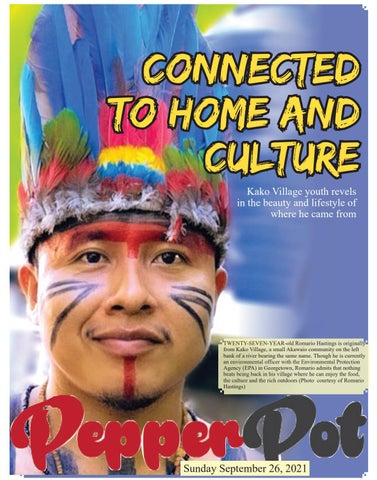
Connected to home and culture Kako Village youth revels in the beauty and lifestyle of where he came from
TWENTY-SEVEN-YEAR-old Romario Hastings is originally from Kako Village, a small Akawaio community on the left bank of a river bearing the same name. Though he is currently an environmental officer with the Environmental Protection Agency (EPA) in Georgetown, Romario admits that nothing beats being back in his village where he can enjoy the food, the culture and the rich outdoors (Photo courtesy of Romario Hastings)
Sunday September 26, 2021
II
CHRONICLE PEPPERPOT ― Sunday, September 26, 2021
First Year of Rotary Club of Garden City
By Francis Quamina Farrier FOUNDED a year ago in September 2020 as the COVID-19 pandemic raged around Guyana and the rest of the world, a group of 33 patriotic Guyanese banded themselves together and founded the Rotary Club of Garden City - Georgetown. Each member felt that their involvement could make a positive difference to the quality of life of their fellow Guyanese. As most citizens would agree, there is the need for many more individuals and groups who are focused on giving more of themselves to work for the genuine development of the Guyana society at large. The important discipline of not littering or dumping garbage illegally, here, there and anywhere, is needed so much in Guyana at this time. While there are exemplary citizens who do the right things most of the time, there are just too many who lack the urge to extract the line from the country’s National Pledge which states in part, “To Love My fellow citizen.” The founding of the Ro-
tary Club of Garden City last year was a very bold act by very dedicated citizens. It was at an extremely difficult and depressing time as the COVID-19 pandemic continued to take its death toll higher and higher locally and globally. The number of Guyanese and people all over the world becoming ill and quite a number dying is not only depressing, but also frightening. However, that did not deter those 33 Guyanese citizens from proving their mental and physical grit in many worthy projects. While still in its first year, the club received a Citation from Rotary International for helping Rotary open opportunities in the lives of Guyanese. To carry on their humanitarian work, the club held fundraisers during their first year of existence. The club also benefited from a Rotary District Grant. Local supporters were also willing to give a helping hand. Set goals were equally given full support by the membership who braved the coronavirus pandemic to get things done in very difficult times. One of their benefactors was the Cheshire Home. As part of the district’s Childhood Obesity Prevention Cam-
paign, the “Eat Well, Move Well” book was published and donated to the National Library. The construction of a Shade House and vegetable garden and external, raised beds to serve as a mini fruit farm was also undertaken while the COVID-19 pandemic raged. When those 33 brave Guyanese got together on September 17, 2020, and established the newest Rotary club in Guyana, with the title “Rotary Club of Garden City,” they proved that there are those citizens who are true patriots. Someone in the diaspora once said, “The wise ones left.” in reference to the massive migration of decades ago. But some of those who stayed, like the 33 dedicated members of Rotary Club of Garden City, selflessly and wisely, solve problems by being engaged in such projects by the Rotary Club of Garden City; as service projects that encourage communities and individuals to adopt eco-friendly life style changes. The continuous “Bags, Bins and Bottles” projects are fine examples. Then there is the sale of branded, reusable, multi-purpose canvas bags
Some members of the Rotary Club of Garden City, Georgetown, on their first anniversary, September 2021
by this club to reduce the use of plastic. The club also made a distribution of garbage bins to the Guyana National Park’s Commission to create a clean and healthy environment and the distribution of mini reusable water bottles to schoolchildren as part of the district’s Childhood Obesity Prevention Cam-
paign. That is to encourage children to drink more water and become healthier. The Rotary Club of Garden city, Georgetown, Guyana, has completed its first year of service to the Guyanese people. Their goal is to try and solve some of the myriad problems, one at a time. Yes, those individuals could have left, but they chose to
remain and enjoy the many important tasks of nation building. It may not be swift. But as the Guyanese saying goes, “One, one dutty build dam.” Or as the Italians say, “Rome was not built in a day.” Best wishes to the Rotary Club of Garden City as they enter their second year.
III
CHRONICLE PEPPERPOT ― Sunday, September 26, 2021
Connected to home and culture Kako Village youth revels in the beauty and lifestyle of where he came from
By Telesha Ramnarine ROMARIO Hastings especially loves that when he’s at home in his village, he can enjoy great freedom; he doesn’t have to be overly concerned about his safety or that of his family. Being able to spend time in the outdoors and having access to a clean river and creek also add to his
enjoyment. The 27-year-old is originally from Kako Village, a small Akawaio community on the left bank of a river bearing the same name. He ended up in Georgetown solely to complete his secondary and tertiary education and is now an environmental officer with the Environmental Protection Agency (EPA) in George-
town. Even as he loves his line of work and what he can accomplish through it, nothing beats being in his village. “The familiarity with the food, language and people makes me feel a sense of belonging and elation while being there,” he told Pepperpot Magazine lately. Initially, he wanted to become a medical profes-
Romario loves that he doesn’t have to be overly concerned about his safety when he’s at home
The scenic Kako Village.
Being able to enjoy the outdoors in his village is another plus for Romario
sional when he entered the science stream at President’s College, but upon leaving and spending a year in his village, he realised the dire need for environmental management. It was then that he decided to pursue his tertiary education in the environmental field at the University of Guyana. “I have no regrets for the diversion, as I understand the importance of my current career,” he expressed. At the EPA, Romario mostly enjoys working in the fields. “I always tell people I am not an exclusive office person because I believe maintaining a balance is imperative to our overall well-being,” he said. “Conducting fieldwork as a prerequisite for authorising and regulating
mining projects is quite fulfilling for me because it gives me the opportunity to physically interact with the environment,” he added. Romario feels that access to quality education and investment in digital literacy can greatly enhance the lives of his fellow indigenous peoples, as he believes that these two areas are the key pillars propelling society to greater heights. “It would not only offer indigenous villages a chance to attain education, but it will enable the capacity to engage in public discourses, exchange and share their culture…and access information, which is critical to decision-making within the communities,” he explained. In observing Amerindian Heritage Month, Romario feels that more needs to be
done for the sustenance and development of indigenous culture. “Cultures evolve, and it should not only be a month to showcase, but a time to reflect on the current elements of our culture and identify ways how we can utilise and transform for the benefit of our future generations and the country,” he said. Romario is hoping that cultural development will become more of a priority for the ministry overseeing indigenous affairs. Meanwhile, Executive Director of the Amerindian Peoples Association (APA), Jean La Rose, told this publication last week that she has been using her voice at various forums to highlight SEE PAGE IV
IV
CHRONICLE PEPPERPOT ― Sunday, September 26, 2021
50 golden years in education
By Dillon Goring
HALF of a century is always a momentous and significant achievement for anyone, particularly in an area of speciality. The Pepperpot Magazine spoke with Technical Officer/Facilitator to the Chief Education Officer (CEO) and former Secretary of the Teaching Service Commission, Francesca Vieira, about her life and career in education, which spans 50 years. Born and raised in the village of Moruca in Region One (Barima / Waini), Vieira began her teaching career at just 15. “I started my formal education at the age of four because, according to the Catholic Nuns, I was able to read the textbooks quite fluently, so they admitted me before the required age
which was five years. I guess that is why I was able to complete my primary and post-primary education at the early age of 14 years,” Vieira told Pepperpot Magazine in an interview. Vieira recalled that there were no opportunities to further her studies at the time because her parents could not afford to provide accommodation for her to attend a secondary school in Georgetown, which was made available to her by the Catholic nuns,who managed most of the Catholic Schools in the country in those days. So she completed her education at the Santa Rosa Primary School. She noted that at the beginning, teaching was not her preferred choice of career. She wanted to be a nurse. “I had to attend medical examinations for both career
Technical Officer/Facilitator to the Chief Education Officer (CEO) and former Secretary of the Teaching Service Commission, Francesca Vieira, has served more than 50 years in the education sector
Connected to home ... FROM PAGE III
issues of importance to the indigenous communities. She would especially like to see a revision of the act governing Guyana’s indigenous peoples that considers traditional land rights, the strengthening of government systems with the respective villages, and the education system being upgraded so that those communities are brought on par with coastal ones. La Rose would also like to see indigenous women and girls participate in the decision-making of their villages.
As an EPA officer now, Romario especially enjoys doing field work
choices, for the Teachers Training College and for the Guyana School of Nursing, which were done just like days apart and surprisingly, I got accepted for [the] Cyril Potter College of Education (CPCE), but was not accepted for the Nursing School. That was a turning point for me. Thus, it helped me to make a decision on a nursing career or to continue in the teaching profession,” she told Pepperpot Magazine. Vieira is the second child of five siblings and the only teacher/educator in her immediate family. However, she has three nieces who are also in the teaching profession. She recalled the first time she worked in the education fraternity. “Well, my experience as a Pupil Teacher and Temporary Unqualified Mistress at Santa Rosa RC School for six years geared me to function effectively in the classroom. After completing the upgrading examinations (end of Third-Year and Fourth-Year Teachers’ Examinations) I was admitted to the Cyril Potter College of Education in 1977. When I graduated in 1979, I was unable to return to Santa Rosa School because of illness. So based on the advice of a caring Principal, Ms Olive Lyken at that time, I was appointed at the Montrose Primary School on the East Coast of Demerara. This was not my
choice, but because of illness, I had no other option but to remain so that I could easily access medical treatment. Being a young female away from home and with financial constraints, I went through a tough time as it relates to accessing suitable living accommodation,” Vieira told the Pepperpot Magazine. Giving up is not an option Asked whether there were times when she felt like giving up, Vieira responded that she saw education as a way of getting out of poverty since she and her family often experienced financial constraints. “I believe that education is a means of upliftment both financially and socially, and so I was eager to study and work, whether it was as a teacher or in any other field, so that I could progress and even further my studies. I must say that both of my parents were always very supportive, even though they were not fortunate to complete their formal education. Nevertheless, they did their best by providing the basic necessities to ensure that we completed our formal education and qualified ourselves in whatever field we chose,” She told the Pepperpot Magazine.
Motivators and Inspirators Vieira disclosed that the Catholic Nuns, former Principal Ms Lyken, and other tutors of CPCE were among the people who inspired and motivated her in her career as a teacher. The educator noted that she always had people who inspired her along her career path. “I got my satisfaction by simply helping and empowering students/teachers with whom I interact as I worked and travelled from region to region, during my tenure, while I served and continue to serve in the various positions,” she said. In a recent article published by the Guyana Chronicle on September 14, 2021, it was revealed that Vieira has served as a public servant/ educator for 50 years. Her legacy can be viewed as an esteemed educator who has made significant contributions towards the development of the education sector of Guyana. On many occasions she has been commended for her dedicated and unselfish service as an educator and public servant According to the article, many persons could also attest that she is a strong, passionate advocate for the educational development of hinterland and riverine communities, for which she must be applauded.
V
CHRONICLE PEPPERPOT ― Sunday, September 26, 2021
‘We can be business men and women too’ Young entrepreneur invests in indigenous cuisine restaurant
By Marissa Foster CALVIN’S Indigenous Cuisine is owned by Calvin Roberts, an Arawak youth with roots in the Pomeroon. Roberts currently resides in Zeelugt where he operates his business alongside his business partners, Eion
Beaton and Denzil St Hill. The purpose behind his business is to promote the Indigenous way of life. In doing so, his business provides the opportunity to share his culture, heritage and delicacies with Guyana and the rest of the world. As a health advocate, Calvin
Labba Tuma with cassava bread
Roberts stressed that he witnessed many Guyanese suffering from non-communicable diseases such as diabetes, hypertension and even cancer. He firmly believes that one of the main contributing factors to this is poor eating habits. As such, Calvin’s Indigenous Cuisine wishes to gear and encourage the Guyanese population to make healthy eating choices. In doing so, it will ultimately increase their longevity on earth. “Very often, I’ve noticed that after the long month of heritage celebrations ended at the Sophia Exhibition [Centre], many could not find indigenous delicacies if they wished to have them in October or January. The Guyanese populace will have to wait eagerly in September every year to have Indigenous delicacies,” said Calvin. He further stated that “This is the narrative Calvin’s Indigenous Cuisine wishes to change and in doing so, we plan to provide indigenous delicacies all year through to promote our culture and heritage. People no longer will have to wait until the month of September for Indigenous meals.” Calvin and his team believe that this is one of the best ways they can uphold their rich culture by allowing others to indulge in their sumptuous delicacies. The business is relatively new, a
Deer tuma with cassava bread, farine and the “Mighty Fly” drink
month old, to be exact. The Pepperpot Magazine asked Calvin what were some of the challenges the business faced since its commencement and he said, “Like many businesses, one of the main deterring factors would be lack of finances. This had been one of my biggest challenges, but I had to aggressively save and made sacrifices to launch my business. Another challenge would have been [sic] finding a safe space for my customers to dine, which would make them feel comfort[sic] with a sense of pride for my delicacies.” Calvin’s Indigenous Cuisine offers
Indigenous Guyanese entrepreneur, Calvin Roberts
Calvin Roberts
a wide array of dishes and beverages, some of which include; Labba Tuma, Capybara Tuma, Farine, Cassava Cakes and the Mighty Fly. As a young Indigenous entrepreneur, he wants to encourage his fellow indigenous brothers and sisters to be proud of their heritage, culture and identity. This makes it much easier for you to share with the world, whether it be through a dance, a poem, a song or even through Indigenous cuisine. Calvin explained that one must love and appreciate his being and identity or it will be difficult for someone else to do so. He also urges other indigenous youths never to let anyone limit their potential. “We are educated, we
have ambition and potential like any other ethnic group. We can be businessmen and women too. Do not let anyone belittle you or compromise your standards for anyone. Our culture is rich and we are responsible to promote it and maintain our heritage,” said Calvin. Roberts and his team would like to urge Guyanese and tourists to visit their restaurant for an Indigenous cuisine experience like no other. They would also like to ask all Guyanese to support indigenous businesses, regardless if it’s September or not. At Calvin’s Indigenous Cuisine, the Hañ-thé Wako-ta-thé “come let’s eat” experience awaits you.
VI
CHRONICLE PEPPERPOT ― Sunday, September 26, 2021
Prosville Villaage Pristine and serene
(Carl Croker photos)
By Michel Outridge THIS week the Pepperpot Magazine visited the hilltop village of Prosville, Wismar, Linden, Region 10 (Upper Demerara-Upper Berbice) to highlight the way of life of the people and the village. Prosville is a picturesque hilltop village where the breeze is cool and the atmosphere is crisp and fresh. It is one of those villages where you go and fall in love with the scenery and want
to stay a bit longer than you should. Prosville Village is a developing community where houses are still being constructed and the landscape is changing rapidly. There are about 332 house lots with just over 200 residents of Indian descent, Afro Guyanese and some Amerindians. The village has about seven internal streets which were freshly capped with loam about two weeks ago, because they previously had
a dry-weather road and when it rained, the place became muddy and messy. The village has electricity but is yet to benefit from potable water supply, which is a necessity. There is a wireless internet service provided by a Lindener, but there is no landline phone service. Behind this community, there is another village, Andyville, a less developed place where dozens of people reside and in front is Wisroc and next door is Blueberry SEE PAGE XXIX
Focus on the Village
VII
CHRONICLE PEPPERPOT ― Sunday, September 26, 2021
The people of Prosville Optimistic about development and life
By Michel Outridge EVEN though it is a small house, it is just right for living a comfortable life. Three years ago, 65-yearold Lennox Richards, a pensioner, was allocated a plot of land in the village and the money he had could only build a one-bedroom house so he went ahead and did just that. Today he is a homeowner who leads a good life in Prosville Village. It is a nice little house, painted and well-kept place which has a homey feel to it. The yard is spacious and well-kept and it is a lovely piece of land which was developed by Richards over time. The house has inside washroom facilities, a small kitchen and a bedroom which is perfect for Richards, who
Garfield Mittleholzer
house at the back of the land, so I left space to construct a bigger house later on, but I
the last street is the home of Garfield Mittleholzer, a pensioner, who has chronic
Lennox Richards in front of his house (Carl Croker photos)
Prosville when he was allocated a plot of land and he built a nice flat concrete house. Waldron told the Pepperpot Magazine that he had preferred potable water to
Home of Russell Waldron
lives alone. He is originally from Silvertown and he seems to be very happy and comfortable. Richards has a motorcycle and he uses that to get around to run errands and buy groceries and has the use of his kind neighbour’s Wi-Fi. This gentleman used to be a Mill Right Mechanic with the bauxite company in Linden and retired about 10 years ago. “You see, I built my little
am okay for now,” he said. At the time, Richards had completed his household chores, including cooking and he had made a meal of black eye pea’s stew with chicken and rice. “I am comfortable here and this is a good place to have a quiet life, so life is good,” he said. The elder Down in the village,
arthritis in both legs, but despite the pains, he is trying to be normal and go about his everyday life. He has been in Prosville Village for the past five years and has a modest two-storey wooden house that is on a slope. “I use to burn wood to make charcoal so perhaps that’s why I have such bad arthritis in my feet and this place is nice and quiet and at 19:00hrs you don’t see anybody walking
around, that’s time to be indoors,” he said. At the time of the visit, he was by his neighbour, Russell Waldron, who was washing and preparing some fried chicken. He used to reside at Blueberry Hill and relocated to
Waldron reported that they have to ensure when it rains, they store rainfall water to cook and drink because buying water adds up and with his house unfinished, every dollar counts.
Lennox Richards
loam roads. “Water is a necessity for everyday life but I guess is one thing at a time and there is a well right over in Wisroc Village, which is in front Prosville,” he said.
He added that they are very thankful for electricity and two weeks ago the internal streets were capped with loam making accessibility in and out the village easier.
Focus on the Village
VIII
CHRONICLE PEPPERPOT ― Sunday, September 26, 2021
Dreams do come true Single mother and her children’s lives changed by a timely intervention by Regional Police
By Michel Outridge A FEW months ago, the thought of owning her own home seemed impossible and beyond her reach, but kind people came together and constructed a lovely two-bedroom house for Malika Thomas and her two children. Thomas, a single mother of two, is a resident of Prosville, Wismar, Linden and she is very happy to be in her own house which is also furnished. Her dream of owning her home became a reality when the region’s police stepped in along with stakeholders. It was during a police outreach to the village that ranks were dismayed at the
living conditions of Thomas and her two small children who were living in a small concrete shop without doors or windows,and exposed to the elements. The shop is a small structure that is incomplete and Thomas, who had nowhere to go, was forced to stay there for three months before she had a breakthrough. The 26-year-old seemed very happy in her new home and she is indeed very thankful to the police and the others who made it happen. She plans to get a job so she can provide for her children and get herself organised to rebuild her once shattered life. Thomas is a victim of domestic abuse and suffered
at the hands of her abuser for many years before she finally mustered the courage to leave. On August 6, 2021, the brand new two-bedroom furnished house was officially handed over to Thomas and her children by Police Commander Hugh Winter, who was present to cut the ribbon, signalling the opening of the house. Presently she is unemployed and would depend on hand-outs from people in the neighbourhood, but she wants to change all that by getting a job to put food on the table and pay her bills. “I feel very fortunate because this house is a gift for life and it is time I change my life around for the better
The new house (Carl Croker Photos)
Malika Thomas and her children in her new home
because I prayed for this miracle and it happened, so I want my children to have a good life and we will take care of this house,” she said. The house came with electricity and a black tank that stores rainfall water for home use and has indoor washroom facilities. Reliving her ordeal of being homeless, Thomas said that at times she had very little to nothing to eat and neighbours would step in and give them a meal and often, she felt defeated because she could not help herself. She contemplated suicide, but then she prayed and the police visited and they saw her need and worked towards providing her a house. Thomas told the Pepperpot Magazine that she is beyond grateful and whenever she talks about it she is moved to tears because today she is a homeowner and it goes to show that dreams do come true. “I was desperate and I had nothing or nowhere to go, but God saw my need because he knows my heart
and send people to help me and my children and for that I have faith and I believe that my suffering has come to an end,” she said. Thomas disclosed that to get, one must give, and it is the thought that counts. She wants to encourage women who may be trapped in similar situations in life to get out of abusive relationships because life is worth living despite the challenges of walking away from everything. At the opening ceremony, Regional Commander Senior Superintendent Hugh Winter said the initiative to construct the house was set in gear after ranks, during an outreach to the community in January, met with the mother and saw her unfavourable living conditions. However, in January, the entire administrative team visited the location and after speaking in depth with Thomas, it was decided she needed help and they reached out to stakeholders for assistance. “On arrival, we were
taken aback at the living conditions of Malika and her two daughters. Initially, we had planned to build a toilet and a bath, but with the inspiration of God, we reached out to our stakeholders who assisted in the realisation of Malika’s dream of obtaining her own home,” Winter noted. The commander said after he and his administrative team decided to assist, the project commenced on February 15, 2021. Thomas, who was emotional at the opening ceremony, expressed gratitude for being a homeowner with a furnished house. She made the promise to take good care of the home. Thomas revealed that she lost her mother at a tender age and reminisced on sad times she spent in her former home as she looks forward to a brighter future for her and her children. The children were also awarded tablets and other tokens were presented to the family by community stakeholders at the opening ceremony.
The shop where Malika Thomas and her children used to reside
Focus on the Village
Malika Thomas at her home
CHRONICLE PEPPERPOT ― Sunday, September 26, 2021
Life in the hilltop village of Prosville
By Michel Outridge LIFE for Eric Moore could not be better in Prosville, Wismar, Linden. He has his wife and four children, all together in their own home and has been in that community for the past seven years. Moore is a happy man and so pleased with his life he gets up at the crack of dawn to clean the yard, makes it tidy before sunshine and gets things organised on his farm. The main crop of the 49-year-old is fine-leaf thyme; his entire yard is filled with the herb which is used to add flavour to foods and it is also dried and bottled for overseas buyers and is used to make herbal tea, which cleanses the body of impurities. It is said that fine-leaf
thyme helps with intense pains in the body and helps rid the body of colds. Due to its benefits, the catchy phrase “thyme to boost your immunity” was coined since the plant is packed with vitamin C and is also a good source of vitamin A. Moore would use fineleaf thyme with oils and other herbs to make a cold medicine and a body cleanser as home remedies. The farmer also has crops of cassava from which he reaped one root, which weighed 10 pounds as first bearing and he used that in his kitchen. Moore has some crops of ochro, boulanger, corilla, sweet pepper and other cash crops which are used in the home and the excess are sold. “I was not getting work
IX
Eric Moore in his well-kept backyard (Carl Croker photos)
and I became very frustrated and as a spiritual man I had a dream one night that I must plant bare fine-leaf thyme and I did… When I look at that plant it motivates me to plant even more and I got the strength to start planting many crops in my land space,” he said. Moore reported that with-
in six months, his cassava was ready to harvest and he was pleased. “My crops are strictly organic. I do not use any fertiliser and this area has topsoil composition because of the sand, so you have to know how to plant and what to plant here,” he said. Moore is planning to ex-
pand his farming to largescale and is hoping to acquire a lease for 75 acres of farmland along the Mabura trail which is about four miles from his home. That land was used to cultivate ground provisions, but Moore was SEE PAGE XXVII
Shellon Seales and her children
Fine-leaf thyme cultivation
Focus on the Village
X
CHRONICLE PEPPERPOT ― Sunday, September 26, 2021
The small-business folk of Prosville
By Michel Outridge
TRUCKERS plying the Mabura/Kurupukari/Lethem Trail have a place to stop where they can relax, have a cold beverage, something to munch on and even take a bath and use the washroom facilities at Prosville, Wismar, Linden.
extend the washroom facilities to serve customers, free of charge; truckers must have a place to visit and be able to be comfortable,” he said. The washroom facilities will be outfitted with a shed and seating accommodation especially for truckers and others to visit. Jefferd added that he
Sheena Martindale in front of her shop
The brightly painted, newly opened shop sits at the side of the trail just off Prosville Village and it is at a convenient location where the trail starts to the interior. This shop, which has adequate seating accommodation just in front of the place, is ideal for weary truckers and others to take a rest and re-charge for the journey. The shop is managed by Toriano Jefferd, who opened the business a week and a half ago and so far, the response has been good. The 48-year-old told the Pepperpot Magazine that the shop has every little thing from groceries to cold beverages and snacks and it is a Truck Rest Stop where trucks are parked to be serviced, truckers can use the washroom facilities and even take a bath, free of charge. The father of three stated that there is no potable water supply yet, but he would buy a black tank of water for $4,000 just to ensure that people who visit can use clean, running water. “I applied for the plot behind the shop so I am hoping I can get it, because I want to
plans to have the place fenced and secured, but in time and his prices are reasonable and pocket-friendly since he is providing a reliable service to customers. The up-and-coming shop owner
the Pepperpot Magazine that she has been living in the village for the past four years and she is a stay-at-home mom, who will be earning from home soon when she opens her small business. The 35-year-old noted that life is fair once you have a job and she is trying to be empowered the same way, but doesn’t want to work with people and invested her savings in a small shop which is in front of her house. “Life here is quiet and it is a really nice hilltop place to live and my life will be better when I open my shop selling groceries, because I will be earning and working right from my home,” she said. Martindale started her own small business in the form of a shop and is manning that business while tending to household chores and children. She is originally from Essequibo but left there since she was a teenager and lived in the city most of her life, then she was allocated a plot of land in Prosville and she relocated after constructing a concrete flat house which sits on a hill. The homemaker was at the time entertaining some friends from the neighbour-
Kelisa Jones and one of her two daughters in the shop
The shop
Toriano Jefferd, the owner
Meanwhile, in Prosville Village itself, single mother, Sheena Martindale will be opening her small shop which was recently constructed and will do so when she is able to stock the shelves. The mother of three told
hood after she found an old compact disc which had Christmas songs and even though it was a bit too early to usher in the festive season, it felt right just then. SEE PAGE XV
Focus on the Village
Home and business of Kelisa Jones
XI
CHRONICLE PEPPERPOT ― Sunday, September 26, 2021
‘NATION BUILDING IS A WORK OF ART’ captures the evolution and content of the national ethos PT II
WITHOUT evidence of cultural memory and a creative relationship with the spaces we occupy, then we just drift through and are overcome with insignificance with the swift dance of time. In saying that, what then is profound and what is not? What comprises the legacy of nations through its works to the admiration of friend and foe alike? Let’s take Russia as an example: what do we know at a first glance of Russia? Is it of Catherine the Great and her exorbitance in comparison to the compositions of Tchaikovsky and the poetry of Alexander Pushkin? The answer is the latter two, in Russia and also abroad. Likewise, with the savagery of Rome, had they not through the inspiration of Greece and by that the very Cartage they destroyed, and the currents of inspiration that imbued the connected spaces of the ancient world of Africa and the Mediterranean, KHEMET; rendering in our minds the architecture of Rome that we justifiably admire, the sculpture and metal works that cloud our memory, instead of the bloodthirstiness of Rome- definitely Rome with its laws and inclusive colonising systems would be lost to our interests, as another global menace, gladly like the Assyrians, gone. The arts indeed have not always been used positively,
the martial melody of the Horst Wessel-Lied did with a doctrine of racial mythology fitting the era, led the Nazis across Europe through WWII, but it was the music and captured imagination of Richard Wagner’s God-men of Valhalla that fueled that mythology into a functional mass human-weapon. But even in battle, music has found its way to admiration, the Zulus sang three songs
in battle, the first is one of aggressiveness against an unrighteous enemy, the second is a song of regret ‘that brave men on both sides must die’ the third ‘honours the brave who have died’ this trio of songs were used in the film ‘Zulu’ a very popular movie of the ’70s, saw it a few times. I have lobbied across opposing governments as an artist and writer that culture
and matters of the national heritage should have their own domain, in that related context, to get the best, the same is required of Youth and Sports. There was a reason why drama, sculpture, paintings and frescoes were so popular in the world ages before photography. All the chronicles we owe to our human ancestors of past eras are due to the arts. Of course, through them, we inherit
the propaganda and embellishments that pleased even cowardly kings, scheming Princes and halfmad prophets. Still, modern disciplines like archaeology are clarifying ancient royal inspired-artistic misdemeanours. We in the arts in Guyana must construct the platform to tell the story of our Guyana, the precedents of what our peers have done in the Caribbean and across the Americas are inspiring. The world is continuing to change, the changes are not entirely in our interest, we don’t own the technology or the ‘missiles’ but the technology in our area, regardless of our limitations, can be utilised. The platform I’m talking about revolves around the business of the arts, and its rules and tireless work. Somehow the market of global humanity must be accessed, and since we speak a different language, that sometimes even our kindred spirits don’t quite understand, we have got to talk to ourselves first. To begin, we have to explore and explain the present dangers of this apparent easy option of copying verbatim subject
matter from the internet. It appeals to our laziness, but it must be realised first that everything on the net belongs to somebody else. Some years ago there was an Amerindian art exhibition that donned the first page of the Sunday newspapers, I can’t remember which papers, but all of the pieces were taken from the internet-Instagram posts of a photographer on Pinterest. Neither the Newspapers nor the Toshao of the area could have identified the origins of the models. It would have been very embarrassing should the pieces be elevated to an exhibition that embodied national sensibilities. As I’ve often said, the arts, like any serious discipline, cannot be bluffed, you either know or you don’t. Nation-building is a work of art. It isn’t surprising that all the revolutionary nations that rejected its previous horrid histories, well, the old folklore and age-old legends of its peasantry, are today coming to grips with the global appetite for diverse entertainment and are making efforts to tap into the market even reclaiming like the East Europeans did with the fall of the ‘Iron Curtain’ to own Vlad Dracula. As I emphasise, the work of art that constitutes nation-building cannot be attributed to the interpretation of foreigners or lazily adopted. It’s a difficult creative duty for beings and creatures of the soil.
XII XII
CHRONICLE PEPPERPOT ― Sunday, September 26, 2021
ARAWAK GIRL AND THE A HAND HOLD LEGACY OF TO EL DORADO
For tiredness lies ANN-MARIE closed her and settled in the Hinterland On my lids eyesbody andlike inhaled deeply as the first people. Stories My a as the plane started its of their lives from the beBroken goblet descent. ginning were written on the The Earth can feel She was foliage of the rainforests and No more my home feet again! likehome, the cool bornewas by the thehoarse wind plea across “SoElation, I must come dear Lord,” rushing streams in the forthe rolling savannahs – her from the lips of the old woman, lying in a recliner on the patio. est, flowed through her behome in Guyana, South The middle-aged nurse aid sitting close by reading the ing. She had missed America. newspaper inquired of the oldher woman, people,isthe rainforest with She was returning home “What it, Sharda?” its astounding flora and from to ancient She did not answer, looking up at expeditions the clear blue sky, waterfalls cities her fauna, eyes notamazing so dim, her hearing still fine.and She sites couldinseeCentral the andflowers adventurous America her English lovely bloom life. and hear the sweet songswith of the birds in She but washer a love girl and of the husband, David. and his her garden, passion for nature wereHe slowly Arawak fading away.tribe and proud of team of archaeologists had her Indigenous heritage, to forembrace unearthed and documented How does one continue life when the body the many placesfloating and relics has history becomehad ageddocumented and feeble, memory sometimes into of differentwhen tribesyou who thestrong earlyhand inhabitants. It was nothingness, needcame a young, to hold and there was none? “How did this happen?” she asked herself, tears misting in her eyes, “Why did this happen?” The loneliness was a deep ache in her heart, craving for them, her hard work and the children she loved and missed so much just to hear their sacrifices laying a foundation voices. But they were gone, now matured adults pursuing for the successes they had achieved in their lives. But careers and sharing their lives with new loves and interests. The mother now lived alone in the home where they had after reaching great heights shared a beautiful family life. She had moulded and guided in the business world, their
CHRONICLE PEPPERPOT ― Sunday, August 8, 2021
rich lifestyles made them forget where they came from, and for the aged mother, there was no time. A lone tear trickled down her wrinkled face, a face still beautiful never mind her age
and she lifted a trembling hand to wipe it. A hand that was once strong, that held her children’s small ones every step of the way. A wry smile crossed her face and a faraway look shone in her eyes as her thoughts took her back to a time when she was a young woman. She was so full of life, like a butterfly with amazing colours and a simple, little home filled with love, then her father gave her hand in marriage to a rice farmer’s son; a new life as a bride and later, a young mother. Paths she had walked paved with love, compassion, tears and pain, episodes of her life written on the leaves of time. Then one day, fourteen years later, when she could
of great interest to Ann-Ma- played in nature’s secret litrie for, being on the team, tle hideouts, the treacherous trailstoand dark,care forbidden provide and she she had discovered walked awaypieces from ofchildren places deep in the forest, companionship for they hardher her matrimonial home with ancestral history scatbathing under any timetheinwaterfalls their her tered four like children the thely found leavesinto across swimming with with her rivschedules to spend throes of an unknown world. dailyand Americas. er friends, the otters. their mother. SheThe hadold worked long and valuable nightanasexciting she laidand in fun hours every of daythe to Mayan build aand ThatSuch artifacts had been, facing sheitlooked at the paint-danniceAztec little home with comfort dynasties in sealedbed,life chambers with inscriptions gers sometimes, when she on the walls. On the stone was free to run, play and steps of temples, she had explore, but a chance came walked barefoot, visualizing for a new life when David, the Gods and Goddesses the English boy she had of that era, the rituals and rescued when his family’s plane had crashed, fulfilled sacrifices. The spiritual power of his promise to her and came the Gods of the past was a back years later. He wanted her to share bond she shared with her his life, so he could take her tribal people, an inheritance that had passed down on travels across the world and impacted deeply in her on archaeological expedimind, was that unforgettable tions. They had gotten marjourney from Asia across ried and she left the village the Bering Strait over 7,000 with him, but Ann-Marie (seven thousand) years ago had missed home too much. to this land in South Amer- Three years later, one early morning in Guatemala, she ica. David took her hand and had told David. “Something has haplooked at her with a warm pened, I have to go back smile, “Happy now?” home.” She nodded and leaned “What happened?” he her head on his shoulder had asked, concerned she as the small plane touched hadn’t been too happy. on the interior airstrip.ing on the wall facing her and for down them and today, instead She had smiled, a glow There was touched her lips, less- his of holding hera small hand,welcomlike a smile on her face and, taking ing party for the special the pain in it heronheart. she had held theirs, they ening hand, placed her abcouple the toshao’s turned theirand backs, leaving sonIt was the picture of three domen. her with a bunchchildren, her father working her presented alone. “I would love for our of choked rare orchids. She inhaledin the garden and her mother A sob escaped baby to be born in my little the heavenly scent deeply her lips and once again she standing not far off with a paradise at home.” and gave“It’s himtime a warm hug. bucket of fresh vegetables whispered, for me It was wonderful news Tears of happiness gath-on her arm, smiling warmly to come home, dear Lord, for David and touching erednothing in her eyes at the joyousas she watched her children. her there’s left here.” gently,that he had said, “If welcome she David Aface portrait captured The nurse aid gotand up and that’s what will make in her village. tookreceived her hand, urging her a simple life and a beautifulyou happy, we will return.” evening there wasfamily. gently, That “Come on, Sharda, fourleft months later, celebration feast, “YouSohave so long it’s atime for your with meal aand hadshe taken temposongs and dances not onlyago,David mother,” saida in a medication.” leave work so voice, “I from can’t his rememShe sighed and but looking for her return, also forweakrary return home muchcanfor nowtoI her have up ather thelittle nurse.princess She inquired, on theber they to await the birth of their grown too old.” puzzled, “Who are you?” way. Ann-Marie went to baby.brother A happyand smile played sister “I’m thethe wombed inJeanette,” her benab, toned- The across herherface with had and alsoshe an answered patiently, as sheandplaying down sounds of music turned into her husband’s assisted her tolulling her feet, laughter her“Your to sleepleft, their names now written arms, laying her head on his on tombstones whilst she, the nurse in aid.” this – her paradise. chest waited in the still blissalone. of sleep, “Oh,” soft- ofyoungest, In she her exclaimed dreams, scenes ly, aher momentary lapse her re- “ W h i s p e r m y n a m e , adventurous lifeinwere PAGE XIII I mother,” SEE she said, “And memory.
CHRONICLE PEPPERPOT ― Sunday, September 26, 2021
ARAWAK GIRL AND ...
South Rupununi District Council photo) FROM PAGE XII the peace and quiet of the night. Ann-Marie awoke early the next morning before the mist had cleared from the mountain tops. She stepped outside, her bare feet kissed by the morning dew on the grass and she inhaled deeply, the cool fresh air. “Such a blessing!” she expressed quietly, her hand touching her abdomen lovingly. “She will be the princess of El Dorado,” she had told David as they had prepared to return. He had looked at her somewhat surprised, “The mythical El Dorado?” “Well it’s a popular story that started since a long time so we can own it,” she had
smiled with pride. El Dorado, the City of Gold searched for by explorers but never found and it became a myth to the outside world, a legacy for the Indigenous peoples. As a young girl she had been fascinated by the story, but as she grew older, her interest faded for it seemed unlikely El Dorado ever existed until one day she stumbled upon something deep in the rainforest where no one had ever walked before. It was as though a door had opened to let her in and she had stood there in awe looking around at the flowing streams, rare flowers and exotic birds. What took her breath was the gold sparkling all around. “Could it be…?” she wondered, unable to believe
it actually was. She had walked to the stream and scooped up water with both hands, watching in disbelief as the water trickled through her fingers, leaving small gold particles on her hands. A deep thrill passed through her body and she stood there rooted for a long moment. “No one has ever found this place. Why me?” “Because you are a chosen daughter of our people,” a low voice had said from somewhere, “This is now your secret, that you will pass onto your daughter.” “That I will do,” Ann-Marie said to herself as David stepped out of the benab looking for her, “El Dorado will forever be our legacy.”
XIII
XIV
CHRONICLE PEPPERPOT ― Sunday, September 26, 2021
CHRONICLE PEPPERPOT ― Sunday, September 26, 2021
The Prosville Truck Stop Shop (Carl Croker photos)
The small-business folk .... FROM PAGE X Kelisa Jones, the shopkeeper The mother of two, Kelisa Jones, has a grocery shop, attached to the lower flat of her two-storey house at Prosville Village. The shop has two sections, a grocery and a hardware store which is her husband’s small business, while she has the grocery shop but when he is at work she manages both.
She has been in the community for the past nine years and decided to start a small business while being at home. Jones is the wife of a policeman and on Sundays they would go on family outings thus, closing the business that day. “Life here is quiet and peaceful and I like it here because the people in the community supports the business and we live nice,” she said. Her house is located at the edge of the street and it
is an ideal spot for a corner shop and hardware store. Jones stated that potable water is yet to be delivered to the village and it is essential because they have to buy drinking water which is costly and they had preferred water over roads.
XV
XVI
CHRONICLE PEPPERPOT ― Sunday, September 26, 2021
To the family and friends of substance abusers
o not always know what I’m looking y phone is such a normal part of my my hand that I cannot count the numhed for it, while it was actually in my o when I get up in the morning and I REMEMBER one time abuser and do not want to when Ito sawsleep a few clients seek help for yourself, I hopeI going isforcheck my phone. substance use and abuse is- this article gives you the mohealthy and something must done. sues, what affected me most tivation to stopbe using for the was seeing the effect it had ones you love. If you are the andon found women were those aroundthat them. The family/friend of anmore abuser/ family/friends of substance addict, I hope you find comd to abusers their are phones men equally ifsimply not fort inbecause this piece and seek the even more affected than help that is available for you cialthemedia apps.TheAlso, people user him/herself. withinolder our community. drug might not physically It has long been said that e addicted. I and believe this is because enter their bodies harm addiction is a family disease. as it does the user, spouses, children, usethem smartphones (MyIt affects father actually but those close to them are parents, siblings and even
losing your phone would be on a scale of 1-10. 98 percent said 10 and 2 percent said 9. They all claimed that it would be the worst material possession that they could ever lose. They continued to say that feelings of anxiety, irritation and overwhelming sadness would be felt if they were to lose their ing the drug, they spend most phone of their money on the today. drug, often have issues with the law, and are unemItoften seems harmless, right? Caring so much about a ployed. Additionally, they tend to be unreliable, unphone? Well, this week I’ve been really paying attention kind, and abusive or absent. All ofto thesethe cause importance many isthat I and others around me give to a sues within the family, many phone, than what’s actually going on around them. arguments, much rather shame, divorce and even suicidal Our phones -- whether we are speaking to other people, thoughts and behaviours. In a typical family unit, usinghassocial each individual specific media or playing games -- can be addictive definitely mentally, socially, friends. This is for a multi- role/s. This helps the family as they alter our moods, beliefs and trigger enjoyable emotionally and financially tude of reasons. The abuser to successfully function and affected. spends most of his/her time maintains order. When even y colleagues and friends how bad unenjoyable feelings. Apart from obviously being my If you are a substance obsessing, obtaining and us- one ofand those individuals gets main source of communication, my phone is my newspaper, watch, alarm, map, recorder, day planner, calendar, camera, music player, calculator, a weapon (sometimes) addicted to drugs, it throws sometimes fail to see the and my friend when I’m bored orbalance lonelyev-This real problem at hand. the whole off as basically roles have to be shifted behaviour can be due to a erything. However, it is also my constant interrupter and between the other members parent being an addict and mostly leads to addiction the family. Additionally, distractor. I (I imagine much ofnew like most of you out there) roles are developed in itself. Mostly, this person/ feels unheard, neglectorder to deal with thethat neg- child have a deep desire to know everything is going on. ative effects of substance ed and lonely. abuse. Whenwhen there is drug I believe that is human nature. But does it become The Mascot abuse within the family, This is the individual there are specific roles taken too much? up by each member. Each who assumes the role of comic. They are often role when forces one it to neglect Well, I believe it’s too much has aa name. ‘Nohis/her own needs and cater full of energy, jokes, and mophobia’ is the term coined to describe being smiles of -- whether or not to others. Below arethe the fear they truly feel that way on possible roles. without a mobile phone. Seriously, what have we come the inside. They useto? humour as a coping mechanism and The Hero It becomes an addiction when the to control and fun to be Oftenobject the eldest, begins most are charming responsible and hard-work- around. They typically feel your life and interferes with your dailyin the activities, and this is an important ing person family. that work, They are over-achievers distraction for the rest of the relationships. I read somewhere that “The biggest obstacle family- laugh to forget the and perfectionists who take on responsibility for which worries. They get hurt like to productivity is connectivity,” but overuse can affect a they are not responsible. anyone else but mostly hide it for the benefit others. do not want tois, makeoveruse lot more than our productivity.They The truth of ofour mistakes to make up for all The Lost Child the errors that the substanceand physically. phones can harm us psychologically, socially This one seems quiet, abuser makes. This makes isolatedof but yet particularly difficult With regard to affecting our failure social skills, howdistant, many usconfor them to deal with and tent. He/she makes sure remain on invisible often leads to insecurity miss out on a joke or good conversation as and we towere ouras to not cause any additional low self-esteem. the family. annoyed ourproblems phones? How many times have we goodwithin friend They do not personally get The scapegoat or family member because we were on involved socialwith media any issues. This posting is the one who typically gets into trouble They have trouble socialhow much fun we are having with It truly ourrelaand developing (mostlythem? a child). They are isingaffects blamed for all wrongdoings in the home and are labelled troublesome or rebellious. Everyone is so distracted by their behaviour that they
tionships in general. On the inside, they typically feel SEE PAGE XVII
CHRONICLE PEPPERPOT ― Sunday, September 26, 2021
To the family and friends... FROM PAGE XVI hurt, unheard and lonely. The Enabler This individual is usually the spouse or eldest child of an addict. They pick up the slack and do all the tasks that the addict can no longer do. They become the breadwinner, do the housework, and take care of other family members -- pretty much everything. They provide the time and money the addict needs to obtain the drug. Most importantly, they make excuses for the addict, especially in social situations. This, while helpful and kind to the others, has the opposite effect on the addict. An addict is much less likely to seek treatment if they have an enabler in his/her life. Do you recognise any of these roles? Have you adopted them? How does substance use affect children? Children are particularly affected by substance abuse within a home. Children raised by a substance abuser are basically being raised by a single parent. The non-using parent (if there even is one) often has to do all the cooking, cleaning, school work, and make the financial living for the family. The children tend to grow up in a home without structure or order. A child of an addict is more likely to have issues socialising, have issues at school, problems with the law and is more vulnerable to general issues of mental health (any type). Addicts are particularly violent and may be so to their children, starting a cycle of abuse. Please remember that children who are abused (physically, emotionally or sexually) are more likely to abuse their spouses and their own children. Children of addicts are more likely to drop out of school than children of non-addicts. Children of addicts are more likely to become addicts themselves, especially alcoholics. Children of alcoholics are four times more likely to develop alcoholism. If the addict is using illicit substances, children are unfairly exposed to illegal activities. Being raised by an addict and experiencing all of the above result in low self-confidence and self-esteem, loneliness, guilt, anxiety, depression, self-harm and suicidal thoughts. It results in a fear of abandonment and
a lack of respect for the parents; the one for using and the other for staying. Very often, because of parental drug abuse, children are raised by extended family such as grandparents. How does substance use affect a spouse/partner? It is very difficult to live with someone who often uses alcohol/ drugs. As mentioned, it causes a multitude of issues such as fear, lack of trust or resentment. The non-using partner often starts to doubt and even blame themselves for their partner’s use. They habitually believe that they are unloved as if their partner loved them, they would stop using. They feel guilty for not leaving the situation but instead exposing their children to it. They feel sad, angry and embarrassed; they feel helpless and hopeless. The lack of trust stems from the persistent lying and stealing done by the drug user. They often lie about their use or where they have been. Often, the non-using partner has to hide valuables as the user steals in order to fund their habit. Sadly, the closest things available go first which means they begin to steal from their families before anyone else. One using partner also increases the possibility of two using partners. This situation is harder on both partners as well as children. That household would be very dysfunctional and children would be particularly neglected. When both partners are users, there is a less chance of divorce, but a high rate of enabling and co-dependency. This means they feed off each other’s habits and unknowingly encourage each other to keep using. How does substance use affect parents? I am not yet a parent, but the popular consensus is that you will never love another human being the way you love your child. This obviously means that you want nothing but the best for them; that their pain is your pain. It is incredibly difficult to watch your child struggle -- in any capacity. A child’s drug use causes a lot of issues between the parents. They begin to neglect each other and spend most of their energy and resources on the child. Some even have to stop working due to the guilt, stress, anxiety and depression that the situation may cause. Many arguments happen due to
a difference of opinion of how to handle the situation. Everyone has different opinions which usually becomes hard to respect when in difficult situations. Many parents blame each other and tend to separate or get divorced over hardships caused by children. If you are a family member/friend of an addict, the most important thing to remember is that it is not your fault, even if they say that it is. It is a very common characteristic of an addict to blame any and everyone else for their habit. Sadly, there isn’t much you can do either. An addict needs to want to get help. The only thing you can do is keep educated on the pattern so you can pass on information -- both to the addict and anyone else in the family. Try not to be an enabler. Seek help for yourself. There are Al-Anon meetings available in Guyana. These are specific support groups for the family and friends of substance abusers. For adults (age 30+): Thursdays – 17:15hrs18:15hrs Location: Brickdam Presbytery (opposite Brickdam Church) For adolescents/ young adults (ages 14-30): Thursdays – 18:30hrs19:30hrs Location: Brickdam Presbytery (opposite Brickdam Church) Keep in mind that there are ways to educate your partner on the harms of addiction as well as encourage them to seek help. With the whole family involved, it usually starts with an intervention. In the meantime, if you have someone close to you who is an addict, spend the next week researching all you can about addiction, their specific drug of choice and the harms it does to the mind and body. You will need that to be able to conduct an intervention. Thanking you for reading. Please keep sending any topics you’d like to talk about to caitlinvieira@gmail.com Suicide Prevention Helpline numbers: 2230001, 223-0009, 623-4444, 600-7896 Say Yes to Life and No to Drugs! Always
XVII
XVIII
CHRONICLE PEPPERPOT ― Sunday, September 26, 2021
Tourism package for
Santa Rosa Village coming soon - Much dedication and sacrifice involved
By Telesha Ramnarine DEVELOPING a tourism package for Santa Rosa in the Moruca sub-region is a top priority for the tourism committee that was installed lately in the village; with its members working tirelessly, even with their personal resources, to pull off the effort. Those heading the committee are convinced that developing tourism is the way to go when it comes to preserving traditional knowledge, complementing residents’ livelihoods, and showcasing the beautiful features and attractions that are present in the villages across Region One. Although the core body of the committee has been established, it is still in the process of getting fully organised and functional. There is a lot of work to do, but what keeps the team going is the positive response it has been getting from residents so far as developing tourism is concerned. “Residents are usually
The main goal of the tourism committee is to explore opportunities that can assist in strengthening the livelihoods of residents
very excited when we ask them to tell us about their
The 27-year-old moved back to Santa Rosa Village after completing school in Essequibo
Biking with a friend
village. We can see the excitement when we ask them about their unusual creeks or rock formation, and when they think about the fact that people will be passing through their village,” committee chairperson Marcus Atkinson expressed in an interview with Pepperpot a few days ago. The 27-year-old moved back to Santa Rosa Village after completing school in Essequibo and doing a couple of jobs in Mahdia and Georgetown. But he’s settled in Moruca now, especially as he appreciates the low crime rate there, along with the peace and quiet. According to him, the main goal of the tourism committee is to explore opportunities that can assist in strengthening the livelihoods of residents while preserving and promoting the cultural heritage of the village. In doing this, many elderly ones are being engaged with so that their knowledge can be well documented for historical purposes.
“Because we have a big village, we have to do assessments in 12 different areas to find out what type of natural features and attractions are available there that could complement our tourism package. We’re moving slowly because of COVID, but we’re visiting areas, taking pictures and talking to residents,” Marcus explained. Persons in the village are available and ready to be service providers as soon as the package becomes a reality. “We have a lot of work to do. It takes a lot of time, dedication and sacrifice to move between the areas. Transportation is a major challenge, along with getting the necessary equipment to use. We don’t have such equipment, so we basically have to use our personal stuff at the moment,” he related. M a rc u s a l s o s p o k e about the importance of residents getting more training in tourism. He is especially grateful for the quality-service training that was done recently which saw 12 villagers benefitting, and is looking forward to November, that month being Tourism Month. Marcus is currently using his time to develop projects that will raise awareness about tourism in his village. He also works in capacity building for the Moruca District Council, which is made up of toshaos from all the villages in the sub-region. “I want to see things working out in the village. I want to see things streamlined and functioning; that the village has everything sorted out.” Apart from this, he loves to explore the village. “I do mountain biking which is something that I really enjoy. It’s very exciting, very adventurous. We went to check potential bike trails recently for tourism within the village. The roads need some work but it was really fun,” he shared. While the village can be explored by boat, many places can also be reached through roads.
CHRONICLE PEPPERPOT ― Sunday, September 26, 2021
XIX
XX
CHRONICLE PEPPERPOT ― Sunday, September 26, 2021
CHRONICLE PEPPERPOT ― Sunday, September 26, 2021
XXI
XXII
CHRONICLE PEPPERPOT ― Sunday, September 26, 2021
CHRONICLE PEPPERPOT ― Sunday, September 26, 2021
XXIII
XXIV sharing their journeys
CHRONICLE PEPPERPOT ― Sunday, September 26, 2021
ng seven amazing women from the Women rs Anthologies. host of Watch Radio NY requested an interI asked him if it was okay for me to invite o join me. I am sharing some excerpts from
Evan Phillips -- born in St Lucia, living in
y towards being a Midwife of Purpose came of being broken, displaced, and hrough this journey, I experienced a divorce, rate and got displaced er education administrator’s position. Coupled ey were two major eclipses One week later I completed my life. An eclipse happens when you can my assignment with CTO ur calling becomes greater than your current and was now ready to move Through this process, you can transcend to a on to my next career move. f thinking where you can connect with your I called Monique to let her yourself as one with nature. know I was available as we eblett – born in Guyana and living in NY agreed and she was so hapbegan to have the real experience of dreamto have me start my first ng myTHE dreamfirst worldtime alive.I Ivisited was immediately mountainspy was mesmerisown-forget the fashion intemporary assignment with n interview with the agency where they tested the Rupununi was over a ing, or maybe it was more dustry, my travels etc and Deutsche Bank. My first in using Microsoft Office andand typinghypnotising. speed. decade ago for Rodeo I seriously buy a ranch, find a cowboy I fell in love. The breath- wanted to forget about and learn to ride horses. I taking view of the Kanuku the world and create my can remember what it feels
I am in love … again I knew that I would be in When I was six years assignment lasted two weeks, covering someone’s vacation. old I started school in Mesa, big trouble if I told my dad Due to my work ethic and Arizona, so I began staying what had happened. It was a secret: the desire to go the extra mile, with my mom kind that could get me and her husband routineI landed another assignment in the same department for ly. It was like going from into big trouble. I didn’t six months, then another for heaven to hell. It was a horror know how much trouble, but three months, which finally story that’s yet to be writ- I wasn’t willing to take a chance. “Shhhh... led to my permanent posi- ten. While at grandma’s I tion, allowing me to live a was filled with the love of Don’t tell anyone.” Maybe it’s the trauma of a grandma and Jesus daily. dream. Dr. Safeeya Mohamed – On the other hand, at my my experience, but for some mother’s house, I was filled reason I still cannot rememTrinidad We received the updates with Rock ‘N Roll, drugs ber how often it happened, when that the accident was horrific and inappropriate, wild sex and that the victim was stuck parties. Ultimately, from it started, or even when it such an environment you can ended in the car. The vehicle had to be cut imagine the kinds of abuse Penny Phakahi –South open to get to the victim. It that mom’s house provided. never occurred to me that When I was 11 years old, Africa I have had my share of grandma Shirley died and my my brother could be remotely in- stepdad left. My mom had turmoil and I strongly believe volved. The next thing I an emotional breakdown, so that it is these stints of turI had verythat productive like at to have brought me launching their tourism I ran water away! Ifrom couldn’t take a moil remember, I was looking waylife.projects. the Kumuany Falls massaging meeting discussing this farthe in my I was more. the body of my brother My desire is to visit all for the personal developmy body. The magnificent Andrea Edwards – born and perhaps is still in my covered in blood in a ment programme during the villages and will take tree-shaded waterfall de-in Florida refinery process. in Guyana, living hearse. The strident, agonisthe pandemic. in the scends AsIawas young girl, Ithem grewa few at a time. SurAsthe I satmounin the back of ing scream of my mother in from ama village activates my hammock theone balcony taintops my of dad’s the majestic with main ambition, Nissan Bluebird, I upon the A&E that creative of the Puma Cabin Kanuku Mountains wanting to and get aaway, far juices and maybe throughand the windows early morning has not peered mythe mind. flows17down a images gradient away from system itofis because many artworks at the on of thought crossed escaped my mind almost from about three the miles into of thetheThis thinking orthat the box thatthe talented villagers fence Guy-place provides years later as she howled are in. visible on buildings. I environment thatfind allows Kumu River. The falls are ourselves ana Botanical Gardens and we often “my son died, my believe all these villages mind Apart to depths minutes Park. fromThemy frombeyond understanding radio son died, nobody’sabout help- 30Zoological talent in abundance interacthave athe picpopular look- my imagination. myself IIalways dared possess to ing us!” But nobody Lethem. could, Iblasted love the see the ed with Micha at the Kanuku col-“1985” be different, whichand waswould a calypso(in song by the Toshao as his spirit departeding at the work Tocostruggle villagewhen lage) anda then-popular visualisation calypsonian. of Davis from constant sur-showcased on many point of platforms. and my rounded excitement grew myday, future. Last have year just andcelebrated by my situations. I I would impact. Up to this Indigenous designers to him earlier this year, I visit- just in listening grew up under a strict my sixth I ponder where the strength Vanda talking about his vision ed that Iwokrama and briefly Christian family with my Allicock and Marcelle birthday, quite oblivious came from to navigate Allicock, who showcased at for but the village. I enjoyed visited the Rupununi. grandfather and step granny, to the concept ofI time, night. invested that one song week would in Re-notwatching my sister mother and lost herGuyana mom Fashion Week, are allow as his from efgions Eight Nine and I mom peeling cassava meand to forget Shanon Paar – Arizona SEE PAGE XXV that village. Sitting that it was 1985. fortlessly to make cassava with Collin Jarvis admiram further convinced that very soon I will be living bread. I learnt to master ing the mountain ranges in an environment where I the art of making the Tuma while drinking lemongrass am surrounded by nature. Pot, which is the correct tea or taking a pic at sunI had a chance to meet pot to cook tuma, which set in front of an original some of the young ladies is my favourite indigenous indigenous kitchen (both that were part of the vir- dish. He also was my in- in collage) are priceless tual Confidence Becomes structor (in collage) on moments. I also created You. Lethem Town Clerk, how to use the arrow and some invaluable moments at Keisha Vincent, Counsel- bow. I certainly will be SEE PAGE XXV lor Megan Thomas and going back when they are
XXV
CHRONICLE PEPPERPOT ― Sunday, September 26, 2021
I am in love …
was a guest there. I met Robert a few days before at Iwokrama and I enjoyed Rockview Lodge in Annai. Last year I fell asleep hearing his intriguing stoin minutes in the hammock ries from travelling around under the tree and it was the world. The trip to Guythe most amazing brief ana now put his count to sleep ever. It is always a 141 countries he has visited pleasure to chat with the and he said the pandemlegend Colin Edwards who ic slowed him down. He is featured in the collage. talked about how rough He is one of the pioneers in the road travelling to the creating eco-tourism in the Rupununi was (he flew Rupununi. He saw the vi- back) but the beauty that sion years ago when many awaits you makes up for could not understand what the discomfort. He had a he was doing. I did not fall blast! The road reminds me of asleep this time but had delicious cookies and tea the rough patches in life we with him, his beautiful wife all go and grow through, but Alyssa and Robert, who they can help us to find our purpose. Colin also has so FROM PAGE XXIV
many stories and he needs to write a book soon because the content will be inspiring and compelling. I can see myself writing one of my books on the big rock surrounded by trees. I am also looking forward to my friend Raquel’s first book. We are always discussing what we can continue to do to empower the youth. We are celebrating Amerindian (Indigenous) Heritage Month and we decided that a tie-dye session can be beneficial. This was the highlight of my trip and seeing the reactions from the young ladies was worth the rough road travelling here, lol is meet-
ing some of my favourite young people from Fairview Heritage Month, Dr. Raquel Thomas, who is a director at Iwokramma said, “Iwokrama collaborated with the Sonia Noel Foundation to engage the young women in a tie-dye workshop. The premise of this idea is about sustainability. Clothes waste is becoming a major polluter globally, but yet many clothes that are thrown out
are functionally good to wear. Revitalising clothes can be done by using techniques such as tie-dying.” Surita Marslowe is a young lady who has the potential to be a phenomenal leader in her community and she expressed how she started the programme. “This session was helpful because it is great learning different stuff. Learning to dye and recycle clothing was not only fun, but it was also
meaningful. It is useful for these young women to do something useful for their communities. We also saw the possibility of a viable business. where we can help or make a little business.” The Rupununi convinced me again that nature is the best medicine and I encourage you to explore as we continue to celebrate this beautiful journey called life.
XXVI
CHRONICLE PEPPERPOT ― Sunday, September 26, 2021
XXVII
CHRONICLE PEPPERPOT ― Sunday, September 26, 2021
Life in the hilltop... FROM PAGE IX forced to quit farming there because of the pests and insects which continuously destroyed his crops. And he was planting there three years ago and it motivated him to re-start farming there once again and he will expand to some cash crops, but needs a little help in clearing the land and getting his documentation in order. Moore describes life in the hilltop village as good, because the place is breezy, quiet and the people mind their own business and things are just nice the way it is.
The housewife Shellon Seales lives in the very first house in Prosville Village and she is a stay-athome mother of three. She has been living in the village for the past seven years and is originally from Coomacka Mines and came to that community for a better life. The 29-year-old said the place is nice, except she became spooked when someone tried to break into her house recently one night, but she yelled for help and that person ran away and did not get
to enter her home. She stated that a few nights ago, someone broke into her friend’s house nearby and it is suspected that that same person could be breaking into other homes in the area in recent times. Seales added that other than that, she is happy in Prosville and with potable water supply, her life will be enhanced. She reported that her husband is a logger and she is not afraid because her neighbours are good people and they look out for each other and all is well.
Eric Moore (Carl Croker photos)
XXVIII
CHRONICLE PEPPERPOT ― Sunday, September 26, 2021
XXIX
CHRONICLE PEPPERPOT ― Sunday, September 26, 2021
Prosville... FROM PAGE VI
Hill. Prosville is between One Mile and Wisroc villages and it is accessed from the Mabura/Kurupukari/Lethem trail. It is the last village before the trail and it is the home of the food seasoning, fine leaf thyme, which is also used to make tea to get rid of impurities from the body and add flavour to the pot. Fine leaf thyme can be found almost everywhere in this village and it is plentiful, growing on street corners and yards. Prosville doesn’t have
any government facilities, including schools, health centres or any other;those are accessed in nearby villages. The village has a few shops, and essentials can be sourced within the community. It is a peaceful, quiet neighbourhood where the people are friendly and respectful and are not nosey. P ro s v i l l e h a s s o m e lovely little houses which look as if they are right out of a magazine, so picture-perfect and colourful, while there are other large houses, mostly flat concrete houses brightly painted and
gated. The village has many cul-de-sacs and dead ends and the streets are one-vehicle and go throughout the community, which is mostly uphill, high, and then one has to go downhill when they want to visit Andyville via a steep descent. The people of Prosville are homemakers, self-employed folk, skilled workers, and those outside the village in both the public and private sectors. Prosville was established more than 10 years ago and it is still developing.
The Village Leader Monica Moore, called Stacy, is the known village leader who has been residing in the community for the past seven years. The mother of four reported that she moved to Prosville after clearing the land abruptly because of family issues and constructed a little house out of sawmill waste wood (slabs) and lived in it for five years before she was able to build a better home. Moore told the Pepperpot Magazine that she would clear land for a living; using a power saw, she and her husband would take on the task. “We heard about squatting in the village from my brother whose plot we resided on and began living there
since we had nowhere else to go,” she said. Moore explained that her brother, who resides overseas, had the plot and he returned to Guyana and decided to give them the land since he had no desire to live here anymore. The 49-year-old stated that they were the first settlers in terms of a family because a few others were living there, but not with families. Moore disclosed that she heard of a meeting in the nearby village, Andyville, and she showed up and was told by regional officials that they need to form a group to get titles for the lands they are occupying and a Community Development Council (CDC) was formed in 2016. She was elected
vice-chairman of the CDC and was instrumental in mobilising the people for the cause. Moore added that after the CDC was in place, things started to happen for them and the folk from Lands and Surveys came in and marked off the lots by boundaries after a month of surveys. Prosville was regularised in 2018 and infrastructural development began in that community and more people moved in and began occupancy of empty houses. The village benefitted from electricity in 2019 and the people were thankful. “This is a nice place to live, it is quiet and we don’t have no problems with people and everybody do what they have to earn,” she said.
XXX
XX XIV
CHRONICLE PEPPERPOT ― Sunday, September 26, 2021
IS THERE REALLY RACISM REVISITING THE GUYANA/
CHRONICLE PEPPERPOT ―― Sunday, CHRONICLE PEPPERPOT Sunday,February January 28, 10, 2021 2021
THE SEAWALLS IN GUYANA? FOREVER!
VENEZUELA CONTROVERSY SOON TO COME BEFORE THE ICJ SOME of our members have long been suggesting that
ever point out that race is a sociological concept and not
HE Guyana/Venezuela controversy will and again shortly and adiscussions bases of invariably this column address the issue of race racism in Guypolitical onewhere despitefactual the attempts politiciansbecome to co-opt sincethe it appears to be one of theofmost topical subjects it into their armoury. me upana before International Court Justice (ICJ). blurred. ofSeawalls discourse. We had resisted this sinceofthe Guyana today Guyana in muddy the century become veryseashells multiracial, Guyana, most oflie thedeep writings on the controversy have In this we19th will depart from this with norm and try to THE in the consciousness Guyanese isoffering, rather was oncehad covered and Consumers Association (GCA), by its Constitution, nevand despite the currency of racial name-calling and racial enpeople, of a historical and factual nature and this a good questions have been asking theup but especially Georgetowners. Yet itis has rarelyanswer theretwo would alwaysthat be many children exploring and since picking er is involved in politics or takes political sides. Indeed, jokes, the various racial groups respected each other and ng, since the Guyanese of theoftwo Guyanese fishing boats inthey Guyana’s terribeen noticed by the newspublic mediaare andnot the encouraged last time it wasseizure different colours; may find large practising politicians cannot hold office in the Association, seashells desired to live in harmony andsometimes by the beginning of the 20th mentioned as an item of national concern was five or six conch shells. move their attention into the realms of arguments torial waters by a Venezuelan navy ship. The first question though they can be members. Many of our members how- century, the country had evolved into a plural society. During years ago when the Ocean overtopped the wall and flooded The foreshore or continental shelf gradually rises and falls the yards parallel to the Public Road. This was the first every 20 years and today, the foreshore land between Camp time in living memory that there was such an occurrence Street and the Pegasus Hotel has almost risen to the height of and it led to great panic. The authorities hurriedly con- the wall and coconut trees and other vegetation grow on it. structed a barrier of standing concrete slabs on the Walls to counter such overtopping. In the last few weeks, the Seawalls have again featured in the news, but in a happier vein. From Camp Street to the Demerara River, the wall had become disfigured by an accumulation of unsightly garbage and no one assumed the responsibility of cleaning it. A homeless man, Carl Melville, who sometimes slept there was noticed by Dwayne Hackett trying to clean the garbage and immediately volunteered to help him. Hackett placed the incident on social media and immediately numbers of persons volunteered their services. First Lady Arya Ali was one of the first to volunteer and the Ministry of Public Works, the Director of Solid Waste Department of the Georgetown City Council and the Fire Service became involved with her. The Fire Service cleaned the bandstand and in a few days all the garbage was removed and Seawalls appeared as if they had always been maintained! Many have been high in their praises of this example of civic responsibility. Likewise, the sea has reclaimed the land along the Kitty SeaThe Seawalls had always been the promenade and park for wall where houses once stood. Indeed, a substantial building the people of Georgetown and the surrounding villages from is still standing close to the wall near the Kitty Pump Station, the last quarter of the 19th century and continued to be so until but the sea is under it. Old fishermen who set their nets on the 1960s when the country became plagued with political ten- the foreshore sea could vividly describe the cyclical rise and sion and there were robberies on the Seawalls. For most of the fall of the beach. 1960s, therefore, fewer and fewer people visited the Seawalls. The Seawalls provided a favourite place for health enIn its heyday, the Seawalls were the most delightful place thusiasts. Many would go there to practise deep breathing of in Georgetown. The vast openness of the seascape and the the clean and fresh sea breezes. Others would be cycling or surrounding landscape, the blue skies and silver clouds, the even training for cycle races. Probably the most notable were ever-present seagulls and the steady flow of the health-giving the ones who went for physical culture. Many of this group trade winds and the enveloping peace and quietude attracted would go to the Seawalls by either jogging to get there or by hundreds of people at all times of the day. The beach which cycle and they would arrive there at 5 o’clock, long before
Research work helping curb... From Page III
timate for that area and in the space of 18 months, some 33 Giant Anteaters were identified. According to Millar, researching the animals included going out on horseback and following them from a distance to be able to stock up on more scientific information. One of the things they discovered is that the
zone in the village. “So we will work with the villagers to create certain rules and help them to know what they should and should not do. For example, no one is allowed to kill them, keep them as a pet, destroy their habitat, and light a fire in certain places, so that we can further protect the population.” The SRCS has been
several short documentaries called the “Secret Life of Giant Anteaters” and each episode focuses on different aspects of the work being done. Two more episodes are expected to be released this month. The team also does a lot of awareness work, including environmental education. They have another project for
the had risen. the sun Christmas season which began in November, for examis, is the Venezuelan public sowere convinced they On nights the submerged Seawalls always athat crowded ple,why the moonlit population became into a joyousness and have a valid claim to two-thirds of Guyana’s territory and promenade. Many went to socialise withsimply friends,a but all went feeling of unity where everyone became Christmas why their politicians are so bellicose and aggressive about celebrant. the end 1940s, Guyana to enjoy theBybeauty of of thethe moon rising fromhad the developed sea and the this claim? And the second question is, why did President a sense of nationalism and was moving towards racial unity. blue-green moonlight which was brighter, since there were In the 1950s, the scenario took a disturbing change to most Maduro of Venezuela choose this time to seize the boats no road lights to dilute it. Others would enjoy the various people: the colonial power,alienate Britain,, decided to withdraw when heof knew he would the Guyanese phases the New Moon with the background of population purplefrom skies its West Indian colonies and grant them independence. this and cause the international community to condemn or embellished with thousands of stars whichInappear process, they nurtured politicians and political parties to whom disapprove of his action, leaving Venezuela isolated interbrighter were no cityThe lights. Others they could hand oversince powerthere on their departure. concominationally on the issue. would go to the Seawalls in the late afternoons tant of this process was the grant of progressive constitutionsto The answer to the first began during theinto Cold admire gradually transforming the with parliaments. Thesunsets newquestion political parties then began to blue lightother ofof dusk. War: At the beginning the office 1960sand Britain had decided compete with each for the easiest way forto the joys of colony the Seawalls were the them to mobilise supportof was by racial appeals and this was withdraw fromAnother Guyana and grant the independence, the itbeginning of racialthat consciousness of angiven adversarial kind. earlylikely evening Sunday concerts bythe the newly Militia but was very the Prime Minister of In the 1950s, the Cold War had begun raging and Band the Police Band at the Bandstand which independent stateand would be Dr Cheddi Jagan, an Guyana avowed was sucked into it because the Cold Warriors, led by the attracted of people. Their repertoire conMarxist. U.S. Cold hundreds War interests tried to persuade Britain sisted ofindependence, light classical music Strauss’ and to delay Guyana’s but allsuch that as Britain could ballet Delibes’ pizzicato promise wasother that waltzes, she would handmusic over such power to a non-ComandMinister. Sylvia, atAmerican least one English patriotic such munist Prime Intelligence feltsong that this as “This royal throne of Kings” and Guyanese and British offer needed further insurance and so they devised Caribbean folk songs. The concerts were arranged a plan whereby their client Venezuela would threaten to for early evening so that children could attend; many Guyanese in later life have admitted that their first exposure to classical music was from these Bandstand concerts. On Easter Monday thousands of kite-flyers turned out from five o’clock in the morning. Kites were all hand-made and were in a variety of shapes such as boxes, birds and snakes, but the predominant shape was the Guyanese octagon and in a variety of colours. Singing engines, a kite which made a loud droning sound, was one of the most popular. American Central Intelligence Agency (CIA), perceived Dr Kite-flying was always combined with picnicking. The Easter C.B. Jagan today and hisis PPP party as Communist being able kite-flying a pale reminiscence of theand heyday. to unite Africans and Indians forming tensions a nationaland unity and at As mentioned above, the political criminality the imminent grant of independence by the British, would kept people away from the Seawalls in the 1960s. Bybethe taking the independent Guyana intopossibility the Soviet of Bloc similar invade Guyana if theremore wasstable any a Marxist 1990s life had become and people again began to to Cuba. being installed in Guyana. government frequent the Seawalls, but the ambience had changed. The 1899 Cold Arbitral WarriorsAward led byhad the settled CIA became frantic There and The the boundaries of grew up stalls lining the parapet of the Public Road from the tried every method to stimulate and exacerbate hatred and Guyana and Venezuela and these boundaries were fully Kitty Pump StationIndians to the Pegasus, selling and animosity between and Africans andrefreshments they were emiaccepted bystalls bothresulting parties andwidespread the communiall of these were well-lit. TheInternational character of the Seawalls nently successful in communal violence ty. One of the lawyers representing Venezuela where scores of junior persons were promenade murdered and property had changed from a peaceful to amuch lively fair. at the arbitration, MalletPrevost, left a letter that was not destroyed in thethe 1960’s. This industry was a scenario which had never Now that tourism is being revived, the toSeawalls have occurred been opened until after his death. In that letter, before in Guyanese History and was beyond the still offer an attractive attraction. imagination. Onethe of the aims of the strategy of the CIAofwas he claimed that Arbitral Award was the result an to delay independence indefinitely , but Russian they succeeded in arrangement between Britain and the arbitrator for two years for the British were determined todelaying depriveit Venezuela ofonly its rights. After more than half a to withdraw. Independence came in 1966, and racial relations, century, Venezuela, based on Mallet-Prevost’s posthumous and especially between Indians and Africans were in ruins. letter, now Arbitral Award twoThe Westrejected won thethe Cold War in the 1980sand andclaimed this, together thirds of Guyana’s Mallet-Prevost’s with the tremendousterritory. societal changes which hadposthumous occurred in letter was the causus threaten Guyana the half-a-century fromVenezuela 1950, led used to thetodismantling of the machinery which had been the electoral and this continued after theused ColdinWar, the raisonsphere d’etreand for by claim, the Cold the hadWarriors ended. to exacerbate feelings of hatred and animosity between Indians and Africans. Most lawyers and historians who took any notice By the turn of the 20th century to the beginning of the 21st of Mallet-Prevost’s letter dismissed it as a historical century, Guyanese society had recovered. All Guyanese attend curiosity very flimsy on which the same or schools, go to theevidence same hospitals, worktoinattempt the sameto upset a long-accepted Arbitral Award. But the Venezuelan workplaces, fraternise in the same social spaces and affiliate politicians and the Venezuelan public with their multiracial relatives. And everygave day, credence thousandsand of importance to proffered to Mallet-Prevost’s posthumous kindnesses are each other. The only letter, personswhich who speak of racebeen as andismissed issue are politicians or persons who are would have in the modern world. But aligned, in one way or another, with politics and thisinfact the Venezuelan politicians and public still live thecould 19th be ascertained if oneworld researches the printconquests and electronic century Napoleonic whereinto territorial were media over the last 20 years. regarded as acceptable and even heroic. In today’s world, Is there really racism in Guyana? The answer is ‘no’. this ethic hasofbeen rejected. The19th-century politicians who talk race completely are a dwindling breed. The Guyana/Venezuela controversy has been an alba-
CHRONICLE PEPPERPOT ― Sunday, September 26, 2021
XXXI
WORLD HABITAT DAY
WORLD Habitat Day is celebrated on the first Monday in October, annually. The day is recognised by the United Nations to reflect on the state or condition of towns and cities and promote the basic right to adequate shelter or housing for all. High population density, coupled with poor building techniques, results only in a chaotic situation and enormous loss of lives. World Habitat Day aims to remind people across the world that they have the power and the responsibility to shape the future of towns and cities. The basic idea is to remind the world of the effects of urbanisation and its collective responsibility for the future of human habitat. For this year’s celebration on October 4, the United Nations General Assembly will continue focusing on our habitat with the theme, “Accelerating urban action for a carbon-free world.” This focus is timely, given the rapid increase in urban cities. Attention must also be given to the rise in slums often found on the outskirts
of these urban cities. In comparison to the cities, basic necessities such as housing, shelter, potable water and food, etc., are non-existent in these slums. Moreover, in this new paradigm of COVID-19, the living standards are seen as even more deplorable, with limited access to health care and even basic medical drugs. The effect of the COVID-19 pandemic on these communities cannot be fully comprehended. Environmental impacts of overcrowding in cities * Concentrated energy use leads to greater air pollution with significant impact on human health. * Automobile exhaust produces elevated lead levels in urban air; the world has since moved to phase out lead in gasoline. Algeria is the last country to report empty reserves of leaded gasoline. * Large volumes of uncollected waste create multiple health hazards, particularly during periods of flooding. * Urban development can magnify the risk of environmental hazards such as flash flooding. * Pollution and physical barriers to root growth promote loss of urban tree cover. * Animal populations are inhibited by toxic substances, vehicles, and the loss of habitat and food sources. SEE PAGE XXXIII
XXXII
CHRONICLE PEPPERPOT ― Sunday, September 26, 2021
No more licks and lashes, please!
CHILD abuse has been one of those topics that I have shied away from over the years. I have personally felt uncomfortable writing about something that has been so normalised while I was growing up. Phrases like “when yuh don’t hear, you does feel” and “spare the rod, spoil the child” are not unfamiliar to me or many (if not all) of my relatives, friends, and neighbours. It was not abuse, it was sim-
ply being disciplined-or so we thought. To illustrate what I mean about child abuse being normalised, I thought about how problematic it is that my first reaction after reading a recent report containing child abuse statistics was ‘I’m sure the amount of abuse is much, much greater,’ instead of being instantly appalled. What I read was an address by Minister of Human Services and Social Security Dr. Vindhya Per-
saud, who stated that there were nearly 2,000 reported cases of child abuse in only the first six months of the year. In retrospect I find that very problematic, because it illustrates how normalised child abuse is, or, at least how normalised it is to me. Let me, however, hasten to add that I do not blame our parents, grandparents, or any of our fore-parents for perpetuating the cycle of abuse and
even obscuring it as discipline. While I believe that we are all individuals who possess human agency, I also believe that violence in our society is more of a systemic issue. That,
therefore, means that I believe that child abuse is a deeper problem than a parent wanting a child to be obedient and well-disciplined. In the United States, for example, research from the American Psychological Association has linked corporal punishment in African-American communities to racial trauma. In a 2017 article written by Dr. Stacey Patton, it is argued that once in America, parents who were enslaved were pressured into shaping their children into docile field workers and to teach them proper deference and demeanour in front of whites-so that they could remain unharmed. “Child deaths, brutal whippings and torture, sexual abuse, and being sold away from their relative for the rest of their lives were constant features of plantation life,” she highlighted. Later, she added: “... when you belong to a group of people who are in constant fear of their lives and those of their children, then it is understandable how that trauma can cause parents to interpret cruelty as love, protection, and responsible parenting, even when proven counterintuitive.” I cannot say for sure whether that reality in the U.S. is exactly applicable to us in Guyana, but in the local context, I invite you to think about our existing 1876 Education Act that was last amended in 1976. Section 94(1) of this Act says: “For serious or repeated offences, corporal punishment may be administered by the headteacher or by an assistant teacher over 20 years of age and authorised by him.” The existing Education Act provides for corporal punishment and one can even argue that the Act could be microcosmic of how permissible and entrenched this form of abuse, proffered as discipline, has been - at least when the Act was crafted and throughout its lifetime. In all fairness, though, relatively recent efforts have been made to change this. A few years ago, the Ministry of Education introduced a policy that prohibits using this form of punishment as a disciplinary method when dealing with children in schools. Additionally, the 2014 Education Bill- which was not passed but is expected to be tabled again this year and could replace the existing Education Act- has dropped corporal punishment as a method of discipline. And, in June 2018, Guyana enacted the Juvenile Justice Act 2018 to prohibit all corporal punishment of children in penal institutions and as a sentence for a crime. Still, there is a need to change hearts and minds with these legislative amendments (or planned legislative amendments). Just a cursory look at social media is needed whenever children’s corporal punishment is the ‘hot topic’; I guarantee that there will be raging debates for and against this punishment. I believe, however, that we have to be able to honestly interrogate how problematic corporal punishment is and think about how we conceptualise child abuse- including the physical, verbal, sexual, and emotional spheres. Even though lashing out might feel like the most appropriate or familiar thing to do, there are other ways of engaging children or sanctioning them that can, perhaps, be just as effective. Alternatives to corporal punishment include placing a child in a ‘time-out’ or letting the child lose privileges to something valuable, such as an electronic device (phone or tablet, for example). These two can, however, be perceived as acts of punishment. As such, research shows that employing empathy towards a child’s feelings, recognising and as much as reasonably possible meeting the child’s needs, and calmly trying to resolve situations are good alternatives to punishing a child. To report any child abuse, please call the 914 hotline. If you would like to connect with me to discuss this column or any of my previous works, feel free to email me at vish14ragobeer@gmail.com
CHRONICLE PEPPERPOT ― Sunday, September 26, 2021
WORLD HABITAT ... FROM PAGE XXXI
Solutions * Reduce air pollution by upgrading energy use and alternative transport systems. * Create private-public partnerships to provide services such as waste disposal and housing. * Plant trees and incorporate the care of cities green spaces as a key element in urban planning. The approach taken by the UN really spelt out in this year’s theme aligns with its Sustainable Development Goal 11- Sustainable Cities and Communities. However, this can only be achieved when people from all facets of life begin to take responsibility for their own areas which they inhabit. These include national, regional and local governments and organisations, communities, academic institutions, the private sector and all relevant stakeholders working together to create sustainable, carbon-neutral, inclusive cities and towns upon which the future of our planet depends. You can share your ideas and questions by sending letters to: “Our Earth, Our Environment”, C/O ECEA Programme, Environmental Protection Agency, Ganges Street, Sophia, GEORGETOWN, or email us at: eit.epaguyana@gmail.com. Follow us on Facebook and Instagram and subscribe to our YouTube channel.
XXXIII
XXXIV
CHRONICLE PEPPERPOT ― Sunday, September 26, 2021
CHRONICLE PEPPERPOT ― Sunday, September 26, 2021
XXXV
XXXVI
CHRONICLE PEPPERPOT ― Sunday, September 26, 2021
CHRONICLE PEPPERPOT ― Sunday, September 26, 2021
XXXVII
XXXVIII
CHRONICLE PEPPERPOT ― Sunday, September 26, 2021
THOUGHT FOR TODAY And naked to the hangman’s noose The morning’s cloc A neck God made ks will ring fo Than strangling in r other use A.E. HOUSMAN a string. (1859-1936)
September 26, 2021 STUDY SUCCESS Dear Student, Welcome, dear friend. Heed revision. It is vital to study success. It enables facts, figures, topics and methodologies, already covered under formal tuition, to become fixed in your mind.
Correct revision puts you on the success trail. In preparation for your essay type examination, for instance, wisdom leads you to reread your work and make needful changes to improve it. Improving content, organisation, sentence structure, and word choice works wonders. Let effective practice be your motto. Be wise. Love you. THE EXCERPT The Christmas Holidays had passed uneventfully for Bita, who on account of Anty Nommy’s condition, could not participate in any of the village amusements. And so she had not been prompted by tea-meetings this time. Now at last Anty Nommy was convalescent enough to sit on the veranda to take the morning sun. It did not seem to her she had been ill so long, from the beginning of the coffee picking season all through the hot December holidays until now the time of the annual Harvest Festival. Of all the celebrations that Christmas observance had established among the people there was none that seemed so significantly beautiful (as if it was a spontaneous outgrowth of their own social instincts) as the Harvest Festival. Certainly it was not such a formal affair as the annual missionary meeting, when many preachers were brought together to orate over the virtues and the necessity of subscribing to foreign and domestic missions; when the Negroes, praising God for their redemption from savagery, brought in their envelopes to Salvation Fund for the conversion of heathen souls who had not had the good fortune to escape from pagan and savage lands. (Claude McKay’s “Banana Bottom”) Something to Do 1. What is the meaning of each word or phrase as it is used in the passage? eventfully, prompted, convalescent enough, such a formal affair, missionary, virtues and necessity of subscribing, savagery 2. What does the writer make you think of the purpose of each of the named
church activities? 3. Write a composition to describe any church activity that has caught your attention. Include some imaginary points. As you write, communicate to your reader some dominant impressions such as the frenzied willingness of church folk and such like. Let appropriate language prevail. GRAMMAR Using quotation marks in terms and expressions 1. Quotation Marks for Explanations and Definitions Writers use quotation marks to give special significance (emphasis) to certain terms and expressions. But please note that quotation marks, or any other device used for emphasis must be employed sparingly. Overuse dilutes the effect of the emphasis. Note the use of quotation marks for explanations and definitions in the following set of examples. a) Give special significance to expressions introduced by so-called, marked, entitled, and signed and enclose them with quotation marks. Their so-called “emergency measures” delayed the delivery of needed elderly care in nursing homes for weeks on end! Charles, please be sure to mark these gifts “For the older Ms. Melissa.” b) Enclose definition of words or phrases in quotation marks. The abbreviation cps means “characters per second” and refers to the speed with which a word processing printer prints copy. As used in word processing, the word wraparound means “the ability to start a new line automatically.” 2. Quotation Marks for Unfamiliar Terms Writers generally place quotation marks around technical terms and other terms that may be unfamiliar to the reader. The sister-in-law said that Sassy’s handwritten note had her doing the ROFL which means “rolling on floor laughing.” 3. Slang and Humorous Expressions When slang and humorous expressions are used
in writing, writers enclose them in quotation marks. Joseph explained that within the next five years all the out-of-date machines would “bite the dust.” The foreign highlander explained that when he asked the information clerk for the summary printout, she told him it “aint ready yet.” 4. Translations When writers use foreign words and phrases, they enclose them in quotation marks. The wife from an outof-town area did not know that par avion means “by airplane.” Something to Do Correct any errors in the following sentences by adding quotation marks. Can you explain to a study partner your reason for each correction? That would be good. 1. All folders that are marked Last Will and Testament should be placed in the top drawer of new cabined in the back office. 2. The word facilitate and expedite are synonyms; both mean to make easier or simplify. 3. If you wish, Ms. Nors said, your daughter may pay the total in 15 monthly installments. 4. His exact words were we can no longer afford to offer tea and biscuits to our clients. 5. As Mr. Gross said, W have the best coconut oil; we must now convince our sales staff. 6. We must raise our pay scales, Mr. Sammy said, if we are to copete effectively in the market. GRAMMAR (keys from last week) Correct the following sentences by adding quotation and other required marks: 1. Mrs. Dolby asked, “Does anyone have a recent copy of the statistics on COVID-19 deaths in Guyana?” 2. “On Tuesday, January 8,” said Mrs. Simone, “I and my family moved into my son’s newly built classy home.” 3. “Before he left for vacation,” said Milly, “Henry signed all the contracts.” 4. She called after him, “Don’t forget the whole wheat bread!”
XXXIX
CHRONICLE PEPPERPOT ― Sunday, September 26, 2021
The aging mouth BEFORE the advent of the SARS Cov 2 pandemic in November 2019, it was an established fact that was confirmed by numerous international reports that there is a global trend of increased longevity among the elderly, especially in developed and developing countries. It, therefore, seems logical to assume that dentists will go on enriching the quality of the patients’ lives via traditional techniques of prosthetic rehabilitation. However, population groups exist who simply cannot benefit from current treatment techniques. A significant number of elderly patients are already without natural teeth and wear complete dentures with different degrees of success. Many elderly patients are edentulous (missing teeth) and may not be able to avail themselves of methods for the retention of their remaining teeth. Clinical
wisdom would suggest immediate denture therapy for such patients, particularly if advanced gum disease is present. For persons who have lost most of their teeth to obtain this satisfaction with dentures, it is important that the remaining teeth be preserved, no matter in what condition the crown may be. These teeth, if strategically located, may be retained and prepared for abutment service as adjunctive means of support under partial or complete overdentures. When correctly applied, the mechanical principles of partial or complete dentures treatment are purported to virtually guarantee a happy coexistence between dentures and their host tissues. As a result, dentists have remarkably and successfully convinced themselves, if not always their patients, that technically well-made removable dentures can be worn satisfactorily and perhaps even indefinitely. According to reports, evidence reveals that while it is difficult to define denture satisfaction, a significant number of patients in all age groups are dissatisfied with their dentures. Furthermore, many elderly patients experience difficulty in attaining comfortable and efficient oral function with removable dentures. The important relationship between adequate oral function and proper digestion and nutrition is well documented. Since the greater the life expectancy of toothless patients is likely
to go on increasing, the risk of denture dissatisfaction and its functional implications can only be prolonged. This risk is particularly compelling in the context of denture- supporting tissues’ vulnerability to adverse changes as a result of longterm denture wear. There seems to be the tendency for the all-or-none rule where retaining teeth are concerned. It is commonly believed that it is better to extract all one’s teeth and wear total dentures, rather than keeping a few and wearing a partial one; well, that belief may have been justified 20 years ago, but
today dentists utilise any few remaining the potential the satisfaction for the patient. Modern dentistry has made sure that elderly patients with no teeth are by no means in an irremediable situation, no matter how hopeless their condition might appear. Various techniques exist, albeit somewhat inaccessible to the average person who can significantly take care of seemingly impossible circumstances.
XL
CHRONICLE PEPPERPOT ― Sunday, September 26, 2021