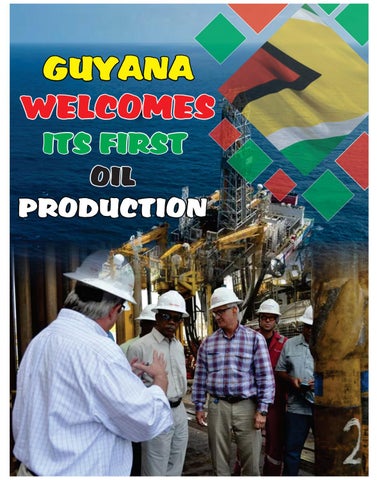
GUYANA CHRONICLE, SATURDAY DECEMBER 21, 2019
1A
2A
GUYANA CHRONICLE, SATURDAY DECEMBER 21, 2019
‘We are as ready as we can be’
-Trotman on First Oil W ith the establishment of a regulatory body, the Sovereign Wealth Fund (SWF) and the training of persons to take up positions within the sector are among several factors which Minister of Natural , Raphael Trotman believes are testimony to Guyana’s readiness for oil production. While speaking to the Guyana Chronicle on Friday, Trotman said that he is “euphoric” about First Oil, adding that it is a humbling moment when one considers the long road stretching fours back to conversations I various circles about oil and how it will transform Guyana.
Trotman said he said he knows that there are persons who bear negative perceptions about oil and its benefits for the country but according to him, once the sector “gets going” it will transform the country in a positive way. “It is a humbling moment,” he said. “I think that we are as ready as we could be,” he reiterated. The Alliance for Change (AFC) chairman said that given the fact that many countries have been where Guyana is, he said many have said that they were not even half way in the process when compared to Guyana’s state of readiness,. “We have a cadre young persons who are being trained and getting ready, so yes we are as ready as we could be for this moment,” he said. The Act governing the SWF was assented to on January 23, 2019 by President David Granger, making Guyana one of a few countries to have the vital piece of legislation in place before first oil. Earlier this year, Minister of Finance, Winston Jordan praised the Commonwealth Secretariat for its input and Finance Ministry staffers for their “constant dedication” towards the effort. The Sovereign Wealth Fund (SWF) is defined as pools of money derived from a country’s reserves, which are set aside for investment purposes that will benefit the country’s economy and citizens. The funding for a Sovereign Wealth Fund comes from Central Bank reserves that ac-
Minister of Natural Resources, Raphael Trotman cumulate because of budget and trade surpluses, and even from revenue generated from the export of natural resources.
3A
GUYANA CHRONICLE, SATURDAY DECEMBER 21, 2019
‘Exciting future ahead’
President of the GMSA, Clinton Williams
-Business community says ‘first oil’ opens path to progression
A
bright and exciting future awaits Guyana, with the dawn of the new oil and gas industry, especially if the industry is managed efficiently, said the local business community. “A whole new future and hopefully exciting future awaits Guyana,” said President of the Guyana Manufacturing and Services Association (GMSA), Clinton Williams in an invited comment, on Friday. Williams joined other leaders in the business community to welcome “first oil” and speak about the expectation of the industry and significance of the “first oil.” Leaders in the business community believe that first oil opens the path to progression and could improve the economic conditions, especially if there is a balanced economy which could survive beyond the finite resource called oil and gas. President of the Georgetown Chamber of Commerce and Industry (GCCI), Nicholas Boyer said “first oil” is a huge milestone and it is interesting that it is happening at a time when Guyana will be celebrating its 50th anniversary as a Republic. “While it is exciting times, Guyanese must use it as a chance to reflect on where we have come from and look at where we are going,” said Boyer, adding that “first oil” marks a major step in Guyana’s history. He said, in the short term, Guyana must do some introspection before looking at the long term and moving into the future. Boyer said the business community will also be looking for clarity and the completion of the local content policy so it could benefit from the oil and gas sector. Chairman of the Private Sector Commission (PSC), Gerry Gouveia shared the sentiments of Boyer, noting
that this is exciting times and first oil is very symbolic for Guyana. “I don’t think there will be a remarkable change in the quality and way of life in the short term but it creates the path for growth and development,” said Gouveia, adding that he is looking forward to the benefits of post 2020. In the first phase of ExxonMobil’s venture, the Liza oil field is expected to begin producing up to 120,000 barrels of oil per day. The company estimates these oil reserves at 5.5 billion barrels. The Economist had reported that in a decade from now, Guyana could become the second-largest oil producer in Latin America and the Caribbean, after Brazil. The Liza Destiny, Guyana’s first FPSO which operates the Liza Phase 1 Development had arrived in the Stabroek Block some three weeks ahead of schedule. The vessel is twice the length of the Providence Stadium; half the width of the Georgetown Cricket Ground; has the depth of the Kingston Lighthouse and the capacity to store some 1.6 million barrels of oil. Apart from HESS, Esso Exploration and Production Guyana Limited (EEPGL) holds 45 per cent interest and CNOOC Petroleum Guyana Limited, a 25 per cent interest in the Stabroek Block. It is estimated that there is over six billion barrels of oil equivalent in the Block while the involved partners continue to see “multibillion barrels of additional exploration potential”. HESS noted that Exxon’s and its partners’ 14th discovery was announced on the Stabroek Block at the Tripletail-1 exploration well located approximately 3 miles northeast of the Longtail discovery. The Tripletail discovery adds to the 6 billion barrels of oil
Chairman of the PSC, Gerry Gouveia President of GCCI, Nicholas Boyer
equivalent. The Liza Phase 1 project will produce up to 120,000 barrels of oil per day at peak rates utilizing the Liza Destiny FPSO. It is expected to generate over $7B in royalty and profit oil revenues for Guyana over the life of the project. The Noble Bob Douglas drillship is currently completing development drilling operations for
the Liza Phase 1 development. At the same time, the Stena Carron drillship is completing a well test at the Longtail-1 discovery and, upon completion will next drill the Hammerhead-3 well. The drillship is also expected to drill a second well at the Ranger discovery this year.
4A
GUYANA CHRONICLE, SATURDAY DECEMBER 21, 2019
Guyana’s Crude Taken Care Of of the Liza grade. The quality of the crude and its yield have not yet been tested within a refinery system. This interim arrangement is put in place just for this period,” the Department explained. The direct sale is short term and the International Oil Companies (IOCs) invited to bid are ExxonMobil; China Nation-
al Offshore Oil Corporation (CNOOC); Hess Corporation; BP; Chevron; Shell, Total and Eni. According to Crude Marketing Specialist, Virginia Markouizou, the IOCs possess integrated value chains, have a global refining footprint, are accountable to stakeholders and are aware of the intricacies
one year with the option to renew. The entire engagement with the IOCs is expected to be completed soon. GUYANA PREPARED ITSELF When it was announced in October 2019 that ‘first oil’ would be possible in December 2019 ahead of the previously
Minister of Finance, Winston Jordan hands over the signed agreement to Governor of BOG, Dr. Gobind Ganga (Adrian Narine photo)
By Lisa Hamilton
W
ith ‘first oil’ announced, Guyana first three cargoes of oil from ExxonMobil’s Liza-1 field will be sold to selected operators which will prevent the Liza Crude from being priced downwards due to initial uncertainty of the quality. Crude is natural mineral oil not yet processed or refined,
which is stored aboard a Floating Production Storage and Offloading (FPSO) vessel and then transferred to tankers and pipelines heading ashore. The Department of Energy (DE) has explained: “The full extent of the quality of crude is not yet known. It usually takes several lifts to determine crude only quality and the cost of refining it. Guyana is embarking on its very first new crude introduction into the market
LOCAL CONTENT At the same time, the final draft of the much-anticipated Local-Content Policy is being edited and is on course for completion this month. The DE will be looking to complete the
The Liza Destiny FPSO
of introducing a new grade into the market. “They can help us introduce the grade into the market in a very standard way. This is what we’re trying to achieve here. Volatility for the Guyana Liza new grade is not good. We’re trying to create an environment whereby there is standardization and stabilization,” she said. While it is normal for the process of stabilization to take up to six months, Guyana has decided that it was prudent to shorten the period to three cargo lifts, which is to take approximately three months. Guyana’s crude will be sold under a Free On Board (FOB) contractual agreement which will see the crude being sold to the buyer at the exit point of the Floating Production Storage and Offloading (FPSO) vessel, with the buyer taking responsibility for aspects such as insurance and shipping. “I am happy to report that the department has been working with its sister agencies and the operator to ensure that such a process is put in place so we can ensure that it is running as efficiently as possible from day one,” Dr. Bynoe. It does not require procurement and will only require such when Guyana moves into the next phase of public Request for Proposals (RFP). The Department has indicated that this is likely in January 2020 and a full RFP will be issued inviting companies to bid for the marketing of Guyana’s portion of crude on a long-term basis, for at least
Gobind Ganga, on Wednesday, entered into an Operational Agreement for the management of the Natural Resource Fund (NRF). The Memorandum of Understanding (MoU) was handed over to the governor at the Ministry of Finance in accordance with sections 11 and 12 of the NRF Act 2019. According to the finance minister, as part of government’s preparations towards becoming a petroleum-producing country and in anticipation of first oil, work commenced in earnest in 2017 on the drafting and consultations regarding the development of a Sovereign Wealth Fund (SWF) legislation for Guyana. He said that the signing is a significant next step in establishing strong institutional arrangements to support the effective management of the country’s petroleum revenues.
Director of the Department of Energy Dr. Mark Bynoe
projected March 2020 date, Finance Minister, Winston Jordan stated that efforts were being made to speed up local preparations for the shipment of crude. He confirmed then that the revenues to come from the production would be stored in an account and parked until after the March 2, 2020 elections when a new government is elected. “We had an inkling that the first oil could be in December and therefore we were working under that assumption and trying to ramp up our activities. So, it doesn’t come as a surprise to us who were working underground… we were trying to work with the World Bank and other donors who were helping us to try to put in place as much as possible the critical elements,” the Finance Minister said. And, so said so done; a month later and before ‘first oil’, Jordan and the Governor of the Bank of Guyana (BoG), Dr.
policy so that there will be a guide for the participation and inclusion of Guyanese in the new oil-and-gas sector. “The Local Content Policy Consultant has submitted his final report; the policy is being edited, with a completion date of December 2019 still being the aim of the DE,” said Dr. Bynoe said during a recent press briefing. The policy framework is meant to outline the guidelines by which local content will be understood, developed, measured, secured and implemented in Guyana’s petroleum sector. It also takes into consideration the urgent need for the optimisation of revenues received from oil to benefit Guyana’s economy and citizens, present and future and, although the policy is not complete, the DE has been working with operators to commence reporting on local-content performance as per the conditions of the final draft of the policy.
5A
GUYANA CHRONICLE, SATURDAY DECEMBER 21, 2019
The journey towards first oil
By Lisa Hamilton
The journey towards ‘first oil’ in Guyana has been an exciting one with several discoveries along the way which have placed both Guyana and much of the rest of the world at the edge of their seat, eager to see the projected transformation finally play out. In years past, Guyana was regarded as one of the poorest countries of South America even with a population of under 1 million but, today, it is projected to rise to the top of the continent’s rich list and up the general list of the richest countries in the hemisphere within the decade. LIZA DISCOVERY Guyana gained some of the world’s attention when it announced its first oil discovery at the Liza -1 well in the Stabroek Block on May 20, 2015. In a release ExxonMobil referred to the discovery as “significant” stating that it was encouraged after scores of previous wells dug had turned out dry. Guyana’s first Floating Production, Storage and Offloading (FPSO) vessel, the Liza Destiny has now commenced the production of oil aiming for up to 120,000 barrels of oil per day by 2020, with storage capacity of up to 1.6 million barrels. By 2025, it is expected to ramp up to 750,000 barrels daily which would see Guyana producing as much oil as Venezuela in just five years.
mid-2022 with the aim of producing up to 220,000 barrels of oil per day with the help of the Liza Unity FPSO. SNOEK DISCOVERY Then in March 2017, the Snoek discovery was announced after the Snoek- 1 well was drilled in a new reservoir, encountering 82 feet of high-quality, oil-bearing sandstone reservoirs. President of ExxonMobil Exploration Company, Steve Greenlee had stated: “The results from this latest well further illustrate the tremendous potential we see from our exploration activities offshore Guyana.” TURBOT DISCOVERY The US oil giant’s fifth discovery and last for 2017 was announced in October located at
PAYARA DISCOVERY The year 2017 was one of rapid successions in oil discoveries by ExxonMobil beginning with the Payara discovery announced in January 2017. Payara was ExxonMobil’s second oil discovery in the Stabroek Block which encountered 95 feet of high-quality, oil-bearing sandstone resAll of ExxonMobil’s discoveries ervoirs. thus far in the Stabroek Block offshore Guyana Back in September 2019, Esso Exploration and Production Guyana Limited (EEPGL) sub- the Turbot- 1 well which encountered 75 mitted its Energy Information Administration feet of high-quality, oil-bearing sandstone. (EIA) on the Payara Development Project to Located just 30 miles away from the Liza the Environmental Protection Agency (EPA). 1 well, the development was expected to The project will see the drilling of up to 45 further solidify Guyana’s potential as an development wells which could take up to oil producer. five years, with drilling beginning in 2020 and initial production by early 2023. RANGER DISCOVERY The discoveries in 2018 exceeded the LIZA DEEP DISCOVERY previous years as much of the world had Also, in January 2017, the Liza Deep begun to set their sights on Guyana as a discovery was announced described that year possible petroleum powerhouse should the as a “world-class” find which boosted the success continues. potential recoverable resource of 800 million In January 2018, Exxon’s sixth discovto 1.4 billion oil-equivalent barrels. It con- ery at the Ranger – 1 well encountered 230 firmed that there was significant potential of feet of high-quality, oil-bearing carbonate high-quality oil in the Stabroek Block even as reservoir which would add to the more than Exxon’s former CEO, Rex Tillerson told the 3.2 billion recoverable oil-equivalent barForbes Magazine that it was “…the equivalent rels estimated total of the previous wells. of 1,400 Gulf of Mexico blocks.” That year the Government of Guyana Just in May 2019, it was announced that noted in a release: “The news of an addithe Liza Phase 2 Development has received tional find of this magnitude, particularly, ExxonMobil’s approval through funding and at the start of the new year, can be seen as a the new development will see some 30 wells further blessing and underscores the richness being drilled and approximately 600 million and diversity of Guyana’s natural resources.” barrels of oil as a result. Startup is pinned for
PACORA DISCOVERY Then, just one month later, in February 2018, the Pacora discovery was announced
reservoir, encountering approximately 256 feet of high-quality, oil-bearing sandstone reservoir and the estimates then were that Guyana had potential for some 4 billion oil-equivalent barrels all together.
HAMMERHEAD DISCOVERY However, the country had cause once again to re-estimate upwards with the Hammerhead discovery announced in August 2018 which encountered approximately 197 feet high-quality, oil-bearing sandstone reservoir. Wood Mackenzie had suggested that year that ExxonMobil and Guyana had “hit jackpot” with the discovery which showed that the winning streak continued and with possibly no intention of stopping any time soon. "Guyana has hit the jackpot," Latin America Upstream Senior Research Manager, Maria Cortez told Wood Mackenzie, adding: "If this Students from the University of Guyana and small South American nation with, members of the public engage experts on the Payara Development Project and its planned a population of about 750,000, can operations. (Delano Williams photo) properly manage the billions of dollars of revenue about to come its way, it may become the richest corner of as Exxon’s seventh the continent." discovery at the Pacora- 1 well encounterPLUMA DISCOVERY ing approximately 65 Taking the final slot for 2018, the Pluma feet of high-quality, discovery was announced in December 2018 oil-bearing sandstone as ExxonMobil’s 10th oil discovery which reservoir. By then increased estimates of the discovered recovit was common for erable resource for the Stabroek Block to countries around the more than five billion oil-equivalent barrels. world to report on the It was drilled in a new reservoir, encountering developments in Guy- approximately 121 feet of high-quality hydroana expecting nothing carbon-bearing sandstone reservoir. less from the coun“Guyana is well poised to truly forge ahead try’s basin even as the in the 21st century. As a petro-development find that month would state we will, however, need to strategically help bring Guyana invest in a people-centered and balanced production to more manner, where we utilise our non-renewable than 500,000 barrels resources for structural transformation and per day. improving people’s lives in the short-term, while concomitantly providing the foundation LONGTAIL to allow us to transition in the medium and DISCOVERY long-term to a post-carbon economy,” DeThe Longtail discovery, announced in June partment of Energy (DE) Director, Dr. Mark 2018, at the Longtail – 1 well saw CEO John Bynoe had stated. Hess stating: “We are very pleased with this TILAPIA AND HAIMARA DISCOVERIES In February 2019, “double strike” were the words plastered across newspapers as ExxonMobil discovered oil in two wells – the Tilapia-1 and Haimara-1 wells --drilled only a short period before the discovery. This totaled Exxon’s discoveries to 12 with the Tilapia-1 well bearing 305 feet and the Haimara-1 207 feet of high-quality oil-bearing sandstone. In the 2018 budget presentation just months The Joe and Jethro oil finds by Tullow ago, Finance Minister, Winston Jordan said that eighth significant oil discovery, which reaf- the discovery of very significant firms the remarkable exploration potential of the Stabroek Block.” It was drilled in a new TURN TO PAGE
8A
6A
GUYANA CHRONICLE, SATURDAY DECEMBER 21, 2019
Youth must prepare for a life after oil
…President Granger
P
resident David Granger on Thursday urged a large gathering of young people to equip themselves with the requisite skills and knowledge to advance Guyana’s development beyond the life of the petroleum sector. The President said being cognisant that the country’s petroleum product will not last forever, the `Decade of Development’ will be launched next year to ensure that youths become the “muscle and the brain” to drive Guyana forward. President Granger was at the time delivering the feature address at the first Youth Empowerment Summit (YES) hosted by the Youth Forward Movement on the lawns of the Watooka Guest House in Linden, Upper Demerara-Berbice (Region Ten). “All around the world people are moving away from petroleum and you better learn that lesson that petroleum, whatever bonanza, whatever profits, whatever revenues we get, will not last forever. So, we have to put in place the type of development that would take us beyond petroleum. That is why I deliberately choose a ‘Decade of Development’, not a year of development [but] a decade because by 2030 this country must be must more developed than it is at present,” he said. The Head of State told the youths that they can expect many programmes which will be established for their development during this decade, which will end in 2029. During
this period, he said, emphasis will be placed on education, particularly as it relates to ensuring equal access. The President said every community should at least have a nursery school so that small children are not required to travel long distances to get to school; secondary colleges and university centres will be constructed in every Region and no eligible student will ever again have to pay for an education at the University of Guyana. President Granger informed that during the ‘Decade’, Government intends to intensify and expand technical and vocation education, particularly to hinterland and rural communities. Given all that Government plans to put in place, the Head of State believes that youths will be provided with the right tools to ensure that Guyana does not become heavily dependent on the petroleum sector. “It (oil) wouldn’t last forever. Even some of the most productive petroleum countries now have the most successful solar energy generation plants. Some of the countries producing the most petroleum are also producing the most electricity from solar energy,” the President said. ECONOMICALLY EMPOWERED President Granger chronicled programmes which have assisted young people to become economically empowered. He said that they can also create economic opportunities for themselves. The Sustainable Livelihood
and Entrepreneurial Development (SLED) programme, launched in 2016 has provided financing and technical support for more than 400 community projects which support income-generation. The Hinterland Employment and Youth Service (HEYS), launched in 2015 assisted in creating more than 1,200 jobs and trained some 3,728 hinterland youths and Linden Enterprise Network (LEN), relaunched in December 2015 with an injection of G$ 155M from the Government, disbursed 570 loans totalling G$326.2M over the past four years; Micro and Small Enterprise Development Scheme aimed at removing some of the traditional bottlenecks, disbursed 559 grants between 2015 and 2018, which supported initiatives in the fields of agro-processing, agro-culture, apiculture, aquaculture, business outsourcing, cultural industries and eco-tourism. Additionally, the Guyana Youth Corps, aimed at ensuring young people are equipped with the knowledge, skills and attitudes to become productive citizens was re-launched on 28th March 2019 after having been inaugurated on the 1st January 1968 by the Government of- the- day; the Guyana Industrial Training Centre since 2015 has graduated a total of 734 persons in data operations, electrical installation, furniture-making, masonry, metallurgy, motor vehicle repairs, plumbing and welding; the Board of Industrial Training equipped more than 8,000 young persons with technical vocational skills over the past four years; and the Youth Innovation Project of Guyana, launched in 2017 to encourage inno-
President David Granger
vative project ideas from young persons aged 14 to 35 years, selected 105 projects, from all ten administrative regions, for approval of which 65 have received funding totally G$97.3M, so far. “That is why you must pay attention. Everything that was said tonight is TURN TO PAGE
8A
7A
GUYANA CHRONICLE, SATURDAY DECEMBER 21, 2019
Oil wealth must benefit the people
-A recap of foreign envoys’ advice to Guyana GUYANA is on the cusp of development with the advent of the oil and gas sector, which is expected to increase the inflows of revenue to the South American country, revenues which foreign envoys believe should “reach the people.” Ambassadors, high commissioners and even foreign politicians believe that Guyana’s new-found wealth should benefit the people of the country, but they said it can only happen if there is efficient management of the sector. “Guyana is on the cusp of unparalleled wealth. That wealth must benefit each and every citizen of this country, regardless of who they are or where they are; from the coast to the hinterland, from Georgetown to the smallest village. Everyone must benefit. Government and Opposition must work for all the citizens of Guyana,” said British High Commissioner, Greg Quinn in his remarks at the 93rd anniversary celebration of the birth of Queen Elizabeth II. He believes that the only
US Ambassador to Guyana, Sarah Ann-Lynch
Canadian High Commissioner, Lilian Chatterjee
way Guyana will realise its true potential is if the citizens of the country benefit from the oil wealth. “If this does not happen, I fear Guyana will not develop, and we will continue to hear the tired, old mantra of how much potential Guyana has. There is no question about that potential, but it is up to the political leadership to do, to actually show it, to actually move beyond potential to reality,” said Quinn. Former US Ambassador to Guyana, Perry Holloway had also posited the notion of ensuring that the wealth benefits the people of the coun-
British High Commissioner, Greg Quinn
Former US Former Prime Ambassador, Minister of Jamaica, Portia Perry Holloway Simpson-Miller
try. His advice to government was to spend the new-found riches on education, healthcare and creating a secure living and working environment for Guyanese. He said the benefits could be extensive and far-reaching especially given the possibility of Guyana’s Gross Domestic Product (GDP) increasing by 1000 per cent by 2025. The former ambassador had said based on the calculations and oil finds of U.S. oil giant ExxonMobil, the economy could grow rapidly within the space of five years. “Guyana could experience that level of growth by
2025…that would be about 300 years of growth,” said Holloway. The country would not be just the richest country in the western hemisphere but, Ambassador Holloway believes that it could be the richest country in the world in per capita terms. Canadian High Commissioner to Guyana Lilian Chatterjee had also anticipated a bright future ahead for the soon-to-be oil producing South American country and had made it clear that Canada is looking to help and not exploit Guyana. She said Guyanese may
still not be fully aware of the drastic impact the emerging petroleum industry is about to have on the country. “I don’t think you are ready to know how drastically you are going to change and we in Canada are here to help you, not to exploit you, but to help you prepare for hopefully all the good things that are going to happen. There will be other challenges as well, but we want to help you prepare so that you can realize the same prosperity that Newfoundland has realised,” said Chatterjee. US Ambassador to Guyana, Sarah Ann-Lynch had said one of the areas that Guyana should look at closely, in keeping with the demands of the new oil and gas economy, is the country’s infrastructural development agenda. “I would say it is important for the country to move ahead and start addressing those issues,” the Ambassador said. She reminded that infrastructure is very important for a country’s economic growth potential and highlighted the potential benefits of Public Private Partnership initiatives to help push this agenda.
Former Prime Minister of Jamaica, Portia Simpson-Miller had also advised Guyana to explore Public Private Partnerships, but said Government must also look at meaningful economic reform in order to create an inclusive and transparent system. “Your country is poised to embark on an exciting path to high levels of economic growth and huge development… It will happen through significant private, foreign and local investments in your economy, but major adjustments will have to be made as a nation,” said the former Prime Minister. As Guyana moves ahead, the country will need to look at addressing things such as inflation, Simpson-Miller said, adding that those issues will be tackled through fiscal and monetary policies. The former Head of State of Jamaica told businessmen and women: “Fiscal and monetary policies are necessary in ensuring that prices remain low and stable, and since inflation is the greatest tax on the poor, low inflation is the best gift any Government can give to its people and private sector.”
8A FROM PAGE
6A
Youth must prepare ...
important to you. Even if it means opening a small farm and producing carambola [or] producing guavas, it will make a contribution to some enterprise,” the President said. The Head of State explained that in order to aid Guyana’s development investment is needed. “You in this Region, with greater investment could generate those commodities [and] those products which could find markets…in the Caribbean. Investment is important,” he said before urging Lindeners in the diaspora to return to the Region and invest in manufacturing and other industries. President Granger assured that Government is doing its best to ensure that employment is created for young people. He said significant emphasis is placed on job creation through self-employment and as such Government wants to see people developing marketable skills. “Young people we are capable of producing those commodities and we have shown you the amount of schemes and programmes that our Government over the last four and a half years has established to make that type of marketing possible,” he said before informing those gathered that the Minister of Business will find a market locally and in the Caribbean for any product that is grown in Guyana. The President said that Guyanese youth must have an opportunity to be fully employed and be afforded the opportunity to make decisions. “This is why this forum is very important. It is not entertainment. It’s
not for a stage show. It is helping you to make decisions,” he said, noting that such an event should be replicated in other towns. “Take and create a movement that is going to sweep this whole country. Let young people rise to the fore and take control of their destiny,” President Granger said as he reminded the gathering of the existence of a National Youth Policy, which rests on four pillars -education, equality, empowerment and employment. The Head of State said the ‘Policy’ explains Government’s vision as “… a nation in which young people are united, educated, trained, safe, happy, healthy and integrally involved in the decision-making processes, while enjoying equality of opportunity and equal access to the resources of our country”. Also present were Minister of State, Mrs. Dawn Hastings-Williams; Minister of Social Cohesion with Responsibility for Culture, Youth and Sport, Dr. George Norton; Minister of Natural Resources, Mr. Raphael Trotman; Minister responsible for rural affairs in the Ministry of Agriculture, Mrs. Valerie Patterson-Yearwood ; Director-General of the Ministry of the Presidency, Mr. Joseph Harmon and Mr. Audwin Rutherford, Member of Parliament, Region Ten. (Ministry of the Presidency)
GUYANA CHRONICLE, SATURDAY DECEMBER 21, 2019
History of oil exploration in Guyana Guyana has two potential hydrocarbon basins -The Guyana Basin which extends offshore the coastal plain -Takutu Basin, which is much smaller and lies inland, to the south of the country on the border with Brazil. 1916-The first well in Guyana was drilled on the onshore coastal section of the country in the Waini, North West District. 1926- A well drilled at the Bath sugar estate produced gas which was used for domestic purposes. 1950- Offshore exploration commenced 1960- 1970-Offshore drilling was undertaken by several companies including Conoco, Comoro, Deminex, Oxoco , Tenneco and Shell. 1975- Shell’s Abary-1 well found several shows. 1980- 1990-Mobil, Total, Guyana Exploration and BHP continued the exploration effort. 1982- The Karanambo-1 well in the Takutu Basin was drilled by Home Oil Inc .Tests conducted confirmed that oil of good quality was found .However, the commercial future of the find did not materialize due to the geographical reasons. 1991-1992- Total drilled its Arapaima-1 well but received no returns 1996- The founders of a Canadian-based company, CGX Energy Inc began negotiations with the Government of Guyana to acquire an offshore concession to explore for oil. 2000- In June 2000, Surinamese gunboats forced an oil rig which was hired by CGX, out of the Corentyne River during an exploration exercise at its Eagle-prospect. 2007- The United Nations International Tribunal of the Law of the Sea (ITLOS) awarded 33,000 square kilometres to Guyana in its international border dispute with Suriname. 2008- American oil giant ExxonMobil commenced oil exploration offshore Guyana. 2010- Takutu Oil and Gas Inc, a subsidiary of Canadian firm Groundstar Resources Inc, announced that it was drilling for oil in the Takutu Basin in the Rupununi. 2015- ExxonMobil and its subsidiaries announced in May 2015, a significant commercial oil find in the Liza-1 well within the Stabroek Block. 2017- Exxon announced in January of 2017, that it found oil in commercial quantities in the Payara-1 well. Exxon also made another oil find that month at its Liza Deep field. March-Exxon announced that it also made another significant commercial oil discovery, this time, in the Snoek well, the third within the Stabroek Block. Later that year, in October, Exxon announced that another commercial oil discovery was made within the Stabroek Block. The discovery was made at the Turbot-1 well. 2018- In January that year, Exxon made another oil discovery in the Stabroek Block; the discovery was made at the Ranger-1 well. February- Exxon announced the discovery of oil at its Pacora-1 well in the oil rich Stabroek Block. June- Exxon announced another oil find. The discovery was made at the Longtail well in the Stabroek Block. August- Exxon made a significant oil discovery at the Hammerhead-1 well in the Strabroek Block. December- Exxon announced another commercial oil discovery in the Stabroek Block; the discovery was made at the Pluma-1 well. 2019- In February this year, Exxon announced that it discovered oil in commercial quantities in the Tilapia-1 well. February- Exxon also announced that it found oil in commercial quantities in the Haimara-1 well in the Stabroek Block. April- The Yellowtail-1 oil discovery was Exxon’s 13th oil discovery. August-Ireland-based -Tullow Oil announced that it made an oil discovery at the Jethro-1 well in the Orinduik Block. September-Exxon announced the discovery of oil at its Tripletail-1 well, its 14th in the Stabroek Block. That month, Tullow also announced its second discovery, this time at the Joe-1 well in the Orindiuk Block, bringing the total number of oil discovered in commercial quantities here, to 16.
The journey ... oil reserves has put Guyana at a critical point in its history. He assured citizens: “We are poised for rapid economic expansion, and our government is committed to pursuing economic and social policies conducive to equitable, sustainable and environmentally friendly growth.” YELLOWTAIL DISCOVERY The Yellowtail discovery was announced in April 2019 drilled in a new reservoir, encountering approximately 292 feet of high-quality oil-bearing sandstone. Dr. Bynoe said that month that the rate of the oil discoveries demonstrates the magnitude of Guyana’s natural resources. He welcomed the 13th announcement vowed that his department would monitor the developments closely to ensure that Guyanese reap the benefits.
JETHRO DISCOVER In August 2019, Tullow Oil plc’s (Tullow) made its first oil discovery offshore Guyana at Jethro-1 well in the Orinduik Block. Although recent and initial analysis of the oil discovered in the well has shown that the finds are heavy crude with high sulphur content unlike the preferred light, low sulfur crude found in the Liza field, the company “remains optimistic” and “extremely confident about the future”. JOE AND TRIPLETAIL DISCOVERIES On September 16, “double Strike” was once again the catch phrase of news entities when two separate oil finds were announced by Tullow and ExxonMobil which said that the finds were of high-quality oil-bearing sandstone. The Joe – 1 well located
FROM PAGE
5A
in the Orinduik Block encountered 52 feet of continuous thick sandstone while the Tripletail -1 well encountering approximately 108 feet of high-quality oil-bearing sandstone reservoir. The two finds brought the most recent total finds in Guyana to 16 in Guyana even as only a portion of the Stabroek and Orinduik Blocks have been explored and other blocks remain undrilled or unawarded. In 2019, Guyana was ranked as the country with the second highest oil discoveries with Rystad Energy projecting that the Guyana-Suriname basin would continue to occupy headlines. It gives greater credibility to the United States (US) 2012 Geological Survey which ranked Guyana as having the second most attractive under-explored basin in the world, with a potential of 15.2 billion barrels of oil.