2
Address By
GUYANA CHRONICLE
His Excellency Dr. Mohamed Irfaan Ali President of the Co-operative Republic of Guyana On the Occasion of the 55th Independence Anniversary of Guyana 2021.05.25
HONOURABLE Prime Minister, Madam Chancellor of the Judiciary, former Presidents, Ministers of Government, Heads of Service, Members of the Diplomatic Community, Members of Parliament, Distinguished men and women in uniform, members of the media. It gives me great honour and privilege, and indeed, it is a humbling time for me, to stand before you, to stand before the people of this beautiful country, Guyana, and address you on the occasion of our 55th Independence Anniversary. Perhaps it is fitting, before I move forward, to observe the environment in which we are—an environment that straddles time. We have the Appeal Court, an important sym-
President, Dr Irfaan Ali
bol of democracy and the rule of law, we have our great Amerindian Heritage, we have our commitment to conservation, we have the old Pegasus and as you
look beyond that you will see a feature of what the new and modern Guyana would be like with the new construction. And just in
front of where I stand is the Marriot Hotel. Fifty-five years captured around our very surrounding. My brothers and sisters of Guyana Today or just a few hours from now is the 55th anniversary of our people’s collective struggle for independence. We hold this annual celebration to remind ourselves that our one nation has a joint history of oppression, subjugation and of exploitation. We celebrate because a great victory was achieved by our foreparents, acting together to end colonialism, to fashion our own future, and to shape our own destiny. No one race of our people achieved that victory. People of all races did it collectively, as Guyanese born in this land and of this land, each the equal of the other, and each devoted to the common purpose
of making of Guyana, a homeland in which all Guyanese could thrive and prosper. Now, it falls to us to keep faith with them and all the great Guyanese of the past. To do so, we must recall the spirit of common purpose that motivated them. And in recalling that spirit, with pride and respect, we must commit to continue the journey they began, realising our hopes and aspirations for the future of our much-loved Guyana. My brothers and sisters, we cannot recall the moment of Guyana’s independence without also remembering the efforts of Venezuela to prevent it. As we released ourselves from the colonial cord of Britain, the Venezuelan government sought to stifle our birth by falsely laying claim to two-thirds
of our country. It [Venezuela] has spent the last fifty-five years of the independence of all of Guyana pursuing this claim. But international law is not silent. The International Court of Justice is the forum where the voice of international law will be heard, and justice will be determined. As one people, with one united voice, and in spirit that will not be broken, we’ll advance the validity of the one hundred and twenty-two-yearold Award that fixed our boundaries. In our continuing struggle, we are not without friends. We deeply appreciate all those who have stood by our side - from the Caribbean, from the Commonwealth, from the Americas and beyond. Continued on page 4
GUYANA CHRONICLE
Guyana's road to Independence and its significance By Tota C. Mangar
TODAY, Wednesday, 26th May, commemorates the fifty-fifth anniversary of our country's attainment of political independence from Great Britain. On this historic day in 1966, a new nation, Guyana, the only English speaking one on the South American continent, achieved national sovereignty to become the 24th member of the then British Commonwealth of Nations, thus bringing to an end several decades of British colonial rule. Guyana's road to political independence was indeed turbulent. For a brief period in the early 1950s its nationalist movement, the original People's Progressive Party under the leadership of the late Presidents, Dr. Cheddi Jagan and Mr. Forbes Burnham enjoyed overwhelming support from the working class and the masses in general, as they pursued the noble objective
Historian, Tota Mangar
of national unity and internal self-government. Their resounding victory at the 1953 general elections astounded m a n y, i n c l u d i n g l o c a l reactionaries, the Colonial Office and also the US State Department.
tenure in office was shortlived as the Constitution was suspended, and the largely legally elected government was overthrown under the guise of preventing the establishment of a communist state in the then British Guiana. The irony about this SETBACK unfortunate development was The mass-based party's t h a t an interim
government was imposed and it comprised several of the individuals who themselves suffered humiliating defeats at the hands of the toppled nationalist candidates. As if that setback was not enough, the nationalist movement itself became severely fractured in 1955 into Jaganite and Burnhamite factions of the PPP and the eventual emergence of the People's National Congress, a mere two years later. This development paved the way for the intense political rivalry between our foremost two political leaders, Dr. Jagan and Mr. Burnham. Unfortunately, it was this split more than anything else which led to serious racial strife and insecurity in the immediate post-independence years and also ensured the local movement for political independence treading a most uneven passage. Subsequent events such as political and social instability, including strikes and disturbances which erupted as
a result of the Kaldor budget and the Labour Relations Bill, clearly illustrated the very turbulent waters this nation had to endure. Loss of several lives, the destruction of properties and the severe dislocation of people to the tune of millions of dollars were the sad reality of life during this extremely dark period of our country's history. INDEPENDENCE At fresh elections and under a new electoral system of proportional representation instead of the previous firstpast the post or constituency system, Mr. Burnham headed a PNC/UF coalition government in office in 1964. As Prime Minister, he shouldered the responsibility of leading the country to independence while his former colleague and by then rival, served as Leader of the Opposition. Political independence was achieved on May 26, 1966 and it represented the successful culmination of several years
3
of agitation, lobbying and political filibustering against the background of centuries of colonial domination of one form or the other. At the twitching hour of midnight, thousands of Guyanese of all walks of life stood proudly and cheered lustily as the Union Jack was lowered and our National Flag went up to herald the birth of a new, proud ,ambitious and independent Guyana. Among those who witnessed the highly significant and unique ceremony were the Duke and Duchess of Kent, C o l o n i a l S e c r e t a r y, M r Anthony Greenwood, former Conservative C o l o n i a l S e c r e t a r y, M r. Duncan Sandys, the first Governor-General of Guyana, Sir Richard Luyt and 62 delegates from 47 countries world-wide. Of added significance and to the tumultuous Continued on page 5
4
Address By His Excellency...
From page 2 The Venezuelans must understand that we sought no quarrel with them, and we do not do so now. Our only wish is to live in harmony and cooperation with all our neighbours. We hold out not a fist of war but a hand of friendship, based on respect for our borders and theirs. But we will not be cowered, nor will we be bullied. My Fellow Guyanese, it is not only in relation
to protecting our territorial integrity that we must stand as one Nation. Like every other country in the world, we are fighting an unseen, but ever-present enemy in the COVID-19 pandemic. More than sixteen thousand of our people have been infected with the dreadful coronavirus and, sadly, more than 360 of them have died. We mourn those deaths and sympathise with the families who have lost loved ones.
I plead with all to help stop these deaths; stop the tears of anguish; stop the grief. Your government has instituted measures to try to protect every person in Guyana, particularly our elderly and the vulnerable. However, the active participation of all is required to deploy the protective measures of masks, physical distancing, hand washing and using sanitisers. Already, 20 per cent of our people have been vaccinated. This is a significant accomplishment in a world
where less than 1 per cent of people in the developing countries have access to vaccines, and where recent World Health Organisation studies suggest that more than 6 million people have died globally. We have already purchased thousands of vaccines, and we are sparing no expense in ensuring that we have enough vaccines to cover our full population 18 years and above. Our objective is to ensure that we can inoculate everyone from this dreadful virus. The length of this battle depends on how soon each of us is fully vaccinated, liberating ourselves to return to a high level of normal life, and protecting others from infection. In the past, we have immunised generations of our people from measles, mumps, typhoid, polio, yellow fever, meningitis, hepatitis, and other communicable diseases, proving that vaccination saves lives; vaccination saves lives. My brothers and sisters let us get vaccinated; let us take each other and get vaccinated, so that we can return to normalcy as fast as possible. I urge that we all recognise the value to our own lives, to the lives of our family and friends, to our livelihoods and to the betterment of our country by vaccinating to defeat the coronavirus, as we have defeated so many others in the past. My brothers and sisters, while much of our health resources have been devoted to fighting the harmful effects of COVID-19, I assure you that our intention is to deliver the highest international standard of health care for every citizen of our country. There is already considerable private sector enthusiasm for investing in modern hospitals, fully equipped with the latest technology. Your government will partner with these private sector initiatives, to give to all Guyanese the high-quality medical care that each of you deserve. What we are putting in place in medical care, we are also doing in education. Guyana and Guyanese must be assured of educational facilities that will
GUYANA CHRONICLE
allow everyone to attain the highest standard of achievement. Since your government came to office 9 months ago, we have commenced the programme to award 20,000 scholarships to young men and women, to further their education. We did not make an empty promise; we kept it. And we intend to keep all our promises to the people of Guyana. Free University education will be delivered, and schools’ infrastructure will be improved to provide a conducive environment for learning. Guyana must become a knowledge-based society, capable of competing with the best in the world; and other sectors have been affected in the past by the high price of energy. Our private sector partners have rightly pointed to the adverse effects of this high price to the cost of doing business and to their capacity to market their goods abroad competitively, earning revenues in foreign exchange for the benefit of the country. Your government will respond to this situation. We cannot be a nation that produces oil and gas, earning considerable sums from it without passing on the benefits to all sectors of our society. The cost of electricity must be reduced for both business and household consumption. Therefore, government is carefully considering mechanisms by which the cost of energy can be reduced across our society by utilising an appropriate percentage of our national earnings from oil and gas to do so. These mechanisms will be presented to the nation, through the appropriate bodies, for endorsement. At the bottom line, domestic consumers must be given relief and businesses should be rendered more competitive. Our financial resources must be utilised to improve the quality of life for all our communities. We fought for independence to give our people the quality of life of which they had been deprived. If independence is to have any real meaning, it is to uplift our people from the ravages of limitations of the past, and to
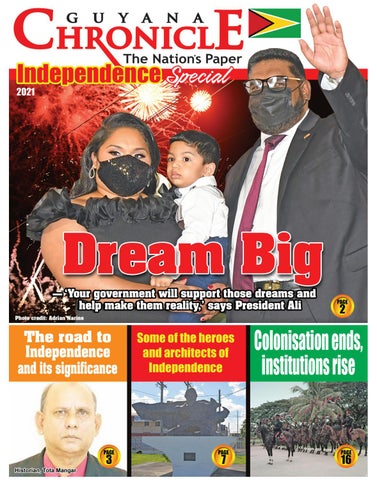
give them a better life with better opportunities under better circumstances. My brothers and sisters, everyone should be aware of the considerable work upon which the government has already embarked in relation to building infrastructure throughout our country. Our objective is to build connectivity to all parts of Guyana, by roads, bridges, telecommunications, air and river transportation. Every part of our vast country should be accessible to all Guyanese so that we can all enjoy the marvels of its attractions in waterfalls, lakes, forests, and its flora and fauna. We also need to build new communities further inland from our coastal belt to spread our population, reduce prices for land and housing, and ease traffic congestion. In other words, we must use the land space with which we have been blessed as Guyanese to create new and improved living conditions, new areas of growth and development and new population centres. That is why, apart from the infrastructure buildout upon which we are embarked, we will also establish a new City. Government will incentivise the private sector and persons wishing to own their own homes to locate in the new City where government will also provide major facilities. My fellow Guyanese, I have said it before, and I repeat it now. This is an exciting time, with exciting prospects. Every person in our society now has real economic opportunities to grow and develop, and to contribute to the enlargement of our national wealth. I urge each of you to dream big. Your government will support those dreams and help make them reality. We are on the cusp of being an economically strong Guyana, with opportunities for growth and development of all Guyanese. That is a cause to which I am personally and deeply committed. It is why I have been travelling this country Continued on page 17
GUYANA CHRONICLE
Guyana's road...
From page 3 applause of all who thronged Independence Square was that comforting 'bear hug' embrace between Cheddi and Forbes, the architects of Guyana's freedom, only minutes before the attainment of nationhood. That emotionally charged happening promised much at the time but unfortunately in the final analysis it realized very little. As part of Independence we saw the emergence of our new Guyana Coat of Arms. On it is seen the pride of our fauna life, two jaguars holding a pickaxe and stems of rice and sugar-cane and facing each other proudly across a painted shield on top of which rests a visored helmet topped by the feathered crown of an Amerindian chieftain. Beneath, a scroll-like banner proudly proclaims the Nation's Motto; 'One People, One Nation, One Destiny' while on the shield itself are found three barrulets of azure blue symbolising Guyana's watery nature and its water potential. This Coat of Arms justifiably accords pride of place in our national minds and reminds us of our unity and sense of purpose as an independent nation. Independence brought with it our National Flag, a slender golden arrowhead, set proudly on a background of green and red standing as a striking symbol of Guyana's journey into the future. The lush green colour symbolises the fields and forests of Guyana's assets of which the country is richly endowed. The red triangle represents the zeal and dynamic nature of nationbuilding that lies before the young and independent nation while the deep black border
stands for the endurance that will sustain the forward thrust of its people. Finally, white depicts our rivers, waterfalls and our hydro-electric potential of this "Land of Many Waters". Our own National Anthem is a popular aspect of our Independence. Reverend Archibald Luker wrote the words of “Green Land of Guyana" in response to the nation-wide competition sponsored by the then National History and Arts Council, while our distinguished Guyanese educationist and musician, the late R.C.G.Potter composed its music. The title of our National Anthem is appropriate and expressive of colour and vitality and of land fertility. On the morning of the 26th May, 1966 the National Assembly witnessed all the pomp and pageantry and ceremonial aspects o f We s t m i n s t e r. I n t h e historic Public Buildings the Duke of Kent handed over to the country's Prime Minister, the Constitutional instruments conceding to us the dignity and pride of Independent Nationhood on behalf of Her Majesty the Queen and the British Government. Undoubtedly, the expectations of all Guyanese were very high at that point in time and they had every right to be so. Our then Prime Minister, Mr. Forbes Burnham, expressed great optimism when he said, "Thus our journeying to Independence h a s e n d e d . We f a c e , however, the harder but more emotionally satisfying and definitely more self-respecting tasks of making Guyana great among the nations- the task
5 of building a free and just society." CONCLUSION What can we justifiably say 55 years after gaining independence? We certainly share the joy, pride and dignity of being an independent nation. Our expectation was that with political independence we would have enjoyed political stability, national unity and social and economic progress. Regrettably, the stark reality is that today our nation is still struggling to fully achieve these desired objectives. In several aspects we have fallen short despite the very best efforts of many. Political stability and national unity are as elusive as ever. Unfortunately, we are often plagued with the
blame game, insensitivities and controversies which do us more harm than good. A real, prolonged and serious threat to our democracy and the rule of law in the immediate post- March 2020 elections is a clear testimony of this sad situation. While some progress has been made on the social and economic front, the nation is still to completely rid itself of economic dependency on international financial agencies. Foreign debts, despite write offs and debt rescheduling, continue to stifle us while we experience fluctuating and sometimes depressed world market prices for our products. We are still to fully accelerate our production and productivity drives.
We continue to suffer from migration and consequential 'brain drain' and capital flight. We are feeling the devastating effects of the European Union sugar reforms and the recent decline in the sugar industry. We need to focus attention on the challenges associated with the rapidly emerging oil and gas sector along with the impact of climate change, especially on our low-lying coastal plain. We should never lose sight of the current deadly scourge of the global pandemic of COVID-19 which is targetting our human resource with tremendous venom. Let us ensure we are all vaccinated and we rigidly adhere to all COVID-19 protocols and guidelines. Through struggle, trials and tribulations
of our trail-blazers for freedom we are now living in an age of greater enlightenment and with the corresponding need for more tolerance, mutual respect, understanding and appreciation of all Guyanese towards a unified nation with a common destiny. Let us show a greater sense of purpose and maturity as we reflect on the true meaning of Independence. Let us put Guyana first in the face of a seemingly harsh and oppressive world environment in this twentyfirst century of ours. A h a p p y 55th anniversary to one and all; long live the Cooperative Republic of Guyana.
6
GUYANA CHRONICLE
GUYANA CHRONICLE
Some of the heroes and architects of Independence
AS Guyanese, we often hear stories of our national heroes, courageous strong men and women who fought so that we could today celebrate Guyana as an independent nation. Names like Cuffy, Damon, Dr Cheddi Jagan, Linden Forbes Burnham, Janet Jagan, Desmond Hoyte, Stephen Campbell and many others, immediately come to mind. G u y a n a ’s r o a d t o Independence predated the signing of that agreement on May 26, 1966 and runs back all the way to slavery and to the Enmore Martyrs. This article looks at some of the earlier heroes and the architects of the country’s Independence
OVERTHROWING MAGDALENEBURG, THE CUFFY STORY In the year 1633, the first set of African slaves were stolen from the land of their birth and brought to the new world as slaves, being stripped of their culture, names and identities. By the 1760s there were about 15,000 slaves in the three colonies of Essequibo, Demerara and Berbice. Longing for their freedom, slaves often attempted to run away or leave their plantations but were in most cases unsuccessful and were flogged or even killed for their plans to leave the plantations due to the inhumane treatment they would have received. The 1763 revolutions are recorded as a pivotal juncture in the abolition of slavery in not just here but also in the Caribbean. Cuffy, Damon and Quamina, three ex slaves have been greatly credited for their work as the movers and the shakers of the slavery abolition movement. Following the successful rebellion of slaves who fled into the woods and became “bush negroes’ or Djuka people in neighbouring
Suriname, African slaves in Berbice became emboldened to fight for their freedom and decided to undertake similar actions. Led by a house slave named Cuffy (or Kofi), the Berbice slaves overran plantation Magdaleneburg, removing the colonial masters, and taking their freedom. During this battle for freedom, Cuffy did not act alone; he was aided by two slaves Atta and Akara who served as his right-hand men during this period. Cuffy and his lieutenants led 3,833 enslaved Africans to their freedom. Cuffy had planned the revolt just as two shiploads of people from Africa had arrived at the docks, which significantly increased the number of Africans in the fight to overthrow the 346 colonial masters. The rebellion spread like a forest fire to neighbouring plantations, and within onemonth, Africans were in full command of most of the plantations in Berbice. Cuffy declared slaves free and the Africans managed the plantations for almost a year. After the plantations were recaptured by the Dutch, Cuffy shot himself in the head, in a bit to never submit to his enslavers. Although their freedom did not last due to Dutch reinforcements arriving by ships with heavy machinery to recapture the slaves, Cuffy left a lasting legacy, one that inspired other slaves to fight for their freedom and to never give up until they were free. The February 23, 1763 Cuffy-led revolution was recorded, in European history, as the first major revolution by Africans in the western hemisphere, and influenced several other revolutions in the west, including the Haitian revolution led by Toussaint Louverture. DAMON AND THE
This bronze monument of Damon is located next to the Anna Regina Town Hall on the Essequibo Coast
FALL OF LA BELLE ALLIANCE Following years of attempts to be free and treated humanely, African slaves gained Independence on August 1, 1834. When the Emancipation Act was finally passed in 1833, it did not
automatically give the slaves their freedom. The now freed slaves were transitioned into a period of apprenticeship and continued to work with their former masters for miniscule wages. This did not sit well with the ex-slaves who had a
different vision for what life would be like after freedom. True freedom came in 1838 when the apprenticeship system was abolished. What started the fall of La Belle Alliance was a problematic move by the owner of Richmond sugar
7
plantation, Charles Bean, who stirred up trouble by killing the pigs and cutting down the fruit trees of the former slaves, which was a subsistence income for those ex-slaves. His excuse for this destruction of the ex-slaves’ Continued on page 8
8
Some of the ... From page 7 properties was that their pigs were destroying the roots of his young canes. Being displeased with this type of unjust treatment, the ex-slave Damon called on other ex-slaves to oppose Bean. Some 700 apprentices downed tools in aid of Damon’s cause. On August 3, 1838, they protested the apprenticeship scheme. The following morning, the freed slaves were more than surprised, and became angry when they were ordered by their former masters to return to work. By August 9, the labour situation worsened when exslaves from Richmond to Devonshire Castle downed tools and gathered in the Trinity Churchyard at La Belle Alliance. Governor Smyth addressed the workers at Plantation Richmond, telling them that the apprenticeship
period was still in force and they should go back to work. He arrested the leaders of the peaceful demonstration. Damon was referred to as the “Captain” and ringleader of the unrest; and at noon on October 13, 1834, he was hanged for rebellion in front of the Parliament Buildings. Although Damon lost his life, his resilience influenced many other ex-slaves and even warned plantation owners of the strength and the will of the Africans to be free. THE ENMORE MARTYRS On June 16, 1948, shock waves were sent across Guyana as five sugar workers were shot and killed by police at the Enmore Estate, East Coast Demerara. Lallabaggie and Dookie from Enmore, and Rambarran, Harry and Pooran from Enterprise/ Non Pareil, are known as the Enmore Martyrs, who lost
their lives while protesting unfair treatment on the sugar estates. Cane cutters, backed by the Guyana Industrial Workers Union (GIWU), went on strike demanding the abolishment of the existing "cut and load" system in the fields, which was introduced in 1945. Cane cutters had to load the sugar punts with the cane they cut. As part of the demands of the 1948 strike, the cane cutters called for the replacement of "cut and load" with a "cut and drop" system by which the cane cutters should cut the cane, but other workers would load the cut cane into the punts for shipment to the factory. In addition to this particular issue, the workers demanded higher wages and improved living conditions on the sugar estates. However, the real aim of the strike was to demand recognition of the GIWU as the bargaining union for the field and factory workers on all the sugar estates in the country. On June 16, a crowd of about 400 workers protested outside the Enmore factory.
The management of Enmore Estate expecting this protest action had the evening before requested assistance from the police. Lance Corporal James and six policemen, each armed with a rifle and six rounds of ammunition were sent from Georgetown on the morning of June 16. At 6:00 hrs, they took up positions in the factory compound which was protected by a fence 15 feet high with rows of barbed wire running along the outward struts at the top. By 10.00 hrs, the crowd had grown to between 500 and 600 persons and was led by one of the workers carrying a red flag. They attempted to enter the factory compound through the gates and through two trench gaps at the rear by which punts entered the factory. But they were prevented from doing so because the locked gates and the punt gaps were protected by policemen. Accounts of the incident indicate that one section of the crowd hurled sticks and bricks at the police and a few persons got into the compound from behind the
GUYANA CHRONICLE factory. The police tried to keep the crowd at bay but their efforts proved futile. As such, they opened fire which resulted in the death of five sugar workers and injuries to 14 of them. The sacrifice of those five sugar workers brought enough attention to the plight of the
certainly shaped his views and influenced his activism for education for Indigenous peoples. Campbell was at the age of 60 when he entered party politics, joining a party called the National Labour Front (NLF). He was particularly passionate in his fight for
Stephen Campbell with a petition presented at the London Constitutional Conference
sugar workers that some of the major objectives were achieved, including better treatment of sugar workers. Additionally, the tragedy and the ultimate sacrifice of these sugar workers greatly i n f l u e n c e d D r. J a g a n ’s political philosophy and outlook. STEPHEN CAMPBELL On December 26, 1897, in Santa Rosa, Moruca, British Guiana, Maria Dos Santos and her husband, Tiburtio Campbell welcomed their baby boy, Stephen Esterban Campbell, who, little did they know, would one day become a legend and hero for many Amerindians and Guyanese. Campbell, who, belonged to the Arawak Tribe, was raised by his grandmother after his parents died. He was described as a man who never limited his abilities to naysayers, which led him to become the first Indigenous member of the British Guiana Legislative Council that is now called Parliament. He entered the Council on September 10, 1957; hence, September was chosen to honour the national contribution of Indigenous Guyanese. Campbell was the holder of many professional caps. He was a teacher at various villages and settlements, he worked in bauxite mines and he did farming. His work with common labourers and the difficulties he endured,
equal opportunities for Indigenous Peoples during his tenure as a politician. A strong believer in empowerment and selfs u f f i c i e n c y, C a m p b e l l fought vigorously during his parliamentary days for educational opportunities and land rights for indigenous communities. During the colonial days, the then rulers allowed Amerindians to live their life in ‘reservations’, according to their traditions and practices, subject to certain limitations. However, Amerindians at that time had no formal title of ownership or established legal rights to the lands which they used or where they lived, which saw fear arising when there were talks of then British Guiana becoming an independent country. The people feared that after the country gained Independence, whatever rights they enjoyed would have been trampled upon and ignored and the lands on which they lived and built their families on for thousands of years would have been expropriated. In 1962, Campbell travelled to London to present a petition and lobby the British Government for recognition of Amerindian land rights. On that first visit to London, Campbell took with him a petition which was written on a long scroll and signed by dozens of
Continued on page 10
GUYANA CHRONICLE
9
10
GUYANA CHRONICLE
Some of the ... From page 8 Indigenous leaders of the day. He presented it to the British Secretary of State, Duncan Sandys, in London, after having a private, onehour meeting with him. Sadly on May 12, 1966, two weeks before British Guiana gained Independence, Campbell passed away while he was receiving treatment in Canada where he was later laid to rest. However, the works that he did during his last days made sure that when Guyana attained its Independence on May 26 1966, Indigenous Peoples had legal ownership of land and rights of occupancy and these were embodied in the Independence provisions. GOVERNMENT OF UNITY: THE CHEDDI, BURNHAM STORY Dr Cheddi Jagan and Linden Forbes Sampson Burnham ushered in a period of togetherness for Guyanese just prior to the country gaining its independence from its colonial masters. Being ruled by the first Government of unity was great for the Guyanese people who were seeking to recreate their
country, freeing it from its colonial past and preparing it for a brighter future. Dr Jagan, Guyana’s first Premier, was born at Port Mourant, a sugar plantation on the Corentyne Coast of Berbice, on March 22, 1918. His parents came to British Guiana from India as indentured labourers. Jagan's father was a cane cutter, who became a field supervisor for cane cutters. Jagan received his high school education from Queen’s College, an exclusive secondary school in Georgetown that was reserved for children of the middle class. Upon graduation from high school, Jagan migrated to the USA and studied pre-dentistry at Howard University for two years. He completed his education as a dentist at Northwestern University. Linden Forbes Sampson Burnham was the son of a schoolmaster. He also attended Queen’s College. Renowned for his scholastic ability, young Burnham won the Guyana scholarship, which earned him the right to free university education in the UK. Burnham studied at the University of London. He was subsequently admitted to the bar as a
Guyana's first Premier, Cheddi Jagan
barrister-at-law at Gray's Inn. When Burnham returned to British Guyana in 1949, Jagan was already well known as an anti-imperialist fighter for the working class. Dr Jagan was one of the first leaders of the Caribbean to call for independence from British colonialism. Burnham and Jagan teamed up under the political banner of the PPP, forming an alliance that became a formidable political force. Burnham became deputy leader of the PPP, Jagan was elected leader. Together, these energetic young men made the
PPP a vibrant political force. They were at the forefront of a new political movement that swept through the rural countryside, through villages, sugarcane plantations, and rice fields of the country; ordinary citizens participated in politics. The PPP won the national elections in 1953 and Dr Jagan became premier, head of the Cabinet; Burnham was named Minister of Education, and other young African and East Indian men and women also enjoyed their first experience at party politics serving as Members of Parliament and also in several ministerial post.
Former President, Linden Forbes Sampson Burnham
This was the first Government of unity of Guyana: East Indians and Africans came together under the leadership of Dr Cheddi Jagan. He sought justice for his constituents, regardless of their race. This type of cohesion did not sit well with the colonials and on October 1953, British Guiana was invaded. In the midst of the invasion, Dr Jagan and several members of his Cabinet were thrown in jail on trumped up charges of sedition and treason, for allegedly abusing the Queen. This British rule by force lasted four years, while the people's
elected representatives were either incarcerated or were busy defending themselves against trumped-up charges. PPP political leaders had to raise several thousand dollars to hire senior British lawyers to defend them in court. Of the detainees, Dr Cheddi Jagan, Janet Jagan, Sydney King and other former members of the PPP Government remained captive but later won their case and were released to continue leading Guyana forward as the country stepped into a new age. (This piece was compiled from stories in the Guyana Chronicle archives)
GUYANA CHRONICLE
11
Quotes on Independence by Guyanese Heads of State Dr. Cheddi Jagan on the occasion of Independence Day 1993
Janet Jagan on the occasion of Independence Day 1998
Bharrat Jagdeo on the occasion of Independence Day 2005
“The travail of the Guyanese people is a saga of courage and defiance, of sacrifices and eventual rejoicing. We came through hard times, but came through we did. “Let us reconcile ourselves with our history, and be inspired, let us move forward in unity, Late President, goodwill and confiDr. Cheddi Jagan dence to make our Guyana more beautiful than we have found it, an imperishable as a Nation as we enter a new century. I look forward to your talent, your commitment and your dedication for us together to make a better future. Let our actions unite us. We triumphed in restoring democracy on October 5. In rebuilding Guyana, we will also triumph.”
“It takes two hands to clap, and cooperation is by no means a one-way process and our desire for compromise should not be confused with either weakness, fears and doubt whatsoever about our own understanding of governance based on the freely expressed will of the electorate. “I am certain that we as a people will certainly forego Late President, Janet Jagan choices of options that are inherently self-destructive. At the same time, we as a people must understand that in this era of democracy, globalisation and liberalisation, small, poorly developed societies like our, cannot afford the luxury of being insensitive to the challenges before us. “I put my hope in the innate goodness of the human spirit: as Guyanese we are products of history that teaches us that though we come from different lands our destiny, out of necessity, lies in our oneness. “This is the only way we will survive and achieve levels of prosperity which others, less endowed, currently enjoy.”
“We have to encourage and enhance at all levels of this society, a national conversation as to how we relate to one another and how, in relating positively to one another, we contribute to, and promote, the national welfare. “But, in the modern society, achievement must not be limited by factors that are remediable. There must be economic opporFormer President, Bharrat Jagdeo tunity for all. And, in preparation for life the young must have the physical care, the discipline and especially the education that will allow them to seize and exploit the opportunities. No one, from accident of birth or economic circumstance, must be denied these things. If they are not available from parent or family, society must provide effective forms of care and guidance “Ours is the task of creating a prosperous, modern society, one in which the basic needs of our people for water, health care, education and wholesome nutrition are met, where recreation facilities are available and opportunities for cultural participation are present.” See More Quotes on Page 14
12
GUYANA CHRONICLE
GUYANA CHRONICLE
13
14
GUYANA CHRONICLE
Quotes on Independence by Guyanese Heads of State Donald Ramotar on the occasion of Independence Day 2013
Former President, Donald Ramotar
“Democracy is indispensable for sustained social and economic development. Without it, we would be unable to achieve the great aspiration captured in the motto of our nation, of being “One People, One Nation, One Destiny.” The post-Independence history of Guyana has proven this adequately. “Now is the time for us to show more maturity in our body politics; it is a time to put Guyana first; nothing should be done to jeopardise the welfare of our people and country.”
Dr. Irfaan Ali on the occasion of Independence Day 2020
President, Dr Irfaan Ali
“We are at the cusp of great development which my Government intends to see benefits all Guyanese. We must mobilise our best human resources here and in the diaspora to create and build the framework for the Guyana of the future, ensuring we are capable of managing our affairs; we have to build the human, institutional and infrastructural capacity. “The managing of our resources must be able to give the current generation a high-quality life whilst ensuring we safeguard our resources and build our wealth fund with appropriate and best standards and safeguards to secure future generations of Guyanese. With greater access to resources we must also be able to create global leadership in tackling various issues, including safeguarding our environment, eradicating hunger, and promoting societies that are just and democratic.” Forbes Burnham on the occasion of Guyana’s first Independence Day celebration in 1966 “While, for others, Independence might mean the symbolic changing of a flag and an anthem, for Guyanese it has been a rejection of the colonial past, the assertion of our dignity, and the discovery of a sense of our own identity and worth. For this Guyana has gained worldwide recognition and respect.”
Late President, Linden Forbes Sampson Burnham
Arthur Chung on the occasion of the tenth Independence of Day
Desmond Hoyte on the occasion of Independence Day 1991
“In all these matters your willingness to cooperate has been of paramount importance. In many ways it’s your ambition, your experience and your consistent labour which will eventually decide what the State will be, especially in economic terms.”
“We, the Guyanese people are all of immigrants stock. Our forebears, at different periods of history, came from many lands to constitute what is in our own way, our Guyanese nation. But in the end, this land became their home. It is now our home. We have no other.”
Late President, Arthur Chung
Late President, Desmond Hoyte
David Granger on the occasion of Independence Day 2015
Former President, David Granger
“Independence was not the work of one person or one party. It was the product of a movement of the Caribbean people. It was a process that took place over a long period of 50 years. “Independence meant change – from colony to nation; from subject to citizen; from subjugation to liberation and from discrimination to dignity and equality.”
Guyana’s Independence GUYANA CHRONICLE
Throughout the early part of 1966, preparations for Guyana's independence celebrations went in full swing. A special committee appointed by the Government designed the new coat of arms and selected the Canje Pheasant as the national bird. The design and colours of the new flag, appropriately called "The Golden Arrowhead", had already been chosen during the period of the PPP Government from entries submitted through an international competition. The winning five-coloured design was submitted by an American, Whitney Smith. The name chosen for the independent nation - Guyana - was also chosen since 1962 by a select committee appointed by the House of Assembly. The flag of Guyana, was designed with a golden arrowhead along its middle to signify Guyana's journey into the future. The golden arrowhead, with narrow white and black strips along its sides, was set on a green and red background. The five colours were also seen as symbolic to the country’s various assets: green for the agriculture and forests; gold representing the country's mineral wealth; red for the zeal of nation-building; black border, depicting the people's endurance; and white symbolising the natural water potential of the country. A n a t i o n - w i d e c o mpetition, sponsored by the National History and Arts Council, also helped to select the words of the National Anthem. The winning entry, "Green Land of Guyana", was written by Reverend Archibald Luker, and the words were set to music by Cyril G. Potter, a prominent Guyanese educator and musician. Guyana became an independent nation on Thursday, 26 May 1966, but the independence celebrations began four days before and continued until 29 May. Public buildings and business places were brightly decorated with streamers and buntings bearing the colours of the Guyana flag. On the evening of May 25, a grand cultural performance took place at the Queen Elizabeth Park (later to be renamed the National Park). Dignitaries in the audience of thousands included the Duke and Duchess of Kent, representing Queen Elizabeth, and representatives of foreign governments. Then at midnight, the Union Jack, the symbol of British
15
Dr. Odeen Ishmael
colonial rule for 163 years, was lowered and the new flag of Guyana, the Golden Arrowhead, was raised to the top of the mast. Just before the flag raising ceremony before a huge crowd, Prime Minister Forbes Burnham and Opposition Leader Cheddi Jagan publicly embraced each other, indicating their satisfaction that Guyana had finally won its political independence. With the raising of the new flag, fireworks burst across the sky in various parts of the country. Then around mid-morning, the State opening of the Parliament of Guyana took place. It was preceded by a military parade accompanied by much pomp and pageantry. Significantly, for this occasion, a portrait of Sir Walter Raleigh decorating the wall of the Parliament chamber was removed and replaced with a portrait of Prime Minister Burnham. The meeting of Parliament was chaired by the Speaker, Aubrey Alleyne. The Duke of Kent read a throne speech on behalf of the Queen, after which on behalf of the sovereign, Queen Elizabeth, he handed over to Prime Minister Burnham the constitutional instruments designating Guyana an independent nation. Immediately after, there were speeches by Prime Minister Forbes Burnham and Leader of the Opposition Cheddi Jagan. Burnham, in an appeal to Guyanese nationalism, declared: "The days ahead are going to be difficult. Tomorrow, no doubt, we as Guyanese will indulge in the usual political conflicts and differences in ideology. But today, to my mind, is above such petty matters. For today Guyana is free." In welcoming independence, Dr. Jagan seized the opportunity to point out that the Burnham Government was abusing its powers through the extension of the state of emergency beyond the date of independence.
This, he said, was generating fear throughout the country and was detrimental to the struggle for peace and security. He also highlighted the view that his party was "the victim of repeated constitutional manipulations designed to keep it out of office." He added, "We are confident that despite these manipulations the People's Progressive Party can be triumphant at future elections if these are fairly held." Later that afternoon, Sir Richard Luyt was sworn in by the Duke of Kent as Guyana's first Governor General at a ceremony in the ballroom of Guyana House, the official residence of the Governor General. During the period of the independence celebrations, many public events were also held. These included carnival-style parties, exhibitions, float parades and public rallies addressed by Burnham and his Ministers. On achieving indepen-
The Golden Arrowhead being raised on the advent of Independence as Prime Minister Burnham looks on
dence, Guyana became the 23rd member of the British Commonwealth. The new state received instant recognition internationally. However, in its note of recognition signed by Foreign Minister Iribarren Borges, the Venezuelan Government stated that it "recognises as territory of the new State the one which is located on the east of the right bank of the Essequibo River". The Venezuelan note claimed that the boundary between Guyana and Venezuela ran "through the middle line of the Essequibo River, beginning from its source and on to its mouth in the Atlantic Ocean". In a response to the Venezuelan Government (sent on 18 August 1966), Burnham rejected this assertion and expressly stated that the "Guyana constitution stipulates that the territory of Guyana embraces all that area, which immediately before the 26th May, 1966, comprised the old Colony of British Guiana, togeth-
er with the area which by Act of Parliament may be declared as part of the territory of Guyana." He added: "The territory which extends between the middle line of the Essequibo on the east and the boundary of the old Colony of British Guiana all along the rivers Cuyuni and Wanamo on the west, was already included on the 26th May, 1966, judicially and administratively, within the old Colony of British Guiana and forms part of the State of Guyana." (Article by the late, Dr. Odeen Ishmael. The writer previously served as Guyana’s Ambassador to the USA, 1993-2003; Venezuela, 2003-2011; and Kuwait and Qatar, 20112014) This is an extract from http://www.guyana. org/features/guyanastory/ guyana_story.html where many stories on Guyana was shared by the late Dr. Odeen Ishmael)
16
GUYANA CHRONICLE
Colonisation ends, institutions rise --a look back at the establishment of pillars of development that exist to this day
IT has been just about six decades since Guyana attained its instruments of independence from Great Britain, and while the events leading up to this historic moment paved the way for the home that we know and love today, it was the events that followed thereafter that saw Guyana being the great independent nation it is. With Guyana becoming an independent nation officially on May 26, 1966, a lot of changes were made, one of the most
significant being a national “deed poll” which saw the name British Guiana being changed to Guyana, and later to the Co-operative Republic of Guyana, in 1970. As the country turned the page to start its new chapter, it also adopted its own flag, National Anthem and many other symbols. Along with these changes also came the introduction and building of a new economy, starting with the establishment of several institutions
which are still standing to this day. And while they are far too numerous to mention, the Guyana chronicle seeks to highlight the progression of a few of these institutions.
Flashback: Ranks of the then British Guiana Police Force (Guyana Police Force photo)
THE NATIONAL INSURANCE SCHEME (NIS) Birthed in September 1969, the National Insurance Scheme came into being as part of the National Insurance and Social Security Act of that same year. The 52-year-old agency was established three years after Guyana gained independence from Britain, in May, 1966 At the heart of this scheme is a system of social security which provides monetary payments to contributors for old age, invalidity, survivor’s, sickness, maternity and funeral benefits. In an interview prior to his death in 2016, former General Manager of NIS, the late Patrick Martinborough, had said that, when the scheme was established, there were only two national schemes in the Caribbean, and those were in Jamaica and Barbados. H o w e v e r, t h e G u y a n a Scheme was the first of its kind relative to its level of supervision and control, since the others were mere departments of government while the local scheme was the first to be managed by an independent board. The NIS also earned the status of a training centre and was used by the International Labour Organization (ILO) for that purpose. THE GUYANA POLICE FORCE (GPF) One of the oldest institutions in the country, the Guyana Police Force, was established on July 01, 1839 and while it was around before independence, it was refashioned, not only through uniform and name but also with ranks. The then British Guiana Police Force was established with 245 ranks represented by three Inspectors, 25 Sergeants, 25 Lance Sergeants and 192 Privates. The Chief Administrator of the Police Force at that time was termed a Sheriff, who was subsequently named Commissioner. According to an article published by the Police Force in 2018, the development of the Guyana Police Force can be traced through the following stages: Police idea in the country since the Dutch occupation; the Dutch system continued after the British took possession in 1803; the Board of Police for Georgetown was formed in 1812; outlying districts were provided with police settlements under the supervision of a Sheriff in 1834 and then the force was enlarged. Further, the word constable was introduced in 1836; the force properly organised and put under the control of an Inspector-General in 1839; the
present numbering system was introduced in 1855; the force became semi-military in 1891; the Mounted Branch was formed in 1905; title of officers changed in 1938; appointment of first Assistant Superintendent from the ranks was made in 1944; further changes of titles were made in 1950 and the Police Federation was created in 1950. Moving closer to independence, the Police Women Branch was formed in 1953; the Police Training School detached from Depot in 1956; the Police Ordinance was amended and consolidated in 1957 and police dogs were introduced to the force in 1960. The duties of the police were solely to bring to justice all persons charged with or suspected of murders, robberies, thefts of all description, and to suppress and prevent tumults, riots, brawls, outrages and disorders and all other offences. The Guyana Police Force in an independent Guyana has been completely revolutionised. Three training colleges have been established to train policemen and policewomen in every aspect of policing. To broaden their expertise, they are sent on overseas training in areas such as police administration, general police operations, senior command course, among others. Police personnel are attached to a number of specialised departments and sections namely the Criminal Investigation Department, Photographic Section, Forensic Department, Immigration Department, Traffic Department, Communication Section, Museum, Mounted Branch, Canine Section, Felix Austin Police College, among others. THE BANK OF GUYANA Established by virtue of the Bank of Guyana Ordinance No. 23 of 1965, the Bank of Guyana commenced operations on October 16. 1965, some seven months before the country gained its independence. The early establishment of the bank was said to be prompted by an agreement of the U.K. Government (acting for the still colonial members of the British Caribbean Currency Board [BCCB] and the Trinidad & Tobago Government), for the dissolution of the BCCB by mid-1967 and the cessation of issuance of currency after 1965. Established as an ‘autonomous institution’ with headquarters in the capital city of Georgetown, the bank’s principal objectives were and still are grounded in the context of the economic policy of the Government. The bank is guided in all its actions by the objectives of fostering monetary stability and promoting credit and exchange conditions conducive to the growth of the economy of
Continued on page 17
GUYANA CHRONICLE
17
Address By His Excellency... From page 4
from the start of my Presidency, listening to individuals, to communities, to groups of all kinds, and acting on what I see and what I hear. We want not only an economically strong Guyana, we also want a powerful Guyanese nation in which there is no distinction of race, no determination by colour and no differentiation by creed. Let there be no doubt about it – just as we were divided and ruled in our
colonial past, there are those who would divide us for their own purpose in the future. That must not happen. We must never allow that to happen. Earlier this month was “Arrival Day’; ahead of us is “Emancipation Day”. We all celebrate these occasions together as integral parts of the rich tapestry that makes us uniquely Guyanese. We are all proud of our ancestral heritage – as we should be. Our ancestors suffered
Colonisation ends...
Bank of Guyana
From page 16 Guyana. Apart from specifying the administrative and management arrangements for the bank, the Ordinance, inter alia, decreed the bank to have the sole right to issue and redeem notes and coins, act as banker to the commercial banks, act as fiscal agent and trustee of and banker to the government and administer payment agreements entered into by the government. The Ordinance establishing the bank was revised and became the Bank of Guyana Act CAP: 85:02. This Act was further revised in 1995, 1998
and in 2004. The latter revisions significantly enhanced the role and purpose of the bank within the framework of Guyana’s economic and financial system. Additionally, they imparted greater autonomy to the bank in terms of its constitution, administration and operations. Since its establishment, the bank has unassumingly laid the foundation for the economic growth of Guyana notwithstanding the many challenges. It has provided leadership to the financial system and the public sector in general, under difficult situations at times.
greatly so that we could inherit this land in freedom. Let us make them proud that their children belong to this new country built on their blood, sweat and tears, and on their creativity, their ingenuity and their recognition that, in the end, their success could only be the result of their unity. In the course of our independent history, many persons have contributed immensely to the social and economic development of our country and to respect the contributions of those persons to Guyana and the wider global society.
On this 55th anniversary of our independence, it is right that we should honour some of these persons who have shown their devotion to Guyana and Guyanese, benefitting us all. Therefore, national awards, for their outstanding contribution would be announced shortly. It is only we ourselves who can either spoil Guyana’s future or make it glorious. Our country will not be built by the negativity or nay-sayers, poor losers, and the purveyors of destruction. I ask you to remember
that our Nation has endured and triumphed over colonialism and exploitation, our political differences, our social discord at home and challengers from abroad. Yet, we are still here, still living together, still working together, still looking toward tomorrow. It is our job to carry on this great enterprise. Make no mistake about it, as long as we have faith in the future and the courage to seize the opportunities, our Nation is unstoppable. The greatest of our perils is to forget our overriding oneness.
It must not be so. I am determined that it shall not be so. On this 55th anniversary of our independence, as economic prosperity surely lies before us, let us ensure that national cohesion strengthens us even more. I urge that we pledge ourselves to each other and to the cause of our collective economic and social development. Happy Independence Anniversary to all our Guyanese home and abroad. God bless you and God bless your families. Thank you very much.
18
GUYANA CHRONICLE
GUYANA CHRONICLE
19
20
GUYANA CHRONICLE
A new era of transformational development beckons
OUR beloved nation has reached another milestone; its 55th Independence Anniversary. It comes at a time when Guyana is on the cusp of unprecedented transformational development. The unleashing of our nation’s vast potential is within reach. Our developmental trajectory
has, undoubtedly, imbued all Guyanese with a tremendous sense of optimism, pride, expectation and confidence that our individual and collective dreams and aspirations for a prosperous nation will be realised. As we observe this very significant moment in our nation’s
history, the People’s Progressive Party (PPP) takes this opportunity to extend greetings to all Guyanese, both here and those globally in the Diaspora. The 55 years since the Golden Arrowhead was first hoisted in May 1966 was not without its challenges; our nation and its people were tested at various points, but on every occasion, despite the severity of what confronted us, our resilience and indomitable will to rise to those challenges and to forge ahead prevailed. It is demonstrative of our resoluteness as a people to work assiduously, and to sustain our efforts to
build a brighter future for all. During those 55 years, there were periods when much was achieved; a period that saw our physical and social infrastructures being transformed through sustained growth and development, and periods of regression. There were periods when our freedoms were suppressed, and periods when they were restored. There were periods when pride was lost, and periods when it returned after relentless struggles. However, throughout these times, our people never allowed hope to slip away, and remained steadfast in their com-
mitment to nation-building, and the advancement of all. Guyanese are aware that the 55th Independence Anniversary comes months after glaring attempts to suppress freedoms and democracy. The fact that our freedom and nascent democracy were vigorously defended is testimony to our collective resolve, and the value we as a people attach to our democratic principles. This is not dissimilar to the values of those who led the struggles and fought valiantly for Independence would have attached to breaking the shackles of colonialism. Those selfless strug-
gles remain a revered source of inspiration, and a demonstration of patriotism in guiding us to work in the best interest of our country, and all of its peoples. As we celebrate this independence anniversary, albeit restricted due to the COVID-19 pandemic, our Party urges that we be encouraged by the invaluable efforts of those who struggled to free us from colonialism, as we endeavour together to safeguard our democratic values, and to advance ourselves and fellow countrymen and women as a new era of transformational development beckons.
GUYANA CHRONICLE
21
Independence brought us new status, and heavy responsibilities for a free and prosperous future AS Guyana observes 55 years as an Independent State, the Guyana Agricultural and General Workers Union (GAWU) is pleased to join with all Guyanese to celebrate this exciting landmark anniversary in our history. We need to recall at this time that there was near absolute consensus amongst our then leaders that we needed to shed the constitutional and other chains with which we were then wrapped. Independence brought us, and we joyfully welcomed, our new status as citizens of Guyana, no longer colonial subjects tied to a “mother” country. It also brought heavy responsibilities for a free and prosperous future. The onus was now ours to chart our own course, and it was recognised that national Independence needed to be strengthened by economic Independence and social justice. Those objectives had to be attained and sustained. GAWU feels certain that our Independence, which we fought for, is an attainment to be cherished, and will be cherished by coming
generations too. Since Independence, we have moved forward. There are successes in several fields nationally, and at the international level, our country has earned recognition and respect, especially when it took principled and laudable stance on issues that are of concern to humanity. That respect was surely strengthened with the resurfacing of our democratic culture over 20 years ago, and which we saw a year ago faced serious attempts of destabilisation. Though disheartened by the nefarious efforts of a few, we are heartened by the expressions of our people to protect and consolidate our democratic foundation. Today, our union stands in support of reforms that will enhance our democracy in our people’s interest and well-being. As an independent nation we have faced trials and setbacks of one kind or another, punctuated by periods of marking time, economic and social decline at the same time we recognise there have been very many significant achievements in our endeavours to overcome the negative
legacy of colonialism, and fulfill our development obligations. Today, Independent Guyana is poised for further advancement. We recognise the serious efforts to further develop and enhance the people’s standard-of-living. We laud such efforts, and look forward in the coming years of independence to Guyana unlocking its true potential, and our people enjoying a life they truly deserve. Apart from the question of economic and social advancement, we hold there is need to strike an ecological balance. On this score, we have seen the development argument advanced. Such contentions cognisant of the setbacks we faced have some merit. We nonetheless charge that we need to ensure that there is every effort to ensure that our environment is preserved for current and future generations. The prospects for our country to grow and develop remain encouraging, and we need to tackle the various tasks before us in a collective and united spirit. In this respect, acts and obstacles that tend to undermine
our still fragile democracy should be discontinued; measures that bring hardships on working people should be frowned upon, and our people, especially our working people, need to become involved in the decision-making process at various levels of our society. As we celebrate this historic anniversary, GAWU urges that we all recognise that we have a responsibility to build our nation, to make great efforts to realise enduring national unity, and strengthen the strands that bind our nation. We must be justly proud of our well-deserved freedom, and it must also be a joy for all our people. At the same time, let us on this 55th anniversary remember the struggles associated with the fight against colonialism, and these organisations and outstanding leaders who were at the front of those history making efforts. GAWU extends a Happy Independence anniversary to all Guyanese!
Let’s build on our achievements over the years to forge a cohesive nation THE Ethnic Relations Commission (ERC) takes this opportunity to extend greetings to all Guyanese on the occasion of Guyana’s 55th Independence Anniversary. The attainment of our Independence entailed a prolonged period of sustained struggles by many patriotic sons and daughters of this dear land. Their selfless efforts were focused on the betterment for all of their compatriots, for the realisation of a nation free from the bonds of colonialism, and one that will always remain the cherished home of its diverse people. Their success remains that beacon of inspiration epitomising what can be achieved when we work together in the best interest of Guyana and Guyanese. This must become an accessible source of motivation for us to renew our commitment to work assiduously for the realisation of the goal enshrined in our national motto of ‘One People, One Nation, One Destiny’. Every anniversary of our nation’s Independence brings that pertinent reminder of the freedom that was birthed out of patriotic struggle sustained by the underlying bonds of brotherhood. It is those bonds that we all must endeavour to build upon and strengthen so as to expunge the seeds of division from our society. While our history will reflect the challenges in this regard, it must also serve as an impetus
to fortify us with tolerance to fully understand and appreciate our invaluable diversity, and what it means to us as a nation. This enhances our capacity to shed prejudices, thereby creating an environment in which harmony can prevail. History also provides a framework to help build a better society. As we celebrate this 55th Anniversary of Independence, let’s all work together to forge social cohesion and national unity. Let us all together commit
to build upon this with the objective of attaining a more harmonious society which we all desire. Let us also use this opportunity to renew our sense of value for the efforts of those who toiled for an independent Guyana. Let’s not forget that those efforts were in the interest of all, despite from where our ancestors originated. Once again Happy Independence to all Guyanese, from the Management and Staff of ERC!
22
GUYANA CHRONICLE
A transformative event that laid the ‘Remember and recognise all those who contributed foundation for a good life for all to the ending of British colonial rule’
THE People’s National Congress greets all Guyanese on the happy occasion of our nation’s 55th Independence Anniversary. Independence on 26th May 1966 was a transformative event that laid the foundation for a good life for all. Our visionary first Prime Minister, Forbes Burnham, embarked on a transformative programme of renewal. His administration led public education enhancement, including the construction of the Cyril Potter College of Education, University of Guyana campus, and multilateral schools in coastal regions, and public infrastructural development through the construction of the Timehri International Airport, Soesdyke-Linden Highway, coastal sea defence and coastal road networks from Skeldon to Parika. The People’s National Congress, during the first decade of Independence, contributed to social cohesion by ensuring that Islamic and Hindu holy festivals were observed as national holidays; to securing Indigenous Peoples land rights by establishing the Amerindian Lands Commission; to territorial de-
fence with the establishment of the Guyana Defence Force; to regional integration by contributing to the establishment of the Caribbean Community and to housing development; hinterland development; youth development and much more. Guyana was able to make a good start as an Independent nation, despite emerging from the worst period of civil violence, economic bankruptcy and political turmoil. It became respected for its efforts at advancing the cause of the small, developing states, particularly in Africa, the Caribbean and the Pacific. Independence celebrations this year will be restrained, as a result of the huge death toll caused by the Coronavirus pandemic. Independence Day reminds the nation, also, of its debt to doctors, nurses and other workers in the public health system who have been engaged continuously in protecting our people from the ravages of the pandemic. The People’s National Congress wishes everyone a Happy 55th Independence Anniversary!
THE Indian Action Committee (IAC) wishes to convey greetings to all Guyanese citizens on the occasion of the Independence of Guyana from British colonial rule on May 26, 1966, 55 years ago. The IAC calls upon all Guyanese citizens to remember and recognise all those persons who contributed to the ending of British colonial rule in Guyana including former Presidents Cheddi Jagan, Forbes Burnham and Janet Jagan, and stalwarts of the struggle for national liberation like Hubert Nathaniel Critchlow, Jocelyn Hubbard, Joseph Pollydore, Ramkarran, Ashton Chase SC, Jainarine Singh, E.M.G. Wilson, Cedric Vernon Nunes, Martin Carter, Rory Westmaas, Eusi Kwayana, Brindley Benn, Moses Bhagwan and Reepu Daman Persaud. The IAC, in recognition of the challenging history of
Guyana during the past 55 years dominated by authoritarian rule (1968-1992) and especially the period from 1962 to 1964 when there was a state of undeclared civil war which resulted in: 1. Over 200 persons losing their lives. 2. Over 900 persons suffering physical injuries. 3. About 2700 terrorised families being displaced from their homes as villages were engulfed in orgies of ethnic cleansing. 4. Over 1700 cases of arson in which over 300 business places and houses were completely destroyed by fire during wanton acts of terror. 5. Losses of over US$ 20 million in the local economy as opposed to an investment of US$2.2 million used to destabilize pre- Independence British Guiana according to U.S. declassified documents.
6. The destruction of the Indo-Guyanese community at the adjoining villages of Wismar and Christianburg, where all 87 business premises and 215 homes owned and occupied by Indo-Guyanese were deliberately destroyed by fire between 24th and 25th May 1964 followed by the evacuation of almost 3,400 Indo- Guyanese persons under the protection of British military forces on 26th May 1964, exactly two years before Independence. The IAC is cognisant of the recent upsurge in crime within the past eight months, mainly in rural areas, and characterised by many brutal robberies on Indo-Guyanese and Chinese business persons who have been deprived of hundreds of millions of dollars in cash, jewellery, electronic devices and vehicles by criminals. The IAC reiterates its
call for the inclusion of all Guyanese in the present Government’s drive towards economic development and prosperity. The IAC, in light of the ongoing COVID-19 pandemic, is calling upon all Guyanese to respect the COVID-19 safety protocols at all times and to take advantage of free vaccines being offered by the Government of Guyana. The IAC joins its voice with those of the political parties, religious bodies, trade unions and other civil society groups in a nationwide call for peace and unity. The IAC is of the opinion that as many persons as possible must be vaccinated in order to ensure herd immunity by the end of 2021. The IAC wishes all Guyanese citizens a Happy 55th Independence Day.
GUYANA CHRONICLE
23
Guyana has progressed markedly since becoming a nation --CARICOM Secretary-General, Ambassador Irwin Larocque
butions, especially in your capacity as the Lead Head of Government with responsibility for Agriculture and Food Security in the Quasi Cabinet of the Conference of Heads of Government.
Excellency:
On behalf of the Caribbean Community (CARICOM), I extend congratulations to the Government and People of the Cooperative Republic of Guyana on the occasion of the country’s Fifty-fifth Anniversary of Independence on 26 May 2021. Guyana has progressed markedly since becoming a nation. Guyanese have made their mark globally in diplomacy, the arts, academia and sport. A valued member of the Caribbean Community from its inception, Guyana has played a pivotal role in
shaping our regional integration movement. In addition, being host of the Headquarters of the CARICOM Secretariat confers both a symbolic and a physical dimension to the centrality of its role. Mr. President, the Community looks forward to Guyana’s continued contri-
A very successful future, good health and deliverance from the pandemic at the earliest -- High Commissioner of India, HE Dr K J Srinivasa
HE Dr K J Srinivasa
On behalf of the High Commission of India in Georgetown and on my own behalf, I extend my warm greetings and felicitations to Your Excellency, the Government and the people of Guyana on the occasion of Independence Day of the Cooperative Republic of Guyana. Our historical partnership is being further strengthened by new
projects and I sincerely believe that the Guyanese path to development and progress will have India as its partner in various sectors. Strengthening more people-to-people ties, assistance in skills and upgrading capacity building, especially in key sectors like agriculture, education, oil and gas, MSMEs, etc. will be a corner stone of our relationship. Excellency, I wish your kind self and people and Government of Guyana, a very successful future, good health and deliverance from the pandemic at the earliest. Please accept, Excellency, the assurances of my highest consideration.
Those priority areas have taken on increased importance under your leadership, as the Community seeks to address and recover from the devastating effects of the COVID-19
pandemic. Excellency, the Caribbean Community pledges its continued support and commitment to the People and Government of Guyana, especially in relation to the
preservation of the country’s territorial integrity. We extend our best wishes for the prosperity and security of Guyana on this momentous occasion and beyond.
24
GUYANA CHRONICLE