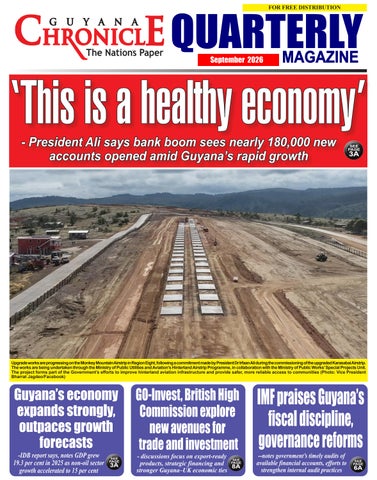
QUARTERLY FOR FREE DISTRIBUTION
September 2026
MAGAZINE
‘This is a healthy economy’ - President Ali says bank boom sees nearly 180,000 new accounts opened amid Guyana’s rapid growth
SEE PAGE
3A
Upgrade works are progressing on the Monkey Mountain Airstrip in Region Eight, following a commitment made by President Dr Irfaan Ali during the commissioning of the upgraded Karasabai Airstrip. The works are being undertaken through the Ministry of Public Utilities and Aviation’s Hinterland Airstrip Programme, in collaboration with the Ministry of Public Works’ Special Projects Unit. The project forms part of the Government’s efforts to improve hinterland aviation infrastructure and provide safer, more reliable access to communities (Photo: Vice President Bharrat Jagdeo/Facebook)
Guyana’s economy expands strongly, outpaces growth forecasts
-IDB report says, notes GDP grew SEE 19.3 per cent in 2025 as non-oil sector PAGE 3A growth accelerated to 15 per cent
GO-Invest, British High Commission explore new avenues for trade and investment
- discussions focus on export-ready SEE products, strategic financing and PAGE 8A stronger Guyana–UK economic ties
IMF Guyana’s IMFpraises praises Guyfiscal discipline, ana’s fiscal discigovernance reforms
pline, governance
--notes government’s timely audits of available financial accounts, efforts to strengthen internal audit practices
SEE PAGE
6A
2A
GUYANA CHRONICLE, QUARTERLY MAGAZINE, SUNDAY, September 27, 2026
Government developing mobile app to widen access to Guyana Development Bank
- President Ali says, assures ‘grassroots’ financial institution will serve ordinary people THE Government of Guy‑ ana is developing a mobile application to ensure that the soon‑to‑be‑launched Guyana Development Bank (GDB) is accessi‑ ble to entrepreneurs and small businesses in every region of the country, Pres‑ ident Dr Irfaan Ali has announced. Speaking during a wide‑ranging discussion with private sector leaders and stakeholders recent‑ ly, the President said the bank, which comes into operation on October 5 with an initial capitalisation of US$100 million (approx‑ imately G$20 billion), is
being deliberately designed as a “grassroots” institution to serve ordinary Guyanese, particularly young people, women, and vulnerable groups. Dr Ali explained that the mobile application will al‑ low citizens to engage with the bank’s services without having to be physically close to traditional financial cen‑ tres on the coast. “What we are doing also is creating an app, so the bank is accessible through technology. We are also developing a system of facilitation,” he said, noting that the GDB will operate through a com‑
bination of branch desks in commercial banks, region‑ al officers, facilitators and mentors, as well as digital channels. This, he stressed, is in‑ tended to ensure that hinter‑ land and riverine commu‑ nities, and emerging enter‑ prises in tourism, agriculture and agro‑processing, are not left behind. The President under‑ scored that the GDB is “not a grant facility” but a development institution aimed at economic empow‑ erment, credit building, and long‑term wealth creation at the household and com‑ munity levels. Under the model outlined, small en‑ trepreneurs will be able to access up to G$3 million in collateral‑free, interest‑free financing in certain catego‑ ries, backed by compulsory mentorship, technical sup‑ port, and financial literacy training. The bank’s structure will see sector specialists and government extension offi‑ cers working alongside bor‑ rowers to refine proposals, link them to existing State support programmes, and help them transition, over time, into the commercial banking system. Throughout the dis‑ cussion, Dr. Ali repeated‑ ly linked the bank and its
supporting mobile app to a broader strategy of econom‑ ic diversification beyond oil and gas, community devel‑ opment, and the strength‑ ening of local value chains. He cited examples rang‑ ing from organised poultry production, dragon fruit farms, and greenhouse clus‑ ters to value‑added food pro‑ cessing for local supermar‑ kets and regional exports. The President also high‑ lighted the transformative impact he expects for wom‑ en entrepreneurs, many of whom have historically lacked collateral despite contributing significantly to household assets. Dr Ali said the bank will
operate under clear eligi‑ bility criteria, compulsory coaching, and transparent reporting, including the pub‑ lication of lists of beneficia‑ ries to allow for community scrutiny. He emphasised that while the first issuance will focus on ideas, innovation, vulnerability and the “small man”, young professionals with entrepreneurial plans, including those in the public sector, may also be able to benefit as the facility scales. Ultimately, the Presi‑ dent projected that with‑ in five years, the initial capital could generate a multiplier effect across the economy.
3A
GUYANA CHRONICLE, QUARTERLY MAGAZINE, SUNDAY, September 27, 2026
‘This is a healthy economy’ - President Ali says bank boom sees nearly 180,000 new accounts opened amid Guyana’s rapid growth
PRESIDENT Dr Irfaan Ali has hailed a surge in bank accounts, rising credit and deep liquidity as signs of growing confidence and financial inclusion. Speaking during a press conference held in September, the President disclosed an expansion in banking activity, with 179,758 new accounts opened between October 2024 and August 2026, saying the surge reflects rising confidence and wider financial inclusion in a rapidly growing economy. Citing data from six commercial banks and two nonbank deposit-taking institutions, the President told reporters that 96 per cent of the new accounts were opened in the formal banking sector, following Government moves to ease requirements for ordinary Guyanese to open accounts. Between October 2024 and March 2026, 119,807 accounts were opened, with
President Dr Irfaan Ali
a further 59,951 added from April to August 2026 alone. Dr Ali linked the uptick directly to regulatory and procedural changes aimed at lowering barriers to entry for low- and middle-income customers who were previously excluded from, or hesitant about, formal banking.
“When you look at our banking sector, we have about $90 billion of excess reserves in the banking system. That is in excess of the reserve. You have $90 billion of liquidity,” he said. The President also pointed to strong growth in lend-
Guyana’s economy expands strongly, outpaces growth forecasts
-IDB report says, notes GDP grew 19.3 per cent in 2025 as non-oil sector growth accelerated to 15 per cent
GUYANA’S economy continued to record strong expansion in 2025, with gross domestic product (GDP) growing by 19.3 per cent and significantly surpassing earlier growth expectations, according to the Caribbean Economics Quarterly published by the Inter-American Development Bank (IDB) in August. The IDB noted that the performance followed an exceptional 43.8 per cent expansion in 2024 and exceeded the International Monetary Fund’s (IMF) initial projection of 10.1 per cent growth for 2025. The report said Guyana’s strengthened output performance was promoting socioeconomic development while also helping to insulate the country against increased global uncertainty and associated risks. While growth in the oil sector moderated to 21.1 per
cent in 2025, the country’s non-oil economy continued to expand at a faster pace. According to the IDB, non-oil GDP growth increased from 13 per cent in 2024 to 15 per cent in 2025, demonstrating continued expansion across the wider economy. The mining and quarrying sector also increased its share of the economy, rising to 79 per cent in 2025 from 67 per cent in 2022 and 51 per cent in 2021. The report noted that oil production received a further boost late in the fourth quarter of 2025 with the coming on stream of a new oil extraction vessel. Looking ahead, the IDB acknowledged that Guyana’s economic outlook remains subject to uncertainty, particularly amid persistent geopolitical tensions and volatility in international oil prices. The IMF forecasts that Guyana’s economic expansion in 2026 will be smaller
than previously projected. However, the IDB said macro-fiscal risks are expected to remain manageable. It pointed to several factors supporting this outlook, including Guyana’s rules governing withdrawals from the Natural Resource Fund, the high concessionality of the country’s debt portfolio, its low debt-service ratio and continued high GDP growth. The report also highlighted measures being taken by the Government to cushion the impact of current oil price pressures, including maintaining the zero-rate tax on fuel, electricity subsidies, a new universal cash grant and support for key sectors. Despite the more uncertain global environment, the IDB’s assessment points to continued strong economic expansion and resilience, with Guyana’s robust growth providing an important buffer against external risks.
ing as evidence that more households and businesses are accessing finance. At the end of the first half
of 2026, net domestic credit stood at $1.286 billion, an increase of 15.5 per cent over the December 2025 position. Credit to the private sector grew by 11.5 per cent, while credit to households rose by 14.6 per cent year-on-year. Real estate mortgages expanded by 21.2 per cent, which Dr Ali cited as a sign that more Guyanese are buying or improving homes and investing in property. “Isn’t this an economy that is healthy? Isn’t this an economy that is demonstrating strength, that is demonstrating diversification, that is demonstrating structural stability? That is what these numbers demonstrate. This is the facts. This is what we should be debating, facts from fiction,”
he added. He tied the expansion in credit and mortgages to broader growth in construction and services, suggesting that more jobs and higher incomes are feeding into demand for housing, business loans and personal credit. For the administration, the banking and credit figures have become a key indicator that the country’s headline economic growth is beginning to filter into everyday financial lives. He said the Government is now working with banks to “leverage this liquidity to create opportunities”, promising new instruments that would allow Guyanese to invest directly in “major transformative projects” for fixed rates of return.
4A
GUYANA CHRONICLE, QUARTERLY MAGAZINE, SUNDAY, September 27, 2026
Demerara Bank launches mobile app for easier banking access — customers can pay bills, transfer funds, manage cards and access other services remotely
DEMERARA Bank Limited (DBL) has launched a new mobile application that allows customers to manage their accounts, pay bills, transfer funds and access several other banking services from their mobile devices.
Speaking with this publication at the bank’s newly opened Beterverwagting (BV) location, Marketing Officers Shirley Seokumar and Aneisa Harriram said the app forms part of DBL’s continued efforts to make banking more convenient and
accessible to customers. With the app, customers can access several services without having to visit a branch. Seokumar explained that existing e-banking customers can register using information already associated with
their accounts. “So, you don’t have to go and register online. Just download the app from either your App Store or Play Store, and just have the information that you would have used before for the e-banking access, which is your last seven digDemerara Bank Limited’s new mobile app gives customers access to a range of e-banking services from their mobile devices (Sachin Persaud photo)
its of your customer number and the email address that you would have registered for before,” she said. For customers who are not already registered for e-banking, the process is also designed to be simple. “Now, that’s for existing e-banking customers. So, if you’re not an e-banking customer with us, all you would need is your customer number and the email address that you would have registered for an account. That’s all you would need to register for the app,” Seokumar explained. The app is available on Apple’s App Store and Google Play. Customers can use it to view their accounts, request bill payments and international wire transfers, and schedule appointments to visit the bank, among other services. CARD MANAGEMENT One of the new features allows credit-card customers to temporarily block and unblock their cards directly through the app. “This is a new feature that the app has introduced where customers that have credit cards, they can go on the app.
If it is that they want to block their credit card temporarily, they can do that right on the app and unblock it,” Harriram said. Previously, customers carrying out transactions considered high-risk by the bank could be required to contact DBL to have their cards unblocked. The app now allows customers to manage that process directly. According to the marketing officials, early feedback from customers who have registered for the app has been positive. “So, they said that it’s actually better, it’s more convenient for them, and the process of registering is quite simple. It’s easy,” they said. In the coming weeks, DBL plans to host meet-andgreet sessions at several of its locations, where customers will be able to receive assistance downloading the app and setting up their e-banking access. The bank said the mobile app forms part of its wider technology-driven approach to improving access to banking services and providing customers with more convenient ways to manage their finances.
Demerara Bank Limited Marketing Officers Aneisa Harriram and Shirley Seokumar (Sachin Persaud photo)
5A
Economic expansion drives growth in NIS contributor base
GUYANA CHRONICLE, QUARTERLY MAGAZINE, SUNDAY, September 27, 2026
- nearly 80,000 contributors added over five years amid job creation
SENIOR Minister within the Office of the President with Responsibility for Finance, Dr Ashni Singh, says the National Insurance Scheme (NIS) has expanded its contributor base by nearly 80,000 persons over the past five years, reflecting the significant growth in employment and economic activity across Guyana. He made this known during the NIS’ 57th Anniversary General Meeting, during which he said Guyana has been experiencing an extended period of “extraordinary economic growth and expansion”, with the expansion also reflected in the number of persons contributing to the social security scheme. He noted that the economy grew by 33.3 per cent in the first half of 2026 and is projected to record growth of 20.8 per cent for the full year. “These are extraordinary rates of economic growth, and a lot of that growth, of course, is driven by what is taking place in the oil and gas industry,” Dr Singh said. However, he stressed that economic expansion was not confined to the oil sector, noting that the non-oil economy also grew and, as such, pointed to the continued growth across a range of sectors, including mining, agriculture, services, construction, tourism, health, education and financial services. According to Dr Singh, the economic expansion has also been accompanied by significant job creation. He said that between the end of 2020 and the end of 2025, the Guyanese economy created no less than 156,000 new jobs and, with that expansion, there has been a corresponding impact on the NIS. “We see corresponding developments in the expansion in the National
Insurance Scheme because the NIS has itself grown its contributor base very, very dramatically,” Dr Singh said. He said the scheme added nearly 80,000 persons to its contributor base over the five-year period, representing growth of more than 40 per cent. “The scheme has grown its contributor base by nearly 80,000 contributors, or 41 per cent,” he said, noting that the figure reflects both employed and self-employed persons. Dr Singh commended the NIS management and staff for responding to the expansion in the number of businesses operating in Guyana and the growing number of employed and self-employed persons. “I want to commend this team for the manner in which it has responded to the expansion in the number of businesses that are operating in Guyana, the number of persons who are working either as employed or self-employed persons, and the manner in which the scheme has, of course, absorbed these persons and is now providing important services for them,” he said. Despite the growth, Dr Singh noted that there are still persons working who are not currently contributing to the NIS. Against this backdrop, he noted that employers have a legal obligation to register their employees and pay contributions on their behalf, while workers also have a personal interest in ensuring they are properly registered and that their contributions are being paid. To this end, the finance minister said the continued expansion of the economy will require institutions such as the NIS to adapt to changing circumstances if they are to remain relevant and continue to serve the population effectively.
Senior Minister within the Office of the President with Responsibility for Finance, Dr Ashni Singh (Elton John photo)
6A
GUYANA CHRONICLE, QUARTERLY MAGAZINE, SUNDAY, September 27, 2026
Citibank to provide financing for company undertaking Lethem airstrip construction
CITIBANK will provide the financing needed by OEC USA Inc. for the construction of the new Lethem Airport in Region Nine. This was revealed by United States Ambassador to Guyana, Nicole Theriot, on September 14, at the official launch of the financial institution’s representative office
in Guyana. “I am particularly pleased to see so many members of the Government, business community and international companies here tonight. Their presence reflects a great interest in Guyana’s economic future and the importance of working together to ensure that growth trans-
lates into sustainable and inclusive prosperity. Today marks a milestone not just for Citibank, but for Guyana’s expanding role in global finance,” Theriot said during brief remarks. She noted that Citibank is now the first international bank to establish a representative office in Guyana,
describing the development as a landmark achievement that speaks to the confidence of global financial institutions in Guyana’s economic trajectory. She pointed to amendments made to Guyana’s Financial Institutions Act and the Government’s efforts to facilitate the modernisation of the country’s banking sector. “Your leadership in creating the legal framework for Citi’s presence is a testament to your commitment to building the institutions that will support Guyana’s continued growth,” she said, adding: “Citibank’s decision to establish a representative office reflects confidence in Guyana and the opportunities its rapidly growing economy offers. As Guyana’s economy expands and becomes increasingly integrated into global markets, strong financial institutions will be essential.” The institution, she added, can help connect Guyanese businesses with international capital, support
United States Ambassador to Guyana, Nicole Theriot
investment, facilitate trade, and bring global expertise and financial services to a growing private sector. She stressed that this transformation presents significant opportunities for US and international companies. “But capitalising on them will require strong partnerships, strong and sound institutions, and continued engagement between the public and private sectors. Citi is already stepping up to do exactly that.” She added: “The United States is committed to supporting Guyana’s economic development and to deepening our commercial relationship. We welcome investments that create opportunity, strengthen Guyana’s financial
institutions, and build lasting partnerships between our countries.” Back in 2024, President Dr Mohamed Irfaan Ali announced that amendments to Guyana’s Financial Institutions Act would bring the country’s banking sector into greater alignment with international standards. He announced at the time that the country would allow foreign financial institutions to establish representative offices here. Dr Ali explained that while representative offices would not be permitted to conduct banking or financial business, they could offer their services as a stimulant for direct investment by connecting capital with investment opportunities.
IMF praises Guyana’s fiscal discipline, governance reforms --notes government’s timely audits of available financial accounts, efforts to strengthen internal audit practices
THE International Monetary Fund has once again given Guyana high marks for the way it is managing its rapidly growing oil wealth, commending the government for “sustained prudent fiscal policies” and a borrowing strategy that keeps the country’s risk of debt distress at its lowest possible rating. In its Article IV Mission concluding statement, IMF staff painted a picture of a country that continues to punch well above its weight on fiscal responsibility even as spending needs multiply. While the fiscal deficit is expected to widen somewhat in 2026, driven largely by social transfers and electricity subsidies aimed at cushioning citizens from rising costs, the Fund projects an improvement in 2027, thanks to the built-in one-year lag in the Natural Resource Fund (NRF) withdrawal rule that automatically moderates spending. Perhaps the most striking
endorsement in the report is the Fund’s recognition that Guyana’s careful stewardship has produced “rapid accumulation of substantial NRF balances and one of the lowest debt-to-GDP ratios in the hemisphere.” The IMF noted that Guyana’s budget documents already provide detailed
medium-term projections, performance indicators, and macroeconomic assumptions, reflecting a strong foundation, the Fund said, for building out even more sophisticated fiscal guideposts as the economy continues its transformation. One idea under discussion is anchoring policy to
the non-oil primary balance, which would help balance the needs of Guyanese today against those of future generations, while accounting for the higher cost of delivering public services in a low-population-density country. The report also highlighted real momentum on institutional modernisation. The
authorities are rolling out digital solutions across key public services, including efforts to make government information systems talk to each other more efficiently. Financial account audits are proceeding on schedule, internal audit capacity is being strengthened, and a new centralised digital procurement platform is helping safeguard the quality of public spending as expenditure expands rapidly. The Fund also acknowledged the government’s work to resolve outstanding costoil audits, including through arbitration. On anti-corruption and anti-money laundering, the IMF was similarly encouraged. Guyana is pursuing what the Fund called a “comprehensive approach” to AML/CFT, including concrete steps to close gaps flagged in its 2024 Mutual Evaluation Report by the Caribbean Financial Action Task Force, alongside new AML legislation and a broad-
er modernisation of the legal framework. The Fund singled out progress in the gold mining sector, where a planned risk assessment of extractive industries is expected to help identify remaining vulnerabilities. Some beneficial ownership information is already publicly available; this is a transparency measure many resource-rich nations struggle to implement, and the IMF encouraged further work on public access and enforcement. Continued reinforcement of the Integrity Commission, including stronger compliance with asset declaration rules, rounds out a governance agenda that the Fund views as moving in the right direction. As the Fund put it, staff will continue engaging with the authorities on how best to calibrate medium- and long-term fiscal guideposts to Guyana’s development needs.
7A
GUYANA CHRONICLE, QUARTERLY MAGAZINE, SUNDAY, September 27, 2026
Agro-processing facility planned for East Bank Berbice
will build an agro proccessing facility in the East Bank of Berbice because there will be a lot of produce and we are going now to do a lot of value-added product to ensure that we add value to the
Agriculture Minister Zulfikar Mustapha
MINISTER of Agriculture Zulfikar Mustapha has announced that the government will examine the construction of a new agro-processing facility for East Bank Berbice as part of its considerations for the next budget. The proposed facility is expected to provide significant support to farmers and other agricultural producers along the East Bank Berbice corridor by creating greater opportunities for them to process their produce, add value, and access wider markets. Minister Mustapha explained that the project will be part of government’s drive to expand agro-processing across the country while ensuring that farmers are able to earn more from what they produce. An agro-processing facility in the area would allow farmers to move beyond the sale of primarily fresh produce by creating opportunities for fruits, vegetables, and other agricultural commodities to be processed, packaged and marketed as
value-added products. This could also help to reduce post-harvest losses, particularly during periods when there is an abundance of certain crops and farmers experience difficulties finding markets for all of their produce. The facility could further encourage increased production and diversification along the East Bank Berbice, which Mustapha said there is big plans for. Minister Mustapha said the government will look at making provisions for the facility in the next budget as it continues to invest in infrastructure and programmes aimed at strengthening Guyana’s agriculture sector and improving the earning potential of farmers. “East Bank Berbice is earmarked for more developnment, there are lots of land available there, fertile land and also we are seeing interest in foreign investment coming to that area, so I am hoping to work with the farmers to link them to the investors, I am looking at next year’s budget that we
primary product that we are producing over the years.” The proposed investment would add to ongoing agricultural development in Region Six and provide East Bank Berbice farmers
with an important avenue to transform primary produce into higher-value products, strengthening both their livelihoods and the local economy. Meanwhile, Mustapha
further pointed out that agro processing is a major part of the agriculture budget for this year. “So I want to ensure that we build these facilities…,” he said.
8A
GUYANA CHRONICLE, QUARTERLY MAGAZINE, SUNDAY, September 27, 2026
GO-Invest, British High Commission explore new avenues for trade and investment - discussions focus on export-ready products, strategic financing and stronger Guyana–UK economic ties
The discussions took place during a meeting between GO-Invest Chief Investment Officer Dr Peter Ramsaroop and the British High Commissioner, Joseph Guy Fisher during which officials reviewed Guyana’s evolving investment landscape and the country’s growing portfolio of export-ready products
THE Guyana Office for Investment (GO-Invest) and the British High Commission have explored opportunities to strengthen investment, expand trade and support strategic development projects, as Guyana continues to position itself as an increasingly attractive destination for international investment. The discussions took place during a meeting between GO-Invest Chief Investment Officer Dr Peter Ramsaroop and the British High Commissioner, Joseph Guy Fisher during which officials reviewed Guyana’s evolving investment landscape and the country’s growing portfolio of export-ready products. The engagement also examined opportunities available through UK Export Finance (UKEF), the United Kingdom Government’s export credit agency, and how its financing and insurance solutions could support investment, infrastructure development and increased commercial activity between Guyana and the United Kingdom. UKEF provides government-backed financing, guarantees and insurance to help UK companies secure international contracts, fulfil export orders and manage risks associated with overseas trade. Its support can also facilitate financing for international buyers and projects that involve the procurement of goods and services from the United Kingdom. The financing mechanisms could create additional opportunities for Guyana to access UK expertise, technology, equipment and services in areas linked to infrastructure and national development. Dr Ramsaroop said the engagement formed part of GO-Invest’s continuing efforts to build strategic partnerships that can unlock new opportunities for businesses, strengthen exports and support sustainable economic growth. As Guyana undergoes rapid economic transformation, he noted that stronger international partnerships can help attract investment, develop new industries and create opportunities for local businesses to participate in
expanding regional and global markets. The meeting also focused on Guyana’s export potential, with discussions examining ways to promote locally produced goods and support businesses seeking to expand their international reach. The United Kingdom remains an important economic partner for Guyana. Official UK trade data shows that total trade in goods and services between the two countries reached approximately £1.8 billion during the four quarters ending in the final quarter of 2025, representing an increase of 8.7 per cent compared with the corresponding period a year earlier. UK exports to Guyana totalled approximately £1.1 billion during the period. The continued growth in trade reflects expanding commercial links between the two countries and provides a foundation for further co-operation in investment, infrastructure, energy, technology and other sectors. Through its financing programmes, UKEF can provide guarantees to lenders, support loans to overseas buyers and offer insurance against certain risks associated with international trade. Its services are intended to complement private-sector financing and help make commercially viable projects more attractive to investors and lenders. The discussions between GO-Invest and the British High Commission come as Guyana seeks to broaden its economic base, strengthen non-oil industries and increase the competitiveness of local businesses. GO-Invest said partnerships of this nature can help create new commercial opportunities, increase exports and support development that delivers long-term benefits to Guyanese businesses and communities. The engagement also underscored the importance of continued dialogue between government agencies, diplomatic partners and the private sector in identifying financing opportunities and translating Guyana’s economic growth into sustainable and inclusive development.
9A
GUYANA CHRONICLE, QUARTERLY MAGAZINE, SUNDAY, September 27, 2026
Dragon fruit pilot blossoms into new opportunity for Guyana farmers
NINE months after dragon fruit cultivation was introduced to a group of farmers along the Soesdyke-Linden Highway, the first blossoms and fruits are signalling growing prospects for a crop that was once unfamiliar to many of them. The early results of the pilot initiative are giving participating farmers confidence to expand their orchards, diversify their incomes and explore the commercial potential of dragon fruit, while demonstrating how technical support and agricultural innovation can create new livelihood opportunities. Among the farmers is William Adams, who planted dragon fruit for the first time through the initiative and said he was surprised by how quickly the crop reached the production stage. “This is my first time planting dragon fruit, and I am surprised by how quickly it has reached production,” Adams said, adding that he is already expanding his farm after seeing its commercial potential. He said continued guidance from dragon fruit specialist Nguyen Van Son has also helped him learn how to identify and manage diseases affecting the plants. For other farmers, the emergence of the first flowers has provided a welcome reward after months of preparing land, installing trellises, managing irrigation and training the climbing cactus plants. Wanda Lakna said she was excited when her plants first began flowering, describing how she would regu-
Dragon fruit farmers from Soesdyke-Linden Highway and St Cuthbert’s Mission
larly walk through her field to observe their progress. “Watching the plants grow little by little kept me motivated,” she said. Her sister, Naphnis Lakna, said the experience has also taught them about the crop’s growing requirements, including the importance of open-field cultivation. The family is now clearing additional land with plans to expand production. The farmers are participating in a Food and Agriculture Organization of the United Nations (FAO) dragon fruit pilot initiative launched under the Sustainable Land Development and Management (SLDM) project. The project is being implemented by the Guyana Lands and Surveys Commission (GLSC), with support
The first blossoms and fruits are signalling growing prospects for a crop that was once unfamiliar to many farmers
from the National Agricultural Research and Extension Institute (NAREI), and funded by the Guyana REDD+ Investment Fund (GRIF). Under the initiative, participating farmers received dragon fruit plants, fertiliser and trellises, along with practical training and continued technical support to establish commercial orchards. FAO said the first blossoms represent more than the beginning of fruit production, as they demonstrate the potential of introducing new crops while strengthening farmers’ capacity to adapt to changing markets and climate conditions. Dragon fruit plants produce large, fragrant flowers that typically open for a single night, with the appearance of the blossoms signalling that fruit production is approaching. Muhammed Haroon, another participating farmer, said the first flower gave him greater confidence in the crop’s commercial potential. “When I saw the first flower, I knew this could become a successful business,” Haroon said, adding that he followed guidance from the project’s experts and is now producing while expanding his farm. The initiative has also received continued technical input from international dragon fruit specialist Nguyen Van Son, who returned to Guyana this month to mentor farmers. During field visits, Van Son has been helping farmers identify diseases, improve plant health and apply practical techniques aimed at supporting healthy fruit production. The early progress has
prompted FAO to expand the initiative to St Cuthbert’s Mission, where a new start-up farm is providing Community Service Officers with practical experience in dragon fruit cultivation while creating opportunities for fu-
ture livelihood development. FAO Representative in Guyana, Dr Gillian Smith, said the progress among participating farmers demonstrates the potential of dragon fruit to contribute to income diversification and greater
resilience. “It is encouraging to see the enthusiasm and progress of these farmers,” Smith said, noting that the crop can create opportunities to diversify incomes, strengthen resilience and improve livelihoods. She stressed, however, that sustaining the gains will require continued collaboration among farmers, institutions and development partners. For communities along the Soesdyke-Linden Highway and the newly participating farmers at St Cuthbert’s Mission, the initiative represents an opportunity to explore an alternative agricultural enterprise with commercial potential. What began as an unfamiliar crop is now producing its first flowers and fruits, while the experience gained by participating farmers could help shape the development of dragon fruit cultivation as another component of Guyana’s evolving agricultural sector.
10A
GUYANA CHRONICLE, QUARTERLY MAGAZINE, SUNDAY, September 27, 2026
11A
GUYANA CHRONICLE, QUARTERLY MAGAZINE, SUNDAY, September 27, 2026
Avalon Gold eyes major employment, career prospects for Guyanese -PEA outlines path for potential large-scale mining operation at Omai, significant investment, long-term employment, and sustained opportunities for Guyanese businesses
AVALON Gold Exploration Inc. (Avalon) announced its Preliminary Economic Assessment (PEA) on August 19, outlining potential for a long-life, large-scale gold-mining operation in Guyana. According to a press release, the PEA represents a significant advancement for the OMAI Gold Project, outlining a development pathway for a long-life, largescale mining operation and outlining the scale of investment, employment and business opportunities that could accompany the project if advanced. The PEA indicates that if the project advances it could result in an investment of approximately G$300 billion, with between 1,500 and 2,000 workers expected during construction and approximately 900 direct longterm jobs during operations, the company said, adding that the proposed mine would have an initial operating life of 18-20 years, creating sustained demand for Guyanese labour, skills, goods and services, both as direct and indirect opportunities. The assessment builds on approximately five years of exploration and investment by Avalon at Omai. During this period, the company has maintained a permanent camp, completed an extensive drilling and technical programme, and developed a team that includes Guyanese geologists, geotechnicians and other local personnel working alongside international specialists. The release noted that the project currently hosts approximately 8.0 million ounces of gold resources, positioning OMAI among
Guyana’s significant emerging gold developments. The PEA projects production of 6.3 million ounces of gold over the life of the mine or an average of 351,000 ounces per year, once the proposed mine is operational. Continued exploration also indicates potential to extend the mine’s life beyond the initial period outlined in the study. It added that the project’s
sibility study, environmental permitting, and issuance of a mining licence. “Development of OMAI would also create procurement opportunities for Guyanese businesses across transportation, construction, equipment services, engineering, accommodation, catering, maintenance, and other support services. Linden and Mile 58, which have
and the new expectations. “After five years of exploration, this Economic Study gives us a clearer picture of what a new OMAI could become. Our focus is on building a long-life operation that creates dependable skills development and career opportunities for Guyanese workers and businesses, while contributing to the
RESPONSIBLE MINING AND LONG-TERM VALUE Alongside technical development, Avalon is progressing through the environmental-review process, the release said, noting that an application for an Environmental Impact Assessment has been submitted to Guyana’s Environmental Protection Agency (EPA),
An aerial view of the proposed mining site for the OMAI Gold Project
principal deposits are Wenot and Gilt and both have been shown to extend to depths of at least 1200m below surface. The current development concept envisages open-pit mining at Wenot, with underground mining at Gilt to commence a few years later as the project advances. Development is subject to additional drilling, a final fea-
supported Avalon’s exploration activities, are expected to be among the communities well positioned to participate as the project advances, alongside businesses and workers across Guyana,” the company said in its release. Meanwhile, Jake Thomas, Avalon’s Director of Government and Community Relations said about the project
country’s broader economic development. “We also recognise that scale brings responsibility. As the project advances, we will continue to work with regulators, communities and other stakeholders to ensure that environmental stewardship, safety and meaningful local participation are built into the development process.”
and public consultations have been held in Linden, Mile 58, Georgetown, and Mahdia. Additionally, the company is working with the EPA to determine the Terms and Scope for the next phase of baseline and environmental studies, with further stakeholder engagement expected as the process advances. “Avalon is working to-
wards a 2030 production objective, subject to further technical studies, environmental and regulatory approvals, financing, and a future construction decision. Project planning will address areas including water management, tailings safety, biodiversity, waste management, monitoring, rehabilitation and mine closure, alongside occupational health and safety systems appropriate for a modern mechanised operation. “If developed, OMAI is expected to contribute to Guyana’s economic diversification through wages, local procurement, and investment and, once in production, applicable taxes, and royalties. The company’s stated objective is to build on OMAI’s long legacy in Guyana by creating sustained value for all stakeholders, including workers, communities, businesses, and the wider economy,” the release said. Avalon Gold Exploration Inc. is the wholly owned Guyanese subsidiary of a new Canadian exploration and development company Omai Gold Mines Corp. It holds a 100 per cent interest in the Omai Gold Project in Region Seven, where it is advancing exploration, technical studies, and environmental work towards the potential redevelopment of the Omai mine. The project encompasses the Wenot and Gilt gold deposits and benefits from established site infrastructure and road access. Avalon is committed to responsible mineral development, constructive stakeholder engagement and generating employment, procurement, and other long-term economic opportunities for Guyana, according to the release.
12A
GUYANA CHRONICLE, QUARTERLY MAGAZINE, SUNDAY, September 27, 2026
Berbice positioned as major agricultural, trade and investment hub – Mustapha — billions in infrastructural, agricultural and business investments driving Region Six transformation
BERBICE is being positioned to become a major agriculture, trade, logistics and investment hub as the government continues to roll out billions of dollars in infrastructure, agricultural development and business-support initiatives across the region. Minister of Agriculture, Zulfikar Mustapha, outlined this vision while delivering the feature address at the launch of the 20th Berbice Expo and Trade Fair which will run from October 2 – 5 at the Rose Hall Estate Community Ground in East Canje Berbice. The Minister said the transformation taking place across Berbice is being supported by major investments in agriculture, transportation, tourism, technology, agro-processing and other productive sectors, creating new opportunities for farmers, businesses and young people. This year’s Expo is being held under the theme, “Harnessing AI to transform the future: while enhancing our People.” As such, Mustapha said the theme is particularly relevant as Guyana embraces technology and Artificial Intelligence (AI) to improve productivity and service delivery. “Artificial Intelligence is no longer a distant concept; it is a practical tool that can help our farmers increase yields, our agro-processors improve efficiency, our businesses reach wider markets, and our young people access new skills and opportunities,” he said. However, he stressed that people must remain at the centre of the transformation, with technology being used to enhance human potential rather than replace it. Mustapha then pointed to the Farmers Connect App as one of the ways technology is already transforming Guyana’s agriculture sector. The platform provides farmers with access to agricultural information and services and includes an AI-driven assistant developed specifically for Guyana’s agricultural environment. According to the Minister, the app has attracted 4,389 subscribers, including 2,212 active farmers.
The Agriculture Information System (AIS) is also being used to improve the Ministry’s ability to collect and utilise information on farmers, farms and agricultural activities. Through partnerships with the Food and Agriculture Organization (FAO) and the Inter-American Institute for Cooperation on Agriculture (IICA), the Government is also pursuing AI-driven production systems and large-scale agricultural innovations, including hydroponics and climate-resilient crop and livestock management. Meanwhile, the Pesticides and Toxic Chemicals Control Board’s Licensing and Regis-
erations while expanding Guyana’s trade and logistics capabilities. The Minister said the Government is also finalising negotiations for a new fourlane, high-span bridge across the Berbice River, which is expected to remove existing weight and transit limitations and integrate with the planned four-lane highway towards Moleson Creek. Other transformative investments highlighted included the 10,000-seat Palmyra International Multi-Purpose Stadium, the planned municipal airport at Rose Hall, Canje, and the Hospitality and Tourism Training Institute at Port Mourant.
AGRICULTURE REMAINS CENTRAL Despite Guyana’s rapid industrialisation, Mustapha said agriculture remains central to the government’s development agenda, pointing to the $113.2 billion allocated to the sector in the 2026 National Budget. In Region Six, more than $600 million has been invested in the brackish-water shrimp industry. Production reached approximately 1.557 million kilogrammes in 2025 and has since expanded to approximately 145,000 kilogrammes per month in 2026. At Black Bush Polder, a state-of-the-art seed-pro-
also being strengthened, with two high-level, Hope-like drainage canals being developed at Number 52 Village and the Lancaster area. Farm-to-market roads at Numbers 52 and 58 villages are improving access to more than 50,000 acres of agricultural land, while all-weather trails are being advanced from Moleson Creek towards riverine communities, including Orealla. Communities along the Canje River, including Baracara, have also benefitted from heavy land-clearing equipment and drainage works aimed at increasing cash-crop production. In the livestock sector,
Launch of the Berbice Expo and Trade Fair
tration System, launched on July 1, 2026, has registered 325 users and issued 752 licences. MAJOR TRANSFORMATION Mustapha further stated that under the leadership of President Dr. Mohamed Irfaan Ali, Guyana’s development is advancing at an unprecedented pace, while emphasis continues to be placed on building a diversified economy beyond oil and gas. Among the major projects expected to transform Berbice is the US$285 million Berbice Deep-Water Port at the mouth of the Berbice River. Situated on approximately 30 acres north of Crab Island, the development is expected to support oil and gas op-
The Government’s Model Village Initiative has also been extended to Region Six, with communities including Port Mourant, Rose Hall Town and Skeldon targeted for improvements such as modern internal roads, drainage, street lighting, CCTV cameras and green spaces. Mustapha also spoke of the modernisation of the Skeldon Market and surrounding infrastructure, including upgrades to approximately 9,277 metres of roads, which are expected to benefit some 720 households, vendors and businesses. Specialised business clusters for poultry, egg production and commercial hatching are also expected to be supported through financing from the Guyana Developnment Bank.
cessing facility, retrofitted with a 10-tonne dryer and seed cleaner at a cost of $75 million, is serving more than 600 farmers. The government is also moving to open approximately 35,000 acres of new agricultural land while pursuing additional international markets for rice. Mustapha said significant investments are also being made to revitalise the sugar industry, particularly at the Albion, Blairmont and Rose Hall estates. The objective is to increase production and efficiency while positioning the industry to satisfy regional demand for industrial-grade white sugar and other value-added products. Flood protection and drainage infrastructure are
approximately 6,000 acres have been dedicated for new pasture lands in Region Six, while investments are also being made in feed production. Mustapha also highlighted the Tunnel Ventilated House Poultry Project at Onverwagt, where pens are designed to accommodate between 20,000 and 45,000 birds, with birds reaching market weight within five to six weeks. AGRO-PROCESSING, NEW MARKETS Modern agro-processing facilities have also been established at Crabwood Creek and Orealla to reduce post-harvest losses, increase farmers’ earnings and encourage value-added production. The Crabwood Creek fa-
cility is fully operational and provides services including dehydration, milling, blending and juicing. Mustapha urged farmers and agro-processors to utilise the facility to improve product quality and expand production. He further announced that the Agriculture Ministry will invest in a dedicated cold-storage plant to help reduce spoilage and post-harvest losses for perishable crops. Another initiative will establish stronger direct linkages between Region Six farmers and the hospitality sector. Under the initiative, hotels will be connected directly with local producers of fruits, vegetables, poultry and other agricultural products. Mustapha said this should reduce dependence on middlemen and imports while providing farmers with more reliable markets and fairer returns. EL NIÑO SUPPORT Addressing current El Niño conditions, Mustapha said the Agriculture Ministry and its agencies are implementing measures to safeguard agricultural production. These include maintaining irrigation and drainage infrastructure, pumps, canals and conservancies, while providing farmers with technical support on water conservation and climate-resilient farming practices. Rice farmers are being guided on water-saving practices, drought-tolerant varieties and adjusted planting schedules, while farmers are also being encouraged to utilise mulching, micro-irrigation and water-harvesting techniques. The Minister also pointed to direct financial interventions aimed at reducing production costs. More than $490 million in subsidies was distributed to Berbice rice farmers, while $3.2 billion worth of urea fertiliser was distributed to 15,460 rice farmers nationally. Mustapha also highlighted the availability of collateral-free and interest-free financing through the Guyana Development Bank, saying greater access to financing TURN TO PAGE 14A
GUYANA CHRONICLE, QUARTERLY MAGAZINE, SUNDAY, September 27, 2026
13A
14A
GUYANA CHRONICLE, QUARTERLY MAGAZINE, SUNDAY, September 27, 2026
Guyana’s economic expansion reflected by improving labour market - IDB --unemployment falls from 14.5 per cent to 6.8 per cent as economy strengthens
GUYANA’S continued economic expansion is being reflected in significant improvements in its labour market, with the country’s unemployment rate falling by more than half over a three-year period, according to the Inter-American Development Bank (IDB).
This was highlighted by the IDB’s Caribbean Economics Quarterly released in August, which indicated that Guyana’s improved labour and population dynamics were part of the country’s strengthened output performance. The report noted that Guyana’s unemployment rate
declined from 14.5 per cent in the third quarter of 2021 to 6.8 per cent during the same period in 2024. The sharp decline represents a reduction of 7.7 percentage points over the period and comes against the backdrop of Guyana’s rapid economic expansion, particularly following the acceleration of oil production. The IDB said Guyana’s output performance strengthened further in 2025, helping to promote socioeconomic development, while also providing a degree of insulation against increased global uncertainty and associated risks. Guyana’s gross domestic product grew by 19.3 per cent in 2025, following an exceptional 43.8 per cent expansion in 2024. The report also highlighted significant demographic changes taking place alongside the country’s economic transformation. Guyana’s population increased to approximately 900,000, up from around 700,000 a decade earlier, according to data from the Guyana Bureau of Statistics cited by the IDB. The population increase, coupled with the marked decline in unemployment,
points to significant changes in the country’s economic and social landscape as Guyana continues to experience rapid growth. The IDB’s assessment comes as the country continues to transition into a major oil-producing economy, with economic activity expanding both within and beyond the petroleum sector. The report noted that nonoil GDP growth increased from 13 per cent in 2024 to 15 per cent in 2025, indicating that the wider economy has continued to expand alongside the petroleum sector. While the IDB cautioned that Guyana’s economic outlook remains subject to global uncertainties, including geopolitical tensions and fluctuations in international oil prices, it said macro-fiscal risks are expected to remain largely contained.
Berbice positioned as major agricultural, trade and investment...
FROM PAGE 12A
will allow farmers, agro-processors and entrepreneurs to expand viable businesses. Reflecting on the 20year milestone of the Berbice Expo and Trade Fair, Mustapha congratulated the Central Corentyne Chamber of Commerce for sustaining an event that has become an important platform for regional businesses. He said the Expo provides businesses, farmers and investors with opportunities to showcase products, establish market linkages, network and explore new investments. “Berbice is quickly
emerging as an investment hub, offering a range of opportunities across key industries,” Mustapha said. With continued investments in infrastructure, logistics, agriculture and value-added production, he said Berbice is poised to play an increasingly important role in Guyana’s economic growth and the wider Caribbean agricultural economy. “Let us work together to transform Berbice into a beacon for agricultural excellence and a driving force in Guyana’s economic development,” the Minister said.
15A
GUYANA CHRONICLE, QUARTERLY MAGAZINE, SUNDAY, September 27, 2026
Investment in young people is Guyana’s most important investment – Dr Singh - Highlights education as key to preparing youth to drive the country’s future development
THE Government has identified investment in young people as its most important investment, with education playing a central role in preparing Guyana’s future workforce and driving the country’s continued development. This was according to Senior Minister within the Office of the President with responsibility for Finance, Dr Ashni Singh, who said the Government remains firmly convinced that investing in young Guyanese is critical to determining the country’s future “I want very simply to say…that President Irfaan Ali and his government are of the firm and unshakable conviction that there is no investment more important than an investment in the young people of our country,” Dr Singh said. He noted that the young people currently being educated will eventually become the doctors, lawyers, engineers, nurses, mechanics, artists, sportsmen and women and other professionals who will shape the country. According to the Minister, the strength of Guyana’s future will depend not only on the talents of its young people, but also on the opportunities being created for them and their willingness to take advantage of those opportunities. He pointed to what he de-
scribed as an era of opportunity in Guyana, stressing that young people are growing up in a country where opportunities are virtually boundless. “The brilliance of that future will be determined by the diligence with which you apply yourselves and the talents that you bring to bear to your respective responsibilities and roles, and of course the manner in which you respond to the investments and the opportunities that we are currently creating,” he told recent CXC students. Investments in the education sector are expected to help build the human capital needed to sustain the country’s economic transformation and ensure that young Guyanese are equipped to participate meaningfully in it. Against this backdrop, he credited the Ministry of Education, teachers and education administrators for nurturing and developing the country’s future workforce, while recognising parents for the sacrifices they make to ensure their children receive quality education. He said the recently released CXC results demonstrate that young Guyanese are responding to the opportunities available to them, but cautioned that examination results represent only one milestone in a much longer journey. Dr Singh stressed that the benefits of the invest-
ments being made in education will extend beyond individual students, as a better-equipped generation will contribute to the country’s wider social and economic development.
Senior Minister within the Office of the President with responsibility for Finance, Dr Ashni Singh
16A
GUYANA CHRONICLE, QUARTERLY MAGAZINE, SUNDAY, September 27, 2026
GUYANA CHRONICLE, QUARTERLY MAGAZINE, SUNDAY, September 27, 2026
17A
18A
Judiciary vital to Guyana’s investment drive - AG highlights
GUYANA CHRONICLE, QUARTERLY MAGAZINE, SUNDAY, September 27, 2026
- notes investors need confidence in the country’s ability to resolve commercial disputes AT T O R N E Y G e n e r a l and Minister of Legal Affairs, Anil Nandlall, has highlighted the judiciary’s growing importance to
Guyana’s investment and economic expansion, noting that investors require confidence in the country’s ability to resolve commer-
cial disputes through an independent and competent justice system. Nandlall, during his “Issues in the News” pro-
Attorney General, Anil Nandlall
gramme, stated that the rapid expansion of Guyana’s economy and commercial sector has placed greater importance on the judiciary, particularly as billions of dollars in investments enter the country. “With the rapid expansion of our economy, with the astronomical growth of our commercial sector, our judiciary assumes even greater importance,” Nandlall said. He explained that the judiciary provides the mechanism through which disputes involving businesses, individuals and the state are resolved, making its effectiveness an important consideration for investors. “With the billions and billions of dollars of investments that are pouring into Guyana, with the new vista of economic and commercial activities that we are embarking upon, the judiciary is the institution to settle disputes between and among businesses, between and among individuals, and between and among businesses and individuals and the state,” he said. Nandlall said there is a direct connection between the effectiveness of the judiciary and investor confidence, arguing that businesses would be reluctant to commit significant capital to a jurisdiction where disputes cannot be resolved independently and competently. “The statistics clearly show that if the judiciary is not independent and not competent, investors will be reluctant to invest in that country,” he said. He noted that many major commercial contracts now include arbitration clauses, allowing disputes to be resolved outside the traditional litigation process. However,
he stressed that arbitration does not eliminate the need for an effective court system. “Although companies that come to Guyana may put arbitration clauses in their contracts, they depend, and they know that they depend upon an effective, impartial judiciary to get the rewards of any judgement,” Nandlall said. He explained that courts may be required to intervene during arbitration proceedings, including where parties require injunctions or other remedies that an arbitral tribunal may not be able to provide. Additionally, once an arbitration concludes, the resulting award must be registered as a judgement before it can be enforced, further underscoring the judiciary’s role in the commercial dispute-resolution process. Nandlall pointed to several major arbitrations that are expected to take place in Guyana, including a dispute involving MARAD and the dredging of the Demerara River, which he said is valued at millions of US dollars. He also referred to the Vamed Hospital matter, which he said involves an ICC arbitration valued at hundreds of millions of euros and is expected to take place in Guyana under the terms of the relevant contracts. Against this backdrop, Nandlall said ensuring that the judiciary remains both independent and competent is essential to Guyana’s continued development. “It is so crucial that we ensure that the judiciary remains independent and remains competent, because it is an indispensable factor in the development equation of this country,” he said.
GUYANA CHRONICLE, QUARTERLY MAGAZINE, SUNDAY, September 27, 2026
19A
20A
GUYANA CHRONICLE, QUARTERLY MAGAZINE, SUNDAY, September 27, 2026
US EXIM backs Guyana’s transformational drive - as President Ali and team meet with bank’s officials
- GTE 2, affordable housing and deepwater port among projects discussed THE United States Export-Import Bank (US EXIM) is deepening its
support for Guyana’s development agenda, with financing and investment
discussions ranging from the Gas-to-Energy Project Phase Two (GTE 2), a
President Dr Irfaan Ali and US EXIM Bank President and Chairman, John Jovanovic, in New York
Deepwater Port, affordable housing and other major infrastructural initiatives. The commitment was reaffirmed following a meeting between President Dr Irfaan Ali and US EXIM Bank President and Chairman, John Jovanovic, in New York, where the two sides reviewed Guyana’s transformative projects and the growing partnership between the country and the US institution. President Ali, in a video posted to his social media, said US EXIM had demonstrated its continued commitment to Guyana’s development agenda, including by working with other international stakeholders to find solutions for existing projects. He disclosed that the discussions included the completion of Gas-to-Energy Phase One (GTE 1), financing for GTE 2, and the involvement of US EXIM in a structure to facilitate investment in the Deepwater Port. “US EXIM today has once again demonstrated its full commitment to this transformative agenda, and being part of some of our historic projects ahead of us,” President Ali said. Dr Ali said the bank’s support was also expanding beyond the energy sector into housing, security and other areas of national interest. He also identified the proposed Amaila Falls hydropower project and the development of the Lethem Airport among the initiatives discussed as part of Guyana’s wider transformation agenda. Meanwhile, Jovanovic said the partnership was being strengthened through Guyana’s engagement with
US technology providers and companies, adding that US EXIM wanted to take the relationship to the next level. He indicated that the completion of GTE 1 and the realisation of GTE 2 were particularly important to Guyana’s industrialisation plans, as reliable electricity and power generation would provide the foundation for economic transformation. “The vision that you have for transforming, industrialising Guyana all depends on reliable base electricity and power generation, so we want to ensure that serves as a foundational backbone,” he told President Ali. Further to this, the bank’s chair pointed to the Deepwater Port and other critical infrastructural projects as areas where US EXIM would work alongside other international partners. According to Jovanovic, the bank is also advancing an affordable housing construction project in partnership with US companies and businesses, reflecting what he described as President Ali’s emphasis on ensuring that major international partnerships benefit ordinary Guyanese. He said the US viewed Guyana as an important partner in efforts to promote peace, prosperity and stability in the Western Hemisphere. Against this backdrop, Jovanovic affirmed that US EXIM would continue working with Guyana and its international partners, stressing that the institution was not merely supporting the country from the sidelines but was very proud to be a partner.
21A
GUYANA CHRONICLE, QUARTERLY MAGAZINE, SUNDAY, September 27, 2026
Over $50B invested in Guyana’s health sector in first half of 2026 -tens of thousands reaping benefits of new hospitals, digitised records, health vouchers
GUYANA’S healthcare sector continues to develop and modernise to meet the medical demands of the nation, with more than $50 billion invested in the first half of 2026, according to the government’s mid-year report, produced by the Ministry of Finance. Major investments included more than $2 billion for expanding healthcare infrastructure, more than $400 billion for expanding and modernising the inventory of medical equipment, and more than $200 million for developing healthcare professionals. A number of projects and initiatives are planned for the second half of the year, with continued investment in infrastructure, training and access to healthcare set to drive the sector’s growth. As government remains committed to delivering a world-class health sector, investment continued in the expansion of health coverage nationwide, with $58.6 billion of a $161.1 billion budget expended in the first half of the year. A major share went toward developing facilities, equipment and drugs. Work continued in 2026 on state-of-the-art regional hospitals in Moruca, West Demerara, Bartica, Kato and Lethem, while construction at the Georgetown Public Hospital Corporation (GPHC) and polyclinics at Campbellville and Industry are scheduled for completion in the second half of the year. A further $2.3 billion was spent on construction, retrofitting and maintenance of other health facilities across all regions, and construction of the National Neurological Rehabilitation Centre is expected to begin in the second half of 2026. The modernisation and expansion of healthcare inventory and medical equipment saw an investment of $488.4 million in the first half of 2026. Major developments include the GPHC’s first Magnetic Resonance Imaging (MRI) machine, an additional Computed Tomography (CT) scanner, and a Cardiac Catheterisation Laboratory machine, all slated for installation in the second half of the year. Fifty new telemedicine sites were installed in Regions One, Two, Seven,
Minister of Health Dr Frank Anthony during a visit to the Ithaca Health Centre in Region Five to distribute Universal Health, Eye Testing, Spectacles, and Cervical Cancer Screening Vouchers to residents (MoH photo)
Eight, Nine and 10, with 70 more proposed for the second half of the year. Artificial intelligence has also been used to improve access to healthcare, with AI systems now running across 21 health facilities and expected to expand to 15 more. Steps were also taken to use drone technology to deliver essential medical supplies and robotic technology to improve specialty care, while work to clear the backlog of children needing cardiac surgery will begin in the second half of the year. A total of $17.2 billion was expended in the first half of the year on the procurement of drugs and medical supplies. To ensure timely and adequate supply, the Onderneeming and Bamia regional distribution centres have been completed, while three more, in Mabaruma, Williamsburg and Lethem, are slated for completion in the second half of the year. According to the report, these centres will use a newly designed, fully digitised supply chain management system aimed at reducing waste and improving logistics, stock management and distribution countrywide. The ministry also continued rolling out its Electronic Health Records (EHR) system at the Festival City Polyclinic, where more than 5,900 patient profiles have been created to improve treatment monitoring and reduce paper-based records. The GPHC is also ex-
panding its rollout, with medical, surgical and paediatric records to be digitally recorded by the end of 2026, alongside ongoing training and infrastructure testing to reduce service disruption. Government has also launched an online portal for patient feedback to strengthen service delivery and accountability. Investment in healthcare infrastructure has been matched by investment in human resource capacity. A total of $226 million was spent advancing the New Amsterdam and Suddie nursing schools and dormitories, all of which are expected to be completed in the second half of the year. Two new specialised post-graduate programmes, in adult cardiology and nursing anaesthesia, began in the first half of 2026, with 273 people now training across 23 post-graduate specialty programmes and 60 expected to graduate in November. A further 128 nursing and allied professionals have completed training, with 2,798 currently enrolled and 1,345 more projected to begin by year’s end. Voucher programmes continue to play a role in tackling chronic disease, as the report notes that 49,836 eye examinations were completed and more than 50,000 spectacle vouchers issued in the first half of 2026, while 3,705 women benefited from cervical cancer vouchers and 38,935 people received universal healthcare vouchers.
An additional 121 people received free prosthetic limbs and 478 received free hearing aids. All dialysis machines at the six regional hospitals will be fully operational by the second half of 2026, with 15 more machines being procured. The Ministry of Health’s HEARTS programme is now active at 250 facilities, reaching more than 28,000 patients, and colorectal screening will launch in September at the Enmore, Diamond, Linden, Lethem and De Kinderen hospitals. Steps have also been taken to combat non-communicable and infectious diseases. Seventy-seven people were trained in integrated vector control management in Regions One, Seven and Eight to strengthen malaria and
dengue prevention, surveillance and elimination efforts. Work continues toward eliminating filaria by 2030, with a Transmission Assessment Survey in preparation. Guyana has also advanced plans to end AIDS as a public health threat by 2031, including a review of the HIV Strategic Plan to guide the country’s response from 2026 to 2031; voluntary testing remains available at 82 sites, and Pre-Exposure Prophylaxis (PrEP) distribution continues. On mental health, 80 primary health workers were trained to integrate mental health services into primary care, with 30 more to follow as part of a broader goal of region-specific mental health and suicide prevention plans TURN TO PAGE 24A
22A
GUYANA CHRONICLE, QUARTERLY MAGAZINE, SUNDAY, September 27, 2026
GUYANA CHRONICLE, QUARTERLY MAGAZINE, SUNDAY, September 27, 2026
23A
24A
GUYANA CHRONICLE, QUARTERLY MAGAZINE, SUNDAY, September 27, 2026
17 young Guyanese build poultry business from scratch
Florence (only name given), a young Guyanese involved in poultry farming
IT was five o’clock in the morning when the call came. President Dr Mohamed Irfaan Ali had summoned young people to Windsor Forest in September 2024, and Florence remembers sitting in that meeting knowing that something in her life was about to shift. “I realised that it was time for change,” she said, explaining that “When the initiative was put to us, I said I’m going to get on board right away.” Two years on, that early-morning decision has grown into row upon row of feeding troughs, cooling
systems and extractor fans, all housing more than 24,000 birds on a facility that 17 young Guyanese built themselves. The facility is located in Cornelia, Region Three (Essequibo Islands-West Demerara). The 17 people are owners of Demerara Chicken Incorporated, a company they started with no outside investors, and a shared bet that agriculture could be their way to build something real. Operations Manager Samantha (only name given) walks the pens daily, watching over 24,535 birds with a mortality rate of 2.5 per cent, a figure she is extreme-
ly proud of. “We’re doing extremely well,” she said, declaring that “As you can see behind me, the birds are growing bountifully.” For chairman Darren Jordan, the numbers are only part of the story. He sees the facility as proof of concept for a much bigger idea. “His vision for Guyana in terms of food security and food sustainability is one of the greatest,” Jordan said of President Ali, crediting the administration’s push for young Guyanese to invest directly in agriculture. Jordan believes the company is positioning itself to compete with the interna-
Brandon (only name given), another owner of the Demerara Chicken Incorporated
tional market. He thanked the president and cabinet for “the opportunity for us to work on such a magnitude, such a large project.” Co-owner Brandon frames it differently, less about scale, more about who gets a seat at the table. “I would like to thank the Government of Guyana for recognising the importance of agriculture in Guyana, and allowing young people and ordinary Guyanese like myself to be part of such an investment,” he said, “so that we can also play a critical part in food security in our country.” (DPI)
Guyanese secure US$466.2M in ‘local content earnings’ --during first half of 2026
GUYANESE business es earned an estimated US$466.2 million in the first half of 2026 through procurement in the goods and services sectors that Guyana’s Local Content Act reserves for local participation within the oil and gas industry. This was outlined in the Ministry of Finance’s MidYear Report which was released on September 14. According to the report, roughly 500 Guyanese businesses registered with the Local Content Secretariat over the same period. The gains come as government moves to speed up the certification process that
determines which firms qualify for that reserved work. An online portal launched in the first half of the year has cut processing times for new applications and renewals, the report states. Wholly-owned Guyanese companies and business partnerships now receive decisions on new applications within 15 working days and on renewals within 10 working days, while other firms wait up to 21 working days for new applications and 15 working days for renewals. That effort builds on regulatory groundwork laid earlier in the year. Continued stakeholder engagement on revising the Act’s first
Operations Manager Samantha (only name given)
Over $50B invested in Guyana’s health sector in first...
FROM PAGE 21A
schedule, the specific list of oil and gas-linked goods and services reserved for Guyanese firms, identified 20 additional areas for possible inclusion. The push comes against the backdrop of an oil and gas industry that expand-
ed by an estimated 41.3 percent in the first half of the year, with production averaging roughly 902,000 barrels per day, underscoring the scale of the supply chain from which Guyanese businesses are now entitled to a growing share.
under a decentralised model. The report also highlights steps to improve maternal care through specialised training and targeted interventions, including efforts to ensure all hinterland hospitals have waiting homes for mothers to reduce risk. Through the expansion of the school health programme from nursery to secondary level, 12,555 students have
been screened so far, with 60,000 expected by year’s end. In the second half of the year, focus will shift to mental health, substance abuse and early autism screening. Together, these investments and initiatives reflect the government’s continued commitment to delivering a world-class health sector.