From the archives
Sunday, MAY 31, 2020
A look at the olden days of Guyanese thea tre
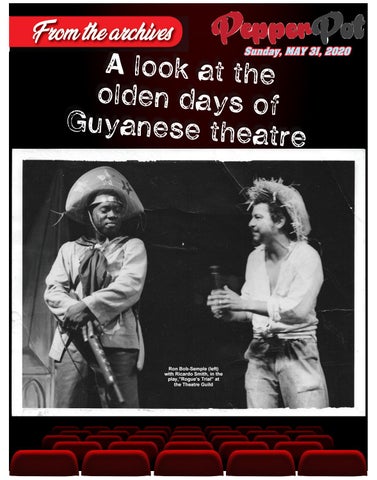
Ron Bob-Semple (left) with Ricardo Smith, in the play,”Rogue’s Trial” at the Theatre Guild
CHRONICLE PEPPERPOT ― May 31, 2020
Th Gu e B es er t bi Ho ce us In e n
II
By Jared Liddell
T
HE preservation of historic buildings is one of the main aims of the National Industrial and Commercial Investments Limited (NICIL), taking visitors and guests into what would seem like a time machine as they get to experience these buildings almost as they were at the time of their construction. This, therefore, became one
a ‘home away from home’
of the main selling points of the Berbice Inn Guest House owned and managed by NICIL. The Berbice Inn is a sight to behold in New Amsterdam, just three minutes off the Berbice River Bridge. The two colonial and modern-styled stunning pieces of architecture are found at 28-29 Princess Elizabeth Road, Queenstown, New Amsterdam. The building that stands today was erected on July 26, 1849, and was defined and designated on a diagram made by James Bone, a Sworn Land Surveyor. Hospitality Manager at NICIL, Rawle Dundas told the Pepperpot Magazine that the Berbice Inn Guest House provides a unique experience for everyone. “It’s a home away from home; the Berbice
Inn is a really special place, when people come here they have an experience that they can’t get at many other hotels. They keep coming back or they tell others to come and visit-- come and see it for yourself.” He said that the original design for the building remained “for the sake of heritage,” explaining that when something that historic is handed down you try as much as possible to preserve it as it was, passing it from generation to generation, allowing persons the chance to have a feel of being a part of history. The Berbice Inn was previously owned by the Berbice Mining Enterprise Ltd (BERMINE). In 2003, NICIL took over management of the then guest house and the name
was subsequently changed to Berbice Inn. Upon the dissolution of BERMINE in October 2004, the property was transferred to NICIL via the BERMINE (Dissolution and Transfer of Assets and Liabilities) Order 2004 and went into operation on October 15, 2004.
people who are travelling through the area and need lodging for a night or more. In addition, it is also convenient for business retreats involving overnight activities. According to Dundas, currently, the inn has three suites and an apartment which is suitable for families, while
of meals normally take place. Customers can either order what they desire or simply leave it up to the chef. Along with the renovations to the building a new Cocktail Hut was opened in February 2020 to modernise the services offered to customers and guests. The hut offers food and drinks
Exterior of the Berbice Inn Annexe Under the former management, the building located on the eastern half was known as the residence of the chief executive officer. The guest house, situated on the western half was originally set up to offer accommodation to government officials, primarily on a short-term basis. NICIL transformed and expanded the services to include government officials, private individuals or business
the annexe has four suites with an extension of three more suites, a reception area and a back veranda to be added. The suites range from small, medium to large rooms, with a price that suits one’s pocket. Guests always express how beautiful the scenery is and the scenic picture the countryside always captures. There is a kitchen where the preparation and cooking
as well as several activities such as Karaoke Night. This colonial-style home away from home is the perfect getaway for local guests who want to take some time away from their busy lives to get some much-needed rest and relaxation, as well as foreign visitors who want to experience the culture of country life through the services offered by the Berbice Inn Guest House.
CHRONICLE PEPPERPOT ― May 31, 2020
A learning experience By Vishani Ragobeer
S
TUDENTS spend years immersing themselves in learning about a field that they will eventually make a career out of. Countless hours of study, dedication, and yes, sacrifices are an integral part of the journey. Twenty-four-year-old Narifa Ally is a soon-to-be graduate with the Bachelor’s of Dental Surgery, Class of 2020, at the University of Guyana (UG). Her degree programme spans five years, and it is one which is very study-intensive. According to her, sometimes it did feel as though time was almost at a standstill, yet her studies were perpetual. This was a particular challenge in the first three years of the degree when she and her batchmates had to tackle both dentistry and medicine courses. But at other times, the degree seemed manageable, particularly when her colleagues and friends found ways of remaining social (even if just a bit) and enjoying the time together. For Narifa, though, the “rough and tough” journey of Dental Surgery, which is part and parcel of her pursuit to become a dentist, has been winding down in quite an unconventional way. As a final-year dental student, Narifa explained that her classes were more practical than theoretical, and she had her final-year research project to conduct and complete. Now, during what would have been her final few days of this degree, she has to contend with the COVID-19 pandemic putting a damper on things. “The last few months were the toughest,” she related. “The little uncertainty of whether I would be finishing my degree and graduating on time like I would have without COVID-19, really took a toll on my mental health.” Like many of the graduates or soon-to-be graduates in the Class of 2020, there is a level of uncertainty surrounding what the end of this academic journey will be like. For many, this final semester was characterised by online classes and social-distancing measures, which, if you are a final-year dental student, can be counterproductive. Even so, the pandemic has necessitated a new mo-
dus operandi and Narifa related that she has found ways of making her days a bit more manageable. She has been actively trying to stay positive, connect virtually with loved ones, and even opted to find ways of destressing. In fact, Narifa has been cooking and baking and has an Instagram
III
Class of 2020 finding novel ways to cope during pandemic that the President of the Medical School decided that the students should stay home. Effectively, this meant that students’ time for practical learning at the hospital and their preparations for their final examinations, were cut short. Exacerbating this was that by the second week of March, Guyana recorded its
in their final-year research project. With no prior experience in these ‘novel ways’ of research, Tamara said, “This task in itself has felt like it takes a herculean task every day.” While contending with the ramifications of this pandemic, Tamara shared that she has a deeper understanding and appreciation for the essential role of doctors and
degree in medicine. COPING AWAY FROM HOME Tamara and Narifa are still navigating the completion of their degree in the context of the global pandemic, but across shores, in the USA, 24-year-old Guyanese journalist Daniel Haynes is graduating today, May 31.
Final-year Dental Surgery Student, Narifa Ally (left) with a colleague
Final-year medical student at the University of Guyana (UG), Tamara Williams
page: @tek_ah_taste dedicated to this. “I can’t wait to start working with my patients once again since COVID-19 has taken away my last semester as a dental student in which I would have had the opportunity to build a rapport with my patients,” Narifa highlighted. DEVIATING DURING THE ‘LAST LAP’ Twenty-three-year-old Tamara Williams, a final-year medical student at UG, the ‘Med School’ journey thus far has been akin to a metamorphosis, where she became a more mature and driven person, particularly in her endeavours to become a doctor. “The first four years I spent in med school flew out so fast until we were in the last lap, in my final year. That was actually a very terrifying thought because after that the lives of thousands of people would basically be in my hands,” Williams related. Cognisant of that rapidly approaching reality, she decided to increase her focus on her studies. And this helped to reaffirm to her that she is truly passionate about serving others through the medical field. However, like Narifa, Tamara’s ‘last lap’ is a deviation from what she has seen the med students before her engaged in. Amidst her best efforts in her theoretical studies and the practical components, at the medical ward, Guyana became embroiled in a tense election period. It was then, in March,
Guyanese journalist and newly graduated student of the St. John’s University, New York, Daniel Haynes
first case of COVID-19 and its first death caused by this virus. With the protocols being put in place to mitigate the spread and effects of COVID-19, the final-year students were instructed to stay at home. They’ve been home ever since. As you can imagine, the final year students are suspended in a perpetual state of worry. There are questions on what format their final examinations will take, or even when these examinations might be held. This is coupled with the myriad of psychological issues resulting from the pandemic and its ramifications. Added to that, Tamara and the med students in the class of 2020 have been forced to find novel ways of engaging
frontline workers. “It really made it hit home that this profession is really not about you, it’s really a selfless one where you have to make a lot of sacrifices in your own life to take care of other people, she said, adding later, “I already knew that there would be sacrifices that I would have to make, but I didn’t realise the extra mile you have to go sometimes simply to do a good job as a doctor.” And in this context, she proffered that persons should be cognisant of the demands of the medical field and ensure that they are truly passionate about this field before committing a considerable amount of time and effort to the pursuit of a
Haynes, a student of Journalism at St. John’s University in New York, started his degree in January 2017. He left Guyana with high hopes for his opportunity to further his studies and to make himself, and his loved ones proud of him. The successful completion of his degree and his ability to graduate marks the successful realisation of his goals. But, his graduation isn’t one with the usual pomp and style. It is an unorthodox virtual ceremony. Essentially, this means Daniel won’t have the opportunity to walk across the stage with his shoulders back and chest out, exuding pride from being able to complete his degree. Instead, he’ll have to make the most of his room and contend with virtual celebrations with his loved ones and supporters. That doesn’t mean, however, that he isn’t proud of what he has accomplished, especially since he did so after surmounting a myriad of challenges. First, it took him three years to get to the United States to study journalism, a field he had already been part of- working as a Sports Reporter at the Guyana Chronicle and writing Entertainment and Feature stories. He said that this field allows him to harness words as windows to different worlds and perspectives, and he was set on
studying this so that one day he would become an internationally recognised journalist, and even have his own media corporation. After working for a while, he finally made it to St. John’s, but it would be some time before he was able to get even a bit comfortable. He was faced with financial constraints, which affected his registration as a student, the way he was able to live, and even put his student visa in jeopardy. He also found himself in a hospital for an entire week due to an enlarged heart, and all the while he was miles away from home with none of his family members around him. He highlighted that he eventually got a job with the Office of International Admissions where he was able to connect with other international students, just like him, who were trying to come to the U.S. to study. And, in his second year, he became a resident assistant, which took care of his housing and meal plans and provided a much-needed bit of relief to his budget. “I’d consider these experiences a dual-edged sword because on one side they helped me appreciate the journey more, but on the other side, it definitely made the journey harder than what I thought it should’ve been,” Daniel shared, relating how difficult it was navigating these experiences. He mentioned that he has always thought of himself as someone who “fights and perseveres,” and studying abroad was no different, but the struggle wasn’t eventually glamorous, not even in retrospect, because of the toll it took on his mental health. Similar to Tamara and Narifa, the past few months have been especially challenging for Daniel. As a Resident Assistant he had to help with the evacuation of other students from the campus and he had to move to an off-campus facility where he has been in isolation. During that time, the last few weeks of his degree, he felt his interest in his online classes decline and his mental health once again suffered. That has been the lead-up to his graduation today. “The journey has been challenging, but there have been bright spots,” he said; however, making particular mention of his girlfriend and the opportunities provided to him due to his hard work. And if he could do it all over again he would, only this time he would change worrying about getting kicked out, worrying about his finances and definitely, graduating as he imagined he would.
IV
CHRONICLE PEPPERPOT ― May 31, 2020
Saluting the ‘Last of the Redmen’
By Francis Quamina Farrier
W
ITHIN the beautiful Guyana society, some people are referred to as “Redmen” and “Red women”. These folks are light in complexion. To be referred to as a “redman” in Guyana is not actually disrespectful or insulting. It is, for the better part, endearing. In fact, one of Guyana’s celebrity redmen, is known internationally as “Reds” Perreira. Few in the wider society know that officially, his name is Joseph Perreira. So this article is not approaching any controversial issue, but rather to accommodate tributes to two outstanding Guyanese redmen who recently died; Dr. Michael Gilkes, 86, and Pat Thompson, 88. The following is some of what Guyanese celebrity Ken Corsbie had to say in his tribute to the late Dr. Michael Gilkes who died of complications of COVID-19 in England. “His accumulated productivity over a lifetime as a poet, scholar, playwright, theatre practitioner and actor, filled me with admiration,” stated the highly acclaimed veteran dramatist, broadcaster, storyteller, and yes, redman, Ken Corsbie. The two knew each other for decades since they were boys growing up in Georgetown and spending much of their time in the Tait’s Yard on Murray Street (now Quamina Street), South Cummingsburg. “My friendship with Michael Gilkes goes back more than 75 years at the almost mythical Tait’s Yard,” Corsbie stated. That location, with the mansion-like grand three-story wooden building, which is still there, is now known as Cara Lodge. Back in the colonial days, Dr. Jabez Tait, a serene citizen and medical doctor, was the patriarch of the Tait clan. He and his family were almost like colonial royalty in Georgetown and their encouragement of the arts - music, dance, drama - is legendary. Michael Gilkes and Ken Corsbie were among the many bright youngsters who frequent-
ed that mecca of the arts in Georgetown back in the day. While many in society considered the “redmen” as being privileged, it was not always smooth sailing for them. Ken Corsbie gave this example of how he and the late Michael Gilkes worked on various Theatre projects. “Over the years I designed for many theatre projects with Michael,” Ken Corsbie related. “After initial thoughts about all the reasons why the idea was nearly impossible to bring to fruition, I was invariably recruited and enthusiastically
was not easy.” The other redman I was asked to feature in this article, is the indomitable Patterson “Pat” Thompson who recently died at age 88 in Barbados where he was living for many years. Here are some extracts from a tribute by the brilliant Guyanese academic, Dr. Aubrey Armstrong, which was submitted to me for inclusion in this feature article. “When I first met Pat Thompson, he was Chairman of the Bauxite Industry Development Company (BIDCO), and I was a youngster just returning to
had a public quarrel with two very powerful Public Service Chairmen. “I got a call from another powerful Chairman - Pat Thompson,” Armstrong recalled. “At our meeting, to my surprise, there was no attempt to lecture me. We merely got to know each other. At the end of the lunch, as we stood to say goodby, Pat bowled the first of many mentoring balls - he said, “Dr. Armstrong, I would have thought that if you were picking a fight with two of the most powerful men in Guyana, that you would at least have chosen
From left; Ken Corsbie, Michael Gilkes, Eugene Williams and Henry Muttoo - all former members of the Theatre Guild of Guyana. All migrated (Photo courtesy of Ken Corsbie)
embraced the project and began designing.” He later improved his own original theatre skills when he attended the Rose Bruford College of Theatre and Performance in London, England. Referring to his earlier work with Gilkes, Corsbie recalled, “We often began without funds, venue, backing, or supportive systems needed for success, and although I did not understand the logistics, somehow, Michael made it happen.” Redmen usually never let the side down. For example, in his younger years, Sports organiser “Reds” Perreira suffered with a terrible stammer. “The Caribbean knew about my stammer,” he told me, “ but I was able to overcome, but that
head one of the State Enterprises in Guyana,” stated Dr. Aubrey Armstrong. At that time, Pat Thompson had already served as Guyana’s Permanent Representative to the United Nations, with headquarters in Manhattan, New York. In his tribute, Dr. Aubrey Armstrong mentioned that Pat Thompson was, “born in colonial British Guiana and attended St. Stanislaus College (which was run by the English Jesuit priests). He was from a conservative Roman Catholic background and would have even been considered privileged,” said Dr Armstrong. Pat Thompson was a brilliant, classy gentleman as Dr. Aubrey Armstrong demonstrates in the following story in which he
to fight them one at a time.” I looked at him and saw the mischievous twinkle in his eyes, and we roared with laughter.” Dr. Aubrey Armstrong is President of a Regional Management Consultancy firm. He is known to be a no-nonsense man; one of those Guyanese who is not politically partisan, and as mentioned above, from time to time, picks fights with those powerful men who he feels are less than fair to the ordinary Guyanese, causing unnecessary pain. As such, he hinged his star, as it were, to some of the social and civil rights activities with which his mentor Pat Thompson was also involved. In his tribute, Dr. Armstrong also mentioned; “In his private
life, Citizen Thompson’s other activities embraced political and public affairs analysis on radio and in the newspapers. This led him to become a member of a political action group called “COMPASS”, where he joined me and a cross-section of Guyanese to push back against the growing Authoritarian impulses emerging in Guyana.” Pat Thompson was a man for all seasons as Dr. Armstrong demonstrated. “He was the first president of the Guyana Association of Barbados (GAB) serving two terms. Two members were nominated to succeed him; one African, one Indian. Pat Thompson approached Dr Aubrey Armstrong saying, “Aubrey it’s clear that you would win this election, but I want to suggest something to you that I think is in the interest of balance of fairness; you should stand down but still sit on the committee.” Dr. Aubrey Armstrong immediately took the advice of the great man - his mentor, Pat Thompson. As such, the Candidate of Indian heritage was elected. Some of the other wellknown “redmen” of Guyana are the Pilgrim brothers - Billy Pilgrim, who was a gifted musician, and his younger brother Frank Pilgrim who was very talented and renowned, was the Public Relations Officer of (then) Prime Minister Forbes Burnham. He was also a playwright, and his play “MIRIAMY” broke all theatre records in Guyana at the Theatre Guild Playhouse in Georgetown when it was first staged. Broadcaster Ray Robinson who produced my two radio soap operas, “The Tides of Susanburg” and “The Girl from Susanburg”, is the older cousin of Broadcaster, Theatre Producer and Scout Leader, Ron Robinson. Guyana’s national poet, Martin Carter was also a “redman”. In the Guyana Police Force, prominent redmen include Dick LaBorde, Neil Isaacs, Norman McLean, Skip Roberts and Laurie Lewis. Six-footer actor and scout leader, Lawrence Thompson was a most pleasant redman gentleman. He was loved at the Theatre Guild as well as at Scout Headquarters.
Another redman scout Leader, was the beloved school teacher Flavio Comacho who used the word “Terrific”, probably thousands of times during his lifetime. Broadcaster Christopher Deane, and older “redman”, TV Anchor Tommy Rhodes, were among the very best with pronunciation and the use of the English language in the Guyana Broadcast Media. Solicitor Miles Fitzpatrick was so ‘red’ that it gave reason for President Forbes Burnham to poke fun at him due to his extra ‘red’ complexion. This article would be incomplete without the inclusion of one of Guyana’s most endearing redmen; business executive and actor, Ricardo Smith. He is a most serene and talented individual who you would want to have on your team, no matter how difficult the project might be. Summarising that special one-character play, “Last of the Redmen”, which was based on Clairmonte Tait, de facto prince of the Taits (ahead of his older brother Dr. Horace Tait) and Guyanese Redmen, Ken Corsbie had this to say; “In many ways the ‘Last of the Redmen’, written, designed and directed and acted by Michael Gilkes, was his most audacious theatre project.” So as Guyana mourns the recent loss of two of its most illustrious redmen, we join redman Ken Corsbie in extracting one of his favourite lines from the Michael Gilkes play, ‘Last of the Redmen’. In recognising that those redmen were dreamers, and as the late Michael Gilkes expressed in his play about the redmen and a line which Ken Corsbie loves: “We were the dreamers, our heads full of impossible scenes...don’t laugh at dreamers, because the world is made of their dreams.” Adieu, Pat Thompson. Adieu, Michael Gilkes. For while your ‘red’ complexion may have to some degree mattered in the Guyanese society, what really matters to all humanity, is the grey brains in your heads and the will to make positive things happen for the development of our Green land of Guyana.
CHRONICLE PEPPERPOT ― May 31, 2020
V
The tale of the missing vessels and aircraft
By Wendella Davidson
O
VER the years, Guyanese have become accustomed to reading about the disappearance of aircraft and vessels without a trace in particular in international waters or airspace. Among such popular stories are of the mysterious disappearance of ships and aircraft, last known to be in the vicinity of the Bermuda Triangle, also called the Devil’s Triangle. This is an area bounded by points in Bermuda, Florida and Puerto Rico. There is too, the case of the Malaysia Airlines Flight MH 370, with 227 passengers and 12 crew members that left Kuala Lumpur, Malaysia for Beijing, China, but never reached its destination. According to The Travel. com, throughout aviation and naval history there have been several vessels that have disappeared under mysterious circumstances. Among the largest vessels are the USS Cyclops that is believed to have vanished in the infamous Bermuda Triangle. Here in Guyana, there is the occasional news of fishing vessels that go missing along with the crew or an aircraft from one of the local airlines that crashes while on a flight to a hinterland location, or during a shuttle to transport goods for miners. There is a November 26, 1986 incident involving a Cessna 206 Super Skywagon single-engine aircraft bearing registration 8R-GAG. The small aircraft with experienced navigator George Alexander Grandsoult in the pilot’s seat and Emile Khan, as the co-pilot was reportedly en route to the Indigenous community of Kamarang, in the Cuyuni-Mazaruni district. However, it failed to show up. The last transmission to air traffic controllers on that fateful day was reportedly at midday. Grandsoult is remembered as the true pioneer of aviation in Guyana, who is credited with teaching many local pilots not only how to fly, but also the finer knowledge of an aircraft. THE RAMBARRAN VESSELS There is also the mystery
of two vessels, Gran Rio `R’ and Fiona `R’, from the Rambarran marine group that disappeared on April 1, 2000, and September 2002, respectively. The Gran Rio ‘R’, a 230foot cargo vessel owned and operated by Dennis Ram-
was about two hours sailing time away from Crown Point, but it was taking in water. A request was made for a pump to be on standby to await the ship’s docking. However, because there was no indication that the Gran Rio `R’ was in any immi-
waters. Owner of the Gran Rio `R’ was Dennis Rambarran, with whom this publication had spoken for an update, on several occasions after the unfortunate incident,
UNANSWERED QUESTIONS The Pepperpot Magazine recently reached out to Chris Mangru, a brother of the late seaman Morris
A web grab of missing crew members from the Gran Rio `R’ – Chief Mate, Maurice Mangru; Chief Engineer, Indarpal Latchman; Third Engineer, Phillip Scott and Second Engineer, John Karpan
barran, was registered in St Vincent and the Grenadines. On April 1, 2000 with a nine-member crew sailed from Port Georgetown en route to the Coco Reef Resort at Crown Point, Tobago, with a consignment of 1,500 tonnes of silica sand. The Coco Reef Resort and beach had been destroyed by a hurricane and the sand was to have been used to develop a man-made beach. The Gran Rio’ R’ was said to have been equipped with Global Positioning Systems (GPS) that would trigger an alarm should the vessel sink, along with radios capable of making long-distance contact within a 75 to a 100-mile radius, so its disappearance is still baffling. The vessel when it set sail was not expected to be out for no more than a week. Port authorities in Trinidad had reported that ‘Gran Rio R’, on reaching that country, made a stop at Scarborough Harbour for immigration purposes before setting sail at about 19:00hrs on April 11, 2000, for Crown Point, the final destination. The Trinidad and Tobago Coastguard at the Staubles Bay Station said it had received a signal from the ‘Gran Rio R’ which was then somewhere off the coast of Tobago, sometime around 21:30hrs that night. The signal indicated that the vessel
nent danger, the Coastguard officials did not treat the signal as one of distress. Following the ship’s sudden disappearance, surface units from the T&T Coastguard, at times, aided by an aircraft, conducted searches of the vessel’s presumed path, all of which proved futile. Two years later, on September 23, 2002, another Rambarran vessel, the Fiona ‘R’ with one of the siblings, Chandrama Rambarran, also called `Randolph,’ also mysteriously disappeared. The ship with R. Ramcharitar as the mate; Deodat, an engineer and sailors Lindon London and Danston George, left to transport a consignment of silica sand. Its destination was, Kingston, St Vincent and the Grenadines. The last contact reportedly made with the ship was when Rambarran spoke with his wife in Guyana, the ship’s agent, Mr. Winston English of Wills Agencies Limited, in St Vincent, related. He said the vessel was expected to arrive around daybreak on September 24, 2002. The Fiona ‘R’ was also equipped with a GPS, but it never arrived; neither has there been any positive sightings despite coordinated searches. The fate of the vessels remains more baffling as there had been no contact with the vessel as it travelled through Caribbean
but would only say that he would offer relatives of the dead crew members whatever financial and other assistance he could have mustered whenever they visited. Questioned about his brother, he would respond that he had not heard any word about him, neither his crew.
Mangru, who was Chief Mate aboard the Gran Rio `R’. Chris offered “… I’ll be glad to know what took place and what really went down. I don’t know how to give my gratitude or sympathy on this sad news.” As he posted an old newspaper clipping with the image of the ship along with
the missing crew, he added “the image above is all I’ve heard about after so long of wondering, the grief if still within.” The clipping Chris spoke about was from a post on Social Media from Derick Seecharran, a former crew member of the Gran Rio `R’. Seecharran was scheduled to sail with the vessel but missed its departure and was left behind. On April 1, 2020, the ship’s anniversary he wrote, “Today makes 20 long years since the MV Gran Rio `R’ left Guyana for Tobago and never heard back anything about the crew or the vessel.” Another mystery is that of the `Oliver L’, a white vessel with a black hull that departed Portof-Spain, Trinidad, on December 21, 2011, and was scheduled to arrive in Georgetown around midday on December 24 but the vessel never arrived, even though additional time was calculated in the event the vessel had encountered adverse weather. It was captained by Weston Andrews, 33, and had two other crew members, Ramdatt Roopnarine, 38, and Clad Burnett, 55, aboard.
VI
CHRONICLE PEPPERPOT ― May 31, 2020
‘Through the eyes of Guyana’s children’
A
S a Guyanese, have you ever really given much thought to the kind of Guyana you want to see? Of course, we all (I hope) want to see a ‘developed’ Guyana, but intrinsically, what does a developed Guyana mean? What does it constitute? Last week, we observed Guyana’s 54th anniversary as an independent nation. For those of us in the Guyana Students’ Association in Trinidad and Tobago (GuySATT), we wanted to do a little project; hopefully, something that was honest and meaningful, as we celebrated the occasion with all Guyanese. Cognisant of all that is happening in Guyana- the aberrations and egregious occurrences coupled with the expectations many of us had for Guyana’s destiny in 2020, we wanted to espouse something meaningful at this landmark in our history. ‘Through the eyes of Guyana’s children’ was the idea pitched by a new Guyanese friend of mine, that allowed us to do just that. The idea for this was that we provide a platform for fellow Guyanese students in the twin-island republic to speak about the Guyana we want to see. Not only that, but while we thought
about and articulated the specific aspects of Guyana we wanted to develop, we also had to relate it to our field of study, in an attempt to show that we intend to contribute towards building the Guyana we want to see. So I thought about it, and I reflected on my own
celebrate our 50th anniversary as a Cooperative Republic, which, for me, was a timely reminder of the spirit of cooperation envisioned for Guyana. At that time too, Guyana was preparing for the 2020 ‘Mother of All Elections.’ You couldn’t miss it
were led by the people who worked together to push for Guyana’s independence back in the 1960s, but whose separation planted those seeds of mistrust and insecurity among the ethnic groups, which germinated into the ethnic conflicts that underpin my Guyana.
something I have been reflecting on for much of this year, is how my approach to confronting my feelings about these ethnic tensions has changed. About two years ago, I was firm in my belief that if Guyanese could stop looking at the colour of
with the flags, posters, and banners decorating almost every open space. And at that time, I was back in Guyana working-- covering political rallies and all of that. During that time, I attended quite a few political rallies for the two major political parties. Interestingly, in the context of our independence anniversary, these political parties
This column, this space is a weekly platform where I am allowed to share my thoughts and feelings. Something I like to do nowadays is look back on some of my older work and see how, maybe, my perspectives have changed from the youthful naivety and pure optimism to the marginally more mature Vishani. And one thing that has stuck out for me, and
their skins, the texture of their hair and the cultures immediately around them, then we could truly be a unified people. And if, only if we could stop dwelling on the past that is filled with ethnic conflict and mistrust, then maybe, we could stand a better chance at staving off the divisiveness in our Guyana. But one day I read an article written by Akola
Photo courtesy of gtvibes.com
lived experiences and one thing hit home for me -- I have always felt the ethnic tensions and mistrust that underpinned Guyana because of the fluid environments I’ve been part of. In January, I joined hundreds of Guyanese at the Kitty seawall to watch the ExxonMobil fireworks commemorating our First Oil. That was about one month before we would
Thompson, titled: “Why we should not be colour-blind.” Essentially, she explained that my belief that invisibilising ethnicity and race was the solution to many of Guyana’s problems, was frankly, counterproductive. In fact, she posited that the contrary was necessary-that we need to engage in these uncomfortable conversations and address people’s social realities. Since then, I’ve been open to learning and so far, I have a new set of beliefs. Guyanese, all Guyanese, have their perceptions of what has happened to their social groups (speaking particularly on ethnic and racial relations) and it is not my place, or anyone else’s for that matter (I think), to trivialise whatever feelings people may have. And though I am miles away, if the past few months have illustrated anything, it is that independent Guyana still has a far way to go and needs those productive but uncomfortable conversations in an attempt to navigate those incendiary feelings. The Guyana I want to see is one where we recognise that ethnicity and race have never been the problem. The problem lies in how we interface with those.
Focus CHRONICLE PEPPERPOT ― May 31, 2020
VII
on the Village
Brickery Village
A safe heaven for residents
By Michel Outridge
T
HIS week the Pepperpot Magazine visited the small, sleepy community of Brickery, East Bank Demerara. It is home to labourers, heavy-duty operators, poultry farmers and large-scale farm workers, small business owners, both public and private sector employees.
street which was made into an all-weather road last year. In addition, there is a small track which is considered the only street by locals, who use it as a shortcut to the Public Road. The community has about 48 houses, and the villagers reported that it is a very safe place to live. In almost every yard there is a macaw or two, parrots and monkeys which are kept as
the village for the past 40 years and has a small business, a shop, which is under renovation presently, as a result of the novel COVID-19. Wilkie added that Brickery is considered a residential area where the residents would keep to themselves but if the cooperation is needed they would step out to lend a helping hand. “We used to play cricket at the playfield in the village,
A church in the village (Carl Croker photos)
Brickery Village is sandwiched between Garden of Eden and Support and is home to more than 400 residents, of all ethnicities, except Chinese. The land in the village was originally owned by the Persauds and the Kissoons, both of whom began selling off the land as time progressed and it later developed into a community. Brickery has one main
pets in in the village. Farida Wilkie The Pepperpot Magazine first met Farida Wilkie, a stayat-home mother of five, who was relaxing in her hammock at the time. This friendly woman related that she has lived all her life at Brickery, East Bank Demerara and it is a place she wouldn’t trade for anything. She has been residing in
a few doors down but we stopped because some neighbours have complained that the game was too noisy and the balls were had damaged their property,” she explained. Wilkie added that the cricket matches ceased 13 years ago so there are no recreational activities for locals but at Easter, they would clean up the ball field and go there to picnic and fly kites with their families.
This year, however, no such gathering took place because of the global pandemic. Wilkie told the Pepperpot Magazine that most people from Brickery go out of the village to work and a handful of them are farmers. She stated that the people of Brickery are indoors people when they are not working so the Coronavirus ‘stay at home’ policy isn’t affecting them because they are accustomed to being home. The small business owner disclosed that life in Brickery Village is very peaceful and safe. She stated that she chooses to renovate her shop now because people are hesitant to exit their houses with the virus so sales were down and it was the best thing to close it until things get back to normal. The Wilkies have two monkeys as pets but there is another, named “Jacko” that belongs to the neighbour and usually sits at the entrance of the shop, where he would welcome shoppers and sometimes partake in a social drink with the men. Wilkie said Brickery is a place where Guyanese of all ethnicities reside and there is simply no discrimination there.
Brickery Village
Farida Wilkie
The pet monkey named ‘Jacko’
The macaw out enjoying the rain
CHRONICLE PEPPERPOT ― May 31, 2020
VIII
F ocus Brickery on the Village
entrepreneurs stay creative to make a living
Christian Willems’ Road Side Stand (Carl Croker photos)
By Michel Outridge
E
Water coconuts and pineapple for sale
VEN though he is originally from Soesdyke, East Bank Demerara, Christian Willems has made Brickery Village his home. Christian He came to Brickery Village at age three years Willems and his old and has spent all his life in that community where he has family established a small roadside business. The business started recently and he sells cold beverages, coconut water, confectionaries, pineapples and pet monkeys. “It is better to have your own small ‘hustle’ and I started this business recently and so far, it is going well, since I am close to home and it is a roadside spot,” he said. Willems related that he did other jobs such as masonry, carpentry, manual labour and mining but it didn’t pan out for him. He told the Pepperpot Magazine that he has been living in the village for the past 44 years and he recently decided to become self-employed. His wife, Maureen Brace, who hails from Victoria, East Coast Demerara and his son, Akeem, a teenager, were by his side. Ramona Trim Akeem Willems is tasked with catching the monkeys right in the village and they sell them to villagers right in the village. At that time they had three on sale and some sweet pineapples they had purchased for re-sale from Soesdyke producers. Young Akeem is animal-friendly and has developed the skill to find monkeys and other animals in the village. The father of one added that life in Brickery is very quiet and it suits him and his family where they are eking out a living. Ramona Trim’s work He recalled when he came to the village, growing up the main access road which is now paved was a mud dam and the place used to flood a lot whenever it rains. But over time the place was developed and it is evident the lives of residents have improved over the years. Willems used to have a similar road side business at Supply Village, a short distance away but said that he used to get a “fight down” by locals so he decided to sell from his own village
to avoid a conflict. “Business isn’t flourishing but we do get some sales depending on the people flow and we are patient so things might get better,” he said. Willems also has a kitchen garden where he has some vegetables and fruits, most of which he takes from the farm to his table. And like most residents, they hardly buy greens since they grow their own and some amount of livestock for home use. Willems told the Pepperpot Magazine that life in Brickery is comfortable once employed or self-employed. THE NAIL TECHNICIAN Ramona Trim and has her small business that she operates at her home. The 19-year-old would like to establish her own salon in the city at Tower Hotel where she will employ a few others. But with COVID-19, her plans have been stalled and when the virus passes she will proceed to establish her small business to build her clientele. Trim started designing and hand painting nails since she was 15 years old. She had a passion for it and wanted to develop her skills. She then enrolled for a three-month course and received a certificate of completion at the end of it. Trim can perform acrylic and hand-painted designs and is also versed in both manicures and pedicures. With the tools for the job, she operates her small business at her home based on appointments and most of her customers are from outside the village. Trim reported that all prices are pocket-friendly and she would even go out of her way to please her customers with their own designs. “This is all I do, no other job and I am good at it, at least that is what I am being told and I want to enhance my skills further and make it a well-established business as my only source of income,” she said.
CHRONICLE PEPPERPOT ― May 31, 2020
IX
The life of an ‘all-rounder’
David Cherei’s house
Focus on the Village
By Michel Outridge
E
V E N though he prefers to be behind the scenes, David Cherei is doing his part to enhance his community by being a volunteer with the Neighbourhood Democratic Council (NDC). The NDC Councillor and all-rounder steps out to do his volunteer work and is also a Rural Constable with the Community Policing Group (CPG). “We try to maintain law and order without taking any inducements and try to settle issues amicably without any police intervention at a community level,” he said. Cherei stated that they are normal church people and most Sundays they attend services at two different churches right on the East Bank corridor. He pointed out that his sons are musicians in the church and they also lead simple and fulfilling lives. Cherei added that the village is peaceful, neighbours don’t clash and if there is a problem they visit him to have the matter resolved. The Brickery resident stated that he has been with the Craig/Good Success NDC for four and a half years and it has been quite an experience. “I am more a resident than a councillor and I don’t mind the volunteer work because I like it, mediating as the voice of the people because at times people have genuine issues that need redress and can’t explain themselves so I act on their behalf at the community level,” he said. PLAYFIELD Cherei told the Pepperpot Magazine that a bulldozer was acquired to do some work on the playfield which will be levelled, cleared and they have two options either to fill
David Cherei’s up and coming kitchen garden (Carl Croker photos)
it with sand and loom or have it fenced. “We will consult with the residents of this small village before anything is done to the playfield because it is a collective agreement and we all have a say,” he said. Cherei stated that $1 million was set aside for the enhancement of the Brickery playfield and the NDC’s tractor and front- end loader will be utilised for the preparatory works on that field. Community development The father of two stated that a request was recently made for a culvert to be constructed through the NDC and it materialised but some finishing touches will be completed. He explained that the funds were sourced from the Friendship/Craig NDC which receives a subvention from the government for community development. “The main thing is that the accumulated water is drained off the land to prevent flooding which was a problem in Brickery, prone to flooding,” he said.
Cherei added that the NDC has 13 villages to oversee, that is, five miles of villages to enhance with two pieces of heavy-duty equipment and they are doing their best to maintain drainage and other works within the villages. He pointed out that the most needed areas are looked at first and works are filtered down to other villages especially, for this rainy season. EARLY HISTORY Cherei said he came to the community when he was six months old on February 14, 1969, a Valentine’s Day. Cherei reported that he has lived at Brickery for most of his life but when he was 12 years old he relocated to Suriname and returned when he was 28 years old. He disclosed that he got married in the village as well and soon after started his family. The resident recalled the current all-weather road was a mud dam and they used to wade through six to seven inches of mud to get in and out the village.
He added that the place was covered with thick bushes and they did a lot of de-weeding and land clearing to make it as it is today. He added that his parents lived a few houses away and the plot he is residing on presently was covered with bush but over the years he developed it and constructed a house a few months ago, with the help of his father-in-law. “I am not a qualified contractor but I built this house from brick up with guidance from my father-in-law and look at it, the finished product, so people can tell themselves they can do anything they want to with a positive attitude, anything is possible,” he said. He pointed out that the
construction of the flat concrete house took six months to be completed and it has a few minor works to be done. When the Pepperpot Magazine visited Cherei, he was doing some plastering work at his concrete trestle even though it was raining heavily. The villager has also started a kitchen garden of bora, ochro and other vegetables with the use of old tyres. “The people of this village are known for trying from day to day and we get along and everyone adjusts to suit their lifestyle,” he said. Cherei related that most people in the village lives to an average standard and are people who work diligently to support their families.
X
CHRONICLE PEPPERPOT ― May 31, 2020
Focus on the Village
A blossoming small business
By Michel Outridge
W
H E N she first started, Marilyn Clario had only two ducks- a drake and a hen - which she reared in her back yard. Over time, the duo started a family and before she knew it she had a yard full of ducks. It was then it dawned on her to establish her own small business right from home. With a sign that says “Ducks for Sale” affixed to her front fence, her business has blossomed. Today, Clario has 30 adult ducks and 23 ducklings which she rears in a pen in the back yard. The business started three months ago and the people in the village support the venture. Clario is originally from Region Eight (Potaro-Siparuni), a reservation called Kurukaru, but relocated to Brickery Village, East Bank Demerara five years ago. The mother of three told the Pepperpot Magazine that she is expecting another child and wanted to do something for work right from the comfort of her home.
Ducks are sold ‘live’ not plucked and villagers would make purchases so she doesn’t have to go to the market to sell them.
The stay-at-home mother said her eldest son, Daniel Seebaran, 10, would assist her in feeding and cleaning the duck pen
while she would focus on the household chores. She explained that she visited the village and saw the man who would become h e r
Zabena Jhaman
Daniel Seebaran with a duckling
Mother and her ducklings (Carl Croker photos)
Marilyn Clario
Ducks taking a bath
husband some 15 years ago and relocated when they got together. “In this village, I know people by seeing them and greeting them but we don’t go out often so this pandemic isn’t bothering me much,”she said, yet she is still safeguarding herself and family. The children are homeschooled via Whatsapp and she supervises the exercise daily which started when schools closed its doors due to the Coronavirus outbreak in Guyana in March.
When the Pepperpot Magazine visited, Daniel was in the process of doing some school work. Clario was relaxing having completed her chores since early that day. This family has a parrot and three dogs and is doing some construction work to enclose the lower flat of their house, to accommodate a kitchen and a setting area. “This place quiet and peaceful, people do their work and stay in so there are no real issues here and I am comfortable because they have electricity, potable water and cell phone service,” she said. THE STAY-AT-HOME MOTHER OF NINE The Pepperpot Magazine also met another resident, Zabena Jhaman, who resides at Brickery Public Road. She was visiting a friend since it had been weeks since she stepped out of her house.
The mother of nine said she came to the village 19 years ago when she got married and admitted that life is fair there. She has three schoolage children, who are being home-schooled via the internet and she also would assist. Jhaman is originally from Kitty, Georgetown and has adjusted to the country life well because it is simple and quiet. “The people of this village does isolate themselves and those that work go out daily while others stay indoors,” she said. Jhaman added that the people are friendly but don’t mix up much and the children are mostly at home. “I don’t go nowhere, because of the virus, this is the furthest I does go. I just wanted a walk and it isn’t far from my house so I ventured out to visit my only friend, in this village,” she explained.
CHRONICLE PEPPERPOT ― May 31, 2020
XI
Vintage is best! How Brickery resident takes care of his classic car By Michel Outridge
W
HEN his friend, who was migrating overseas 17 years ago told him he was the perfect person to get his car, Stephen Ragubeer thought it was a joke, but today, he still has that car and doesn’t want to part with it. The car, which can be termed antique, is a mini Austin with license plate PZ 9702, which is in good working condition inside and out. Ragubeer is a resident of Brickery Village, East Bank Demerara and is the proud owner of mini 1969 model Austin car. He told the Pepperpot Magazine that the car was first registered on December 15, 1971, by the then owner, who was a Manager at Banks DIH and later left the country.
Over the years, Ragubeer upgraded the car to his liking and today, that little car which seats five persons comfortably is used as the family car. “A lot of people would ask me to sell them the car, but I don’t want to part with this car because my son likes it. I got it when he was just two and today, he is 20 years old,” he said. The father of two pointed out that the car is eye-catching and wherever he goes people are drawn to it like a magnet. Although he has received numerous offers he refuses to sell the car, which has in so many ways become a part of his life. Ragubeer stated that the car is only used to make family trips to the creek or for leisure drives with his wife and children. “It is my very first car and I was excited to own a car
Stephen Ragubeer and his mini Austin car, PZ 9702 (Carl Croker photo)
As such, he sold the car which went to different owners over the years and when his son was just two years old, a friend who he hadn’t seen for 15 years gave him the key to the car and told him he was the perfect owner. “He gave me the key and told me to pay later and I bought that car for US$400 and never regretted,” he said.
and an antique car as well, so it is simple to understand why I will not part ways with this car,” he said. Ragubeer stated that he used to go to work with the car but acquired another vehicle he currently utilises for work and the mini Austin would be parked until family trips come up. He is a radio technician
at a Fishery where he repairs radios for trawlers and has been residing in Brickery Village for the past 50 years. Giving some background on the village, Ragubeer told the Pepperpot Magazine that the community used to be
called ‘Ban Corilla Scheme’ when it had a mud dam as a road. He said that sugar cane used to be cultivated in the lands behind the village and the harvested cane used to be transported to Diamond
Focus
Estate to be converted into sugar. It was after the estate closed cane harvesting ceased and the land became overrun by thick bushes. Ragubeer added that the plots of land in the village
on the Village
were owned by the Persauds and the Kissoons, who sold the parcels of land to locals, as the years rolled by. He revealed that Brickery Village has 48 house lots with less than 400 residents, who are simple yet hardworking people.
XII
CHRONICLE PEPPERPOT ― May 31, 2020
d n i M e t i r The W by Jasmaine Payne
Would you consider a career in Ghostwriting?
ERE’s a fun fact: did you know that Carolyn Keene and Franklin W. Dixonthe purported authors for the popular childhood mystery books Nancy Drew and Hardy Boys, respectively- didn’t exist? These names are pseudonyms that represent a variety of named and unnamed authors who wrote in the same style about the characters in the Nancy Drew and Hardy Boys fictional universes. These writers agreed that they would give
H
up all rights to the work they wrote and operate under confidentiality. Writers who agree to terms such as these and write copy for books, articles, speeches and a variety of other types of written work but are not credited for and have no rights to that work thereafter are called ghostwriters. Instead, the credit and ownership of the written work go to the client who hires the writer. For some artists, such an idea may seem absurd; the thought of pouring your
effort and creativity into the work, only for others to take the credit. And perhaps, at its very core, it is. But, ghostwriting is an extremely useful and convenient method of producing written work. In fact, the business of ghostwriting can be quite lucrative, depending on the types of contracts you procure. Those bestselling memoirs and autobiographies you see being churned out by celebrities? Many of them have ghostwriters to thank for them. Lots of popular songs that heat up the charts are
also written by ghostwriters. Even works of art and musical compositions credited to famous artists have been created by unnamed persons. Ghostwriting is more popular than you may think, but as its name suggests, it is meant to be a covert operation based on a mutual agreement between parties.
Are there advantages to being a ghostwriter? Long ago, ghostwriting was frowned upon and considered a “lazy” or “dishonest” way of gaining recognition by taking credit for someone else’s work. Today, ghostwriting has transformed into a lucrative subgenre where ideas can be developed by other parties, while those who put their names on the work pay the creators handsomely for their creativity. In many cases, ghostwriters are even publicly acknowledged by their clients or are sometimes referred to as “research assistants” and other titles. That is not to say that the clients don’t do any work in the process. Ghostwriters have varying degrees of participation in the creation of written work ranging from the actual writing of the entire body of work and coming up with all the ideas; to rewriting something that someone has already written; to simply developing someone else’s ideas or even writing a story that they would have narrated orally. Though they may not have any rights to the work they initially created, this career path does have its perks. For one, clients pay a hefty price for someone else to undertake the bulk of the work, so if you’re fine living a life of obscurity but would still like to put your writing skills to use, this is a good path for you to get into. Ghostwriting also gives its writers a vast amount of knowledge. Every time a ghostwriter undertakes to write someone else’s story, they have to become that person. The job also requires the unique skill of being able to adopt the subject’s voice.
Speechwriters -- a type of ghostwriting -- have to ensure that when their subject reads from that speech, the words they say are not unlike the things you would hear them say in an interview or at another forum. Ghostwriting, therefore, requires extensive research and acquiring the knowledge of the subject you are writing on then using that knowledge to come up with a finished product that can sound credible. Ergo, ghostwriters are constantly
that you have to learn to speak in their distinct voices. Undertake writing courses that can help you to do that, there are many available online. Market yourself. Internationally, ghostwriters now have agents that market them to bigger clients, but if you are now starting, you can find many potential clients on peer-to-peer platforms like Upwork, Freelancer and even Fiverr. My first ghostwriting client came
able to learn and improve their writing skills through the versatility required for what they do.
from Upwork. He was an international speaker based in South Africa and wanted a ghostwriter to write a 20-chapter book on leadership. The job was tough, but in the end, I received good reviews for my research and promptness. Good-paying ghostwriting jobs do exist! So, familiarise yourself with these platforms, create accounts and start looking for open jobs that can land you clients. Ghostwriting is not for everyone. But for writers looking to make money while working on their own projects, this is a viable niche that you can tap into. Just put your best writing skills forward, be professional and do your research and you will find that the opportunities are out there!
How do I become a ghostwriter? First, it would be good if you have some manner of a portfolio in professional writing before you undertake ghostwriting. Clients looking to hire ghostwriters need the highest quality of work because many times they occupy high-ranking positions in society and need to uphold a particular standard. Start creating a portfolio for reputable writing projects you have done in the past so that your client can know you can undertake the job. Next, practise your research skills and learn how to write in different voices. No two projects are the same in ghostwriting. Every written project is for a different occasion, and if you have multiple clients, it means
Interested in contributing to this column on writing? Email me at thewritemind592@gmail.com.
CHRONICLE PEPPERPOT ― May 31, 2020
XIII
Coping during A pandemic
I
T is hard to escape the effects of COVID-19 on people all over the world. This week I decided to share some comments from various people in Guyana and different parts of the world. Allan Tijseling is a crazy friend of mine from Holland who is a veteran journalist. He is one of those largerthan-life characters who interviewed me a few times and never fails to make me laugh: “I’m a free spirit. Wandering around in the world of fes-
tivals, theatres, bars, restaurants, boulevards and terraces. Sunday, March 15 my natural habitat disappeared literally within the hour. All it took was one press conference of the Dutch Prime Minister. Around 5pm he announced a COVID-19 lockdown, effective immediately at 6pm. I merely had time to finish my third gin-tonic at Shelby’s, the Peaky Blinders themed bar I always frequent on Sundays. I paid my tab and walked outside in a world I’d never seen before lost and confused, the only thing not being closed was my own home!” Guyanese business owner Chris Bassoo in Brazil: “Our situation is a little different because we are stranded in Brazil in a hotel, but because I consult with firms in different countries the fact of not being home doesn’t really affect business for me...the only issues I face is everything is closed in Brazil, so I can’t get contracts notarised (it is harder to find here because very few people speak English, if I email people from online ads). Things like that Zoom, WhatsApp, Skype and even FB messenger have been invaluable. The landscape of business is changing and while being stranded here in Brazil we have been blessed to sign a few large business
deals, so those are keeping us busy until the airports open and we can get home.” Let’s make a stop in the beautiful St Vincent and the Grenadines to get an opinion from the lovely Jean Johnney- Findlay, Manager Coreas Pharmacies/Food Xpress/ Café Centrale: “COVID-19 has taught me to draw on my strengths to help keep my mental faculties together to be able to remain focused and lead my team as we made adjustments to do our part to protect ourselves.
Personally, I spent more time reading positive and inspirational stories; attending virtual educational sessions; exercising to help build the body and release tensions and doing some decluttering. This is enabling me to stay balanced and be strong for my team. I have been encouraging my team members to get mentally and physically fit, follow the protocols as much as possible as we have to protect each other, our families and the next person as we make every effort to flatten the curve. Thankfully, our island did not lock down so we have a greater degree of freedom. Nevertheless, we were always cautioned to follow the protocols.” Tracey Chan Smith is a young Guyanese project manager: “Adapting to the sudden changes caused by the pandemic has been eye-opening. It has forced me to realise the importance of empathy. Going through a pandemic is not easy for anyone, regardless of the level of comfort one has access to. It can affect us all whether we are business owners navigating how to manage clientele and even staff or employees navigating how to maintain a healthy mind and be productive during this time. In fact, some households have a member(s) who might have lost their job due
to the pandemic. This may increase anxiety on the working members to fill the gap of a missing household income. Thus, I’ve made personal changes to be careful with my media consumption. This protects my mind and saves my energy for loved ones. Professionally, I strive to be more honest with myself and colleagues as I possibly can. If you’re not okay it is okay to say so. It is very easy to become overwhelmed during this time. We’re all in a pandemic and we should do our
part to show empathy for our colleagues and family.” A perspective from the John Ernest Fernandez, an author, speaker, life coach, corporate trainer and business consultant in the Philippines: “Like everybody else, my business was greatly affected by this pandemic as our government announced a lockdown for more than two months now. But God really moves even in times of crisis! Indeed, every crisis is an opportunity! During this pandemic I was able to launch
Beyond the Runway with Dr. Sonia Noel ... Inspiring lives through fashion two programmes: an online training programme about the Kingdom of God, and a home-based business opportunity for everyone which involves selling my ebooks online. God is truly the God on turn-arounds!” Clinton Urling is a prominent Guyanese businessman and former Chairman of the Georgetown Chamber of Commerce and Industry. A few years ago he extended his business to New York: “Personally, I’ve shifted to a higher sense of awareness about my surroundings and environment and have shown
more empathy towards others since my actions can have a detrimental effect on people. Professionally, before COVID-19, I felt like I always had to be on the go to get things done urgently, but through this period I’ve come to embrace that it is ok to slow down and be more patient with people and projects.” Thank you all for sharing your very inspiring comments and I pray God continues to protect you and your family as we continue this beautiful journey called life BEYOND THE RUNWAY.
XIV
CHRONICLE PEPPERPOT ― May 31, 2020
Savory’s Mazaruni Experience
I
N the light of the recent independence celebration, I decided to focus on an art-
ist whose work displayed themes based on his experiences while in Guyana. Ron Savory was a St Lu-
cia-based Guyanese artist. Savory studied art under E.R.Burrowes at Queen’s College in the 1950s. He
later joined Burrowes’ Working People’s Art Class producing small paintings. Savory was later appoint-
Bowman by Ron Savory
Creek by Ron Savory
ed a civil servant to the District Commissioner’s Office at Kamarang in the Mazaruni. His experience with the Indigenous people would soon influence his work. He started to create paintings which represented the life and culture of the Indigenous people. Depicting the canoes by the creek, riversides, hunting, the Timehri symbols, and the rainforest, he experimented with sand to create textures on a flat surface. Savory soon shifted his focus to the forest itself, attempting to capture the effect of sunlight within the forest. His colour palette often consists of greens,
yellows and browns. Today I’ll be discussing two of his acrylic paintings - Bowman 1967 and Creek 1968. These paintings represent his experience in the Mazaruni. The Indigenous people lived by hunting and fishing, so it is no surprise that Savory’s work displays this lifestyle. A bowman is a person who shoots with a bow and arrow. As you look at the Bowman painting, you can see a standing figure in the centre. His structure showcases two charTO V N acterisR EX U tics of T AG P a
CHRONICLE PEPPERPOT ― May 31, 2020
XV
#SupportCreativity
By Subraj Singh
Tennessee Williams, Literary Gay Icon R ECENTLY, I have been re-reading Tennessee Williams’ classic play, “A Streetcar Named Desire,” and I have been wondering about the elements that contribute to the world viewing Tennessee Williams as a gay icon - about what specific criteria needs to be in place before someone can be considered a gay icon. A gay icon, for people who may not know, is someone who occupies a place of adoration and respect within the LGBTQIA+ community. Examples of gay icons from real life include Judy Garland, Rock Hudson, Sylvia Plath, Eartha Kitt, Leslie Cheung, RuPaul, Lady Gaga, and many, many others. Although gay icon is a status that is primarily awarded to real-life individuals, there are fictional characters who have been given the title as well. For example, Miranda Priestly, Meryl Streep’s character in “The Devil Wears Prada” is an example of a gay icon, as is Dorian Gray from “The Picture of Dorian Gray,” the Babadook monster from the film of the same name, Mrs. Dalloway and Orlando from the Virginia Woolf novels, and Harley Quinn from the DC comics. Certainly, with real personas, being gay is not the singular criterion to be considered when it comes to the creation of gay icons, as there are several heterosexual people who have been placed in the category. I do believe that gay icons are made when LGBTQIA+ persons are able to see aspects of their identities represented in celebrities, and this visibility leads to a heightened level
of adoration and respect for those individuals who highlight these aspects while in the limelight. It might be an actress’s outlandish costumes that references some aspect of drag culture; or it might be a singer who has songs about forbidden love; or it might be the story of a socialite who escaped oppression to create the life that she wants for herself. Whatever the reason, the status of a gay icon is built on bringing some visibility to the LGBTQIA+ community through some connection/ similarity that exists between the people who exist in these marginalised communities and the people who have transcended into superstardom. Additionally, these elements of the LGBTQIA+ community need to be represented in the work that the gay icon has received popularity or acclaim for, such as films, fashion, cartoons, novels, poems, songs, etc. So, with all of this in mind, what can we glean from Tennessee Williams’s most famous work, “A Streetcar Named Desire,” that emphasises homosexual themes and therefore expresses the idea of LGBTQIA+ elements being present in the work of the artist who is to be considered a gay icon? I think that such elements can be found represented in Williams’s several of the main characters in the play, especially Blanche Dubois. At the beginning of the play, Blanche emerges on to the scene in New Orleans, looking for her sister. She comes from wealthy beginnings, but all the money has been lost through the years, and she is now impoverished and homeless. Blanche
spends most of the play looking for ways to make it back to her comfortable beginnings, mostly by trying to secure men who will be able to provide for her. This element of her characterisation is one of the factors that might make her a sympathetic character, especially to gay people, since homophobia itself is often wound up with capitalism. There are many instances of gay people being fired from their jobs or being refused positions of employment because of their sexuality. There have also been many, many instances of LGBTQIA+ persons being disowned or removed from their homes and families on account of their sexuality. Blanche losing everything she once knew and valued and being tossed into a harsh world without the means to take care of herself is a reality experienced by most gay people, and her longing for comfort and security is only that continues to plague them, particularly those in conservative and third world countries, even all the way to the end of their lives. Another factor that emphasises the similarities between Blanche and the gay community to which Tennessee Williams belonged, has to do with her vanity and her reliance on her beauty and clothing, and her fear of aging and losing her good looks. Even though she has fallen far from her original station in her life, Blanche remains focused on material and superficial things, specifically her looks and appearance, as these are the only elements that Blanche believes she can use to win attention. Furthermore, her wearing the clothes
she wore in her younger days also enhances the illusion that she might be able to one day return to that time in her life, when she was young and
in the lives of trans-people, especially transwomen, many of whom have utilized clothing and make-up as a means with which to fully express
‘Tennessee Williams’ by Orlando Fernandez, 1965 - Image source: Wikipedia
wealthy. Clothing and makeup are important items in the LGBTQIA+ community, particularly in the ways that they can be used to express identities or create illusions for the purpose of creating a sense of security and comfort within the individual. In the drag community, for example, men rely on extravagant costumes and make-up as part of female impersonation, which is an avenue that allows them to showcase their talent and creativity while also helping their self-esteem and confidence. Clothing and make-up are also important elements
who they truly are. Throughout the entire play, Blanche searches for love. She was once married, but her husband kills himself after Blanche sees him with his male lover. She becomes distraught after his death, and it can be argued that Blanche’s fall begins after her husband dies. That is the moment when she, devoid of love and protection, begins the downward spiral that is seen in the play. She becomes an alcoholic and is fired from her job, yet she does not lose sight of the fact that she needs, yearns for, love
bowman – speed and silence, that is, he must tread lightly enough so as not to alarm the prey and be fast enough to catch it. Savory uses simple shapes in his composition. It is arranged somewhat like a puzzle with dark brown lines separating each piece. The rustic brown, in my opinion, represents the forest floor. The variety of greens represents the forest. The bright yellow
represents the opportune time to hunt. It is simple yet complex. Creek is such a captivating painting. Its dark colour palette captures the mystery of the forest. I wonder if it’s a night scene or if it speaks to the density of the forest where little to no light can enter. I’m fascinated by the lack of detail in the trees. However, the technique he uses creates movement
and even adds depth and distance. There are visible brush strokes in the foreground and a wash (a visual arts technique resulting in a semi-transparent layer of colour) in the background. The still and murky water gives the impression that the forest is somewhat dangerous and uninhabited. There is no physical presence of forest creatures, but you could imagine hearing their
sounds through the painting. A scene like this could never be in silence. It’s the thought of the sounds that adds to the viewer’s experience of the painting. As I take a closer look, I see a hint of brown with a white border that takes the shape of a canoe. The canoe, perhaps abandoned by a lost lone traveller, is resting at the side of the creek in front of some broken branches.
There is so much mystery and wonder in this painting. I imagine placing myself in the centre and disappearing if only for a moment. Art creates an escape from the world as we know it. It isn’t until you experience a piece of work, that you can fully appreciate its power and influence in your life. The National Gallery would usually hold an In-
M O FR XIV RN GE TU PA
Savory’s Mazaruni Experience . .
and respect. Being denied love is something that many LGBTQIA+ persons must contend with. From parents who choose not to love them, to straight people who are often unable to love them, to divisions in the community itself, there has always been a difficulty in the lives of LGBTQIA+ people when it comes to finding love. Blanche represents this in her deep craving to be loved and her inability to balance this need with all of the other things that she has going on in her life. I do think that it is possible that many aspects of the gay experience, probably based on the author’s own experiences and understanding of the LGBTQIA+ community, have made their way into the play, particularly through the character of Blanche, and this ability to represent elements of the LGBTQIA+ community in a work of literature is definitely one of the factors that contributes to making Tennessee Williams a gay icon. Of course, it is important to view the entirety of the character’s arc in the play while highlighting this comparison, and while it is true that Blanche does not get a hopeful ending, it is important to remember that people in the LGBTQIA+ community did not often get happy endings in the 1940s (the play was first staged in 1947). There is no doubt that Blanche’s life would have been markedly different were she a woman of the 21st Century, in much the same way that things would have been different for Tennessee Williams had he lived in the 21st Century.
dependence exhibition every year featuring works from within the National collection. This year’s featured artists include Stephanie Correia, Marjorie Broodhagen. Stanley Greaves, Dennis Williams. Aubrey Williams, Ron Savory, Bernadette Persaud, Dudley Charles, Gary Thomas and George Simon.
XVI
CHRONICLE PEPPERPOT ― May 31, 2020
SOME GUYANESE HAVE BEEN TARGETS OF SOCIAL RIDICULE FOR TOO LONG We must begin to know our social critics, prophets and ‘Brutuses’ Passive retreat from racial and social assault into hope and humane expectations from the other will not redeem any targeted group. Only resistance through knowledge first, and self-determination will forge the paths towards liberation from the chains of others who have perfected deception over centuries and have long-buried any qualms about stealing your soul if your lack of self-esteem permits. Know them from within and without. Elections 2020 (still in process) have been a case study of not merely an election but an international conspiracy to bury a people- ‘us’- into a chasm. It is a chasm of accepting a calculated imposed mood of inferiority, surrendering to an invasive interpretation of the how, and if, and what ‘right’ to our geographic and organic inheritance we should be comfortable with, by intimidating and mesmerising our senses as to whom we should turn to for guidance and who holds the enlightened spark to morality and its authoritative wisdom.
Nut-Butter people in the interior. This was Eddie’s quest for his rights. This is the narrative he was told beginning with the - Industrial Relations Creature-01 “Me and NIS. are personal friends, Nut-Butter won’t budge cause I pay the cheque”. Next, to the HR Creature- “Do you know her? She works at the Court’s Registry. Nut-Butter won’t pay. Do you know why me and Nut-Butter direct and dictate the court? ” Next; poor Eddie went to the Labour Minister this creature told him as follows- “What do you want from Nut-Butter? As long as I’m in this office, I am not going to let you embarrass Nut-Butter or NIS.” Union Creature -1 “ If you make trouble for me and the Union, you will see what I will do to you” Union Human-2 “ I have investigated your matter and the retrenchment letter you got. You were not off the job for six months. But you can’t fight Nut-Butter. And you can’t win them. They are going to pay their way.”
by Afro-Guyanese it was ignored. The conscience call was a facade, saturated by the racism of the ‘Colonial Jumbie’ but conveyed to win your noble Christian sympathies. I cannot but sympathise with my friends Tacoma Ogunseye and Mark Benschop on their crusade to save Frederick (Freddie) Kissoon’s soul. Freddie, to his credit, on his disappointment with the PPP, has provided us with an inner perspective of the nature of that political cult, that sank into deeper chasms of racial callousness and vindictiveness that our imagination could not have further conceptualised, even against what we already knew. But Freddie is at war with himself. In 2015, my revolutionary friend from Durban Street called hysterically, and emailed me a piece Freddie had written “I lived in white man’s country. The non-white record is awful” July, 19, 2015, here is where the ‘Indentured complexes’ come into focus, politicians do not perceive actions through the streams of culture, but by Freddie’s
Thus the right to dictate what we should have and have not, despite what we by profound experience ‘know and have witnessed’. But the posture is old, the methods are new, but from Columbus, the Atlantic Slave Trade, two World Wars, and a cold war, with some, the thinking has not changed. And the enemy within has always remained the most treacherous and self-destructive factor. The patriots of our small and young Republic must now look within the proverbial crystal ball of our national identity and explore the more malignant ailments of our collective inheritance at work against us. That collective inheritance I’m talking about is the thinking of the ‘Fixed Colonial’ the ‘Indentured complexes’ and the ‘Accredited criminal structured class’. The latter is even more complex in understanding, as the posture of these people may have been perfected to appear national and patriotic, able to get appointed to this and that on public postulations but will easily betray every principle expected in the pursuit of the three vices of “Me, Myself and I”. I was given two sets of legal documents years ago by two legal luminaries who thought that the topics and direction of my public narratives needed a deeper understanding of the society I live in, so as to protect myself. They also warned me not to be a fan of too many public eating and drinking gatherings. I will present the plight of a citizen named Eddie (injured) from Mackenburg who worked for the Foreign-Durban Street
Union Creature-3 “I will see to it that you never embarrass Nut-Butter nor NIS. Boy, you are playing with your well-being. You must remember, they are my friends, and they have me there [the Presidency]. Finally, I do hope from this factual narrative [(adjusted to remove actual personalities) you understand the nature of what I described as the ‘Accredited criminal structured class’ which is a phenomenon in every society, but we Guyanese have a tendency to either be in denial or extrapolate our own deficiencies. There are people whose traits should not inspire you. The next group are the Colonials. I confronted elements of that group as a young writer/artist owing Stabroek News advertising money I had invested and lost. I proposed local illustrated work, the equivalent of my overseas counterpart. Mrs De Caries is a frank individual who taught me much, she was the manager at that time. She responded, “Barry it’s not the quality of your work, the Board of this Newspaper will not allow that Creole Black people imagery in this newspaper”- a few names were mentioned. One of those names had later penned a ‘conscience call’ for the Guyana Government to invite Syrians suffering to Assad’s assault to be given sanctuary here. Milton Bruce, my colleague and former Advertising manager at Chronicle addressed that conscience call, referring to the earthquake that had devastated Haiti, which had attracted no conscience call, even when land was offered
phenotype he’s possibly descended from groups of people who had suffered in India for some two thousand years to the prejudices of the caste system. There or over here, we all know of the preferences and prejudiced fictions that still exist in more than just the provincial Indo cultural sphere of Guyana, but among many in politics and business, Rahul Bhattacharya’s book ‘The sly company of people who care’ is also a good incite to that range of complexes. How else can it be described, that a political scientist, schooled in the writings of Noam Chomsky, who should have digested the Memoires of Larry Devlin-Chief of Station Congo- who would also know that all who were responsible for the peace movement in Jamaica that included Bob Marley ended up murdered for their lofty vision? The contents of Freddie’s article in 2015 were a technical disappointment of self, of people he saw as evil, who had treated him in the most degrading way, yet he still identified with. Or either, Freddie could not divorce the weight of current economics to be grounded against that which is glaring and inescapable. I can empathise with that, but not agree, or instead, he has sunk as a tool, rather than evolve, absorbed into the servitude of the contemptuous caste Gods, compelled by race before conscience, and from his writings before he understands well, the unforgiving rituals of ideological racism.
CHRONICLE PEPPERPOT ― May 31, 2020
XVII
What children see and hear T ODAY, I’d like to talk about the importance of sheltering children from adult topics, abuse and pretty much any unhealthy behaviour. Anyone who has children knows the famous saying – that children are like sponges, they soak up everything. There have been mountains of scientific research to support this, even though you probably don’t need it when you curse and notice your child has picked up the word quite quickly. Parents are spending more time with their children now more than ever, so this is something that worries me. Age doesn’t really matter – children start soaking up this information from birth and from birth to three years, their brain increases 80 per cent of its adult size. It’s a crucial point of development. Healthy interactions between this age aids in healthy communication and social skills – ones that will last a lifetime. An important thing to remember is that children learn without being taught. They learn from their environment and who’s in it. It’s called modelling -- when a child acts and speaks the way they observe to be the
norm. This means it’s important for adults to speak and behave wisely around children -- not just to them. Psychological studies show that children who witness abuse are at a much higher risk for mental health issues later down in life -the same risk as If they were abused directly. Exposure to psychological or physical stress reduces the potential of learning, forming healthy relationships and becoming independent. And these negative consequences continue into adulthood. If we’re talking about a child witnessing abuse, they can become depressed, have difficulty eating and sleeping, issues in school and their relationships. They even may become violent themselves and have a low sense of self-worth. All these factors cause them to grow up to become abusers themselves. I think most of us already know this. It is important to shelter our children from anything negative, including things that may seem harmless such as gossip or insulting their other parent or grandparents. You can’t blame children-- they learn from copying you. They are listening to what you say and they are watching how you eat.
‘Boys will be boys’ is an excuse to raise toxic men
“
Boys will be boys”, a dreary slogan we’ve all heard at least once in our lives. It is quite upsetting and can be a dangerous label. I have heard it in primary school when boys fought or showcased violence behaviour. I have heard it in high school when boys broke the hearts of girls in relationships just to showcase to their friends that they can “catch and keep this one”. I have heard it on the streets when boys and young men cat-called women when they’re passing. I have heard it a lot and I am sick and tired of doing so. It is exhausting to even think about. The saying “boys will be boys” is an excuse. It is an excuse for males to behave how they want when they want without having to worry about consequences because they’re protected by their gender. From an early age,
we were taught this. A part of me always wanted to hear, “girls will be girls” whenever I did something mischievous when I was younger. To my dismay, I never did but two wrongs can never make a right. I was disappointed. Disappointed, because from that tender age, even though I did not use the coined term; I discovered “male privilege”. No, this is not an exaggeration of the truth. It is actual male privilege. If you’re a female and this is not your truth, then please note that our experiences are then different. I do not expect everyone to agree with me but I know some women and girls share the same sentiment as I do. I was never allowed to hide behind my gender and identity when I behaved in a certain manner; aggressive and warrish to be exact. “Girls are soft”, “girls are gentle”, “girls are kind”, “and girls are quiet”. Says who?
This type of mentality translates into other aspects of life as we grow. It develops into stereotypes that we somehow have to mould and
How did we find this out? There was a very famous psychological and behavioural study conducted in 1961 by Albert Bandura and colleagues to investigate if social behaviours (specifically aggression) can be acquired by observation and imitation. They randomly chose 36 boys and 36 girls from the Stanford University Nursery School aged between three to six years old. The children were pre-tested on their levels of aggression, so there would be no bias or false results. They showed an aggressive model to 24 children, a non-aggressive model to 24 children and no model to 24 children. The aggression was an adult coming in and becoming violent-- physically and verbally-- with some toys, especially a large bouncy ‘bobo doll.’ The intention was to see if the children who were in the aggressive group would copy or ‘model’ the violence that they witnessed the adults perpetrating. The children witnessed the violence for only 10 minutes. The results were astounding. Children who observed the aggressive model made far more imitative aggressive responses than those who were in the non-aggressive
reshape ourselves into. The minute we refuse to reshape ourselves to form these expectations, we are not one with society anymore. Little
groups. The girls in the aggressive model condition showed more physically aggressive responses if the model was male, but more verbally aggressive responses if the model was female. Boys were more likely to imitate same-sex models than girls. Boys imitated more physically aggressive acts than girls. There was little difference in the verbal aggression between boys and girls. The conclusion was that children copied what they saw from adults, even if it’s not in their nature. If you are guilty of a few things mentioned, it’s not too late to make some changes. Look at your home as your child’s first and last classroom as they are watching and copying everything that you do. Set a positive example for your children. Also, limit what they watch on television as they can model behaviour from there as well. Finally, keep in mind that every person your child sees is teaching them something, so keep good people around. Thank you for reading. Please continue to send topics to caitlinvieira@gmail.com. If you would like to book a personal counselling session with me, please WhatsApp +592 623 0433
“tomboyish” girls grow up to rude and ‘un-wifeable’ women. Quiet boys grow up to be gay men. Angry girls grow up to have “daddy issues”. Shy boys grow up to be the one with the least girls around. Or, so they say. We don’t have to live up to any of these expectations. I am not saying girls should be excused for behaving unmannerly because boys do, I am saying that we should not allow gender to be an excuse for our behaviours anymore. We need to start teaching our sons the same things we teach our daughters. If girls have to grow up with a long list of expectations and restrictions, then why the same can’t be done for boys? It is definitely not a man’s world, at least not anymore. Women, like myself and many others are viewed as “rude”, “disrespectful” and “piggish” because we refuse
to ‘act a certain way’. I am outspoken, bold and brave; that does not make me less of a woman and should not make me look more like a man. I am just me. Stop using the term “boys will be boys”. It is just a front for, “boys will be entitled to unacceptable behaviours because we enable them to do so through gender and social expectations”. “Boys will be boys” but who will girls be? We have to live up to images that we refuse to become but to succeed, sometimes we have no choice. Girls were always the standards society sets. We were never girls, just social reflections. Let’s change that. Let us encourage women to be expressive of themselves. Let us also teach our men that “more aggressive” does not equate to “more masculinity”— but rather
XVIII
CHRONICLE PEPPERPOT ― May 31, 2020
Green Agriculture Initiatives
NAREI encourages sustainable farming to further cope with COVID-19
THE Agriculture Sector continues to be avn important pillar to food security and suitability in Guyana. In fact, anyone can contribute to its sustenance by making maximum use of all available resources. Growing food doesn’t require one to be a scientist or an agriculturalist, but being equipped with a plot of land and love for farming, anyone at home can plant a sustainable garden. But it all starts with effective Soil Management.
Soil Management: Soils play an important role in food security, climate change adaptation and mitigation and it is something NAREI has been placing enhanced emphasis upon. Healthy soil is the foundation for profitability, productive and environmentally sound
agricultural systems. According to the Chief Executive Officer of the National Agricultural Research and Extension Institute (NAREI), Dr. Oudho Homenauth, by understanding the soil processes which support plant growth, it is possible to design a crop and soil management system that improves and maintain soil health overtime and remains essential for the long-term sustainability and commercial viability of agriculture. One of the most important and necessary resources to complement effective soil management is fertilisation, as it provides the nutrients needed by plants to grow properly and yield a quality product. Fertilisation accounts for one-third or more of crop yields as such, inadequate fertility starves the crops. It is necessary therefore, to supply plants with precise and balanced amounts of nutrients for their optimal growth. This is an area in
which NAREI continues to assist farmers and residents through the Extension Arm of the institute. Composting and Vericomposting- An alternative to waste management: Composting of organic waste offers solutions to large amounts of waste worldwide. It is a natural process of recycling decomposed organic materials into rich soil known as compost. Traditional composting of organic waste has been known for years, but new methods have become much more common in organic waste treatment and something that NAREI has been pushing for returns in Alternative Waste Management in Guyana. In Guyana, NAREI has been conducting experiments with one such composting technique called vermicomposting, a biotechnological process whereby earthworms convert food waste to a nutrient-rich material, stimulate microbial activity, and at the same time, increase the rate of mineralisation of the soil. It is rich in nutrients, poor in readily biodegradable carbon, and relatively free of any plant and human pathogens. Earthworms play a major role in breaking down the waste materials which forms vermicompost. The use of compost and vermicompost for planting has been highlighted in agriculture as a beneficial medium for improving plant growth, yield and the maintenance of soil fertility and crop yield. It is one of the best organic media for planting as it’s highly organic and contains no chemicals- making it environmentally friendly. However, there is a difference. Composting contains plant nutrients but is not characterised as a fertiliser, while, vermicomposting, on the other hand, is seen as ideal, as it leaves behind castings, a valuable type of fertiliser. Advantages of Composting: * The decomposition of organic matter by microorganisms under controlled conditions * The conversion of organic materials into humus, a rich nutrient material * Safe for application to soils as it is rich in nutrients for plants but is not characterised as a fertilizer. * Recycles plant nutrients and supplies a variety of macro and micronutrients * Improves soil structure and porosity * Improves water-holding capacity and contributes to carbon sequestration Note: Healthy soil means there is less need for water, chemicals or pesticides Advantages of Vermicomposting: * Increased porosity and microbial activities in soil and improved water retention and aeration * Decreases the amount of waste at landfills and in so doing benefits the environment * Lower Cost of Production * Allows for the recycling of nutrients back into the soils * It is a key element in sustainable agriculture In next week’s edition, NAREI IN FOCUS will highlight some of the successful trials collaborated with local farmers and residents. Happy farming, your plate will thank you later!!!!
CHRONICLE PEPPERPOT ― May 31, 2020
“
XIX
What you should know about Biodiversity
I’m very concerned for the future of the earth and its amazing creatures. We’ve got to be careful and make sure we don’t foul our own nest.” – John Lithgow GUYANA joined many other countries around the world in celebrating the International Day for Biological Diversity on May 22, 2020. With that, you would have probably read a lot about species and ecosystems diversity and how some of the world’s biodiversity has had to be protected because of irresponsible human actions. But what do these terms really mean and what should you know about them? ? Species - a group of organisms capable of interbreeding and producing fertile offspring of both genders and separated
One example of diversity within species is dogs; dogs are a single species but there are many different “breeds” of dogs. The same applies for members of a family for example, you may have inherited similar genes but everyone has their unique features.
from other such groups with which interbreeding does not (normally) happen. ? Ecosystem diversity - is the variety of ecosystems in a community of living organisms interacting with each other and their surroundings, e.g., forest, ponds, savannahs, marshes, etc. ? Species diversity – this variety is the basis for distinguishing organisms into different groups, e.g., humans, insects, cats, dogs, fishes, palms, mangroves, etc. Species diversity plays a pivotal role in making life on earth expansive, captivating and unique. Although biologists are not really sure how many species live on earth, they have agreed that it is an astronomical number since the estimates range from about 2 million -100 million. ? Genetic diversity within each species there is a genetic variability causing each organism from the same group to be different.
HABITAT LOSS, DEGRADATION AND FRAGMENTATION A rapidly increasing human population and the quest for wealth have been causing significant degradation of the world’s ecosystems. Since the habitat and food are specific to the species, such disruption has affected species’ productivity due to factors such as food shortage, increase in predators, etc.
FACTORS AFFECTING BIODIVERSITY ? Extinction According to scientists, since the beginning of the Industrial Revolution when man began to use a lot of machinery to make work easier, a large number of species have become extinct. And, according to re-
search, human actions have accelerated the rate of extinction between 1,000 – 10,000 times faster than natural extinction.
? INVASIVE ALIEN SPECIES This is a very important cause of extinction which is usually overlooked. However, invasive alien species can invade an ecosystem and out-compete the native species, thereby forcing them out. It’s basically like a foreign species coming into an environment and adapting so well that they force the native species out. POLLUTION This is another factor which poses serious threats
to species since many species are habitat and food-specific. Contaminants can alter the habitats and food supplies of species, thereby affecting their productivity and survival. Plastic pollution, especially single-use plastics have been very detrimental to our biodiversity, hence, the call to eliminate single-use plastics from our environment. ? CLIMATE CHANGE This is a single indispensable factor which threatens species and ecosystems. The distribution of many species is largely determined by climate. In addition, many species of birds and marine turtles are migratory. The change in climate will shift this distribution and affect the productivity of species, since climate can become relatively unpredictable and difficult to forecast. Further, changes in climate will cause changes in ecosystems and ultimately
habitats, hence many species will be unable to adapt to these changes in conditions, thereby accelerating the rate of extinction. As a result of the issues of habitat loss and degradation of the environment due to pollution, deforestation and more direct threats such as overhunting and trapping, many species are becoming endangered. Endangered species, such as the Harpy Eagle, Giant Anteater and Jaguar which are all found here in Guyana, are at an overall low in population size in the world today. As a result, if existing populations are not monitored through conservation efforts, they may soon be added to the list of extinct species. As such, the work done in Guyana over the past years has been especially vital in conserving our wild flora and fauna. Some of the actions that have been implemented
include: 1. Development of a National Biodiversity Strategy and Action Plan; 2. Development of a National Biosafety Bill and Regulations; 3. Establishment of National Agricultural Research and Extension Institute (NAREI) as the National Biosafety Lab; 4. Development of the Wildlife Conservation and Management Act; 5. Regulations on access to genetic resources and benefit-sharing; 6. Establishment of protected areas; and 7. Training workshops, community projects and awareness programmes on addressing biodiversity issues. As we continue to celebrate our achievements in biodiversity conservation, we call for the continued support of relevant Agencies and
you, the general public, to ensure our natural wealth is preserved, since we all benefit from the goods and services biodiversity provides. Please follow us on Facebook and Instagram for our World Environment Day activities to learn more about biodiversity and what you can do to help. Participate in our video challenge which ends on June 05, 2020, to showcase your backyard biodiversity and win fabulous prizes. Check out our Facebook and Instagram pages for more details. You can share your ideas and questions by sending letters to: The Environmental Protection Agency, C/O Communications Department, Ganges Street, Sophia, GEORGETOWN, or email us at: eit. epaguyana@gmail.com or follow us on Facebook, Instagram and YouTube.
XX
CHRONICLE PEPPERPOT ― May 31, 2020
HONOUR, RESPECT AND APPROPRIATELY REWARD OUR NURSES
M
AY is the month in which many of the most important anniversaries of the world are celebrated. One of the most notable is International Nurses Day which is commemorated every year on May 12. The theme of this year’s commemoration is “A Voice to Lead - Nursing the World to Health.” May 12 was chosen as the date of International Nurses Day as it is the birth anniversary of Florence Nightingale, the pioneer of modern nursing. This year also celebrates her 200th birth anniversary. Until Florence Nighti n g a l e ’s w o r k during the Crime-
an War of the mid1 9 t h century, nursing was not regarded as a systematised prof e s s i o n . F o r thousands o f years, men and women of compassion used whatever medications were available, often improvising their own treatments to treat the sick. Although older systems of Medicine had evolved in the ancient civilisations such as the Egyptian and Greek, the only one of these which has survived and is still used is the Ayurvedic. Indeed, many Ayurvedic medications and techniques have been adopted by modern Medicine. The doctors practising these ancient systems also did the work which today is assigned to nurses. Up to the mid-19th century, almost all who practised healing were men. In the mid-nineteenth century when Britain was the world’s greatest power, she was fighting a war in the Crimea in Russia and the wounded were placed in a field hospital where the conditions were little better than if they were left on the battlefield as the wounded were left at Solferino. It was the sight of the sufferings of the wounded soldiers on the battlefield at Solferino that awakened Henri Dunant’s compassion and led to the founding of the Red Cross. In respect of Crimea, several patriotic
young women volunteered to go and nurse the wounded soldiers and among these was Florence Nightingale. Florence Nightingale took charge of the hospital, established a strict code of discipline, enforced proper hygiene, used rational techniques of treatment and revolutionised the hospital in a short time. The soldiers were so grateful to her that when she went through the wards at night, the soldiers would kiss her shadow. Her methods created modern nursing and nursing as a profession. In the 1840s, the colonial authorities had established a Seaman’s Hospital on the site of the present Georgetown Public
they knew of the bone and muscle structure practised as de facto physiotherapists. These village nurses were known countrywide and were sought after more than doctors since they had earned a reputation of being able to successfully treat all common ailments such as colds, fevers, constipation, whooping cough, measles, chickenpox and so on. With the growth of the colony’s health system, more nurses were recruited and trained but all nurses, whether they worked in the hospitals or practised privately in the villages or elsewhere regarded themselves as being members of the profession. It was in this spirit and led by the older nurses, they established the Nurses Association in 1 9 2 8 .
This was the f i r s t Nurses Association in the Caribbean and one of the early Hospital ones in the world. which quickToday, nurses form ly evolved into the 50 percent of the health Georgetown Hospital in professionals employed the 1850s and soon adopted by the State and these togethmany of the disciplines and er with the nurses employed techniques of Florence Night- by the Private Hospitals do ingale. The Matrons were give nurses a majority of the usually recruited in England health professionals in the while the nurses were locally country. recruited and trained. Until The onslaught of the the beginning of the 20th cen- Covid19 Pandemic has forcetury, nursing was regarded as fully brought to the fore the a prestigious profession and it value of nurses to the society attracted young women from and their compassion and the middle classes. Guyanese great courage are widely nursing thus began with the recognised and appreciated. highest standards. They risk their lives every There were two govern- day and the comfort and ment hospitals in Guyana un- well-being of their families til Independence and patients since they are in the front from the countryside had to line in the fight against the travel to Georgetown or New coronavirus. Amsterdam for medical help. The public has become In the villages and the sugar more conscious than forplantations, there grew up a merly of the comparatively body of nurses who consisted poor pay and conditions of nurses who had worked under which nurses serve and trained at the government and there is growing suphospitals, a few who had re- port that their conditions of turned from the United States work and remuneration be driven back home by the improved and that training Great Depression and a num- opportunities be widened ber who were self-trained. and made more available. On the sugar estates mostly, The leaders of the country were several Indian women have pledged themselves known as chamaines who de- to improve the conditions livered babies and dealt with of nurses and it is expected ailments like gastroenteritis, when the country returns to diarrhoea, “narra” and since normalcy, this will be done.
CHRONICLE PEPPERPOT ― May 31, 2020
The Dental
Registration Bill
A
S one of the persons who helped to draft the Dental Registration Bill 1996, I can assure you that main objectives of the Act are to legalise, organise and regularise the practice of all dental professionals and to establish a specialised corporate body, namely the Guyana Dental Council, with powers to control and regulate dentistry in Guyana. It is quite probable that the enactment of the Dental Registration Bill 1996 is the most significant event in the history of local dentistry. When it was operationalised the Act impacted positively on the social character of the profession. In fact, not only has the dental profession been placed on a higher level, but the community would be safeguarded from
most of the adverse attributes its practice hitherto exuded. One major aspect of the Bill is the establishment of a Dental Council. This is a statutory body which registers dentists, dentexes ( formerly known as dental nurses) and dental technicians. The council also advises the minister where necessary on pertinent matters and manage the training of the dentexes and dental technicians. The Dental Council comprises five dentists including the principal dental officer. The body is responsible for compiling a register with the names of all the dentists, dentexes and dental technicians whom the Council has authorised to practise for the current year. The list of names must be published in the Official Gazette. Any person whose name is not published in the Gazette but who practises, is liable to be imprisoned as well as pay a
substantial fine. A person’s name may be struck off the Dental Register if he or she is convicted of an indictable offence or if found guilty of professional misconduct. Of course, the legislation provides for the opportunity of defence and depending on the severity of the crime, the professional may be censured or suspended. The dentexes, according to Section 21 of the law, can work only in a government clinic on patients below the age of 18 years and under the supervision of a government dentist. Dental technicians are not permitted to perform any work in the mouth of any person. They can fabricate dentures, etc. This is what the law says about “dental quacks.” Part IV Section 33 (2) unequivocally states that “ a person not being a registered dental practitioner who holds himself or herself out, assumes or uses any name, title or description implying that he or she is entitled to be recognised as a person authorised or qualified to practise dentistry or practises dentistry, is liable on summary con-
vict i o n to a fine of $75,000 and to imprisonment for 12 months.” If a person is registered as a dental technician and he or she performs any work in a person’s mouth, on summary conviction he or she is liable to a fine of $25,000 plus imprisonment for six months. The law makes it relatively easy for a “quack” to be convicted. Section 34(2) says that the mere possession of dental materials or dental instruments without being registered to practise or authorised to sell (by the Council) is prima facie evidence of guilt. While the Dental Registration Bill 1996 may appear facetious to some, it represents a profound advocate for the rights of the patients and modern thrust for the local dental community.
XXI
XXII
CHRONICLE PEPPERPOT ― May 31, 2020
MAY - 31 - 2020
English STUDY SUCCESS Dear Student,
Y
O U are responsible for the condition of whatev-
er you communicate in writing, which is a personal skill and pride in scholarship. Try to erase carelessness, also misunderstandings about your
ability. Present a positive image by developing keen proof-reading skills. Consequences of letting errors go undetected can be assignments with in-
correct spelling, improper formatting, capitalization errors, and transmission of incorrect messages and meanings. Work hard right now to remove this barrier from between your assessors and you. Be wise. Love you. WRITING IMPROVEMENT Guiding purpose in composition writing The first step in good composition writing is for the writer to decide upon a purpose. “Where am I going in this piece of writing; what progression should my reader see of my definite idea?” you should consider. Look at a limited aspect of a subject, a precise topic like the usefulness of the Mashramani Children’s Float Parade. Put it in a theme sentence as simple and compact as you can make it. Let the guiding purpose be in the first paragraph or somewhere near the beginning to stand on guard to guide or help when you are straying or mind-wandering. Use it to consult on bothersome issues also. When you will have completed writing about the benefits physically, psychologically, and socially you would not absolutely want to go into how much it costs the promotors to keep it on the road. But, however, you may write about the experiences of the children you have interviewed, and teachers and trainers who have worked with them. You may even write about some viewers’ opinions. To some extent the guiding purpose will influence your choice of words, your choice of vocabulary, the tone, and the mood. That is the reason for an explanatory or expository composition being different from a narrative one. Both the former cannot be written in the same style or word choice, tone, and mood. Technical terms must be used in technical subjects accompanied by straightforward language, and the list can go on. The language used will, of course, be flavoured by your treatment of the topic.
THOUGHT FOR TODAY: Vain the ambition of kings Who seek by trophies and dead things, To leave a living name behind, And weave but nets to catch the wind. JOHN WEBSTER (1580?-1625?) The Devil’s Law-Case GRAMMAR Making verbs agree with their subjects Today we will look again at two rules that enable us to put together verbs and their subjects. We all know how silly the situation can be when we hear or see someone constantly repeat with gusto the same wrong pair of subject and verb. Even you yourself slip at times and become self-conscious about it. These situations happen because some verb-subject situations cause difficulty. But let us make it good practice in linking the correct verbs to their subjects. A verb should agree in person and number with its subject. FIRST SET: Sometimes we get misled by a phrase that follows a subject. Phrases beginning with such expressions as: accompanied by, as well as, together with, are especially troublesome. Not one of these phrases affects the number of the subject. Bear in mind that once you have found the subject, ignore the phrase following it. Examples: 1. a) A long line of ex-workers was awaiting the employment clerk since 8 o’clock. (Line is the subject; the singular verb was is needed.) b) A string of tilapias now hangs across the right shoulder of the village fisherman. (String is the subject; the singular verb hangs is needed.) c) Bags of rotten oranges were dumped in the garbage truck by the shopkeeper this morning. (Bags is the subject; the plural verb were is needed.) d) A bag of rotten potatoes was forgotten in the sidewalk. (Here bag is the subject; the singular verb was is needed.) 2. a) Bartholomew, as well as his wife and sistersin-law, is watching the 6 o’clock NBC News. b) Onion, as well as garlic, is used in home remedies to fight off the invasion of the novel virus COVID-19. (Here onion is the subject; the singular verb is is needed. If the singular verb sounds awkward to you, recast the
sentence: Onion is used in home remedies to fight off the invasion of the novel virus COVID-19, as is garlic.) c) Beef, as well as pork, is the main ingredient for a wide range of stews and soups in Guyana. (Here sugar is the subject; the singular verb is is needed. Sentence recast: Beef is the main ingredient for a wide range of stews and soups, as is pork.) SECOND SET: Sometimes the subject is all, more, most, part, some; a fraction; or a per cent, and is followed by an “of” phrase, use a verb that agrees with the object in that phrase. (Be careful; there are some exceptions to this rule. Look for them.) Examples: 1. a) More of this ice cream needs to be ordered. b) More of the visitors have left the party. 2. a) All of it is hers. b) All of these are hers. 3. a) Most of this day has been sunny. b) Most of these days have been sunny. 4. a) Part of this book is missing. b) Part of these demonstrators are going away. 5. a) Some of the cake has been nibbled. b) Some of the cakes have been nibbled. 6. a) Three eights of our day was wasted. b) Three eights of the voters were young men. 7. a) Eleven per cent of the forest is destroyed. b) Eleven per cent of the forests are destroyed. What to Do Choose the correct verb for each sentence. Explain to your study partner why you chose each verb. 1. Twenty percent of the contestants (own, owns) two cars. 2. Three fourths of our farm (were, was) sabotaged. 3. That bunch of bananas (seem, seems) green. The last ones (weren’t, wasn’t) ripe, either. 4. More of the fish stew (need, needs) to be left for another time of serving. 5. Part of the lost kitchen utensils (are, is) being replaced. 6. Fifty per cent of the house lots (are, is) small. 7. Sister Kathy, as well as her sister, (are, is) visiting today.
CHRONICLE PEPPERPOT ― May 31, 2020
Deviled Eggs
Ingredients ֎ 6 eggs ֎ 2 tbsp cream cheese, room temperature ֎
¼ tsp Dijon mustard
֎ 3 tbsp mayonnaise ֎
¼ cup shredded cheddar cheese
֎ 1/8 of tsp black pepper ֎ Salt to taste ֎ Parsley and paprika to garnish
Method
• Place eggs in a single layer in a pot with cold water. • Bring to a boil and then cook for 10 minutes. • Remove from the heat. • Drain the eggs and cover with cold water. • When eggs are cool enough to touch, peel carefully. • Slice eggs in half cross ways. • Using a small spoon, carefully remove the yolk. • Set the whites aside. • Place yolks in a bowl with cream cheese, Dijon
mustard, mayonnaise, cheddar cheese, black pepper and salt. Using a mixer whip for 2-3 minutes, this will make the filling light and airy. You can also use a fork but the filling will not be as smooth and creamy. Place yolk mixture in a pastry bag fitted with a large star tip. Pipe mixture into egg whites. If you do not have a pastry bag, you can use a small spoon to fill the eggs. Garnish with a parsley and a sprinkle of paprika. Loosely cover with cling wrap, making sure not to flatten the tops, refrigerate until ready to serve.
• • • • • • •
jehancancook.com
XXIII
XXIV
CHRONICLE PEPPERPOT ― May 31, 2020