Sunday, JUNE 28, 2020
―
a r b a Life k a i in Wa
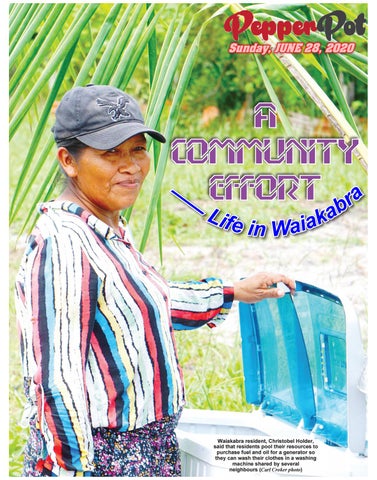
Waiakabra resident, Christobel Holder, said that residents pool their resources to purchase fuel and oil for a generator so they can wash their clothes in a washing machine shared by several neighbours (Carl Croker photo)
II
CHRONICLE PEPPERPOT ― June 28, 2020
and the
the h of grap urt of o t o o ph forec ng a t taki tue in the getown 2020) s i r u y Geor ia sta ish to bruar Engl en Victor Court in arrier, Fe Que the High ncis Q. F Fra ph by a r g o (Phot
S
By Francis Quamina Farrier
TATUES and portraits of those deemed less than admirable heroes or heroines of the past are being removed from public display in many cities and other public spaces around the USA. Over three decades ago in Guyana, the statue of Queen Victoria deemed unacceptable for public display, was removed from the compound of the High Court in Georgetown, and dumped at the back of the Botanical Gardens where it remained for many years until it was rehabilitated and returned to its pedestal once again. It now seems as though history may repeat itself. Walking along the pavement on the Avenue of the Republic in Georgetown last February, I observed a young Englishman
taking great efforts to get a good photograph of the statue of Queen Victoria with his phone. Instinctively, I took out my own phone and took a photograph of the tourist in action. A few weeks into the coronavirus lockdown, I posted that photo on Facebook. That resulted in a flood of comments, a few of which I now share with you. Victor Pires stated, “You can’t change the past. Live with it. Learn from it and don’t forget it.” Elfreda Moore St. Claire said, “She is cleaned up nicely, proud that we can boast of a clean and beautiful Guyana.” From Guyanese, Dr. Henry Muttoo in the Cayman Islands, “Francis, do you feel she should [or would] be removed once again, and placed behind the gardens?” From our own beloved musician Dave Martins, it is a matter of location, “In a colonial display in the museum, that’s the place for that statue.” The last six words come across like a refrain from a Dave Martins hit song. “Some of us separate her from the policies which she reigned over. Ridiculous! Remove the statue!” stated Albert R. Cumberbatch. Glenyss Adams-James enquired, “So who writing the petition to get the ball rolling?” Nick Harewood suggested, “Off with her head. Return her back to the [Botanical] Gardens. No, better yet, ask Hew Locke to adorn her appropriately the next time he visits Guyana.” Francis Canzius, no doubt with a heavy sigh, stated, “Some of us really don’t know what to say.” Meanwhile, Malcolm Wiltshire was more direct; “Come on Francis, that thing needs to be removed from there. Remember who put it there.” Another direct criticism was from Mohamed E. Shaw; “The point Mr. Farrier is why proudly carry the name of your slave master... Liberation starts from within.” Of course, that needed a response from me which was as follows; “Dear Mr Shaw. Please be respectful and desist attempting to speak for me. It is unbecoming of a gentleman such as yourself.” To which Mr Shaw answered, “Mr. Farrier, no disrespect meant. My apologies. I have always been a fan of yours...Tides of Susanburg, and your interesting pictures.” That gracious apology was accepted. Based in far-away Thailand in East Asia, Guyanese, Derrick John Jeffrey made the following contribution to the conversation. “I could tell you the history of Victoria, from her birth to her death. She kept a diary from an early age, until long after
her German husband, Prince Albert died.” With firmness, Michael Jordan demanded, “Off with her head!” Then, like the Balm in Gelled, Kelly Khan poured some soothing suggestions. “I have a better idea”, she commenced. “Instead of spending time, money, and efforts in trying to move her, why not do something more meaningful, like say...look at ways we can have constitutional reform?” And there was more from Kelly Khan; “Why not educate our people about our rich history? Why not work to improve our health and educational systems?” Kelly Khan had some more patriotic recommendations to offer. “Why not spend that time and money repairing City Hall?” The latter, of course, struck a chord with me, since for over 15 years, I have been lobbying for repairs to the Georgetown City Hall which is just one block north from the Victoria statue. Guyana is not the only country where a statue of Queen Victoria was cause for great controversy. Another statue of the queen evoked much controversy in Dublin, Ireland. After much debate, it was also taken down and buried. Some years later it was unearthed and shipped thousands of miles away to Sydney, Australia, where it was given a new home and a pedestal to be displayed thereon. In 1840, at age 21, Queen Victoria got married to Prince Albert of Germany. That was shortly after slavery ended in British Guiana in 1838. Amazed that the English queen, whose name was given to their village, was marrying a German, the ex-African slaves in Victoria Village in British Guiana, composed a song, which was more like an angry lament; “When me go home, me goh tell me Mooma seh, Victoria married wan German, man. German man, German man, Victoria married wan German man.” For them, Victoria had let the side down and married someone from a country which was a future enemy of England. But how did those ex-slaves in 1840 seen almost 70 years into the future with World War l and World War ll, when Germany fought two devastating wars with Britain? With the popular mood in America and other countries removing statues and monuments, will the statue of Queen Victoria here in Guyana fall a second time? Maybe the residents of Victoria Village should have a say. So too, staff and students, past and present of Queen’s College in Georgetown which was named to the honour of Queen Victoria.
CHRONICLE PEPPERPOT ― June 28, 2020
III
Lasting resilience
Cooperative Societies in Guyana Employees of the Hopetown Land Coop Society
Fishing boats moored at the Upper Corentyne Fishermen’s Coop Society Limited
Upper Corentyne Fishermen’s Coop Society (Carl Croker photos)
A
By Michel Outridge
T a time when income inequality is rising around the world, it is good to be reminded that solutions to inequality do exist. The co-operative model is foremost among these solutions, since it contains aspects of sustainable development at its core and is based on ethical values and principles. According to the United Nations, International Day of Cooperatives is an annual celebration of the cooperative movement which began in 1923 and is observed on the first Saturday of July. In observance of the International Day of Cooperatives, the Pepperpot Magazine is featuring several co-op societies across Guyana and their input to foster self-sustainable Co-ops. The Hopetown Co-Op Land Society Limited Chairperson of the Hopetown Co-Op Land Society Limited, Renai McCalmont said the co-op is 65 years old and it was officially registered on December 23, 1954. She related that over the years the Society was managed by several management committees but very little evidence of general development was seen. However, in 1994 a management committee was installed, whose purpose was to see development at all levels. In view of this, they laboured hard and dedicated much time towards the general progress of the society. McCalmont added that they then embarked on a plan to have the lots surveyed and lotted out for housing, as well as for cultivation purposes. She stated that more than house lots were lotted out and from this number, 728 were allocated and approximately 50 per cent of this amount has been transported. McCalmont pointed out that the cultivation area comprises 885 acres of state land and the society is currently in possession of a 50-year lease from the Mahaica Mahaicony Abary/ Agricultural Development Authority. She disclosed that besides this, there are also 300 acres of bonafide land all of which are being used for rice cultivation. “The Society can be considered as a progressive organisation but there are still many more developmental works to be done. We will not quit until all to be accomplished is accomplished,” she said. The office The office of the Hopetown Land Co-op Society Ltd is located at Lot 1 Public Road Onderneeming, West Coast Berbice, about 57 miles from Georgetown. The Chairperson said the building houses the business office of the Hopetown Land Co-op Society on one section. She noted that the eastern part of the building is being rented to the ‘We Care Copy Centre’, a small, valuable business to the community. The western side is occupied by the Assemblies of God Church, which pays monthly rent to the society. “The society realised that there will come a time when all the lands will be fully issued and thus there will be a need for contin-
The award earned by the Hopetown Land Coop Society
ued generation of funds. As such, a decision was taken to rent out the two sections of the building,” McCalmont said. The building of the Sunrise Supermarket was purchased by the society and has been rented to a member. The society also rents chairs and tables to the community for various occasions. “We considered this a diversification from the normal functions of the society. We can say that this society has been and is still making much progress in an effort to benefit its members and the community at large,” she said. The Aishalton Multi-Purpose Co-op Society Limited This Co-op is headed by Chairperson Beatrice Sandwell and is based in the Deep South, an isolated settlement. Sandwell told the Pepperpot Magazine that the co-op has a membership of 30 persons and they were established on June 4, 2018. The boundary is from Shea to Achiwib and they are engaged in food-processing and agriculture. Sandwell explained that because they are relatively new they have had some challenges and at present, they are non-functioning because of heavy rainfall and the equipment is down. “We plant eddoes, sweet cassava, cassava, yam, sweet potatoes, peppers and fruits and from our produce we would dry them and grind it to a powder after which it would be packaged for the market,” she said. The Chair of Aishalton Multi-Purpose Co-op Society Limited reported that they make jams from guava, pine, and gooseberry and preserve the cashews and mangoes. Sandwell added that the packaged products are all local and grown in the community and sold to a supplier in the city. “Right now because of the coronavirus and the generator being down we are at a standstill without operations,” she said. The co-op is managed by members, who do all the cultivation or buy fruits from locals to process without any funding. Sandwell disclosed that in 2017 the multi-purpose building was constructed and outfitted with a grinder/dryer for processing fruits and vegetables. However, the machine is down as well, so they have to grind the fruits and provisions manually and that is done through selfhelp by its members. She said the Aishalton Multi-Purpose Co-op Society Limited is also engaged in the school-feeding programme for nursery and primary schoolchildren in Aishalton, a far-flung community. Paradise Multi-Purpose Co-op Society Limited This co-op is under the stewardship of Gregory Mentore; it started in 1994 and was registered on April 29, 1995. Mentore told the Pepperpot Magazine that the co-op’s purpose is to allocate lands to its members as well as different activities such as cash crops and livestock rearing. He added that they have a membership of 870 and when they took office there were no lands to allocate since they had none. Mentore reported that they are trying to regularise the co-op as is, and it is managed by an executive body, but an interim
committee which consists of seven persons are in place presently. He has held the position of Chairman since last year and the makeshift office is located at Block Nine Paradise and they are opened on Saturdays from 10 am to midday. Mentore said they are looking for lands to expand into livestock rearing and farming for its members and one can become a member by filling out the form and making a purchase of 10 shares at $40,000. “To acquire a house lot means you don’t own the land but the building and the Coop functions[sic] basically on occupancy of the land,” he said. Upper Corentyne Fishermen’s Coop Society Reg. 863 No.66 Inshore Fishing Port Complex This facility is managed by Chairman Pameshwer Jainarine and it was registered since 1965; its main purpose is to provide a safe environment for fisherfolk. He told the Pepperpot Magazine that they provide all the services necessary at that location where the fishermen can moor their fishing boats, lodge their engines in safety lockers and get fishing supplies among other services. Jainarine added that all fishing equipment are on sale at the same location and they also provide a dry-dock facility for two weeks for fishing boat repairs at a fee. He explained that they have 57 active members but have more than 100 members. Jainarine disclosed that they employ more than 800 men, that is, 155 fishing boats with a five-crew member and have food and fish vendors alike at the location. “This place is safe, we have security cameras, security guards and it is gated, not just anyone can come into this place at any given time,” he said. Jainarine told the Pepperpot Magazine that fish vendors would make purchases of fish for re-sale at the facility when the fishermen return from their fishing expedition. Presently, no fishing boats are operating due to the closure of the Corentyne River as a result of COVID-19. Jainarine stated that they have a gas station, an ice factory, 150 lockers for the storage of engines and fishing gear which is rented. “We provide a safe environment at this one location for fishermen where they can access anything fishing and even rent a locker to store their engine for $12,000 per year and use the ramp as well for a fee,” he said. Jainarine added that they have 24-hour security for both fishermen and their boats and an area for food vendors and a sports club for fisherfolk. The sports club is closed but take-away service is available as a result of COVID-19 and a sink and soap station is in place for washing hands upon entry. The chairman related that the coop is managed by a seven-member management committee and elections are held annually. He stressed that due to the coronavirus, 150 fishermen are on the breadline because they cannot fish.
IV
CHRONICLE PEPPERPOT ― June 28, 2020
Full of flavour
Local business brings fruity variety to Guyanese snacks
T
By Jared Liddell
HE business world is all about being c re a t i v e a n d passionate about your products and services, and that is just the passion that owner of Pizzazz’s Forking Delishsauce Sours, Romanda Jeremie aka ‘Lisa Dash,’ possesses. Jeremie told the Pepperpot Magazine that she had the idea to start this business six years ago while she was eating snacks. She explained that she used to make sour at the time for her and her family to eat with their snacks, but never implemented anything until now. She said that once she decided that no business idea was ‘too crazy’ nothing could stop
her from realising her dream for the business. “No idea is crazy; I
learnt that when I was doing research and came across bacon ice-cream, and I told Pizzazz’s Forking Delishsauce Sours
myself if there is bacon icecream then there is really no limit for you to try something. And if someone can make the decision to make bacon ice-cream and people are willing to try it and support it, I’m sure people will be willing to support my business,” she said. Further, Jeremie stated that the process of getting her business up and running was somewhat simple as she had already been involved in the business world through her other business venture “Pizzazz’s catering.” The company produces several creative flavours of sour as a way of standing out on the market which according to Jeremie has drawn the attention of lots of persons who are usually only accustomed to mango, cucumber and tamarind. She further stated that she started with six flavours and intends to add more sour flavours as the business continues. “Currently I have six flavours, passion fruit, cherry and pineapple, as well as the good old mango, cucumber and tamarind but I’m actually aiming to introduce all the local fruits you can think o f , from five
Cherry, pineapple and tamarind flavours
Proprietor of Pizzazz’s Forking Delishsauce Sours, Romanda Jeremie aka ‘Lisa Dash’
finger to gooseberry and even soursop,” she said. “Every single fruit that I can experiment with and come up with a really nice flavour that is unusual and eye-catching and delicious that is what is going to be there; but for now, those are just the flavours that I opened with and I’m gonna be adding as I go along.” Jeremie told the Pepperpot Magazine that she ensured she invested in getting creative and eye-catching packaging as a way to promote her products and give them a level of professionalism and flair. She also added that she moved in that direction for her packaging because she intends to take her products to local supermarkets as a way to reach a larger demographic.
“What I wanted to do first was introduce this product to the public, because it’s not really something that you’d come across; so my intention was to have it in supermarkets which I already have lined up, but I want the public to be aware and interact with it and actually try it and say well, ‘oh yeah this thing is good and if it goes into supermarkets I will actually be buying it very often,’ so my method was to get it introduced first that then move to supermarkets.” Jeremie stated that her products which come in three sizes are very affordable, ranging from $800 to $1200. When asked what piece of advice she would give to other entrepreneurs, Jeremie said, “If you have an idea and it’s somewhat unique and you’re passionate about it, you should definitely go for it, follow your vision and you will achieve whatever you set out to achieve.”
CHRONICLE PEPPERPOT ― June 28, 2020
Up-and-coming Blairmont cricketer willing to put in the work
Nigel Deodat playing the game he loves most
N
By Marissa V. Foster
IGEL Deodat is an 18-year-old up and coming cricketer from the village of Blarimont, West Berbice. It is a village that is mostly known for its sugar estate and its rich preservation of the Indo-Guyanese culture. Deodat hopes he can add his cricketing ambitions to that list. At the age of five, he lost his father. He found comfort in holding a bat and ball and at the age of 13, he started to take the game more seriously. Deodat alongside his coach worked tirelessly. He explained that “My coach and I took it step by step. Through that hard work, I managed to play for the Blairmont Blazers. I also represented Guyana in all junior levels.” Nigel played for the Guyana under-15 team in 2016 and played for the Guyana under-17 team in 2018 and he was also on standby for the Guyana under-19 team as of last year. Deodat mentioned that
last year was quite a tough year for him. “It was tough because although I worked and practised very hard, I did not get selected but that did not break me”. Deodat further stated, “I used it as my motivation now to keep doing better than before and I am now learning from my mistakes of last year to do better this year.” This cricketer wants young cricketers like himself to use his story as an example to always do better; to know that they should keep on trying and pushing forward, even if they’re not selected when they’d hope to be. Deodat is a bowling all-rounder at the county level. However, at the club level, he is the opening batsman for the first division selection of the Blairmont Blazers. His best score is a whopping 132 against the team of Bushlot, while his best bowling figures are 8 for 38 against the West Berbice Cricket Team. Nigel is adamant that cricket administrators must organise junior competitions for youths like himself to be active and to play for a greater purpose. This will
encourage the “youngsters” to keep playing the game and will give them the motivation to progress for their future careers in cricket. He would also like to ask that administrators and boards donate more cricket gear to those young and upcoming cricketers like himself who cannot afford it. He stressed that while it is one’s talent that makes one a good cricketer, personal gear also improve one’s skills and confidence. Cricketers also need sch gear to stay protected; especially in light of COVID-19, it is always better to have your own equipment. Nigel is striving to make his name known in every household across Guyana. He is hopeful that he can put his village Blairmont on the map and that one day he can give back to the people there who have made him who he is today. He is also grateful for the love and support he’s received from the women in his life; his mother and grandmothers, while not forgetting that God is his main motivation for his past and future successes.
Nigel Deodat
V
Upcoming cricketer from Blairmont, Nigel Deodat (source Nigel Deodat)
VI
CHRONICLE PEPPERPOT ― June 28, 2020
Are we rushing to get students back into schools?
R
EPORTS of two children in Region Nine testing positive for the novel coronavirus has caused me to revisit my earlier thoughts on whether Guyana and other countries in the Caribbean have been rushing to reopen schools. Whether this is an unpopular opinion or not, it should go without saying that ensuring the well-being of all children should be paramount. Though studies show that children are less susceptible to the severe effects of COVID-19, jeopardising their health in any way is inexcusable. Furthermore, it has been emphasised that children may be ‘carriers’ of the virus, and though asymptomatic, they may pass it onto older persons who are more susceptible to the moderate to severe effects of the coronavirus. A few weeks ago, the announcement was made that the National Grade Six Assessment (NGSA)-- Guyana’s Secondary School Entrance Examination-- would be held on July 1 and 2. This was met with mixed reviews from parents and teachers. Some were satisfied with the sanitisation efforts that would be made and were happy that schools would be reopening and that pupils could take this ‘high-stakes’ examination that they have spent years preparing for. I spoke with a teacher in Region Nine who highlighted that she was both satisfied by the physical-distancing measures put in place at her school for the children and the sanitisation that was done before and after classes. Moreover, just being able to teach her pupils once again was welcomed by her as many of her pupils lived in surrounding but distant communities, where internet access was quite limited. For her, online teaching was almost impossible. Others, including the Guyana Teachers’
T
Union (GTU), were not as enthused. When the schools reopened on June 15, some teachers told me that they stayed home in protest. These teachers believed that a premature decision was made to reopen the schools and even to have these examinations as early as July. I understand the logic of reopening schools and not postponing the NGSA for much longer. Essentially, there will be a shift in the upcoming academic year. And that will have a ripple effect on this batch of pupils, moving forward. I am also very conscious of the very real struggles of children, parents, and teachers as they contend with the education disparities in Guyana-- virtual classes is a fleeting thought for many.
my opinion that as a country we need to get a better handle on COVID-19 before reopening schools, or anywhere for that matter. Last week I tuned into a webinar that discussed the decisions being made in Trinidad and Tobago, Barbados and Guyana for the administration of the Secondary Entrance Examinations. Like Guyana, these countries will be administering their examinations in a shorter period, instead of waiting until next term as the earlier discussions suggested. An important consideration in this webinar, also, was the lack of emphasis on children’s mental well-being. Trinidadian Psychologist Dr. Margaret Chatoor emphasised that children are inherently social beings with social needs.
However, I have become very concerned following the positive cases of the two children in Region Nine who reportedly came over from BonFim, Brazil, to attend classes. The alarming number of cases in Moruca, Region One, many of which have been contracted from teachers, is also concerning to me. It is
And being at home for about three months and being put into the school setting once again, just before these ‘high-stakes’ examinations does not augur well for their mental well-being. She contended that much more consideration should be given to how children should be reintegrated into the school system, and
reintegrated while the pandemic still ensures. Specifically, in the Guyanese context, a Guyanese student attending Harvard University, Shawn Shivdat, noted that Guyana’s electoral process has placed some amount of anxiety on the population at large; children have not escaped this. This focus on the mental well-being of children and their social nature is something I believe should be explored further. Even further, I recall the teacher in Region Nine explaining to me that while the classroom setting has augured well for physical-distancing guidelines, during the shortened lunch break or even before and after the class sessions, naturally, the children congregated in groups. How then, do you impress upon children the importance of staying physically distant, when they just really want to ‘lime’ with their friends after being away for so long? In April, local paediatrician Dr. Hardat Persaud explained that focus on children should not be neglected as the country contends with the epidemic. He advocated for the empowerment of children so that they are aware of the role they also play in mitigating the spread of the virus. Empowering children, according to him, includes teaching children how to wash hands effectively (that is, with soap and for at least 20 seconds as outlined by the WHO); encouraging them to sneeze or cough into their elbows or sleeves; and, keeping a physical distance from older folk like their grandparents. Recent events have emphasised that we ought to revisit how we are reopening schools and have spotlighted the need for much more emphasis on children. I hope this is done. If you would like to connect with me to discuss this column or any of my previous works, feel free to email me at vish14ragobeer@gmail.com
The preservation of teeth
HIS week marks 26 years since I started this weekly column. Back then in 1994, the column was named The Dentist Speaks and in my accompanying picture, I sported an afro hairstyle and a beard. Notwithstanding, over the years, my central theme generally remained the same. From a philosophical standpoint, two very important facts must first be considered when contemplating oral health. The first fact concerns the role of the dental practitioner. While it is quite common for Guyanese to associate dentists with the extraction of teeth, the fact is that the dentist should be associated with exactly the opposite, that is, with the preservation of teeth. So, persons should consider as a matter of priority the conservation of their natural dentition rather than taking the radical approach of extraction which they could invariably regret. The other critical point is that while the most common disease affecting mankind today is dental caries (tooth decay), it can hardly be expected that the number of dental personnel
accessible to the public is adequate. Further, the cost of dental services universally is exorbitant, a reality that more than ever justifies a preventive approach to oral disease by every individual. As a former senior administrator in the public sector, I can say that convincing the politicians who are responsible for appropriating funds for capital expenditure is no “walk in the park” as dental disease is not commonly given importance simply because no one dies from it. Fortunately, it is theoretically possible to never visit the dentist and yet have a healthy mouth. Dental problems are made simple because nearly all dental diseases originate from a single cause. That cause is known as bacterial or dental plaque. It is a sticky, transparent film formed by saliva itself and which covers the teeth. Special types of bacteria (germs) found in the mouth live in the plaque and feed on food remnants, especially sugar and starch. The bacteria which inhabit the dental plaque convert sugar to acid as part of their natural digestive process. It is this acid that damages the enamel surface of the teeth when
it is allowed to be exposed to it for more than 48 hours. What happens is that acid has the property of removing calcium from tissues. The hardness of teeth and bone is due to their high content of calcium. Therefore, when the calcium is removed from the tooth surface it becomes soft and pitted. This process continues and a cavity is formed. The cavity is called a carie. You can recognize caries in your own mouth by checking on the surfaces for brown or chalky white spots. On the back teeth, called premolars and molars, the initial stage of decay appears as dark lines and patches occupying the fissures (grooves) and fossae (pits) of the occlusal (biting) surfaces of the teeth. The younger the person the easier it is for the teeth to decay. The most important aspect of oral health education is the effective control of plaque. Remember it is not how often you brush or floss that matters but how thorough you do so.
CHRONICLE PEPPERPOT ― June 28, 2020
VII
Waiakabra Village (Carl Croker photos)
Focus on the Village
T
By Michel Outridge
HIS week the Pepperpot Magazine visited the community of Waiakabra,Soesdyke-Linden Highway. The village is located at Ideal Road and is home to about 500 residents of mixed ethnicities, most of whom are from Region One, Eight, Nine and farther afield. Waiakabra was formerly called “Roberts Bush” community, but the name was changed to Waiakabra when the Community Development Council (CDC) was formed on July 11, 2017, by a group of residents. The w ord Waiakabra means ‘getting together as one’ and the village comprises 14 blocks and is divided into two sections: the regularised and unregularised areas. The village is located about a 15-minute drive from the junction on the Soesdyke-Linden Highway and is between Hill Foot and Yarrowkabra. It is home to Camp Kayuka and four sandpits and the main access road, which was once an all-weather road has deteriorated to a sand-loom one which is impassable in sections, as such, the team could not journey to Camp Kuyuka. Waiakabra also has two CDC groups and the residents are farmers and others go out of the village to work, while some are employed on poultry establishments and large-scale farms.
In Waiakabra there are lots of foliage and trees, many of which are fruit trees, planted in the yards by residents and is home to the biggest passion fruits. The regularised section of this village has electricity, while the other section is without, and residents have been trying to benefit from this basic necessity since 2013. Waiakabra has potable water supply and some villagers make do with makeshift houses and cottages, while there are also some large edifices within the community. The community has a Community Centre building
but no schools; children attend the schools nearby in Kuru Kururu. The people of Waiakabra are friendly and some have invested in small businesses. The Village Leader The Pepperpot Magazine met the Village Leader Lloyd O’Selmo who has had that position for the past three years. He reported that most of the inhabitants of Waiakabra work outside the perimeters of the community and some are miners. O’Selmo disclosed that 15 years ago he left his hometown of Matthews Ridge, Region
One (Barima-Waini) because he wanted his children to benefit from tertiary education; a decision he made with much thought but has not regretted the move like many others, who also relocated to the quiet village of Waiakabra. The village leader added that some lands in the village are privately owned and as such, some residents do not have leases and cannot access a loan from the bank to upgrade their accommodation. “There are land issues that have engaged the Lands and Survey Commission for many years with the private owners and we would like it to be
resolved,” he said. O’Selmo is a member of the CDC which is made up of four members and he is a miner, who has turned construction worker. He disclosed that within Waiakabra 30 families have electricity and he is still trying to make representation for the villagers. He pointed out that under the stewardship of the Ministry of Indigenous People’s Affairs they have benefitted from a community centre which is 95 per cent complete. The construction of the multi-purpose building was done three
years ago and it is outfitted with solar equipment. “I did approach Food For The Poor (FFTP) to assist villagers with better houses, but they did not meet certain criteria and that did not materi-
Village Leader Lloyd O’Selmo
Home of Lloyd O’Selmo
alise,” he said. O’Selmo reported that Waiakabra is home to a doctor, nurses, teachers and other professionals, including his four children. “One of my daughters is a teacher and the other has just enrolled in nursing school, while one of my two sons is a contractor and the other works with Gafoor’s. O’Selmo stated that his children had sound education and they have developed skills to be gainfully employed and that was his main reason for leaving his hometown of Matthews Ridge.
VIII
CHRONICLE PEPPERPOT ― June 28, 2020
Waiakabra o b t e g t t n e i r o l g i v n e o l i s h t o c e ods j o r P
A
By Michel Outridge
NN Mohanlall i s a re s i d e n t of Waiakabra Village located on the Soesdyke-Linden Highway and she is the Secretary of the Community Development Council (CDC). Like many others, she too relocated to the village in search of a better life. She hails from Hosororo Hill, Mabaruma, Region One (Barima-Waini) and moved to Waiakabra in 2016.
Mohanlall told the Pepperpot Magazine that she is farming at Swan--a neighbouring village--as a form of income to the home. The mother of four related that things are difficult at times. Currently, she depends on rainfall for water to cook and do other household chores, because her water bill was disconnected in December . “When it doesn’t rain we have to walk a mile away to the nearest creek to source water for use,” she said. Mohanlall pointed out that there are no available lands in Waiakabra and any new
residents come to reside only if they marry into the village. “People from all over the country, including Regions One, Eight, Nine, and even in the city has [sic] made Waiakabra their home,” she said. The resident of Waiakabra told the Pepperpot Magazine that they had the Hinterland Employment and Youth Service (HEYS) programme in the community whereby scores benefitted and graduated.Mohanlall stated that the HEYS programme started in September 2017 and the young people participated. Through the HEYS programme, thousands of Guya-
Waiakabra Community Centre
Focus on the Village
nese are being empowered as the government continues to build capacities in the areas of business, entrepreneurship, agriculture, ecotourism and technology in hinterland communities across the country. That programme was held at the Waiakabra Community Centre, for which Mohanlall is the overseer.
all residents. Mohanlall said it is their bit to flatten the curve and reduce the spread of the coronavirus within their village. The initiative was well received by locals and the young women were commended for the part they played in the exercise. She related that just like
Ann Mohanlall
FACE MASKS-MAKING AND FREE DISTRIBUTION The mother of three told the Pepperpot Magazine that as part of giving back to the community, two young ladies of the village have dedicated their time and service to sewing 400 fabric face masks. “This happened at the Waiakabra Community Centre where they have sewing machines and it was utilised to sew the face masks,” she said. The Community Policing Group and the Church of Christ and another one collaborated and assisted the young women, who, after the preparation, made a free distribution of fabric face masks to
the fabric face masks project, the residents need other similar COVID-19 relief, since some are barely getting by and many are on the ‘breadline.’ Mohanlall said being a mother of four, she is managing a farm with support from her family and that is their only source of income. She, like many others, is in the same position financially, but they try with whatever they have to ensure nobody goes to bed on an empty stomach. “Some people in this village is very needy and it would be nice if organisations or others can assist in any way possible, because they have a large population of children,” she said.
CHRONICLE PEPPERPOT ― June 28, 2020
IX
Making full use of their skills
Staying productive to enhance the village
C
By Michel Outridge
ALVIN Smithet wanted a better quality of life for himself and family; as such, he left his home village Matthews Ridge, Region One (Barima-Waini). Today, eight years later, he has a home in Waiakabra Village, located on the Soesdyke-Linden Highway, a quaint hilly community that is sandwiched between Hill Foot and Yarrowkabra. He describes life in that neck of the woods as great, because he has a small business that is operated by his wife and he has a thriving garden in his spacious backyard. Smithet told the Pepperpot Magazine that it wasn’t easy to leave his village and move to another and that he had to start from scratch, but it was worth it. He has a house and they sell cold beverages, confectionery and vegetables at their small roadside stand in front of their house. The father of three related that life in Waiakabra Village is like anywhere else, because you have to work to earn, to adequately provide for your family. “Things okay here, but my main concern is to have electricity like others in this village and with the four sandpits at the back of the village as you can see, the road is now sand since the once all-weather road was destroyed by the large trucks traversing there every day,” he said. Smithet added that they have cellphones with both GTT and Digicel networks, but no internet hub f o r
the schoolchildren, but that they have potable water supply which is a blessing. “Recently, a garbage disposal service came to the village so that is a paid service so people here don’t really dump rubbish around, as you can see the place is clean and we promote cleanliness,” he said. Smithet related that a lot of people pass through the village because they have Camp Kayuka at the back, but often some cannot reach the location because the road is in a bad state. “The people here are ordinary folk, who make a living by working on farms and others go outside the village for work with some private companies and some plant,” he said. He has a budding garden in his backyard, full of vegetables such as bora, calalloo, peppers, banana, and tomatoes among other crops. “We are contented and we try to make a living because you cannot sit down and complain, you have to work, do something to bring in a dollar in the home to get by,” he said. Smithet and his children would plant in the backyard, while his wife manages the roadside stand they have. The Mechanic of Waiakabra The Pepperpot Magazine during the visit to the community also met Lorenzo Kellman, a mechanical engineer, who was still celebrating Father’s Day with a friend. The duo were having some alcoholic beverages, chatting and playing music from a bluetooth music box via a cellphone, under a shed
in the community. The 46-year-old reported that he was not working that day and having enjoyed the Father’s Day celebration with his family, it was a held-over event. “Life never have a problem with me, you have to apply yourself and do something to earn because things change and it doesn’t remain stagnant all the time,” he said. Kellman told the Pepperpot Magazine that in 1990 he enrolled at the GuySuCo Port Mourant Training Centre, Berbice. Four years later, he graduated as an Agricultural Mechanic and today he earns from that skill, fixing machines and other things within the village and its environs. “I had the potential and I was encouraged to pursue higher education and here I am today, fully dependent on myself and earning, more so, working with myself,” he said. Kellman added that since he was a child, he had the presence of mind to fix things and his mother used to call him “Home Care” because there wasn’t anything broken in the house he couldn’t fix. “You see everybody born with a talent, so they have to explore the possibilities and apply themselves. Practice makes perfect and you have to perfect that skill and there you have it, an ingrained gift that you can earn [from],” he said.
Calvin Smithet in his backyard garden
o Ke
Lorenz
Focus on the Village
s)
er photo
ok Carl Cr llman (
Waiakabra Village
CHRONICLE PEPPERPOT ― June 28, 2020
X
Focus
Camp Kayuka Signage (Source: Roman Catholic Diocese)
Focus
on the Village
on the Village
A trail leading to the camp (Camp Kayuka FB page)
W
By Michel Outridge
A I A K A B R A Village, located on the Soesdyke-Linden Highway, is home to Camp Kayuka, a church-based facility which offers the ambience of nature and a cool, undisturbed creek. The place is nestled among tall trees against the backdrop of a creek, making it the ideal place to soak up the scenery and admire the many birds and other animals that are there. Camp Kayuka is also a
wildlife paradise and a peaceful place for church and other events. It is about a mile in and has a creek with comfortable accommodation. The road to get there needs repairs, however, as a result of heavy-duty trucks and other vehicles traversing on a daily basis to access the four sandpits behind the village. The place is secluded and is away from the daily ‘hustle and bustle’ of everyday life and happenings. Camp Kayuka can be reached with a four-wheel drive vehicle or other large ones because sections of the
Camp Kayuka (Camp Kayuka FB page)
sand-filled road are impassable to cars and other lowrise vehicles. Even though the camp isn’t frequented by locals, it is visited by others, especially church folk who would make the journey to have a pleasant out-of-town gathering. It is the perfect place for relaxation and camping and it provides a nature experience. Camp Kayuka offers both indoor and outdoor relaxation. One can take a dip in the cool (black) creek water and even overnight in their comfortable private huts or camp outside under the stars. According to Anneda Bacchus of the RC Bishop’s Office, Kayuka, the name is derived phonetically from the first syllables of Catholic
Youth Camp. This camp is situated on the northern bank of the Madewini Creek in the Soesdyke area. She related that the camp was the brainchild of a Jesuit Priest, Fr. Andrew Morrison, who was very much involved in Youth Ministry and wanted to establish a training facility for Catholic youths, away from the city. In 1962, he was able to identify a 10-acre plot of land in a secluded, wooded area as the ideal camp site. He was later able to acquire a lease and the area was developed with the basic infrastructure to facilitate camping, retreats and other church-related activities. Bacchus added that in 1963 Camp Kayuka was commissioned by Bishop Lester Guilly and declared
opened. It was used by the scouts, parishes and youth groups for formation and retreats, and recreation for Catholic families. However, over the years there were many challenges but nevertheless, the committee always managed to keep Camp Kayuka afloat by God’s grace, Bacchus noted. Today, the facility is extended to other Christian denominations, government and non-governmental organisations and service clubs for hosting workshops, seminars or recreation. It can facilitate a capacity of about 100 persons at any given time and there is also a caretaker family, who looks after the maintenance of Camp Kayuka.
CHRONICLE PEPPERPOT ― June 28, 2020
XI
Working together for a common goal
The industrious women of Waiakabra
A
By Michel Outridge
LICIA O’Selmo was just eight years old when she left their home village of Matthews Ridge, Region One (Barima-Waini) and relocated to Waiakabra Village on the Soesdyke-Linden Highway with her parents. Today, she is very happy; her father decided to move because she is a teacher in training and had she remained
School, Grade Three. O’Selmo is a student at the Cyril Potter College of Education (CPCE) and she is in her first year, in the twoyear programme. “The most challenging part is the commute to and from Timehri Primary School to classes at CPCE, Turkeyen, East Coast Demerara, daily. By the time I get to class, I am so tired and then after to make the journey home again, but I am trying because I don’t want to live in the dormitory,” she said.
level. Her sister has expressed interest in the nursing profession and she has enrolled for the course, while her brothers are gainfully employed. She describes life in Waiakabra village as quiet and peaceful and she likes it there.
that she has been a resident for 14 years and she came from Lethem. She left her hometown like many others in search of
ents passed away and here I am,” she said. The 46-year-old added that she and the neighbours would come together and
time, since we don’t have electricity,” Nekita Rodrigues said. The mother of two reported that they would use a
Nekita Rodrigues bathing a child (Carl Croker photos)
COLLECTIVE EFFORT Christobel Holder and Nekita Rodgrigues are residents of Waiakabra village and they are neighbours. Christobel was doing the laundry via a washing maThe generator
Christobel Holder Alicia O’Selmo
in Region One, the possibility exists that may not have materialised. LIVING HER DREAM The 23-year-old always wanted to serve her community; even as a child growing up, she knew she wanted to become a teacher. O’Selmo recalled she used to attend the Kuru Kururu Primary School and after writing the Common Entrance Examination, she secured a place at Diamond Secondary School. After some time, she enrolled in a private school but quit after she wasn’t comfortable there and after time elapsed she applied for a job as a teacher. She was successful in her application and today, she is a teacher at Timehri Primary
She has been a teacher at Timehri Primary School for 18 months and she is enjoying her job to the fullest because it was what she wanted to do. “Teaching is very fulfilling for me because I impart knowledge and it makes me feel good about myself and serving my community at the same time,” she said. O’Selmo stated that she is doing well at the primary level at teaching and who knows maybe after becoming a qualified teacher she might try her hand at the secondary
Cooling off on a hot day in Waiakabra
chine which was set up near a generator, while Nekita was bathing her son. Holder stated that she used to sell vegetables, but with the coronavirus she was forced to quit and is at home. The mother of five related
a better life and has a kitchen garden in her backyard; the produce is sold to upkeep the home financially. “My family left Lethem when I was a child and we relocated and that’s how we ended up here; sadly, my par-
purchase fuel and oil for the generator, so they wash. “The cost for the oil and fuel for the generator is around $7,000 per week and we would wash and put on the light in our houses at nights, but up to a certain
Focus on the Village
pail of gas per week and it is sourced at the junction. She noted that one person alone cannot afford to make that gas and oil purchase, so they collaborated. The 23-year-old stated that her husband is a woodcutter and is away at work up the Demerara River, while she is a stay-at-home mom. “Around here we have to live nice because without cooperation we cannot do it alone and that’s how things are here in Waiakabra, we are simple people,” she said. Rodrigues told the Pepperpot Magazine that she benefitted from skills training which was ongoing, but due to the epidemic, they had to cease classes of sewing, handicraft and cooking, at Kuru Kururu.
XII
CHRONICLE PEPPERPOT ― June 28, 2020
d n i M e t i The Wrby Jasmaine Payne
I
HAVE this ultimate goal that someday, with the right support and investments, I would like to launch my very own Writing Competition in Guyana. This goal was birthed from my wish to see more such local competitions. Writing competitions help to motivate writers and push them to exercise their talents- bringing worthwhile recognition should they emerge successful in the end. In my creative-writing career, I have entered only a handful of competitions. Many of the competitions I have come across request full-length manuscripts which I have never been able to compile, while short-story competitions often challenge me because I was never truly a short-story writer. But over the years, while winning was never my goal, entering those competitions (The Commonwealth Short Story Prize and the Guyana Annual Writing Competition included), have allowed me to exercise my writing muscles in ways in which I am usually too lazy to pursue on my own. The writing competition I aim to establish within the next five years, however, will seek to focus more on skills development rather than publishing. I find that while publishing is a highly sought-after reward, a fledgeling writing industry such as ours -- which lacks basic institutional support and investments-- should instead seek to sharpen the raw skills of our talented writers before looking at publishing. Besides, with little to no local publishing options, such a reward is oftentimes one-off and short-lived, with monetary rewards being the only other thing the winners have to show for their work. How does that saying go? “Give a man a fish and you feed him for a day; teach a man to fish and you feed him for a lifetime.” That adage is a perfect example of what I aim to achieve. Giving our writers skills to forge forward in their writing journey is much more valuable, I believe, than giving them one-off recognition by way of publishing their work. Of course, we must also continue to provide publishing options so that writers have some means of getting their work out there, but more options should also be provided to train them so
that when they do seek to get published, their work reaches a standard that can help them to eventually penetrate the regional and international literary markets. But, alas, my own ideas are still swimming in my brain and under development. So I shall bring you more on that later. In the meantime, I decided to provide some free writing competitions that writers looking to whet their appetites can peruse during their spare time: THE BCLF CARIBBEAN FICTION WRITERS COMPETITION The competition seeks to recognise published and unpublished writers with Caribbean roots. The BCLF Elizabeth Nunez Award for Writers in the Caribbean will select and award the best short story by a writer living in the Caribbean while the BCLF Elizabeth Nunez Caribbean-American Writer’s Prize award will go to the best short story from an unpublished Caribbean writer residing in the North-American diaspora. The theme for this year’s competition is ‘National Language: Prose, Poetry and Sound’. Entries are open until July 1, 2020. For more information, visit www.bklyncbeanlitfest.com . THE COMMONWEALTH SHORT STORY PRIZE This is an annual competition that invites unpublished short fiction from natives from commonwealth countries. The 2021 Prize will open for online entries from September 1- November 1, 2020. Winners can earn up to £5,000. It’s a prize that sees pretty stiff competition every year. Last year, Guyanese writer Kevin Garbaran was shortlisted from among over 5,000 entries for his piece ‘ol’ Higue on Market Street.’ For more information on this competition, visit www.commonwealthwriters.org . THE QUEEN’S COMMONWEALTH ESSAY COMPETITION This is an extension of the Commonwealth Short Story Prize that offers young writers up to 18 years of age to write
essays on key global issues according to a specified theme. Past themes have included: A Connected Commonwealth (2019) Towards a Common Future (2018) A Commonwealth for Peace (2017) and ‘An Inclusive Commonwealth’ (2016). Entries for the 2020 competition are open until 17:00hrs GMT on June 30, 2020. For more information, visit: www.thercs.org . THE GUYANA ANNUAL COMPETITION This competition awards a cash prize and a chance at having your work published in their magazine. The competition usually opens at the beginning of the year and welcomes entries for junior and open categories in Short Story, Poetry, Playwrighting, Visual Arts, Photography, and Cartoon and Graphic Short Story. For more information, visit www.theguyanaannual.com . THE ALPINE FELLOWSHIP WRITING PRIZE Open to all nationalities from persons 18 and above, this competition welcomes unpublished entries from all genres up to 2,500 words. The winner receives £10,000 and an award while the second and third prizes receive cash prizes of £3,000 and £2,000, respectively. The 2021 competition will open in January next year. For more information, visit www.alpinefellowship.com . I urge local writers to continue sharpening those skills and to keep at their writing projects. And, by all means, take a chance at one of these writing competitions just to say you did it. Many of the competitions around the world are exclusive to persons in certain territories, so when we find competitions that are open to Caribbean writers, we should jump on them! Who knows, you may very well surprise yourself and win.
Good luck! Interested in contributing to this column on writing? Email me at thewritemind592@gmail.com
CHRONICLE PEPPERPOT ― June 28, 2020
XIII
Women possess unbelievable inner strength and can learn so much from each other
Women possess unbelievable inner strength and can learn so much from each other
She was powerful not because she wasn’t scared, but because she went on so strongly, despite the fear.” – Atticus
L
ast week, I shared some information regarding the upcoming Women Across Borders Free Virtual Event from July 7-10. My first anthology was Women Across Borders –Fulfilling Purpose featuring co-authors from Guyana, USA and the French and English Caribbean. The foreword was done by phenomenal Dr Elayne Anthony from Jackson, Mississippi, and was the first African-American female to anchor a newscast on WJTV which was a CBS affiliate. Dr Desiree De Florimonte was one of the co-authors and went on to publish her own book since and she is sharing her experience. “It was an honour to be invited by Sonia to be a co-author of Women Across Borders: Fulfilling Purpose. Initially, I was apprehensive about writing but became very enthusiastic during the process as I shared my voice and claimed ownership of my life. Between the hours of 9:00 pm and 1:00 am was the time I was most creative and the words simply flowed as I told my story. I felt fulfilled and grateful for the experience to collaborate with some phenomenal women on the project. Thanks again Sonia!’ Women Across Borders with a mission was the second anthology and we featured co-authors from Africa, Venezuela, USA and the Caribbean, including Suriname. Ediclia Bastardo not only co-authored the book but translated these anthologies into Spanish and she is on her second book. “Participating as a co-author and translator in the Women Across Borders an-
thology has been decisive for me. It was the first step in achieving one of my life’s goals, to become a writer. I learned the story of wonderful and brave women who through pain have become the best versions of themselves. This project represents a high motivation to continue writing and positively impacting the lives of other women. “Writing a chapter on my story was so empowering and it really made me happy to know that my experiences could really impact another woman in her lowest point. I would encourage every woman and man to tell their story, we all have one, and it’s liberating” Bethany Love Hanna I admire these women for taking the bold step to write and publish their books. One of the objectives behind these anthologies was to give them the confidence to write their own books. I must thank my friend Dr Linda Wallace for contributing the foreword. Sometimes we have to die inside in order to rise from our own ashes and gain confidence in ourselves and love ourselves beyond words. Some of the stories shared in my third Rising from the Ashes reflect this and it was therapeutic for many. The Dynamic Dr Anna McCoy contributed the foreword. Three of these inspiring women shared what the experience was like. “I would encourage everyone to write their story. It is one of the most cathartic and most intentional ways to grow. Writing my story gave me the opportunity to make that journey from the head to the heart and powerfully connect to my authentic self. By writing our old story, we find ourselves in the midst of a new story, one in which we
have the freedom to unlock your innermost potential. Finding similarities with other people helps us live happy and healthy lives. Your life may feel ordinary to you, but it might seem extraordinary to someone else. Every story shared is a chance to make someone feel less alone.” Dr Safeeya Mohammed. “I am beautifully broken and elegantly remoulded. My journey during the writing of my piece was therapeutic. It has allowed me to fully comprehend the words of God: ‘All things work together for GOOD for them that loves[sic] the Lord and are called according to His purpose.’ God prepares us for the life he calls us to live. I am so grateful to learn that my destination is intertwined into my willingness to forgive.” Walterine Mc Leod “When asked to be a part of the anthology for Women Across Borders, at
first, I was excited. Then I began to think, what I could possibly write that would impact others in a positive way? There were so many things that went through my mind, but none seemed to be impactful. I then decided I would not be a part of the anthology. If you know Sonia Noel like I have grown to know and love her, not doing something is just not a part of who she is. God placed a light in her like no other. So, I went back to the drawing board in my prayers and remembered something God had given me a year prior when visiting Guyana. Not writing now seems like it was not an option for me. Remembering, the things that God gives us in prayer and in life are not just for us. It is important to remind others that they are not alone and that all things are possible
Beyond the Runway with Dr. Sonia Noel ... Inspiring lives through fashion through Christ. I thank Dr. Noel for her passion and persistence. As I read the stories of the other women, I too remembered, I am not alone. Through writing my story and my part of Women Across Borders, has awakened a part of me I had long forgotten. Writing is a way of remembering, encouraging, and healing. Thank you, Ms. Noel for the opportunity to share and be a part of Women Across
Boarders!” Every life has a story and only you can tell your story the way it should be told. If you are interested in writing a chapter in the upcoming anthology or need info on the virtual event email anthologymenandwomen@gmail. com Own your story as we continue to celebrate this beautiful journey called life BEYOND THE RUNWAY.
XIV
CHRONICLE PEPPERPOT ― June 28, 2020
Joy amidst sorrow
A
T the end of the national and regional Elections fiasco, there will be mixed emotions across Guyana as we will have a victor and a loser; in other words, there would be joy amidst sorrow. Many Guyanese will need counselling because the final results may affect their mental health. I can only pray that sadness does not turn into wrath and that wrath doesn’t lead to violence. Earlier this week, I came across a graphite and colour-pencil drawing by Stanwyk Cromwell entitled ‘Joy in the midst of sorrow.’ I felt it would be fitting to write about it, given our current state of affairs. The subject of this drawing is a woman. Seated in a frontal portrait position, she appears to be sad or deep in thought. Her skin and clothing are heavily textured and is shaded brown. To the left of her face, is a drawing of her side profile that is shaded using grey
I
N T E R N AT I O N A L Climate Change Day is celebrated every year on June 21. This year the theme is, “Climate Change and Environmental Challenges”. Climate change is the defining issue of our time and we are at a defining moment. From shifting weather patterns that threaten food production to rising sea levels that increase the risk of catastrophic flooding, the impacts of climate change are global in scope and unprecedented in scale. Without drastic action today, adapting to these impacts in the future will be more difficult and costly. The evidence of climate change is compelling: sea levels are rising, glaciers are retreating, precipitation patterns are changing, and the world is getting warmer. According to the Intergovernmental Panel on Climate Change (IPCC), the current rate of greenhouse gas emissions is likely to cause average temperatures to rise by 0.2?C per decade, reaching by 2050 the threshold of 2?C above pre-industrial levels. Yes, we know that
tones. Her facial expression in the side profile represents a proud woman. This side profile is larger than the portrait position. She is wearing a headwrap that is rich in colour. We see some of that colour recurring throughout the drawing in the form of motifs (a decorative image or design). She is an elderly woman. Stanwyk noted that grandmothers of colour have always had resilience, despite their current situation. That was one of the few things afforded them and of course, their trust in God. In my opinion, the message of this drawing is one that demonstrates that “… weeping may endure for a night, but joy comes in the morning.” Psalm 30:5. While his focus is on women of colour, being resilient applies to persons of every race and stage. We are all overcomers. Bad experiences should make us stronger and wiser. As we learn from our mistakes, we should share our knowledge with others. Our reaction to adversity should not remain
t h e same. At some stage, we should demonstrate growth and a deeper understanding of how things work. According to Stanwyk, this piece started with random lines. “I go about my art as I drive. Before GPS, I used to get lost all the time. I still do. But I discovered, even when I’m lost, I’m not. It’s just another opportunity for me to discover a new route.” He further went on to state that he conceives his artwork through his mind’s eye. Even though he relies on his natural eyes for physical guidance, it is his mind’s eye that helps him navigate his work through the corridors of his mind. “It is this sense of carefree attitude that fuels my creative drive.” At the beginning of his art career, Stanwyk was a realist artist, eager to capture likeness and reality as seen through the natural eye. As he grew in his craft, he began to explore alternative perceptions. I have never seen his realist works, but I am impressed by his current artworks. For this particular
piece, I see a combination of both techniques. Like many artists, Stanwyk’s work would go through several stages. At times, a piece would be left incomplete. He would later revisit it. Such is the case of this drawing. While he is attracted to creating random lines, he intended to juxtapose joy and sorrow, using colour and form. “I have always admired the way that Elizabeth Cattlet utilised strong geometric shapes and colour.” He said. Initially, when I saw the drawing, I assumed that Stanwyk used a textured surface. However, after closer examination, I recognised that there were different textures throughout the artwork. The dispersion of these textures could only be achieved through the skill of the artist. His use of geometric shapes is also very skilful. Although the lines on the bottom portion of the paper are random, they create an impression of the position
piece. There Joy in the midst of is room sorrow by Stanwyk Cromwell for more (Bottom of Form) interpreof tation of the this drawing womso I will leave an’s legs that for you to decibeneath the pher. Remember to stay skirt. The overlaying of hands resting safe and in everything on the skirt adds another rest assured that God is interesting element to the in control.
iNTERNATIONAL CLIMATE CHANGE DAY climate change is global, but its negative impacts are more severely felt by poor people and poor countries. They are more vulnerable because of their high dependence on natural resources and limited capacity to cope with climate variability and extremes. Restoring and maintaining key ecosystems can help communities in their adaptation efforts and support livelihoods that depend upon the services of these ecosystems. Yes, climate change is one of the major challenges of our time and adds considerable stress to our society and the environment. Yes,
climate change is a serious risk to poverty reduction and could undo decades of development efforts. But we as a people and a country need to move towards low-carbon societies that can help reduce greenhouse gas emissions, which can in-turn improve human health and well-being and create green jobs. Climate change impacts can be mitigated by reducing greenhouse gas emissions and by enhancing the capacity of Earth’s land surface to absorb greenhouse gases from the atmosphere. While the Office of Climate Change, the Guyana
Energy Agency and other government agencies along with private sector companies work to combat climate change on a national level, there are simple, everyday actions you can take to join the effort. You can share your ideas and questions by sending letters to: “Our Earth, Our Environment”, C/O Communications Department, Environmental Protection Agency, Ganges Street, Sophia, GEORGETOWN, or email us at: eit. epaguyana@gmail.com or follow us on Facebook, Instagram or YouTube.
CHRONICLE PEPPERPOT ― June 28, 2020
XV
#SupportCreativity
By Subraj Singh
T
HIS might sound absurd to some people, but for a long time I was actually somewhat resistant to things that are comedic. I mean, sure, we all need to laugh – that is an essential part of life, and there are a great number of comedic films, cartoons, and TV shows that I have enjoyed throughout my life. However, do I gravitate towards comedy when I have to choose between other genres? Absolutely not. I think the reason why I prefer more dramatic/tragic works of art might have to do with the idea that comedy does not present a realist version of the world, in that comedies are often too good, too happy, too pure and devoid of real-world tragedy and sorrow, but maybe that is the point. Comedy exists to remove one from the daily
toil and burdens of everyday life. I realised this only quite recently, when, bogged down with weeks of self-isolation, I, surprisingly, found myself looking for something to watch that would actually make me feel better. I was beyond fed-up of the pandemic, like everyone else, and I was tired of making myself even more morose by reading literature that focused on class struggles, watching films that fell into the psychological thriller genre, and listening to sad songs from the 50s and 60s (see Paul Anka, Nat King Cole, and others). So one day, I literally found myself googling “shows to make me feel good” and one of the first recommendations to pop up was a comedy titled ‘Feel Good,’ a series starring Canadian stand-up comedian and actress, Mae Martin.
‘Feel Good,’ Netflix, 2020 – Image Source: IMDB
‘Feel Good’ turned out to be really good. It is filled with dry humour and lots of laughout-loud moments too and I ended up watching the whole thing over the course of two days, and I have zero regrets about it because it was a comedy series that actually tackled real-world, serious, issues, such as drug addiction, lesbian relationships, dysfunctional parent-child relationships, and dating (Remember going on dates before the pandemic swooped in?), and I wholeheartedly recommend it for anyone who needs a pick-me-up or something to make them feel better on a really bad day. I think a part of the appeal of the show is that it offers a protagonist who is easy to empathise with, despite her flaws. Sure, Mae is an ex-drug addict and she is very close to slipping back to drugs, but at
least she is trying really hard to stay clean so she can repair her relationship with her parents and maintain her connection with her new girlfriend, George. We like and support Mae because we see her struggles and her perseverance. She suffers through the hilarious Narcotics Anonymous meetings where a host of strange characters (all of whom have forgone their drug addictions and replaced them with new addictions, such as lying or cooking), and she is constantly put down by her parents who seem reluctant to repair their damaged relationship with her, and, additionally, George, the woman she loves, is the kind of girlfriend who prefers to keep her sexuality, and, by extension, Mae herself, a secret from her straight friends. Yet, despite all of these conflicts, Mae remains constant and true to George, and the way this relationship is depicted in the show, starting out as a small bud of cuteness before blossoming into something that might be too powerful for both women to handle, is the cornerstone of the show, the thing that keeps
the whole thing afloat, the thing that keeps Mae sane and the audience invested. It is one of the best depictions of a relationship that I have seen in a TV show this year. It is tenderly developed, and remains one of the few bright spots in Mae’s life, and, therefore, the audience wants it for Mae as much as Mae wants it for herself. Whether that is a good thing, or whether George has become Mae’s new addiction, is one of the main focal points of the series. ‘Feel Good’ can definitely make the audience feel a range of emotions, mostly sadness and joy, but the third dominant feeling is the one that we get when we experience something funny (I am not sure about what exactly is the emotion we feel when we laugh. Is it happiness? Sometimes, embarrassment and pain can be funny too. I’m not sure. Scientists should look into this). Whatever the emotion is that we experience when we are confronted with something funny, that emotion is a constant throughout the show. I found myself continually laughing, whether at George’s coming out scene when she is in the hospital and high on morphine, or whether it is the strange presence and monotone of George’s odd
housemate, Phil, who tries to cheer her up by offering her a bucket of earthworms to take care of, of whether it’s Lisa Kudrow as Mae’s high-strung mother who is constantly, and somewhat obliviously, berating and pointing out the flaws in her daughter, there is enough humour in this show to make one feel completely revitalised. Looking back on my two-day binge, I think that I now have a better understanding and appreciation of comedy. Additionally, the old adage of ‘laughter is the best medicine’ finally makes sense to me. It might be strange to hear me talk about how my gloominess was cured (at least for now) by a TV show, and, obviously, that is not going to work for everyone, but in my case, in this one instance, it actually worked, and I honestly came out of watching ‘Feel Good’ while also feeling pretty good myself. I now realise that, sometimes, a little bit of light and laughter is all one really needs, and, sometimes, a series about a former drug addict and her relationship with a closeted schoolteacher named George is exactly where you need to go to find that light and laughter.
XVI
P
RESIDENT Granger has alluded to the end of winner-takesall politics in Guyana, into a system that will expand into shared governance that includes political parties who have won seats at general elections in the administration of the country. This will not be an easy task to develop, but it can be done; it has been done before in other parts of the world, but it must take the interests, requests and arguments of the positions of the citizenry as its sole platform,
CHRONICLE PEPPERPOT ― June 28, 2020
thus, placing the human, social and cultural anatomy of Guyana into real context and not just ‘neat’ superficial cabinet catalogue file headings void of any functional substance. The proposals of shared governance cannot be constructed on political slate inferences; we have seen the betrayals, shape-shifting, petulant revenge vexations and tag-along culture that inhabits many of that lot, though there are a select few that do make grounded contributions, which indeed fill the void. ACDA from its inception
has recognised that wider participation is inevitable to avoid marginalisation in areas outside of the mental and cultural make-up of the other, should the ‘other’ be the sole authority of our distinct differences and partition creeds. Since ACDA’s formation, it has argued and demonstrated throughout the past two decades-plus how much a reality that these disparities are. Halim Majeed in his book “Forbes Burnham-national reconciliation and national unity 1984-85,” gave us a straightforward narrative of that attempt with a useful bibliography; that would have evolved to a possible state of ‘Shared governance’ had former President Forbes Burnham not passed. However, that may not have had the required ingredients to address what politicians may interpret as the mere administration of Ministries. A far more in-depth, practical and realistic approach has to be added from the overwhelming evidence which at times politicians prefer to ignore. Policies evolve from systems put in place through thorough participation with persons who represent and have acquired experience, and in collaboration with persons who may have invested time and scholarship in anthropological and investigative research in related areas. Guyana, like most old colonies, evolved a cultural expression and identity unique to its Old and NewWorld experience, upon the threshold of its modern era. From the 1630s to the 1850s the creole culture was established through a Dutch and Anglo- Saxon interaction with its multi-African and Indigenous fusion. The period of indentureship found fixed cultural norms, related to a vast New World (The Americas) cultural landscape divided by borders and lan-
guages that included Spanish and Portuguese, but with common cultural indexes at various levels. Narrowing to Guyana, the landscape is multi-cultural but without clarifications for separation and development, where necessary, because all are conveniently dumped into one national indexed drawer, to be devalued or supported based on who is politically in charge, whether they understand or not, to be treated as a disinterested ritual of duty or annoyance. A vast area of cottage industries, cultural industries and the Arts suffer if the mentioned do not fit into the interests of the specific political culture. Resulting in marginalisation that severely impoverishes groups not identified as part of their constituency, or even in favourable political management by the wrong people in the right place. Thus shared governance must take into consideration ‘Partition Creeds.’ The country is divided by two political factors, the APNU+AFC and the PPP. Their real constituencies are culturally in separate creeds and factions, also are smaller factions enveloped in inherited colonial partition creeds. What constitutes ‘Partition Creeds’? This cannot be discussed in flowery language. The PPP has always been the national and cultural underdog (I can publically debate this if necessary) and this is not a race issue though racism did emerge to become a pivotal weapon. Janet Jagan-Rosenberg was not a Guyanese and there was nothing that indicated that she had any interests in the culture or history of Guyana. Her philosophy and purpose resided in Stalinist communism and unfortunately, we were her ceramic studio through the PPP. Comparing the 19922014 PPP/C period against the 2015- 2020 APNU+AFC
to date, a concise analysis can be easily made concerning the spirit breathed into sports, culture, relative developments in keeping with historical precedents, and the overall national identity of Guyana by the latter, which did not emerge as even recognised by the previous PPP/C administration, nor was a willingness to collaborate when the necessity demanded, as with 1823 Parade ground debate among other examples too many to include in a limited article. Shared governance in Guyana will have to confront the thinking of the politically sustained race-based caste-tenets that are a part of the Indo-Guyanese heritage as against the tenets of the tribal heritage of Africans, Amerindians and others. The term ideological racism has been introduced with supporting overwhelming evidence into the public consciousness by Frederick Kissoon and cannot be dismissed as ranting. No current propaganda ethnic face dressings can alter the administrative methodology executed in that evidence provided and independently observed. This article is the first with respect to shared governance as advocated by ACDA from our beginnings, and recently indicated by President Granger. What must be understood in closing is that in exploring ‘Partition Creeds’ is a process long due, towards evolving with functional principles towards co-existence, the divisive fictions must be addressed. What is still relevant is a national information centre, housing and disseminating information through screened booklets on national business, rather than by the half-truths of politicians and other public attention grabbers. This is the idea behind the National Heritage Commission.
CHRONICLE PEPPERPOT ― June 28, 2020
I
RECENTLY had a client come to me with symptoms of depression and anxiety. At the end of our session, she made an interesting comment; she said the only thing that changed in her life over the past six months was that she created two social media accounts. She laughed and said maybe that was the reason for her abrupt, unpleasant feelings. I laughed along with her at the time, but when she left I thought about how valid her point was and decided to look a little further. Therefore, today I’m going to talk about social media and its effects on our mental health. This is a tricky one as there is no way to downplay the importance of social media. When used appropriately, social media sites such as Facebook, Twitter, LinkedIn, Instagram etc., are the most powerful forms of communication, education, marketing, job opportunities, research, world news and general information the world has ever seen. They are mostly used by teenagers but the elder folk friend requests are becoming more and more popular. Studies show that females use social media more than males and that Facebook is the most popular site with over 1.2 billion global users. Overall, 1 in 4 people worldwide has some sort of social network account. It’s quite amazing to think how fast and far social media has advanced since dial-up connection. We all remember that dreadful noise- those were the days when you couldn’t sneak online as the dial-up to connect online would not only wake up the entire house, but disconnect your phone line. Yes, that’s how old I am -- I remember those times. How far we’ve come! I’m not going to say that social media is all bad- there are certainly many benefits. My favourite aspect is the awareness and support it can spread all around the world at the click of a button. For example, I’m sure we all remember the ALS campaign that used just social media to promote the ‘ice bucket challenge’. Now, everyone knows about ALS and millions of dollars were raised
towards their cause. Also in terms of awareness, social media is a way for people to reach out for help. I cannot tell you the number of people that are identified and helped via these sites. My second favourite is the support groups that it offers. There are groups on Facebook for people who are interested in the same things, people who have lost loved ones, sites intended to decrease violence against women, recovering addicts – pretty much anything. On social media, one not only can connect with old and new friends, but is now able to find jobs, properties, cars and promote their businesses. Social media even helps to catch criminals: who remembers that story of the boy from Buxton who robbed a store and decided to post a picture and comment about it on Facebook? I’m sure he’s now well aware of the impact of this revolution. Finally, these sites promote freedom of speech which is crucial for many reasons. Human beings need to feel heard- it’s really important for our overall well-+being to feel that our feelings and opinions matter. However, this is where the negatives come in. Just because we have the right to say something, should we say it? Yes, we can send messages a lot faster and cheaper to many more people than ever in history, but what messages are we sending? Are those positively evolving like these sites? While I am definitely a fan, there are so many noteworthy negatives to social media. First and foremost, of course, would be cyberbullying. So many people are victims of this. An example of this would be other people posting inappropriate pictures and videos of you, which happens all the time in Guyana and has actually been a causal factor of multiple suicides. There is an example I could use that happened not too long ago. A well –known (in her field) person commented on the child who did really well on her CXCs. What she said wasn’t supportive or even kind but it was her opinion, which people have a right to share on Facebook. The backlash that she received was so ridiculously cruel and
over the top that it made me not want to log in, period. I don’t know what she did to overcome all that negativity but I take my hat off to her. There is also a lot of misinformation on social media sites. People post whatever they want and almost every day I read something completely inaccurate. I know it is, but everyone may not. That’s a huge negative and potentially dangerous influence on a large population. Sites such as Facebook and Instagram are also known to cause low self-esteem, high anxiety, feelings of inadequacy, insecurities, envy, jealously – pretty much every emotion that can make us feel bad about ourselves. Sites such as these are breeding grounds for comparison and as Theodore Roosevelt said: “Comparison is the thief of joy.” Physically, adolescent obesity has drastically increased over the last 15 years. There is no doubt to researchers that these sites play a significant role in that incline. Social media sites also glamorise alcohol and drug abuse. Everyone knows what I’m talking about there. Socially, these sites can also have a negative effect. It’s ironic as these sites were created to be ‘social,’ but if you think about it, they minimise this. These are platforms that are responsible for much less face-to-face communication. This can also cause a lot of conflicts as there is no way to account for tone and there is no way to see the immediate impact your words have on people. Additionally, there are many people in my life who I used to talk to daily or weekly and I feel no need to do that anymore, as I can see on social media that they are alive and doing well. So, these sites have actually allowed me to drift away from some people. Fraud is also common. People constantly make fake profiles or hack into existing ones. There are also online predators which make it very unsafe for young people to use. In terms of productivity, studies have actually been done to show that students who have social media profiles have lower academic grades than those who do not. Specifically, they score 20%
less on test scores. Finally, it can cause internet addiction. Yes, that’s a real thing! Those who read every week know that I specialise in addiction and have a talent of comparing anything to it. Social media is no different. It can be thought of in a sense where it causes isolation, lack of sleep, loss of appetite (when you see all these ridiculously good looking people in bikinis) etc. More so, when you post something and get a ‘comment’ or a ‘like’, it’s pleasurable and reinforcing (much like a drug) which makes you want to repeat the action. Think about it. The solution to this is not to delete your accounts- that’s not at all what I’m saying but like everything else- be aware of its negative effects and practise moderation. Like me for instance, I’m on Facebook more than 10 times a day as that’s where I get all my news from. I follow local and international news stations and boom, everything is right there in one
XVII
application. It’s incredible. However, this week, I have paid attention to the amount of time I spend on these sites as well as the emotions they elicit. I have realised that I also sometimes compare/ contrast my life to others and sometimes I felt bad about myself. It was important for me to recognise that. Social media is a huge investment for us. Not monetarily but time which is worth so much more. To get the best return on this investment, we need to use it more wisely. For example, if you own a business, make the profile solely for its benefit. To promote it and get the attention of new potential customers. Use the sites to create a likeable brand for yourself. Most companies/people check social media sites before hiring. If you are worried about your children on these sites, guide them through it and teach them the right way to use it. Set time boundaries for how long they can use it, create secure privacy settings and teach them not
to share personal information. Come to think about it, this is not specific to children. From what I see, many adults need to learn this too. I think the most important thing to remember is that people on social media sites present idealized versions of their lives. There is a reason they took a picture of themselves or their food, because they both looked unusually good that day. That’s not everyday reality. So, set a certain amount of time to use these sites daily, keep track of how you feel when on them, fact check everything you read, watch out for bullies, DO NOT BULLY, and remember not to judge or compare! Thank you for reading and please send in any topics to caitlinvieira@ gmail.com. To book private counselling sessions with me, please WhatsApp +592 623 0433
XVIII
CHRONICLE PEPPERPOT ― June 28, 2020
GUYANA-VENEZUELA CONTROVERSY AND THE ICJ
T
HIS column has endeavoured over the years to keep before the public the importance of the Guyana -Venezuela controversy. Over the last year, the nation had been distracted by difficult political problems and the Guyana-Venezuela controversy and its long-term importance to the very survival of the country had been placed on the backburner in the consciousness of most Guyanese. The issue is coming up before the In-
ternational Court of Justice (ICJ) on June 30, when the court will determine whether it has the authority to hear Guyana’s filing which seeks to obtain from the court a final and binding judgment that the 1899 Arbitral Award which established the land boundaries between Guyana and Venezuela remains valid. The court has to take this first step before hearing the substantive filing, because Venezuela has taken the position that the court (ICJ) has no authority to adjudicate
in this matter and has so far declared that it will not participate in the hearing. Guyana’s legal team will be led by Sir Shridat Ramphal who would be supported by several international lawyers and Mr Carl Greenidge will represent the Ministry of Foreign Affairs. Both government and opposition are united in defending Guyana’s sovereignty and territorial integrity and are standing together. For the information of younger citizens, we will reiterate a synopsis of the controversy:-
In the early decades of the 19th century when the Spanish colonies in America were rebelling against Spanish rule, the United States adumbrated its Munroe Doctrine whereby they pledged themselves to oppose the founding of any new European colonies on the American continent and the expansion of the already established ones. In the last quarter of the 19th century, Venezuela, encouraged by the Munroe Doctrine, claimed most of the colony of British Guiana and the United States supported
Venezuela’s claim against Britain. Relations between these two English-speaking countries became so tense that there was even talk of war. Eventually, it was decided to refer the issue to international arbitration. At the arbitration, Venezuela was represented by the United States and both sides were represented by the best lawyers of the time and the arbitrators were equally respected for their legal acumen and integrity. The work of the arbitration was thorough. The archives of Spain, Holland and Britain were meticulously searched and the documentation recovered was voluminous. Britain’s claim was for the territory to the mouth of the Orinoco River and most of the present Venezuelan province of Guyana, while Venezuela claimed Essequibo and all of British Guiana except Berbice. The arbitrators made their award in 1899. Britain lost territory to the mouth of the Orinoco River and its claims to parts of the present Venezuelan province, Guyana, while the Essequibo two-thirds of British Guiana was confirmed as belonging to Britain. The Venezuelans were jubilant at the award and celebrated it as a victory, even commemorating it with the issuance of postage stamps. The land boundary of British Guiana was then demarcated by a joint team of Venezuelan and British surveyors and this boundary was recognised by Venezuela and internationally. Then after 63 years, just as Britain was about to grant independence to Guyana, Venezuela rejected the Arbitral Award and claimed two-thirds of Guyana’s territory. Many suggestions have been put forward to explain Venezuela’s actions but whatever they might be, it is clear they did not wish Guyana to be granted independence and threatened not to recognise the independent state. Britain was determined to grant independence to Guyana and withdraw from the colony and came up with the idea of forming a Mixed Commission of Venezuela, Britain and Guyana to work for settlement of the controversy. Britain then granted independence to Guyana in 1966. The Mixed Commission deliberated for four years (1966-1970) without result and for the next half-a-century, Guyana tried to bring closure to the issue. There was the 12year moratorium(1970-1982); the seven-year Process of Consultation (1981-1990); then the 27-year Good Offices Process under the aegis of the Secretary-General of the
United Nations (1990-2017). If the Good Offices Process failed to bring about a solution to the controversy, then the secretary-general was charged with identifying any other methodology. The secretary-general ruled that it should be referred to the International Court of Justice (ICJ). Guyana accepted the secretary-general’s ruling, but Venezuela claimed that the secretary-general had no authority to make such a ruling and that the ICJ could accordingly not hear the case. The ICJ invited Venezuela to prove its contention, giving it half-a-year to do so until November 2019. Venezuela, however, made no submission or appearance. During this period of seeking a solution, that is from 1966, Venezuela took multiple bellicose and hostile actions against Guyana: there was continuous hostile activity and threats to attack Guyana with its very superior military and this included overflying Georgetown, sabre-rattling on the borders, and seizure and occupation of Ankoko island from Guyana (1966); attempting to dismember Guyana by instigating the Rupununi Rebellion (1969); the Leoni Decree when Venezuela attempted to seize Guyana’s territorial sea (1969); assault on an Eteringbang outpost (1970). They dissuaded investors from investing in Guyana by large advertisements in some of the main newspapers in the developed world, warning them how unsafe their investments would be. This economic hostility took a new turn when they tried to hamper Guyana’s oil and gas exploration by the seizure of seismic vessels Technics Perdana in early 2018 and Ranaform Thetys in December 2018. The controversy should have come before the ICJ in March but owing to the constraints of COVID-19, it was postponed to 30th June when the proceedings would be employing ICT technology. Guyana’s filing, we reiterate, is to obtain from the court a final and binding judgement that the 1899 Arbitral Award which established the boundaries between Guyana and Venezuela remains valid. Settlement of the controversy would be in both countries’ interest - it would remove an issue which has bedevilled Venezuelan internal politics for decades and allow Guyana and Venezuela to grow in cooperation and friendship to their mutual benefit.
CHRONICLE PEPPERPOT ― June 28, 2020
XIX
Free sanitary pads
H
AV E y o u ever wondered how less fortunate and/ or destitute women cope during their periods? Do they have access to sanitary products? Do they have to choose between wanting to use their money to purchase food or to buy sanitary products? If they have reusable products, are they safe to use? Is there an organisation in Guyana that provides free sanitary products for women in need? These are all questions I have been ponder-
ing lately as it relates to periods and the less fortunate. A few years back, I watched a video on YouTube called; “How do homeless women cope with their periods?” It was produced by a channel called, “Bustle.” Before that, the thought of women struggling to financially and physically cope because they simply cannot afford to never crossed my mind and ever since, it never left my thoughts. This should be a national health priority! My average cost for a sanitary pad is GY$150. A typical period lasts around five days and the average woman would typically use about three
pads per day; GY$2,250 per period; GY$27,000 per year. This is my rough estimation of the cost it takes for a woman to take care of herself during her period. Of course, that cost excludes medications, toilet paper and additional days or usage of sanitary products, etc. It is upsetting to think that such a natural phenomenon is still taboo and under-looked upon. This hefty cost is not the only problem. The lack of sanitary products and “period-friendly” environments, on the whole, is as well. I can remember clearly, there were many girls in my high
video I previously mentioned gave me the chills. One of the women expressed that: “The hardest part of living on the streets is being a woman.” Homelessness or not, the hardest part is always being a woman in life. In Guyana, commendable efforts are being made by organisations such as Days for Girls Guyana, the Happy Flow Foundation and SRHR Adventures with Dr. Pat. During this epidemic, many other organisations have been donating hampers to families in need. I urge you all to add sanitary products for women in your essential
school, who came from families that could not afford sanitary pads. Teachers gave them from their personal stash. Even when I had ‘accidents’ and forgot to take extra sanitary pads to school, either the school just did not have or I was forced to go around asking my friends or female students for one. I am sure many office spaces in Guyana also does not have these products to freely give female staff members in times of need. Why? A quote made in that very
hampers to families, a little can go a long way. Sexual reproductive health education is very important. These topics ought to be taught at every level in society. Women must be knowledgeable about how clean sanitary products can be used to maintain an overall healthy lifestyle. Periods, a natural phenomenon that celebrates fertility, womanhood and the preparation of new life. Yet, it is always placed on a back burner? Why? We need to move from the stigmatisation of periods and sexual health to inclusivity and more awareness. All in all, sanitary napkins, pads, tampons,
cups, tissues, etc., should be readily available to women. If we can’t entirely eradicate poverty and homelessness, then the least we can do is show some decadency and help women in need with pe-
riod products. Ironically, condoms are readily available at almost every social service and/or public agency centres. Sanitary products are just as important but are highly capitalised upon and marketed AKA
exploitation. Periods, the ‘Red Car’, Auntie Flo— whatever name we gloss it over as, is not a choice. It is naturally a part of the female experience and it’s about time we start treating it that way!
CHRONICLE PEPPERPOT ― June 28, 2020
XX
Cassava-
C
ASSAVA (Manihot esculenta Crantz) is the main root crop grown in Guy-
ana. The tubers are a popular domestic nutriment and are the staple food for the hinterland communities.
Cassava is classified bitter or sweet and is widely adapted for cultivation on various ecological zones. It is a low
input crop and is drought tolerant. In Guyana, the commodity is used mainly for food as it is a great energy source. There are more than 30 varieties of Cassava grown in Guyana. Some of which include Four Month, Brancha, Butterstick, Uncle Mack, M Mex 59, Mex 52 and Bad Woman. However, the most common varieties used for cooking are Uncle Mack and Butterstick. Cassava is becoming increasingly more important as a staple food crop as it can grow reasonably well in infertile light-textured soils, where many other crops would fail. This is because cassava is very tolerant of acid soils with low pH and high levels of exchangeable Al. However, land preparation is a key component to ensure crop productivity. Land preparation should be
deep enough to accommodate the tubers of cassava. Since the crop cannot withstand waterlogged conditions, there should be adequate drainage. Soils should be ploughed and harrowed and adequate drains should be made. In conditions where there are lighter soils, flat planting can be done, as opposed to ridging in heavier soils to facilitate drainage. There are various methods of planting Cassava namely, horizontal, vertical and inclined planting. Pest and Disease: Correct identification of the pest and an understanding of its behaviour, including its most vulnerable stage would provide insight into its management and control. Here are a few pest and diseases which attack the cassava plant. Cassava Mealy Bug:
Mealey Bug damages the cassava plant during feeding by sucking the plant sap from the leaves, roots, petioles and fruit. This may result in whole plant dieback, dwarfing, seedling blight and plant deformation. Leaves may show symptoms of abnormal colours, forms, leaf fall, wilting, or may appear yellow or dead with honeydew or sooty mould covering the leaves. Plant stems and growing point may have witches’ broom appearance, stunting, dieback and distortion. Plant roots may have a reduced root system. There are several cultural and biological m e t h o d s which can be employed to treat mealy bugs TOXI N attack. R EX Field TUAG saniP
CHRONICLE PEPPERPOT ― June 28, 2020
tation and crop rotation are forms of cultural control, while, the use of natural enemies such as predators, parasitoids and parasites such as Ladybugs are suitable biological control methods. White Flies: These insects are in fact bugs. The adults are a white, moth-like insect that flies upwards from the plant when disturbed. They are about 2mm in length and their wings are covered with a white waxy powder. White Flies can also be controlled using cultural and chemical methods. An integrated control strategy is necessary for the effective management of this pest which includes good farm sanitation. Several new generations of insecticides are now available for the control of whiteflies. Soap based products which target both nymphs and adults should be applied very early in the morning or late in the evening. Other chemicals which can be used include Admire, Pegasus and or Basudin/Vydate L at 10mls to 4500mls water. Aphids: Aphids attack the cassava plants at all stages of growth and are usually found in dense clusters on the undersurface of the young leaves thus causing leaf distortion. In several cases, aphids cause the leaves to become chlorotic, followed by wilting. Aphids secrete a sweet substance known as “honeydew” while they feed. This substance attracts ants and serves as a substrate for sooty mould (black fungus) thus impairing photosynthesis. Aphids also serve vector for viruses. A contact or stomach insecticide may be used such as Fastac, Decis or Karate at 6mls of 4500mls of water, Sevin 85% W.P. (Carbary) at 6 grams to 4500mls water or Malathion 57% E.C. at 15mls to 4500mls water. Sprays should be directed to underside/surface of leaves. Cassava Hornworm: Hornworm eggs when deposited on the upper or lower leaves hatch within seven days. The larvae feed for three to four weeks until they mature on young leaves and growing shoot of the cassava plant by stripping away the foliage. In severe cases, the larva can defoliate the whole plant and the entire crop. Controlling breakout of larva can be achieved by spraying Bacillus thuringiensis (BT) on susceptible plants before they become a major problem. Braconid wasp parasitizes cassava hornworms and other insects thereby reducing the population Cassava Mosaic Disease: This is caused by a virus which is usually present in the plant leaves and stems. Plant leaves infected by the virus usually appear discoloured with mixes of light green, dark green, yellow (chlo-
M O FR XX RN GE TU PA
CASSAVAMORE THAN ...
rotic) and white colour. In severe attack, the leaves become small and stunted and are evident in younger plants. The cassava mosaic virus is spread by whitefly from infested plants to healthy cassava plants. Infested stem cuttings are sources of contamination if used to plant clean fields. Cassava Bacterial Blight: This is caused by a bacterium which is present inside Cassava leaves and stems. Cassava bacterial blight disease is more severe in young plants. It appears as water-soaked lesions on cassava leaves and is usually present between leaf veins and is most evident on the lower surface of the leaves. Lesions are small, irregular in shape, with few angles at the edges. The main sources of the bacteria are infested Cassava plants, dead stem and leaves which remain after root harvest. The bacterium enters the cassava plants through wounds on the stems and leaves. There it multiplies in large numbers. Insects can also transfer the pathogen to healthy plants. Cassava bacterial blight is spread by planting infested stem cuttings. Fastac, Decis or Karate may be used for vector control, while, it is advised that farm tools should be cleaned using a bleach solution after they were used to cut infested cassava plants. This is to prevent bacteria from spreading to other plants. Cassava Root Rot Disease: Cassava root rot disease is caused by microorganisms both fungi and bacteria living on or in the soil. In poorly drained soils, where there is a prolonged wet period, the damage caused by these microorganisms may be greater. The leaves on cassava plants affected by root disease turn brown, wilted, and the plant appears scorched. Root rot diseases kill both feeder and storage roots of cassava. Cassava root rot microorganisms are spread by water to new cassava roots. Infested plant debris remaining in fields may serve as a source of infecting new plants. The pathogens may also be transmitted through wounds caused by pests or farming tools. Cassava is an important food supply to Guyanese and much has been done by NAREI to ensure farmers receive the much-needed support. The Institute continues to provide technical assistance to farmers across Guyana ranging from extension services which are free of cost, soil testing, providing cassava sticks and ants baits to affected farmers and farming groups. In 2016, NAREI introduced the usage of bio-stimulants which can aid significantly in increasing cassava yields.
XXI
XXII
CHRONICLE PEPPERPOT ― June 28, 2020
JUNE - 28 - 2020
THOUGHT FOR TODAY:
English
Why didst thou promise me a beauteous day, And make me travel forth without my cloak To let base clouds o’ertake me in my way, Hiding thy bravery in their rotten smoke? WILLIAM SHAKESPEARE (1564-1616) Sonnet 34 STUDY SUCCESS Dear Student,
T
RY to maintain physical health during this time of best reading routine. Avoid straining your eyes using poor lighting or reading for excessively long periods. Seek urgent medical examination for any eye problem, or abnormal and frequent tiredness. Aim at obtaining an eight-hour nightly sleep, enjoying a moderate amount of fresh air, doing adequate physical exercises, and eating well-balanced meals. A best reading routine is supported by physical health and wellness which ultimately generates those needed study results. Love you. THE PASSAGE The sun shone weakly. The cirri had fallen; had turned into cirrostratus and stretched now across the sky in one great mottled sheet through which the sun looked like a blob of cotton soaked in castor oil… As the car hummed east along the red road, however, none of them took heed of the weather. There were too many things to be talked about with Baijan. Ramgolall’s eyes shone brightly when Baijan told him of his growing wealth. Baijan said he had over five thousand dollars in property and nearly two thousand dollars in the bank, and if this year’s rice crop proved fair, he would be worth nearly ten thousand dollars, for he had some deals pending. In October he hoped to export five thousand bags of rice to Guadeloupe, and, in November, about three thousand to Trinidad. Besides the rice mill at Number Sixty-eight Village, he had bought a fair-sized cottage in the same village where he and his bride would live. He was to be married with Christian rights, not with Hindu. He had turned Christian. In February year before the last he had got baptised under the names Charles Christopher, in the Anglican Church, and in July of the same year he had been confirmed. … Ramjit and his family were Christians, too. “It carry more influence in business when you is a Christian,” Baijan explained. “Ramjit was a big church-man in Essequibo. Since he was young, he join’ de Church. Deh mek ‘im churchwarden.
He talk with estate-manager an’ ‘e shake hands over an’ over wid de Lord Bishop of British Guiana. I see it wid me own eyes. One Easter Sunday he put a twenty-dollar in de collection plate. Twenty dollars! Rich man, I tell you. ‘E got t’ousands an’ t’ousands o’ dollars.” All Ramjit’s children, Baijan said, had been baptised in the English Church and given English names. (Edgar Mittelholzer’s “Corentyne Thunder”) About the Passage The Guyanese writer, Edgar Mittelholzer, tells about life on the coastal plain of Guiana. The excerpt depicts characters through whom we can learn what life could be like at that time. Mittelholzer captures thoughts in dialogue. He uses Baijan and Ramgolall to tell about places, people, religions, and opportunities; indeed, life itself, as enterprising people discerned and lived it in the days when white planters were still around. Look at the absent character, Ramjit. See how every aspect of life back then depended upon something or someone to be a ‘success.’ The saga registers the feel of authentic peasant-life in British Guiana. What to Do 1. Read the extract again with more appreciation of its style. Plan, and then write a story whose style is inspired by this extract. 2. Carefully note the following two, clear pointers of good writing found in the passage and fit for emulation: i) The first paragraph has excellent description. It captures things noticeable in Mittelholzer’s environment: farmers’ knowledge about clouds, and the colour of castor oil. ii) Make note of the worthy terms that build up the scenario and give account of life styles back then. IMPROVING WRITING Useful reminder: direct speech in your story “…. Then there is my half-brother Alexander, coloured like me but not unlucky like me, he will want to tell you all sorts of lies. He was the old man’s favourite and he prospered right from the start. Yes, Alexander is a rich man now but he keep quiet about it. Because he prosper he is two-faced, he won’t speak against white people. There is that woman
up at your house, Christophine. She is the worst. She have to leave Jamaica because she go to jail; you know that?” “Why was she sent to jail? What did she do?” His eyes slid away from mine. “I tell you I leave Spanish Town. I don’t know all that happen. It’s something very bad. She is obeah woman and they catch her. I don’t believe in all that devil business, but many believe. Christophine is a bad woman and she will lie to you worse than your wife. Your own wife she talks sweet talk and she lies.” The black and gilt clock on a shelf struck four. I must go. I must get away from his yellow sweating face and his hateful little room. I sat still, numb, staring at him. (Jean Rhys’s “Wide Sargasso Sea”) About the Passage The above excerpt reminds us about one of the enhancing techniques of writing. Its dialogue is simple in style. It is better at times to use direct speech in stories. 1. Look at the two efforts below. Weigh the interest and interaction in each set of sentences. Discuss your findings with a fellow study partner. i) “…. There is that woman up at your house, Christophine. She is the worst. She have to leave Jamaica because she go to jail; you know that?” ii) That woman Christophine who lives at your house, is the worst of them. Do you know she had to leave Jamaica because she went to jail? Tell me; do you know that? 2. Write a short story with dialogue whose descriptions help depict facial expressions, gestures, mannerisms, culture; and of course style, and tone. For example: “There be some grandparents everywhere who don’t want to see all their grandchildren equally rise,” the generally silent young man at the back shocked the class with this contribution. The Commonplace Book: Writing stories will be easy for you if you keep an up-dated commonplace book. As it was proffered some time back, this self-assorted book will accommodate worthwhile pieces of writing such as: quotations, jokes, and other clippings capable of maintaining your interest, and provoking your thoughts.
CHRONICLE PEPPERPOT ― June 28, 2020
Baked Vanilla Custard
Ingredients ֎ 3 cups evaporated milk ֎ 1/2 can condensed milk (14 oz can) ֎ 4 eggs ֎ 1 tsp vanilla extract ֎ nutmeg
Instructions
» Preheat oven to 350 degrees. » Heat milk, do not allow to boil. » Beat eggs and gradually add warm milk to eggs. » This is called tempering » » »
and prevents the eggs from scrambling when added to the warm milk. Add egg mixture to remaining milk and add vanilla. Pour into greased baking dish and sprinkle grated nutmeg over top. Place the pan in a larger pan filled with water and bake for 40 mins.
jehancancook.com
XXIII
XXIV
CHRONICLE PEPPERPOT ― June 28, 2020