Sunday, JUNE 14, 2020
A m
o rf
message r t a i s t r s u o
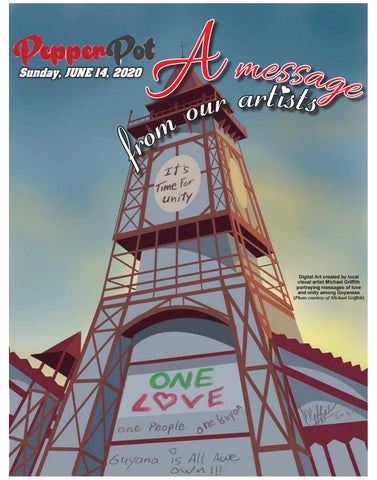
Digital Art created by local visual artist Michael Griffith portraying messages of love and unity among Guyanese (Photo courtesy of Michael Griffith)
II
w o H
CHRONICLE PEPPERPOT ― June 14, 2020
determination and zest can bring you out of poverty
By Wendella Davidson
EW JERSEY-based Guyanese, Odel Andre Wade, believes in and embraces Colin Powell’s quote, “A dream doesn’t become reality through magic; it takes sweat, determination and hard work.” Born at Kwakwani, a mining and logging community on the Berbice River, Odel remembers growing up in poverty. He began his formative education at Kwakwani Primary School but left when his father, Roy Wade, decided to relocate to Yeoville, a West Coast Berbice (WCB) village, to live at a house that belonged to his parents. In an interview with the Pepperport Magazine, Odel said he falsely believed that the change would have improved his standard of living, but instead, the house became the new home for himself, dad, stepmom and three brothers from his father’s side, and had no furniture, electricity nor running water. It is those circumstances and a determination to succeed in life, belief in God and fervent prayers that Odel, now 47 and a retired a Sergeant in the United States Army who owns a security company, believes is responsible for his upward mobility. Odel said he enrolled at the Number 29 Primary
School, wrote t h e
N
barefooted and had to wear `hand me down’ or secondhand uniforms. My stepmom worked part-time as a maid and those were things she got from her employer,” he said. He remembered, too, he and a brother having
cessful and pursued a course in Electrical Engineering. Odel said in August 1992, he joined the Guyana Police Force (GPF) but left in 1998 to work at the Timehri Airport as a security officer with BWIA, now Caribbean
According to him, he landed a job at the John F Kennedy (JFK) airport as a security agent with Delta Airlines, but while success came one way, his marriage unfortunately crumbled. “I did not let that deter me from moving
graduated with an Associate Degree in Applied Science from Berkeley College and was on the Dean’s List. The following year, he earned a Bachelor’s Degree in Criminal Justice from the said college. Further developments
Odel Andre Wade on his graduation day
Odel with his wife and children
Seconda r y School Proficiency Examination (SSPE) and was awarded a place at the Bush Lot Secondary School. “I vividly remember attending both primary and secondary school
to walk about five miles to attend school. According to him, unfortunately, he didn’t finish secondary school since he felt he needed to learn a trade and start working if he wanted to have a better life. He said he enquired from some boys who were attending the New Amsterdam Technical Institute of the procedure, then in 1987, at age 15 years, he wrote the entrance examination, was suc-
Airlines. NEW START Odel said he subsequently got married and with his wife living in the United States, he left these on September 28, 2001, exactly two weeks after the 9/11 tragedy, to start a new life in the `Big Apple’. Odel said he lived with his mother-in-law but did not want to be a burden to anyone, so he quickly found a job as a construction worker. He also started attending GED classes to enable him to be more marketable on the job market.
forward. I began to focus even harder and took advantage of all available opportunities to further qualify myself,” he said, adding that by 2006, he had certificates that qualified him as a Private Investigator and a Loss Prevention Officer. Odel said following a twoyear relationship with Tenday Hall, in 2007 he tied the knot and the following year enlisted in the United States Army and remembers doing 307 hours in online correspondence classes through the Army’s learning institutions. Odel said in 2015, he also
Of his tenure in the US Army, Odel said while it was gruelling it was worth every bit of the sacrifice and by the time he resigned on February 21, 2020, he had attained the rank of a Sergeant. He was also qualified in several disciplines, including, as a Chemical Biological Radiological Nuclear Explosive Specialist (CBRNE); in Self Defence TOV N and as a R E Combat TU AG
P
CHRONICLE PEPPERPOT ― June 14, 2020
III
THE LAUGHTER I’LL ALWAYS REMEMBER
Liberty Avenue ‘Little Guyana’, Queens, New York City (Photo by Francis Q. Farrier) By Francis Quamina Farrier
O
V E R the decades, especially since the 1970s, there has been a need for assistance from those who left Guyana, by those who stayed. Many who stayed, did so by choice. Others by the inability to up-root themselves from the circumstance of their situations in the country of their birth. Victims of a situation well beyond their control. It is well-known that the bulk of Guyana’s problems is man-made. Guyana is one of the most blessed countries in the world - certainly weather-wise. There are no snowstorms here in Guyana. No sand storms. No blizzards. No earthquakes. No brush fires. No tornadoes. No tsunamis. No droughts. Guyana is blessed with gold, diamonds, manganese, lumber, cattle, fish of all sorts. One of the widest arrays of wildlife So there are the Guyanese “At Home”, and there are the Guyanese “In the Diaspora”. On the occasion of Guyana’s Independence Jubilee Celebrations in 2016, I penned - rather, typed - two feature articles; one was
advice to the Guyanese at home, the other, advice to Guyanese in the Diaspora, returning to the motherland to celebrate that grand event. An example of the advice given to the Guyanese at home was, “Do not greet your returning relative with the question, “Is woh yoh bring fo’ meh?” An example of the advice I gave to the returning Guyanese was, “Don’t go about wearing the latest bling and speaking loudly with a foreign accent since you would be setting yourself up to be a victim of professional robbers.” Four years later in 2020, the country celebrated its Republic Jubilee. Again many from the Diaspora came to visit and celebrate. Many had a blast and an extremely enjoyable time. A few who came down with a super attitude returned to their adopted homes with a sour taste in their mouths. As a youngster, I read the following; “Two men looked out from prison bars, one saw mud, the other saw stars.” It was all a matter of how they held their heads. While one looked down, the other looked up. Just a simple tilt of the head - up and down - they were in the very same place, but each had a different experience. One of my all-time fa-
vourite songs is, “What a wonderful world” by the late great American jazz musician and singer, Louis “Satchmo” Armstrong, who grew up in New Orleans, USA. Many older Guyanese would recall his visit to Guyana and a memorable concert at the Queen’s College auditorium. Some of the lyrics of “What a Wonderful World” are as follows: “I see skies of blue and clouds of white, Bright sunny days, dark sacred nights. And I think to myself, what a wonderful world.” As I walk the streets of my Mother Guyana, I am so often approached by various citizens and asked about this, that and the other; and it’s almost always about the woes of the country, which are many. Not that I mind, it’s just that I’d much prefer to dwell on the positives and discuss the solutions to the problems which abound. It is also good to chat about the developments, which for many, are coming much too slowly. Just imagine, Guyana was the very first country on the continent of South America to have built a railway while being the very last to install an escalator! Within the Diaspora, are many Guyanese who so love their country, that they visit
annually and give quite a lot of support - money, goods, as well as their time. They visit and carry out FREE medical and educational projects. They do not curse the darkness. They light it up with their candles of love. Almost all of the recipients
here in Guyana show gratitude. Some, like the nine cured lepers, forget to say “Thanks”. On the other hand, there are some in the Diaspora who have nothing good to say about their Mother Guyana; one told me that he spat on the tarmac at the
Cheddi Jagan International Airport as he was about to place his feet on the steps to TOXI board the N X outbound URGE T aeroA
P
CHRONICLE PEPPERPOT ― June 14, 2020
IV
What happened to just dating?
Facing forced marriage in this modern age By Naomi Parris
F
OR decades, young women and girls across the world have been subjected to arranged and forced marriages, while many may see the harsh truth of arranged and forced marriages in the mainstream media in other parts of the world, it’s a taboo subject that is not often talked about in Guyana, despite many young women in the country still being forced into unwanted and arranged marriages.
Lily’s Story
Nineteen-year-olds “Lily” (name changed) is fresh out of high school and looking to start a new journey into adulthood. The teen, who is currently job hunting, noted that she is considering pursuing a career in nursing; she is,however, keeping her options
open due to the effects of the COVID-19 pandemic. One would think the only things on Lily’s mind are her plans for academics and her career; however, for weeksm the young woman has been trying to find innovative ways to tell her parents she is not yet ready to be married. Earlier in 2019, Lily had told her parents about her high school boyfriend whom she was with since 2018, but she stated that this announcement shifted things in her relationship with her parents. “Growing up, I was never short of anything. Whenever I needed something, if my parents weren’t able to give it to me right away, I still would get it whenever they could afford it...honestly, it was great [but] it changed when my family found out I had a boyfriend last year,” she stated. The young woman told the Pepperpot that her par-
ents had lost trust in her and have since kept an eye on her like a hawk and have begun talking about marriage. While the young woman noted that she is happy with her relationship, she is not
ready for marriage. The young woman noted that her parents have placed herself and boyfriend on some bizarre restrictions and have been pressuring her to get married to him
wanting to destroy the little relationship she has with her mother. “When it comes to parents the courage and bravery disappear…I don’t answer them back, mainly
marriage or pressured into getting married; hence, many young women find themselves in abusive and toxic relationships which they feel helpless in, since it’s hard to leave, due to the shame they might face from their parents and others within the community.
Marriage is not a contract
by 2021. Lily revealed that there is so much more she wants to do with her life before getting married, such as furthering her studies and finding a job to have the feeling of independence and earning for herself.
‘The talk’
Lily admitted that it was a challenge to tell her parents about her relationship, since she was unclear about how they would have reacted despite being incredibly open with her mother. “I tell my mom everything, but when it came to my relationship we never had ‘the talk,’ so it was very difficult for me to open up to her about it, at first she didn’t like the idea, but eventually she grew to like him,” she said. She noted that she avoids having serious conversations with her parents since in most cases parents, especially in the Caribbean and East Indian community, if a child or children dare to disagree or share their opinions on various discussions it is seen as “answering back,” a blatant disrespect or disregard for your parents. As such, she avoids confrontation, not
because I don’t want to cause any problems;, nor do I want anything to mess up my relationship with my mom,” she stated.
What happened to just dating?
While Lily admits that she is in love with her boyfriend, she still believes they both are still way too young for marriage. She stressed that she is still quite young, and a rushed marriage does not have her nor her partner’s best interest at heart. The young woman noted that she wished her parents understood the concept of just dating. Lily added that she wished Caribbean parents, especially Indo-Guyanese, would normalise dating someone and cut children some slack on the notion of getting married to the first boy/man a girl has dated. Lily noted that it’s not just about her since she believes there may still be many Indo-Guyanese girls who don’t have a say in what they wish to do with their lives, especially when it comes to selecting a life partner even in this modern age. She also believes that these girls are either subjected to an arranged
In sharing her sentiments regarding the possible presence of such practices within Indo-Guyanese culture, President of the Guyana Hindu Dharmic Sabha Dr. Vindhya Persaud noted that marriage is a relationship that should be entered into by mutual consent. In fact, she added that during the Hindu marriage ceremony, there are steps where mantras are said and one of those very critical steps says that both parties present are there because of mutual consent; in other words, nobody didn’t force them to get married. “I don’t agree with anybody being pressured into marriage…marriage is not a contract, it’s an institution and it’s bringing two people together, families together and if they are there by mutual consent and because of their emotions, then it’s their own initiative of entering into something that is not only respected. but something very honoured not only by society, but by the two people entering it,” she stated.
‘Cut us some slack’
In Lily’s case, the young girl stated that she wished her parents would trust her more and respect her wishes; however, it is not exactly easy for her to just tell her parents “No, this is not what I want,” since that may be seen as her being disobedient and disrespectful to her parents. She stated that she is hoping that one day, her parents will trust her enough to make her own decisions, especially in selecting a life partner. However, it’s a quite difficult conversation to have and sadly, the day to have that conversation maybe later, raher than sooner.
CHRONICLE PEPPERPOT ― June 14, 2020
determination and ...
Field Medic. Odel served a deployment in Germany on two occasions. With a combined total of 34 years in the area of security, as a security specialist and a consultant, Odel says he formed his security outfit `Warrior Analytica’, in the US and provides bodyguard and escort services for diplomats and celebrities. Odel is of the view that God has answered his prayers to bring him out of poverty. In gratitude, he tries to assist the less fortunate and also participates in several volunteer activities.
the sixth of seven children to a single-parent mom, she too had grown up in a home where things were `very’ rough at times. “I admired my mother single-handedly doing her best to provide for and make the family comfortable. I have awesome childhood memories of my homeland, Guyana, before migrating in 2002 at age 20, to the United States,” she added. In May, this year, Tenday graduated from Rowan University in Psychology. It was a non-normative life event one her daughters experienced that
to understand how she thinks, acts and feels. I wanted to acquire a range of different skills ranging from behaviour observation to the physiology of the brain, so that I can help her and other children like herself, as well and their families, to cope with such situations,” she reckoned.
life. When we met 16-yearsago, it was obvious that our goals were the same, we both wanted to achieve almost the same things in life, including a home, be qualified and provide and lead a decent life for our children. We both understood and discussed what had to be done to accomplish the
Between them, they have a boy and three girls, two of the girls she mothered but according to her, they all make a “great blended family”. Before she decided to return to school, Tenday said she discussed it with the family knowing that any decision would have a profound
so-called `American Dream’, in the best and honest way. We also used and continue to use effective communication as an essential element to keep our relationship alive.”
impact on everyone. She said she created a balance by sitting with the kids as she did her assignments and they did homework, ensuring her presence if ever they needed
Odel in his United States Army uniform
A WIFE’S SUPPORT Meanwhile, wife, Tenday, an ever-supporting arm alongside him, recalls that when she met Odel, it didn’t take very long for her to understand the determination drive and goals in him, adding, that as
was the catalyst and motivated her to switch from majoring in Nursing to Psychology, she noted. “I felt this career choice was going to help me understand my daughter’s behaviour and mental process. I wanted
On being able to balance family life, work and studies, Tenday remarked, “I am truly blessed and grateful that God has placed such a loving and hardworking man in my
M O FR II E RN G TU PA
w o H
V
any help. Additionally, the family would eat breakfast and dinner together and openly discuss any issues affecting anyone and devise a plan on how to have it resolved. Tenday hopes to further pursue studies to become a Clinical Social Worker (CSW). She describes Odel as “smart, industrious and my everything,” noting that apart from providing financial and emotional support he was of great assistance during her studies. “Let’s just say he is the best husband, father and friend any woman would love to have as a partner,” Tenday said in a confidence tone. Her advice to women seeking to empower themselves, while juggling to balance a family, work and academics, is to first know exactly what it is you want out of life, plan how to achieve it and put the plan into action. “Having a family must not restrict any woman from following their passion for increasing their academic knowledge. Education can make you grow mentally, emotionally and financially, give you confidence, build your self-esteem, also with the self-confidence of the children. It is one of the tools that can help a family to get out of poverty and change their socioeconomic status. Sometimes life’s circumstances can prevent us from accomplishing our academic goals, but it is never too late to achieve that dream of going back to school,” she remarked.
VI
CHRONICLE PEPPERPOT ― June 14, 2020
Unlearning the bad and learning the good
M
Y last column reflected my thoughts on my role as an Indo-Guyanese in #BlackLivesMatters and in navigating my experiences with the perpetuation of anti-blackness in my social and cultural spaces. I still maintain that I am not entirely sure what is the right way to use my voice in this regard, but I have been learning a few important things here and there. For me, the most crucial lesson I have learnt so far is that it is extremely uncomfortable confronting learned biases, prejudices, and stereotypes, but it is simultaneously important to confront these nevertheless. Confronting these means interrogating what we have learnt about the people outside of our social and cultural groups. Two common notions, for example, that I have grown up hearing are that Afro-Guyanese are lazy and that Indigenous Guyanese are simple-minded (putting it nicely). What can be uncomfortable confronting these is that there are people who truly believe these stereotypes are true. And asking them to think critically about what truth exists in these notions would cause them to become defensive, even to the point where they question your ‘loyalty’ to your own social or cultural group (true story!). But the thing is, we have to confront these notions. We have to interrogate the intrin-
sic biases and prejudices we have towards people who are not part of our social and cultural groups. These have been passed from generation to generation, and it is my opinion that many of us are guilty of just perpetuating these notions without ever really internalising them.
theory of the inherent social dissonance in a plural society. According to Smith, this dissonance was as a result of the composition of different cultural groups, each replete with their own internal structures and institutions, making each group insular. Local
biases to the outright and outspoken attacks against one race, or against one ethnicity. I acknowledge this from my position as an Indo-Guyanese in Indo-Guyanese social and cultural spaces, where I have been privy to the sentiments of anti-blackness. And just because you
to take some time to remind anyone who might be reading this that while you’re confronting your learned prejudices and biases, it is also important to take some time out to take care of yourself and your mental wellness. Amidst it all, this is a healthy habit that I think is impera-
Only through confronting these will we be able to peel away the layers of learnt segregation and take a step in the right direction for reconciliation and cohesion. Guyana is an interesting country because it encompasses myriad cultures in one geographic space. That, however, does not equate to a blissfully cohesive society. In fact, Guyana’s reality makes me think about M.G. Smith’s
Political Scientist, Professor David Hinds contends that, in Guyana, this insularity also transcends to ethnic insecurity among the groups and fears of dispossession and disenfranchisement. Interestingly, the insularity and ethnic insecurities have festered, inter alia, the perpetuation of anti-blackness in Guyana. This manifests as the seemingly simple, unspoken prejudices and
can never be too politically correct in these things, let me emphasise that my acknowledgement of the perpetuation of anti-blackness is not a repudiation of my Indo-Guyanese identity. If anything, I would hope that me speaking my truth would add to the discourse of confronting these ingrained prejudices and biases that are rooted in the legacy of imperialism. This week also, I wanted
tive to learn. At this time, the combination of being forced to adapt to changes necessitated by the COVID-19 pandemic, trying to play a part in dismantling ubiquitous systemic racism (assuming that you are genuinely #woke) and dealing with Guyana’s perpetually unravelling political conundrum, is enough to burn anyone out very quickly.
As much as I can speculate, I can only honestly speak for myself. And honestly speaking, I am overwhelmed and exhausted. Just recently, I was in an online forum with a group of Guyanese youth (they aptly call themselves “592 youth”) listening to young persons share their lived experiences and views, primarily, on racism. It was then that I had my first unfortunate experience with ‘Zoombombing’, where several intruders (maybe bots, maybe real people) stormed into the Zoom meeting and essentially, disrupted the forum with divisive sentiments. Then, the group of more than 130 youth decided to take a few minutes to reflect and realign and even vibed to Chronixx’s ‘I can’ before resuming the discussions. It was obvious that the group was taken aback. My point in relating this is to illustrate that despite engaging in well-meaning, positive acts, there are going to be disruptive forces manifesting in some form or the other, and it is important to know how much of something you can manage at a time. This week, please remember to take care of yourselves. Take it from someone who has lots of responsibilities at the moment and is struggling to find the energy to fulfill all of those. You owe yourself time to unwind and recharge, but also have to be vigilant with how you choose to use your energy in the first place.
CHRONICLE PEPPERPOT ― June 14, 2020
Welcome to Focus on the Village
Windsor Forest Nursery School
Rookmin Shivanauth called “Pinky” at her roadside snackette
Windsor Forest Village (Carl Croker photos)
By Michel Outridge
W
I N D S O R Forest is a countryside village located on the West Coast of Demerara and it is the home of rice-farming and a multi-ethnic community of skilled people. It is densely populated with about 3,000 residents, predominantly of Indo-Guyanese descent and a combination of all other ethnicities including, Chinese, Portuguese and they have also seen their fair share of Venezuelans. The people there are mostly large-scale rice farmers, a handful of cash-crop farmers, small-business operators and persons who work within both the private and public sectors. Windsor Forest is between Ruimzeight and La Jalousie villages and has basic infrastructure such as roads, electricity, potable water supply, telephone services, both landline and cellphone. Windsor Forest has a primary school, a nursery school, a health centre, a community centre ground with a ballfield, the Neighbourhood Democratic Council (NDC) Nouvelle Flanders/La Jalousie, the Water Users Association which is housed in the old ticketing office of the railway train, taxi services, beauty salons, barbershops, two Chinese supermarkets, Chinese restaurants and vast backlands. The village starts from the public road and ends way down into the backlands which accommodate large-
scale rice-farming. The architectural landscape of Windsor Forest boasts large houses with intricate designs -- both in wood and concrete -- and sprawling edifices with equally beautiful landscapes. In almost every yard there is a tractor or some large vehicle and the surroundings are well-kept and maintained. About three-quarters of the residents are self-employed, owing to the fact that they grow their own fruits and vegetables; there are some poultry and cattle farmers as well. The first person the Pepperpot Magazine met at the entrance of the village is a roadside snackette owner, Rookmin Shivanauth, called “Pinky.” She is a friendly woman who inherited the family business when her parents passed away. The snackette has been in the family for more than 20 years and was first managed by her parents. She has been in charge of the business for just over a year, which was when her father died. Shivanauth said Windsor Forest is the only place she has lived all her life, adding that even though she married a man from outside the village, he became a resident of the community. “This place safe and I feel secure because we have no thieves or those things here and we live in peace without any major issues,” she said. Shivanauth told the Pepperpot Magazine that she
would start her day very early in the morning when most people are still asleep to prepare her snacks for eggball, pholurie, cassava ball, fish ball, chicken ball, to go with fresh coconut water and cane juice. “You can walk anywhere in this village at nights or even in the day and no one will trouble you,” she said. Shivanauth added that the place is so safe, they have had an influx of Venezuelans who are renting and working in the village. “I have to wake up at 03:30hrs to do the cooking, but it is worth it because I never in my life worked with anybody and I am not about to start,” she said. Before operating the family snackette, she used to sell CDs and DVDs at the Parika Market for eight years and sold greens at the Charity Market for four years. Shivanauth stated that her mother died five years ago and then her father passed away last year, leaving her the snackette. She has a brother who operates a similar business from his canter truck at Diamond, East Bank Demerara. Shivanauth opens her snackette from 07:30hrs until her snacks are sold out and would repeat the process the next day. Right next to her roadside snackette there is a large tree which provides adequate shade for some taxi drivers, who would park their vehicles there and enjoy the country breeze.
The Windsor Forest mosque
VII
CHRONICLE PEPPERPOT ― June 14, 2020
VIII
FocusWindsor Forest on the Village
Hard work and talent abound in
The old Railway Station building used as the office of the Water Users Association
own paddy and rice, but today the old building and bond still stand, a stark reminder of those days. Haniff told the Pepperpot Magazine that he has 40 acres of rice lands at the back of the village and only cultivates one species of rice from all the varieties. “The 40 acres of rice lands are too much for me alone to handle, so I rented out some acres because rice-farming is a high-risk investment and often leads to unrecoverable losses, due to the changing weather patterns,” he said. He had just returned home from his rice field af-
The NDC building in Windsor Forest
By Michel Outridge
R
AJISH Kadarnauth is Chairman of the Nouvelle Flanders/ La Jalousie Neighbourhood Democratic Council (NDC); he is also a pandit and operates a pharmacy, a grocery and general store at his premises. Kadarnauth wears many hats and he is also a Justice of the Peace, a licensed marriage officer and a pharmacist, who has a Diploma in Pharmacy from the University of Guyana (UG). The pandit is also a rice
M.S. Haniff and his prized tractor
The home and business place of NDC Chairman Rajish Kadarnauth (Carl Croker photos)
farmer who reported that Windsor Forest, West Coast Demerara, is an agriculture-based community, where there is largescale rice-farming. The NDC Chairman stated that he has been in this position for the past four years. He, however, advocates for the establishment of trades that the youth can become involved in and infrastructural help for the rice farmers. Kadarnauth told the Pepperpot Magazine that since the rise of COVID-19 they have seen the reduction of payment for rates and taxes in that community. He related that there aren’t many social difficulties in Windsor Forest since they have mandirs, churches and a huge mosque. The rice farmer also reported that they have a community centre, but they need some assistance in terms of the fencing of the place since the cows would damage the field and fence. He is also calling for the development of 200 acres of land they have in the backlands, which can be used as a cow pasture since the place is overgrown with thick bushes and is inaccessible to cattle owners. As such, the cows roam the village damaging infrastructure and property.
“This village has a landmark which they preserved over the years, that is the old Railway Embankment Station which was the ticketing office for the trains some 40 years ago. The building was renovated and is used as the office for the Water Users Association. The Railway Embankment is still there as a reminder of the yesteryear trains,” he said. RICE-FARMING AT AGE 69 M.S. Haniff is a large-scale rice farmer, who has lived all his life in Windsor Forest, West Coast Demerara. At 69 years old, he has never been married, has no children and is a self-taught rice farmer, who has in his employ a few workers. This gentleman does everything for himself, including cooking and other household chores. “We had a rice factory which was managed by my father; he is deceased but my mother, who resides overseas, is 87 years old. It’s just me here, all my siblings and relatives are abroad. I go for a vacation when I feel like it but Guyana is home and a paradise and there is no country like Guyana,” he said. Back in the days, the Haniffs had a thriving rice factory where they processed their
ter “throwing,” then had to take in and out water via the drainage system which he said is the hardest part of rice-farming. Haniff added that throwing rice takes about two days, an uphill task that requires some skill and the drainage of the water in and out of the rice fields are also tedious. His tractor, which he said has some more good years and because of the good maintenance it gets, it is in tip-top condition, being one of the cleanest tractors of its kind in the village. Haniff told the Pepperpot Magazine that if you take care of things they last and that is exactly what he is doing to his prized tractor; the same one he bought two years ago from a migrating resident. “Rice-farming isn’t a day’s job, it is continuous back-breaking hard labour and you have to tend to the crops in the mornings and afternoons to ensure the rice is irrigated adequately,” he said. Haniff added that he once had his own combine as well, but he has scaled down rice-farming for valid good reasons and he would sell his rice to Hack’s Rice Mill located at Harlem, also on the West Coast of Demerara.
CHRONICLE PEPPERPOT ― June 14, 2020
IX
Coping with home-schooling
Windsor Forest
Bibi Shanaz Shahid (Carl Croker photos)
teacher discusses the ups and downs of the task
By Michel Outridge
B
IBI Shanaz Shahid has been in the noble profession of teaching for the past 23 years and today, she is assisting students in home-schooling due to COVID-19. This resident of Windsor Forest, West Coast Demerara, is also a first-year student at the University of Guyana (UG) pursuing a Bachelor of Education- General. She is the Senior Assistant Mistress at Windsor Forest Primary School, who grew up in Winiperu, Region Seven (Cuyuni-Mazaruni), where her father used to work but later moved to Uitvlugt Pasture when she passed to go to a secondary school on that corridor. After getting married 19 years ago, she relocated to Fourth Street, Windsor Forest, and is the mother of two, who enjoys a calm, quiet country life. “This village is a quiet, safe place to live and I feel secure here because the people are cooperative and we co-exist in harmony,” she said. Just after High School, Shahid started teaching at the nursery school level after which she transferred to Windsor Forest Primary School, where she is teaching to date. In 2001, she enrolled at the Cyril Potter College of Education (CPCE). Home-schooling Since the closure of schools as a result of the global pandemic, she is assisting students with their home-schooling via a WhatsApp parent/teacher group to aid in the learning process. But on Mondays, she would go to the Windsor Forest Primary School where she would lend a hand via their shift system with the National Grade Six Assessment (NGSA) students. Shahid reported that the shift system is in place for teachers to go to the class-
room three days per week from 09:00hrs to 13:00hrs. On other days they are home-schooling according to the scheme of work under the Ministry of Education’s curriculum. She related that while they are doing their part as teachers to send the worksheet via the WhatsApp group, and parents have to ensure their children do the work at home. Shahid has been a Grade One teacher for 18 years and she was mildly pleased about the cooperative attitude of parents, who quickly adapted to home-schooling due to the novel coronavirus. “Since we can’t get back as normal to the classroom, the children are trying to cope with the home-schooling, but based on the feedback from parents, some of them face a lot of distractions; as such, they need that face-to-face interaction with teachers to enhance the learning process,” she said. Shahid added that children in the age group of six and seven need the face-toface interactions in a classroom. She stated that these students find it difficult to cope with home-schooling and not being able to be in a classroom. “I got into teaching because I genuinely love children and moulding them, so being a teacher is relatively easy for me to do since I like the job. It is much easier when you like what you do because me imparting knowledge in a way children can grasp brings me joy. It is also making a difference in their lives,” she said. Shahid reported that she takes their motto seriously and she sees her job as a part of her life and it is fulfilling to be a teacher. “The other day I was in the bank and a student, who I didn’t recognise, reminded me that I taught her in school and I was so proud of her achievement and years later these former students would approach me and it makes
The Windsor Forest Primary School
Focus on the Village
my heart melt with gladness, knowing I contributed to their education,” she said. Shahid pointed out that even though some students are not fast learners, as a teacher she doesn’t give up on that student and gives him/her individual tutoring. The teacher noted that some students aren’t booksmart, but are willing to learn and they would try to boost those pupils in the weak subject areas. “Not all students become successful and work in high offices, but some do, while others can learn a skill to earn as well, since there is a place for everyone who may not be academically inclined,” she said. Coping with UG online home-schooling Shahid is also trying to cope with online home-schooling and it is at times difficult, given that with the unreliable internet service doing research and assignments for UG is taxing. She confessed that her final paper is due this Friday, after which she will complete her first year of studies and it has been quite a challenging. The most difficult thing was having to get on board fast with online schooling and she made it happen due to COVID-19.
X
CHRONICLE PEPPERPOT ― June 14, 2020
Focus on the Village
Health and beauty in Windsor Forest
By Michel Outridge
father passed away, because she had to work and so she EGISTERED enrolled in a professional Nurse Alicia course. Harper is atAfter completing the tached to the course, she was successful Windsor Forest Health and eventually got the hang Centre. of it and made it a career. Although she is fairly She sought employment new there,s she has been in in a salon as a hairdresser the nursing profession for and as time progressed, she eight years. developed her skills as a The Windsor Forest make-up artist. Health Centre has three Sieunarine has been staffers which include a home since January this registered nurse, a midwife The hairdresser and year due to COVID-19 and and a community health make-up artist is hopeful that the virus will worker. pass, so she can return to A visiting doctor work fully., is there every At home, The Windsor Forest Health Centre We d n e s she would day and get calls f o r
R Aaliyah Sieunarine and her son
Thursday when they have the largest clinic, that is, for chronic diseases. “I have been here for the past four months and I find it delightful to work in a health centre, which is located right on the Public Road, so it is easily accessible and I feel safe here,” she said. Nurse Harper hails from La Parfaite Harmonie and would make the daily commute to and from work. Even though there is not a pharmacist at the health centre, Nurse Harper reported that they do dispense drugs but not antibiotics and only prescriptions drugs to members of the chronic disease clinic. Nurse Harper, who is multi-talented, told the Pepperpot Magazine that she always wanted to serve her community and nursing is the perfect job to interact
and help sick people. The Windsor Forest Health Centre serves several communities, including Harlem and others. The services offered are ante-natal, outpatient, family planning, child health clinic and chronic diseases clinic. The Windsor Forest Health Centre is opened five days per week from 08:00hrs to 16:30hrs.
Apart f r o m those who are employed in the health sector, there are also residents in the beauty sector within Windsor Forest who are also making moves. Aaliyah Sieunarine is a hairdresser and make-up artist who is a mother of one and resides with her elderly grandmother, her son and a younger sibling. Sieunarine, who is 23 years old, returned to Windsor Forest from the Essequibo Coast after her husband died and she is hoping to have her own salon one day. She has been a make-up artist and hairdresser for about a year and has experience working in a salon. Sieunarine started that profession when her grand-
work but is scared to be around people because of the virus. “In this profession you can’t just take one class and tell yourself you know everything, because you can’t. You have to work along with others in a salon to gain experience and enhance your skills,” she said. The Windsor Forest resident believes that one can easily become better in a professional environment, that is, a salon, because opening a salon is a big investment and it takes time, money and planning to make possible. She is, however, optimistic that one day her dream of having her own salon will materialise. “I will return to work when I am ready, but my customers are anxious and simply cannot wait,” she said.
CHRONICLE PEPPERPOT ― June 14, 2020
F ocus A showstopper indeed on the Village
The classic car and its owner Dhanpaul Mattadin, called “Munesh” (Carl Croker photos)
Classic car owner proud of his vehicle By Michel Outridge
D
HANPAUL Mattadin is the ownere of a Morris Oxford Series Six motorcar which was manufactured in 1961. This motorcar is priceless to Mattadin; his ‘pride and joy’ and it shows in the way he takes care and maintains the vehicle. The car was purchased in August 1969 by the then Booker Tate, the first owner. Dhanpaul Mattadin called ‘Munesh,’ is the car’s fifth owner and he has had it for more than 40 years. Mattadin bought the car, PZ 1587, when he was in his 20s from a friend, who was getting married and wanted the money for his wedding. “The guy was in need of money, so I paid the difference and took the car, after which he migrated and I still have this car after 40 years,” he said. The first owner of the Morris Oxford was a man named Roy Henry (only name given) former proprietor of the now defunct disco, Guiding Light, in the city. Mattadin related that over the years he affixed modern lights to the car and made some changes to enhance its appearance. “I would drive this car everywhere I want to go; it is a family car, of course, I have others but my son wants me to keep it as long as I can,” he said. The 62-year-old resides in Campbellville, Georgetown, but when the Pepperpot Magazine met him he was at Windsor Forest, West Coast Demerara, with his wife, visiting relatives there. Being a mechanic by profession, Mattadin has done some work on the car, which she says can outrun almost any vehicle on the road, even a pitbull minibus. “Right now, three persons are begging me to spray this car at no cost attached, but I declined because I like the colour as is and I take good care of this car,” he said. Mattadin added that wherever he goes, random people would show up and ask him to sell the antique car, but he has refused. “I don’t want to part company with this car, because it has been a part of my family for a long time and it is worth about $4.5M,” he said. Mattadin stated that he would not gain much from selling the car, because it is still in excellent condition, inside out. The Morris Oxford is a classic and antique car and the father of three told the Pepperpot Magazine that he really likes the motorcar and will hold on to it for as long as possible, no matter how much is offered.
“This car is faithful, it never gave up on me because I used it to work taxi at Mahaica, Cane Grove and even in the city, at Demico Car Park and back then it had a name ‘Tek me, Tek me’ in the days of contraband goods,” he said. Mattadin reported that he worked as a taxi driver since 1974 and used to take passengers from Crabwood Creek to the city, and in front of the old Georgetown Public Hospital Corporation (GPHC) at Thomas Street. He disclosed that when he drives the car it’s like all eyes are on him, and it is like the car demands attention everywhere it goes. The Morris Oxford is outfitted with a five-horn animal sound, including a rooster (fowl cock) crowing, a PA system and five-way siren and it has a modern music system that is top of the line. THE WINDSOR FOREST TAXI DRIVER While Mattadin used his classic vehicle for a taxi service, Kishan Tracy, also a taxi driver, plies his trade using a more common means. He works from the first street, just off the Public Road, under a large tree, where they have a wooden bench for comfort. He would park there and wait until he gets a passenger to transport for the cost of $300 into the village.
He has been at the job for about three months and would operate from 07:00hrs to curfew time, that is, 18:00hrs. Tracy is attached to Ray’s Taxi Service base, a village business, and he is also a resident of Windsor Forest. The 20-year-old is originally from Bartica, but when he wrote the Common Entrance Exam for a secondary school he was given a city school; as such, his family relocated to West Coast Demerara. He has been a resident of the community since he was 11 years old and is presently pursuing studies in medicine at the Greenheart University School of Medicine, in the city. Tracy told the Pepperpot Magazine that he is a part-time taxi driver because he is studying and to make ends meet he has to work. “With the pandemic, things scale down a lot, so there [isn’t] much social or other activities and people are not travelling much, so the job is not doing well, but I can’t complain I have to try,” he said. “Life is peaceful, quiet and really good here because the people are not nosy and they go about their business as usual and it is a good place to live.”
XI
XII
CHRONICLE PEPPERPOT ― June 14, 2020
d n i M e t i r The W by Jasmaine Payne
On mentorship during writing
D
URING this time of lockdown caused by the ongoing pandemic, everyone finds that they have a lot of downtime at some point or the other. It is at these times that your most creative side shows itself. Whether you tap into your culinary skills, start gardening or become involved in DIY projects from YouTube, your efforts can really produce some surprising results once productively directed. I, too, have dabbled in hobbies such as painting and cooking over the past few months, surprising myself with the latter because I was never one to enjoy it prior. But while my creativity has been sparked in these areas, I am ashamed to admit that I did not have the same luck with my half-finished novel. That disappointment has led me to wonder whether it is time to once again place myself in the hands of a writing mentor; someone who can review my work and give me a stern, but gentle nudge to get moving again. As mentioned in a previous article, I once procured the services of a mentor from a man named Jim Parsons -- a retired College English Professor -- when I was suffering a terrible writer’s block coupled with selfdoubt about the initial content of my book. Now that it seems a similar block has re-
turned, I believe that I may need to do so once again.
WHY CONSIDER A WRITING MENTOR? Every writer needs a mentor at some point or the other. Not many of us are aware of this, and that is why so many talented writers hang up their hats after hitting a stumbling block. The reason I keep going is that I found inspiration from Jim during our mentorship sessions as well as from other writers in the past. Mentors hold you accountable for your work and keep you in line with deadlines. They will sit with you and map out a course of action on how to move forward and achieve measurable goals with regard to your writing project. Mentors inspire
you through their own work. Whoever you choose should be able to be a good example of where you want to be, or at the very least, should inspire you enough to continue putting effort into your work and moving forward. Mentors give you honest feedback and encourage fresh ideas. When you are stuck, a mentor will review your work and give you pointers on how you can get out of your rut, oftentimes giving you alternatives and ideas that can help you along the way.
Where necessary, mentors can also provide emotional support. Imagine your mentor as your personal writing counsellor. You have a problem that is affecting you, lay your burden in their lap. Mentors should have the patience to listen and guide you through those problems. HOW TO CHOOSE A MENTOR Because of the characteristics I mentioned above, choosing a mentor should not be done lightly. To get worth-
while results, your mentor should be someone who possesses all the things you need to achieve your writing goals, give you honest feedback and to weed through your writing issues. Your mentor should, therefore, be wise, experienced, compassionate and honest. I would say those are the key characteristics of someone who can get the job done. In whatever field you operate, choose a mentor who is also in that field. Don’t just choose an older person who is kind to you and who will listen. A skills-based mentor should have the relevant abilities needed to help you do the work you set out to do. Good writing mentors can be found in writing groups. Since Guyana is practically void of such gatherings, your best chance is to join online writing groups or book clubs and network with the people in them. Lots of experienced writers hang around in those places and have a wealth of knowledge about the industry and are even willing to take you on to have a look at your work once you build up the right rapport. You can also consider an old English teacher or professor. They will already have a familiarity with your work and your potential and will also have an appreciation for what you are doing. If you have access to an editor in your circle, tap into their skills to help you weed through structural errors in your work. Editors are built to critique, so half of your
job is finished there already. Finally, you can even try a paid option. While, traditionally, mentors are usually persons whom you know, mentorship can also be offered as a service by experienced professionals who love the job of working with writers. Moreover, you are guaranteed to get professional, timely and focused feedback on all the things you want to achieve on your project. Jim Parsons’ mentorship was paid and I have no regrets about that. He was able to get me to a place that I would not have been at, had I not engaged him. Perhaps I need to seek him out again. At varying points of our writing journeys, mentorship is necessary. Never be afraid to ask for help. We get so caught up in our work and then sometimes become wrapped up in crippling fear that we risk losing the passion projects we have worked on for so long. When you realise that you are at this point, try to find that person who will tell you to keep going, then help to show you how. Interested in contributing to this column on writing? Email me at thewritemind592@gmail.com
CHRONICLE PEPPERPOT ― June 14, 2020
XIII
COPING DURING A PANDEMIC PT. III
O
VER the last view months, I have been interacting with family, friends and strangers online and one of the things I have noticed is the presence of compassion in most people no matter where they were from or their race. The pandemic has adverse effects on the world but lots of positive things are emerging. Pause and reflect on the pain the world is seeing and weeping with those who weep. I think the compassion we are witnessing of over the world because of the brutal murder of George Floyd is partly due to people having time to pause and reflect on the pain the world is experiencing through this pandemic and we need each other in more ways than we would want to admit. Nothing changes until our mind changes. We can’t always control circumstances but you can always control your own thoughts. The world was shocked at some of the people who are showing empathy and mourning with the people who are morning and crying with the people who are crying. It reminded me of a quote by Martin Luther King Jr.: “Injustice anywhere is a threat to justice everywhere. We are caught in an inescapable network of mutual- ity, tied in a single garment of destiny. Whatever affects one directly, affects all indirectly.” This week I am closing the series featuring various perspectives from people from around the globe and I will begin with my fellow Bartician. “I was intrigued but didn’t think anything about it because the Ebola outbreak didn’t reach Guyana and I took comfort in that. I had already taken precautions in having my two sons use more fruits and local juices during this time. But the scariest news was on March 11 when it was confirmed our first case and death of COVID 19. My world changed drastically as everything I was monitoring became my worst nightmare. I immediately stopped sending them to school and started working with them from home. The hardest adjustment for me is no hugging when I get off the road. I have changed my entire mode of dress as well since COVID 19. I’m asthmatic and as such, I’m in the vulnerable group. I have started covering my hair, long sleeves and long garments that are put to wash as soon as I get home. Even though I’m Catholic most persons think I look like a Muslim now but I’m more comfortable and confident in my new style choice.” Cianna Persaud –Journalist/ Station Coordinator of Radio Bartica 95.1 FM “During this Pandemic, it has been a roller coaster of emotions, as I am a frontline worker in Barbados. Seeing the entire world transform right before your eyes economically, socially, and academically causes you to change the way we approach life differently. The whole idea of having to wear a mask and being restricted in our movement and freedom during curfew hours bring about a feeling of imprisonment of the mind, body and soul. Some positive things which have emerged from this Pandemic
are, we are seeing families restructure and strengthen; we are embracing technology more and people are planting and growing more food.”- Ishiaka McNiel, Civil Society, Bridgetown Barbados “Working from home has both positives and negatives. First, the freedom to set your own hours, I’m usually up at 4:00hrs and by 8:00hrs most of my routine tasks such as emails, content development and notes are completed. Rest of day for 2-3 Zoom or webinar meetings. You also get to wear your pyjamas all day. The downside is the many distractions such as Netflix, overeating/snacking and taking three- hour power naps. I do miss the physical human and social interaction, being able to see smiles, read peoples’ faces and the likes.”- Juanna Mc Kenzie Joseph, Antigua “My experience during this world lockdown was a bittersweet one. The Nigerian Government had In late March 2020 ordered a lockdown on all activities in some parts of the Nation including the part I reside. People could only go out to make purchases for foodstuff among other essential services as the lockdown was relaxed twice a week. The palliatives shared by the Government did not also reach affected areas due to the usual and massive complicity by those charged with the duty of sharing these palliatives. The Good part for me, was it gave me ample time to develop myself among others, I read books by John Maxwell among other Authors. The lockdown experience for me was really fruitful. I also shared palliatives personally to people who were not able to afford any means of getting by.”- Umoru Theophilus Iko-Ojo. Lawyer, Nigeria. “The little things we take for granted the pandemic brings that in perspective for me and my family. COVID-19
hit close to home for me as I lost a dear cousin, had two more recovered. When she could not be reached and upon visiting her home, I found her dead and it shattered my life for weeks because this COVID is real. Church from our living room as church doors closed, getting groceries in the long line, wearing masks and gloves only to realise that is the new norm. The fear, the anxiety, being exposed and not get tested. I started treat-
Beyond the Runway with Dr. Sonia Noel ... Inspiring lives through fashion ing myself as if I had COVID. The stay at home brings the family closer, it gave us time for the little things that our busy lives took away and when that busy life was taken away, you realised what matters the most. Coming out of this pandemic you realise that relationships are one of the most valuable things with family and friends. We are taking the necessary precautions to stay safe.”- Jacqueline Robinson Williams, Independent Life Insurance Agent, Florida, USA Send us an email beyondtherunway1@gmail. com) sharing your experience during this pandemic. None of us has a date when this will be over but let us continue to be our brothers’ and sisters’ keepers as we continue to celebrate this beautiful journey called life BEYOND THE RUNWAY.
XIV
CHRONICLE PEPPERPOT ― June 14, 2020
My Soul Says Yes
‘
MY Soul Says Yes’ is a collage which serves as a testimony to the ingrained racism that black people experience in the United States and globally. Artist Stanwyck E. Cromwell addresses the issues of the American Constitution and the Bill of rights. The Guyanese-born artist has been residing in the USA for the past 50 years. He noted that over the years, little has changed regarding racism. As an artist who loves exploring new artistic horizons in search of knowledge and innovation, Stanwyck is comfortable with almost any medium. He frequently fuses his initial pencil sketch with the finished product. In so doing, he has devised ways and means of manipulating certain mediums based on their applications and drying time. This practice allows him to direct his creative energy in various directions, as opposed to focusing on one particular piece of art. When I saw
his work on social media, I knew I had to write about it.
The first thing you notice about the collage entitled ‘My Soul Says Yes’ is
the black man in the foreground. His eyes are closed and his head is covered as
a sign of spiritual reverence and respect. To the left, the eye symbol, representing
‘My Soul Says Yes,’ by Stanwyck E. Cromwell
God’s all-seeing eye, looks you directly in the face. There are small, brightly painted motifs which represent hope. The most striking thing about this work of art is the newspaper clippings. Cromwell explained that these clippings are the contents of the Articles of the American Constitution and the Bill of Rights. The arrangement of these words suggests the lack of cohesiveness of these documents as it pertains to the continuous struggle of black people and other minority groups. His work stands in solidarity with the American protestors who are seeking change in policy. The fact remains that black people receive harsher punishments than other races do, especially whites and that by those who took an oath to serve and protect.
This collage captures different aspects of black history. It highlights the struggles of slavery, which stripped black people of their freedom. It addresses their right to vote. I particularly like the position of the stamp, stating, my vote counts. Placed in front of the man’s mouth, it demonstrates how one’s voice can make a change. I believe that that is why even now as Americans protest, they are encouraging young people to vote come November. The right and ability to vote has the potential to create drastic changes. Freedom, belief and press pass are all words from the First Amendment. “Congress shall make no law respecting an establishment of religion, or prohibiting the free exercise thereof, or abridging the freedom of speech, or the press, or the right of the people peaceably to assemble and to petition the Government for a redress of grievances.” Americans are fighting for equal rights for all. This piece has a powerful message that I hope has inspired you. Stanwyck E. Cromwell is a second-generation visual artist and an Adjunct Art Professor at Capital Community College, in Hartford Connecticut. He spent the majority of his adult life in the United States of America and currently resides in Bloomfield, Connecticut. His memory of Guyana is rich and abundant. His work is reminiscent of his cultural identity and is evident in his colour palette. The diverse cultures in American society contributed to his ability to create art that speaks to the soul. Stanwyck is a current member of some visual arts organisations. These include WEUS1 Artists Collective, Harlem NY Black Dimensions in Art Inc., Albany NY and others.
CHRONICLE PEPPERPOT ― June 14, 2020
XV
#SupportCreativity
By Subraj Singh
On ‘Cancel Culture’
C
ANCEL Culture is a somewhat newfangled idea that relates to calling out public personalities (such as celebrities, socialites, artists, politicians, etc.) who have shared controversial opinions or have made particularly obtuse or unfortunate mistakes in some aspect of their lives. While I must say that I am generally against online trolling and shaming and that I cannot wholeheartedly support all aspects of cancel culture because there does not seem to be any opportunity for growth and redemption, it is difficult to ignore the importance of highlighting the errors in logic, the prejudice, or other disgraceful elements that are espoused by people with huge followings and influence in the world. With this in mind, I still believe that it might be interesting to view cancel culture as a route through which we can learn a lot about a society, based on the public opinions of personas and works that have been cancelled. To better illustrate my point, let us use the very recent example of the Editor in Chief of ‘Bon Appetit’ magazine, Adam Rapoport, who was accused of allegedly donning brownface. One of the members of the magazine’s YouTube channel, a Person Of Colour (POC) chef named Sohla El-Waylly, alleged that the POC employees of the channel were being paid less than the white employees. Subsequently, Rapoport was cancelled on social media, and
Rapoport later stepped down as Editor in Chief. Now, I am using this example because the ‘Bon Appetit’ YouTube channel has a variety of videos that appeal to people, specifically now in the time of COVID-19, when lots of people are cooking, and they rack up millions of views. Lots of my friends in Guyana watch the videos
on this channel. We can evaluate these incidents and conclude that Rapoport and ‘Bon Appetit’ needed to be called out. The accusations against Rapoport and the channel were serious and the implications were dire, and they received backlash. The true value of the case, however, lies in how they were held accountable by
the public, and how the case has become one with which the public can approach other media companies to measure or understand a company’s treatment of employees and employment standards. Hopefully, it will also lead to improvements in the company. Additionally, it is also a teachable moment, particularly when
Image by Marten Bjork on Unsplash
it comes to understanding complex subjects such as race in America. So, there is some value to be found in ‘cancel culture’ and it does not necessarily lie in enjoying the fall of an individual or organisation, but, rather, with everything else that is gained from the incident. Another example with which to illustrate that there might be merit in aspects of cancel culture relates to J.K. Rowling, the author of the ‘Harry Potter’ series who has been accused of making allegedly transphobic remarks. This incident led to a backlash against the author on Twitter and she was, to use the parlance, ‘cancelled.’ In this instance, there was an interesting debate about how to respond to the work of the author while also addressing her comments. Obviously, the ‘Harry Potter’ books have been some of the best-loved and most widely read books of all time. Almost everyone I know has read and has been touched by those books in some way. So, what to make of a problematic author whose work is beloved? Some people advocated for the separation of the art and the author, suggesting that the work stands apart from the creator, while others have gone on to suggest that this is not possible and that the series and the writer go together. Taking a step back and observing the situation, I think that this case allows us to review Rowling as a person, while still allowing us to hold on to the aspects of her books that we value. Her ‘cancellation’ might definitely change how she
is perceived by the fandom, but I don’t think that this applies to her work. In the end, I guess that the main point here is that in some cases, there are people who might be deserving of vitriol online, but, more importantly, and more valuable to society as a whole, is the observation of the context in which someone has been cancelled and the lessons that can be gleaned from the cancellation. As outlined above, Rapoport was cancelled, but the true value of the whole ‘Bon Appetit’ incident is that it improves scrutiny of the way POC workers in the media are treated and emphasises that there is no tolerance for brownface, blackface, or anything similar. Rowling was cancelled, but we learned from that incident that, sometimes, it is possible and necessary to separate the art from the artist, and that the outpouring of support for trans-people online is indicative of growing acceptance of trans-people in the world. I think a reflection and analysis on all of the recent cases of people being cancelled (Alison Roman, Lana Del Rey, etc.) by social media will indicate that the context and reasons for their ‘cancellation’ can yield important insights into their specific fields, and, therefore, cancel culture, is much more useful as a tool with which to learn from and better societies, rather than as a tool to only shame or tear persons down, even in cases where they deserve it.
XVI
CHRONICLE PEPPERPOT ― June 14, 2020
The legitimate fear at elections has got to stop, it will take courage and intuitive faculties ― Rare among those who aspire and crave their relevance through political power
I
T is not the best minds or intentions who aspire to national leadership through politics, once you tear away the emotional jargon and its callous opportunist public media hecklers. Like the trial of Christ, it was ‘Bribed Hecklers’ who shouted loudest to save the life of the criminal Barabbas who had robbed and raped their daughters and instead advocated to crucify the Nazarene, the revolutionary mystic preacher and sage; in whom the experienced mature Roman warrior administrator could
jobs, and state authorities wield power, worse when they are propped by ignorant spiteful political sycophants. The latter is not to be construed as semi-literate, with a contracted attitude that prohibits them from awakening, many are wealthy who crave more and more, others are certified in sometimes respected disciplines who ‘want fuh get in’ to feel important and wield the power they don’t deserve or should have. Many workers have experienced withheld pensions; salaries and denial of benefits that should come to them in any
the Youth Corps and those cooperatives experience into small businesses without significant financial inheritances, would not have had the impulses to awaken and to forge forward regardless. But “The small man, becoming a real man” idea became stuck in our subconsciousness, so driven by challenges that appeared either compromising or too pedestrian. We challenged ourselves to realise skills, talents and oppose traditionally imposed conformity, that by the ’80s included the many luring careers of criminal enterprises that worked for a three percent with a
principles are symbolically active in our society; while international conglomerates and their smiling foot-soldiers have turned their attention to Guyana. And who better to extract as allies, but those with innate racist and other contentions, already active here, who have and can facilitate media and social media ‘hecklers’ caring less to illegitimately fuel and establish the temperament for civil war, that would strip the national cohesiveness and cognisance required, closing the doors to a counterproductive national trap.
find no fault, recognising the hypocrisy of the politics of the day. The Roman concluded and washed his hands from the Blood of ‘The Christ’ letting it fall upon the Pharisees. The rest is history, accounted for, right or wrong into the 20th century. But have we learnt en masse from what transpired then, enough to interpret its continuous manifestation before us time and time again and more so today? When you look at the cadre of presidential hopefuls in 2020 and enquire of them, these are not inspiring souls. But they stand upon a platform, before multitudes mesmerised by fear, honed by hate, untutored, misguided but selfishly hopeful, eager to be led by a magician. Why in Guyana is it like this? Simple, we have inherited a constricted economy, 80 percent of our livelihood depends on state
meritocracy, because of spite, racial and political malice, countless examples are recorded under the past PPP administration. Burnham wanted to change this; he initiated many of us into the concept of cooperative businesses, provided small loans through several institutions, but as it was with the Cooperative that I became secretary of at 17 years old Kuru kuru Agri- Young Settlers cooperative (KAYS). He erred in expecting public servants to guide us into business practices. They couldn’t because they had no guiding templates, and were not trained or inclined to use innovative methods that were not approved, least offend some jealous boss. Movements decline, because of this or that, but the ideas, initiatives and imperatives become embedded. Had Burnham not lived many of us who evolved from
body count of 97 percent, hoping against the whispers in our minds of relatives and friends “Hope yuh know wuh yuh doing...why yuh don’t jus? ” We created businesses that paid bills and fed our responsibilities. Like many of us in the Arts, we proceeded in our country that did not even have laws to protect us, with institutions that didn’t know us, or recognise how serious our existence is, yet we honed our skills and struggled to meet the imposing standards of our international competition, but these were the simple times. Now there’s oil. and as the Apostle wrote: “Wide is the gate, and broad is the, that leadeth to destruction, and many there be which go in”. Now the mental state of the relentless greed of the Pharisees and the callousness of the illegitimate mother who would cut the child in half rather than surrender it to nature’s
The only ethnic public figure that would stand and erroneously say that APNU-AFC supporters, especially the Afro-Guyanese benefited from the 23 years of past PPP rule, and have no historical memory of nightmares, of prejudiced job loss, marginalisation, murders of kith and kin and an outright onslaught on their values and culture would be Sam Hinds and those of his ilk. This article is written on June 7, 2020, by publishing date, the 2020 elections will be determined if it existed in any ‘CREDIBLE’ form. Instead of being riddled with fraud, and blatant criminal conduct as currently revealed, also coupled with an obvious intention to eliminate the tools of any following election petition, as revealed by this ‘Verification Re-Count’ still in progress at this moment.
CHRONICLE PEPPERPOT ― June 14, 2020
XVII
The truth about alcohol Q UICK question: How many of you drank alcohol this weekend? I bet only a few of you can say no and stats collected throughout our country can back me up on that. Alcohol is the most widely used and abused substance around the world, with Guyana being no exception. The World Health Organisation (WHO) averages over 2.5 million alcohol deaths annually around the world. The Drug Information Network (DIN) has determined that the average Guyanese will start consuming alcohol at just nine years old. The earlier the age of onset, the more likely to become addicted, which means that simply growing up here is a potential risk factor of becoming addicted to alcohol. It is almost every day that I see people abusing alcohol with little care or knowledge about what is actually happening with consumption. Before you stop reading, I am definitely not trying to get you to stop drinking completely; I just want you all to have an idea of what alcohol is and what it does, so you can make informed decisions. Many people do not consider alcohol a drug, but I’m both sorry and happy to tell you that it is. Basically, a drug is anything that has an effect on our emotions, thoughts, mood and behaviour. Not only is alcohol a drug, but many specialists will also call it a toxin or poison, as it’s lethal in large quantities.
It is important to mention that all drugs fall under a classification based on the effects they have on the body and mind. Alcohol is considered a depressant drug. You know that nice and calming feeling you get after one or two drinks? It’s hard to deny the pleasurable effects; there is a reason why we keep doing it after all. But do you know why you feel like that? Depressant drugs (such as alcohol) slow down the functioning of your central nervous system –- you are literally depressing the body. It feels good because when the drug enters the brain, it starts to release hormones such as serotonin and dopamine which are responsible for happiness, positivity and energy. Now the brain being the efficient organ that it is, will stop producing these hormones as it is already being produced by a foreign object (the drug). This means that natural production of happiness, positivity and energy will halt and people do not feel this way again unless the drug re-enters the brain. You may already feel as though you know most of the harms that come with alcohol abuse and you may even be right. However, I wouldn’t be doing my job unless I reiterated this. It would take me this entire paper to list all the harms of alcohol abuse so I will focus on the most common. Alcohol affects us physically, emotionally and socially. It also affects us differently, both short and long-term.
Many of us are aware of the short-term effects which typically happen during and a few days after intoxication. These include slurred speech, blurred vision, nausea, vomiting and diarrhoea. Our eating and sleeping patterns are interrupted. There is a loss of balance and coordination which often result in accidents and injuries. There are impaired judgement and thought processes which can lead to abuse, accidental pregnancies and development of sexually transmitted diseases. After heavy use, some even experience blackouts, loss of consciousness and severe dehydration. In extreme cases, there can be alcohol poisoning, which can have fatal consequences. Extensive periods of alcohol abuse can result in long-term damage to liver and heart, various forms of cancer (mouth, throat, liver etc.), stroke, seizures and reduced fertility in both men and women. It can lead to permanent memory loss and nerve damage and can result in mental health issues such as anxiety, depression and suicidal thoughts. There are also many social issues that can come with alcohol abuse such as loss of productivity, unemployment, as well as familial and friend issues. People tend to have many mood swings and behavioural problems when consuming alcohol. I actually read somewhere that the phrase ‘mind your Ps and Qs’ traces its roots back to alcohol. In England, bars serve alcohol in pint and quart sizes. If a customer became disruptive, it used to be
common for a bartender to tell that customer to mind their pints and quarts. I’m aware that a fair number of articles would also have information on the benefits of alcohol use. There are many studies resulting in data that suggests that moderate amounts of alcohol, particularly wine, is beneficial to the heart and therefore prevents cardiovascular disease. Keep in mind the keyword -- moderate-- which means one or two. Also, just because there are benefits does not mean that it’s risk-free. However, I do feel the need to say that it isn’t just about the alcohol. Most people who drink will socialise at the same time which typically comes with a reduction in stress and nurtured relationships –- two things that also affect our mental and physical health. Multiple studies have concluded that people who abuse or are dependent on alcohol live an average of 10 years less than those who do not have problems with alcohol. Now that you know a bit more about alcohol, please read next week to see if you are consuming too much! Thank you for reading. Please keep sending any topics you’d like to talk about to caitlinvieira@gmail.com Say Yes to Life and No to Drugs! Always! Suicide Prevention Helpline – 223-0001, 223-0009, 623-4444 or 600-7896 Do not be afraid to reach out!
‘All lives matter’ is a parody of the #BlackLivesMatter movement
B
LACK Lives Matter is a social movement that initiated through the hashtag; #BlackLivesMatter which came about after the 2012 shooting of Trayvon Martin by the hands of George Zimmerman. It then transcended to police brutality in 2014 after the death of Michael Brown in the United States of America. The Black Lives Matter movement has expanded throughout the world from North America, the majority of the world stands in solidarity with the African-American Community. Recently, this movement has been the centre of attention yet again after the death of George Floyd; an unarmed African-American male that was yet again killed by the hands of a white police officer. It is a sickening thought to think that after four barbaric centuries of slavery, racism in all of its forms still exists. Racism is not a myth. It is here. It is alive. It is breeding amongst our society every single day. Amongst the chaos of it all,
many nonblack persons have been using a new hashtag “All Lives Matter”. This slogan right here has been the centre of its own spotlight amongst the controversial intent it has against the #BlackLivesMatter movement. Let’s begin, shall we? “All Lives Matter” is used by nonblack, or “humanitarian” activists to allegedly ‘enlighten’ the Black Community and the rest of the world that every life matters and all races are faced with issues alike. My question to people who use “All Lives Matter” would be; when did the African communities and black activists ever say all lives didn’t matter? Of course, all lives matter. But, are all other lives at risk? Do all other lives specifically the white and privileged face discrimination every day because of the colour of their skin?
Do all other lives fear for their own lives every time a police officer in the U.S pulls them aside? Stop trying to overshadow this movement with other issues. Some persons can speak on their personal rights, abortion rights, immigration rights and everything else under the sun that affects the world currently except; Black Lives Matter. Some are silent when our fellow African
brothers and sisters are killed and discriminated against but has more vocal than a choir the second a protest occurs. If you do not see a problem with this then YOU are a part of the problem. It is visible that a black person is more prone to face discrimination and racism. I need not show you statistics and numbers; just listen. Listen to the news every day, listen to the expe-
riences of our brothers and sisters, listen to the way your family and friends speak on #BLM; listen to the way privileged politicians and businesses respond to the black community and their issues, listen to the tone of nonblack persons confronted about “All Lives Matter”, listen to George Floyd in the recorded video minutes after his death saying, “I can’t breathe, I can’t breathe!”—Listen. “All lives matter” and “blue lives matter” are a mockery to the #BlackLivesMatter movement. You want to start a human rights or policing rights movement? Fine! But, do so with a new name and new meaning. Do so without the intention of using it as a rebuttal for black lives and black lives. Us, Guyanese should also remember that racism is not a “foreign” topic to us. In fact, it’s a trending topic.
This is also our fight; Black Lives Matter is everybody’s business because not so long ago we were all oppressed under the same powers; just different locations. Stand up for what is right, stand up for lives that are affected by racism and hate, stand up for black lives! We can focus on all other lives and their issues on separate Facebook posts, separate platforms with autonomous agendas with a different name and timing. These times are sensitive. For once, can we just focus on Black Lives only? The hashtag #BlackLivesMatter is more than just a hashtag. It serves as a resource base, a support line, a networking system, a Black Lives news channel among many other important titles. If all lives truly mattered then how come black lives aren’t? Until Black Lives truly matter then is when we can safely use the hashtag; “All Lives Matter” but for now, in societies that constantly breed cycles of racism and hate #BlackLivesMatter is very much needed.
XVIII
CHRONICLE PEPPERPOT ― June 14, 2020
the health of our oceans. Modern conveniences, a straw with our iced coffee, a plastic bag to carry our takeout, a wrapper on a candy bar: taken individually, each seems harmless, are so ubiquitous and so quickly thrown out, that they hardly register in our minds. But single-use plastics come with a steep environmental price, one that we’ll be paying off for
and unwittingly feed them to their hungry chicks. Millions of single-use bottles jostle their way around the oceans, carried on the currents even to the remotest and most fragile Pacific atolls. Plastic waste is increasingly polluting the oceans. This year as we celebrate World Oceans Day, let us be aware of single-use plastics and make an effort to
It is a curious situation that the sea, from which life first arose, should now be threatened by the activities of one form of that life. But the sea, though changed in a sinister way, will continue to exist: the threat is rather to life itself.” - Rachel Carson ON June 8 World Oceans Day was observed; a day designated by the United Nations for celebrating the role
millennia. Our plastic addiction is having a devastating impact on our oceans, our wildlife, and our health. The results of today’s single-use, throw-away plastic culture can be seen on seashores and in oceans everywhere. Turtles choke on plastic bags be-
reduce your use. “Look to buy locally and sustainably produced food whenever possible. You may not feel that you have an impact, but our collective efforts as consumers can drive the industry to find better and better solutions.”
of the oceans in our everyday life and inspiring action to protect the ocean and sustainably use marine resources. The theme, “Innovations for a healthy ocean” appeals to all persons to put their minds to solutions to restore
cause they mistake them for jellyfish. Dolphins drown, tangled up in discarded plastic packaging. Albatrosses somehow find floating rice bags in the farthest reaches of the South Atlantic, far from human populations,
We can also contribute to the efforts by disposing of our waste in the correct manner and volunteering during local clean-up efforts such as the International Coastal Cleanup.
“
CHRONICLE PEPPERPOT ― June 14, 2020
O
VER the last several months, Guyanese society had been distracted by two issues-- the political problems and the COVID-19 pandemic. Both issues have had very demoralising and negative effects on the society, especially on the economy and the standard of living and both seem to be unrelentingly spiralling downwards. The leaders of the society, whether they belong to the private sector, the political segment, the religious bodies or the main NGOs, seem to have been overcome by hypnotic inactivity in the face of the enormity of the problems. The political problems seem to be moving towards equilibrium as the public is gradually beginning to see the objective truth and are freeing themselves from the tangle of fake news and propaganda. They are emerging out of their ennui and are once again being themselves, desiring to live creative lives. In respect of the COVID-19 pandemic, the authorities have been taking purposeful action whenever they do, but this has been somewhat mechanistic and imitative of what is done in the developed world. These would include the now universal precautions of bodily distancing, wearing of masks, regularly washing hands and sanitisation of surroundings. All these precautions are directed to avoiding the virus coming into contact with the body, either by touch or airborne. The other very major precaution is the lockdown of the country and the economy and the methodology of this has varied from country to country. In Guyana, the lockdown has affected social and economic life -- funerals and weddings only attended by essential persons; restaurants and places of public entertainment closed; supermarkets and drugstores open for part of the day; public transport functions; industries mostly closed or disrupted; government offices mostly unfunctional and so on. All of this has resulted in the country and its citizens becoming poorer and poorer and imposing much suffering among the population. In evaluating the lockdown
and what movement could be taken, the equation, “Life versus Livelihood” continuously has to be kept in mind. In Guyana, the time has come for us to seriously begin to review the lockdown and we will do this with the equation, “Life versus Livelihood” in mind. Indeed, every country is faced with the dilemma of deciding how much weight to give to the sides of the equation. H i s t o r i c a l l y, t h e COVID-19 pandemic is rather mild: there have been fewer than a million deaths in the last half-a-year - as compared with pandemics of the past such as the Black Death of medieval times, Cholera of the 19th century and the Spanish Flu of the 20th century which killed tens of millions of people. Why COVID-19 has generated such fear is because of the sudden and painful deaths with which sufferers are visited and the fact that no cures or vaccines have so far been discovered. It should not be forgotten that it is likely that the universal precautions taken have successfully been able to limit the pandemic and to prevent it from being the terrible killer like Spanish Flu and other past pandemics. Another positive and optimistic fact to remind ourselves about is that epidemics such as Sars, the Bird Flu, MERS, all respiratory diseases like COVID-19 as well as Ebola and AIDS are most virulent and dangerous in the first six months. Thereafter, they begin to recede and in three or four years they become sporadic. This characteristic of a limited time for the disease to be at its most dangerous virulence is, after all, the assumption and raison d’etre for quarantines, since it is known that within two weeks an infected person would be rid of the infection. In Guyana, COVID-19 has not been the scourge as it has been in, say, Brazil, where thousands have died. In the last six months, about 500 persons were infected and most of them have recovered or are recovering and there have been 11 deaths at the time of writing, far less than deaths caused by traffic accidents or tobacco-related diseases. Given the positive trends outlined above, it is time that the authorities now emphasise
the “livelihood “ side of the equation, since there would be little risk in now lifting the lockdown. At present, the economy is in a tailspin recession; there is widespread want, social life is all but destroyed and the quality of life has deteriorated. We should not await a cataclysmic economic collapse, but should lift the lockdown in a phased and creative manner. The Committee of the Guyana Consumers Association would like to
propose the following: (A) Georgetown and its environs are the epicentres of the epidemic and most deaths and infected persons occur here. Infected persons and deaths from the disease are rare in other parts of the country. (B) The lockdown should be lifted now in other parts of the country. The internal airways would begin to fly again, farmers, miners, small shops and other commercial
XIX
and industrial enterprises, government offices, the courts and the schools would again get to work. it must be emphasised that the safety measures such as wearing masks, sanitisation, regular hand-washing, bodily distancing and so on must be enforced and insisted upon by the health authorities, the police and other relevant authorities, especially in the more populated areas. Careful and vigilant surveillance must be maintained in the districts
bordering Brazil. (C) The economic and social life of Georgetown should be freed up at the discretion of the authorities, but it should be done in a creative and phased way and the lockdown should be ended by mid-September. In all of this, the COVID-19 safety measures should be enforced and maintained for at least half-a-year after the lifting of the lockdown.
XX
CHRONICLE PEPPERPOT ― June 14, 2020
Integrated Pest Management practices essential to increasing investment returns NAREI pushes for greater IPM practices by farmers to reduce incidences of crop loss.
A
GRICULTURAL activities remain highly sensitive to climate change, largely because they depend on biodiversity and environmental conditions. In fact, its production is subjected to many uncertainties: weather, market development and pest and disease are some of the uncertainties faced by farmers countrywide. As such, it is necessary for farmers to effectively manage risks in farms as part of the general management of farming. However, you are not in this alone. At the National Agricultural Research and Extension Institute (NAREI), researchers continue to ‘up the ante’ concerning Pest and Disease Management through a holistic approach of Pest and Disease Management practices. To further support this, NAREI developed an IPM Strategy in 2017 which has been focusing solely on reducing pest and disease attacks from the inception of planting. This has resulted in a significant reduction in pest attacks on farms, allowing for an increase in production and export with an increase in the production of non-traditional crops alone for 2019. Chief Executive Officer of NAREI, Dr. Oudho Homenauth, reminding farmers of the importance of managing pest and disease attacks, said that for this to work special emphasis must be placed on the methods used from the inception of planting. In addition to this, biological control (using biological pesticides or pest predators), use of resistant crop varieties; cultural control (such as weeding, tilling, crop-spacing); and selective use of chemicals are methods used by NAREI’s extension officers. “Plants are subjected to various attacks of pest and diseases from time to time; however, treatment of farms and fields at an early stage and monitoring of farms at all
stages is necessary. The IPM Strategy development by our researchers focuses on several key stages such as sanitisation and monitoring of plants,” Dr. Homenauth said. In addition to this, intercropping is another avenue to not only prevent pest and disease attack, but to ensure the viability of the soil and to guarantee an increase in productivity. This method of agricultural extension offered by NAREI allows farmers to be equipped with the skills to also learn for themselves. Farmers are taught how to make an analysis of their farms and to observe pest-predator relationship. The extension officers at NAREI also experiment with farmers to find solutions to problems, based on their better understanding of the ecological processes taking place at the field level. This approach is taken because IPM is not a fixed set of rules that farmers can apply to pest problems. Over the last five years, the Ministry of Agriculture has recorded a 15 per cent reduction in pest and disease attacks on farmers’ fields, due to the stringent approach taken to promote and implement IPM practices countrywide. Solutions will vary according to each situation, and finding the right solution depends on a farmer’s skill in recognising the problem, understanding its causes and devising an appropriate remedy. Developing the skills and knowledge to use IMP effectively depends on training and therefore farmers must work together with NAREI’s Extension Officer. NAREI has stationed extension officers in each region of Guyana to assist farmers in all crop-related issues. In addition to this, the Ministry of Agriculture has developed a Farmers’ Manual and is currently producing the second edition of this publication. The manual is equipped with pest and disease identification and management techniques which farmers can utilise in any given situation.
CHRONICLE PEPPERPOT ― June 14, 2020
plane. Different people react differently to their bad experiences. But to spit on your motherland because of a hurt or hurts which you have experienced! Should I advise anyone who hangs on to hurt for years and decades, let me say; all of us have experienced unfair and unjustified ill-treatment, but that should never be the reason to curse your Mother Guyana. Your navel string is buried here, as they say and that is of great significance. It is so sad when one decides to laud it over their motherland and say things like. “I will never goh back deh.” To be arrogant enough to say, “That’s why the wise ones left”. Thus implying that those in Guyana are idiots. Yes, there are idiots in Guyana. So, too, idiots almost everywhere. It is a fact that there are many issues to be settled here in the Motherland, but acting with an attitude will never solve them. The world is at present in turmoil with protests all due to the murder of a civilian by a policeman in the United States. Many who curse Guyana, live in the United States where they are regularly treated extremely bad by hostile police. Many complain about being followed around by security person-
M O FR III RN GE TU PA
THE LAUGHTER I’LL ...
nel when they go shopping in stores. I’ve previously written about a policeman at Port Kaituma in Region One many years ago. He tracked down a wanted man and discovered him hiding in some bushes. Many other policemen would have ended that fugitive’s life there and then. However, that policeman called the man out and took him to the police station. Now, juxtapose that with policing in the United States of America for people of colour! Mothers pray daily for the safe return home of their sons. Sadly, all’s not safe for many in the diaspora. Many years ago while on a visit to Aishalton in the deep south Rupununi, as the sun had just sunk below the horizon, I left the police station where I was chatting with the officers for some time. Walking along the trail heading back to the Government Rest House where I was a guest, I heard the happiest laughter coming from a little house with a thatched roof and which was lit by a ‘speak-easy’ lantern, one of the happiest bouts of laughter I’ve ever heard, and which I’ve always remembered. Out of the darkness, joy.
XXI
XXII
CHRONICLE PEPPERPOT ― June 14, 2020
JUNE - 14 - 2020
English STUDY SUCCESS Dear Student,
T
HERE is no point going to bed to try to sleep when you do not feel like sleep. Use the time more wisely, more creatively. Further, there seems little point in lying in bed worrying about not sleeping. You
would be better occupied doing something which causes less stress: making yourself some favourite beverage, listening to music on headphone; tackling a small, yet niggling study task; or using a relaxing exercise. Strive toward greater stress control. Be wise. Love you.
THE PASSAGE Andy Liang watched the kids from his school bus walk home with their friends. He could hear them talking together and laughing. He always got off the bus and walked home by himself. But this time it was different. A girl got off the bus just behind him and started walking in the same direction.
He wondered why he hadn’t seen her before. She was also Asian American, which made it all more surprising that he hadn’t noticed her earlier. As he tried to get a better look, she went into the neighbourhood convenience store and disappeared behind a shelf of canned soup. He peered into the store, hoping for another glimpse of her.
THOUGHT FOR TODAY: All violent feelings …. produce in us a falseness in all our impressions of external things, which I would generally characterise as the ‘Pathetic Fallacy’. JOHN RUSKIN (1819-1900) Modern Painters (1888), vol iii He only saw some of the kids from the bus getting bags of potato chips and soft drinks. Andy sighed. He was used to being a loner, and usually it didn’t bother him – not much, anyway. But today the loneliness was heavy. He overheard the other kids talking, and he knew they were planning to study together for the aptitude test. From the looks of the snacks, they were expecting a long session. Andy would be practicing for the test, too, but he would be doing it by himself…. (From Lensey Namioka’s “Fox Hunt”) About the Passage This is a simple-looking but much implied kind of writing. The character, Andy is a keen observer of things around him; and he senses that the other students are ganging up to study. He has not been invited into the study circle. Take his position, and then think about a way forward for him. What to Do 1. What can you say about the person who got off the bus after Andy Liang? 2. Why should Andy Liang, like the other children, have feelings of anxiety about an aptitude test? 3. Give the implied meaning of each given statement: a) Andy heard them “talking and laughing.” b) Why did Andy try “to get a better look” of the person who exited the bus after him? c) Explain: “But today the loneliness was heavy.” d) Explain: Why were some of the children from the bus “expecting a long session”? 4. Study the passage well, and then complete it, as you see fitting the circumstances. GRAMMAR Agreement of subject and verb Revision: There are TWO main causes of not making your subject and verb agree: 1. Mistaking a singular subject for a plural and vice versa. 2. Failing to identify the true subject and making the verb agree with an apparent subject instead. 1. Mistaking a singular subject for plural and vice versa A pair of yellow leather cloves was found near the scene of the crime. (‘A pair of ’ is always singular; it takes a singular verb.) BUT Rubber gloves are used for handling soil and plants. (plural subject takes a plural verb.) 2a) Failing to identify the true subject
NOTE: Some multiple subjects are singular. When sentence sense makes one of the elements in a multiple subject appear subordinate, the subject is singular. Examples: i) Look at the uses of with and and. The Chief Elections’ Officer with his assistants has started investigations. (singular subject takes singular verb) BUT The Chief Elections’ Officer and his assistants have started investigations. (plural subject takes plural verb) ii) Look at the use of together with. The original land title, together with a forged copy, was submitted as evidence in court. (Singular subject takes a singular verb.) BUT The original land title and a forged copy were submitted as evidence in court. (Plural subject takes a plural verb.) iii) Look at the use of as well as. The offender, as well as his neighbours, was ill-treated by the police. (Singular subject takes a singular verb.) BUT The offender and his neighbours, were ill-treated by the police. (Plural subject takes a plural verb.) 2b) Failing to identify the true subject: Watch out for the plural noun and pronoun standing nearby, between the true subject and its verb. Examples: Correctly written sentences i) A bundle of tattered tennis shoes and blue jeans was found in the old man’s attic. ii) The large peaceful throng of peaceful protestors was tear-gassed by the police. 2c) Failing to identify the true subject: Some true subjects are not collective nouns Examples: i) The phrasing of some traffic instructions is often misunderstood by young drivers who often fail the driver’s written test. (singular subject and singular verb) ii) The routing of the feeble stragglers was revenged by their adamant leader. (singular subject and singular verb) 2d) Failing to identify the true subject: A look at collective nouns. NOTE: Collective nouns can be used in a singular or plural sense. If the subject is a group named by a collective noun as a whole – as one thing – treat it as singular. Example: A correctly written sentence. The complaints committee has deemed, in a resounding voice, her complaint as petty.
CHRONICLE 2020 CHRONICLE PEPPERPOT PEPPERPOT ― ― June June 14, 7, 2020
Pholourie
Ingredients Ingredients
֎ ֎ 1Mediavine (1/4 oz) package active dry yeast (2 1/4 tsp) purpose flour ֎ 21cups tspall crushed garlic ֎ 3/4 cup water ֎ 2 scallion ֎ 1/2 tsp salt ֎ hot pepper ֎ 111/2 tspred extra-virgin olive oil ֎ 1/2 1 cup all purpose flour lb ground beef ֎ 1/2 crushed garlicsplit peas flour ֎ 1/4tsp cup yellow ֎ 1/2 tsp italian seasoning or and 1/2pepper cup yellow split peas ֎ salt to taste soaked overnight ֎ 1/2 lb mozzarella sliced or shredded pizza sauce ֎ 1/2 1/4cup tsp cumin ֎ 1/2 pineapple tidbits ֎ 1/2cup tsp turmeric ֎ 1/3 pint grape tomatoes, halved ֎ 1 tsp salt ֎ 1 scallion finely (optional) ֎ 1 cup water • To2 make dough stir together yeast, 1 tbsp flour ֎ tsp yeast
Method
and 1/4 cup warm water and let stand until it foams, about 5 minutes. If the mixture doesn’t foam, discard and use fresh yeast. • IfStir using splitcup peaflour flour: in either and pestle 1 1/4 and salt inaamortar large bowl. or food processor, grind scallion, pepper and Add yeast oil and 1/2 cup warm water garlic into a mixture, fine paste, set aside. and stir until smooth. • Mix flours, cumin, turmeric and salt. remaining flour and stir together. This • InAdd a separate mixthan 1 cup warm water with dough will bebowl wetter other pizza doughs. yeast, leave for 10 minutes. Knead dough on a lightly floured surface until • Mix yeast,and crushed paste smooth elastic,garlic/scallion/pepper about 8 mins. into dry ingredients. Allow it to rise for 40 minutes. Lightly flour hands to prevent sticking while • Heat enough canola oil in a pan to allow deep kneading. frying, about 3 inches of oil. Place in a bowl, cover with a towel and allow to • When oil about is hot, 1drop amounts into hot double, 1/2 tablespoon hour. oil, turn when edges are brown. Preheat oven to 400 degrees. • Fry for about 2-3 minutes, remove from oil and drain. To make crust, don’t roll the dough, stretch • Serve with mango sour or apple the dough with your hands until chutney. the dough **Ifforms usingafresh splitcircle. peas: Place split peas that’s 14 inch been soaked overnight in a blender 1/2 cup To make topping, mix ground beef, with Italian water, garlic, pepper and scallion and puree. seasoning, crushed garlic, salt and pepper • Mix all purpose flour, cumin, turmeric and salt. together. • InBrown a separate bowl mixof 1/2 cupoil. water with yeast, meat in 1 tbsp olive let proof forto10 minutes. Stir meat break up into smaller pieces. • Place split pea mixture a bowl in the Spread spaghetti sauceinover theand top stir of the yeast. pizza dough leaving a 1 inch border. • Next stir mozzarella in the dry ingredients and letspaghetti it rise in a Spread cheese over the warm place for 40 minutes. sauce, then sprinkle ground meat, pineapple and grape tomatoes.into hot oil and fry until • Drop small spoonfuls golden brown. Bake until golden brown and cheese is bubbling about 15 to 20 mins.
• • • • • • • • •
Instructions
• • • • • •
jehancancook.com jehancancook.com
XXIII XXIII
XXIV
CHRONICLEPEPPERPOT PEPPERPOT― ―June June14, 7, 2020 CHRONICLE