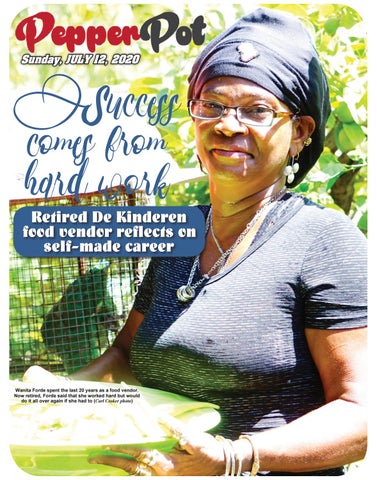
Sunday, JULY 12, 2020
Wanita Forde spent the last 20 years as a food vendor. Now retired, Forde said that she worked hard but would do it all over again if she had to (Carl Croker photo)
II
CHRONICLE PEPPERPOT ― July 12, 2020
By Francis Quamina Farrier
R
Professor Chuck Mohan and his wife of 38 years, Andrea
ACISM and all its evil deeds are among popular international discourses at this time. Those who practice racism always try to justify their actions; principally with the argument that they are superior to their victims. At this time those who are victims of racism, especially in the United States, cry out for justice. There are many examples of official racism which crumbled, or are crumbling under pressures from anti-racists; apartheid in South Africa being a prime example. In more recent times, there have been lots of push-back against that human weakness when individuals and groups treat others differently because of race. Racism and all that goes with it bring lots of pain to the victims. In more recent times in the United States of America, there have been many "Black Lives Matter" demonstrations which have even been extended worldwide. In this article, I write about romantic love between the races, especially when the individuals get married and raise a family together. In this my first feature article on the topic of inter-racial marriage, I immediately make mention that President David Granger and First Lady Sandra Granger are of different races, and that they have been married for over 50 years now. President Cheddi Jagan who was of Indian heritage, was married to Janet Rosenburg, who was white. Their marriage lasted for over 50 years. The first featured couple in this series, is New York-based Guyanese Chuck (Charles) Mohan who is of Indian heritage, and his wife Andrea, who is of African heritage. They have been married for almost 40 years now. "We are together 43 years and married 38 years," Chuck told me. "Her name is Andrea. Williams is her maiden name and I asked her if she wanted to continue using it after we were married and she said no.” Their meeting was, in a way, spectacular. "We first saw each other at an Earth, Wind and Fire concert at MSG in 1976 but was officially introduced by a mutual Surinamese friend in 1977 and we have been together ever since," Chuck said, in a way implying that their different racial backgrounds were really no big hurdle for them. They saw each other as two human beings who fell in love and wanted to spend the rest of their lives together as partners building a family and giving service to their community. Love has no borders. Cupid, that little baby-like fellow of Roman love mythology, with wings and a bow and arrow, shoots straight and to various people; he is not a racist for sure. Back in the 1960s, there was a popular love song by the American singer Sam Cooke entitled, "Cupid" in which the singer pleads with the love iconic to shoot his love arrow straight to his lover's heart. "I knew from the first day I met her that I wanted to marry her and I could not be happier," said Chuck when he first saw Andrea,
who he knew was going to be his wife. Cupid's arrow had struck its target. "She is the most wonderful human being and I'm happy that she chose me to be her husband. Race or ethnicity plays no part in our love and understanding of each other," said the Professor and community organiser. While their love for each other is firm and has stood the test of time, there were certainly the occasions when outside forces - especially people with racial agendas in their hearts - tried to intervene in a negative way. "We don't believe the colour of a person's skin is important, but understanding, compromise, dedication, and love are more important for a successful marriage," Chuck pointed out. "Our marriage vows and family first is of utmost importance to us." Chuck Mohan could very well be speaking for many others who are living their lives with spouses of a different race, such as former Guyanese Beauty Queen Shakira Baksh, who is of Indian heritage, and was courted by the Academy Award Winning English movie star Michael Caine. The two have been married for 50 years and counting. No doubt, most of us know a racially mixed couple - or great friends, for that matter. Chuck Mohan and his wife Andrea have strong opinions regards mixed marriages. "I totally support mixed marriages. I believe it's healthy for the world and brings about better understanding of people. In a mixed marriage you have to be able to be objective. For example, I criticise blacks and she criticises Indians, but not in a general stereotype but on individual situations and never their race or ethnicity." So Chuck and Andrea look at the deed, good or bad, of the person, and not their race to level criticisms or praise. "We brought up our daughter to love her whole being and not to choose between her Indian-ness or blackness, but love and respect both halves of who she is. She stays away from attending Guyanese most of the time because of racist comments about blacks by Indians and also some blacks would question what she is doing with me and not one of her kind. Our kind is human beings," Chuck emphasised. The couple has enjoyed lots of support from relatives and friends over the years. "Andrea is a great in-law and she is loved and adored by my parents and never had an argument or ‘falling out’ over those years. My sister and nieces and nephew also adore her," Chuck said. Some years ago I interviewed an elderly couple in America who were married when the country had laws prohibiting whites and non- whites from marrying each other. Chuck Mohan pointed out that, "Mixed marriages in the past was very difficult for those involved, even today because of the racism that still exists in the United States. The famous Loving case ended that in 1967. Richard and Mildred Loving (an inter-racial couple) endured a lot but they fought all the way to the supreme court and won, which ended the ban on inter-racial marriage throughout the United States ended," Chuck enlightens his students regarding that aspect of the history of America. "This is a case I discuss in my class every semester. In the movie it showed when their lawyers were going to the supreme court to present their case, he refused to go. They asked him what they should tell the court and he said, ‘Tell them I love my wife.’ That said it all for me and I also LOVE MY WIFE." Chuck and Andrea continue to live a happy married life in which race is not an obstacle, but rather a pedestal on which their love for each other zooms large like a display by Cupid, that mythical Roman god of love, who is definitely not a racist.
CHRONICLE PEPPERPOT ― July 12, 2020
I
By Wendella Davidson
T has long been appreciated that women, in particular housewives, find unique ways of utilising their spare time and ward off some boredom, or as a form of physical exercise. Before, gardening was merely to beautify the home with exotic flowers, which sometimes saw a healthy competition among neighbours. Kitchen gardens comprising herbs, peppers and thyme, where the homeowner could have gone to, should they run short and need any of those items. However, recently with the advent of COVID-19, it has become quite noticeable in the city and other communities that there is increased emphasis on the planting the kitchen gardens, by reducing the size of flower gardens to accommodate a larger patch for the planting of vegetables. While some persons visit the Nursery Division of the Ministry of Agriculture to purchase the young plants and seedlings, others prefer to visit the popular Caribbean Chemicals store on Croal Street, where packets of a variety of vegetable seedlings are available for purchase. According to Mr Martin Lopez, Agriculture Manager and Chief Agronomist at Caribbean Chemicals, there has been a marked increase in the purchase of packet seedlings in particular by both male and females. Among the most popular are ochro, bora, celery, eschallot, pak choy, peppers, tomatoes, cucumber, calaloo and cabbage. There has also been a huge demand for
III
kale, Lopez explained, while noting that there are farmers who engage in large-scale farming and would purchase seedlings in bulk. Guyhoc Park resident Margaret Clarkson, who has made a name for herself with cakes and other delicacies, has for years been cultivating potted flower plants that she offers for sale, in addition to greens and vegetables for home use. Margaret shared with the Pepperpot Magazine that since she began planting her kitchen garden and reaping the bountiful harvests, there is hardly any need for her to buy vegetables from the municipal market. “Planting is a hobby for me, it is a joy to plant, as it is a form of exercise for me and my satisfaction is being able to reap the fruits of my labour. For me, it is a garden-to-table situation, as every day I am assured a healthy and nutritious meal. I don’t have to worry about
Various packets of seedlings on display for purchase at Caribbean Chemicals (Delano Williams photo)
Margaret Clarkson
TURN TO PAGE VII
IV
CHRONICLE PEPPERPOT ― July 12, 2020
Exploring the benefits of yoga
P
By Naomi Parris
A N I C, fear and anxiety are all now common sentiments being experienced worldwide as a result of the Coronavirus pandemic. Acknowledging this fact, Shivana Persaud owner of the local skincare brand, Lure by Shiv, is bringing a calm to the storm with a four-week virtual yoga and meditation exercise. The young entrepreneur told the Pepperpot Magazine, “It is extremely vital I think for persons to have self-care activities and to really nourish not only your body but your mind and I think that it is more important now to give one’s self a [much needed] nourishment.” Persaud noted that the happiness and energy-boosting event which begins today, July 12, will see a yoga and mediation session as well as some journaling which she hopes will strike a balance between one’s, mind, body and soul. “It is a happiness-boosting activity because persons are seeing the rise the rise in deaths and the rise in cases worldwide is another issue and then you also have businesses suffering. People aren’t getting to go to their jobs, persons are losing their jobs and so you have a lot of chaos surrounding that even myself has dealt with anxiety during the pandemic and calming activities like yoga, talking a walk or a drive around the block helps to relieve some of the tension,” she stated. She noted that the art of yoga can provide clarity and keep persons grounded, all while building up mental strength. Persaud added that it connects the body to the mind to relieve any tension and let go of any frustration. “It really helps to bring calm; it is a really good way to start your day especially during this time,” she stated.
Aside from Persaud’s newest venture into yoga, she owns a small business which sells self-care products made from 100 percent Guyanese produce. The 28-year-old mother told the Pepperpot Magazine that she is a lover of both agriculture and business and decided to merge the two to create a line of skin-care products hence her brand and company ‘Lure by Shiv’. “It all stems from using local produce that we have right here in Guyana and from me being an economist where I worked with farmers along the coastline and one of the things that I found was that we really lacked manufacturing and I wanted to find ways which we could use more of our raw materials,” she explained. She noted that she wanted to create an appealing and alluring product that would be beneficial for Guyanese, however finding ways she could use the local recourses of Guyana was a challenge. Nevertheless, she started her business in 2018 using one main ingredient which was coconut as she believes it one of the most versatile products on the market. To date, she noted that while her brand is growing, coconut remains a staple in all of her products. Like
many entrepreneurs at the beginning of her business venture, Persaud disclosed that she had a hard time marketing her products making it difficult for many to catch on. She noted that many of the larger scale supermarkets would refuse to add her products to their shelves while having the same product which is made abroad- which to her made no sense. Despite her challenges, Persaud never gave up and is happy that many Guyanese are now supporting their own and going back to their roots, making use of their very own products made in Guyana. S h e noted that she is hoping that the trends ‘support your own’
and ‘support small businesses’ continue as they help not only young entrepreneurs to make a name for themselves but also magnify the many resources Guyana has and show how diverse Guyana’s agriculture can be used to produce a variety of products.
A few products from Shivana’s skincare line
Entrepreneur and owner of ‘Lure by Shiv’ Shivana Persaud
CHRONICLE PEPPERPOT ― July 12, 2020
V
Some of the paintings done by Jones for Curlfete 2018
V
By Jared Liddell
Owner and artist behind ‘Extraordinary Designs’, Shimuel Jones
ISUAL art takes many forms, from paintings and sketches to drawings and even videos and animation. A local art business ‘Extraordinary Designs’ has taken the initiative to feature all of these forms of visual art in their services offered including, wall paintings, sculpture and even animation. Owner and artist behind the business Shimuel Jones told the Pepperpot Magazine of his Journey which began eight years ago. Jones stated that although he had a few challenges in getting his dream business up and running they were not significant enough to stop him from following his dream. He said that from a young age he always had the vision that he would be an artist, stating that his love for what art represented and his love for sharing his art with others always influenced him and enabled him to have a sense of awareness that this is what he is meant for. “The journey had its ups and downs but I prevailed. I wouldn’t say it was hard because growing up I always knew what I wanted
to do, it wasn’t like I had to sit and think … I knew for myself that I was creative and I was born to be an artist so the financial rewards were secondary,”he said. “I wasn’t really thinking about that so it was if I didn’t even have to think about it there were no other options, I knew from the beginning that I was going to be an artist.” He explained that he officially started the business eight years ago using his talent and artistry to provide portraits mainly pencil, wall paintings, sculptures, and subsequently animation. Jones mentioned one of his more known animation projects: “Hello, Hello GPL”- who could forget, one of the most known GPL commercials, where a family loses their home for what we as Guyanese know as “thiefing lights”. That commercial was created and animated by none other than Jones, himself. Jones stated that he has also done several other animation projects both regionally and locally for other small and medium companies. He told the Pepperpot Magazine that although portraits are one of the main services persons request from his business, he chooses to offer animation services as a way to evolve his business and keep up with the trends in the business world. “For me, I am constantly trying to grow. As long as you are in business you have to constantly keep up with the trends. Every business is changing and I had to ensure that I was evolving and staying up to date with the trend in my business,”he said. “If you look at how art is evolving, cartoon animation is one of the more modern aspects of art so with that in mind I perused cartoon animation. I took a few courses in it to better develop the skills I had already possessed. And from that, I’ve been able to do projects.” Jones said that he would encourage younger creatives to follow their dreams, invest in their craft and push themselves to be the best. He stated that art is something that should be shared with people and that he would encourage all young creatives to invest in themselves and ensure they take the time to produce quality products that would feed into the souls and minds of their customers and supporters.
VI
CHRONICLE PEPPERPOT ― July 12, 2020
Steps towards an iota of positive change
I
OPENED a new google document and I stared at the blank screen trying to decide which of the very many, real, and ugly things I wanted to write about this week. My Trinidadian connection
directs me to talk about anti-blackness in Trinidad and the protests against that, while my now-minimal social media engagement points me to masked insecurities and prejudice against another ethnicity (National Geographic, Gor-
don Ramsay and highlighting Indigenous culture). Maybe I should write about the exposure of predatory behaviour. After all of that, is there any space or energy left to talk about the scant regard for the COVID-19 pandemic or the election
quagmire? Over the past few weeks, my honesty and my willingness to ‘own up’ to things have been acknowledged as a “good” thing. However, I learnt (and learnt the hard way) that honesty and owning up to things just don’t cut it; it isn’t enough. Beyond being honest, I gather, there must be a commitment to learn and grow, an understanding that listening is key to solidarity and a willingness to simply, unlearn. In my head, I sound pretentiousborrowing these sentiments from the learned people I am guided by. But, I cannot escape the fact that these are crucial tenets, necessary to engender even an iota of positive movement. Let’s take the case of police brutality and extra-judicial killings in Trinidad, for example. In discussing this, the occurrence of the wrongdoings cannot be divorced from the fact that they occurred in poor and/ or working-class, black communities. When violence occurs in these communities, the narrative continues to be “is good fah dem” and labels of “thugs” and “thieves” are thrown around easily. I watched the recent ‘Gary Griffith’ Livestream, which provided an update on the recent protests in Portof-Spain, and the vitriol emanating from the comment section was… just disgusting. It amazes me how persons could blame a pregnant mother of five for being killed while protesting, as though being pregnant invalidated her right to protest unjust circumstances. We cannot ignore that she was killed. Her
name was Ornella Greaves. It amazes me how quickly the conversation can shift from black folk and their allies protesting against a seemingly unaccountable and failed policing system, to one of ensuring that “lawlessness” is avoided. Allow me to borrow a sentiment expressed by a schoolmate here at the UWI#ThatMakingAnySense? I speak about Trinidad not just because I’m here and I’m privy to what has been happening, but because I can see what is happening in Trinidad as a parallel to what has been happening in Guyana. Let’s not fool ourselves into thinking that this doesn’t happen right in good ole GT. For persons like myself (Indo-Guyanese), recognising our privilege we have by virtue of our race is something we would be conscious of. The police brutality in Morvant and other black communities would engender a completely different public opinion had it occurred in a traditionally Indo-Trinidadian area. It would be the very same conundrum if we juxtapose this wrongdoing in a traditional Indo-Guyanese community with it occurring in the ‘Agricolas’ or the ‘Buxtons’ of Guyana. The narrative shifts from police violence and extra-judicial killings being plain wrong, to one that seeks to elucidate who is or isn’t deserving of the violence meted out to them. Again, #ThatMakingAnySense? Unlearning those ingrained prejudices of who “deserves” this violence and terror is necessary. And if you can’t see the problem here, I don’t know what else to say. There are a million other
things wrong in my Guyana and elsewhere in the world, but that doesn’t change the fact that at the root of many (if not all) of these wrongs resides inherent and ingrained narratives which need to be questioned. This past week, there has been a spotlight on sexual violence and predatory behaviour which begs us to revisit the privilege men hold and the prejudice we in society have for women and young girls-- vulnerable and victims. We continue to victim-blame. We accuse women of gaslighting and ‘blowing things out of proportion,’ instead of interrogating the positions of power men hold, and how they abuse those. There has also been the belittling of Guyana’s Indigenous peoples and their culture after this was highlighted on a medium that promises to draw global attention; something we should be proud of, but instead, we have opted to allow our prejudices to take hold. We continue to let our ethnic and racial insecurities get the best of us, instead of learning how to appreciate the richness in diversity. I don’t express these sentiments as a mere afterthought in my column this week. Instead, I express them in an attempt to reaffirm my position that even an iota of positive change must be accompanied by a willingness to unlearn the bad and learn the good; a conscious decision to listen; and, a commitment to learn and grow.
Come on, Guyana. Come on.
CHRONICLE PEPPERPOT ― July 12, 2020
VII TURN FROM PAGE III
the health factor because all of my produce are organic. Among the plants to be found in my yard and from which I have already benefitted are limes, soursop, peppers, parsley, fine-leaf thyme, celery,
Produce planted or reaped by Margaret Clarkson in her kitchen garden
tomatoes, Boulanger, cabbage, lettuce and cherries- the latter known to be a good source of Vitamin `C’, “ she stated. Not only has the COVID-19 epidemic brought
out the planting skills of women here in Guyana, but also farther afield, as is evidenced by Atlanta-based Joycelyn Merchant. Joycelyn told this pub-
TURN TO PAGE XX
VIII
W
By Naomi Parris
HEN w e think of fashion and modelling, we usually think of the tall petite girl or a strapping young man strutting down the runway in the latest pieces of clothing. However, a new era is upon us, and more and more, people have been demanding that men and women of all shapes and sizes be included in fashion, whether it be on the hangers of boutiques or on stage at local fashion shows. One of the movers and shakers heeding that call is 21-year-old entrepreneur Omallia Thorington.
CHRONICLE PEPPERPOT ― July 12, 2020
Thorington, who manages her own online boutique ‘Mallie Enchanted,’ which is known for being an inclusive brand catering for women of all shapes and sizes, noted that it is extremely important for young women and girls to see representations of themselves on magazine covers, as well as on the scenes of large brands sch as Vogue, Dior and many others. “It is very important because the world is not made up of a particular size of people, there is a diversity of sizes and we all should be advocating for it because a lot of times we allow these brands to do whatever and we are not speaking out,” she stated. The advocate for body positivity stated
that many young girls and women usually find themselves trying to change themselves to fit what is portrayed as the norm in the mainstream media, which can be both harmful to one’s mental and psychical health. “It’s a thing where you can be plus and you really want to buy this thing, but they don’t have your size and then you find yourself trying to look skinny just to fit in this type of clothing and this type of brand, because you just want to fit in with everyone else,” she stated. Thorington added that with the recent attention the fashion industry in Guyana has been receiving, she believes local designers who are launching a new clothing brand or line must be mindful and inclusive, adding pieces for both men and
women who are on the heavier side. “There are a lot of local brands that you’d want to support, but can’t, because they don’t make clothing to fit you. They don’t make sizes for you and even to the local seamstresses; a lot of people don’t know how to sew for a curvy body,” she told the Pepperpot. ‘SELF-LOVE IS THE BEST KIND OF LOVING’ Acknowledging that Guyana’s society norms usually see persons belittling young men and women for their weight, as persons are always commenting that ‘you’re either too fat or too thin’, Thorington stated that many young people have to first learn to love themselves. She noted that while the journey of self-love may not be an easy one, it will definitely
CATERING FOR ALL SHAPES AND SIZES Thorington disclosed that her business originally started from her just shopping for herself. She noted that she was looking for a specific piece of clothing, however, was having some difficulties since the boutique that was selling this specific item at the time did not cater for her size. Thorington eventually came across a website that catered for women who looked like her and she decided to pick a few items for herself, as well as a few for some of her plussized sisters. She noted that while she caters for all body types, the majority of her customers are on the heavier side. “People are longing for it, people are buying and every
change the way one sees themselves and will eventually alter the way other people see you. “Try to flood your thoughts with positivity and when you truly start loving yourself, it’s going to show and people are going to see that. Wear whatever you want and do whatever you want and they would naturally respect you,” she said. However, she noted that people must also be mindful of what they say and how they say it, because words can cut deep and sometimes even leave scars. “We should also teach people, I mean you can’t always control your mind and what you think but you can watch what you saw.” ‘Being on the heavier side does not make you unhealthy’ Noting that the stigma of assuming that someone who is plus-sized is unhealthy is absurd, as there are many plussized persons who are vegetarians and also exercise regularly. However, losing weight can remain a challenge owing to a medical condition as well as genetics. “People are like, ‘oh, you getting fat you need to go [to] the gym’ and I’m like, I am going to the gym but nothing is happening, and I’m not going to kill myself trying to get slim, but you know I’m still trying to be on the healthy side,” the young woman stated. Thorington added that while nothing is wrong with wanting to tweak the way you look, especially if one is willing and dedicated to do so by exercise or diet, it should never be influenced by someone else’s opinion.
day I get orders. They really love the [items] and it’s not old- fashioned. It’s really sexy and appealing to the body and the eyes, so I really appreciate the support - I’m getting a lot of support from the plus-sized community,” she told the Pepperpot Magazine. Admitting that her business venture was only meant to be a one-time thing, she noted that with the overwhelming support she has been receiving and also the demand for trendy, plussized clothing in Guyana, she will continue her business and may even expand. The ‘Lindener’ who is also a YouTuber, admitted that while she also does a lot of make-up videos, her true talents lie in the editing aspect of her videos, as that is her true passion. She noted that she loves videography and photography and was collaborating with a professional for a photoshoot; however, due to the COVID-19 pandemic, it had to be postponed. She noted that she also intends to use her YouTube platform to engage other youths on critical topics, but that too has been placed on hold and she has been experimenting with make-up and photo editing on her channel in the meantime. The 21-year-old told the Pepperpot Magazine that she is not one to put herself in a box, as such, she is passionate about exploring her talents, whether it be in the fashion and economic arena, after disclosing that during her time at home she enrolled in an online business programme to enhance her business skill.
CHRONICLE PEPPERPOT ― July 12, 2020
G
By Jared Liddell
U YA N E S E entrepreneurs have been constantly adapting and changing moving from being just suppliers to being even creators and producers, and this was the vision that founder of Trisee Luxury Cosmetic, Tristell Manifold had when she started producing her own line lip-gloss and lip plumper exclusive to her company. Manifold gave the Pepperpot Magazine an insight into her business journey explaining that she was very passionate about the beauty community and she noticed that there was a lack of quality beauty products and makeup services in Guyana and wanted to make a difference. To her surprise, within months of debuting MakeupByTrisee, her business expanded to include one-on-one makeup courses, which she said was very rewarding as well as satisfying. “One of the joys of being an entrepreneur is a constant challenge to create and build. I’ve always wanted to be a teacher, so when life provided another path, I took the opportunity to share my knowledge with others, using a simplified course outline to help clients to create their own natural and trendy makeup looks. Over the years I have really enjoyed mentoring and coaching others while learning more about the beauty industry,” she said. The young entrepreneur stated that one of her biggest sources of motivation is her four-year-old son, explaining that she wants to create a business that can provide for him and that he can aspire in turn be inspired by and be proud of all the hard work she has put in to accomplish her goals. Manifold told the Pepperpot Magazine that to take her brand to the next level, she knew that she had to take the initiative and move from simply supplying beauty products to creating her own products. She said that her locally-made lip-gloss and lip-plumper are not her first venture as a product creator adding, “Why not be innovative and create my own products? At the end of the day, my consumer base is Guyanese and I want to provide the best for us. I started by designing and supplying luxury 3D mink lashes. So, I created strip lashes that give that glamorous look.” When asked about the process of her creating her own product, Manifold described it as challenging and said,
“But I loved every moment of it” noting her commitment to her customers, and the love she has for creating quality products. She stated that her love for makeup enables her to have an insight into customers’ need for comfort as well as style and that allows her to create the best possible products that would meet the need of her customers. Manifold stated that it has been quite a learning process but she has enjoyed every second of the journey. “People often glamorise the end results without taking into consideration the hard work that goes into it and trust me it takes a lot of tears and sweat. Making Glossy Luxe by Trisee has been an amazing new challenge,”she said. “Larger companies normally make lip gloss in larger batches as opposed to the smaller handcrafted batches I’m currently making. I am using all-natural ingredients such as pure coconut oil and vitamin E oil, which help to soften lips and heal chapped lips.” Manifold told the Pepperpot Magazine that the lockdown has allowed her more time to focus on the business and its future stating that she is excited to grow as a brand and an entrepreneur. She stated that her business will continue to produce its own products to ensure that all the products she offers to her customers are locally produced and of the highest quality. Trisee Luxury Cosmetics currently produces lashes, lip gloss, and glitter products and recently launched a Shimmer Body Spray. Manifold also told the Pepperpot Magazine of one of her upcoming products the “24k gold body oil” infused with rose petals. The young entrepreneur said that she had to ensure she invested a lot of herself into the business. She encourages other entrepreneurs, especially women, to follow their vision and never stop expanding and working toward their goals. “Being successful takes a lot of work, vision, and perseverance. I would encourage young entrepreneurs and product creators to anticipate the customers’ needs and always deliver beyond expectations. It sets you apart from your competitors and helps you to develop a loyal consumer base. Above all, continue to challenge yourself, take risks, learn from complaints, study your craft and industry, and always believe in yourself.”
IX
X
CHRONICLE PEPPERPOT ― July 12, 2020
G
U YA N A , from its earliest manifestation as a colony in the 1700s, has always had a venue for the Arts, especially the theatrical Arts. I have written on taking our drama festival to a different level with proper recordings of its best plays, but it was ignored, while the drama fraternity fretted and quarrelled with itself and failed to embrace the big picture. The lack of knowledgeable upper management that should have been able to arrest, iron-out and transcend the petty contentions, enforce stability and lobby for necessary budgets is a principle negative, and there are petty contentions, backbiting and counterproductive undermining do exist in the arts. Like all else in our colonial-inherited public service, the rabid itinerary of securing the borders of ‘De Job’ against real and imaginary incursions limits and excludes external participation. However, the result is that we do not have in this unprecedented time when
a pandemic is demanding a life- or-death social adjustment of remaining indoors. We do not now have that reservoir of recorded cultural items, though we have more than performed enough stage productions at both the Theatre Guild and the National Cultural Centre to have stored enough materials to package a minimal chat and show programme to attract interest and stay home, family/community involvement in watching people we know and can remember on stage, boasting our national ‘being’ with the excellence of our own talents on stage and concise, narrated literature supported by graphics and live performances. We have failed to recognise, organise and open up to a broader discourse to advance and perfect what is in all a national treasure. Though unrecognised, undesired and held with indifference by one area of the political crossroad, and shelved ‘Fuh Now’ by the other side of the political crossroads who have the greater Guyanese cultural groundings at its innate bequest. That there is a need to activate and define ourselves
TURN TO PAGE XXV
CHRONICLE PEPPERPOT ― July 12, 2020
XI
De Kinderen Village
By Michel Outridge
T
H I S week the Pepperpot Magazine visited the village of De Kinderen, West Coast Demerara and highlighted the way of life of the people and the community. De Kinderen Village is sandwiched between MetenMeer-Zorg and Zeelugt and is home to about 200 residents.
e r s have their small businesses. There are a few teachers, nurses, cash crop and livestock farmers and estate workers. De Kinderen has a Health Centre, a tyre shop, a home for the elderly which is privately run by Muslims, three churches, shops and has clay brick streets. The Pepperpot Magazine met an elderly villager, Mi-
more than 20 years, retired as an excavator operator from the Regional Office and decided to open the shop to earn an income. He also has a plot of land behind the village, on the old railway embankment where he has a small farm and is rearing some chickens and pigs.
community is small and was established under former President, Hugh Desmond Hoyte in the 1990s under a self-help programme in which 28 house lots were parcelled and given out and 28 houses were later built.
Home of Michael Sanders
Focus on the Village
De Kinderen Village (Carl Croker photos)
It is a small community with a few streets and most of the residents have to go out of the village for work while oth-
chael Sanders, who was manning a small shop he has in his front yard. Sanders, who has been living in the village for
Historical background
Giving a background of the village, he reported that the
He added that the residents came together and also built the clay-brick road which still exists in some sections but is eroding after all these years. Sanders disclosed that they had a large plot of land in the
village which was allocated as the playfield but in 1992 the Opposition took away the land and converted it into a 32-plot housing scheme. He reported that later
quite some time, the drains haven’t been cleaned and the roads left in disrepair by the Neighbourhood Democratic Council (NDC). Sanders pointed out that De Kinderen comes under the Meten-Meer-Zorg to Uitvlugt NDC and is often referred to as the “Clay Brick Scheme”. He related that the residents in the village are prompt with the payment of their rates and taxes but no attention is given to infrastructural works to enhance the village. Michael Sanders Sanders stated that a and his pigs handful of residents came together and built a bridge in the community without any assistance from the NDC. “In this community, we have to pool our resources to get things done because the NDC has no time for us and we don’t depend on them to do anything anyway,” he said. Meanwhile, he told the Pepperpot Magazine that De Kinderen is a quiet, countryside village where the people live simply and do their part to maintain their families. Sanders added that most villagers De Kinderen Village ‘go and come their way’ and other than the NDC’s neglect there are no real issues among the peoon, another plot of land was also re-possessed and ple there. “We are simple peomade into a 28-plot housing ple, work and live as othscheme aback the village. The senior citizen added ers and we live in peace that some attention needs to and co-exist in harmony be paid to the village, as for here,” he said.
XII
CHRONICLE PEPPERPOT ― July 12, 2020
Focus on the Village
Simone Warner
T
The Warners displaying some of their home-processed products (Carl Croker photos)
HE Warner family has, over the years, invested time and money to ensure that their small business grows and it has, with their homemade Jet’s brand of nutritional bottled beverages. In 1999 Jethro Warner used to walk and sell the noni fruit freshly picked from his farm and while going into the city and offices, he was encouraged to process it into juice and bottle it for re-sale. After he did some research and realised the many nutritional values of the fruit, there was no stopping him from embarking on his project, which started from his home and is a juice factory today. This business was registered in 2000 and they began converting fresh fruits garnered from their farms into juices which includes mauby, guava, gooseberry, ginger, jamoon, cherry, noni, capadulla, sorrel, tamarind and many others, which also come in a bottled concentrate to which you can just add water to consume. No sugar is needed. These products are available in many shops and supermarkets
Home of the Warners
The Jet’s brand of juices and beverages
countrywide and are also being retailed at the Guyana Marketing Corporation (The Guyana Shop) on Robb Street. The Warner family consists of Jethro, his wife Simone and their six children, who are all involved in the family business and they have two employees who work on their farms. The Warners have gone into honey, pepper sauce and green seasoning and these are bottled and sold as well. Simone Warner told the Pepperpot Magazine that she is originally from Danielstown, Essequibo Coast, but relocated to De Kinderen, West Coast Demerara 20 years ago when she got married to Jethro. The 51-year-old added that their time is consumed with work on their farms and at their home where they have their processing factory; as such, they do not socialise much with residents but stated that the village is a very quiet place, which suits them just fine. Being farmers, they have some farmlands behind Parika, East Bank Essequibo, where they have crops of ground provisions and fruits which are sold at the Leonora and Stabroek Markets on Fridays and weekends. The Warners also have a plot of land in De Kinderen on which farming is also done and presently, they are experimenting with cassava which is chopped into small pieces and dried. Simone Warner said it will be converted into powder and if the experiment is successful, they may soon have cassava flour of the shelves of supermarkets soon. “We would source honey from the Soesdyke-Linden Highway and bottle it for sale; same with peppers and green seasonings,” she said. Simone Warner added that her husband had a vision and collectively they worked to achieve that goal and today their family-run business is successful and gaining momentum. She related that the glass bottles of 750ml are sourced from Demerara Distillers Limited (DDL), while the plastic bottles are bought from local suppliers. “We have our factory here with cold storage and everything and we produce juices according to the international standards and it is also correctly labelled and sealed as wholesome products,” she said. While Jet’s product range derives from the processing of various fruits and barks, including cherry and mauby bark, the star products are the Noni drinks and juices. Noni has a well-known history of use as a preparation for joint pain and skin conditions and its juice is consumed in several countries as a general health tonic, as well as for cancer and chronic conditions such as cardiovascular disease and diabetes. Laboratory research has indicated that the fruit has antioxidant, immune-stimulating, and tumour-fighting properties. The fruits that are processed into drinks at the De Kinderen factory are all cultivated at the Warners’farm. The farm also provides cash crops, some of which are sold to subsidise the Warners’ income. The Warners are a true representation of humbleness and perfect examples of agro-processors, who are determined to go forward with the introduction of newer products through their innovative reach. “To be successful in any business you have to have the support of all parties involved and it entails a lot of work and planning and this family is a unit that does everything together to ensure the doors stay open and we are simple, God-fearing people, who have a small business which provides and income for the home,” Simone Warner said.
CHRONICLE PEPPERPOT ― July 12, 2020
XIII
Wanita Forde’s home
Wanita Forde (Carl Croker photos)
Focus on the Village
The 24-year-old parrot named Lora
H
By Michel Outridge
AVING spent more than 20 years as a food vendor at the M e t e n - M e e rZorg, West Coast Demerara Primary School, which provided an income to educate her three children, today she has retired and is enjoying her golden years. Wanita Forde is a resident of De Kinderen, West Coast Demerara and over the years, she has developed arthritis in her shoulder and knees. Forde told the Pepperpot Magazine that she had some good years as a food vendor and would do it all over again if she had to. “I know a lot of pupils and their parents and they used to come and chat with me while waiting to pick up their children from school, and I became well-known there,” she said. She has been a resident of De Kinderen Village for the past 28 years after relocation from Region One (Barima-Waini) Mabaruma, where she used to work in the ‘gold bush’. The 54-year-old added that she wanted a better quality of life and she opted to move away and bought a plot of land at De Kinderen and made it her home to date. “In life, you have to make the sacrifice if you want a better life and I did and put my children through school and today they have good jobs and they have made me proud,” she said. She retired as a food vendor four years ago based on her doctor’s advice.
This easy-going friendly woman used to prepare homemade foods and snacks for schoolchildren and used to sell snacks and other odds and ends that the children needed. She used to be the chairperson of Jaso’s Nursery School Committee at MetenMeer-Zorg, a position she had held in high regard. Forde has two daughters and one son. One daughter is married and lives overseas, the other daughter is a nurse and her son is a police sergeant. Her husband is a bus driver and she is taking care of her granddaughter who has been with her since she was seven months old. The little girl is her ‘company,’ along with the many animals she has. “I used to work hard in the bush and selling at the school, but now I do my gardening and take care of my granddaughter and my dogs and parrot,” she said. Forde related that her mother is of East Indian ancestry, while her father was of African descent. Sadly, her father passed away at age 63 years old, but her mother is 80 years old and resides in Matthews Ridge, Region One. Her mother is originally from Moruca and got married when she was just 14 years old. Her dad fathered 29 children wi three wives and of that number, he had six children with her mother. “I live a good life, nothing don’t bother me and I don’t mix up too much with people and mind my own business, besides, I have a lot to do,” she said.
ANIMALS ARE MY BEST FRIENDS At one time, Forde had 29 dogs that were all trained and named and 18 cats but today she has three dogs and two puppies. Forde also has a parrot called Lora, who is 24 years old and she got her as a baby
when she used to work in the interior. She recalled that the bird fell out of a tree and was injured. The mother of three took care of the parrot and she is in good health and seems contented with her current conditions. “It is better to have animals around you because they are
true friends and they do not act up when things go wrong,” she said. Nowadays, Forde is busy with household chores, gardening –- the products of which she uses in her kitchen -- and taking care of her granddaughter and her pets. Her yard is quite an envy
because of the many fruit trees and vegetables, so she eats what she grows. Forde has come a long way and she is pleased with herself today, because in 2001 her house was destroyed by fire, it was a Father’s Day but she managed to pick up the pieces and start over.
XIV
A
CHRONICLE PEPPERPOT ― July 12, 2020
By Michel Outridge
B I G A I L Wa r n e r i s a hard-working young woman who is fully involved in her family-run business and is a full-time school teacher at the Vergenoegen Secondary
School. She teaches English A and Reading for Grades Seven to Nine. The 22-year-old has been in the profession for the past three years, having completed her studies at the Cyril Potter College of Education (CPCE). She gravitated to teaching as a Sun-
day school teacher at her church and developed a liking for it when she realised that she had a way with children and it was a fun time for her. “I used to look forward to Sunday school time because I like children and I felt good being able to impart knowledge; and I thought I should make it a career, something I like doing,” she said. Warner added that since she wasn’t too creative in her teaching skills, she opted to teach on a secondary level and it was a good choice, because she is loving the interactive classroom sessions with the students. “I do well in a controlled environment such as a classroom, where I can relate to the students both on a one-onone platf o r m and collectively,” she said. W i t h school being closed for more than nine weeks now, Warner would assist her students with online teaching via WhatsApp and Zoom. Daily, she tutors a group of 15 to 20 students and deems it fun interacting with the bunch who are willing to learn. “My students would call me every day to talk and for me to help them with the school work, but I miss the classroom exercise where I have a more hands-on technique,” she said. These days, Warner would go to Vergenoegen Secondary School three days a week to assist students who are writing the Caribbean Secondary Education Certificate (CSEC) exams. “I am helping with basically the supervision aspect of it and it is done on Mondays and Wednesdays; and it is no big deal because I miss the students and the school,” she said. Warner added that when students ask questions it means that they want to learn
Abigail Warner and they want to fully understand what is being taught and it gives her great joy to be a part of that. This young woman sees herself opening her own school in the future. It is her wish to utilise retired teachers as supervisors and managers, because a lot of them are not doing anything as is and they have a wealth of knowledge. “At the same time, my school must have a lovely canteen where my family products will be sold and I might as well kick-start my catering service, since I am versed in making pizza,” she said. Warner is considered the family’s chef and they love the home-made pizzas she would make and they have been encouraging her to start a small business in that field. This teacher also aspires to venture into hair-styling and makeups, since she is talented in that line of work and would often practis ALe on her siblings.
Focus on the Village
CHRONICLE PEPPERPOT ― July 12, 2020
I
By Michel Outridge
T was a mind of positivity, determination and faith that led Christine Medas to withdraw her life-savings and construct a small salon to house her part-time business. Medas is not just any young woman, but a very passionate one, who is making a name for herself in the beauty business. SELF-TAUGHT TALENT This small business-owner grew up braiding hair. She is self-taught and over time she perfected the talent and was urged to make it a living and that she did last year, when she withdrew her life savings and constructed a small building to house her salon. Her small cottage-style, wooden salon is strategically located on the first street, just off the Public Road at De Kinderen Village, West Coast Demerara. She is also a full-time employee at the Vreed-en-Hoop Regional Democratic Council Office (RDC) Accounts Department. “I decided to get serious last year and invest in this small business to meet the demands of[my] clientele, who previously converged at my mom’s home three streets away and [I wanted] to avoid people visiting her house, something she didn’t approve of,” she said. Medas told the Pepperpot Magazine that she would do makeups on weekends, but it is the braid styles that are in demand and she would take appointments even after she finishes work at 16:30hrs on a weekday. “Some people go to classes to get better but I didn’t, it is a gift I have since a child and I would go to YouTube to view videos of trending styles to get familiar with what’s new to bring to the customers,” she said. Medas would accept a hairstyle job only if she can accomplish the style to save herself and the client time and money. “Clients would send me photos of braid styles they want via Instagram and Facebook, where I have a page and I would try to give them what they need, because to keep your business alive you have to be reliable and consistent to keep them coming and keep the doors open,” she explained. She is versed in all hair types and textures as it relates to braids and it would take hours depending on length and style to complete a knotless
XV
- Braid specialist and make-up artist advises aspiring entrepreneurs Christine Medas’s salon in De Kinderen Village (Carl Croker photos)
braid style which is presently trending. Medas’s Facebook page can be viewed as “Alisha’s Perfect Look”, the same name as her salon at De Kinderen, West Coast Demerara. This hairstylist disclosed that depending on the style, the price varies which she considers reasonable adding that she is a professional and does a perfect job, every time. HARD WORK IS REWARDING This hardworking young woman is wise for her age and because of her workload and appointments she doesn’t have the time to socialise or mix with the regular crowd. “Last Christmas, I had clients at my house waiting to get their hair done and I worked through all night to ensure I met their needs with my service and that is how I work, non-stop even without eating some days just to keep my business open and customers happy,” she said. “I am young and have the gift of health and strength so this is the time for me to work hard to ‘make my money’ and not wait until I get big to fight up to get certain things because when I have a family I want them to be comfortable and not have to pay rent or worry about frivolous things,” she said. Medas, a chatty but pleas-
ant person added that as she looked back at a year ago, the investment she made has certainly paid off but due to COVID-19 she had to close her door for a bit. She recently resumed business as a result of the demand of customers, who have kept her busy with calls for her services. LENDING A HELPING HAND Medas added that the business cards she has are a gift from a client, who resides overseas stating that she is thankful for small mercies. “Having a small business is all about assisting others with similar ventures because you have to help others to grow as such, the taxi drivers would leave their cards for my clients to use when they need to,” she said. The feminist added that her salon is without electricity and she is hoping to have soon but in the meantime, she is using a battery to power a fan and other equipment. Medas explained that as part of her small business she is a role model to young women in her village, she would accommodate them and assist them in braiding hair. “I would tell them to come and watch me braid hair and that way they learn, everybody has a gift, a talent they can do
something to make a living rather than sit and complain, one can get up and start their own small business and that’s the way to go to enhance your life,” she said. These days as a result of the global pandemic, Medas works every other day, this gives her the time to do hair and that is how the Pepperpot Magazine found her this week. She was braiding the knotless braids in a client’s hair, a job which would take hours because of the length but she was at it and she was determined to complete the task at hand. Medas would source her hair products from both local and overseas and is hoping to import fragrances and other hair products which will be available at her salon. “As a professional, one has to get the tools to do the work because it makes you better equipped and sure of yourself and that’s why I follow the best hairstylists to enhance my skills,” she said. Medas told the Pepperpot Magazine that her small business started as a vision and she believed that’s he could do it and she saved up some money and took her life-savings and went ahead with the construction of her salon. “My biggest motivator is my mother, who always encouraged me to establish
my own business and my family is very supportive as well even though we are not rich we have each other,” she said. Medas added that for one to get their own business they have to first make a start then everything falls into place with planning. The 25-year-old is hoping to make her small business her full-time job but for she will have to balance two jobs.
Christine Medas
XVI
CHRONICLE PEPPERPOT ― July 12, 2020
d n i M e t i r The W by Jasmaine Payne
W
E’VE all heard about the importance of reading in general, but particularly when you are interested in becoming a writer-- any type of writer, for that matter-- reading is mandatory. “Reading inspires us, sparks new ideas, and teaches us by example how to write effectively… If you aren’t nurturing yourself as a reader, you’re shortchanging yourself as a writer,” says Maggie Murphy, American writer. Persons looking to upgrade their writing should read more of the type of publications within their fields. By that, I mean that creative writers should read more fiction, business writers should read more reports and journals, etc. Reading documents from other career paths is also recommended to get a glimpse of techniques they employ to produce different types of content.
Variety is recommended Don’t just read literature that you like, add a variety of genres to your reading menu. Inspiration can come from all sources, so don’t limit yourself to just one area. Read whatever you can get your hands on and keep an open mind: mysteries, thrillers, horrors, poetry, non-fiction, true crime, plays, memoirs- try out a variety of publications to keep the flow of information constant. You’ll be surprised how inspired you may be by just stepping outside of your comfort zone.
The Writer’s Handbook 2001 suggests the following tips for incorporating more reading into your writing life:
go along to stay engaged in the content. This is a good way to get you through especially long publications or to keep you motivated to continue reading.
Compile a booklist Every year, I set a target for the number of books that I want to read. Whether I actually make that target at the end of the year is another story. But setting a target, and making it as detailed as possible by even including specific titles that you want to read are helpful ways of staying active. As you progress, cross them off your list to keep track of how you’re doing along the way.
Join a book club If none of your close friends are big readers, you can always find a book club where countless persons share your interests. Depending on your preference, you can either try to find or form a physical book club, or hop on the modern trend of choosing from among thousands of online groups on Facebook and Instagram. The latter option brings you into
Get company Finding a book buddy can be a fun way of getting through your booklist. Find someone who has similar interests or who may want to read the same books that you do. Make it fun by seeing who can get to different chapters or the end of the book first. Have constant discussions as you
contact with persons from all over the world, and can even widen the variety in the types of literature you read. A little at a time You don’t have to read 50 books a year. Sometimes your schedule may not even permit you to read as much as you wish. That’s okay. Any amount of reading is good, so long as you keep at it. Maybe you can take a book wherever you go so that you can pick it up in your downtime. When you’re on the bus (or train, depending on where you live) or waiting at the doctor’s office, you can pull that book out and get a couple of pages in. A little bit goes a long way and still helps to serve the main purpose. eBooks and audiobooks are still books You may not like the hassle of having a physical book to lug around all the time. Maybe you’re a more “digital” read-
er. That’s okay, capitalising on Amazon’s Kindle services is the perfect way of solving that problem. eBooks are just as good as physical books – and are also more convenient. You can even invest in audiobooks to listen to the content, which saves time and allows you to multitask. Following these tips are sure to improve your reading habits over time. It may seem like a daunting task, but it is essential for your writing career. The important thing is that no matter what, you keep at it. The future of your writing depends on it! So have fun! Interested in contributing to this column on writing? Email me at thewritemind592@gmail.com
CHRONICLE PEPPERPOT ― July 12, 2020
LAST week I received a request to discuss Parkinson’s and its effects on families, the community and mental health.
What is Parkinson’s disease?
Parkinson’s disease is a progressive disorder of the nervous system which mainly affects movement. Progressive means that it starts slowly and worsens over time. It is mainly caused by the damage of important neurons- which are nerve cells in the brain. It particularly damages parts of the brain that produce dopamine which is a chemical largely responsible for movement and coordination. Over time, this affects the individual’s ability to control overall body movement. Parkinson’s typically affects individuals over age 60. If it is developed in anyone younger, it is called young-onset Parkinson’s. It is more commonly diagnosed in males than females and sadly the life expectancy of someone who is diagnosed is typically between seven-14 years.
What are the symptoms of Parkinson’s disease?
These can be physical or mental and largely depend on the progression of the disease. Parkinson’s typically begins with a small hand tremor. This leads to slow and (cause) rigid movements, called bradykinesia. Over time, this becomes constant and uncontrollable tremors which leads to impaired balance and coordination. The subsequent stiffness in the muscles may result in pain which also decreases movement in general. As the progression worsens, it becomes hard to do regular daily activities such as writing, brushing teeth or getting dressed. Eating becomes difficult due to the lack of hand coordination as well as problems swallowing. Issues with digestion, bladder control and blood pressure/sugar are also common. All of these disruptions typically result in difficulty sleeping. Cognitive problems such as dementia, impaired perception and decreased attention and memory, also tend to occur when an individual develops Parkinson’s. Senses such as sight, smell and touch are also negatively affected. In rare and extreme cases, hallucinations and delusions can occur. Mentally, Parkinson’s increases the chances of stress, sadness, fear, insecurity, anxiety, depression and even suicidal thoughts and behaviours. The individual is still mentally aware of what is happening around him/her but control of bodily functions is lost. They become dependent on other people.
They may feel like a burden on friends and family. There are facial symptoms which minimize expressions. It will be difficult to see/understand what the individual is feeling. This tends to make them feel misunderstood or alone. Their speech will become slurred, quiet or non-existent.
Who is at risk for developing Parkinson’s disease?
There are multiple causes of Parkinson’s. As mentioned, the two major risk factors being damage to certain areas of the brain (which are responsible for movement and coordination) as well as age. Like most other illnesses, there is a heredity factor at play. If you have a close relative with Parkinson’s, you are more likely to develop the disease yourself. The more affected relatives, the higher your chances of development, especially if you are male. There are mutations of several, specific genes which also makes development more likely. Research shows that head injuries of those prone to development increase the risk of the disease. Some studies also show the exposure to toxins such as pesticides and herbicides increase the chances of developing the disease.
How is Parkinson’s disease treated within our community?
Parkinson’s disease cannot be cured but can be treated and managed with prescription medication and counselling. The appropriate medication will be prescribed by the diagnosing doctor. These will increase the production of dopamine in the brain and will, therefore, manage the tremors and movement issues. The user will see strong changes in the first stages of treatment. Unfortunately, over time, the benefits of the drug tend to become less consistent. Lifestyle changes such as improved diet and exercise are also highly recommended to slow the progression of symptoms. Exercise can be anything from aerobic to yoga. A diet high in fibre and omega-3 fatty acids is beneficial for those with Parkinson’s disease. Research also shows that caffeinated substances such as coffee or tea may reduce the possibility of developing Parkinson’s. Keep in mind that this not only helps the direct symptoms of Parkinson’s but also the secondary ones. For example, exercise and healthy diets help to lower depression and improve balance. Other recommendations are massages, acupuncture, mediation
XVII
and music therapy. In extreme cases, surgery may be recommended. When our loved ones suffer, we tend to suffer along with them- all the while feeling helpless. There are a few simple things one can do to make this transition easier. One of the main causes for mental health issues that arise from illnesses like these is the feeling of helplessness and loss of independence. It would help if the individual is made to feel like he/she can do things on their own. Examples of this are simple things such as avoid shirts with buttons so they can still dress themselves, purchase electronic toothbrushes or cut their food into smaller bites. Pay attention to what is particularly hard to for them to do and come up with easier solutions. Do activities outside as research shows that vitamin D may slow down the progression of the disease. If you feel that you may be showing early signs of Parkinson’s, please visit your nearest health centre and share your concerns. If you are suffering from Parkinson’s, think about starting a support group. Do you know anyone else that is suffering from Parkinson’s? Find comfort, support and education in each other. If inpatient treatment is needed, there are options available within our community. These centres ease the stress of both the patient and family members. Mercy Hospital Resident Care. This means, the patient lives and is taken care of by people within the centre, who are specially trained in these areas. Address: Lot 3 Pere Street Kitty, Georgetown Contact: 227-1100, 225-3185 Demerara Paradise Inc. Nursing Home & Medical Facility who provide direct nursing care, CCTV Camera Supervised Back Office Care, physicians , therapists , social workers and nutritionist visits. Address: 1 C Le Ressouvenir East Coast Demerara Contact: 220-2677, 220-2672. Thank you for reading and please send in any topics to caitlinvieira@gmail.com. Also please remember you can book a counselling appointment with me at +592 623 0433 Suicide Prevention Helpline Numbers: 223-0001, 2230009, 623-4444, 600-7896 Say Yes to Life and No to Drugs! Always!
We have no right to tell victims of sexual abuse when, how or where to speak out against their abusers
A
S a young writer, my only constant writing mentor has been myself. As such, I taught myself that silence through observation allows us to grasp the simplicities through the complexities. In other words, I observe to understand and then head to my computer and quiet space to write. I recently observed that many alleged victims are taking a stance to speak up against their abusers/abusive experiences. Most of these cases were sexual abuse/assault and/or entailed sexual grooming. While I am no lawyer or scholar of the law, I know that a person is legally innocent until proven legally guilty. Nonetheless, that should not allow us to mute the voices of alleged victims along with their stories. I have observed many instances where persons prepared rebuttals and have shamed the victims, accused them of lying and even tried to dig up past dirt on them. Some people did every other thing possible, except listening to alleged victims and their claims.
We have NO right to tell abused victims how to feel, when they should tell their stories, when they should go to legal authorities, which platforms to use when they tell their stories, what tone to use, what time of day or day of the month—whatsoever. Even if you were abused yourself; you still have no right to compel another victim because “this is how I handled it and so should you.” Every individual and their experiences are different. The same can be said for the way we deal with trauma and in this case; abuse. No one is asking you to believe an alleged victim’s story, neither are they asking you to feel pity for them. It can be liberating and also terrifying for victims to come forward with a truth that haunts them; a truth they wish wasn’t true. It can take many years for some people to process raw traumatic experiences while it may also take others to do the same in a matter of days—we’re all different. The least we can do is show even a minuscule of human decency to people who may want to finally tell the world of their darkest days and expose monsters for who they are.
These very instances of disregarding public statements of alleged victims in a country where rape culture is already glorified are more reasons as to why so many victims will remain silent. When sexual abuse victims “speak up”, the least we can do is listen. We have no right to tell a victim when, where or how they should speak out against their abuser—only their mind and body can. Victims have been manipulated and controlled with their experiences so the minute they decide to take back that control then let’s listen and try to understand. Who are we to devalue the experiences of victims? Who are we to judge and compel them on how they should feel? We ought to do better Guyana. Yes, most accused are concerned with their reputation but we should not stop persons from having a voice. If you really are innocent then allow the law to prove it. With the same energy, be sure to use #MeTooGuyana to community support for victims, alleged victims and potential victims of sexual abuse and assault.
XVIII
CHRONICLE PEPPERPOT ― July 12, 2020
CHRONICLE PEPPERPOT ― July 12, 2020
XIX
XX
CHRONICLE PEPPERPOT ― July 12, 2020
TURN FROM PAGE VII lication that she used to have the occasional house plant, but after reading about the coronavirus pandemic and seeing the deadly impact of it on the television and the internet, she started producing some of the vegetables she eats. And, while she is disappointed that she is hampered to be able to plant in a yard space because she resides in a gated community, she nevertheless uses containers that she placed on her patio. Joycelyn, who describes the garden she started in May as “my quarantine garden,” added, “I am in lockdown and can’t go anywhere, so I started to make myself useful at home. I am loving it, every morning I get up I go sit on my patio and have
a conversation with my plants. I have already harvested and continue to harvest to my personal satisfaction.” The plants she has now are tomatoes, boulanger, rosemary, and thyme (married man pork). “Who knows - had COVID-19 not surfaced I would have still been planting flowers, not realising that I can do vegetables and reduce the need for me to go to the vegetable market for certain foods. Of the produce I reaped, I shared with close friends and have some in the freezer to be used later. My next move is to try my hand planting other vegetables,” she added.
Bearing plants on Joycelyn Merchant’s porch; plants that she converted into a `quarantine garden’
CHRONICLE PEPPERPOT ― July 12, 2020
XXI
EXERCISE CARE WHEN BUYING COSMETICS
MOST people are unaware of the importance of human skin. The skin is one of the most important organs of the human body and provides coverage for the other organs and protects them from infection and damage. It maintains an equilibrial temperature of the body and gets rid of waste by perspiration. Oftentimes, when the skin is damaged by cuts, bruises, burns or abscesses, such damage is not regarded seriously and this results in the skin being weakened or permanently damaged. It is the skin which makes the human body beautiful or pleasant to the eye and accounts for the term “beauty is only skin deep.” It also provides the human body with a pleasant odour. The cosmetic industry, therefore, concentrates on making the skin more beautiful and making it more pleasant-smelling. In both Eastern and Western civilisations, cosmetics were produced and used and cosmetic industries were at various stages of development. In the West, the cosmetic industry took its recognisable root in the 18th century in the royal and other palaces where the queens and grand ladies concentrated on making themselves more beautiful. Ladies such as Madame de Pompadour and Madame de Maintenon of the French Royal Court are legendary in this regard. Various methodologies and formulas for beautification, skin and hair care and giving the body pleasant odours were evolved mostly using natural products such as natural oils, mud packs, eggs, spices, gums to produce nail polishes and colours to produce rouges, lipsticks and so on. This culture of beauty very quickly spread to the growing middle classes who were thrown up by the industrial revolution. Cosmetic industries came to be established everywhere in the West and science, especially Chemistry, was applied in developing and creating new products such as moisturisers, deodorants, soaps, mascaras, perfumes and colours such as rouges and lipsticks and so on. Many of the chemical substances used to produce these cosmetics were toxic and ultimately dangerous to health. Producers claim that the amounts of toxins in their products are so comparatively small that they will do little harm. Despite such assurances, many of these poisons
could cause cancer and other diseases and age the skin prematurely. In Europe, it is only 1,300 toxic substances that have been banned from use in cosmetic industries, while in America it is only 13. In other words, the cosmetic industry is unregulated and depends on self-regulation. Accordingly, it is believed that all cosmetics are toxic -- even to a minimal degree. Western-produced cosmetics generally use an alcoholic base, while Eastern or Asian cosmetics were formerly oilbased and used natural products such as herbs, essential oils and even flowers. Today, Asian cosmetic industries have been rapidly transformed into alcohol-based products and the cheaper ones are more toxic than their Western equivalents. Cosmetic industries in Western countries have already divided themselves into three categories: the first category includes those producers which have well-equipped laboratories and pride themselves on having products where toxicity is negligible. Such products are prestigious and more expensive. Such topof-the-line products are made by companies such as Chanel. Then there are firms such as Avon which aim at making products which are quite safe, but are sold at more affordable prices. The third category is made by small companies and is of indifferent quality, though cheaper. The labelling of the first two categories tends to be standard and easily recognisable, while the third category tends to be flashy and attractive and keeps changing as long as the company survives. Fifty or 60 years ago, top of the line cosmetics were available in the shops in Georgetown, but the importation of such became one of the first casualties with the economic difficulties and shortage of foreign exchange which had afflicted the country. Today, almost all cosmetics are imported from America by boutiques or from East Asia by very small importers. The East Asian imports tend to be sold on the pavements and roadsides and present many risks, not only from toxicity, but the fact of their odours lasting for a very short time. Another pitfall in buying these cheap cosmetics is that they are sometimes forgeries of well-known brand names such as Brut or Avon. Consumers are enjoined
to be careful and avoid sub-standard products, because such could permanently damage the skin. For example, cheap lipsticks could
destroy the upper skin of the lips and leave the lips discoloured. Or cheap perfumes, after a short time, begin to have the odour of food es-
sences. Fortunately, the “natural look” is now in fashion and most women wear little or no make-up. We would
like to reiterate that cosmetics are of varying quality and that the cheaper ones may have toxins which may damage the skin.
XXII
CHRONICLE PEPPERPOT ― July 12, 2020
Do you practice environmental stewardship? Environmental stewardship refers to the responsible use and protection of the natural environment through conservation and sustainable practices. There are three types of environmental stewards:
* Doers- these are the ones who go out and help the cause by taking action; * Donors- these are persons who help the cause financially; and * Practitioners- they work on a day-to-day basis to steer government agencies, scientist, stakeholder groups, etc. towards a stewardship outcome.
WHY SHOULD YOU BE A STEWARD OF THE ENVIRONMENT? Human activities have impacted the natural environment since the first toolmakers learned to make fire. As our population grew the impact on the environment increased. Climate change, pollution, declining fish populations and the ever-decreasing range for wild ecosystems are the most obvious impacts. To combat this impact and to take climate action becoming a steward of the environment is the best choice for you. How can you become an environmental steward? Starting with these few tips will make you a good example as an environmental steward.
Now let’s start!
1. Reduce the carbon footprint of your food The production of some foods take twice as much energy as others, for example, frozen foods will use more energy to prepare for cooking as compared to using fresh foods. Many practices and processes used in the production of food are harmful to both people and the environment. Thus, we must be informed about the sources of the food we eat and how it is produced. 2. Reduce your meat consumption Regular consumption of meat is harmful to our health. There are numerous negative environmental impacts of meat production that stem from improper agricultural practices, particularly from livestock rearing. Pesticides are sprayed on food that livestock are fed and the water they drink is contaminated with chemicals from fertilizer washed in the waterways. Additionally, large scale cattle rearing requires large tracts of land, and forested areas are often cleared for this purpose. 3. Compost your kitchen and yard waste Our environment is full of waste that is both natural and artificial. Refuse from vegetables and fruits can be added to the farm or kitchen garden, which will form compost that enriches the soil, thus providing nutrients to the crops. Composting ensures that valuable materials do not end up in the landfill contrib-
uting further to the climate crisis by releasing methane. 4. Avoid wastage Avoiding waste of water and electricity is not only good for the planet; it is also good for our pockets. 5. Cut down on the use of single-use plastics and micro-plastics Purchasing and using reusable water bottles, food containers and cotton bags as substitutes would aid the reduction of plastic in the environment. With tons of single-use plastic being wantonly discarded every day, the purchase of plastics items should be avoided as much as possible. Over the years, there have been tons of plastic converging in our waste bodies both inland and oceans. This has not augured well within the marine environment which has seen the death of various types of marine life due to suffocation and or ingesting the microplastics in water. Studies have shown that by 2050, there will be more plastic in the ocean than fish, meaning that we as humans have or will ingest some amount of plastic. Remember; say no to single-use plastics! 6. Become an environmental volunteer The time to act is now! You can volunteer right in your neighbourhood or community with a designated volunteer group or just with friends and family. Assist in an educational session, create a green space or help clean up some parapets. You are guaranteed to have a fulfilling experience as you become an agent of change. “Good stewardship of the environment is not just a personal responsibility; it is a public value. Our duty is to use the land well, and sometimes not to use it at all. This is our responsibility as citizens, but more than that, it is our calling as stewards of earth”- George W. Bush You can share your ideas and questions by sending letters to: “Our Earth, Our Environment”, C/O Communications Department, Environmental Protection Agency, Ganges Street, Sophia, GEORGETOWN, or email us at: eit.epaguyana@ gmail.com or follow us on Facebook and Instagram.
CHRONICLE PEPPERPOT ― July 12, 2020
T
HE teeth are a large part of the puzzle of health and disease. There are many scenarios in which the teeth and the way dentists work with the teeth can play a role in disease. Sometimes we are not aware of some of the consequences we face. There are common types of metals that are being utilised in dental work such as crowns, amalgam fillings and dentures. These metals, when placed in the mouth, are sitting in a medium of saliva, which turns the mouth into a charged battery. We call this charge “galvanic toxicity”. The brain is a collection of millions of nerve fibres that is essentially a battery emitting electrical charges throughout the body. The galvanic toxicity in the mouth is bombarding and overstimulating the brain. Common signs and symptoms of galvanic toxicity are a metal taste in the mouth, an electrical charge with utensils and insomnia. Occasionally, a person can have a toothache only because there are gold and amalgam in their mouth. The “shocking” sensation is really coming from the battery they have created. Teeth are similar to organ systems in the body in that they also acquire a blood supply, lymphatic and venous drainage, and nervous innervations. Root canals are dead teeth. It is not one, if not the worst, source of chronic bacterial toxicity. If the heart or liver or any other organ in the body dies, it will have to be removed otherwise septicemia sets in and the patients can die. Yet, the teeth are commonly left dead in the body, often as stumps. Teeth have roots with main canals and thousands of side canals and contained in those sides are miles of nerves from the main canals, however, they do not have access to the microscopic side canals, which have dead nerves left behind in those spaces. Anaerobic bacteria, which do not require oxygen to survive, thrive in the side canals to grow and excrete toxicity from digesting necrotic tissue that leads to chronic infection. Blood supply and lymphatics that surround those dead teeth drains this toxicity and allows it to spread throughout the body. This toxicity will invade all organ systems and can lead
to a plethora of diseases such as autoimmune diseases, cancers, musculoskeletal diseases, irritable bowel diseases, and depression. Gum disease is another vehicle in which bacteria can spread throughout the body. Classic signs of gum disease are bleeding upon brushing or flossing the teeth, red, swollen gums and bad breath. The following is an actual case study from my office in which I saw a patient who presented for an initial dental visit. She related to a three-year history of breast cancer treated conventionally. Three years later, her cancer recurred and she decided to seek alternative treatment rather than conventional treatment. She sought therapies for five months by two well-known physicians practising these therapies. She then followed up with my office to get a complete dental exam and diagnosis. I took her history and examined the patient. I discovered that since her diagnosis of cancer, all of the physicians conventional and alternative, failed to ask or even consider her dental history as being a necessary part other treatment or the possible association or connection to the root of the disease. It is not surprising that conventional physicians do not look at the dental history as being associated with any disease process, but is certainly absurd that alternative physicians failed to even consider it. Upon my examination, there were several acutely infected teeth, a root canal and severe gum disease that were totally missed. Certainly, the conventional therapies and the alternative therapies that this patient received will most likely fail as this patient continues to harbour infection in her mouth that has chronically compromised her immune system and has weakened her overall ability to eliminate toxicity and to heal as a whole. In reality, the toxicity that continues to thrive in her mouth is being carried by the blood and lymphatic system to all areas of her body and is contributing to her inability to fight cancer. So it’s important to look at the situation as a whole and the mouth as an essential part of our health and to the contribution of disease.
XXIII
XXIV
CHRONICLE PEPPERPOT ― July 12, 2020
L
AST week we looked at the successes of Turmeric and Ginger production in Guyana, using 2015 as a base year for the analysis. This week, NAREI in Focus will look at efforts being made to further catapulting Nutmeg and Black Pepper production in Guyana. This initiative aims to assist in reducing the nation’s food-import bill, looking at the scope for expansion and the efforts by the Institute to ensure annual expansion in production. As part of Guyana’s agricultural diversification trust, smallscale farmers needed to introduce non-traditional commodities into their product mix. Over the years, Guyana has experienced increasing demand for high-value crops due to rising income and changing diets. In 2015, NAREI started to significantly expand the production of black pepper and nutmeg; first on several trial plots which were then expanded to farmers fields. From the successes obtained, many farmers embarked on the production of these commodities. In 2015, black pepper production stood at 23,860 kg with a value of G$10, 103, 752. Nutmeg, on the other hand, produced 4,286 kg with a value of G$930,099 for the same period. Due to improvements in variety and farming techniques, much improvement has been recorded and in 2019 production soared. Black Pepper recorded production of 43,405 kg with a value of G$30,066,023 while nutmeg recorded a production value of 7,380kg with a value of G$2,721,761. “The production of non-traditional crops continues to be a promising economic opportunity for reducing rural poverty and unemployment in developing countries, but also an important component for farm diversification strategies…in Guyana much has been achieved in the promotion, production and utilisation of locally produced crops,” Dr. Oudho Homenauth said. The agriculture sector continues to be an important pillar for food security and sustainability in Guyana and according to the Chief Executive Officer, NAREI, the institute will continue to place more emphasis on advancement of the non-traditional sectors as there continues to be a growing demand for specialty cash crops and spices. This he says, places an opportunity for small-scale farmers to compete on the local and regional markets. Within the Guyanese economy, the demand for spices has grown significantly over the past few years. As such, NAREI structured its work programme around successful growing of the mentioned spices on a large-scale basis to not only empower more farmers to produce spices on a large scale but to reduce reliance on imports. Since then, scores of farmers have been trained across the agriculture-growing regions through the assistance of the institute’s extension officers. The non-traditional sectors continue to be an important component in Guyana’s diversification thrust. It is not just about telling farmers to grow and plant. It remains a policy for long-term production and an important component of national development. In recent years, Guyana has been shifting its focus from the production of just traditional crops such as rice and sugar, to the incorporation of non-traditional crops which have an equally viable market.
CHRONICLE PEPPERPOT ― July 12, 2020
TURN FROM PAGE X through cultural interpretations can no longer be argued as to whether or not. We have the talents, yes, the un-kneaded substance, true, but lack the collaborative inclusion. No arguments can debate the benefits that culture, perfected and industrialised can merit as an employment sector and as a teaching source, the term Edutainment is not in my 1990 Oxford Dictionary (yep, ah need to update, soon, lotto back again) but Edutainment is a conscious and active term with educators around the world today. However, edutainment in practice is not new, this area of instruction was an effective propaganda tool expertly misused by ever so eager political systems to miseducate and thus misguide populations, have been active since the printing press became a widespread technology, you need a reference, reader? Remember all those Eurocentric Jesus posters that used to hang in our homes not so long ago? People used to say prayers before them, that the Chinese make cheap calendars off today, were also effective instructive indoctrination techniques that worked. This election period provides an effective case study with the medium of social media, that allows every coward a means to in the confinement of the lavatory, post the most hateful racist rhetoric based on interpretations of peoples and histories that are completely wrong, and in some cases purposely said because those who are instructing the lies which they call ‘Political Work’ are aware that the facts are not easily accessible to counter their hate narratives. Because the facts have not been packaged and disseminated in a simple reader-friendly way that says most schoolchildren have seen in one form and is now easily available a click away. This is an example of the lack of local content, no! Local content just doesn’t revolve around the entertainment and the direct edutainment arts, but for example, the effective
illustrated story of the post Independence building of our highways, which believe me, that most people don’t know happened when it happened. Local content, however, is essential, because this is an existing organ in the anatomy of every nation, in respect to explaining who you are, what created your national identity, what sustains your imagination and interpretation of self. COVID-19 has definitely exposed that the awareness value of this area was not arrested and the organs proposed to have some creative initiative if existing? Across areas of crucial expression have been found wanting. I came home some days ago in the middle of NCN showing a local film with the late Habeeb Khan as the star- ‘For Better or Worse’. I saw this movie with a lot of pride in the 1970s. Enrico Woolford is a senior head in the field, and he will use what’s there. Neither my youngest nor her older brother knew that at a period in the past we had created movies, or that NCN was originally developed to serve the eager private movie-producing enthusiasts, whose lobbying of Prime Minister Burnham resulted in the then Channel 10. That era came to a pause when the world was plunged into the oil crisis. Sad, however, that there’s no visual archival documentation of this period on its almost all gone personalities to add to the volume of real local content documentaries of what was done, the limitations encountered, and above all the inspiration. In closing, I got in contact with Neaz Subhan to verify the information he had related to me that during the 2005 flood, NCN lost valuable catalogues of footage that was stored below surface. This would have included films and footage of plays, which did stun me, reasoning that we on the coast are below sea level, why store high-end valuable stuff in a basement arrangement?
XXV
XXVI
CHRONICLE PEPPERPOT ― July 12, 2020
JULY - 12 - 2020
English STUDY SUCCESS
I
Dear Student, F you have never taken such an important examination before this one, do not be despondent. You do not have to be brilliant to pass an examination; however, be careful to do the right thing when you get into the room. Know that examiners are looking to award marks for correct responses, not take them away; they are looking for answers that answer the question. Get ahead and work toward
the examination standard expected of you. Be wise. Love you. THE PASSAGE On the morning of the 12th day the people washed themselves well. The women dried themselves with yellow cornmeal, and the men with white cornmeal. Soon after the ablutions were completed, they heard the distant call of the approaching gods - Blue Body and Black Body each carried a sacred buckskin. White Body carried two ears of corn; one yel-
low, one white, each covered at the end completely with grains. The gods laid the buckskins in a certain order. Then they told the people stand a distance and allow the wind to enter. The white wind blew from the east, and the yellow wind blew from the west, between the skins. While the wind was blowing, eight of the Mirage People came and walked around the objects on the ground four times, and as they walked the eagle feathers, whose tips protruded from between the buckskins, were seen to move. When
the Mirage People had finished their walk, the upper buckskin was lifted. A man and a woman lay there in their stead. The white ear of corn had been changed into a man, the yellow ear into a woman. It was the wind that gave them life. It is the wind that comes out of our mouths now and gives us life. When this ceases to blow we die. In the skin of the tips of our fingers we see the trail of the wind; it shows us where the wind blew when our ancestors were created. The pair thus created were First Man and First Woman (Atsé Hastin and Atsé Estsán). The gods directed the people to build an enclosure of brushwood for the pair. When the enclosure was finished, First Man and First Woman entered it, and the gods said to them: “Live together now as husband and wife.” (Washington Matthews retold “The Navajo Origin Legend”) About the Passage Have you gathered from the passage the early Native Americans’ great respect for the natural world? Yes. This passage from a folktale on Navajo Indians speaks of buckskin, eagle, corn, wind, and the rest. Many of these helped to feed and clothe the early Natives. Each has its own power. It also speaks of an invisible power that is believed to be the source of life and good for humans. Yes, this native culture has a name for its invisible power. Something to Do: 1. Are these words familiar to you? See for yourself what they each mean in the passage: ablutions, buckskin, disappeared, changed, enclosure. 2. Why might the Navajo have the view that
THOUGHT FOR TODAY: But when the blast of war blows in our ears, Then imitate the action of the tiger. WILLIAM SHAKESPEARE (1564-1616.) Henry V, Act 3, Scene 1. the wind was the source of life? 3. a) Identify the order and ritual stages of the Navajo creation ceremony. b) What do the stages tell of the people? 4. What role does the wind play in the ceremony? 5. How much do you know about Guyanese folklore? When you do find a folktale tell what culture it is from, and its culture details such as creatures, objects of nature, or practices of daily life, or prevalent attitudes of the people. 6. It would be a good thing to include aspects of folklore in your notebook. You may have need of them some time. LANGUAGE USAGE
Making word choice and language clearer Word choice and language set the tone of your writing, whether it be a descriptive essay or short story or poem. Choice and language help you go beyond the words. They bring along mood and emotions which the reader can experience easily. To bring home forcefully what word choice and language do for both your writing and your reader, let us look at this short passage by writer, Frederick Douglas, in “Memories.” Something to Do: 1. As you read the passage, look out for the following: a) Individual word and sentence choice, b) Overall tone, or attitude. 2. a) What is the writer’s purpose that has been achieved? Tell it to a study partner. b) How have you been affected by the passage? Tell this also to your study partner. They told a tale of woe which was then altogether beyond my
feeble comprehension; they were tones loud, long, and deep; they breathed the prayer and complaint of souls boiling over with the bitterest anguish. Every tone was a testimony against slavery, and a prayer to God for deliverance from chains. The hearing of these wild notes always depressed my spirit and filled me with ineffable sadness. I have frequently found myself in tears while hearing them. The mere recurrence of those songs, even now, afflicts me; and while I am writing these lines, an expression of feeling has already found its way down my cheek. Study Skills Tips: Four approaches that help improve study 1. Get into the habit of using whatever you have learned or else you will quickly lose your capacity to remember it readily. Using your learning outside study hours is an effective technique. 2. You may find things get so bad sometimes that you do not even remember anything you learned during the day. This tends to happen when you try to learn too much in a short sitting. 3. Try to understand what you are learning before you try to commit it to memory. Though some people can commit anything to memory, you should only try to commit manageable bits of information at any one time. Remember that a study habit is as good as you adapt it to your learning capacity. Good study habits help improve your memory capacity. 4. Whenever an unwanted thought tries to etch into your study, quickly suppress it by immediately switching back to the topic under study.
CHRONICLE PEPPERPOT ― July 12, 2020
Cake
Ingredients ֎ 1 cup butter ֎ 1 cup sugar ֎ 1 1/2 cup flour ֎ 1 tsp baking powder ֎ 4 eggs ֎ 1 tsp vanilla extract ֎ 1/2 tsp grated orange zest
Instructions
• Preheat oven to 350 degrees. • Cream butter and sugar for five minutes. Add eggs one at a time, making sure they are well incorporated before you add another egg. • Mix in vanilla extract and orange zest. Slowly add flour and mix until well combined. • Pour into a greased nine-inch cake pan that’s been line with parchment paper and bake at 350 degrees for 35 minutes. • Cake should spring back when gently touched. Remove from oven and allow to cool for 10 minutes before removing from pan. • Once the cake is out of the pan, remove the parchment paper and discard. Allow cake to cool on a rack before serving.
*Optional. To achieve this colour combi-
nation I colored 1 cup of batter red and one cup green. I alternately dropped the red, green and uncoloured batter into the cake pan. I then swirled the batters together with a knife.
jehancancook.com
XXVII
XXVIII
CHRONICLE PEPPERPOT ― July 12, 2020