Sunday, May 5, 2019
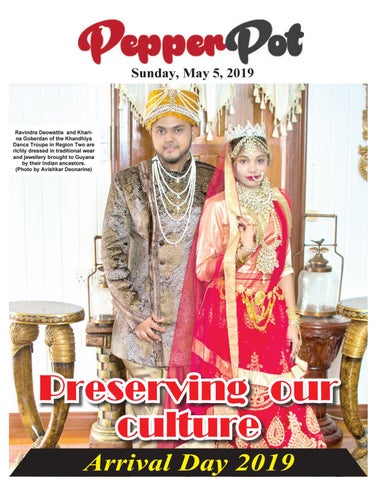
Ravindra Deowattie and Kharina Goberdan of the Khandhiya Dance Troupe in Region Two are richly dressed in traditional wear and jewellery brought to Guyana by their Indian ancestors. (Photo by Avishkar Deonarine)
Preserving our culture Arrival Day 2019
II
Chronicle Pepperpot May 5, 2019
The Eighty-Plus Club and Indentured Indian Immigrants By Francis Quamina Farrier
THERE will be many Arrival Day Celebrations around the country today and tomorrow, which is a public holiday. In this feature article, I will share a few of my own personal experiences and knowledge about Indians in Guyana; some garnered from interviews which I did with East Indian Immigrants. During the 15 years I produced the radio programme series, “The Eighty Plus Club” on local radio, I had the good fortune of interviewing quite a number of East Indian Immigrants who came to British Guiana and laid down a future for themselves and their descendants. I have also had the opportunity to interview some second-generation Guyanese of Indian heritage from every level of the society, who related much of what they knew of their parents and grandparents. I had the good fortune of growing up among many East Indians in the small East Bank Demerara community of McDoom, which was next to the highly Indi-
an-populated Houston Sugar Estate, which was owned by the Vieira Family. In those pre-Independence years, I saw Indian culture and lifestyle very close-up on a daily basis. I was witness to many East Indian weddings and other ceremonies, also the mouth-watering aroma of curry and other Indian dishes titillated my nostrils regularly as the smoke from their ‘cow mouth’ and kitchens, gently sailed across the village, like the ships sailed from Calcutta to Demerara with their human cargo for 80 years. There were the sounds of Indian drumming and others such as the early morning prayers from the village mosque which is still there. Interviewing East Indians, including those who came from India, for my “Eighty Plus Club” radio programme, was, therefore, no real challenge for me. Neighbours such as Beerwah and Rojan, a married couple and their children, were close and like family during my growing-up years at McDoom. In the very early years, the tiny village was initially owned by the McDoom Family, who later sold off house lots one by
Sir Shridath Ramphal and Farrier
one. Mr. McDoom, who was of Indian Heritage, was well respected by the villagers; many of his children became lawyers. There was an Immigrant who I interviewed at Guava Bush, Albion, on the Corentyne Coast, who was 110 years of age at the time; she told me during the interview that she was “disgust” and wanted to go. She had worked hard all her adult life on the sugar estate and had lived a very long life, so it was time to leave this life. However, her memory was still sharp as she related the work she did as a young woman on
the sugar estate at Albion and of conflicts the workers had with the sugar overlordsthat included riots in which people were killed. That East Indian Indentured Immigrant spoke of the recruitment centres in India, and the promises which were made to them; of going to a land for a better life. Some spoke about the weeks-long and arduous journey across the oceans. Some died on the ship during the journey and their bodies buried at sea. Some of the Indentured Immigrants who spoke with me for my Eighty Plus Club show, related the processing which they went through on their arrival in Demerara, at what they referred to as, “The Crosby Office”, which was located just west of where the Pegasus Hotel now stands. Some of the stories told to me were intriguing. A 100-yearold who lived at Anna Regina related that he was a little boy when he came to British Guiana with his mother, who left her husband back in India: “Abee bin live ah one room ah estate logie. Dem white man mek me mooma go live
wid wan strange man, so abee logie room gee to odda people. So, de man woh me mooma live wid, me gat fo’ call am ‘Bap’. Me nah bin like daa, ‘cause me dadee deh ah India,” he recalled. He also spoke of the Africans who were brought to the Essequibo Coast from Barbados, and how they worked together in unity with the Indians at the Anna Regina Sugar Estate. There was the story told of the father and son who had decided to accept the option to return to India after their five year Indentureship had concluded. Arriving back in their home village in India, there was no welcome from relatives and fellow villagers. “When abee ah walk in de village, ah so dem ah goh pan de opposite side, an’ dem a hawk an’ spit at abee. So abee come back to Guiana,” the man related. Another intriguing story about Indentured East Indians to Guiana, was told to me by Sir Shridath Ramphal, when I interviewed him for another of my Radio Programme Series, “Personality Profile”. The internationally-known diplomat’s ancestor first travelled from India to Dutch Guiana (Suriname) after she refused the Sati practice of widows who were obliged to take their own lives by going on the funeral cremation pyre. Sir Shridath said that his ancestor was a strong young widow who refused the sati suicide custom and joined an Immigrant ship which sailed for Dutch Guiana (Suriname). “At the end of her five-year Indentureship, she returned to India hoping that she would be accepted back into her community. But she received
even more severe rejection than she could bear, so she joined another immigrant ship with Indentured Indians sailing, this time to British Guiana,” said Sir Shridath Ramphal. All of the Indentured East Indian Immigrants have now passed on, but the sacrifices they made to this country and the foundations for their descendants, will always be appreciated by their descendants who rose to the very top in their various fields of endeavour; Dr. Cheddi Jagan; the Luckhoo Brothers, including Sir Lionel; Dr. Mohammed Shahabadeen, Sir Shridath Ramphal, Dr. Yesu Persaud, Ms. Lyla Kissoon, Mr. Richard Ishmael, Bishop Benedict Singh, Mr. Rafiq Khan, Mr. Rohan Kanhai, Ms. Rajkumarie Singh, Mr. Toolsie Persaud, Mr. Joseph Singh, Mr. Sataur Gafoor, Sir Fenton Ramsahoy, Ms. Mahadi Dass, Mr. Balram Ragubir, Mr Ayube Hamid, Mr Gora Singh, Mr. Kayman Sankar, Pandit Harry Ramsaroop and a host of others including Dr. David Dabydeen, who a few years ago, made an amazing discovery which he shared with an audience at the Pegasus Hotel in Georgetown; that a free African was one of the sailors on the first journey on the ship Hesperus from Calcutta to Demerara. By-the-way, when last has this nation spoken of that two great long-distance, barefoot runners, Moses Dwarka and Harry Prowell? History sails on and like the ship that represents the Indian Arrival Day Monument, we must always remember the Ancestors.
Chronicle Pepperpot May 5, 2019
III
‘Indentureship opened a New Chapter for Guyana’- Dr. Vindhya Persaud and every norm of human rights was violated with experiences of miseries. Our for- parents never dreamt of such when they boarded the Herperus and Whitby Ships on January 13, 1838,” Dr Persaud said. She added that the arrival of Indians to Guyana paved the way for a viable sugar industry and instead of importing sugar Guyana began to export. At the end of Indentureship, it also created the passage for indentured labourers to enter various fields such as business, law, medicine and engineering. ACTIVITIES The Guyana Hindu Dharmic Sabha has been integral in the promotion and sustenance of numerous facets of that glorious culture. Over, the years, the Sabha’s annual arrival celebrations have reflected on the traditions of the past while celebrating their achievements. The Guyana Hindu Dharmic Sabha’s Dharmic Kendra, affiliated institutions and mandirs are known for training young people in various art forms, Hindi and Sanskrit, and cookery, as well as its noted programs like Kala Utsav, Naya Zamana have been the launchpad for many fine, young artistes in music, dance and drama. National and countrywide events like Members of the Mandalee, the women arm of the Guyana Hindu Dharmic Sabha
By Indrawattie Natram PRESIDENT of the Guyana Hindu Dharmic Sabha (GHDS), Dr. Vindhya Vasini Persaud has said that Indentureship has opened a new chapter for Guyana, unfolding a rich Indian Culture. According to Dr. Persaud the Indian culture has been preserved, sustained and practised throughout hundreds of years since the Indian ancestors arrived on the shores of Guyana. Dr. said that the Sabha - the country’s largest Hindu Organisation – has over the years played an integral role in the promotion and sustenance of numerous facets of the Indian culture through various art forms. “We at the Sabha always focus on providing Edutainment for the Guyanese people. Our annual arrival day celebrations countrywide have reflected on the traditions of the past while celebrating the achievements of Indians through various art forms,” Dr. Persaud said. Speaking on Indentureship Dr. Persaud said, “Indentureship is an important part of Guyana’s history; the efforts made by the Indian ancestors must be remembered. When
aged to preserve it- at no time should we be divisive,” Persaud said.
Ben Parag will be performing at the Sabha’s Indian Arrival Day programme today (GHDS photo)
Indians arrived in Guyana, they brought their own cultures, way of life and religions. These have contributed to the cultural richness of Guyana and we as Guyanese must be encour-
HISTORY Dr. Persaud said in celebrating the 181st Anniversary of the Arrival of Indians to Guyana, the nation must reflect and contemplate on the significance of the many contributions made by Indians to Guyana. On that note, she said the Indian ancestors must be applauded for their efforts and the rich legacy they left behind. Speaking on the history surrounding the arrivals of Indians to British Guiana, GHDS President explained that between the years 1838-1017 239,909 Indian immigrants arrived in British Guiana. They were brought during the colonial period to work on the sugar plantations. “If one should examine the history one would find the inhumane conditions, oppression and indignity Indians suffered, life for them under the plantocracy was dull and oppressive, their feelings were manipulated President of the Guyana Hindu Dharmic Sabha, Dr. Vindhya Persaud
the Diwali Motorcade, Chowtaal Samelan, Phagwah Melas and Holi Utsav has facilitated the enjoyment of religious festivals with their accompanying traditions by all Guyanese. Arrival day activities are held in all its Praants nationwide- Essequibo, Upper, Central and East Berbice and West Berbice. Music has always been an inherent part of the heritage bequeathed by the Indentured Immigrants to their descendants and it will be celebrated in all its glory when the Guyana Hindu Dharmic Sabha presents a concert and dinner this evening at the Dharmic Kendra in Prashad Nagar. Members of the youth arm of the Sabha
Turn to page IX►►►
Rupununi Rodeo
IV
Chronicle Pepperpot May 5, 2019
An experience of a lifetime
The “Bull Thrill for the Spill” was only for the most daring and brave at heart (Delano Williams photo)
By Tamica Garnett YOU could’ve enjoyed the edge-of-yourseat thrill of watching vaqueros try their best not to get trampled by their own horse or run over by a wild bull; try out
the Brazilian dishes; get to have your first horseback ride (on a tame horse of course); go on the heart-pumping Kamikaze ride, or just walk around taking in the breathtaking atmosphere of what it means to be at the Rupununi Ranchers Rodeo.
Bottom line is, there was just so much to do at the Rupununi Ranchers Rodeo, 2019. The people, the outfits, the little amusement park section with the rides, the drive from Georgetown to Lethem (and back), the Rupununi Ranchers Rodeo is not an event, it’s an experience, one that will leave a lasting impression. And as packed as the planned events are at the Rupununi Ranchers Rodeo are, they represent just a fraction of what it means to soak in the Lethem atmosphere on an Easter Weekend. And droves of tourists – both local and foreign– flocked to Lethem to see for themselves if the reports really are true. And they so are. One young foreigner joked about never wanting to leave, many probably shared his sentiments. There are so many cases where you encounter something that gets great reviews; but when you try it out for yourself it does not live up to the expectations. That is so not the case with this experience. “I loved the girls, the food, and the bull riding,” was the take from Randy Pitamber, one of the many Guyanese who travelled the over 550km from the coastland area to the Lethem Town just to take in the Rodeo experience. “To be honest, I came because in social media, on Facebook and in the Guyana magazine you see a lot of pictures, and I liked it, so I wanted to experience it.” As more and more attention moves away from Guyana’s coastland life and the hinterland continues to be promoted as the face of tourism in Guyana, the Rupununi Ranchers Rodeo is going to blow up even more, not-
All smiles trying out horseback riding for the first time (Delano Williams photo)
is to drink a beer, spin around a pole six times with your head down, get up, drink another beer and then race back to tag your next partner, so that they can do the same. The first line to have all their participants complete the task wins. But it becomes quickly evident that winning is not a big part of the task, the fun is. One dizzy participant missed the table by a wide gap, headed for a fence and had to be redirected for his own safety. Then there was the “Bull Spill for the Thrill”, an event that left you with many questions as to why sane men would choose to
A group of foreign volunteers who were out enjoying the Rupununi Rodeo 2019 experience (Delano Williams photo)
withstanding how big a thing it already is. It doesn’t matter whether you are a newcomer or a return tourist, whether you’re a young child or hitting old age, whether you’re looking for daytime excitement or night time allure, there is something for a wide spectrum at the Rupununi Rodeo -- and you don’t even have to be a vaquero to get involved. Matter of fact, you’re probably going to enjoy the spectator events even more than you do the main events. There’s the tug-o-war, watermelon eating, greasy pole and greasy pig events. But a spectator favourite seemed to be the Beer Run. Spectator or participant, this one leaves you rolling in laughter, as you watch persons stagger around trying to figure out where the beer table is. The event pits two teams of lined up individuals against each other where the challenge
sit around a table drinking beer with the sole aim of seeing who could be the last person still holding onto any of the furniture after a wild bull charges straight into all present. The funniest part of this attraction was how unbothered the bull seemed to initially be with the drinking men. The bull was eventually redirected by a bullfighter to the table, and as the bull ripped through the table quite a few spectators wondered if all were still alive. A sigh of relief washed over all when the participants walked away unscathed for the most part. As dangerous as it was, the event fitted in clearly with the overall area of high suspense activities at the rodeo, where vaqueros tried their best not to leave the venue on a stretcher or in an ambulance, at least one however ended up being taken out in a stretcher.
Chronicle Pepperpot May 5, 2019
V
The youthful Kurt Stephenson A man of many talents
By Wendella Davidson DR Kurt Stephenson, a General Medical Practitioner (GMO) attached to the Diamond Diagnostic Centre (DDC) since November 2017, has been credited by his patients as being among the best for the care and treatment of burns. But this Cuba-trained doctor is also multi-talented, and with a pair of gifted hands, he has created a niche for himself as a costume designer, a pastry maker, cake decorator, a cook and florist. At a very young age, he started helping his mother and neighbours in the kitchen and by age 13, the young man was decorating cakes and making pastries at 14 years old; perfecting himself at making floral arrangements the following year, and by age 19 he was designing
emphasis on reading, and emphasised that it should be any reading material that comes his way. Moreover, he was allowed to choose his own reading material, so he chose cookbooks. COOKING UP A STORM According to the doctor, cooking was a natural love for him because of all the entertaining that was going on around him. He remembered when he was about five years old, as he was hanging around the kitchen one day, his father asking what he wanted to become when he grew older. But before he could have given an answer, his father quipped “Dr for the Pot.” For Dr Stephenson, he had his own cooking chores around the house, “I had a bread day. My day was Wednesday, my mother used to have me bake buns, tennis rolls, and salara,
Dr Kurt Stephenson, the medical doctor with gifted hands (Adrian Narine photo)
decorate cakes with icing, but that on one of the occasions when a neighbour was catering for a wedding and he had the opportunity to see the two-tiered bridal cake done from beginning to end, his interest in the culinary field piqued further. “I immediately began to read more books on the preparation of cakes, drinks, cakes and food. From then, I [was] always trying my hand at anything new and interesting,” he said. MEDICINE Dr Stephenson remembered, too, that as a CXC student he focused on the science stream
Miss Guyana Universe 2012 costume (Photos courtesy of Dr Kurt Stephenson)
costumes. Speaking with the Pepperpot Magazine recently, Dr Stephenson recalled that at a very young age, he had his heart set on becoming a medical doctor, and longed to be qualified and to practise medicine. But, according to him, his climb to achieve his goal was not an easy task. He spoke of making subjects such as Biology, Chemistry, Physiology and Mathematics look like a walk in the park, while those same subjects presented a real challenge to other people. He found a stumbling block, however, with reading and his mother was advised by a friend to make sure that he placed more
all from scratch, and she made you cook too,” he said. He remembers vividly when he was 11 years old, the Wilson brothers who were his neighbours, had acquired a television. Also, an aunt of the brothers who lived overseas and had always emphasised the importance of reading and learning, gifted her nephews a library. Among the lot of books were texts on cookery, nutrition and vegetarianism. “I used to be engrossed in those books and that’s how my love for reading and my culinary skills developed,” he said. The doctor recalled beaming with pride when neighbours would call on him to help them coo. From time to time, he said he would observe his mother or the neighbours bake and
, because he wanted a career in medicine. “It was a tight competition, and for me, being a former student of Central High, I had to compete with the cream of the crop; students who attended Queen’s, Saint’s and Bishops’. But I was not discouraged; I subsequently went off to the university where I Studied Chemical Pathology Microbiology. I graduated and that was what I considered as my edge over that cream of the crop. I was there neck and neck with them,” he said. At the age 20, Dr Stephenson departed these shores for Cuba to further his studies in medicine; there, he said lecturers and peers viewed him as a genius with an exceptionally high IQ. “My days in Cuba were numbered. I slept for four hours a day, they [the lecturers] all found ‘way out’ things for me to do. I guess they were studying me and hoping they could break me… it is a phase I was forced to go through, as I was forced to study,” he recounted. With a touch of pride, he spoke of cherished memories while he was studying in Cuba: the celebration of Guyana Day, Independence Day and Mashramani. The young doctor said he used to focus more on Mashramani, which he viewed as a true expression of celebration after a whole year of hard work. Turn to page VI►►►
VI
Chronicle Pepperpot May 5, 2019 ◄◄◄ From page V
And, as the main caterer, he remembered preparing various Amerindian, African, Indian, Portuguese, Chinese and European dishes that represented the Guyanese cuisine - “I used to cook my heart out to showcase Guyana and the foods we have at home and the foreign students and visitors loved the food,” he added. For this, Dr Stephenson expressed his appreciation and gratitude to his parents and neighbours for sharing with him almost all of the techniques he now possesses in the preparation of meals. OTHER TALENTS Touching on his other extra-curricular activities, the medical practitioner said the designing of costumes was just a natural gift. He recalled that at the time he started dabbling with designing, the thinking and culture of then President L.F.S. Burnham, was to make sure that citizens appreciate patriotism as well as their cultural identity, as Guyanese do not know or seem to appreciate their cultural identity until they happen to leave your country. “Be it whether you are Black, Indian, Amerindian, whoever, when you leave the country you are just a Guyanese. And so, you had to identify as a Guyanese, also during the era, the focus was to educate Guyanese along that phase where you had to learn something creative,” he added. He became involved with designing costumes at Enterprise Primary School and it was from then on that a spark was ignited. “ I went off to the university and found that there was an experimental cross-faculty programme where they wanted arts and science to blend, as the administration realised that the students who were studying science, at the time, had no interest in art; but their interest grew with the cross-faculty art experiment. There was more appreciation and within the Indian culture group, they would do the Rangoli design, as it was an artistic expression. The cross-faculty did work… there was no one person with a skill, at the same time the focus was on the development of the arts, “ he added. He recollected also, another interesting move to promote the `Black Arts’, or `Black Persons In Art.’ “It was at the same time when National Service was being phased out, and university students were asked to undertake voluntary work at various schools. Dr Stephenson said he jumped at the opportunity to volunteer at Dolphin’s Secondary School, which was then going through a transition period under the Secondary Schools Reform Programme (SSRP). “ It was me, as a young man who introduced the design of the badge and tie for Dolphin Secondary and the school also changed the colour of the uniform to the blue they now wear, “ he said, adding, “At that time, too, I was doing integrated science and cultural arts; they were trying to push it into the school system, as well as the steel band and costumes were my thing. That was the year that Dolphin Secondary won first place at the Children’s Costume Competition with a costume themed `Black Widow’ and again with ` Mr & Mrs Universe’ and the ` She Devil,’ but when the last year a costume depicting the dolphins and the school copped the first place again, but because Fernleaf stopped its sponsorship of such events I lost interest,” Dr Stephenson said. He likened that period as “my best time, I was just having fun doing what I loved.”, as according to him he was not connected to anyone. It was after graduation that Dr Stephenson said he was awarded a scholarship and proceeded to Cuba to study. Upon completion, on his return, he was sent to work at the Linden Hospital Complex. He also recalled doing voluntary work at the National Communications Network (NCN), during the morning show as an intern doctor. Dr Stephenson’s crowning moment with costumes though, was when he designed the National Costume for Miss Guyana Universe 2012, Ruqayyah Boyer. Boyer’s national costume had created quite a stir here in Guyana as it depicted a beautiful mixture of our patriotic colours and a diversity of fauna. The arrangement showcased the colours of the flag with birds of the rainforest and with butterflies.The shoulders were aviaries and Boyer’s shoes were decorated with butterflies as well. Dr Stephenson considers himself as a medical practitioner who can function in any department. “I am not limited to specialty; I am experienced in all the areas, but was trained in wound care and diabetic foot care mostly, and minor in several areas including massage and psychiatric art therapy. I love to study my patients and how they heal, to determine if their ailment has to do with their blood type or the foods they consume. However, because of the Guyanese culture, there is no possibility of studying a patient, as almost everything is looked at, or perceived in a negative way,” he related.
Chronicle Pepperpot May 5, 2019
VII
VIII
Chronicle Pepperpot May 5, 2019
What you need to know about Haemophilia By Anthony Layne
IN Guyana, awareness about Haemophilia and other bleeding disorders such as von Willebrand Disease, (VWD) Rare Factor Deficiencies and Rare Platelet Disorders, seems limited to a small circle. This includes some doctors -- perhaps those affiliated to the Guyana Haemophilia Society (GHS) -- a handful of confirmed affected persons and their relatives. It is therefore hoped that this article will help to develop some level of awareness about Haemophilia and other, even less well-known, bleeding disorders.
or soft tissue, causing a build-up of blood in the area (called a haematoma) Bleeding of the mouth and gums and bleeding that is hard to stop after the loss of a tooth Bleeding after circumcision (surgery performed on male babies to remove the foreskin covering the head of the penis) Bleeding after having shots, such as vaccinations Bleeding in the head of an infant after a difficult delivery Bleeding in the urine or in stool
WHAT IS HAEMOPHILIA? Haemophilia is an inherited bleeding disorder in which the blood does not clot properly. This can lead to spontaneous bleeding or bleeding following an injury or surgery. Blood contains many proteins called clotting factors, that can help to stop bleeding. People with haemophilia –haemophiliacs—have low levels of either factor V111 (8) or factor 1X (9). The severity of haemophilia that a person has is determined by the amount of a factor in the blood: the lower the amount of the factor, the more likely it is that bleeding will occur, which can lead to serious health problems. Additionally, the bleeding can be fatal if it occurs within a vital organ, such as the brain. In rare cases, a person can develop haemophilia later in life. The majority of cases involve middle-aged or elderly people; or young women who have recently given birth or are in the later stages of pregnancy. This condition is often resolved with appropriate treatment. CAUSES Haemophilia is usually inherited, that is, it is passed through a parent’s genes. Genes carry messages about the way the body’s cells will develop as a baby grows into an adult. They determine a person’s hair and the colour of one’s eyes, for example. Sometimes haemophilia can occur when there is no history of it in a family; this is called sporadic haemophilia. About 30 per cent of people with haemophilia did not get it through their parents’ genes. It was caused by a change in the person’s own genes. HOW HAEMOPHILIA IS INHERITED The haemophilia gene is passed down from a parent to child. The genes for Haemophilia A and B are on the X chromosome. Hence, the reason haemophilia is called an X-linked (or sex-linked) disorder. When the father has haemophilia but the mother does not, none of the sons will have it; all the daughters will carry the haemophilia gene. If a woman inherits a copy of the altered gene from either of her parents, she is said to be a “carrier” of the haemophilia gene. In other words, she has one normal and one altered copy of the gene; she can pass either gene onto her children. For each child, there is a 50 per cent chance that a son will have haemophilia and a 50 per cent chance that a daughter will carry the gene. On average, “carriers” of haemophilia will have about 50 per cent of the normal amount of clotting factor, but some “carriers” have far lower levels of clotting factor. HAEMOPHILIA CAN RESULT IN:Bleeding within joints that can lead to chronic joint disease and pain Bleeding in the head and sometimes in the brain, which can cause long-term problems, such as seizures and paralysis Death can occur if the bleeding cannot be stopped, or if it occurs in a vital organ, such as the brain There are several different types of haemophilia, the following two being the most common:Haemophilia A (Classic Haemophilia) This type is caused by a lack or decrease of clotting factor V111 Haemophilia B (Christmas Haemophilia) This is caused by a lack or decrease of clotting factor 1X SIGNS AND SYMPTOMS Common signs of haemophilia include:Bleeding into the joints. This can cause swelling and pain or tightness in the joints; it often affects the knees, elbows and ankles Bleeding into the skin (caused by bruising) or into a muscle
as dental work. Most important, you may need to take medications to clot your blood beforehand. 3) Certain medications such as aspirins can slow blood-clotting, so check with your doctor about what you should take and should not take. Also, check with your doctor about vaccines, such as those for Hepatitis A and B, that you may need. Most blood products nowadays are checked for things that can cause disease, but it is still worthwhile to check if you need to take steps to prevent getting infected. 5) Stay active. If your child has Haemophilia A, they can still be active; exercise makes them stronger, which makes injuries less likely. Exercise also helps by managing weight—extra pounds strains the body, which raises the risk of bleeding. It is worthy of note that while haemophilia is the bestknown bleeding disorder, many other types exist and most are inherited. Von Willebrand Disease (VWD) is a genetic disorder caused by missing or defective von Willebrand factor (VWF), a clotting protein. VWE binds factor V111, a key clotting protein and platelets in blood vessel walls, which help to form a platelet plug during the clotting process. The condition is named after Finnish physician Erik von Willebrand, who first described it in the 1920s. VWD is the most common bleeding disorder. It is carried on chromosome 12 and, unlike haemophilia, occurs equally in men and women. SYMPTOMS People with VWD experience frequent nosebleeds, easy bruising and excessive bleeding during and after invasive procedures, such as tooth extractions and surgery. Women often experience menorrhagia, heavy menstrual periods that last longer than average; they also experience haemorrhaging after childbirth. Researchers have identified many variations of this bleeding disorder:-
Frequent and hard-to-stop nosebleeds THE AFFECTED Haemophilia occurs in about one of 5,000 male births. Haemophilia A is about four times as common as Haemophilia B, and about half of those affected have a severe form. The disorder affects people from all racial and ethnic groups. INHIBITORS About 15-20 per cent of people with haemophilia develop an antibody called an inhibitor, that stops the clotting factors from being able to clot the blood and stop bleeding. Treatment of bleeding episodes becomes extremely difficult, and the cost of care for a person with an inhibitor can skyrocket, because more of a clotting factor or a different type of clotting factor is needed. People with inhibitors often experience more joint disease and other problems from bleeding, that result in a reduced quality of life. TAKING CARE OF YOUR SELF There is much that a haemophiliac – a person with Haemophilia-- can do to manage his\ her condition on a dayto-day basis. First, one MUST keep up with the treatment and strictly follow the doctor’s advice. Additionally, there should be strict adherence to the four measures listed below:1) Handle injuries correctly: clean small cuts, scrapes and injuries, then apply pressure and a bandage. Medical attention should be sought for serious injuries. 2) Inform all your health care professionals that you (or your child) has haemophilia; and remind them before undergoing any procedure, such
Type 1 VWD Type 2 VWD ( Four sub-types: sub-type 2A; sub-type 2B; subtype 2M and sub-type 2N) Type 3 VWD Acquired VWD RARE FACTOR DEFICIENCIES:These are several rare, inherited bleeding disorders in which one or more clotting factors are not in the blood, are present in only small amounts or do not work properly. Rare Platelet Disorders:Bleeding disorders in which platelets lack a protein needed for the blood to clot. These disorders are inherited in an autosomal recessive fashion. When a disorder is inherited in an autosomal recessive fashion, one inherits two mutated genes, one from each parent. These disorders are usually passed on by two carriers, whose health is rarely affected; but they have one mutated gene (recessive ) and one normal gene (dominant ) for the disorder.
Chronicle Pepperpot May 5, 2019 ◄◄◄ From page III
The extremely talented Ben Parag, a young man of Guyanese parentage who rose to fame on Starplus’ TV reality show “Dil Hai Hindustani” will be the featured performer and he will present a wide range of songs in classical, folk, ghazal, old and new Bollywood genres. Ben, who now resides in Mumbai, India performed in front of a number of celebrity judges including Shah Rukh Khan, Vidya Balan, Karan Johar and Shekhar Ravijiani. He got outstanding reviews and is currently pursuing a career in music in the Hindi Music Industry. Ganindra will bring the traditional flair of “raag/raagini or taan” singing to the event. This style of music has been promoted by the Guyana Hindu Dharmic Sabha as it remains one of the few types of traditional genres that remains alive today. Artie Sookhai – Khelawan of Emerging Voices, Season One will be joining the line -up of singers. The art of dance will be explored through new choreographies and performances by Dharmic Nritya Sangh in folk and classical styles. The Essequibo Praant will also be hosting a cultural programme in observance of the day from 16:00 hours. Yesterday, the Central Corentyne Praant hosted a Cultural programme at the Tain Kendra, West Berbice and another cultural programme at Bath Shree Krishna Mandir while the West Coast of Demerara hosted one at Ocean View Mandir. The East Berbice Praant will be hosting a lecture on May 10.
IX
In this photo, founder and then President of the Dharmic Sabha, Pandit Reepu Daman Persaud (left) and others at the body’s 25th Anniversary years ago (GHDS photo)
X
Chronicle Pepperpot May 5, 2019
ocus F Chronicle Pepperpot May 5, 2019
XI
on the Village
From ‘Diamond without a Sparkle’ to ‘Sparkling Diamond’
THIS week, we headed a short distance up the East Bank Demerara Corridor to the Golden Grove/Diamond community. Stories by Shirley Thomas. The speed with which a residential community can acquire a Fire Station in Guyana is certainly a determinant of the pace of its development and speaks volumes for the value attributed to its resources – both human and capital. In this regard, the Golden Grove/ Diamond Neighbourhood on the East Bank Demerara stands tall. The new Golden Grove/Diamond community, opened up to residential housing in the late 1990s took off at a snail’s pace, and for the first few years very little seemed to be happening. Without roads to transport building materials to the sites, the initial batch of owners of house lots was forced to engage in ‘under-bushing’ and fetched their building materials using wheelbarrows. But more than that, central Diamond itself looked depressing. The main road was narrow. The trench running along the main thoroughfare a little past DDL and spanning the land surface on which now stand three elegant commercial banks was used for the dumping of old cars. The Neighbourhood Development Council seemed to have trouble bringing that under control. It was during this era that one of our dailies, in a feature article on the neighbourhood, published an article headlined “Diamond without a Sparkle,” prompting some action. As infrastructural development kicked in, roads were constructed for the new scheme,
allowing easy access to house lots. Apart from private residential houses being built, houses were built by housing developers as well. And with the drainage infrastructure; the installation of electricity, water and telephones there was a new dynamism. And more recently, Government announced plans to build a second entrance to the Diamond Housing Scheme as part of the bigger expansion of the road network links between East Bank and East Coast. In time there was a marked interest in taking up the lands and owners who were initially reluctant to do so, and about making decisions to resell their house lots it was now different. By early 2000, there was a surge of energy and more investment and from then on
there has been no turning back. Today the pace of development witnessed in Golden Grove/Diamond can be likened unto the speed of a galloping horse and this does not go only for the new housing areas but throughout the Grove/Diamond Place Neighbourhood. This has seen a surge in vehicular traffic with more motor cars and heavy equipment vying for space on the roadways. In a positive sense, government intervened by constructing a walkway for children of the Diamond Secondary School, linking the major roadway to the school. This move is intended to ease traffic congestion at peak hours and ensuring the children’s safety. There is also word that the Demerara
Distillers Limited (DDL), is looking towards building a car park as well as a second entrance to diamond. The pace of development in the Golden Grove/Diamond Neighbourhood is phenomenal. New roads have been built, with an attending surge in the amount of vehicular traffic. There are now more health/medical facilities, including the Diamond Regional Hospital and Diamond Diagnostic Centre which is being constantly upgraded, the most recent being the installation of ultra-sound facilities. In the area of banking and commerce, the neighbourhood now boasts three commercial banks: Republic Bank, Demerara Bank and Guyana Bank for Trade and Industry. There are also insurance companies. For this reason, it is no longer absolutely necessary for persons to travel all the way to the city to go in search of certain services. There are several Nursery, Primary and Secondary Schools, a School for Children with Special Needs, as well as a number of churches. Not least, there are Auto Sales, hotels, more restaurants and a mega supermarket – FRESH Co. standing majestically as it overlooks the Golden Grove/ Diamond Neighbourhood façade. On recent visits to Guyana, members of the diaspora were impressed and expressed amazement at what they saw and what Diamond /Grove now has to offer. “We’ve got practically everything we want right here, and there’s more coming, a group of residents boasted during an interview with the Pepperpot Magazine.
Diamond Special Needs School - part and parcel of human resource development
Senior Staff at Diamond School for Children with Special Needs. (From left) Head Teacher, Wendy Grimmond-Webster, Patsy Clarke and Debra Stenson. (Photos by Philiesha Thomas)
AS the Golden Grove /Diamond Place community continues to stand tall in terms of all-round development over the years, kudos are in order for the high premium being
Some of the slippers and other craft work produced by children of the Diamond School for Children with Special Needs
placed on the educational development of its children, not only by way of the many schools – from nursery to secondary-- but essentially the establishment and maintenance of a school for children with special needs.
Boys from the Craft Class engaged in producing various items of craft Turn to page XII ►►►
XII
Golden Grove/Diamond
A clean and healthy environment “WORK is continuing apace at the Golden Grove/Diamond Place under the aegis of the Neighbourhood Development Council, and as you can see, the work is very impressive. We do our best at all times, regardless of the circumstances.” This was the proud announcement made by Pooran Singh, NDC Councillor and a resident of Cane Ville. Singh said he is happy to be part of an entity that is tasked with making life comfortable for citizens, and at the same time, working towards improving the environment, keeping it clean and healthy and making it a model for other communities. “For my area, we did a lot of work: drainage, maintenance, road repairs. Apart from that, we are trying to execute weeding of all parapets. And even though we know that the NDC does not have the capacity to do road building, we have been able, through our task force committee, to lobby and get government to embark on and complete some road-building works. We are grateful for this, since it has certainly heightened the aesthetics of Golden Grove /Diamond Place. This neighbourhood is practically one of the biggest across Guyana and has come to be the centre of attraction along the coastland. But our focus is on road maintenance,” Singh proudly declared. Citing an example of works initiated, he pointed to the walkway project constructed from the main Diamond thoroughfare, inward and linking with the Diamond Secondary School in the Diamond New Housing Scheme. Highlighting the benefit, Singh said that it would ease traffic congestion, which is clearly evident when school is dismissed and children are hustling
Pooran Singh
to get home. The facility will also reduce accidents, Singh said. Meanwhile, the regional system, he said, is responsible for maintenance of government buildings such as schools, health centres, community centres and police stations. But because of a good collaboration existing between the regional system and the NDC, the NDC would from time to time take up the slack in order to expedite works which could be considered urgent. Singh is however of the view that this could have negative spin-offs, since both their time and resources will come into play. He is contending that since the Golden Grove/Diamond Place is one of the largest neighbourhoods, there is need to re-examine the needs and allocations, so that none would be left to suffer and everybody will be happy, Singh concluded.
Chronicle Pepperpot May 5, 2019
Housed in the compound of the Diamond Primary School, the facility was established in September 1988. Funded by the Inter-American Development Bank (IDB), with SIMAP (the Social Impact Amelioration Project) as the executing agency, it also had as a sponsor, the United Women for Special Needs Children – a body of Guyanese professional women who would find out the needs of special schools and strategise in terms of assisting to satisfy those needs. The school is headed by Wendy Grimmond-Webster, with a support staff of 13, including one male, in addition to one overseas volunteer, Debra Stenson. Stenson coaches the students in art and craft production. Under the purview of the Ministry of Education, the institution also has the support of the Ministry of Health, as well as the National Centre for Education Research and Development (NCERD) and the Board of Industrial Training (BIT). Having grown from strength to strength over the last 30 years, the facility currently has enrolled some 69 children between the ages of 5 to 16 years. It caters for both boys and girls who have proved to be very responsive to the programme. The teachers who are very caring and compassionate, have developed a close bonding with them; hence, it was quite an emotional moment when more than 100 students graduated from the programme during a recent ceremony held at the David Rose School for the Handicapped. The Diamond School for Children with Special Needs is a place where love abounds, with absolutely no discrimination. Commending the performance of the teachers and their caring and compassionate attitude to the children, Webster told the Pepperpot Magazine: “We have loving teachers. Whilst they are not perfect, they apply themselves professionally and are always willing to reach out and go that extra mile for the children – whatever their needs. They would clean them thoroughly (if the child is not able to do it); comb their hair; give them manicures and pedicures- you name it, and it’s always a sad moment when the time would have come for them to leave the school.” WHO ARE CHILDREN WITH SPECIAL NEEDS? According to Webster, the children with special needs enrolled at the school include those who have learning disabilities or other
◄◄◄ From page XI
conditions such as Downs Syndrome; hearing and sight impairment; Cerebral Palsy; Autism, etc. Other conditions are known to include: neurological disorders; difficulty listening, thinking or doing mathematical calculations. In broad outline, learning disabilities are said to impact the way children are able to process and understand information. The headmistress outlined that since most of the children are not academically inclined, the school conducts training programmes in leather- craft designing and teaches them to make leather slippers, belts, purses and slippers and it’s amazing to see the interesting creations with which they would come up. Last term, 15 persons received coaching in leather craft, while this term another batch will pursue training in straw craft, using tibisiri. That programme is being sponsored by the Board of Industrial Training. The making of leather craft is a good thing for them, Webster says, since, it is a means of teaching them a skill so that when they leave the institution, they would have a skill to take back with them. It is also a way of improving their lives and making them proud products of society, Webster added. Meanwhile, there is an ongoing School Feeding Programme, through which the children are all provided daily lunches, free of charge. In addition, there are aquatic sessions at the Colgrain Swimming Pool where they are taken to the pool every Thursday to engage in swimming. That too is sponsored by BIT. According to Premier Aquatics, “Swimming has a myriad of benefits for all children, but learning to swim is particularly beneficial for children with special needs.” The benefits include the boosting of physical activity levels and the development of self-confidence and teaching a life-saving skill. The headmistress has commended the Ministry of Education and NCERD for doing an excellent job at sensitising people about the School for Children with Special Needs , among other things. “Parents need to know about the service the school provides. There are too many children with special needs at home who could be benefitting from the programme; hence, there is a need for more outreach work so as to sensitise the public about the programme and how their children can benefit from it,” Ms. Webster concluded.
A brighter Golden Grove/Diamond - but hot competition forces smaller businesses out
“I AM proud to be a resident of Golden Grove/Diamond. Almost daily I can see positive changes taking place, and that’s something to be proud of,” says Wazim Khan, Managing-Director of Lisa’s Supermarket on the Golden Grove/Diamond main Highway. Ecstatic and pointing to visible signs of development, Khan who has been in the commercial sector for a number of years, could not help acknowledging the presence of three of the main commercial banks in close proximity to each other in the heart of the community, and along the Golden Grove/Diamond main highway. “We have three banks, a fire station, Insurance companies; a GPL Consumer Assistance Bureau; GRA has a branch here - so that it is not necessary for persons from the far ends in the community to travel all the way to central Georgetown to access the services of a bank or other essential services. Likewise, it is not necessary for
persons to travel all the way to the city to go in search of most of the things they want when shopping. There are Auto Sales, hotels, restaurants. We’ve got practically everything we want right here and there’s a lot of development still ongoing for the area, with another housing scheme soon to be developed at Providence,” Wazim reasoned. But whilst there is much to shout about in terms of development, there are still some irritants, residents contend. High on the list, they say, is ‘unfair competition’ from the Chinese in the area of commerce. “Whereas in the past there were just about five supermarkets in the area, today there are about 20 and the spending population remains about the same as it was 10 years ago. Local businesses have always had a fair edge…But today, we are being virtually forced out of the competition,” he said. Another practice the businesses are bemoaning is the uneven playing field when it comes to opening hours for business.
Wazim Khan, Managing-Director of LISA’S Supermarket, Diamond/ Grove.
“We respectfully ask, ‘Why is it that local businesses have to close at specified times, and not so with the Chinese?’ They
are open for business as late as 22:00hrs and open their businesses on every one of our national holidays and all day Sunday. We’re also still to determine what is the situation as regards attaching revenue stamps to bills for purchases or other financial transactions undertaken,” residents say. Meanwhile, what was at one time referred to as ‘bottom-house shops’ have, over time, become a thing of the past. It was observed that the elder folk who would have served the country nobly but are now retired, can no longer depend on eking out a living through their ‘bottom house shops’ as these are no longer relevant. Hence, they are forced to shut them up. And of concern, many local shop and store owners are said to be selling out their businesses to the Chinese, compounding the problem. “It’s happening here at Diamond; in the capital city of Georgetown; on the West Demerara and the list goes on,” residents complained.
Chronicle Pepperpot May 5, 2019
XIII
The ancestors said, ‘Know thyself’ If you do, it will prevent ‘eye-pass’ Part Two
THE three articles that compose the above subject, with this being the second, are written to condense the crucial aspects of our history that are immediately relevant to where we are today. The books that capture these narratives are identified, for Guyana is saturated with plagiarism and falsifications, apart from arrogant speculations and presumptions, across group borders. The colony of British Guiana post-emancipation (after 1834) was a stage of conflict between the African group of all shades (Creoles) and the government that constituted the Euro-planters and merchants. The indentured groups were neither citizens nor subjects of the crown in the colony context; they were immigrants, except for the Portuguese who were extracted (and as indicated there were sound reasons for that, they were not surviving the physical estate challenge) and promoted as a buffer between the Euro plantocracy and the ambitions of the Creole. Turn to page XXII►►►
XIV
Chronicle Pepperpot May 5, 2019
COMMEMORATING ARRIVAL DAY TWO important national anniversaries have fallen in close proximity to each other - Labour Day on May 1 and Arrival Day on May 5. Space would not permit us to deal with both; we will accordingly consider Arrival Day since, with the 19th-century immigrations, it marks the creation of modern Guyana. In 1838 the Apprenticeship System came
to an end. By this System, the slaves though theoretically freed in 1833, had to continue working on the plantations for some time for a very small wage. Owing to the fact of natural decrease of the plantation workforce by death and disablement and the fact that the freedmen had gradually begun to leave the plantations, the planter class began to anxiously search over the world to recruit labour
for their plantations. Eventually, the focus fell on China, Madeira (a part of Portugal) and India. About 15,000 Chinese were brought to the colony and many more Portuguese from Madeira but these proved unsatisfactory for the needs of the plantations, and in any case, they left the plantations as soon as their Indentureship contracts had expired. The indentured workers from India proved the most reliable and consequentially, all the indentured workers that came to Guyana from the last quarter of the 19th century to the end of indenture in 1917 were from India; Indentureship was often described by historians as “the New Slavery” since it did retain many of the most important characteristics of slavery. The wages paid to the workers were invariably less than what they had agreed to before leaving their homes. Such wages could barely cover the cost of their very basic food. Their clothes were always skimpy and they often used the bags in which wheaten flour was imported as material to make their clothing. They lived in the same slave barracks, now generally known as ‘ranges’. These ranges had no floors since their floors were the bare earth and during the rainy season, the ranges and the land surrounding them were always muddy. In the ranges themselves, there was little privacy. There was no health care and the death rate among the indentures was very high mainly from malaria and preventable diseases. During the 19th century and even into the 20th century, there were no schools on the sugar plantations resulting in a very high rate of illiteracy. The Indian indentured servant and his children were stereotyped as agriculturists and as such, they could scarcely find jobs out of agriculture. In agriculture, however, they were able to find some agricultural industries such as the rice industry and the coconut industry. If they ventured out of agriculture, it had to be in some self-employed work such as shop-keeping. But probably, the discrimination which hurt them the most was cultural. Their cultures were despised and their Hinduism and Islam were regarded as alien and subject to continuous attacks by Christian missionaries. During the period of Indian Indentureship, no trade unions were permitted, so when working conditions became unbearable, there
were spontaneous strikes. These strikes were generally designated “riots” which gave the Police authority to act harshly on the strikers and even shooting them. During the period of Indian Indentureship, there were seven such strikes or “riots” resulting in a serious loss of workers’ lives. Indentureship, like slavery which preceded it, was a period of harsh exploitation and immeasurable suffering among the plantation workers and their families. Despite the terrible exploitation and harsh conditions which the plantation system imposed on the working people, it ironically had some positive effects: For one, since all the racial and cultural groups brought to the country to supply labour went through the plantations, the plantation put its indelible stamp on them all and they became very much alike. This gave a oneness and unity to Guyanese society which is clearly seen when Guyanese are in a foreign country. The various efforts by political and other groups to stir up racial and religious discord among the population and disturb this foundational unity of Guyanese society have never succeeded. Another positive for which the Plantation System was responsible, was the bringing of the three greatest world religions together and have them cooperate and develop empathy among each other. This is the only country in the world where Hinduism, Christianity and Islam sincerely cooperate with each other and where members of these Faiths even participate in each other’s services. The Guyanese philosophic position is that all religious ways lead to God and each way is equally valid. And lastly, the Plantation System peopled Guyana at a time when the population of about 80,000 to 100,000 was declining and there was talk of abandonment of the colony in some colonial circles. As important, it saved the country’s economy which was based on the sugar industry, from total collapse. Owing to the emigration wave which enveloped the country from the 1950s, almost the entire Portuguese and Chinese populations emigrated and the responsibility of commemorating Arrival Day devolved on Indian descendants to the extent where the Day is now generally called “Indian Arrival Day”.
Chronicle Pepperpot May 5, 2019
XV
Immediate dentures
THE name immediate dentures sounds like something produced by a fast-food version of a dental office. However, ‘immediate’ in this context means that the denture is placed immediately after the dentist the teeth. Most people do not realise the problems that arise after dentures are placed. How would you like to have an artificial leg rather than your natural leg? I feel on very safe ground in assuming that you would emphatically answer: “Definitely not!” So, replacing your natural teeth with either a full or partial denture is about as desirable as having an artificial leg. Dentures allow you to chew; an artificial leg allows you to walk. The problem in both instances is the performance quality of the artificial replacement in comparison to what nature originally provided. Quite simply, the artificial replacement will never function as well as your natural teeth no matter how good it looks. Dentures are not maintenance free; they need adjustments. It is not that the denture change; it is the tissues under the dentures that change. A denture adjustment is necessary when the denture material must be removed from the denture to relieve pressure at pressure spots that occur when bone and tissue shrink. Since tissue shrinks as it heals, dentures that are
placed immediately after the teeth are extracted sometimes need to be re-lined as soon as the tissue has healed. All dentures need relining periodically to adjust for normal tissue changes. So a denture is not one-shot cure. It is very important to see your dentist once a year so the tissue under the denture can be monitored. With this overview, let me offer a word of caution. Your dentist may offer you options on types of tooth replacements possible in your case. Offering treatment options is part of your dentist’s obligation. This is where you need to become a wise, informed dental consumer so
you can discuss with him the best decision for your situation. As a general rule of thumb, fixed prosthodontics (crowns and bridges) are more expensive, than removable prosthodontics (full or partial dentures). However, fixed prosthodontics is usually a more desirable replacement. Dentures also vary in cost depending on the type of teeth, the material used to make the denture base, and the number of steps followed to construct the prosthetic device. If you find a place that claims to be able to make your denture in one day for much less than the fee being charged in the area by most other
dentists, you will probably get exactly what you pay for. Let the buyer beware! They are no bargains in healthcare! Here is a typical example of what happens in preparation for an immediate denture. The first phase is the removal of all teeth posterior to (behind) the cuspid teeth. These ridges are then allowed to heal and act as a stable base for the future denture. After the healing has occurred, the denture is constructed. Then, the natural teeth are extracted and the dentures are immediately placed in the mouth. This keeps the patient from having to be without his or her anterior (front) teeth at any time. There are many advantages to immediate dentures, besides the immediate esthetic considerations. They protect sensitive extraction sites, help control bleeding from the tooth sockets, and protect the surgical area by covering it, thus keeping food and debris out of the extraction sockets. An additional advantage that you might consider worth the extra expense of the immediate denture is that your dentist knows how your “natural” teeth appeared. Thus, he is likely to be able to construct a denture that more closely resembles your natural teeth. This makes the transition easier when you see your friends and family because your appearance is minimally changed.
The other option is that it is possible, if you want, to change your appearance with new dentures. Finally, an immediate denture gives the dentist a better idea of how your natural teeth were biting. He can construct a denture that better stimulates the bite you had before extractions. Esthetically, immediate dentures are a better way to have dentures inserted than having dentures made after going through a period of being toothless. However, they do not present more problems. More denture adjustments are needed when immediate dentures are placed, and these dentures sometimes need to be relined a short time after they are seated. The reason is that the tissue, including the bone in the area, shrinks during the healing process after the teeth are removed. The healing process lasts about six months. This shrinking causes the denture to become loose, and the fit is altered. Relining is not needed as soon for conventional dentures fitted on ridges where time has lapsed after the teeth are extracted. Usually, the immediate dentures themselves are not any more expensive than conventional dentures. However, since immediate dentures usually have to be re-lined as soon as the ridges have healed, the reline is usually an additional charge.
XVI
Chronicle Pepperpot May 5, 2019
Chronicle Pepperpot May 5, 2019
XVII
Free tertiary education OVER the past few weeks, I’ve been reading that there are some persons who have begun to lobby for the government to make tertiary education free once again and I am in total agreement with this move. If there’s one thing I think we can all agree on, it would be that education (formal and informal) is just plain necessary for any sort of development to occur; and our education system is segmented into nursery, primary, secondary and tertiary, with each level dealing with a different facet of our growth and development individually and collectively. But there is also the fact to consider that access to each of these levels is not readily available for all. In Guyana presently, public education is free from the nursery to secondary levels onl,. and as such, some people have begun advocating for education at the tertiary level to become free. Free tertiary education is, in fact, enshrined in Guyana’s constitution. Article 27 of the Constitution of Guyana states: “Every citizen has the right to a free education from nursery to university, as well as at non-formal places where opportunities are provided for education and training.” What’s important to note too is that this article falls in Chapter II of the constitution, which connotes the principles and basis of the political, economic and social systems in Guyana. Other facets detailed in this section include every person’s right to sovereignty, the right to own personal property, the right to free health and social care, inter alia. Guyana, under the People’s National Congress (PNC) Government, offered free public education from nursery to university. But that was gradually changed to free education from nursery to secondary; and as such, in my opinion, if we can gradually forget about one part of the constitution as we have from free edu- cation, what’s stopping us from gradually mov- i n g away from these other facets? Not to
be all doom and gloom, but that is worrying. And it’s not only that this is enshrined in our constitution, but it is apparent that not many persons have a tertiary education. The Bureau of Statistics recently released the findings of a study which showed that only 2.3 per cent of Guyana’s population has a Bachelor’s Degree, typically referred to as a ‘first degree’. Comparatively, in developed countries, that figure stands at about 30 per cent. I’ve been to a few of the information and awareness sessions organised by the Department of Energy on the emerging oil and gas industry. And without fail, at each and every one of
these, the topic of local content and local employability comes to the fore; and without fail, Director of the Department, Dr. Mark Bynoe, underscores that right now, Guyana just does not have that pool of skilled persons to work directly in the oil and gas industry, and as such we must allow ourselves to learn and develop these over time. Tertiary education, whether at UG or at the technical institutes, becomes pivotal in developing the skills needed in this post-2020 ‘transformed’ Guyana. And this education must be one that is certified and accredited, but accessible to all. We cannot settle for less. I’ve seen advocates proffer that we use the oil revenues to fund free tertiary education. President of the Guyana Trade Union Congress (GTUC), Coretta McDonald, has another view. It was reported that she opined that the country should not wait until 2020 and beyond to garner those oil revenues and then use them to fuel avenues for free tertiary education. Instead, she said: “In everything we’re talking about, we’re referring to the oil revenues, but the thing is if we don’t put systems in place from now, when we have the revenues from the oil then we will go elsewhere. We need to start planning and put the plans in place now, so when we get the revenues from oil, then we can channel them directly into that.” I can’t say I disagree with her because, again, it comes back to us not having those skills that we need and are now seeking to equip ourselves with those skills. I know little about economics, so I won’t put my head on a block to ascertain that the country could support and maintain this for all citizens. But I do believe that the constitution should be adhered to and I do believe that education is a necessary part of development, and as such, I think free tertiary education for all is something we should strive for as a nation, once more.
18-year-old entrepreneur shares positive messages through her art GUYANA’s c r e ative arts industry is so flooded with exceptional talent that one ought to be proud. The young peo- ple especially have been dominating this industry with their 21st-century creative eyes and minds that they have developed. Today’s personality is an 18-year-old girl who uses her social media platforms to share her art pieces, along with motivational messages for her followers. With over 10,000 people following her work, Kasy Sookram uses this influence for the greater good. She was born in Guyana, lived in St. Lucia for a few years, and returned home in her teens. Kasy said that she realised her artistic ability at a very young age, but it was only in 2017 that she realised what she was actually capable of. “In the summer of 2017, I saw the music video for ‘Can’t fight the feeling’ by Mac Miller and Kendrick Lamar, and that gave me the inspirational push to start over. I say start over because I’ve been drawing and writing for as long as I could remember and after
seeing that video, I was ready to start taking art seriously and hopefully go into animation or creating comic books. I have always had a love for art, by the 2017 awakening lead to me launching Kc&Company in January of 2018,” the young woman shared. Kc&Company, she said, was named after her, and the word ‘Company’ came from all the people who have supported her. “I believe that if it wasn’t for the persons who constantly reminded me of how good I was and how great I’ve become, I would not have been here. If it weren’t for the people who first insisted on buying my work and those who share it and told people about it, there would be no Kc&Company. It was and still is a team effort and for that, I’m forever grateful. That’s why I try to cater for everyone’s budget, giving a variety of options and price ranges as well as payment plans,” Kasey said. Aside from the business aspect of her talent, she said she is passionate about helping people in any way possible. This is why she uses her platform to spread a little joy. “I just know that I want to be a voice for the voiceless and be able to help those in need. I have tried to get into the volunteer
work in Africa, but I figured I’d start small in my own little platform where I can attend university while sharing positive and life-changing messages under my art posts. I’ve had numerous people over the years tell me how much I’ve helped them conquer a hard time in their lives and for that I’m extremely grateful,” the artist said. She aspires to have her work published on or in books, as well as on walls and buildings along the streets. Additionally, Kasy said she would like to get professionally into animation and create comic books or mangas, “until then, I’m bettering my drawing skills every day and gathering ideas for new projects,” she added. “My message to anyone who is in or trying to get into the art field is don’t ever doubt yourself. It’s the worst thing you can do and it’ll lead you nowhere. As someone who is completely self –taught, the lesson that I found to be repetitive was, if you master patience and discipline, you can go far. Always remember that and no one will be able to stop you,” Kasy said.
18-year-old self-taught artist, Kasy Sookram
XVIII
Soil Testing SOIL testing is the basis for good fertiliser management. It maintains the productivity of soils and improves the quality of crops; it promotes more efficient fertiliser use at a lower cost and prevents environmental pollution from excess fertilisers. Low soil fertility is unfavourable to crop growth, hence crops which are provided with the nutrients they need at the required rates are stronger and more resistant to pests and diseases. As such, soil testing is recommended before the planting of any crop. Based on the soil test results, recommendations are made to the farmer or other stakeholders on the best way to optimise crop production. The Soil Chemistry Laboratory at the National Agricultural Research and Extension Institute (NAREI) is capable of conducting the following analyses:
Chronicle Pepperpot May 5, 2019
Calcium Magnesium Sodium Potassium Iron Zinc Phosphorus Organic Carbon Organic Matter Exchangeable Acidity pH Electrical conductivity A soil test helps us to tell: 1. The type of fertiliser to use 2. The quantity of fertiliser to use 3. The quantity of limestone that should be added to the soil 4. If the soil is salty, or toxic, and how to correct these conditions Procedure for taking soil sample: 1. Soils are distinctly different, crop growth or past treatment must be sampled separately, provided that the
area can be fertilised and treated separately; 2. To take a sample, remove all loose debris from the soil surface, dig a ‘V’-shaped hole to the required depth. Clean the hole and remove 3cm thick slice along one side of the ‘V’
Chronicle Pepperpot May 5, 2019
Dance and Mental Health
AFTER receiving an email from a young girl about her love of dance, and how it got her through some tough times, I thought it best to share the mental health benefits of dance. Whether you consider it a hobby or job, dance is art and can be an expression of love and emotion. If you think about it, many sentiments can be communicated through dance and it wouldn’t be that difficult for audiences to decipher the mood of the dancer. Couldn’t someone dance in a way that displays happiness, sadness or even anger? It could help to release these emotions as a form of self-expression; maybe of feelings we didn’t even know we had. Dancing is often considered a recreational activity or a job. Many also use it for exercise as its physical benefits have been vastly acknowledged. However, its positive mental and even social benefits are often overlooked. Dancing is enlightening; it heals and can allow the broken to become whole. Due to the physical activity alone, dancing increases energy and enhances the mood while decreasing stress, body tension and the possible onset of mental health illnesses such as anxiety and depression. Most of us are familiar with the feeling that comes with even a few minutes on the dance floor. Yea, that happy and uplifting one. Well did you know that there is actually a scientific explanation for that feeling? Dancing releases feel-good chemicals such as serotonin and dopamine in the brain, which are the chemicals that are generally responsible for the happiness and positivity that we feel. There has been research that focused on the ‘dancer’s high’ which shows that the positive benefits of dance last a prolonged period of time after the activity. Dancing has actually been a prescription for mild anxiety and depression. Yes, meaning a doctor or
There have been many studies which have examined the direct positive effect of dancing. One in Sweden studied 100 teenage girls who struggled with depression and anxiety. Half of the girls attended weekly dance classes, while the other half didn’t. The results indicated that the girls who took the dance classes improved their mental health and reported a boost in their mood. These positive effects lasted up to eight months after the dance classes ended. This means that not only is dancing itself effective but it can also lead to newly developed and possibly sustained new healthy habits and coping skills. Another in the United States reviewed the effects of dance in older participants – ages 65-91. Results of a dance class within this group, especially Zumba, resulted in improved moods and cognitive skills as well as increased strength and agility. psychologist recommended to aid in developing or maintaining good mental health. The vulnerability that may accompany dance is thought to decrease individuals’ fear of situations that would usually bring forth anxiety- such as public speaking or general socialising. When done in groups, it can promote socialisation, team-work and unity. Dancing can also be viewed as a universal language which both communicates and connects – both with others and ourselves. Through this, it works to increase self-esteem, self-confidence and overall well-being. Dance enhances creativity, especially when choreographing your own dance. Professors of Dance Psychology (yes, that’s a thing), have found that dancing helps the brain find new ways of thinking and creates new neural circuits. Not only does it enhance mood but certain cognitive skills as well, such as visual recognition, decision-making, long-term memory, and spatial recognition.
XIX
Actually, dance has also been used as part of holistic treatment for conditions such as Parkinson’s disease, chronic pain, dementia, autism, and mood disorders. It has been shown that consistent dancing improves heart health, overall muscle strength and enhances balance and coordination. Some research even shows that dance can alleviate physical pain, such as headaches and backaches. Other studies even show that dancing results in slower ageing of the brain. Basically, it favours neural synapses, slowing the loss of volume in the hippocampus that happens naturally as a part of ageing. Although dancing itself should not replace help or treatment from a mental health professional, it is an added benefit and just one of the many ways to practice good mental health and wellbeing. It’s a healthy coping mechanism. It’s easy and free to do. Try it today! Thanking you for reading. Please keep sending any topics you’d like to talk about to caitlinvieira@gmail.com Suicide Prevention Helpline numbers: 223-0001, 223-0009, 623-4444, 600-7896. Say Yes to Life and No to Drugs! Always
XX
Chronicle Pepperpot May 5, 2019
Preparing for the impending ban on single-use plastics: Part 1 IT seems as though a new, gruesome image or video of a marine animal suffocated by plastics is uploaded to social media every day. By now, you have probably heard the stories of marine animals being washed up on shore with their stomachs full of plastics. These stories and images are graphic, but often, we may catch ourselves thinking: if plastics are so bad, then why do we continue to use and produce them? Plastics are easy to use and to transport materials. It is impossible to imagine life without them; just take a look around you. However, plastics actually have far-reaching, negative effects on the environment,
prompting the international community to rethink how we use and dispose of these materials, especially single-use plastics. As Guyana continues to transform itself into a Green State, the country has announced that by 2021, there will be a ban on single-use plastics. Within the next few weeks, the Environmental Protection Agency (EPA) will write a series of articles on single-use plastics with the intention of keeping the public up to date as we move towards phasing out these materials. WHAT ARE SINGLE-USE PLASTICS? Single-use plastics are plastics that are designed to be used once before they are thrown away. These items can include plastic bags, straws, cups, spoons, forks, soda and water bottles and most packaging. Globally, approximately 300 million tons of plastics are produced each year and more than half are single-use plastics. Plastics that are less than 35 microns thick cannot be reused and typically end up in landfills and water bodies. Most plastic bags, for example, are less than 35 microns. Plastic bags are made from a polymer substance known as polyethylene. Polyethylene is manufactured from ethylene, which is commonly extracted from natural gas (petroleum). Ethylene is treated to become a polymer (large molecules) forming long chains of carbon and hydrogen atoms. These chains can vary depending on the type of polyethylene being used, but they all help to create various types of plastic bags. When exposed to heat, light and oxygen, these polymers disintegrate into small fragments and can remain in the environment for prolonged periods of time. WHAT IS THE EPA DOING ABOUT THIS? Last year, the agency as part of its World Environment Day celebration, hosted a number of public conversations through Regions 2, 4, 6, 7 and 10 around single-use plastics. To this end, the Department of the Environment and the EPA collaborated in not only informing stakeholders of the move, but also to garner support, particularly from the private sector. A total of one hundred eighteen [118] persons attended the “Single-Use Plastics Conversations” throughout the regions. The conversations were intended to get initial feedback from citizens on their thoughts about the impending ban. Data from these conversations showed that citizens are open to the ban, since it would reduce pollution in the environment; however, they asked for a matrix to test biodegradable alternatives. In some regions, citizens recommended adding a tax to plastic bags as a way to encourage shoppers to bring their own reusable shopping bags. Citizens also suggested that the EPA work closely with the police department to enforce the ban. As we approach World Environmental Day 2019, the agency will continue the “Single-Use Plastic Conversations” with citizens of Guyana through a number of public events engaging supermarkets, vendors and other businesses. HOW CAN A CITIZEN BE PREPARED FOR THE BAN? As we continue with this series focused on single-use plastics, we encourage you to read and follow the conversation. However, awareness only goes so far, a move away from single-use plastics involves an attitude change towards the reliance on single-use plastics. Citizens do not have to wait for the ban to make small changes to reduce their plastic footprint. For starters, you can take up the single-use plastic challenge: this week, the agency challenges you to do two simple things to reduce your plastic footprint: first, encourage your family members to take a reusable bag when shopping. Secondly, remember to pack your reusable cutlery and water bottle in your lunch bag this week. Feel free to tag us on social media. Remember, we are agents of change and we can always change our habits with practice. No matter how small, we need you to do your part as we move towards a sustainable Guyana. You can share your ideas and questions by sending letters to: “Our Earth, Our Environment”, C/O ECEA Programme, Environmental Protection Agency, Ganges Street, Sophia, GEORGETOWN, or email us at: eit. epaguyana@gmail.com or follow us on Facebook and Instagram. Attach: EPA: Participants at “Single Use Plastic Conversation”
Chronicle Pepperpot May 5, 2019
XXI
FILES E S A C COURT
Wheels of justice moving too slowly in Guyana What is the cause – blindness? By George Barclay
JUSTICE is blind, as the saying goes, and as the statute of justice with the scales is blind-folded, but blindness is not the cause of the slow ruling of the wheels of justice in this country. When Justice Brassington Reynolds was confronted with obstacles last Friday that caused him to remove a murder case from list and direct the Prosecution to make sure the matter is first on the list for next session (next year) the judge noted that the wheels of justice were moving too slowly. Reacting to the last observation, Attorney-at-law, Mr. Huckumchand, whose client had to suffer since the accused charged jointly had to remain until the next sessions, jokingly told the judge, “the lady is so blind that she cannot see. ” However, in a more serious note, the lawyer agreed with the judge that the time set for the case to be brought back would give the accused or the authorities time to appoint counsel for the unrepresented three murder accused. That delay Mr. Huckumchand said, was most desirable. Judge Brassington Reynolds observed on last Friday that the wheels of justice were moving too slowly and left the cause to be determined by those spectators who obviously knew or did not know the reason. The majority of spectators who learnt that justice is blind, also knew that blindness was not the cause of the slow rolling of the wheels of justice and that the real reason was due to the fact that the various agencies were not in control of operations that would enable the cases fixed for trial to be able to go ahead without obstacles of one kind or another. The obstacles include the listing and setting of cases to be tried without making sure that witnesses were available, that the murder accused listed for trial are represented by counsel, and that cases which require lengthy voir dires should be distinguished before court day. Because of these and other failures, cases are being left untried and day by day the list of unheard cases are becoming greater and greater. So slow is the pace of the wheels of justice that since the beginning of the October Criminal Sessions in Demerara, the two judges, Mr. James Bovell-Drakes and Mr. Brassington Reynolds have only been able to complete a total of five cases between them. These include the Mark Samuels murder trial- Samuels was sentenced to death; Roxanne Daniels murder case – Daniels was sentenced to seven years for manslaughter; Joanna Denhai murder trial – that trial was aborted’;Patrick Narine Carnal Knowledge case- Narine was found guilty, awaiting probation report; Mahendra Persaud murder trial - Persaud was sentenced to 15 years for manslaughter. At present Justice James Bovell-Drakes is still conducting a vloir dire ( a trial within a trial) to determine the admissibility of a magisterial document in the Abubakir, Abdel Bari and Atta Sankar Conspiracy to defraud case.
XXII
Chronicle Pepperpot May 5, 2019 ◄◄◄ From page XIII
To every ready opportunity that constitutes the replacement of another group economically and socially by trickery, by force or a philosophy of favouritism by whatever criteria will have retaliatory consequences. We concluded last Sunday with tax laws instituted by the Colonial authorities that were composed by former plantation owners and the colonial authorities designated from England that needed their support for the considered smooth administration of the colony, who complied with the destabilising plan for the emancipated African Creole. Culturally though the Creole was imposed upon by the overlord European norms, levels of African taste were incorporated, regardless- inseparable were the styles of the head wrap, an ancestral feature still alive today throughout New world Afro societies. The main interaction and cultural and economic conflict waged in post-emancipation British Guiana was between the values and manipulations of justice of the Euro-colonial overlords and the manumitted Africans and other Africans conveniently referred to as coloured in the vast scheme of divide and rule. It must be noted as indicated by Brian L. Moore- CULTURAL POWER RESISTANCE AND PLURALISM “Very strikingly, though, the documentary evidence does not reveal any food items in the Creole diet borrowed from the 19th-century immigrant groups –Portuguese, Indian or Chinese which did become favourites among the Creoles later on. – Food however, was one area of their cultural matrix through which the Creoles, as we have seen, significantly influenced the colonial elites.” The tax plot was a sinister initiative that related as follows-”The rationale was simple: the more taxes the Creoles had to pay on basic consumer products, the more money they would need to earn; and as the village economy proved increasingly incapable of providing them with sufficient income to meet their basic needs they would have to turn to plantation labour. Thus, from the very first tax ordinance after Emancipation until the end of the century, consumer goods were heavily taxed-wheat flour, cornmeal, codfish, beef, pork, rice, salt, lard, soap, candles, cloth, fabrics, hardware, confectionery, tobacco, wines, beer, etc. Generally speaking over 90 per cent of the total revenue was raised by taxes on consumer goods. By contrast, plantation supplies such as bricks, machinery, manures, lime, hay, staves, steam engines and ploughs etc, were exempt from taxation.” Brian L. Moore-THEMES IN AFRICAN-GUYANESE HISTORY. Thus with Independence P.M Forbes Burnham insisted on the return to the reliance on culinary tastes in-keeping with homegrown produce ‘grow your own food’. But this alone was not the completion of the undermining of the independence of the liberated population; we again turn to Brian L. Moore-THEMES IN AFRICAN- GUYANESE HISTORY –“Taxation also took the form of licences which were required for portering, huckstering and shopkeeping, as well as for boats, cabs and mule and donkey carts operated by the working people for hire. Once again, the boats, horses, mules and carts operated by plantations were exempt from taxation. More sinisterly, however, the huckster and shop licences were calculated to hinder the Creoles from engaging profitably in the lucrative retail trade to accumulate wealth and thus become relatively independent of the plantation sector. Successive Governors recognised that these licences discriminated against the Creoles in favour of the Portuguese, but did very little about them since the planters and merchants controlled the combined court.” This process of planter plotting to reverse the emancipated African to plantation dependency using the Portuguese as a preferred counter to his independence did not escape the awareness of the Creole. Portuguese rise in the merchant trade also aroused anxieties from the English merchants and planters; they had used the ploy of the planters effectively to their uses. “In some areas the Portuguese shopkeepers were even acting as bankers for the East Indians on the sugar estates. This evidence was decried by the government which urged the East Indians to use the Savings Banks. The Portuguese were in much disfavour with the authorities and it must be noted that, to a great extent they had brought much of it on their own heads through their practices of defrauding their customers. They were consequently fined very heavily for using false weights and measures, the courts contending that their profits were large enough to cover both fines and costs. It was a see-saw situation: on one hand the ubiquitous shops allowed the poor man with a few pennies to purchase bread, salt fish, salt beef, pork, plantains among other items, while at the same time cheating other customers who could afford to pay. Whatever favouritism the government had shown previously to the Portuguese had now waned.” Mary Noel Menezes, R.S.M-THE PORTUGUESE OF GUYANA A STUDY IN CULTURE AND CONFLICT. It was the Angel Gabriel-James Sayers Orr’s crusade against the Catholic Church; the Portuguese were the backbone of Catholicism in the colony at that time and they existed as was evident as a preferred group by the government that were strangling Creole business efforts with support from the colonial authorities; in the 1850’s onward the Creoles petitioned for constitutional reform, but failed, the principal contention of the riots against the Portuguese across the counties, New Amsterdam, West Coast Berbice, East Bank Demerara, and the largest riots occurred in Georgetown in 1856 under the trumpet and oratory of the Angel Gabriel under the slogan of “They are taking bread out of our mouths.” During this period of the other indentured groups - the East Indians were in the majority held within the boundary of the plantation estate, forbidden to interact with the Creole villages. The Chinese were not inclined to the same indentured values as the East Indians and drifted into the townships as soon as their indentures were completed, others were encouraged to stay. ”A Christian preacher started a settlement called Hopetown on the Kumuni Creek up the Demerara River.” David A. Granger –THE VILLAGE MOVEMENT. Africans who came as Indentured labour became part of the steaming population of port Georgetown and some settled in the Canal belt on the West Bank of Demerara. The Chinese however had previously introduced another dimension, Brian L Moore-CULTURAL POWER RESISTANCE AND PLURALISM-“In Guyana the Chinese immigrants were known to organise themselves in criminal gangs during the 1850’s and 60’s and engaged in armed robbery (essential praedial larceny) perhaps to supplement their meagre rations while indentured on the plantations, these bands of Chinese workers armed with cutlasses fastened to long sticks roamed the countryside at night, both on the plantations themselves and in the neighbouring villages, ravaging stockyards and provision grounds. Numbering in some cases between twenty and fifty, these marauding gangs terrorized plantation watchmen and villagers by the viciousness of their attacks in which several persons were killed. This in fact forced the plantations in 1861 to arm their watchmen.” The conclusion for this series will come next week.
Chronicle Pepperpot May 5, 2019
XXIII
#SupportCreativity
By Subraj Singh
Avengers: Endgame told at all. They just seemed to be there to take part in the fight and to have some amount of female representation. There was definitely a gender imbalance, and maybe it was something that could not have been avoided, given the limitations of the story, but one still can’t help being slightly disappointed by this aspect of the film. Regarding the future of the MCU, things are still unclear at this point. “Endgame” does seem like a definitive “Avengers: Endgame, 2019, Marvel Studios – Image via: IMDB”
REGARDLESS of your reasons for going to the movie theatre to see “Avengers: Endgame,” whether it was to see Stan Lee’s last cameo, to find out the future of the Marvel Cinematic Universe, or to learn of the fate of your favourite superhero, there is no doubt that you got your money’s worth. The film, though flawed in the presentation of its female superheroes, still manages to come across as a sprawling, tear-jerking epic that serves as a worthy culmination to this particular wave of superhero films that have emerged from Marvel over the years. The film picks up right after “Avengers: Infinity War,” when Thanos (Josh Brolin in good ambiguous performance) acquires all of the infinity stones and wipes out half of the world with a snap of his fingers. Gone in this 50 percent are some of the best-known heroes in the world, including the Black Panther, Spiderman, Dr. Strange, and Scarlet Witch. The remaining Avengers: Ironman, Thor, Hulk, Black Widow, and others work together to find a way to reverse time and bring their comrades and all of the other souls that were lost, back to the world. The first thing that needs to be commented upon when talking about superhero films is the concept of spectacle. Spectacle is the only appropriate word I can think of to convey to the majesty and cinematic glory of everything that is conveyed on screen – whether it is the awe-inspiring design of an alien planet, the beauty of Scarlet Witch’s powers or Dr. Strange’s portals, or the arrival of alien spaceships, the alien themselves, or well-executed fight scenes. The climactic scene in the end of this film, in particular, which brings together a multitude of characters who, when seen together, really impart the power not only of the superheroes, but of the movie studios and of franchises that are able to bring together that amount of star-power in one movie at the same time. “Endgame” may, in fact, be the most star-studded film of all time. Never before has this amount of well-known actors been seen in the same place and, truly, we must thank “Endgame” for putting Robert Downey Jr., Scarlet Johannsen, Chris Hemsworth, Angela Bassett, Jeremy Renner, Chadwick Boseman, Benedict Cumberbatch, Rene Russo, and all of the others in one place for us. Among the stellar cast, there were definitely a few standouts who are worthy of note. Robert Downey Jr. turns in one of his best and most emotional performances ever that has already started to generate some awards whisperings. Tom Holland is so sincere in his role that it is really hard for the audience to not be happy when he’s happy or sad when he is sad. Elizabeth Olsen is powerful in the film and her standout scene in the climax is one of my favourites. Karen Gillan as Nebula is one of my favourite performances in the entire franchise. Chris Hemsworth has always been underrated as an actor, and the role of Thor in “Endgame” allows him to highlight both his comedic and dramatic skills; and he is a joy to watch onscreen. The film’s major problem undoubtedly has to do with the way the female characters are sidelined. One of the franchise’s most prominent female characters dies halfway through the movie, and while this move may have been meant to shock, it just came across as abrasive and unnecessary. It hurt because it was emotional, sure, but unfortunately, it hurt more because we had a situation where the filmmakers killed off one of the few prominent female characters when there was a multitude of men who could have served the same role. Furthermore, most of the female superheroes were only relegated to the end of the film, and even there, their characters did not seem to be developed, and they did not contribute much to the story being
end, but it might be the end of the current wave of superhero films more than anything else. After all, Marvel still has a lot up its sleeve for the future, including an “Eternals” movie starring Angelina Jolie. In any case, “Endgame,” in the end, allows us to reflect on the fact that the superhero genre has come a long way since the “Ironman” film in 2008; and if there is anything we know about Marvel, it is that it will ensure that we still have a long way more to go.
XXIV
Chronicle Pepperpot May 5, 2019
THE LAW OF EXPANSION
ON the first of the month, I shared the post below and a photo on my FB page. “Today is the first day of a brand new month and I am thankful to be given the opportunity for new possibilities. I am asking myself, what needs to happen for me to say it has been the most amazing month of the year. I came up with a few things that I need to improve on for me to get the results. What is the one thing you need to improve on this month? Please feel free to share your thoughts” I received many responses and please allow me to share some with you: “My main focus is to remain focused. Starve my distractions and feed my focus on my health, inner peace, emotions and to better myself. Remember hard work, dedication and consistency are required to help one grow. Don’t be pushed
Beyond the Runway with Dr. Sonia Noel ... Inspiring lives through fashion around by the fears in your mind” “My focus is on my goals and my inner strength” “I am praying for clarity, I believe too much in the good of people and give people too many chances” “
“One thing that needs to improve is my time management
“I need to start speaking words of worth, value and God’s truth over my life and all situations that I may be faced with” As I think about the things I need to focus on, the responses from others remind me of the Law of Expansion from the 15 Invaluable Laws of Growth by John Maxwell. Potential within us is limitless - we usually create our own limits. Growth always increases your capacity. We all have the capacity to grow ourselves. Whatever you have done, whatever you have achieved, you can do more. Experts claim that people tap into only 10 percent of their potential. People can attain so much more than they have in the past. To accomplish more in your life, change your “Can I?” to “How can I?” thinking. A “Can I?” question automatically limits you. A “How can I?” question assumes that a solution exists for any problem. HOW TO INCREASE YOUR THINKING CAPACITY** Stop thinking MORE work and start thinking WHAT works. Choose a better strategy – hard work is not always the answer. WHAT AM I REQUIRED TO DO? WHAT GIVES THE GREATEST RETURN? 2. Replace “Can I?” with “How can I?” Give yourself a chance to overcome - what would you attempt if you knew you couldn’t fail? Test your limits 3. Stop thinking one door and start thinking many doors. Look for multiple answers. People need to act on their dream and they formulate the details NOT waiting for the secret formula to their dreams. Give yourself options - if you can change your thinking, you can change your life 4. Stop doing what you were doing before and do something new. A master doesn’t become a master overnight - apprentice, journeyman, master. Should I enjoy my life or expand it? 5. Stop doing what is expected and do more of what is not expected - help more, do more, give more - strive 6. Stop doing important things occasionally and start doing important things daily. Make your life a masterpiece. Thoreau: advance confidently in dreams - do the right thing always. “Thank you I notice” notes - make progress until the day you die 7. Believe that you can do it You can share with us by emailing beyondtherunway1@ gmail.com Review your effectiveness everyday. We all can learn from each other as we continue to grow and go through this beautiful journey called life BEYOND THE RUNWAY.
Chronicle Pepperpot May 5, 2019
Male privilege in the workplace
RENATA Burnette is well-known for her poems and her programme on MAAD 97.5 FM. She shared her story saying: “Men waste no time displaying their god-complex around the workplace. I am oftentimes viewed as a ‘lil gyal’ who does not know what she’s about by men who consider themselves as powerful. On two different occasions, I sat in front of a man who was either my manager/ supervisor. They told me, ‘you got this job because of me,’ as though my hard work was non-existent. Then I have to stand my ground in a respectful manner, because I need my job. ‘If that ain’t male privilege, then I do not know what it is’.” As discussed last week, privilege may be invisible to those who have it. In the conversion of gender equality and male privilege, we always attract the wrong crowds, even if we did not intend to. The workshops that are hosted for these topics are hosted for women by women, attended by other women. The first step to a level playing field is for us to invite men to the table to have these discussions. In fact, it should go both ways; every gender, inclusive of LGBTQ+ persons should be present. To begin the discussion, for centuries men have had an advantage over women in the workplace before women even dreamed of stepping into the workplace; women were always in the private sphere of society. We were the homemakers, in some societies we still are. Where women make up a majority of the working population in a specific labour field, that job is seen as ‘feminine’ and automatically weak, which would deter men from that field. There is also research which proves that jobs performed by mostly females, pay less. Have you ever come across the term, ‘gatekeeper’? A gatekeeper is a person who controls access to something. Jessie Reyez, a singer from the United States sang a song entitled, ‘Gatekeeper,’ which surrounds the sexism and misogyny she faced in the music industry. Some of the lyrics for the song opened my mind to the reality of what many women have to face, just so they can ‘make it.’ Parts of the lyrics included: “twenty million dollars in a car Girl, tie your hair up if you wanna be a star Thirty million people want a shot How much would it take for you to spread your legs apart?” You could be famous You know we’re holding the dreams that you’re chasing You know you’re supposed to get drunk and get naked.” While many will argue that these are just fictional lyrics, you can take heed of the Harvey Weinstein and Bill Cosby cases; they used their ‘power’ to force sex/ sexual activities onto females who were trying to cast a role or find a job in their field of work. Sadly enough, there are even famous females like Rose McGowan who had to face this darkness before they were given a chance. In reality, if a woman gets an esteemed job, most of society ends up thinking it is due to her sexual relations with a man, as Renata said, “if that isn’t male privilege, then I do not know what is.”
XXV
XXVI
Chronicle Pepperpot May 5, 2019
More than culinary delights
Glitzy Glamour offers culinary school By Gibron Rahim AS human beings, we are obsessed with food. It is not only taste which appeals to us, but we are also keenly interested in appearance, texture and presentation as well. For this reason, the culinary arts are an exciting field of expertise. It is for this reason that Debbie Houston has created her business Glitzy Glamour and passes on her knowledge through her culinary school. In an interview with the Pepperpot Magazine, Houston related that she began cooking since she was a teenager. However, she officially started her business in 2012. Noting that cooking is a passion for her, Houston related that she had studied social work at the University of Guyana and then pursued a post-graduate degree in psychology through the University of Cambridge. She was a social worker for over 20 years. Her last posting was at the Georgetown Prison, where she said she worked for about three years. After completing her work at the prison, Houston decided that she wanted to focus on food and living her passion. She chose the name “Glitzy Glamour” for a specific reason. “I do stuff out of the box,” she explained. “I don’t like doing the regular stuff everybody does.” She noted that, while she does cake decorating, she also handles other forms of food and food preparation. “I deal with local and international cuisine [and] I’ve developed recipes on my own.” Her work is not only about food, according to Houston. It is also about people and personalities. “[In] whatever I do, I try to work with the personality of the person,” she said. The service she offers goes beyond simply have persons call and order cakes. “I like to know the personality of the person I’m doing the cake for, what are some of the things they like and stuff like that,” she related. “That helps me to produce something that, that person would really appreciate.” Houston is currently compiling some of her recipes into a cookbook which she hopes to have on shelves by the end of this year or early next year. She noted that not all of the recipes are original creations. Rather, there are those to which she had added her own personal touch to enhance them. “It’s to share with the world what I love doing and what people can try,” she said of the cookbook. Houston explained, “I am not the type of person who likes to just keep my stuff to myself, I like to share.” It is with this same spirit of sharing that Houston started her culinary school. “There are people out there who would like to learn to cook and bake,” she stated. “And I like sharing with them and it also helps me because when you are consistently teaching people, it helps you to retain more of what you do and become even better at it.” Houston related that the school was something she always had in mind. Houston noted the importance of having an upgraded curriculum. “I wanted to teach stuff that is out of the box,” she said. She plans her classes with the input of students, allowing their areas of interest to guide her. This allows her students to gain the most benefits from the classes. She also offers oneon-one classes which are personalised to a greater degree. One of her hopes is to be able to refer her students to prospective employers when such opportunities present themselves. Houston’s journey to establish Glitzy Glamour has not been without challenges. She noted that she does not yet have a storefront, with her business being conducted mainly online. She explained that the field is very competitive, as there are many persons doing the same type of business. “You try to advertise a lot,” she related. “I do a lot of advertisements, a lot of posts and stuff like that.” Houston also makes an effort to take her business out of town. “Guyana is a small place, unfortunately, and so it’s a little difficult getting to where you want to get to sometimes but, otherwise than that, business is good.” She added, “I keep trusting that one day it will get bigger than what it is now, especially the school.” Houston sees the benefit in owning her own business. “You get to do the things you want to do and you get to put the drive behind it,” she said. In the future, she hopes to have her own café and eventually a restaurant. She noted that she wants to start the café at a really good location first. “I’m really hoping and trusting to have it before the year is out,” she stated. She is also intent on continuing to push the culinary school forward. “The school is really what I would like to see grow and become a place where persons can come and learn anything they would like to learn in terms of food and food preparation.”
Chronicle Pepperpot May 5, 2019
XXVII
XXVIII
Chronicle Pepperpot May 5, 2019
Chronicle Pepperpot May 5, 2019
XXIX
XXX
Chronicle Pepperpot May 5, 2019
Chronicle Pepperpot May 5, 2019
XXXI
XXXII
Chronicle Pepperpot May 5, 2019
Chronicle Pepperpot May 5, 2019
XXXIII
XXXIV
Chronicle Pepperpot May 5, 2019
English
STUDY SUCCESS Dear Student, To manage your examination stress, find time to rest and relax and use positive study breaks. Take a day-off a week at least, plus other free times when you are not obliged to feel guilty. A lovely drink or a favourite television programme can be used as a reward for the completion of specific revision units. Physical exercise like a walk, a run, a swim, yoga exercises or team games can retain the zest in you. Shun passive study. Remain focused.
Love you WRITING ACTIVITY At noon the truck stopped at a huge clearing on the Hinterland Road. Everybody climbed out with a grand feeling of relief. A hill fell away gradually from a road, and there was a path going down. After I had had my sandwiches I set out for a stroll. Soon I had left the clearing where the lorry had stopped. Soon the mighty trees closed in over my head; yet not entirely for many bright sunbeams were clinging like innumerable butterflies to the branches far up at the tops of the trees. I remember something I had read somewhere a long time ago. Something
THOUGHT FOR THE DAY
about people hearing the trees grow in forests. And I thought that surely, I would hear the trees grow in this forest. They were so solid, so timeless. One seemed each moment to hear them quietly settling deeper and deeper; their mighty roots thrusting farther and farther into the ancient earth. It was all very strange and fantastic and beautiful. Suddenly at a turn in the path I came upon a creek at the foot of the hill. A man was standing by the creek drinking and bathing his hands. He had not heard me approach. The sand under my foot had muffled my footsteps. My first impulse was to go forward and speak to him. But I was struck by something about him, I felt I would like to stand quietly by and watch him. I felt he had something important to tell me, but not with words. Something important he would tell me simply, by his movements, by the lift of his head, by his hands, and by his feet moving upon the ground. I slipped quietly into the bush at the side of the track, and then hugged close against the spur of a huge tree. From there I could watch him, without being seen. (Wilson Harris’ “Fences upon the Earth”)
His honour rooted in dishonour stood, And faith unfaithful kept him falsely true. ALFRED, LORD TENNYSON (1809-1892) Lancelot and Elaine, 1.871.
ABOUT THE PASSAGE You have been using the “I” narrator in your narratives with some sure success. But look at this higher level of usage. This writing by Wilson Harris, who was born Theodore Wilson Harris, reflects the inner monologue of an “I” narrator and philosopher-observer. See how this first person “I” was crafted to wander into the British South American forest to speak with himself and see what he could see. [Tell your partner the meaning of “monologue”.] WHAT TO DO Give your thoughts freely about the following lines: a) a grand feeling of relief b) hill fell away gradually from a road c) clinging like innumerable butterflies d) something important he would tell me simply e) was struck by something f) hugged close against the spur of a huge tree g) hearing the trees grow GRAMMAR Complete the following items of grammar. 1. Choose the word that best completes the sentence below. -------- his many hours of hard work at the modern clothes factory, he realised that his progress in life was insignificant. a) Despite c) Besides b) Because of d) By 2. Examine the sentence below, and then decide if it contains an error in standard English usage. Mark the correct
letter. a) All the young entrepreneurs (a) who attended the conference (b) were instructed to leave (c) his or her baggage (d) with the checker at the entrance. (e) No error 3. Decide whether the underlined portion of the sentence below needs correcting. Pick the best correction from the choices that follow. As public outrage over contaminated ground meat becomes stronger, consumers who will demand more organically grown vegetables and fruits. a) consumers that will demand b) consumers will demand c) consumers demanding d) consumers who have demanded 4) Choose the pair of words whose relationship is most similar to the following pair. windows: frame a. photographs: margin b. pots: handle c. mirrors: rim d. faces: hair 5) Underline the word that takes the place of two nouns in the sentence. George Orwell wrote Animal Farm and 1984 in the 1940s. Both remain immensely popular today. PUNCTUATION MARKS The Comma The following sentences cover all uses of the comma that you have studied. Study the sentences and then supply commas where they are needed. Exchange papers with study partners. As you discuss them, give the reason for each comma inserted. 1. Each man woman and child in the group was asked to contribute a tidy sum. 2. He spoke of a movement “of the loggers by the loggers and for the loggers.” 3. This mystery message addressed to you arrived at noon by hand did it not? 4. The temperature was below freezing but he went out without boots hat and coat. 5. The costume designs were exceptional and the dancers were wonderful to behold. 6. The warm green earth exuded a fragrance of spring. 7. “I doubt” the consultant replied gravely “that there is sufficient evidence here.” 8. Father may I have the payment check for the principal? 9. Tommy’s neighbours Surry and Derry were given new homes on April 27. 10. “We should perhaps” Tommy suggested “wait patiently for ours shouldn’t we?”
Chronicle Pepperpot May 5, 2019
Pine Tart
INGREDIENTS 2 cans crushed pineapple Sugar - depends how sweet you want it 1 large egg Pastry 1 lb (16 oz) flour 1/2 lb (8 oz) of Crisco shortening INSTRUCTIONS Drain most of the liquid from the pineapple in the cans, then empty the cans into a pot. Add sugar till the sweetness is desired to your taste. Boil the pineapple on a medium fire until the juice is absorbed but the fruit is not dry. Stir often to avoid burning. Put aside to cool. PREPARE THE PASTRY: Mix the flour and shortening together until the mixture becomes crumbly like bread crumbs. Then, as you mix with your hands, add small amounts of ice cold water as needed, and knead until the flour mixture becomes soft and doughy. Break off 1 inch balls and roll out into thin rounds. Put an amount of the pineapple mixture in the center of each round, and then close the pastry over the filling to form a triangle-shaped tart. Use a fork to pinch the corners shut. Beat the egg in a bowl and brush it on top of the pine tarts. Put the tarts in an oven preheated to 350°F, and bake for 20 - 25 minutes or until done.
XXXV
XXXVI
Chronicle Pepperpot May 5, 2019