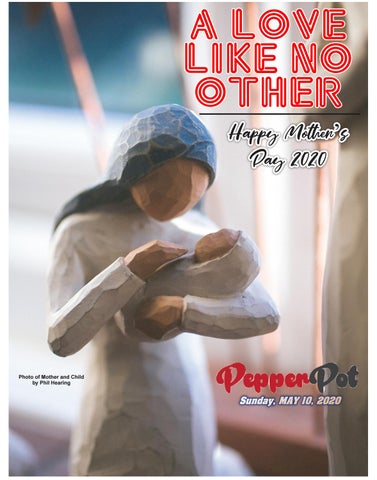
A love like no other Happy Mother’s Day 2020
Photo of Mother and Child by Phil Hearing
Sunday, MAY 10, 2020
II
CHRONICLE PEPPERPOT ― May 10, 2020
e v o l s ’ r e h t o A m ction ni a By Jared Liddell OTHERS are a pivotal part of the family. They act as a protector, provider, nurturer, and in many cases even a friend. Seventy-sixyear-old Desiree Spencer, known as ‘Aunty Waveney’ of Louisa Rowe has been a mother to not only her children but to many in the community. Spencer, a soft-spoken mother of four and a grandmother of eight
M
raised her children with the help of her husband and mother while she worked as a midwife at the Georgetown Public Hospital Corporation. The Pepperpot Magazine asked Spencer what being a mother means to her; without hesitation, she said, “It means unconditional love. Motherhood is one of the most unique qualities that God has given to humans, and the love that mothers have for their child or children is one that is of God.” She continued, “A mother would sacrifice herself of many things so that her child could be
taken care of, and I have always tried to do that for my children.” Spencer who spent her younger years as a midwife reminisced on raising her children, stating that although she had such a demanding job she still always made the time to be with her children and offer them the best life she could. With quiet conviction, she said she placed great emphasis on prayer and seeking guidance from God as it related to raising her children. Further, she said that one of the biggest lessons she learnt was that of chil-
dren mimicking the behaviour patterns of their parents. She said that she learnt that fact very early on from her own mother who she and her siblings had patterned some of their behaviours after. She stated that she did feel torn when she had to leave her eldest child at home to carry out her midwifery duties. “He was only about one year old, and I had to leave him home to go to work, and I felt a little sad to leave him, but I had my mother who made herself available to come to my home and look after him when I had to work at nights.” She stated that she learnt throughout the years that a mother has the duty to uphold, encourage, maintain, protect and help their child or children, and
Desiree Spencer, known as ‘Aunty Waveney.’
she worked to ensure that she exhibited these traits and continues to exhibit them even though her children are all adults and have families of their own. She said that as a mother, she always made sure that when she reprimanded her children she sat down and gave them an explanation on where they went wrong. “I always tried to ensure that my children and I had open communication; I think that as a mother I had to ensure I was able to not only correct my children and reprimand them but that I could also listen to their concerns. I think this type of relationship benefitted my family greatly, my children were able to express themselves and I got to understand them a lot better,” she said. Spencer currently lives with the youngest of her sons and says that although he is an adult, she still treats him with love and affection because a mother’s love never goes away. She said that although her other children do not reside with her she still considers them her babies. Spencer, who is regarded as a mother figure in her Wortmanville community said that she has had a maternal instinct since giving birth to her own children and s h e later
joined the ‘mothers’ club at the St. Georges Cathedral, where she said they were taught several core values a mother is expected to have. The retired midwife has always extended a hand to help her neighbours with any medical issues they may have encountered. She even performed several safe home deliveries for her neighbours and at present has a special relationship with one of the babies she delivered who visits her on a daily basis. One of her neighbours told the Pepperpot Magazine that she remembers when she had received first and second degree burns to her body and had been a bit scared to visit the hospital and “Aunty Waveney” being the maternal figure she was, made herself available for two months daily go to her home and help her clean and dress the burns until they had healed completely. So caring is this mother figure that young expectant mothers in the community still consult her often during their own pregnancies. When asked what piece of advice she would give to younger mothers, Spencer said “I would advise them to first ask God for guidance, allow yourself to have an open relationship with your child or children and remember that each child comes with their own personality and that you have to work to ensure that you provide for them and protect them. Motherhood is unconditional love and I would encourage them to love unconditionally.” Spencer said that she is happy that her motherly love extends not only to her biological children but also to the many whose lives she has lovingly touched.
CHRONICLE PEPPERPOT ― May 10, 2020
III
The bittersweet journey of motherhood
W/Corporal Jennifer Weever who is attached to the Agricola Outpost
By Wendella Davidson
“
MY journey towards becoming a mother and an independent woman has been bittersweet, but those experiences along the way, my fervent belief in God and my determination to suc-
ceed regardless, are what helped me to be what I am today.” Those were the words of Woman Corporal Jennifer (W/Cpl) 17271 Jennifer Weever, 52, of the Guyana Police Force (GPF), a mother of two and grandmother of three. Cpl Weever, who is stationed at the Agricola Police Outpost at Agricola, East Bank Demerara, during an interview with the Pepperpot Magazine, credited her experiences along the way and her fervent belief in God for helping to mould her into the woman and mother she has become today. Today, she plans to spend the day at home with the family: her daughter, Natalia a.k.a ‘Latoya’,32; son, Kevon, 31, and his wife, Aquela and her grandchildren, Tinnisha, 12, Tranace and Trevon. She admits that she looks forward to being pampered by them. They all reside at Parfaite Harmonie, West Bank Demerara (WBD), where Cpl Weever after being allocated a plot of land in the community, by the Central Housing and Planning Authority (CHPA), said she constructed a house through blood, sweat and tears. According to Weever, she is a Christmas Day, 1968 gift to her m o t h e r, Doreen Weever and father, Her-
Tranace and Travon
man Muss and the third of five children. The family first lived at Agricola and subsequently relocated to Grove, both villages on the East Bank of Demerara (EBD). Early life She reminisced on the fun times she had travelling to the North Georgetown Secondary School in the city. The mode of transportation then was the `Tata’ bus, and her mother used to buy `a monthly contract’ that allowed her to join the bus in the mornings, in order that she could have been punctual for school.
out of school when the going got really tough.” ”I knew I had to start earning a living to upkeep myself as a teenager, so when I became 18 I wrote an application seeking any job. On my own instinct, I got up one morning, dressed and armed with the application went to see my mother’s uncle, Dr Ptolomey Reid, who was Prime Minister in the Forbes Burnham administration and lived at Supply, also on the East Bank. I was determined to start earning money and `Lady Luck’ was with me. I was allowed to see him I ex-
Cpl Jennifer Weever with her son Kevon and wife, Aquela, on their wedding day
“My mother never used to make joke when it comes to schooling, so she went out of her way to ensure I was always neat and on time for school. In the afternoon, she allowed me to make my way to the bus park and join any bus that was available to get home early,” she added. Cpl Weever recalled that she had not even reached the age of 16 when her mother was afflicted with a stroke and subsequently died. As a result, she was sent to live with her grandmother, who also lived at Grove, while her other siblings were split up among relatives. With the death of her grandmother, the teenager moved to live with an aunt, Shirley Bruce, who also lived in the same village. “Those deaths, especially that of my mother really took a toll on me and my education, my aunt tried her best but there was only so much that she could do and so much love she could have offered. Eventually, I dropped
plained my situation he offered me a job at Vanceram Tableware Factory, at Coverden, another EBD village. The trials of motherhood “I stayed on that job for two years, before I was offered better employment at Congress Place, Sophia but left when I realised I was pregnant. The baby’s father was a policeman who used to work at Dr Reid’s residence and he was supportive. However, my aunt and uncle were annoyed as they thought I was getting into motherhood too early. It wasn’t easy, not working, “she said According to her, the situation got tougher when one year after giving birth to her daughter, she again became pregnant. The child-father was transferred to `D’ Division and then is when his visits became scarce and to crown it off, I became aware that he was having an affair with someone from the Westside.
“It was then when realisation hit me as to my situation, I had two children now and I told myself that I will be the runner that stumbled, got up, dust myself off and made it to the finish line. I applied to become a Special Constable, wrote the exam and was enlisted on September 3, 1990, and was assigned the regimental number 8603.” “I used to pay persons to look at my two children whenever I had to work and when I had my off-duty I tried to be the best mother I could,” she said, adding “I always took my work seriously and maybe it was because my superiors said that determination that on September 26, 1996, I was selected to participate in a Conversion Course, to become regularised as a full-fledged police officer. I had my child r e n
Daughter Natalia a.k.a `Latoya’ Weever
and wait at the station until I was relieved and we would go home together. Continuing she said, “I prayed a lot, I brought them up in the church just as I was brought up and I would sit and have pep conversations with them and maybe that is why I never had any problems with them growing up.” Cpl Weever’s children are both adults now. Her daughter works at one of the KFC franchises and has two children of her own while her son recently got married, has one son and works with Exxon Mobil. “My mother died when I was still a teenager, I made some wrong choices but that did not prevent me from trying to stay focused. Because of my job, I hardly got to spend key holidays like Mashramani, Easter and Christmas with them. I am ever grateful to my sister Rhonda Weever who used to ensure that they still enjoyed those occasions. Nevertheless, I made it my duty to always hold pep talks with my two children, and today I am proud of what they have both become,” CPL Weever added. Her advice to mothers, even those who are teenage mothers as she was, is to “train up your children as how you would want them to grow, keep talking and praying for them and keep them in church.
enrolled at St Andrew’s Primary School in the vicinity of the Stabroek Market, however, when I was regularised I was transferred to the Grove Police Station. I used to work from 8 am to 8 pm. When I got home at nights I used to prepare their clothes and stuff for them to eat the next day. Latoya and Kevon used to leave home the same time with me. I had a contract with a bus to pick them up and transport them to school in the mornings so that they can Tinnisha be punctual. In the afternoons they would together board a bus, and come
IV
CHRONICLE PEPPERPOT ― May 10, 2020
The best birthday giftthe gift of giving life
Giving birth during COVID-19 pandemic
By Naomi Parris
L
IKE many first-time mothers, Nickacey Munroe, was anticipating her baby’s arrival in the world, however, the young woman felt somewhat fearful not for her actual birth, but for the life her child would have to live if he or she were to grow up in the current crisis the world is facing. Munroe, who found out she was pregnant just before Guyana recorded its first case COVID-19 case, revealed that the least of her fears were centred on the virus since she was informed by her doctors that her baby’s umbilical cord was wrapped around its neck. “My water bag never broke, the umbilical cord was wrapped around the neck but wasn’t causing any issue at the point but there was no amniotic fluid there which caused me to deliver before the estimated delivery date,” the young mother said. She added, “I was least concerned about the virus when the doctor told me to tell my family to bring my bag I’m getting admitted, but after I thought of what his childhood life would be like if people don’t stay inside”. Munroe told the Pepperpot Magazine that she had hoped to give birth naturally, however after having a failed induction, she was rushed to the theatre to have an emergency Cesarean Section (C-section) which at the time was frightening to her. “Let me tell you... This C-section thing is not easy,” she disclosed. Nevertheless, Munroe received what anyone would call “the best birthday gift in the world” as she gave birth to a healthy bouncy baby boy just a few days after her 20th birthday. ‘I thought I had the flu’ Admitting that she was unaware of her pregnancy, Munroe noted that when she started experiencing symptoms, she assumed it was just a regular flu. “I had the flu; well I thought it was the flu after which I had to go to the health centre because to my surprise the “flu” worsened... I got medication then I was advised to take a pregnancy test which I did, then boom there it was two strokes on the stick,” she explained. After finding out she was pregnant, Munroe related that while
the feeling was unorthodox, she and spouse took all the necessary measures to secure their child’s future. “We were both happy at that point but it wasn’t like the fish out of water kind of happy yet we took instant measures like setting up a joint bank account to save towards the child.” She added that overall, her pregnancy was normal and was not quite what she was expecting since she experienced very little sickness and little changes A then-pregnant Nickacey Munroe showing off her baby bump some aside from the usual weight gain weeks before giving birth and traditional mood swings. ‘It’s a feeling I can’t explain’ Despite being incoherent from the anaesthesia during her C-section, Munroe recalled her very first moments with her baby boy as one she has yet to find words to describe. “I heard him cry before I saw him, and when I saw him, tears rolled down my eyes and I was filled with joy as the nurse held him up... I was upset when they took him away but, in my mind, I thought I was dreaming I still can’t believe that I had a real baby, a whole baby,” she stated. Adding that her entire outlook on life has changed, Munroe stated that her life now feels surreal as she is adjusting to the new and greatest addition in her life. “It’s not an imagination you wake up every morning and do what you think is right for yourself and child,” she said. Noting that her child is all she ever thinks about, Munroe added that nothing else in her life seems to hold any importance aside from her newborn baby. “I don’t care about nothing now, he comes first in every aspect and I’m more concerned about him. I don’t even want to go anywhere without him; it’s a feeling that’s hard to explain but once having a child that child becomes your everything and you really don’t care about no one else,” she gushed.
CHRONICLE PEPPERPOT ― May 10, 2020
Tales of mothers of heroes
The late Hyacinth Bradshaw is the mother of Guyanese celebrity broadcaster Basil Bradshaw (Photo by Francis Q. Farrier)
By Francis Quamina Farrier
T
HERE was Nelson Mandela who, with many of his brave comrades were fighting in the trenches, as it were, in the then Apartheid South Africa. It was a fierce struggle for human dignity as they fought bravely out of the valley of the shadow of death, up to the summit of the mountain Sinai of freedom and dignity. Simultaneously, there was The Rev. Dr Martin Luther King, jr. bravely fighting for the downtrodden in the deeply racial United States of America where black mothers witnessed their sons being lynched as entertainment for white groups as they enjoyed their picnics for many decades. So, have you ever paused for a moment to think of the mothers of those black heroes of two of the greatest civil rights struggles of the 20th century? Many mothers are taken for granted- sometimes by their own children. Fortunately, Mother’s Day allows them to make up on this special day. Mothers of international celebrities are most times barely mentioned in their biographies. How much do we know about the mother of the Rev. Dr. Martin Luther King, Jr. for example? Alberta Williams King, the mother of the renowned American Civil Rights Leader, was very active in the Ebenezer Baptist Church in Atlanta, Georgia, USA, working along with her husband the Rev. Martin Luther King, Sr. She was a trained school teacher by profession as well as the Music Director and principal organist at her church. It is apt to note that her teaching career was short-lived since she had to resign when she got married to the Senior Rev. King. At that time, married women were not permitted to teach. Having a close relationship with his mother, Martin Luther King, Jr. once wrote an essay while in college, in which he stated, “My mother worked behind the scenes, setting forth those motherly cares the lack of which leaves a missing link in life.” In her maturing years, Alberta Williams King was endearingly called “Mama King”. She was
V
Mrs Norma Clarke is the mother of well-known journalist Tangerine Clarke
also described as being, “poised, gentle, an accomplished musician and scholarly”. As she continued her dedicated service to her church and community, her life was suddenly and unexpectedly snuffed out at age 69, while she was inside her church playing the organ at a morning service. Entering the iconic Ebenezer Baptist Church that morning, a crazed young gunman began shooting while shouting, “It is the war”. He was taken down by men in the church and handed over to the police. Mrs. King, shot and bleeding profusely, was rushed to the hospital where she later died of her wounds. One of the Deacons who was shot also died. That tragic ending of the life of the mother of the Rev. Dr. Martin Luther King, Jr. occurred close to six years after she suffered the loss of her hero son, also by an assassin’s bullet. Rev. Dr. Martin Luther King, Jr. was assassinated on April 9, 1968. His mother Alberta Williams King was assassinated on April 4, 1974. The assassin was tried, found guilty and condemned to death in the electric chair. However, the King family requested that the killer not be executed, due to their belief in non-violence. The killer, who was 23 years old at the time of the assassination of Mrs Alberta Williams King, died in prison at age 44. Today, Mother’s Day 2020, we also take a look at the super mothers of South Africa; women who are internationally unknown, unlike their children, but whose children have done great deeds for the rest of humanity. For example, how much do we know about the mother of Nelson Mandela? Nosekeni Fanny Mandela was the third wife of the father of that great South African freedom fighter, Nelson Mandela, who became the first black president of that country. With a middle-class background and royal blood, Mandela’s mother sent him to a top-grade Methodist school. He was later sent to “The Great Place” palace at Mqhekezweni where he was entrusted to the guardianship of the Thembu Regent. During a period of his early marriage, Mandela invited his mother and sister to spend time with him. Their relationship was that of a loving and caring mother to her son. Another well-known South African freedom fighter was
Steve Biko. His father died when he was just four leaving his mother to be the sole breadwinner for Steve and his three siblings. Alice Nokuzola Biko was there for her children giving Steve all the support she could as he juggled studies between Law and Medicine. “The average native mothers in South Africa experienced two types of systems: one for white South Africans that provided all the possibilities of achievement, privilege, control, acceptance and power,” according to Guyana’s High Commissioner to South Africa, Professor Dr. Kenrick Hunte. “A second system was under Apartheid that was the opposite of what white mothers in South Africa enjoyed,” the High Commissioner pointed out. With the end of Apartheid, things have been changing somewhat favourable for the black mothers in South Africa. Since his tour of duty commenced two years ago, the Guyana High Commissioner, his wife Claire and visiting Guyanese, have been working on projects, principally with education, to partner with South African mothers in areas such as Soweto. The High Commissioner, Dr. Kenrick Hunte, related the condition for Black South African mothers during Apartheid. “Non-white mothers, mainly Africans, toiled as nannies, caregivers and maids for white families. They were underpaid, over-worked and held in low esteem. Many had insufficient time to nurture their own children,” the High Commissioner revealed. However, over the past two decades, more black mothers in South Africa are seeing the rewards of their efforts to have their children better educated and on the road to achieving what they have the abilities to achieve. Some of the freedom fighters such as Nelson Mandela and Steve Biko were internationally known. Hollywood produced movies about their lives. However, little is still known about their mothers. So who are your national and international heroes and heroines, and how much do you know about their mothers? There is that saying, “The hand that rocks the cradle, rules the world”.
Happy Mother’s Day 2020.
VI
CHRONICLE PEPPERPOT ― May 10, 2020
n o i t p u r s Di or ? t n e m p o l e v De
A
FEW short years ago, Guyana struck oil. This is the particular resource that has been touted as the world’s most valuable and profitable resource and has only been overshadowed by data resources in the past three years or so. Many, however, question whether oil will result in disruption or development for Guyana. Sometimes, I find myself excited at the country’s development of this new industry and I love being able to learn about the industry and its ties to development. Other times, however, that excitement is tapered by the negative prospects that characterise this industry, and those that underpin Guyana. Either way, Guyana is now an oil-producing nation, and the most I can hope for is that the good outweighs the bad. Last week, I attended an online forum organised by the University of the West Indies (UWI)’s Department of Government, Sociology, Social Work, and Psychology, at my sister campus in Cavehill, Barbados. The flyer was sent to me by one of the panellists, and it immediately got my attention; the topic being explored was: “Disruption or Development? Exploring the potential impact of oil exploration in Guyana”. With a topic like that, as you can imagine, the academics dissected some Guyana- its economics, its politics, its culture and so much more. Common among each of the presenters drawn from different fields was one thing: Oil would lead to much disruption in Guyana if the country did not manage itself well. It wasn’t that the country needed to manage the industry well- as has been the mantra from experts advising Guyana; instead, it was that the country needed to manage itself, in its entirety, well. An important consideration within the discussion was that Guyana is a society inherently characterised
by ethnic and resource-driven conflict. And there is an interplay between these two, that transcends to the political sphere and creates conundrums, not unlike the one we’re currently experiencing, for the society at large. This consideration, of course, is separate from a myriad of other concerns about oil’s impact on the environment, and the economics of dependence. According to one panellist, Professor Tarron Khemraj, the fight for political power by the ethnic groups (our entrenched and normalised system of politics) underpins the conflict between the ethnic groups because political power equates to which ethnic group gets to distribute and benefit from the distribution of resources, in Guyana’s ‘winner takes all’ system of governance. The introduction of oil, an industry with prospects of huge incomes, is another addition (albeit, a seemingly larger addition) to the pool of resources to be shared. Professor David Hinds, another contributor, acknowledged that Guyana’s development would always be stymied by the country’s inability to arrive at a national consensus, a national solution. For him, oil in Guyana does not present new challenges to Guyana’s development. Rather, it allows for the exacerbation of old problems- those same ethnic divisions, caused by ethnic insecurities- that have permeated the country for decades now. Indian and African Guyanese, and the Indigenous Guyanese, he said, are in a perpetual struggle to preserve the groups’ identities, dignities and safeguard the distribution of resources. It is interesting to think about how these ethnic and resource-driven conflicts have long underpinned Guyana’s society and are widely acknowledged, yet, when something like oil (or elections) comes around, they manifest in such ugly, exacerbated ways.
Interestingly, the academics proposed ways in which Guyana could perhaps overcome these inherent challenges. Chief among these suggestions was a system of shared governance. Now, shared governance is an idea that was perhaps the basis of the new political party A New and United Guyana (ANUG)’s platform, leading up to the elections. And for me, a shared governance system- though not without its deficiencies- seems to be one of the better outcomes we can have from this year’s mother of all elections. For simple interactions with my family, friends, and colleagues, I can tell that whatever gains were made over the past few years in striving for some amount of cohesion between the groups has been greatly diminished. And I think that it doesn’t matter which political party assumes power, the insecurities will be profound. I also watched a segment of a live discussion between Nigel Hughes and Dr. Vishnu Doerga. Here, Dr. Doerga shared that he doesn’t see himself as an Indo-Guyanese, but rather, just as a Guyanese. And honestly, I feel the same way. When I introduce myself to new persons in Trinidad, I don’t say ‘Hi I’m Vishani, an Indo-Guyanese’, I just say I’m Guyanese. But it was also interesting to hear Mr. Hughes say that not all ‘Guyanese’ feel that way. He contended that Guyana is not the national space many of us want to believe it is; it is a geographical space shared by different groups with their own identities. Assimilating all these conversations over the past week and thinking about the ways these ethnic and resource-driven conflicts have been manifesting in Guyana this year alone makes me think much more about whether the oil is the agent of development I want it to be, or whether it is an agent of disruption, exacerbating the inherent struggles of Guyana.
CHRONICLE PEPPERPOT ― May 10, 2020
Focus Ulverston
VII
on the Village
Earning a living in
Vanester Lucius in her Braid Shop (Carl Croker photos)
By Michel Outridge NE day, Vanester Lucius went to a salon to utilise the services and observed a hairdresser braiding the hair of a customer and said to herself she can do it. With that thought in mind, the mother of one looked on for a while-- maybe longer than she should have, she admitted-- but then she went home. Lucius started braiding in her verandah and was very confident she would get better as time goes went by and she did. It was at her home she began practising braiding until she had a firm handle on it and before you know it she had customers flooding her premises to utilise her expertise. Lucius said she watched some YouTube videos on hair-braiding and she became familiar with many styles and what was trending. The self-taught hairdresser said she is the only person in her village who provides such a service and she has a small shop in her yard where all hair-braiding is done. The 37-year-old told the Pepperpot Magazine that she can handle all styles and she doesn’t use any chemicals, because of personal health reasons. The Ulverston resident
O
stated that customers would come from all over to get their hair braided, so she had to open a shop to accommodate them. In 2014 she constructed a small wooden shop in her front yard and has been a hairdresser who specialises in braids for about eight years now. “Customers would come with their own style for braids or would ask me to give them a style that would match their face structure and what is
cally any braids styles. She expressed plans to make her shop cosier by adding an air conditioning unit, products and services. Lucius’ braid shop is currently closed as a result of the COVID-19 epidemic,but will re-open when it is safe to do so.
The notice board on Tamesh Mohabir’s fence
Tamesh Mohabir
trending today is long braids, way down to the waist and it takes four to five hours to complete such braids, she said. “I grew up in Manchester Village but I was born in
Essequibo and at age six my family relocated to Manchester and I got married and now reside in Ulverston, a village away,” she said. Lucius added that she started a course in braiding,
Tamesh and the GuySuCo chalk notice board Meanwhile, also in Ulverston Village, the
Home of Tamesh Mohabir
but due to COVID-19 the sessions were put on hold, so she will have to complete the course before she can display her qualification. She can also do interlocking, extensions and practi-
Pepperpot Magazine met Tamesh Mohabir, a security professional who works at night and is the son of a senior sugar worker. Affixed to his fence is a notice board; it was put
there by the Guyana Sugar Corporation (GuySuCo) many years ago to alert cane harvesters when they have to work. That day, the board was written up by a foreman, a day before which read “Mon (cut load)” which simply means cane cutters had to work on Monday to cut and load cane which was harvested from the cane,fields. “Growing up, my dad worked with GuySuCo and he retired as a senior staff and as long as I can remember, the notice board was on our fence and the cane cutters would pass to see when they had to work,’’ he said. Mohabir explained that the cane cutters would come out to catch the truck for 04:00hrs to make their way into the backlands to load the punts which transport the cane to the factory. The father of two related that life in Ulverston is good and during the lockdown, they have had good Samaritans come to the village and donate face masks and hampers to residents, so they are not forgotten and he is grateful for that. Mohabir resides with his father, who is 77 years old, in the family home, the same one in which he grew up.
VIII
CHRONICLE PEPPERPOT ― May 10, 2020
‘Never give up, no matter what’ Focus
Ulverston
on the Village
small business owner encourages entrepreneurs
By Michel Outridge I F E had thrown some punches at Yonell Gray, a resident of Ulverston, Lower, Corentyne, Berbice but she took those blows in stride, picked up the pieces and moved on. Armed with experience and her trust in God, the 35-year-old knew her life would get better even though it didn’t seem so promising. However, she was not fazed and worked tirelessly to make a better life for herself, doing many jobs. Gray was desperate for employment and she was motivated to join the army so she enrolled and worked in the
L
Geneva Gray and her daughter, Yonell Gray (Carl Croker photos)
HOME-CARE AND NEW OPPORTUNITY At the same time, she was taking care of a shut-in who was bedridden and she did this task for one year, six months. The elderly woman, who
Yonell Gray in her food shop
Guyana Defence Force (GDF) for six years. It was during those years she realised she didn’t want to work for people and told herself she had to establish her own small business. “Working for people is not an easy task because it becomes routine and they have a lot to say. Sometimes it’s hard to please employers,” she said. After quitting the army, Gray tried her hand, working in the interior and that proved to be more difficult than she thought. She then got a job at a restaurant and saved up her money, bit by bit and garnered culinary skills which became useful in establishing her own food business.
Geneva Gray assisting her daughter to open the shop for business
was 77 years old, passed away last year on Mother’s Day. After the elderly woman passed away, the relatives of the woman, whom she regarded as family were kind enough to let her stay in the house as their way of showing appreciation for the home-care she provided. They all reside overseas but are Guyanese from the village. Gray told the Pepperpot Magazine that she had no formal training in home-care for the elderly but learned quickly after consulting with friends, who are in the healthcare profession. The Ulverston resident added that she was even complimented by her peers for the home-care she provided and that made her feel she had done a good job. Shortly after the woman’s passing, Gray then opened her business on October 20, 2019. It was a sentimental occasion for her because it was also her birthday. THE FOOD SHOP “Today, I have my own small business, making me self-employed and I have no boss to stress me out and I work at my own convenience, four times per week and I like what I do now. I provide home-cooked food for villagers and passers-by and it is working out for me,” she said. Gray explained that she had to save up and it took her years to get the money to invest in her own business and along the way she felt like giving up but it was not an option. “Nothing is impossible to accomplish because I prayed a lot and I still do because it wasn’t easy all those years and looking back it took a lot out of me to become self-employed but I did it and the experience was eye-opening for me,” she said. To date, with her small food business, Gray pays her bills, maintains the house and has enough to assist her mother, Geneva Gray, who would visit to help her clean and sanitise before opening the shop. Carl Croker photos saved in a Folder in Graphics as Village Focus.
o t r s y s F ocus ’ a l l tS e How faith and perseverance brought her this far
CHRONICLE PEPPERPOT ― May 10, 2020
IX
on the Village
than 70 grandchildren and great-grandchildren and will soon welcome great-great-grandchildren in the family tree.
Entry into the village In a sit-down with Granny Stella, she narrated her journey to the village of Ulverston. She related
“My child father was around but his intentions were of no good but I didn’t hate him and I ended the relationship because it was going nowhere,’’ she said. Granny Stella explained that she wised-up and kept to herself because she was unmarried and had a child, something she knew her parents would have been upset about. She realised she had
going nowhere and inserted himself in my life and refused to give up even after I told him I wasn’t interested in him and after time I was told by Granny to give him a chance because of his persistence,” she said. That young man would later be her husband, with whom she bore 11 more children. Granny Stella told the
box which contained a ring in 1964. She pointed out that Granny, who was a seamstress, told her to hand over 25 cents and she sewed the wedding gown from scratch, as a gift because according to the old woman, only dead people would get a free wedding dress After the wedding, she made her entry into Ulverston Village, her husband’s
Home of Stella Williams-Tyndall (Carl Croker photos)
By Michel Outridge
A
T a young age, Stella Williams-Tyndall lost her parents, making her very vulnerable without parental guidance but she fell into luck when an elderly woman took her in and provided the much-needed love, care and advice which has moulded her into a strong, Godly woman. Her father passed away when she was just seven years old and her mother when she was 12. It was not easy for her, she was alone and without much and many days she went hungry, but according to ‘Granny Stella’- now 77 years old- singing was her food. “The next-door neighbour knew I had nothing much to eat and she would hear me singing and invited me over for lunch and I was grateful. I remember the days so vividly and with tears in my eyes, I recall how difficult it was to understand why I was alone but with the teachings of the Bible from my parents, especially my father I knew I had to put my faith in God to find a way out of the misery,” she said. Today she is a resident of Ulverston, Lower Corentyne, Berbice and is enjoying her golden years, reading the Bible and singing hymns at church and going to services. Granny Stella is the matriarch of the village and is highly regarded as an elder in the community, whose door is always open to others, for advice or just for a chat. Stella Williams-Tyndall is the mother of 12 children -11 of whom are still alive. Collectively, she has more
Granny Stella in her verandah
that it was when she was living with the elderly woman who took her in, that she met the man who would become her husband. It was in Diamond, East Bank Demerara and she had already had a daughter for a man, whom she claimed took advantage of her naiveté. “I used to call her Granny because she was wise and took me in her house to live. Her house was big so she had tenants and there I met a young man, who fooled me with lies, he was a ‘ladies’ man’ too and after I got my daughter I realised he had conned me but it was done and I couldn’t undo it,” she said.
failed them and made a mistake but she was determined to get her life together and provide for her daughter. Granny Stella added that as time progressed she settled in and one day when Granny was out, a young man came with his bicycle, an individual whom she knew by seeing. He enquired about Granny’s whereabouts and she told him that Granny was out, in the city. However, the young man took the opportunity to engage her in a conversation and told her he was very interested in her because he knew she did not walk about and was decent. “He made sure he was
Pepperpot Magazine that he was working at Plantation Diamond and would leave his bicycle at Granny’s place he visited daily. With Granny’s advice, she was told that he was of good character and responsible and she should marry him since she was of age and it was a good prospect to start a family life. “Back then you had a lot of respect for elders and you used to listen to them because they were mature and had experience and could point you in the right way, she said. She thought about it and decided to marry him when he showed up with a tiny
village. She started her married life which she described as ‘hard’ at first but she didn’t give up. . Hard work “I worked hard doing many things with my hands. I planted rice, used a grass knife to cut rice, throw rice into the fields by hand, all the old-fashioned way. I wasn’t academically inclined because I went to school up to nine years old but I was sensible and listened to old people for their guidance. I knew I couldn’t get an office job so I set my mind to work hard, no matter what. I mind cows, pigs and sheep that my husband had and made a life for the children, ’’ she said. Granny Stella explained that she never forgot her roots and it is the way one carries themselves that speaks a lot of who you really are and to date, she doesn’t walk about but would sit in her verandah and lookout. It was in the verandah the Pepperpot Magazine found Granny Stella during a walkabout in the village. Most residents told the team to talk to Granny Stella, who has a wealth of knowledge and survived many generations. “Growing up without
parents was difficult because I had no food nor clothes and I cried a lot but I never give up and believed that my life would change one day,” she said. The 77-year-old said it is good to have parents because they provide for you, take care of your welfare and ensure you have a good life I still miss him Clement Hubert Tyndall was Granny Stella’s husband, who passed away 11 years ago. She said that she still misses him dearly and her eyes would light up and she would smile when she spoke of him. Granny Stella recalls spending three months in the New Amsterdam Hospital, where I ate nothing but had a quarter cup of plain water each day. “When I left the hospital I was bare skin clinging to bones and before that I was full-figured and a doctor who favoured me encouraged me to pray and keep the faith. I was healed one day even though the health professionals found no medical reasons. I took ill just so and no one knew what was wrong with me. I stopped my family from coming to see me in the hospital but I always prayed to regain my strength and good health and it happened because of God. It goes to show one should never waiver their faith and trust in God,” Granny Stella said. She described Ulverston as a place of hard-working people except for the youths of today, who are idle and don’t want to work. Granny Stella is supported by her children and she gets by with her pension. “I does do all my chores and everything and the only place I go is to church every Sunday but with the Coronavirus, services have been put on hold until further notice,” she said. Granny Stella doesn’t step out only for church because she grew up like that. Her grandchildren would go to the shop and do errands for her. “My parents instilled good discipline and morals in me so I put that into use in my life,” she said.
X
CHRONICLE PEPPERPOT ― May 10, 2020
Education at any cost
Headteacher promoting home-schooling in her community By Michel Outridge
E
VEN though schools have been closed for the past seven weeks and counting, due to the novel Coronavirus (COVD-19), Judy Smartt, a headteacher of Mibicuri Nursery School is still playing her part in the promotion of home-schooling. Judy Smartt is a resident of Ulverston, Upper Corentyne, Berbice and was out distributing textbooks to parents in an effort to supervise their children’s home-schooling programme. When the Pepperpot Magazine visited the community of Ulverston, Lower Corentyne, Berbice, ‘Miss Judy’ as she is fondly referred, had just returned home from her community project. The textbooks she had handed out were literacy, numeracy and writing skills for Year One and Two students of the Mibicuri Nursery School. Mibicuri is a farming community in Lesbeholden, Black Bush Polder which has the enrolment of 64 pupils in total. Smartt related that there is no ICT hub in the community, as such, children have no other option but to use textbooks to home-school. She related that the children have no access to an online programme of which the Ministry of Education has full control. Smartt stated that the pupils of Mibicuri Nursery School are challenged with literacy, Mathematics and Numeracy although they are deemed quick learners. “I have been appointed the headteacher at Mibicuri Nursery School for the past year but I have been in the teaching profession for the past 20 years and worked at various schools along the Corentyne corridor,” she said. It was the great love and fondness for children at a young age that made Smartt realise that she had to become a teacher to serve her community. It is a job she really loves from the bottom of her heart and there isn’t a day that goes by she doesn’t think about the welfare of her students and that of the school. “In this line of work, teaching, it is very challenging at times and I always find
ways to work around those difficulties but all of that vanishes away when the love of the job outshines all the troubles,” she explained. Smartt stated that she is very passionate about teaching and even more fond of the children, all of whom she takes special interest. “Children respond to you based on how you treat them so I am like a mother, a teacher, a counsellor, a pastor and so many other personalities they want me to be. I do whatever I have to assist the children and their parents because we are all connected,” she said. Smartt pointed out that in the teaching profession she wears many hats in order to make everyone comfortable and lighten their burdens, be it domestic issues or other problems they may be facing in the home. “Whatever is happening at home, it would reflect on the children’s behaviour at school and it affects them in so many ways and learning becomes difficult for them,” she said. As such, Smartt has a parent-teacher conference, a forum geared for both teachers and parents to have open conversations. She pointed out that some children come from broken homes and one can sense there is a lot going on with those children and in many instances abuse cases are referred to the Ministry of Education for the professionals to deal with. The mother of one related that she has no idea when schools are re-opening but she is doing her part to ensure the children are doing some schoolbased work at home. “I provide some supervision for the children if needed in regards to home-schooling and I always try to maintain a good relationship with both children and parents,” she said. Smartt added that home-schooling is not an easy task for some parents because they
were not prepared to play the role of a teacher at home due to COVID-19. She has been asking parents to exercise patience when home-schooling and at the same time do some outdoor activities and have one-on-one interactions with their children. Smartt told the Pepperpot Magazine that she has lived all her life In Ulverston and it is a very quiet community where the people live simply. She stated that the people are very friendly, welcoming and they cooperate with each other.
Head Teacher, Judy Smartt (Carl Croker photo)
Focus on the Village
CHRONICLE PEPPERPOT ― May 10, 2020
Focus on the Village
Pastor Seecharran Dwarka by his church signboard (Carl Croker photos)
By Michel Outridge FTER Pastor Seecharran Dwarka found his true calling of being a spiritual leader, he founded the Pentecostal Mount Zion Seventh Day Church of God 13 years ago and is satisfied serving the community. The pastor’s church is located at the rear of his house and he challenges himself daily to do God’s work, that is, door to door visits to single mothers, widows, shut-ins, the elderly, the disabled and church members. Having exited a Hindu background it was not easy for Dwarka to transition to a Christian calling but with his faith deeply embedded in the Bible he was able to lead a spiritual life along that path. DOOR TO DOOR COUNSELLING With just 15 members, Dwarka related that he chooses to minister to the people and when he gets work he would do painting jobs to offset his expenses and keep the church financially viable. He told the Pepperpot Magazine that he would take his bicycle and go around the village and nearby communities to minister to the people and counsel them in whatever problems they may be facing even if it’s not spiritual. Pastor Dwarka related that at any given time, he is never too busy to attend to the spiritual needs of the people making his door always opened. He is no stranger to the Ulverston Village as such, he is familiar with t h e peo-
A
XI
Pastor Seecharran Dwarka in his church
Pastoring a village ple and being a resident for the past 19 years he would do door-to-door visits. “I don’t pick and choose who I visit. If anyone needs my help I am there because that’s what I do despite their religious affiliation,” he said. The father of two stated that when his wife passed away in 2016 he was devastated but managed to recover from a deep state of mourning and buried himself even deeper in his ministry. “This is home for me even though it is not my hometown because I am settled and the people are very nice and welcoming and we get along well,” he pointed out. Pastor Dwarka added that one of the issues he faces is with some people, who emerged from Hinduism they are often immersed in a deep spiritual battle. Often they recover from that state and are converted to his ministry where some are still members while others would leave even after being healed. “I don’t demand money from members but whatever donation they gave are used to do church work and I made the wooden benches, pew and outfit this church with every-
thing,” Pastor Dwarka said. He noted that he doesn’t force people to come to the church but whoever feels compelled are free to visit at any time. Pastor Dwarka pointed out that he was self-taught, from reading the Bible he learned even though he did not receive any formal training. “I do what I do for the love of it because this is not a money-making business and the real joy comes when members go out and minister to others, helping people to turn their lives around to God,” he said.
Pastor Seecharran Dwarka
XII
CHRONICLE PEPPERPOT ― May 10, 2020
d n i M e t i r The W by Jasmaine Payne
The importance of Poetic Form M
Y real first encounter with poetry occurred when I was 14 years old. My older sister had taken me to Upscale Poetry Night at the Upscale Restaurant. So enamoured I was by the performances, that I begged her to take me back so that I could read a poem of my own. Years later, as a young adult, I became a frequent visitor of Upscale Poetry Night where I was privileged to witness some very talented Guyanese Spoken Word poets. That experience
encouraged me to start writing more of my own poetry, to the point that I even performed one of those pieces at a special show they hosted. What I remember vividly is that on one hand, I was impressed at varying levels by the talent of some of those poets, but on the other hand, I found a significant chunk of the poetry performed during my attendance at those events to be far below my expectations. I hate to admit that, because every performer – including me- who graced that stage did so with a passion and vulnerability aimed at shamelessly bearing their soul, and that takes a lot of courage. I didn’t know at the time what it was that I didn’t like, but I later found out while reading for my Degree in English. There was a course specifically dedicated to poetry and it really stripped the art down into
the intricacies and dynamics that made up a poem. Prior to studying that course, I would just pour my emotions out on paper and structure them into something that resembled a poem. And I came to realise that this tendency is what many aspiring poets are guilty of- and I am not just talking about in Guyana. In fact, my new-found knowledge and appreciation for what poetry truly entailed, helped me to improve my own work and admit that not only was my work not fit for Spoken Word, but Spoken Word Poetry in itself is a specific form that had specific requirements. That takeaway is what I feel inclined to highlight in this piece about poetry as a whole: poetry is an art with myriad segments, each of which r e quires some
manner of form and construction. I am aware that I am speaking amidst the rise of a generation built on freedom, self-expression and self-entitlement. But I support a school of thought built on the belief that poetry as an art has specific requirements and in order to be a true poet, one must adhere to the rules of the form. WHAT IS POETIC FORM? Poetic form is the root and birth of all poetry, but it simply means the shape and classification of a poem. Think of a poem as n complex sculpture: there are certain requirements to getting the type of texture and shape that the sculptor desires, so he must manipulate his hands and his materials in a certain way to achieve that. There are two main forms of poetry: closed(fixed) form- following specific rules, patterns and requirements; and open form (free verse) which adheres to very little or no traditional rules of structure, rhyme, stanza
etc. Closed form poetry like Sonnets, Villanelles, Sestinas, Ballads and Blank Verse are more traditional and technical and are becoming rarer in this modern age. In fact, the majority- if not all- of contemporary poetry I have come across, falls largely into the segment of open form. SHOULD OPEN FORM POETRY FOLLOW RULES? The parameters within open form poetry and whether any rules are required to be followed has for years attracted debate. And somehow, the misconception was developed that open form does not require adherence to any poetic rules. This misconception is the reason I find that many pieces of contemporary poetry I encounter tend not to be poetry at all, and are instead just glimpses into the emotions and thoughts of the writer broken into lines that resemble poems. Because of its seeming lack of structure and traditional rules, free verse poetry has also been deemed by critics as being nothing more than glorified prose. However, at its core, true open form poetry- while free of the strictness of structure and other requirements that closed forms demand- still incorporate tools such as punctuation, line break, and figures of speech (metaphors, similes, irony, puns, paradoxes, etc). Examples of excellent free-verse poetry can be found in the works of poets like Walt Whitman, Langston Hughes, W.B Yeats, E.E Cummings and even our very own Martin Carter. Their free verse poetry is riddled with riveting imagery, tone, rhythm, irony and countless other identifiable poetic features while not adhering to the rules of tradition. So it is, indeed, possible to achieve greatness even without stringent guidelines, but that does not mean no guidelines should be followed. ADVICE TO ASPIRING POETS In the years since I started writing poetry, I have had to take a step back many times after learning about what true poetry requires and I have had to humbly rework my own poetry several times. Many pieces did not even make the cut as satisfactory and had to be put aside to be worked on later. That is because poetry at its best is a fine art, and there are certain features about this art that must be respected and followed- regardless of the freedoms that you undertake in your choice of forms. In giving feedback to some persons who have shared their poetry with me, I have had the tough job of telling them that their work had not yet achieved the status of poetry. Some have taken it in good stride, others have chosen not to come back to me for my opinion- which they have every right to do. But I truly believe that too many aspiring poets take poetry for granted and simply throw words on a page and quickly call it poetry. Thanks to self-publishing, I have even seen those same poems amalgamated into published works. My bit of humble advice to aspiring poets would be to incorporate some form of research into the art. Don’t just write words on a page. You don’t have to study it, but understand that there are rules and find out what they are. Look at your poetry as a continued work of art; a piece that requires constant revision and reconstruction. Do not take poetry and what it truly is lightly, because if you do not understand the core of an art, then you will never truly be able to contribute to it. Interested in contributing to this column on writing? Email me at thewritemind592@gmail.com
CHRONICLE PEPPERPOT ― May 10, 2020
XIII
The bond of d l i h c nd I
a r e h mot
T is indescribable the possible bond that can exist between a mother and child and I have experienced that. I am blessed to have two amazing daughters, an adorable grandson and cutest granddaughters. I have had many mountain tops and valley moments along this motherhood journey but if I had an option to be or not to be I will certainly be. I was fortunate to have a mom like Claudia Noel John who gave motherhood her best shot under adverse circumstances. Love, compassion and caring for each other were a natural part of our lives. We did not have a lot of material things but the simple things had a big impact on our lives. We love her more than words can express and I thank God for her every day. We all have different stories experiencing motherhood but there are similarities. I asked a few ladies I know to share with us what motherhood means to them. Phebe Wallerson is the youngest mom sharing her journey today. “I have a sixteen-month-old son and this is my greatest achievement. There existed between the beautiful wondrous magic I carried and the glorious son I birthed, a deep fear of inadequacy. Of all my times in motherhood yet, my lowest moment came while looking at my three week old who had gas. I was unable to make him better and my mind raced. What if this was not limited to gas? What if I can’t wipe every tear, fix every hardship, teach him well enough? I believe that the first time I heard him say “mom” and my fears melted. The responsibility is great but I know that God will enable me. To him, I will always be mom and he doesn’t look at all that I can’t do. To him I am mom and that means possible.” I am younger than my friend Dr Raquel Thomas-Caesar but already a grandmaa. This is what she shared with us. “My highest point in the journey of motherhood was the birth of my daughter who I planned for carefully. She was named with a purpose, an African name that means ‘her place’ and her place in my life has motivated me to never give up even in the lowest moments. My lowest point is when she was ill in April 2008 when she was two years old when she had an ear infection that the first set of antibiotics did not work and she developed a painful abscess by her ear. The great ENT specialist Dr Sharma saved the day by finding a suitable antibiotic but the overwhelming feeling of not being able to help my child when she was in so much pain was too much. I was unable to sleep but thank goodness for my dear mom who came over to spend some nights and relieve me of some of the stress. We all want to be there to protect our children, but some times we have to trust that there is bigger power looking over them.” I believe that higher power intervenes on our behalf many times and many mothers will agree with me including Jo Ann Forde. “Mother!!? Jo-Ann Forde a Mother!?? Never!!! Those are the thoughts that went through my head for years even after having both my children. That’s because I never found value and worth in myself. I was scared of not knowing how to teach them values and morals that will sustain them through childhood into adulthood. It took years for me to get it together personally, then once I got myself together, parenting became the part of life I enjoy the most. I
basically look over my life and thought them from my stupid choices and mistakes, so they don’t have to go through that. My children and I have a great open communication relationship which is very important. I’m super glad God chose me to be a mother to my children because now when I look at them I’m honoured that I was able to invest into them.
I Love being a MOT HER!”
Racquel Shafiullah said “Motherhood means to me, a special God-given gift, the really special moment of motherhood is to raise six kids. There are sad mo- ments, happy moments and even exciting moments to celebrate special moments and achievements. My high points of motherhood are to love them and to be there for them knowing how it is when you don’t have a mother is not a nice feeling. And also I let them have dreams and visions for themselves with the help of God. Low points in
Beyond the Runway with Dr. Sonia Noel ... Inspiring lives through fashion motherhood are when they don’t live up to my expectations it really hurt as a mother to see our kids try to do their own thing when you try your best with them”. I asked my cousin Sheneva Jacobs to also share with us. “I’m a mother of three: a teenager, a nine-year-old and a four-year-old so as you can imagine in this time of quarantine my home is quite entertaining. I’ve experienced a wide array of emotions and played a lot of roles during this journey. From the happiest moments of my life (the birth of my three kids) to some less happy time (when they are hurt or sick ). The roles of a referee, (during their many fights with each other), the role of confidant, (listening to my nine-year-old talk about her crush and fallouts with her best friend), the role of the protector (continuously praying for their safety and protection) and putting measures in place to ensure they have a safe environment and providing for them. It’s not always easy the decision or the sacrifice you have to make but a mother will always do what she thinks is best for her kids.” My sister Nicola Noel Ward also shared: “Motherhood, I see it as a special privilege by God. He gave me five human beings for me to care for and nurture. I must admit, it’s not easy at times but I wouldn’t trade it for anything in the entire world. My worst fear is dying and leaving them, especially when they are still young.” As a mother sometimes I had to keep going when I was exhausted. I made tough decisions sometimes without knowing if it is the right decision. I doubted myself many times questioning if I could have done things differently. I had to fill the slot of a father which was sometimes difficult. One thing I know for sure is without God in my life my daughters could not have been the women they are becoming. I believe we all have our mountain and valley moments and I would love you to share with us. Email soniaenoel@gmail.com as we continue to enjoy this beautiful journey called life BEYOND THE RUNWAY.
XIV
CHRONICLE PEPPERPOT ― May 10, 2020
#SupportCreativity
By Subraj Singh
Two poems for surviving the pandemic
P
EOPLE often underestimate the power of a poem. The irony in this is the fact that poetry, perhaps the most difficult and most sublime of the literary arts, offers us many opportunities that can be utilised into mechanisms for survival. Obviously, a poem is not a tangible thing. You cannot eat it. You cannot wield it. You cannot use it to provide a roof over your head. However, other, more subtle, but equally important uses can be pulled from a well-constructed poem. Poetry can invoke catharsis, allowing readers to have a chance to release pent up emotions, like guilt, anger, sorrow, and fear, that have been growing since the announcement that the spread of the pandemic. Poetry also allows us to feel necessary emotions – the warmth of kindness, the sweet scent of love, the sturdy, wooden texture of protection. Every emotion that we are missing in this period, can be gained by reading the appropriate poem. Poems also tell us stories, despite their size. A poem can hold a narrative thousands of years old within two lines, or it can carry the voices of several people within it in three lines of a haiku, or give us the tragedy of a romance gone wrong while shaped as a sonnet. The two poems discussed in this article serve all of the purposes listed above, but they also contain within them, essential kernels of the most necessary of all emotions in this time: hope. It is the one thing that we must not lose sight of, the one thing that is necessary for survival and the continuation of every individual life in the world, and poems, with their compact size and eternal depth, are like wells from which we can continuously draw hope, again and again and again, without having to worry about ever running out. The first poem I would like to recommend is “Perhaps the World Ends Here,” by United States Poet Laureate, Joy Harjo. This poem focuses on a simple premise, that of a kitchen table – an item, whether large or small,
old or brand-new, that is found in every household, and yet the poet manages to transform that object into something through which all the greatest moments within human existence can be experienced. Harjo begins by saying, “The world begins at a kitchen table. No matter what, we must eat to live.” Then she goes on to describe in soothing visual language, all of the happenings that take place at the kitchen table. It is at the table that “children are given instructions on what it means to be human.” It is at the table that we “recall enemies and
t h e ghosts of lovers.” The table, Harjo says, “has been a house in the rain, an umbrella in the sun” and that in the end, perhaps, “the world will end at the kitchen table, while we are laughing and crying, eating of the last sweet bite.” The poem is much more than just about the table. The table is given meaning because of the people, the family, the relatives and friends, the lovers, the children, who gather at the table. These are people who create the big moments in our lives, and without them, like the
kitchen table itself, life would hold no meaning. This poem, to me, represents the promise of what is to come when the pandemic is over – loved ones crowding around the table, regardless of whether it is a literal kitchen table, or a desk in the office, or a pool table in a GT bar. It also serves as a reminder for those people who are lucky enough to be with their families in this time that they should be grateful, because even though the world is in shambles right now, at least their kitchen ta-
bles are full, at least they are surrounded by the people who matter most. My second recommendation is a rather famous poem written by the Welsh poet, Dylan Thomas. The poem, “Do Not Go Gentle Into That Good Night” has been referenced in popular culture in various ways since its publication. The most recent example that I can think of is the way it was recited in Christopher Nolan’s science-fiction film, “Interstel-
“Kitchen Table, Claire Brear, Unsplash”
lar,” which starred Matthew McConaughey, Anne Hathaway, and Jessica Chastain, among others. The most easily remembered parts of this poem, include the opening line: “Do not go gentle into that good night,” and the line that appears throughout the poem at the end of alternating stanzas, “Rage, rage, against the dying of the light.” The poem is about the speaker telling his father to fight against death, or “the dying of the light.” It is a call, a plea, for the dying person to “rage,” to fight, to keep striving to stay alive. The relevance of this poem to the coronavirus situation should be obvious, but there are several other, positive ways, in which the poem can be read and be more uplifting than gloomy. The speaker’s desperation, and use of a range of examples to motivate his father, is something that can inspire us all. It is a reminder that no matter how hopeless the situation seems, no matter how dark it gets, there is always someone supporting you, there is always someone who wants you to fight, someone who wants you to stay alive, someone who wants you to do your best to not succumb. The poem encourages you to keep on keeping on, if only because that one person expects and wants you to. Are you tired of having to wear a mask and you want to take it off? Rage, rage against the dying of the light. Are you angry at being pent up at home and you want to go outside? Do not go gentle into that good night. Are you lonely and sinking into a pit of depression? Rage, rage against the dying of the light. Are you about to let coronavirus win because you feel hopeless about the situation? Do not go gentle into that good night. Thomas’ poem is both an anthem of encouraging and an exclamation of love, and it is a reminder that no matter how dire the situation, there are always others who encountered worse, and if they can keep holding on to hope, then so can you.
CHRONICLE PEPPERPOT ― May 10, 2020
XV
The trials and labours commanded by COVID-19 will force us to change the hard way
T
HE Herculean trials and commands that the Pandemic of COVID-19 will impose on many of us will expand our awareness outside of the customs and comfort practices that we have become accustomed to seeking refuge within. This is a ‘virus’ that so far has no cure and none in the immediate weeks ahead. We should tabulate in a simple format what is so far known for example; 1- COVID-19 is an infectious disease, unknown before its outbreak in Wuhan China. 2- The Coronavirus belongs to a family of viruses that range from the common cold to its highly evolved expression that came into focus with
pandemic has, which are the known symptoms of contamination of the Corona-Flu family of Viruses. 5- Understand, however, that this is not the Flu, this is a powerful scourge, a killer more powerful that the SARS-CoV-1 whose nature is still currently scientifically unmasked, so avoid coughs, being in the line of sneezing persons, wash your hands, spray shoe-soles and change clothing upon arrival at home, we lean, we sit, we brace, not knowing who sneezed in their hands and wiped drippings on that spot. This virus is potent (alive) some 30-45 minutes after coughed or sneezed out – see the WHO online guide on COVID-19.
at which the traders could be isolated. Subsequently, after the disease had run its course, Kwaadu Yaadom granted Obese and her followers’ permission to remain on the farms which they had made near Asaaman.” Thus, the concept of containment with its economic consideration rather than banishment was functional in the old world. Another necessary extract from this document is as follows, AMA; “the town itself was evidently well laid out, with wide streets planted with shades trees and flanked by houses. The walls of the houses were decorated with mural designs executed in relief, like those of the palace... there were four main streets, each about half a mile long and from
the deadly 3–Middle East Respiratory Syndrome (MERS) that broke out in 2012 and surfaced again in 2019-20 has so far recorded deaths of 871 souls, and the- Severe Acute Respiratory Syndrome (SARS-CoV-1) that broke out in 2002 to 2004 in Foshan, Guangdong, China. The current Coronavirus is determined as a related virus strain of SARSCoV-1 and is termed (SARS-CoV-20. 3- The first SARS was linked to an animal to human connection of infection transfer, so far this SARS- Cov-2 is not linked to any animal to human infection, and the previous SARS infected 8,000 people with recorded deaths of some 774 souls. But do countries always tell the truth? 4- Our most important consideration in the interest of our, and immediate family health, is that this is a respiratory infection. This means that it infects the lungs so we can presume that the lungs would be damaged as a result of being contaminated, more so as the health officials indicate if there is an existing health condition. When the mosquito-borne Virus of Chikungunya hit this country, someone close to me was infected. After it subsided, for about a year following that person had structural pains in the limbs, no information to my knowledge implied what after-effects to expect. Thus, it would seem that the only front defence is to respond to the preventative measures against infection, common to the relationship in nature that this
One source contended that- “A frenzy of research is underway, but most studies are small and limited. The first few months of this crisis have brought a few new findings on treatments and plenty of confusion”-see online: BUSINESS INSIDER. Do not get caught in the confusion, follow the advice of the health professionals and keep clean. On the subject of cleanliness I want to share with you some surprising data I picked up while doing the script for a two-part Illustrated series I did over a decade ago called ‘The Adventures of Brer Anancy’, I was researching the Kingdom of Ashanti, I needed to know where and how the tribes that gave us Anancy and our National Hero Kofi lived. The much-touted book I was trying to get by Captain Rattray on the Ashanti was not available in our libraries and the only, single offer online was way out of my economy. So I downloaded a document titled “AMA, A story of the Atlantic slave trade”. In the context of modern behaviour, let’s judge the ancients for managing an infectious crisis. AMA; “By report, a trading party sent into the northern highlands by of Asante by Kwaadu Yaadom, under the command of her servant Ata Obese, was on its return journey near the Nsuta town of Asaaman, when smallpox broke out in its ranks. Messages were sent to Kumase [the capital] to inform Kwaadu Yaadom of the misfortune, who in turn asked the Asaamanhene to make available a site
fifty to one hundred yards wide.” The Ashanti whose blood is in many of us seem to have been more astute with town planning several hundred years ago. Another pertinent concluding extract to our current time reference from ‘AMA’ is the following “The better houses had internal pit latrines of considerable depth, down which boiling water was poured daily. The yards and streets were swept regularly and all rubbish was burned every morning at the back of the streets.” The bath was also a type of ritual that began with warm water and concluded with a probable shea butter skin crème application. The essence of this is ‘Hygiene’ our responsibility is to monitor our community and the occupants of the home. One of the most vulnerable groups are the drug addicts, especially those who return to homes from visits into ‘Drug Yards’. Whether in the yard or in squat groups, they have the potential for TB, Syphilis, and ever communicable disease existing. I am fighting the addiction of a close relative for some seven years, and without the drug yards, I have witnessed the free moving drug sellers, they would surprise you. This is one area where the addicts have to be the policy objective, and I have recently explored one area for proactive action, and there is no corresponding policy. I can only anticipate that at the end or during this COVID-19 pandemic a hands-on awakening occurs.
CHRONICLE PEPPERPOT ― May 10, 2020
XVI
untain
ry Mo
Eve Climb
A
orreia
nie C
epha by St
NNA Correia-Bevaun said that her mother Stephanie Correia often used the term “burden bearers” when depicting women in her work. Stephanie Correia 1930-2000, was a pioneer Guyanese artist. Her work represents the history and the culture of the Amerindian people. Stephanie was seen as an artist ever since she was a little girl in North West, where she grew up. Stepanie would draw images of Jesus and the Timheri figure (earth mother), for her mother’s friends. Her mother taught her many crafts, such as macramé and embroidery. Stephanie was a trained teacher by profession. During her studies at the teacher’s training college, the late E.R. Burrowes encouraged her to paint instead of making craft. After marriage, she gave up her teaching career to become a housewife. She was the mother of eight children. In those days, it was customary for the women to stay home while their husbands worked. But Stepanie had the skills of an artist, so while at home, she started to paint using watercolours and acrylics. Her pieces were displayed in a gallery during the early 1960s and 1970s. In 1972, when her youngest child turned two years old, she started to experiment with clay. She made sculptures of Amerindian men and women and created pots using hand-building techniques. Stephanie adorned her pieces with cultural artefacts, such as beads, feathers, cotton twine, seeds and petroglyphs. In 1974 she was offered a scholarship by a Baptist Minister to go to the United States, to learn to throw on the potter’s wheel. There she did many pieces in stoneware. In 1987, she became a founding member of the Guyana Women Artist’s Association (GWAA). She continued working with clay for many years and later returned to painting. Anna knew her mom was a well-known artist, but she had dreams of her own. She was going to be a nurse. She studied very hard, and eventually, her dream was realised. But as destiny would have it, she too would become an artist. In 1988, after the birth of her second child, Anna made the same decision as her mom did and became a housewife. It was at this stage of her life that her mother took her under her wings and taught her ceramics. She soon realised that although she was a housewife, she could also be an entrepreneur. Over the years, she improved her artistic skills that were nurtured by her mother. In 1995 Anna Joined GWAA and had her first exhibition that year with them. Anna is still a member of GWAA and continues to do exhibitions with the group. A lot of her ceramic pieces are similar to those of her mother’s because of the motifs she uses. Fortunately, Stephanie’s knowledge in archaeology, anthropol-
n e d r u B r e r a e B
ogy and mythology was passed down to Anna. She left her and us a great legacy. Let’s examine the term “burden bearer”. “Burden bearer” focuses on the strength of women and their ability to bring life into the world. They carry a child for nine months, and after the child is born, a mother does everything for the child. In the North West, Stephanie had witnessed women fetching waiari with cassava and their children at the same time. A waiari is a basket made out of palm leaves used to fetch heavy things. She thought about the responsibility of motherhood, pleasing a husband and running a household. In 1998 Stephanie told her life story in an acrylic painting entitled Climb Every Mountain. At the top left of the background, she portrays the North West, where she spent her childhood. It is positioned within an Amerindian Headdress. Her face is in a side profile. On her cheek, she painted two wedding bands which signify her marriage. There is a string tied around the wedding bands that pulls in two directions - towards her creativity and her eight children. The mountains in the right background represent eight operations that she had to undergo in life. Also in the background, there is the Timheri Figure, an aspect of her Amerindian heritage. The smoking buildings in the left middle-ground, represent Georgetown which became her home. Stephanie knew all too well what it meant to be a burden bearer. Anna followed in her mother’s footsteps, and together they have made their mark in the art world. This Mother’s Day, I wish to celebrate this dynamic duo for the contributions they have made, as mothers and as artists.
Mother and Child, Pen and ink drawing by Anna Correia-Bevaun
CHRONICLE PEPPERPOT ― May 10, 2020
XVII
The web of life International Day of Biological Diversity -May 22- ‘Our Solutions are in Nature’
E
NTWINED we are, connected we are, dependent on each other, yes we are. Each day we see the trademarks of biological diversity in trees rooted for years, natural processes and through the influence of humans. All of these characters form the web of life of which we humans are an integral part of and on which we fully depend. Do you know that scientists have identified over 13 million species of plants and animals? Diversity is often under-
stood as a wide variety of plants, animals and microorganisms. Biological diversity is the variety of life on Earth and the natural patterns which are formed. Biological diversity also includes
genetic differences; it is our genetic building block that determines the uniqueness of each species of life. Do you know that ecosystems are part of biodiversity? In each ecosystem, be it in the desert, forest, agricultural lands, wetlands, mountains, lakes or rivers, living creatures form communities. Within these communities, there are interactions with each other, with the air, water and soil. The combination of these life forms and their interactions with their immediate environment has made this Earth a uniquely habit-
able place for humans. Do you know about one million plants and animal species are now threatened with extinction? Extinction even though being a part of evolution,
has seen species vanishing each day. However, it is sad to say that humans are driving this extinction at an alarmingly fast rate, from the actions of deforestation and overconsumption to pollution. In Guyana, a plethora of biodiversity is important in ecosystems because it prevents extinction of our species, allows organisms to adapt to changes in the environment and provides a wide range of materials and foods for mankind’s survival. As such, Guyana signed on
to an agreement in 1992 to pledge its commitment to “sustainable development”, the United Nations Convention on Biological Diversity (UNCBD). This convention entered into
force on December 29, 1993, with three main objectives: Conservation of biological diversity; sustainable use of the com-
As the global community is being summoned to re-look at its relationship with nature, one thing is quite evident, even with all
a year of reflection, availability, opportunity and solutions. We can “bend the curve”, all biodiversity is not lost.
ponents of biological diversity: and the fair and equitable sharing of the benefits arising out of the utilisation of genetic resources. Further, in December 2000, the United Nations General Assembly adopted May 22, as International Day of Biological Diversity (IDB). Did you know May 22 was adopted as IDB because it was difficult for many countries to plan and carry out celebrations in December, given the number of holiday activities which coincide?
the technological advances we are still fully dependent on a “healthy and vibrant ecosystem”. A healthy environment provides the essentials for the existence of all species, it provides for the continuation of the web of life. Healthy and vibrant biological diversities provide cleaner waters, safer foods, shelter, medicines, clothes and sources of energy. This year International Day of Biological Diversity aims to tell a story as we bear witness to the final period for the 2011-2020 strategic plan on Biological Diversity. The year 2020 is
So, as we celebrate International Day of Biological Diversity on May 22, in this COVID- 19 pandemic, let’s remember there is hope, let us work together to build a future of life in harmony with nature. You can share your ideas and questions by sending letters to: The Environmental Protection Agency, C/O Communications Department, Ganges Street, Sophia, GEORGETOWN, or email us at: eit.epaguyana@gmail. com or follow us on Facebook, Instagram and You Tube.
XVIII
CHRONICLE PEPPERPOT ― May 10, 2020
REFLECTIONS ON INDIAN ARRIVAL DAY
O
N May 5 every year, Guyana celebrates Immigration Day which was ostensibly to commemorate the peopling of Guyana in the 19th century by indentured immigrants from various countries in the world. Guyana’s experience in this regard was not singular since there were other countries in the Americas which were going through a similar experience. As examples of this movement
of peoples we will mention three examples: The United States of America, where, after their Civil War, increasing numbers of Europeans emigrated there; Argentina, where mainly Italians, went there to make a new life; and Cuba where thousands of Spaniards settled the Island. The one commonality these movements of people had was to supply labour. In the case of Argentina, it was to supply labour for their Agricultural Revo-
lution which was taking place; in the case of America, it was for both their Agricultural and Industrial Revolutions: and in the case of Cuba, as it was in Guyana, it was to supply labour to their burgeoning sugar industry. In all these countries, as it was in Guyana, the labour imported suffered grave exploitation and the immigrants suffered discrimination. Slavery was finally abolished in 1838 with the ending of the Apprenticeship
System. The freedmen began leaving the estates to set themselves up in villages or went to the capital town to try to find employment. With this exodus of the workforce, the sugar estates were all on the verge of collapsing and their owners, the planter class, frantically began to search everywhere in the world to recruit labour. They tried the West Indian islands, Madeira (an island territory of Portugal), China and India. The Indian indentures proved themselves better suited for the work that had to be done and from about 1860 only Indians were imported. Since Indians were the overwhelming majority of indentures and owing to the great contribution they made to the social and economic life of the country, Immigration Day came to be known as Indian Immigration Day and was celebrated on May 5, the date when the first Indian indentures disembarked in Guyana in 1838. Accordingly, special commemorative days are celebrated to mark the arrival of the first Chinese and Madeirans. Indian indentured immigration was a new form of slavery. The indentures were exploited to the hilt Their wages were the lowest in the colony, barely enough to keep them alive; their freedom of movement was restricted as at the time of slavery; they had no educational facilities though from 1876 free and compulsory primary education was established by Law; there were no medical services; they were housed in ranges or logies where the earth was their floors and there was little privacy; the pit latrines they used contaminated the water used for washing and even drinking. Above all, their culture and religions were barely tolerated and held in contempt. In such conditions, there were continual labour disputes and when conditions became unbearable there were spontaneous strikes which the colonial authorities designated “riots” and
this allowed the Police and military to violently suppress them, often with loss of life. The last of these “riots”, in effect a labour dispute, occurred at Enmore Estate on the East Coast Demerara where the Police shot and killed seven workers. As a result of these “riots” and the rise of trade unionism in the sugar industry in the 1920s, conditions of life and work gradually began to improve but are still inferior to those of other established industries. There are several inaccurate assumptions which have become attached to the story of Indian immigration but we shall mention only two here: Between 1838 and 1917, 239,000 Indian indentures came to Guyana and it is loosely assumed that they all settled in the colony. In fact, one-third were able to return to their homeland; about 40 percent died in the colony before they could return home and it was this high death rate which resulted in the continual immigration to replenish the workforce, and a maximum of 80,000 settled in the colony. The other inaccurate assumption is that Indian immigration brought down the wages of African workers. This inaccuracy is perpetuated in the CXC Caribbean History textbooks. Until about 1860, Indian indentures were far outnumbered on the plantations by West Indians, Chinese and Portuguese and as such could not have brought down the wages of African workers. Indian indentures only became the most numerous group of indentures from about 1860 by which time the Africans had mostly left the estates to set up in villages (The Village Movement) or had migrated to the towns. The relations between the various racial groups were friendly and between Africans and Indians particularly so. It is only some politicians and those aligned to them who speak of racial tensions and try to stimulate such tensions and
this could be ascertained by newspaper research over the last 20 or 30 years. The Indian contribution to the development and creation of modern Guyana has been of fundamental importance. In the 19th and 20th centuries, Indian labour sustained the Sugar Industry on which the colony’s economic survival depended. They were also the founders or main players in other Agricultural Industries such as the Rice Industry, the Coconut Industry, the Fishing industry, the dairy and meat industry and in increasing the production of ground provisions, fruit and vegetables. Schools were never established on the sugar estates since it was the assumption of the ruling classes that the role of Indians was to supply agricultural labour. It was only when they left the estates that they and their children were able to access secondary and tertiary education. The turn of the 20th century saw an increasing number of Indians entering commerce and industry and the learned professions such as Law, Medicine, Engineering and Accounting, adding another dimension to their contribution to national life. The Indian cultural contribution to national life is of notable importance: They introduced new foods and recipes, new festivals, music and dance and above all, Hinduism and Islam as established religions. This has given Guyana the unique position of having the three greatest world religions established here side by side and existing in the greatest amity unlike other countries in the world. Finally, the large settlement of Indian indentures in Essequibo meant there was an even larger British presence in the territory from 1838 and no Venezuelans whatsoever and ensured that Essequibo remained without question a part of the then British Guiana when the Arbitrators were working out their award.
CHRONICLE PEPPERPOT ― May 10, 2020
XIX
Self―care Sunday
L
AST week Sunday I was given the honour to speak on selfcare via a live session for the Youth Ambassadors Guyana Alumni x U.S Embassy’s newest project; #CatchMeInside. I had a fair and universal idea of what self-care was. After all, it’s what the name suggests, right? Taking care of oneself. I then asked myself the question. “How do you take of yourself, Marissa?” I paused. I had to grab a pen and paper, hands slightly pounding forehead, shuffling thoughts of, “How do I actually take care of myself”. “Why is this so hard?” I asked myself. I eventually made a list of self-care activities I engage in from time to time. To my dismay, I did things without realising the true purpose and meaning behind them. Yes, I take care of myself but I should be aware of the thought, purpose and meaning behind what I do. The phrase, “self-care” should be printed in my mind. I u r g e everyo n e to be con-
scious of “self-care” because we often spend enough time “taking care” of other people and things and ourselves are put on the ‘back burner’. For my discussion on the #CatchMeInside live, I have put together some personal points, which I believe can be helpful. First, selfcare is continuous. Today, I take care of myself and tomorrow I go back to old habits then, the day after I take care of myself again? No. Every day should be “self-care” day. It should be a process, a practice and a routine. Second, you should be able to honour your body, mind, soul. Think of yourself as a temple that deserves respect and sacred recognition. Do not allow anyone or thing to disturb that sacredness that
your body, soul and mind need. While these points aren’t listed in order of importance, I believe this next one is the most important one; taking care of yourself before taking care of others. You should always put yourself first. Not a single organism on this planet will be able to take care of you, the way you need to be taken care of. Many of us are busy and we have tight schedules but we still have to remember to take some time off for ourselves. This leads me to my next point; put aside at least two hours per day to spend time doing an activity/activities that you appreciate and which will ultimately lead to taking care of yourself. Last, you should be able to say YES to yourself! Saying yes to yourself can be such a difficult thing at times, especially when it means we have to say NO to something/one in return. You should feel guilty for being able to express that you rather use your time/energy on yourself over something/one. “YOU” come first, before “it” and “they”. Personally, I practice self-care by taking care of skin,
working on new projects, getting my makeup done, exploring my yard/house, watching Netflix/shows and learning to cook a new recipe every other day. The world around us is changing. The COVID-19 outbreak is changing our everyday routines and lifestyle. That does not mean that taking care of ourselves should stop. Yes, we are stressed and overwhelmed by the saddening news titles, the COVID-19 updates and the fact that we cannot even move and get out of the house as we’d like. Hence, this is why self-care is so im-
portant, we need to do it more than ever now. Online schooling and work can also be very stressful but we should be able to take a step back from the
workload and say, “Hey, you know what? This is too much for me to handle now, let me go and find something else to do and relax”. That degree and ti-
tle can always be obtained after this pandemic is over, for now, you should take care of you and yours. Unlike my naïve self, prior to the live video, I am
now fully aware of who I am and how to holistically take care of ME. After reading this, I do hope you can do the same too; #SelfCare.
XX
CHRONICLE PEPPERPOT ― May 10, 2020
Teeth grinding A
WOMAN called me wanting to know if I could do anything about her son, who wakes up the household frequently at night with the sound of his teeth grinding. She wanted to know about this abnormal habit called bruxism. The grinding or clenching of the teeth usually occurs unconsciously and spontaneously and may be repetitive at varying levels. It is practised almost universally, usually during sleep.
structures in and around the mouth appear to be the focus of this tension. The reason why the mouth is selected for this habit can best be appreciated if one reflects on the infant’s activities. Since the mouth is the means of receiving food and the earliest method of exploring the environment, it is intimately tied to emotions such as satisfaction, frustration, anger and anxiety. These early associations are significant and seem to last a lifetime and are the reason
To the extent that grinding movements during sleep reduces the tension, the habit may be helpful. But unfortunately, this type of discharge is highly inefficient, and the tension may accumulate. Incidentally, bruxism may be practised even by persons without teeth. What are the effects of teeth grinding? Most symptoms of the joints of the lower jaw are really the consequence of the muscle spasm obtained through bruxism. The areas in front of the ears
Bruxism has been shown to be linked to psychological stress as a necessary component. While mental tension provides the spark for the initiation of this habit and the fuel for its continuation, the original source of this energy comes from the genetically determined drives and needs of the individual. Any unsatisfied need or interference with one’s satisfaction, which may be experienced as frustration, anger, anxiety, or fear, may result in tension and the possibility of teeth grinding. Other causes, such as epilepsy and high fillings, have been implicated, but their relation to psychological tension should be obvious. So, while mental stress may manifest itself anywhere in the body, in this case, the
why the mature individual reverts to the oral cavity during periods of stress by smoking, eating, chewing gum and grinding teeth. For bruxism to occur it is necessary for the chewing muscles to receive psychological tension for discharge. The first reaction to anxiety is increased tonicity (contraction) in preparation for either fight or flight. Other stress-inducers such as pain or the physical exertion of lifting heavy objects, may also induce muscular tension. The net effect of this uptightness and movement is a vicious circle. Suppressing our emotions during the day for socio-cultural reasons may cause clenching or grinding of the teeth, which in turn will increase the tension.
become painful and tender to the touch. In addition to localised discomfort, pain may be referred to neighbouring muscles in the scalp, neck, shoulder and back. The mouth may not be able to open fully due to the shortening of the muscles due to the persistent contraction of the fatigued muscles. This leads to tissue breakdown and with it an inflammatory response. Grooves found on the area of the teeth next to the gum line are caused by the unconscious clenching of the teeth during episodes of anxiety and social stress. Blunting and wearing down (attrition) of the enamel and dentin result in short teeth, periodontal abscess and eventual extraction.
CHRONICLE PEPPERPOT ― May 10, 2020
Affirmations Part II
T
O D AY, I a m continuing the 35 best affirmations that I have found online with the hopes that it raises my reader’s self-esteem, self-confidence and overall self-worth. Affirmations are words of wisdom which we should tell ourselves every day to live our best lives. I hope you can go back and review the first 10. 11. “Follow your heartI’m always rewarded when I follow my heaty. I trust that the GPS in my heart knows all the best routes. And when it seems like it’s taking too long to get where I want, I know that’s because there’s some cool, weird stuff to see along the way.” 12. “Friendliness – Whenever I smile, I make someone’s day better. What a cool way to buy happiness for free! Today, I will remember what an awesome power I hold, and I’ll talk joy in improving lives simply by giving away grins like crazy”. 13. “Generosity- I give generously to those around me, no matter how much (or how little) I have. I know there is more than enough to go around, and that the key is to allow it to keep going around without stopping. If I stop the flow, I’m like the one person at the stadium who doesn’t do the wave.” 14. “Good things to come- There are so many amazing gifts coming my way. I can’t see them now because I respect the general convention of not peeking under the wrapping paper. But they will show up when the time is just right, and that’s when I’ll remember how much fun it is to be surprised. “ 15. “Gratitude – Today, I am grateful for all of the lit-
tle things. Even when the big things suck, there are always plenty of little things I can be at least a little grateful for. Like hot showers and music. And that fact that humans invented an internet and I’m allowed to use it whenever I want to, using fingers and thumbs that do whatever I think them to do at any given moment.” 16. “Ideal partnership- I am a rare and precious find, and my brilliance will be reflected back to me when I am paired with a true match. My ideal partner ships and working relationships are easy and free-flowing. I deserve greatness because I am greatness.” 17. “Impermanence- Life is always changing and I drift easily through these changes, good and bad. As I drift through hard times, I can take comfort in knowing I will leave them behind. As I drift away from good times, I can take comfort in knowing that more will come my way. Impermanence is an equal- opportunity nonentity.” 18. “Inspiration – There is a voice of inspiration within me. Right now, it’s only a whisper, but the more I listen, the louder it will get. Soon it will be a flawless speech, voiced by James Earl Jones, through a megaphone, with lots of applause.” 19. “Joy- To enjoy something, I simply need to add Joy to it. Joy is like butter- I can put it on anything and it will make it way better. Today, I will add joy to everything, really slather it on.” 20. “Love – Love is a many splendored thing. Today I will notice and appreciate at least three of those splendours. Like the fact that puppies make me feel like a parent. Or the surge of self-congratulation I feel
when I sink a three-point trash basket shot on the first try. Or how about the chills I get when a sing along to my favourite song.” 21. “Options- As I open to the abundant possibilities of my life’s path, I’m reminded that I always have unlimited options. Life is a buffet and I allow myself to choose whatever makes me happiest, without limiting thoughts like “you can’t put mac and cheese on your baked potato”.” 22. “No need to do – I am exactly where I need to be, exactly when I need to be. There is nothing more I need to do. I mean, yes there will always be laundry and taxes- but in terms of my life’s path, I don’t need to do anything because I am already here. I take a deep breath, relax and trust (and then do laundry). “ 23. “Gentleness- I speak with gentleness, and I listen with gentleness. I align with the gentleness part of myself, and I take joy in being receptive, open and unafraid. I am like a baby deer who is best friends with a baby elephant. The baby elephant wraps its little trunk around my shoulders and we lie down gently on the grass, daydreaming and talking about what sorts of humans clouds look like.” 24. Letting go- I don’t dwell on bad things that happened. I let things go because I have enough heavy things to carry around……and also, grudges aren’t a good look.“ Thanks for reading and again, I hope you say these things to yourself every day. Please continue to send topics to caitlinvieira@ gmail.com If you would like to book a private session with me, please message 623 0433.
XXI
XXII
CHRONICLE PEPPERPOT ― May 10, 2020
MAY - 10 - 2020
English STUDY SUCCESS Dear Student,
I
T is time that you know what examiners are looking for. Know they are looking to give marks; not take them away. They are looking for responses that answer the questions that you choose yourself. Harbour no fear. Do not read through the question paper too quickly;
and upon the second reading, underline all important words in each of your chosen questions. Positive actions create positive results. Be wise. Love you. THE EXCERPT On the outskirts of a little town upon a rise of land that swept back from the railway, there was a tiny cottage of white boards, trimmed vivid-
ly with green blinds. To one side of the house there was a garden neatly patterned with plots of growing vegetables, and an arbour for the grapes which ripened late in August. Before the house there were three mighty oaks which sheltered it in their clean and massive shade of summer, and to the other side there was a border of gay flowers. The whole place had an air of tidiness, thrift, and modest
comfort. Every day, a few minutes after two o’clock in the afternoon, the limited express between two cities passed this spot… Every day for more than twenty years, as the train had approached this house, the engineer had blown on the whistle, and every day, as soon as she heard the signal, a woman had appeared on the back porch of the little house
THOUGHT FOR TODAY: Style is the dress of thought; a modest dress, Neat, but not gaudy, will true critics please. REVD. SAMUEL WESLEY (1662-1735) An Epistle to a Friend concerning Poetry (1700)
and waved to him…. The engineer had grown old and grey in service. He had driven his great train, loaded with its weight of lives, across the land ten thousand times. His own children had grown up and married, and four times he had seen before him on the tracks the ghastly dot of tragedy converging like a cannon ball to its eclipse of horror of the boiler head – a light spring wagon filled with children, with its clustered row of small stunned faces; a cheap automobile stalled upon the tracks, set with the wooden figures of people paralysed with fear; a battered hobo walking by the rail, too deaf and old to hear the whistle’s warning; and a form flung past his window with a scream – all this the man had seen and known…. (Thomas Wolfe’s “The Far and the Near”) ABOUT THE EXCERPT This excerpt tells vividly a story about a train engineer’s life. Note how it is written with a strong sense of time and place: clues which enable the reader to predict upcoming events and outcomes. Every day, a few minutes after two o’clock in the afternoon, the limited express …. passed this spot. With this neat exemplary writing before you, try to write your own thought-out stories with helpful details for your reader to predict where the action is headed. S e e h o w t h e w r i t e r, Thomas Wolfe, used his wide background of experiences to create vivid and realistic descriptions; and to present a deep understanding of the human condition. Why not use more of your experiences with the people, the community, and the country known to you intimately, and see your writing take on a more enjoyable turn? Check with your diary which should be particularly useful had you been faithfully recording in it. WHAT TO DO Respond to the following questions on the passage to extend your understanding of it. 1. Does the routine of “every day” have a positive effect on your expectations of the story? Tell about the effect. 2. Something happens
every day a few minutes after two o’clock. What is it? 3. The passage tells about the engineer’s daily experience for the last twenty hears. What does it tell the reader about his life? GRAMMAR and STYLE Dialogue punctuation REMINDER: Do you remember that dialogue is one of the most effective tools in a writer’s toolkit? We hope you do and have been using it successfully. Dialogue brings characters to life by letting readers “hear” the speakers’ own words. Know that each writer carefully punctuates his dialogue, to let the reader tell easily who is speaking each line. Useful tips to remember: a) To correctly punctuate dialogue, always put quotation marks (lifted commas) around the speaker’s exact words. “I believe,” he replied to his wife, “that you know the facts.” Edith screamed, “Quick! Call the police!” “Wait for me!” Shirley Shilling shouted, as she ran toward the last village bus. b) i) “Ghost,” she said sharply, “who be you the ghost of? For I have heard of nary death close by.” (The direct quotation may be broken by explanatory words. Then an extra set of quotation marks must be used. Also note the comma, for the entire quotation is one sentence.) ii) “We’ve caught five fish already!” he shouted exultantly. “By three o’clock we’ll have our quota!” (The direct quotation may be broken by explanatory words. Then an extra set of quotation marks must be used. Also note the full stop, for the entire quotation is two sentences.) c) Watch the placement of the question mark in the two sentences following: i) Then Johnstone eagerly asked the tutor, “What are the new uses of atomic energy?” (Question mark inside lifted commas if it is part of the conversation material.) ii) Jason ended his bold stand with a question that was on everybody’s lips: “The strong arm of the law”? (Question mark outside lifted commas if it is not part of the conversation material.)
CHRONICLE PEPPERPOT ― May 10, 2020
Parsad
Ingredients ֎ 1 cup all purpose flour ֎ 1 pt Ghee (margarine can be used if not for religious functions) ֎ 1 cup sugar ֎ 1 can evaporated milk ֎ 2 sticks cinnamon ֎ 8 cloves ֎ cherries (optional) ֎ raisins (optional)
Method
1. add 1 cup water and boil for about 5 mins .with cinnamon, sugar and cloves to make a syrup you can add the sugar alone to the water to make the syrup and add the cinnamon and cloves to the flour when parching, which is sometimes done ( original way) . 2. Set stove to medium, 3. add ghee or margarine and let melt. 4. add and stir in all the flour a bit at a time, keep stirring to avoid burning 5. by turning slowly, parch the flour to a golden brown color (about 8-10 mins) it will get dry and loose and then it will become moist and sticky again. 6. after it get a bit darker cplor and sticky (parched ) add the syrup and keep stirring. 7. Add the evaporated milk and cherries and raisins and mix in.
realniceguyana.com
XXIII
XXIV
CHRONICLE PEPPERPOT ― May 10, 2020