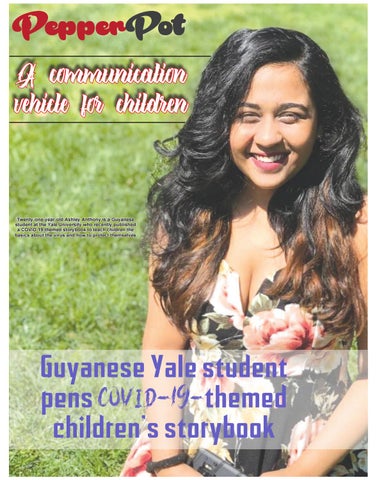
A communication vehicle for children
Twenty-one-year-old Ashley Anthony is a Guyanese student at the Yale University who recently published a COVID-19-themed storybook to teach children the basics about the virus and how to protect themselves
Guyanese Yale student pens COVID-19-themed children’s storybook
II
T
By Francis Quamina Farrier
HE tour of duty by the British High Commissioner to Guyana and Suriname, His Excellency Dr. Greg Quin, concludes at the end of the month. Following is an exclusive interview which I had with the out-going diplomat. FQ: My first question was for him to reflect on the first time he learnt that he was being posted to Guyana. GQ: “When I was told I was coming to Guyana, I was hugely excited. This was going to be my first Head of Mission post and it was in a part of the world I had spent little time in before (bar a couple of holidays). I have spent most of my career working on the Former Soviet Union (with spells in Ghana, Iraq and Washington). I made a deliberate decision to apply to come to Guyana. I wanted a new challenge. To see a different part of the world. To have an opportunity to demonstrate my skills outside that FSU arena.” FQ: So how much did the High Commissioner know of Guyana before his posting here. GQ: “As an historian by training (my real passion) I did know something of Guyana. I was also aware of many of the famous Brits who were Guyanese or had family connections to Guyana. Clive Lloyd, for example, was always a hero to me when I was growing up. And then there is Eddy Grant - also a hero to me when I was growing up. Indeed one of my happiest moments was when I met
CHRONICLE PEPPERPOT ― Sunday, August 16, 2020
Eddy for the very first time in 2015. And I am honoured to have had the opportunity to talk and meet with him on several subsequent occasions (usually at Barbados airport whilst we awaited for flights to Guyana!). And let’s not forget Sir Shridath Ramphal. It was a hugh pleasure to meet this titan of Guyanese politics and history and a previous Secretary-General of the Commonwealth.” FQ: Was there anyone the diplomat knew in Guyana before he arrived?
GQ: “There were several people in the Foreign and Commonwealth Office who have family ties to Guyana. So whilst I didn’t know anyone here I did know people who knew Guyana (and who had been here).” FQ:So what were the principal projects Dr. Quinn had on arrival, and how successful have they been? GQ:”I arrived three months before the 2015 election. That was my major preoccupation and one which meant I had to hit
British High Commissioner to Guyana, Dr. Greg Quinn at the Cenotaph in Georgetown, on Remembrance Day (Photo by Francis Quamina Farrier)
the ground running. And to add the fact that I am also Ambassador to Suriname (which also had elections in May 2015) and you can see how busy it was. Throughout the period of my time here I believe there has been a significant expansion on UK activity in, and support to Guyana. This included Security Support Reform which, in May 2015, the newly-elected President asked me to get reinstated. We managed significant work on that in subsequent years. My major aim has always been to build the relationship between our two countries. A relationship based on being equal members of organisations such as the Commonwealth. We have had several Ministerial visits, increased assistance, increased business interest and of course, the visit of Prince Harry in 2016. That was a completely unforgettable moment in my life.” When asked about his travels around Guyana he replied, “I have travelled from the border with Venezuela in the West to Orealla in the East. I’ve been down to Lethem and Sand Creek in the South, and I’ve been many places in between. My one regret is that I never made it to Paramakatoi (although I did get to Chenapou). The reason I so wanted to go is that the UK is funding an upgrade to the health post there - and it is the only place we are doing that, that I haven’t visited.” High Commissioner Quinn demonstrated special interest in one of Britain’s World War ll heroes, Cy Grant, who was born in Beterverwagting, East Coast Demerara. On
the occasion of the 100th birth anniversary of Cy Grant, the High Commissioner held a special celebration event at his residence. GQ:”As an historian by training, I am convinced that we must understand and remember the past. Some of it is not pleasant, some of it most definitely is. When I first became aware of the story of Cy, it demonstrated the breadth of the links between our two countries. Links which many don’t know. Cy flew with the Royal Air Force (RAF) in World War ll and was shot down and imprisoned in a German POW camp. He was the first man of African heritage to be a regular on British TV. He became a TV star in his own right and then a passionate advocate for equality in the UK. His impact, influence and role in both countries deserved to be recognised and I am glad that I could do my small part to help that. It was also a pleasure to connect with Cy’s family and show them that his spirit and impact lives on.” FQ:What would you miss most about your tour of duty in Guyana?. GQ:”I think it is hard to say just one thing. It has been a spectacular 5 and a half years here. I’ve done a lot, and seen a lot. It has been an amazing experience. Capped by wonderful people. But Guyana needs to look to the future. A future where every citizen will benefit. The opportunity is there. It needs to be grasped.” The following are his wishes for Guyana in the short and the long term. “Since my first day here people have told me about the potential Guyana has. That is without question. But it has never been really achieved for the benefit of every citizen. That is my fervent hope. That politicians and leaders in this country are able to do everything they can to ensure each and every citizen benefits to the degree they deserve. Guyana, and its people, deserve better.” In summary, Dr. Greg Quinn had this to say. “It has been quite a time here. I arrived expecting to be here for three years, yet here I am coming to the end of my posting after five and a half years! Who would have thought it? I have had the opportunity to do and see things I never expected. That includes Kaieteur, the Rupununi, turtles, discovering the secrets of the world’s best rum (and how important it was to the Royal Navy), going up and down a variety of rivers, flying into tiny airstrips, meeting wonderful people. The list goes on and on, to be honest. I will miss Guyana, but I certainly expect to remain engaged in the coming months in my next job with the FCO in London.” Since the Foreign and Commonwealth Office (FCO) deals with Commonwealth matters, Guyana will most likely be on the desk of Dr. Greg Quinn from time to time. His overall wishes for Guyana is that, “Everyone in Guyana will knuckle down and work together for the future of Guyana and to see that potential realised that we keep hearing about. There are huge opportunities for Guyana and all Guyanese. This must be grasped for the benefit of every single citizen of this country.”
III
CHRONICLE PEPPERPOT ― Sunday, August 16, 2020
A
By Naomi Parris
MID the coronavirus (COVID-19) pandemic there is a heightened level of anxiety in the atmosphere as the world continues to watch the virus sweep across countries snuffing lives away and crumbling economies. While there has been a mental strain on adults and young people, the pandemic has also had its effects on children as they are still trying to comprehend what a pandemic really is. Twenty-one-year-old Ashley Anthony, who is currently studying biomedical engineering and history of science public health and medicine at Yale University birthed a children’s COVID-19 storybook to teach children the basics about the virus and how to protect themselves. The initiative for the book ‘Lia & Ellie talks about Coronavirus’ according to Anthony was erected when herself and classmates were instructed by their professor to create an information vehicle based on the challenges of the global health crisis. Capitalising on the current health crisis, Anthony chose to create a children’s book about the COVID-19 pandemic. “I wrote this book as a final project for one of my classes. The class was Challengers and response in global health…and so for our final project it was really open-ended and they gave us the option to write about some children’s book to write about some topic,” Anthony said. Additionally, the young woman stated that she chose the Coronavirus because it was topical and she believes that it is particularly important for children to understand what is happening right now. “I feel as though the pandemic has been stressful on all of us and it has been a lot of adjustments to this new kind of lifestyle and as young adults and as teenagers we kind of understand why we have to make these changes but children might not and it’s not always at the top of our
priorities to sit down and talk to kids about what’s going on,” she explained. The young woman noted that as much as everyone is struggling with mental health and the increasing levels of anxiety because of being socially isolated, children are also suffering since they do not understand why they have to be socially distant. “I just really think that it is important that we provide kids with information. It is also important that the information comes from a reliable source because we don’t want kids to ask their friends,” she said. IT’S A GOOD WAY TO COMMUNICATE Anthony, who has a knack for writing, told the Pepperpot Magazine that the book gives parents a way to communicate with their children about the pandemic and the effects it can have on them if they do not take the necessary precautions. “I think it’s important to have ways to communicate with children with this health
crisis but I recognised that for a lot of parents that is not an easy task especially for parents who themselves might not understand all of the reasons why they need to stay inside,” she said. For parents, she added it has has been difficult to talk about the topic since many do not want to overwhelm their children with the harsh realities of the health crisis, “What information do I share with my child versus what is too much or what might overwhelm them…so I think that a children’s book is a really good way to start the conversation. I don’t think that it answers all the questions but it provides a way for the parent to begin addressing this topic,” she said. IT HAS BEEN DIFFICULT Meanwhile, Anthony has been adapting and learning to cope with the effects of the pandemic herself. The young woman noted that she was
forced to move out of her dorm quarters after a student at the University tested positive for the novel coronavirus. Anthony revealed that she had plans to return home to spend the summer with her immediate family, however, due to the virus the airports have been closed for some time and it is still unsure as to when they will open since travelling is no longer permitted as per normal. “It has been difficult maybe in unexpected ways actually. We have spring break that starts around March 8 and ended on March 23rd and so leading up to spring break things were pretty normal and then things started to go very badly very quickly and all the plans that I made got thrown out the window,” she said. Luckily Anthony has fam-
A cover of Anthony’s COVID-19 children’s book ‘Lia & Ellie talks about coronavirus
A glimpse of Anthony’s COVID-19 children’s book
21-year-old Ashley Anthony ily in the United States who she has been staying with for the time. “I was lucky because my uncle has a place in Maryland, and I was able to come and spend the time with him and so I have been here and it has been good to spend time
with extended family, bond and become closer,” she said. Nevertheless, being around family has helped her to remain calm amid the uncertainties of what will happen next. A KNAC FOR WRITING Despite her interests in the sciences and medicine, Anthony has always seemed to have a love for penning her ideas on paper, so writing the book for her final project came easily. In sharing her love for writing, the young woman told the Pepperpot Magazine that she began writing at a relatively young age and would from time to time engage in a few writing classes at her current university. “My interest for writing started when I was maybe about 10 years old because I read and I just felt like it would be good to express myself and to tell stories so I started writing from a relatively young age and I would have published my first book when I was thirteen,” she said. Anthony had even dabbled a little bit in writing for a newspaper as a columnist before heading out to study at Yale University. “And so, from there on I started to explore other types of writing. I had a column in the Guyana Times that ran for about two years and I did a stint at the Guyana Times shadowing a journalist in 2017,” she said.
IV
CHRONICLE PEPPERPOT ― Sunday, August 16, 2020
Isabis Naturals ensures healthy hair and skin
T
By Jared Liddell
H E b e a u t y, hair and skincare arena in Guyana has been evolving over the years with Guyanese entrepreneurs becoming more involved in producing their own lines of products made to withstand and cope with the conditions relating to Guyana’s specific climate and especially its diverse skin types. Isabis Naturals, a Guyanese hair and skincare line which uses purely all-natural ingredients. Co-founder and one of the creatives behind Isabis Naturals, Danellie Giddings spoke to the Pepperpot Magazine
on their Journey getting their own line started. She stated that her Haircare line is a joint effort between her sisters Dannika Giddings and Dasha Hendricks, while their skincare line is a collaboration between the company and Trisha Fordyce, a trained cosmetologist. Giddings stated that she and her sisters decided to start up the business because they wanted to allow others to have the experience and feeling that came with knowing your hair is healthy and being able to see the growth that came along with that. She went on to say that it was a collective effort by her supporting family that allowed her to successfully launch the product. “Isabis Naturals is not
something that just happened one day. My sisters and I, with the aid of friends dear to us and my mother, my grandmother had been researching, planning and working for a long time on how to go about making this product available and workable to the needs of every person that uses the brand. The ingredients infused to make the oil have been used among my sisters and I for years, promoting healthy hair, that often triggered many people to ask ‘what do you use in your hair?’ So we decided that we would improve upon the mixture we used and make it available to others,” said Giddings. She stated that since the launch of the line, the business has been able to
achieve an unexpected level of support, stating that within its first two weeks they sold out all of their hair growth oil and had to restock. Giddings further said that since starting her busi-
Co-founder of Isabis Naturals, Danellie Giddings
A sample of the Isabis Naturals Haircare Product
ness journey she was able to garner some invaluable insight into the processes that go into creating and launching a self-sustaining business. She stated that from this she was able to see that there is no dream too big or too small that she couldn’t achieve especially with the support of her family and friends, and said that she would encourage any young entrepreneurs to get involved in business stating that they should never limit themselves and that they should always strive to be integrative in their craft.
“Go for that thing you so desire to do. Don’t be threatened by what other people are doing or limit yourself because you think people might not like it or may hate you for doing it because you are you and you are unique in your own craft,” she said. “Imagine if every business person thought like that before they ventured out. So you have a vision, study the industry, plan properly especially with the current economic situation the world is in due to the pandemic and if you feel that you would succeed at it, just go for it making
sure of course that it is something you want to do and love.” Giddings said that she and her business partners have been overwhelmed by the support and success of the business locally and that they intend to continue working innovatively to ensure that they can continue to meet their customers’ demands. She added that Isabis Naturals is also on the verge of introducing their brand and products in the United States to allow persons worldwide to have a first-hand experience of the product.
V
CHRONICLE PEPPERPOT ― Sunday, August 16, 2020
A
By Marissa V. Foster
Guyanese graphic designer; Amar Latif
M A R Latif is a very ambitious Guyanese graphic designer. Latif went to Barbados in 2016 and applied to the Samuel Jackman Prescod Institute of Technology. There, he studied graphic design and printing technology. He was ahead of the class and was later placed on job attachment. He worked and studied simultaneously. While working, he was asked to stay in Barbados a while longer to work as a graphic designer, printing press operator and bookbinder because his employers noted his efficient work ethic. Latif was very proud of himself because as he was working, he was also able to teach his classmates. Normally, it takes five years for someone to become a Amar Latif from printing press operator but Graphic Mood’s it took him only six months graphic work to learn the printing press. Subsequently, after earning his diploma, he was met with various company offers to
work due to his newfound skills and knowledge. Amar also had intentions to open his own business. After he returned to Barbados from a trip to Guyana in January, he realised that a lot of companies appreciate his skills and how he multitasks but none of them were willing to pay him according to his level of qualifications. Hence, he reflected and said to himself: “I am too educated to be working for someone that doesn’t know my worth eventually. So six months later, I was working on getting my very own printing press to set up my business,” he said. “I eventually opened my business and I’m doing everything by myself now. From graphic designs and printing. The presses I work with are Heidelberg KORD, GTO, Speedmaster, Printmaster, HP indigo 3050, Xerox, Toshiba, Hamada press, and Heidelberg 10 color printing press.” Latif is the proud owner of “Graphic Mood” and is also currently trying to expand his business to Guyana. “I am a Guyanese that came to Barbados to study and achieve my goals with hopes of opening my own
business. No matter how hard you think something is, you always have to fail first in order to gain success,” said Latif. His business is booming as he now offers free shipping to any Guyanese who may be interested in printing business cards, flyers, brochures, stickers, labels, cake boxes, soap boxes, posters, tickets and much more. His business is always to give discounts and he has an open mind to listen to everyone’s story, in order to communicate and gain more customers. He stressed that he does all the designing and printing by himself. He is still in disbelief that he now has his very own business. This driven graphic designer expressed that, “My business stands out from others because that I am my own boss. I do everything by myself and as such, I can maintain the quality of my work, the way I see fit.” His mother always told him to have faith and one day things will get better. Today, she can now look at her son and see her hard work in raising him is paying off, he said.
VI
CHRONICLE PEPPERPOT ― Sunday, August 16, 2020
Guyana and Trinbago: T
HE March 2 and August 10 elections of Guyana and Trinidad and Tobago, respectively, have illustrated that tribalism is still very much alive in the politics of the two plural societies and that constitutional reform is necessary to usher in better governance. Trinidad and Tobago and Guyana are both plural societies, with their largest or dominant ethnic groups (almost equal in size) being the descendants of East Indians and Africans. I submit that these two plural societies are fractured and that two dominant ethnic groups still perceive that they are in competition with each other for the country’s resources. I do not believe the competition for resources is an entirely ethnic (or racial) one for persons of the two dominant ethnic groups, nor the remaining groups since there is evidence to show that the class structure is a major contributing factor. However, I cannot dismiss the generally accepted perception. It is for this reason that I am not surprised when major political capital is gained when political parties can appeal to the economic insecurities of their respective (ethnic) bases. Economist Tarron Khemraj (a learned academic, unlike me and my impressionable self) expands on this in his piece on “Politics and Underdevelopment: The Case of Guyana” published in the 2019 book, Unmasking the State. He wrote, “Pro-ethnic voting by the
two dominant groups- East Indian and African masses- is endogenous or is jointly determined by external factors rooted in history, geography, production structure, and foreign price shocks.” He posited too that tribalism is perpetuated because when considering to vote for a ‘third force’, the two dominant ethnic groups cannot be sure that the other group may also vote for a third party instead of the party that group has traditionally voted for. Essentially, Afro or Indo-Guyanese could vote for a third party in an attempt to break the tribal hegemony, but what if members of one of the two groups vote for the third-party while members of the other do not? The party which maintains more of its traditional supporters, therefore, wins. “The respective masses (the overall majority) also perceive- rightly or wrongly- that their economic interests would be harmed if the other side were to win the elections,” Khemraj wrote. As the votes were being tabulated last Monday in T&T, I listened to political analysts on Trinidad’s TV6 discuss some of the issues brought to the fore by the election; it came as no surprise that tribalism and constitutional reform were among those. Former Minister Vasant Bharath highlighted that the two main Trinbagonian parties- the People’s National Movement (PNM) and the United National Congress (UNC)- head into
elections confident of at least 15/16 seats each (out of the 41 constituencies in total). This is due to tribalism which characterises T&Twhere a majority of the population votes for a party based on the ethnicity associated with the party. The election, therefore, is contested upon which of those two parties can secure the marginal (or swing) constituencies. This is also the case of Guyana, in my opinion. It is well-known that the PPP/C will secure a majority of Region Six, for example (unless they monumentally botch their time in office). The very same goes for the A Partnership for National Unity (APNU) in Region Ten. The tribalism, I tell you. Now, this is why constitutional reform becomes necessary. Guyana uses the Proportional Representation electoral system to elect a President and government and T&T uses the First-Past-the-Post system to elect its Prime Minister and a government, but what is common is that they are both, essentially, ‘winner-takes-all’ systems. Up to Tuesday, as I am writing this column, the People’s National Movement (PNM) has 22 of the 41 seats, while the United National Congress (UNC) has 19 (Disclaimer: I don’t know if the recount may change this later in the week). In this political system, even the slimmest of margins results in an outright winner and loser. Imagine, Prime Minister Keith Rowley’s government stays in office for another five years by se-
curing only two more constituencies than the opposition UNC. Currently, the PPP/C government has 33 seats, as opposed to the 31 held by the APNU+AFC opposition and one seat held by the joinder list. Here too, the opposition is only the opposition because of a difference of two seats (which came from a difference of just over 15000 votes). This system is flawed, as it leads to a monopolisation of power. Power-sharing has been one idea which has been popularised once again in Guyana, due to the events following the No-Confidence motion and the March 2 elections. I emphasised on the “once again” as power-sharing is not a new idea. As highlighted by Perry Mars (1990), the PPP/C proposed a National Front Government in 1977, in an attempt to foster “working-class unity for socialist development”. If we can’t seem to shake tribalism (though I genuinely believe the national healing I wrote about in my previous column could help with this), then maybe constitutional reform and power-sharing are other alternatives for us to consider. I think the people in the plural societies of Guyana and Trinidad and Tobago could benefit tremendously from this. If you would like to connect with me to discuss this column or any of my previous works, feel free to email me at vish14ragobeer@gmail.com.
VII
CHRONICLE PEPPERPOT ― Sunday, August 16, 2020
Focus on the Village
Crabwood Creek Village (Carl Croker Photos)
T
By Michel Outridge
HIS week the Pepperpot Magazine visited the large community of Crabwood Creek, Upper Corentyne, Berbice, Region Six (East Berbice-Corentyne). The village is a place of sawmills, lumber yards, gas stations and other business but is also an agricultural community with quite a few large-scale rice, cash crops and cattle farmers. The population is about 10,000 people of mostly Indo Guyanese and a mixture of folk of other ethnicities. Crabwood Creek is between Moleson Creek, where the Guyana-Suriname Ferry Stelling is, and Line Path, Skeldon, a commercial hub of businesses as well. The village extends from the foreshore of the Corentyne River to way down into the vast backlands which are used for rice and cash crops cultivation. Crabwood Creek is home to a handful of businessmen and women as well as simple folk who try to make an honest living doing various jobs. The community took an economic plunge when the Skeldon Estate closed its doors a few years ago, forcing sugar workers to seek other forms of employment. Most of the people on this corridor depended heavily on the sugar industry as their main source of income and following the closure of the estate they became farmers and other small business operators.
Crabwood Creek still has maintained the colonial-style landscape in terms of its well-designed wooden houses with intricate details of woodwork in various forms as well as some very large mansions and houses. There are many empty houses owned by people who have migrated and some still have trucks, tractors, vehicles and combines still parked in the yards for several years. It is a beautiful place with well-maintained houses, yards full of plants, flowers, fruit trees and vegetables. This village overlooks the Corentyne River and it has many streets with the basic infrastructure of electricity, potable water, and telephone landline and internet services. Crabwood Creek has a nursery and a primary school, a Neighbourhood Democratic Council (NDC) office, a health centre, mosques, mandirs, churches and a public library. CRABWOOD CREEK NDC Meanwhile, the NDC Assistant Overseer, Sattee Singh took the time out of her busy schedule and gave an overview of the work of the NDC. She explained that the NDC provides services for members of the community spanning Crabwood Creek to Moleson Creek. They clean and maintain all internal drains and parapets and settle minor disputes among villagers. The maintenance of drains and parapets is done under the Community Infrastructure Improvement Project (CIIP) which falls under
the control of the NDC and it currently has 11 persons drawn from the community in their employ. Singh pointed out that they were supposed to have 25 persons as part of the CIIP. The Assistant Overseer told the Pepperpot Magazine that she is originally from Corriverton but married 23 years ago and relocated to Crabwood Creek. “In this village, you can never grow hungry because everybody planting something and the people are close-knit and look out for each other,” she said. Singh reported that Crabwood Creek is the home of rice, vegetables and ground provisions. “Almost 50 percent of the population are farmers and we eat what we grow and sell at the markets and we have no real major issues boiling over here so it is a peaceful place to reside,” she said. She added that the NDC has a Chairman, two staffers and 11 councillors and their catchment area is from Crabwood Creek to Moleson Creek. Singh pointed out that the NDC takes care of the residential community and that they have 10 Grants in which each area is sectioned off and it starts from the Sea Dam to the end of the First Depth. She disclosed that the Mayor and City Council covers from Black Water Bridge to the township. “In this village, the people live neighbourly and whether you are related by blood or join the family they live like a big family,” she said.
The Crabwood Creek NDC
One of the schools in Crabwood Creek Village
One of the more colonial-style and well-maintained houses in Crabwood Creek
VIII
CHRONICLE PEPPERPOT ― Sunday, August 16, 2020
The ‘village shop’ at Crabwood Creek Public Road
Focus on the Village
Elsa Dilchandar
Some of the locally made sweets and snacks for sale in the shop operated by Elsa Dilchandar and her family
L
By Michel Outridge
IFE is simple in Crabwood Creek, a country-side village in Upp e r C o re n tyne, Berbice where the people are very friendly and enjoy the peace and tranquillity after hard work. Elsa Dilchandar has lived all her life in the community and she manages the grocery shop they have which is located on the Public Road. The 18-year-old said her daily tasks include manning the shop and assisting with the household chores, while her mother would make home-made fudge to sell in the shop and do the cooking among other things. “When you have a shop you want to be prompt and not let customers wait on you so I does be in the shop to sell,” she said. Dilchandar reported that some days they get busy while other days, they have time. It is a grocery shop that has every little thing includ-
ing locally made plantain chips, cassava chips, sugar cake, chicken foot and tamarind balls. “We don’t go out much because of this business we stay home and sell in the shop and only attend a few family functions,” she said. “Even though this village is big but quiet and nothing much happens around here but I like the peace and simple living,” she said. STAY-AT-HOME MOM Meanwhile, Kavo Arjune is also a resident of Crabwood Creek Village, who was at the time doing household chores. She stated that she is originally from #63 Village, also on the Corentyne but relocated to her uncle’s house three years ago when he passed away. The 37-year-old added that she is rehabilitating their house so when that is completed she may return to her hometown which has almost the same quietness. The housewife reported that due to the closure of the ferry crossing at the nearby Moleson Creek the place is
Kavo Arjune
Village teacher, Chandrekha Persaud
kind of dismal with less traffic and people. But when it is opened the road is busy all the time with people and vehicles traversing and they reside right on the Public Road. Arjune told the Pepperpot Magazine that most elders of the village passed away but a few remain such as her nextdoor neighbour, who is 70 years old and he is cared for by relatives, who would visit. Since there is no market in that village they would do their shopping at #79 Village and would make those trips when necessary. “With the virus and all we don’t really go out much so we spend a lot of time in-
doors and in the yard where we plant and do chores to beautify the place,” she said. Arjune pointed out that most villagers are farmers and they eat and make a living in what they grow and they are basically simple people trying to earn. THE VILLAGE TEACHER The Pepperpot Magazine also met the village teacher, Chandrekha Persaud better known as “Seema”. She is attached to the nearby Crabwood Creek Primary School which is a few doors away. The educator is eager for the re-opening of schools because she thinks she has
been at home for far too long and missed the interactive sessions with pupils. She has been in the teaching profession for the past 14 years and has grown quite fond of the job and the pupils. “As a child I wanted to become a teacher and I used to hold imaginary classes… and today that dream has materialised and I am very happy to serve my community,” she said. Persaud disclosed that in 2006 she completed her secondary education and applied at the Cyril Potter School of Education (CPCE) and was there from 2013 to 2015.
She was successful in the Associate Degree of Education at CPCE and became a qualified teacher at the Crabwood Creek Primary School. Even though she fulfilled her dream of becoming a teacher, Persaud is determined to qualify herself to the fullest and become a first-year student at the University of Guyana (UG) Tain Campus, Berbice. She is pursuing a Bachelor’s Degree in Education Primary General. However, Persaud revealed that since schools closed in March they have tried to do some online classes but that failed because many students do not have access to the internet. “I have a class of 23 and only 13 have internet access so I asked those that have the school work to share it with the others so they will be in the know,” she said. Persaud is hoping schools can be re-opened because she is exhausted being home and would like to return to the classroom where she can function more effectively.
IX
CHRONICLE PEPPERPOT ― Sunday, August 16, 2020
Focus
S
By Michel Outridge
AIF Ally found his calling when he became a trained Community Health Worker attached to the Crabwood Creek Health Centre in 2013 and has grown to enjoy the job as a frontline worker even amid the pandemic. The best part of the job is getting to residents who live and farm deep in the backlands which is 10 to 15 miles from the village. “It is very challenging getting there at times. When it rains heavily the place is muddy and the motorcycle gets punctuated and I am stuck for hours before I get help but I know the people residing depend on me to get to them to provide vaccines,” he said. Ally revealed that if they get an All-Terrain Vehicle (ATV) it would be easier to get to the location without mishaps and he would be able to serve the people better.
diseases clinic which was the largest clinic so they provide just the basic health care services there,” he said. Even with these shortcomings, the Crabwood Creek Health Centre is touted as one of the best simply because the staff are always cooperative and display a professional attitude and the environment is very clean and they are a ‘child-friendly’ facility. He stated that they have a ‘child corner’ equipped with toys, books, a table and some chairs where the children when visiting with their parents can play and occupy their time. Ally reported that they serve residents of Moleson Creek to Crabwood Creek and even neighbouring villages. The Crabwood Creek Health Centre has three Community Health Workers, two of whom are in training, one midwife and a clinic attendant and they oversee the daily operations of the facility. They provide antenatal, prenatal clinics, family planning services and other basic health services.
is what I like doing,” he said. The Community Health Worker told the Pepperpot Magazine that he started working at the health centre in 2013 after he was had completed training at the West Demerara Regional Hospital and he is from Line Path, Skeldon. Ally added that he always wanted to become a health care professional and is doing what he loves best and he feels he is serving his purpose of assisting people who need it. He pointed out that the antenatal clinic is held in the upper flat of the health centre and they try to minimise the waiting time for patients and treat everybody as a priority. “If I am at home and I get call out to go and tend to a sick person, without question I would go no matter how far I have to and ensure that person is treated and I see it as a blessing to my life,” he said. Ally reported that the health centre staff function as a team of professionals and they can carry out their man-
on the Village
Community Health Worker, Saif Ally (Carl Croker photos)
Inside the Crabwood Creek Health Centre
Crabwood Creek Health Centre
He also reported that they do not dispense medicines there only vaccines are administered because they do not have an in-house doctor. Ally added that they have a visiting Medex every Wednesday for the pregnant mothers’ clinic only. “Without a doctor here we had to abandon the chronic
Ally stated that they do home visits with shut-ins and bedridden residents and he would go to persons in need of vaccines even on weekends to ensure people get the medical relief they need. “I like serving people and more so sick people who need to get treatment to get better and I would work on weekends when I am supposed to be off duty because this
The ‘Child-Friendly Corner’ at the Crabwood Creek Health Centre
date as a group because they cooperate to provide reliable patient care. However, there is also a need for a pharmacy with an in-house pharmacist since all patients have to visit Skeldon Hospital to get their medicines. “We are working with what we have and we do our jobs professionally and we are always pleased to serve the people,” he said.
X
CHRONICLE PEPPERPOT ― Sunday, August 16, 2020
R
By Michel Outridge
Romain and Chandrawattie Premsook at their home and business place (Carl Croker photos)
Focus on the Village
ENDY Premsook is a resident of Crabwood Creek, Upper Corentyne, Berbice and he is a tour operator, who is registered with the Guyana Tourism Authority (GTA) and is promoting tourism to both locals and foreigners. His business is Rendy’s River Tours and they do jet boat tours to Orealla, Siparuta, Apoera, Suriname, Wonatobo Falls among other places along the Corentyne River. But due to the novel Coronavirus (COVID-19) his business is partly closed because the Corentyne River is not open as a result of the travel restrictions. Premsook told the Pepperpot Magazine that he has been in the tourism business for the past six years. He has been on the river for longer, however, as his father had a boat and they used to learn to drive it and over time he became versed then after some years he managed to acquire a boat of his own. Premsook later acquired three more jet boats which are now used for his tour operation. “I started off with one boat and today my tour is considered one of the best because our service is very reliable and safe,” he said. The 32-year-old Crabwood Creek native stated now that he only does river trips that are
necessary which is the Ministry of Social Protection pension distribution to Orealla, Siparuta and Apoera where he takes in staffers for that purpose. Premsook disclosed that business is basically at a standstill so he has found another source of income, that is, farming. He has a plot of land and is cultivating plantains and ground provisions which he sells. The father of three added that he would like to have a meeting with the tourism representatives to highlight his need for duty-free concessions to get better equipment for his tour operation. The Librarian of Crabwood Creek Meanwhile, the Pepperpot Magazine met Chandrawattie Premsook who is attached to the Crabwood Creek National Library. The village library re-opened on August 10, 2020 from 14:30hrs to 17:30hrs and has full sections of books for both adults and children. “My grandmother was the village librarian for more than 50 years and she is still alive and active and that’s how I developed an interest in the library because as a child I used to go with her and I got to appreciate books,” she said. The Crabwood Creek National Library has three staffers and Premsook has been there for the past three years, doing a job she loves but it was closed for some time due to the virus. “The library is open for the general public and anyone can join and the books are borrowed freely but must be returned upon due date,” she said. Premsook related that the library is a good place to spend time because reading broadens your scope as an individual and it teaches of many things you did not know about. She, however, encourages young people to make more use of the facility since at times the youths get carried with technology and gadgets and forget about books. The mother of two also manages a small business from her home she has a boutique and a stationery section where utility bills can be paid. She also sells stationery, does photocopying, sells sim cards, phone cards and cell phone accessories. The business is housed on the lower flat of her house and she is often assisted by her husband, Romain Premsook, who is the village barber. He has a small barbershop in front of the yard and operates daily. This family is doing more than one job to make ends meet financially and they are determined to stay afloat.
The Crabwood Creek National Library
Tour Operator, Rendy Premsook’s jet-boats
XI
CHRONICLE PEPPERPOT ― Sunday, August 16, 2020
The old-fashioned ice cream van
The driver, Keshan Bisarmjeet and his assistant, Kevin Manmuthoo in the old-fashioned ice cream van, selling cones (Carl Croker photos)
I
By Michel Outridge
CE Cream is a beloved treat by young and old alike and in Crabwood Creek Village, residents can enjoy a really good home-made vanilla-flavoured ice cream from an English-made ice cream van whenever it passes through the villages on a daily basis. Residents would await the arrival of this van in their village as it announces it entrance via a unique tune through its speaker. At Crabwood Creek, the Pepperpot Magazine encountered Keshan Bisarmjeet, who is the local ‘Ice Cream Man’. He drives the old-fashioned Oxford ice cream van with an assistant who sells the ice cream in a cone cup. The 32-year-old reported that when he was unemployed he wanted to work and took up the job
when it was offered to him five years ago. He has an assistant, Kevin Manmuthoo, who is at the back of the van to fill the cone cups with the delicious frozen snack for just $140 per cone. They are both from the same village of Port Mourant and every day they would make the ice cream at home and then fill it in the ice cream machine that is built into the enclosed van and then they would wait until it gets hard enough to be sold. Once this process is successful they would start sell from Crabwood Creek Village until they reach their home village of Port Mourant then call it a
The assistant, Kevin Manmuthoo wrapping the cones with tissues before selling
Focus on the Village
day. Bisarmjeet told the Pepperpot Magazine that the vans are owned by a villager of Tain, Corentyne and he has three similar vans which are used for selling ice cream. “These vans are old but strong but still works well so we use it to sell ice cream even though we had to do some internal work,” he said. He explained that home-made ice cream takes about 20 minutes to make once all the ingredients are added and put to freeze. Bisarmjeet stated that they would make a gallon daily and it would be sold before 17:30hrs and they can go home to start all over again the next day. The father of three noted that before he became the ‘ice cream man’ he was a taxi driver and that wasn’t a lucrative venture so he had to seek another job to support his home financially. “I like the job because you get to meet a lot of people especially the children would know you and we would normally go to different villages and it is rewarding seeing places and meeting new people daily,” he said. Bisarmjeet added that mostly children would look out for him and he doesn’t want to disappoint them so he would pass through the villages every day. Bisarmjeet stated that he has a simple job but he takes it seriously because he provides a service to the people and he likes to be reliable and on time. “I wouldn’t want to have little children waiting on me and then I don’t show up, no, never, so I do my work” he said.
XII
CHRONICLE PEPPERPOT ― Sunday, August 16, 2020
An internal shot of the newly opened establishment at St Cuthbert’s Mission
T
HE community of St Cuthbert’s Mission (Pakuri) located on the Soesdyke/Linden Highway, now has its very first pharmacy allowing its residents easy access to much needed medical supplies. ‘Simon’s Pharmacy’ - was established in the area on July 19, 2020 by Emmanuel Simon who grew up in the community. He told the Pepperpot Magazine that after establishing his first pharmacy in Soesdyke some five years ago he then realised the need for a similar facility in his home community. “My main pharmacy is on Soesdyke, I can make things better for them especially pensioners. The health centres in the outlying communities they are always out of medications and stuff like that, so I
decided that I had to establish a pharmacy in my home community,” said Simon. He stated that there is a need for persons, especially elderly persons to be able to access the necessary medications and thus in creating the pharmacy he decided to offer a 10 percent discount throughout the year to the pensioners. Simon stated that he ensured to choose an ideal area to ensure easy access to the people of St. Cuthbert’s Mission. The location of the pharmacy, he said, is more densely populated so many more persons would have access to it. He explained that it is in the central area just five minutes away from the health centre, the church, the school Toshao’s office and one of the community’s ICT hubs. “I think its beneficial because sometimes persons may need to come from a distance maybe
an hour and a half and they may come to the health centre only for it to have a few Panadol and not many of the other medications that that may be recommended by the doctor. So I see it as convenient since they can take five minutes more and come to my pharmacy and be able to get a variety of things as long as they can afford to buy it,” stated Simon. He stated that he believes the pharmacy not only helps the residents but helps in great part the resident doctors in having access to a wider range of medication that they can recommend or prescribe to their patients. He further explained that the health centre stocks mainly the essential drug list such as penicillin, saline, diclofenac as essentials but not drugs such as Vitamin C.
Pharmacist and owner of Simon’s Pharmacy, Emmanuel Simon at the opening ceremony
CHRONICLE PEPPERPOT ― Sunday, August 16, 2020
A
UGUST is an extremely special month because it’s my birth month and this year, we have five Saturdays, Sunday and Mondays and that that rarely happens. They say it is so rear that it only happens once every 823 years. My birthday was yesterday but I started celebrating from August 1. I have given out a number in gifts such as my books, outfits, coaching sessions or complimentary programmes and chapters in the Women Across Borders Anthology “Soaring to Greater Heights”. We recently launched the cover ( in the picture below) and I am happy and blessed to have one of my best friends Dr Hilda Bourne contribute the foreword. Contact me if you are ready to share your story and be a co-author in this anthology. I am naturally a giver but more intentional in my giving for my birth month. I am enjoying sowing seeds of greatness and making a positive contribution to life. I wanted to add more to people’s lives because I just have a feeling that the manifestations will be in abundance infesting the most valued of all the resources. Have you noticed we have a new banner for the column? This is part of my celebration. Send your feed to beyondtherunway2@ gmail.com. The BEYOND THE RUNWAY Show was also launched yesterday on FB and Caribbean Power Jam Radio. Next week I
will feature my first two guests. Anyone registering for any of my programmes this month will receive unbelievable deals as part of the celebration. I’m just so grateful for life and so grateful to be able to have a front-row seat in so many people’s lives. We’ve just concluded our first virtual Confidence Becomes You and the testimonials are just so amazing of people finding their purpose of launching new businesses or pursuing higher-level studies. I love it when people take radical action as a result of becoming intentional. I encourage people to keep investing in yourself, keep sharing, keep giving because it’s a win. You can’t lose by giving because that is the best investment. I am looking forward to the rest of the second half of my birth month August and I just know it’s going to be Next Level. It’s definitely going to be even more intentional than the first half and I’m so thankful to God. I’m thankful for my relationship with God. I’m thankful for my ability to love no matter what and I am so appreciative of my family, my friends and the people who continue to support me along this magnificent journey. I think 2020 is going at a faster rate than last year and I am trying to utilise every day wisely I am engaging in lots of reflections and projections for this month. It is a tremendous blessing the day we discover why we were created. Also, it is a blessing to have genuine people in my front row. Looking forward to you joining me for the next two weeks of my birth month because
you may receive one of these valuable prizes as we continue to celebrate this beautiful journey called life BEYOND THE RUNWAY.
XIII
XIV
CHRONICLE PEPPERPOT ― Sunday, August 16, 2020
CHRONICLE PEPPERPOT ― Sunday, August 16, 2020
XV
XVI
R
CHRONICLE PEPPERPOT ― Sunday, August 16, 2020
E C E N T LY I broke from tradition and lent a friend my old but relevant single copy of HARPER’S Magazine from 2007 to read a story about the tough legal conditions soldiers of fortune go through. The story is titled “CONTRACT WITH AMERICA. Hard times for the soldier of fortune” by Daphne Evitar but he also read another article “THE RIVER IS A ROAD Searching for peace in Congo” by Bryan Mealer which seemed to overpower his interest in the first article of choice. Obviously, he had never read anything complete about
the following excerpts: “To think we had one of the greatest civilizations in Africa,” he said once, shaking his head. “But now... Severin had grown up around some of the world’s nastiest poverty just outside of his door in Kinshasa, and I think he was hoping like me, to find something better in the vast, green interior.” Then he chose another part of the story, also highlighted: “ And while Mobutu siphoned off billions in public funds to build palaces, like the one deep in the jungle equipped with a runway for Concorde jets, and to fly in masseuses direct from China, the country rapidly fell apart. Civil servants went unpaid for years, soldiers mutinied and looted the cities clean, inflation
deas already absorbed. With the advent of social media and Google, no one bothers to reach to the links of articles, much less for books, which is making a comeback with some of the younger adults. The distractions of living are numerous, including just staying on top of the bills. It’s also difficult explaining the history that seems fantastic to someone hearing it for the first time. But I felt compelled to explain what had transpired with the Arab and Moslem African onslaught led by Tipu Tip from his Zanzibar headquarters. This was followed by the African schemes of Leopold of Belgium, destroyed the self-sufficient high cultures of the Congo, like the orderly
Congolese troops. It was a tense time contaminated further by the cold war interests of America and Russia. The fact is that the Congo was caught up in a severe conflict upon the threshold of its independence not of its making but between Nikita Khrushchev of Russia and President Eisenhower of the US of A. In the end, Patrice Lumumba was murdered and Mobutu who was tabled to be thrown out of the army became the convenient president. This was 1965, he destroyed the country for 32 years. Congo was the victim of cold world politics by nations who cared only for their desired Geo-political results at any cost, the suffering of the ‘Other’ people did not matter.
the Congo before, and knew nothing even by hearsay of its history, except for The Mighty Sparrow’s provocative calypso “Never eat a White meat yet” so he was devastated by the references to poverty, hard-living and violent times. I patiently explained to him that writers cannot produce extensive biographic footnotes on the subject areas of their topic, the subject of the article is about the River traffic, when they have guidelines from publishers on how much words the article must contain etc. Writing is also a job I insisted, and criteria’s have to be met. This brother had made highlights of areas to support his argument. I was not happy with him doing that to my magazine but he ignored my protest and my previous explanation and proceeded to insist on the failure of the country’s leaders with
soared, water and electricity disappeared, and the average Congolese existed on US$120 per year. Mobutu’s era of Kleptocracy and neglect finally ended when rebels marched into Kinshasa in early 1997 and installed Laurent Kabila as president. The big man fled to Morocco and later died.” It then occurred to me what was going on. This brother had digested so many reports of bad things, revolutions in Africa, including the Congo (Zaire) that somewhere in his awareness he was looking for confirmation or an explanation on whether the article he had read confirms that Africa is indeed a basket case. the indoctrination of stereotypes is most times self-induced, relying on your ignorance and lazy resistance to the task of investigating for clarification, which results in being able to dispel or leave unchallenged the fertilised
and well-governed Kuba Kingdom with its artistic population, unaware and unprepared for the savagery of the invading European colonisation mentality (still alive today) from the 1870s onward, that swept an entire social system out of existence across Africa, adjusting borders, dividing peoples and destroying proven workable social systems. Then after the manifestation of ‘God’s Demon’ Adolf Hitler, in the 1930s followed by WWII, with Russia and Communism emerging as a pretentious alternative of Colonialism, postWWII. The colonised nations were again in a struggle to liberate themselves, or what was of their former selves dissected under different flags, the Belgium Congo under its charismatic leader Patrice Lumumba seeking an escape for his nation from Belgium colonisation, in the midst of insurrection by
My friend asked for related literature. I lied and said I had none. People just don’t return books. However, I did give him some title names to buy on Amazon or may be available in our almost vanished second hand book stands. His plight was not alarming, he is not in a field that made such literature an option, but paying attention to the world and its politics and the real policies of powerful nations does make you understand that national Independence is an elusive ceremonial concept. No wonder Forbes Burnham chose to celebrate our Republic status that enveloped the resistance of Kofi and the maroons that are more relevant in the face of disappointing expectations and the betrayals from preconceived guardians of democracy.
XVII
CHRONICLE PEPPERPOT ― Sunday, August 16, 2020
I
received an email requesting that I speak about Bi-polar disorder. I was quick to respond to this as I have seen first- hand the struggles that an individual with Bi-polar disorder goes through. It is especially difficult in Guyana as treatment, particularly mental health specialists, are not available in all health centres. What makes it even more difficult is the individual’s lack of social support due to a lack of understanding of this disorder. This is what I would most like to remedy today. To have everyone understand exactly what it is and how to deal with it. So first, we have to know exactly what it is. Bipolar disorder is a type of mental illness that causes unusual changes in a person’s mood and behaviour. It causes them to be full of energy or have a complete lack of energy with little notice. It mostly consists of manic and depressive episodes which are characterised by extremely happy/up moods and extremely unhappy/ down moods respectively. Bipolar disorder can occur at any age but often diagnosed in teenage years. It is typically a co-occurring condition which means it is usually paired with other conditions such as anxiety disorders, ADHD, substance abuse or eating disorders. It makes individuals more susceptible to physical issues such as headaches, diabetes, heart disease etc. This makes it difficult for these individuals to obtain and maintain jobs, healthy relationships and even to carry out regular day to day activities.
WHAT ARE THE SIGNS AND SYMPTOMS OF BIPOLAR DISORDER? It is quite difficult to diagnose bipolar disorder because the symptoms are similar to other illnesses such as schizophrenia, psychosis or depression. The changes in mood/emotion are an obvious tell but more aspects can be considered. There will be general changes as well as changes based on the type of episode experienced that day. General signs would be severe changes in sleeping and eating patterns. There may be a lack of judgement and heavier drug use to deal with the emotional and behavioural changes. If the individual is experiencing a manic episode, they will have an unusual amount of energy and talk incessantly. They will seem overly happy and confident. This eventually causes trouble sleeping and anger and irritation if their moods are matched by those around them. If the experience is a depressive episode, the symptoms will be almost the opposite. The individual will seem very down, may sleep for most of the day, not talk at all and may seem emotionless. They may isolate themselves, have no interest in any activity, not eat, feel worthless and may even consider suicide. It is possible that the individual feels both of these at the same time, called a “mixed episode”. This can potentially bring on psychotic symptoms such as hallucinations (hearing voices etc.) However, this is rare. All episodes will, of course, affect the individual’s relationships, judgement,
productivity and efficiency. How often episodes happen depends on the individual, their diagnosis and stress level. There are four types of bipolar disorder which are Bipolar 1, Bipolar 11, Cyclothymia and ‘other types’.
Bi-polar 1 occurs when an individual has experienced an episode of mania which has lasted over a week. They may or may not have experienced a depressive episode. Bi-polar 11 occurs when you have experienced both manic and depressive episodes. Cyclothymia occurs when you are experiencing both episodes rarely and is considered less severe than the previously mentioned diagnosis. Other Types means that you have bipolar symptoms that have been brought on or made worse by other mental
illnesses such as substance abuse. HOW DO WE DEVELOP BIPOLAR DISORDER? Research suggests that there is no single cause for bipolar disorder.
We know that brain structure/functioning and genetics are huge factors when it comes to any mental illness. Children with a parent or sibling with bipolar disorder are much more likely to develop it themselves. Other factors known to increase the possibility of bipolar disorder include heavy stress or trauma such as the death of a loved one, severe neglect or any kind of abuse. TREATMENT There is no cure for bipolar disorder- it is a lifelong illness that needs to be treated with medication and psychotherapy. However, people
with bipolar disorder should not feel hopeless. With proper counselling and medication, the individual can lead a normal, productive and happy life. This means that if you feel that you or a friend/family member may be suffering from bipolar disorder, please
go to your nearest health centre to discuss your concerns as soon as possible. As usual, treatment is most effective with all information so I suggest to start journaling and take it to your doctor. This means writing down your daily moods, when and why it changes, sleep patterns etc. Knowing this will keep you a few steps ahead. Of course, treatment requires medication and counselling but there are personal steps that can be taken along the way to better manage this disorder. Most importantly, know yourself. Know your moods,
triggers and warning signs. What is likely to cause what episode and how do you know it’s about to happen? Being aware means being properly prepared. As always, look after your physical health. Exercise, eat and sleep well. Do so at the same time every day- stick to a routine. Find calming activities to do daily or weekly to manage potential stress. Use your support circle. Let your family and friends know when you are experiencing an episode and allow them to help any way they can. If you are a friend/family member of someone with bipolar disorder, keep in mind how they feel after an episode which is unhappy and ashamed and unable to cope- that is, if they even remember their episode. Also, research shows that people are more likely to seek help during a depressive episode so it might be better to approach them then. WHY GET TREATMENT? Bi-polar disorder left untreated will more often than not lead to additional mental health issues such as depression, anxiety and substance use. It may also cause financial and legal issues, strained relationships and suicidal thoughts. So, again, please go to your nearest health centre today Thanking you for reading. Please keep sending any topics you’d like to talk about to caitlinvieira@gmail.com. Or message +592 623 0433 to book a private appointment with me Suicide Prevention Helpline numbers: 223-0001, 2230009, 623-4444, 600-7896 Say Yes to Life and No to Drugs! Always!
XVIII
S
H O W me someone who is not afraid of the dentist while sitting in the dental chair and I will show you an elephant that can fly. The prevalence of dental anxiety is universal and although a precise reason for it has not been scientifically confirmed, research is continuously being conducted to elucidate the phenomenon. One such study was recently conducted in Australia and it is
CHRONICLE PEPPERPOT ― Sunday, August 16, 2020
believed that the results reflect a global blend. Many researchers believe that persons are afraid of dental treatment simply because the supine position they must assume in the dental chair leaves the patient subconsciously vulnerable and defenceless unlike if they were in a standing position. Others are fearful because they cannot see what the dentist is doing in their mouth so they want to think is the worst and painful act.
Dental anxiety has been reported to impact upon both dental status and the use of dental services. There is an association between dental anxiety and correspondingly greater levels of untreated oral disease, and patterns of care provision, which were dominated by emergency treatment and irregular dental attendance. When two Australian scientists studied dental anxiety by using a long (one to two hour) semi-structured psychiatric interview followed by dental examination, the National Dental Telephone Interview survey (from a random sampling of telephone numbers by computer) and by using Corah’s Dental Anxiety Scale (13 points and above considered severe), they discovered the following: 1. The ‘dental phobics’showed greater numbers of missing teeth, more loss of alveolar bone through gum disease, and greater denture use, when compared with other subjects. 2. The adults had less natural tee 3. Those with natural teeth had more missing and fewer filled teeth but did not differ in their numbers of decayed teeth. 4. They had 4 to 5 times the odds of
needing immediate treatment for the relief of pain or infection. 5. The prevalence of dental fear was higher among those of lower education level and social class. Dental anxiety has also been shown to be associated with the avoidance of regular dental care. Evidence of the adverse health consequences means that the estimation of the prevalence and severity of dental disease may be important to dental public health. Individuals with high dental anxiety are likely to suffer greater impact from dental conditions, with significantly more toothache, discomfort, and avoidance of some foods. The condition may be a component in a cycle of dental disadvantage among individuals who are inflicted with it. The dental health status of the victims will progressively deteriorate unless the condition is overcome. It follows that dentally anxious individuals would be more likely to experience marked social impact from impairing oral diseases; that is, not only are they more likely to avoid care, they are more likely to need it, and they suffer the dental and social consequences of not seeking it.
XVIII
S
H O W me someone who is not afraid of the dentist while sitting in the dental chair and I will show you an elephant that can fly. The prevalence of dental anxiety is universal and although a precise reason for it has not been scientifically confirmed, research is continuously being conducted to elucidate the phenomenon. One such study was recently conducted in Australia and it is
CHRONICLE PEPPERPOT ― Sunday, August 16, 2020
believed that the results reflect a global blend. Many researchers believe that persons are afraid of dental treatment simply because the supine position they must assume in the dental chair leaves the patient subconsciously vulnerable and defenceless unlike if they were in a standing position. Others are fearful because they cannot see what the dentist is doing in their mouth so they want to think is the worst and painful act.
Dental anxiety has been reported to impact upon both dental status and the use of dental services. There is an association between dental anxiety and correspondingly greater levels of untreated oral disease, and patterns of care provision, which were dominated by emergency treatment and irregular dental attendance. When two Australian scientists studied dental anxiety by using a long (one to two hour) semi-structured psychiatric interview followed by dental examination, the National Dental Telephone Interview survey (from a random sampling of telephone numbers by computer) and by using Corah’s Dental Anxiety Scale (13 points and above considered severe), they discovered the following: 1. The ‘dental phobics’showed greater numbers of missing teeth, more loss of alveolar bone through gum disease, and greater denture use, when compared with other subjects. 2. The adults had less natural tee 3. Those with natural teeth had more missing and fewer filled teeth but did not differ in their numbers of decayed teeth. 4. They had 4 to 5 times the odds of
needing immediate treatment for the relief of pain or infection. 5. The prevalence of dental fear was higher among those of lower education level and social class. Dental anxiety has also been shown to be associated with the avoidance of regular dental care. Evidence of the adverse health consequences means that the estimation of the prevalence and severity of dental disease may be important to dental public health. Individuals with high dental anxiety are likely to suffer greater impact from dental conditions, with significantly more toothache, discomfort, and avoidance of some foods. The condition may be a component in a cycle of dental disadvantage among individuals who are inflicted with it. The dental health status of the victims will progressively deteriorate unless the condition is overcome. It follows that dentally anxious individuals would be more likely to experience marked social impact from impairing oral diseases; that is, not only are they more likely to avoid care, they are more likely to need it, and they suffer the dental and social consequences of not seeking it.
XX
CHRONICLE PEPPERPOT ― Sunday, August 16, 2020
HAZARDOUS WASTE MANAGEMENT – PART III
T
HANK you for joining us once again, as discussed in last week’s
article hazardous waste is waste or a combination of wastes which, because of its quantity, concentration or physical, chemical or infectious characteristics,
may pose a substantial hazard to human health and the environment. Such waste may be flammable, oxidising, poisonous, corrosive, infectious, ecotoxic, etc.
HAZARDOUS WASTE REGULATIONS AND THE BASEL CONVENTION The EPA under the Environmental Protection Act, Chapter 20:05, Laws of Guyana, and the Environmental Protection (Hazardous Waste Management) Regulations 2000, is mandated to oversee the management of hazardous waste. Guyana is also a signatory to the Basel Convention on the Control of Trans-boundary Movement of Hazardous Wastes and their disposal, and the EPA is the National Focal Point in the country for the Convention. This is mandates the EPA to ensure the protection of human health and the environment against the adverse effects of hazardous waste across borders. Notice of Activity – Getting Authorised According to the Hazardous Waste Management Regulations, anyone who operates or proposes to operate a facility that generates, transports, treats, stores or disposes of hazardous waste, is required to submit a Notification of Activity and an application to the Agency for an Environmental Authorisation. The Notice of Activity will inform the Agency of the nature of the activities at the facility and will aid in guiding its decision on whether or not Environmental Authorisation is required. Application forms for Environmental Authorisation are available on the Agency’s website and at our Georgetown, Berbice and Linden offices. Here is what should be submitted in the Notice: • Name, address, email, telephone number and fax number of the applicant; • Generators of the waste and the site of generation; • Disposer of the waste and size of disposal; • Designation and physical description of the waste and its composition and information on the special handling requirements including emergency provisions in case of accidents; • Ty p e s o f p a c k a g ing envisaged (e.g. bulk, drummed, etc.) for storage, accumulation etc.;
• Estimated quantity weight and volume; • Process by which waste is generated; • Information concerning the contract between the transporter, disposer as the case may be; and • Information relating to insurance.
OFFENCES AND PENALTIES Notifying the Agency of your plans to generate, store, handle or dispose of hazardous waste is the first step in the right direction. It is an offence to store, treat, transport, and dispose of in an open dump, import hazardous waste or cause contamination from such waste, with penalties ranging from $30, 000 to $2, 000, 000 and imprisonment up to five years. Penalties may be doubled in the case of corporate bodies. Common Waste Management Practices Waste management is costly and different types of wastes are managed differently depending on their nature and potential impact. Common means of waste disposal utilised today include land-filling and incineration (burning). Land-filling is widely used and once properly designed and managed can be cost-efficient and environmentally friendly. However, poor designs and inefficient management of landfills can result in many negative impacts – both for the environment and humans. These impacts may involve scattering of litter by heavy winds, leaching of harmful chemicals into the soil and groundwater supply and the prevalence of vermin which could increase the spread of disease. Incineration or burning of household waste is a common waste disposal method in Guyana especially in rural communities; incineration is also done on an industrial scale where treatment of waste occurs before final disposal. However, much controversy has been raised on this method of disposal due to the release of pollutants and greenhouse gases into the air. The burning of substances such as plastics, Styrofoam and paint is particularly dangerous to human health. Recovery including recycling is by far the most effective means of waste management. Most of the waste that is produced in everyday life can be recy-
cled. Importantly many of the items that are recycled are non-biodegradable waste products such as plastics; materials that degrade slowly like tin and aluminum are recycled too.
3 ‘Rs’
To maintain a healthy environment every member of society must practice and contribute to environmentally safe methods of waste management. The 3 ‘Rs’ of waste management can help us to do this. (1) Reduce – This is the first positive action we can take as individuals to reduce waste. Reducing the amount of waste we produce every day is the first step. The diagram shows an approximate percentage of waste type thrown out daily. Could we reduce the amount of waste we throw out in the garbage? (2) Reuse – We can sometimes make use of items for longer durations and also make use of items for other purposes that they were not initially intended for. (3) Recycle – Recycling is different from reusing as it involves the breakdown of material to make something completely new. For example, cardboard is recycled to make paper and plastic bottles are recycled to make bags. Here are some actions you can take to support the 3 ‘Rs’ of waste management: • Buy products with less packaging; • Use reusable shopping bags instead of plastic bags; • Reuse plastic bags and bottles; • Donate toys and clothes to orphanages, or have a yard sale instead of throwing them in the trash; and • Try composting at home to reduce kitchen and yard waste, turning it into fertile soil – compost, for use in kitchen gardens. REMEMBER TO GET AUTHORISED! You can share your ideas and questions by sending letters to: “Our Earth. Our Environment,” C/O ECEA Programme, Environmental Protection Agency, Ganges Street, Sophia, Georgetown, or email us at eit.epaguyana@gmail.com or follow us on Facebook, Instagram and YouTube.
CHRONICLE PEPPERPOT ― Sunday, August 16, 2020
XXI
XXII
STUDY SUCCESS Dear Student,
Y
OU need to utilise a wide scope of reading styles to manage your increased reading volume. Use these
CHRONICLE PEPPERPOT ― Sunday, August 16, 2020
five either singly or in combinations: Scan for an important point or key word; Skim to find out what the text is about; Read to study or Study read (slow and repetitive) to achieve a breakthrough; Read for leisure with stories and entertaining texts; and use Wordby-word reading which
THOUGHT FOR TODAY Cromwell, I charge thee, fling away ambition, By that sin fell the angels. WILLIAM SHAKESPEARE (1564-1616) Henry VIII, Act 3, Scene 2 helps conquer challenging language and new subject matter. Utilise appropriate skills each time you read. Love you.
A COMMONPLACE BOOK
This kind of document is really a scrapbook where students can compile knowledge of every kind and purpose. Its origin is from Greek antiquity where items of every kind were filed in a book, such as tables of weights and measures, proverbs, prayers, legal formulas, arguments, quotes, ideas from lectures. It soon progressed to a more personal based collection of ideas for writing. It is a useful tool especially for writers and teachers. In it you can collect whatsoever you imagine would be of usefulness later in your writings. You can store such items as: interesting ideas, beautiful language pieces, photographs, copied images, quotations, song lyrics, jokes, menus, pictures with footnotes, cartoons and anything else that is useable, thought-provoking, and interesting. Each item could have a date of entry. Write items by hand or type and paste; but just use anything to make the project personal, upbeat, and attractive. Revisit and up-grade it often. Keep one especially for inspiration from ideas, and a seed of a new short story or novel, also to record thoughts and ideas you have not yet quite comprehended. Are you aware that some professional writers today still carry around such books? Yes, they do. They write down ideas they want to hold on to like items that occur while they are engaged in doing other things like reading or talking or listening. Why not try starting one and reap its benefits. IMPROVING WRITING 1. Analogy and Contrast Here is an exercise that will help you understand comparisons made in a text. To do this successfully, you need to be able to understand relations between parts of a text. Read both texts and then complete the table given below them. FIRST: Imagine a piece of land thirty kilometers long and thirty kilometers wide.
Picture it wild, inhabited by animals small and large. Now visualize a compact group of sixty human beings camping in the middle of this territory. Try to see yourself sitting there, as a member of this tiny tribe, with the landscape, your landscape, spreading out around you farther than you can see. No one apart from your tribe uses this vast space. It is your exclusive home-range, your tribal hunting-ground. Every so often the men in your group set off in pursuit of prey. The women gathered fruits and berries. The children play noisily around the camp site, imitating the hunting techniques of their fathers. If the tribe is successful and swells in size, a splinter group will set off to colonise a new territory. Little by little the species will spread. SECOND: Imagine a piece of land thirty kilometers long and thirty kilometers wide. Picture it civilised, inhabited by machines and buildings. Now visualize a compact group of six million human beings camping in the middle of this territory. See yourself sitting there, with the company of the huge city spreading out all around you, farther than you can see. Now compare these two pictures. In the second scene there are a hundred thousand individuals for everyone in the first scene. The space has remained the same. Speaking in evolutionary terms, this, dramatic change has been almost instantaneous; it has taken a mere few thousand years to convert scene one into scene two. (From Desmond Morris: The Human Zoo (Corgi Books, 1970) The table: • Items • Scene 1 • Scene 2 • land • human beings • other living creatures • your feelings • what people do 2. Logical Relationships This exercise is to help
you understand the logical relationships within a passage. It will help you understand relations between parts of a text. Can you re-order the following sentences to form a coherent paragraph? Try it. a) We should not dismiss Malthus too quickly, however. b) But certain directions of developments are clear and suggestive of our future problems. c) Thee are few people today who agree with the Malthus in theory in its original form. d) It is hard enough to understand those we already face. e) A large part of the world population still lives in hunger, just above starvation level. f) No one can predict exactly what our main problem will be in the next generation or two. g) The reason may be that he did not know about the advances in technology and transportation which have increased food production and made it possible to use in one part of the world what has been produced in another. h) One certainly will be the difficult balance between man and the natural resources on which he depends. i) Because of these historical facts, the English economist Robert Malthus declared in 1798 that population tends to grow more quickly than food supplies. j) Despite the enormous increase of the world population since his day, his theory is no longer feared. k) Time after time, the population of certain areas has developed so quickly that there was not enough food available, which brought about starvation and social disorders. l) In the foreseeable future, world food production will be enough for the population. Now look at the text again and underline all the words and expressions that helped you find the articulation of the passage.
CHRONICLE PEPPERPOT ― Sunday, August 16, 2020
Float Bakes
Ingredients ► 3 cups of All Purpose Flour, plus more for dusting work surface ► 2 teaspoons of baking powder ► ½ teaspoon of salt ► ½ cup of brown sugar ► 1 cup of warm water ► 1 tablespoon of fat (coconut oil, butter, shortening, ghee or cooking oil) ► 4 cups of oil for frying (sunflower, grapeseed, avocado or canola oil)
Instructions • Add brown sugar and warm water to a small mixing bowl and mix together until sugar crystals com pletely dissolve • Then add flour, baking powder and salt to a large mixing bowl • Mix together well then add the fat (coconut oil, butter, ghee, oil) to the dry ingredients and mix in using finger tips until a crumbly texture forms • Then make a well in the center of your ingredients and add the sugar water solution to the center • Next mix together the sugar water solution and the dry ingredients to form a soft dough, you may dust with a little bit of flour if the dough is too sticky • Then turn the dough onto a floured surface and knead well into a smooth ball • Place the dough ball into a greased bowl, cover with a kitchen towel and let the dough rest for 30 minutes • After the dough has rested for 30 minutes, turn the dough onto a floured surface and roll (with a rolling pin) until it is about â…› of an inch thick • Then using a cookie, biscuit or hand pie cutter large enough for palm size circles, cut the dough into 12 circular pieces (see video for method with zero dough wasted). For this step you can also use a round bowl or the cover/lid of a round container • Next add 4 cups of oil to a medium sized stock pot or frying pan, on medium to high heat. Please en sure pot is large and deep enough for deep frying. • Here’s a linkto the pan I used in the video. • Bring the oil up to temperature • Then add your cut out bake dough to the oil. You may cook 1-3 bakes per time if your pot can ac commodate it • Cook bake for about 1 minute on each side or until golden brown, then flip to the other side and fry for another minute or so or until bake is golden brown • Remove from the oil and place in a bowl lined with a few sheets of paper towel or a kitchen towel • Continue steps 12-14 until all the bakes are cooked • Serve warm with some salt fish!
XXIII
XXIV
CHRONICLE PEPPERPOT ― Sunday, August 16, 2020