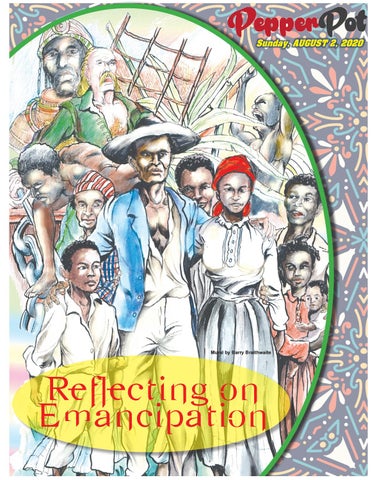
Sunday, AUGUST 2, 2020
Mural by Barry Braithwaite
II
CHRONICLE PEPPERPOT ― August 2, 2020
H
By Naomi Parris
ABIBAH Akilah Atherley is not your typical “paint-on-acanvas” artist. Gifted with her hands, Atherley can make almost anything into art, from clothing and textiles to even wine bottles. Atherley, who usually does interior décor and makes floral arrangements for a living, recently embarked on a new art project-- making decorative pieces out of wine bottles. “I usually collect wine bottles, I’ve been doing that for about two years now, because I usually do flo-
ral arrangements with them. So I was like, what else can I do with this bottle,” she said. She noted that it was then the idea was birthed to do twine work with the bottles outside of the usual floral decorations. Her first bottle décor came out as she expected it would and soon after she started making more for home and office décor. Atherley, who is an E.R. Burrowes School of Art graduate, started her career with clothing and textiles making fashionable clothing designs. T h e 35-year-old, who majored in textile design and minored in painting, has been in the art
Habibah Akilah Atherley
world for over 15 years. She stated that too many times people limit the definition of art to just painting and drawing, when in fact it is a broad spectrum of creativity; so in most cases, persons don’t look at it as the first choice for a career.
still trying to push, still trying to believe in my work and the fact [that] artists can actually make a living out of this,” she said. Additionally, Atherley noted that she pursued a full-time career in art to also rubbish the idea or stigma people have that
arts, she believes, should be considered a language of self-expression, since it can be used as a means of explaining and putting one’s feelings, fears and hopes out into the world. “Art can play a major role in lots of people’s lives. It should be introduced from the smaller ages --from nursery up because you would want individuals, especially children, to express themselves not only verbally, but physically,” she said.
help in their communication skills as some children are shy and visual arts can help to boost their confidence, as well as open up their creative thinking and imagination. She added that the option should be given to children and they should be able to decide if they wish to pursue art as a hobby or a career without the societal norms weighing on their shoulders. Aside from that, Atherley believes that the arts give people a sensational feeling of
The newest addition to Atherley’s decorative pieces -- bottle décor made with twine
A few of Atherley’s clothing pieces sporting African accents
“When I was being trained to be an artist at art school, they usually advise us that your basic career is just going to be teaching because you know in Guyana, it is appreciated but not to that extent to live on wholly and solely without having a job,” she said. Wanting to change the social norms as well as prove something to herself, Atherley pursued a full-time career in the arts “It has actually been a struggle over the years and I’m still here and I’m
suggests that art is about just drawing and painting and that artists can’t survive or make a living from such a career. She noted that art is therapeutic and sometimes even a great way to exercise the mind, relieve stress and even bring people closer to each other. Aside from that, Atherley stated that art is a form of self-expression that aids character and personality development, as it can help boost one’s confidence and self-esteem; even on gloomy days art can make people feel good about themselves and adjust their surroundings. The arts, especially visual
Giving children the option to pursue an education in the art field, Atherley said, will
knowing that they were able to create something beautiful for the world to see, as well as gives the person who is on the receiving end the same feeling. A living example of what the arts can do for you, Atherley’s gifted hands and talents have helped to keep her afloat in times of an economic crisis during the COVID-19 pandemic. Due to her knowledge in clothing and textiles, Atherley has been making stylish face masks which have helped her put food on her table and pay her bills amid the pandemic. “After COVID hit us, I was trying to think what else I can do as a way to help with the situation. I started doing that and you know now people are asking for the clothes with the mask,” she said. Those who wish to have a decorative piece, face mask or a clothing item can contact Habibah Atherley via her Facebook page at Akilah’s Creative Xpressions.
III
CHRONICLE PEPPERPOT ― August 2, 2020
By Francis Quamina Farrier
U
NITED Statesbased Guyanese actors Ron Bobb-Semple and Rudolph Shaw keep turning in extremely strong performances of two real-life African heroes. They play Jamaican Marcus Garvey (August 17, 1887 - June 10, 1940) and South African Steve Biko (December 18, 1946 - September 12, 1977) respectively. Both Garvey and Biko spent their lives fighting social and racial injustice; Garvey in the Americas, including a visit to British Guiana (Guyana) in October 1937. Freedom Fighter Steve Biko died of police brutality while he was detained in a cell at a police station, in apartheid South Africa.
tinents, playing two great African Civil Rights fighters. Playing real-life contemporary characters is usually somewhat challenging for actors and actresses. Members of the audience may know or know of those individuals they are playing, and so the actors and actresses have that extra pressure to deliver as credible an interpretation of the character as possible. Ron Bobb-Semple relates how he ‘became’ the Hon. Marcus Garvey. “My journey into Garveyism began one Saturday afternoon some 40 years ago while attending a wedding ceremony at the St. Mark’s Episcopal Church in Brooklyn, New York. There was a stained glass window close to me with an image,” he said. That image was of the Jamaican hero, Marcus Mosiah Garvey. Having been told that he has a close resem-
Veteran Guyanese actor Ron Bobb-Semple (Photo by Francis Quamina Farrier)
Actor Ron Bobb-Semple after receiving the UNIA Marcus Garvey Award of Jamaica in 2016
Both Ron Bobb-Semple and Rudolph Shaw had their early groundings in theatre arts at the Theatre Guild of Guyana Playhouse in Kingston, Georgetown. Both actors have long and impressive ongoing careers in theatre, taking their craft across con-
blance to the Jamaica-born African hero, Bobb-Semple got to work researching the life of Marcus Garvey. After he had completed a script for a one-character play, “The Spirit of Marcus Garvey”, Bobb-Semple’s journey bringing Garvey back to life
on stage commenced. After many performances in various venues around the USA, the Caribbean and Africa to impressive reviews, he was awarded the UNIA Marcus Garvey Award of Jamaica. From a very young age, Rudolph Shaw gained knowledge in Theatre Arts at the Theatre Guild in Georgetown. He was also tutored by his father who was in a Drama Group which entered the British Guiana National Drama Festivals in the early pre-independence years. That groomed Shaw to become an actor above average. Migrating to the USA and joining
the United Nations (UN) in 1974, he became a member of the UN Drama Group the next year. That led him to become active in the annual UN Staff Day Talent Show. Through a casual conversation with a visiting South African who is married to a cousin of Steve Biko, the South African freedom fighter, Shaw was introduced to the book “I Write What I Like” written by Biko. That proved to be the catalyst for the play “Steve Biko Rising” in which Rudolph Shaw played the title role in a production staged in Cape Town, South Africa. Playing real-life characters
on stage as well as in films and television puts extra pressure on actors and actresses who want to get it right. That is so especially when the character they are playing, is still alive or recently passed. In both cases, Ron Bobb-Semple and Rudolph Shaw face mountainous challenges in their roles, including the accents of the characters they play. Ron Bobb-Semple’s play is performed at a range of venues and to a variety of audiences. As such, the actor with his wide experience knows how and when to make any necessary adjustments for the
audiences, whether younger people or mature, to absorb “The Spirit of Marcus Garvey” to the fullest. The two Guyanese actors are well aware of such differences and adjust their performances as necessary. Both “The Spirit of Marcus Garvey” by Ron Bobb-Semple, and “Steve Biko Rising” by Rudolph Shaw, are likely to be staged in the years ahead.
IV
CHRONICLE PEPPERPOT ― August 2, 2020
D
By Naomi Parris
UE to the continued economic effects resulting from the coronavirus (COVID-19) pandemic, many organisations have been forced to either temporarily dismiss some of their staff or cut their pay. Unfortunately, 29-year-old Rhinold Cameron was one of those employees who were temporarily dismissed from their jobs. Cameron however, who was a flight attendant employed by LIAT Airlines, flipped the switch and started his own delivery business ‘Cameron’s Fast Carriers,’ to provide for himself and family. He noted that the idea was birthed during the period when persons were advised to self-quarantine. “While I was there locked away in Barbados for three months before being repatriated back to Guyana, like most other people my mind was toying with what can I possibly do as a business venture as a means of gathering income when I get home,” he said. He added that he had come up with several ideas; however, the idea of owning his own delivery service seemed like a good idea, especially since at that time there was a growing need for delivery services across the country. “There was a growing need for delivery, even the fact that people weren’t able to leave their homes, so I said you know what, I can work on this one,” he said. At the beginning of his business venture, Cameron noted that Guyana at the time had only two major delivery services; however, soon after the lockdown was implemented, several other businesses rose up and took the delivery business by storm which made it hard for him when he arrived on the scene. “Being away for that three months actually put me on the back burner for the bit in terms of getting myself on the market before others came along,” he said. Coming back home and having to integrate himself into the market, he said, has been a challenge; however, he is grateful for the support he has been receiving thus far from his partners and customers. Cameron, who grew up in an aviation family, noted that he had always wanted to pursue a career in the aviation field, but he ventured off into the world of computer science and communications, but given his background when the opportunity presented itself, he made no second guesses and took the leap. “Most of my male family members, including my fatherA worked in the aviation sector. My grandfather was a manager at Guyana airways, so I was always around aviation- [and a] flight attendant [was] one of the things I wanted to do earlier; [being a] pilot [was] the second thing,” he said. When Cameron pursued an education at the tertiary level, he studied computer science and communication studies, holding a degree in both courses from the University of Guyana. He had initially planned to further his career within the technology and computer world; however, life had other plans and he found himself
A proud Cameron in his delivery service uniform
in the communications sector which he had a passion for. While those careers seemed fit for him, he found his way back to his first love, aviation, and had applied for a job with Fly Jamaica when the airline first commenced operations in Guyana back in 2013; however, he was unable to get the job because of one requirement -- the ability to swim. Despite being “bummed,” five years later Cameron gave the aviation field another shot and applied for a job at LIAT. Within some months, Cameron disclosed that he had missed a phone call from a strange number from Antigua and was baffled as to who would be calling him from that island; he later found out that it was LIAT’s representatives trying to make contact with him. “I returned that call early a Friday morning to them and they were like, ‘Yes, I was trying to get on to you, we want to invite you to Antigua on the Monday morning for an interview,’” Although he was nervous, Cameron noted that he walked into the interview with all the confidence in the world. He soon after returned to Guyana and whilst waiting for his call back for the second phase of the interview, tragedy struck. On the very day he received that call for his second interview, he lost his beloved grandmother, Struck with grief at what was supposed to be an exciting time in his life, Cameron made his way to the airport in tears, trying to keep his composure for the interview in Antigua. He weathered the storm, but was unable to hold his grief back and broke down during the interview. He soon after returned home and was in the midst of funeral preparations when he received a confirmation call that he had got the job. Cameron, who had been stationed in Barbados for the last two years, noted that he would return home at every chance he got to be with his fiancé and two children. Despite the glories and adventures of the job, Cameron noted that it has been difficult for him as he would be away from his family and would often miss a few precious moments. Nevertheless, he made the best of the situation and would video chat with his family as much as he could while he was away working. He stated that with his new business venture he has been able to spend much more time with his family. As such, his decision at the time is unclear if he will return to aviation.
Rhinold Cameron (right) clad in his flight attendant’s uniform moments before a trip with two of his workers before the coronavirus pandemic
V
CHRONICLE PEPPERPOT ― August 2, 2020
I
By Naomi Marshall
N just a few weeks and with a little more time on their hands, Linden sisters Alessa Hodge and Alicia Benjamin are now owners of their own small business, “Kiara Delicious Sweet Treats,” which not only is a means
of supplementing their incomes, but also fulfilling their childhood dreams. While the coronavirus pandemic has created much negative rhetoric, many have used the extra time allotted to them for constructive and ingenious means to earn and create small businesses with just the use of their hands.
Sisters Alessa Hodge (right) and Alicia Benjamin(left), owners of Kiara Delicious Sweet Treats
With persons being at home, especially children, one thing that needs to be satisfied is the appetite and the sisters have decided to capitalise on this need. “Since we were children growing up, we always wanted to own our own bakery since we always liked baking and cooking; it was always our dream to make it
into something big,” Alessa said. After making glazed doughnuts for the home and friends and posting on social media, the positive reviews prompted them to commercialise the products and advertise them on social media. Both of their workplaces were closed as a result of the virus and so they invested a lot of time into
making the doughnuts very appealing with eye-catching colours and a plethora of edible décor and impressive packaging. The orders started rolling in and the sisters who have now become business partners, have decided to expand their product line from just doughnuts to several other sweet treats such
Photos of some of the products made and sold
as cinnamon rolls, cookies, cheesecakes and pastries. “The response is very good, a lot of persons started ordering our tasty doughnuts and then our other products. It is amazing how we are able to earn from this and follow our dream during this pandemic,” Alessa said. They offer a pick-up service or delivery at a cost of $500, but the plan is to have a permanent place of business once things return to normal. “Right now we are using social media to advertise and our clientele has certainly grown. But our dream is to own our own big business and introduce new treats once all of this is over,” she said. Her advice to persons, especially youths during this, is to not wallow in despair but to seek out their talents and hand skills and to capitalise on it. “This is not a time to be despondent. This is a time to try new things, since the opportunity is here and you never know where it might lead you,” the new business owner said.
VI
CHRONICLE PEPPERPOT ― August 2, 2020
Beyond Emancipation:
“
Reparations [are] not about standing on street corners and asking for handouts… The reparations movement is the movement that will save humanity and the world.” Professor Sir Hilary Beckles speaking at a public lecture in Guyana on January 25, 2019. When I think about Emancipation nowadays, I am angrier than I am elated. There was a time when I could read about Caribbean History and be thankful that after centuries of exploitative labour, the formerly enslaved Africans were finally freed. They were able to leave “Massa’s” plantations and establish
their communities and seek a new way of life in this foreign land. Back then, however, I was ignorant of the lasting ramifications of plantation life and the inherent power structures left in our Guyanese and Caribbean societies. I remember being in a CAPE History class and we were “gyaffing” about local foods. A colleague brought up souse, and I mentioned I couldn’t understand how something like the chicken’s foot became such an adored culinary ingredient. My History teacher capitalised on that moment of the “gyaff” to teach us: the enslaved Africans ate the least wanted, and least nutritious parts of the animals-- the
chicken foot, the cow heel, the pigtail, inter alia -- because “Massa” had to eat a healthy diet. (The imminent segues between “gyaffs” and history lessons were part of the beauty of being in a class of five). Later, when I was exposed to the newly introduced component of CARICOM Reparations in our CAPE syllabus, I le ar n t ab o u t th e nexus between the pervasive public health crisis in the Caribbean and enslavement. You see, on the plantation, only “Massa” had nutritious meals. The food eaten by the Africans was a quintes-
sential “sugary” diet. And today, the alarming rates of hypertension and diabetes i n the Caribbean
faithful, productive workers. What that translated to, was an illiterate population. Illiterate and unskilled. Since the 1960s, when countries across the Caribbean began moving towards independence, education was pursued as a harbinger of development. For decades, successive governments have been trying to tackle this legacy of illiteracy. T h i s t i e d into
wider efforts (the provision of health and social services, infrastructural develo p -
are attributed to the diet the enslaved were forced to eat. Making matters worse, more amputations are done, per capita, in the Caribbean than any other part of the world, as a result of the legacy of the plantation. Let’s talk about education. It should be common knowledge that the Africans were uprooted from their own cultural spaces, brought to this part of the world, and made to discard their local knowledge. Here, they were placed in a society replete with its own set of structures and a different body of knowledge. It was not deemed necessary for the formerly enslaved Africans to be educated beyond what was required to keep them as
ment, inter alia) at promoting development of the human capital of the Region. But let’s also talk about what subverts Caribbean governments’ attempts to foster development in the Region, in face of those atrocities resulting from enslavement and colonisation. The debt the Region continues to accumulate stymies regional development. We borrow from these developed nations, many of whom were developed because of centuries of the free, exploitative labour here and we are stuck in a seemingly never-ending cycle of borrowing, repaying, borrowing and repaying, in an attempt to meet our developmental goals. When the formerly enslaved were emancipated, “Massa” was compensated. “Massa” was allowed to plunder the lands and enrich himself and his home country. Nothing of the sort was given to the Africans. When the conversation on reparations comes around now and then, I don’t dismiss it as imaginative or futile. I remember the atrocities of enslavement and the legacy left in
its wake (and I’ve barely scratched the surface in this column, eh), and I think about how reparations are, in fact, due. I once asked Professor Beckles, who heads the CARI C O M Reparations Commission, about h o w long he believes it will take before we get reparations. He said it matters not how long it takes, because it will happen. It matters that we understand why reparations are important and it matters that we continue to push for reparations. Enslavement was a crime against humanity and no amount of economic benefits augured could ever justify it. I join with the African community in celebrating the freedom of Africans from the bondage of centuries of enslavement. Beyond that, I will continue reading, learning, and doing whatever little I can in raising awareness on Caribbean Reparatory Justice. The CARICOM 10-Point Plan for reparatory justice calls for: the issuance of a full and formal apology; repatriation; indigenous peoples development programmes; cultural institutions; alleviating the public health crisis, particularly the Caribbean’s susceptibility to chronic diseases (hypertension and diabetes) rooted in the plantation diet; illiteracy eradication; an African knowledge programme; psychological rehabilitation; technology transfer; and debt cancellations. CARICOM is seeking reparatory justice from the former colonising nations of Europe, namely the United Kingdom, France, Spain, Denmark, Germany, The Netherlands, Portugal, Norway, Sweden, and Switzerland.
VII
CHRONICLE PEPPERPOT ― August 2, 2020
Shieldstown Village
Resident, Mohamed Nazool
T
By Michel Outridge
HIS week the Pepperpot Magazine visited the small, quiet, countryside village of Shieldstown, West Bank Berbice. The community is nestled between Rosignol and Blairmont and is home to mostly sugar workers, who are employed at the nearby Blairmont Sugar Estate. Shieldstown has a kindergarten, a nursery and a primary school, a community centre ground with a wooden pavilion, several small businesses, a private school, a mandir, a mosque and a church. Villagers are also fishermen, both public and private sector employees, cash crops, rice and cattle farmers. It is home to about 1,000 people of mixed ethnicities and its main business hub is in Rosignol, where most people do their shopping and other economic activities. The Blairmont Police Station and Post Office are nearby and they are surrounded by lush canefields, which belong to the nearby Blairmont Sugar Estate. The people of Shieldstown live simply and they depend on their farms for vegetables and fruits and meats are sourced from the market or their backyards.
Shieldstown is a place where you can get a fresh cup of cow’s milk to go with freshly baked bread-- a very tasty combination. The Village elder The Pepperpot Magazine upon entry into the village met Mohamed Nazool, the Chairman of the Shieldstown Community Policing Group. The 68-year-old reported that he is also a rural constable and a councillor, who is very much interested in the development of the community. He related that there is a need for the re-paving of the internal streets and the installation of street lights since the place is very dark at nights. Nazool added that Shieldstown is a close-knit community where people have their own kitchen gardens and livestock. The father of two stated that he is retired and is taking his old age easy with doing just household chores, tend to his garden and he has a few chickens as well. “I worked hard in my younger days, so now it is time for me to relax a bit and bask in my old age,” he said. Nazool disclosed that he is originally
The Community Centre Ground and pavilion in Shieldstown (Carl Croker photos)
from Rampoor Village, which is located about three miles from Shieldstown through trails and he relocated in 1974. He explained that Rampoor was a settlement bought by slaves and his family originated from there but when the government relocated them to Shieldstown which was only cane fields, he had to move. Nazool was once a rice farmer and only goes out when it is necessary due to the pandemic and his age. “I really don’t have to leave this village to go out because vehicles does pass with things selling, so we make purchases and then Rosignol is close by, so we do our business there where they have the bank and so on,” he said. The senior citizen related that life in Shieldstown is good because he uses
the greens and fruits in his garden for the kitchen and they do not need much. “This place is home and I cannot see myself elsewhere, because after residing here for so long I like the ordinary life here,” he said.
ge
s u c o e
on
F
th
V
a ill
VIII
CHRONICLE PEPPERPOT ― August 2, 2020
H
By Michel Outridge
him to continue in other competitions. In this very competition, Singh was awarded four second places in the same single and also won first place in harmonia and dholak. The singer then went on to participate in the coveted GTT Jingles competition which was held annually and first landed in the top 10, before placing fifth in his second year. Singh however, did not stop and was determined to make it in the local music industry and was also a participant in the Emerging Voices competition and was in the top 10. In 2009 he signed up as a participant in the Guyana Chutney Competition and was deemed the best newcomer and in the ‘Super Star Chutney Monarch’ from 2005 to 2015. The singer got first in 2017 and 2018; however, in 2019, he placed second and in 2020 he gained first in the National Chutney Monarch Competition. “Even though I lost the Chutney Monarch competition for six years, I never gave up and I continued to press on and represented the people,” he said. Singh stated that music is about uniting people for a better Guyana and you have to believe in yourself and don’t depend on anyone for that extra push to stay alive in the business. His newest song is a joint effort with Brandon Harding and it will be released soon. Singh incorporates his instrumental music from the dholak, dhantal and harmonia into his songs and also does it with his One Man Band.
IS story isn’t perfect, but with determination and the sheer will to succeed, local recording artiste Bunty Singh was able to withstand the test of time and survived in the local music industry. Singh originally hails from Bath Settlement, West Coast Berbice, but relocated to Shieldstown Village, West Bank Berbice, after marriage. This artiste grew up in a house of music and his music career started at age seven. Singh used to go with his foster father to religious functions with his kirtan group and began playing various instruments. “I was given to my guardian by my parents at six months old, so my foster dad is a religious singer of bhajans and he played the instruments too, so I was able to learn most of that by going with him to many functions,” he said. Today, Singh is well versed in playing the dhantal, the dholak and the harmonia (all religious instruments) and being so gifted, he established his own ‘One Man Band’ and does that on his keyboard which he has mastered as well. The One Man Band is for hire at weddings, bar-b-ques, birthdays and other functions. MUSIC CAREER Singh told the Pepperpot Magazine that he became a participant in the Kala Utsav locally and was placed first and that motivated
on
s cu o
F
PRODUCER AT HIS RECORDING STUDIO Singh has the Bunty, Krish, Valarie and Janvi (BKVJ) Recording Studio right at his home in Shieldstown. He is aiming to bring out the young a r -
tistes and has linked his recording studio with YouTube where he records for many international artistes. Singh revealed that it was through relentless, hard work that he established his recording studio in 2013. The singer/musician disclosed that it was through walking and selling his own CDs from house to house for three years that he garnered funds to open his own recording studio. “I would walk house to house and sing and talk to people and I become a household name by doing this and I connected with the people and they in turn got to appreciate my music,” he said.
that they can get their songs produced, mixed and mastered, done all in one day at his recording studio. “In the local music industry you have to get money to survive and I do most vocals via emails and I am not performing right now due to the pandemic, but I would do a
Bunty Singh on his dholak
beats on the keyboard and likes soca. “When my wife was pregnant with him I used to put the headphones on her belly and if you see how he used to move up and it was then I knew he would be into music just like me,” he said. Meanwhile, his daughter is a dancer with her mother’s dance group and she too can sing, but prefers dancing. Singh’s wife Valarie is a dance teacher in the community.
Local artiste/producer, Bunty Singh in his recording studio (Carl Croker photos)
e
th
e
ag
ill
V
The local artiste told the Pepperpot Magazine that he likes to blend his music with chutney, soca and reggae, which a wide cross-section of people can enjoy. Singh added that he is giving back to society by encouraging young, up-andcoming artistes to shine and would assist them with their music. “I don’t do this for the money, but more so my love for music because I came up from the grassroots, so I know what it is like to be a singer with little or no money trying to make a name for yourself here,” he said. Being very familiar with the struggle and value for money, Singh told the Pepperpot Magazine that he is willing to work with any artiste. He explained
The musician on his keyboard
few funerals, weddings, and janhdis with my One Man Band setup and other work is done in the recording studio,” he said. TALENTED FAMILY Singh is the father of two. His son, Krish Singh,
eight years old, is a young calypsonian who competed at the nursery level and at regionals in 2016 and 2018 for Rosignol Primary School and won for two years. He started singing when he was three years old and, like his father, he can build
The singer/producer is very thankful for all the people who supported him in his time of need over the years and his fans for their encouragement, adding that it has made him into a better person and artiste.
IX
CHRONICLE PEPPERPOT ― August 2, 2020
teacher from Georgetown, she branched out with her own dance group. The mother of two then benefitted from professional guidance in classical dances, her all-time favourite. Barran related that her
a single competition for six years in a row,” she said. Barran then adopted the motto, “Practice makes perfect” and on their seventh year in the dance competition they won and she was elated. That win motivated her to continue putting more effort into her dancing and they went on to win many more competitions. Barran now has her own dance group called “Berbice Delight,” which operates from
Pepperpot Magazine that because of the pandemic, they have not been doing many performances, but they do have practice sessions at home. She disclosed that they would do music videos for artistes and perform at a few functions. Barran stated that in 2019, two of her dancers, most of whom are drawn from across the country, participated in CARIFESTA in Trinidad and Tobago. The Berbice Delight Dance Group Anjali Ramdeo Angaad
Valerie Barran
Valerie Barran’s Dance group
I
By Michel Outridge
T is said that practice makes perfect and this is the ideal idea of Valerie Barran, a dancer and dance teacher who began dancing since she was nine years old. It started as a pastime in the annual schools Diwali programme among the peers of her community and later developed into a career. The 33-year-old told the Pepperpot Magazine that she continued to dance in primary and secondary schools, so she was self-taught and did not receive any formal training then. And it was at the secondary level where they had a dance group which was birthed out of the village mandir and they began competing. The resident of Shieldstown, West Bank Berbice, stated that after high school she decided to establish her own dance group which started at the mandir with about 40 dancers. Barran added that she used to be very active in fundraisers for the development of the mandir and the dance group back then and after collaborating with a professional dance
dance career skyrocketed when she started to dance with the Guyana Hindu Dharmic Sabha, where they participated in several competitions and did well. “It was there I gained experience and realised I had a deep liking to dancing and began practising to become even better, because we did not win
her home with 18 dancers who are versed in classical, soca, modern, Bollywood and chutney dance-styles. “We won the Guyana Chutney Dance Competition from 2018 for three years in a row and that worked well for the dance group,” she said. The mother of two told the
Make up done by Anjali Ramdeo Angaad
is also affiliated with the Indian Cultural Centre in the city and they have benefitted from training in the form of classical dancing, such as kathak dancing. Beauty at its best The Pepperpot Magazine met another Shieldstown resident, Anjali Ramdeo Angaad, who is a hairdresser as well as a makeup artist and a nail technician. She works at her own salon in neighbouring D’ Edward Village but has been home for the past three months as a result of COVID-19. Angaad is the mother of a nine-month-old baby boy and is finding things to do at home to pass the time. She started in her career after completing secondary school in 2011, after which she had formal training in the city. A n g a a d worked one year at a salon then
she opened her own business, a beauty salon, in 2013. “The salon is my only source of income, so I depend on them to manage the home, but with the pandemic I cannot do any work,” she said. Angaad told the Pepperpot Magazine that she would take a few jobs at home if she is hired to make-up a bride or style and cut hair or line-up the eyebrows or even do nail designs. “Being a beautician is something I always wanted to do as a career, so you can say I am living my dream and it is rewarding to
assist people in bringing out their beauty in the form of make-up, hair and nails,” she said. Angaad disclosed that life in Shieldstown is good, since it is a quiet countryside place where she has lived all her life.
ge
s u c o e
on
F
th
V
a ill
X
CHRONICLE PEPPERPOT ― August 2, 2020
Vishaul Raj
By Michel Outridge
V
Councillor Sieuraj
Focus
ISHAUL Raj is a re s i d e n t of Shieldstown,
West Bank Berbice and he is an avid cricket fan and cricketer, who established the Blairmont Cricket Club which has since been dismantled. He was a teacher at the Rosignol Secondary
School but resigned in 2017 and has been out of a job for the past 19 months. The qualified accountant is job seeking, but misses teaching which his true passion and presently he is self-employed and is also
lihoods. He believes there can be more recreational activities for the youths, some of whom are engaged in unsavoury activities to pass the time in a meaningful way. The former foreman at
Councillor Nowrang Damarlall and his pets (Carl Croker photos)
on the Village
The home of Vishaul Raj
dependent on his elderly father to support him financially. With the limited job offers in his ‘neck of the woods,’ Raj reported that he has shifted his focus on cricket and has revived the team. Their latest competitive match was last weekend against Bath Village, West Coast Berbice. He explained that their cricket club was the club of the year in 2018 and most of the youths in the community are cricketers in the under-15 team. “Our youths are cricketers and six of them are presently playing for the under-15 team for Guyana, so we have some talented sportsmen here and some also are good football players too,” he said. Raj related that Shieldstown is a good place to reside because life is peaceful and they have a lot of space. “One thing is needed though, our ballfield is good, but when we have cricket we have to weed the ground ourselves and the building needs repairs and the washroom facilities also need some attention to make it fitting for visitors,” he said.
The Councillors
The Pepperpot Magazine also met Councillor Nowrang Damarlall who described the village as a small, quiet neighbourhood, which is heavily dependent on the nearby Blairmont Sugar Estate for their live-
the Blairmont Sugar Estate reported that the schoolchildren are in dire need of an Information and Communication Technology (ICT) hub to access the internet for their school work. Damarlall retired from the sugar estate in 2017 and is focusing on his farm and pets, he has six dogs. “We also need street lights and well-paved roads, sometimes people does get robbed while walking in here, so if the place is illuminated we can see what’s going on,” he said. The Pepperpot Magazine encountered another resident, also a councillor, Sieuraj (only name) who is employed at the Blairmont Sugar Estate as a general labourer. He is also a farmer who was busy clearing drains in his community when the Pepperpot Magazine visited. Sieuraj reported that Shieldstown is a place of sportsmen who are good in both cricket and football, but their community centre-ground needs repairs since the place is being vandalised by drug users. “We have a lot of talented people here, but it is a shame to see what some folk are doing to the community centre building and sad at the same time, because it is not used for its intended purpose,” he said. The villager stated that the community also has many skilled people who are electricians, teachers, nurses and others.
XI
CHRONICLE PEPPERPOT ― August 2, 2020
Focus on the Village
Jannat College of Accountancy (Carl Croker photos)
G
By Michel Outridge
ROWING up in a single-parent home has taught Faraad Khan better known as ‘Sir Javed,’ that things do not come without hard work and dedication. Today, he can say he is successful after following the path of his role model, his own mother. He is the man behind the Jannat College of Accountancy, an internationally accredited, privately run institution which offers Association of Chartered Certified Accountants (ACCA) and Certified Accounting Technician (CAT) courses. Khan explained that the ACCA and CAT are United Kingdom courses which are recognised in 180 countries for chartered accountants. He added that he has more than 100 students per semester and gained confidence to open his own school after spending many years in the teaching profession. Khan taught at the Rosignol Secondary School for six years, after which he resigned and started his own private school from under his ‘bottom house’ with just 10 students, a table and a bench. The resident of Shieldstown told the Pepperpot Magazine that he teaches all the courses himself and also man-
ages the school. “I used to teach at the public school business and office administration and I know I can also teach accounting and decided to branch off on my own where I am more than a teacher,” he said. In classrooms which are large and fully air-conditioned with cushioned seats and desks has a canteen facility which offers free coffee and the décor of the place is quite impressive and very creative at the same time.
in every paper. At Khan’s school, classes are held only on weekends from 08:00hrs to 17:30hrs, but due to COVID-19 he has minimal students there at any given time and is doing online teaching. “But with online teaching, it poses a challenge to me because it is audio and I cannot get to see the students and their body language and it is not very interactive,” he said. The father of two related that he has a ‘down-to-earth’
Faraad Khan
Khan stated that in classrooms he likes to have interactive sessions with students and has adopted a more personalised teaching technique. If and when a student needs individual attention that is given and he is always accessible and has had 100 per cent passes
approach with his students and the youngest is 15 years old, while the oldest is 65. At the Jannat College of Accountancy, one can become qualified with an associate degree that is internationally accredited and recognised in the United States and the Ca-
Inside one of the classrooms
ribbean. Khan said the ACCA is a professional body of regulators in accountancy, where all chartered accountants come from and CAT is the foundation to ACCA which deals with accounting, finance, management, taxation and auditing. He stated that the ACCA Level Two is equivalent to a bachelor’s degree at Oxford University and it is in con-
formity with International Accounting Standards. “I always dreamt of having my own school and here it is; after many years of hard work I managed to do it and it is quite an achievement, because it was not easy being in a single-parent home after my dad passed away when I was just nine years old,” he said. Khan’s classrooms are spacious with air-conditioned
units backed up by fans, well-decorated with aquariums, hand-made clocks, comfortable sitting area, coffee station, canteen, washroom facilities and all stationery, identification cards, tee-shirts are given to students as part of the package. Students pay every month and there is a payment plan in place and it is very affordable.
XII
CHRONICLE PEPPERPOT ― August 2, 2020
d n i M e t i r W e n y a The P e n by Jasmai
I
N the spirit of Emancipation, which was observed just yesterday, I thought that I would share another excerpt with you. This time, however, I would focus on African folk tales. We are often taught their stories from the history books, but how often do we delve into the creative industries from the Motherland? An appreciation of African roots should encompass all aspects of African culture, and there is no better way to get a taste of culture than to observe the products that are birthed directly from the arts and culture. The following folk tale is a traditional story that originated from the Zulu Tribe. Today, the story is told among African families and teaches the lesson that leadership is not about size, but about skill and wisdom. KING OF THE BIRDS “Gogo?” Thobeka was the first to break the silence around the fire this night. Gogo looked at the most inquisitive of her grandchildren with a broad smile. “Yes, my dear one,” she answered. “Gogo, I know that the mighty Lion, Bhubesi, is king of all the animals. Is he King also of the birds?” “Ah, that is an interesting question, Thobeka.” The children sensed a story coming and drew even closer together. “You are right when you say that Lion is the king of all the animals. And as for the birds, well, I will have to tell you about the time they decided to have a leader of their own. . . Kwasuka sukela. . .” Sometime after the Creator had finished making the beasts of the sea, land and sky, as He was busy putting the finishing touch to His work by creating People, Nkwazi (nkwah’-zee), the great Fish Eagle, called a meeting of all the birds. And they came, from the Flamingo to the Weaver, from the Warbler to the Owl, they came. “Ah-hem,” Nkwazi began by clearing his throat. The chatter died down as everyone turned their gaze on the magnificent eagle. “I have asked you all to be here for a very important reason. As you all know, Lion, the great Bhubesi, is the king of all the beast of the land. But he hardly dare speak for us, the great winged creatures of the air! It is my suggestion that we chose from among our number a bird to be our sovereign leader!” A ripple of chattering began again as the birds turned to one another to discuss the idea. “Ahhem!” Nkwazi cleared his throat once more. He waited until he had the attention of all present. “As I am the most majestic and regal bird present, I suggest that I, Nkwazi, be the King of the birds!” A great deal of mumbling began from all corners of the gathering. Then one voice rose above the others, demanding attention. “Yes, Nkwazi, you are indeed majestic.” It was the giant Eagle Owl, Khova (koh’-vah) speaking. “However I actually think that it is I who should be the King of the winged animals. You see, I have the largest eyes of any of the birds. I can see everything that happens, and therefore am very wise. It is wisdom we need in a leader more than stateliness.” Again a low murmur went through the crowd until a third voice demanded attention. “I acknowledge Khova’s wisdom and Nkwazi’s regal bearing, however I would propose that I be King of the birds.” Kori Bustard, Ngqithi (ng*ee’-tee) walked to the centre of the circle as he spoke. “I am the largest of all the winged kingdom. Certainly strength is an important factor in leadership!” All the birds began to speak at once. Some threw their support behind the Eagle, some believed the Owl should be the King, while others liked the Kori Bustard. Finally after a long period of arguing, a little voice was heard rising above the din. “Excuse me. Excuse me, please!” It was Ncede (n~ay’day), the tiny Neddicky (a small, quick-moving southern African warbler). He was so small and insignificant looking that he was easily overlooked. Finally the crowd became silent and allowed the little bird his say. “If we are going to elect a King of the birds, well, I think it should me !”
Everyone broke into laughter. Surely this miniature warbler was jesting! Ncede, King of the birds! Unthinkable! Silly creature for even thinking it! What, the audacity of this little thing! What arrogance! What impudence! “And what reason would you give for having us elect you as our King?” asked Nkwazi staring into Ncede’s eyes. “Well,” began Ncede, “no real reason, besides to say that I should be given every bit as much opportunity as anyone else!” While they laughed at Ncede’s suggestion, the assembly was impressed with the little fellow’s courage! “What we need is a competition!” decided Nkwazi. “We will have a contest to see who is fit to be our King!” Everyone seemed to like this idea. It was agreed that on the first day after the full moon the birds would again gather. They would meet on the open veld when the sun was high in the sky. And when the sun touched the tallest tip of the mountain, the birds would become airborne. The one who could then fly the highest and touch the hand of God would become the King. On the appointed day the birds assembled. Patiently they watched the sun make her way down from the sky. At the exact moment she touched the tallest peak of the mountain, the birds all rose into the air. It was a magnificent sight to see. Now, little Ncede was there. He was determined to prove that he had just as much right as anyone else to the kingship. But he knew that his little wings could not lift him very far. He had therefore made a special plan. Just before the birds took off, Ncede silently crept underneath the wing of the mighty Fish Eagle. He carefully pushed his way deep down into the raptor’s largest feathers. Nkwazi was so busy concentrating on the descent of the sun, he didn’t feel a thing. Higher and higher the birds soared. The little ones fell out of the race after a short time. Slowly they drifted back down to earth to watch the others. Soon all but three of the birds had dropped out of the competition. Eagle, Owl and Bustard fought to see who would claim the prize. They were so tired, but they pushed on, higher and higher. The strain was too much for owl, and with a resigned “Hoo-hoo” he dove back toward firm ground. Now it was Nkwazi and Ngqithi. Up and up they went, closer and closer to the hand of God. But no matter how much he tried, the feat was too much for the heavy Bustard. After a final pull with his mighty wings, he called to Nkwazi. “Ah, my friend, it seems you are the winner. I can go no further.” That confession seemed to temporarily strengthen the almost spent Eagle; he gathered his last bit of strength and climbed beyond the Bustard. “Wheeeee-whee-whee!” The victorious sound of Nkwazi’s call filled the sky. “Not so fast, Nkwazi!” chirped Ncede, and he shot out from under one of the mighty bird’s feathers. “You have not won yet!” And with that Ncede rose above Nkwazi to touch the hand of God. No matter how hard he tried, Nkwezi just didn’t have the strength left to climb any farther. With a groan he allowed himself to begin gliding down to earth. Now, all the birds below had watched this and were angered by Ncede’s trickery. As Ncede returned to the soil he did not find the kingly welcome he expected. Instead ev-
ery bird in the kingdom was ready to pluck the feathers from little Ncede’s back. But the quick little bird saw their anger and quickly flew into a deserted snake hole. “Come out, Ncede!” snapped the bustard. “Come out and get the prize that you deserve!” “Yes!” echoed all the other birds. “Come on, Ncede! Where’s your brave face now?” But Ncede stayed hidden. The birds guarded the hole until long after sunset, waiting for Ncede to show his face. All through the night they waited, thinking that Ncede had to come out for food or water soon. In the morning Ncede had still not appeared. “Listen,” said Nkwazi, “I am faint from hunger. We do not all need to guard the hole. I suggest we take turns until the little jokester decides to come out!” Everyone agreed, most of them being terribly tired. “I am not yet weary or hungry,” volunteered the owl. “I do not mind taking the first watch. Just mind that someone comes back in an hour or two to relieve me!” A quick roster was drawn up and everyone but owl went off to sleep or hunt for food. Owl was used to being still and waiting for his prey. He waited and waited it seemed to him forever. Finally he decided to close just one of his eyes. “After all,” he thought, “even one of my eyes is bigger and can see better than both eyes on any other bird!” He closed his right eye and peered into the dark hole with his left eye. Several minutes later Owl decided to switch and so he open the right eye and closed the left. This went on for quite a while, until one time Owl forgot to open the right eye when he closed the left. There he was, both eyes closed! And he fell fast asleep. Now this was the moment for which Ncede had been waiting. Before the opportunity was lost, Ncede shot out of the hole and disappeared into the forest. Eagle, who was on his way to relieve Owl, saw the little creature leave and cried out. He went to owl and found the bird in a deep sleep. “Wake up, you fool!” he shouted at owl. “You fell asleep and Ncede got away!” Well, Owl was so embarrassed by his mistake, to this day he sleeps during the day and does his hunting at night so that none of the other birds will bother him about having been caught sleeping on the job. And Ncede, he hides out in the forest, flittering from here to there, never stopping anywhere long enough to be caught. “So,” Gogo,” asked Thobeka when several moments of silence had elapsed, “who then became the king of the birds?” “That, my child,” Gogo looked at her granddaughter with a smile, “no one knows. I think they are arguing to this day about the position!”
XIII
CHRONICLE PEPPERPOT ― August 2, 2020
I
HAVE been on a journey of mental detox and intense intentional growth and am having fantastic results. I decided to create a programme to share to benefit people. Many active thoughts go through our minds every minute and many are likely toxic thoughts. I love the quote when Gandhi said: “ I will not allow people with dirty feet to walk through my mind.” I am sharing the amazing testimony of the results after dedicating just a few minutes a day for the seven days programme. I am impressed when people take action like Jo Ann Forde who told me her new venture was birthed from this challenge. I received a pic which I included in this article saying this was birthed out of the seven days challenge and also shared some words: “Change your thoughts, change your Life!! If this is what seven days can bring out of me. Imagine if I had allowed my healthy thoughts all my life where I would be. Let’s not stop now, we are more powerful than our thoughts o let’s direct where they go. Be intentional about what you think and let’s use our minds to bring to life every gift God has entrusted us with!” The drama queen Clemencia Goddette was also on this journey. “As the saying goes: ‘Empowered women empower women’ and that is exactly what you are doing Sonia. I am so happy that you are obedient to your directions. My dad would always say that, ‘A woman’s hair is her beauty” but for some time before the challenge, I wasn’t feeling Beautiful. However fast forward during the challenge, I was given some tools to help me to SHOOT down those negative thoughts that I used to entertain and replace them with some excited and positive thoughts. So I boldly cut my hair and now I feel so powerful and beautiful because I did it for me and no one else.” Reena Francis from Boston shared her experience. “Being part of the Healthy Thoughts
Seven Days Challenge with Dr Sonia Noel helped me to be aware of unhealthy thoughts and their triggers. I have become very much aware of the need to re-channel those thoughts to a healthy space. I’m also now surrounded by a group of women that strive for the ‘Best out of Better’.” Reena Francis Latoya Barton said: “Being a part of this challenge has made me begin to think about the root causes of the negative thoughts I have and I now try to resolve those. I have been able to push myself more by the way I think and am able to block out those who will not contribute to my own growth. We are what we think and if we want to exceed our abilities, changing the way we think is the first step.” Subrina Grant : “The challenge of ridding one’s mind of toxic thoughts and has been so empowering and fulfilling. My thoughts can and will determine my divine destiny.”
became so time conscious and disciplined. Then I focused on spending 15 mins each day with God, myself or family and that was the highlight of my days.” Rochel Wright Alesia Amanda from French Guiana was one of the most excited on this journey: “Throughout my journaling, I have managed to eliminate all forms of negative thoughts and doubts from my mind indefinitely. Being apart of this wonderful seven days of healthy thoughts challenge has really helped me on my journey of becoming more focused and confident in myself. I was procrastinating about a lot of my goals that I had started but never found the strength to continue because of those negative branches. The moment I decided to change my mindset and my thinking I was able to accomplish so much in just a few days. This is just the beginning of my journey. Great strength comes from within “
In some cases, some family members benefited
We had a poet in the group and her summary included soulful poetic language
“Being a part of this healthy thoughts challenge has not only helped me but my family because they wanted to be a part of what I was doing. I
My confidence had dropped tremendously and I had stopped doing the things I enjoy
like writing poems and doing photoshoots but throughout the process, I was able to combat all the negative thoughts and start back doing the little things I enjoy and I am grateful for the push and encouragement from the great Sonia Noel and I can’t wait to share some of the work I managed to accomplish. I feel more refreshed, renewed and very hopeful. I am ready to continue this journey on selflove, self-acceptance and self-confidence. Throughout this journey, I also wrote a quote which I used to motivate myself. It says : “You pretty petal
Beyond the Runway with Dr. Sonia Noel ... Inspiring lives through fashion You wonderful queen Your life is indeed magical So go out there and fulfil your dreams You are beyond important You are exceptional and STRONG Chin up, you are a warrior And in this world you belong” I now feel more POW-
ERFUL, beautiful and UNSTOPPABLE and I now know that I can conqueror the world with a positive mindset and a calm, cool and collective spirit.” Roshel Bailey. Check out the 21 Days of Intentional Growth launched yesterday as we continue to celebrate this beautiful journey called life BEYOND THE RUNWAY.
XIV
CHRONICLE PEPPERPOT ― August 2, 2020
Challenges and mitigation efforts of exotic crop production
I
N this week’s NAREI In Focus, we seek to highlight some of the challenges which may arise from time to time when cultivating exotic vegetables and recommend mitigation efforts which can be used to reduce instances of crop loss. One of the most significant problems with growing high-value crops in Guyana is that most farmers tend to grow multiple exotic crops that belong to the same family like that of Brassicaceae (Cruciferae) of which cruciferous vegetables like broccoli, cauliflower and kale belong. Consequently, growing a variety of these exotic crops make them susceptible to attacks from the same kind of pests and diseases. Over 88 percent of farmers experienced such pest attack as a result of planting vegetables of the same family together. Based on this trend, the extension arm of the National Agricultural Research and Extension Institute (NAREI) has been encouraging farmers to adopt crop rotation as a medium of ensuring fewer losses with regard to pest and disease attack. Chief Executive Officer of the National Agricultural Research and Extension Institute (NAREI) Dr. Oudho Homenauth has stated that while such instances have been evident, there has been a reduction in cases of pest and disease attack due to farmers being more educated on the importance of crop rotation to manage and mitigate pest and disease attacks. The most common pests identified are White Flies, Leaf Miners, Aphids, Thrips, Worms, Nematodes and Diamond Back. “In instances of pest and disease attacks, farmers can utilise both chemical and biological method of control. Interestingly, approximately 31 percent of farmers rely on both methods of pest control. The most commonly used are CAPRID (a systematic insecticide suitable for whiteflies and thrips among others; ABAMECTIN (targets caterpillars, leaf-miners, mites and diamondback); TRIAZOPHOS (a trans lamina, broad-spectrum insecticide); CHLOROPYRIFOS (contacts, persistent, termites and many other insects); FASTAC 5 EC and KARATAX both of which are contact and effective on many insects “ he said. Additionally, a neem-based concoction and Jeye’s fluid solution are also alternative pest control for insects such as ants and whiteflies. With regard to biological control neem is seen as an effective measure used to deter the identified pest attacks. This can be used in the form of teas, concentrate or oil. “In addition to these, farmers can also utilise other natural remedies using a solution containing soap, hydrogen peroxide or pepper such as cayenne; herbs such as holy basil and roots such as ginger and turmeric” he added. Pest Control Application: Concerning pest-control application, this can be applied either to beds before or after transplanting. However, the vegetable would need to be closely monitored and a follow-up application along with preventative measures during crop growth. It is advised that farmers monitor crops more during the wet season as diseases and root rot are often more prevalent during the wet season. The most common diseases and disorders identified among exotic farmers are various fungi, most notably anthracnose, powdery mildew, club rot, blossom end rot and root rot. Bacterial diseases such as bacterial soft rot are also common during this period as these are brought on by pest attacks such as leaf curl and root rot due to nematodes. Additionally, wilting and spotting on leaves are also commonly observed during the wet season. Methods for disease control among exotic farmers can be grouped into two categories namely through the use of natural remedies and best practices or via fungicide application. The most popular antifungal and antibacterial sprays used among farmers are CARBENSIZIM (systematic, broad-spectrum suitable for root disease); ACROBAT (broad-spectrum, contact and systematic); RIDOMIL (systematic, controls soil and leaf diseases); BELLIS (systematic, effective vs. many fungi) and COPAC which is a bactericide). While the use of chemical control is effective, farmers can also effectively utilise natural remedies (identified prior) and best practices which include uprooting affected crops to prevent the spread of the fungus, scattering leaves or branches underproduce to prevent rotting and soil solarising using ultra-violent plastic to control soil-borne plant pathogens. Continually planning rows of one exotic crop on the same plot is known to build up the population levels of pathogens in the soils. As such, NAREI recommends crop rotation to reduce pathogens in the soil that cause diseases.
CHRONICLE PEPPERPOT ― August 2, 2020
T
HERE can be no doubt that haemorrhage (bleeding) is frequently associated with the profession of dentistry. Also, no one can deny that bleeding after an extraction is a perennial worry of many patients. No other profession has been so involved in this process, save the time when medicine was preoccupied with employing “leaches to bloodlet” as a form of treatment. Based on the time of occurrence, haemorrhage can be classified as primary, intermediate, or secondary. Primary haemorrhage occurs during the time of surgery and is attributable to cutting of the blood vessels. Under normal conditions, the application of pressure along with the retraction and contraction of blood vessels is sufficient to promote arrests. Frequently, when infiltration anaesthesia is used, the vasoconstricting (contracting blood vessels ) agent involved also helps to promote the arrest of bleeding. Many factors both extrinsic and intrinsic can prevail to promote coagulation. Intermediate haemorrhage refers to bleeding which occurs within 24 hours of surgery (extraction). The likelihood of this happening is as a result of many factors, eg. removal of pressure, dissipation of vasoconstricting agents, and relaxation of blood vessels. Secondary haemorrhage occurs 24 hours after surgery and is frequently attributable to many factors eg. intrinsic trauma (loose chip bones ), infection, etc. The post-extraction wound basically, and for the sake of discussion, consists of two types of tissues: hard and soft. The hard tissue component, bone constitutes the greatest part of its wound, whereas the soft tissue makes up the smallest part of the wound. Haemorrhage can occur from either one of the compo-
nents. Bleeding from bone can be difficult to control because unlike a soft tissue wound, the walls cannot be collapsed and approximated to provide the relaxation required to promote retraction and contraction of the vessels. Perhaps the most common cause of haemorrhage is due to the pressure of infection, periodontal (gum) and periapical (root tip). Whenever there is an infection, there is frequently inflammatory proliferation (granular tissue) and inflammatory hyperemia (increased blood flow). Therefore, there is an increase in the number of blood vessels along with hyperemia. The treatment for haemorrhage can be arbitrarily grouped as follows: prevention, pressure, cold, haemostatic agents, and vasoconstriction (local anaesthetic). Methods of minimising, if not preventing, haemorrhage should be restored to. Atraumatic surgery, elimination of chronic bleeding granulation tissue, removal of fractured splinters of bone, excision of old necrotic clots (if such is the cause ) are suggested measures well worth taking. Preventive therapy is undoubtedly one of the most important forms of therapy available to control haemorrhage. The method of applying direct pressure to the wound is certainly the most effective one to stop bleeding. By compressing the margins of the wound to relieve tension, the vessels will be permitted to retract and contract. The patient should bite on the cotton or gauze for an hour to aid in collapsing blood vessels and encourage clotting. Suturing, filling the wound with gauze soaked in benzoin, applying ice packs, injecting local anaesthetic around the site are all ways to arrest bleeding. Premarin and Vitamin K administered systematically can also be used.
XV
XVI
I
hope this week has been kind to you all. Today I would like to speak about the importance of random acts of kindness. A friend/ co-worker of mine told me a story where she helped a strange woman who was visibly distressed on the street. She had misplaced all her money while in town and didn’t know what to do. My friend stayed, helped her retrace her steps and when the money could not be found,
CHRONICLE PEPPERPOT ― August 2, 2020
put her in a cab home. Not many people take the time to help others that way so this week, I would like to talk about the mental health benefits of conducting such acts. I wondered if I would have done the same and truthfully the answer is no. I’m usually very focused on what I’m currently doing so I’m not even sure I would have noticed someone in distress on a busy street in town. Second, a lot of us tend to ignore others as it’s “none of our business” or we
are afraid the person would lash out and end up embarrassing us. I am guilty of this and this is the wrong way to be. It is so important to do these little random acts of kindness. It is important for both our and other’s good mental health. What is a random act of kindness? It is a selfless act, no matter how small, by a person or group with an intent to do a good deed or cheer a person up. Can’t figure out what to
do? Here are some ideas for random acts of kindness. 1. Compliment peopleeven strangers. If you notice someone has a nice smile or eyes etc., be sure to tell them. If it’s someone y o u know like a
10. If you can, buy food for the next homeless person you see. 11. If you are around people who are gossiping or saying something bad about someone, be the person to add in something positive. After all, everyone has some g o o d
Kindness makes for better relationships – this is obvious. We are all attracted to people who show us kindness- this is human nature. It reduces emotional distance between individuals where new rela-
co-worker and you like something as simple as their shoes-tell them. This takes no time and costs nothing. 2. Listen to people when they seem to have a problem they would like to share- don’t interrupt! 3. Donate to a charity. Now, this does not have to be a monetary donation –- give old clothes, make cookiesanything. 4. Not in a position to donate any goods? Donate services, donate your time. Read to children or elderly, play games with them or educate them. 5. Recycle or clean up trash when you see it, especially if it’s in front of people’s homes or business. 6. We live in a social media age. If you come across something uplifting or funny online, share it so others can enjoy it as well. 7. It is important to also share a good book you have read. 8. If you receive good customer service somewhere (which let’s be honest is rare in Guyana), tell a manager or the owner so that person is rewarded and it can continue. 9. Learn the names of everyone you come into contact with every day-- no matter their position to yours- everyone is important so always say hello.
qualities- even if we don’t like them. 12. Lastly and just as important, be kind to yourself. Write a list of three things that you like about yourself every day. This will make you feel happier, confident and grateful. WHAT CAN BEING KIND TO OTHERS DO FOR YOU? I’ve done some research on this and found that people who are kind-hearted produce on average 23 percent less cortisol (the stress hormone) than those who are not. Therefore, being kind - Lowers stress - Lowers blood pressure - Allows slower ageing - Increases energy - Boosts happiness - Inspires more kindness as kindness is contagious Being kind has these effects on both you and the person receiving the kindness. Overall, kindness makes us happier. When we do something kind for someone, we feel good. This is especially if it’s openly appreciated. That warm feeling we get is the hormone oxytocin being produced. I spoke of this ‘love hormone’ on Valentine’s Day.
tionships are forged or old ones are strengthened. Kindness makes people smile and have we ever thought about the importance of a smile? If we are lucky, we do it hundreds of times a day but have we really thought what it does for us? Smiling and laughing has positive effects on our wellbeing. When we smile or laugh, many physiological changes occur in our body. Endorphins are released based on the way our muscles move and position during smiling. There is a theory known as the ‘Facial Feedback Hypothesis’ which suggests that even if we fake smile, the brain interrupts the muscles as sincere and makes us happier regardless. Try it now to feel happier and less stressed! :) Research also shows that people who smile and are more relaxed in job/school interviews come off as more approachable, appealing, confident and capable which results in a higher probability of being hired or accepted. Please keep writing in at caitlinvieira@gmail.com or contact me at +592 623 0433 to book a private counselling session Say yes to life and no to drugs! Always!
CHRONICLE PEPPERPOT ― August 2, 2020
S
XVII
OME months ago, Trinidadian Ramdath Jagdessar vomited an odious narrative of hate, directed at Afro-descendants in Guyana and Trinidad, stating that “Africans did not build Guyana and Trinidad“ he also included Suriname in his
diatribe. What he said is intended to influence all and sundry that are oblivious to paying attention to the important matters concerning the anatomy of history, culture, politics and their related impact on economics, self-esteem and the awareness necessary for the productive confidence; which if you cannot define yourself, others will define you according to where you fit as fodder in their scheme of things.
of Change Smithsonian Institution Press 1991. Islamic Nations and influence was a feature of West Africa so were trade, it is obvious that West Africans who were enslaved were exposed to sugar development and were as such assets. Plantation owning Europeans also demanded from their slavers to request from the slave-trading African kingdoms –captured Africans who knew how to plant ‘rice’. Also necessary were slaves with the skill to reproduce the ancient methodology mastered by Africans of producing granaries. Thus, to quote from the narrative of one of the earlier biographer of Stabroek and other areas of colonial Guyana this other factor that some enslaved became emancipated, meaning that they purchased their freedom, “The seasoned negroes keep fowls, pigs, goats, and grow garden stuff; the
Surinamese and others came from, will aid in healing through the curiosity to explore a true human world of what was and what came to be, here I will use the text of a non-African whose literary legacy, ‘A’ Jagdessar would be more anxious to accept, who visited pre-colonial Africa. “In 1906 when I penetrated into the territory of Kassai-Sankuru (states Frobenius), I found still, villages of which the principal streets where bordered on each side for leagues, with rows of palm trees, and houses decorated each one in charming fashion, were works of art as well...Everywhere were velvet and silken stuffs. Each cup, each pipe, each spoon was an object of art perfectly worthy to be compared to the Roman European style. But all this was only the particularly tender iridescent bloom which adorns a ripe and
To begin, contradicting Ramdath, African tribes in the age of the Atlantic Slave Trade were organised from adolescence into specific orders that left no member outside of a contributory position. From the inception, the initiation into young adulthood of both male and female led to the awareness of responsibility and tribal laws, then into categories and guilds that covered agriculture and animal husbandry, ironworks, sculpting, construction, canoe building and navigating rivers, military and hunting training, among other necessary skills. There were no menial contemptible tasks as can be identified in Asian caste system cultures, in the African tribal menu of responsibilities. Thus, the Africans who were sold into slavery were in the majority prisoners of war, and tribes subdued by invasion by other tribes and slavers. The enslaved African people who were brought into the slave trade were not as defined by Jagdessar as untalented people brought to do menial work; he is attempting to transfer his own caste memory onto the African experience. ‘The production of the Sugar Cane crystal was brought into Iberian Europe by the Moors in the late 9th or 10th century. Thus it was Spain and Portugal who pioneered Sugar production in the early stages of the Atlantic slave trade colonising era.’ –Seeds
tradesmen employ their spare time in making those articles of their several trades which they can sell to advantage. At the close of life they often keep a retail shop. It is by no means an uncommon thing in theses colonies for negroes when they have accumulated a sufficiency, to purchase their freedom.” A VOYAGE TO THE DEMERARY by Henry Bolingbroke 1799-1806. The stock imagery of slavery does not reflect the timeline and gradations of the humanity enveloped in that era, as existing historical stock templates go, they are designed for quick usage, and not a complex structure of social puzzles and contradictions, that challenge the mind to explore and unmask across human borders. Thus, it should be instructive to the Ramdath Jagdessar’s of our Americas, who require a justification of imagining superiority of self-assurance to emerge from social obscurity, that it is necessary to contradict and arrange an opposing narrative that can stand in posterity with guiding references to subdue the ugly inferiority complexes that haunt and propel such minds. Such an education cannot be contained in any single article. But let us presume that extracts rooted in fact, about the kind of origins of the Caribbean human world, in this case, with special reference to the Afro-Guyanese, Trinidadians,
marvellous fruit; the gestures, the manners, the moral code of the entire people,... were imprinted with dignity and grace,...I know of no northern people who can be compared with these primitives with unity of civilization. Alas these last Happy Isles! They, also, were submerged by the tidal wave of European civilization. And the peaceful beauty was carried away by the floods (Professor Leo Frobenius in Historie de la Africaine. Cited by Dr. W.E.B. DuBois in The World and Africa, pp. 1567)” Introduction to African Civilizations by John. G. Jackson. The building and shaping of Guyana, Trinidad, Suriname, Jamaica, the New World was carried by the “ATLAS of Africa” Haiti, the most victimised of the Caribbean family is so because of the hate and fear of the slaving nations. Should Ramdath Jagdessar introduce himself as Trinidadian anywhere in the world, the first three things any foreigner will link themselves to his country with; is Carnival (that Ancient festival to the Gods of Khemet) next will be Calypso, (daughter of the African titan Atlas, fabled king of Atlantis and the Steel Pan, that dynamic creation that stands alone, as the only musical instrument created since 1492. So what was the criterion implied about the building of a nation about again?
XVIII
CHRONICLE PEPPERPOT ― August 2, 2020
REFLECTIONS ON EMANCIPATION DAY
Y
ESTERDAY, all Guyana celebrated Emancipation Day. Emancipation Day, first celebrated on August 1, 1834, is among the oldest holidays on
the Guyanese holiday calendar. Emancipation Day celebrates the ending of plantation slavery which had been established by the Dutch in the 17th century and continued by the British when the Dutch Guiana colonies
were ceded to the British Empire in 1815. The slaves who manned these plantations were forcibly taken from their homes in West Africa and transported over the Atlantic by slave ships. The conditions in these slave ships were as cruel and barbaric as could be imagined and as a result, a comparatively large percentage of the captives died before they could reach Guyana and the Caribbean. This terrible journey was known as “the Middle Passage”. Those who survived the Middle Passage were taken to the plantations and formally sold into conditions which in many respects were even worse than those on the slave ships. They were worked from dawn to dusk, given little food, were whipped if the overseers felt that they were not working fast enough and if they became ill, there was no medical help except to give them some rum to drink. They were housed in logies or ranges which were basic huts where there was no privacy, no floors and the thatched roofs always leaked. The death rate among the slaves was very high and new slaves had to be constantly bought to replace them, They were permitted no cultural or recreational time. Occasionally, a slave was manumitted or freed but the overwhelming majority died in hopeless bondage. Towards the last half of the 18th century, there grew up in England a group known as the ‘Humanitarians’ who were deeply influenced by the ethical teachings of the Christian religion. This group came largely from the new industrial middle classes who were fast displacing the old landed classes in their influence in British life and control of Parliament. This group included such names as Clarkson, Wilberforce and Buxton. Among the first humanitarian challenges this group undertook was the abolition of the Slave Trade which they succeeded in achieving in 1807. The slave trade was largely controlled because the British navy controlled the seas. They next tried to have the amelioration of the harsh conditions of slavery by the adoption of a number of reforms but the plantation owners rejected most of them. They, therefore, decided to work for the abolition of slavery and the full emancipation of slaves in the British Empire. At this juncture, that is in the first quarter of the 19th century, the British Industrial Revolution had greatly advanced and Britain had become the workshop of the world. The new economic wisdom was that it was more profitable to sell the Africans manufactured goods and acquire from them agricultural products such as palm oil and also gold than to be engaged in the slave trade. The influential industrial classes and the Humanitarians became natural allies. At this time, sugar was becoming less and less profitable and the influence of the
sugar interest on British politics declined. With the alliance between the Industrial classes and the Humanitarians, the Emancipation Act freeing all slaves in the British Empire was passed in Parliament to take effect from August 1, 1834. In the West Indies and Guyana, the slaves were however not freed immediately but had to serve an additional four to six years before full freedom. In this period, known as the Apprenticeship, the conditions of the technically freedmen was greatly improved and they were given a small wage. The Apprenticeship System was designed to allow the ex-slaves to adjust to freedom and more importantly, to allow the planters to locate new sources of labour for their plantations and this led to the Indenture System. The planters experimented with recruiting workers from various countries, finally settling for India. The conditions under which the indentured workers served were little removed from slavery. The Apprenticeship System in Guyana ended in 1838 and immediately a number of the freedmen left the estates and settled in the towns or squatted on agricultural land near the estates. The majority, however, remained on the estates as wage labourers but soon felt they were underpaid. In the 1840s there were two strikes which failed and thereafter, the freedmen left the estates. On leaving the estates, the freedmen were able to purchase a number of abandoned plantations in all three counties. They paid in cash from monies they had saved from wages received and from the sales of the Sunday Markets. They then embarked upon creating villages on the abandoned estates, a process known as the Village Movement. The Village Movement is one of the proudest chapters in Guyanese History: These mostly illiterate ex-slaves established a system of local government; built thousands of houses; cleared and cultivated several thousand acres of land; created a commercial and economic life; saved and spent their money wisely; reestablished the family which had been destroyed by slavery; established the best system of primary education in the colony with the cooperation of the Christian churches; and built up a new rural culture. In all of this achievement, they manifested great entrepreneurial skill and self-reliance and never looked for help from the State or anyone else. These virtues need to be recaptured by all Guyanese and particularly by our African descendants whose forefathers pioneered them. These virtues would include, we reiterate, greater involvement in Agriculture, education of children and eschewing the debilitating socialist idea of dependence on the State for jobs and social welfare.
CHRONICLE PEPPERPOT ― August 2, 2020
A
T this point, I am sure most of us are physially and mentally burned out. Some of it may have been caused by the existing political tensions and the COVID-19 virus but I am sure most of it is caused by work. Work—whether it be school work, office work, skilful work, yard work, housework-- all of it can be very tiring and time-consuming. Have you ever felt as if you’re drowning in an ocean of work and you can’t seem to reach the surface, no matter what? After one task is done, you’re forced to complete another? It seems as if the cycle of work never stops. That can be very demotivating to you and in return may hinder the outcome of the task or agenda you had to complete.
Overworking yourself may result in sloppy submissions of your assignments, losing one’s train of thought, unhealthy sleeping and eating patterns and much more. It can even affect your relationships with close family and friends. “Drowning” yourself in work means you’re going to use more time to complete certain tasks and that also means that you’ll automatically spend less time with your loved ones. I think the most important point to note here is that you will also end up spending less time with ourselves as well. More work time means less “me time.” This week’s inspiration for this column piece is myself. I have been overworking myself lately, trying to balance the responsibilities of being a student, a businesswoman, a writer and a student representative. I spend less time
with myself these days and that bothers me. Eventually, I had to force myself to shy away from such a habit. Anything, if used or done compulsively, becomes addicting. The same can be said for work. There is a thin line between addiction and passion/ intense love for someone, something or in this case, tasks to be done. Hence, the term, “workaholics.” Some may also view work as an “escape” from their everyday troubles. That is okay. What isn’t okay? When work itself becomes burdensome. Learn where and how to draw that line to a halt, no matter how hard it is. We should also learn when to say, “NO”. Some of us, no matter what, for whatever reason cannot say no or “I decline”. I am one of those guilty persons. If you are taxed with work, you have exist-
XIX
ing problems and tasks, don’t try to create more problems for yourself. A simple word such as: “NO”, can save you a lot of stress. Everything doesn’t have to be done today. You are human, the world around you should expect human behaviour. If it does not; find a new environment to dwell in. Eventually, your body will run short on energy and when your mind wants to say, “Yes”, your body will say, “no” for you. Quality over quantity. Focus on one task at a time and if you can decline extra tasks until you’ve completed one, then do just that. In these times, work and school can be very burdensome and tiring. You’re not quitting, you’re merely taking a break to fuel up to achieve more than you possibly could imagine. Take a step back.
XX
CHRONICLE PEPPERPOT ― August 2, 2020
CHRONICLE PEPPERPOT ― August 2, 2020
XXI
XXII
CHRONICLE PEPPERPOT ― August 2, 2020
AUG - 02 - 2020
English STUDY SUCCESS Dear Student,
W
HEN you read, look out for the different graphic organisers the author uses. What purpose does the author have in choosing these diagrams and illustrations? Well, they organise information and ideas in the best possible way and topics become easier to comprehend and internalise. In other words, graphic organisers integrate text and visuals to help you see relationships and connections between concepts, terms, and facts, some of which may be new to you. Make use of them. They really help you understand what the author is saying. Be wise. Love you.
MAKING SENSE of the PASSAGE Read the selection carefully. Answer the questions below it. “We interrupt this programme to warn of a serious thunderstorm in our area.” Outdoors, Jenna and her little brother Tim noticed dark clouds building on the horizon. They decided to go indoors. Jenna had taken a weather safety course, and she knew that there was danger from lightning, even if a storm seemed far away. Earlier, Mom had called to say she would be a little late getting home. Tim suggested to Jenna that they get dinner started. The two were cutting up vegetables when a loud crack of thunder shook the house. Startled, Jenna went to see the news on television. Just then, there was a flash of lightning and the house lost power.
THOUGHT FOR TODAY: There is nothing either good or bad, but thinking makes it so. WILLIAM SHAKESPEARE (1564-1616) Hamlet, Act2, Scene 2
Jenna then grabbed Tim by the hand and led him to a hall in the centre of the house. Then, the lights came on, and she heard a car pulling into the driveway. 1. From the information in the first paragraph, you can predict that Jenna and Tim A) will be unaware that the brewing storm is serious. B) will do well in the cricket tryouts. C) will watch television when they go indoors. D) will try to escape from the storm. 2. What detail helps you predict that Jenna will know what to do when the lights go out? A) She is Tim’s older sister. B) She has taken a weather safety course. C) She wants to check the news. D) She sees dark clouds on the horizon. 3. What prediction is supported by the lights coming on? A) The storm will become stronger. B) The worst part of the storm is over. C) The storm will continue. D) There is still a lot of lightening. 4. Based on details in the story, who do you predict is in the car? A) Jenna and Tim’s mother. B) a neighbour checking on the children C) the cricket coach from school D) a television reporter 5. Based on your prior knowledge and details in the story, what do you predict will happen when Mom gets home? A) Jenna and Tim will go back to playing cricket. B) Everyone will go right to bed. C) Mom and the children will finish preparing dinner. D) The children will act as if nothing had happened. THE EXCERPT My mother and I walked south on Fifth Street one morning to the corner of Q Street and turned right…. Up to this point the adventure of enrolling in the school had been carefully rehearsed. Mrs. Dodson had told us how to find it and we had circled it several times in our walks. Friends in that part of town explained that the director was called a principal, and that it was a lady and not a man. They assured us that there was always a person at the school who could speak Spanish. Exactly as we had been told, there was a sign on the door in both Spanish and English: “Principal.” We crossed the hall and entered the office of Miss Nettie Hopley. Miss Hopley was at a roll-top desk, sitting in a swivel chair that moved on
wheels. Chairs were set around a table and framed pictures hung on the walls. The principal half-turned in the swivel chair to look at us over the pinch glasses crossed on the ridge of her nose. To do this she had to duck her head slightly as if she were about to step through a low doorway. What Miss Hopley said to us we did not know but we saw in her eyes a warm welcome and when she took off her glasses and straightened up, she smiled whole-heartedly, like Mrs. Dodson. We were, of course, saying nothing, only catching the friendliness of her voice and the sparkle in her eyes while she said words we did not understand. She signaled us to the table. Almost tiptoeing across the office, I maneuvered myself to keep my mother between me and the Spanish lady. In a matter of seconds, I had to decide whether she was a possible friend or a menace. We sat down. What to Do 1. What is the meaning of each of the following words? rehearsed, assured, maneuvered. 2. Read the passage again and determine single words and phrases that sum up a description of the principal. 3. Write a plausible conversation between the boy and his mother as they walked to the new school that day. 4. Who is the narrator of this writing? How can you tell? Listen to what your study partners have to say. 5. What do you think would help the boy decide that the new principal would be a friend? 6. Briefly summarise the meeting with Miss Nettie Hopley. GRAMMAR Quick Study: Punctuating a dialogue Study the use of the punctuation marks in the following sentences taken from short stories. Discuss how they are used with your study group. 1. Then he added something I have never forgotten: “Whatever you do,” he said, “stay with it. See it through. Master it.” 2. “Shift the focus,” said the old man promptly. “Change the key words and substitute a phrase that supplies lift instead of creating drag.” 3. “Hey, remember, Lyn said she wanted some books,” Denise reminded them. 4. “She will,” Mama said. “She’d better.” 5. My mother would make me make something of myself whether I wanted to or not. “The Lord helps those who help themselves,” she said. That was the way her mind worked.
CHRONICLE PEPPERPOT ― August 2, 2020
Ingredients ► 1 lb cornmeal ► 1 lb pumpkin ► 1 oz lard ► 1 tsp black pepper ► ½ pt water ► 1 grated coconut ► 1 oz margarine ► 2 tsp salt ► Sugar to taste ► 4 oz dried fruit ► Twine ► Banana leaves
Instructions
• Grate the coconut and pumpkin, and add all the other ingredients. • Stir in enough water to make a mixture of dropping consistency. • Wipe the banana leaves clean and heat them to make them pliable. Cut them into 8 x 8 inch squares, and wrap around lumps of filling, tying the bundles with the twine. • Place in boiling water and boil for about 20 ― 30 minutes. Note: If banana leaves are not available, mixture may be steamed in a greased bowl instead.
XXIII
XXIV
CHRONICLE PEPPERPOT ― August 2, 2020