Sunday, JULY 26, 2020
SEE PAGE VIII
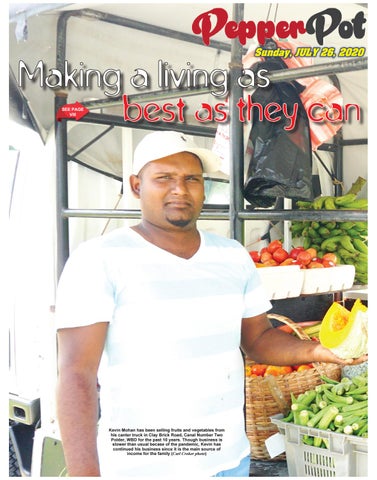
Kevin Mohan has been selling fruits and vegetables from his canter truck in Clay Brick Road, Canal Number Two Polder, WBD for the past 10 years. Though business is slower than usual becase of the pandemic, Kevin has continued his business since it is the main source of income for the family (Carl Croker photo)
II
By Francis Quamina Farrier ERE is another in my series of interracial Guyanese married couples. This one with the focus on what is described as “A Rainbow Family.” No doubt you know of families which could be described as such, in which members are individually and collectively of various racial heritages. Most members of such families usually speak proudly of
CHRONICLE PEPPERPOT ― July 26, 2020
‘Rainbow Family’. The son of an East Indian immigrant, Peter worked his way from a journalist at a now-defunct newspaper, through being Head of the Publications Division at the Guyana Information Service, and through the Guyana Diplomatic Service. He served as Guyana’s senior diplomat, both in the United States and Canada and later as a consul-
more about interracial couples, and about the joy of being free of racial attitudes and rhetoric which create so much misery among those who hate others based on the difference of race. No one is born a racist. Racism is usually taught from childhood. There is that song in the Rogers and Hammerstein Musical “South Pacific”, which places a magnifying glass
ing and learning of racism which I have seen is that of a mother bottle-feeding her baby with the word “racism” written on the bottle of milk. Fortunately, there is a
Retired Guyanese author and diplomat Peter Halder and his wife Mirri have been married for 49 years
their varying ethnic composition; especially those who can claim that they have the blood of all the six races of Guyana flowing through their veins. You probably know such Guyanese. Retired Guyanese journalist, author and diplomat Burnette Alexander Halder, better known as Peter Halder, is the proud patriarch of a
Peter Halder, whose father was from India, with his wife Mirri who is of Indigenous, African and European heritage, and their rainbow grandchildren
tant to the Fiji Government Ministry of Foreign Affairs. No doubt you have had many experiences of observing interracial couples living happily together. I have been encouraged to write some
over that human frailty. The song is entitled “You’ve got to be carefully taught” in which it is emphatically stated that racism is taught by the time “you are six, or seven or eight.” One of the best cartoons on the teach-
growing number of people who understand the nonsense and evil of racism and stay away from it. They are the people who clearly understand that the Creator is a creator of diversity. Some people have grown up in loving “Rainbow Families” one of which I am so happy to feature in this article, even as Guyana is once
again embroiled in some very serious racial issues, spawned by partisan politics. These issues are even played out in sections of the Guyana diaspora. More citizens seem to be moving away from what we promise in our National Pledge- “To love my fellow citizens” - and have been engaging in some serious racist rhetoric which is non-productive at best and rather dangerous at worst. But all is not lost. Many Guyanese of varying racial groups are still seen together enjoying each other’s company. It was the American Civil Rights leader Rev. Dr. Martin Luther King, jr. who made the statement, “Hate is too heavy a burden to bear.” Retired Guyanese diplomat and novelist Peter Halder is the son of an East Indian
Immigrant and is now the Patriarch of what can be described as a great Guyanese/American Rainbow Family. Peter grew up in Albouystown, Georgetown and went on to step in many corridors of power in over 60 countries around the world. For nearly half a century, Peter was fortunate to have by his side his wife Mirri who is of African, European and Indigenous heritage. They met at the Ministry of Information back in the early 1970s. She was the secretary of the Minister of Information and national poet Martin Carter. At that time, Peter headed the Publications Division of the Ministry. The couple were married on June 26, 1971, at St. Andrew’s Kirk in Georgetown, and worshipped there for some years. The loving couple celebrated their 49th wedding anniversary on June 26. They are the proud parents of four and grandparents of four as well, which make up a happy Rainbow Family. During his active years at the Ministry of Information, Peter travelled extensively within Guyana, and during those exposures, garnered much insight into Guyana beyond Georgetown. He has many publications to his credit including two novels; “The Cat of Muritaro” and “Resurrection”. The story of the ongoing journey of the life of Peter Halder and his wife Mirri as an interracial married couple is one like a rainbow created as the waters of the mighty Kaieteur Falls in flowing over the lip and falling 741 feet to the gorge below, creating a beautiful rainbow like the bright sunshine of a happy interracial marriage.
III
CHRONICLE PEPPERPOT ― July 26, 2020
Y
By Jared Liddell
OUTHS are the key to changing any economy and ensuring growth and sustainability. Many Non-Governmental Organisations have built on the platform of youth empowerment, allowing many children access to many opportunities that might not have been so easily accessible to them. VOICE Guyana, for the past two years, has been instrumental in advocating for youth empowerment on the Essequibo Coast through literacy and oracy. President and Co-founder of the Group, Deanna Walcott, spoke to the Pepperpot Magazine on the group’s journey, stating that the idea was to ensure that all youths regardless of their locations have access to resources that would be beneficial to them. She stated that she and fellow co-founder Tracy Marks are both from Queenstown on the Essequibo Coast and that they realised that there aren’t a lot of volunteer groups in Essequibo that work to promote youth empowerment and growth. She stated that once she moved to Georgetown at 17, she realised that there were so many more opportunities available to young people there and felt that she should try to change that and offer her expertise to youths from her hometown. “We are both fond of debates and as a result of this, we realised that being a part of speaking and debate competitions really gave us confidence. We are both cur-
rent members of the Toastmasters Club and during that time we realised that many persons got to the Toastmasters Club as adults when they become professionals to learn speaking skills,” she said. “Although we are there to refine our speaking skills, we understand that our confidence of managing speaking techniques and learning how to write speeches came from that Primary Four debate that we did at the Queenstown Primary School; and so we decided to form a group that helps to build children’s speaking skills as well as confidence through speaking competitions.” Walcott stated that the group is still in the process of getting registered but expects constant and consistent growth as it continues its work. Walcott noted that while the group started as a way of offering resources to children on the Essequibo Coast, it has surpassed that goal and has also been moving in the direction of facilitating children from Georgetown. The president of the group stated that one of the major things the group aims to do is to allow Guyanese youths the chance to understand and acknowledge great Guyanese literature and be able to implement it into their lives and use it as a guide as they move forward on their journey. “We want our members and to read about leadership; we want them to read about politics; we want you to read about foreign affairs and we want to encourage them to understand that they have a voice and that they
Deanna Walcott, President and co-founder of VOICE Guyana
must use it,” she said. “They must use it to promote Guyanese culture, Guyanese rich history and that’s something I’m very passionate about. We have so many Guyanese authors and visionaries and I want us to acknowledge profound words spoken by Guyanese.” Walcott stated that what sets VOICE Guyana apart from other youth-empowerment groups is its principle that every member must contribute. She explained that the group is set up in a way to ensure that all of its members function and use their varying gifts and talents to ensure maximum benefits. “From my experience, what tends to happen to NGOs is that people would see an organisation and say, ‘oh, this is a great CV opportunity let me just join this group’ and then the group is filled with a bunch Tracy Marks, Vice-cresident and of dead Co-founder of VOICE Guyana weight, that is, t h e y don’t do
(Top) Read Aloud Fest at the National Library, February 2020, (bottom) Elsie Marks Memorial Storytelling Competition, August 2018
anything, they just show up for a meeting and sometimes they don’t even show up so we have tried our best to recruit people on the basis of need.” Further, she highlighted that the group has worked to ensure that it carries out several activities aligned with its goal of literacy and oracy and this includes one of the group’s most recent
exercises, the Elsie Marks storytelling competition. She explained that they decided to do a physical activity so it hosted two: one at the Imam Baksh library on the Essequibo Coast with a team from Essequibo and a second at the National Library, where the children had a packed day of fun, learning activities. Walcott stated that the
group is still in its embryonic stages and has already touched the lives of its members as well as many of the children whom the group has had interaction with. She expressed her pride in the group’s current growth and stated that it will continue working to ensure it can change the lives of youth.
IV
CHRONICLE PEPPERPOT ― July 26, 2020
[Polycystic ovary syndrome] PCOS or hormone imbalances and fibroids,” she stated. DaSilva told the Pepperpot Magazine that the most important thing about Sister’s Secrets is that it is not only owned by women, but it generally assists women w h o
W
By Naomi Parris
HEN it comes to the topic of feminine hygiene, many young girls and even older women are not very educated about how to properly take care of their “lady parts,” since finding the right products can be a challenge and conversing about the topic usually makes women and girls feel self-conscious due to the his-
tory of shaming women. However, the founder of ‘Sister’s Secrets’ Daniella DaSilva, has created a safe haven for young girls and women to share their issues and challenges with her feminine hygiene/ self-care store. “It’s a women’s-health business. It’s a business owned by women and provides natural and organic remedies for issues women face, like something as simple as a yeast infection to something more serious like
struggle with having proper remedies or even diagnosis when it comes to women’s health issues. She stated that many times women would refer to a doctor who provides pharmaceuticals or chemicals that do not agree with your body or hormones but instead work against it. S h e added that
in-depth talk where they will say, ‘oh, you’re supposed to expect this or you’re supposed to expect that.’ We have a shame culture and it passes down from our parents onto us and then we pass it on to our children,” DaSilva stated. She added that women are very self-conscious talking about personal things, odours and vaginal discharges, which may be affecting them; however, speaking out about it is difficult to address due to societal norms. Hence, many young women and girls sit in silence, which affects them in the long run, when they develop all kinds of life-threatening diseases and infections.
A few of the many herbs Sister’s Secrets use for vaginal steaming and detoxing
YONI DETOX PEARLS AND VAGINAL STEAMING She noted that while the vagina is self-cleaning, the body does not always have all the nutrients it needs to do the job efficiently, hence the yoni pearls which vaginal detox or vaginal cleanse are useful for this purpose. They contain multiple herbs wrapped in small mesh cloth “gems” or “pearls. “In a perfect world your body would have all the nutrients you need, but we do not eat properly, we do not take enough water, we don’t have enough, so guess what? Our bodies would not operate at an optimum level, so it means therefore that you need to help your body,” she said. Vaginal steaming, sometimes shortened to V-steaming, is an alternative health treatment, popular in various countries where a woman squats or sits over steaming water containing herbs such as mugwort, rosemary, wormwood, and basil. “Herbal and natural is [sic] the best way to go when you are dealing with delicates of your body like your sexual and reproductive organs,” she said.
‘Sister’s Secrets’ is here to let women know that natural remedies are best for their bodies, because the more organic a feminine hygiene product is, the better it works along with your body. “We have some natural remedies that we tested and have tried and we find them to be working very, very well. [I] have struggled with issues and I found no answers from normal medicine -- I found answers in conventional medicine,” she stated. Additionally, she noted that her business is more than just about making a profit. It is about providing a platform for women and girls to talk and express themselves about the different issues they are facing, “ We educate women, we allow them to talk, to share their issues, their struggles, their fears; it’s not only a profit-making business, but it is a business where we allow persons to come and talk to us,”she said. DESTIGMATISE TALKING ABOUT VAGINAL CARE AND HEALTH She stated that in Guyana and across the Caribbean, many young girls enter into the world of womanhood with only basic knowledge of what is a period or menstruation and this is due to a stigma which tells women that it is wrong and not ladylike of them to speak of their bodies out loud. “Mothers or parents do not come and give you this
EDUCATION IS KEY Owing to the fact that we live in a society where many of the larger companies -- especially the ones that produce feminine hygiene products and contraceptives -- the main objectives are results and sales, it
is important for women to do research and consistently be on the lookout for new organic methods of caring for themselves and their health. Additionally, she noted that as it relates to contraceptives, many women find themselves suffering from life-threatening infections due to taking various forms of contraceptives. “Contraceptives is [sic] just a quick fix; it’s just prevention of fertilisation …persons need to be extremely careful that the methods that they using to preventing pregnancies do not just care about that aspect, but also care about your well-being,” she said.
CHRONICLE PEPPERPOT ― July 26, 2020
By Jared Liddell
C
RAFT takes many forms and influences creators in many different ways. It enables them to come up with creative and ingenious ways of sharing their gifts with the world, while showing an unexplored territory of sustaining themselves financially. Many persons are taught craft ideas and techniques by their parents and have time and time again passed it down from generation to generation. The Pepperpot Magazine caught up with Raul Harmon, who makes a living by selling his handmade polythene bags in the heart of Georgetown. The colourful and eye-catching bags are all handmade by Harmon and have been sustaining him and his family for the past year. He told the Pepperpot Magazine that he had the skill of making bags from the age of nine years old when he was taught by his aunt. He said that at that age, he started helping his aunt make bags for his grandmother to sell. Harmon said that he had been doing this as his only job for the past year and has been able to comfortably support himself and family. When asked why he chose to make and sell bags, Harmon responded, “Well I decide to start making them now cause I do all kind of work in this country. I was a sounder, a police, a pork-knocker, security but I find you know all these years working you ain’t really getting no way, cause most of the time the cost of living is higher than your salary and you have responsibilities,”he said. “So one day I was doing a security work in Georgetown and we used to work every day, New Year’s Day, Christmas Day, Boxing Day, just to make ends meet, and one day in last year I said to myself, you got a skill why you don’t use it.” He explained that this is where his journey started, stating that he wanted something a little more fulfilling than the jobs he had done previously and he had remembered how fulfilling it would be to work at his own pace while doing something he was passionate about. This led Harmon to purchase all the materials he needed, leave his job as a security guard and begin exercising the craft he had learnt all those years ago. He stated that although he had not practised or made any bags in several years, it was something that never left him and he was able to utilise his skill. Harmon explained that he understands the value of
a skill and says that he is appreciative of his aunt for taking the time to pass down the talent she possessed to him, allowing him to not only be able to earn and sustain himself, but also to have a sense of peace and calm in his life as he does so. Harmon stated that he would encourage everyone to utilise their skills, especially having seen the effects the COVID-19 pandemic had on the job market. As such, he believes that there has never been a better time to utilise their talents to continue to sustain one’s afamily. “Most of the people looking fuh big money, but as long as you’re contented you’ll be alright. Use your skills; use it to your advantage and don’t just sit down on it. But I’d also say to love it. You’ll realise that using your skill or craft is going to be better for you, j u s t p u t that extra effort into it, have patience, skill is patience and determination. To me, once you have that skill and that determination it gon work, yuh just gotta believe in that,” he said. Harmon told the Pepperpot Magazine that The intricately designed like his aunt who passed down her polythene bags knowledge of the craft to him, he is working to pass it down to the younger members of his family to ensure that they always have a talent that could sustain them.
Raul Harmon with his handmade polythene bags – Elvin Croker Photos
V
VI
CHRONICLE PEPPERPOT ― July 26, 2020
How do we view in
O
VER the past few weeks, I’ve been exposed to quite a few scenarios which required me to delve into the matters through a ‘gendered lens.’ Domestic violence discussions, talks on the disproportionate economic effects of COVID-19 and recognising the experiences of women in leadership have been under my radar. In each of these, it was easily discernible just how important it is to
recognise how differently we interface with women in society. Being stuck in Trinidad over the summer means that a beach trip is imminent. I was sitting in the sands of Las Cuevas putting down the points for this column, drawn from a book I have been reading. I thought about body image and body positivity and the weaponisation of feminine characteristics to belittle women. And I thought about how this weaponisation has manifested throughout this entire electoral process.
w
n e om
As a gentle disclaimer, let me categorically state that gender is one field that I do not claim to know a lot about. I give much credit to my UWI journey and the folk I’ve met here at the Institute for Gender and Development Studies (including the GT massive crew!). They have allowed me to have a deeper appreciation for the field.
Let me begin by providing some historical context to this discourse. Steve Garner (2008) in his book “Guyana, 1838-1985: Ethnicity, Class and Gender,” illustrated how the division of labour and varying experiences of women on the plantation creates an intersection of women’s experiences with their class and ethnicity. A black woman who was enslaved had a starkly different experience than a white woman who was the spouse of a colonial master. Garner posited that class conflict has been experienced through ethnicity, (an axiom in our contemporary Guyana) but advanced that gender is inextricable in this discourse because of the added layer of hierarchy it creates. In Guyana today, women hold high positions with tremendous responsibility. There is Volda Lawrence as the Chairperson of the PNCR, the largest constituent of the APNU coalition (and the Minister of Public Health). Rondha-Ann Lam is the presidential candidate of the Citizenship Initiative (TCI), a new party that has been adding its voice very prominently to the political discourse right now. Importantly too, in the judicial sphere, we have the Chairperson of the Guyana Elections Commission (GECOM), the Chief Justice, and the Chancellor of the Judiciary as women. This is something I am proud of. The intersectionality of ethnicity, class, and gender, perhaps, is just as relevant in today’s society as it was during the period Garner
? a n a y u G
studied. The hierarchical nature of the society -- fostered by these three tenets -- still exists. The hierarchical structures that have transcended from the plantation and colonial days to now do no favours to women, and women aspiring to high offices. I submit that women face a myriad of barriers and challenges as they navigate the professional world. Now among these barriers or challenges, there is the vitriolic misogyny that these women, like so many others, are faced with. I direct specific attention to the GECOM Chairperson Retired Justice Claudette Singh. Over the past few months, she has endured, inter alia, a death threat, a theatrical funeral, and persons questioning her every move and decision. The nature of her post, exacerbated by the political climate and mistrust of the electoral bodies and processes, means that no decision or judgement of hers would ever be unanimously supported. It is virtually impossible for her to please all sides of a highly polarised society. But, that is the reality and nature of her job. When there was a fullpage ad printed in a daily newspaper questioning her competency and judgement, I imagined that was just another manifestation of thinly disguised misogyny. And that’s the thing about how we view women in Guyana, for me. It is an axiom that there is an interplay between ethnicity and class, which manifests itself in our political struggle. However, there is little consideration, to my knowledge, of how women interface with
these hierarchical structures. There is not enough consideration of how normalised the attacks on women are. Let’s not forget the recent attacks on the Prime Minister of Barbados, Mia Mottley, either. We can disagree with the sentiments articulated without dragging their characters through the mud-- attacking their appearances, threatening them or utilising references to women’s sexuality, and assumed sexual practices. That is not alright. While writing this column, a local meme was created and it popped up on my Facebook timeline. It showed a woman, clearly terrified, in bed, and the silhouette of a man entering her room with what appeared to be a belt. The male was a prominent political leader while the woman was Guyana, and the meme attempted to convey that the political leader would abuse Guyana. I get that this was a meme, and meme culture has been a distinctive way that my people in my generation express themselves. This, however, was not acceptable for me. This illustrated just how normalised we are to the abuse of women-- so much so, that we can easily portray violence in our discourse. I thought about the abuse threats, I thought about the stories of domestic violence recounted during the forum I wrote about in a recent column. I thought about how we view women is just not okay. It’s not. If you would like to connect with me to discuss this column or any of my previous works, feel free to email me at vish14ragobeer@gmail.com
CHRONICLE PEPPERPOT ― July 26, 2020
Claybrick Road and Belle West residents live in peace and harmony
T
By Michel Outridge
community to earn. It is also home to teachers, health care employees, accountants, cane cutters and others. Clay Brick Road has a population of about 500 residents. Meanwhile, Belle West Village has 708 house lots with about 65 per cent occupancy and a large number of residents who were previously employed by the Wales Sugar Estate up until its closure. The community has many internal streets and a lot of businesses both small and large-scale with masjids, churches, mandirs and other impressive buildings. It has schools, a health centre and a playschool/aftercare facility which is privately owned. The people are of mixed races who co-exist in peace and harmony and they also grow their own fruits and vegetables. Residents are kind and friendly and are always up for a quick conversation. Canal Number One and Two Polder Water Users Association The Pepperpot Magazine met the mild-mannered overseer of Canals Number One and Two Polder Water Users Association, Naushad Boodhoo. He is also the Imam of Belle West Masjid and the Coordinator of Boodhoo’s Play School. In highlighting the role of the Water Users Association, Boodhoo said the outfit is like a ‘little brother’ to the National Drainage and Irrigation Authority (NDIA) which comes und e r
HIS week the Pepperpot Magazine journeyed to Clay Brick Road and its neighbouring village of Belle West, Canal Number Two Polder, West Bank Demerara. Clay Brick Road is a onestreet village which has 60 house lots and is home to the once-thriving Clay Brick Factory which is at the end of the street. The village got its name after this factory which functioned in the 1970s and provided employment for many villagers up until its closure. Today, the place is in a state of deterioration, but the administrative building-which is still standing -- is occupied by a single villager. Clay Brick Road comprises Guyanese of all ethnicities, most of whom are farmers, self-employed folk and some private and public sector workers who leave the village for work. At the start of the village, there is a wooden bridge which connects Canal Number Two Polder to Clay Brick Road and the large housing scheme of Belle West. Clay Brick Road and Belle West villages are separated by a canal which runs through the communities and are joined by small bridges. Clay Brick Road has an all-weather road, drainage and the basic infrastructure including electricity, potable water and internet services but is without landline phones. At the head of the village stands the one-flat concrete building which houses the New Annlegt Nursery School. The people of Clay Brick Road are very friendly and welcoming and are mostly cash crop The old Clay farmers, who culBrick Factory tivate the land within the
the Ministry of Agriculture. He related that the Water Users Association is responsible for the drainage and irrigation, fixes of sluices, shaping of dams, removal of over-hangings (trees) and the general maintenance of drains and canals. Boodhoo added that the Water Users Association is managed by seven board members which include farmers and residents of the community. “We collect drainage rates similar to the Neighbourhood Democratic Council [NDC] and it is about 20 per cent which varies from proprietor to proprietor. The Water Users Association have their own heavy equipment to do the tasks they are responsible for within the communities,” he said. Boodhoo reported that due to recent heavy rainfall they had to undergo emergency works where they had overtopping of 100 rod- that is, 150 feet of breach. He disclosed that emergency works had to be done because the entire dam would have been washed away causing flooding. “The soil structure is pagasse instead of clay so it was prone to collapse and we had to fix that,” he said. Boodhoo explained that a lot of people and children have been at home for weeks and it is beginning to take a toll on them psychologically since there is a need to socialise. But on another note, the pandemic has caused families to re-connect where there is more time for family with fewer distractions and they have become a priority.
VII
Overseer of the Canal Number One and Two Water Users Association, Naushad Boodhoo (Carl Croker photos)
Focus on the Village
VIII
CHRONICLE PEPPERPOT ― July 26, 2020
Focus on the Village
Ramlall Boodhoo
V
By Michel Outridge
ILLAGERS of Clay Brick Road, Canal Number Two Polder, West Bank Demerara, are simple, everyday folk, who work hard to make ends meet. The Pepperpot Magazine
met an elderly resident, Sahadeo Ramillah, who was ‘taking some breeze’ at a shed in the village. THE WRISTWATCH VENDOR/REPAIRMAN The 65-year-old stated that life for him is a bit rough, since he is unemployed as a result of the pandemic and has to depend on a few
friends in the neighbourhood to support him financially. Ramillah is a wristwatch vendor and repairman on Water Street, Georgetown, but has been unable to work since March 2, 2020. “Right now I am not doing anything because of COVID-19. I can’t work, so I am at home most times and I decided to take a ride out on my bicycle and take some breeze then go back home,” he said. Ramillah added that the shed under which he was sitting is a meeting place for locals, who would gather there for a chat but since the pandemic, people are afraid to socialise, so they are social-distancing. He is a single parent with three grown children who live elsewhere and he is finding
things to do to occupy his time. The senior citizen stated that life at Clay Brick Road is simple and the people are hard workers, mostly farmers. Ramillah said Clay Brick Road is one mile long and the entire access road for Canal Number Two is seven miles long.
being cared for by his eldest son, who has a wash bay. “In my young days I worked very hard, so it’s time for me to relax now and I do get up for a brisk walk or do minor chores,” he said. Back in the days, Boodhoo used to work at the Clay Brick Factory at the back of the village until it closed.
VILLAGE ELDER Meanwhile, the Pepperpot Magazine also met Ramlall Boodhoo, a retiree and a village elder, who is “taking it easy” in his golden years. The 76-year-old stated that he has been in the village for the past 20 years and in his younger days he used to work hard to upkeep his wife and children. The senior citizen added that he used to work at a rice factory at Harlem, West Coast Demerara, for many years until he retired. The father of two pointed out that nowadays he tries to stay active by doing yard chores, but the cooking is done by his daughter-in-law who lives next door. He resides alone and is
THE GREENS/FRUIT VENDOR The Pepperpot Magazine also encountered the village greens/fruits vendor, who plies his trade via a canter truck. Kevin Mohan is a resident of Clay Brick Road and he has been vending via his canter truck for the past 10 years. Most of the vegetables and fruits come from their farm, which is managed by his father. The 28-year-old stated that vending is his only source of income and he would begin his trade from his village to Belle West and along Canal Number Two Polder Road. “My father is the farmer
Sahadeo Ramillah ‘taking breeze’ under the village shed Kevin Mohan and his canter truck vending greens/fruits/citrus in Clay Brick Road (Carl Croker photos)
and I do the selling of the produce from the farm, which includes citrus, greens and fruits,” he said. Mohan reported that they have two canter trucks, but had to park one because of the economic situation due to COVID-19. “Without the spending power people are not buying as before and business is not ‘bright,’ because a lot of people are not working,” he said. The father of two pointed out that he would start selling at about 08:00hrs to midday. He usually drives and sell and does it alone, since he had to lay off his only employee. “Before the virus I used to sell until night, but now I would return home just after midday daily,” he said. On the farm they have only three employees because they had to lay-off 10 and they have a cultivation of 86 acres located in the backlands. When it is dry they would use the dam to access the farm, but when it rains they have to use a boat to get to the crops. Mohan disclosed that on their farm they have healthy
IX
CHRONICLE PEPPERPOT ― July 26, 2020
Focus on the Village
Boodhoo’s Playgroup and Day Care Centre
W
By Michel Outridge
HEN Shamrool Baksh moved from her home village of Zeelugt, East Bank Essequibo, to Belle West Village in 2008, there was nowhere for parents to leave their children while they went to work. After requests from desperate parents, she established the Boodhoo’s Playgroup and Day Care Centre on October 18, 2010, a safe place for children while their parents are away at work. “I always loved children and had a deep passion for their care, so I thought about opening a school and an after-care centre especially for children where they can be in a safe environment,” she said. P r e s e n t l y, d u e t o COVID-19, the place is closed and will be re-opened when it is safe to do so. Baksh reported that so far, they have had nine graduations and will have another, where certificates of completion are presented when schools reopen. Boodhoo’s Playgroup and Day Care Centre admits children from as young as four months old and also has preschool classes and a drop-in/ aftercare section for parents to leave their little ones while they are away from home. Boodhoo’s Playgroup and Day Care Centre employs two persons and
Baksh, who is a qualified child care professional, is attached to the playgroup on a full-time basis. When classes are in session for Grades one and two, she related that she would even take the children whose parents have to go out on Saturdays until they return.
to utilise the services. There, barber Nicholas Persaud was present and was cutting his son’s hair. Persaud has been a barber and tattoo artist for the past five years after he quit his job as a welder, which he considered life-threatening, so he went in search of a simpler job.
Nicholas Persaud cutting his son’s hair (Carl Croker photos)
“The school is a safe place for children of all religions … and it is a disciplined environment where children can learn in our care,” she said. Baksh admitted that due to the worldwide pandemic, she has suffered a loss of income when she had to close the school but is occupied with household chores. “As a mother of three I was inspired to open this school because I love children and wanted to provide a service to the villagers and it worked out well,” she said. One of Baksh’s daughters is a doctor attached to the West Demerara Regional Hospital.
This small business is located on the main access road in Belle We s t Vi l lage and is considered the ‘village shop’ where residents Shamrool Baksh of Boodhoo’s would visit Playgroup and Day Care Centre
“Being a welder I had to climb heights to work and it wasn’t safe and being in the sun was taking a toll on me and I decided to change jobs,” he said. Although he is not wellversed in tattooing, he is willing to learn and he did just that by observing his boss, who owns the shop. Persaud can draw from a carbon copy whatever designs are requested by the customer and he does a good job too. The father of one related that presently business isn’t going well, but on some weekends they do get a few customers. Simone Mohan is the assistant overseer for the Canals Number Two and Two Polder Neighbourhood Democratic Council (NDC). She is in charge of supervising the collection of rates and taxes and also guides on spending, updating funds and other clerical duties. Mohan told the Pepperpot Magazine that the NDC is responsible for the maintenance of drains, trenches and canals within the community that is, east to west and assists in
weeding government-owned compounds such as schools, health centres, etc. She related that as it relates to rates and tax collection,, most residents have been paying up, while some are in arrears and they cannot locate others. Mohan reported that $3,000 is the fee per year for each villager and they have good relations with the people. “One of the challenges of this job is that some people come in for our services and they believe you are giving them a hard time, but that is far from the truth, since this system is a process they have to go through,”
she said. The Canals Number Two and Two Polder NDC is managed by 18 councillors, one of whom migrated and has a staff of four and is headed by the chairman. The NDC covers an area of 35 square miles and the road is seven miles long, a farming community. NDC Overseer, Simone Mohan
X
CHRONICLE PEPPERPOT ― July 26, 2020
Focus on the Village
The home of Shamkumarie Seodatt (Carl Croker photo)
S
By Michel Outridge
HAMKUMARIE Seodatt is a teacher at the Endeavour Secondary School, Canal Number Two Polder and she explained that it has been very challenging for her to be out of the classroom setting for months now. Nevertheless, this educator is hoping to return to the classroom soon, once the pandemic is contained. Extra lessons “Even though we have a remedial programme for slow learners for one hour during school hours at lunch-break, I would like to become even better in my major which is Mathematics; as such, I will be pursuing [a Bachelor’s Degree in Education in the field of] Mathematics at the University of Guyana, which is a two-year course and maybe later I will provide extra lessons at my home,” she said. Seodatt stated that she would like to give back to the community and a good way of doing that is to give extra lessons for those who are willing to learn. “Teaching is fun once you like it, [it] can be fulfilling and takes you places and it broadens your scope and makes you into a better person overall,” she said. Seodatt explained that with slow learners she would go down to basics, since some have mixed abilities in Mathematics. “This group of students [consists of children] from different catchment areas and I am not ashamed to say we don’t have the ‘cream of the crop,’ but we try to give an hour’s extra lessons free of cost on school days for slow learners,” she said.
Even though she is originally from Parika Backdam, East Bank Essequibo, Clay Brick Road has become her home. She has been residing there for the past nine years after marriage and reported that life in that village is fair, once one is employed. Seodatt previously taught at Kawall Primary School until that school was formed into the Endeavour Commons Secondary School and she managed to adjust in no time. Online schooling Unfortunately, teachers and students are not doing any online home-schooling because of some reluctance from the students to give their cellphone numbers to establish a WhatsApp group to promote home-schooling. The mother of two explained that the students are not cooperating, as such, they cannot be forced to comply and they are receiving school work directly from the Ministry of Education through the headteacher. She reported that students who are interested in their school work would access the coursework on the Ministry of Education’s website. Endeavour is a CSEC centre She is a Grade Nine teacher and she was, however, pleased to report that this year was the very first time they had students sitting the Caribbean Secondary Examination Council (CSEC) exams right out of their secondary school building. Previously, they had to go to Vreeden-Hoop Secondary to write CSEC exams so this new achievement is a plus for the school, she said. Seodatt added that their school is now a CSEC centre and she is really
happy about that achievement. “I started teaching at the primary level and morphed into a secondary school teacher, because I attended a religious secondary school which is privately owned and adopted their teaching methods to hone my skills,” she said. She disclosedthat it is a disciplined and controlled environment, but at Endeavour Secondary School they have a problem with the students in terms of discipline, but strategies are being implemented to reduce the wayward behaviour of some students. “At that private school I attended the p;rincipal is a stern disciplinarian and I came out successful; as such, I tried to incorporate his method of teaching and it has proven to be a success,” she said. Seodatt told the Pepperpot Magazine that she graduated from the Cyril Potter College of Education (CPCE) in 2018 and the best part of teaching is the classroom sessions, where she can interact with students because she likes children and has their best interest at heart. Repairs The teacher disclosed that the Endeavour Secondary School building is in dire need of repairs and they do not have a proper washroom facility and they also need good furniture. “The building is shaky and not conducive for learning; and then we don’t get a good supply of running water, but we try with what we have and recently some repairs were done, but it is not enough,” she said. Seodatt disclosed that although they teach Home Economics, there is no classroom area for that session and practicals are done in an open classroom.
Shamkumarie Seodatt, teacher of Endeavour Secondary School
XI
CHRONICLE PEPPERPOT ― July 26, 2020
Staffers of the Belle West Health Centre (Carl Croker photos)
Focus on the Village
T
By Michel Outridge
HE Belle West Health Centre is supervised by Senior Medex Jaikaran Narine and they have one of the largest chronic disease clinics on Mondays. On Mondays, they have more than 100 patients and this week they recorded 154 such patients, who suffer from ailments such as diabetes and hypertension. He told the Pepperpot Magazine that presently they have a shortage of insulin, but all other drugs are intact and in storage. Narine stated that they provide a reliable service to members of the public and they have a series of services which can be accessed hassle-free from Mondays to Fridays from 8:00hrs to 16:30hrs. The Belle West Health Centre provides services in infant admissions, postnatal mothers, family planning, chronic diseases and general out-patient care and treatment. Narine reported that they also do all dressings on weekdays, but they have a large number of uncontrolled diabetes patients who require insulin of which they are all out. He disclosed that they also have counselling sessions with patients and the Community Health Worker would do home visits for pregnant women; post-natal mothers are schooled on breastfeeding and shut-ins where they give a general talk for the household on their care and treatment. “Generally,,, patients are receptive to our counselling because they want to feel better and we try to put them at ease and when we have cases that require specialised treatment, we refer them to the West Demerara Regional Hospital or the Georgetown Public Hospital,” he said. With COVID-19 the Belle West Health Centre is practising social distancing and they screen patients as they visit before seeing the doctor. “We had some patients on repeat treatment, but we would see them as they visit because some have complications and we look at that too and we are maintaining our workplace safety health practices to protect ourselves too at the same time,” Narine said. The Senior Medex revealed that even though they have services at the health centre, some people are peculiar and are afraid to visit to seek care and treatment and would rather go to the pharmacy and buy medications or self-diagnose. Narine added that when patients miss their clinic visits they would contact them via telephone to enquire why they did not show up and if they need help they would visit. The Belle West Health Centre has a midwife, a nursing assistant, two community health workers, a clinic attendant, a handyman, a doctor and the visiting Senior Medex. Narine is the Region Three Senior Medex who resides in Belle West, but is originally from Goed Fortuin, West Bank Demerara and has been in the profession for the past 34 years. RETIRED MEDEX SHARES HER STORY Meanwhile, the Pepperpot Magazine met a retired Medex who shared her memories in the health care profession. Kawlapattie Jairam is a resident of Belle West Village and started her nursing career at age 20 years.
She recalled as a child she used to do dressings on their dog Tarzan and was always fascinated with nurses, their uniform and how they worked. One day, it was Career Day and a nurse visited the school and she gave a talk and there was Jairam awestruck and it was then she told herself she will become a nurse and be just like the one who visited her school that day. At that time she was in Standard Four and after the nurse’s visit, they had to write an essay on what they want to become when they grow up and of course hers was about being a nurse. Jairam retired at age 55 as a medex but was a nurse and a midwife before she attained the position of medex. She served Hogg Island, Wakenaam, Windsor Forest Health Centre, La Grange Health Centre, Georgetown Public Hospital Corporation and the West Demerara Regional Hospital during her tenure in the health care system. “Most places I worked as a nurse I went back to serve as a medex and that was really fulfilling as a health care worker,” she said. Jairam also visited many riverine areas as, a nurse and enjoyed her career to the fullest, because she liked people and her joy comes from making people better when they are ill. “As a health care professional you have to ensure every patient that you see get the treatment to make them get better and I always saw my job as the caretaker of the people’s health, because I know I have to provide a critical service to them,” she said. Kawlapattie Jairam in As a midwife, she delivered more her nursing years than 1,000 babies and it was a role she thoroughly enjoyed, talking to young mothers and caring for their newborn. In 1989 Jairam met a young man who would become her husband. Today, they have two children, one of whom has taken her path in the health care profession and is pursuing gynaecology/obstetrics. After serving for 42 years, she retired in 2019 and discovered the ‘Do It Yourself’ channel on YouTube Senior Medex Jaikaran Narine and began occupying her time making things for the home. Jairam, 63, is originally from Crane Village, West Coast Demerara and noted that she had a good experience in all the places she worked Kawlapattie Jairam in over the years, with her younger days no regrets.
XII
CHRONICLE PEPPERPOT ― July 26, 2020
d n i M e t i r W e n e y a Th P e n i y Jasma b
E
VERY so often, I stumble across resources that are invaluable to my writing process. We often rush through the world without taking the time to look to other sources that can help to improve our craft; but I thought that this week, I would share with you an excerpt from a book I found immensely useful to my business-writing career. The book is called “Writing Fitness, Practical Exercises for better Business Writing” by Jack Swen-
son. In this excerpt, he outlines why writing is important, sources that can help to better your craft and other useful tips that you may want to carry with you along the way. Writing skills are essential Anyone who earns a living at a desk knows how important it is to have good writing skills. A good letter can get you a job interview or win you a new client. An ability to write clear, concise memos and reports can help you move up the ladder i n
your organisation and win you a better job. On the other hand, poor writing wastes time and costs money. As one consultant recently said, “Profits improve only when our correspondence is read. No sale is made when a business letter ends up in the wastebasket.” A high-tech world Part of the challenge of clear writing is the nature of business communication. Business-writing is often necessarily technical and complex. This kind of writing makes special demands on a writer. A writer who has not yet learned to have sympathy for the reader is bound to create problems for himself or herself. But isn’t writing ability less important in today’s high-tech world of computers and electronic data-processing? Don’t we now depend more on machines for precise, accurate communication? The experts say no. They maintain that good communication skills are more critical than ever. The spread of electronic communication devices makes better writing imperative. Size, too, is having an impact on today’s business needs. As Business Week pointed out (July 6, 1981), “The ability to write simple, direct prose that says precisely what you want it to say in the fewest words…has become rare—just when business and social organisations have grown too large for anyone to be effective face-to-face.” Better writing now Some readers may have reservations about the length of time it takes to develop good writing habits. You may believe it takes years to become a good writer. You may be reluctant to commit yourself to the time and effort you feel are necessary. Let’s give that myth a decent burial right away. True, it takes time and energy to become an accomplished writer. No professional writer ever got to that level without using up a lot of pencils, paper and ink. But it does not take years or even months to become a good writer. Most people can make remarkable progress in a few weeks. Indeed, you should expect to see significant improvement quickly. The principles of effective writing are simple and easy to apply. You can prove to yourself that
it is possible to learn to be a better writer by performing this simple test: dig a letter or memo out of your files; it doesn’t matter if you wrote it or it was written by somebody else. Then, pen or pencil in hand, go over the document sentence by sentence, crossing out any words unnecessary to make the meaning clear. When you have finished, compare the two versions. Read them aloud. Which looks and sounds better? Odds are it will be the one that is shorter and more concise. Some helpful resources If you want to begin developing better writing skills, you don’t have to sign up for a course or wade through a grammar book. All you have to do is apply a few simple principles of effective writing. For readers who have the time and desire to pursue the matter of writing improvement further, some books that will also help you build your skills as a writer are “Elements of Style” by Strunk and White, “On Writing Well” by William Zinsser, and “Better Business Writing” by Susan L.Brock. A grammar handbook is also handy. An excellent, brief manual that contains all you need to know about English grammar and usage is “English Simplified” by Blanche Ellsworth. Building a foundation Many writers have trouble with basics such as spelling, punctuation, grammar, and mechanics. It’s no disgrace to be a poor speller, just a weakness. A good beginning point for a self-improvement course on writing is with the basics of the language. If you are weak in this area, the first step is to admit it, then begin to build a foundation for improved skill with the language. A grammar handbook is a useful reference. You can also benefit by making it a habit to look up words you don’t know how to spell in the dictionary and writing them several times until you learn them. One step at a time If your basic skills are weak, don’t despair. Learning how to write is like everything else: it must be learned one step at a time. Isolate your biggest weakness and deal with it first. Interested in contributing to this column on writing? Email me at thewritemind592@gmail.com
XIII
CHRONICLE PEPPERPOT ― July 26, 2020
T
HIS is my first time as a coach on the Healthy Thoughts Challenges and I love it. Meeting up on line with my tribe energises me. They are from Guyana and many parts of the world and their daily feedback is a dose of inspiration. If anyone had told me that I would be utilising this virtual space like this I would have responded: ‘I don’t like technology and technology hates me.’ Lol. Imagine, there were six evenings for the Women Across Borders Virtual Event? God is great and worthy to be praised. The positive-energy event certainly carried me in the challenge. Now the challenge is taking me in the direction of the first Confidence Becomes You virtual programme. We know how self-confidence is important to both our physical health and our psychological well-being. When we believe in ourselves we are more likely to try new things, devote our time and energy to tasks that matter, make good lifestyle choices, and foster healthy relationships. We have had many sessions in the classroom but this is the first time on line. Males and females have already registered from Guyana, Trinidad, French Guiana, Nigeria and many parts of the United States. I was going to give an insight into the programme but decided others would be more effective in sharing their experience. Here are some testimonials from persons who completed the programme “My name is Joan Jackie Butcher, an educator and an owner of a small business named ‘Butcher’s’ which was birthed from the class of Confidence Becomes You. As a past student of this dynamic class, I remembered the story of one of my colleagues who had lost her job. And as she was relating her story, Sonia Noel the convenor of the class asked her what she loves the most and her reply was cleaning and washing. Ms. Noel fondly called Sonia then said to her and I quote, ‘Then you have a job, you can open your own cleaning service and work for your self.’ It was at that said moment an idea came to me and said you can own your own business too. My baby was birthed right there (my business). I then immediately told Sonia and the class that by the end of the said year I will have my own business. So said so done. Today I am the owner of a business because I was a part of the class, Confidence Becomes You. That class changed my mindset. And also hearing other persons’ stories and sharing mine helped me to think positively. So for me with God as my pilot and having done that class is one of the stepping stones for who I have become today. So I encourage persons to join the class, Confidence Becomes You and be encouraged. Thank you, Sonia, I will forever be grateful.” Meleesa Payne, Entrepreneur/Former Miss Guyana Universe: “Confidence Becomes You has impacted my life in ways unexplainable. I have taken risks in my business and made bold decisions to be the best version of myself. I am proud of the person I have become after attending the workshop, it’s a blessing.” Maryam Jameela Haniff was so shy when she joined the class but she did not regret afterwards. She shared her remarks: “The course built my confidence and helped me reignite flames that had been long extinguished by circumstance. In a nutshell, it aids in discovering who we are truly meant to be.” The programme is not only for females and here is a testimonial from Shawn Hetemeyer, a 25-year-old student: “I attended the Confidence Becomes You workshop in 2018 and, beyond the information dispensed, I learned a lot from the experiences of the other participants. It was the first workshop of that kind I had ever attended and the experience taught me how to network. Candacee Lowe-Edwards, Programme Administrator at 104.1 Lite FM: “Confidence Becomes You is one of my greatest and most humbling investments I’ve ever given to myself. Almost three years later, and the teachings from Ms. Noel still allow me to commit to working intentionally on the best version of who I am and ultimately what will be.” The class is perfect for all ages, races and nationalities. Her is a view from a teenager Varuna Ganess: “Just hopped out of high school as a naive 16-year-old, entering into the real world where everything will be abnormally different from my everyday life. I had no idea what to expect until I was introduced
into the building confidence working shop by Ms.Sonia Noel. The Confidence Becomes You workshop helped to improve my emotional intelligence, encouraged me not to be afraid of taking risks, be secure about myself as we are all unique in our own way and more importantly, the fashion tips were a slayer. From this experience, I’ve grown into a more confident, stronger young lady than ever.” It will take a few columns to share all the testimonials so I will stop after JoAnn Forde, Founder - Innovoir Spa: “Before doing this class, I was surviving and not living. The life skills I’ve learnt and live by today are values. I now put value to everything, which before I didn’t. I value my time, my efforts, my opportunities, my opinions, my goals and dream investments (either what I’ve invested or what people invested into me). I no longer just go through a day, but I intentionally LIVE through my day. I celebrate every second of life- success and failure - both. One thing I’ve learnt is, no matter how far I fall, I can always get back up!!! I encourage you to give yourself a chance and live life with INTENTION.” This will be held on August 4 and 5, 2020. If you are interested email livingwithintention11@gmail.com as we
Beyond the Runway with Dr. Sonia Noel ... Inspiring lives through fashion continue to celebrate this beautiful journey called life BEYOND THE RUNWAY.
XIV
CHRONICLE PEPPERPOT ― July 26, 2020
VINEGAR AND ITS CULINARY, MEDICINAL AND CLEANING USES
VINEGAR is one of the substances which has been used worldwide from very ancient times. It was known among the Babylonians, ancient Indians, Hebrews, Egyptians, Greeks and Romans and used in cooking, medicinally and as a general cleanser and sanitizer. The most famous Biblical reference to it was when Jesus was mockingly given wine vinegar while he was on the cross and during the Black Death pandemic in Europe during the Middle Ages, some doctors prescribed its use as a body cleanser. The word “Vinegar” derives from two French words - ‘vin’ meaning wine and ‘aigre’ meaning sour, and indeed, “sour wine” is an apt description of it. The widespread use of it partly derives from the ease with which it is produced: It is made from any carbohydrate source that can undergo fermentation. Such carbohydrates include apples and grapes, commonly used in Europe and oats, barley, rice and even beer. The basic production of vinegar is fairly simple: The yeast in the carbohydrates ferments the natural food sugars into alcohol, then the acetic acid bacteria (acetobacter) converts the alcohol into acetic acid. The fermentation period could be weeks or months, depending on the kind of vinegar one expects to produce. The alcohol content of food-grade vinegar ranges from five per cent to two percent and the acetic acid content would be between four per cent to six per cent. If the acetic acid content goes beyond 10 per cent it becomes unhealthy to use. Until World War II, Guyana imported its vinegar mostly from Canada and Britain. During the war, however, vinegar -- like so many other imported foodstuffs -- became scarce or impossible to obtain and this forced local people to produce substitutes. The substitute vinegar which was produced was done by the drug stores which merely mixed acetic acid with water. There was no standard or control over this locally produced vinegar which could sometimes have too high a percentage of acetic acid, making it very unwholesome to use. Fortunately, this locally produced brew was used mostly to preserve peppers and in achars and chutneys and in preserving green mangoes and other green fruit. After
the end of the war, some vinegar was again imported but it was more expensive than the local mixture and this led to consumers continuing to use it, though they were aware that it was inferior to real fermented vinegar. Demerara Distillers Ltd (DDL) saw the opportunity of producing vinegar and had their laboratories work on producing a world-class product. DDL succeeded in producing a white vinegar which could easily blend with other ingredients in cooking or in use with salads and was of the highest quality. An export market became immediately available. Most Guyanese consumers now use DDL vinegar which goes under the brand name EHP Fermented White Vinegar. In the last year or two, the big supermarkets have been promoting vinegar and have been explaining the different types of vinegar, their colour and for what they are used. There has been much talk of vinegar like apple cider, grape and malt. In Guyana, such promotion has been small since the consumer population seems to be securely committed to the DDL-produced vinegar. Out of this promotion has however arisen two positives: the first is the emergence of a large number of recipes which use vinegar celebrating its culinary use and the second is the identification of a large number of medicinal and cleansing uses for vinegar. Among the most popular medicinal uses claimed for vinegar are: it reduces the risk of heart disease; could control high blood pressure; has an anti-tumour activity; could help to regulate blood sugar; could support healthy weight loss; and that it may have anti-microbial effects and could even fight colds. These medicinal uses are supported by Alternative Medicine but Formal Medicine has not so far given them acceptance. Its cleansing uses have been more widely accepted and adopted and these would include cleaning of metals as in garages, mopping of floors, and killing weeds, most moulds, bacteria and germs. Among its most known side effects are that it could damage the oesophagus and tooth enamel and in general, it is a caustic substance if not used sensibly. Vinegar has however been coeval with human civilisation and will continue its worldwide usage.
CHRONICLE PEPPERPOT ― July 26, 2020
T
HERE has been an increased awareness of organic farming in Guyana. Providing proper levels of nutrients for growing vegetable seedlings is crucial for productive growth. While potting mixtures need to be nutrient powerhouses, given the short amount of time it needs to support plant growth, inadequate nutrients can lead to stunted growth, r e -
incorporate the right structure, fertility and integrity in your mixture as it can help you get your production off to a good start, Dr. Homenauth stated in an invited comment. The new potting mixture S- SOWMIX (Seedling Soil Organic Waste Mixture) which was launched by NAREI last year, was under testing over four years by the Institute’s Soils Department, Mon Repos. According to Dr. Homenauth the inclusion of mycorrhiza by N A -
duced productivity, and susceptibility to pathogens and pests. Organic fertilizers such as chicken, sheep or cow manure are commonly used in vegetable production. Additionally, synthetic fertilizers are frequently used among farmers in Guyana because these are more convenient to purchase, transport and store. In light of its importance, the National Agricultural Research and Extension Institute (NAREI), has developed a successful trial of local potting mixtures. Several organic substrates including coconut coir, vermicompost, tabela sand and composted chicken litter were combined with mycorrhizae, an environmentally friendly fungus, to produce a potent growing medium. “Inadequate fertility in potting mixtures can lead to plant deficiencies. It is necessary whether you are buying potting mix or making your own, that you
REI in agriculture is necessary to boost farm production and expertise in the field. In light of climate change, the push for sustainable agricultural practices is paramount. “These locally produced potting mixtures are intended to replace similar substrates which are currently being imported. The product which is currently available for purchase by our Mon Repos office has already received support from our local farmers,” Dr. Homenauth said. Mycorrhizae are a fungus that colonises root systems of host plants. It assists the plant to absorb more water and nutrients while the plant, in turn, provides the fungus with carbohydrates. The fungi have been credited for the dense botanical life of rainforest that do not benefit from agronomic practices. It is important to note when handling, mixing or making commercial or homemade potting mixtures
to wear protective gear such as dust masks or respirators to reduce the risk of harm. The mixture contains small particles that can irritate the lungs, so it is necessary to work in a well-ventilated or open area. The potting mixture can be purchased from NAREI’s Mon Repos location Monday to Fridays from 8:30 hrs to 3:00 hrs. However, due to the pandemic, the purchasing hours has been amended to 08:30hrs to 12:00hrs. S-SOWMIX can be purchased in one, three and 60 litres at $200, $600 and $10,000 respectively.
XV
XVI
T
CHRONICLE PEPPERPOT ― July 26, 2020
HIS week I would like to talk about self-esteem and how it relates to our overall mental health and well-being. This is a topic I have touched on many times, but I still see at least three clients a week who show many signs of low self-esteem. Honestly, if I had to guess, I would say at least 75 per cent of our population suffers from low self-esteem and therefore, it needs to be spoken about again and again. I don’t think much attention is paid to self-esteem itself, but rather what it causes. For example, people may be receiving help for their depression and anxiety without even knowing the cause of it in the first place--which very often is a lack of self-esteem. They are treating the symptoms but not the cause. Even worse, there is no medication that one can take to increase their self-esteem- it must be done through counselling and practising new behavioural techniques. I want to start out by acknowledging the difference between self-esteem and self-confidence. Self-esteem refers to how we feel about ourselves. Do we like, care, value or respect ourselves? What is the overall view of ourselves? Is it positive or negative? Self-confidence refers to how we feel about our abilities. How do
we think we can handle a particular situation? Can we do anything well or right? You can have one without the other as they actually have little influence on each other. Someone can have very high self-confidence but very low self-esteem and vice versa. Obvious examples of this would be celebrities who perform in front of millions of people, but use a lot of drugs, or do so many inappropriate things to feel good about themselves. They definitely have high self-confidence but low self-esteem. It is much easier to develop and build self-confidence, which is why I would like to focus on self-esteem. When people have high self-esteem, they not only like themselves but care, respect and value themselves. They like themselves just as they are without making huge efforts to change who they are. They do not attribute their happiness to any external factors such as money, houses, new phones etc. They have healthy coping skills to deal with their stress and most importantly, setbacks and hardships do not diminish them; they are resilient and forgiving to themselves and others. Low self-esteem is not a mental illness in itself, but it should be.
When one has low self-esteem, they dislike or even hate themselves. Feeling not good enough or sometimes even worthless,it is difficult to make decisions (as questioning yourself is common), easy to blame yourself for all your setbacks and believe no one likes you (simply because you don’t like yourself). These people are unable to recognise their strengths, focusing only on their negatives while constantly thinking or saying self-deprecating things. They compare themselves to others often, always believing they are lower than others. It goes without saying that they often feel sad, irritated and angry. Low self-esteem can lead to stress, anxiety, depression, addiction and even suicidal thoughts and behaviours. Worst of all (I think), it leads to a life of mediocrity. Imagine all the things we have missed out on simply because we thought we couldn’t do it or we were feeling badly about ourselves. The bottom line is if you feel a certain way about yourself, you believe that is how the whole world sees you and nothing could be further from the truth. A wide range of biological, environmental or situational factors can cause low self-esteem. A person with mental illness in his/her family (especially if it is passed on) has high chances of developing low self-esteem. Growing up in an abusive household, seeing use or personally using drugs/alcohol, having low grades or unemployment, having a physical illness or just ongoing stress can all cause low self-esteem. I believe one of (if not the biggest) reasons for low self-esteem is social media. I think it is one of the biggest issues within our generation. Don’t get me wrong, there isn’t anything wrong with having a social media account (I do); but there is if you don’t take the benefits out of it, but rather only the negatives. Social media causes self-comparison, jealousy, envy and extreme and unprompted mood swings. It makes many people feel as though they aren’t good looking enough or rich enough or not travelling enough and millions of other self-deprecating things. On social media, we see everyone having good days and doing fun things, assuming that we may be the only ones struggling that day or any day. Again, incorrect. HOW CAN WE INCREASE OUR SELF-ESTEEM? The first thing you need to know is what makes you feel good in the first place. The quickest way to find out is to ask yourself what compliment you would like to hear the most. Is it that you are smart, pretty, a good person? When you figure that out- then you know which area of your life you need to focus more on. Body image is highly associated with self-esteem and a negative body image is the biggest cause of low self-esteem. It is important to remember that self-esteem starts in the mind and not in the mirror. Having a healthy body image doesn’t mean that we love everything about ourselves, it means we accept what we look like without doing anything drastic to change the way we look to suit how we think we should look or worse- how others make us feel we should look. It means that we recognise our individual strengths far beyond our height, weight, skin colour and size of nose, eyes etc. If you don’t like the way you look, it is going to be much harder to like anything else about yourself. How to start liking yourself more? Take basic care of yourselfeat, sleep and exercise right. It makes a huge difference in how you feel. Avoid negative self-talk. For most of us, no one can be meaner to us than we are to ourselves which is a real shame. The rule of thumb is – if you wouldn’t say it to anyone else, do not say it to yourself. Set realistic goals for yourself-- both short and long term. I often see people set unrealistic goals and end up feeling like a failure when they cannot accomplish them. If you have big goals, that is fantastic, but do them in baby steps- give yourself a realistic time frame to get it done. Focus on your positives and reward yourself for them. You did a good job at work? Did you get an A in school? Did you clean your entire house today? These are things you should feel good about. Celebrate any and every success. Everyone who reads my columns knows how much I like writing lists, so make a list of everything you like about yourself. Add in something new every day. Eventually, you’ll see how easy this will become. Do things you enjoy doing and spend more time with people who make you feel good about yourself. Do not compare yourself to anyone. You are separate from your thoughts of other people. Also, remember, there will always be someone better and worse off than you. Most importantly, forget what people think. This is the fastest way of being self-conscious and unhappy. Not everyone is going to think nice things about you. Most people don’t even think nice things about themselves -- hence why I’m even writing this piece. Keep in mind that even if you do everything that I recommend, you still won’t feel happy all the time and that is fine, no one does. Embrace your bad days when you have them. Don’t beat yourself up over them, they will pass. I have come to understand that in life, we don’t get what we want. We get what we think we deserve; so believe that you deserve all the good in the world. Thank you for reading and please send in any topics to caitlinvieira@gmail.com. Suicide Prevention Helpline Numbers: 223-0001, 223-0009, 623-4444, 600-7896 Say Yes to Life and No to Drugs! Always!
XVII
CHRONICLE PEPPERPOT ― July 26, 2020
2020
T
HERE is a disregard in Guyanese society in respect to the Afro-descendent, birthed from a decadent convoluted historical perspective towards the spheres of our humanity. Especially the value and significance of our historical memory, this is not only an undercurrent consensus of non-Afro-Guyanese but many perceived as within the fold; who are indoctrinated to the point where they will arrive at an instant betrayal at the slightest urging- especially if lured by some promise concerning a job or position. At the launch of the Kuru Kuru college in 1973, Prime Minister Forbes Burnham was present. He gave an official speech then conducted a discourse with us pioneers. Our Cooperative society Kuru Kuru Agro-Industrial Young Settlers Co-op (KAYS) was also launched. I must state that it involved Afro-, Indoand Indigenous Guyanese.
a stereotype of the Afro and non-white presence in English society. Even though the image was absorbed and remained a feature in my mind, it came in full reality much later while working and trained at the Walter Roth Museum of Anthropology with Dr. Denis Williams. There, I became aware of the ‘Colonial’ defined as a soul who has developed a dislike of self, based on misguiding education and doctrine that has instructed him/her of a uselessness of their own origins, making him/her feel saved by the scorned accommodation of the condescending oppressive culture. The colonial is in permanent denial of its own talents, ideas, abilities, judgements or right to independence. The colonial is comfortable with any menial status and praise even if deep down it realises its mockery it will assure itself that the praise is real. In a plural society like Guyana, some people have all had different origins and expe-
The Prime Minister’s first chat consisted of a protest artwork I had done, which I have written about before, but the most intriguing and symbolic feature was when he told a group of us that we must be aware of the following, and understand when they appear. He identified them as “Golliwags with credentials; waving their credentials to intimidate and impress you and will, in the end, betray you.” Most of us were clueless of what he was talking about. Like most young Guyanese I had read the primary library books of ‘Noddy and Big Ears’ that included Mr and Mrs Gollywag, never realising that this was
riences, and some are haunted by greater historical demons and flashbacks than others that have shaped a unique mind-set of values propelled by centuries of deprivations and humiliations. Values that transcend the principles of the scale lower than we who experienced the effects of the transatlantic slave-trade. Thus knowledge of self and our neighbours across the street will help to understand, engage or protect ourselves from surprising and unexpected actions and outbursts and to understand the complexes and fictions that are manipulated in the first place to create the psychological and cultural
launching pad for group enmity and callous manipulation. It is not by error that Afro-Guyanese and Indigenous people the targets, both are off course peoples whose stories and memories reach back to the foundations of the nation and are linked by blood. Thus, to dismiss that heritage would leave space for false reconstructions and assertiveness along political lines, not cultural, because those groups represent the cultural ethos to a greater percentage. Emancipation was not celebrated with pomp and praises of gratitude to God by all alive when it occurred in 1834. Others grimaced from deep down inside at the next option of labour that had to be paid, that would demand medical accommodations along with systems of how daily employment would be so constructed. Most of all, no longer could restrictions of movement be implemented on the freed Africans, if while enslaved, his thriftiness had enabled them to plant their gardens after a day from six to six on the plantation, reap and journey to the slave market on Sunday, sell and save to eventually in cooperative groups purchase plantations. Then as freemen and women, how could they be restrained, no doubt entered the minds of the Plantocracy. The freemen were initially employed on the plantations as labour, the first struggle for workers rights began in 1842, and was supported by African Indentured labourers from Sierra Leone. The contentions were allowances for food and medicines that were denied, in 1848 anther strike was launched, that included taxes, which were paid in agreement towards drainage works in the villages, but was diverted to bring more Indentured labour from India and Portugal who did not support the strike, this was a concept unknown to both these latter Indentured groups, nor could the African villagers imagine the state of existing in the lands from whence these Indentured labourers were brought from, but significantly the hardest treachery to the villagers were the non-support of their struggle in 1848 by the very Christian churches who vied for their souls. Today ours is the self task to know and be aware of the past, not to live in it, but to attach those struggles and gains made to your consciousness and the contemporary land that those contributions shaped into modern Guyana. The 2020 Elections must be seen as an effort to steal fruit from the tree of life of Emancipation by the new
age international colonisers and their local sycophants. This is a record we must hold sacred, as we must hold in equal conscious-
ness all that is involved, beneath the anthem that Black Lives Matter across the Americas. What is happening in Guyana is part of
the global anatomy of BLM and deserves an extensive narrative against the thrust that all lives matter. It will be told.
XVIII
H
AZARDOUS materials and hazardous waste can be silent killers; these can be a single chemical substance or a combination of chemical substances, which because of their quantity, concentration or physical, chemical or infections characteristics, may pose a substantial hazard to human health. If you take a look around - it doesn’t matter where it could be in your household or
CHRONICLE PEPPERPOT ― July 26, 2020
WHAT YOU SHOULD KNOW ABOUT HAZARDOUS MATERIALS workplace- you will be able to find different amounts of chemicals that, if spilled or combined, will cause various degrees of physical discomfort, or even death. It is important to have basic knowledge and be aware of hazardous waste and the different forms of hazardous materials and waste. Some examples of basic household hazardous materials include: · Household cleaners; · Abrasive scouring powders; · Aerosols; · Ammonia and ammonia-based cleaners; · Chlorine bleach; · Drain openers; · Furniture polish; · Glass cleaners; · Outdated pharmaceuticals; · Oven cleaners; · Shoe polish; · Silver polish; · Spot removers; · Toilet bowl cleaners; · Upholstery and carpet cleaners; · Personal care products; · Hair-waving lotions; · Medicated shampoos; · Nail polish remover; and · Rubbing alcohol;
Each one of these hazardous material exhibits its own characteristics; Toxic substances- These are either poisonous and would result in long-term illness if inhaled, ingested or pene-
trates the skin. Some examples of toxic waste are chlorine gas, Malathion, lead and paint thinners. They usually have warning labels such as: Use in well-ventilated spaces. Flammable substancesThey easily ignited. These products include paint, thinners, and other solvents. Flammable substances usually carry warning labels such as: Combustible; Do not smoke during use of product; Not to be used near heat or flames. Corrosive substancesThey cause disintegration of materials such as acid in car batteries. Corrosive substances usually carry warning labels such as: Causes severe burns on contact; Can burn eyes, skin, and throat. Reactive substances- These instantly ignite or produce poisonous vapours when mixed with other substances, or can explode when exposed to heat, air, water or shock. Warning labels include: Danger; Combustible; Not to be used near heat or flames. Infectious waste- These are known or reasonably expected to contain a pathogen. (e.g. bacteria, viruses, parasites, fungi) or other agents that can
cause disease in humans or animals. Infectious wastes are usually found in hospitals and health clinics. Infectious waste includes blood-soaked materials, sharps, etc. and would usually be labelled with the BIOHAZARD SIGN. What do you think happens when you DON’T dispose of dangerous waste properly? You should never put hazardous household wastes into your rubbish bins or even within your garbage collection system. These types of wastes are not to be disposed of in the sink, or toilet or gutters or buried in the ground. This is what can happen if you don’t use correct disposal methods: ? If you bury your hazardous waste in the garden, the dangerous chemicals and poison can leach into the surface or groundwater. This can affect the soil, plants and water for a long time. ? If you pour your hazardous waste down the sink, the waste may corrode the pipes or block storm-water drains and cause problems at water treatment plants. ? If you put your hazardous waste into the garbage bins, this can put the health and safety of garbage collection workers at risk. It may also pollute waterways and drinking water if sent to normal landfills. Hazardous waste should only be stored in specially designed landfills.
? If you put your hazardous waste into plastic shopping bags, these can create an ugly litter problem if not recycled or disposed of properly. If these bags get into waterways, they may be a threat to wildlife. Most supermarkets now collect plastic bags for recycling. Illegal disposal, dumping or misuse of wastes is a serious offence and subject to large financial penalties. WARNING!! Hazardous waste is dangerous to our health and the environment. Always ensure you read labels carefully and follow the safety precautions before using any substance. It can save your life! Wondering how you can manage your hazardous waste? Stay tuned next week for more information! You can share your ideas and questions by sending letters to: “Our Earth, Our Environment”, C/O ECEA Programme, Environmental Protection Agency, Ganges Street, Sophia, GEORGETOWN, or email us at: eit. epaguyana@gmail.com or follow us on Facebook and Instagram
CHRONICLE PEPPERPOT ― July 26, 2020
Ingredients ► 3 ½ cups all purpose flour ► 1 tbsp yeast ► ¾ cup water ► ½ cup warm milk ► ¼ cup butter ► 1 tsp salt ► ¼ cup sugar ► ½ tsp lemon zest ► ½ tsp vanilla ► Yields: 12 rolls
Method » Preheat oven to 375 degrees. » In a large bowl place warm water and sugar then sprinkle yeast on to and let sit for 10 minutes allow the yeast to proof.
» Add milk, flour, melted butter, lemon zest,
vanilla and salt in the mixture with the yeast and mix to form a dough.
» Knead for 15 minutes. » A stand up mixer with the dough hook
attachment would be an excellent alternative to hand kneading the dough.
» Cover bowl with a cloth, set in a warm place and allow to rise for 45 minutes or until the dough has doubled.
» Remove the dough from the bowl then place on a lightly floured surface. » Knead for 2 minutes to form a smooth ball, this shouldn’t take long. » Next cut the dough into 12 even pieces then roll each piece into even balls.
» Let rise for 35 minutes. » Place in preheated oven and bake for 20 minutes.
» Remove from oven and brush with melted butter.
jehancancook.com
XIX
XX
CHRONICLE PEPPERPOT ― July 26, 2020
Denture satisfaction
I
T is well established and even confirmed by numerous international reports that there is a global trend of increased longevity among the elderly, especially in developed and developing countries. It, therefore, seems logical to assume that dentists will go on enriching the quality of the patients’ lives via traditional techniques of prosthetic rehabilitation. However, population groups exist who simply cannot benefit from current treatment techniques. A significant number of elderly patients are already without natural teeth and wear complete dentures with different degrees of success. Many elderly patients are edentulous (missing teeth) and may not be able to avail themselves of methods for retention of their remaining teeth. Clinical wisdom would suggest immediate denture therapy for such patients particularly if advanced gum disease is present. For persons who have lost most of their teeth to obtain this satisfaction with dentures, the remaining teeth must be preserved no matter in what condition the crown may be. These teeth if strategically located may be retained, and prepared for abutment service as adjunctive means of support under partial or complete overdentures.
The mechanical principles of partial or complete dentures treatment when correctly applied are purported to virtually guarantee a happy coexistence between dentures and their host tissues. As a result, dentists have been remarkably successful in convincing themselves, if not always their patients, that technically well made removable dentures can be worn satisfactorily and perhaps even indefinitely. According to reports, evidence reveals that while it is difficult to define denture satisfaction, a significant number of patients in all age groups are dissatisfied with their dentures. Furthermore, many elderly patients experience difficulty in attaining comfortable and efficient oral function with removable dentures. The important relationship between adequate oral function and proper digestion and nutrition is well documented. Since the greater the life expectancy of toothless patients is likely to go on increasing, the risk of denture dissatisfaction and its functional implications can only be prolonged. This risk is particularly compelling in the context of the denture supporting tissues’ vulnerability to adverse changes as a result of long term denture wear. There seems to be the tendency for the all-or-none rule where retaining teeth are concerned. It is commonly believed that it is better to extract all one’s teeth and wear total dentures rather than keeping a few and wearing a partial one; well, that belief may have been justified twenty years ago, but today dentists utilise any few remaining the potential the satisfaction for the patient. Modern dentistry had made sure that elderly patients with no teeth are by no means in an irremediable situation, no matter how hopeless their condition might appear. There exist various techniques, albeit somewhat inaccessible to the average person that can significantly take care of seemingly impossible circumstances.
CHRONICLE PEPPERPOT ― July 26, 2020
XXI
XXII
CHRONICLE PEPPERPOT ― July 26, 2020
JULY - 26 - 2020
English STUDY SUCCESS Dear Student,
E
NDEAVOUR to shine at the up-coming English A Paper 1 multiple choice examination. Be ready for much in-dept reading at manageable and adjustable speeds, and never underestimate the time per task. Be ready to read for ideas, and vocabulary (i.e. shades of meaning between apparent synonyms, prefix, suffix, and root meanings), and phrase, sentence, paragraph relationships. Managing insights from literature, recognizing and evaluating expressed opinions, and interpreting information from visuals will also comprise your portion. Be at ease, please. Love you.
THOUGHT FOR TODAY:
The ruling passion, be it what it will, The ruling passion conquers reason still. ALEXANDER POPE (1688-1744) Epigram iii. To Lord Bathurst, 1.153
MAKING SENSE of the PASSAGE Items 1-5 Directions: Read the following extract carefully, and then answer items 1-5 based on which answer is MOST ACCURATE according to the information given in the passage. Artistotle, the Greek philosopher, summed up the four chief qualities of money some 2,000 years ago. It must be lasting and easy to recognize, to divide, and to carry about. In other words it must be, ‘durable, distinct, divisible and portable’. When we think of money today, we picture it either as round, flat pieces of metal which we call coins, or as printed paper notes. But there are still parts of the world today where coins and notes are of no use. They will buy nothing, and a traveller might starve if he had none of the particular local ‘money’ to exchange for food. Among isolated peoples, who are not often reached by traders from outside, commerce usually mean barter. There is a
direct exchange of goods. For this kind of simple trading, money is not needed, but there is often some thing that everyone wants, and everybody can use. These things – salt, shells or metals – are still used as money in out-of-the-way parts of the world today. Salt may seem rather a strange substance to use as money, but in countries where the food of the people is mainly vegetable, it is often an absolute necessity. Cakes of salt, stamped to show their value, were used as money in Tibet until recent times, and cakes of salt will still buy goods in Borneo and parts of Africa. Cowrie sea shells have been used as money at some time or another over the greater part of the Old World. In Africa, cowries were traded right across the continent from East to West. Four or five thousand went for one Maria Theresa dollar, an Austrian silver coin which was once accepted as currency in many parts of Africa. 1. Aristotle said money should be (A) made of metal. (B) durable, distinct, divisible and portable. (C) 2,000 years old, (D) made of high-quality materials. 2. Nowadays we think of money as (A) made of either metal or paper. (B) pieces of metal. (C) printed notepaper. (D) useful for starving travellers. 3. In some parts of the world a traveller might starve (A) even if his money was of the local kind. (B) even if he had no coins or notes. (C) if he did not know the local rate of exchange. (D) even if he had plenty of coins and notes. 4. Barter usually takes the place of money transactions where (A) there is only salt. (B) the people’s trading needs are fairly simple. (C) metal tools are used. (D) money is unknown. 5. Four or five thousand cowrie shells used to be (A) as valuable as a Maria Theresa dollar. (B) valued because they were easy to carry. (C) useful currency in South America. (D) the maximum one man could carry. MAKING MEANING of WORD, SENTENCE, PARAGRAPH Items 6-10 Instructions: Each sentence in this section has either one or two words missing. Choose from the FOUR options, the word or pair of words which BEST completes the meaning of the sentence. 6. The historians were impressed by the …… of the statesmen whose speeches had a profound …… on all who heard him. (A) presence … result (B) eloquence … effect (C) emotion … sensation (D) appearance … reaction 7. Dismayed by her discourtesy to the hospital triage nurse, Cindy’s father …… her. (A) berated …… (C) applauded (B) rewarded … (D) contradicted 8. When teachers display a …… for one child, the others are likely to feel ……. (A) concern ….. unsympathetic (B) dislike ….. indifferent (C) fondness ….. lonely (D) preference ….. jealous 9. While the opposing teams …. insults across the floor, the referee tried in vain to …. order. (A) hurled …. restore (B) spoke …. impose (C) gave …. maintain (D) exchanged …. conserve About the Examination (A short reminder) Section 1. There might be questions on some of these: synonyms, antonyms, sentence completion, usage, error recognition, construction shift, and equivalent sentences. These are 25 questions. Section 2. This consists of three or four passages. You will be awarded marks for your ability to: a) obtain information accurately, b) grasp insights from reading literature; and c) recognize and evaluate opinions expressed in various forms. These are 35 questions. Expect to work with poetry and prose, an expository extract (e.g. Encyclopaedia report, instruction, newspaper article, text of speech, transcript of conversation), and one visual extract (e.g. table, chart, form, diagram, map, cartoon, advertisement).
CHRONICLE PEPPERPOT ― July 26, 2020
XXIII
XXIV
CHRONICLE PEPPERPOT ― July 26, 2020