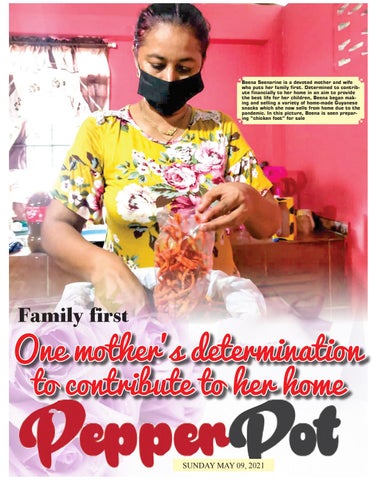
Beena Seenarine is a devoted mother and wife who puts her family first. Determined to contribute financially to her home in an aim to provide the best life for her children, Beena began making and selling a variety of home-made Guyanese snacks which she now sells from home due to the pandemic. In this picture, Beena is seen preparing “chicken foot” for sale
Family first
One mother’s determination to contribute to her home SUNDAY MAY 09, 2021
II
CHRONICLE PEPPERPOT ― Sunday, May 09, 2021
The joys of motherhood
By Dillon Goring IN honour of Mother’s Day, the focus is on one mother who shared with Pepperpot Magazine the challenges and joys of motherhood in this modern age, as compared to motherhood in years past. Rebecca Ganesh, who
hails from Georgetown, has been a mother for 10 years. During an interview with Pepperpot Magazine, Ganesh cited some of the challenges that a 21st century mother faces, as compared to when she was growing up as a child. “I believe that I had an advantage where parenting
is concerned because both of my parents were self-employed. While that is a lot of work on the whole, it was easier for me; hence, both parents are at home. Thus things will be taught at home. Children don’t do sports now, everything now is virtual. Children play games on their laptops
or iPads, thus children are learning differently now as against when I was younger,” Ganesh told Pepperpot Magazine. According to Ganesh, becoming a parent these days is more or less planned; it is a lifetime job and as such, lots of commitment is involved. “There is no right and wrong when you are a parent, each mother deals with various situations in a way applicable to their training,” Ganesh further related. When it comes to those times, when you are despondent, discouraged and frustrated, Ganesh contends that her Dad has taught her to step back and reassess the situation, before deciding to do what needs to be done. “Like most parents, we tend to overthink, we are overprotective, and with the world today, we get overprotective because we know what can happen,”Ganesh told Pepperpot Magazine. In order to preserve both the children’s sanctity as well as hers, Ganesh made it clear that she shares things
with her children in spite of their age, more so because her partner is absent. She believes that sharing gives her children an idea of what is going on in the world around them, so they aren’t oblivious to the world around them. She is also advocating that we shouldn’t wait until our children enter the working world to keep them apprised on what is going on around them. Ganesh believes that because children aren’t exposed to knowledge that a lot of uninformed choices and decisions are made when they are faced with certain challenges. Ganesh believes that one of the most important ingredients in being a mother is understanding, compassion, caring, loving and being very patient. “It is not easy teaching and trying to understand children. Each child is different. If you don’t have a proper cultural background, traditional background, some form of discipline, you cannot expect to have that with your
Rebecca Ganesh and her children
child. If you don’t know how to deal with it -- I am not talking licks here -- but if you don’t know what obtains and are able to distinguish the differences between right and wrong, then how do you teach them?” Ganesh related to Pepperpot Magazine. Ganesh is of the view that because she is academically astute, she is more in an advantageous position to deal with her children’s homework, assignments and so forth, but there can be great difficulty for someone who is not so fortunate. Advice to parents “We are in a difficult time right now, there are more issues with children than there were ever before and parents need to pay attention these days. They need to monitor the things their children are doing and parents need to monitor themselves,” she said. “Children do not need to know everything; as a result of paying attention to children, you will discover when the body languages change.”
III
CHRONICLE PEPPERPOT ― Sunday, May 09, 2021
Family first
One mother’s determination to contribute to her home
By Marissa Foster B E E N A Seenarine also known as ‘Mala’ to her friends and family is the mother of three children. She currently is the owner of a small snacks business at her residence and her snack stand is well known in the community of Enterprise. Her snacks are so good, she would even receive special orders and requests to cater for larger portions of snacks for Guyanese who live abroad. She expressed that she has five siblings so her family was relatively big. Her parents; Alvin Seenarine and Deopattie Somwaru, both worked hard at the sugar estate to maintain their household. Even though her parents couldn’t afford much, they both taught her the importance of caring for your family as she was growing up. As a child, she always wanted to mirror that mindset when she had her own family—so she did. Her father also taught her to cook and clean and that’s how she developed her snack-making skills. She got married at the age of 19 to her husband Rajendra Sheoprashad (Dara). Together, they worked through all of life’s ups and downs. At the age of 21, Beena got
pregnant with her first child; Samantha, then three years later; Amanda and then finally her son; Alex, who she described as the sweetheart of the family. Beena also mothered one of her sister’s daughters since she was a toddler- Cynthia. “We stick together and work through for our children,” said Beena. She continued by saying, “Being a parent isn’t the easiest thing when reality hits you. We ensure we instill good values into our children, ensure the homework is done on time and make sure they have the opportunity to further their education. I didn’t have that opportunity because in those days my parents couldn’t afford it. My eldest daughter finished her university education- is working on her business; my second child is a stay-at-home mom and my son just started his business and I am proud of all of them.” She was a vendor at the Enterprise Primary School for about 15 years. She makes some of the most craved and delicious local Guyanese goodies: plantain chips, chicken foot and sour, cassava chip, phoulourie and sugarcake. She built quite a good reputation, not only for her snacks but also for her good personality. Due to the pandemic, she was forced to
“Chicken foot” prepared by Beena Seenarine
Beena Seenarine preparing snacks for her stand
continue her business on a smaller scale at home. Nonetheless, people would still call home to get their order from Beena. This business has helped her to take care of the three children she has
and her entire family. Her business allowed all three of her children and Cynthia to complete their schooling
Beena Seenarine
while ensuring her the livelihood of her entire family is sustained. It even helped her eldest daughter to pursue
her academic studies at the University of Guyana. Even though her husband worked, Beena was persistent to also work to help the family. This ambition of hers helped her children to excel throughout life as they are all respected members of their community. Beena stressed that scheduling was one of her biggest challenges being a mother when her children were younger. She had to ensure that breakfast, lunch and dinner are ready on time every day. She took care of the house and surroundings to ensure that it was always neat and tidy. She had to balance life with her children while completing tasks around the house. She explained how finances were a challenge. “Making sure our money is always budgeted for the best interest in my family was a challenge. I also worked on the farm when my children were going to school. My husband did Goldsmith work but eventually stopped so we did farming. Then I started my SEE PAGE V
IV
CHRONICLE PEPPERPOT ― Sunday, May 09, 2021
The ‘career mother’ and childcare
By Dillon Goring
FEW can deny the amount care and nurturing that a mother extends to her children throughout their lifetime in an aim for them to become responsible adults, thus making meaningful contributions to society. But many times, those women have to balance that full-time job while also working on their own professional careers. Sherry Jerrick has been a mother for the past 18 years and is one of those moms who juggle work and motherhood daily. She explained that this has its advantages and disadvantages. “The only advantage of juggling work, studies and taking care of my children is that today, I am what I am: everything that I am and everything that I have are attributed to my work ethics, my will to persevere in difficult circumstances and my innate characteristics of resilience, self-awareness and confidence,” she explained. “As for disadvantages, I have a notable few to mention: I was not able to be there for my children as much as I wanted to. Yes, I provided for their needs, but I was physically absent on many occasions. I missed a lot of important events in my children’s life, take for instance my younger daughter lived with my cousin and then with her paternal grandmother from ages 3 to 10. That is 7 years of her life that I missed. I regret it daily. My Elder daughter missed out on a lot of things that she wanted when she was younger mainly because I had to make
choices between keeping her a birthday party and putting food on the table; between paying my university tuition or buying her new shoes and clothing. But I thank God for the support system of family and friends, they made it easier for us.” Jerrick also made mention of the fact that there were times when things were very difficult but she managed to overcome them as well. “If you know me well enough, you will attest that I am a very loving, thoughtful and kind-hearted person. I have never experienced discouragement, tiredness or frustration with my children. I am a very firm, disciplined mother but I have always taught them about the value of contentment and honesty. Therefore, the times when we lack I made my children feel comfortable and loved irrespective…,” she said. “I can recall a short period of my life when my father was ill and bedridden and I couldn’t manage financially so my
Sherry Jerrick
Sherry has two daughters
Sherry’s has been a mother for the past 18 years
daughter and I spent most of our time eating bread with different spreads and condiments for flavour. I believed firmly in the word that ‘this too shall pass’ and it kept me. Thank God it did. I can also tell you about the time I wanted to quit University because my classes were scheduled to end at 9 pm. All this while my daughter was home alone, awaiting my arrival for her dinner. I don’t wish to remember those days. Many see my glory but they have no
idea what my story unfolded. In short, everything that I am and everything I have, I truly deserve.” She explained that mothers need an impetus to push them forward. For Sherry, she is inspired by her children. According to her, she doesn’t want them to experience what she has gone through in terms of working and studying. Jerrick made the point that it could be very difficult to maintain a balance to the extent that she practically self-studied in many courses while attending university. Jerrick revealed also that she received encouragement from her parents and a lot of persons who have impacted her life over the years. “There is an unspeakable, immense joy in being a mother. Giving birth to my children, watching them grow and knowing that they are well rounded and spiritually grounded excite me a lot. That feeling of gratification is often linked to that fact that no matter how many times I have fallen and failed at many, many things, and no matter how much I have accomplished the one thing I have passed with flying colours is the test of motherhood,” she explained. “I did my best and give my all to ensure that they will be better than I can ever be. Today, we are all united and living under one roof. I have a very loving, supportive spouse and an extended family that I love dearly. I wouldn’t trade anything for what God has done, what he is doing and what I am assured by his word that he will do.”
V
CHRONICLE PEPPERPOT ― Sunday, May 09, 2021
Reflection of a journey
One woman’s story of teenage motherhood
By Dillon Goring
TODAY, Guyana joins with the rest of the world in celebrating Mother’s Day. But for many, motherhood can come at a high price. Many teenage mothers are faced with great challenges by getting pregnant at a young age. Eraina Yaw, though now an adult, was one such mother who gave birth at the tender age of 14. Looking back on her journey, she bravely shared her story with the Pepperpot Magazine. “At 14, you yourself would like to be parented, but now you are forced to be a parent for a child, and all I knew about at that age was breastfeeding and making sure the child has clean clothes and feeding the child,” Yaw said. “I was not even at the age of understanding the child receiving the kind of emotional stability that needed to help the child in adulthood. I think at that time I was looking for anybody who could chip in and help, and it took me a while to really hug and taking care of my child.” She stated further that she didn’t know the importance of passing on the values that she learnt to the
child. Yaw is of the view that the situation can get even more complicated in the nurturing of the child when the child becomes ill. “I remember my son got sick, and I went to see him, my mother was sick and I had no support. I was like a helpless person, I didn’t know what to do practically when he went into the hospital, they said that he had a 50/50 chance of living,” she said. Yaw is of the view that at 14, one does not understand the importance of raising a child. According to her, however, these days at that age, youth are a little more informed with the advent of technology and the use of the internet so that they can be advised of the risks of teenage pregnancy. While teenage pregnancy is not ideal, the reality is that it still occurs, and for young mothers who may end up in that situation, Yaw gave some sage advice on how they could cope. “You have to allow your child to grow up in a society feeling as a well-rounded child, so because you are 15 or 16 , it means that you will short change your child in preparing him or her for this
world. You have to prepare them for this world,”she said. “So though we are young, they are still some basic things that we need to understand: that child needs love, care, and attention. To get all of that, you as a parent will need finances, so that you will able to give the children what they need. ” She made mention of the fact that people have to learn all that is needed to be a good parent. A child, according to her, needs to grow up in a home where he or she is properly taken care of, thus, though acknowledging that teenage pregnancy is not always something that can be controlled, she said that the best advice to teenagers is to understand the risks about early sexual activity and as best as possible, to wait until they have all that is vitally important in being a good parent. “They do not mature the way they should mature because there is something that is lacking and then we push them into society with this deficit, the lack of love and we put them out there and they are looking for love in all the wrong places,” Yaw told Pepperpot Magazine.
Eraina Yaw advised young women that they need to be fully prepared for motherhood
One mother’s determination to contribute to... FROM PAGE III
Beena Seenarine alongside her husband and three children
own business and because of this I hardly had time for myself. I made many sacrifices as a woman for my children to keep our family together which wasn’t the easiest of thing”. These days, you will find Beena at home relaxing, learning about new technology every day, or listening to “baby shark” and surfing through app features with her grandchildren, Alvin and Aliyah Nankishore. “They are the light of our home. I enjoy taking care of them and listening to all their intelli-
gent chatters,” said Beena. The Pepperpot Magazine asked Beena to explain what motherhood was like. She responded by saying, “Being a mother is a full-time job. You could feel a whole range of emotions – from complete exhaustion to total satisfaction knowing your children are well and groomed. As a mother my ultimate goal was to ensure my children have better than I did and see that they grow up to become good people.” Beena wants every mother who reads her
story to remember to be someone good and learn as much as you can. These virtues not only helped her in motherhood but also helped her throughout life. She also wants to encourage others to help people along the way and to never forget where you come from. Beena ended the interview by advising young women, “Take your time, develop yourself, understand relationships before you get into one and never settle for less. Learn a skill and learn to make your own money.”
VI
CHRONICLE PEPPERPOT ― Sunday, May 09, 2021
Tigerbone Banakari Nature village at its best
The picturesque villag e of Tigerbone Banaka ri ( Carl Croker photo s)
By Michel Outridge
THIS week the Pepperpot Magazine journeyed over land to Tigerbone Banakari, a scenic village nestled deep along the Soesdyke/Linden Highway. This village is the ideal place to enjoy nature and live off the land and creek and the residents consist of a mixture of people, whose descendants were its first settlers are doing just that. The people are friendly but have a lot of community-related issues which needs to be resolved to fos-
ter community development. Tigerbone Banakari Village is between Dora and Kuru Kuru and forms part of Long Creek and Newtown. Within this community, two miles inland is the home of large scale farmer, Lakhan Budhan, whose farm is considered a paradise. The way of life of the people of this village is very simple and they utilise their skills to earn without potable water supply, electricity and all-weather roads. This village is managed by the Community Development Council (CDC) and
benefits from presidential grants for community development and plans are in stream to construct a multi-purpose centre, where an ICT hub will be installed with computers, internet and furniture. Tiberbone Banakari has a pavilion and the community centre ground is presently been cleared of bushes and weeds and is being levelled. The residents of this far-fetched community are scattered and most of them reside miles inland in Banakari while, just a handful live closer to the highway
Focus on the Village
and they have a few roadside shops. The people of this village are charcoal burners, farmers, skilled persons, miners, chainsaw operators, wood cutters, shop owners and some self-employed folk. The unemployment rate among both adults and youths are alarmingly high and some people have resorted to small businesses while others work on farms and cut sticks for bora crops. There are several small creeks within this village but the main one is about three miles inland and that area is used to fish and hunt for wild meat. At the rear of the village there is a small creek called
Tigerbone of which the village was named after and the place is also noted for its large population of jaguars and other wild animals of the big cat’s species. More than 43 acres of land are occupied and most of it belongs to the Guyana Forestry Commission (GFC) as reserve lands. The populations was tallied at about 436 with 113 households, scattered in both sections of the village, that is, Tigerbone and Banakari. There are no schools or health centre in this village and all services have to be accessed at nearby villages. In Tigerbone Banakari Village there is an abundance of trees, plants, fruits,
coconuts which is small but contain a lot of water and it is indeed a very beautiful place which can become the ideal place to live if you are up to a more nature lifestyle. The history of Banakari provided by Katherine Alfred, Villager, women’s group leader and community elder The word “Banakari” is an Arawak word that has roots with the most ancient language of the word Sanskrit. In English translation it means a dweller of/ cutter of/keeper of wood or a woodman. This was the name that SEE PAGE XIV
VII
CHRONICLE PEPPERPOT ― Sunday, May 09, 2021
Fostering development within the community
The work of the village women
By Michel Outridge
CAMELLA Gomes is 19 years old and is a resident of Tigerbone Banakari Village located on the Soesdyke/Linden Highway and she is passionate about developing her community and enlisted to become a volunteer. She is a Community Service Officer (CSO) and one of the members who were instrumental in hosting a village fundraiser to outfit the group with tee-shirts. Gomes told the Pepperpot Magazine that they had no money to host the event which was strictly a takeaway service one where drinks and barbeque were on sale and they had no gathering in keeping with the COVID-19 guidelines. She stated that a member, Alexandria De Abreu lent them the money to buy drinks and the chicken and they did the cleaning, clearing and cutting of trees at the
the barbeque chicken and that money will be used to get some tee-shirts for the CSOs. She related that the first project the CSOs did was the community census and they did a walkabout in the village where they went door to door to ascertain the population. They registered 436 persons including children after visiting 113 houses. Gomes has five siblings and collectively they work on their farm which is located about five miles inland to earn since they do not have jobs. She needs a place to set up a baker shop since she is qualified as a baker and is willing to go into the pastry business, on a small scale. “I have some visions that I would like to come to fruition but I need a little push and with that I know I will get started because I have the potential to be successful,” she said.
Tigerbone Banakari Community Service Officers (Carl Croker photos)
Sandra Budhan
front of the village where the event was held. Gomes added that they made a profit of $46,000 from selling beverages and
Her sister is the holder of nine subject and is unemployed and they also need transportation to get to their farm.
The Pepperpot Magazine also met Sharon Henry, the village cook, who prepares all the Amerindian cuisines whenever there is a function in the community.
Focus on the Village
Sharon Henry
She has been residing in Tigerbone Banakari since she was 12 years old and today she has three children and is settled. Henry is a member of the Women’ Group and they have a sewing machine but need a place to sew. They intend to make fabric face masks for the entire village among other charitable proj-
ects. Presently, they are making from scratch costumes for the children for the May 26, Independence Parade and flagraising ceremony which will be held in the village. She disclosed that the women’s group was founded two months ago and they have a total of 22 mem-
bers, all from the village and they have been doing things quietly to develop the community. “I am doing my part to contribute to the community and it feels good and I will continue to do whatever I can in the interest of the people,” she said. SEE PAGE XXIV
VIII
Life in Tigerbone Banakari Village
By Michel Outridge
CLEVELAND James is considered an all-rounder in the village because he is the “Jack of all trades”- a talented individual, who can do almost anything. He is a resident of Tigerbone Banakari Village and has been living in the village since he was just three months old.
The father of one told the Pepperpot Magazine that he is originally from Kuru Kuru and would often venture into the interior to work as a land dredge operator and when he is at home he would burn wood to make charcoal to earn. James is also a chainsaw operator and is into wood cutting and the felling of trees and would take up that
job when he can. “I would try to do any job that is available around because I have a son writing exams so I want him to be able to access the internet and do well with his school work and also to set a good example as a father,” he said. James stated that he is mobilising the people in the village to establish a Community Policing Group
Focus on the Village
CHRONICLE PEPPERPOT ― Sunday, May 09, 2021
Cleveland James (Carl Croker photos)
(CPG) and an election of the members will be held on May 23 where volunteers will be elected by the people. He reported that he has gone into the charcoal business with his brotherin-law at Red Road, Long Creek, and their business was registered in January. “If you want to live a comfortable life you have
to do many jobs to make it and that is my aim,” he said. He is working with the Tigerbone Banakari Heritage Group to have a village signboard erected at the front of the highway which will identify the name of the village and they had a fundraiser for the $34,000 they have garnered.
James reported that they had a community fundraiser to get money for uniforms for members of the group and they raised $37,000 among the people. He added that nothing will go well if the people are divided and for cooperation SEE PAGE XV
The people of Tigerbone Banakari Village
IX
CHRONICLE PEPPERPOT ― Sunday, May 09, 2021
For the betterment of our people Tigerbone Banakari residents have the best interest of their village at heart
By Michel Outridge KATHERINE Alfred, better known as “Kathy”, is a resident of Tiberbone Banakari and she is the Chairwoman of the Women in Motion Group, President of the Banakari Heritage body and was former Chair of the Community Development Council (CDC), from 2012 but was knocked off the list of electors. She has been the foundation for development within the village from the onset and she is geared towards having the community regularised and for the people to have a housing scheme since they are scattered in the village. The people of Tigerbone Banakari are descendants of the Carib, Warrau, Arawak and the Akawaoi tribes. They are some Indo Guyanese and others of mixed race in the village and from the looks of it the people get along mostly. Alfred told the Pepperpot Magazine that she settled in
the village in 2002 and she used to reside with the rest of the people which was two miles inland. She explained that the village was registered in 1994 by the then village leader, a woman, who has settled there with her family. Alfred stated that in 2002 the village was bare, it had nothing in terms of facilities for the people and she only had a child and began her quest to develop the place. She mobilised the people and they collectively formed a CDC and started to ask the government for assistance for a community centre and other things. Back then, Alfred reported that they had 266 residents and they were given 43 acres of land to occupy but over time the population has increased. Alfred added that the people need a concession for large scale farming and over time they will get that. “During the elections, the administration made some promises to the people and after they won, those
Villagers at the pavilion in Tigerbone Banakari
promises came to fruition and things are happening for the community,” she said. Alfred pointed out that
the area for the pavilion is being cleared and levelled and it will accommodate a ball field for sports activities and meetings. She added that all community activities will also be held at the location that is being developed. Under Alfred’s chair of the CDC, the villagers benefitted from a solar panel and
Katherine Alfred
Focus on the Village
Raffeena Williams (Carl Croker photos)
a black per household and a laptop each was also given to 13 families. She also made a proposal for the upgrading of the sports ground and the construction of a resource building to house the women’s group, the cooking class and residents for skills training. Meanwhile, Raffeena Williams, Secretary of the
CDC, whose father, James Williams is the Chairmanm, reported that they received a grant through the Ministry of Amerindian Affairs to construct a multi-purpose building but the project was stalled because the foundation is defective and they are awaiting an engineer. SEE PAGE XXIV
X
CHRONICLE PEPPERPOT ― Sunday, May 09, 2021 Farmer, Lakhan Budhan with his freshly harvested papaya (Carl Croker photos)
The trail that is maintained by Lakhan Budhan and leads to his farm
The best crops for miles Tigerbone Banakari farmer well-known for his produce
By Michel Outridge L A K H A N Budhan is a large scale farmer of pear, papaya, breadfruit, coconuts, corn, limes, lemon,
The 68-year-old has in his employ eight workers on his large farm which is managed by himself, youngest son, Ajay and his wife. The farm is located about
“I would take my produce, farm fresh to Stabroek Market to sell it with my wife and would also sell to wholesale buyers, who would export the seedless
Lakhan Budhan and his wife on their farm
watermelon among other crops on his 150 acres of farmland in Tigerbone Banakari Village, Soesdyke/Linden Highway.
two miles inland and the trail leading there is maintained by Budhan, who would take his produce to the market to be sold.
limes and the papaya which came from Israel,” he said. Budhan was once asked SEE PAGE XI
Focus on the Village
XI
CHRONICLE PEPPERPOT ― Sunday, May 09, 2021 Budhan’s farm
The papaya cultivation
The best crops ... FROM PAGE X as a child in school what he wanted to become when he grew up and without hesitation, he told the teacher he will be a farmer and that vision came to fruition because when he came of age he began farming. He is originally from Soesdyke and relocated to Tigerbone Banakari after he bought some farmland and began his cultivation. As unreal as it may seem Budhan has seven wives with a total of 27 children, all of whom have their own farms and most reside in the many villages along the highway. At Budhan’s farm, it is indeed a paradise, the well-maintained grounds are something to be seen with the naked eye and the place is huge. He also has his house on his farm and resides with his third wife and son, Ajay, who is his main farmhand, who does the work and also assist him to sell the produce. The farmer facilitated a tour of his farm during the team’s visit to the village and it was a guided tour that was most rewarding.
The abundance of coconuts trees are a wonder and you can stand right by the tree and without any effort to pick water coconuts. These water coconuts are small but has the most water and it is a very refreshing drink. Budhan, apart from farming, which takes up most of his time, does a lot of volunteer work for the people and the community. He has spearheaded many charitable events to raise funds for the village and has the interest of the people at heart. He would go out of his way to ensure the needs of the people are met. “Whenever the need arises I would give back to the community and it is a wonderful feeling to do something for people and to give something that is needed,” he said. The farmer would work closely with the CDC and community leaders and would gave his time and energy to participate in community-based development projects and also serve as a village elder. Budhan has a wealth of knowledge when it comes to farming and would of-
ten take people to work with him, most of whom he would have guided. He told the Pepperpot Magazine that at times he would have a dozen workers on his farm but due to COVID-19 and the economic hardship he had to let go of some employees but will take them back once he can afford to. “Being a farmer is not a dream job, it is hard work around the clock and the know-how to keep the crops alive is what makes you a good farmer and the job doesn’t come with prestige but for me and my family it is food on our table and it feels good to grow our own food,” he said. Budhan stated that the village needs responsible people to manage the finances of the village and for that to happen there must be accountability and it is causing separation and much bickering among the people. Despite these budding issues within the village, the farmer is always willing to lend his support to the people for the village to be developed to a standard that will be beneficial for all.
XII
CHRONICLE PEPPERPOT ― Sunday, May 09, 2021
‘Made in Guyana’ does not mean inferiority
WHEN we discuss Guyanese businesses, we often use the term “local.” It is most often used to describe products that are made in Guyana or businesses in Guyana. Apart from using it as an adjective to describe businesses, some Guyanese also use it as an insult or jab at products or businesses from Guyana. When comparing Guyanese-made products to imported ones of similar properties, the term “lo-
cal” is used to describe the “lesser” of the two. By now, I’m sure you can tell which one they consider “less” or “inferior.” Does this always mean that local products are inferior compared to imported products? Are local products made from inferior ingredients? Aren’t entrepreneurs in Guyana as skilled and qualified as foreigners? There’s a feeling of intense contempt towards local businesses in Guyana. Yes, some of us
support local businesses and their products but perhaps, we do so because it’s a friend or a friend of a friend. Or, maybe we simply support said business because it’s trending. I’m in no way saying that because it’s a Guyanese-owned business, it means we should support it—simply out of patriotism. No. What I’m saying is that we ought to learn See Page XIII
Locally made Guyanese organic products (Babe Cave Guyana photo)
Scented candles handmade in Guyana by Aura Organix
CHRONICLE PEPPERPOT ― Sunday, May 09, 2021
‘Made in Guyana’ does not mean... From Page XII
to give credit where it’s due and that should include our local businesses as well. We should be more open-minded about trying locally made products and supporting local businesses. Guyanese will have doubts about the ingredients used in a Guyanese brand, but they’d buy a similar, imported product without thinking twice about what it’s made with. I do agree that local business owners have a part to play in this as well. They ought to help Guyanese customers trust their brand and name with accountability and assurances. Nonetheless, I still believe they have to work twice as hard to gain consumers’ trust—even with the best marketing strategies in place. Let’s work hand in hand. Both consumers and local business owners of Guyana ought to work together to help make “Made in Guyana” a term of quality. To consumers: the next time you buy imported plantain chips without thinking twice, consider the local vendor on the road. Maybe his plantain is organic and tastes 100% sweeter. To local business owners; learn how to promote your brand and don’t give up. By shopping local you are helping to create jobs in our country; you are helping to put food on the table for many business owners and most importantly—you are helping to uplift the name of the land of many waters.
Locally handcrafted hair slides from Guyanese owned business, Eccentric Creations
XIII
XIV
CHRONICLE PEPPERPOT ― Sunday, May 09, 2021
Tigerbone... FROM PAGE VI was given to the land by a woman named Doris Jacobs from the Arawak tribe. She travelled up the Demerara River with her grandchildren to find a much easier way of life in the year 1972. As they paddled up the river they came across a creek. Little did she knew that this creek would change her life and the lives of others that followed. After paddling for what seemed like four new moons they stopped and built a Troolie hut to stay for the night. What she found was a paradise, a place where their lives were made easier, the kind of place for which she was searching.
There were numerous species of trees which could be harvested to make charcoal, fish which she had never seen before and lots of wild meat to eat. After a few months of settling in Banakari she met Henry King and his two sons where who were from the Warrau tribe and they travelled together from Morawhanna, Barima River, Region One. Like herself, they too came here in search of a better life. Henry King got married to Carmen William, another Arawak for she came in search of a better life also but she migrated from the Pomeroon River. She wrote letters to her family describ-
ing Banakari and invited them to come and see for themselves. They came and found it was exactly as she described in her letters and they never left, for life was easier there. In the year 1988 her father passed away she informed her brother James Williams, who at the time resided in the Pomeroon River. Two years after in 1990, James’ wife passed away. Decoding that was best he and his family came and settle in Banakari. As the years passed on the Ramdeos, Stephens, Klass, Katttows and Mendocas settled in Banakari. Since then Banakari has become a place of family settlement and to some an inheritance.
XV
CHRONICLE PEPPERPOT ― Sunday, May 09, 2021
Life in Tigerbone ... From page VIII
to take place a fresh election should be held for the people to elect members for the Community Development Council (CDC). Meanwhile, the Pepperpot Magazine also met Joshua Singh who is self-employed and one day would like to have his own small business of catering. As is, he has a small village shop and the people support his business as such, he can bring in an income in the home. He resides down a small trail that goes for miles at Banakari and is also hoping to benefit from a government scholarship. He stated that there is a genuine need for transportation for the people in the community because many also walk for miles to get to their farms. Singh also reported that there are many school-age children in the village and they do not have access to the internet for virtual schooling and for eight years they have been advocating for an ICT hub in the village for all. He added that the project started but stalled due to self-interest since the grants are not being used for their intended purpose. Singh pointed that a new election for the CDC body should be held since it was done without the knowledge of almost the entire village and persons were hand-picked by themselves for the positions, from one family and that is not right. He, like most residents, is calling for an audit of the finances and for an investigation to take place by the authorities, and for immediate transparency of how grants were spent.
Joshua Singh.
XVI
CHRONICLE PEPPERPOT ― Sunday, May 09, 2021
A MOTHER’S DAY SPECIAL TO DANCE AGAIN
PEARL was her birthstone, yet she loved red. Alex smiled, pleased as he took out the gift bag from between his clothes in the wardrobe. Today was mother’s day and he had bought a special gift for his mother two days ago. It was something he knew
she would love, something that would have been beyond him, hadn’t he won the logo competition by the Ministry of Culture, Youth and Sport. He had spent long hours on the design and won something for the first time in his life, a win that was for her. But she did not take the mon-
ey, telling him he had earned it, for his time and dedication in his artwork. He had hugged her for being such an understanding mother and for everything else. The gift, though beautiful, was nothing compared to her worth, for as a young mother who had gone through so many struggles in her life, but stood strong
and dedicated to her three children, she deserved all of the gifts and flowers in the world. Alex was only 11, yet he understood as her oldest child, the struggles in her life since his father left.
a teacher, so on working days she always had to be up early. He prepared tuna and toast, a little burnt, as quietly as he could and laid the small table in the kitchen, hoping it could be a good start to the day for her.
nice!” She unwrapped the gift slowly and for a long moment, she did not say anything, then she looked at her son, tears in her eyes. “This is so beautiful.” It was a pair of red shoes.
Photo courtesy of Katie Rodgers
How many nights from seven years old hadn’t he heard her crying softly, but in the morning there was always a smile for her children, a smile to tell them, everything would be fine. Alex opened his bedroom door quietly and went to the kitchen to start breakfast, for today was her special day; a day she could get a little extra sleep because she was
She smiled when she came to the kitchen, pleased at the surprise breakfast and hugged him, “Thank you, son.” After breakfast, to which she added scrambled eggs and bacon, he brought the gift bag, and smiling, he said, “Happy Mother’s Day.” “Oh,” she exclaimed, surprised again, “This is so
“Do you like it?” he asked, a little anxiously. “You know I do,” she said, “But why the shoes?” “So you can dance again.” She looked at him, a flicker of pain flashing across her face and she said quietly, “You know I have no one SEE PAGE XVII
CHRONICLE PEPPERPOT ― Sunday, May 09, 2021
A MOTHER’S DAY SPECIAL... FROM PAGE XVI
to dance with now.” “Someone can come along,” he said, a positive note in his voice, but the flicker of pain in his expression, she saw. She hugged him, and mother and son stood there for a moment in each other’s embrace, pain in their hearts from the absence of a husband and father. He had walked out on them, his priorities in life having changed and never looked back, breaking his promises and vows. Times had become hard for her, but she did not give up, battling on with a little help from family and the church. Today, she could afford to rent a comfortable, two-bedroom bottom flat as she awaited the processing of her application for a house lot that would give her a chance to own her own house. She still had a long way to go as she continued working and striving to lay a solid foundation for her children. Alex had known she would be happy with the gift, because she loved to dance but since his father left, she had stopped dancing. Red was her favourite colour and knowing she had a red dress she hadn’t worn yet that her sister had given her for Christmas, he had looked around until he saw the perfect pair in the showcase of an exclusive boutique. It cost more than the money he had and two days later, after borrowing some money from his grandmother, he went to the boutique but almost lost the shoes. A tall gentleman was about to buy it, “For my sister’s birthday,” he was telling the salesgirl. “Sorry, sir,” Alex had said without hesitation, “But that’s my mother’s shoes.” The man had looked at him curiously, “Really, son? I thought these shoes were for sale.” He looked at the sales girl, puzzled, “Are they not?” “Yes, sir,” she answered. “No,” Alex had said almost frantically, “I entered a logo competition and worked long hours on the design, so I could win the first prize money to buy these shoes for my mother,
so she can dance again.” The man had looked at the boy for a long moment, at the slight tremor on his lips, the money in his trembling hands and shaking his head resignedly, he had handed him the shoes saying, “Your mother is a lucky woman, to have a son like you.” As Alex rode to school that morning, he wondered, “Now who can I get to dance with her?” Since his father had walked away, she had shown no special interest in anyone. “Not everyone wants a woman with three kids,” he had overheard her telling his grandmother one day. “There must be someone,” Alex thought to himself, “Who is loving and kind.” The days that followed were a little out of the norm from school, basketball practice and church for the young boy, for every good-looking gentleman he saw, he wondered if they were single and if they could be someone his mother would like. One afternoon as he was shooting hoops, he paused and chided himself, “This is crazy, what am I thinking?” He tried to push the thought at the back of his mind, as his mother continued to work to provide for her family. It was almost four months since Mother ’s Day and one afternoon on the basketball court, Alex fell and hurt his ankle. She rushed him to the hospital, praying in her mind, “Oh please God, don’t let this be bad.” The x-ray showed it was just a hairline fracture and she sighed deeply in relief, “Thank you, dear Lord.” She was walking back from the hospital’s dispensary after collecting some medication for Alex, when someone called her name. “Jennifer.” She turned around and saw it was one of the young doctors, not someone she knew, but he knew her name. “Yes?” “Don’t you remember me?” he asked, a courteous smile on his face. She looked at him, tall with casual good looks, not sure she knew him, after he hinted, ‘high school.’
She gasped, “Oh my god, Dylan it’s you!” He nodded, laughing a little at the surprised look on her face, “It’s been some time.” “ I k n o w, ” s h e s a i d , pleased at meeting an old school friend. “When you went away to Cuba to study, we lost contact.” “It’s great seeing you again,” he said, and looking at Alex he asked, “Your son?” “Yes,” she answered with pride, touching her son’s shoulder. Alex could hardly believe it. It was the gentleman from the store where he bought the shoes. “Is she dancing now?” he asked Alex. Jennifer looked puzzled as Alex shook his head and Dylan explained. “I was at the store when he bought the red shoes for you so you can dance again.” “Oh,” Jennifer exclaimed softly, looking a little uncomfortable. “She stopped dancing since my father left,” Alex said, trying to make something happen here. Jennifer looked at her son, surprised, “Alex you don’t have to--” “What happened?” Dylan asked. Jennifer shook her head a little, not wanting to talk about her failed marriage, “It’s a long story, you really wouldn’t want to--.” “I’d love to,” he interrupted her, “We were once best friends.” She smiled wryly, “I have to go.” She assisted Alex to his feet and as she turned to leave, Dylan asked, “Over dinner, maybe, Saturday night?” She hesitated and Alex pinched her arm whispering, “Say yes, mom.” She couldn’t help smiling at her son’s request and after a short moment, she nodded, “Okay.” “Great,” Dylan said. The wish in the boy’s heart was that the young doctor was the right one for his mother, the one thing that was missing from her life. Now she would wear the red shoes and dance if there was music and a song in her heart.
XVII
XVIII
CHRONICLE PEPPERPOT ― Sunday, February 28, 2021
CHRONICLE PEPPERPOT ― Sunday, May 09, 2021
XIII
ON THE AWARENESS OF THE AESTHETIC AND THE‘BEING’ MYTHOLOGY OFYOUNG URBANNATION AND RURAL THE OF OUR Part II
HUMANITY ON THE CULTURE OF THRIFTINESS
IN concluding this discussion, which is intended to raise questions within the reader and inspire responsible actions among those that acquire decision making positions or are already there, we cannot arrive at a sensible without considerations in retrospect. So in a brief flashback, we must recognise, what we have lost to our physical memory reference archive, and use this as inspiration, to be able to raise a natural alarm, a connection to the aesthetic sensitivity alerting us to the fact that we need to have a historical memory in respect to our surroundings, as buildings, landscapes and architecture are inherent of memories in both the conscious and subconscious awareness. We have to become other than people who occupy a geographic space on this planet, and relate to what is the necessary thinking that will enable us to address from the now onward what is significant to telling our stories, especially stories important to our timelines. When we became independent, the euphoria of self-governed nationhood intoxicated us, it had its grounds for intoxication alongside sober examination. We did not make the observation that all around us within the borders of countries we still held controlled admiration for, had retained the edifices of past times. Our own coloniser England never dismantled Hadrian’s Wall. In more ways than one, from previous colonisers and also from despised local leaders, they kept the memory for reflection, in our Caribbean, Christophe’s spectacular fortress of defence in Haiti will remain, regardless of his history. Europe with the obvious white supremacy that emerged with colonisation did not destroy the sculptures of Afro-European Knights, artworks and literature that spoke of, or alluded to the African presence in a much older Europe, of course, they didn’t in-depth celebrate them either, and also hid their identities with new portraits and in movies. Where we erred in Guyana was not to use the structures that became available with the decline of trademark services like the Trains, to build museums dedicated to that part of our historical memory. Why preserve the physical imagery of the past? Simple, our ancestors lived it, for the historian, the creative mind, the investigative journalist, the physical location is important. The development of museums was a continuous peeve of the late Dr. Dennis Williams, who had identified Five Museums to be built, he insisted that a marine museum would have been a must. I can now imagine a display of the ship’s kitchen on Lady Northcourt with its cook, the portrait of indifference ‘John’, ‘keep away from John’s kitchen, and why?’ A caption should read before this rude faced ship’s cook made of papier máché –“whose kitchen lay beneath a toilet, from which water dripped continuously, or so we were made See Page XIX
It is part of our humanity to compare to justify one’s self whether nation by nation or human variation against variation[ ethnicity] it’s called the ‘Coherence Theory’, and this study does not always reveal pleasant evidence through its findings; one of the areas that are related to the articles I recently did is the values and realities of Town and Country, in relation to thriftiness, and I should say how mythologies evolve and become etched into customary perceptions, and adopted as truth. Our history is essential In such a narrative, Berbice, Essequibo and Demerara were separate colonies and each had its own centre of administration, which was the foundation of the subsequent townships, the oldest seat of the colonial administration was Kyk-Over-Al and its plantations, 1644 in Essequibo-Winston Mc Gowan: with Demerara, Stabroek as the capital on the 14th September 1784 (Georgetown would come in 1812)-James Rodway: and New Amsterdam in 1796-Alvin Thompson: but it is the differences of economics and culture that would follow as towns grew. In 1834 emancipation followed and the first villages were bought and streamlined, and livelihoods explored and challenged by the colonial interests, that resulted in the importation of new peoples brought to exact the cheapest labour needed to support the economics of the then colony of British Guiana and to fit into the schemes of the plantocracy against the foremost foe, the freed Africans. Hostilities emerge in many cases from conflicts based ‘mainly’ on ‘economics’, ‘cultural isolation from and of the other’ and challenges to rights due to bigoted nepotistic class echelons. There’s a piece of information that will formulate how unique hostilities emerge; “Berbice and the Courantyne were less malarial than the Demerara coast and Georgetown. With this advantage of health and the fact that the land is more fertile here than between the Demerara and the Berbice, it seems a paradox that Georgetown and Demerara should have become the focal point of the Colony. New Amsterdam, however, was unable to keep pace with Georgetown because its harbour was even more disadvantaged than that of the capital. The bar at the mouth of the river the Demerara will allow small ocean vessels to enter the harbour, but only coastal vessels can enter the Berbice. Anchorage at New Amsterdam is ten to thirteen feet compared with 24 feet at Georgetown. Thus, New Amsterdam has no direct trade with the outside world; all its imported goods come by rail or coastal vessel from Georgetown. Its tradesmen complain about this dependence on the capital, and in general the townsfolk have no great love for Georgetown”. –British Guiana by Michael Swan 1957. The other is a rebuttal by Roger Ally (Kaieteur News Feb. 17, 2013) “I condemn the racism contained in these two letters “ written by Vassan Ramracha and Devanand Bhagwand. The writers had both demonstrated the insensitive perceptions of non-exposure to crucial historical and social-environmental processes. To quote Roger on this, he had then explained the differences in economics to urban living compared to rural living, I will elaborate from my own experiences because I was fortunate to have been raised by my god-parents at Mahaica, an experience I cherish for what I learned, my mother and her entire lineage are urban, my great grandfather was born in an area called Robbstown, Grace (my mother) in Bent Street. My dad at Bartica, his dad from Friendship, East Coast, his mom from Bartica, SEE PAGE XIX
CHRONICLE PEPPERPOT ― Sunday, May 09, 2021
THE MYTHOLOGY OF URBAN AND RURAL ... FROM PAGE XVIII
most of his relatives in Charlestown, and Ruimveldt with that social and cultural diversity, which I think Roger Alley must have had experience or exposure to, that allowed his cognizance to assimilate, shaping a much more diverse and grounded perspective on the norms that are applied in forming perceived social and cultural advantages and disadvantages among peoples. The fact is what lies before all of us today may well have taken hundreds of years to envelop individuals and transform group creeds towards responses of a certain necessary likeness. I can remember talking to relatives my age; just post my God-father’s demise exchanging ideas about owning real estate, they would tell me about a front or back house here, in this or that street, I spoke about buying a land, they would look at me with knitted brows, rightfully so, where in Georgetown did this land to plant fruit trees and to build a four-bedroom house exist, from where I stood with juvenile economics. This was not the usual in rural areas either, people are downtrodden poor everywhere, but in the country, there are multiple areas of earning real money that are non-taxable, and real estate owner rates are not compete-able between rural and urban. The Public service –plus workers and private sector staff of our Townships do pay most of the national taxes. But if you got the money back then in the rural areas it would be more possible to fulfil that juvenile dream at far less. I can remember a friend who lived in the High and Drysdale Streets ‘Big Yard next to relatives of mine, who told me that he ran from the front of the yard to the back in celebration of yard space, in special excitement, when his family moved into their new home in South Ruimveldt in the ’70s. Those “Niggeryards” that Martin Carter referred to, existed for almost 100 years until the post-Independence Government freed the occupants from the psychological generational poverty and desperation they represent, this disparity exists in cities across our human world, so do the misconceptions.
XIX
XX
CHRONICLE PEPPERPOT ― Sunday, May 09, 2021 Collecting the catch
Through the eyes of Eric - An Artisanal Seabob Fisherman
SOOKNANAN Takchand, better known as Eric, has been an artisanal seabob fisherman in Guyana for more than 50 years. He started fishing at age nine to support his mother and younger siblings. Whatever he caught, Eric either sold or took home for family meals. Today, a husband and father of four, Eric forms part of Guyana’s artisanal seabob industry, which contributes to almost 2 percent of the country’s total seabob landings. He mostly harvests seabob (coarse shrimp) and white belly shrimp (fine shrimp) that is processed in two ways: 1) by drying and 2) by peeling to sell fresh in local markets. “Most Guyanese utilise a lot of seafood especially Seabob. It is a daily meal for us. I can eat that all the time. My favourite is curried shrimp with dhal and rice,” Eric relates. Guyana’s seabob industry Guyana is the world’s largest producer of Atlantic seabob (Xiphopenaeus kroyeri), a commercially important shrimp harvested from the Atlantic Coast, which stretches along from the United States way down to Brazil. Both industrial trawlers and artisanal fishers harvest seabob in Guyana, but most of the industrial catch is processed into frozen, peeled shrimp to supply local and international markets. The industrial trawlers that operate offshore harvest the majority of the seabob, and function in accordance with the Marine Stewardship Council (MSC) certification, which started in 2019. The certification tool measures the industrial seabob processes to ensure sustainability in operation and quality seafood products. MSC Certification is the only scientific measuring tool for wild-capture fisheries certification and eco-labelling programme that meets best practice requirements as set out by the United Nations Food and Agriculture Organization (UNFAO). Most of the industrial seabob catch is exported to North America. As important players in the seabob value chain, both artisanal and industrial fishers are part of the FISH4ACP Project. The UNFAO is the implementing partner for FISH4ACP, an initiative of the Organization of African, Caribbean, and Pacific States (OACPS). The programme aims to make selected fisheries and aquaculture value chains in Africa, the Caribbean, and the Pacific more sustainable. In Guyana, FISH4ACP focuses on enhancing the productivity and competitiveness of the Atlantic seabob fisheries while helping stakeholders overcome some of the challenges faced. Artisanal seabob A typical day for Eric and his fellow fisherfolk starts at the break of dawn when the red and white scarlet ibises and several other bird species noisily flock to the fishing dock at Good Fortuin, looking for their meals. When the tide does not permit for fishing, some of the artisanal fishermen can be seen repairing their nets and boats, building new vessels or cleaning and servicing their other fishing gears. On a usual fishing day, however, the workers equip their boats with iceboxes, fish crates, and nets in preparation for SEE PAGE XXI
XXI
CHRONICLE PEPPERPOT ― Sunday, May 09, 2021 Pulling in Chinese Seine
Sooknanan Takchan (FAO Guyana photos)
Through the eyes....
FROM PAGE XX
their journey to sea. Artisanal seabob fishermen use the Chinese seine gear that catches the whitebelly, seabob shrimp and anything else that gets into the nets. Eric explains that the Chinese Seine gear is designed to be positioned at one spot, making it work better during the spring tide, when the tide and currents are favourable. The current steers the catch into the nets. When the tide recedes, the fisherfolk haul the nets aboard and collect their catch. Environmental Impact To ensure sustainable fishing practices, Eric and other small-scale fisherfolk only work for about 60 hours per month or in the spring tide for 10 days in every two weeks. The reason for this Eric explained: “For a couple of years now we were facing depletion of catches. We are not producing the catch we used to produce before so we are giving the sea time so that our shrimp and fish can multiply. We are trying to rest the area and doing our best to preserve the species for a better catch.” The artisanal fishermen also believe that the Chinese Seine gear is environmentally friendly because it is a stationary small-scale operation. Social Impact Eric conveyed that artisanal fishery allows him to provide a stable livelihood for his family and educational opportunities for his children. He was a member of the Region 3 Fishermen Co-operative Society before the group became inactive. He now hopes that the 30-plus fisherfolk operating at Good Fortuin can form an association to get better organized and have a greater impact at the national level, in addressing issues such as declining stocks, more favourable duty concessions, piracy, acquiring boat licenses, training for captain licenses and other important concerns of small-scale fisherfolk. Economic Impact Quantity per catch and price for seabob is challenging for fishermen and vendors when trying to find the balance to ensure profitable operations. Both vendors and fishers are key stakeholders in the value chain that depend on each other. According to Eric, COVID-19 had a big impact on the seabob industry. “During this time, we relied on our savings to take care of our families because the quarantine closed down everything and prevented people from shopping. This forced us to stop fishing for a few months and to take the necessary precautions to protect our fishing gears at the landing site and at sea,” he explains. Eric feels that the FISH4ACP programme can help in several ways. With the information collected, the project can help artisanal fisherfolks identify the reasons for depletion in catches and find solutions. Fishers hope also that the project can provide training to help them manage their business, and assist to set up an association. “I would like the artisanal fishery operation to be certified like the industrial fishery so that we can sell our shrimp to them for exportation,” Eric also expresses.
XXII
CHRONICLE PEPPERPOT ― Sunday, May 09, 2021
Will violence against women ever stop? XXVII
bruary 28, 2021
HOW many more ‘Breaking News’ reports of abused women do we have to see before we realise that the scourge of violence against women is rooted in systemic, structural problems that simply cannot be solved by telling a woman to leave an abusive relationship? I wish I knew the answer. Just recently, two women were killed by their partners. The body of 20-year-old Shonnette Dover was discovered in a shallow grave, in Linden, after it was revealed that she
y
al al esier,
nt -nal as, hat to
training of Parliamentarians so that a semblance of decorum could be maintained in the National Assembly. It is envisioned that such training sessions would also help to guide the officials on proper parliamentary procedures. But also, these events should force us to reconsider what we expect and accept from our elected officials -- all of them-- while they discharge their responsibilities towards us. Are they articulating our collective values when they make racist, sexist, homophobic, and other derogatory statements?
Are they adequately representing us and our best interests at all times? I hope we can do better. If you would like to discuss this column or any of my previous writings, please feel free to contact me via email: vish14ragobeer@gmail.com
on ifes es is
le, of nd ble nal
eon nal ly
ars of illd of
was allegedly shot dead by her boyfriend before he buried her in his backyard. There was also 43-year-old Nicola Wilson who was stabbed to death by her partner who later committed suicide. Since 2019 it was revealed in a UNDP study that more than one in three Guyanese women experience intimate-partner violence (IPV) and some 20 per cent of women in Guyana have experienced non-partner sexual abuse (NPSV) in their lifetimes. Late last year, Minister of Human Services and Social Security, Dr. Vindhya Persaud, said that over 210,000, or three out of every five women have experienced some form of violence, either sexually or physically.
ade za de m. he xt, re
ple ld ishe cal to er
nsis all he vhe
ve in re of on
Again and again, these extremely unfortunate things happen. And again and again, we share these stories like wildfire and we talk about how sickening our society is becoming before a few days pass and we forget our anger and disappointment until the next breaking news hits us. It seems to be a daunting, unending cycle. As I have referenced before, women’s rights activist Danuta Radzik emphasised that domestic violence and gender-based violence are not just a man getting drunk and beating his wife, or him beating his wife because she is not a good housewife. While these are issues that should be addressed with much alacrity, she clarified SEE PAGE XXIII
CHRONICLE PEPPERPOT ― Sunday, May 09, 2021
Will violence against ...
FROM PAGE XXII
that those occurrences are symptoms of a system that oppresses women and women’s rights. The root causes, according to her, include gender inequality, gender discrimination, and the social system of patriarchy. According to Abeda Sultan (2010), feminists use the term ‘patriarchy’ to describe the power relationship between men and women, as well as to find out the root cause of women’s subordination. The need for transformed power relations has been touted as the way forward, since the entrenched system of patriarchy yields power over women, and even those men who are perceived to be “weaker.” These power relations are about who can make decisions and take action, and who does not. They are about who is accorded respect and authority, and who is not. They are about who is seen as the property of another person, or merely a sex object, and who is not. These power relations are pervasive because though the status quo is continuously challenged by people like our activists and advocates, the rest of us are only proactive for the short while we are angered and are mourning. These unequal power relations between men and women are also pervasive because our socially constructed beliefs, norms, and traditions have legitimised how men interact (degrade and disrespect) with wom-
en, and on what women are supposed to stay silent. So when we talk about gender inequalities, these are all factors that must be considered and interrogated. The thing is, if we are genuinely interested in seeing this scourge of violence against women eliminated, we have to be willing to understand that domestic violence is a systemic issue and we all interact with the system of oppression every single day. Our advocacy, activism, or simply, outrage must not end after a WhatsApp status or Facebook post. We have to be willing to do the hard work in dismantling these structural causes- whether that hard work means being activists and advocates, or supporting the activists and advocates, whether it means interrogating those relations in our private spaces, or whether it means sharing the knowledge with other people. The deaths of these women must not merely add to yet another report from an international partner. These women and their utterly untimely and unfortunate deaths must be more than just statistics that are used to decry the scourge of action. There must be real, tangible efforts taken by each one of us to dismantle this systemic scourge that bedevils our country and the women in this country. To answer the question of whether violence against women will ever stop, I will say only that it has to. It has
to stop. If you would like to discuss this column or any of my previous writings, please feel free to contact me via email: vish14ragobeer@gmail.com
XXIII
XXIV
CHRONICLE PEPPERPOT ― Sunday, May 09, 2021
For the betterment ... FROM PAGE IX
Rowena Rodrigues
Williams added that an ICT hub is also expected to take shape within the village and a bus will be bought for the transportation needs of the villagers. Rowena Rodrigues is one of 10 Community Services Officers (CSOs) and they are tasked with developing the village by way of a census and beautifying the Tourism Site within the village. Rodrigues disclosed that they will plant flowers and trees at the site and do a lot of community-based cleaning and construct benabs with seating accommodation for both visitors and residents. “I would walk to this village from where I live, two hills away, three days per week and we get a stipend plus $30,000 monthly to make the village attractive and clean and I like the job so far but to make things happen we need to cooperate,” she said. She resides at Camp Alpha, a small village of 10 houses, about two hills away.
The work of ... FROM PAGE VII
Camella Gomes
Meanwhile, Sandra Budhan is also a villager, who is a large scale farmer and has been living in Tigerbone Banakari since she was 14 years old. The 32-year-old lives one and a half-mile inland through a trail and has a farm of citrus, pear, papaya and kathar. The mother of one admitted that she is comfortable but the people needs electricity, potable water supply and other services that is necessary for their development. Budhan has solar and does most of the work on the farm herself. She stated that the life of a farmer is simple, they always have food but it entails hard work but she is accustomed to that kind of work. She comes from a long line for farmers in her family.
haring their journeys CHRONICLE PEPPERPOT ― Sunday, May 09, 2021
amazing women from the Women ogies. atch Radio NY requested an interim if it was okay for me to invite I am sharing some excerpts from
XXV
llips -- born in St Lucia, living in
being a Midwife of Purpose came broken, displaced, and s journey, I experienced a divorce, ot displaced on administrator’s position. Coupled wo major eclipses One week later I completed An eclipse happens when you can my assignment with CTO becomes greater than your current and was now ready to move this process, you can transcend to a on to my next career move. where you can connect with your I called Monique to let her as one with nature. know I was available as we orn in Guyana and living in NY agreed and she was so haphave the real experience of dreampyand to have my first am world alive. I was immediately I celebrate when people elevate havemea start passion to temporary with w withelevate the agency where tested others too.they When it is centred on assignment people in my Deutsche Bank. My first Microsoft Office Bartica and typing speed. even hometown I celebrate more. Bartica is only one square mile but the birthplace of many great people who are making a difference around the world. When people are intentional about adding value to our future leaders we must applaud them and Collin Dr Colin A. Ferreira is among those people. He is the founder of the Bartica Research Institute for Educational Empowerment (BRIEE). BRIEE is a nonprofit educational organisation founded and managed by a cadre of highly accomplished, passionate, and dedicated Barticians in the diaspora. BRIEE was established on January 1, 2019. From August 14, 2020, they have provided several professional development programmes to teachers, school leaders, football coaches, referees, and other professionals. The mission is to provide free best practices training programs to youths, K-12 educators, school administrators, and other public servants aimed at filling the skills and knowledge gaps that exist in the public and private sectors of Guyana. Collin Ferreira is an international K-12 Mathematics Specialist, a college Mathematics professor, founder, philanthropist, author of three widely used Mathematics and educational textbooks, business and educational consultant, and PhD dissertation editor among several others. Dr. Ferreira, a 26-plus year veteran Mathematics educator, is an industrious, dedicated, and distinguished educator who is passionate about and committed to effecting positive social changes by creating innovative educational programs aimed at closing the disparities that exist in K-12 and postsecondary education specifically gender academic achievement gaps and the underrepresentation of girls and women in the Science Technology Engineering and Mathematics (STEM) fields. Dr. Ferreira is a proud Guyanese and Bartician who has had a long and distinguished career. Dr. Ferreira has served in many leadership positions including department chair for Mathematics and Information Technology in Guyana, Bahamas, North Carolina, and Texas. He is a graduate of the Cyril Potter College of Education, University of Guyana, Nova Southeastern University, and several other leading universities in the United States resulting in multiple degrees including doctorate and master’s degrees. Dr. Ferreira is a competent and highly effective teacher with his state assessment Mathematics scores being ranked among the top in the states of North Carolina and Texas. Dr. Ferreira currently serves as a high school Advanced Statistics, Advanced Algebra 2, and dual credit Mathematics professor in Texas, USA I am super proud of this young man because I am aware of his humble upbringing in our small village that is now a town. He was my sister Nicole’s classmate and his sister Dianne Ferreira -James (Vice president of BRIEE) is another distinguished Bartician who is an international referee was my classmate and friend. She has made Guyana proud of her achievements in the sports arena. Other vice presidents are Hugh Ferreira, Nadia De Costa, Andrew Boyan, Ron Jeffrey and the director of training is Jennifer Smith. BRIEE Live SpanMath Classes commenced and are held every Saturday on Zoom from 12:00 pm to 2:30 pm, where students from across Guyana are taught by highly effective, experienced, and passionate Guyanese Mathematics and Spanish teachers residing in the United States and Bahamas. Some important accomplishments are listed below.
Proud of my countryman
SEE PAGE XXVI
assignment lasted two weeks, covering someone’s vacation. Due to my work ethic and desire to go the extra mile, I landed another assignment in the same department for six months, then another for three months, which finally led to my permanent position, allowing me to live a dream. Dr. Safeeya Mohamed – Trinidad We received the updates that the accident was horrific and that the victim was stuck in the car. The vehicle had to be cut open to get to the victim. It never occurred to me that my brother could be remotely involved. The next thing I remember, I was looking at the body of my brother covered in blood in a hearse. The strident, agonising scream of my mother in the A&E that early morning has not escaped my mind almost 17 years later as she howled “my son died, my son died, nobody’s helping us!” But nobody could, as his spirit departed at the point of impact. Up to this day, I ponder where the strength came from to navigate that night. Shanon Paar – Arizona
When I was six years old I started school in Mesa, Arizona, so I began staying with my mom and her husband routinely. It was like going from heaven to hell. It was a horror story that’s yet to be written. While at grandma’s I was filled with the love of a grandma and Jesus daily. On the other hand, at my mother’s house, I was filled with Rock ‘N Roll, drugs and inappropriate, wild sex parties. Ultimately, from such an environment you can imagine the kinds of abuse that mom’s house provided. When I was 11 years old, grandma Shirley died and my stepdad left. My mom had an emotional breakdown, so I ran away! I couldn’t take any more. Andrea Edwards – born in Guyana, living in Florida As I sat in the back of my dad’s Nissan Bluebird, I peered through the windows at the images on the fence of the Guyana Botanical Gardens and Zoological Park. The radio blasted the popular calypso song “1985” by a then-popular calypsonian. I would have just celebrated my sixth birthday, quite oblivious to the concept of time, but that song would not allow me to forget that it was 1985.
I knew that I would be in big trouble if I told my dad what had happened. It was a secret: the kind that could get me into big trouble. I didn’t know how much trouble, but I wasn’t willing to take a chance. “Shhhh... Don’t tell anyone.” Maybe it’s the trauma of my experience, but for some reason I still cannot remember how often it happened, when it started, or even when it ended Penny Phakahi –South Africa I have had my share of turmoil and I strongly believe that it is these stints of turmoil that brought me this far in my life. I was and perhaps is still in my refinery process. As a young girl, I grew up with one main ambition, wanting to get away, far away from the system of thinking or the box that we often find ourselves in. Apart from understanding myself I always dared to be different, which was a constant struggle when surrounded by my situations. I grew up under a strict Christian family with my grandfather and step granny, as my mother lost her mom SEE PAGE XXV
XXVI
CHRONICLE PEPPERPOT ― Sunday, May 09, 2021
ACCESSING BENEFITS FROM THE USE OF GENETIC RESOURCES – A CLOSER LOOK AT THE ABS REGULATIONS
GUYANA is known as a melting pot of cultures. Our motto: ‘One People, One Nation One Destiny’ spells out the uniqueness of a land’s rich cultural knowledge and customs we all call our own. The diversity of our food is uniquely linked to the geographic locations of our people. Equally matching the beauty of our people and their foods is our rich biodiversity. The abundant, diverse flora and fauna, the special herbs and spices we know that bring out the aroma in the kitchen or that shrub when applied to soothe the nagging pains, can all be lost if regulations are not established to manage the natural resources which benefit our Guyanese people. This article, therefore, will focus on the Access and Benefit Sharing (ABS) Regulations in Guyana, and how we as a people can be beneficiaries from the provisions in these regulations. Guyana is among fourteen (14) countries in the Caribbean to
adopt the Nagoya Protocol, with significant advances in establishing relevant measures. The adopted Nagoya Protocol which provides access to Genetic Resources and the Fair and Equitable Sharing of Benefits Arising from their Utilisation (ABS) is an agreement under international law, entered into by over 70 countries around the world. It operates in the context of the Convention on Biological Diversity (CBD), aiming to implement one of its central objectives: the fair and equitable sharing of benefits derived from the utilisation of genetic resources. Thus, the ABS Regulations are specific laws in the Nagoya Protocol that allow countries, such as Guyana to benefit from indigenous knowledge and genetic resources against countries and companies who exploit such resources for their gain. When we speak about genetic resources, we are referring to natural ingredients, research into the beneficial properties
Proud of my...
Challenges
of biochemical compounds for new ingredients and products; and in the cosmetics sector, for example, research on plant extracts, oils and molecules to develop new ingredients with moisturising, firming, anti-ageing properties, etc. One such example is using the noni fruit extract for a number of health benefits. The Environmental Protection Agency (EPA) is the constitutional focal point agency in Guyana for the implementation of these regula-
tions as set out in the Nagoya Protocol. There were many successes and challenges since the EPA adopted the ABS regulations. What are the successes and challenges?
ing sons who are part of the reason he is so motivated. I think he may be up for the father of the year award because of his dedication to his sons. We need more fathers
like that to be role models for our future leaders. I do wish only the best for BRIEE as they pledge to honour their motto “To promote empowerment, equity,
Successes * Drafting of the Access and Benefit Sharing (ABS) Regulations to ensure that Guyanese have mutual sharing and benefiting opportunities of our genetic resources.
* Implementation of the application process for biodiversity research, hence, all persons (Guyanese or non-nationals) interested in conducting biodiversity research in Guyana must apply for a Biodiversity Research Permit from the EPA. * Indigenous communities are given opportunities to contribute in crafting Regulations, including provisions that are seen as beneficial to their villages.
* Since the ABS Regulations in Guyana are not fully implemented, there are areas of misunderstanding regarding resources covered in the regulations, and those which are excluded. * The loss of traditional knowledge due to biopiracy, where foreign researchers gain knowledge from community elders that were passed down from generation to generation. The knowledge is then used to create resources that are then patented and sold by multi-national companies with billion-dollar profits, with no benefit to the local communities. You can share your ideas and questions by sending letters to: “Our Earth, Our Environment”, C/O ECEA Programme, Environmental Protection Agency, Ganges Street, Sophia, GEORGETOWN, or email us at: eit.epaguyana@gmail.com. Follow us on Facebook and Instagram and subscribe to our YouTube channel.
FROM PAGE XXV • More than 100 K-12 teachers have benefited from our 21st-century professional development programs. More than 400 secondary school students have attended our live and interactive Mathematics and Spanish Classes taught by trained, competent, and experienced teachers. • More than 200 students have recovered approximately 100 hours of lost instructional time caused by the covid-19 pandemic. • Our EWC Program focuses on empowering key stakeholders in students’ educational journeys. • Students from all the top secondary schools including Queen’s College, Bishops’ High School, President’s College, St. Ignatius High School, Berbice High School, and Three Miles Secondary School among many others, and almost all regions of Guyana are members of the BRIEE Live SpanMath classes. I read some of the testimonials of the benefits received from parents and students The last year have been very challenging for many including students and teachers and I am excited to know that a programme NIS contributing to many lives. Collin is also pouring into the lives of his three amaz-
and equality by breaking down barriers to accessing quality educational programs” I encourage you to visit the website at https://
www.briee.org/ and share this info with someone who may benefit as we continue to celebrate this beautiful journey called life BEYOND THE RUNWAY.
CHRONICLE PEPPERPOT ― Sunday, May 09, 2021
XXVII
XXVIII
CHRONICLE PEPPERPOT ― Sunday, May 09, 2021
Caribbean songstress releases Mother’s Day song to urge care for mothers all year round
ALTHOUGH enjoying her life in Queen’s, New York, Shamin Dudhnath has never forgotten her Caribbean roots. Born in Trinidad and Tobago, she feels she is ‘half’ Guyanese too following her marriage to Guyanese-born Davindra Dudhnath of New Amsterdam, Berbice. Shamin has been keeping busy during the pandemic and has been pursuing her interests in music and cooking, and much to the delight of her many Guyanese fans. She has written a new song in observance of Mother’s Day called “A Mother’s Love” that was released in Trinidad earlier this month, paying tribute to her mom, Meera Ragoonanan. “I was inspired to write this song to send out a strong message
to cherish your mother when she is alive and not to wait until it’s too late,” Shamin told Pepperpot Magazine. Life is too short, she acknowledged, especially during this time of the pandemic when life should be appreciated even more. “Put whatever issues aside and live in love and harmony with your mom and everyone else.” Shamin hasn’t seen her mom in over a year since the pandemic broke out and she said it hurts that she is unable to do anything for her. “She is sickly and I grieve to see her, so with this pain I am going through, I decided to share it with a song that everyone can understand.” “I love writing songs and singing. I sing a lot of acapella
Shamin Dudhnath during the making of her new song, ‘A Mother’s Love’
on my Facebook as well as my Youtube Channel. Although my channel is based on cooking, I also have some entertainment there. Thanks to my son, he recorded it and forwarded it to my producer, Kishore Wizzy Ramdath,” Shamin explained about her latest production. Here are some of the lyrics to the song: “A mothers’s love will never end. She will be your best friend. Cherish her every day; don’t do it only when it’s Mother’s Day. She’s the one who took you nine months until you due, the pain that she went through; don’t forget what your mother did for you. She sacrificed a meal or two so she can give to you, she lose her
Shamin is unable to see her mom due to the pandemic and thus wrote the song to share her feelings
rest during the night so you can be alright; some things she wouldn’t tell you about the struggle she went through, and what she had to do, to grow you up, you really never knew. Worship your mother every day, don’t keep her far away, the blessings that she gives to you will never go away, so do your part and do it now before it is too late; a mother’s love is great SEE PAGE XXIX
CHRONICLE PEPPERPOT ― Sunday, May 09, 2021
Caribbean songstress releases... FROM PAGE XXVIII so do your best to get in heaven’s gate.” Apart from her music, Shamin uses her social media platforms to share her cooking techniques, many of which she learnt from her in-laws in Guyana, to her followers. Known as ‘Shamin Di’, she has a large Guyanese following for her live cooking shows. Owing to her background, Shamin focuses on West Indian food that can be found throughout the Caribbean and even has a Facebook group called West Indian Delight and Entertain-
Shamin, her parents, and brother Shammi
With her parents Mr. and Mrs. Patram and Meera Ragoonanan
ment with over 12,000 members. She is not a caterer but because of her passion for cooking, she does her own recipes to share. After she starting getting a lot of positive feedback on social media, she decided to go live regularly to share her recipes. The response from her viewers, whom she said are made up of about 75 percent Guyanese, motivated her to continue taking to social media to cook live. She even manages a Youtube Channel. Shamin said she cooks in a setting that is very much like the ones Guyanese enjoy with their drinks, music and family. “I play music while I am cooking, so it’s real home style. I am cooking in the comfort of my home and not in some fancy
XXIX restaurant,” she pointed out. She spent a lot of time cooking with her mother-in-law Dhoorpati Jagoo and said she learnt a lot from her when she was younger. She was taught to clap roti, make bara, cassava ball, egg ball, fried channa, and things like that. Shamin also believes that her love for cooking stems from when she was young and had to ensure she finished cooking before her parents returned home from work in their garden. They were hard workers. Today, Shamin loves to cook curry and dhal puri. “It doesn’t matter what type of curry, but I just love to look curry.”
XXX
CHRONICLE PEPPERPOT ― Sunday, May 09, 2021
CHRONICLE PEPPERPOT ― Sunday, May 09, 2021
XXXI
XXXII
CHRONICLE PEPPERPOT ― Sunday, May 09, 2021
CHRONICLE PEPPERPOT ― Sunday, May 09, 2021
XXXIII
XXXIV
CHRONICLE PEPPERPOT ― Sunday, May 09, 2021
CHRONICLE PEPPERPOT ― Sunday, May 09, 2021
XXXV
XXXVI
CHRONICLE PEPPERPOT ― Sunday, May 09, 2021
CHRONICLE PEPPERPOT ― Sunday, May 09, 2021
XXXVII
XXXVIII
CHRONICLE PEPPERPOT ― Sunday, May 09, 2021
CHRONICLE PEPPERPOT ― Sunday, May 09, 2021
XXXIX
XL
CHRONICLE PEPPERPOT ― Sunday, May 09, 2021
CHRONICLE PEPPERPOT ― Sunday, May 09, 2021
XLI
XLII
CHRONICLE PEPPERPOT ― Sunday, May 09, 2021
CHRONICLE PEPPERPOT ― Sunday, May 09, 2021
XLIII
XLIV
CHRONICLE PEPPERPOT ― Sunday, May 09, 2021
CHRONICLE PEPPERPOT ― Sunday, May 09, 2021
XLV
XLVI
CHRONICLE PEPPERPOT ― Sunday, May 09, 2021
CHRONICLE PEPPERPOT ― Sunday, May 09, 2021
XLVII
XLVIII
CHRONICLE PEPPERPOT ― Sunday, May 09, 2021
CHRONICLE PEPPERPOT ― Sunday, May 09, 2021
XLIX
L
CHRONICLE PEPPERPOT ― Sunday, May 09, 2021
THOUGHT FOR TODAY
“Success is no t final; failure is not fatal: it is the courage to continue that counts.” WINSTON S. CH URCHILL (1874-1965)
MAY 09, 2021 STUDY SUCCESS Dear Student, Welcome, dear friend. This point in your study marks self-confidence. You have prepared yourself as best you could and used strategies to help you succeed. You have not neglected using flash cards, outlines, time-
lines, charts, sample questions, past papers, burning the midnight oil. You have solicited help from friends, partners, parents, teachers, study sites. You have even used relaxation techniques. Now go into the examination room with confidence. Stay calm throughout your sitting. Robust study, show your worth! Love you. IMPROVING WRITING Abridged: Depicting character qualities It was a sweltering July day in Philadelphia - I can feel it still, 57 years later. The five boys I was with were casting about for something different. “Hey!” said Ned. “We haven’t climbed that cliff in a long while.” “Let’s go,” someone shouted. I hesitated. I longed to be brave and active like them, but I’d been sickly most of my eight years and had taken to heart my mother’s admonitions not to take chances. “Come on!” called Jerry, my best friend. “Don’t be a sissy.” “I’m coming!” I yelled, running after them... At the far end loomed the cliff, a near-vertical wall of jotting rocks, earth slides, scraggy bushes and saplings. It was only 60 feet, but it looked like the very embodiment of the Forbidden and Impossible. They scrabbled toward a narrow ledge two-thirds of the way up... At last, I reached them... Then they started to the top where they could walk home from a roundabout route. “Hey, wait.” I croaked weakly. “I can’t -” “See you in the funny papers,” one of them said, and the others laughed... They wiggled to the top, then peered down at me. “You can stay if you want to,” mocked one of the boys. “It’s all yours.” Jerry looked concerned, but he left with the others. I looked over the edge; I could never climb back down. I could lose my grip, fall and die. But the way to the top was even worse – steeper and more treacherous... About the Abridged
In the abridged story, the reader can easily see character traits, especially those of the quite inexperienced and untried “I” narrator’s. What to Do 1. What do the sentences and phrases say about the main character? a) “sweltering July day in Philadelphia - I can feel it still” b) “taken to heart my mother’s admonitions” c) “I croaked weakly.” 2. There are more helpful insights of the main character. Find them. Why does the writer juxtapose him and the five boys? 3. He is alive 57 years later. How do you think the day ended for him? Write a cohesive conclusion for the episode that happened on that “sweltering July day in Philadelphia - I can feel it still.” IMPROVING READING CAPACITY Making inference Read the selection. Then, answer the questions. My small sister Cheryl and I always bragged about our Sioux grandpa, Joe Iron Shell. Our friends who had always lived in the city and only knew about Indians from movies and TV, were impressed by our stories. Maybe we exaggerated and made Grandpa and the reservation sound glamorous, but when we returned home to Iowa after our yearly summer visit to Grandpa, we always had some exciting tale to tell. We always had some authentic Sioux article to show listeners. One year Cheryl had new moccasins that Grandpa had made. (Virginia Driving Hawk Sneve’s “Medicine Bag”) 1. What can you infer about the narrator? A.. He knows how to make moccasins. B.. He does not like the reservation. C.. He prides in his Sioux heritage. D.. He does not like living in Iowa. 2. What is probably true about the narrator’s grandfather? A.. He always wears moccasins. B.. He makes up exaggerated stories. C.. He carries on Sioux traditions. D.. He leads a glamorous life. 3. What can you infer
about the narrator’s friends? A.. They are envious of the narrator. B.. They are interested in the Sioux way of life. C.. They too are part Sioux. D.. They want to know to make moccasins. 4. Which of the following is probably not a logical inference? A.. The grandfather is a teacher of the Sioux heritage. B.. The grandfather is proud of his Sioux heritage. C.. The narrator likes his resourceful grandpa. D.. The children dislikes visiting the Sioux reservation. COINING the Social Business Letter Reminder: A business letter must have its parts sequentially arranged to make the letter parts more meaningful. This social business letter goes to an employee who has passed a milestone. See how thoughtful it is. How do you think Eva would react to it from her employer? Dear Eva, In the seventeen years you have been with Walter’s, you have seen our company grow from a small entity to a nationwide organisation. Responsible for this remarkable growth are highly productive and loyal employees like you. It is a pleasure for me to write this congratulatory letter on your seventeenth anniversary, for it gives me an opportunity to thank you for your unstinting contribution to our success. As supervisor of our filing-away staff, you have set up a highly flexible and effective fool-proof system for handling the volume of bulk juice and delivery to private companies. I am sure you have heard the often-repeated statement about the office: “If you don’t know it ask Eva.” The tribute is indeed fitting and no exaggeration of your efficiency. I look forward to working with you in the years ahead. When I think of the slogan “Walter’s is relationship,” I cannot help calling to mind a picture of you and the way you almost coerced me into implementing your carefully thought-out system! You have helped to make our firm the congenial, effective group it is today. Sincerely yours,
CHRONICLE PEPPERPOT ― Sunday, May 09, 2021
Dental emergencies IN dentistry as in medicine, pain and infections are often emergencies in every sense of the word. An emergency is an unforeseen situation that requires immediate action. Since these emergencies may develop from seemingly ordinary circumstances, the control of pain and infection will be discussed from the routine, as well as from the emergency standpoint. Pain of an emergency nature is more likely to occur in the dental practice as a result of infections, trauma, and temporomandibular (jaw) joint or occlusal ( biting) disorders. Obviously, the first consideration in pain control is to eliminate the cause of discomfort and institute indicated local and systemic therapeutic measures. Analgesics (pain killers) are then employed to alleviate pain until the direct treatment has eliminated the cause. Whenever the dentist considers prescribing an analgesic, he recalls certain clinically significant factors about pain itself. One of the most important considerations here is the psychological aspects of pain. A basic regard in selecting a pain killer for any particular case is to match the potency of the analgesic against the severity of the pain. In this respect, one must never lose sight of the fact that the psychological makeup of the patient is an extremely important factor in selection of the proper analgesia. Pain has two components: perception and reaction. Healthy individuals appear to have essentially the same capacity to perceive pain, but their reaction to what they may perceive may vary widely. Discomfort that may require no drug in one patient may require aspirin in another, and even codeine, meperidine, or morphine in others. Therefore for a dentist, having relative knowledge of his patient is of considerable value. A predisposition towards a greater reaction to pain has been said to be associated with patients with one or more of the following characteristics: (1) emotional instability, (2) fatigue (3) youth (4) female sex and (5) fear and apprehension. It is well known that many individuals will obtain greater benefit from an analgesic if they expect it to be effective or if they have found it to be effective in the past. The clinician should assert his confidence that a particular agent will give prompt relief. The confidence the patient has in his dentist will then be conveyed to the drug. For a knocked-out permanent adult tooth, keep it moist at all times. If you can, try placing the tooth back in the socket without touching the root. If that is not possible, place it in between your cheek and gums, or in milk and get to the dentist right away. For cracked teeth, or if you should bite your tongue, lip or cheek, wash with warm water to cleanse the area if necessary, then apply a cold compress to help prevent swelling. Mild to moderate pain of dental origin can usually be controlled by aspirin (200 mg every four hours). A similar dose of Acetaminophen ( Tylenol) or ibuprofen should be equally effective. These drugs provide an additional antipyretic (eliminating fever) effect. Acetaminophen is particularly useful in cases of allergy to aspirin and where gastrointestinal bleeding problems contraindicate the use of aspirin. Strong pain killers include Talwin, Pentacine HCL, Demerol and morphine sulfate. These drugs, however, all have adverse potentialities and side effects. One must therefore always consider whether or not taking a strong pain killer is worth i, bearing in mind the side effects.
So while no one obviously likes pain, special effort should be taken to avoid it by preventing tooth decay, etc.
LI
LII
CHRONICLE PEPPERPOT ― Sunday, May 09, 2021