Sunday, April 21, 2019
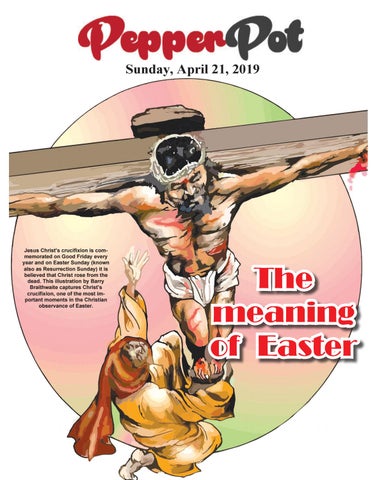
Jesus Christ’s crucifixion is commemorated on Good Friday every year and on Easter Sunday (known also as Resurrection Sunday) it is believed that Christ rose from the dead. This illustration by Barry Braithwaite captures Christ’s crucifixion, one of the most important moments in the Christian observance of Easter.
The meaning of Easter
II
Chronicle Pepperpot April 21, 2019
‘Nuff, nuff breeze but kite nah fly’ By Francis Quamina Farrier
MOST elders can recall some of the little things they saw or heard as pre-teens and teenagers! As we celebrate Easter 2019, I can recall an early Easter experience of mine. It occurred on the Georgetown Seawall beach at the Camp Street section. My two brothers, our older first cousin Neville and I, had gone there to raise our kites. As is the Easter tradition in British Guiana/ Guyana, that Georgetown seawall beach was packed to capacity on that Easter Monday, with hundreds vying for a special space to raise their kites; from the humble ‘Caddy Ol Punch’ to the glamorous starpoint, the beautiful singing-engine to the dancing box-kite and the imposing large ones; all types. Back then, every kite flying on the Georgetown seawall was, “Made in British Guiana”. No imported kites were ever seen. On that long-gone Easter Monday mentioned, some conflict blew in to my group; the Farrier brothers and their first cousin Neville. A bully was targeting us for our space on the beach. That was a long time before Gabby of Barbados composed his very popular calypso with lyrics that include, “This beach belong to me.” The aggressor was a tough fellow who the Farrier brothers conceded would wallop all three of us at the very same time. However, our cousin Neville who was a little older than us, though not anything near the size of the aggressor- who was built like a ten-tonne truck- took him on and beat the living daylight out of him in minutes, as some onlookers cheered. Meanwhile, there was a strong breeze blowing from across the Atlantic Ocean, from
Preparing to go and fly their kites
the north-east, lifting kites of all designs and sizes. But there was a fellow nearby who just couldn’t get his kite to lift off from the beach. As we all know, a kite is made to fly, especially when there is a nice strong breeze. Unfortunately, some kites are poorly designed, or the loop is not properly set, or the tail is either too long or too short and as such the kite just won’t function as desired and expected - like the constitution of some
countries. So, no matter how much breeze is blowing, that sub-standard kite will zip and zap, and plummet right back to the ground. It is flawed and should either be scrapped entirely or restructured in part. For a kite to be raised, and immediately take to the sky, it must have been well-made with suitable material, a proper loop and a tail of the correct length. Referring to the kite tail, there were some kite flyers who are wicked in their ways. They would insert razor blades into their kite tails and operate their kites in such a way, that the tail would come into contact with the twine of another kite and cut it, resulting in that unfortunate kite to become detached from the kite line and simply sail away like a balloon into the distance. That action by the wicked flyer and the victim sometimes results in fist-fights. Those were the days when people never took weapons around with them to plunge into the bodies of others at the drop of a hat, the loosing of an
argument or the falling of a kite. Fists were the weapons of choice. Kites are made to be flown and give pleasure to the flyer and to spectators. So, have you ever flown a kite in peace with yourself and friends in harmony, somewhere in a quiet place, away from the maddening crowd and from electrical wires? Could you consider our Cooperative Republic of Guyana, which has few Coop Societies, as a kite struggling to get off the ground even though there are strong breezes such as gold, diamonds, manganese, bauxite, timber, rice, sugar, fruits galore, fish in abundance, ground provisions and excellent weather and coming on the horizon, “Just off the Atlantic”, as Hilton Hemerding sings in his patriotic song “Beautiful Guyana”, oil and gas galore. Guyana also can boast of having some of the most brilliant people on the planet. You might ask yourself: Why is it that ‘Kite Guyana’ is just a few feet off the ground instead of soaring way up in the blue sky? Is it because of a land breeze blowing in the wrong direction in the form of criminal activities at all levels in our society? Also, selfishness in many areas of the beach in which bullies attack others who they feel that they can suppress and oppress? Is it a typhoon-type breeze from abroad ripping the ‘Kite Guyana’ into shreds? Looking back some 70 years to my Easter Monday experience mentioned earlier, I still vividly remember my first cousin Neville, taking on that big bully and beating him to a pulp. Neville flew away at age 80. I can’t inform you of the life span of that Easter Monday Kite flying Bully. But this I know, ‘Kite Guyana’, small though it is, is taking on the bully to the west, as all Guyanese patriots sing along with Dave Martins, “Not a Blade of Grass”. Tomorrow is Easter Monday, and many families - fathers, mothers and their children - will go kite flying. And so, as the song in the musical “Mary Poppins” states, “Let’s go fly a Kite”. However, make sure that you do so away from electrical wires. Let’s hope that there is nuff, nuff breeze tomorrow and your kite, no matter what size and design, will take to the sky in glory. HAPPY EASTER TO ONE AND ALL.
Chronicle Pepperpot April 21, 2019
III
The good kite maker
Part and parcel of Easter in Guyana By Vishani Ragobeer EASTER is a widely celebrated holiday in Guyana, and kite-flying, perhaps, forms one of the largest parts of the celebrations. Each year, skilled kite makers and sellers begin preparing months in advance just so that they can offer up a wide selection of kites to the Guyanese populace. “The energy level is high, it’s like you can feel we are encountering a vibrant Easter this year,” ‘Ras’ Trevor Smith shared with the Pepperpot recently. For exactly 40 years, since he was just 16 years old, Ras has been making kites to sell on Easter day.
to have three critical things: a natural love for making kites, a passion for putting together the best kite and an innate joy in seeing a completed kite that you know someone will love. He also shared that for him, kite-making has caused him to become a more disciplined and patient person. “It’s hard work, but hard work brings honest pay and it goes to show that the mind is capable of creating, but it just needs to be applied,” Ras Smith said. And though he has a little shop at home that generates income for him, for most of the year, Ras would be at home making kites. He just loves it that much. This year he made about
highlighted that he would usually begin making his kites in November. He started late this time around because he was preoccupied with his job as a mason, but it was better late than never for something he loves doing. “It’s the same thing all the time. You see all kinds of people come and buy the kites… We don’t watch face,” he highlighted. This year, he shared that sales have been a bit slower than usual, but said: “You just got to keep the faith and hope for better.” DETERMINED WOMAN Then there’s 54-year-old Dawn Drayton. As a young girl, Dawn would help her dad paste the kites. And
A young girl checks out one of the hundreds of kites on display on Camp Street
Christians, as evidenced by the persons buying kites. But the downside to this, for her, is that as the holiday grew more popular, the kite-selling business became inundated. “It used to have about 20 main sellers out here years ago and my father alone would sell out about 500 kites, but now more kites selling but the money splitting up among more people,” she Drayton said. Nevertheless, for this Easter season, she has about 300 kites for sale at various locations in ‘town’- being sold by herself and her siblings. “It does take about 15 minutes overall to make a kite- to paste is and so, and then you got the loop and the tail,” she said.
Ras Trevor Smith poses with some of his happy customers
Dawn Drayton showing off her kites
Orville Mccurdy and his array of kites on display at Camp and Robb Streets
You could say, that Ras is an expert in kites at Easter in Guyana because of the sheer number of years he has been involved in the business. To be a good kite maker, according to Ras, you need
1,300 kites and shared that he was expecting to sell off these early. And if you meet him, you would understand why he would say this. Aside from his neatly done wood kites, Ras’ love for kites is
evident and infectious. It is because of people like Ras, there is no shortage of kites in the sky at Easter time. LOVE FOR THE PROFESSION This love is shared by
Ehud Thomas and his bird kites
34-year-old Ryan Naar. The man is a mason by profession, and though he has been swamped with his usual job, he has a special place in his heart for making kites. He started making his kites in January this year but
eventually, she decided that this was a business she wanted to get involved in herself. For Dawn, the Easter holiday is one which is being embraced by more persons nowadays, and not just
The woman related also that in more recent times, persons have begun taking an interest in the traditional handmade wooden kites once again. Turn to page V►►►
IV
Chronicle Pepperpot April 21, 2019
The joy of kite-flying in Guyana By Wendella Davidson ALMOST everywhere the sky is dotted with lots of creative and colourful flying objects of different shapes, sizes, colours and shapes with some emitting beautiful and distinct buzzing sounds. The sound usually comes from a piece of paper or flap, called the `tongue,’ that is pasted at the back of a kite, as it sways in the breeze. Such scenery is an indication that it is Easter, a festival celebrated by Christians and a tradition that dates back generations. It is believed to have held in the past, a religious connotation as a symbol of Christ’s ascent from death. While Good Friday, the day when the Lord Jesus was crucified, is a solemn one, Easter Sunday and Monday are for celebration.
Studies have shown that the flying of kites dates back to more than 2,000 years ago. Though the exact date is not known, it is believed that the flying of kites first took place in Shandong, the most eastern province in China. We are told that a Chinese farmer in the Shandong province tied a string to his hat to prevent it from blowing far away from him by high winds. The hat was blown into the air where the high wind swayed it back and forth. Emerging from this experience was the flying of the first kite known to mankind. The Chinese made the first kite from bamboo, which was used for the frame and it was covered with silk and paper to make it light for flying. The earliest-known Chinese kites were flat and rectangular in shape. Some were decorated with mythological motifs and legendary Chinese figures; others were fitted with strings and
whistles to make musical sounds while being flown. Ancient and medieval Chinese sources have claimed that kites were used for measuring distances; testing the direction and strength of the wind; signalling, and as a communication mechanism for military operations. The military used to spy on enemy positions in China, and for dropping propaganda leaflets over enemy territories to warn them of an impending attack. From China, kites were introduced to Cambodia, Thailand, India, Japan, Korea and the western countries. The most famous kite in history was created in 1750 in the United States and flown by Benjamin Franklin during a rainstorm, to prove that lightning bolts were indeed electricity. He was right and lucky to have been alive to record his findings. Kite-flying is integral to Easter celebrations in Guyana and it is every child’s dream to participate in such a spirited, fun-loving and relaxing activity that is peaceful and stressfree. The hype though is on Easter Monday, the day reserved for kite flying, picnics and family gatherings and outings throughout the country. On this day, Guyanese from all walks of life usually throng the seawalls, parks, the Botanical and the Promenade Gardens, as well as every conceivable open space to launch their kites into the air. Kite-flying is known to bring out the best in everyone, young or old, it is sometimes difficult to when you look at the faces to say who has had the best time, or should I say it is of equal enjoyment and joy to those that come out at Easter and fly kites. No one is ever glum while flying a kite; children are usually seen running as fast as their legs can carry them to launch their kites, be it a homemade one, a mad bull, a bat, a box, a paper or a plastic kite, or a kite that is bought in a store. The fun brings joy and happiness and both young and old don’t care once the kite is flying. It is also fun watching how some majestic kites with an adornment bobbing behind as a tail and some very, very tiny kites take to the sky. These kites are most times seen on the seawall, in the vicinity of the bandstand, where a competition for `The `Largest Kite’, `The Smallest Kite’ ‘The Most Unique Kite’ and `The Most Colourful’ is staged. Then there are sometimes regretted scenarios where someone would wickedly tie a razor blade onto the tail of their kite and this could spell disaster for other kites nearby, as the blade would sever the strings of those kites resulting in them either sailing away or crashing. Also, sometimes while a kite is flying, there can be a sudden dip of the wind causing the kite to either end up in a tree. Then too, there are those kites that for some unanswered reason, try as one would, will not soar into the air. It is disastrous events like these that can quickly crush the ego of a child and turn what was once a joyous moment, into tears of sorrow. Over recent times, the joy and happiness experienced during kite-flying have been extended to include children with special needs and even those attending play school and nursery schools. The children attending any of the categories of school are usually accompanied by a parent or relatives, and it is viewed as bonding time. In addition, such an exercise is said to be therapeutic for children with special needs. For Guyanese, however, the flying of kites on Easter Monday is a happy occasion to meet friends, bond with relatives and share in the fun and excitement. Whatever you do, do be safe and adhere to the safety rules of kite-flying, that is, use open spaces and keep away from the high-powered electricity lines.
Chronicle Pepperpot April 21, 2019
V
◄◄◄ From page III
“What I find is that when the bird kites first came, people would run and buy that cause it cheap but now people buying the wood kites again,” she said. BACK TO BASICS At the corner of Camp and Robb streets, Orville Mccurdy shared the same sentiments as Drayton. “What you see happening is that people fall away from the local traditional kite and going for the (bird) kite because it a little cheaper,” he said and explained: “But some people understand that those bird kites ain’t got the fun like what these wood kites would have and you see now that people going back to these kites.” He also opined that Easter these days is celebrated
ers in Georgetown, this was a relatively low number, but Orville explained his reasoning for this. “Based on the market, you would assess and then that’s how you would sell,” he explained, and continued: “And last year, that’s the amount that actually sold so I decide to go back with that same amount and have a little now.” It is evident that while kite-making is a craft that those who are involved take great pride in, there is also an art in selling these kites too. KNOW YOUR MARKET For 52-year-old Audrey Daniels, there are certain times when you market your kites and you need to understand what kites people want
Audrey Daniels and her kites
quite differently from when he was younger. “Easter back them was real old school, people more concerned with like a show or a party, it’s not like Easter before and following tradition like kite-flying or going to the beach or so,” he noted. Within his family, though, he spends a lot of the time selling kites, he ensures that on Good Friday and the latter half of Easter Monday, he finds the time to be with his family. And making the kites each year is his way of keeping the traditions alive. This year, he has about 200 kites on sale. Among the kite sell-
more. And she garnered this knowledge from selling kites annually for 16 years. In fact, over the past few years, she shared that she has bought and sold maybe about 400 kites each year. But at the spot where she sells her kites, she also has her ‘drinks stand’ so when persons stop to marvel at the beauty of the kites she could convince them into getting something to drink or capture their attention when they stop to quench their thirst- whichever works! LONG LIVE THE BIRD KITE Aside from the litany of
Ryan Naar
wooden kites being sold, Ehud Thomas was one who lined the pavement at the corner of Regent and Camp
streets with his variety of bird kites. “I does walk and sell [undergarments] normally,
but at Christmas time I does invest in toys and at Easter time I does invest in kites,” Thomas related.
“Years ago, I used to sell the local (wood) kites, but I ain’t got patience for that no more so I does invest in different sizes of kites,” he said further. Kite sales would be constant leading up to the holiday but most of his sales occur on Easter Monday. The reason for this, according to him, is that persons would take their children out to fly their kites on the days leading up to Easter but would often lose these kites. As such, on the holiday of itself, they would return to buy the kites again. Each year, he has between 500 to 600 kites but this year he had a lot more due to the ones left over from last year. He vividly recalled that a “heavy rain” fell all afternoon on Easter Monday last year, and as such, many persons were not inclined to buy and fly the kites.
VI
Chronicle Pepperpot April 21, 2019
Live ProActive and holistic well-being
Minister of Business, the Hon. Dominic Gaskin at the Women in Business Expo with Keiba Murray, Founder of Live ProActive
By Gibron Rahim A COUNTRY needs a strong and healthy population in order to develop. This is not just in terms of physical health and wellness, but also psychologi-
cal and social health. The importance of a holistic approach to health and well-being cannot be overemphasised. It is this approach that ‘Live ProActive’ continues to utilise as it works toward helping to
build a healthier Guyana. The Pepperpot Magazine spoke to Keiba Murray, Founder and Co-Leader of the Live ProActive Club, who noted that the club has done work with some major clients over the last year. She could not disclose their names for the sake of confidentiality, noting that some of the work involved counselling and was thus very sensitive. Additionally, Live ProActive was an official partner in GTT’s Pinktober campaign, conducting the warm down session for the annual walk last October, as well as a week of free activities open to the public for the week leading up to the event. They were also recently a part of a walk for World Health Day 2019 on April 7. Yoga, self-defence and a few other items were part of Live ProActive’s contribution on that day. This year, Live ProActive
will be working with the Miss World Guyana Organisation. Murray related that, once the winner is crowned, Live ProActive will work with her from the period of time she is crowned locally to when she proceeds to the international stage. “We will be helping her with things like time management,” she said. Miss World Guyana will also be part of a financial course, as
trying to help people to develop and it’s about consistency.” While she said that body nutrition is a part of it, the emphasis is also on nourishing the self mentally and socially. “Because if we look at one area, it tends to not do justice to the others.” She explained, “That’s the essence of what we’re looking at – to get people to think about wellness in totality.” She
who may be in need of help. Live ProActive’s programmes are not just for adults, children are also included. The kids’ wellness package is offered during the August holidays, when children are out of school. Murray related that last year they took aspects from Live ProActive’s existing programme to create a programme tailored for children. She noted
Some Live ProActive team members at Pinktober 2018 (All photos courtesy of Keiba Murray)
well as receiving training in professionalism and dance classes in merengue, salsa and several other dances. “When she comes back we will work with her again,” Murray stated. The aim at that time will be helping her transition smoothly back to everyday life. Live ProActive is aiming to get more corporations on board, according to Murray. “Because I think this is definitely needed,” she said, referring to the work the group is doing. “I’m looking to send proposals out to people.” She noted that workplace stress has increased over the last few years. “It’s something that’s definitely on the rise and stress-management programmes would definitely need to be implemented by a lot of the employers,” she said emphatically. “We’re working to see how best we can work along with them on affordable packages that will help them to get on board and get their employees looking at holistic wellness.” She emphasised, “It’s really a holistic look that is necessary, as opposed to one specific area.” Murray pointed out that a holistic approach to health and wellness is extremely important. “What we are accustomed to in Guyana, when we think of wellness or well-being we think of nutrition and exercise,” she related. “But it’s more than that, it’s a lifestyle that we’re
added that financial, social, psychological, occupational and environmental wellness are as important as physical wellness which is nutrition and exercise. A holistic approach to wellness will become even more important as Guyana moves toward having a green economy, according to Murray. It makes no sense, she said, to put the right infrastructure in place in the country if the people are not also being motivated or empowered to function in a capacity that will enrich our society. The state of mental health in Guyana is definitely an area of concern. Murray noted that Live ProActive, as its name suggests, takes a proactive approach toward mental wellness. “It’s not about waiting until people get to the stage where they need a psychologist,” she said. She related that Live ProActive’s aim is to get people to be proactive in looking at their lives and their well-being. “That’s why we’re reaching out to businesses and individuals to look at these things now,” Murray stated. “We are putting systems in place prior to the breaking point; prior to it getting to a stage where you have that breakdown or, you have that depressive state and you can’t function.” She noted that employers also need to have an active human resources department that is on the lookout for employees
that the hope is to do the same this year. She recalled that last year a social worker came to talk to the children about their emotions and managing them. There was also a financial wellness session where piggy banks were distributed and the children learnt about managing money and making investments, putting it in terms that they could understand. The children were also given their own seedlings to grow, which was an exciting experience for them, she said. “It was a really great programme and we’re looking to do it this August again and hopefully with more kids.” Live ProActive is definitely still on the rise. Murray is a nominee for the 40 Under 40 Award set for April 25. It is also notable that Live ProActive is one of the United Nations’ Official Partners on Sustainable Development Goals. As it relates to what the future holds for the group, Murray noted that they are looking to expand and build a headquarters. “We’re hoping to be able to build and have a home,” Murray said. “We want to have a centre where we have all our activities under one place.” Live ProActive can be contacted at 647-3925/6580024, via email at iliveproactive@gmail.com and on Facebook at www.facebook. com/iliveproactive.
Chronicle Pepperpot April 21, 2019
VII
A Mon Repos Alliance Phoenix comes to Mon Repos we have to do in terms of doing our outreach, is to reach out to the community of Mon Repos, because it is a community that is having a high percentage of substance misuse - particularly alcohol.’’
FROM RESISTANCE TO EMBRACE In retrospect, she said that all was not lost: “When we first relocated and did our initial outreach, in Mon Repos, there was some degree of resistance towards us, but we drew strength from the district chairman who said that he understood why we had come and what we were about to do. He agreed that there was definitely a need for such an approach within that community. CEO of the Phoenix Recovery Project, Mrs Samantha Younge.
By Shirley Thomas IT was not by chance that Mon Repos on the East Coast of Demerara, home to the reputable Guyana School of Agriculture (GSA)and the National Agricultural Research and Extension Institute (NAREI), was also chosen as the soil on which to establish Guyana’s first-ever Home for the Recovery of both male and female substance abusers and misusers. Rather, it was through divine inspiration that a humble couple, Clarence and Samantha Young, with a burden on their hearts for the plight of substance abusers in Guyana, made themselves available to be used as pioneering vessels in the fight against this scourge. And for more than 19 years, Mon Repos has been and continues to be the Home of the Phoenix Recovery Project, providing counselling and rehabilitation for substance abusers. Having started with men only, by 2008 the facility threw its doors open to women as well. With knowledge gleaned from his homeland Trinidad and Tobago, Clarence Young, initially in the late 1990s, ventured into providing counselling and therapy for his first client – a patient of Prasad’s Hospital. There he worked side by side with Dr. McRae. It was during this time that he designed and implemented the Salvation Army’s Drug Rehabilitation Programme in Water Street, Kingston. After leaving the Sal-
vation Army’s programme, Clarence and his wife took the decision to set up their own drug rehabilitation programme that would bring relief to substance abusers and misusers. But having limited resources and virtually no accommodation, the couple did it ‘out-of-pocket’ and set up the facility at their Hadfield Street home in Georgetown. They started with four clients, but the response was heartening. Except for being conducted under cramped conditions, the programme was quite a success and it was there that the Youngs saw the need to have an independent building set up to conduct the programme on a much larger scale. MON REPOS SATISFIES A CRYING NEED Desiring to reach out to and impact the lives of as many persons in the grasp of substance abuse as possible, they conducted a survey to determine what communities were most afflicted by alcohol and drug addiction. Mrs. Young, co-founder of the project, now recalls: “One of the things we knew we have to do in terms of doing our outreach, is to reach out to a community where the need exists, and Mon Repos ideally fitted that slot, because it is a community that is having a high percentage of substance misuse - particularly alcohol,” she reasoned. Reflecting on their initial journey, Mrs. Samantha Young, now chief executive officer, following her husband’s death in 2017, stated: “One of the things we know
Turn to page VIII►►►
Mrs Samantha Younge and executives of the Phoenix Recovery Project
VIII ◄◄◄ From page VII
But that is not to say that the service being offered there was exclusively for the people of Mon Repos. It also targeted persons coming from wherever in Guyana there was a need. “As time went on and the word went around, those whom ideally we were targeting began gravitating towards the programme. Both the clients and their family members co-operated and we are very grateful to them. Over the years, we have been able to survive and we have interacted with some persons imbibing (alcohol) drinking and playing loud music, with the net result that we have been able to bring about tremendous changes to the lifestyle while winning the battle against substance abuse in the lives of many persons.” Moving from strength to strength, in time, the programme, registered under the name ‘Phoenix Recovery Project’, got into full swing and has since seen the recovery of hundreds of men and women who have successfully completed the programme and were able to return to the community, reunite with their families and lead productive lives. It was with funding from the United States Agency for International Development (USAID) and the Catholic Relief Services (CRS), that Phoenix was able to expand and offer
Chronicle Pepperpot April 21, 2019
services to women as well. At the present time, the project has accommodation for 30 men and 10 women, but there are plans ahead for expansion. PHOENIX RECOVERY HOME RECEIVES GOV’T SUBVENTION And announcing that the Phoenix Recovery Project was for the first time granted a subvention by the government in its 2019 Budget, the CEO expressed profound gratitude, stating: “We were able to increase our staff as a result of funding being made available, and are hoping to start our targeted street-based education intervention. We have to do a lot of street-based education and we have a caravan which we are actively preparing, so we can continue our street outreach programme. We go out into the highways and by-ways and reach those who may never have heard the word that help is available for substance abusers,” she stated. PRIVATE SECTOR RESPONSE Mrs. Young also acknowledged financial and other support from the private sector and other persons following an interview with the Pepperpot Magazine last year. “God is good. Coming out of that interview, we got
some more support from the private sector in terms of donations and persons were even dropping by with small parcels of donations in the form of foodstuff and clothing.” She said they also received two sewing machines which the women are currently using as part of their skills training programme. They are learning to sew clothing and bed sheets, window curtains, handbags and cutting jeans as well. But the best thing that happened was government’s subvention to the Phoenix Recovery Programme, she said. Young said the subvention will go a far way towards helping the centre execute key programmes such as the skills training programme, which ensures that they have a skill to take back home with them and enhance their lives after completing the programme. They are also learning up-cycling skills, mastering the art of coming up with beautiful designs and creations made from plastic bottles that would normally be thrown out.
FORGING ALLIANCES Meanwhile, the men, usually with a passion for farming, will be given support from agriculture-related entities in the practice of Cultural Rhetoric Farming. They are also currently engaged in the fabrication of picture frames and stools for which there is a need at the centre. And utilising the rich fertile land space on the premises, the clients are engaged in cash-crop farming to satisfy the needs of the centre. The Phoenix Recovery Programme has alliances with good-intentioned entities such as The National Tuberculosis Programme; The BV Church Global Youth Day Programme; National Health Workers; the National Narcotics Agency and Saying No to Drugs. Phoenix is also in partnership getting the message out there - ‘Say No to Drugs’! The CEO expressed being heartened with the response as it relates to the Alternative to Incarceration Programme. “ We are also on board with the government through the National Narcotics Agency (NNA) and so we look forward to the implementation of the Alternative to Incarceration Programme. I am really happy to know that our prisons would be less burdened by those who should not be there, she said. And whilst thanking God for what they have achieved through the years, the CEO has grandiose plans, and is looking forward to the day when Phoenix would be housed in its own property and can have separate facilities for men and women. The future plan for Phoenix “My future plan for Phoenix is not to have it housed in buildings around the corner, but to see Phoenix standing very tall on a stretch of land that will be permanent. And so, one of my goals is to continue resolutely, getting some lands to do such a project. There will come a time when you have to have your own; I firmly believe that now is the time. And so, while I am comfortable in one sense, that is not my ambition to remain this way all the while. I like to go for bigger and greater challenges, she concluded.
Chronicle Pepperpot April 21, 2019
IX
Knitting away to a healthy and productive lifestyle Using the art of crochet to create modern and unique pieces By M Margaret Burke WHEN the Pepperpot Magazine caught up with Colita Ishmile-Mohamed she was quite busy preparing a variety of pieces for the Easter holidays but stated that she was willing to share her experience and products. “I was introduced to crochet by attending a two-week programme before I was 12 years old; I had not even started high school as yet. So, while this taught me what to do in terms of knitting some things I did not take it up seriously, in terms of making innovated pieces until 2012. At this point, I began simultaneously teaching myself as I worked on the pieces,” she said. Mohamed completed her secondary education at the St. Joseph High school, where she studied accountancy and business. She is now 27 years old, married and a mother of a four- year old boy. She told the Pepperpot Magazine that in addition to being a full-time entrepreneur – making her lovely handmade pieces - she has also worked in several accounting and finance agencies. “I started this journey of promoting and selling my handmade pieces on October 9, 2016, at the first Curlfest Natural Hair Show and exhibition, which was held the Promenade Gardens and that is when I officially
Handbags
launched my business as CIM Exotic Designs,” she stated. According to Mohamed, since her launch in 2016, she realised that using the art of crochet to create modern and unique pieces captured the attention of many as it is not a craft that is marketed as a brand in Guyana. She added that she currently works from her home and offers delivery, as well as pickup options to her customers in and around Georgetown. She explained that most of the items are from custom orders, noting that she has found that social media marketing works best for reaching potential customers. EXPANSIVE IDEAS Mohammed stated that despite the fact that she had been taught her to knit at an early age, yet a while passed without her touching a knitting needle. However, once she got back into it she was hooked, not only on knitting but also on crocheting, and posited that she is
anorexia nervosa, who were taught to knit, found that learning the craft led to significant improvements. Seventy-four percent of the women said the activity lessened their fears and kept them from ruminating about their problem. Betsan Corkhill, a wellness coach in Bath, England, and author of the book “Knit for Health & Wellness,” established a website, Stitchlinks, to explore the value of what she calls therapeutic knitting. Among her respondents, 54 percent of those who were clinically depressed said that knitting made them feel happy or very happy. In a study of 60 self-selected people with Ms. Colita Ishmile-Mohamed, Manageress of CIM Exotic Designs
on her way to becoming a highly productive craftswoman. “I have made countless ladies tops, short pants and skirts, bath suits, summer wear, a variety of underwear, knitted shoes for both adults and children; handbags and clutch purses, baby blankets, sweaters, vests, shawls, scarves, hats, mittens, caps, bedspreads and many more. I feel that when my hands are busy, my mind stays focused in a very productive way,” she stated. Studies have shown that there is a resurgence of interest in needle and other handicraft, especially by women, even as some men are also showing more interest as well. Dr. Herbert Benson, a pioneer in mind and body medicine and author of “The Relaxation Response,” says that the repetitive action of needlework can induce a relaxed state like that associated with meditation and yoga. He added that once people get beyond the initial learning curve, knitting and crocheting can lower heart rate and blood pressure and reduce harmful blood levels of the stress hormone cortisol. ECONOMIC FACTOR However, while the health value of activities like knitting is being rated high, the rewards go well beyond replacing stress and anxiety with the satisfaction of creation. It is also being done for major gains economically. Mohamed indicated that while she truly loves what she does – the job satisfaction, as well as the fine end-products that are there to look at- yet still her intention for making them is not just to sit and look at them, because there is a need to balance the cost of materials, cost of producing and profits. “The raw materials are pretty expensive and because I desire to get the best quality materials to make the products I offer the customer, I look for and choose only the best… the better the materials, the better the outcome for whatever is being made.” OTHER HEALTH BENEFITS Research has shown that some people find that craftwork helps them control their weight. Just as it is challenging to smoke while knitting when hands are holding needles and hooks, there’s less snacking and mindless eating out of boredom. Further, many have found that doing handiwork with crochet thread or wool helps arthritic fingers remain more nimble as they age. A 2009 University of British Columbia study of 38 women with the eating disorder
chronic pain, Corkhill and colleagues reported that knitting enabled them to redirect their focus, reducing their awareness of pain. She suggested that the brain can process just so much at once and that activities like knitting and crocheting make it harder for the brain to register pain signals. There are many more proven cases. Mohamed also said that she has found knitting to be a very relaxing and creative activity so that while she has been gaining many customers as a result of her expansive ideas she believes that she has also been benefiting in terms of her health and wellness. (mercilinburke2017@gmail.com)
X
Chronicle Pepperpot April 21, 2019
ocus F Chronicle Pepperpot April 21, 2019
XI
on the Village This week, the Pepperpot took a long drive into the Potaro-Siparuni Region and stopped to pick up stories in Guyana’s newest municipality, the town of Mahdia. Stories and photos are by Vishani Ragobeer.
Big things in store for Mahdia Mayor of Mahdia David Adams
The Denham Bridge
ON October 25, 2018, the mining community of Mahdia entered into an irrevocable process of development. This was the day it became a town, which paved the way for a local democracy to be instituted. Getting to Mahdia from Linden takes about eight hours if you’re lucky enough to avoid the rains. Drivers from the popular Carly Bus Service, which offers daily transportation between Georgetown and Mahdia, explained that previously the journey would have taken much more time, but improvements to the trail have been a significant boost to the commute. With the exception of the stop at Mabura Hill for a quick bite and to check in with the local police, and the crossing over the river at Mango Landing, the journey to Mahdia is like a modified rollercoaster ride- except there are no steel rails, just the loam trail, thick vegetation and the occasional wild animal running across the road. And unless you decided to take a nap on the bus, you would be able to see the transformation from that scenery to huts and then the sighting of concrete roads and houses. This indicates that you’re in Mahdia. Established in 1884, Mahdia is located in Region Eight: Potaro-Siparuni and is surrounded by 19 other communities.
The Ebini Mountain range overlooking Mahdia
The region is renowned for its massive gold reserves though in recent years there has been a drop in production among small scale miners. Nowadays, the town has been much more commercial activity with the establishment of several eateries, general stores, a supermarket, and far too many hangout spots. Mayor of Mahdia, David Adams has been a prominent businessman in the community for a number of years. “Coming out of my success in business, I think that is what motivated persons in the community to encourage me to get involved in local government,” Adams highlighted and affirmed: “To date, I don’t regret that decision.” Now that Mahdia is a town, Adams shared that there is much work to be done with the influx of new developments taking place. The council has been instituted but the councillors are currently working alongside Adams to set up the prerequisites before the body can begin their work in Mahdia. “We have to get ourselves organised, have our staff in place, have our finances in place, have our standing orders in place, etc,” he said. Capacity-building for staff members is also a must, according to Adams, who also highlighted that members of the Ministry of Communities have committed to providing this training. But once all of these are in place, Adams shared that he hopes that the council will “hit the ground running”, since they have already identified certain areas that want to focus on first. A major aim of the council is to develop Information and Communication Technology (ICT) in the region. Adams explained that it is envisioned that a research centre will be established to ensure that all residents have access to internet services. This centre is going to be located by the dorms of the Mahdia Secondary school, and the council has already received pledges from businesses to help with further development of the centre, the Mayor shared. Heralding Mahdia’s elevation to township status was several infrastructural developments facilitated by the government and the regional administration body. There are now concrete roads, backed by an innovative draining system alongside it; a recreational area which has the Mahdia monument snuggled in between in and a radio station which operates about four times a week. Though the community has received a massive facelift in recent times, the Mayor indicated that the water system and roadways are two areas that still require additional work. As such, the council will seek to dig more wells to enhance the water supply and work on developing the internal roadways. Community beautification, through the nationwide community enhancement programme, and the disposal of garbage are two other areas that will garner the council’s focus in the coming weeks. For both of these, Adams related that the ministry of communities has provided much support- both in the technical aspects and in providing the resources. And of great importance is the drive to promote ecotourism, Adams noted. “Well [Guyana] has been branded number one in the world
The view of the Potaro River from the Denham Bridge
for ecotourism and we want to capitalise on that. We are planning on identifying heritage sites and sites that people can come and visit and train guides to take them around,” he said In so doing, the body has set up a tourism committee which will be looking to collaborate with the Guyana Tourism Authority (GTA) to understand the dynamics of venturing into tourism and how the region can begin to transform itself into a destination. And this shouldn’t be too difficult, given the natural beauty of Mahdia. At any point in the community, mountains form a picturesque backdrop to the Mahdia scene. Specifically, in central Mahdia, the Ebini Mountain range encapsulates any visitor, and so do the plains of Eagle mountain- located to the range’s left- which make you want to sit on top and overlook all of Mahdia. The trails in and around Mahdia offer nothing but excitement for those adventurous at heart- but this is only complimented by the trek to the historic Denham Bridge, in Garraway Stream, which connected the town with Bartica. As explained by Adams, Mahdia has much to offer for persons willing to come and explore Guyana.
XII
Chronicle Pepperpot April 21, 2019
‘Mr. Mahdia’ and his drive to develop the town Roger Hinds showing fresh vegetables on sale in his supermarket
to keep his success going. “We built that small hotel about 10 or 12 years ago and with that and my other business in Georgetown, that pushed me to build the bigger hotel. And with a bigger hotel, it pushed me to build the supermarket,” the man related. Hinds posited: “If you have four businesses, you take that profit and invest it back into another one because it is all about development. You have to sit and see 10 or 15 years ahead.” But for him, it is not about making money and being successful for himself, instead, he shared: “I would sit down and try to see what Mahdia needs.” FOR THE LOVE OF THE COMMUNITY And in so doing, he indicated that he was the first person to supply electricity to the area- and he did so for about 12 years until the government stepped in. He also dug six wells in the area to supply the residents with running water for some time and he even-
IT IS practically unavoidable to be in and around the town of Mahdia without hearing the name Roger Hinds or simply, Mr. Hinds. Whether it is at the town’s hotel, supermarket or even at the gas station in Linden that signals the start of the eighthour drive to the community, you must hear about the man that has dedicated all his energy towards developing Mahdia. As a young man, at just 18 years old, he already had a knack for doing business. He resided in Kumaka, in the Moruca subregion of Region One and would supply goods to persons in the community. Subsequent to that, he decided to bring his skills down south to Mahdia. “When I came here, people used to want to invest $100 and get $500 back and what I realised was that Mahdia could really use a turnaround,” Hinds explained and related that he decided to begin bringing supplies to the region and offered them at a much cheaper price. The man, who is now 54 years old, started small. He trekked many miles walking from Chumachumari to Garraway stream, which is The newer hotel in Mahdia, which is owned by Hinds, and features a swimming pool
at least a 45-minute drive from central Mahdia. Sometimes, he shared that passing truck drivers would give him a lift; aside from that, it was a journey he underwent on foot.
tually brought telephone services and cable televisions, just so that the residents would have access to all utilities and services. “It’s like a sacrifice… I came to Mahdia and saw what it needed [and] I realised that I could make a difference,” the man said. “You just can’t living in a community and not hustling to give back and if I didn’t love this community, you would’ve never seen me put back into it.” He also noted: “When I started to build, people saw me as a madman and wondered why I wanted to invest. But it’s like a vision I’m seeing that Mahdia would not be just a town in the future, it would become a city.” According to him, however, his journey to success would not be possible without the massive support he has received over the years. As an ardent believer in God, he shared that he would receive blessings and even visions that would guide his endeavours. He also shared that his wife and four children are his “backbone” that holds him firm, even when he is confronted by adversity.
Another part of the supermarket
INCREASING BUSINESS But because he wanted to provide his services to the community, he persevered. And in so doing, he was able to capitalise on opportunities that arose and eventually became the sole supplier to the region. “I used to supply from the whole of Mabura straight down to Mahdia all by myself,” Hinds shared, “Sometimes I does order truckloads of goods and before it reach Mahdia, it done.” Eventually, Hinds was able to secure a spot in the arcade and then worked diligently to build his empire. “One business bring two businesses, two businesses bring three businesses and three businesses bring four businesses because that’s how it goes right,” the businessman noted. Moving up, he took a loan from the bank and opened a gas station in Linden. And then continued managing his businesses efficiently He also credited the American government for giving him a ‘good push’ in life by exposing him to new markets, and for providing him with the opportunity to let three of his four children study in the US. “The best thing you can do for your children is education,” Hinds asserted and added: “The world is about education and I never really had it, only up to first form.” Hinds is also seen as the largest employer in central Mahdia and shared that he treats his workers as though they are his own children. And this is why, according to him, they are motivated to work diligently. “The more well you could treat them good you would get back good from them,” he said. And though he has already done so much for the community, he shared that his venture to establish a church in the community. In fact, the building has already commenced this venture and he hopes that this can be completed as soon as possible- because he wants to bring Mahdians ‘closer to God’.
Chronicle Pepperpot April 21, 2019
XIII
From a plantain chip stand to a flourishing restaurant Part of the gaming centre in the restaurant
David Adams and Margaret Nieuenkerk
ABOUT 23 years ago, David Adams was a simple man who came to Mahdia to work in the mining industry while Margaret Nieuenkerk made her living by working in her sister’s bar. Neither one of them knew that in time their partnership and determination would create a booming business in Guyana’s newest town. Businessman and newly-elected Mayor of Mahdia, David Adams shared that he came to Mahdia in 1996. It was his intention to eke out a living in the mining region, but according to him, he soon realised that there was a need for a restaurant in the community. “I, fortunately, met Margaret, who was working with somebody at the time in a bar, and I encouraged her then to start making plantain chips and so for the customers and it catch on,” Adams recalled. “Then I told her to put a stand on the roadside and see how it goes- and that also caught on.” Margaret shared that since their initial encounter, she realised that Adams had the eye for business and she, too, recognised that this was a niche market that she could get into. And the partnership between the two was irrevocably forged. “I decided to start this because I was a mother who fathered my kids at the time and to get a little more money,” she shared also. In a few short years, the business had become way too small to cater for the demand and the growing Mahdia population, and so the duo started to save rigorously so that they could invest in expanding the business. From her little roadside stand, Margaret explained that she started ‘throwing box hand’ and she and Adams began working together and would set aside some of their profits each night. With this slowly growing capital, they began making incremental improvements to their business. “With the little that we put aside and with my encouragement again, we bought a stand in this present location,”
Adams explained. “Over time we started selling drinks and food, and the business grew and it has grown to what you see it here today in 2019.” For Margaret, in 2002 when they bought the plot of land on which the business is currently situated, there was no turning back. “We’ve built an enterprise,” she posited. Nowadays, the business has evolved into a restaurant, replete with two dining areas; a bar and a gaming outlet for persons interested in trying out their luck- casino style. The business also employs 14 persons from the community. “No matter where people come from, they’re attracted to quality service and that’s what we try to do here,” Adams explained. He further highlighted: “You might hear around Mahdia that business is slow and so, but for me, the results of the business venture is how much you put into it.” And for Margaret, the support within the community is one which keeps the business going even at times when it might seem like commercial activity is dwindling. She has made her life in the quiet community and doesn’t even fancy going to Georgetown, where she has a home. In fact, she said that she would only routinely visit Georgetown in August and December to see her family. Aside from that, Adams is the one who would make the frequent commute to get supplies for the business.
XIV
Chronicle Pepperpot April 21, 2019
Mandy’s one-stop shop Mandy’s one-stop shop located at the Brian Sucre junction in Mahdia
Amanda Solomon, called Mandy
THE Brian Sucre junction is located in a central location that connects several of the outer communities of Mahdia. Once here, the main road leads to central Mahdia, one road takes you to ‘Blackwater’, one takes you to El Paso and another takes you to Micobie. Smackdab in the middle of this junction is ‘Mandy’ and her one-stop shop. “I’m living in Mahdia for almost 24 years and I’ve been out here, at the junction, for about 15 years,” Amanda Solomon, called Mandy, related. Mandy initially came to the mining region to get involved in mining herself, but after trekking the back dams for a few years she decided to branch out and establish her business. She created this business, her one-stop shop, in a central location where she could meet the miners going in and out of the mining lands and travelling to and from the communities. And what she offers is everything from home-cooked meals to packaged goods and supplies. At this space, you can also swing by to catch a cricket match on the television or just chill at the hangout spot (don’t worry, she’ll cater for your lime too!). Solomon explained that the shop usually opens at about 06:00 hours, though she wakes up before that to prepare breakfast to sell to travellers. By 19:00 hours, she’s back in bed getting her rest to start this all over again the next day, every day of the week. However, there are times when business would be hectic and that would require her to be up and about a bit more. “If you have like a fest or some kind of activity like Guinness in the street or so, you would find that people would come out here and so,” Mandy said. Currently, however, she shared that miners are moving further away in search of new lands to mine on and that has put a bit of strain on her business. “We depend on mining to bring the money,” she said, hastened to add that she persists just so that she remains upto-date with her bills and expenses. Aside from her business pursuits, Mandy is also a councillor on the recently instituted town council. “Mahdia became a town and that is very nice, so I decided to give back some of my time to the people that support me for all of the years,” the businesswoman said while explaining what prompted her to get involved in local governance. “Since I came to Mahdia I was able to achieve many things in my life business-wise and then I get involved into the council and now I decide to give back,” she said.
Chronicle Pepperpot April 21, 2019
XV
XVI
Chronicle Pepperpot April 21, 2019
FILES E S A C COURT
Withdrawal of charge and substitution of another
By George Barclay
Led to accused successfully pleading Autrefois acquit THE accused Ivan Benson was charged summarily with the offence of unlawful wounding and pleaded not guilty thereto. The hearing was then postponed and an indictable charge for felonious wounding later instituted against him in respect of the same facts. He was thereafter committed to stand trial on the indictable charge and after this, the summary charge was withdrawn. The accused was subsequently indicted for wounding with intent and unlawful wounding. At his trial, he pleaded autrefois acquit. The plea of autrefois aquit which meant that the accused was saying that he was already tried for the same offence, was successful, because the magistrate had at the summary trial indicated on the case jacket that the matter was withdrawn, which the trial judge at the Assizes, found was tantamount to a dismissal on the merits of the summary charge At the Criminal Assizes, Presiding Judge Mr. Guya Persaud, upheld the plea of autrefois aquit, and freed the accused. According to Justice Guya Persaud, Section 34 (1) of the Summary Jurisdiction (Procedure) Ordinance Chapter 15 , provides that the court shall give its decision “either by dismissing the complaint or by making such order against the defendant as the justice of the case requires”. Section 34 (3) of the said Ordinance provides that if a complaint is dismissed on the merits the defendant shall be entitled to a certificate of dismissal w;hich “upon production, shall be without further proof, a bar to any subsequent complaint for the same matter against the defendant.” Justice Persaud held (i) a dismissal on the merits, but not a dismissal for some technical informality , whether obtained in summary or indictable proceedings , is a bar to a subsequent indictment for the same offence or any ofence of which the defendant could have been properly convicted on the trial of the first charge. (ii) Under section 34 (i) of Chapter 13 the magistrate could only convict or dismiss and the withdrawal fell to be treated as a dismissal. Further, such dismissal having resulted from the offering of no evidence amounted to a dismissal on the merits. (iii) an accused person who can prove a previous acquittal or conviction by legally admitted evidence other than by a certificate of dismissal will not be debarred from availing himself of the plea of Autrefois acquit or autrefois convict respectively. The plea of autrefois acquit was upheld. Mr. E. A. Romao, Senior Crown Counsel, with him, David Singh, Crown Counsel , appeared for the Crown. Mr. J. O. F. Haynes, Q.C., with him Mr. P. Persaud, for the defence. Justice Persaud delivering the judgment said “The accused Ivan Benson was charged before a summary court on the 17th July, 1961, with the offence of unlawful wounding contrary to section 30 (b) of the Summary Jurisdiction (Offences) Ordinance , Chapter 14 , alleged to have been committed on the 14th July . “He appeared in answer to the said charge on the 17th July before the Magistrate when the charge was read to him and he entered a plea of not guilty. “The hearing of this matter was then postponed to the 26th of July on which day the police instituted an indictable charge for felonious wounding Contrary to section 57 (a) of the Criminal Law (Offences) Ordinance, Chapter 10. Turn to page XVII►►►
Chronicle Pepperpot April 21, 2019
XVII
Getting a younger smile IF YOU would like to take years off your smile – and your overall looks – ask your dentist about cosmetic procedures that can help. Your chronological age should never stand between you and a more pleasing appearance. Dentistry’s role in improving appearance is often misunderstood and underrated. For example, many people believe that only dentures can alter the appearance of their smile, yet nothing could be further from the truth. Such cost-effective techniques as cosmetic contouring, bleaching, or bonding often work wonders – typically in a single office Consumers spend billions of dollars each year on services and products designed to make them look more attractive. Countless women – and increasing numbers of men – have facelifts and other surgical procedures in an effort to enhance their appearance and remain competitive in job markets where looking youthful is an asset. While many patients benefit from plastic surgery, others could be helped with cosmetic dentistry alone. After all, your smile is one of the most important parts of your face. If your smile is attractive and healthy looking, it will take years off your appearance. If, on the other hand, your smile reveals worn, discoloured, chipped, or missing teeth, you’ll look older than you should, and no amount of plastic surgery can change that. Here are 10 Tips to keep your smile young : 1. Watch for unnatural wear and avoid grinding your teeth. 2. Take preventative oral hygiene seriously to avoid gum and bone loss. 3. Replace faulty fillings before they cause problems. 4. If crowns or bridges are worn down, replace them. 5. Lighten any discoloured teeth. 6. Replace any missing teeth as soon as possible. 7. Correct a bad bite. 8. Never chew ice or hard candy or suck on lemons. 9. Avoid abrasive habits such as aggressive tooth brushing. As we age, the edges of the front teeth wear until these teeth are about the same length as the others. At the ◄◄◄ From page XVI
“The accused was not requied to plead to the new charge. While the summary charge was still pending the preliminary into the indictable charge was heard and the accused was committed for trial. On the 6th September , 1961. “He was subsequently indicted by the Director of Public Prosecutions for wounding with intent and unlawful wounding, contrary to sections 57 (a) and 50 respectively of Chapter 10 , and it is upon this indictment that he has now raised the plea of autrefois acquit.. “After the accused had been committed fo trial by the magistrate on the same day, the latter wrote under the heading ‘Judgment’ on that Case jacket “W.D.N.”, meaning to indicate that the summary charges had been withdrawn. “It is accepted on all sides that both charges related to the same set of facts. “From the magistrate’s minute in the summary case . it is apparent that the accused was committed on the indictable charge before the summary charge was withdrawn,” the judgment disclosed. The following submissions have been made in support of the plea of autrefois acquit. (1) That our laws do not contemplate such a procedure as a withdrawal of a charge in the magisrate’s court , that a magistrate may do one of two things - he my either convict or he may dismiss. (2) That even if the magistrate has power to permit a case to be withdrawn and the case is withdrawn on the failure to lead evidence, that withdrawal is tantamount to a dismissal on the merits; and (3) Assuming that the summary charge was in fact a dismissal on the merits, the accused may still avail himself of the plea even if a subsequent charge is instituted in which an intent is alleged.
same time, the upper and lower lips lose muscle tone. The upper lip may sag, covering more or all of the upper teeth. The lower lip may also drop, allowing more of the lower teeth to show. The will teeth become darker in colour. These conditions create an older-looking smile. As they get older, people stop taking proper care of themselves, in-
cluding their teeth. If this sounds like you, remember that it’s never too late to start taking care of yourself again. Many older adults today are seeking treatment to correct dental problems and improve their appearance. Don’t be left out. Visit your dentist today and get an expert opinion about improving your smile.
XVIII
Chronicle Pepperpot April 21, 2019
A joyous Easter! THE Easter Season is with us again. This is one of the most welcome times of the year. It is respected and celebrated by people of every culture and religion in Guyana’s multi-racial, multi-racial mosaic. This is not surprising since it has both strong religious and cultural strands. The Easter story is well-known: Lord Jesus who was God incarnate began teaching the people of ancient Pales-
tine a new and revolutionary ethic of non-violence, love, peace and the brotherhood of all mankind. His teachings were regarded as subversive, especially among the conservative, religious and ruling classes who decided that he should be eliminated. Their plot to kill him was successful and he was judicially sentenced to die by crucifixion. His death was a long and agonising one. He- a man who had just come out of a period of prolonged fasting- was made
to carry the heavy cross on which he was to be nailed up over a long distance. This painful journey, as well as his crucifixion, is historically documented. He was crucified on Good Friday and buried on the same day. His family and those who believed in his teachings suffered intense pain and sorrow and when he was certified as dead, they permitted them to take him down from the cross and bury him. He was buried in the family burial chamber. As they waited all Saturday, the family and disciples lived in anxious hope that God will raise him from the dead. Then, on Easter Sunday he rose again from the dead. The rejoicing among the early Christians was intense since all were now convinced that the Son of God was indeed among them. And this was further confirmed when he ascended into heaven. The death and Resurrection of Lord Jesus is one of the most important occurrences in human history. Every year, the churches all over the world re-enact the drama of the death and Resurrection of Lord Jesus in their Good Friday, Holy Saturday and Easter Sunday services. The Good Friday services usually last for more than three hours and depict Jesus carrying his cross and the crucifixion and his burial. This Good Friday service is intensely sad. Holy Saturday is a time of anxiously awaiting the Resurrection and is a time of hope. The Sunday services are a burst of joy for they celebrate the Rising of the Lord from the dead. The cries of “He is risen!” often resound. Easter is the most joyous day in the Christian calendar. The Easter message is of deep significance for the welfare and salvation of Man. It brings the presence of God to Man’s consciousness in a very direct way. And Lord Jesus’ teaching has been growing in impact with the passing of time, moving from ancient Palestine to every country in the world. As we have mentioned above, the Easter Season has a celebratory dimension which occurs on the Monday after Easter Sunday. The secular aspects of the Festival actually begin with cross buns on the Thursday before Good Friday. The cross-bun mixture is unique to Holy Thursday and each bun will be embossed with a cross. Cross buns are widely exchanged among families and children look forward to them. Families, even the humblest, prepare special lunches or dinners and feel blessed if they are visited by at least one guest. The centre-piece of the Easter Celebrations is kite flying. The customs of kite flying have been changing over the years. Twenty or 30 years ago, all families, particularly the children, made their own kites. Kite making started two weeks before Easter Monday. Frames were made of any softwood and almost everyone tried his hand at making frames. Papers of every thickness and colour were pasted on the kites and kites were decorated by “stars” pasted in the middle. These “stars” were all of the unique designs and star-making was a special art. Loop making was also a special art for if the loop was not tied with very accurate balance, the kite would never stay in the air for very long. From dawn on Easter Monday, kite flyers would set out for the day’s fun. They congregated all along the sea walls and on every sports ground or park or any open space and tens of thousands of kites would soon be aloft, and the skies became decorated with colours of every kind. Picnicking was an inseparable part of the fun of kite flying. Today, there is far less kite flying. Most families and children buy their kites from professional kite makers, or more so, the cheap, flimsy China-imported plastic kites. Though Easter kite flying has somewhat diminished in popularity, those who still fly kites enjoy it immensely and as such, the custom is gradually being revived. Though the customs of Easter has changed over the years, the meaning and quality of the Festival have not changed. The moral and spiritual message of Easter is still as inspiring and moving as it ever was and the celebratory aspects of the Festival still awaken joy. The Easter spirit of Renewal remains as strong as it was on the first Easter some two thousand years ago.
Chronicle Pepperpot April 21, 2019
The age of Judas
IN OUR age we time travel through books, but for the wider masses mainly through the American expansion of cinematics, misused from its inception by the talented but bigoted filmmakers D.W Griffith and Frank E. Woods with the racist movie ‘Birth of a Nation’ in 1915. Our time-travel through the cinema has taken us on voyages into Biblical times; has influenced our perceptions about how populations looked, how they felt and dressed and the social environment they lived, loved and died in. Without questioning further, clinically, we believe and conceive those films to be records of worlds we are religiously related to through faith and the moral dramas that do interpret life, that explore human frailties, weaknesses, capacity for hypocrisy, against heroic strengths, wisdom, morality and integrity. Dramas that explore the dualities of humanity in a specific model. Kept out of our consciousness is the reality that movies represent huge investments, contracts and expectations of profit at the end of it all. The pleasing of the audience is foremost. Most religious paintings, children books and films were produced in an age of strict racist directives, to the point that when I was in school, Miss Barry, a very attractive teacher asked us upon returning to school after an Easter Holiday, aware that most of us had seen the ‘Ten Commandments’ and ‘The greatest story ever told’- that the class tell her on which continent these events happened. Yours truly stood up and said that it all occurred in Europe. Nobody laughed nor did the backbench heckle ’yuh wrong’ because the class thought that I was right, and were dumbfounded when she said ‘Africa’. What we thought of Africa was ‘Tarzan’ ‘Zulu’ and those King Solomon’s mines movies, not Pyramids or the ‘Jesus’ story. History tells us that the Romans were not the conscientious good citizen colonisers of the movies. The Roman Legionnaire was like any battle-hardened human, more mentally damaged than the modern combat man or woman, because most of his killing was done up, close and personal. Plus the wholesale slaughter of populations were mandatory at times, and every army in his day was promised in the immediate aftermath of the battle, the women of the conquered as the declared spoils of war,
XIX
- Of material convictions and Kosmic schemes
until the puppet leader is put in place and the system for economic colonisation constructed for the benefit of the empire as it was with Rome, Khemet, Persia, Kush or any of the major powers in the ancient and not so long ago modern world. In the
lated as he who speaks the truth into being, or “made true the voice”. Maa is the male term of Maat the Goddess and lawgiver of Khemet, and the authority of the Maa Kheru is linked to the resurrected God Ausar [Osiris]. From the text that narrates the
day of Jesus, the lands of his fathers were a Roman colony with Hebrew religious groups like the Essenes, and non-religious resistant groups like the Zealots and Sicarii, they did test Rome with initial victories but were wiped out by Roman retaliation. This occurred after the passing of Jesus ‘The Christ’. Judas was born into this world around the time of Jesus and was more concerned with the nationalism of the day and the prospects of lifting the yoke of Rome rather than with the moral and social reforms of the Christ. There also existed a term in Khemet [Egypt] ‘Maa Kheru’ trans-
life of Jesus of Nazareth, his quest lay with the moral uplifting of the populace of his land. His strong liberal teachings brought him into dispute with the compromises of the Pharisees and Sadducees, who ignored certain misgivings as a balance for survival, not needing to test the Roman capacity for total war, and in compromising they themselves had sunk to the level of looking after their own interests as a privileged group, corrupt and indifferent to the rights and sufferings of their people. The greatest impetus of nationalism for the Hebrews then was the mystical promise
of ‘The Messiah’ who would liberate them from all oppression. The Christ had in his teachings and healings possibly convinced Judas Iscariot that he possessed qualities that could be more useful to a revolution than addressing the moral consciousness of the masses. Judas [John, 12-6] was the custodian of finances for Christ and his disciples. He protested the purchase of expensive ointment by Mary (Miriam) who then massaged the feet of Jesus, and its fragrance pervaded the air ‘The Christ’ was in the presence of Lazarus who the Christ had previously raised from the dead. Luke 22: 36 ‘The Christ’ is narrated to have later said near the time of his betrayal “But now, he that hath a purse, let him take it and likewise his script: and he that hath no sword, let him sell his garments and buy one.” A path he then rejected. The betrayal of Judas is significant. It was not done with ranting and accusations, but gently with a kiss. There was no mystery in the scriptures of the potential of Judas for betrayal, yet he was allowed to play his part, material convictions, yes, in the scheme of things beyond his comprehension, and then again, unlike Delilah, Judas demonstrated that it was not for the 30 pieces of silver he had done his treacherous act, he committed the ignoble self-judgement of his day, that of suicide by hanging. Judas had nothing to fear from his population, there were numerous weak and loud souls bribed by the Pharisees to denounce The Christ, so to indulge in lawlessness, as long as the Priests and the merchants were happy, Judas and kind were safe. Or was it that he felt that the strange powers that The Christ possessed would be used to free himself and destroy Romans, Pharisees and Sadducees in one revolutionary purge, fulfilling the mystical manifestation of the divine messiah? Divine intervention did occur, the principles of the Christ teachings have brought its troubling, man-corrupted and still inspiring narratives of its age into ours, to reason with and be illuminated by its metaphors and truths relevant across time. ‘The greatest story ever told’? Perhaps, but in all honesty, its guidelines are profound, its parables culturally familiar, an incredible textbook even for the most stubborn of us. There is a verse that will make a significant difference.
XX
Chronicle Pepperpot April 21, 2019
Chronicle Pepperpot April 21, 2019
XXI
Easter in Guyana EASTER in Guyana is like nothing else you would have experienced anywhere else, and there is probably nothing anyone can do to convince me otherwise. Easter is a Christian religious holiday that celebrates the resurrection of Jesus Christ, the son of God, on the third day after his crucifixion. On the religious side of things, the past week- the final week of the period of Lentwould have been a sacred one. This week began with Palm Sunday, the day that celebrates the arrival of Jesus into Jerusalem. The week starts to wind down on Good Friday, which commemorates the crucifixion of Jesus and his death at Calvary. Then there are the observances of Easter Sunday and Monday. In Guyana, in my opinion, there is no shortage of reverence for the observances. You would find the churches filled with people coming to show their devotion. And despite the country being both secular and multicultural, I find it amazing that businesses and people, generally, solemnly observe Good Friday. All non-essential services are closed for the day. I believe that this goes a far way in maintaining respect for another’s religion and culture. This just shows, also, that there are just some things we do in Guyana that we have adopted and integrated into our culture and celebrations. I, personally, am not necessarily involved in the more religious observances of the holiday but I am respectful of these observances.
And of course, engaging in the Guyanese celebrations of Easter is a must. Flying a kite is symbolic of the risen Jesus and it is something that is widespread in Guyana. I can remember during my primary school days, we would make the famous ‘Caddy Ole Punch’ kite (though sometimes to the dismay of the cleaning staff) and convince ourselves that the kite would actually fly one day. I can also remember flying actual kites during my time in QC, on the last day of school before the Easter vacations. There are also the Easter goodies. While those chocolate Easter eggs have found popularity in other countries, we have our
things. At least once in your life, you must have tried cross buns and cheese (especially the ‘tip top’ cheese!). And you must have had a drink of ‘Cream Soda and milk’ to go with those buns. You have to admit, that’s the Good Friday special. On Easter Sunday and definitely on Easter Monday, it would be impossible for you to pass by the long stretch of seawalls on the Rupert Craig Highway or by the National Park without seeing the sky packed with a litany of kites- in all shapes, colours and sizes. And the scene is just a melee of loud music, thousands of people and the all too familiar singing of the kites.
And every year, without fail, there will be at least one person who took the time and diligence to create a colossal kite that requires a canter truck to fetch it around and about five persons to get it up in the air and then down again- if it actually goes up in the air. You know how it goes, go big or go home! These are Easter traditions I have grown up with, just as so many other persons have. But outside of the religious celebrations of Easter, and how this fosters kinship bonds, we really do the most in Guyana at Easter time. The famous Rupununi Rodeo is hosted during the Easter Weekend, as is the wildly popular Bartica Regatta. Both of these events capitalise on the lengthy ‘Easter Weekend’ and offer up things that are uniquely Guyanese in nature. At the rodeo, scores of persons head down south into the Lethem region to see the vaqueros and ranches battle it out for supremacy. The regatta, on the other hand, features water sports (featuring mostly speed boats), cricket, boxing, soccer, talent shows, a street parade and party, and a Miss Bartica Regatta Pageant So really, the only downside of Easter would probably be the inability to experience everything all at once. And like I said, I don’t think there is anywhere else in the world you can experience Easter as you can in Guyana. What we have here is that unique blend of religious observances, traditions and even a bit of adventure and excitement in the mix. Happy Easter!
A man of many caps Dexter Hall
WHEN in Mahd i a and in need o f a quick tyre fix, building blocks or security ser- vices, the first person you ought to think about is Dexter Hall. Over a decade ago, Hall ventured into the heart of Guyana, with his brother who was a police officer. He hailed from Georgetown, but would soon find out that his home was always meant to be Mahdia. The town is known for its mining activities and services associated with that industry, and it as no surprise that Hall aligned himself with this. “I’m a certified mechanic and I basically see the need for a tyre shop so I decide to open up a tyre shop,” he shared. This need that he saw was that many of the off-road vehicles would traverse the area, and because of the
terrain would need regular maintenance. But while Hall’s services are open to all Mahdians, he capitalised on establishing partnerships with the governmental bodies in the area. As such, he focuses majorly on the contractual work he has been able to acquire from these bodies. His little tyre shop, however, has another feature: it is a space where Hall sells the hollow blocks that he has made. This is just all part of his hustle, he explained. “I’m working in Mahdia for over 12 years now,” Hall related and affirmed: “From then to now, I can’t lie, Mahdia developing at a pace.” According to the mechanic, the new town has seen major infrastructural development that has led to expanded commercial activity. And what that meant, for him, was that he needed to hire someone else to help with the daily operations of his business.
During the day, the two of them manage the tyre shop and hollow block business but as the sun begins to descend behind the surrounding mountains, Hall puts on yet another cap. He becomes the guy that’s in charge of Mahdia’s security firm and is responsible for keeping Mahdians and their businesses safe throughout the night. “Well I deh for the development of Mahdia; anything for the development of Mahdia I gon be in,” he said, explaining his involvement with the security firm. “Mahdia becoming nice and I’m here to back the development of the community.” He also shared that he is s simple man who just loves the tranquility of this hinterland community, but he wouldn’t be angry if the developments continue. “Just now we gon be better than Georgetown, cause everybody from Georgetown gon run and come here,” Hall affirmed.
XXII
Chronicle Pepperpot April 21, 2019
Preserving Guyana’s culture: Easter
President David Granger assists these youngsters with holding the ball of twine (balla) of their kite as they watch it soar into the sky
EASTER is a celebration of the resurrection of Jesus Christ, making it the most significant event on the Christian calendar. However, in the spirit of diversity and inclusion, Guyanese throughout history have created traditions around the occasion that makes Easter celebrations in Guyana truly unique. A PROMISE OF REDEMPTION In this edition of Government in Action, we explore the cultural elements of this holiday and rediscover the true religious significance of Easter. Apostle Claude Brooks of Love and Faith World Outreach Ministry tells us about the great love story of God keeping his promise of redemption to his people. “Good Friday is exactly what it is. It’s a good Friday in a sense that it is a fulfilment of what was promised by God and this actually began way back in Genesis when… Adam sinned and was separated from God. Man lost his connection with God, his relationship with God… and God made a promise and that promise was the promise of redemption,
to redeem man back to Himself… So, Good Friday was the day when the Lamb of God, Jesus Christ, God’s only son, his blood was shed for the redemption of all mankind… paving the way…for man to be reconciled back to God, or fellowship, or relationship with God,” Apostle Brooks said. While good Friday holds great significance, Apostle Brooks said that the true celebration comes with Christ’s resurrection. “What is interesting with both Good Friday and Resurrection Sunday, which is Easter Sunday, is that [they are] events which [were] prophesied in Scripture and… many of the old prophets talk about the death, burial, and resurrection…Paul said if the resurrection did not happen, the Christian faith would be in vain. As a matter of fact, the whole reality, the whole essence of the Christian faith hinges on the resurrection because… Jesus said, for us to be forgiven someone had to pay the price and Jesus paid that ultimate price for our redemption,” he said. Apostle Brooks added, “The Bible says that God is love. He is the epitome of love. He is the author of love. The fact that he was
willing to give his Son to die for the world, not just for a particular group of people, but for the whole world, is the best example of love. The Scripture actually tells us greater love has no man than this than he who lay down his life for his friends.” This love, he said, is evident in the inclusive nature of Christ and reflected in the inclusive nature of Guyanese Easter traditions. “He did not die to redeem a specific people or ethnicity or religious group. He died for mankind. You find certain holidays, particularly in Guyana, it is not just celebrated by Christians. You find people of every persuasion, whether they understand the significance [or not], they celebrate it. When you go on the sea wall, you would not just see, find one ethnic group or [only] Christians flying kite. You find every ethnicity within Guyana and every religious group and every people-group celebrating this activity. So, I believe that’s what’s so marvellous about it. It’s inclusive. And as the Scripture says, ‘whosoever will, may come’. So, Jesus is never exclusive. That’s one thing about Jesus,” he said.
A GUYANESE EASTER Not many Guyanese go through the Easter holidays without having at least a few servings of hot cross buns. Vice Principal of the Carnegie School of Home Economics (CSHE), Ms. Sharmaine Marshall explained the history and significance of the buns. “In 1361, a monk by the name of Thomas Rodcliffe, he started the tradition of cross buns. He started this tradition by giving the poor cross buns on Good Friday, and as such, it has become a representation of the crucifixion of Jesus Christ. Cross buns [are] that time of the season where we do share and [there] is an excitement… that we share our cross buns with each other. It is something that is exciting to look forward to,” she said. To that, Principal of CSHE, Ms. Myrna Lee expanded on the role food plays in Guyana’s cultural make up. “Food history actually holds lots of fundamental things that make Guyana unique. When all of the races came to Guyana, they came with something distinct and unique that’s attached to their culture, their belief,
Chronicle Pepperpot April 21, 2019 their value, things that they consider very, very scared to themselves. Inclusive in that, was food and dishes. Food brings people together. It is used for ceremonial reasons: to celebrate birthdays, weddings, anniversaries, if you’re launching a business… the birth of a child or even promotion. So, you don’t find dishes being singled out based on their ethnic influence, but rather they’re being embraced as ‘our thing’. This is a Guyanese dish. So, that makes our food very exciting,” she said. Mr. Esan Hall, Project Officer at the Ministry of Social Cohesion tells us how Easter truly fosters the spirit of togetherness among Guyanese. “The minute Mashramani is finished, you see all the children with their ‘caddy old punch’ and different things they would make kites with. [They’d] even tie a string on a plastic bag and fly it. So, you realize that this is something everybody looks forward to. If you look at the open spaces on Easter Monday, you don’t only see one group of people. You see everybody coming together. If everybody is picnicking, you will find people will share their meal and that’s what social cohesion speaks to. Everybody coming together enjoying themselves, living as
Apostle Claude Brooks of Love and Faith World Outreach Ministry
Fresh, hot cross buns, cheese, and a glass of milk, a traditional Guyanese Good Friday meal.
President David Granger raises this kite at Easter
XXIII one. So the traditions that have developed over the years here in Guyana for Easter, is one that pulls the different groups of people, the different religious groups… they pull everybody together and they have one big celebration over this particular weekend,” he said. Guyanese, Mr. Hall said, have modelled the words of our national motto, choosing togetherness over religious barriers. “One of the things I know a lot of us can relate to is our motto: “One People, One nation, One destiny”. The Motto tells us that we need to live as one, work together as one for us to achieve one destiny, which is to build Guyana. This is taught to us in schools and what we can see is that persons relate to each other… we try to support each other. We try to live as one… We try to do everything together and you can see it in the various religions,” he said. The Government of Guyana continues to uphold and support the celebration of religious holidays that promote unity and togetherness among Guyanese. Let us chase after a relationship with one another with fervour and intentionality. Happy Easter! Hot cross buns in the cooling rack at the Carnegie School of Home Economics (CSHE)
XXIV
AS we know, today is Easter Sunday and so, I would like to talk about how we can best experience this day, one that gives the opportunity for fun traditions or simply promote rest and relaxation. Many of us are happy simply because lent is now over and therefore we can return to our vices. Although, if they were unhealthy, I hope
Chronicle Pepperpot April 21, 2019
Happy Easter!
you continue to abstain from them. First, a little bit about today. Easter is a Christian festival that celebrates the resurrection of Jesus Christ and is the most celebrated of holidays. It began as a Pagan holiday that was adopted by Christians. My research shows that the holiday was named after the Anglo-Saxon goddess Eostre who’s sacred symbols were thought to have been the hare and the egg. Christians used to celebrate the resurrection of Christ every Sunday until it was decided that a full, annual day will not only be acknowledged but celebrated. Easter Sunday specifically is the day which celebrates the resurrection of Jesus- the day he rose from the dead, three days after his crucifixion and burial. It’s the last day of what is known as ‘Holy Week’ which encompasses Maundy Monday which commemorates the Maundy and the Last Supper and Good Friday, the day of Jesus’s burial. Easter Sunday, the day he resurrected, is the oldest and most important day in the Christian calendar. For those who aren’t so religious, Easter simply marks a long weekend, filled with fun (hopefully). Today both Christians and non- Christians celebrate with more modern and fun traditions involving kites, chocolate, cross buns, Easter eggs and even an Easter bunny. Traditionally, during Holy Week, eggs were not allowed and any eggs which were laid were saved and decorated as ‘Holy week” eggs which were then given to children on Easter Sunday. Future generations have thankfully evolved these into chocolate eggs. Also, why a bunny rabbit for Easter? Rabbits have traditionally been viewed as a symbol of new life because they usually birth large litters of babies which legend believes they often hid. This idea is believed to have originated in Germany during the middle ages as the first ever seen written piece on the Easter bunny was dated back to the 16th century, Germany. It’s then believed that Dutch settlers in Pennsylvania brought the bunny ritual to the United States in the 1700s and the tradition spread on from there. Hence, today an Easter egg bunny has left treats for you to find in an Easter egg hunt. The traditional act of painting eggs is called Pysanka and the eggs were traditionally painted red to signify the body of Christ and his victory over death. The official flower of Easter is the white lily (Easter lilies) as it represents grace and purity. Like many other religious holidays, the dates of Easter and Holy Week change based on different group beliefs and the moon. Turn to page XXVI►►►
Chronicle Pepperpot April 21, 2019
XXV
#SupportCreativity
By Subraj Singh
Season Two of Netflix’s ‘Chilling Adventures of Sabrina’ I HAVE come to believe that “Chilling Adventures of Sabrina” truly might be the show that is most expressive of everything that is of value to the current generation of young people. The show fully represents the continuous rise of feminism and powerful women in a misogynistic world. It rebels against long-accepted notions of religion and tradition (both in form and content), and it perfectly captures the angst, fear, sense of helplessness and of hope, resilience, and a dedication towards diversity and acceptance (particularly of communities traditionally marginalised) that have also come to stand as tenets that are exemplified by the young people of the world today. For these reasons, I believe the Netflix show is one of the best on television (or your phone, or your computer, or wherever else you use to stream shows), particularly because of the way it managed to elude the ‘second season’ curse, where the first season remains markedly superior, a phenomenon that has affected other shows, such as “Riverdale” and “13 Reasons Why,” which cater to the same demographic. The second season of “Chilling Adventures of
“Chilling Adventures of Sabrina,” Netflix, 2019. Image via – IMDB
Sabrina” is better, increasing the suspense, the stakes, and all of the campy horror elements that made the first season so well-received by audiences. The story continues where the first season left off, with Sabrina, the half-mortal, half-witch teenager struggling to juggle both the elements of light and darkness that have converged in her life. There are new
demons to battle, of course, but the biggest adversary that Sabrina goes up against is the patriarchy. She rebels early on by attempting to derail Father Blackwood’s attempts to promote certain traditions of the Academy of Unseen Arts that are steeped in misogyny. This later escalates with Blackwood asserting that witches are meant to be followers and servants of warlocks, which, naturally, rubs
Sabrina the wrong way and sets the stage for the undoing of everything Blackwood is trying to set in place. The feminist fight that this particular story arc brings to us is relevant to the world of today, especially considering that this age coincides with the rise of Fourth Wave Feminism. Sabrina’s own battles with patriarchy are indicative of the severity and widespread-nature of patriarchal norms and traditions in society. The fact that a bright, enterprising, and powerful witch such as Sabrina can be belittled and cast aside on account of her sex indicates that, unfortunately, no woman is exempt from the tentacles of misogyny, not even the strong. This idea is reinforced when we see other powerful female characters being treated in a similar manner in the show: Zelda Spellman being forced to walk behind Father Blackwood because it’s a tradition for wives to walk behind their husbands, Hilda Spellman being sexually propositioned in exchange for a favour from the leader of the Witches’ Counsel, and Lilith who is used, lied to, denied what is rightfully hers, and abandoned by Lucifer. Turn to page XXVI ►►►
XXVI
Chronicle Pepperpot April 21, 2019 ◄◄◄ From page XXIV
I apologise if I’m the only one who finds these facts interesting. So what to do today other than eat chocolate and cross buns? Well there is the traditional Easter egg hunt and kite flying Easter egg hunts can work for children and adults. The child version is hiding candy in a safe environment, keeping them quiet and busy searching for them while you as the parent/guardian can either enjoy the peace and quiet or equally share in their excitement. The adult version can be more of a scavenger hunt - around the neighbourhood or even around the whole town. Invite some people and make it a neighbourhood event. Want to bring out your or your child’s creative side? Try egg decorations. I used to do this all the time as a child. My mom would drill small holes into eggs, make us breakfast and then put the empty eggshells in the fridge for a while. The hole was just big enough for us to stick our finger in which meant we could easily hold, turn and paint around it. We also used these and any other Easter creations to make Easter hats out of plain straw hats. While kite flying did not originate in Guyana, making it an Easter tradition is our own little, feel-good tradition. I also always thought an interesting thing to do on holidays was plant a tree, especially on one which signifies resurrection and life. It’s a great tradition as while it’s good for the environment, it’s great for strengthening relationships and creating memories. Basically, any healthy quality time can do this and no better day than today for some family bonding. Regardless of your religion, today is a day for the appreciation of life, hope and family time. I hope you make the most of it. Thanking you for reading. Please keep sending any topics you’d like to talk about to caitlinvieira@gmail.com Suicide Prevention Helpline numbers: 223-0001, 223-0009, 623-4444, 600-7896 Say Yes to Life and No to Drugs! Always ◄◄◄ From page XXV
All of these characters struggle with sexism, but the shows angle is not merely to represent women who are hurt and mistreated, but to highlight empowered women who are strong, brave, cunning, and exacting. Sabrina bests Father Blackwood and the devil, Zelda is freed from her curse and takes her place in the fight, Hilda murders the man who propositioned her, and Lilith finally gets everything she deserves by the end of the season – and all of this happens in ways that are entertaining, emotional, celebratory, and just. The moral here quite obviously is that women are strong enough to survive, to succeed, to kill, to lead, and to make it out of anything that the patriarchy wants to throw at them, and that is everything that the young, sane, show-watching audience of 2019 needs in a television show. Patriarchal norms and traditions are not the only staples of society that are addressed by “Chilling Adventures of Sabrina,” however. There are elements of religion that are represented in ways that are contrary to what we have been traditionally seen in the media. I mean, the fact that our heroine and protagonist is a witch who has basically given her soul to the devil should be enough for people to understand the somewhat ambivalent feelings about religion that the show gives off, but there’s more. Angels, in the guise of demon-hunters, are presented as bloodthirsty villains, while witches are represented as being capable of goodness, such as curing one of blindness or helping friends to succeed in athletics. It is a re-presentation of a lot of what we have regarded to be true and accepted over the years. This reaching out to and remodeling of old traditional forms is meant to be observed as a mirror with which the complete remodelling of the world in the modern era is meant to be shown – a variety of significant changes brought on through the rise of the newer generations that are going to elevate the world from a dismal place of darkness and antiquity into a place of acceptance with less draconian laws and regulation, and all of this in a show steeped in magic and fantasy, makes it even more thrilling and it also makes us hopeful seeing current ideas, such as the concept of transitioning with regards to transgender people, staunch female empowerment, and a world without religious hypocrisy all being packaged and made available for the young people who are bringing about and will continue to bring about these very same changes in the world.
Chronicle Pepperpot April 21, 2019
XXVII
Recommendations for sampling soils for lime and fertiliser
SOIL sampling is a management tool used to determine the status of soil pH and available nutrients. In this week’s column, the National Agriculture Research and Extension Institute (NAREI) will provide some tips to determine the appropriate amounts of lime and fertilizer inputs needed for the crop(s) grown. Generally, a farmer needs to know two things about his soil. Firstly, how much fertilizer he or she needs to add to the soil to obtain profitable yields and secondly, how acidic the soil is and whether there is a need to add lime. Soil testing results provide the soil nutrient status before a crop is planted,
thereby permitting more efficient use of fertilizer/manure and lime. Soil tests are done at NAREI for all crops—free of charge for the farming community. Adding lime and fertilizer to crop production without a current soil test is not an economically and environmentally sound practice. For the next two weeks, NAREI will provide information on what is meant by a chemical soil test, how to take soil samples and why it is important to take a representative sample. WHAT IS SOIL TESTING? The basis for recommending the kinds and quantities of fertilizer for a par-
ticular crop is soil testing. It is also the basis for recommending lime requirements. A chemical soil test is a method for estimating the ability of a soil to supply nutrients to a crop. This is accomplished by treating a soil sample with a mixture of chemicals in a controlled manner for a fixed period of time and then determining the nutrients extracted by using various chemical and instrumental procedures. Soil tests do not actually measure the amounts of nutrients in the soil. Rather, they estimate the ability of the soil to supply nutrients and provide the profitability of crop response to fertilization. In order to make sound fertilizer and lime recommendations, the information supplied by farmers as well as that predicted from the climatic records, soil maps and yields response data assist in detecting yield potential. Information requested of farmers include the location from where the sample was taken, the quantities of manures and fertilizers previously used, the crop previously planted and what crops are now being proposed. The soil test recommendations must be followed for profitable yields to be obtained. If less than the recommended amount of fertilizer is used, the expected yield will not be the obtained and yields may be so low that a loss and not a profit would be obtained. Excessive use of fertilizer could result in the death of the crop from fertilizer “burn” or “injury.” Further, although there may be good crop growth, the extra increase in yield resulting from the excess fertilizer used may be worth less than the cost of the excess fertilizer. A similar situation would occur if the correct amounts of lime are not applied. Next week, NAREI will continue with the information needed to analyse soil samples.
XXVIII
Chronicle Pepperpot April 21, 2019
Chronicle Pepperpot April 21, 2019
XXIX
The Law of Trade-offs
A FEW TRADE-OFFS COME ONLY ONCE The cycle of change gives us windows of opportunity in which to make decisions. Sometimes that cycle only comes around once. Miss it and the opportunity is gone.
Beyond the Runway with Dr. Sonia Noel
... Inspiring lives through fashion “IF you want to achieve your potential , you must give up some things and there may be things you value dearly.” I had a discussion with a few young ladies a few days ago and decided my focus in the column this week will be the Law of Trade-Offs from John Maxwell’s 15 invaluable laws growth. These laws have assisted me with my personal and professional growth. YOU HAVE TO GIVE UP TO GROW UP. People will cling to an unsatisfactory way of life rather than change in order to get something better for fear of getting something worse. When you’re first starting out in your career it’s not very hard to give up to grow up. In fact, you’re willing to give up everything for an opportunity because your “everything” isn’t much of anything. But what about when you’ve started to earn some things; a job you enjoy, a good salary, a home, a community you’ve become part of, a level of security? Are you willing to give up those things for a chance at doing something that will take you closer to your potential? TRUTHS ABOUT TRADE-OFFS: Trade-offs are available to us throughout life Everybody makes trades throughout life, whether they know it or not. The question is are you going to make good ones or bad ones. Nothing creates a greater gap between successful and unsuccessful people than the choices we make. Too often, people make life more difficult for themselves because they make bad choices at intersections of their life or they decline to make choices because of fear. But it’s important to remember that while we don’t always get what we want, we always get what we choose. Whenever you face an opportunity for a trade-off, as yourself these two questions: What are the pluses and minuses of this trade-off? Anytime you react to one of life’s crossroads according to fear rather than looking at its merits, you close yourself off from a potential opportunity. Will I go through this change or grow through this change? Positive trade-offs should be seen as opportunities for growth and seized. After all, we become better as a result of them. We grow through change, we become better. We take control of our attitude and emotions. We become positive change agents in our own lives. Trade-offs force us to make difficult personal changes. Often I hear people expressing the hope that things will change. At those moments, I want to tell them that the difference between where we are and where we want to be is created by the changes we are willing to make in our lives. When you want something you have never had, you must do something you’ve never done to get it. Otherwise, you keep getting the same results. Change may not always be easy, but it can always be done The loss of a trade-off is usually felt long before the gain We want change, but we don’t want to wait for the result. And often we become acutely aware of what we have lost in the trade because we feel that immediately, while we often don’t reap the benefit of the trade until days, weeks, months, years, or even decades later. MOST TRADE-OFFS CAN BE MADE AT ANY TIME We can give up bad habits to acquire good ones anytime we have the willpower to make the decision. After they make a bad trade-off, people often panic, feeling that they have blown it and can never recover. But seldom is that true. Most of the time, we can make choices that will help us come back. So when it comes to choices, never say never.
THE HIGHER YOU CLIMB, THE TOUGHER THE TRADE-OFFS When you’re starting out in life you have little to give up. But as you climb and accumulate some of the good things in life, the trade-offs demand a higher price. Each success only buys an admission ticket to a more difficult problem. When we’re at the bottom, we make trade-offs because of desperation. We are highly motivated to change. As we climb, we change because of inspiration. At this higher level, we don’t have to anymore. We get comfortable. As a result, we don’t make the trade-offs.
TRADE-OFFS NEVER LEAVE US THE SAME Don’t fear failure so much that you refuse to try new things. The saddest summary of life contains three descriptions: could have, might have, and should have. We are never the same after we make a choice. Some trade-offs are never worth the price Not everything in life is on the trading block. And I’m not willing to trade away my values for anything or anyone. These kinds of trade-offs only lead to regret. And they are difficult to recover from. I believe that most people make these kinds of devastating trade-offs and don’t realize they are making them until after it’s too late. There is no future in any job. The future lies in the person who holds the job. Trust you received some value from this content as I did. Email beyondtherunway1@gmail.com if you will like to join us for the next mastermind and celebrate a beautiful Easter weekend.
XXX
Chronicle Pepperpot April 21, 2019
Chronicle Pepperpot April 21, 2019
XXXI
Don’t Forget Grandma and Grandpa this Easter!
An insight into elders and abuse in Guyana ing over the seniors present at the Elderly Funday, the saying ‘once a man, twice a child’ is very true. They received pure joy by playing dominoes, dancing to music, showcasing their hats and flying kites. It is the Easter season and we might want to go to the beaches and forget that our grandparents even exist. We fail to understand that they are human beings full of life. Mahatma Gandhi once said, “A nation’s greatness is measured by how it treats its weakest members.” While I do not agree that our elders are weak, I would say they need assistance and a little more patience than an average
Senior citizens of Berbice enjoying dominoes at the Ministry of Social Protection’s Elderly Fun Day
FRIDAY, April 12 the Ministry of Social Protection (Probation Department) in collaboration with UGBC social work students hosted an Elderly Fun Day for the older adults of Berbice. It was done under the theme; “A future of fun without abuse; living life at its fullest.” I participated in this event and I must say I am glad I did because it opened my mind to a lot on our senior citizens. It was blissful to see older adults finding joy in kite flying and dancing as though they were children once again. While Easter is a time when most Christians reflect on the resurrection of their Lord Jesus Christ, the activities that surround Easter, perhaps every other holiday and event excludes our older adults. Now, did you note the word ‘abuse’ in the given theme above? Well, it stood out to me the most. As a Social Work student, I am aware that abuse is prevalent in all many forms but the term, ‘elder abuse’ was always subtle in my vocabulary, until now that is. Elder or Senior Abuse happens to adults over the age of 60. Physically, mentally, emotionally even financially and sexually; whatever the case of abuse may be, no matter what age a person is, abuse is never right. Neglect and abandonment are quite prevalent amongst caregivers towards elderly people; neglecting them by not responding to their needs and abandoning them by leaving them along to tend to their needs. In Guyana, there are many cases of financial abuse towards the elderly. It might be in the form of stealing their money, using their bank or credit cards, cashing and spending their pension money without them knowing and even tricking them to sign over lands/houses. Majority of the reported cases of elder abuse globally are women. Most of the elders that are abused are those who struggle with dementia, long term physical disabilities and memory loss. The sad part about all of this is we all have to age and become ‘old’ one day. Ageing to some is a disease that no human can escape. In recent years, Guyana has an increasing number of older adults compared to younger adults. Apart from abuse, our senior citizens also are vulnerable to poverty which eventually equates to poor health. There are even cases where the pensions of senior citizens have to take care of grandchildren and entire households. Ageing should be graceful as believed by many but reality suggests otherwise. Ageing comes with many illnesses, physical and mental setbacks. I believe we should not see old age as the end of life, it is a continuation of life. We should continue to live as long as we’re alive and always do things that make us happy. As I was sitting, watch-
aged adult would. Our policies, the amount of money given to their pensions and health care services for elders all reflect how seriously we are about this topic. I salute all those elders who have helped pave a way for youngsters like us to be where we are today. I am grateful for my grandmothers Claudette and Maria and my grandfathers Hilbert Spence and Ronald. Who are you grateful for? And will you forget to invite them to go out for Easter? To care for those who once cared for us is an amazing honour. I hope you believe the same.
XXXII
Chronicle Pepperpot April 21, 2019
Chronicle Pepperpot April 21, 2019
EPA to Commission New Office in Region 6 THE Environmental Protection Agency in Guyana stands firm in its commitment to environmental sustainability as more than 1 billion people in 192 countries take part in the largest civic-focused day of action in the world, rallying the call to ‘Protect Our Species”. Earth Day, first celebrated in 1970 and celebrated annually on April 22, challenges us to consider the impacts of human activities such as deforestation, habitat loss, trafficking and poaching, unsustainable agriculture, pollution and pesticides on plant and wildlife populations. Data continues to show that many populations are on the decline, facing extinction or are already extinct. Some are engaging policymakers, some marching and signing petitions, others planting trees and cleaning up their communities. This year, the EPA is celebrating expanding its services in the Region 6 area to support the public in environmental management and compliance. This ultimately contributes to the conservation of the environment and all species, especially those that are endangered and threatened. A New Office for Region 6 In light of recent marked changes in Guyana’s economic landscape, the Environmental Protection Agency has responded promptly to the need for decentralised services to increase efficiency and effectiveness in tackling pollution control and environmental management across the country. Since its establishment, the EPA has been operating from within the city of Georgetown. This single location meant that the suite of officers and other resources had to be mobilised to serve customers all over the country. Though there were several notable achievements, in spite of the obvious pressures, the need for expansion has been on the radar for some time. We are pleased to inform the public that, construction and staffing of our extension office at Whim Village, East Berbice - Corentyne is now complete. This milestone achievement signals EPA’s commitment to its mandate to oversee the sustainable use of Guyana’s environmental resources. This physical expansion will directly support the compliance of business operations in the wider Berbice area, allowing face to face support during the Environmental Authorisations process, timely monitoring inspections, investigation of complaints, and emergency response. The Berbice Office will be Officially opened on April 25, 2019, and customers visiting our Region 6 location can access the following services from May 06, 2019: ? Receive guidance on the Environmental Authorisation process; ? Lodge applications and documents for Environmental Authorisations including Noise permits; ? File complaints of environmental breaches; ? Request environmental education and awareness material …and much more. You can also make contact via telephone on 337-2201. Additionally, you can continue to make contact with our main office via email, our website, and our social media pages. This Agency is also making strides to have a sustained presence in all ten Administrative Regions. This Earth Day you can help to raise awareness on the need for us to be mindful of our day to day actions to protect all our species. Dedicate your social media feeds, notice boards, and news outlets to this global campaign, or plan your own event to raise community awareness about the accelerating rate of extinction of millions of species. Keep looking out for public events happening all across the country. Join the single-use plastics free day on April 22. Refuse plastics bags and take your own reusable bag when shopping. Remember the change begins with you! Let help to protect out species by saying NOOOOO!!! to single-use plastics. You can share your ideas and questions by sending letters to: “Our Earth, Our Environment”, C/O ECEA Programme, Environmental Protection Agency, Ganges Street, Sophia, Georgetown, or email us at eit.epaguyana@gmail.com or follow us on Facebook and Instagram.
XXXIII
‘HAPPY EARTH DAY’
XXXIV
Chronicle Pepperpot April 21, 2019
The Parika Facade CDC volunteers By M. Margaret Burke
VILLAGERS within the community of Parika and beyond formed what they called the Parika Façade Community Development (CDC) group, with a mission to develop the community by promoting self-involvement, self-improvement, self-confidence and social cohesion. The CDC group, which is registered under the Ministry of Communities, has on register just over 75 members of young people, who have been making every effort to ensure that what they do have a positive and significant impact in the lives of the people they are reaching. The group has been wasting no time in encouraging members of the community to join with them in a number of activities, even as they have drawn up their calendar of activities, which started last year and would continue throughout this year.
So far, some of the activities included a community cleanup and tree planting exercise earlier this year. This activity began early in the morning and saw almost all of the residents participating in beautifying their community, with more than 50 trees being planted. The Parika Facade CDC also collaborated with the Ministry of the Presidency, Department of Social Cohesion, Culture, Youth and Sport to bring Christmas joy to hundreds of children in the community. The event, which was was hosted at Barns
Minister George Norton along with community leaders with schoolchildren who witnessed the watering of the first plant
Some of the children who witnessed the tree-planting exercise
Avenue, featured a cultural presentation full of performances that displayed Guyana’s rich culture and the symbolic lighting of a village tree that was planted by villagers, where hundreds of parents with their children came out in support. The group, in highlighting these two projects, said that they have been constantly working and plan to do much more in the near future. ACKNOWLEDGING VOLUNTEERISM Volunteers of the Parika Facade CDC were recently acknowledged at a grand ceremony with the presentation of a bouquet of flowers, silver and gold medals and certificates of appreciation for the successes achieved by the group since its formation in May 2018. “We, together, kept our community clean and tidy and it is now very much environmentally friendly, we together erected signs guiding our people, we formed a Community Policing Group, we hosted a tree planting exercise which was graced by the Honorable Dr. George Norton, we applied for a community internet hub and it was granted, we engaged Ministers Joseph Harmon and Annette Ferguson on electricity issues and now we can boast of 50 residents benefitting from electricity through a six months waiver we hosted many successful fundraisers and we continue to do well. We are a family here at Parika Facade and we enjoy the Government’s confidence in promoting love, unity and togetherness,” Chairman of the CDC, Sunil Oudit was recorded as telling the volunteers.
Chronicle Pepperpot April 21, 2019
XXXV
XXXVI
Chronicle Pepperpot April 21, 2019
Chronicle Pepperpot April 21, 2019
XXXVII
XXXVIII
Chronicle Pepperpot April 21, 2019
Chronicle Pepperpot April 21, 2019
XXXIX
XL
Chronicle Pepperpot April 21, 2019
Chronicle Pepperpot April 21, 2019
XLI
XLII
Chronicle Pepperpot April 21, 2019
English
STUDY SUCCESS Dear Students, Probably you’ve personally used various memory techniques and benefited by them; but move over to other useful options for smarter study. If you are artistic, draw diagrams, sketches, cartoons, illustrations; and use two-dimensional lettering also for emphasis. Your brain will gather and
process things easier if you use unique and outstanding visuals to organise and recall matter. Also reread scripts, rewrite notes, replay recordings; these force you to think about the information often from a different angle and more in-depth. Be wise. Love you THE PASSAGE Conversation in story writing
A dialogue is a conversational passage in narrative writing where two or more characters engage one another on a specific subject. ONE of the mysteries of human conduct is why Dialogue allows a character to adult men and women all over England are ready speak little in direct terms or to to sign documents which they do not read, at the speak much. It allows for the behest of canvassers whom they do not know, use of dialect or perfect standard binding them to pay for articles which they do not language. Dialogue information want, with money which they have not got. is important to the reader’s piecSIR GERALD HURST (1877-1957) ing-together of the story. It is an Closed Chapters (1942), p.141 integral part of characterisation. Dialogue interspersed in writing excitedly, “the man in the green jacket. Just makes the story come to life and now!” be more enjoyable. “Where are you?” barked the Inspector In this dialogue, Beppo Tate and Daphne down the line. Belmont, his favourite girl, conversate. “On the corner of Orange Street and “Do you think you’ll get married when Jackson Square,” said Marcus. “The man’s you grow up, Daphne?” I asked. just gone into Paradise Bar.” “Of course, I will.” “Stay where you are. I’ll be right “Whom to?” over.” “How’d I know, boob?” “But you must have a little bitty idea SOMETHING TO DO of him?” Complete a story interspersed with dia“Well…” and she mocked up the fellogue. Choose an experience that is worthlow in her mind, taking time to ponder him. while sharing in your study group. Remem“…he’ll be tall…” I could fit the bill, yes I could. I had ber that dialogue is used to help not hinder your story’s development. the earmarks of tallness in my bones. GRAMMAR “…and he’ll be dark…” 1. Common mistakes: Singulars mistaken My exact colour. for Plurals (and vice versa) “…and handsome…” A) Multiple subjects with and and with Nothing to worry about there. But better than a dozen times I had been told I was (Pay attention) a) The chief cook and his assistants are handsome, by george. All of me was there in baking the party things. what she sought. b) The chief cook with his assistants is “and of course,” she added, “I’ll look baking the party things. for other little things…” a) The chief cooks and an able assistant “What other little things?” “I’ll make sure,” said she, “that he’s are baking the festivity samples. b) The chief cooks with an able assistant clean in his ways and has a nice-sounding are baking the festivity samples. name. I like nice names.” B) Using together with (Pay attention) I saw what she was getting at. a) The real gold bracelet, together with a “Beppo’s not my last name, you know,” I said. “So you needn’t worry that fake, was put up as evidence. b) The real gold bracelet, together with you’ll be called Daphne Beppo.” Her eyes came out of her head all right. fakes, was put up as evidence. a) The real gold bracelets, together with a “What are you talking about? You don’t think fake, were put up as evidence. I would marry you?” a) The real gold bracelets, together with fakes, were put up as evidence. ABOUT THE PASSAGE C) Wrong: One of the spoon is missing. Beppo tries to get Daphne’s thinking Correct: One of the spoons is missing. about her future marriage partner. He allows Wrong: One of the policeman was jailed. her to talk while he listens and does not say Correct: One of the policemen was jailed. much. 2. Misused Grammatical Constructions Know that dialogue in story can reveal To help alleviate some grammatical a character’s thoughts, feelings, intentions, among other sets of information about him/ constructions that can be confusing, here are some reminders about good subject-verb herself. agreement. 1. When other parts of a sentence come SOMETHING TO DO Attend to the following questions to get between the subject and the verb, these parts do not change the person or the number of information about the two characters. 1. Describe Daphne to a fellow study the verb. The office boys who had a good time at partner. 2. Should Beppo’s personality be discred- the cookout are now playing golf. The flier about vacant positions and work ited because he does not say much? What is contracts was distributed. he thinking inwardly? 2. Inverting the order of the subject and 3. How does the conversation leave him verb does not affect agreement. (Beppo) felling? In the trunk were pockets of jewellery. Dialogue can also form an important part [Pockets of jewellery were in the trunk.] of a plot. 3. Some nouns are plural in form that end Pay keen attention to the following telephone conversation. Tell a study partner what in –s but are singular in meaning and therefore it says to you about plot; and get what it tells agree with (take) singular verbs. Many of these nouns name branches of him/her about plot. knowledge: ethics, mathematics, physics... “Is that Inspector Brown?” said Marcus. Others name a single unit or idea: Measles, “Yes, Brown here,” came the reply. “I’ve seen him, Inspector,” said Marcus news, series, United Nations.
THOUGHT FOR THE DAY
Chronicle Pepperpot April 21, 2019
STEAMED FISH
INGREDENT 2 lbs fish (tilapia or snapper), cleaned and scaled Juice of 1 lime ½ tsp black pepper 1 tsp salt 3 cloves garlic – 2 sliced and 1 crushed About 15 sprigs thyme ½ tbsp butter ½ tbsp oil 2 carrots, thinly sliced 1 red pepper, thinly sliced 1 green pepper, thinly sliced 1 onion, thinly sliced 12 okra, ends cut off 1 hot pepper, seeds removed 1 ½ cup water METHOD Season the fish with lime juice, crushed garlic, black pepper, salt and half of the thyme and set aside. In a large, wide heavy bottom pot over medium heat, add oil and butter. When butter has melted, sauté carrots, red and green pepper, and onion until it has softened, about 5 minutes. Add garlic slices and pepper and cook for just a minute or two. Add water and bring to a boil. Add fish to the pot. Spoon some of the vegetables on top of the fish. Add okra and the rest of the thyme. Cover the pot and lower the heat to simmer then cook for 15 minutes until the fish is done. Remove from heat and serve!
XLIII
XLIV
Chronicle Pepperpot April 21, 2019