Sunday, September 29, 2019
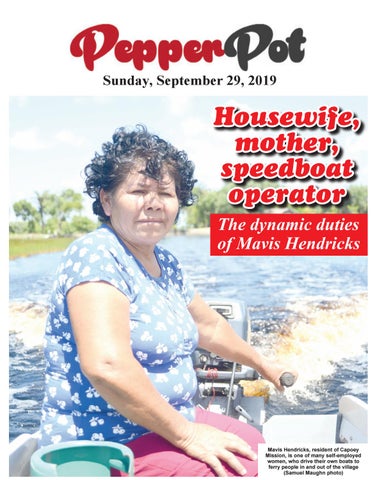
Housewife, mother, speedboat operator The dynamic duties of Mavis Hendricks
Mavis Hendricks, resident of Capoey Mission, is one of many self-employed women, who drive their own boats to ferry people in and out of the village (Samuel Maughn photo)
II
Chronicle Pepperpot September 29, 2019
Do celebrate, if you are 60 Years or older By Francis Quamina Farrier ON October 1, most countries around the world, including Guyana, will be observing International Day of Older Persons. This special day which was established by the United Nations in 1991, has been set aside to focus on the world’s increasing population of older persons and to honour them for the work which they have done during their more productive years. At this time, there are approximately 700 million persons who are 60 years and older around the world, according to a United Nations disclosure. With such information, some smart and astute politicians who are running for office, recognise the wisdom in going the extra mile to ensure that elders are shown respect, which they realise will certainly transfer into votes for them. As is known, elders do make every effort to go out and exercise their franchise since most of them know of the times when only the elites could have voted at general elections. Older persons generally tend to be more responsible in terms of social issues. During the 15 years I produced my radio programme series, The Eighty-plus Club, in which I interviewed hundreds of persons 80 years and older, I became well aware of the way elders looked at life and their responsibilities in establishing a better future for their descendants. On “ The Eighty-plus Club, I interviewed quite a number of elders who talked some politics, and I can safely say, that they were not only frank about their views, but they ensured that they turned out to vote at general elections. In no way am I berating the youths in this article, however, I have to
The late Pandit Rampiary Maraj of Mahaicony River during my visit with him
Retired Educator, 100 year-old Hilton Lewis
Mayor Muriel Bowser of Washington, DC, USA, with Guyana-born Centenarian Geraldine McRae flanked by her two children, at the annual Centenarian Celebration(Photo by Francis Q. Farrier))
say that the majority of elders exercise their right to vote and do turn up at the polling sta-
tions in their neighbours to cast their ballots. Guyana’s next general elections will therefore once again, attract many older persons. Some years ago, I had a most pleasant and very enlightening visit with Pandit Rampiary Maraj, who resided on the Mahaicony River. I took a boat ride up the river to his home where I spent about three hours in his company, learning quite a lot about Indian culture from a Hindu perspective, and the life of that wonderful man. He was in his 90s at the time and was still a role model, not only to his immediate family, who adored him but also to people in his community and beyond. Video recorded extracts from that visit were edited into a brief News Feature and aired on the GTV Evening News. Earlier this year, it was my pleasure to have been present at the 33rd Annual Salute to DC Centenarians, Hosted by the Mayor of Washington, DC, Honourable Muriel Bowser, on April 29, 2019. It was a proud day for me as a Guyanese Citizen, to see a fellow Guyanese, Geraldine McRae formally of Plaisance, who has been residing in the USA Capital city for decades, being one of the honoured guests. It was also my pleasure of having the Honourable Mayor, Muriel Browser pose with the Guyanese-born Centenarian for me to take a few photographs. Many years earlier, I was also invited to a seniors’ gathering at the World Trade Center in New York, which was hosted by then New York Mayor, David Dinkins. The Theme was, “New York honouring its seniors”. Revered and honoured Elder Statesman, Eusi Kwayana, is a hero not only of his native Buxton Village on the East Coast Demerara but of all Guyana. Kwayana has the unique distinction of writing the (Political) Party songs of the People’s Progressive Party (PPP). the People’s National Congress (PNC) and the Working People’s Alliance (WPA). Maybe, he holds the distinction of composing Party songs of three different Political Parties of his country, something no one else has ever
done and should be in the Guinness Book of World Records. Now in his mid-90s, Eusi Kwayana is still alive and well and contributing to his native Guyana with commentaries from time to time. The theme of this Year’s Observances of The Day of Older Persons by the United Nations is “The Journey to Age Equality”. It is important to take particular note of the word “EQUALITY”. That international organisation has pointed out that “Development will only be achievable if it is inclusive of all ages.” In a statement for World Day of Older Persons 2019, the UN also states that “Empowering older persons in all dimensions of development...is one way to ensure their inclusiveness and reduce inequalities.” There are so many examples of older persons who have retired, then go on to new careers and continue to make sterling contributions to society. One example is the retired Judge, Justice Oslyn Small, who is now the Senior Pastor at the Smith Memorial Congregational Church on Brickdam in Georgetown. So for someone to say, “I am fed up with the old people. They had their time. They must go one side,” is very counter-productive and even dangerous, since it sends the wrong message to younger persons, that it is acceptable to treat elders with disrespect, and even violence. It must be recalled the incident a few years ago, in which a minibus conductor so roughed-up an elderly passenger, that shortly after, the poor man collapsed and died. Fortunately, many individuals take good care of elders. There is the Commission for the Elderly which ensures as best as possible, that older persons, especially those who are resident in public institutions, are well taken care of. Quite a number of religious organisations also have special programmes for elders as well. The hope is that as a nation, Guyana will continue to respect and care for its older citizens on whose shoulders the younger persons stand.
Chronicle Pepperpot September 29, 2019
III
Guyana’s first Child and Adolescent Psychiatrist committed to her craft
By Wendella Davidson YOUTHFUL Dr Jenese October has etched her name in the annals of this country’s history as the first local doctor to specialise in Mental Health, targeting children and adolescents. Dr October recently returned from Cuba where she completed specialty studies in Child Psychiatry, a three-year, post-graduate programme for which she was granted a partial scholarship from the Pan American Health Organization (PAHO). Prior to heading to Cuba, Dr October had completed CXC (as it was referred to at the time) at a city school and the New Amsterdam Multilateral Secondary School, and at age 16, she enrolled at the University of Guyana to read for an associate degree in medical technology. In July 2005, after completing university studies, she applied for a scholarship to do medicine and was included in the batch of students who left for Cuba in September that same year. Graduating in 2012, she returned to Guyana and served for three years before heading back to Cuba to be tutored in child
and adolescent psychiatry. According to Dr October, she always had an interest in general medicine and found herself becoming more intrigued about mental illness during rotation in the fifth year of studying to become a medical doctor. “I always wanted to understand how it is that a physically healthy person is unable to function adequately once they have a mental disorder. The more I was exposed to psychiatric illnesses during my rotation stints, the more curious I became to know more to be able to help persons with such conditions,” she said. Dr October is of the view that early diagnosis of a mental health disorder, coupled with proper management and treatment, can help to stem progression of the disease. Child psychiatry is the early detection and diagnosis of these mental health disorders before it reaches adulthood, she stated. As the first trained Guyanese Child and Adolescent Psychiatrist, Dr October says she feels honoured and proud, knowing that she is a young professional in the field. She said that her exposure to persons suffering from mental health illnesses has caused her to realise that the awareness of these conditions has not
reached all corners of the country. She posits that her input will go a long way in helping the situation. Dr October recalled spending the last three years in Cuba being attached to the only paediatric teaching hospital in the capital of Havana with an in-service Child and Adolescent Psychiatry Ward. She described her experience as invaluable and vast, while noting that she has had the privilege of attending to a range of psychiatric disorders. A simple, motivated and hard-working individual, Dr October is the eldest of four who include a cousin, who is practically like a brother. She grew up in New Amsterdam with her grandmother, the late Daisy Baker, a retired school teacher. She recalls her late grandmother had a very strict principle that books come first and anything else after. “She basically instilled in me the importance of education and how through education, anyone, irrespective of his/her background, can be elevated. She was a firm advocate of education, “It was principal in my household,” she added. Reflecting on Cuba during her first stint there, Dr October said it was chal-
Dr Jenese October specialises in mental health problems in children and adolescents
lenging dealing with a different society, language and culture, and reminded that there were also students from different parts of the world. “We all had to adapt to the new conditions and surroundings and stay focused,” she said.
IV
Chronicle Pepperpot September 29, 2019
The Albion Estate ‘FAM TOUR’ is a refreshing experience The Albion Sugar Factory
By Naomi Marshall OUR journey to the Albion Estate in East Berbice-Corentyne started at around 07:00hrs from the Le Bonne Intention Estate on the East Coast of Demerara. It was a two-hour drive that took us across the magnificent Berbice Bridge and 11 miles east of New Amsterdam. Though the journey appeared longer than it really was, the thought of economic prospects driven by a budding tourism heritage hot spot filled the air with excitement, as the tour operators on board were eagerly waiting to see what the Albion Estate had to offer. At 09:00hrs we had arrived at the Albion Estate where we were welcomed by our tour guides for the day. We were then escorted to the mess hall where we were all treated to finger licking creole dishes for breakfast, which is a huge part of the ‘country expe-
rience.’ After, we were given an overview of what the trip would entail. This was also one way to prepare us mentally for the day’s adventures we were going to endeavour. Our first stop was at the Estate’s Field Laboratory. There, we were given a synopsis of the Pest Control Mechanism. At the Albion Estate, insecticide is not used to control pests. However, the insect control mechanism used is Biological control. Biological control is the introduction of a natural enemy or predator that is able to suppress pests. The advantages of using this method of pest control are that the natural enemy can become established and this will produce long-term results. The risk of resistance is also much lower since pests cannot build up resistance to being eaten. Natural pest control is very targeted and therefore an effective way to control particular pests.
During this period, we were also given the chance to go into the nursery where we viewed the different varieties of sugar cane. The second stage of the tour was the cultivation visit. At this phase we got involved in the Lorry experience, where we drove in a Lorry, on the longest straight road in the Caribbean Region, while getting to see the community of Rose Hall. From the Lorry, we then embarked Labour punts that were drawn by two oxen along the cultivation canal. This was an experience of a lifetime, and the fresh coconut water and jelly we were treated to made it even better. Next, some would say was the most exciting part of the tour, a visit to the GuySuCo Training Centre. Here we were greeted by dancers dressed in clothing of different ethnic groups within Guyana, as they performed a cultural dance that made us all want to join in. Music plus dancing?
Best welcome ever! At the Centre, we encountered even more excitement, as we got the opportunity to view and even go into the world’s only working 1924 Rolls-Royce Goshawk. The 1924 Rolls-Royce Goshawk built between 1922 and 1929 was Rolls-Royce’s “small car” for the 1920s and was produced alongside the 40/50 Silver Ghost and Phantom. The car has 20 Horse Power, a 3 or 4-speed manual transmission, a wheelbase of 3,275 meters, a 3127 cubic centimetre engine and was designed by Sir Henry Royce. There was also an ancient sugar mill which was located in the Essequibo region. It was first operated by the slaves during the 18th century. The mill was reconstructed using scrap materials available in the Training Centre by the students and staff of the school. The GuySuCo Training Centre is the preTurn to page V ►►►
Labour punts being drawn by two oxen
Chronicle Pepperpot September 29, 2019
V
◄◄◄ From page IV
Old sugar mill
Participants of the ‘FAM TOUR’ enjoying the lorry experience
mier technical vocational training school in the Caribbean and specialises in apprentice and technical training in the following competencies: fitting and machining; industrial electrical installation; automotive electrical; agricultural mechanic; instrumentation, amongst others. The GuySuCo Apprenticeship Training was established in 1957 to provide formal residential training for young persons wishing to pursue a career in engineering skills in the Sugar Industry. At this point, you would think that we had enough excitement for one day, but the tour was not over just yet. Dressed in safety helmets and vests, we visited the Albion Factory where we were told of the history of the Factory and even got a tour of it. In school, I was taught of the sugar making process but on the Familiarisation Tour (FAM TOUR) I got firsthand experience of the sugar making process, which I thought was very sweet. As the tour wined down we were taken back to the estate’s mess hall for lunch before we left for home. Albion Estate was established in the second half of the 19th century. The Estate lost its singleness and became known as Albion-Port Mourant Estate, following the closure of the Port Mourant Factory in 1953. This amalgamation formed the largest operating unit within the local sugar industry. The Estate has a reputation for being ‘different’ from the
other Estates owned by GuySuCo. It appears and is seen as an ‘oasis of untypical sophisticated charm and beauty’ of the community of Rose Hall. Earlier this month the Guyana Sugar Corporation (GuySuCo), in its quest to tap into the country’s second largest export sector – Tourism– hosted its inaugural ‘FAM TOUR’ to the Albion-Port Mourant Estate in Berbice; an initiative that forms part of its ‘Cultural and Sugar Heritage Tourism’ programme. Tour operators and media operatives from across Guyana were given the opportunity to experience the aesthetics-rich heritage that exists within Guyana’s biggest sugar estate. Salvador De Caires, Representative of the Wilderness Explorers, said that the initiative is what his entity has been searching for year after year. “I think this tour is wonderful. I think it was something we had been looking for years and years because, throughout the Caribbean, everybody has rum tours and sugar tours. It is one of the important parts of Caribbean tourism and we never use to do it here,” he said. De Caires added that the tour would be a great weekend trip “for locals, the diaspora and the international market which is something unusual.”
The 1924 Rolls-Royce Goshawk
VI
Chronicle Pepperpot September 29, 2019
GPHC wants six months’ maternity leave policy implemented for breastfeeding mothers A nurse demonstrates how to breastfeed
A section of the audience
By Elvin Carl Croker THE Georgetown Public Hospital Corporation (GPHC) has issued a call for the implementation of a policy that will see breastfeeding mothers having a full six months of maternity leave instead of only three months as it exists now and an extension of parental leave across the country. “We educate our mothers about breastfeeding for the first six months of life, but yet our policy of returning to work after three months hinders that goal for working mothers. This brings to focus the discussion of an extended three months of maternity and parental leave from our National Insurance Scheme,” said Assistant Director Nursing Services Celeste Gordon, as she addressed a health fair to celebrate National Breastfeeding Week last Thursday. National Breastfeeding Week this year is observed from September 15 -21 and is held under the theme, “Empowering parents, enabling breastfeeding.” Gordon further said that in Guyana the majority of unemployed mothers are not covered by the maternity and protection policies. In this regard, she advocates the construction of a day care centre accessible to working mothers at the GPHC and a breastfeeding room in areas within workplaces accessible to working mothers, so that they can have a space. She noted that the lack of support for parents at work is a barrier for empowering women. The benefits of breastfeeding are numerous and according to the WHO, only 40 percent of infants less than six months are exclusively breastfed globally. It is further stated that if breastfeeding were scaled up to near universal levels, about 820,000 children’s lives would be saved every year. The health fair was held with a focus to empower not only women who come for services at the GPHC, but women in the general public at large about the importance of breastfeeding. As such, the theme was done with a focus on the family’s involvement to enable breastfeeding and helping parents to create that bond with their children in early life. It is the hospital’s view that the 91 days’ maternity leave to recover from birth and breastfeeding is a good start; however, as mothers return to work, their ability to continue breastfeeding regularly depends on having access to breastfeeding facilities and brings into focus a safe, private and hygienic space for expression and storage. Chief Executive Officer (CEO) of the
Chief Executive Officer (CEO), GPHC, retired Brigadier George Lewis viewing a section of the fair
GPHC, retired Brigadier George Lewis in his support for the call said fathers should be encouraged to be part of breastfeeding to create a bond with their babies and to assist the mother with household chores. Lewis referred to the call made by the World Health Organization (WHO) and the United Nations Children’s Fund (UNICEF). In that call, it was pointed out that a collaborative effort should be made to improve breastfeeding by having a comprehensive breastfeeding programme and improved counselling, offering support to women in the workplace and community as a whole. This, he said, can be achieved by working together with support from the Ministry of Public Health, employers and communities as a whole. “We have the power to enable breastfeeding and support families in fostering and nurturing our environment for our children,” he said. The CEO said breastfeeding is a normal way of providing young infants with nutrients they need for healthy growth and development. Mothers, he added, should breastfeed their children once they are provided with the support of family members, the support of the health care system and the support of society. “Exclusive breastfeeding is recommended up to six months of age with continuous breastfeeding along with appropriate supplementary goods up to two years of age; the
benefits of this are numerous both for mother and child,” he said. In sharing some of the health benefits of exclusive breastfeeding, the hospital boss said it helps with the natural method of birth control; in fact, he said it is believed that it prevents 98 percent of pregnancies. “Breastfeeding also helps to reduce the risk of ovarian and breast cancers, diabetes, depression and a number of other illnesses. It is safe and contains antibodies that protect the infant from common childhood illnesses such as diarrhoea and pneumonia,” he counselled. Noting that one of the immediate benefits is that it contributes to a lifetime of good health. Lewis said that breastfeeding is a learned behaviour that not all mothers decide to do, noting that some of the factors that prevent mothers from breastfeeding are a lack of knowledge; brief maternity leave; the number of feeding breaks on the workplace and in some cases, discomfort that the mothers experience through soreness and redness of the nipples. In this regard, he called for both old and new mothers to be educated on what to expect during breastfeeding and the benefits of breastfeeding, so that they will embrace it and thus nurture healthy babies who will become healthier adults and be able to contribute to national development. “As you encourage others to breastfeed,
do so with diligence, and always remember to do so considering the dignity of the mother. You must respect them and understand that persons have biases based on different factors such as religion, culture, beliefs and others which may affect them wanting to breastfeed. Therefore, you have to exercise patience and tolerance to achieve your goal, which is to make every mother who delivers in the GPHC breastfeeding for at least six months,” he told the staff of the maternity unit of the GPHC. He encouraged the staff to maintain and improve their efforts at educating mothers that “breast is the best” and that this nation’s health and well-being depend on them. The GPHC achieved “baby-friendly” status in August 2016. As such, it is the role of the hospital to sensitise and educate both staff members and the general public at large that breastfeeding is everyone’s business. To this end, the hospital has placed its focus on helping breastfeeding mothers, along with other family members to exclusively breastfeed. Evidence has shown that exclusive breastfeeding for as long as possible can strengthen development of the child’s brain, which creates a positive impact over a lifetime. It also protects maternal health and reduces the risk of having breast and ovarian cancers in women; it also helps to improve their physical health and enhances general family well-being. Adolescents and adults who were breastfed as babies are less likely to become overweight or obese, less likely to have Type Two Diabetes and it is believed that they have greater intelligence. Breastfeeding is not a choice, it is a responsibility, and it is the best investment in saving lives thus improving health, and social and economic development of individuals in the nation. In commemorating activities for National Brestfeeding Week, staff and management of the maternity unit of the GPHC believe the health fair will serve to educate persons on the topic. The GPHC is fully supportive of breastfeeding and has renewed its commitment to work with the Ministry of Public Health, other government agencies, the Pan American Health Organization and the World Health Organisation. This is with a view to developing policies and action programmes that promote and advocate breastfeeding; this includes legislation to protect commercial biases and to facilitate opportunities for working mothers to be able to breastfeed their babies and work at the same time.
Chronicle Pepperpot September 29, 2019
VII
Informed consent in dentistry obvious open margins (spaces) between the tooth structure and filling material. An open margin can eventually lead to decay under restoration. If there is a question of the quality of
THE most important service you can do for yourself as a dental patient is to be informed. Be aware of what your dentist is proposing for your treatment. Let us assume that he has told you that you need one ‘simple’ cavity filled. Which tooth is it? How can you prevent any similar cavities from forming? What type of filling is needed? How much will it cost? Ask plenty of questions if you are uncertain of what is going on, or what is about to happen to you. It is your tooth and your mouth, and you have every right to know what is going to happen! Informed consent is a very important aspect of dental care today. Patient education about necessary treatment alternatives, or the ramifications of no treatment, should be accomplished at the diagnostic appointment (such as when you go for your routine tooth cleaning and checkup). Economics do sometimes dictate which option you must elect. For example, you might decide on amalgam (silver filling) rather than gold only. The amalgam may not be the best choice, but it will save the tooth until you can save enough money to select the better choice. Ask what your options and risks are in selecting a particular course of treatment. Having a thorough understanding of your needs allows you to understand treatment plans before treatment is started. For every procedure, you need your dentist to inform you about treatment alternatives (advantages and disadvantages), cost, risk and ramifications of non-treatment. If you have any doubts about the necessity of restorations, the experience or expertise of the dentist, or if there is anything else that bothers you do not hesitate to speak up. The dentist cannot read your mind. If the problem is one of confidence in the dentist, do not hesitate to change dentists or at least seek another opinion. Now, let us assume that you have chosen a dentist, and you need restoration on your
lower first bicuspid. Do you know which tooth this is? This could be very important information to know later. Why? What if you get a toothache on a vacation? If it is on the left side, you can tell any dentist that you recently had a filling on the lower left first bicuspid, and thus the toothache might be coming from that tooth. You need to be able to communicate with a new dentist who is not familiar with your dental history. It is also helpful to be able to communicate effectively with your regular dentist. In the beginning, a toothache is localised. Later the pain becomes diffused and it may become difficult to determine the source. If you are informed, you could be a great help in diagnosis. It’s also important to know how deep the filling was and whether pulp capping (sedative medication placed on exposed pulp) was necessary. You could be helping yourself out of an uncomfortable situation later. In addition to the technical side, you should take into account the human aspect. A big question is: Can you communicate with your dentist? Find another dentist if the answer is a big ‘No!’ Finally, after you get home, you can examine the treatment done by your dentist. It is quite easy, provided the dentist placed a silver or gold filling. Does it feel as though the filling is hitting first when you bite down? If the answer is ‘yes’, go back and tell your dentist. He can ‘adjust the occlusion’ (fix the bite) by grinding down some of the dental restoration. What for tooth sensitivity or sharp pain, which also may indicate high restoration. Next, you can purchase a mouth mirror from the dental aids section of your local pharmacy. It will look just like the one the dentist used except that it will probably be made of plastic rather than metal. There should be no ‘catch points’ restoration between the teeth when you floss. It should be smooth; thus, you can use your fingernail to test this and to make sure that you have no
the service provided, first bring it to the attention of the dentist who provided that service. If you get no satisfaction, seek the advice of another dentist or your local dental society.
VIII
Chronicle Pepperpot September 29, 2019
THE ELIMINATION OF FALSE AND SUBSTANDARD GOODS FROM THE GUYANA MARKET IN the last two or three weeks, the consumer community were both surprised and rejoiced that the Food and Drugs Department had shown a sudden squirt of activity when they visited several pharmacies which had been selling substandard and fake pharmaceuticals and seized them. This column had been constantly bringing to the attention of consumers not only to the wide distribution of fake and substandard pharmaceuticals but also other goods such as cosmetics, foods and haberdashery. These false and substandard goods are often toxic, that is, being poisonous at various levels and could seriously impair health. In pre-Independence times, Guyana’s food and drug imports were almost wholly made from reputable Western companies which were subject to strong national standards. Guyanese, therefore, felt with much justification that goods imported from Western sources were superior to those produced by Third World countries. The advent of the Free Market has changed the scenario completely and goods from every part of the world are imported into the Guyana Market.
The recent commendable activity by the Food and Drugs Department netted three fake and substandard “medicines” - Chanca Piedra Phosmovite which was promoted as being able to successfully treat gall and kidney stones and clean the liver and urinary tract; Fungabort which claimed it was effective in the treatment of nail fungus; the third forgery being Phosferine, a well-known drug in the Guyana market a generation ago. Despite the forgery claimed that the name Phosferine was copyrighted and registered, the real drug which was indeed copyrighted and registered was spelt ‘Phospherine’ and not Phosferine. All three fakes claimed they were manufactured in Canada. Canada is not known to be a forgery capital as some East Asian countries are but there are a few firms in that country which do produce fake and substandard goods. One such is a well-known food manufacturer whose products are imported into the Guyana market. That firm uses the trademarks and labels of well-known products which are no longer produced by the genuine producers who would have ceased using the brand or may even have gone out of
business. It also clandestinely patents the name of products which are not as yet patented in Canada. It is likely that the three fake products seized by the Food and Drugs Department were indeed produced in Canada. Consumers themselves must be on the lookout for the quality of the drugs or other goods they are buying and must read the labels carefully since the labels often indicate whether a product is genuine or not. An example of this was given above in the case of spelling. Colour of the label could also be an indication. Country of origin, though a useful indicator of quality, is not always so as was shown in the case of Helms Pharmaceuticals of Hamburg, Germany some years ago. Helms was able to quickly win a good part of the market until consumers began to notice the Helms drugs quickly deteriorated. On research by the Bureau of Standards, it was found that Helms had their drugs made in extremely poor conditions in various Third World Countries and passed them as being German made. They were quickly removed from the Guyana market. The Food and Drugs Department has not
so far instituted any charges against any of the pharmacies selling the fake products but instead are turning their attention to finding the main distributor and uncovering how or when the goods were brought into the country. This strategy may be farsighted but the normal consumer feels that charges should have been instituted on the retailers since such would have been a deterrent to retailers buying or selling food or drugs of uncertain quality. Importers, wholesalers and retailers should be alerted of the relevant Laws of Guyana relating to the quality of imports and their cooperation sought. This may require importers being reminded of quality and that low prices should not always be a determinant in purchasing import stocks. In the final analysis, the control and elimination of imports of fakes, forgeries, substandard and health-impairing products is the shared responsibility of consumers, retailers (including pharmacists), importers, the various responsible government departments and above all strengthening the relative Laws.
#SupportCreativity
‘Elite’ Season Two Carla as a Lady Macbeth for the Modern Age By Subraj Singh
‘ELITE’ is one of those shows that greatly exaggerates its subject matter, presenting high school students as murderous, deceitful, drug-peddling, alcohol-guzzling, people with very sad personal lives. The beauty of ‘Elite,’ however, is how it convinces the audience to lose sight of the reality of the subject. It convinces us to remove ourselves from reality and insert ourselves into a narrative where students seem to spend way more time partying than they do going to school, where everyone is extremely beautiful, where wrath and envy and lust are the dominant emotions. It is truly a miracle, the way the writers, directors, and actors come together and manage to keep us glued to our screens, episode after episode, as we tunnel headfirst through a story that only marginally represents something the way that thing exists in real life. But perhaps, by doing this, ‘Elite’ is serving its purpose. After all, we do go to Netflix and the movies and refer to books and other sources of art to indulge in fantasy, so we can escape the constraints and the difficulties of the real world. Having watched the second season of this particular Spanish-language TV show, I have once again come away with the impression that the cast is one of the best things about it and that the cast is one of the reasons why it is so successful. Mexican superstar, Danna Paola, who plays spoilt, rich-girl, Lucrecia, stands out in a remarkably strong performance of a remarkably strong character. Alvaro Rico, as Polo, a bisexual student hiding a dark secret is also quite impressive, as is Mina El Hammani who essays the role of Nadia, a poor, repressed, Muslim student. One of the standouts
uses sex and deceit to control the men around her or is she a young girl who sees no other way around all of the various strong, villainous figures that she surrounds herself with? No one really knows. To this day, I am still uncertain as to whether Carla is a good person or not. This ambiguity with regards to who she is as a person, beneath the façade, is one of the things that make her quite comparable to Shakespeare’s Lady Macbeth, whom we never really get to figure out as well – is she a power-hungry tyrant or just a woman trying to survive in the world? Carla’s ability to convey an angel-like sweetness, her beauty, her charm, her soft voice, all contribute to her innocent persona, but her actions – like arranging a threesome with herself, Polo, and Christian, or helping a murderer to hide a murder weapon – can be very contrary to everything that is “Carla” as portrayed by Ester Exposito in revealed on the outside. In season two, after the audience has been Netflix’s ‘Elite,’ 2019 – Image source: IMDB led to believe that we know who Carla is, she among the new additions this season is Geor- flips the switch once more and invites us to see gina Amoros who turns in a mind-bogglingly a softer, more delicate side of her personality good performance as Cayetana, a poor student – as evidenced in her interaction with Samuel who is also domestic worker, but masquerades and the fact that she worries him about to as the wealthy women she works for. As the the extent that she confesses her knowledge season went along, with the students still trying of the murder that took place in season one. to make it through the events that came about It is quite a change from the Carla that we from the murder that closed the previous sea- knew, or thought we knew – and yet, even son, it quickly became clear to me once more this other dimension to her personality is still that ‘Elite’ has one of the strongest casts in any not enough to know her at all. She is the kind international show right now. These actors are of character that is always one step ahead of really talented, and, for me, none of them more every other character and the audience as well. so than 19-year-old, Ester Exposito, who plays This unknowability coupled with her beauty, her fire, and her keen, intelligent mind that ofmy favourite character, Carla. Carla’s complexity is my favourite thing ten inclines towards the darker side of human about her. Is she a manipulative vixen who nature makes her the perfect incarnation of
Lady Macbeth. If Lady Macbeth was a highschool girl who was born into wealth and had an active social life in the 21st Century, then she would be Carla. A lot of the credit for the creation of this character must go to Ester Exposito, who as the actress playing the role, is responsible for bringing this character to life. It is hard to believe that she is only nineteen years old. Not only does she manage to imbue Carla with vitality and deviousness that surpasses the character’s youth, but she also manages to make the character likeable and relatable and ensures that the audience conjures up some amount of empathy for Carla – which is no easy task considering Carla’s difficult personality and the numerous morally incorrect things that the character does. Exposito also perfectly straddles the fine line that renders us incapable of ever knowing who Carla is or what her end-goals and true motivations are. She manages us to reel us in enough so that we like, relate to, and appreciate the character, without ever really knowing what the character’s next move will be – and being able to do all of that with the role at nineteen years old, to me, is talent. It is taking the character as she is on the script and imbuing her with such life and vitality that when she tells a lie, you believe her anyway, despite knowing that you shouldn’t – and in much the same way that we continue to be glued to the show itself even though it is not a true depiction of the real world of high schoolers, so too are we glued to Exposito’s depiction of Carla, knowing that very little of what this character says is true.
Chronicle Pepperpot September 29, 2019
ocus F
IX
on the Village
Capoey Mission A scenic paradise of hard-working people Village chat at noon
By Michel Outridge THIS week the Pepperpot Magazine visited the idyllic and majestic Indigenous reservation of Mission Capoey, which is located between Taymouth Manor and Alliance Villages on the Essequibo Coast and it is home to less than 1,000 residents. THE scenic reservation of Capoey Mission boasts many things, but one of the most noticeable is that most villagers are self-employed and very resourceful. The Pepperpot Magazine met a very kind and friendly villager, Theresa Williams, who had finished preparing a barrel of traditional wine called ‘fly,’ which is made from black potatoes grown right in the village. The 62-year-old was at the time stirring the barrel of ‘fly,’ which she had specially prepared to sell at the village heritage celebrations which are scheduled for today. She stated that the ‘fly’ is made from 25 pounds of black potatoes which is boiled with sugar and then stored in a barrel to ferment for the acquired taste. Williams, however, admitted that it was her first time making ‘fly,’ but after a taste of the potent beverage, it was confirmed as a perfect mixture which was tasty and had all the right ingredients. “I will bottle the ‘fly’ and based on the size I will sell it for the heritage and it is my contribution to the village this year, she said. Williams disclosed that the longer the ‘fly’ is stored, the stronger it becomes and it
is considered a ‘strong wine,’ which should only be consumed by adults. Another resident, Seon Tugwell, who went through the village with the Pepperpot Magazine said he is self-employed and is into graphic designing and is also responsible for the Capoey Mission’s Facebook page. Although he is not originally from the village, he has been there for the past six years and he was drawn to the community through his wife; he met her at a beauty pageant in another village years ago. His wife is a teacher in the village and they have one child and he describes life there as peaceful and quiet, the perfect place to raise a family. Violet Budwurgh, a resident of Capoey Mission, was outside her house chatting with others when the Pepperpot Magazine met her. Born and bred in the village, the 48-yearold said that the heat was unbearable and she decided to step outside to get some fresh air on a bench at the side of her house. “I am a craft-maker, but due to ill health, I am unable to make things now and I now depend on my husband to provide for the family,” she said. The mother of three reported that she is an occupant of one of the many Food For The Poor houses in the community, which has a relatively small population. The Pepperpot Magazine also encountered a smiling Lorenzo Carter, the village’s boat operator, who ferries schoolchildren and teachers in and out of the Mission.
Beautiful Capoey Mission (Samuel Maughn photos)
He works for the Village Council, a job he started about two months ago. “I born and grow here and I have a daughter but life here is not easy; you have to work to make ends meet,” Carter said. While at the Village Office, the Pepperpot Magazine caught up with Grace Edwards, who had dropped of a few model canoes which were hand-made by her spouse, Morris Edwards. The samples were purchased by the Village Council and will be used as part of the mini-exhibition for the village heritage celebrations. Edwards said the canoes are made from wood sourced from within the village and although it takes time to make them, it is a task her husband has been up to for some time and it provides an income for the family. Wanda Solomon is the resident forestry officer and her role is to monitor the reservation and issue relevant documents needed to conduct logging, etc. She also takes samples of trees and sends them to the Guyana Forestry Commission for processing purposes for market and discovery
Theresa Williams displaying the black potatoes that are used to make ‘fly’
of newer wood species. Solomon said she is from the Essequibo Coast and when she was a little girl her mother moved to the indigenous village, which has become her home. She is also part of the Village Council and assists in the daily running of the Village Office. Village Council member Edward Hendricks said he is responsible for assisting the health workers in the village. His task is to ensure they have everything to keep the residents in the community healthy. He has served for many years and is self-employed as a mason and carpenter and would even work outside the village. When the Pepperpot Magazine met Edwards, he was in the process of cementing a piece of land in front of a lakeside shop in the village. The father of six said, “For heritage, a stage will be constructed with booths to vend food and drinks for villagers and we expect a lot of visitors. When dem hear about heritage here, everybody anxious fuh come,” Edwards said.
X
A man with the village and its people at heart By Michel Outridge RALPH Hendricks is a community man and a family-oriented husband, who shoulders the responsibility of Capoey Mission to ensure that villagers are comfortable and that development abounds. He has been the Toshao for Capoey Mission for the past three years and retired head teacher for Capoey Primary School and has the village and its people at heart.
Council is made up of seven councillors, himself included, and they oversee all developmental works within the Mission. He stated that Capoey Mission is a registered indigenous reservation which was first inhabited by the Wapishanas, but due to a plague, that tribe was wiped out, according to the legend. He added that the Arawaks, mostly from Region One (Barima-Waini), came and settled on Capoey Mission. Hendricks noted that the Mission is about two and a half
The landing at Capoey Mission (Samuel Maughn photos)
Hendricks told the Pepperpot Magazine that his role in the village is to serve as the leader, who puts the people first and governs the Village Council. He related that he is the chairperson for all meetings and is responsible for all developments within the village and act as a mediator to settle all internal disputes and issues. The village leader added that the Village
miles wide and is a large lake within a lake. “We have another lake which is on the right side of the village called ‘Calabash Lake’ and it is about three-quarter miles in diameter and we are the closest reservation to the Essequibo Coast, which is about two miles away,” he said. Hendricks pointed out that the development of Capoey Mission started a long time
Chronicle Pepperpot September 29, 2019 The Capoey Community Library and All-Purpose Hall
ago with the missionaries who established churches and later schools; however, in 1976, the then government constructed school buildings housing the nursery and primary schools. He told the Pepperpot Magazine that Capoey Mission has a health post with at least two health workers, a primary school, a nursery school, teachers’ quarters, five churches, a library, an all-purpose hall, a large benab, the village council building and a Guyana Water Inc. (GWI) solar-powered water system for the entire village, which is outfitted with 16 black tanks on a concrete trestle. The village leader added that within Capoey they have a housing scheme called “Georgeville,” where 50 Food For The Poor (FFTP) funded houses equipped with solar panels was constructed some years ago. Hendricks added that Capoey Mission itself sits on four acres of land, but Capoey is larger in size and there are parts with thick vegetation and jungle for hunting. The toshao pointed out that there is a standpipe water supply to every house in Capoey and some folk have generators in addition to the solar-powered systems; the quality of life there is comfortable. He noted that residents earn their livelihoods by wood-cutting, gold-mining, sand-mining, small- scale farming and fishing. “The Village Council has their own tractor with two trailers which aid in the
cleaning of the village; we also have a bus for transporting schoolchildren to and from school every day and our own school boat as well,” he said. The toshao disclosed that six villagers are employed in sand-mining in Capoey, which is managed by the Village Council and money garnered from the sales goes towards the development and upkeep of the Mission. He added that they make do with the money and try to improve the village and also maintain the village adequately. Hendricks stated that all activities are held at the Village Benab; he looks forward to it being transformed into a flurry of activities to host their village heritage celebration. The toshao told the Pepperpot Magazine that the Village Council will be preparing wild meat Pepperpot to go with home-made cassava bread and to ‘wash down’ with some home-made ‘fly’ and cassiri wine; samples will be gifted to visitors. Hendricks said the toshao’s work is not new to him because he has been in that post for 12 straight years. He then took up the position of headmaster and spent 10 years in the Pomeroon teaching and later returned to Capoey Mission, where he was elected toshao for three years in a row. “This is my last term as toshao, because I made the decision to let go and make way for a young person to take up the responsibility; I will be more than happy to guide that individual,” he said.
Housewife, mother, speedboat operator
The dynamic duties of Mavis Hendricks By Michel Outridge MEET Mavis Hendricks. She is the wife of the Toshao, Ralph Hendricks of Capoey Mission. This ever-friendly but serious woman is a native of Capoey Mission where she met her husband, got married and mothered children. Presently, she takes care of six grandchildren who were orphaned when her daughter died suddenly, after the birth of her sixth child. This mother, however, still has to contend with household chores and even provides a speedboat service to and from the village which provides a small income. “My mother is alive, but my father passed away many years ago and we had a good upbringing and led a very simple family life – the only place that is home for me is
Capoey Mission, because I spend all my life here,” she said. Hendricks operates a 15 horsepower (HP) outboard engine on a boat bought for hire, an acquired skill she mastered by herself. This Capoey Mission resident stated that one day, she just took the boat and learned to operate it by herself and it turned out well. “Our village has everything and we are comfortable here, because the Essequibo Coast is nearby and we go to get our groceries and other things and bring it [sic] back to the village,” Hendricks said. She related that Capoey Mission is nearer than any other indigenous village to the Essequibo Coast, so prices are reasonable. For the village’s heritage celebration, Hendricks stated that they have been making preparations in
advance and they are ready to host it and all are welcome. Villagers have prepared the traditional beverages by the barrels and foods to accompany them, which will be on sale at the many booths that will be constructed. Hendricks told the Pepperpot Magazine that Capoey Mission is large, making it ideal for hunting within the village and there are about 200 houses. The mother of four said that all her children are grown up and lead their own lives and her role is raising her six grandchildren, two of whom are attending secondary school on the Essequibo Coast. Hendricks is one of many women who drive their own boats to ferry people in and out of Capoey Mission and are self-employed.
Mavis Hendricks in her boat on Lake Capoey. (Samuel Maughn photo)
Chronicle Pepperpot September 29, 2019
XI
The Eco Lodge Guest House is the perfect holiday getaway By Michel Outridge NATOYA Richmond left her home village of Lima Sands, Essequibo Coast, to settle for a quiet and simple life in Capoey Mission. She is the Eco Lodge Guest House caretaker and also has a house of her own in the community; she is married and has one child. The Capoey Mission Eco Lodge Guest House has three large rooms with double and single beds and is outfitted with a spacious kitchen for visitors’ convenience. This place has a rustic and “outdoorsy” look that is attractive and sits atop a hill in the community which is sandy and noted for its sand-mining. Richmond told the Pepperpot Magazine that it is her job to take bookings and ensure that guests are comfortable and catered for and if they request meals, she also serves as the cook. For outsiders, the room costs $4,000 per night and for villagers, it is $3,000 nightly and there are no air-conditioned rooms, so one can leave the windows open. She has been residing in the
The Eco Lodge Guest House (Samuel Maughn photos)
community for the past several years and is very comfortable with life there, having escaped from the bustling life of a populated area for peace and tranquility of Capoey Mission. Peace Corps Volunteer Martin Alexis who is a teacher at Capoey Mission Primary School, told the Pepperpot Magazine that he really likes the village and the people who
are very friendly; most of all however, he is happy to be a teacher. It has been two years since he started as a literacy teacher at the village school and has a house in the Mission, where he prepares his meals for the weekends. During weekdays, meals are provided at the school through their feeding programme and the food is to his liking.
Alexis if from Florida, United States of America and his stint will end next year; he, however, said that he will renew it because he is in love with the place, especially the lake and the people; they have been very cooperative and welcoming. “It is one of those places where you go and never outlive your welcome, because the people are genuine and kind,’ he said. He likes to
Peace Corps Volunteer Martin Alexis
take dips in the cool, dark water of the lake. He disclosed that he will be doing the Mari-Mari dance for the village heritage celebration, as he did last year. He was at the time assisting an elderly villager to guide the children in practice of the traditional dances for the heritage celebration at Georgeville Community Centre in the Georgeville Housing Scheme. The Pepperpot Magazine also met Wilfred Roberts, 65, a village elder, who was guiding schoolchildren in the traditional dances of Mari-Mari, Baboon dance and Snake dance, which they will perform for the village heritage celebration. Roberts was assisting six primary school students with the dance moves, but on a daily basis, he is a small-scale farmer. He has crops of vegetables, which are sold in the village and assist in defraying his personal expenses.
Capoey Mission Primary School Outstanding performances despite challenges By Michel Outridge HEADMISTRESS of Capoey Mission Primary School, Phulmattie Drikpaul, said the pupils of the school are academically inclined and have performed well at exams despite challenges. She made the disclosure when the Pepperpot Magazine visited the picturesque community recently. She reported that with the children, they can look out for success because, in the last Grade Six Assessment, students excelled and were awarded places at senior secondary schools in the region. Drikpaul stated that results have proven to us that of the 14 students who entered, six were awarded senior secondary schools in the region and that is a plus for the school. “It is a good gesture to tell the teachers that teamwork pays off and we can achieve so much, but our basic challenge is not having electricity at the school,” she said. Drikpaul explained that after construction of the school three years ago, a solar-powered system was installed but due to some faulty connection with the inverter it damaged all the batteries. “We had a problem where the inverter couldn’t handle the power to the batteries and caused the batteries to go flat; we got donations from one agency that gave us an inverter, but we need batteries now,” she said. Drikpaul added that they need at least four batteries for eight large solar panels and four smaller ones for them to have electricity to the school building. She related that with electricity they will be in a position to broaden their scope in terms of technology, internet learn-
The Capoey Mission Primary School (Samuel Maughn photos)
ing and the possibility of having an ICT hub. Drikpaul noted that without electricity their desktop computer, printer, fans and other electrical equipment are laid up at present. The headmistress said their radio programme was suspended indefinitely because of their electricity woes, and both teachers and students are limited; some of them don’t know what is beyond the lake. She stated that most teachers hardly go out of the village because it incurs a cost and they do so only when it is necessary, since many teachers are from the village. “Their experience is limited because they don’t know what is beyond the lake when it comes to interacting and other cultural
lunch period or after school, where the teachers identify the students’ weak areas and take half an hour to work with the children and also children who work along with other teachers. In all it is a nice community to work in and being small is manageable. Our greatest challenge is electricity and it is very hot here and the children need some relief,” she said. Headmistress Phulmattie Drikpaul Drikpaul told the Pepperpot Magazine that she has been stationed at the Capoey Mission Primary School from October 2018, for one year, and the experience so far has been good. She stated that the community is not academically inclined, but the children are very willing to learn and they have a school-feeding programme; this started a year ago, but before that attendance at the school was at an all-time low. In total, the headteacher disclosed they have 74 primary school students and 33 nursery school pupils, most of whom need help in phonics and mathematics in the backgrounds, other than what is being taught at school. Right now we are having an issue concept areas to which they are not exposed. with staff: we have to date seven teachers, “These children need exposure which will one peace corps volunteer, four cooks and ultimately bring out the best in them, because two cleaners,” Drikpaul said. She, however, they are quick learners,” she said. Although stated that Capoey Mission is a good place to the school has a small library, there is a need work, since the children are open and willing for an extended library with fun reading mateto learn; the community is small and the peo- rials, in addition to the Ministry of Education ple are easy to talk to, but stressed the need textbooks. Presently, Food For The Poor has emfor teamwork with both parents and teachers. Drikpaul told the Pepperpot Magazine barked on a project to construct a kitchen in that there is no need for after-school lessons, the compound of the school, which will boost since they don’t have the resources, but they their current school-feeding programme. The project is about 80 percent comhave an active remedial programme to assist pleted and will house a kitchen for preparslow learners. “We have remedial lessons during the ing students’ meals.
XII
Chronicle Pepperpot September 29, 2019
Chronicle Pepperpot September 29, 2019
XIII
The potential of art therapy to aid with suicide prevention and mental health * Family and relationship issues * Abuse and domestic violence * Social/emotional difficulties related to disability or illness * Personal trauma, post-traumatic stress disorder and loss * Physical, cognitive and neurological problems * Psychosocial difficulties related to medical illness On September 10, we observed World Suicide Prevention Day; this day raises awareness around the globe that suicide is preventable.
Painting by Alyce Cameron entitled “Last Resort”
ART THERAPY This is me internally A feeling I cannot express verbally Can art release the emotions inside of me? Is there anyone to interpret and counsel me? Lord knows I need help psychologically. How long can I continue to suffer silently? How long before my thoughts get the best of me? I forever live with the trauma etched in my memory. My emotions create a seemingly Hopeless battle mentally. Death by suicide seems to be My only escape from this agony. What can art do to change my reality? How can artists help me Express the feelings that consume me daily? Can art spare me the misery Of reliving my tragedy? Don’t know anything ‘bout Art Therapy. By Aiesha Scottland ART therapy involves the use of visual arts by victims of all ages and circumstances, to help improve their physical, mental and emotional well-being. It is an established mental health profession. With the guidance of an art therapist, patients understand the visual messages in their art pieces. This helps them to understand their feelings and behaviour and further enables them to resolve the deeper issues. Art therapy is used to assess and treat the following: * Anxiety, depression and other mental/emotional problems * Mental illness * Substance abuse and other addictions
TRIED AND TRUE In 2016, a very dear friend of mine volunteered her services at Blossom Incorporated where she conducted several art-therapy sessions. Blossom Inc is a children’s charity based in Guyana. They were registered in 2014 and founded with two main goals: to support the childprotection system in Guyana and to support children and families affected by trauma. Mrs Sandker explained that it was difficult at first, to get the children to express their feelings. This is where visual art and the use of colours play an integral role. Art helps in identifying hidden problems. The most crucial part of the art therapy session is when the painting or drawing is complete. You might be struggling with depression, suicidal thoughts and other mental illnesses, but you don’t understand why. Making art brings clarity because it comes from within; it exposes the emotions that torture persons mentally. These sessions do not require the patient to have artistic skills; instead, it serves as a means of release. At the end of these sessions, Blossom Incorporated sought support from the European Union and UNICEF and collaborated with the Ministry of Social Protection and the Guyana Police Force to launch an exhibition to raise awareness about child sexual abuse. The exhibition was a display of paintings created by sexually abused children depicting the trauma of abuse as seen through their eyes. It was titled the “Travelling Exhibition.” The works visually represented the anger, fear, shame and other emotions the children live with daily. A CALL TO ACTION However, since 2016, there has been a deficit in art therapy, a strategy that
has proven to yield positive results. Artists have great potential to help society solve mental issues. With additional training in counselling and psychology, we have the power to save lives. In September the American University of Peace Incorporated located at 135 Sheriff Street, Campbellville, Georgetown, held guidance and counselling training. There was a free workshop on the 14th, two 12hour programmes on the 21st and 28th that cost $35000 with a grant of $10000, so you were paying $25000 for the programme; persons also received a certificate for participation. The Wesleyan Bible College located at lot 7-8 Brickdam, Stabroek, Georgetown, currently offers a Diploma in Christian Counselling which encompasses mental health and suicide prevention. Participants complete 24 courses in two years at the cost of $12000 per course. W.B.C also offer specialised certificate programmes throughout the year. These are all small steps that can be taken to aid in suicide prevention. Be sure to look out for other great opportunities as these, and let’s help make a difference.
XIV
Chronicle Pepperpot September 29, 2019
PRE & POST- INDEPENDENCE HUMAN FOUNDATIONS Unchronicled and unspoken of
THE critical misuse of time through which any nation’s elders can inflict mental and spiritual injury on the future is to allow its present youth to find its way untutored. They need to be tutored not in a didactic way that will arouse retaliation, but be informed in the practical and engaging methodology that can teach, inform and engage the mystery of the hidden memory that doesn’t need a psychic to unwind. Some of the work has been done, but then storage in books, while much exist in the memories of elders, who remain unengaged to tap into a reservoir that can clarify negative external definitions of who we are, and what we have achieved. I recently spoke to Oscar Clarke, politician and unpretentious elder, once again and learned more things I didn’t know, regretting not having the means to record his take on the biography of his social and political times. Most of what is recorded does not exist in forms that can stimulate young minds, informing them about themselves across important timelines. This deficiency occurred post-independence. There was no nexus with the then to now in the scenarios presented to young readers, though much of the work that evolved out of the curriculum development in the 70s was excellently done, yet its content related nothing about the periods of human development that have resulted in where we were mentally, spiritually and physically. That I can analyse this, is indicative of one solemn reality, that an atmosphere of being Guyanese, post-independence, led us reluctantly from colonialism into the discovery of all that we were, and I say this on very precise grounds. Of the political leaders that evolved pre-independence, only Burnham sufficiently understood the cultural ethos of our national
strengths, weaknesses and fears, to recognise without the initiative of a ‘Stevedore Scheme’ that the children of stevedores would not own property, and mentally expand their minds into a broader sense of being. I am not a political party person, but I did meet Cheddi Jagan in 1990-1. I had lived my formative years in a provincial coastal community and witnessed the sometimes frightening core understanding of many of his constituency and I understood its majority isolated perspective. I knew nothing much about, nor have I ever met Peter d’Aguiar, but had insights through my godfather with whom I grew at Mahaica, and who was a supporter of D’Aguiar; this man and his strong colonial status quo preferences. Forbes Burnham stared into the volatile mists of the Idol of our self-loathing survivalist sub-culture of misery and contentment, and struggled with us. He by some means understood what we didn’t know about ourselves, our abilities and potential, and devised systems to fast-start that awakening towards realisation. I can remember though still in school, when the South Ruimveldt housing scheme was being proposed, people living in congested yards with five cottages and semi-cottages with sewage problems were complaining about their disappointment with Burnham, because, as it was said: “He carrying we fuh live in de bush.” We can today talk of bridging the coast with the highway through new roads and townships and it would be normal-- as normal as when the following generation came to understand South and North Ruimveldt as progressive. One of the greatest achievements of the early post-independence era was the emptying of the ‘Big yards’ of Georgetown. Few commentators understand the damning significance of those structures to the populations
entrapped in them; populations that constituted a little over a third of the city population up to independence. Work and jobs were always a challenge; then most jobs were manual and semi-skilled.Tthe weight of the stress was housing. This was a bigger headache; the reality is that conspicuous consumption was not an imposing creature on life, as it is, in the context of today, but Burnham seemed to understand that the days of ‘labour wuk’ was gradually coming to a close. Thus, he embraced the need for mass training of skills, also intercepting the culture of deploying of young men specifically into odds-and-ends jobs, to help out the home and result with them as skill-less young adults in the swift years that followed, with dysfunctional lives. The Guyana Youth Corps, the Pioneer Cooperative groups and the Guyana National Service that followed were brazen skills-training programme initiatives that worked to fill the mass vacuum of functional skills that existed up to 1966. These programmes had expanded across all necessary areas, from the maintenance of heavy-duty equipment, artisans, to publishing, the cooperative groups taught practical, on the job business training. But the system was working with a colonial public service (which has not greatly changed). I was the secretary of KAYS (the Kuru Kuru Agro-Industrial Young Settlers coop). I was suspended for assault and more seriously, selling produce outside of the coop system -- something the manager Rigby Dover told us we could do because the other co-ops were difficult paymasters. But the public servant who took over from Mr Basil Armstrong didn’t have a memo telling him so. Hence, I was suspended and never returned as, in a fit of anger, I might have told him something unpleasant. But it was the thinking that mattered; Burnham was ahead of his time when he told us that rice flour was healthier, that coconut milk and coconut oil were better; when he hosted CARIFESTA in 1972, recognised that
Culture and the Arts would play an important part of national development; built a National Cultural Centre; constructed the airport and named it in respect to the indigenous people, ‘Timehri’; allowed the Burrowes School of Art, the National School of Dance and the Walter Roth Museum of Anthropology to blossom and bear fruit. In my play Legend of the Silk Cotton Tree, Burnham was the lawyer who represented ‘Kate Fullington’ (which he did in real life) the second woman to be hung in Guyana, but he was deceptively edited out of the script. He, however, declared religious freedom in Guyana, and his political opponents couldn’t even credit him with this; they concocted some empty, divisive theme why he had callously done it. Luckily, my father was old enough to remember the persecution of the Jordanites, and the elder who was imprisoned pre-WWII for predicting the fall of the British Empire and the atrocities that were encouraged against him while in prison, Burnham had known of this incident and others. The administration that had inherited the colonial economy (the six sisters) realised that these core industries could not sustain a consistent employment demand; thus, they sought to encourage the expansion into manufacturing, the creation of Guyanese ‘Brands’ GRL, GRECO, the still incredible Tapir, Sunbell products, Mr Mod & Windsor shirts, all Guyanese initiatives that stumbled when the oil crisis hit the non-producing ‘Oil World’ 1973-79, coupled with the pressures brought on by consequent Venezuelan administrations, to inhibit our growth. Knowing what was, takes away the complexes of any inhibitions about our ability to face the future; we are lucky today to have an administration that understands that foundation and will pursue a modified philosophy, suitable to this age, and shall resist the temerity of the barbarians at the gate.
Chronicle Pepperpot September 29, 2019
XV
FILES E S A C T R U O C
Trustee moves to take over N.A. property By George Barclay
Appellate Court affirms judgment for property owner
IN 2008, the Guyana Court of Appeal by a majority judgment affirmed a High Court order that had returned a New Amsterdam property to a 75-year-old woman, Ena George….who claimed she was being fleeced by her trustee. According to George, before migrating to the United States, she gave her trustee (Collymore) money to renovate and rebuild a house at 35 Stanleytown, New Amsterdam. But, to her dismay, her trustees after rebuilding the house, caused it to be transported in his name. The plaintiff George was granted the relief sought, i.e., she was the owner of the property at 36 Stanleytown, New Amsterdam. The majority judgment of the court came from Justices of Appeal Mr Charles Ramson, S.C. (former attorney general) and Ms Yonette Cummings-Edwards. The dissenting judge was Mr Ian Chang, S.C., former acting chief justice (CJ). The facts disclosed that in 1980 the plaintiff and her daughter, the second defendant, who was married to the first defendant, moved into a rented accommodation (the property) in New Amsterdam. In 1983 the plaintiff gave US$ 1000 to the first defendant to make a down payment on the property; she then moved to the United States and sent the balance to pay off for the property. Owing to its condition, the building was demolished and a new wooden house was erected in its place. Renovations were
also carried out with money sent by the plaintiff and handed over to the defendants. Unbeknownst to the plaintiff, the first defendant obtained transport for the property in his name following application to the court under section 35 of the Deeds Registry Act. The plaintiff filed an action, seeking, inter alia, a declaration that she was the owner of the property. At trial, the plaintiff gave evidence. The defendants were resident overseas and chose not to attend court, although their attorney gave some evidence. The trial judge granted the plaintiff the relief sought and the first defendant appealed on the following grounds, inter alia, (1) the trial judge had failed to exercise his discretion to grant an adjournment to the first defendant, for the defendant to return to Guyana and testify; (2) the law of Guyana did not recognise the equitable concept of a trust, but, if it did, the judge had been in error for concluding that a resulting trust had arisen. With former CJ Chang dissenting, the Guyana Court of Appeal held (1) In view of the fact that both parties resided in the USA and the plaintiff had returned to Guyana to prosecute her case and remained there over the period of postponements granted by the learned trial judge under Ord 33, r 4, to allow for the first defendant to be present to testify in his defence, coupled with the age of the plaintiff (75years), it would not have been expedient in the interest of justice to further adjourn the trial under the same provision.
(2) In the instant case, the trial judge had found as a fact that the plaintiff had given the first defendant money over a period of time to purchase the property at issue for herself, but the latter, by stealth, engineered the passing of the conveyance in his own name under section 35 of the Deeds Registry Act, Chapter 5: 01. The first defendant had therefore been in a fiduciary position vis-a-vis the plaintiff and the uncontradicted testimony had been to the effect that the property had not only been purchased but had been also substantially rehabilitated after its conveyance over a period of time with money entrusted to the first defendant upon a written request by the first defendant to the plaintiff. To this, the first defendant had irrefragably been a trustee for the plaintiff and whether an express, constructive or a resulting trust, it would be inequitable not to divest him of that legal title. By virtue of Section seven of the Court of Appeal Act, the court was entitled to confirm, vary, amend or make any such order as the court might have made. In his judgment, Justice of Appeal Ramson had among other things said, “This appeal raises a commonplace concern with respect to the inter-relationship between parents and their scions in whose names immovable property is conveyed by purchases, or transfer simpliciter. The agony of any, if not all disputes, culminates in litigation with an outpouring of emotion which further divides the parties, whatever the ruling of the courts.
“Along the journey of life, relationships constructed on the basis of trust that ought to be milestones are fractured by greed, covetousness, diabolical selfishness and not infrequently, inexplicable, intransigence. “Paradoxically, it is the law of trusts to which the courts must turn in a bid to rescue the aggrieved party if the picayune beneficiary was to be divested of his/her benefactor’s ci-devant property Tyndall v. Tyndall (Civil Appeal No. 32/94) are two such cases and though dissimilar in factual contents, raised not dissimilar jurisprudential polemics. “The Ancient County Berbice was once home to a quaint rural community in the early 1980s, and two of the litigants in this appeal formed part of that environment. “The second-named defendant in the action out of which the instant appeal arose is the only daughter of the respondent, whose culture prompted her to give as she put it,’ the first preference to look after my business.’ Justice of Appeal Ramson and Justice Cummings-Edwards had referred to 46 cases in support of their majority judgment. The majority judgment affirmed the order of the learned trial judge, subject to rights of the mortgagee acquired prior to the commencement of the action. Justice of Appeal Chang who had delivered a minority judgment had said, “I found myself in the regrettable position of disagreement with that majority decision.”
XVI
Chronicle Pepperpot September 29, 2019
Chronicle Pepperpot September 29, 2019
XVII
Youth leading the way in combating the effects of Climate Change THE name Greta Thunberg is one which has continued to infiltrate global news cycles over the past few weeks. With this name, two concepts are relentlessly brought under the spotlight: climate change and youth advocacy. Why? Well, that is because 16-year-old Swedish Greta stands out as a beacon of hope for the world. The teenage girl made it clear to the world’s current leaders that their inaction to remedy climate change is a factor to be blamed for the perpetuation of the dilapidation of ecosystems and well, life on planet earth. “This is all wrong. I shouldn’t be standing here. I should be back in school on the other side of the ocean,” she told the world leaders at a United Nations (UN) Climate Action Summit held in New York on Monday last. “Yet you all come to me for hope? How dare you! You have stolen my dreams and my childhood with your empty words,” she continued. But even so, Greta made known that she has not felt the brunt of climate change. In fact, she called herself one of the “lucky ones” compared to the people who are suffering, or even dying and the ecosystems that are collapsing, taking with it precious species that have now ceased to exist. In the face of climate change which has for years been backed by sound scientific evidence, many countries have been mostly lethargic in their approach to mitigating this alarming situation, lest planet Earth gets to a point of ‘no return’. In my own opinion, I
believe that for decades, if not for centuries, economic development has taken precedence in society at the expense of the natural environment. The Industrial Revolution in the 18th century ushered in an era of rapid and unstoppable development, but also awakened a beast that devours the world’s natural patrimony. Now, there is a global thrust (of some sorts) to ‘fix’ the problem with which the world is confronted and many countries have committed to reducing emissions and using more renewable technologies by 2030 to 2050. This seems all well and good, especially when you consider that the large emitters of greenhouse gases have all pledged to do better. At the same time, however, you
have countries such as the United States (the second largest global emitter of Greenhouse gases, after China) dialling back on its responsibilities towards mitigating the harmful effects of climate change. There is our neighbour Brazil-- the actual living, breathing lungs of this planet-- allowing more and more of its rainforests to be cleared away in an attempt to boost economic development (I mean, are we really surprised at this point?). How then do we navigate this situation? I don’t know what’s the correct answer, but people like me look to people like Greta who are bold enough to take steps to demand better, instead of just clamouring and complaining. I take comfort in the efforts of other
countries, as shared by the World Economic Report, in advancing their efforts to promote friendlier practices. Two small countries, Bhutan and Suriname, already have a zero carbon footprint and, in fact, boast negative carbon output. Guyana has its eyes set on an incredibly ambitious plan of capitalising on its oil finds, while transforming its economy into a “green” state. Ambitious, but not impossible. I also take comfort in the small efforts being made that could probably lead to a larger good. Many of my friends and I have cut back on our use of plastics (especially plastic bottles!), changed our consumption patterns (whether as pescatarians, vegetarians or vegans), and have adopted a more environmentally friendly approach to our decisions in life. If you look at the activities organised for the International Coastal Clean-up observed last week, I can bet my last dollar that the majority of persons involved were young people-- both at home in Guyana and in Trinidad. I think people of my generation are more aware of the impact of climate change and want to leave a world behind for future generations. And I’d like to hope that these efforts play some role in preserving our environment and add to the global effort, particularly from young people, to help remedy the effects of climate change. Greta might be the global advocate pushing the conversation on climate change, but we need to also be our own advocates and our own movers and shakers.
A girl with a dream to uplift persons through social work MAKI N G a n investment, n o not a business investment, but an investment in kindness can go a long way in making someone’s day better and even taking them out of a rough patch. Young, Rushumba Bacchus is one such person who is ready to invest her kindness and time into making someone’s life better. “My passion is uplifting others. I feel that kindness is an investment that always pays back, not necessarily from the outside, but for one’s
own peace of mind and soul,” said Bacchus. While spreading her kindness is at the centre of what she does, Bacchus intends on applying it in her future career as a social worker. “My aspiration is to become a social worker to help and protect the needs of people. Being a social worker I would be able to empower, motivate, encourage and advocate,” she said, adding that social workers fill the role of “making a difference on multiple levels.” The young Mahaicony girl said she is motivated to become a social worker because she has a desire to help others
and change society for the better. Her main focus will be on protecting children and families from harm. She is empowering herself through academically by pursuing a Bachelor’s Degree in Social Work at the University of Guyana. Her advice to other young people who are aspiring to become a social worker is to know yourself and know what makes you react the way you do. “Use the experiences and knowledge you have and despite what you may think you, you do have skills, knowledge and experience…be passionate about what you do and love,” said Bacchus.
Rushumba Bacchus
XVIII
Chronicle Pepperpot September 29, 2019
Hinterland development a top priority for Government - over 2,000 businesses created through HEYS - four new capital towns commissioned PRESIDENT David Granger is resolute that Guyana’s development will not be limited to the coastland, but will extend to all regions of the country as hinterland development is essential to national development. The President has said that it is imperative that all branches of Government are functional and that hinterland regions are equipped to manage their growth through Local Government. To this end, the President has commissioned four new capital towns in far-flung locations to empower them to become the drivers of growth in their regions. ACHIEVING TOWNSHIP STATUS The towns namely, Lethem, Upper Takutu-Upper Essequibo (Region Nine); Mabaruma, Barima-Waini (Region One); Bartica, Cuyuni-Mazaruni (Region Seven) and Mahdia, Potaro-Siparuni (Region Eight), are the centres of economic growth and public services. “You go to any part of Europe, of Asia, the majority of people live in towns. Towns are the hubs of economic development, towns are where the populations concentrate, towns are the hubs of business and industry… The same thing is going to happen in Guyana… you don’t have to leave your region, all you have to do is go to the regional capital to transact all of your business,” President Granger said at the commissioning of the most recent town, Mahdia, on October 25, 2018. The President said Guyana is now on the path to enhancing the standard of living of all Guyanese by reducing inequalities and decentralising services. “We’re not going back, we are moving forward with the creation of these townships…We’re now on the road to the integration of these regions, the regions now have a centre, so people from outlying areas can come to that centre” he said. In keeping with this goal, the Government has spearheaded several programmes aimed at preparing young people in the hinterland to become entrepreneurs. These programmes were among several reflected in the Ten-point Action Plan for hinterland development which the Head of State unveiled at the National Toshaos Council on August 18, 2015. The Hinterland Employment and Youth Services (HEYS) features prominently in this strategic plan as its overall goal is to help reduce poverty. From January 2016 to July 2019, the Government has invested over $2 billion in the HEYS programme, creating
2,500 small businesses in the hinterland and training over 3,500 youth. The one-year training programme, which is administered through the Ministry of Indigenous Peoples’ Affairs aims to “provide educational, entrepreneurial, vocational and technical training opportunities that will lead to empowerment, job creation and employment, while improving sustainable livelihoods.” It caters for youths age 16-35. The Ministry utilises local expertise in
the various Indigenous villages to conduct the training, which, in turn, creates jobs for the villagers. During the first six months of the HEYS, young people are taught life skills, vocational studies and academics. The second six-month period is used to create and execute a business plan. Minister within the Ministry of Indigenous Peoples’ Affairs, Ms. Valerie Garrido-Lowe, said the Government carefully examined the assets of hinterland villages
President David Granger meets this young girl during his visit to Shulinab Village, Upper Takutu-Upper Essequibo (Region Nine) in September, 2018.
and came up with a plan to transform them into monetary benefits for the residents. The Minister noted that while the hinterland is ripe with opportunities for business development, careful thought must be put into determining how best to capitalise on those prospects. Minister Garrido-Lowe said that the plan is to empower hinterland residents to go into business by guiding them through the process from beginning to end. She emphasised that this approach teaches them that it is not only about producing raw products but taking those products to the end of the value chain. “For instance, in Moruca, Santa Rosa, we have coffee. Moruca used to produce coffee years ago when I was a child and after that it went down, but now we’re going into the coffee business. Government has been supporting 15 farmers to grow coffee again. The aim is not only to sell the seeds but we want to add value to it… we want the factory, we want to roast it, we want to ground it, we want to package it, we want to brand it and we want to help get the sales for it,” the Minister said. “That’s only one project, we have more,” she added. Minister Garrido-Lowe said that the HEYS initiative provides a second chance for hinterland youth who are early school-leavers, unskilled and unemployed. “You had a lot of youths in the hinterland really needing attention, really needing that extra push, just to lift them up in their lives so that they can continue… It gives them a second chance to uplift their life, to learn skills and to go back in class and improve their English and Maths. Learn about budgeting, learn about business and vocational skills like carpentry, joinery, masonry, garment construction and so on,” she said. In this regard, she informed that the 2, 500 jobs that were created through the HEYS create more employment when those businesses expand. As such, it may lessen the occurrence of persons travelling from village to village and even as far as to Georgetown seeking employment. In 2019, through the Ministry of Indigenous Peoples’ Affairs, each existing HEYS business was given an additional stimulus grant of $50,000 to assist with any shortcomings encountered, in an effort to ensure that the businesses are sustainable. Toshao of Santa Rosa village, Barima-Waini (Region One), Ms. Whanita Phillips, said her village has benefited from HEYS through the establishment of several small businesses. “Some of them are into sewing, they are into craft, they sell food stuff
Chronicle Pepperpot September 29, 2019
President David Granger meets these residents moments after arriving in Jawalla Village, Cuyuni-Mazaruni (Region Seven) for the Upper Mazaruni Games in August, 2019.
President David Granger (right) and Fourth Vice President and Minister of Indigenous Peoples’ Affairs, Mr. Sydney Allicock (centre), examine a document shown to them by a resident during a visit to Chinowieng Village, Cuyuni – Mazaruni (Region Seven) earlier this month.
and other things… These youths have really been benefiting from HEYS. They have their little businesses, they are back on track, some of them are [pursuing further] education… and they are doing really well. They are focusing on what they are doing and I’m very thankful to the Government for giving them that opportunity,” she said. HEYS beneficiary, Ms. Marissa Paulo of Shulinab Village, Upper Takutu-Upper Essequibo (Region Nine) is now an entrepreneur. She sells gasoline and spare parts for motorcycles. For her, the commercial activity fits in well with her fiancé’s business, since he is a mechanic. “When I started, I started with the grant that they gave to me and I bought motorcycle parts and gasoline … I really wanted a business in my life and I had everything set up already for it and then when I got this little income it was a good start for me,” Ms. Paulo said. Hinterland development is priority for the Government. Guyana is on the brink of massive economic transformation from the sustainable development of our petroleum sector and the Government has outlined plans that will ensure that the hinterland regions will not be left behind.
A beneficiary of the Hinterland Employment and Youth Service (HEYS), proudly stands inside her grocery shop located at Monkey Mountain, Potaro – Siparuni (Region Eight).
Fourth Vice President and Minister of Indigenous Peoples’ Affairs, Mr. Sydney Allicock (sitting centre, second row); Toshao of St. Ignatius, Upper Takutu-Upper Essequibo (Region Nine) Mr. Dennis Benedict (sitting first right, second row), along with facilitators and beneficiaries of the Hinterland Employment and Youth Service (HEYS), under the St. Ignatius benab earlier in 2019.
XIX
XX
The Benab Plant Nursery THIS week NAREI in Focus will be showcasing the Benab Plant Nursery that is located at the entrance of Benab access road nearing Guyana’s well-known #63 Beach. The nursery is 465-ft in width and 325-ft in length. A wide variety of fruit crops such as guava, carambola, pomegranate, soursop, Jack fruit, Papaya, gooseberry, rough lemon, West Indian cherry, West Indian lime, passion fruit, mango, tamarind and avocado; saijan, breadfruit and ornamentals are available at the nursery. In total there are 21,000 plants. The nursery is staffed with a Supervisor and five labourers. There is never a dull day in the nursery. Staffers are usually busy maintaining the environs and stock. They engage in budding and grafting, pulping fruits, preparing potting bags, mixing soil, controlling pest and disease and maintaining the orchard. The Benab Plant Nursery is famously known for its sweetly flavoured coconuts. Visitors oftentimes quench their thirst with refreshing sweet nuts from our 18-month coconut palms.
Chronicle Pepperpot September 29, 2019
Chronicle Pepperpot September 29, 2019
XXI
Alzheimer’s disease
I RECEIVED an email from a young man struggling with his mother’s illness. It is known that when an individual is suffering from any sort of illness, the family suffers along with them. Alzheimer’s offers no exception. I have seen many cases of Alzheimer’s in Guyana and even worse, a lack of understanding – which I hope to now remedy. Alzheimer’s disease is a degenerative brain disorder that severely damages cognitive functioning over some time. This can range from anything such as memory issues to language problems. Sadly, it is a very common cause of death among the elderly population. Alzheimer’s is generally linked with dementia, which is a common cause of the disease. Dementia is the loss of all basic cognitive functioning such as memory and reasoning skills. There are both outward and inward signs of Alzheimer’s. Inward symptoms include shrinking of brain tissue, particularly in the hippocampus; the part of the brain most responsible for memory functioning. Typically, the first outward sign of this disease is memory issues. We all often forget where we put our keys or whether we’ve turned off appliances before we left home but when does it become a problem? This happens when memory loss is so severe that it starts to affect our daily life and overall functioning. One may not be able to drive themself as he/she cannot remember where certain places are- even though they have been frequently visited. The individual may even forget the names of the people closest to them. Short term memory is usually the first to go. An Alzheimer patient may remember things from their childhood but not in the last few months, weeks or even days. Other common symptoms include wandering and getting lost, impaired judgement, reasoning and communication skills. These symptoms all lead to heavy stress, aggression, anxiety as well as suicidal thoughts and behaviours. Different stages come with different symptoms. These are mild, moderate and severe Alzheimer’s. During the mild stage of Alzheimer’s, the individual may start to repeat questions, lose items and take longer to complete regular daily tasks such as cooking, cleaning, paying bills etc. They may require help to do these things. If the individual is experiencing moderate Alzheimer’s, there is damage in the areas of the brain that are responsible for memory, language and reasoning. The memory issues are more severe whereas the individual may no longer recognise people or places that were once close to him/her. Hallucinations and delusions are possible during this stage and the individual need help during most routine activity. During severe Alzheimer’s, the brain tissue in the hippocampus significantly shrinks which results in the inability to form any kind of new memories. The individual will not be able to learn anything new, effectively communicate, take their medication on their
own or basic self-care. The progression of the disease would have resulted in a loss of ability to read or write and basically anything else that stimulates the mind. During this stage, the patient will typically spend most of their time in bed. It will be almost impossible for them to live alone at this point. More often than not, they will require around the clock care. There is no one cause for Alzheimer’s but rather a number of factors that make certain individuals more likely than others to develop the disease. Alzheimer’s is typically developed among elderly people- around mid-60s. Therefore, age in itself is a risk factor. There is the possibility of early-onset Alzheimer’s which usually develops around mid-30s. However, this only happens in about 10% of all people with Alzheimer’s. Like most mental illnesses, genetics plays a significant role in development. This means that an individual is more at risk of developing the disease if a first-degree relative (parent/sibling) has been diagnosed with it. However, this does not mean that Alzheimer’s is inescapable, one can still reduce their risk by living a healthy lifestyle- even with a genetic downfall. Some individuals are also born with a genetic mutation that is usually the cause of development. Individuals who have a personal history of head injuries, sleep disorders, depression, addiction and overall poor physical health are also more likely to develop Alzheimer’s. Gender is also considered a risk factor as women are more likely to develop the disease than men. Alzheimer’s disease cannot be cured but can be treated and managed. There are medications, counselling and brain activities that can help the individual better manage the physical, mental and behavioural symptoms as well as delay further symptoms of the disease. Individuals who increase intellectual activities such as word/memory games, chess, reading or any creative crafts have been shown to slow the progression of their disease. Those who have increased hobbies and social activity have done so as well. An individual diagnosed with Alzheimer’s is medicated (exact one depends on the patient). They may go through various methods of counselling before they find which is right for them. A popular one, Reminiscence therapy (RT), involves deep discussion of the patient’s history and past experiences. They are shown pictures, music, home videos or old letters – anything that can spark memories. We feel helpless as friends/ family in these situations but there are small things that we can do to help. Keep items used daily (keys, medication, phone etc.) in the same place at all time. Clean and de-clutter the house. Keep pictures (associated with good memories) all around the home. Play productive and learning games with them. Label all the items in the house that they may be forgetting. Help them with daily chores or show them easier ways to go about them. Follow them to all doctor appointments. All of the above slow the progression of the
disease increases patience lowers frustration and decreases the chances of isolation for the individual suffering from Alzheimer’s. Caring for an individual with Alzheimer’s is not an easy task. It is very physically, mentally, emotionally and financially taxing. There are inpatient services available within our community that can help. Inpatient services are offered by Mercy Hospital Resident Care. This means, the patient lives and is taken care of by people within the centre, who
are specially trained in these areas. Address: Lot 3 Pere Street Kitty, Georgetown Contact: 227-1100, 225-3185. If you feel like you or a loved one might be suffering from Alzheimer’s, please visit your nearest health centre to share your concerns. Thank you for reading and please send in any topics to caitlinvieira@gmail.com. Suicide Helpline numbers: 223-0001, 223-0009, 623-4444 or 600-7896. Say Yes to Life and No to Drugs! Always!
XXII
Chronicle Pepperpot September 29, 2019
World Habitat Day THE United Nations has designated the first Mon-
day of October every year as World Habitat Day; this year, World Habitat Day will be held on October 7, 2019. The purpose of World Habitat Day is to reflect on the state of our towns and cities, and on the basic right of all to adequate shelter. It is also intended to remind the world that we all have the power and the responsibility to shape the future of our cities and towns. Each year, World Habitat Day takes on a new theme to
tures, Green Towns & Urban Public Spaces. A fundamental principle in this goal is bridging the gap between people and the environment and recognising the role of nature in economic and social development. This involves understanding and valuing natural ecosystems and the services they provide and incorporating those into spatial and economic planning. World Habitat Day is more than just affordable housing, it’s about:
Some of the initiative undertaken by the CH&PA to improve urban housing are the development of a National Housing Strategy, the launch of the Adequate Housing and Urban Accessibility Programme (with IDB support), and the construction of 1000 turnkeyy homes on the East Bank of Demerara. Food for the Poor Guyana, has completed the construction of 3, 815 homes as part of their housing drive. Although many of the homes
bring attention to UN-Habitat’s mandate to promote sustainable development policies that ensure adequate shelter for all. This World Habitat Day will focus on promoting all levels of government and all relevant stakeholders to reflect on how to implement concrete initiatives to ensure adequate and affordable housing in the context of the implementation of the New Urban Agenda at all levels, as well as, the achievement of the Sustainable Development Goals (SDGs), specifically Goal 11 which speaks to sustainable cities and communities. The theme will be “Frontier Technologies as an innovative tool to transform waste to wealth”. HOUSING AND THE GREEN STATE DEVELOPMENT STRATEGY Development objective E of the GSDS vision 2040 speaks to Resilient Infrastruc-
* High-quality transport and communication systems; * Sufficient and appropriate land to meet municipal services demand; * Maximising the use of green infrastructures to preserve biodiversity and ecosystems function; * Provide local population, especially the poor with sufficient safe and affordable housing, open green space and access to quality services; and * Low-carbon and sustainable lifestyles. SOME INITIATIVES IN GUYANA Housing and the development of communities in Guyana is a shared responsibility. Agencies which have a mandate (both legal and voluntary) include The Central Housing and Planning Authority under the Ministry of Communities; Habitat for Humanity; and Food for the Poor Guyana.
have been constructed outside urban areas, residents in Regions 2, 3 and 4 have benefitted, including victims of the Broad Street fire which occurred in March. Sources:http://unhabitat. org/world-habitat-day/ http://sdg.iisd.org/events/ world-habitat-day-2019/ http://sdg.iisd.org/events/ world-habitat-day-2019/ https://www.kaieteurnewsonline.com/2019/05/11/ food-for-the-poor-donated3815-homes-through-housing-programme/ Green State Development Strategy: Vision 2040 You can share your ideas and questions by sending letters to: “Our Earth, Our Environment”, C/O ECEA Programme, Environmental Protection Agency, Ganges Street, Sophia, GEORGETOWN, or email us at: eit.epaguyana@gmail.com or follow us on Facebook and Instagram.
Nexus Hub
Chronicle Pepperpot September 29, 2019
Innovation and techindustry growth in Guyana
Beyond the Runway with Dr. Sonia Noel ... Inspiring lives through fashion I LOVE the energy generated by people fulfilling purpose and I am even more intrigued when they are young Guyanese. Social entrepreneur, software developer and educator Eldon Marks is a young man I admire greatly. For the last few years he has facilitated the Technology and Your Business training for exhibitors for the Women in Business Expo and they received content that assisted in elevating their businesses. He is on a personal mission to create enabling environments for innovation and tech-industry growth in Guyana and has spent 13 years as a lecturer and mentor to students of the Department of Computer Science at the University of Guyana. During his time at the university, he founded a social-impact-led tech community under the brand Version75 Solutions (currently V75 Inc.), as well as co-founded weOwn space, a shared office space and ecosystem for entrepreneurs. He left the university in 2017 to pursue these and other social-impact initiatives, full time. In August of 2017, he along with his V75 network planned and executed what was Guyana’s first online digital industry exhibition, devX. The data gathered from the devX online platform revealed key intervention points with regard to growing the local tech industry. With this insight, in July 2018 he and his V75 team founded Nexus Hub Inc., a non-profit technology and innovation centre for tech-industry growth and development. I have utilised weOwn space for many of my training sessions but was very curious about Nexus Hub, so I decided to find out. Nexus Hub is a non-profit technology and innovation centre. The NeXus model is based on three primary objectives: to foster collaboration (through the physical space, online platform and select tech movements); To support innovation (through the provided collaborative ecosystem as well as an inventory of tech toys); To create opportunities (through paid apprenticeships, scholarship funds, networking and promotion of local talent). It comes in three forms: a physical space, an online community, as well as several tech movements “My inspiration for Nexus came in 2017, the V75 Network collaborated on devX, which was Guyana’s first digital-industry exhibition ; it was an online exhibition powered by a platform that V75 built and we had accompanying offline events such as themed showcases, tech talks, a code sprint and even a tech fete. This took place throughout the month of August. From the platform we built, we managed
to index over 70 local tech entities who submitted over 200 of their works under categories such as tech research, graphics, animation, tech services, robotics / embedded programming, apps and websites. Around that time we had done our research into the conditions which are necessary for tech industries to grow and economies to benefit; we observed a link among collaboration, innovation, technological change, global market penetration and economic growth,” Eldon Marks said. With these findings, Marks and team immediately knew that they faced a problem which needed a tailored solution, so they went back to the drawing board and came up with the NeXus Model. Thirty persons on average at the hub during the week and one in six are women. I have a feeling the young women are planning to change that soon. This hub is great for youth with a keen interest in tech and a passion to learn it. Once on the path, they are allowed to explore and their progression depends on how they use what they are taught to produce. In about 10 months they facilitated the training and employment of 12 Conversational AI specialists who have built conversational experiences for over 20 million users thus far. When I heard this I was taken aback, but was also excited about where technology is going in Guyana and the impact this can have for young people who desire a career in the tech industry The Nexus model has won an IDB Lab grant (US150K) to continue its work. While Marks has not received funding from the government, they have supported in other ways such as affording a venue for their first Hack Solve. The team has grand plans for the future which increases my enthusiasm, although I do not consider myself a technologically inclined person. These are a few of the things in the making: a mini-tech park, a complex to house a number of tech entities which assist in training and employing more technologists with full funding to support a steady delivery of marketable, home-grown innovations. Nexus Hub has plans to expand throughout Guyana and possibly beyond these 83,000 square miles. I am convinced this movement will afford many young people a chance to make their dreams a reality and I have met some of them. Let’s continue to be a beacon of hope for our young people as we continue this beautiful journey called life BEYOND THE RUNWAY.
XXIII
XXIV
Chronicle Pepperpot September 29, 2019
What it means to be a ‘people-pleaser’
HAVE you ever been called a ‘people-pleaser’ before? Well, if you have then you and I probably have similar traits to our personalities. Being called a people-pleaser means exactly what it implies—you’re trying to please others. You have developed such a strong sense of compassion and care for others, especially those closest around you that you will do everything in your humane power to keep them happy. The word ‘NO’ is not included in your vocabulary as it relates to people’s requests and they can always count on you to live up to their expectations. I like to compare people who are people-pleasers to those heroic shape-shifters we’d see in superhero comics or shows. However, instead of them shape-shifting their physical body, it’s more of an ordeal of personality and behaviour. In essence, a people-pleaser shifts and moulds their behavioural traits to whatever or whoever you’d want them to be. For some, this can be seen as a good thing and we take advantage of such a trait. But, is it really healthy for the pleaser of people themselves? One can only wonder where does such a trait come from or how it’s developed. What makes a human being to constantly leave their self-undone to satisfy the needs of others? First of all, we should take a look back at that person’s childhood experiences and past. Perhaps, it was the hostile displeasure your parents had every time you broke a rule, or a grandparent who accepted nothing more than As in your exam—under extreme and consistent circumstances similar to these can slowly develop the trait of people-pleasing. Another reason as to why people might have this trait is the simple reason of having a fear of rejection and a fear of failure. That very person is afraid that if by chance they do not live up to people’s expectations, they will be forced to become an outcast of either society or those closest around them. Likewise, they might also have a fear of being a failure. As if, there is absolutely no room for making mistakes which will ultimately lead to disappointing others. Sometimes, we even act out of natural instincts of love and affection for others. Some people may be highly dependent on us (or so we think) and we try our best to not hurt them. We live up to their image of an ideal partner, sister, friend or even parent. Personally, the reason why I may please others is that I try to avoid conflicts. The reason is that it is not always you and others will be on the same page of issues or topics. As such, I would find myself just agreeing to their sides (or so they think). Given all the reasons why we choose to please others, don’t you think that if you are in fact a people-pleaser then you’re a liar? You’re lying to yourself and most importantly others around you. We ought to remember that every person is different and not every soul is fragile, some can, in fact, handle your cold truth. You should also realize that sometimes you do not please people for their own good but rather, for your own good- to help with your own fears and anxiety. People do deserve to know the truth about your actual feelings and intentions. Now, in no way am I saying that people-pleasing is entirely wrong. NO! The world needs compassionate souls who are willing to be selfless in times of needs. People-pleasing with no boundaries, limits and even an ulterior motive are where things take the wrong path. We should ‘people-please’ or for the use of better grammar (be compassionate) at our own boundaries and be aware of our personal limits. We should be considerate of our own feelings as well and acknowledge the fact that we should take care of ourselves first. Being taken advantage of, excess stress, aggression and resentment are all other effects of constant self-pleasing. Eventually, as you parade through life always pretending to be someone or something you’re not you might lose track of who you truly are. Your underlying issues prevent you from expressing who you really are and turn you into someone that everybody wants you to be. You can be pleasant even without pleasing others, through effective means of communicating and expression of self. Finally, the next time you decide to ‘please’ others, be sure that when you say ‘YES’ to others, you aren’t in return saying ‘NO’ to yourself because ‘the surest way to lose your self-worth is by trying to find it through the eyes of others.’
Chronicle Pepperpot September 29, 2019
XXV
XXVI
Chronicle Pepperpot September 29, 2019
Chronicle Pepperpot September 29, 2019
XXVII
XXVIII
Chronicle Pepperpot September 29, 2019
Chronicle Pepperpot September 29, 2019
XXIX
XXX
Chronicle Pepperpot September 29, 2019
Chronicle Pepperpot September 29, 2019
XXXI
XXXII
Chronicle Pepperpot September 29, 2019
Chronicle Pepperpot September 29, 2019
XXXIII
XXXIV
Chronicle Pepperpot September 29, 2019
English
Dear Student, DURING this time of revising and taking examinations, try to develop a degree of positive anticipation in which you are keyed up and ready to work. It can enable you to be more alert, attentive and to concentrate more fully. It can sharpen your examination performance; make you feel more full of energy; cause you to work at the most effective speed and be more attentive to detail. Never get tired of preparing yourself. Think about your success always. Love you.
THE PASSAGE Everyone admits that it is praiseworthy in a prince to keep faith, and to live with integrity and not craft. Nevertheless, our experience has been that those princes who have done great things have held good faith of little account, and have known how to circumvent the intellect of men by craft, and in the end, have overcome those who have relied on their word. You must know there are two ways of contesting - the one by law, the other by force. The first method is proper to men, the second to beast; but because the first is frequently not sufficient, it is necessary to have recourse to the second. Therefore, it is necessary for
THOUGHT FOR THE DAY
a prince to understand how to avail himself of the beast and man. It is a wise father that This has been figuratively taught knows his own child. to princes by ancient writers, who WILLIAM SHAKESPEARE (1564escribe how Achilles and many other princes of old were given to Centaur 1616) The Merchant of Venice, II.ii Chiron to nurse, who brought them up in his discipline; which means They shopped for records. None of them were solely that, as they had for a teacher one who much interested in nuts and candy anymore. was half beast and half man, so it is necessary A new group of children came to Mr. for a prince to know how to make use of both Tillian’s shop now, but not Harry Tillian’s natures, and that one without the other is not friends. The year harry turned twelve was durable. also the year Mr. Tillian got a parrot. He A prince, therefore, being compelled went to a pet store one day and bought one knowingly to adopt the beast, ought to for more money than he could really afford. choose the fox and the lion, because the lion He brought the parrot to his shop, set its cage cannot defend himself against snares and the near the sign for maple clusters, and named fox cannot defend himself against wolves. it Rocky. Harry thought tis was the strangest Therefore, it is necessary to be a fox to dis- thing his father had ever done, and he told him cover the snares and a lion to terrify wolves. so, but Mr. Tillian ignored him. Those who rely on the lion do not understand Rocky was good company for Mr. Tillian. what they are about. Therefore, a wise lord When business was slow, Mr. Tillian would cannot, nor ought he to, keep faith when such turn on a small colour television he had sitting observances may be turned against him, and in a corner, and he and Rocky would watch the when the reasons, which cause him to ledge operas. Rocky liked to scream when the roit, exist no longer. mantic music came on, and Mr. Tillian would If men were entirely good, this precept scream at him to shut up, but they seemed to would not hold, but because they are bad, and enjoy themselves. will not keep faith with you, you are not bound The more Mr. Tillian grew to like his parto observe it with them… Nor will there ever rot, and the more he talked to it instead of the be wanting to a prince legitimate reasons to people, the more embarrassed Harry became. excuse this non-observance…. Harry would stroll past the shop, on his way But it is necessary to know well how somewhere else, and he’d take a quick look to disguise this characteristic, and to be a inside to see what his dad was doing. Mr. great retender and dissembler; and men are Tillian was always talking to the bird. So so simple, and so subject to present necessi- Harry kept walking. ties, that he who seeks to deceive will always (“Papa’s Parrot” by Cynthia Rylant) find someone who will allow himself to be What to Do deceived… Read carefully, and then provide answers (“The Prince” by Nicolo Machiavelli) to the following questions: What to Do 1. a) In the past, why did Harry and his 1. Give the meaning of the following friends visit Mr. Tillian? (Recall question) words and phrases: b) Why have Harry and his friends stopped Integrity, circumvent, to have recourse, visiting Harry’s father? (Inference question) subject to present necessities 2. a) Who is Rocky? (Recall question) 2. a) “There are two ways of contesting.” b) Why does Mr. Tillian buy Rocky? What is meant by “contesting”? Explain what (Cause and effect question) the two ways are. 3. Why is Harry embarrassed by his fab) Why is it necessary to have recourse to ther? (Inference question) the ‘other’ way? 4. Write a story based on similar points in c) Why do those who “rely simply on the the excerpt you have just read. Get hold of lion” not understand what they are about? the book “Papa’s Parrot” by Cynthia Rylant d) Explain to a friend your thoughts about and see what happens to the characters you Machiavelli’s argument. just read about. 3. a) Machiavelli says that princes have A Learning Log: Now that you are prebeen figuratively taught by means of the Cen- paring for your examination, we suggest taur Chron. What is the figure of speech used you keep a handy Learning Log. This is in this statement? where you use a decent and strong noteIMPROVING WRITING The Excerpt Though his father was fat and merely owned a candy and nut shop, Harry Tillian liked his papa. Harry stopped liking candies and nuts when he was around seven, but, in spite of this, he and Mr Tillian had remained friends and were still friends when Harry turned twelve. For years after school, Harry had always stopped in to see his father at work. Many of Harry’s friends stopped there, too, to spend a few cents choosing penny candy from the giant bins or to sample Mr. Tillian’s latest batch of roasted peanuts. Mr. Tillian looked forward to seeing his son and his son’s friends. They were older and they had more spending money. They went to a burger place. They played video games.
book to write up any aspect(s) of your study. You can keep entries going for a week, at the end of which you re-read the entries with an eye to see what you have been doing to shore up your study journey. You then think about how the jottings have helped you understand your recent class/ study sessions. Also, notice the variety of note forms you used in your record-keeping. Have you used tables, graphs (line, bar, picto., circle), sketches, pictures, and so on? Now you can write about your experience up-keeping your log. Mostly you can enter a brief summary of the session in question, note any idea or concept that you find puzzling/interesting, say how things went after that. The main purpose of this writing activity is to clarify concepts discussed in the classroom.
Chronicle Pepperpot September 29, 2019
CABBAGE AND SALTFISH
INGREDIENTS 1 lb saltfish, soaked in water overnight to remove salt 1 ½ tbsp oil 1 tbsp crushed garlic 1 ½ tsp crushed ginger 1 large tomato, diced ½ onion, chopped Splash of lime juice 3 scallion, chopped 1 tsp black pepper 1 tbsp tomato paste ½ head of cabbage, finely chopped INSTRUCTIONS In a frying pan add oil. When oil is hot add garlic, ginger and onion and fry for a minute. Add salt fish and a splash of lime juice and cook for 5 minutes stirring occasionally. Next add tomato paste and tomato and cook for about 5 minutes until the tomatoes begin to break down. Add scallion, black pepper and cabbage and cook until the cabbage has softened about 10-15 minutes. jehancancook.com
10X4
XXXV
XXXVI
Chronicle Pepperpot September 29, 2019