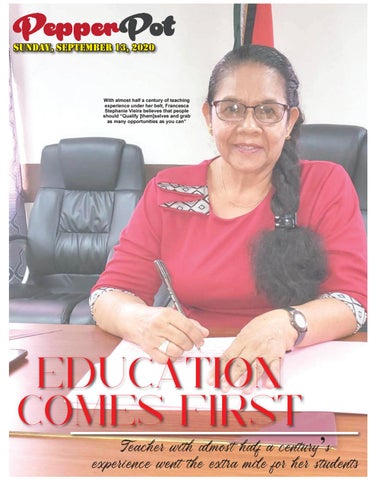
SUNDAY, September 13, 2020
With almost half a century of teaching experience under her belt, Francesca Stephanie Vieira believes that people should “Qualify [them]selves and grab as many opportunities as you can�
II
T
By Francis Quamina Farrier
HE World Trade Center Twin Towers in downtown Manhattan, New York City, were wellknown to me. Their construction which commenced in the early 1970s was shortly after my first visit to ‘The Big Apple’ in 1969. I liked being a tourist in New York City, taking in the sights and sounds. Looking at the locals going by always in a hurry. I also liked attending plays and musicals on Broadway and Off-Broadway. Touring around, not only Brooklyn, but all the five boroughs of the city of New York was what I did. I was impressed with much of what I saw. I was truly impressed and in awe of the Empire State Building which was the tallest building in the world at that time. I had seen it in a few movies including King Kong.
CHRONICLE PEPPERPOT ― Sunday, September 13, 2020
two awesome buildings. On one occasion, I had to do business at a Chase Manhattan Bank branch which was in one of the towers. What I observed on the printed pass, was the time and floor of my purpose within the building - which meant, I supposed, that if I were to be approached by a security person somewhere else in the building, I would have some explaining to do. All that was before security was anywhere as tight as it is at present internationally. Being the producer of my Radio Programme Series, “The Eighty Plus Club”, I received an invitation through the Guyana Consulate to attend a programme, “Serving Senior New Yorkers”, which was hosted by Mayor David Dinkins, and held in the forecourt of one of the twin towers. Then came that fateful and tragic day: Tuesday, September 11, 2001. Where were you when it happened? I was travelling in a taxi from Sisters Village on the West Bank of Demerara, having just done one of the most amazing recordings for my
fire. I was in shock. A very close relative of mine worked in a building very close. Later, there was the report of the attack on the Pentagon. I wondered whether I was dreaming. How could such an attack happen in America? Actually, I was scheduled to travel to New York two days later. Of course all international airports in the United States were closed down. My arrival was delayed for four days until the Saturday after the tragedy. As I exited the plane and headed
We later viewed an open air Memorial service on television which was held at the awesome Yanke Stadium. Among the performers was Bette Midler who sang “You are the wind beneath my wings.” Her performance brought tears to many eyes. Then there was a rendition of “We Shall Overcome” in which all in the stadium joined in with gusto. It was awesome. Here was the ‘national anthem’ if you will, of the Civil Rights Movement in America being sung not only by African Americans
Farrier in the forecourt of the World Trade Center during a “Serving Older New Yorkers” event by then New York Mayor David Dinkins
Farrier at the Bull on Wall Street just a stone’s throw from the Twin Towers
When the World Trade Center twin towers were completed in 1973, they replaced the Empire State Building as the tallest structures in the World. At that time I was unaware that at least two Guyanese worked on their construction. I met and interviewed them after the tragedy. On my many visits to New York City over the decades, I went past and even entered those
Radio Programme Series, The Eighty Plus Club. The radio was on in the taxi. While crossing the Demerara Harbour Bridge on the way back to Georgetown, the unexpected news from New York interrupted the usual morning music. It stated that the World Trade Center in lower Manhattan, New York, was attacked by two commercial jet aircraft and were on
to the Immigration, I had this feeling of trepidation. I was correct. The Immigration Officer was a white gentleman maybe in his mid- 50s. “I don’t know why you people want to come to America,” he said with an unwelcoming tone as he took my Guyana Passport. I was not annoyed because I had already wondered whether the Immigration Officer who would process me had lost a relative or friend in the 9/11 attack. Maybe that Immigration Officer did. The next day, Sunday, I was at the home of a Guyanese friend who had organised a prayer service at which about 25 other Guyanese had gathered. We prayed for the victims and their loved ones. We sang up-lifting and inspirational hymns. The host made a pronouncement which I have always remembered; “The World would never be the same again.”
but by Americans of all colours. It was an emotional experience knowing that over 20 Guyanese also perished in those terrorist attacks both at the Twin Towers and at the Pentagon. Two weeks later, I was invited to the home of a Guyanese widow of a 9/11 victim and interviewed her for the VCT Evening News back in Guyana. She played the voice mail recording of the message her husband had left on her phone as he, unknowingly, awaited his death. “Hello dear, I’m trapped in the World Trade Center.” His voice was calm. As she said in the interview, “...as per GDF.” Later, the Guyana Consulate in New York held a Memorial Service to the memory of the 25 fallen Guyanese. What a Guyanese Mathematician later told me, is that per capita, Guyana lost the most people on 9/11.
III
CHRONICLE PEPPERPOT ― Sunday, September 13, 2020
w o r k i n g p a rents Manuel and Matilda were working in the farms all week and would only be home on the weekends. This meant t h a t apart
P
Afterwards, there was nothing to do, especially as she finished school early, at just 14 years old! So at 15, when she started to teach at the same school, it was as if she still wanted to play with her friends. “It was like I was still a child wanting to go and play. But the nuns who ran the school put me to teach smaller kids, so I now had to stop playing and take up responsibility,” she told the Pepperpot Magazine a few days ago during an interview. While teaching at the school, she continued to do several upgrading courses that
With her children Tawanda and Francine
By Telesha Ramnarine
ADDLING along the Moruca River for school each day was a breeze for Francesca Vieira, even though it took her over an hour one way! Still, she’d say, “It was not far from home.” As challenging as it might seem to make the journey each day, beginning around six in the morning, she was happy to do it. Little did she know that as she paddled each day she was really leading herself towards a path that would result in a rather successful career in education; one that would allow her to help her fellow Indigenous people. Having held several important posts in the education sector, Vieira retired as Secretary to the Teaching Service Commission (TSC). Today, with 49 years in education under her belt, her advice is simple: “Qualify yourselves and grab as many opportunities as you can.” Many opportunities were not readily available to her as a young girl growing up. So she knows what she is talking about when she says that whatever opportunity comes up, take it and be determined to make something of it. She was just 14 years old when her older sister married and moved away. At this point, her loving and hard-
Vieira has been recognised by various agencies for her quality work in education
were required for entry to the Cyril Potter College of Education (CPCE). She came Vieira began qualifying herself at a very to Georgetown when she was about 21 young age, and now has 49 years under years old and despite being severely ill, her belt in the education system she was determined to complete college. Because of her illness, she could not go back to Moruca after finishing college as she had to remain on medication. It was from going to school, Vieira was now re- what she longed for though; to go back to sponsible for her younger siblings and she her village and continue teaching there. ensured that they also attended school and Realising that her new reality was to all of their other needs were met. In short, remain in Georgetown, she thought instead she was now in charge of the household of wasting time, she would go to the Uniduring the week. versity of Guyana (UG). During this time, The family was poor. The chil- she taught at Montrose and Vryheid’s Lust dren would receive a new pair of Primary Schools on the East Coast of Derubber slippers each September merara. for the new school year, and one In 1987, she obtained a Bachelor of week later when they burst, it Education Degree from the University of was nothing strange to have to go Guyana, thus being the first female from to school barefeet. Even when Moruca to obtain a university degree. Vieira started to teach at 15 So eventually, she was recommended years old, she had no shoes. In to go to the Education Department in those days she had to Region Four to work as a supervisor. wait three months Having performed such duties exceedbefore receiving ing well, she was then appointed her first salary. district education officer (DEO) After that, she in 1998. was never again She later returned to UG and without shoes. obtained additional qualifications in the form of a Diploma in Public Administration in Vieira attended San- 1993. Recognising the esteemed ta Rosa Primary School qualities possessed by Vieira, where there was a sec- the Ministry of Education then ondary department which appointed her to act as the regionallowed students to go up al education officer (REO) for to fourth form. When she Region Four at varying periods was of age, she took the during 1997 to 2004, and in London-based College 2004, she was appointed the of Preceptors Exam- first female secretary of the ination. TSC, where she served until
retiring in March 2011. Vieira was then rehired as the technical officer/ facilitator to the chief education officer in February 2012 and she continues to function in this capacity. Reflecting on her almost five decades in education, Vieira said she is glad that she took the time to qualify herself, and that she also did the same for her two children Tawanda and Francine, whom she raised as a single parent. Her son is a farm manager in Zimbabwe, Southern Africa, and her daughter is a qualified aeronautics engineer. “Education takes you out of poverty and if I hadn’t such, I would not have been where I am today. The position that [What] I have, I didn’t get it easy. So to me, once you have an education, you can achieve your goals. I would always encourage children to remain focused and grasp as many educational opportunities as they can,” she expressed. Poverty was surely one of the many challenges along the road for Vieira. “We come from a very poor family. I would tell my daughter that now she can fry an egg and eat one, but in our time we used to put it in the pan and spread it out and that had to be divided into four; and that had to take us through till midday.” Vieira has used her position to help struggling teachers from all across Guyana, especially those in the hinterland who may not know their rights, or all of the benefits that they may be entitled to. “I have a special interest in the hinterland communities. Many times you have to beg the other agencies to attend to those in the hinterland in a timely manner, because sometimes they don’t have anywhere to stay and the cost to travel is so high. I know the terrain and what they have to go through.” Vieira said she too struggled a lot in her days when no one came to her assistance, not even her own ministry. She was denied a scholarship, even though she was very much qualified for it and even after requesting help to deal with her serious illness, she was denied again. “I wouldn’t like anyone to go through that, but now I am happy that our Amerindian brothers and sisters are getting scholarships to study abroad.” Vieira received the ‘Women’s Wall of Distinction’ Award from the Ministry of Amerindian Affairs, the ‘Outstanding Achievements in Education’ Award from the Ministry of Education and the ‘Invaluable Contributions in Education’ Award from the Department of Education in Region Four. T h e Department of the Public Service in 2019 also honoured her for 48 years of outstanding service.
IV
CHRONICLE PEPPERPOT ― Sunday, September 13, 2020
By Telesha Ramnarine
Holly-Anne Maksyhung
I
T’S as if the life of the beautiful and energetic Holly-Anne Maksyhung changed overnight. She didn’t see coming what had the ability to completely upend her life, but all she knew was that she was now entirely dependent on others to help her with even the simplest of tasks. Holly-Anne, 40, has been officially diagnosed with Chronic Inflammatory Demyelinating Polyneuropathy (CIDP), a rare neurological disorder that goes after the nerves of the body, and severely inhibits movement. For Holly-Anne, her symptoms started with simple things, such as stumbling while walking, which she never took to mean anything; having difficulty climbing stairs and having swollen feet after being on them for just a short time. So it came as an utter shock to her when she realised that it all formed part of the dreadful disease that would now become her new reality. Just after a short time of becoming very ill, she became wheelchair-bound. “For the first two weeks, it was pretty scary; it was
depressing and confusing. I had all of my other responsibilities…it was total confusion, depression, panic,” she expressed during an interview with the Pepperpot Magazine. “I was very surprised because there is no precursor to this type of illness. In my case, it affected my lower body, so I am telling my foot to move, but the message is not being transmitted to my brain.” Holly-Anne, born and raised in Linden, became ill in the latter part of last year and her true condition was detected in February. PRETTY ACTIVE “I was pretty active. I worked in hotel management for the last seven years. So I was someone who was always on the go. If I am not at work, I am hiking, I am on the beach; I like to travel, take my daughter on vacation to different islands. I had a pretty active work and social life,” Holly-Anne explained.
them from dying.” Based on her progress, her prognosis is somewhat on the brighter side. It all depends on the amount of damage that was done on her body and how fast her body heals. But she is confident that she will be able to walk independently in the future. “I have adopted the mindset that if I work towards it, I will achieve it; that this is just another chapter in my life.” Holly-Anne has been receiving therapy from the qualified and well-trained personnel of the Rehabilitation Department of the Ministry of Health, in the Palms compound on Brickdam. She said the physiotherapist assigned to her, Vanessa Wickham, is quite an asset to the team, led by Director Barbara Lawrence. “In the couple of weeks I've worked with her, she has really built my confidence and pushed me to want to recover. She takes her time to explain what she's doing and why as we do our workout.”
Holly-Anne was quite active before her illness and spent her time travelling and hiking, among other fun activities
So when she became ill, it was quite a drastic change for her. “I went from being like that to being unemployed, immobile and having to depend on persons for the simplest things. It was a shock to me because I didn’t know what was happening to me. All I knew was that my body was falling apart.” To make matters worse, Holly-Anne knew no one else with the disease, and there was not a single support group, specific to the needs of persons with CIDP in the country that she could have turned to. In fact, to this day she believes that she is the only person with the disease locally. “You understood the illness based on what you read, but the support locally… there wasn’t anyone I could have turned to….to understand if I would ever get out of bed again,” she recalled. But her family and friends turned out to be strong support and rallied around her to help. She then began reaching out to the online community, and persons with the illness came forward and shared their stories with her. WALKING AGAIN “There is a 98 per cent recovery rate in general, but it is possible for persons to remain with severe disabilities in some cases,” Holly-Anne pointed out. She has, however, been showing significant improvement with her illness and was able to begin using a wheelchair after being bedridden. Furthermore, with therapy and treatment, she has been able to take steps with the help of a walker. “I am slowing redeeming movements in my leg, so I sometimes use a walker to get around, to keep the muscles active and prevent
As for Wickham, Holly-Anne is the first CIDP patient that she has ever dealt with. In fact, she said Holly-Anne is the first case known to the department, and the only one thus far. She explained that when Holly-Anne first went for therapy, she was very limited in what she could do. Now, though, with the help of a transfer board, Holly-Anne can get out of her wheelchair and onto the bed. She can also bend her knees, and do certain exercises on her own. Wickham said while Holly-Anne would have to go through some rigorous sessions of therapy, they are already seeing improvement. With continued progress, she said Holly-Anne may be able to move from using a walker to using a cane. POSITIVE OUTLOOK Holly-Anne said she prefers not to dwell on the negatives in her life, and instead keep a positive outlook on life. “You just have to live life and face every obstacle that comes in your way. Be quick to smile, and every time a negative thought comes into your mind, replace it with something positive.” Being ill in this way has also taught her to accept help. “This was one of my shortcomings because I was someone who was pretty much ‘Miss Independent,’ doing everything for myself. But I’ve learnt that there are times when you need to let other persons take care of you.” Holly-Anne wants to eventually be able to start a support group to bring awareness to people like herself. She is ever grateful for the genuine love that her family continues to show her.
V
CHRONICLE PEPPERPOT ― Sunday, September 13, 2020
A few of the products from the ‘Queen P’ natural hair line
weren’t giving me what I was looking for, so I just made the decision that I was going [to] use simply natural products and they all just [sic]for me,” Primo said. The young woman noted that changing her hair regimen to all-natural/organic products has seen her hair flourishing, “They have not only helped with the health of my hair, but the [products] also thicken my hair and repaired damaged ends and so forth; so I said, you know what, maybe I should just start a business using these very products,” she said. AN EVOLUTION Reflecting on her hair journey, Primo said, “I am an advocate; I would advise any woman to go natural simply because it’s like our whole lives growing up we’ve been taught that straight hair is
F
By Naomi Parris
OR many women hair can mean so many things, especially for women with kinky and coily hair texture. However, sometimes finding the right products to care for curly hair texture can be difficult. Being a girl with natural, thick, curly tresses herself, Iona Primo has had her own experiences with finding the right products for her hair; nevertheless, the young woman recently found a solution with all organic ingredients to give her hair the nourishment and care that it needs. Not wanting to keep the secret ingredients to her luscious locks to herself, the 28-yearold decided to share her natural hair products with the rest of the country through her small business. “My business is called ‘Queen P’, I first [thought] of that name because my whole life I’ve been using that name. The products that I offer for now, are just four; [however], there is so much more I want to introduce to the business. The four are my raw African black soap shampoo, my growth-oil serum, my whipped shea buttercream and whipped body; now these four products are all available for purchase.” Primo disclosed to the Pepperpot Magazine that she had been sitting on the initiative to launch her business for over a year and that it was only two weeks ago she took a leap of faith and made her hair care line public. “I am very passionate about hair and natural hair in general and any hair in general, but mainly natural. I’ve been planning this
28-year-old Iona Primo, creator and founder of ‘Queen P’ hair products
business for over a year and I just decided two weeks ago that I’m not going to make excuses and just launch it and I decided to do it on my birthday which was August 28,” she said. Additionally, the young woman stated that despite an ongoing pandemic and the business being fairly new, the response she has been receiving has been astonishing. “It wasn’t difficult for me to launch my business during this pandemic, because the response that I’m getting is phenomenal and I’m so happy that I decided to do it now and not wait until this whole pandemic is over,” she said. However, the entrepreneur noted that when the chaos of the pandemic is over, she intends to host a proper launch party to celebrate her product and the dedicated customers and fans she has since gained during her business tenure. A SELF-DISCOVERY JOURNEY Having been on her own journey of self-discovery as regards learning to care and love her natural tresses, Primo disclosed that she was experimenting with several products which did more harm to her hair rather than nourish it. “About a year ago, while I was a ‘loose’ natural, I was going through different phases in my life and there was one point where I was using so many different products that
the [beautiful] thing. Me for one when I was younger, when I saw these girls with nice, straight [or] curly hair I always wanted that.” She added that after some soul-searching with herself and research about natural hair, she grew to love and appreciate her hair for what it is and its diversity. “I grew to love me and my natural self and my natural hair and I think that [time] as revolved because a lot of women are now seeing all these different hair textures and how beautiful natural hair really is,” she said. Primo noted that given the situation with the pandemic and many persons being at home following a partial lockdown, there has never been a better time for one to embark on their own hair journey and experiment with new products, especially all-natural organic products from her hairline, ‘Queen P’.
VI
CHRONICLE PEPPERPOT ― Sunday, September 13, 2020
O
VER the past week Guyana was plunged into horror as young boys were killed gruesomely and senselessly. The racism and ethnic insecurities that have been more and more pronounced throughout this year of campaigning and electioneer-
ing have gotten worse. What else needs to happen before we can seriously commit to tangible national healing? I began writing this column about the painful, painful loss of Isaiah Henry and Joel Henry. These two young Afro-Guyanese boys were taken away most horrifically. It pains me to think about what happened to them, much less what
their families are feeling right now and much less what they felt. There is absolutely nothing that could ever justify what was done to these two young boys. There is nothing they could ever do to deserve this -- nothing. Afterwards, a young Indo-Guyanese boy, Haresh Singh was also killed senselessly. There is speculation that he was killed in retaliation and there is speculation that he was killed to stir up further strife. I do not know which it is, but I do know that no matter the reason, his death cannot be justified either. There is no silver lining here -- none. There is nothing that could provide enough justice for the loss of their lives. Nothing can compare. But, we can dig deep and try to find some amount of humanity and attempt to create a better, safer Guyana. We have to. It is the only way we can properly honour them. If there was ever a time for a national-healing agenda to be a top priority, it is now. If the protracted elections, exacerbated by racist overtones and strife, were not reason enough, this should be. We cannot take for granted the years of fragile ethnic insecurities tied to our ethnopolitics, neither can we take for granted that Guyanese will continue feeling like victims of the “other” race(s). Healing has to provide spaces for persons to engage and learn about the racial dynamics in this country; it has to involve Guyanese recognising the prejudices and stereotypes they have consciously and unconsciously perpetuated; and it has to include opportunities for us to unlearn the bad, learn the truth and reconcile with each other. Only then could we begin to think about healing and progressing. As I write this, our national budget is being presented. This is necessary, no doubt, particularly since we are living through a pandemic and fiscal relief and monetary policies are crucial at this point. But, I cannot emphasise just how much we NEED our leaders to come together and lead us out of this scourge of racism, hatred, and violence. On our own, there is still much that we can do as well. A young Guyanese woman, Jamicia Mc Calman, wrote on Facebook: “Dear Guyana, If dancing is your thing, DANCE. If singing is your thing, SING. If poetry is your thing, SPEAK. If chanting is your thing, CHANT. If writing is your thing, WRITE. If organising is your thing, ORGANISE. But don’t just be silent.” I agree with her. We are speaking up and speaking out, we are protesting, we are trying every conceivable option we know to push for a tolerant and safe Guyana for all. We also have to be willing to do these things-- to learn from each other and about each other, to respect each other regardless of our differences, and to stand up for each other when we see injustice being perpetrated. Fighting for justice for the Henry boys and for Afro-Guyanese should never be equated to a repudiation of any other group, just as rallying around the injustice meted out to Haresh Singh should not mean similar repudiation either. Why do we feel we could ever equate the two actions? Yesterday, as I worked along with my colleagues to get them home on a repatriation flight, I saw my colleagues do what needed to be done to look out for one another, without even thinking twice. Students gave up their spot on the repatriation flight-- their chance to finally get back home, while others paid to upgrade to business-class seats, just so that students who could barely afford it would have a chance to get home. This is humanity and camaraderie I genuinely believe are at the core of who we are. We cannot continue like this; we cannot let our differences divide us. I beg, please speak with your families and friends and encourage them to think about the society they live in and whether they want to continue living like this. Ask yourself if you want to continue living like this. And then, please, let’s do better. We have to be willing to engage and commit to healing, it is the only way we would be able to do better.
CHRONICLE PEPPERPOT ― Sunday, September 13, 2020
VII
VIII
CHRONICLE PEPPERPOT ― Sunday, September 13, 2020
Focus on the Village
T
By Michel Outridge
guards and other professionals such as, nurses and teachers. The Pepperpot Magazine team trekked through the backlands and reached out to residents, who were more than willing to have a sitdown. The people of Bendroff are very welcoming, kind, giving and hardworking, who have survived many hardships and challenges.
brothers. The 20-year-old stated that his family consists of seven members including, his parents and they have a cultivation of plantains, bananas, pumpkins, cassava and other crops on the land nearby.
Leroy Harry HIS week the Pep(Carl Croker photos) perpot Magazine visited the secluded community of Bendroff, East Bank Essequibo, which is located many miles from Parika and is the second to last village on that side of the Essequibo River. It is a riverine village which is between Naamless and Morashee and is accessible via paddle boat, bicycle, tractor or motorcycle since there is no all-weather road, just a muddy dam. This community doesn’t have a village leader but the residents, most of whom came Boat building done by from far-fetched regions Leroy’s father under in Guyana, have settled their house Bendroff Village this village which overlooks the Essequibo River. There is no potable water supply, no elecOne of the modes of tricity, no land services transportation in this riverine The access road to community of Bendroff nor internet except on Bendroff Village cell phones which is unreliable in this area and they have to strategically position themselves to get a strong signal. Residents live far apart but they are simple people, who are eking out an honest living in this remote village doing many things to bring in an income. For lights and other household At the edge of the village is a would build boats in his spare time, appliances, residents utilised gener- huge wooden house which is occuators, for those who have and others pied by the Harry’s. Harry added that he as been a like he was doing recently. There have a small solar system to power Harold Harry, head of the house- seaman on a trawler for the past two is also an unfinished boat under his house which needs some finishing light bulbs at nights. hold, is originally from the North years and he likes his job. They depend on rainfall as their West District and he and his family He, like many others, had to touches. “Life is simple here but hard you main source of drinking water and relocated there many years ago leave their village to seek employthe river is often used for washing when his children were young. ment because there isn’t much to do have to work tirelessly and do labourer work to maintain your family and bathing purposes. His son, Leroy Harry was at except for farming. Many residents have a small home keeping an eye on his younger “To come out and get in here is and if we get the basic infrastructure boat that they use with a paddle to siblings and spoke about his life in very costly because of the state of it will be better for us,” he said. Harry added that the people of get from one point to another in this Bendroff. the road, the cars don’t want to come village. The seaman told the Pepperpot in and they would drop you off at a Bendroff make much with what they It is an agricultural based village Magazine that he is often away on certain point and after that you have have but a help in terms of better facilities would be welcomed at any which produces plantains, bananas, his fishing expeditions with the com- to walk for miles,” he said. other fruits and vegetables and the pany he is employed and he returns Harry stated that his parents were time and more visitors are also welpeople are basically farmers and home every two weeks. forced to leave Region One in an comed to the peaceful community. He noted that life is not easy labourers on farms. They are also He was on a break at home effort to give them a better life. employed, boat builders, security that day and was relaxing with his His father is a farmer and he but they can’t give up.
IX
CHRONICLE PEPPERPOT ― Sunday, September 13, 2020
Focus on the Village
― But it still entails hard work
Eric Williams (Carl Croker Photos)
F
By Michel Outridge
OR Shanaz Mohamed, it is easier to live away from family because it is very peaceful and quiet without any interference of the busy life as in other villages. She is a resident of Bendroff Village, East Bank Essequibo and is the mother of an energetic and friendly two-year-old boy named Stephen. She resides some distance away from the Harrys, the only house on that side of the dam. Mohamed is married to a multi-talented farmer and they cultivate their land and sell the produce in and around the neighbouring villages or wholesale it to customers. The 22-year-old told the Pepperpot Magazine that she likes the place, but they need a better road and the basic facilities such as potable water and electricity. They have a generator and it is used in the nights, while a solar panel powers the lights bulbs. “Life here is okay, but we don’t have a lot to boast about; but at least we are happy because there is nobody to bother you here and we work with our self,” she said. She has been residing at Bendroff Village for the past four years when she got married to a local and they constructed a house. Mohamed stated that she utilises the data plan on her cellphone to get up to date with what’s happening, but at times the service is not very good. She was tending to her son while her husband, a farmer, carpenter and diver was away vending citrus from their farm. “My husband can do more than one job, so whatever is available he does,” he said. Mohamed is a stay-at-home mom, who hardly goes out unless necessary. The security guard who paddles miles
for work Farther up the dam Eric Williams and his family reside in a small wooden cottage, in front of a farm owned by another villager. He is originally from a remote village in Aruka River, Region One, but relocated to Bendroff since 2017 when he left in search of a better life. Williams told the Pepperpot Magazine that they were brought from their village to work on a farm and they were treated unfairly for a long time before they managed to get their own place. “People promise you the world and they bring you to work and then you end up working like a slave without pay and it is a very distressing situation many face,” he said. He is a security guard at nights attached to the Morashee Primary School, miles away, and he uses a boat and a paddle to get to work, which takes 45 minutes or more, depending on the weather. Williams reported that during the day he would work on his farm and they would either sell or use their produce. He related that in Morashee Village there are about nine houses and the Primary School and it is almost a ghost village because many people have left. The father of three added that right now the canal is being excavated, so the water is very low and he was unsure how he woukd get to work that night. “I work with Sentinel Security Service and since December 1, 2017, I never benefit from a day off or any incentives other than my pay. You can’t take a day off because they would tell you to have to go on two weeks leave and is like you get knock-off, because they would replace you and I can’t afford to lose my job,” he said. Williams also reported that many Amerindians would leave their villages and come out to work thinking they would be paid
well, but they would be put to work and paid poorly. On the brighter side of things, he has a five-acre plot of apple bananas and plantains and the piece of land he is occupying, he was given permission to erect a house and live by the owner, a compassionate man. “When I had nowhere to go the man helped me and told me I can stay here, but as you can see my house is a work in progress and I wish to build it better,” he said. Williams is a very hardworking father, who is doing everything he can to provide for his school-age children and wife, who works as a sweeper/ cleaner at the Morashee Primary School.
Two year old Stephen Archer
Shanaz Mohamed
X
CHRONICLE PEPPERPOT ― Sunday, September 13, 2020
Focus on the Village
Rose Kingston (Carl Croker photos)
By Michel Outridge
L
O RAINE Kingston left her hometown of Wauna, Region One (Barima-Waini) at age 19 along with her teenage sister after they were promised employment in the city. However, when they reached the city after taking the arduous overnight trip via the ferry, they were told by their aunt that the positions of maids which they were promised were filled. Kingston said she felt disappointed when they were informed that there was no work for them, but she was determined to stay and find employment while her sibling returned home. “We were at the wharf waiting to go back home and I saw my aunt and I asked her if I can’t stay with her and find work and she agreed, so that’s how I managed to get by,” she said. Kingston stayed with another aunt and did odd jobs, including working in a Chinese restaurant as a waitress and doing domestic work at many places to make ends meet. “When I left home for work and a better life, I was determined to make it one day and today I can say I have somewhere to live, even though it was hard, but I am content,” she said. Kingston added that she used to reside at Bagotville and work with some Brazilians to make an honest living and stood her ground all those years to ensure she wasn’t taken advantage of. The mother of three is a resident of Bendroff Village, East Bank Essequibo and has been in that community since 1993. Kingston explained that she resided in the homes of relatives who were abroad as a caretaker and when
they r e turned home she had to find her own home. At the plot where she is residing she has a farm of fruits and vegetables and her husband is a local. Kingston still works within the community as a domestic helper twice per week and was tending to her two grandchildren when the Pepperpot Magazine visited. “I went back to my village after 22 years and a lot of things have changed, but I am accustomed to the place [where] I am now so I don’t want to return there to live,” she said. Her mother and siblings still reside in Wauna and she may visit them again if the need arises. In her spare time she would make cassava bread and sell, but would like to have potable water, electricity and a better road in the community to lighten the residents’ burden. Meanwhile, a few doors down the dam is the home of Rose Kingston, who is originally from the Pomeroon River. She has a cottage and resides with her children and husband, a farmer. The 46-year-old disclosed that where jobs are concerned it is difficult finding employment, as such, she is a stay-athome mom of six. Some of the children are grown and married, while the two youngest reside with her. She has been a resident of Bendroff Village for the past 17 years when her parents came
Loraine Kingston poses with her matapee she uses for making cassava bread
The pet monkey from Lanaballi
out looking for work. Presently, Kingston is distressed because her mother is hospitalised and is terminally ill with cancer and she is trying to keep it together. Her father who is 70 years old is still able-bodied and working. Kingston stated that she has 10 siblings and they are scattered across the country, mostly with their families. “We try with the farm planting red beans, potatoes, fruits and vegetables that we use in the kitchen and to sell,” she said. The Pepperpot Magazine also met her husband, Trevor Kingston, who has just returned home from the farm. “We are here trying with life and we are making the most of it, but life will be better if we can get the basic facilities needed to enhance our lives at the back here,” she said. This family is rearing some chickens for domestic use and they also have a parrot and a monkey as pets.
XI
CHRONICLE PEPPERPOT ― Sunday, September 13, 2020
Focus on the Village
Mrs Kippins and her home-made Crabwood oil
Compton Williams
Henry Kippins, his wife and her mother
The Williams family (Carl Croker photos)
ed being bwood se
Cra
ake oil
dried to m
Shirley Halls, 89 years old
A
By Michel Outridge
MONG the residents of Bendroff Village is Henry Kippins and his family. This farmer moved back to the village after his children finished secondary school and he has been there for seven years. He used to reside in Vergenoegen, East Bank Essequibo for some years after which he chose to return to quiet Bendroff. “The children are all grown, five of them; the last is 16 years old so we can do our farming and have our peaceful life undisturbed in here,” he said. Kippins resides with his wife and his wife’s mother, who is 89 years old and still assists on the farm.
They have converted the land space in their yard to a farm of citrus, ground provisions, cherries, guava, soursop and many other fruits and vegetables which are sold at the Parika Market on weekends. Kippins said his father is Amerindian and hails from Goshen, Essequibo River and his mother is from High Park, Parika. He is accustomed to the hard farming life and it is easy to tell by the many trees that his yard has. The father of five told the Pepperpot Magazine that he was rearing some meat birds and layers, but last month a deadly disease caused all his poultry to die rapidly within a short space of time. This family would use the produce from their farm and also sell the excess at the market. The Kippins are enterprising and tal-
ented people who make Crabwood oil for their home use. “We do what we have to, go our way and it is all well because here we don’t have to worry about thieves or anything like that. It’s the back of nowhere and the road is a dam, so not very many people would risk coming here to commit a crime,” he said. COMPTON WILLIAMS AND HIS FAMILY Farther down the dam, the Pepperpot Magazine met Compton Williams and his family which consists of 10 children. He was a bit worried that his wife did not return home as planned and was awaiting her arrival from Mabaruma, Region One. Williams is a labourer on a large farm,
but he also has some ducks, chickens and 10 rabbits which he rears in his yard. He told the Pepperpot Magazine that the rabbits would roam the forested area daily and return at nightfall. An area in his yard is sectioned off for the ducks and chickens. “I am living here on the land that is privately owned, but the owner gave me this place to live and take care of,” he said. The 60-year-old disclosed that life in Bendroff Village is not easy, but he is trying his best to provide for his family. He resides in a part of the village where there are no neighbours and he has a small cultivation for himself. “Being a labourer on a large farm is hard work, but what will I do for a living here when there isn’t much so I have to do it and I would say life is fair,” he said.
XII
K
CHRONICLE PEPPERPOT ― Sunday, September 13, 2020
Kaila and her sister Kelsie Bynoe (Photos courtesy of Tenesha Bynoe)
By Michel Outridge ALIA Lorraine Bynoe is very much gifted and talented for her age and she is the kind of child who would turn heads wherever she goes and cause people to take a second look. She is just six years old and has a very unique talent with which she can achieve unattainable moves that regular people cannot accomplish ordinarily hand stands and
other tricks. Unbelievably, she was self-taught by looking at her older sister do her dance practices around the house after returning from dancing classes. Her sibling, Kelsie Bynoe, 12, is a student of the National School of Dance in the city, but
since the pandemic, she has been at home. According to Kalia’s mother Tenesha Bynoe, her youngest child has been doing all these extraordinary stretches since she started to walk and as she got older, she began to get even better. “At first I thought it was odd seeing her do all these things like standing on her head, but then I got used to it and it became normal for us in the home to see her do some unusual stretches,” she said. This amazing child hails from Atlantic Ville, East Coast Demerara and is a pupil of the Turkeyen Nursery School. Whenever school re-opens she is expected to start primary school and she is looking forward to it very much. Bynoe told the Pepperpot Magazine that so far she has embraced the fact that her daughter is special in so many ways, because she was not taught anything, yet she was able to grasp a lot just by watching her sister doing her dance moves. The mother of two explained that maybe it runs in the family, because she is into yoga and then her oldest daughter is a dance student, so it might very well be that. When Kalia celebrated her sixth birth anniversary on August 19 this year, her parents facilitated a photo shoot to observe the occasion and a professional photographer was sought to capture a few studio photos. After that the Bynoes placed some of the photos via Facebook and she was surprised at the response she got when many people messaged her to ask her to enrol her daughter in their dance school to realise her full potential. “I was a bit taken aback by the overwhelming response from people when they saw her photos on Facebook, but I have an open mind when it comes to my children’s future; so I will explore the possibilities before I put her in any dance school because she is very determined and knows what she wants, even at her tender age,” she said. With schools closed since March
this year due to the novel coronavirus (COVID-19), Bynoe and her husband Kevin would take the children on the seawall in the afternoons for a stroll. “When we go out there Kalia would do her flexes, stretches, splits and other moves and it would get the attention of people and they would dote on her and tell her how talented she is,” she said. Bynoe related that Kalia gets a lot of attention, because when people see her they are simply fascinated and in awe of what she can do with her body. Describing little Kalia, her mother said she is very talkative at home and would even try to control her sister, but when she is out she would remain aloof. “Kalia is friendly, but if she is not familiar with you she would not say much,” she said. Bynoe explained that her daughter is positive about what she wants in life and she even asked them to buy certain equipment for her to exercise. In her spare time Kalia would watch YouTube videos of gymnasts and aerobatics, so she is aware of certain things and has people she would admire. “Kalia is a very active child so we try to keep up with her, so that’s why we would go on the seawall which isn’t far from our home and take a walk,” she said. For now, Kalia is homeschooled by her mother for at least two hours per day and she gets some free time to do whatever she wants, that is, within the confines of home.
XIII
CHRONICLE PEPPERPOT ― Sunday, September 13, 2020
S
EPTEMBER started well for me and I have greater clarity regarding my next project. I miss not going to Sophia but I am still finding ways to enjoy the Amerindian Heritage Month celebrations. Last week I featured two amazing persons from the indigenous community, Terry Ceasar and Sabanto Tokoroho on the BEYOND THE RUNWAY Show. This week I had Tuma (my favourite indigenous dish) with cassava bread, twice. This will be another meaningful and hectic month because we are launching the Men Across Borders Anthology among other things. I will be sharing a bit about the amazing co-authors from around the world. Last week’s article was about the great work that Canada-based Guyanese Suresh Sugrim is making as a major contribution to humanity. He will be one of the featured stories with 13 other men. My friend Richard Young writes so much about other personalities and I am finally getting him to share part of his journey with the world. Richard Young is a Caribbean creative impresario who has worked extensively in the region, directing and producing fashion/ arts/beauty/culture-related projects for the past 30 years. He has become one of the most sought-after cultural industry specialists in the region, winning accolades and being recognised for his service-export excellence. His talent for branding, merchandising,
E
ACH tooth has a dental pulp commonly called “nerve” by patients. The anatomy of the pulp is well known to dentists. Individual teeth have [sic] divisions of the pulp called root canals. Each tooth has one to four root canals. When these small pieces of soft tissue die or become injured or infected, the resulting pain can be as debilitating as almost any other physical condition experienced by humans. Why does a piece of diseased or dead tissue cause
production/event management and strategic cultural industry networking has assumed significant proportions which positions him as a savvy expert to lead developmental coaching; to corral motivational endorsement; to foster youth-empowerment initiatives; to steer creative entrepreneurship agenda; to engage gender-based identity responsibility. All in all, he has mastered enacting identity-branding consultation and cultural-confidence investment. He has tutored at several programmes to develop personal and professional confidence, to impart knowledge on service excellence and to steward creatives in best-practice methods For unique sales positioning. I am also excited that Pastor Diego Alphonso will be inspiring many young men with his chapter. Diego Alphonso is a pastor and chaplain with the New Testament Church of God (NTCOG) in Guyana. In 2012 Pastor Alphonso was appointed Administrator of the Men Affairs Bureau within the Ministry of Human Services and Social Security. Presently he continues to serve the Government of Guyana in the Gender Affairs Bureau of the Ministry of Social Protection. Pastor Diego Alphonso has received an ambassadorial appointment by CICA International University with the right and privilege of carrying the title of His Excellency Rev. Diego Alphonso, CDSE (Commander of the Most Distinguished Order of Special Envoy).
pain? A tooth is usually sealed externally by the outside tooth coating (enamel). Only a small opening into the supporting bone is present on the tooth end, deep within the bone. When the dental pulp is diseased or dead, pulp blood flow and cellular activity increase, and there is no possibility for release of pressure from inside the tooth except into the supporting bone. The result is pain, and it is usually present when a tooth is dead or dying. O c c a s i o n a l l y, t h e infection finds its way into the bone and perforates out into the soft gum tissue. The patient observes a pimplelike projection on the gums, com-
monly called a gum boil, and this “dead” tooth is usually not painful. What clinical conditions are commonly observed related to the
A title that he modestly uses very rarely. Pastor Alphonso is married to Sonia Alphonso and is the father of three wonderful children Gabriella, Cassandra and Israel. I met Dave Armstrong during the Build Your Brand challenge hosted by Tony Robins, Dean Graziozi and Russell Brunson. I invited him to share his inspiring journey and I am happy he accepted the challenge. Sensei Dave Armstrong was a product of a broken family, foster care, youth-correction facilities, and a deceased, only parent at the age of 13. As an “at-risk” youth and a “product” of the inner-city education system, young Sensei Dave was predestined to run with gangs, not graduate high school and be dead or in jail by the age of 18. After his mother passed away, Dave lost all contact with his family and was in and out of boys’ homes, juvenile hall, and foster homes in San Bernardino, California, for over five years. But along the way, he was influenced by two AMAZING people: his CASA, Ron Barnick, an Air Force pilot and Otto Johnson, his first martial arts instructor. Without their mentoring, Dave Armstrong would not have been able to mentor, guide, help, and motivate hundreds if not thousands of youth, mentors, foster parents and board members. Dave now is retired after 24 years of service to our country in the United States Air Force; he has also sat on the Board of Directors as vice-president for non-profit organisations, created his own Martial Arts Mentoring programme and owned three martial arts
dead or dying teeth? When chewing on the suspect tooth, significant pain is experienced. Pushing on the tooth or tapping on it with a hard object creates pain. The tooth may have periods of no pain. Antibiotic therapy usually reduces or eliminates the pain for a while. Pain on pressure may be indicative of a dead or dying tooth, but it may also indicate a cracked tooth or a tooth that has had recent heavy chewing or “bruxing” on it. If your dentist finds a dead or dying tooth, you have the following alternatives, either root canal therapy, or extraction of the
schools (Faith Martial Arts Inc) in the United States. As a U.S. Air Force veteran, Dave has been able to travel and see the world, spreading his positive and motivational personality from country to country. Currently, Dave is retired in the country of Greece and writing a truly inspirational autobiography. Johnny Randle Jr was born August 21, 1964, in Thornton, MS to Gennie and Johnny Randle Sr, his arrival was assisted by the community midwife. Johnny was the second child of seven children born to his father and second born to seven born to his mother. He was the second of nine children altogether. Johnny is a military veteran who joined the military at the age of 21. Challenged with a disability many may find difficulty accepting, Johnny tells jokes and uses humour to help others see the good things in life. He believes gratitude is the key to success in life. He likes to share the goodness of God with anyone who will listen. His favourite quote: “He that liveth in me, is greater than he that is in this world,” John 4:4 This anthology of stories provides an intricate insight into the adaptability of the willpower of man. Men Across Borders is an appropriate title for a stimulating study of resourceful affirmations of men coming from diverse cultures, yet facing similar challenges. I am personally inviting you to join us for the virtual launch on the 30th as we continue to celebrate this beautiful journey called Life BEYOND THE RUNWAY.
offending tooth. A red, pimplelike projection on the cheek side or tongue side of the tooth near to the tooth root end usually indicates that the tooth pulp ( nerve ) is dead, and that the infection has broken through the bone to the outside. This condition creates a fistula or canal from the tooth root end through the gums. Often the yellow pus can be expressed from the red projection without much pain, but the pus will return until the therapy is completed. Treatment for the draining fistula may include the following: A. Endodontic therapy alone. B. Root canal (endodontic) therapy and an apicoectomy (root-tip amputation and root-tip filling) if the defect
in the bone is large. C. Hemisection ( amputaton of one or more roots) may be needed, if the disease is especially persistent and involves only one root of a multi-rooted tooth. D. Extraction of the tooth. Although over 95% of root canal treatments are successful, occassionally a few of these teeth cause subsequent pain or other problems. After discussion with your dentist, you will have several alternatives: A. Redoing the root canal therapy B. Apicectomy ( root amputation and root-tip filling) C. Hemisection (amputation of one or more roots) D. Extraction of the tooth.
XIV
CHRONICLE PEPPERPOT ― Sunday, September 13, 2020
O
UR national consciousness must be pushed to the maturity that will allow open exploration of examinations on race-based contentions within the pool of ‘our history, our social construct and the partition creeds pertaining to each contending group’ to analyse, and to recognise the indigenous developments. Inclusive of those imported from our previous roots and the overwhelming divisive elements influenced by the pseudo-human and cultural sciences prevalent in the cosmos of the colonial world and its nations that imposed their presence and ‘will’ of empowered fictions upon us through coercion and force. The most effective applications, however, are the latent creeds that lingered within our spectrum of belief systems and fears, these can be manipulated to serve myriad purposes, for the simple reason that the origins of some contentions can be forgotten and thus replaced by a new logic, that is not contextually rational, but fits into the race-baiting chants that either attacks the self-esteem or arouses rage from the ‘other,’ setting alight a continuous passage of animosity. The ERC, Human Rights, enlightened media contributors or any other institution alone, cannot impact enough, or to the extent necessary without the wider support of the citizenry. Political parties shall be the least of our contributors. Not to sociology, anthropology, psychology, or any particular related area of the humanities, arts or sciences that will take effort into translating unheard-of facts and theories, simplified enough to counter long-entrenched fictions and convincing dogmas imposed on our vulnerable masses. Though they do have the means to allow or disallow such a process in the interest of the national well-being. To explore what our people or any Turn to people believe and how it affects page XVII their social interactions require attention and a study of precedents
CHRONICLE PEPPERPOT ― Sunday, September 13, 2020
D
UE to the pandemic, I have b e e n
binge-watching Netflix more than ever. I came across a show that is called Skin Decisions. On there, two plastic surgeons help to correct the insecurities people face with their bodies due to past uncontrollable circumstances. A past model, Marla Hanson, shared her story on the show and she explained how she was attacked while she was walking on the road. Her attackers used razor blades and cut her face. It was later discovered that her ex-landlord hired these men to attack her because he had made inappropriate remarks and comments to her and she declined and disregarded them. The idea of him doing this was something along the lines of: “If I can’t have you and your pretty face then nobody else can.” She was left with these scars and this ended her modelling career. She went into the shadows. I am sharing this story with you all because this is a real woman and these are real-time issues. While most cases might not be as severe as what she experienced, women still experience and feel that horrible feeling once and afar when “entitlement” clouds one’s judgement. According to Marla, she felt the need to step away from the spotlight. She saw getting “dolled up” as a threat to her safety. I can empathise with her because sometimes, just sometimes, I feel the same way. Yes,
some men do compliment women with the kindness of their hearts, but for the most part, many of the intentions on the road are derogatory and reeks of male privilege. Have you ever wiped off that red lipstick because it just might draw “too much attention” to you? Have you ever changed that short dress into a midi or maxi one because being “too exposed” might be dangerous for you? I am sure there are a few women who feel the same way I have. Yes, I am confident in my attires and in the way I look, but society has spewed the narrative of “blaming the clothes” so many times, sometimes I unconsciously act on that. Our clothes can be an expression of who we are and how we feel. Our physical features are unique to us in our own ways. Nobody should have to be afraid of expressing themselves. This entire article trickles down to two major issues: street harassment and entitlement. I hope that there will be a day when my future daughters can walk in the streets of this country without fear of what they look like. I hope there comes a day when our clothes and physicality are not used against us for prosecution to harassment and assault. I hope there comes a day when we take these issues more seriously and I really hope that day comes sooner rather than later. It is more than just clothes for me and feeling the need to play “dress up” and go out. It is about the safety of women and how we educate our boys and men better on how their actions like these can do only harm.
XV
XVI
CHRONICLE PEPPERPOT ― Sunday, September 13, 2020
I
T was on May 16, 1985, that three scientists from the British Antarctic Survey announced their detection of abnormally low levels of ozone over the South Pole. Their discovery, commonly known as the Ozone Hole, became a palpable example of mankind’s ability to damage the Earth’s atmosphere as well as one of the most famous success stories in the history of climate activism. But there is good news, the international community was quick to act. Within two years, in direct response to the nature article and corroborating studies, 46 nations signed the Montreal Protocol, pledging to phase out substances known to cause ozone depletion. All 197 members of the United Nations would eventually ratify the treaty, and as a result, scientists now predict that the ozone layer will return to its pre-1980 levels before the end of the 21st century. The relative speed and unanimous adoption of the treaty around the world led former UN Secretary-General Kofi Annan to call the Montreal Protocol “perhaps the single most successful international agreement to date.” This discovery has led to September 16 being designated to celebrate International Day for the preservation of the ozone layer, commonly known as Ozone Day. The theme this year is “OZONE FOR LIFE-- 35 Years of Ozone Layer Protection.” This theme echoes the sentiments that the ozone layer works as an important shield surrounding the earth’s atmosphere. Guyana is among the countries that agreed to reduce the use of ozone-depleting substances such as CFCs (chlorofluorocarbons). This is done through the National Ozone Action Unit (NOAU) within the Hydrometeorological Department, which is responsible for implementing the Protocol. Ozone depletion is a major environmental problem because it increases the amount
of ultraviolet (UV) radiation that reaches Earth’s surface, which increases the rate of skin cancer, eye cataracts, and genetic and immune-system damage, among other effects. One might ask why it is important to protect the ozone layer? Some pollutants in the atmosphere like chlorofluorocarbons (CH3) cause the depletion of the ozone layer. These CFCs and other similar gases when they reach the stratosphere they are broken down by the ultraviolet radiation and as a result, they liberate free atoms of chlorine or bromine. These atoms are highly reactive with ozone and disrupt the stratospheric chemistry. The reactions deplete the ozone layer. This fragile shield of gas works to protect the earth from the harmful portion of the sun’s rays, which in turn preserves life on planet earth. HOW CAN I HELP THE GOVERNMENT TO SAVE THE OZONE LAYER? > Conserve energy - at home, at work, everywhere; > Look for the ENERGY STAR label when buying home or office equipment; > Carpool, use public transportation, bike, or walk whenever possible; > Follow gasoline-refuelling instructions for efficient vapor recovery, being careful not to spill fuel and always tightening your gas cap securely; > Consider purchasing portable gasoline containers labelled “spill-proof,” where available; > Keep car, boat, and other engines properly tuned; > Be sure your tires are properly inflated; > Use environmentally safe paints and cleaning products whenever possible; > Mulch or compost leaves and yard waste; and > Consider using gas logs instead of wood. Many of us might not understand how important the ozone layer is to our planet, so that is why we should take more care of our environment so we don’t deplete our ozone layer even more. To some, this topic may not be important and they don’t understand what affects these dangerous chemicals can have on our environment. Hopefully, by reading this we will want to take better care of our planet for our future generations.
CHRONICLE PEPPERPOT ― Sunday, September 13, 2020 Turn from page XIV
recorded over time, which can be cross-checked easily. Examples can be extracted and compared for comparisons in narratives uttered to justify historical events, for example, the language describing the Aztec priesthood describe them as sodomic, serving bloodthirsty Gods, practising cannibalism and having an unhygienic odour, meaning smelling bad. Enough reason to murder Montezuma and steal his gold and his nation, according to some interpreters of Cortés’s quest, which we cannot debate on facts, upon recognising some aspects to be true, from Aztec ‘graphic art’ human sacrifice representations, but if a closer exploration is taken, the thrust of the Spanish Kingdom was based on plunder as a priority, and the Moors also have a narrative of some similar experience with the Christian monks in Spain, who felt that not bathing would bring them closer to God. So the Moors created public baths and forced them to bathe, to relieve all from their stench. Racism became an essential tool to justify slavery and colonisation. A strange European racism also emerged in the 19th century to justify their own poor as being responsible for their condition, absolving the nobility and landowners and the system of serfdom from all blame. The other impetus of the drive of colonialism that determines the type of narrative it conceives and gives life to is the type of struggle it must endure to achieve its goal from its targeted group. Colonisation is the essential reference point from which all clarifications for current race-related impediments in Guyana (or any other former colony) can be gauged. Colonisation produced the immense volumes of pseudo academia that defined groups to correspond with their resistance, by race and religion. That would become to the subsequent ‘colonial’, his torch-bearer for defining self and his neighbour. Two quotations from the English first about Africa, “For two or three generations we show the Negro what we are: then we shall be asked to go away. Then we shall leave the land to those it belongs to, with the feeling that they have better business friends in us than in other white men” –Lord Lugard and next, the strange interpretation of India- “ India: the imperial summer” upon exploring opposing statements. Africa was many nations, which resulted in many wars, and unsettled peace. India was one country, defined by the Raj and the deals of the East India Company, thus making India easier to control. Take for example Haiti, a sister nation of CARICOM: they defeated the armies of the aristocracy of slave-owning nations of 18th century, France, England and Spain, became the first nation in recorded history to accomplish a successful slave revolution, supported Simon Bolivar in his revolution on the promise that he would abolish slavery in Venezuela, he betrayed that promise. Haiti has been condemned to exist as a failed state by the western world. But in the context of this article, it is the narratives that are inserted into the consciousness of the colonial populations of the Caribbean that must be explored as an example of the complex nature of the conversation that we Guyanese must pay attention to, sooner than later on our local race problem. The value of the Haitian resistance is equalled and exceeded only by Castro to the ethos of the CARICOM group and should be celebrated by way of a fixed aspect in our carnivals and masquerade bands. Instead, it is eclipsed by the narratives I spoke of, which in our context similar narratives have been composed pre independence onwards, based on social superstitions negating the value of the groups perceived to be grudgingly designated to be de-emphasised for this or that purpose. Haiti today is typified by the following narratives: poverty, voodoo, and zombies and as a failed state. In understanding how distorted narratives are developed, it is indicative that we in Guyana construct on the foundations of knowledge, a path for the narratives in our discourse on race and culture through an informed dialect in our collective interest.
XVII
XVIII
CHRONICLE PEPPERPOT ― Sunday, September 13, 2020
A
MONG the most important occurrences following President Mohamed Irfaan Ali’s inauguration were the unplanned business meetings with President Chandrikapersad Santokhi of Suriname. The meetings between the Presidents were constructive, comprehensive, far-reaching and of the utmost importance to both countries. Their discussions covered economic, social and even political developments of both countries. These meetings were historic both from the extensiveness of their coverage and from the serious and quick effectuation to which the presidents pledged themselves. President Santokhi took centre stage and for the first time, Suriname became a watchword throughout CARICOM. In 24 hours, a large number of important and far-reaching agreements were arrived at and these would be put into writing in the next few days and both presidents were anxious to have the ball rolling. In this regard, President Ali remarked : “We need to set out an agenda with deadlines, an agenda with greater involvement of stakeholders in the societies of both countries, especially the private sector.” President Santokhi was equally emphatic: “Yes, there is a historical cooperation between Suriname and Guyana, but from this moment, with these two leaders, there will be value added to the cooperation… We’re here not only to discuss, we’re to act…A working committee would be set up at the policy and technical levels to advance discussions and to determine a time table of action…We’re not talking of months , we’re talking of weeks.” At random, we will mention some of the programmes and projects identified: Maritime security: both countries have suffered from piracy in the Corentyne River basin, where fishermen were attacked and brutally killed and where the fishing industries of both countries were negatively affected. Border security: controlling “back-tracking” and the movement of goods. Most important at this time is addressing the many facets of
the COVID-19 pandemic. These would include control of movement between the two countries and also medical and other health cooperation. Oil and Gas: both countries have equally rich oil resources which are now being seriously developed by foreign multi-nationals and are faced with the same problems of how to get fair returns from the oil companies; how to avoid wastage and corruption and ensure that the oil revenues are enjoyed by the populations; and how to be seized of technical aspects of the industry. Suriname has had a longer experience of the oil-and-gas industry than Guyana and could offer much guidance and help, including of how best to achieve local content. Infrastructure and travel: the ferry across the Corentyne River would be improved and modernized and the building of the bridge across the river would be a priority project. Aviation and road-linkage cooperation would be developed. Agriculture: the cooperation in agriculture is vast and includes its various facets -technical and non-technical. Environment and Biodiversity: Suriname and Guyana have the same environment and biodiversity and could profitably address their problems together. In addition to the issues mentioned, there are others such as Tourism. Both Presidents had their foreign ministers in attendance, since it is they who will have the overall responsibility of ensuring that the projects are effectuated. Minister Todd of Guyana commented, “We’ve recognised that if we work closer together, we’ll be able to improve the lives and standard of living of both of our peoples.” Suriname’s Albert Ramdin, whose brilliance was long recognised and respected by the Organization of American States, reminded that Guyana and Suriname together form almost 75 per cent of the geographic area of CARICOM and have the potential of serving the Region. In mid-September, the foreign ministers would re-evaluate the existing programmes and thereafter there would be regular meetings at the technical level. At the policy level, there would be at least two meetings annually.
CHRONICLE PEPPERPOT ― Sunday, September 13, 2020
XIX
XX
CHRONICLE PEPPERPOT ― Sunday, September 13, 2020
CHRONICLE PEPPERPOT ― Sunday, September 13, 2020
XXI
XXII
THOUGHT FOR TODAY Know then thyself, presume not God to scan, The proper study of mankind is man. ALEXANDER POPE (1688-1744) An Essay on Man, Epistle ii, 1.1, 1733-34
CHRONICLE PEPPERPOT ― Sunday, September 13, 2020
SEPTEMBER 13, 2020 STUDY SUCCESS Dear Student,
W
EL-
COME, dear friend. It is
needful to cultivate decent study habits now which will further support you at college or university. Check these useful hints: a) Know how you study best and consciously use it. b) Always aim to understand what you are learning: rearranging your material, questioning the ideas, and looking for links with old ideas. c) Always sleep well and exercise regularly. d) Utilise learning aids especially study cards. e) Keep in touch with your study group. Love you. MAKING SENSE of the PASSAGE How is your reading? My reading is all right should be your answer; but then there is always more work to do as you get deeper in study. Much reading is done sitting your English A Paper 1. So practice, practice, practice. Inferring the Meaning of the Unfamiliar Word Sometimes when you read you have to ‘infer ’ the meaning of unfamiliar words. Deducing the meaning of unfamiliar words can be done through contextual clues. What does ‘inferring’ mean? It means guessing the meaning of words using their contexts. Work with the text below. The Text Read the following paragraph and try to guess the meaning of the word ‘zip’. Zip was stopped during the war and only after the war did it become popular. What a difference it has made to our lives. It keeps people at home much more. It has made the remote parts of the world more real to us. Photographs show a country, but only zip makes us feel that a foreign country is real. Also, we can see scenes in the street, big occasions are zipped, such as the coronation in 1953 and the Opening of Parliament. Perhaps the sufferers from zip are the notable people, who, as they step out of an aeroplane, have to face the battery of zip cameras and know that every moment, every gesture will be seen by millions of people. Politicians not only have to speak well; they now have
to have what is called ‘zip personality’. Perhaps we can sympathise when Members of Parliament say that they do not want debates to be zipped. (From Britain in the Modern World by E.N. Nash and A.M. Newth) ‘zip’ means A. cinema B. television C. telephone D. photography THE PASSAGE It is a bit less than one year to the end of study time before the next CXC English A examination. There is more than enough time to improve your competence in ‘shaky’ areas. Bolster up enough confidence, especially in the continuous writing sections. If they are done well, you will rake up a lot of marks. Concentrate on improving your continuous writing. Use knowledgeable people and study partners to discuss any composition you create. Read the following statement and study intensely. Whatever thought you wish to verbalise, there can be one noun only by which to express it, one verb only by which to give it life, and one adjective only by which it can be described. Do you agree with that statement? You should. It is expressing clear thinking by those who write. Writers of any genre must be able to choose that particular word to fit that particular situation that is to be built up. Find that noun. Find that verb. Find that adjective. Let each work towards the desired outcome. Here is a composition. As you read it, pay rapt attention to the verbs which the writer has used. Examine his choice of nouns. Look at the choice of adjectives. Get your well-informed friends and study partners together in this business too. Talk together about word choice. Is the topic properly expressed by the noun choices? Have the verbs and adjectives given life to the topic? Say what you think about the composition. THE OLD HOUSE The road to Prescott winds past a deserted house that peers out sadly from a clump of tamaracks. Long ago, it was constructed of
adobe blocks laid flat and held with heavy clay. Today a skeleton-like chimney reaches above the roof and clutches to the sky. The adobe has crumbled in gaping patches, and chunks of red lie scattered in the grass. The window frames hang listlessly from the body of the house. Their panes have long since scattered and disappeared. A few bent shingles still curve over the roof boards. The desolation of the house is broken only by the birds nesting in the eaves. The passer-by gives the house a quick look and wonders. What lives were once sheltered here? What circumstances enticed the occupants from this wooded spot by a winding road? What to Do 1. We have the feeling that you can now either draw a picture or look for one fitting the writing. Then, if you can paint, it is even better to express what picture you gather from the passage. 2. Think of a building that has quickened your imagination; think even that it has a mystery. Think about a gutted jailhouse, a condemned great hall, a backyard cottage, a dilapidated slave master’s house, a great storehouse, any such thing. Concentrate on writing about the appearance of the structure to give your composition life. A mysterious place needs sensory words. Choose your words well. Choose your adjectives especially well. Pattern after the structure of the given passage and edit along the following listed pointers. EDITING CHECKLIST Before displaying your written effort, always do an edit. This is a good practice to read over your effort and fix things which help you become a better writer. Here is a list to help you (and your study partners) gauge some of what things need fixing. 1. Have I avoided sentence fragments? 2. Have I used capitalisation and punctuation correctly? 3. Have I avoided double negatives? 4. Are my pronoun references clear? 5. Have I checked spellings of any words I am unsure of?
CHRONICLE PEPPERPOT ― Sunday, September 13, 2020
Ingredients ► Mediavine ► 1 ½ lb cowheel ► 1 tsp oil ► 2 carrots, diced ► 1 medium onion finely chopped ► 2 scallion, chopped • ► 1 wiri pepper ► 2 cloves garlic, finely diced ► 10 sprigs thyme ► ½ cup split peas ► 1 bay leaf ► 1 tsp salt ► water
Instructions ■ Place cowheel in a large pot and cover with water, boil until tender adding more water as needed. I highly recommend using a pressure cooker to cut down on the cook time. Pressure for 20-25 minutes. ■ Once cowheel is tender, remove from water and allow to cool before cutting into smaller pieces. ■ In a large pot over medium heat, add oil. When oil is hot add carrots, onion, scallion, garlic, thyme and pepper and sautee until the onions are soft, about 3 minutes. Add split peas, cowheel and three cups of the liquid that the cowheel was boiled in and an additional four cups of water and bring to a boil. Reduce heat and cover and cook until split peas are soft and dissolves into the soup, about 1 ½ hours. ■ Dumplings can be added to the soup in the last 10 minutes. Here are two dumpling recipes ■ Root vegetables such as sweet potatoes, eddoes or dahseen can be added to the soup
jehancancook.com
XXIII
XXIV
CHRONICLE PEPPERPOT ― Sunday, September 13, 2020