Sunday, August 30th, 2026
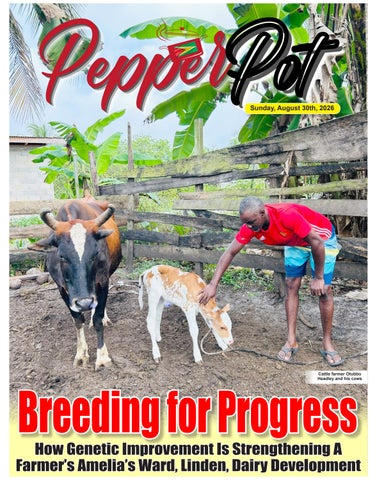
Breeding for Progress
Cattle farmer Otubbo Headley and his cows
How Genetic Improvement Is Strengthening A Farmer’s Amelia’s Ward, Linden, Dairy Development
II
CHRONICLE PEPPERPOT ― Sunday, August 30, 2026
A Way of Teaching Beyond Traditional Maths Textbooks Inside an after-school classroom where ‘I can’t’ is transformed into ‘watch me’
By Andrea Hendricks
THE gate at 562 Go-slow Avenue opens onto an ordinary Georgetown street and then, almost immediately, into something that feels like momentum. Inside Sir Giddel’s All Momentous Intellects (GADAMI) in Meadow Brook Gardens, class begins with an everyday question, something students recognise from home, school, the minibus or the shop. From there, Giddel Thompson builds the mathematical equation step by step, out loud, with the room participating. He is an after-school educator with a simple refusal at the centre of his method: he will not let abstract theory be the reason a child decides they are ‘not a Maths person’. His sessions are practical and interactive, pushing students to the board to explain, show their working and correct errors without shame. “One of the techniques that is not working is the use of textbooks to meet the challenge in the Maths class,” he has said of the textbook-only approach. At GADAMI, books are tools, not the whole plan. He starts with real-life situations, then has students demonstrate the method back
to the class. Understanding shows up in posture, in eye contact, and in the moment a voice steadies at the whiteboard, while classmates learn to listen, question, and try again. “Daily, I would sit and think about ways to explain topics differently without the use of a maths textbook… instead of using theoretical explanations,” Thompson explained. He keeps sessions fun and interactive as a memory strategy and has students teach concepts back to their peers, rehearsing both the steps and the confidence to perform under pressure when exams arrive. Current student Akeelah Smith put it plainly: “Sir has a unique way of teaching using common language to young people in a fun environment.” Parents and students return for that translation of difficult ideas: clear, not watered down. Thompson’s aim is not only to cover the syllabus but also to build independence by showing working, checking for errors, and practising until the process feels familiar. Though GADAMI is often described as an after-school programme, it runs with the seriousness of
Last day of the 2026 summer programme for students from Grade 4 through to Grade 9
a small institution. Thompson works across readiness levels, slowing down to rebuild foundations when needed, then accelerating. The message is consistent: gaps can be closed, but only with time, practice and steady support. And while Mathematics is the flagship subject, it is not the only one. GADAMI teaches Mathematics alongside English Language, Principles of Business, Office Administration, Principles of Accounts, Social Studies,
Akeelah Smith, a current student, demonstrating Sir Thompson’s unique Maths technique [Photo credit: Sachin Persaud]
Integrated Science, Human and Social Biology, and Biology. Instruction runs from Grade 4 to CSEC level, with adult sessions and private tutoring also available. The building on Go-slow Avenue is a place where extra lessons come with a wider sense of academic direction and responsibility. That mission shows up each year in GADAMI’s annual free summer programme, launched in 2022. This year’s programme drew
its largest attendance so far, bringing students from Grade 4 through to CSEC level for Mathematics and English built around participation: working problems, answering questions and practising exam habits. When the programme ended, the results kept the institution’s name moving by word of mouth. On average, a 92 per cent pass rate in Mathematics and 100 per cent in Business are just a few of the results highlight-
ed in GADAMI’s overall performance. For Thompson, the numbers point to what structure and steady practice can do, even for students labelled ‘average’, ‘weak’ or ‘not interested’. For Destiney Thomside, whose favourite subjects are Maths, English and Chemistry, two years at GADAMI in Maths and English helped her secure passes in Maths (Grade 3) and English (Grade 2). “Sir Giddel always TURN TO PAGE XIV
Founder of GADAMI, Sir Giddel Thompson [Sachin Persaud photo]
Breeding for Progress
CHRONICLE PEPPERPOT ― Sunday, August 30, 2026
III
How Genetic Improvement Is Strengthening A Farmer’s Amelia’s Ward, Linden, Dairy Development
By Michel Outridge IN Amelia’s Ward, Linden, where generations have known the town through the legacy of bauxite mining, Otubbo Headley is quietly writing a different kind of economic story, one measured not in tonnes of ore but in gallons of milk and the steady improvement of a cattle herd. For nearly two decades, Headley has built a dairy enterprise in an environment where designated pasture is scarce, and livestock production is under pressure from a growing community. Yet, with determination and support from the Guyana Livestock Development Authority (GLDA), he is moving beyond simply keeping cattle to deliberately improving them. Through artificial insemination, veterinary care, extension services and access to improved genetics, Headley is demonstrating how science and technical support can help a smallholder farmer turn environmental constraints into an opportunity for greater productivity, efficiency and resilience, offering a compelling glimpse into how agriculture can contribute to Linden’s economic diversification and local food security. Family legacy Headley’s journey into cattle farming began in 2008, when Linden was grappling with economic uncertainty. For generations, baux-
The premium-breed calf born recently
ite mining had been the town’s economic backbone, sustaining employment, businesses and families.
The calf and her mother
However, changes within the industry were creating growing economic pressures and highlighting the need
for alternative sources of livelihood. As a young family man, Headley relied on intermittent work, but the irregular income made it difficult to meet his household’s demands. Seeking greater economic stability, he turned to cattle production, an enterprise operated by his father-in-law, a cattle farmer, setting in motion a journey that would eventually transform both his livelihood and his family’s future. Encouraged by his father-inlaw, Headley began with a cow he received as a gift. He later purchased two more from a village pastor, gradually expanding the herd through reinvestment and hands-on experience. Today, he has approximately 25 cattle, predominantly Holstein-Zebu crosses, which have become an important source of income for his family. Reflecting on the years he spent raising his family, Headley regards the value of his cattle as best measured by the opportunities milk sales created for his seven children. Income from his dairy enterprise helped finance their education and laid the foundation for their careers. Two became teachers, one became a nurse, another is self-employed, and another works for a private company. His youngest child, now 19, recently completed trade school. For Headley, their achievements are a lasting testament to the economic security his cattle provided and to the transformative power of what he
proudly calls “milk money”. “If it wasn’t for ‘milk money’, I don’t know what would have happened, but the money I got from selling cow’s milk assisted me in sending my children to school,” he said. Farming within Linden’s limits That history explains why Headley remains committed to cattle farming despite the challenges of raising livestock in Linden. Unlike Guyana’s expansive cattle-producing areas, he does not have extensive designated pasture for his animals. His cattle are allowed to graze in available areas and are brought home in the afternoon. While this system has enabled him to maintain the herd, it also requires constant supervision because the animals can stray into residential areas, creating conflicts with residents. On occasion, Headley has even had to visit the police station to resolve issues arising from wandering cattle. Yet these challenges have strengthened rather than weakened his determination to improve the way he farms. With limited land and pasture, simply increasing his herd is not necessarily the most practical path to growth. Instead, Headley has increasingly focused on improving the quality, health and productive potential of the cattle he already owns. It is this shift, from maintaining TURN TO PAGE VII
Cattle farmer Otubbo Headley and his cows
IV
CHRONICLE PEPPERPOT ― Sunday, August 30, 2026
Beauty inside and out Beautician Builds a Ladies-Only Zone for Beauty, Privacy and Confidence
By Andrea Hendricks FOR Bibi Aarifa Sahadeo, beauty is about far more than appearance. It is about helping women feel confident, cared for and comfortable in their own skin. What began as a genuine love for makeup and beauty has grown into a business and career shaped by perseverance, compassion and purpose. Sahadeo began taking makeup seriously in 2018. Over the years, her interest in makeup application de-
veloped into a wider passion for the beauty industry. Today, she is the proud owner of XOXO Salon & Spa Ft Makeup by Aarifa, located in Industry, East Coast Demerara, where women can enjoy a variety of beauty and selfcare services under one roof. The journey was not an overnight success. “I had to push myself, but I kept going because I genuinely love what I do,” Sahadeo recalled. As her experience and confidence grew, Sahadeo wanted to create more than a place where clients received
a service. She envisioned an environment where women could also enjoy the experience, one that felt comfortable, relaxed and welcoming, where they could feel beautiful and cared for. Opening the salon was also an important step towards independence. Sahadeo wanted to build something of her own: a brand that reflected her personality, values and enduring love for beauty. At XOXO Salon & Spa, the focus is on creating a private, comfortable and person-
Beautician and owner of XOXO Salon & Spa Ft Makeup by Aarifa, Bibi Aarifa Sahadeo
Open-day launch of XOXO Salon & Spa on March 20, 2026
alised experience for every client. “I want each woman to feel welcomed, respected, relaxed and truly cared for throughout her appointment,” she said. The salon and spa cater exclusively to women, which is especially meaningful for hijabi sisters who may wish to remove their hijabs while receiving beauty services. The space is designed around comfort, privacy and respect, allowing clients to feel safe and at ease.
Sahadeo works strictly by appointment, creating a calm, unhurried atmosphere in which each client has dedicated time and their full attention. For hijabi clients in particular, the one-on-one setting offers the reassurance of receiving services in a private space. Cleanliness, attention to detail and client satisfaction are also central to her work. “I am constantly learning, improving my skills and adding new services so I can
continue offering my clients something better,” Sahadeo said. The wide range of services offered by XOXO Salon & Spa includes makeup, hairstyling, hair treatments, hair colouring, nails, manicures, pedicures, facials, hydrofacials, massages, eyelashes, eyebrow tinting and mehndi or henna designs, among others. Makeup courses are also available. For Sahadeo, the salon’s TURN TO PAGE VI
Staying true to home
V
CHRONICLE PEPPERPOT ― Sunday, August 30, 2026
An entrepreneur’s return to Guyana to explore investment opportunities
By Michel Outridge
MITRANAND ‘Mitch’ Singh is a Guyanese entrepreneur, technology professional and investor with business interests in both Guyana and Canada. Although his professional journey has taken him abroad, Guyana has always remained central to his identity, ambitions and long-term vision. He was born and raised in Guyana, where family, community, and personal responsibility played important roles in shaping his outlook. Singh’s mother, in particular, has been a quiet source of strength and guidance throughout his life. As he prepares to start a family of his own, he carries forward the values and example she set for him while choosing to keep the broader details of his family life private. Singh told Pepperpot Magazine that growing up in Guyana allowed him to experience both the warmth of Guyanese society and the difficulties people face in creating opportunities for themselves. He stated that from an early age he was curious, independent, and interested in how things worked.
“That curiosity eventually developed into a passion for technology, problem-solving and business,” he said. However, at age 16, he left Guyana to continue his education abroad. Leaving home at such a young age required him to mature quickly, adapt to a different environment and learn to navigate unfamiliar systems. Over time, Singh built his career in technology and established PlexxTech Solutions in Canada. The company provides managed information technology, cybersecurity, Microsoft cloud, and technology risk services to businesses. Singh said his work has given him extensive exposure to structured business environments where documentation, cybersecurity, compliance and accountability are considered essential, not optional. He became particularly passionate about helping organisations understand that technology is not simply about purchasing equipment. It is about protecting information, managing risk, establishing proper procedures and ensuring that systems support the organisation’s wider objectives. Singh reported that, de-
spite building a life and business abroad, he never lost his connection to Guyana. About eight years ago, he returned to establish M3Tech Solutions. His decision was driven by more than commercial opportunity. “I wanted to bring home some of the knowledge, standards and practical experience I had developed abroad and demonstrate that a Guyanese technology company could deliver services at an international level,” he said. Singh added that investing in Guyana has not always been easy. Red tape, inconsistent processes and the absence of clearly enforced standards can frustrate even the most committed investor. He pointed out that, too often, there is a workaround for the system rather than an effort to improve it. “We sometimes resist structure, compliance and change because informal arrangements appear easier in the short term. However, those shortcuts eventually cost the country through inefficiency, weak accountability and lost opportunities,” he said. Singh told Pepperpot Magazine that he holds no animosity towards Guyana, but his frustrations stem from his love for the country and
Family holiday with Mitranand Singh and his relatives, including his mother, uncle and grandfather
Mitranand Singh and his mother, Meera Mookram
from recognising how much more we can become. “I appreciate the development and improvements taking place across the country, and I want to contribute constructively to that progress. At the same time,
development must be accompanied by transparency, proper planning, measurable outcomes and accountability. Public and private institutions should be able to explain what was promised, what was delivered, how much was
spent and who is responsible when standards are not met,” he said. Singh related that his investments have gradually expanded beyond technology. He is involved in agriculture TURN TO PAGE IX
Mitranand Singh at a PlexxTech donation ceremony at Hospice Vaughan in Canada
VI
CHRONICLE PEPPERPOT ― Sunday, August 30, 2026
Beauty inside and out
women-only approach responds to a genuine need. Many women value having a place where they can set aside their worries, enjoy personal care and be themselves. She considers it particularly important that women who wear hijabs can receive beauty services without compromising their values or privacy. She also believes the ladies-only setting is distinctive, as there are hardly any spas in Guyana offering a similar zone. That commitment to care extends to the locally made organic skincare products she incorporates into the business. The line includes lip scrub, facial soap, body scrub and face scrub, made with local organic ingredients. Offering products that benefit clients’ skin while supporting local producers is an added point of pride for Sahadeo. The skincare line was born from her own experience. “I suffered from severe
facial scarring after being burned by harsh chemicals in face paint. I visited countless doctors and tried to find help, but unfortunately, I wasn’t getting any results. That experience led me to create my own skincare formula with great success.” After consistently using the formula, Sahadeo saw tremendous improvement. The scarring cleared, and the pigmentation on her face disappeared. That transformation inspired a skincare line that offers the gentle, natural care she wishes she had known about while struggling with scars. Because it grew out of her personal experience, she hopes it will help other women feel confident and comfortable in their own skin. Balancing family life and work has been one of Sahadeo’s challenges, but the support of her husband, mother-in-law and children
FROM PAGE IV
has helped ease the demands of being a businesswoman. Her journey has also strengthened her resilience. In 2018, she experienced bullying and many difficulties, but instead of allowing them to break her spirit, she turned each stumbling block into a stepping stone. Now 28, Sahadeo is proud of the woman she has become. She views challenges differently, knowing she can overcome them and learn from them as she moves forward. Her work is also closely tied to her mother’s legacy. The current salon was once her mother’s space, a comfort zone and workplace where she built herself up. Years later, Sahadeo is following the same path. “She’s no longer here with me. I miss her very much. I truly believe she is proud of me. Every step I take, every milestone I reach and every time I walk into
XOXO Salon & Spa’s beautiful, welcoming ambience
the salon, I feel like I am carrying a small piece of her legacy with me,” she said. For Sahadeo, success is not simply about owning a business. It is about carrying on her mother’s legacy and turning it into something meaningful, something for which she will always be
grateful. If her work reaches beyond Guyana’s shores, Alhamdulillah. And if God has something even greater planned for her life, she is ready to welcome it. For now, Sahadeo remains grateful for her journey and focused on serving the women in her community.
She intends to keep learning, improving and growing XOXO Salon & Spa into something she can proudly call her own. For information or to book an appointment, follow XOXO Salon & Spa on Instagram or call (592) 723-6748.
Breeding for Progress
CHRONICLE PEPPERPOT ― Sunday, August 30, 2026
VII FROM PAGE III
How Genetic Improvement Is Strengthening A Farmer’s Amelia’s Ward, Linden, Dairy Development a herd to deliberately improving it, that has brought genetic improvement to the centre of his farming ambitions. Improving the Herd Through Science For years, Headley had wanted higher-quality dairy animals within his herd, but conventional breeding could be expensive for a small farmer. Maintaining a breeding bull, for example, requires additional feed, space, veterinary care and management. Accessing superior genetics can also be difficult for small-scale farmers. Through the Guyana Livestock Development Authority’s (GLDA) artificial insemination programme, however, Headley has been able to access selected genetics without the need to maintain male breeding stock on his farm. Four of his heifers have benefitted from the AI programme, and the results have given him renewed confidence in the possibilities of genetic improvement. The most significant development came on August 14, 2026, when one of his Holstein-Zebu crossbred cows gave birth to Emily, a Gir calf produced through artificial insemination. For Headley, Emily represents more than the addition of a new animal to his herd. Her birth is tangible evidence that modern reproductive technology can reach smallholder farmers and can be applied within a production system such as his. It also marks the fulfilment of a long-standing ambition to improve the genetic quality of his cattle. Looking at the newborn calf, Headley expressed his delight at what he sees as a significant step forward for his herd. “ To m e , t h i s n e w l y birthed calf resembles a purebred Holstein I would see at shows, and I am very happy to have it as a part of my herd; the colour is just right,” he said. Although Emily exhibits the characteristics of a high-quality dairy calf, she has Gir genetics; her dam is a Holstein-Zebu cross, a combination well suited to Headley’s tropical production
environment. Originating in India, the Gir is a Bos indicus breed recognised for its heat tolerance, environmental adaptability, hardiness and dairy potential. Its capacity to maintain milk production under tropical conditions, coupled with relatively high milk-fat content, makes Gir genetics particularly valuable in tropical dairy breeding programmes. Those characteristics are especially relevant to Linden, where Headley operates without extensive pasture and must manage his cattle within a relatively constrained environment. His animals are exposed to tropical temperatures and must utilise the available grazing and feed resources efficiently. The introduction of Gir genetics into a herd that already contains Holstein and Zebu ancestry therefore offers the potential to combine dairy productivity with the adaptability required for tropical smallholder production. For Headley, the significance of genetic improvement lies precisely in this balance. He is not seeking to replicate the production system of a large commercial dairy farm; rather, he wants animals capable of producing efficiently within the realities of his own operation. By progressively improving the genetic potential of each generation, he can enhance productivity without proportionately increasing herd size or placing additional pressure on scarce land resources. Improved production The economic implications are equally significant. Headley currently produces approximately two to three gallons of milk daily, depending on the productivity of his milking cows. He sells milk to consumers within the community and distributes any surplus when production exceeds local demand. Improved genetics could enhance milk yields, increase farm income and optimise the use of his existing resources. Artificial insemination also offers an economic advantage by reducing the need to maintain breeding bulls. For a farmer with lim-
ited pasture, avoiding the additional costs of feeding, housing and caring for male breeding stock can help reduce operating expenses. In this respect, genetic improvement is not simply a breeding strategy; it is part of Headley’s broader effort to create a more efficient and economically sustainable production system. Satisfied with the AI service, Headley is now looking towards the next stage. He hopes to participate in the GLDA’s embryo-transfer programme, which he believes can further accelerate genetic improvement within his herd. His interest in embryo transfer reflects his growing appreciation that the productivity of his farm will depend increasingly on the quality of its genetics and the effectiveness of its management. Technical Support Beyond Breeding Genetics, however, cannot deliver its full potential without healthy animals and sound management, and this is where the GLDA’s continuing technical support has become critical. Headley credits the GLDA Region 10 Extension Team, led by Regional Coordinator Ms Roxanne Langevine, together with Dr Grey, the GLDA veterinarian, and Ms Ronique Bremmer, the livestock extension assistant, with contributing significantly to the development of his herd and his knowledge of livestock management. The team’s involvement extends beyond reproductive services. Regular farm visits allow the officers to monitor the health of the animals, provide practical guidance and screen the herd for transmissible diseases, including tuberculosis. This integrated support is particularly important because improved genetics can only translate into greater productivity when animals are healthy, properly managed and able to express their genetic potential. The extension team’s guidance has also highlighted the importance of proper livestock records. Headley acknowledges that record-keeping remains an
area for improvement but recognises that accurate records of animal identification, breeding, treatments, disease history and production are fundamental to effective herd management. As his participation in genetic improvement expands, such records will become increasingly important in evaluating animal performance and making informed breeding decisions. For Headley, his engagement with the GLDA has extended beyond access to services to encompass the development of technical knowledge. Although he began farming with limited formal training, years of practical experience, reinforced by guidance from the Region 10 team, have deepened his understanding of animal health, breeding and herd management. He now adopts a more systematic approach to cattle production, recognising the interdependence of these factors in improving overall productivity. Headley also recognises the agricultural policies of the PPP/C Government, led by President Dr Mohamed Irfaan Ali, particularly its emphasis on genetic improvement and on providing government-supported services that enable smallholders to participate. As a livestock farmer with a relatively small herd in Linden, access to artificial insemination (AI) and other advanced breeding services would otherwise be difficult to obtain. While acknowledging the scope for continued programme improvement, he values the opportunities these initiatives provide to smallholder farmers and their contribution to strengthening Guyana’s livestock sector. A Wider Future for Linden Agriculture His experience is particularly relevant to Linden’s broader economic context. The town’s identity has long been shaped by bauxite mining, but the challenges associated with dependence on a dominant industry have highlighted the need for greater economic diversification.
Headley recognises that agriculture will not replace bauxite; however, enterprises such as his can provide supplementary household income, strengthen local food availability and generate employment within the community. H e a d l e y ’s a p p r o a c h demonstrates that economic diversification does not necessarily require large-scale expansion. With limited pasture, increasing herd size could intensify pressure on available resources. Enhancing herd quality and productivity therefore offers a more sustainable pathway. Improved genetics, supported by sound animal health and management practices, can enable farmers to derive greater value from existing resources. This principle now informs Headley’s vision for the future. He aims to maintain a healthy herd, increase milk production, strengthen record-keeping practices, reduce operating costs and progressively improve herd genetics. His positive experience with artificial insemination has encouraged him to explore embryo transfer, while continued technical support from the GLDA extension team provides a foundation for advancing these goals. Nearly two decades after receiving his first cow, Headley has entered a new phase of his farming journey. What began as a response to employment insecurity has evolved into a dairy enterprise with enduring personal and community significance. Income from milk sales has supported his household, financed his children’s education and provided consumers in Linden with locally produced milk. Today, genetic improvement is extending this legacy by enabling him to develop a more productive, resilient and better-adapted herd. Emily’s birth is perhaps the clearest symbol of that transition. She represents the intersection of farmer determination, improved genetics, reproductive technology and professional extension support. More importantly, she
demonstrates that modern livestock technologies can produce meaningful results even within a smallholder operation operating under significant land and production constraints. And as Emily grows within the herd, she carries with her more than the promise of improved genetics. She represents what can happen when a determined farmer is given access to the right technology, professional guidance and an opportunity to turn experience into progress. In Amelia’s Ward, Headley’s experience demonstrates how farmer commitment, complemented by strategic public-sector support, can strengthen smallholder livestock enterprises. Beginning with a single cow, he has progressively improved his herd through enhanced genetics, animal health and management, supported by the GLDA’s veterinary and extension services. His experience underscores the value of targeted public investment in equipping farmers with the knowledge, technologies and technical assistance required to overcome resource constraints and improve productivity. The convergence of farmer initiative and institutional support is contributing to the modernisation of livestock production in Linden and the wider transformation of Guyana’s agricultural sector, with important implications for food security, rural livelihoods and the resilience and sustainability of national livestock production.
VIII
CHRONICLE PEPPERPOT ― Sunday, August 30, 2026
What we choose to see and to be
ONE might imagine morality to be a great castle built brick by brick. In truth, it is more like a flame quivering in a windy room. Its shape changes with every passing moment and with
every angle at which the viewer chooses to see it. There is a constant internal struggle we all experience when we wonder whether our very existence is the result of random chaos or whether
we were planted here with the gentle particularity with which seeds are placed into the ground. I believe that looking up at the stars might answer our question to some extent.
The stars appear to be tossed randomly across the sky. To the keen observer, however, the stars take on incredible shapes, and they tell stories. Perhaps one’s eye might capture a pair of mythical twins whose brotherly bond would never allow them to be parted, even by death. Or one might observe the shape of a great hero, poised in battle. Some might even notice a lion, a fish, a hare or a wolf, all taking up residence in the night sky, waiting to tell a story to anyone who might be willing to listen. Of course, for those who believe the stars to be randomly scattered, there are no mythical creatures, princesses or heroes to meet. There is only the reliable darkness and winking lights to see. Life is like the darkness, scattered with stars. It takes on whatever shape or meaning we choose to give it. For someone who is encountering grief or difficulties, it is difficult to imagine that they are in control of their life. To some extent, indeed, they are not. After all, if we truly were in control of life, then we would never be surprised. We
would never know anything as we go to sleep that we did not already know when we woke up in the morning. At the same time, we do have some control over it. We can choose what life turns us into and, in doing so, control how we choose to see it. We can choose to look at a random spatter of twinkling lights and see constellations taking life in them. Or we can see them as nothing more than pretty little lights in the sky and still feel the same amount of joy and wonder. Growing up can be difficult because no one truly tells us who we ought to be. We might be given rules to follow or directed towards paths to walk, but no one can tell us what the right thing to do is in every situation. Sometimes, you are thrown into an unexpected situation with nothing but your own values and experiences to guide you, and when you navigate through it, the choices you make will also have made you. In those moments, the choices you make cannot be explained away or justified by your suffering in the past. It is an uncomfortable truth that a difficult past rare-
ly excuses an intentional mistake you make in the present. At the same time, the naivety that arises from having lived a comfortable life does not automatically protect you from the realities of the world. Your sheer trust in the goodness of humanity cannot stop you from witnessing its ugliest parts at some point in your life. There are things in life that you can only see if you intentionally choose to do so. There are also versions of yourself you can be only if you choose to. The only unshakeable vessel we can construct to ensure that we can go through life without allowing it to drown us is a collection of unwavering morals. As strange as it seems to imagine morals as things you intentionally cultivate and keep, there must be parts of you that cannot be broken or misshapen by any force that you encounter in life. Whether it is honesty, integrity or loyalty, there must be one thing in you that does not change, even when the entire world seems to be falling apart around you. This will be your anchor.
IX
CHRONICLE PEPPERPOT ― Sunday, August 30, 2026
Staying true to home
through ARV Chicken, a Guyanese poultry operation focused on contributing to local food production and reducing dependence on imports. He said that agriculture has given him a deeper appreciation for the challenges faced by local producers, from feed costs and animal health to infrastructure, market access and competition from imported products. Singh noted that it has also strengthened his belief that technology, modern farming practices and better coordination can transform Guyana’s agricultural sector. Meanwhile, outside of business, he loves exploring Guyana and experiencing the country beyond Georgetown. He said its rivers, communities, agriculture, natural en-
vironment and extraordinary potential constantly remind him why he chose to return and continue investing here. Singh believes the diaspora has an important role to play, but Guyanese living abroad must feel that they are returning to a system that respects their time, investment and expertise. Looking ahead, he intends to expand his work in technology, cybersecurity, compliance, and agriculture while exploring initiatives in modern livestock production, renewable energy, responsible investment, and technology-driven development. Singh’s long-term ambition is to help create enterprises that can compete internationally while remaining firmly rooted in Guyana. “I do not expect change
FROM PAGE V
to happen overnight. However, I believe change begins when citizens stop accepting that ‘this is just how things are’. I want to see people held accountable, institutions strengthened and investments judged by the value they create for Guyanese people,” he said. Singh added that this is our Guyana: One People, One Nation, One Destiny. He wants to see it develop, compete and succeed, not only because of its oil and natural resources but because of the strength, creativity and determination of its people. He has a thriving chicken farm at Yarrowkabra on the Linden-Soesdyke Highway, and his IT business is located at Lot M, G3 Building, Diamond, East Bank Demerara.
X
CHRONICLE PEPPERPOT ― Sunday, August 30, 2026
TRULY UNDERSTANDING THE PROCESS OF EMANCIPATION AND THE TROUBLED AGE THAT FOLLOWED…
CONTRARY to what we believe, North Africans are credited with the first acknowledgement as the custodians of what we today address as Christianity: those who survived the destruction of Carthage. But the barbarism of the pagan Romans drove many of those Africans deeper into Africa. The irony of that age was that the Romans
themselves would adopt the religion that would become known as Christianity. The Romans stopped tormenting the Africans, turned to their religion, and became its followers. For the exact chronicle, explore “The Arab Invasion of Egypt and the Last 30 Years of the Roman Dominion” by historians Alfred Butler and John Henrik Clarke.
That the hierarchy of religion played a profound role in the slave trade in Africa and the New World should not be alarming. The adaptations will surprise; do not be alarmed or overwhelmed. It also played a role, even in the destruction of European pagan belief systems. A prominent poet in the making of the embracing of emancipation in colonial Guyana,
P. H. Daly, the writer, in his book ‘Revolution to Republic’, quoted HIS BRETHREN ON MAIN STREET. We knew this man, and we listened to his poetry. As the poet sat with us and defined our world at the moment, smiling, he read a poem on the social classes of the day: ‘Show you to make a living on the minimum of work and the maximum of bluff
and make-believe, while the law of compensation shouts: “A thief!” Such were the men whose nature did begin our nation… From colony to emancipation, as they began to recognise themselves as men with much to say and to do. Join me next week as we conclude the poet’s narrative…
CHRONICLE PEPPERPOT ― Sunday, August 30, 2026
XI
XII
CHRONICLE PEPPERPOT ― Sunday, August 30, 2026
The Full Catastrophe: Wild Maami by Roopnandan Singh
ROOPNANDAN Singh is one of those Guyanese writers about whom one hears very little anymore, like Sheik Sadeek. This is owing, in part, to the fact that their novels and, in Singh’s case, his poetry were published locally, which almost guarantees that they will receive little critical attention beyond the borders of the country, and perhaps not much within it either, beyond the small, dedicated readership that exists in
Guyana. Neither writer was particularly popular, even locally, but both were well known to a discerning minority of readers. For most writers, however, local recognition is rarely enough. The ambition of writing is always larger than local notoriety; one writes towards the widest readership one can imagine. Writing, though, is more than ambition. It is also an urge, a forceful necessity. One senses that Sadeek and
Singh wrote because they were writers and that this compulsion may have been the most important impetus behind their prolific production of books that often cost more to produce than they earned. Realistically, the possibility of making a living from their writing in the Guyanese milieu in which they began was virtually out of the question. Singh’s self-published books belong very much to the enterprising publishing
tradition of Guyana, a tradition born of necessity in a country that has never had a significant publishing house of its own. It was in this way that many Guyanese writers got their work into print. Even writers who would eventually become central figures in Caribbean and world literature had to find unconventional means of publication. The work of Edgar Mittelholzer, Jan Carew, Wilson Harris, Martin Carter, Ivan Van Sertima and others appeared through various local initiatives, including A. J. Seymour’s Miniature Poem series in the 1950s. The tradition extends beyond Guyana.
Derek Walcott, the St Lucian Nobel laureate, was proud to say that his mother financed the publication of his first collection of poems, 25 Poems, in 1948, when he was eighteen. This was very much a Caribbean creative tradition. We made music out of discarded steel drums; we made cuisine out of the ‘dash-way’ remnants of the massa’s kitchen; we made art out of the ordinary difficulties and limitations of daily life. Creativity in the Caribbean has often been an act of transformation: taking what is available and making something new of it. I am not well-versed in the writings of Roopnandan
Singh. I have read only his novel, Wild Maami, published in 1995. I know little about the man himself, but I gathered from the book’s adcard that he had previously published five collections of poetry and three novels, a significant body of work about which remarkably little appears to have been written. This is unfortunate because Singh is a fine and attentive writer. Wild Maami is Singh’s third novel, although, at only ninety-four pages, it is more accurately a novella. It moves with the pace of a good thriller while displaying considerable psychological acuity and TURN TO PAGE XVI
XIII
CHRONICLE PEPPERPOT ― Sunday, August 30, 2026
I AM DUSKY
I CAME into this world one late night, on a grassy parapet in the glow of a street lamp, but disaster befell me the moment I got up to walk. I wobbled, lost my balance and fell into the deep drain. My mother nudged me to help me out, but I couldn’t get out, struggling until I grew tired. No one was passing at that hour who could have stopped to help, and my worried mother was pacing around restlessly. By the time I saw the first light of day, I was cold, could not feel my legs, and, soon after, help found me. A lady in a red dress, from a red house bordered by flowering plants opposite where I was lying, unlocked her gate and saw my frantic mother. She came closer and saw me struggling in the drain, and I heard her say, ‘Oh my God, this baby is in trouble!’ She looked around for help, but still there was no one, and she hurried back into her house, coming out again quickly, holding something to her ear and talking to someone. The next moment, two young boys came running from around the corner, followed by their father, who lifted me carefully out of the drain. I was wet and trembling but now safe, and my relieved mother walked to the playfield nearby as I followed on shaky legs. But, in crossing the narrow bridge, my disastrous welcome to the world continued as I fell into that drain. My rescuers rushed to take me out again and waited a short while to make sure my mother and I were safely in the playfield. I tried suckling as she grazed on the thick, green grass, but couldn’t get much milk, so I sat down to rest. Later that morning, another kind lady and her little daughter from nearby came to see me and pet me. I was new to this world and felt comfortable in that wide, grassy field with caring peo-
ple around, but there were no others like me. Maybe they were somewhere else, so when my mother started to walk out of the field, I followed her and fell into the drain again. The nice lady from the red house and her daughter came to my rescue, getting a construction worker nearby to haul me out. ‘What’s happening to this poor fella?’ I heard her ask. They put me in a little shady area, dried my coat and gave me water to drink, whilst molasses water was given to my mother. They secured the gate this time before leaving. No more falling into the drain that had shaken me. Somehow, I hadn’t the strength to suckle enough milk from my mother’s breast, but I found comfort in that wide field, green grass, blue skies and a cool wind. I wondered, though, because I hadn’t seen any other horses or ponies, ‘Where is home? Does Mama have a home?’ She seemed sad and tired, her white coat not glistening. I got up to go to her, but my weak legs wouldn’t carry me, and I sat down.
The first day I came into this world passed, and that night it rained. There was no shelter, but my mother stood over me, sheltering me with her body. The sun shone the next morning, and most of the field was wet, but I found a few dry spots. I wanted to run and frolic, but my legs were still weak, so I lay down and rolled from side to side. My mother had walked a little way off as she grazed, and I got up slowly, steadily walking towards her. Then I collapsed. Something was very wrong with me. She saw when I fell, came and stood over me, worried and looking around for someone. Sometime later, the lady from the red house came over with molasses water for my mother and was shocked to see my condition. ‘How did this happen?’ she asked herself. ‘He seemed fine this morning.’ She signalled her daughter, a little frantically, to come over to the field. The other kind lady came over, too, and together they moved me to dry ground and wiped my wet body. I heard them
on the phone, calling different animal doctors, but they couldn’t reach anyone until late afternoon. They tried feeding me milk from a baby feeding bottle, whilst my mother stood close by, allowing them to do so as they tried to save me. But the milk wouldn’t pass down my throat, and the doctor who came late said I had no suckling power and, without my mother’s milk, I might not survive. It was getting close to dusk, and the caring voices that had been close for two days seemed to be drifting away. The good man and kind lady from early that first morning made a makeshift shelter over me, just in case it rained during the night. They left at dusk with the hope that I would make it to the morning. It didn’t rain that night, and I lay there in the quietness, with lights all around and my mother never leaving my side. But creeping darkness came closer and
closer and, just as I came into the world on a quiet night, I left. The last thing I knew was my mother nudging me. Morning came, and I lay there, my body cold, but I was free to run and frolic around the field. I spoke to my mother, whose sadness had deepened, and said to her, ‘Don’t be sad. I’m free to live.’ She couldn’t hear me or see me, for I would now go to another world, across the rainbow bridge, where many of my kind lived—no more hunger, no more suffering, free from cruel hands and unkind words. I looked at my mother, who had lost her baby, and I felt sorry to have to leave her. The lady from the red house came to check on me just after the sun rose. She touched my body and said, with a sad look on her face, ‘Gosh, he didn’t make it.’ Those words gave me the comfort of knowing that there are people who care and
are kind to animals, so my mother was in good hands. The lady went back home, brought some molasses water for her and spoke to a couple of men about burying my body in the playfield. Her daughter came to offer her support, and then, because no one else was there, she sat and talked to my mother, trying to comfort her as my resting place was being prepared. But when it was ready, my mother would not allow the strange men near me. The kind lady had to coax my mother out of the field so the barricade could be put up to keep her from coming back. The moment they picked up my body, she became agitated, neighing distraughtly and trying to get back into the field. I watched, so sorry that I couldn’t comfort her, for I now had to cross the rainbow bridge. ‘I will wait for you there, Mama,’ I said. ‘We will meet one day again, and then you’ll be happy.’
XIV
A Way of Teaching Beyond Traditional Maths Textbooks
CHRONICLE PEPPERPOT ― Sunday, August 30, 2026
FROM PAGE II
pushed us to do our best and made sure we understood the work,” she said. Her outcome echoes the programme’s larger point: interest can be taught by making the content feel possible. The closing session, held last week, was designed as more than a goodbye: a handover from summer routines back to daily life. A Min-
istry of Education official spoke about dietary health; a representative from the Guyana Police Force warned against drugs and substance abuse; a Toastmasters representative guided students in public speaking for oral presentations, interviews and leadership; and an invited creative artist offered encouragement on discipline
and imagination. Thompson’s own message was direct and familiar to many of his students. ‘Potential is a beautiful thing, but potential alone isn’t enough; it must be developed with guidance, patience and consistency,’ he told them. If they remembered nothing else, he urged them to ‘believe, work and continue’. He ended with a
All receiving certificates of participation Photo credit: Sir Giddel Thompson
personal challenge wrapped in affirmation: ‘I believe in you, but now is your turn to believe in yourselves.’ The story of GADAMI is also the story of how Thompson became a teacher before he had the title. He discovered his calling at 17, after writing CSEC Mathematics a year early while still in a lower grade. After changing secondary schools, he noticed students struggling, not because they were incapable, but because the delivery was not connecting. He started helping anyway, beginning with his then-girlfriend, one of only two students who excelled in that year’s exams. One student at a time, he learnt what worked. That early experience still shapes how he teaches. He urges early preparation so gaps can be closed before exam season tightens, but he also works with students who start later. For Thalia Devonish, although Principles of Business is her favourite subject, Maths was a struggle. “I did poorly in Maths and needed help,” she said. Introduced to GADAMI eight months before her exams, she worked within the limited time span and secured a pass with a Grade 2. “We all know Maths is a difficult subject, but Sir Giddel is also one of the best teachers you can ever find,” she told this publication. The standard at GADAMI is not perfection; it is progress, reinforced through practice. Over time, GADAMI expanded beyond its beginnings in Sophia, where seating was limited, and the operation was smaller. From its Meadow Brook location, it offers more subjects in a more spacious environment, and Thompson says preparations are underway to transition to a full-time educational institution in Guyana, an ambition tied to the impact of consistent support on community outcomes. The milestones are also personal: teaching two of his sisters, one of whom later became an educator, and
watching a student who once failed Mathematics return the following year, rewrite the subject and earn a Grade One after rebuilding confidence through instruction and practice. For Abica Hetsberger, who started attending GADAMI in 2024 and studied five subjects, Maths was her favourite. “I enjoyed challenging myself and finding different ways to solve problems, and Maths did that for me,” she told this publication. She said, “The lessons helped me become more confident and disciplined.The early mornings and late-afternoon sessions, with practising past papers and solving difficult questions, helped strengthen my understanding. The formula book created by Sir Giddel was extremely helpful.” These stories never fit neatly into a pass-rate percentage, but they explain why he keeps refining his method. Looking ahead, Thompson wants his signature practical approach documented and shared. For now, he continues to apply it across levels, reminding students that progress requires repetition and that practice is the bridge between knowing and performing when it matters. For parents, students and adults interested in registering and securing tuition spots, registration is available online, with an online payment option. Information can be obtained via the contact numbers (592) 642-1721 and (592) 696-5705. At GADAMI, formulas matter, but the deeper lesson is steadier: belief is a practice, too. In Thompson’s classroom, belief is taught the same way as Mathematics: by example, by participation, by correction that does not shame and by continuing until the work feels real. The stories that follow students out of the building are not only about grades but about the moment ‘I can’t’ becomes ‘watch me’ and the quiet discipline that keeps it that way.
CHRONICLE PEPPERPOT ― Sunday, August 30, 2026
Run Towards the Storm
I RECENTLY had a brief moment to reflect on my behaviour when a difficult situation arises, and I’m sure many people will resonate with this. Whenever a problem appears on the horizon, we suddenly become Olympic athletes. We run. We run from the conversation we need to have; we run from the decision we know we need to make; we run from the grief sitting inside our chests; we run from the relationship that has been bleeding us dry, the habit that has been eating our peace and the truth that has been knocking on the door for six months. We run from the storm. And then, because human beings possess a knack for confusing movement with progress, we congratulate ourselves for getting away from it, except the storm is still behind us. There is an image from nature that has stayed with me: the American bison facing a winter storm. When severe weather approaches, bison has been observed turning towards the storm, lowering their bodies and moving into it rather than simply fleeing in the same direction; their thick coats, powerful bodies and low stance allow them to endure conditions that would be dangerous for other animals. The National Park Service describes this behaviour as part of the bison’s remarkable adaptation to harsh winter weather. Now, there is a popular version of this story that says the bison understands that running towards the storm means spending less time inside it. It makes a wonderful story. Science, however, gives us a more modest explanation. There is no good evidence that the bison is sitting there doing meteo-
rological mathematics in its enormous furry head. And frankly, I prefer it that way. The lesson does not require the bison to understand the weather. It requires us to understand ourselves. Sometimes, the way through a storm is through it. Mind you, this does not mean we deliberately walk into danger. It does not mean we remain in abusive situations, tolerate mistreatment, ignore wise counsel or pretend suffering is somehow noble. There are storms we leave, there are doors we close, and there are places from which we wisely remove ourselves. But some storms live inside us. Those are the ones we have a peculiar habit of carrying wherever we go. We avoid the conversation, so the resentment grows; we suppress the grief, so it finds another language; we refuse to admit that something has ended, so we keep dragging its corpse through tomorrow; we avoid looking at our finances, and the numbers become uglier; we ignore the crack in the relationship, and eventually the crack becomes a wall; we postpone the decision, and the decision eventually arrives with interest. So, you see, life really does have a strange way of sending the same examination paper back to us until we finally stop pretending we forgot our glasses. Psychologists have a name for one part of this pattern: ‘experiential avoidance’. It refers broadly to attempts to escape, suppress or control difficult thoughts, emotions, memories or sensations. Research has linked stronger experiential avoidance with greater psychological distress and poorer well-being. In other words, sometimes our attempt to avoid discomfort becomes
the very thing that keeps discomfort alive. We run from anxiety and become more anxious about feeling anxious. We run from sadness and become frightened of our own sadness. We run from uncertainty and become obsessed with controlling everything. We run from failure and become too afraid to try. We run from rejection and build a life in which nobody gets close enough to reject us; then we call it peace. It is actually a very expensive form of hiding. Steven C. Hayes, one of the founders of Acceptance and Commitment Therapy, developed an approach that deliberately challenges emotional avoidance and encourages people to make room for difficult inner experiences while continuing to take meaningful action. Acceptance does not mean surrendering to a terrible circumstance. Acceptance means seeing the weather accurately. The sky is dark, the wind is strong, and the road is flooded. All this is what is happening. Now, what can I do? This is very different from standing in the rain, screaming at the clouds because we had already scheduled sunshine. There is a lot of spiritual wisdom in that distinction, too. Eckhart Tolle writes, ‘The primary cause of unhappiness is never the situation but your thoughts about it.’ Does this mean that difficult circumstances are imaginary? Of course not. Pain is real, loss is real, betrayal is real, poverty is real, illness is real, and broken hearts are remarkably physical things for something we casually describe as emotional. But there is the event, and then there is the story TURN TO PAGE XIX
XV
XVI
CHRONICLE PEPPERPOT ― Sunday, August 30, 2026
The Full Catastrophe: Wild...
close attention to Guyaneseness, particularly the rhythms and textures of Guyanese Creole. These qualities make the book an interesting and, at times, compelling example of locally grounded Caribbean fiction. The novel is set in Georgetown, in what appears to be the 1960s, when trains were still running in the country. It follows a young couple from their earliest courtship through a disastrous marriage to its final, merciful dissolution. It is not a good
marriage; it is, in Singh’s telling, recognisably a Guyanese one, marked by self-sacrifice on the part of the wife and infidelity on the part of the husband. Nadira and Anil meet as teenagers, both still at home and recently out of school. Nadira comes from a disciplined household with her parents and siblings. Anil’s family situation is markedly different. His mother died when he was young, and he lives with his father and stepmother. He is unsettled, emotionally and domestically,
and this instability foreshadows one of the novel’s central concerns: how childhood circumstances and nurture, or the absence of nurture, shape adult behaviour. The young couple fall madly in lust, mistaking it for love, and Singh is particularly interested in exploring the distinction. There is a considerable amount of sex in the book, but it is suggestive rather than explicit, and its function is primarily narrative and psychological. Nadira and Anil possess the heedless
sexual urgency of teenagers and repeatedly act without sufficient thought for the consequences. Nadira becomes pregnant and has an abortion. She becomes pregnant again, and this time they are compelled to marry. That is effectively the end of romance. What follows is marriage, with all its hurts and psychological stressors: infidelity, resentment, irresponsibility and the careless disregard with which one person can treat another. The novel’s interest lies less in the conventional romantic arc than in the slow disintegration of the fantasy that initially binds the couple together. The world of Wild Maami is remarkably insular, confined almost entirely to the principal characters and their perspectives. They move through a world that extends very little beyond the places in which they live and the people they know. There is consequently little sense of the larger political or social world in which the characters exist. We are not given a broader historical context or a substantial sense of society beyond their immediate apprehensions. This is not necessarily a weakness. Rather, it is a deliberate limitation of the novel’s scope. Singh offers very little exposition, and this contributes to the book’s brevity and pace. The story remains close to the characters, close to their speech, their desires, their resentments and their immediate circumstances. The result is an unusually intimate narrative. The prose is direct, neither complicated nor dense. One of the marks of the novel’s authenticity is its deft use of Guyanese Creole, which, in places, is reminiscent of the language employed by Rooplall Monar. The dialogue often approaches poetry, its rhythm wonderfully attuned to the cadences and tones of actual speech. One does not get the sense of an approximation of the Guyanese vernacular; rather, one feels that the language itself has been captured. This is a considerable accomplishment. Writing convincing dialect is notoriously difficult, and Singh manages it with remarkable precision. One irritating blanche was the lack of spelling distinction between ‘awe’, which contextually would be ‘a-we’ in Creole, meaning ‘we’, and ‘awe’, associated with wonder, powerful emotions or something vast. What is most evident throughout the novel is its authenticity: a raw and particular naturalism that comes close to what one might actually see and hear in Guyana.
The marital travails ring with the uncomfortable truth of lived experience: the affairs, the recklessness, the betrayals and their inevitable consequences. There is a particularly poignant scene towards the end of the book. Anil, in a moment of desperation, when his star is very much on the wane, returns to see his former wife. He has been reduced significantly from the man he once was. Nadira gives him a hundred dollars and tells him to go away. It is a sobering moment because the power dynamic between them has been completely reversed. Once, Anil was the dominant figure; now, Nadira possesses the power to dismiss him. The scene is made more painful by his interaction with his two children, which is almost entirely devoid of filial connection. What exists between them is obligation rather than affection and love. Anil has never really been a father to them beyond the biological fact of fatherhood. His emotional absence becomes another measure of his diminishing significance, another indication of the obsolescence of the man he has become. Singh is also saying something here about Guyanese women and the burdens they are often required to bear in relationships with bad husbands and irresponsible men. It is Nadira who ultimately triumphs over the men in her life: over her domineering but loving father; over Anil, her womanising husband; and over Chitram, her womanising lover, whose fate ends the novel with a bang. She eventually escapes both the country and the men who have defined so much of her life. Singh seems to suggest that the women are ultimately the stronger characters: they endure, adapt and survive, while the men diminish, fail and, in some cases, die. The men are implicitly weak. What is especially striking is the subtle transformation of Nadira, which Singh handles with considerable care. She moves from the romantic innocence of puppy love to a growing awareness of her predicament with Anil, and from there to choice and agency. She gets a job, moves out, establishes a place of her own and eventually takes a lover, but by then her relationship with men has changed. Her motivations have become more calculating and mercenary. She has learnt, in effect, how to behave like a man. This is consistent with the novel’s implicit understanding of Guyanese society as one in which women often exercise greater practical authority
FROM PAGE XII
than men, even when the men imagine themselves to be in charge. Guyana can appear, in this respect, like a matriarchal society in which women rule while men pretend to rule. There is, at times, in the novel, a reaching for profundity through conceits that lose their connection to the objects of comparison, along with a tendency to overexplain: to tell rather than show. These are minor distractions from what is otherwise a highly entertaining and dramatic narrative. The narrative voice occasionally intrudes upon the flow of the story with commentary on one matter or another. Such interventions create a certain dissonance and risk distracting the reader from the narrative’s momentum. This is unfortunate because the story itself is compelling, and Singh’s framing of it through the characters’ perspectives is otherwise consistent and deft. But these are relatively minor reservations. Wild Maami is an exciting and culturally relevant read: a very Guyanese novel, attentive to the milieu, the people, the speech and the particularities of Guyanese culture. Its achievement lies partly in its refusal to distance itself from the ordinary realities of Guyanese life. It is psychologically attentive without being ponderous and linguistically convincing in a way that gives the novel much of its vitality. There are echoes here of the psychologically acute fiction of another Guyanese writer, Roy Heath, particularly The Armstrong Trilogy and The Shadow Bride. Like Heath, Singh is interested in the intimate pressures of family, sexuality, marriage, class and social expectation, and in the ways these forces shape individual lives. Yet Singh’s voice is distinctly his own, particularly in his use of Guyanese speech and his sharp observation of domestic life. It is perhaps one of the ironies of Guyanese literature that a writer such as Singh could produce a substantial body of work and yet remain so little known, even within the country of his birth. Wild Maami suggests that much more of his writing deserves to be recovered, read, discussed, and placed within the broader history of Guyanese and Caribbean literature. Writers like Singh remind us that literary history is not made only by those who achieve international recognition. It is also made by the persistent, often solitary labour of writers who continued to write because writing was something they had to do.
CHRONICLE PEPPERPOT ― Sunday, August 30, 2026
XVII
XVIII
CHRONICLE PEPPERPOT ― Sunday, August 30, 2026
XIX
CHRONICLE PEPPERPOT ― Sunday, August 30, 2026
Run Towards the Storm
we build around the event. Something happened, then the mind says: this always happens to me; I will never recover; everyone leaves; I am finished; my life is ruined; and so on. The storm becomes a hurricane partly because we keep feeding it our imagination. Tolle’s teaching invites us back to the fact itself. What happened? What is happening now? What can actually be done? The bison does not appear to stand in the snow composing a seventeen-chapter autobiography about how unfair winter is. It lowers its head, adjusts its body, faces the weather and waits. Sometimes, our greatest act of faith is simply standing still long enough to discover that the thing we feared would destroy us is passing. Viktor Frankl expressed another side of this wisdom when he wrote, ‘When we are no longer able to change a situation, we are challenged to change ourselves.’ There it is. Sometimes, we can change the storm; sometimes, we can change our direction; sometimes, we can change the shelter we are standing under; and sometimes, all we can change is ourselves. The mistake is believing that every difficult season requires immediate escape. While some seasons require movement, others require endurance; some require action, others require surrender; and some require us to finally stop running in circles long enough to notice that we have been carrying the same problem from one location to another. Remember, a person can leave one relationship and carry the same insecurity into the next. A person can change jobs and carry the same bitterness into the new office. A person can move across the country and still wake up with the same unresolved anger. A person can delete a telephone number and still have an entire conversation with that person every night inside their head. Changing the scenery does not automatically change the weather inside us. That is why facing a problem is so powerful. When we face something, we can finally see its shape. Fear becomes a conversation; grief becomes tears; confusion becomes a question; failure becomes information; a difficult relationship becomes a boundary; a mistake becomes a lesson; a painful ending becomes a just ending; and an ending, despite the dramatic
performance we usually give it, is sometimes simply life clearing the stage for another scene. We have been taught to think courage looks like fearlessness. It rarely does. Courage often looks like shaking hands, opening the letter, making the phone call, saying, ‘I was wrong.’ Courage looks like admitting, ‘This hurts’; like sitting with yourself without immediately reaching for a distraction; like turning towards the storm and saying, ‘All right. Let us see what this has to teach me.’ This is where the spiritual lesson becomes beautiful. The storm does not always come to punish us. Sometimes, it comes to reveal what was never strong enough to survive the wind. Sometimes, it strips away an identity we outgrew. Sometimes, it blows the comfortable lie out of the window. Sometimes, it shakes the tree so violently that the fruit that was ready to fall finally does. And sometimes, after all the noise, we discover that we were never being destroyed; we were being rearranged. Of course, none of this means we romanticise suffering. There are storms from which we must seek shelter. There are situations where leaving is wisdom. There are moments when asking for professional, spiritual or practical help is the bravest thing a person can do. Facing a storm does not mean facing it alone. Even bison do not wander through winter as isolated philosophers. They are herd animals. Perhaps that is another lesson we have forgotten. Strength does not always mean standing alone. Sometimes, strength means saying, ‘I need help.’ Sometimes, the storm is survived because somebody stands beside you. But eventually, there comes a moment when every human being must face something personally: the truth, the grief, the fear, the choice or the change. Maybe this is why this strange image of the bison stays with us. The animal does not need to know that the storm will end. It simply knows how to meet the weather. Let’s be like the bison and stop running from our storms. Below is poetry for perspective, as usual. When the Storm Comes When darkened skies come rolling near, And thunder drums its song of fear, Tu r n t o w a r d t h e w i n d , breathe deep and stand, Let courage take your trembling hand.
The rain may fall, the wild winds roar, Yet every storm has passed before; What shakes the heart and bends the tree Can wake the strength we could not see. So face the thing you tried to flee, The truth you buried quietly; For wounds concealed beneath the skin Grow roots where healing
could begin. The road may twist, the night may sting, The storm may steal away the spring; But clouds are travelers passing through, And morning keeps its promise too. What life has brought, let wisdom meet, With grounded soul and steady feet; For fighting what we cannot
change Can make a prison out of range.
And when at last the winds grow mild, You may discover, almost wild, The storm that frightened you before Was only opening another door. So when the heavens darken blue, And life feels far too much
FROM PAGE XV
for you, Face what you can, release the rest, Walk through the rain and do your best. Because somewhere past the wind and rain, The sun will find your face again; And you will smile, surprised to see, The storm passed through, but strengthened thee. Romella Dasratt
XX
CHRONICLE PEPPERPOT ― Sunday, August 30, 2026
CHRONICLE PEPPERPOT ― Sunday, August 30, 2026
XXI
XXII
CHRONICLE PEPPERPOT ― Sunday, August 30, 2026
CHRONICLE PEPPERPOT ― Sunday, August 30, 2026
XXIII
XXIV
CHRONICLE PEPPERPOT ― Sunday, August 30, 2026
CHRONICLE PEPPERPOT ― Sunday, August 30, 2026
XXV
XXVI
CHRONICLE PEPPERPOT ― Sunday, August 30, 2026
CHRONICLE PEPPERPOT ― Sunday, August 30, 2026
XXVII
XXVIII
CHRONICLE PEPPERPOT ― Sunday, August 30, 2026
CHRONICLE PEPPERPOT ― Sunday, August 30, 2026
XXIX
XXX
CHRONICLE PEPPERPOT ― Sunday, August 30, 2026
CHRONICLE PEPPERPOT ― Sunday, August 30, 2026
XXXI
XXXII
CHRONICLE PEPPERPOT ― Sunday, August 30, 2026
CHRONICLE PEPPERPOT ― Sunday, August 30, 2026
XXXIII
XXXIV
CHRONICLE PEPPERPOT ― Sunday, August 30, 2026
CHRONICLE PEPPERPOT ― Sunday, August 30, 2026
XXXV
XXXVI
CHRONICLE PEPPERPOT ― Sunday, August 30, 2026
CHRONICLE PEPPERPOT ― Sunday, August 30, 2026
XXXVII
XXXVIII
CHRONICLE PEPPERPOT ― Sunday, August 30, 2026
CHRONICLE PEPPERPOT ― Sunday, August 30, 2026
XXXIX
XL
CHRONICLE PEPPERPOT ― Sunday, August 30, 2026
CHRONICLE PEPPERPOT ― Sunday, August 30, 2026
XLI
XLII
CHRONICLE PEPPERPOT ― Sunday, August 30, 2026
CHRONICLE PEPPERPOT ― Sunday, August 30, 2026
XLIII
XLIV
CHRONICLE PEPPERPOT ― Sunday, August 30, 2026
CHRONICLE PEPPERPOT ― Sunday, August 30, 2026
XLV
XLVI
CHRONICLE PEPPERPOT ― Sunday, August 30, 2026
August 30th, 2026 STUDY SUCCESS Welcome, dear friend. Are negative thoughts about studying still bothering you? Turn them into constructive, practical ideas. Reframe common challenges as opportunities for deep learning, innovation, and even career-exploring opportunities. Yes, use personal encouragement, and focus on building skills through persistence. List
highly specific issues, concerns or tasks. Strengthen your abilities for logical thinking, problem-solving, and spotting hidden biases. Make revision a manageable routine. Remember: effective studying overcomes stress and anxiety. Be wise. Take good care of yourself. THE PASSAGE Close reading: similar or
different Students are sometimes asked to say whether two statements are similar in meaning to test their understanding of a text under close reading. Close reading of a text encourages thinking skills, and measures how much the student has moved from word level to phrase and sentence level understanding. It is careful reading. It
is rereading to figure out more and deeper information with each time of reading; attempting to get increasingly out of the wording. It is purposeful reading with argumentation – a rereading for understanding of what the author is saying in a short, selected text. Read the following extract carefully and then answer items 1-5 based on what is most accurate. Hides and skins are the raw material of the leather manufacturer or tanner. When man first used animal skins is not known. Skins, even when preserved by tanning, do not last as long as stone, pottery, metals and bone, and our knowledge about the early use of skins is vague. However, the numerous flint scrapers and bone or ivory sewing needles in our museums show that tens of thousands of years ago, in the early Stone Age, skins were prepared and used long before textiles. Nowadays, hides and skins are essential raw materials and important articles of commerce. Any animal skin can be made into leather, but the skins chiefly used come from cattle, sheep, goats, pigs and horses. To a lesser extent the skins from dogs, deer, reptiles, marine animals, fish and birds are also used. Snakes, lizards, seals, whales, and sharks all contribute to leather manufacture. There is usually a long interval between the flaying, or stripping, of the skin from the animal and putting it into the tannery for processing of cattle hides. If the flayed skins were left wet, they would go just like meat; they must therefore be preserved in some way. The most common method is salting. This involves sprinkling the skins with salt on their inner side; or immersing the skins completely in strong salt solution for some hours, after which they are drained and sprin-
Knowledge comes, but wisdom lingers ALFRED, LORD TENNYSON (1809-1892) “Locksley Hall” kled with solid salt. A. First Set of getting ideas from the extract. In the following sets of sentences, each first sentence is from the selected passage, “Making Leather,” and is to be compared with each second sentence. 1. Skins do not last as long as pottery (A) unless they are preserved by tanning. (B) however well preserved by tanning. (C) except after certain processes. (D) unless made into leather. 2. Our knowledge about the early use of skins is vague (A) because there is no evidence. (B) even though there is some evidence in the form of tools. (C) although numerous Stone Age skins have survived. (D) in spite of some written evidence. 3. Leather can be made from the skins of (A) any animal except fish and birds. (B) any kind of animal. (C) cattle, sheep, goats, pigs, and horses only. (D) the larger animals only. 4. The skins of sheep, lambs, and ponies are dressed (A) with the hair, wool still in place. (B) in one of two different ways. (C) after the hair or wool has been removed. (D) with the hair or wool added later. 5. Skins are usually preserved with salt after stripping (A) because they cannot be tanned immediately. (B) to preserve their moisture. (C) to make them turn
out better. (D) to keep insects away. Second set of Similar or different coming from the extract: 1. a) However, the numerous flint scrapers and bone and ivory sewing needles in our museums show that tens of thousands of years ago in the early Stone Age, skins were prepared and used long before textiles. b) Indications of the early use of skins by man are the tools used to prepare and sew them. 2. a) If the flayed skins were left wet, they would go bad, just like meat. b) Unless skins are left moist, like meat, they decay. 3. a) This involves sprinkling the skins with salt on their inner side; or immersing the skins completely in strong salt solution for some hours, after which they are drained and sprinkled with solid salt. b) Each skin must go through four processes: i) Salt is sprinkled on the inside. ii) it is immersed in a salt solution. iii) It is drained; iv) It is sprinkled with dry salt. IMPROVING WRITING Vocabulary building An antonym is a word that is opposite in meaning to another word. For the first word in each numbered item, find the answer choice that is its antonym. Explain your choice to your study group. 1. anonymous: (a) mysterious; (b) named; (c) informed. 2. profusely: (a) insufficiently; (b) busily; (c) freely. 3. awkward: (a) tricky; (b) expert; (c) clumsy. 4. authenticate: (a) verify; (b) invalidate; (c) confirm.
CHRONICLE PEPPERPOT ― Sunday, August 30, 2026
Can children have bad breath? CHRONIC bad breath in adults can indeed be an ominous sign, which, in extreme cases, can even indicate stomach cancer. In children, though, halitosis (bad breath) is hardly ever connected with anything that serious. A study published in the March 2012 issue of the Journal of Paediatrics reveals that the worst breath in children comes either from the mouth itself or from the nasal cavity. We tend to think of bad breath as an adult problem. So, it is always a shock when parents smell foul breath coming from their little angel. If it persists, they often worry that something is seriously wrong with their child. As one mother said to me recently when she brought her son to my clinic, ‘I’m afraid that my child is rotting inside.’ There are several things in the oral and nasal cavities that can cause bad breath in children. • The most common cause is poor dental hygiene. Bacteria feeding on stagnant saliva and food particles are the cause of classic ‘morning breath’. We all know that morning breath can turn into ‘afternoon and evening breath’ if your child does not get a good tooth and tongue brushing in the morning and at night. Sometimes, food particles get caught in little crypts in the tonsils. This, too, can cause a foul odour. • Tooth decay can also be a culprit. If the decay has not yet affected the dental root, your child will not experience pain but may have smelly breath. • Both acute and chronic sinusitis have been associated with bad breath. In these cases, though, bad breath is not the only symptom. Sinusitis is usually accompanied by a daytime and night-time cough and possibly a fever, facial swelling or a thick, yellow-green nasal discharge. • Bad breath can signal pharyngitis, a throat infection. Usually, your child will also complain of a sore throat. As with sinusitis, the odour is probably coming
from the bacterial infection itself and from bacteria feeding on stagnant saliva because your child is breathing through the mouth. • Seasonal allergies could be the cause. Allergies can cause a pooling of mucus in the back of the throat (postnasal drip), which can be accompanied by halitosis. In this case, your child may also complain of symptoms such as a dry cough that worsens at night, itchy eyes, and a runny nose. • Finally, it is practically a rite of passage for a child to shove something, typically a corn kernel, a pea or a dime, up their nose. If this foreign body is left there, it can begin to rot or cause an infection around it. In this instance, the bad smell will come predominantly from the nose and not the mouth. 1. F i r s t , t r y n o t to make your child feel self-conscious. Children will have plenty of time to obsess over bad breath as they grow older, and there is no need to get them started prematurely. Instead, use this as an opportunity to teach your child good self-care habits. Explain that washing the teeth is as necessary as washing other parts of the body. 2. Let your child pick out a toothbrush and toothpaste. Just make sure that the toothbrush has soft or medium bristles and is small enough for the child’s mouth. The toothpaste should contain fluoride. Commercial mouthwashes and breath-freshener lozenges are poor substitutes for brushing the teeth and are not recommended for children. 3. S u p e r v i s e y o u r child’s tooth-brushing twice a day, something many parents overlook in the rush to get out of the door in the morning or to get children into bed at night. Brushing your teeth with your children is a good way to teach them how to do it properly. 4. Once any two of your child’s teeth touch, you should start them on flossing, says the American Dental Association (ADA). This will help keep the gums healthy
and remove food debris. 5. If you see food caught in your child’s tonsils, have them try gargling with warm water to dislodge the food. 6. Make sure that your child gets regular dental check-ups, at least once a year beginning with their first birthday, recommends the ADA. If you suspect that your child has shoved something up their nose, contact your healthcare provider for further advice. Generally, it is not a good idea for parents to try to fish the object out because they usually only succeed in shoving it farther up the nostril. If the bad breath does not go away with careful dental hygiene, consult your dentist. If the bad breath is accompanied by a cough lasting more than 10 to 12 days, a fever, or thick nasal discharge, contact your healthcare provider.
XLVII
XLVIII
CHRONICLE PEPPERPOT ― Sunday, August 30, 2026