
Sunday, March 29, 2026

Sunday, March 29, 2026
The young entrepreneur aiming to bring a luxurious, personalised approach to makeup artistry in Guyana with the Java Experience

The young entrepreneur aiming to bring a luxurious, personalised approach to makeup artistry
By Shaniya Harding
FOR Donelle Harvey, makeup is more than a service; it is an experience designed to make the customer feel relaxed and confident long after the final brushstroke. Through her business, The Java Experience, the young entrepreneur is hoping to redefine beauty standards by focusing on comfort, confidence, and individuality.
Officially introduced to
the public at the WE LIFT Expo in March, her brand is rooted in the idea that every client should leave not only looking their best but also feeling it, with a renewed sense of self and a touch of luxury that many once thought existed only beyond Guyana’s shores.
While new to the landscape, The Java Experience has quickly become a favourite of many. Describing the business as a fully immersive experience, Harvey shared
that the goal has always been to create a moment within a memorable experience that her customers could return to.
“It must be something that, when they leave and go out into the world, they have a solid experience. I want that luxurious experience on site to be here locally.”
Located on the West Coast of Demerara, Region Three, the business, through Harvey’s skills, aims to make customers feel confident in TURN TO PAGE XV



By Shaniya Harding
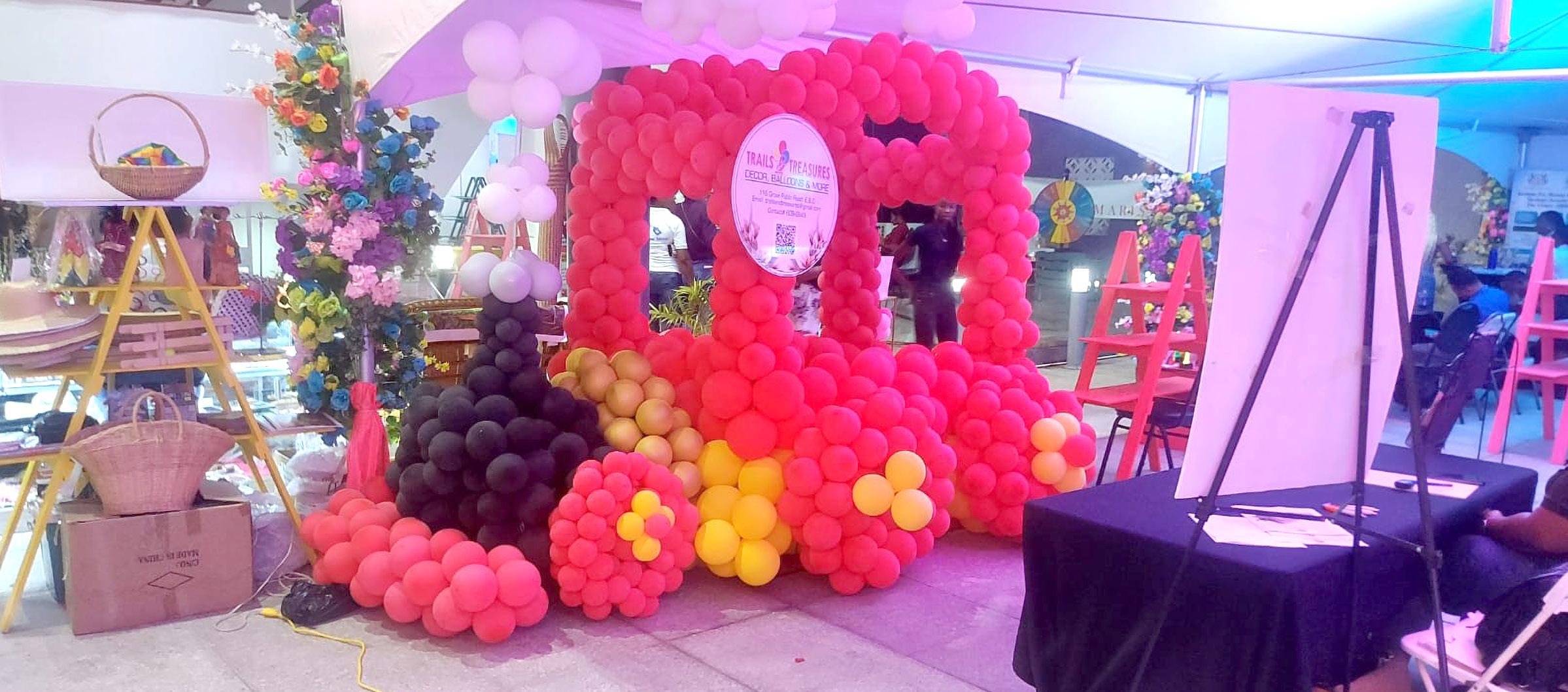
WHAT began as a young bride’s desire for a beautiful wedding has blossomed into a long-standing creative enterprise rooted in creativity, determination, and growth. For Marisa Jaisingh, founder of Trails and Treasures Décor, the journey to developing a business has been anything but simple, marked by multiple closures, financial challenges, and the demands of motherhood.
Yet, through creativity and a passion for design, she has carved out a space in Guyana’s events industry, becoming known for her distinctive décor and balloon artistry while continuing to rebuild, evolve, and inspire.
Trails and Treasures Décor was launched almost twenty years ago, when Jaisingh, a young bride at the time, wanted unique decorations for her wedding. During
the planning of her wedding, when she could not find just the right décor, she decided to make her own.
Recounting what inspired the business, she shared, “At that time, décor options were limited, and prices were very high. Weddings were usually done by family or community members, and I wanted something really nice. My husband and I decided to use the money we had to buy our own materials and create our décor.”
The couple researched décor ideas and themes, invested in flowers and décor materials, and learned what it took to put décor together. Their work was so vibrant that it garnered attention from guests and became the beginning of Trails and Treasures Décor.
Within the first few years of the business, Jaisingh noticed growing interest in and uptake of balloon art and TURN TO PAGE XII

By Michel Outridge
SUSAN Farnum’s originality has surpassed the expectations of many who doubted her capabilities, skills, and talent.
Even though she has roots in a remote village in Guyana, she did not let that define her future but utilised foundation-based education and skills to become the best version of herself.
She is a businesswoman and philanthropist who was born on May 1, 1987, in a remote indigenous village named Warapoka, located in Santa Cruz, Moruca (Barima-Waini), Region One, and developed an interest in entrepreneurship, politics, and community service.
Farnum had the opportunity to relocate to the city; it was her father’s idea to afford her an education there. So, at age four, she came to Georgetown to live with a relative on Pere Street, Kitty.
She is the daughter of David Farnum, a renowned public servant who placed her in the care of his cousin so that she could attend school in the city. Her name is Cyrilda De Jesus—at that time, she was a Member of Parliament (MP) and a businesswoman in gold mining who resided in Kitty.
As a product of Region
One, she came to the city at a young age to attain primary, secondary, and tertiary education.
She graduated from North Georgetown with seven passes at CXC and pursued studies at the Business School and the University of Guyana (UG).
She related that at age 17, she embraced her independence, moved away from her cousin’s care, and started to build her own life. At the time, she was managing two businesses. Unfortunately, those were not as successful as she had hoped, but she continued to shape her way as a woman in business.
Farnum reported that she developed a love for politics and philanthropy during her younger years because of her family ties.
After successfully applying her newfound knowledge, she founded a logistics company, SF Strategic Investments, in February 2020, following her exit from the Public Service.
Farnum is known for her social work in Guyana, and her efforts remain relevant in behind-the-scenes work, especially when it comes to giving back to the community.
Farnum enjoys mentoring others, including youths,


some of whom she has played a vital role in their lives by devoting her time to social and educational activities.
“Today, she continues to expand her business and contribute to community development by collaborating with the Open Gates Community Group in Parika, East Bank Essequibo, where a skilled and qualified group has taken root to empower others,” she said.
The group works with communities, especially women in business, and provides life skills training in homemaking, cooking, farming, and artificial intelligence (AI), among others.
“I am currently developing a partnership programme to be launched in April this year, where exchange students will be engaged in camps to both learn and teach indigenous craft-making, among other things,” Farnum said.
Farnum also worked with
Indigenous women’s groups in Warapoka and two other remote villages and helped develop a work programme for Mabaruma.
She explained that the women’s groups in these far-reaching communities are involved in skills training to empower women and youth, and they are seeking to expand into Regions Two, Three, and One.
Farnum pointed out that outside of her business, which is procurement and construction, she is also a logging concessionaire, and that is her source of income.
In her professional sphere, she worked with the Diplomatic Corps for 15 years through Georgetown International Academy and left government service after gaining experience and building a network to launch her own small business.
Farnum spent a good part of her adult life working with youth groups, in politically
motivated capacities, as well as with the Red Cross, the Diplomatic Corps, government, and the private sector.
However, when motherhood happened in 2020, when she gave birth to her first child, it changed the family dynamics, and she spent the better part of four years tending to her son. When her second child, a daughter, was two years old, she returned to business as an entrepreneur.
It was during this time, while building her business, that she was led to the Open Gates Community Group, where she is employed, tasked with overseeing group activities, and also part of the management team.
Farnum is the mother of two children, and she has been employed as a teacher since January this year with the Open Gates Community Group (OGCG), a non-governmental organisation (NGO).
Open Gates Community Group
Open Gates Community Group (OGCG) is a skills-training project designed to address unemployment and societal ills within the community.
It falls under the umbrella of Eden Gates Farm, which was formed and registered in 2022 by a group of like-minded persons for farming and as a safe space for the community, but later evolved into a training facility for the common good.
From farming, they developed into a snackette, a recreational facility (safe space), a variety store, a meeting place, and an OGCG to facilitate training and capacity building for villagers in Parika.
The farm is multi-purpose: it grows long-term crops like citrus and raises fish, poultry, and coconuts. They hope to build a shade house in the near future to expand the farm.
The OGCG comprises seven administrative members, with 14 volunteers and ground support personnel scattered across the country.
Eden Gates Farm will also be part of training people in agriculture, as well as getting villagers, especially those with small businesses like cement block-making and workshops, involved by taking on trainees to empower people, including youths and older people.
So far, people are responding favourably, but they need more support.
People are more excited about the training sessions that started in January this year in catering, sewing, computer, and mechanical training.
Parika, East Bank Demerara, has two housing schemes with about 140 households and an additional immigrant population of more than 40 households, so capacity and human capacity building are needed, but not limited to that area alone.
By Michel Outridge
AT 39, Mala Hookumchand is quietly redefining what it means to inherit a family legacy.
From Number 41 Village, West Coast Berbice, she is up before dawn daily to manage a fully licensed butcher shop and slaughter facility—work that many consider physically demanding and traditionally reserved for men.
For Hookumchand, however, this is more than a business; it is a responsibility passed down through generations.
That responsibility was shaped long before she fully understood it.
In 1997, her grandfather established the family’s butchery trade, supplying beef to markets in Linden and Georgetown.
After his passing, her father continued the operation until his death last year. As the only sibling to pursue this path, Hookumchand knew the duty to preserve the family’s livelihood rested squarely with her.
“I was born and grew up in this business, so it was up to me to keep it going,” she said.
After completing her secondary education, she became more actively involved in the butcher shop.
When her grandfather died, much of her time shifted to overseeing both the retail and slaughter operations.
Although she admits she was not fully prepared for leadership, the years of hands-on experience allowed her to adjust quickly and take control when it mattered most.
Stepping into this role also meant confronting the realities of being the only female butcher along the West Coast Berbice corridor.
There were doubts from some who questioned her capability because of her gender.
Nevertheless, through discipline, knowledge, and consistency, she gradually earned respect and built a solid reputation across the region.
As her confidence grew, so did the reach of her business. Today, her establishment supplies fresh, wholesome beef to customers and provides slaughtering services for butcheries along the East Coast Demerara and in Georgetown.
The operation provides steady employment for a truck driver and four other workers who assist at both the butcher shop and the slaughter facility.
To maintain this level of service, Hookumchand relies on trusted cattle farmers from Region Five and other areas for her supply of high-quality animals.
Each animal undergoes careful inspection before slaughter, reflecting her commitment to quality and food safety.
This commitment is strengthened by her training and ongoing support from the Guyana Livestock Development Authority (GLDA).
As a licensed butcher trained by GLDA, she benefits from routine visits by the Region Five Livestock Extension Officer, who conducts ante-mortem inspections to ensure animals are healthy and disease-free.

After slaughter, the Environmental Health Department certifies the meat as fit for consumption.
On average, her facility processes between 10 and 15 cattle weekly, depending on supply and demand.
Beyond inspections, Hookumchand is extremely pleased with the increasing number of farmers’ training programmes offered by GLDA, which she believes are essential for the livestock sector’s overall develop -
ment. The theoretical and practical knowledge she gained from these sessions has sharpened her ability to select high-quality animals for her business.
In fact, she recently participated in a specialised
training programme focused on creating awareness about bovine tuberculosis and bovine brucellosis, as Guyana advances efforts to achieve disease-free status and expand trade prospects.
The training was conducted by Veteffects, with support from GLDA and funding provided by the Government of Guyana (GOG) and the European Union (EU) through the Caribbean Development Bank (CDB).
Her optimism about the sector’s future is also reflected in her support for the construction of the modern GLDA abattoir at Onverwagt, which she believes will further strengthen sanitary standards and improve the quality of meat entering the market.
Despite the physical demands of her work and lingering societal perceptions, Hookumchand takes immense pride in her profession. Butchery, she explained, is a skilled trade requiring precision, sanitation, technical knowledge, and dedication—qualities she applies every day.
Through resilience, courage, and an unwavering commitment to her family’s tradition, Mala Hookumchand continues to demonstrate that expertise in butchery is not defined by gender, but by skill, professionalism, and determination.
This butcher is very certain about one thing: she is there to stay and uphold a family-oriented business that will remain intact in the family tree for generations to come, and is essentially laying that foundation.

IMAGINE that one day, as you are travelling home, you see a stranger carrying an enormous bag. He is visibly struggling to hold himself up under the weight of the bag. He glances at you, clearly hoping you will help him out.
Yet, understanding that you are a stranger with no obligation to help him, he does not choose to ask you for assistance. You have no bags of your own to carry, and you are in no particular hurry. Will you help the stranger carry his burden?
Our world is a complex web of connections. Oftentimes, the most critical parts of the web are links formed between two strangers in a moment of need. Helping
a stranger in need may be one of the purest forms of kindness, as there is never an expectation for something in return. As difficult as it is for altruism to survive in today’s world, it is one of the most magnificent facets of human nature.
There are many things taught to us in our homes and in school. Some of these things are meant to shape our knowledge and understanding, and some are meant to shape our character. Nevertheless, the driving forces behind our actions are rarely things we learn in classrooms or lectures; rather, they are things we feel in the depths of our hearts. As we go through our lives, we are forced to carry
many burdens. Some obstacles become our responsibility to survive. Life itself becomes a sort of lonely maze. As we struggle to carry our own burdens, it becomes quite easy for us to forget that everyone around us is carrying their very own burdens, which, sometimes, are much heavier and more painful than the ones that we carry.
This lapse leads us to believe that our responsibility as human beings lies only in carrying our own burdens to the best of our abilities. We develop a disposition of indifference that gradually evolves into selfishness. If the earth did not choose to carry the burden of our arrogant ambitions so
gracefully, we would have lost our home centuries ago. A closer look at nature can show us that even the smallest creatures take responsibility for the organisms which live around them.
Birds and bees ensure that the plants they feed on continue to reproduce by pollinating their flowers and dispersing their seeds. Sharks that live in our oceans take no issue with the remoras that ride on their fins and depend on them for their meals.
Even the tiny microorganisms that live in our bodies aid our immune system in keeping us healthy. Yet when we come across a stranger yearning for help, our first instinct is rarely to reach out
with a hand.
Every connection we form is part of a unique human ecosystem. A simple act of kindness has the power to ripple through multiple links and bridges, creating positive change along its path.
As a younger generation, we have truly extraordinary things in our possession. We have the knowledge necessary to understand where our world needs the greatest assistance and how we can make a desirable impact with the resources that we have. We have the technological prowess needed to connect with someone in a completely different hemisphere and still bond with them as we would with a close neighbour. We have
every opportunity to be kind human beings.
If we choose to spend just a little more time and energy being kind to the people around us, there is no limit to the positive impact we can create. If enduring a minor inconvenience can help someone in their time of need, then perhaps it is quite worth the discomfort we feel.
After all, what difficulty is it to carry a bit of extra burden if it means that we can create a more beautiful world? If the people in our world could learn to endure tiny burdens for each other, then we might find that we can share in each other’s happiness as well.



LIFE doesn’t end with retirement. Senior citizens should and can enjoy full and meaningful lives.
Geary Reid wants to help seniors make the most of their time. In this inspiring and motivational guidebook, he advocates that people live their best lives after retirement, stressing the importance of seniors sharing the wisdom and knowledge they have gained with others, investing in meaningful relationships, and finding work to do, even if it is just gardening. Reid encourages seniors to use their knowledge and ability and to care for their minds and bodies so they can fully enjoy their retirement.
Before a person proceeds to retirement, they should know if they are part of a pension scheme. Some employers do not have a pension scheme but may provide employees with a gratuity. Many people collect their gratuity but do not consider that they may not be entitled to a pension when they retire. Therefore, they must wisely use their gratuity to avoid an immense financial burden during retirement. There are often debates about whether people should accept gratuity or a pension. However, each person must make the best use of whichever option is provided to them. Some organisations may not be able to join a pension scheme and may only offer gratuity. Some small organisations do not have a pension scheme or offer gratuity. Therefore, when some employees reach retirement age, they are still willing to continue working because they do not expect any future benefits. While it may be chal -
lenging for some people to contribute to a pension scheme financially, they may enjoy its benefits in the future. Many pension schemes allow employees to obtain the amount that they contributed. They may also receive part of the employer’s contribution, in accordance with the pension scheme’s regulations.
The assurance of pension benefits after retirement is a strong incentive for many people. Those who have contributed to the pension scheme and receive their regular benefits will feel a
sense of comfort, ease, and relaxation, knowing that many of their expenses will be covered.
Now that day-to-day employment is over, it is time to rest and do other things that you wanted to do. Many young people look forward to being able to retire.
When some people are frustrated with their work, they think retirement is the solution. While it may be a solution for some people, it may be a problematic position for others.
2.1 Part-time employment after retirement
Often, most organisations or countries may have laws that govern when a person retires. This guide is more specific to a particular age.
Some people who have spent many years working may still seek employment after reaching retirement age. Working for many years and suddenly stopping may be something that some people refuse to do. They believe their bodies will shut down, so they seek part-time employment.
Some retirees will covet the opportunity to stay home and rest, but many still choose to work for various reasons. Some of those reasons were mentioned in the diagram above.
Before a person reaches retirement age, they should make provisions for their future. They must not have to depend upon their children for all financial support. There is no guarantee that their children, whom they spent most of their time and money caring for, will contribute to their future if the need arises.
2.2 Full-time away from work
As people age, some may retire and leave the workforce for good. They know that they have given their time and energy to the organisation, and it is time to rest and enjoy life.
Congratulations to those who are satisfied that they can stay away from work and enjoy life. It is often expected that people will work and then find time to rest. Retirement does not take away from their freedom and enjoyment; they are happy TURN TO PAGE XII



LET’S have a slightly uncomfortable conversation. Children did not send an application to be born. They didn’t hover in some celestial waiting room saying, “Yes, please, I’d love to enter a financially unstable household with unresolved trauma and generational anger. This sounds like fun.”
Instead, parents choose, and that choice—romantic, impulsive, hopeful, accidental, whatever the backstory— comes with responsibility. It is not just food, school fees, and “I work so hard for you” speeches. I mean emotional responsibility, psychological responsibility, the kind that doesn’t get applause at graduation ceremonies.
Many of us were raised on this script: “I sacrificed everything for you,” or “You don’t know what I gave up,” or “I suffered so you could live.” While that may be true, it is not a debt contract.
Here’s the hard truth: your child does not owe you for being born. Now, before anyone throws a slipper at me, let’s breathe. This isn’t about disrespecting parents. It’s about awareness: what often happens, especially in homes where there isn’t enough money, time, or emo-
tional support, is that stress leaks downward.
Children become containers for frustration, for regret, for dreams that never happened, and so on. Then, years later, we wonder why the relationship is strained, why phone calls feel forced, and why visits feel like an obligation rather than a joy.
This isn’t random; it’s psychological.
According to Dr Shefali Tsabary, a leading voice in conscious parenting, children are not here to fulfil us; they are here to reveal us.
She speaks often about how parenting triggers our unresolved wounds. The tantrum doesn’t just irritate you; it activates something old in you. The defiance doesn’t just frustrate you; it challenges the control you cling to.
So when a parent says, “After everything I’ve done for you,” what’s often underneath that sentence is unprocessed pain, a lifetime of not being seen, a history of scarcity, and a nervous system that has been in survival mode for decades.
The important thing to remember is your child is not your therapist; that’s not their job description.
Dr Gabor Maté, who has spent years studying
trauma and attachment, explains that children don’t experience the world the way adults do. They internalise it. When there is chronic stress, emotional volatility, or guilt-based messaging, the child adapts. It isn’t because they’re weak. It is because attachment is survival.
If keeping mum calm means shrinking, they shrink. If keeping dad proud means performing, they perform. If love feels conditional, they learn to earn it, and then we call that “good behaviour.” What’s really happening is adaptation to emotional pressure.
I understand hardship. Poverty is real, struggle is real, exhaustion is real, but struggle does not permit us to invoice our children emotionally. They did not ask to be here.
So then, what does responsibility actually look like? It looks like regulating yourself before correcting them. It looks like saying “I’m overwhelmed” instead of “You make my life hard.” It looks like understanding that discipline without dignity breeds distance.
Conscious parenting isn’t soft parenting; it’s aware parenting. It’s recognising when you’re about to project your
insecurity onto a ten-year-old who just spilt juice. It’s asking yourself, “Am I responding to my child, or reacting from my childhood?”
If you don’t interrupt the pattern, the pattern continues, and then twenty years later, you’re sitting in a quiet house, wondering why your adult child doesn’t visit. The truth is not that they are ungrateful; the truth might be that the relationship never felt safe.
Sacrifice speeches do not prove parental love; it is proven by safety. Raise children with boundaries, yes; raise them with structure, absolutely, but raise them without making them feel like a burden for existing, because one day they will grow up, and the relationship you have then will be the result of how safe they felt when they were small.
Let’s put this into poetry:
They Did Not Ask to Be Here
Before their cry first split the air,
Before you traced their tiny stare,
A choice was made, by you, not them,
To call a soul through flesh and stem.
They did not beg to take a breath,
Nor sign a pact with joy or death.
They came as hands that needed guidance,
Not burdens to be pushed aside.
Not vessels built to pay your dues,
Or carry wounds they did not choose.
A child is not your sacrifice,
They are your mirror, not your price.
Yes, life is hard, and cupboards thin,
And storms can rage beneath your skin.
But hardship is no rightful claim
To wrap a child in guilt and shame.
“I gave up everything for you,”
They never asked you to.
Your hunger, fear, the dreams you shelved,
The nights in worry you dissolved,
Those were the battles you endured,
But love is not a debt secured.
A child should never feel they owe
For simply choosing life
to grow.
Project not pain through sharpened tone,
Nor plant your thorns in seeds unsown.
For words take root in tender ground, And echo long when you’re not around.
The voice you use becomes their own, Long after they have left your home.
Raise them with strength, but also grace, Let safety live within your face.
Correct with wisdom, not with spite,
Guide with firmness, wrapped in light.
So when your hair turns silver-grey, They’ll choose not to flee but stay.
For children blossom where they’re seen, Not where resentment grows between.
If love is clean and ego small, You will not lose them after all.
Remember this, before you start: They came through you, from your mind, from your heart.


TWO authorities govern the home: one is in charge, in principle, of all domestic realms; the other is the proverbial hunter. This hunter’s task, from the first eras, was to provide, to protect, and to punish the lawbreakers beneath the sun or in the shadows of the night and its order… or so it was decreed in some gathering beneath the moon, before a pondering tribe entrenched in strange beliefs towards obedience.
Today, with its echoes of a new order, there may well be a
new festival to commence and empower new laws and rules to be perceived as sacred, be it religious or enforced by those who consider themselves masters of the game.
From our matriarchal and patriarchal celebrations to the sacred places and the observing cosmos, there our species shaped what was selfish and what should serve.
Our beginnings were not democratic, and in many areas of our accepted norms, the impulses from the past lightless nights still compel their influences, defying our electric nights and new con-
versations through more powerful instruments of punishment and resistance.
One fact remains in our darkest beliefs: we still believe through questions to forces that withhold participation, as we humans violate reason with loathsome plots from ages past, sheltered today beneath a more painful desire, mirrored to the same desires of times gone by.
Our ancient and civilised belief systems revolve today and are defined by modern weapons, but carry the same suspicions and
superstitious onslaughts intended, though shaped in times past.
What is needed is a broader conversation affixed to the practical interests of those involved, whether the conversation must be conducted in an atmosphere transcending the familiar, for example.
Some years ago, a case was examined by a senior court officer. It seemed simple: a young man who had worked in the gold bush from his early teens was brought before the court over his mother adding his aunt to his budget. What was
peculiar was whether the law officer enquired whether the young man had an account in his name, in case of any emergency he might find himself in.
I had written a letter in this column because I know of the era when young men were taken out of school, because, as it was then said, “males can always find work”. I suffered that briefly, but in my time there were options such as the Youth Corps and later the GNS, and young settlers at places like Kuru Kuru Young Settlements.

décor. While balloons and balloon art are a prominent addition to parties and other events today, Jaisingh explained that they were not as popular ten years ago. But as she saw the gradual growth in interest, Jaisingh prepared for and invested in the new market.
As she shared, “I spent a lot of money on balloons and materials, including importing items because they were not readily available at the time. This was not something common 15 to 20 years ago, so I had to source and learn on my own. That is how I became known as the ‘balloon girl’.”
Balloon art would even-
tually become a defining feature of the business, with Jaisingh’s unique, bold, and skilled use of balloons gaining recognition beyond décor.
As she shared, the business gained notoriety through creative expos and fashion events.
“We started showcasing our work at wedding expos, including those held at Pegasus.”
Citing one of her most unique and well-known creations, the Balloon Dress, Jaisingh added, “One of our balloon dresses was featured in a fashion show, and many people saw the creativity. That exposure helped us grow. We began working
with wedding planners, event planners, and marketing professionals, and whenever they needed balloon work, they would call us. That is how we built and targeted that market.”
Throughout the almost two decades that Trails and Treasures Décor has been in operation, Jaisingh says that there have been several hurdles that remain, while others have become easier with time and experience.
In the early years, marketing was a major challenge for the business, as she explained, the use of social media and the internet in advertising was not yet widespread. Jaisingh relied

on more conventional means of getting the word out about the business.
“Back then, marketing was very hard. We relied on newspapers, radio, and television because the internet was not widely available, and social media was not a major tool. It was difficult and expensive, especially for a small business.”
Throughout the years, she has developed the brand’s marketing through investment and emphasis. The first step in developing the business’s marketing strategy, however, was recognising its importance.
As Jaisingh explained, most new and upcoming businesses tend to be more focused on ensuring sales numbers and the quality of their products and services. While these aspects are important, Jaisingh stated that marketing is just as vital to a business’s growth.
“When I started, I did not budget for marketing. I had the creativity, but I did not have the business education
to plan for expenses like marketing and production.”
She added, “As a young entrepreneur, you focus on the idea and forget the other aspects of running a business.”
While Jaisingh has overcome some business hurdles over the years, many of the lesser-known challenges of being a woman and mother in business remain.
As a mother of three boys, Jaisingh spends most of her days balancing business and motherhood.
“It is very challenging. At times, my children do not see me at night when they go to bed or in the morning when they wake up, but they understand that the business provides.”
Beyond the challenges, Jaisingh says the business is important to sustaining her livelihood and fuelling her creativity. While over the last two decades, Jaisingh has proven that balancing motherhood and business is possible, she shared that it was not easy and that there is no roadmap to ensure success.
Speaking to other mothers who are thinking about venturing into entrepreneurship, she shared, “Do not doubt yourself. We all make mistakes, and we learn as we go. There will be slow times, and that can be discouraging, but you have to keep going. The business environment is always changing, and you must adapt. No business stays the same all the time.”
This ability to adapt is the reason that Trails and Treasures Décor continues to grow, as Jaisingh further added, “Keep pushing forward. It takes tenacity, commitment, and a lot of sacrifice.”
Despite the challenges, Jaisingh says she does not see herself stopping business anytime soon, adding, “It is difficult, and there are moments when I cry, especially when I have to leave early to fulfil orders and cannot be there for my children. It is not easy. It requires sacrifice, and while it is difficult, the rewards are great.”
to rest and enjoy doing what they want.
Those who choose to remain in retirement may find many ways to keep themselves occupied. They may begin to do some of the things they were unable to do while employed, since they did not have the time needed.
3. Time for family
Retirement can be an enjoyable period for some people. It allows them to have more time with their family.
3.1 Retiree spending time with their parents
When a person retires, they can still take time to enjoy their parents. Some people are blessed to have their parents alive after they retire. Therefore, if either or both parents are alive, they must not forget their parents’ contributions.
If their parents are not living with them, then it is important to plan trips and visit them to keep them close. Never neglect your parents, as your children may follow the same example
that you set. Your parents might not have provided all you needed, but they are still your parents, so do the best that you can as long as you are able.
3.2 Retiree spending time with their companion
Working sometimes makes it difficult for husbands and wives to grow together and enjoy each other’s company. The nature of some people’s work has led both adults to work long and varied hours throughout the day. Therefore, some couples continue this cycle, where they are both out of the house at different times, unable to have a relaxing moment together.
Once either one of them is retired, or both persons are retired, it is time for them to spend quality time together. This allows both persons to tour and visit places they have never been to before. They are often seen together now more than ever, visiting places.
Working can rob some people of the quality time
that a family needs. However, working allows people to generate money to pay their bills.
3.3 Retiree spending time with their children
Some children can testify that since they have known their parents, both parents have been working. Therefore, children can only enjoy their parents when they are on vacation.
Often, vacation leave is fixed based on a person’s years of service with a company or set by laws or union agreements. However, when parents go on vacation, it may not be the entire time they spend with their children, as they have other personal matters to attend to.
For more information about Geary Reid and his books:
Amazon: http://www.amazon.com/author/gearyreid Website: www.reidnlearn. com
Facebook: Reid n Learn Email: info@reidnlearn. com Mobile #: 592-645-2240







themselves by ensuring her work does not drastically alter her clients’ appearance.
“It is not going to be a rushed process. We try to ensure that the look you get is one that you are pleased with. At the end of it, you must feel beautiful on the inside, and we do not want to drastically change your features. We want you to still see yourself when you are finished.”
The first spark of inspiration for The Java Experience was lit in 2019. Harvey, a trained makeup artist, has long been passionate about
promoting authenticity and self-confidence through makeup.
However, it was only a few months ago that she launched The Java Experience, inspired by the drive to do makeup with a difference.
Sharing insight into the birth of the business, Harvey stated, “This business was in thought since 2019. However, we recently launched it. Relive Expo was my soft launch into the business world, getting people acquainted with my business. That was my first announcement for this business.”
She added, “I have done a few people’s makeup. I am really trying to ensure that I not only do what others are doing. I want to do something that is very unique and niche.”
Moving forward, she aims to further expand her offering, particularly through airbrush makeup, a service that is not as prominent in the Guyanese makeup landscape.
While other businesses within Harvey’s niche continue to emerge, she shared that there were a number of challenges in the deeper workings of developing the business. Citing common hurdles, she described developing her line of services, finding her market, and assessing the best value avenues, which took years of thought and months of planning.
“It took a lot of thought process, designing what I am going to do, what products I am going to use, and purchasing strategically, seeing where the best value is.”
Moreover, she faced a number of specific challenges due to the nature of the business. As Harvey shared, she had to consider her diverse customer base and their unique makeup requirements.
“I ensured I have a wide shade range so that I cater for everyone. I do not want someone to come and sit in my seat, and I do not have what is needed for them.”
Another hurdle Harvey highlighted is creating a unique brand. With Guyana’s business sector steadily growing, crafting a brand and image that stands out, especially in a market as saturated as makeup, can be challenging.
“The main challenge is being known because there are so many persons, and you want to be known for what you are producing and who you are, and you do not want to shy away from that. It is hard to stand out because you do not want to just be like everybody else.”
While challenging, the growing market opens new avenues for creativity and individuality, as Harvey added, “Guyana is full of personality, but you need to stand out. If you do not stand out, you can be overlooked. For me, that is the biggest issue.”
With the challenges, however, there are many upsides to the Guyanese business landscape. As Harvey explained, there are now more training and educational opportunities than ever before.
“There is so much training available, including training about registering a business. Once you want to take it up, you will have the training.”
She also highlighted the importance and impact of support in gaining visibility and a platform. Events like the WE LIFT Expo are just one of a growing number of ventures aimed at creating a space for small entrepreneurs.
“I made sure I took part in the expo because it is one of the only expos where you do not have to pay a fee to participate. It is like free advertising, and they also
help you get your flyers out there and get your business known.”
She added, “I also took part in small business training. That was a wonderful experience, and I would advise anyone to go—once they can make it, take that risk, go, learn, and be equipped as a businesswoman.”
As her business continues to grow and diversify, Harvey hopes to create a collaborative space for makeup artists. She shared that a common issue is that many skilled Guyanese makeup artists struggle to secure a location, a hurdle she thinks collaborative work could help address.
“I want to have a space where makeup artists could come, even if they need to rent for an hour to do someone’s makeup, they can have that space.”
She also hopes to teach others in her field, adding, “I am also hoping that I would be able to teach and educate persons.”
While she works towards making her brand a national, and later international, brand, Harvey aims to continue and grow her business with many of the same themes that inspired the venture in the first place: self-confidence, collaboration, and passion.


THAT blow of betrayal had hit Vickash so hard that it had shattered his mind for a few frightening moments.
The bullying, taunts, and abuse from his father, being forced to leave home and ending up homeless, were severe blows by fate, but he had never given up hope that one day a door would open for him to have a good life. His passion for design and his sketches were all he had that could have given him the breakthrough in life he needed.
“She seemed so kind, and I trusted her,” he bemoaned.
Such cruelty in this world. “What is left for me now?” he asked quietly, sitting at the wharf, watching the mighty river.
“How long more can I go on like this?”
He sighed deeply, a burning sensation in his throat.
“Maybe I should ask the river to take me in its depths and leave this suffering life behind.”
He felt a soft touch on his leg, and turning a little, he saw Sam—the stray dog with thick black fur and grey eyes, his closest companion—looking at him, sensing his pain. Vickash patted his head and said to him, “Thanks for caring.”
And to all the dogs who watched over him like protectors, he said, his voice breaking a little, “Thanks, guys, you are my strength and support in this unforgiving world.”
And as the days went by, he pulled together those shattered pieces in his mind to be whole again, to keep his

hopes alive.
“One day,” he kept saying
in his mind, “one day, life will smile at me.”
He never saw the woman again, but one Saturday, he
saw Aunt Bethany at the market.
She hugged him, and tears misted in her eyes when she told him, “I’m so sorry you had to leave. It distressed your mother when I told her.”
“It’s okay,” Vickash smiled to comfort her. “I am doing okay.”
The old lady shook her head, regret in her eyes. “If only my son was a good person,” her voice choked a little. “He’s in prison now, but he’ll be out again soon. All I wanted was to live my old age in peace and quiet.”
Vickash watched her leave, her shoulders a little slumped, having lost the zeal for life. He felt sorry for her, but he couldn’t help her, given that he himself was in a helpless situation. He was TURN TO PAGE XX


SAYAKA Murata’s novel, Convenience Store Woman, translated from the Japanese by Ginny Tapley Takemori, is a strange and utterly engaging work of fiction. Part of its charm lies in its sly humour— sometimes deadpan, sometimes situational—which arrives obliquely, often through a character’s reaction to an awkward or cringe-inducing setup. The novel’s minimalist approach treasures small moments, but these moments are dense with wit, wisdom, and surprise.
Although the book often reads as comic, the conventions of that genre feel almost incidental—peripheral to Murata’s more pressing concern: the cultural pressures to conform to familial and societal expectations. These include marriage at the “proper” age, childbearing, stable employment, and the achievement of parental pride. The novel’s heroine resists this entire apparatus of expectation. She is determined to opt out of what she perceives as a burdensome script, preferring instead to remain mediocre, unnoticed, and uncelebrated.
Keiko is 36 and has worked at a Smile Mart convenience store in Tokyo for 18 years. She seems made for this store—or perhaps the store was made for her. It is the only place where she truly fits. As a child, Keiko fails spectacularly to assimilate into her peer group; her attitudes are antithetical to social norms, and her behaviour marks her as strange, friendless,
and vulnerable to ridicule and bullying. Her difference is not subtle; it is amplified by what she says and does, often with unsettling frankness.
At the convenience store, however, Keiko thrives.
The employee manual instructs her precisely how to behave—how to talk, walk, smile, and communicate—and she performs these instructions with devotion. The manual gives her a template for normalcy. She mimics her coworkers’ inflexions and mannerisms, rehearsing humanity as if it were a role to be mastered. Her adherence to these rules becomes one of the novel’s richest sources of comedy. Keiko is trying desperately to be normal in a world that remains fundamentally inhospitable to her.
The pressure to conform intensifies as others repeatedly point out her strangeness, particularly her failure to marry. Keiko is uninterested in both sex and marriage, yet she longs to appease her family and acquaintances.
To that end, she enters into a calculated arrangement with Shiraha, an unemployed and deeply embittered man whose sole redeeming quality may be his willingness to serve as Keiko’s ersatz husband. She treats him less like a partner than a dependent; she refers to his meals as “feedings” and allows him to sleep in her bathtub. Her logic is simple: a man living in her apartment will grant her the outward appearance of normalcy.
There is an undercurrent of anomie in Keiko that borders on the sociopathic, and Murata provides sufficient evidence to support such a reading. Yet this is not the novel’s central concern. Convenience Store Woman is not a diagnostic exercise but an exploration of performance—of the exhausting effort required to be something one is not. From this effort, both comedy and pathos naturally emerge.
Murata writes about the quiet, constrained lives of her characters with remarkable care and fidelity. Her deft ambiguity regarding their mental states lends depth and authority to their inner worlds. She is exquisitely attuned to their frailties and anxieties, striking exactly the right tone in prose that is deceptively plain and workmanlike. The dialogue, in particular, is a triumph: often robotic, stilted, and incongruous with real speech, it becomes deadpan to the point of hilarity.
This is a genuinely funny novel—laugh-out-loud funny—and Keiko, if the term “heroine” applies, is both the object and engine of that comedy. Murata exposes the absurdity of social norms by staging their meticulous performance.
The performance of normalcy has rarely been rendered with such strangeness or such precision. Convenience Store Woman is a novel that unsettles even as it amuses; it makes the reader think, feel, and quietly question the price of fitting in.








now 17 and thinking of renting a room somewhere near the market and getting a job, possibly in a hardware store. His mother, whom he spoke to often, was relieved he had come to that decision.
“I will have to move on,” he said quietly. “Until I find where I want to be.”
The only problem he would have, though, was leaving the dogs. They had become his best friends, and he had witnessed people chasing and kicking them all because of a little food. He had been spending half of his
earnings on food for them, and though some people appreciated what he was doing, others mocked him because he was homeless like the stray dogs.
He always took it calmly, saying quietly, “Story of my life, but one day…”
He left the thought unfinished, and that one day came that his young heart had hoped for a few months later.
He was sitting on the wharf one night—the wind had become chilly, for the rains would be there soon— when he heard light footsteps
behind him. The dogs became alert but did not bark because they sensed no danger.
The footsteps came closer and stopped, and a smooth voice inquired, “Are you Vickash?”
Vickash got up and turned around, gasping in disbelief as the country’s top fashion designer stood in front of him. He had a polished look and was fashionably dressed, though modest.
He held up a copy of the sketch and asked, “Is this your work?”
Vickash nodded, not find-
ing his voice.
The sketch was the same one the woman had stolen from him.
“How did you get that?”
Vickash questioned in his mind.
“A young girl met me at one of my workshops,” the designer said, “and told me a little sad story.”
Vickash knew the girl had to be his sister because he had told her what happened.
“This is really a beautiful piece of work, and you are quite talented,” the designer complimented him.

“Thank you,” Vickash said, finding his voice.
The designer looked around and inhaled deeply. “It’s quite cool and serene here. Your own little world?”
Vickash smiled and nodded.
“And your bodyguards?” he inclined his head towards the dogs.
“Yes, they have been my constant companions.”
The designer nodded appreciatively, and looking again at the sketch, he said to Vickash, “I need someone with your vision on my team.”
He handed him his card and said, “The problems you have faced because you’re different, I can identify with, and the same help I was given, I would like to extend that help to you. Wait for my call and have an adult family member accompany you.”
Vickash couldn’t believe what he was hearing, an exhilarating thrill running through his being, and he stammered, “T-thank you so much. I need that.”
Vickash was so excited after the designer had left that he called his sister to share the good news, and he could hear his mother crying quietly with joy in the background.
It had been a long time since the family had something to be happy about.
The dogs had become quiet since the designer’s visit, sensing that their caregiver might be leaving. Vickash spoke with them, hoping they would understand, “This is a breakthrough I had always hoped for, to uplift my life, to be recognised as a successful designer.”
He took a deep breath and continued, already starting to feel sad, “Though I will have to leave for a while. I will not forget you, and I will come back for all of you.”
They looked at him, not excited, somehow sad.
One month later, he got that call and went to the interview with his mother and Aunt Bethany. Vickash’s story was similar to the designer’s, who had also been different and had faced problems as a young boy.
After discussions, his mother agreed to the conditions and terms. Vickash was given a temporary contract with benefits, including a travel allowance and a furnished apartment.
Three weeks later, Vick-
ash began his dream job.
That morning that he had to leave and bid the dogs “goodbye until later” almost broke him.
They whimpered, not wanting him to leave, and ran behind the car a good way before stopping and turning back. He had turned and looked at them until he couldn’t see them, his heart aching.
“So much heartache in my life,” he had said to himself.
He had left money with the lady at the snackette to give them at least one meal a day and told her that he would send more money with Aunt Bethany.
Three months into his job, he was sent overseas to hone his talent, but before he left, he visited the dogs and spent the day with them. He returned two years later as a young, breakout designer. During that period, he had saved enough to rent a comfortable house of his own and hire a maid and gardener.
“And this is where I start,” he said with confidence.
Not long after, the day came to fulfil his promise to the dogs. He went to the market and found them all in good condition; none had died, and the family had grown with a few new members.
They were so excited to see him, barking, running around, wagging their tails, jumping up to hug him. The snackette lady and a few other vendors, touched by the scene, stated, “They waited patiently for you.” He took them all with him and announced, “This is now your home, no more living in the streets. I will now have to work hard to become rich and buy that mansion.”
Six years later, he made his first down payment on a beautiful mansion. He became reunited with his family, no one happier than his mother, no one more proud than his sisters. His father still refused to speak to him, and every time he visited home, he went with a different new model vehicle to show the bullies he had made it in life.
Vickash clicked on the TV and leaned back on the sofa with a contented sigh. Sam stretched out on the rug at his feet.
“What a journey!” he expressed quietly.

































































Welcome, fellow reader. Maintain your physical health during this time of best reading routine. Avoid straining your eyes using poor lighting or reading for excessively long periods. Seek urgent medical examination for any eye problem, or abnormal and frequent tiredness.
Aim at an eight-hour night’s sleep, enjoying a moderate amount of fresh air, doing adequate physical exercises, and eating well-balanced meals. Any best reading routine supported by
physical health and wellness generates those study results you need. Be wise. Love you.
Reminder: direct speech in story writing
Study passage:
“… then there is my half-brother Alexander, coloured like me, he will want to tell you all sorts of lies. He was the old man’s favourite, and he prospered right from the start. Yes. Alexander is a rich man now but he keep quiet about it. because he prosper he is two-faced, he
won’t speak against white people. There is that woman up at your house, Christophine. She is the worst. She have to leave Jamaica because she go to jail; you know that?”
“Why was she sent to jail? What did she do?”
His eyes slid away from mine. “I tell you I leave Spanish Town. I don’t know all that happen. It’s something very bad. She is obeah woman and they catch her. I don’t believe in all that devil business, but many believe. Christophine is a bad woman and she will lie to you worse

than your wife. Your own wife she talks sweet talk and lies.”
The black gilt clock on a shelf struck four. I must go. I must get away from this yellow sweating face and his hateful little room. I sat still, numb, staring at him.
(Jean Rhys’s “Wide Sargasso Sea”)
About the passage
The above excerpt reminds us about one of the enchanting techniques of writing. Its style of dialogue is simple. It shows that it is better at times to use direct speech in stories. But were you able to follow the picture the writer was painting? If yes. So good. To reinforce your response, do the following exercises.
1. Look at the two groups of sentences being presented. Weigh the reader-interest and interaction aroused in the mind in each piece. Discuss your findings with fellow study partners.
i) “… there is that woman up at your house, Christophine. She is the worst. She have to leave Jamaica because she go to jail; you know that?”
ii) That woman Christophine who lives at your house, is the worse of them. Do you know she had to leave Jamaica because she went to jail? Tell me; do you know that?
2. Getting the picture right for the reader:
a) Write a short story with dialogue whose descriptions help to depict facial expressions, gestures, mannerisms, affection, honesty, culture; and of course, clear-cut style and tone. Examples:
i) “There be some grandparents everywhere who don’t want to see all their grandchildren equally rise.” The young man at the back who is most often silent, shocked the class with this contribution.
ii) “Are you pleased with your new clothes?” asked my mother.
Pleased? Yes, I was
I remember Drake, in the vaunting style of a soldier, would call the enterprise the singeing of the King of Spain’s Beard.
(1540?-1596)
Bacon, considerations touching a war with
pleased. They were fine clothes, they were … I turned towards my mother; she was smiling sadly at me …
iii) “What do you want?” I said.
“I’ve brought you a wheat cake,” she replied. I took it and ate it almost without realising what I was doing, though Fanta’s mother was renowned as the best cake-maker in the district. I got up and drank some water and washed my face. Then I came back and sat down again.
“I don’t want you to come and sit beside me when I’m crying,” I said.
“Were you crying?” she asked. “I didn’t notice.”
I looked at her. She was lying. Why was she lying? Obviously to spare my pride: I smiled at her.
3. Using various sentences patterns:
Using various kinds of sentences also attracts reader interest. Here is an exercise that is surely going to help you.
Rewrite each of the following groups of sentences using a participial phrase and/ or a subordinate clause of time or cause.
The first one is done for you. 1. He was an invalid. He could not walk more than a few steps on his own. Stephenie called to enquire after his health.
a) Because he was an invalid, he could not walk more than a few steps on his own toward Stephenie when
she called to enquire after the child’s health.
b) Being an invalid, the child could not walk more than a few steps on his own toward Stephenie when she called to enquire after his health.
2. He met her. He was a vulnerable young man with very little sense. He imagined at that time that he was in love with that beauty queen contestant.
3. The fun-liking puppy seized the plastic bag. The bag was not offered to him. He took pleasure in destroying it in play.
4. She wrote a letter to her friend. She explained why she could no longer go beyond the edge of the village. She was now being monitored by her new parents.
5. He did something that turned out to be wrong. He found it difficult to apologise to his neighbour. She had always been good to him.
GRAMMAR
Looking at progress: how much do you really know? Choose the correct verb in each instance. Compare your answers with your study partners’ choices.
1. This jacket, as well as the shawl and hat, (is, are) new arrivals.
2. (Was, Were) Bonita looking for me at the benefit dress parade? I could not be there.
3. The biggest problem (is, are) the absentees from cricket practice.

MOST people do not know that every month of the year is designated internationally as Cancer Awareness Month and that it specifically names dozens of areas of the body that develop this disease. Oral cancer is among the most fatal because more than half of the cases would have already spread at the time of diagnosis. Therefore, early detection of oral cancer is key.
As an example, one type of oral cancer, when treated while the cancer is still less than half an inch in diameter, has a survival rate of about 60 per cent.
The same cancer, if not treated until it is double that size, reduces the patient’s survival rate to only 15 per cent on average.
When diagnosed, surgery is usually required with fol-
low-up radiation and chemotherapy treatments. Many times, surgery is disfiguring, and radiation and chemotherapy can cause severe complications.
The dentist, besides being involved in pulpal and periapical disease, is also very involved in the detection of oral cancer. Oral cancer is the sixth most common cancer in the world. Studies show oral cancers are more common than leukaemia, melanoma, and cancers of the brain, liver, kidney, stomach, thyroid, ovary or cervix.
Each year in Guyana, it is estimated that oral cancer strikes more than 100 people. Of those diagnosed, 90 per cent are in the over-40 age group, and males are affected more frequently than females.
Statistics further show
that 95 per cent of all oral cancer is squamous cell carcinoma, which is related to tobacco use.
Major risk factors for oral cancer include the use of tobacco products (smoking and chewing), the use of alcohol, exposure to the sun (lip cancer), dietary factors, and exposure to carcinogens in the workplace.
All parts of the oral cavity are affected by oral cancer: tongue, lips, floor of the mouth, soft palate, tonsils, back of the throat and salivary glands. Oral cancers most frequently occur on the lips (usually the lower lip).
This is likely due to chronic sun exposure and is especially prevalent among people with light skin. The tongue is the second most affected site.
These cancers occur most often on the sides and
on the back two-thirds of the tongue. The floor of the mouth is the third most affected site.
Cancers on the floor of the mouth and the tongue are the most aggressive and result in the highest death rates, because cancers here spread most frequently to the lymph nodes and then to other parts of the body.
The gingiva (gums), the roof of the mouth, and the inside of the cheeks are less frequently affected.
However, oral cancer certainly can and does occur there.
It is estimated that 75 per cent of all oral and pharyngeal cancers are caused by excessive smoking and heavy consumption of alcohol, especially when the habits occur together.
Most authorities feel that alcohol promotes the effects
of cancer-producing agents found in tobacco.
Dental health professionals have the greatest opportunity to identify oral cancer while it is asymptomatic, innocuous, and unsuspected.
Patients who smoke and drink alcohol can visit my clinic for a free cancer examination at least every six months.
It only takes about two minutes to do an oral cancer exam.
When examining the mouth, the dentist usually wraps gauze around the tongue and pulls it forward. He then feels and looks at the tissue under the tongue and inside the cheeks for texture or colour changes, bleeding, lesions, masses, ulcerations, and lymphadenopathy (swollen lymph nodes).
You can look for these
warning signs:
1. A sore on the lips, gum, or inside the mouth that bleeds easily and does not heal within two weeks.
2. A lump or thickening in the cheek that can be felt with the tongue.
3. Numbness or loss of feeling in any part of the mouth.
4. Soreness in the mouth or a feeling that something is caught in the throat with no known cause.
5. A white or red patch on the gums, tongue, or inside the cheeks.
6. Difficulty in chewing or swallowing food.
The value of self-examination is strictly for screening purposes. When questions arise, your dentist is the best source of information about suspicious sores in and around the mouth and neck.