Sunday, December 28, 2025
Yannick Roberts in the fields, his ideal place of work.
A journey of determination and a lifelong love for agriculture
II
CHRONICLE PEPPERPOT ― Sunday, December 28, 2025
The dawning of 2026 By Michel Outridge
A NEW year has dawned, while some of us are still reeling from the old year gone by; it has taught us a lot about ourselves and the people around us. In 2026, it is always positive to start with renewed hope, goals and visions, and work towards them by giving it our best, striving for excellence in whatever we do. We have come a long way. We went through a year filled with pain, grief, struggles, disappointments and hardships we dare not speak about, and most of all, our mental health was pushed to the limits. It made us realise that nothing in life is permanent. People come and
go, and we are left to pick up the pieces of ourselves we often let fall. In 2026, we must tell ourselves that it will be a better year with many possibilities—ones we can accomplish—and also that we can have peace of mind that comes with happiness in leading a very simple and humble life. If we want to be successful, we must set about doing things the right way: earning honestly, leaving the camera behind when doing charity, and keeping our private lives out of social media. In this new year, 2026, so much can be had and is within reach once we condition our minds, think deeply about what we need to do, and pave the way to do it, even if we
have to do it silently. I think we have all been tested way beyond what we are willing to admit in 2025, and at some point, we were about to give up. But that wasn’t a valid option when we had to try even harder and acknowledge that we can do better if we make the right choices.
Every day life comes with challenges. It takes a lot to overcome them when there is no support system in place. We live in a world that is fake; there are hardly any genuine people left, and unknowingly, we form connections with the wrong people. In 2026, we can move forward
from all the hurt, pain and unnecessary baggage we tend to carry around on our shoulders. It is time to take stock of what will serve us and move on. Until we rid ourselves of the old and welcome the new, things will remain stagnant—whether in our personal lives, the work environment, or relationships and family. It is good to make personal resolutions and push through as we welcome yet another brand-new year. It is with renewed hope that we want what the heart and mind crave: inner peace, happiness, success and fulfilment—of being loved and also giving love. Happy New Year 2026! From Team Pepperpot Magazine…
Aid Work in Guyana Ought to Adapt “Do No Harm” – Conflict Sensitivity Approaches
AS we develop community projects and programmes in Guyana and across the world, many of us believe that all of our actions in the process mean that we are always doing good for the target groups we assist. If you do community work without any assessment or analysis, I hope you pause and reconsider the work you do right here and now. Within the development space, there is a concept known as “Do no harm”. It was thoroughly explained by Mary Anderson in 1999 through her book Do No Harm: How Aid Can Support Peace or War. The core underpinning of this concept is that aid workers, humanitarian staff, NGOs and international organisations ought to work within a framework that minimises harm and maximises peace. It is mostly used in fragile or conflict-affected areas, but it can also be applied to almost every category of country or community. Now, many international organisations are mandated to use the concept of “Do no harm”, which has expanded into what many development staff and agencies know as “conflict sensitivity”. I am writing
this column with local organisations and groups in mind—those who are not mandated to use such a framework. I am here to say that despite not being obligated to use it in Guyana, it is still important that we take it into consideration at all times. While Mary Anderson stressed
“peace” and “war”, we can also examine the concept through the lens of “peace” and “conflict” to better suit Guyana’s context. From news reports, observation or general knowledge, we know that some areas in Guyana are more fragile than others. Some communities are more prone to conflict or social issues. Do we then want to exacerbate those issues with the aid we provide?
You might be wondering, how can aid possibly cause more issues? Unfortunately, one of the most obvious ways is through dependency. If aid is constant and there are no parallel programmes or support that allow people to solve problems independently, this can create a high level of dependency within communities. It is also important that we understand what happens to the aid, how it is distributed, and who receives it. Are we giving it directly to local people, or is it given to third parties? If it is distributed through third parties, can they be trusted to fulfil that duty? The way we distribute aid, and to whom, is critical. We must also take into consideration existing conflicts, roles and relationships within a community. In instances where there are wide margins of inequality—such as economic or gender inequality— we must be mindful that the aid we provide does not further widen those gaps. Sometimes organisations or groups do not conduct enough research to identify who the truly disadvantaged people are. As a result, aid can end up in the hands of
people who are not in dire need of it. In cases of economic inequality, resources are always limited, and those living in poverty may be unable to fully benefit because people from higher socio-economic groups are better positioned to access support. What happens in communities where gender inequality exists and households are expected to receive aid, but the focus is placed solely on men because they are viewed as “heads of households”? What does that mean for women? Similarly, when we enter multicultural communities in Guyana, how do we provide aid without creating or deepening racial divisions? In closing, if you have never used a “Do no harm” or conflict sensitivity framework and would like to start, there are many approaches developed by international agencies and bodies such as the United Nations, the World Bank and the UK Government. The Department for International Development (DFID), now the Foreign, Commonwealth & Development Office (FCDO), developed a conflict-sensitivity framework comprising four steps.
The first step is to analyse the area’s context, including existing relationships, key actors, and sources of conflict. The second step is to review that analysis alongside the design of your programmes and ensure that they align with maximising peace within the community. The third step is implementation, during which all necessary measures are taken to ensure that partners involved are conflict-sensitive. The final step is monitoring and evaluation, particularly for medium- or long-term programmes, ensuring that activities are reviewed and adjusted according to changes within the community. I urge you to consider “Do no harm” in all aid, development and community work that you pursue. I know this column included many rhetorical questions, and that was deliberate. We should become accustomed to asking questions and finding suitable answers within this line of work. Is your goal simply to give relief, or will your actions reinforce existing fragility and conflict within the communities you work in? You decide.
Why Volunteers Matter
III
CHRONICLE PEPPERPOT ― Sunday, December 28, 2025
The UNV Focal Point reflects on Guyana’s transformation and why volunteerism remains central to sustainable development
THE United Nations is one of the most well-known and recognised organisations in the world. Through its work, it has helped shape and rebuild nations. In times of natural disasters, economic hardships, and even war, the UN can be found working to help. But there are people behind the world’s largest humanitarian mission, primarily volunteers, many of whom never gain acclaim, although they contribute time, work and energy to helping change lives and nations. The UN’s Cesar Guedes says it is more than just volunteer work. In an interview with Pepperpot Magazine this week, Guedes, who currently serves as the new UNV Focal Point for the English/Dutch Caribbean in Guyana, said that if calculated and considered, volunteers around the world create the world’s tenth-largest industry. This is why he has dedicated his life to working across countries and continents to address a number of challenges, and why, now as we move forward, volunteers should be valued, respected, and highlighted as both their numbers and their impact grow. Born in Peru, Guedes’ brilliance set him apart at an early age, and his academic acclaim led to his being noticed by the UN and, eventually, to his coming to Guyana in January 1992. “I had completed my postgraduate studies in the Netherlands. I
am a graduate of business administration and economics from the University of Lima. I applied to study abroad and went to do my master’s in international relations and development in the Netherlands, in The Hague, at the Institute of International Studies. It’s part of Erasmus University, a very reputable university in Europe. I was on a scholarship.” Although among the youngest
in the batch, Guedes was given the chance to volunteer on two continents, and when given the choice, he chose to explore Guyana. “When I returned to Peru, I had two job offers with the UN Volunteers. One was to work in Equatorial Guinea within a UNDP project, and the other was to come to Guyana and work with UNIDO and UNDP within the economic recovery programme.”
Cesar Guedes today, serving as the United Nations Volunteers (UNV) Focal Point for the English and Dutch Caribbean, bringing decades of global experience back to Guyana
Guedes (far right) as a young UN volunteer in the early 1990s, alongside fellow volunteers during his first assignment in Guyana, where his international career began
Through continuous engagement, Guedes continues to champion volunteerism, underscoring the vital role volunteers play in nation-building and sustainable development
The idea of Guyana offered Guedes an entirely new environment and language. As he further shared: “One was going to the only Spanish-speaking country in Africa, Equatorial Guinea, and the other was to go to the only English-speaking country in South America. I said, I speak English, but I could do better, so probably I should go to Guyana and polish my English. If I go all the way to Africa and work in Spanish, probably I’ll be missing something. I opted for Guyana.” Guedes’ service highlights, in the best light, the impact that volunteerism can make and has made, even in our own backyard. During its developing stage as a new nation, Guyana faced a number of hurdles. Collaborative work between the government, the UN, and other stakeholders gave the country a much-needed boost at the time, not just economically but structurally across industries as well. “The World Bank and IMF told
Guyana, this is what we suggest you do. Because if you don’t do this, we cannot bring more money. As the IMF and World Bank, we owe it to our board that every dollar that we put in a loan in a country is going to help this country to recover, not continue going into loss,” he said. He added, “The UN was invited in full force to work in all areas: FAO, WFP, UNIDO, the World Health Organization, the organisation for women and human rights. All the big UN family came to assist and implement the humanitarian and development plans.” While he began as a volunteer, Guedes’ career changed over the years, with an upward trajectory in developing countries and their systems. During his early years in Guyana, Guedes worked on a programme to privatise public enterprises. While a simple plan on paper, the programme required extensive work on policy and volunteer efforts. “I was assisting the head of the programme as a junior professional in the privatisation of a portfolio of companies. You had the big ones: sugar, rice, the shipping company, the airline, the fisheries. Then you had the little ones: a cinema, a cafeteria for government employees, a small conference centre,” he shared. His dedication to this work and the success of the privatisation programme in Guyana launched a distinguished career spanning over three decades. Guedes has held numerous roles, including assignments with UNDP, UNIDO, UNV Headquarters and UNODC. His last UN appointment was as the UNODC Representative in Afghanistan, preceded by similar senior positions leading large teams in Pakistan, Mozambique and Bolivia. He is fondly remembered at UNV Headquarters in Bonn, where he served for five years as a Programme Specialist and Operations Officer for Latin America, the Caribbean, and the Arab States, during which time he designed and TURN TO PAGE XX
IV
What Makes a Guyanese Christmas Ours
CHRONICLE PEPPERPOT ― Sunday, December 28, 2025
- Dr Vibert Cambridge reflects on tradition, change, and the enduring spirit of Christmas at home and in the diaspora EVERY year, Guyanese of all walks of life, around the globe, celebrate the Christmas season the way only Guyanese do. From the traditional foods found only here to the music, sights and sounds of the season, Christmas in Guyana is unlike Christmas anywhere else. These unique traditions, foods and celebrations were not coincidental, however, but were crafted by our history, individuality and sense of self, as were those of much of the country. Speaking to Pepperpot Magazine from his home in Minneapolis, Dr Vibert Cambridge, Professor at the University of Ohio and a leading scholar in Caribbean media and culture, highlighted the roots of what makes a Guyanese Christmas, how our traditions have changed, and how different a Guyanese Christmas is for those in the diaspora. Guyana’s holiday traditions, like all of our culture, were shaped by the various ethnic groups that have called Guyana home. As Dr Cambridge highlighted, almost every Guyanese Christmas food, music and celebration was crafted by one group and adopted by others. “All of the elements that make up Christmas have their roots in all the ethnicities and traditions in the Guyanese family. If you were to start with our Indigenous brothers and sisters, that’s your pepper pot, that’s your cassareep.” He added, “If you were going to talk about your black cake and that kind of pastry tradition, you were talking about our English ancestry. If you’re going to talk about your garlic pork, you’re talking about your Portuguese ancestry. If you’re talking about your masquerade, you’re talking about your African and Afro-Caribbean roots and ancestry.” But over time, some things have become part of
Guyanese Christmas, among them Christmas cleaning and preparation. “Among the constant things about Guyana as it relates to Christmas is the whole process of preparation. There’s a term we use in Guyana, and I think we still use it, where you ‘break up the house’. That is about that whole process where you clean out the past year in your house.” Christmas cleaning in Guyana has become more than a practice; it is a family event. “For the Guyanese Christmas, an important part of that is breaking up the house, ensuring that the furniture is polished, that there are new curtains, the archetypal linoleum for the kitchen, new glasses, mansion polish, and that kind of stuff. That seems to be constant.” Apart from the food, drinks and cleaning, the holiday season in Guyana is shaped by a strong sense of
family and community. For most Guyanese, Christmas is that one time of year when all the family comes together; neighbours exchange pieces of black cake and spend time together that is not always possible throughout the year. “There are the social practices of visiting. You may stay home on Christmas Day, but you visit on Boxing Day. It’s the carol singing. It’s the new pair of pyjamas for Christmas Eve night, so you could wake up on Christmas morning. The Christmas season is a special season, and then there’s Christmas Day, and Boxing Day, and leading on to New Year’s Night and New Year’s Day,” Dr Cambridge stated. However, while the core values of a Guyanese Christmas have remained the same, Dr Cambridge highlights that it has grown. Whereas Christmas decades ago gave rise to small, localised community celebrations along narrow roadways, today it is more of
Dr Vibert Cambridge addresses a recent symposium on masquerade, highlighting its role as a living, multi-dimensional art form rooted in Guyana’s African and Afro-Caribbean history
a national celebration, with Christmas shows becoming more popular than community and village celebrations. “Guyanese Christmases, although they have a constant core, have changed over time. We have changed from smalltown Christmases where your dominant roadway was the street, the road. Today you have highways, which is a whole different transportation infrastructure, and that has some impact, particularly on things like masquerade.” He noted that the roads in Guyana are now multi-lane, from the East Coast, East Bank and West Demerara, compared to earlier times when donkey carts, tree carts and bicycles dominated. One aspect of an old Guyanese Christmas that has diminished is the vibrant, multifaceted creativity in decorating, not just homes. As Dr Cambridge explained, in earlier days in Guyana, creativity in decoration extended to bicycles. “Those days in the 50s, early 60s, when you had a lot of bicycles, the bicycle was a dominant mode of transportation, you would have decorated bicycles. I remember as a kid, my mother would take us to Big Market, and I think it was on New Year’s Night, you had the decorated bicycles, where the bicycle would have a lot of pepper lights and smoke lights.” Today, he noted, the same bold vibrancy can be found in decorations in public spaces around Georgetown, highlighting a shift rather than a loss. In essence, many of our Christmas traditions have shifted and adapted. Citing the masquerade as an example, Dr Cambridge highlighted that while the roadways have changed, stages for masqueraders continue to exist. “Masquerade is operating in a different milieu now. The roads are different. The vehicles on the road are large and fast and could be dangerous
Dr Vibert Cambridge, Professor and Caribbean cultural scholar, whose work explores Guyanese identity, tradition and the evolution of Christmas at home and abroad
for masqueraders. But what is interesting, if you look at what has happened to masquerade in 2025, there were very few before—I would say zero masquerades in state-sponsored events.” He added, “This year, that’s not the case. Masquerade is around the place at these state-sponsored events—the market on the seawall, the event by Stabroek Market, the Christmas village. If we look, we see there’s a lot of young people. The masqueraders on the street this year are young. They are very young.” But like the songs that describe a Guyanese Christmas and the recipes passed down through generations, masquerade tells a story of our history. “Masquerade is multi-dimensional. Masquerade is not just one art form. Masquerade [has] multiple integrated art forms. It is costume design. It is dance. It is music. It is voice. It is poetry. It is community. It is something that tells us our history,” Dr Cambridge stated. “If you listen to the masquerade chant, those that remain with us today, they tell us something. Poor Uncle Willie in the jail, having saw a fish tail and saw a ginger bear. Is that what the diet of people who were in our penal system experienced in the past?” The Guyanese Christmas
spirit is alive and well in the diaspora, Dr Cambridge said. As he explained, traces of Guyanese authenticity can be found almost everywhere. “The tradition of festivity and sharing is alive and well in the diaspora. Maybe 20, 30, 40 years ago, it may have been difficult to find Guyanese elements for the Guyanese Christmas; that is no longer so. Guyanese trading patterns and Guyanese entrepreneurs ensure that you can have access to Guyanese foods and condiments around the world.” He added, “For example, this Christmas I’m spending it in Minneapolis, and there’s a Guyanese store in Minneapolis which we’re getting ready to go to a little bit later on, and you can find Chico cough drops there.” Describing the beautifully curated Christmas traditions of Guyanese in the diaspora, Dr Cambridge shared that these traditions are rooted in people, wherever they are. Nostalgia, he added, is very prominent, with the older generation working to keep their Christmas culture alive and the younger generation adding their own influence to the season. He also reminded readers that holiday celebrations in the diaspora are bigger than just Guyana. “What happens in the diaspora is that you find your commonality. You begin to TURN TO PAGE IX
V
CHRONICLE PEPPERPOT ― Sunday, December 28, 2025
Following the presentation, the Toshao, Shamaine Rambajue, poses with the region’s GLDA Extension staffers.
Baramita Village is developing its swine project for future food security, empowerment and economic opportunities By Michel Outridge
BARAMITA, perched nearly a hundred metres above sea level in Guyana’s Barima-Waini region, is one of the country’s largest Amerindian settlements and the closest to the Venezuelan border. For generations, the Carib (Kalina) people who call it home have relied on mining and subsistence farming to sustain their families. Life here has always been defined by resilience and tradition. Yet, today, the community is embracing a new chapter; one that promises not just survival, but prosperity. With the launch of the first-ever commercial swine project in the region, Baramita is stepping into a future of
food security, empowerment, and economic opportunity. The project was born out of a promise made during a presidential outreach in August 2025. When President Dr. Irfaan Ali visited the village, residents shared their dream of producing pork locally to reduce dependence on costly imports and strengthen livelihoods. What was once a hope has now become reality. Fifty pigs have been introduced to the community, marking the beginning of a venture that could transform Baramita’s economic landscape. Toshao Sharmaine Rambajue described the initiative as life-changing: “The President’s visit opened the door for a project we’ve dreamed of for years. For the first time, our Indigenous
residents can participate in commercial agriculture. We are truly grateful; it gives our families hope, and the ability to earn a steady income,” she said. At the centre of the initiative is the Baramita Village farm, where nineteen pigs are housed under the supervision of the Village Council. With technical guidance from the Guyana Livestock Development Authority (GLDA), the farm doubles as a breeding facility, ensuring the project’s sustainability. The chosen breed, Large White, is known for its fast growth, high reproductive rate, and adaptability; qualities that make it ideal for a community venturing into commercial pork production for the first time. Beyond the farm, 15 vil-
lagers, including four women, each received two pigs to rear at home. For Rambajue, this is not just about agriculture but about empowerment. “This is a real chance for women to contribute to the family income,” she said. “It’s empowering to know we can participate in something that makes a tangible difference in our lives and in our community.” The project’s impact is already clear. For years, pork in Baramita has been a luxury flown in from the coastland and sold at an estimated $1,500 per pound. Producing pork locally will not only reduce costs but also improve access to protein and create new market opportunities. With careful animal husbandry and TURN TO PAGE VII
The gift pigs upon arrival in crates following promises fulfilled during a presidential visit to the region.
Some of the pigs in their pens at Baramita Village Farm.
Tradition meets technology
VI
CHRONICLE PEPPERPOT ― Sunday, December 28, 2025
How an elderly farmer is helping to shape Guyana’s dairy future By Michel Outridge AT 86, Mahadeo Persaud Sookram is not your average farmer. Robust in spirit and visionary in outlook, he continues to forge ahead in sustaining his family’s long-standing legacy of dairy cattle rearing, refusing to let age or tradition define the limits of his ambition. His life’s work is driven by a deep affection for his animals, and an enduring belief in providing wholesome, high-quality milk to the nation. Known by several generations of residents in the Mahaica area as a reliable
and trusted milk producer, Mahadeo reflects on a life marked by ebb and tide, yet each day, with quiet determination, he continues to build and improve his herd, ensuring that the values and standards of his family’s dairy tradition endure well into the future. Persaud Sookram’s journey in cattle rearing began long before Independence, rooted in a family tradition established during the colonial era, when his grandfather acquired pedigree dairy cattle from English sugar-estate managers. By the 1940s, as a young farmer working with Creole cows, milk yields were mod-
est, often no more than three pints per cow per milking. Yet, even then, he recognised that productivity was inseparable from genetics; a lesson that would shape his lifelong commitment to improvement. Before the resuscitation of the dairy industry, including the introduction of improved breeds and the expansion of marketing opportunities, Mahadeo, through the breeds introduced using the Guyana Livestock Development Authority (GLDA)’s Artificial Insemination (AI) programme, was able to produce more than 20 gallons of milk per day. However, due to limited
Mahadeo Persaud Sookram and his gift cow, a Girolando, received from GLDA
market opportunities and price volatility, he had to reduce production. Today, buoyed by renewed government support and greater market access, he is more optimistic and eager to increase milk production once again. That commitment to improvement found new momentum under the People’s Progressive Party/Civic (PPP/C) government, led by Dr. Irfaan Ali, through its livestock development agenda, implemented by the Ministry of Agriculture through the GLDA. Over the years, Persaud Sookram has transitioned to improved dairy breeds, such as the Holstein and Brown Swiss, significantly increasing yields. Alongside genetic improvement, he’s relied on pasture-based management, strategic supplementation during dry periods, and careful animal observation, all traditional practices refined through decades of experience. Today, those practices are reinforced by modern reproductive technologies. Through GLDA’s AI programme and extension support, Persaud Sookram was able to adopt structured crossbreeding strategies, guided by GLDA’s CEO, Dwight Walrond, the Region Four (Demerara-Mahaica) Extension team headed by Ms. Ava Klass, and Mr Sunil Balkarran, Senior Livestock Officer responsible for cattle. By crossing Brown Swiss and Holstein cattle, his herd
can now produce more than five gallons of milk per day from a single milking, across two lactating cows; an achievement that underscores the value of combining farmer knowledge with scientific intervention. Just recently, as part of the Government of Guyana’s strategic genetic improvement programme implemented through the GLDA, nineteen farmers, including Mr. Mahadeo Persaud Sookram, each received a Girolando heifer, marking a significant step in the national effort to modernise and expand the dairy industry. The Girolando, a breed developed in Brazil from a cross between Holstein and Gyr cattle, is particularly well suited to Guyana’s tropical environment, combining heat tolerance, disease resistance, and improved milk productivity. For Persaud Sookram, the introduction of the Girolando represents an essential milestone in his lifelong journey as a dairy farmer and, with technical guidance from the GLDA, he is eager to commence a structured breeding programme aimed at strengthening his herd and increasing milk yields to meet the growing domestic demand. Persaud Sookram also believes that the government’s input represents an excellent investment in the future of agriculture, particularly in encouraging more young people to enter the sector. Unlike his era, when establishing a dairy farm re-
quired significant personal resources and access to quality breeding stock was limited, today’s aspiring farmers benefit from ready access to genetically-improved animals, structured technical support through extension services, and financing options that lower entry barriers. He sees these measures as transformative, not only for expanding production, but also for making agriculture a more attractive and viable career path for the next generation. During the recent Girolando distribution exercise, Agriculture Minister Hon. Zulfikar Mustapha underscored the government’s continued commitment to the sector. Minister Mustapha noted that over the past five years, the government has advanced multiple aspects of livestock development and cautioned farmers against a “tunnel vision” approach, encouraging instead the adoption of integrated production systems to ensure long-term sustainability and growth. The Minister also disclosed that more than $110 million has been invested in about 300 embryo transplants, aimed at boosting dairy production, and improving genetic quality. He further informed farmers that Demerara Distillers Limited (DDL), in partnership with an international company, is establishing a modern dairy processing plant at Moblissa, which is approximately 90 per cent TURN TO PAGE XVIII
VII
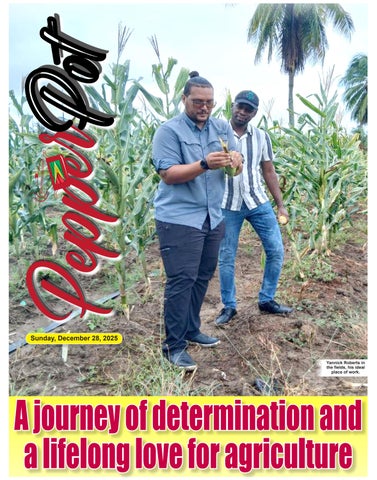
A journey of determination and a lifelong love for agriculture
CHRONICLE PEPPERPOT ― Sunday, December 28, 2025
By Michel Outridge
AT the heart of Guyana’s push to modernise livestock production and promote sustainable agriculture is a quiet but formidable force: Yannick Matthew Roberts, Senior Research Assistant with the Guyana Livestock Development Authority (GLDA). In the new year, Roberts will step into a pivotal role at the Ebini Livestock Station along the Berbice River, the country’s hub for large-scale cattle breeding. There, he will focus on advancing pasture management and boosting livestock productivity, contributing directly to the nation’s agricultural development. Roberts’ path to this role is a testament to determination, adaptability and a deep-seated passion for agriculture. A city boy from Bourda, he originally envisioned a career in sports science, a field that was not available in Guyana at the time. “I didn’t even know that this kind of career was possible for me,” he reflects. Yet life charted its own course. Drawn to agriculture through early influences from his grandparents—his grandfather, a forester, and his grandmother, a devoted gardener—Roberts developed a fascination for the rhythms of nature and the care of animals. He pursued a bachelor’s degree in Agronomy in Cuba, and later earned a master’s degree in Forage Manage-
Yannick Roberts in the fields, his ideal place of work.
Yannick Roberts
ment in the United States, where he conducted forage variety trials, and immersed himself in scientific research. “As a researcher, I would read numerous scientific journals about pastures and forage management, and try to adapt these technologies to Guyana,” he says. Guided by a commitment to advancing production, enhancing sustainability and mitigating the effects of climate change, Roberts has spent his career turning research into practical solutions for local farmers. Professionally, Roberts’ journey has taken him
across Guyana. He spent five years in Region One (Barima-Waini), including three as a Livestock Coordinator, before serving as a Livestock Extension Officer in Region Four (Demerara-Mahaica). In these roles, he provided hands-on support in livestock production, sustainable agriculture and agricultural economics, helping farmers adopt improved practices. Today, his work is shifting towards pasture management, a critical component of GLDA’s mission to strengthen livestock systems nationwide. Beyond agriculture, Roberts has a rich personal
story. A former national athlete, he represented Guyana in swimming at the World Games in Melbourne, Australia, and competed in karate at the Pan American Games. He also channels his creativity into farmer education initiatives and design projects, demonstrating a versatility that extends beyond the research ‘lab’ and pasture. Family and personal growth remain central to Roberts’ journey. As the firstborn of three siblings, he fondly recalls holidays in Bartica with his grandparents, where his appreciation for nature and animals first took root. “At first, I wasn’t interested in agriculture,” he admits. “But, over time, I grew to love this work, and
Baramita Village is developing...
FROM PAGE V
ongoing support from GLDA officers, villagers are optimistic that they will soon be able to sell pork to neighbouring communities and miners in the region, tapping into a lucrative demand. The farm is also diversifying. Alongside the pigs, 1,200 broilers are being raised, and are expected to be ready by January 2026. Together, poultry and pork promise to reshape the village’s food landscape, offering nourishment and income. GLDA officers con-
tinue to provide hands-on training in breeding, swine rearing, and disease management, thus ensuring that as pigs reproduce, offspring can be distributed to more families. This cycle of growth and opportunity is designed to expand steadily, bringing more households into the fold. Importantly, the project is aligned with the PPP/C government’s Low-Carbon Development Strategy (LCDS) 2030, which emphasises sustainable livelihoods for Indigenous and rural commu-
nities. By creating opportunities in agriculture that reduce reliance on costly imports and encourage self-sufficiency, Baramita’s swine project embodies the vision of a low-carbon future; one where economic growth is balanced with environmental stewardship and community empowerment. For Baramita, the project is more than livestock; it is a symbol of dignity, empowerment, and the ability to chart a new course. “What began as a simple request during a presidential
outreach has transformed our community,” Rambajue reflected. “It is more than a project; it is hope, empowerment, and a future where our people, especially women, can thrive while feeding our families.” There is anticipation in the air, a sense that the limitations of geography or tradition no longer bind the community. Instead, it is stepping boldly into a future of self-reliance, sustainability, and possibility.
realised I could achieve my personal goals while contributing to my country.” Roberts’ work is part of a broader strategy led by GLDA to improve pasture management and livestock productivity nation-wide. Through technical training, extension services, and strategic partnerships, including with the Inter-American Institute for Cooperation on Agriculture (IICA), GLDA provides guidance on suitable grasses, pasture husbandry, improved animal nutrition, and sustainable systems that enhance market access for beef, dairy, and small ruminants. Workshops and advisory services help farmers optimise grazing, establish better pastures and maximise nutrient intake while reducing production costs. Feed analysis and ration formulation further support livestock health, and model farms in regions like the Rupununi demonstrate best practices for pasture and livestock systems. Initiatives such as the “Clean Milk Initiative” integrate pasture management with higher production standards, promoting both sustainability and economic growth. Despite these advancements, challenges remain. Limited pastureland, the need for more efficient management systems, and the need to improve feed quality are ongoing concerns. Yet the com-
bined efforts of GLDA and professionals like Roberts signal a promising trajectory for Guyana’s livestock sector. At 36, Yannick Roberts embodies dedication and innovation. Soft-spoken yet resolute, he is recognised for his intelligence, creativity and unwavering commitment to advancing agriculture in Guyana. “There is no other place I would rather be,” he says, reflecting on his journey from a curious city boy to a respected researcher and extension officer. As he prepares to assume his new role at the Ebini Livestock Station, Roberts’ story resonates beyond personal achievement—it reflects the growing potential of Guyana’s agricultural sector, where passion, science and innovation converge to build a sustainable future for farmers and livestock alike.
VIII
CHRONICLE PEPPERPOT ― Sunday, December 28, 2025
Cost Reduction and Value Enhancement
ONCE companies start to grow, they need more leadership to oversee all the moving parts. Too often, corporate governance and its benefits are overlooked or misunderstood by stakeholders, including the board of directors. A board of directors can
offer needed stability, oversight and a fresh perspective to a business. Each board member brings experience and a unique perspective, helping management make wise decisions. There are many factors to consider when choosing a board of directors, including
ethical and bias concerns. An organisation can learn how to recruit a diverse board of directors to create and implement policies, establish needed subcommittees, and provide other useful oversight. In Embracing Corporate Governance – An Effective
Board of Directors, author Geary Reid shares theoretical knowledge and practical wisdom from years of experience working in leadership roles within organisations. Your organisation can start reaping the benefits of corporate governance today with the knowledge and tips he
provides.
Section 1. Theories and Scope of Corporate Governance Corporate governance has evolved over the years. There have been many challenges with organisations and agents who have misused their authority. Many shareholders have been disappointed by the actions of some of their agents, but it was often too late for them to take corrective action. Corporate governance is not intended to prevent organisations from operating. Instead, it allows them to operate within their scope by implementing policies and strategies and holding individuals accountable for their actions. Some individuals may resist corporate governance. Still, there needs to be a louder call for more organisations to embrace it, as many fail precisely because they do not. When organisations are trading on the stock market, they are required to follow corporate governance recommendations. Institutional investors want to know that their investments will be protected and deliver regular, substantial returns. The laws and taxation systems in many countries must be understood by management and independent non-executive directors. These laws affect how an organisation treats employees, the environment and other stakeholders. While organisations may gain tax exemptions in their initial stages, they may later be required to remit funds and pay those amounts to the relevant government agencies. Agency and stewardship theories are important concepts to understand. Agents must remember that they are not the owners of the organisation but work under the supervision of the board of directors to ensure the organ-
isation is successful and compliant. Most organisations have numerous stakeholders, some of whom are highly influential. Each stakeholder’s interest must be carefully managed. There are various benefits to implementing and enforcing corporate governance within organisations. While resistance exists, the benefits outweigh many of the criticisms. Organisations that do not have a board of directors ought to consider establishing this important oversight body to gain recognition and avoid the pitfalls that have caused many organisations to close suddenly when managers fail to act in the organisation’s best interests. Corporate governance must become everyone’s ally, and more organisations must practise it. Section 2. Appointments of Boards Most individuals do not appear on a board without being nominated. Therefore, those responsible for appointing board members must carefully consider whom they would like to serve. While some board members enjoy the prestige associated with being known as a “director”, they must also recognise that the role carries significant responsibility. There are several types of directors, and the term itself is often overused. Every kind of director has different functions. It is important to understand the criteria a person should possess before being appointed to a board. The duration of board memberships must also be considered. Some individuals are appointed for short periods, while others serve for several years. This section discusses the advantages and disadvantages of both short and long board tenures. Board members must act ethically at all times. Their TURN TO PAGE XVIII
CHRONICLE PEPPERPOT ― Sunday, December 28, 2025
What Makes a Guyanese...
FROM PAGE IV
see that you have similar patterns with Trinidad and Barbados and Jamaica and Antigua and St Kitts. So in this larger Caribbean family, you have the Guyanese nuance to this big Caribbean tradition.” As roads have widened, traditions have evolved, and Guyanese have scattered across the globe, the essence of a Guyanese Christmas endures. Whether it is breaking up the house in Georgetown, preparing pepper pot in Minneapolis, or watching masquerade bands dance through state-sponsored events, the core values of family, festivity and shar-
ing remain unchanged. The songs may echo in different accents now, and the black cake might include innovations alongside tradition, but the spirit of a Guyanese Christmas lives on wherever Guyanese gather. Yet, for all the beauty and authenticity found abroad, Dr Cambridge reminds us that there is something irreplaceable about being home for the holidays. “Most of us still miss coming home for Christmas, where you could have a lime. I think Slingshot captures it—there’s nothing like a Christmas morning in Guyana.”
IX
X
CHRONICLE PEPPERPOT ― Sunday, December 28, 2025
The holidays drift by, and we prepare for the challenges of another year
IN the Caribbean, we view the holidays differently in some homes. I was introduced to two interpretations of this religious story: one identifying Osiris, the god of Kemet, as the root of the Christ story, and the other told to me by Christian priests. Some things, as a child, faded away until much later, but both my father and godfather emphasised that work embraced and presented as gifts—especially Christmas gifts, like a contract to fix an impediment that disturbs
the tranquillity of the home, such as a plumbing misfortune, or a kitchen safe or bed promised to be constructed and delivered for the holidays—embodies a commitment that envelopes the execution of expectations in a family context that is almost sacred to the balance of the family. One example is the passing of a year of enduring inadequate home facilities that are sworn to be fixed at Christmas. To this day, I do not quite comprehend how the readjustments of home fixtures
become attached to the celebration of the Christmas atmosphere and content, but it does— even today—where the significance to the mythos of Christmas is buried beneath the enticement of merchandise, which, of course, can be interpreted as the blessing of one’s efforts, matters not how done and, further, at what cost to the human or natural environment. This is often ignored, be it human or otherwise. The intellect seems no longer a valuable inner self. But then again,
not much is reflected in what occurs and what we should explore. That is where the sciences step in, but that requires another discussion of exploring culture and the inner realms of how we presume our entitlements against our responsibilities—a process that, for many of us, began in childhood or through aspects of our nature. With me, my bed had to be made up before tea could be embraced. It became a good habit down the road where life beckoned, especially during my bach-
elor days—the dual responsibility of self versus duty. Christmas teaches us to observe. If we want to leave our offspring a society sustained by exemplary collective value systems, we can begin by exploring the drivers that crush so many animals, say, on Stone Avenue, among other social questions that pass us by every day. Would they worry if it were humans? Enjoy the remainder of the season, on to 2026. Nurture the inner attention to explore…
CHRONICLE PEPPERPOT ― Sunday, December 28, 2025
XI
XII
CHRONICLE PEPPERPOT ― Sunday, December 28, 2025
The Line Between Loneliness and Solitude
WHEN a flower falls upon the surface of a stream, its movements are captured by the current, and the direction of its flow decides the remainder of its journey. Although the flower’s buoyancy may mimic a sense of detachment from the world, it is actually placed quite securely under control. For the entire time that it remains on the surface of the stream, it cannot move or stop at any point unless the current determines that it should. As such, the flower is caught in an unfortunate confinement that strangely imitates freedom while, at the same time, taking away one’s sense of control. As we progress through life, we may realise that human beings are not very different from a lone flower floating down a stream. We try our very best to take control of our lives, and yet we may find ourselves in situations where there is simply nothing we can do to achieve the outcome we desire. At times, we can feel detached from the rest of the world. At other times, we can feel pressured to go along with its forces. Ultimately, we feel like we are not in control. Eventually, with growth, comes the ability to manage these emotions and gain a sense of acceptance. Yet we do not realise that the unpredictability of life is not just reserved for our experiences; it also extends to the relationships we develop. Like a stream splitting into two or drifting into a stagnant pond, many relationships may change their dynamics over time. Friends may grow apart, and family members may move to different corners of the world. Even healthy relationships
may come to a sudden halt due to the changes life brings. There is no antidote to unpredictability, and certainly no shield to protect ourselves from its hurtful consequences. To live a life full of meaningful experiences, we must be willing to risk the pain of loss or change, especially when it comes to connecting with others. In our generation, we seem to have discovered a way to enjoy the benefits of human connection without having to accept the downsides. This loophole, of course, takes the form of technology. To protect ourselves, we often have a natural tendency to deprive ourselves of the necessary parts of being human—we mistake loneliness for solitude and comfort for peace. With today’s technological developments, this tendency becomes much easier to lean on. By simply watching a show on television, we can find ourselves in the company of several interesting characters who may become our friends during the time we spend watching them on a screen. In fact, it has even been discovered that some people may begin to develop the same level of emotional connection with fictional characters as they do with real-life friends. As we continually turn away from connection for fear of rejection, change or loss, we choose to give up valuable time that we could use to discover the beauty of the world around us. As important as solitude is in helping us understand ourselves, it is easy to let it turn into loneliness. Similarly, as crucial as technology is in various endeavours, it can quickly turn into a replacement for human connection TURN TO PAGE XXI
XIII
CHRONICLE PEPPERPOT ― Sunday, December 28, 2025
The Card Receiver
A story from Short and Sweet by Robert J. Fernandes
LOUISA Row itself gave the impression that it was quite proud that it led to the Le Repentir burial ground. In fact, it seemed annoyed at being interrupted by lesser streets such as Bent Street that were going nowhere in particular. Mrs. Walcott had lived here for ‘umpteen years’, in a small, almost transparent cottage. She often referred to it as a wood-ants barracks. It was the kind of house that, in case of flooding, had warped pieces of board laid out in the yard, leading the way to both front and back steps. She was popular with most of the residents of Wortmanville, to whom she was known simply as Old Lady Wally. When she was much younger, Old Lady Wally was married, and had produced two children in quick succession. When they were born, she had told her husband, “The girl is yours and the boy is mine. Now don’t bodder me ’bout making any more children.” Sadly, her husband had died soon after, leaving her nothing but the two small children to be raised. Old Lady Wally was already accustomed to sewing her own clothes, but was then forced to become a full-time seamstress. Most nights she worked into the early hours of the morning, sewing dresses for sale to Department Stores or private clients. As the sole provider for her family, she had thrown herself into her dressmaking with a vengeance. She had to be independent somehow, not only as a matter of pride, but to show her well-to-do relatives who had disowned her for marrying a poor man. The Old Lady had eventually come to love dressmaking. Although it kept her very busy, and she couldn’t get around much, all the latest gossip came to her through the kind courtesy of her customers. It was very amusing that sometimes the very rumours that she herself had started would come back to her after making the rounds, so “hemmed and gathered” that she had trouble recognising them. But dressmaking also had its stressful side. Everyone wanted their clothes done immediately, especially at the Christmas season. The miserly women, who only bought cloth when it was on sale, really annoyed her. They would expect her
to make shimmering evening gowns out of the cheap “counter cloth” which had been in the store too long and massaged by hundreds of hands. Worst of all were the really fat women shaped like box kites. They always chose the most sleek, hip-hugging styles from her fashion books, and expected Old Lady Wally to make them fit. When she was not in a good mood, she would suggest that they go to church on Sundays and pray for a change of shape. After all, she reasoned, it was God that had made their shapes in the first place, and she was only trying to disguise them. The Old Lady’s two children grew up and started to work. Although this was a big help to her, times were still hard in the country as a whole, and, like many other young people, her children dreamed of migrating to North America for a better life. The Old Lady refused to even consider an existence without them until one day her son came home and excitedly told his mother that he had managed to get an American visitor’s visa, and would be leaving shortly for California. He planned to stay there illegally, and quelled the Old Lady’s protests by promising to send for both her and his sister as soon as he got organised. A year later he sent an airline ticket for his sister, and she, in turn, promised to send for her mother as soon as she became organised. After a few years of waiting, Old Lady Wally had come to the conclusion that America was not a very organised place. She was now like a ship without a rudder. The two stars by which she had steered her life were gone, and she drifted aimlessly from day to day without a reason for living. As she got older, she could barely do enough dressmaking to support herself. The children had promised to send US money for her, but maybe they hadn’t gotten organised as yet. Old age was just like a dress, she thought; as you grew older, life seemed to fit you tighter. In her case, things were as tight as they could possibly get. What Old Lady Wally needed most from her children was to be a part of their new life in America. After all, ever since her husband had died, their three lives had become fused by
the relentless struggle for self-preservation. Like so many other parents who had been torn from their families by the plague of migration that gripped the country, she felt undeservedly cheated. The Old Lady lived for the days when she would receive letters from her children, but these became less and less frequent. Instead of letters, she received birthday cards, Christmas cards, Mother’s Day cards, Valentine’s cards, Halloween cards and, occasionally, get-well cards. All the cards were signed in the same touching way: “To the Greatest Mother in the World from your loving children.”
wrinkles of her brow, would say, “Those dogs at the Post Office thief the US that my children send me again. I hope the next card they send is a credit card.” When she hadn’t heard from them for a long time, she would try to disguise her hurt with cynical remarks to her friends. “Instead of making them two children, I shoulda make two dice and throw them, I mighta win something. Or better yet, if I had make two sheep, you know how much sheep I woulda got by now?” Old Lady Wally now spent so many hours with her eyes glued to the jalousie louvre
She had become a “Card Receiver”. Like any devoted mother, she always worried about her children, and wondered if they were taking proper care of themselves. She wondered if their neighbourhood was safe from all the violence that seemed to be an everyday occurrence in America. They could never imagine how necessary this information was for the preservation of her sanity. When a mother cares for children so well for so long, it becomes her right to know everything about their lives. Whenever she received a card from her children, the Old Lady would open it, shake it out and, with a smile that temporarily smoothed the
windows at the front of the house that the neighbours used to say her face was sunburnt in stripes. From this observation post, she liked to watch the parade of life and death that passed along Louisa Row every day on its way to the burial ground. From her discreet vantage point, very few happenings in the neighbourhood escaped her notice, and she gave a running commentary on whoever she saw. However, it was funerals that especially interested the Old Lady. Having paid special attention to the death announcements on the radio the night before, she liked to play a game of trying to guess who the occupant of the hearse was as the funeral passed her house.
One day she recognised the funeral of someone she knew and commented, “Look who passing all dress up and only two cars following the hearse. Imagine, he used to play big shot on me. I sure if I was to dead now I would get more than two cars.” One Christmas, Old Lady Wally got a large package from her daughter. She opened it with great excitement, but it was only another large Christmas card. It was the kind that smelt of perfume and played a wordless melody when it was opened. On Christmas Eve day, the Old Lady was summoned to a neighbour’s house to receive a telephone call from her daughter. She answered eagerly, only to hear her daughter in tears declaring how much she loved and missed her mother. Eventually, her daughter asked how she was making out for the season. “Well,” the Old Lady answered, “is a good thing you send that big card the other day, because I going make soup with it for Christmas.” Her daughter became hysterical over the phone, and it took her mother quite a while to calm her down and get a chance to speak. “Look, I think you should stop crying, put down the phone, and send the money that you wasting on this call. I love you, too, darling.” The phone call ended. Not long after this incident, Old Lady Wally received a letter from her daughter. She felt the thickness of the envelope and thought it might contain photographs of her children. She tore it open excitedly, and, to her surprise, several small pieces of crushed yellow stationery fluttered out onto the table. The envelope also contained a short note written on white paper which said: “Dear Mom, Sorry about this, but when I had finished your letter, my pet dog Gemini got hold of it and chewed it up. He is a naughty dog sometimes. Luckily I managed to collect all the pieces, so you shouldn’t have any trouble putting them together again. Your loving daughter.” The Old Lady could not believe her eyes. She stared at the frayed pieces of paper that lay on the table mocking her, and somewhere deep inside, her fragile spirit crumbled. Her tears blotched the
handwriting, making it even more difficult to reconstruct the mosaic of her daughter’s disrespect. The letter finally gave up its coded message. Her airline ticket was on its way. This should have been a day of rejoicing for the Old Lady, but for the first time she questioned whether this family reunion in America was really a good idea. She had lost her enthusiasm for the trip to the place where pet dogs seemed to have more rights than ageing mothers. She reluctantly began to sell her household possessions. She remembered a friend who had sold all her furniture while waiting for a ticket from her children, and was left sitting on a drinks box in the middle of her house. She didn’t want this to happen to her, so she would have to be careful. At last, the ticket came, and the only things she had left to get rid of were her dining table and chairs. She had kept them for last because, other than the children, they were the only things her husband had ever made. Old Lady Wally couldn’t bring herself to part with them, so, in the end, she gave them to her friends from the Obeah house next door. Although she didn’t believe in Obeah herself, she had always felt a little safer having these people as friends, and was tempted to consult them about her future in America. Over the years she had known many wellknown people who paid a lot of money for these same Obeah practitioners to “See Far” on their behalf. What if she didn’t like what they saw in her future? She might not want to go to America after all. She decided against it. The long-awaited day finally came for her to travel to California. The hired car arrived to take her to the airport, and most of the residents of Louisa Row turned out to see her off. As the car drove slowly past them on the side of the road, Old Lady Wally waved, just as she had seen Princess Margaret do during her royal visit. The Old Lady chuckled to herself, “Well look at story. I get a powerful turnout. This even better than a funeral, because I get to know who is them two-faced people who ain’t show they face.”
XIV
CHRONICLE PEPPERPOT ― Sunday, December 28, 2025
CHRONICLE PEPPERPOT ― Sunday, December 28, 2025
XV
XVI
CHRONICLE PEPPERPOT ― Sunday, December 28, 2025
XVII
CHRONICLE PEPPERPOT ― Sunday, December 28, 2025
A Barbie Doll for Me
A Child’s Dream and Wish for Christmas
CHRISTMAS season—that wonderful, magical time of year—the children’s fascination with spectacular Christmas trees and dear old Santa bringing toys and joy to hopeful, innocent hearts. A little girl who had already made her wish held her grandmother’s hand firmly as they exited the crowded market. The old lady’s two baskets of sorrel and carambola had all been sold, putting a few extra dollars in her pocket for the season. She would be able to give her three grandchildren a nice little Christmas in their cosy little home. Sarah was a great helper and a wonderful child, and she had wished for a special gift—a real Barbie doll. She had many dolls from Christmases before and birthdays, but the beautiful, glamorous Barbies in the shopping plaza showcases were what her little heart yearned for. She knew her grandmother could
not buy one with her small earnings, but she still wished, holding on to the hope that the Christmas spirit would bring good tidings into their poor lives. A heavy drizzle came down as they walked to the bus park, and they hurriedly sought shelter under a hardware store’s awning. Across the street, a little way off,
was the shopping plaza that she often passed on the way home from the market. Always, she would stop and stare at the superb toys that were every child’s dream. The rain eased, and they continued walking to the park. As they approached the store, a sales clerk brought out a new doll for display in the window. The little girl
drew in her breath sharply, for it was the doll of her dreams—beautifully dressed in a soft pink party dress, long, curly black tresses and a dazzling smile. But what captured the child’s heart was the doll’s ebony skin, just like hers. Her grandmother looked at her questioningly, and TURN TO PAGE XXI
XVIII
Cost Reduction and...
CHRONICLE PEPPERPOT ― Sunday, December 28, 2025 FROM PAGE VIII
behaviour is often viewed as a reflection of the organisation itself. Poor ethical conduct by a single board member can negatively affect the entire board and the organisation. Shareholders have rights and must be aware of them, exercising those rights when necessary. With the appointment of independent non-executive directors, shareholders may accept or reject nominated individuals for board
roles. In many government agencies and ministries, politicians appoint board members. Some appointees may prioritise political mandates rather than acting as independent professionals who execute their duties impartially. In family-run organisations, individuals are often appointed to boards due to lineage or family recommendations. Conflicts can arise in such situations when board
members lack the necessary skills or expertise for their roles. Diversity is essential for many boards. Boards require individuals with a wide cross-section of skills, knowledge and experience. The inclusion of women on boards is critical, as they bring professional expertise alongside unique personal perspectives and insights. Section 3. Critical Board
Members and Their Functions Every board consists of multiple members, each of whom plays an important role. However, certain key members often take on leadership responsibilities. The absence of these individuals can delay or postpone meetings. Each board has only one chair. The traditional term “chairman” in this context also refers to chairwoman
or chairperson and is not gender-specific. Historically, most chairs were men, but over the years more women have assumed leadership roles on boards. The chair’s responsibilities are clearly defined. The individual in this position can have a significant impact on the organisation. The chair must be assertive in guiding board members and ensuring adherence to the agenda so that documents presented can be properly ratified and approved. The chair also reviews and approves the agenda for each board meeting. The Chief Executive Officer (CEO) is another key figure who represents management. The CEO serves as the link between the board of directors and the organisation’s staff, executing board directives, managing employees, and motivating them to achieve organisational goals. Many reports submitted to the board are reviewed and discussed by the CEO. Once
approved, they are forwarded to the company secretary for inclusion in board packages. At some meetings, other senior managers may be invited to attend and represent their respective operational areas. The company secretary records board discussions and prepares the minutes of meetings. After meetings conclude, much of the company secretary’s work begins. The quality of board minutes often reflects the effectiveness of the company secretary’s department. Company secretaries also perform other routine organisational duties and, where legally trained, may represent the organisation in legal matters. For more information about Geary Reid and his books, please use the following contact information: Amazon: http://www.amazon.com/author/gearyreid Website: www.reidnlearn. com Facebook: Reid n Learn Email: info@reidnlearn.com Mobile: 592-645-2240
Tradition meets technology
FROM PAGE VI
complete. According to the Minister, the facility will play a critical role in expanding local milk processing capacity and strengthening market opportunities for dairy farmers. “When we give you these animals, and you continue breeding through the embryo transplant programme, you will be able to produce additional heifers for dairy production,” Minister Mustapha explained. In addition to the dairy stock, farmers also received silage to support improved feeding systems and promote sustainable production practices. For Persaud Sookram, modernisation does not mean abandoning tradition. His dairy operation remains firmly rooted in pasture-based management, complemented by cash crop farming, particularly ochro, which helps stabilise household income during periods of reduced milk production.
This integrated approach practised by small farmers closely aligns with the modern sustainability principles now promoted by the Ministry of Agriculture. As Guyana moves towards greater dairy self-sufficiency and responds to rising consumer demand for fresh milk and value-added products, Persaud Sookram’s story offers more than a reflection on longevity. It illustrates how elderly farmers, supported by sound policy, responsive institutions, and accessible technology, can remain central to national food security. By blending inherited wisdom with Artificial Insemination (AI), improved genetics, and the introduction of climate-resilient breeds like the Girolando, Mahadeo Persaud Sookram embodies a dairy sector that is resilient, adaptive, and firmly rooted in the future.
XIX
CHRONICLE PEPPERPOT ― Sunday, December 28, 2025
On Harold Bascom’s Desperate for Relevance
HAROLD A. BASCOM— poet, painter, novelist, and book illustrator—is arguably Guyana’s pre-eminent playwright. By my count, he has written more than fifteen plays and five works of fiction and non-fiction, including the novel Apata, and has mounted art exhibitions in Guyana, New York, and the US State of Georgia, where he currently lives. It is his plays, however—rooted in Caribbean concerns—that have achieved the greatest resonance. A five-time winner of the Guyana Prize for Literature, Bascom has produced dramatic works of remarkable range, attentive to both the folk culture of his native shores and the philosophical and prescient issues of his time. Critical response to his work has been limited and largely localised, despite the popularity of his performance pieces, which drew substantial audiences during the 1980s and 1990s, particularly after his migration to the United States. This change in geography has made little difference to his output, which remains prolific. His recent work, especially Desperate for Relevance—which was awarded both the Guyana Prize and the Caribbean Prize—exhibits a pronounced philosophical turn, signalling a more introspective writer and lending his drama a broader universality. Desperate for Relevance is a finely crafted play that deserves far greater critical attention, as do many of his other significant works. The dramatic foil of sorts in Harold Bascom’s Guyana Prize for Literature (2015)– winning play Desperate for Relevance is Sheik Sadeek, the Guyanese novelist of the 1950s and ’60s, whose disaffection is born of barely veiled desperation, jealousy, implicit racial animus, and, above all, fear. This fear is of a particular and familiar kind: the fear that haunts many writers—the ever-nagging spectre of irrelevance and anonymity, a condition which, in the imagination of
the literary mind, is akin to inhabiting a circle of Dante’s Inferno. Dante does indeed reserve such a place for artistes in his epic: the second circle of Hell, where souls condemned for lust, and by extension for wasting their gift, whirl endlessly. Bascom’s play is set in a comparable afterlife, a kind of limbo: a space between conscious dead presence and oblivion, akin to the realm inhabited by Virgil himself. It is an eternal waiting room before the resolution of resurrection or doom. This is not a place of ease or escape, but one of anxiety and turmoil. Bascom employs an ingenious conceit to determine which characters continue “living” in death and which of the dead die again and disappear. It is a fine metaphor, with a particularly poignant play on the word’ relevance,’ the lack of which proves fatal in the play’s world. For many writers—whose vocation is inseparable from a sense of destiny—there exists a conviction that their works will outlive them, granting a second life in the manner of Shakespeare or Walt Whitman. To be forgotten is, therefore, a second death. The characters in Desperate for Relevance are mostly dead Caribbean writers, though dancers, painters, and musicians also inhabit this afterworld. It is an exciting imaginative space, populated by figures we might long to encounter. Among the Guyanese are Jan Carew, Martin Carter, Denis Williams, Ivan Van Sertima, and Sheik Sadeek; among the Jamaicans, V. S. Reid, Roger Mais, Louise Bennett, and Andrew Salkey; Trinidadian Samuel Selvon; Barbadian Frank Collymore; and Cuban poet Nicolás Guillén. Writers from smaller islands also appear, including Jean Rhys and Phyllis Shand Allfrey of Dominica. The dancer Geoffrey Holder and choreographer-scholar Rex Nettleford make cameos and, incongruously yet delightfully, Ray Charles enters, bringing soul—literally and
figuratively—to an already fraught space. A pithy précis of the play
might run thus: a group of dead, canonical Caribbean writers reside in an afterlife
resembling Limbo, where their continued existence depends upon whether their
works remain relevant on earth. Relevance is closely TURN TO PAGE XXVI
XX
CHRONICLE PEPPERPOT ― Sunday, December 28, 2025
Why Volunteers...
FROM PAGE III
launched award-winning projects involving national, international, and youth volunteers. Throughout his career, Guedes pursued further education to strengthen his expertise. Beyond his degrees from the Universidad de Lima and Erasmus University, he earned a Postgraduate Diploma in International Conflict Resolution from the United Nations University International Leadership Academy in Amman, Jordan, and a Postgraduate Certificate in International Programme Development Evaluation from Carleton University in Ottawa, Canada. In recognition of his dedicated service, Guedes has received several awards, including the Condor of the Andes Medal (Bolivia, 2013) and the Presidential Diploma for anti-corruption work (Pakistan, 2019). After retiring from his Afghanistan post, Guedes joined his wife, Lisa Moreau, whom he met while serving in Guyana in the early 1990s, in Hanoi, Vietnam, in 2022, where she was assigned to the Canadian Embassy. During this time, he engaged in consultancy work and served as a guest lecturer at the Vietnam National University Business Faculty and the UN International School. His retirement, however, was brief. UN Headquarters called on Guedes in August to return to the Southern Caribbean and Guyana, the very region where his UN career began, to revamp and strengthen the volunteer programme, bringing his vast experience back to familiar ground. Yet among his biggest achievements and career highlights has been the transformation that Guyana has undergone. “I was a little piece of the puzzle, but if I contributed with a grain of salt, I feel now that we did the right thing because now Guyana’s private sector is very diverse—a vibrant, strong private sector. You see businesses all over.” Highlighting the vibrancy of downtown Georgetown, Guedes said Guyana has not just grown but blossomed. “What we did over 30 years ago, there was a vision, and with this vision, we told the Guyanese that it was the right time, at the right moment, with the right persons to be part of this impulse that didn’t stop. It continued on-
ward. I can smell the roses.” He added, “Nowadays, people still travel, but they travel for pleasure. At that time, people were travelling, leaving the country for survival. Now that brain drain has stopped, and I see people investing in Guyana.” While the UN has helped Guyana over the years, what is more important is the knowledge and structural changes the country has seen. Guedes said that the Guyana of today has come a long way, not just in growth and stability, but also in leadership. “I think Guyana now has very good leadership. It’s inspirational—a young president that connects with young people, with the media, who is hyperactive and is everywhere at the same time. He’s a champion of social media, his wife, the family, the ministers. That leadership is showcasing the spirit of a continued evolution of a new Guyana.” He added, “I have the luxury to know what happened before and to see, as an outsider, as a foreigner, the Guyana of the early 1990s, and to be here in the 2020s, mid-2020s, and see all these changes. It’s very special.” Now, as Guedes takes on his new role as UNV Focal Point for the English/ Dutch Caribbean, his return comes at a pivotal moment. The UN has declared 2026 the International Year of Volunteers for Sustainable Development (IVY 2026), marking 25 years since the first International Year of Volunteers in 2001. The initiative directly links volunteerism to the Sustainable Development Goals, recognising volunteers as crucial drivers for achieving the 17 Global Goals, from poverty reduction and climate action to building strong institutions. For Guedes, who has witnessed first-hand how volunteers transformed Guyana three decades ago, IVY 2026 represents a critical opportunity to reinvigorate volunteer efforts across the Caribbean and accelerate progress towards the 2030 Agenda’s targets. As someone who began his own journey as a volunteer and rose through the ranks while never forgetting the power of grassroots action, he understands that volunteers are not just helpers; they are the backbone of sustainable development.
CHRONICLE PEPPERPOT ― Sunday, December 28, 2025
A Barbie Doll for Me FROM PAGE XVII
she pointed to the doll in the store’s window. The old lady shook her head regretfully, and the child sadly turned her eyes away. She turned to have one last look at her dream doll before rounding the corner and gasped loudly, not believing her eyes. The ebony Barbie doll, seeming to come to life, waved to the child. “What is the matter, child?” her grandmother asked impatiently. “Look, Grandma!” the little girl gushed excitedly. “The Barbie doll waved at me!” “Oh dear Lord.” The old woman shook her head in exasperation. “Your imagination is really running wild.” “It’s true!” the little girl insisted, but her grandmother was not in the mood to listen. Sarah could not understand, wondering now if her eyes had played tricks on her. As she walked away, the doll blinked her eyes and smiled—just a little smile— the magic of Christmas. That night, it continued to rain, and Sarah, huddling in the comfort of her grandmother’s jasmine-scented sheets, whispered sleepily, “Dear God, I know my grandma can’t buy me a real Barbie, but in my dreams, if only I could play with her…” Her voice trailed off as she fell asleep, and out the window flew that wish into the starry night. Dreams, from heaven they came—playing, laughing, filling innocent hearts with beautiful things. Sarah’s soft laughter, as she played in her dreams with the ebony Barbie doll, passed through the creases
in the wall, awakening her grandmother. The old lady looked at the child for a long moment, knowing she was dreaming of something she truly loved. She sighed, as though she had made up her mind about something. Returning to her room, she opened her wardrobe and took out an old tin box hidden at the back. It had been years since she had had cause to open the box. She stared at her precious few pieces of fine jewellery and selected a small heart-shaped brooch that was worth enough to buy a special gift. The last few days before Christmas were busy at the market, and with Grandma’s own late shopping on Christmas Eve from the money she earned. Sarah felt happy in her heart for the loving family she had, and in their own small way, they always had a happy, enjoyable Christmas—such a beautiful time. On Christmas morning, Sarah opened her gift and smiled happily at her doll-carrying case. “Thank you, Grandma,” she said, hugging her, and turned to go when her grandmother said, “You need a doll for that case—a special doll.” She handed the surprised child another gift she had hidden behind the Christmas tree. Sarah opened it slowly and cried out in amazement. It was the ebony Barbie doll from the shopping plaza. “Grandma,” she laughed as her heart filled with joy, “thank you, thank you. I love you so much.” Her Christmas wish for the most beautiful gift her little heart had desired had come true.
The Line Between Loneliness and...
FROM PAGE XII
when its use is unregulated. For instance, today one can spend time chatting with robots rather than with human beings. Life can indeed be controlling and, at the very same time, difficult to control. Despite this, there is a magnificence in the spirit that refuses to see the chaos of life as an oppressive force, but rather sees it as an invitation to find thrill and joy. A flower may decay and disintegrate
under the forceful current of a stream, but seeds will use the current to travel as far as they can to take root. So, whenever you are afraid to form a connection and are instead about to turn to technology, remind yourself that rejection is as beautiful as acceptance, and that loss is as beautiful as love, because in each one of these experiences, you will find yourself in extraordinary ways.
XXI
XXII
CHRONICLE PEPPERPOT ― Sunday, December 28, 2025
CHRONICLE PEPPERPOT ― Sunday, December 28, 2025
XXIII
XXIV
CHRONICLE PEPPERPOT ― Sunday, December 28, 2025
CHRONICLE PEPPERPOT ― Sunday, December 28, 2025
XXV
XXVI
STUDY SUCCESS Welcome, dear reading friend. Have you been recording experiences from books, magazines, and newspapers; issues from television and internet services? Also, have you been noting experiences of friends, neighbours, even of relatives abroad? Yes? Good. So, your caché is varied enough to easily choose the best for essays and short stories and other forms of responses in classroom practice. Keep on carrying around and using your commonplace book. You can even write whole stories instead of story stimuli only. Be wise. Love you. THE PASSAGE Examining story plot
CHRONICLE PEPPERPOT ― Sunday, December 28, 2025
Note: 1) The plot is a story’s core element, focusing on “what” happens and “why”. It unfolds as linked events driven by cause and effect around a central conflict, progressing from story introduction (exposition), through to rising action (major tension point or climax), to ``falling action (winding down of tension), then finally to conclusion (resolution or denouement). 2a) When you delve into a story writer’s plot, it makes his use of literary devices more visible to you. You are compelled to read and process slowly to appreciate his word choice (tone) and discern his variety in sentence structures; the total of which helps you analyse the power of a plot. b) Story writers’ literary
devices can consist of any of the following well-used ones: foreshadowing, flashback, irony, suspense, metaphor and simile. Subplot: A subplot is a secondary story line that adds depth to the main plot. Examining the plot of a story: You are looking deeper into the writer’s work by doing several things. 1) Examining and evaluating and evaluating the twists and turns the writer puts in his plot. 2) Looking at the literary devices: word choices, and sentence structures. 3) Looking at the story to know it better. Here the initial stage can take some time for your eyes and mind to get acquainted and settled with the writing style.
December 28th, 2025
How analysing plot helps with your personal writing: Constant practice at analysing story plots helps you critically examine yours, and points you to a way forward to self-improvement, and maybe into being a professional writer. Eventually, your experience will enable you to examine and identify elements in story stages at will. Remember the stages: 1) Exposition: Setting, and characters (especially the central character - the protagonist); particulars of both. 2) Rising Action: Visualising the explicitly rousing or exciting incident. Have you met anything the likeness of? 3) Climax: The story’s turning point in its plot. 4) Falling Action: the part of the story when conflict lessens.
On Harold Bascom’s Desperate for Relevance FROM PAGE XIX
allied to being read; to be read is life-sustaining. Its antithesis is obscurity, which entails a gradual fading of light and, ultimately, extinction. This fading provokes intense fear among writers whose works are no longer read, most notably Sheik Sadeek. Sheik is fading. He lacks the signifying brightness of figures such as V. S. Reid or Jan Carew, whose works continue to circulate among the living. Deprived of relevance, Sheik lashes out. He attributes his obscurity to external forces: his work was self-published rather than issued by metropolitan presses in London or New York; others benefitted from lighter skin, class privilege, or institutional pedigree. Hair texture, skin colour, and class designation emerge as determinants of literary success—or at least of literary survival. These figures are not so much themselves as representations, dispossessed of the human concerns of family, finance, health, and the like. They are shades, in the Homeric sense—distillations of vocation and reputation. Yet Bascom goes further: he arranges them along a spec-
trum of relevance. Those surrounded by a radiant aura—something like a full-bodied halo—are the most relevant, their works actively consumed by the living. Others glow dimly; some scarcely at all. Those without light are irrelevant and are in danger of disappearing altogether. To worry about relevance after death is, conceivably, too late, yet the conceit is deeply poignant. Obscurity can haunt the living to the grave—and, as this play suggests, beyond it. Who wishes never to be remembered? To die and then die again in the minds of the living is a uniquely despairing fate. Irrelevance, here, is closely allied with despair, even for the dead. There is also, embedded in this anxiety, a hint of ecclesiastical vanity: a preoccupation with ethereal recognition that may be antithetical to wisdom itself. Desperate for Relevance possesses a philosophical density that demands attentive reading. It is allegorical in its central premise, dramatising a problem fundamental to literary creation. The play operates simul-
taneously on multiple planes that coalesce around its core question: what constitutes success, and to whom must a work be relevant? We are introduced to Hector Bunyan, a writer who writes primarily for himself. He is content in this, unconcerned with relevance. A postman by trade, Bunyan regards his writing as no more—or less—significant than delivering mail. Both acts serve a purpose; both possess equal salience in his eyes. Alongside him is Amanda H enry, a jour nalist marked by far less vanity than the dead writers, for whom relevance is no longer an obsession. Like Bunyan, she inhabits the world of the living, as does Writer Man—a ragged, Tiresias-like figure who speaks in enigmas, hinting at deeper truths of the human condition, or perhaps merely madness. Amanda Henry functions as a Cassandra-like presence, a modern soothsayer whose prophetic insight plays a crucial role in solving the mysterious disappearance of a Brazilian girl, as well as in rescuing the fading Sheik Sadeek from the terminal dimming of irrelevance.
The play’s subtitle—A Surreal Drama of Dead Caribbean Writers Bound in a Curious Hereafter—is aptly chosen, given the strange, magical, and often humorous events that unfold. The drama is at once serious and playful, suffused with pathos and moments of genuine theatrical delight. The dialogue is often witty and quick, carrying the pacing forward with the necessary alacrity. Ultimately, Desperate for Relevance is a play about representation. Its allegories are potent, particularly in their interrogation of how writerly success is measured. As the play suggests, relevance may have little to do with readership alone and much to do with the writer’s own sense of fulfilment and integrity as a creator. Relevance, in this sense, is not an objective criterion but a deeply subjective one. One of the play’s most striking achievements is its successful melding of disparate narrative strands and characters into a coherent and affecting whole. This convergence is handled with considerable skill, culminating in a resolution that is both poignant and satisfying.
Education is what survives when what has been learnt has been forgotten. B.F. SKINNER (1904-1990) “Education in 1984”. New Scientist, 21 May 1964, p.484 5) Resolution: a story’s conclusion. Interacting with story plot: See how this becomes an immense help in your story writing. 1) You get to know character types and become able to express this knowledge easily. You get to improve your understanding of story conflict. 2) You also get to closely follow the build-up or rising action of conflict to its crisis point. (This is where you, the reader, find the writer deciding that things cannot continue the way they are going.) You agree and begin to speak the same language as the writer. 3) Also, you are enabled to follow story resolution to its original problem, which depends on how the climax is played out. Improving Reading Making Inferences Section A. Directions: Read the selection. Then, answer the questions. My kid sister Cheryl and I always bragged about our Sioux grandpa, Joe Iron Shell. Our friends … were impressed by our stories. Maybe we exaggerated and made grandpa and the reservation sound glorious, but when we’d return home to Iowa after our yearly summer visit to Grandpa, we always had some exciting tale to tell. We always had some authentic Sioux article to show our listeners. One year, Cheryl had new moccasins that Grandpa had made. (From “The Medicine Bag” by Virginia Driving Hawk Sneve) 1. What can you infer about the narrator? (A) He knows how to make moccasins. (B) He is proud of his Sioux heritage.
(C) He does not like the reservation. (D) He does not like living in Iowa. 2. What is particularly true about the narrator’s grandfather? (A) He always wears moccasins. (B) He leads a glamorous life. (C) He makes up exaggerated stories. (D) He carries on Sioux traditions. 3. What can you infer about the narrator’s friends? (A) They are interested in Sioux history. (B) They are jealous of the narrator. (C) They are part Sioux. (D) They want to make moccasins. 4. Which of the following is probably not a logical inference? (A) The narrator likes his grandfather. (B) Grandfather teaches his heritage. (C) The narrator resents having to visit his grandfather. (D) The children treasure their gifts. Section B. Across the aisle, a middle-aged man was staring out the bus window. A newspaper lay on his lap, but he wasn’t reading it. A cell phone rang nearby, and he jumped. He jiggled his foot, crossed and uncrossed his legs. He reached into his pocket, took out a map, and studied it. Then he glanced at his watch and smoothed back his hair. He peered eagerly out the window as the bus pulled into the station. 1. Which fact gives a clue about the man’s state of mind? (A) He is a middle-aged man. (B) He is on the bus. (C) He takes out a map. (D) He jiggled his foot up and down. 2. Write what you can infer from the man’s behaviour as the bus arrives at the station.
XXVII
CHRONICLE PEPPERPOT ― Sunday, December 28, 2025
The festive Season and toothache
AS I write this, I recall that a few days ago I celebrated thirty-nine years as a dentist. During this period, I worked in more than a dozen dental clinics in both the public and private sectors. Therefore, I can say without fear of contradiction that during the Christmas season, more people visit the dentist complaining of a toothache than at any other time of the year. The reason is simple: we consume extra sugar while our oral hygiene routine takes a beating. Certainly, this sugar is destined to cause excruciating pain from acute toothaches that will attack hundreds of people during this time. Cakes, sweets, jellies, chocolates, and dried fruits are among the most cariogenic (decay-causing) foods. At Christmas, they are consumed indiscriminately. Despite what you may believe, there is a direct relationship between oral health and the composition of the food you eat. Tooth decay is an ongoing process. The process begins with plaque, a sticky, colourless layer of harmful bacteria that is constantly forming in your mouth. Certain bacteria found in plaque use the sugars you eat (especially ordinary table sugar) to form acids. Plaque holds these acids against the tooth surface. Each time acid is produced— that is, every time you eat— it attacks the tooth enamel for about 20 minutes. After repeated acid attacks, the enamel is broken down and becomes decayed. A cavity is formed.
Decay eventually progresses towards the centre of the tooth. If the decay is not treated and it reaches the pulp (nerve), an abscess forms at the root end. When this happens, the tooth becomes painful. At this point, root canal (endodontic) treatment is indicated. Without treatment, the tooth will have to be extracted. How do you know if you already have dental cavities? If your answer to the following questions is yes, then chances are you do. 1. Are your teeth sensitive to heat, cold or sweet foods? 2. Is it painful when you chew? 3. Is there swelling or drainage at or below the gum line? 4. Are there any brown or darker spots on the tooth? 5. Do you have persistent pain in your mouth or in the sinus region? If any of these signs are present, see a dentist without delay. A dental examination will determine whether you have caries and what must be done to repair the damage. If decay is present, dental treatment is the only way to keep it from robbing you of a tooth. In China, the most populous country in the world, tooth decay is least prevalent because each Chinese person consumes less than 5 pounds of sugar per year. On the other hand, in Australia, Cuba, Great Britain and the USA, each citizen consumes over 120 pounds of sugar each year. About 32 per cent consists of sweets, of which 80 per cent are flavoured with chocolate. As a matter of fact, there are more than 50,000
sweet-making machines in the US alone. The proverbial sweet
tooth of humans has led to tooth decay being the most common disease, apart from
the common cold. Christmas is a time when this sweet tooth becomes most evident.
Best wishes for the Season, and may your Holidays be free from toothache!
XXVIII
CHRONICLE PEPPERPOT ― Sunday, December 28, 2025