Guyana unites in solidarity to honour the victims of the MV Barima Tragedy
A symbolic mural adourned with wreaths during the National Interfaith Service held on July 22 to pay tribute to the victims, survivors and families affected by the national tragedy (Delano Williams photo)
A man of many talents
Contributing to Guyana’s development in sports, politics, humanitarian efforts and technology
By Michel Outridge
SHEIK Mohamed
Muazziz Yaseen is a father, son, political leader and sportsman. He is very much a family-oriented man whose values are seen in his everyday life. He was born on June 27, 1961, to Sheik and Nazmoon Yaseen of Industry, East Coast Demerara, and is the
youngest of four siblings.
Presently, he resides in Ogle, also on the East Coast Demerara, and is the father of two girls and one boy.
Yaseen is married to Sonia Khan and received his secondary education at Cummings Lodge Secondary School, East Coast Demerara. He later attended the University
of Guyana (UG), where he attained a diploma in Marketing, and Karachi University in Pakistan, where he received a diploma in Comparative Religion.
His political career started in 2012 as deputy leader in the National Sitting Alliance and leader of the Movement for Improvement, contesting with the National Front Alliance.
He contested the National and Regional Elections as part of the coalition, and presently, he is a sitting councillor on the Regional Democratic Council (RDC), Region Four (Demerara-Mahaica).
Yaseen is a professional commercial drone pilot employed at GuyDrones as Country Manager. He has also been employed by Roraima Airways,
Renshaw International Limited and several major companies as a marketing manager. As an avid sportsman, Yaseen is a former motorcycle and motor-
Sheik Yaseen and his wife, Sonia Khan
Passionate teacher’s role in moulding pupils to excel at NGSA
By Michel Outridge
JUANITA Williams, a passionate educator, educational leader and minister of the gospel who has dedicated more than three decades to the teaching profession, is especially proud of the sterling performance of her pupils who excelled at NGSA.
She currently serves as a Grade Six teacher and Deputy Headteacher at Leonora Primary School, West Coast Demerara, under the leadership of Headteacher Mrs Raywattie Bridgewater, where she has had the privilege of helping to shape the lives of hundreds of children.
Williams was born and raised in the village of Windsor Forest, West Coast Demerara, where she developed a deep appreciation for the value of education, hard work, discipline and faith.
Those values continue to guide her life and her approach to teaching. She is married to Pastor Eric
Williams, and together, they have faithfully served the church and community for the past 30 years while raising their three children.
“Teaching has never been just a profession for me; it is my calling. I became a teacher because I believe education has the power to transform lives, open doors of opportunity and inspire children to dream beyond their circumstances. Every child who enters my classroom is treated as someone capable of achieving excellence,” she said.
Professionally, Williams is a trained teacher who holds a Bachelor’s Degree in Education from the University of Guyana (UG) and recently earned a Master’s Degree in Educational Leadership and Management.
She believes that effective educators must remain lifelong learners if they are to inspire excellence in others.
As a Grade Six teacher, she has had the distinct
honour of producing some of Guyana’s top-performing pupils over the past four years.
Year after year, she has been privileged to witness her pupils excel at the National Grade Six Assessment (NGSA), with several earning places among the country’s highest achievers.
In 2023, Glasford Archer was the country’s top performer. This year, she was especially honoured to have taught two of Guyana’s top performers, Devya
Sukhai and Ieon Fredericks, both of whom attained perfect scores.
Williams said these accomplishments reaffirm her belief that with the right guidance, unwavering commitment and a culture of excellence, every child can realise their fullest potential.
She told the Pepperpot Magazine that this year’s Grade Six class demonstrated what is possible when determination meets opportunity.
“Their sterling performance was the result of months of disciplined preparation, commitment and teamwork. We began our preparation early and maintained a rigorous programme that often extended from early mornings into the late evenings. Every available teaching opportunity was maximised to ensure that no child was left behind,” Williams said.
She reported that their preparation was guided by the resources provided by the Ministry of Education, which they covered comprehensively.
In addition, they faithfully utilised the weekly NGSA publication in the
Guyana Chronicle, which proved to be an excellent and timely resource for reinforcing concepts, exposing pupils to examination-style questions and keeping them focused throughout their preparation.
Williams added that the journey to this year’s success began long before the examinations. In 2025, Leonora Primary School recorded a 77% pass rate, with that percentage of pupils attaining 50% or more in all four NGSA subjects. She noted that, for 2026, the Ministry of Education challenged their school to achieve an 82% pass rate. Williams stated that, at
Teacher Juanita Williams
Pupils who excelled at NGSA
Turning Creativity into Opportunity
Greater support, training and exposure needed to unlock the potential of Guyana’s creative economy
By Shaniya Harding
GUYANESE creativity has continued to grow, progressing from a hobby to a business possibility and now making the shift towards an industry. The country’s creative sector, once viewed primarily as a space for artistic expression, is increasingly becoming recognised as an area with significant economic potential. While the development of the orange sector has been a goal of the nation’s leaders for some time, young entrepreneurs, designers, artists and innovators are now, more than ever, turn-
increased investment, stronger partnerships and greater recognition, Guyana’s creative industry can become a major contributor to the country’s economic development. Among the people at the core of this shift is Seishonen Guyana co-founder and Head of Marketing and Public Relations, Juliana Lopes, who, in an interview with the Pepperpot Magazine earlier this week, shared that over the past several years, she has witnessed a noticeable shift in the way Guyanese creatives approach entrepreneurship, with more individuals moving beyond simply showcasing their talents and beginning to
countless creative businesses over the years. Lopes explained that since the introduction of FumaCon in 2022, there has been a noticeable increase in creative entrepreneurs entering the space, particularly those involved in merchandise, design, costume creation and other forms of artistic expression. “From starting the event in 2022 all the way to now, I have seen a surge of creative businesses that not only focus on retail and products from the different anime and merch, but also we have been seeing people be more creative in costume making,” she shared.
According to Lopes,
are using their skills to compete both local-
ing their talents into sustainable, successful ventures. While challenges such as funding, visibility and access to resources remain, those working within the sector believe that with
build businesses around their skills.
As one of the founders of one of Guyana’s largest event companies, known for creating events such as FumaCon, Lopes has worked alongside
one example of this growth is the development of costume creation as a creative field. As she explained, the addition of costume creation highlights how individuals, especially young entrepreneurs,
ly and internationally. She pointed to Guyanese cosplayer Roberto Teeka, who first became involved as a vendor before entering costume competitions, eventually winning recognition
for his work and representing Guyana at the Caribbean Cosplay Championship. “When we started the event, the first FumaCon, he came on board as a vendor. And then the second year was the first time that he had actually cosplayed in a competition because he had never done that before,” Lopes said. “He won first place and was also awarded the recognition of representing Guyana at the Caribbean Cosplay Championship, where he won second place. He did a film about it,” she added.
Beyond financial support, Lopes identified visibility and marketing as another major challenge affecting creatives. While talent is the foundation of any creative venture, she highlighted that entrepreneurs must now place more emphasis on understanding how to position themselves, promote their work and build recognition among consumers. “Talent could take you far, obviously, but marketability is also important,” she noted. Lopes added
that Guyana is home to countless creatives who can design, create, and innovate, but many struggle to ensure their work reaches the right audiences. As she shared, “I think it is important to recognise that a lot of creatives have this talent, this eye for designing or creating whatever they prefer to do, but also they need to be able to balance that talent with how they market themselves,” she explained. Overcoming these hurdles is the key to sustainably developing the creative business sector and orange economy. But Lopes also noted that the Guyanese audience has a role to play. According to her, building the creative sector will require exposing Guyanese audiences to different forms of creativity while maintaining a strong connection to local identity. She noted that collaborations with international partners, including embassies, have helped introduce new experiences while encouraging Guyanese creatives to explore how global
Seishonen Guyana co-founder, Juliana Lopes, says Guyanese creatives are increasingly moving beyond showcasing their talent to building sustainable businesses
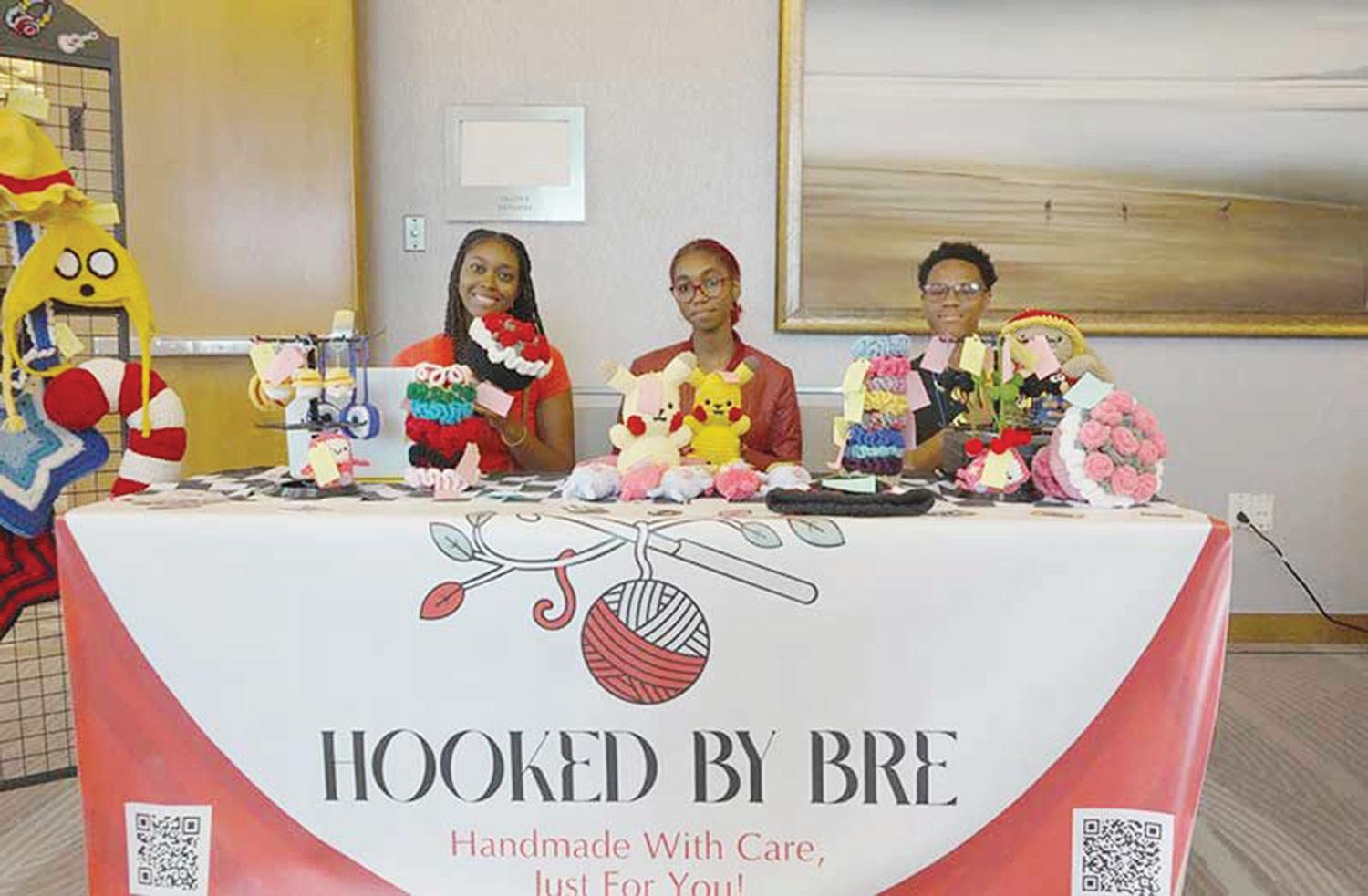
Brianna Exeter, founder of Hooked by Bri (centre), showcases her handmade crochet items at FumaCon 2026 as one of a growing number of local vendors turning creative skills into businesses
A man of many talents...
car driver and former President of the Ogle Community Centre, where he played dominoes and cricket.
He is also a former President of the Guyana Darts Association and is presently involved with the organisation, where he still plays darts.
Culturally, he coordinated the first chutney competition, worked alongside the late Ms Latchmine Kallicharan, and promoted two Miss Diwali Sari Pageants in 2000 and 2001, respectively.
Yaseen told the Pepperpot Magazine that following the passing of his father in 2003, he launched the Haji Yaseen Foundation in his honour. Through the foundation, his family collectively began assisting the less fortunate and sponsoring annual Christmas parties for children along the East Coast Demerara and West Coast Demerara corridors.
The annual Christmas party has been held since 2004 and is well received by children in the community, who look forward to the fête.
Yaseen has been actively involved in Public Relations and is the Public Relations Officer for the Guyana Darts Association.
Sheik Mohamed Muazziz Yaseen is a Guyanese politician and member of A Partnership for National Unity (APNU).
He serves as a Regional Democratic Councillor (RDC) for Region Four (Demerara-Mahaica) in Guyana.
“As an RDC councillor, I sit on two subcommittees: the Works Committee and the Drainage and Irriga -
tion Committee, which oversee work being done in the region. I am also an executive member of the Guyana/Trinidad Chamber of Commerce, which is scheduled to launch on the 13th of August 2026,” he said.
Yaseen added that his hobbies include motor racing and outdoor activities.
He is very much an outdoorsman. His first safari was in 2018, and he liked it so much that he began camping in remote jungle areas of Guyana on weekends to hunt and fish.
Yaseen is the man-
ager of Team Zabeeda Racing, and his son and grandson are both accomplished racers. It is a family tradition and personal passion for him, a hobby he cannot part with.
Sheik Yaseen is a Guyanese politician and regional councillor who formerly led the A Movement for Improvement (AMFI) party.
He later transitioned his political alliance to A Partnership for National Unity (APNU) and subsequently crossed over to support the governing People’s Progressive Party (PPP).
AMFI entered into discussions with the People’s National Congress Reform (PNCR) to integrate into the APNU coalition. He served as a regional councillor for APNU.
In May of this year, Yaseen and several other APNU councillors and former Members of Parliament (MPs) met with PPP General Secretary Bharrat Jagdeo to pledge support for the governing party’s development agenda.
Sheik Yaseen and racers at the South Dakota Circuit for races
FROM PAGE II
Passionate teacher’s role in...
FROM PAGE III
the beginning, that target seemed ambitious, but their Grade Six team refused to be intimidated by the numbers.
“We developed and implemented a rigorous action plan and worked assiduously, often beyond the call of
duty, believing that excellence is achieved through commitment, sacrifice and consistency. Our team’s motto throughout the year was, ‘We shall speak life and not death,’” she said.
Williams told the Pepperpot Magazine that those words became more than a
slogan; they shaped their mindset. They encouraged their pupils to believe in themselves, persevere through every challenge and approach each day with confidence and determination.
However, it was by God’s grace and through
collective effort that they not only met the Ministry’s target but surpassed it, achieving an 85% pass rate, with pupils attaining 50% or more in all four subjects.
Williams said the results were truly remarkable, and every one of their 140 learners gained placement
in a secondary school, with 28 pupils earning places at senior secondary schools in Georgetown: nine at Queen’s College, seven at The Bishops’ High School, four at St Stanislaus College, five at St Rose’s High School and three at St Joseph High School.
The educator pointed out that their pupils also achieved exceptional subject performances, recording 20 perfect scores in Mathematics, 14 perfect scores in English, 13 perfect scores in Science and six perfect scores in Social
TURN TO PAGE VII
Passionate teacher’s role in...
FROM PAGE VI
Studies.
She revealed that these accomplishments reflect not only academic excellence but also the dedication, discipline and resilience of the pupils, the unwavering support of their parents and the tireless commitment of every member of the Grade Six team.
Williams stated that throughout her career, she has sought to make meaningful contributions to Guyana’s education sector by mentoring young teachers, promoting academic excellence, supporting school-improvement initiatives, and encouraging a culture of high expectations.
“I firmly believe that our nation’s greatest resource is its children, and as educators, we have the privilege and responsibility of helping them realise their fullest potential,” she said.
Williams related that while she is humbled by the recognition that has come with her pupils’ achievements, her greatest reward is witnessing their growth into confident, disciplined and ambitious young people who now believe that anything is possible through faith, perseverance and hard work.
She noted that with God, integrity, dedication and consistency, all things are possible. She, however, extended sincere gratitude to the Ministry of Education and the Department of Education, Region Three, whose unwavering support, guidance and encouragement have been instrumental in their success.
“I also wish to acknowledge the ded-
ication of my fellow Grade Six teachers, the administration of Leonora Primary School, our supportive parents and, above all, the hardworking pupils who embraced the challenge and exceeded expectations. As I look ahead, I remain committed to nurturing excellence, inspiring future generations and serving Guyana’s education sector with the same
passion and purpose that have guided me throughout my career,” Williams said. Her message to every child is simple: Never allow your circumstances to define your future. Dream boldly, work diligently, remain humble, trust God and never stop believing in your ability to succeed.
Turning Creativity into...
FROM PAGE IV
ideas can be adapted locally. Speaking about cultural workshops facilitated by Seishonen in collaboration with an international partner, she stated, “The concept of making a piñata, which is about doing an activity that has a shared experience, is something that everyone can relate to,” she said. “I think that is where we really have to consider how we mar-
ket our creativity, not only as a creative, but most importantly, as a Guyanese,” she added. As the sector continues to develop, Lopes sees increased corporate involvement as critical to creating more opportunities for young people and supporting creative entrepreneurship. Over the years, Lopes has noted that the growing interest from private-sector organisations showcases
a recognition that creativity, innovation and youth development are important components of Guyana’s future economy. “With this edition of FumaCon, it was the first time that we had a title sponsor, which is something that has never happened at our event before,” Lopes shared. She explained that corporate partnerships have allowed organisers to expand initiatives, includ-
ing educational programmes that introduce young people to skills in areas such as public speaking, technology, entrepreneurship, design and cybersecurity. Looking ahead, Lopes believes Guyana’s creative sector has significant, undeniable potential for growth. But for Guyana to reach this potential, further development is needed through continuing
education, stronger frameworks and greater investment in local talent. Speaking about the future of the sector, Lopes stated, “I think that in five years, we can see Guyana’s creative sector continue growing if there is the willingness of our people to invest in what we have now, but also to see what they can do in the future,” she said. “People will bloom
if they have the right environment for them to do it,” she added. As Guyana continues to diversify its economy, the creative sector represents a growing opportunity, one where imagination, culture and entrepreneurship intersect to create new pathways, opportunities and horizons for Guyana’s creatives.
one of
largest creative and pop-culture
and a hub for the country’s growing orange economy
Crowds gather at FumaCon 2026,
Guyana’s
events
WE CAN TURN INTO THE WRONG STREET IF WE ARE UNSURE OF WHAT WE SEEK…
THE elders did not err when they seemed to pay attention to every step they made, with the intention of sealing a significant path. It is not with ease that we step forward, but instead with hope and its companion, the dream, with its whispers and our ripe imagination. At times, we
are intruded upon by voices we cannot understand, nor should we trust. Nevertheless, we plunge into love and trust, guided by our feelings, rather than behaving like our most ancient ancestors, who stood afar and paid attention to the world around them. Their primitive aware -
ness cautioned them about whom and what to trust and whom to guard themselves against. They cautiously trusted each other or risked being devoured. Their sketches on the walls told us that they cooperated; thus, they evolved and survived…
The world of today
compels us to be on guard against family and companions; thus, our expectations are guarded. But in such circumstances, we might crave a companionate embrace, which can manifest as a deception when an unknown shadow appears. The fact is that trust and loyalty are aged
companions, not promising angels. The few whom you may trust, even in a time of collective distortion, may be looking upon their own needs at the concealed moment of common private need. Therefore, expectations must not be raised as banners expected to solve expectations but
shelved as self-redemption tools. Thus, guard your own gifts well, for each of us is blessed with gifts. Look upon the world and see that there is a platform for each of us as we live longer today. Guard your conscience well until next week, when we shall talk culture in the now…
ANARKALI
SHE sat in front of the ornate dresser, the only thing she had inherited from her mother, slowly brushing her long, black hair. There was a faraway look in her eyes, and a pensive sadness flickered across her face as memories of the past rose in her mind.
Such a long time it seemed. A farmer’s daughter she had been, born on a night when stars twinkled like jewels, gleaming brilliantly in the sky. Her mother’s ecstatic gasp, breathless as she had been
from the labour pains, as she held her baby girl in her arms.
Her mother’s beautiful voice, her love and the warmth of her smile filled her life with joy as she grew up, but eight years later, a mysterious illness took her away on a night when just one star twinkled in the sky. Anarkali and her father had sat by her side, holding her hands as her breathing became shallower and the light slowly faded from her eyes.
Anarkali couldn’t stop
crying for weeks, and the deep grief stayed with her for months. She asked over and over, “Why… why was the most beautiful thing in my life taken away?”
“Maybe it was God’s will,” her father had answered, his strong voice breaking with emotion.
He had been a strong, hardworking man with rice fields and a cattle farm, but the loss of his wife had broken his spirit and slowed his steps.
Anarkali couldn’t bear to see him so broken, and
taking his hand one day, she had said to him, “Papa, we have to be strong to go on. Mama wouldn’t want this to happen to us.”
He had taken a deep breath and hugged her, tears in his eyes.
“You’re right, my child.”
One day at a time, the farms came back to life, and years later, they were producing bountiful yields and had expanded from cattle to sheep. Anarkali continued her studies and also developed into an astute young businesswoman.
But at the sweet age of sixteen, someone walked into their lives who changed everything.
A new woman!
Anarkali inhaled deeply, and at that moment, her husband entered the room. Seeing the pained look on her face, he asked, “Are you sure about this?”
She did not answer for a short moment, then nodded her head slightly and stood up.
“I need to do this.”
The woman who had caused a destructive change in Anarkali’s and her father’s lives was her stepmother.
Today was her funeral.
As Anarkali’s husband started their Land Cruiser, he put his hand comfortingly over hers. “Everything will be fine.”
She smiled with gratitude for the kind and understanding man he was and had always been to her. Her stepmother had arranged for her marriage
to him, a dark-skinned, older man who was a struggling farmer, in a despicable attempt to hurt and embarrass her. It was a wasted attempt, given how kindly her husband had always treated her. She had never liked Anarkali and was jealous of the bond between father and daughter.
Anarkali had been distraught by the idea of an arranged marriage at her young age, but her stepmother had threatened her,
“If you don’t want your father to suffer more, you will accept.”
Her father had developed a heart condition that could trigger a heart attack through stress. He had already had one slight attack, and still carrying the pain of losing her mother at a young age, she did not want to lose her father too.
The night before the wedding, she had told him tearfully, “Maybe this is for the best. How long
can I live like this? Please promise me you will stay calm and not stress over anything.”
He had hugged her, crying quietly too.
“I’m sorry, my child, that my decision to remarry caused you all this misery.”
“It’s okay, Papa. You couldn’t have known.” Her stepsisters, pampered by their mother, had mocked her for marrying someone they found unattractive, for they took pride in their beautiful looks and fair skin. Their travels and glamorous lifestyles were funded by her father’s money, which the stepmother controlled. Meanwhile, Anarkali worked with her husband to develop the land he owned.
Five years later, life improved for them with new investments and initiatives. Sadly, though, her father’s heart gave up,
TURN TO PAGE XI
ANARKALI...
FROM PAGE X
and he died. That loss had hit her really hard, but her husband stayed close and supportive to help her through that difficult period.
The stepmother had manipulated her father into leaving the house, money, and lands to her. All Anarkali got was the ornate dresser because the stepmother thought it was something old and unworthy.
Anarkali had accepted it with a happy feeling because, for her, it was something unique.
She had walked away that day without looking back because her father was now gone, and she had taken comfort in the fact that he had been reunited with her mother in heaven.
“I have lost the two most important people in my life,” she had bemoaned.
But their memories gave her the determination to continue working and to build her own family. Her stepmother had left strangers to stay in the family home whilst she and her daughters moved to the city, built their own businesses and lived fabulous lives filled with travel and luxury.
But things started to change as the mother grew older and her health slowly deteriorated. Her daughters were too busy to spend time with her, giving her a nurse’s aide instead.
Anarkali heard all the stories of her children’s neglect, her ill health and her lonely life. But she did not reach out to her, given their severed relationship after her father died.
When news reached her a year later that her stepmother had died, she felt no grief or regret for a woman who had been a part of her life. The daughters did not inform her, but deep down inside, she felt the need to say
‘goodbye’ and close that chapter of her life. She reached the cremation site and walked towards the unlit pyre as the priest concluded his prayers. The daughters saw her but did not speak to her as she stood close by among the other mourners. Anarkali was undaunted by their cold attitude and stepped forward for the final viewing.
She reached for a single fresh rose that was being shared with the mourners, but the second daughter said haughtily, “The roses are only for family.”
Anarkali looked at her and said to herself, “At a time like this, you can still be so hateful.”
She looked at her stepmother for a short moment, the woman who had caused a good, kind man to die and robbed his daughter of her rightful inheritance. She said quietly, “I wish you no ill, just farewell.”
Then she turned and walked back to her vehicle.
“Are you okay?” her husband asked.
She inhaled deeply, then exhaled slowly and said, “That part of my past is now gone, and I feel free.”
Three months later, a lawyer came to her home and handed her a document.
“What is this?”
Anarkali asked, puzzled.
“Your stepmother left you the family house in her will.”
“What?” she questioned, very surprised.
The lawyer also handed her an envelope, and the note inside read, ‘Please forgive me, if you can, for all the pain I caused you.’
Anarkali sighed, then smiled, somewhat satisfied that she had received an apology.
“And tomorrow, I reclaim my family home.”
Advice for denture wearers
THE following advice is especially for those who will be wearing dentures for the first time and obviously want to obtain maximum benefit from them. One should first remember that dentures are not permanent and that changes continue to occur in the bone and soft tissues of the mouth; therefore, periodic modifications may be required.
Incidentally, I believe that if it were not for the fabrication of false teeth, there would have been far fewer dental “quacks” in Guyana. Despite losing their teeth for one reason or another, some people are often sceptical about wearing den-
tures, due mainly to erroneous perceptions or ignorance. Here is some basic advice for those who either wear or intend to wear removable dentures:
During the initial adjustment period, you should:
• Leave the dentures in for the first 72hour period. Use denture adhesive cream,
for example, Fixodent. Note any discomfort or pain and revisit your dentist for a post-insertion consultation and adjustments.
• Feelings of fullness and increased salivation will decrease with time.
• Sucking sweets may help with any gagging sensation.
• Expect sore spots to develop during this initial adjustment period, as this is not unusual. The dentist must see these sore spots to identify the exact place to relieve on the new denture.
Eating with your new dentures:
• Cut up food into small, bite-sized pieces.
• Eating with food on both sides of your mouth may be helpful.
• Avoid sticky foods.
• Learning to eat with dentures takes time. Eating with dentures will not be as easy or efficient as eating with natural teeth, but you need to be patient.
Talking about your new dentures:
• Adjusting takes time. Read aloud to speed up the process.
• Muscles will need to be re-educated so that they will retain the denture.
• The feeling of crowding of the tongue will decrease with time.
Cleaning your mouth and your dentures:
• Biting food with your front teeth will tend to dislodge the dentures and the underlying tissues.
• Cleanse and massage your gums daily with a soft toothbrush.
• Brush dentures with a soft toothbrush and ordinary facial soap. Never use toothpaste to brush your dentures; it is too abrasive.
• Soak dentures overnight in either a commercial denture-soaking solution/ tablet or a weak mixture of bleach and water.
Denture Dos and Don’ts
• Brush your dentures with soap daily.
• Only use denture adhesives on the advice of your dentist.
• Never attempt to adjust, repair or refit your denture yourself because you can damage it and may require a new one.
• Do see your dentist for your regular check-ups.
Our Duty to Give Back
FOR every living force that occupies this planet, there is a motivating factor that keeps it in motion. Even the smallest creatures have a reason for staying alive and an intrinsic drive to move towards the necessities that allow them to sustain themselves. Without the complexities of human nature and the ebb and flow of desires and aspirations at play, even our own lives would be reduced to the acquisition of basic needs such as food, water and shelter. Perhaps, if faced with the unfortunate occurrence of a calamity or disaster, this reversion to our fundamental character would become apparent.
If this were to occur, one would see that the desire to have our needs met is, in its very essence, quite natural. Having the strength and drive to sustain ourselves and to treat our lives as a gift that must be utilised to its fullest extent is a rather noble pursuit. The issue is that the rush of the modern world often makes it impossible to differentiate between what is necessary for us to live a happy life and what is not. Today, our needs are not about
survival but about several different things. Sometimes, they are about securing and announcing a position. Sometimes, they are about fulfilling an innate desire to own something special, just for ourselves. Sometimes, they are about caring for our loved ones in the manner they deserve.
There are many reasons why we seek to acquire material objects. Meeting our basic needs is not the only factor that drives us. As such, one cannot dismissively say that seeking to own something that lies beyond our basic needs is a shallow endeavour. The consumption of goods and services has become a part of our nature. It is now an instinct as deep-rooted as survival. In turn, the world and the intricate web that drives it have also begun to metamorphose into an engine that exists to meet the human need for consumption and ownership. Now, this change manifests itself in a rather unexpected way in our day-to-day lives. We see this shift causing us to feel a sense of personal unfulfilment. Our own desires and dreams are being sold to us in neatly pack -
aged boxes. The only obstacle that lies between us and the things we want is money. Of course, this does not mean that less work is needed to achieve our goals and acquire the things we want. It only means that we no longer require as much imagination.
In today’s world, the common man’s needs are generally met. If they are not, then there is at least a clear path towards achieving our goals. There is always a voice extending itself to us and guiding us towards some new product that we eventually convince ourselves we need.
The issue is that our lives have become centred around consumption, when our innate drive almost always lies towards creation and production. When we designed and accepted life in a world where we are constantly being fed goods and services, we were enthralled by its convenience and luxury. However, one thing we did not take into consideration is just how corrosive boredom can be to our minds.
It is human nature to give back and create; in fact, it is one of our needs. We might be able to live with just food, water and shelter,
but we only come alive when we can contribute something to the world around us. If you find yourself feeling unfulfilled and incomplete, consider that perhaps it is not because you are failing to own something, but rather because you are failing to produce something of true meaning.
We must make it our duty to learn how to give back. Our generation has found itself in an era where its growth is not limited by what it needs, but rather by what it is capable of creating. When we wake up each day, let us choose to draw a map of ourselves and dis-
cover the treasures that lie within. The answer to our unfulfilment and sadness rarely comes from the outside world. If we are diligent enough, we might discover something within ourselves that the people around us desperately need.
The Company They Keep
SOCIAL media can package life’s greatest complexities into a single sentence. One quote, one striking image, one dramatic conclusion, and suddenly thousands of people are sharing it as though it were a universal truth. Recently, one such quote caught my attention: “If you see your friend with your enemy, be sure that both are your enemy. One openly, the other secretly.”
At first glance, it feels empowering. It gives us certainty in an uncertain world. It tells us exactly
whom to trust and exactly whom to cut off. There is comfort in black-and-white thinking because it saves us from the exhausting work of discernment. The problem is that human beings are rarely black and white.
A colleague can be your closest confidant while maintaining a professional relationship with someone you dislike. Two siblings can fiercely love one another while taking opposite sides during a family dispute. Friends may find themselves navigating complicated circles where loyalties overlap, and person-
alities clash. Life is messy because people are messy.
The real question is not whether your friend knows your enemy. The real question is what happens when your name enters the conversation.
Psychologists have spent decades studying conformity, and the findings are both fascinating and unsettling. Human beings have an innate desire to belong. We adjust our opinions to fit a group; we laugh when everyone else laughs, even if we do not find the joke amusing; and we re-
TURN TO PAGE XV
The Company They Keep...
main silent because silence is often rewarded with acceptance. This silence can become incredibly expensive, however.
Imagine a group of co-workers sitting around the lunch table when one person begins criticising another absent employee. It starts innocently enough: someone rolls their eyes, another laughs, a third adds another story, and one person says nothing but smiles. Before long, everyone around the table has become part of the conversation, even those who never uttered a single insulting word. Who was responsible?
Most people point to the person who started the gossip, but psychology suggests otherwise. Every laugh reinforces the behaviour, every nod validates it, and every silence allows it to continue. Human behaviour is shaped by what goes unchallenged. We like to believe that neutrality exists, but in many situations, neutrality strengthens the loudest voice in the room.
Now place yourself at the centre of that conversation. Would your friend change the subject? Would they defend your character? Would they say, “That hasn’t been my experience with them”? Or would they stare into their coffee and allow the conversation to continue?
Sometimes, loyalty is not straightforward. Sometimes, loyalty is one uncomfortable sentence spoken at exactly the right moment. Another behaviour deserves attention. We all know someone who seems to carry information between people like a courier. They arrive with phrases such as “I thought you should know” or “I’m only telling you because we’re friends.” Occasionally, they are protecting you, but more often, they are feeding the very drama they claim to dislike.
Psychologists call this triangulation. Instead of resolving conflict directly, one person becomes the
middleman, passing emotions, stories and misunderstandings back and forth. The result is rarely clarity. Instead, suspicion grows, relationships fracture and trust slowly erodes. Ironically, the messenger often becomes the only person everyone believes they need. Healthy friendships do not thrive on secret updates; they thrive on honest conversations. It is also worth asking ourselves a difficult question: Have we ever expected too much from the people we love?
Pain has a way of narrowing our perspective. When someone hurts us, we naturally want those closest to us to stand beside us. That is understandable, yet emotional maturity reminds us that our friends are individuals with their own relationships, responsibilities and experiences. Expecting someone to abandon every person we dislike may not be loyalty. Sometimes, it is fear disguised as loyalty; sometimes, it is insecurity searching for reassurance. But discernment requires patience.
Patterns matter more than isolated moments. Seeing your friend speaking to someone who has wronged you tells you almost nothing. Watching them repeatedly entertain your humiliation tells you everything because actions accumulate and character reveals itself over time.
One conversation means very little, but twenty similar conversations become impossible to ignore.
Carl Jung famously observed that everything unconscious eventually seeks expression. People may carefully manage the image they present to the world, but maintaining a mask requires tremendous energy. Eventually, exhaustion wins: the sarcastic remark slips out, the unnecessary criticism appears, the hidden jealousy reveals itself, the performance ends, and the true character takes the stage. This is why time remains one of the greatest truth-tellers, because it is difficult to pretend forever.
One of the strongest in-
dicators of genuine friendship is something few people ever witness. How does someone speak about you when you are not there?
There is no audience to impress, no social media likes to collect, and no expectation of recognition. Only character remains.
I have often believed that our reputation is safest in rooms we never enter. Those who genuinely value us protect our name whether we are listening or not. They correct misinformation, refuse to entertain unnecessary cruelty, and understand that defending someone’s dignity says just as much about their own integrity. On the other hand, some people enjoy proximity more than friendship. They like access to your life because information carries value. They collect confidences, opinions and vulnerabilities, storing them away until an opportunity presents itself. They are not building relationships; they are building leverage. These people rarely reveal themselves through grand betrayals. Instead, they appear in subtle ways. They ask questions without offering answers, and they encourage gossip without contributing openly. They remain agreeable in every room because conviction would require courage. Eventually, you notice something strange. Everyone trusts them, yet no one truly knows them. Perhaps the most dangerous mistake we can make is assuming that every smiling face deserves unrestricted access to our lives. Trust is not something handed out because time has passed. It is earned through consistency, honesty and repeated demonstrations of integrity. Observe what people celebrate, what they tolerate, what they excuse and how they behave when kindness becomes inconvenient. Those moments tell you far more than affectionate words ever will. The quote that inspired this reflection may not be entirely correct, but it points us towards an important truth. Loyalty is not measured by who stands beside you in
photographs; it is not measured by birthday messages or public declarations of friendship.
Loyalty reveals itself in the conversations you never hear. It reveals itself when choosing integrity carries a personal cost and when someone protects your dignity despite having nothing to gain. Perhaps that is why the deepest betrayals rarely come from strangers. Strangers cannot reach the places reserved for trusted hands; only friends are given the keys. The rest simply knock. Here is a poetic piece for reflection.
The Company They Keep
A stranger’s stone may bruise the weathered skin,
A friend’s soft whisper lets the poison in.
The loudest foe declares where battles start,
The silent one may borrow your own heart.
So never judge by smiles that freely leap,
For promises are measured where they keep.
The table fills with laughter, bread and cheer,
Yet absent names grow
smaller year by year.
One careless joke invites another guest,
Till truth lies buried deep beneath the jest.
The tongue that mocks may wound for just a day,
The silent nod can clear betrayal’s way.
The mind was built to hunger for the crowd,
To blend with voices cheerful, safe and loud.
Acceptance wraps itself in sweet disguise,
And asks us all to compromise our eyes.
How many trade their backbone for applause,
Then wonder why their peace has hidden flaws?
Yet wisdom asks for patience, not for haste,
For wounded hearts can judge with bitter taste.
One meeting proves no story on its own,
One picture never tells the seeds we’ve sown.
Count patterns like the seasons, slow and true;
Time paints the hidden portrait into view.
Protect the soul that guards your name with grace,
Who speaks of you the
same in every place.
Their loyalty requires no grand display, It shines within the ordinary day.
The strongest hearts need neither mask nor role; They carry honor in the soul.
Some gather lives the way collectors do,
Admiring every polished, shining view. They borrow hopes and secrets as they roam,
Yet leave no lasting footprint called a home.
A heart that feeds on whispers, praise and schemes,
Will always starve despite ambitious dreams.
So choose the few whose actions match their rhyme,
Whose truth remains unbroken over time.
For friendships bloom where honesty takes root, And every faithful branch bears lasting fruit.
When life removes the noise for all to see,
The company they keep reveals who they’ll be.
Romella Dasratt
Success is Possible for Everyone
Your Contributions
WHILE it is acceptable to have the Creator and other people influence your life, you have some work to do. Success will not walk up and ask to be your friend; you must go and reach it. You must expend some amount of energy. Of course, the Creator sets the pace and puts things in place for you to reach that desired outcome, but you must be aligned with the process toward success.
Many ideas may fill your brain, but you will be unable
to execute all of them. Being focused and sticking to one thing at a time can probably be your key to success. When you are doing many things at the same time, you may not be able to concentrate your energy and may thus miss the opportunity to achieve victory. Working hard is never a crime. If you are considering becoming successful, then prepare to work. Whoever thought success came easily was never talking about me or you. You may have to work hard and honestly
while others may be resting. Avoid measuring your hard work against that of others. Do what is right, and you will have victory on your side. Working hard requires much energy, but the result can be victorious if you stay focused on the task. Avoid unethical activities just to be successful. Shortcuts may be good, but they may not be the best option. Unethical activities may make you feel good at that moment but ashamed in the future. Many people’s good reputations have been
damaged because of one unethical activity. Please do not follow the unethical route in trying to be successful.
A positive attitude can, or more accurately will, be a key to your success. Many people may want to support you if you have one. Even when you experience some failures, try to keep a positive attitude. As you become successful, try to maintain your winning formula. Too many changes may only create harm, and you may soon become defeated. Do the things that work for you,
and you will have many successful days.
People Who Surround You
You will need people to help you become successful. Avoid creating enemies and establish more friendships. Not everyone will want to be your friend, but keep those who choose to do so close to you, as they may be concerned about your success and may do many good things to help you become successful.
Some people have great ideas, but they are unsure of
what to do. In some cases, when they connect with a mentor, they may realise that they have potential and can become successful. Mentors often help you see what may be in front of you that you may not be able to see. Stay with your mentor and work to be successful.
You have a responsibility to surround yourself with quality people. When people have pet birds for whistling competitions, they may often take them to challenge other birds so that they become
TURN TO PAGE XVII
Success is...
FROM PAGE XVI
better at whistling. If you want to be successful, then you ought to surround yourself with people who will cause you to rise higher.
People of quality can sometimes help you see life from a better position, and you may live your days thereafter thankful for their friendship. Some of those quality people may be right at your workplace. Only if you spend time talking to and observing them will you become aware. At your educational institution, there are quality people who are there to help you become better. Your neighbourhood may have people who will cause you to lift your head high and see that opportunities are all around you.
You have the choice of who to surround yourself with. Use that choice wisely and be willing to learn from others, as they may be great guides to your future.
When you are successful, try to help others. You can help change the world and make it a better place by helping those who surround you become better. Your presence and guidance must challenge people to improve. Be willing to share with others that life is filled with opportunities and that everyone can become successful. Share with them some of the important things that they can do so that success will be their friend, and defeat will be their permanent enemy.
The Environment
A fish can swim but needs the right environment to do so. Many times, people have the ability but lack the right environment. An athlete will not become great if they only spend time in a house and dream about success; they need a supportive environment to execute what is important to them. Your environment can be your springboard for success.
Your surroundings may provide support for your success. Do not become angry with your surroundings. Just keep looking for things that can work in your favour. You will need good soil for your seed to germinate and bear much fruit. While a seed may germinate, the
soil will give it stability and many of the nutrients it needs. When a plant is removed from the soil and not provided with another supportive environment, it may soon die. You should try to stay connected to your soil so that your success will be sustained.
Many people would like to be your friends, but you must choose your associates wisely. These associates may carefully help you see the opportunities that exist before your eyes. Your associates may constantly challenge you to rise above defeat and remind you that you are a winner. When your associates share their success stories, you may remind yourself that you, too, can be successful. It is difficult to find good associates, but when you find some, keep them with you.
What you hear can help you decide whether you want to move forward or backwards. Your ability to hear can propel you towards success. Be willing to listen, but most importantly, hear good things. Keep away from bad information and become friends with good information. What enters your ears will affect your thinking and actions. What you hear may help fashion your mind. Therefore, only lend your ears to good information.
If you see that other people are successful, then you may be challenged to believe that the same thing can happen to you. Look for opportunities to see what life has to offer you. Many times, birds will be in the trees or the air, looking for food that may be within their sight. You must have a similar mindset and look for good things to happen to you.
For more information about Geary Reid and his books, please use the following contact information: Amazon: http://www. amazon.com/author/gearyreid
Website: www.reidnlearn.com
Facebook: ReidnLearn
Email: info@reidnlearn.com
Mobile: 592-645-2240
Domestic Disturbances: A Review of The Witch by Marie N Diaye
A WILLING suspension of disbelief is essential to appreciating Marie NDiaye’s The Witch (Vintage, $16.78). As with many works of literary fantasy, the novel asks readers to accept the coexistence of the or-
dinary and the impossible, presenting the supernatural not as an intrusion upon reality but as one of its nat -
ural extensions. The result is a peculiar domestic narrative centred on a witch whose magical abilities are
treated with the same matter-of-factness as marriage, motherhood and middle-class disappointment.
The Witch is the ninth of French writer Marie NDiaye’s novels to be translated into English. Originally published in French in 1996 as La Sorcière, it was translated by Jordan Stump and recently shortlisted for the 2026 International Booker Prize. NDiaye has long distinguished herself as a novelist of extraordinary psychological acuity, producing works that are at once philosophical, unsettling and emotionally precise. Novels such as Ladivine and Vengeance Is Mine demonstrate her gift for creating narratives that feel both dreamlike and profoundly real. Her fiction often possesses the compressed elegance of a novella, with sharply delineated characters and meticulous attention to interiority. In this respect, she bears comparison to writers such as Sayaka Murata and Banana Yoshimoto, whose deceptively simple prose often conceals deeper existential concerns. At just 114 pages, The Witch shares this economy of style and thought.
The titular witch is not the fairy-tale sorceress of folklore. Lucie, the novel’s protag -
onist, is first and foremost a wife and mother. NDiaye’s central conceit is that witchcraft is hereditary and surprisingly commonplace. Witches marry, raise children, quarrel with spouses and struggle with family obligations. Lucie’s twin daughters, Maud and Lise, are witches too: cold, aloof children whose emotional detachment makes them both fascinating and unsettling. Their eventual departure from the narrative through literal flight is rendered with such effortless conviction that it feels entirely plausible within the novel’s strange logic.
Lucie’s mother is also a witch. Recently separated from her husband, she presides over one of the novel’s most memorable transformations: Lucie’s father has been reduced to the form of a snail through magical means. NDiaye treats this absurdity with remarkable restraint. The father’s condition is simultaneously comic and tragic, eliciting laughter even as it evokes pity. Such moments exemplify the novel’s peculiar emotional register, where melancholy and humour coexist in uneasy proximity. There is a sadness here generated by characters who are themselves experts at
Domestic Disturbances...
FROM PAGE XVIII
making others unhappy.
Indeed, few of the novel’s characters are conventionally likeable. Lucie is relentlessly judgemental, her observations of others often bordering on cruelty. She appraises people with a candour that recalls the unfiltered honesty of children, frequently fixating on physical appearance and bodily flaws. Her husband, Pierrot, is hardly more appealing. Like Lucie’s father, he is a thief, though his transgressions are compounded by a passive-aggressive temperament that makes him particularly irritating. Then there is Isabelle, Lucie’s friend and neighbour, whose relationship with her young son wavers between neglect and hostility. Her affection rarely manifests as care; more often, it takes the form of abandonment or daily criticism. The boy emerges as perhaps the novel’s most sympathetic figure, a lonely and bewildered child trapped within a world of emotionally impoverished adults.
NDiaye constructs a social universe in which empathy is scarce and familial bonds are marked more by obligation than affection. Yet the novel never judges its characters outright. Instead, it observes them with a cool detachment, allowing readers to draw their own conclusions. The men fare particularly poorly. Lucie’s father is an embezzler whose moral failings are costly. Pierrot steals money from the family’s joint account and abandons his wife and daughters without warning. Significantly, neither Lucie nor the twins seem especially distressed by his departure. His absence
is merely a mild inconvenience.
As the narrative progresses, The Witch assumes the shape of a picaresque journey. Lucie and her daughters travel across France, visiting her mother and searching for the missing Pierrot. When the twins eventually fly away, Lucie continues alone. Her travels ultimately lead her to her husband, who has established a new family and settled into a different life. Their reunion is one of the novel’s most revealing scenes. Remarkably calm and almost devoid of confrontation, the encounter unfolds with the stillness of water in a glass. Everyone involved appears resigned to circumstances they lack the energy to challenge. The resulting atmosphere is one of emotional torpor, as though the characters have exhausted their capacity for outrage and settled instead for uneasy acceptance.
Later, Lucie reconnects with Isabelle, who now operates a boarding school for troubled girls, a somewhat dubious institution that attracts the desperate and the unwanted. Lucie secures employment there, though, predictably, the arrangement proves short-lived. Stability, in NDiaye’s fictional universe, is always temporary.
Nothing goes particularly well for anyone in this novel. Yet its emotional honesty makes it compelling. In its unsparing attention to resentment, disappointment and familial estrangement, The Witch recalls the fiction of Jamaica Kincaid, particularly The Autobiography of My Mother and See Now Then. Like Kincaid, NDiaye possesses
an extraordinary ability to render the complexities of inner life with startling clarity. Lucie’s thoughts, however unpleasant, often feel uncannily real.
Motherhood occupies a central place in the novel, though NDiaye offers none of the comforting maternal archetypes of literary fiction. The mothers in The Witch are emotionally distant, impatient and frequently ambivalent towards their children. Isabelle’s inexplicable hostility towards her son, Lucie’s detached relationship with her daughters and Lucie’s mother’s strained interactions with her own family all point towards a vision of parenthood defined less by nurturing than by endurance. This emotional climate explains why Lucie’s daughters eventually take flight, literally escaping a world to which they feel little attachment.
The Witch is a strange, memorable and thoroughly enjoyable novel. Its pages are populated by deeply flawed people doing and saying unpleasant things, much as people often do in real life. Add to this witches who cry blood, little girls who fly and a man transformed into a snail, and the result is a work of fiction that is as entertaining as it is unsettling. Dark, moody and psychologically incisive, the novel is also unexpectedly funny, its humour emerging from the absurdity of human behaviour rather than from overt comedy. NDiaye has crafted a small but remarkable novel, one that lingers in the mind long after its final page.
STUDY SUCCESS
Dear student, Welcome, dear friend. Use discussion to make your revision effective - active rather than passive. This strategy deepens your understanding of a familiar topic or written work, tests what you know and reveals gaps in your knowledge, encourages new ideas and insights, and helps you organise material more clearly and solve problems. It improves and deepens memory by
requiring you to explain and defend your ideas. In short, discussion makes revision more secure and builds your examination confidence. Be wise With love.
THE PASSAGE Letter of refusal
Reminder: Tactfully treat the occasion.
i) Be prompt to reply. A delayed negative response can only offend the reader even more than lessen his chances of retaining goodwill.
ii) Be positive in your
statements. Always try to phrase your refusal in a positive way by emphasising what you can do for your reader instead of what you cannot do. iii) Be helpful. You can sometimes propose an alternative solution that is helpful. iv) Be tactful. Do not insult the reader nor indicate that the request is unreasonable. Be careful to explain the circumstances fully.
In writing a letter refusing an invitation, you may adapt the bad-news plan to
include the following three points:
i) Express appreciation for the invitation. ii) Give a logical reason for having to refuse. iii) Keep open the possibility of accepting a similar invitation in the future (if desirable). The letter below is refusing an invitation to speak:
Dear Mr. Sandiford: I was pleased and complemented by your invitation to speak on August 8 at the Senior Women’s Recognition Meeting of the Congregational Reform Ministry Fellowship.
I have plans to be out of the city during that week in August, and unfortunately, I will not be able to accept your invitation. An important company business trip is scheduled for that time, and it cannot be postponed. I am genuinely sorry that I cannot be with you.
It would be a pleasure to appear before your group at some later date. If you wish me to do so, I hope you will let me know at least six weeks in advance. Incidentally, the subject: “How to Make Your Retirement Manageable” suits me just fine.
Sincerely,
A letter to enjoy practising on: Pretend you are a public relations associate at “Johnny’s Electronics and Computer Center”. You received a request from Ms. Delia Ellis regarding the July-August Day Camp, P.O. Box 135 G.P.O., Georgetown, for a plant tour of ten youngsters. Your company is not yet set up to give tours. However, you do provide speakers for young people’s groups on the topic of electronics and computers. Write a letter refusing the request for a plant tour but retaining the July-August Day Camp’s goodwill.
IMPROVING READING
Making inferences improves reading comprehension
Making inference is a strategy where readers, who are proficient, think about and search the text, and at times use personal knowledge to construct
No matter how thin you slice it, it’s still baloney
meaning beyond what is actually stated. This reading method includes making connections and drawing conclusions.
Especially when studying Literature, the proficient reader is enabled to gather from context clues within the passage, information from the author about plot, characters, settings, time period, and other elements of a story, by the things the writer infers.
With inference, reading becomes more pleasurable; and language skills are improved, such as vocabulary, memory, syntax, sentence structure, and listening comprehension.
Here is an exercise that should help you to use inferencing.
Directions: Read this well-known selection. Then answer questions 1-5.
One hot summer day, a fox with its tongue hanging out staggered down a long dusty road. Suddenly he looked up at a fence by the side of the road. He saw a bunch of fat, juicy purple grapes hanging from a vine at the top of the fence. He backed up, took a running start, and tried to jump to the top of the fence, but he just missed the grapes. With a determined look on his face, he took a deep breath and tried again. No luck. Huffing and puffing, he tried again and again, with no success. Finally, exhausted, he was forced to give up.
“Oh well,” he said, walking away with his head held high, “no great loss. I didn’t want them anyway. I’m sure those grapes are sour.”
1. What can you infer from the description of the fox at the beginning of the
passage?
A.. He is happy and contented. B.. He is fat and well-fed.
C.. He is hungry and thirsty. D.. He is lonely and uncared-for.
2. What can you infer from the fox’s efforts to get the grapes?
A.. He desperately wants to showcase his jumping capability. B.. He desperately wants the tempting grapes. C.. He naturally likes making himself be noticed. D.. He really does not know what he wants to happen.
3. What idea does the author probably want readers to connect with in the fox’s statement that the grapes are sour?
A.. He does not want to taste the grapes. B.. He makes a flimsy excuse for not succeeding. C.. He cannot become a better jumper. D.. Others need the grapes.
4. Look at the connection in the story between the fox’s action and his words. What does it help the reader to infer?
A.. Some people just do not try enough. B.. Some people just do not know when to quit. C.. Some people would do anything for a free meal. D.. Some people pretend not to want the thing they cannot have.
5. What is the most logical inference about the fox?
A.. He thinks about several approaches to a matter. B.. He does not try hard enough to problem-solve. C.. He approaches a problem only one way. D.. He carefully solves problems after great thought.
ALFRED EMANUEL SMITH (1873-1944), Governor’s Speech, 1920s