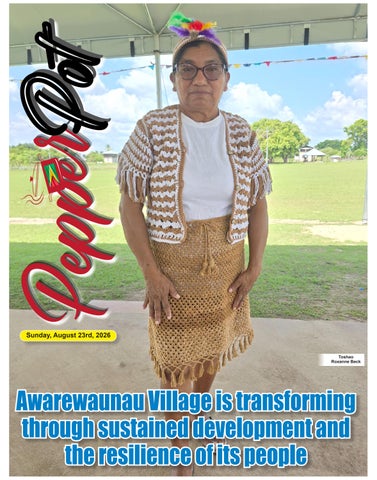
Sunday, August 23rd, 2026 Toshao Roxanne Beck
Awarewaunau Village is transforming through sustained development and the resilience of its people
II
CHRONICLE PEPPERPOT ― Sunday, August 23, 2026
RideGY brings safe, simple travel to Guyana The locally built app offers fixed fares, verified drivers and trackable rides
By Andrea Hendricks
FOR many visitors, the first negotiation in Guyana can happen before they even reach a hotel: securing a ride at the port of entry. RideGY, a Guyanese-built ride-hailing platform, is betting that certainty, through known drivers, fixed pricing and a tracked
itself as a practical option by offering reliable movement backed by receipts that can be accounted for. RideGY was founded by a team of Guyanese professionals with backgrounds in technology, business, and customer service who saw an opportunity to modernise local transportation. Rather than relying on a purchased
“We did a soft launch on July 4, 2026 and discovered that the infrastructure couldn’t support the bandwidth our application demanded. We made adjustments based on feedback from our drivers and riders to resolve those issues.” According to the company’s technology specialist, testing took place over time
At its core, the platform is trying to solve long-standing pain points in local transportation. Guyana has traditionally relied heavily on cash transactions, phone calls and negotiating fares, often with limited visibility into pricing and driver information. RideGY says its goal is greater pricing transparency, improved customer safety,
predictability, RideGY offers transparent upfront pricing and live GPS tracking, alongside PIN-verified pickups for added passenger security. The company also highlights its driver-verification process and says every driver is vetted and required to submit documents, including government-issued identification, a valid Guyana driver’s
travelled, selected vehicle category and any applicable demand adjustment, with the total displayed before a ride is confirmed. “The goal is to eliminate guesswork so passengers know exactly what they’ll pay before they start their journey.” RideGY also lists multiple payment options, including cash, cards, Apple Pay,
Driver, Henri Forrester Driver, Alex Langhorne
route, can improve that first impression and offer everyday users a safer, more accountable way to move around the country. The company says its approach is designed for the way Guyanese travel and do business, with features that appeal to both residents and the steady flow of investors, conference-goers and tourists now passing through. For business professionals in particular, RideGY is positioning
template, the team developed the platform from the ground up and says it owns the source code, the app, and the supporting infrastructure, which it believes will help it respond quickly to issues, improve the service based on feedback, and scale as demand grows. Founder Adrian Sookchan told Pepperpot Magazine that the company’s early days were defined by troubleshooting and adjustment.
and was informed by local feedback. The aim, he said, was to build to international standards with familiar features so that visitors can adapt quickly to RideGY while locals benefit from a more structured and transparent service. “Visitors who are familiar with these standards will quickly be able to adapt to RideGY. We have a roadmap to support WeChat Pay in China, Pix in Brazil and also a closed-loop credit system, where you can top up your account and pay using RideGY credit.”
easier access to transportation through technology, and more earning opportunities for drivers. Officials explained that the app’s matching system is intended to connect drivers directly with nearby riders. “The drivers are matched directly with their riders or customers nearby, resulting in less fuel being burned, more paid trips and fair pricing on every side. As they build a good track record, they move into better tiers with lower commission.” To support safety and
One of RideGY’s founders, Inshan Alli. (Photo credit: RideGY officials)
licence, vehicle registration, current vehicle insurance and a profile photo for rider verification. “Each application is reviewed, and documents are scanned for validity before a driver is approved to go online. We also ensure drivers meet the platform eligibility requirements before activation.” The company says fares are calculated using factors such as a base fare, distance
PayPal and MMG, along with optional driver preferences and vehicle types. It has also rolled out a promotion offering “20,000 free travel credits”, framed as travel credit equivalent to free rides within the app, and says customers can participate via its social media platforms as part of the engagement. Early feedback, the company reports, has been TURN TO PAGE XI
III
CHRONICLE PEPPERPOT ― Sunday, August 23, 2026
Awarewaunau Village is transforming through sustained development and the resilience of its people
By Michel Outridge
AS the afternoon sun softens over the vast Rupununi savannah, the landscape surrounding Awarewaunau appears almost untouched by time. Cattle move slowly across the open grasslands; farmers tend their crops, cotton is spun by hand, and traditional hammocks are carefully woven using skills passed from one generation to the next. Yet beneath this familiar rhythm, a quiet transformation is taking place. Roads are being paved, solar panels are converting sunlight into electricity, new homes are rising, teachers are pursuing further education Online, and farmers are looking beyond subsistence towards commercial markets. Awarewaunau is not leaving its past behind; it is drawing on its heritage as the foundation for its future. That transformation is being championed by Toshao Roxanne Beck, a lifelong resident whose own journey mirrors the resilience and
determination of the community she serves. A teacher, farmer, cattle rancher, mother and community leader, Beck has devoted much of her life to creating opportunities for residents. For her, development has little meaning unless it improves the lives of families, and creates opportunities that future generations can sustain. “We have the market, and we want to expand our cattle-rearing venture at the community level,” she told Pepperpot Magazine, expressing a vision in which livestock can become an even stronger pillar of the village economy while contributing to local food security. That vision is particularly significant in a community where geography has historically shaped economic opportunity. Awarewaunau, an Indigenous Wapishana community in the Deep South Rupununi of Region Nine, is home to approximately 848 people in 230 households. For generations, its re-
moteness limited access to markets, transportation, education and essential services. Today, however, that isolation is gradually being reduced as investments in infrastructure, renewable energy, transportation, housing and digital connectivity create new possibilities for
Men on Mission initiative, providing improved living conditions for families, and adding to the growing signs of development within the community. Improved transportation is further strengthening this foundation. Awarewaunau has also benefitted from a
A stretch of newly asphalted road in the village
The village guesthouse for visitors
Toshao Roxanne Beck
residents. One of the most visible manifestations of this change is the community’s approximately 1.5-kilometre asphalt road, complemented by a solar farm and solar-powered lighting around public buildings. These improvements have enhanced mobility and security while providing a stronger foundation for education, community services and economic activity. The transformation has also extended into housing, with three new homes recently constructed through support from the Government’s
Canter truck provided by the Ministry of Amerindian Affairs, supplementing the community’s existing vehicle fleet. The additional capacity is particularly valuable in a remote settlement where the ability to move agricultural produce, livestock supplies and essential goods can determine whether production remains at the household level or reaches a wider market. In this respect, every transportation improvement represents an investment in the community’s economic potential. These investments have been supported, in part, by
Guyana’s Low Carbon Development Strategy (LCDS), which has enabled communities to channel resources towards projects that reflect their own development priorities. In Awarewaunau, LCDS investments have supported productive activities, including livestock development, while community vehicles are helping farmers transport produce to Lethem, Marudi and neighbouring communities. As a result, agriculture is gradually gaining greater commercial potential, with farmers better positioned to move beyond producing primarily for household consumption and participate in wider markets. SOLAR DYNAMICS The community’s solar farm adds another important dimension to this transition. In a remote settlement where extending conventional electricity infrastructure can be challenging and costly, solar power provides a practical and sustainable energy source. Beyond illuminating public facilities, it supports communication, education and digital services, demon-
strating how hinterland communities can participate directly in Guyana’s low-carbon development pathway. The same sun that has long sustained life across the Rupununi savannah is now helping to power Awarewaunau’s future. Yet, even as modern infrastructure changes the physical landscape, one of the community’s most important economic assets remains deeply rooted in its history: Cattle rearing. Livestock production is inseparable from the story of the South Rupununi, where vast grasslands supported the development of cattle ranching and shaped a distinctive culture of horsemanship, cattle handling and open-range grazing. The influence of major ranching operations, including the neighbouring Dadanawa Ranch, helped establish the region’s ranching traditions, while Wapishana communities developed exceptional knowledge of the savannah and the animals that thrive within it. From that tradition emerged the legendary Rupununi vaquero, whose TURN TO PAGE VI
IV
CHRONICLE PEPPERPOT ― Sunday, August 23, 2026
Teenager Reinvents Herself as an Entrepreneur Selling Trendy Phone Accessories
By Andrea Hendricks
in. When no orders are waiting, she takes time to reset, sometimes with a walk. Part of Creative Cases GY’s appeal is the craft behind the finished product. Dover shared the steps she uses to build a “junk” case, describing it as similar to the process of doing acrylic nails. Her materials include a phone case, charms, a file, resin and rubbing alcohol. The work starts with preparation: she buffs a silicone case with a file to help the decorations adhere properly. Next comes cleaning: rubbing alcohol is applied to the cover, then resin, which serves as the base that holds the charms in place. The final stage is where the personality comes through. Dover arranges charms, glitter and other details to match each customer’s request. She said a single case can take about three hours to complete in one sitting.
WITH a desire to make trendy tech accessories accessible in Guyana, Kayla Dover started her business, Creative Cases GY, to create and sell stylish mobile add-ons for local consumers. At 19, the founder of Creative Cases GY is building a business around custom, charm-packed designs while juggling school, work, and big plans for expansion. Kayla Dover wanted one thing: for Guyanese customers to have easier access to the kind of trendy tech accessories she kept seeing online. That simple gap in the market sparked Creative Cases GY, the microbusiness she started to create and sell stylish mobile add-ons, from heavily decorated “junk” cases to an expanding range of everyday accessories. In a recent interview with Pepperpot Magazine, the teen entrepreneur explained that her early focus was on clear cases transformed into bold statement pieces, layered with charms, rhinestones, beads and glitter. The look caught on. Since then, she has widened her offerings, stocking items such as lanyards and charger cases alongside her custom designs. “...I realised that we don’t have access to those things over here,” Dover said, describing the moment she decided to try sourcing charms and testing the concept locally. She added that encouragement at home helped push the idea forward. “I was also encouraged by my partner and decided to source some charms, try it out and see how it would go.” Dover’s week is split between selling and designing customised phone cases. These items are supplied at SILUM Smartphone Store and Repairs, located in the ACME building, where customers can find her products. To keep pace with demand, she said she often works on two or three cases at the same time as new requests come
Growth brought pressure. Dover said one of the toughest parts of the early days was trying to balance her academics, work life and the demands of operating a business. With little time to herself, sleep became the first sacrifice. Her nights, she recalled, were packed with two-hour classes, assignments, studying and long hours spent creating cases. She later resigned from her job, a change that made day-to-day life “smoother in every aspect”, giving her more time to focus on herself and Creative Cases GY. Academically, she also shifted direction: she moved away from studying to become a medical laboratory assistant and intends to apply to the University of Guyana to study medical rehabilitation and become a physiotherapist. For Dover, the most rewarding part of the business is the customer’s reaction at the end. “I love the reaction when somebody sees the final product of their case,” she said in an interview. “I love seeing how happy they TURN TO PAGE XI
CHRONICLE PEPPERPOT ― Sunday, August 23, 2026
Falling in love with
V
a n a y u G
By Michel Outridge
NEAL Millar is originally from Scotland, and he first came to Guyana in 2013 at 18 as a volunteer teacher, based at Sand Creek Secondary School in Region Nine. He immediately fell in love with Guyana and the Rupununi: its people, environment, wildlife, and food- all of which were so amazing to him. While he was teaching, he met his then-girlfriend, who was also teaching. He later returned to Scotland, where he completed his BSc in Sustainable Development at the University of St Andrews. But Millar could not stay away from Guyana and returned whenever possible during holidays to visit his girlfriend. Once he finished his university education, he and his girlfriend had to decide whether she would move to the UK or he would come to Guyana. At that time, she was living at home in Rupunau Village in Region Nine and had four young siblings to take care of. She told him that she wanted to help all of them excel at the National Grade Six Assessment (NGSA) and obtain scholarships to attend school in Georgetown, where more opportunities would be available to them. It was then decided that they would move to Lethem, and her siblings also moved in with them.
How a Conservationist’s motivation and love for Guyana evolved into managing the South Rupununi Conservation Society
Neal Millar poses with a turtle in his care
Neal Millar and his wife
Neal Millar enjoys the scenic view of the Rupununi
From 2019 to 2026, they tutored them and helped her two sisters obtain places at Queen’s College. This year, her brother topped the region and earned a place at The Bishops’ High School. “We are immensely proud of how hard they have worked, and we are excited to see where their futures lead,” he said. Millar told Pepperpot Magazine that when they moved to Lethem in 2019, he was seeking a job focused on protecting Guyana’s environment and biodiversity. He then took over management of the South Rupununi Conservation Society (SRCS), a grassroots,
Indigenous-led conservation NGO based in Region Nine (Upper Takutu-Upper Essequibo). He said that at the time the organisation had very limited funds, one full-time staff member, and no infrastructure, and was not well known outside the South-Central Rupununi. Millar explained that the organisation did have an amazing group of individuals from Rupununi communities who had incredible knowledge, passion and enthusiasm for the Rupununi’s environment, culture and wildlife. He stated that one of the main TURN TO PAGE IX
VI
CHRONICLE PEPPERPOT ― Sunday, August 23, 2026
Awarewaunau Village is transforming ...
FROM PAGE III
skill, endurance and intimate knowledge of cattle and the landscape became an enduring symbol of the region. That heritage remains relevant today, but Awarewaunau is now seeking to transform it into a more organised, productive and commercially sustainable livestock enterprise. At the heart of that effort is the community cattle ranch, which currently maintains approximately 107 heads of cattle and is supported by a dedicated paddock, a newly constructed corral, and fencing. During the dry season, the animals graze across the surrounding savannah, preserving an important feature of traditional Rupununi ranching. When the rains come, however, cattle sometimes move back towards the village, creating challenges as they wander onto the new asphaltic road and agricultural lands. It is this challenge that has prompted the community to consider fencing the village itself. According to Beck, such fencing would provide greater control over livestock movement while protecting roads, farms and residential areas. Although the investment may appear modest, it represents an important step towards more organised livestock management. The goal is not to separate cattle from the savannah, which remains central to the community’s ranching tradition, but to manage livestock in ways that protect new infrastructure while improving productivity and efficiency. The community ranch, however, represents only one part of Awarewaunau’s livestock economy. Collectively, farmers in the com-
munity own approximately 1,000 head of cattle, making livestock one of the village’s most significant productive assets. This substantial private and community-owned herd provides a strong foundation for developing a more coordinated local livestock industry and creating greater opportunities for farmers to supply the growing demand for beef within Region Nine. To realise that potential, Beck believes the next step must be improving the quality of the herd. The community is seeking access to improved breeding stock, particularly high-quality heifers, to strengthen genetics and increase productivity. LIVESTOCK MANAGEMENT This ambition aligns with national livestock development efforts and the technical support provided by the Guyana Livestock Development Authority (GLDA) and its Region Nine Extension Team, headed by Dr. Darren Halley. The team conducts regular outreach in Awarewaunau and provides technical assistance to farmers as needed. At the same time, Awarewaunau is looking beyond cattle to diversify its agricultural base. The community is interested in expanding into pig production and Black Belly sheep to create additional sources of food, income and employment. Such diversification could make the local economy more resilient by reducing dependence on a single livestock enterprise while opening new avenues for families, women and young people to participate in agriculture. The motivation is both economic and practical. Beef
and other animal products are important components of the local diet, and as the population grows, so too does the demand for food. Increasing local production would strengthen food security and reduce reliance on supplies transported from distant locations, while any surplus could be marketed in neighbouring communities. With commercial and mining activity expanding across Region Nine, Beck believes there is considerable potential for locally produced beef and other agricultural products to meet an expanding market. Her confidence is grounded in personal experience. Beck is herself a cattle rancher and, following the death of her husband, the late teacher Lester Beck, approximately a decade ago, she inherited about 125 cattle. Through determination and careful management, she says her herd has since grown to more than 400 head. The achievement is remarkable not only because of the size of the herd but because it has been built alongside her responsibilities as a teacher, farmer, mother and community leader. Her agricultural experience has also shown her how production can create benefits far beyond the farm itself. Beck recalls that income earned from peanut cultivation enabled her family to purchase a tractor, which was subsequently used to transport goods and essential supplies to other remote communities. What began as income from a small agricultural enterprise, therefore, became an investment in an asset that served a much wider community purpose. It is precisely this multiplier effect that Awarewaunau
The overhead water tanks and kitchen for the preparation of meals for the primary school pupils in the community
One of the three houses constructed for villagers from monies from the government Men on a Mission (MOM) project
hopes to generate through more organised agriculture and livestock production. While the community looks increasingly towards commercial markets, it continues to draw upon traditional methods that have sustained families for generations. Tasso beef, prepared through salting, seasoning and sun-drying, remains an important part of local food culture. Long before refrigeration became widely available in the interior, such methods allowed families to preserve meat for extended periods. LOOKING AHEAD Today, tasso remains a cherished food across Amerindian communities in the Rupununi, providing a tangible link between contemporary life and the practical knowledge of earlier generations. That relationship between past and present extends beyond food and livestock to one of Awarewaunau’s most treasured cultural traditions: The making of the Wapishana hammock. Despite the arrival of paved roads, solar electricity, ICT facilities, and modern housing, the community continues to produce its distinctive hammocks using pure, hand-spun cotton, a tradition that has survived because knowledge and craftsmanship are passed from one generation to the next. The process itself is an expression of cultural knowledge. Natural cotton fibres are carefully prepared and hand-spun into strong threads, then meticulously woven into the finished hammock. The work requires patience, precision and considerable skill. The final product is lightweight yet durable,
flexible yet strong and aesthetically simple while reflecting generations of craftsmanship. For the Wapishana people, however, the hammock is far more than a household item. It is a living expression of Indigenous identity. Each hammock embodies knowledge of natural materials, craftsmanship and the environment while connecting contemporary generations with those who came before them. In an increasingly sustainability-conscious world that values handmade products, cultural authenticity and environmentally responsible production, this traditional craft also offers opportunities for cultural tourism, entrepreneurship and income generation, particularly for women artisans. In many ways, the hammock provides the perfect metaphor for Awarewaunau itself. Its strength comes from many individual strands carefully brought together. Likewise, the community is drawing strength from many interconnected elements: Livestock, agriculture, education, renewable energy, infrastructure, transportation, technology and traditional craftsmanship. Individually, each contributes something important; woven together, they create a stronger and more resilient foundation for the future. That future, however, will depend heavily on the community’s young people. Beck acknowledges concerns that relatively few young people from Awarewaunau have pursued agricultural studies at the Guyana School of Agriculture. Some young men leave the community in search of employment in Marudi, while teenage pregnancy has affected the educational prospects
of some young women. But Beck emphasises that these setbacks should not define the future of those young women. Instead, she points to the opportunities available through programmes designed to help them regain independence and continue their personal development. Young women affected by teenage pregnancy are being offered opportunities to become financially independent through the Community Service Officer programme, while they are also encouraged to pursue further education through the Guyana Online Academy of Learning (GOAL) programme. For Beck, providing such pathways is essential to ensuring that young people are not defined by their circumstances but are given the tools to shape their own futures. Her emphasis on education is deeply personal. Beck began her teaching career as a teenager and later pursued formal training at the Cyril Potter College of Education. Leaving the interior to attend classes was challenging, but the experience enabled her to become a qualified educator. Even after formally retiring approximately a decade ago, she continues to teach on contract because, she says, teaching remains the work she loves. The opportunities available today are markedly different from those of her youth, particularly because technology has reduced some of the barriers to accessing education. Approximately 10 teachers from Awarewaunau are pursuing CPCE classes online through the community’s ICT Hub, enabling them to advance their professional qualifications without leaving the village for extended
CHRONICLE PEPPERPOT ― Sunday, August 23, 2026 periods. For Beck, who remembers a time when some children attended school barefoot and educational supplies were scarce, the transformation represents just how far Awarewaunau has travelled. Her commitment to education has also shaped her family. Beck was able to send one of her children to Region Four on a scholarship, where that child later earned a master’s degree. Her family’s experience reinforces her belief that education is one of the most powerful investments a community can make and that, when combined with agriculture, entrepreneurship, and local economic opportunity, it can create a cycle of development that benefits generations. For Awarewaunau, therefore, progress cannot be measured solely in kilometres of asphalt, numbers of cattle, solar panels, vehicles or newly constructed homes. It must also be measured in human capability, cultural resilience and the capacity of residents to create opportunities for themselves. The continued production of Wapishana hammocks, the preparation of traditional tasso beef, the preservation of farming and livestock knowledge and the commitment to education demonstrate that modernisation has not erased the community’s identity. Instead, the two are increasingly reinforcing one
another. LCDS investments can provide modern infrastructure while traditional knowledge continues to guide agriculture. Solar energy can power the ICT Hub while artisans continue to spin cotton by hand. Improved livestock genetics can strengthen cattle production while traditional tasso remains part of the local diet. New homes can improve living standards while cultural practices continue to connect families to their heritage. The road ahead will nevertheless require sustained investment. Improved livestock genetics, veterinary services, pasture development, fencing, transportation, agricultural education and market access will all be necessary if Awarewaunau is to convert its considerable productive potential into lasting economic gains. Equally important will be expanding opportunities for young people and strengthening avenues for traditional crafts and Indigenous knowledge to contribute to household incomes. THE ULTIMATE OBJECTIVE For Beck, the ultimate objective is simple: produce more food locally, create sustainable sources of income, strengthen the community’s productive capacity and ensure that the next generation can find opportunities without having to abandon the place that raised them.
Her own life is perhaps the strongest illustration of that philosophy. She grew up in a farming household, became a teacher, raised a family, cultivated crops, developed a substantial cattle enterprise and now serves as Toshao while continuing to educate young people. Her story is inseparable from that of Awarewaunau: a story of perseverance, adaptation and an enduring commitment to community. Today, the village stands
at an important crossroads. Behind it lies a history of cattle trails, open savannahs, subsistence farming, traditional food preservation and Indigenous craftsmanship. Ahead lies the possibility of a more diversified and resilient local economy powered by livestock, agriculture, renewable energy, technology, education and improved market access. Yet Awarewaunau does not have to choose between these two worlds. Its future can be
built from both. From the cattle trails of the Rupununi vaqueros to solar-powered public buildings; from traditional tasso beef to organised livestock production; from hand-spun cotton hammocks to digital classrooms; from open-range cattle ranching to improved genetics and structured herd management, Awarewaunau is demonstrating that sustainable development is most meaningful when it is rooted in the culture, knowledge and
Awarewaunau Village solar farm
The village cows in open grazing pasture
A hammock being woven by a young villager
The upgraded playfield with floodlights for night games
VII
aspirations of the people themselves. And perhaps nowhere is that philosophy better captured than in the Wapishana hammock. Its strength does not come from one strand but from many strands carefully brought together by skilled hands. Each strand has a purpose, and it is only when they are woven together that they become strong enough to carry the weight of another generation.
VIII
CHRONICLE PEPPERPOT ― Sunday, August 23, 2026
In a Moment of Grief
FROM as early as 400 BCE to 499 CE, ancient astronomers such as Aristarchus of Samos and Aryabhata began to propose that, rather than the stars revolving around the Earth, it was the Earth that was constantly rotating on its own axis, giving the illusion that all of the celestial bodies were moving around it. By the middle of the 1800s, it had not only been theorised but also scientifically proven that the Earth constantly rotated on its own axis and revolved around the Sun. These discoveries were initially quite controversial and sparked intense debate. Today, we view them as scientific facts. In fact, anyone who might suggest other-
wise may find themselves in constant conflict with many other parts of science that are based upon this fundamental understanding of our planet. It is extraordinary to imagine that we live and grow on a planet that spins on its axis at about 1,000 miles per hour and orbits the Sun at 67,100 miles per hour. Taking a moment to consider the magnitude of our speed and the size of the Earth will certainly allow our problems, even if only for a moment, to shrink to an atomic level. There are times when this consideration is comforting and gives us more perspective. Yet, in a way, this idea is incomplete. It gives the false impression that, because we are small creatures in an
enormous universe, our actions do not have sufficiently significant consequences. Perhaps, to the divine beings that might occupy the spaces between the stars, the impact of our actions is imperceptible; they are a fluctuation or a murmur in the fabric of humanity. To the members of humanity, however, it is quite different. Actions and words become waves. They become fires. They become storms. Then, depending on how they are directed, they can either shape and forge people or destroy them. What is strangely saddening is that those who destroy or build others cannot often perceive that they have done so in the first place. Like worlds
spinning on their axes, we move along our own paths without realising the effect of our gravity on those we encounter. Unfortunately, human beings do not live by simply existing. We live by experiencing. We do not go through our days just by sensing the world around us and responding to stimuli. We make memories and allow the feelings we experience in each moment to shape the person we are. As much as we may try, we do not truly forget anything that deeply influences our emotions. Living might be easier if there were some way for us to dispose of the memories of feeling hurt,
but if we did, then we would risk disposing of the parts of ourselves that have grown stronger because of the suffering we went through. We cannot stop ourselves from being hurt, nor can we get rid of the memories that hurt us. So, our only real chance of being good people lies in preventing ourselves from becoming the reason someone else has a painful memory that they cannot eradicate from their mind. In a moment of grief, disappointment or sadness, it is easy to express our pain by lashing out at others. Sometimes, we do not even realise we are doing so until we have already caused the damage. In a single moment, when we are stumbling
and attempting to grab onto something to restore our balance, we tip over someone else’s world. It is not easy being human. We hurt others and are hurt by others every day. We grow and, at the same time, seem to be stuck in the same position for years. We feel like the world is too small and also too big, all at once. Being human is an art that we can only slowly master. In doing so, we must remember that we are not the only ones going through this growth. We are all stuck together on this journey of rotating around the Sun at 67,100 miles per hour. The least we can do is be kind to each other.
IX
CHRONICLE PEPPERPOT ― Sunday, August 23, 2026
Effective and Efficient Administrative Assistants
ADMINISTRATIVE Assistants play a critical role in ensuring the efficient functioning of every organisation. While the number of employees performing this critical function has been reduced in some organisations, the support provided by Administrative Assistants remains important, and it would be difficult to replace them entirely, as they are a valuable resource in every organisation. The term “Administrative Assistant” is sometimes used interchangeably with other terms that represent the same function, such as Confidential Secretary, Executive Assistant, or Personal Assistant to the Manager. It should be noted, however, that the position of an Administrator differs from that of an Administrative Assistant, as an
Administrator is more akin to a Manager or Leader. The Administrative Assistant position is not gender-biased. However, for many years, there have been more female employees occupying this position. Whether a male or female occupies this position, the most important thing is that they are expected to perform the role effectively. Administrative Assistants’ Responsibilities When organisations employ Administrative Assistants, they provide them with a job description. Most of the responsibilities of Administrative Assistants are included in this document. Administrative Assistants are expected to be good planners. They will have to plan their work so they can meet
and exceed the timelines allocated to them. Leaders may be extremely busy and have many meetings to attend. On many occasions, Administrative Assistants will have to coordinate internal and external meetings for their leaders. They will have to attend the meetings and take notes that will be included in the minutes. Once the meeting minutes are finalised and approved by the leaders, the Administrative Assistant will generate an action sheet. Both the minutes and the action sheet will be submitted to those who are eligible to receive them. A mailing list is often maintained by Administrative Assistants who are responsible for sharing the minutes and action sheets. Answering the telephone may be second nature to
some Administrative Assistants. Many of them are very polite and will be helpful to the person on the other end of the telephone line. Not everyone likes to file documents. However, this is a task that Administrative Assistants have to perform routinely. Because they file documents professionally, it is often easy for them to locate and retrieve important documents. Many leaders depend on their Administrative Assistants to help them retrieve filed correspondence. Core Competencies of Administrative Assistants Persons who desire to become Administrative Assistants must possess some core competencies. When leaders recognise that their Administrative Assistants possess many of these core
competencies, they tend to trust them more and may also utilise their skill sets in other areas. Accurate reports, letters, memoranda, and similar documents are among the documents leaders expect their Administrative Assistants to produce. Leaders often have many tasks to complete, so they hope to read a document and approve it immediately. Administrative Assistants must develop listening skills. It may take some time for them to develop these skills, but leaders like to share their views with those who will listen. Administrative Assistants must also demonstrate critical thinking. They must look for ways to improve their work and the organisation’s. Administrative Assistants are expected to type rapidly.
While they learn to type speedily, they must also type accurately. Employers’ Responsibilities Employers have a responsibility to ensure that the work and offices of Administrative Assistants are treated with respect. The office space must be suitable for Administrative Assistants to work in. There will be a need to provide adequate office equipment and furnishings. Servers and backup power supplies are important for organisations, as the work done by Administrative Assistants must be saved and easily retrieved when the need arises. If there are regular power outages, they will affect the Administrative Assistants’ work. Some TURN TO PAGE XI
Falling in love with Guyana objectives of the SRCS is to build the capacity of Indigenous communities to manage their environment and biodiversity sustainably. Millar reported that since the organisation was formed in 2002, it has developed strong partnerships with several communities across the Rupununi, enabling it to implement projects to protect iconic species, including the Red Siskin, the Yellow-spotted River Turtle and the Giant Anteater. He pointed out that, across these communities and in collaboration with other partners, the organisation has also been able to develop an Environmental Education Curriculum, identify an unknown species of rabbit,
implement classes to preserve traditional knowledge, host multiple events, including turtle festivals, bird fairs and youth forums, and design a national accreditation system for bird guides in Guyana. Millar disclosed that from 2019 to 2024, he led all aspects of the SRCS, including fundraising, research design, strategic growth, event hosting, project implementation, capacity building, partnership development, and more. He said that during this time, in collaboration with his colleagues, they secured 22 grants worth over US$2 million, built a headquarters, trained over 200 individuals, and won three prestigious international awards: the Parker
Gentry Award, the Whitley Award, and the St Andrews Prize for the Environment. “We were also delighted to be one of the initial signatories to the Georgetown Declaration at last year’s Global Biodiversity Alliance Summit,” he said. Millar related that, in managing the SRCS, he always tried to remain in the background of the organisation. He aimed to run the organisation while focusing on building the capacity of residents from Region Nine to run it and to design and implement research programmes in their communities. “I believe we have been able to do this to some extent through mentoring, assisting
young rangers to receive fellowships and supporting individuals to grow into leadership positions,” he said. In 2024, he took a position as Biodiversity Coordinator at the Landscape Alliance (formerly CIFOR), while remaining a Technical Coordinator with the SRCS. He added that, with the Landscape Alliance, his role is to determine the most cost-effective approach for collecting biodiversity data to assess biodiversity trends and ecosystem health across spatial and temporal scales. Millar noted that, with the SRCS, he is focused on leading several projects, including efforts to protect two of Guyana’s most threat-
ened wildlife species: the Hoary-throated Spinetail and the Rio Branco Antbird. At the same time, he is in his final year at the University of Edinburgh, where he is pursuing his MSc in Biodiversity, Wildlife and Ecosystem Health. “It is a very exciting time to be involved in biodiversity conservation in Guyana with the implementation of the Global Biodiversity Alliance, the Low Carbon Development Strategy and the National Biodiversity Monitoring Initiative,” he said. Millar stated that despite Guyana’s size, these initiatives, along with good governance, have put Guyana at the forefront of global con-
FROM PAGE V
servation and environmental leadership. He revealed that Guyana is his home and that he is very excited to be involved, as it provides a real-world case study of sustainable development, where he believes the country balances oil extraction with the conservation of its biodiversity and environment. Millar said he has found his passion in conservation, and he loves working with people across Guyana and beyond who recognise the importance of preserving our biodiversity. He is also excited to hopefully start a family in the Rupununi and have them experience all that Guyana has to offer.
X
CHRONICLE PEPPERPOT ― Sunday, August 23, 2026
A NEW ERA OF HUMAN CREATURES: SWARMING THE VULNERABLE WITH TRICKS AND DECEPTIVE SCHEMES
RECENTLY, my wife accompanied a friend to court over a strange situation involving a man who was claiming the house where she is living as a tenant and pretending to be a colleague of the rightful owner. She, however, recognised after some questioning that something was terribly wrong, and so they went to court. The magistrate concluded,
based on the inconsistencies presented, that this was a trickster. The alleged crook’s lawyer subsequently withdrew from the case and from representing his client, and, after offering some stern advice to his client, left the court’s jurisdiction. The person in question, who, it seems, had befriended the homeowner, was taking advantage of the gentleman’s age, and
believed that his tenants could be easily overwhelmed and lacked immediate, trustworthy support nearby. Thus came the scheme of entrapment to launch a brutal criminal act by intimidating the next person in line. He had even borrowed the man’s vehicle, and had not returned it. I knew of such a gang some
years ago that arose in the Kitty area and targeted older people, posing as an official City Hall entity or group, and even claiming to work in their interests. Luckily, this time, a tenant, who was also targeted by a similar crook, was at the location. These individuals came with well-prepared documents designed to intimidate and subdue their targets, leading them to as-
sume the role of innocent victims whose fear would contribute to the criminal act of deception. It did not work because a tenant was astute enough to recognise the flaws that accompanied the trickster’s other errors. Factually, there are such human crooks in many areas, and we must be vigilant, as these tenants were, to rebuke such creatures.
CHRONICLE PEPPERPOT ― Sunday, August 23, 2026
RideGY brings safe, simple travel to Guyana FROM PAGE II
encouraging. Drivers have welcomed another platform that can widen earning opportunities and flexibility, while riders have responded to the app’s simplicity, transparent pricing and emphasis on safety. The company says ongoing input from both groups is being used to improve the platform continuously. Driver Henri Forrester described the visitor-focused benefits in particular, telling this publication: “What I like about RideGY is that a visitor can book and reserve a driver before arriving in the country. Customers can communicate directly with their drivers from the time they book a ride until they reach their destination. I only have good things to say about my experience using the app so far.” Driver Alex Langhorne,
meanwhile, pointed to emergency support and communication as key safety features. “There is an emergency mechanism through which a driver and vehicle can be located if a signal for help is sent, with a quick response time from emergency responders. Additionally, drivers and customers can communicate to let each other know about their current locations and distance, which saves a lot of time.” Driver Keith Cheong also welcomed the initiative and described ease of use as central to its appeal. “The functionality of the app is user-friendly, making it easy to book a ride and schedule a pickup.” He encouraged more drivers to join, citing the professionalism and service standards the RideGY team
aims to set. Beyond day-to-day rides, the team has said it aims to build a pool of 1,000 drivers within a year, with additional services such as courier services, deliveries, and logistics among its longer-term plans. For now, RideGY’s pitch is straightforward: a locally built platform that keeps innovation and investment in Guyana while offering riders more clarity and drivers more structured opportunities. As the country continues to attract new business activity and visitors, the company is betting that a fixed price, a verified driver and a trackable route can move to Guyana feeling as modern as its economic momentum suggests. Follow RideGY on Facebook, Instagram and TikTok for updates, engagements, rides and rewards.
XI
Teenager Reinvents Herself as an Entrepreneur... FROM PAGE IV
are once they uplift their case.” She credits a close circle for helping her build momentum. Dover said her mother, sisters and partner are among her biggest supporters. Her partner, she explained, gave her the confidence to start, helped with finances for supplies and encouraged her through difficult periods. Her mother and sister, meanwhile, promote the business by telling friends and reposting advertisements on social media. Looking ahead, Dover said she wants to expand Creative Cases GY and has several ideas in mind, including AirPods cases, screen protectors, power banks, phone grips and other tech accessories. “I want to grow Creative Cases GY into a trusted tech accessories brand,” she said, adding that her vision is to offer “a wide range of stylish,
high-quality phone accessories and stuff of that nature.” Her advice to young people considering a small business is practical: be patient, build a strong support system and have a strategy because, without one, she warned, “it will fail.” She also urged new entrepreneurs to be disciplined with their earnings. Rather than spending profits on personal items, she recommended putting a simple system in place: pay yourself a portion, then reinvest the rest to restock and keep selling. What remains constant, she said, is the hands-on nature of her work. Each case is still built with the careful layering and detail that first drew attention, creating pieces that feel personal, playful and unmistakably handmade, even as the brand begins to look beyond its original “junk” designs to a wider
catalogue of tech accessories. As she maps out the next stage, Dover is focused on doing it deliberately: sourcing new products, strengthening consistency and keeping customer trust at the centre of every rollout. Friends and family may have helped provide the push to begin, but it is her own discipline, managing time, reinvesting earnings and sticking to a plan, that she believes will determine how far Creative Cases GY can go. For young people watching from the sidelines, her message is the same one she applies to herself: start with what you have, stay patient, and build something that can last. And if Creative Cases GY is any sign, a small idea, worked on late at night, charm by charm, can become a brand with room to grow. (Photos credit: Kayla Dover)
Effective and Efficient Administrative...
organisations conduct annual performance appraisals for their employees. When leaders assess their Administrative Assistants, they must ensure that their contributions to the department and the organisation are adequately reflected in the scores assigned to them. If Administrative Assistants need to be sent for training, leaders must work with the Human Capital Department to assist them in this area. The employer must plan developmental programmes, some of which must also
benefit Administrative Assistants. Every organisation should celebrate the importance of its Administrative Assistants, as these employees work very hard for the organisation. Administrative Professionals Week is recognised every year, and leaders often allocate funds in the budget to celebrate these professionals. Many Administrative Assistants work with the same organisation for a long time. Therefore, their long service
must be acknowledged and celebrated. Treat Administrative Assistants very well, and they will help the organisation surpass its previous performance. Every April, one week is set aside as Administrative Professionals Week to recognise the importance of these employees. Since one week is set aside for this category of employees, this shows how important they are to every leader and, by extension, to the organisation. Many leaders are delighted to celebrate
this week with their Administrative Assistants, and many Administrative Assistants look forward to it because they will be celebrated for their continued dedication to the organisation. This week does not imply that Administrative Assistants are on vacation or that it is a restful week for them. Some Administrative Assistants hope that, during this week, they will have less work to do, but sometimes it turns out to be the opposite. In the organisation’s annual budget, heads of Human
Capital departments will often allocate money for Administrative Assistants Week. The money will be spent to acknowledge the contributions of the organisation’s Administrative Assistants. Some organisations may provide Administrative Assistants with a fixed monetary contribution or purchase gifts for them. Some leaders will make it their personal responsibility to take their Administrative Assistant to lunch at their own expense. Many leaders know how important their
FROM PAGE IX
Administrative Assistants are to them. It may not be possible to acknowledge their contributions every time, but they must be acknowledged. For more information about Geary Reid and his books, please use these contact details: Amazon: http://www.amazon.com/author/gearyreid Website: www.reidnlearn. com Facebook: Reid n Learn Email: info@reidnlearn. com Mobile: 592-645-2240
XII
CHRONICLE PEPPERPOT ― Sunday, August 23, 2026
XIII
CHRONICLE PEPPERPOT ― Sunday, August 23, 2026
WHEN I FOUND YOU IV
IT was a night of passion and bliss, with the world shut out, and we were just two people following our hearts. She had left early the next morning, turning back to look at me before getting into her car, a look not of worry or fear, but of soft satisfaction. And for the two months I was away, I couldn’t stop thinking of her, her delicate touch and seductive scent. I didn’t want to count the days until I could see her again because they would take too long to pass. The texts, phone calls, and video chats kept us connected, and she told me some days after I had left, “I am losing my focus in my shop.” “How?” “Because I think of you so much, I get lost in thought.”
I laughed a little because hearing that made me feel so good. But a couple of weeks later, during another video call, I saw a worried look on her face. “What’s the problem?” I asked. She sighed and answered, “My ex-husband, he shows up regularly at the shop and at socials with my friends, trying to give people the impression that we still have a close relationship.” “And that’s because you’re seeing me.” “Yes, it’s quite discomforting for me.” “He’s still trying to have control over you.” “And what’s of no help is that my daughter is trying to discourage me from having a close relationship with you.” “She knows?” “He told her, putting em-
phasis on our age difference.” “That’s not a good thing for him to do.” “So there are two against me now, and when his family knows, they will all be against me.” “This is quite absurd because you’re a free woman who has a right to live her life.” That situation left me somewhat worried because, given her pleasant nature and quiet disposition, he would take advantage of her. “She definitely needs me around to help her deal with this,” I mused. And as the days went by, I knew we couldn’t live two worlds apart, and I couldn’t continue with a job that took me away to different countries. She had mentioned she had to take a business trip,
and knowing she needed a break from the stress she had been dealing with, I asked her to come to New York so we could spend some time together. She accepted, and I took a week’s leave from work to accommodate her. She stayed with me in my condo, and it was an unforgettable week spent together, shopping, sightseeing, having lunch at lovely dining establishments and enjoying elegant dinners at exclusive restaurants. Written in the city where dreams are made was the beautiful love story my heart desired. Her return home, though, was met with the same problems involving her ex-husband and his family, who now knew she was seeing someone younger than her. It
left me wondering what kind of family this was, for they knew he had wronged her and put her through so much pain and mental anguish. “He’s a wealthy and influential man in society,” she had told me. “And many have benefitted from his funding and charity work, so no one sees his wrongs.” After a few weeks, the situation hadn’t improved for her, and being alone, I knew she might fold under the pressure to stop seeing me. So, there was one thing left for me to do. I took emergency leave and flew to Guyana. I did not tell her I was coming back. I arrived in Georgetown in the late morning, checked into the Marriott, and went to see her at the shop. As soon as I walked in, I saw her ex-husband convers-
ing with a gentleman who was apparently waiting for someone. I ignored him and walked up to the counter, where she was attending to a customer. She did not see me when I walked in because she was taking fragrances down from a shelf. When she turned and saw me, there was a mixture of surprise and relief on her face. “Hey, I didn’t know you were coming back.” “I wanted to surprise you,” I said. There weren’t many customers in the shop, which was good for me, as I had her complete attention. “You look exhausted,” she remarked quietly. “I just flew halfway around the world to ask you one question.” I did not TURN TO PAGE XVIII
XIV
CHRONICLE PEPPERPOT ― Sunday, August 23, 2026
Epic: Between Two Fires by Christopher Buehlman
THE standalone epic fantasy novel is a rare feat of authorial restraint or else the product of limited ambitions. Fantasy novels, after all, tend to come in series, with the trilogy often regarded as the shortest respectable form. These are stories that create and destroy worlds and gods, in which there might be dragons, demons, sorcerers, empires and entire civilisa-
tions waiting to be invented. Their expansiveness and seeming lack of limits satisfy a reader’s fantasy of an endless tale: a story that rolls on without a terminus, perhaps accompanying us for years, with sequels to sequels, prequels, side stories, and spin-offs. As a genre, fantasy has no natural limiting coda. Everything can be included. Fantasy is the literature of
invention and imagined extravagance, and it can be so precisely because the factual constraints of realism have been removed. The very best fantasy enshrines the wonder and surprise that reality cannot always satisfy. Epic fantasy, especially, makes a virtue of excess. Consider some of its great series: Robert Jordan’s The Wheel of Time, fourteen volumes; Terry Pratchett’s
Discworld, forty-one novels; Steven Erikson’s ten-volume Malazan Book of the Fallen; Stephen King’s The Dark Tower series; and George R. R. Martin’s A Song of Ice and Fire, five published novels and still unfinished. Martin’s series has become perhaps the most famous example of the modern fantasy reader’s peculiar predicament: having invested thousands of pages in a story, readers wait, sometimes for many years, for the next instalment, wondering whether the author will complete the saga at all. Long fantasy series are an investment of personal time and, often, considerable patience. But they can be worth the investment because of their ability to lift readers out of their earthbound realities. Fantasy is the literature of wonder and awe. All those words constitute a commitment on the part of the reader, and epic fantasy asks for an especially substantial one. Defined partly by its magnitude and sprawl, epic fantasy needs space and paper to encompass its vast sweep: its elaborate world-building, its hundreds or even thousands of characters, its invented histories and religions, its monsters and magic and the myriad extravagances that would be intolerable or impossible in realistic fiction. A healthy suspension of disbelief is salient for a reader of epic fantasy. Yet the standalone epic fantasy novel persists, even if the series increasingly overshadows it. The trilogy or longer sequence has become the norm, but there are still magnificent exceptions: books that construct worlds of considerable depth and tell stories complete enough to end within a single volume. Some of the best standalone novels are every bit as sat-
isfying as large-scale series, as detailed and engaging as the best serial fantasies. Guy Gavriel Kay’s Tigana, Brandon Sanderson’s Elantris, Susanna Clarke’s Jonathan Strange & Mr Norrell and, the subject of this review, Between Two Fires by Christopher Buehlman are among them. Epic fantasy, however, is not a monolithic genre. Its varieties range from traditional high fantasy, exemplified by J. R. R. Tolkien’s The Lord of the Rings, to the darker and morally ambiguous fantasies associated with writers such as Joe Abercrombie, John Gwynne and George R. R. Martin. Abercrombie’s First Law trilogy and Martin’s A Song of Ice and Fire are particularly influential examples of what has come to be called “grimdark” fantasy. There are also works that combine epic fantasy with other genres and traditions: Marlon James’s Dark Star trilogy, for example, brings a distinctly African and Caribbean sensibility to epic fantasy, beginning with Black Leopard, Red Wolf and continuing with Moon Witch, Spider King. James’s presence is significant, as he is possibly the only Caribbean author writing epic fantasy. There are romantasy novels, which place romantic relationships at the centre of the fantasy narrative, and science-fantasy novels, which blend fantasy with the speculative technologies and conventions of science fiction. Whatever the subgenre, epic fantasy tends to share certain fundamental pleasures: the creation of an alternative world, the presence of the extraordinary, the struggle between competing forces, and the sense that the story is unfolding on a scale larger than ordinary human experience.
Between Two Fires belongs to another branch of the genre: historical fantasy, with a hefty dollop of horror. Its setting is not an invented medieval kingdom but a recognisable historical world. Buehlman’s novel is set in France in 1348, during the Black Death, and uses the plague’s catastrophe as the foundation for a supernatural battle between the forces of Heaven and Hell. The plague is not merely a historical disaster; in Buehlman’s imagination, it is the consequence of a cosmic conflict. The monsters and devils that appear throughout the novel are manifestations of that darkness. The result is a book that is often lyrical and philosophical while remaining attentive to the fundamental pleasures of fantasy. Buehlman concocts a world of death that increasingly resembles an earthly version of Hell. Everywhere, there is murder, deceit, corruption and spiritual decay. The fallen angels seem to have infected creation itself, turning men and animals into grotesque versions of themselves and transforming nature into something hostile and uncanny. Even the Catholic Church is not immune: its priests and institutions become vulnerable to the demonic forces spreading across the land. It is a harrowing novel. Into this hellish landscape ride Tomas, a disgraced knight and veteran of many wars, and Delphine, a prepubescent girl whom he rescues from his fellow soldiers, most of whom he kills. Delphine is on her way towards a destiny she barely understands, and Tomas becomes her reluctant protector and guide. Along with a priestly companion met on the way, they move through the death fields of TURN TO PAGE XXI
CHRONICLE PEPPERPOT ― Sunday, August 23, 2026
XV
XVI
CHRONICLE PEPPERPOT ― Sunday, August 23, 2026
CHRONICLE PEPPERPOT ― Sunday, August 23, 2026
XVII
XVIII
CHRONICLE PEPPERPOT ― Sunday, August 23, 2026
WHEN I FOUND YOU IV
speak in too low a tone because I wanted everyone to hear what I had to say. I took a jewellery box out of my pocket, opened it and asked her, “Will you marry me?” “What?!” she exclaimed, taken completely by surprise. I heard the quiet comments from the customers. “How sweet!” “Romantic.” But her ex-husband walked up to me and said, cold fury on his face, “You
see I am standing right here, and you dare to ask her such a question.” Now I knew I could speak in her defence, and I said casually, “You are her ex-husband, so she’s a free and single woman.” “And you are a young man who doesn’t deserve her.” “And you do?” I asked calmly. “You couldn’t treat her right, and you still want to control her life?”
The muscles in his face grew taut, but I stood there tall, a figure of strength, and looking at her, I could see the disturbed expression on her face. I put the ring back in my pocket and said quietly to her, “You don’t have to answer now. Just think about it, then you can.” I went back to the hotel, definitely exhausted, with so many things on my mind. I knew I had taken her by sur-
FROM PAGE XIII
prise with the proposal, and it was not where I had planned to do that either, but I had to, out of fear that I would lose her. That evening, I was in the shower when there was a knock at the door. I grabbed a towel, tied it around my waist and, still wet, answered the door. She was standing there with an even more disturbed look on her face. She looked at me, took a deep breath, then threw herself on the bed
and buried her face in the pillow. I knew frustration when I saw it and went back to the bathroom to finish showering hurriedly. When I finished, she was sitting on the sofa, leaning back with her eyes closed. “Are you okay?” I asked, sitting beside her. For a long moment, she did not answer. Then she opened her eyes, sat up and said, “No, I am not.” “What happened?” “Your proposal. Why did you do that?” “Well, for one, I love you, I want to spend the rest of my life with you and, because of your situation, I was fearful that I would lose you.” “Oh, God,” she groaned, putting her arms around me and burying her head against my shoulder. I held her close so she could calm down. A long moment later, she raised her head and said, regret in her eyes, “It has made matters worse.” “How?” “My daughter isn’t pleased that I’m seeing someone younger, thanks to her father influencing her mind with negativity.” “That’s not fair to you, though.” “I know.” “So, what about your son?” “He thinks I should fol-
low my heart.” “Well, that’s good.” We both sat there for a long while in silence. Then I got up and said to her, “I thought of finding another job, of making plans for our lives together, and if I have to leave without your answer, I may not come back.” She looked at me for a long moment, pain in her eyes. Then she got up, sighed and said, “I’m sorry, but this is so difficult for me. I don’t want tension with my daughter.” “I understand. If you choose this, I will support you in mediating all of this and any more complications.” Deep in my heart, I did not want her to walk out the door without knowing her answer. She looked at me with a measure of relief at my promise but remained mostly conflicted and undecided. She walked to the door and opened it, stood there for a while, then closed it and turned around, tears in her eyes. “I can’t leave you. I love you and, yes, I will marry you.” I hugged her close as she cried, tears also in my eyes because she had found the strength she needed. “You will never regret this,” I promised her. “I waited so long to find you. You will be my forever.”
XIX
CHRONICLE PEPPERPOT ― Sunday, August 23, 2026
Did Your Mind Just Choose Your Reality?
THERE is a particular kind of sentence that can make the scientifically curious person sit up a little straighter: ‘Your mind does not merely observe reality; it selects which reality manifests.’ It sounds somewhat dangerous, doesn’t it? It also sounds like quantum physics has finally wandered into the territory of manifestation, synchronicity and the long-standing human suspicion that consciousness may be doing considerably more than sitting silently inside our skulls. A video making this claim recently caught my attention. It describes a supposed 1998 experiment in which a quantum physicist ‘proved’ that human consciousness can collapse quantum probabilities. From there, it offers a 72-hour formula: choose one desire, saturate it with emotion, eliminate contradictory thoughts and wait for reality to rearrange itself. It’s a beautiful idea. There is just one problem: the actual science is considerably more interesting than the viral version. In 1998, Michael Ibison and physicist Stanley Jeffers published a paper titled ‘A Double-Slit Diffraction Experiment to Investigate Claims of Consciousness-Related Anomalies’. The experiment was conducted at York University and Princeton University using a Young double-slit setup. Human participants were asked to try to influence the interference pattern produced by light passing through the slits. At York, participants attempted to identify or influence the light’s path mentally. At Princeton, they were instructed to try to reduce the contrast of the interference
pattern. This sounds extraordinarily close to the claim in the video, except the experiment did not prove that consciousness collapses quantum probabilities. In fact, the York experiment found no statistically significant effect of operator intention. The Princeton results produced a marginal statistical deviation from chance, but the researchers themselves described the evidence as limited and called for larger databases and further experimentation. They also acknowledged that the particular measurement they had chosen was intrinsically noisy and could not distinguish between different explanations for the apparent anomaly. Now, this distinction matters. Science becomes fascinating precisely at the point where we resist the temptation to turn an intriguing result into a certainty. The double-slit experiment itself is among the great demonstrations of quantum mechanics. Send light or other quantum particles through two slits and, under appropriate conditions, an interference pattern appears. When information about which path was taken becomes physically available through measurement, the interference is altered. This is part of the quantum measurement problem. But here is where popular explanations often take a wrong turn. In quantum physics, an ‘observer’ does not necessarily mean a human being staring at something with intense concentration. A measurement involves a physical interaction between a quantum system and a measuring apparatus
or environment. Modern approaches such as decoherence explain the emergence of apparently classical outcomes through interactions between quantum systems and their environments. In other words, the photon does not wait around wondering whether Romella is paying attention. Physics does not require human eyeballs, desire or emotional conviction for a measurement to occur. There have certainly been physicists and philosophers who have explored whether consciousness could play a fundamental role in quantum measurement. John von Neumann’s formulation and later proposals associated with Eugene Wigner gave serious philosophical attention to the possibility. But that is very different from saying that an experiment has established that human thoughts select physical reality. The question remains part of the broader debate about consciousness and quantum theory. And this is where things become much more interesting because the viral claim may be scientifically overstated while still pointing towards something real. Your mind really does influence the reality you experience. It just happens through mechanisms considerably less magical and, arguably, more astonishing. Consider attention. The human brain receives an enormous amount of sensory information, yet conscious awareness handles only a fraction of it. Attention allows the brain to prioritise what matters. Research in cognitive neuroscience shows that expectations can influence sensory processing and decision-making.
What we anticipate can alter how incoming information is interpreted, while attention determines which information receives priority. This means that when you become intensely focused on a particular goal, your environment can begin to look different.
Suppose you decide you want to buy a particular car model. Suddenly, you see that car everywhere. The cars did not suddenly multiply. Your brain became interested, and the information was already there. Your attention changed what became meaningful. This is one of
the most practical pieces of the manifestation puzzle. A focused mind begins filtering the enormous stream of available information according to relevance. Opportunities that previously blended into the background become visible, TURN TO PAGE XX
XX
CHRONICLE PEPPERPOT ― Sunday, August 23, 2026
Did Your Mind Just Choose Your Reality?
FROM PAGE XIX
conversations take on new significance, and so on. You recognise people who can help; you notice advertisements, job openings, courses, contacts, ideas and possibilities that your previous mental priorities passed over. From the inside, it can feel like the universe has answered. From a neuroscience perspective, your information-processing system has changed. And those two descriptions do not necessarily have to fight each other, because that’s when expectation comes in. Psychological research has repeatedly shown that expectations can influence perception, behaviour and even aspects of physiology. The placebo effect provides one of the clearest examples. A person’s expectation of an outcome can produce measurable changes in experience and brain activity, even when the treatment itself contains no active therapeutic ingredient. Researchers have identified neural and biochemical pathways associated with these expectancy effects. Expectation, therefore, is not merely a little sentence we tell ourselves. It can become biology. If you repeatedly imagine yourself capable of doing something, you may behave differently. You may approach situations with greater confidence, persist longer, interpret setbacks differently and recognise possibilities you would previously have dismissed. That brings us to point number one in collapsing a probability into a physical
experience: a singular focus. There is actually something psychologically sensible about choosing one clear objective rather than scattering attention across twenty competing ambitions. Research on goal-setting has found that specific goals can improve sustained attention and reduce certain forms of attentional lapse. A large meta-analysis involving more than 16,000 participants also found a small positive effect of goal-setting on behaviour change. So, perhaps ‘one desire’ is useful. The scientific explanation, however, is less ‘one frequency opens one quantum timeline’ and more ‘a clearly defined goal gives the brain a target around which attention, decision-making and behaviour can organise’. That is powerful enough, but then comes emotional saturation. Again, there is something worth investigating here because emotion changes attention, memory, motivation and learning. A goal with emotional significance is psychologically distinct from an abstract sentence written on paper. When something matters deeply, the brain allocates resources towards it. But there is a leap between saying that emotion changes our nervous system and saying that emotion creates a magnetic field that pulls money, people, or circumstances towards us. The evidence supports the first, but it has yet to establish the second. Then we reach
the most intriguing part of the 72-hour formula: ‘zero contradiction’. The manifestation formula suggests that saying ‘I am abundant’ while worrying about bills cancels the signal. Real human psychology is considerably messier. We are capable of holding conflicting beliefs, emotions and intentions simultaneously. In fact, contradiction is part of being human. You can desire financial freedom while still worrying about money. You can love someone and feel angry with them. You can believe in yourself and still have an afternoon when you wonder whether you have lost your mind. This does not mean your signal has become corrupted. It means you have a nervous system. The healthier interpretation of mental consistency is perhaps simpler: when our thoughts, goals and actions become more aligned, we tend to behave with greater coherence. We make fewer decisions that undermine what we say we want. Someone who genuinely wants to become financially secure may begin to notice spending habits, opportunities, skills, and relationships that support that goal. Their ‘frequency’ has changed in the poetic sense because their behaviour has changed. So now, behaviour changes circumstances; circumstances create new information; new information creates new decisions; and decisions create consequences. Eventually, the external
world can look dramatically different. That can feel like manifestation. There is also something beautiful about calling it manifestation, provided we understand what we are actually claiming. Science has yet to demonstrate that thinking intensely about money causes money to materialise through quantum probability. The 1998 Ibison-Jeffers experiment certainly does not establish that. The Princeton finding was marginal, the York result was negative, and the researchers explicitly described the work as requiring further experimentation. But science does demonstrate something subtler. The mind participates in the construction of experience. Attention determines what receives priority. Expectations influence perception and decision-making. Goals organise behaviour. Emotion changes motivation and learning. Beliefs can influence physiological responses. And repeated behaviour can gradually reshape the circumstances in which we live. So, perhaps consciousness does ‘select reality’ in a way that is simultaneously less supernatural and more profound than the internet version suggests. We are constantly selecting what becomes important. We select what we look for and what we practise, which opportunities deserve another glance and which interpretations we give our experiences. Through those selections, we participate in creating
the lives we eventually call reality. Perhaps the universe does not require us to become a perfectly purified human laser beam for 72 hours. Perhaps it asks something much more human. Pay attention, know what matters, feel what matters, act accordingly and, when the mind wanders, as minds inevitably do, bring it gently home. Because maybe the real experiment has been running all along. Every day, consciousness receives a world filled with possibilities. Some become thoughts, some become choices, some become actions, some become habits, and eventually some become the circumstances of a life. This is already a remarkable form of participation. Perhaps the deepest mystery is not whether the mind can magically command the quantum field; perhaps it is this: how much of the world we experience has been waiting for us to notice it suddenly? In closing, enjoy the poetic piece below that brings this discussion home. The Mind That Chooses A thought enters softly and settles like rain, Then roots in the places we revisit again; We feed it with feeling, we give it our sight, And slowly the darkness begins catching light. We walk through a world that was always in view, Yet suddenly something seems strangely made new;
A face that we noticed, a chance we ignored, A door we walked past now appears as a door. Perhaps we call miracles things we can’t name, While quietly feeding the fire of the flame; For what we keep seeking, we learn how to see, And what we learn seeing can alter our reality. A wish is a whisper that floats through the air, But give it direction and meet it with care; Then thought finds its footing, and feeling finds form, And action gives shape to the dream we have worn. So maybe the magic was never control, But learning to bring what we think into whole; To let what we cherish align with our deed, And follow the path of the life that we seed. We are neither the rulers of all that will be, Nor helplessly drifting on some endless sea; We stand at the meeting where choice becomes fate, Where one little thought can arrive at the gate. So focus with wonder, but question the flame, Let science keep searching while mystery remains; For somewhere between what we know and pursue, The world keeps unfolding, and consciousness too. Romella Dasratt
XXI
CHRONICLE PEPPERPOT ― Sunday, August 23, 2026
Epic: Between Two Fires by Christopher Buehlman
France, witnessing the devastation of the plague and encountering monsters that appear in the guise of men, animals and things that are neither. In the two main characters, Buehlman establishes two familiar fantasy archetypes: the fallen or honourable knight and the Chosen One. Both are staples of the genre, but fantasy depends as much on the reinvention of familiar tropes as on the invention of entirely new ones. Buehlman’s most interesting variation is that his Chosen One is not the usual adolescent boy destined to become a great warrior or king, but a young girl whose powers and purpose remain mysterious even to herself. The novel is never boring. It is unrelenting in its grimness, full of terrors, violence, sudden deaths and grotesque transformations. Tomas is an engaging character precisely because he is morally complicated. He has
suffered enormously: he has lost his wife and his lands, been excommunicated from the Church and fallen far from the life he once knew. He is not a good man, exactly, but he retains the code and instincts of an honourable knight. Delphine, by contrast, is enigmatic, stubborn and increasingly imbued with fantastical powers. Their uneasy relationship produces some of the novel’s best moments, including entertaining banter that provides occasional relief from the surrounding horror. Buehlman is particularly good at action. His fight scenes are balletic and bloody, sudden and visceral. The best of them carry emotional weight. Characters die unexpectedly, bodies are broken, and victories often come at a terrible cost. Violence serves the larger atmosphere of a world in which civilisation itself seems to be collapsing.
Just as impressive is Buehlman’s depiction of medieval France. The novel’s historical texture feels convincing, extending beyond scenery to encompass politics, religious practices, food, social customs, and the everyday realities of fourteenth-century life. The supernatural elements are therefore more disturbing because they intrude upon a world that otherwise feels solidly real. The familiar becomes strange. The historical world becomes a stage upon which the mythological and demonic can operate. That combination makes Between Two Fires an unusually effective historical fantasy. It is at once educational and entertaining, grotesque and beautiful, philosophical and relentlessly physical. Buehlman takes the familiar materials of epic fantasy, the knight, the Chosen One, angels, demons, monsters, quests and battles between good and evil, and places
them within one of the darkest episodes of European history. And unlike so much contemporary epic fantasy, it knows when to stop. There is no enormous secondary cast waiting for its own novel, no unresolved kingdom crisis designed to carry the reader into another volume and no cliffhanger
demanding a sequel. The ending provides the appropriate sense of completion. The story is finished. That, perhaps, is the greatest achievement of Between Two Fires. In a genre increasingly defined by sprawl, Buehlman demonstrates the power of concentration. The novel gives
FROM PAGE XIV
us the scale, wonder, horror, mythology and imaginative extravagance of epic fantasy without demanding that the reader commit to a decade-long literary investment. It tells its story and ends. For a genre that so often privileges continuation, that is no small accomplishment.
XXII
CHRONICLE PEPPERPOT ― Sunday, August 23, 2026
CHRONICLE PEPPERPOT ― Sunday, August 23, 2026
XXIII
XXIV
CHRONICLE PEPPERPOT ― Sunday, August 23, 2026
CHRONICLE PEPPERPOT ― Sunday, August 23, 2026
XXV
XXVI
CHRONICLE PEPPERPOT ― Sunday, August 23, 2026
CHRONICLE PEPPERPOT ― Sunday, August 23, 2026
XXVII
XXVIII
CHRONICLE PEPPERPOT ― Sunday, August 23, 2026
CHRONICLE PEPPERPOT ― Sunday, August 23, 2026
XXIX
XXX
CHRONICLE PEPPERPOT ― Sunday, August 23, 2026
August 23rd, 2026 DEAR student, Welcome, dear friend. This is a reminder to be honest with yourself and be realistic in your study expectations. Work with your natural learning style; do not force it into an uncomfortable mould. Structure your study plan to strengthen your abilities. Use balance - give priority to tough tasks when fresh, and shift tasks around. Support your preparation by non-negotiables like attending classes regularly, eating well, exercising regularly, getting enough sleep, caring for your mental health, and staying connected. Be wise. Take care. THE PASSAGE Careful reading Note: To read a text carefully, you need to slow down
to understand every part, idea, and meaning of it instead of rushing it through. Check and think about each sentence - the clarity or new slant of ideas each brings. Hidden details and facts should be checked. Set your mind to learn and appreciate hard topics. Take notes and ask yourself questions about what the author means. Always reread to clarify understandings. Instructions: Read the following extract carefully. Then answer all the questions that follow. Our text stems from a journal on healthy lifestyles. Prepare an open mindset. Will I Ever Get Over Losing My Friend? The news that one of my close friends committed suicide came as a shock.
Jack was a social guy who was liked by everyone. His girlfriend recently broke up with him, but he seemed to be taking it all right. He talked to you about the situation – seemed disappointed but not despairing. He mentioned that he was still in touch with his former girlfriend and seemed glad about that. That’s why his suicide is so hard for you to comprehend. Were there warning signs you missed? If you had done more to support him during his breakup, would he still be here? Did you talk to him enough? Did you really listen to him? How could you really be a good friend and not know that he had been despondent? You feel guilty every time you think of Jack. It is hard to come to terms
with any death – even one that’s expected, such as when the person is sick or old. But Jack was healthy and young, just about your age. That makes it harder to accept his death. Still, you need to come to terms with it – let yourself feel sad about it, reflect on your friendship with him, and, ultimately, get on with your own life. What can you do to cope? Something to Do Read the text until it is understood and you can fully participate in the set of questions that follow. 1. Why should you not blame yourself for Jack’s suicidal death? What networks or set of contacts close to him, do you think, also missed Jack’s signals for help if he were sending any out? Whose decision was it for Jack to take his own life? 2. What in paragraph one could you now call a warning signal for help? 3. What can you share with your study group of friends about the way forward to deal with Jack’s death? Listen to what these individuals say. Record the discussion, then have everyone help write and proofread a summary. 4. Do you think that your religious or spiritual beliefs can help with what you are going through here? Why or why not? 5. After all of this, do you think you are now able to help keep someone else from making that fatal choice? How do you hope to do it? 6. Jack’s death could be a turning point for you. Examine your own life. Describe how you live now and what you hope to achieve in the years ahead.
That action is best, which procures the greatest happiness for the greatest numbers. FRANCIS HUTCHESON (1694-1746) “Inquiry into the Original of Our Ideas of Beauty and Virtue” – (1725) GRAMMAR Correcting errors as you practise to proofread A.. Read the following sentences carefully to correct any errors. Write O.K. for any sentences that have no error. [Note: See key immediately after each application exercise.] 1. Ms. Clarkson may if she prefers assign this project to a new consulting firm. 2. Mr. Branchlene and his family originally indicated that they would attend our anniversary celebration, but we have not received the Branchlenes’ reply card yet. 3. There is, according to the manufacturer, only two or three suppliers of this metal throughout Jamaica. 4. Each supervisor has already been asked for their suggestions for cutting transportation costs. 5. To receive a copy of the entire study write or call the Internal Research Coordinator. 6. Most of the older men and women who work in this department has already indicated that they would pay for extended life insurance coverage. 7. Johnson and myself will probably be able to handle this language project
before the end of the month. [KEY: Proofreading exercise: 1. (may, …. Prefers,); 2. (O.K.); 3. (are,); 4. (his or her); 5. (study,); 6. (have); 7. (I,)] B.. Improving Your Vocabulary Note: All language students should develop a strong vocabulary. A strong vocabulary is more than knowing many words. It enables you to understand fully what you hear and read and to express your meaning precisely in speech and writing. Focus on the two key ideas: fully and precisely. Are you all right with them? Good. A limited vocabulary can hinder effective communication, so work consistently to expand it. Something to Do: 1.. These word pairs are often confused: quiet; quite; explicit, implicit. Explain the differences. 2.. Match the choices in List B with the correct words in List A. List A.. 1. absurd; 2. artificial; 3. careless; 4. discordant; 5. incessant List B.. a. unstable; b. ridiculous; c. inharmonious; d. negligent; e. abusive; f. diffident; g. unnatural; h. unceasing.
XXXI
CHRONICLE PEPPERPOT ― Sunday, August 23, 2026
Your choice of a dentist
WHEN someone decides to visit the dentist, choosing the “right” one can be a problem if they have no criteria for comparison. Notwithstanding this, even when one considers that, in this country, for every practising dentist there are about 12,000 people, there could be some difficulty when the time comes to choose which dentist to visit. Although many people have little or no choice in choosing their dental practitioner because they attend a public clinic, choosing a dentist is no small matter these days. How should you go about choosing a dentist? Should they be the one who is in the neighbourhood? That would be fine if you are a gambler by nature, and so the chance of you being right would be the same as your chance of winning the lotto. That den-
tist may be good, or maybe not. The only thing you know is that they are conveniently located near where you live. Should you ask someone you know to recommend one? Maybe, but perhaps it is that person who is satisfied with the dentist’s work, not you, so it is their opinion. Dentistry, like medicine, accounting or law, is a profession. It is not a business, although there are business practices and financial aspects to discuss and employ in the practice of these professions. They are regarded as different from a business. Professional people generally receive more respect, and more is expected from them. What distinguishes a business from a profession, at least in the eyes of the public? For one thing, business is characterised by the sentiment, “Let the buyer beware.” In other words,
anything the seller can get away with goes. We have consumer protection laws because consumers need protection. We have heard about quality control and advertising gimmicks. A profession should be a field where the public retains people of integrity, honesty, trustworthiness and sincerity. That is not to say that we do not find these admirable qualities in businesses or businesspeople. Try asking a dentist to explain his findings in your mouth, the details of treatment, clinical expectations and follow-up visits. Ask about the available options and the price of each. Carefully make a mental note of his reaction to your probing questions. Prospective patients should be astute enough to recognise and avoid dentists who treat dentistry more as a business than a profession.
If your dentist should ever say, “You’ll get the final cost when I’m finished,” beware and don’t fall for that gimmick. The world of dentistry, for the layperson, is an unknown world full of pain, superstition, misinformation and apprehension. It is for this very reason that this author decided to start this column nearly fourteen years ago. Since then, I have always tried my best to publish weekly. My objective is to equip the dental patient with basic dental knowledge so they cannot be easily
misled. The profession becomes culpable whenever there is a general failure by dental personnel to respond appropriately to the patient’s needs and to allay fears and apprehensions. Dentists owe the public for the privileges and financial security they enjoy, and must repay that debt with an ongoing concern for the public’s dental well-being. Your choice of a dentist can affect your dental health for the rest of your life. It should not be a “crisis choice” made when you are
in pain. At such times, you cannot think rationally and make an intelligent choice. If the dentist you get is not your kind of person, thank him, pay him and leave. It will be a lot cheaper in the long run. Finally, dental care is a two-way street. Each time the machine breaks down, it becomes harder to fix, and it will not work as well as before. If you want success, become a working partner with your dentist. If you find that this is impossible with the dentist you picked, then try another one.
XXXII
CHRONICLE PEPPERPOT ― Sunday, August 23, 2026