


Guyanese poet and author reflects on taking the leap into the arts and building a career rooted in passion, purpose, and identity
By Michel Outridge
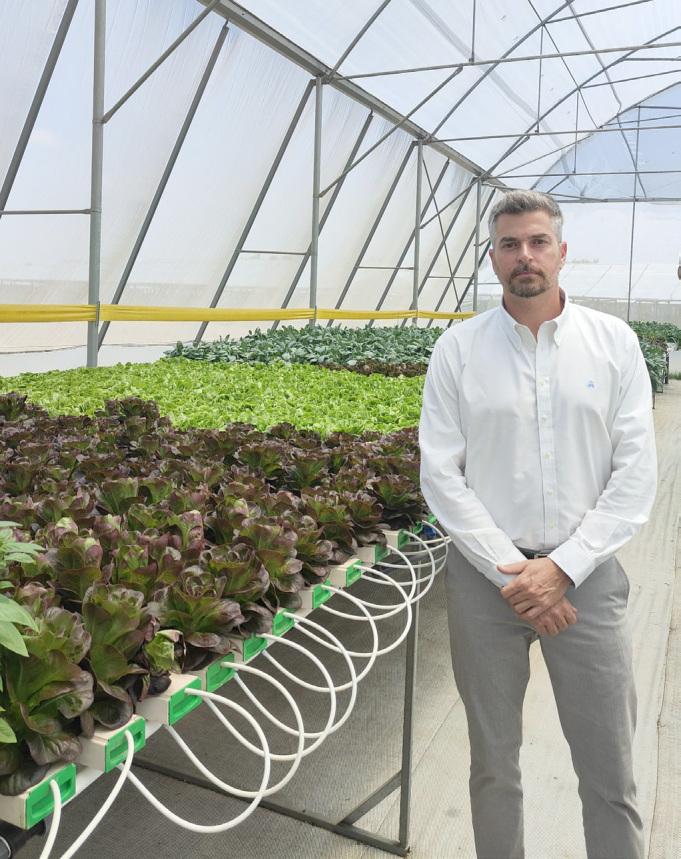
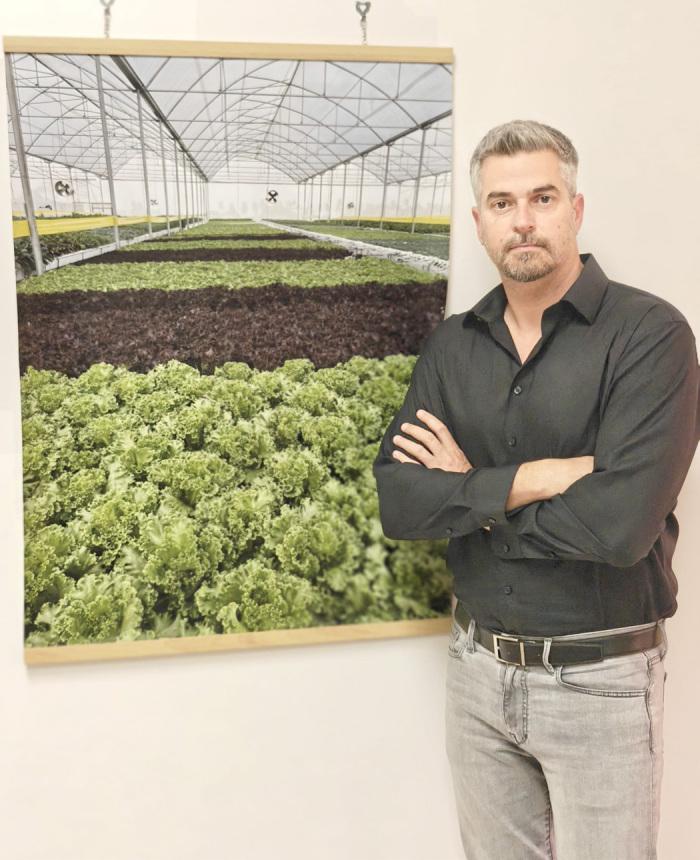
MATAN Koren, Chief Executive Officer of Seal Group of Companies, an investment holding company focused on developing, financing, and constructing large-scale projects in highgrowth economies, believes that Guyana is poised to adopt innovation and AI in farming to boost productivity and reduce time loss.
He is notably leading a $15 million+ hydroponics project in Guyana in partnership with KARLICO Inc. and the LR Group.
During an exclusive interview with the Pepperpot Magazine recently, Koren said AI in farming, in more practical terms, means using data analytics, machine learning, satellite imagery, IoT sensors and drones to make precise, real-time decisions.
Koren added that instead of relying solely on histor-
ical knowledge or manual inspection, farmers now use predictive models to optimise irrigation, detect pests early, manage fertilisers efficiently and forecast yields.
He noted that drones are playing a role in this transformation, as they are among the most visible AI tools in agriculture. Equipped with multispectral and thermal cameras, they collect high-resolution imagery that allows farmers to detect crop stress before it is visible to the human eye, identify pest infestations in early stages, monitor irrigation efficiently and perform precision spraying only where needed.
Koren said that in countries like Brazil and Argentina, drones are widely used in large-scale soybean, corn, and wheat operations. Meanwhile, in Mexico, drone adoption is increasing in avocado, berry and sugarcane production.

He stated that this kind of innovative technology is no longer accessible only to large agricultural corporations, as its accessibility has improved significantly, and in some Latin American countries, both small and medium farmers are increasingly accessing AI tools through cooperatives, government-backed innovation programmes, and subscription-based platforms.
Koren noted that lowcost drone services are also emerging, in which farmers TURN TO PAGE VI

Guyanese poet and author reflects on taking the leap into the arts and building a career rooted in passion, purpose, and identity
By Shaniya Harding
FOR many creatives, both locally and internationally, a career in the arts is intimidating. While a number of hurdles exist for artists worldwide, Guyanese poet and author Carlene Gill-Kerr has made the bold choice to become a full-time creative. Growing up in the heart of Georgetown, she found solace in books and stories, escaping the noise of everyday life into worlds crafted by words.
What started as a shy girl’s self-therapy through writing has evolved into a full-fledged career in poetry and creative arts, one that tackles social issues, celebrates Guyanese identity, and uplifts anyone who engages with her work. Today, she stands not just as a poet, but as an inspiration to a new generation of creatives to choose creativity.
Born and raised in the heart of Georgetown on Regent Street, Gill-Kerr was shaped by the capital city’s vibrancy and found her pas-
sion for creative writing through her family. As the third child in her family, she turned to books at an early age. “I have six sisters, two brothers. I am the third child, so I was kind of in the middle. That is probably why I started writing, because the big ones are too big, and the little ones are too annoying.”
While writing was initially an escape for her, it soon became a way of having her voice heard. “I started reading very early. Whenever my cousin got paid, I would always get books because she bought them for me. I started reading stories and poetry from a very young age and just threw myself into books. I loved it. I just totally loved it,” she said. For a young, shy Gill-Kerr, writing was a form of self-expression.
Like so many Guyanese creatives after completing high school, Gill-Kerr was told that a career in the arts was not realistic, and although she was interested in psychology, that field was also difficult to enter at the time. Gill-Kerr turned

to the next field she had an interest in that was accessible—computer science—a field she worked in for more than twenty years. However, her creative flair never died, as Gill-Kerr continued writing and performing poetry alongside her job as a computer technician. As GillKerr explained, she jumped at every opportunity to express her creativity through continuous writing and performing. “Whenever there was a talent show or anything along those lines, I’m there and present.” Her staff and friends at work noticed her talent, as well as the vibrancy her performances brought, as she added, “My staff would say, ‘You realise whenever you do this stuff, you come alive?’ Because that is when I am doing what I really love.”
While she had balanced her creative flair alongside her career for more than two decades, several years ago Gill-Kerr decided it was time to change. A mother of two, she explained that while she pushed her children to pursue their dreams and passions, she found herself taking her own advice. “My eldest daughter hit her teens. I kept telling her, ‘Do what you love. Go after the things you really want. What is it you really want to do?’ And I began to feel like a hypocrite.”
Through a five-year plan and commitment, Gill-Kerr was able to resign three years ago to pursue the creative arts full-time. As she added, “Here I was just doing my creative stuff on the side. At that time, work got stressful, so I said, ‘I’m going to pursue what I love to do.’ It took about three years to make the shift.”
The shift was not random, however, as Gill-Kerr pursued a diploma in creative writing and graduated as the best student in her class. This gave her not just the qualifications but the confidence to pursue her passion.
This passion and confidence have pushed Gill-Kerr to publish three books in recent years. Among the earlier books were Waves of Emotion and Guyanese Waves, both collections of poems. Waves of Emotion in particular garnered GillKerr attention; the book’s gripping poems on raw emotions were seen as inspirational by many. Speaking on the book, Gill-Kerr shared that, “This one here, ‘Waves of Emotion,’ goes through life and our emotions in all kinds of waves. I started doing a lot more inspirational, motivational stuff and realised I didn’t have them compiled, so I sat down and

compiled them.” While successful, Gill-Kerr said the book served as a learning experience, and she drew on that knowledge in her most recent book.
Gill-Kerr’s book, Hey You I’m Enough, speaks to many of the same themes she has explored throughout her career, with the signature intensity she is known for.
Published in September of last year, the book is a collection of uplifting poems written by Gill-Kerr as she navigated her own life challenges and changes. “‘Hey, I’m enough.’ is about the fact that life may hit me from all angles, but asking yourself, what’s the strength I have within me? There are poems that say, ‘I am enough.’ There are those about the cost of giving too much of yourself, understanding that destiny
lies within you.” The book also has a number of other inspiring pieces, as she added, “Then there are pieces on Guyana, culture, and my journey with Jesus—the doubts, fears, and wondering if I should keep going or what to do.”
Today, Gill-Kerr continues to perform, and her books continue to reach new readers. While daunting at first, she says she is happy with her choice to pursue the arts. She shared that although there were a number of hurdles and misconceptions, she continued to put her best foot forward; that, she said, is what has made her choice a success and what she hopes other young creatives take note of. “Make sure you do your best. Believe in yourself. Gather opinions from others. In the TURN TO PAGE IV
By Shaniya Harding
FOR decades, Linda Griffith has been a pillar of dance development in Guyana, shaping generations of performers through the Guyana National School of Dance (GNSD). From a time when formal training was limited to today’s growing network of trained dancers, choreographers, and companies, she has witnessed— and helped drive—the art form’s transformation.
Now, as she looks towards eventually stepping back, Griffith, in an interview with the Pepperpot Magazine, is reflecting on the progress made, the gaps that remain, and the cultural legacy she hopes to leave behind.
Griffith has seen the evolution of dance in Guyana more than perhaps anyone else. Beginning her career in dance more than four decades ago, she has shaped the careers of thousands of Guyanese dancers. In those years, she says dance in Guyana has changed, with the biggest shift being the improvement of the art form at a national level. This, Griffith added, is due to growth; with more dance companies and schools, the art form has matured and developed in recent years. “We have improved as a country where dance is concerned. This is
due to the fact that there are more dance groups now, there are more dance companies, and the people who are heading them, the majority of them have passed through the National School of Dance.” She added that dancers have also gained more from the art form, with a number of them venturing abroad to represent Guyana. “We have moved from not having established dance schools or dance companies in 1972 to having a lot of groups and companies where people have been trained as dancers and choreographers,” Griffith added.
Growth in the art form has also been present at the institutional level. As Griffith explained, the National School of Dance is now a part of the Institute of Creative Arts. This move, while seemingly small, is important to building the capacity of dance teachers and students. It has bolstered what the school can teach and what its students can accomplish.
As Griffith shared, graduating students are now better equipped than ever before. “These are certificates in dance, in technique. They study choreography, methodology, and fundamentals of dance. They are equipped when they finish these programmes to go out and establish their own schools and companies.”
She added, “There are also people
who graduate as students from the school and are in the educational system, where they teach and send children up for competitions, and you see them doing very well.”
Dance in Guyana has also changed, says Griffith. As she explained, the art form has evolved and is now seeing a rise in more contemporary dance forms. While a new addition to the landscape, Griffith says she would like to see more traditional dances return. “More contemporary forms are emerging because we’re following a lot of what is happening on the outside. But for me, we prefer people to study more of our culture, because it’s unique.”
As she added, Guyana’s rich culture has crafted unique dance styles that should be performed and preserved. “People need to take time; choreographers and teachers need to study and research our cultures and our dances. Then we can create and have our own style, our own form of Guyanese dance, but it takes time to develop that. Also performing on a regular basis, touring, and showcasing what Guyana has as our dance culture.” These steps, she added, would be impactful in developing Guyana’s signature style of dance.
While the exact time and date are yet to be decided, Griffith says


she hopes to retire in the near future. After more than thirty-five years at the helm of the Guyana National School of Dance, she says she will hand over the mantle sometime soon, knowing that the art form will be in good, talented hands.
“I plan to retire soon because there are people who can carry on. We can’t carry on forever. You have to, at some time, let go and give them a chance to develop as you have developed over the years.”
Looking at the art form, she added that there are countless Guyanese dancers, many of them her own students, who will ensure its continued growth.
Although she has undoubtedly been a pioneer of dance in Guyana, choreographing numerous captivating performances, Griffith says her proudest moments come from seeing the success of her committed students. “My proudest moments are to see persons who are now in the National Dance Company come into the school as four-yearolds, and they pass through our instructors at the various levels, and they are now in the National Dance Company. They are instructors, they are choreographers—I am very
process leading up to making the decision to go full-time, maybe you need more honing of your skills, more understanding of the craft, and awareness of the opportunities,” she added. “Figure out where you see yourself fitting in, then go after it. It’s definitely a possibility.”
Gill-Kerr is as inspiring as her work. The journey of a professional and mother of two, leaving her
proud of that.” She further added that helping someone move from not believing they have the potential to dance to becoming a skilled dancer has also been profoundly fulfilling.
As she transitions into retirement, Griffith says she will continue to advocate and work to develop cultural dances, and hopes this, too, is part of her legacy. Highlighting her passion for masquerades and the preservation of that art form, she added, “One of the things that I have worked a lot on is masquerading, trying to revive masquerades. One of the things I want to do when I retire is continue writing books on masquerade—how it is done, the history of masquerade, the costumes, the dance, the images. That is something I really want to leave behind.”
As Guyana’s dance landscape continues to evolve, Griffith’s reflections serve as both a record of progress and a call to action. With a generation of trained dancers, educators, and choreographers now carrying the work forward, she remains confident that the foundation built over decades will continue to grow.
FROM PAGE III
20-year career to pursue a career in creative writing, is truly unique. It shows, however, that it is possible to follow a passion successfully at any point in life, at any age. Gill-Kerr’s most recent work, Hey You, I’m Enough, is available on Amazon, at local bookstores, or through Gill-Kerr herself at 684-4080 for a signed copy.
By Michel Outridge
IF anyone had told Marcia Kwang that she would become an agro-processor later in her adult life, she would have thought nothing of it, but fate had other plans.
From nothing, just with in-bred memories of how her grandmother used to make cassava bread and cassava cassareep, as a child growing up, she used to watch but never had the opportunity to try on her own. Yet that vision stayed with her, causing her to practise until she perfected the task.
Kwang, originally from Kwebanna, Region One (Barima-Waini), said she left that community as a baby and has not lived there since. Her single mother, who had five other children, relocated to another far-flung village and later to the Pomeroon in search of work and a better life for herself and her children. The 53-year-old, who was recently featured as the Agro-Processor of the Week on Big Market, an online portal, operates a thriving small business from her home, producing nine authentic products from locally grown cassava.

Kwang, who by then was accustomed to fending for herself and her two children.

Even when the odds were against her, a lot of challenges had to be resolved. Eleven years ago, Kwang had to start from scratch when her sister abandoned the venture.
She picked up the pieces after three months, when the joint venture of making cassava bread and cassava cassareep became her sole responsibility.
That hurdle did not faze
It was then that it dawned on her that she wanted to be a stay-at-home mother to her two children, specifically to allow them to benefit from the secondary education she never had, so she worked towards building a business from the bottom up.
Kwang is the CEO and farmer behind Marcia Products. Since 2014, she has been turning locally grown

cassava into nine authentic Indigenous Guyanese products—including cassareep, cassava bread in garlic, onion, and original flavours, quinches, tapioca, farine, cassava starch, and coconut oil.
She told Pepperpot Magazine that, at age 14, she had the opportunity to attend secondary school when she relocated to the city with her mother, who had a job.
Kwang said she eventually learned to read and write, something she never had
done before, because of their situation. She had to work on the farm to support her mother who was providing for six children as a single parent.
She explained that she learnt responsibility at an early age. Their father never contributed to their upbringing, and she met him only when she was grown. He has other children from different unions, and she has only met two of her siblings.
Kwang stated that she was determined to make something of her life because she wanted her children to have a good foundation—education—so they would have the opportunity to choose their careers.
The agro-processor related that she did not let herself down. She began elevating herself by pursuing higher education, became a nursing assistant at a private hospital for five years, and later became a qualified teacher.
Kwang is a true testament to resilience, hope, courage and faith. Even when things were falling apart, she never gave up and always bore a positive attitude, which was noteworthy.
Today, after years of hard work, she is a recognised TURN TO PAGE XV

hire certified operators instead of purchasing the equipment themselves, thereby lowering the barrier to entry.
He reported that AI and drone solutions are highly customisable, and that AI systems can be trained according to crop type, soil composition, altitude, and climate conditions.
Koren explained that AI tools are adapted for high-altitude crops and export-oriented fruit production, and banana producers are using drone monitoring to optimise disease detection in humid tropical conditions, while large-scale grain producers
rely on predictive analytics for climate risk management. He stated that customisation ensures the technology aligns with local agronomic realities rather than applying a generic global model.
Koren told Pepperpot Magazine that farmers are seeing measurable impacts, including substantial yield increases of 10 to 25%, water savings of up to 30% through AI-driven irrigation, reductions in agrochemical use of 15 to 35% via precision-spraying drones, and lower crop loss due to early pest and disease detection. He pointed out that the adoption of drones and AI
will not threaten agricultural jobs because, rather than eliminating jobs, the technology is transforming them. Drone pilots, data analysts, agronomic consultants and technology technicians are becoming essential roles.
Koren said the agricultural workforce is shifting from purely manual labour towards higher-skilled, technology-oriented positions.
Delving into the main barriers to wider adoption in Latin America and CARICOM, he emphasised that the main challenges include rural connectivity limitations—though, in many cases, Starlink is offering solu-

tions—financing constraints for small producers, and the need for digital literacy and training.
However, governments and private investors across these regions are increasingly supporting agtech ecosystems and innovation hubs.
Koren added that the future for AI-driven agriculture in the region points towards integrated smart farming ecosystems. Drones, autonomous machinery, soil sensors, predictive weather modelling and AI analytics will operate as a unified system.
He noted that this strengthens Latin America’s role as a global food supplier. For CARICOM nations, it enhances resilience, sustainability and food sovereignty.
In both cases, AI is no longer experimental—it is
becoming structural infrastructure for modern agriculture.
“AI and drones contribute to climate resilience due to climate volatility—including droughts, floods, and irregular rainfall—which is one of the region’s biggest agricultural challenges.
AI models are being used to forecast soil moisture levels and optimise planting windows. Drone-based imaging identifies early water stress, enabling corrective irrigation before yield losses escalate.
By enabling proactive management rather than reactive intervention, AI strengthens climate resilience and reduces catastrophic losses,” he said.
Koren stated that looking ahead, the next phase of AI and drone innovation
in farming will be integration and autonomy. Instead of isolated tools, they will see fully synchronised ecosystems where drones scan fields automatically, AI platforms generate prescriptions instantly, autonomous machinery executes precise interventions, and real-time dashboards continuously monitor performance.
He noted that Latin America—particularly Brazil, Argentina and Mexico—is positioned to lead this evolution due to scale, export orientation and growing agtech ecosystems.
Koren said the transformation underway is structural, not incremental. AI and drone technology are refining agricultural productivity, sustainability and competitiveness for the region’s future.



MARKETING can determine whether a company sinks or swims. Here, Geary Reid helps businesses navigate the turbulence of the current marketing landscape.
Today’s market is complex. Consumers and cultures continually turn the tide of trends. To keep up, companies need to be willing to adapt their marketing strategies, forecasting into the future to stay one step ahead. However, the competition among businesses trying to attract certain demographics can seem stiff and intimidating.
In this book, Reid offers essential tips that will give your company a competitive edge. With the right research, planning, customer care, and reputation-building, your business can reach your target audience and keep them coming back for more.
The organisation that wants to grow through marketing must first understand its role within the customer environment in which it seeks to operate, then differentiate itself from competitors while protecting itself from new entrants who may capitalise on any weaknesses in its marketing plan. Some organisations may have an easier path towards success, while others may have many challenges.
In life, there will always be challenges, but those who prepare for them might be able to weather the storm and become victorious. Too many organisations are struggling and have thrown their hands up and disappeared. That action will allow an organisation to receive sympathy from those who care, but others may be happy for their demise, since it gives them
the opportunity to take their place.
Such a plan must also include a forecast to measure progress and growth throughout its journey.
Many organisations will face competition, some from known sources and others from locations and organisations they are not aware of. When an organisation establishes a marketing plan and works towards that plan, it has decided to be strategic in its operations. The marketing plan must be monitored over time. What may be planned for years may not remain the same; the marketing plan must be reviewed and modified as needs arise.
A marketing plan requires much work from senior officers within the organisation, and if they work as a team towards the organisation’s growth, they may rejoice in the success the organisation achieves. Planning is never easy, but it provides some stability for a specific target. The marketing plan will enable the organisation to work towards its mission, and, if effective, many stakeholders will be satisfied with the outcome.
An organisation that wants to know about customer behaviour must be willing to conduct the necessary research. The research objectives must be clearly established so that the researcher can conduct the study and identify appropriate information related to them. Marketing research will provide evidence of what the organisation needs to know about the market, the product, and customers. Some years ago, organisations could easily predict the market, but that has changed significantly,
so they now need to conduct research rather than guess.
Forecasting
Once the organisation has its marketing plan and has conducted its research, it can forecast its products, markets, and promotions based on the information received. An organisation will not have increased sales by doing the same thing and expecting a better result. The organisation will need to plan and find ways to reach out to customers. The forecast the organisation prepares must be measured against actual results. There will be a need to amend the forecast, especially if the market is changing.
Some aspects of business can be conducted over the phone or on a computer. However, most formal businesses will require a place to operate from. A location provides many benefits to an organisation. Some organisations are looking for more places to operate from. Some organisations have outgrown their original location and are engaging individuals to use part of their space.
Some businesses require a lot of space, while others do not. A computer repair technician who visits clients’ locations will not need much space. An organisation that provides janitorial services to households may not need much space, since it visits clients’ locations to conduct its business.
A Place to Manufacture Products
Organisations that manufacture products may need a lot of space to produce them. Organisations involved in agriculture may also require significant space.
Some of the space that an organisation needs to man-
ufacture its product can be leased. The organisation that wants to lease a place may have a contract for either an operating or a finance lease. Both types of leases have their advantages and disadvantages, and the organisation must choose the one that provides the greatest benefits.
A Place to Store Products
Not everything an organisation manufactures will be sold immediately. If an organisation produces a certain amount of a product but the market cannot consume it all at once, the organisation
must find a place to store the excess. An organisation must also have sufficient space to store its raw materials to avoid stockouts. Organisations might be able to secure discounts on largescale purchases, but they may not be able to use all that they purchase.
A Place to Sell Products
When the product is produced, the organisation will need a place to sell it. This can include their stores, supermarkets, etc. Not all products will be sold immediately, but the longer the
organisation keeps them, the more they may be subject to pilfering, ageing, corrosion, etc.
A prime place to sell products can be an opportunity to meet the demand of many customers. If the location is ideal, the organisation may not have to incur many promotional costs. A location can create wonders for an organisation if it is near high-traffic areas.
Section C: Product and Its Impact on Marketing Customers always desire TURN TO PAGE XVI


CLIMATE change is currently being addressed as a security threat by many nation-states worldwide.
I was attending a lecture on climate change and its consequences when my professor drew parallels between himself and the younger students (us)
He showed us an illustration that made me realise how important it is for young people to have continuous contributions, conversations and participation in climate talks. The picture shows that those at the end of life expectancy in 2020 will experience significantly lower temperatures worldwide.
It then compares temperature increases over the next 100 years. Those aged 70 in 2050 and 2090 might experience a hotter climate, with temperatures up to 4 degrees warmer than the current climate.
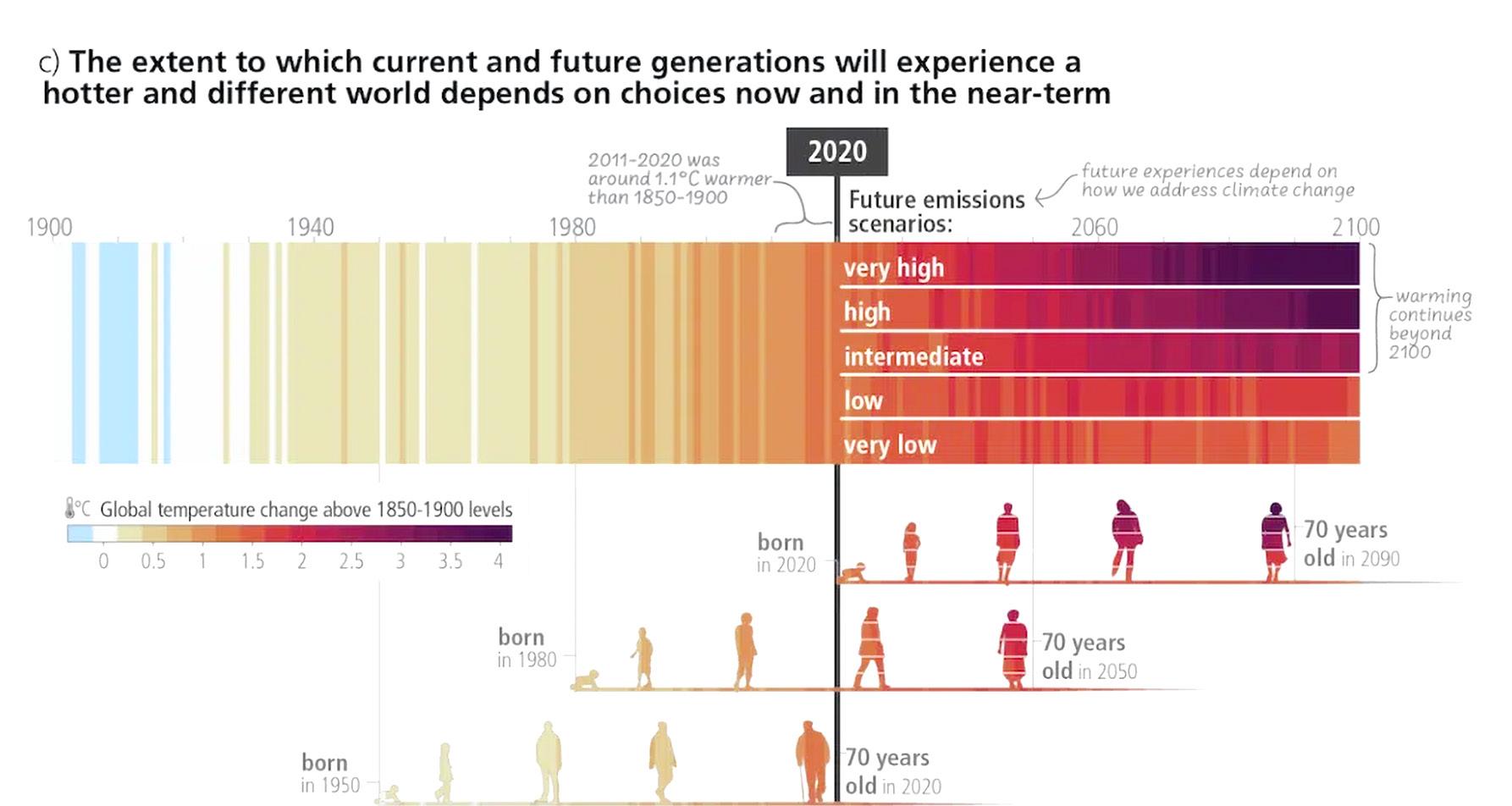

My professor reminded us of life expectancy and that the current older generation will not be here to experience life on a hotter planet. As such, he encourages us all to be active participants in climate justice and action because we will be the unfortunate ones to face the brunt of the consequences.
The impacts are no longer something we pass by in a text, because we can feel their effects more and more every day. It is important to note that historical data and research prove that Earth’s climate has naturally changed over time. However, since the Industrial Revolution in the 19th century, many of the changes have resulted from human activities.
As more advocacy is done, more young people are becoming aware of what
their future might look like amid the devastating effects of climate change.
As such, many young people might also be faced with increased risks of experiencing climate anxiety. This overwhelming stress can lead to a decline in mental health among young people. There is also uncertainty about economic stability. Climate change can reduce job opportunities in agriculture, tourism, and other sectors.
While these realities currently exist, we are also taking matters into our own hands. Many believe that it is unfair that this burden was imposed upon us to “make amends” for what generations before us did. Nonetheless, young people are now adopting climate-friendly lifestyle changes.
We are reducing our
waste and supporting sustainable policies and development. More young people are also becoming environmental and climate academics, students, professionals and scientists.
Climate change is a defining issue for young people. While we face serious risks, youth are also driving global awareness, activism, and solutions for a more sustainable future.
We are bringing new ideas and solutions to solve an issue that will mainly affect us in the years to come.
Young people will experience the long-term impacts of climate change more than older generations. Rising temperatures, extreme weather, food insecurity, and water shortages will shape our futures—our voices must be heard.


THERE are certain choices we make during our lives that can determine our entire trajectory. Making choices like those can be a rather intimidating process. Fortunately, our growth often helps us make these choices to the best of our abilities. We all gain values during our unique processes of growth that act as a compass to guide us as we make important decisions.
This is why, when we do make a mistake, it can be quite difficult to move on from it in a healthy way. When our choices fail us, it is not only that we have made a mistake that affects us, but also that the values which have guided us throughout our lives have suddenly failed to prove as dependable as they may have initially seemed. In those critical moments when we make mistakes, we not only face the consequences but also the feeling of losing trust in ourselves.
This is a rather difficult obstacle to overcome. As we progress through our lives, we conquer many obstacles by reaching deep within ourselves to find the strength and resilience to fight our battles. What happens, then, when we discover that the obstacle itself lies within us too? What if we realise that there is no enemy for us to fight apart from the very person we see in the mirror?
If there were a simple answer to this question, our world would surely be an easier place to navigate. However, as we discover time and again, the only way to win a battle with ourselves is to allow ourselves to lose.
In the examination of the quality of the choices that we make, we may classify “poor choices” as ones
which do not lead to the outcome that we desire.
Perhaps, by expanding our definition of poor choices, we may see the real reason why some of them produce feelings of regret and remorse within us. Poor choices are not choices which lead to an undesired outcome.
Strangely enough, sometimes the right choices are the ones that do not produce the result we hope to achieve. Poor choices are decisions that push us down a path where we must think and act in ways that do not represent our values or identities.
So, when we truly come to terms with the reality of a “poor choice”, we will also understand that it is not our undependable values that produced such a decision, but our unwillingness to stand by our values—what we have known is right for all our lives—in pursuit of a goal that sometimes arises no more than a few seconds before we desire to attain it. When we come to this realisation, it can feel like we have lost our sense of direction.
Of course, as human beings, we all have a few moments of weakness where we lose sight of our own values. In those moments, we must seek an anchor to
keep us grounded while we learn to find our path again.
In cases where individuals are caught in an avalanche and buried in snow, many factors keep them trapped. One of the most distressing aspects is that even if the individual were to survive the impact somehow and gather the strength to try to dig themselves out, they would not know which direction to dig because they are completely covered in snow. If they happen to be facing the ground, their attempts to rescue themselves may simply lead to them becoming buried deeper. In many cases, they cannot survive without the help of others.
Sometimes, when we are buried by our own thoughts and actions—for example, after we have made a poor decision—we are afraid to try and rescue ourselves. When we try to do so, there is a tangible chance that we may be leading ourselves in the wrong direction. This is why we need to establish an anchor to steady us. We must be willing to allow ourselves to establish a support system of friends or loved ones with whom we can be vulnerable.
Although we may occasionally forget it, life is not a journey that is meant to be taken alone.



HOW do we lead by example if the mere act of engagement is based on deception? There seems to be a force integrated into our nature that exports the elements of deception while we postulate falsehoods with the intent to mislead and envelop. Even the most powerful nations fail to look back at our past.
I insist the distant past, onward, and the endeavours of trickery, despite success on the
field of conflict, and the application of false ideals and conduct, lead to resistance against imagery and philosophies that are eventually unmasked—either to have no merit, or realised to be one’s own, disguised, or mockery with intent to be the ‘WILL’ and riddle of the ‘Trickster’s deception’.
With the past 60 years of human ideas and ideals that have led to so much misery, some conversations should be
changed, and more transparent ideas should be debated.
The tragedy is that such falsehoods have become domesticated, in one of the worst places—‘THE HOME’. We cannot deny that the very home, whether young or mature, is embroiled in solving problems not through engagement between themselves, but before the throne of the Grim Reaper’s shadow.
Our world is again embroiled by sectionalised power bases
that, like the imposing teacher— though endowed with a fearsome posture and imposing literature—have no logical summary. Thus, the shortcomings cannot be interpreted to define balance and closure.
We are, for reasons of our own, rooted in that realm of constant imbalance, and whether we understand it or not, the common worker’s home is the balancing gatekeeper of society. Not the highwayman’s palace—what is
there is understood, though it does not inspire; it is aware of. Too many in-house conflicts come quickly but leave with harsh consequences.
Most of the time, the innocent occupants suffer, and amid the workers’ squabbles comes the predator.
Amidst it all, it is our predicament too. It is time to stop concealing those who work with such issues; filled reports cannot help.

THE Environmental Protection Agency (EPA) has reinforced its mission to restore Guyana to a litter-free state by establishing its newly formed Litter Enforcement Unit. This dedicated team is tasked with addressing littering and illegal dumping through active patrols across towns and communities nationwide.
Enforcement in Georgetown and Surrounding Areas
merara, focusing on hotspots where illegal dumping is most prevalent. In collaboration with Neighbourhood Democratic Councils (NDCs), the Unit also successfully addressed several litter-related issues, with follow-up visits planned to ensure sustained compliance.
to create lasting behavioural change.
Armed with the Litter Enforcement Regulations (2013), the Unit has intensified its presence in Central Georgetown, issuing six clean-up orders to individuals found in breach of the law. Patrols targeted Main Street, Camp Street, and Alberttown, while additional enforcement drives extended into Charlestown, Albouystown, and West Ruimveldt. Similar exercises were carried out along the East Coast and East Bank of De-
Beyond enforcement, the EPA’s Litter Prevention Strategy emphasises a long-term, concentrated approach. The Agency is working closely with residents to foster mindset-changing initiatives that encourage both personal and collective responsibility. These efforts include building public-private partnerships with schools, businesses, and environmental clubs to ensure that litter prevention becomes a shared national effort. By assessing on-the-ground conditions and implementing measures beyond clean-ups, the EPA aims
While these initiatives mark important first steps towards cleaner communities and coastlines, the EPA has pledged to expand the strategy across all regions of Guyana. Citizens are urged not only to speak out against littering but to take action— by reporting illegal dumping and actively participating in efforts to build a cleaner, healthier, and litter-free Guyana.

You can share your ideas and questions by sending letters to: “Our Earth, Our Environment”, C/O Communications Department, Environmental Protection Agency, Ganges Street, Sophia, GEORGETOWN, or email us at: communications@epaguyana.org. Follow us on Facebook and Instagram and subscribe to our YouTube channel.



HE sat at the back of the bus, huddled against the window, wearing a dark, long-sleeved, hooded jersey, the hood partially covering his face. His heart was bleeding, but he did not cry.
“I will not cry,” he said to himself, “I have to stay strong to survive.”
At sixteen, he was pushed into the world by his cruel father, someone who could have understood why he was born different, who could have stood by him to be his support and strength. Instead, he faced hate and abuse, which were like physical scars on Vickash’s mind.
He took a deep breath and promised himself, “I will not die, I will survive to be my own person, and the regrets, father, will be yours.”
He disembarked at the village where the old lady lived and walked down the street past small houses with designs from long ago, yards

with fruit trees, vegetable gardens, and livestock. It was quite like a lost little place, and Vickash said to himself, “I like this, at least I will get some privacy.”
The old lady, Aunty Bethany, was expecting him, and she greeted him with a cheerful little laugh.
“You resemble your
he did all of her work.
In the evening, he sat at a small table by the window to do his fashion design sketches, but his heart wasn’t in it because of his heartache and missing home.
That weekend, he went with Aunt Bethany to the market at Parika, and Vickash looked around, awed by the
CSEC examination results. He did great, obtaining ten passes of grades A and B, but he did not feel elated.
“It’s like happiness is not meant for me,” he lamented.
“You can come back home,” his mother suggested, “Get a job and rent an apartment.”
“I know,” Vickash ac -

mother,” she stated, a little twinkle in her soft brown eyes, “She is such a nice and kind person.”
“Yes, I know,” Vickash said with a little smile.
“Just make yourself at home,” she said to him, “There’s food in the kitchen, and I prepared a room for you.”
“Thank you,” he said, and that night, lying in bed in a strange house, far away from home, he whispered, “It feels fine here, but how long do I stay? Where do I go from here?”
He didn’t sleep well that night, and the next morning, after a healthy breakfast, he helped Aunt Bethany with the garden. He noticed many things that needed to be done, given she lived alone and hadn’t much help, so to occupy his time and earn his keep,
bustling marketplace with its bountiful fruits and vegetables, the attractive clothing stalls, and food outlets with delicious-looking food. He carried her bags and basket as she wove her way carefully through the shoppers.
At home, he helped her unpack everything she had bought and prepared the chicken she needed to cook for lunch. It was curry chicken and dhal puri, and Vickash quite enjoyed the tasty, spicy meal that brought tears to his eyes, as he remembered his mother cooking the same curry.
“Don’t worry, son,” Aunt Bethany comforted him, “You were born on this earth for a reason, with a purpose to serve, so don’t let anyone tell you otherwise.”
A few months went by, by which time he received his
cepted, “It’s a good idea, but I don’t want to come back home just yet.”
He had told himself he would go back home when he was older, stronger, and more confident. He was comfortable and safe at Aunt Bethany’s, but fate took that away when the old lady’s son returned home. He was not a nice person, spoke to his mother with an edge of roughness in his voice, and looked at Vickash with disdain, calling him a ‘sissy’.
He was like a rolling stone without a family, drinking and gambling, and he only visited his mother when he was broke and wanted money. The old lady was not pleased to have him there, but she didn’t have the heart to tell him he couldn’t stay.
“I have been hoping TURN TO PAGE XVII

FRESHWATER is the debut novel of the prolific Nigerian writer Akwaeke Emezi, who since 2018 has published close to 10 books, including the widely acclaimed New York Times
bestselling The Death of Vivek Oji and the National Book Award–nominated Young Adult (YA) novel,
Pet. Like her compatriot Helen Oyeyemi—author of Mr Fox and White Is for Witching—Emezi often draws from the deep well of African myth, lending her work a resonant, fable-like strangeness: mysterious, unsettling, and eerily knowing.
“Magical realism” is an
inadequate term for the atmosphere Emezi creates. What animates Freshwater is closer to a myth-inflected horror, magnified through the interior psychosis of its protagonist. In this novel, that quality manifests as schizophrenia—a splitting of the self into several haunting figures that operate beyond the

heroine’s conscious control. Emezi’s use of myth and folklore differs significantly from that of Amos Tutuola in The Palm-Wine
Drinkard and My Life in the Bush of Ghosts, where spirits and creatures exist as external forces, independent of the protagonist’s mind.
In Freshwater, by contrast, these entities are tethered to the psychology of the central character, seeming to arise
TURN TO PAGE XX


EDWARD Aloysius Murphy Jr was an American aerospace engineer who worked on rocket-sledge experiments with the United States Air Force in 1949.
During a test in which sensors were installed incorrectly, he reportedly re -

marked that if there were any way to do a job wrong, someone would do it.
That practical engineering observation evolved into what we now call Murphy’s Law, and so in today’s Verse and Vows feature, we will explore the implications of this law in our everyday lives.
Murphy has enjoyed a long career in other people’s blame. He receives credit for burnt dinners, late buses, suspicious text messages, and vanishing Tupperware lids. People speak about him as he lives in the attic, waiting for confidence before making his move.
Murphy’s Law says that whatever can go wrong will go wrong. The upgraded version says that if you fear something will happen, odds are it will. The relevance of this second version is that it makes people uncomfortable by introducing participation.
Most adults stroll through life as if they are auditioning for a disaster reality show. A friend replies with “k”, and suddenly they are scripting a whole break-up saga in their head.
The boss says, “See me later,” and the mind starts to design a dramatic exit scene, complete with slow-motion door slams. The body reacts as though it just ran a marathon through a hurricane—heart racing, energy spiking—and if you actually pay attention, life seems to follow the cue, because apparently the universe loves a bit of theatrical tension.
Psychologists have given this pattern a name. Confirmation bias drives the brain to search for evidence that supports existing beliefs. If you expect betrayal, you will find suspicious details. If you expect failure, you will notice obstacles with relentless regularity. The brain loves to prove itself correct.
William James noticed this habitual pattern way back when people still overreacted
without the help of the tiny glowing rectangles we carry around all day long.
He explained that human beings can alter their lives by altering their attitudes of mind. Attitude shapes interpretation, interpretation shapes behaviour, and behaviour shapes outcome. The chain runs smoothly without asking permission, and the most interesting thing is that both physics and spirituality agree. Watching something closely literally nudges reality to behave differently, as if it is showing off just for you.
Werner Heisenberg, the German theoretical physicist and philosopher, demonstrated that the act of observing influences what is being measured. The observer participates in the outcome; attention interacts with matter.
You do not need a laboratory to see this principle at work. You see it in conversations, relationships, business meetings, and family gatherings. The energy you carry into a room influences how the room responds. The expectation you hold quietly guides your posture, your tone, and your decisions.
Spiritual teachers have been saying the same thing without equations. Where attention goes, energy flows, and where energy gathers, experience grows. Universal law operates with perfect neutrality, never checking character references or moral records, responding purely to where focus lands. It multiplies what is repeated and amplifies sustained emotional energy. Gravity pulls both the saint and the sinner with identical dedication, just like a flame that warms both with equal enthusiasm. Energy reflects attention with the same consistency.
Ralph Waldo Emerson said that a person becomes what he thinks about all day long. That line feels poetic until you watch it unfold in real time. A person who con-
stantly anticipates rejection begins to behave guardedly. Guarded behaviour creates distance, and distance invites misunderstanding. The feared rejection eventually appears, and the person calls it fate. Meanwhile, someone else expects growth. That person speaks openly, tries again, adjusts, learns, and builds momentum. The outcomes differ, yet the law behind them remains the same.
Henry Ford summarised it bluntly when he said that whether you believe you can or believe you cannot, you are correct. Belief influences effort, and effort influences results.
Murphy starts looking less like a villain and more like feedback. This perspective does not hand human beings control over traffic or rainfall, but it does hand them authority over focus. It invites awareness about what receives mental rehearsal. Even the Buddha taught that the mind shapes experience and that repeated thoughts form the structure of reality. Repetition creates patterns, patterns influence choice, and choice builds identity, while identity shapes future experience.
The cycle runs non-stop, silently and efficiently, and here is the part that makes adults shift in their seats: universal law does not care whether attention comes wrapped in fear or faith. It responds to attention itself. Worry carries energy, gratitude carries energy, resentment carries energy, and confidence carries energy— everything carries energy. The law amplifies whichever one dominates.
So now we see that Murphy’s Law is less about bad luck and more about focused effort. Life will still include burnt toast and printers that sense urgency and decide to rebel. Spiritual awareness does not protect garlic bread TURN TO PAGE XVI
agro-processor whose products speak for themselves because of the quality and standards that go into their production—well thought out, just like homemade.
Kwang has a registered small business.
She is also certified and licensed with the relevant authorities, making the products authentic and wholesome, free of additives and preservatives, and also gluten-free.
She has participated in several local and overseas expositions to showcase locally made Guyanese products and has also had the opportunity
to form connections to market her products, which she supplies to 12 local supermarkets.
“Having my own small business, providing part-time work for two others, has really empowered me as a woman, an agro-processor and a mother, and it goes to show that no matter how small you start, always remain focused to see the project through, it has long-term benefits as an income earner,” she said.
Kwang told Pepperpot
Magazine that starting a small business was not easy, but she made it happen by staying grounded, being a
FROM PAGE V
prayerful woman who always looks for guidance, and she believes that is what kept her motivated.
Of course, she had distractions and a lot of ups and downs, but she worked towards her goal of becoming an agro-processor whose products are retailed in leading supermarkets across the country.
Kwang added that today she is very grateful for the support she received from agencies and the training and loans she accessed, which helped her build a sustainable business.



from impatience. It does, however, change the internal narrative. A person who understands attention begins to notice where energy flows. That awareness alone shifts trajectory.
Below is the poem that captures this lesson in a classroom where Murphy finally receives a proper introduction.
The Fault In Order Murphy Law 101
“Class,” she said, with chalk in hand,
“Let’s speak today of things unplanned. Of missing socks and broken brakes, Of spilt truths and shattered cakes.

There lives a law, not bound by court, Not in the books, nor math you’re taught.
It’s whispered soft when plans fall through;
‘Whatever can go wrong, just might do.’”
A boy up front with crooked sleeves
Said, “That sounds cruel, who still believes
That fate is out to twist the thread,
And break the plans we’ve forged ahead?”
She smiled, and paced, then took a seat,
“Belief is not the kind you greet.
This law’s no god, nor devil’s voice,
It’s just the echo of our choice.
We build with hope, we dream and try,
But winds may shift, and maps may lie.
So Murphy’s Law just
brings to light,
The art of bracing for the night.”
A girl behind with teary eyes
Asked softly, “So, should we not rise?
If all can crumble, what’s the gain
Of chasing sun through certain rain?”
“Ah,” the teacher said, “and now we’re near;
The heart of why we persevere.
It’s not to dodge the fall or flame,
But to rise, still and try again.
Murphy may dance and throw his darts,
But he can’t touch resilient hearts.
So build your dreams, but brace them too; And laugh when plans fall out of view.”
Romella Dasratt
a product or service that meets their needs and wants.
The product sold to the customer yesterday may not be the same one the customer wants tomorrow. Many products have long shelf lives, but customers’ tastes may change, so the organisation has to do everything it can to match customers’ evolving appetites.
Customers do not notify the organisation when their preferences change, but the organisation must be quick enough to realise that the product is not making an impact in the market. It might be surprising that the organisation may make a slight
FROM PAGE VII
change to a product, and many customers will suddenly take a liking to that new product.
If an organisation has to manufacture a product, it must go through several phases to meet customers’ needs and wants.
For more information about Geary Reid and his books, please use the contact information below: Amazon: http://www.amazon.com/author/gearyreid, Website: www.reidnlearn. com, Facebook: Reid n Learn, Email: info@reidnlearn.com, Mobile #: 592645-2240.

FROM PAGE XII
and praying that one day he would change,” she told Vickash.
Vickash felt sorry for her; he had seen what a cruel husband did to their wife, and now what a bullying son was doing to their mother.
“And the world hates people like me,” he expressed silently.
Vickash did not feel safe around him, and one night, in a drunken state, when he tried to break into Vickash’s room, he felt he couldn’t stay there any longer.
“Where do I go now?” he cried silently.
Aunt Bethany gave him an address of one of her vendor friends in Parika and told him, “You can work and stay with her for a while, until it’s safe to come back here.”
He had taken a bus one late afternoon to Parika and, after reaching the lady, realised she had three young adult sons, so that he couldn’t stay with her either. He went to one of the food outlets and sat on one of the empty stalls to eat the food he had bought. A few stray dogs looked hungrily at him, and he bought more food for them.
It was starting to get dark, and with no home to go to, Vickash lay down on the stall and fell asleep, the dogs staying right there with him. At 4 a.m., the market came to life as boatloads of fruits and vegetables were offloaded on the wharf. He stood there, fascinated by it all, when a female vendor who was there with a van to buy wholesale goods asked him, “Are you working?”
Before Vickash could answer, she pointed to a pushcart that was parked in a corner. “I want all this load in my van.”
Vickash accepted the offer and started that morning as a porter. He bought food from the snackettes, used the standpipe to freshen up and wash his clothes, and slept on an empty stall at night, huddled in a corner, unnoticed by anyone.
“I guess I am homeless now,” he said to himself, “I have a family I can’t go home to, and working as a market porter with ten CSEC subjects. What a life!”
His mother was increasingly worried about him, but he continued to assure her he was doing fine. The stray dogs at the market were fed with money he earned, and they became his constant companions. He spoke to
them because he felt better doing so than to humans.
“One day, I will become rich, then we will all go live in a mansion.”
In his mind, it was just a crazy dream, but the dogs barked as though they understood. Somehow his passion for designing came back, and under the market lights, he did his sketches. In the cool and quiet of the night, he would sit on the wharf watching the mighty river’s natural, smooth flow. The dogs sat with him in those peaceful moments, their lives the same—homeless.
Vickash knew he couldn’t be a market porter forever.
“There must be something good for me in this life.”
He kept that hope in his heart as days and weeks passed until one Sunday morning, when the market was at its peak, he hurriedly grabbed his sketch pad and a page fell out. Two days later, as he was cleaning the area where he usually relaxed and had his meals, a beautiful woman approached him and held up the lost page.
“Is this your work?”
He looked at it, surprised. “Where did you get it?”
“I found it on the ground two days ago, and after inquiring, a vendor told me it had to be yours.”
She looked at him for a long moment, then said, a concerned look on her face,
“This is really good work, you’re talented, but you’re young and homeless. How did that happen?”
Vickash had never told anyone his story, but to stay safe, he told her his father was ill, and he was working to send money home for his family.
“So sorry to hear that,” she said, “I guess you need a break in life.”
She then reached into her bag and handed him a pamphlet.
“There is an ongoing competition for the best-designed gown for a pageant, you should try and enter.”
“Wow!” Vickash exclaimed, and one week later, he had finished the sketch. He called the woman, who looked at it, absolutely amazed.
“I will send it in for you.”
Three weeks later, the winner was announced. His design had won, but it was under someone else’s name—the woman had stolen his design!
To be continued…





from, and remain bound to, her inner life. They are not encountered so much as inhabited. Freshwater is, in this sense, an extraordinary and singular novel.
It is difficult to summarise this strange and thrillingly original bildungsroman. The book hovers between being a mythology of madness and a mythologising of madness itself. Its heroine, Ada, is a Nigerian
girl described as “contaminated by the gods.”
These gods—one female and one male, Asụghara and Saint Vincent—reside within her. Drawn from Igbo cosmology, they function largely as enablers, stepping in to fight Ada’s battles when she is unable to overcome her many personal obstacles. Yet they also appear to be preparing her for an inevitable suicide. These
gods are splinters of Ada’s personality, inseparable from her being; they go wherever she goes.
Asụghara, the particularly libidinous female god, procures men for her host, many men.
There is an intense erotic charge running through the novel, one that feels inseparable from madness itself. It is often unclear whether the pleasure derived from Ada’s
fleeting sexual encounters belongs to her or to the gods who inhabit her. This ambiguity is further complicated by Saint Vincent, the male god who is fond of women; through Ada’s body, he goes clubbing and kisses girls. Does this make Ada gay? The question itself seems beside the point, for Ada rarely belongs to herself. She exists simultaneously as a vessel for the spirits within her and

as an object for their pleasure. Agency is something she can exercise only when the gods permit it.
Ironically, when she is momentarily free of them, she is weak and vulnerable, prone to disastrous, romantic choices.
These choices lead to intense psychic pain, selfharm, and suicide attempts. Gradually, it becomes clear that the gods inhabit Ada for both her survival and their own ends.
The novel is skilfully composed—lyrical in places, relentlessly intriguing throughout. Emezi demonstrates a firm command of her subject matter, particularly her nuanced under-
standing of Igbo mythology, which she weaves seamlessly into the narrative. The pacing is assured, steady, and deliberately unhurried, allowing the psychological and emotional stakes to unfold with devastating clarity. Her portrayal of the distinct personalities coexisting within a single schizophrenic consciousness is sharp, realistic, and deeply poignant. There is a heartbreaking lucidity in her rendering of madness and inward turmoil. Emezi represents her characters with a fidelity that feels profoundly true to life, making Freshwater not only daring and original, but also profoundly humane.




















































Welcome, fellow reader. In study, postponing thinking about something or doing something invariably fuels and increases anxiety. This act absorbs your emotional energy and intensifies unproductivity and can be looked at as academic procrastination, which overwhelms very many students.
It can have dire consequences upon your academic performance, mental health, and physical well-being. But you can regulate yourself better.
Take immediate and appropriate action of not postponing study. Let perseverance continue to be your watchword. Be wise. Love you.
Punctuation at the end of quotations
There are no exceptions to the relevant rules pertaining to punctuation marks at the end of quotations, whether for full stops and commas; colons and semi-colons; or question marks and exclamation points. Do not use quotation marks

March 22nd, 2026
around indirect quotations.
Look at the examples that follow:
1. With full stops and commas: Always place them within the quotation marks.
Examples:
The youngest daughter said, “They are his children’s toys. He can do the sharing.”
“You might have noticed how a lamb takes after its mother,” Kambi cleverly said to the young group.
I’ll take over now, Joseph,” he said. “You rest.”
2. With colons and semi-colons: Always place them outside the last or closing quotation mark. Examples:
Miss V. Thompson said, “Note well these three sections in “Introducing the Child to Party Fare”: Section 1 – Starters, cocktail fare and salads 8-37, Section 2 – Fish dishes 38-47, and Section 4 –Desserts 86-123.”
You remind me of that line from “A Psalm of Life”: “Let us, then, be up and doing.”
I have just read “Miniver Cheevy”; are you familiar with it?
3. The question mark:
She queried, “Where are you going?”
“Have you taken the Oath?”
[The question mark belongs only to the quoted words.]
What did Shakespeare mean by “the milk of human kindness”?
[The question mark belongs to the whole sentence.]
4. The Exclamation point: The sergeant bellowed, “Stop!”
[The exclamation point belongs only to the quoted matter.]
Protect us from his “kindness”!
“They are John’s toys. Leave him alone with them”!
[The exclamation point belongs to the whole sentence.]
Practice and Application Supply quotation marks where they are needed.
1. Silvanna said that yesterday’s youth meeting was well attended.
2. If you wish, said the mechanic, I’ll grind the valves.
3. I would like to become a psychologist, Beauty Thom-
Beauty is truth, truth beauty,’ that is all Ye know on earth, and all ye need to know.
JOHN KEATS (1795-1821)
“Ode on a Grecian Urn”
as announced.
4. When I talked with him, said Master Bailey, his exact words were, I declined the nomination.
5. What is meant by the quotation, The pen is mightier than the sword?
6. Dorothy mentioned her little black dress; as a matter of fact, it was a creation by a famous Parisian designer.
THE PASSAGE
Making sense of the passage
The sun shone weakly. The cirri had fallen; had turned into cirrostratus and stretched now across the sky in one great mottled sheet through which the sun looked like a blob of cotton soaked in castor oil…
As the car hummed east along the red road, however, none of them took heed of the weather. There were too many things to be talked about with Baijan. Ramgolall’s eyes shone brightly when Baijan told him of his growing wealth. Baijan said he had over five thousand dollars in property and nearly two thousand dollars in the bank, and if this year’s rice crop proved fair, he would be worth nearly ten thousand dollars, for he had some deals pending. In October he hoped to export five thousand bags of rice to Guadeloupe, and, in November, about three thousand to Trinidad.
Besides the rice mill at Number Sixty-eight village, he had bought a fair-sized in the same village where he and his bride would live… He was to be married with Christian rites, not with Hindu. He had turned Christian… Ramjit and his family had been Christians, too. “It carry more influence in business when you is a Christian,” Baijan explained. “Ramjit
was a big church-man in Essequibo. Since he was young, he join’ de Church. De mek ‘im churchwarden. He talk with estate-manager an’ ‘e shake hands over an’ over wid de Lord Bishop of British Guiana. I see it wid me own eyes. One Easter Sunday he put a twenty-dollar in the collection plate! Rich man, I tell you…”
(Edgar Mittelholzer’s “Corentyne Thunder”)
1. Read the extract again with more appreciation of its style. Plan, and then write a story whose style is inspired by this extract.
2. Carefully note the following two clear pointers of good writing found in the passage and fit for emulation:
a) The first paragraph has excellent description. It captures things noticeable in Mittelholzer’s environment: farmers’ knowledge about clouds, and the colour of castor oil.
b) Make note of the worthy terms that build up the scenario and give account of lifestyles back then.
3. What do you know about the following expressions used in the passage? the cirri had fallen, one great mottled sheet, car hummed east along the red road, some deals pending, fair-sized cottage, married with Christian rights, married with Hindu rights.
STUDY IMPROVEMENT
The Commonplace Book: Writing stories will be easier for you if you keep an up-dated Commonplace book. This self-assorted book should accommodate worthwhile pieces of writing such as quotations, laugh-provoking pieces, and clippings of different kinds of text capable of maintaining your interest, and provoking your thoughts.

SOME people may observe fleshy growths on either the gums or tongue, or even a scaly lesion anywhere on the soft tissues of the mouth. Fortunately, most tumours of the gums and tongue are benign (non-cancerous). The most common growth is an irritation fibroma, which appears as a smooth-surfaced, pink mushroom suspended by a small stalk attached to the lip, tongue or inner cheek. The papilloma is also mushroom-shaped but with an irregular, white surface.
Irritation fibromas a re caused by lip, tongue, or cheek biting or sucking. Frequently, growth occurs opposite the small space between the teeth, where the tissue can be sucked in. On the other hand, a papilloma is a benign growth that occurs on its own accord. The patient first becomes aware of the fibroma or papilloma by feeling or observing the irregularity or by frequent accidental biting of the overgrowth of tissue.
Treatment by excision (cutting out) is the usual cure. Since the diagnosis is obvious and the entire growth is removed without difficulty, a biopsy to check for cancer is not necessary. Avoidance of lip or tongue “doodling” usually prevents
recurrence. If recurrence is due to a space between the teeth, then closure of the space with a small, fixed bridge may be indicated. However, once the growth is removed, it seldom recurs, and no further treatment is necessary.
Then there are bony growths, quite common in adults, in the middle of the palate or on the inside lateral or tongue side of the lower jaw. They are called tori and consist of normal bone substances that, in the palate, appear as an irregular oval protuberance and, in the mandible, more or less as small single or multiple marbles beneath the mucosa. The cause is unknown, and they are completely symptomless.
Occasionally, they grow so large as to be traumatised by chewing or interfere with the wearing of dentures. Most people are unaware of their presence until a dentist or a dentist’s assistant points them out.
Unless tori cause a problem, there is no reason to have them removed. If their size becomes annoying or interferes with denture placement, they are removed by simple surgery. Once removed, tori do not recur. Hairy tongue is a harmless elongation of the hairlike filiform papillae on the
top surface of the tongue. The surface usually appears white but may be stained brown or black by tobacco or food pigments. This condition occurs only in adults. A white-coated tongue is common during a dehydrating illness, but what causes hairy tongue in the absence of systemic illness is unknown.
The condition is painless and noted only for its abnormal colour. Since food particles can collect in the hairy filaments, the tongue may emit an unpleasant smell. Both treatment and prevention consist of daily brushing or scraping of the tongue to keep its surface clean.
Leukoplakia, meanwhile, should be considered more seriously. This is observed more frequently among older males and in persons who use tobacco. Although most lesions remain benign, the condition can be viewed as pre-cancerous.
Lesions vary in size from a few millimetres to many centimetres (an inch or more) across. It may be flat, fissured, or ulcerated with a somewhat rough and scaly surface, and whitish yellow, pearly white, or greyish white in colour. Leukoplakia is usually found behind and to the outside of the lower molars, on the inside of the cheeks, and on the floor of

the mouth or the side of the tongue.
Leukoplakia occurs spontaneously or may be caused by irritation from heavy smoking, chewing tobacco, jagged teeth, ill-fitting dentures, and poor oral
hygiene. The disease develops slowly and painlessly, and most often it is discovered by a dentist, with the patient unaware of the condition.
When leukoplakia appears on the tongue or
floor of the mouth, there is a very high risk of it developing into invasive cancer, and so complete excision is recommended with mandatory biopsy. Constant monitoring by the dentist is required.