
Sunday, February 22, 2026
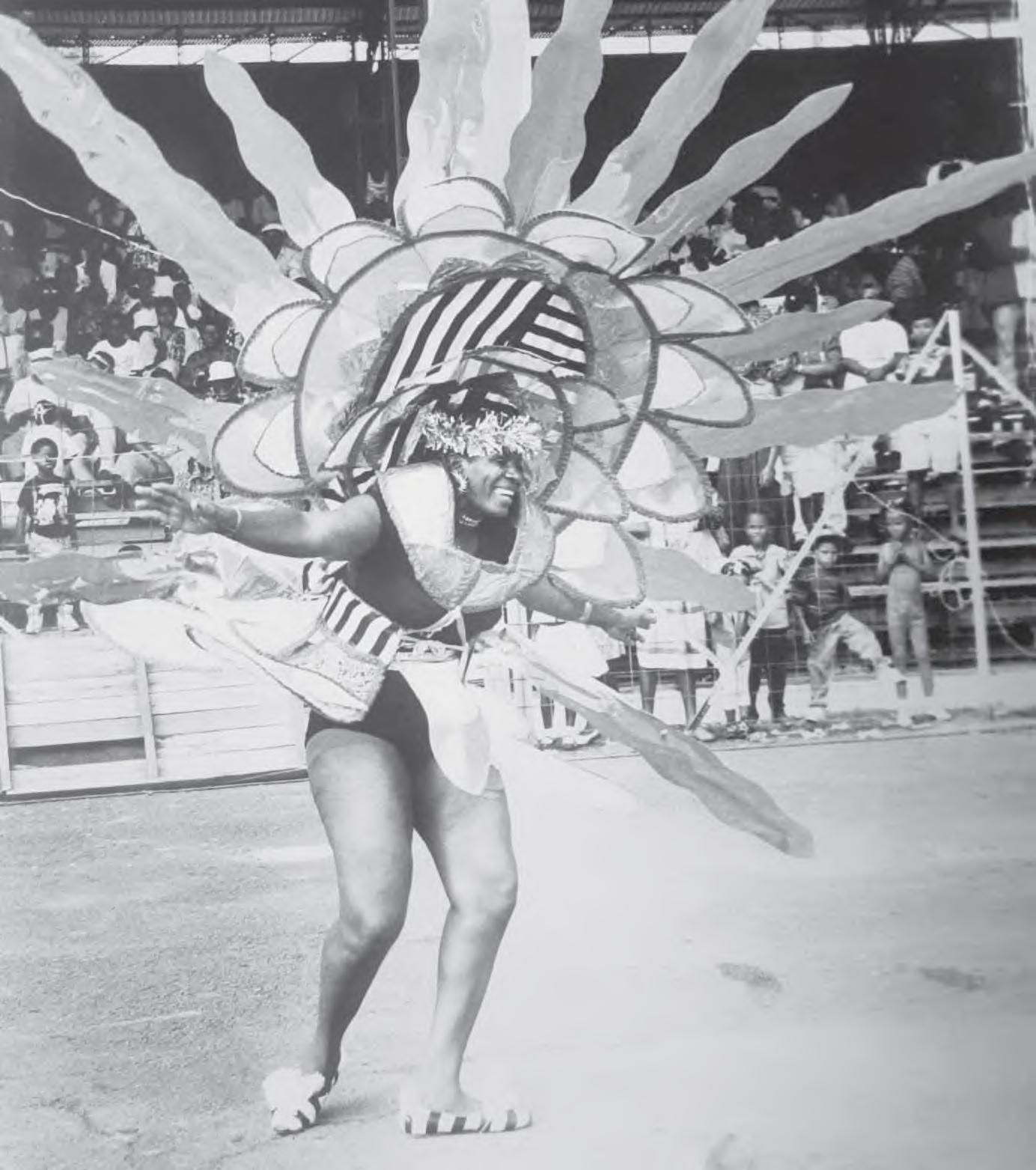
As Guyana prepares to celebrate its 56th Republic Anniversary tomorrow, we went into our archives and are taking you back to ‘Mash 22’: A reveler during the 1992 Mashramani Parade.

Sunday, February 22, 2026
As Guyana prepares to celebrate its 56th Republic Anniversary tomorrow, we went into our archives and are taking you back to ‘Mash 22’: A reveler during the 1992 Mashramani Parade.

By Frederick Halley
KNOWN to the music world as Anjulie and iden-
tified as an artiste, songwriter, producer, and storyteller, the Canada-born, Guyanese-rooted artist has written songs that have reached millions of people around the world and have been incredibly meaningful.


is part of a much larger history, one shaped by migration, survival, and resilience.
In an exclusive interview with the Pepperpot Magazine, Anjulie, who was born Anjulie Persaud, explained that her Guyanese background is the foundation of who she is, “even though I was born and raised in Canada. My grandparents were from Guyana, and their story
“My family is Indo-Guyanese, descended from Indian indentured labourers who were brought to Guyana during colonial times. Because of that history, our identity carries layers—Indian roots, Caribbean culture, and a deep awareness of displacement and reinvention.”
According to Anjulie, “growing up, Guyanese culture was everywhere in my life. It was in the food, the music, the humour, the rhythm of how my family spoke and loved. There’s a
warmth and emotional openness in Guyanese culture that shaped me deeply. There’s also a toughness and a sense that you can survive anything and still remain joyful.
“As I’ve gotten older, I’ve come to understand how extraordinary Guyana is, not just culturally, but spiritually. It’s a place where so many histories intersect. Being Guyanese has given me a global, layered sense of identity. It’s taught me that you can come from a small country and still have a voice that reaches the entire world.”
Anjulie pointed out that TURN TO PAGE VII


By
EVER since he was a child, Simeon Raywaram has been dancing to music and singing along with his mother’s gospel songs. Beginning his music journey in school, Raywaram’s talent garnered attention from his community and school while he was still a teenager.
Today, the young man from the village of Pomona, on the Essequibo Coast, is doing more than gaining support; he is making a name for himself in the music arena after being crowned this year’s Junior Calypso Monarch. Completing the competition in first place earlier this month, Raywaram says he now aims to conquer more stages, entering other categories to show young Guyanese that music is an option.
Raywaram had what he called a quiet upbringing. Born and raised in the community of Pomona, a quaint village in Region Two (Pomeroon-Supenaam), he
was introduced to music through his mother. With his mother’s love of music and his grandfather being a church musician, it was not long before Raywaram was singing. “Music has always been a part of my life. My mother was a worshipper in church, so I grew up in that environment, surrounded by music and singing. My grandfather is a pastor and a guitarist, so, being around instruments and musicians was normal for me. I started by singing in church,” he said. Raywaram’s shift away from the church came while he was still young, after he entered a jingle competition. Although nervous, and with this being his first public performance outside of church, Raywaram’s performance captured the attention and admiration of the judges. This, he shared, was the first step in his career in music.
“In 2023, I decided to put my talent out there. I had heard about the GTT Jingle, and would often check the

Ministry of Culture, Youth and Sport’s page for opportunities. When I saw auditions being posted, I decided to try. I was fortunate to be selected to perform at the Independence celebrations, and that is when I began doing music professionally in 2023,” he stated. After being discovered, Raywaram performed at a number of events, forums and celebrations. His goal, however, was a Mashramani crown.
While he has competed and gained support in a number of Mashramani competitions over the years, Raywaram was striving to win. While in school, he competed in the children’s Mash competition, winning first place at the regional level and second place nationally in the children’s calypso competition. The transition to the Junior Calypso competition is where Raywaram’s true potential shone. “I then transitioned into the Junior Calypso competition for the first time and placed second,
earning the Best Newcomer award,” he added. “In 2024, I competed again in Calypso and placed third. That year, I also tried Soca for the
first time. Although I did not place, I won Best Newcomer.
I continued pushing forward.
Last year, I competed again and placed second in both

GUYANA’S business landscape is rapidly evolving, with new players, emerging industries and more opportunities than ever. However, navigating this arena can be challenging, especially for newcomers. This is why the Women’s Chamber of Commerce and Industry (WCCI) has outlined several events for the year ahead.
Speaking to the Pepperpot Magazine this week, Vice-President Shamela John shared that the chamber has three major events scheduled for the year ahead. With more women seeking to join the world of business, John says these events are the perfect place to network, learn and grow.
The Chamber is kicking off its year with a focus on both women and girls with its Guyana Women and Girls Summit. The free event is held in celebration of International Women’s Day. The event is slated for March 4, 2026 at the Arthur Chung Conference Centre, with registration beginning at 09:00hrs and the summit at 09:30hrs. The event spotlights women and girls, who, through leadership, innovation, or social impact,
have raised the bar for future generations. Highlighting the impact the annual event has, John shared that, “Each year, once the theme is created—this year it is ‘Safe, Seen, Supported’—we put out nominations for persons to nominate women who embody that theme. Nominators share stories and experiences about the direct or community impact of these women.”
She added, “We aim to feature at least 18 to 24 women annually, provide a short bio, and highlight their work. Recognising large, medium, and small impacts helps create a ripple effect that encourages and motivates others to continue their work.”
One of the key features of the day is the event’s panel discussion, coined “Find Your Mentor, Build Your Future”. The panel seeks to explore what women and girls should look for in mentorship, focusing on the goals they hope to achieve and how to identify unhealthy mentorship relationships. The panel is interactive, creating space for and listening to the voices of young women and girls. As John added, “The event caters not only to women in business but also to girls.
Approximately 60 girls from about five schools across the country will attend and benefit from mentorship sessions.” She added, “After the panel, there will be guided sessions where attendees can meet with professionals, including lawyers and financial institutions.”
The chamber’s second event of the year is its Business Brunch. A simple yet highly anticipated and impactful venture, the event will see vibrant discussions on various areas of business. Moreover, this year’s brunch will focus on the biggest change happening within the sector: Guyana’s diversifying economy. “This year, the event will explore the theme of a diverse economy, looking beyond oil. Insurance and other sectors are thriving, but oil is temporary. We must plan financially and strategically for diversification,” she added. “We will also address employment, wages, working conditions, and the portions of the economy that may not fall within formal employment brackets.”
The focus is a vital aspect of Guyana’s economy and something that many Guyanese are becoming a part of.

As John explained, now more than ever, more Guyanese are seeking to have multiple streams of income, with side hustles and full-time jobs becoming the norm. This shift signals a growing economy
and a stronger workforce; this is what the chamber is seeking to foster among women. “Many individuals have side businesses in addition to full-time jobs, yet some work environments restrict second-income opportunities,” she added. “Although there are tax exemptions for second earnings, conditions and restrictions may prevent individuals from earning additional income. These are some of the issues that will shape the discussion at the brunch, which will be held in June.”
The Chamber’s last event of the year is its annual Founders’ Dinner and Awards Gala. The highly anticipated event serves as one of the Chamber’s fundraising events. It is also a personal event, with Chamber members recognised and awarded for their efforts throughout the year, and a new Board ushered in. Sharing details on the event, John stated that, “We present eight awards, as of last year, recognising both members and non-members. Awards include categories such as Woman in Business Excellence, Advancement, and Woman in Business,
which recognises not only business ownership, but also community impact.” Women leaders are also recognised.
“We also present awards such as Young Woman in Leadership, recognising young women who have made visible and impactful strides in developing their businesses.”
While business and women’s roles in business continue to grow, support is still vital to that continued growth.
As John shared, while the opportunities, resources and information are present, support is still important to ensure that continued growth.
“While there are many resources available online, mentorship provides something different. It allows you to lay everything out about your venture with someone who has your best interest at heart.
A mentor helps draw out internal questions and guide your thinking,” she added. “Often, women question themselves: Am I capable? Am I qualified? What if I fail? A mentor does not dismiss those fears but asks why you think you will fail and helps address the root concern.”
song, ‘Guyana Way’, written by Faith Corrica-Nedd. The song talks about the transformation and development happening in Guyana. The calypso song received support from the judging panel and supporters. Calypso has a special place in Raywaram’s heart, highlighting his love for the genre.
He shared that calypso feels culturally connected to him. “Calypso resonates deeply with me. I am not drawn to dancehall; calypso feels connected to my culture as an Amerindian. It is more than just a genre to me; it feels natural, almost as if it belongs to me,” he said.
One of the defining moments of this year’s competition was Raywaram’s approach. While nerves are always present when stepping onto a stage, that feeling is multiplied when performing in a national competition on an international stage.
This is why Raywaram says he approached the competition like any other performance, focusing on his love of the art rather than the nerves of the moment. “I approached the performance as just that—a performance, not a competition. Despite the
rehearsals and preparation, I focused on enjoying the moment and sharing the love of music rather than competing with anyone,” he added.
“Before going on stage, I still experience nervousness. That has always been one of my challenges. Once I got on stage and felt the energy of the crowd, supported by my dancers, musicians and supporters in the audience, everything flowed.”
That feeling of flow and creativity was quickly replaced by excitement when Raywaram was announced the winner. “When I was announced as the winner, I did not know how to react. I barely slept that night because I was so excited. I had to travel back to Georgetown the next morning, but the excitement stayed with me. It was a proud and fulfilling moment.”
The moment was also celebrated by his family and community. “Although I am originally from Pomona in Region Two, I now work in Georgetown and am often busy. Still, the support from my community has been strong. I received many congratulatory messages from people back home and across

the region. Everyone expressed pride and appreciation for the performance and the message of the song.”
Now, Raywaram is working to further cement his place in Guyana’s music landscape, preparing to enter other genres. Whether it is
calypso, dancehall or soca, Raywaram says he will continue to make music, perform and represent what it means to be Guyanese on stage. “Music means everything to me.
It is what I turn to when I need inspiration or encour-
agement. Some people do music for money, others for culture, but I do it for the love of music. I believe that anyone with talent should pursue it.”
Raywaram hopes his career and continued journey inspire other young musi-
cians, showing that music is a possibility. “You never know what opportunities exist unless you try. With determination, anyone could become a Junior Calypso Monarch, Junior Soca Monarch, or even compete at the senior level.”





FROM PAGE II
music was something she was drawn to from a very young age. “I started writing songs at 13 as a way to understand my emotions and make sense of the world. It felt like the most natural language to me.
“I began sharing my music and eventually started working with producers and songwriters. Early on, I was fortunate to connect with people who recognised something unique in my voice and perspective. That led to my first record deal and opportunities to write and perform professionally.”
Describing her music career as a journey of both external success and internal discovery, Anjulie explained that she has released songs that have travelled across continents, been written for major artistes, and performed for audiences around the world. “I’ve had the honour of winning a Juno Award and being recognised internationally as both a singer and songwriter.
“But what inspired me the most was the feeling that music allowed me to express something that couldn’t be expressed any other way.
“I’ve always felt like I’ve been between worlds culturally, emotionally, and creatively. Music became the place where those worlds could coexist. It allowed me to turn confusion into clarity, pain into beauty, and isolation into connection.”
Anjulie disclosed that she has been inspired by artistes who create from a place of truth, such as Sade, Lauryn Hill, and Jeff Buckley, whom she said taught her the power of emotional honesty, and others who showed her that softness and strength can coexist.
“Over time, my music has evolved. It’s about creating work that helps people feel

less alone, more peaceful, and more connected to themselves.
“My career has taught me that the most powerful thing you can do as an artiste is to tell the truth.”
Asked what advice she would give to upcoming artistes, Anjulie said her biggest advice is to understand that your uniqueness is your greatest strength. “The industry often encourages people to conform, but the people who truly stand out are the ones who remain connected to who they really are.
“It’s also important to be patient. Careers in the arts rarely follow a straight line. There will be rejection, uncertainty, and periods where nothing seems to be happening. Those periods are not failures; they are part of the process. Most importantly, focus on developing your craft. Most people forget that with all the distractions.”
Anjulie explained that it wasn’t always smooth sailing, and one of the biggest challenges has been learning to trust herself in an industry that often tries to define you.
“There were moments when people tried to shape my identity, my sound, or my image in ways that didn’t feel authentic to me. It took time and experience to realise that the most sustainable path is the one that aligns with who you truly are.
“Another challenge has been navigating uncertainty. The music industry constantly changes, and there is no guaranteed formula for success. You have to develop resilience and learn how to stay grounded even when things are unstable.
“Ultimately, those challenges made me stronger and helped me understand my purpose more clearly. I could see myself as a TV writer, filmmaker, or someone work-
Anjulie at the Kaieteur Falls during her visit to Guyana
ing in a field that helps people understand themselves more deeply. At its core, my work has always been about exploring what it means to be human.”
Anjulie is the recipient of the Juno Award, which is one of Canada’s highest music honours. She was also nominated for an MTV Video Music Award for Best New Artiste. She has also received international recognition as both an artiste and songwriter, including at the HER Music Awards and the Soca Music Awards. “These awards are meaningful, but what matters most to me is creating positive impact.”
Touching on her recent visit to Guyana, Anjulie pointed out that it was deeply meaningful on a personal level. “It was an opportunity to reconnect with my roots and experience the country not just as a concept, but as a living, breathing place.
“There’s something powerful about standing in the place your family comes from. It gives you a deeper understanding of yourself.
“It was also important to me to connect with the people and culture directly. Guyana is growing and evolving, and it was inspiring to witness that firsthand.”



LIFE can sometimes be reduced to a few defining moments. Within those moments are sacred gambles which are not made with arrogance or temerity, but with the hope that the things which we are risking can be enough to give breath to the dreams that
we never dared to imagine as reality. Not all of us can be brave enough to take such a risk.
At the same time, bravery

is not always a guarantee for a good outcome. Yet, we can say with certainty that the thorny prick of regret is more tolerable when we try to do something and fail, as opposed to not trying at all.
There is a very thin line between simply existing and living. It is only in understanding this difference that we can explore the depths and wonders of life. Living does not begin at a heartbeat or a breath; it begins with imagination.
As strange as it may seem, our ability to imagine different realities and to actively choose how to navigate between them is a marvellous gift that seemingly only human beings possess.
One may observe that most other creatures that share this planet with us make choices out of instinct—as a response to the environment or to the in-built urge to interact with the world in a very specific way.
In fact, it is their very instincts that often keep them alive. For those creatures, living and existing are the very same thing. Reality is only what they are capable
of experiencing in the present moment.
So, how can we truly step away from the unfortunate likelihood of spending our time in this universe just existing and not living life in all its beautiful glory?
The answer, of course, is by allowing ourselves to use our imaginations!
What dreams have you disposed of, believing that you will be unable to achieve them? What moments of whimsy and fun have you failed to experience by forcing yourself into a shell of dull seriousness? What doors have you unknowingly closed by simply failing to imagine them leading to possible realities?
Life, as we all grow to realise, is held together by certain rules and norms that human beings have created. Without these, society would devolve into chaos, and there would be no order.
Unfortunately, as we have grown and expanded as a species, many arbitrary and unnecessary additions have been made to these rules.
Many have had their personalities and inherent nature

suppressed or completely forgotten under the pressure to follow these rules. The most sorrowful loss that these rules tend to create is the loss of one’s ability to imagine directing the course of their own life.
All of us have dreams and desires living at the very centre of our hearts, hidden behind trepidation and covered up by other commitments and responsibilities.
When we are younger, it is easy to ignore the magnetic pull of these dreams, since we can simply tell ourselves we have plenty of time to pursue them. Time, however, runs swiftly and unexpectedly. Soon, we may find that our dreams are not just unrealised, but completely lost— nothing more than relics of the youngest, most hopeful versions of ourselves.
If you look back at the days that have passed and cannot remember a single time when you felt completely satisfied, it means you must change the direction you are moving in. Your life must not be reduced to reactions and responses to the stimuli you experience in the present moment. You must not become a product of the simple needs that drive you from one day to another.
Instead, you must allow yourself to make decisions fuelled by the passion you have for life itself. There is a purpose that gives you an invigorating desire to wake up each morning.
There is a path that a part of you yearns to feel under your feet. There is a dream that burns in your heart every time you think about who you would like to become. Do not choose to ignore these urges. Do not choose to simply exist when you have the option to live!

PEOPLE of all ages and backgrounds can and should pursue formal education, as it provides many personal, financial, and societal benefits.
Everyone knows higher education is expensive, but there are ways to minimise the financial impact. In this book, Geary Reid shares how students can get sponsored. He also offers tips on time management, showing how students can create a study schedule and take effective notes to retain knowledge and prepare for exams. Additionally, Reid explains the types of assignments students can expect to encounter and discusses the benefits and drawbacks of working with other students and being assessed.
Importantly, formal education helps people learn time management and develop analytical thinking skills. Upon completing their degrees, graduates will be able to identify a suitable and fulfilling career path for themselves.
Furthermore, receiving a formal education can help graduates network and get ahead, which, in turn, can help them negotiate a better starting salary. It is crucial to note that students who face obstacles can overcome them by requesting extra help; indeed, there are various departments that are designed to help students succeed in their chosen programme. It’s never too late to pursue formal education. A college degree can help people become more successful and knowledgeable in their careers.
1. Learning is essential for all Learning has no age limit; anyone who wants to learn only needs the desire and attitude to do so. When people give their best effort towards learning, they often achieve
their goal of increasing their knowledge and experience. The challenges to learn may be many, but there is a sense of accomplishment for those whose knowledge has increased.
Learning is available both inside and outside the classroom. Not everyone is comfortable sitting in a classroom to receive formal training. Some individuals enjoy learning by trial and error. There are several ways individuals can develop their skills. The skills some people developed years ago have now become an important asset that has opened many doors for them.
Most parents want their children to increase their knowledge and skills, enabling them to make positive contributions to themselves, their families, and their countries. Parents will often make sacrifices for their children to receive a formal education.
Some children will enjoy formal education and perform outstandingly at school. However, others may have a passion for sports or for learning a trade. Parents must be vigilant and understand their children’s career paths. When parents can work alongside their children to fulfil their career paths, it often enables them to excel in the areas they feel passionate about.
Some parents dropped out of school for various reasons. However, many of them desire their offspring to become knowledgeable and excel in school, so they will make grave sacrifices to support their children’s development.
It breaks many parents’ hearts when they make sacrifices for their children’s development, only for the children to show no desire to learn. It can be frustrating for some parents to invest in their children’s development
and see those investments go to waste.
While parents desire for their children to learn, they must not fail to acknowledge their children’s abilities. Parents must remember that children learn at different paces, so they should never compare them to anyone else.
When people hear about learning, they often associate it with children. However, adults can also be students. Many learning institutions do not have an age limit for persons who want to study.
For example, due to a teenage pregnancy, some people were unable to complete their studies. However, later, they may choose to continue their studies while working.
Illness can affect anyone at any age. When some people were younger, illness affected their lives, and they did not get the chance to complete their studies, but they eventually chose to deepen their learning when they became adults.
When some people were younger, they could not see the importance of studying. However, when they became adults, they saw the need to increase their learning. Some job opportunities require adults to expand their knowledge. Therefore, those who want to remain competitive in the workplace may choose to increase their knowledge and skills to become more effective within the organisation.
It is not at all laughable for adults to attend classes alongside younger people. Many people may not know the challenges those adults have faced or are currently facing. They see the need to continue their studies, and they have not allowed pride to impede their desire to learn, which is commendable.
Learning has no age limit. It doesn’t matter how old you
are; you can still be a student. With new technologies, becoming a student should be something that all adults should work toward. This will help them remain in sync with everyday discoveries and advancements.
Since there ought not to be any age barrier for learning, everyone should see learning as important. Learning opportunities are
available to everyone, but not everyone has the desire to learn.
The desire to learn is different from the capacity to learn.
When people have the desire to learn, they are willing to find solutions to obstacles. They are not easily defeated. They acknowledge there are challenges, but they will not let them prevent them from
pursuing their dreams. If people do not have the desire to learn, they will have many opportunities in front of them, but they will not make any effort to learn. The wealth people have does not increase their desire to learn. Some people live in poverty but have a great desire to learn, and when they are provided with opportunities
TURN TO PAGE XI


MOST times we accept the hearsay of what a friend reports, or the adverse, loud declaration of, “That is what I hear, and know.” We are thus inclined to act within the extreme.
We repress the possibility of any inclined truth of any incident if we cannot place it into the quest of enquiry before guilt is confirmed and the emotions demand retribution, where such may not be justified.
I have known friends who fell for the I-see assurance of others and acted, destroying their lives on the accusation, and in one dismal
case inflicting serious harm to an innocent. Some incidents and assertions do bring harm that cannot be corrected.
For some reason not yet analysed, we have sunk into a realm of domestic suspicion that leaves no path for reason or second thought, where violence explodes into an earthquake that consumes, tearing down the walls of alternatives, and all is lost to the harsh, consuming report of suspicion that devours, leaving the innocent to endure in a world that hardly cares.
I had a long chat with someone I know. At the conclusion, he
suggested to me what a friend had offered to him as an alternative: to block his mind and emotions, to use “drugs or alcohol to soothe his domestic peeves.” I insisted that those two were the worst possible alternatives.
I explained using my own child as an example. I elaborated, using the condition of my own child as an example. I queried whether there were other ideas, even past industrial hobbies he may have toyed with, and circumstances that may point into the immediate that presented as earning capable and could allow a more rational perception. There
were, but the problem was what I faced at his age: even if it’s a workshop, where were the tools going to come from?
This is where I was even younger than he was; I did whatever was practical to learn. Drugs and alcohol were gestures into a bottomless pit. I told him what I endured as a parent, and was a young male child taken out of school years ago so the only parent—they were separated—could go to work.
There’s this feeling that males could always find employment. Those days are gone, but some folk are stuck in the imaginations
of yesteryear, and you can’t build your dreams on fantasies.
Today, any field you need to explore, you either need to have been born with the talent and be paying attention to how it works, or, if it’s a trade, then you need to have tutoring or experience, or the tools, and some practical experience through work or trade books.
Thus, some tutoring is required, but drugs nor liquor are not going to get the ball rolling in any justified beginning. Even though we parted in an agreeable mood, I do hope he was listening and that he had heard.

to learn, they will give their best.
Knowledge is available, but some people cannot receive it because they lack the capacity. Similarly, a barrel filled with water cannot hold any more water. However, if the same barrel is not filled, then it can receive more water.
2. A desire for formal learning
No one was born with all the knowledge they currently possess; through formal learning, their knowledge increased. Some people took many years to complete their formal education, while others completed their studies
within a short duration.
When some people were younger, they may have tried to avoid formal learning. It might have been against their parents’ wishes. Some children may have been forced to drop out of school because of poverty. Other children did not complete formal education because they had an interest only in sports and extracurricular activities.
Formal learning can be challenging. It requires a great deal of discipline from students.
Nevertheless, it provides a solid educational foundation for those who choose to further their academic pursuits.
Formal learning helps reduce ignorance by providing a structured way to learn. There are several ways to reduce ignorance, but formal learning makes it possible for people to learn many important things, which can make them more marketable or employable.
For more information about Geary Reid and his books, please use these contact details: Amazon: http://www.amazon.com/author/gearyreid Website: www.reidnlearn. com Facebook: Reid n Learn Email: info@reidnlearn. com Mobile #: 592-645-2240






now after 10 years.”
“Alvin, this is my wife, Marissa.”
She smiled pleasantly as though she was seeing him for the first time, but behind the smile, he saw a flicker of surprise. His father put his arm around his shoulder, a proud look on his face as he now introduced him.
“Marissa, this is my son, Alvin.”
The smile froze on her face, and disbelief flashed in her eyes.
“Your son?”
“Yeah, I am seeing him
The father hadn’t missed the surprised looks in both their faces, but understanding why Marissa would be, he asked Alvin, “I am guessing no one told you about her?”
“It was mentioned casually,” he answered, “but I was not told she was such a…”
“Young woman?” his father finished for him.
Alvin nodded and smiled a little apologetically, still somehow stunned. They sat down for dinner, and he noticed how relaxed and happy his father was, with a pleasant tone in his voice, and Alvin silently questioned, “Does he know
what he is doing, married to a woman more than half his age who parties at nightclubs as a single woman?”
After dinner, his father requested that he join him in the study for a few drinks so they could continue their conversation. She stayed for a little while, then excused herself, “Good night,” and to Alvin she said, “It was nice meeting you.”
He smiled cordially, holding strong against the desire to look at her as she left the room. After a few drinks, his father asked him, “What do you think of my decision to marry someone so young?”
Alvin took a long mo -

ment and a shot of Scotch before voicing his opinion.
“It’s unacceptable to the family because your three children are older than her, but if that makes you happy then I guess I will have to accept your decision.”
His father smiled with deep relief. “It’s good to hear that, son.”
It was late when Alvin left, happy that he had reconnected with his father, and he felt in his heart that he wanted to make things better between them, but how could he visit often whilst she was there? He paused by his car on the driveway, looking at the upper flat, and saw her
standing by the window, partially hidden behind the curtains, looking at him.
A moment woven by magic touched his heart as he looked at her.
Questions burned in his mind as he drove away.
“Have I fallen in love with my father’s bride? How did that happen?”
This unexpected situation was quite troubling to him, but he stayed firm because he was now mentally strong enough to deal with whatever problems or challenges came his way.
“I will have to fight against this feeling of love,” he said to himself.
But it wasn’t that easy when their paths continued to cross at several places. She always smiled at him, but he just nodded courteously and walked away until one late afternoon at the seawall lime, Kevin asked him, “Why don’t you talk to her? I thought you liked her.”
She was parked not too far away with a couple of friends.
Alvin sighed deeply and said to his friend, “Yes, I like her, but she’s married to my father.”
Kevin choked on his beer, and when he stopped coughing, he exclaimed, “Good TURN TO PAGE XXI


ROY A. K. Heath wrote psychologically acute novels about Guyanese people living in Guyana—and about nothing else. They are the sole, unbroken focus of his fiction. Across nine novels—A Man Come Home (1974), The Murderer (1979), Kwaku, or, The Man Who Could Not Keep His Mouth Shut (1982), Orealla (1984), From the Heat of the Day (1979), One Generation (1980), Genetha (1981), later collected as The Armstrong Trilogy (1994), The Shadow Bride (1988), and The Ministry of Hope (1997)—Heath returned obsessively to the psychic, social, and moral textures of a small, fraught society.
He also published a memoir, Shadows Round the Moon, in 2000. No other landscape intrudes. None of his novels is set outside Guyana, and none imagines a meaningful escape from it.
Heath belonged to the formidable generation of Caribbean writers that includes Kamau Brathwaite, V. S. Naipaul, Derek Walcott, and Michael Anthony. Yet he was a late bloomer, publishing his first novel at the age of fifty. Born in Georgetown in 1926 and educated at Central High School, he worked as a civil servant before migrating to Britain in 1951.
Although he lived there until his death in 2008, he maintained a tenuous but persistent connection to Guyana through frequent visits. Notably, none of his novels is set abroad. Taken together, they map—almost comprehensively—the psychic and social history of Guyana across the twentieth century.
Heath’s novels are remarkable artefacts of a deliberate artistic ambition: to show Guyana and Guyanese people as they are. He realised this ambition through extraordinary fidelity to the fine-grained details of everyday Guyanese life. His
portraits are sensitive and unvarnished, offering characters without metaphorical disguise—figures bound to their native place and often at odds with it. These characters move restlessly within Guyana—New Amsterdam to Georgetown, Georgetown to Wismar, coast to interior—but never beyond its borders. They are rooted yet restless, resentful yet loyal, frequently unhappy and only intermittently hopeful. A defining feature of Heath’s oeuvre is its moral ambiguity: his characters are never sufficiently good, kind, or prudent to redeem themselves.
Heath wrote a realism that suggests lived experience: rooms one has inhabited, people one has known, the moral claustrophobia one has felt. His novels are wholly engaged with the social realities of Guyana and the full spectrum of people who inhabit it. Nearly all aspire to tragedy, even those that begin in comic registers. The pages accumulate toward an eventual shock of awfulness, arriving slowly and incrementally, with dreadful inevitability. In
The Murderer, his Guardian Prize–winning novel, dread arises from the reader’s growing certainty that the victim—innocent, ordinary, hopeful—is doomed. The narrative crucible tightens around her. At the same time, Heath charts the murderer’s descent with unnerving plausibility, rendering madness as both tragic and terrifyingly real.
Ameena Gafoor’s Aftermath of History: The Novels of Roy A. K. Heath (UWI Press, 2017) remains the best full-length study of Heath’s work. It is erudite, accessible, and indispensable. Gafoor argues persuasively that Heath’s fiction is driven by a deep ethical commitment to inclusiveness and by a sustained examination of how history—colonialism, race, class, and economic depriva-
tion—presses upon intimate lives. If Wilson Harris is the most formally innovative novelist Guyana has produced, Roy Heath is arguably its finest realist. There is much to admire in Heath’s work, not least his immersive rendering of the Guyanese milieu—the
full catastrophe of its social, racial, and economic contradictions—from the 1920s to the late 1990s. Across these decades, Heath tracks the country’s transformations with particular attention to class stratification. His fiction exposes the destructive obsession with maintaining
distinctions of class and colour, residues of colonial values that continue to corrode everyday life.
The Armstrong Trilogy—From the Heat of the Day, One Generation, and Genetha—is Heath’s masterpiece of social realism. It chronicles the slow collapse
of a Georgetown middle-class family from relative comfort to desperation, culminating in the surviving daughter’s descent into prostitution. A parallel collapse unfolds in The Murderer, where a middle-class woman marries badly, is murdered by her TURN TO PAGE XVIII







husband, and is dumped, with chilling indifference, into the dark Demerara River.
The Murderer is a profoundly dark novel, but Heath is never a writer of happy endings. His characters suffer without release.
They often suffer toward further suffering, and then they die. Consider Kwaku Cholmondely, the protagonist of Kwaku and The Ministry of Hope. These novels enshrine exploitation as a ladder, rung after rung of opportunists
preying on the vulnerable—poor against poor, rich against poor, rich against rich. Kwaku spends his life scraping along the margins and dies no better than he lived. Heath’s ideal subject is psychic pain: thwarted ambition, disappointed hope, the
small dream collapsing into futility. This is true of Ben in Orealla, Rohan in One Generation, and Genetha in Genetha. Heath’s narrative machinery frustrates desire itself, often ending not merely in disappointment but in madness and murder.

In this respect, Heath is kin to Cormac McCarthy—less mythic, less apocalyptic, but equally committed to exposing the darkness underwriting human conduct.
Yet Heath’s work is not without humour. Kwaku and The Ministry of Hope contain genuinely comic scenes, moments of abrasive wit and social satire. But humour cannot survive the pressures of deprivation and survival; it flickers briefly before being overwhelmed by harsher truths.
Reading Heath, one becomes conscious of the illusory nature of “elsewhere”— the belief that movement offers reprieve. Kwaku moves from New Amsterdam to Georgetown; Galton Flood from Georgetown to Wismar; Genetha from middle-class respectability into the underworld of Tiger Bay. Ben imagines Orealla as a sanctuary, only to discover that it too is compromised. Elsewhere is merely the same place under a different name. Rohan is as unhappy in Essequibo as he was in Georgetown; Flood leaves the capital only to lose his mind and murder his wife. Darkness is everywhere.
Gafoor argues that Heath is the most inclusive of Guyanese writers, and it is difficult to disagree. His work articulates a Guyaneseness that is both panoramic and intimate. Heath is arguably the finest Afro-Guyanese writer of Indo-Guyanese life, particularly in The Shadow Bride, but he also renders Amerindian communities with seriousness and empathy. His oeuvre is marked by deliberate inclusiveness—of race, class, region, and texture of experience. This capaciousness, combined with devastating psychological insight, secures his place among Guyana’s greatest novelists.
The city, as conceptualised in Heath’s fiction, is far more a site of chaos than of enlightenment. He is not merely sceptical of urbanisation; he is palpably hostile to it. In The Armstrong Trilogy, Orealla, and The Ministry

of Hope, Heath persistently stages clashes between town and country, the urban and the pastoral, the “enlightened” and the “primitive”. These conflicts arise not from authorial dogma but from the friction between incompatible ways of life.
Agrarian theory offers a useful lens for understanding this hostility. It contrasts the rootedness of rural life with the alienation of the city, arguing that when human beings are severed from the soil, civilisation enters a state of moral entropy. In this view, instinct yields to abstraction, myth to rationalism, and barter to money; the city becomes a profit-driven system in which individuals are commodified, community erodes, and identity is measured in economic terms. Heath’s Georgetown exemplifies this condition.
Across The Armstrong Trilogy, Orealla, and The Ministry of Hope, the protagonists are village people uprooted from their native soil and thrust into Georgetown. They are internal migrants confronting poverty, loss of identity, and the sensation of becoming foreigners in their own country. Their inherited values—tradition, superstition, myth, communal obligation—hold little currency in a city of machines, corruption, and greed. The trilogy dramatises this collapse across generations: Sonny Armstrong’s disastrous marriage, Rohan’s doomed affair, and Genetha’s descent into prostitution.
Country life, by contrast, exists as memory and longing—a moral refuge imagined but rarely recovered. Rural spaces become “harbours for tired souls,” even as return remains impossible. The poignancy of Heath’s fiction lies in this tension between remembered peace and lived brutality, between the village as sanctuary and Georgetown as moral labyrinth.
Ultimately, the city in Heath’s novels is both opportunity and doom. It promises advancement but demands psychic annihilation in return. Heath’s protagonists—mostly internal migrants—navigate this tension with tragic inevitability. Their stories powerfully affirm agrarian theory’s bleak claim: that severing human beings from the soil produces not progress, but alienation, corruption, and despair.







God.”
Alvin clapped him gently on the shoulder. “It’s okay, man.”
He met with his father a few times for lunch at restaurants, thankful he didn’t have to go to his house, but one day, he walked into a nice little high-end gift shop to buy a gift for his sister, not knowing the place was owned by Marissa. The moment she saw him, she walked over to him.
“Hi…”
“Hey,” he answered politely, but looked away, not wanting to start a conversation.
“Why are you avoiding me?” she asked directly. He turned and responded in a serious tone, “Shouldn’t I?”
He could see the regret in her eyes when she answered, “I’m sorry about that night. I didn’t know you were…”
She left the sentence unfinished.
He relaxed his serious look. “That’s okay, we did not know each other.”
She tried to smile and said, “Thanks, I do not want you to hate me too.”
Those words left him feeling a little guilty for avoiding her.
During the next few weeks, he focused his mind on the prospects of starting his own company, in regular discussions with his father, when one day over lunch, he noticed the pale look on his face and loss of appetite.
“You don’t look good,” Alvin observed. “What’s wrong?”
“Nothing, I’m fine,” he answered nonchalantly.
Alvin expressed his concern to his mother, but in her unforgiving mind, she thought differently.
“How long do you think an old man like him could last with a young girl?”
It was a question he had no answer to, which left him with a kind of worry, so when his father invited him to his house one evening, he did not decline.
He was looking paler than the last time Alvin saw him.
“Are you sure you’re not
suffering from any form of illness?”
“I have a good doctor, son. Don’t worry about my health.”
They spoke for a fairly long period on several topics, then his father said, “I have been living with the hope that I will see you again one day.”
For the first time, Alvin saw a flicker of pain on his father’s face, a brave and strong man, now older and weaker.
“And I want to ask of you one thing,” he continued.
“What’s that?”
“Please don’t hate Marissa like the rest of the family does. She’s a nice young woman.”
Alvin responded with what had been on his mind.
“I think it’s unfair to hate her for being married to you, because that was your choice.”
His father smiled with relief. “Finally, someone with real understanding.”
Marissa came home not long after, looking incredibly beautiful in a white bodycon dress.
“How can I hate her?” Alvin questioned himself. “When every time I look at her, there’s an overwhelming feeling of love.”
His father called her, and she came and sat down next to him, but a few moments later, he excused himself to make an important phone call. There was an uncomfortable silence, neither of them looking at each other, then Alvin asked, “How sick is he? He seems to be hiding something.”
“He’s fine most of the time,” she answered. “Just not good some days.”
“So who looks after him at nights when you’re out?”
She looked at him a bit defiantly, knowing that question would come up.
“I’m here all the time. That night was just a girls’ night out, and he was out of the country.”
“Sorry,” he apologised. “Just trying to understand what’s happening with his life.”
There was another moment of silence, then he asked a question he needed
to know the answer to.
“Why did you dance with me?”
Their eyes met this time,
and for one hushed moment, the world seemed to stop. Then she answered him, her soft voice almost a whis -
per, “There was something unique about you that I liked.”
Neither of them saw
the father come out of the study and stand there, quietly watching them. To be continued…
























































Welcome, fellow reader. When collecting facts for a project, it is important to remember that the reliability of any information is determined by where it comes from. For example, if you rely on personal observations, keep in mind that people’s impressions can sometimes be misleading. Lawyers understand this well — two witnesses describing the same event may offer very different accounts of what they saw.
Broaden your foundation by considering diverse approaches to strengthen and enhance your project. Be
wise. Love you.
Showing understanding of the matter
Read the passage below and prepare to respond to the questions set on it.
In the morning of the 12th day the people washed themselves well. The women dried themselves with yellow corn meal, and the men with white corn meal.
Soon after the ablutions were completed, they heard the distant call of the approaching gods – Blue Body and Black Body – each carried a sacred buckskin.
White Body carried two ears of corn; one yellow, one white, each covered at the end completely with grains.
The gods laid the buckskins in a certain order. Then they told the people to stand a distance and allow the wind to enter. The white wind blew from the east, and the yellow wind blew from the west, between the skins.
While the wind was blowing, eight of the Mirage People came and walked around the objects on the ground four times, and as they walked the eagle feathers, whose tips protruded from between the buckskins, were seen to move. When the Mirage

February 22nd, 2026
People had finished their walk, the upper buckskin was lifted. A man and a woman lay there in their stead.
The white ear of corn had been changed into a man, the yellow ear into a woman. It was the wind that gave them life. It is the wind that comes out of our mouths now and gives us life.
When this ceases to blow, we die. In the skin of the tips of our fingers, we see the trail of the wind; it shows us where the wind blew when our ancestors were created.
The pair thus created were First Man and First Woman (Atsé Hastin and Atsé Estsán). The gods directed the people to build an enclosure of brushwood for the pair. When the enclosure was finished, First Man and First Woman entered it, and the gods said to them, “Live together now as husband and wife.”
(Washington Matthews’ retold “The Navajo Origin Legend”)
About the Passage
Have you gathered from the passage the fact that the early Native Americans’ great respect for the natural world?
Yes. This passage from a folklore on Navajo Indians speaks of buckskin, eagle, corn, wind, and the rest of what is mentioned. Many of these helped to feed and clothe the early Natives. Each has its own power.
It also speaks about an invisible power that is believed to be the source of life and good for humans. Yes. This native culture has a name for its invisible power.
The Questions
1. Are these words familiar? See for yourself what they each mean in the passage: ablutions, buckskin, disappeared, changed, enclosure.
2. Why might the Navajo
I caught this morning morning’s minion, kingdom of daylight’s dauphin,
dapple-dawn-drawn Falcon.
GERARD MANLEY HOPKINS (1844-1889) “The Windhover”
have the view that the wind was the source of life?
3. a) Identify the order and ritual stages of the Navajo creation ceremony.
b) What do the stages tell of the people?
4. What role does the wind play in the ceremony?
5. a) How much do you know about Guyanese folklore?
b) When you do find a folktale tell what culture it is from. Tell about the culture details such as creatures, objects of nature, or practices of daily life, or prevalent attitudes of the people.
6. It would be a good thing to include aspects of folklore in your scrapbook for you may have need of such details and embellishments some time to enhance and give depth to your short stories and descriptive essays.
LANGUAGE USAGE
Making word choice and language clearer
Your word choice and language set the tone of your writing, whether it be a descriptive essay or short story or a poem. Word choice and language help you go beyond words. They bring along mood and emotions which the reader can experience easily.
To bring home forcefully what word choice and language do for both your writing and reader, let us
look at this short passage by writer, Frederick Douglas, in “Memories.”
Do These Things:
1. As you read, look out for the following:
a) individual word and sentence choice; and b) overall tone, or attitude.
2.a) What is the writer’s purpose that he achieved? Tell it to your partner.
b) How are you affected by the passage? Tell this also to your study partner.
The Passage: They told the tale of woe which was then altogether beyond my feeble comprehension; they were tones loud, long, and deep; they breathed the prayer and complaint of souls boiling over with the bitterest anguish. Every tone was a testimony against slavery, and a prayer to God for deliverance from chains.
The hearing of these wild notes always depressed my spirit and filled me with ineffable sadness. I have frequently found myself in tears while hearing them. The mere recurrence of those songs, even now, afflicts me; and while I am writing these lines, an expression of feeling has already found its way down my cheek.
STUDY SKILLS: Here are some approaches that help improve study.
1. Using what you learn outside study hours is an effective learning technique. 2. Do not try learning too much in a short sitting. 3. Good study habits help improve your memory capacity. 4. Quickly switch from an unwanted thought to suppress it, then immediately switch back to your topic under study.

YEARS of research have shown that mouth cancer can be prevented. In Guyana, it is believed that over 100 cases are diagnosed every year and that no one survives after six years. Diets rich in Vitamin E foods such as nuts and whole grains (whole wheat), and soybean oil can all help to lower the risk of lung and oral cancer among smokers by about 20 per cent, a new study says.
In the study of more than 29,000 male smokers in Finland, researchers found that those who had high blood levels of alpha-tocopherol, the main form of Vitamin E, reduced their incidence of lung cancer by 19% to 23%. For the prevention of cancer, the importance of diet should also be emphasised.
The benefits were most dramatic, the study found, among men under age 60 and among light smokers who had been using cigarettes for less than 40% to 50%. But despite the encouraging finding, the most beneficial health action smokers can take is still the same: stop smoking.
I must emphasise that not only for lung cancer, but for oral cancers, pancreatic cancer, kidney cancer and a bunch of other cancers, stopping smoking is crucial. In the study, which lasted for almost eight years, researchers took periodic blood samples to measure the levels of alpha-tocopherol, the most active form of vitamin
E in humans. The levels of alpha-tocopherol were then linked to health outcomes among men in the study.
There were 1,144 cases of lung cancer diagnosed in the group during the study.
The lung-cancer rate was reduced among men with the highest levels of alpha-tocopherol, and the cancer protection was most pronounced among men with the shortest history of smoking who also had a high Vitamin E level. Although the new study involved only smokers and lung cancer, earlier studies have shown that healthy levels of Vitamin E give some protection against disease, stroke and some other types of cancer, such as prostate cancer.
The proven benefits came only from a balanced diet that included food rich in Vitamin E, he said. The researchers drew conclusions about the effect of vitamin pills taken by some of the men in the study. In effect, the proven benefits of Vitamin E come from eating the right foods, not from popping vitamin pills.
Clearly there is a need for more studies to compare supplements with natural diet sources of vitamin E. There are still uncertainties about the comparative value of vitamin pills vs nutrients absorbed naturally from foods. For instance, some studies have shown that beta-carotene, an antioxidant found in foods such as carrots, can help prevent some forms of

cancer.