Finding Purpose, Prosperity and Hope in Guyana’s Hinterland


Farmer, Nikita Williams

By Michel Outridge
BENEVOLENCE was the motto of the home in which Caren Regina Juman was raised, and from a young age, she grew up witnessing the goodness of giving.
She was raised in a Christian home as the daughter of pastors, and from a young age, she watched her mother quietly give to those in need.
Whether it was someone from their church or a stranger in need, she never sought recognition or praise.
She gave without expecting anything in return and did it all quietly behind the scenes.
“It was watching her serve others so selflessly that shaped the person I am
today. Giving became second nature to me, especially to those who could never repay the kindness. But it is part of who we are, and automatically, I followed suit and continue to do so even today, helping those in need, especially vulnerable groups such as children, single mothers and the elderly,” she said.
More than 20 years ago, Juman made a personal commitment to dedicate her life to serving orphanages, widows, widowers, single parents and the elderly.
Juman told the Pepperpot Magazine that her passion has always been to reach those who are most vulnerable and to be a source of hope where it is needed most, since it brings her immense joy.
She added that the first orphanage she partnered with was the Full Gospel Girls’ Home in Hauraruni, where she regularly supplied groceries, ground provisions, fresh vegetables and whatever else was needed to care for the children.
Juman explained that over time, the work expanded to include another orphanage in Cornelia Ida, West Coast Demerara, and today she and her family are privileged to support orphanages not only in Guyana but also beyond its borders.
“Although many people associate this work with me, I can honestly say that none of it would be possible without my family. They have stood beside me every step of the way. They know

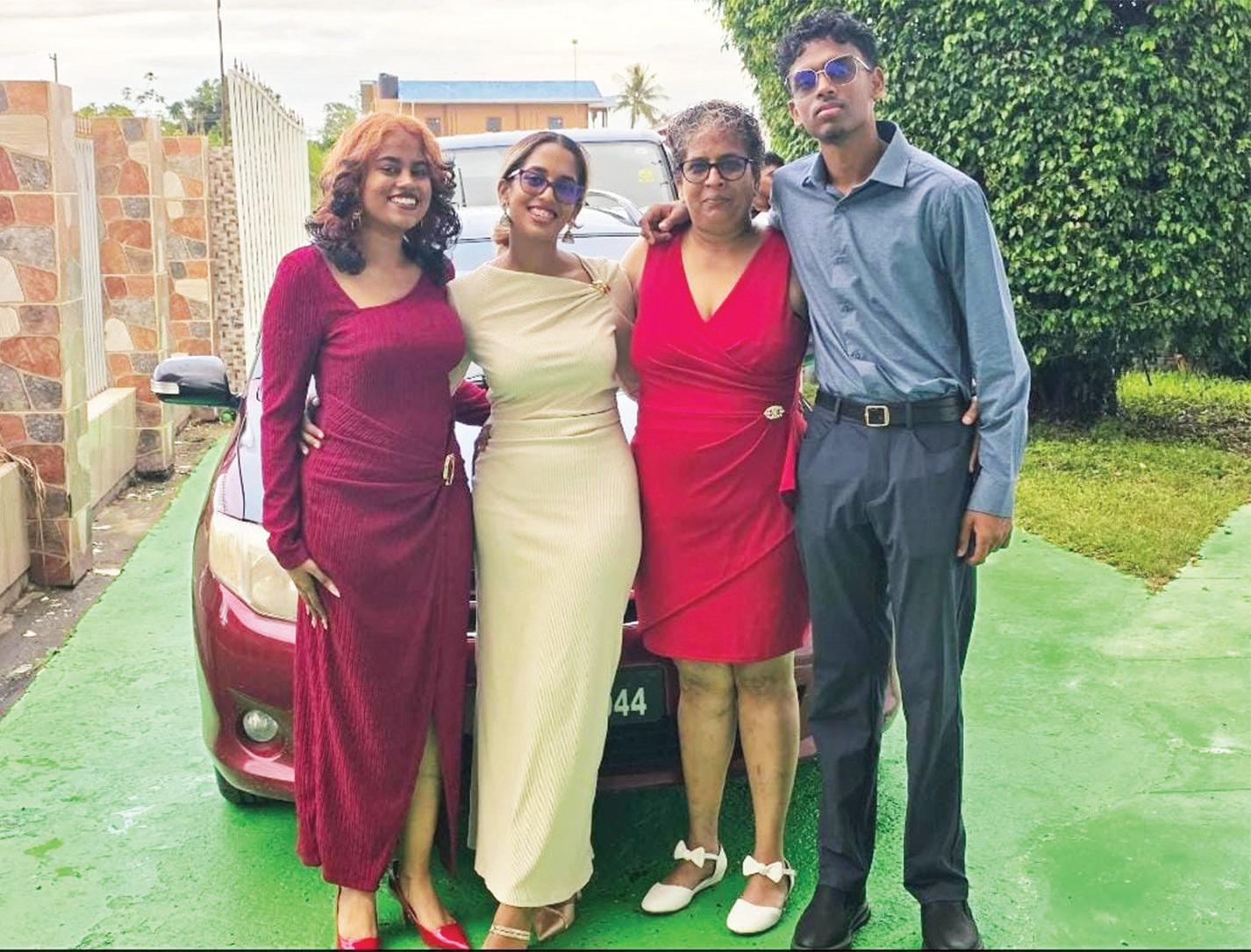
that if I had my last dollar, I would still choose to give it to someone in need, and instead of discouraging me, they join me in the mission.
From packing hampers to organising donations, they have faithfully supported every outreach effort,” she said.
Juman reported that during the COVID-19 pandemic, they extended their outreach by providing care

By Shaniya Harding
AS Guyana continues to embrace digital transformation across various sectors, a new platform, created and run by Guyanese, is seeking to change the way people move, order and connect by placing convenience, safety and accessibility at the centre of its operations.
ZIP GY is a locally developed transportation and delivery platform that is being introduced as a digital solution designed to connect passengers with drivers while also allowing businesses to expand their reach through delivery services. The main man behind the initiative is Guyanese entrepreneur and programmer, Boddy Rama, who, in speaking with the Pepperpot Magazine earlier this week, shared that he believes the platform can provide a safer, more reliable and customer-focused alternative for Guyanese consumers and businesses and redefine the landscape of connectivity in Guyana.
Rama, who has spent more than two decades developing technology-based solutions and businesses, said the inspiration behind ZIP GY came from Guyana itself. As he shared, the idea was born after observing the growing demand for faster access to services, particularly as Guyana continues to develop technologically. He explained, “We are moving in a direction where people want to have accessibility faster. I think most people in Guyana have probably travelled to New York or the United States, and they know Uber, and they know Lyft, and they know a bunch of other good things. And they know that you can put something online and have it delivered.”
Developed over the course of several months and slated to go live within the coming weeks, the platform was created with both convenience and security in mind, Rama said. Through features such as driver verification, live tracking and an emergency SOS system, Rama said ZIP GY was designed to provide additional security measures for both

users and drivers. “I think what ZIP GY does, besides verifying drivers and all, is that we have a PIN verification system where nothing is being dropped off to anyone who is not verified through a PIN, and no one is being picked up who is not verified through a PIN,” he added. “I think one of the things we also implemented is that drivers’ photos are included in the dashboard, so a user can actually see who is coming to pick them up.”
According to Rama, once the SOS feature is activated, driver information, including pictures, is shared with the authorities. This, while not a new concept internationally, is new to Guyana and creates immediate contact with law enforcement in the event of an emergency. Explaining the importance of this aspect of the platform, Rama said, “Now, what happens when you click that is that the driver’s information, car, picture, driving licence, everything that he submitted to us, which he has to, gets sent to the Guyana Police Department. So it is an actual hard copy sent there. There is no guessing game.”
Being candid and realistic, however, Rama noted that while technology cannot eliminate all risks, ZIP GY aims to implement measures that reduce vulnerabilities and increase accountability as much as possible. As he noted, “Certain things you just cannot prevent, but we are going to take the

necessary precautions to make sure they do not happen. So drivers are fully aware that their information will be sent if something happens.”
Beyond safety, Rama said customer service is another area where ZIP GY hopes to distinguish itself. He explained that users will have access to the company’s office and direct support, adding, “I think one of the most important things I want to implement in Guyana is customer service. So there is always someone there to take a call.”
ZIP GY was built on Rama’s years of experience and entrepreneurship. He said the platform took six months to create and programme. Speaking about the work that went into ZIP GY, Rama shared, “I programmed it in six months by myself, so it is not an easy process. I have done programming.” He further explained that the platform was built in just six months thanks to his programming experience and expertise, which spans more than 15 years, including work in the early days of online advertising. As he recounted, “My background in this probably spans about 20 years, developing stuff. I opened up stores, and I do a lot of different things.” However, even backed by more than a decade of expertise, Rama explained that it was still challenging to create a platform capable
of handling thousands of users. Late nights saw Rama and his team working extensively on developing the platform, fine-tuning and testing it. “I am creating a platform here that is hopefully going to eventually handle thousands of users who are interacting daily.”
One of the features Rama believes will benefit both drivers and users is ZIP GY’s approach to pricing. Unlike traditional models, where drivers may have to pay commissions or fees to operate on a platform, he said ZIP GY currently does not charge drivers a base fee. Explaining the reasoning behind this, Rama shared, “We do not charge any commission. There is no base fee for taxi drivers. What users see on the platform is exactly what they pay.” He explained that removing those costs can help prevent additional charges from being passed on to passengers, adding, “If a driver has to pay a base fee of $5,000 a week or $10,000 a week, now he is going to raise his fee and charge you to cover that cost. This is normal. If your product costs more, you have to charge more to cover your costs. So we eliminate that.”
While the idea is new,
interest among Guyanese has been present and growing. As Rama shared, since beginning its marketing push some 45 days ago, the response from Guyanese has been incredibly encouraging, with more than 1,000 people already signing up. This, Rama explained, showcases not just interest in the idea but the fact that the platform is something Guyanese do need. As he added, “I think the site really went up for marketing within the last, I would say, 45 days. I think we have over 1,000 sign-ups. I think people are eager for that. And we have had many phone calls, quite a few people asking us if it’s live or when it is going to be ready.”
As ZIP GY prepares to launch officially, Rama said the company is also working to bring more businesses onto the platform, allowing customers to access a wide range of food and other services while helping businesses reach a broader customer base. “We are trying to get more businesses online to use the platform. So it has the reach of a business,” he said. Looking ahead, Rama said the goal is not simply to create another delivery platform but to
build a trusted service that becomes part of everyday life for Guyanese. “I would love to see it as a thing that people can feel is reliable. They can book a taxi, they can order food, they can travel safely.”
While ZIP GY's core functions remain the current focus, Rama added that in the years ahead, the business could expand to include services such as vehicle rentals. He was keen to note, however, that the immediate focus remains on reliability, safety and customer satisfaction, stating, “The goal for me is to make it a household name where people feel it’s something reliable they can use. That’s the whole goal. It is not just launching a website and just launching software and just letting it run there. I think we want to back it up with customer service.” With technology increasingly shaping how people access services, Rama believes ZIP GY can provide Guyanese consumers with a new, safe, authentically Guyanese option built around trust. As he added, “ZIP GY is free to use. It’s something that can either change your life or help enhance your life.”
By Michel Outridge
FOR many young people of the millennial generation, agriculture is seldom viewed as an attractive career path.
Instead, professional success is often associated with urban employment, corporate careers or migration in search of better opportunities.
Yet, for Nikita Williams, 26, life unfolded in a remarkably different direction. What began as an unexpected move from Guyana’s coast to a remote village evolved into a
would ultimately be shaped by livestock farming deep within Guyana’s hinterland.
That defining moment arrived in 2022, when the couple relocated to Tigerbone Banakari, along the Linden-Soesdyke Highway, her husband's ancestral home.
The transition from the bustling coastal environment to the tranquillity of an Indigenous hinterland community required significant adjustment.
Yet, what initially appeared to be a dramatic lifestyle change soon revealed
powerful story of resilience, personal transformation and agricultural entrepreneurship.
Today, Williams represents a growing generation of young women demonstrating that farming can provide not only economic opportunity but also dignity, empowerment and a meaningful contribution to Guyana’s food security agenda.
Born and raised in the coastal village of Strathspey, East Coast Demerara, Williams had little indication in childhood that agriculture would one day define her future.
Although she studied Agricultural Science for three years at Annandale Secondary School, farming remained a classroom subject rather than a career aspiration.
Like many young people facing personal and social challenges during adolescence, she had her educational journey interrupted before she completed secondary school.
Marriage to her husband, Paul Williams, ushered in a new phase of life, but neither anticipated that their future
ing to grow even more.”
This transformation created an environment where residents, particularly women and young people, could begin to explore new livelihood opportunities.
Motivated to become more actively involved in her community, Williams joined the Banakari Tigerbone Women in Action Group, a vibrant organisation committed to empowering women through skills development, entrepreneurship and agriculture.
The group promotes food security while encouraging women to establish sustainable income-generating activities within their households.
For Williams, participation in the organisation proved to be the catalyst that would permanently alter the course of her life.
Looking back, she admits that she never imagined agriculture would become such an important part of her identity.
“As a young woman, the opportunity to empower myself through agriculture was something I never envisaged,” she explained.
itself as an opportunity for personal reinvention.
Surrounded by nature and a close-knit community, Williams gradually began to view her new environment not as a limitation but as a place where new possibilities could emerge.
As she settled into village life, Williams quickly recognised that Tigerbone Banakari was itself undergoing an important period of transformation.
She recalls arriving at a time when development was still in its infancy, with limited infrastructure and few economic opportunities.
However, she believes that sustained government investment has fundamentally changed the community's trajectory.
“There wasn’t as much development in 2022 as we see today,” she reflected. “But because of the PPP/C Government’s intervention through the Presidential Grants Programme and the Low Carbon Development Strategy (LCDS), our community is growing by leaps and bounds, and we are will-
insignificant beginning.
However, through careful management and patience, that modest investment gradually evolved into a thriving breeding enterprise.
Today, the Williams family maintains a flock of more than 60 healthy Muscovy ducks, which now serve as the parent stock for an expanding commercial duckmeat production enterprise.
Reflecting on those humble beginnings, Williams remarked, “The investment was very small then, but today, it has grown into something much bigger. It taught me that if you care for your animals properly and stay committed, small beginnings can become successful businesses.”
The success of duck production sparked a genuine passion for agriculture and encouraged Williams to consider expanding into other livestock production areas.

Interestingly, her agricultural journey began with an investment so small that few would have recognised its long-term potential.
One day, her husband returned home carrying a Muscovy duck hen he had purchased from his workplace.
Soon afterwards, the couple acquired a drake, completing what seemed to be an
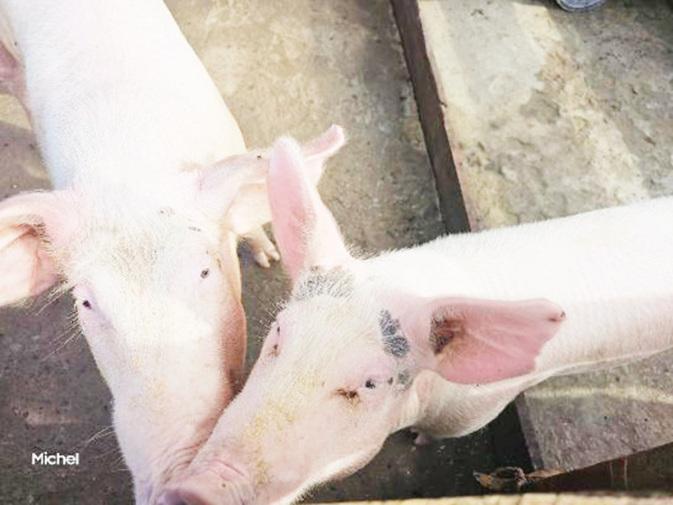
Consequently, when the opportunity arose through the Banakari Tigerbone Women in Action Group to participate in a government-supported swine development initiative, she readily embraced the challenge, despite having absolutely no previous experience in pig farming.
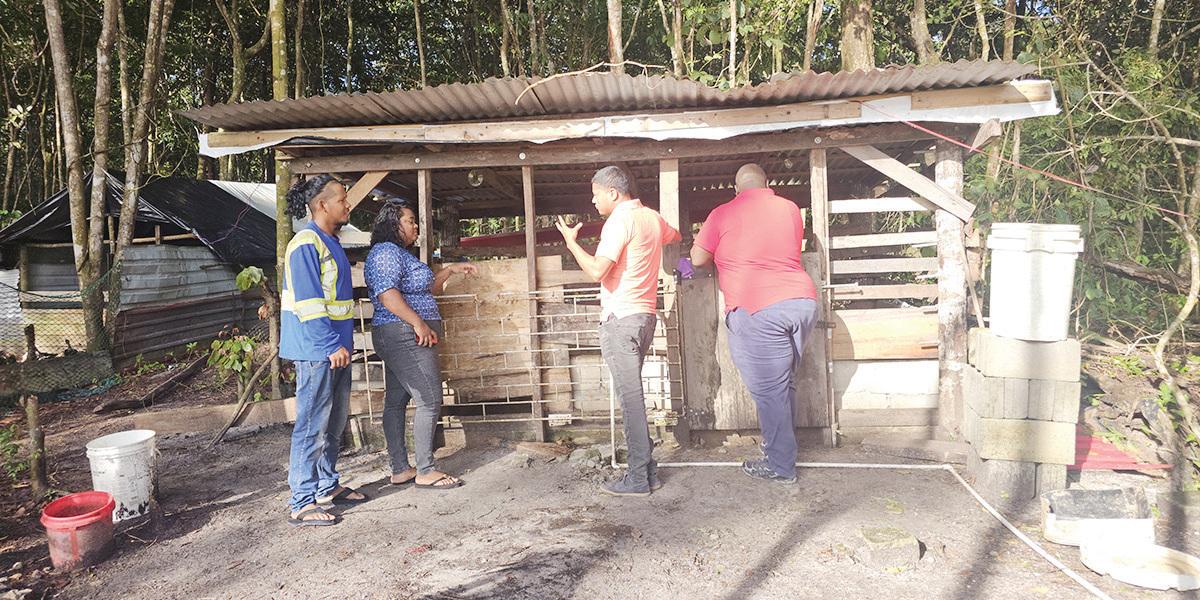
Supported by the Guyana Livestock Development Authority (GLDA), she received introductory technical training, along with two improved breeding sows, feed, and nipple drinkers, in February this year, as well as ongoing extension support to establish her farm.
Although excited by the opportunity, Williams openly admits that the early stages of swine production were intimidating.
Entering an entirely unfamiliar field required both confidence and guidance. Fortunately, she credits the unwavering support provided by GLDA’s technical officers with helping her navigate the learning process. She expressed particular appreciation for Mr Cameron, Head of GLDA’s Swine Production Unit; Dr Nauth, Regional Veterinarian; and Mr Bhawandin, Livestock Officer, all of whom provided practical advice and reassurance throughout the establishment of her enterprise.
“Even today, I can call any one of them at any time, and they are always willing to provide support. That gives you confidence as a new farmer because you know you’re never alone,” she said.
The results of that support have become increasingly evident. After only seven months, her breeding animals entered the gestational stage, bringing the exciting prospect of her first litter of piglets.
For Williams, this milestone represents far more than an increase in livestock numbers; it signifies the successful transition from a novice farmer to a confident
TURN
By Shaniya Harding
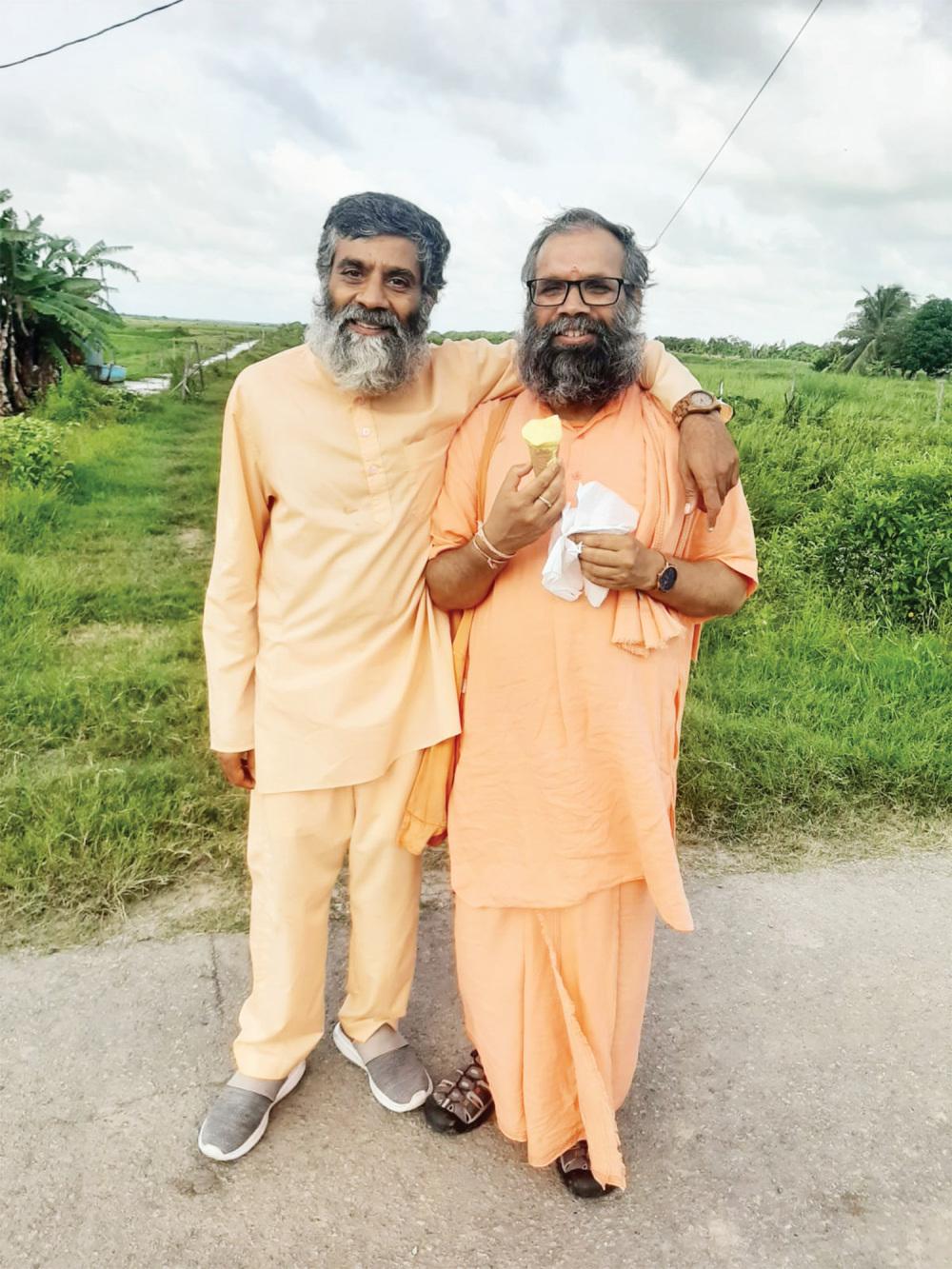
IN today’s world, where constant notifications, demanding schedules and the mounting pressures of work and life often leave people searching for a sense of balance, meditation is increasingly being embraced as a way to quiet the mind. For Swami Purnatmananda Giri, a monk with the Kriya Yoga International Organization, that search for inner peace begins not with changing one’s lifestyle or beliefs but by learning to look inward. Speaking to the Pepperpot Magazine during a visit to Guyana earlier this week, the Indian-born monk said he hopes to introduce more people to the ancient practice of Kriya Yoga, which he says offers a practical way to cultivate calmness, clarity and spiritual awareness amid the distractions of modern life.
Although he now lives a monastic life, Swami Purnatmananda’s journey began far from the American monastery he now calls home. Originally from India, he pursued engineering studies before moving to the United States, where he completed a master’s degree in engineering and spent more than a decade working. While he had a successful career and a life that most people would call successful, Purnatmananda was inspired to make a change more than 30 years ago. As he shared, the shift in his life came after he read Autobiography of a Yogi by Paramahansa Yogananda, a book that has inspired millions of readers worldwide.
As he continued learning and practising Kriya Yoga, inspired by the teachings of the
book, he realised it was more than a personal interest; it had become his calling. He said, “That inspired me, and gradually, over time, as I learned the practice, I started practising, and eventually, I decided I wanted to go full-time to practise this path. It took over a decade before I completely stepped over from just practising and living in the world to transitioning into living in the monastery. For me, it was easy because I was mentally prepared. It was very simple in terms of the switch. My decision was very clear: this is what I wanted to do long-term. And I went forward.” Having practised Kriya Yoga since 1992, Purnatmananda now dedicates his life to teaching others under the guidance of his spiritual master. While the notion of yoga is well known and millions practise it, Purnatmananda noted that Kriya Yoga has a few major differences. A large part of the work Purnatmananda and his fellow teachers do involves correcting one of the biggest misconceptions surrounding yoga. According to Swami Purnatmananda, many people associate yoga solely with physical exercise, stretching and flexibility, but Kriya Yoga, he explained, focuses on something much deeper. Rather than emphasising postures, it centres on calming the mind through meditation. He explained that the goal is to gradually quiet the constant stream of thoughts that pulls people outwards towards the world so they can begin to experience the divinity that already exists within them. “When the word yoga is said on the street, people automatically assume it’s physical postures, twist-
ing my body this way and that way,” he added.
“Kriya Yoga is about stilling the mind, calming the mind. When you calm the mind, you
ordinary family people who were married, raised children and continued fulfilling their daily responsibilities while practising medita-
change your faith or your belief in a particular God. Nothing needs to change. Just practise Kriya Yoga. It is going to help you understand
realise that divinity is within you,” he said.
One of the aspects of Kriya Yoga that Swami Purnatmananda says most people find both surprising and appealing is its accessibility.
As Purnatmananda noted, unlike practices that require drastic lifestyle changes, strict diets or changes to existing religious beliefs, Kriya Yoga is designed to fit into everyday life. He noted that some of the greatest masters in their spiritual lineage were
tion. Because of this, he emphasises that people do not need to change their faith, their place of worship or even their eating habits to benefit from the practice. Instead, Purnatmananda notes that Kriya Yoga complements whatever religious tradition its practitioners already follow. “That is the beauty of Kriya Yoga; nothing needs to change,” he added. “You do not need to change your food habits; you do not need to
your own faith and divinity in a better way.”
In a society where stress and anxiety have become increasingly common, Purnatmananda believes that even that initial experience can encourage people to continue exploring the practice and discover its deeper benefits over time. That message has brought Swami Purnatmananda back to Guyana for the third consecutive year. During this visit, he and members of the Kriya
Yoga International Organization have been conducting a series of free public lectures at mandirs across the country. While interest has been encouraging, Swami Purnatmananda acknowledges that introducing meditation to Guyana presents its own unique challenges. He has observed that many Guyanese are deeply rooted in devotional worship and religious practices that play an important role in their spiritual lives. Meditation, however, is often less familiar. “People are very curious, but it’s still a slow transition in Guyana because many people here are more focused on the devotional and ritualistic aspect of looking at divinity. They are not into the meditative aspect. It is going to be a little bit of a challenge for us to convey to people the meditative aspects of the paths to divinity and health,” he said. Purnatmananda is optimistic, however, believing that, over time, more people will become curious about exploring Kriya Yoga. Although this year’s visit is brief, ending with his return to Miami, Swami Purnatmananda considers it successful and fruitful. For Swami Purnatmananda, his work in Guyana and several other countries is about offering people a practical tool they can carry into their everyday lives. Whether someone is a student navigating academic pressures, a professional balancing work and family or simply someone seeking greater peace amid life’s uncertainties, he believes the practice of Kriya Yoga offers an invitation to pause, breathe and reconnect with something deeper within themselves.
GUYANESE fashion designer, author, speaker, philanthropist, and empowerment coach, Sonia Noel, continues to celebrate an extraordinary milestone as her 30th Anniversary of Style, Purpose and Impact inspires audiences around the world through international recognition, book signings, awards, keynote presentations, humanitarian work, and an exciting calendar of events spanning Guyana, the Caribbean, the United States, and soon Africa.
Since the official launch of her 30th Anniversary celebrations at the Canadian High Commissioner's Residence in Guyana and the launch of her new book in New York, Noel has embarked on an inspiring journey that reflects not only three decades in fashion but also a lifetime dedicated to empowering others through confidence, leadership, education, and humanitarian service.
The celebrations began in New York, where Noel launched her latest book and held a successful book signing. The publication has already received rave reviews from readers, many describing it as inspiring, practical, and transformational.
Her celebration continued in Atlanta, where she delivered the keynote address at the Georgia Caribbean American Heritage Coalition Gala. During her presentation, Noel shared her journey of perseverance, purpose, entrepreneurship, and faith while encouraging attendees to embrace their unique calling and use their gifts to impact others positively.
At the gala, Noel received a prestigious award recognising her 30 years of outstanding contributions to fashion and humanitarian service. She also hosted another successful book signing, allowing supporters to engage with her personally and receive signed copies of her latest publication.
Reflecting on Noel's contribution, Monica Trotz, Chairman of the Georgia Caribbean American Heritage Coalition, said:
"I just wanted to thank Sonia for the outstanding job she did, sincerely. Her professionalism, dedication, creativity, and willingness to collaborate made a tremendous difference. I truly appreciate the time, energy, and commitment she gave to ensure everything came together so successful-
ly. It is always a blessing to work with someone who is passionate about serving and committed to excellence."
The journey then took Noel to Washington, D.C., where a group of women hosted a special celebration
individuals intentionally design every area of their lives.
Robin Corte of the Netherlands shared her experience:
"This Vision Life Book is not just a guide. It is a life compass. It brings structure, insight, knowledge, and pur-

in her honour. During the gathering, she reflected on the lessons from her book, spoke about the importance of intentional living, and encouraged attendees to pursue lives of purpose, confidence, and service.
Most recently, Noel was honoured by the Guyanese Girls Rock Foundation in New York, where she received the Woman of Inspiration Award in recognition of her outstanding leadership, commitment to fashion, philanthropy, and community development over the past three decades.
During the ceremony, she was also presented with three official citations from New York City officials, recognising her contributions to fashion, entrepreneurship, humanitarian work, and the empowerment of communities locally and internationally.
In addition to her latest publication, Noel continues to receive remarkable feedback for her transformational Vision Life Book, which helps
signing in Guyana, purchase signed copies of her latest book, meet the designer, and celebrate culture, creativity, freedom, and empowerment.
The next major event will be How Money Works, a financial literacy experience taking place on Saturday,
August 14, with in-person auditions taking place in Georgetown on August 8 and Bartica on August 12. The competition officially begins on August 15, and aspiring designers throughout Guyana are encouraged to apply before the deadline.

pose to every area of life, from mission and health to relationships, finances, and service. I felt my path unfolding step by step. I am profoundly grateful for this experience and wholeheartedly recommend the Vision Life Book to anyone ready to shape their life with intention, power, and spiritual clarity."
Noel says testi monials like these continue to affirm her mission to help people become the best versions of themselves.
Upcoming Events in Guyana
The celebrations now return to Guyana with Threads of Freedom, a special Pre-Emancipation experience on Thursday, July 23, from 4:00 p.m. to 7:30 p.m. at Black Magenta, Georgetown Club, Camp Street. This event will feature Sonia Noel Designs' newest Afrocentric collection, created especially for the Emancipation season.
Guests will also have the opportunity to attend Noel's first official book
July 26, in collaboration with Kevin and Tracey Ploche, bringing practical financial education to participants seeking to improve their financial future.
Preparations are also underway for the next Confidence Becomes You programme, which begins next month. The internationally recognised personal development programme continues to transform lives by helping participants develop authentic confidence, discover purpose, and maximise their potential.
Participants will also have the opportunity to enroll in the Confidence Becomes You VIP Experience, which offers deeper coaching, mentorship, accountability, and an enhanced transformational journey.
Registration also remains open for Designers Quest 2026, Noel's initiative dedicated to discovering and developing emerging fashion talent.
Registration closes on
for November during the International Men's Day celebrations.
The collection has already generated outstanding reviews following exclusive previews at recent events, where respected personalities, including Kamrul Baksh, Director of the Guyana Tourism Authority, and renowned broadcaster Russel Lancaster, proudly wore Sonia Noel Designs. Their enthusiastic response has further heightened anticipation for the official launch in November.
Reflecting on the new line, Noel shared:
"I am more excited about my new men's collection than any collection I have created in years because this is the first time I have poured so much love, creativity, and intentional design into shirts for men. I made them a promise that they would be a priority during my 30th anniversary celebration, and I intend to keep that promise."
Reflecting on the anniversary celebrations, Noel added:
"I am enjoying this season of celebrating 30 years of style, purpose, and impact. Every plan, every experience, whether planned or unexpected, is part of my preparation for the legacy I will leave behind. To God be the glory."
The remainder of Sonia Noel's 30th Anniversary celebrations promises an exciting series of local and international events that continue to celebrate fashion, purpose, leadership, culture, and empowerment.
Upcoming highlights include activities surrounding New York Fashion Week, a special event at the Embassy of Guyana in Washington, D.C., participation in activities surrounding the Congressional Black Caucus, engagements in Barbados, the St. Rose's Reunion, a National Blood Drive on August 21, Food and Fashion in Saint Lucia, Las Vegas, Suriname, and upcoming visits to Ghana, South Africa, and Nigeria as she continues building bridges through fashion, education, culture, and empowerment.
Another major milestone during the anniversary year will be the launch of Sonia Noel Designs' exclusive men's collection, scheduled
For Noel, this anniversary is about far more than marking three decades in fashion. It is a celebration of transformed lives, empowered communities, young designers mentored, women encouraged to believe in themselves, and opportunities created through purpose-driven leadership.
As her anniversary celebrations continue throughout the year, Sonia Noel remains committed to using fashion as a platform for confidence, education, economic empowerment, philanthropy, and national pride while proudly representing Guyana on the international stage.
Members of the public interested in attending upcoming events, purchasing Sonia Noel's latest book, joining the Confidence Becomes You programme, registering for Designers Quest 2026, or exploring partnership opportunities during the 30th Anniversary celebrations are invited to contact the Sonia Noel team via WhatsApp at +592 684-8129.
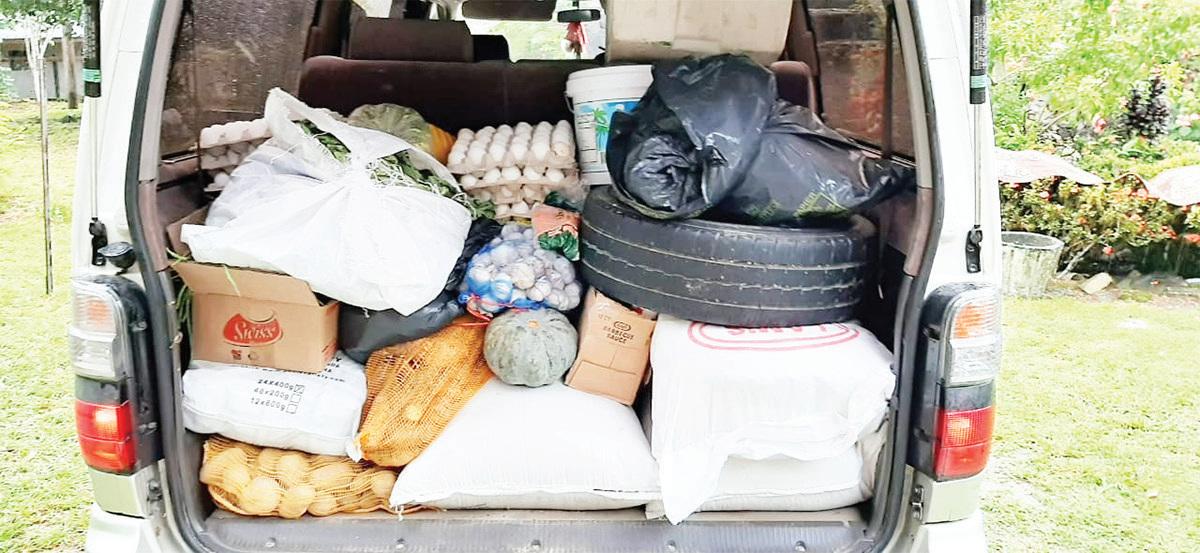
packages and hampers to healthcare workers serving in hospitals across West Coast Demerara, as well as members of the Guyana Police Force (GPF) who continued to serve during those difficult times.
She stated that she has also been blessed with an incredible network of farmers, huskers, businesspeople, kind-hearted individuals and many friends who willingly partner with them
by donating produce and other essential supplies to help families facing hardship.
In addition, their church family has always been ready to answer the call whenever a family is in crisis.
Whether it is food, clothing or other necessities, they give generously and without hesitation.
Juman told the Pepperpot Magazine that, for
her, giving has never been about recognition or reward but simply about showing God’s l ove in practical ways, restoring dignity and reminding people that they are not forgotten.
She believes that true generosity is measured not by how much we give but by the love, compassion and humility with which we give it.
She added that serv-
ing others is not simply something she does; it is who she is and a legacy she hopes to continue for many years to come.
Juman pointed out that her entire life has always been very church-centred and that she does charity ministry in their church, Faith Community Ministry, located at Lot 480 Peter’s Street, Parika, East Bank Essequibo.
She related that she

raised her children in the church and that they are well-rounded academically and pursuing careers of their choice.
Juman revealed that all three of her children are students at the University of Guyana (UG).
She explained that her life is all about her family and giving back to society in every way possible to bring joy, happiness and comfort to others.
While most people are still asleep at 02:30 hrs, Juman is already up and doing chores to ensure her children have healthy, wholesome, home-cooked meals to take with them for the day.
By 06:15 hrs each morning, she is ready to leave home to take her children to UG and repeats this cycle daily to ensure her family is comfortable.
agricultural entrepreneur.
Looking ahead, she intends to expand her operation by producing both breeding animals and market-ready fatteners to supply Guyana’s growing pork industry, thereby creating an additional and sustainable source of household income.
While the economic benefits are important, Williams believes agriculture has transformed her life in far deeper ways.
Beyond providing an opportunity to earn an income from home while maintaining her responsibilities as a wife, farming has strengthened her confidence, independence and sense of purpose. “I am proud to be both a housewife and an agricultural entrepreneur,” she said.
In addition to managing her livestock enterprise, she also maintains part-time employment and serves as Secretary of the Community Development Council (CDC), actively contributing to local
governance and community development.
Her experience demonstrates how agriculture can become a powerful platform for women’s economic empowerment and leadership.
Equally inspiring is Williams’ determination to complete the education she once believed she had lost forever. Recognising that education remains fundamental to personal and professional growth, she enrolled in the Government of Guyana’s Guyana Online Academy of Learning (GOAL) scholarship programme, through which she is currently pursuing her secondary school certification.
As someone who once considered herself a school dropout, she now views education as another opportunity created through national development policies. “As a school dropout, I never thought I would get another chance,” she reflected.
“Today, I have that opportunity, and I intend to make the most of it.”
Her long-term ambition is to continue advancing academically while simultaneously expanding her agricultural business.
Her confidence to pursue both education and farming continues to be reinforced by the ongoing support she receives from GLDA’s extension services.
Beyond the initial training and livestock distribution, GLDA officers regularly provide veterinary care, husbandry advice, disease-prevention guidance and technical assistance whenever challenges arise.
Williams speaks warmly of this relationship, emphasising that the accessibility of extension officers has been critical to her success. “Whenever I reach out for assistance, the GLDA extension staff respond.
“They always come to provide the services needed to improve my animals, and I truly appreciate that level of commitment,” she explained.
Such extension support remains an indispensable
component of Guyana’s broader livestock-development strategy, particularly for first-generation farmers entering the sector.
Williams’ own transformation mirrors the remarkable evolution taking place throughout Tigerbone Banakari Village.
She vividly remembers arriving in a community where dense vegetation vastly outnumbered houses and infrastructure was extremely limited.
Today, however, the village has experienced significant improvements through investments in roads, community facilities and public services.
Residents now benefit from all-weather roads, expanding access to electricity, a modern Resource Centre, an Information and Communications Technology (ICT) Hub, community recreational facilities, village-owned tractors and trailers, vehicles and other amenities designed to improve both livelihoods and quality of life.
For Williams, these developments represent far more than physical infrastructure; they symbolise opportunity, optimism and the confidence that young people can build meaningful futures within their own communities.
Visitors to the Williams household are immediately struck by the diversity of animals that populate the property.
In addition to her growing swine enterprise and Muscovy duck flock, the farm is home to chickens, parrots, dogs, cats, monkeys and several other domestic animals, creating a unique environment where agriculture coexists harmoniously with Guyana’s rich natural biodiversity.
The farm reflects not only her passion for animals but also her broader vision of developing a diversified and sustainable agricultural enterprise capable of supporting her family for years to come.t
Ultimately, Nikita Wil -
liams’ story is about much more than livestock production. It is a compelling testament to the transformative power of resilience, community support, education and strategic public investment.
From a young woman whose education ended prematurely to an emerging agricultural entrepreneur, community leader and GOAL scholarship recipient, her journey demonstrates that success is not determined by where one begins but by the willingness to embrace opportunity when it arises.
As Guyana continues to modernise its agricultural sector and promote inclusive rural development, Williams stands as a powerful example of how government support, effective extension services and personal determination can converge to change lives. Her experience reminds us that agriculture is no longer merely a necessity; it is increasingly a pathway to entrepreneurship, empowerment and national development.

SOMETIMES, it pounces upon the mischief of the moment and creates an endless roadway of animosity. This very thing happened when a mother faced her two sons on a betting battlefield, and the younger one prevailed, defeating the elder brother. It led to a quiet ascendancy of growth and animosity between the two brothers in their diverse upbringing, one with wealthy folk, while the younger
coped with the literature he explored and the tougher realms of employ ment. But, unknown to his brother, he persevered and proved his manhood, worked hard and seemed to be forgotten by most of the family, even as he pursued diverse and, at times, difficult lifestyles. The pain of defeat that generated the hostility of the bigger brother towards the younger was that their
mother had bet on the younger brother. Later, even though he had a more fabulous job through his aunt’s connections, the bigger brother did not find common ground easily. The younger brother toiled on the waterfront. Eventually, the aunt migrated, and the younger brother was encouraged to join the Castle Royal because he was earning now, and the hard life had conditioned him to
prepare his meals, while the elder brother and his pals could not fry an egg.
The younger brother also had a small library of books, some of which were rooted in the occult. While the younger brother viewed that collection of his literature as interesting fiction, his older brother and pals saw it as cosmic realms to be explored, as described by one particular book touted. And there’s no lit-
erature like mysticism to confuse quickly and feed an ego with all manner of ascending purposes. Their tale is a giant one of Kosmic mystery. Of course, Georgetown had its realm of con artists and victims, unto today. So did the rural areas. But the real mysticism of the younger brother had taught him to be careful of all kinds of engagements and trusts, even with family. The younger studied the contracts
that shouted, “Read before you sign…” The elder brother was intensely suspected to have been murdered and robbed by his private fraternity kinfolk and blood family, who were not part of the initial investment and vision. The ego can shape blunders… Rest in peace and dissolve, and may old acquaintances be remembered only as a dim, shadowy memory to learn from.


AS an avid user of social media, I often see people label themselves as “minimalists”, with minimalism becoming a very popular lifestyle trend. If you scroll through your social media, you’ll see spacious white rooms, homes that look untouched or gardens with one tone of flowers. Many celebrities are adopting these styles in their houses and lifestyles. The pictures look very appealing online, and people seem to be more pleased by “minimalist” pictures. I do think that there is a misconception about minimalism. It does not mean that one should own fewer things or that a picture needs a certain appeal or style to be shared online.
Minimalism is beyond what we can see. It involves the intentional choices we
make and asks people to evaluate what truly adds value to their lives. It goes beyond the physical things we see and own. It also encompasses the mental, emotional, spiritual and social aspects of our lives. It is not a matter of depriving yourself of something; it’s about prioritising what matters.
We are often encouraged to be large-scale consumers in today’s fast-paced world. We are often led to believe that the newest iPhone, the latest fashion and the mass production of goods and services are meant to give us happy and prosperous lives. How happy and prosperous do many of us genuinely feel after consuming these, despite the high cost or irrelevance?
Many people still feel very overwhelmed, not be-
cause they have too little but because they have too much. They have too many distractions, too many commitments, too many demands and too many expectations to keep up with. With that in mind, minimalism is essenti ally a concept that challenges the culture of excessiveness. We are encouraged not to remain silent but to ask questions about everything we own. Are we spending enough time on things that matter, like our family? Are our schedules overpacked with activities that don’t include self-reflection? Sometimes, the greatest form of decluttering isn’t cleaning out a closet; it’s learning to say no to obligations that no longer serve us. Minimalism can be when we choose to disconnect from our inboxes and
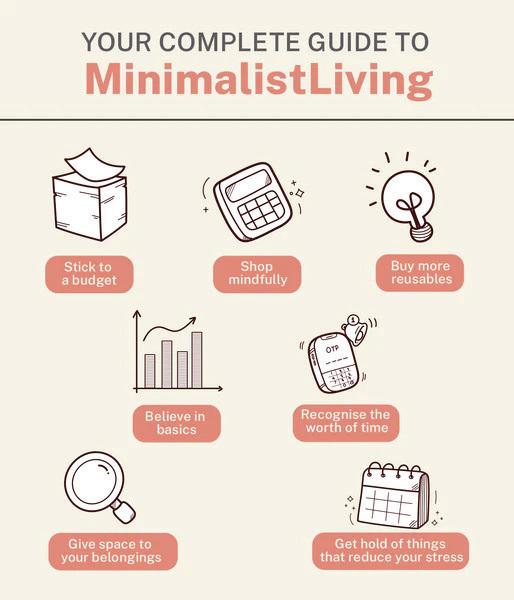
endless digital notifications to focus on our family. Or it is when we choose to use our finances and resources wisely on more sustainable and permanent solutions for our lives.
Perhaps the greatest benefit of minimalism is the clarity it brings. When we remove unnecessary distractions, we create room for creativity, purpose and peace. We begin to appreciate experiences over
possessions, relationships over status and quality over quantity. This doesn’t mean everyone should own only thirty items or live in a tiny house. Minimalism looks different for every person. A family with children will live differently from a university student. A traveller may value mobility, while an artist may treasure collections that inspire creativity. The goal isn’t to fit into a minimalist
image; it’s to build a life that reflects your values. Ultimately, minimalism isn’t about having less for the sake of having less. It’s about making room for more of what truly matters: more time, more purpose, more gratitude and more freedom
The most meaningful form of minimalism isn’t found in perfectly curated spaces; it’s found in intentionally lived lives.






HEADACHES have practically become a national pastime.
During the past year, nearly 90% of men and 95% of women have had at least one headache every eight weeks. An estimated 150,000 Guyanese suffer from some form of severe headache. They make tens of thousands of
outpatient visits to physicians every year for this condition. Thousands suffer from migraines. That is about 15% of our population. However, what most people, physicians included, do not realise is that a tremendous number of headaches are related to the teeth. In my experience as a
dental surgeon, as much as 85% of all head pain has been directly attributable to problems in the teeth and jaw, especially when new fillings, dentures or crowns are placed, and is readily alleviated with dental treatment.
When a friend told me that she had been getting headaches nearly every
day for several years, I immediately suspected a problem with her teeth. Sure enough, her wisdom teeth were impacted. Since she had never had specific problems with them, she did not know that they needed to come out. And once they were removed? You guessed it: 99% of her headaches completely vanished. She does still report an occasional headache, but we have both concluded that once her three kids are a bit older, those will probably miraculously vanish!
Stress and tension headaches are the most common, afflicting as many as 77% of all headache sufferers. Ninety per cent of adults have had a tension headache, according to the American Council for Headaches. Tension headaches are usually a steady ache rather than a throbbing pain; they affect both sides of the head. I believe psychological factors have been greatly overemphasised as a cause of tension headaches.
You might think that the only way to treat a tension headache would be to reduce the amount of tension or learn how to “relax” more, but that is not always possible or even easily accom -
plished. It is also not the only answer.
Many times, people under stress will clench or grind their teeth, which is frequently the result of a misaligned bite. As a result, the tension headache is almost always accompanied by spasms of the muscles that help to open and close the jaw. To evaluate whether the headaches are bite-related, a small mould can be made to fit over the upper front teeth, which the patient wears for several days. Often, the headaches stop entirely or diminish greatly. It is known that a dentist can make minor but important adjustments to reshape the teeth so the patient can have long-lasting relief. When the bite is corrected, the strain is taken off the muscles, allowing them to relax and heal, while the patient continues to feel better.
TMD, formerly known as TMJ (temporomandibular joint) syndrome, is simply a dramatic extension of the classic tension headache. It is named for the temporomandibular joint, which is in front of the ear, where the lower jaw rests in the skull bone socket. Often related to clenching and a misaligned bite, over time,
TMD syndrome can result in extreme spasms and trauma to the muscles, not only in the jaw but down the neck and shoulders. In many cases, even the back muscles are affected.
Between the top of the lower jaw, called the condyle, and the skull is a cartilaginous disc. This serves as a cushion as one condyle moves forward and downward when the mouth opens. If this becomes slightly displaced, a click or pop will occur when opening the mouth; sometimes the jaw may even lock. Some symptoms of TMD include dizziness, headaches, migraines, facial pain, tooth pain, pain radiating down the arms into the fingers, limited jaw opening, pain with jaw movement, ringing in the ears, teeth grinding, and chronic neck and backache. Since the site of the temporomandibular joint is at the intersection of three major energy meridians relating to the stomach, endocrine system and small intestines, relief from TMD can spark a tremendous healing process in the whole body, relieving symptoms such as stomach problems, chest pains and cold extremities.






…and the soldiers stood at attention, saluting their superior officer, the Lieutenant General, as she entered the room in the uniform of one of the highest ranks in the military.
The family stared dumbfounded at her,
She sat down and spoke in a deep South American accent. Her voice was low but had a sharp edge as the storm outside continued to rage.

standing there, proud and dignified, far removed from the child they had rejected: their own flesh and blood.
The mother cried quietly as the Lieutenant General stared at them, her eyes emitting cold fury. She had lived for this day, to see them suffer, cry and beg for forgiveness as she had cried and cried when she was thrust into strange hands that stormy night as the ship sailed away to an unknown place.
“Lies, scorn and rejection: the stories of your lives. You continued to live and make your name in society because there was nothing and no one who would bring shame to the family. She was gone.”
She looked at the distressed mother.
“Many bad things could have happened to that child, but the traders, merciless businessmen, felt pity for her and sold her to a wealthy, childless couple, kind people who gave her a good life.”
“God answered my prayers,” the mother
sobbed. “I begged Him every day to take care of you.”
Lieutenant General Morales looked at the mother, unmoved by that heart-wrenching display, and turned her attention to the father.
“She was dead to you, wasn’t she? You couldn’t even say she was your child. Such scorn and hate for your own. What did she do that was so wrong? She
was only six, innocent to the world.”
He couldn’t answer. The enormity of the wrongs done by his hands against his own child was cutting into him like a sharp sword.
“I can kill you now,” she said icily. “But that’s too easy a punishment for a heartless father like you.”
She sat back in the chair, taking her time, having carried this
weight on her mind for 22 years.
“A brother protects his sister, doesn’t he?” she asked the brother. “She called for you. She screamed for you, but you never came. But when you saw what had happened to her, you lied, so shame was cast on her. What happened to a brother’s love?”
The brother broke down crying. “I am so
sorry. I can’t tell you how sorry I am. Please forgive me.”
A small, cynical smile played at the corner of her mouth.
“You, as the eldest son, were the pride of the family, enjoying their love and attention, never sparing a thought for your little sister. And now you want forgiveness?”
He bent his head,
TURN TO PAGE XVII


IN the gentle moments of the morning, when we are about to step out of
bed or into the outside world, there is a quiet change that occurs with-
in us. Without realising it, we put on a special mask, a face appropri -

ate for the people we are about to interact with or the place where we are about to spend our day. This change is as natural and necessary as switching between different clothes for different occasions. It is not something we discuss with others or do intentionally, but it is certainly something we need to fit in.
For instance, we cannot use the same tone with a superior in the workplace as we do with a friend. We may not share the same things about ourselves with someone we have met at a formal event as we would with someone we have met at a party. We cannot wear the same clothes we wear at home to visit a restaurant. These little changes we make, and the subtle masks we wear, are not necessarily misrepresentations of who we are. More often than not, they are very important parts of us. Instead, they are incomplete pieces of ourselves that we choose to share with the world in places where the entirety of who we are may not be accepted.
When we are younger, this process of ‘switching faces’ is infinitely more difficult. To begin with, the idea of switching faces is not something we are taught in that specific way. Instead, we are taught rules and social norms, asked to follow them, and reminded that failing to do so can lead to negative consequences. Under the
guise of being taught values, we are truly taught to hide the real way we think, speak and act to make our personalities more palatable to the wider society. For example, when we are asked to show respect for our elders, we are not really being taught to respect the wisdom and experience these individuals have; rather, we are being asked to address them properly and follow all the formalities.
In an attempt to understand what the world wants from us and, more importantly, to understand what it is that we are willing to give, we go through many phases of confusion and discomfort. During these phases, we feel as though there is no place where we truly fit in. It is at this point that we realise that we do not have to change ourselves to fit in; we only need to briefly pretend to be the kind of person who has the qualities that enable them to conform to all social norms. Eventually, we fall into the accepted habit of being different for different occasions. We begin to wear new faces.
We do this with the understanding that if we refuse to wear different faces, then we must be willing to give up the social benefits of wearing these faces or, at the very least, have something extraordinary enough to offer the world that allows others to forgo judging us for not conforming. This has been an unchanging
truth that has existed for generations. Perhaps this way of living must finally change.
Our generation has begun to show signs of a special kind of acceptance, the kind that allows us to walk away from the idea of wearing different faces. Today, it is becoming increasingly normal to be the purest version of ourselves in every setting. Formalities and ceremonious protocols are gradually slipping away, to be replaced by true connections. Some may see this as discomfort or a loss of culture. It is, however, the beginning of being able to access the richest parts of humanity without an obstacle.
It is no longer the absence of tattoos or piercings that determines how good someone is at their job. It is no longer someone’s ability to smile constantly that really determines what kind of heart they have. Today, we can even choose to ignore someone’s tone or language to listen to the content of their words. Sometimes, it is seemingly the rudest persons who have the most truthful things to say.
Let us continue refusing to judge others in small ways and, in return, accept the freedom of seeing one another’s faces without masks. We might discover that, for many people, their real face is their most beautiful one.
FROM PAGE XV
too ashamed of himself to look at her. The sword of guilt cut into him even deeper.
“Ahana.”
She turned as the mother called her name, a name she hadn’t heard for so many years.
“You loved me so much. Why did you let him take me away that night?” she asked.
The cold fury ebbed a little from her eyes.
“I cried for you until I couldn’t cry any more.”
The mother’s lips quivered. “I tried, but I lost because I couldn’t win against him, with his brutal fists and threats. All I could do was pray for you.”
Her voice broke as she looked at her daughter. “I prayed for you every day for twenty-two years, and in my mind, I walked with you every step so no harm could come to you.”
The General said nothing for a long while. Then she stood up, her face impassive, seemingly unmoved by the mother’s words and tears. But underneath the soldier’s uniform was a woman whose heart beat with love and compassion, who could cry and laugh.
She nodded to a soldier to untie the mother’s hands.
“Take her to the guest house and have her refreshed and re -
laxed. I will talk to her later.”
She turned to the father and brother, the cold fury back in her eyes.
“It’s too late for apologies. I just wanted to make sure you suffered for what you did to me.”
She issued an order to her soldiers. “Take them back to their home. I’m done here.”
She left the army base for the guest house, where her mother awaited her.
General Morales changed from her uniform into a simple dress, letting her hair down, with a relaxed look on her face: the woman she was, just Gabriella.
As she entered the room, her mother rose from the sofa, her face lighting up with a smile at the change in her appearance.
“You’re as beautiful as I always imagined you would be.”
For the first time that night, she saw her daughter smile, a smile that drew tears to her eyes.
“Whoever you are now, you’re still my sweet Ahana.”
“I am happy to hear that,” Gabriella said, embracing her mother. It had been such a long time since she had been held by those loving arms and heard that affectionate voice. They sat together, talking over cups of
coffee as the sun rose, with sleep far from their minds.
“There is only one regret,” the mother said.
“What is that?”
“I can’t have the special wedding celebration I wanted for you.”
Gabriella smiled.
“Maybe you can.”
She said something in Spanish to the waiter serving breakfast, and a few moments later, a most handsome man entered the room.
He was dressed casually, the soldier who had been asking the questions in the interrogation room. Gabriella rose, and he embraced her, kissing her lightly on the cheek.
“Mum, this is my fiancé, Javier.”
The mother smiled happily. “Thank you, dear Lord. It gets better.”
Javier was not a soldier, although he had served in the military. He was a director in his family’s oil company, but he had accompanied her on this trip to help her find closure from what had been a great burden on her mind.
“Now I can have my celebrations,” her mother said as they ate breakfast together.
“What celebrations?” Javier asked.
“You’ll have to ask her,” Gabriella said with an innocent smile.


YOUNG adult fiction is rarely written by young adults. The classics of the genre—from The Catcher in the Rye, The Chocolate War, and The Pigman in the American tradition to Caribbean classics such as Green Days by the River, A Year in San Fernando, Crick Crack, Monkey, Geoffrey Drayton's Christopher, Ian McDonald's The Humming-Bird Tree, and, more recently,
Junot Díaz's The Brief Wondrous Life of Oscar Wao and Edwidge Danticat's Claire of the Sea Light—were all written by adults, often decades removed from the age of their youthful protagonists.
Writing convincingly for young readers requires a peculiar literary ventriloquism. Adult writers must inhabit the voice, rhythms, fears, and emotional landscape of adoles-

cence without succumbing to nostalgia or allowing an intrusive adult consciousness to overwhelm the child's perspective. The greatest works of young adult fiction succeed because they recover, not merely remember, the immediacy of youth.
Abigail Persaud Cheddie's Ixora Mara, Sourhouse (Hansib, $15.00) is a welcome addition to the distinguished tradition of Guyanese young adult fiction, joining works such as Jan Carew's The Wild Coast, Oonya Kempadoo's Buxton Spice, Imam Baksh's The Dark of the Sea, and Berkley Wendell Semple's Kipling Plass. Young adult fiction is by no means a monolithic genre. Its concerns range from innocence to violence, family life to sexuality, and its intended readership is equally varied. Novels such as Buxton Spice and Kipling Plass confront sexuality with unusual frankness and are more appropriately read by older adolescents. More broadly, coming-ofage fiction constitutes one of the central traditions of Caribbean literature since the 1950s, chronicling the transition from childhood to adulthood against the backdrop of colonial and postcolonial societies.
Persaud Cheddie, a lecturer in literature at the University of Guyana, makes an impressive literary debut. Ixora Mara, Sourhouse is an accomplished first novel whose greatest strength lies in its affectionate and psychologically convincing portrayal of pre-teen girls. The emotional texture of
childhood is rendered with remarkable authenticity, while the social landscape is unmistakably Guyanese. The novel received a Special Prize at the 2024 Guyana Prize for Literature, owing in part to the absence of a dedicated young adult fiction category, a significant omission given the growing vitality of the genre in the Caribbean.
The novel's central achievement is its careful observation of everyday childhood. Persaud Cheddie possesses an enviable eye for the small rituals that define growing up: school friendships, sibling rivalries, playground politics, family discipline, neighbourhood gossip, and the quiet negotiations through which children learn deception, loyalty, embarrassment, and resilience. Childhood, here, is neither sentimentalised nor romanticised. Rather, it is presented as a period during which the moral framework of adulthood is slowly assembled.
The story follows Ixora Mara Henry and her twin sister Ivy from primary school into early adulthood. Named after flowers but considerably less delicate than their names suggest, the sisters navigate village life under the guidance of a loving but disciplined extended family. Ixora, affectionately called "Ixie Pixie" by her patient father, is the emotional centre of the narrative.
Within the opening chapter, Persaud Cheddie introduces the novel's governing trauma. On the day

EVERY one of us lives in two worlds. The first world consists of circumstances, events, conversations, opportunities, disappointments and all the things we collectively call life. The second world exists entirely within the mind.
That inner world contains beliefs, assumptions, expectations, memories, interpretations and stories. It influences how every experience is perceived. It determines which details receive attention and which details fade into the background. It acts like an invisible architect, shaping the meaning we assign to the events unfolding around us. I have always found it fascinating that two people can experience remarkably similar circumstances and walk away with completely different conclusions. One person discovers a possibility where another discovers a limitation. One person notices support while another notices rejection. One person sees a closed door and immediately looks for a window; another sees the same door and assumes the journey has ended.
The difference often begins long before the experience itself. It begins with the world each person has already built inside.
Neville Goddard spent much of his life exploring this idea. The twentieth-century mystic became famous for what he called the ‘Law of Assumption’. His central teaching proposed that people move through life according to the assumptions they consistently accept as true. He encouraged people to assume the feeling of their desired reality and to occupy
that mental state before any physical evidence appeared.
Many people dismiss the idea as purely spiritual. The interesting part is that psychology has spent decades studying similar patterns from a different direction.
William James, often regarded as the father of American psychology, understood that belief influences behaviour in profound ways. James observed that people frequently act according to what they believe is possible. Expectations shape attention, attention shapes behaviour and behaviour shapes outcomes. The process creates a continuous feedback loop between the inner world and the outer experience.
The same principle appears in one of psychology’s most famous discoveries, the Pygmalion effect. Research conducted by psychologist Robert Rosenthal demonstrated that expectations influence performance. Teachers who expected more from certain students often created conditions that fostered greater achievement. The expectation influenced behaviour, the behaviour influenced performance, and the performance reinforced the original expectation. The phenomenon appears everywhere.
A person who expects success approaches challenges differently from a person who expects failure.
A person who expects respect carries themselves differently from a person who expects rejection. A person who expects opportunity notices possibilities that another person may completely overlook. The expectation
itself becomes part of the experience.
Modern psychology also explains in terms of confirmation bias. Human beings naturally notice information that supports existing beliefs. The mind enjoys consistency. It searches for evidence that confirms its assumptions and often gives less attention to evidence that contradicts them. That tendency does not mean
reality is imaginary. Reality remains reality. The principle suggests that perception acts like a filter. Two people can stand in the same room and focus on entirely different details. One notices the opportunities, while the other notices the obstacles. Both observations may be accurate, yet each creates a very different experience.
I have seen this principle
TURN TO PAGE XXIII

FROM PAGE XVIII
Disappearance becomes a recurring motif.
A beloved teacher suddenly leaves. The school janitor's wife vanishes
of Ixora's birthday party, her closest friend never arrives. Instead, the girl's family disappears from the village without warning or explanation. This unexplained absence reverberates throughout the novel, becoming the emotional wound that earns Ixora the nickname "Sourhouse," a local expression capturing the lingering sadness that settles over a child when something precious has gone irretrievably wrong, a mood and feeling that is very right.
from the community. Even the janitor himself exits under tragic circumstances. These departures accumulate into a meditation on human impermanence, teaching Ixora that people do not always receive proper endings or farewells. Childhood is revealed not simply as a season of innocence but as
an early education in loss. The novel unfolds episodically, resembling a collection of interconnected stories rather than a tightly plotted narrative. In this respect, it recalls the Caribbean oral storytelling tradition, where family anecdotes, village gossip, humorous episodes, and cautionary tales accumu-

late into the larger story of a life. Persaud Cheddie does not imitate Anansi stories so much as recreate their communal rhythms and narrative sensibility.
Among the most memorable episodes is the story involving "The Nephew," a schoolyard bully whose antagonism toward Ixora and Ivy is by turns comic and heartbreaking.
Like many of the novel's finest moments, the episode balances humour and sadness with remarkable assurance. Indeed, humour quietly animates the entire book, preventing even its most painful moments from becoming oppressive.
Persaud Cheddie also demonstrates a remarkable gift for evoking place. Village life is recreated with documentary precision. Daily routines, household interactions, school life, neighbourhood relationships, and the intricate dynamics of the Guyanese extended family are rendered with affectionate realism. Grandparents, aunts, uncles, neighbours, and teachers collectively shape the moral universe of the novel. The family is neither idealised nor dysfunctional; it is recognisably Caribbean— strict, loving, imperfect, and enduring.
If the novel has a weakness, it lies in its narrative perspective. The story is framed as an adult recollection of childhood, which hints at biography, yet the adult Ixora contributes relatively little interpretive insight. Indeed, the retrospective frame occasionally interrupts the immediacy of the child's experience. The novel might have achieved even greater emotional power had it remained entirely within the consciousness of the young Ixora, allowing readers to discover the world solely through her developing perceptions.
A related weakness is the novel's reluctance
to engage fully with the physical realities of adolescence. Childhood is presented with emotional honesty, but bodily maturation- the awkward self-consciousness of puberty, changing bodies, and emerging sexuality— is largely absent. This omission creates a sort of dissonance within the text. Persaud Cheddie excels at exploring psychological development but is noticeably less willing to inhabit the biological realities that accompany growing up. As a result, the novel occasionally lingers over comparatively minor emotional episodes while passing too quickly over more formative experiences. These criticisms, however, do little to diminish the novel's considerable accomplishments. Ixora Mara, Sourhouse is refreshingly free of literary gimmickry. It avoids postmodern fragmentation and elaborate formal experimentation in favour of straightforward realism. Its prose is lucid, its characters recognisable, and its emotional world entirely believable. It is, in the best sense, a "straight story"—an unembellished account of ordinary lives made extraordinary through attentive focus. Ultimately, Ixora Mara, Sourhouse is a loving portrait of Guyanese girlhood. It captures with rare fidelity the texture of village life, the consolations and burdens of family, the intensity of childhood friendships, and the soft sorrows that shape adult memory. Funny, moving, and deeply rooted in Guyanese experience, Abigail Persaud Cheddie's debut announces the arrival of an important new literary voice. One finishes the novel with the distinct sense of having inhabited not merely a fictional childhood but a lived one.






TURN TO PAGE XIX
operating in countless areas of life.
Some people enter relationships expecting betrayal and spend years collecting evidence for that expectation. Some people enter relationships expecting partnership and spend years gathering evidence to support that expectation.
Some people start businesses expecting failure and interpret every challenge as confirmation. Others start businesses expecting growth and interpret those same challenges as part of the process.
The circumstances differ less than we imagine. The assumptions often differ more than we realise.
Albert Bandura, one of the most influential psychologists of the modern era, introduced the concept of self-efficacy. Self-efficacy refers to a person’s belief in their ability to influence outcomes. Bandura’s research demonstrated that people who believe they can succeed often persist longer, recover more quickly from setbacks and achieve better results. The belief itself influences behaviour, which in turn influences results, and the results reinforce the belief, so the cycle continues.
Neville Goddard approached the same phenomenon from a spiritual perspective. He viewed imagination as a creative force. He taught that assumptions eventually externalise themselves through experience. Whether a person interprets that process spiritually, psychologically or philosophically, the underlying observation remains compelling. The stories we repeatedly tell ourselves influence the lives we experience. This comes with tremendous responsibility. Many people spend years focusing on what they fear, what they lack or what they expect to go wrong. The mind becomes skilled at finding evidence for those expectations. Fear receives attention; attention receives energy. Energy strengthens perception, and the cycle reinforces itself. The opposite pattern operates just as pow-
erfully. A person who consistently focuses on possibility begins noticing possibility. A person who focuses on growth begins recognising growth opportunities. A person who expects improvement often takes actions that support improvement. The inner world influences the outer one. The idea appears throughout history. Ancient spiritual traditions emphasised the importance of thought long before modern psychology existed. Philosophers explored the relationship between perception and reality for centuries. Contemporary neuroscience continues revealing the extraordinary influence of attention, belief and expectation on human behaviour. Perhaps that explains why Neville Goddard’s teachings continue to attract interest decades after his death. His message speaks to something deeply human: every person carries an invisible narrative. Every person interprets life through a personal lens, and every person participates in the ongoing construction of meaning. The world outside matters, but the world inside matters too.
As I grow older, I find myself paying closer attention to the stories I tell myself. Those stories shape expectations, which shape perception, and perception shapes action. Action then shapes outcomes.
The process unfolds silently and continuously. It unfolds whether we notice it or not. Perhaps the greatest lesson hidden within the Law of Assumption involves awareness, which allows us to examine the assumptions we carry. Awareness allows us to question inherited beliefs. Awareness allows us to choose thoughts that serve growth rather than limitation. The world we experience each day contains countless factors beyond our control. Life continues presenting surprises, challenges, opportunities and unexpected turns. Yet within that uncertainty, a powerful choice remains. That is, we choose the assumptions we nurture, the stories we repeat, the world we build inside, and that inner world
often becomes the foundation on which the outer world is experienced. Enjoy my poetry below.
The World I Build Inside
“Tell me,” I asked, “why two men stand
Upon the same stretch of earth and land,
Yet one finds blessings by the mile,
While one walks heavy all the while?”
The old man smiled beside the sea,
Then drew a circle next to me.
“The world,” he said,
“appears outside, Yet first it gathers deep inside.”
“But mountains rise and rivers flow, And seasons come and seasons go.
Surely life arrives complete,
Before it ever meets our feet?”
He traced a window in the sand,
Then placed a pebble in my hand.
“The eye receives what it believes, And meaning grows
from hidden seeds.”
“The hopeful heart finds open doors, And chances scattered on the shores.
The faithful soul finds paths to roam,
Because it carries light from home.”
“Then does the mind create it all?”
I asked beneath the evening’s call.
He smiled and watched the sunlight bend,
“The mind decides what story wins.”
The tide rolled in, the circle faded, The sky turned gold, the daylight traded. That hush made me understood,
The inner root becomes the wood.
For every life we think we see,
Begins within invisibly.
The world we meet from day to day
First learns its shape from what we say.
Romella Dasratt


















































Dear student, Dear student, when preparing responses to examination questions, read each question carefully and identify the key words, phrases, or details by underlining them. This practice will help you concentrate on the precise requirements of the question, reduce the likelihood of errors caused by misreading, and lessen stress. Plan your response, manage
your time effectively, and present your main points and supporting evidence clearly for the examiner to exercise sound judgement. Be wise. With sincere regards.
THE PASSAGE
Improving reading –drawing conclusions
Note: 1. Drawing conclusions means using clues in the passage to understand ideas that are not said directly. It is like “reading between the lines”: you use what the
writer tells you, along with what you already know, to make a sensible judgement about the whole text.
2. Inference and conclusion in exams: These two skills work together. An inference uses clues from the passage to explain one detail, while a conclusion combines several clues and ideas to form a final judgement about the whole text. In exams, always support both with evidence from the passage.

Expounding: Drawing conclusions helps you understand a passage better. It means looking past the obvious facts and thinking about the bigger idea: what is important, why it is important, and how one event or idea connects to another.
At this stage, it is not enough to know what happened in the passage. You also need to think about what those facts mean to you. A conclusion goes deeper than one inference because it uses several clues from different parts of the text.
Now, look at the following text and then answer questions 1-4.
Tasha: (pouting) I’m not going. I hate dances!
Liz: (sighing) But it wouldn’t be any fun without you.
Tasha: I’m not fun … (hopefully) Am I?
Liz: (trying hard to be patient) You are when you stop thinking about yourself so much. (In a coaxing voice) Come on, there’s going to be a really good DJ … (grinning) You can wear my new sweater.
Tasha: (with a big smile) Really? Oh, all right. You talked me into it … again. (with enthusiasm) Who else is going to be there?
Liz: Everybody! I knew you’d change your mind.
Questions:
1. What can you conclude about Tasha?
(A).. She hates dances. (B).. She depends upon Liz for assurance.
(C) She has a lot of confidence. (D).. She dislikes Liz.
2. What can you conclude about Liz?
(A).. She dislikes Tasha. (B).. She is Tasha’s good friend.
(C).. She does not really go to the dance.
(D).. She is not very persuasive.
3. What is the most logical conclusion about
But those behind cried “Forward!” And those before cried back!
the type of situation between Tasha and Liz?
(A).. It has never occurred before.
(B).. It will never occur again.
(C).. It has occurred only once before.
(D).. It occurs often.
4. Which is the most logical conclusion?
(A).. Tasha is looking for attention.
(B).. Tasha is self-confident.
(C).. Tasha is used to being the centre of attention.
(D).. Tasha does not know how to dance.
THE LETTER
Coining the social business letter
Note: Today, we move from the friendly letter to the social business letter. Unlike the standard commercial business letter, which is mainly concerned with sales and business transactions, the social business letter has a more personal and courteous purpose.
A social business letter, also known as a social-personal business letter, is formal correspondence used in professional relationships to express goodwill, sympathy, appreciation, or congratulations. Common examples include thankyou letters, congratulatory letters, condolence letters, and professional recommendations.
These letters help strengthen relationships by combining a warm, personal tone with professional presentation.
The example below is addressed to an employ-
ee who has reached an important milestone. See how thoughtful it is. How do you think Eva would react to it from her employer?
Dear Eva,
In the seventeen years you have been with Walter’s, you have seen our company grow from a small entity to a nationwide organisation. Responsible for this remarkable growth are highly productive and loyal employees like you. It is a pleasure for me to write this congratulatory letter on your thirty-fifth anniversary, for it gives me an opportunity to thank you for your unstinting contribution to our success.
As supervisor of our filing-away staff, you have set up a healthy flexible and effective fool-proof system for handling the volume of bulk juice and delivery to private companies. I am sure you have heard the often-repeated statement about the office: “If you don’t know it ask Eva.” The tribute is indeed fitting and no exaggeration of your efficiency.
I look forward to w orking with you in the years ahead. When I think of the slogan “Walter’s is relationship,” I cannot help calling to mind a picture of you and the way you almost coerced me into implementing your carefully thoughtout system! You have helped to make our firm the congenial, effective group it is today.
Sincerely yours