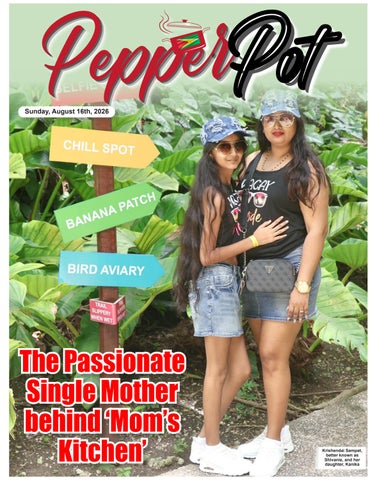
Sunday, August 16th, 2026
The Passionate Single Mother behind ‘Mom’s Kitchen’
Krishendai Sampat, better known as Shivanie, and her daughter, Kanika
II
CHRONICLE PEPPERPOT ― Sunday, August 16, 2026
Hope In Motion:
A Ride for Awareness, Healing and Change Across Guyana By Shawnde Lewis (Guest Contributor) Director of Communications Strategy MSM Global | Hope in Motion – Education and Empowerment BEHIND every statistic is a person. A mother. A daughter. A son. A friend. A neighbour. Someone whose life has been changed by violence, someone silently struggling with their mental health, or someone who has watched a person they love suffer and wondered what
gether government agencies, community organisations, partners and members of the public around one shared purpose: raising awareness, encouraging education and inspiring meaningful action. At the centre of the ride is Lead Cyclist and Ambassador Harry Camlasaran, whose cycling journey has been closely connected to giving back. Camlasaran has participated in major fundraising rides in Canada, including the Ride to Conquer Cancer, using his passion for cycling to support causes that impact others’ lives. Through Hope ognise unhealthy and abusive behaviours, and remind communities that mental wellbeing deserves the same attention and care as physical wellbeing. Most importantly, the initiative reinforces that asking for help should never be a source of shame. Moving Together Hope In Motion is being strengthened through collaboration across government, community and tourism sectors, reflecting the understanding that addressing gender-based violence and mental health requires collective action.
they could do to help. This October, those realities will be brought to the forefront through Hope In Motion: Education & Empowerment, an awareness and education initiative using movement, community engagement and advocacy to spark meaningful conversations around gender-based violence and mental health across Guyana. Led by MSM Global Enterprises Inc., under the leadership of Founder and Principal Dr Michelle S. Moseley, Hope In Motion will culminate in a two-day awareness ride across Guyana on October 24–25, 2026. The initiative will bring to-
In Motion, he is bringing that same spirit of service to Guyana, using the bicycle not simply as a means of travelling from one destination to another, but as a vehicle for conversation, connection and change. The two-day journey will move through communities across Guyana, creating opportunities along the route to engage people directly and reinforce an important message: violence does not always leave bruises. Some wounds cannot be seen. A Conversation That Cannot Be Ignored The numbers underscore why this conversation mat-
ters. According to the 2019 Guyana Women’s Health and Life Experiences Survey, 55 per cent of women who had ever had a male partner reported experiencing at least one form of intimate partner violence in their lifetime. The findings highlight the continued need for education, prevention, intervention and community support. But behind those numbers are people, families and communities living with the consequences of violence. For survivors, those consequences can be physical, emotional, psychological and financial. Children and
families can also be affected, while the impact of trauma can extend far beyond the moment an act of violence occurs. Mental health is deeply connected to this conversation. Fear, trauma, isolation, grief and emotional distress can remain long after physical wounds have healed. For many, those struggles are carried quietly, behind closed doors and without the support they need. Hope In Motion seeks to create space for these realities to be acknowledged openly and compassionately. It aims to encourage conversations, help people rec-
Confirmed government and ministerial partners include the Office of the Prime Minister; the Ministry of Human Services and Social Security; the Ministry of Home Affairs; the Ministry of Health; and the Ministry of Foreign Affairs and International Cooperation. The initiative is also supported by community stakeholders, including the Women’s Chamber of Commerce and Industry Guyana, The Magic of Rotary and Visit Guyana. These partnerships represent more than organisational TURN TO PAGE VII
III
CHRONICLE PEPPERPOT ― Sunday, August 16, 2026
Pages, Voices, Legacy: Inside the Guyana Prize Literary Festival 2026 A four-day celebration in Georgetown spotlighted mentorship, performance and the next generation of Guyanese writers
Vanisha: Vanisha Ramnauth
Tamara Gilbert
By Andrea Hendricks FROM August 6 to 9, the Guyana Prize Literary Festival 2026 unfolded across the capital as a brisk, fourday programme of readings, workshops, performances and public conversations about what it takes to build a sustained writing culture. Hosted by the Ministry of Culture, Youth and
Sport, the free festival drew writers, poets, readers and literature enthusiasts from around Guyana and the wider Caribbean—an open invitation to listen closely, sharpen their craft and take part in the country’s storytelling life. Events rotated between Castellani House, the Pegasus Hotel and the National Cultural Centre, giving the festival a citywide rhythm. Workshops and storytell-
Distinguished Trinidadian advocate, author and literary mentor Celeste Mohammed, guiding the future voices of Caribbean justice and creative writing.
ing sessions focused on language, structure and voice allowing participants to practise their craft and think about their writing strategy and ambitions. Elsewhere, the National Poetry Slam brought a different energy:
performance-forward work that demanded presence, timing and risk. A dramatic stage production reinforced the festival’s central proposition that stories do not live only in books; they TURN TO PAGE VII
Rickeisha Perreira
Natasha Williams
Makeda Braithwaite
Literary triumph: award-winning Guyanese author, editor and communications specialist Jasmaine Payne, who recently secured the prestigious Guyana Prize for Literature for Best First Book (Fiction) for LEECH. Photo credit: Sachin Persaud
IV
CHRONICLE PEPPERPOT ― Sunday, August 16, 2026
The Passionate Single Mother behind ‘Mom’s Kitchen’
By Michel Outridge
KRISHENDAI Sampat, better known as Shivanie, has been single-handedly managing a home-based small business called Mom’s Kitchen, noted for its authentic local cuisine and flavours. The business is located in Phase 11, Meten-Meer-Zorg, West Coast Demerara, and it provides a daily menu for customers who have grown to love the original flavours of the food, born of creativity, raw culinary skills, and talent, all self-taught. Sampat was born on January 5, 1990, and she is the eldest of three children. Like many families, life wasn’t always easy. In 2003, her father suffered a stroke, and from that moment, their lives changed. Watching her family struggle taught her resilience at a very young age. She reported that, after graduating from Zeeburg Secondary School in 2006
A sample of the daily breakfast pre-ordered by customers
with eight subjects, she started working at Boodhoo’s General Store in 2007. That was where she met the young man she would later marry and with whom she started a family.
Krishendai Sampat, better known as Shivanie, and her daughter, Kanika
They got married in May 2010, and in June 2011, she welcomed her daughter, Kanika. “She has always been the reason I never gave up,” she said. However, in March 2019, her marriage ended, and she became a single mother, but she pressed on despite the challenges. She worked wherever she could: as an office assistant at St John’s Ambulance Brigade, a sales clerk at Bargain Mart Supermarket, and a restaurant cashier and waitress at Country Spice Restaurant, doing whatever was necessary to provide for her daughter. Sampat was determined to build a better future; she constructed a small, two-bedroom home. She thought she had finally found stability, but life had another lesson for her. Due to ongoing family difficulties, she made the heartbreaking decision to leave that home behind and start over once again in a rented house. “It wasn’t easy walking away from something I had worked so hard to build, but I chose peace and a fresh start for my daughter and myself,” she said. In November 2021, she got a job at the Regional Democratic Council (RDC), and later, she was transferred to the Department of Education.
She utilised the opportunity and tried teaching in the Special Needs Department at Stewartville Primary School in 2024, but that didn’t work out well because of workplace challenges. Sampat also started a small online business in her daughter’s name, Kanika’s Magnificent Looks Online Shopping, in 2021 as a side hustle. That small step gave her the confidence to dream even bigger. In 2025, she took her biggest leap of faith yet. She left her job and started Mom’s Kitchen from her home. “Today, every meal I prepare is a reminder that even the hardest seasons can lead to beautiful beginnings,” she said. Sampat reported that life has taught her a lot, but through it all, her daughter has been there from day one, a constant source of moral support and encouragement. “Today, I’m still dreaming. I now have my own registered business, our first car, the documents for my own land, and I’m working towards building a home that no one can ever take away,” she said. Sampat’s journey has taught her that sometimes you have to start over more than once, but every new beginning makes you stronger. She is, however, thankful to everyone who has supported her small business, Mom’s
Kitchen. Sampat said every order, every share, every recommendation and every word of encouragement has helped her to keep believing in her dream and kept the door open to her small business. She is the woman behind Mom’s Kitchen—not someone with a perfect life, but someone who has refused to let life’s challenges define her. Sampat’s story is one of courage. Even when life was hard, she tried over and over again until she succeeded. It demonstrates the unflinching strength, dedication, hard work and sacrifice she displayed as a single mother despite many challenges. She also believes her sto-
ry is still being written and that the best chapters are yet to come. Sampat’s daily menu is advertised on social media, allowing customers to place their orders. A delivery system is in place, or orders can be collected. On weekends, a seafood boil is available, along with a variety of other dishes, including Creole foods, accompanied by fruit milkshakes and desserts such as ice cream, jelly, and custard. On religious holidays, Sampat cooks seven curries with sweet rice, or whatever customers who support her small business request. She is also skilled at baking cakes and offers a daily breakfast menu, as well as ramen bowls.
Krishendai Sampat, better known as Shivanie, of Mom’s Kitchen
V
CHRONICLE PEPPERPOT ― Sunday, August 16, 2026
Emerging fashion designer making her mark in the local industry
By Michel Outridge
TRIANA Adano Barrow’s fashion-designing journey began when she was 18 and today that dream still lives within her as she continues to build her own brand and share her unique creativity with others. It started when she bought her first sewing machine and experimented with making her first dress. Looking back, she thought fashion had actually been a part of her life long before she realised she wanted to become a designer. Growing up, she would watch her mother and grandmother go shopping and come home with bags and
bags of clothes. Barrow related that they would put everything out on the bed, and she remembered how exciting it was to see all the beautiful, colourful pieces. “That really sparked something in me. I loved clothes from a very young age,” she said. The now-25-year-old started sketching dresses in an exercise book she would take to school, and almost every day she drew different dresses and came up with ideas. Barrow added that she actually wished she still had that book because it would be amazing to look back at the designs she drew as a child.
“At that time, I didn’t even know I wanted to be a fashion designer. I didn’t really know about the concept of being a designer; I knew about seamstresses, and I knew that I loved creating clothes. I always imagined myself working in a boutique, gaining experience and eventually doing something of my own,” she said. Even the designs she created as a child were very colourful. She never really gravitated towards dull or ordinary pieces. Barrow was always drawn to colour, different details and creating something that stood out. It’s funny because when she looks at some of the corset and
Triana Adano Barrow
Fashion designer Triana Adano Barrow and a model wearing one of her designs
detailed pieces she has created recently, she can actually see that same little girl in the designs. So, becoming a designer wasn’t something she planned from the beginning, since it was something that naturally grew from her love of creating from a young age. Barrow started with a simple tube dress, then made another, and another, just in different colours. At the time, she was selling them for about $1,500 each because she was still learning and had very little knowledge about pricing and the business side of fashion. The up-and-coming fashion designer told Pepperpot Magazine that she was also working at a boutique, learning as much as she could about the industry while
slowly building something of her own. She hadn’t left her job completely because she knew she still had a lot to learn. One day, she went to visit a friend, and they ended up going into the market. It was then that she came across a tailor and asked him to teach her how to sew. He agreed and told her to come the following Monday, and she actually showed up with her sewing machine and everything she needed. “I think he was surprised that I was serious. At that point, I didn’t even know how to properly take measurements or cut fabric. He taught me how to measure, how to cut and how to properly approach the technical side of sewing. I’m
extremely grateful to him because teaching someone your craft is a very generous thing to do, especially when you’re giving that knowledge freely. He became an important part of my journey, and I’ll always acknowledge that because, without that knowledge, I wouldn’t be where I am today,” she said. Barrow stated that when she now looks at how she started compared with where she is now, the difference is huge. She couldn’t imagine creating a piece today without taking proper measurements, drafting and understanding the construction behind it. That foundation has helped her develop into the designer she is becoming. As for where she hopes TURN TO PAGE X
VI
Teaching With Visual - Advocating for Impairment Lasting Change
Bartica-born educator and disability-rights advocate is seeking support for specialist eye surgery overseas—while continuing to serve students and advocate for persons with disabilities. By Andrea Hendricks
BORN in Bartica, Region Seven, Asif Khan moved to Georgetown with his family after it became clear that he was living with visual impairment—relocating for the educational support he would need. Today, at 29 years old, he is a teacher of students who are blind and visually impaired, and an emerging national voice on disability rights—now preparing for further medical intervention that could preserve and improve the vision he has. In Georgetown, Region Four, Khan began his formal schooling at St Agnes Primary and St Rose’s High School. He recalls a childhood shaped by adaptation, but not defined by exclusion. “My childhood was as normal as that of any other child, in spite of my visual impairment. I was engaged in all activities, as was any other child,” Khan said. After completing his secondary education at the sixthform level, he earned a bachelor’s degree in International Relations at the University of Guyana in 2019 and later completed an associate degree in Special Education and Disabilities at the Cyril Potter College of Education in 2024. His path into education began in 2017, when he entered the profession—work he continues to this day with a focus on learners who are blind and visually impaired.
CHRONICLE PEPPERPOT ― Sunday, August 16, 2026
He described teaching as something he grew into rather than planned. “Teaching would have called me. It wasn’t my intention; I was seeking financial independence,” Khan told this publication. While his sight poses real challenges, he said technology helps him meet the demands of the job: “My disability doesn’t affect my work as a teacher in any significant way. I would adapt with the help of technology to get work done.” Alongside teaching, Khan has built a record of advocacy that began when he was 15, attending workshops and speaking on disability issues. That foundation led to the establishment of his NGO, Disability Affairs Guyana Inc., founded about a year ago and still in its operational stage, with a focus on disability rights at the national level. Through the organisation, he aims to support persons with all forms of disabilities and strengthen advocacy through training, capacity-building, sensitisation and programmes intended to improve policy development in the interest of the disability community. He has also encouraged NGOs to work together in support of inclusive access to education, housing, employment and health opportunities, and to be part of policymaking for an inclusive Guyana. Khan’s advocacy is deeply personal, rooted in years without clear answers about his eyesight. His parents sought explanations from multiple doctors, but he said there was no immediate diagnosis in his early years. It was only at age 18 that he was diagnosed with keratoconus—a condition affecting the cornea, the shape of which can change and become thin over
Asif Khan
time—compounded by a cataract. “Without a diagnosis from childhood to being a teenager, I had to adapt to visual impairment throughout my school years,” he said. “I would have faced challenges coming through the school system,” Khan recounted, noting how access to information in accessible formats
affected learning and reading. As an adult, he said hazards can test daily independence many take for granted—such as crossing roads, uneven pavements, and open manholes. Still, he maintains a determined outlook. He said, “Acceptance of whatever situation one finds oneself in and showing a willingness
to accept it will always lead to success.” After a treatment option became available following his diagnosis, Khan underwent cataract surgery in 2024 and regained some vision in one eye. He still requires another cataract operation, and he also needs a full or partial corneal transplant, which he said must be performed in Orlando, Florida, USA. Wi t h t h e p r o c e d u r e abroad expected to cost about GYD$3 million—covering accommodation, airfare, the medical procedure and doctors’ fees—Khan is appealing for help from the public and private sectors. He said support would ease the financial burden and give him the chance to improve and preserve his vision: “This is very important to me. Even if I can regain a percentage of sight, it matters, as I hope to preserve what I have,” Khan explained. While acknowledging improvements in access to medical assistance for persons living with disabilities through the public system, he noted that complex cases can still require international intervention. For Khan, the work he does in classrooms and training sessions is part of a wider argument he has been making for years: that accessible education is not a “special” add-on, but a basic requirement that determines whether children with disabilities can participate fully in national life. He has said that access is shaped by simple, practical considerations—materials that can be read, devices that can be used and teaching approaches that do not treat disability as a barrier to ambition. In his view, the differ-
ence between inclusion and exclusion can come down to whether information is available in formats students can actually use, and whether schools are prepared to adjust how lessons are delivered so that learners who are blind or visually impaired are not left behind from the start. That perspective is sharpened by the everyday realities he continues to navigate outside the classroom. Visual impairment, he has said, does not only affect reading and study; it intersects with safety, mobility and independence in ways that are easy for others to overlook. The same obstacles he described—roads to cross, uneven pavements and open manholes—also reflect larger questions about how public spaces and services are designed, and for whom they are designed. Support for his overseas procedure, therefore, carries meaning beyond one person’s medical need: preserving and improving his vision would help him remain active in the teaching and advocacy roles he has built, and it underscores the case he continues to make that people living with disabilities should not have to pause their lives to access essential care. As he prepares for the next stage of treatment, Khan continues to teach, organise and speak up— appealing for assistance to meet the estimated costs of his surgery abroad and urging the public and private sectors to stand with the disability community in practical ways. Anyone willing to assist can contact him at 592-647-8700. Contributions can be made via MMG or Republic Bank Account No. 300000135051, Chequing Account, Diamond Branch.
CHRONICLE PEPPERPOT ― Sunday, August 16, 2026
Pages, Voices, Legacy: Inside the Guyana Prize Literary Festival 2026
VII
FROM PAGE III
also move through bodies, through sound and through the shared air of a room. On Friday evening, the Guyana Prize Award Ceremony was held at the Pegasus Hotel. The ceremony honours outstanding works by Guyanese authors in fiction, drama, poetry and creative non-fiction. The awards remain one of the country’s clearest public measures of literary achievement, placing new voices alongside established names. Among the honours this year, the Guyana Prize for Literature Best First Book of Fiction went to Guyana Chronicle Pepperpot Editor Jasmaine Payne—recognition that underscored the festival’s dual mission: celebrating achievement while signalling that emerging work belongs in the national record of excellence. Yet the festival’s most urgent conversations were not only about who had already arrived, but about how writers get there. Again and again, panels and informal discussions returned to a practical question: What sustains a literary culture beyond a single week of applause? Trinidadian author and lawyer Celeste Mohammed earned an MFA in Creative Writing from Lesley University. Her novel-in-stories, Pleasantview, won major Caribbean fiction awards, including the 2022 OCM Bocas Prize for Caribbean Literature and the 2022 CLMP Firecracker Award for Fiction. Her latest work
includes A Different Energy: Women in Caribbean Oil & Gas (2024), Ever Since We Small (2025) and the 2026 Hope Prize-winning story “Plenty Time”. While in Guyana for the Literary Festival, Mohammed said, “The talent is present; what is needed is the training and mentorship to shape it.” That conviction took practical form earlier this year, when she spent over five weeks training local writers, including Natasha Williams, Rickeisha Perreira, Jonelle Gilbert, Makeda Braithwaite and Vanisha Ramnauth. The workshop, participants said the programme provided encouragement and introduced technique as a discipline—tools for shaping narratives, pacing scenes and making deliberate choices about dialogue, description and structure. It also required writers to move from private drafting to public sharing, a transition that can be as psychologically demanding as it is technically useful. Williams described the vulnerability of that step with disarming honesty: “It was my first literary workshop and the nerves got the best of me.” The value, she suggested, was not only in learning what to change, but in learning how to hear feedback without losing confidence in the impulse that produced the work. After receiving practical guidance—such as slowing scenes and giving readers time to connect with characters—she said, “This
is all I ever wanted and what I am getting now.” In that arc—from nerves to clarity— the workshop’s purpose came into focus: craft as something teachable, repeatable and strengthened through community rather than guarded in isolation. Gilbert credited the sessions with giving language to instincts she had not yet been able to name. “Before I learned about writing techniques, I was writing almost blindly,” she said. Feedback and presentation, she noted, forced her to think about readiness and revision, not just inspiration. “As a budding writer, my work will be published once I am satisfied the manuscript has reached maturity to share locally and internationally,” she added—an emphasis on patience that echoes a common lesson of serious training: publication is not merely an outcome, but a decision made after a manuscript has been tested, revised and brought to a state that the writer can stand behind. Mohammed, in an interview with Pepperpot Magazine, framed the festival as an essential bridge between instruction and audience. “This was their opportunity to present their piece and talk about what the experience was like for them, being a part of the writer’s workshop, getting feedback on their work and being mentored by a professional writer,” she said. The public platform mattered precisely because it raised the stakes. Writers were asked to articulate their
processes, describe revision and speak about craft in a room that extended beyond the workshop circle—a rehearsal, in miniature, for the wider conversations that accompany literary work once it reaches readers. She argued that the yearly literary festival matters because it celebrates “all the storytelling talent available in Guyana”, continuing “a history that goes back a long way”. Recognition, she suggested, should not be reserved only for finished books and formal awards. “It’s important to recognise the local writers who are taking risks and taking their time to tell their stories,” she said. The emphasis on time— on allowing work to develop—stood alongside a direct call for sustained infrastructure. She hopes more workshops and training can be organised by the Ministry of Culture, Youth and Sport, and she urged emerging writers to keep seeking guidance: “Reach out for help, follow other writers on social media, and reach out to the community for support.” For participants, the workshop’s impact was measured in the practical language of the drafting desk: new approaches to structure, clearer goals for revision and a sense that the work could be improved through method rather than guesswork. Ramnauth, a feminist writer who writes on social issues locally and internationally, called the experience clarifying. “The ses-
sion was informative and enlightening,” she told Pepperpot Magazine. She said the concepts shared—and the mentoring guidance—made the work easier to grasp and helped refine her writing pieces. She also pointed to the workshop’s usefulness beyond the immediate moment. “I’ll also construct a second edition of my book, A River of Endless Grace, using the concepts I learnt in the writer’s workshop,” she said—an indication that the training did not end with the festival, but would feed back into ongoing projects and future revisions. Braithwaite described a similar shift in perspective, calling the process revelatory even as an experienced short-story writer. “The writer’s workshop was an eye-opener for me,” she said. She appreciated the technical concepts introduced and explained to enhance her storytelling skills—an acknowledgement that experience alone does not replace structured learning, and that even seasoned writers benefit from returning to fundamentals: how scenes are built, how tension is maintained and how language is made to carry the full weight of what a story intends. Perreira, meanwhile, characterised her training as both demanding and exhilarating. She described the experience as “intense and exciting”, explaining that those feelings came from developing a short story from
scratch under Mohammed’s guidance and applying specific tools and techniques: story plotting, the use of dialogue, creating scenes and summarising, and learning how to use each with intention. The pressure, she said, was not abstract. It was built into the schedule through daily and weekly assignments that were assessed by peers and the facilitator. For Perreira, the discipline of deadlines and critique was matched by the encouragement of belonging. “The exposure to the community of writers and their work was inspiring and motivating,” she told Pepperpot Magazine. Ta k e n t o g e t h e r, t h e writers’ accounts offered a grounded counterpoint to the glamour often associated with literary festivals. The work described was quiet, exacting and sometimes uncomfortable: reading aloud, revising again, hearing what lands and what does not. But it was also work tethered to a clear vision of what the Guyana Prize Literary Festival aims to be—more than a celebratory calendar date and more than an awards night. In highlighting mentorship alongside performance and recognition, the 2026 festival made a case for continuity: for writers who are still learning, for readers who want to hear new voices and for institutions willing to invest not only in applause, but in the long practice that makes strong literature possible.
Hope In Motion: A Ride for Awareness, Healing and Change Across Guyana
FROM PAGE II
support. They reflect a shared commitment to bringing conversations surrounding gender-based violence and mental health into communities and encouraging Guyanese at home and throughout the diaspora to become part of the movement. For Dr Michelle S. Moseley, Hope In Motion is ultimately about people: the person who has not yet found the courage to speak; the family trying to support someone through trauma; the young person who needs to understand what a healthy relationship looks like; and the survivor who needs to know that
their story did not end with what happened to them. It is also about communities recognising the role they can play in creating change. More Than a Ride Hope In Motion is more than a cycling event. Every kilometre travelled represents an opportunity to start a conversation. Every community reached represents another opportunity for someone to receive information, feel seen or recognise that support exists.
The campaign is inviting individuals, businesses and organisations in Guyana and throughout the diaspora to stand behind the initiative through donations, partnerships, sponsorship, participation and by helping to amplify its message. Because change does not always begin with a grand gesture. Sometimes, it begins when one person decides to listen, when one survivor decides to speak, when one family chooses to seek help, or when an organisation decides to stand behind a cause.
Be Part of Hope In Motion Members of the public are encouraged to follow the journey and help carry the message forward as the October 24–25, 2026, ride approaches. Follow @hopeinmotionee and @MSM__Global on Instagram for campaign updates, educational content and information on how to get involved. Individuals, businesses and organisations interested in becoming a sponsor or partner can connect with Hope In Motion through Instagram or by emailing 1rideforhope@ gmail.com or team@michelles-
moseley.ca. Those wishing to support the initiative financially can donate through the official Hope In Motion GoFundMe by scanning the QR code pictured in this article. On October 24 and 25, the wheels will move. But the hope is that the conversation will continue long after the bicycles have stopped. Hope In Motion. Change in Action. Raising Awareness for Gender-Based Violence & Mental Health.
VIII
CHRONICLE PEPPERPOT ― Sunday, August 16, 2026
A Story to Write, A Story to Remember THERE are many things that we gradually grow to fear. Some of these fears take intangible forms, like the shadows that lurk in the corners of the rooms we occupy. Others are larger and more solid. They take up a distinct space in our hearts, creating a weight that, no matter how much we try to ignore it, will not go away. Even in moments when the fear is lifted away, we notice the outline it has left. We feel the depression in the space it has created, like a footprint planted by an enormous monster. As long as we are human, we cannot live a life completely free of fear, and in truth, we sometimes need fear to ensure that we remain human. Fear can be ugly, but it can also
be powerful. The fear of failure drives us to practise, study and work. The fear of loss helps us to be grateful. The fear of consequences helps us to make the right choices. Yet, as the average man progresses through life, he uses fear, or the lack thereof, as a measure of how much he has grown. We often mistake a lack of fear for power. We believe that one who has nothing to fear must be extremely strong. In reality, it is not power that prevents a man from being fearful. Instead, it is the inability to lose anything else from his possession. It is complete emptiness, a state of having nothing more to lose, that makes an individual truly fearless. If we allow ourselves to pause and truly reach deep into our hearts
to discover what exactly we fear, we can also find the things that make our lives worth living. We can find the things that give us the strength and motivation to keep moving, even in the face of our deepest fears. The world is not a blank canvas. We cannot paint it into the kind of picture that appears in our dreams. However, we can choose to take the elements that we see and write the stories by which we wish to be remembered. Fear is often seen as an obstacle that we need to overcome to achieve the goals we have set for ourselves. As one may easily discover, fear does not always have to be an obstacle. It can be a reminder to push ourselves further because we have so much to lose if we do not. If we choose to wait for our
fears to dissolve before we set out to achieve our goals, then we will simply never move from the position in which we are standing! Instead of focusing our energy on overcoming our fear, we should be using it to transform our fear into our fuel. We should be learning to make enormous decisions, step outside of our comfort zones and work towards our most distant dreams, all while being terrified. We should be able to do the most important things in our lives, even as fear rages like a storm at the bottom of our hearts. We are all living our lives for the very first time. Although it may seem like it sometimes, no one truly has all the answers to the questions that life poses, waiting at their fingertips for them to use. Most of these answers are dis-
covered in a stumbling haze, in the same way that a baby may learn to walk or a toddler may learn to speak. Even then, the answers that seem extraordinarily clear in one moment can stir your beliefs into a state of turbidity when you reach the cusp of another one of life’s moments. It is okay to be terrified. It is perfectly fine to be confused. What we can never allow ourselves to become is paralysed. As we write our stories, let us build legacies of brilliance and passion. Let us leave reminders of what human excellence can mean. Then, as we grow to remember the stories we lived, let us give a bit of space to the fear that gave us the courage to be who we are meant to be.
IX
CHRONICLE PEPPERPOT ― Sunday, August 16, 2026
Financial Management for Organisations
MANY people are eager to manage other people’s finances. If you are given that privilege, then you must demonstrate good stewardship and deliver to the principal more than what was placed in your care. Accounting for an organisation’s finances is a great responsibility. Planning Every organisation must have a financial plan. When people do not plan their finances, their money can pass through their hands without them even recognising it. Planning requires considerable effort, and the amount devoted to it will determine the planner’s yield. You do not have to wait until the money is in your hands before deciding what to do with it. You must also plan how to maximise the use of the funds entrusted to your care. Organisations may not always have all the funds they need, but they can negotiate to acquire additional funds, which they will be required to repay. When an organisation has accumulated extra funds, they must be put to proper use. Profits benefit organisations. However, cash plays a greater role and offers organisations many opportunities that profit cannot provide. Managing the cash-and-bank position of an organisation is never easy, but because these are the organisation’s liquid resources, certain procedures must be established to prevent persons from inappropriately using the organisation’s liquid assets. Cashiers do not always understand the importance of their role in the organisation’s finances. Their dishonesty can affect the organisation’s
reputation. If caught, they can be placed before the legal system. Organisations have several ways to grow. However, the organisation can experience financial growth through its savings and investments. When funds are invested, prudent financial decisions must be made. Considering multiple investment options before making a final decision is advisable. A great need for high rewards entails the likelihood of high risk. The time value of money must be considered since a dollar invested today will not have the same value tomorrow. Discounted cash flows, present value, and future value will also be considered in financial decision-making. While planning is good, do not spend too much time on it. Execute the plan and make adjustments along the way to maximise shareholders’ wealth. Organisations should consider having most of their funds banked as early as possible. This may allow the organisation to earn interest. Once banking is done, the organisation must have its employees prepare a bank reconciliation as part of its internal control. When the bank reconciliation is prepared, the organisation can determine if the funds were misappropriated. Every penny that an organisation acquires must be properly recorded and reconciled between the bank statement and the cash book (general ledger). The organisation has several ways of obtaining funds, and all of these must strengthen its financial position. Control Accounting for an organ-
isation’s finances remains a great responsibility for the agent. The principal wants to know how his or her money was spent, and that can be done through record-keeping. If you do not keep records, then you may not know when things are done correctly. Record-keeping allows lessons to be learnt over the years and also allows the principal to appoint others to review your performance. Once you have authority, you will have responsibilities. You are required to report on your stewardship of the
organisation’s resources. Those who manage the organisation’s finances require some amount of internal and external financial reporting. Cost accounting remains a key part of planning and reporting. Organisations must know the cost of producing a product or service. When the cost is known, a markup can be added to allow the organisation to make a profit. Organisations desire to cover their costs at least, and any extras will be profits. Apportioning a cost
to a product or service can be done using several methods. Whichever method is chosen, the organisation should remain consistent with its choice unless a compelling reason to change it exists. Many managers want to know how the organisation manages the resources available to it. The management accounts will help managers and other internal users make important decisions that contribute to the organisation’s longevity. Management accounts must be designed to help many
users independently understand how the organisation is performing for a specific period against the budget and the previous year. Control is always necessary whenever a plan is established, and management accounts provide some internal control. Organisations do not have to wait until the end of the month or year before assessing their performance. Regular control checks on various reports are essential to help the organisation remain on course. A variance report is TURN TO PAGE XVI
X
CHRONICLE PEPPERPOT ― Sunday, August 16, 2026
Emerging fashion...
FROM PAGE V
to go, she can’t put a limit on herself because she has very big dreams for Fitted by Ada and for herself as a designer, and there are certain goals she is keeping private until the right time. “What I can say is that I’m going to keep climbing. Even if I experience setbacks or things don’t go exactly as planned, I’m not going to stop. I believe I can achieve great things, and I don’t allow other people’s limitations
to become my own,” she said. Barrow reported that she would like to see how far she can go. If there is another level to reach, she is going after it, and she is not interested in putting a ceiling on her own potential. She noted that she would describe her style as modern, different and very much her own. She is inspired by everything around her, so she doesn’t really limit her creativity to one particular trend
or aesthetic. Barrow told Pepperpot Magazine that she does keep up with trends and stays in tune with what’s happening in fashion, but she doesn’t want to simply follow what’s already popular, since she takes inspiration from what she sees and then puts her own spin on it. “I believe every designer has their own flow and creative language, and that’s what people eventually grav-
itate towards. For me, it’s about being modern while still making sure that, when you see my work, you can recognise that it came from my imagination and my perspective,” she said. Fitted by Ada is Barrow’s studio, where clients can visit for consultations and fittings. It is a safe space where she can let her creativity flow freely while building her own brand. It is located at her home on Seventh Ave-
The Emerging Designer award Triana Adano Barrow received for her participation in the Origins Fashion Festival
nue, Diamond, East Bank Demerara. Barrow participated in the Origins Fashion Festival both last year and this year. Last year, she participated in the fashion festival, showcasing her work and gaining experience. This year, she returned and was fortunate enough to win Emerging Designer, which was a really meaningful achievement for her because it showed her that the work she is putting into her craft is being recognised. The Origins Fashion Festival has brought Barrow a lot of attention and given her greater exposure. The workshops were also extremely helpful, especially for developing her collection, and she gained knowledge
that helped her approach it and her work from a different perspective. “I also genuinely love being part of fashion shows. I love the adrenaline, the excitement and the rush that comes with seeing a collection come to life on a runway. It’s an experience that I really enjoy,” she said. Barrow told Pepperpot Magazine that being part of the Origins Fashion Festival last year, and then coming back this year and winning Emerging Designer, made the experience even more special for her. In fact, it showed her how much she can grow within a short period when she continues to learn, create and push herself.
A model wearing a piece made by Triana Adano Barrow at the Origins Fashion Festival.
XI
CHRONICLE PEPPERPOT ― Sunday, August 16, 2026
WHEN I FOUND YOU III
THE charity organisation she was a member of was having an event the next day in Essequibo, and she invited me to go with her on the trip. “It will be a nice experience for you.” I had never visited that region and was happy to do so now, but happier to be in her company. She picked me up early the next morning from the hotel so we could make the first ferry crossing. It was indeed a wonderful experience for me. I was awed by the vast expanse of
the river, Guyana’s largest waterway. And from a little piece of history, I learnt that the river featured an astounding 365 islands and rich wildlife. “Amazing,” I expressed. She introduced me to the group of six women and two men from the organisation, and one of the older women jokingly asked, “Where did you find this mystique man?” “I found her,” I answered. “Interesting!” We sat on the deck, eating the breakfast that the group had served. Sitting there be-
side her, with the cool wind on my face and the beauty of the river, filled my heart with a new kind of love. She looked at me and asked, “Liking it?” “Yeah, it’s great.” It was great working alongside the group of selfless charity workers, bringing relief and assistance to the differently-abled and elderly in the community. Everyone appreciated my help, and they all seemed to like me, which was good. Better yet, on the way back on the ferry, she said to me, “You’re quite
a nice guy.” “Happy to hear you say that.” She dropped me off at the hotel. It was late, and as sleep overcame me, I reflected on the time spent with her that day: the laughter and smiles, how we worked together, and that moment on the ferry when she leaned her head on my shoulder in light sleep. Two women from the organisation passed by and looked at me with approving smiles, and one of them said in a low tone, “She needs that.”
I awoke late the next morning, in time for brunch at the hotel’s restaurant, and I called her to join me, but she said she was busy at the shop. I went to see her later in the day, and the shop was still busy, but she found time to talk with me. “We’re always busy at this time of the year.” “That’s great. Business is booming.” I was relaxing in the small sitting corner of the shop, looking at the pictures from yesterday’s trip on my phone as she attended to cus-
tomers, when her ex-husband walked in. He saw me and approached with a displeased look on his face. “Hmm, look who is here,” he stated. I got up and stood there, unbothered. At that moment, she noticed him and stopped attending to a customer. “Hi, what are you doing here?” “Just stopped by to see how you’re doing.” “Well, thanks. I’m quite busy here.” “Yeah, I can see TURN TO PAGE XII
XII
CHRONICLE PEPPERPOT ― Sunday, August 16, 2026
WHEN I FOUND...
FROM PAGE XI
that, but not too busy having him here?” he questioned, looking straight at me. “Is that a problem?” she asked in a patient tone. “Just hope you know what you’re doing with someone younger than you.” “And that’s coming from you?” He didn’t answer her question and gave me a harsh stare before leaving. “See what I have to deal
with?” she voiced. “Yeah, it seems like obsessive behaviour.” She shook her head, a little perturbed, then said to me, “Thanks for standing there looking unbothered.” “Yeah, I don’t know the guy, and I didn’t want to say anything that could have caused any more problems for you.” I left not too long afterwards and saw her later in
the evening. Knowing she would be tired, I opted for a quiet spot on the seawall so she could relax in the cool atmosphere. “This is so thoughtful of you,” she said. “I feel relaxed.” We had a light meal and were feeling quite content when her phone rang. It was her daughter. “Mom, where are you?” Her voice sounded stressed.
“I’m with a friend.” “You need to come home now.” “Why? What’s wrong?” “It’s Dad. He’s not feeling well.” “But isn’t he with his family? Why are you calling me?” “I don’t know. I just thought of you.” “Okay, hope he feels better.” She sighed and shook her
head in disbelief. “Another drama, and my daughter always falls for it out of concern.” I had to laugh a little. “This guy is unbelievable. He really wants to continue exercising control over you.” “Yes, although we’ve been divorced for six years because of his constant cheating with girls half his age.” A flicker of pain crossed her face, and she said, “The last girl was my shop assistant, and he took her on a cruise.” I could only imagine the pain and betrayal she must have felt, and I took her hand in mine. “Hey, you have to forget the past to live your life and be happy.” She sighed wearily. “If only it was that easy.” Sitting by the seawall that night, I felt that little fear in her and knew I had to stay close to give her the strength she needed. She leaned her head on my shoulder, and we sat there for a long while. At the hotel, as we said goodnight and she turned to go, I called to her, “I forgot something.” She turned around. “What is it?” I stepped close, kissed her lightly and said, “A goodnight kiss so you can sleep well.” She reacted with surprise and looked at me with something in her eyes I had never seen before. I couldn’t sleep until late that night, thinking about it. The first thing that dawned on me in the morn-
ing was that she was starting to listen to her heart. We met for lunch that day at MovieTowne, and she looked bright, the tiredness gone. “Slept well?” I asked. “ Ye s , b l i s s f u l . ” S h e paused to sip her fruit drink, then continued, “That doesn’t happen often.” “Maybe because something new is happening to you.” She looked at me, smiled, then looked away. “Maybe.” We couldn’t have dinner that night because she had to attend an event with her daughter, so I had drinks with the businessmen after the meeting, which was the final one. With two days left of my break, we spent more time together. We took a drive over the new Demerara River Bridge to West Bank Demerara, then went back to the city for a few cocktails at Bistro before returning to the Marriott. This time, I did not kiss her goodnight but looked at her and asked in a low tone, “Can you stay for a while?” She didn’t answer but looked away, then looked back at me with that same look in her eyes, a desire not so hidden for something she seemed afraid to allow into her life. I took her hand, and we went up in the elevator to my room. The door closed, and I could clearly see now the uncertainty in her eyes. Holding her close, I whispered, “Just listen to your heart.” To be continued…
XIII
CHRONICLE PEPPERPOT ― Sunday, August 16, 2026
We shall seek the glow that has embraced us before. We swore to the light within to be its torchbearer AND in so doing, we will nurture the inner guardian to be our guide along the shadows, so that they, too, shall stumble…before the honesty of your inborn garden, with its own light to smile on the shadows… Whether we are brave or cautious, we are going to be confronted by promises and broken embraces…that will demand wise
courage… so that you do not conclude that you are the only one deceived. There, you must complete the task and let your inner gifts guide you, not through fears and disappointment, but by awareness and persistence… We are alone, but only when we are confronted do we recognise that we are surrounded by once-smiling faces that have changed to become observers of
terrain beyond your landscape… and you have become the intruder, encroaching towards purpose without displaying the expected reward that most hold secret without displaying. Life must be reasoned on its true aspects. To avoid self-deception, you must be the commander-in-chief, whose responsibility guides the designs and chances
taken. Never must we say, “I didn’t know,” when every friend betrays self at some level. So, let’s seek the obvious and consult the glow from within. The most realistic of errors and the whys…and if it was loyalty that was betrayed for personal gain? Such acts tell a warning message of a value with which our age is infested.
Thus, it is necessary to explore because we need to explore before we judge. Explore, for ours is not the only fallen posture. It is a dark realm that saturates our world, and many are created when the sunrise sinks into the twilight. It must not be an obsession. Treat it as one of those days in yesteryear’s schoolclass days.
XIV
CHRONICLE PEPPERPOT ― Sunday, August 16, 2026
Wages Paid, by James Carnegie WAGES Paid is a 1976 novel (more accurately, a novella at only 105 pages) by the Jamaican writer James Carnegie. It won the Casa de las Américas Award and was originally published in Cuba by Unidad Productora. A later edition was brought out by Peepal Tree Press in 2016, with an introduction by the Jamaican poet and novelist Thomas Glave, as part of its Caribbean Modern Classics series. The novella holds a peculiar place in Caribbean
literature, not least because of its length, but also because of its structure and setting. It is set on a slave plantation and maintains a particularly narrow focus on the domestic quarrels among the enslaved people on the estate: their jostling for power, their schemes for revenge and their efforts to gain influence while diminishing one another. The book takes place over the course of hours, from “morning” to “dusk”, and is told from the perspectives of its principal schemers: Mary, the chief cook and
most powerful woman on the estate; Wiseman, a privileged obeah man; Johnson, a “stud” whose significance in the novel is confined to his sexual prowess and his ability to impregnate women and thereby populate the estate, a breeding programme effected by Mr Johnson, the estate owner and a stud himself; and Cho-Cho, the despised and feared slave driver, a lonely and repulsive figure on the plantation. There is not a single likeable character in the entire novel. Their motivations
seem, at first glance, disproportionate and minor in the larger scheme of things. All the principal characters are animated by a forceful selfishness that appears misdirected. Their genuine concern with “topping” one another in their petty contests has no larger aim towards their collective freedom. The novel spans less than a full day in the lives of its principal characters. You inhabit their minds for much of this time, seeing them at work, internalising what they cannot say aloud and watching them plan their next move. A great deal of what they think is consistent with the survivalist ethos of plantation life, with the underlying notion that “only the fittest of the fittest survives.” Their mindset is neither cumulative nor co-operative. Given their circumstances, such reductive thinking is understandable, but it is also painfully real. What the characters do not reveal about themselves, we learn from others: their histories, their likes and dislikes, and the forces that animate their dreadful actions. What emerges is that these are not characters given to self-examination. Had they been, Wages Paid would have been an entirely different novel, one in which reflection, rather than emotion alone, shaped action. These characters feel, and their feelings dictate what they do. Mary is used and aban-
doned by both Mr Johnson and Johnson the stud, and she schemes to get revenge against them. The outcome is not as she imagines. Wiseman is enlisted to her cause for reasons that are never entirely clear. He is a dissembler in the biblical sense, keeping those around him unsteady and vulnerable; in this way, he maintains his authority over them. “Control” is one of the novel’s recurring words, which is deeply ironic since none of these characters possesses any real control. They are enslaved people, denied genuine self-determining agency. Mr Johnson, the estate owner, is a morally bankrupt and sybaritic Englishman who occupies the Great House on the plantation. He is suffering from “the clap”, or gonorrhoea, which makes passing water painful and agonising. The rumour is that he contracted it from one of the many women he exploits, who, in turn, got it from Johnson the stud. Mary seizes upon this rumour as the instrument of her revenge. There is a soap-opera quality to the novel that occasionally overshadows its more serious intentions: to depict one reality of plantation life among the enslaved, to explore the place of women within an enslaved society and to examine the brutal realities of everyday existence on the estate. Mary’s scheme reads as an attempt to exercise the agency she is denied. In this sense, her clever conniving
becomes significant, even admirable, though ultimately tragic. She changes the order of things on the estate, but only at considerable cost. There is little exposition in the novel. The reader gains almost no sense of the world beyond the plantation: the politics of the island, the wider colonial society or even the planter class beyond Mr Johnson himself. Instead, the book remains tightly focused on its characters, their immediate milieu and a sharply confined period. It never veers from this focus. The pacing is excellent, and the novella can easily be read in a single sitting. The prose is at times lyrical, though not consistently so. Everything is presented in block paragraphs, including the dialogue, much of it rendered in dense Jamaican patois, lending the book an immediacy and authenticity that would be difficult to achieve otherwise. There are echoes of Orlando Patterson’s 1967 novel, Die the Long Day, in Wages Paid, especially in its focus on Mary and her attempt at some kind of justice for her abuse, which mirrors Quasheba’s attempt in Patterson’s book. Carnegie’s slim novel is not as expansive or philosophical, but it has its own gifts. The 2016 Peepal Tree Press edition of the novel is superior to the original Casa de las Américas edition. It corrects the numerous typographical and editorial errors.
XV
CHRONICLE PEPPERPOT ― Sunday, August 16, 2026
A Whisper Beyond the Womb
BEFORE we begin asking what happens after life, there is another question that may be even more mysterious. What is experiencing life now? The body exists; we can see it, touch it, measure it, study it, repair parts of it, and occasionally become annoyed with it when it decides that sleeping comfortably is an impossible task. The brain exists too. Scientists can observe its activity, study its structures and examine the electrical and chemical processes involved in thought, memory, emotion, movement and perception, yet consciousness remains difficult to explain. We know that we experience life. We know that colours appear, that music creates feeling, that pain hurts, that love changes something inside us and so on. In essence, we know that we experience ourselves as existing. Science can describe many processes associated with these experiences. The deeper questions remain, though. Why does experience exist at all? Why does a collection of physical matter produce an inner world? Why does the brain process information while consciousness experiences meaning? A camera can record a sunset but never experiences its beauty. A microphone can record music but never becomes moved by the song.
A computer can process language, but processing information and experiencing existence appear to belong to different categories. Human beings possess an inner world. We experience colour, memory and love. We experience the strange feeling of remembering a moment while knowing it has already disappeared. Something within us experiences the world, and that something remains one of the greatest mysteries of existence. The philosopher David Chalmers called this the ‘hard problem of consciousness’. Science can study how the brain processes information and how different areas contribute to perception and behaviour. The deeper question is why physical processes give rise to subjective experience. Why does the brain activity connected to seeing the colour red produce the experience of redness? Why does sound become music? Why does a physical event become a feeling? The question carries us beyond ordinary explanations. Perhaps consciousness emerges from the brain, or maybe the brain creates awareness through its extraordinary complexity. Perhaps consciousness exists as a fundamental feature of reality, and the brain functions as a receiver or organiser. The body acts like an instrument through which conscious-
ness experiences the physical world. While the truth remains under investigation, possibilities invite reflection. The poem below begins inside the womb because the womb represents a world shaped by limited perception. The unborn child experiences a reality that feels complete. Everything necessary for that stage exists within the environment. The child possesses no experience of sunlight, air, open space, language or physical independence. They remain surrounded by a reality that cannot yet be perceived. The mother exists, the world exists, and the sky exists. The child simply lacks the sensory ability to experience them. Human consciousness lives inside a similar condition. We experience the universe through a biological system. The eyes receive a limited portion of the electromagnetic spectrum. The ears receive a limited range of vibrations. The brain interprets signals and creates the world we experience. Our perception gives us access to reality. It also creates boundaries. The world may contain far more than human senses reveal. We already know that many forms of reality exist beyond direct perception. Radio waves travel through space without being visible to the human eye. Ultraviolet light remains invisible to us. Many animals experience
sensory information in ways humans cannot. A dog enters a room and receives an entire world through scent. A bird senses direction through abilities that lie outside ordinary human awareness, and a bat navigates by sound. Each creature experiences reality through the tools available to its body. Human beings experience reality through human senses, and consciousness itself carries possibilities beyond the present range of those senses. The spiritual teacher and philosopher Sri Aurobindo wrote, “Consciousness is the fundamental thing in existence.” He viewed consciousness as something that extends beyond the individual mind and participates in the evolution of life. This idea reverses the usual assumption. Instead of consciousness appearing after matter becomes sufficiently complex, consciousness may exist before matter and express itself through increasingly complex forms. The body becomes an expression, the brain becomes an instrument, and life becomes an experience. The individual becomes a temporary point through which consciousness observes itself, changing the way we see identity. We often describe ourselves through the body, our name, our history, our work, our relationships and the experiences that shaped us. These things form
the story of a life, yet the story changes, the body changes, the personality changes, memories change, and beliefs change. The person who existed at five years old bears little resemblance to the person reading these words now. The body has replaced much of its physical material over time. The mind has developed new knowledge. The personality has grown through experience. Yet a sense of “I” continues. Something connects the child to the adult. Something experiences every stage. Perhaps consciousness remains while the contents of life change. The philosopher and spiritual teacher Ramana Maharshi encouraged people to ask a simple question: “Who am I?” The question appears easy until we attempt to answer it. We may say, “I am my name.” The name arrived after birth. We may say, “I am my body.” But the body changes throughout life. We may say, “I am my thoughts.” But thoughts appear and disappear. We may say, “I am my memories.” But memories fade, change and sometimes disappear. Again, the question continues. Who experiences the name? Who experiences the body? Who notices the thoughts?
Who remembers the memories? The search carries us towards consciousness, and consciousness represents the space in which every experience appears. So then, the body gives consciousness a physical point of view. Every human life becomes a unique window through which existence experiences itself. The universe may look through billions of eyes. It may hear through billions of ears. It may experience joy, grief, love, fear, beauty and wonder through countless forms. Each person becomes a distinct expression of one greater reality. The separation may be part of the experience. The connection may belong to the source. The spiritual teacher Alan Watts described the individual as an expression of the universe rather than a separate object placed inside it. He wrote, “You are an aperture through which the universe is looking at and exploring itself.” The words create a different understanding of life. We may never have been visitors inside the universe. We may be the universe becoming aware of itself. The stars formed the elements that became planets. The Earth created conditions for life. Life evolved into organisms capable of perception. Consciousness emerged, or expressed itself, through TURN TO PAGE XX
XVI
CHRONICLE PEPPERPOT ― Sunday, August 16, 2026
Financial Management... FROM PAGE IX
another control report that provides some information concerning whether the organisation exceeds its plan or falls behind. External stakeholders want to know what is happening inside the organisation. Those stakeholders will usually receive standardised financial reports that provide information on how those who manage the organisation’s resources have performed over a specific period. Some external financial reports can be produced on a quarterly, semi-annual, or annual basis. If investors are confident in the organisation’s financial management, they may even want to invest more in it. Delegation Those who have authority must be willing to provide appropriate answers. If they cannot do so, then the principal puts systems in place to obtain accurate answers. Not all persons employed in the organisation may follow all the procedures. However, their actions can adversely affect the organisation. Since the principal is aware of such deviation from agency theory, measures must be put in place and executed appropriately. Not all shareholders will have the time and knowledge to assess whether the agent has acted in accordance with their fiduciary duty. Shareholders have the right to appoint independent auditors to review the organisation’s performance. Once this is done, the agent will not operate in isolation but will know that they are held
accountable for the authority delegated to them. The organisation may establish an internal audit department to ensure its management follows its policies and procedures. The auditors will bring deviations to management’s attention so it can take corrective action. While external auditors possess functions different from those of internal auditors, they must carry out their assignments without fear of being victimised. When auditors fail to execute their duties, an entire organisation could collapse. The need to embrace corporate governance is increasingly important. Even some small organisations want to ensure that they comply with international requirements. Corporate governance is not limited to what the organisation may do to benefit shareholders; organisations nevertheless have a greater responsibility to many stakeholders. The board of directors helps many organisations and their management by setting strategies and policies. Those who manage the organisation must execute the established strategies and report on their performance over an identified period. For more information about Geary Reid and his books, please use this contact information: Amazon: http://www.amazon.com/author/gearyreid Website: www.reidnlearn. com Facebook: Reid n Learn Email: info@reidnlearn. com Mobile: 592-645-2240
CHRONICLE PEPPERPOT ― Sunday, August 16, 2026
XVII
XVIII
CHRONICLE PEPPERPOT ― Sunday, August 16, 2026
CHRONICLE PEPPERPOT ― Sunday, August 16, 2026
XIX
XX
A Whisper Beyond...
FROM PAGE XV
beings capable of asking where consciousness came from. The universe became curious about itself through us, and this explains the human desire to understand. We look into space because something within us recognises connection. We study the brain because consciousness wants to understand its own experience. We create art because existence seeks expression. We love because connection reveals something deeper than separation. The mystery then becomes personal. The poem’s unborn souls may represent more than physical life before birth.
They may represent consciousness before it becomes aware of a larger reality. One soul trusts only the world it knows. The other senses something beyond the limits of experience. Both positions are honest since human beings live inside the same tension. We seek evidence because evidence protects us from illusion. We remain open because knowledge continues expanding. We investigate, question and experience, and still, we accept that some mysteries remain unfinished. Wisdom lives inside the ability to hold knowledge and wonder together. Interestingly, the question
of consciousness also changes how we approach death. If consciousness emerges entirely from brain activity, then death may represent the end of individual experience. If consciousness exists independently of the brain, then death may represent a change in the form through which consciousness expresses itself. This is why science continues to study consciousness, spiritual traditions continue to explore the soul, and philosophy continues to ask questions. The mystery remains open. The womb offers an interesting image. The unborn child depends upon the
CHRONICLE PEPPERPOT ― Sunday, August 16, 2026 environment of the womb. The body develops there, the senses prepare there, and the child experiences a complete world within a limited space. Then birth changes everything as the child enters a reality that existed before it could perceive it, a world that waited beyond the boundary. Perhaps death carries a transition that consciousness cannot understand while living inside the body, or perhaps the body resembles the womb of a larger reality. Maybe physical life prepares consciousness for another experience, and the end of bodily existence represents the beginning of a different form of awareness. These ideas belong to spiritual reflection rather than established proof. Reflection allows the imagination to explore possibilities that certainty closes. The mystery of consciousness
invites humility because we experience awareness every moment while understanding only part of its nature. We use consciousness to study consciousness. We ask the observer to observe itself. The eye cannot see itself without a mirror. Consciousness, therefore, requires life as its mirror. Every relationship reflects something, every experience reveals something, every challenge expands awareness, and every moment offers consciousness another way to experience existence. The world becomes a place of learning. Love becomes recognition, compassion becomes the awareness that another person experiences life from within, pain becomes more than an event because someone feels it, and kindness becomes meaningful because consciousness receives it. Perhaps the value of life lives inside experience itself. The universe contains matter, and consciousness creates meaning. The world becomes alive through experience, which might very well explain why life feels sacred. We remain conscious for a limited time within a body; we experience the world through one set of eyes, we hear one collection of voices, and we carry a unique story. No one else experiences life exactly as we do. Every human being has an inner universe. The greatest spiritual responsibility involves recognising that inner universe in others. The person beside us carries memories, fears, hopes, dreams and experiences that remain invisible. We see behaviour, but we rarely see the complete story. Compassion grows when we remember that every person experiences life from within. The question of consciousness may never receive a final answer during our lifetime. The question is valuable because it changes the way we see ourselves. We may be more than the story we tell. We may be more than the body we inhabit. We may be more than the thoughts that pass through us. We may represent a temporary expression of something ancient, intelligent, creative and deeply connected. Or consciousness may emerge through the extraordinary complexity of life and create meaning during the brief time we exist. Either possibility makes life valuable. One voice says that physical reality contains everything. Another voice senses a reality beyond the visible. I suppose the answer waits beyond the boundaries of present perception. Consciousness continues in forms we cannot yet understand, while the body is a temporary instrument and life is
one chapter within a larger existence. The truth may remain hidden until experience reveals it. The unborn child cannot understand the world before birth. The living mind cannot fully understand what lies beyond death. Yet the unknown continues to surround us. The mother exists beyond the child’s sight. The world exists beyond the womb. The sky waits beyond the darkness. Consciousness carries a reality beyond the body, and we are already held inside something greater. Life is the moment when consciousness opens its eyes and experiences itself in human form. When this physical experience reaches its final page, consciousness will discover that the world it called life represented only one beginning. A Whisper Beyond the Womb Deep in the dark, so warm, so tight, Two tiny souls knew only night. One turned and asked, so full of dreams, “Could life be more than what it seems?” “Don’t be absurd,” the other sighed, “This is our world, so safe inside. No space to run, no sky to see, No other fate for you or me.” “But what if air will fill our chest, And Mother’s arms will bring us rest? What if there’s light, what if there’s sound, And we will walk upon the ground?” The second scoffed, “You speak in vain, We’d never survive without this chain. The cord that feeds us is all we know, Without its touch, we’d cease to grow.” “But maybe out there, free and wide, A greater love will be our guide. She carries us now, though out of sight, Her voice, her warmth, her soul, her light.” “Mother? You claim she’s really near? If she exists, then why not here?” “Look closer, feel her soft embrace, She’s all around, in time and space. And when we leave this darkened sea, I know she’ll be the first we see.” Romella Dasratt
CHRONICLE PEPPERPOT ― Sunday, August 16, 2026
XXI
XXII
CHRONICLE PEPPERPOT ― Sunday, August 16, 2026
CHRONICLE PEPPERPOT ― Sunday, August 16, 2026
XXIII
XXIV
CHRONICLE PEPPERPOT ― Sunday, August 16, 2026
CHRONICLE PEPPERPOT ― Sunday, August 16, 2026
XXV
XXVI
CHRONICLE PEPPERPOT ― Sunday, August 16, 2026
CHRONICLE PEPPERPOT ― Sunday, August 16, 2026
XXVII
XXVIII
CHRONICLE PEPPERPOT ― Sunday, August 16, 2026
CHRONICLE PEPPERPOT ― Sunday, August 16, 2026
XXIX
XXX
CHRONICLE PEPPERPOT ― Sunday, August 16, 2026
CHRONICLE PEPPERPOT ― Sunday, August 16, 2026
XXXI
XXXII
CHRONICLE PEPPERPOT ― Sunday, August 16, 2026
CHRONICLE PEPPERPOT ― Sunday, August 16, 2026
XXXIII
XXXIV
CHRONICLE PEPPERPOT ― Sunday, August 16, 2026
August 16th, 2026 STUDY SUCCESS Dear student, Welcome, dear friend. Self-care is vital to academic success, so protect your mental and physical well-being. If you have a medical condition, it is safe, supportive, and practical to speak with a trusted adult, a health worker, or your teacher. Healthy habits will help you stay focused, refreshed,
calm, and less likely to burn out. Prioritise your well-being so you can study effectively before helping others. Be especially mindful during the final week before exams when competing demands may disrupt your routine. Plan wisely. Take care. THE PASSAGE Heeding specific instructions in multiple-choice ques-
tions Note: Students sometimes jump into question-answering without first considering the key word or phrase which informs you of the correct response to the question. Let us look at THREE key instructions that students can miss sight of in multiple-choice questions. 1. For a question that states “according to the passage,” make sure that you
refer to the passage for the answer. 2. Pay close attention to the italicised word or phrase. 3. Pay close attention to terms like ‘describe, summarise, etc. The text Read this passage. Then select the answer to each question which is most accurate according to the information given in the passage. Diamonds Some of the earliest diamonds known came from India. In the eighteenth century they were found in Brazil, and in 1866, huge deposits were found in Kimberley in South Africa. Though evidence of extensive diamond deposits has recently been found in Siberia, the continent of Africa still produces nearly all the world’s supply of these stones. The most valuable diamonds are large, individual crystals of pure crystal-line carbon. Less perfect forms, known as ‘boat’ and ‘carbonado’ are clusters of tiny crystals. Until diamonds are cut and polished like those you see on a ring – they just look like small, blue-grey stones. The jewel value of brilliant diamonds depends greatly on their colour, or ‘water’ as it is called. The usual colours of diamonds are white, yellow, brown, green, or blue-white; the blue-white brilliants are the stones of the ‘finest water’ and so command the highest prices. During their formation, some diamonds absorb metallic oxides from the surrounding rocks and take on their colour. Thus black, red, and even bright pink diamonds have occasionally been found. 1. Since 1866 …. A. most of the world’s diamonds have come from Siberia. B. all the world’s diamonds have come from near Kimberley in South Africa. C. diamonds have been discovered in most parts of
The greatest pleasure I know, is to do a good action by stealth, and to have it found out by accident. CHARLES LAMB (1775-1834) “Imperfect Sympathies” - 1821 in The London Magazine the world. D. Africa has produced nearly all the world’s diamonds. 2. ‘Carbonado’ is the name given to … A. only the absolute best diamonds. B. lumps of pure carbon. C. diamonds from a Spanish-speaking country. D. diamonds made up of clusters of very small crystals. 3. After a diamond has been cut and polished, it … A. looks like a small blue pebble. B. can no longer be used to put in a ring. C. looks quite different from its original form. D. changes its chemical composition. 4. The value order of ‘water’ in diamonds … A. ranges from bluewhite downwards. B. ranges from bluewhite upwards. C. has never been reliably established. D. is based on absorption of metallic oxides. THE PASSAGE Close reading – similar or different Note: Students are sometimes asked to say whether two statements are similar in meaning to test their understanding of a text under close reading. Close reading of a text encourages critical thinking skills, and measures how much the student has moved from word level to phrase and sentence level understanding. It takes careful reading to figure out more and deeper
information with each time of reading; attempting to get increasingly more out of the wording. It is purposeful reading with argumentation – a reading for understanding of what the author is trying to say in a short, selected text. In the following sets of sentences, each first sentence is from the selected passage, Electric Fish, and each second is from the person examining. 1. a) The fact that an aeroplane is up in the air and cannot stop if anything goes wrong, makes it perhaps a matter of life or death that its performance is absolutely dependable. b) An aircraft has to operate as perfectly as possible because people might die if anything went wrong while it was in flight. 2. a) Given a certain power of engine, and consequently a certain fuel consumption, there is a practical limit to the total weight of aircraft that can be made to fly. b) The total possible weight of an aircraft depends on the power of the engine and the amount of fuel it requires. 3. a) Two kinds of ground strength tests are carried out. b) Two tests are made on the strength of the ground. 4. a) Relatively small loads are applied thousands of times. Each may be well under what the structure could stand as a single load, but many repetitions can result in collapse. b) Repeating the loading many times may cause a part to break up even though each single load is within limits of safety. 5. a) Making the working parts reliable is as difficult as making the working parts dependable. b) Making the structure strong enough is no less difficult than making the working parts dependable.
XXXV
CHRONICLE PEPPERPOT ― Sunday, August 16, 2026
Are toothaches dangerous?
IN most cases, dental problems such as cavities or toothaches are viewed as trivial. Many persons do not consider these “a big deal”. This is true even when there is pain. A visit to the dentist can quickly bring relief. But not so fast. It’s not what you are thinking. Toothaches are potentially dangerous. Extremely rarely, if ever, will a death certificate indicate that a toothache was the cause of death. The blame is usually placed on the effects of a secondary infection somewhere else in the body. Now, a twelve-year-old, let me call him Tommy, as it is obviously unethical to publish the real names of private patients, ignored the pain in one of his teeth. His mother had five children to support and, at the time, was unemployed. So, visiting a private dentist would have to wait. Before long, the toothache was no longer noticeable.
The pain seemed to have migrated into his head. The resulting headache became so unbearable that Tommy’s mother took him to the emergency room at the Public Hospital. A brain abscess, a bacterial infection in the brain, caused the headache. The infection had come from the infected tooth he had complained about previously. The tooth became abscessed, and the bacteria spread, causing a secondary infection in the child’s brain. Some species of Streptococcus bacteria that cause tooth decay and gum disease tend to accumulate in nerve tissue. From an infected tooth, they can migrate up through the nerves and into the brain or spinal column, where they can cause a secondary infection. This is what happened to Tommy. Tommy underwent two surgeries and the removal of the infected
tooth. For several weeks afterwards, he seemed to be on the mend, working with a physiotherapist to regain full use of his right arm and leg, which the brain infection and surgeries had impaired. But despite thoroughly disinfecting the tooth socket and taking antibiotics, some of the infection remained and continued to spread. Within a few weeks, the infection inside Tommy’s brain returned, and this time with a vengeance. Again, he was rushed to the hospital, but it was too late. Tommy died before doctors could help. The cause of his death was attributed to a brain abscess, but the real culprit was an infected tooth. In another case with which I am more closely familiar, a 57-yearold man was admitted to a hospital complaining of a toothache accompanied by a fever and swelling in his right cheek and neck. The man
had diabetes and suffered from liver cirrhosis due to excessive alcohol consumption. His immune system was obviously overworked, dealing with the consequences of poor lifestyle choices. His symptoms worsened despite antibiotic therapy. Infection from the tooth eventually spread to his lungs (pneumonia), kidneys and liver. After 35 days in the hospital, the patient died of multiple-organ failure. Antibiotics were not effective. The infection in his mouth continued to feed the systemic infections until it killed him. Although weakened by other health problems, his death, like Tommy’s, was literally caused by an infected tooth. Relatively young and otherwise healthy individuals are affected, as well as those who are older and in poor health. A 19-year-old woman with no serious health problems had
an infected tooth extracted. Soon afterwards, she developed chest pain. Even though she was treated with antibiotics before and after the dental procedure, bacteria from the infected tooth spread to her heart. Thirteen days after the tooth extraction, she died of a heart attack brought on by the infection. While deaths due to tooth infections are uncommon, they do happen more often than we suspect. In most cases, they go unreported or unrecognised, with the secondary infection getting all the blame. In most cases, the patients suffered from poor nutrition or low immunity (especially HIV infection), or had other health conditions which exacerbated the situation. If a tooth infection can cause death, it can certainly cause other health problems. Even people who eat well and take care of their health can be, and are, affected by the health of their teeth.
XXXVI
CHRONICLE PEPPERPOT ― Sunday, August 16, 2026