

Shaping Guyana from Above
Local drone specialist says the technology is opening new possibilities in infrastructure, agriculture, environmental monitoring and beyond

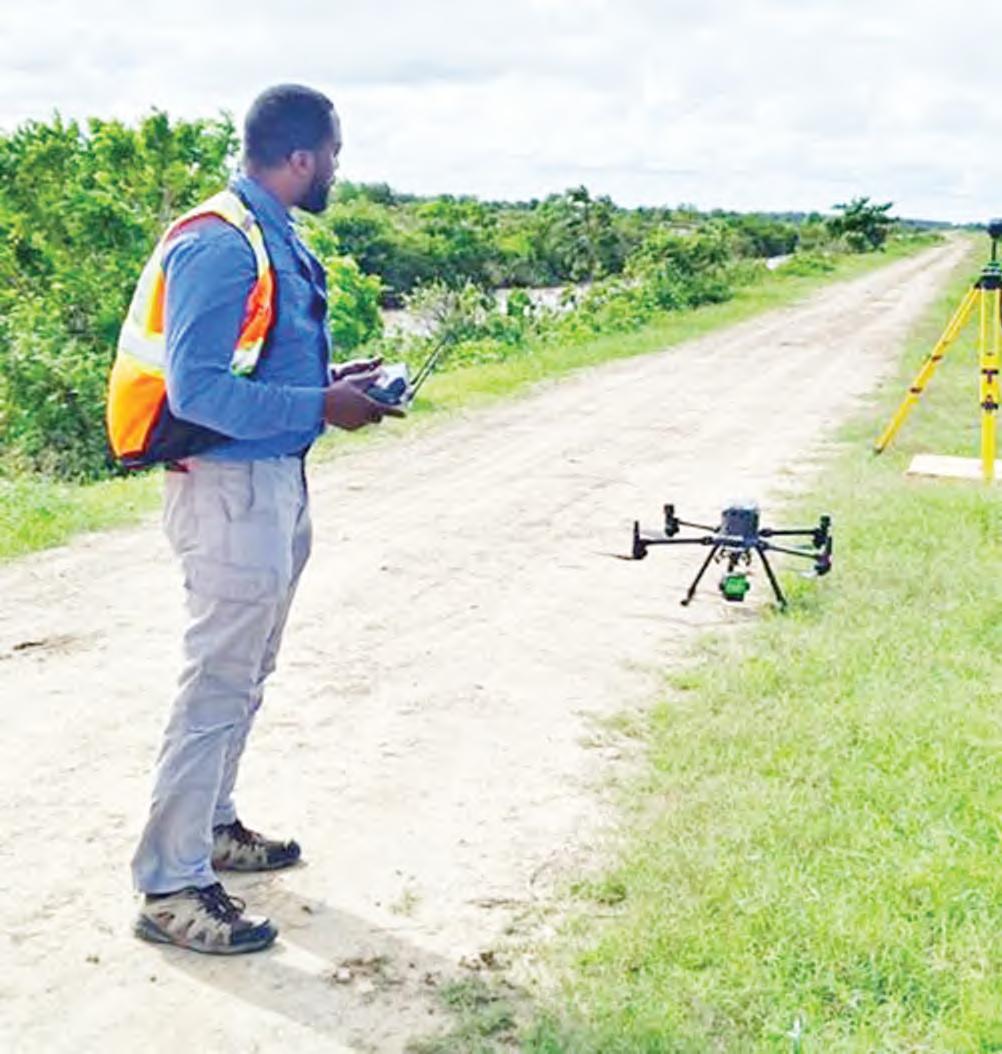
Founder and Operations Lead of Dragonfly Drones and Geospatial Solutions, Brian Smith, with one of the drones used in surveying, inspections and mapping projects across Guyana
Shaping Guyana from Above
Local drone specialist says the technology is opening new possibilities in infrastructure, agriculture, environmental monitoring and beyond
By Shaniya Harding
ONE of the most captivating aspects of Guyana’s Diamond Jubilee celebration was the drone show, featuring hundreds of drones that took to the sky to showcase vibrant patriotic imagery. But while this may seem like a simple creative exhibition, Brian Smith, Founder and Operations Lead of Dragonfly Drones and
Geospatial Solutions, and a collaborator on one of Guyana’s first drone shows a few years ago, says that drone work is as precise as it is innovative.
Smith sees drones as

far more than flying cameras. They are powerful tools helping engineers design roads, farmers improve crop yields, and agencies monitor the environment, while creating opportunities for Guyana to become a regional leader in drone innovation. Speaking with the Pepperpot Magazine earlier this week, Smith shared how his business became a reality, innovative new ways drones are being used, and why, more than ever, Guyanese should consider entering the field.
Dragonfly Drones is among the most notable names in Guyana’s drone industry. Established amid the pandemic, founder of the company, Brian Smith, says that his love for drones was sparked by an interest in photography. Sharing his journey, he said, “Basically, it started off with me borrowing a drone from a friend and doing photography, taking pictures,” he said.
While he started with just pictures, Smith soon saw the vast capabilities of drone technology and how they could be implemented in Guyana.
As he added, “I spent
a lot of time on YouTube and realised that there is a technical space where drones exist that really wasn't that popular yet, which is using drones in surveying, mapping, technical work and inspections. That's where I started to get more technical and build the business to where it is today,” he added.
While drone shows in Guyana have become more prominent and increasingly captivating since Smith collaborated with Adrian Allen, Founder of Lunalite Drone Technologies, to launch the spectacle two years ago, this is just the beginning of the work that drones are currently doing in Guyana.
As Smith shared, drones are helping shape Guyana. With more linkage roads and impactful infrastructure being built across the country, drones are being used as eyes in the sky in charting the path for these new ventures.
As Smith shared, “Drones go there within those cane fields and mark points and establish road alignments and all that type of stuff. If you know a cane field is full
Dragonfly Drones founder Brian Smith conducts drone operations in the field as part of geospatial mapping and surveying work
Strength in Speaking Up
•
How mentorship, family support and honest conversations can help men and boys break the silence around mental health
By Shaniya Harding
FOR many Guyanese men and boys, the first lesson in life is not how to ask for help, but how to hide pain, says Male Empowerment Network (MEN) Managing Director, Richard Collymore, who warns that deeply rooted ideas about “strength” are pushing men into silence until the crisis point. Speaking to the Pepperpot Magazine earlier this week, as the world observes Men’s Mental Health Month, he said that while resilience is often praised, it has also become a barrier, leaving many to struggle alone with mental health challenges, crime risk and life pressures that could be eased through simple conversation, mentorship and community support.
Men’s mental health is just one of the many areas of advocacy that Collymore is passionate about, and MEN is just one of the organisations that he works with. He is also a member of BROCODE, another NGO with a broader focus on men’s health.
While both organisations deal with differing issues, Collymore said that when it comes to men’s mental health in particular, the major challenge, men asking for help, has been taught since childhood. After working with boys and men for almost a decade, Collymore said that the idea that asking for help is a weakness remains the biggest hurdle preventing men from accessing mental health support, and it has been reinforced from an early age.
As he shared, "Generally, men, even when you take it all the way back, are raised with conflicting messages. We start telling our boys at a very young age that they need to find a way to deal with problems on their own. And there's no place in society for weakness when it comes to men,” he added.
“The reality is that while resilience is important, asking for help is seen as a sign of weakness rather than a sign of responsibil-
ity. So problems are left unaddressed and, a lot of times, those situations become a crisis."
Over the course of eight years working with both BROCODE and MEN, Collymore said he has been able to speak to more than 10,000 young men and boys. Speaking on the similarities, he noted that mentorship has a major impact on the mental health of young men from an early age.
As he shared, "I think
mentorship plays a big role in supporting young boys who are on the brink of getting involved with the law, or who are already at that first stage."
This is why Collymore has partnered with various organisations, both locally and internationally, to mentor and support young men, particularly those in vulnerable situations, towards independence.
"We brought them away from their community, and we used plac -

es like cafés and similar spots in New Amsterdam to bring them into a new environment and bring professionals from differ-
ent walks of life to share their stories. We brought professionals who are successful today but came
TURN TO PAGE VI
Male Empowerment Network (MEN) Managing Director, Richard Collymore, says asking for help should be seen as a sign of responsibility, not weakness
Protecting Her, Supporting Him, Strengthening Us
By Romella Dasratt
EVERY society reflects the condition of its homes. Long before a child understands politics, economics or social policy, they learn from the people around them. They learn how to communicate, how to express emotions, what love looks like, what respect feels like, and what relationships should become. When families thrive, communities thrive. When families struggle, the effects ripple across generations.
This is the understanding that sits at the heart of ShieldHER Guyana, an emerging organisation founded on a belief that protecting women and children remains essential, but lasting change also comes from addressing the emotional and psychological challenges that often contribute to violence in the first place.
“ShieldHER Guyana was created from a recognition that domestic violence is not simply a women's issue or a men's issue; it is a family and community issue,” explained founder Dr Yusuf Abdullah.
For Dr Abdullah, the vision for ShieldHER emerged from witnessing the far-reaching effects of violence on women, children, families and communities throughout Guyana. While much attention is rightly placed on supporting victims, he saw an opportunity to broaden the conversation and address the deeper issues that often fuel destructive behaviour.
“We believed there was a need for an organisation that could protect survivors while also addressing the underlying issues that contribute to violence.”
The organisation's guiding principle is captured in its motto: Protecting Her, Supporting Him, Strengthening Us.
At first glance, the phrase may seem unusual, yet it reflects a growing body of psychological research suggesting that healthy families are built not only through protection and accountability, but also through healing, ed-
ucation, emotional awareness, and prevention.
For decades, domestic violence initiatives around the world have focused primarily on crisis response. These efforts remain critically important. Women and children facing abuse require immediate protection, safety, legal support, healthcare and opportunities to rebuild their lives.
Dr Abdullah is clear on this point.
“Our mission is to protect women from violence, injustice and abuse while ensuring access to justice, healthcare, empowerment opportunities and support services,” he said.
However, ShieldHER also recognises that sustainable change requires looking beyond the immediate crisis. Modern psychology has increasingly demonstrated that human behaviour is shaped by experiences, environments, relationships and learned patterns. Researchers studying adverse childhood experiences have found strong connections between exposure to violence, unresolved trauma, chronic stress, substance misuse and difficulties with emotional regulation later in life.
In simple terms, people often teach what they have learned and repeat what they have experienced.
This understanding does not remove personal responsibility. Rather, it provides valuable insight into how cycles of violence develop and how they can be interrupted.
Dr Abdullah believes this is one of the most important conversations society can have.
“Lasting solutions require the involvement of men,” he said. “While perpetrators must always be held accountable for their actions, prevention requires us to understand and address the factors that contribute to violence before harm occurs.”
His perspective reflects a reality that many mental health professionals have observed for years.
Men are often raised with powerful expectations regard-

ing strength, success, emotional control and responsibility. Many are encouraged to suppress vulnerability while carrying immense personal and societal pressures.
Dr Abdullah describes this challenge with remarkable honesty.
“A man is often raised to find purpose in providing, protecting and leading his family,” he explained. “Yet many lose that sense of worth through unemployment, poverty, depression, addiction, childhood trauma, relationship breakdown, social isolation, financial hardship, public humiliation, lack of positive role models and untreated mental health struggles.”
He paused before offering a powerful metaphor.
“Like a tree stripped of its roots, some men eventually crumble under pressures nobody sees.”
That image captures a truth increasingly supported by research. Studies on men’s mental health have shown that emotional suppression often contributes to anxiety, depression, substance misuse, relationship difficulties and increased psychological distress. Many men are taught how to appear strong but receive little guidance on processing grief, disappointment, fear or emotional pain in healthy ways.
ShieldHER seeks to ad-
“Children who witness violence often experience anxiety, behavioural problems, poor school performance and emotional distress,” he explained. “Even when they are not directly abused, exposure to violence can have long-lasting effects.”
Developmental psychologists have long recognised the importance of early childhood experiences. Children learn emotional regulation, conflict resolution, communication styles and relationship expectations through observation. Positive role models, supportive environments and healthy family dynamics play a crucial role in shaping future wellbeing.
dress this gap through counselling, mentorship, rehabilitation programmes, conflict-resolution training and opportunities for emotional development.
By helping men develop healthier coping mechanisms and stronger emotional awareness, the organisation hopes to strengthen families while reducing the likelihood of future violence.
“By engaging men in constructive dialogue, mentorship, counselling and rehabilitation programmes, we can help build healthier relationships and reduce the risk of violence,” he said. “Supporting men does not diminish support for women; rather, it strengthens prevention efforts and helps create safer homes for everyone.”
At the same time, ShieldHER remains deeply committed to supporting survivors.
Dr Abdullah explained that many women and children who seek help often face numerous challenges simultaneously.
“These may include physical injuries, emotional trauma, financial dependence, social isolation, fear of retaliation, lack of safe housing and concerns about the well-being of their children.”
Children, in particular, often carry invisible wounds that can shape their development long after a specific incident has ended.
For Dr Abdullah, these conversations represent an important step forward.
“Success is not measured only by crisis intervention; it is also measured by prevention, education, healing and the positive changes that occur when individuals choose healthier paths for themselves and their families.”
Ultimately, ShieldHER's vision extends far beyond responding to violence. It seeks to help create a culture where emotional wellness, healthy relationships, responsible fatherhood, personal accountability and mutual respect become the norm rather than the exception.
This understanding forms the foundation for another key aspect of ShieldHER's work: breaking intergenerational cycles of violence.
“Breaking the cycle requires intervention at multiple levels,” Dr Abdullah said. “For children, we emphasise early support, counselling referrals, positive role models and education on healthy relationships. We believe children should grow up understanding respect, empathy, non-violent communication and mutual responsibility.”
The organisation also emphasises collaboration. Families do not exist in isolation, and meaningful change requires support from multiple sectors of society.
“We also engage parents, community leaders, healthcare professionals and educators because protecting children cannot be accomplished by one organisation alone,” Dr Abdullah noted.
As ShieldHER continues to develop, encouraging signs are already emerging.
“One of the most encouraging outcomes is seeing individuals regain hope and confidence after experiencing difficult circumstances,” he said.
Beyond direct support services, the organisation has observed increasing public conversations around mental health, domestic violence prevention and family wellbeing.
“Our vision is a Guyana where women are safe, empowered and respected, where men are supported to become responsible partners and fathers, and where children grow up in homes free from violence and fear,” Dr Abdullah said.
He believes achieving that vision requires a broader understanding of domestic violence, one that recognises both immediate needs and long-term solutions.
“Protecting women and children must remain a national priority, but sustainable solutions also require addressing the emotional, psychological, social and economic factors that contribute to violence. We must move beyond reacting to abuse and work together to prevent it.”
Perhaps that is the true message behind ShieldHER: a healthy society begins with healthy families. A child who grows up surrounded by respect learns respect; a child who witnesses empathy learns empathy; a family supported through challenge becomes stronger; a community that values healing creates lasting change; and when protection, accountability, compassion and prevention work together, the result extends far beyond individual lives. It strengthens families, it strengthens communities, and ultimately, it strengthens a nation.
Shaping Guyana from...
FROM PAGE II
of snakes, that is hazardous. By using LiDAR technology, we're able to send different lights through the front sensor to pass through the leaves of the plant and go to the ground,” he said.
The unique use of drones enables people like Smith to gather vital information that engineers then use. As he explained, while historically survey engineers could assess land only from ground level with traditional tools, drone technology provides a more comprehensive view.
As Smith shared, “The survey engineer who designs the road is able to design a road in those conditions. It makes the survey work easier because he does not have to spend as much time in the field. It makes the
engineers' work easier because they're getting data that's very accurate. It also makes the entire engineering process simpler because now you have smart data that you can use for drafting, drawing and modelling, making the road design process more efficient.”
Drone technology is also helping keep the country connected by maintaining critical infrastructure.
As Smith shared, “Inspection of infrastructure like telecom towers allows us to check whether they're rusted, whether components need to be repaired or replaced.
Thermal inspections can check the roofs of large buildings to see where leaks are. It's difficult for a person to go up there, but you can use a drone and map it,” Smith said.

While drone technology is used across sectors from agriculture to health, the general public’s adoption of the technology remains limited. With his Master’s thesis focused on drone adoption, Smith explained that there is still much apprehension surrounding the “eyes in the sky” in Guyana.
As he explained, “We have a problem where people think that drones just take pictures and that's it. As a matter of fact, it's just a toy. They don't understand the technical side of it. Flying is just one part of it. There's a data aspect to it because you have to process that data.”
Noting that certain security measures are necessary, Smith said that drone technology, once used by professionals, is safe.
and Operations
As he added, “People are scared and concerned about their privacy being infringed on, or they only see the usual things like pictures. They see a drone and think, ‘Wow, this is interesting,’ but don't necessarily understand all the elements it takes or all the other careers that exist in the drone space,” he shared.
However, Smith noted that steps are being taken to adopt drone technology in Guyana. As more companies adopt LiDAR technology, there is still much work to be done.
This is why Dragonfly Drones continues to work on education and training, teaching people about the possibilities of drone technology.
As Smith shared, “We are working on the adoption of the technology in Guyana. We do that through various levels. We have Drone Kids and Drone Girls programmes. We raise awareness as well as train ministries and agencies on how to use the technology for different purposes,” he further added, “The Environmental Protection Agency uses drone technology and photogrammetry for land-use planning. Statistics agencies can use drones for landuse mapping and helping to acquire census data.”
As Guyana continues to pave a connected, innovative path forward, Smith says drone technology will play an even
and Geospatial
greater role.
As he shared, “I believe that there's almost no place here in Guyana where there isn't a drone application. I dream of a day where I can use a drone to model one of our ecological sites, put that model on a tablet and send it to the interior. People can actually touch it, interact with it and hear the sounds of the heritage site. That's all part of drone technology.”
For Smith, Guyana is a nation with endless opportunities for drone technology. Through environmental monitoring, illegal mining detection and security services, he says the role of drones in Guyana is only just taking off.
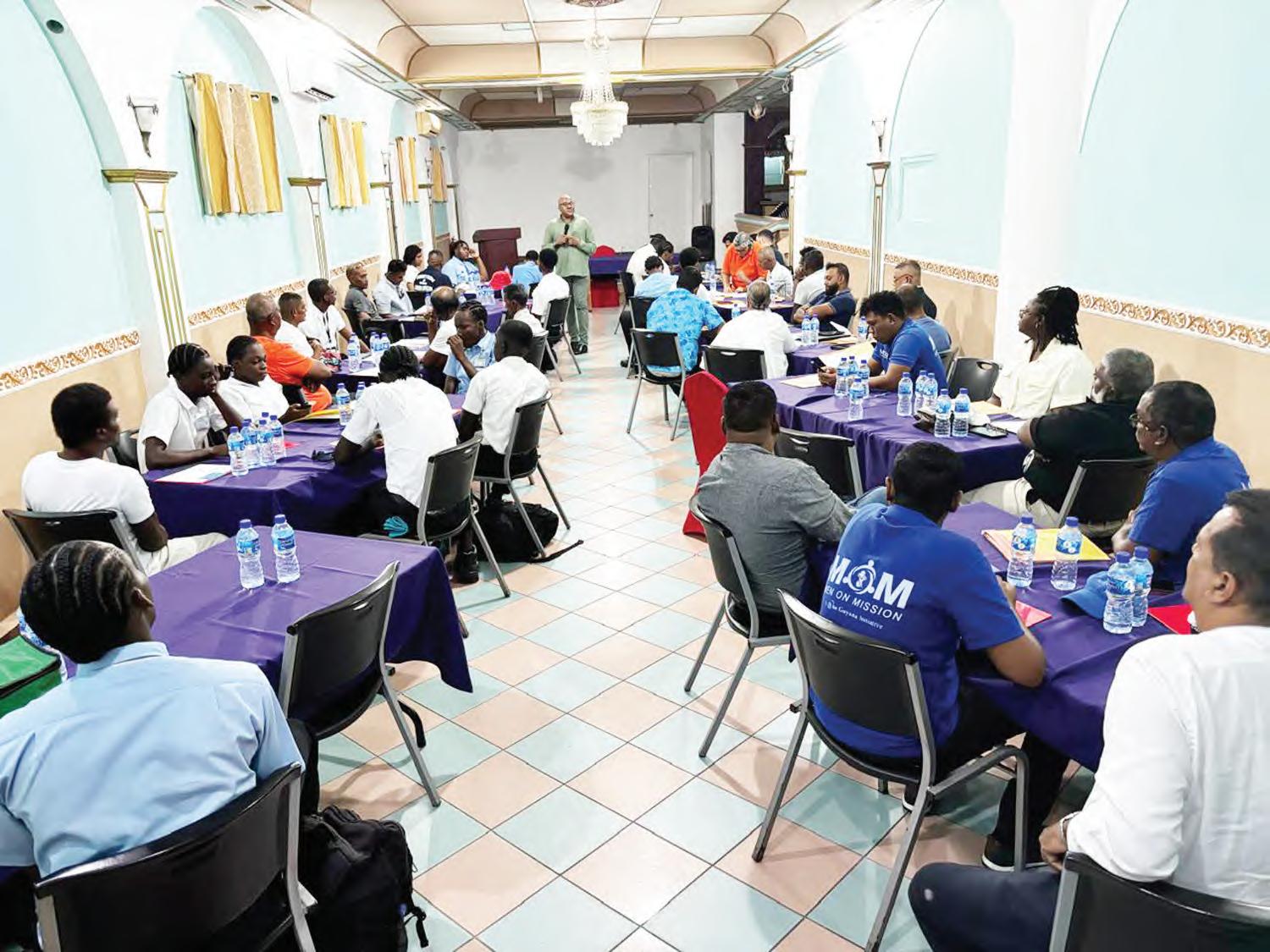
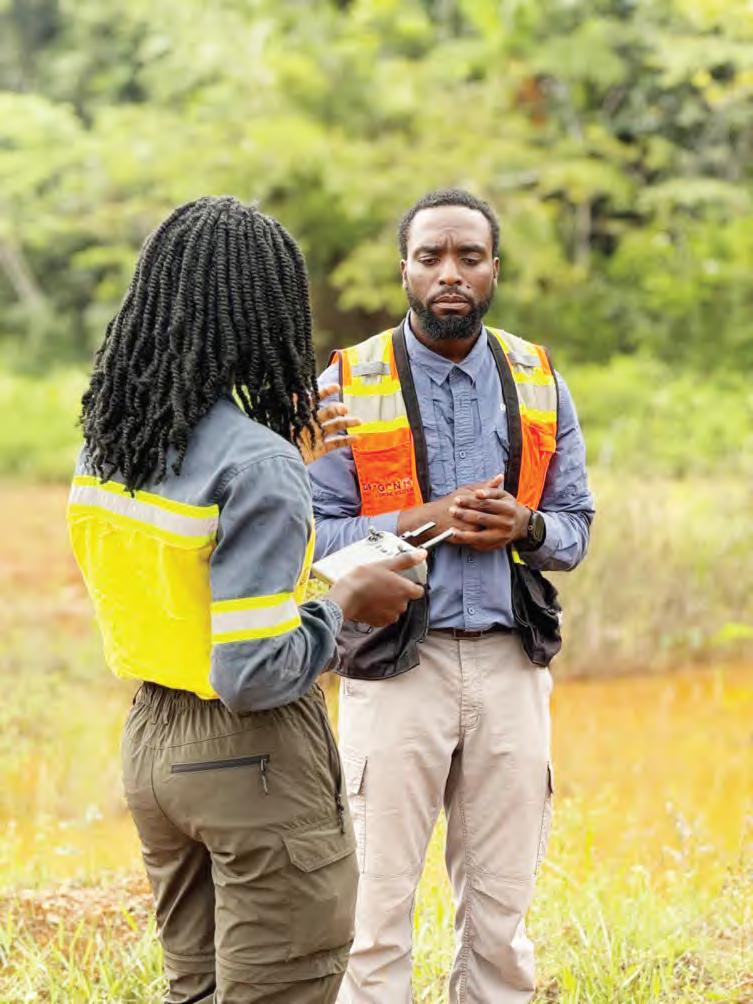
Brian Smith shares his knowledge of drone technology during a training session aimed at building local capacity in the industry
Founder
Lead of Dragonfly Drones
Solutions, Brian Smith, with one of the drones used in surveying, inspections and mapping projects across Guyana
Strength in Speaking...
from similar backgrounds to share their stories with young people,” he added. “We collaborated with some businesses and local employers. Persons were able to get jobs. We got some certified in cosmetology and welding. We got some certified in installation."
While men supporting each other and mentorship can help pave a better path for young boys, family support is also vital, Collymore said. Describing the family as the first line
of support. For men, that support from the nearest sibling or close relatives makes a tremendous difference. You don't need your whole family. Just having that one person in
adding, “Most men do not need somebody to solve their problems immediately. What you need is somebody who can listen and not judge. Having that person in your fam-
ing a major part of society, is not just an isolated hurdle, but a social one. This is why Collymore said that the community, too, should create space for young men and boys
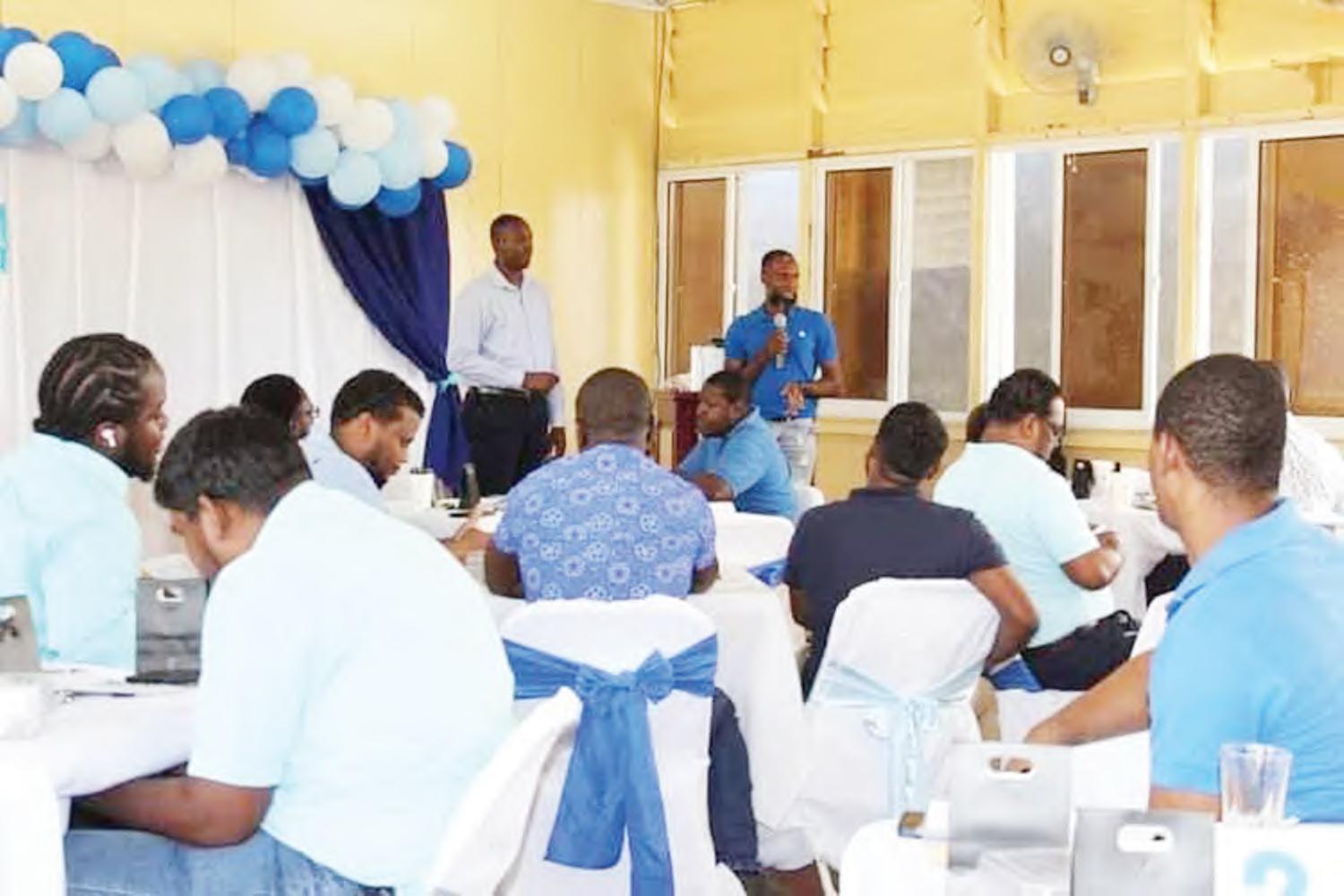
Members of the Male Empowerment Network (MEN) take part in a discussion aimed at creating safe spaces for men and boys to share their experiences and challenges
of support, he added that for men, particularly fathers and husbands, the family may be the only place they can go to.
As Collymore stated, "The family is the first line
your family that provides the level of support you need, that in itself is powerful,” he said.
Speaking to families, Collymore noted that all they need to do is listen,
ily, having that type of relationship, what that does is create a healthy environment, not just for the family, but beyond.”
Men’s mental health, just like all issues impact-
to speak about their mental health. As he added, community spaces and gatherings could serve as platforms for these conversations.
"People, especially
boys, need a place that they can go to channel all their energy. If we don't have that, they're going to find creative ways to occupy themselves. We need to start normalising conversations about mental health and asking for help,” he said.
Collymore and his team are also working to revive ‘Men’s Night’, a safe space for men to speak and express themselves, as he added, "We had men from different places, company executives, labourers, employees from the ghetto. We would ask questions: What issues affect men? And what are some opportunities with regard to those issues?"
For Collymore, creating healthier men and stronger communities begins with changing how society views vulnerability. Whether through mentorship programmes, family support, community initiatives or simple conversations, he believes men must be encouraged to seek help before challenges become crises. His message to boys and men remains simple yet powerful: ask for help when you need it.
As he noted, "If somebody has mental health issues, often it can be very difficult to get help. But we have to learn to ask for it. We have to ask for it. Sometimes you are scared, but you have to take that step, because if you do not, you are going to miss the opportunity."


The First Man She Loves
PEOPLE love to say that the most important man in a woman’s life is her husband or her father. Life, however, has a very sarcastic way of correcting popular opinions. The truth often reveals itself in school uniforms, grocery store meltdowns, unfinished homework, and tiny boys asking impossible questions five minutes before bedtime.
For many women, the most important man in their lives becomes their son. This reality comes with a different kind of emotional weight because a woman understands, consciously or unconsciously, that she is shaping the kind of man he will eventually become. A husband may walk beside her, and a father may guide her, but a son absorbs her. He studies her reactions, her boundaries, her fears, her strength, and the way she handles herself when life becomes difficult.
This is the part people underestimate. A boy’s first understanding of femininity usually comes from his mother. Before society, relationships, podcasts, motivational quotes, and gym influencers begin shouting into his brain about masculinity, he learns emotional behaviour from the woman raising him.
Psychologist John Bowlby explained through Attachment Theory that early emotional bonds shape how people form relationships later in life. In practical terms, children develop emotional expectations through repeated experiences. A child raised in an emotionally safe environment learns one version of love. A child raised around instability learns another.
Understanding that alone explains half the confusion in modern relationships. People spend years asking why certain men struggle with communication, vulnerability, affection, accountability, or emotional consistency.
Meanwhile, childhood sits in the corner sipping tea like it already knows the answer. Children absorb atmosphere long before they understand language. A mother may think she is simply trying to survive adulthood, bills, stress, exhaustion, and life itself, but her son is observing everything. He notices how she handles conflict. He notices whether she respects herself. He notices whether she tolerates mistreatment, and he notices whether love in the home feels safe, tense, unstable, warm, distant, or conditional.
Children normalise repetition. Human beings build identity through repeated emotional environments. The process may sound scientific because it is scientific, but it also explains why some adults enter relationships carrying emotional habits older than their driver’s licence.
Now, let us be honest about something uncomfortable. Society teaches women to pour endlessly into motherhood while simultaneously pretending emotional labour burns zero calories. Mothers are expected to raise emotionally intelligent sons while operating on exhaustion, stress, financial pressure, and approximately four surviving brain cells before coffee. Women deserve compensation simply for answering “Mommy?” eight hundred times a day without levitating into another dimension.
Still, the responsibility remains important because boys eventually become men, and those men eventually enter relationships carrying the emotional blueprint they learned early in life. One day, another woman will meet the son a mother raised. She will experience his communication style, emotional awareness, respect, accountability, and ability to handle intimacy.
A sudden realisation changes the meaning of motherhood completely.
Psychologist Donald
Winnicott introduced the concept of the “good enough mother”, which honestly sounds like a phrase exhausted parents immediately wanted printed on T-shirts. Winnicott explained that children benefit most from emotional consistency and responsiveness, not perfection. A child develops a sense of security through emotional reliability, repair, honesty, and presence.
It’s a matter to consider because many parents quietly destroy themselves while chasing perfection, while children simply need emotional safety. A son does not require a flawless mother floating through life on spiritual enlightenment and green smoothies. He benefits from a mother who demonstrates self-respect, emotional honesty, accountability, and resilience.
A boy who sees his mother communicate calmly learns emotional regulation differently from a boy raised around screaming, suppression, manipulation, or constant emotional chaos. Behaviour teaches louder lessons than advice ever will.
A mother can lecture her son about respecting women every day until the walls become emotionally exhausted. If he watches her abandon herself for unhealthy relationships, tolerate disrespect, or shrink herself emotionally, he receives a completely different lesson.
Children study patterns more carefully than speeches.
And this is where things become deeper than parenting itself. Mothers do not simply influence sons emotionally; they influence future relationships, future families, and future generations. The emotional habits developed within one household eventually travel outward into society,, wearing adult clothing and pretending they appear natural.
A boy who learns emotional safety often becomes a man capable of intimacy and honesty. A boy who learns suppression often becomes emotionally unavailable while insisting he is “just busy”. A boy who learns that vulnerability creates shame may spend adulthood avoiding emotional depth as if it were a tax audit. Then society acts shocked when relationships collapse under emotional illiteracy.
Researcher Brené Brown explains that vulnerability forms the foundation of authentic connection. Brown’s work consistently shows that emotional suppression disconnects people from empathy, intimacy, and meaningful relationships. In simple language, emotional avoidance creates distance disguised as strength. Many boys learn that disguise early.
“Man up.”
“Stop crying.”
“Handle it.”
So now adults everywhere are dating people who communicate emotional pain through silence, withdrawal, distraction, or sudden obsession with motivational podcasts and protein powder.
Human beings remain fascinating creatures.
This conversation also explains why mothers often love sons with such fierce emotional intensity. Somewhere deep inside, a woman understands she is preparing a future man for the world. She understands that the little boy following her around today will someday become someone’s husband, father, protector, partner, or source of emotional confusion, depending on the awareness he develops along the way.
This realisation changes the way conscious mothers parent. Awareness shifts communication, discipline, and emotional accountability. A mother who understands influence becomes more intentional about the emotional environment she creates.
Is it perfection? Not at
all. Honestly, that distinction matters because perfection creates performance while awareness creates growth.
A son benefits from seeing emotional honesty handled properly. He benefits from learning that emotions exist to be understood rather than suppressed. He benefits from seeing strength expressed through calmness, consistency, kindness, accountability, and integrity rather than domination or emotional absence.
This kind of upbringing creates emotionally grounded men, and grounded men transform relationships.
The beautiful thing about human beings is that awareness interrupts cycles. One emotionally conscious parent can quietly and permanently alter generational patterns. A mother who chooses healing, emotional maturity, accountability, and self-respect gives her son something far greater than comfort. She gives him emotional direction.
It’s a gift for life because long after childhood fades, people still carry the emotional language they learned at home. Somewhere beneath every adult reaction lives a younger version repeating what once felt normal.
This is why motherhood carries such profound emotional weight. A woman raising a son is not simply preparing a child for adulthood; she is shaping the emotional habits, values, and understanding that another human being will eventually bring into the world.
As usual, here is a poem to sum it all up.
The First Man She Loves
“Tell me,” she asked, “why mothers cry when sons grow wings and learn to fly?
Why does a woman hold so tight to one small boy throughout the night?”
The older woman gave a grin,
“Because the world steps slowly in.
A mother knows with every day, she shapes the man he’ll be someday.”
“But husbands leave,” the young one said,
“Some fill the heart, some fill with dread.
And fathers sometimes lose their way, or turn their love from home astray.”
She nodded softly.
“That is true.
But sons become what they live through.
The way he sees his mother stand will teach him how to love a woman.
If pain has turned your spirit cold, he learns that hearts are hard to hold. If anger lives in all you say, he learns that peace must run away.
But if he sees you calm and wise, with truth still living in your eyes, he learns a woman’s love is deep, a thing a real man learns to keep.”
The younger woman bowed her head, and thought of every word she’d said.
“So every lesson, small or great, becomes the kind of man fate makes?”
The older woman smiled once more.
“A son is watching from the floor.
And one day someone else will see the man you taught your boy to be.
So love him strong, but love him right, with gentle hands and honest light.
For every woman he walks to will meet the parts he learned from you.”
Romella Dasratt

Alpine Divorce: The New Face of Separation
I WAS watching a news report where a woman was explaining a horrific hiking experience she had with her ex-husband. She and her husband went hiking on an isolated, mountainous trail. She explained that he planned this hike for them to do as a couple and, as they hiked, she grew tired and decided it was enough for her and that she wanted to go back. She explained that she wanted them to go back together, but he insisted on finishing the trail without her. He ventured on, and she eventually lost track of his location and tried to make her way back, with no prior hiking experience. She became lost and, when he finished the hike, he did not try to locate her. There was no report to the police, but eventually she made her way back after a few days. After investigations were done, it was found that her husband had planned to leave her there with the hope that she would not find her way out. I heard the term “Alpine Divorce” being referenced for this unfortunate event, and as I researched, I found that many women from across the world also experienced this phenomenon. The term actually originated over a century ago. It was coined in a 1893 short story by Scottish-Canadian writer Robert Barr, which satirically detailed an unhappy husband plotting to push his wife off a cliff in the Swiss Alps to end his marriage. It occurs when one partner abandons the other during outdoor activities such as hikes. This can happen after arguments or
can be premeditated, as in the case study I shared. As more women come forward about their experiences, they realise it is not an isolated experience and that many others have experienced similar situations. It is why I decided to write about it this week, because it sounds like such a dramatic term.
However, it highlights communication gaps and a major safety concern during outdoor activities with partners or friends. Being left alone without navigation or adequate clothing can quickly lead to hypothermia, getting lost, or injury. It appears to be mainly associated with hiking incidents. However, it goes beyond a hiking trail or mountainous view. It shows how a challenging environment can reveal secrets and expose cracks in a re-

lationship. What makes it so difficult to wait on or slow down for your partner if they are tired? To ensure that they are safe and that you do not abandon them in the wilderness?
Harsh environments create communication challenges and when there is conflict between two partners, what happens then?
I think if you have doubts about your partner’s ability to remain patient and supportive during an outdoor adventure, you should not venture out. I think the inability to trust them before the hiking trail also reveals a lot about the relationship to begin with. Some people speculate that Alpine Divorce is largely about power and control. When someone abandons their partner in a very challenging situation, it creates vulnerabilities and
safety concerns. It leaves the other person feeling unsupported, unsafe and even insignificant. I must point out that this phenomenon sometimes occurs without intention. Some partners genuinely do not mean to put the other in harm’s way.
However, I wanted to highlight this phenomenon, hoping that women, particularly in Guyana, can be mindful when visiting ecotourism and outdoor sites. In my research, I have found no reported cases of this in Guyana. However, as trends rise and change, so too do the mindsets of perpetrators. As such, I hope you remain vigilant and alert at all times during outdoor gatherings and activities moving forward. Ensure you share your location with other family members, remain self-reliant by carrying your own
supplies, and observe your environment carefully.
Perhaps the most important lesson from Alpine Divorce is that adversity acts as a mirror. Whether on a mountain trail, during a financial crisis, or through everyday disagreements, difficult moments reveal character. They show whether individuals view challenges as something to face together or as obstacles that justify leaving someone behind.
The mountain is not the problem. The argument is not the problem. The real question is what people choose to do when faced with discomfort. In the end, the strongest relationships are not those that avoid challenges, but those in which both partners remain committed to walking the difficult path together.


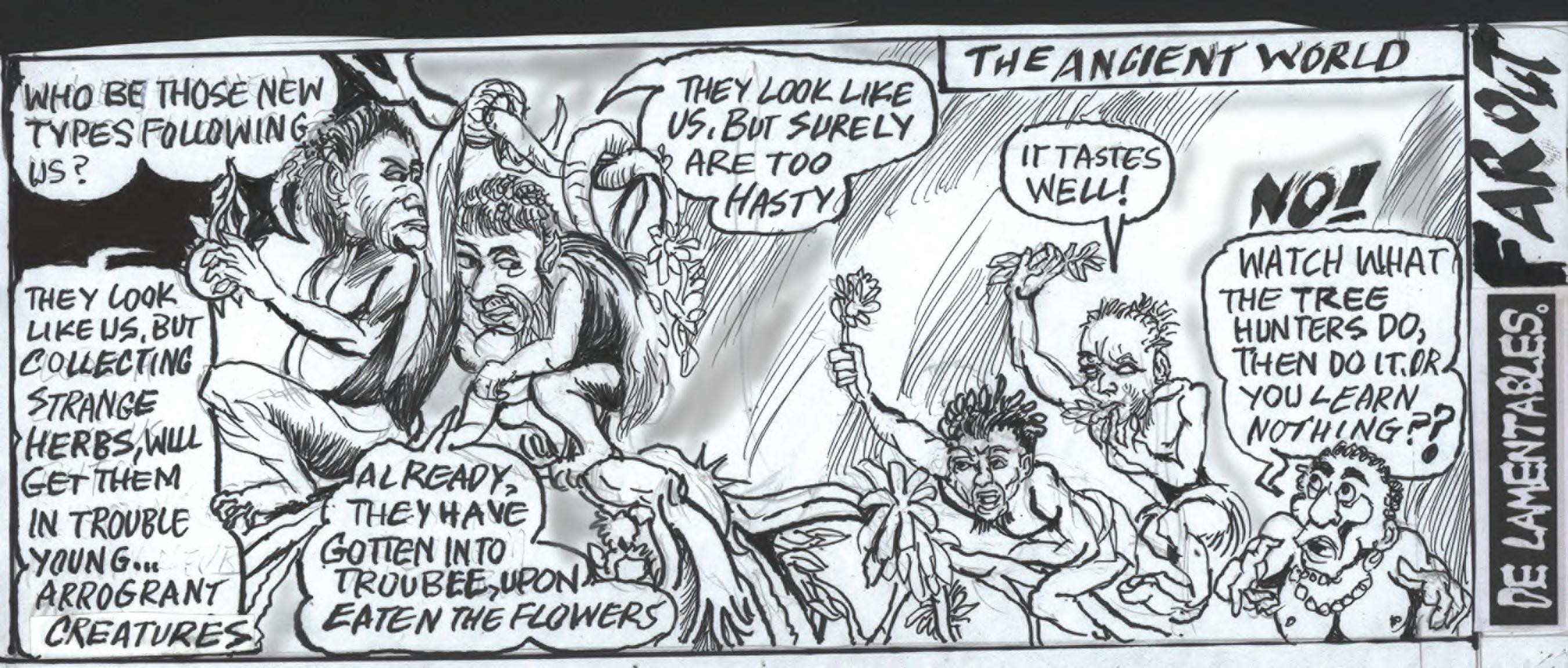
When we are confronted by challenges we cannot readily resolve, we must explore whether our ancestors faced similar problems and how they confronted and dealt with them
THE challenge of our ancestors is not limited to the long-gone past; it includes those of today who may have been taught and have passed on the serious logic of times before. This country has suffered the terrible onslaughts of drugged-out minds, with severe impacts on relatives and innocent citizens. People died, adults and children. The nation was subjected to manifestations of savagery as never before. But beyond all that
shook our peaceful and unsuspecting mindset, there was the impact of drug addiction and violence. Not the violence between drug narco handlers, but violence against unsuspecting relatives, neighbours and even the innocent murdered by a relative for a piece of jewellery.
Addicts are even more numerous than we suspect. The escape into drugs is a partial mystery. We can presume that the basic opportunities sought or dreamt
about by some citizens do not exist, though we may have grown as witnesses to such opportunities, and senior talents still are around. For example, the arts on stage. But more than that, many talented Guyanese businesses and clothing designers are no longer around. The era of the global oil crisis destroyed many. Talents like Lance Braithwaite, Alladin’s Cave, Linco’s, among others, never recovered.
So the so-called glory
era of drugs came to light, but for most, it was never a light. With it came the other darkness of rites and rituals and the beliefs of fallen ages gone by. Many were caught and lives destroyed, not immediately, but by succumbing to callous people building an illusion of would-be slaves, to be consumed in the shadows of substance servitude, blessed by the worthless gifts of a master of imagination.
There is an interesting book I bought some years
ago, written for writers with the same weird curiosity as I have. True in many ways, the ages have engaged. The Chemical Muse, written by D.C.A. Hillman, PhD, explored the ages of his forefathers.
The relevance is that the current human world has merged. The error is that our learning is apart, and yet we summon our fathers across the echelons to inspire our stance here, in the interest of where it should be.
Drug addiction has become a dismal opportunity. It matters not how many are punished, even nations are and were involved in this forbidden temptation that empowers in one breath and destroys with its dismal staff of misery.
We witness, observe and resist its temptation, and offer whatever assistance we can to its victims. This is our act of resistance, whether it is heeded or not.

Why People Choose to Marry
External Factors in Choosing to Marry
SOME people marry for various external reasons. These external factors were enticing to their eyes, and they could not resist the temptation, so they married. When some people consider whom to choose

as a companion, they may first look for people based on their physical appearance. In certain parts of the world, those from certain tribes may marry within their own tribe or cultural group. Similarly, those who operate under a class system may choose only people from their class.
It is interesting to see how peer group pressure can cause some people to marry, even when they were not thinking of marriage. In some groups, most people are married, and those who want to associate with them may perceive that they must be married to fit in. Some groups have their own written and unwritten cultures, and people choose whether to become members. Mo st of the time, when people want to fit into a group, they have to adjust their culture to match the group's.
Some family members will constantly remind those who are not married that they ought to consider marriage. While some single persons may not be considering marriage, they may eventually allow family pressure to cause them to seek a companion and then marry.
Family abuse is never an acceptable practice. However, in some families, if there is regular family abuse, then the victim may choose to marry because they want to move away from that abusive atmosphere. Those who perpetrate family abuse must stop such actions right now, as they may cause many family members to prematurely exit their families.
Those living in poverty will be happy for the opportunity to enjoy some wealth. Therefore, those who can quickly find a wealthy person may seek every opportunity to marry to enjoy a financially secure relationship. Poverty drives people away and may lead them to make decisions they might not otherwise have wanted to make.
Some people see marriage as providing them with a sense of human security. When a person is single, others may see them as vulnerable, but once they are married, they are afforded respect. Marriage does wonders for some people’s self-esteem and their need for security.
Internal Factors in Choosing to Marry
The internal factors that cause some people to marry may vary. Nevertheless, each person must know what they need internally for their marriages. There is no formula for people who want to marry. Each person must choose why they want to marry, and if they are reasonably satisfied with their decision, then they can proceed.
There is a great need to assess the internal factors that lead some people to choose to marry. Most people who marry eventually have their own children. They may also have many pleasurable moments among couples, but these may not last forever. As couples age, they may not have the same des ire for sex as they did when they were younger. Those who plan to enjoy a healthy, sensual
life must take good care of their bodies. They must be willing to consume healthy food and also exercise. Exercising must not be solely for looking muscular, but also for keeping the body fit.
People enter into relationships because they want ways to relieve their emotions. In the relationship, they may have moments of laughter that help them overcome their struggles. Communication is important for both single and married persons. Some people choose to marry because they need someone to communicate with regularly and someone with whom they can share some deep personal issues.
Many people are longing to have their own offspring. So, when they marry, they can have biological children.
The history of some families is negative. Therefore, to change those negative histories, marriage may be a way for a person to move away from their family. When some people live in depressed communities, they may choose to marry because they want to move away from those communities.
For more information about Geary Reid and his books, please use the following contact information: Amazon: http://www. amazon.com/author/ gearyreid Website: www.reidnlearn.com Facebook: ReidnLearn Email: info@reidnlearn. com
Mobile #: 592-645-2240

Gangster of Love: The Lost Love Songs of Boysie Singh by Ingrid Persaud
THE Lost Love
Songs of Boysie Singh (Faber & Faber, $30.00) takes as its point of departure one of the Caribbean’s most notorious criminals: Boysie Singh, the Trinidadian gangster who was hanged in 1957 for murder and piracy among a catalogue of other crimes. Singh—charismatic, theatrical, and widely feared— was often referred to as “Raja,” Hindi for king, a sobriquet befitting the mythic aura that came to surround him.
A gambler, pimp, club owner, and racketeer, he occupied in Trinidadian folklore something like the place John Gotti would later hold in American popular imagination: a criminal whose notoriety became inseparable from legend. Stories about him have long passed into Caribbean lore. He is reputed to have murdered more than four hundred people. According to popular accounts, Singh would transport migrants by boat from Venezuela to Trinidad, only to rob and murder them mid-journey, throwing their bodies into the sea.
It is this spectral and terrifying figure who stands at the centre of Ingrid Persaud’s dazzling new novel. The book arrives on
the heels of her Costa Prize-winning novel, Love After Love, a deeply Caribbean novel distinguished by its warmth, humour, emotional intelligence, and vivid evocation of contemporary Trinidadian life. That earlier work captured a Trinidad that was politically alert, dangerous, tender, and exuberantly alive. The Lost Love Songs of Boysie Singh takes a darker turn. It is a larger, more ambitious novel, populated by a broader cast of characters and animated by a more ominous historical imagination.
Despite the title, this is not Boysie Singh’s story in any straightforward sense. He is less a protagonist than a gravitational force, the dark centre around which the novel’s “love songs” orbit. The phrase itself is deeply ironic, for Boysie is not a man easily loved. Instead, the novel belongs to the women whose lives intersect with his violence, charisma, and appetite. The story unfolds through the voices of four women: Popo, Rosie, Manalala, and Doris. Each woman has a distinct relationship with Boysie, and through their testimonies, the reader gradually assembles a portrait of the man. Boysie himself never truly speaks

Gangster of Love: The Lost Love...
except through their perceptions of him.
Manalala, the mother of Boysie’s only child, is perhaps the most tragic of the quartet. She endures his beatings and humiliations with a kind of exhausted resignation, clinging to him despite the degradation he in-
flicts upon her. Popo, by contrast, is Boysie’s lover and accomplice, a former prostitute whose streetwise cunning rivals his own. She understands the brutal logic of survival and navigates Boysie’s dangerous world with hard-earned intelligence. Ultimately, she is a very tragic figure in
this novel.
Rosie, however, emerges as the novel’s most compelling figure. The owner of a bar and dry goods store, she survives through wit, instinct, and emotional independence. Rosie refuses the conventions imposed upon women of her era, choosing lovers—both men and
women—with unapologetic freedom. In a society crowded with gangsters, hustlers, and desperate strivers, she remains defiantly self-fashioned. Hers is the voice that most fully captures the novel’s mixture of resilience, sensuality, and danger.
Doris, meanwhile, is perhaps the most so-

cially ambitious of the women. A “red woman,” as the novel repeatedly emphasises, she longs to transcend her status as a maid and ascend into respectability and wealth. Her marriage to Boysie appears to promise such elevation, but the rewards prove hollow. Doris is vain, acquisitive, and often delusional about the life she believes she deserves. Compounding her disappointment is the fact that Boysie’s interest in her rapidly cools, leaving the marriage emotionally barren and sexually unconsummated. Yet Doris remains believable because Persaud grants her a deeply human mixture of vanity, longing, insecurity, and calculation.
Through these four women, Boysie emerges as monstrous but strangely elusive. We learn of his compulsive gambling, his womanising, his manipulations, and his acts of terrifying cruelty. One particularly harrowing scene—in which Boysie robs and drowns three men at sea—lingers long after the novel ends. The episode confirms the brutality that the women repeatedly attribute to him and crystallises the terror that underpins his legend.
One of the novel’s most remarkable achievements is its handling of language. Persaud carefully distinguishes the women's voices through subtle variations in Trinidadian speech patterns and Creole usage. Manalala’s speech carries traces of Hindi vocabulary and cadence; Doris aspires toward Standard English, frequently correcting herself whenever she slips into Creole; Rosie and Popo speak in a raw, vibrant idiom
thick with colloquialisms, slang, and rhythmic improvisation. These linguistic distinctions never feel ornamental. Rather, they reveal class, aspiration, ethnicity, education, and temperament. Persaud demonstrates an extraordinary ear for the nuances of Trinidadian speech, using language not merely to authenticate setting but to deepen characterisation. The women’s voices become unmistakably their own.
Equally impressive is the novel’s recreation of Trinidad in the 1930s, 1940s, and 1950s. Persaud conjures a society shaped by colonial hierarchies, racial tensions, economic precarity, and shifting moral codes. It is a world populated by hustlers, gamblers, migrants, sex workers, shopkeepers, and drifters—all engaged in the difficult business of survival. Yet the novel never reduces this society to sociological portraiture. Instead, Persaud renders it alive with humour, sensuality, gossip, violence, and longing.
What ultimately distinguishes The Lost Love Songs of Boysie Singh is its refusal to romanticise criminality, even as it acknowledges the seductive power of myth. Boysie may dominate the imaginations of those around him, but the novel belongs to the women who endure, resist, desire, survive, and narrate him into being. Their voices transform what might have been a conventional gangster story into something richer: a meditation on power, gender, memory, and survival in the Caribbean imagination.









The Things That Are Worth Stopping For
THERE is a distinct sense of unease that emerges from the bottom of our hearts at the sight of falling raindrops. The feeling is not exactly the same as fear or panic, but it is quite similar. Our instinct is to seek cover from the rain, to close our windows and doors, and remove all articles from the damp reaches of its touch. To an aloof observer, the world may seem like a rosebud snapping shut as soon as the rain begins to fall upon it. Yet humanity also welcomes the rain as a boon. Entire communities beseech deities and the universe for healthy rain every single year. In places where there is no rain, starvation and death follow.
Amidst the duality of how we view the rain and the consequences of its presence, or lack thereof, it is easy to forget to stop and observe its unembellished grace. For those of us who are used to seeking cover from the rain, it is not strange to go our entire lives without noticing the magnetic beauty of fresh rainwater seeping into the thirsty earth. It is not strange to be unfamiliar with the nostalgic embrace of petrichor, or the feeling of raindrops becoming
diamonds on our skin. Perhaps our desire to hide from the rain stems from an inherent need to protect ourselves from its harshness, but in our fear of it, we also lose the ability to experience its gentleness. Like the rain, many seemingly destructive forces are also responsible for growth and nourishment. Nevertheless, it is a less complex and burdensome task to ignore one side of them in favour of the other. After all, it is always easier to believe that a coin only has one face when the only way to discover its other side is by taking the effort to flip it over.
There is a unique sense of comfort that our generation enjoys. Many tasks that would have taken immense labour and time in the past now take mere seconds to complete, with no more than a fraction of the effort required previously. Some may believe this is the cause of a general sense of lethargy or a lack of drive, but there is another way to see it. The extra effort and time that have now been spared for us on simpler, less meaningful tasks can be utilised on the more important ones. The only matter left for us to sort out is deciding which things are worth the time and
which are not.
In something as simple and mundane as the rain, multiple facets are unravelled and revealed to those who choose to seek more from it. Perhaps the gift of having been spared the wastage of time and energy on smaller tasks is also a gift for our generation to discover similar facets of the world that have been overlooked or lost.
As younger generations take on greater responsibility for the world, it seems the days are moving faster. Life itself has become a vision seen through the frosted window of a speeding train. Occasionally, we may catch sight of a light or a face that holds our attention, but it too darts away within moments. Every fragment of life is something captured and stored between the short-lived moments between each breath, or in the spaces between each step. There is rarely any space for grandeur or magnificence in a place where speed is the currency for survival.
As a generation, let us vow to change the pace at which we move. This does not mean that we must give up our determination or our drive for success, but rather make the meaning of success less shallow
than we often believe it to be. When it rains, let us teach our children to stop and absorb its beauty, even if it means that our feet might get wet, or our plans may change a little. There is nothing in the world that can
keep moving without stopping. The beauty of being human is that we get to choose what's worth stopping for.

















THE CAT GIRL
IT was a cold, damp morning, and the threat of more rain hung darkly in the sky.
Arista opened the door
of the small, wooden house where she lived, and a wisp of cold wind stung her face. She gasped, but still stood looking across
to the green pastures where the mist hung like a thick blanket. The early-morning view she always photographed in her
mind, as the beginning of every new day, be it mist, rain, or sunshine.
Art, she loved, and on her sketchpad were nu -

merous scenes of nature and life that fascinated her young mind.
kindness to all.
“Artista,” her mother was calling, “I’ll be late today, and I need you to be home early.”
“Yes, Mama.”
She was a dark, petite, ten-year-old with long, curly black hair and big black eyes that always had a sparkle, never mind that there was not always enough food on the table or the shoes she wore had worn thin. She had dreams that she hoped could one day be realised as she carried a faded satchel with her precious few tools for learning.
A poor little girl she was, living in a squatter’s settlement, because her father, a gardener, and her mother, a part-time maid, could do no better with six children in the family. She had learnt, even though she had so little, to give thanks and share love and
Arista would ever so often wander around peering into flower gardens through the intricately designed grill fences of the wealthy, talking with the domestic animals on the roadway she saw and picking wild flowers by the wayside for the lone, cracked vase in her little house.
“I wish,” she had often mused, “to live in a big, beautiful house with glass doors and a beautiful garden.”
She knew, though, at her young age, it was just a wish.
THE CAT GIRL...
an old shack, had fulfilled that desire.
herself by what had just happened.
She hurried home from school that afternoon, pausing briefly by the one house that fascinated her the most because the design was so much like a castle and the sprawling lawn, like a courtyard, when she heard a little sound, soft and weak.
2
“How did I do that?”
“Meow.”
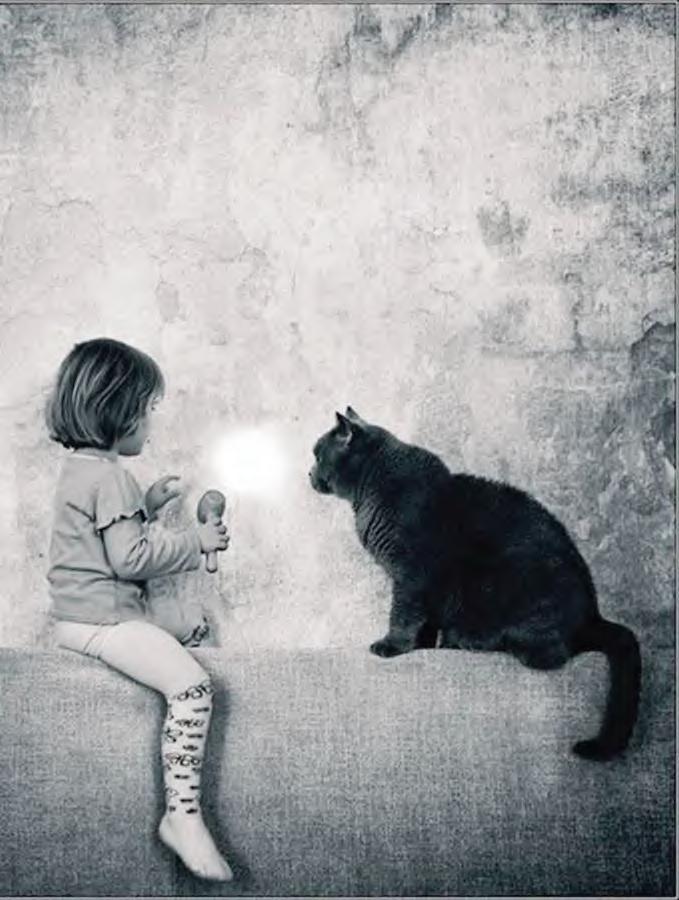
Artista looked around, but saw nothing. Then the sound came again from within the overgrown ginger lilies on the courtyard’s outer borders. She searched between the long stalks and looked down at a small, black kitten, wet and bedraggled, staring up at her with pitiful eyes. She picked it up gingerly and jumped back, startled as a vicious Doberman lunged at her from within the barricade of the fence.
“Bad dog,” she admonished, holding up the kitten. “Don’t you see she needs help?”
The dog growled menacingly, and Arista, wrapping the trembling kitten with her face rag, put it in her satchel and ran home. She made a cosy bed for it under her bed, fed it with some of the precious little milk they had and kept it hidden because her mother wanted no pets in the cramped house.
That night she lay in bed listening to the howling wind and prayed earnestly that the house wouldn’t get blown down. Life was bad enough as it was.
As she slept, the kitten, whom she had named Velvet, awoke, jumped on the bed and stared at the sleeping child. It meowed softly, its emerald-green eyes sparkling in the dark. So many days it had wandered, looking for a home, for someone to care for her and be her friend, and the poor little girl, whose plate was always almost empty and who lived in
A black cat, tradition says, brings bad luck, but this kitten, who wore a white crest on her underbelly, could stave away the bad luck and bring, instead, good luck. It came from a long feline line, a dynasty when kings ruled, and witches flew on brooms, casting spells and curses. It had gotten its power from a good witch with whom she had lived centuries ago and came back, birth after birth in many homes, for the good witch had cast that spell, telling her, “One day you will find someone like me. Again, I have transcended some of my power to you, so when that day comes, you will bestow it on her, and our legacy will continue.”
But she never found the one with whom she belonged until now.
The poor little girl, because of her kind heart, was the one and, as she slept snuggled between the patched sheets, the magical powers of a century-old dynasty were bestowed upon her.
Arista knew not, as she walked to school the next morning, how much her life would change. She stood at the side of the pot-holed road waiting to cross, but a little boy a short distance away grew impatient and, pulling away from his mother’s hand, ran across the road into the path of a black Land Cruiser. His mother screamed, and before anyone else could move, Arista sprang forward, grabbing the child and pulling him back, saving his life by a whisker.
The mother gasped, astounded by the girl’s swift reflexes, but Arista, not waiting for anyone to say anything, hurried on to school. She was stunned
She sat in class, pondering the incident until someone from the back
threw a hard ball of paper that could have hit her any other day, but not today, as she spun around and caught it in a swift movement inches from her face.
There were loud gasps instead of the laughter such mischief caused, the torture of being treated as a misfit because she was a poor girl, the scorn and the taunts from the wellto-do kids.
It interrupted her focus and interest in school, and she often questioned
TURN TO PAGE XXII FROM PAGE XX

THE CAT GIRL...
herself,
“Would I become a maid like my mother or
someone big like a manager or a doctor?”
A dreamer who wore rags – how real could any
of her dreams become?
In art class that afternoon, her fingers seemed to have a way of their own

over the art pad, and Arista stared, amazed at the finished work – a perfect sketch of a witch and a black cat.
“Oh, no,” she exclaimed softly. “This will cause more taunting.”
But surprisingly, everyone praised her work, and she saw smiles on faces that had always borne looks of scorn.
“I wonder what’s going on,” Arista mused and, looking once more at the sketch, she saw, or thought she saw, a little smile on the good witch’s face.
On her way home, she paused by the castle-like house. Through the ornate gate, she saw a pretty little girl standing by the water fountain, looking at the birds. Arista had often seen her, but the little girl, who looked like a princess, never once looked her way until today.
3
She turned, a sweet little smile on her face, and Arista gasped, totally surprised.
“Is there magic in the air?” she wondered, as she ran home, unaware how close she was to the answer.
She reached home in a jiffy, running adroitly between moving vehicles.
“I’m so hungry,” she groaned as she pushed open the old, rickety gate. “I hope my big brother didn’t eat all the food.”
Lo and behold, the small kitchen table was filled with dishes of delicious food and her mother was humming a little tune, a smile on her usual worried face.
Arista sat down, almost falling off the chair, and said,
“Tell me this is a dream.”
“No,” her mother answered. “My mistress was in an unusually generous mood today.”
Arista sat down in deep thought for a moment, forgetting her hunger. Then, remembering Velvet, she ran to her room and found her curled up behind an old carton box. She lifted her gently, soothing her velvet fur, and it was at that moment that it dawned on the little girl as she looked into the kitten’s eyes.
“It’s you, Velvet, isn’t it? You have brought luck into my life.”
“Meooow,” the kitten answered, and Arista laughed, hugging her.
She used that good moment to introduce her to the family, and her mother was aghast.
“A black cat, just when luck has come our way?”
“No, Mama, she’s not bad luck. She was here all the time under my bed. Look at this.”
She showed them the white crest. “I think she has brought us good luck.
Please let me keep her.”
Father and mother exchanged looks, then nodded.
“Okay, she can stay, but if bad tidings follow us, she goes.”
Arista smiled, a strange new feeling filling her heart and, holding the kitten close, she said, “She will change our lives for the better.”
That night, as Arista slept, dreams took her across land and seas back into time, amongst kings and queens, witches and wizards and battles engaged in forests and caves. She awoke in the middle of the night and sat up in bed, her wits sharp, her senses alert, a sparkle in her eyes.
Something has changed!
She stood up and walked to the door, her feet soundless on the floor, her bright eyes piercing through the dark night.
The kitten grazed against her legs and, picking her up, Arista felt the connection as she looked into her eyes. The magical power of a good witch from centuries ago and her feline companion had been transcended to her in this modern era, bringing good luck. The rags of her life were thrown to the wind as she continued now, the legacy of the good witch as a cat girl.



















































STUDY SUCCESS
Dear student, Welcome. There comes a time in study when you become bogged down with self-produced stress. You think about how you are feeling, how worried you are, your health status, or your career prospects. The need at this time of revising and taking examinations is for you to be able to focus effectively on tasks, particularly those that are manageable and can be tackled immediately. Adjust your focus. Remember: robust study
encompasses adjustments to situations. Be wise. With love.
IMPROVING WRITING
1. Depicting character qualities
How to depict character qualities effectively:
To portray character traits effectively, writers should show rather than tell. Instead of simply stating what a character is like, reveal personality through what the character says, does, feels, and how he or she responds to others.
Look for the following writing techniques of au-
thors that are used:
*actions that reveal the character’s nature
*character-driven dialogue
*physical cues and reactions
*interactions and contrasts with other characters
*internal thoughts and reflections
These techniques work together to create more believable and engaging characters.
Read the abridged story below and observe how the writer depicts character. It was a sweltering

June 14th, 2026
July day in Philadelphia – I can feel it still, 57 years later. The five boys I was with were casting about for something different.
“Hey!” said Ned, “We haven’t climbed that cliff in a long while.”
“Let’s go,” someone shouted.
I hesitated, I longed to be brave and active like them, but I’d been sickly most of my eight years and had taken to heart my mother’s admonitions not to take chances.
“Come on!” called Jerry, my best friend. “Don’t be a sissy.”
“I’m, coming!” I yelled, running after them…
At the far end loomed the cliff, a near-vertical wall of jotting rocks, earth slides, scraggy bushes and saplings. It was only 60 feet, but it looked like the very embodiment of the Forbidden and Impossible.
They scrabbled toward a narrow ledge twothirds of the way up… At last, I reached them… Then they started to the top where they could walk home from a roundabout route.
“Hey, wait,” I croaked weakly. “I can’t - ”
“See you in the funny papers,” one of them said, and the others laughed…
They wiggled to the top, then peered down at me.
“You can stay if you want to,” mocked one of the boys. “It’s all yours.” Jerry looked concerned, but he left with the others.
I looked over the edge; I could never climb back down. I could lose my grip, fall and die. But the way to the top was even worse – steeper and more treacherous…
About the Abridged
In the abridged story, the reader can easily see character traits, especially those of the quite inexperienced and untried “I” narrator’s.
In war, whichever side may call itself the victor, there are no winners, but all are losers.
NEVILLE CHAMBERLAIN (1869 1940) Kettering, 3 July 1938
How to Work the Story
1. What things do the following phrase and sentences say about the main character?
a) “a sweltering July day in Philadelphia – I can feel it still”
b) “I had taken to heart my mother’s admonitions…”;
c) “I croaked weakly.”
2.The writer uses the three aspects above in the story plot to depict the characteristics of his main character. Describe the aspects.
3. a) The story gives additional clues about the main character.
With your study partners, identify these clues and explain the traits they reveal to the group.
b) Why does the writer juxtapose him and the five boys?
4. The main character is alive 57 years later. How do you think the day ended for him? Write a cohesive conclusion for the episode that happened on that sweltering July day in Philadelphia.
IMPROVING WRITING
2. Laying aside the story
Relax and recall an interesting happening you witnessed recently. Write it down as you remember it. Then make it the basis of a short story you would like to turn out excellent and well enhanced with dialogue. You can lay it aside and call that period an incubation period or “drawer time” which helps you detach (with pluses) from
your text. If you have the time, you can return to it within a few minutes, hours or days. (timing when you intend to complete it). This break allows you to subconsciously process plot details. You now have the necessary distance and objectivity to identify flaws in its structure and make your next draft significantly stronger. You return with a fresh eye. You may need to evaluate your first draft objectively, maybe drastically. Stepping away from your draft has many benefits. After some time away, the wording may fade from memory, allowing you to review it more objectively—as a reader rather than as its writer.
Your mind may continue working on plot points and structural issues in the background, which can be beneficial. Taking a break can also reduce revision fatigue and allow your creativity to recover.
You can now review the original objectively by asking yourself the direct questions suggested below.
1. Is my writing interesting?
2. Does it respond appropriately to the happening?
3. Is my plot easy to follow?
4. What do I like best about my plot?
5. How can I make my plot better?
6. Would it take me much effort now in trying to improve my original?

Your dental health diet
I HAVE followed the field of nutrition closely for more than 23 years, and what I have discovered is that there are a few very good, very consistent individuals in the field whose work and advice have consistently held up under scrutiny over time. Dr Weston Price was a giant in this field. In the book Nutrition and Physical Degeneration, long considered the seminal text on nutrition, he documented the effects of dietary changes on bone structure, teeth, and overall health.
Many people now realise that they must be responsible for figuring out for themselves just what proper nutrition is. But these days,
there are so many conflicting viewpoints that it is hard to decide what constitutes healthy eating. Every ten years, it seems, the so-called experts flip-flop their positions and tell us to eat exactly what they told us not to eat before. First, butter is bad, and margarine is good; then butter is good and margarine is bad. What do you do?
There are over 150 medical schools in the U.S. Most teach a nutrition course totalling 19 hours. In dozens of those institutions, such a course is not a requirement for graduating physicians, much less dentists. There is a very strong perception that diet and nutrition are unrelated to the teeth, but this could
not be further from the truth.
In his extensive travels to Alaska, the Amazon, Australia, Europe, the South Pacific, and many other areas, Dr Price consistently found that people who remained on their native diets experienced almost no tooth decay or periodontal disease, and that degenerative diseases in general were virtually nonexistent. However, when the “white man’s” civilised diet, including refined sugar and flour, was introduced, tooth decay and other degenerative diseases began appearing with sudden and alarming frequency. Perhaps the most dramatic proof of the link between diet and health was demonstrated by Dr Price through these studies.
Dr Price also noted that the new diet brought about remarkable changes in physiognomy. Bodies became narrower and taller. The dental arches narrowed, leading to tooth crowding. Women’s pelvises also became narrower, making childbirth more difficult.
One photo essay of two brothers indisputably illustrates these changes. The first brother stayed on the family farm and continued to consume the traditional native diet. The second brother had moved to the city and switched to a typical modern diet. The brother on the farm had no tooth decay, while the city brother had developed severe decay. What is truly remarkable, though, is
that when the city brother moved back to the farm and resumed his native eating habits, all decay ceased.
Based on Dr Price’s research, following a genetically appropriate diet would lead to optimal health. This does not make for highly practical advice, however, as native genetic lines are, for the most part, completely blurred. Most of us do not live in isolated tribal communities, marrying into our own genetic pool. How then do we apply Dr Price’s insights to our modern dietary needs?
A good place to start is adopting strategic eating habits, such as avoiding starchy or sticky foods that can get stuck in teeth, like
gummy sweets and potato chips. Then you should limit snacking, especially on sugary foods. If you must eat sweet foods, consume them during mealtimes. Saliva production, which was increased at that time, would help wash away the food and neutralise the acids. Vitamin D is important for calcium absorption, and Vitamin C strengthens gums. In addition, lean meat, fish, eggs and greens provide phosphorus and protein for tissue repair and maintenance. Cheese can reduce mouth acidity, helping reduce the risk of tooth decay. Finally, apples, carrots and celery act as natural toothbrushes.