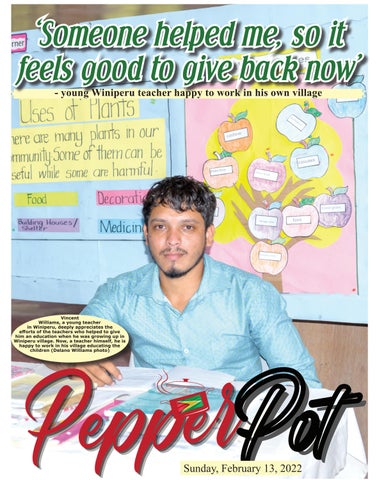
‘Someone helped me, so it feels good to give back now’ - young Winiperu teacher happy to work in his own village
Vincent Williams, a young teacher in Winiperu, deeply appreciates the efforts of the teachers who helped to give him an education when he was growing up in Winiperu village. Now, a teacher himself, he is happy to work in his village educating the children (Delano Williams photo)
Sunday, February 13, 2022
II
CHRONICLE PEPPERPOT ― Sunday, February 13, 2022
DID YOU KNOW?
TWO VARYING STORIES OF VALENTINE’S Day occurs every February 14. Across the United States and in other places around the world, candy, flowers and gifts are exchanged between loved ones, all in the name of St. Valentine. But who is this mysterious saint and where did these traditions come from? Find out about the meaning and history of Valentine’s Day, from the ancient Roman ritual of Lupercalia that welcomed spring to the card-giving customs of Victorian England. Where did Valentine’s Day originate from? The history of the holiday—and the story of its patron saint—is shrouded in mystery. We do know that February has long been celebrated as a month of romance, and that St. Valentine’s Day, as we know it today, contains vestiges of both Christian and ancient Roman tradition. But who was Saint Valentine, and how did he
become associated with this ancient rite? The Catholic Church recognizes at least three different saints named Valentine or Valentinus, all of whom were martyred. One legend contends that Valentine was a priest who served during the third century in Rome. When Emperor Claudius II decided that single men made better soldiers than those with wives and families, he outlawed marriage for young men. Valentine, realizing the injustice of the decree, defied Claudius and continued to perform marriages for young lovers in secret. When Valentine’s actions were discovered, Claudius ordered that he be put to death. Still others insist that it was Saint Valentine of Terni, a bishop, who was the true namesake of the holiday. He, too, was beheaded by Claudius II outside Rome.
VALENTINE’S DAY
Other stories suggest that Valentine may have been killed for attempting to help Christians escape harsh Roman prisons, where they were often beaten and tortured. According to one legend, an imprisoned Valentine actually sent the first “valentine” greeting himself after he fell in love with a young girl—possibly his jailor’s daughter—who visited him during his confinement. Before his death, it is alleged that he wrote her a letter signed “From your Valentine,” an expression that is still in use today. Although the truth behind the Valentine legends is murky, the stories all emphasize his appeal as a sympathetic, heroic and—most
importantly—romantic figure. By the Middle Ages, perhaps thanks to this reputation, Valentine would become one of the most popular saints in England and France. A pagan ritual While some believe that Valentine’s Day is celebrated in the middle of February to commemorate the anniversary of Valentine’s death or burial—which probably occurred around A.D. 270— others claim that the Christian church may have decided to place St. Valentine’s feast day in the middle of February in an effort to “Christianize” the pagan celebration of Lupercalia. Celebrated at the ides of February, or February 15, Lupercalia was a fertility festival dedicated to Faunus, the Roman god of agriculture, as well as to the Roman founders Romulus and Remus. To begin the festival, members of the Luperci,
an order of Roman priests, would gather at a sacred cave where the infants Romulus and Remus, the founders of Rome, were believed to have been cared for by a she-wolf or lupa. The priests would sacrifice a goat, for fertility, and a dog, for purification. They would then strip the goat’s hide into strips, dip them into the sacrificial blood and take to the streets, gently slapping both women and crop fields with the goat hide. Far from being fearful, Roman women welcomed the touch of the hides because it was believed to make them more fertile in the coming year. Later in the day, according to legend, all the young women in the city would place their names in a big urn. The city’s bachelors would each choose a name and become paired for the year with his chosen woman. These matches often ended in marriage. Lupercalia survived the
initial rise of Christianity but was outlawed—as it was deemed “un-Christian”—at the end of the 5th century, when Pope Gelasius declared February 14 St. Valentine’s Day. It was not until much later, however, that the day became definitively associated with love. During the Middle Ages, it was commonly believed in France and England that February 14 was the beginning of birds’ mating season, which added to the idea that the middle of Valentine’s Day should be a day for romance. The English poet Geoffrey Chaucer was the first to record St. Valentine’s Day as a day of romantic celebration in his 1375 poem “Parliament of Foules,” writing, ““For this was sent on Seynt Valentyne’s day / Whan every foul cometh ther to choose his mate.” Valentine greetings were popular as far back as the Middle Ages, though written Valentine’s didn’t begin to appear until after 1400. The oldest known valentine still in existence today was a poem written in 1415 by Charles, Duke of Orleans, to his wife while he was imprisoned in the Tower of London following his capture at the Battle of Agincourt. (The greeting is now part of the manuscript collection of the British Library in London, England.) Several years later, it is believed that King Henry V hired a writer named John Lydgate to compose a valentine note to Catherine of Valois.
III
CHRONICLE PEPPERPOT ― Sunday, February 13, 2022
‘Subraj Foundation’ to help thousands in 2022 health/ eye care outreaches
By Telesha Ramnarine
THOUSANDS of persons stand to benefit later this month when the George Subraj Foundation takes its signature health and eye care clinics to various parts of Region Nine (Upper Takutu/Upper Essequibo). The foundation, based in New York, continues to be passionate about providing healthcare services to Guyanese in need and would often visit to conduct the outreaches with the help of local authorities. Cognisant that many Guyanese are without essential health care services and may not be able to afford simple tests, the foundation goes all out to render practical assistance to folks all across Guyana. Beginning February 18, foundation member Richard B. Mahase, who is in Guyana coordinating the mission, will be at the Annai Health Complex. The team will continue at Shulinab Health Center on February 19 and at the Lethem Hospital on February 20. Representatives of the Linden Hospital Complex and a 10-member team from ‘Georgetown Hospital’ will be accompanying Mahase on the trip to Region Nine, to be later followed by outreach to Berbice. “RHO of Region Nine, Dr. Mc Watt
Foundation member and coordinator of the effort, Richard B. Mahase
and his team said this is a highly anticipated service and would benefit the thousands of residents immensely. Dr. Shailendra Sugrim of GPHC is cooperating fully,” Mahase told this publication recently. According to him, the foundation would not function as desired lately due to the Coronavirus pandemic. “COVID is affecting every aspect of life globally. It has been the same for the US, so plans are shelved and re-
booted accordingly, but we still had reasons to celebrate as this was a signal year for Guyana’s healthcare with the passage of the Organ Transplant Bill.” Even with the challenges of the pandemic, the foundation intends to continue partnering with the Ministry Of Health to assist a healthy Guyana. The foundation pioneered Guyana’s first kidney transplant in 2008, facing great
odds. “From a country where renal failure patients had to travel overseas for transplant, the dynamics have changed; and today, not only is living donor transplants possible, but an agency is in development to procure similar tissue from donors,” Mahase shared. The same can be said for Corneal Transplant, he noted. “This Mr. Subraj presided over in 2014, and after almost 100 surgeries where we purchased and flew in the corneas, harvesting is now possible locally from donors. “Again, the formation of an Eye Bank is taking place. Overall, the foundation is proud of these medical milestones achieved by the subject Minister, Dr. Frank Anthony, and his team in such a short time,” he continued. The foundation wants to elevate the health care services of the nation. “An air traveller is told to put on their oxygen mask first in an emergency. In the same way, before helping another, one should think of their own health,” Mahase shared. He said rudimentary things such as asking individuals to cook and consume less salt or avoiding white rice or white flour could have longterm benefits to the body. Meanwhile, the foundation’s other team members are Gloria, Tony and Jasmine Subraj, along with Jay Jainarine. They have been coordinating various health initiatives in Guyana since the early SEE PAGE V
Head of the Ophthalmology Department of GPHC, Dr. Shailendra Sugrim assisting a youth during one of the outreaches
Foundation member, Tony Subraj
George Subraj (deceased) with his wife Gloria
IV
CHRONICLE PEPPERPOT ― Sunday, February 13, 2022
Guyana-born Canadian receives USA Brescia University’s highest honour
By Frederick Halley NARINE Dat Sookram’s phenomenal achievements over the years have been re c e n t l y d e s c r i b e d a s “rare.” The Guyana-born is credited with winning over 200 prestigious awards, his most recent being the Spirit of Angela Award from Brescia University, Owensboro, Kentucky, USA. In glowing introductory remarks at the January 27 presentation ceremony, Narine was exalted for his volunteerism over the years, which started as a 14-yearold growing up in Berbice, Guyana. According to Associate Professor of Social Work, Elaine Wright, “Narine is passionate about societal well-being and exemplifies the spirit of Angela in his personal endeavours and professional life. During his time in the MSW programme at Brescia, he has demonstrated his commitment to academic excellence in the classroom as well as in his advocacy for social justice.” Among his most treasured award has been the Public Peace Prize, won in 2016 from a field that included the likes of Pope Francis and Malala Yousafzai, the Pakistani activist for female education and Nobel Peace Prize advocate. This award is the only distinction in the world focused on recognising people and initiatives working for peace that are proposed, nominated and validated by the public. On being presented with the award, Sookram was described as an excellent example of the rich social and economic contributions made by immigrants. The huge number of letters of support sent in showed the trust and gratitude of those who have crossed paths with him from across Canada.
Narine Dat Sookram
These letters came mostly from fellow citizens confronted with the same challenges of integration into an adopted country and have led him to be awarded the 2016 Public Peace Prize for Social Integration and Community Peacemaker. Sookram has been an excellent role model for the immigrant population in Canada. In 2015, he was named one of RBC’s Top 25 Canadian immigrants for the continued support to other immigrants for more than 20 years. His attitude is one of acceptance and openness towards all, rich or poor, regardless of their social status. He makes everyone feel special and worthy by bringing out strengths that people often don’t know they have. He has exceptional mentoring skills, which he uses to help businesswomen in Third World countries as well as internationally trained professionals here in Canada. In 2013, Sookram
received the World of Difference 100 Award, making him the first North American to receive this honour in the category of Championing Women’s Economic Empowerment. By connecting with the community, new immigrants realise the resources available to them that were put in place to make them feel welcome, safe and accepted. “Youth are the leaders of tomorrow and this is something we have to be conscious of. Youth especially in today’s world, are full of fresh ideas and, as a social service worker, it is my obligation to empower them,” he explained. Although Narine feels a certain responsibility and tenderness towards youth, he not only passes his wisdom to them but to newcomers of all ages. He encourages new immigrants to move out of their comfort zone and use the resources their community offers because that “will determine [their]
Spirit of Angela Award
failures and successes.” As soon as he migrated from Guyana some two decades ago, he formed a non-profit organisation as a continuation of a group he’d founded in Guyana. At the young age of 14, he started a youth group to bring kids together to share ideas so that everyone could contribute to building a better village. The organisation in Canada aims to help schoolchildren in Guyana and to promote its rich cultural heritage here, and is called Active Vision Charity Association. One of the schools in Guyana has named its library after his organisation. According to Sookram, volunteering has been part of his daily life since childhood, and he considers it a value for him. He has been recognised for his volunteerism locally in his hometown of Waterloo, where he received the Waterloo Award, the city’s highest civic honour. In his province of Ontario, he was awarded the June Callwood Outstanding Achievement Award for Volunteerism and is also the recipient of The Sovereign’s
Medal, which is Canada’s highest award for volunteers. A first-generation to enter and thrive in higher education, Narine is highly motivated to make a difference after migrating to Canada in the early 90s, during a recession and finding work was difficult. That personal experience gave him a personal dream to pay it forward. In 2003, Narine saw the need for a West Indian radio show in the Waterloo region of Ontario, Canada, and “Carribean Spice Radio” was born. Narine realised that something was missing and he wanted the West Indians in Canada to feel a sense of home. The radio show aims to promote, entertain, educate, and keep that sense of “home” alive through radio. It has captured listeners both in Canada and internationally and has become the only radio programme to receive the “CKMS Sonic Boom People’s Choice awards for “Favourite Caribbean Music” and “Favorite Word Music.” Narine credits the secret to the success of the show is to build a good relationship with listeners.
Narine, who is also a Licensed Diversity & Inclusion Trainer, is spending time to educate businesses and landlords so that they can see everyone as one or simply as humans and don’t label anyone to be different or unworthy for giving a chance to live in a safe space that they can call home. He states that many landlords and even other businesses are working in the blind spot, meaning they are not being inclusive when it comes to newcomers, but still carry on as if everything they do is perfect, which is far from the truth. Sookram was born and raised at Number 65 Village, but grew up at Number 64 Village, Berbice, Guyana. He lived right by the Number 63 Village close to the New Market Primary School, where his family had a successful business cake shop. During his childhood days, he was an active member at the Number 64 Krishna Mandir (Hindu Temple) and at one point, was the assistant priest at the age of 14. He attended New Market Primary School and Tagore Memorial Secondary School before migrating to Canada in 1993. Narine is the last child of seven children and the first to have completed post-secondary and postgrad education. He graduated with several degrees, including a Master of Social Work from Brescia University, Bachelor of Social Work from the University of Manitoba, Bachelor of Professional Arts from Athabasca University, Bachelor of Education in Adult Education from Brock University, Social Service Worker Diploma from Mohawk College, Post-Grad in Career Development from Conestoga College and has recently been accepted for the Doctor of Social Work from Capella University in which he’ll start Summer this year.
CHRONICLE PEPPERPOT ― Sunday, February 13, 2022
Romance beyond the coastland IT’S one day before Valentine’s Day and love is in the air. Not only on the coastland, but on the islands, the grasslands, the swamplands, the valleys, hills and mountains, as well as the savannahs beyond the Pakaraimas and the Kanuku Mountain ranges. In every one of the country’s regions, LOVE BLOOMS and BLOSSOMS on Valentine’s Day and in between. At the Tourist Resort at Hurakabra, seen in the photograph, which is located a few miles north of Bartica, on the West Bank of the Essequibo River, guests enjoy a game of volleyball on the sandy beach. In the distance are islands in the Essequibo River. Some of those islands, such as Fort Island at the left, are populated. Many of the other islands in the Essequibo River have just a few homesteads. Others are uninhabited. However, the Tourist Resort at Hurakabra, which is actually located on the West Bank of the Essequibo River, can be regarded as special. Those who visit that resort are both Guyanese and foreigners. Quite a number of them are married couples who spend quality time together. Around Fort Island are a number of other islands which are smaller and unpopulated or sparsely populated. Nonetheless, in these relatively unknown locations, love still blossoms and blooms. We have heard of the birds and the bees, and they all sing their love songs year round. Young people, and even some mature and single persons, do fall in love and get married or establish relationships and live together as loving partners. For most of them, Valentine’s Day is really just another day to be loving and kind to the person who share their lives in a special way. Together they raise families and make contributions to Guyana, the country of their birth, and the country which they love. Lovers and married couples from the coastland and even from abroad, visit the Essequibo tourist resorts and spend quality and romantic time together. At the resort seen in the accompanying photograph, the younger tourists who are not necessarily couples, are seen playing a game of volleyball on the beach. For them, it is a different kind of love - love of life itself. And even though there is the horrid COVID-19 pandemic - call it Mr COVID who wants to steal Valentine’s Day from the embrace of young and not-so-young lovers and married couples, LOVE and ROMANCE still prevail. Afterall, it is VALENTINE’S DAY.
V
Young Guyanese enjoying a game of volleyball on the beach at the Hurakabra Tourist Resort on the Essequibo River
While cultures are usually static in most communities and countries for the better part, in some segments of those very cultures there are sometimes gentle or dramatic changes. But be it romantic or patriotic, or the love of a talent, most individuals do give their hearts to someone
‘Subraj Foundation’ to help ... FROM PAGE III
1990s, doing so with personal funds to give back to the country. As usual, the team will be providing eye tests, blood sugar, pressure and glucose testing, and has brought in thousands of glasses for adults and children, including anti-glare and blue light glasses. The foundation members have also brought with them masks, personal protective equipment, thermometers and oximeters, and a wealth of knowledge that they plan to share at the clinics. Founder, Mr. George Subraj (now deceased), always believed in helping the people of Guyana, according to the foundation members who are carrying on his legacy.
or something which they hold very special and most dear. Happy Valentine’s Day! FQF1
A previous eye clinic held in Guyana
VI
CHRONICLE PEPPERPOT ― Sunday, February 13, 2022
The residents of Winiperu are easygoing, content and happy! TO some people, living in a community devoid of basic amenities such as water, electricity, and phone signals would be out of the question, but not so with
Bartica from Linden. Day-to-day life for people of this logging concession, or “timber grant,” would see the approximately 130 residents- most of whom are
to get things done. It would be no unusual scene, for instance, if someone decides to paddle out in the middle of the river, or more often, climb to the top
The Winiperu Creek where residents go for recreation on Sunday
the people of Winiperu - a small riverine community nestled along the road to
employed with the logging company Vaiterna Private Holdings- being innovative
of something, perhaps a tree, to be able to get a phone signal in the event of an
emergency. Whereas the former logging company would’ve provided water for residents, people now depend heavily on rainwater. When their
22-year-old Vincent Williams, succinctly puts it: “I love it here because it is home.” Most of the residents that Pepperpot Magazine inter-
school,” she reflected. “I don’t know what happened,” she said. But even with these
Residents depend heavily on rainwater, or would use water from the creeks
tanks are empty, though, they must make their way to the creek to fetch buckets of water, to have enough for the entire family; those trekking there would obviously have to make several trips. Over the years, residents have become tired of promises from politicians, especially regarding electricity and water; but they are not complaining. In fact, they’d happily tell you about the sacrifices they have to make each day as if they were a breeze to them. It’s their way of life, and as one resident,
viewed recently reminisced about days when Winiperulocated more than an hour’s drive from Linden (including a pontoon crossing at Sharima village)- were bright and abuzz with a bigger population and more fun activities. Edith Bennett, for example, is now 79 years old and has been living in the community for some 53 years after following her husband, who came to work at the logging company. “This place was nicer than it is now. It had plenty houses and people, grocery stores, hospital,
changes and the fact that she lost her dear husband in death about three years ago, Bennett would not prefer to go anywhere else. “I just like it here,” she said, adding, “No matter what, I love this place.” The mother of eight, who worked onerously in the day on her farm, explained how the family ended up in Winiperu: “I used to live at a place called Wakapau in the Pomeroon in Region Two and my husband used to SEE PAGE XI
Edith Bennett has been living at Winiperu for more than 50 years (Delano Williams photos )
Winiperu is located more than an hour’s drive from Linden (including a pontoon crossing at Sharima village)
VII
CHRONICLE PEPPERPOT ― Sunday, February 13, 2022
Winiperu residents make considerable contributions to Bartica township By Telesha Ramnarine IF the history of the Bartica Township is to be written, so to speak, Mayor Gifford Marshall feels that the Winiperu community must be included because of the significant contributions that the people have made to the town over the decades. “Winiperu remains a community that is very close to our heart. Bartica, being the central or the main town in Region Seven (Cuyuni/ Mazaruni), would see a number of persons from Winiperu supporting our services,” Marshall expressed during an interview with Pepperpot Magazine. “For this, we are very grateful. We know that they have a few issues, and we will continue to work with the Regional Democratic
of Bartica is significant,” he added. Marshall called attention to the Winiperu Creek, which he said is part of the region’s tourism drive. “It’s part of what we have to offer in Region Seven. Those persons who would have [sic] visited that creek know the beauty and scenic nature of it, and of course, you can enjoy seeing the wildlife, especially the monkeys, jumping from tree to tree,” he said. According to former Regional Chairman Gordon Bradford, Winiperu has been in existence for many years under different companies such as Caribbean Resources Limited (CRL), Guyana Timbers, Colonial Life Insurance, and Vaitarnia Resources, an Indian company currently working in the area. “The last time I was in
Marshall said the beautiful Winiperu Creek is part of Region Seven’s tourism drive
‘Winiperu remains a community that is very close to our heart.’ – Bartica Mayor
Council in ensuring that they are addressed. The number of persons who were born and grew up in Winiperu, who contributed to the township
there, I gathered that operations have been winding down a little; not as it used to be before. The whole economic situation has seen the
company wavering,” Bradford opined. Explaining what the company does, he said: “They bring the logs to the landing, and while they would export
Many residents born and raised at Winiperu visit Bartica often to conduct business and do shopping (Delano Williams Photos)
Bartica Mayor Gifford Marshall
them, they would also cut them to produce materials.” While electricity, water, transportation, and phone signals are sore areas of concern for residents of Winiperu, Bradford noted that the regional authorities would do their best to assist when necessary, such as providing a vehicle to someone in an emergency.
“We have been making representation to GT&T to improve their signal,” Bradford related, among the measures they’ve taken to bring improvement. The primary school in Winiperu is a collaborative effort between the company and the government and has, for the most part, been working well.
The health post is managed by the regional authorities that overlook staffing and repairs. “It used to be located in the company’s compound, but because persons are living outside the compound, we saw to constructing it alongside the road so that anyone can have access to it at any time,” Bradford related. The school’s population often depends on the company because the more workers that the company employs, the more enrolments the school sees. Now that there are not many workers, there has been very low enrolment over the past year. The primary source of employment at Winiperu is working with the logging company as a labourer, operator, mechanic, welder, or something else. Since most people depend on this source of income, if there is no work, they’ll leave the community. A few others run small businesses in clothing and groceries. With no police outpost at Winiperu, the community would sometimes see a patrol from nearby Sharima village. Persons wishing to make a report would also have to go to that village.
VIII
CHRONICLE PEPPERPOT ― Sunday, February 13, 2022
The community health post in Winiperu - making a difference in the lives of residents
By Telesha Ramnarine THE health post in Winiperu is seldom closed. The community, with about 130 persons, is being served by two Community Health Workers (CHWs) who go above and beyond the call of duty to help those who are in need. According to the World
Health Organisation (WHO), CHWs are health care providers who live in the community, they serve and receive lower levels of formal education and training than professional health care workers such as nurses and doctors. This human resource group, according to WHO, has enormous potential to
extend health care services to vulnerable populations, such as communities living in remote areas and historically marginalised people, to meet unmet health needs in a culturally appropriate manner, improve access to services, address inequities in health status and improve health system performance and efficiency.
Winiperu’s CHWs Alana Glasgow Beaton (right) and Natasha Lowenfield (Delano Williams photos)
“We open every day, even on weekends. We’d just come out to help,” Alana Glasgow Beaton, one of the CHWs working at the Winiperu health post for the past seven years, told Pepperpot Magazine during a visit to
the facility. Along with the other CHW, Natasha Lowenfield, Alana grew up in the village and is happy to serve the residents in this capacity. “The work is not fatiguing, because on a daily basis
we see between five and 10 persons,” the mother of two shared. Of course, because of its remote location, the health post has certain limitations. SEE PAGE XV
The health post in Winiperu is being served by two community health workers
IX
CHRONICLE PEPPERPOT ― Sunday, February 13, 2022
‘I get to enjoy my day’ - Winiperu farmer revels in daily life on the farm
By Telesha Ramnarine THE pumpkins that Earla Nibbie Bess reaped from her farm were huge. She’d fetch them one by one from the
and I can’t even call my family, my own children. We still have no electricity,” she said. Transportation is also a problem in the event of an emergency.
Earla Nibbie Bess (Delano Williams photos)
There is no electricity or phone signal in Winiperu
farm to her home in Winiperu and wait for the central logging company in the village to come and pick them up from her. As you can imagine, hard work was required of Earla, now 78 years old, and all other farmers back in the days, especially at a remote location such as Winiperu, where certain peculiar challenges are presented. With roots in Wakenaam Island, the mother of 11 has lived most of her life in Winiperu. When she first arrived in the village, she can still remember her conversation with the local pastor about how she needed land to build a house and farm. The pastor directed her to the authorities in Bartica, where she subsequently went with her husband and children; she received all that she was hoping for. “We did farming: cassava, plantain, banana, eddo, all kinds of things. I worked hard, you see me here. I was fatter, with 296 pounds. I used to work with my cutlass and my axe,” Earla reflected in an interview with Pepperpot Magazine last Monday. At the time, she was visiting the health post and chatting with the community health workers. Even as he also worked on the farm, Earla’s husband worked in the village compound, weeding for the logging company. “We used to sell provisions to the company. One time we reaped six pumpkins weighing 135 pounds. I used to fetch it and put it under the house and then they would come with the loader to carry it,” she recalled. As a young woman, Earla also worked with the company at the time, Guyana Timbers, helping the medic. “I got the cotton, made the swab and put it to warm. I also helped people to dress their cuts,” she said. Easygoing despite challenges Earla is among many others who’ve long expressed their concerns about the need for water, phone signals, electricity and other basic needs in the community. “You want a phone call, you have to walk distances. I am here
Transportation is also a problem in the event of an SEE PAGE XVI
SEE PAGE XIX
X
CHRONICLE PEPPERPOT ― Sunday, February 13, 2022
‘Someone helped me, so it feels good to give back now’ - young Winiperu teacher happy to work in his own village
A teacher at Winiperu Primary assisting a pupil
Vincent Williams (Delano Williams photos)
VINCENT Williams, a young teacher in Winiperu, deeply appreciates the efforts of the teachers who helped to give him an education when he was growing up in the village. He understands the value of what he has received, in part, because not many persons in the profession were willing to accept a placement at the primary school in this extremely remote village. This reality is mainly responsible for Vincent’s decision to stay in the village and “give back,” even though he’s had opportunities to be placed elsewhere or could’ve easily moved to another location that would’ve allowed for him to pursue his personal goals. Growing up, the 22-year-old wanted to become a doctor, but having finished school, he realised that teachers were needed to assist the children in the community. So he decided that he will resort to teaching at the very school that he attended. “It feels good because I am giving back to the community. Just as how people educated me, children here need someone to do the same for them,” Vincent expressed during an interview with Pepperpot Magazine at the Winiperu Primary
school. “Most people don’t want to come in these areas to teach, so it feels good, because I want the children to have the same experience, or even a better one than me, when I was going to school here,” Vincent, now teaching for four years, further said. Videos and Worksheets Recalling his days in school, Vincent hardly had access to videos and a lot of worksheets, so he is happy that such aids are more readily available to the children at the moment, especially for his Grades Three and Four pupils who need more than just the textbook experience to studying. “Things have become more modernised. We now use videos and a lot of worksheets. In my time, we hadn’t those things,” he reflected. Apart from being effective tools for the children, they also help make Vincent’s teaching job easier. But the problem is that a reliable supply of electricity and internet is not available at SEE PAGE XIV Winiperu, so Vincent would have
CHRONICLE PEPPERPOT ― Sunday, February 13, 2022
The residents of Winiperu... FROM PAGE VI
work at Winiperu. We left everything in Region Two and came here. We first lived in the backdam, about a mile from here, but the compound closed in the backdam and they brought all the workers here. Then, we built our home, farm, and everything.” The Creek on Sundays Sports was a big thing
in the community back in the days, and people from Linden, Bartica, and other surrounding communities would visit Winiperu to play with the youths there. Cricket, football, rounders, hopscotch, among other games, would be the going things on the ballfield on the weekends and after Lack of transportation is a major issue affecting the school. people of Winiperu With sports no
longer available, residents now make their way to Winiperu Creek. On Sundays, the creek would come alive, with residents from Bartica also coming to share in the fun. Winiperu Creek is one of the most beautiful ones in the area. Winiperu has always been controlled by a logging company. Because of its remoteness, residents find it hard to obtain supplies:they’d have to go to Bartica to do their shopping or settle for paying
XI double the prices for items when people come to the village to sell. For this reason, having a form of transportation here is of utmost importance. By road, it would reportedly take residents an hour to drive to Bartica, while by boat, they may get there in about 45 minutes. As another option, residents can wait on the company’s truck that would take its workers out for business and shopping once a month.
XII
CHRONICLE PEPPERPOT ― Sunday, February 13, 2022
I WILL ALWAYS BE YOURS - PART II
YES, fate did! Her quiet nature and gentle smile seemed to have woven a magic spell that drew him to her and whenever he smiled at her an overwhelming feeling of joy filled her heart. But his mother’s harsh warning always echoed in her mind, creating a little fear in her mind.
It was becoming a little discomforting working under her sharp eyes and Shanti was relieved when Raj went on a business trip to Europe. In his absence, she was tasked with other duties in the house and heard more than enough at the lady’s brunches and lunches of the exquisite and wealthy girl she wanted her son to marry. Shanti knew those words were meant for her, but they just blew past her as on a windy day. She never cried tears on the thorny path she walked, just living with hope that one day her tired feet could step on a smooth path. Raj returned a couple of weeks later as preparations began for a satsang to celebrate his parents’ jubilee wedding anniversary. She saw him for short moments given his extra busy schedule and the added tasks she was given, the endless work. The satsang was a lavish, extravagant affair, over which a priest from India officiated, accompanied by a few renowned bhajan singers and several local kirtan groups. That night Shanti was dressed in a simple sky- blue saree, adorned with inexpensive traditional jewellery and white flowers braided into her long hair to give her an outstanding new look. The lady of the house had surprisingly given her and a selected number of young helpers extra money for an improved ensemble to serve the special guests. The divine rendition of songs and prayers so filled her heart with spiritual bliss,that it put a happy glow on her face. Raj had been looking at her as she served the guests and once when she took a brief break and looked at the small stage where he was sitting, elegantly attired, with his family, her eyes met his and held for a moment. SEE PAGE XXIV
CHRONICLE PEPPERPOT ― Sunday, February 13, 2022
XIII
ST VALENTINE’S DAY REMINDS US OF THE DELIGHTS OF ROMANTIC LOVE AS WELL AS OF ITS SOCIETAL IMPORTANCE TOMORROW, Saint Valentine’s Day, will be celebrated in most parts of the world, especially in English-speaking countries. The origin of the festival lies in the obscure mists of history. There are at least three Catholic Saints who bore the name of Valentine, but the one who is generally believed to be commemorated on Saint Valentine’s Day lived in the third century in the Roman Empire during the reign of Emperor Claudius II. In the third century, the Christian religion had begun to make inroads into the empire, and the Christian ethic was not as militaristic as the older Greco-Roman religion. This was a troubling trend to government administra-
tors, as men of military age increasingly began to prefer staying at home with their wives and families rather than enlisting in the army. Recruitment to the army began to suffer badly, and the Emperor was at his wit’s end to know what to do. He, therefore, hit upon the plan of banning marriages and forbade all priests from performing marriage ceremonies. Valentine,- a Christian priest, some traditions claim he was a Bishop - decided to risk his life by defying the Emperor’s orders. He secretly began to marry couples, but was discovered after some time and arrested. When he was taken before the Emperor, he was given the choice of renouncing his Christian faith and reverting to the older Roman religion. He stoutly refused to give up his Christian faith and was accordingly sentenced to death. While awaiting his execution, he became very friendly with his jailer and was able, through God’s power, to restore the sight of the jailer’s blind daughter, Julia. The jailer and his family, impressed with this miracle, became Christians. On the night before his execution, he wrote Julia a farewell letter ending with the words “Your Valentine” which phrase came to be perpetuated through all time in Valentine’s Day communications. On February 14, 270 AD, Bishop Valentine was first bludgeoned and then executed and when he was canonized by the Catholic Church, he was made the Saint of Marriage and Love. The love envisaged by the church was not romantic love but the love of family, friends and community. The concept of romantic love came into European culture only in the Middle Ages. Today, this concept is only now beginning to affect the non-Western SEE PAGE XVII
XIV
CHRONICLE PEPPERPOT ― Sunday, February 13, 2022
‘Someone helped me, ... FROM PAGE X to ensure that he makes good use of his monthly trips to Bartica and download whatever content he needs to take back to the children. “We need reliable electricity, like solar panels or something. Two main things are internet and electricity. Without these, you can’t re-
ally do anything these days.” In the village, logging company Vaiterna Private Holdings would put on its generator from 18:00 to 21:00 hours, and then from about 05:30 to roughly 08:00 hours. Even so, the signal would only be strong enough to probably just send a few messages. “The internet signal
works with the current. We have printers and so, but it’s difficult to come down here at the school in the nights. So in the mornings, you have to hustle and do whatever you need to [do] before the current goes off,” Vincent explained. Beautiful and Easy
Irrespective of how challenging it might be to remain in the teaching profession, Vincent said he loves Winiperu simply because, “It is home; beautiful and easy. “It wasn’t my firstchoice profession, but in time I got to love it. It feels good to give back to the community’s children, and
Winiperu Primary School
things are far better now because we didn’t have teachers back then while the population was much more,” he shared. Now that school is back in full swing, Vincent has the help of three other teachers at the school with about 28 pupils.
Vincent’s keen awareness that the community children need teachers to help them motivates him to stay in the village
XV
CHRONICLE PEPPERPOT ― Sunday, February 13, 2022
The community health post in ... FROM PAGE VIII In the event of an emergency, residents would have to be referred to another facility, such as the Bartica or Linden hospital. Emergency Cases “If there is a serious emergency and we don’t have the equipment to assist the person, we will go to the manager of the company (the logging company, Vaiterna Private Holdings) to assist us with transportation to get to the nearest hospital,” Alana explained. By road, it takes about an hour to get to the Bartica hospital and roughly 45 minutes by boat. While Alana cannot recall anyone dying in the village due to an emer-
gency, she does remember the time that a resident’s life could’ve been saved if he had made it earlier to the hospital. That resident, she said, died while he was receiving treatment at the Bartica Hospital. “When certain things happen, it’s challenging when it comes to transportation. We don’t have a midwife here, so in severe cases, we have to refer to Bartica hospital. Also, certain medications we don’t store here,” Alana shared. More Fun Alana, like many others, fondly recalls how life was in years past when Winiperu had many more residents. “Life was much more fun
back then as we had more than 300 people living here. We still have the playfield, the airstrip, and the creek,” she offered. But the people of Winiperu, according to Alana, face a lot of challenges when it comes to the lack of water and electricity. “They have to buy a generator and then pay to fuel it. We would depend on the rain for water, and when there’s no rain, we would have to go to the creek, which is quite a distance for some people.”
In the event of an emergency, patients would have to be referred to the nearest hospital, often at Bartica or Linden
On the occasions that water has to be obtained from the creek, Alana would help her husband to fetch. “I would fetch one bucket and my husband would
fetch two. He’d have to make about three trips to get enough water for the family.” Alana said residents would also have to contend
with high prices for groceries and other needed items. “The price here is expensive, but we’re accustomed to it. If we need it, we have to buy it.”
XVI
CHRONICLE PEPPERPOT ― Sunday, February 13, 2022
‘I get to enjoy... FROM PAGE IX
emergency. For water usage, she, like many others, has a black tank to store water. “When it is dry, my old man [husband] has to fetch water from the creek, a good distance away. Going down is hard for me, so I don’t get to help fetch. Before, when it was Guyana Timbers, there was a tractor and a trailer that will come in your yard. They will bring the water for you, and you will full in your buckets.” These are some of the changes that Earla would love to see in the community, making life much easier for her and the other residents in the community. She reminisced on how life used to be much more exciting back when the population was greater, and the community was busy with one activity or another. “Winiperu is a beautiful place. We had a lot of sports; cricket, rounders, football. People from Linden, Anarika, Rockstone, and Bartica used to
Apart from rainfall, residents would utilise the creeks to obtain water
come to play. However, with many people moving out of the area for better access to work and school, the place became very quiet. “Life at work is nothing like what it used
to be. But it remains an easygoing place. I get to enjoy my day. We have no problems with people. That’s why I love it,” she expressed.
CHRONICLE PEPPERPOT ― Sunday, February 13, 2022
ST VALENTINE’S DAY REMINDS ... FROM PAGE XIII societies of Asia and Africa. In the Middle Ages, the age of chivalry with its knights and their ladies, the concept of courtly or romantic love was born and flourished. In the Middle English poet Geoffry Chaucer’s story of the Parliament of Fowls, the concept of birds and all other creatures pairing off romantically on February 14 was further propagated. In the 19th century, ro-
mantic love began to be vigorously resuscitated since Valentine’s Day came to be commercialised, and this trend continued into the 20th century when there grew up a “Valentine industry producing decorations, cards, chocolates and candies worth nearly two billion dollars. There are other socio-economic related offshoots of romantic love, such as the film industry of Hollywood and Bollywood, where the theme of romantic
love is celebrated in numerous popular films. T h e re a re t w o o t h er societal impacts. In non-Western societies, the concept of romantic love has been a liberating force, and the traditionalists have been waging a losing battle against it. In many Western cultures, the populations have become stable, not increasing, and even beginning to decline. The aged are now beginning to outnumber the younger, economically productive members of society. It is now beginning to be generally accepted that the St Valentine’s Day ideal of marrying and rearing families is a necessary imperative if Western societies are to continue to survive at the level they are and to be creative. St Valentine’s Day will therefore continue to be celebrated with greater verve and commitment.
XVII
XVIII
CHRONICLE PEPPERPOT ― Sunday, February 13, 2022
Excessive bleeding after extraction
THERE can be no doubt that haemorrhage (bleeding) is frequently associated with the profession of dentistry. Also, no one can
deny that bleeding after an extraction is a perennial worry of many patients. No other profession has been so involved in this process save the time when medicine was preoccupied, employing “leaches to bloodlet” as a form of treatment.
Based on the time of occurrence, haemorrhage can be
classified as primary, intermediate, or secondary. Primary haemorrhage occurs during the time of surgery and is attributable to cutting of the blood vessels. Under normal conditions, the application of pressure along with the retraction and contraction of blood vessels is sufficient to promote arrests. Frequently, when infiltration anaesthesia
is used, the vasoconstricting (contracting blood vessels ) agent involved also helps to promote the arrest of bleeding. Many factors, both extrinsic and intrinsic, can prevail to promote coagulation. Intermediate haemorrhage refers to bleeding which occurs within 24 hours of surgery (extraction). The SEE PAGE XIX
CHRONICLE PEPPERPOT ― Sunday, February 13, 2022
Excessive bleeding ... likelihood of this happening is as a result of many factors, eg. removal of pressure, dissipation of vasoconstricting agents, and relaxation of blood vessels. Secondary haemorrhage occurs 24 hours after surgery and is frequently attributable to many factors eg. intrinsic trauma (loose chip bones ), infection, etc. The post-extraction wound basically, and for the sake of discussion, consists of two types of tissues: hard and soft. The hard-tissue component, bone, constitutes the greatest part of its wound, whereas the soft tissue makes up the smallest part of the wound. Haemorrhage can occur from either of the components. Bleeding from bone can be difficult to control, because unlike a soft-tissue
wound, the walls cannot be collapsed and approximated to provide the relaxation required to promote retraction and contraction of the vessels. Perhaps the most common cause of haemorrhage is due to the pressure of infection, periodontal (gum) and periapical (root tip). Whenever there is an infection, there is frequently inflammatory proliferation (granular tissue) and inflammatory hyperemia (increased blood flow). Therefore, there is an increase in the number of blood vessels along with hyperemia. The treatment for haemorrhage can be arbitrarily grouped as follows: prevention, pressure, cold, haemostatic agents, and vasoconstriction (local anaesthetic). Methods of minimising, if not preventing, haemor-
FROM PAGE XVIII rhage should be resorted to. A traumatic surgery, elimination of chronic bleeding granulation tissue, removal of fractured splinters of bone, excision of old necrotic clots (if such is the cause ), are suggested measures well worth taking. Preventive therapy is undoubtedly one of the most important forms of therapy available to control haemorrhage. The method of applying direct pressure to the wound is certainly the most effective one to stop bleeding. By compressing the margins of the wound to relieve tension, the vessels will be permitted to retract and contract. The patient should bite on the cotton or gauze for an hour to aid in collapsing blood vessels and to encourage clotting. Suturing, filling the wound with gauze soaked in benzoin, applying ice packs, injecting local anaesthetic around the site are all ways to arrest bleeding. Premarin and Vitamin K administered systematically can also be used.
XIX
XX
CHRONICLE PEPPERPOT ― Sunday, February 13, 2022
Advice for younger generations
After writing for six years, this may be my favourite column ever. I WAS asked by a reader what advice I would give to the younger generations. While I may be old enough to answer this, I had a better idea. I reached out to people
in my life who are a bit older and who have provided me with great wisdom. I asked them the question instead. These particular people have had major positive influences on my life. Some have given names, and others are anonymous- either way, I truly
believe their advice will result in great perspective and will incite positive mindful and behavioural change. I hope you all enjoy as much as I do! “There is an entire book of advice that I would like to give my younger self, but I
will break it down to my most important six: 1. The saying “sticks and stones may break my bones, but words can never harm me” ...that’s a load of crock... your words hurt and damage people for lifetimes. Be careful and kind with your words. Respect is key to all relationships. 2. In an aeroplane, the rule is to put your mask on first, then apply to others in your care. Adapt that to life.
Spend time looking after yourself mentally, spiritually and physically. Once you are healthy, then you can add value to the lives of those you love. 3. Independence- find a passion and make it your job. Once you are capable of looking after yourself and recognising your worth, then you’ve won half the battle. 4. Watching TV and scrolling on social media are not hobbies, nor is most
of what you’re seeing real- go outside and live your life 5.You can’t please everyone- stop trying 6. Last but certainly not least, be grateful. It changes your perspective.” - Tracy Vieira “Grab the opportunity to learn - anything that you can learn will come in handy in life, you never know. It is never too late to pursue your SEE PAGE XLVII
CHRONICLE PEPPERPOT ― Sunday, February 13, 2022
XXI
Memory Lane at home
LAST week I did promise that I will amplify on my magnificent time in Bartica. I know I am not the only person who feels a special place about his/her respective place of birth. The trip before this one was for the funeral of my foster dad. Certain moments came back, and it reminded me how much I miss him because I will never see him walking into that yard again or hearing that contagious laughter. I am not surprised that not only the family misses him, but also many of his colleagues and fellow boat captains. I believe the river misses him too. I was having a conversation with Mr Ward and he was sharing his experiences with the great Allan John Aka Kaikuchi (tiger), who was a daredevil in the Mazaruni River. I heard a few weeks ago someone remark that he was the only person to go to certain high-
risk areas without fear. I had heard many stories when he was alive, but even more after his death. One of the goals on my vision board is to create a short biography of his journey. It is hard to be at the river and not see a boat that resembles the ones he captained over the years. I love the river and feeling the sand from the Bartica Golden Beach enjoying the spectacular sunrise. I turned to my right to watch the Regatta Pavilion and remember some of the moments there from the countless regattas I attended over the years. I was also first Runner Up in one of the Bartica Regatta Pageants. One of my fondest times at the river with my siblings would be swimming for hours, then sailing to the beacon with the blown-up tyre tubes from the garage. Most of the younger relatives with me that day were nowhere in those mem-
ories from decades ago. Only my aunt Brenda and maybe my younger brother Chris whose children Tandy and Terrel were with us. Also my gorgeous niece Moesha, my cousins Shenela, her husband Shawn and daughter Erica and Sheneva and her children were with us. The boardwalk certainly enhances the ambience at the beach. We had a delicious breakfast at the beach from Upper Level Restaurant. We have lots of talent in Bartica, and that morning a young man with whom I was not familiar but knew his mom performed for hours. He went from reggae to gospel to oldies, and my brother joined him with his original songs. Samuel Medas had performed the night before and he was at the beach having a blast and they joined in the singing too. It was SEE PAGE XXV
XXII
CHRONICLE PEPPERPOT ― Sunday, February 13, 2022
CHRONICLE PEPPERPOT ― Sunday, February 13, 2022
XXIII
BLACK HISTORY MONTH IN THE CONSISTENT AGE OF A PANDEMIC A Guardian.com article brought the South Pacific Island of Kiribati and other near Islands to global observation. It showed how these folk could have kept out the COVID virus infections for two years and one flight on January 22, 2022, left them with multiple infections, ongoing. I am sure that the flight conformed to all the CDC’s protocols or whatever COVID-mandates required- what was being done before, that was not done then. Disease across national spaces have always been a subject that has tormented nations, from the stowaway infected (by human standards) rats, that have on more than one instant infected an unconscious population, wiping out vast numbers across multiple nations, like the Medieval Plague. But humans are not innocent. The terms chemical and biological warfare emerged from warring nations of the old world, propelling infected bodies into the water reserve of nations, particularly under siege using siege weapons, this philosophy of inflicting mass death was never abandoned. This is a subject that requires a delve into a bitter and not so unchanged human world. What is necessary today and in the context of this month, is to understand the interactions of age-old formulas, proven and merged into cultural practices. We should recognise, explore where diversions have affected usage and what retains its immediate value to us to use a reference for historical observation from the age of the MOORS, an essential element of social life. In great contrast with the Moorish regard for bathing and hygiene was the contempt, which much of Western Europe had for bathing and physical cleanliness. Burckhardt confirms, like a number of other historians of Adalus. That Catholic Conquistadors after the Moorish age, destroyed Moorish Bathes that enforced bathing as a custom” see Terence McLaughlin’s Historical Study: Dirt: A Social History As Seen Through the Uses And
Abuses of Dirt: “What is certain is that the Moorish [Bismaristans]-‘Hospitals’ were equipped by medical Officials who were knowledgeable in such things as blood circulation, measles and smallpox. See- “Golden Age of the Moor,” edited by Ivan Van Sertima. Thus, the necessity for the Bathes were not driven by religion, but by medical knowledge. In the Hollywood Movie-Documentary on ‘Nostradamus, the Moorish physician who accompanied him throughout plague-saturated lands stands out but was never named, though obvious to all. The courage of many of the medical guilds of Europe of that day must be applauded. They risked the horrors of the inquisition to preserve to circulate - even smuggle secretly into academies, Moorish medical manuscripts before the church burned them; Jan Carew referred to it as” attempts at an Intellectual holocaust”-see-Golden Age of the Moor Thus, the interaction and eventual conquest of Mesoamerica by Columbus, and the Conquistadors who followed him is attributed by scholarship in the following.
“Diseases, especially smallpox, measles, even the common cold, wrought havoc with New World peoples. Scholars believe that 50 to 90 percent of the Indians in North and South America died of diseases introduced from Europe: see “Seeds of Change 500 years since Columbus”-Smithsonian Institutional Press. The mere fact that today economics is forcing many of us to return to home treatments, of course with the support of useful modern aids, is significant enough that we construct a catalogue of home practices, backed by research. For instance, what are the properties of ‘Clay’ I knew family friends who during pregnancy eat clay, and go unchecked because she was not the first in the family, the children are alive, healthy and productive. What is this ancient medical mystery of clay? The inquisitional purges of Europe were centred on herbalists, and methods of fruit and botanical treatment which was described as ‘witchcraft’ even in Guyana, not so long ago treatment by village knowledge was viewed as “Obeah,” but the enslaved were wise. They quietly on the plantations of the three colonies of Guiana planted the healing tamarind trees. I’ve witnessed successful baths for skin rash, smallpox and a kind of hair rash, using tamarind leaves. In closing, what could be the therapeutic benefits of sleeping on a daubed surface? No doubt this would be rare in Guyana today, but it wasn’t difficult to fall asleep on ‘Buck-Mai’s’ dried daubed bottom house while living on the coast. I boasted this to a relative who had come to visit me; she informed me that in Africa, based on transferred knowledge, Africans also practised “daubing”- (Cow Dung and mud ); only she informed me that in some parts of Africa they used Camel dung, which is also used as fuel. These methods sustained our people. Should we not explore and also patent our national heritage?
XXIV
CHRONICLE PEPPERPOT ― Sunday, February 13, 2022
I WILL ALWAYS BE ... FROM PAGE XII
That night at the moment as bhajans were
sung, a love story was born. It was after one o’clock in the morning when the household staff was excused to go home and drivers had been dispatched to chauffeur home everyone who were not mobile. Shanti was among the last set waiting and as she sat down tired, her feet worn, one of the security guards came over to her and relayed quietly, “The young boss wants to see you.” “Oh boy,” she sighed, wondering why he wanted to see her now. He was standing by his Mercedes Benz in the other driveway and said to her, “Come on, I’ll take you home.”
She was too tired to worry about whether she should take that offer and accepted with relief. On the way home, he glanced at her and expressed, “You must be tired.” “Yes,” she said with a little sigh, “I am.” After a short while, he spoke again, “There is something I must tell you.” She looked at him questioningly. “I love how you look tonight, beautiful in a simple and alluring way.” She smiled modestly and said, “Thank you,” not sure how else to respond. “And that look in your eyes,” he continued, “a soft, mesmerising glow.” She gasped silently, not wanting him to know what her heart was saying to her. He turned in the street to her home and a little way down, he stopped the car and turned to look at her. “Is there something you want to tell me?” “No, nothing,” she answered quietly, turned and opened the car door, “It’s late, I have to go.” He stopped her as she got out of the car, “You can’t walk home. The street is dark. Let me take you home.” “No, the street is bad, the car can’t go any farther.” “Then I’ll walk you home,” he insisted and walked with her along the dirt road until they reached where a deep puddle stretched across the street. She stopped uncertainly and without a word he lifted her up and stepped effortlessly over the puddle. Shanti gasped in surprise, but he did not put her down, continuing to walk. “You can put me down now,” she said. “No, the street is still bad.” He was smiling with a little mischief at her discomfort and put her down when they reached her home. “You’re home safe.” That what he did was so unexpected that she felt she was battling to keep secret. She was losing and she turned to go, but he held her hand, stopping her. “Don’t go yet,” he said, pulling her gently, close to him, “Just stand here with me for a minute, just one minute.” For that one minute, as they stood close, not a word said, their hearts seeming to beat as one, he saw in her eyes that look at the satsang, of pure love, that seemed to stop the world for him. “Shanti,” he whispered her name, but she pulled away scared and ran into the house. He stood there for a
moment looking at the closed door before leaving. A figure stepped out from the shadows of the house, an evil glint in his eyes and he laughed quietly, “Very interesting, it seems as though we will hit the jackpot.” It was Shanti’s step-father! Shanti closed her eyes, not always in the comforting embrace of sleep, bitter-sweet memories like a stalker in her mind. It would not have been such a worry if she could have forgotten and moved on but she just could not forget that unique feeling in her young heart, the first time she saw him. And she held onto that love, even in those nine unforgettable months, through her struggles and pain, for inside of her was growing a new life. She kissed the sleeping cherub face of her son and said wishfully, “If only your father knew of you.” That night when he had lifted her up in his arms and walked down the street, and when he had held her close to him for that breathless minute, it was the first time in her life something had given her that deep, beautiful feeling of joy and comfort. From a little girl, life had dragged her through the mud of hunger, worn clothes and tears. She had prayed silently for something better in life but over the years, not much changed until that night. Raj began coming home from work at regular periods in the day and calling more often than before for her attendance, just to be close to her. But her shyness and little fear made him keep his feelings casual so she won’t be scared. Her love for him was like the blooms of the spring season when nature unfolded her magic but she had to keep remembering her place. “Has poverty marked my place?” Thoughts of hope and pain had flowed in and out of her young mind as she grew up, “If only a strong hand could hold mine, if only you hadn’t died, Papa.” That tragic loss had left a void in her life and silently, she had lived with that pain, for her uncaring mother and arrogant, wicked step-father could do nothing for her. He had often looked at Shanti with evil intent as she blossomed into a beautiful young girl, but she had managed to keep a safe distance. Now with Raj in her life, money seemed to be his new focus. “You’re very good,” he had told her one morning whilst she was making breakfast for her young brothers, “Never thought you were so smart.” “What are you talking about?” Shanti had asked, puzzled, not liking the tone of his voice. “He’s a rich boy, so for the time you spend with him, make sure the benefits are good.” Shanti looked at the man whom she was supposed to call father, with shock and disgust. “How can you think like that? You’re so evil!” “Wake up, girl,” he had said in a harsh tone, “Look around you, look at yourself. You’re a poor girl, how long do you think he will stay with you?” “My life is not your concern,” she had told him firmly, “It never was.” He continued to make remarks about Raj’s wealth that she ignored and it was a relief to her when he stopped. But her peace of mind was shortlived, for after Raj left on another business trip, his mother accosted her. “Have you been heeding my warning?” “Yes ma’am.” “But I’ve noticed a change in my son, and the way he looks at you. What is that?” “I-I don’t know, ma’am.” The lady looked at her closely and said in a disdainful tone, “Whatever it is, do know he can never belong to you. All you would gain is money.” That statement could have hurt Shanti deeply but she took comfort in the truth, the true feelings she shared with Raj. “What is with everyone and money?” she questioned to herself, frustrated, “Does simple and true love mean nothing?” That night she had laid in bed, sleepless, thinking of him, the comfort of his arms, his smile, the tender way he would kiss her, a question in her mind, afraid of the answer. “Will he ever be mine?” To be continued…
CHRONICLE PEPPERPOT ― Sunday, February 13, 2022
Memory Lane at... students and I ran into three of them on this trip. One of the things they often say is, “Miss you not getting old” or “Miss, my kids would like to meet you.” I promised them at some point we will have a reunion and I will see all the families. I think that will be fun because I will have many stories to tell about their school days. I decided to walk down some of the avenues and reminisce about the many times I walked those streets and avenues selling cakes, pastries and buns, unconsciously starting
FROM PAGE XXI wonderful and if I did not have other things to do, I could have easily been there all day. I was looking forward to strolling down First Avenue (front street) and chatting with people I had not seen for a while. The stories that come up are always interesting because they cause the memory to be very active. Even memories of two years as a teacher at the Bartica Community High School. When I hear “Teacher Sonia” or “Miss” it has to be from my former
my entrepreneurial journey from a young age. I was part of my first box hand before I was a teenager and the money went towards buying things for the new school term for us. When I encounter children selling, I always support them, even if I don’t need the items, because that was once me. I met some adorable children at Mora Camp and experienced one of the best sunsets as seen in the picture. I promised the community to host an event for them later in the year. Some of the residents there benefited from the Bread
Basket project that weekend and I plan on visiting some of the other outlying areas on every trip to do some work with the communities. Pastor Ivor reminded me about the confidence programme we hosted before the pandemic and how effective it was. Although we are hosting
many virtual programmes, the internet in Bartica is not effective. I would love to spend more than a weekend, but I need to have access to a strong connection. I hope this is sorted soon because we live more in the virtual world now. I plan to do some significant projects, God’s will-
XXV
ing, to add value to many in my hometown Bartica and the environs. Going down memory lane reminded me how of much I have grown. I thank my family, friends and all the persons who supported my journey as we continue this beautiful journey called Life BEYOND THE RUNWAY.
XXVI
CHRONICLE PEPPERPOT ― Sunday, February 13, 2022
How can Guyana chart a sustainable-energy future? THERE continues to be a significant buzz about Guyana, largely because of the country’s nascent oil-and-gas sector, but we cannot be myopic and fail to recognise that Guyana ought to continue pursuing its low-carbon, sustainable development efforts. Quite literally, our survival depends on it. Guyana’s low-lying coastal plain, where most Guyanese live and work, is increasingly threatened by rising sea levels and flooding due to climate change. One international study has led to projections that Georgetown could be underwater as soon as 2030- eight years from now.
Further, according to a recent report from the World Bank Group titled, “360° Resilience: A Guide to Prepare the Caribbean for a New Generation of Shocks,” Guyana is expected to have the second-largest average shoreline retreat by 2050. Cognizant of these studies, Guyana has to seriously focus on how it can adapt to and/or mitigate the effects of climate change. And I believe our “energy future” plays a huge role in this. This week, an International Energy Conference and Expo will be hosted in Guyana. In addition to top government officials from Guyana and other countries, industry experts are expected to congregate right here in Guyana and all discuss ‘Charting a Sustainable Energy Future.” That theme immediately conveys the idea that we will see rich discussions on sustainable, or renewable, energy and potentially, partnerships to chart that future. This conference, however, cannot be divorced from the overarching reality: Guyana is now an attractive, oil-producing state and much of the new-found interest in Guyana is premised on opportunities emerging from that sector. Guyana, in policy, has not strayed from a concerted focus on low-carbon development. Admittedly, policies may have shifted from “low carbon” to “green state” but, I believe, intrinsically the same aspiration remained constant, SEE PAGE XXVII
CHRONICLE PEPPERPOT ― Sunday, February 13, 2022
How can Guyana chart ... From page XXVI
even if methods to achieve that differed. And so, there is no absence or dearth - again, in policy - of intentions to chart a sustainable future. The poignant question has been whether Guyana will be able to balance its pursuit in oil and gas alongside its low-carbon development. I believe that this is, potentially, complicated. Some of our local leaders, who have been at the forefront of low-carbon development, do not necessarily agree. Certainly, concerns about the oil industry reversing low-carbon gains are not unfounded. The industry contributes significantly to global emissions of harmful greenhouse gases. These gases contribute to global warming and exacerbate the climate crisis, resulting in disastrous implications such as rising sea levels (which, of course, directly impacts Guyana). Still, Vice-president Bharrat Jagdeo has argued, the country can still be a “net-zero carbon emitter.” This means that the expansive, intact forests can suck in and balance out the harmful gases produced - not just in Guyana, but elsewhere. Guyana’s forest stores 21.8 billion tonnes of carbon, which, if cut down, would release all of that into the atmosphere, further causing harm to the environment. Protecting the forest and even getting money from other countries to protect the forest continues to be a focus for Guyana. Because Guyana continues to save the forest amid oil production, the Vice-president believed that Guyana’s oil industry will not catastrophically worsen the climate crisis. Guyana also intends to leverage the oil-and-gas industry to spur renewable energy pursuits, which include bringing natural gas onshore and advancing the Amaila Falls hydropower project. The increased use of renewable energy such as hydropower is part of the global push to reduce countries’ dependence on fossil fuels such as oil, that release those harmful gases. Of course, climate adaptation, particularly in small-island developing states and low-lying countries, remains a complex topic with nuances in vulnerability, financing, reparations, and climate justice. It’s not a simple black-and-white discussion. The larger, developed countries have historically (and still continue to) emit more of the harmful gases to the detriment of these smaller countries. With this context in mind, the question remains: can Guyana have the best of both worlds? I hope we can see more practical discussions on Guyana’s pursuit as a low-carbon oil producer at this conference in the week ahead. If you would like to connect with me to discuss this column or any of my previous works, feel free to email me at vish14ragobeer@gmail.com
XXVII
XXVIII
CHRONICLE PEPPERPOT ― Sunday, February 13, 2022
RESPONDING TO ENVIRONMENTAL EMERGENCIES WITH Guyana’s rapidly expanding industrial, manufacturing and agricultural sectors, it is important to plan for emergencies, both at the level of the operator and the regulator. According to the United Nations Environment Programme, an environmental emergency is a sudden-onset disaster or accident resulting from natural, technological or human-induced factors, or a combination of these, that causes or threatens to cause severe environmental damage as well as harm to human health and or livelihoods. Planning for environmental emergencies includes plans highlighting the important elements of both environmental and human-health protection and sustainability of resources.
The EPA is the lead first responder to environmental emergencies and would also provide technical support to sister agencies responding to environmental emergencies, including the Civil Defence Commission (CDC) and the Guyana Geology and Mines Commission. Given the EPA’s mandate to oversee the effective management, conservation, protection and improvement of the environment; and to prevent or control pollution, it is our responsibility to respond in an operational role for environmental emergencies. Technical advice is provided before, during, and after emergencies to the government, industry, and the community through scientific, engineering, and regulatory expertise on the environment and impacts to health from pollution caused. Beside the major benefit of providing guidance during an emergency, developing a plan has other advantages. During an emergency response, discoveries of unrecSEE PAGE XXX
CHRONICLE PEPPERPOT ― Sunday, February 13, 2022
XXIX
Achievements should not be flukes-have intentional goals WITH a recent change of hair colour and some additional weight; you probably didn’t recognise me trending on social media. I recently graduated from the University of Guyana and received the Council of the University Prize alongside a perfect GPA of 4.0. This wouldn’t have been possible without many things, but one of the most important factors was my self-awareness and profound commitment to achieving my goals. The word GOAL helped me persevere throughout my time at the university—in academics and otherwise. I dedicated this week’s column to shed some insight into why goals are important and how you can stay focused to achieve your goals. Four years ago, I decided to enrol at the University of Guyana. Initially, it wasn’t my goal to further my studies at a tertiary institution as yet, but at just the age of 17, I attended my first set of classes at UG. It was hard to keep up with the brilliant minds and personalities around me. I spent my first year at the university struggling to attend classes, accepting Cs and Bs and even handing in mediocre coursework. I am not proud of this. I had no intentions, no goals and no plans. I think sometimes we often dive into things and get through them by “going with the flow.” If
that’s genuinely your plan, then that’s okay. However, suppose you plan on being a specific person or expect specific achievements. In that case, you need specific goals and you need to work towards achieving said goals. For me, I always wanted to excel academically, but I was very lost in my first year of studies. That was due to a lack of intention and vision on my end. In my second year, I was presented with the opportunity to join the UGSS and it was during the first few months of being a part of the UGSS when I realised that I was treading the wrong path. You see, my initial plan was simply to attend classes and graduate with a certificate. I eventually realised that if I wanted to become the person I aspired to be,that wasn’t going to cut it. I grabbed all the opportunities that were presented in front of me and created opportunities for myself when none was there. I SEE PAGE XXXI
XXX
CHRONICLE PEPPERPOT ― Sunday, February 13, 2022
RESPONDING TO ...
From page XXVIII
ognised hazardous conditions that would intensify an emergency situation can be addressed to eliminate them. The planning process oftentimes highlights or pinpoints challenges such as the lack of resources (equipment, trained personnel, supplies, etc.), or items that can be corrected before an emergency occurs. In addition, an emergency plan promotes safety awareness and shows the organisation’s commitment to the safety of its workers.
As the probability of an occurrence of an emergency is oftentimes high, pre-planning is necessary. An urgent need for rapid decisions, shortage of time, and lack of resources and trained personnel can lead to chaos during an emergency. Time and circumstances in an emergency mean that normal channels of authority and communication cannot be relied upon to function routinely. The stress of the situation can lead to poor judgment, resulting in severe losses. A well thought out, well-organised emergency response plan will help to eliminate these issues. The EPA CDC has developed a number of plans to respond to environmental emergencies, including the Guyana National Oil Spill Contingency Plan (August 2020), Flood Preparedness and Response Plan, and Disaster Risk Management. Environmental emergencies that have gotten the EPA’s attention during the past year and to date included tailings spills, chemical spills, fuel spills, and a suspected oil spill. Other emergencies include bird strikes and fish kills, as well as spin-off incidents from natural hazards e.g. an earthquake damaging an industrial facility, which in turn releases hazardous materials. The EPA’s Emergency Response System (ERS) has two designated telephone numbers that members of the public can dial to report environmental emergencies and request the agency’s response. The ERS will be operational daily on a 24-hour system. The numbers designated for the ERS are (592)- 225-5469 and 592-623-4594. As part of this system, the agency has developed a roster of officers who are specialised and prepared to respond to specific environmental emergencies e.g. fish kills, chemical spills etc. You can share your ideas and questions by sending letters to: “Our Earth, Our Environment”, C/O Communications Department, Environmental Protection Agency, Ganges Street, Sophia, GEORGETOWN, or
CHRONICLE PEPPERPOT ― Sunday, February 13, 2022
XXXI
Achievements should not ... From page XXIX
networked with every single administrative staff, lecturer, student and even outside organisations that I crossed paths with. In my time at the UGSS, the events and projects are too astronomical to mention, but it’s safe to say that I’ve helped hundreds of students through those said projects. The minute I became intentional with my goals, I started to see improvements in my academic standings and my accomplishments in other areas at UoG. I went from a 3.4 GPA in the associates’ degree to a 4.0 GPA in my final year of my Bachelor’s. YES! Despite the fact that I was always front and centre at every event or volunteerism opportunity—I am graduating with a 4.0 GPA. I cannot fathom the idea of it, but I am. I worked hard and long. It wasn’t without struggles or tears. I went from being a clueless 17-year-old girl to being the recipient of the Council of the University Prize. I AM THE FIRST STUDENT from the University of Guyana Berbice Campus to ever receive this esteemed award. After 20+ years of the campus’s existence,I made it happen for us. The Council Prize is awarded to a student who has attained at least a ‘Pass with Credit’ and has made the greatest contributions in other areas of university activities. The key to achievement in any field is remaining focused on the goals and tasks at hand while planning how you’d get there. In essence, you need to be organ-
ised and stay committed to your routine. For me, I like to schedule my time effectively through scheduling apps on my phone or in notepads and books. Every night before I go to bed, I endure that the next day is planned out so that I make use of my time effectively. It is also important to take breaks and not to push yourself to the point of burnout. Sometimes, it’s very hard to say “No” to things that are undone. However, you shouldn’t push your body and mind beyond their
limits. Know when you need to say, “no” and work within that timeframe of getting things done. If you’re a student at the University of Guyana and you currently have no goals or intentions on how to get where you want to be in life, I urge you to take a few steps back and reflect. Sometimes, we don’t like to jinx things by saying it out loud, but I’m urging you to not only
say it out loud, but to also work towards achieving it. Intentional goals are purposeful, have significance and are decisive. Even if you don’t achieve your end goal, there’s fulfilment and satisfaction in knowing that you weren’t living life on auto-pilot when you’re intentional about the things you want out of your life.
XXXII
CHRONICLE PEPPERPOT ― Sunday, February 13, 2022
CHRONICLE PEPPERPOT ― Sunday, February 13, 2022
XXXIII
XXXIV
CHRONICLE PEPPERPOT ― Sunday, February 13, 2022
CHRONICLE PEPPERPOT ― Sunday, February 13, 2022
XXXV
XXXVI
CHRONICLE PEPPERPOT ― Sunday, February 13, 2022
CHRONICLE PEPPERPOT ― Sunday, February 13, 2022
XXXVII
XXXVIII
CHRONICLE PEPPERPOT ― Sunday, February 13, 2022
CHRONICLE PEPPERPOT ― Sunday, February 13, 2022
XXXIX
XL
CHRONICLE PEPPERPOT ― Sunday, February 13, 2022
CHRONICLE PEPPERPOT ― Sunday, February 13, 2022
XLI
XLII
CHRONICLE PEPPERPOT ― Sunday, February 13, 2022
CHRONICLE PEPPERPOT ― Sunday, February 13, 2022
XLIII
XLIV
CHRONICLE PEPPERPOT ― Sunday, February 13, 2022
CHRONICLE PEPPERPOT ― Sunday, February 13, 2022
XLV
XLVI
CHRONICLE PEPPERPOT ― Sunday, February 13, 2022
February 13, 2022 THOUGHT FOR TODAY In skating over thin ice, safety is in our spee our RALPH WALDO d. SON (1803-1882) EMERPrudence
STUDY SUCCESS Dear Student, Welcome, dear friend. If you are reading short stories coined by different authors and filing personal and vicarious experiences, you are already set to write without stuttering. See your story blossom as you consider the given theme and follow the constructive flow of your mind. Creatively pull together characters, highlighting their personal idiosyncrasies. Roll out a real-life setting and plot. Juggle story aspects to give a snapshot of that signif-
icant moment and maintain the required length. Be wise. Love you. THE PASSAGE Instructions: Read the following passage carefully and then answer items 1-7 based on what is stated or implied. Breast Cancer: A Rare Diagnosis in Men With all the attention given to breast cancer in women – in the news, by physicians, and by research foundations – you may be surprised to learn that men can also be diagnosed with this condition. For every 100 wom-
en who develop breast cancer, however, only one case will be reported among men. Estimates for the year 2000 suggest that no more than 1,828 American men will develop breast cancer. When compared to the 182,800 cases anticipated in women during the same year, the rarity of breast cancer in men becomes apparent. The typical male breast cancer victim is usually older than 60 and often has a family history of the disease... In most ways male breast cancer is very similar in type to that seen in women. Infiltrating ductal cancer, ductal carcinoma, in situ, and a form of cancer arising from the ducts immediately beneath the nipple (Piaget’s disease) have ben reported. Because of this close similarity of female breast cancer, medical management of male breast cancer closely parallels that seen in women. As with virtually all forms of cancer, early diagnosis and treatment are of critical importance. (From “Preventing Diseases: Living with Cancer”) Something to Do Question 1. In paragraph 1, what health diagnosis is cited in the American society? 2. In as few words as possible tell what paragraph 1 is saying to the reader. 3. Around what age do some men become victims of cancer? (A) at age 75 (B) at age 65 (C) older than 60 (D) any time in their life 4. What often plays a part in this condition? (A) being in the company of too many women (B) a dubious lifestyle (C) a family history of the disease (D) being in the company of family 5. In most ways the male breast cancer type is (A) unlike female breast cancer (B) much like children’s cancer (C) very similar to female breast cancer (D) the type is not yet ascertained 6. Medical management of male breast cancer (A) includes everything we can imagine. (B) closely resembles that seen in lab rats. (C ) closely resembles that seen in women. (D) includes all the above. 7. Give in your own words what the abridged report is saying about breast cancer in men. GRAMMAR 1. Getting it explicit in sentences One of the marks of a trained communicator especially in business and negotiation is explicitness, the ability tom put down
on paper an idea or meaning that the reader can interpret in only one way – the way intended by the writer. The lack of this ability can cause confusion and misunderstanding, and a confused reader is in no condition to respond positively. Assert your prowess in the following exercises. Exercises Start now and see how well you understand the short presentation. Discuss and revise the following sentences. [See suggestions soon after in KEY.] 1. I stood looking at the flocks of sheep at my window. 2. Mr. Fernley brought a clock to the meeting that had been running for over 150 years. 3. The wood has been stored in a metal container, which burned brightly in the stove. 4. Ms. Austen’s secretary found a memo that her supervisor had written on the floor. 5. Sarah found a faded skirt in the big black trunk that was forty years old. 6. We looked at the tall buildings walking down the street. 7. Robert was able to finish reading his report on improving church conduct while flying to Boston. KEY: Answers will vary. Some possible revisions are as follows: 1. I stood at my window looking at the flocks of sheep. 2. Mr. Fernley brought to the meeting a clock that had been running for over 150 years. 3. The wood, which had been stored in a metal container, burned brightly in the stove. 4. Ms. Austen’s secretary found a memo on the floor that her supervisor had written. 5. Sarah found a faded forty-year-old skirt in the big black trunk. 6. Walking down the street, we looked at the tall buildings. 7. While flying to Boston, Robert was able to finish reading his report on improving church conduct. 2. Fluency: Word Meanings Review the words in the given list. Then answer the following questions. Explain your responses to your study partners. Given word list: reverential, tremulously, semi-somnambulant, inert, prelude, jocularity 1. If trainees are reverential toward a basketball coach, do they ignore or respect him? 2. Who is most likely to speak tremulously – a musician, a truck driver, or a child? 3. Does semi-somnambulant describe someone who is angry, dazed, or busy? 4. Is an inert substance motionless or weightless? 5. As a prelude to bad news, would you expect sarcasm or seriousness? 6. Is jocularity likely to be the trademark of a funeral director or a talk-show host.
XLVII
CHRONICLE PEPPERPOT ― Sunday, February 13, 2022
Advice for younger ... studies - I did a Masters in Public Health through the University of London when I was 50, via distance education. Be vocal and say your piece. Do not be fazed by those who appear more influential or powerful. We all have the right to speak. Expressing one’s opinion doesn’t have to be done in an aggressive or disrespectful manner. One can be assertive without being aggressive. Try your darndest to be truthful to yourself and stay on the straight and narrow path. As you grow from childhood into adulthood, there will be many temptations - and peer pressure can often make you bend. But be guided by the little voice at the back of your head that tells you what is right from what is wrong. And be guided by the principles that your elders might have instilled in you Look for the simple and little things in life that can give you so much pleasure - one doesn’t have to spend money in enjoying the joys of nature - a full moon, a picnic in the countryside - or even the National Park. The sunrise, the sunset, the sound of heavy rain on your zinc roof. Be as kind and as helpful as you can to people. What goes around comes around. Help comes back to you from the most unexpected sources - and not necessarily from those whom you helped. Build as much goodwill as you can - and it doesn’t necessarily mean having to give in the form of money. Of course, the corollary to helping people is to beware of those who may take you for granted and ALWAYS look for a “brace.” Help people who are willing to help themselves and not those who would like to become appendages. Try not to harbour negative thoughts about those who may have offended you. Negative thoughts weigh you down and utilise much of your mental energy. Difficult as it might be, try to move on. Justice has a strange way of being served. While disappointments may at the outset be difficult to cope with, strange enough, disappointments can serve to strengthen your personality and build your resilience. Try not to fall in love with love, but with the person in question. Many a gooey-eyed teenager has rushed into a long-term union with someone whom they never really got to know. Long term relationships, marriage, and parenthood can wait until you are mentally and emotionally ready.” - Mena Carto “My advice to my younger self or to a younger generation is to ensure you have tertiary education. Presently, you will have more upward mobility in the working world if this is in your resume, as it is known Education is the key to success, without a doubt Education also helps to reduce poverty. This young generation is very privileged in obtaining a tertiary education, they can push-start from high school by deciding their future career whether to do Law, Sciences, Engineering, Agriculture, Oil and Gas and the many other academic programmes taught at a higher level. The young generation can also attend many Vocation Seminars/Workshops which are mostly held through a collaboration with the Ministry of Education and the private sector, there are also work-study programmes available at many private companies and government offices. After completing the Vocation Seminars and work-study programmes, hopefully you will be guided in the right direction to apply for the right programme to obtain your college degree, whether it’s a Diploma, Bachelors, Masters or PHD. Student Loans are readily available at most commercial banks and if you are very successful at CSEC, some Schools (Old Students Association), private sector and government grant you a scholarship to make tertiary education possible, so you can make a positive impact in the future in Guyana.” – Private submission “Perspective is everything. When one is young, we think we have a lot of time in which to accomplish things; the older I get, I understand time only as a metaphor, for the energy we can access and expend in this dimension. It is therefore upon perfecting the use of our energy that we must focus if we are to live a fulfilling life that also means something to others.”- Prof Paloma Mohamed “This would be my suggestion [not advice] to anyone asking me the above, today; Find out who you are, how you became ‘you.’ This is a journey of understanding the people and life events that affected you from the day you were born and how you ‘learned’ to be the person you are by the examples surrounding you. These examples were the teachers of life and the direction of patterns to be followed - habits were created, some bad, some good, no one quite understands how they became who they are until they choose to step back and study this as these habits, we didn’t even know we were creating. Understanding that these habits can be unlearned (if needed) and it is possible to know yourself, love yourself and create new habits to be the person you want to be, is an amazing experience. Today, serenity is most important for me. I am more aware
of who I am, I have accepted that I am made of assets and defects and I have searched through the rubble for treasures and garbage, for the things I want to discard or keep. I use this information to make healthy choices for myself today. There is no perfection. When I screw up or fall back to the use of unhealthy habits, awareness is most prominent (this takes practice through the choice of staying connected to me) and I can choose to be gentle with myself and know I can build upon that and turn it around. I love the quote ‘Life is a journey not a destination’, for me I continue the practice of learning who I am each day.” - Nikki Mendes Be your authentic self and never try to “fit in “whilst working hard to pursue your passion. On a personal note, whilst I am blessed to be doing what I do, I feel almost guilty being paid for it.” - Annette Arjoon “You said that there’s so much for you to learn. That’s true for everyone, regardless of age. If we keep that in mind, we’d be more open to learning and less arrogant. The world has become extremely complicated, so there’s really no easy way to advise our children other than case by case. Even that is difficult because of the number of variables. That said, and being an old-timer, I would revert back to the basics. Health being #1, followed by, in random order, family and healthy friendships, education, work ethic, kindness, courage, honour, integrity and the willingness to laugh, especially at yourself. So, in conclusion, my best advice would be to work on yourself at becoming the best person you can be. Usually, everything else follows” - AM “A message to my younger self. I could prove all of what I say with citations from learned people but time is short and you can test for yourself the accuracy of my advice just by trying it. We will not be talking about abstract concepts but about the practical application of knowledge to improve not only your life but the lives of everyone you meet. Everyone needs attention. Very few people get enough. You can make an amazing contribution to the happiness of every single person you meet. Give attention and pay attention to everyone you meet (in person). Social media does not count. Ask how their day is going, notice how long they have been at work. See their challenges. Consider how they must be feeling. Be compassionate. The responses will amaze you. This works well on 97% of the population. Let’s talk about the other 3 percent. You can’t help them, but you can at least not harm them. There exists a fragment of the population for whom the simple act of disagreeing with them is extremely painful. Humans disagree on basically everything, but for these people this causes them to anticipate only pain from other people. They can’t escape the pain and so they hate everyone. They have no attention to give and live a tortured existence. They are easily identifiable, although they try to hide. While in casual interactions, I still recommend kindness, deeper interactions will reveal these people. The simplest test is to disagree with them and watch the response. If they become
FROM PAGE XX
disproportionately agitated or angry, you have found one. You can’t help them, don’t even try. What you can do is remember to never disagree with them. I am sure you never intend to cause them pain, so now that you do know that you are causing them pain, I expect you to think and act differently.” - Gerry Mekdeci “If you change the way you look at things, the things you look at will change. I tell this to my kids because I feel with access to social media, judgement of others is so easy, so when others judge, really look at those people and try to see a different perspective. Their personal struggles have made them who they are, good or bad. We have no right to judge them. So look at their good side and you will see them for the good things they do. People judge others according to their own standards, which may not be appropriate for everyone as they expect people to do things the way they would do them. People then use words based on these judgments and words are very powerful – they can destroy someone, so sometimes, it’s better to stay silent. I wish I was stronger when I was younger to know as well as tell people that their opinion of me doesn’t matter. Judging a person does not define who they are. It defines who you are. Also, you can’t wait until life isn’t hard anymore to decide to be happy.” – AB
XLVIII
CHRONICLE PEPPERPOT ― Sunday, February 13, 2022