Sunday, January 11, 2026
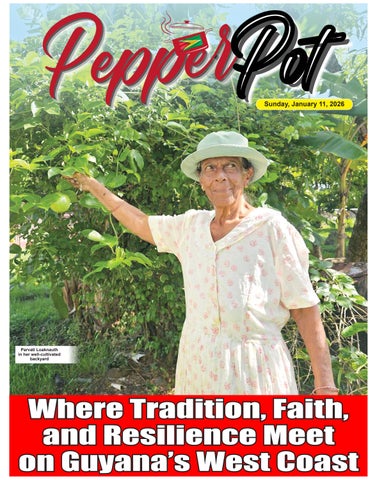
Parvati Loaknauth in her well-cultivated backyard
Where Tradition, Faith, and Resilience Meet on Guyana’s West Coast
II
Learning Tree and the Business of Believing in Writers
CHRONICLE PEPPERPOT ― Sunday, January 11, 2026
Guyanese entrepreneur creates new option for self-published authors, changing the local literary landscape
By Shaniya Harding
WHEN Dennis Adonis wanted to publish his first book in 2018, he realised that while talent was rampant, Guyana did not quite have the infrastructure for publishing. This is what led him to create Learning Tree Group Media and Publishing. Launched in 2021, Learning Tree offers writers a wide range of services and is quickly becoming the go-to agency for emerging writers, especially those seeking to self-publish. In an interview with Pepperpot Magazine this week, the man behind Learning Tree, Dennis Adonis, shared how the venture found its footing, the changing trends in Guyana’s literary landscape, and why he thinks Guyanese creativity will continue to grow, diversify, and surprise. When Adonis first had the idea of developing a publishing company in Guyana in 2018, he did not know whether the venture would be successful or even feasible. Despite this, Learning Tree Media and Publishing became a reality just a few
years later in 2021. While the business started off strong, Adonis, the company’s head, says there were still a few hurdles very early on. “The economy and the industry I was in were not well-suited at the time. Learning Tree experienced highs and lows from 2021 to now. With the dawn of oil wealth pouring into Guyana, expats coming in, and more people moving into the middle class, the need for services like mine began to grow, especially for creative expression.” Adonis, however, persevered, and it paid off in 2025. “We relaunched a couple of times over the years. Last year is when we really struck gold as a company. We were able to publish books for roughly 15 authors.” Today, Learning Tree has worked with dozens of authors and has helped make hundreds of books a reality. As Adonis shared, the quality of Guyanese stories has gained recognition internationally. Highlighting the 15 Guyanese authors Learning Tree worked with in 2025, he shared, “Each author averaged about 100 books sold
When founder of Learning Tree Media and Publishing, Dennis Adonis, set out to publish his book in 2018 and realised that there were not many publishing agencies, he started his own
locally, along with sales in Australia, Japan, the Caribbean, the US, Canada, Europe, and other regions.” This seemingly sudden uptake in
writers is a sign of growth and development in the field, says Adonis. “The new traction does reflect stabilisation in the field.” This growth
has forced Learning Tree to focus on a model tailored to authors seeking to make their manuscripts a reality. “I had to deal with pricing, navigating pricing to suit the local clientele, adjusting pricing, and adjusting how I structured marketing strategies for books.” Adonis told Pepperpot Magazine that Learning Tree is dedicated to working with authors to make their book what they want. New authors can expect a thorough onboarding process that sees Learning Tree work with them to understand the author’s story and vision. The next step is the selection of one of Learning Tree’s many packages, and once payment is made, the book is published. As Adonis shared, Learning Tree partners with bookstores to help push Guyanese books to the larger public, a small but impactful service. “We have partnered with bookstores like the University of Success Bookstore at Giftland Mall and the Book Barn at Massey. These partnerships help strategically place Guyanese-authored books.” He added, “We have books coming in at the end of this month, so you will start
seeing more Guyanese-authored books in these stores. We are also in discussions with other stores.” While not a traditional publishing agency, Learning Tree’s model helps self-published authors to access a variety of publishing services in one place for their book to get published and pushed to the public while retaining all of their intellectual rights, an important feature in an age where self-publishing is becoming increasingly common. “We charge an upfront fee for publishing, and authors retain 100 per cent of their intellectual property. We do not own any intellectual property like most publishing companies do. I am strongly against that.” He added, “If you have spent time, blood, sweat, and tears creating your work, you should have full control over your creative expression.” This freedom extends to the books published as well. As Adonis shared, “We do not limit authors in terms of creative expression. We do not say you have to do it one particular way. We are an open-minded publishing company. We publish every TURN TO PAGE IX
When Work Becomes Family-Friendly
III
CHRONICLE PEPPERPOT ― Sunday, January 11, 2026
Professional Guard Services’ childcare initiative is giving working parents peace of mind and urging other companies to do the same
By Shaniya Harding
SECURITY and support have been guiding pillars of Professional Guard Services since its establishment more than four decades ago. However, the company has taken its motto one step further by creating a free on-site care facility for the children of office employees. What started as a trial venture in December of last year has blossomed into a cherished part of the company. In an interview with Pepperpot Magazine, Managing Director, Sean Kirkpatrick and Human Resources Manager, Afiana Lesperance, say the space has had an incredibly positive impact on employees and the company, offering support, safety, and peace of mind. Professional Guard Services is one of Guyana’s oldest security firms, with a strong track record of being both helpful and professional. This is why the company began the venture. Managing Director Kirkpatrick says that the idea of having a childcare space for his employees has long been a goal of his. Backed by his team, that dream became a reality late last year. “Apart from being security, we are safety-conscious and we are helpful,” he added. “Our Human Resources Manager came up with the initiative, and it has been a long-term goal of mine. I keep showing slideshows from years ago, but it was definitely one of the things we wanted to do, and this year might have been the best year to start. It was well received and we plan to continue from last year. It was a team effort. We are all here chipping in and helping out.” While the idea has been in the works for some time, it only became a reality through the encouragement of the Georgetown Chamber of Commerce and Industry
(GCCI) and the Ministry of Human Services and Social Security’s Day, Night, and Early Childhood Centres Programme. This is why, when schools across the country closed their doors for the Christmas holiday, and offices stayed open, Kirkpatrick and his team took the opportunity to open the centre with just a few children. “Sometime last year, the GCCI had a meeting with its members and the minister, and she suggested that people offer childcare for their employees,” he added. “Now, last December, this was highlighted because we had a lot of staff who had kids they could not tend to because they had to come to work and the kids were off from school. Being that school closed for Christmas, we decided to give it a short try and see how it would work out.” Human Resources Manager Afiana Lesperance was also a major player in the venture’s creation. During interviews with employees, Lesperance saw firsthand the challenges that working parents face. As she shared, new employees were seeking night shifts rather than day shifts, while admin workers were requesting time off during the holidays to care for their children, particularly single parents. “Christmas came about, and our own admin employees were saying, oh, we have to write for time off because we cannot work and have our kids at home without daycare. If I do daycare, one employee said, it will take more than my salary.” She added, “So I came back, and I told my boss, and he was like, you know, we have been planning this thing for years now, but he said, it is just the finance, it is a lot to put into it, but we did it.” The company’s facility began small, but its impact was felt immediately. As Kirkpatrick explained,
“We had about five kids. Some would come every day, some would come periodically. And it worked out for us very positively.” As the number of children grew, so did the centre’s positive influence. As he added, “The
for donations of toys and books from our personnel, and that should be positive in the near future.” To ensure its sustainability, however, the centre operates with clear guidelines. While the centre is equipped
centre has been overwhelmingly positive. “Some of the feedback we had after Christmas is that I was so grateful to have my kids at work. Peace of mind, I have so much peace of mind,” she added. “One quote—some
Sean Kirkpatrick, Managing Director (left), and Afiana Lesperance, Human Resources Manager of Professional Guard Services
people were able to get their work done knowing their child was safe here, and if there were any issues, we could always contact the parent to l et them know right away. We really do plan to open up to the larger security force, but we are confident in some support from the ministry also. We have asked
with someone caring for the children and resources such as books, play mats, and a napping area, the company also has rules that parents must follow. As Lesperance shared, parents are required to check on their children, particularly during lunch periodically. Despite this, Lesperance says the feedback on the
people even said they had to spend less, because normally when school closed, you spend a lot of money when your kids are at home, but by bringing them to work, it was less spending and all of that. So it turned out to be a great thing in December.” The centre’s flexibility is also something employees praise. As Kirkpatrick
explained, the centre allows parents to drop off their children at any time of day, whether at the beginning of the working day or in the afternoon after school. “They were happy to have their kids there by them, checking on them during lunch hour. If they had any emergencies or any break, they can just come and check.” Sharing the experience of an employee, he continued, “So for example, Mr Cesar, he was one of the employees that made a statement yesterday. Normally what happens is that he picks up his daughter and he has to leave her at the neighbours, and sometimes it’s hard for him. So because we have that service, he was able to bring his child back. She now stays here until he gets off after work. That’s why we did it. Because we have young kids coming out from school and then they got nowhere to go because the parents are working.” But Kirkpatrick and his team are not stopping here; they are encouraging more companies to follow suit. As he explained, the centre is more than just a safe space for children; it creates a sense of ease and safety for employees. “I would encourage anybody to do it, and everybody with a business, you have your staff. Yes, it’ll take up a little space, but it’ll give them the peace of mind they need also. Especially single parents who cannot always be there for their kids.” As Lesperance added, “It does not take a lot. It is a great initiative, and it shows care. It gives back not only to your community but to your employees. So jump on it, jump on it and run with it. It gives you, as the head of the company, a lot of benefits, because you have your employees here. You know that they get the job done while their kids are safe.”
IV
CHRONICLE PEPPERPOT ― Sunday, January 11, 2026
Optimum milk production needs a market Some of the many calves in the pen
The biggest bull on the farm at Parika
By Michel Outridge
FOR generations, cattle have been an inseparable part of the Mohamed family’s identity in Parika, East Bank Essequibo. Set firmly in tradition yet open to innovation, brothers Gibron and Inshaan Mohamed represent a lineage of large-scale cattle farmers whose livelihood and heritage are deeply rooted in livestock production. Their story is one of resilience, adaptation, and cautious optimism amid shifting market realities for fresh cow’s milk in Guyana. “Cattle farming is not something we just picked up,” Gibron said. “I came into this family and met cows. It started with my grandfather,
passed through my parents, and it’s something that will always be part of us.” The Mohamed family’s involvement in cattle rearing spans more than four decades, beginning with their grandfather and carried through successive generations. Growing up, Gibron recalls that cattle were always present in the family; they were not merely livestock, but a way of life. Today, among the ten siblings, four brothers and one sister remain actively involved in cattle farming, ensuring that the family legacy continues. “Out of all of us, five stayed fully in cattle,” he explained. “We’re all invested in keeping this going.” Collectively, the family man-
Cattle farmer, Gibron Mohamed and his huge breed
ages approximately 500 heads of cattle, housed between their Parika homestead and Hogg Island in the Essequibo River, Region Three (Essequibo Islands–West Coast Demerara). Their herd includes Holstein, Zebu, and Jersey crosses, reflecting a dual-purpose operation focused on both milk and beef production. While beef contributes to the enterprise, milk production remains the family’s most immediate source of income. “Milk is what gives you cash every day,” Gibron noted. “Beef takes time, but milk helps you meet expenses quickly.” At full capacity, the Mohameds have at least 30 milking cows capable of producing up to 300 pints of
One of the many breeds of cows on the farm
milk daily. However, that level of production has not been sustained in recent years. According to Gibron, a steady decline in demand for fresh cow’s milk, driven largely
by increased consumption of powdered milk, has forced the family to scale back. “People don’t buy fresh milk TURN TO PAGE XI
One of the prized bulls
CHRONICLE PEPPERPOT ― Sunday, January 11, 2026
Where Tradition, Faith, and Resilience Meet on Guyana’s West Coast By Michel Outridge
ON Temple Street, Windsor Forest, West Coast Demerara, the quiet rhythms of an older Guyana co-exist seamlessly with the signs of a rapidly modernising nation. At the centre of this convergence is Parvati Loaknauth, an 85-year-old matriarch whose life reflects endurance, faith, and an abiding satisfaction with both personal and national progress. Loaknauth is sprightly and self-reliant, a woman firmly set in her ways yet deeply appreciative of change. She remains fully able-bodied, preparing her own meals, tending to her home, and cultivating her garden with the same diligence that has characterised her life for decades.The modest yard
surrounding her home is alive with crops, budding plants, fruit trees, and flowers—an extension of her philosophy that purposeful work nurtures both body and spirit. Originally from Maria’s Pleasure on Wakenaam Island in the Essequibo River, Loaknauth recalls a childhood shaped by the stability of village life. Her father was a contractor, and the family lived comfortably. She grew up alongside three sisters, including a twin, older by 15 minutes; her eldest sister is now 89.That sense of security was shattered in 1954 when her father died after falling from a roof and breaking his neck, a tragedy that profoundly altered the family’s circumstances. In keeping with the social customs of the time, Loaknauth left school after Standard Six and married
young. Marriage required her to relocate to Windsor Forest, her husband’s home village, where she began a life she describes as difficult but never hopeless. She has lived there continuously for the past 70 years. Having never worked prior to marriage, she was forced to adapt quickly to the demands of survival. Her husband found work weeding at the estate, while she walked barefoot along the railway embankment to cut rice at a plantation in Harlem. The labour was intense and unrelenting. Later, when her first child was born, her husband secured permanent employment at a company where he worked for 28 years, bringing a measure of stability to the household. Loaknauth recalls earning $1.50 for cutting and bundling 72 square feet (one rod) of rice with only a grass knife. After long days in the fields, she returned home to cook, clean, and prepare for the next morning’s work. Despite the physical demands, she and her husband persevered, united by a shared commitment to their family. Together, they raised five children, ensuring that education remained a priority. They kept chickens, sheep, turkeys, and goats, and maintained a kitchen garden that supplied vegetables and fruits. “Things
were cheaper then,” she reflects, “but you had to work hard for everything.” That hard work yielded lasting rewards. All of her children later secured good jobs, migrated, and established families of their own. Today, Loaknauth is the proud mother of five children, grandmother to nine, and great-grandmother to seven. Despite the hardships of her early life, she speaks warmly of her marriage, describing it as happy, and expresses deep pride in her children and grandchildren. A devout Hindu, Loaknauth believes her strength and longevity are grounded in faith. Daily prayers remain central to her life, complemented by a disciplined, wholesome lifestyle. Loaknauth’s late husband, Ganga Persaud, was the village pandit, a respected member of the community he served. She attributes her vitality to eating mostly vegetables, maintaining a strong work ethic, and drinking a daily herbal brew made from carilla leaves and lemongrass. Adequate rest, she adds, is equally important. Her yard continues to provide abundantly. She rarely purchases greens or fruits, and from her 12 mango trees alone, she once earned approximately $50,000 from the sale of ripe mangoes—an
Parvati Loaknauth in her well-cultivated backyard
example of self-sufficiency rooted in tradition. Loaknauth also expresses satisfaction with Guyana’s national development. She speaks approvingly of the country’s infrastructural transformation, including the construction of the new Bharat Jagdeo Bridge, which she views as a symbol of progress and improved connectivity. Such developments, she believes, signal a better future for younger generations. With a gentle chuckle, she says she lives comfortably as a pensioner and is content with her quality of life. Her home is tidy, her garden well-
kept, and her days peaceful. A familiar presence is Robert, an 18-year-old parrot once owned by her daughter, whose chatter adds warmth and continuity to the household. In Parvati Loaknauth’s life, tradition and modernity do not compete; they co-exist. Her story is one of quiet resilience, deep faith, and measured contentment, offering a poignant reminder that national progress is ultimately anchored in the lived experiences of ordinary citizens whose strength and sacrifice laid the foundation for the present.
The backyard of the elderly woman
An aged pedal sewing machine that still works in the home of the senior citizen
Parvati Loaknauth with a photo of herself and her late husband
V
Robert, the 18-year-old bird that is very vocal
VI
Entering 2026 with Clarity and Purpose
CHRONICLE PEPPERPOT ― Sunday, January 11, 2026
The Vision Life Book Experience Launches In-Person and Online
[PRESS RELEASE] AS individuals around the world prepare to enter 2026, many are seeking clarity, direction, and deeper meaning in their lives. Internationally respected creative entrepreneur and confidence coach Sonia Noel is answering that call with the launch of the Vision Life Book Experience, offered both in person and virtually in January. The
programme is designed to help participants move beyond wishful thinking and step confidently into a future shaped by intention and purpose. For many years, Sonia has successfully hosted Vision Board Parties that inspired powerful transformations. Participants from those events manifested dream homes, new vehicles, acceptance into law school, career
advancement, business expansion, restored confidence, and renewed faith in their own potential. Many testimonies describe lives redirected after individuals finally saw their goals clearly. One of the images that has stayed in my mind is Abigail, who wrote “black Toyota Rush” on her vision board, and the following year she drove a black Toyota Rush to the event. Sonia says these results
are not accidental. “They happened because people gave themselves permission to dream again and to write the vision. Vision focuses your life and directs your actions.” Now, Sonia is taking this work to a higher level through the Vision Life Book. A vision board is mainly visual. It inspires and motivates. It focuses on what you desire. A Vision Life Book goes deeper. It guides you to explore why you want what you want and how you are going to move towards it. It is a living personal guide that brings together reflection, journalling, goal-setting, core values, affirmations, spiritual grounding, and action plans in one place. From the Vision Life Book, you can easily extract your vision board, which then becomes a powerful visual summary of the deeper work already done. The Vision Life Book includes guided sections on purpose, mission, vision, core values, and calling. The content will review how you navigate specific areas in your life: 1. Spiritual life 2. Health and wellness 3. Family and home life 4. Romantic relationship or life partner 5. Friendships and social life 6. Career or calling 7. Finances and wealth 8. Personal growth and education 9. Fun, leisure, and recreation 10. Contribution, service, and community impact Participants also learn how to set goals and actually achieve them rather than simply writing them down. The programme is designed to be practical as well as reflective. Sonia explains, “A Vision
Life Book is a blueprint for your life. It helps you design intentionally instead of living on autopilot. It is something you return to during the year when life becomes noisy or confusing.” The Vision Life Book Experience will be held January 16th to 18th, with both in-person and online attendance options, allowing participants from anywhere in the world to take part. Participants only need to choose one day, as the experience will be repeated to accommodate different schedules. Sonia shares that her own 2025 journey was deeply impacted by creating her Vision Life Book. It gave clarity during uncertain seasons and strengthened her decision-making. “It kept me aligned with my calling and reminded me to put God first,” she says. She also emphasised the spiritual and emotional grounding of this new season. Sonia is currently on a personal sabbatical dedicated to prayer, Bible study, reflection, and reconnecting with nature. She spends
time meditating by the lake, walking barefoot in the grass and sand, and listening to birdsong. She describes this sabbatical as “coming back to centre and filling my cup.” She will conclude the sabbatical one week before the Vision Life Book Experience. “I am coming into this ready to serve from overflow,” she says. Vision is not optional in life. It is essential. Scripture reminds us, “Where there is no vision, the people perish.” Vision shapes choices, renews hope, and gives strength during temporary setbacks. Sonia closes with one of her personal quotes: “When we keep a positive mindset through temporary setbacks, envision our future beyond present circumstances, and put God first, we unlock our full potential and attract the people aligned with our purpose and vision.” For more information or to register, group rates are available. Email: sonianoel@gmail. com WhatsApp: +592 684 8129
VII
Empowered Female Farmer at the Frontline of Food Security
CHRONICLE PEPPERPOT ― Sunday, January 11, 2026
By Michel Outridge
NEATLY tucked away along a quiet street in Den Amstel Village, West Coast Demerara, is the well-kept home and farm of Abiola “Goldie” Hill. Surrounded by flowering plants, fruit trees, and food crops, her property reflects disciplined land use and purposeful production. More than a personal enterprise, Hill’s small-scale livestock operation represents a critical link in Guyana’s contribution to national and regional food security efforts, particularly within the CARICOM framework. A resident of Den Amstel Village for the past 27 years, Hill relocated from Wakenaam Island in the Essequibo River following her marriage. Over time, she has become a respected community figure, recognised for her work ethic and her role as a female farmer contributing meaningfully to the domestic meat supply. At 50 years old, Hill embodies a growing cohort of women whose agricultural activities strengthen rural livelihoods while supporting broader food security objectives. Hill told Pepperpot Magazine that she grew up in Maria’s Pleasure, Wakenaam Island, in a household not traditionally engaged in agriculture. Her mother worked as a sweeper and cleaner, while Hill herself was employed in a village shop. Her transition into farming was therefore neither inherited nor accidental, but rather shaped by
Some of the goats reared at the home of Abiola Hill
Female small ruminant farmer, Abiola Hill
opportunity, resilience, and increasing access to government-supported agricultural systems. Today, Hill rears sheep, goats, and cattle, while cultivating crops and fruit trees within her farm. Her livestock enterprise is her primary source of income and contributes directly to the availability of locally produced red meat. By supplying sheep and goats to the domestic market, Hill helps reduce Guyana’s dependence on imports, a key pillar of food security and a central objective of CARICOM’s regional agricultural agenda. Hill’s entry into small
Part of the herd
ruminant farming began approximately 12 years ago when an abandoned dog kennel—left unused after the family dog stopped returning home—was converted into a sheep pen. Around the same time, Hill invested her Penny Banking savings into livestock. With her husband’s support, the first sheep was purchased, laying the foundation for a production system that consistently contributes to the local meat supply. Despite early success, Hill faced significant challenges, including a devastating dog attack that resulted in the loss of approximately 25 sheep. At the time, her
animals comprised Creole, Nubian, and Barbados Black Belly breeds. Rather than exiting the sector, Hill diversified into goat production, an adaptive strategy that strengthened household resilience and maintained continuity of supply to the local market. Her goat enterprise began after her younger daughter, Kendra, received a goat as a gift following the Common Entrance Examination. With the acquisition of a ram, the herd expanded rapidly. At peak production, Hill managed approximately 40 goats and nine sheep, while her husband maintained 10 cattle for beef production and breeding. Collectively, these enterprises contribute to the steady flow of meat into village and regional markets. Hill is the mother of two daughters, with her younger daughter, Kendra, sharing
her passion for agriculture. A trained Agricultural Science teacher, Kendra actively supports animal husbandry practices on the farm, reinforcing the application of science-based methods in small-scale livestock production. This intergenerational transfer of skills strengthens the sustainability of the operation and aligns with national efforts to modernise agriculture through education and training. Central to Hill’s contribution to food security has been sustained support from the Guyana Livestock Development Authority (GLDA). Through extension services, Hill has accessed free training, improved management techniques, and upgraded infrastructure, including an elevated pen constructed with materials provided by the Ministry of Agriculture. According to Hill, the ele-
vated design has significantly reduced disease incidence and prevalence, such as foot rot, improved animal welfare, and enhanced productivity— critical factors in ensuring reliable food supply. Looking ahead, Hill plans to improve the genetic quality of her herd through artificial insemination and the introduction of improved breeds such as Dorper–Barbados Black Belly crosses and Boer goats. These genetic upgrades are expected to increase growth rates, carcass quality, and feed efficiency, thereby strengthening her capacity to meet local demand and contribute to Guyana’s expanding role as a food supplier within CARICOM. As a small-scale farmer, Hill sells sheep and goats once they exceed 50 pounds in live weight, marketing TURN TO PAGE XI
Some of the young animals in their pen
VIII
CHRONICLE PEPPERPOT ― Sunday, January 11, 2026
Live and Let Live
WHEN a marble is tossed upon the floor, it will seek equilibrium by rolling to the lowest point in the room. There, it will remain unless otherwise disturbed. Without any complicated forces in play, it will simply attain the position that is most natural for it. Human beings are also naturally directed towards roles and duties that are destined for them from the moment they are born. As soon as they have developed the knowledge and skill to
do so, they will adopt these roles and play them well. Society, in its essence, can be described as a well-oiled machine whose function depends on the competence of its individual parts. In a modern world, however, ‘society’ comprises around 8 billion people, interlinked through a complex web of culture and technology. In this case, society cannot be reduced to a machine. In fact, our very attempt to do so may lead to its complete breakdown.
Our understanding of human lives and the destiny that lies at the end of each one of our paths is grossly limited. Even those who live with us or grow with us are very often unable to help us understand who we are meant to be. Yet, despite this limited understanding, we are quite prone to placing unfair expectations on younger generations under the guise of directing them towards who they are meant to become. In reality, the final destination of someone’s life is something they are meant to discover by themselves, not by the forceful direction of mentors or peers. After all, even the inert marble, upon being tossed onto the ground, seeks its own destination. So why should human beings not do the same? For centuries, people
have lived by adopting predetermined roles and conforming to the expectations set by those around them. Oftentimes, they do this because it is the most comfortable way to live, even though it is not the most fulfilling one. For many people, drawing outside the lines would mean disturbing the status quo and risking, at the very least, the loss of social standing or peace. At the same time, we also cannot say that the existence of rules and order precludes freedom. The very ability to voice one’s opinion and discuss alternative ways of thinking is a consequence of the order that comes when we respect one another and adhere to the general rules and etiquette of society. So, becoming the best version of ourselves has transformed into a sort of balancing act. To be ide-
al members of society, we must follow the norms and rules established to promote peace and liberty, while at the same time challenging unfair limits and boundaries. Strangely enough, even as we endure and struggle through this journey, we must also carry another responsibility to ensure that society functions well: we must live and let live. As we interact with others throughout our lives, we will be introduced to many ideologies and ways of living that may come into direct conflict with our own. We may not understand some of the choices people make, especially when a loved one is making them. Although our first instinct may be to stop these people and change the way they live, doing so may not always be the right course of action.
We cannot truly know the best way for another person to live. Hence, as an alternative, we can only seek the best way to discover the path that leads us to our own destinations. This, of course, can look different for different people. We have been conditioned to believe that ideologies should only be held in terms of extremes—as sides. However, there is a very real space between the two sides that many people choose to inhabit. Without expanding our worldviews, we may find ourselves struggling to accept this fact and, consequently, failing to live a fulfilling life in the futile pursuit of changing others. The true beauty of life lies between the spaces, between the sides, and in the choices that we may not understand but still accept with love.
IX
CHRONICLE PEPPERPOT ― Sunday, January 11, 2026
CEO IN ACTION
LEADERSHIP is not for the faint of heart, and Geary Reid’s CEO in Action fearlessly tackles some of the most pressing concerns CEOs and leaders face. As a strategic leader, you don’t simply start a company. You plan, gather information, and map out the necessary steps. As your company grows, you remain vigilant. You know you need to stay in touch with all aspects of the business. You learn to value your employees and treat them well, motivating them to become invested in the project. Navigating and maintaining it all can be difficult, but Geary Reid is here to help. From boardroom meetings to managing employees, Reid is thorough in his examination of what is needed to lead
an organisation effectively. He knows you want your organisation to succeed, and this book will help you get there. With well-reasoned, well-researched approaches, this book offers compact, compelling advice you don’t want to miss.
1. A Leader is Needed Every organisation’s aim is to succeed. Success does not happen overnight. Some successes may result from natural events, and others may result from the inputs of individuals in a process. In this chapter, you will learn that there is a great need for a person who can lead the organisation, thus contributing to its success. Human beings demonstrate unique leadership abilities. They can make deep analytical decisions that
affect processes across the universe through intuition rather than knowledge. There is a constant push for artificial intelligence (AI), but people can sometimes make decisions that are not based on all the prevailing factors, instead on a deeper feeling that may not be easily available to others or to machines. However, it must be remembered that some decisions must be made on facts, some on emotions, and others on a mixture of both. It is often difficult to manage a business without any idea of that business. Intelligence is always good, but a leader has to know the specifics of an enterprise. Some businesses cannot be understood overnight, but require the leader to spend significant time on them and
Learning Tree and the...
thing from research papers to fiction, romance novels, how-to books, and children’s storybooks. Everyone gets a fair chance to see their creation materialise into a book.” Moreover, Learning Tree offers a wide range of services to authors, offering guidance, preparation, and execution on the road to publishing. “We work with authors on the book cover, and once approved, we move forward with a strategic marketing plan tailored to their book to ensure local and international sales. We make the process easier. If you are a doctor, for example, working multiple jobs and doing research, you do not have the time to handle all of this. You give us a manuscript, and we do the work. We ensure your book is published.” He added, “We handle logistics, bringing the book here, delivery, organising the launch, and distribution. We also do ghostwriting, taking your idea straight to a physical book in your hand.” This
freedom and support offered by Learning Tree is why Adonis says many writers were able to sell more books than they thought they would. “I do not believe you should limit someone based on perceptions of what will sell. I’ve had authors who thought their books wouldn’t sell, and they ended up selling over 100 copies.” Like Learning Tree, Guyana’s writing scene has also seen several changes in recent years, with one of the most striking being the diversity of genres. As Adonis explained, some genres are seeing a rise and more young professionals are becoming authors. “I have noticed a rise in two main genres: poetry and fiction, especially romance fiction. There is also more research-based work emerging because we are seeing a rise in young professionals who want to stand out in their fields,” he shared. This shift, Adonis believes, will continue and have a positive impact on the literary landscape and Guy-
FROM PAGE II
ana at large. “I think we will see more Guyanese entering educational publishing, with textbooks flowing into the Caribbean and even global markets. Many textbooks come from Trinidad and other islands, but we have professionals here with the expertise to create material for CSEC, CAPE, and tertiary levels. The next step for Learning Tree is moving into publishing research papers and expanding our reach across Guyana and the Caribbean.” Learning Tree has big plans as they head into 2026, with a number of book launches and poetry events slated for the coming months. Whether you are interested in publishing your first book, seeking to learn more about what publishing in Guyana looks like, or just seeking some good Guyanese books, you can find Learning Tree on social media or at their website learningtreemedia. org, or call them at 592619-4424.
to have a proper understanding of their inner workings. The leader who is willing to spend time understanding their business may be able to have many successes. It will always be difficult to play lawn tennis on a basketball court. This sometimes happens to leaders as they try to deploy their skills in an area that requires a different approach. Some leaders spend much time exerting energy in areas where they do not need to use any at all. A leader must have some understanding of their business and where their skills need to be used. Sometimes, an organisation is very complex, and it may take some leaders a very long time to understand it. On the other hand, some leaders are skilled and will find ways to learn about the organisation that may enable
them to make a positive impact within a very short time. People’s involvement in the organisation’s success is always important. The leader must be able to steer the ship in the right direction by making careful decisions based on their knowledge of the business. Not all the information provided in the media may be correct. Therefore, leaders must be very mindful of what is being read and listened to, since those decisions must also be based on facts. A leader’s ear must be carefully trained to hear information and decide what is applicable and what can be quickly disposed of. Some leaders believe that all information they hear must be acted upon. That is not a correct approach and may harm those who like to act without verifying the information.
Knowing some or many parts of the business is an essential asset for each leader who has been entrusted with the authority of the Chief Executive Officer (CEO). In some locations and types of organisations, the functions of the CEO may be allocated to persons designated as managing directors (MDs), general managers (GMs), managers, administrators, coordinators, team leaders, etc. 2. Operation and Administration Many times, the CEO has to manage operations carefully. This area of the organisation often sounds simple to some people, but depending on the type of organisation, it can be challenging. Some organisations may rarely have operational activities; others have numerous operational TURN TO PAGE XVIII
X
CHRONICLE PEPPERPOT ― Sunday, January 11, 2026
THE MOODS THAT COMPEL US TO RE-EXPLORE THE LITERATURE THAT WE HAVE ABSORBED, IN OUR QUEST TO BE AT PEACE WITH THE WORLD WE LIVE IN HOW do we equate the civilised with the other world of 1900– 1945, which we digested only yesterday, packaged by capable authors who, by exposure, allowed us to ponder the dynamics of evolution towards comprehending values and primitive realms, and to understand what we conclude is proper conduct? Yet we also absorbed the literature of the mental condition of obsessions, the collective ego of nations that led to the plague of pillage of the other, as recorded in colonisations and the ego of justification that “might is right”. This allows us to plot and execute and then reveal the most
unexpected justifications—those expected to become sacred and civilised—though rooted in another age of learning that we now look back on, with its strange gods and beliefs. Provocations, when propelled—worse still—to contribute to the ego of the prophet, or ‘Chosen One’, despite what the records warn, have opened the portals of fallen angels. Eager to cast a board of challenging royal pieces. Eager to cast a legion of pawns, willing or not, to act out a grim tale to be added to the shapes and shades of memory. My father and my youngest uncle once separately informed me, in my juvenile
awareness, that, in our modern world, as it was in so-called barbaric times, “it has been said by the custodians of competing nations that they cherish no friends, only interests.” How did this pattern that existed in our primitive ancestors— forming groups, then tribes— through the evolution of climate and creative gifts towards sustenance, become our ancestors? We learnt from older species and honoured them as sacred, in respect of the widening awareness that observation of their realm taught us. The question today is how we will endeavour to be discreet in how we rationalise our needs,
whether by fear or by deception, though some attract this upon themselves in the passion to overwhelm, control, or possess my neighbour’s mango tree in the ways of old and in the triumphant manner of the glorious kingdoms of the past, which today cannot directly speak for themselves, but only through their art and what we interpret of the values they cherished. As a much younger man, apart from the insertions of the male world that shaped its expectations, I read and built a small library to better understand the world of nations and cultures I was immersed in.
Modern texts that described their nature, and the nature of things I did not know of, awakened me—whether it be Cheikh Anta Diop, Walter Rodney, Noam Chomsky, Wallis Budge, Roger Manvell and Heinrich Fraenkel, Ivan Van Sertima, and numerous others. They all revolved around the nature and failures of our species and, through these authors, represented the paths of goodness we should emulate in this age of the most volatile, self-imposed conspiracies against our species: global warming and weaponry. The wand rests within our hands.
Optimum milk production...
CHRONICLE PEPPERPOT ― Sunday, January 11, 2026
XI
FROM PAGE IV
like before,” he said. “Powdered milk changed everything.” At present, daily production averages about 30 pints, most of which must be sold through informal channels. Occasionally, Spanish-speaking residents in the community purchase the milk to make mozzarella cheese for personal use. “Sometimes they come and buy to make cheese for their homes,” Gibron shared. “But that can’t sustain largescale production.” Gibron believes that renewed consumer education could help reverse this trend, noting that fresh cow’s milk offers clear nutritional advantages. Fresh milk is naturally rich in protein, calcium, and essential vitamins, contains beneficial enzymes, and is free from preservatives and heavy processing. “Fresh milk is straight from the cow,” he said. “You know where it comes from.” Despite these market challenges, the family maintains high standards of animal care. Dairy cows are washed before milking, hygiene is prioritised, and animal welfare remains central to the operation. The herd is predominantly grass-fed, with
most cattle grazing freely on Hogg Island. Minimal supplemental feeding is done at the Parika location using molasses and a mix of “banks” feed and wheat middlings. “We rely a lot on pasture,” Gibron said. “The cows do well on grass, especially on Hogg Island.” While the Mohameds possess extensive generational knowledge, they have also embraced the national livestock development agenda, particularly the genetic improvement programme led by the Government of Guyana through the Ministry of Agriculture and the Guyana Livestock Development Authority (GLDA). The family is a beneficiary of the bull rotation programme, having received a Brahman-breed bull, and is awaiting inclusion in the embryo transplant programme. They are eager to participate in the Girolando embryo transplant programme offered by the GLDA. “These programmes are really helping farmers,” Gibron said. “You see the difference in the animals.” At present, the family also has a prized Holstein bull available for sale, a decision taken to prevent inbreed-
ing within the herd. “The bull comes from a strong line of milk producers,” Gibron explained. “But you have to rotate to protect your herd.” He added that platforms such as the Ruminant Show and livestock expos are essential for marketing quality animals and strengthening the local breeding market through networking. “Those shows help farmers connect and sell,” he said. Although he did not personally participate, Gibron praised Hon. Zulfikar Mustapha, Minister of Agriculture, and Dr Dwight Walrond, CEO of the GLDA, for the Ruminant Expo held in October last year, describing it as timely and encouraging for livestock farmers nationwide. Beyond milk production, the Mohamed family operates a modest but hygienic butchery, selling fresh beef from locally reared bulls only. Gibron takes pride in the quality of the meat produced. “Our beef is better than imported meat,” he asserted. “The animals are fresher and better bred.” He attributed these improvements to sustained government intervention under the PPP/C Administration,
One of the cow pens on the farm at Parika, East Bank Essequibo
led by President Dr Irfaan Ali, through the Ministry of Agriculture. The operation also provides employment for several people in Parika and on Hogg Island, with workers engaged daily in milking, feeding, animal care, and butchery operations. “Even when sales are slow, we still have to pay workers,” Gibron said. “People depend on this farm.”
Empowered Female Farmer at the Frontline of Food...
FROM PAGE VII
approximately 15 to 25 animals annually. While modest in scale, such consistent production, when replicated across hundreds of similar farms, forms the backbone of Guyana’s livestock sector and supports the country’s positioning as a net food producer within the region. Hill expressed gratitude to her family and the GLDA for their support, emphasising that government-enabling agricultural policies have been instrumental to her success. She highlighted the PPP/C Government’s commitment to empowering farmers—particularly women—through access to free training, improved genetics, market access, and financial support via the Agriculture Development Bank. With interest-free financing now available, Hill plans to expand her infrastructure to house pregnant animals and newborns, further stabilising production and reducing losses. Such investments, she noted, will allow her to increase output, enhance animal welfare, and strengthen her contribution to national and regional food security goals. Abiola “Goldie” Hill’s journey from converting a dog kennel into a sheep pen to operating a diversified livestock enterprise illustrates how empowered female farmers are central to Guyana’s food security strategy. Her work contributes not only to feeding households in Den Amstel Village but also to advancing Guyana’s role in CARICOM’s vision of regional food self-sufficiency.
The advanced design of a Ministry of Agriculture elevated pen for small ruminants
For farmers in Region Three, Gibron noted that the newly constructed Bharat Jagdeo Demerara River Bridge, which links Regions Three and Four, has fundamentally changed market access. The ease and timeliness of crossing the river now allow producers to supply markets in Region Four more efficiently, reducing spoilage risks and transportation delays. He is hopeful that, with improved logistics, agencies such as the Georgetown Public Hospital Corporation, along with mining companies and other large institutions, will increasingly look to local farmers for consistent supplies of fresh milk. “That bridge changes things for farmers in this region,” he said. “We can now get fresh milk across quicker and more economically.” He added that, with the support of GLDA officers, regular on-farm surveillance is conducted to ensure compliance with good agricultural practices, while food safety and biosecurity remain paramount. “ We h a v e r e g u l a r checks,” Gibron explained. “Biosecurity is very important, especially if you want to access bigger markets.” Importantly, Gibron explained that expanded market access must go hand in hand with traceability and food safety compliance. He acknowledged the benefits of the national livestock traceability system currently implemented by the GLDA, noting that proper animal identification and record-keeping strengthen disease control, improve herd management, and build confidence among buyers.
“These systems help us grow,” he said. “Traceability and food safety are what will open doors.” Gibron said the family is eager to work closely with the Guyana Food Safety Authority (GFSA) to ensure their milk meets requirements at every level of the market, from roadside sales to institutional and commercial buyers. He believes that strong traceability and food safety systems are not barriers but enablers that will accelerate the growth of Guyana’s livestock industry, support value-added dairy processing, and help position locally produced milk and meat as safe, reliable, and competitive alternatives to imports. Looking ahead, the family remains optimistic. While access to a consistent commercial market remains their biggest challenge, they are actively exploring value-added dairy production. “Once we get a steady market,” Gibron said confidently, “we can go right back to producing 300 pints a day.” A past winner of ruminant competitions, Gibron is enthusiastic about the continuation of national livestock exhibitions, which he believes help farmers market animals, share knowledge, and build networks. For the Mohamed family, cattle farming is about heritage, hard work, and hope that, with improved i n f r a s t r u c t u re , s t ro n g regulatory systems, and continued support, Guyana’s livestock industry is well-positioned for accelerated growth and long-term sustainability.
XII
CHRONICLE PEPPERPOT ― Sunday, January 11, 2026
XIII
CHRONICLE PEPPERPOT ― Sunday, January 11, 2026
ONCE UPON A TIME
I NEVER thought I could have fallen in love so immensely with a place, the moment we drove through the wrought iron gate of a small island on a former sugar estate. The curving driveway was bordered on one side by bougainvillaea in vibrant colours, all the way to the colonial house. I was not sure at that moment how that incredible rush filled my heart, for we had looked at several grand houses with an interest to buy, but though they were all beautiful, none spoke to my heart until I came here. Something told me, as I looked at the landscaped gar-
den and the flowering shrubs along its borders, that this place was different. “What wonders or mysteries does it hold?” was my questioning thought as I stepped onto the long, tiled patio. It was furnished with intricately woven Amerindian tibisiri chairs and two centre tables. “This is quite lovely,” I expressed. An hour later, after inspecting the house, my husband looked at me and asked, “Well, is this the one?” A slight wind blew across the garden, lifting the sweet scent of the chameli flowers
around the patio, and I closed my eyes and took a deep breath. My heart had spoken to me, and opening my eyes after a brief moment, I smiled and said, “Yes, I love this one.” At that moment, light seemed to filter across the grounds, giving life to everything, and the realtor, looking a little amazed, said, “I really do think you have made a great choice.” Five months later, after cleaning and repainting, with no changes to the beautiful colonial architectural structure, we moved in. It was one of my most memorable days, mainly be-
cause my two young children were happy about their new home. In the following days, after my husband had left for his business enterprise in the city, I began settling down with my children. The house was a combination of simplicity and grandeur, with polished wooden floors and timbers, an entrance hall, and a prominent wooden staircase, but what impressed me most were the two extensive patios.
On the lower flat, three double sliding glass doors opened from the living room to the patio that overlooked the sprawling lawn and garden, and on the upper flat, one bedroom and a small sitting area opened onto a sunroof that overlooked an extensive area of the estate grounds. In the house, there were several pieces of antique furnishings we bought with the house, for I loved historical
artefacts. I added my touch with my own collection and some modern pieces. It was simply beautiful! I employed the old house staff, who were quite happy being there again, and I listened with interest as they told their own little stories. Strangers who would become close in a place that was now home. On the second weekend there, the middle-aged East TURN TO PAGE XVI
XIV
CHRONICLE PEPPERPOT ― Sunday, January 11, 2026
CHRONICLE PEPPERPOT ― Sunday, January 11, 2026
XV
Fraught Relationship: A Review of Palaver by Bryan Washington
BRYAN Washington’s new novel, Palaver (Farrar, Straus & Giroux, $25.00), is a word that traditionally suggests a peaceful—if sometimes tense—conversation between disparate personalities attempting to resolve a lingering conflict. It is a fitting name for a book whose plot turns on the long-unsettled rift between a mother and her son; closely entwined with this conflict is the fact that the son is gay. Palaver is Washington’s fourth work of fiction, following closely on the heels of his much-lauded debut story collection Lot (2019), the novel Memorial (2020), and Family Meal (2023). A gay Black writer from Texas, Washington has built an oeuvre attentive to queer lives and concerns—though in Palaver, queerness is not the central crisis so much as an indelible fact. Gayness in this novel is presented simply as a matter-
of-fact mode of being, one that neither requires justification nor invites debate. At its core, the book is about filial ties: how they bind, how they wound, and how they endure. The novel is set in Tokyo, where the protagonist—referred to only as the Son— has been living for over a decade. He teaches English to a rotating roster of students and is embroiled in an affair with a married Japanese man, the father of a newborn. The Son’s life is upended when he receives an unexpected visit from the Mother—also never named—who arrives from Houston, Texas. Their dynamic is immediately fraught: the Son is abrasive, while the Mother is combative and unrepentant. Over time, as they uneasily share his cramped apartment—quarrels punctuated and sometimes softened by the presence of the Son’s cat, Taro—their history begins to TURN TO PAGE XVIII
XVI
ONCE UPON A TIME
CHRONICLE PEPPERPOT ― Sunday, January 11, 2026
FROM PAGE XIII
Indian gardener, who told me he had worked there since he was a boy, took me on a walkabout on the estate grounds. That overwhelming feeling of falling in love filled my heart again, and I wondered about the occupants of the long-gone past. There were still distinctive
patterns of colonial life: the relics of the bird bath and fountain, large pots and urns in rustic earth tones, subtly arranged as though time itself had framed them all in portraits. There was an outstanding variety of flowering plants, crotons, ferns, and shrubs
bordering the lawn, and for a garden lover like me, it lent a blush of romance. The gardener educated me on the names of the tall flowering trees as we continued the walkabout, some of which I had never seen before. “De missus bring dem from England,” he told me. “Quite interesting,” I responded. We stopped at a narrow waterway and walked across an old wooden bridge into a section of the ground that was an abandoned tennis court. He and his friends, the gardener told me, young boys then, used to pick up the tennis balls hit out of the court. “You would come all the way from your village to do that?” “No,” he replied, “abee used to come fuh pick cane from de punt to eat, and running tuh pick up de balls was fun.” “Yeah, I can just imagine,” I said, smiling. “De missus was a nice lady,” he said. “She always give abee biscuits, sweet roll, and tea.” I looked at him and saw the glint of admiration in his eyes for his colonial mistress. I had seen it before among people in the villages, and it always amazed me how some of these past masters and mistresses left a deep impression on those who worked closely with them. As I stood in the middle of the lawn tennis court, I smiled to myself, amazed, for as a schoolgirl I couldn’t have afforded to buy a racket to join a club, but today I had my own tennis court to play on with family and friends. “We have come from such a long way,” I mused. “Once upon a time, we were mere servants.” We didn’t complete the garden tour that day because my in-laws arrived just then from the airport, back from a holiday in Dubai. They wanted to spend a few days at the new house we had bought. I sighed in anticipation of the veiled, condescending comments my mother-in-law would make. She was an authoritarian woman and never stopped reminding me subtly of being a primary school teacher and my family’s lower financial status. Over the years, I learnt to tolerate her
negative comments because I loved my husband and we were happy. Three days later, my mother-in-law commented that we had made a bad choice by buying that property and that she had a bad feeling about the place. “Well, I love it,” I said to her with a smile. “It has an interesting history, and there might be one or two colonial ghosts on the grounds.” That scared her a little, and they left that same day, much to my relief. That night, my husband looked at me suspiciously. “What did you do?” “Nothing,” I answered innocently. “I know that mischievous glint in your eyes,” he said. I took a sip of wine and said with a little laugh, “I think she’s scared of ghosts.” He shook his head in mock reprimand and said, kissing me lightly on the cheek, “Thanks for being tolerant and patient with her.” The next day, I resumed my tour of the garden with the gardener, but this time he took me to another part of the grounds. A wooden bridge over a wider waterway took us to that section, and I gasped in awe at the huge, flamboyant trees that bordered the ground. The floor was carpeted with fallen blooms, and walking under the canopy, I scooped up handfuls of flowers and let them fall slowly through my hands over my head. The gardener looked at me, bemused and said quietly, “De white missus loved to do dat too.” I looked at him and smiled slightly, but said nothing, for it was his reflection of the past. The present was me. Two women from different ethnicities and cultures, centuries apart, with the same love and passion for one thing, and I said silently, “I feel to myself, there’s some kind of deep mystery here. I wonder what.”
XVII
CHRONICLE PEPPERPOT ― Sunday, January 11, 2026
Amazon Sustainable Landscapes Guyana Project II
DID you know that the Amazon rainforest is the largest rainforest in the world, covering approximately 6.70 million km² and spanning nine countries in South America, including Guyana? The Amazon is home to about 10 per cent of all known species on Earth, making it one of the most biologically diverse places on Earth. These facts underscore the ecological significance of the Amazon and highlight why initiatives like the Ama-
zon Sustainable Landscapes Project are important.
What is the ASL–Guyana II Project All About? The Amazon Sustainable Landscapes Project is a large-scale conservation and sustainable development initiative funded by the Global Environment Facility (GEF) and implemented with support from partners, including the World Bank and national governments. In Guyana, the project functions under the theme “Securing a Living Amazon through Landscape Connectivity in Southern Guyana.” It aims to strengthen landscape connectivity and improve conservation of the Kanuku Mountains Protected Area and the North Rupununi Wetlands by enhancing protected area management and promoting sustainable landuse practices. The project is executed locally by the Environmental Protection Agency (EPA), with support from partners such as the Protected Areas Commission (PAC) and the Guyana Forestry Commission (GFC). Recent Strategies Adopted to Advance the Project’s Goals The Environmental Protection Agency has launched a series of community-driven assessments to inform and strengthen environmental and landscape protection, conservation, and sustainable
management in the North Rupununi—one of Guyana’s most important ecological and cultural landscapes. The assessments focused on land use, livelihoods, and water quality and are designed to support smarter planning, stronger community involvement, and long-term environmental protection across the North Rupununi. Local Communities at the Centre Local communities and key stakeholders were engaged before the fieldwork began. They were briefed on project activities and provided feedback to ensure that local priorities and traditional knowledge guided the process. In late 2025, community participants were equipped with practical skills in digital mapping and socio-economic data collection. Training conducted at the Bina Hill Institute in Annai focused on using mobile tools to support long-term community planning, while subsequent sessions strengthened the capacity of local enumerators in ethical survey practices, household and village data collection, and the documentation of traditional ecological knowledge. Furthermore, the first round of water-quality assessments in selected North Rupununi communities was completed. The data will establish a baseline for tracking changes
in rivers and wetlands and guide future conservation and management actions. Building Resilient Landscapes and Livelihoods Together, these activities mark a major step forward in a multi-stakeholder effort—including local communities—and in strengthening local capacity to ensure
effective conservation and sustainable management of biodiversity, culture, and livelihoods in the North Rupununi. The EPA, through the ASL Guyana Project II, continues to work alongside communities to ensure that Guyana’s natural heritage is protected not just for today, but for generations to come.
XVIII
CHRONICLE PEPPERPOT ― Sunday, January 11, 2026
CEO IN ACTION
and administrative activities. Managing resources as a CEO may not always be easy. Some resources are readily available and therefore easy to use. For example, if an organisation has access to vehicles to transport its products to customers, it may be able to meet those customers’ needs regularly. In this case, customers may not have many complaints about late delivery, so the CEO may not face many operational challenges. Most CEOs will be happy to have most of the resources necessary to perform their jobs quickly. Some resources are scarce and must be managed
carefully. A CEO must be aware of this. The use of such resources may need to be prioritised. While the CEO may not be directly involved in resource use, they must set the tone for that use. When junior employees see that senior employees use resources carefully, they may follow suit. Most organisations have finite resources. Therefore, careful use of them is very important. It may be the CEO’s duty to assemble an emergency team to address operational issues. In such a situation, choosing the right people to form the team can be a great
challenge. The CEO must ensure representation from across the organisation’s departments. Many people may have ideas, but their ideas may or may not support the organisation’s success at this point. When putting together the team, a leader will choose people who can participate in meaningful discussions within the group. It is also expected that less time will be spent disagreeing and more time will be spent on finding common ground. It is not expected that everyone in the group will agree on every point, but it is also not expected that everyone will disagree in every area.
Some of the final decisions that have to be made will depend heavily upon the CEO’s input and approval. Many CEOs will be happiest operating in an environment where conditions are normal and there is less need to make decisions in situations where
they may have reservations. But the work of a CEO is never about perfect conditions; it is about making decisions, sometimes when no one else will. For more information about Geary Reid and his books, please use the follow-
FROM PAGE IX
ing contact information: Amazon: http://www.amazon.com/author/gearyreid Website: www.reidnlearn. com Facebook: Reid n Learn Email: info@reidnlearn. com Mobile #: 592-645-2240
Fraught Relationship: A Review of Palaver...
FROM PAGE XV
surface. We learn that the Mother favoured his brother Chris, a homophobic, drug-dealing convict; that she abused the Son in the past because of his sexuality; and that she is herself marked by losses and migrations. A Jamaican immigrant who first moved to Canada and then to Texas, she once had a deep bond with her gay brother Stefan, who died of AIDS many years ago. She is now a widow; she works in a dentist’s office; she carries her own accumulation of grief. Tokyo, in Washington’s rendering, is vivid, cosmopolitan, and teeming with immigrant life. The Son’s friends come from all across Asia and span the queer spectrum. Some of the novel’s most electric
moments take place in gay bars and other haunts where the Son and his friends gather—scenes that feel lived-in, frank, funny, and sometimes piercingly tender. Washington explores the subtle hierarchies and shifting textures of friendship with particular acuity. Meanwhile, the Mother’s attempts to navigate a foreign city supply both humour and unexpected warmth; her interactions with strangers offer relief from the sometimes suffocating tension between her and her son, giving the novel pathos and breathing room that keep it from tipping into despair. What stands out most about this thorny Mother– son relationship is its realism—its fine precision of gesture, tone, and emotional
weather. Their conversations, caustic as they often are, carry a casual naturalism. The novel never raises its voice; its intensity lies not in dramatic outbursts but in the steady pressure of ordinary argument. Washington’s prose has the consistency of a breeze—rising, falling, and looping back with a lyrical, almost hypnotic ease. His sentences move with the steadiness of poured honey. Palaver maintains an even keel in all respects, including its pacing, which is leisurely and assured, like a conversation that unfolds at its own necessary rate. This is a novel of nuance, one deeply attuned to the texture of everyday living and being. It is a wonderful read: immersive, affecting, and quietly exhilarating.
CHRONICLE PEPPERPOT ― Sunday, January 11, 2026
XIX
XX
CHRONICLE PEPPERPOT ― Sunday, January 11, 2026
CHRONICLE PEPPERPOT ― Sunday, January 11, 2026
XXI
XXII
CHRONICLE PEPPERPOT ― Sunday, January 11, 2026
CHRONICLE PEPPERPOT ― Sunday, January 11, 2026
XXIII
XXIV
CHRONICLE PEPPERPOT ― Sunday, January 11, 2026
CHRONICLE PEPPERPOT ― Sunday, January 11, 2026
XXV
XXVI
CHRONICLE PEPPERPOT ― Sunday, January 11, 2026
January 11th, 2026 STUDY SUCCESS Welcome, dear reading friend. During periods of study, it is common to reflect on personal feelings, concerns, and uncertainties regarding health, success, and career prospects. Such worries are prevalent and can contribute significantly to self-induced stress. Yes. It is one of the most common forms of self-produced stress. Cease worrying yourself to distraction. To optimise performance, it is essential to focus attention effectively on clearly defined tasks, particularly those that are achievable within a reasonable timeframe. Be good to yourself. Love you. WRITING IMPROVEMENT The guiding purpose The first step in good composition writing is for the writer to decide upon a purpose. “Where am I going in this piece of writing; what progression should my reader see of my definite idea?” you should consider.
Look at a limited aspect of a subject, a precise topic like the usefulness of the Mashramani Children’s Float Parade. Put the idea in a theme sentence as simple and compact as you can make it. Let the guiding purpose be in the first paragraph or somewhere near the beginning to stand on guard to help when you are straying or mind-wandering. Use it to consult on bothersome issues. When you have completed writing about the benefits physically, psychologically, and socially you would not absolutely want to know how it costs promotors to keep it on the road. But, however, you may write about the experiences of the children you have interviewed, and teachers and trainers who worked with these young children. You may even write about some viewers’ opinions. To some extent the guiding purpose will influence your choice of words, your choice of vocabulary, the tone, and the mood. That is the reason for an explanatory or expository composition
being different from a narrative one. Both the former cannot be written in the same style or word choice, tone, and mood. Technical terms must be used in technical essays accompanied by straightforward language, and the guidelines can go on. The language used will, of course, be flavoured by your treatment of the topic. WRITING IMPROVEMENT Coining of modifiers: the compound adjective Sometimes your writing forces you to coin compound adjectives to enhance its description. Here is a description of the compound adjective which is also called coined modifier and phrasal adjective. i) It modifies a noun. Its parts work jointly to act as a single idea to modify the same noun. ii) It is placed before the noun it modifies. iii) It is made up of more than one word; in fact, there is no actual limit of words in its make-up).
Example: She looked at him with that I-dare-you-totouch-me sneer. (This kind, however, will not be looked at today.) It is almost always hyphenated. Today, we will look at THREE compositions of the compound adjective: 1. Adjective plus adjective: top-right, bottom-middle, blue-green. 2. Adjective plus noun: part-time, ice-cold, world-famous. 3. a) Past or present participle plus adjective: old-fashioned, right-handed. b) Past or present participle plus noun: crocodile-infested, mineral-based, mouth-watering, French-speaking. A look at meaning: Sometimes the meaning of a compound adjective is literal, or sometimes figurative. Figure out the expression: the “lionhearted man.” Yes. Courageous, brave man. A look at multiple adjectives: Sometimes the careful writer intends that his multiple adjectives be separated. He then uses a comma to separate them. Example: a) The eerie, grey room. The room was eerie, and it was grey. b) The room was eerie-grey in colour. Meet the adjectives as used by authors of your choice. 1. Examine stories in popular magazines, novels and online to find good original compound adjectives. Tell your study partners what the
We owe respect to the living; to the dead we owe truth. VOLTAIRE (1694-1778) “Oeuvres (1785), vol. 1, p.15n writers are trying to suggest. You should enjoy trying to coin effective expressions for the ideas you have in mind as you live your life learning new strategies. Store them in your Commonplace Book for later use. 2. Here are some coined compound adjectives: Work out which ones are figurative, and which are literal. One does not have a hyphen which happens over time in word-usage: chickenhearted, good-looking, sternfaced, long-held, flea-bitten, ham-handed, frost-bitten. 3. write an interesting short story and try to infuse some worthy compound adjective modifiers to keep your reader interested. Do not force-feed. Follow the example of the writers you have read. GRAMMAR Vocabulary Let us first understand the term ‘vocabulary’ taken from online websites. Vocabulary is a noun and was first used in 1500 to mean a list of words
with explanations. It came to refer to the range of languages of a person or group, about 200 years later. Examples: His German vocabulary is very limited. Technological vocabulary is constantly growing. Exercises: Choose the word or phrase (in brackets) that is most nearly opposite in meaning to the word in single lifted commas. 1. The landlord gave her tenants no indication that she was going to ‘demolish’ the building. (improve, erect, extend, irrelevant, abandon) 2. The assistant editors thought that the interviewees’ answers were ‘pertinent’ to the question asked. (relevant, suitable, irrelevant, decisive) 3. The inner circle board members of the church held ‘diverse’ opinions about the proposed method of raising church renovation funds. (different, great, similar, various) 4. The stamps on the parcel were ‘intact’ when it was posted. (undamaged, broken, affixed, unexpected)
XXVII
CHRONICLE PEPPERPOT ― Sunday, January 11, 2026
The Best Oral Health Care
MY advice would be to start the year determined to place greater emphasis on your oral health, and to begin by learning the essentials. You should keep this article for reference. Now, the effective control of plaque (bacteria and food particles sticking to the surface of unclean teeth) represents the basis of oral health. It is not of primary importance which method is used to remove plaque, provided that the required objective is achieved. So even if your toothbrush was lost, you can still take good care of your mouth. However, try to get a toothbrush, as it is the ideal tool for oral care. Two important factors must be considered when brushing teeth. First, you must strictly follow a specific sequence. For example, begin with the last left upper molar, then move to the last right upper molar, then down to the last right lower molar, and finally across to the last lower molar. The other important factor is thoroughness. The entire surface of each tooth, as well as the interdental area, should be sanitised for 1 minute each day. If, therefore, you have all your permanent teeth, you should spend a total of thirty-two minutes every day practising oral care. Remember, you do not need toothpaste; plain water will do. There are eight scientific methods of toothbrushing, the most widely accepted being the Modified Stillman. This method is designed for massage and stimulation as well as for cleaning the neck area of the tooth. The brush ends are placed partly on the gum and partly on the neck area of the tooth and are directed towards the root of the tooth. Moderate pressure is applied, and the handle is given a slight rotary motion while the brush ends remain in position on the tooth surface, always in the direction of tooth growth. Repeat many times be-
fore moving to the adjacent tooth, and do not forget to include the palatal (inner) faces. The biting surfaces are cleaned by vibrating the brush with light pressure while maintaining the bristle tips on the occlusal surface, allowing them to work their way into pits and fissures. Excessive pressure curves the bristles, so the tips cannot reach the pits and fissures. The most effective time to brush is just before retiring for the night. The use of toothpaste or dentifrice is not essential, though the regular brands, which contain nine ingredients including abrasives, detergents, fluoride, binders, and humectants, help facilitate our objective. Because plaque on the surfaces between two teeth is inaccessible to usual brushing, a means of proximal plaque removal is necessary for complete preventive care. The use of dental floss or tape should always precede brushing. (Three strands of thread together will suffice in this crisis.) Hold a 12-inch length of floss with the thumb and index finger of each hand. Grasp firmly with a halfinch of floss between the fingertips. The ends of the floss may be tucked into the palm and held by the ring and little finger, or the floss may be wrapped around the middle finger. For the upper teeth, the floss should be directed up by holding it over two thumbs or a thumb and an index finger. Rest the side of a finger on the teeth of the opposite side of the upper arch to provide balance and a fulcrum. When flossing the lower or mandibular teeth, direct the floss down by holding the index fingers on the top of the strand. One index finger holds the floss on the lingual and outer (facial) surfaces. Hold the floss in a diagonal or oblique position and ease it past each contact area with a gentle sawing motion, curving the floss around
each tooth, working from below the gum line, making up-and-down motions and shoe-shine strokes. Diet plays an integral part in oral care. In this regard, food is classified into
two categories: protective and cariogenic. Cariogenic foods contribute significantly to the formation of caries, especially those that are sugary and sticky. Sugar is converted to acid faster
than starch, while the sticky property facilitates more prolonged contact with the enamel. Protective food is generally fibrous and contains vitamins, minerals, and flu-
oride. Greens, vegetables, ground provisions, corn, etc., are examples of protective foods. Although avoiding cariogenic foods is ideal, extra oral care is required after TURN TO PAGE XXVIII
XXVIII
CHRONICLE PEPPERPOT ― Sunday, January 11, 2026
The Best Oral Health...
FROM PAGE XXVII
use. Vigorous mouth rinsing with water, when toothbrushing is not practical, should be practised. Dental plaque can sometimes mineralise (harden), forming calculus (tartar). These appear as brown or greenish crusts on the enamel around the neck areas or on the inside (lingual) surface of the lower incisors (front teeth). As the calculus develops, it penetrates below the gum
line, infecting the gum, connecting fibres, and bone. This condition, called periodontitis, is just as common as caries. When periodontitis becomes chronic, the signs include easy haemorrhage (the patient spits blood when brushing), receding gums (the tooth appears to be growing longer), and alveolar bone resorption with deep pockets between the gum and tooth (the tooth becomes
loose or shaky). Scaling, root planing, and polishing constitute the treatment for periodontitis, since removing the irritation caused by subgingival calculus interrupts and reverses the destructive process to a certain degree. Because periodontal disease is usually painless, the onset is insidious, and the debilitating effects are generally not recognised until it is too late.