
Sunday, May 10th, 2026
Sunday, May 10th, 2026

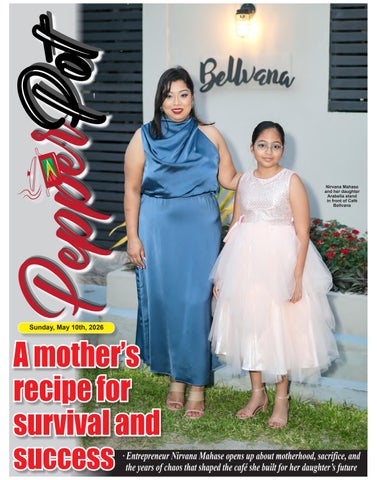
· Entrepreneur Nirvana Mahase opens up about motherhood, sacrifice, and the years of chaos that shaped the café she built for her daughter’s future

By Frederick Halley
THE Guyana Independence Festival Committee last Saturday night recognised six outstanding Guyanese for their excellent contributions to Guyana and Canada during an extravagant gala, held at the Grand Cinnamon Banquet Hall and Convention Centre, Toronto, Canada, to mark Guyana’s 60th Independence Diamond Jubilee.
The six awards, styled GICC Excellence Awards, were for Global Academic Achievements, which went to Dr Narine Dat Sookram; the Business Excellence Award to Eric Rodrigues; the Outstanding Philanthropy Award to Dhaman Kissoon; the Education Excellence Award to Yolanda Marshall; the Entertainment Award to platinum singer-songwriter Anjulie Persaud and Sports Award to international cricketer Dilon Heyliger.
Four of the awardees were on hand to collect their plaques, while Eric Ro -

drigues’ son, Chris, collected on his behalf. Heyliger was unavoidably absent.
Today, we present abbreviated profiles on the prestigious awardees:
Dr Narine Sookram –Global Academic Excellence Award
Dr Narine Dat Sookram was born in Guyana as the son of a cane-cutter. From such humble beginnings, however, Dr Sookram went on to become the first in his family’s generation to complete university as an outstanding high achiever.
Academically, Dr Sookram holds over a dozen degrees, including a Doctor of Social Work (DSW) and a Master of Social Work (MSW). He also achieved a perfect 4.0 GPA in both programmes and received the highest honour from Brescia University while pursuing his MSW.
The very prestigious St Angela Award is also included among his very long list of outstanding academic TURN TO PAGE XVI

- In celebration of Guyana’s 60th Independence Diamond


By Michel Outridge
WHEN her husband passed away from meningitis a year ago, Melissa Cush, better known as “Queenie”, went into a deep state of depression as a single parent, but she didn’t give up because she is a mentor to minors.
Even though the prospect of being the single provider for the home with eight children scared her, she knew they depended on her to be strong, and with that thought in mind, she became a prayerful woman.
She utilised every opportunity to earn and provide for her children, operating a small boutique from her home, and bought a weeding machine which brings in some money.
Cush told Pepperpot Magazine that before her spouse passed away, she had established the East Ruimveldt Giving Back Learning Centre in East Ruimveldt for the community’s children.
“I know what it is like to have nothing, going to bed hungry and not having anyone to stand with you in time of need, losing a loved one, and that motivated me to become the change for others, especially children,” she said.
The 43-year-old has four adult children and four minors, including twins who recently turned 16, and is doing her best to provide for them.
She receives assistance from her adult sons, two of whom have their own families, but one had an accident in 2025, and that left him disabled. Now he is unable to help himself, much less her.
Cush, realising she had a problem with depression, sought counselling and therapy and is overcome with joy she receives from the children in the community, and that is her sign to keep moving forward despite personal challenges.
“Some days, it is hard to get out of bed; that is depression, a silent actor that plays within me, and I am trying to become the best version of myself because people depend on me,” she said.
Going to church in the community and praying has helped, and she would visit different churches as often as she can because they would assist when called upon.
Cush reported that at the East Ruimveldt Giving Back Learning Centre, they have an electrical installation course in session for the community’s youth, empowering them with life skills to
become gainfully employed.
She said that for Mother’s Day, May 10, 2026, at 6:00 p.m., she is hosting a dinner for mothers in the community at the Giving Back Centre at Mango Lane, East Ruimveldt.
Cush credits self-discipline and determination with her time management as a single mother, a businesswoman, and the founder of the Centre, which takes up much of her time to keep operational.
“The children in the village bring a smile to my face, and they would come to my house and cheer me up, with a simple hug that makes me feel good inside and out, knowing that I am making a positive impact in their lives, and that is all I need,” she said.
The East Ruimveldt Giving Back Learning Centre was established in 2017 when there was a lot of gun violence in the village, which caused a stigma to become attached to the area.
Cush did not like it at all. She witnessed several young men being gunned down, and she did not want to attend any more funerals. The site, which once housed a garbage dump, was cleared for the Centre, a safe place for all, especially children and youths.


At first, it was just old tyres and wooden benches until she received assistance to construct a flat concrete edifice.
Through self-help, Cush and other villagers came together to lay brick by brick to develop the building for the Centre, which sits at Back
Circle, East Ruimveldt. Commissioner of Police Clifton Hicken also contributed to the establishment of the Centre in 2023.
She noted that the Centre aims to empower young people and equip them with life skills, enabling them to earn a living by establishing their own businesses.
The founder said the Cen-
tre usually caters for around 70 children from the community, though attendance varies depending on the courses offered.
She expressed her gratitude for the support the Centre has received from corporate Guyana, individuals, organisations, and other agencies, which helps to keep its doors open.

By Michel Outridge
CHRISTINA Basil, 31, is a yoga teacher and a mother of two who brings a grounded, real-life approach to movement and wellness.
Her classes blend strength, endurance, and mindful flow, shaped by her love for running, training, and staying active in everyday life.
“I focus a lot on helping students build consistency, feel stronger in their bodies, and establish feelings of wellness and balance — even with busy, unpredictable schedules,” she said.
Basil told Pepperpot Magazine that, with nutrition a passion of hers, her classes incorporate simple, real-life, budget-friendly nutritional tweaks to help achieve overall health and wellness.
Currently, her classes are held at GCC Bourda Ground three times a week, with morning and afternoon classes being an option.
Basil was originally born in Essequibo but moved to Georgetown as a toddler.
She started yoga in her gap year from university in St Lucia, where her mom’s friend inspired her.
Basil started just attempting poses and uploading them on Instagram, then as she got better, people started noticing and commenting on how much “better” she got.
Eventually, she began to feel very strong and balanced in her body, and took yoga seriously in 2016.
She said she never intended to teach, but a few people had asked her to Skype with them and show them a few things.
Eventually, when she returned to Guyana, a super kind soul asked her if she would be interested in teaching because he had a space at GCC. From there, it all began.
Basil said that as fast as it began, it was derailed when she had an accident in November 2016. She had sustained a shattered femur and was unable to walk for close to a year.
“I credit my entire remarkable recovery to yoga. My injury was so severe that my doctors were surprised I was walking without a limp. That’s yoga for you,” she said.
She reported that as she began to teach, word of mouth became her marketing, and the classes grew.
Basil told Pepperpot Magazine that she began looking into getting certified. However, by a stroke of luck, she saw the most perfect yoga training in Colorado, hosted by the very teacher she had initially based all her practice on.
The determined young lady worked hard and saved up her earnings. She was
working at Giftland Mall at the time to earn money while she was in university.
“And there were many days I walked from UG to home to save on that transportation money. Fortunately, the stars aligned, and my friend offered to take me to classes in the morning as he was also working at UG and would pass my house every day. Every dollar I made, I saved,” she said.
Basil added that she recalled going to Colorado with a dozen envelopes because she was on a budget and could not afford to overspend.
Back then, she didn’t even have a bank card, and she did her training in 2019 and came out successful.
The 31-year-old pointed out that she was at the Bodhi Yoga Academy but is no longer there due to COVID-19.
Basil added that her studies were not free, since she invested US$5,000 in her training, and that yoga is definitely her way of life, with the physical aspects helping her immensely in her personal life.
Today, she is a trained yoga teacher, and her certification title depends on the number of hours of classes she has taken; she completed 25 days of classes and earned a 200-hour certification.
Basil said that, after she gave birth during COVID-19, she had another opportunity

to specialise in yoga, which she wanted.
So, she got certified in Sussex, England, in an 85hour Prenatal Yoga Teachers Training (PYTT) course, which helped her with a C-section delivery, and she credits the training exclusively for her amazing C-section recovery.
“It taught me so much on scar tissue massages, diastasis recti, pelvic girdle pain — things that I was never told about in all my clinic
TURN TO PAGE VIII


CAFÉ Bellvana is a small but captivating business that many Guyanese café-goers are familiar with; its charming aesthetic and vibrant menu have earned it a loyal following. What most customers may not know, however, is that behind the business is the inspiring story of a mother who built it from scratch with a small child by her side.
The woman behind the business, Nirvana Mahase, says the business
was never part of a carefully structured dream, but rather a response to life’s uncertainties after becoming a mother and rebuilding her life. Today, as the café continues to attract new customers, Mahase says the business stands as a testament to the strength of mothers and as a guiding light and a door to new opportunities for her daughter.
Born and raised in Region Two, on the Essequibo Coast, Mahase says she has always had an interest

in entrepreneurship. In an interview with the Pepperpot Magazine, Mahase recounts her childhood, saying her primary school days saw her selling small items at school. While she loved entrepreneurship, Mahase says that love was rooted in a difficult childhood, one in which her parents faced financial challenges and later separated.
“In primary school, I would sell pencils or erasers, or anything popular at the time. I always had that little bit of entrepreneurial struggle, that leadership capacity in terms of leading things and doing things.”
Following high school, Mahase left to further her education at the University of Guyana but was unable to complete her studies, as she explained, “I started university and was doing law, but I never finished because of financial reasons and all the travelling arrangements.”
However, this did not stop her love or pursuit of business, and Mahase soon found herself in the world of entrepreneurship. But like many first steps, this business was not a success. Speaking on what this business taught her, Mahase shared, “What I learned from that business was what not to do if I ever did get off the ground, because it was one of those businesses where there was a lot of investment upfront.”
While it was not a success, it was a profound learning experience and the step that would solidify Mahase’s love for business, as she added, “After that business, that is where I started my business-owning skills.”
In the years that followed, Mahase, with the support of her then-partner, launched a number of innovative business ventures, some even ahead of their time. However, life shifted in 2016 following their separation. Sharing insight into this time of her life, Mahase said that it was a period of rebuilding that felt like survival, noting, “I became a mother in 2013, so my daughter had just turned three when we separated.”
She added that the need to create and sustain life, not just for herself but for her daughter, saw her open Café Bellvana.
“That is when I started Bellvana in 2017. Bellvana is actually a combination of my name and my daughter’s name, Nirvana and Arabella.”
Building a business while rais-

ing a three-year-old was no easy task. As Mahase shared, the business began essentially with just the land, and getting it off the ground required a leap of faith. She noted that she considered renting and a number of other ventures, but a café seemed to be the best option at the time.
While she was unsure, Mahase said that starting the business was a necessity rather than a calculation.
As she shared, “It was really the need for survival that pushed me into it. Back then, rental was not what it is today, so renting it out would not have covered what I needed to make life work.”
The business began to gain more traction in what was, at the time, a small market, and growth pushed Mahase to develop the café further, as she added, “Bellvana was not supposed to be a dining café. It was supposed to be similar to a
Starbucks-themed idea. I had the space, but I didn’t cater for a dining area. People wanted to dine in, and I needed to follow where the money was. I had bills to pay, a child to look after.”
By the end of 2018, Bellvana’s dine-in section had become a favourite among customers.
Since then, Café Bellvana has continued to grow with the support of loyal customers. As Mahase shared, while the growth has not been rapid, it has been consistent and sustainable.
“Our growth has been at a good level. Not accelerated growth, but a steady and sustainable pace.”
A major reason the business has remained consistent is balance. As Mahase shared, at first she struggled to find a balance between business and motherhood. Many days, she found herself in what she described TURN TO PAGE XV


· Slated for the Arthur Chung Conference Centre on May 31st, this year’s celebration puts young girls centre stage


young competitor channels confidence and
SLATED for the Arthur Chung Conference Centre on May 31st, this year’s celebration puts young girls centre stage.
For the last decade, Kids Fest Guyana has been a staple for Guyanese children and has become one of the year’s most highly anticipated events. This year, however, the event intends to break the mould by being bigger, better, and packed with a slew of new additions.
Speaking to Pepperpot Magazine about this year’s event, the woman behind the venture, Natalya Thomas, says that families can look forward to Playtopia, slated for the Arthur Chung Conference Centre on May 31st. The event will bring
refreshed vibrancy to the well-known Kids Fest.
Moreover, a main highlight of this year’s event will be the Princess of the Safari Pageant. Speaking on the highly anticipated competition, Thomas noted that the pageant seeks to bolster and hone the creativity of young girls, ages 5 to 14, as they compete for the title of Miss Kids Fest Safari Princess.
Noting that it is a collaborative event, she said, “The pageant brings families together and helps young girls become more confident and vibrant.”
The event aims to be a platform for vibrant, creative young girls, as she added, “There are many girls who have potential, talent and


skills, but they do not always have a platform to showcase themselves. Through the
Kids Fest pageant, a space was created for them to express themselves and build confidence.”
The event also comes as Kids Fest turns 10 years old and, in many ways, celebrates the ones who made it a success: the children. Describing the journey as fulfilling, Thomas noted that the pageant seeks to make
children more than spectators but a part of the excitement itself.
As she shared, “This year marks 10 years since the event has been hosted. It has been a rewarding and fulfilling journey, with many young girls returning year
after year to be part of the pageant.”
She added, “That continued interest reflects the excitement surrounding the event and the positive impact it has on the participants.”
and the
While the competition is still in its early stages, with the photogenic competition now TURN TO PAGE
The pageant aims to help girls develop confidence and express their creativity through the themes of nature,

IN the early 1800s, there lived an extraordinarily intelligent German princess named Alexandra Amelie. She was considered strange because of her eccentric, obsessive habits. For instance, she was known to wear only white clothing to maintain her purity and fragility. The strangest characteristic of her personality, however, lay in a remarkable delusion that she held. Princess Alexandra believed that, as a child, she had swallowed a whole glass piano, which remained intact within her. She also believed that if she were to hurt herself or bump into something accidentally, the piano inside
her would break and hurt her from the inside. So, she developed a habit of walking delicately, always stepping into doorways in a gingerly, sideways manner. She ensured that nothing would touch her as she moved. Interestingly, Princess Alexandra was not the only individual of royal or noble lineage who had this delusion. There are many such individuals, such as King Charles VI, who have been recorded in history as having suffered from a delusion whereby they believed that their bodies or a body part was made of glass. These nobles, apart from this particular delusion, were recorded to have been quite
intelligent, charismatic, or talented in some other way.
These “glass people” were perhaps some of the most sheltered and wellcared-for individuals in their societies. Among the other people who lived in those cities or countries, they were the least likely to come to harm of any form. Not only were they protected, but they were given wonderful opportunities that allowed them to intellectually and physically excel far beyond the limits of an ordinary man. Yet, despite everything, they found themselves limited by their own minds, trapped in an ironic prison of false fragility. They believed them -
selves to be constantly teetering at the edge of a precipice when they were, in fact, perched at the centre of a formidable fortress. The glass people suffered needlessly within their own minds and, in their suffering, lost parts of their lives that some would have given anything to enjoy.
In the modern world, the delusion is no longer as prevalent as it seemed among the nobles and royals of the Middle Ages. Nevertheless, we do still occasionally suffer within the irrational boundaries sculpted by our own minds.
As human beings, we carry a wonderful resilience within us. This resilience does not reveal itself in

the simpler moments we experience, but rather in the moments when it may seem as if we can no longer go on. It reveals itself when we feel we are taking our last steps or making the final efforts towards a dream that will not come true. This resilience and energy are wonderful gifts that allow us to spread our wings when we feel we have hit rock bottom.
It is often the reason many people achieve the marvellous things they do in situations when it appears there is no way to rise.
Unfortunately, to discover this hidden potential, we often have to push ourselves to our very limits. After all, there is no way for us to discover the things that we are capable of doing if we never truly try to do them. Then again, it will be impossible for us to overcome a limit if we convince
ourselves that doing so will destroy us.
The glass people of the past believed they could not do the simplest things for fear of being broken or hurt. Even when there was no real danger, they lived cautiously to a fault. By doing so, they lost the ability to be themselves. They did not truly live their lives, but spent their time trying not to be harmed.
If one of them had resolved to live normally for a single day, even if they feared being broken, they might have lost the delusion of being too fragile to do the things they loved. In that loss, they would have found themselves again.
Perhaps, if we, too, resolve to choose to live freely and test our own limits, we might discover that we are not as fragile as we believe we are. We, too, might find ourselves.
A dedicated mother and her love for yoga in every way
visits. In fact, when I asked my OBGYN about the possibility of my diastasis recti, I was brushed off. But sure enough, DR is something all pregnant women will have, with 67% of cases healing on their own. Others need more help.
In my case, I was perfect after my first pregnancy. In my second pregnancy, I had a three-finger gap.
I’ve helped tons of post-partum women suffering from that — spending my time educating them and showing them things could be done,” she said. Basil added that her
PYTT highlighted how amazing pregnancy and post-partum can be when mothers are supported not just mentally, but also physically. She thoroughly enjoyed her fourth trimester each time because she knew exactly how to help herself.
As a way to give back to society, she says yes to every volunteer yoga activity that comes her way and offers discounts to people who may not be able to afford classes.
In addition, she gives tons of free nutritional and yoga advice not only to people who attend her classes but also to others.

MANY women wish to become biological mothers but cannot for various reasons. Those who are fortunate enough to be mothers must count this a blessing.
Once fertile eggs and sperm combine, it becomes very likely that another human being will enter this world within nine months. A pregnant woman experiences many challenges.
So many, in fact, that some women wonder if there are other options for childbearing. Young women may not understand the challenges that their mothers went through during pregnancy until they experience them firsthand.
Each pregnancy is unique. Some women experience fewer challenges than others, but no woman is immune to the challenges of pregnancy. Vomiting is a
common experience for some pregnant women. Sometimes it is because of regular vomiting after eating or smelling certain food scents or perfumes, or because of feeling excessively tired, that some women realise that they are pregnant.
Labour is an experience that some women will not want to remember. While they are in the labour room, they think of the dead and the living. Some women have sworn not to get pregnant again after their pain in the labour room.
Caring for a child is not easy either. Caring for physically challenged children will often be more challenging than caring for a child whose physical condition is normal. Mothers are wonderful people who do not want their children to be hungry; a mother might give her last
meal to her children to keep them from hunger.
As children grow, parents need more money to provide for them. Sometimes parents may have to work two jobs to meet their children’s needs. Family planning is important for parents to consider. Some mothers will choose to stay at home independently, while others will be asked by their companions to do so.
Those who stay at home may have more time to spend with their children and their companion. However, some mothers work; there are many important reasons to do so. Working mothers may have more opportunities to learn from others, allowing them to improve their mothering skills.
Parents must attend Parent-Teacher Association meetings for their children.
These meetings are essential for parents to get to know their children’s teachers and to learn about their children’s progress in school.
Anniversaries for mothers must be celebrated. Most people celebrate birthdays and Mother’s Day as anniversaries for mothers, but there are other important anniversaries as well. Every mother must be celebrated for the sacrifices she has made. She must be honoured in a great way.
A mother to others
As children grow older and find companions, they move away from their childhood home and start families of their own. This may be a great challenge for their mothers, who miss them. Mothers are often concerned about their children, who are now in relationships. Some
mothers want to know that their child’s companion is taking good care of them and that they are eating properly.
When a woman becomes a mother, she becomes concerned for her children’s well-being. Regardless of age, she always sees her children as babies and wants to protect them from anyone who might mistreat them.
The transition from motherhood to grandmotherhood is another phase in a woman’s life.
Many grandchildren love and connect with their grandmother. Grandmothers often adopt their grandchildren as their own children and may treat some grandchildren better than they treated their own children.
Some grandchildren are allowed to visit their grandparents and spend weekends and holidays with them. If the
parents live far from a school, they may arrange for their children to attend from their grandparents’ residence (if the grandparents live closer to a school than they do). Some grandmothers adopt birds and animals as pets and lovingly care for them. While most pets cannot speak, grandmothers can still communicate with them. Pets that are cared for often respond positively to their owner.
For more information about Geary Reid and his books, please use the contact information below:
Amazon: http://www.amazon.com/author/gearyreid Website: www.reidnlearn. com
Facebook: Reid n Learn Email: info@reidnlearn. com Mobile #: 592-645-2240


IMAGINE the painter, a younger relative, and the strange piece that they are working on, which you can’t figure out, so you enquire, “How come this image?” And the answer is, “I saw a woman and a child in the bath in this house we used to live in, or so I thought.
We moved away, but before that, I told my godmother and she told me to pray before I went to sleep. And when I awoke in the morning, I did just that, then I heard her talking to the man who
owned the home, who had come for his rent.
‘Well, meh god-son, hmmm…,’ she quietly narrated her story, ‘he see wha ah a tell yuh, he remember that she had on, yes, yes, yes, a dark green dress,’ then, ‘I’m an honest man, I admit that the girl commit suicide in the house by the forty-feet, but other people lived here before, no one said anything about seeing anything like that.
Lemme give yuh some advise[sic], Ms Elesabeth, get one
ah dem Spirit church people, they gon pass he over some boil rice with certain bush in it, and everything done, problem will stop.’ My ma responded, ‘And he gon stop remembering what he saw?’ ‘Ah, Sister Elezebeth, he gon forget it.’”
Years later, two teachers watched two school friends consuming the adventures of a mystical novel, My Bones and My Flute, written by a local writer, and indicated to another young teacher sharing a bench.
One whispered to the other, “Is who lessons class the two of them prevailing over? Why does he read all them jumbie stories? He better read the textbook that will help him to pass the exam.”
An elder interrupts, “Young sirs, they’re reading, and I’s sure that they will find their niche in our world, and explore labyrinths that we will shudder from.”
Wherever we venture, we will all be confronted by an inner narrative that propels us to explore and question.
We are in a world that proposes lasting entrepreneurship. Where does it begin, if not with a mind that explores and relies on its own beginnings and interpretations before we stumble and stand again, recognising that those who presume to know have never been in the fray of sleepless nights in the search of one’s own, rather than a mimic among legions of a type that has a master’s mould. Understand and venture on, with dreams of your own precise perspective.


I CAN recall watching or reading headlines when I was younger and being distraught. There were certain past events that made me very worried about the state of the world, peace, and security. These crises disrupted our everyday patterns of behaviour; people felt an urge to be at the forefront of protests, and we called for immediate action to end the crises.
I cannot help but now reflect on how different it feels to experience crises these days. It feels as if people are now desensitised to conflict. While the content of this column reflects my personal and professional opinions and insights, I developed it
through many interactions and consensus with people while studying peace abroad.
Many of us feel as if, over time, priorities shifted, and while we are aware of ongoing conflicts or crises, it is only a thought that may or may not linger at the back of our minds, and it may not materialise into anything more.
Do we scroll past these headlines or news because we lack empathy? Or is it a protective response that occurs when overwhelmed and anxious? Is it because of familiarity with the many crises we are currently faced with across the world?
Or is it our inability to keep up with all that is hap-
pening? Unfortunately, it feels as though we no longer experience shock at things that can go wrong across the world.
In the face of wars, humanitarian crises, environmental degradation, and even crime, many people find ways to adapt to these new realities.
When I examine communities that live in a constant state of crisis or conflict, I can’t help but reflect on how sometimes those people have no other choice but to continue living their lives. They do not have the time or even energy to react in shock or disbelief. They have to continue living within their routines as a means of survival.

Many of the “crises” we see today are ongoing. They are not one-off incidents that only occur in a certain country during a specific period. They are often structural challenges and systems that reproduce and expand exploitation or inequalities. Take, for instance, the current state of Palestine.
If you’ve been listening to the news or media for quite some time now, you will know that the events of recent times are only the tipping point of an ongoing conflict that has been oc -
curring for decades prior. Some might even argue that these situations eventually stop being a priority for aid, assistance, and protest. Over time, it simply becomes an expected condition for the country, community, or the people, and this can be a very dangerous shift.
There is a “normalisation” that occurs where proximity does not exist. If you aren’t living close to or within the circle of the environment where a crisis occurs, there is often a disconnect. I came to that realisation after

studying peace and being part of an environment that encouraged us, as students, to discuss these topics daily. Before studying peace, a conflict might be another headline to choose to read or scroll past. How, then, can we focus our attention on responding to and acknowledging conflict or crisis while also trying to strike a balance to protect our own well-being? What happens when the emergency never ends? When does displacement last for years? When does recovery never fully arrive? These situations are shaped by power, access, and inequality. In many cases, the burden of adapting to prolonged crises falls unevenly.
Normalisation does not mean acceptance in the moral sense. It means adjustment. It means learning how to live with conditions that should, by any standard, be unacceptable. And while adaptation is necessary for survival, it should not become the endpoint.
As I close this week’s column, I want to remind you all that crisis and conflict were never meant to feel “normal.” We should become comfortable with feeling uncomfortable at the current state of our world, and, personally, I fuel those feelings through my advocacy and writing.
If we lean too far into adaptability, we risk losing the sense of urgency and responsibility required to address conflict and crises. The challenge, then, is not only to respond to the crises of the world, but to refuse to become comfortable with them.

THE young man stood at the head of a quiet village street with a bouquet of fresh flowers in his hand. It was a street he had a vague recollection of because he had been six years old when he was taken away. But as he grew up, the blurred image of that street stayed in his mind, for the most precious thing in his life was most likely still there, waiting.
He had vowed silently that one day, when he was old enough, confident and self-independent, he would look for that street to find what had been missing from his life for fifteen years. He had parked his luxury vehicle at the side of the road because he wanted to walk, and taking a deep breath, he began walking down the street.
He passed two cross streets, impressed by the paved road, the neatly weeded parapets, and the absence of litter. The neat houses, variety of fruit trees in the yards — a small community. As he walked, a strange feeling surged through his body, and he stopped by a cute little house with a vibrant, flowering garden and the sounds of animals and birds.
It seemed like a small animal sanctuary.
An elderly man attending to the dogs answered his call, “I am looking for a woman named Shreya.”
The old man looked at him for a moment, the flowers in his hand, then nodded his head slightly and ambled to the back of the house. Arun took a deep breath, a little
nervous, his heart beating a little fast. She came from the back, holding two kittens, a gentle smile on her face, as she laid them down on a cushion.
She walked towards the gate where he was waiting, and looking at her, the world seemed, for a moment, to stop for him. His father had told him one night, with regret in his voice, “She’s a beautiful woman with a gentle smile.”
“She sure is,” he said to himself.
After fifteen long years, now he was seeing her, that missing part of his life.
“Hello,” she spoke, and the world restarted for him.
“I — can I come in?” he asked.
She looked at the handsome young man standing there with a bouquet and nodded to the gardener to open the gate. Arun handed her the bouquet and said, “I want to wish you a happy Mother’s Day.”
She accepted the flowers a little hesitantly and asked, puzzled, “Why would you, a stranger, offer me flowers for Mother’s Day?”
“So you can feel special today.”
A sad look flickered across her face, and he said to her, a little choked in his voice, “I’m Arun.”
That revelation took a little while to register in her mind, and she asked with a little tremor in her voice, “My Arun? My little Arun, who was taken away from me so long ago?”
He nodded, tears filling
his eyes.
“I have come home to you, Mom.”
She touched his face gently and asked, her lips trembling, “Am I dreaming?”
He wiped the tears from her face. “No, mom, you’re not dreaming.”
“How long have I ached to hear that word!” she expressed, and broke down crying.
He hugged her close, crying too, and it was amazing how quiet the animals became, as if they sensed something special was happening for their caregiver.
After a long moment, mother and son regained a little control of their emotions and sat down. She rested the bouquet on the small centre table and said, “It’s beautiful, I love flowers.”
He smiled. “I somehow felt you did.”
She looked at him, still somehow not believing he had come back to her.
“You have grown so much from a little boy,” she said, lowering her head a little, crying softly, “I thought you had forgotten me.”
He took a deep breath so he could speak in a steady voice. “I don’t remember much except for a strong hand dragging me whilst I was crying, looking back at a figure standing on a bridge with outstretched arms. I grew up with that blurred image in my head and promised myself that one day I would find you.”
“The grief of losing you,” she told him, “made me almost lose my mind. I had

to resign from my teaching job, and it took a long while for me to regain my mental strength to live again.”
“If it’s any comfort, the way things are with him now, I think he regrets what he did to you.”
She smiled wryly. “It doesn’t matter anymore.”
She picked up a kitten that was curled up beside her and, cuddling it lovingly, she told her son, “I was walking home one night from the mandir when I heard a soft, pitiful crying in the grass. It was a poor, homeless kitten, and I took it home and gave it the love and care it needed. As much as I saved the kitten, it saved me, too, from grief and loneliness.”
“And that’s where the
idea came from to start a shelter for homeless animals?”
“Yes,” she smiled, a little light in her eyes, for it was doing something she genuinely loved.
Arun looked around and smiled appreciatively.
“You’re doing something selfless and wonderful.”
He looked at her little house, which seemed so cosy and comfortable, the flower and vegetable gardens, the cat patio, the open kennels, and a small bench. It was like she had created her own little paradise, whilst he grew up in his father’s mansion with luxuries. He should have been happy, but he was never completely so, for this beauty was missing from his life.
He went out back to the road and drove in his vehicle, parking it in front of the yard. He brought in a lunch he had ordered, gifts for her, and a lovely cake to celebrate the day with her. They spoke of many things so Arun could understand what caused the break-up between her and his father. She relayed to him that she came from an average family, was a nursery school teacher, and sang in the kirtan group at her mandir.
Her innocence and simplicity had won his heart, and just a year later, they got married. But his playboy lifestyle, which she hadn’t known about, didn’t stop him, and tension began to creep into their relationship. It came a day when she couldn’t take it anymore and left his rich home with her son. She had refused to return, and because of that, he demanded the child and filed for custody.
He won the case because of his money and connections and took the child away from her.
She sighed deeply, a distressed look on her face and related, “I couldn’t even get visitation rights.”
Arun lifted her hand and kissed it.
“Nothing compares to a mother’s love; it’s precious, a bond that cannot be broken.”
And for the first time, he saw that warm smile, a smile that touched his heart and, leaning forward, he kissed her on the cheek.
“Happy Mother’s Day, mom, now and forever.”


EDWIDGE Danticat, the Haitian-born author of several acclaimed, award-winning novels, essays, and anthologies — including The Dew Breaker, The Farming of Bones, Claire of the Sea Light, and Brother, I’m Dying, which won the National Book Critics Circle Award for autobiography — turns to non-fiction in The Art of Death: Writing the Final Story (Graywolf Press, $16.00).
The explicit subject of The Art of Death is death itself: whether we die en masse or alone, and the innumerable ways, places, and moments in which death arrives. The “how” is inexhaustible — by guillotine or gas, illness or machete, fire, poison, or the slow attrition of a chronic
malady; in bed, asleep and unaware, or awake and lucid; surrounded by family or in solitude. We die everywhere and at any time. There are, as someone once wrote, eight million ways to die. To attempt to catalogue them all is its own kind of exhaustion — a critic undone by enumeration, a death by listing.
The book is, at its core, about loss, and it offers sharp, often moving insights into grief. Yet it also bears an inherent limitation: it is written by one who has not died. One cannot help but imagine that such a work might attain its fullest authority if authored by someone who had crossed that threshold.
But no one has returned to testify. Danticat herself acknowledges this paradox.
What she can offer instead is proximity, an account shaped by witnessing and remembering. The book becomes, in part, a memoir, an exploration of the deaths of those closest to her.
One might expect The Art of Death to be uniformly sombre, yet it is also a curious and searching work. What emerges most strongly is not only the gravity of death, but its inevitability, its almost routine presence in human life.
Some, as Dylan Thomas famously urged, “go not gentle into that good night,” while others do; either way, the going is certain. Danticat writes candidly about the deaths of her own relatives — her mother, father, and uncle — recounting their final days
with an intimacy that can be unsettling. She also examines her evolving understanding of death, from childhood fears to adult reckoning.
Alongside this personal narrative runs a more critical thread: a meditation on literary death.
Danticat turns to the ways writers have depicted dying — both their own and their characters’—fictional deaths, though imitative, often illuminate the real passage from being into nothingness. Much of the book draws on literary examples, exploring how characters die and how authors confront mortality on the page.
Writers, unsurprisingly, have much to say about death, perhaps more than any profession outside medicine.
as chaos, with long hours and little rest. She knew she had to make a change to her routine, explaining that, “Growing up in a single-parent home and in poverty, I was not taught a lot of basic things about structure, saving energy and prioritising.”
While it took several years to master, Mahase says she now feels that she has found a rhythm between motherhood and business, adding, “Now, I have routines. There are certain things I do in the morning and certain things I do in the afternoon. By four in the afternoon, I’m checked out of certain things that require intense attention.”
Even today, almost a decade later, Mahase says her
daughter remains her biggest motivator. For her, Café Bellvana is more than a business; it has been her way of giving her daughter a better life than she had.
As she shared, “My biggest motivator for staying in this is to support my daughter and give her more than just the basics. To provide her with opportunities that I was not offered. I grew up in poverty. Not poverty like some people, but I grew up in poverty. I grew up in a world where you wear handme-downs and are in front of certain things.”
She further shared that, more than just money, she wanted to give her daughter the opportunities she did not have, adding, “Money does
not buy happiness, but it certainly puts you in places and gives you opportunities that you could not have without it. If it wasn’t for her, I would have quit this business a long time ago.”
While Mahase may have walked away from the café if not for her daughter, today she is proud of what the business has become. She admitted that in the early years, she was filled with uncertainty, a challenging feeling that many mothers and entrepreneurs know well.
Looking back at her own journey, Mahase says if she could speak to other mothers beginning the same path, she would urge them to leap, but not wildly. As she shared, single mothers in business
FROM PAGE V
For them, it is less an abstraction than a recurring preoccupation. Danticat engages with a wide range of voices, from Toni Morrison and Leo Tolstoy to Susan Sontag, Christopher Hitchens, Zora Neale Hurston, Anne Sexton, and Sylvia Plath. Plath and Sexton, in particular, wrote with searing clarity about death, their work often shadowed by the knowledge of their own eventual suicides. In such cases, death can appear not only as an end, but as a grim counterpart to the suffering of life.
The Art of Death is a brief book — one that can be read in a single sitting — but its scope is expansive. It reflects on how we die and, just as importantly, how we are remembered. Death, ultimately, is less an ending than a relay: it passes from one life to another, without a clear finish line. How we die may sometimes be a matter of choice, though more often it is not; its timing remains beyond our control. In the end, a book like this can only be written by the living — by those who grieve, who endure, and who attempt, however imperfectly, to give shape to loss.
have more to risk than most, and they must be both bold and cautious.
“As a mom, especially a single mom, you have to manage your income, your child and yourself. If you’re going to venture into business, then you also have to mitigate those risks around you.” She added, “My advice would be not to make the same mistakes, but also not to hold yourself back. Just be calculated about it.”
As Café Bellvana approaches its ninth year, Mahase says she is more hopeful than ever, not just for the business, but for what it represents and what it has taught both mother and daughter.

achievements, made even more remarkable by the fact that he was the very first Guyanese to ever receive that honour. It is no surprise, then, that the Guyana-USA Embassy took pride in featuring it on its social media page. Dr Sookram’s doctoral research focused on best practices for inclusive hiring.
Named as one of Canada’s Top 25 Immigrants in 2013, Dr Sookram also holds the record of being the most decorated Guyanese, arguably even the most decorated Canadian in history. His community work is unmatched in his contributions to employment, mental health, equity, diversity, and inclusion (EDI)
advocacy.
Eric Rodrigues – Business Excellence Award
For over four decades — 40-plus years, to be more precise — Eric Rodrigues was quietly, and without much public fanfare, directly involved in manufacturing many of the spices and hot sauces that Guyanese-Canadians currently use. Eric is the Founder and Owner of Exclussif Spices and Wholesalers Ltd., the Geeta and Irie Spices flagship brands of which have long since become household names within the Guyanese and Caribbean-Canadian communities. They are must-haves
in the kitchens of any self-respecting “sweet hand” chefs, whether male or female.
Born in Georgetown, Guyana’s capital city, Eric spent his food-service apprenticeship working at the Albouystown headquarters of Rick’s alongside his father, the senior Eric, otherwise more familiarly known as the legendary “Rick” Rodrigues. The company was involved in manufacturing and distributing Rick’s Curry Powder and other spices, which were themselves perennial favourites among Guyanese consumers.
Eric migrated to Canada in 1974 and, within six relatively short years, in 1980,

had started operating a business out of his apartment, selling hot sauces and spices. As the business grew, it was moved from his garage to his basement. After outgrowing its previous space, the business moved to its current location on Tiffield Road in Scarborough’s industrial area.
Dhaman Kissoon –Outstanding Philanthropy Award
Born in Beehive, Guyana, Dhaman Kissoon is an experienced Guyanese-Canadian lawyer and renowned philanthropist. Having migrated to Canada as a teenager, Dhaman began his studies at the University of Toronto but subsequently suspended them following his father’s passing. Instead, he used this time off to help his mother and siblings move to Canada. That objective duly accomplished, he continued his studies, culminating in his law degree from Queen’s University in 1989.
While at Queen’s, Dhaman also co-founded the MultiHeritage Collective, a student-run organisation that was instrumental in effecting changes to the university’s hiring and admission policies. Shortly after his graduation, Queen’s University’s Law Faculty Dean approached him to begin teaching at the college, and he immediately accepted, serving as an Adjunct Professor for more than 30 years.
During his teaching years, Dhaman received multiple awards, including the student-presented Teaching Excellence Award, which he received on at least three occasions. Now in its 35th year of operations, Dhaman’s law firm, Kissoon & Associates, was founded in March 1991 and, from its initial location on Toronto’s Bay Street, eventually moved to 8 Beamish Drive in Etobicoke, where it has remained since 1992. In addition to his professional accomplishments, Dhaman Kissoon has also been an active community leader and an outstanding philanthropist.
Yolanda Marshall – Education Excellence Award
Yolanda Marshall is a celebrated Guyana-born, Bajan-heritage Canadian author renowned for her vibrant, inclusive, and culturally rich children’s literature. A passionate storyteller and literary trailblazer, she began her publishing journey in 2008 and secured a multi-book deal in 2019.
Yolanda is a traditionally published, agented author of 20 beloved titles, including Brown Girl in the Snow (one of The Globe and Mail’s and CBC’s best children’s books of 2025), Marching North (about Black Canadian WWI and WWII soldiers), A Piece of Black Cake for Santa, Miles Away in the Caribbean, Sweet Sorrel Stand, C is for Carnival (the only children’s book in print about Canada’s Carnival Festival), My Soca Birthday Party: with Jollof Rice and Steel Pans (recognised by CBC as one of the Best Canadian Picture Books of 2020 and featured on TD’s Top Recommended Reads for 2023), and Hot Cross Buns for Everyone (featured on TD’s Top Recommended Reads for 2025).
In 2023, she received the My People Award from the Blackhurst Cultural Centre for her outstanding contribution to Canadian literature. She was named Author of the Year by the Caribbean media Loop Awards in 2022, honoured among Canada’s 100 Accomplished Black Women the same year, listed on CBC’s 2020 Best Picture Books, and recognised as one of CIBWE’s Top 100 Black Women to Watch in 2017.
Anjulie Persaud –Entertainment Award
Anjulie Persaud is a Juno Award-winning, platinum-selling Guyanese-Canadian singer-songwriter whose work bridges global pop with diasporic identity, storytelling, and culture. She has written and collaborated with artistes including Lady Gaga, Nicki Minaj, Kelly Clarkson, and Diplo, and recently co-wrote Nelly Furtado’s Gold-certified comeback single “Eat Your Man.”
Anjulie was born on May 21, 1983, in Oakville, Ontario. That’s also where she grew up. As the youngest of four siblings, Anjulie always felt a connection to music. When she was younger, she attended St Ignatius of Loyola Catholic Secondary School in Oakville.
The moment when Anjulie decided that maybe music was her vocation came after seeing one of Janet Jackson’s most prominent performances, namely, The Velvet Rope Tour. Anjulie was immensely impressed by the presentation of the show, as well as Janet’s talent as a singer. The Canadian star-to-be started writing songs in her spare time and recorded a few acoustic tracks. When she was a teenager, the young, talented girl
wrote her very first song, Say Goodbye to Jr. High. Not long after, Anjulie signed up on MySpace and started uploading her projects there.
For his outstanding contributions to cricket in both Canada and his homeland, Guyana, Dilon Heyliger is a most worthy recipient of the Guyanese-Canadian Community’s Guyana 60th Independence Anniversary Sports Excellence Award.
He has made a name for himself as a Canadian national cricketer of outstanding all-round talent. Heyliger started his cricketing career on the Essequibo Coast, where he represented his village team, Santos. Before long, he became a member of the Essequibo Under-15 and Under-19 teams and subsequently represented Guyana at the Under-15 level in 2005. His progression continued three years later, when he was selected to play for his country at the regional Under-19 tournaments in 2008 and 2009. Even earlier, in 2006, Heyliger had already become a member of the Essequibo senior team, and despite his sojourns in the Caribbean, United Kingdom, and Canada, he continued to be a member of the Cinderella County side, which he last played for in 2013.
In April 2019, he was named in Canada’s squad for the 2019 ICC World Cricket League Division Two tournament in Namibia. He made his T20I debut against the Cayman Islands in August 2019, finishing the tournament as the leading wicket-taker, with 11 dismissals in five matches. In February 2022, he was named in Canada’s squad for the 2022 ICC Men’s T20 World Cup Global Qualifier A tournament in Oman. In July 2022, Heyliger donned Canadian colours in the 2022 ICC Cricket World Cup Challenge League ‘A’ tournament and, in the opening match against Denmark, took his first five-wicket haul in List A cricket.
In April 2023, he made his One Day International (ODI) debut against Namibia in the Cricket World Cup Qualifier Playoff. In May 2024, he was named in Canada’s squad for the 2024 ICC Men’s T20 World Cup tournament. He subsequently represented Canada with distinction at the 2026 ICC T20 World Cup, jointly hosted by India and Sri Lanka.

HUMAN beings love control. We love it so much that we pretend we have it even when life clearly proves otherwise. We plan, calculate, overthink, and micromanage situations that were never asking for supervision in the first place. Then something small happens, and the illusion cracks — a delayed message, a missed opportunity, a sudden change of plans, etc.
And suddenly, the mind turns into a full-time strategist, running scenarios like it’s preparing for war. The body tightens, the breath shortens, and the energy shifts into something that feels urgent and important. Meanwhile, life continues doing whatever it was already doing.
Now here is the funny part: people board planes every day without interviewing the pilot, sit in buses without checking the driver’s résumé, and cross bridges without inspecting the engineering. Trust flows easily when the control feels unnecessary. Yet the moment life asks for that same trust, something inside us stands up like an unpaid supervisor and says, “Absolutely not! We need to be involved!” The irony writes itself, doesn’t it?
Eckhart Tolle speaks about this beautifully when he explains that much of
human suffering comes from resistance to what is.
The mind creates tension by arguing with reality, by insisting that things should unfold differently than they are. That resistance feels productive; it feels like action and like control. It is none of those things, honestly. It is simply tension wearing a badge. People believe that worrying prepares them, that overthinking protects them, that holding on tightly keeps things from falling apart. But reality offers a different lesson: tension clouds perception, and overthinking delays clarity. So, it is safe to say that control creates exhaustion, yet we hold on, though.
Sadhguru often says that life functions far more intelligently than the individual mind. The body breathes, the heart beats, the earth spins, and the seasons shift without needing your permission or supervision. That truth humbles and comforts at the same time. It humbles the part of you that wants to run everything. It comforts the part of you that feels tired from trying. Let us keep this simple.
Control focuses on outcome, while trust focuses on process. Control demands certainty while trust allows unfolding. Control tightens
whilst trust softens, and here is the part that people quietly resist: trust requires surrender — not the dramatic, give-upon-life kind of surrender, it is the intelligent kind, the grounded kind, the kind that says, “I show up, I do my part, and I allow life to meet me where I am.” And you know what? That kind of trust changes everything.
Alan Watts described life as something closer to music than to machinery. Music flows, it rises, it falls, it pauses, and it continues. No one listens to a song while trying to control every note. The beauty comes from allowing it to play. Life works the same way: you participate, you experience, and you respond. You do not conduct every second of it, and yet, people try.
They try to control timelines, outcomes, people, how things should feel, when things should happen, and how everything should end. That sort of effort creates pressure, which creates fatigue, and fatigue creates frustration in return.
Then we dare to call life difficult. But life is rather simple; it carries movement, change, and uncertainty. These are not flaws; these are features. The discomfort comes from resisting what naturally flows.
Here is something worth
noticing. Every time you tried to force something, it felt heavy. Every time you allowed something, it felt lighter. The pattern repeats itself in everything with remarkable honesty.
Even Lao Tzu, whose teachings were later translated by Thomas Cleary, spoke about moving like water. Water does not argue with the path; it flows around obstacles, through openings, and towards its destination without resistance. Would you call that weakness or mastery?
So, it would mean that trust does not remove effort; it refines it. You still show up, still make decisions, and still act. The difference is that your action carries calm rather than panic, and intention rather than desperation. People notice that difference. Situations respond to that difference. The entire experience of life shifts with that difference.
Now, let us bring it back to something very real.
You have already trusted more than you realise. You trusted your body to heal, for time to pass, for certain situations to resolve themselves, and many of them did because you did not force them nor try to control every detail, and so life moved on.
So the question becomes simple: why trust the driver
of a vehicle more than the flow of your own life? Why sit calmly in a plane at thirty thousand feet, yet panic over outcomes that have not even arrived? When you release the need to control everything, you gain the ability to experience anything. Peace enters where resistance leaves, clarity appears where tension softens, and strength grows where trust begins.
Suddenly, life feels less like something you are battling and more like something you are moving with. This is called freedom.
Let’s put the perspective into poetry.
The Passenger’s Prayer
“You sit,” she said, “on roads unknown,
In moving steel, not yours to own.
A bus, a plane, a fleeting ride, Yet fear does not sit by your side.”
I smiled, but something in me stirred,
A truth within her words.
“For hands unseen,” she softly spoke, “have carried you through storm and smoke.”
You trust the wheels, the wings, the way, Though you don’t know who leads the day.
No questions asked, no restless plea, Just silent, practised certainty.
“Then why,” she asked, her voice so light, “When life unfolds beyond your sight, Do you resist, do you control, As though you are the guiding soul?”
I paused, as doubt began to bend, The need to fight, to comprehend.
For every path I tried to steer Was lined with worry, shaped by fear.
“And what if,” she leaned close to say,
“The One who leads you every day Is surer than the pilot’s hand, More knowing than you understand?”
The wind grew still, the noise grew dim, As something deep awoke within.
A truth not loud, but calm and clear, You are not lost, you’re carried here.
So let the road be what it will, Release the fight, the force, the will.
For peace is found when you let go
And trust the course you cannot know.
Another breath, another day, Another unseen guiding way. And in that trust, both soft and wise, You do not fall, you learn to rise.
Romella Dasratt

underway, Thomas noted that it has already helped several girls come out of their shells.
As she added, “Some participants are naturally shy, but once they step onto the stage, they become bold and expressive. It allows them to showcase themselves in a supportive environment.”
Against this backdrop of creativity, confidence-building, and celebration, this year’s delegates each bring their own unique personality, talents, and safari-inspired identities to the stage.
For 8-year-old Amarah Zuri Nala, a delegate in the 8–10 category, the pageant is
a way to showcase her creativity. She describes herself as the daughter of the Golden Savannah and Empress of Roraima. She sees herself as a joyful lioness who loves dancing, swimming, and learning, with dreams of becoming a teacher. She presents herself as brave, kind, and full of energy, believing in working hard and shining brightly.
Stepping into the older category, another competitor, Renee Wilson, is 13 years old and competes in the 11–14 group. Wilson shared that she identifies with the spirit of a dancing jaguar, which
represents confidence and the essence of the Guyanese people. She describes herself as bold and expressive, someone who brings her own spark and story into every space she enters. Similarly, Gabrielle Apple Singh is 11 years old and is also part of the 11–14 category. She is passionate about drawing and painting, using art as her main form of self-expression. As she moves ahead in the competition, she hopes to highlight creativity as a key part of who she is, as she enjoys turning everyday inspiration into artwork.
Also flying the flag for creativity is Christella Bacchus, a 13-year-old student of Zeeburg Secondary School. She enjoys painting and spending time with animals, and also has a strong interest in fashion, dreaming of becoming a fashion designer in the future, hoping to create confidence and beauty through her work.
In the 8–10 category, Dalecia Arokium is 9 years old and presents herself as Princess Dora, aiming to bring an adventurous, fearless character to the safari stage. She enjoys dancing and describes herself as kind-hearted, fash-

ionable, and full of light wherever she goes.
Among the youngest competitors making their presence felt, Nathalia Abrams is 8 years old and also competes in the 8–10 category. She describes herself as Zahara, ruler of the giant trees, inspired by the giraffe. She enjoys dancing and gymnastics and sees herself as strong, graceful, and determined, with dreams of becoming a beautician or teacher.
Six-year-old Aashriya is also an art lover. As she shared, she enjoys drawing, colouring, and painting. She describes herself as a brave and strong little lioness who loves creativity and dreams of becoming a tourist and business owner when she grows up.
Bringing a flair for performance to the competition, Isabella Barbie Singh is 9 years old and competes in the 8–10 category. She loves dancing and has a passion for performing, enjoying a range of dance styles, including ballet, hip-hop, and contemporary, often combining them in her performances.
Rounding out the older group, Jezel Kessa Singh is 14 years old and competes in the 11–14 category. She enjoys dancing as her main hobby and uses it to express herself. She describes herself as energetic and confident, embracing performance as a core part of her identity.
The younger end of the field brings its own burst of personality and spirit. Nevaeh Dandrade is 6 years old and presents herself as a joyful safari princess. She enjoys making friends, dancing, and art, and describes herself as a leopard-inspired princess, strong, graceful, and full of confidence.
Alejandra October is 7 years old and enjoys singing, dancing, and spending time with animals. She represents
herself as a jaguar-inspired princess who is confident, brave, and full of personality, believing in standing out with courage and kindness.
Francia is 4 years old and describes herself as a warrior princess of the Savannah. She enjoys singing and expresses herself as brave and kind, comparing herself to a cheetah, with speed and courage, and a small but strong presence with a “tiny roar.”
Equally spirited, Amarah Pile is a young delegate who describes herself as a happy lioness. She enjoys dancing, swimming, and learning. She presents herself as brave and kind, always doing her best and embracing life with a positive, energetic spirit.
This year, 13 delegates are competing for the title of Miss Kids Fest Safari Princess across three age categories: 5 to 7, 8 to 10, and 11 to 14. Winners in each category will receive a trip to Panama, along with other prizes.
The competition includes three segments: talent, creative wear, and evening wear. Delegates will present a talent within two minutes, model a costume based on the safari theme, participate in the evening wear segment, and introduce themselves.
The pageant is not heavily focused on question-answering, but rather on confidence and how the participants present themselves.
As Playtopia draws closer and excitement continues to build, it is clear that this year’s Kids Fest is shaping up to be more than just an event; it is a celebration of a decade of memories, milestones, and the fearless spirit of Guyanese children.
Whether they roar like a lioness, glide like a giraffe, or leap like a jaguar, each delegate stepping onto that stage on May 31st will carry with her a story worth telling, and an audience ready to cheer her on.


STUDY SUCCESS
Dear student, It is profitable to maintain a good reading routine through physical health. Just avoid eye-strain through using poor lighting or reading for excessively long periods. Also, seek medical examination for any eye problem, or abnormal and frequent tiredness of the eyes.
Do these, alongside an
eight-hour nightly sleep, a moderate amount of fresh air, adequate physical exercise, and well-balanced meals. At best, a profitable reading routine is supported by physical health and wellness which ultimately generates excellent study results. Be wise. Love you.
Patterning after other writings
He felt a great content at being here, where he had come as a young gentleman and where he had done his work. The room was little changed; the same rugs and skins on the earth floor, the same desk with its candlesticks, the same thick, wavy white walls that muted sound, that shut the world and gave response to the spirit …
In New Mexico he al -

May 10th, 2026
ways awoke a young man. His first consciousness that he was growing older was the light, dry wind blowing through the windows; a wind that made one’s body feel light and one’s heart cry, “Today, to-day,” like a child’s.
Beautiful surroundings could not make up to him for the loss of those light-hearted mornings of the desert, for the wind that made one a boy again. He had noticed that this peculiar quality in the air of new countries vanished after they were tamed by man and made to bear harvest. …
The air would disappear from the whole earth in time, perhaps, but long after his day. He did not know just when it had become so necessary to him, but he had come back to die in exile for the sake of it.
Something soft and wild and free, something that whispered to the ear on the pillow, lightened the heart, softly, softly, softly picked the lock, slid the bolts, and released the prisoned spirit of man into the wind, into the blue and gold, into the morning, into the morning!
(Willa Cather’s “Death Comes for the Archbishop”)
About the Novel
Taken from how the passage is put together, it tells a beautifully written story of Archbishop Jean Latour, who leaves his parish in France and returns to New Mexico. He had done service as a young man there to re-establish a diocese in New Mexico. …
The novel is set in the mid-nineteenth century in the paramountcy of the agricultural revolution worldwide. The author brings time and place to life. In the excerpt the archbishop awakens in his same old room. There is some evidence that he muses about the past in that part of the world. He also makes profound comments about the destruction of air agriculture brings to the whole earth.
Something to Do
Write a story with a lot of descriptions of its place, time, and main character. See how Willa Cather treats her writing. She sets out and builds up the various
Brothers and Sisters, I bid you beware Of giving your heart to a dog to tear
“The Power of the Dog”
paragraphs to bring time and place to life. Imitate her writing.
To make your writing more of value, you may need to do some research into a time or era of your personal choice, or use what you know from other subject areas to authenticate and embellish your writing. You, along with your study partners, should examine your completed product and add “finishing touches” to help support its beauty.
THE EXCERPT Night is falling. It is getting dark. You can barely see. But now … Light comes on.
Car headlights sweep the road. Windows light up. Neon lights glow red and green. Street lights shine; bright as noon. So, who cares if it is night?
But what if you were camping in a forest? Or a storm blows down power lines? Then the night would be inky. To see, you would have only star twinkle, or the moon’s pale shine. Until about 1900, when electric power networks began spreading, that is how nights were dark.
Roger Ekirch, an historian at Virginia Tech., studies those long-ago dark nights. For light, our ancestors had only candles, hearth fires, torches, walnut-oil lamps. And that made their nights different from ours.
“It used to be, when it got dark, people get edgy,” Ekirch says. He studies the years from about 1500 to 1830, when mostly only the wealthy could afford even candles. Our ancestors imagine werewolves roaming the night, and demons. In their minds, they populated the darkness with witches,
fairies, and elves, and malignant spirits. Night had real dangers, too – robbers and murderers, but also ditches and ponds you could fall into. …
About this Excerpt
This kind of writing is called informational material. Writing like this can be found in an article in a magazine. A magazine article is a short work of non-fiction. Some articles are human-interest stories that offer insights about interesting people. Some explain or investigate specific subjects. Some explain or investigate specific subjects like animal behaviour or new technology. There are often additional attached features. See how this writer begins with an attention-grabbing opening paragraph? Try to have one as provocative.
What to Do: Respond to the following questions: 1. How do you see the following phrases and sentences helping readers to appreciate the content of the article?
Underline the figurative words first.
a) “Car headlights sweep the road.” b) “Street lights shine, bright as noon.” c) “Then the night would be inky.” d) “In their minds, they populated the darkness with witches, fairies, and elves, and malignant spirits.”
2. Who is the narrator of the story? What role does the narrator play in this non-fiction article? 3. Detail to what extent the writer shows appreciation for the research done by Roger Ekirch.
4. After noting the style and purpose of writing in this article, attempt one of your own choices of topics. You and your study partners could add finesse to the finished product.

THE primary objective of treating periodontal (gum) disease is to remove plaque from teeth and to keep it from returning once removed. This is known in dentistry as prophylaxis, but is called “cleaning” by patients. However, because plaque re-forms within 24 hours, only personal hygiene can keep it from re-establishing itself; effective plaque control is the “secret” to oral health. Because some people are more susceptible than others, not everyone may be required to practise prevention with the same diligence.
Anyone with obvious gum disease should floss their teeth thoroughly at least once a day, preferably twice. By the same token, excessive brushing and flossing can be harmful. A woman with an immaculately clean mouth complained to me that her teeth were sensitive to cold water, brushing, and even breathing through her mouth. When she reported brushing five or six times a day, she was advised to brush no more than twice a day and to avoid scrubbing the necks of the teeth with a straight backand-forth stroke. Within a few weeks, the sensitivity to cold and brushing disappeared. Her problem resulted from her needlessly wearing down her enamel and dentin with abrasive toothpaste. Similarly, there was a young man who never had a cavity. His gums were healthy, but the tissue between the teeth was “punched out.” He had been advised to use dental floss. Figuring if a little floss was good, a lot was better, he tied knots in the string and pulled them through the teeth, destroying the interdental papilla, the triangular-shaped gum tissue that normally fills the space between the teeth. Upon cessation of this destructive flossing, the gum tissue gradually returned to its normal shape.
Professional treatment for diagnosed periodontal disease is generally divided
into non-surgical and surgical phases. Antibiotics and antimicrobial chemicals are used for acute infections and for supportive therapy. Mechanical protective devices, such as plastic occlusal guards, relieve problems caused by compulsive grinding. Orthodontic realignment of teeth corrects severe and traumatic occlusion. Prosthetic appliances — fixed and removable bridges and splints — may be necessary to restore and stabilise teeth. And, of course, there is no substitute for personal effort.
There are two major motivations for practising good oral hygiene. They are to have sparkling clean teeth and wholesome breath, just like the chewing gum twins of the TV ads. Preventing periodontal disease, which requires an understanding and perhaps fear of its cause, is seldom foremost in the avid tooth brusher’s mind.
Primary prevention of periodontal disease requires good personal home care, with particular emphasis on diligent daily toothbrushing and flossing. Once the disease has occurred, the same methods, supplemented by professional treatment and special devices and rinses, prevent further extension of the disease. While gingivitis is a reversible form of gum disease, over the years various brushing and flossing methods have been advocated: this shape, that shape, soft bristles, hard bristles, waxed floss, unwaxed floss, and so on. Whenever we find such an inconsistency among authorities, we can reasonably conclude that there is no one best way, but rather several modalities that work well.
As long as one brushes without abrading, puncturing, or otherwise irritating the gums, one technique is probably as good as another, provided plaque is effectively removed.
Being a dentist for over 20 years has taught me that the best way to prevent and maintain oral health is TURN TO PAGE XLVIII


to obey the Rule of Thoroughness. This Rule states that the total time spent cleaning the mouth over 24 hours must be equal to the number of natural teeth, in minutes. For example, if a person has 20 teeth, they should spend at least 20 minutes every day brushing and flossing.
One should not scrub the teeth with a straight back-and-forth stroke because of the danger of wearing grooves along the necks of the teeth, the area at the gum line where the crown joins the root.
Brushing from the gums to the tips of the teeth, or in a circular motion, removes most plaque without damaging the tooth surfaces.
However, plaque also forms beneath the gingival cuff. If the bristles are placed at a 45-degree angle at the neck of the tooth, with the tips slipping under the cuff, and the brush is then jiggled back and forth, newly formed plaque can be removed from this covered area.
The average person takes less than a minute to brush their teeth and fails to remove two-thirds of plaque. While emphasising the importance of tooth and gum care in oral health, one should not ignore the tongue.
A healthy tongue is smooth and pink. Excessive smoking and coffee consumption can cause stains and irritate the top surface. Mouth breathing, particularly during sleep, dries out the mouth, preventing adequate salivary lubrication.
A dry mouth may leave the tongue with an unpleasant white coating of dead surface tissue cells that are normally washed away by saliva.
As some people age, their tongues become fissured, and the taste buds and other papillae on the top of the tongue grow longer, giving the appearance of a hairy surface. To eliminate stains and mouth odours emanating from the tongue, it should be cleaned daily with a soft nylon toothbrush.