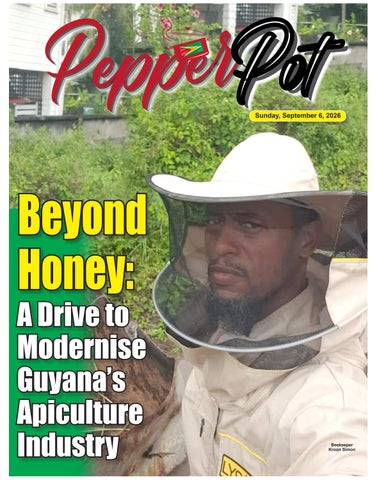
Sunday, September 6, 2026
Beyond Honey:
A Drive to Modernise Guyana’s Apiculture Industry
Beekeeper Kroon Simon
II
CHRONICLE PEPPERPOT ― Sunday, September 6, 2026
Turning Trash into Treasures and Giving Discarded Things a Second Life
By Andrea Hendricks IN Melania Desa’s hands, a peeling purse can become a painted keepsake, an old sweater can acquire a striking new identity, and cardboard and paper can find fresh purpose. From her home in Stewartville, West Coast Demerara, Desa has built her creative work around a simple conviction: what is considered useless can still become something beautiful, practical and meaningful. Her work spans recycling, repurposing, craft-making and celebration. Through Cactus Black Sheep and Fiestaville, she gives discarded materials another chance while encouraging people to consume less, save money and look differently at the objects around them. Desa was born and raised in Venezuela to Guyanese parents before returning to her parents’ homeland years later. Creativity was woven into her early life. At school, drawing, craft-making, story writing and storytelling, game creation and carving sculptures were encouraged, almost mandatory.
Her first love was creating movies for children. “It wasn’t uncommon for children to learn crafts at an early age,” she recalled. “A lot of people love to make and purchase handmade items. It is supported by the local people.” She also grew up loving nature and solitude. In the popular city where she lived with her parents, she spent time in national parks filled with waterfalls and cotton-bearing trees. As a child, she watched cartoons and began drawing them, bringing the images to life on paper with vibrant colours. After completing her university-level education in graphics and publicity design, Desa returned to Guyana. As an art teacher, she enjoyed history and connecting with people who shared her interests. “Growing up, all my friends knew how to draw at different levels,” she said. Crafting has been part of Desa’s life for as long as she can remember. At 13, she made her largest group of piñatas to supply others, an early sign of the creative enterprise that would develop in later years.
Recycling and repurposing have always been central to Desa’s way of working. She used shoes and clothing to create distinctive looks or change their appearance, a practice that made her stand out while she was at university. She does not recall having one particular inspiration for her creativity; the impulse to make and remake has been part of her life. As the enthusiast behind Cactus Black Sheep and Fi-
my way,” she said. One example is the “Starry Night purse”, a cherished piece that began as an old bag. After its surface started peeling, Desa noticed a furry material beneath it. She peeled away the outer layers, painted a Starry Night design onto the purse and transformed it into a usable bag again. Her most unusual creation, she recalled, involved old sweaters decorated with Melania Desa, creative enthusiast and founder of Cactus Black Sheep and Fiestaville, with plaited braids and a sunflower in her hair (Photo credit: Melania Desa)
A piñata offered by Fiestaville for birthday celebrations
Repurposing an old handbag: “A Starry Night” purse, a creation of Cactus Black Sheep
estaville, Desa takes pleasure in transforming items that others might consider trash or unusable. With Cactus Black Sheep, reusable materials are turned into something new, while Fiestaville carries that same spirit into handmade celebration pieces: piñatas. Her favourite materials are cardboard and paper because they are versatile and can be used across both brands. “I work with pretty much anything that comes
painted designs that attracted curious people drawn to their unique patterns. A recycled project can take about a week, depending on how much time is devoted to it each day. Desa’s creative approach is also reflected in the name Black Sheep. “I don’t believe black sheep is something bad; it’s just something different from the crowd,” she said. Somewhere within that idea is her own story of being
different. Cactus, meanwhile, was an alias she used in the dating pool. Desa’s work with piñatas brings colour and anticipation to children’s gatherings and other celebrations. The piñata originated in Mexico and became a tradition across Spanish-speaking countries, where it is common at Hispanic children’s parties. Desa began making piñatas for children’s gatherings, starting with an ice-cream-cone style that she produced for many years. Fiestaville now offers a variety of designs. “Piñatas are the mood-changer at every party,” she said. “I love the vibrant colours and the creativity inside the piñata, which makes partygoers curious to know what’s inside. It gives me a thrill.” Although piñatas are not yet popular locally, Desa believes they can save a party by adding an element of surprise and excitement to a special milestone. To her, they represent mystery, fun, entertainment and the power to revive a celebration. She considers herself a problem solver. When specific materials are unavailable, she improvises to complete the job. Customer satisfaction, she says, is guaranteed at the end of every project. With Cactus Black Sheep, reusable materials are always available, which makes the process different from sourcing materials for other creations. Recycling is also at the heart of her junk journalling. The journals are fun,
creative gifts for friends and loved ones, made by recycling and reusing household items. Desa’s passion began in childhood. “I was that kid when my mother would be ready to throw away things, like an old appliance. I would break it up and make jewels.” Rather than throw things away, she looks for another purpose. Recreating and repurposing allow her to turn trash into treasured paintings or journals. “I try to give things a different purpose or meaning,” she said. Her message is both environmental and practical. “I would like people to save the planet by giving life to things that are considered junk instead of repurchasing them; repurpose.” Reusing items and buying fewer products can also help people save money, she believes. Cactus Black Sheep began as a hobby. As enough creations became available, they were displayed, advertised and sold. Piñatas can be ordered for special occasions and celebrations. Those interested can keep in touch through the social media pages for Fiestaville and Cactus Black Sheep or contact Desa at +592 680-3982. For Desa, every discarded object is an opportunity: to protect the environment, spend less and create something useful or joyful. By giving unwanted items a second life, she is also encouraging people to trust their imagination and build a more resourceful local craft culture.
Beyond Honey:
CHRONICLE PEPPERPOT ― Sunday, September 6, 2026
III
A Drive to Modernise Guyana’s Apiculture Industry
By Michel Outridge FOR Kroon Simon, beekeeping is far more than a hobby. Despite being a trained heavy-duty machine operator and maintaining full-time employment, apiculture has become an integral source of income and an enterprise in which he continues to invest his time, resources and vision. Known in the digital space as “The Swag Beekeeper”, Simon has 28 years of experience in apiculture, specialising in bee removal and relocation, hive establishment and management, consultancy, equipment sup-
ply and honey production. A resident of South Ruimveldt Park, Georgetown, Simon began his beekeeping journey in 1998 at the age of 22 while living on Howes Street, Charlestown. It was there that he came under the mentorship of the late Henley De Souza, who was recognised at the time as one of Guyana’s best beekeepers. De Souza’s encouragement, guidance and willingness to share his knowledge proved instrumental in shaping Simon’s career. What began as an interest eventually developed into a specialised vocation that Simon has continued to build
The late Henley De Souza, who was one of the best beekeepers locally
around his full-time career. His fascination with bees began in childhood when a colony occupied a cashew tree in his family’s yard. Although fear initially kept him at a distance, years of mentorship under De Souza and hands-on experience eventually gave Simon the confidence and technical expertise to safely remove bee colonies from homes, businesses and other locations. After stepping away from beekeeping in 2004 due to circumstances beyond his control, Simon returned to the industry in 2018 and rebuilt his operation from scratch. Determined to modernise his approach and improve efficiency, he invested in specialised equipment, including battery-operated bee vacuums. He imported his first in 2021, followed by a second in August last year, with a third on the way. The equipment enables safer, faster and less labour-intensive bee removal while reducing his reliance on electricity. Simon’s investment in technology reflects his broader entrepreneurial vision. He views beekeeping not as a casual pursuit but as a viable agricultural enterprise and important source of income. Through a strategic partnership, he has established a 100-hive apiary at Silver Hill along the Linden–Soesdyke Highway, enabling the pooling of resources, expansion of hive capacity and increased honey production. He also maintains a smaller apiary on family land at Moblissa, supported by a mobile honey house. Moblissa is particularly important to Simon because of its vegetation and natural forage, which provide favourable conditions for the bees. He reports as many as three honey-flow cycles annually in the area. However, Simon notes that rapid development and deforestation
along the Linden–Soesdyke corridor are reducing vegetation and bee forage, disrupting bee activity and honey-production cycles. The changes underscore the critical relationship between environmental conditions and apiary productivity. For Simon, the partnership at Silver Hill and his operation at Moblissa form part of a deliberate strategy to transform beekeeping into a more structured and lucrative enterprise. By combining his technical expertise, investment in modern equipment and collaboration with other beekeepers, he is seeking to increase production while making the business more efficient and economically sustainable. His experience has also given him a clear perspective on the challenges facing beekeepers. Simon recalls that doing business before 2019 was considerably more challenging, particularly due to limited access to specialised beekeeping equipment. He notes that recent government policies and initiatives have improved the operating environment, making it easier to import modern TURN TO PAGE VII
Beekeeper Kroon Simon
Bees in their natural habitat in hives
IV
An inspiring journey of one healthcare professional
By Michel Outridge
GERARD Khan, 33, is the owner of Medicine Hub Pharmacy. He is a simple person who worked against the odds to fulfil his dream of being self-employed. As a boy from Bartica, he always knew he was destined to fulfil his true potential. He was born and raised in Bartica, where he last attended Three Miles Secondary School before moving to Georgetown. Khan grew up going to church with his family and was a member of the Bartica Full Gospel Church during his early years in Bartica. His faith has always been an important part of his life, and today, God remains a huge part of who he is. “I genuinely believe that none of what I have accomplished would have been possible without God, and I give
CHRONICLE PEPPERPOT ― Sunday, September 6, 2026
Him a lot of praise for where I am today and for where I am going,” he said. Khan told the Pepperpot Magazine that he is one of five children and that family has always been extremely important to him. He comes from a closeknit family comprising his parents, siblings, and his nieces and nephews. Unfortunately, he lost his eldest brother and, more recently, his father. Those losses have made him appreciate his family even more. He has always been very protective of his family, and he believes strongly in representing them and the values they have instilled in him. Khan’s journey into pharmacy was not straightforward, and he spent considerable time searching for the career that was right for him. He told the Pepperpot Magazine that he sold insur-
ance, worked at the Guyana Lands and Surveys Commission and worked in banking and pest control. Khan has always been a “hustler”. Even in high school, he was a conductor on the bus his father drove, shuttling children who attended the same school as he did. He would do this before and after school on weekdays. Looking back, he believes all those experiences helped prepare him for where he is today. Khan eventually found his calling in pharmacy because he always had a natural desire to help people. Even growing up in what he would describe as an average household, he always tried to share whatever little he had and help people in whatever way he could. “I have always enjoyed seeing people doing well,”
he said. That same passion encouraged him to start Medicine Hub Pharmacy in June 2023. Owning his own business has been one of the most rewarding experiences of his life, but he would never say it has been an easy journey, with its hurdles and challenges. Khan told Pepperpot Magazine that entrepreneurship comes with its challenges, sacrifices and moments when you question yourself. He explained that, at the same time, rewards are not always tangible. Sometimes you may not see the results immediately, but you can feel the impact, which makes it worthwhile. Since opening Medicine Hub Pharmacy, he has been focused on constantly growing, expanding and getting the name out there.
Gerard Khan, the owner of Medicine Hub Pharmacy
Khan reported that customer service is extremely important to him, and he tries to ensure that everyone who walks through the doors of his pharmacy receives the level of service he would want for himself, his family and his friends. Outside of the pharmacy, he is also a proud member of the Rotary Club of Georgetown Central, where he was recently appointed Public Image/PR Chair for the 2026–2027 Rotary year. Being part of Rotary has given him another opportunity to do something he has always enjoyed: serving people and contributing to the community. “When I look back at the different jobs and experienc-
es I had before pharmacy, I realise that perhaps I was not lost; I was simply finding my way. Today, I am grateful for the journey, proud of how far I have come and excited about where Medicine Hub Pharmacy can go from here,” he said. For him, it is not just about owning a pharmacy. It is about building something meaningful, serving people and creating something he can be proud to put his name on. Most importantly, Khan knows that through every step of the journey, God has been with him. His family and friends have been by his side, supporting and encouraging him, and for that, he feels truly blessed.
CHRONICLE PEPPERPOT ― Sunday, September 6, 2026
Cara Lodge Symposium to Explore Opportunities for Wellness Tourism
V
Guyana-born Canadian healthcare professional to spearhead international team
By Frederick Halley SEVERAL internationally renowned healthcare and wellness professionals, along with Guyanese and CARICOM VIPs, will converge at Cara Lodge in Guyana on 12 November to explore opportunities to develop Guyana as a destination for wellness tourism, integrative medicine, and health-related travel. The symposium is the brainchild of Guyana-born Canadian citizen Dr Stanley Ngui, who told the Sunday Pepperpot that he is spearheading the Tourism Awareness Month activity, termed the Guyana Wellness Tourism Symposium. Among the internationally recognised speakers expected to participate are: • Dame Dr Sheila Mackenzie, President, World Organization of Natural Medicine • Sir Dr Gerald Smith, Integrative Medicine Doctor • Lori Smith, Director of International Strategy & Development • Menakshi Babulall, Vaksana Eco-Retreat, Essequibo The event is expected to highlight the growing global interest in wellness tourism and the potential for Guyana to develop new opportunities at the intersection of tourism, healthcare, wellness and
international collaboration. Speakers are expected to explore Guyana’s potential to become a leading international destination for wellness tourism, integrating natural and integrative medicine, innovative healing technologies, traditional knowledge, nature-based therapies and whole-person wellness. Presenters are also expected to address the development of eco-lodges and wellness resorts; medical-wellness retreats; international partnerships; sustainable tourism; workforce developmen; research; humanitarian outreach and Guyana’s opportunity to establish itself as a premier wellness destination for CARICOM, South America and the global community. As a member of the Guyanese diaspora, Dr Ngui has spent decades working in Qigong, integrative medicine and wellness and has developed programmes that combine traditional health practices with contemporary approaches to healthcare. The symposium will also provide an opportunity for members of the Guyanese diaspora, local healthcare professionals, tourism stakeholders, and international guests to discuss ways to contribute to Guyana’s emerging wellness tourism sector. With the participation of
Dr Stanley Ngui
Guyanese and CARICOM VIPs, the 12 November symposium is expected to serve as an important platform for dialogue, networking and the development of future wellness initiatives in Guyana. Dr Ngui pointed out, “Guyana does not need to reproduce the wellness model of another country. Its greatest opportunity may lie in developing something distinctly its own.” He disclosed that Guyana offers
an unusual combination of rainforest and biodiversity; rivers and expansive natural environments; Indigenous and cultural heritage; ecotourism; English-speaking accessibility; growing international visibility and a developing hospitality and tourism economy. These attributes create possibilities for wellness travel that go well beyond the conventional resort-spa model.
THE ECONOMIC OPPORTUNITY Wellness tourism, Dr Ngui pointed out, “could potentially touch numerous parts of Guyana’s economy: hotels and eco-lodges; transportation; restaurants; tour operators; health practitioners; professional education; wellness businesses; community enterprises; retreat development; the oil sector; investment and real estate and specialised travel services. “This is why Guyana wellness tourism should be viewed not simply as a health project but also as an economic-development and tourism opportunity with health at its centre. It is an effort to develop an interconnected wellness-tourism ecosystem in Guyana. The November 2026 symposium and outreach programmes are early components of that effort.” Professor Ngui, who hails from Sisters Village, West Bank Demerara, migrated to Canada in 1971. He is an adviser to the World Natural Medicine Organization (WONM), where he is the Dean of Traditional Chinese Medicine and Qigong. As a professor at large for WONM–University of Humanitarian Medicine Federation (WONM-UHMF), he has co-authored the internationally recognised book, Sleep Your Way to Wellness.
Ngui is the founder of the NGUI MATRIX System, which he teaches internationally. The NGUI MATRIX teachings are certification credits at WONM and UHMF. He is also the Chief Integrative Medicine Doctor at the NGUISTYLE Integrative Medicine Clinic Inc. A former principal of the Academy of Acupuncture and the president of Beyond Abilities Centre, a charitable organisation, Ngui is a member of the 23rd generation of the Ngui family and of the North American Martial Arts Hall of Fame. Ngui is also a knight in the Sovereign Orthodox Order of the Knights Hospitaller of St John. As a clinician for over 40 years, he has helped thousands of patients with a wide range of health issues. He has been a speaker on radio and television shows, both nationally and internationally. As a Doctor of Humanitarian Science, he supports Clinics for Humanity. In 2006, Ngui was recognised for his contributions to the martial arts community and was inducted into the North American Martial Arts Hall of Fame. As a Grandmaster in the art of Qigong, he founded the Academy for Chi Kung Studies and became the founding director of the Kung Fu Federation in Toronto, Canada.
VI
CHRONICLE PEPPERPOT ― Sunday, September 6, 2026
Sonia Noel Embraces AI and KSM™ as Fashion Brand Prepares for New Era of Digital Discovery
AS internationally acclaimed Guyanese fashion designer, author and entrepreneur, Sonia Noel celebrates 30 years in the creative industry, she is looking beyond the milestone and deliberately positioning her brand for the future, embracing artificial intelligence both as a creative tool in fashion and as an increasingly important part of how businesses are discovered online. The conversation took centre stage this week in Barbados during Style & Story: A Fashion Experience, presented at the Caribbean Grand Market as part of Noel’s ongoing celebration of 30 Years of Style, Purpose & Impact. During the event, which combined fashion with conversations about Noel’s journey and the industry’s evolution, she was asked about artificial intelligence and
what it could mean for the future of fashion. For Noel, the answer is already becoming practical. “AI is not going anywhere, so the question for me is: how can we benefit positively from it? As a designer, I can now visualise a concept on a model, explore different colours and fabrics, look at the proportions and aesthetics, and make changes before I actually produce the garment. It does not replace my creativity. It gives me another tool to develop that creativity and make more informed decisions,” Noel said. For designers, particularly independent creatives and smaller businesses, the ability to visualise and refine concepts before production can potentially reduce unnecessary sampling, save time and resources, and provide greater freedom to
Sonia Noel with Dr Anthony Bowen
experiment. Noel’s growing interest in AI is particularly significant because she readily admits that technology has never been her comfort zone. “I have never considered myself technologically inclined, but I have realised that no matter what business you are in, technology is going to be part of it. With AI developing so rapidly, we cannot simply ignore it or be afraid of it. We have to educate ourselves and determine how we can use it responsibly and positively, while maintaining the human element of what we do,” Noel stated.
Model at Caribbean Grand Market, Barbados
KSM™ and the Changing Way Businesses Are Discovered That philosophy is now extending beyond Noel’s design process to the rebuilding of her website, scheduled to launch soon. While the new website is being developed to provide a more engaging and user-friendly experience for visitors, considerable attention is also being given to something visitors may never see: how the information behind the website is structured so that search engines and artificial intelligence systems can better understand the Sonia Noel brand. Helping to shape this aspect of the project is Guyanese-born Dr Anthony Bowen, DBA, a corporate AI strategist and professor, and the founder of the Knowledge Structur-
ing Model (KSM™). KSM™ addresses an emerging challenge for businesses. Traditionally, companies focused heavily on Search Engine Optimisation (SEO) to improve their chances of appearing in search results. Today, consumers can increasingly ask AI-powered platforms direct questions, request recommendations, compare options, and receive summarised answers without traditionally navigating the internet. That evolution means it is no longer enough for a business simply to have a website. Its digital information must also be structured in ways that make it easier for AI systems to understand who the business is, what it does, what it is known for and which sources represent authoritative information about it. Bowen’s KSM™ framework focuses on three pillars: Extractable Structured Content, Entity Salience and Citation Authority Reinforcement, expressed through his formula: AI Visibility In practical terms, KSM™ seeks to make information clearer and more understandable to AI systems, strengthening the possibility that a business, professional or organisation can be accurately identified and represented as AI-driven discovery continues to grow. “The way people discover busi-
nesses and information is changing. KSM™ is designed to help organisations structure their knowledge so AI systems can better understand who they are, what they do, how their information is connected and why they are relevant. As AI becomes increasingly involved in how consumers search, ask questions and make decisions, being clearly understood by AI becomes an important part of digital visibility,” — Dr Bowen explained. What KSM™ Means for the Sonia Noel Website For Noel, the benefits are tangible. Her career has evolved considerably over three decades. Today, her digital identity encompasses fashion and Caribbean design, as well as books, entrepreneurship, personal development, mentorship and social-impact initiatives. Without clearly structured information, an AI system searching across the internet could potentially encounter disconnected pieces of that story or fail to understand how they relate to the same person and brand. Through the principles of KSM™, the rebuilt website is being structured to provide clearer signals about who Sonia Noel is, what the Sonia Noel brand represents, the areas in which she operates and the relationships among the different TURN TO PAGE XV
Beyond Honey:
CHRONICLE PEPPERPOT ― Sunday, September 6, 2026
A Drive to Modernise Guyana’s Apiculture Industry
equipment that reduces labour, saves time and enhances operational efficiency. He also welcomes the increasing emphasis on training and technical support for beekeepers. In his view, continued government assistance through training, equipment and other forms of sectoral support can help strengthen the industry. He considers the resuscitation of the queen bee-rearing facility very important. He believes it will improve access to quality queens, which could contribute substantially to hive development, colony expansion and increased honey production. Most recently, Simon received several bee boxes from the Ministry of Agriculture through the Guyana Livestock Development Authority (GLDA) to further expand his apiary. He views the assistance as a timely investment in his productive capacity and an opportunity to build upon the foundation he has established. Simon’s enterprise extends beyond honey production. He specialises in bee removal and relocation, hive establishment and management, bee trapping, consultancy and the supply of beekeeping equipment, including hive boxes. Recently, he established five hives for a customer who has since harvested honey for the first time, demonstrating
how his technical knowledge can help others enter and succeed in the industry. His vision for apiculture is equally broad. Drawing from his agricultural background in crop production, Simon sees bees as an important component of the wider agricultural ecosystem and believes the sector has potential beyond honey extraction. Colony development, queen production, pollination services, consultancy, equipment supply and value-added products, he believes, all present opportunities for economic expansion and future export development. Importantly, Simon is investing in the next generation. His nephew, a final-year engineering student at the University of Guyana, and his son, who works with him part-time and is simultaneously pursuing technical and vocational training in heavy-duty machine operation at MACORP, are both developing their beekeeping skills under his tutelage. For Simon, this combination of formal technical education and practical agricultural training can provide the younger generation with a diverse skill set while strengthening continuity of the family enterprise. Simon’s commitment to apiculture extends to responsible bee management. With nearly three decades of experience, he advocates for
the safe relocation of bee colonies rather than their destruction by burning. He sanitises treated areas using environmental products to discourage colonies from returning and urges homeowners, schools and businesses to seek professional assistance when bees establish colonies in unsuitable locations. He strongly discourages the practice of burning hives, which can endanger people and destroy valuable pollinators. From a young man who was once afraid to approach bees in a cashew tree to an experienced beekeeper, entrepreneur, innovator and mentor, Simon’s journey illustrates the potential of apiculture as a viable agricultural enterprise. His story demonstrates that with entrepreneurship, modern technology, strategic partnerships, appropriate government support and investment in the next generation, beekeeping can evolve from a personal passion into a sustainable and increasingly profitable source of income. For the “#1 Swag Beekeeper, Never #2”, the future of apiculture is not simply about producing more honey. It is about working smarter, protecting the resource, developing people and building an industry capable of generating greater economic value for Guyana.
VII
FROM PAGE III
VIII
CHRONICLE PEPPERPOT ― Sunday, September 6, 2026
Would you share it?
SOMETIMES, we may believe that every resource we receive or seize is limited by its finitude. Its value is greatly affected by how much of it we can own. For example, wealth is valuable because there always seems to be less of it available than we need. On the other hand, love is only valuable when it is unconditional and infinite. The moment wealth becomes abundant, and love becomes finite, they both begin to lose their lustre. Yet, strangely, neither having large amounts of wealth nor having small amounts of love, that is, having either resource in its least desirable form, makes the owner more likely to share it
with another person. In fact, it makes him more likely to hoard it and keep it to himself. So we should consider whether it is the quantity of a resource that determines its value, or the perspective of its owner. The desire for us to share seems inherent. From the very beginning of time, we have seemed inclined to share what we have with those around us. Everything from food to knowledge was something owned and shared by the entire community because the ignorance or starvation of even one member would become a significant loss to the whole village. Today, the idea of sharing is no longer an obligation for survival but
rather a moral option. The rich are not necessarily seen as cruel for not sharing their wealth with those who struggle, but when they do share, they are celebrated and acknowledged as being generous. A population may not perish because it is made up of selfish members, but when people do choose to help each other, it is more likely to thrive. So, now that the ability to share is no longer about a population’s survival, it ironically becomes a largely individual responsibility. Although we may not realise it, sharing is one of the only ways by which our lives can gain meaning. We do not need to be altruistic to be
generous. We only need to have the desire to find a greater purpose for ourselves. As we go about our lives, without even realising it, we find ways to give pieces of ourselves to the world. This is our way of making a mark and creating more space within ourselves to grow. If we lose the ability to share, we begin to lose our sense of identity. Sometimes, sharing is not just about what we can afford to give; it is also about what we must let go of. Burdens that we can no longer carry may easily become a new relationship if we choose to share them with others. Memories that are too heavy for us to hold may become
lessons for generations that are seeking ways to learn and grow. Even in today’s world, when sharing has become an individual imperative rather than a collective one, sharing is a way to retain our sense of community and belonging. The world today moves far too quickly for us to think about giving or gaining trust. Sometimes it is hard for us even to share our thoughts, let alone our time and energy, with those around us. Yet there are still small ways in which we seek the joy that comes from sharing. When we post pictures on social media or smile at a stranger, we are, in fact, sharing something with them. There are both good
things and bad things that we can share. Regardless of what we choose to give to someone else, the very act of sharing something allows us to build a bridge with others. As we grow, we will experience sorrow and pain in the same way that we will experience joy and happiness. We will find success and also have to weather failure. In all these things, the only factor that makes our experiences worth their effect on us is our ability to share them with others. So, when you have a little or a lot, when you have something that means something to you, would you choose to share it?
IX
CHRONICLE PEPPERPOT ― Sunday, September 6, 2026
Make Learning Your Best Friend Plan Your Future Learning MANY people want to increase their learning but hope that it will happen spontaneously. Those who want to be successful must plan for their success. Many people might not have completed their schooling and may be disappointed. When people have academic credentials, they have the opportunity to make an impact. Those people who did not complete their formal or informal schooling and wish to continue must know that there are more opportunities for them to continue their learning. However, they must plan to further their education. There is always a sacrifice to be made, and those who are willing to make it will have many successes to talk about.
Learning must not be ignored. Instead, it must be embraced! Education will be challenging, even for educated people, but it must become a lifestyle for many. Education is never restricted to children, since there is no age limit. Many adults ought to continue their education so that they can help their children, seek better employment opportunities, and make a significant impact on society. There are many benefits associated with learning. Some people may view education as an opportunity for them to show off their knowledge to those who may be less educated. However, increasing knowledge must never be done to impress the competition. Those who have learnt must also encourage
and help others to learn, so that there are more knowledgeable people around the world. Successful people often set goals. They usually identify what they need. Thereafter, time is allocated to those goals. Therefore, if you want to succeed in your learning, you must be willing to set timelines for your studies. When a timeline is set, you will challenge yourself to finish your education within a specific timeframe. Too often, people do not set a timeline, and as time elapses, they lose focus and may quit. Section B: Formal Learning Learning is not confined to a classroom. This may be a surprising statement to people who think they must
attend school to learn. However, this section of the book examines learning from a formal perspective. Yes, attending school is very important. Not everyone can learn quickly on their own. There are a few people who can read, learn and
apply themselves to many situations without much assistance. However, other people need the aid of a teacher, facilitator, or lecturer to understand certain concepts, theories, etc. There are many learning institutions within the coun-
try. People may be able to choose where they wish to continue their formal learning, or they may have to work with the limited choices that are available to them. Whatever options are available, individuals must take TURN TO PAGE XII
X
CHRONICLE PEPPERPOT ― Sunday, September 6, 2026
XI
CHRONICLE PEPPERPOT ― Sunday, September 6, 2026
The Horror: A Brief Account of the Destruction of the Indies by Bartolomé de las Casas THE twin horrors of murder and greed define A Brief Account of the Destruction of the Indies, Bartolomé de las Casas’s 1542 polemic on the unrelenting atrocities committed by the Spanish and, to a lesser degree, the Germans against the Indigenous peoples of the Caribbean and Latin America. De las Casas, a Dominican friar, witnessed some of this violence himself, a fact that lends his account a disturbing authority. The deaths come by sword and lance, by fire, drowning, starvation and torture. They are plentiful, varied and vividly rendered. Again and again, the reader is brought face to face with the grotesque machinery of colonial conquest and with a history that constitutes a
terrible part of the Caribbean experience. The Spanish made a ritual of murder and mutilation, torture and rape, plunder and destruction. The “destruction” of the book’s title refers not merely to the violent deaths of individuals but to the systematic killing of populations, what de las Casas repeatedly describes as “depopulation”, a seemingly simple word that, in its proper context, amounts to wanton and reckless slaughter. It is a difficult book to read, not because of any density or difficulty in its prose, although there is some of that, but because of the sheer relentlessness of the violence, which might be tolerable if it were fiction, as in Cormac McCarthy’s ultraviolent novel, Blood Meridian, or
The Evening Redness in the West. De las Casas spares the reader little. Torture abounds: burning, starvation, quartering, stabbing, drowning, mutilation and rape. After two or three chapters, the accumulation becomes almost unbearable. Captives are roasted over fires to extract information. Whole towns are “put to the sword”. Babies are seized, swung by their legs and thrown into fires, or have their heads dashed against stones. It is a nightmare book, stubbornly and almost obsessively focused on the atrocities committed by Spanish colonials in the Americas. Yet the book is also, and perhaps more profoundly, a meditation on greed. Here, greed knows no horizon when the object is gold. The
book is a catalogue of plunder, with the later logic of colonial predation already fully visible. The murders de las Casas describes are not simply cruel; they are, in many instances, extrajudicial even by the standards of the time and profoundly irreligious. The latter point matters greatly to de las Casas, a Christian friar and a witness to some of the
slaughters. He is appalled by the contradiction between the professed faith of the conquistadors and the violence they inflict upon the people they have conquered. He comes to understand that, in the pursuit of gold, every imaginable horror becomes permissible. Gold is the Spaniards’ deity, as one of the doomed caciques declares as he prepares to be burned.
What makes the violence so appalling is its apparent lack of necessity. The Indigenous peoples were often willing to surrender their gold without being forced. They offered it to the Spaniards in considerable quantities, yet the conquistadors, consumed by their appetite, remained convinced that there was always more. Thus, torture TURN TO PAGE XIV
XII
CHRONICLE PEPPERPOT ― Sunday, September 6, 2026
Make Learning Your Best Friend Plan Your Future Learning FROM PAGE IX
responsibility for learning. Not everyone will be able to attend a recognised learning institution, so they must make the best use of the options available to them. For many people, formal
learning starts at playschool (daycare) and continues through university. A person must determine how far they want to continue in their education. Some people choose not to attend a university and
are very successful today. People attending formal learning institutions will incur some costs, but they must look beyond them, as the rewards will outweigh the sacrifices. Some govern-
ments offer free education to people from nursery to university. Those people who would benefit from free education must make greater use of the opportunities provided to them.
Many people may not have time to attend formal classes. Therefore, online learning is still an option for many. People who are working or have busy lives can make great use of online learning. However, they must be disciplined enough to learn through online options. The cost of online education may be lower than attending classes, but it is their responsibility to start and finish their studies. Most learning institutions will assess people before and during their studies. Assessments will be done via quizzes, monthly tests, endof-term tests, individual or group presentations, etc. Assessments allow facilitators to better understand students’ knowledge of the taught materials and their ability to apply what was learnt. Section C: Informal Learning Even teachers and other educators rely on informal learning to prepare for formal sessions with students. No one can avoid informal learning, since it is all around them. Within the home, they have access to some form of news, whether by purchasing daily newspapers, watching the news on television, etc. Many people have discussions at work after following the news. People must be careful about the news sources they choose, since some can affect their decision-making. Workplaces may have mentors who help employees become better equipped for the tasks set before them. Smart employees will take every opportunity to glean wisdom from their mentors so that they may operate similarly to their mentors. It is important to be respectful to your mentor, observe their actions and ask interesting
questions. Not every mentor will be the same, but employees need to adjust and learn from them. Educational games and sports also help people learn. For example, people may be involved in Scrabble, which helps them identify words from the letters. Many sports can help people become disciplined and focus on future learning opportunities. Parents sometimes enrol their children in sports, as they may receive a scholarship to further their studies once their performance meets the established requirements. Many places and activities within people’s communities and countries will help them learn. Visiting historic sites is a rich source of learning. Simply birdwatching may provide good knowledge to people. Learning opportunities often surround many people, but they have to be willing to learn. Several organisations and government agencies offer learning opportunities for people and communities. For example, there may be health fairs where much important information is shared with attendees. Sometimes, pamphlets, brochures and other informational documents are provided. In panel discussions, many facilitators connect with people and address critical concerns they may have. Attendees are sometimes allowed to ask questions or share comments during panel discussions. For more information about Geary Reid and his books, please use these contact details: Amazon: amazon.com/author/gearyreid; website: www.reidnlearn. com; Facebook: ReidnLearn; email: info@reidnlearn.com; mobile: 592645-2240.
XIII
CHRONICLE PEPPERPOT ― Sunday, September 6, 2026
Arawak Girl From branches to roots
ANN Marie, a young native girl of the Arawak tribe, sat on the bank of the creek, looking across the smooth, tranquil waters, in awe, as she always was, at the magical splendour of the sunset in its burning red and tangerine glow. The natural beauty and serenity of this place in the interior that she called home lived within her heart; a deep love to which, in her mind, she gave wings to fly like the magnificent harpy eagle. It was a love that soared from the Pakaraimas, over the majestic Kaieteur Falls, across plains and sprawling savannahs and through the lush green forests, home to exotic birds and rare flowers. From time to time, she had tried visualising her foreparents walking 11,000 years ago from Northern Asia, across the Bering Strait during the Ice Age, to this land on the South American continent. A land with black-water creeks, rich vegetation and untouched beauty, waiting to be discovered; to be peopled. The different tribes, with their traditions and cultures, the first to walk this land, had settled here until a white explorer laid claim to having discovered it. Every time she heard that story, she always wondered, “How can anyone discover a land when it’s already inhabited?” The riches of the gold and diamonds attracted strange and dangerous men who were desirous of finding them, but for her, an Amerindian native, the richness was the land’s splendid beauty; the cool, fresh air; the gushing streams; the soft whispering of the wind and the sounds of the jungle.
She was adventurous, and the exciting part of her life was exploring and discovering places even skilled hunters and trackers knew not; the hidden places where rare flowers, birds and butterflies made their homes, nature’s secret little hideouts. It was that adventurous spirit that had helped her find the lost plane. It had crashed in the jungle with a European family on board eight years ago, and the young white boy whose life she had saved had become her friend. He had promised to return one day, and true to his word, he did come back years later with a team of archaeologists to film a documentary on the fabled El Dorado, the City of Gold. “I can’t believe,” she had said to herself in her native tongue, “that, after centuries, they still believe this tale.” The early explorers had spread tales of a land so rich that the streets were paved with gold. Those tales spawned a legend of the lost City of Gold because it was never discovered, though excerpts from journals by early explorers suggested that El Dorado did exist. David’s team spent two months there but found nothing new, and El Dorado remained a legend. A special friendship between them, formed when she had saved his life, grew into something beautiful as they grew up. Before leaving on his last visit, he had given her an engagement ring and promised to come back for her so she could travel the world with him on expeditions. “Wait for me,” were the last words he had said to her. Ann Marie twirled the diamond band on her finger and sighed deeply.
David had been back for two weeks now, and the Toshao had performed a simple traditional ceremony, joining them in matrimony. Soon, it would be time to leave, but she was not feeling overjoyed. She knew visiting the Aztec ruins and Mayan dynasties across Central America would be the adventure of a lifetime, but her heart was here; written on the leaves, carved on the tree trunks, flowing with the gushing streams, the home
her ancestors had discovered, their footsteps imprinted on the land. How could she leave? A distinct barking sound broke into her musing, and she looked up across the water. The otters, their dark, glistening heads bobbing in and out of the water, were swimming towards her. They were her aquatic friends, whom she always saw at sunset. She spoke to them in her native tongue as they TURN TO PAGE XVI
XIV
CHRONICLE PEPPERPOT ― Sunday, September 6, 2026
The Horror: A Brief Account of the Destruction of the...
FROM PAGE XI
was used not because the Indigenous peoples refused to give up their wealth but because the Spaniards could not believe that what they had received was enough. The point is central to de las Casas’s indictment: greed is not satisfied by possession. It creates its own insufficiency.
There is always another town to ransack, another village to raze, another people to pillage. The injustices are of a kind that haunt because they suggest something elemental about human behaviour: the capacity to suspend common decency when greed
becomes the governing principle. Greed here knows no horizon. Not all the gold in the world is enough, and there are no moral limits to the means of acquiring it. In her recent novel Paradise Once, which I reviewed in this column, Olive Senior writes with great imaginative
force about the depopulation of Xaymaca (Jamaica) and Cuba by the Spaniards: the razing of villages, the murder of inhabitants and the flight of survivors into the mountains. One can hardly read Senior’s account without thinking of de las Casas.
In his narrative, however, there is scarcely any refuge. Those who flee are pursued, rounded up on horseback and “run through” or “put to the sword”. These phrases, chilling in their matter-of-factness, manage to conceal as much as they show. They suggest the act of killing without fully conveying the brutality of slaughter. De las Casas is, among other things, a writer of extraordinary detail. His attention is not limited to geography and historical circumstance. He gives us the names of Indigenous kings, princes and princesses; he offers glimpses of their societies and customs; and, with mordant carefulness, he records the circumstances of their deaths. Through these details, what is destroyed is revealed as something more than a population. Entire societies and cultures are being dismantled. The horse becomes a formidable instrument of conquest, allowing the Spaniards to pursue, surround and run down those attempting to escape. Sword and lance complete the work. The technology of violence is intimately connected to the technology of conquest. Then there is fire, which the Spaniards employ with a particularly horrifying avidity. De las Casas describes occasions on which Indigenous people are herded into buildings, locked inside and the buildings “put to the torch”. The phrase is almost banal compared with the horror it describes. Fire is only one method. There is the cutting off of hands, noses, ears and lips: mutilation used as punishment and as a means of extracting information. What is striking, especially in contrast, is the description de las Casas gives of the Indigenous peoples themselves. The people the Spaniards encounter are often portrayed as peaceful, trusting and hospitable. They welcome strangers into their midst with kindness and civility. The contrast is very stark: on one side, a culture of hospitality; on the other, a culture of conquest whose appetite appears to grow with every victory. The meek are massacred in Xaymaca, Cuba, Santo Domingo, Haiti and many other parts of the Caribbe-
an and Latin America. The strategy is depressingly consistent: kill, plunder, torture, extract and move on. The geography changes; the method does not. Murder everyone and take their gold. Torture those who remain to discover where more gold may be found. The repetition is itself part of the horror. A persistent motif of the book is the sheer senselessness of the slaughter. There is little evidence of the kind of sustained military resistance that might explain, though certainly not justify, the scale of violence. When resistance does occur, the Indigenous people are often routed by superior weapons and military organisation. For the most part, however, de las Casas presents them as peaceful and co-operative with the invaders. There is no war in the strict sense of the term. There is no sustained Indigenous threat capable of explaining the violence that follows. What we encounter instead is something closer to bloodlust: violence that feeds upon itself and cannot be satisfied by victory because victory only opens the possibility of further plunder. This is perhaps the most disturbing dimension of de las Casas’s account. The violence is not presented as an unfortunate excess of conquest, an occasional lapse in discipline or an aberration committed by a few bad men. It appears repeatedly, across territories and communities, as part of a system of ethnic cleansing. The murder of Indigenous people, the destruction of their communities, the seizure of their wealth and the use of terror to compel submission become recurring features of the colonial enterprise. A Brief Account of the Destruction of the Indies is both difficult and necessary. Its subject is not simply the cruelty of individual men. It is the moral catastrophe that occurs when conquest, religion, technology, and greed combine, and when the humanity of the conquered is subsumed by the conqueror’s appetite. This catastrophe is relentlessly enumerated through villages destroyed, bodies mutilated, children murdered and societies erased.
XV
CHRONICLE PEPPERPOT ― Sunday, September 6, 2026
Sonia Noel Embraces AI and KSM™ as Fashion Brand Prepares... FROM PAGE VI
dimensions of her work. The objective is also to strengthen the official website as an authoritative digital source about the brand. Potential benefits of this approach include stronger AI visibility, more accurate representation of the brand, improved digital authority and greater opportunities for discovery as consumers increasingly use AI-powered platforms to find people, products, services and expertise. “That was an eye-opener for me. We are not rebuilding my website simply to make it look better. Of course, it has to be beautiful and user-friendly, but we are also thinking about how people will discover and understand the Sonia Noel brand in the future. If AI is becoming part of the way people search and make decisions, then I want my business to be prepared for that future,” Noel said. Noel credits Bowen with helping her move beyond seeing AI as something highly technical and outside her world. “Dr Bowen has really helped to shape my view of what AI can mean for my business and how I can incorporate it positively into my work. I don’t have to become a technology expert, but as an entrepreneur, I have a responsibility to understand what is changing around me and determine how those changes can strengthen what I am building.” — Sonia Noel Taking KSM™ Home to Guyana For Bowen, however, KSM™ represents more than a corporate or academic undertaking. Having migrated from
Guyana to the United States, where his career developed across business, technology and academia, he sees enormous potential for AI to create new opportunities for his home country. “I don’t want the next generation of Guyanese to simply consume AI technology. I want to see them learning it, building with it, creating businesses around it and competing for AI-enabled jobs in the global economy while remaining in Guyana and contributing to its growth,” Dr Bowen explained. Bowen is enthusiastic about sharing his expertise and the KSM™ framework in different parts of the world and is particularly looking forward to opportunities to bring the conversation home through events, workshops and educational engagements in Guyana. He intends to help entrepreneurs, professionals, business leaders and young people understand not only AI itself but how businesses across various sectors can begin preparing for an economy in which AI will increasingly influence visibility, customer discovery and competitiveness.
Technology Should Support, Not Replace, Human Creativity For Noel, there is an equally important principle underpinning her embrace of AI: technology should never remove the humanity from fashion or entrepreneurship. The story behind a collection, cultural influences, craftsmanship, relationships with clients, intuition and the designer’s creative vision remain distinctly human.
AI, she believes, should be used to enhance those abilities rather than replace them. As Noel celebrates 30 Years of Style, Purpose & Impact, the timing of this new direction is particularly meaningful. Her anniversa-
ry is not only providing an opportunity to look back at three decades of accomplishments but also to ask what the next chapter should look like. From using AI to visualise fashion concepts before production to rebuilding her
website with KSM™ principles designed for a new era of digital discovery, Noel is demonstrating that business longevity requires a willingness to continue learning. Thirty years after beginning her journey in fashion,
Sonia Noel is not simply celebrating where she has been. She is deliberately preparing her brand for where the world is going next. Visit sonianoel.com. (Article submitted by Sonia Noel)
XVI
CHRONICLE PEPPERPOT ― Sunday, September 6, 2026
Arawak Girl
frolicked, splashing the cold, black water all over her. She laughed, and above the din, she heard a loud screech and looked up into the sky as a harpy eagle, the largest in the world, sailed past towards its habitat. A soft wind blew past, ruffling her long, black hair, and tears misted in her eyes. “It’s all here,” she thought. “Our past as a people from a far-off land who came to this
rich, green land.” The sun sank deeper in the west, and she stood up and watched the otters as they swam back up the creek until she could see them no more. She whispered, “I’ll see you again one day.” “Ann Marie!” She turned at the sound of David’s voice and smiled through her tears. “I’ll miss home.” “I know,” he said, wiping
her tears. “You’re my Indigenous princess, and I don’t want that ever to change, so we won’t stay away too long from your homeland because this is where your heart is.” He slipped a gold bracelet with tiny, intricate carvings onto her wrist. “What is this?” she asked. “Something inspired by your Mayan ancestors in Guatemala.” A spark of interest stirred
FROM PAGE XIII
in her eyes, and she knew this journey was going to take her through many lands where her ancestors had made their homes and that, one day, maybe, she would reach that point in Northern Asia where it all began, bridging that link to South America that was now home. A legacy that would live on; a life and a culture to celebrate as Indigenous people.
XVII
CHRONICLE PEPPERPOT ― Sunday, September 6, 2026
Thoughts That Stay
EVERY morning begins with a conversation, one that happens long before the first cup of coffee, the first traffic light, the first message on the phone or the first smiling face. The conversation begins in the space between waking and rising. The mind greets the day with a thought, and that thought sets a direction. Every thought carries a destination, and every repeated thought becomes familiar terrain. This truth has more power than any catchy affirmation ever printed on a coffee mug or shared across social media. Science has spent decades studying the relationship between our thoughts
and our brains. Researchers have explored neuroplasticity, which describes the brain’s extraordinary ability to change throughout life. Every experience leaves a trace, every lesson creates a connection, and every repeated thought strengthens a pathway. Canadian psychologist Donald Hebb expressed this beautifully with a principle that became famous in neuroscience: “Neurons that fire together wire together.” The phrase sounds technical, yet the meaning feels wonderfully human. Every repeated thought becomes easier to think again because the brain enjoys efficiency and certainly loves familiar roads. Many
people spend years searching for one magical sentence that transforms their lives. The search often ends with beautifully designed affirmation cards promising abundance, confidence or happiness. Those cards offer inspiration, yet real transformation grows through repetition. The brain values consistency more than performance. One thoughtful sentence repeated every day creates a stronger influence than one hundred beautiful phrases spoken only once. The mind resembles a garden far more than a courtroom. Every thought plants a seed, every repeated thought receives water, every watered seed grows stronger roots,
and the harvest eventually reflects the care given to those moments that nobody else ever sees. Dr Rick Hanson, psychologist and author of Hardwiring Happiness, often reminds readers that the brain develops according to repeated experience. Joy practised repeatedly becomes easier to recognise, gratitude practised repeatedly becomes easier to feel, and compassion practised repeatedly becomes easier to express. The brain welcomes familiar emotional patterns because repetition creates efficiency. Life offers countless examples. In fact, a child hears encouraging words from a loving parent every morning before school,
and those words gradually become the child’s own inner voice. Years later, that adult faces a difficult interview and quickly thinks, “I prepared well, and I have something valuable to offer.” The parent’s voice evolved into the child’s thoughts, and the child’s thoughts became confidence. Another person experiences years of criticism. Every mistake receives attention, while every success passes unnoticed. The mind begins to expect disappointment because repetition has shaped that expectation. The wonderful news rests within the science itself. New thoughts create new pathways, and repeated new thoughts strengthen those
pathways. Growth becomes possible because the brain continues learning throughout life. This is a possibility that fills me with hope. Many conversations about affirmations sound wonderfully poetic. Poetry certainly nourishes the soul, yet everyday life asks practical questions when the electricity bill arrives, when children become sick, when relationships experience seasons of joy and seasons of challenge, when careers shift, when families grow, or when grief visits every home. In daily life, thoughts that feel believable settle comfortably into the nervous system. A simple thought often TURN TO PAGE XVIII
XVIII
CHRONICLE PEPPERPOT ― Sunday, September 6, 2026
Thoughts That Stay
carries tremendous strength. “I handled yesterday well.” “I know how to learn.” “I welcome today’s opportunities.” “I deserve moments of peace.” Those thoughts create stability because they rest upon lived experience. The heart recognises sincerity, and the brain embraces familiarity. Dr Andrew Huberman frequently discusses the relationship between atten-
tion and the brain. Attention shapes learning, and focus strengthens neural circuits. Repeated attention influences future perception. The mind gradually notices whatever receives regular attention. A gardener notices flowers because flowers matter, a musician notices melodies because music matters, and a grateful heart notices blessings because gratitude receives daily attention. This pattern appears everywhere. Someone purchas-
es a bright yellow car, and suddenly yellow cars seem to fill every road. The number of yellow cars remains almost the same, yet attention changes perception. Psychologists often describe this through the reticular activating system, a network that helps the brain decide what deserves conscious awareness. The brain filters millions of pieces of information every moment, and repeated thoughts influence those filters. Our thoughts introduce us to our
world and inspire a tremendous sense of responsibility. Every morning presents an invitation to choose the thoughts that receive our attention; every conversation presents another opportunity, and every challenge offers another moment to strengthen a healthier pathway. Grief teaches this lesson honestly. It carries memories, longing, love and change. Grief also carries thoughts that revisit familiar moments. Every grieving heart remem-
bers conversations, birthdays, photographs, laughter and random evenings. These memories deserve tenderness because love always leaves beautiful fingerprints upon the heart. Healing grows alongside those memories. It welcomes thoughts such as, “Love continues through remembrance.” Healing embraces, “My heart expands through every meaningful memory.” Healing celebrates, “Every beautiful moment remains part of my story.” Those thoughts honour both love and life; they create space for remembrance while encouraging gentle movement forward. Science beautifully supports this journey too. Emotional experiences strengthen memory because the brain values significance. Positive emotional experiences repeated over time gradually build resilience. Researchers continue to discover how gratitude, compassion, purpose, and meaningful relationships support emotional well-being. Every discovery echoes something beautifully simple. The thoughts we practise become the thoughts we recognise most easily. One person wakes every morning expecting frustration, while another person wakes expecting opportunity. Both individuals encounter unexpected delays, changing weather and demanding schedules. Their experiences differ because their thoughts influence interpretation. One person notices obstacles, and the other notices possibilities. Both people share the same world, yet each mind forms a different relationship with it. That may explain why thoughts deserve greater respect than affirmations alone. Thoughts accompany us while driving, cooking, gardening, working, laughing, crying, celebrating and resting. Thoughts that narrate our lives become our companions, teachers, architects and storytellers. They shape habits, influence choices and emotions, and guide our behaviours. Every repeated thought becomes another brushstroke upon the portrait of who we become. Perhaps today’s greatest invitation rests within a wonderfully ordinary question: “What thought deserves another moment of my attention?” One thoughtful answer today becomes tomorrow’s familiar pathway. One compassionate sentence becomes
FROM PAGE XVII
next week’s confidence. One hopeful perspective becomes next month’s resilient habit, and one grateful thought becomes next year’s peaceful heart. Transformation isn’t a destination welcomed by fireworks. Transformation arrives subtly; it arrives through one thought, then another, then another and so on until, one ordinary morning, the mind naturally speaks with kindness because kindness finally feels like home. As usual, here is this week’s poetic feature in closing. The Thoughts That Stay One little thought knocked at my door, It asked for time and nothing more. I gave a smile, I shared my day, That gentle guest decided to stay. Another thought arrived with grace, It filled my heart with calmer pace. It painted hope in colours bright, And turned my dawn towards the light. Each thought became a tiny seed, It grew through every loving deed. The roots reached deep beneath my soul, And slowly made my spirit whole. The mind remembers every trail, Each whispered dream, each hopeful tale. The paths we walk grow clear and wide, With every step we take inside. Today I choose a kinder view, A thought that’s honest, strong and true. My heart responds with steady ease, Like summer dancing through the trees. My future blooms through what I keep, The thoughts I plant, the faith I reap. Each moment shapes my way, And builds tomorrow from today. So guard your thoughts with gentle care, For hope grows strong through daily prayer. The life you seek begins anew, With every thought that carries you.
CHRONICLE PEPPERPOT ― Sunday, September 6, 2026
XIX
XX
CHRONICLE PEPPERPOT ― Sunday, September 6, 2026
CHRONICLE PEPPERPOT ― Sunday, September 6, 2026
XXI
XXII
CHRONICLE PEPPERPOT ― Sunday, September 6, 2026
CHRONICLE PEPPERPOT ― Sunday, September 6, 2026
XXIII
XXIV
CHRONICLE PEPPERPOT ― Sunday, September 6, 2026
CHRONICLE PEPPERPOT ― Sunday, September 6, 2026
XXV
XXVI
CHRONICLE PEPPERPOT ― Sunday, September 6, 2026
CHRONICLE PEPPERPOT ― Sunday, September 6, 2026
XXVII
XXVIII
CHRONICLE PEPPERPOT ― Sunday, September 6, 2026
CHRONICLE PEPPERPOT ― Sunday, September 6, 2026
XXIX
XXX
CHRONICLE PEPPERPOT ― Sunday, September 6, 2026
CHRONICLE PEPPERPOT ― Sunday, September 6, 2026
XXXI
XXXII
CHRONICLE PEPPERPOT ― Sunday, September 6, 2026
CHRONICLE PEPPERPOT ― Sunday, September 6, 2026
XXXIII
XXXIV
CHRONICLE PEPPERPOT ― Sunday, September 6, 2026
CHRONICLE PEPPERPOT ― Sunday, September 6, 2026
XXXV
XXXVI
CHRONICLE PEPPERPOT ― Sunday, September 6, 2026
CHRONICLE PEPPERPOT ― Sunday, September 6, 2026
XXXVII
XXXVIII
CHRONICLE PEPPERPOT ― Sunday, September 6, 2026
September 6th, 2026 STUDY SUCCESS Welcome, dear friend. Make effective use of short study breaks by using them either to reinforce learning or to relax. During revision breaks, choose active, high-impact methods instead of passive ones, and give your full attention to one specific topic. You might test your memory with flash cards, write brief outline notes, reorganise
or recall notes on a topic, use selected notes to prompt memory, outline an answer to an important question, improve existing notes, or draw and label a diagram. Be wise. Love you. THE PASSAGE Examining expository writing style alongside descriptive and narrative Note: To do this we are
going to compare how different formats use words to inform, paint a picture, or tell a story. But first, know that the main aim of expository writing is to inform and explain, and to appeal to the reader’s understanding. It may also include elements of narration, description or definition, and argumentation. This writing uses facts, statistics, and evidence only. And second, the aim of descriptive and
narrative is not to explain at all. It is to evoke reality by calling up an image of what has been seen, heard, felt, or enacted. Descriptive writing paints a picture with words by using sensory details and figurative language to engage the reader’s emotions and imagination. Narrative writing tells a fictional story featuring characters, dialogue, and a plot with a beginning, middle, and end. Description and narration are therefore rightly called imaginative or creative. As literary forms, they must be distinguished from the matter-of-fact description and narration that may be found in catalogues, textbooks, encyclopedias, scientific books/ journals, directions, guides, advertisements, court records, biographies, and the like. The writer of exposition tries to convey information, versus the story line of narrative writing. Here is one example of an expository paragraph. It is based on research and science. In it, Sigmund Freud, an Austrian neurologist, founder of Psychoanalysis, gives an explanation about dreams in 1899/1900 in one of his voluminous writings. The text: We revert in our dreams to the modes of thought characteristic of early childhood. Our thinking becomes concrete, pictorial and non-logical, and expresses ideas and wishes we are no longer conscious of. Dreams are absurd and unaccountable because our conscious mind, not willing to acknowledge our subconscious ideas, disguises them. Here is an example of a narrative with down-to-earth action where description and narration are closely allied: Bonita dashed to the local fashion store to grab the balanced parcel for her mother’s church wear, next day Sunday. As she exited the car, she noticed the manager and the chief guard walk out of the store, lugging a bag of heavy padlocks. Above their heads flashed the bright red electric sign spelling ‘Closed.’ She was much too late.In a narrative the descriptive element may account to no more than phrases and sentences interspersed here and there to bring out character, setting, or emotion, as
Now, here, you see, it takes all the running you can do, to keep in the same place. LEWIS CARROLL (1832-1898) “Through the Looking-Glass,” ch. 1 in the following passage from a novel by Wiliam Faulkner’s “Light in August.” The boy’s diction was slow, recapitulant, each word as though chosen simply and carefully and spoken slowly and clearly for the ear of a foreigner: “Listen Cap’m. When I turn off here, it’s just a short cut … a short cutoff to a better road … so we can get there quicker. See?” “All right,” Christian said. The car bounced and rushed on, swaying on the curves and up the hills and fleeing down again as if the earth had dropped from under them. Mail boxes on posts beside the road rushed into the lights and flicked past. Now and then they passed a dark house. Something to Do As you continue to actively study numerous texts, try to see how an author’s purpose dictates the form of his writing. Let the study group discuss their findings. This helps learning move away from passive reading to active analysis. THE SHORT STORY Making inferences What is a short story? It is a limited prose fiction that can be read in one sitting and what you need to be good at for your examination. Yours should be about 450 words in total. You should trade upon a single event, a small group of characters, one main mood or theme, and a clear impact upon your reader. Short story writers do not tell you everything there is to know about their characters, settings, and events. Instead, they leave it to you to make inferences, or logical guesses, about unstated information. To form inferences, you must recognise details in
the story and consider their importance. As you studyread the story, use a chart to record details that can help you make inferences. Directions: Read the selection. Then, answer questions 1-4. Mr. Dickson began to speak at the business meeting. His hands shook so badly that he could scarcely hold his business cards. Beads of sweat formed on his forehead. He paused and took a sip of water. “I can do this,” Mr. Dickson thought to himself. He took a deep breath and continued his presentation. In time, smiles appeared on the faces of the audience. When he finished his speech, Mr. Dickson received enthusiastic applause. 1. Based on the passage, what can you infer about Mr. Dickson at the start of his speech? A.. He is confused. B.. He is nervous. C.. He is confident. D.. He did not write it himself. 2. What detail suggests that Mr. Dickson was prepared for his speech? A.. He drinks water. B.. He is at a business meeting. C.. He takes a deep breath. D.. He has note cards. 3. What detail suggests that Mr. Dickson is determined to succeed? A.. His audience smiles. B.. His hands shake badly. C.. He encourages himself. D.. He speaks in a low voice. 4. What can you infer from the round of applause from the audience? A.. They felt nervous themselves. B.. The speech improved greatly. C.. The speech ended abruptly. D.. They were glad when the speech was over.
CHRONICLE PEPPERPOT ― Sunday, September 6, 2026
XXXIX
What you should not do
TEETH wear down and break. In addition to proper oral hygiene, please consider these additional pointers. Don’t even think about opening a bottle or a wrapper with your teeth. Using your teeth as a can opener or chewing on pens, ice or popcorn kernels can dull or even crack your teeth. Don’t even think about showing up to your dentist’s office without brushing and flossing. Brush before you come in. The whole office will appreciate it. Don’t even think about letting your child go to bed with a bottle in their mouth containing anything but plain water. Milk, formula and juices can cause what’s known as baby bottle tooth decay when they remain on a child’s teeth for extended periods. Don’t even think about sucking your thumb. Yes, some adults suck their thumbs. In fact, my sister does it, and she is older than me. Thumb-sucking is a parafunctional habit which will damage tooth alignment. And, by the way, pacifiers or bottles for children past the age of two are just as bad. Don’t even think about smoking or chewing tobacco. They not only discolour and weaken your teeth but can lead to gum disease and oral cancer. Don’t even think about going to sleep without brushing and flossing. The plaque will remain on your teeth for an extended period, making you more vulnerable to gingivitis. Most research shows that if you disrupt or remove dental plaque and the bacteria it harbours within twenty-four hours, it does not have time to produce enough acid to decay your teeth. At minimum, once a day is a must! Don’t even think about u s i n g o v e r- t h e - c o u n t e r tooth-whitening products without your dentist’s guidance. These tooth-whitening products are not regulated
by the FDA, ADA and other world dental associations because they are considered cosmetic, so there is no guarantee that they are safe or effective. Plus, you may not be a good candidate for whitening, even if they do work. Don’t even think about chewing gum or sucking on lollipops all day unless they are sugar-free. This includes any substance that will bathe your teeth in sugar for long periods. When it comes to sugar-free products, I recommend you also avoid aspartame because of all the controversy about possible health risks. To know if you are using the right product, check the ingredients. If sweetened with aspartame, that’s bad; if sweetened with xylitol, that’s good because it’s natural and good for the teeth. Don’t even think about using super-abrasive toothpaste. Sure, it may remove the stain, but it may take part of your tooth along with it. Don’t even think about biting your nails. You can wear your teeth down and chip off the edges. Don’t even think about not wearing your retainers after having braces or other orthodontic treatment. Without the retainers, your teeth will almost certainly return to their original place. Don’t even think about going to a bargain dental centre. You get what you pay for, so go to a reputable dentist. Don’t even think about using someone else’s toothbrush. It harbours foreign bacteria that cannot blend in with your own oral flora and can harm you. Finally, don’t even think about getting your tongue pierced. Tongue piercing can cause excessive drooling, infection, pain and swelling, chipped teeth, increased saliva flow and nerve damage. Remember, the tongue is the only part of your body where so many important nerves traverse.
XL
CHRONICLE PEPPERPOT ― Sunday, September 6, 2026