Determined to soar above his circumstances
Young aviation professional defying the odds


Pilot Emmanuel Macey
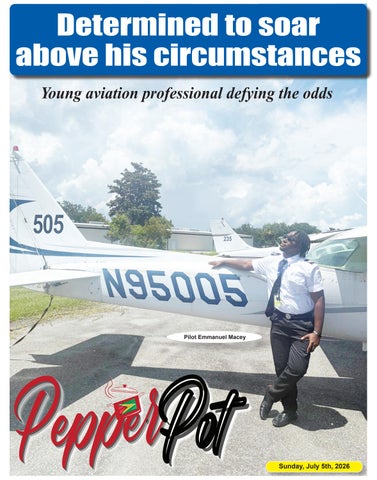
Young aviation professional defying the odds
By Michel Outridge
DESPITE his humble beginnings, he always had a strong desire to succeed, even if it took a long time to realise his dreams. Andrew Anthony Haimraj waited his time, and today he is impacting lives positively.
The married father of three is utilising his skills and resources to support almost everyone he encounters daily.
As a multi-talented, selftaught person, Haimraj refused to give up and always knew he would benefit from
being an all-rounder in life skills as time progressed and that it would be useful in building his future.
He was born on January 12, 1980, on Fort Island, Essequibo River, Region Three (Essequibo Islands-West Demerara). He came from a very simple family whose livelihood revolved around farming, fishing and logging to some extent.
He recalled that they basically lived off subsistence in the riverine area, where his extended family was spread across the Essequibo Islands, Bartica, Bonasika, Leguan, Hogg Island, and
the coastline.
Haimraj stated that the generation's main title is De Barros, which originated with his grandparents and later grew to more than 300 people.
The businessman reported that his family dynamics from his parents' side are quite large. The extended family is huge, and he came from a home of three siblings.
At the primary level, Haimraj was successful and secured a place at Zeeburg Secondary School, and it was an achievement that
TURN TO PAGE VI



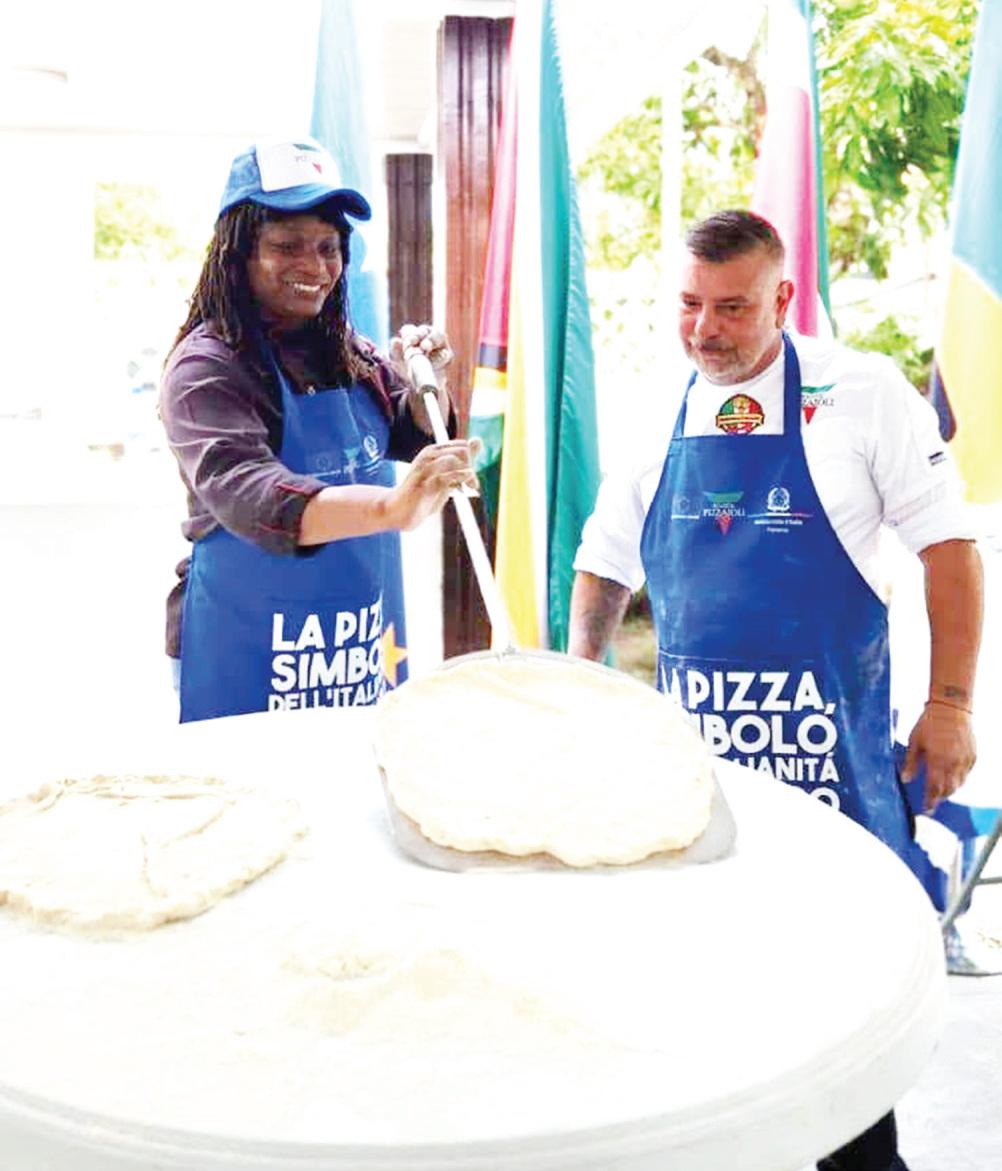
Culinary arts professional wins Guyana’s inaugural pizza-making competition, capping a journey that began in her mother’s home bakery
By Shaniya Harding
LISA Hamilton did not set out to work in the culinary arts, but says she was pushed there by necessity, faith, and a wood-fired oven her mother used at home to keep her family afloat. Decades before she became the kitchen manager at Herdmanston Lodge, she was a teenager who walked and sold her mother's bread and buns, having left school too early to finish what she started. At 41, she went back, enrolling at the Carnegie School of Home Economics and graduating with distinction as one of its oldest students. Most recently, Hamilton broke new barriers during Guyana's inaugural pizza-making competition in June, where she outstretched, out-folded and out-baked the competition to take the win. Sitting with the Pepperpot Maga -
zine earlier this week, Hamilton shared that her story and journey began long before she knew how to make a pizza, long before she took her first steps into a kitchen and long before she knew just how good a chef she was.
Hamilton was born and raised in central Georgetown and the community of Sophia. Speaking about her upbringing, which she described as filled with highs and lows, the now 48-year-old shared that she dropped out of school due to financial constraints her family faced. She added that while she was still young, she left school to help her mother after her father left the family. Reminiscing on the challenges that forced her to leave school, Hamilton added, "At that time, I was in Form 3. I wanted to be a journalist, and so I worked towards the arts and my dream. I got arts, but then I had to

leave school because it was too tedious for me
as a young teenager at that time. I had to walk

miles to get to school. So I dropped out, and I started selling for my mom," she said.
Hamilton became pregnant with her first child at 17. She added that even at that time, she did not see herself venturing into the culinary arts and described herself as a "tom-boy" growing up, adding, "I became pregnant at age 17, and I used to walk the weekend streets and sell the goods that my mom would bake," she added. "Ironically, if anybody had told me as a young teenager, or young girl coming up, that I was going to be like you, I would have laughed because I was a dunce. I did not even know where the salt was in the kitchen."
However, life's uncertainties had different plans. After getting married at 22 and becoming a mother of seven, Ham-
ilton sought to create financial stability for her family. As she shared, "I had difficult seasons. Every time I became pregnant, I was faced with financial uncertainty, but instead of giving up, I trusted God. I built a wood oven and started a bakery," she said.
While her bakery gained support and grew, Hamilton knew she wanted to achieve more and that she had to gain further qualifications to do so. As she shared during her interview, Hamilton began attending the Carnegie School of Home Economics and, at 41, was among the oldest students at the school. As she recounted, "After I supplied these small businesses and so forth with food items, I said, 'God, this world, everything is about qualifications.' So I said, 'Faith
• Releases debut gospel album inspired by personal challenges and a message that no one struggles alone
By Shaniya Harding

SINGER and songwriter Summer Gentle's first step into music came while she was still a teenager in Trinidad, singing at weddings, funerals and school competitions, working through her emotions the only way she knew how. That instinct shaped her debut gospel album, an 11-track project built largely from songs she wrote during a difficult period in her life, including its emotional title track. Now looking forward to creating yet another album and collaborating with other Guyanese musicians, Gentle hopes Guyanese audiences will hear more than a collection of songs; she wants them to feel less alone. Her closing message is simple: God is never as distant as our struggles make Him feel. It's a fitting note for an artiste who turned her lowest moments into something others could lean on.
Born and raised in Guyana, Gentle migrated with her family to Trinidad and Tobago, where she spent most of her childhood. She shared that it was in Trinidad, during her teenage years, that she discovered both her love for music and her talent for singing. As she stated, "I started in music over there, not professionally, but I would sing at school competitions, I would sing in church, weddings, funerals and stuff like that. I really had my start there." Gentle's talent at a young age made it possible for her to become a professional while still young, collaborating with musicians to perform at events, as she added, "I came to the point where I could have started doing it professionally. We recorded an entire song, but I had a little group. I was the only singer, and my friend was the pianist, so we were kind of like a duo, and we had a little producer."

However, it was not until Gentle returned to Guyana in 2021 that her talent went viral. As she shared, following her performance at Advent Praise, one of Guyana's largest gospel showcases, Gentle gained popularity.
"When I came back here, which was in 2020, 2021, I started singing at Advent Christ, and from there I kind of gained popularity, if you want to say so. I was invited to sing, I think in 2024, at the Cultural Centre
By Michel Outridge
AT just 20 years old, Emmanuel Macey is proving that where you come from does not determine where you can go.
Raised in the East Ruimveldt community of Back Circle, Emmanuel grew up understanding both the challenges and the realities that many young people in his community face.
Rather than allowing those circumstances to define him, he made a conscious decision to let his
dreams, determination, faith and relentless work ethic shape his future.
Emmanuel hails from a family of six and is the fourth child. Coming from a modest background meant that opportunities were never handed to him.
Every achievement has been earned through sacrifice, discipline and perseverance. He has always believed that with God at the centre of his life, no dream is too big to achieve.
After successfully passing all seven CSEC sub -
jects, Emmanuel gained the confidence to pursue his lifelong ambition of becoming a professional airline pilot.
Aviation quickly became more than a career goal—it became his passion and purpose.
Immediately after completing secondary school in 2022, he began applying to airports and aviation companies throughout Guyana. Despite receiving numerous rejections, he refused to give up. He continued sending applications
until he secured his first opportunity with Air Services Limited, where he worked from 2023.
He later joined Roraima Airways that year, gaining invaluable exposure to the aviation industry while remaining focused on his long-term dream of becoming a pilot.
After seeking sponsorship from numerous organisations, authorities, and government agencies without success, he decided to finance his own pilot training.


Rather than spending the income he earned, Emmanuel strategically invested in his future. He enrolled at the C. Douglas Institute of Learning (CDIL), where he successfully completed a Diploma in Medical Laboratory Assistance and a Certificate in Phlebotomy in 2024.
His dedication to excellence earned him the distinction of being the valedictorian of his graduating class.
Following graduation, Emmanuel joined Edward B. Beharry and Company as a Senior Research Laboratory Technician in Quality Assurance, where he worked for approximately one year.
Every pay cheque represented another step towards funding his aviation training. He deliberately saved thousands of dollars with one goal in mind—to finance his pilot training independently.
His determination eventually led him to the United States, where he began flight training at Florida Flyers Flight Academy.
There, Emmanuel successfully completed 20
hours of dual flight instruction, passed the FAA Private Pilot Licence (PPL) Knowledge Examination, and graduated from the Gleim Online Private Pilot Ground School.
Although unexpected financial setbacks temporarily interrupted his training, they did not diminish his determination.
Instead, they strengthened his resolve to return and complete his Private Pilot Licence before continuing towards his Commercial Pilot Licence and ultimately fulfilling his dream of becoming an airline pilot.
Today, Emmanuel serves as a Temporary Passenger Coordinator with Omni Helicopters Guyana Inc., gaining additional experience within the aviation sector while preparing to return to flight training and continue where he left off.
He is also pursuing a Bachelor's Degree in Aviation Management at the University of Guyana (UG), further strengthening the academic foundation needed for a successful aviation career.
would pave the way for his future.
He explained that back then, on Fort Island in the early 1990s, it was unheard of, so it was like moving mountains to get to a place like that.
Haimraj told Pepperpot Magazine that he started high school in 1991 and excelled in six subjects, which paved the way for him to enrol at the University of Guyana.
He added that he regis-
tered for Natural Science but settled into Computer Science and, after four years, graduated with a degree in Computer Science, but was unable to get a job, even though he was qualified.
However, he did not let that hurdle define his life, and the world of work took on a different meaning after struggling to get a job.
Haimraj said he did every other job possible to survive, and that is where he learnt real-life skills. Despite having the educational
background, he was never exposed to and did not take the opportunity to do every type of work, from cutting grass and digging drains to plumbing, painting, mechanics, electrical work, and auto repairs.
This initiative helped to broaden his understanding of survival and working with people in communities and places, to the point that he had a whole host of things he understood how to do.
“My humble beginning led me to be like this until
I got my first job with DDL Drinks Distribution Services, where I worked a bit as a computer operator, later moved straight into DDL, where I started as a computer specialist in IT, working a bit with DDL, then slipped over to Beharry, where I also worked for a while,” he said.
Haimraj told the Pepperpot Magazine that he then moved again. Each of these moves took a year or two before he landed a job at the airport, where he worked for three years as an IT Officer

at CJIA from 2002 to 2004.
At CJIA, he established every aspect of the IT infrastructure. Since his arrival, there have been only a few independent computers, and most work has been done on paper. He was able to establish a full IT infrastructure, including servers and everything else, and contributed significantly to that area.
Haimraj pointed out that, over a three-year period, he kept moving on because, for him, it was never about giving up.
The pastor added that he moved into consultancy, so he worked with the Health Sector Development Unit under Dr Frank Anthony, Dr Leslie Ramsammy and later Dr Bheri Ramsarran as well.
In detailing his journey, Haimraj said he worked with both the private and public sectors, progressing from an IT beginner to an IT consultant over a total of seven years.
However, in his mid-30s and early 40s, he was married and had three children, and his involvement with the church began at age 16, when he was introduced by his late mother, who was truly an inspiration.
Haimraj related that from then until now, he has remained consistent in church and eventually became a pastor, in which role he is deeply involved in all church activities.
He noted that after he took early retirement, he diversified his business into AH Consultancy and also expanded it at the same time into IT electrical, covering low- and high-voltage. He did things like fire alarms, camera systems, doorbells, telephone wiring and then house wiring.
While doing these jobs, as a direct result of his expertise, he was able to put together plumbing, painting, and welding and became a point person.
Haimraj confirmed that after the consultancy it was only fitting to become an allin-one person, seeing things out of place and starting work within a short period of time. He felt confident enough to move into contracting.
Being self-taught through books and never having formally studied it, he learned general services while working with many homeowners, adding almost every service. He would stand with them on their bare land and see them through
to achieving the home as it should be.
Haimraj admitted that one of the biggest projects he ever did was his own home. Seven to eight years ago, he started his first major project, and since then, he has built many houses, completed numerous modernisation and renovation projects, and combined his knowledge with newer ideas to bring a modern touch to everything.
Meanwhile, during COVID-19, he went into construction and, about three years later, in 2021, he retired early, having acquired most of what he needed to be comfortable through working this way.
He retired into woodworking, building kitchens, furniture, and customising things people wanted. He then also joined a family business owned by his father-in-law.
Rose Ann's Resort and Fun Park in Parika has been run by him for the past three years. He said it has been doing okay despite challenges and, of recent, he has returned to construction this year to help build dreams.
“Above all, I re-invented myself. Coming from an island, growing up thinking I would become a farmer or a fisherman, you can actually get an education at university level, always beating the odds, pushing against the wind. I never thought I would become the person I am today. I didn’t believe it, but the potential lies within you, and you must push,” he said.
Haimraj credits his success to his upbringing. His parents instilled values in him, so he grew up believing that the value of things, not the cost, matters.
In addition, he stated that his connection to faith also propelled him to remain grounded, and he has never regretted his decision to follow Jesus.
Being a pastor at the Fellowship Baptist Church in Tuschen, he said he would trade this for nothing and would lead everyone he can there.
Haimraj utilises his skills to help others and uplift almost everyone he touches through his work and faith.
He is known for his giving nature and his volunteerism in the community, where giving back is normal for him, having come from a humble background. FROM PAGE II
FROM PAGE III
without works is dead.' I was 41 years old when I enrolled at the Carnegie School of Home Economics. I graduated with distinction," she added. "Some thought I was too old. I was one of the oldest people at Carnegie at that time, in 2019. I knew that God wasn't finished writing my story."
The skill, talent and excellence she displayed at Carnegie landed Hamilton a work attachment at Herdmanston Lodge, one of Guyana's leading hospitality agencies. There, Hamilton climbed the ranks, becoming a prep cook and the assistant events coordinator. Hamilton worked to become the acting kitchen supervisor and is now the kitchen manager. She continued to educate herself, most recently graduating from a GOAL scholarship with merit in Tourism and Hospitality Management. Her per-

sistent rise through the ranks, backed by exceptional hard work, is what made Hamilton stand out among ten contestants. As she explained to Pepperpot Magazine, contestants had to make
two pizzas after two days of master classes on the Neapolitan method, using imported Italian flour. The second category, a fusion pizza, allowed contestants to combine Italian and
Guyanese or Caribbean ingredients, though Lisa stuck with the Italian dough, reasoning that local flour would simply burn in an oven reaching up to 500 degrees Celsius.
For her fusion pizza, Hamilton paired Italian basil and speciality Parmesan with five Guyanese and Caribbean ingredients. Each pizza had to be made and presented within five minutes, and contestants had to explain the name and ingredient choices of their fusion pizzas to the judges. They were also judged on the technique taught in the master class, as well as punctuality and texture, with judges lifting each pizza to check the underside of the dough for signs of proper kneading. After heading into the competition confident and overcoming a number of hurdles, Hamilton walked away as the winner of the Guyanese Gourmet category and the Overall Champion of the Guyana Cup Pizza-Making Competition.
Speaking on the challenges she encountered during the competition, Hamilton noted that her biggest challenge was working the dough. Although Hamilton is no
stranger to baking in its many forms, she noted that the unique process of dealing with the flour was new and unfamiliar, adding, "The only real problem I had with the competition was the dough. The pizza was basically a Neapolitan pizza, not the normal pizza we are accustomed to," she added. "The hardest part was stretching the dough to form the circle. You put your hands down, and they said, 'Do not stretch the dough, press the dough, and it's going to stretch out.' That was a bit challenging for me because my instinct was to stretch. When you're kneading the dough, it has to be left for 24 hours," she added. "Then it is time to shape the actual pizza to form the circle. You do not stretch the dough; you press the dough, put your palm down, and keep doing that, keep doing that," she said.
Moving forward, Hamilton aims to open a business in the pizza-making industry. Looking ahead, Hamilton says she will continue to master her craft and inspire others with her story. As she shared, "That is an art I'm still to master. I'm intending to go into
business in that area, so I've got to get it right every time," adding, "My journey is one of [development and] because of different highs and lows, I did not become this person overnight. You see or hear the kitchen manager, the cup champion, they see a destination, but I remember a beginning. My story started in my mom's bakery at home."

FROM
PAGE IV
for a programme, and a friend of mine taped it and put it on Facebook, and it kind of went viral," she said.
This performance opened new doors for Gentle, and while she did not have the funding needed to create a professional album at the time, she was supported by friends and supporters who believed in her.
As Gentle shared, "After Advent Praise, a friend of mine asked if I would like to go professional, and I said I would love to, but I don't have the finances to source it. And she said, 'It seems like I'll do it for you.' And from there, that's where it all started for me," she added.
Released in May of this year, Gentle's debut album, titled Jesus Saves, is a compilation of 11 songs, ten of
which are originals and one cover, making for an impressive 46 minutes of listening time.
Speaking on creating the album, Gentle noted that the title was inspired by a song she wrote when she was much younger, during a very challenging time in her life.
As she shared, "The title of the album is actually a song that I wrote when I was a little younger, basically about that kind of time in my life where I was going through a serious bout of depression, so I always wrote about how I felt."
For Gentle, music had always been a form of expression, as she added, "A lot of persons, they have their own issues. Some may drink, some may smoke, some may do drugs or whatever, but my addiction has always been music. Whatever I was going
through, I always did music."
Since the release of the album just over two months ago, Gentle notes that the feedback has been incredibly positive, with many listeners saying they feel connected to and can relate to her music. This, Gentle added, is one of the key aims of the album: creating something people can relate to.
"A lot of persons seem to like 'What If,' which is the very first song on the album. A lot of persons have given me feedback on that particular song, that they can truly, truly relate to it," she added.
This is why Gentle would like to see greater support for Guyanese musicians. She explained that, based on the feedback she's received, more support exists for international and even regional musicians than for local

talent.
As she shared, "We don't support our own enough. Enough support is not given to ours. We always try to support those outside;
while she and her team are currently still in the process of recouping from the first album, work is already underway on the second.
As Gentle noted, the
about it. We have a lot of material for album two."
While Gentle is open to collaboration, she notes that the message at the core of

you're excited, you're super, super excited about others, and you would promote them and stuff like that. But I find that the same energy is not facilitated towards ours," she said.
Moving forward, Gentle aims to continue building on the success of Jesus Saves by creating more music and releasing a new album. She noted that
Guyanese public is still getting familiar with her music, but she aims to keep that momentum, adding, "I have a bunch of material to work on. But right now we're in the recouping process, trying to get the album out there, to bring it to different persons, to get familiar with me, to get familiar with my music. But album two, don't worry
her album and work remains the same, saying, "God is not distant that he can't hear your cry. Even though it may seem that whatever you're going through, it feels as if you're going through it by yourself, He is right there with you. All you have to do is give Him a chance."


Beyond aviation, Emmanuel has demonstrated a strong entrepreneurial spirit. In November 2025, he founded MaceyRunners, a delivery service designed to provide efficient transportation of food, groceries, parcels and other items throughout Guyana.
The business was officially registered in January 2026. Although operations are currently under temporary closure to facilitate system upgrades, operational improvements and fleet expansion, Emmanuel is actively preparing to relaunch the company with additional motorcycles and improved systems to better serve customers.
Emmanuel is also an author. His inspirational book, Submit to God, is currently available on Amazon in digital format, with physical copies scheduled for release soon.
Through his writing, he encourages readers to trust God, remain steadfast through adversity and pursue their purpose regardless of life's obstacles.
Throughout his journey,
Emmanuel has embraced one philosophy: where there is a will, there is a way. His story is one of resilience, faith and unwavering commitment.
Every job he has accepted, every qualification he has earned and every sacrifice he has made have been intentionally directed towards achieving one goal—to become a professional pilot.
Growing up in Back Circle has also given Emmanuel a deep appreciation for the importance of positive role models.
Knowing that many young people in his community now look up to him has become one of his greatest motivations.
He hopes his journey will inspire others to believe that no matter where they start, their future can be transformed through faith, discipline, education and hard work.
He also credits his parents and siblings for their unwavering encouragement and support throughout every stage of his journey.
Their belief in him,
combined with his own determination and trust in God, continues to fuel his ambition.
Although his path has included setbacks and challenges, Emmanuel remains confident that his destination has never changed.
He firmly believes that every obstacle is simply another lesson preparing him for the cockpit. His Private Pilot Licence is only the beginning of a much greater journey, and he remains committed to becoming the airline pilot he has dreamed of being since childhood.
For Emmanuel Macey, success has never been about escaping where he came from—it has always been about proving that dreams can take flight regardless of where they begin.
His message to every young person is simple:
"Your circumstances do not define your future. With faith in God, discipline, perseverance and an unwavering belief in yourself, even the biggest dreams can become reality."




WHETHER you believe that the unholy exists, or that deception is nothing more than human bad mind, pay attention, and prepare at home for in-house social conflict, because yuh grown-up baby may be more vulnerable as a victim of overconfidence than as a shrewd loner learning from a functional memory of fallen friends, consoling self
as just their fault, with no enquiry of why it happened, bro. In a world governed by imagery that casts realms of adventure but withholds the inner turmoil that forces us towards a quest for compassion and guidance, there are other things that whisper, offering a release we must be aware of.
There was a time when a few beers were the soothing masseur
of troubled times, when this or that which seemed friendly had changed into what we may term “greater demons” or vices, which have manifested, seeking souls to envelop and offer the worst in a cluster of welcoming whispers that are nothing but enticing lures. Whether it is alcohol or COCAINE, it will be an unprepared burden for an individual to bear, but the new
burden is when it then expands, and the initial contention fades away, and directives evolve from the memory into a metaphor that expresses itself as initiating blame in victims, to face the being in the mirror, where shortcomings and private guilt are exiled.
A phantom world comes alive, to escape in, to look back, or look around and blame where self has failed to
all around. As a parent of an addict, addiction induces a new logic of self-righteousness and self-persecution from all else, an elite ‘being’ who alone has risen beyond SELF-GUILT, and the consequence of folly inflicted on self by self, in the failure of denouncing the whispers and challenges of ‘hype’ used to consume the guardians of self, to become the victim, and to unleash blame
against all else.
Except the new master that will mock and applaud the woe and agony of those bewildered kin and brethren who feel, and those who care, and helplessly stare at their bounty in the embrace of the true hopelessness.
Let’s look at the true horror and learn enough to defy its mockery, in good time.

EVERY husband should know who he is and be the best husband he is called to be.
Every man seeking a wife must demonstrate certain essential qualities. Those important qualities will cause women of high quality to be attracted to them, and each man must choose one of these women for his wife. At that point, he is expected to treat her as his companion and the person with whom he will be spending his future.
Married men must focus on their wives and avoid activities and situations that could disturb their marriages. In addition, when men are married, they may not be able to spend as much time with their friends, parents and siblings, as they have to
invest more time in their new family.
Some men fear that after they get married, they will lose their identity and do fewer of the things they once did. However, when they marry, men commit to being there for their families, so they will have to give up some temporary things to raise a successful family. The success of many families depends on men understanding and fulfilling their roles as fathers. Many husbands are expected to have the following basic qualities. However, if they do not have all of these qualities, that does not disqualify them from being husbands. Some men were trained by parents who had not themselves learned these qualities. Therefore, some men will
not embrace or practise these basic qualities. Other men possess more than these basic qualities when they get married.
It is expected that husbands will be gentle with their wives. They must treat their wives as an important resource in their marriages. A husband must let his wife know that she is the queen in the marriage and that he is delighted to have her in his life. She must have the assurance that her husband, her king, is looking after her interests and that he is in love with her alone.
Every marriage will have challenges. Not every husband will be able to adequately and independently address every problem that arises. Nevertheless, he must not run away from challenges. He must show

his wife that he will stand up for the family, and even when many things are not working the way the family expects, he will be there to work through those difficult challenges.
When husbands run away from challenges, they make their wives vulnerable. Some wives will look for other men who can stand up against challenges and be there for the family. This situation may lead to divorce because the wife needs a husband who is not afraid of challenges. Every marriage will go through many trials, but those trials often make the marriage stronger and cause both people to work as a team to succeed.
Every husband must have love for his family. He must love his wife and their children, and he is also expected to love his extended family. When some men marry, they focus only on their wives and forget their wives' relatives, but they must love their wives' families and offer strong support whenever needed.
The husband's main roles
Some men are afraid to marry because of the responsibilities of being a husband. However, men must be willing to take on challenges, as they are expected to be leaders. When husbands are afraid to provide leadership to their families, they may cause other family members to take on the roles that husbands are expected to fulfil.
The entire family may be depressed, but husbands must motivate them to fulfil their dreams and march towards their goals. Wives need their husbands' sup-
port on many occasions. Therefore, husbands, be the best supporter your wife needs.
Provider and protector are other roles that husbands are expected to fulfil. Even if a husband is not the primary provider in his home, he must contribute to his family's success.
As protectors, husbands must keep their wives and children safe.
It is not guaranteed that all husbands will talk as much as their wives. However, husbands must still be effective in verbal and non-verbal communication with their wives.
Husbands are expected to offer advice and to have a strategy for their family. First, they must consider where they would like their family to be in the next five or ten years. Then, based on that strategic direction, husbands may have to make significant investments in their family.
Wives often appreciate it when their husbands contribute to household chores. Children sometimes love to ask their fathers to cook for them, clean the house, or shop for groceries. Husbands must know where to find the kitchen utensils and how to prepare their family's favourite meals.
Husbands are not expected to know everything about their wives, but they must take the time to learn about them. Once they know more about their wives, they must take steps to bring joy to the marriage. Every wife wants to know that her husband is her lover alone. Therefore, he must respect her in both private and public places.
After giving birth to children, some wives may
lose some of the physical beauty they had when they entered the marriage. However, there is hope, as their husbands can help them stay healthy and in shape. Together, they can arrange to eat healthy meals and exercise. As they exercise, they may be able to reduce excess weight.
Wives love to be celebrated. Therefore, husbands, honour your wives. Look for every possible occasion to celebrate her. Let her know that she is the only woman in your life and that you are willing to give your time, money and effort to celebrate the queen of your life.
Celebrating husbands
Celebrating husbands is essential. Children and wives cannot achieve the roles that husbands perform. Therefore, every husband must be celebrated.
Wives must regularly encourage their children to make their fathers feel special. No wife must be ashamed to celebrate her husband, since she loves him and leaves no room for other women to gain his interest.
Husbands' birthdays may be an excellent time to celebrate them. On a couple's wedding anniversary, the husband must be celebrated alongside his wife.
For more information about Geary Reid and his books, please use these contact details:
Amazon: http://www. amazon.com/author/ gearyreid
Website: www.reidnlearn.com
Facebook: ReidnLearn
Email: info@reidnlearn.com
Mobile #: 592-6452240

SOME treasures in life are found simply by waiting patiently. Those who stand at the edge of the ocean for long enough will eventually find an object washing up at their feet. Depending on their luck, what they receive may be trash or treasure. Nevertheless, in that moment, the universe and fate come together to decide that they must become the owner of something, and so they do. Similarly, there are many opportunities and experiences that we gain just by being alive and going through the motions every day. Many things may wash up at our feet, allowing us to take ownership of them, but not all of them are meant to become our treasure.
While it is possible for us to live a decent life with the joy and experiences we receive in this gentle, accidental way, the true heart of happiness comes from yearning for something until we earn it. There are so many destinations we can only reach by sculpting our own paths to them. This, of course, is much more difficult than merely waiting for a destination to arrive, like a passenger on a train. Yet those who are brave enough to yearn for a future they know is difficult to achieve will also learn to cultivate a deep and rare form of self-love.
The very idea of selflove is often reduced to caring for ourselves daily and perceiving ourselves positively. While these are truly important parts of the act, they are very small. The foundation of self-love lies in our ability to decide that we deserve the most extraordinary experiences and a bright future. It lies in having the courage to make the sacrifices necessary to achieve what we wholeheartedly believe we deserve. In those moments when our goals seem difficult to achieve, our self-love becomes a reminder that our difficulties are a necessary part of giving ourselves the kind of future we deserve. So first, to build the kind of life we like, we need to believe we deserve the things that make us happy. Every day, take a moment to look at the bridges you have crossed in the past. Allow yourself to linger on the obstacles you have survived, and on the hard work and willpower it took to overcome them. When we begin to appreciate how far we have come and the effort it took to make that journey, it will become easier for us to understand why we cannot settle for the bare minimum in the present. Decide that you deserve the best. Then, when you have done so, hold out for yourself.
Being a member of the younger generation today
means something very different from what it used to mean in the past. Although life is certainly filled with excitement and enrichment in a novel way, achieving certain milestones has become monumentally more difficult. It takes longer, more financial effort, higher qualifications, and more energy to reach the levels attained in a relatively easier manner in the past. Social mobility itself has become an arduous task that, oftentimes, is not even worth the effort.
This does not mean we should give up on our goals, but rather that we need to begin creating more careful plans. When we envision our futures and realise that some parts of our dreams seem too magnificent to come true, we should not normalise removing them from our visions. Instead, we must find a way to chart a more achievable path towards them. We might change the timeframe we initially set to achieve it, or the idea we meant to use to work towards it, but we should never give up on our vision.
Every moment of hard work, every careful act of dedication and every sacrifice we make is worth our dream. Every decision we make with the hope of a dreamer is worth the person we are at this very moment, and nothing less.


IN the effort to mitigate the hassle of modern life and in the quest for respite, ironically, uncontrolled self-medication in all forms is practised, which sometimes leads to serious situations. In addition, unfortunately, dental personnel prescribe medications for their patients unnecessarily, an act which constitutes drug abuse. While all drugs produce undesirable side effects, cognisance must also be given to the various conditions derived from the use of certain drugs.
Up to 8 grams (one third of an ounce) of sugar is added to every 2 teaspoons
of liquid medication to preserve the product and mask an unpleasant taste. If taken at least three times a day, the last intake is often at bedtime and perhaps kept in the mouth for a minute or two before being swallowed. The effect on the teeth will be catastrophic, rapidly leading to dental decay.
Aspirin is probably the most frequently used drug. Indeed, it is widely believed to be capable of preventing chronic heart disease if taken consistently and is promoted as the best medicine for arthritis. However, a daily intake of 2 to 3 aspirins results in 5 millilitres (one teaspoon) of blood being
lost in the faeces every 24 hours due to the erosion effect on the protective mucosal barrier of the stomach. If this continues for some time without dietary iron supplementation, the person may eventually develop iron deficiency anaemia, the symptoms of which can include a smooth tongue surface, tenderness in the oral cavity, pain on swallowing, tiredness, and shortness of breath. Hookworm infestation may present identical symptoms. Because oral symptoms predominate, the dentist is likely to be the first to diagnose the problem, especially in postmenopausal women.
Every patient currently on systemic corticosteroid medication should receive an extra dose of the medication on the day he/she visits the dentist. If this is not done, the stressful experience could trigger an adrenal insufficiency syndrome with a sudden fall in blood pressure, leading to severe shock and even death.
It is estimated that the risk of an allergic reaction in asthmatic patients is 5 to 10 times higher than in normal patients. They are especially prone to allergic reactions when treated with penicillin or aspirin. Aplastic anaemia is a serious and sometimes fatal complication of drugs
that depress the bone marrow, leading to a halt in the production of red and white blood cells and platelets. One of the first symptoms in this condition is spontaneous bleeding of the gums with oral sores in a very pale patient.
Among the drugs known to induce bone marrow depression are chloramphenicol and phenylbutazone, commonly used to treat typhoid and arthritis respectively. Patients suffering from grand mal epilepsy (the type with convulsions) usually take hydantoin sodium. This drug causes the gums to swell, which may ultimately cover most of the
tooth crowns.
It is advisable that before dental treatment, these persons should have pre-medication with sedatives such as diazepam or oxazepam. Chlorhexidine is a widely used, hig hly effective mouth disinfectant. The recommended concentration for routine use is 0.2%. It is well known that Chlorhexidine can cause discolouration of the teeth and tongue while inducing taste disturbances.
Consequently, as an important participant in the treatment process, the dangers of potential drugs must never be underestimated.


AS I have been observing my environment more closely in recent times, one pattern continues to stand out with clarity: nothing exists in isolation from consequence. There is a consistent balance at work in life, where no good deed goes unnoticed, no bad deed remains without consequence, and no act of genuine intention is ever truly wasted. The universe, in its own way, seems to keep its own form of accounting, restoring balance through timing, outcomes and unseen corrections. It is within this understanding that we begin this feature, reflecting on how effort, integrity and impact continue to shape the world around us in ways both visible and invisible.
We expect it to arrive like a courier carrying a neatly wrapped parcel with our name on it. We imagine dishonest people eventually losing everything, generous people living happily ever after, and every villain receiving a dramatic final scene worthy of a Hollywood script. Life rewards, corrects and teaches through repetition, and most of its finest work happens long before the audience notices.
I spent years wondering why certain people appeared to glide through life after leaving a trail of broken promises behind them. Some lied with confidence, manipulated with extraordinary skill and somehow continued collecting applause along the way. At the very same time, I watched decent people lose jobs,
suffer betrayals, experience heartbreak and question whether integrity still held any value. The scoreboard looked broken, and I briefly entertained the idea that perhaps life simply enjoyed playing favourites. Then I started paying attention to a different kind of evidence.
The person who lied to everyone eventually trusted no one. Every conversation became an interrogation, every friendship carried suspicion and every act of kindness came wrapped in doubt. The generous woman who constantly encouraged others developed friendships built upon genuine affection instead of convenience. The arrogant man filled every room with tension before he even opened his mouth, while the humble man attracted opportunities without chasing every one of them. The consequences had already arrived; they simply wore ordinary clothes instead of carrying flashing lights.
Psychologist Albert Bandura described human behaviour as a continuous interaction between our thoughts, our actions and the world around us. He called this reciprocal determinism. Every decision influences the next decision, every habit shapes future behaviour and every repeated action changes the environment we live in. The remarkable part of Bandura's work rests in the understanding that people do not merely react to life; people also participate in creating the conditions that eventually shape their own experience.
It is a fascinating idea to me because it explains something I had observed for years without possessing the language to describe it. Character builds an environment around itself. An honest person attracts trust because honesty encourages trust. A dependable person attracts responsibility because dependability inspires confidence, whereas a dishonest person gradually constructs a world where every relationship requires constant vigilance. The punishment begins internally, and the external consequences eventually catch up.
Aristotle reached a similar conclusion more than two thousand years ago. He believed excellence developed through repeated action rather than isolated moments of brilliance. Virtue emerged from practice, not intention. Character grew through daily choices, and those choices slowly became destiny. Modern neuroscience continues supporting that ancient observation through the concept of neuroplasticity. Every repeated behaviour strengthens neural pathways, making the next repetition easier than the last. Kindness literally becomes easier to practise, gratitude becomes easier to experience and even resentment also becomes easier to sustain. The brain faithfully rehearses whatever we repeatedly ask it to perform. This realisation changes the conversation completely because now justice no longer appears as an event waiting patiently somewhere in the future. Justice
begins shaping the human nervous system in this very instant. Every generous act strengthens the neural networks associated with empathy and connection, every dishonest act strengthens the mental habits required to justify further dishonesty, and every choice leaves a biological fingerprint inside the person making it.
Professor Robert Sapolsky from Stanford University spent decades studying the effects of chronic stress upon the human body. His research demonstrated that persistent anger, hostility and psychological stress influence cardiovascular health, immune function, memory and emotional regulation. The body carries emotional history with pinpoint accuracy. A lifetime spent nurturing bitterness produces far more than unhappy conversations. It reshapes the physiology of the individual carrying it.
The opposite pattern also unfolds in the same way. Researchers studying positive psychology, including Dr. Martin Seligman, have consistently demonstrated that gratitude, meaningful relationships, optimism and purposeful living improve psychological wellbeing and strengthen resilience. Acts of generosity activate regions of the brain associated with reward and social connection. Compassion benefits both the receiver and the giver. The reward begins long before anyone says thank you.
People often ask whether someone 'got away with it.'
Life asks a far better
question. Life asks, 'Who did that decision help you become?' Every action casts two shadows: one shadow falls upon the world around us; the other settles within us. Society notices the first one because it produces headlines, gossip and courtroom dramas. The second shadow receives far less attention because it develops invisibly through habits, attitudes and character. That invisible shadow ultimately determines whether success feels peaceful or lonely, whether wealth feels abundant or insufficient, and whether achievement produces satisfaction or endless hunger for more.
Perhaps that explains why I no longer envy people whose victories require them to abandon their integrity. Their reward and their consequence arrive in the same package. Their achievements accompany the person they have practised becoming every single day. My greatest investment has gradually shifted away from collecting possessions and towards protecting character, because character accompanies me everywhere, even when applause disappears and circumstances change.
Success has never impressed me as much as peace. I have met people with impressive titles who could not enjoy a single evening because every relationship in their lives required management instead of trust. They measured every conversation, questioned every motive and guarded every corner of their lives. Wealth decorated
the outside, while suspicion furnished the inside. I have also met people whose bank accounts would never attract headlines, yet they possessed something infinitely more valuable. They laugh easily, they sleep well, they celebrate other people's success without secretly wishing for their downfall and they walk into a room without carrying the exhausting burden of pretending to be someone else. In essence, their reward had already arrived long before any financial statement could acknowledge it.
Psychologists often describe this phenomenon through the principle of cognitive dissonance. Dr. Leon Festinger explained that people naturally seek consistency between their beliefs and their behaviour. Whenever those two drift apart, the mind begins working overtime to justify the gap. Every lie requires another explanation. Every betrayal demands another excuse. Every dishonest decision asks the conscience to remain silent one more time. Eventually, the mind spends more energy protecting the story than enjoying the life it created. This explains why genuine integrity feels so liberating. Honest people possess little to remember because the truth remains consistent. They carry fewer masks, fewer rehearsed conversations and fewer imaginary arguments. Their peace comes from alignment rather than perfection. They make mistakes, acknowledge them, learn from them and continue moving
FROM PAGE XV
forward without dragging a courtroom of excuses behind them.
I sometimes think humanity has misunderstood karma. We picture karma as an invisible judge waiting patiently around the next corner with a notebook full of offences. Noticeably, the truth is much more elegant than that. Every choice shapes the person making it, every act of kindness strengthens kindness, every act of cruelty strengthens cruelty, every generous decision expands the heart a little further, while every selfish decision shrinks it. The reward and the consequence begin at exactly the
same moment as the choice. Understanding this has even changed the way I look at disappointment. I no longer spend much time wondering whether someone else receives what they deserve. I spend far more time asking whether my own responses are producing the person I hope to become. It gives me something useful to do while life takes care of everything else.
The philosopher Ralph Waldo Emerson captured this beautifully when he wrote, "Character is higher than intellect." Intelligence builds businesses, inventions and fortunes. Character determines whether those achievements become
blessings or burdens. Character decides how success is shared, how failure is handled and how power is exercised. Every day offers another opportunity to strengthen that invisible foundation. Perhaps that is why every meaningful tradition encourages generosity, honesty, forgiveness and compassion. Those virtues create better communities, and they also create healthier minds. They lower the emotional cost of living. They invite trust instead of suspicion, gratitude instead of entitlement and purpose instead of endless comparison. Their greatest reward arrives within the person practising them.

And always remember that life keeps accurate accounts. Every decision earns interest, every habit compounds and every conversation plants another seed. Some seeds become gardens; others become weeds. Time nurtures both with perfect fairness. It's wonderfully optimistic because goodness never depends upon applause; goodness transforms the person practising it. Integrity never depends upon recognition because integrity creates its own reward. Justice never rushes because justice is already unfolding through every choice we make, every habit we strengthen and every person we slowly become.
Perhaps the oldest saying deserves a small revision: "No good deed goes unnoticed. No harmful deed goes unrecorded." Life writes both into the architecture of
our character, and character remains the only possession we carry everywhere we go.
The Ledger "Tell me," she said, "why crooked hands
Still gather gold in distant lands?
While faithful hearts that choose what's right
Still wrestle through the longest night."
The old man smiled beneath the tree,
Then dropped an acorn next to me.
"The forest starts with seeds unseen,
Long before the hills turn green."
"But justice feels so slow," I cried,
"As though it walks with shorter stride."
He pointed gently to his chest.
"The truest court lives here the best."
"The liar sleeps with growing doubt,
Expecting every truth to flout.
The giver rests with open skies,
Because clear hearts close peaceful eyes."
"So every choice becomes a stone
That builds the house we call our own?"
He smiled. "Each act, both small and great, Becomes the architect of fate."
The evening wrapped the earth in gold,
And every lesson told
That wealth and titles fade away,
While character survives the day.
So now I measure loss and gain
Beyond possessions, praise or fame.
For every deed returns once more,
First through the heart that chose before.
Romella Dasratt




IT was a dark night in a small, dusty village deep in the countryside, bordered by sugar-cane fields, a village untouched by the changing times, where a merciless, age-old tradition still reigned. In the silence of the nights, a woman’s cries could always be heard as a man, a gladiator with steel muscles and an aggressive mind, stamped his dominance and control. At dawn, the silence as she performed her
daily tasks was like an oppressive veil. Tonight, that veil, which through the times had covered the blood, tears and suffering, was thrown off as one woman stood in defiance. The shock, as the villagers watched the smouldering embers of the fire, hushed even those who followed the oppressive rules, like the soundless roar of an angry sea, the screaming winds. The woman, crying softly, her lips quivering with a deep passion, blood
trickling from her wounds, looked at her husband’s charred, lifeless body lying on the dusty street. Her three young children huddled close to her, too often in the embrace of violence to be shocked, but still scared.
Tragedy, a messenger of fate, always came calling in that little village where minds and bodies are torn and bled, and most often the woman was the victim. Tonight, one woman changed it all; her name is Sharda.

At the young age of fifteen, when her life, like a rose petal, was just starting to bloom, her father, a man of old-fashioned ideals and principles, decided she should get married. She had wanted so much to be given
was a habitual drinker and, so often, he would be in a bad mood. His insults that denounced her womanhood and his cruel fists made life a nightmare she couldn’t awake from. Yet, in her culture, she must honour him as her God,
she often wondered, “Why, as a woman, am I treated in such an inhuman way? How much better is he as a man than I am?”
From within a woman comes life, purity and richness, that the Gods know, and

a chance to study at a high school, to broaden her horizons, so she could break the shackles that imprisoned the women of her generation, but her father wouldn’t listen to her pleas. She had lost, and a life she wasn’t ready for was forced upon her, a flower not allowed to bloom, plucked from a garden, withering in uncaring hands. Her husband, much older and educated, used that as a tool to dominate her life, not to love or share, for to him marriage was only a convenience. He
love him, pray for him, and cry for him.
How can he be my God if he cannot love me?
“A new day will dawn,” she kept reassuring herself. “A new day must dawn.”
He was demoted from his job just after her second son was born because his drinking habit had worsened, and life became a greater struggle. She had begun working her father’s small farmland to sustain their needs so her children wouldn’t go hungry. In the quiet as she tilled the land,
she would ask of the heavens as she sat to rest under a jamoon tree, “Questions I ask of you, Dear Lord, can you answer me?”
No answers came as time moved on, and she opined:
“Maybe there’s no answer because maybe a woman’s tears have to fill the rivers and her blood must fertilise the earth.”
She had watched the women of the village suffer as she did, with
FROM PAGE XVIII
no one really willing to go to the depths and lengths to understand the problem, to stand in the shoes of an abused woman and feel her suffering. Many sleepless nights, she would sit looking at her sleeping children, deeply worried that her sons would most likely grow up to be abusers and her daughter a victim, as the cycle of oppression continued. Something must be done, but what and how?
On the day of Raksha Bandhan, when a sister ties a sacred thread on her brother’s wrist for care and protection, an answer she had long awaited called at her humble home.
It was her ‘Rakhi brother’, whom she hadn’t seen for over fifteen years.
He had left when she was just eight years old, and now he was back. He had to see her. A worried look crossed his face.
“What has become of you, Sharda?”
She smiled wryly. “Nothing, I’m okay.”
“No, you’re not.
You can talk to me. I’m like a brother to you.”
She had been so happy to see him after all those years, not wanting to burden him with her problems, and, as they talked, her husband came home. She introduced her ‘Rakhi brother’ to him, the grandson of an old Pandit from the next village. All was well until her husband came back home later that night, drunk. The suspicious look he gave her rang warning bells in her ears, and she knew she had to hide herself to escape his cruelty.
“You look happy today, woman,” he said, “when you look at that man.”
“He’s my brother and I haven’t seen him in years. I tied rakhi on his hand.”
He grabbed her around the neck, his eyes wild with anger.
“I don’t believe it. Something is going on.”
She struggled and managed to pull away from him, gasping for breath.
“A man in my house is the worst thing you can do!” he swore loudly, knocking over
the kitchen table. The children awoke, her little daughter crying, and she ran to grab them and move, but it was too late. He blocked their escape, a cutlass in his hand, dark rage on his face. She was trapped in the room with the children, fear welling in her heart, almost suffocating her.
“Is this how it ends for me, hacked to pieces as my children watch?”
As he advanced on her, her eldest son shouted and threw his cricket bat.
“Use this, Mommy!”
She grabbed the bat, warding off the cutlass, not too successfully, for he possessed the strength and fear had weakened her. She felt a burning in her arm and shoulder, knowing she was bleeding, but she steadied her mind, refusing to go down. The boys kept grabbing him around the waist to slow him, giving her a chance to escape from the room. She screamed for the children to run out of the house and, as he swung the cutlass, she grabbed the lighted lamp from the table

and threw it at him. The last thing she saw as she ran out the door was his shirt on fire. She closed the door, putting all her strength against it, knowing one thing: if he exited that door, she was dead, if not tonight, then another night or day.
As he shouted and
kicked the door, she screamed to the dark sky, “I’ve had enough; you will give me strength, you will give me strength!”
Even the earth seemed to shudder at her anguished screams, a woman whose pain and suffering were close to breaking point.
The door did not budge.
Now, as she looked down at his burnt remains, she felt no sorrow, but deep regret that it had to end this way. The veil of oppression had burnt with him. A new day would now dawn for her.



IF one searches for light in No Pain Like This Body by Harold Sonny Ladoo, one will scarcely find it. Whatever moments of brightness emerge flash only briefly—like lightning across a storm-darkened sky—before being swallowed again by the novel's overwhelming bleakness. It is an unrelentingly grim work, saturated with sadness, deprivation and despair, and it is brilliant precisely because it refuses to look away from those realities.
Ladoo commits himself fully to what might be called the darkness of fact: the brutal textures of existence among the rice-farming, poor East Indian folk of rural Trinidad in the early twentieth century. The novel is narrow in scope yet astonishingly granular in execution, attentive to the rhythms of speech, the textures of suffering and the quiet violence embedded within ordinary life. Its prose is at once poetic and austere, capable of sketching entire emotional worlds with startling economy and precision. There is little else in Caribbean literature quite like it.
In mood and severity, the novel recalls Children of Sisyphus by Orlando Patterson, with its raw, unsparing portrayal of poverty; in its incantatory rhythms and folkloric sensibility, it occasionally evokes the naïve simplicity of The Palm-Wine Drinkard by Amos Tutuola. Yet No Pain Like This Body ultimately belongs only to itself. It is tragedy rendered in prose and, in certain respects, mirrors
the brevity and violence of Ladoo's own life.
Ladoo was born in Trinidad in 1943 and raised in conditions not unlike those depicted in the novel: severe poverty within a rural Indo-Trinidadian farming community. By most accounts, his childhood was marked by profound hardship, and he is said to have taught himself how to read. He later emigrated to Canada with his family and attended the University of Toronto, graduating in 1973. No Pain Like This Body appeared the year before, in 1972. Tragically, shortly after returning to Trinidad on a visit, Ladoo was murdered; his body was discovered abandoned on the side of a road. A second novel, Yesterdays, was published posthumously.
Set in Tola Trace, a rural Trinidadian farming village populated by impoverished labourers, No Pain Like This Body chronicles a very short period in the life of one family: Ma, Pa and their children—Twins (Rama and Panday), Balraj and Sunaree. Though compressed into the span of a single day, the novel achieves an almost biblical weight of suffering. Every interaction feels sharpened by fear, resentment and exhaustion.
The opening line remains unforgettable in its simplicity and menace: "Pa came home. He didn't talk to Ma. He came home just like a snake. Quiet."
The comparison to a snake is exact. Pa moves through the novel as a figure of dread, embodying arbitrary cruelty and
FROM PAGE XX
simmering violence. The family spends much of the day attempting to avoid his wrath, navigating the atmosphere of terror he creates. His brutalities often feel casual, almost instinctive, as though violence has become the only language available to him.
When one of the children falls gravely ill, the family responds with frantic, improvised remedies shaped by superstition, desperation and poverty. Their actions are never presented mockingly but tragically; these are people abandoned by systems of care, left to improvise survival from folklore, fear and instinct. The child's illness becomes emblematic of the family's larger condition: trapped, vulnerable and doomed by circumstances beyond their control.
Part of the novel's power lies in Ladoo's prose style. His language is deceptively simple, stripped of ornament yet deeply rhythmic and often hypnotic in its repetitions. At times, the prose feels almost incantatory, as though the characters are speaking themselves through suffering. Like Tutuola, Ladoo permits superstition and folk consciousness to exist naturally within the narrative world—not as quaint cultural residue, but as genuine frameworks through which reality is apprehended.
This is not prose interested in spectacle or stylistic pyrotechnics. Its force emerges through restraint, cadence and accumulation. The novel does not merely describe despair; it generates within the reader the emotional atmosphere of despair itself. Long after finishing the book, one retains a lingering sensation of bewilderment and sadness, difficult to articulate yet impossible to shake.
Part of this effect derives from the novel's profound melancholy: the sense that the suffering depicted here is not exceptional but ordinary, merely another day in an end -
less cycle of deprivation. There is no suggestion that tomorrow will differ meaningfully from today. The characters' lives seem governed by repetition, by the crushing continuity of hardship. The children especially appear doomed from the outset. Balraj's illness carries with it an almost preordained fatality, as though death has already enclosed him long before it arrives.
What Ladoo gives us are characters trapped entirely within the reality of their conditions. There are no elaborate backstories, no explanatory psychologies, no sentimental consolations. We know these figures only through what they endure moment by moment, impression by impression. The effect is claustrophobic and devastating. They seem to have existed forever in this state of want and violence, unable even to imagine escape because escape itself has become unimaginable.
That is the terrible achievement of No Pain Like This Body. It confronts despair without romanticising it and, in doing so, creates one of the most haunting novels in Caribbean literature.
There is no significant overarching plot in the novel, nor do the dire incidents faced by the characters accumulate into a conventional dramatic arc. Yet the novel does not require one. Its episodes, intimately bound to the daily struggles of its characters, generate sufficient tension and conflict on their own. This is a minimalist work that at times reads like an epic, achieving remarkable breadth through carefully chosen details and an extraordinary command of atmosphere.
The characters—mostly children—are themselves minimally sketched. They possess neither explicit histories nor strongly implied pasts, except those imagined by the reader. They seem almost to have been born for the narrow span of time the novel depicts, with no discernible "before" and no imaginable
"after". One of the children suffers and dies, yet the event is narrated with the same tonal weight as the novel's other incidents, no more and no less significant than, for instance, the death of pollywogs. What does it mean that a child's death occupies the same narrative plane as such minor losses? Ladoo
emerges here as a restless, unsettling writer, and this flattening of emotional hierarchy suggests either an extraordinary artistic discipline or an intention that remains elusive, even deceptively naïve.
There is much absent from the novel that one instinctively expects to find: some account of Ma
and Pa's shared history, for example, or a fuller psychological exposition of their motives and inner lives. Yet it is precisely this refusal to overexplain or rationalise that gives the novel its strange directness and visceral force, its palpable and implicatory reality. The characters seem simply
to act as they would be observed acting. Ladoo's authorial gaze does not embellish; it records. This pared-down, almost documentary style— combined with the novel's resistance to exposition—grants the work its admirable immediacy and stark realism.


















































STUDY SUCCESS
Dear student, Welcome, dear friend. Make your study space comfortable and free from distractions so it supports effective revision. A calm setting can make it easier to focus. In my own study area, a soft green wall, a pleasant view, and two favourite pictures help me concentrate. I use a wall chart also to monitor my story-writing progress. Choose a study space that suits your style and encourages focus. If helpful, use a pin board or another simple tool to track your progress. Be wise.
With love.
THE PASSAGE
A friendly letter
Reminder: A friendly letter has five main parts: the heading, which includes your address and the date in the top righthand corner; the greeting, which usually begins with “Dear [Name],” followed by a comma; the body, which contains the main message and often has three paragraphs, including one with a closing thought; the closing, which is a polite expression followed by a comma; and the signature, which is your name written directly below the closing. Note the block style in this letter that follows.
Address 26th. June 30, 2026
Dear Fenchyl,
I hope this letter finds you well and that your week is off to a peaceful start. I am writing to you today because the weather has been out of the ordinary here in Guyana, and I needed to share my recent experience with you.
In this unpredictable season, something happened last Wednesday that surprised everyone. Strong winds and heavy rain swept through several neighbourhoods and caused widespread power outages. I was studying at home when the house suddenly began to sway amid the howling wind. At first, I thought it was only another powerful gust, but then the floor

started to roll. It was an earthquake, and I instinctively ducked under the heavy table. The tremors seemed to last forever, and I panicked as the bookshelves shook violently. We later learned that the shaking was a secondary effect of two major earthquakes in Venezuela, our neighbouring country.
Thankfully, the house had no major structural damage, though strong winds left our yard covered with fallen branches and debris. My family and I were safe, but the aftershocks kept everyone in the community on high alert. We spent the rest of the evening following emergency updates on the radio and television. The experience was a powerful reminder of nature’s unpredictability, and I was relieved when the worst had passed.
Please send my warmest regards to your parents, and let me know whether your area has been affected by these weather systems. I hope to hear from you soon.
Sincerely, Walton
Tasks: 1. Plot a timeline of your experience (e.g., a hurricane or earthquake) but only record what you saw, heard, and smelled during each phase instead, rather than write just what happened.
2. Locate a physical or digital artifact from an actual event (e.g., a photograph, an emergency kit, a social media post, or a damaged item). Then tell the “story” of that specific item.
THE PASSAGE
A man rushed in to say that he had seen smoke on Monrovia Peak. As I looked out of the window, I saw the two mountains facing the house on fire. The entire rim burned wildly in the night. The flames, driven by hot Santa Ana winds from the
desert, were as tall as the tallest trees, the sky was already tinted coral, and the crackling noise of burning trees, the ashes and the smoke were already increasing. The fire raced along, sometimes descending behind the mountain where I could only see the glow, sometimes descending toward us. I thought of the foresters in danger. I made coffee for the weary men who came down occasionally with horses they led out, or with old people from the isolated cabins. They were covered with soot from their battle with the flames…
We were told to ready ourselves for evacuation. I packed the diaries. The saddest spectacle, beside that of the men fighting the fire as they would a war, were the animals, rabbits, coyotes, mountain lions, deer, driven by the fire to the edge of the mountain, taking a look at the crowd of people and panicking, choosing rather to rush back into the fire.
Respond clearly to the following questions.
1. State what the following sentences and phrases indicate in the excerpt:
a) “I saw two mountains facing the house on fire.”
b) “Ashes fell, and the roar of the fire was now like thunder.”
c) “The saddest spectacle, beside that of the men fighting the fire
as they would at war, were the animals,”
d) “driven by the fire to the edge of the mountain, taking a look at the crowd of people … choosing rather to rush back into the fire.”
2. What is the meaning of each of the following terms?
a) flames b) desert
c) ashes d) descending
e) evacuation f) foresters
3. Who is the narrator of the story?
4. How much does the writer show experience with forest fires so far in the story?
5. What clues indicate that this essay is organised chronologically?
6. Does relating the forest fire events in chronological order increase drama?
7. Why would a mountain be an especially challenging place to fight a fire?
8. What would you take if firefighters asked you to evacuate your home?
9. How would you help people during their ordeal of fire? How does the author help people? What do her actions reveal about her?
10. Write three images the writer uses to describe the fire.
11. Write about a fire that you either witnessed or read about in a local newspaper.