Sunday, January 4, 2026
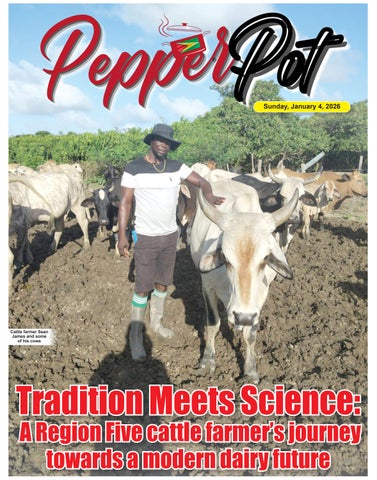
Cattle farmer Sean James and some of his cows
Tradition Meets Science:
A Region Five cattle farmer’s journey towards a modern dairy future
II
CHRONICLE PEPPERPOT ― Sunday, January 4, 2026
Self-styled upcoming apiculturist explores a unique way to rear bees using easy-flow tap boxes By Michel Outridge
MELVIN Singh’s journey into apiculture is rooted in a deeply personal experience that reshaped his understanding of health, nature and trust. Nearly seven years ago, after surviving pneumonia complicated by misdiagnosis and a near-fatal cardiac arrest, Singh made the conscious decision to eliminate sugar from his diet and rely on honey as a natural alternative. What he believed to be a wholesome choice, however, soon revealed a troubling truth. Observing the honey crystallising unnaturally while sitting near sunlight, he realised that the product he had trusted for his recovery was counterfeit. That discovery became a turning point. Rather than retreating from honey altogether, Singh committed himself to producing the real thing—pure, traceable and responsibly harvested. Approaching beekeeping with both curiosity and discipline, Singh invested time in extensive research before establishing his apiary. Determined not to rely solely on conventional methods, he imported “easy-flow” hives from the United States,
becoming one of the early adopters of this technology in Guyana. An easy-flow hive is a modern beekeeping system designed with specially engineered frames that allow honey to be extracted through
a tap mechanism. Instead of opening the hive, removing frames, and disturbing the colony, the beekeeper simply turns a lever, opening the honey cells and releasing honey directly into a collection jar.
This process significantly reduces stress on the bees, preserves the integrity of the hive and minimises the risk of contamination. By allowing bees to remain calm and undisturbed, easy-flow hives encourage
One of the boxes of Africanised bees being reared
Beekeeper, Melvin Singh
A hive
consistent foraging and nectar conversion, ultimately improving productivity and colony health. Singh soon learned, however, that innovation must be adapted to local ecological conditions. To better suit Africanised bees, he modified the easy-flow frames, adjusting their configuration to accommodate the bees’ natural behaviour and ensure colony stability in Guyana’s tropical environment. He also operates a double-box system, known as “supers”, where the lower box houses the queen and is never interfered with, while honey is harvested only from the upper sections. This approach prioritises bee welfare and long-term productivity over short-term
gain. Today, Singh manages 38 super hives at his Parika property on the East Bank Essequibo and another 30 hives at Lower Bonasika along the Essequibo River. His apiaries are strategically placed among mango, cashew, citrus and other fruit trees, creating a mutually beneficial ecosystem. The results have been striking. Mango trees that once failed to bear fruit are now producing abundantly, a clear testament to the vital role bees play in pollination and agricultural sustainability. The honey produced in these locations is equally distinctive, shaped by the diversity of blossoms and prized for its rich flavour, TURN TO PAGE XIII
III
CHRONICLE PEPPERPOT ― Sunday, January 4, 2026
From the Deep South to the Frontlines of Livestock Science
One professional’s quiet leadership at GLDA By Michel Outridge
MELISSA Boston did not grow up imagining herself at the helm of a national laboratory or overseeing some of the most advanced livestock genetic programmes in Guyana. Raised in the Deep South District of Aishalton Village, Region Nine, her early life was shaped by community values, discipline and a strong tradition of public service. Today, at 34, Boston serves with distinction as Acting Head of the Genetic Improvement Laboratory and Small Ruminant Breeding at
ucation Officer for the Deep South District. Agriculture was also deeply embedded in her upbringing. Her grandfather was a cattle rancher, and her parents were actively involved in cattle rearing. She recalls childhood stories told by her father about walking long distances across the savannahs in search of cattle that had strayed, stories that reflected resilience, patience and a commitment to rural livelihoods. Academically driven from an early age, Boston earned the top placement at Aishalton Primary School in the Common Entrance Examination, a success that
Following the completion of her contract, Boston was awarded a scholarship to study in Russia, where she spent five years deepening her technical knowledge in livestock production, with a particular focus on swine management. She returned to Guyana in 2019 and rejoined GLDA as a Livestock Extension Officer, assigned to the Genetic Improvement Unit (GIU) under the guidance of Dr Renita Lashley. Although her formal training centred on swine, those responsibilities were already assigned within the unit. Instead, Boston was entrusted with work in the
Melissa Boston, a typical day in the laboratory at GLDA
the Guyana Livestock Development Authority (GLDA), quietly helping to shape the future of the country’s livestock sector. Born and raised in the South Rupununi, Boston comes from a humble, hardworking family that instilled in her the importance of always putting her best foot forward. Both of her parents were public servants—her mother a Headteacher at Aishalton Primary School and her father the District Ed-
took her far from home to attend St Rose’s High School in Georgetown. She later pursued agricultural studies at the Guyana School of Agriculture (GSA), where she completed a two-year diploma. Upon graduation, she returned to Region Nine and served her community for three years as a Livestock Extension Assistant with GLDA, gaining valuable field experience and strengthening her resolve to build a career in agriculture.
Genetic Improvement Laboratory and Small Ruminant Breeding—areas in which she initially had little handson experience. She embraced the challenge wholeheartedly. In retrospect, she believes that her supervisor recognised her potential and capacity to grow into these demanding roles. Over the past six years, Boston has played a pivotal role in developing and implementing the Quality Management System for the
Genetic Improvement Laboratory, a critical framework that ensures accuracy, consistency, and adherence to international best practices in genetic services. This work contributed to her appointment as Acting Head of Department, a responsibility she describes as both humbling and demanding. She is quick to acknowledge the contribution of her team—livestock assistants Akeem Wallerson and Quacy Hector—whose dedication and teamwork, she says, are central to the unit’s effectiveness. A well-mannered, soft-spoken and introverted individual with a warm smile, Boston leads through quiet confidence and technical competence rather than authority. Beyond laboratory management, she has been closely involved in completing the Embryo Transfer Programme at the Ebini Livestock Station in Region Six and now oversees embryo transfer activities across the coastal regions, alongside her responsibilities for the Genetic Improvement Laboratory. She is also deeply grateful for the confidence and trust placed in her by GLDA’s management. Boston has expressed particular appreciation for the support of Dr Dwight Walrond, Chief Executive Officer of GLDA, noting that his leadership and confidence in young professionals have created space for growth, innovation and accountability. That institutional trust, she says, has been a powerful motivator, encouraging her to meet the demands of her role and continuously raise standards within the Genetic Improvement Unit. The laboratory under her supervision is a cornerstone of GLDA’s Genetic Improvement Programme. It is where semen from boars, bulls, bucks and rams is collect-
Melissa Boston
ed, processed and prepared for Artificial Insemination (AI), supporting livestock producers nationwide. The programme is a national initiative aimed at modernising Guyana’s livestock sector by improving herd quality, productivity and food security through advanced reproductive technologies such as AI and Embryo Transfer (ET). By introducing superior breeds, including Brahman, Angus and Nelore, through subsidised services and bull-rotation programmes, GLDA is strengthening farm profitability while contributing to CARICOM’s regional food security goals. Artificial Insemination has provided farmers with low-cost access to superior genetics. It has expanded successfully from cattle into swine and small ruminants. At the same time, the Embryo Transfer programme further accelerates genetic progress by implanting embryos from elite breeding stock, with plans underway to make up
to 1,000 embryos available to farmers across the country. For Boston, however, the science is inseparable from a deeper personal mission. A proud Indigenous woman, she notes that although she is currently stationed in Region Four, her long-term dream is to return home to Region Nine, serve her community and one day operate her own farm. Her journey from the savannahs of Aishalton to the laboratories shaping Guyana’s agricultural future reflects the transformational power of education, mentorship and institutional confidence. In Melissa Boston, GLDA has not only a skilled scientist and administrator but also a quiet leader whose work bridges tradition and technology, rural heritage and modern science. Her story stands as a testament to how belief in people, coupled with opportunity and dedication, can drive national development from the ground up.
IV
CHRONICLE PEPPERPOT ― Sunday, January 4, 2026
Tradition Meets Science: A Region Five cattle farmer’s journey towards a modern dairy future By Michel Outridge
FOR Region Five cattle farmer Sean James, cattle rearing is not merely an occupation; it is a legacy shaped by memory, discipline and deep respect for the land. Raised in the countryside by his grandparents, James learned the fundamentals of animal husbandry at a young age, spending long days grazing cattle, tracking strays, and absorbing lessons from a grandfather widely respected for the quality of his herd. Those formative experiences planted the seeds for a lifelong vocation rooted in tradition, resilience and self-reliance. Now 48 and a resident of Number 28 Village, West Coast Berbice, James manages a herd of close to 100 cattle, including Zebu, Brahman, Brown Swiss and Holstein crossbreeds. His farming operation is dual-purpose, supplying milk, beef and breeding animals, and represents his sole source of income. After the passing of his grandparents, James decided to establish his own farm, relocating his animals and steadily building a herd that reflects both inherited knowledge and personal ambition. While his cattle are currently temporarily pastured along Abary Creek, James is preparing for a major transition. With 50 acres of land
secured at Blairmont Village, he plans to relocate his animals to a permanent pasture system that will allow for more structured grazing and improved productivity. “I believe in animals,” he often says. “I take care of them, and they take care of me.” For James, cattle rearing offers independence, stability and dignity—advantages he values deeply as a father of five. Although firmly grounded in traditional practices, James is a strong advocate for applying modern science and technology to agriculture. He credits much of his progress to the support received from the Ministry of Agriculture (MOA) through the Guyana Livestock Development Authority (GLDA). Through various genetic improvement initiatives, he has accessed superior breeds to improve milk yield, beef quality, and overall herd productivity. He is particularly thankful for the leadership and support of Hon. Zulfikar Mustapha, Minister of Agriculture, and Dr Dwight Walrond, Chief Executive Officer of the GLDA, whose commitment to strengthening livestock development has translated into tangible, farm-level benefits for producers like himself. Just recently, as part of the Government of Guyana’s strategic national genetic improvement programme implemented through the
Cattle farmer Sean James and some of his cows
GLDA, James was among nineteen farmers who each received a Girolando heifer. The Girolando breed, developed in Brazil from a cross between Holstein and Gyr cattle, is particularly well
Some of the cows on the farm in Region Five
suited to Guyana’s tropical environment, combining heat tolerance, disease resistance and enhanced milk productivity. For James, the introduction of the Girolando rep-
resents a significant milestone in his lifelong journey as a dairy farmer. With continued technical guidance from the GLDA, he is eager to commence a more structured breeding programme
to strengthen his herd and increase milk yields to meet growing domestic demand. In managing reproduction on his farm, James employs a blended approach that combines traditional and modern techniques. While he maintains a breeding bull within his herd, he also actively utilises the GLDA’s Artificial Insemination (AI) programme. He believes that AI is a critical tool for maintaining high genetic quality, enabling controlled breeding, access to superior genetic material, and long-term productivity gains. This strategic use of AI, alongside natural breeding, has played an essential role in sustaining the overall performance and resilience of his herd. Beyond genetics, James has also benefited from the ‘Clean Milk Initiative’, another key intervention supported through the GLDA. The initiative promotes strict hygienic standards through training, monitoring and evaluation of on-farm production systems. Its implementation has significantly improved the quality and marketability of his milk. Currently, James supplies approximately 12 gallons of fresh milk daily to the Amaya Milk Company at Number 27 Village and anticipates increased production as his herd expands and genetic improvements TURN TO PAGE XIX
Some of the cows among the herd at Sean James’s farm
CHRONICLE PEPPERPOT ― Sunday, January 4, 2026
Podcasting the Literary Voices of the Caribbean
V
Trinidadian Literary Advocate has archived nearly 1,000 regional writers, and he’s not stopping WHAT began in 2019 as a personal exercise to improve speaking and presentation skills has grown into a powerful digital archive of Caribbean storytelling. Trinidad and Tobago–based podcaster Kevin George, founder of Tropical Literature Creatives, has interviewed more than 100 authors and featured nearly 1,000 writers of Caribbean heritage, using technology to bridge borders, amplify underrepresented voices and preserve regional literature. In an interview with Pepperpot Magazine this week, George reflected on the challenges and changing trends within Caribbean literature, from self-publishing and marketing hurdles to the growing influence of audiobooks, collaboration and digital tools. Through it all, Tropical Literature Creatives has become a vital space where Caribbean stories are not only told, but sustained for future generations. Today, Tropical Literature Creatives is a well-known and well-loved podcast among Caribbean literature enthusiasts, but George says the idea was never meant to become a platform of this scale. Instead, it began with a personal goal of sharpening his public speaking abilities. “I promote writers and authors of Caribbean heritage,” George explained. “In terms of how I started, originally it was actually a project that I started to help me with my speaking and presentation skills. I had done a broadcasting course and I wanted experience, so when I wanted to enter the industry, I could say I had a body of work to refer to. I ended up starting a podcast where I would interview authors of Caribbean heritage, and then it kind of grew into something else,” he said. “Where I started off with interviews, I segued into offering additional services that helped promote authors of Caribbean heritage.”
While there are countless platforms for Caribbean creatives today, George said Caribbean literature, in particular, remains underexplored. As an avid reader himself, he noticed a gap in visibility and access for writers from
in the region, George initially believed Caribbean writers were few and far between. That perception, however, quickly changed. “I thought it would have been one or two authors, but I learned that the fraternity of authors of Carib-
written their books, struggled with marketing,” George noted. “Being interviewed on a podcast was a good platform to get the word out. A symbiotic relationship came out of it.” Over the years, Tropi-
Kevin George, Trinidad and Tobago–based podcaster and founder of Tropical Literature Creatives, has interviewed more than 100 authors and featured nearly 1,000 writers of Caribbean heritage
the region. “In terms of choosing Caribbean authors as a topic, I liked reading, but some of the authors I wanted to interview were not accessible,” he explained. “So I pivoted towards authors of Caribbean heritage.” Like many people
bean heritage was a lot larger than I initially thought,” he said. “When I approached them, they were eager to be interviewed.” For many of those writers, visibility was a challenge long after their books were published. “A lot of authors, after they had
cal Literature Creatives has shared the stories of Caribbean authors from across the globe. In that time, George said he has observed clear shifts and growth within the literary landscape, much of it driven by technology. “Technology has changed the
landscape,” he explained. “I can have a Caribbean author living in Japan who has written a book, and a person in Canada of Guyanese heritage reading that book. Technology really is a game changer.” Alongside this increased connectivity is the rise of self-publishing and online distribution, which George said has transformed access to publishing. “Traditionally, publishing was very expensive,” he noted. “But with the advent of self-publishing, it makes publishing a book very economical. A man on the street can now publish a book.” That shift, he believes, makes conversations around Caribbean literature and writing more important than ever. With the growth of AI tools and online publishing platforms, writers now have more power and more responsibility than at any time before. While the benefits are significant, George urged that there are also reasons for caution. “It is important to have these conversations not just to promote books, but to talk about technology,” he said. “Publishing power and responsibility are now in the hands of the author. Authors are responsible for publishing and marketing their work.” He added that artificial intelligence, in particular, presents both opportunities and risks. “With the advent of AI, authors should be aware of technologies that can make their job easier,” George said. “But these tools are a double-edged sword. They can be beneficial or a detriment if not used properly.” Despite challenges related to marketing, visibility and emerging technologies, George remains optimistic about the strength and future of Caribbean storytelling. He noted a growing spirit of collaboration among writers across the region and its diaspora, as well as increasing international interest in Caribbean narratives.
“One trend that I have seen is collaboration,” he shared. “More material is being produced by Caribbean authors, and I’d like to see that material used as a platform for other industries like television and film. Platforms are always looking for material to adapt.” Another notable shift has been the rise of audiobooks, which George believes could significantly expand the reach of Caribbean literature. “I have also seen a lot of Caribbean books being converted into audiobooks, which is an exciting development,” he said. “Film and television may not be too far behind.” Looking ahead, George said Tropical Literature Creatives aims to deepen collaboration not only with authors, but also with readers and institutions. Future plans include joint ventures that bring together writers, audiences, corporate partners and educational entities. “We see ourselves collaborating with corporate, business and educational entities to make reading, literature and learning more exciting and accessible,” he said. “Not just in the Caribbean, but beyond. Caribbean writing is exciting, and the genres and stories are intriguing. We see ourselves bridging these groups and elevating the voices of Caribbean authors.” That vision, George emphasised, very much includes Guyana. “A lot of people may not know that I have featured many Guyanese authors, including Jasmaine Payne, Yolanda T. Marshall and others,” he said. “It is exciting to see what is coming out of Guyana. If what has been coming out so far is of such good content, I cannot wait to see what comes next.” Through Tropical Literature Creatives, George continues to ensure that Caribbean stories, wherever they are written, are heard, valued and preserved, one voice at a time.
VI
CHRONICLE PEPPERPOT ― Sunday, January 4, 2026
VII
CHRONICLE PEPPERPOT ― Sunday, January 4, 2026
Failing to try
TO some, change is a great storm that revolutionises the world, leaving it unrecognisable. To others, change is a small modification that makes life a little more different than it was yesterday. Change can also be characterised by its longevity. A transformation that lasts for a lifetime is much more valuable than one that lasts for a few moments. Depending on the context and the person, change can mean different things, and carry varying amounts of weight. One common factor amongst everyone is that change is necessary to live a meaningful life. Whether the change is a push towards healthier habits or a radical transformation of society, human beings simply cannot live a fulfilling life without being participants or recipients in the creation of some form of impactful difference. The obvious obstacle to
change is that it can be quite difficult to achieve any meaningful version of it. The world is a vast web of interlinking factors, and attempting to correct a single problem ourselves often lands us in the middle of a tangled mess of unmanageable elements. With enough zeal and passion, we can navigate through this maze and make real progress. Nevertheless, the task can still begin to feel impossible. Often, we believe that our ability to create change, whether in our own lives or in the world around us, depends simply on how much we want it to happen. The most discouraging part of failing to reach a milestone is not the failure at all, but the belief that we must not have been passionate enough about our cause. The achievement of goals, however, does not depend on our devotion to the task,
but on our ability to see the bigger picture and create an effective plan. Seeing the bigger picture involves observing our progress in the past and present, as well as defining the possibilities in the future. It is easy to get caught up in how far we need to go rather than celebrating how far we have already come. The best way to counteract this perspective is to create a roadmap centred on achieving smaller milestones rather than attempting to achieve enormous tasks in one go. This is the foundation of an effective plan. Another element we often fail to consider in making effective plans is the role of others in achieving what we intend. We do not live solitary lives. This means that every choice we make and every day we live are shaped quite distinctly by our family members, friends, colleagues, and mentors. When we create
personal goals, involving our friends and family as a support system can make an enormous difference in achieving them. Similarly, when we wish to achieve a greater societal goal, the best course of action is to garner the support of a group of people with similar concerns and interests. It may be difficult for one person to reverse climate change or end a cruel war, but it is not so daunting for a group of 100 people to make a significant
impact. At the very least, it is possible to create a small wave that splashes others, so they stop and listen to the voices that need to be heard. The only time that change becomes impossible is when one fails to try at all. There is always something that needs to be different in our personal lives, in the communities that we live in, or in the world that we all occupy. A single, purposeful glance is all it takes to uncover a goal we can begin working towards.
Our volition is a powerful tool that we can use to shape a new future. The very act of perceiving a problem and choosing to do something about it alters the potential outcomes of our lives. What we choose to do with our lives lies in our own hands, but remember that it is not the improbability of a task that leads to the failure of its achievement, but rather failing to try in the first place.
VIII
CHRONICLE PEPPERPOT ― Sunday, January 4, 2026
Consider a vision board over a resolution for New Year’s goals
AS we celebrate the New Year, many people will be looking for ideas to help them achieve their resolutions. Many people believe that the New Year is a time where we can “start over”, learn from our mistakes and do better in certain instances.
While I respect these beliefs, I also want to remind you that having a mindset or an idea alone is sometimes not enough to achieve life goals. Thinking about losing weight in the gym is not the same as actively planning and executing a gym routine into your everyday life. I believe
this is why having a vision board can be very important, especially for young people. When a vision board comes to mind, you might flash back to aesthetic boards on Pinterest. While you can make a vision board that looks creative and fun, it’s more than the aesthetic. A vision board can outline the priorities, goals, objectives, and future plans you may have in mind, while also providing a step-by-step process for accomplishing them. You can answer some of the following burning questions that often come up during the New Year: “What kind of life do I envision in the New Year?”, “What versions of myself do I want to take over?” or, “Who do I see myself becoming?” The vision board should not only allow you to answer these questions, but it should also allow you to find clarity on how to achieve these objectives. You can use the opportunity to list people who are needed in your circle to achieve these goals, the support you’ll need, the resources or network you hope to gain, the social media growth you hope to attain, the skills you need to develop, or the old habits that ought to be changed. Sometimes, when we lay out our plans and the steps needed to get there, we gain further clarity and insight. For some, visuals are the best way to map out certain concepts and better under TURN TO PAGE XVI
IX
CHRONICLE PEPPERPOT ― Sunday, January 4, 2026
COST REDUCTION AND VALUE ENHANCEMENT
COSTS have been rising globally for all businesses and industries. Because of this, many entrepreneurs are understandably concerned that their profit margins have decreased, and they worry whether they will be able to recoup their losses. Luckily, there are ways entrepreneurs can cut costs without sacrificing quality. After all, the last thing a business owner wants to do is sell a lower-quality product to save money; this will only erode customers’ trust and loyalty, and a business’s reputation may be irreparably sullied. To bolster their profit margins and keep their clients coming back for more, entrepreneurs should focus on training and empowering their employees, investing in high-quality equipment and technologies, working with reputable suppliers, and selling products they believe in. Customers appreciate firstrate products and are willing to pay more for well-made items. Hence, to be successful, business owners must recognise that there are other ways to cut costs—ways that will not negatively affect customer satisfaction. Being an entrepreneur is by no means easy, but if you put in the necessary work, your chances of success will skyrocket. Section A: Cost reduction Cost reduction is necessary for all organisations. Both large and small organisations must implement strategies to reduce costs. Sometimes reducing costs requires an investment. Reducing costs can start with an assessment of the costs associated with purchasing goods. When customers purchase goods in large volumes, they may be entitled to discounts that reduce overall costs. Purchasing in large volumes will
also reduce logistical costs. However, leaders must assess whether they have enough space to store a large volume of inventory. Large volumes can lead to spoilage if inventory is not stored properly and sold promptly. Investing in renewable energy can help reduce costs. Fuel costs often increase, and this may be one of the organisation’s major costs. Today’s success may not be permanent, so seek ways to improve continuously. Too many leaders become comfortable with past successes but forget that they have competition and that their competitors are always seeking to become the new leader in the industry. Some organisations may not be able to beat their competitors by purchasing large volumes and benefiting from discounts. However, they may win over competitors by continually improving their processes to reduce costs and enhance outputs. Continuous improvement (CI) will not produce significant changes at the outset, but efforts must be made to improve processes continually. Team leaders often look for a quick fix, but they must be prepared to spend time reviewing and improving the organisation’s performance. Unlike business process re-engineering, which is expected to produce significant change in a short time, continuous improvement allows for gradual improvement over a longer period. Leaders need to be patient with the process. With small, steady changes, the organisation will meet its objective, but over a longer period. If the organisation does not have the financial resources to make major changes, then it will have to consider incremental changes. Incremental changes over a longer duration may allow team leaders to assess each
process. If they are not happy with a particular change, then they will have time to modify their actions. Business process re-engineering and continuous improvement are two approaches to reducing costs and maintaining value. Leaders need to embrace greater use of integrated information systems to generate reports that help them analyse costs. Once the costs and activities are known, appropriate action can be taken to reduce costs. Skilled employees are necessary for cost reduction. Employees must be properly trained for their duties, since their skills will be needed to
help reduce costs.
Section B: Value enhancement There are many ways to enhance quality without compromising value. The value chain analysis is a useful way to reduce costs while increasing value. Team leaders must not compromise on quality inputs. Quality inputs will usually be more expensive, but the outputs will meet customers’ expectations. Rebranding the organisation is important to enhance its image. Customers are often willing to spend a few dollars more for the same goods or services if they per-
ceive they are getting value for their money. The performance of the organisation must be measured. There must be enough business tools to measure several aspects of the organisation. The performance of individual leaders must also be evaluated. Whenever a team leader’s performance needs adjusting, they must be informed at the earliest possible moment. Whenever a leader’s performance meets the organisation’s goals, their efforts must be acknowledged and rewarded. Customers will increase their purchases from the same organisation if they know they are receiving value for
their money when they pay for goods and services. Team leaders must remember that their organisations have many competitors; therefore, they must distinguish themselves from their competitors. They can do so by adding value to their goods and services. While there is competition, every organisation must be alert and agile to stay ahead of its competitors. Organisations in the same industry are often competing for the same customers. The competition is often fierce, but no competitor can relax, since customers can switch to competitors in the same industry. There are several TURN TO PAGE XVIII
X
CHRONICLE PEPPERPOT ― Sunday, January 4, 2026
The quest of another year is before us, to repair and bring to life what our dreams beckon us to honour as gifts and light towers; to soothe our uneasy tensions EVERY one of us has endured the sleepless nights of unfulfilled aspirations. Let me give you an example. I was tutored by one of the best minds that colonial Guyana had allowed to unfold, and, more importantly, who returned to share in post-independent Guyana. He was allowed to share his knowledge. I was an anxious young man, outside the family cloak, and, after some probing, I revealed one of the concepts I had struggled with as a writer/ illustrator. It was a Friday afternoon, and
the boss asked to look at it over the weekend. I conceded, and he smiled. We will talk on Monday after lunch. The idea of becoming a graphic storyteller seemed simple then, until I was introduced to the business of everything in my field of self-creation. My boss taught me to develop an agreement for any idea that I could vouch for and prove that I was the legitimate owner of. Back then, I went to the archives to see if they had the forms to fill out for creative protection. However, the archives for protecting my ideas
were not the place. I later learnt about the countries that would accommodate creative protection, regardless of country of origin, and hence I benefited. So, I closed that door and followed the rules. The fact is, every idea you come up with should be documented in a location that allows it. But what I must advise creative persons is that you should read up as much as you can on the legal protections for ideas and imagery, and research past instances of extreme actions taken in defence of their work—you’ll be surprised.
Recently, during the annual Christmas clean-out, I found a UNESCO booklet given to me by my late friend and media tutor, Claudette Earl, in 1990. I thought that it was lost while moving sometime last year. The following is why I valued it and will share a few inspiring lines of its specific and relevant content: “On the contrary, only through books can the material needs of humans be met, because with the help of books they will reason lucidly and make clear-sighted choices,” and here I quote Mallarmé, a poet not given to triteness:
Everything in the world exists to be turned, ultimately, into a Book. The experience of books is what books have harvested from experience: the voice and cries of everyone, speaking to all of us.” —Jorge Semprún Maura, writer, Spanish Minister of Culture, 1990. Make haste. Copyright your expressions. We have witnessed the callousness of some worldwide and at home. Protect your sanity and gift to the nation. Do the right thing. Don’t steal from your neighbour, nor leave your yard unprotected.
XI
CHRONICLE PEPPERPOT ― Sunday, January 4, 2026
A TOMORROW IS PROMISED
MELISSA went to bed that night with a feeling in her heart that seemed to promise new beginnings. It had been three years since her son passed away, and all she had left were the memories. The divorce from her husband, not long after, had left her battling with stress, but her hopes and her faith as a Christian had given her the strength to keep on going. The first amazing thing that happened to her was receiving her house lot and, with a bank loan, building her own home. It had lifted her
They became her constant, but there was still something missing from her life to make her whole again. It was not something she *was looking for; she was content to live with her son’s memories, her teaching, and her pets. But after talking to the doctor that afternoon in the park, it somehow awakened
up, but she was still alone, true happiness still lost somewhere. Then, one day, she
adopted two dogs—a stray mum and her pup—and caring for them brought her joy.
a feeling she had buried. “I wonder…” she mused as her eyes closed in sleep. She went to the park the next afternoon with Penny and Bubbles, with a slight hope that she might see the doctor again, but he was not there that afternoon, nor the four more afternoons that followed. Melissa sighed as she sat
on a park bench, the two dogs relaxing at her feet. “I guess it was nothing.” A few minutes later, Bubbles pulled away from her and ran along the path, barking excitedly. “Bubbles!” Melissa jumped up to run after him, then stopped when she saw it was the doctor he had run TURN TO PAGE XV
XII
August 13, 2023, New York Nora NORA Smith thought of her daughter. It seemed that overnight, Arianne became known to the world. The small family fell under the spotlight of Arianne’s fame as it skyrocketed within just days. At times, their phones were ablaze with calls requesting interviews about their daughter. They took a few and offered comments about this fantastic book about the old serial killer Arianne wrote about. But their daughter’s strange behavior, while writing the book and after it was
CHRONICLE PEPPERPOT ― Sunday, January 4, 2026
published online just over a month ago, never sat well with them. Now, living a state away, they wondered how well their daughter was riding the wave of sudden success. Soon they learned, however, that she wasn’t surfing it well at all. They saw less and less of her, and she spoke less and less to them. Though they were happy with Arianne’s success, they both had grown to see how brutal the American society was—how they celebrate you until you’re no longer the fad of the day, then spurn you. Could it be that the fear of rejection amid the fame was what made Arianne become
Excerpt: Chapter II from LEECH By Jasmaine Payne
this way so fast? Or was it the fact that the massive sales had made her a millionaire overnight, and she couldn’t handle that pressure? Whatever it was, they watched Arianne gradually fall into debilitating anxiety and knew that it was time to step in. *** Nora made the call just after noon. This was the second 911 call within a few days. On the first call, three days ago, she told the dispatcher she was very worried about her daughter, Arianne, the brilliant but sensitive author she couldn’t make contact with. Officers had been dispatched to Arianne’s home at 421 128th Street,
but reported all “appeared well, except your daughter just seemed tired.” This gave Nora’s mind some rest for a while, yet here she was calling again. “It’s been three days. You said she seemed okay last time, but she’s still not answering my calls, and no one else has heard from her either,” Nora said to the dispatcher. “Please, I’m really worried. We have no relatives or friends close by. Please send someone over again.” She hung up the phone after being promised that they would check. Nora slumped into the chair in her living room. She felt hopeless and just a little guilty that perhaps
she had some hand to play in her daughter’s current mental state. Nora and George Smith were simple Caribbean folks, immigrants from the South American country of Guyana, and they were deeply rooted in their Caribbean ways, caring little for the “fast life” of the United States. Did either of them yearn to live in America? No, but if the opportunity to do so arose, it was rare for a Guyanese not to take it. So, when their “papers came through,” within a month, they packed their belongings and headed to what they believed would be a better life, with their fiveyear-old daughter, Arianne, in tow. Nora thought that, as a child, Arianne did well with the transition. They first settled in Brooklyn, New York, where the foreign twang soon replaced her Creole tongue. She excelled in school at first, often applying her Caribbean standard of excellence to fly far ahead of the class. But then she grew into the age of rebellion and started committing petty offenses that would get her into just enough trouble for the school to call home and get her par-
ents’ attention. At first, Brooklyn was heaven—a city buzzing with a mix of Caribbean faces, sounds, and smells. But time passed, and both Nora and George quickly learned that this wasn’t like Guyana, the place where you could drop the children by Aunt Merle while Daddy was at work and Mommy went to market, or where the man who owned the corner shop would chase your children home if you stayed too late playing on the street. In either case, you had to pray that the closeness these neighbors had with the children did not result in the latter letting loose any “house business” to these nosy elders, or else it would be all over the community by the next day. America was a place where it seemed that everyone looked out for themselves. The communal closeness of Guyanese neighbors wasn’t easily there. So, while Nora sought companionship in Arianne, George retreated to silence in his longing to return to Guyana. To get away from the bustle, George encouraged them to find a home in the less hectic state TURN TO PAGE XVII
CHRONICLE PEPPERPOT ― Sunday, January 4, 2026
Self-styled upcoming apiculturist explores a unique way to rear...
XIII
FROM PAGE II
aroma and quality. Despite these successes, Singh’s work has not been without setbacks. During recent honey flow seasons, his apiaries were vandalised; hives were pushed over and set alight, disrupting production and endangering the bees. Forced to rebuild boxes just months ago, he none-
sumer” platform registers apiculturists, maps apiaries using GPS technology, assigns batch numbers and places QR codes on honey products to allow instant authentication. Singh believes the initiative is timely and critical in combating counterfeit honey. He describes the QR code system as “a good move
The brand of honey to be launched in 2026
theless remains resolute. In 2026, he aims to expand to 150 hives, transitioning from a medium-scale operation to a larger, more resilient enterprise. Central to Singh’s vision is restoring trust in honey. He is one of the participating beekeepers in the Guyana Food Safety Authority (GFSA), in collaboration with the Guyana Livestock Development Authority (GLDA), National Registration and Traceability System (NRTS) pilot programme being rolled out across several regions. This digital “hive-to-con-
toward eliminating fake honey”, noting that it will ensure defaulters take responsibility for the products they place on the market. For legitimate producers, the system provides long-needed credibility and accountability, while consumers gain confidence by knowing exactly where and how their honey was produced. Later this year, Singh plans to officially launch Aurora’s Organic Honey Apiaries, named after his only granddaughter—a brand that reflects both legacy and purpose. Though he works profes-
sionally as a private contractor, beekeeping remains his passion, pursued more out of love than profit. Still, his ambitions extend beyond Guyana, with longterm plans to access export markets, particularly in the
United States. In an age where food authenticity is increasingly questioned, Melvin Singh’s work demonstrates how innovation, transparency and respect for nature can come together to rebuild trust.
Raw, unfiltered honey from the apiaries owned by apiculturist Melvin Singh
XIV
CHRONICLE PEPPERPOT ― Sunday, January 4, 2026
Women’s Work: A Review of Passiontide by Monique Roffey
THE sometimes-narrating ghost of Monique Roffey’s funny, sad and serious new novel, Passiontide (Alfred A. Knopf, $28.00) is Sora Tanaka, a Japanese tourist and steelpan player murdered on the fictional Caribbean island of St Colibri, a stand-in for the author’s native Trinidad.
The incident is based on the real-life 2016 murder of Asami Nagakiya, a Japanese visitor and well-known pan player who was found strangled in Port of Spain. This parallel murder becomes the catalytic event in Passiontide, the seventh novel by the Trinidad-born British writer, through which
Roffey probes the urgent theme of violence against women. Tanaka’s killing, one in a long line of femicides on St Colibri, sets in motion a series of political and personal upheavals that propel the novel’s winding plot. Roffey mines both the bacchanalian paganism of Carnival and
the solemn rituals of Catholicism to craft a story rich in political commentary and emotional gravity. “Passiontide”, the source of the novel’s title, is the final two weeks of Lent in Christianity, a period of penance and reflection on sin and sacrifice. But the Passiontide of Roffey’s nov-
el refuses traditional expectations; instead, it unfolds as a period of social turmoil and erupting violence on St Colibri, a transparent standin for Trinidad and Tobago. The island setting is similar to that of Roffey’s previous novel, The Mermaid of Black Conch (Peepal Tree Press, 2022), which won
flamboyant women’s rights activist; Sharleen Sellier, an aggressive local newspaper journalist; Gigi Lala, the leader of a sex worker collective; and Daisy Solomon, the Prime Minister’s wife—and others, women who have varying degrees of connection to Sora Tanaka, or in some cases none at
the prestigious Costa Book Award. That novel—a luminous synthesis of Caribbean myth and incisive political insight—was the sixth in her rapidly growing oeuvre. Passiontide is a different kind of novel, though it shares with its predecessor a deep concern for the condition of Caribbean women. A feminist perspective shapes both works, but here Roffey’s engagement with the subject is more pointed, more insistent. The narrative follows four women on the island—Tara Kissoon, a
all. Their stories—and Sora’s own, told from beyond the grave—interweave into a chorus of perspectives linked by a shared reckoning with the island’s long, brutal history of unsolved murders of women. Galvanised by Tanaka’s death, Tara Kissoon begins to organise women across the island, confronting the casual misogyny of men and the entrenched patriarchal systems under which crimes against women are routinely ignored. The women TURN TO PAGE XVIII
CHRONICLE PEPPERPOT ― Sunday, January 4, 2026
A TOMORROW IS PROMISED
to meet. “Hey,” she said with a little smile, taking the leash from him. “He’s never done that before.” “He remembered me,” the doctor said with a pleasant smile, “and I think he likes me.” “He’s not often like that when any guy stops to talk to me, always nipping at their ankles.” “Well, that’s a good thing for me,” he laughed a little. She smiled and said, “I haven’t seen you around.” “Oh yeah,” he said, “I have been working day shifts.” “Oh, of course,” she voiced quietly, “a doctor’s life.” “ Yu p . D o c t o r L u c a s Pereira, general practitioner,” he introduced himself. She shook his hand. “And you know me.” “Yes, I do.” She smiled, and, for that brief moment, looking at him, her heart seemed to whisper something to her. “Not sure,” she responded to herself. “So,” Lucas was saying, “I know we have just met, but can I invite you out for a casual dinner sometime, or a movie, or…” Melissa laughed a little at his uncertainty and said, “I guess you can.” And so it began, a casual relationship—dinners, drives, movies, hanging out at the seawall—things she hadn’t done since the split-up with her husband. It had left her so devastated she couldn’t speak to a strange man and had withdrawn into a quiet, lonely life. Lucas had reignited the joys of life in her, the things she had loved, and she was beginning to really like him. He was sincere, charming and kind to animals, all attributes she loved. Months went by as the Christmas season approached, and though her heart was telling her she was falling in love with him, she was scared to acknowledge it. “I’ve really got to work on this fear,” she vowed to herself. Lucas, to her relief, understood what she was battling with and stayed supportive. The Christmas season arrived, and Melissa got busy with the Christmas party for her students, shopping in the city, putting up décor and lights at her home, and Christmas jerseys for Penny and Bubbles, who were pretty excited. One evening during Christmas week, Lucas took
her to the Christmas Village on Main Street. It was, for her, truly magical—the splendid décor and shimmering lights filled her heart with joy, but watching the little children laughing and playing brought a touch of regret to her heart. She looked up at the heavens and said quietly, “You would have so loved this, baby.” As they continued walking, she felt a slight tug on her hand and turned around, but no one was close behind her. A little perplexed look crossed her face, but she let it go. That night at home, she showed the pictures and videos to Penny and Bubbles, who wagged their tails and barked with excitement. They were so adorable, she laughed and hugged them, happy for the decision she had made to adopt them. They were her comfort and had brought some light into her lonely life. And as the season continued, she went shopping with a few of her colleagues, picking up gifts for family and friends. On Christmas Eve, she went to church with her mother and sisters, and on Christmas Day, she invited them home for lunch. Lucas, unfortunately, couldn’t be there because he was on day shift. “I’ll see you in the evening,” he had told her. Melissa’s mother was happy she had finally found someone to share her life with. “He has all the characteristics I love,” Melissa stated, “but I’m still unsure.” “Listen to your heart, dear,” her mother advised her. Melissa smiled wryly. “Yeah, I know. Wish it was something easy for me.” Just after they left, she got dressed to wait for Lucas, and as she sat on the sofa, looking at her son’s portrait, she felt a slight touch on her hand. It was the same little touch she had felt at the Christmas Village. A slight sensation ran through her body, and she said with a little choke in her voice, “Are you here, baby?” A rapping at the door broke the moment, and she took a deep breath before opening the door. It was Lucas, looking quite dapper and wearing an invigorating cologne. He kissed her lightly on the cheek and handed her a gift. “Merry Christmas.” “Thank you,” she said with a warm smile and handed him a gift. “Merry Christmas to you, too.”
It was the first time he had come into her house and looked around with an appreciative smile. “It’s beautiful, fragrant and cosy.” They had a nice dinner with wine, soft music and scented candles, and later, as he said ‘good night’, he kissed her lightly on the lips. “I enjoyed the dinner and your warm company.” That night, Melissa couldn’t sleep, thinking about Lucas, how far they
had come in their relationship, and those two strange instances that made her feel her son’s spirit was present. “I don’t understand,” she said to herself. “It’s been three years now since he’s been gone, and now I’m trying to move on. Doesn’t he want me to?” The days after Christmas went quietly, and on Old Year’s Night she went to church and prayed for love and peace in the world, for care and compassion for an-
imals, and for a new beginning in her life for the New Year. Lucas invited her out for an elegant dinner in the New Year. He ordered the best that was on the menu and champagne, and taking her hand, he kissed it and said, “There is something I need to tell you. You touched a place in my heart since that day at the hospital, and that feeling stayed with me even though I wasn’t sure I would see you again—but I did. It
XV FROM PAGE XI
means we were meant to be together, and I am ready to take the next step when you are ready.” She took a deep breath, tears misting in her eyes, because it was the same dinner scene she had seen in her dream the night before, with her son smiling and nodding. His presence was to tell her he wanted this to happen for her. “Lucas,” she paused for a short moment, “I am ready.”
XVI
CHRONICLE PEPPERPOT ― Sunday, January 4, 2026
Consider a vision board... FROM PAGE VIII
stand them. As such, a vision board can help bring your imagination to life and give you a glimpse into what your life can actually look like if you work intentionally towards certain goals. The vision board should not be a silent piece of art sitting on your wall; it should be a constant reminder and a source of motivation. It is also not a one-size-fits-all board. Everyone’s board may look different for the New Year because our priorities and goals are all different. While some of us may want to get married or to graduate with perfect grades, some people’s objective for the New Year is simply to pay their rent and survive. It is not always glamorous; sometimes it’s simply a realistic priority for survival, and that is okay to celebrate too. When we think about the future, there is often a lot of anxiety and uncertainty surrounding it. As such, a vision board can foster hope and confidence as we venture forward into the New Year. You don’t need fancy ideas or materials to create a vision board. In fact, you can use your mobile device to do it. However, remember it is more than a collage of pictures and ideas. It should be created with intention and a sense of commitment. Remember that it is never too late to create a vision board, even if you don’t do it in the New Year—you can feel free to create one any time of the year for any
specific purpose or goal. You can also strive to create a vision board beyond material goals and wealth. Personally, I want to include topics such as personal boundaries and the values I want to uphold to continue my personal growth as a young adult. The New Year is not a blank page; it’s simply a continuation of unfinished plans and goals we set for ourselves. A vision board is a visual conversation with yourself about the path you can choose to take to reach the destination you want to see yourself in. I think New Year’s resolutions are also great, but they mostly focus on shortterm goals. At the same time, a vision board allows you to think far beyond that. A New Year’s resolution might mean a diet to lose weight, but a vision board can help you live a healthier lifestyle in the long term, with the food you envision yourself eating, the types of groceries you plan to buy, and the number of calories you intend to consume daily. I f y o u f e e l o v e rwhelmed by the thought of a vision board, then you need to create one. It is meant to challenge you, not impress you. A vision board might not guarantee success and achievement of all the goals you set for yourself. However, it keeps you grounded on the right course to accomplish the things you envision for yourself, and that, by itself, is already powerful.
XVII
CHRONICLE PEPPERPOT ― Sunday, January 4, 2026
Excerpt: Chapter II from LEECH By Jasmaine Payne
FROM PAGE XII
of New Jersey. Arianne hated the move. She wanted to stay in New York and made sure that that was where she went to college after graduating from high school. Nora guessed that after Arianne became eighteen, she probably felt the pressure of being her mother’s best friend, and that it drove her to rent her apartment fresh out of college instead of returning to New Jersey. Nora knew her daughter’s ambition of becoming a best-selling author. It echoed every other sentence in the Smith household, so she and George willingly used their savings to fund the rent in the name of “creating a creative space.” They wished her well and hoped the new space she was going into would help her spread her wings. Nora sipped her tea, letting the aroma of honey and chamomile caress her nostrils to calm her anxiety as she waited for an update from the police. “Please call me back to tell me if my girl is okay,” she had begged the dispatcher, who promised they would, though things were a bit hectic. Maybe she and George should have been more hands-on in all this, Nora thought, but their sweet Arianne was always one to run away if the pressure was too much, even from them. *** About forty minutes later, Nora’s phone rang. On the other side of the line, Officer Ray Delgado of the Ninth Precinct identified himself as the responding officer for Arianne’s wellness check. “Mrs. Smith, I’m calling with the update you requested,” the man said, his tone was flat but empathetic. “I’m
afraid your daughter wasn’t in good condition when we arrived. She’s been taken to Lenox Hill Hospital. She’s stable, but you’ll want to get there as soon as you can.” “Oh my God,” Nora managed to respond, immediately struck with grief that her worst fears had been imagined: the spiral they had been observing had come to an unfortunate head. “I—I’m about two hours away, but we will leave right now. But can you tell me one thing quickly, Officer?” “Sure, ma’am,” Delgado said kindly. “What exactly happened? What did you find?” “When we got to the apartment, she didn’t answer the door,” Delgado responded. Nora could hear the dispatcher rambling details of other reported matters through the radio in the background. “We had the building super let us in,” the responding officer continued. “The place was … ransacked, and from her condition, it looked like she hadn’t left in days.” “Was she hurt?” “No physical injuries, but she was in bad shape mentally. We found her in the bedroom, on the floor, not responding at first. She was disoriented … kept saying strange things about someone coming for her—” “Someone coming for her?” “Yes, ma’am—then, she lashed out. We had to restrain her to prevent her from hurting herself.” Nora gripped the rail of the stairs. While she was on the phone, George had been attentive to the conversation, and they started to move the moment Delgado announced what they had found. They
hurried to the garage and into their car as the officer filled them in. “She’s safe now, though, ma’am,” Delgado continued. “Paramedics sedated her and got her out calmly. I’m truly sorry, Mrs. Smith, but you
should probably get there as soon as you can.” “Yes, yes, of course, Officer, thank you very much.” “We’ll let the hospital know you’re on your way,” he said before ending the call. As they drove on the
interstate, Nora was quiet. George didn’t ask her what she was thinking. She gazed through the vehicle’s window and struggled silently to hold herself together. Someone coming for her. Nora felt even
more guilty as she recalled her daughter’s increasingly erratic behavior while writing her book. Nora felt she should have visited her daughter more to find out what she had been struggling with.
XVIII
Women’s Work: A Review of...
CHRONICLE PEPPERPOT ― Sunday, January 4, 2026 FROM PAGE XIV
“occupy” the park opposite Parliament, camping out, protesting, raising hell and upending the island’s complacency. Their numbers grow, ultimately drawing in even the Prime Minister’s wife as the movement intensifies. Roffey, a writer of finely detailed scenes and deep sensitivity to Caribbean realities, renders these women with affection, nuance and
penetrating insight. They are archetypes of Caribbean life, yet fully human—funny, sexual, conflicted, strong, vulnerable and passionate. The novel is frequently laugh-out-loud hilarious, yet anchored by a sharp depiction of the real lives of Caribbean women. It is a prescient, here-and-now story. One of the women’s strategies is radical in its simplicity: they refuse sex
with their partners until their demands are met. The novel openly nods to Aristophanes’ play Lysistrata, in which women similarly stage a sex strike to end war. In Passiontide, the abstention brings its own pains and ironies, but Roffey uses it to draw out enduring truths about the challenges of being a woman in a deeply misogynistic society. The novel’s emotional power lies
in its multifaceted, reasoned examination of these realities. It can make you cry— and also laugh out loud. That emotional chiaroscuro is quintessentially Caribbean, a region long practised in laughing through its tears. Firmly rooted in the genre of literary fiction, Passiontide nonetheless carries the tension of a mystery and, at times, the rhythms of a police procedural.
The question “Who killed Sora?” remains a significant through-line. Sora herself, the ghostly guide of the tale, does not know the identity of her killer—only the details of her own death, which she recounts with startling detachment. The investigation falls to Cuthbert Loveday, the island’s chief of police, a compellingly flawed and fully realised character.
Passiontide is an engrossing work of fiction, attentive to the Caribbean milieu—its language, food, humour, politics and history. Told through multiple perspectives, the novel offers a holistic portrait of a place and its people. It is a Caribbean that feels utterly recognisable, rendered with the precision and empathy that have become Roffey’s signature.
COST REDUCTION AND VALUE ENHANCEMENT FROM PAGE IX
approaches leaders can take to secure their competitive advantage through a value chain. Within an organisation, some activities are primary, and others are support activities. The primary and support activities are both important and must be carefully analysed if the organisation is to add value to its operations and ultimately to its customers. Technology plays an important role in the value chain, but this is only a support activity. There will be people involved in many of the activities, but they are there to support the primary activities. If employees are not properly trained, then their performance will not add value to the organisation. Leaders must motivate employees to always give their best service to the organisation and its customers. However, leaders must also ensure that employees are motivated, properly compensated, and provided with the right tools to effectively
execute their activities. Activities that are duplicated must be identified and removed. Duplicated activities across departments will always waste the organisation’s finances and time. Customers do not want to pay for non-value activities, since additional activities will increase costs but will not increase value. The organisation must be customer-friendly and strive to build strong relationships with customers. There should be a system in place to receive customer feedback. Often, customer feedback helps organisations improve efficiency. For more information about Geary Reid and his books, please use the following contact information: Amazon: http://www.amazon.com/author/gearyreid Website: www.reidnlearn. com Facebook: Reid n Learn Email: info@reidnlearn. com Mobile #: 592-645-2240
XIX
CHRONICLE PEPPERPOT ― Sunday, January 4, 2026
Tradition Meets Science: A Region Five cattle farmer’s journey towards a modern... FROM PAGE IV
take effect. James is grateful for the consistent support of the GLDA Region Five extension team, headed by Dr Joel Dilchand, Senior Veterinarian and Regional Coordinator. Regular on-site visits, proactive disease surveillance and timely veterinary interventions have enabled him to maintain Hazard Analysis and Critical Control Point (HACCP) standards on his farm. Combined with meticulous record-keeping, these measures enhance traceability, strengthen consumer confidence and ensure that milk is produced under environmentally responsible and hygienic conditions. Looking ahead, James is adamant that farmers like himself are ready to embrace the rapidly evolving livestock sector in Region Five fully. He is confident that the combination of aggres-
sive genetic breeding programmes, improved access to pasturelands, sustained technical assistance and regular farmer training will further transform livestock production in the region. He also views the new abattoir at Onverwagt, West Coast Berbice, as a critical investment that will modernise the livestock value chain, improve food safety standards, reduce post-harvest losses and create new market opportunities for farmers. For James, these coordinated interventions position Region Five on a clear path to becoming not only the livestock capital of Guyana but also a national model for modern, science-driven and sustainable livestock development. His story reflects a broader transformation underway—one in which
traditional knowledge, institutional leadership and technological innovation converge to secure livelihoods, strengthen food security and shape the future of agriculture in Guyana.
Sean James milking one of his dairy cows, a daily routine
XX
CHRONICLE PEPPERPOT ― Sunday, January 4, 2026
CHRONICLE PEPPERPOT ― Sunday, January 4, 2026
XXI
XXII
CHRONICLE PEPPERPOT ― Sunday, January 4, 2026
CHRONICLE PEPPERPOT ― Sunday, January 4, 2026
XXIII
XXIV
CHRONICLE PEPPERPOT ― Sunday, January 4, 2026
CHRONICLE PEPPERPOT ― Sunday, January 4, 2026
XXV
XXVI
CHRONICLE PEPPERPOT ― Sunday, January 4, 2026
CHRONICLE PEPPERPOT ― Sunday, January 4, 2026
XXVII
XXVIII
CHRONICLE PEPPERPOT ― Sunday, January 4, 2026
CHRONICLE PEPPERPOT ― Sunday, January 4, 2026
XXIX
XXX
CHRONICLE PEPPERPOT ― Sunday, January 4, 2026
CHRONICLE PEPPERPOT ― Sunday, January 4, 2026
XXXI
XXXII
CHRONICLE PEPPERPOT ― Sunday, January 4, 2026
CHRONICLE PEPPERPOT ― Sunday, January 4, 2026
XXXIII
XXXIV
CHRONICLE PEPPERPOT ― Sunday, January 4, 2026
CHRONICLE PEPPERPOT ― Sunday, January 4, 2026
XXXV
XXXVI
CHRONICLE PEPPERPOT ― Sunday, January 4, 2026
CHRONICLE PEPPERPOT ― Sunday, January 4, 2026
XXXVII
XXXVIII
CHRONICLE PEPPERPOT ― Sunday, January 4, 2026
January 4th, 2026 STUDY SUCCESS Welcome, dear reading friend. This information will help you process what constitutes effective revision. It transforms superficial learning into comprehensive knowledge, replaces uncertainty with confidence, and dispels the misconception that only a select few possess exceptional memory abilities. Achieving a deeper understanding eliminates the common yet unproductive feelings of guilt experienced by those who may underperform. Put current academic standing aside - the remaining top-up months have opportunities available for every student to demonstrate his capabilities and enhance his performance. Be active. Love you. THE PASSAGE Using a story passage for comprehension
Note: Using a story passage for comprehension involves active reading, (maybe previewing), key clues, literal information, and inferential information to gain vocabulary skills, critical thinking, and engagement with literature. It necessitates using question types that are literal, inferential, vocabulary, and the author’s theme/ purpose. a) Literal type deals with questions like: What happened? Who did? Where? b) Inferential type deals with questions such as: Why does a character act that way? What does the description imply? c) Vocabulary type deals with questions such as: What does a specific word mean in context? d) Author’s purpose/ theme type is such as: What does the story try to teach or convey? Read the following excellent extract carefully, and then answer items 1-6 based on what is
stated or implied. They told a tale of woe which was then altogether beyond my feeble comprehension; they were tones loud, long and deep; they breathed the prayer and complaint of souls boiling over with the bitterest anguish. Every tone was a testimony against slavery, and a prayer to God for deliverance from chains. The hearing of those wild notes always depressed my spirit; and filled me with ineffable sadness. I have frequently found myself in tears while hearing them. The mere recurrence of those songs, even now, afflicts me; and while I am writing these lines, an expression of feeling has already found its way down my cheeks. 1. This passage is probably taken from a(n) (A) novel (B) newspaper (C) autobiography (D) short story
2. Which of the following best describes the main idea of the passage? (A) The narrator does not understand the meaning of slave songs. (B) The narrator has deep emotional attachment to slave songs. (C) The narrator misses singing the slave songs that he sang as a child. (D) The narrator is unmoved by the slave songs but tries to understand them. 3. The author’s claims that the songs “breathed the prayer and complaint of souls” cannot be called a fact because (A) it is an expression of his feeling. (B) it can be proven. (C) songs cannot be facts. (D) the narrator never heard the songs. 4. The statement “every tone was a testimony against slavery” suggests that (A) the slaves testified
Whither is fled the visionary gleam? Where is it now, the glory and the dream? WILLIAM WORDSWORTH (1770-1850) “Ode, Intimations of Immortality” (1807), ii against slavery in court. (B) the songs were more of amusement than anything else. (C) the songs reflected strong opposition to the institution of slavery. (D) the songs frequently made people act against slavery. 5. In the phrase “ineffable sadness,” ineffable means (A) slight. (B) powerful. (C) indescribable. (D) unbelievable. 6. Had the author begun the selection with a rhetorical question it would (A) require the author to include dialogue. (B) confuse the reader. (C) introduce a new character to the reader. (D) set up the expectation that the author will discuss the question. Second Passage: THE PASSAGE Looking at an enhancing writing technique Note: Dialogue is one of the enhancing techniques of story writing. See below, the writer’s style of dialogue. It is simple. It is better at times to use direct speech in stories. Read the following excellent extract carefully, and then attend to the two items below it. “…. Then there is my half-brother Alexander, coloured like me but not unlucky like me, he will want to tell you all sorts of lies. He was the old man’s favourite, and he prospered right from the start. Yes, Alexander is a rich man now but he keep quiet about it. Because he prosper he is two-faced, he won’t speak against white people. There is that woman up at your house, Christophine. She is worst. She have to leave Jamaica
because she go to jail, you know that?” “Why was she sent to jail? What did she do?” His eyes slid away from mine. “I tell you I leave Spanish Town. I don’t know all that happen. It’s something very bad. She is obeah woman and they catch her. I don’t believe in all that devil business, but many believe. Christophine is a bad woman, and she will lie to you worse than your wife. Your own wife she talks sweet talk and she lies.” The black and gilt clock on a shelf struck four. I must go. I must get away from his yellow sweating face and his hateful little room. I sat still, numb, staring at him. (Jean Rhys’s (1966) “Wide Sargasso Sea”) 1. Look at the two efforts below. Weigh the interest and interaction in each set of sentences. Discuss your findings with fellow study partners. i) “…. There is that woman up at your house, Christophine. She is the worst. She have to leave Jamaica because she go to jail; you know that?” ii) That woman Christophine who lives at your house, is the worse of them. Do you know she had to leave Jamaica because she went to jail? Tell me, do you know that? 2. Write a short story with dialogue whose descriptions help depict facial expressions, gestures, mannerisms, culture; and of course, style, and tone. For example: “There be some grandparents everywhere who don’t want to see all their grandchildren equally rise.” The generally silent young man at the back shocked the class with this contribution.
XXXIX
CHRONICLE PEPPERPOT ― Sunday, January 4, 2026
Stay away from dental imposters
SOME will recall a story published a few years ago in the Stabroek News under the caption, “Boy loses eyesight after extraction by quack dentist.” Since then, although Guyana has been regularly training dentists, there persists, albeit mostly in interior areas, persons who pretend to be dental professionals. This report serves as a living example of the magnitude of the consequences one is exposed to when acquiescent to the therapeutic fraud carried out by the so-called quacks. Since that incident, there have been cases in which individuals have been seriously mutilated by ‘quacks’ who believe they practise dentistry. Typically, four salient points exist in the aforementioned case that should be examined in the circumstances. Having experienced a severe toothache, the patient consulted the quack, who advised him to get the tooth out. The quack then extracted the affected tooth without hesitation. Point one. Only dentists and dental nurses (dental technicians) in this country are trained in the art of dentistry, and are obviously the only ones qualified to advise anyone with respect to such matters. They know that a toothache is not one of the six indications for extraction. If the patient had visited any Government Dental Clinic, explained the exacerbation of the pain, and complied with the attending dentist’s advice, that professional could have taken the necessary action to mitigate the suffering. Point two. Whenever a person seeks the services of a quack, they become an accomplice to a crime under Chapter 134, Part IV,
Article 38 of the Laws of Guyana. No one could be a quack unless there were patients seeking treatment from them. Point three. Evidently, an extraction was not indicated at the time. Also, the patient should not have been instructed to rinse out his mouth with salt water soon after the extraction. If indeed medication was required in the circumstance to mitigate any infection present, it should be properly prescribed based on its type, dosage, condition severity, and the patient’s body weight. It was barbaric to tell the patient, “buy 20 red and black tablets and swallow one every four hours”, as was alleged in the article. Point four. When asked if he had any intention of providing financial assistance to the victim after the botched extraction, the quack replied in the negative and suggested that “he can take his own action.” Obviously, the quack knew that no one could take legal action against him. It’s like a person reporting to the police that someone stole a kilogram of cocaine from his house. Clearly, the person making the complaint will be arrested. People who subject themselves to the mercy of quacks cannot expect any redress, as no law provides for the accomplice of a crime to receive exoneration. More than 95 per cent of the population of this country lives on the north-eastern coast from Skeldon to Charity. Thirty-five of the Ministry of Health’s dental clinics are found in this part of the country. The patient resided on the Coast, with easy access to a dental professional. The patient became blind because he contracted a
fulminating infection of the entire globe (eyeball), with severe oedema of the appendageal structures. The quack obviously did not know that distinct
precautions must be taken for each tooth to be extracted. For example, the upper molars have their apices in proximity to the maxillary sinus, sometimes even pen-
etrating the same. The extraction created a communication channel that facilitated the transmission of the infection (most likely from septic
conditions) to the sinus, then to the orbital cavity, and eventually to the eyeball itself. Unfortunately, the patient paid dearly for his mistake.
XL
CHRONICLE PEPPERPOT ― Sunday, January 4, 2026