

Maisha’s Bakery brings diverse treats blending local and international flavours
Tamasha Oxford, founder of Maisha’s Bakery, continues to blend creativity and culture through her unique dessert offerings

By Michel Outridge
IN the open backlands of Mahaicony Branch Road on the East Coast Demerara, where rice fields stretch for miles, and narrow cattle trails wind through the grasslands, Charlene Nedd has built a life that quietly challenges long-standing assumptions about who can successfully manage a cattle farm.
For decades, cattle rearing in Guyana was viewed as a male-dominated occupation grounded in physical labour and inherited practice.
Yet at 56, Nedd demonstrates how knowledge, discipline, and access to modern agricultural systems are reshaping that narrative.
Today, she manages more than 50 head of cattle alongside her son, Darius Nedd, in Mahaicony, Region Five (Mahaica-Berbice), while balancing the responsibilities of family life as a mother and grandmother.
Her path into cattle farming began long before formal training programmes or structured support systems existed.
As a child, she followed her

mother, Claudette Bernette, into the pastures to milk cows, guide them through grazing lands, and care for animals using little more than observation and instinct.
Their household reared chickens, ducks, cows, sheep, and goats, embedding in her an early understanding of animal husbandry.
When her mother passed away 19 years ago, the responsibility of maintaining the family’s livestock tradition fell naturally to her, but the environment in which she would continue that work had already begun to change.
Unlike in her mother’s era, before Guyana’s Independence in 1966, when livestock rearing relied on traditional methods, limited veterinary access, and informal knowledge transfer, Nedd now operates within a system supported by science, technology, and institutional guidance.
A defining shift came with the establishment of the Guyana Livestock Development Authority (GLDA) in 2010, which opened doors for farmers, particularly women, to access structured train-


ing, improved genetics, and extension services.
Through GLDA programmes, she strengthened her knowledge in disease surveillance, biosecurity, herd health management, and livestock traceability—practical skills that directly improved her day-today farm management.
For her, training is not in isolation but is a critical pillar of Guyana’s broader agri-food development strategy under the leadership of President Dr Mohamed Irfaan
Ali.
It supports the national agenda to modernise and expand the livestock sector while strengthening food safety systems, improving animal and public health outcomes, and expanding access to high-value regional and international markets.
Just recently, one significant training brought together more than 125 farmers and technical officers across Regions Three, Four, Five, and Six and was facilitated by Veteffects, led by internationally recognised veterinarian Dr Remco Schrijver, with technical support from GLDA’s Head Epidemiologist, Dr Randy Storm.
The programme focused on strengthening early detection and control systems for transboundary animal diseases, particularly Bovine Tuberculosis and Bovine Brucellosis, equipping farmers with practical tools to monitor herd health and improve disease reporting.
For Nedd, these sessions translated directly into improved on-farm practices, stronger biosecurity routines, and more structured herd TURN TO PAGE XI

BEING fuelled by passion is one step, but having the courage to leave a steady job and venture into a business is a leap. This is what three friends did just around a year ago. While working full-time jobs, the trio, all with their own unique passions, took the bold leap into business, leaving their jobs to launch their own ventures.
What began as three
nurtured from her school days and strengthened through training and encouragement, into a business she now calls her own.
Together, their successful ventures reflect the courage it takes to step away from stability and invest in something personal, uncertain, but ultimately rewarding.
Yolanda Gilkes is the woman behind Doll Face Make Up Studio, a business

friends encouraging each other has since transformed into three distinct journeys of purpose, resilience and self-belief for Yolanda Gilkes, Ianka Snagg and Diasha Daly. For Yolanda, it was a growing dissatisfaction with the routine of her job and an unshakable pull towards her passion for makeup that pushed her to take the leap.
Ianka, on the other hand, was driven by a desire to continue her late mother’s legacy in fashion by building her own boutique. Meanwhile, Diasha followed a long-standing love for hair,
she developed after working a regular nine-to-five for five years.
While the challenges she faced at work would force some to find new jobs, Gilkes decided she would build something of her own. Her passion for make-up was sparked years earlier when her mother sent her to cosmetology school, and since then, she has known she has a passion for the craft.
“Makeup was something I became passionate about when I finished school because my mother sent me to a makeup class during the sum-
mer, and from then I always wanted to do it,” she said. Gilkes found time in between her shifts to practise on her friends and colleagues, eventually perfecting her skills.
But doing make-up parttime was only the beginning, and soon the drive to pursue a business of her own pushed Gilkes to take the major step. As she told the Pepperpot Magazine, her passion for the craft, coupled with the
‘You need to start, you’re doing good,’ and I just started.”
Following in her mother’s footsteps, Gilkes set up a space that housed her vision as she launched Doll Face Make Up Studio. She added that support from her mother was also vital to the business’s creation. However, the challenges did not stop at setting up the business; Gilkes shared that social media and marketing

drive to make a job out of it, made her, as she explains it, ‘put 100 per cent’ into the business.
“It was something that kept knocking in my head that I needed to start my own business. It’s like a calling. When you’re called to do something, you think about it every day, and you can’t get it off your mind.”
The support and encouragement of her family and friends were also vital, as she added, “I would say I opened to the public because of encouragement from friends and family. They kept saying,
were also major aspects of the business she had to learn and grapple with. As she shared, “I would say the most challenging part was social media, finding people and getting them to trust you to do their face, because some people have been using certain service providers for years.”
She added, “It’s hard to get customers, and promoting is a challenge because I want to reach a larger number of people, but I feel like I’m still stuck in a range.” As the business grew, Gilkes said sourcing was among the
hurdles she had to overcome to maintain success.
For Ianka Snagg, the woman behind clothing boutique Style Rack Boutique, the business was a way of honouring her late mother by continuing her legacy. After leaving her three-year-long position, Snagg ventured into business for the first time in her life following the passing of her mother after the pandemic. Speaking to the
added that this was not only the creation of a business but also the continuation of a legacy, saying, “My mother and I were always shopping in boutiques in Georgetown and online, and I decided this was my thing and I wanted to follow in her footsteps.” Snagg also shared the importance of community in starting her business. As she recounted, encouragement from friends and family

Pepperpot Magazine on how this motivated her to venture into entrepreneurship, she shared, “My mother was passionate about clothing and had her own boutique in the interior. After COVID, she passed away, and I wanted to keep the business going because I love to dress and she loved to dress as well.” She
pushed her to begin taking orders and establish the business. Snagg shared that her dream was to create a business by the time she was 25, and just a few months ago, that dream became a reality through consistency. As she shared, “Before I opened the boutique, when I put outfits TURN TO PAGE VII
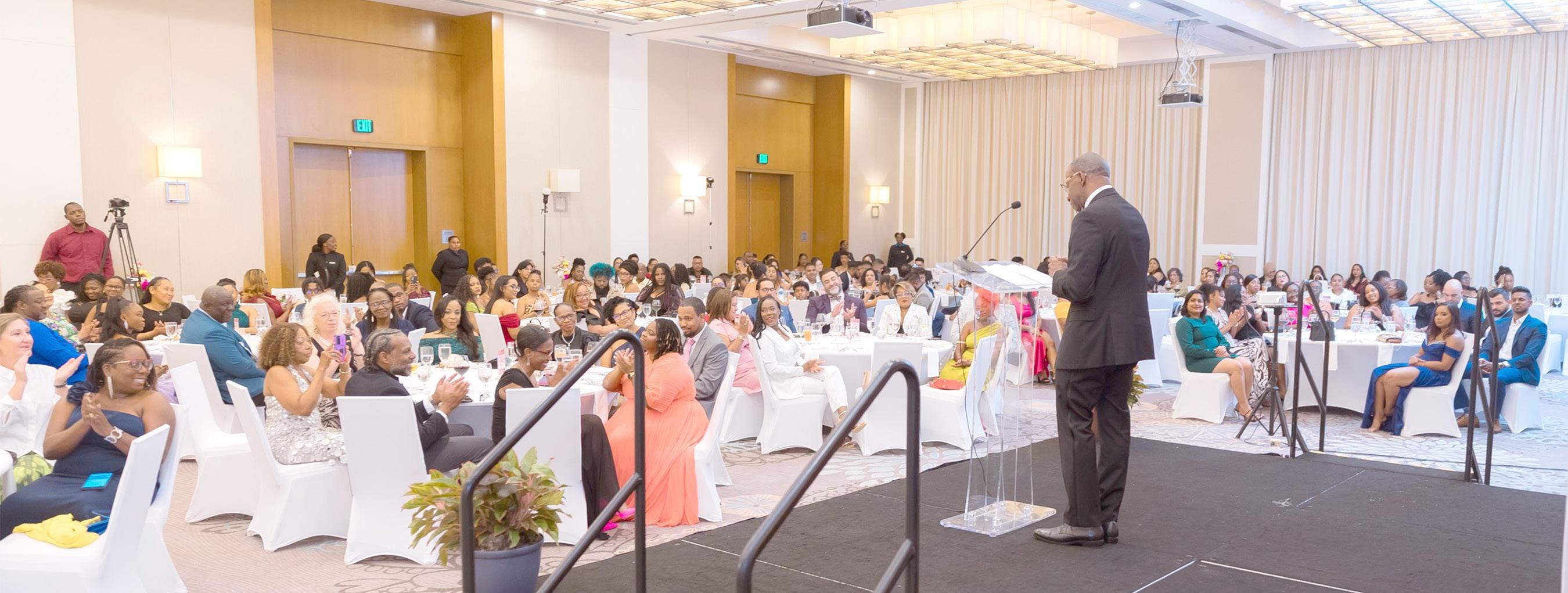
THIS seventh-year celebration of the 25 Influential Women Leaders Award (25IWLA) brings together women whose work is reshaping what leadership looks like across Guyana and opens a conversation about where leadership is headed next. In a country where women have long led from the front without always being placed there by design, this year’s ceremony is something of a reckoning and a celebration of just how much has quietly been built.
The women being honoured at this year’s award ceremony were not chosen for their titles, they were chosen for their impact. This distinction matters. The 25IWLA, co-founded by Michelle A. Nicholas and Lyndell Danzie-Black, has always been focused not on who holds a position, but on who is doing the work that strengthens institutions, opens opportunities for people, and leaves a community genuinely better than it was found.

The women leaders were not selected because their paths were easy. They were selected because of what they chose to do with the paths they were given—the courage they demonstrated when it was not convenient and the standards they upheld when no one was watching, the doors they held open for other women even as they
were still finding their own footing.
That is the kind of leadership this award was always meant to honour—25 women, 25 stories, yet one unmistakable thread running
through every single honouree: a refusal to shrink and a commitment to something larger than ‘self’.
What makes this recognition award especially significant this year is the world and
the time in which it happens. Hundreds of millions of women now live in or near active conflict. Women still hold only 64% of the legal rights of men in most parts of the world. Across peace
tables, boardrooms and legislatures, the strides of women for decades are under pressure, and locally, women in Guyana continue to suffer at the hands of the people they TURN TO PAGE XVI
By Michel Outridge
DR Nyamekeye Griffith had big dreams, aspirations, and visions of a bright future ahead as a young lady, but fate had other plans, some of which motivated her to stand her ground to overcome and become all she wanted to be and even more.
Her silent resilience and faith kept her motivated even when she felt like giving up. The people she was surrounded by made her feel she was more than enough to pull through and had a second lease on life, even near death.
Dr Griffith is a mild-mannered, soft-spoken young lady whose quiet resolve is one of her strongest qualities and has defined her personality.
It is quite evident she likes what she does for work; the passion in her voice is unmistakably colourful, and she is a very dedicated public servant whose ultimate goal is to make people feel good from the inside out.
Dr Griffith always had to fight for whatever she wanted, even for
life when her health deteriorated rapidly due to end-stage renal failure, and that has shaped her into a compassionate person.
She told the Pepperpot Magazine that her own father often likes to retell a story: when she was in nursery school, she announced that one day she wanted to become a doctor.
Although she doesn’t recall saying it, that seed clearly planted itself and refused to let go.
Today, she is a Government Medical Officer (GMO) and the doctor attached to the Adolescent Health Unit at the Ministry of Health (MoH).
At The Bishop’s High School, she fell in love with the arts—debating, elocution, impromptu speaking, dance, drama, and playing the steelpan.
She got to represent her school in competitions, which taught her to think on her feet and speak from her heart. She graduated from Bishop’s High in 2011.
Around that same time, when she was 16, she started working as

a work-study student at the Ministry of Health.
That’s where she was introduced to peer education through the Adolescent Health Programme. She learnt how to talk to young people about sexual and reproductive health, the dangers of substance use, and the importance of mental health—in ways that were actually fun and engaging. She has been volunteering ever since.
The first time she really noticed she had a natural knack for science communication was when she and her project partner won first prize in the biology category at the National Schools’ Science Fair in 2010.
Dr Griffith also won the Best Speaker prize. That was the moment she realised she had a real gift for delivering health information and advocating—blending the arts and sciences without even trying.
“I have to give credit to my CSEC Biology teacher at the time, who saw something in me and helped me hone that skill with creativity and rigour,” she said.
From The Bishop’s High, Dr Griffith moved on to Queen’s College to do her Associate Degree in Natural Science as her entry into medical school.
Then came the University of Guyana (UG) School of Medicine, where she graduated in 2018 with a Bachelor of Medicine and Surgery (MBBS).
“I had imagined a long clinical career. I dreamt of becoming an OBGYN. But we make plans, and God laughs. In my third year of medical school, I was diagnosed with chronic kidney disease. I fought that battle quietly, determined to finish, with my family and close friends holding me up,” she admitted.
Dr Griffith added that she somehow made it through; she graduated and started her internship.
Then the pandemic arrived. By that time, her chronic kidney disease had progressed to end-stage renal disease, and she needed dialysis three times a week to stay alive.
As frightening as that time was, it also showed her how deeply loved she was.
Her cousin—who is truly more like her little sister—gave her the TURN TO PAGE VII


By Shaniya Harding
WHAT began as a lockdown experiment during the height of COVID-19 has grown into a thriving passion project that blends creativity and culture. At just 24, Tamasha Oxford, a young medical student, is balancing textbooks with baking trays, building Maisha’s Bakery into a unique small business shaped by curiosity, discipline and imagination. Launched in 2021 when she was only 19, the bakery started as a way to fill idle time but quickly evolved into something far more intentional.
Today, it offers everything from cookies and cheesecakes to tiramisu and savoury treats, along with an unexpected highlight: Asian-inspired desserts influenced by Korean and Japanese cuisine. For
Oxford, baking is more than a side hustle; it is a personal expression rooted in childhood memories in the kitchen with her grandmother.
Twenty-four-year-old Oxford found her love for baking by the time she was sixteen. But the young medical student does much more than just bake and run a business. A multifaceted person, Oxford shared that while she is currently taking a year off from school, she has dabbled in pageantry, modelling, dance and even cricket, as she looks forward to graduating next year.
However, baking has been a primary love of hers since she was young and has been a defining factor in the relationship she shared with her grandmother. As Oxford shared, “I have always been interested in cooking and baking. Ever since I was younger, my grandma and I would always watch those

cooking shows that would show in the morning. “
I have a lot of memories of that,” she added. “I have really fond memories of Christmas time with my grandma baking in the kitchen.” We would always make sponge cake and black cake, and she would always make bread. My grandma makes the best homemade bread. Once I got older, I started helping her.”
Oxford’s passion was matched by her creativity when she entered high school. During her school years, she baked and decorated cakes for her friends’ birthdays.
And at just sixteen, a young Oxford baked her first cake from scratch.
From then on, and even as she pursued medicine, Oxford knew she wanted to own a restaurant of her own. As she shared, “I always thought when I get older, maybe af-


ter I become a doctor, I would open a restaurant.” She noted, however, that during the pandemic, her creations gained significant traction, and, with nothing else to do, she launched her business in February 2021. “During COVID, when I had nothing to do, I thought I do not have to wait. Why not just start now? I started like a trial period of baking things for people in my contacts. I got a lot of feedback. It was a lot of learning and a lot of trial and error.”
Oxford’s menu is a reflection of who she is: diverse and dynamic, which quickly sets the business apart. One of the highlights of Maisha’s Bakery has been its menu, packed with a wide selection of cookies, cheesecakes and a few savoury items.
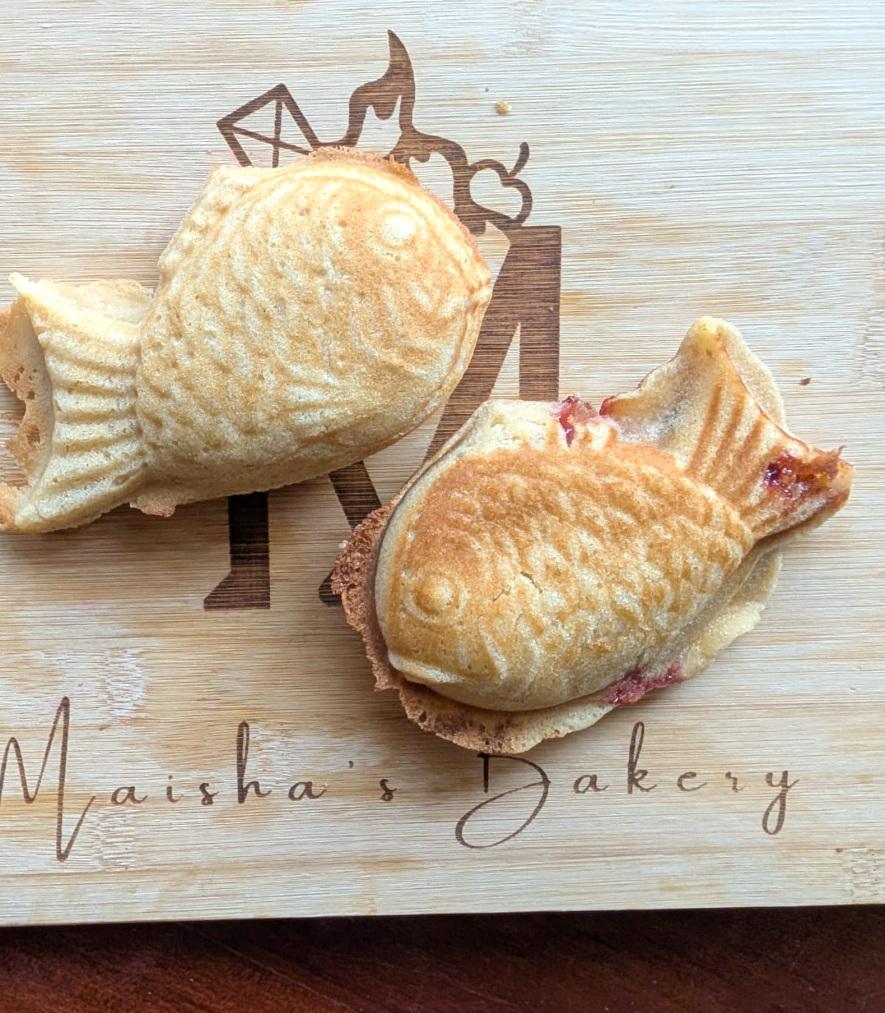
However, Oxford’s Asian-inspired treats have been the star of the menu since their launch. As she told Pepperpot Magazine, she was inspired by her love of anime at the time and was fascinated by the cuisine, which led her to create taiyaki, a fish-shaped waffle with a filling. Oxford brought the treats to a new level with her own unique spins, as she noted, “Traditionally, taiyaki uses red bean, but I did research and realised there are sweet versions too. So I decided to fill mine with TURN TO PAGE XVIII
FROM PAGE III
together, people would tell me I should sell them, and my friends would order from me. I started doing pre-orders first and set up my business while I was still working.” She added that the business moved a few times before she settled into a space of her own, adding, “I rented a space in Mocha, and it was doing well, then I moved the business to town, and now I have my own space.”
Snagg worked through her own challenges in establishing her business. For her, the prevalence of numerous other boutiques made her doubt whether her business would be successful.
Highlighting a fear that most small business owners have, Snagg opened her boutique despite that doubt, and today is happy with her choice, sharing, “There are a lot of boutiques around, especially in town, and many
of them already have a large customer base. I used to wonder if I would make it or if I should even start. Sometimes business is slow, like in March when there aren’t many events, but overall it has been going well,” she said.
For young hairstylist Diasha Daly, cosmetology and hair have been areas she has been passionate about since high school.
Daly worked at her job for just a few months before taking the step to start cosmetology school for seven months, a move that she said ignited her motivation to start Novie’s Unique Hair Space.
As she told the Pepperpot Magazine, “Since secondary school, I always loved doing hair and paying attention to how my hair looked. I got into a cosmetology programme with the Ministry of Labour and later attended the
gift of life by donating one of her kidneys to her.
That relative gave her a second chance to live her dreams and fulfil her purpose, with the expertise of her medical colleagues and professors, who became her doctors and, by extension, part of her support system as well.
That second chance changed Dr Griffith’s trajectory, and she stepped away from clinical medicine to pursue public health instead. Now, she had to blend her love for the arts with her love for science even more fully.
She earned her MBA in Healthcare Management from Jain University and is currently completing her MSc in Public Health at the University of Suffolk, London.
“In my role at the Ministry of Health, I use my ability to interpret data and tell stories at the same time. I design engaging projects and support systems that help empower young people through health education. I help them understand complex things in simple, human ways so they
cosmetology school.
I have always been passionate about hair, so I just continued doing it,” she shared. Daly worked in a salon, where her talents soon made her stand out from her counterparts, as she added, “I started working at a salon after someone reached out to me when they saw my work.
I wasn’t taking clients at first, but I was encouraged to start again. My friends and colleagues kept pushing me, and when the salon owner was leaving the country, I branched off on my own.”
As the business grew, however, Daly found that
building a strong online presence was a hurdle. As she shared, she struggled to get new clients in the early stages, but over time, she has succeeded in developing a support base of her own. “I had challenges with social media, but I am improving. Clients already have their regular hairdressers, so sometimes I am their backup, but I am still building my client base.
I also had challenges finding the right products because different clients require different things.” She credited her support system as a major part of this suc-
cess, noting that, “My biggest support system has been my friends and my former employer. They kept pushing me to keep going and improve.”
For three women who each took a leap of faith on their own terms, the advice they offer is as grounded as the journeys that shaped them. All three point to faith, self-belief and a strong support system as the cornerstones of their successful ventures.
Daly encourages aspiring entrepreneurs to lead with the heart and trust the process, while Snagg urges decisiveness and resilience,
reminding those who doubt themselves that setbacks are simply part of the path. Gilkes, who has since expanded her offerings to include lip gloss and has her sights set on launching her own lash product line, offers perhaps the most practical piece of wisdom: “When things are not doing well, do not just sit there.” All three businesses are open and growing, and together their stories are proof that with enough faith, consistency and courage, everything will, as Snagg puts it, fall into place.
can make better decisions for their own lives. That’s not a future dream—it’s what I do every day,” she said.
Dr Griffith told the Pepperpot Magazine that none of this would have been possible without her village.
Her parents, aunties, cousins, friends—they have been the constant, quiet encouragement behind every step she has taken.
Especially her mother, who always helped her find the bright side of even the hardest situations.
Dr Griffith is an amalgamation of all the love and investment poured into her over the years, and she sees health through two lenses: the clinician and the patient.
She is a member of Guyana’s healthcare system and a beneficiary, and feels it is her personal and professional duty to help as many people as possible have a positive experience like hers.
“I hope my story reminds others that even when life takes unexpected turns, you can still find purpose, joy, and a way to be of help,” she said.



WHEN the sun blooms over the placid world each morning, it is our voices that stretch out to greet the warmth of the golden rays. With a simple wish or prayer, the day unravels from the tips of our tongues, leaving behind a fresh path for us to walk upon.
Even when our minds or our eyes falter, our voices have the strength to flow steadily, like a gentle stream that footsteps or boulders cannot break.
Affirmations, compliments, or even a simple greeting help us begin the day with connection. Words have the power to build our lives and legacies. As such, there is no doubt that we must utilise a great amount of thought and care to present our words in front of the world.
When we comprehend the importance of every word we speak, there is a great weight we begin to feel resting upon our shoulders.
This is the weight of understanding that saying the wrong thing at the wrong time can be so damaging as to be referred to as ‘catastrophic.’ The weight of this understanding often takes the form of silence.
An individual who truly understands the value of words may not be so willing to dispose of them with little reason to do so.
Conversely, there is also the responsibility of knowing when to speak and what
to say. Choosing to remain quiet when our voices are necessary can also be quite catastrophic.
If we choose to be quiet in the face of injustice, then we are no different from those who are committing the mistake.
If we have knowledge that can help those around us and still choose to say nothing, then we are effectively denying others the chance to grow.
So, as valuable as words are, there is also value in understanding when and how our words ought to be spent.
In today’s world, speaking is not the only way through which we can make our voices heard.
There are many media that we can use to share stories and messages with a large audience.
Sometimes, even a single photograph is enough to convey information that a thousand words cannot. So, there is an increased burden in attempting to share with others in the right way.
Every young person is faced with the responsibility of asking themselves what they should say in the face of the moments they meet every day. Do they speak with the risk of saying the wrong words, or do they choose to keep silent, knowing that their silence can cause harm?
Strangely, there is one angle that many of us do not consider when we choose to spend the energy to make a statement or share a mes -
sage—we do not consider whether the message has already been shared by someone else, and whether it has made any impact on the people it has been directed towards.
Communication, we often forget, is an active, ongoing process, especially when we use it as a tool to create significant change.
When this is the case, we must be willing to adjust our method and medium whenever required, and persevere in the process of sharing our thoughts. In this modern era, it is rather difficult for us to say something that has not already been said. As such, it is not the content of our messages we must focus on changing, but rather the manner in which we choose to share it.
Every individual has lived a unique life. In the same way that neither rain nor snow takes the same path towards the ground; human beings do not follow the same journey as one another. Although we may meet at common destinations, we each have something different to share about our journeys.
When we have the chance to share a message with the world, let us promise ourselves to seize it and use it in the best way possible. Let us choose to see the value in sharing something with the people around us and make the effort to disseminate the message, even if we fear that we may not be heard.

Comment by Geary Reid:
This is the title of the document. The information below is an extract from a section of my book.
Follow the motivational guidance of corporate strategist Geary Reid to start, grow and maintain a successful business. Starting your own business can be intimidating, and moving ahead without guidance is a sure road to failure.
With a wealth of experience based on his role as a high-level decision-maker in the business world, Geary Reid offers a wealth of knowledge and advice to help you build a successful business, from developing a business plan to executing a marketing strategy. With expert guidance from this book, you can begin achieving your goals today.
Section A: Initiating the Business
This section provides valuable insight into how you can start your business. It highlights important advice for the initial stage of a startup, and you will also discuss how to get your business started. People often wish to become entrepreneurs but do not know how to get there. Perhaps you are already an entrepreneur. If so—wow! That’s great! Luckily, as you read this section, you will notice important information about what you can do, or confirm what you have already done. Other important points to consider as you read this section include why a business is important. And notice the significance of location. Place (location) has been an important part of the marketing mix, but this seems to be changing. It, however, remains important for certain types of businesses.
You should not jump into a business without knowing the needs of the people you are targeting. A key piece of advice: do not build a house and then decide later what to do with it. It is always best to conduct a needs analysis. While your business may not affect all customers, it will affect a segment that you can consider your niche market for promoting and distributing your product(s).
It is encouraging to know that the need for establishing a business or businesses always exists. You may never know! Your business may be the one that has the greatest impact on many people’s lives. Don’t quit your dream to continue your business just because someone has recently started a business that is similar to yours!
It is important to consider which product or service you would like to offer and to offer it at the best price so that people will share the good news about its quality and price. Just remember that a marketer must promote their product or service, and if the customer is convinced enough, then they will make the purchase.
Always remember that “word of mouth” is a great form of advertisement, which in turn causes your customers to speak well of your business.
In this section, you will be taught how to maintain a business. In Section A, you were introduced to some initial areas of business start-up, but it is important to note that a business must move beyond start-up and remain afloat.
Some people and businesses are good at starting, but if they are unable to maintain them, they will quickly fall apart. If the busi-
ness fails, then all your ideas and hard-earned money will be wasted. Whenever a business crashes, many people will remember your failed attempt and will often want to label you or the business as a failure. It is against this backdrop that this section of the book aims to help you and your business survive. Save yourself the embarrassment by reading this section.
Some important points will be discussed to help you use tools to manage your business effectively. A business can be likened to a marathon. The runner must start the race and then maintain momentum for most of the journey. Once the athlete recognises that the end is near, they will need to increase their speed. In Section B, you will be making every effort to keep your momentum.
Some areas to keep your momentum will include operations, efficiency, performance management, financial management and information systems. You can begin to see that these areas will help you stay apace with the competition and fight to win. Some businesses fail not because of competition but because of poor management. You must have key people who are essential to the business’s success.
As businesses are changing and competition increases, the use of information technology and information systems can create a competitive advantage for you as a businessperson. In these two areas, you might meet more customers, conduct data mining, and process internet sales. If you can harness information technology and information systems early, you may be ahead of the business. This may put you way above the competition.
If you do not measure your performance as an indi-
vidual or as a business, you will not know which areas need improvement. (Please note that a performance review is key for development.)
If a vehicle is used for years without periodic service, it will eventually perform below expectations. This is similar to a business where its performance must be measured constantly using a specific format or
theory.
Your business will always be confronted with many challenges, but “only the fittest will survive”, and that is expected to be your business. Do not allow others to push your business aside. Every time you fight and win, you gain increasing strength as a business, and you will earn respect in the business community.
While your organisation has faced many challenges and survived, you should consider your next move. If you stay where you are, you may not affect others’ lives or generate additional revenue. If you stay where you are, you may face significant competition that could force TURN TO PAGE XIII


WE have matured enough to respect and understand plants, not because they yield fruit we enjoy and, at times, provide delicious tea, but because they can also heal.
But sometimes they can be detrimental.
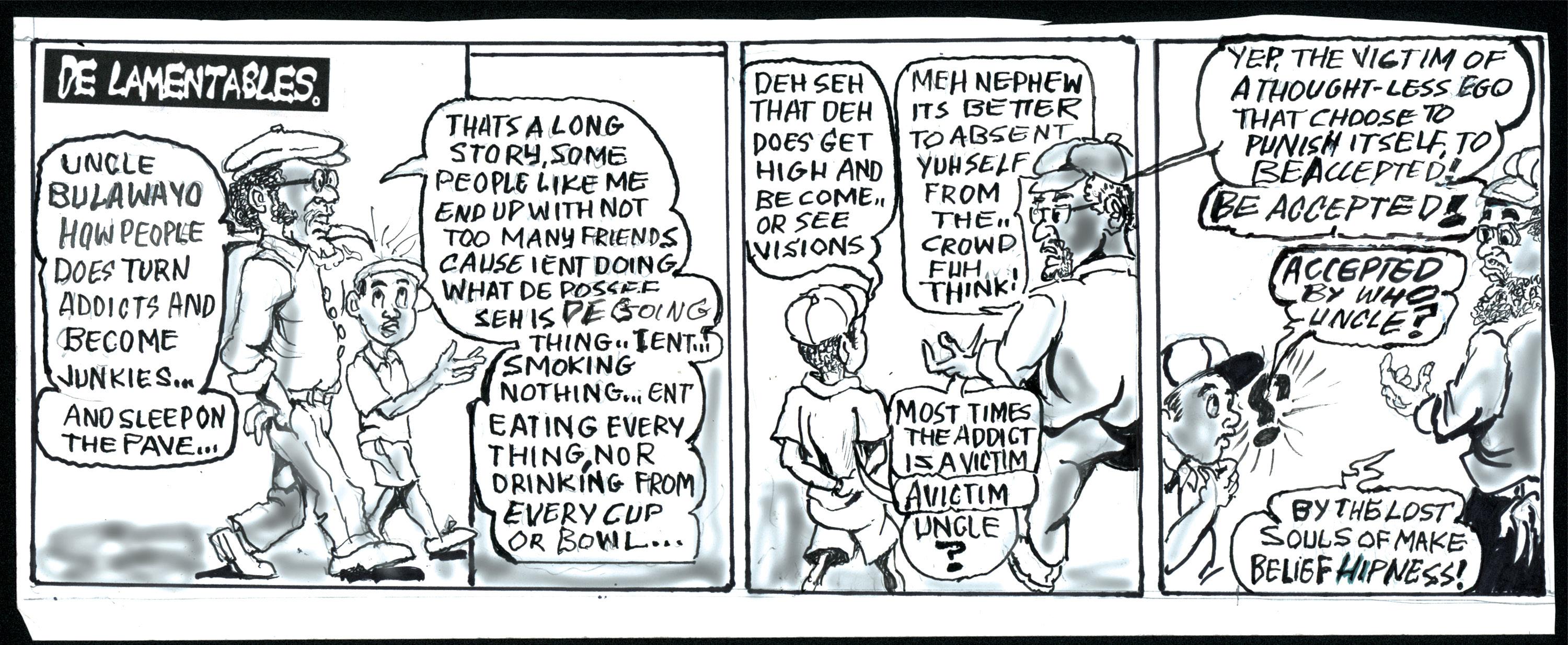
The 1960s–70s age of the hippies that even flowed down to us is credited to one man’s experiment and proposed experiences, which he wrote about; he is even accused of initiating cults and levels of lost balance.
We can only respond to the
publication THE DOORS OF PERCEPTION, HEAVEN AND HELL.
Upon reading it, if Aldous Huxley experienced what he wrote, then we must contemplate and compare his definition of the Mexican cactus and the peyote, to which, upon reading this book for the first time, I then convinced myself of the loss of perception with human sacrifice, through the human sacrifice of the old world in this case, but quickly reasserted through widening my reading habit to the ways of the present
world—not so long ago, not much different—using diverse means and weapons. But Huxley’s book, no doubt, could have influenced so many.
Let me explain close to home. I lived in West Ruimveldt. I saw marijuana rise, and I witnessed it delude many who couldn’t live as their lives fell apart.
I witnessed and did not turn my face as I followed cocaine, and too many to count passed; others are hooked.
Some say it’s a demon… I honestly think if you see the result
of coke and continue to sell or use it, then, “You’re the prisoner, a creature that stumbled and surrendered to enslavement, a spectre of fallen humanity.”
If you, the observer, see the outcome and nothing within moves you because of the temptation, or worse—self-deception because you contributed—then you too have lost yourself, to become a mockery of clouded humanity.
But when the kin have to handle the rude mockery that its kind has cast itself down into, that
cannot redeem itself, and it grows into a legion, then it becomes our moral question: to ignore or pursue the strength of our question of responsibility.
For a society must explore its moral conscience if it is to survive or be swarmed by the other, who, for its own need, shall feign scorn and sympathy but see nothing but the feast of our weakness.
I cannot ignore my fallen, and I cannot be sympathetic without just accusations, for self-pity without the course of redemption cannot bear fruit.
management.
market confidence.
The transition from instinct-based care to science-informed management is most evident in her participation in GLDA’s national Artificial Insemination (AI) Programme.
Through AI, Nedd gained something her mother never had—control over the breed, quality, and future performance of her animals.
By using carefully select-
ment.
This effort was supported by the Government of Guyana (GOG) and key partner, the Caribbean Development Bank (CDB), under the European Union (EU) Economic Partnership Agreement, CARIFORUM, and the Caribbean Community (CARICOM) Standby Facility, demonstrating a collaborative approach to strengthening Guyana’s agricultural landscape.
ductivity, and give her confidence that her herd is being managed in accordance with modern animal health standards. Her involvement in the Mahaicony Cattle Farmers’ Association further illustrates how coordinated systems have replaced informal practices of the past.
Through communal pasture management, conflicts between cattle farmers and rice cultivators have been
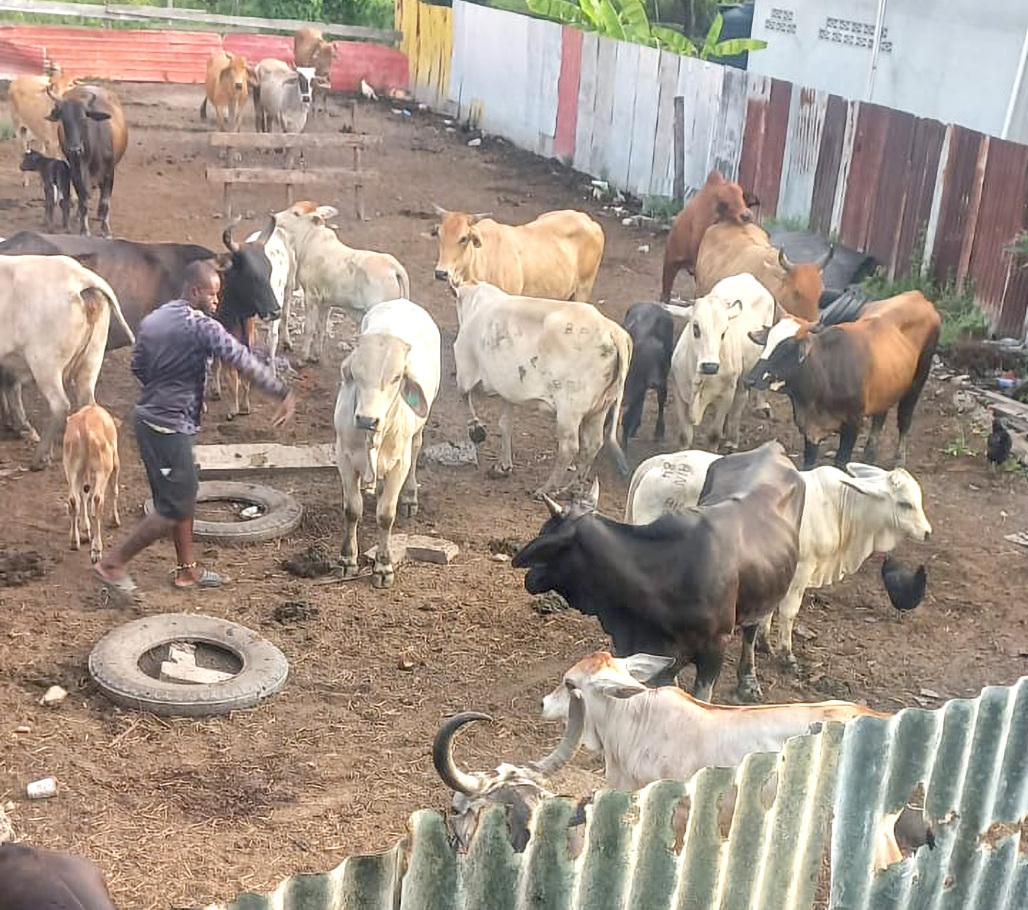
Nedd related that the training provided hands-on biosecurity practices on-site at a cattle farm and classroom sessions, making her better equipped to manage her own animals and farm.
For her, a stronger livestock sector means safer food, healthier animals, and expanded trade opportunities for Guyana, of which she is proud to contribute towards.
These initiatives, Nedd opined, are also aligned with Guyana’s commitment to the Caribbean Community (CARICOM) “25 by 2025 + 5” initiative, which seeks to reduce the region’s food import bill by 25 percent.
Through targeted investments in agricultural production, value-chain development, and institutional capacity building, Guyana continues to position itself as a competitive and reliable agri-food supplier within the Caribbean, with epidemiological surveillance serving as a foundational safeguard for sustaining growth and
ed semen, including from the Brahman breed, she is deliberately shaping a herd suited for efficient beef production, while also using sex-sorted semen to produce more female calves when needed.
This level of genetic control allows her to improve weight gain, hardiness, and meat quality without the expense of maintaining multiple pasture bulls.
As a result, she can focus her operation primarily on beef production using Brahman genetics, while maintaining a small dairy component to supply milk within her community.
At the same time, regular ambulatory veterinary support and nutritional guidance from the GLDA’s Region Five Extension team, headed by Dr Joel Dilchand, and Livestock Extension Officers Oudette Percival and Howard Jones, ensure her cattle receive timely care—another advantage that did not exist during her mother’s time. These services reduce disease risk, improve pro -
She also values GLDA’s livestock traceability system, which records herd data for disease monitoring, movement tracking, and emergency verification.
Together, these digital tools enhance transparency and strengthen decision-making on the farm.
They allow farmers like her to respond more quickly to animal health concerns, maintain accurate herd records, and access targeted veterinary assistance when needed.
These innovations, unimaginable in her mother’s time, now form an essential part of modern livestock management, improving efficiency, reducing risk, and supporting faster access to agricultural services and support systems across Guyana.
These improvements are part of Guyana’s wider agricultural modernisation agenda led by Mohamed Irfaan Ali and aligned with the Caribbean Community (CARICOM) “25 by 2025 + 5” initiative. Through regional partnerships and strengthened food safety systems, farmers like Nedd are contributing to a livestock sector that is not only more productive but increasingly export-ready.
Despite these advancements, the realities of cattle farming remain demanding.
During rainy periods, her son rides their horse into the backlands to check on the herd; in better weather, he uses a motorcycle, and she often accompanies him.
Managing both home and farm requires constant attention, but for Nedd, it is a life defined by commitment and purpose.
The contrast between her mother’s era and her own is profound. Where her mother relied on experience and routine in a pre-independence agricultural landscape,
Nedd now works within a structured system of training, veterinary care, improved genetics, organised grazing, and digital support. These changes have transformed livestock keeping from a subsistence activity into a reliable source of income and financial independence.
Healthier cattle command better prices, improved breeding increases productivity, and access to technical guidance reduces losses.
Through this evolution, Charlene Nedd is not simply continuing a family tradition; she is elevating it.
Her story mirrors the transformation of Guyana’s livestock sector from experience-based survival farming to knowledge-driven, technology-enabled agribusiness.
In doing so, she demonstrates that success in modern agriculture is defined not by gender or physical strength, but by access to knowledge, adaptability, and the willingness to embrace change for a better quality of life.
significantly reduced.
Organised grazing arrangements now protect both livestock and crops, demonstrating how structured landuse planning benefits entire farming communities.
Modern farming for Nedd also extends into the digital space. She welcomes the Ministry of Agriculture’s Farmers’ Connectivity Application “Farmers ConnectGY”, which is available for download on both the Google Play Store and Apple App Store, placing essential agricultural services literally in the palm of farmers’ hands.
Through this application, farmers can quickly access critical information, submit support requests, receive real-time updates from agricultural agencies, and connect more efficiently with extension officers and technical services, without the delays associated with traditional in-person processes.
For Nedd, this represents a practical shift towards convenience, responsiveness, and improved farm manage-



‘188 years it has been since the last ship sailed from the docks of Calcutta, India. A people from the dust of poverty set sail for days and nights across the dark waters to a new land. Promises, their empty hands reached for, nurturing along the torturous journey, dreams of betterment. But as their bare feet touched this green land, their eager hearts were stunned by the falsehoods, for within the sugar-cane fields, they had to toil to build their dreams. The blood, sweat and tears of each day, under indentureship rule, tell many stories.’
A young girl from the dusty village of Fathaha, south of Uttar Pradesh. In the unwanted embrace of poverty, dried tears on a face with a speck of hope in the brown eyes, bare feet kissed numb
by the dry dirt, and ragged clothes on a body that craved warmth.
I sometimes looked up at the sky when tormented by hunger pains and asked, “Why, dear Bhagwan? Why this suffering?”
I always asked questions when it was dark and quiet so that God could hear my weak voice, but there were no answers. I did not give up hope, though, knowing one day He would hear me. I lived with that thought, so even in the day, when a dry leaf falls from a tree whilst I am walking by, I would look up at the sky and ask, “Did you say something?”
So anxious I was for an answer to prayers that could lift the burden of poverty so we could have enough food and comforts to smile with life.
One night, I saw a shoot-
you out of business.
This last section of the book will consider how your organisation can expand. An expanded organisation can bring tremendous benefits to many people, and even to the organisation as a whole. When your organisation expands, you will face challenges, but because you have survived before and learned many lessons, you can continue to thrive.
Expansion has its risks, but besides the risks, some rewards await you. Therefore, managing the risks and the benefits will soon flow towards you.
An organisation must look to new markets to reach more people and meet their

ing star, and I jumped up, almost knocking over my little brother, to make a wish, and I waited.
Days turned into weeks
FROM PAGE IX
needs. In this section, you will learn the ways a business can be expanded, market options and product options, most of which are part of Ansoff’s product matrix.
The practical examples and illustrations will influence you to do better and to be recognised within a wider group. Do not let competition make you close down your organisation; fight back and take it to a higher, more advanced level than before.
Think about new products that the market may need since you may soon be the market leader, and every time people mention your organisation’s name, they will remember you as the “first mover”.
and weeks into months, by which time my Nana died. He had become sick, but my father did not have enough money to buy his medicine. I
watched my father carry that guilt with him, which was so sad, and I wondered about my wish.
Then, in the fourth month,
something happened.
Strange white men came to our village.
They had been sailing to different ports in search of labourers to work in a rich, far-off land. After listening to their offers, many desperate men, some with their families, accepted them, understanding that at the end of their contracts they would be able to return home with their earnings.
My father took my mother and me along with him, for he did not want to travel so far away and leave us home alone. My little brother was left with aunts and uncles who hadn’t quite decided to go on the journey.
“We will be back as soon as we finish our contract,” he promised. “Take good care of yourselves and my son.”
Just before boarding the
TURN TO PAGE XIX


PEOPLE prepare for enemies like it is a full-time job. We imagine betrayal arriving with warning labels, dramatic music, and at least one obvious red flag waving like it is trying to save your life. But honestly, how often does life really operate like that?
Life sends you someone you would defend, care for
and protect, because the real danger in life has never been the person standing across from you.
The real danger has always been the one standing beside you, holding your trust like it is something light, casual, and something they can pick up and put down depending on the mood.
Most of the time, you never see it coming because it is never hidden; it just does not feel like a threat—it feels like love. It feels like, “finally, someone who gets me without me having to explain myself like a user manual.” So, you open up. You share things you do not usually say out loud and soften in

ways you do not normally allow. You relax your guard, perhaps out of carelessness, because everything in you reads this person as safe. The part most people, including me, do not like to admit is that sometimes our nervous system recognises patterns before your mind catches up, but you override it because the feeling is too good to question.
If you have been reading for a bit, you already know I love to discuss Attachment Theory, which explains that people are drawn to familiar emotional patterns, even when those patterns are not healthy. A person who has experienced inconsistency will often feel chemistry with inconsistency, and a person who has had to earn love will feel drawn to situations where love feels conditional.
So, when you meet someone who gives you just enough, your system leans in and now you are invested. And once you are invested, your perception shifts. You start filtering reality through attachment instead of clarity. You explain behaviour rather than observing it, and justify gaps rather than questioning them. The person in front of you always notices, because people always notice what you tolerate.
Now let us talk about the betrayal itself, because this is where it stops being poetic and starts being practical. Betrayal is rarely one big moment.
It is usually a series of small permissions—a boundary you softened, a truth you ignored, or a discomfort you dismissed. Each one feels minor on its own, but together, they create access. And access, in the wrong hands, becomes leverage.
Freud spoke about repetition patterns long before
modern relationship talk made it trendy.
People repeat emotional experiences not because they enjoy pain, but because the mind is trying to resolve something it never fully understood the first time. So, you stay longer than you should and try harder than you need to, giving more than is required.
And when it finally breaks, it feels like betrayal, but part of the pain comes from realising how many times you saw pieces of it and chose not to act. This is the part that stings the most. And what about the one who pulls the trigger?
People like to label them quickly—manipulator, user, heartless—but yes, sometimes those labels fit neatly. But a lot of the time, what you are looking at is someone who learned early on that control feels safer than connection.
Gabor Maté explains that when people do not feel emotionally secure, they develop coping strategies to manage discomfort. Some people withdraw, some people overperform, and some people control situations, so they never feel vulnerable.
When someone studies your weaknesses, your triggers, your soft spots, it is not always because they are plotting your downfall like a movie villain.
Sometimes it is because control is the only language they understand. After all, connection requires a vocabulary they never learned. Still, impact remains impact, because whether the bullet was loaded intentionally or carelessly, it still hits.
Now here is the part where people expect sympathy or blame. I am not offering either, because clarity is better. Once you understand that people operate from patterns, not just intentions,
everything starts to make more sense.
The charm, the inconsistency, the silence, the sudden shift—all stop feeling random and become readable, and then avoidable.
This right here is called real power—not in predicting people, but in observing them. So instead of trying to control outcomes, you make different choices. The truth is simple, even if it is uncomfortable: not everyone who gets close to you deserves access to you, and not everyone who feels right is right.
The real work is not building stronger walls. The real work is building sharper awareness—the kind that notices without rushing, that listens without needing everything to make sense immediately, because when you slow down, people reveal themselves without effort.
Betrayal does something very specific—it removes illusion and takes the version of the story you were holding onto and replaces it with something clearer, something less comfortable, but far more honest. You now know what absence feels like, what effort is, and what performance looks like dressed up as effort. Suddenly, the same situations that used to confuse you become obvious. As usual, poetry in conclusion:
The One Behind the Trigger
Sometimes the one you’d take a bullet for Is standing silent at the door, Not shielding you from what may fire, But fuelling it with quiet desire.
Sometimes the chest you’d stand before Is the same hand that loads TURN

JAMAICA Kincaid’s A Small Place (FSG, $13.95), a work of creative nonfiction published in 1988, is driven by anger—an anger that is unmistakable on every page. Yet this rage is never softened or obscured by Kincaid’s lyrical prose; instead, her style heightens its force. And there is ample reason for such anger.
The essay confronts large and troubling themes: parasitic tourism, corrupt governance and sybaritic politicians, and the enduring damage of colonialism and racism on the island of Antigua.
Kincaid addresses these subjects with striking candour, unafraid to name names or expose systems. She is particularly incisive in tracing the mechanisms through which Antigua’s government becomes corrupted, and how that corruption erodes both civic institutions and the social fabric.
The essay also carries a strong autobiographical undercurrent, as Kincaid draws on her own childhood experiences on the island. Its pacing is brisk, almost galloping, propelled by a prose style that is at once lyrical and blunt. The result is a work marked by an unmistakable, truth-telling directness.
The realities Kincaid details are difficult to confront, not because they are obscure, but because they implicate us. Rather than offering the
comfort of detached understanding, the essay provokes a sense of shame: shame that such conditions exist and persist with our complicity.
Politicians bear responsibility for their actions, but citizens, too, are implicated in repeatedly electing them, fully aware of their character. We endure—and in some sense enable—their sudden accumulations of wealth and the brazen lies that sustain their power.
As a polemic, A Small Place succeeds not by offering solutions, but by insisting on an unflinching presentation of facts. It articulates what many already know, or could reasonably infer, yet refuses to prescribe remedies.
That absence is itself unsettling. The burden of response is left to the reader, who is forced to confront not only the problems but also the lack of viable alternatives.
The cyclical nature of corruption—where one government merely replaces another without meaningful change—creates a sense of entrapment.
Kincaid portrays a reality that feels almost immutable.
Political power in Antigua passes within familiar circles—“from one Bird to another”—suggesting a system that resembles inherited enterprise more than democratic renewal.
The “small place” of her title becomes a microcosm
of the wider Caribbean: a region economically dependent on tourism and visited by travellers largely indifferent to its history and people. Tourists consume the islands as idyllic escapes, rarely perceiving the human and historical realities that sustain their experience.
They do not see—and Kincaid insists on making that blindness visible. It is, strangely enough, the perspective of the native that Kincaid is interested in, and what they see of the tourist is not flattering:
“An ugly thing, that is what you are when you become a tourist, an ugly, empty thing, a stupid thing, a piece of rubbish pausing here and there to gaze at this and taste that, and it will never occur to you that he people who inhabit the place in which you have just paused cannot stand you, that behind their closed doors they laugh at your strangeness (you do not look the way they look); and the physical sight of you do not please them; you have bad manners (it is their custom to eat their food with their hands; you try eating their way; you look silly; you try eating the way you always eat, you look silly); they do not like the way you speak (you have an accent); they collapse helpless from laughter, mimicking the way they imagine you must look as you carry out some everyday bodily function. They do not like you (pp. 17).”

Kincaid’s pointed literary activism resonates with the consciousness of ordinary Caribbean people, who may not express these truths with
her eloquence but recognise their validity. Kincaid’s poetic prose does not dilute her message; it amplifies it. The lyricism sharpens the critique, rendering it not only more powerful but more accessible—ensuring that what is said cannot be easily ignored.

love most.
The evidence is clear and consistent: when women lead, outcomes improve, communities become more resilient, and economies grow more equitably. Governance is more accountable, and peace agreements last longer. This is not sentiment; it is what the research, the data and the lived experience of women across the world have confirmed time and again.
That is not a distant global conversation; it is the conversation the work of Guyana’s women leaders answers every single day, right here in this region. The tapestry of lived experiences, skill sets, creativity and a history of care and organisation continues to place Guyanese women at the centre of decision-making and nation-building.
This year’s cohort of 25 awardees represents the full breadth of what women’s leadership looks like across
Guyana. They come from business and finance, health and education, community development, public administration, and the creative economy. Some are widely known; others have led with quiet consistency in places where recognition rarely travels, including in Guyana’s interior regions, where the work of building community is often invisible. The 25IWLA has made a deliberate practice of finding both. The ceremony itself is structured to do more than applaud. Guests at this year’s event can expect an inspiring programme, anchored in the mission of creating an empire of women leaders, grounded in growth, service and leadership. This will be brought to life not through formal speeches alone, but through the stories of the women being recognised, the table conversations, and the connections during cocktails—all stories that ground
the award’s theme in the specific, living textures of Guyanese life.
The platform’s mission is straightforward and ambitious in equal measure: to empower women as they grow, serve and lead. The 25IWLA’s commitment to providing a network of genuine connections is steadfast, extending an open invitation to leaders and visionaries across Guyana to join this movement.
There is also a forward dimension to the seven-year timeline that reflects where the 25IWLA is headed as a platform. Guyana is at a remarkable inflexion point economically and socially, and in its standing in the region and the world. The decisions being made now about who leads, in which rooms and with what support will shape the country’s trajectory for generations. The 25IWLA is positioned as an active participant in that conversation, not
a bystander.
Women who were recognised in earlier cohorts have since joined boards, launched enterprises, entered governance, authored books, become national political voices, and brought younger women with them into spaces they might not otherwise have reached. That compounding effect—quiet, audacious, deliberate, and now increasingly visible—is the truest measure of what this platform has produced: twenty-five women leaders whose induction this year will bring the platform’s total to 175 honourees since its establishment in 2019.
In seven years, the co-founders also established the Women’s Leadership Programme (WLP) and the Changemakers Series—both designed to ensure continuity, executive presence, coaching and mentorship. The WLP is open to all nominees and honourees, while the Change-

makers Series is an exclusive forum reserved for honourees. The 25IWLA celebrates these extraordinary women and invites Guyana to join in honouring their contributions on 9th May 2026 at the Guyana Marriott, Georgetown.
This year’s cohort represents women’s leadership across Guyana, from operating theatres to nursery schools, from Parliament to the creative economy. In healthcare, Dr Kamela Bemaul-Sukhu has pioneered haematology services at the Georgetown Public Hospital Corporation, establishing dedicated clinics for sickle cell disease and haemophilia, marking historic milestones in Guyana’s medical history.
Dr Aartie Somwaru-Jhagru brings excellence in internal medicine and mentors the next generation of physicians.
Dr Nandishaw Ramsingh leads national diabetes and kidney care policy and is the author of Guyana’s first children’s book on Type 1 diabetes. Dr Theresa Sarju provides strategic leadership as the Regional Health Officer for Region 5. Dr Salome Henry brings over three decades of public health service in Region 10. Dr Renuka Tewari combines clinical practice with community food distribution and outreach for hundreds of families, while Dr Pamela Rose advances public health delivery and preventive care.
In education, Lenise Morgan has dedicated over three decades to Guyana’s schools, serving as Deputy Headmistress of Queen’s College and continuing her work at the Morgan’s Learning Centre. Munirah Reedon leads early childhood education in Region Two whilst training future educators at the Cyril Potter College of Education.
Savitri Tularam-Kaulesar, a member of the National Literacy Committee, has spent nearly two decades building foundational literacy in young learners.
Rhonda Maxius-Lansiquot co-founded Wiser Academy, where student-centred learning is central to her practice. Jessica Nathalia Callender, a national chess champion and FIDE-certified Senior Lead Instructor, uses chess as a tool for critical thinking and inclusive youth development.
In governance and public service, Dellon Adams serves as Clerk of Committees at the Parliament of Guyana and also founds community libraries and youth civic engagement programmes. Chandrowtie Sarran leads peacebuilding and Diversity,
FROM PAGE IV
Equity and Inclusion initiatives as a Commissioner with the Ethnic Relations Commission across all ten administrative regions. Bonita McDonald heads planning and training at the Guyana Food Safety Authority whilst lecturing at the University of Guyana. Doneeta Ramlakhan supports energy-sector oversight, leads the Solar Home Systems programme, and founded Pawsome Oasis Inc. to advocate for animal welfare.
In community development, Jacqueline Cummings Johnson has directed youth empowerment programmes through Mibicuri Community Developers for over two decades. Madonna Ghanie founded BMR Enterprise and Mommy’s Corner, supporting single parents and vulnerable families. Sonja Sampson brings seventeen years of youth development expertise.
Younica Sanchara combines entrepreneurship with youth advocacy, creating inclusive platforms for young people to lead. In the private sector, Kimbely Yearwood, an Attorney-at-Law, advances access to justice for underserved populations.
Upasna Mudlier coaches women entrepreneurs through practical, results-driven business development programmes. Christine Samwaroo, Founder of The Breadfruit Collective, advances gender equity and climate justice. Christell Chesney works at the intersection of environmental governance and Indigenous community empowerment. Marisa Morgan-Bonie, a multi-awardwinning actress and Media and PR Director, shapes national conversations through storytelling and cultural expression.
The 2026 honourees are: Dr. Aartie Devi Somwaru-Jhagru, Bonita Lowenfield McDonald, Chandrowtie Sarran, Christell Chesney, Christine Samwaroo, Dellon Patricia Adams, Doneeta Ramlakhan, Jacqueline Cummings Johnson, Jessica Nathalia Callender, Dr. Kamela Bemaul-Sukhu, Kimbely Yearwood, Lenise Morgan, Madonna Ghanie, Marisa Morgan-Bonie, Munirah Reedon, Dr. Nandishaw Ramsingh, Dr. Pamela Rose, Dr. Renuka Tewari, Rhonda Maxius-Lansiquot, Salome Marina Ann Henry, Savitri Tularam-Kaulesar, Sonja Sampson, Dr. Theresa Sarju, Upasna Mudlier and Younica Sanchara.
Twenty-five women, once again ready to show what Guyanese leadership looks like when it is given the room it deserves.



custard. I do also offer red bean for those who want to try it.” The business has also evolved over the years, with her now creating entremets, cutlets and crunch cakes, gravitating towards something a bit more luxurious.
Five years later, Maisha’s Bakery continues to grow, with support being a driving factor. As Oxford shared, she has built a loyal customer
base and a business that feels more like home. “When I started, it was mostly my friends ordering. Then they would tell others, and others would try it and recommend it to more people.
I have quite a few loyal customers, and I love them dearly. It feels very homey. It’s not just a business; it has soul.” She noted, however, that there have been chal -
lenging moments when she felt like balancing both the bakery and her studies was impossible.
“The good feedback is what has kept me going, because there were many times I wasn’t sure I could continue, especially while managing medicine. It has been really difficult, but I’m still here and still going,” she added.

She noted that while ambition has been a driver, balancing all she did at the time was difficult, adding, “I would bake until maybe 2 a.m., sleep, and then wake up early to go to school with the items. When I did the Miss Guyana Culture Queen pageant in 2023, I had to juggle school and pageant prep. I had to pause baking because I couldn’t handle everything at once. Valentine’s—everyone is out, but I have to bake. It’s a lot of sacrifice.”
This is why Oxford says that rest and resisting burnout are vital, especially for young entrepreneurs. Speaking to her own personal growth, she said that balancing business with education has taught her about boundaries and understanding that it is okay not to be going all the time.
She added that even when she wanted to keep pushing, she knew she had to take a step back, adding,
“I think our mind is our first barrier. It comes down to what you like to do. Don’t limit yourself.
People used to ask how I manage medicine and baking. Yes, you can do anything you set your mind to, just don’t kill yourself in the process.”
Speaking to young entrepreneurs who may feel the pressure to continuously grind as a way to success, Oxford noted that rest is as important as the hustle, adding, “Rest is important. Taking care of yourself while pursuing your dreams is important. If you are not taking care of yourself, you will not have the energy to continue.”
Looking ahead, Oxford has her sights set on refining and streamlining what Maisha’s Bakery offers. Plans include a more intentional, focused menu, one that trims excess while preserving the creativity that has set her apart. Seasonal items will remain, alongside
new additions like tiramisu, homemade sprinkles and a revamped cake menu. She is also working on a Mother’s Day package and a tropical-inspired ‘sunlit serenade’ school package featuring the flavours of pineapple, coconut and passion fruit. But as much as the business is shaped by ambition, Oxford is equally grounded in gratitude.
Her aunt gifted her a KitchenAid, her fiancé provided her first mixer, and her mother helped her take those earliest steps.
“Community is important,” she added, “I would not be here without my family, friends and even strangers who support me.” It is a sentiment that captures everything Maisha’s Bakery has come to represent—not just a business built on skill and creativity, but one carried forward by the people who believed in it from the very beginning.

ship, I picked up a piece of dried dirt and put it in my pocket so the motherland could stay close to me until I returned. It was not easy leaving to follow a dream that, in our eyes, was painted in brilliant colours. But the shocking reality of that long journey cast a shadow over that painting.
The cramped ship, the inhuman conditions, and the disdain on the white men’s faces as poor souls who died during the journey were tossed into the sea.
After countless days and nights, the ship landed, I later learnt, in a small South American country – British Guiana. My bare feet touched soft, green grass, the cool breeze blowing in from the river cooling my face, and for the first time, I felt I could smile a little.
“How good would life be here?” I wondered.
My thoughts went to the families awaiting our return with hope, but as we were allocated to different plantations, I realised it had been a deception.
A one-room hut, harsh working conditions on the sugar-cane fields, and the cruel whip that tore the skin on the backs of men were a far cry from a good life. The dreams we came searching for, we had to toil to find until it was time to return home.
That time never came for me.
The white colonial masters were reluctant to honour
the contracts signed by the indentured servants, mostly by thumbprints, and the sweat we gave for a pittance turned into blood and tears.
But over time, the labourers’ discontentment and deep desire to return home forced the colonists to honour the agreement, and those who had saved enough or couldn’t work under such hardships returned home.
It was such a deep relief for my father, but we couldn’t return home just yet because he hadn’t saved enough money, and the entire family left behind was depending on him.
“What do we do, Baba?” I had asked.
“I will work harder to save some more,” he said. “And two trips from now, we will return.”
That sounded quite reasonable to my mother and me, as ships were taking back labourers and bringing recruits, but it was a huge mistake my father made to delay our return.
I had grown into a young woman whilst working as a house servant, and one day the colonial master from another plantation across the Demerara River came to visit. He saw me and requested that my master take me to his plantation to be his house servant.
I saw the pained, helpless look on my father’s face and the tears in my mother’s eyes as she pleaded for me not to be taken away. Her pleas
were not heeded, and with laden feet and a grieving heart, I left for a new place far away. The piece of earth from my motherland I felt in my pocket, squeezing it tightly in my hand.
“I don’t know where I am being taken now,” I said silently, “but I still have you with me, mother… one day, maybe…”
Time went on, and I bore children for the master, trapped in a life I never wanted. I never saw my mother and father again, and many nights I lay in bed sleepless, thinking of my little brother still awaiting our return.
How could fate perpetuate such agony and pain?
Who wrote these scripts of life?
The plantation that more or less imprisoned me was not far from the sea, and on windy nights, I could hear the waves crashing against the seawalls. One late afternoon, with the help of the old gardener, I slipped away to the seaside.
The sun was sitting in its crimson glory, but my eyes couldn’t appreciate that wondrous spectacle of colours nor embrace its brilliant beauty, for I was watching the rolling waves of the sea. The deep yearning in my heart for home never faded, but the flames of hope to return flickered.
I had grown older; my mother and father had returned home safely, which I was happy about, but sad that
the war?
The eyes you trusted in the night Are aiming steady at your light.
You’d bleed for them without a sound, Stand ten toes firm on battleground.
While they, behind a steady frame, Pull back the hammer all the same.
You’d shield their name with loyalty, Call it love, call it destiny. While they mistake your open heart
For easy access to tear apart.
You saw a bond, they saw control.
You gave your faith, they took their toll.
You thought the danger faced the two, Not knowing it was coming through you.
But here’s the truth betrayal brings; It sharpens broken, fragile things.
It teaches who deserves your stand
FROM PAGE XIV
And who was never worth your hand.
So let the lesson cut it clean, Not every smile is what it seems.
And next time love asks for your core, Be sure they’d take the shot for you, Before you take one more. Romella Dasratt

I was left all alone. I did not cry, for I had no more tears left, just the pain in my heart I had learnt to live with.
Home now seemed farther away from me, and all those who were frustrated by the long wait for their passage back bought pieces of land and decided to stay. But the good thing was that they held on to their faith and culture, and lived and worked each day with an unbroken resolve to achieve something of worth in this land that had now become home.
At the end of indentureship, the colonial master returned to England, be -
queathing to me his house and some acres of land. So, from a servant girl, I became the mistress of a mansion and owner of lands.
I never dreamed for one moment that I would become a rich woman, but it came at a heavy price.
So much time had passed, and now, being the mother of five children, how do I go back home?
Standing by the seaside one late afternoon, I untied the cotton that held the piece of earth from the motherland I had picked up as a little girl. It had crumbled to dust over the years, and dissolving it in
a goblet of water, I poured it slowly over my head.
“I cannot come back to you now, dear mother, but you will always live with me.”
I stood there for a long time, watching the waves rise and fall, feeling in my heart that the boundless sea was my refuge.
Then I turned and walked back to my mansion, my children, a new life, for maybe this was my destiny designed by fate.
A simple wish on a falling star for a good life as a child in Fathaha, India, brought me this far.

























































Dear student,
While it is common to set high standards for yourself during an examination season, excessive concern over the expectations of your supporters can often be more distressing. Note that it is natural to fear criticism or disappointment from them, as this is a common part of performance-related anxiety.
To address this unease, focus your efforts on meeting your own objectives and utilising your capabilities diligently. Remember that a mature, profitable handling
of stress greatly determines your future success. Be wise. Love you.
Writing about historical things
This style of writing demands thorough research with both primary and secondary sources to maintain accuracy, along with an engaging narrative structure. Read the excerpt below to see clearly.
Once upon a time an innocent prisoner was condemned – for his religious beliefs – to die by one of the cruelest tortures of the
Spanish Inquisition. After the strain of the long trial, the prisoner fainted. Blackrobed figures carried him unconscious – down – down -down - far below the surface of the earth where the mind of man had excelled itself in devising fiendish implements of torture.
When he regained consciousness, he examined his surroundings. On the walls were grotesque carvings –figures of imps and demons – and on the ceiling was the figure of Father Time, pictured, as usual, with a scythe. Suddenly he observed something startling about the

3rd, 2026
figure. Father Time’s scythe was a pendulum! The sharp blade was descending inch by inch – and he lay, bound securely, directly in its path. Now the full meaning of his sentence was clear. He was to die by the cruelest of all tortures, mental torture, for his was the anguish of watching death approach by slow degrees.
Down – steadily down. Hours passed – perhaps days – he had no way of knowing; and still the pendulum descended. Nearer and nearer. Now the blade as it passed, cut the folds of his garment. One more stroke and it would reach his heart…
About the Excerpt: This example allows you to observe the treating of a form of writing where the setting is far away and of long ago.
One child wrote this after his teacher gave the class a thumbnail background on the Spanish Inquisition and its extreme cruelty to heretics. She told this first part of the story with dramatic flourish. His story is termed “good” what with the teacher’s drama and interaction with study partners.
Try These three assigned for you:
1. Add an ending to the teacher’s story. You can either write about how the tortures were stopped, whether you think that the fiendish tortures can be stopped, or how the prisoner can be saved. We suggest that you do not write without doing further research.
2. Find another historical era about which factual points are easily gotten and then write an interesting and nail-biting story on it. Share it at your Writing Club and watch the reactions.
3. Imagine you are an apprentice in a bustling pharma-
He gives the poor man twice as much good who gives quickly.
PUBLILIUS
SYRUS
(1st. cent. B.C.) “Sententiae,” 274. J.W. and A.M. Duff, minor Latin poets
cy in a large city and country of your choice between Italy, Germany, Southern Europe, and France during the Renaissance (14th – 17th centuries). Write a story about a day when you are left alone to manage a crisis – either a strange customer or a missing ingredient – while the lead pharmacist is away.
READING SKILLS
Context clues
Remember that context clues are hints or clues to the meaning of a word. These clues are quite literally hidden in plain sight in every reading text. Hints are found in passages, paragraphs, or individual sentences. If you take notice of them, they can tell you the meaning of a word or phrase of which you are unfamiliar.
Sometimes even the title of a passage or its illustrations offer context clues as well. They help you know what is going on within. The writer may include pictures also.
Here are some basic types of context clues classified in different ways. Here are labels given to six of them. (We look at the first three today.)
1. Synonym or Restatement clues (Repeat Context clues)

2. Antonym or Contrast clues
3. Definition or Explanation clues
4. General or Inference clues
5. Specific clues
6. Punctuation or Font clues
Explanations and Examples
1. Synonym or Restatement clues (Repeat Context clues)
Here the author uses more than one word that means the same thing.
Examples: Freddie is a misogamist. He has always hated marriage.
Kendell Simon felt remorse, or shame, for his unjust remark.
2. Antonym or Contrast clues
Here the text may include a word or words that have the opposite meaning of the unknown term. (The text gives hint by telling what the words are not.)
Examples: Eva always dressed extravagantly. I have never seen her in a dreary outfit. Attempting to avoid the road accident was futile; it was impossible for either racing cyclist to stop in time.
3. Definition or Explanation clues
Here the author has an unknown word or phrase explained within the sentence or in the sentence immediately after.
Examples:
On Friday in our science class, we viewed a film on tacamahac which is a yellowish substance with a strong odour collected from various trees and used as incense.
The workers were elated because they were placed second in the bora farming competition.

TOOTH decay, also known as dental caries, and gum disease determine a person’s oral health. Incidentally, such morbid conditions are so common that eventually every adult in the world has one or both. The countries with the best oral health are the United States, Denmark and Canada. Those countries whose populations have the worst mouths are Poland, Colombia and Australia.
Because these conditions are so common, they are considered a real public-health problem, especially because lawmakers and politicians globally do not consider them vital.
Why is it that, even though in most countries in the Middle East there is no significant water fluoridation or comprehensive preventive programme, the populations enjoy relatively good oral health? The answer to that question involves a practice that most of the world probably considers primitive.
Surprisingly, instead of focusing on and knowing the real causes of these two diseases (which are simply dirt and diet), and instead of directing all the efforts to invent and encourage the use of effective tools to prevent and control these two diseases effectively, the profession has fallen into treatment, which consumes too much time, effort and money.
Chew sticks are commonly used in Jordan, Saudi Arabia and the United Arab Emirates for oral hygiene, religious and social purposes. The Ancient Egyptians were concerned about dental hygiene. We know this today because they also had a habit of being entombed with their treasures, so we discovered that tombs from 3000 years
before Christ contain small tree twigs whose ends had been frayed into soft fibres.
Here at home, the chew stick was popular in some rural areas some years ago. Black sage and neem stalks were commonly used to clean one’s teeth.
It has been determined that chew sticks from 13 different plants not only contain substances with antibacterial properties, but also have astringent, detergent, and abrasive properties. These properties have encouraged some toothpaste laboratories to incorporate powdered stems and/or root material in their products.
The chemical constituents of Salvadora persica, for example, include trimethylamines, alkaloids, chlorides, high amounts of fluoride and silica, sulphur, vitamin C, and small amounts of tannin, saponins, flavonoids and sterols.
The most studied chew sticks are the miswak, Fagara zanthoxyloides, Serindea wernikei, neem, paku and Acacia arabica.
Research was conducted mainly in Nigeria, where 90% of the population uses chew sticks. Here in Guyana, we could use neem, cinnamon, lime or black sage.
A few years ago, the World Health Organization (WHO) recommended and encouraged the use of these sticks as an effective tool for oral hygiene. Experts confirmed that the toothbrush is no more effective than the chew stick in removing dental plaque.
The use of chew sticks is entirely consistent with the Primary Health Care Approach (PHCA) principles and a focus on prevention and community participation in technology.

By using it, the notion of self-reliance can be encouraged and implemented in poor countries where it is locally available and does not
require technology, expertise, or additional resources to manufacture. Both children and adults can use it; thus, it is appropriate for all societ-
ies. The use of chew sticks is catching on in industrialised countries.
For example, it is quite common in pharmacies in