
Sunday, March 1, 2026

Sunday, March 1, 2026

By Shaniya Harding
WHEN Rajiv Singh lost both his parents during his teenage years, he knew that despite the challenges and the loss, he had to become a success. Today, he is an established entrepreneur and Chief Executive Officer of Blackwater Tactical Security Guyana.
Sitting down with the Pepperpot Magazine this week, Singh shared his story. From his early days of struggle in Bartica, which built character, to his slow and deliberate steps into the world of security, Singh credits his foundation for his success.
Singh spent most of his childhood in Bartica, Region Seven, being raised by his grandmother, a childhood that shaped his character and taught him lessons he still carries today. Singh had what he described as an old-fashioned upbringing, with his grandmother emphasising the lessons of humanity, humility and the importance of hard work.
“My grandmother wakes up at 3 o’clock every morning. She did not wake me up at that time. But I was supposed to get up at a certain time. She don’t like when the sun rise before I wake up. So she played a role that
moulded me to this point in my life,” he added. “When I get up in the morning, I got to look after the plants. I got to fetch water from the river.”
These lessons, coupled with challenges, gave Singh a strong sense of identity and determination very early on. Recounting his childhood years, he shared that the bullying he faced at both home and school played a major role in building his resilience, sense of self and belief in himself. While at school, Singh says he “had to act cool”; this act soon shifted into self-belief. “With all of this happening in my TURN TO PAGE VI



By Shaniya Harding
WHEN twenty-four-year-old Sabrina Johnson posted a video of herself riding her bicycle and selling her homemade juice, she did not expect both the video and her business to go viral overnight. Since posting the video a little over a month ago, Johnson has garnered thousands of views and hundreds of phone calls from Guyana and beyond.
Now she is working to grow the business amid growing demand. In a sit-down with the Pepperpot Magazine this week, Johnson shared her journey, what led her to the now-viral video, how she is dealing with unprecedented demand and how she plans to chart her course forward.
Born in Venezuela to Guyanese parents, Johnson grew up amid a mix of cultures, with both Venezuelan and Guyanese influences shaping her. Financial and situational challenges struck Johnson and her family just a few years ago. With supportive, more stable relatives in Guyana, Johnson and her family soon moved here. “My family is in Guyana.
They told us that they moved from Venezuela and came to live in Guyana because here you could come and live and have a life and create a life here.” Johnson described the move as starting over, adding, “We came over, me, my sister, everyone who lived in Venezuela came to Guyana to start a new life. My life started when I was 16, that is when I actually came here. For the past years I was just working. I also play football, just keep doing what I got to do.”
Restarting her life almost meant figuring out, for the first time, what she truly wanted to do. Three years ago, Johnson decided she wanted to start her own venture. As she explained, up until that point, she had worked several jobs, but none felt like she was making a mark or creating something for herself.
This drive to have a business of her own is what pushed her to create Sabrina’s Tropical Blend. “It reached a point that I said I just
want to do my own thing. I don’t want to keep working all my life,” she added. “I like playing football, but I like making juices. I try my best to put out the best juices out there. I have been getting a lot of good feedback, so I said let me stick to this and do it part-time while I train in football. I said let me just ride and sell.”
Like so many new businesses, especially in the realm of food service, Johnson’s business was growing slowly but surely. A defining moment that would rocket both Johnson and her business came just over a month ago, when a single video of her riding her bicycle through the city to deliver a customer’s juice order went viral. With thousands of views on that single video and millions of people viewing the profile, Sabrina’s Tropical Blend was soon one of the most talked-about businesses in Guyana.
Recounting the day she filmed the video, Johnson shared, “I started filming myself riding and selling and I posted it on TikTok and it got really popular. I got over 1,300 orders just from three sets of people at one company,” she added. “Now I am getting help from my sister because she sees the demand. Basically, this is how the business started. I wanted to be more independent.”
Johnson’s unique branding has also garnered attention, with many people drawn to the bold, vibrant presentation. This is something Johnson is uniquely proud of. As she told Pepperpot Magazine, she learned branding and graphic design over six months, an experience she used to craft her brand.
“I worked for like two weeks to buy my jerseys and get them printed,” she added. “I learnt for six months how to do logos, labelling and designing. I just watched YouTube videos and learnt until I got good at it. I even did my own labels for the bottles. I started doing the website. I just put in the work.”
Since the business has been gaining traction, Johnson says she is now more confident in both her brand and herself. While she

believed in the business’s vision, she shared that she had previously struggled with low self-esteem.
“Before everything happened, I really had low self-esteem. I thought I was not so pretty or so nice.”
This is why, when she posted the video of herself with no makeup, plying her trade in the sun, and it went viral, Johnson was both surprised and intrigued by the positive response.
“When I post a video and everything start going up and people
start reading comments saying she is really nice, it started helping me gain confidence to put myself out there with no make-up. Piece by piece I started to like what I was doing.”
One of the things that has appealed to viewers of Johnson’s videos is her work ethic. A glance through the comment section of her videos shows thousands of people praising her hard work, with many highlighting that this is not usually seen publicly among
many young women. According to Johnson, the key to this drive has been consistency. As she shared, “Consistency is important. Sometimes you do not want to get out of bed. Sometimes you do not want to keep going. But you got to get up and do the work. If you do not do the work, nobody will do it for you. You got to do it for yourself,” she added.
Today, Sabrina’s Tropical Blend is the producer and retailer of a wide range of juices, shakes and sandwiches. Johnson’s juices, however, are by far her most popular product.
Her juices are entirely natural and seasonal, with each time of the year offering different fruits, flavours and even themes. “I work with the fruits available in the market. Right now, plum is in season, you will get plum juice. Whatever is in season you get. I have a premium option of juice which is expensive, and I have the bottled juice which is $500.” While her bottled juices offer a wide range of seasonal flavours, like her pumpkin-flavoured juice in October, her premium option offers made-to-order, on-the-spot juices.
Moving forward, Johnson hopes to see her business continue to reach new heights, with the dream of being internationally known. While she admits it will take plenty of hard work, Johnson is sure her dedication can make it possible. “I want to be known as the best juice girl or the best in the world, if it is possible.
If it can reach to Venezuela, the place where I was born, to Colombia, not only to the Caribbean but all over. I know it is a lot of work I need to put in, but I think I can reach there.” And Johnson’s advice to other young entrepreneurs is something she said she learnt only after gaining popularity. “Be yourself. Do what you believe in and do not let what people say stop you. I gave up on Sabrina’s Tropical Blend six times and this was the last strike. I left Wendy’s in January to stick to this and look at where it brought me.”



“I looked into your cup to see if you needed more. You looked into mine to see if I had more than you.” - Author Unknown
THAT, right there, explains Thanksgiving dinners, office politics, sibling rivalry, and at least seventy percent of social media. One person checks to refill, the other checks to compare. It is the same table, the same tea, but entirely different software running in the background.
I have noticed that life feels much lighter when you are not auditing other people’s blessings. The moment you start counting someone else’s ounces, your own cup develops imaginary cracks.
Psychologist Alfred Adler explained that human beings naturally compare themselves to others to determine their value. That instinct made sense when we were competing for survival. It becomes slightly ridiculous when we are competing over who has the better vacation photos.
Comparison has evolved. We no longer compare hunting skills. We compare lifestyles, likes, promotions, relationships, skin tone, waistlines, and whose child speaks better English at age four.
We pretend we are just ‘curious’, but what is really happening is that most of us are conducting a full emotional inventory.
Meanwhile, the abundance-minded person is standing there asking, “Do you need more tea?” That person is not threatened by your full cup because they understand that life is not a group project graded on a curve.
Author Stephen Covey described the difference between a scarcity mind-set and an abundance mind-set. Scarcity says that there is only one slice of cake and someone else just took it. Abundance means there is enough cake, and if there isn’t, we can bake another one. In other words, scarcity counts crumbs while abundance preheats the oven.
The truth is that most people do not wake up determined to be jealous. They wake up uncertain. Uncertainty scans the room, it checks salaries, it checks relationships, it checks who seems ahead, it checks who seems behind and calls this research. It is actually insecurity wearing reading glasses.
Researcher Brené Brown has spoken about scarcity as the voice that says, “There is never enough.” That voice is dramatic. It sees your neighbour’s success and immediately drafts a resignation letter for your self-worth.
Abundance does not panic that easily. When I look into your cup to see if you need more, I operate from a sense of steadiness. I assume that what belongs to me cannot be stolen by your progress. I assume that kindness does not reduce my supply. I assume that generosity strengthens my position rather than weakens it.
When you look into mine to see if I have more than you do, you operate from a place of competition. You assume that value is limited, that praise is scarce, and that attention must be rationed. Life does not require rationing of joy. It requires perspective.
Roman emperor and Stoic philosopher Marcus Aurelius reminded himself constantly that other people’s opinions and fortunes do not control his internal state. He ruled an empire and still found time to journal about minding his own business.
That level of discipline deserves applause. Imagine the freedom of focusing on your own growth without side-eye. Comparison quietly damages relationships. In friendships, it creates silent scoreboards. In families, it breeds unspoken resentment. In workplaces, it turns collaboration into a slow, polite war. Everyone smiles, but still everyone calculates.
When you check someone’s cup to see if they need more, you strengthen the connection.
When you check to see if they have more than you, you weaken trust. This does not mean you never notice differences. It means you stop assigning moral value to them. Someone else’s success does not accuse you of failure and someone else’s abundance does not indict your effort.
Psychologist Carl Rogers believed that people thrive in environments of acceptance rather than judgment. Acceptance includes accepting that everyone’s cup looks different.
Some are porcelain, some are chipped, some are tall, some are small, but all of them hold something meaningful. Your job is not to standardise cups, your job is to steward yours.
I have discovered that the most peaceful people are rarely the ones with the largest cups. They are the ones who stop staring sideways. They pour where they can. They refill themselves when necessary, and they celebrate without calculating.
That energy feels different. It feels secure, generous and grounded. You can always tell who lives from abundance. They clap loudly for others, share information, recommend opportunities, and do not shrink when someone else shines. You can also tell who lives from scarcity. They praise carefully, compare constantly and protect tightly. One posture expands and the other contracts.
Life becomes more enjoyable when you stop measuring and start contributing. It becomes more stable when you measure yourself against who you were last year rather than against who your neighbour is today.
So continue to look into
others’ cups to see if they need more. Do not look into others’ cups to confirm whether you are ahead. Your peace does not depend on outranking other people. Interestingly enough, when you stop checking other people’s cups, yours tends to stay full. Here is some poetry to sharpen that perspective.
Mind Your Cup
I looked into your cup to see If thirst had found its way

By Romella Dasratt
to be.
You looked in mine with careful eyes
To measure worth by shape and size.
I moved with hands prepared to pour,
To steady what was needing more.
You counted drops and drew a line,
Comparing yours and judging mine.
I trusted life to freely flow,
To rise, to spill, to ebb, to grow.
You feared that if my cup was wide, Yours somehow shrank or slipped aside.
But cups expand when hearts are sure, When giving feels both strong and pure. They crack when envy takes control
And drills comparison
TURN TO PAGE VIII


childhood growing up, I had to adopt. It was making me somebody all the time. I would not see it then. But I will see it later, which I am now seeing. Why? You understand?” While he was not sure how he was going to accomplish it, Singh knew he had to make his family proud, adding, “A lot of my family members from then, they used to talk me down. A lot of them, oh, you’re never going to amount to nothing. So I built this mindset someday, looking at myself and all the people that are saying that you’re not going to be anybody. I got to prove them wrong.”
Singh soon found his route to success through his passion for law enforcement. After leaving school early, Singh did not take the conventional route of signing up to be a police officer; rather, his first real steps into law enforcement came through his love for the job. Being young and constantly surrounded by police officers—his friends and mentors—it was not long before he knew enough about the job to be hired.
“I was listening to reports. I was looking at the books, and me, this young guy, around the police, looking, seeing and observing what is going on, the way the police were dealing with reports,” he added. “One day, there was a senior police officer who came in and said, you know what? This little boy is always around this station. And we went on foot patrol. I started to like it, and I liked the job.”
Singh took an interest in the field while he was still a teenager, describing this tumultuous time. He shared that while it was his passion, it was not a profession his family wanted him in, particularly his parents. Despite this, he continued his work with the force, gaining knowledge and tactical skills while keeping it a secret from his parents.

ground. My sister saw that. She was excited and called my mother, who fainted.”
Neither of his parents was happy with his choice, but Singh stood by it and continued his career.
Recounting this time, he shared that he was still a teenager, still stubborn and determined. The passing of his mother a short while after, followed by his father sometime later, was a major hurdle that brought with it countless challenges, financial and otherwise. While difficult—particularly when his mother had urged him to pick a different path—Singh says he stuck with his passion.

This would not be kept a secret for much longer, however, when a breaking news report captured Singh standing in uniform in the centre of a crime scene, his secret was exposed. “There I was, standing in the crime scene, and it was breaking news on Channel 6, where I was shown standing in front of a man lying on the
Although at the time he was unsure and regretted his choice, today he says he is happy he stood by it. “The day before, my mom was talking to me, saying, I’m your mother. I know that you decided to go to the station. This is what my mom told me. I know this is what you love and I’m begging you to leave it. I’m begging you to look out for your father and your sister. She died on the bed,” he added.
While he had the expertise and drive, Singh lacked the capital to finance the business. Singh, however, was determined to make Blackwater Tactical Security Guyana a success.
Through help from his friends and despite major financial constraints, the foundation of the business became a possibility. “I had no money for this business, nothing, nothing. I remem-
ber Blackwater Security was started and I built my logo on my phone. I remember calling my friend and I said, listen, I have no money. Can I borrow?” he said. Through hard work and dedication, coupled with his well-known appreciation for law enforcement, Singh was soon issued his licences to begin what would today be Blackwater Tactical Security.
Since its establishment, Blackwater Tactical Security has continued to grow and expand. Through innovation and collaboration, the business has become one of the country’s leading firms. The professionalism and tactical nature of the business have made it among the firms securing some of Guyana’s major events and international visitors.
Even as CEO, Singh continues to be on the ground with his team. That commitment to continuous self-development, along with the knowledge he gained from older members of the field, is what Singh says has made both he and his business a success.
“I always think climbing and associating myself with big men would give me guidance, knowledge of things that I would later experience.” Talking about the impact of his upbringing, he added, “With all of this happening in my childhood growing up, I had to adopt. It was making me somebody all the time. I did not see it then, but today I see it.”


HUMAN beings are strangely drawn to the centre of things. When choosing a place to live,
people are drawn to centres of activity, such as a metropolis or a capital city. In a hall or auditorium,
people are drawn to the centre of attention, where they can observe entertainers display their skills.

When engaged in a conversation, people are drawn to the centre of the topic, where the true crux of the matter is situated, just waiting to be uncovered. In everything that humans seek, there is a central facet that contains an extraordinarily valuable treasure. Our goal, very often, is to discover and attain it.
This innate pull towards the centre seems instinctive—almost as if it is something we developed for survival, or at the very least, for growth. Perhaps it is the spiritual recognition that, just as the precious heart lies at the centre of a living being, the energy that powers anything meaningful must also come from its very centre.
So, in a sense, it is not an object that we specifically seek, but rather the strong energy that drives it; we seek the power.
We seek the power of the land in its busiest cities. We seek the power of the room in its most fascinating part. We seek the power of conversation at its most meaningful.
It is an electrifying feeling to hold power. In fact, it is so invigorating that even the idea of holding it can drive an individual down the darkest, most evil roads or the brightest, most righteous roads. The feeling of being in full control of one’s immediate environment and
all the people who live in it can trick an individual into believing that they are invincible. It can easily become a tool for controlling others and a shield to avoid being held accountable for one’s own poor actions. In essence, someone who wields power without the right intentions can begin to believe that they are above others.
In reality, as we discover again and again, real power does not stand above any part of life or the world. Instead, it lies at its very centre.
As members of this younger generation, many of us will eventually find ourselves in a position of power. Sometimes, the power we hold can be so great that it changes lives when directed in the right way.
True leaders and wielders of power can leave only a positive mark if they understand the people and institutions they lead.
Of course, they cannot do this by standing over others and looking down upon them. In order for us to create true change, we must remember to remain in the centre—amidst the people and the lives we wish to impact.
As we go about our lives, we must take on the responsibility of connecting with the people we encounter and of trying to understand problems and situations we may
never have experienced, but that are very real obstacles people battle every single day.
Even before we step into the realities of adulthood, we must make an intentional effort to become better people. Then, when we do take on leadership roles, we must work under the compassionate and responsible understanding that the power we wield is not a weapon or a shield for our personal use, but rather a tool to protect and guide the people whose lives we have accepted as our duty. The truth is, power does not really change anyone or make them bad people. It simply brings out the qualities in them that play the largest roles in the decisions that they make. Indifference in an average individual becomes negligence when they become a leader. Arrogance in an average person becomes cruelty in a leader. Similarly, kindness becomes benevolence, and empathy becomes compassion.
Before we find power or energy anywhere, we must first find ourselves. The choices we make have the potential to affect people, not only directly but also by bringing out our strongest qualities. If we do receive the chance, one day, to lead the world, what kind of impact will we leave?


DIVORCE can be painful, but it isn’t the end. Many couples and families are impacted by divorce today, and not everyone understands how or why it happens. Couples can slowly get too busy for each other and drift apart, or they may not resolve their conflicts and find it easier to separate. Some divorcees have had abusive or unfaithful partners. Whatever the reason for a divorce, it is always a painful loss.
After a divorce, a person needs healing. They should seek counselling and try to restore their mental and physical health, especially if they want to pursue a romantic relationship again. To remarry, one must learn from the first relationship and avoid the same pitfalls. Children, money and legal issues must all be considered when one is thinking about getting remarried.
Building a new family takes work, but a divorced person can learn to have
a healthy new marriage if they take the time to learn, grow and invest in the new relationship. Here, Geary Reid shares from experience and research he has acquired through years of counselling people through divorce and remarriage.
Before someone chooses to divorce their companion, there will have been many warning signs. Those in the relationship may not recognise that people outside are observing these signs and already know that something is affecting this couple. For example, previously both partners would go to regular events together, but now that the marriage has started developing problems, only one partner may be seen attending such events. If the couple must use public transportation, people may notice they are not sitting together, even when there are opportunities for them to do so. If they do sit
together, they may hardly speak to each other or speak without making eye contact. When the relationship is having problems, one partner may withhold money from the relationship. This may cause a wealthy family to appear to be under financial hardship, since some utility bills may not be paid on time. Vehicle loans may become overdue. Mortgages may be outstanding, and some of these assets may be repossessed by financial institutions.
Infidelity will affect many partners. Even one act of infidelity may trigger the immediate end of the relationship. If a partner does not take time to maintain good hygiene, this neglect may also contribute to the end of their relationship.
Mismanagement of money is another reason why some relationships have ended. If one partner is using illegal substances or drugs, then they may begin to steal from others or their partner to

have money for drugs. Every couple must manage external family influence in their relationship, since the impact of certain family members has destroyed many marriages.
Section 2: Counselling People who are experiencing family problems may need counselling. Those who are experiencing mar-
ital problems should seek counselling before, during and after the divorce. These counselling sessions can be many, but they are necessary to relieve some of the mental challenges that people go through when they are experiencing marital problems.
There are a number of side effects involved in any divorce. No matter how strong a person is, divorce
will negatively affect them. Some people who have gone through divorce have not found their way back into society, especially if they had placed great hopes in their companion.
The counselling sessions will help divorcees to clear their minds. Past hurts may cause them to lose confidence in themselves. It is
TURN TO PAGE XIV


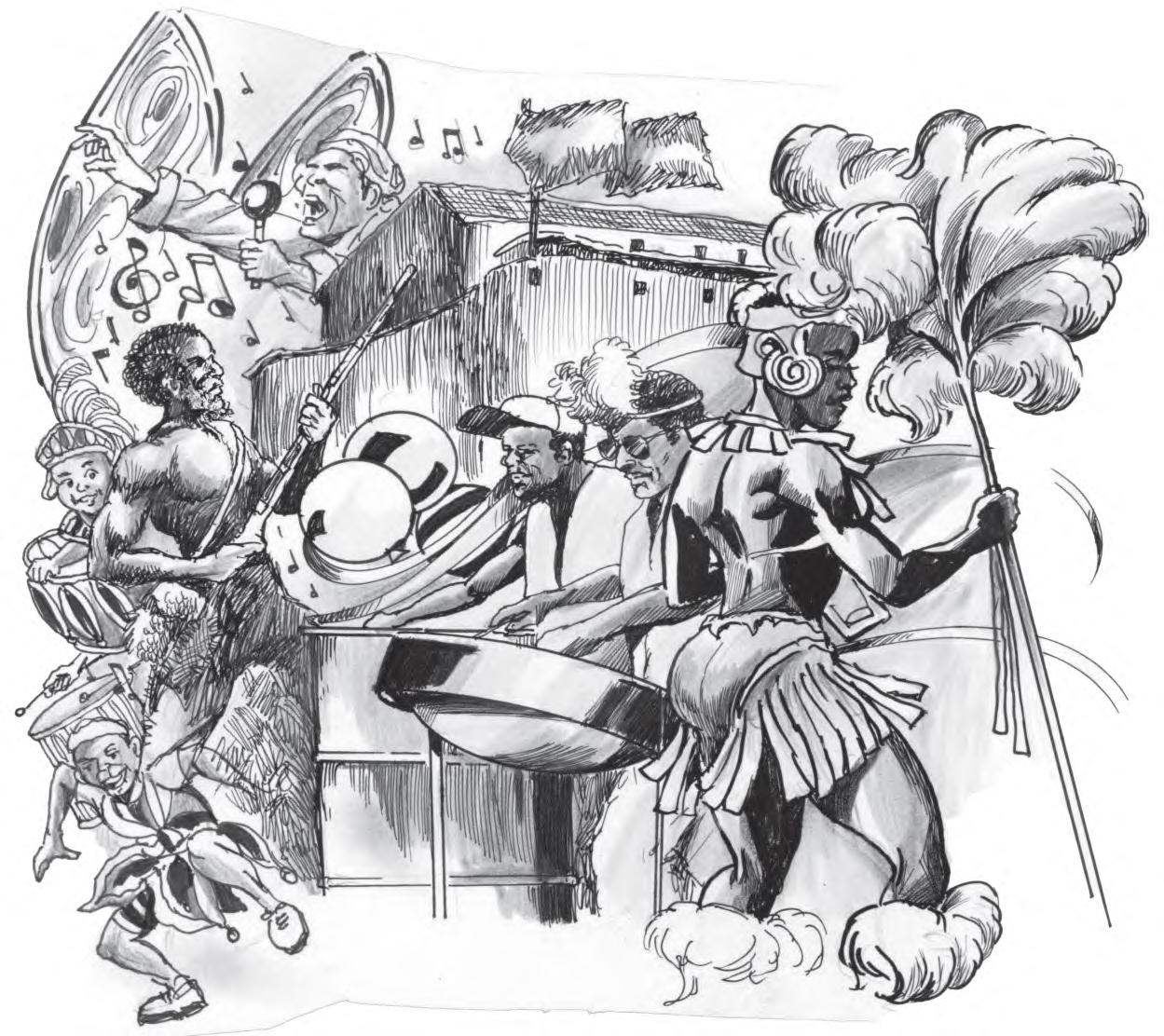
FOR the last Mash celebrations
I took to my drawing table, then to a shy-lime with some brethren who had returned home, it seemed with intent to remind me of our tramping days with
our traditional steel band posse, obeying the crowd chant of “inside–outside”, a chant controlling the disciplined movement of the tramp that enabled and contained the void of any
conflict necessary, admired in a round-the-town tramp controlled by a strict programme, that were at times breached by hostile intruders.
This year caught me, on the
eve of Mash, enjoying the pop music of that time, courtesy of my youngest, mainly the late James Brown, Donny Hathaway and the era of “TALK OF THE TOWN”, that truly played a part in our
transmission.
But here is the era of our Masquerade [much different from our Caribbean cousins].
And the steel bands and tramping of now, in reference, do differ from back then, when the steel bands and their music were the hype, tramping through the town to the top calypsos of the day.
I must, however, concede that the Youth Masquerades and the steel bands I have witnessed from the “posts” that came my way, though youth bands, I’m impressed and do recognise that these cultural expressions rest heavily in our cultural memory as much as the pop music of my youthful ‘coming of age’ into early adulthood.
They capture both mastery of the art and the awakening of the rhythm, much as the haunting memories that still keep us reminiscing while we embrace the current top calypsos, whether local or from our Caribbean kin.
There’s serious consideration, but for now let’s explore the possibility of a small but vibrant nest of local talent that may nurture an exploration of the visual arts with more practical nurturing into functional production, “of this or that”.
Music and scenery become a functional part of the production, whether, however small a space, either of the two becomes relevant cost-wise; thus, it has to be considered by any mind probe, now and not then.
Back in those days, this article is not a lecture, but rather an observation and mind-check of what may be, and with a clear cut of inspiration of what may be, against the inner silent exploration and the comforting gratification of “Is a good thing ah check out this thing that de cross meh mind, ‘cause now ‘I wouldn’t ah know how fuh start.’”
Hope y’all had a happy MASH, stay strong…

THE Super Bowl halftime show performed by Bad Bunny early in February was celebrated all throughout the Americas. It united Caribbean, Latin, Central and South American communities. It was streamed by hundreds of millions of people from within these countries and beyond. I looked on with pride, living abroad for this moment in time.
It felt bittersweet. In one instance, I felt proud and represented as a Caribbean and South American woman. In the other instance, I was missing home more than ever. I felt a connection to the Latin and Caribbean diaspora like I’ve never felt before.
It was a stark reminder that our culture isn’t something we can easily leave behind. The values, culture and beliefs we hold do not leave us when we move abroad. Our culture is an honour to always be proud of, no matter where we are.
I’ve read comments and remarks about Bad Bunny’s performance not being appropriate. For example, the songs were in Spanish. The songs and performance were shown on “American” television. The rhythm and performance were unapologetically infused with Latin and Caribbean influences.
There was such a strong sense of identity and representation. The key takeaway from the performance for me was that we should never “water down” our culture to be recognised abroad. We should not be moulded into familiarity.
We should not be forced to leave our accents behind simply to be “understood”
better. We should not be asked to adapt Western standards into our art and culture.
I wrote this column to illustrate the power of representation and diversity. I want Guyanese creators, artists and writers to understand that no matter where we go or how we present our art, it’s okay to portray our culture through it.
The message behind the halftime performance was also one of resistance. It was a great way to showcase advocacy and awareness through art. Many people might be wondering how this statement matters. I think it does matter because demonstrations like these also show that culture isn’t just about tradition or aesthetics—it’s about lived experience, history and resilience.
There is a simple message. If you’re ever given the opportunity, the way Bad Bunny was, ensure you seize the moment and make a statement. Do not hide your roots; do not be afraid or be sidelined. Our identity is a gift and it is up to us to see it that way and make sure others do too.
Many years ago, Dave Martin made a statement to defend our borders through the use of music and culture. He unfortunately passed on, but his music still lives on and I am sure many Guyanese generations to come will always remember the music and its significance. As such, I think it is important for other Guyanese creatives to understand that their art can have a significant impact as well.
Culture doesn’t need translation to matter; it only needs courage to shine.



“ THERE was something unique about you I liked,” she had told him softly, and those words kept replaying in his mind, for in that tone was an unmistakable passion.
He felt he was losing the battle to fight against the love he felt for her, but he knew he couldn’t because he had to think of his father and what damaging effect it could have on him. He spoke with him
often, but that reconnection was now causing a problem with his mother and siblings.
“Why are you meeting with him so often?” his mother queried in a displeased tone.
“I am just trying to make up for all the years that were lost,” Alvin explained. “And he’s happy about that.”
“Yeah, right,” his older brother Avinash scoffed. “After all he has put this family
through with his cheating and selfishness.”
“Yeah, I know,” Alvin responded, a bit defensive. “But how do I not talk to him?”
“And his young wife?” his sister asked, mischief in her smile.
“That wasn’t funny,” Alvin chided her. “You could have told me that.”
“And ruin a nice surprise?” she asked, laughing.
Alvin shook his head with mock annoyance. He felt like he was caught in a tangled web with his father, Marissa, his unforgiving mother and siblings.
“Damn!” he swore silently. “What a situation.”
His training and experience had shaped him into someone with patience, tolerance and understanding, and he knew he had to apply those mental skills carefully

so no one got hurt, especially Marissa.
He hadn’t seen her in a while, holding against his desire to do so, but one day he just put to rest that mental battle and visited her gift shop.
She was sitting behind the fragrance counter, a little pained look on her face.
“Hey. How are you doing?”
She sighed, then said with a little smile, “I am fine. Haven’t seen you in a while.”
“Kinda busy,” he said casually.
“I see, still avoiding me.”
He smiled a little apologetically, then looked at her and said openly what was in his mind, “I wish I didn’t have to.”
He saw that little pained look again in her eyes and wondered, after he left the gift shop a short while later, if she was unhappy.
He continued to work on his company, which was shaping up great, and he had left for a three-day business trip to neighbouring Trinidad when he got a call from his brother late on the second night.
“You need to come home now, Alvin.”
“What’s wrong?”
“It’s Dad. He collapsed a few hours ago and is in the hospital.”
“What happened?” Alvin asked, an edge of fear in his voice.
Avinash didn’t answer for a moment, then he said, “I think it would be better when we are all together to talk about it because, at this point in time, he’s not looking good.”
“And Marissa?” Alvin asked.
“I don’t know anything about her,” his brother answered in an abrupt tone.
A sudden, compelling feeling had made him ask about her, maybe because
of his father’s request not to hate her.
Alvin reached home early the next morning, greeted by his mother, who looked worried, and by his brother and sister, who were somewhat distressed.
“Has his condition improved?” he asked with some hope.
“No,” his mother answered. “And it seems unlikely it will.”
A dreadful feeling entered Alvin’s heart at that moment, and he felt a deep reluctance to ask why, but he needed answers.
“Cancer,” his sister answered in an unsteady voice.
The living room suddenly became quiet, just that one word that pronounced an imminent death sentence. No one said anything for a while, unable to believe something like that had happened. Then Alvin asked,
“Did he not tell anyone about this?”
“No, and apparently he swore his doctor to secrecy,” his mother said.
“I can’t understand why he hid this from us.” Alvin visited him at the hospital, but he was unresponsive, and as he looked at him, regret filled his heart.
“We were doing fine, Dad, starting to make progress on the time we had lost. Why this?”
He went to his father’s house to talk to Marissa, but she was not there. The gift shop was closed, and his calls to her phone went unanswered. He couldn’t sleep that night, troubled thoughts on his mind, some questions still unanswered.
In the early hours of the morning, his eyes closed in sleep, and in a dream, he saw Marissa standing alone, crying quietly. As he walked towards her, he heard his father’s voice, “Alvin, my son, TURN TO PAGE XXIII

Nana Kwame Adjei-Brenyah is the author of two remarkable works of fiction which—without forcing rigid categories—may be described as speculative fiction. This genre departs from strict realism and often incorporates the supernatural or the futuristic. It is the mode that defines much of the work of the Caribbean writer Nalo Hopkinson, whose novels Brown Girl in the Ring, Midnight Robber, and The Salt Roads stand as exemplary texts.
The genre can also encompass the rich fables of the Guyanese writer Cosmata Lindie, whose stories mine Caribbean myth and folklore for their very keel. Speculative fiction is a broad and capacious field, able to contain subject matter that exists well outside the bounds of the strictly real.
Adjei-Brenyah’s contribution to the genre is distinctive: he places recognisably real people into surreal
circumstances that are not framed as extraordinary but instead treated as the normative fabric of the fictional world.
The most fantastical— and chilling—story in his first collection, Friday Black (Houghton Mifflin Harcourt, $15.00), is “Zimmer Land”, which imagines an amusement park where white patrons are allowed to fulfil their fantasy of murdering Black people for sport. The satire in Adjei-Brenyah’s work almost keeps the reader from laughing; it cuts too close, carrying an edge that rankles and unsettles.
The book is undeniably funny, but it is a frightful comedy—a comedy of discomfort, cringe and moral unease.
Friday Black contains twelve stories and is something of a kitchen-sink collection: long and short pieces spanning multiple genres, including science fiction, fantasy, satire, dystopian and futuristic narratives. What
unites them is a persistent engagement with the Black experience in America.
The result is a dazzling, brilliant and deeply engaging book.
Among the standout stories is “The Finkelstein 5”, which centres on a white murderer who kills five Black children with an electric saw and is acquitted.
The story is shockingly graphic and unnervingly prescient, especially in light of contemporary American realities. It leaves the reader queasy, filled with a simmering rage at the injustice it exposes.
Another notable story, “The Era”, imagines a future shaped by the unchecked influence of technology—a future that does not bode well.
“Lark Street” recounts a man’s encounter with the two children he consented to have aborted, while the title story, “Friday Black”, explores the radical uses and abuses of consumerism

in a hyper-capitalist future.
In that story, people are routinely trampled to death in retail stores during sales; there is even a designated room for dead shoppers, suggesting a chilling foresight that some casualties are to be expected when a television is marked down by fifty per cent.
Each story in the collection taps into urgent and prescient American realities, particularly those surrounding racism. They move
swiftly between high comedy and grave seriousness, sometimes within a single sentence.
The book is beautifully paced and a joy to read— though not a pleasure. The recognisable horror of these tales undercuts easy laughter, and the reader may find herself feeling vaguely guilty for laughing at all. This collection offers no escape from contemporary racial and technological anxieties. The stories haunt;
they linger.
Adjei-Brenyah is especially accomplished at portraying angst-ridden teenagers. His characters are vividly alive, rendered with precision and empathy. They are deftly drawn, and the comedy—when it lands—is exact and devastating. Friday Black is satire for our moment: brilliantly written, unflinchingly observant and deeply attuned to the realities of its era.

important to look back at past hurts to avoid future pitfalls. While the counsellor will provide guidance, the divorcees must want to change. If they are unwilling to change, they will remain in the same position, continuing to spend time thinking about their former companion.
Counselling sessions will help those who want to start a new relationship become mentally prepared by unpacking emotional and other
baggage from their previous marriage. Many divorcees long to have an enjoyable relationship. So, after the first failed marriage, they have learned many lessons and are willing to move forward.
Section 3: Searching for a Companion
People who have experienced divorce must keep themselves healthy and in shape, as divorcees who are willing to be remarried must prepare to meet their new
companion. While they have not met anyone yet, they must be in the best shape of their lives and feel optimistic that great things will happen to them.
Divorcees can sometimes shut themselves away because of their failed marriage. However, as they get in shape, they must be willing to go to important places where they can find suitable companions. They must go to places and events, not mainly focusing on compan-

ionship, but to have fun and enjoy life. However, they must hope that someone of interest will engage them in the conversation they want to hear.
Sometimes, a change of clothing can help those interested in starting a relationship be noticed by a suitable person. Different places and events attract different people, so there are many options for finding a companion.
If someone shows interest and wants to start a relationship, it is important to evaluate that person. Be careful not to say yes too quickly. It may take the effort of some friends and family members to evaluate the potential companion. Once the evaluation gives the potential companion a passing grade, then it is time to start building that relationship.
Courtship has no specific duration. So, as soon as both people feel comfortable with each other, either person can make a marriage proposal. If the other partner agrees with the proposal, they can
move to the next phase of the relationship: planning the wedding.
Section 4: Remarriage
Think about remarriage, and then get it done. Many people know they want to remarry, but they may still be hesitant because of past bad experiences. However, this time around, once the potential companion has been evaluated, then plan the wedding and get married.
Wedding costs can be high, but if both people were previously married, they may not want to make this wedding too large. Nevertheless, whether it is a big or small wedding, the couple must enjoy themselves. Not all friends and relatives can attend the wedding, so the invitation list should include only the number of people both people want at their wedding. There may be people who are disappointed they were not invited, but everyone cannot be invited to a wedding, since there are cost and space constraints to contend with.
After the wedding ceremony and the reception are over, it is time for this newlywed couple to find some private space and enjoy their honeymoon. When planning the honeymoon, choose a place that offers quality services and value for money. There may be special packages for couples on their honeymoons. The honeymoon’s duration must be planned in advance, especially if both are employed, since they will have to return to work. However, whatever time is spent on the honeymoon must be enjoyable, with both people willing and ready to build their relationship.
For more information about Geary Reid and his books, please use this contact information: Amazon: http://www.amazon.com/author/gearyreid Website: www.reidnlearn. com Facebook: Reid n Learn Email: info@reidnlearn. com
Mobile #: 592-645-2240























please take care of her.” A frantic knocking at the door jolted him out of his sleep, and he got up a bit disoriented.
“Alvin, wake up, son,” his mother was calling.
He opened the door and saw a sad look on her face.
“The hospital just called,” she said, her voice breaking a little.
She didn’t want to tell him why; he knew, and he sat down for a long moment, trying to come to grips with the fact that his father was gone.
The doctor revealed in a meeting with the family later that morning that, when the father was diagnosed with the incurable disease, he didn’t want to burden his family with his care nor
seek their sympathy.
After giving them the details of his illness, the doctor concluded, “If it’s any comfort, you must know he dealt with it fearlessly and lived beyond the expected time.”
“He was a strong man,” Alvin agreed, and as the family got up to leave, he asked the doctor,
“Was the wife informed?”
The doctor took a little moment to answer. “She was by his side just before the end.”
They were not pleased that he asked about her, but if dreams were true, then she was alone, crying, and he had to do what his father asked of him.
To be continued…














































Welcome, fellow reader. Your tangible understanding of topics gets underway when you discover how powerful effective revision can be. Its process enables you to move information from short-term to long-term memory. It transforms su-
perficial learning into comprehensive understanding, promotes confidence over uncertainty, and dispels the misconception that only individuals with exceptional recall abilities can achieve mastery. Tackle gaps; for however fortified in study you think you are, there
is always more still left to substantiate your position. Be wise.
Love you.
Showing understanding of the matter
Read the passage below and prepare to respond to the

1st, 2026
questions set on it.
Any zeal is proper for religion, but the zeal of the sword and zeal of anger, is the bitterest of zeal, and is a certain temptation to every man against his duty; for if the sword turns preacher and dictates prepositions by empire instead of arguments, and engraves them in men’s hearts with a poignard ….
This is inordination of zeal; for Christ, by reproving St. Peter drawing his sword even in the cause of Christ, for his sacred and injured person, saith Theophylact, “teaches us not to use the sword, though in the cause of God or for God himself” ….
When Abraham sat at his tent door, according to his custom, waiting to entertain strangers, he espied an old man, stooping and leaning on his staff; weary with age and travel, coming towards him, who was a hundred years of age. He received him kindly, washed his feet, provided supper, caused him to sit down, but observing that the old man ate and prayed not nor begged a blessing on his meat, he asked him why he did not worship the God of Heaven.
The old man told him he worshipped the fire god, and acknowledged no other God. At which answer Abraham grew so zealously angry that he thrust the old man out of his tent, and exposed him to all the evils of the night and an unguarded condition.
When the old man had gone, God called to Abraham and asked him where the stranger was. He replied, “I thrust him away because he did not worship Thee.” God answered him, “I have suffered him all these hundred years, although he dishonoured Me: and couldst thou not endure him one night?”
(From sermon by Jeremy Taylor)
1. Express in your own words the meaning of the following phrases found in the passage: a) “zeal of the sword” b) “inordination of zeal” c) “all the evils of the night and unguarded condition.”
2. If you were convinced that the only hope of a future life lay in your own religious faith, would you feel justified compelling others to adopt it? Why? OR why not?
3. Why is “if the soul turn preacher” an effective expression?
4. What type of story is
All things counter, original, spare, strange: Whatever is fickle, freckled (who knows how?)
“Pied Beauty”
the one about Abraham and the old man? How does it contribute to the preacher’s main point?
Coining modifiers: the compound adjective
Sometimes your writing forces you to coin compound adjectives to enhance its description. Here is a description of the compound adjective which is also called ‘coined modifier’ and ‘phrasal adjective.’
An adjective modifier modifies a noun. Its parts work jointly to act as a single idea to modify the same noun. It is placed before the noun it modifies. It is made up of more than one word (in fact, there is no actual limit of words in its make-up). Example: She looked at him with that I-dare-you-to-touch-me sneer. (But this one would not get looked at today.)
The made-up adjective is almost always hyphenated.
Today we will look at THREE compositions of the compound adjective:
1. Adjective plus adjective: top-right, bottom-middle.
2. Adjective plus noun: part-time, ice-cold.
3. a) Past or present participle plus adjective: old-fashioned, right-handed.
b) Past or present participle plus noun: crocodile-infested, mineral-based, mouth-watering, Spanish-speaking.
A look at meaning: Sometimes the meaning of a compound adjective is literal, or sometimes figurative. Discover the figurative expression: the “lionhearted man.”
A look at a feature of the multiple adjective: Sometimes the careful writer intends that his multiple adjectives be separated. He then uses a comma between them. Example: a) The eerie, grey room; the
room was eerie, and it was grey. b) The child’s room was eerie-grey in colour.
Examine stories in popular magazines and novels to find good original compound adjectives. Tell your study partners what the writers are trying to suggest. You may enjoy trying to coin effectives expressions for the ideas you have in mind.
Get quickly into the habit of using /practising whatever you have learnt or else you will quickly lose the capacity to remember it well. You may find that sometimes things get so bad that you do not even remember anything you learned by the end of the day in the classroom.
This is not news to many learners who skylark and grab snippets of learning when being tutored, then fail miserably when trying to remember intricate aspects to explain to another learner. Then there are some who try to learn too much at one sitting.
The key here is to understand what you are attempting to learn. You will observe that some students obviously have better memories than others. These do much practice; and find it a very easy exercise memorising subject areas like theories, poems, sketches, and almost any kind of information they need to learn.
You also have good memory capacity. But you might take a little longer to digest information. No matter what it is with you, you also can get into the act of committing things to memory, but smaller bits at a time, using various strategies. Good study is active. It results in an improved memory capacity. In closing, be good and understand the need to complement each study area with a lively interest in the subject outside of study hours.

THE connection between the (lower) jaw and the skull is technically known as the temporomandibular joint (TMJ). It functions through five pairs of muscles attached to the facial bones. The structures (bones, muscles, ligaments and discs) that make it possible to open and close the mouth are very specialised, and are required to work together to enable you to chew, speak and swallow. The muscle pairs must work in proper balance, so that stress on both sides of the jaw is distributed as equally as possible.
The TMJ is considered very complex, because it can perform many different movements, including combinations of hinge and gliding actions. The juncture where the two joints meet has a disc that acts as a shock absorber for biting and chewing forces.
Any problem that prevents this complex system of structures from working together properly may result in cycles of pain, spasm (cramp), muscle tenderness, and tissue and joint damage. This is known as temporomandibular disorder (TMD).
Most researchers agree that temporomandibular disorders are grouped into three main categories, as follows. A person may have one or more of these conditions at the same time.
Myofascial pain is the most common form of TMD. It involves pain in the muscles that control jaw function, the neck and the shoulder.
Internal derangement of the joint means a dislocated jaw, a displaced disc or injury to the condyle.
Degenerative joint disease includes osteoarthritis or rheumatoid arthritis in the jaw joint.
Symptoms that TMD sufferers have include:
• An ache in the area of the ear extending to the back of the head, into the neck and shoulders.
• Hearing a clicking or popping sound on opening and closing the mouth.
• Pain brought on by yawning, opening the mouth widely or chewing.
• Difficulty in opening the mouth and chewing (limited movement).
• Headaches that can mimic migraines, earaches, dizziness and neck aches.
• Jaw that ‘gets stuck’, locks or ‘goes out’.
• Tenderness of jaw muscles.
• A sudden change in the way the upper and lower teeth fit together.
A combination of one or all of these symptoms can also be present for other problems. There are no exact causes and symptoms of TMD, so diagnosis can be difficult. After guidelines have been established, it will be easier for health professionals to correctly identify TMD and make appropriate treatment choices for patients.
It is important for your dentist to have a complete health and dental history to make a diagnosis. Regular dental X-rays and TMJ X-rays are not useful in diagnosing this disorder. Diagnostic techniques that include CT scans and MRI scans are usually needed unless the health professional strongly suspects arthritis or the pain and symptoms do not improve with treatment.
Some clear-cut causes of TMD are arthritis, trauma or severe stress. Unfortunately, TMD is usually a combination of factors and is not easily diagnosed. It is common for the disc in the temporomandibular joint to slip forward and click, pop or even get stuck for a moment.
In the absence of jaw pain, this is a minor problem that does not require treatment. Stress often leads to teeth clenching or grinding, which may be a factor that starts the cycle of muscle pain and spasms. Many researchers feel that behavioural and physical factors all contribute to TMD. It is important to note that currently, we do not know the exact causes of this disorder.
Conservative (reversible) treatments include counselling or biofeedback training to reduce emotional stress; muscle mas-
sage, relaxants or tension monitors to aid in breaking the spasm-the-spasm cycle;
short-term soft diets to give the jaw rest (avoiding movements such as yawn-
ing and gum chewing); physical therapy that focuses on gentle muscle-relaxing
exercises; and short-term use of anti-inflammatory and muscle-relaxing drugs.