Sunday, November 10, 2019
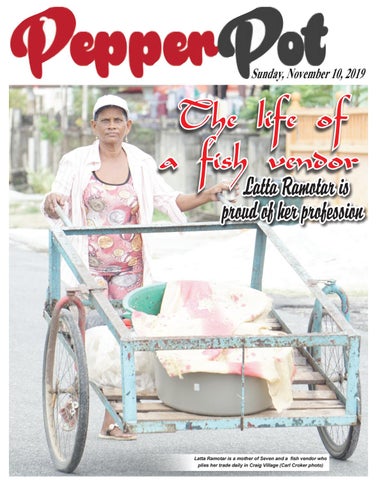
The life of a fish vendor
Latta Ramotar is proud of her profession
Latta Ramotar is a mother of Seven and a fish vendor who plies her trade daily in Craig Village (Carl Croker photo)
2
Chronicle Pepperpot November 10, 2019
Remembering the brave on Remembrance Day
By Francis Quamina Farrier TODAY, the second Sunday of November, is observed in many countries around the world as Remembrance Day -- a day set aside to remember and pay homage to the millions of brave military men and women, especially those who served with distinction and more so, those who paid the ultimate price with their very lives, defending their countries and the freedom of their fellow citizens. It is known that thousands of men from British Guiana served in both the First and Second World Wars with the West India Regiment, as well as with British Forces in the United Kingdom. The author of “To Sir, with Love,” E.R. Braithwaite and the international movie star and entertainer, Cy Grant, were among those who served in the Royal Air Force in World War ll. During the period I produced my Radio Programme Series, The Eighty Plus Club -- 1980s and 1990s -- I was fortunate to have had the opportunity to interview three veterans Farrier wearing a poppy and the Georgetown Cenotaph in the background who served in World War One -- 1914-1918. The longest-surviving Guyanese World War One Veteran was Gershom Browne, who lived at Bagotville on the West Bank of Demerara. He was a regular special feature at the Cenotaph in Georgetown at the annual Remembrance Day Observances, where he would lay a wreath every year on that special day. Many who saw that very elderly gentleman slowly walking to the Cenotaph with a wreath in his hands could hardly imagine that 80 years earlier he fought the Turks and other enemy forces in fierce battles in North Africa and also in the Middle East. Gershom Browne was a man of valor. He informed me that he was a descendant of enslaved Africans brought to this land from Sierra Leone in West Africa and many of his immediate ancestors, who had been attached to Bagotville for generations, spoke one of the African languages. When called upon as a young man, he readily enlisted and fought for King and Country. As a civilian back in British Guiana after the war, he served as the Village Chairman of Bagotville for many years, building that Number One Canal West Bank Demerara community and settling some disputes. Even as a retired public servant I witnessed Gershom Browne settle a dispute between two residents of Bagotville, who had sought his advice. I was visiting him at his home at the time when the two neighbours turned up. They had decided that they would abide by whatever decision the retired village chairman had made, and they did accept his ruling. It was all quickly and quietly done. I wondered why they had decided to take their case to him, since he was already retired and 95-year-old at the time. Could it have been that they trusted him more than the then-current functionary? Another amazing thing about that World War One soldier, was that he rode his bicycle almost to his Turn to page IV►►►
Bringing the ‘GT Spice’ to T&T
Chronicle Pepperpot November 10, 2019
III
–– Guyanese artist on a mission to use his talent to fuel conversation on societal issues FOR some, theatre is just a means that fulfills some leisure time. But for others, like 27-year-old Nickose Layne, theatre is a powerful and unorthodox tool that can effectively explain (and maybe even solve!) some of the issues that plague society. “I want to find out why these things happen and it is my job to make people think and open people’s eyes to things they don’t know,” Layne said. “I have to add my voice to the conversation.” And it is this innate desire that pushed him to hone his skills in theatre, after initially overlooking the power this tool yielded. Layne had a passion for theatre since he was much younger, but he highlighted that it was only when he attended Sixth Form, studying Law, that he became truly enthused. It wasn’t that he studied theatre, or even took part in any plays at the time; instead, it was because that school was located opposite the Theatre Guild Playhouse in Kingston. He recalls vividly that his Psychology classes would end at 19:00hrs, which was the same time plays at “The Guild” would begin. Then, however, he still felt that theatre and plays were, well, ‘just play.’ “I asked myself often, why would grown people be doing theatre after school?,” the young man told this magazine. That question was left unanswered for a few years, as he began working at the National Communications Network (NCN) and studying Marketing, but eventually, he found himself right back at the Playhouse. Since 2011, he has been involved in theatre professionally. And notably, he was among the first batch of graduates from the National School of Theatre Arts and Drama in Guyana. During that time, the Thespian was recognised nationally for his work in directing and used his winnings garnered to go to the culturally alive twin-island republic of Trinidad and Tobago. Some might say that visiting Trinidad was all part and parcel of a much grander scheme at work, but it was only in 2015 when he went to the premier Caribbean Festival of Arts (CARIFESTA) in Haiti that these pieces started to make sense. At that festival, Layne met a Bajan who was heading to Trinidad to study theatre. The seed had been sown and needed the right amount of nurturing to grow. That nurturing came the following year at the Olympics in Brazil, when Nickose saw that people of the creatives around him were similar-- i.e., they followed the beat of their own drums. The difference was that they had their Bachelor’s Degrees, while he had his two diplomas. “At the time, [being more qualified] felt like it was the key to my world,” the Thespian said, explaining: “That experience made me feel like I could promote theatre in Guyana and the Caribbean, but I wasn’t an ‘expert’ in what I was passionate about. I felt like a degree would give me more experience and expertise.” Years later, he would come to believe that his perception of “expertise” was quite subjective, because expertise isn’t garnered only from academic qualifications, but at
‘GT Boy’ Nickose Layne (centre) during the Ti-Jean and Brothers production in Trinidad and Tobago the time that was his belief. And so, with the seed sown and subsequently, nurtured, he applied to the University of the West Indies (UWI) in Trinidad and Tobago and began his journey there. His degree is a very practical one, which means that he has been able to immerse himself in the life of a true Thespian, garnering a wealth of knowledge along the way. “My experience in theatre at home [in Guyana],
made me realise how much I know and how talented I am and can be and how talented people back home are,” the Thespian said, adding: “But on the flip side, it showed me how much that I don’t know.” Layne also shared that this past July/August vacation, he decided to stay in Trinidad so that he could get a ‘feel’ of the culture scene outside of his Turn to page IV►►►
IV
Chronicle Pepperpot November 10, 2019
Remembering the brave ...
laid claim to that large south-eastern section of Guyana and had moved 100th birthday. their military personnel to the loca“Old soldiers never die”; he simtion. Some of the GDF ranks who saw ply passed away at age 102. fierce fighting between the Guyanese and the Surinamese military include ALSO REMEMBERING OUR Hartley Liverpool, Marcus Munroe, GDF VETERANS Asad Ishoof, Martin Nascimento, Ram It is no doubt that had it not been charitar and Clairmont Griffith, among for the brave soldiers of the Guyana others. Clairmonte Griffith told me of Defence Force, Guyana would not be lying on the floor of a Twin Otter airthe size it is now. craft in which GDF ranks flew to Camp There are very few Guyanese of toJaguar, and successfully engaged the day who think of the Rupununi Revolt Suriname military in a bitter confrontawhich commenced on January 2, 1969. tion. Recorded on page 81 of his book, On that fateful day, a group of wealthy “Foundation of the Guyana Defence ranchers commenced a bloody revolt Force,” decorated GDF soldier of valor against the Government of Guyana, Hartley Liverpool states: “Profoundly, to sever the Rupununi from the rest of we accomplished an effective and triGuyana and make it a separate repubumphant mission. The Dutch flag was lic. Their first murderous acts were to lowered and the Golden Arrowhead shoot and kill five policemen who were was raised in victory.” Sometime latstationed at the Lethem Police Station. er, I myself as a journalist was taken A Guyana Airways Dakota aeroplane Guyana Defence Force headquarters Camp Ayanganna, Georgetown (Photo by into Camp Jaguar where I reported was at the time loading beef from the Francis Q. Farrier) the on-going progress by the Guyana abattoir nearby. On seeing the unfoldbefore the sun had set that very day, trained, professional GDF ranks, the re- Defence Force in that far-flung area of ing violence, the pilot, Capt. Ronald Da January 2, 1969, a second aeroplane volters fled to neighbouring Brazil and the Cooperative Republic of Guyana, Silva, closed the door of the plane and from Georgetown landed in the North Venezuela. The Guyana Defence Force for the VCT Evening News. I have took off from Lethem for Georgetown. Rupununi; on board were Lt. Joseph had won. The Rupununi was saved and always spoken of the massive-sized Learning of the revolt, the Guyana plantains and other crops which I saw Singh and about 15 soldiers under his remained Guyanese territory. Defence Force high command at the command. The GDF ranks were wel Another incident in which the at Camp Jaguar. Camp Ayanganna headquarters in the The Guyana Defence Force must comed with hostile gunfire from the Guyana Defence Force had to defend city dispatched a Dakota aeroplane be recognised for keeping Guyana its rebels. The GDF ranks returned their the territorial integrity of Guyana, was with GDF soldiers on board. It flew original 83,000 square miles in size in own firepower which resulted in the what became known as “The New into the Rupununi from Atkinson Field the face of attempts by international hasty retreat of the rebels. Realising River Triangle.” The neighbouring (now Timehri) just after mid-day. Even land-grabbers. that they were no match for the well- Dutch-speaking country Suriname had ◄◄◄ From page II
Bringing the ... ◄◄◄ From page III
academic pursuits. And what better time to garner that experience than when Carifesta was being hosted in the country? While he was doing that, he was recognised as one of the top six students of his ‘Directing One’ course, which meant that he had the opportunity to move onto ‘Directing Two’. For a Theatre Arts major, this is no ordinary feat. The UWI Department of Creative and Festival Arts (DCFA) selects six university students to direct plays for ‘The New Directors Forum: A Festival of Plays,’ which is part of the Annual Student theatre production. The news that he was among the top six came at around the same time he was engaging in his first professional undertaking in Trinidad, outside of school; he had successfully auditioned for a role in Derek Walcott’s beloved Ti-Jean and Brothers. “My process for Directing Two started later than everyone else in the class,
because I was in TI-Jean, so while the course started at the beginning in September, I had no time because I was getting professional experience on with that,” Layne explained. Ti-Jean in itself was quite a rewarding experience for him, since it boosted his professional development but also served to reinforce just how much better Guyanese theatre can be on the technical production front. For him, there is no shortage of outstanding talent in Guyana, but there is a dearth of specialised technical capacities due to the limited scope for development in this area. Nevertheless, he contended, “I kind of feel like UWI has helped me to develop/ identify my style a little more, both in directing and as a Thespian.” As such, he believes that he can be more articulate in explaining his art and style to persons back home, while hopefully introducing local Thespians to the different approaches and styles he has learnt. And this isn’t a far-fetched hope since he already used a bit of what he
learnt at UWI to put on a play in Guyana alongside Rae Wiltshire that sought to put the spotlight on Domestic Violence, quite the topical issue in Guyana. That event also sought to highlight the work of female actresses and photographers, while facilitating a discussion on the topic subsequent to the production. The 27-year-old emphasised that these are the type of productions that he wants to be involved in; it is his desire to use his platform to fuel conversation on societal issues, even if it may be uncomfortable to talk about. His next ‘big idea’ is to engage in a devised theatre production, where there will be no script but the group involved will pool ideas and create a masterpiece on the topic of men and masculinity. “I want to ask the question what is it that causes a man to be abusive and kill a woman,” Nickose said. ” In the meantime, however, he still has to complete his degree and well, make the best of the opportunity afforded him in Directing Two. So far, he has integrat-
ed himself quite well into the directing course and on November 23, he will direct “Final Chapter” on the UWI stage. This play is a fantasy, which, according to Layne, gives it an added layer of complexity that demands his skills more. But what is especially noteworthy is that Final Chapter is written by Guyana’s own Clinton Duncan; this is just a testament of Nickose striving to promote the Guyanese flavour. In Trinidad, Nickose is known for his very “Guyaneseness,” but it is particularly important for him to do justice to this production, since he believes it is an outright representation of Guyana and Guyanese culture. Getting this right, and well, doing well in his degree is also particularly important to him since he is aiming to encourage more Guyanese to endeavour in this field. “I’m hoping that I can fill that void, you know? I hope that people could see this ‘lil’ boy come and do it, and if he could do it, anybody could do it,” Nickose mused.
Chronicle Pepperpot November 10, 2019
V
Understanding the concept of Transgenderism MY column last week has raised a lot of questions- not only about gender equality but gender in general. One curious writer asked me to speak about the transgender community as it is not something that she quite understands. It’s not surprising that in a sheltered and stigmatised country like Guyana, that these topics are not often discussed. Gender identity is the internal sense of being male, female, neither or both. A Transgender individual is one who identifies with a different gender from their assigned sex at birth. Meaning, someone who was born a boy may one day feel as though he was meant to be a girl. The opposite of transgender is cisgender, which describes persons whose gender identity or expression matches their assigned sex at birth. These terms are umbrella terms which means so many other groups fall under the term. For example, non-binary individuals, those who choose not to be male or female also fall under the term transgender. Transgender is dressing or practising behaviours that are not normally associated with their birth sex. This is typically known as gender expression, where their behaviours, mannerisms or social roles don’t fit the society’s view of their birth-assigned gender. Being transgender has nothing to do with sexual orientation, which is a person’s physical, romantic, emotional, or spiritual attraction to another person. This means that if a woman decided to transition to man, she may still like men or women. They can identify as heterosexual, homosexual, bisexual, or asexual or may decline a label at all. Many transgender individuals experience gender dysphoria, which is the feeling that one’s emotional and psychological identity is opposite to one’s biological sex. This can happen as young as toddlerhood but many say they begin to experience these
feelings in early adolescence. However, keep in mind that children who do not strictly fit the typical gender roles such as a tomboy girl aren’t necessarily or will become transgender. Many children embrace certain characteristics of the other gender. Severe cases of gender dysphoria typically lead the individual to seek out some medical treatments such as hormone replacement therapy. For trans men (women who become men), this can mean an introduction of beard growth and masculinises skin, hair, voice, and fat distribution. Hormone replacement therapy for trans women (men who become women) feminises fat distribution and breasts. Those who choose medical assistance to do sex reassignment
surgery, known as transitioning, identify as transsexual. These surgical procedures for trans women feminise the voice, skin, face, waist and while adding breasts and removing Adam’s apple and genitals. For trans men, these include surgical procedures which masculinise the chest and genitals and remove the womb, ovaries, and fallopian tubes. This is known as fully transitioning. To those of you who believe this is a new concept, the term ‘transgender’ was created in 1965 by Psychiatrist John F. Oliven and in 1984, the transgender community” had finally developed. Still, transgender individuals face so much stigma within our society. My research shows that trans-
gender individuals are more likely to suffer from mental illnesses and many seek out therapy. However, these actions rarely have anything to do with being transgendered. Those who have transitioned are finally comfortable in their own skin- the mental health issues typically come from the stigma, bullying, or the life they have had to live in secret for so long. Also, some statistics show that the transgender community are 28 percent more likely to be victims of violence than the regular community. They are also more likely to be unemployed and living in poverty. TRANSGENDER PRIDE FLAG A common symbol for the transgender community is the Transgender Pride Flag, which was designed by an American transgender woman Monica Helms in 1999. The flag consists of five horizontal stripes: light blue, pink, white, pink, and light blue. Helms describes the meaning of the flag as follows: “The light blue is the traditional colour for baby boys, pink is for girls, and the white in the middle is for “those who are transitioning, those who feel they have a neutral gender or no gender”, and those who are intersex. The pattern is such that “no matter which way you fly it, it will always be correct. This symbolises us trying to find correctness in our own lives”. The life of a transgender person can be vastly challenging but it can also be happy, triumphant, and transformative—not just for the individual, but for those who love and accept them. Thanking you for reading. Please keep sending any topics you’d like to talk about to caitlinvieira@gmail. com Suicide Helpline numbers: 2230001, 223-0009, 623-4444 or 6007896 Say Yes to Life and No to Drugs! Always!
VI
Chronicle Pepperpot November 10, 2019
Guyana’s cultural policy industry and creative ‘policy’ Part Two
Social & political short-sightedness towards cultural policy tools ONE would have thought that in Guyana, the realisation towards the changing world of economics would have engineered a more progressive perspective towards rectifying the economic decline through the loss of traditional mass income, which in itself where those openings--the stevedores, cane-cutters, clerks, office assistants, now replaced by technology were still around. Their incomes would not still compete with the modern domestic accoutrements necessary for sustainable urban and provincial domestic stability, fatal economicdriven domestic clashes in the sugar belt and across our working world from as far back as 2004, are undeniable references. In the years before 1992, there was a stirring of acceptance for new ideas; ideas on new platforms were in discussion, how to deal with inevitable changes such as TV stations emerging and sustaining traditional forms such as our cinemas to which old school drama owed a big debt. My discussion with the now late Deryck Bernard towards a subvention for Artsbased businesses began back then. Though this is not a political article, it would be incomplete should I deny that politics, shaping mass consciousness does influence progress or retard it. I’ve written several times before about meeting the late President Cheddi Jagan at the NBIC Competition to define El Dorado thrown out to artists in the late 80s early 90s engineered by the top management of that bank, Mr. Conrad Plummer and Mrs Foo. The bank was filled with officials, diplomats and artists, when not recognising Mr Jagan I engaged him on his take of the pieces. I had in the same period published my comic book trilogy ‘Shadow of the Jaguar,’ that had an El Dorado background. His response left me speechless; he dismissed the exhibition with one sentence: “All this is just fantasy.” I then asked him his name, exchanged formalities and walked away. I discussed it with Dr Denis Williams later, and he explained the Orthodox Church’s severe exploitation of the Russian masses in support of its royalty for 400 generations; that was followed by
the 1917 revolution which I knew of, but never paid much serious attention to, and their Communism that followed, a doctrine of a nihilist conceptualisation of managing humans, no God, no religion, no art, no independent thinking, no individualism, no room for unsanctioned imagination, only obedience to the State. It was the most inhuman concept I could ever imagine; not that we had any perfect ideas, but to stop having contradicting ideas was unthinkable. Communism was in itself as regimented as the Orthodox religion that it had replaced; it was a religion with political Gods, Stalin even had a hymn written to him. This was Janet Rosenberg’s gift to Guyana. This political concept ingrained in its local political adherences is not reconcilable with the advancement of the liberating ‘ARTS’, though their intoxication towards capitalist greed is apparently un-
abated. In 2014, Kaieteur News, July 12, Anil Nandlall made overall assessments against implementing copyright laws based on scare propaganda, drawing ambiguous references about failures of other CARICOM states to enforce copyright laws, thus to protect their own Intellectual property, where he derived his statistics from that political capacity to distort, as he totally ignored the millions in rtoyalties they were making a film set locations among other areas, announcing further that it is impossible, and not advisable to ratify copyright laws to Guyana. The fact is that the PPP is as alien to the diverse constituency that will benefit from copyright as is humanity capable of colonising an earth-like planet and moving there in a few hundred years. But in the discussed topic, they (the PPP and others) would like to, and do own media that will use local creative products
free of royalties and licensed contracts, keeping talents in this country impoverished, so they construct uninformed recitations, saturated with lies to confuse those who haven’t taken the time to be informed in their own interest, seriously, with skilful omitting of their own ‘Demerara Gold’ and ‘Textbook piracy’ cases. Some two years ago, I sat with the late sign artist and band-playing musician ‘Gordon Critchlow.’ Gordon had, before passing, told me he had some important Cultural 110 Street pictures to pass on part of our tangible cultural legacy. But that’s lost now. We were with the recently passed Johnny Braff. Apart from learning that Johnny Braithwaite also carried the name Critchlow, I recognised the helpless pain of constant insult as he related when a music cart passed with his song blaring, redone and sounding good and being sold. His words captured his life and these times. He said, “Ah made many mistakes, but when yuh can’t even get royalties pon yuh own music, is real eye pass.” I didn’t yet catch the real gist of his statement when I informed him that “royalties don’t amount to much financially on the local scene.” He then snapped at me, “Is not the money man, is the respect in meh own country.” I understood him then, loud and clear. In 2014, September 13, Kaieteur News, Lurlene Lester penned an indirectly related analysis “Reading crisis: The continued failure by those in authority” Lurlene outlined the failure of the education system, and the fact that “When 68 per cent of children in the primary schools are unable to read at grade level, the entire country should be concerned and alarmed. This reality underscores the fact that there is a severe problem in the entire school system.” I did back then explore what this sister had written, and sadly she was confirmed as right. The problem had preceded her letter in all areas that literacy is the foundation of. Some of the victims of that failed system are young adults today. The arts cover a broad spectrum of human activity, that cannot heal all the Turn to page IX ►►►
Chronicle Pepperpot November 10, 2019
Advantages and disadvantages of exhibition opportunities AS artists, we are constantly creating new things. Often, we seek opportunities to display our work to the public. Art exhibitions hold a mirror up to society, reflecting its interests and concerns, while at the same time challenging its ideologies and preconceptions. The Agri-Tourism Expo was a great opportunity for us Guyanese artists, to display our work and we took advantage of it. It was held on the 1st and 2nd November 2019 at the Arthur Chung Conference Centre. While we take part in exhibitions, hoping that they would yield much financial gain, participation also presents the opportunity for marketing and networking. The exposition, which was a public exhibition of art and trade goods catered for persons within the arts and agricultural fields. Members of the Guyana Women Artists’ Association participated in this venture. Our display comprised textiles --- both fabric and construction work, drawings, ceramics and paintings. I met both young and seasoned entrepreneurs who shared some words of wisdom and encouragement. I must admit I was a bit frustrated on account of the poor attendance and lack of enthusiasm of patrons and thought: “This expo is in no way profitable for me.” But just then I heard some words of wisdom. “Young lady, don’t see this as an opportunity to make fast money. It is an opportunity for you to market yourself and build a network. You can distribute 50 business cards and only get three customers. Out of those three, one can purchase items amounting to as much as 20 customers. Don’t be discouraged, better days are coming. Take it one day at a time.” These were the words of a beauty soap business owner.
Talk about a word in season! It was just what I needed to hear. Hence, I wish to highlight some advantages and disadvantages of exhibition opportunities. The greatest disadvantage is an investment with no immediate returns. Besides that, there’s the risk of others using your ideas, a risk that every entrepreneur must take. On the other hand, the advantages outweigh the disadvantages: exhibitions present opportunities to analyse our strengths, weaknesses, and threats. When this is effectively done, we can better serve the needs of our customers. Exhibitions allow for feedback, both negative and positive. It is a learning experience. We can build a network with potential suppliers by offering our artistic services and persons with similar business interest. There is an opportunity to meet with potential investors and so much more. Guyanese are gifted individuals. Many of us long for opportunities to display our work to the public. At the Agri-Tourism Expo, I met a young lady who recently graduated from the Guyana School of Agriculture (GSA). Her display was her final-year project, which was a cake mix powder. I was impressed with her packaging. To me, she is Guyana’s own Betty Crocker. I also saw soaps that were made with creative moulds and more. Although these items aren’t in themselves art, elements of art are used in the packaging. This shows that art is in everything. As we work towards building our tourism sector, we must remember that art plays an integral role in sustaining it. Artists should use every opportunity to exhibit their craft, because the advantages outweigh the disadvantages.
Images of works displayed at the Agri-Tourism Expo.
VII
VIII
Chronicle Pepperpot November 10, 2019
A tooth’s worst enemy
T
HE tooth equation is pretty simple: germs plus sugar equals acid production. These acids can dissolve enamel as well as the tooth-root structure and result in a cavity (technically, a carious lesion.) Although tooth decay is a fact of life (no record that exists ever shows that any adult human has never suffered from tooth decay), there is evidence that some persons are more resistant than others. Since effective brushing and flossing are critical in controlling dental decay in susceptible individuals, I want to detour for a brief discussion about the cause and prevention of tooth decay. Of course, everyone who reads this column should realise by now that the secret to oral health is the effective control of dental plaque. Now, three elements need to be in place before tooth decay can happen: the microorganism responsible for decay (Streptococcus mutans) must be present, a sugar or carbohydrate for S. mutans to metabolise must be available, and the tooth or teeth must be susceptible to, or capable of decay. Additionally, there are three cavity-preventing measures those of us susceptible to tooth decay must take to combat this decay: we must control plaque, reduce carbohydrates (sugars) in our diet, and make out teeth more resistant to decay. Eliminating or at least drastically reducing, tooth decay is certainly relatively easy although it takes a little effort. Proper brushing and flossing are of paramount importance in eliminating tooth decay in the caries-susceptible individual, because, without excellent control of plaque (the sticky stuff containing cavity-causing microorganisms, including S. mutans), cavities can develop in the grooves ( pits and fissures) of teeth, in between the teeth, on the sides of the teeth at the gum margins (edges) of fillings, crowns, or bridges distresses dentists and patients alike, since much of this restorative work was done to repair damage caused by previous decay, and new decay around existing dental work does not usually get restored properly with a patchwork approach. Once the dentist has done his or her best to restore a tooth, this work needs to be well maintained by the patient. Brushing and flossing are critical in controlling the plaque that can lead to decay, but the further reduction of microorganisms (germs) is necessary for a healthy mouth. This can be achieved by tongue scraping (the top of most peoples’ tongue carry untold trillions of microorganisms and much odorous material), and irrigation to reduce the number of microorganisms under the gum margins. An obvious way to cut down on dental
decay is to reduce or even eliminate sugary drinks from the diet. Great plaque control is an excellent way to keep cavity-causing organisms at lower levels in the mouth, but even great plaque control is no match for the acids produced when six to twelve sugar-containing soft drinks are consumed every day; this much sugar coating the teeth supports the astronomically fast growth of the cavity-causing organism and its acids. Coffee or tea sweetened with sugar will create never-ending cavities in anyone prone to decay. The use of nonsugar sweeteners is recommended for those susceptible to tooth decay. Another excellent way to deal with dental decay is to drink several cups of green tea a day. Why is green tea so great for reducing dental decay? One study showed that green tea inhibits the growth of plaque caused by the S. mutans bacteria, while another study showed that green tea catechins destroyed these bacteria at concentrations lower than those found in one
cup of tea. Other studies report that green tea strongly inhibits bacteria after only five to ten minutes of exposure to the tea. And yet another study reported that green tea extract was more effective than fluoride compounds in preventing dental caries. To summarise, consuming three or four cups of green tea daily for dental reasons is a great idea because it inhibits the growth of plaque caused by S. mutans, destroys the biofilm that coats teeth and the rest of the mouth (thus helping to clean the mouth), and, because of the fluoride content in green tea, actually makes the teeth more resistant to acids produced by S. mutans. Fluoride in its many dental formulations is the third method that has been utilised to reduce susceptibility to tooth decay (caries) in cavity-prone individuals. I am in my fifties and have only lost 4 teeth which occurred when I was a teenager. I ascribe much protection from green tea and recommend the same to my patients. Please note that when consuming
green tea for its cavity reducing benefits, it is best to swish each mouthful of green tea vigorously to cleanse the mouth before swallowing the tea. In other words, don’t drink the tea as you normally would, since the cleansing action and the S. mutans inhibition are improved by having tea in contact with the mouth and teeth for longer periods. Finally, my advice on the use of green tea is to find one you like, and have it readily available at work and home so you can drink it regularly. Green tea has benefits that go well beyond cavities, and you can take advantage of them all if you will incorporate drinking several cups into your normal daily routine. A final note on the dental decay issue: make certain that you have regular dental checkups. Your dentist is there to help you be healthy. And regular dental visits afford the greatest possibility of keeping problems at a minimum.
Chronicle Pepperpot November 10, 2019
IX
Revisiting Indigenous
Peoples’ rights LAST week, I was scrolling through my newsfeed and I saw an article that restored my faith in humanity (okay, maybe that’s a bit dramatic, but you get my drift). The Minister of Natural Resources, Raphael Trotman visited 87-year-old Mamai Lucille Williams, who lives in the Karisparu village in Region Eight, and provided her with groceries and other essential items. This donation was part of a larger commitment being made to the elderly woman; the Minister promised that he would rebuild her home which had been wrongfully destroyed by a miner, who forcibly evicted her off the land in November 2018, just about one year ago. As the article noted, the Patamona woman had been living in this village on the same plot of land since she was a little girl. Unfortunately, she was evicted from her home and forced to live in a camp of some sort- a makeshift shed, not fit for any residence. This incident is just one of those small things in society I believe that we easily overlook, but they are microcosmic of the wider deficiencies that exist within our
society. Indigenous rights, particularly, are rights that should be given much more consideration. I have been asked before, what makes Indigenous people so special that we have to focus on giving them so many “rights”? I was baffled that someone, my fellow Guyanese, who I expect to be at least minimally aware of our history, would ask a question like this. When we speak about Indigenous people, we speak about people whose populations have been decimated; their culture, lives, and livelihood desecrated; and forced to live in less than desirable circumstances. Resultantly, when we talk about disadvantaged, marginalised groups, Indigenous people are high up on that list. The reason why we ought to respect their rights now is that their rights were not respected before and their contributions as the guardians of this sacred space we call our home was overlooked. It is widely recognised that in the Caribbean the enslaved Africans faced the worst kinds of treatment any human being could ever experience, to the point where they
were treated as mere chattel and not living, breathing human beings. And recognising this, Caribbean scholars have been pushing for reparation, as part of the global thrust for reparations for Africans. The Caribbean Community (CARICOM) has a 10-Point Action Plan which outlines the 10 demands for persons who were affected by the perils of native genocide and enslavement. It is by no pervasion of history that the third point of this plan directly focuses on the injustices meted out to the Caribbean’s indigenous peoples and calls for an Indigenous Peoples Development Programme to rehabilitate survivors. Last year, I had written an essay for the Ministry of Indigenous Peoples’ Affairs (MoIPA) on the topic: “The Amerindian Act No. 6 of 2006 and current its relevance to Amerindian Villages and Communities”. That Ministry has been seeking to revise this act to make it more relevant to indigenous communities today, and this essay competition was just one of the ways public opinion on the act could be garnered. Through the research done for this essay,
I found a study conducted by the United Nations Children’s Fund (UNICEF) in collaboration with the MoPIA. It was not surprising when that study (which was 12 villages on nine of the 10 administrative regions) highlighted that indigenous communities are still the poorest and most vulnerable. The study revealed that for most indigenous communities, poverty was not only due to the lack of monetary resources but also limited access to land, medicine, food, education, culture, and safety. Land rights and Indigenous Peoples are a topical conversation locally, and rightfully so. At a recent public forum, Prime Minister Moses Nagamootoo said that it is not about “giving away” lands to these people, but it is about “giving back” these lands to the group of people who have occupied the space for centuries. And, in light of what has been occurring in neighbouring Brazil with the devastation of the rainforest, he reminded that Indigenous Peoples have generally saved the natural patrimony from indiscriminate destruction. I was overwhelmingly pleased to see the Minister pledge to give back Mamai her home, and once he is held accountable I know that she will be in her place of comfort once more. Now, I only hope that this action can be multiplied and intensified so that Indigenous Peoples receive the rights they are so deserving of.
Creole nature, encompassing memories from our diverse population beyond the beginnings of our nation, which collectively have morphed to reflect timelines that are its manifest Guyaneseness and identity. To this identity, the PPP has, again and again, revealed obvious apathy, cluelessness and disdain in too many ways that cannot be listed here, and all Guyana must fully grasp what is at stake. There are no comparisons and space for exhausting pointless gaff. There can be no argument that the Arts and culture have been the driving force of the ‘being’ and relevant nature of any nation to its own identity and to global posterity. As Norman E. Cameron, a profound son of this soil’s prophetic statement resonates “Those who are dis-
loyal to their ancestry have less chance of creating something with a truly distinctive mark.” In the pursuit of preserving and advancing Heritage onto economic spheres through a national Cultural Policy, it is necessary to understand the challenges that will locally present itself at various junctions, because we have never recognised our collective heritage, much less sought to understand its ‘value’ in respect to what is possible, with what is technologically available today, relevant to the state of the production of cultural products towards creating a niche expression on the global market place. In 2006, I bought a Newsweek magazine from then Universal Bookstore with the
subhead ‘The Knowledge Revolution--Why victory will go to the smartest nations & companies’. Not that I felt that its analyses and predictions were cast in stone, but that it would be an interesting read on observation. But 2006 was hectic for me, the political hierarchy and its criminal allies had made Guyana a living hell and as a founder-member of ACDA, my constituency was under attack. I picked up the magazine recently to read on a trip by air to the interior, only to re-discover that what was globally local then, is even more relevant today. Next week I will visit and explore with you some salient aspects of its arguments, relative to our time and predicaments.
Social & political short-sightedness ... ◄◄◄ From page VI
wounds, but I have known illiterate musicians and other extreme talents, goldsmiths, furniture makers, through which raising the status of their inborn abilities to industry, will make a difference in a changing world and their world, because whether we like it or not, our working-class comfort world is gone. The advent of oil without a functional, skilled population will result in a self-serving local class system too pretentious to recognise that we are colonised by foreign creativity and licensed commerce. The Cultural Policy of Guyana will envelop all Arts that have emerged from the fount of Guyana’s
Focus
X
Chronicle Pepperpot November 10, 2019
on the Village
The friendly village of Craig
By Michel Outridge THIS week. the Pepperpot Magazine journeyed to the village of Craig, East Bank Demerara, where many residents engaged us in lengthy conversations. Craig is about eight miles from the city and is divided into three parts: Craig Old Road which has four streets, then Busbee Dam which leads to the farmlands via a canal and Grant’s Housing
Anthony Wyatt, coconut vendor of Craig Village (Carl Croker photos) Scheme. The village falls under the Caledonia/ Good Success Neighbourhood Democrat-
ic Council (NDC) and has about 26,000 residents which consist of a mixture of people. Upon arrival at Old Road, Craig, the Pepperpot Magazine met some friendly folk, who were seated under a shed by the side of the road to begin their habitual chit-chat. The group comprised Anthony Wyatt, a coconut vendor who vends on the public road and is also a resident of the village. He wasn’t vending that day due to circumstances beyond his control, but was nevertheless in high spirits as he was chatting with Jeanette Balgobin. “To earn you have to spend. I buy coconuts from a man in Pomeroon at $160 each and I re-sell it but the profit is minimal; plus I have to buy ice and steel drops because most people want cold coconut water with steel drops inside as a back builder, so I am trying with it,” he said. Wyatt has been at this job for the past two years after he had to quit his jobs as a miner and a seaman because of an accident; both his legs were broken, so he cannot put pressure them. He therefore has had to resort to a less strenuous job. The father of two related that although things don’t always turn out the way one expects, one has to try and make it work, one way or the other. He noted that Craig has good roads, the drains are cleaned from time to time, and there are schools, a health centre,
One of the roads in the Village
Anthony Wyatt and Jeanette Balgobin in a ‘gyaff’ the NDC office, many shops and other businesses. Wyatt said the people of Craig Village live peacefully and co-exist and they are truck drivers, bus drivers, taxi drivers, vendors, people who work in offices and others, who do different things. JEANETTE AND HER LIMING SPOT Meanwhile, his friend Jeanette Balgobin, who is wheelchair-bound and was in their usual liming spot, said a few of them would meet up there and talk about many things to pass the time. She told the Pepperpot Magazine that five years ago she suffered from strokes and as such, she has to use a wheelchair and life has become difficult for her having to cope with living alone. It was her sibling who took her in at Old Road, Craig, and is taking care of her. She would try to help herself by taking a shower, getting dressed, and assisting in feeding the dogs among other things, since her sister has a small shop to manage. The 64-year-old said she was a fish vendor for many years and managed to build her house, which she had to vacate after getting sick. Under the shed is Balgobin’s spot where she and her friends would meet
Wheelchair-bound Jeanette Balgobin to talk about everything under the sun; it is like her favourite pastime, thanks to her friends, who are also villagers.
Chronicle Pepperpot November 10, 2019
XI
Entrepreneurs in Craig Village
By Michel Outridge FISH-vending is an occupation that entails a lot of physical work, that is, walking and at the same time pushing a cart from village to village, but at the end of the day, it is a job. This job is that of Latta Ramotar, who learned from the best. Her deceased father was a fisherman and sold his catch; as such, she made it into a livelihood and, being a fish vendor, she is well-known. The 50-year-old told the Pepperpot Magazine that she walks and sells fish in the villages of Craig and Good Hope daily; by doing so, she has made a lot of friends. Ramotar was plying her trade when the Pepperpot Magazine visited Craig Village and met her as she went to meet some friends under the shed at Old Road, Craig, for their usual Turn to page XII ►►►
Latta Ramotar as she joined her friends under the shed for a quick chat (Carl Croker photos)
Winifred Weekes and her grandson at their roadside stand at Sideline Dam, Craig
Sideline Dam, Craig Village
XII
Chronicle Pepperpot November 10, 2019
Entrepreneurs in Craig ... ◄◄◄ From page XI
Elvis Sampson at his stand
chit-chat. Subsequent to that, she continued selling the fish she had bought from the wharf at Meadow Bank, a task which requires that she rises at 01:00hrs and a taxi would take her to the wharf. “Depending on the price for fish, I re-sell, because sometimes it is pricey and I would only buy what would sell, so I don’t carry a loss,” she said. The mother of seven and grandmother of 11 related that she would sell mostly trout, banga mary, catfish and shrimp, depending on the fishermen’s catch. “My dad was a fisherman who used to sell around the village and then the regular fish vendor, a woman name Zorena died by accident and after her death, I started to sell fish and I got my own pushcart,” she explained. She added that even though fish-vending entails a lot of walking and coupled with the hot sun it takes a toll on her energy levels; she still does it because it is a job she likes and she meets a lot of people every day. After vending she would return where she still has to do household chores and cook and care for a son, who is physically disabled. ROADSIDE STALL The Pepperpot Magazine also met Winifred Weekes and her husband, Elvis Sampson, who operates a roadside stand at Sideline Dam, Craig. Weeks said that the small business has been that of her husband’s for a year now; they cleared the area of garbage and transformed the place into a clean space. She added that they used to sell greens at Bourda Market but had to stop because of her arthritic pains and decided to start their own small business in the village, a few houses from their home. Elvis Sampson disclosed that he hired an excavator to dig a hole in which all the garbage--which was piled high--was buried about 15 feet below. He said he then planted some flowers and put up some tyres and other decorations after cleaning the area. He then erected the wooden stand where they sell footwear, clothes, fruits, and vegetables and ground provisions among other things and at reasonable prices. “With this business, I does credit some people and a few went away and never paid, only the other day I had to go and look for one of them and was paid; and that is one of the problems with this little business,” Sampson said. The couple has four children, who have borne them several grandchildren; one of them was sleeping in a hammock at the stand and is being cared for by Weekes, whose mobility is limited because of the severe pains in her legs. Weekes told the Pepperpot Magazine that after selling at Bourda Market for 19 years, the adjustment to the small business is something she is getting used to. She stated that her husband would go to the city to buy greens and other things for the stand as early as 03:30hrs and she would assist at the stand to sell until he gets back. The couple said they will maintain and beautify the area, in which they sell since it is an income garnered from the business and they are close to home.
Chronicle Pepperpot November 10, 2019
The Good Success/Craig Youth Group
Empowering youths to become gainfully employed By Michel Outridge THE Good Success/Craig Community Youth Group (GSCCYG) is empowering youths of several East Bank villages with life skills training. Their objective is to foster employment by offering life
GSCCYG Secretary Dominique Williams skills training after which they can become gainfully employed and ultimately contribute to society. The training sessions are held in the bottom flat of the Caledonia/Good Success Neighbourhood Democratic Council (NDC) building, where the place is equipped with 10 internet-ready computers, a printer, telephone service, WIFI, a library, a refrigerator, sewing machines, and a gas stove among other amenities. According to Group Secretary/Teacher, Dominique Williams, there are 85 members of the GSCCYG and they have classes for knitting, dancing, cooking and sewing; they also see that interested youths, once they attain the required age, sign up for the recruitment course of the Guyana Police Force. She related that the GSCCYG is managed by a Board of Directors with Norelle Fredericks being the President, Colin Weekes, the vice-president and others. “Ever since I joined this group I have become a well-rounded person, be-
cause I was a very shy person and now I can speak publicly without being scared and I am doing this to empower others to make something of their life by learning a trade, so they can have a job and earn,” she said. Williams added that she is very pleased with herself because, with the support of the group, she has benefitted from many training programmes. As such, it has opened many doors for her. She explained that the GSCCYG is an organisation devoted to empowering young people, who reside in the villages of Good Success and Craig, East Bank Demerara. Williams added that their vision is to foster and support the social and educational development of all youths in the community, to become responsible, positive contributors and productive members of society, while achieving their full potential. “We aim to engage, empower, inspire and prepare the youths to meet their social and educational needs, while imparting core values through service, camaraderie and perseverance,” she said. GSCCYG also provides a forum for youths to air their concerns and to build their self-esteem through educational programmes, aimed at confidence-boosting. The group meets several times per week to attain their goals and at the same time engage in many activities such as community service, recreation, arts and craft and field trips. The organisation recently spearheaded a community-beautification project by implementing a clean-up of the village and planting palm trees along the roadway. Professionals also ought to conduct forums with members and provide guidance on career paths, social issues and education. Recently, a visiting psychologist from the United States and a judge from Jamaica conducted sessions with members of the group. Individuals or cor-
porations can support GSCCYG in many ways, such as sponsorship, donations, volunteering, offering skills training and mentoring, simply because the non-profit organisation is investing in youths.
The Good Success/Craig Youth Group building (Carl Croker photos)
XIII
XIV
Chronicle Pepperpot November 10, 2019
Craig health centre offers personalised healthcare
By Michel Outridge EVEN though it is not a high-traffic health centre, the services provided there are reliable and personalised. Doctor-in-Charge Anila Ramphal told the Pepperpot Magazine that she has been at the location for close to 10 years and she is comfortable there while doing her
bit to serve the community. “I am originally from Eccles, also on the East Bank of Demerara, but I have been here close to 10 years and I like working here with the people in the community; and I figured that is the reason why I am here for so long,” she said. With the staff of 12 including herself, Dr Ramphal reported that they provide the needed services to the
Doctor-in-Charge Anila Ramphal of the Craig Health Centre (Carl Croker photos)
A section of the pharmacy at the health centre general public more so, the residents of Craig. “I like the fact I can talk to patients on a one-on-one basis and explain things to them in detail; and here you can spend time to discuss health care issues with folks because at a hospital the setting is different; you don’t get the time to give patients the time to do so,” she said. Dr Ramphal stated that at a large hospital the most you can do at times is to write prescriptions for the patient based on their health complaint; because of the patient-flow, it is difficult to spend a lot of time Turn to page XV ►►►
Chronicle Pepperpot November 10, 2019
XV
Day-to-day happenings in Craig Village By Michel Outridge CURTIS Hunte is a minibus driver and he is a villager from Craig, East Bank Demerara, who resides at Third Street with his wife and three children. He described life there as comfortable and peaceful among residents. This Craig resident added that it is a quiet village and most people work during the day and at nights, some folk go to bed early to prepare for another working day. Hunte reported that he started to drive mini-buses in 2002, but has been at the wheel longer than that. The Pepperpot Magazine also encountered a young man named Devon Dublin, who resides at Busbee Dam, Craig. At the time, he was part of a group of boys who were in the process of catching caimans in the canal via a makeshift trap outfitted with bait. The group said they do it daily and whatever they catch they would sell it to the Chinese and split the money equally among them-
Curtis Hunte, Craig bus driver and resident (Carl Croker photos) selves. Dublin had a small green snake which had become his pet. He managed to catch it a few days ago right in the canal. “I keeping it even though I know it is small now and it will grow bigger. I don’t mind I will keep it as a pet and take care of it, because I will try to train it see if it works, knowing how dangerous it is,” he said. Also at Busbee Dam, Craig, Boyie Ramkisson was up for a chat and told
the Pepperpot Magazine that his life is simple and not flamboyant at all, because he prefers to live like that although he has the means. He rears poultry (meat birds) and sheep as his main sources of income and would sell to buyers when the chickens are fully grown. Ramkissoon related that he usually purchases baby chicks from the hatchery, but right now the hatching eggs are not up to standard and buying 1,000 chicks and rearing them for six weeks is
not easy. He pointed out that sometimes he would carry a loss when the chicks get sick and die or other teething problems when it rains. Ramkisson added that he lives with his extended family and they are comfortable there; the area is some distance by boat to the farmlands located aback the village, where residents have large crops of ground provisions. Originally he is from Campbellville, but at age
Devon Dublin and his pet, a green anaconda
One of the most interesting signages at a shop in Craig Village
four he moved to Busbee Dam and it has been his place of abode ever since. He has four children and a wife. “I keep a low profile and live normal because
fancy gallop is nuff problems and you invite trouble when you like a swag life with full of glitter; simple living is the best way to go, that is, for me and my family,” he said.
artificial snacks, beverages and foods and the high levels of saturated and trans fats they have. “It is the saturated fats, the oils we keep re-using; as Guyanese we save and re-use many things including cooking oil, instead of using fresh oil to fry and cook foods,” she said. She pointed out that it is healthier to cook fresh foods daily and do so with limited oil rather than consuming artificially flavoured foods and foods high in preservatives. Dr Ramphal stated that we should emulate our fore-parents, who cooked fresh vegetables and meats daily and ate normally with mostly organic food products and they lived longer and healthier. “If your plate is colourful at meal-time that is eating healthy with the needed greens and meat and not forgetting fruits,” she said. Dr Ramphal noted that having fried chicken isn’t all that bad for your health, since everything we consume can be done in moderation and once we trim off the skin and fats from meats and use less oil, but fresh, it is safe to eat in
Staffers with a patient She pointed out that cold foods should be stored in the refrigerator, while hot foods should be re-heated before consuming. The doctor related that with the schools nearby they treat a lot of pupils with minor cuts and bruises due to accidents at school and the common seasonal illnesses such as cold and flu. The Craig Health Centre is opened from Mondays to Thursdays from
08:00hrs to 16:30hrs and on Fridays they are opened form 08:00hrs to 15:30hrs. Ironically, Nurse Walker was in house with her team to distribute the filaria pills and the team from the Pepperpot Magazine seized the opportunity to have their pills. Nurse Walker was allotted a room especially for that purpose and is the Supervisor for the Filaria Pills Distribution group that is based at the Craig Health Centre.
Craig health centre offers ... ◄◄◄ From page XIV
with one patient, since many others are waiting. “In a hospital, you can only do so much, but here you can explain things in
those suffering from chronic diseases and an entire day is set aside, especially to see those patients which would amount
Rony Rogers of the Guyana Chronicle taking his filaria pills administered by Nurse Walker at the health centre detail and get to understand the patient better and learn of their health issues for a proper diagnosis,” Dr Ramphal said. She related that the most seen patients are
to 50 to 80 daily. Dr. Ramphal explained that chronic diseases are serious and they are very prevalent in our society today, given the fact that people have more access to
portions too. She added that these days fast food outlets reuse oils and even use lard to mass fry chicken and that is excessive trans and saturated fats we put in our bodies. Dr. Ramphal said too, the way we store our cooked foods affects our health; cooked foods should not be out in the open for more than four hours after cooking, since it is after that time that bacteria invade food.
XVI
Chronicle Pepperpot November 10, 2019
Chronicle Pepperpot November 10, 2019
XVII
Strong hands, healthy mind
Guyana’s latest centenarian continues to knit at her age By Wendella Davidson GUYANA’S newest centenarian Mrs Ruby Marie Mingo, who reached the glorious milestone on November 8, says it is her “undying love and faith in God” that has kept her going. The mother of eight children, seven of whom are alive and who has outlived her seven siblings, is unlike many who had attained such an age: she knits scarves late into the night, reads her Bible and indulges in other pastimes. To celebrate the achievement of this centenarian, her off-spring, grandchildren, great-grandchildren and other relatives, some of whom arrived from the United States and Canada, planned a grand birthday bash in her honour at the Umana Yana, Kingston, on Saturday, November 9, 2019. However, preceding the afternoon’s event, Mrs Mingo, a practising Seventh-Day Adventist, attended the Golden Grove Seventh-Day Adventist Church on the East Coast of Demerara, where she worships, for a special service; she was accompanied by all of her relatives. In a pre-birthday interview with the Pepperpot Magazine, Mrs Mingo displayed a pleasant personality and enduring memory. This, despite disclosing that she suffers from health issues related to arthritis, circulation of the blood and has complete vision loss in the left eye, and that loves to knit. She enjoys knitting as a late-night pastime and proudly showcased to this publication several completed shawls
Her late policeman husband, Mr Wilbert Mingo
Mrs Ruby Marie Mingo displaying her knitting /crochet skills on November 7, 2019, the eve of her 100th birthday
and others that are being put together. According to her, she intends to gift each of her visiting grandchildren with one of the items before they return overseas. Her other hobbies are fixing puzzles, including a 100-piece of the brain teaser that adorns the wall of her Haslington home, reading the Bible and other educational books, and playing biblical crossword. Born as the last of eight children to David Simon and Benona Marie, also called Nana Simon, at Gibraltar, a village on the Corentyne coast, she attended the Number 1 Primary School until Standard Six-- as the classes were then known-- when she left. CHILDHOOD Mrs Mingo recalled that her father died by drowning when she was still a toddler and how it was a struggle for her mom to single-handedly maintain Turn to page XX►►►
Mrs Mingo is flanked by some of her children on the eve of her 100th birthday. From left, James (seated), Malcolm, Yvonne, Franklyn and Alexander Children, grandchildren and great grandchildren- A proud Mrs Mingo is flanked by her children, grandchildren and great, grandchildren on the eve of her 100th birthday
XVIII
Aspiring young engineer hopes to start career trend of girls in STEM
PREYA Singh grew up playing cricket and video games, watching wrestling and quickly outgrew the ‘I-want-a-dollas-a-present/gift’ stage. She was always an odd girl, but it all moulded her into who she is today. Preya comes from a family of six. She has three siblings and her father is the sole breadwinner of our family. He was rarely home due to travelling for
his job. Nonetheless, she had an incredible childhood and her parents always made sure that they never fell short of anything She attended Blairmont Nursery School where she developed a love for Art (drawing) then she attended Blairmont Primary School. In 2012, she was chosen to represent her school at the Regional and National GT&T Spelling Bee competitions, where
Chronicle Pepperpot November 10, 2019
she attained first and second positions respectively. She also completed a computer literacy course. In April 2014, she was selected alongside another student to represent the school at the Regional and National Mathematics, Science and Technology Fair. Their project was a fascinating, economical recycling water-filtration system, which gained them first place regionally and Aspiring Guyanese engineer Preya Singh second place nationally. When Preya wrote the NGSA examinations, she gained 511 marks and was awarded a spot at the Bishops’ High School. However, she attended the New Amsterdam Multilateral School (NAMS). Her family didn’t approve of her living in the city at that age, neither did they have finances to move. At NAMS, she continued to excel in academics and also participated in extra-curricular activities. Singh represented the school and Berbice at the Inter-county Cricket Competition in 2017 and 2018. She’s beyond happy that she attended NAMS. This institution provides streaming options which offer foundations for various career paths. Preya chose the technical field because she always wanted to become an engineer. With hopes of joining the stream, she consulted its H.O.D; Sir Tamesh Mohabir and vividly remembered him telling her, “there are lots of things in store for you if you join tech.” He was not wrong about that. She is filled with gratitude that he was an influence and can’t
thank him enough for being a remarkable teacher. Some persons didn’t agree with her choice, but nonetheless, she went ahead to study the technology subjects, regardless. Her family members were supportive and are proud of her achievements thus far. Her father had some degree of influence on her career path choice as well, because he’d show her pictures of him working at various sites and she never ceased to be fascinated. She recently sat the CXC May/ June Exams (2019) and attained Seven grade ones and Four grade twos. She also ranked seventh in the entire Caribbean for Mechanical Engineering at the CSEC examinations. Initially, she planned on studying Civil Engineering, but she has no problem pursuing Mechanical Engineering instead. After studying, she hopes to join ExxonMobil as a qualified and experienced engineer. Preya plans to attend the University of Guyana as of next year to further her studies in engineering. This future engineer shared her advice for young people, especially
Turn to page XIX►►►
Chronicle Pepperpot November 10, 2019
Aspiring young engineer ...
Preya Singh ◄◄◄ From page XVIII
girls who’d like to pursue STEM. She said, “I would encourage persons to pursue their dreams regardless of what people have to say because, in the future, they won’t be doing your job for you. So why not do something you love rather than unhappily and forcibly be doing what someone else prefers? There will always be persons spreading negative vibes, but all you need to do is ignore them and focus on achieving your goals. There will be challenges and times where you’d want to give up, but don’t. Remember why you started in the first place.” She continued by saying, “Work hard, be determined and success will be guaranteed. As for the girls that[sic] wish to join the technology stream in high school, it would definitely raise some eyebrows, but that’s totally normal. You will hear things like: “That stream is for the dunce,” or “Only boys are in there.” I encourage you to go for it. Don’t let anything anyone says hinder you from pursuing a career that you desire. The subjects in the stream aren’t easy. They entail a lot of practical and theoretical work, but if I can do it, so can you. Believe in yourself, study hard and worship God. I’ve recently been told by Joylyn Conway [Miss World Guyana, 2019] that I’ve become an inspiration for other girls to join STEM. Having heard that from her, it’s an absolute honour. It’s about time we eliminate gender stereotypes!”
XIX
XX
Guyana’s latest centenarian ... ◄◄◄ From page XVII
the family. Nevertheless, her mother instilled in her and her siblings the value of education; her mother ensured too, that they arrived early at school, so they could say prayers, even if they were the only students
Chronicle Pepperpot November 10, 2019
present. She still wonders if those actions were as a result of her father’s death and her mother’s way of seeking God’s protection for them. Another of her mother’s actions which she remembers, is of her being seated in an armchair-- one of the favourite pieces of furniture that her father Mrs Mingo, who loves to knit, displays one of the scarves she will gift to each grandchild had bought for the house--and calling on her nightly to read a Psalm in the Bible, before going to bed. “As a result, I read all of the Psalms and knew many of them by heart; and she also taught us to be respectful to everyone,” she added. On the latter, she recalled with a chuckle that although knowing her mother was not on speaking terms with a particular villager, she nevertheless had to say good morning every time she met the woman on the roadway,
knowing very well the consequences if she didn’t. According to Mrs Mingo, her mother subsequently sent her to live with an aunt in Georgetown, so that she could further her studies, as she was desirous of becoming a policewoman, a nurse or working with people; the arrangement, however, never worked out. Turn to page XXI►►►
Chronicle Pepperpot November 10, 2019
XXI
Guyana’s latest centenarian ... ◄◄◄ From page XX
The aunt, who had three children, instead of sending her to school had her doing housework and after nine months she returned home. TOUGH DECISION By then, two of her elder brothers, Cecil and Harold, were forced to leave school early to help support her mother. Her father before his death had
job of her own in New Amsterdam, working as a domestic with a “white” family, with the pay being five dollars a month without food and three dollars if meals were supplied. From the money she earned, she was also able to save and buy a bicycle. It was while doing that job that she met her husband, Wilbert Mingo; Wilbert was then a young police-
Mrs Ruby Mingo in the earlier days bought a matapee and donkey and cart and used to do farming, in particular, cassava. So after his death, she began making cassava bread from scratch, baked pone and made cassareep, which were bought by people in the community. They also reaped an abundance of mangoes, bananas, and reared cows and sold the milk at three cents per pint. “Those were the days, sometimes people used to come to buy cent milk, too,” she said. Mrs Mingo said she wanted to attend the Carnegie School of Home Economics, but with her mother not being able to support her, she at age 18 years moved to Springlands to live and work with an aunt, Anita Tyndall, whose husband had a good job. Subsequently, she secured a
man whose job entailed he and others patrolling along the street where she worked daily. “I really didn’t like him. He used to have his hat down in his face which looked like if it was powdered and I used to trouble him saying you only powdering up your face, you nah do the people wuk, and all he would do is smile,” she recalled humorously. She said that there was another policeman who had shown interest in her as well, and whom she had liked, but it was policeman Mingo who was the aggressor and brought his parents to see her mother and proposed. “The other one who I really had liked didn’t talk marriage,” she repeated. She at 24 years and Wilbert, 29, tied the knot
and due to the husband’s job she lived in areas in all three counties of the country, among the places. They lived together for 49 years. Mrs Mingo, who described her husband as a “very good man,’ said that despite the salary of the police being small, because she was thrifty she was able to save a little, throw box hands and ensure her children all got a good education. A Canadian citizen, who has also visited the United States and Scotland, she is health-conscious, drinks lots of water and uses steamed food, but does not use salt. Speaking of her feelings on the eve of her birthday, Mrs Mingo remarked: “Sometimes I don’t even remember my age, as some days I feel so agile and my hobbies keep me active.
This 100-piece puzzle that adorns the home, was put together by Mrs Mingo. Fixing puzzles is one of her hobbies I also maintain a healthy relatives, for which I am can do some chores for relationship with God and ever thankful, have helped herself, her children have his guiding hand along with me to achieve such a mile- employed the services of two elderly helpers to the love bestowed by my stone.” children and all my other Although Mrs Mingo assist.
XXII
Chronicle Pepperpot November 10, 2019
Chronicle Pepperpot November 10, 2019
XXIII
Women on the Move spreading the Gospel of Cancer for 19 years in Linden By Vanessa Braithwaite
IN October, the month when the fight against the dreaded disease of cancer is recognised mostly through awareness programmes, Lindeners were more inclined to participate and get involved in this worldwide movement and evidence of this is everywhere. Businesses were decorated in pink, one in three people walking the streets was accessorised in something pink or was fully attired in pink; schools held cancer-awareness programmes; designers had dedicated the entire month to customised pink attire for clients and the list goes on. How has such a movement grown? Well, much credit must be given to the first and one of two cancer-awareness NGOs in Linden: the Women on the Move Organisation. For 19 years, a group of seven women have dedicated selfless service in raising the much-needed awareness of a terminal illness that is on the upsurge today and has snatched many sons and daughters of the soil. The members, Camille Cummings, Judy Noel, Mayfield Taylor, Wonda Richmond, Janet Allen, Jacqueline Smith and Glenette Arthur, are the founders of the annual cancer awareness Walk, Run, Ride or Jog activity which was held on October 27. This event, deemed the climax of cancer-awareness events in Linden, has grown by leaps and bounds and today attracts thousands of persons who participate in the fitness activity. Reminiscing on how it all started, Public Relations Officer of the group, Camille Cummings, said in 2000 a group of women attended a marathon cancer-awareness run in Georgetown in support of one of the team members who participated. She said they were all determined to host a similar event in Linden and that very year, it was held for the first time. The event initially featured women and took the form of a race on Republic Avenue. After some time, men started catching the fever and joined the event, then it grew to families, groups, organisations, businesses, etc. After realising its immense growth, a decision was made to take the culmination of the event to the Mackenzie Sports Club ground, where a warm-down is done and a short programme with medical personnel giving talks on cancer
Women on the Move Walk, Ride and Jog 2018 event
is held. For the first time in 2018, a candlelight vigil was held some days. “That vigil was to allow that evening to be where the sentiments can be felt and the reflection...the candle lights represent those who would have passed; the programme features more of the spiritual healing of this thing, because we recognise there is a spiritual part of it, an emotional part of it, a social part of it, so we would have the religious leaders from across Linden there,” she said. These activities, she said, are in support of all cancers and not only breast cancer and so while this year it is themed ‘pink all over’, but all of the various cancers will also be represented by its coloured balloon. The event also heavily focuses on survivors of cancer and those battling the later stages of the disease. “All through the years of our existence, we always considered the survivors, we started with small hampers, then tonics, then we spread to a little basket hampers and every year we are able to do more and more and are able to recognise and acknowledge more survivors. Those that cannot come out, we go to them. So at the end of the walk when everybody is gone home, our day is never finished; we go and visit all of our shut-in survivors,” Cummings related. Since last year’s event, she related that about five survivors have lost their battle to cancer. During the year, the Women on the Move would participate in support-based activities such as home visits, contributions to wakes and funerals, etc. “Our concern is not only the survivors, we care about caregivers as well, because they are evenly important, because if they are not supported mentally and emotionally, it can beat them up terribly.” Looking back, Cummings said she is happy with how much the fight against cancer has been recognised and how so many persons have been involved over the years, especially the youths. “This thing has no age, it has no race, no ethnicity, no creed, no gender. We know we cannot cure it, but we can fight it through awareness, because the more people are aware the more conscious they will become of rest, of their diet, of exercise and even their sex life; people will take cognisance of it so more and more people are being more careful about their choices in life,” she said
XXIV
Chronicle Pepperpot November 10, 2019
Preserving Guyana’s culture: Youman Nabi
EVERY year during the month of November, our Muslim brothers and sisters observe the birth of the Prophet Muhammad, peace be upon Him. He is revered as the last prophet of Islam and the greatest gift to the world because he spent his life interacting with different groups of people, spreading the teachings of the oneness of God and the viewpoint that one must live totally submitted to God. This is the very meaning of the word Islam. Youman Nabi is a day set aside to reflect on the life and teachings of this great Prophet. In this edition of Government in Action, Mr. Wazir Baksh, Head of Education and Training, Guyana Islamic Trust (GIT), and Mr. Omar Haniff, Deputy Imam, Queenstown Jama Masjid, Central Islamic Organisation of Guyana (CIOG) share their thoughts on the life of the Prophet and the impact of his teachings. THE LIFE OF THE PROPHET MUHAMMAD Mr. Wazir Baksh: Youman Nabi is the Day of the Prophet, literal translation… Basically it concerns his birth. When we look at the birth, we have to look at the person and the importance of his birth in the sense [of] why he came and why [he came] at [that] point in time in human history… We need to understand that the Prophet Muhammad… is not the founder of the religion of Islam. He was… the culmination of a line of Prophets that came from the
Mr. Wazir Baksh, Head of Education and Training at the Guyana Islamic Trust (GIT). beginning of creation until his time. He is the last of prophets. According to Muslim tradition, there was over 124,000 prophets that came [at] different times in history to different peoples, different
tribes, [and] different nations. However, Muhammad… is the last of those prophets that came and he came for the entire world. Mr. Omar Haniff: Not only in Guyana, but all over the world, the Muslims have celebrated the birth of Muhammad… because we consider that to be the greatest gift that mankind has received for, he embodied the submission to Allah, submission to God Almighty. He embodied it in every sense and so he is the perfect example as the slave of God Almighty. We have much to be grateful for in his coming to the world. For he did not only serve as a religious leader, but he left a political system and a social system. He took care of the welfare of people. The Prophet Muhammad transformed not only the religious perspectives of those around him, but their social, political, and moral views. The impacts of his teachings can be felt even today. Mr. Baksh: Muhammad coming to the world at that point in time was important because… [it was] in [that] 6th century Christian era; historians define[d] it as the darkest phase in human history…. [With] the challenges that the masses of the people faced under the Byzantians, the Persians, the Indians, the Chinese, all the civilisations that existed then, rulers, and high taxations, people started to rebel… Muhammad was raised in Mecca, a barren desert… with ordinary people… He came with this message for mankind. His coming indeed brought positive transformation to the world [and] in all these areas
Islamic Teachings at Central Islamic Organisation of Guyana (CIOG). (Photo courtesy of CIOG)
Mr. Omar Haniff, Central Executive Council Member of the Central Islamic Organisation of Guyana (CIOG) and Deputy Imam of the Queenstown Jama Masjid. of the world… Those people [found peace] because of this message. Mr. Haniff: He was… not only a prophet of Allah but he was a statesman… a father, a husband, a community person, so many things. So, there isn’t a sphere of life that you cannot get an example of what it is [that] pleases God. There isn’t any sphere of life that you cannot get guidance from [The Prophet’s] life. In the time that he came, the Arabs were not a people who were known to be literate. They weren’t people who practiced reading and writing. They committed everything to memory… However, the first word of revelation in the Quran is to read and within 100 years of his declaring his prophethood, the Muslims became the leaders in every scientific field. And so, we see a remarkable achievement for humanity in that Islam laid the foundation for much of the scientific advancements that we enjoy today. It is the duty of all Muslims, who are physically and financially able, to make pilgrimage to the holy city of Mecca, Saudi Arabia to make the Hajj. While there, the Muslims from around the world pray in the direction of the Kaaba, the House of Allah. Although this ritual is more closely related to the Prophet Abraham, it was the Prophet Muhammad who made Mecca a place solely dedicated to God. Mr. Baksh: That was the first place of worship. Historically, we believe that it was built by Adam… but [over the years] it’s flooded
Chronicle Pepperpot November 10, 2019
and… been destroyed. So, Abraham rebuilt it with his son Ishmael. When Abraham built that place, he invited people to visit the house of God because the house was designed to worship God. So, people came, as the Quran describes, on camels. They came walking… the tradition of the Hajj started in the time of Abraham. However, in [that] period of history, [worship] was distorted again. People [would] go for Hajj but… each tribe [had] idol worshiping… So, they contaminated the pure teachings of Abraham. So, when the Prophet Muhammad came… after he liberated Mecca, he broke down all the idols from the Kaaba. There were over 300 idols… From then, until this day, there [has been] no idols there. Mr. Haniff: Most of the world was steeped in idol worship and so his companions, they had that 13 years of intense training and conviction… in the oneness of God. All of creation… was created by one God and is under the control of the Supreme Power and that that power is overwhelming. You cannot escape it. So, the idols are something they would’ve developed a high level of disdain for. When he returned from Medina and conquered Mecca, he destroyed the idols. The cleansing of [Mecca] and the removal of these idols would’ve been something of value to his companions of that time to see that this place has now been returned to the purpose for which it was initially erected, which is to worship one God on earth. Since Youman Nabi is less of an outward celebration and more of an inward observance, commemorative events of this day are relatively simple, focusing on togetherness, and lessons from the Prophet’s life. Mr. Baksh: There are two views in Islamic theology. [In] one, you stay at home because the Prophet never did… This practice came at a later time. And others say its fine [to go out…] In the Muslim community in Guyana… they will invite people to the Mosque, they will recite the Quran, which is the final book, in Arabic. They will have a few people doing lectures on the life of the Prophet, highlighting and reminding people of his… teachings. They will share food and eat… They’ll get some goodies for the kids. It’s as simple as that. It’s very solemn and very… social in the sense that people will talk and chat and laugh…It’s a time for gelling in the community Mr. Haniff: We celebrate that day by reminding ourselves of his life, the things that he did and the way he lived his life and try to remind ourselves and the community about the values he brought and call ourselves and the community to return to those values… As is the tradition in Muslim culture, we don’t have dancing and music… but we have lots of food. While expressing the great difficulty of
XXV
President David Granger and Shaykh Moeenul Hack, Head of the Central Islamic Organisation of Guyana (CIOG) sharing a light moment during the 2015 Youman Nabi programme. (Photo courtesy of Department of Public Information) choosing just one of the Prophet Muhammad’s teachings which was most personally impactful, since there are so many positive things to learn from the Prophet’s life, both Mr. Baksh and Mr. Haniff were able to share the following sentiments. Mr. Baksh: I think his mercy. The Quran describes him as the mercy to the worlds… Look at Arabia where people used to bury their girl children alive… and have only male kids because they were essential in tribal culture then. Look at people for… very little things [would] fight with each other… Two tribes would fight for 40, maybe 100 years, generation after generation, killing and what have you… When he came, he brought about this revolution in women’s rights… you’ll see many women in his society, they accepted the faith because of his teaching and his mercy, his kindness. Mr. Haniff: I’m a teacher and I deal with a lot of kids. I’m fascinated by His ability to touch and interact and to really be able to influence and deal with people at all levels… His ability to interact and to influence and garner the support and love, not only love but commitment from all levels of society… He could speak to the kings and he could speak to the peasants. He could speak to the children.
He could speak to the elderly. He interacted with all of them in way [s] that… he was not misunderstood by anyone and he understood everyone’s state and level. That’s quite remarkable for me, that he could be able to touch not only his peers’ lives, but everyone’s [life]. And everyone would look to him for guidance and for advice. Children would come to him. Old people would come to him. [Women] would come to him… the educated, the uneducated, everyone would come to him. And he would be able to interact with them at their level. Mr. Baksh and Mr. Haniff offered wishes, not only to their Muslim brothers and sisters, but to all Guyanese on the occasion of Youman Nabi. Mr. Baksh: I think everybody needs to learn… and know Muhammad. If you look into his life and character, there is so much we can learn from him as a final Messenger of God that came for mankind… I think we should. We owe that to ourselves and there are so many things that… if we follow his teachings, we can bring about the same kind of transformation in the humans, especially in these times when we’re so individualistic. We sit on our Facebook and our phone… This interpersonal relationship is almost dying. This
way… will help us a lot to develop more connectivity in a direct way among human beings. We cannot survive by ourselves… Human beings are interdependent… We depend upon each other and I think his teaching can help us a great way… regardless of our belief system. Mr. Haniff: My prayer for myself, my family, the Muslim community, and for the Guyanese community is that we take a strong, hard, look at the life of Muhammad… On this day we remember him. This is the day we were blessed with him coming into this world and he has brought much for us, for our development. This is what we find in his life as a Muslim, an example for uprightness and righteousness… If you want to live a life that is valuable, not only for yourself, but for your community, a life in which you will be a great contributor to society, then look at the life of Muhammad and there is a lot for you to take from. And I [pray] that all of Guyana and the world would do that. The Prophet Muhammad is known as the Mercy to the Worlds. From his life and his teachings, we, as Guyanese, can learn to extend mercy and grace to our fellow citizens. We must do this as we pursue a united and transformed Guyana.
XXVI
Chronicle Pepperpot November 10, 2019
#SupportCreativity
By Subraj Singh
Backstage at ‘Thank You, QC!’
THE celebrations commemorating the 175th anniversary of Queen’s College (QC) has finally come to an end. I attended the QC Quiz Night and I was also privileged to be offered a backstage view of the ‘Thank You, QC!’ concert that was held at the National Cultural Centre (NCC) on Friday, 1st November. The concert was important to me because I was in charge of bringing the whole thing together, but it was more
important because of what it represented. On that night, some of the best Guyanese musicians and singers who attended Queen’s College at some point in their lives returned to celebrate the school that impacted their lives in some way. Furthermore, there was an assortment of skits and readings conducted by current students of Queen’s College, and so the past and present of the school were united in this singular event. I can only speak for
‘Courtney Noel performing ‘Arrowhead’” – Image Credit: Vibert Cambridge myself – and from my vantage point, the event was truly inspiring and beautiful. Backstage there were tears and laughter and dancing and lots of wide-eyed students who were seeing what lay behind the NCC curtains for the very first time. Something that stood out to me
was the strength with which the musical performers, most of them quite up there in age, put into their numbers, injecting energy and vibrancy that I seem to lack on even my best days. Turn to page XXVII ►►►
Chronicle Pepperpot November 10, 2019
Backstage at ... ◄◄◄ From page XXVI
Courtney Noel, the infamous singer of the popular ‘Arrowhead,’ for example, decided that he would begin his performance by being lowered from the ceiling via the swing that NCC keeps for this very same purpose. It was a brave, if risky, move, but one that nevertheless opened a performance that kept pretty much everyone enthralled. Even when the sound went out from his microphone (I thought NCC recently upgraded their sound system?), Mr. Noel kept going on like a pro. Thankfully, the backstage staff managed to replace his microphone and he was able to finish the performance. Mr. Hilton Hemerding is quite old now, but his voice is as smooth and as pure as ever. On the night of the show when he began to sing to opening lines to his famous song, ‘Beautiful Guyana,’ and he crooned to the audience: “There’s a land / Just off the Atlantic / Land of Jungles / Waterfalls / And Sweet Scenery…” I was taken back to my childhood when it seemed that songs with patriotic value were played and appreciated more than they are now. I listened to the song again on YouTube, several days after the performance, and I have come to the conclusion that ‘Beautiful Guyana’ is one of the best songs ever written about the country. It puts the listener in such a calm, lilting mood – one that cannot really be explained through my words that fail to impart the beauty of the music. Andy Ninvalle turned it out with his spoken word, break-dancing, and beatboxing skills – elements that when combined in a single set definitely managed to help this particular artiste stand out. His sense of humour and ability to connect with almost everyone he interacted with were also factors that made him one of the most endearing performers of the evening. Martin James also performed several songs. My memories of him backstage involve the immense likability he conveyed in his interactions, particularly through the interest and obvious love that he had for the other musicians. Nevertheless, he held his ground and turned in an excellent overall performance that ensured he was not overshadowed by any of the others. For me, the most impressive was the UK-based, David McAlmont. Truthfully, I cannot recall what the names of his original songs were – though I do know that he covered Shirley Bassey’s “Diamonds are Forever” – but I do remember the emotions I felt. I remember looking around the backstage space at NCC and seeing people dancing and having a great time as he was performing. I remember when I almost cried during one of his slower songs because of how emotional the music was and because of how excellent of a singer he is. I also recall him saying that he had a songwriting credit on one of the James Bond films and that it was important for people to remember that although Queen’s College is heading in the science areas, the school has its roots in the arts and creativity. McAlmont made a tremendous impression on me. It was the kind of performance where you witnessed it, thought about it for the next few days, and then going online to begin figuring out how you can find more of the artiste’s music. Backstage at ‘Thank You, QC!’ was great fun. It was a wonderful reminder that not all of us QC alumni went into the doctor/lawyer routes and that the legacy of QC people in the arts, at least the musical arts, is very much well-preserved in the oeuvres of these musicians.
XXVII
XXVIII
Chronicle Pepperpot November 10, 2019
LUS USA board chairperson gets nod for another two-year term As LINDEN FUND USA celebrates 20th anniversary By Joe Chapman in New York THE Linden Fund USA’s Board of Directors will be chaired for the third
straight two-year term, by Paula Walcott-Quintin following the Annual General Meeting and biennial elections which took place last Saturday at 1133 Nos-
trand Avenue, Brooklyn, New York. Walcott-Quintin was elected unopposed to the lead position. Vice-chairman Keith Semple will also serve
once more. Retaining their positions also were Secretary Shona Wright-Halley and Treasurer Cyrilene Wright. Following presentation of the 2019 minutes which
was done by Wright-Halley and the Treasurer’s Report by Wright, which were accepted, Keith Semple gave in conjunction with Walcott-Quintin a report about the newly acquired LFU office in Linden. Chapter Reports were also given by the New Jersey Chapter of the Linden Fund, which is chaired by Michael Campbell and the incoming New York Chapter’s new Chairperson Joan Casey also read her report. They both pledged their continued support to the Linden Fund USA. The other members of the LFU USA Board of Directors are Sammy David, Gail Christopher Henry, Ernest Joseph, George Parris and Francene Brotherson, who unfortunately was absent. Reporting on the New Jersey Chapter before the elections was its Chairman Michael Campbell who stated that the chapter under trying circumstances did the best they could and it is felt that they did perform creditably. He promised that they will redouble their efforts this time around and collaborate with the New York Chapter to give the best support to the Linden Fund USA. The New York Chapter’s new Chairperson Joan Casey, who has replaced Steve Henry, said: “I am going forward, but I am not going to do this work without him.” She proclaimed: “As long as one does it, we all did it. Let us work as a family, New York and New Jersey. I am excited if we don’t lift up our boots and run with it in this juncture in Guyana then we would have lost it. I am cajoling, I am asking, as I couldn’t believe the amount of people I saw here. This has energised me and I know we are going somewhere…. we are one family.” Responding to both reports Walcott-Quintin said: “It is only the responsibility of the Chapter where an event is because it is being held there; but at any time any event of the day, whether it is in Georgia, New York, Florida, it is the Linden Fund USA. The Chapter
may take the lead, but then it makes sense if you to get locations in the area because it is the local people you must depend on.” In her remarks, Walcott-Quintin acknowledged: “Some of the events are for community-building, but you want to cover your expenses for the non-tangible benefits. Maybe, some events need to [be] scaled up and some scaled-down.” Walcott-Quintin was quick to tell the meeting of the importance of membership, warning: “Continue to understand that membership is everybody’s business. If you are in doubt about what your role is and can do; some people can write nice, some people can draw nice, some people can sell tickets, love you all. But guess what, everybody is expected to grow the organisation and bring membership. Bring good ideas to the organisation; forward-looking, projecting for the next 20 years.” Those gathered, however, expressed that there should be an effort to publicise what they have been doing so that those who give their support would be more aware of the achievements gained each year. It was felt that among other things, there was a need for highlighting more of what the LFU does and the events held and do a better job with the help of one page of popular spots where they operate, at Town Hall meetings. It was also felt that they can even have a give-back one time a year in the tristate communities or even have an ad in the newspapers to let people know that the LFU appreciates their support and what we do in Linden. The tri-state community and give-back stuff not only in Guyana but also out here “Thank you for the last two years, I truly appreciated [that] some of you have stepped up in ways that have been unimaginable. Thank you, appreciate the gift of friendship that I enjoyed with everybody here,” Walcott-Quintin stated ahead of the elections. Nominations were sent via the Internet, but nominations were also accepted just before the elections were held.
Chronicle Pepperpot November 10, 2019
XXIX
E FILES S A C T COUR n o i t c e r i d s i m s ’ e g apist freed by jud
Convicted r
By George Barclay
Unsworn child allowed to corroborate sworn evidence
CONVICTED burglar and rapist Boodram Lall, who in 1967 was found guilty on the unsworn evidence of a child that corroborated sworn testimony of the mother, appealed and was freed by the Guyana Court of Appeal. That court, constituted by Chancellor Kenneth Stoby and Justices of Appeal P. A. Cummings and Victor Crane, found that the trial judge had erroneously told the jury at the trial that the child’s unsworn testimony was capable of corroborating the mother’s evidence. As a result, the appeal was allowed and the convictions and sentences were quashed. The facts of the case disclosed that the appellant was indicted on two counts: firstly, for ‘burglary with intent to commit rape’ on K., the mother of K.R., a nine-year-old girl. The trial judge questioned the child and recorded the opinion that she was of sufficient competent understanding to give evidence, but he did not permit her to be sworn as he did not think she understood the nature of an oath and, as a result, she gave unsworn evidence. Her testimony, if admissible and if believed, afforded strong corroboration of her mother’s evidence. The jury was directed that the rule of practice was to look for corroboration of the mother’s evidence. Quite properly, he told them that they could convict on the uncorroborated evidence of the mother, but he also told them over and over again that K. R.’s unsworn evidence corroborated the mother’s testimony. That court held (i) the unsworn evidence of a child could not be used to corroborate the sworn testimony of another person; (ii) the directions were of such a nature that it was impossible to say whether the jury relied for their verdict of “Guilty” on the uncorroborated evidence of the mother alone, coupled with the warning that they were entitled to do, or, on the evidence of the child as corroborative of the mother’s testimony. That court, which allowed the appeal – quashing the convictions and sentences – had referred nine cases. Queen’s Counsel Mr. J. O. F. Haynes had represented the appellant, while Mr. N.A. Graham, Senior Crown Counsel, appeared for the respondent. Delivering the judgment of the court, Chancellor Stoby said that the jury trial took place in April 1967 at the Demerara Assizes. After a trial which lasted two days, the accused was convicted on both counts and sentenced to concurrent terms of imprisonment of seven years. According to him, at the trial a nine-year-old-girl, K.R., was called by the Crown, as a witness. The judge questioned the child and after the questioning recorded that in his opinion she was of sufficient competent understanding to give evidence. The judge did not permit her to be sworn, as he did not think that she understood the nature of the oath, and in the result, she gave unsworn evidence. Her evidence if admissible, and if believed, afforded strong corroboration of her mother’s evidence. The main ground of appeal, said the chancellor, is whether the trial judge was correct in directing the jury that the unsworn evidence of a child could corroborate sworn evidence. The chancellor explained, “The manner in which the law developed to permit the unsworn testimony of witnesses is not without interest. In early times, all evidence had to be given on oath and Turn to page XXX ►►►
XXX
Chronicle Pepperpot November 10, 2019
Unsworn child allowed ... ◄◄◄ From page XXIX
on the gospel; no one but a Christian could testify. Competency to testify depended upon acceptance of the witness’ belief in the gospel. Non-Christians and children of
tender years were deemed to be ignorant of the nature and obligations of an oath; they were not allowed to be sworn and so could not testify. Such was the state of the law until the celebrated case of Omychand v. Barker,
(1744) 1 Atk 22,in which the depositions of Indian witnesses of the Gentoo religion taken by Order of Court according to the local ceremonies on commissions in the East Indies were admitted and read in evidence after being objected to. In the report of this case at page 29, LORD CHIEF JUSTICE LEE remarked that it was determined at the Old Bailey upon mature consideration, that a child should not be admitted to give evidence without oath; and LORD CHIEF BARON PARKER in the same case said that it was so ruled at the Kingston Assizes before LORD RAYMOND, where, upon an indictment for rape, he refused the evidence of a child without oath . The old cases of R. v. Powell (1775) 1 Leach 110 and R. v. Braster, (1779) 1 Leach 199, both emphasise the fact that though there was no precise or fixed rule as to the time within which infants are excluded from giving evidence, the testimony of an infant was not receivable under any circumstance except under oath. After reviewing a number of cases, and perusing the directions of the trial judge,
the chancellor declared, “It is impossible for us to say which of these two alternative situations the jury accepted --- whether they relied for their verdict of “Guilty” on the uncorroborated evidence alone, coupled with the warning as they were entitled to do, or on the evidence of the child as corroborative of the mother’s. Indeed, the jury having been told that it would be dangerous for them to act on the uncorroborated evidence of K. alone, may very well, it is contemplated, have heeded the judge’s warning and convicted with the help of the evidence of the child, which was repeatedly suggested to them as being capable of corroborating the mother’s. “It seems to us that the likelihood of a verdict of “Guilty” returned in such circumstances without the proviso (14) being explained to them is unsafe, and founded as it is on a non-direction which amounted to a misdirection in law ought to be set aside in the interest of justice. “The appeal is allowed and convictions and sentences quashed.” Justices of Appeal Cummings and Crane concurred.
Chronicle Pepperpot November 10, 2019
GUYANA/VENEZUELA BORDER CONTROVERSY
THE MEDIA NEEDS TO FULLY APPRISE ITSELF OF GUYANA’S POSITION
T
OWARDS the end of last month, Foreign Secretary Carl Greenidge addressed the Guyana Press Association at their Media Awards function which took place at the Pegasus Hotel. The Foreign Secretary called for the Media to be more responsible in their reporting on Guyana/ Venezuela issues relating to the 1899 Arbitral Award especially now that the matter was before the International Court of Justice (ICJ). A generation ago, most Guyanese were reasonably well-informed of all aspects of the 1899 Arbitral Award and the outrageous Venezuelan claim to two-thirds of Guyana’s territory just at the time Britain was preparing to grant Independence to British Guiana. It was felt at the time that the Venezuelan claim arose to delay Guyana being granted its Independence because of Cold War considerations. At this point we will give a very brief synopsis of the Arbitral Award: In the last quarter of the 19th century, Venezuela began to claim most of the territory of British Guiana. Just at this time, the United States was enthusiastically supporting its Munroe Doctrine which declared that no further European colonies would be tolerated in the Americas and those European colonies which existed could not be expanded. Venezuela asked the United States to champion its cause and the Americans readily undertook to do so. Eventually, it was agreed that the matter would be decided upon by International Arbitration. The Arbitration consisted of the best lawyers at the time and the Archives of Spain, Holland and Britain were thoroughly investigated. The British claim was for the territory to the mouth of the Orinoco River and much of the present Venezuelan province of Guayana while the Venezuelans claimed most of British Guiana except Berbice. The Arbitral Award was made in 1899 and was accepted internationally and by all parties. The Venezuelans celebrated the Award as a great victory and there was much jubilation in Caracas. They even had celebratory postage stamps Turn to page XXXII►►►
XXXI
XXXII
Chronicle Pepperpot November 10, 2019
THE MEDIA NEEDS TO FULLY APPRISE .... ◄◄◄ From page XXXI
issued and fully participated with the British team in demarcating the boundary in 1905 and for 60 years they accepted the boundary. In 1962 when Britain had decided to grant Guyana its Independence, Venezuela raised its present claim which was meant to delay Guyana’s Independence. When, however, it was realised that Britain would not unduly delay Guyana’s Independence, Guyana, Venezuela and United Kingdom came to the Geneva Agreement whereby Guyana would receive its Independence and talks to end the controversy would take place and if there was no solution in a reasonable time, the matter would then be referred to the Secretary General of the United Nations who would then decide by what mechanism the controversy would be settled. The Secretary General decided that the issue would be referred to the International Court of Justice. In pursuance of the Secretary General’s decision, Guyana brought its case to the ICJ. Venezuela claimed in a letter to the Court that the Secretary General exceeded his authority under the Geneva Agreement and as such the ICJ lacked jurisdiction to adjudicate on the matter and as such Venezuela would not participate. On 19th November 2018 Guyana submitted its Memorial to the Court refuting Venezuela’s arguments and demonstrating that the Court had jurisdiction. Whether Venezuela participates in the Court proceedings or not, the Court will proceed to decide, under well-established precedent, whether it has jurisdiction on Guyana’s claims. Guyana’s case before the ICJ will come up in March next year. If the Court decides it has jurisdiction, it will rule on the merits of Guyana’s case and decide whether the validity of the 1899 Award and the border between Guyana and Venezuela should be confirmed. Guyana is seeking a judicial decision rather than a mere advisory opinion since Venezuela would have to abide by the judgement of the Court though it would not have participated in the proceedings. If Venezuela does not abide with the judgement of the Court, it would open itself to further action by the United Nations Security Council. Finally, we would point that the entire nation including the Opposition Parties and the Governmental Parties are fully committed to defending Guyana’s territory and are supportive of Foreign Secretary Greenidge’s advocacy. We would also underline Foreign Secretary Greenidge’s appeal to the Media to be always accurate when reporting on the Border Controversy since whatever is written on the issue is read by those who represent us at Court as well as by our adversaries. Guyana still hopes that Venezuela will participate in the Court proceedings since by so doing it will indicate its respect for the Court and the Rule of International Law, its commitment to the peaceful settlement of disputes and its promotion of long term friendly relations between our neighbouring countries.
Chronicle Pepperpot November 10, 2019
XXXIII
XXXIV
Chronicle Pepperpot November 10, 2019
Chronicle Pepperpot November 10, 2019
XXXV
NAREI successfully produces local potting mixture WHEN innovation is intertwined with Mother Nature’s best-kept secret the result is phenomenal. Several organic substrates including coconut coir and vermicompost were combined with mycorrhizae, an environmentally friendly fungus, to produce a potent growing medium. “Soil health is crucial for the successful cultivation of crops. NAREI has been promoting sustainable soil management practices to ensure that the long term productivity of our soils. The use of mycorrhiza to enhance plant growth and development is currently being pursued,” said Dr. Oudho Homenuath, Soil Chemist and CEO of the National Agricultural Research and Extension Institute (NAREI). WHAT ARE MYCORRHIZAE? Mycorrhizae are a fungus that colonises root systems of host plants. It assists the plants to absorb more water and nutrients whilst the plants, in turn, provide the fungus with carbohydrates. The fungi have been credited for the dense botanical life of rainforests that do not benefit from agronomic practices. S-SOWMIX Following years of research dating back to 2014, NAREI was able this year to produce S-SOWMIX (Seedling-Soil Organic Waste Mixture). The successful result of this research is expected to be a viable alternative to the imported commercial potting mixture. Already, several local farmers are utilizing the potting mixture. According to NAREI’s Research Assistant Foyleann Van Klaveren, who experimented, the study sought to develop a potting mixture that allows seeds to germinate. The mixture is lightweight, low bulk density; has high water holding capacity; high nutrient retention; and contains Mycorrhizae to improve the overall growth of plants. The inclusion of mycorrhiza in agriculture to boost farm production and expertise in this field is limited in Guyana and the Caribbean. However, in light of climate change, the push for sustainable agricultural practices and the need for zero hunger this fungus could play an integral part of the solution. “Seedling requires care and attention like nutrient, water etc. Mycorrhiza will be the booster at this critical point of production so that when planted out in the field it will be able to withstand harsh effects of Climate change and other environmental issues,” Van Klaveren said. PRODUCT PATENT According to Dr. Homenauth, “This product is intended to replace similar substrates which are currently being imported. The product will be patented shortly as it was developed by the Institute. This will also be another source of income generation for the Institute.” Mycorrhiza has widespread use in agricultural systems as they facilitate plant nutrient and water uptake by inoculating plant roots. The success of crop growth, in terms of establishment as well as future performance, is heavily dependent on the quality of the seedling used, thus, attention needs to be paid to raise healthy seedlings that will ultimately provide higher yield, and during seedling stage Inorganic fertilizers are applied to increase seedling growth to overcome deficiencies. The potting mixture is available at NAREI for sale. Large quantities could be made available within two days of order. The institute is selling 60 litres of the soil substrate for only $10,000.
XXXVI
Chronicle Pepperpot November 10, 2019
Breast Cancer Awareness Walk LAST year October I joined the Health and Education Relief Organisation for Cancer (HEROC) in New York for their annual walk to heighten awareness of breast cancer. I interacted with many survivors including Patricia Langford Jordan and Priyadarshani Gordon. I admire both women and they have inspired many women who are dealing with breast cancer. HEROC must be commended for the work they are doing to raise funds and awareness in the diaspora and Guyana every year; I am proud to be one of the patrons of HEROC because of the difference they are making. The chairman of HEROC, Lorna Welshman Neblett and her team came for their annual mission and joined the Pinktober Walk. Lorna not only talks the talk but walks the walk and has done so for years and her leadership has brought a lot of credibility to the HEROC. She has personally assisted so many cancer victims, including Priyadarshani Gordon who is pictured in the photo of this article. I decided to join the walk this year and I was impressed by the numbers and happy to see so many men coming out. My WHY for walking was the many people I know personally who are ill or who have lost their lives to cancer. I can never forget the day when I accompanied my now-deceased aunt Avis Gibson when she was told she had stage four cancer. Two months ago one of my good
friends Juliet Stanton lost the battle to breast cancer. I would love people to go beyond the walk and don’t just join to take a pic for social media or something that will not contribute to the cause. I joined my friend Lorna for breakfast and we were discussing the walk and this is what she shared with me: “The 2019 Strides for Breast Cancer Walk in Guyana was definitely a walk with a difference. This is my fourth year in Guyana and to my surprise, this one seems to be more commercialised. My feelings are not very
complimentary and I would love to see this walk change for the real purpose and cause. All the striders gathered in the wee hours of the morning and it just impressed me that it was a reunion of friends and family. What is the focus of the walk? No one seemed to have the real purpose at heart. Along the route, there was the most inappropriate music; there was no chanting along the way. Whatever happened to bringing awareness to the participants who are walking? There was no emphasis placed on the Survivors and Thrivers; no empathy was given or shown for the persons who are lost to this disease or the persons who are fighting the disease. I have been walking for many years out of Guyana and four years in Guyana and this is the first year that I have seen they have lost the focus. GTT, you need to get back to the drawing board and make this a walk with a purpose; all of your efforts need to be redirected to the Survivors and Thrivers. If people want to go to a picnic or sport, they should pack their bags and go elsewhere and not to the Strides Walk. Looking for better detail in 2020. I am here to support the fighters and honour the taken. Let’s get to the real focus and cause. I am suggesting the original chant for the walk, “EARLY DETECTION SAVES LIVES.” I am sure you will be sending the right message to the supporters.” It is always good to get feedback because that is the only way we can better what we do.
Beyond the Runway with Dr. Sonia Noel ... Inspiring lives through fashion
I also saw this post on a young lady’s page that attracted lots of comments. “Do entities/people know the purpose of a Cancer Awareness Walk? It’s surely not to have a ‘jump up’ at 06:00hrs in the morning. There are people going through millions of emotions while doing this walk -- whether it’s the loss of several loved ones; currently going through the cancer battle; being the caregiver of a cancer patient or awaiting results of a biopsy. Please, let’s be respectful of people’s feelings and walk for the cause. Pinktober has taken on a different meaning.” I must commend all the people who are making a positive difference in the lives of people as we continue to celebrate the beautiful journey called Life BEYOND THE RUNWAY.
Chronicle Pepperpot November 10, 2019
XXXVII
XXXVIII
Chronicle Pepperpot November 10, 2019
Chronicle Pepperpot November 10, 2019
XXXIX
XL
Chronicle Pepperpot November 10, 2019
Chronicle Pepperpot November 10, 2019
XLI
XLII
Chronicle Pepperpot November 10, 2019
Chronicle Pepperpot November 10, 2019
XLIII
XLIV
Chronicle Pepperpot November 10, 2019
Connecting the Environment through GIS
GIS day will be celebrating on November 13, 2019, where persons are encouraged to, share their passions and inspire the world with GIS. Moreover, 2019 marks 20 years, a significant milestone in celebration of GIS day and the vital role it plays in connecting the world. What is GIS? A “Geographic Information System (GIS)” is an integrated system of computer hardware, software, skilled and unskilled users (people), methods and spatial (Geographic) and non-spatial (Attribute) data. Further, GIS allows for people to view data as maps, rather than columns of numbers; making it easier to read and understand. HOW IS GIS DATA COLLECTED? Digitizing (the process of tracing GIS data directly on the screen) LiDAR (images) Drones Global Positioning S (EPA mostly use this format) Satellites (remote sensing) How is Data Stored in GIS? Geographic data stored in two models; Raster or Vector. WHY IS GIS IMPORTANT? Informs decision-making Provides accurate data location Increase efficiencies Can reduce cost of services Coherent management of resources Improves communication Vital for accurate record keeping WHAT CAN GIS DO? Input data Manipulate data Manage data Provide guidance for query & analysis of data Visualisation of information/data TYPES OF DATASETS CAPTURED THROUGH GIS TECHNOLOGY Land cover Climate Ecosystems Energy Infrastructure Marine resources Biodiversity Research Health Demographics Manufacturing/Industries Education DATA WE MAP AT THE EPA Complaints hotspot mapping Environmental inspections Biodiversity research conducted Water sampling locations Disease outbreaks Oil wells and Drill sites Identifying potential and suitable Landfill sites Mapping coastal change and trends Other benefits of GIS GIS can boost Inter-agency collaboration via; Reducing overlaps and redundancies Providing updated datasets More data = more information Cost efficient because of data sharing mechanisms Important points to note about GIS: It is Data driven (must be a priority); Accurate information is necessary for accurate outputs; and Inspection data submitted after each visit (must be a priority); You can share your ideas and questions by sending letters to: “Our Earth, Our Environment”, C/O ECEA Programme, Environmental Protection Agency, Ganges Street, Sophia, GEORGETOWN, or email us at: eit.epaguyana@gmail.com or follow us on Facebook and Instagram.
Chronicle Pepperpot November 10, 2019
XLV
XLVI
Chronicle Pepperpot November 10, 2019
English
STUDY SUCCESS DEAR Student, TELEVISION can be a welcomed dimension in your study environment if you use it well, especially its powerful visual image. Utilising It requires the clever use of the two major senses of listening and watching: listening you can do while working but listening while watching depends upon your specific purpose. Find a way to utilise it for top advantage including relaxation. Nothing matters more at this time than working out a way to secure your personal success. Be wise. Love you. THE PASSAGE The showground was beginning to fill up, and the women helpers kept bumping into you with their big umbrellas, their baskets, and their babies. You had frequently to be getting out of the way of a long row of peasant girls, maidservants in blue stockings and flat shoes, with silver rings on their fingers, who smelt of milk when you came close to them. They spread out hand in hand all across the field, from the row of aspens up to the marquee. By now the judging was due to start. And one after another the farmers were filing into a kind of arena marked off by a long rope hung on stakes. Inside were the animals, their nuzzles toward the rope, their rumps jostling together in a rough line. Somnolent pigs sank their snouts in the ground, calves lowed, sheep bleated, cows sprawled their bellies on the grass, with one leg bent beneath them, and chewed with deliberation, blinking their heavy eyelids as the midges buzzed round them.… Above the undulating line of massed beasts, you saw a white mane ruffling up like a wave in the breeze, a pair of sharp horns jutting out, or the heads of some men running…. Outside the arena, a hundred yards further on, a big black bull stood apart, muzzled, with an iron
ring through its nostrils, moving no more than an animal of bronze. A ragged child held it by a rope. Sundry gentlemen were now advancing with heavy tread between the rows of animals, examining each in turn and conferring together in low tones. One, who looked more important than the rest, made jottings in a notebook as he went. Something to Do 1. Pretend you are living in a country area where well-organised agricultural fairs are staged frequently. Write a letter to a close friend interested in any branch of agriculture, who lives in a far less advanced economy, telling him or her about the kinds of activity likely to happen at your agricultural fairs. Use the ideas and layout in the passage as you care. 2. Tell what you think the writer should pen next for his eager readers (like you) who are looking out for a complete picture (or nearly so) of the numerous competitions and enjoyable fanfare on his kind of agricultural fair grounds. ANOTHER PASSAGE In real life I am a large, big-boned woman with rough, man-working hands. In the winter I wear flannel nightgowns to bed and overalls during the day. I can kill and clean a hog as mercilessly as a man. My fat keeps me hot in zero weather. I can work outside all day, breaking ice to get water for washing; I can eat pork liver cooked over the open fire minutes after it comes steaming from the hog. One winter I knocked a bull calf straight in the brain between the eyes with a sledgehammer and had the meat hung up to chill before nightfall. But of course, all of this does not show on television. I am not the way my daughter would want me to be: a hundred pounds lighter, my skin like an uncooked barley pancake, my hair glistens in the hot bright lights. But Johnny Carson has much to do to keep up with my quick witty tongue. But that is a mistake, I know even before I wake up. Whoever knew a Johnson with a quick tongue? Who
can ever imagine me looking a strange white man in the Crabbed age and youth eye? It seems to me I have talked to them always with cannot live together: one foot raised in flight, with Youth is full of pleasance, my head turned in whatever age is full of care. way is farthest from them. WILLIAM SHAKESPEARE Dee, though, she would (1564-1616) always look anyone in the The Passionate Pilgrim, xii eye. Hesitation was no part of her nature. the professional expertise on such (Alice Walker’s “Everyday matters and is qualified to give an Use”) opinion. About the Passage Look at the following guides to writing letters of opinion. “Everyday Use” is written in the 1. Keep the letter as brief as first-person point of view. It fea- possible. tures the narrator who is a character 2. State your subject clearly from in the story. As you read the pas- the outset. sage over and over, you can easily 3. Explain your stand on the understand the motivations of the question that you are discussing. narrator. Examine her thoughts and 4. Advance in an orderly fashfeelings to help you along. Observe ion the arguments supporting your the use of lively descriptive lan- opinion. guage and note her strategies. 5. Avoid abusive terms or violent Making Sense of the Passage language. Keep the general tone 1. At what point is the narrator good-tempered. Be forceful but not dreaming? What do you think mo- tactless. tivates the narrator to feel this way 6. Avoid writing from a prejuabout herself in her dream? diced viewpoint; do your best to 2. What two characters are be fair. being contrasted? What charac7. Be as ready to write letters of teristics are being contrasted? praise as of criticism or condemnation. WRITING LETTERS 8. Avoid attacking the writer of OF OPINION the letter. Letter writing is one way in a 9. Hold a letter of criticism or democracy to make others know disagreement a day or so before your personal or professional mailing it. Once you have “cooled views and wishes. Whether you off,” you may wish to destroy the write to government agencies or letter or at least to change it. 10. Let the editors of newspapers or mag- your letter of opinion be professionazines or any other entities, even al if you want to be taken seriously. though all letters are read, it takes the most effective letters to get the SOMETHING TO DO most attention. Examine recent issues of a choTo explain better, a letter of sen newspaper for letters from opinion intended for the editor of readers. a magazine, disputing the content Read the letters thoughtof an article is personal in nature. fully and then discuss them. This is mostly criticism of an ar- What kinds of subjects do ticle or news story printed by the they deal with? Is the correeditor whether he has asked for a spondence section an interestfeedback. ing forum on significant topThen, a letter of opinion more ics? Are the letters thoughtformally sent by a professional ful, tactful, interesting? Do boat-builder stating the best sites for they deal with matters worth constructing a certain type of boat writing about? Give reasons is professional in nature. He has for your answers.
THOUGHT FOR THE DAY
Chronicle Pepperpot November 10, 2019
Karhee INGREDIENTS FOR THE PHOULOURI ½ pt yellow split peas 4 cloves garlic 1 tsp roasted ground cumin ( geera ) wiri wiri pepper to taste ( optional ) Ingredients for the Karhee ½ medium onion 5 cloves garlic 1 ½ tsp curry powder ½ tsp garam masala 1 tsp roasted ground cumin ( geera ) ½ tsp turmeric wiri wiri pepper to taste (optional ) Making the Phoulouri
1. Dhal has to be soaked from 3 hours to overnight then grind on mill or food processor Add the four cloves garlic and pepper as you are grinding 2. after grinding add the 1 tsp.roasted ground cumin and salt to taste, mix well. 3. take 1/2 cup of the mixed ground dhal and set aside this will be used in the Karhee later 4. set stove to medium 5. Heat some oil in a pan and make little phoulouries and fry until golden grown. 6. set the phoulouries aside.
MAKING THE KARHEE
1. crush garlic and pepper in a mortar or similiar 2. chop onion and make a curry paste of all the spices and the ground garlic and pepper and onion by adding water 3. set stove to medium 4. Heat some oil in a Karahee. 5 once oil is hot add the curry paste and cook for 2 mins. stir as this will burn easily( not much liquid in there) 6. mix the reserved ground dhal in 1 1/2 cups water, mix well 7. after the two minutes add to the curry paste and let this come to a boil. 8. add the phoulouri and boil for 4 - 5 minutes max. Recipe from realniceguyana.com
XLVII
LII
Chronicle Pepperpot August 25, 2019