SUNDAY, September 6, 2020
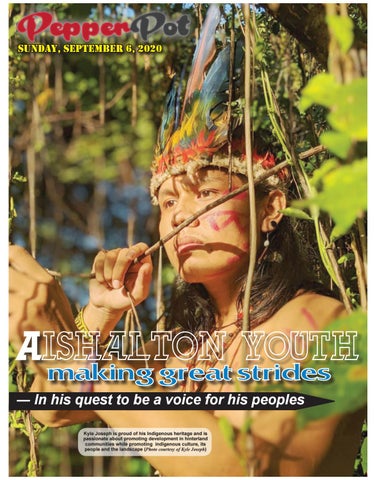
― In his quest to be a voice for his peoples Kyle Joseph is proud of his Indigenous heritage and is passionate about promoting development in hinterland communities while promoting indigenous culture, its people and the landscape (Photo courtesy of Kyle Joseph)
II
By Francis Quamina Farrier SEPTEMBER is observed as Indigenous Heritage Month by many Indigenous peoples of the Americas, including the USA. This is also here in Guyana, where September 10 is celebrated as the Day for National Indigenous Hero, the Hon. Stephen Campbell. He was the very first Indigenous Guyanese to serve in the country’s legislature (Parliament). Stephen Campbell worked tirelessly for the upliftment of his people, especially for land rights. He died on May 12, 1966, just two weeks before Guyana’s independence on May 26, 1966. Campbell Town, which is adjacent to Lethem in Region Nine, is named in his honour and memory. For this article, I decided to look at the fortunes, or lack thereof, of the Indigenous peoples of the “A-B-C” countries of South America; Argentina, Brazil, Bolivia, Colombia and Chile. ARGENTINA Argentina is located at the southern end of South America and is 1.07 million square miles in size -- second only to Brazil in South America. It is a country which I have visited on a few occasions. With a population of 45 million, 600,000 identify themselves as being Indigenous. However, it has been established
CHRONICLE PEPPERPOT ― Sunday, September 6, 2020 Indigenous Guyanese artist Desmond Ali who has visited all other countries in South America, excepting Venezuela (Photo compliments of Desmond Ali)
that some do not admit to being Indigenous, because of the racism against their people in Argentina. There are also many Argentines who are partly Indigenous. In 1995 the government of Argentina established a Federal Law to combat racism against Indigenous citizens. A law which previously prohibited the use of Indigenous names was also revised. At this time, the country is being hard-hit with the COVID-19 pandemic. There are now over 402,000 cases and 9,000 deaths; many being Indigenous. BRAZIL and BOLIVIA Guyana’s giant neighbour Brazil is 3.2 million square miles in size, and the largest country in South America. Its population is 212.5 million. The Indigenous population is estimated at 997,000. The majority of the Indigenous peoples of Brazil have been living on the edge of society since the arrival of the Portuguese in 1500. A lot of their ancestral lands, principally in the forested areas of the country, have been taken away from them by greedy ranchers of European heritage. In many instances, Indigenous Brazilians have been murdered with impunity, especially during the more recent brazen land- grabbing. Such reports have been made in several international media over the
past two decades. The news is not good either with the COVID-19 pandemic in Brazil. There are 3.900 million cases and 121,000 deaths as of the first week of September. Brazil’s COVID-19 fatalities are second only to the United States. Reports out of Brazil are that the government is not letting Doctors Without Borders go to Indigenous villages to assist the people. Some of the Indigenous leaders have organised demonstrations against the Brazilian government. Meanwhile, over 170 esteemed Indigenous elders and leaders have already died of the disease. They include two of Brazil’s most influential Indigenous Leaders; 66-year-old Paulo Paiakan and 71-year-old Chief Aritana Yawalapiti. Their deaths are a devastating blow to the Indigenous communities. Over the past four months, a growing number of Brazilians have been making their way into Guyana, entering illegally primarily across the Takutu River in Region Nine. Fortunately, the Indigenous citizens of neighbouring Bolivia experience a much better standard of living. In landlocked Bolivia, 2.262 million of the 11 million population is Indigenous. Over 50 per cent of the population is “Mestizo,” which is a mix of Indigenous and European. The Indigenous Bolivians enjoy a much higher standard of living than those in Argentina and Brazil, for example. There is now a growing Indigenous bourgeoisie in Bolivia.
keep it from spreading into their communities. All public roads into their communities were blocked and guards stationed. Only vehicles taking food and other essentials were allowed in. At this time, there are 608,000 cases of the COVID-19 in Colombia and 19,400 deaths. Like Guyana, there are nine Indigenous na-
A cultural group from the South Rupununi at the Guyana Cultural Association Family Fun Day in Brooklyn, New Your, USA, September 2017 (Photo by Francis Q. Farrier)
Some Indigenous women live the high-society life, wearing the very best and are even able to employ one or even two bodyguards. Bolivia was the first and only country in South America to have elected an Indigenous person as President. Evo Morales, an Indigenous Bolivian, became president of the country and served two terms. Under his presidency, the country developed even more and Indigenous citizens improved their wealth immensely. His popularity remains intact even now. COLOMBIA and CHILE With a population of 50.6 million, Indigenous Colombians total 1.9 million. Through organisation and agitation, they have been successful in increasing their land base and securing land titles which cover one-third of the country. At present, there is a total of 334 autonomous Indigenous communities in Colombia. When the COVID-19 pandemic struck Colombia, Indigenous leaders took immediate action to
tions in Chile. Located on the western flank of South America facing the Pacific Ocean, Chile is shaped like a long bora, being 2,653 miles long from north to south, and just 109 miles at its widest section. The population of Chile is 19.12 million, with 1.5 million Indigenous citizens. Classified as being one of the more stable and developed countries in South America, the welfare of the Indigenous population is now foremost in the drafting of a new constitution for Chile. MEMORIAL In closing, I invite you to think of the late Guyanese Lokono artist and archaeologist George Simon, AA, of St. Cuthbert’s Mission, who went to be with his ancestors two months ago. The planned paving of the access road from the Soesdyke-Linden Highway into St. Cuthbert’s, may well be christened “The George Simon Drive” by the bishop, on completion.
III
CHRONICLE PEPPERPOT ― Sunday, September 6, 2020
― In his quest to be a voice for his peoples
T
By Telesha Ramnarine
REKKING through rough terrain in the Rupununi region on his motorcycle – at times in bad weather – does nothing to stop Kyle Joseph from getting his job done. He fixes his mindset each time to remind himself that he is making the arduous journey “for a good thing.” His job, as a United Nations Volunteer with the United Nations Children’s Fund (UNICEF), takes him to all of the villages scattered across Region Nine (Upper Takutu/ Upper Essequibo), where he monitors the progress of major projects at those locations and then provides feedback to the agency. Kyle, 23, was born and raised in Aishalton Village to parents Kateri and Morgan Joseph
and finished some of his primary school years in the indigenous community. He moved to Georgetown to attend Queen’s College on a scholarship, but while in lower sixth form he received an opportunity to study abroad. He went to the Lester B. Pearson College in Canada where he completed a two-year diploma course and received his International Baccalaureate. But during this time, he realised that he no longer wanted to become a doctor as he had initially desired. “Being there made me come closer to my identity. You have to know what your identity is when you’re elsewhere. Like, who are you when you are outside of Guyana? I think that’s when I really started to come back to my roots as to where I am, and my people, and what I want to do for my community,” Kyle expressed. Just when he returned home in 2017, the
Out in the field gathering photos
Traveling for work
Attending a United Nations Volunteers Conference in Kenya
then Ministry of Social Cohesion conducted a programme aimed at bringing together youths around the Rupununi. It was all about cultural sharing and networking during the one week it was hosted in St. Ignatius, Lethem. “I was asked to help plan the event and I think that’s when I realised how much I enjoyed working with people from the different villages, listening to what they had to say and their ideas for community development,” Kyle recalled. Shortly after, he found himself an opportunity with UNICEF as a youth advocate for monitoring and evaluation. So two years later, today, he monitors the projects that UNICEF has ongoing in the region, such as those dealing with juvenile justice reform, teenage pregnancy, and other major social issues. Getting out to the villages and interacting in the various indigenous communities has further strengthened Kyle’s resolve to pursue a career path along the line of helping others. He will be pursuing a Bachelor of Arts in Sustainable Development. “I’ve finally decided that’s the direction I want to head. That’s what I enjoy the most and where my passion meets a need that I see.” So despite any challenge that may come up, Kyle gets on his motorcycle and gets the job done. “I am always happy to go anywhere with my motorcycle. At times, making the time and putting in the effort to get to these places….during rainy season you think of the road and think of all the way you have to travel…but then, I think it’s for a good thing and I go.” Ultimately, Kyle wants to find himself in a position where he can present his indigenous peoples. “I want to be a voice or a
Kyle Joseph
representative. No matter where that position is, whether in government or an international agency, I would like to be a big voice in social development and cultural preservation.” His passion also includes tourism and photography. “I have been heavily involved in contributing to ‘Visit Rupununi’, a tour agency here that I support because I see myself becoming someone who shows off the Rupununi, our people and landscape.” Furthermore, Kyle is also looking into starting a clothing drive for the Rupununi with his friends from Georgetown. “I know people in Georgetown who would have good clothes to donate, along with used textbooks and so forth. I want to create a channel for that where they can send that here.” This initiative is currently in the making, as Kyle continues to see how he can find funding and other support for it.
IV
CHRONICLE PEPPERPOT ― Sunday, September 6, 2020
Trifinity Solutions celebrated
‘World Entrepreneurs’ Day’
T
RIFINITY Solutions is a digital media agency, ‘Transforming Ideas into Solutions.’ It is a digital software solution (web, mobile and internet marketing) company that renders services to start up established businesses, helping them to grow their community digitally, extend their reach and increase their sales and education. Its Mission: Bringing together a community of creators through collaboration, to spark innovation while expanding sustained digital wealth. Their Vision: Growing and sustaining business through Digital Media Wealth Creation. “Eco-naire” was conceptualised by Trifinity Solutions as a proposed solution towards solving the problem of youth unemployment and poverty in order to create opportunities for young people in Guyana. This platform aims to establish and build an ecosystem of interconnected and interdependent networks of various actors that combines in order to produce innovative products and services. These actors include, but are not limited to start-up companies and entrepreneurs, developing companies, investors and investment groups, mentors and organisations for business development and support. Eco-naire currently focuses on three main pillars: an online academy to offer training, a mentorship platform and a job repository for entrepreneurs. With the best interest of Guyanese entrepreneurs at heart, Trifinity Solutions celebrated World Entrepreneurs Day with a panel discussion and the launch of a National
with virtual panel discussion
Job Bank, Innovators Online Academy and the reopening of 2020 applications for startuplabGY. World Entrepreneurs’ Day was celebrated under the theme, “Creating Awareness for Entrepreneurship, Innovation, and Leadership throughout the world.” Samantha Sheoprashad of Trifinity Solutions explained that: “Due to the current pandemic (COVID 19) it has changed our lives overnight, without a doubt, disrupting our traditional operation, forcing us to adapt to virtual means. We should recognise that this adaptation requires us to tran-
sition the way we live. We believe that this is a prime time for entrepreneurs, innovators and leaders, to take on this challenge to bring solutions to the table.” On this opportune day, Trifinity Solutions celebrated the founders, producers, managers, designers, administrators and innovators. World Entrepreneurs’ Day was a great opportunity to push philanthropic, social and ethical business practices via conferences, awards and initiatives. Hence the day’s activities involved local entrepreneurs who enlightened and
shared their experiences with the forum with regards to Entrepreneurship, Innovation, and leadership. Dr. Marcia Brandon is a social and economic development entrepreneur specializing in sustainable community development focused on helping youth and females to start and grow. She was a panelist in the forum and discussed; using entrepreneurship to reduce poverty within the ecosystem. The Queen’s Young Leader and social advocate; Samantha Sheoprashad, presented on; impacting the next generation of problem-solvers to reduce
youth unemployment. Marissa Foster, an entrepreneur and small-business owner of MArt discussed leading young people towards developing skills that are relevant to the future of work. Keshav Gupta is trained in law and economics at the University of Delhi and is an expert of the SDGs; he presented on the role of education and innovation during the COVID-19 pandemic. Other speakers included Stephanie Simon, Narendra Nauth and Aurelia Saks. The programme was
hosted by a young writer and aspiring entrepreneur, Nia Williams. Trifinity Solutions is committed to developing the way in which Guyanese view entrepreneurship. They are constantly working on innovative ways and means to educate and empower business owners throughout the country. This forum is the first of its kind for the group, but they are hoping to upkeep the standards and with the help of the public and other entrepreneurs, they are confident that there is more to come.
CHRONICLE PEPPERPOT ― Sunday, September 6, 2020
How a simple upbringing carved a brilliant personality A glimpse at the life of a newly appointed government minister
H
AVING struggled through the early parts of his life to pursue an education and lend support to his family, Deodat Indar has stopped at nothing in continuing to go after brilliant feats in his life. Perhaps he tells himself that he has to make up for all those years that he and his family punished when Guyana experienced harsh living conditions around the 1980s; or maybe he is motivated to continue pressing forward, thanks to the many academic successes that he has had over the years.
He and his teams also did lots of work getting trade missions and international Memorandums of Understanding (MoU) signed between countries, such as Cuba and India, so that businesses in these nations can have direct contact with each other. On the second year of his term as president of the GCCI, Indar became the vice-chairman of the PSC, where he went on to singlehandedly plan a one-of-a-kind business summit in 2017, and produce much work in the energy and economic aspects of the PSC. Apart from these portfolios, Indar was also growing his personal businesses which he de-
Being honoured by the GCCI in 2019
At just 28 years old, Indar could’ve been described as one of the most qualified persons in Guyana, simultaneously holding several positions in the country’s private sector. Today, 11 years later, and being the newly appointed Minister within the Ministry of Public Works, he has no intention of relinquishing his desire to do more – this time, however, for the benefit of his country. The responsibilities of his new office are no doubt many, but Indar wants to show the world that he is part of a “results-oriented” government. “And the proof of the pudding is always in the eating, so you have to see the results. We don’t want to talk about things; we want to do things to benefit the citizenry,” he expressed. During an interview with the Pepperpot Magazine lately, Indar reflected on his many years of hard work, and even some of his more recent work as a leading figure in the Private Sector Commission (PSC) and the Georgetown Chamber of Commerce and Industry (GCCI). He had exerted much time and energy fighting against the controversial parking meter project in the city and was perhaps the loudest voice for local content legislation in the oiland-gas sector.
veloped. “They’ve become successful and they grew in very short spaces of time. So we have about four businesses that I pushed for international partnerships.” Because of his political standing now, however, he has since resigned from all of his private sector positions, including his post as finance controller at the reputable Sterling Products Limited at Providence. Indar is also doing a lot in his private life, including building his home on the West Coast of Demerara, which he said he started to do over a year ago. PERSONAL DEVELOPMENT During all of his hard times growing up, Deodat, now a father of two, said he realised that the only way out of that “severe poverty” was through education. “At the age of 12, I was given a chance by a primary school teacher who saw something in me. Up to now, I don’t know what this person saw in me. I was brought from the back bench to the front bench and so I started to listen. I came from the extremely dunce g u y to the extremely brilliant guy,” he had related in a previous inter-
Indar has also been working on his personal life, beginning construction of his house on the WCD
V
view. He started to do well in school and after sitting the then Common Entrance ExaminaIndar has done a lot of work during tions, he went to St. Stanislaus his stints at the PSC and GCCI College where he spent the next University of Oxford Brookes in England and five years. One year after leaving school, Indar received his Bachelor’s Degree with honours. received employment at Guyana Beverages as He did the Certified General Accounting Exams an accounts clerk. of Canada and received his Master of Business At the age of 20 he became the operations Administration Degree at the University of manager at the same firm and started to study for East London. He then proceeded to do the US the Certified Accounting Technician (CAT) ex- (United States) Certified Internal Audit Exam. amination. Though working and studying were In addition, he was also President/Chairman difficult, he concluded the CAT certification in of the Board of Governors, at the Institute of only nine months and was the best student in Internal Auditors – Guyana Chapter; Facilitator Guyana for the highest aggregate marks. at the Australian Institute of Business – Nations This served as motivation to him and he University; Treasurer of the Guyana Scout Asimmediately went into the ACCA (Association sociation; an investment advisor; and an ACCA of Chartered Certified Accountants) programme. lecturer. He finished this in two years and by age 24, was More recently, he received his Chartered already a qualified chartered accountant. By this Professional Accountant (CPA) and Certificate time, he was working at the Guyana Forestry in Risk Management Assurance (CRMA) creCommission, but decided to leave the job and dentials. take up a position at Sterling Products Limited. Now in his newly appointed position in There, he was the youngest Finance Controller government, Indar firmly believes that he has for a public company. been chosen not just because he is qualified At Sterling, he was able to elevate himself to do the job, but due to his track record of even further. He finalised his first degree at the being a hard worker and getting things done.
VI
I
T is just over one year since I started my academic journey here at the University of the West Indies (UWI), St. Augustine. In a year, I’ve learnt a lot. And, I don’t just mean through my formal academic pursuits. More often than not, when some of my colleagues and friends first heard that I was coming to the ‘Twin Island Republic’, they told me that I would feel right at home- because the similarities between the two countries are many. I agree; I have seen and experienced many of those
S
ELLERS in the markets and shops, over the centuries, have been known to exploit consumers by giving them less than the correct weights and measurements of the goods purchased and this form of theft has been forbidden in the ethical codes of all religions. Governments have tried by various means to control this abuse by sellers and to protect the consumers. In Guyana, this responsibility has been entrusted to the Guyana National Bureau of Standards (GNBS). The GNBS administers the Weights and Measures Act and addresses matters such as the Imperial and metric systems of measurements and the accuracy of the mechanisms used for measurements. The most popular of such mechanisms are scales. The GNBS is charged with the responsibility of ensuring that the scales used by sellers are accurate and accordingly, sellers, by Law, have to register their scales with the GNBS who
CHRONICLE PEPPERPOT ― Sunday, September 6, 2020
similarities. One of the more striking similarities, however, has been the Indo/Afro binary. Much like Guyana and unlike many other Caribbean countries, T&T has a large Indo population. The dynamics of a post-colonial, Caribbean society with an Indo population is an interesting one. Following the genocide of Indigenous Peoples, the Caribbean became a “black and white” space, framed in a “black or right” power structure. White supremacy was positioned at the top of a social, political, and economic hierarchy; they brandished and consolidated power and left the dehumanised enslaved Africans and later, the descendants of Africans at the bottom of the hierarchy. The introduction of Indian immigrants into countries like Guyana and Trinidad and Tobago and even in Suriname, and to a lesser extent, in Jamaica presented a new dynamic. These immigrants entered into an already established hierarchy, replete with its overt anti-blackness. The Indian immigrants (and later, the other immigrants who came in much smaller numbers) created another level in this hierarchythey could not be white, but they did not want to be at the bottom, either. And so, they found themselves in the middle, cultivating their
anti-blackness, subscribing to white supremacist ideals. (Note: I am not ignoring the hardships faced by Indian immigrants, or Indo-Caribbean people) Even now, as the Caribbean encompasses (many) Independent nations, that white supremacist power structure permeates our societies. The legacy of colonialism has left Caribbean people always having to “play catch up” or to clean up the “colonial mess” (as Professor Sir Hilary Beckles calls it) left behind. In our post-colonial societies, Professor Emeritus of the UWI, Rhoda Reddock contends that while there are many intersectional components to navigate, race is the “prism” through which Trinidadians view social, political, and economic life. “The European presence continues to be an overarching framework for the antipathies between the Africans and the Indians,” the Professor said at a recent National Symposium organised by the UWI. Trinidad and Tobago held its 2020 General Elections on August 10, just about one week after our own 2020 Regional and General Elections had finally ended (or, “ended”). I was in Guyana for the commencement of the campaigns, and I keenly followed the post-election developments, even while here in T&T. On the other hand, I have been forced to stay here for an extended period, which led me to become immersed in the political campaigns in Trinbago, as well. One thing was clear to me: both countries have two dominant political parties which mobilise their ethnic Indo and Afro bases. The same vitriol which engulfed Guyana this year, and which always seems to be more pronounced at elections time, also engulfed Trinbago. While in Guyana, the traditionally Indo party won, in T&T, the traditionally Afro
party was re-elected. Both cases presented an opportunity to understand the ethnic insecurities from each of the respective groups when they perceived that because “their party” lost, they too had lost. Professor Reddock articulates that the loss in Trinidad and Tobago was not only seen as a political loss but the loss of an entire group of people- who, worse yet, lost to a perceived inferior group. I would love to see an in-depth, academic analysis of Guyana’s case. My time in Trinidad has allowed me to think deeply about this scourge in my country. It allowed me to think about the layers of these relations which need to be unpacked. Gender and race, for example, is perhaps (in my opinion) the least discussed dynamic. There is the factor of class struggles and our navigation of a white, capitalist system which continues to disadvantage us. I wrote before about geographical considerations, too (policing the Agricolas vs the Prashad Nagars, the Laventilles vs the West Moorings). I don’t think T&T has a better handle on these relations than we do. The ‘Zessing’ anthems during the elections campaign illustrated that clearly. What I do think Trinbago is better at, is channeling its academic energy. The UWI hosted a Post-Election National symposium, on race relations and reconciliation last week. Academics, political leaders, youth, and other stakeholders were brought together. A single symposium isn’t going to solve the issue, but, it does get the process moving along. President Mohamed Irfaan Ali has committed to fostering a National Healing agenda. I do hope that he too will look at Trinidad and Tobago, and the UWI, and recognise that we need to embrace this agenda with much alacrity.
calibrates them. Unfortunately, the GNBS, like most such enforcing bodies worldwide, never has resources enough to ensure the consumers are protected in all circumstances. For example, a seller may have two scales, a GNBS registered one and one which is doctored to short weight the buyer. When the GNBS inspector visits his establishment, the seller would produce the registered scale. But there are other kinds of subterfuges. Recently, for example, the GNBS issued an advisory to vendors, shopkeepers and other retailers to discontinue their use of unregistered dial scales. These dial scales which many retailers have taken to using were designed for domestic use and their mechanisms are easily damaged from continuous and commercial usage and a damaged scale would inevitably short weight the purchaser. In the final analysis, it should always be kept in mind that the consumer or purchaser has to make the necessary effort to ensure
that he receives value for money. In the first place, purchasers should immediately examine the goods purchased and this will give him a good idea if the goods purchased are of correct weights/measures. If there is suspicion that there is a short measurement, the purchaser must challenge immediately. Or one could challenge the scale the seller is using and demand to see the GNBS’s stamp. In the markets, if a seller has his goods at inordinately cheap prices, then it is quite likely his scales have been doctored or the goods are expired. The buyer could take his complaint directly to the GNBS since they are entrusted with the supervision of the country’s weights and measures. In the alternative, he may contact the Guyana Consumers Association, the Competition and Consumers Commission or the Consumer Division of the Ministry of Business headed by Ms Cheryl Tinnis. Over the years, the GNBS has been urging vendors and other retailers to use the recom-
mended metric devices and these include the metric red equal arm scales, the metric platform scales, electronic scales or the dial salter scales which have been approved by GNBS. Metric scales are a security for the future since, by law, the weights and measures of Guyana are already metric and it is only a matter of time before the law is enforced. Use of metric measurements has become imperative, not merely because they are more convenient and efficient, but because Guyana, with its oil resources, is fast-moving on to the international stage which has already gone metric. Use of accurate metric measurements would also be insurance for the survival of vendors and retailers, since, except they could hold the trust of purchasers, custom will go to the supermarkets where the measurements are generally accurate. It would therefore be in the long term interests of retailers and customers as well to use accurate scales stamped by GNBS.
CHRONICLE PEPPERPOT ― Sunday, September 6, 2020
Focus on the Village
VII
Residents making their way into the village (Carl Croker photos)
Silver Hill Village
I
By Michel Outridge
N observance of Amerindian Heritage Month, this week the Pepperpot Magazine journeyed to the picturesque and hillside village of Silver Hill, located on the Soesdyke/Linden Highway. Silver Hill was originally an Indigenous Settlement but over the years people came and left but today, it is home to less than 160 residents with just about 50 houses. The village consists of Indigenous, Afro, and Indo Guyanese, who are coal miners, woodcutters, skilled mason and carpenters, and self-employed folk. Silver Hill is about 11 miles from Linden and is approximately 32 miles up the Soesdyke Junction. The village runs deep into the backlands area and consists of hills and a vast forested area. The soil is fertile and used by locals for farming pineapples, watermelons, legumes, fruits and vegetables. The main access road is made up of sand and loam and is accessible and is about four miles long
and has many trails on which a few houses are scattered. Silver Hill has a large poultry farm and on that side of the village, people use it to access the riverine communities along the Demerara River. The village has a nursery and primary school housed in the same building, a well where residents access potable water supply, and a health outpost. Silver Hill is a farming community that is large but sparsely populated and most of the lands are leased and overrun by bushes and reclaimed by the forest. Silver Hill has no electricity but residents have generators and solar power systems that provide power sully to their household appliances. The village is without landline telephone service but the residents have cellular service from both networks. Silver Hill has a few creeks within the village and the locals, who do not have bicycles, motorcycles or vehicles have to walk miles to get in and out of the village since taxis fares are not within their budget. THE CDC CHAIR The Pepperpot Magazine met Chairperson of the Community Development Council (CDC) Patricia Williams, who operates a small roadside shop. The 62-year-old stated that life is very simple in that village but entails challenges and hard work but she escaped from the city to have a quiet life there. Williams is better known as “Sister Pat” by locals and although she has no children, she seemed content with life as is. S h e would spend a lot of time at the shop which sits at the side of the highway and would tend to customers but her house is deep
Pat’s roadside shop
Patricia Williams called “Sister Pat”
within Silver Hill, almost near the Demerara River. She has been residing at Silver Hill for the past 30 years but got married to a local, two years prior and did not regret leaving the city. “Here you have a lot of space, fresh air, breeze, peace and quiet and no one to bother you and I like it very much so I am not missing much in the city,” she said. AMERINDIAN HERITAGE MONTH 2020 In light of the global pandemic, the Ministry of Indigenous Affairs on August 31 hosted a virtual opening to usher in Indigenous Heritage Month under the theme: “Fostering Traditional Practices for a Safe Environment”. Amerindian Heritage Month is an annual observance that is held every September in Guyana in honour of Guyana’s Indigenous Peoples. To commemorate our first peoples, a calendar of virtual events has been planned throughout the month which kicks off with the day on which Stephen Campbell became Guyana’s first Indigenous Member of Parliament on September 10, 1957. In memory of Campbell’s achievement, September 10, is still celebrated as “Heritage Day” each year.
Silver Hill access road
VIII
CHRONICLE PEPPERPOT ― Sunday, September 6, 2020
Focus on the Village
Village's first resident, teacher recall how they came to settle in the serene community
A
By Michel Outridge T 76 years of age, Ann Harvey is restoring old furniture and making high-end crafted furniture for sale right from her home in Silver Hill,
the first school in the community and for teaching music. He promoted music and cultural development within the village and started the school in a ‘bottom house’; when they had i 35 children attending, they approached the Ministry of Education. It was a resident, Miss Martin, who was
performances. She is the mother of Dr. Alexandria Harvey, who is attached to the Georgetown Public Hospital Corporation Medical Teaching Service. “We have about 160 residents in Silver Hill with some being weekend villagers, while others reside there permanently,” she
“We had the land for five years and did nothing to it and then we decided to construct a small house and cultivate the land with fruits and vegetables for the kitchen,” she said. Romascindo told the Pepperpot Magazine that the one and a half plot was cleared, which took some time and effort and they
Ann Harvey in her workshop
Part of Romascindo’s garden
Jean Wagner in her favourite place the garden (Carl Croker photos)
Pauline Romascindo displaying the produce of her garden
A piece made by Ann Harvey
Soesdyke-,Linden Highway. Ann Harvey, the first resident of Silver Hill, is Guyanese, but migrated to London and returned here in 1973. Harvey, her husband -- who was a citizen of Grenada -- and their six children upon their return to Guyana, were housed at the rear of the village in the Transition Centre for two weeks. After that, they got some posts, wood and zinc and erected a small house in which they resided. It was on April 1, 1976, that they got a lease for the land and built a much better house which is still standing, but a large one is being constructed on the same plot. Unfortunately, Harvey’s husband passed away in 2011, but he was praised for starting
instrumental in those meetings with the authorities and later a school was constructed in 1977. Harvey’s husband further gifted the school their first piano and taught the children how to play and they become so good that they were invited by “Billy” Pilgrim to perform at the National Cultural Centre (NCC). Harvey taught craft at President’s College and founded the health outpost in the Demerara River. Today, she is quite contented with the serene and tranquil life at Silver Hill and is busy in the yard making high-end craft pieces of furniture based on orders. Harvey stated that the children also participated in the CARIFESTA games back then and was given certificates of merit for their
said. “Silver Hill is my home and I really like it here because it is so quiet and I have a lot of space to plant and make my furniture,” she said. THE TEACHER FROM AMELIA’S WARD HAS HER GETAWAY PLACE IN SILVER HILL Another resident who thought Silver Hill was ideal to settle down in is Pauline Romascindo who lives just next door to Harvey. Romascindo and her family, have an acre plot on which they farm for domestic use. She is a teacher attached to Linden Foundation School and since schools closed in March she left her Amelia’s Ward home and went to her place at Silver Hill for some much-needed peace and quiet.
began utilising the land for farming, a hobby which is therapeutic. The mother of two related that she has the time now to do things and that is what she is focusing on and still has time to make craft while her elderly mother, Jean Wagner, who does more of the farming, would sew face masks for sale. “I am in no hurry to return to Amelia’s Ward, because I like it here and I am doing the things I wanted to for a long time,” she said. Romascindo’s children are 19 and 23 years old and they are at home in Amelia’s Ward taking care of things there. “We eat what we plant and the only thing we have to buy for the kitchen is shallots, because we grow a lot,” she said.
CHRONICLE PEPPERPOT ― Sunday, September 6, 2020
Focus on the Village
W
By Michel Outridge
ALKI N G t w o miles f r o m h e r home in Silver Hill, Soesdyke-Linden Highway, to her small roadside shop on the highway at age 72, is perhaps the secret to her longevity. This village elder doesn’t look her age and is without any medical complaint and is very much able-bodied. Uleen Michael is a resident of Silver Hill and is wellknown as “Aunty Lynn.” She has a small wooden roadside shop where she has cold beverages, school supplies, confectioneries and homemade snacks. She has been a roadside shopkeeper for the past 15 years and prefers to walk to and from her home to her shop, because it is a form of exercise and taxi fares are too costly. To go in by taxi is $1000, a sum she saves by walking, which she is accustomed to; but at times the sunshine is way too much for her to endure, plus it is even hotter with the sandy condition of the soil.
Uleen Michael in her shop
Uleen makes sponge cakes, pholurie, channa, plantain chips, chicken foot, mittai and tamarind balls to sell at her shop. As a result of the epidemic she re-started selling three weeks ago after having closed shop for weeks in fear of contracting the deadly Coronavirus. This elderly woman would wake up early in the morning to prepare her snacks to take to the shop. She would leave home about 09:00hrs, cease selling at 15:00hrs and would make the journey home on foot. In addition, she would have to carry her bags and it is a walk that would take some time. Michael lives alone and is also tasked with cooking and doing all her household chores. “I don’t really go out much, except for church and selling, so I am at home mostly and that is just fine with me,” she said. She does her vending from the shop on Mondays, Wednesdays and Thursdays. The schoolchildren and locals are her customers, but with the closure of schools since March, business is slower than usual. “The schoolchildren
would come daily and buy all my snacks but since the pandemic there is no school, so I am trying to stay afloat,” she said. The Silver Hill Nursery and Primary Schools are housed in the same building which is located within walking distance. Michael was residing in Linden, but when her father passed away she had to relocate because he left his house and 40 acres of farmland. That was 20 years ago and she is now used to the serene life at Silver Hill, where people enjoy very private lifestyles and plenty of space. Michael’s brother has taken up farming on the lands and has a cultivation of coconuts and citrus. The mother of six related that all her children are grown and are leading their own lives elsewhere. “Life is normal here but considering you have to work to live comfortable and most people know each other, so there is no real issues and we live far apart, so that’s just perfect,” she said.
IX
Anesia Simon (Carl Croker photos)
Some of the home-made snacks on sale
THE TEACHER IN TRAINING The Pepperpot Magazine also met another resident, a teacher in training, Anesia Simon, who was out with her daughter. She uses a dirt motorcycle to get around in the village and was in the midst of doing so when this publication caught up with her. Simon is in her final year at Cyril Potter College of Education (CPCE) and is waiting to complete her last exam, but due to the he COVID-19 epidemic there isn’t much she can do but wait. “Teaching was my first choice as a profession, because I want to give back to my community and it is the ideal job to serve the people,” she said. Simon also had nursing as a second choice, but was deterred by the shift system by which she would have had to work and opted for teaching, since it can be done during regular working hours. She has a three-year-old daughter and is originally from St. Cuthbert’s Mission, called Pakuri, which is lo-
cated off the Soesdyke-Linden Highway. “When I finish at CPCE I want to return to my village as a teacher and work there, because it is my home village,” she said. Like many other villages along the highway, Simon said the young people have to fend for themselves and it would be easier for them to have a resource centre for skills training, where they can become self-employed. “Living on [sic] these far-fetched [sic] villages off the highway is not easy and it takes a lot to get out and get qualified because everything costs more here,” she said. She relocated to Silver Hill 15 years ago and has no immediate neighbours except for her grandmother. In her spare time she would go with her grandfather, who is a woodcutter in the jungle, to cut wood and other times enhance her sewing skills at home.
X
M
CHRONICLE PEPPERPOT ― Sunday, September 6, 2020
Focus
By Michel Outridge
ALVALY Laud is a resident of Silver Hill, Soesdyke-Linden Highway and it is the only place she has lived all her life. The mother of five told the Pepperpot Magazine that her parents are from the community, she was born and raised in Silver Hill and today has her own family. The mother of five has a small business which she operates
on
the
Village
from her home and it supplements her husband’s income. Laud makes home-made traditional bitter cassava bread, with which she supplies supermarkets and other retail shops in Linden and in the city. As a successful participant of the Hinterland Employment Youth Service (HEYS) programme since last July, she is versed in preparing Indigenous cuisine and would assist the villagers when they have an event, such as the celebration of Indigenous Heritage Month. She stated that her grandmother was instrumental in
Malvaly Laud displaying her cassava bread (Carl Croker photo)
hosting ‘heritage’ annually, but since she passed away two years ago, she has stepped up to the task in terms of arranging the event. Laud explained that the villagers would come out and lend their support and the celebrations would attract a lot of people residing on the highway. “Usually, ‘heritage’ is held on the last Saturday of the month and this year we will not have a big event like last one because of the pandemic,” she said. Laud added that the women of the community would come together and prepare Amerindian cuisine and a cultural show would be arranged featuring a fashion show, a pageant with games such as a Pepperpot-eating competition, fire-lighting, arrow and bow shooting, among others. “Our local foods and drinks would be on sale, but this year we will not have a grand event but we will try to have a small gathering at least, which is held on the lawns of my house,” she said. Laud disclosed that her late grandmother, Carmelita Laud, who died at age 67, started organising the ‘heritage’ in 2009 and was also an active member of the nearby Roman Catholic Church. She promoted cultural development in Silver Hill and was wise beyond her age and was deemed the matriarch of the village. Today, her grand-daughter would share her ideas with her fellow villagers to make the ‘heritage’ event possible. Laud is an entrepreneur making cassava bread, which is packaged, labelled and placed in a pack of three after which it is ‘wholesaled’ to merchants. Luckily, they do not incur any cost for the bitter cassava, since they grow their own in the farmland they have at the rear of their house. But at times to meet the demand they would source from the National Agricultural Research and Extension Institute (NAREI) on the highway or other farmers within the village. “My husband works on a farm, so he has an idea of farming and we collectively tend to the cultivation,” she said. Laud said despite some hiccups such as no electricity or potable water supply, they live a simple life. “The cost for buying gas for the generator is high and sometimes we have no choice but to stay in the dark and we ‘make do’ with whatever we can afford,” she said. Laud reported that Silver Hill is a quiet, beautiful place to enjoy a good family life and it was evident her family unit is closely knit. One of her five children, a young boy, O’Neil, was petting his pet parrot which he had on his hand. The parrot, Sherry, he said is his friend and they enjoy many adventures within the confines of their big yard space which has many trees and other greenery. THE COAL-MINER/FARMER/LANDSCAPER The Pepperpot Magazine also met Dan Stanton, a coal miner/ farmer, landscaper, and also a resident of Silver Hill. He is originally from Leguan, Essequibo River and went to Linden for a wedding, after which he visited a relative in Silver Hill. Stanton related that he got to like the place,so he left his home village and relocated and has been a villager for the past 28 years. The 58-year-old explained that he hardly leaves the village and the last time he went out was last year. He has some chickens, he would do his coal-mining and has a few acres of farm land where he cultivates sweet potatoes, yams, plantains, bananas and other fruits and vegetables for the kitchen. “This is a kind of place where the birds would wake you up before sunrise and it is very much a part of nature, among other things,” he said. The father of six added that he would do his coal-mining and whenever he gets landscaping jobs he would do that too. Stanton added that he would gather wood from the forested area or at sawmills for his coal-mining, which he does in his backyard.
XI
CHRONICLE PEPPERPOT ― Sunday, September 6, 2020
Government Medical Officer (GMO) Dr. Joanna Sealey (Carl Croker Photo)
T
By Michel Outridge
HE Silver Hill Health Outpost, Soesdyke/Linden Highway is providing healthcare services thus, fulfilling its mandate to the people of this far-fetched community and its environs. The facility is outfitted with automatic soap dispenser and a pipe for proper hand hygiene practices in keeping with the new normal for the novel Coronavirus (COVID-19). General Medical Officer (GMO) Dr. Joanna Sealey told the Pepperpot Magazine that the Silver Hill Health Outpost has a visiting doctor every third Thursday of the month. The doctor resides at Long Creek also on the Soesdyke/Linden Highway and would also visit other health facilities along that corridor. She stated that they provide all other services such as ante-natal, maternal and child health, neo-natal, family planning, chronic diseases clinic and home-visits. The Silver Hill Health Outpost has a pharmacy with other facilities and is staffed with
a midwife, who resides in the government accommodation, next door, a nurse and a cleaner. The health facility provides service to that community and the nearby villages. According to Dr. Sealey, more than 100 patients would visit the Silver Hill Health Outpost monthly and the chronic disease clinic is the largest but they would often see patients with seasonal illnesses, as well. She explained that Silver Hill Health Outpost is one of seven along the East Bank Demerara/Soesdyke/Linden Highway with 11 health centres. The GMO disclosed that the jurisdiction starts from Eccles to Mobilssa and all public health facilities come under the Ministry of Health. THE BUSH MEDICINE LADY OF SILVER HILL Having watched her father make ‘bush’ medicine for many people over the years she became very familiar with the different ‘medical’ herbs from trees and plants that have many benefits for varying illnesses. She is Debbie Daniels fondly referred to as “Aunty Debbie”, who is a resident of Silver
Hill. Daniels is originally from Christianburg, Linden but also resided in Bartica and Kartabo Point for some years before she settled in Silver Hill. In her home village, her father was into making bush medicine and assist people, who often visited the home in search of his bush concoction for illnesses. “I used to watch him and over time I got familiar with the herbs and I began making my own after he passed away and I still do it today because it brings relief to people, who are suffering from many sicknesses,” she said. Daniels explained that she doesn’t do it to make a profit but she would help people and would charge a small fee because sometimes she would have to source certain herbs from far. “Gathering these herbs also takes time and my eyesight isn’t too good so sometimes it
is difficult for me to move around to look for these herbs to make it fresh for a client because I don’t make it and keep it,” she said. The mother of six stated that sourcing some hard to get herbs would take her out the village and she would have to get it from elsewhere. “This isn’t about just boiling plants and herbs but it takes some form of knowledge to know what you are about before you embark on ‘herbs making’ which takes a liquid form after combining different plants,” she said. Daniels, who is a resident of Silver Hill for the past 37 years revealed that plants from our yard and environment can cure us if we know how to use it to rid of any illnesses in our bodies. “The real joy comes from helping people, when they use my potion of herbs and it helps I feel happy then they get some form of relief from their suffering,” she said.
XII
W
ORLD Suicide Prevention Day is coming up on September 10 so I’ve decided to briefly pay tribute to it today. I’ve spoken about suicide a few times before but this article has been long overdue as the topic has taken a backseat in the past few years. In 2016/17, Guyana had the highest suicide rate in the world. When it was reported that had decreased, so did the discussion. I saw that so many people started to get involved and were spreading awareness but over time, like with many other things, people have started to lose interest. I’m hoping to permanently change that. World Suicide Prevention day was created in 2003 by the initiative of the International Association for Suicide Prevention (IASP) and the World Health Organization (WHO) The efforts were made shortly after the discovery that over 800,000 people commit suicide around the world every year. It is so unfortunate that Guyana has the highest rate in the world. I don’t think many of us have actually stopped to think about what that means for us as a nation. The world average is 11 people per 100,000 while Guyana had 44. This means that if you take 100,000 people from any other country and put them in one room, 11 (on average) will commit suicide. In Guyana, 44 will. That is a massive lead. I feel like everyone already knows this. We know it’s a problem but do we know why? Do
CHRONICLE PEPPERPOT ― Sunday, September 6, 2020
we know the individuals who are more likely to attempt, do we know all the causal factors, the warning signs? More importantly, do we know the solutions? Here are some facts about Guyana. - Younger people between the ages of 1218 are more likely to attempt suicide - People in the age range of 19-40 have more successful attempts - Females are more likely to attempt suicide than males - Males are more successful in their attempt - Suicide is more common among IndoGuyanese - The most commonly used means is pesticides - Suicides are most common in Regions 2, 5 and 6 What are some causal factors of suicide? People who experience mental illness such as depression and substance abuse are much more likely to attempt suicide. Depression is a prolonged period of sadness which results isolation, loss of interest in activities etc. Substance abuse has very similar symptoms but also think about what an abuser would go through than the (lucky) average individual wouldn’t such as loss of job, family, friends, prostitution, legal issues and so on. Health issues are another reason why people might want to take their own lives. I once did an outreach in Berbice where a man had a piece of glass stuck in his eye for a week as there were no doctors to take it out. He also did not have the money to come into Georgetown
making poverty another risk factor. Any kind of abuse – sexual, physical, emotional and financial- are common risk factors for suicide. Low education is another one that can be tied with that. Abuse also applies to children. Many young people in Guyana commit suicide. I believe this abuse has a lot to do with it. For example, I did an outreach in Berbice with 30-40 adolescents. I asked them if they felt they could go to their parents if they were in trouble. Every one of them said no. I asked if they felt comfortable going to their teachers and ¾ said no. Now, imagine a scenario where a 14 year old is pregnant and terrified of her parents because of their usual abuse, what options are there for her? Now, what are some warning signs? How can we tell if someone might be considering suicide? I’m not going to lie- sometimes you can’t tell or the signs slide right past you. However, there are some universal signs that if both partners are lucky will be caught in time. First of all, the best predictor of a suicide attempt is a previous one. If someone has attempted before, they are likely to attempt again. Otherwise, individuals with suicidal thoughts are usually withdrawn and preferably isolated, sad or depressed and have lost interest in activities they once loved. They tend to be very negative, have low self-esteem and have a hopeless outlook on life. This typically results in physical changes such as neglect of appearance, weight loss or gain, substance abuse, visual tiredness, insomnia etc.
If the individual is older, they might show signs by rushing to get all their affairs in order, saying elaborate goodbyes, giving away prised possessions, stockpiling medications etc. Now, we all know the problem – what’s the solution? It’s important to know what help is available. No matter where you are, go to your nearest health centre if you are experiencing suicidal thoughts. There will always be someone there to help or at least refer you to somewhere else. Since lack of motivation is also a serious symptom of suicidal thoughts/ tendencies, you do not even have to leave your home. Call the Guyana Suicide Prevention Helpline numbers. The centre is open 24 hours so you can call at any time. It’s free to call and you can remain as anonymous as you like which means you do not have to give any personal information about yourself. The numbers are: 223-0001, 223-0009, 623-4444, 600-7896 Please do not be afraid to seek help! The helpline is not only there so one can speak about their problems. We do everything we can to actually come up with a solution to it. I also urge newspapers to start posting these numbers on their front page instead of details of the last person who committed suicide. Thank you for reading and please send in any topics to caitlinvieira@gmail.com Say Yes to Life and No to Drugs! Always!
What is Polycystic Ovary Syndrome (PCOS)?
R
EPRODUCTIVE health education is much undermined in our society. There is little to no conversation about it in your standardised Guyanese household and even when it is brought up at schools and events, it’s for a “special occasion”. Believe it or not, I had no idea what PCOS was until a few persons brought it to my attention. I was told that it is a very prevalent health topic but yet there is not much open conversation that surrounds it. Hence, I am here with a little insight into Polycystic Ovary Syndrome (PCOS). PCOS affects about 2-27 percent of women around the ages of 15-44 (a woman’s childbearing years). Can you believe that? I certainly couldn’t. While the symptoms and signs of PCOS can be noticeable, it is believed that many women who may have this syndrome, may not be aware that it is the cause of those signs they are experiencing. An example of this may be women who have irregular periods/cycle. Their cycle is not fixed around the normal 28 eight days cycle as most women. They usually have skipped periods. Do you or anyone you know experience this? Well, it might be something much deeper than just an “irregular” period. Another sign of this includes high levels of a male hormone called androgen. High levels of this hormone in women can have physical signs such as excess amounts of facial hair and/ or baldness as well as, severe acne. The word poly means many. Hence, the word polycystic means: “many cysts”. The ovaries of a woman who has PCOS might be quite enlarged or overgrown.
The ovaries might also have follicles (small sacs filled with fluid) that surround the eggs. Due to this, their ovaries might not function regularly as an “average” woman. Some other common symptoms of PCOS include heavy bleeding, weight gain, darkening/hyperpigmentation of the skin and headaches. This syndrome in its prime can have severe effects on the body of a woman. Some severe effects include: infertility, endometrial cancer (cancer caused when the uterine lining buildup due to no ovulation or opportunity to be released), sleep apnea (pauses in breathing while sleeping, mostly common amongst overweight women who have PCOS) and the most severe and alarming effect just might be depression. The alarming signs and symptoms might sound towering and alarming but fear not, there are some common medical treatments available. Birth control pills and medication or Metformin (a drug used to treat Type 2 diabetes) are commonly used to treat PCOS. The Polycystic Ovary Syndrome has its physical impacts but I believe the emotional and mental effects are even more detrimental. The social anxiety and low self-esteem women may face is also just as important to consider as it relates to treatment. I am no doctor but I have decided to use my platform to educate and inform my readers on PCOS. Together, with this information, I hope everyone reading this becomes a bit more mindful of reproductive health and if by chance you’ve noticed certain signs of it within yourself or a friend/family, kindly visit a professional.
XIII
CHRONICLE PEPPERPOT ― Sunday, September 6, 2020
“
I’VE benefited in a good way so far and I’m able to become independent so I can do things for myself now. Because it has been very hard to go out and find a job, so this has become a very helpful something for me. The organisation is very helpful to young women by helping people to help themselves. I’m glad that they are targeting young women mostly because of their families, especially single parents,” said Shakema Hendry The organisation she is referring to is the Humanitarian Mission led my Suresh Sugrim who is a Guyanese based in Canada In a press release, the Humanitarian Mission Guyana Inc. said that it is passionate about empowering all those willing to learn. The organisation is most concerned about the impact the pandemic is having with the world’s most prized asset: children. “We
were lucky to have an American student Robert Coggins, who is pursuing a Professorship in Theoretical Physics reaches out to us to offer his time and skills in whatever capacity needed. He wanted to give back to his mother’s birth country, in a way of honoring her, and he is also passionate about teaching and making Math’s Fun for children. And thanks to this most recently we added Free Math Tutoring for grades 7-9 and grades 10-11,” the
organisation said. The Humanitarian Mission-Guyana, Inc. and the Guyana Chapter are offering continuation of educational programmes that the organisation that will benefit Guyana’s children, and the country’s future generation. The Humanitarian Mission aims to Educate, Empower, and Elevate individuals. Its goal is to break the cycle of poverty through education/empowerment and creating jobs. The following quote projects its mission: “Give a man a fish, and you feed him for a day. Teach a man to fish, and you feed him for a lifetime.” Handout is not the answers. “We are calling on all gifted,
― NAREI advises vendors to practice food safety
T
HE National Agricultural Research and Extension Institute (NAREI) is pleased that the COVID 19 pandemic did not hinder the production of fresh fruits and vegetables locally. In fact, Guyana remains self-sufficient in the production of over 80 different crops. These produce are being sold daily at different markets and supermarkets across the country. This pandemic has emphasized the importance of agriculture diversification and food security, areas NAREI has been partnering with farmers to achieve. Closure to the country’s borders has limited imports and exports. Consequently, an abundance of fresh fruits and vegetables are readily available on the market. For months consumers have been benefiting from the low cost of vegetables. However, with the presence of rain, this may change. Raine Dukhia a vendor at Mon Repos Market assured that there is no shortage of crops on the market. Huskers bring produce from Berbice and other areas for sale. This has to be done between 06:00 hrs and 18:00hrs. Mindful that many persons may be facing hardships, Raine
talented, and skilled Guyanese who are looking for ways to give back to the community to reach out to us for partnership and collaborations, as we would like to expand the list of online programs we can offer, and we need more kind-hearted individuals who are not only looking to see change but are willing to put in the time and effort to be part of the change!” the organisation continued in its Press Release. “We have recognized that there are many individuals that receive transient handouts, and thus concluded that we can tremendously impact the lives of the less fortunate and underprivileged youths and adults, by instilling core skills and knowledge that will enable them to become employable and earn a living; thereby removing themselves from the cycle of poverty and deprivation. Our facility located at Lot 14-26 Area Q, Ankerville, Port Mourant, Corentyne, Berbice and provides for Skills Development Training in diverse fields, Counseling, Social Services, Character Building, and Education, among other things, with the objective of playing a predominant role in reshaping and transforming as many lives as possible through the power of education and empowerment for all.” I admire individuals and organisations that go beyond to contribute to humanity. We all need to play a part especially in these challenging times. This is the first weekend in a brand new month with endless possibilities. I encourage us to look for creative ways we can contribute to our communities as we continue celebrate this beautiful journey call life BEYOND THE RUNWAY. decided not to add high markup to her goods. “Right now I am buying 48 packs of carrots for $20,000 and I am selling back for sometimes $460 and $500…and this is what I am doing for everything I am selling…I am just adding on like a $20 and $40 to see with the people. The huskers buying cheap but when they come to the market they sell expensive. I know tomato selling cheap in Berbice by the time it reach Mon Repos is $200 per pound and you still have to add on something,” Raine said. Meanwhile, Heimwantie Persaud, a cash crop farmer said that “After months now the cost for a pound of corrila is $100 and this because of the rain. But, is not a lot of corrila you reaping because the rain damaging the crop. Just after elections and during this COVID period I was selling the husker between $30 and $40 per pound,” says Heimwantie Persaud, a cash crop farmer. NAREI’s Chief Executive Officer, Dr. Oudho Homenauth during an interview with Demerarawaves news outfit noted the importance of Markets in facilitating trade between hundreds of persons daily. Market vendors selling fresh fruits and vegetables need to observe the Covid 19 protocols to ensure food safety. He advised the following practices: 1. Vendors, as well as, consumers should wear masks 2. Fruits, vegetables and ground provisions should be stored on stalls off the ground 3. Produce should be stored in clean containers 4. Vendors should have access to an adequate supply of water to wash produce and hands 5. If possible, produce should be packaged or covered with clear plastic 6. Vendors should practice social distancing “These measures are intended to prevent or minimize the risk of fruits and vegetables coming into contact with the virus. There is no research pointing to the transmission of the virus through foods. However, we usually cook our vegetables thoroughly. But, for fruits such as mango should be washed with bleach and water,” Dr. Homenauth said.
XIV
CHRONICLE PEPPERPOT ― Sunday, September 6, 2020
Y A D O ET
MIN
Mined out area in Mahdia
E R O T - RES
B
E it by air or land, as one traverses within an a re a t h a t was once raided for precious minerals, you are bombarded by scenes such as landscape degradation, deforestation, and abandoned mined out pits with polluted/murky waters. These scenes remind us that even though the mining sector plays an important role in the social and economic development of Guyana, the negative environmental impacts within the sector cannot be ignored.
W O R R TOMO
cyanide, mercury, and tailings sediments, etc., within mining areas. It is clear from the profits derived from mining; the economic demand for precious minerals will continue to rise. As such, miners should implement good practices for a sustainable future. Some best practices relating to tailings management are as follows: * Miners should ensure that there is a tailings storage facility at their mine site to contain for all tailings/ effluent discharged. Tailings storage facilities can be in the form of earthen raised dams to provide safe and stable storage of tailings to
vironmental impacts are as relevant during the post-closure phase as they are during operation. At the end of the mining cycle, the design of the tailings storage facility should allow the area to gradually attain its physical and chemical stability, allowing ecosystems to thrive; * Strict tailings management can mitigate adverse effects on human health, vegetation, wildlife and aquatic life. As such, the storage facility should be frequently inspected for leaks/seepage and overtopping. To further determine the effectiveness of the storage facility, simple turbidity tests can be conducted. One
Image showing a small scale gold mining operation with no tailings storage facility
Environmental challenges within the mining sector are caused by several bad practices and habits. Poor tailings management (wastewater generated during the recovery of the mineral from ore) is deemed as one of the major environmental challenges within Guyana’s mining sector among small and medium scale gold miners (IDB, July 2017). Bad tailings practices such as poor design/construction, lack of water balance control and the general lack of understanding of key features of safe operations are some of the causes of pollution of ground and surface water by toxic substances such as
minimize environmental impacts during operation and post-closure. The storage facility should be located at least 100 meters away from any river or other waterways; * Tailings facilities should be designed according to site-specific environmental conditions, ore type, topography, etc., to minimize interactions between tailings and the environment to prevent metal leaching and contamination of surface and groundwater and loss to biodiversity; * Tailings storage facility design and management plan should be applicable throughout operation up to post-closure since the en-
or two persons within the mine site can be given this responsibility. Gold miners should be reminded that the way tailings are handled can have a long term impact on their mine’s economic efficiency, as well as on the ecological sustainability of the area. You can share your ideas and questions by sending letters to: “Our Earth, Our Environment”, C/O ECEA Programme, Environmental Protection Agency, Ganges Street, Sophia, GEORGETOWN, or email us at: eit.epaguyana@gmail.com. Follow us on Facebook and Instagram and subscribe to our YouTube channel.
XV
CHRONICLE PEPPERPOT ― Sunday, September 6, 2020
D
ENTISTS occasionally encounter patients who suffer from an agonizing pain somewhere in the mouth which often includes areas of face and neck. After routine examination, however, nothing to justify the patient’s agony is found. Sometimes the dentist may then prescribe analgesics not being sure of what is causing the pain. But frequently, the pain either subsides mildly or not at all. The frustrated patient then seeks the help of another professional, only for the process to be repeated. However, any astute dentist will know that, in general, the diagnosis of facial pain is a complex process. The initial step in the diagnosis of facial pain is a thorough medical history which should include a complete review of systems, a family history, social history, and a cursory of psychological evaluation. Special emphasis should be placed on disorders involving the head, neck, nose and throat because disor-
ders affecting any of these areas may present with facial pain. Patients with psychiatric or psychological problems could present either chronic or acute facial pain. It is not a simple task for a dentist to convince a patient that the painful sensation experienced in the face originates in the patient’s mind. There are thirteen systemic disorders which are associated with facial pain. Ischaemic heart disease, for example, produces pain that may be referred to the left side of the jaw, especially causing the molars to ache. Persons with high blood pressure when undiagnosed or uncontrolled experience vascular headaches which often radiate to the neck region. A nervous disease called multiple sclerosis often results in neuralgia, a fairly common condition. But the most significant positive findings involving connective tissue disorders are arthritis, systemic lupus erythematosus. This can affect the joints and muscles of the jaw resulting in myalgia (muscle ache) of
the muscles involved in chewing. Arthritic involvement of the jaw joints and cervical spine can cause headache, neck pain and facial pain. Significant historical findings involving the endocrine system include thyroiditis and low blood sugar. Common signs of thyroidism are muscle stiffness and myalgia; when undiagnosed this disease might act as a perpetuating factor in chronic facial pain. Certain factors may aid in diagnosis. Pain that occurs after a traumatic or stressful episode often implies that the cause is related to emotional factors. Neuralgia is mostly found in persons over the age of 50, although younger persons can be affected. Jaw joint
disorders mostly affect persons between the ages of 20 and 40 years. It must be emphasised that the diagnosis and consequent management of facial pain is not necessarily a simple matter. A careful assessment should be done. Patients need to understand that the dentist may question about psychological status (social stresses etc. and medical conditions (heart diseases) to ascertain the exact condition and to arrive at the appropriate treatment. Finally, whenever a person has a pain that they believe is coming from a tooth but they are not sure which tooth it is, they should consider that the pain may not be originating from a tooth at all.
XVI
CHRONICLE PEPPERPOT ― Sunday, September 6, 2020
CHRONICLE PEPPERPOT ― Sunday, September 6, 2020
XVII
XVIII
CHRONICLE PEPPERPOT ― Sunday, September 6, 2020
CHRONICLE PEPPERPOT ― Sunday, September 6, 2020
XIX
XX
CHRONICLE PEPPERPOT ― Sunday, September 6, 2020
CHRONICLE PEPPERPOT ― Sunday, September 6, 2020
XXI
XXII
THOUGHT FOR TODAY Where’er you walk, cool gales shall fan the glade. ALEXANDER POPE (1688-1744) Pastorals, Summer, 1.73
CHRONICLE PEPPERPOT ― Sunday, September 6, 2020
K Dear Student,
E E P on engaging yourself in effective learning strategies. They make learning much easier and lasting. They pay you
SEPTEMBER 6, 2020 dividends. Be wise. Love you. THE PASSAGE Here is a chronological sequence exercise that is a surprise. It should be comparatively easy for you to complete if you understand relations between parts of a text. It is unmistakably a recipe. But the instructions are not in the right order. Re-order them, and then use your study partners to check your order. SHERRY TRIFLE • Serves 8 Time taken: 45 minutes • Chill for several hours Ingredients • 6 trifle sponge cakes 100g ratafias • Raspberry jam 11/2 dl sweet sherry For the custard: • 6 egg yolks • 50g castor sugar a few drops of vanilla essence • 31/2 tsp. flour toasted flaked almonds • 1/2 litre cream a) Draw off the heat, add the vanilla essence and allow to cool for a few moments. b) Split the sponge cakes and spread with jam. c) Heat the cream in a saucepan until very hot, then draw off the heat and gradually stir into the egg mixture. Mix well and put the custard into the saucepan. Put over low heat and stir until it thickens. Do not let it boil. d) Separate the egg yolks into a basin. Add the sugar and cornflour. Mix the ingredients. e) Pour over the soaked sponge cakes and leave until cold. Chill for several hours. Then sprinkle with the toasted flaked almonds just before serving. f) Cut in pieces and place them in a large dish. Add the ratafias and pour over the sherry. g) Set aside for 30 minutes while preparing the custard. GRAMMAR IMPROVEMENT Correct Parts of Speech
Enhances Writing Grammatically correct structures are enhancers to writing. [Though it is true that some grammatically correct structures do not make sense, we will not travel along that road today.] The point is, if you have something to say, state it well to make sense to your readers, especially your examiners. A ..Tense Sequence and Other Tense Uses 1. Suit the tense of dependent clauses and of verbal phrases to the time expressed by the verb in the main clause. Example: i) We sold the house that we had built. (not we built) ii) I planned to go (not have gone) to the reunion. (At the planned time of planning, the reunion had not taken place.) iii) Having hurried (not Hurrying) home, I ate lunch. (The hurrying preceded the eating.) 2. When indirect discourse follows a past tense, use the auxiliaries could, should, and might, not can, shall, will, and may. Example: John declared that he would (not will) help us. 3. Express in present tense the verb in a noun clause that states a generally accepted truth or a fact that is true for all time. Example: Sherry forgot that light travels (not travelled) faster than sound. 4. Keep in the same tense any verbs that are parallel in use. Example: The inmate slipped past the guards and made (not make) a swift getaway. B. Subject-Verb agreement Look at agreement of subject and verb in the following sentences. Notice that the verbs are made bold for you. Check the verb against its subject in each sentence. You and your study part-
ners are to discuss your find. 1. No one knows exactly the population of Finland. 2. I have used enough fat in this doughnut recipe. 3. A long line of young people was waiting at the appointed location. 4. I shall meet the problem boldly. 5. Half of the property belongs to the new wife. 6. Half of the turkeys belong to the second child. C. Word and Phrase Substitution Read the familiar passage and then answer questions 1) and 2) below. Artistotle, the Greek philosopher, summed up the four chief qualities of money some 2,000 years ago. It must be lasting and easy to recognise, to divide, and to carry about. In other words, it must be, ‘durable, distinct, divisible and portable’. When we think of money today, we picture it either as round, flat pieces of metal which we call coins, or as printed paper notes. But there are still parts of the world today where coins and notes are of no use if a traveller had none of the particular local ‘money’ to exchange for food. Among isolated peoples, who are not often reached by traders from outside, commerce usually mean barter. There is a direct exchange of goods. For this kind of simple trading, money is not needed, but there is often some thing that everyone wants, and everybody can use in these out-of-the-way parts of the world today. Something to Do 1) Work with the words in block letters and give for each another word or phrase of similar meaning, which might be used to replace each word in the passage. 2) Explain concisely the meaning of the following phrases, which are also taken from the above passage. i) In other words ii) where coins and notes are of no use iii) traders from outside iv) out-of-the-way parts of the world today
CHRONICLE PEPPERPOT ― Sunday, September 6, 2020
Ingredients ► Mix 2 cup raw chicken cut into 1 inch pieces ( I used thighs) with: ► 1 tsp crushed garlic ► ½ tsp crushed ginger ► ¼ tsp red pepper flakes ► 1/8 tsp 5 spice powder ► 1 tbsp soy sauce ► ½ tsp salt •► 6 cups cooked rice(cold) ► ½ tsp 5 spice powder ► 2 tbsp soy sauce ► 4 scallion, finely chopped ► 1 tbsp crushed garlic ► 1 tsp crushed ginger ► 1½ cup frozen peas and carrots mix ► 2 tbsp canola oil ► ½ tsp sesame oil
Instructions ■ Place chicken in a bowl with garlic, ginger, red pepper flakes, 5 spice powder, soy sauce and salt. ■ Next spread rice on a baking sheet and sprinkle soy sauce and 5 spice powder and mix with a fork. ■ In a wok or high heat add 2 tbsp canola oil and sesame oil. ■ When oil is hot add chicken and stir-fry for 2-3 minutes. ■ Add carrots and peas and stir-fry for 2 minutes. ■ Next add 1 tsp ginger, 1 tbsp garlic and rice then stir-fry for 3 minutes. Remove from heat and sprinkle with scallion. Serve warm. *NOTES It is ok to cook the rice the same day, just make sure the rice is completely cold and undercooked just a bit. Prep all of the ingredients before starting the cooking process because once you start cooking you won’t have time to stop and cut anything as it’s a fairly quick process.
jehancancook.com
XXIII
XXIV
CHRONICLE PEPPERPOT ― Sunday, September 6, 2020