SUNDAY MAY 30, 2021
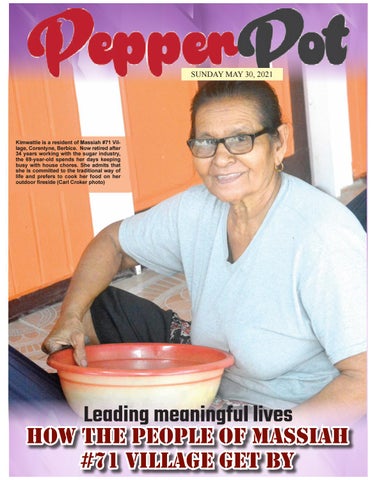
Kimwattie is a resident of Massiah #71 Village, Corentyne, Berbice. Now retired after 34 years working with the sugar industry, the 69-year-old spends her days keeping busy with house chores. She admits that she is committed to the traditional way of life and prefers to cook her food on her outdoor fireside (Carl Croker photo)
Leading meaningful lives How the people of Massiah #71 Village get by
II
CHRONICLE PEPPERPOT ― Sunday, May 30, 2021
Young women entrepreneurs challenge themselves to succeed By Dillon Goring
Shanelle Garraway, showcasing some of her products at Women’s Expo 2021
SHANELLE Garraway, the owner of Garraway’s Delight, is a young entrepreneur who, like many other small business owners, faces a lot of challenges. In an interview with the Pepperpot Magazine, she highlighted some of those challenges and how she is managing to overcome them. “By trying to substitute certain raw materials which have risen in costing since the pandemic began, these materials have been supplied to us at a cost,” Garraway told Pepperpot Magazine during an interview. Her business, Garraway’s Delights, is a catering service that undertakes orders for all special occasions. She also explained that in order to meet the demands of customers, particularly during the pandemic, Garraway‘s Delight has introduced its online service and delivery order system to customers, who aren’t able to come to the store and make their purchase. It was further explained that Garraway’s Delight would negotiate with customers on the prices that are being paid for the various items that would have been
Lexann McPhoy of Lexann’s Nail Creations and Nsi Nails Guyana
purchased and bargain with them on obtaining the items or item purchased their affordability to utilise their purchasing power. Garraway explained that she just participated in this year’s “Women Expo”
which was held at the Arthur Chung Convention Centre on March 7 in observance of International Women’s Day and that persons were surprised at the premium quality of her products . SEE PAGE IV
CHRONICLE PEPPERPOT ― Sunday, May 30, 2021
Using time wisely on the job pays off
III
- Mother of three learns new skills through observation
RACQUEL Dasilva Gonsalves was not content to just focus on the aspect of the job that she was hired to do; but her interest in other facets of the work,
the optical field, it was to assist customers in choosing suitable frames for their spectacles. But Racquel used any opportunity she got to learn about the different
Operating a machine to help make her work easier
three knew the value of a Racquel is self-trained in many aspects of the job day’s pay, and she’s always kept in mind her goal to move up in life and possibly coupled with her diligence skills involved in completing one day, even own her own and desire to learn more, the entire process. business. paved the way for her to In an interview with PepJust by paying attention move on to greater tasks. perpot Magazine recently, and using her observation When she initially joined the 37-year-old mother of skills, Racquel, now an op-
Racquel paid attention and learned new skills through observation
tical technician, was able to learn how to cut and fit up the glasses for customers. “I always had a passion for it,” she reflected. As a sales clerk, she paid close attention to how the technicians cut and fit up the glasses and was always very intrigued by such work. Having enjoyed a stint at Dasilva’s House of Optics, Racquel then joined the team at Value Eyewear and that’s when she took up that interest. She later moved on to
Lens Craft Optical where she is currently located. “Nobody really trained me; I just watched and observed and tried it. It didn’t come out good the first times I tried, but I had a passion for it and it became easier and like a hobby to me,” she expressed, adding, “I trained myself. Some of the jobs were complicated and I thought to myself, ‘How can I get it done?’ But the constant trying all the time is what makes it perfect. So ba-
sically, I would say I trained myself.” Especially of interest to Racquel is the fact that the job of an optical technician is rarely performed by a woman. She likes the challenge and is motivated by it to be the best she can in the field. “At least other young women can see that even though a job may have been cut out for a man, there is a woman that can actually do the same SEE PAGE XI
IV
CHRONICLE PEPPERPOT ― Sunday, May 30, 2021
Pelting dogs and the mentally disturbed
By Francis Quamina Farrier THE youngster was pelting a man of unsound mind who was walking relatively peacefully along a street in Georgetown. The man seemed no threat to anyone. However, being poorly dressed and with his funny actions as he walked along, shaking his limbs in an unnatural way, disclosed that he was most likely, someone of unsound mind. I asked the youngster why he was pelting the man. “Mista, he mad,” was the practical response, which was embellished with some boyish giggles. I took the opportunity to give the youngster a very brief lecture about respect for others, no matter who. I considered that to be my responsibility as an elder. He seemed to accept that it was wrong to visit violence on someone because they are perceived to be mad. Even the mentally disturbed should be viewed as being human, and as such, must be shown respect and compassion. So, it is important for parents and guardians to educate their growing children and others in their care, how to treat those who are powerless, with kindness and compassion. Even institutions of learning should include such information in their Social Study classes, if that is not already being done. Dogs roaming the streets are also attacked by some youngsters. For them, it is fun. But certainly not for the animals. You may recall that saying, “What is fun for boys, is death for crappo?”
Most stray animals and destitute people who roam the city and elsewhere, poor persons of unsound mind, live on the edge of society. Fortunately, there are institutions such as the Palms and the Dharm Shala among others, which provide a safety net for those who are destitute; some suffering from mental issues, are given assistance. There are those unfortunate souls who fall through the cracks of society and become extremely vulnerable. There are those times when, looking at them, I would wonder what they were like when they were teenagers, young and vibrant. Their stories might be one of a young Guyanese full of life and career shining bright before them. Sadly, for some, the dream becomes a nightmare. It, however, behoves the rest of society to extend a helping hand in compassion. There are those both here in Guyana and the diaspora, who decide to help those in need- people with big hearts. Guyana has been an independent nation for over half a century, and while this is a relatively healthy population, there are a number of health challenges being faced by many. Malaria then HIV and AIDS which were rampant not so long ago, have been reduced dramatically. It is now the coronavirus and flawed mental health which are at the top of the health challenges in the country. Because of dedicated health workers - doctors, nurses and social workers - who give full support to those in need of medical assistance and guidance, there is the ongoing healing process. Both malaria and
A destitute citizen sleeping on the Bourda Market pavement.
HIV and Aids are now well on the wane. The present challenge is the coronavirus, and from observation, the Ministry of Health is doing a great job in advising and assisting citizens in all 10 regions, to stay safe and remain healthy. Guyana itself is a relatively healthy nation. Let’s now look at the blessings which Mother Nature has bestowed on Guyana with our weather for instance; there are no snowstorms or blizzards. No volcanoes or earthquakes. There are never tornadoes or hail storms. Guyana has never experienced droughts during which
there is absolutely no rain for months and sometimes over a year as some other countries experience from time to time. In fact, Guyana is a “Land of Many Waters.” A land with many trenches, canals, creeks, rivers and lakes. Our Essequibo is the third largest river on the continent of South America, with only the mighty Amazon in Brazil and the awesome Orinoco in Venezuela being larger. Guyana is a blessed country as far as Mother Nature goes, and more Guyanese need to recognise that blessing and be grateful. Admittedly, there are
many things to make us miserable, such as the incessant man-made noises all around including the numerous BOOM-BOOM boxes. That includes the noise emitting from vehicles driven by people who seem unable to keep their hands off their vehicle’s horns. So, it will be safe to say that 55 years after independence, most of the problems here in Guyana are man-made. Since that is so, then the solutions can also be man-made. Sadly, not many with the necessary power, seem willing and ready to bell the cat. Many with the power to
Young women entrepreneurs... But despite the constraints of COVID-19 and the rising cost of materials, Garraway’s Delight has been able to meet the demands of its international clientele, thus catering for weddings and other events which are held out of the country. Meanwhile, another Guyanese entrepreneur and
the proprietor of Lexann’s Nail Creations and Nsi Nails Guyana, Lexanne, shared with Pepperpot Magazine that another issue plaguing the operations of entrepreneurs is getting access to quality products on a regular basis for her clients. “Access to real quality products is the main chal-
lenge faced by the cosmetology agency right now, and particularly access to quality products at an affordable price,” Lexanne related to the Pepperpot Magazine. She expressed the view that clients who visit her place of business received customer satisfaction. L e x a n n e f u r t h e r e x-
pressed the view that nail technicians in Guyana sell themselves short, thus providing a dissatisfaction and deterrent to persons who want to join the industry and compete for an honest living She noted that this is a multimillion-dollar industry and that there is enough scope for persons to step
up their game and make a decent living for themselves and the maintenance of their families. “Set the bar high, especially if you know that you provide great service, and you use good products for your clients, there is no need for you to sell yourself short,” Lexanne told Pepper-
make a positive difference, seem to be sitting on their hands. There are Guyanese who need to display much more respect for our homeland, including our beaches. How could a Guyanese dig out tons of sand from the Number 63 beach, with impunity? Our destitute, and those who suffer from mental illness - and even our stray dogs need our kindness and consideration. As Bill Pilgrim posed in his popular patriotic song, “Let us cooperate for Guyana…Can we do it?” Then that resounding response, “YES, we can!”
FROM PAGE II
pot Magazine. Both of these entrepreneurs have stated that despite challenges, they are passionate about their work and are determined to see their business thrive, so they will continue to work towards achieving that goal.
V
CHRONICLE PEPPERPOT ― Sunday, May 30, 2021
‘International Year of Fruits and Vegetables’ focuses on food security and health By Dillon Goring THE Year 2021, has been designated by the United Nations (UN) General Assembly as the International Year of Fruits and Vegetables (IYFV). The IYFV is a unique opportunity to raise awareness of the important role of fruits and vegetables in human nutrition, food security and health, as well as in achieving the UN’s Sustainable Development Goals. It is dedicated to raising awareness about the important role of fruits and vegetables in human nutrition, food security and health. Fruits and vegetables are good sources of dietary fibre, vitamins and minerals and beneficial phytochemicals. The Food and Agriculture Organization of the United Nations (FAO) and the World Health Organization (WHO) recommend that each adult consumes at least 400 grams of fruit and vegetables on a daily basis to prevent chronic diseases, such as cancer, diabetes, heart disease and obesity, as well as to counter micronutrient deficiencies. With the COVID-19 pandemic the need to transform and rebalance the way our
food is produced and consumed has only been further stressed. However, Director of the Food and Agriculture Organisation here in Guyana, Dr Gillian Smith, spoke with Pepperpot Magazine and gave a brief overview of the significance of the observances and their implications for us as Guyanese. “We are happy that the government has embraced this observance and has launched a programme of activities which we are supporting. We share the same views as Minister Mustapha that the IYFV promotes diversified, balanced and healthy lifestyles through fruits and vegetable consumption, raise awareness of food-safety issues, standards and guidelines for the production, handling, storage, and processing of fruits and vegetables”, Dr Smith related. Dr Smith further alluded to the importance of fruits and vegetables on daily dietary level as a country. “In Guyana, obesity is a growing problem in the adolescent and adult population. Approximately 41% of males and 56.5% of females age 18 years and above are considered overweight, ” Dr Smith contended.
According to the Ministry of Health and Global School-based Student Health Survey - 71 % of Guyanese schoolchildren consume carbonated soft drinks daily and 56 % consume fast food on a weekly basis. These numbers rank above the average in South America and the world. Observances such as this will raise awareness of the issues and help us to work together to encourage more consumption of healthier diets rich in fruits and vegetables, our experts believe. According to the FAO and the WHO, we need a minimum of 400 grams of fruits and vegetables in our
diets daily for the prevention of chronic diseases such as heart disease, cancer, diabetes, and obesity, as well as for the prevention and alleviation of several micronutrient deficiencies, especially in less developed countries. In Guyana, Only 25 % of school-aged children ages 12-17 consume fruits daily while only 17 percent consume vegetables each day. These statistics tell us we need to do more to encourage more fruits and vegetable consumption. For this reason, FAO launched the social media challenges to target the younger generation who are
falling below in the consumption of fruits and vegetables. Food loss also remains high on the priority of the Food and Agriculture Organisation (FAO). To this end, Dr Smith contended that food wastage in the Region has continued throughout the pandemic. As producers or consumers, we have a responsibility to reduce food waste for the sake of our environment. By re-thinking the way we treat and utilise fruits and vegetables, we can significantly reduce food wastage at home. Globally, about 1 300 million tonnes of food, including 30% of cereals, between 40 and 50% roots, fruits, vegetables and oilseeds, 20% of meat and dairy products and 35% of the fish are lost annually. FAO estimates that such foods would be enough to feed 2 000,000 people. FAO also estimated that 6% of these global food losses occur in Latin America and the Caribbean and the Region lost each year and/ or wasted about 15% of their food available, even though 47 million people still suffer from hunger. This is one of the great remaining challenges to achieving full food security.
These cumulative environmental impacts produce a food-wastage carbon footprint of 540kg of CO2 per capita in the Latin America and Caribbean (LAC) region— the fourth-highest carbon footprint associated with food wastage in the world, and the highest in the developing world. At the household level, food wastage can eat into the budget of families, while at the business level it can significantly reduce profit margins. Food loss in agricultural production reduces efficiency, drives up costs and unnecessarily depletes natural resources. Therefore, working to reduce waste will help to make the country more competitive and healthy. T h e FA O i n L a t i n America and the Caribbean has issued a series of activities, events and publications to share this unique relationship with fruits and vegetables and to raise awareness on the important role of fruits and vegetables in human nutrition, food security and health and reducing food loss and wastage, so that the world can work together to achieve the UN Sustainable Development Goals.
VI
CHRONICLE PEPPERPOT ― Sunday, May 30, 2021 Massiah #71 Village (Carl Croker photos)
The sleepy village of Massiah #71 comes alive with daily activities of residents
By Michel Outridge
THIS week the Pepperpot Magazine visited the sleepy village of Massiah #71 Corentyne, Berbice, Upper Corentyne, Region Six (East Berbice-Corentyne) and interacted with the residents. It is a relatively small village which has four cross streets and the public road area which has some businesses. The community has the Massiah Primary School, the nursery is in the next village
and the nearest secondary school is at #65 Babylon Tagore Memorial Secondary School. The village comes under the #52 to #74 Village Neighbourhood Democratic Council (NDC) which spans 24 villages and that NDC building is located in #52 Village. Massiah Village #71 is a quiet countryside community where the people are friendly. They will invite you into their homes and ensure you have a sip of a beverage before leaving.
The village is separated by the public road and it has houses in one section and some of those houses are from the colonial days and are still standing and well preserved by their owners and descendants of the owners. The community is clean and the surroundings are well-kept and it is a place where people knows each other and co-exist peacefully. Massiah #71 Village is just a few miles away from Crabwood Creek and Moleson Creek and the farmers
Focus on the Village
have access to the various markets in other villages where they sell their produce and also have adequate access to rice mills for their paddy and different varieties of rice. The village has one primary school, a playfield which sits in the centre of the community, a mandir, a mosque and two churches. The people of Massiah #71 Village are cash crop and rice framers, two residents have large scale poultry businesses, some large businesses on the roadside, some self-employed folk and public servants. The population is about 800 of predominately Indo-Guyanese with some people of mixed race and a handful of Afro-Guyanese.
Community development Meanwhile, in highlighting developmental works in this community, the NDC Vice Chairman, Anil Ramgahan told the Pepperpot Magazine that last year, two footpath wooden bridges were constructed in the village. One was constructed west of the public road liking the middle walk to the first cross street and the other linking #71 and #72 villages. He disclosed that two and half years ago a heavy-duty concrete bridge was constructed at the first cross street which replaced a wooden one and another similar bridge was also built linking the two villages of #71 and #72 at the Sideline Dam. Ramgahan stated that in 2020 the old wooden building which housed the #71
NDC sub-office was rebuilt into a one-flat concrete structure. He added that the Sideline dam was asphalted from the public road to the drainage canal, way down to the backlands (sea dam) area. Ramgahan reported that last year they did some cleaning of the drains and canals in the village and it was de-weeded, as well. He noted that during a visit by the First Lady Arya Ali on that corridor recently it was promised that the road leading to #63 Beach will be paved and a contract was signed and road works have commenced. The all-weather road will be from the public roadway down to the beach and the SEE PAGE XVIII
CHRONICLE PEPPERPOT ― Sunday, May 30, 2021
Leading meaningful lives How the people of Massiah #71 Village get by
By Michel Outridge KIMWATTIE (only name) is a resident of Massiah #71 Village, Corentyne, Berbice and after many years of tending to children and working with the sugar industry – the latter of which she did for 34 years- she is now basking in well-deserved retirement age. When the Pepperpot Magazine met her, she was in her hammock cleaning ‘katahar’ (breadnut) after completing household chores. The 69-year-old is a homemaker who would get up early to do housework and cook after which she would relax or find other things to take up her time.
This elder doesn’t go out much except for shopping or to attend services at the mandir in the village. The ‘katahar’ she was cleaning that is, separating the seeds from the fruitwould be used to make a curry without meat to go with rice or roti the following day. The mother of three had gone to the market and bought two ‘katahar’ at $300 each and would grate the dry coconut when she is ready to cook the meal. And it was before 10:00hrs she had already cleaned the entire yard, the house and washed the clothes, cooked and was still doing something. The senior citizen dis-
Retired cricket coach, Davo Jairam
closed that her husband was sick, he was a cane cutter and in 1985 he passed away and she had three children to support. She worked with the Skeldon Sugar Estate as a field lab assistant for 34 years before she retired and with that job she was able to send her children to school and put food on the table. “I have good children, all grown now and leading their own married lives with their own children and they assisted me and made it easy to bring them up the right way,” she said. Kimwattie stated that she is bent in the old-fashioned way of life and still would cook on her outdoor fireside but not when it rains she would use her gas stove. Being retired she gets all the time to tend to the house and cook and when she is not feeling well she go to the health centre for a check-up. At times, she would visit her many grandchildren and recite stories of yesteryear. Promoting cricket The Pepperpot Magazine also met another resident, retired cricket coach, Davo Jairam, who is lending his expertise to the community, through the All Stars Cricket Club of Massiah Village. Jairam is better known as “Blacks” in the community
The pavilion
Kimwattie (Carl Croker photos)
and he lives just across from the ball field, the community centre ground. He reported that after he retired from coaching he was asked to lend his expertise to the village and the youths and he did not hesitate to do so. Jairam added that the youths have been doing well so far, at the cricket competitions held and won several matches but since COVID-19
all games have been cancelled indefinitely. He stated that a few youths and others would play friendly games when it is sunny and people would go to the community centre ground for recreation. Jairam coaches the under 15 and under 17 All Stars Cricket Club members and the big boys’ team as well as, boys in the community. “Sports is a good way
The Community Centre Ground
Focus on the Village
VII
to engage young people to spend their time and around here there isn’t a lot of opportunities so I do what I can to encourage the youths to play cricket,” he said. He pointed out that they have had many fundraisers to buy gears and uniforms for the teams but now they cannot host anything as a result SEE PAGE XIII
VIII
CHRONICLE PEPPERPOT ― Sunday, May 30, 2021
Giving back to society is the way of life for these Massiah residents
By Michel Outridge SIR Yovendra Singh has been a teacher for the past 20 years and he is presently attached to Massiah Primary School, Corentyne, Berbice, Region Six (East Berbice-Corentyne) and is the acting senior master. He is an approachable, affable kind of person, whose door is always open and easy to talk to. He is a well-known man in the community who does a lot of volunteer work behind the scenes. Singh would give his time to the pupils, their parents and the school at any given time and he is one of the teachers you can call on at any time. As an educator, he reported that his job is fulfilling and he gets a sense of achievement when his pupils would excel at exams and get a placement at top schools in the region. “Teaching has to be a part of you or you will not like the job since it entails long hours and endless work,” he said. He stated that parents entrust you with their children and it is your job to impart knowledge and when they do well it is his objective to mould, prepare children for the future, a foundation on which they can earn and build. Singh admitted that with COVID-19 it has been quite telling on everyone both teachers and parents because we had to adopt new measures such as zoom classes, whatsapp classes and other forms of online schooling. He stated that the children too are frustrated and being at home for so long has had an impact on them in some ways, adding that there is a need for face to face teaching which is the best way to get through to pupils. “I am hoping that we all do the right thing so the virus can eventually vanish and we can return to classroom teaching and things can be normal again in this extraordinary time,” he said. Singh added with virtual learning there are a lot of disadvantages and some pupils have not been able to access the
Teacher, Yovendra Singh (Carl Croker photos)
have been done to upgrade the building and preserve the building. They have a total of 13 teachers and more than 200 students and they are of the view schools will re-open for the new school term and is accepting new admissions. All the teachers are qualified with just one in training presently and some are students of the University of Guyana Tain Campus. Singh added that despite it all the Ministry of Education have been going all out to ensure they have much-needed supplies to prolong online teaching and home tutoring. Massiah Primary School has produced top students and they continue to strive for excellence and are working collectively to mould the young minds.
Businessman, Jerry Lakeram
ed his money in business and as time progressed his business grew and he is now in a position to help others. Lakeram came from humble beginnings and understand the needs of regular people and has an open-door policy in which anyone can approach him at any time and he will lend support in whatever way is necessary. “My support is not limited to one organisation or church and I assist whoever comes along and I keep my prices low so people can afford to make purchases,” he said. Lakeram is in the electronics, hardware and spare parts business and he is well-respected in Massiah #71 Village and would do free delivery even up to Black Bush Polder and Crabwood Creek just to go out of his way to help others. He would also sponsor religious functions at the nearby
Two of the three business places owned by Jerry Lakeram
internet to benefit from online classes but they have been distributing worksheets door to door to ensure the children get something to occupy their time. He, like many other teachers, would go to the homes of pupils to deliver the worksheets and it goes beyond the call of duty but they understand the needs of the children. Singh reported that Massiah #71 Primary School is headed by Angela Innis and the school is 100 years old and works
Giving back to society The Pepperpot Magazine also met businessman, Jerry Lakeram, who owns several large businesses at Public Road, Massiah #71 Village, Corentyne, Berbice and does a lot for the community. ‘Uncle Jerry’ as he is fondly called by residents has given unwavering support financially to the religious bodies, the community and others who needed his support to do many things. The 52-year-old businessman stated that like many he came up from grass root level and invest-
Focus on the Village
mandir in the village and donate food items, hampers and other things to those in need. Even though the pandemic has crippled some businesses and workers laid off, Lakeram said his business is surviving and things are fair considering all that has happened economically and his children works with him. “In this village, we need more recreational facilities for the children and youths to be engaged in meaningful activities so instead of drugs and idle they will use their time and go to that place with wide-open space to do something of benefit to themselves,” he said. Lakeram added that the country life is simple but hard and the people are trying to earn honesty and they exist peacefully.
CHRONICLE PEPPERPOT ― Sunday, May 30, 2021
Cooking at its best at Massiah #71 Village
IX
By Michel Outridge
BEING self-employed and being empowered as a chef was the best thing that has happened to Nadira Gildharry, a resident of Massiah #71 Village, Corentyne, Berbice. She works with herself from her home and prepare tasty, finger-licking foods and would sell it at her roadside food stall at Public Road, Cromarty Village, also on the Corentyne. The mother of seven told the Pepperpot Magazine that she first started out making dhal puri and roti on orders for people in the village and as word got around of her cooking she was encouraged to start preparing more dishes. As such, the small business blossomed and customers began asking for more and she would make at least five different dishes every day to sell. That day when the team visited, even though it was a very rainy day, the outdoor fireside was going with a pot of cassava and eggs boiling which would be used to make egg balls. Inside, the kitchen, a series of activities was ongoing, fried rice with fried chicken, potato wedges, pizza and channa was being prepared simultaneously on a four-burner gas stove. The vegetables and everything for the pots were prepared ahead of the cooking and things were moving swiftly because she had to be at the food stall for a certain time every day. The 45-year-old stated that cooking is her passion and she is doing what she loves and it makes her very happy to be busy and earning at the same time. “I love to cook, to be quiet and I don’t go anywhere except to sell food and keep to myself and I am comfortable with this way of life,” she said. Gildharry explained that at first, she used to sell in front of her house and later
Nadira Gildharry in her kitchen cooking various dishes
got the food stall at Cromarty Public Road where she relocated her food vending small business four months ago. She added that due to COVID-19 things got a bit slow in terms of sales but it is slowly gaining momentum and she is of the view she will cope. Gildharry stated that having a small business takes a lot of time to prepare foods but she doesn’t mind because working with herself is the best option since she had worked with food places as a chef and it was even more time-consuming. She had worked in Trinidad and Tobago as a chef
in the food industry for 10 years before she returned to Guyana and began working with several large food businesses but the shift system wasn’t going well with her and she quit. She talked things over with her husband and they decided to start their own food business, several years ago. Gildharry began making dhal puri and roti on orders on weekends and people began asking for more and she started to make other dishes and her small business turned into a catering one where she would make many dishes for special events, such as
Focus on the Village
Fireside cooking at Nadira Gildharry’s place
birthdays. “I would take orders for dhal puri and roti and if they want other dishes I would
also make it and they would collect same and I would earn,” she said. Gildharry would do some
barbeque on weekends and her husband and daughter SEE PAGE XI
X
CHRONICLE PEPPERPOT ― Sunday, May 30, 2021
The cleaners of Massiah Primary School are earning an honest living By Michel Outridge HASENA Khan is a cleaner/sweeper attached to the Massiah Primary School and from the looks at things, one can tell she likes what she does for a living. The single parent has been at the job for the past five years and she got the work when she needed a job and she was thankful. The 59-year-old is effervescent and friendly and it has been a different experience going to clean the school without the pupils being there since she is accustomed to their banter and the running around.
The mother of one reported that she was forced to work to upkeep the home because she has a son and a sibling, her sister resides with her. “I like this job because the head teacher is a gem and she would see with you and doesn’t fret or tell you anything that would make you feel hurt and I would clean this school just as I would my home,” she said.
Hasena Khan
Anita Somai
“It is two of us and we would portion the cleaning because it is a two-storey wooden building plus the compound so it is a lot of work and collectively we do it,” she said. She was at home since the pandemic forced schools to close but last week they
Hasena Khan and Anita Somai doing their job (Carl Croker photos)
Focus on the Village
began cleaning the school again due to new admission registrations three days per week for the new school term. The other sweeper/cleaner
is Anita Somai, 34, a mother of one, who has been holding that job for six years. She resides in the neighbouring village and would walk to work and is pleased to return to work even three days per week because she was at home doing just housework and being indoors all the time can test your sanity. The teachers have been coming out and the cleaners were called out to keep the place tidy and it is something to do for Somai, who did not venture out of her house often. She stated that it was not easy being away from school for 16 months and she has grown quite fond of the children and teachers and she misses them. “It had been frustrating at first when COVID-19 came to Guyana and we had to stay home and away from school but we had to try and cope and being shut-in isn’t normal and it took a toll on us,” she said. Somai reported that she would like to resume normalcy and urge all to get fully vaccinated since the Coronavirus seems to linger a bit longer so people can return to their jobs and places of work. “It is nice coming out of the home three days per week to clean the school and we do it from 08:00hrs to 13:00hrs,” she said. Somai added that she doesn’t mind doing her household chores and cooking before going to work and looks forward to it. She explained that when school closed they had no choice either but to pack up and go and it has been hard on a lot of people to finally adjust to social distancing and staying home. Somai noted that they not only clean but sanitise visitors and test their temperature before they enter the school compound and it’s something new, they were, however, trained. “Because the headteacher, Angela Innis, this is a good place to work, she is a good person and we get along well,” she said. Somai has been fully vaccinated and she is hoping to return to work on a full-time basis when schools re-open. She and Khan get along well and they would share the cleaning to ensure the place is tidy and everything including, the washroom are clean. Even for such a large school, the two women do what they must to ensure the environment is sanitary for both pupils and teachers. “Cleaning is an honest job and there is no shame in doing work that gets you paid,” she said. Somai is a quiet person, who does her work easily and gets things done on time without much effort. She doesn’t mind working to assist her spouse in bringing in a monthly income to the home because they have a child.
CHRONICLE PEPPERPOT ― Sunday, May 30, 2021
Using time wisely on the job...
XI
FROM PAGE III
thing.” Racquel has gained so much knowledge and competence on the job that should she decide to open her own business, she’d know all the ropes, so to speak. “I would know how to programme myself and how to go about doing something like this; I can handle myself in a business.” At the moment, Racquel said that she can do “every little thing in the optical field” and will definitely be taking steps in the direction of becoming her own boss. “Everyone who loves their job wants to be able to do something on their own. Nobody wants to be working for someone for the rest of their life. So my goal is one to open my own optical because I have gained so much knowledge and skills,” she expressed. Racquel has found the optical field to be very interesting and has observed that there is not a lot of training in the field locally. “It’s costly especially for a mom who has to look after her family and still go to work. There is not much she can do to pursue a career in this field.” While courses may be available at a university level, Racquel said the affordability is what often becomes a problem for persons. “This field is mostly private in Guyana. For a person like me who started off by looking and observing and training myself, I wish there was more that I could have done to get a certificate; something to show that I know what I am doing. Racquel is mom to kids ages 13, 11 and 8.
Racquel cuts and fits up the glasses
Cooking at its ... FROM PAGE IX
would be on hand to assist her in all the preparations. Recently, she started to buy fresh fruits and started to make homemade fruit juices due to customer’s demand. Gildharry disclosed that since she started her small food business there haven’t been any complaints about the service or foods and she is quite pleased about that and it serves as an encouragement. This Massiah #71 Village resident would get up at 06:00hrs to prepare and would start cooking at 09:00hrs to ensure she is at the food stall with the foods at a given time so customers would not have to wait or return. Her husband, Leo would transport them and the food to Cromarty Village and they would set up the stall and sell daily. Gildharry is a smiling,
Nadira Gildharry displaying her homemade fruit juices (Carl Croker photos)
generous woman who, is full of energy and takes pride in what she does and
it is evident in her personality and attitude.
XII
CHRONICLE PEPPERPOT ― Sunday, May 30, 2021
Moulding in context, the cultural-historical memory - The final chapter
“FOR too long has Guianese history remained in the background of historical studies in the country; we must now bring it into its rightful place in the foreground of social studies in our schools as well as within the knowledge of all adult Guianese. History looks back on the past and
brings our heritage and all the antecedents of our present position clearly before us.” Mr. C.V. Nunes Minister of Education, 1962; our predicament is that the obvious became subject to our inferiority complexes in respect to our own wise, and a causality of the experimenta-
tion with “Isms,” instead of colonising the “Isms: into our own context, we adopt another’s revolutionary cries and further bind ourselves to the hypocrisy of preaching one narrative while being obedient to another. The antecedents of cultural and functional values that are
C Copyright all rights reserved
bound to command questionable attention and suspicion at times will wrestle in a national arena, guided by separate rules because the guidelines of our timelines and its disruptions have not been adhered to. Post Emancipation which I have coined years ago as… “The genesis of modern Guyana,” became the most conflicting era because up to then, forms and creeds were formulated and understood in a quarrelsome way, but after 250 years of harsh, hostile versus compromising engagements, this was inevitable. One example occurred with the slaves of Alness of the colony of Berbice and other plantations who took an oath that no cruel master should live beyond six months. The story of one such execution was revealed many years later by a very old slave as a parting testimony after all the actors were gone, leading to the discovery of the buried remains of the horse, saddle and the condemned plantation master, who had vanished for decades. Suspicion was conveniently directed at
the Maroons, but likewise, a young kind-hearted master came onto a neighbouring plantation and baffled the keepers of the oath; they were able to frighten him away with horrid tales, he returned to Europe, much to their relief. See- “A Documentary History of Slavery in Berbice 1796-1834 by Alvin Thompson.” The values of the Creole community in respect to the established creed of belonging with the ‘being’ of ‘the colony’ post-emancipation, despite group identities would seem surprising, but there was an evolved national consensus of protected nationhood by Creole subjects, despite harsh conflicts with the colony administration, against whom they were not afraid to address their concerns; the first group of indentured people to attract discrimination from the administration and the Creole population on this pretext were the Portuguese; “ Most of the Portuguese were still Portuguese and not British subjects; though resident in a British colony for years, they did not wish to become naturalised. No wonder they
were considered aliens. They still considered themselves “sons and daughters” of Portugal and this attitude did not win them friends as in maintaining their separateness they tended to be smug see- “The Portuguese of Guyana: A Study in Culture and Conflict by Mary Noel Menezes, R.S.M.” The fact is, that with Indentureship it must never escape consideration that British interests were riveted to establishing an empire, and with most of the indentured coming from then British colonies and friendly states, they were more likely to accommodate levels of social responsibility towards the contract -societies, while with the Creole population that constituted manumitted slaves, kith and kin who were British colony subjects no external mother country presided over their interests and rights, they were akin in pursuit of rights with the poor of England itself. Unlike the indentured, the manumitted Africans had emerged from slavery; the enslaved Africans were from inception abandoned to their fate; thus, after emanSEE PAGE XXVII
CHRONICLE PEPPERPOT ― Sunday, May 30, 2021
How the people of Massiah...
XIII
FROM PAGE VII
The people of Corentyne, Berbice
of the pandemic. Jairam told the Pepperpot Magazine that, through self-help, they repaired the rotting pavilion as a community-based project. He added that most boys and young men in the village play cricket and that is a plus for them because they have good players but just need more resources. “I have been play-
ing cricket since I was 13 years old and that game has helped me develop into a well-rounded person and took me places so I want the same for the youths around here,” he said. Jairam stated that he prefers to use his time to coach and do volunteering with cricket as his way of giving back to the community. “We need more games
like football, basketball and volleyball so more youths can participate and use their time in sports instead of wasting their time,” he said. Jairam has been instrumental in assisting some young men to participate in try-outs for the Berbice team in cricket and some were successful to achieve competition stage.
XIV
CHRONICLE PEPPERPOT ― Sunday, May 30, 2021
BLOOD CHILD
A LITTLE girl in her pink floral dress, skipped around the garden--bare-footed -- with her little basket, picking flowers and fallen, ripe fruits, chasing colourful butterflies and playing with her bunny rabbits. Her mother washing clothes at the standpipe watched her, a sweet child dear to her heart. She would often imagine how beautiful she would be when she grew up, and a special wedding celebration she would have for her when it was time for her betrothal. That was 22 years ago to this day, a dark day. A storm had been brewing for the past few days and tonight it unleashed its fury with screaming winds, deafening thunder and frightening lightning. The roads were desolate, except for two black sedans that drove cautiously along the dark country road to a moderate house standing almost in isolation. Four strange men stepped out in the rain, men with steely looks and stone-cold eyes, on a mission commanded by their superior officer in the military, a lieutenant-general. What would the military be doing deep in the countryside in the farming backlands? What illegal activities gathered by an intelligence network merited the presence of army personnel from a neighbouring Spanish country? A small farming family in deep slumber as the storm drowned the farmlands was awoken by the armed invaders and forcibly taken away before they knew what was happening. The abductors drove to a secluded army reserve off the highway, and the family was roughly hauled into the base. The mother, father and brother were bound to chairs in one room, and the younger ones locked into another room with an armed guard. They stared at their abductors, terrified beyond their limits. What would foreign soldiers want with a simple farming family? The soldiers left the room and returned after a long while, dressed now in black clothes and leather gloves. They said not a word. The look in their eyes, so cold, it sent shivers down
the spines of the family. The duct tape was ripped from their mouths and they inhaled deeply, tears welling in the mother’s eyes. “Why have you brought us here?” the father asked hoarsely, “We’ve done no wrong.” A fist hit him so hard it rocked his head back, and the mother cried, “Please, why are you doing this?! We are farming people!” One soldier straddled a chair and two specialists of torture stood by. The soldier sitting said to the father, “Investigations have proved that you are involved in an illegal trade.” “I don’t know anything about that.” A fist thudded against his jaw, drawing blood from his mouth. “You have been under surveillance for some time now, and tonight you will have to disclose your part in this trade if you value your life and your family’s. Do you understand?” The father nodded, scared and confused and the soldier continued his questioning. “How often have you met with mysterious traders in the
backlands?” “Twice,” he answered. “Did you take any of your children there with you?” “No,” he answered hesitantly. A thunderous fist hit him, knocking him down with the chair. The mother screamed, “Please, don’t!” “Quiet!” a voice boomed, silencing her. The question was asked again and the same answer given. The questioning line was then changed. “How many children do you have?” “I have two sons.” He was hit to the floor now, blood trickling from his mouth and nose. The son, unable to witness the torture shouted, “Why do you want to know that?!” The soldiers turned on him like angry pit bulls until he was left crumpled on the floor, gasping for breath. “Why aren’t you asking me?” the mother sobbed. “Because we can’t hit you, their pain is your suffering.” Father and son were hauled upright and given a short moment to breathe easy before the interrogation started again. “We know of the boats that docked in the ocean and the people who came to the backlands who you did business with.” The father didn’t answer, afraid now to say anything. “You have two sons and you’re sure you don’t have another child you sold to be used as a drug mule?” “No,” the father groaned, “I didn’t do that.” “We have evidence that you did. You wanted to be rich, to become powerful.” “No!” he shouted, his voice cracking, “I did not sell my daughter!” A sudden hush fell over the room and the soldier in the chair rose to his feet. “So you have another child, a daughter?” “Yes,” he sobbed, “I had a daughter.” “Where is she?” “I don’t know,” he continued to cry, “I gave her away a long time ago.” “How old was she?” “She was six.” “You gave away your little daughter to be used as a drug mule?” “No, I didn’t want her anymore, I couldn’t look at her.” The soldiers looked at the glass partition beyond where a silent figure watched and listened to every word - the general who had ordered the abduction to find answers from the family in that room. “She was violated and her impurity became a shame to the family, something I couldn’t live with, so I sent her away.” “On a stormy night like this, you wrapped a sleeping child in a blanket, ignoring the mother’s pleas and gave her away, not caring what happened to her because of traditional beliefs?” He said nothing, his head bent and the soldier said to the son, “You became the golden child because of your lies. You were supposed to watch her while your parents were away SEE PAGE XXII
CHRONICLE PEPPERPOT ― Sunday, May 30, 2021
REIMAGINE|RECREATE|RESTORE
‘RESTORE EARTH’
WORLD Environment Day takes place every year on June 5. It is the United Nations’ leading day for promoting worldwide awareness and action for the environment. Over the years, it has grown to be the largest global platform for environmental public outreach and is celebrated by millions of people across the world. This year’s observance of World Environment Day will be on the theme of ‘ecosystem restoration’ and focus on resetting our relationship with nature. It will also mark the formal launch of the UN Decade on Ecosystem Restoration 2021 – 2030. Pakistan to host WED 2021 Led by Prime Minister Imran Khan, the Government of Pakistan – in one of the world’s most ambitious afforestation efforts – plans to expand and restore the country’s forests through a 10 Billion Tree Tsunami spread over 5 years. The campaign includes restoring mangroves and forests, as well as planting trees in urban settings, including schools, colleges, public parks and green belts. Pakistan has launched an Ecosystem Restoration Fund to support nature-based solutions to climate change and facilitate the transition towards environmentally resilient, ecologically targeted initiatives covering afforestation and biodiversity conservation. Recently, the Prime Minister of Pakistan launched the Protected Area Initiative to develop 15 model protected areas across the country to conserve over 7300 sq km of land area and create over 5,500 green jobs. Do you know which sport the Pakastani PM is famous for? Ecosystem Restoration Decade Ecosystems support all life on Earth. The healthier our ecosystems are, the healthier the planet - and its people. The UN Decade on Ecosystem Restoration aims to prevent, halt and reverse the degradation of ecosystems on every continent and in every ocean. It can help to end poverty, combat climate change and prevent mass extinction. It will only succeed if everyone plays a part. The UN Decade is intended to massively scale up the restoration of degraded and destroyed ecosystems to fight the climate crisis, prevent the loss of a million species and enhance food security water supply and livelihoods. World Environment Day is a once-a-year activity, however, it doesn’t mean that we should only pay attention to the environment on that one day. Irrespective of the day, organization, event, country, theme — preserving nature is our responsibility. 1. Bring a change in your lifestyle. See how we can live better with nature, and make little
alterations in our day-to-day life. 2. Educate other people. This is not a fight we can win alone; even if we can create awareness for a small minority of people, it can create a world of difference. 3. Respect biodiversity & nature. Biodiversity plays an important role in offering ecological services that make life livable on Earth. Each species, no matter how big or small, has a mind-boggling impact on the ecosystem. 4. Ensure that your business is authorized and in compliance with all environmental regulations. 5. Support local conservation efforts This is our moment. We cannot turn back time. But we can grow trees, green our cities, rewild our gardens, change our diets and clean up rivers and coasts. We are the generation that can make peace with nature. Let’s get active, not anxious. This World Environment Day, join #GenerationRestoration to revive and protect our ecosystems. Do you know which of the Sustainable Development Goals does the Ecosystem Decade support? For more information on WED visit https://www.worldenvironmentday.global/ https://www.unep.org/news-and-stories/press-release/pakistan-host-world-environment-day-2021 https://medium.com/climate-conscious/pakistan-to-host-world-environment-day-20213ca161a72de4 Remember to pick up a copy of the newspapers on Saturday, June 5 to learn more about EPA’s World Environment Day and upcoming anniversary. You can share your ideas and questions by sending letters to: “Our Earth, Our Environment”, C/O ECEA Programme, Environmental Protection Agency, Ganges Street, Sophia, GEORGETOWN, or email us at: eit.epaguyana@gmail.com. Follow us on Facebook and Instagram and subscribe to our YouTube channel.
XV
sharing their journeys XVI
CHRONICLE PEPPERPOT ― Sunday, May 30, 2021
seven amazing women from the Women Anthologies. t of Watch Radio NY requested an interasked him if it was okay for me to invite oin me. I am sharing some excerpts from
van Phillips -- born in St Lucia, living in
owards being a Midwife of Purpose came being broken, displaced, and ugh this journey, I experienced a divorce, e and got displaced education administrator’s position. Coupled were two major eclipses One week later I completed y life. An eclipse happens when you can my assignment with CTO calling becomes greater than your current and was now ready to move hrough this process, you can transcend to a on to my next career move. hinking where you can connect with your I called Monique to let her urself as one with nature. know I was available as we lett – born in Guyana and living in NY agreed and she was so hapgan to have the real experience of dreamto have start myabout first the significance of St. Patrick’s Day. my dream world alive. I was WE are celebrating theimmediately last Sunday inpyMay andme it feels temporary assignment with nterview with the agency where they tested awesome. Life can be simple but we overcomplicate things. We Deutsche Bank. first to actively seek to view situations from the perspectives using Microsoft Office andthe typing speed. Thank you to all people who sent feedback fromMy need the article last week. We will continue with the “Power of of others. Aaida Bacchus is a brilliant and hard-working Diversity” this week. young lady who is not only beautiful but caring. I met her I am not sure if my fellow Guyanese understand how for- at my first Muslim wedding and was so detailed and patient tunate we are to experience the different cultures we experi- in explaining every step to me. I asked her to share her view ence daily throughout these 83,000 square miles. I encourage on this topic: us to try to get to know more about other people’s religion “Guyana is known for its rich cultural diversity as we are and cultures. I heard someone referring to the term MILO a multicultural, multiethnic society. Growing up as a Muslim, (moment in the life of others) and it intrigued me because our I’ve learnt that Islam teaches peace and unity. Cultural diverculture scape can make us see the best or worse in others. So sity is one of the basic characteristics of human society and is many times people judge other’s actions without knowing an asset which is indispensable to the progress of humanity. When and I was six years tworespect weeks,to the beliefs anything about the person or circumstances. One thing I Cultural assignment diversity islasted to show pracold I started school covering someone’s vacation. can say is that we are adaptable. It helps to be open-minded tices of the adherents towards different religions. It is thein Mesa, Due to my work ethic and Arizona, so I began staying because it actively works on managing our unconscious bi- basic tenet of Islam. The Quran assures us that we can live desire to go the extra mile, with my mom ases to remain open to possibilities. I remember when I was together in peace and harmony with people of other faiths. and her husband routineI landed another assignment dating this Irish guy and he was visiting me around the time The Quran humankind, Wewas havelike created ly. It going from in the says: same‘O department forindeed they celebrated St. Patrick’s Day. We invited some people you fromsix male and female and made you peoples and tribes was a horror months, then another for heaven to hell. It and they totally enjoyed it. They even wanted to know more that you three may know onewhich another. Indeed,story the noblest of you that’s yet to be writmonths, finally
Power in diversity Pt. II
led to my permanent position, allowing me to live a dream. Dr. Safeeya Mohamed – Trinidad We received the updates that the accident was horrific and that the victim was stuck in the car. The vehicle had to be cut open to get to the victim. It never occurred to me that my brother could be remotely involved. The next thing I remember, I was looking at the body of my brother covered in blood in a hearse. The strident, agonising scream of my mother in the A&E that early morning has not escaped my mind almost 17 years later as she howled “my son died, my son died, nobody’s helping us!” But nobody could, as his spirit departed at the point of impact. Up to this day, I ponder where the strength came from to navigate that night. Shanon Paar – Arizona
I knew that I would be in big trouble if I told my dad what had happened. It was a secret: the kind that could get me into big trouble. I didn’t know how much trouble, but I wasn’t willing to take a chance. “Shhhh... Don’t tell anyone.” Maybe it’s the trauma of my experience, but for some reason I still cannot remember how often it happened, when it started, or even when it ended
ten. While at grandma’s I was filled with the love of a grandma and Jesus daily. On the other hand, at my mother’s house, I was filled with Rock ‘N Roll, drugs and inappropriate, wild sex parties. Ultimately, from such an environment you can imagine the kinds of abuse Penny Phakahi –South that mom’s house provided. When I was 11 years old, Africa I have had my share of grandma Shirley died and my stepdad left. My mom had turmoil and I strongly believe an emotional breakdown, so that it is these stints of turI ran away! I couldn’t take moil that brought me this far in my life. I was any more. Andrea Edwards – born and perhaps is still in my in Guyana, living in Florida refinery process. As a young girl, I grew As I sat in the back of my dad’s Nissan Bluebird, I up with one main ambition, peered through the windows wanting to get away, far away from the system of at the images on thinking or the box that the fence of the Guyana Botanical Gardens and we often find ourselves in. Zoological Park. The radio Apart from understanding myself I always dared to blasted the popular be different, which was a calypso song “1985” by a then-popular calypsonian. constant struggle when surI would have just celebrated rounded by my situations. I grew up under a strict my sixth Christian family with my birthday, quite oblivious to the concept of time, but grandfather and step granny, that song would not allow as my mother lost her mom in the sight of Allah is the most righteous of you. Indeed, me to forget SEE PAGE XXV Allah is Knowing and Acquainted’ (Surah Al-Hujurat, 49:13) that it was 1985. The existence of different cultures and societies is acknowledged and embraced in Islam in this verse. It also notes that each tribe — or society — has its own distinctive features that separate it from one another, and it goes to show that these differences are not at all condemned or disapproved but respected as part of creation. Islam doesn’t seek to radically change a society’s culture. To do so would be against the holistic nature of Islam. However, at the same time, as Muslims, we should
SEE PAGEXXXI
CHRONICLE PEPPERPOT ― Sunday, May 30, 2021
XVII
Grieving and Mental Health
I RECALL seeing a client who had recently lost a loved one and naturally, is having a hard time coping with it. He asked me to write on the potential benefits of grieving; to possibly help others who may be going through a similar situation. The feeling of loss is supposed to be painful and may feel as though it will never end, but ‘time heals all wounds’ is a cliché for a reason. However, giving it time is not all that is needed. We must accept the new situation, the loss, and accept the full range of emotions that will come along with it. We need to adjust to a new life and saying goodbye. Accept that you are hurting and let yourself hurt, as grief also has the power to heal. Many believe that grief is a sign of weakness- that one must always be composed in front of company and cry when everyone else is gone. We should never run from sadness. There is a measure of dishonesty in that--to yourself and those around you. Not to mention, the more you fight it, the longer you will feel it. Loss can be sudden or predictable, both being equally difficult, as even though you know what’s going to happen, you are never prepared for how it feels. There is no right or wrong way to grieve, but there is something known as healthy grieving. Grief is a process with multiple stages that allows us to feel the situation – really feel it- in order to move past our sadness over time. Without it, sadness is repressed and it is very difficult to get over the loss. Grief allows us to let go of the negative and sad energy we are feeling and put it into something else. Grief can be a roller coaster of emotions where you have good and bad days. This is normal and a completely natural response to any loss. There are five stages of grief which include:1. Denial: “This can’t/ isn’t happening to me.” 2. Anger: “Why is this happening to me?” 3. Bargaining: “If this doesn’t happen, in return I will…” 4. Depression: “I’m too low or lack the motivation to do anything.” 5. Acceptance: “I’m at peace with what is happening/ happened.” Denial initially helps us to deal with the loss. It is a protection mechanism that allows us to pace ourselves while grieving. Anger is a necessary stage as it’s an essential emotion for pain and healing. Feeling angry has never been the problem, it’s how we choose to express it. There are healthy ways to express anger. Aristotle once said: “Anyone can become angry, that is easy. But be angry with the right person, to the right degree, at the right time, for the right purpose and in the right way - that is not easy.” Bargaining encompasses a lot of ‘what ifs,’ ‘if onlys’ and guilt. At the end of this stage is the realisation that what happened is not your fault and the beginning stages of acceptance of the situation. The depression stage will feel never-ending. We will feel intense sadness and withdraw from others. The final stage, acceptance, does not mean that you are no longer sad, it just means you accept that time will help to heal the pain and it’s a further understanding that you are not to blame for what happened. However, it is important to point out that you do not need to go through all these stages in order to heal properly. We don’t just grieve death, there are many other situations that cause the common signs and symptoms of this. Some of my clients actually experience grief without actually knowing what it is. A few include shock and disbelief, physical symptoms such as nausea, headaches, pains and insomnia, prolonged crying and sadness, changes in eating
and sleeping patterns as well as withdrawal from others. To healthily grieve, we take all the time we need. Do not let anyone tell you when you should be ‘over it.’ Accept that you may have some low motivation and reduction in the want and need to do activities that you once loved. Knowing this, it’s okay to not take on any new responsibilities. Accept support when offered- there’s no need to put on a brave face. Talk regularly about the loss with those closest to you. There are things we can do for others who are grieving. We can ask about how they are doing, about their feelings and be present – be good listeners. You can ask them to share good memories of the loss they experienced. Allow them to feel sad. If they do not want to speak, just sit with them. Of course, everyone is busy and have their own lives, so if you
can’t be with them daily, make simple phone calls. Everyone grieves in his/her own way and in their own time. If you feel that your grief has surpassed your idea of normal and it may be leading to depression or any other mental illness, please go to your nearest health centre. Thanking you for reading. Please keep sending any topics you’d like to talk about to caitlinvieira@gmail.com Or come in to see me at: Georgetown Public Hospital: Psychiatric Department: Monday- Friday – 08:00hrs to 12:00hrs Suicide Prevention Helpline Numbers: 223-0001, 2230009, 623-4444, 600-7896 Say Yes to Life and No to Drugs! Always!
XVIII
CHRONICLE PEPPERPOT ― Sunday, May 30, 2021
The sleepy village of Massiah #71 comes alive ... FROM PAGE VI
entrances of #74 to Corriverton will also be paved and construction of the sea defence is also underway. He explained that with the road the people of the villages from #52 to #71 can access the beach via their own communities and they can start small businesses selling beverages and snacks to visitors going to the beach along those villages. Ramgahan added that the middle walk in Massiah #71 Village will be paved to an all-weather road and there are 56 streets in the villages from #52 to #74 villages that are still mud dams and these will be paved. He disclosed that the NDC is responsible for the upkeep of 24 villages from #52 to #74and they try to maintain the parapets, drains, canals and streets in these villages as best as they could.
Massiah Primary School
The Vice Chairman noted that within recent times most of those villages have recorded an increase in the population which means people are living in the back dam area where there are no roads and they are trying to provide them with electricity, potable water and streets.
CHRONICLE PEPPERPOT ― Sunday, May 30, 2021
XIX
XX
CHRONICLE PEPPERPOT ― Sunday, May 30, 2021
‘The difficulty of labelling my bully’
Telling my story
BACK when I was in nursery-primary school, I had a “friend” and once upon a time, I considered this person to be my best friend. My memories of what happened back then are vague, but I remembered always crying because of feeling hurt. Why was I hurt? She used to pick on me, tease
me and was very mean. But nonetheless, I still considered this person to be my “friend.” Fast forward to when I first started to attend UG, I saw a message request pop up by this familiar name. We rekindled the “friendship” I thought we had (keep in mind I was still delusional about said
friendship). I noticed this person was nice to me at first, but then came to slight jabs (especially, when I’d place my opinions on topical issues). The said person would ridicule my skills, my ability to learn new things, my decisions and even told me, “shut up and suck it up” when I
complained about UG being overly difficult. Even though none of it was physical (hitting, beatings, etc.), I still believe like many other writers that words can be very powerful or very dangerous. I eventually realised that my childhood memories were vague for a reason. I tried to wipe those terrible things from my mind, without even
Now, I’m not saying this for pity or for validation. Sometimes when we’re faced with abuse, harassment, bullying or any other ill-will that was done to us;
realising it. I finally could’ve put a label on what happened to me, after all these years and that label was BULLYING.
we struggle to label and identify with. I confused their so-called “tough love” for friendship, I confused their insults for criticism, I
confused that I was being bullied for having a “difficult friendship.” Mind you, I am being very hazy with the details, because some are too hurtful to recall or mention. I was unsure of what or how to label that encounter. One of the main reasons for this was the fact that 1- We were both children at the time. 2- I was conflicted at the fact that they called me their “friend.” 3- It was my very first “friendship” and so I had no real expectations of who or what a friend was supposed to be. I was only able to define and correctly label what I encountered after I learned about the said topic during one of my class sessions at the University of Guyana. This is why education and dissemination of information surrounding abuse, harassment and bullying are SEE PAGE XXX
XXI
CHRONICLE PEPPERPOT ― Sunday, May 30, 2021
From the Guyana Graphic: May 27, 1966
THIS past week, Guyana celebrated its 55th anniversary as an independent nation. As always, our independence celebrations are an opportune time for us to think about where we are as a nation and how we want to collectively move forward. This year, I find myself trying to wrap my head around the frequent headlines of Guyana’s “unprecedented” era of development and cast my worries and anxiety aside about what challenges or issues could possibly accompany our development. There is no doubt that there is this buzz in the air, signalling that Guyana is poised for great transformation, but the disproportionate impact of the COVID-19 pandemic alone illustrates how vulnerable we remain. And so, to try to make sense of what is happening, I opted to see a bit of what it
was like 55 years ago when we started this developmental journey as a new nation. Thankfully, the Guyana Chronicle’s archives remain a rich, but underappreciated, source of history. Coverage in the Guyana Graphic illustrated that in the days leading up to us gaining nationhood, there was much pomp and celebration-understandably so. Foreign dignitaries came to celebrate alongside the local leaders who worked to herald in independence, while it appeared as though each Guyanese felt as though they were part of something much bigger than themselves. The headline for the Guyana Graphic newspaper on May 26, 1966, was: “Zero hour and then we’re free.” It was indicated that at the stroke of midnight, the nation of Guyana would be born and it would become the 23rd member of the Com-
monwealth of nations after 350 years of Dutch and British rule. The reports of what happened on Independence Day were published in the May 27, 1966 edition of the Graphic (because that is how newspaper coverage works). Most of the page was missing (I suspect intentionally torn out by some individual who wanted to keep that bit of history for themselves), but Guyana’s goal as articulated by then Prime Minister Forbes Burnham, and as reported by Rickey Singh, was: “To mould Guyana into an
outstanding member of the Commonwealth, surpassing even those countries which have been independent for many years.” Personally, what was more important to me than this nod to the monarchy was the awkward yet beautiful photo on the front page by Donald Periana. It was a photo taken from behind of two men hugging; their faces were not discernible, but a crowd of people looked at this embrace in awe. As per the photo caption, it was Dr. Cheddi Jagan and
Forbes Burnham embracing one another just half an hour before Guyana gained its independence. Greater detail on this embrace was provided on page four. According to the author, Jerry Daniel, “As the clock ticked off the momentous minutes which brought Guyana to a new day at midnight on Wednesday, the nation saw Prime Minister Forbes Burnham and his bitterest rival, Dr. Cheddi Jagan, Leader of the Opposition, embrace each other to the tumultuous applause
of thousands who thronged the Independence Square…” These two men are hailed as the founding fathers of Guyana, and though different groups of people have different feelings towards them, they both had an indelible impact on the achievement of independence. And I think it is important to recognise that on that momentous occasion, despite the violence and strife in the 1960s, there was a nod to some bit of SEE PAGE XXX
XXII
CHRONICLE PEPPERPOT ― Sunday, May 30, 2021
BLOOD ... FROM PAGE XIV at the market, but you were so engrossed in gambling that you didn’t hear her call for you to help find her bunny, and she wandered too far from home, where bad boys saw her. You didn’t hear her scream for you until she found you, much later, her dress torn, her face streaked with tears, her bunny in her arms.” The mother stared at the son, shocked and angry. “All these years you’ve been living a lie. How could you? Your heartless father took away my baby and you helped with your lies!” The son was so choked with guilt, he couldn’t answer. It was then the father realized something and cautiously asked the soldier who had been interrogating them, “How do you know about all this that happened to my daughter 22 years ago?” The soldier stared at him, not answering for a long moment then he said, “She told me all about it.” The mother gasped and asked, her emotions rising, “You know her? You know my daughter?” “Yes,” he answered, glancing at the glass partition, “She has been seeing and hearing everything that transpired in this room.” There was a shocked silence then the mother asked, her voice trembling, “Can I see her?” The soldier did not answer. After a long moment, the door slowly swung open… To be continued…
CHRONICLE PEPPERPOT ― Sunday, May 30, 2021
XXIII
XXIV
CHRONICLE PEPPERPOT ― Sunday, May 30, 2021
SRC TRADING THOUGHTS – MAY 2021
SAME CAST BUT TIME FOR A DIFFERENT SCRIPT:
A SOBERING WELCOME TO DR. BARNETT
By Dr. Kai-Ann D. Skeete
WITH the announcement of the upcoming retirement of Ambassador Irwin LaRocque in August 2021 as the Caribbean Community (CARICOM) Secretary General (SG), this author waited with bated breath for the confirmation of the selected successor. The moment came earlier this month when CARICOM Chair, Prime Minister of Trinidad and Tobago made a virtual announcement that Dr. Carla Barnett was unanimously appointed by the Conference of Heads of Government as the 8th CARICOM SG. Immediately, I breathed a sigh of relief that the region was not torn between the competing calls for representation between the Less Developed Countries (LDCs) and More Developed Countries (MDCs) and I smiled as I recalled Dr. Barnett is a national of Belize, a CARICOM LDC situated outside of the Caribbean archipelago. Belize is a Curious Place Belize is one of the most beautiful Caribbean countries I have ever visited. It is situated in Central America nestled between Guatemala and Mexico with a geographic area of 8,867 sq m and a population of roughly 400,000 persons. As the lone Anglophone country in Central America, Belize has benefitted from the good in CARICOM ranging from CARICOM’s allegiance in Belize’s defence against its borders from Guatemala to the utilisation of CXC’s Caribbean Secondary Education Certificate (CSEC) Examinations to name a few. Belizean Prime Minister Briceño in his congratulatory statement put it nicely when he said that ‘Belize’s commitment to our integration, Community and Secretariat is unshakeable’, he further explained that ‘CARICOM is central to Belize’s identity, culture, aspirations and development’ To understand the importance of Caribbean integration, it is useful to visit Belize and see in person the importance and the value Belizeans place on building their intra-CARICOM relations. The groundbreaking nature of the announcement was not lost on the author and although regional media has been replete with congratulatory messages, this author has chosen another perspective to discuss. What is meaningful for this author is what Dr. Barnett represents for the future of Caribbean Regional Integration. It is a future that is embracing of all and a future that sees a greater role and increased engagement with the CARICOM member and associate states on the periphery of the Caribbean. A Journey to CARICOM Secretary General Dr. Barnett has been on the Executive Staff of CARICOM since she has served as Deputy SG from 1997-2002 and was up for consideration for SG in 2011. Since then, her regional experience has grown by leaps and bounds with positions at the Caribbean Development Bank, other international organizations? and more recently, several national high-ranking portfolios. Dr. Barnett will likely draw on her experience from previous portfolios to aid in her future decision-making process ranging from experience in Economics, Climate Financing, Quality Assurance, Labour and Portfolio Performance Management. As a Belizean, Dr. Barnett knows firsthand the struggles of regional transportation and the movement of goods and people especially the fact that to reach the closest CARICOM neighbour of Jamaica requires an in-transit trip through either Miami or Panama, sometimes with a layover. Dr. Barnett becomes SG at a time when the region is battling the world’s
most global and fatal epidemic and our best efforts at vaccine diplomacy have shown us that we will be unable to truly determine our recovery without access to vaccines from a developed partner. It is hoped that Dr. Barnett is not merely a convener of meetings and a companion to the Conference, but that she transforms the administrative position of the SG into a predominantly advisory, implementing role similar to that of the Director-General of the Organisation of Eastern Caribbean States (OECS). It must be noted that the Revised Treaty of Basseterre provides the OECS DG with a plethora of powers.
Recommended Immediate to Short-Term Targets (immediate and up to 2 years) It is hoped that when Dr. Barnett assumes the SG portfolio she takes to heart the words of the CSME Mission Statement of the Single Development Vision to “envision a Caribbean Community…in which all citizens willingly accept a responsibility to contribute to the welfare of their fellow citizens and to the common good.” The new SG must appeal to the humanity of our regional population and regional leaders and ask them to start not from an econ-political perspective but think about what meaningful changes can be done to benefit the lives of the average CARICOM National. Dr. Barnett has to refashion herself as a trusted advisor and a regional leader who can assist with the detailed crafting of national implementation plans on the basis of the resource capacity of the member states. She must be a calm, steadfast, reassuring but persistent voice that reminds Member States of their regional obligations first. One that insists on the Community spirit and common regional good; that insists that we not be divided and torn apart by Third States; and that maintains a united front at all times while deepening regional integration. Recommended Medium-Term Targets (up to 4 years) It is time that the region adopts a methodology that fixes the proverbial ‘low-hanging fruit’. Thus, the region has to look at simple but tangible solutions to increase intra-regional trade. The region has to start an open discussion on enlarging the Community into one that embraces the Dominican Republic, Cuba, Puerto Rico and the Dutch Caribbean territories as members. Or perhaps, the region could tackle the advancement of regional standards and the removal of outdated non-tariff measures which frustrate and prohibit the intra-regional movement of goods. Dr. Barnett is already familiar with the high quality of Belizean exports and the pathways the Belizean government has taken to facilitate the exports of local oranges/fruit juice to nearly all regional manufacturers of juices and beverages. It is hoped that Beltraide joins the regional private sector organisations and advocates for the Belizean exports of raw sugar, coffee, rice, bananas and fish products into the wider CARICOM region as a stepping stone to international markets.
Dr. Carla Barnett
Recommended Long-Term Targets (up to 6 years) As a former employee of a Regional Institution, Dr. Barnett is aware of the technical expertise and capability of all regional institutions to their Article 22 obligation to “contribute to the achievement of the objectives of the Community.” However, this calls for a redesign of the theoretical CARICOM’s positional picture into one that carves direct linkages with the network of regional and associate institutions and the corresponding national units to facilitate the immediate sharing of regional expertise within the entire Community. Regional and associate institutions need to stop being ever so patient and waiting on member states to call but be proactive and approach with advice and support to correct blatant, regional imbalances and injustices in nearly every sphere. Special Considerations It is also hoped that the newest CARICOM SG understands that CARICOM’s significance has been waning. It must not be seen as another random regional arrangement in the hemispheric spaghetti bowl. Instead, Dr. Barnett must champion the utility of multilateralism and strategically coordinate CARICOM’s approach and planned engagement within the other regional arrangements starting with the OECS, Association of Caribbean States (ACS), Community of Latin American and Caribbean States (CELAC), Union of South American States (UNASUR) the Organisation of American States (OAS) and the Central American Integration System (SICA). This recommendation seeks to increase CARICOM’s representation and its foreign policy coordination efforts at identifying new points of intersections to chart common regional goals but always to ensure that the entire CARICOM region benefits and is better and stronger at the close of each regional meeting. Dr. Kai-Ann D. Skeete is the Trade Research Fellow at the Shridath Ramphal Centre for International Trade, Law, Policy & Services of The University of the West Indies, Cave Hill. Learn more about the SRC at www.shridathramphalcentre.com.
CHRONICLE PEPPERPOT ― Sunday, May 30, 2021
XXV
XXVI
CHRONICLE PEPPERPOT ― Sunday, May 30, 2021
CHRONICLE PEPPERPOT ― Sunday, May 30, 2021
Moulding in context... FROM PAGE XII
cipation, to shape a new cultural and survival ethos, to value their peculiar history towards interpreting reciprocal economic rights, while recognising their unique process of ‘Being’ cognisant of an evolved difference, and world view identity; while in the environment of the indentured worker, the simple pretext was to have their rights throughout their contracts guarded by the authorities and sub authorities of the mother country.
To embrace and envelop the alien world he/she was contracted to, did not seem to be an intended motive in most cases, except in cases where some individuals understood that cultural differences existed in the colonies that allowed opportunities in a new land that were not permitted in the age-old traditions of the ancestral place, as indicated-“ The rigours of the caste system, agrestic slavery, population density and limited economic activity in some districts were some
of the main catalysts for the emigration of Madrasis as indentured labourers to Guyana and other countriesThough the caste system was the canker of the Hindu society, the worse elements of it were nowhere more conspicuous than in the presidency of Madras, more especially so in Tamil Nadu, where the entire population other than the Brahmins were reduced to the position of Sudras, though social realities were different.” See “History Gazette #16,
1990 A Preliminary Study of the Madrasis of Guyana by Ph.D. E. Sa Visswanathan.” Though the Chinese are less in our dialogue, had no known racial philosophy divisive against the Creoles or other indentured groups, they were among the first to have Secret societies that organised with both criminal and civil economic niches, Gambling and opium dens. -see Cultural Power, Resistance…-by Brian.L.Moore; Rather than spend money to send indentured labour
to their motherlands, the authorities encouraged settlement (the context of the settlement is not quite clear). Government-sponsored villages were allotted to the Chinese, their village was at Kumuni Creek named ‘Hopetown’ while for the Indians, Plantation Huis t’dieren in Essequibo. A settlement was opened at Helena, Mahaica, Whim, Bush Lot and Maria’s Pleasure. See- The Village Movement 18391889 by David A. Granger:
XXVII It must be noted in closing, that from a holistic overview of that era, the only groups that did not benefit in perspective from colony concessions were the manumitted Africans and their kith and kin, but concessions were extended not through altruism, but purely through stringent fiscal considerations. Literature is cited in this and other articles to encourage independent extended research of the topics.
XXVIII
CHRONICLE PEPPERPOT ― Sunday, May 30, 2021
WESAK, THE FULL MOON OF MAY
- CELEBRATING LORD BUDDHA’S BIRTH ANNIVERSARY FROM time to time this column and the media, in general, have given much notice to the festivals of the various religious communities in Guyana, but Buddhism, a religion associated with the Chinese community had never been given such notice. China regards Confucianism, Taoism and Buddhism as its three national religions and there has always been much interchange between
these Chinese faiths. On the full moon of May, three days ago, the birth anniversary of Lord Buddha would be celebrated worldwide. In this offering, constrained by the limitations of space, we will try to recount the story of Lord Buddha’s life and a few of his teachings: Some 500 years before the birth of Lord Jesus, King Sudhodana who ruled a kingdom in what is now Nepal
was blessed with the birth of a son and heir. 108 Brahmins were invited to the naming ceremony of the Prince who was named Siddhartha Gautama. The King then asked the most expert of them to foretell what would be the future of the young prince. They unanimously foretold that he would be a great world Emperor or a great religious teacher. He would only become a great World Emperor if he were kept
away from seeing ageing, sickness, death and a monk before he succeeded to the throne. The King was determined that his son would become a World Emperor and never a religious teacher and decided to immerse him in a life of pleasure. He built three palaces for him to reflect the seasons and furnished them most luxuriously and provided entertainment for him and his companions, including the most beautiful dancing girls and the best musicians. At the age of 16, he was married to Yasodhra, the most beautiful and well-endowed SEE PAGE XXIX
XXIX
CHRONICLE PEPPERPOT ― Sunday, May 30, 2021
WESAK, THE FULL... lady in the kingdom. He never saw any aged, sick, or dead person nor any monk. He was trained in the military arts and performed excellently in all the tournaments. He tamed a wild horse, Kantakha and was
and rode on to the river Anoma which was the boundary of his kingdom. There he stopped, cut his locks and exchanged his royal vestments and jewels with that of a beggar and ordered Channa to return and tell his
given the best charioteer available, Channa, who became his friend. He was a perfect monarch and his father’s plans were succeeding. Then suddenly one day, he was seized with an irresistible urge to see beyond the palace walls and the King had to allow him to visit the city which he had spruced up and all ageing, sick or dead persons removed. He started his tour with his charioteer Channa and his horse Kantakha and as he drove along, he miraculously saw an aged man grey and bent with the pains of old age. He ordered Channa to stop and asked him what was that? Channa explained to him that was an ageing man and all human beings, including the prince himself, would eventually become aged. He similarly encountered a sick person and a corpse and received the same reply from Channa. The prince became extremely disturbed and in great mental pain, ordered Channa to return to the palace. As he was about to enter the walls, he saw a monk in meditation who exuding peace and calm, which Siddhartha had never before experienced. Channa explained to him that it was a monk. Siddhartha suffered great pain at the plight of humanity and decided to leave home and search for an answer. He arranged with Channa to escape from the palace and eluded the guards
father that he had left and had become a wandering monk, He then crossed the river Anoma and wandered through the forests, suffering great privations as he went in search of teachers. He met several teachers who all recommended extreme asceticism which he practised until he had become very weak and reduced to skin and bones. He finally saw the two most famous teachers at the time, Alara Kalama and Udaka Ramaputta, but they could not give him the answers he was seeking. He did this search for six years and then realised that he was at death’s door and began to eat again. He decided he would make his own effort or die in the process if he failed. He went to the river, bathed himself, changed into clean clothes, chose a high spot under a peepal tree (ficus religiosa) and began a meditation which some accounts say was for nine hours, others for nine days. During his meditation, he was attacked by Mara, the Devil with terror and violence and then with every temptation imaginable, including the offer of food, sensual pleasures and power. Lord Jesus suffered only three temptations. Siddhartha overcame them all and went on to achieve Enlightenment or Nirvana. He had become one with the universe and beyond pain and pleasure. He had become a Buddha. Mara carried his last temp-
tation--Egotism. He told the Buddha that now that he has achieved everything, he should leave the world and enjoy his new achievement. Lord Buddha resisted this and returned to the world and taught for many years. He had discovered the Four Noble Truths and the Eightfold Path which would take too much space to explain. Briefly, however, the Four Noble Truths are that Suffering is universal, that there is
a cause of Suffering and there is a way to end Suffering. In ending Suffering, one must practise Right View, Right Resolve, Right Speech, Right Conduct, Right Livelihood, Right Effort, Right Mindfulness, Right Concentration. We will give a few examples of Lord Buddha’s teaching: *Do not believe in anything or any doctrine except one could experience it. *The Past does not exist,
FROM PAGE XXVIII
the Future does not exist, live and act only in the present. *Everything in existence is changing; nothing is permanent. *All that we are is the result of what we have thought, it is founded on our thought and if a man speaks or acts with an evil thought, pain will follow him as the cart follows the horse that draws it. * Av o i d u s e l e s s a n d time-wasting discussion: If
a man is wounded with an arrow, he does not ask who made it, how long is it, where was it made and numerous other questions; what he does is draw the arrow out and staunch the blood. The full moon of May is a memorable day for Buddhists, for it was on this day the Buddha was born; he left his palace to seek Enlightenment and the day on which he achieved Enlightenment or Nirvana.
XXX
CHRONICLE PEPPERPOT ― Sunday, May 30, 2021
From the Guyana Telling my ... Graphic...
FROM PAGE XX
FROM PAGE XXI
unity from these men. Nowadays, Guyana is still a place that has not realised the national motto of ‘One People, One Nation, One Destiny.’ By and large, I believe, we have not achieved this because we have not yet fully grasped the opportunities presented to us to achieve a semblance of national healing and perhaps, real reconciliation.
We hope that Guyana will realise this unprecedented development it is expected to achieve, but I genuinely do not believe we can realise this without learning that we each have a role to play in creating that ‘better Guyana.’ Our leaders do not need to hug each other (and they shouldn’t, because of COVID-19 and all) but, at the very least, I hope that
they can work with each other towards the noble pursuit of developing Guyana. It is not unimaginable or unachievable, I hope. If you would like to connect with me to discuss this column or any of my previous works, feel free to email me at vish14ragobeer@ gmail.com
important. Most of the time, victims are dewy-eyed by their attachment and relationship to their bully or abuser. They cannot differentiate between friend and bully, or partner and abuser, or parent and perpetrator. It is quite difficult to accept that this one person can hold both labels at the same time. Perhaps the most difficult realisation that I’ve had with this experience was the fact that I had to finally accept that my “friend,”
really wasn’t a friend to me, to begin with. I started a new chapter in my life when I decided to forgive myself for this and many other instances of being bullied. I learned that I do not owe that person anything. If you’ve experienced this or a similar story, I hope this article helps you to correctly define and label those who have done you wrong. I’m not sure if the person who bullied me
will ever read this because according to them, my writing pieces lack charisma and I should learn to be a better writer. However, if they do, I hope you also heal from whatever trauma you endured instead of projecting it onto others. Even if you still considered these encounters to be “tough love,” I took a stance to say otherwise. This is my story and my truth.
CHRONICLE PEPPERPOT ― Sunday, May 30, 2021
Power in diversity... FROM PAGE XVI always practise what is said in the Quran: ‘Show forgiveness, enjoin what is good, and turn away from foolishness’ (Surah Al-A’raf, 7:199) Though Islam doesn’t deny us the right to embrace our cultural traditions, there might be practices that are against the commandments of Islam. As seen in the Arab community before the arrival of Prophet Muhammad s.a.w, certain cultural practices have to be abandoned as they do not bring benefits and only harm the society. Only then can we enjoin what is good in our culture and the teachings of Islam to bring benefits to ourselves and our community. Diversity is a natural phenomenon created by God and we are bound by the laws of nature to this diversified world, where religions and cultures exist next to each other in the same lands and countries. The Quran assures us that we can live together in peace and harmony with people of other faiths. Islam is a religion that maintains peaceful co-existence and integration within a society by putting disputes aside and emphasising more on the concept of unity and brotherhood. I also asked Bibi Ramlall Khan, who is one of the makeup artists who fixes me up for my photoshoot and special occasions. “ I really like Christmas, I don’t like the way it’s being commercialised nowadays- it feels like it’s all about making money. But I like the idea of it. The way families come together from near and far to meet up and have a meal together and exchange thoughtful gifts and get to spend quality time. You can always find a certain level of unity among people during these two holidays that tends to be generally missing. It’s nice to see everyone come together to play Phagwah and to see everyone going out to watch the motorcade for Diwali.” I also needed a male perspective and Guyanese-Canadian Habeed Alli provided that. “As a Muslim, I enjoy participating in festivals and holidays of other faiths, because it gives me a sense of solidarity and love across divides and that we are one human family; when I hear the hymns or eat the sweets or stand up against injustice- it makes us family! It is a great way to look at each other as family no matter where we are from. I have a family who look so different to the way I look and I am sure that many will resonate with that. I love having that access to diversity because it adds so much beauty to life.” I have incorporated many cultural concepts in my collection over the years. When I visited India I purchase lots of saris and I even wore them to many places, including church. The fabric is so beautiful and I converted some of them into gorgeous dresses. I have seen people from various back group wear outfits with Afro-centric prints I have a few indigenous outs from Natasha David designs. I was on vacation on the Royal Clipper and wore an indigenous outfit designed by Ms Calistro and I was the belle of the ball. As they say, variety is the spice of life as we celebrate this beautiful journey called Life BEYOND THE RUNWAY.
XXXI
XXXII
CHRONICLE PEPPERPOT ― Sunday, May 30, 2021
CHRONICLE PEPPERPOT ― Sunday, May 30, 2021
XXXIII
XXXIV
CHRONICLE PEPPERPOT ― Sunday, May 30, 2021
CHRONICLE PEPPERPOT ― Sunday, May 30, 2021
XXXV
XXXVI
CHRONICLE PEPPERPOT ― Sunday, May 30, 2021
CHRONICLE PEPPERPOT ― Sunday, May 30, 2021
XXXVII
XXXVIII
CHRONICLE PEPPERPOT ― Sunday, May 30, 2021
CHRONICLE PEPPERPOT ― Sunday, May 30, 2021
XXXIX
XL
CHRONICLE PEPPERPOT ― Sunday, May 30, 2021
CHRONICLE PEPPERPOT ― Sunday, May 30, 2021
XLI
XLII
CHRONICLE PEPPERPOT ― Sunday, May 30, 2021
CHRONICLE PEPPERPOT ― Sunday, May 30, 2021
XLIII
XLIV
CHRONICLE PEPPERPOT ― Sunday, May 30, 2021
CHRONICLE PEPPERPOT ― Sunday, May 30, 2021
XLV
XLVI
CHRONICLE PEPPERPOT ― Sunday, May 30, 2021
THOUGHT FOR TODAY
There are many wonderful things, and noth ing is more wonderful than man. SOPHOCLES (4 96-406 B.C.) Antigone, 332
MAY 30, 2021 STUDY SUCCESS Dear Student, Welcome, dear friend. Are you still battling to avoid negative self-statements about your areas of study? Aah! Quickly turn negatives into positives. Shun all overwhelming feelings
with specifics like: “I’ve got to get some revision done.” Adjust the way you condition your mind. Make revision a manageable routine of activities. List highly specific issues, concerns or tasks that can be tackled immediately. Remember now: robust study smartly overcomes stress and anxiety. Do enjoy this week’s issue of revision. Love you. LETTER WRITING Revision of letter of refusal Reminder: Tactfully treat the occasion. i) Be prompt to reply. A delayed negative response can only offend the reader even more and lessen your chance of retaining goodwill. ii) Be positive in your statements. Always try to phrase your refusal in a positive way by emphasizing what you can do for your reader instead of what you cannot do. iii) Be helpful. You can sometimes propose an alternative solution that is helpful. iv) Be tactful. Do not insult the reader nor indicate that the request is unreasonable. Be careful to explain the circumstances fully. Refusing invitations A business organisation and its employees receive numerous invitations to participate in exhibits, to speak to groups, to take part in various kinds of community activities. Most business executives feel it is wise to participate in these affairs – they help to build goodwill for the business. However, not all such invitations can be accepted because of time or financial limitations. In writing a letter refusing an invitation, you may adapt the bad-news plan to include the following three points: i) Express appreciation for the invitation. ii) Give a logical reason for having to refuse. iii) Keep open the possibility of accepting a similar invitation in the future (if desirable). Letter of refusing an invitation to speak: Dear Mr. Sandiford: I was pleased and complemented by your invita-
tion to speak on the June 8 Senior Women’s Recognition Meeting of the Congregational Reform Ministry Fellowship. I have planned to be out of the city during that week in June, and unfortunately, I will not be able to accept your invitation. An important company business trip is scheduled for that time and it cannot be postponed. I am genuinely sorry that I cannot be with you. It would be a pleasure to appear before your group at some later date. If you wish me to do so, I hope you will let me know at least six weeks in advance. Incidentally, the subject: “How to Make Your Retirement Manageable” suite me just fine. Sincerely, Something to Do You are a public relations associate at Johnny’s Electronics. You receive a request from Ms. Delia Ellis of the July-August Day Camp, P.O. Box 135 G.P.O., Georgetown, for a plant tour. Your company is not yet set up to give tours. However, you do provide speakers for young people’s groups on the topic of electronics. Write a letter refusing the request for a plant tour but retaining the July-August Day Camp’s goodwill. PASSAGE Developing a fictional narrative Reminder: Like any other narrative, a fictional narrative tells a story. A short story is a fictional narrative. Use the story extract below to good measure. Carefully note its characters, the setting, the conflict and events that form the plot, and the point of view. One character is not using standard language. This is permitted. When you write, use enough standard language in the story so the examiners can see how well you can handle the standard language. They went out from the house. The sun turned the sweat of Durante to hot water and then dried his skin so that his clothes felt transparent. “Tony, I gotta be mean,” said Durante. “Stand right there where I can see you. Don’t try to get close. Now listen. This sheriff’s gonna be along this trail sometime today, looking for me. He’ll load up himself and all his gang
with water out of your tanks. Then he’ll follow my sign across the desert. Get me? He’ll follow if he finds water on the place. But he’s not gonna find water.” “What you done, poor Dick?” said Tony. “Now look, I could hide you in the old wine cellar where nobody - ” “That Sheriff’s not gonna find water,” said Durante. “It’s gonna be like this.” He put the rifle to his shoulder, aimed, fired. The shot struck the base of the nearest tank, ranging down through the bottom. A semicircle of darkness began to stain the soil near the edge of the iron wall. Tony fell on his knees, “No, no, Dick! Good Dick!” he said. “Look, all the vineyard. It will die. It will turn into old, dead wood, Dick.” “Shut your face,” said Durante. “Now I’ve started, I kinda like the job.” (Max Brand’s “Wine on the Desert”) About the Writing If you look carefully at the writing, you will not help but notice that in this story someone is fleeing from someone else. This forms the basic action as in countless fictional narratives, both short story and novel. The evidence of this is right in the first paragraph without any dilly-dallying, the reader is told. One character is clearly ruthless and single-minded. He confronts the other who is kind, trusting Tony. It is a struggle between good and evil. Read to find this. There are other elements of equal importance beside plot, characters, setting, and point of view. Jon Franklin, a feature story writer says this: A story centres on a problem, or complication, and its solution, or resolution. The complication is the most attention-grabbing element of the story. The resolution is the solution to the character’s problem. The resolution grows out of the story. What to Do: Try doing a short story along the lines of dynamic writer, Max Brand, and complete it with advice from Jon Franklin, a feature story writer. Let your confidence be high and sure as you write.
CHRONICLE PEPPERPOT ― Sunday, May 30, 2021
Professional cleaning THOSE who are lucky to still be in the possession of most of their natural teeth should be intelligent enough to maintain their good fortune by having prophylaxis ( cleaning ) done at least once every three months. If not, they may suffer from periodontal disease, despite regulating and thorough brushing with flossing. These preventative measures cannot guarantee the absolute freedom from any dental affliction because direct vision and objective procedures are essential to remember to ensure detection and remedy. Scaling, root planing and curettage ( scraping diseased gums) have been the basic procedures in periodontal therapy long before periodontics was recognised as a speciality of dentists. Exactly, what are the indications, contradictions and expectations of these modalities of treatment? The periodontal lesion consists of a pocket. This tooth aspect of this pocket is the dentin and cementum of the root. The soft-tissue aspect comprises an epithelial lining and connective tissue. When observed under a microscope, the soft tissue displays a chronic inflammatory lesion. In other words, certain types of cells invade the gum, manifesting breakdown products as well as sights of repair. The pocket deepens in response to this chronic inflammatory knee process. The atypical migration ( penetration along the roots) of the attachment results in a deepened sulcus ( grove ). Scaling removes plaque, calculus and stain, thereby eliminating all the factors causing inflammation. The supragingival ( which is visible above the gum line ) deposits are easily removed. Subgingival calculus requires the placing of the instruments below the gingival peak. Scales are used on the crown of a root to scrape off the hard calculus (tartar) while curettes being smaller and more flexible, fit below the crest more easily. Root planing is the removal of calculus and “root roughness” from the surface of the tooth. The goal is to leave a smooth, glasslike surface. This accomplishes the removal of necrotic cementum and dentin, bacterial products and endotoxins ( poisons) in the decayed cementum. Curettage has a minimal effect on the fibrous or firm gingival pockets. However, in the case of spongy gums, the inner pocket lining is scraped away. The more bleeding that occurs in the process, the better the results. Deep, narrow pockets will not shrink and are difficult to curet due to the adjacent soft-tissue walls which are firmly attached. Such areas are often seen in the upper anterior region. The most desirable outcome to curettage, therefore, is regeneration and reattachment. Unfortunately, epithelial adaption does not create a stable result. Healing of the pocket may occur in three different ways: regeneration, reattachment and epithelial adaption. Regeneration is the growth of new tissues. Young cells develop into specialised tissues. Regeneration is the formation of a new periodontal ligament and new cementum with the attachment of gingival epithelium to tooth surface denuded of disease. Epithelial adaption is the close apposition of the gingival epithelium to the tooth surface. This is not firmly attached to the root surface. A probe ( dental instrument ) will not pass into the pocket, but a breakdown can occur with the first insult from plaque and calculus. Generally, there can never be complete recovery from moderate to severe periodontal disease. Once the alveolar bone is destroyed in the process of the ailment, naturally, there is inadequate support for the tooth and it now becomes shaky. Depending on the degree of looseness, extraction may be the only solution. It is obvious that on a clinical level, scaling, root planing and curettage are interrelated and necessary for the healing of specific types of periodontal lesions.
XLVII
XLVIII
CHRONICLE PEPPERPOT ― Sunday, May 30, 2021