No. 104560
7
MONDAY, MAY 23, 2016
JULY 22, 2016
Price: $80
(VAT Inclusive)
GOLD Galore Page 5
City Hall blocks Page 4 containers from leaving wharves Who Page 6 really is President David Granger?
Cost to send money from U.S., Canada ‘too high’ 12 Page
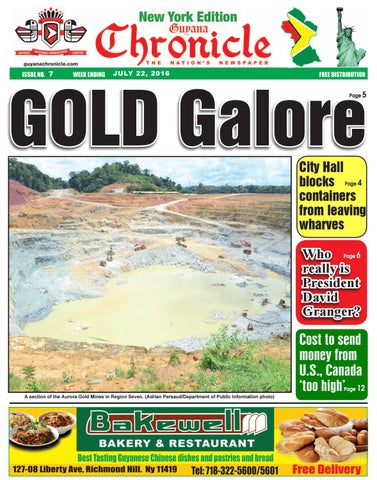
A section of the Aurora Gold Mines in Region Seven. (Adrian Persaud/Department of Public Information photo)
2
Guyana Chronicle New York Edition Week-ending July 22, 2016
Guyana Chronicle New York Edition Week-ending July 22, 2016
3
4
Guyana Chronicle New York Edition Week-ending July 22, 2016
Showdown! City Hall blocks containers from leaving wharves By Alva Solomon A SHOWDOWN between City Hall and two Water Street shipping companies on Tuesday saw the Georgetown municipality blocking the
movement of container-laden trucks from the companies’ city wharves over a $25,000 shipping container tax. Town Clerk, Royston King reported that the move is aimed at com-
mencing repair works to the roads. At the scene, Assistant Town Clerk, Sherry Jerrick noted that the council was invoking Sections 273/74 of the city by-laws “with respect to the use of roads by vehi-
cles of a certain weight”. City Constables proceeded to place barricades outside the entrances of Muneshwers and John Fernandes Limited on Water Street, leaving company officials baffled at the
move by the council. King said the issue is relative to Section 274/76 of the city by-laws which he noted stipulates that the Georgetown Mayor and City Council is entitled to fees by those persons
Barricades outside one of the Water Street wharves who use roadways, streets, parapets and space owned by all citizens on the city. “We have the right and authority to charge fees and this is what we are doing in this particular point of time”, he said. “It’s not getting the containers really, it’s really getting to do maintenance works, critical works to our roadways in the city,” the Town Clerk told reporters. Robin Muneshwer, a manager at Muneshwers Limited on Water Street told members of the media that no prior notice was given to the company about the move. “There is a barricade outside our compound, we can’t move. They just came and no traffic is allowed out”, he said. Meanwhile, the Assistant Town Clerk Jerrick told reporters that the issue is not confined to the parking of containers, a
matter which was recently discharged by the courts in favour of the businesses against City Hall. “It is not only about parking but also with the traversing of the roadway,” she said. She confirmed that $25,000 was being asked per container to operate on the roadway. LAW DOES NOT APPLY Attorney Robert Hanoman noted that the section of the law being enforced by City Hall does not apply to penalties being charged per container. He said the section in question “is vague, uncertain” and cannot be enforced by a court of law. Hanoman said that Muneshwers will seek legal advice and let the courts pronounce on the issue. He advised that the company should “not pay at this stage.” According to Hanoman, the containers should be allowed on the roadway until the matter is decided by the courts. “We would take legal action,” he said. Meanwhile, the Town Clerk noted that inspection by engineers at City Hall determined the need to “begin urgent works to some of the roadways.” He said that the access roads to industrial sites area are an example of the damage done by the heavy vehicles. “What we are trying to do is save these roads from further deterioration and further erosion”, King said. He added that fatigue by some of the heavy-duty single-axle vehicles and container carriers are being looked at by the City Council with the view of seeking to restrict their use of the roadways in the city. Shortly after 13:30hrs, this publication observed the heavy vehicles operating into John Fernandes Limited compound along Water Street. Persons there noted that the vehicles were allowed in after the issue was discussed.
Guyana Chronicle New York Edition Week-ending July 22, 2016
5
‘GOLDEN FUTURE’ –– Aurora produces 75,000 ounces of gold; set to surpass 2016 target By Ariana Gordon
–– PM pleased with safety, environmental safeguards
AN ESTIMATED 75,000 ounces of gold was produced by the Aurora Gold project for the first half of this year, Minister of Natural Resources and the Environment, “I would say Guyana is on the verge of major transformaRaphael Trotman, revealed on Saturday after visiting the methods of management relationship with the working force. “And therefore you have a company working together with tion, and now is the time to get in, particularly when…gold operations site in Region Seven. Prime Minister Moses Nagamootoo led a ministerial team Guyanese to bring a product that the economy depends on at prices are at a level where you can make an investment and get a decent return,” he declared. to the area, managed by the Canada-based company Guyana this point in time,” the Prime Minister said. Asked what he would say to encourage investors to come Minister Jordan said that with the added incentive of oil, Goldfields. Along with Trotman, others on the visit were Minister of Foreign Affairs, Carl Greenidge; Finance Min- to Guyana, given what he observed on Saturday, Prime Min- investors have every opportunity to come to Guyana. “Now is the opportunity to put a foothold and then ripple ister Winston Jordan; Minister of Agriculture, Noel Holder; ister Nagamootoo said Aurora Gold is a “good investment, a the rewards,” he said. Minister of Citizenship, Winston Felix; and Minister within sound investment. “The rewards are showing now, and they are very encourAsked to speak to the returns to Guyana, given the producthe Ministry of Communities, Dawn Hastings. Trotman said the Government is pleased with the opera- aging for new investors. There is a good prospect for gold tion levels, the Finance Minister said, “The returns to Guyana are absolutely fantastic! As you know, sugar has not been tions and production of the mining company. “This is my third mining and investment in Guyana,” he said. He said that, after three years, he believes the mining doing well, and I don’t think it is going to be doing well in the visit since becoming minister; so, on each occasion, the sense company is here to stay; and based on the plans outlined to foreseeable future. of pride and accomplishment increases”, he said. “Rice had some slippages, and bauxite is holding its own… “…we are seeing greater manifestations of a company that the ministerial team on Saturday, the Prime Minister has been has a standard of excellence that is growing, and Government is quite happy with the production and operation of Guyana Gold Fields and Aurora Gold Mines, its subsidiary,” Trotman revealed. He predicted that the company would surpass its target set for 2016, as it has currently produced 75,000 ounces of gold. He believes that, with the price of gold being where it is, the operations of the Aurora Gold Mines demonstrate a golden future. “It is surpassing even our target; because, at the beginning of the year, we anticipated just about 100,000 ounces. It would appear that we will go beyond that for this mine alone,” he declared. Minister Trotman described Guyana Gold Fields as an “exemplary organization,” a company that has high standards in health and safety and the environment. “Everything is complementary, and the synergies we see An official of Aurora Gold explains the operations of the mines to Prime Minister Moses Nagamootoo and the ministerial team on here are good; and we hope Saturday. (Adrian Persaud/Department of Public Information photo) they can be replicated throughconvinced that “not only do you have a viable product under So, to get gold to step up in the way it has stepped up has alout other parts of Guyana,” said Trotman. The returns to Guyana, the Natural Resources and Envi- mining and extraction, but it has some sustainability; because lowed the economy to continue to grow rather than regress.” He reminded that Guyana is one of the few countries in this ronment Minister said, are good; and the company is being there are plans that are long-term in terms of expanding the production areas, producing alternative energy, [and] in terms part of the world that continues to grow despite many uncerpraised for its high gold production. Prime Minister Moses Nagamootoo said the level of pro- of accommodating the work force. [There is] an environment tainties. “What I have seen here together with their plans… I think the future is golden,” he declared. duction at Aurora Mines is “good news”, while noting that a that is more permanent than you’d find in camps.” Additionally, Prime Minister Nagamootoo said there is a Foreign Affairs Minister Carl Greenidge said the opporreport of 75,000 ounces of gold at half-year is “excellent for ripple effect that would be conducive to community devel- tunity to observe the workings of the country’s largest gold Guyana.” He said such news provides a ray of hope to accelerate the opment, as the company takes safety and the environment operation is important. He said Government ought to have an seriously. ability to assess first hand such operations not only in terms of economy and bring the “good life” to all citizens. “Any company that wishes to come to Guyana with the production, but to assess the natural landscape and the effect “I am very impressed…Aurora Gold is doing a good job same objective would be welcomed. Aurora Gold Mines is a the extraction and production have on the environment. for Guyana and for the company itself,” he declared. “That is a dimension that is very important for the GovThe Prime Minister said he was satisfied with all ex- model that one can look to for future this is a [massive] big planations provided by the company relative to safety and time investment here of millions and millions of US dollars. ernment. International agencies’ bilateral representatives are environmental precautions with regard to the extraction and It is a work in progress, and it is has shown, so far, very good interested to know what is going on, and the effects on the results.” landscape…and the people,” said Greenidge. production of gold. Like the Prime Minister and the Minister of Natural He said it was interesting to observe the use of technology “…the explanations given convinced me that this is not only a safe operation, but this is also a worthwhile venture; and Resources and the Environment, Finance Minister Winston by the mining company, as opposed to how OMAI operated anywhere you go and you have over 500 persons being kept Jordan was impressed with the operations of the company. in the 1990s. The Aurora Gold Mines started production in August on site on jobs and they have performed one million man days Saturday was his first visit to the mining location, and he said 2015. without break in service, it shows it must have been very good he was overwhelmed.
6
Editor-In-Chief
Nigel Williams Editor
Godfrey Wray
Editorial: 227-5216; 227-5204 guyanachronicle.com wnigel10@hotmail.com gnnleditorial@gmail.com
Editorial
Dennis A Nelson –– dennisnelson. newyorkchronicle@yahoo.com –– 917-379-6590
Copyright Laws A writer’s view
FOR SOME time now I have been visiting lots of book stores and markets buying books and published material for my children and me. I note with a great deal of interest that most books today selling in our markets and book stores are photocopy books; that’s a violation of copyright laws both nationally and internationally. I observed that books such as: Junior English, First Aid in English, CXC text books in every subject area, books by Caribbean writers like V. S. Naipaul, Derek Walcott, Ian McDonald, Martin Carter, Wilson Harris and the long list goes on and on when it comes to ‘book piracy’ and our past and present governments does nothing about it. I am scared to bring my books which are published abroad and launched it here because my first book published here was pirated by many schools and store owners and it’s hard to track down everyone and if you take them to court you can lose your case because the copyright laws are not enforced here. Our writers here suffered a lot like me because we only have four newspapers here that makes it hard to employ our writers to get jobs. Even many agencies hardly have job positions for writers and editors I say this from my personal experience and most papers pay columnists very cheap or don’t want to pay them because many politicians write columns here for free that makes it very difficult for our Guyanese writers like me. We have copyright laws in Guyana but they are not enforced. If they were enforced, then the owners of these stores selling photocopy books would have been picked up by the police, they would have been sent to prison or pay some heavy court fines like in Trinidad, Jamaica, Barbados and many big nations. I also see now the piracy of CDs and DVDs has now become a normal business in this country from the very big store owners to sellers in the streets. What is really happening to the laws of our country? On every corner we can see laws are broken everyday by corrupt people in our society. What is copyright? Does it apply to our country? ‘’Copyright is a type of protection provided by law to authors of original works of authorship, inclusive of literary, drama, musical, artistic and some other intellectual works.’’ Guyana is a signatory to the Berne Convention and the Universal Copyright Convention. In addition, other copyright legal provisions are enacted in the Copyright Act 1956 of the United Kingdom to which Guyana acceded in 1966. The problem, however, is that these copyright provisions are not enforced in Guyana. Guyana is among 121 countries that were party to the Berne Convention on March 2, 1997. Since Guyana is a signatory, why is it not being enforced? Why is Guyana a signatory of a convention she has no intention to implement? It’s about time our law-makers try to have an understanding of copyright laws to protect our authors, singer, etc. This law must be passed in parliament and all pirated photocopy books, exam papers, DVDs, CDs must be removed from the shelves in every store and market stall in Guyana. What we need in Guyana is a writers/authors union where writers are represented, meaning they can take a store owner to court for selling their books and that store owner will have to compensate the writer financially if found guilty. The same should apply for artistes. This looks like a long hard road for us to travel, but it can be done if we work together to enforce the copyright laws in our country. Rev. Gideon Cecil
Guyana Chronicle New York Edition Week-ending July 22, 2016
Who, really, is President David Granger? P
resident David Granger’s rise to political power may have seemed unlikely even a decade ago, even to his wife, First Lady Mrs. Sandra Granger. In an interview with Lloyda Garrett, his Public Information and Press Services Officer, the President gave a rare candid insight into his life, his family, and the decisions that influenced his decision to seek the presidency. By Lloyda Garrett and Jasmaine Payne
INAUGURATED just ten days shy of the 49th Anniversary of Guyana’s Independence to a show of national pride that had seemed absent for many years, President Granger rode into office on a wave of popular demand for change and the palpable hope and desire for national unity of a new generation of Guyanese. With one year in office under his belt, President Granger has advanced clear policy positions for the development of a Green Economy built on the sustainable management of the country’s resources, economic diversification in agriculture and other sectors, information technology, high quality and accessible education from nursery to tertiary levels, regional and domestic security and social cohesion. The President has emerged as a champion for the protection of the nation’s patrimony and has sought to assert Guyana’s sovereignty, in the face of threats from Venezuela, by seeking a definitive, legal settlement to the border controversy with Guyana’s western neighbor, though the intervention of the Secretary-General of the United Nations. President Granger’s policies are so closely linked to the modern day needs of Guyana, as it stands at the cusp of a new age of economic and social prosperity, that one would not be incorrect in thinking that he is the right man for the moment. The President himself has declared himself President of all the people and has demonstrated a deep and abiding love for the people of Guyana. But as much as we know about him, there still begs the question: Who, really, is President David Granger and what led him to the highest office on the land?
“
[My Vision] was conditioned not only by my own upbringing but joining the Defence Force in 1965 and facing the Venezuelan threat reinforced my views that we needed to be united as a nation in order to protect our territory and we were very poorly armed at that time compared with Venezuela; we had no aircraft and we had no coast guard, we had no artillery and we could have been overwhelmed if there was a serious invasion. But by 1969 we had overcome two of our major challenges,” he said, referring to attempts made by both Venezuela and Suriname to claim part of Guyana as their own.
Few can deny that President Granger has managed to bring with him a stronger sense of nationalism and hope. With every public appearance, President Granger preaches with passion about unity and his love and vision for Guyana. But who is the man with the solemn face and the impeccable posture, the man that makes up the whole of President David Granger? In an interview with Ms. Lloyda Garrett, his Public Information and Press Services Officer, the President gave a rare candid insight into his life, his family, and the decisions that have led him to running for Public Office. WHERE IT ALL BEGAN Though born in Ruimveldt, Georgetown, it was in Bartica that President Granger spent the first years of his
President David Granger and his wife of 48 years, Sandra Granger (Photo by Saajid Husani) life, and for which he holds some of his fondest memories. It is there, too, at the gateway to the hinterland that Guyana’s beauty and the diversity of its people became apparent to him. “I regard Bartica as my home because that’s where I first became conscious of life and friends and family…I was always conscious of Guyana and Guyanese being a multiethnic society and people who mix easily with each other. Bartica, of course, was a very pleasant place.” For a young David, Bartica was his whole world for the first few years of his life, and it provided for him simple pleasures, which he grew to cherish greatly. There, he attended St. John the Baptist Anglican School, and in his spare time, the President recalled indulging in simple activities like kite flying, community centre games and swimming in the river. These purely enjoyable activities served as the main sources of entertainment for children there. “There were no organised sports in which we could participate in the type of athletics and the things that you See page 7
Guyana Chronicle New York Edition Week-ending July 22, 2016
7
Who, really, is President David ... From page 6
see nowadays, but I would go frequently with my dad up started his Primary education spending three years at the the river -or what you call the line- when he was going Auchlyne Church of Scotland School. By the time he moved about his policing duties, but the relationship among to Georgetown, Granger was eight years old and enrolled in people was quite easy,” he recalled. the Comenius Moravian School. The President, who consistently advocates for the In 1956, after writing Common Entrance at Sacred Heart, strengthening of the institution of the family, seemed in- President Granger entered Queen’s College (QC), where his fluenced by his own upbringing and recalled the value that next eight years of secondary schooling would begin to carve a close knit family life added to his life. Born to a mother, him into the man he would ultimately become. Many may who was a nurse and a father who was a policeman, he was have heard President Granger speak with much passion about the seventh of eight children. They lived in the flat atop the his time at Queen’s College, and with much reason. Though Bartica Police Station near what is now known as the Modern admitting that he wasn’t the best in his class, he said that he Hotel. By the time he was born, his mother had given up her worked hard to achieve the results which propelled him into profession to become a full time housewife, while his father his professional aspirations in life. operated as a County Sergeant-Major. This hard work was an achievement in itself, as the disPresident Granger described his father as very warm, tractions of the disruptive period of the 1960s affected the though many people assumed him stern, due to his profession. schools in the form of strikes and disturbances, and as a result, “He was certainly firm, but you know my best memories naturally caused self-doubt with regard to students’ personal are of him and my mom, maybe because I was the seventh in performance in school as well. the family; I had five sisters and two brothers. Still, the President believes that he received a well-round“I won’t say that I was ed education during his secondspoilt, but my memories of ary school years and it was the him are very pleasant and I Every member of my family had myriad activities offered at the only wish that he could see some education. You always knew school that assisted in rounding me now. He was born in 1905 young David Granger. you had to go to school and never out Athe member so, was he alive, he’d be a of Molder attempted not to go to school…that House (G House), he was very hundred and ten years old,” was the place you met your friends. active in extra-curricular activthe President mused. We developed respect for each other ities and then social life of the EDUCATION and you developed respect for your school, boasting membership It is hard to ignore that the Cadets, the school’s teachers. And within my home there in much of President Grangnewspaper (the Lictor – from were always books. There were always which his love for journalism er’s initiatives have had a elders in my family and you just knew was born), the Chess Club and strong focus on the country’s educational system. Lookthat education was a necessity. There the debating club. He admited ing back on his educational that he was not good at the athwas no option.” background, and his own exletic games so instead stuck to periences and achievements the academic means of passing as a result, it is simple to see his time. why education plays a paramount role in his policies with “So there was a cultural milieu, which is very difficult to regard to its importance to Guyana’s development. describe. You behaved, you dressed, you spoke in accordance “Every member of my family had some education. You with those unwritten codes and you joined clubs. Everything always knew you had to go to school and never attempted not was not just books or even sports; there were so many other to go to school…that was the place you met your friends. We things you could do. developed respect for each other and you developed respect “I could only describe it as a sort of culture and when for your teachers. And within my home there were always people left school they left with that culture and so it’s not a books. There were always elders in my family and you just matter of being elitist, it’s a matter of being able to share a knew that education was a necessity. There was no option,” certain view of the world that you were not there out of greed President Granger said. At five years old, his family moved to Whim, Berbice, and though he dearly loved Bartica, he admitted that the move was not as traumatic as one would expect, since he was still within the “bosom” of his family. At Whim, the President
“
The early years at Queens College
or selfishness, or to beat the next person, but you were just there to be well educated and part of a community. I think that is what I left with and I believe that is what a lot of my colleagues left with,” he said. President Granger said that the strong relationships between the masters and students and among the students themselves were much the cause for the success of the students as it evoked a type of mutual respect and school See page 13 Army days
8
Guyana Chronicle New York Edition Week-ending July 22, 2016
Drop-In Centre tragedy…
Brothers given touching send-off By Shirley Thomas
AGONIZING best describes the mood at the New Testament Ministries at Lot ‘G’ Joseph Pollydore & Chapel Streets, Lodge yesterday, where a Thanksgiving Service was held for the two brothers who perished in the fire that razed the Drop-In Centre on July 10. The congregation of
remained prayerful and calm. The boys’ parents, Sonia and Ulric George, and their siblings, weeping for the greater part of the service, appeared to have momentarily slipped into a trance, then fainted as the bodies were being taken away. The immaculate white coffins bearing the remains of six-year-old Joshua Jossiah Tyric George and his
on the fateful night; and a large turn-out of Welfare Officers and other staff of the Child Care and Protection Agency (CCPA). Minister Lawrence, who had moments before left a Cabinet meeting to attend the service, extended condolences on behalf of President David Granger, Prime Minister Moses Nagamottoo and the rest of
The boys’ parents, Sonia and Ulric George (first and second left), have a last look before their children are wheeled out of the church mostly women, teary-eyed with grief and still in shock,
three-year-old brother, Antonio Dominique Alex George, could not have been opened for viewing because of the state of their charred bodies, but the pain was somewhat mitigated by the presence of their beautifully framed photographs prominently displayed atop each coffin for the mourners and sympathisers to see as they filed past. Above each photograph were replicas of two angels watching down on the boys, with the inscription: “Sleep well, my beloved son.” Among those joining the bereaved family in paying their last respects to Joshua and Antonio were Minister of Social Protection, Volda Lawrence, and Minister of State within the Ministry of Social Protection, Keith Scott; chief caregivers Sharon Fraser Jones and Rupert Hudson, who evacuated the children from the burning building
Cabinet. Lawrence expressed gratitude to Public Health Minister Dr. George Norton for his cooperation; to the members of the fire department for their gallant efforts at extinguishing the blaze; and to the ranks of the Police Force for maintaining law and order at the scene of the fire. Empathizing with the boys’ parents, the minister noted that it is tough when a mother loses one child, and doubly so when she loses two at the same time. She urged the Georges to keep trusting God, for He only has the answer. Recalling that even though he had escaped the burning building, one brother had run back inside to save his sibling, Minister Lawrence commented that this ‘ultimate act of love’ demonstrated by one sibling for another is an exam-
ple for everyone to follow. “He has left us a message… We need to work diligently. Our mandate is to protect our children, and we should not shirk from that responsibility,” she said. Tributes were also delivered by relatives of the George family: Myrna Grant; Rawle Harry and Jean-Ann Harry, with a moving tribute in song; “Gone Too Soon” by relative Jo Ann Forde; and a representative of Head Start Nursery School, which little used to attend. In her tribute, Jean-Ann Harry thanked Minister Lawrence and the staff of the Ministry of Social
Minister of Social Protection, Volda Lawrence, addressing the Thanksgiving Service
The coffins bearing the remains of Joshua and Antonio George Protection; and indeed the caregivers, for their dedicated work at the Child Care Centres. She thanked everyone for attending the funeral and for the great outpouring of love and sympathy. “Losing a child is a parent’s worst nightmare,” she said, noting that she could not put into words the grief that was being felt for the loss of the two precious lives. Giving a background on her two deceased cousins, she remembered Joshua, the third of three children, as being playful and energetic. He always showed a sense of responsibility, and took pride in taking on the role of a leader whenever he was placed in a group. He cooperated fully with his siblings, and was always respectful to his parents. Antonio, the fourth child,
would fondly be remembered, Jean Ann said, as the “eat man” who was working towards admission to the “Food College”. However, he’d aspired to one day become a lawyer, and indeed was always at the forefront representing his older siblings. He was a very loving child, but one who would always fearlessly fight off anyone who seemed a threat to his family members. To this end, she recalls that his ambition was to write the NGSA exam, move on to the Bishops’ High School, and one day become a lawyer. Recalling that Antonio was said to have run back into the fire to save his brother, when they both perished, Jean-Ann remarked: “Joshua and Antonio have been robbed of the opportunity of growing up to become fruitful members of our society, but they must not only be
remembered as ‘the boys who died in the fire’, but as boys whose deaths brought about a change in how we view the plight of poverty; how we support those in need, as family members, as neighbours, as a community and a country at large.” Rawle and Myrna Harry attested to the fact that Sonia, despite her circumstances and the conditions under which she existed, was not brought up that way, but had the benefit of a decent life until she left the family’s homestead. Myrna, in no uncertain terms, admonished the grieving mother, who is said to have suffered at the hands of her reputed husband. “Now is not the time for you to be taking orders; it’s time for you to stand up and make demands…” she said as she urged her to have faith in God.
Guyana Chronicle New York Edition Week-ending July 22, 2016
9
GHRA remembers Bishop Randolph George
THE Guyana Human Rights Association (GHRA) has noted the indelible contributions of Bishop Randolph George, who died on Monday. “The Bishop is said to have contributed significantly in the late 70’s and 80’s towards challenging the widespread repression and his courageous and unflappable spirit was also said to be reassuring to other human rights and political activists in times of tension,” the GHRA stated. In a statement, the human rights watchdog said the Bishop’s willingness to be the voice of the
voiceless was acclaimed to be unwavering in an era where the “Freedom of Expression” utterance was almost non-existent. “Bishop George sought to defend human rights violations and his contributions were rooted in freedom of expressions, the independence of the courts and countering abuses generated by the supremacy of the then ruling party. “He, along with Catholic Bis hop Benedict Sigh, showed political courage to defend trade union demonstrations and denounce police actions taken against these demonstrations during the
PM mourns passing of Bishop George THE Office of the Prime Minister has issued a message of condolence on the passing of Randolph George, former Anglican Bishop of Guyana, who passed on Monday last, saying that he was “a knowledgeable, soft-spoken and amicable leader of the Diocese.” “Prime Minister Moses Nagamootoo wishes to express (condolences) to Mrs. Sheila George, the wife of former Bishop George, his four children – Gail, George, David and Christopher and to the entire Anglican Prime Minister Moses Nagamootoo community,” the Office of the Prime Minister stated. The Prime Minister’s office noted that George served the Anglican community for twenty eight years (1980- 2008) and was bestowed with the Cacique Crown of Honour in 1994.
Bishop Randolph George
economic austerity calamity of the late 1980s,” the GHRA stated. According to the Association, the Bishop endeavored to provide leadership in a more civilized and dignified manner as he attributed in the struggle for free and fair elections and that his role in the Guyanese Action for Reform ad Democracy (GUARD) also showed his stature as a trusted national figure whose influence was not limited to the religious and civic community. “His influence is deemed as one of a unifying nature due to his ability to surpass the ethnic divide and highlight his genuine interest in matters that were requisite for all. He has also been attested to know many Amerindians by name due to his constant trekking in visiting interior Anglican communities,” the GHRA noted.
The Association noted that the Bishop is said to have spent almost the last two decades of his life in relative privacy, and this came as a result of the restoration of democratic space in 1992, “for which a man like him whose attributes to social justice was due to his larger religious calling rather than a political inclination.” The GHRA noted that to those skeptical of the value of social and political activism which often felt more symbolic that substantive in that repressive era, the Bishop’s response was that, whether successful or not, without such activism the situation would have been much worse. The GRHA extended warmest sympathy and condolences on the death of the late Bishop to his wife, Sheila, his family and to the entire Anglican Community.
10
Guyana Chronicle New York Edition Week-ending July 22, 2016
Guyana Chronicle New York Edition Week-ending July 22, 2016
11
12
Guyana Chronicle New York Edition Week-ending July 22, 2016
Cost to send money from U.S., Canada ‘unacceptably high’ - Greenidge
MINISTER of Foreign Affairs Carl Greenidge has criticised the high cost to send remittances to Guyana from North America. On Wednesday, the minister said the high cost to send money here from North America is of great concern to the government. He was addressing participants at the opening ceremony of a two-day Inter-Agency Workshop on remittances, being held at Cara Lodge, Quamina Street, Georgetown. Being held under the theme, “Migration and Development in Guyana,” the workshop is geared at among other things, examining ways by which the high transferal fees attached to remittances can be lowered. It was disclosed that 5.8 per cent of the money coming from the United States to Guyana is lost to the money transfer agencies, while approximately 10.7 per cent of the money coming from Canada fail to reach low- income recipients here.
Minister of Foreign Affairs Carl Greenidge The Foreign Affairs Minister described the rates as “unacceptably high” and said Government is looking at ways and means of having those fees reduced.
“Let us use this opportunity to find ways to ensure that the cost of sending remittances to Guyana is reduced,” he told participants. He noted that while migration remains a significant global problem , Guyana heads a list of countries that has migrants who send resources home regularly. Greenidge noted that remittances have proven quite beneficial to the local economy in that it is a means of investing and ensuring that those who are vulnerable have money in their pockets. It also enhances the country’s economic performance. “Remittances have characterised movements of people , the diaspora for over a century has been a reflection of the fact that many are economic migrants who try to improve their well-being and welfare and in the process they also direct, channel resources back to their countries in order to acquire assets… house- building…facilitating the movement of other family members.” The minister said in examining the statistics of the Caribbean Bloc, it was recognised that there has been a steady flow of remittances to Guyana from the diaspora over the years. In 2012, US$469M entered the country and this represented 16 per
cent of Gross Domestic Product (GDP). In 2014, when the world suffered as a result of the economic meltdown, the country saw remittances in the amount of some US$332M or 11 per cent of the GDP. “16 per cent of the GDP is a very significant growth,” said the Foreign Affairs Minister. He said while Guyana benefits from remittances annually, it is important to examine the impact of same on consumption, inequality, investment and savings as they impact on the labour markets and the quality of human capital. “We are, as I indicated, one of the major beneficiaries of inflows from our diaspora ---but at the same …the average cost of sending remittances…from London, New York and Toronto in December 2015 is roughly 7.73%.” The Inter-Agency workshop on Remittances is aimed at helping government find ways to ensure that the cost of remittances would be reduced, so that the benefits of same can be maximised. The workshop is hosted by the Ministry of Foreign Affairs in collaboration with the International Organisation for Migration (IOM) and is coordinated by the ACP-EU Migration Action.
Mason charged with recruiting cocaine trafficker TWENTY-YEAR-OLD mason Shamar Morris of Lot 60 Durban Street, Lodge appeared on Tuesday before Chief Magistrate Ann McLennan, charged with allegedly recruiting 26-year-old Patrima Nima Isaacs to traffic 698 grams of cocaine out of Guyana between March 1
Patrima Isaacs was sentenced to three years’ imprisonment for trafficking narcotics
and July 3. Ranks of the Customs Anti-Narcotics Unit (CANU) were able to implicate Morris after Isaacs had been busted at the Cheddi Jagan International Airport (CJIA) with the drugs concealed in the handles of her handbag and in the form of sanitary pads that were placed between her legs. Based upon the woman’s statements, CANU officers were able to arrest Morris, who had been on their radar for a while. Two weeks ago, Isaacs appeared before City Magistrate Leron Daly and was sentenced to three years’ imprisonment and fined $1.8M. CANU prosecutor Konyo Sandiford-Thompson said a confrontation had recently been held between Morris and Isaacs, and Morris denied knowing Isaacs. The prosecutor said Isaacs had provided the police with details of events that had transpired between herself and Morris while they con-
Shamar Morris spired to traffic the cocaine to the United States of America. The prosecutor strongly opposed bail for Morris based on the seriousness and prevalence of the offence. As such, he was remanded to prison until August 15, and his matter has been transferred to Magistrate Daly’s court.
Guyana Chronicle New York Edition Week-ending July 22, 2016
13
Who, really, is President David ... From page 7
honour among the students. “I think the masters had it easy because when any one of us misbehaved you were more afraid of the discipline from your colleagues than from the masters. Because if they felt you behaved in an unethical way or you caused the class or the group any embarrassment, you were really afraid of them. They would have come after you after 3:00pm and that was the best discipline. You lived up to the expectation of your peers rather than to the discipline that was imposed by the masters,” he said. THE DISTURBANCE PERIOD As referenced earlier, President Granger’s high school years were marred by the period of inter-racial and political disturbances of the 1960s. At the time, a then teenaged David Granger would have been at the beginning of coming into his own as a young man and the role he was to play with regard to making a meaningful contribution to his country. And while to this generation, the disturbances are little more than tales told in passing, for people growing up at that time, it is a period that remains etched in their memory to this day. The President, though admitting that he does not possess perfect knowledge of all that happened in this time, touched on some
P
resident David Granger’s rise to political power may have seemed unlikely even a decade ago, even to his wife, First Lady Mrs. Sandra Granger. However, on closer examination, the President’s life experiences seem to have been specifically designed to lead him towards becoming the Eight Executive President of the Cooperative Republic of Guyana. This is the first in a two-part feature. the PPP [People’s Progressive Party] under Dr. Cheddi Jagan and elections were held in August 1961. So I would say agitation and unrest started as early as August 1961. In 1962, there was a huge confrontation. Part of the central business district in Georgetown was burnt down and there was looting and a part of the British army had to deploy troops here. That was short lived but it affected the confidence which the people had in the government and in 1963 there was another long strike. It was called the ‘Eighty Day Sstrike’. It was probably the longest general strike in the English speaking Caribbean at the time,” President Granger recalled. This resulted in the shutdown of many government offices, followed by protests and a shortage in goods and services. “So it was a very testing time. A few people were killed in 1962, a few were killed in
President Granger and Lloyda Garrett enjoy a game of chess (Sandra Prince photo) of the events that he was aware contributed to that sad era. “It had several dimensions. One was the labour and industrial dimension because it was the first time I think in the English speaking Caribbean the entire public service struck against the government in 1961 and 1962 and it was all tied up with political party affiliation,” he said. He noted, however, that the industrial dispute was more due to salary issues that affected the civil service because the government at the time did not follow recommendations in the 1961 Commission of Inquiry (COI). “In those days the government was run by
1963 but the disturbances were taking place at different levels. One was the labour level and many of the Trade Unions were aligned to different political parties. There was also political development because in 1962, Jamaica became Independent and Trinidad became Independent and Guyana under the PPP was attempting to become Independent as well,” he said. In February 1964, the Guyana Agricultural Workers Union (GAWU) called a strike in the sugar industry after the British Colonial administration changed Guyana’s electoral system from “First Past the Post” to “Proportional Representation.”
In his assessment, President Granger said that “it was a protest against the British imposition of the Proportional Representation system and many people were killed. The official record said 176 people were killed but it is suspected that many more people were killed and that period is known as the disturbances.” The President described a period between February and July 1964, where there were murders almost daily and a bomb being thrown into a bus taking the school children of estate managers to Lusignan. There were also many cases of arson. In what became a struggle between the two major political parties, the fabric of Guyana’s nationhood was torn apart as villages became separated by race and political loyalty became largely fashioned by race. As the President reflected on this period, painfully memories etched on his face, it is not hard to see why social cohesion has been one of the key principles of his leadership. He described this period as “divisive”, to say
the very least and Guyana entered its Independence, a broken nation. “It was traumatic and it did have an effect. It damaged race relations for a long time thereafter. For example the PPP did not go to the Constitutional talks to decide the Constitution for independent Guyana and apart from the token representation by a few of the leaders who boycotted the independence celebrations in 1966, I believe a lot of our problems, not only political problems but our ethnic problems, stemmed from that period,” he said. AFTER THE DISTURBANCES AND THE GDF Guyana’s Independence in 1966 found President Granger a member of the Guyana Defence Force(GDF). Having graduated from QC, he worked for a short time in the graphics department of a local newspaper and shortly after enrolled in the University of Guyana (UG) in 1965. Yet, Mr. Granger felt that this was not much of a leap forward that he envisioned for himself as the University was housed in the QC compound. With many of his peers studying overseas, he left UG to join the army, where he believed opportunities to study overseas would be available to him. “I put my university studies on hold and went away to Britain to study to become an officer and then when I returned I was in See page 16
14
Guyana Chronicle New York Edition Week-ending July 22, 2016
Guyana Chronicle New York Edition Week-ending July 22, 2016
15
GTT supports liberalised telecoms sector -says economic, social benefits to be derived
By Ravin Singh
THE successful passage of the Telecommunications Bill 2016 has paved the way for a competitive regime to be created in the sector, and the Guyana Telephone and Telegraph (GTT) company is in support of efforts to end its monopoly of the sector. “We’re heavily in favour of breaking the monopoly. We’re not asking for a monopoly to be put in place. We want the sector to be open,” Justin Nedd, GTT’s Chief Executive Officer (CEO) said at a Wednesday morning press conference held at the company’s head office on Brickdam. The Bill, which was passed in the House on Monday evening after a rigorous debate, seeks to create a competitive environment by providing for an open, liberalised and competitive sector that will be attractive to new market entrants and investors. At the same time, it supports preservation of the activities of the current participants – both GTT and Digicel Guyana. The Bill, as was described by Public Telecommunications Minister Cathy Huges, will result in greater choice, better quality of service and lower prices, which will effectively benefit consumers. It also specifically addresses the expansion of telecommunication networks and services
GT&T’s CEO Justin Nedd at Wednesday’s press conference into unserved and under-served areas, through the institution of a new universal access/universal service programme, in an effort to further national, regional, social and economic development. And despite holding the monopoly for over 20 years, GTT, through its CEO, has acknowledged that positive economic and social benefits will be derived from
the liberalisation of this sector. But these aren’t the only benefits, Nedd said. He suggested that this will now allow for an accelerated rate of learning for all Guyanese, while providing clarity on the operation s of the sector. “Right now there are many grey areas that we are trying to resolve and we’ve been operating in those grey areas for several years. So, we are optimistic that with liberalization, they will be clear. Businesses need predictability; we could focus on driving the business, providing good service to the customer and getting things done right,” the CEO said. He said the company is currently in negotiations with the Government, which he said is critical for the country. “Doing the negotiations and respecting the rule of law contract is something that is critical for the country…because if any country wants Foreign Direct Investment, it’s important for investors to understand that if they have a contract with the government, it will be honoured,” Nedd explained. And although he refused to get into details of the negotiations, the CEO said that it is necessary to ensure that existing contacts which GTT has with other services providers are respected. When asked about the company’s support for net neutrality, which is listed in the Bill, Nedd did not specifically say
if GTT was in support of it. He offered rather that the company supports the Bill which seeks to develop Guyana’s telecommunications sector. Nedd was also asked by this publication about reports of GTT censoring its competitor’s – Digicel’s - website by redirecting traffic (users), who were trying to access http://digicelgroup.com, to GTT’s website. He said he was unaware of this issue. Regarding 4G service which was introduced recently, the CEO fended off criticisms regarding the slothfulness of the service, boasting that this project was introduced with two weeks’ notice, while it is known to take up to nine months. He also added that the company is still working out deployment of more services and teething problems which will take time to resolve. In closing, he congratulated the Government on this landmark achievement and lauded the efforts which contributed to the Bill’s passage. “This is great for the people of Guyana and GTT remains ready to work quickly with the Government to complete the path to market liberalisation. Guyana will be very different with the development of the robust 4G broadband services that liberalisation will enable. GT&T intends to be a big part of that transformation,” he stated.
16
Guyana Chronicle New York Edition Week-ending July 22, 2016
Guyana to seek renewable energy help from Denmark GUYANA will be turning to Denmark for assistance in the development of its renewable energy sector, President David Granger said Wednesday. His comments came after he accepted letters of credence from Denmark’s new ambassador to Guyana, Kim Højlund Christensen at the Ministry of the Presidency. Describing Denmark as “an international bellwether” in the development of sustainable energy, President Granger said “Guyana looks forward to working closely with Denmark to advance cooperation for the development of the renewable energy sector in order to build a ‘green’ and sustainable society.” He said Guyana is ready to learn from Denmark’s experience with respect to its community energy models, noting that such experience can be a guide for Guyana in the implementation of its national “green” agenda.
“Guyana, like Denmark, is a small state. We are committed, unreservedly, to the principles and purposes enshrined in the Charter of the United Nations, especially those with regard to the settlement of all international disputes by peaceful means and for the avoidance of the threat, or use of force against the territorial integrity or political independence of any State,” the President added. He pointed out that on May 20, 2016 Guyana ratified the Paris Agreement, and remains committed, to realizing, through international cooperation and national developmental initiatives, the ambitious objectives which have been set out in the United Nations 2030 Agenda for Sustainable Development. The country, President Granger said, will continue to be actively engaged on global issues, such as the mitigation of the adverse effects of climate change, with the aim of
finding sustainable solutions. “We are confident that your appointment as Ambassador of the Kingdom of Denmark to the Cooperative Republic of Guyana will contribute to the further strengthening of the existing friendly relations between our two countries,” the President said. Ambassador Christensen, in delivering brief remarks, said the relation between Denmark and Guyana has not only been longstanding but has been marked by mutual respect. Like President Granger, Ambassador Christensen said efforts to combat climate change and its impact are particularly important to low-lying countries such as Denmark and Guyana. “Our two countries have a lot of values in common – democracy and equality – as a foundation for modern society, Ambassador Christensen posited while adding that both Guyana and Denmark also
Kim Højlund Christensen, Ambassador of the Kingdom of Denmark and President David Granger share a toast at Wednesday’s accreditation ceremony aim to reduce poverty. “Economic growth is necessary to eradicate poverty,” he added, but said due to the increase pressure on natural resources and high demand for food, energy and water, the growth needs to be “greened.” He also used the oppor-
tunity to extend greetings to Guyana on its 50th year of Independence. Denmark established diplomatic relations on November 16, 1979. The relations between the two countries have been characterised by the principles of mutual respect,
mutual non-interference in each other’s internal affairs and cooperation for mutual benefit. In 2004, Denmark had cancelled all commercial debt that was owed by Guyana – a gesture the country remains appreciative of.
Who, really, is President David ...
From page 13
uniform. So in fact my university education was interrupted for a significant part of my young adult life,” he said. While overseas, however, President Granger kept close tabs on the situation in his homeland. As Guyana headed toward Independence, he recalled the changing atmosphere and attitudes of the people of that time. “We were very optimistic because the disturbances had come to an end and the Prime Minister, at the time, established what he called a regime of consultative democracy and there was widespread reconciliation. Communities, which had been torn apart by the disturbances, were visited. Many of the refugees, people who had been driven out of villages, during the disturbances, were resettled and there was a powerful thrust to provide public services to the population,” he said. But Guyana was still struggling. There was no proper international airport because
the existing one had been burned down in 1959, much of the coastal roadways and even sea defences were in a decrepit state and there were not enough secondary schools. As such, the President said, much attention had to be paid to infrastructure countrywide. Describing a very different time that we can envision today, President Granger said, “In the 1960s, life was very, very different… It was a luxury to even own a wristwatch. That’s why many of the markets had clocks because that was the only way you could tell the time. There were very few telephones and to make a long distance call… it was called a ‘trunk call’. In fact when we first came to Georgetown you had what they called party lines. Two completely separate houses would have one phone so when it rang a different family would answer and it was crazy but there were simply not enough lines.” Sometimes with a bemused smile on his
President Granger shows the writer, Lloyda Garrett, his coin collection (Sandra Prince photo)
face as he reflected on that time, he said, “Everything was very difficult, even the cameras; to get a family photograph taken you would have had to go to a studio because few people owned cameras. You (had) to be very rich to own a camera or a watch or a car and I would say that the population was much poorer but in a way much happier. The city was very clean and the services although very rudimentary, were reliable. You had clean water in the pipes, you had regular electricity and telephone service although you had to book a call overseas and wait several hours… We were not yet a modern state and that was the duty of the government after 1964, to make Guyana into a modern country,” he said. Still, Independence, which found President Granger, a young army officer in training in Britain, evoked pride of country and this was not lost on him. He recalled that as May 26 approached, his mother sent him a picture of the Golden Arrowhead, which evoked both a sense of patriotism and nostalgia. “I wished I was there because my colleagues were raising the flag and on parade. When I came back in June, maybe less than a fortnight after, I joined my first platoon and I felt very proud,” he said. President Granger admitted that at that time all those who were part of the GDF were immensely proud to be Guyanese because the training standards were very high. And so began his career of distinction in the military. Even as he defended his country in the Cuyuni against Venezuelan aggression and in 1969 in the Rupununi Rebellion, his love of country and belief in Guyana’s sovereignty was only further strengthened. “[My Vision] was conditioned not only by my own upbringing but joining the Defence Force in 1965 and facing the Venezuelan threat reinforced my views that we needed to be united as a nation in order to protect our territory and we were very poorly armed at that time compared with Venezuela; we had no aircraft and we had no coast guard, we had no artillery and we could have been overwhelmed if there was a serious invasion. But by 1969 we had overcome two of our major challenges,” he said, referring to attempts made by both Venezuela and Suriname to claim part of Guyana as their own.
President David Granger photographed at State House by Saajid Husani Remembering the Rupununi Rebellion, another dark time in the country’s history, he said, “I was able to see it at close range, you know, how hatred could divide this country. And when we arrived there all of the bodies on the ground were policemen. The rebels just killed the policemen and they ran out of the station - shot them where they were, no questions asked. I just hope that we never return to that level of fierceness and enmity that I saw with my own eyes at Lethem...But these are experiences which strengthen your love for your country, not lessen. I never wanted to migrate and once I had put my hand on the plough I just stayed there as long as the Defence Force would have me,” he said. (Next week, we continue the interview, featuring “Mr and Mrs David Granger” and the “Road to the Presidency”)
Guyana Chronicle New York Edition Week-ending July 22, 2016
17
18
Guyana Chronicle New York Edition Week-ending July 22, 2016
THE BEAUTIFUL VILLAGE OF SUDDIE THE quiet village of Suddie, once the administrative centre of the Essequibo Coast, has a long history that dates back to the Dutch occupation of Essequibo. Today, a prominent feature of the village is the Suddie Hospital, the main hospital on the Essequibo Coast. The sprawling hospital complex, which houses a public health building, a health centre and a rehabilitation centre, was built around 1840. Prior to becoming a health centre, it used to house a huge building that overlooked the mighty Essequibo River. In those days, the building served as a fraternising club for the major estate owners, and they would usually meet there every month end to drink intoxicants or sip coffee while taking in the cool sea breeze and admiring the beautiful shoreline. According to Isahak Bashir, an elderly resident on the Essequibo Coast, the area that is now called Hamburg Island was located east of, and close to, Suddie; but during a 200-year period, erosion pushed the island some one-and-a-half miles away, and in the process created a beach that was a major resort up until the 1960s. The beach has since been washed away by the Essequibo River. In the days of the Dutch planters, the plantations owners who used to socialise at the club house reportedly used to relax on the verandah and enjoy the scenery at the beach. Unlike the other estates on the coast, which produced cotton and sugar, Suddie was known to produce coffee and cocoa. In 1835, the Portuguese came to these shores from Madeira as a substitute to the slaves, and were distributed to several estates on the Essequibo Coast. About 30 of them were posted to Suddie. They worked on the coffee
and cocoa estates, and were also involved in the production of honey; but they were not able to cope with the horrid working conditions, and as a result, many died. Then Governor of the Essequibo Coast, Henry Lyte, in 1841 established a committee to investigate the living conditions of the Portuguese, and found that they were indeed living under severely harsh conditions, which contributed to the decline in their population. Over the years, the Portuguese worked hard and developed themselves. Many of them went on to become shrewd business persons. Guan Fernandes, a Portuguese, built the first general store at Maria’s Lodge, Essequibo Coast. Sunny Lord, the Gomeses, the Mendeses and the Bellames are among the prominent citizens who also contributed to the development of the village. Bashir related that the village is known for the medical services it provides to the Essequibo Coast and Pomeroon. Over the last 60 years, survivors of the generation of elderly persons would be familiar with Dr. Gillette, Dr Whaling, Dr Asregadoo, Dr Muchenagumbo, Dr Gladstone Mitchell; and, more recently, Dr Rama, all of whom have provided yeoman service to the region. Aside from the hospital, Suddie is home to a post office, a police training school, a magistrate’s court, a High Court, schools, religious institutions, shops, and a police station. Prominent in the compound of the police station is a mango tree which is said to be over 100 years old. The tree provides shelter for those waiting to see family members or friends who have been admitted to the hospital. Bashir related that, in years gone by, Amerindians who visited hospitalised relatives would rest under
the tree and, on occasions, would miss the bus, but they used to be given shelter by a very kind Portuguese woman named Hilda Ferreira. Suddie is one of the less rustic villages on the Essequibo Coast, and most of its residents work at the Government offices, while a few engage in cattle rearing aback the village. Following promulgation of the 1980 Constitution, a regional government system came into being, and Suddie was soon after relieved of being the administrative centre of the region. Those duties were shifted to Anna Regina, which became a town in 1990.
The Suddie Police Station and the mango tree which is said to be over 100 years old
The sprawling Suddie Hospital Complex
The High Court at Suddie, Essequibo Coast
Guyana Chronicle New York Edition Week-ending July 22, 2016
19
CARIBBEAN HEAT: the place for clean entertainment
THE Caribbean Heat Hotel, Restaurant and Bar is the number one spot for clean entertainment in the township of Anna Regina on the Essequibo Coast.
The bar is located in the Anna Regina Market access road, and in one of the liveliest places for a family get-together in the quiet township.
The Caribbean Heat Hotel, Restaurant and Bar at Anna Regina, Essequibo Coast
Ghandi Gossai
Owner of the facility, Ghandi Gossai, a Canadian remigrant, told the
Guyana Chronicle that he established the business for one of his sons, but unfortunately the son died in an accident before the business opened. The death, he said, caused him to remain in Guyana; and it seems like he would remain here for a long time, since management of the entertainment spot rests squarely on his shoulders. At the Caribbean Heat Hotel, Restaurant and Bar, patrons can listen to the best Indian filmi music — the blasts from the past and the past; Soca, Hip Hop, Soul, Reggae, Rock and Chutney; while looking at cricket or a movie on big-screen television. And all dishes are served: from mouth-watering curries to wild meat, with
the exception of beef and pork. Patrons are not allowed to fight; argue in anger; swear ‘on the tops of their voices’; or enter the bar without a shirt, or while wearing slippers. “Once they can comply, they can enjoy themselves at Caribbean Heat Hotel, Restaurant and Bar,” Gossai, popularly called “Guss”, told this publication. He manages the business with the help of his wife, a son, his daughterin-law and three staff, and they are all courteous and helpful. According to the businessman, generally, business on the Essequibo Coast is not bright; but business is not bad at Caribbean Heat Hotel, Restaurant and Bar.
“To maintain customers, I’ve cut the prices for beers, foods and the hotel; so I have managed to maintain most of my customers, plus I get new people every now and then,” he said. The spot where the business sits was an abandoned land with a hotel. Gossai, two years ago, purchased the land and invested some $25M in renovating the hotel and building the restaurant and bar. He said family members and friends in Canada want him to pay them a visit, but to do so now would be very tough. “Even my former boss recently called me and told that my job is still there when I ready to go back,” he said as he rushed to attend to a patron.
Inside the Caribbean Heat Hotel, Restaurant and Bar
20
Pomeroon to become Guyana’s coconut capital THE community of Pomeroon is set to officially become “the coconut capital of Guyana”, and coconut water is set to become the national drink when the Ministry of Agriculture hosts a grand Coconut Festival, from October 21 to 23, in observance of Agriculture Month 2016. The festival will feature cuisines, art and craft, and value-added products from the coconut industry, as well as presentations on the value of the industry to Guyana’s development. In fact, Agriculture Month 2016 will be paying special attention to the coconut industry; and on October 16, there will be a huge boat parade in the Pomeroon River to create awareness of the industry and to stop pollution of the Pomeroon River. Many farmers in the Pomeroon are in the habit of disposing of coconut shells and husks in the river, which not only creates an ugly sight but impedes smooth transportation on the water top.
The boat parade is being organised by the Ministry of Tourism in collaboration with the Essequibo Chambers of Commerce and other stakeholders. The Ministry of Tourism intends to use the industry to promote agro-tourism by organising tours on coconut farms, showing how coconut is harvested, and how it is processed. In all of this, heavy focus will be placed on research, employment, and trade. The Pomeroon community reportedly has the best coconuts in the world. In the Pomeroon alone, there are about 20,000 acres of land that can be cultivated with coconuts, producing an estimated 140 million nuts per year. And at $50 per nut, it is a $7 billion enterprise waiting to be tapped; and this does not include the value-added industry of the coconut, which includes coconut oil, craft, and coconut water. The worth of the value-added industry is estimated at about $7 billion, most of which can come from the sale of coconut water. It is estimated that the demand for coconut water grows at between 50 and 100 per cent annually. Globally, the coconut water industry is worth US$1 billion, and the product is on its way to becoming the world’s most popular drink. According to The WaterPage.Com, coconut water increases rehydration, boosts the immune system, decreases heat stroke, increases blood circulation in diabetics, and is important in anti-aging treatments. Moreover, coconut water is a rich source of vitamins and minerals. Locally, some 60,000 acres of land are under coconut cultivation; and in terms of its status as a priority agriculture crop, coconut ranks third in importance, behind rice and sugar. About half of the coconuts produced locally are exported to The Dominican Republic, but these are mainly dried nuts. In light of the threat of global warming, coconut stands out as a climate-resistant crop, and can be a more-than-useful product to brace farmers during hard times.
Guyana Chronicle New York Edition Week-ending July 22, 2016
Personality profile
Defying tradition to realise her dreams
DR AFARAH KHAN is a gritty young lady who sets ambitious goals for which she pours her heart and energy out into achieving, even if it means coming up against a mountain of odds. A resident of Charity on the Essequibo Coast, she is currently the acting Regional Health Officer of Region Two, a post she has held for the past year. Khan, who is from a humble background, attended the Anna Regina Multilateral School; and upon graduation, set her sights on making her childhood dream of becoming a doctor a reality. She was, however, faced with a major stumbling block: her parents, traditional East Indians, wanted her to marry and start a family soon after finishing school. Khan was defiant, and having achieved good grades at the Caribbean Secondary Education Certificate (CSEC) examinations, applied at the University of Guyana (UG) to pursue an Associate Degree Programme in Pharmacology, and her application was approved. She was overjoyed at hearing the news, but her parents were not happy, because they did not even know she had applied to pursue studies at UG and was successful. She pleaded with them, and eventually they listened to her and agreed that she would further her studies. Khan successfully completed her studies and returned to the Essequibo Coast, where she worked for three years as a pharmacist. Time was going and her parents were pressing her to marry; and one day, while running through the daily
Dr Afara Khan newspapers, she saw an advertisement on the Guyana-Cuba scholarship programme, and she applied and succeeded. The good news caused a great uproar in her family; but Khan, who dearly loves her family, knew what she wanted in life and was prepared to give no ear to their disappointments, while, at the same time, she remained astutely respectful to her parents. After much disagreement and debate, she related, she informed her family that if they don’t approved of her going to study medicine in Cuba, she would go on her own. Again, they eventually agreed, but with
great reluctance. Khan related that notwithstanding their disappointment, her parents gave her their full support during her studies in the Communist State. In 2009, she successful completed her studies and returned to practise medicine in Guyana. Today, her parents have not regretted their decision, and are proud of her achievements; and equally so now that she is married. Dr Khan is urging parents to make their children’s education a top priority, and she is urging young girls to qualify themselves academically before getting married. “It is empowerment. It will help you to take care of yourself and children if you have to move on from an abusive relationship; and it will help you to better support your family if you are living together, and (you can) make a solid contribution to society,” she told the Guyana Chronicle. Dr. Khan intends to further her education. She plans to specialise in the field of Public Health Management, since her new role is centred on management. On a daily basis, she oversees management of the Charity and Suddie hospitals, the 11 health centres, and 20 health posts in the region. Dr Khan says she enjoys helping persons who need help, and feels a great sense of satisfaction when they recover from their various illnesses. This young doctor is advising young people to dream big in life. “It does not matter where you come from, go after your dreams!” she urges.
Two teens rescued from trafficking in Baramita TWO teenagers are currently in protective care, following a Trafficking in Person (TIP) rescue operation on Wednesday in the Barima-Waini Region. A woman is also in police custom. After receiving reports of a suspected case of Human Trafficking, the Guyana Police Force (GPF) conducted a rescue operation on Wednesday in the community of Baramita,
and the alleged victims were placed into protective custody. According to confirmed reports, one of the teenagers is the daughter of a family friend. The woman is, however, claiming that the other teenager is her daughter but up to press time, the police was still trying to confirm this. The Ministry of Social Protection TIP Unit has since been providing
psychological support to the suspected victims. Last Wednesday, Ranks of the Police Force descended on Rio Inn following reports that several young women were held against their will. The police removed 10 female Dominican Republic nationals and one Guyanese woman from the night club as they continue intense post-raid investigations.
Guyana Chronicle New York Edition Week-ending July 22, 2016
21
End the death penalty By Ariana Gordon
THREE international experts on human rights and the abolition of the death penalty are in Guyana to engage all stakeholders, including the government and the judiciary on the need to abolish the death penalty. The trio - Dr Ivan Si-
death penalty, but to abolish it. Guyana, like many other countries, has laws enacted to sentence terrorists to death, but she believes that the institution of the death penalty is inhumane. Guyana’s law has been amended to allow the death penalty only in circumstances
tries such as Gambia… as soon as there was a change in the President, he executed nine people in one day. This is what happens when you have to rely on something that is not written in law, so it can be ignored by successive Governments.” RIGHT DIRECTION The commissioner said the statement by President David Granger that he would not be executing anyone is a step in the right direction. She described the statement by President Granger as an important one, but stressed that it has to be translated into law.
–– experts urge
bean culture of values,” said Justice Pillay, who noted that Guyana is the lone country in South America that has not abolished the death penalty. Meanwhile, United Nations Assistant SecretaryGeneral, Office of the High Commissioner for Human Rights Ivan Šimonovi, said Guyana is not alone when facing the challenge of terrorism. He said as chair of a working group on protecting human rights while countering terrorism in New York, it has
about the death penalty and moratorium resolutions. CRUEL AND INHUMANE The UN Secretary-General referred to the death penalty as a “cruel and inhumane practice.” Professor Marc Bossuyt, Emeritus President of the Constitution Court of Belgium who agreed with his colleagues, said in a comparison of countries that have abolished the death penalty, it was
“We will lend our voice to ask Guyana to advance forward and not go backward.” - Navi Pillay, Commissioner of the International Commission against the Death Penalty
The protocol is aimed at the abolition of the death penalty. Some 81 states are party to the protocol and he believes that becoming party to it “is the best way of taking that commitment internationally.” “If you look at the map of South America, Guyana is now the only country that has not abolished capital punishment…. so either you remain a particular island in the continent or you join the others in that direction.” He stressed, however, that it is not a matter of criminal policy but a matter of human rights and the right to life. “We value very highly the right to life and we think that executing people is contrary
Navi Pillay, Commissioner of the International Commission against the Death Penalty speaks at a press conference Wednesday calling for abolition of the death penalty. (Cullen Bess-Nelson photo) monovic, Professor Marc Bossuyt and Navi Pillay - are here as part of a Judicial Colloquium on the Abolition of the Death Penalty held at the Marriott Hotel, Kingston. Pillay, Commissioner of the International Commission against the Death Penalty told reporters on Wednesday, that she is hopeful that Guyana would re-examine its terrorism legislation with specific attention being placed on the death penalty. She said the Terrorism Act has 12 provisions relative to the death penalty. “You don’t pass a law just because something terrible has happened; law is not done emotionally. The rule of law follows international standards and Guyana is very much a part of the international community, has passed many international treaties and so they are bound to pass laws that are certain and definite and not responding each time to terrorism acts committed here, France or wherever,” she said. Pillay noted the importance of complying with international law and the many conventions to which Guyana is a signatory. She said it is important to not only have a 20-year moratorium on the
where members of the Joint Services or the judiciary are killed while on duty. Her plea came just prior to the beginning of the judicial colloquium comprising local judges and magistrates. “We will lend our voice to ask Guyana to advance forward and not go backward,” said Justice Pillay, who noted that Guyana should be proud that no executions have taken place here for the past 20 years. She believes that the trio’s visit to Guyana is timely and said discussions have been held with both the Government and Opposition. “We want to continue meetings with Government representatives the rest of today and early tomorrow.” Justice Pillay reminded that the United Nations (UN) has specific requirements for counter-terrorism measures, but must still comply with International Humanitarian Law. She believes Guyana should take the first step in formalising its position on the death penalty by outlawing it. “Make it into law -- not just de facto moratorium -because if it is just de facto, it hangs over people all the time. I know in certain coun-
From left to right: United Nations Assistant Secretary-General, Office of the High Commissioner for Human Rights, Dr Ivan Simonovic; Commissioner of the International Commission against the Death Penalty, Justice Navi Pillay; Emeritus President of the Constitutional Court of Belgium, Professor Marc Bossuyt; and Charge d’ Affaires, European Union Delegation Derek Lambe at a media conference on Wednesday at the Marriott Hotel, Kingston Justice Pillay said in examining some of the social issues prevalent in Guyana, it should be noted from the statements made by President Granger that much has been tried to curb instances of domestic violence, but to no avail. She believes that what is needed is an integrated approach, community involvement and education that stresses values. “You don’t want what was forced upon you more than 50 years ago… I address the young people of Guyana -- you are not alone in the problems you face but each and every one of you can do something to develop a Carib-
been discovered that there is no conclusive evidence that the death penalty prevents crime, including terrorism. “It is the first period of human history where the majority of member states have abolished the death penalty, so it would be good for Guyana to be on the right side of history.” Šimonovi noted too the fact that UN Secretary-General Ban-Ki moon has spoken out against the death penalty should be deemed significant in the eyes of countries such as Guyana. He said in the past, other Secretaries-General were cautious when speaking
observed that “the more people are exposed to information about the death penalty, the more likely they are to move away from the death penalty.” He said human rights and anti-death penalty activists would very much like to see the death penalty removed from any legislation here. Professor Bossuyt said too that Guyana has taken the first step through the statement of President Granger that no executions will take place here, but noted that the country can also “sign and ratify the second optional protocol which was adopted in 1989 at the General Assembly of the UN.”
to the right to life which is the most basic of all human rights,” the Professor stated. He noted that in those countries where the death penalty has been abolished, it was not a result of general consensus, but a matter of leadership of the political directorate who are cognisant of the fact that the death penalty “has no place in the civilised world of today.” “One has to show leadership by abolishing the death penalty…. public opinion will, even if some people were opposed to it, they will understand that this has no place in modern society,” he added.
22
Guyana Chronicle New York Edition Week-ending July 22, 2016
$200M investment secured - Moco Moco hydropower facility to come on stream soon
THE Moco Moco hydro power facility is expected to come on stream shortly as the government has been successful in securing $200M in international funding, Minister of Social Cohesion Amna Ally, told over 100 residents at the Moco Moco Primary School over the weekend. The facility is expected to provide jobs for the residents, and improve the standard of living and develop their community. The design for the project
has begun and it is expected that the works will commence before the end of 2016. “Surely this government wants your development; we don’t want you to feel excluded. The things the people on the coastland are experiencing, you must experience it too and so this government, this coalition government, this palm and key government that is what it is working towards,” Minister Ally told Moco Moco residents.
Minister Ally expressed the view that due to neglect by the former administration, no meaningful development was done in Moco Moco. “This government under President Granger is going to change that, and we have started to do so, we are going to advance your life so that you can enjoy it …we have a lot in store for you, we want your development, we want you to have a good life,” the Social Cohesion Minister stated.
Social Cohesion Minister Amna Ally greets Toshao of Moco Moco, James George, on her arrival at the Region Nine village
residents at the meeting at the Moco Moco Primary School
Residents had long called for the power plant to be repaired since they were forced to pay increased electricity costs, after fossil fuel powered generators were used as alternative power sources. Now that government has announced the revival of the project, a former employee and resident, Mark, made some sugges-
tions to the Minister. “I was a worker of the hydro when it used to work so I realised that we have some mistakes when it comes to like tourists visiting the facility, I think we need proper consultation with the village, we need to sign proper agreements,” the resident stated. A small hydropower
project was developed at Moco-Moco with assistance from the Government of China in 1995 which provided electrical power for Lethem. The hydropower plant began to work in 1999, however, a landslide in 2003 disrupted its operations, and it has since been out of commission. [GINA]
CAL re-commits to Guyana’s Kind Soles Project FIRST Lady, Mrs. Sandra Granger on Monday met with Caribbean Airlines’ new Chief Executive Officer, Mr. Tyrone Tang and South America Manager, Mr. Carl Stuart to explore the possibilities of further partnership. The meeting was held at the Office of the First Lady, State House. In an invited comment, the First Lady said Caribbean Airlines requested a meeting to introduce her to Mr. Tang, who is currently in Guyana. “We discussed the Kind Soles Project, which Caribbean Airlines has supported from the inception and has committed to continuing to support,” Mrs. Granger said. Caribbean Airlines brings the shoes that are donated to the Shoes that
First Lady Mrs. Sandra Granger is flanked by, from L-R: Mr. Dion Inniss, Caribbean Airlines’ Guyana and Suriname Sales Representative; Mr. Tyrone Tang, Chief Executive Officer, and Mr. Carl Stuart, South America Manager Grow/Kind Soles Project to a great example of Carib- comment Mr. Tang said he “We were also inquiring Guyana from New York free bean Airlines’ commitment met with the First Lady to what other charities and [the of cost. as a corporate sponsor and assure her of his company’s First Lady spoke about] a “I am very grateful for donor,” she said. continued support of the number of charities with us that kind of assistance…It’s Meanwhile, in an invited Kind Soles Project. that she is working on and
we have said that we will look and see how we can assist further on other charities,” Mr. Tang said. Caribbean Airlines Sales Representative – Guyana and Suriname, Mr. Dion Inniss, who has been collaborating with the First Lady on the Kind Soles Project, also attended the meeting. The Shoes that Grow/ Kind Soles Project was started by Mrs. Granger in collaboration with Mr. Ernie Ross, Guyana’s Consul General in Trinidad and Tobago as part of Rethink initiative. The shoes donated are distributed to children in Guyana’s hinterland region under President David Granger’s Boats, Buses, Bicycle plus Breakfast and Books (Five Bs’) programme. [GINA]
Guyana Chronicle New York Edition Week-ending July 22, 2016
23
Dr Stewart is Guyana’s civil society representative to CCM GUYANESE civil society representatives have elected Dr Dawn Stewart, the unopposed nominee of the Guyana Equality Forum (GEF), as the civil society representative to Guyana’s Global Fund Country Coordinating Mechanism (CCM). Dr Stewart, who was elected last Friday, has replaced Renuka Anandjit, Programmes Director of the Guyana Responsible Parenthood Association (GRPA) who resigned after serving for five months. The CCM was established as an oversight apparatus for the effective implementation of grants provided to Guyana by the Global Fund to Fight AIDS, Tuberculosis and Malaria. The mandate of the CCM is to coordinate the preparation and approve proposals for submission to the Global Fund and to monitor the implementation of all approved grants. The CCM focuses on performance by linking Global Fund resources to the achievement of clear, measurable and sustainable results based upon agreed monitoring indicators.
Membership in the CCM is broadly representative of a variety of stakeholders, each representing an active
Dr Dawn Stewart constituency with an interest in one or more of the funded disease areas HIV, TB and Malaria.
The participation of communities, particularly those infected and directly affected by the three diseases, is critical for both the development of proposals and the implementation of the awarded grant funds. Newly elected representative of the civil society constituency, Dr Stewart is the founder and current Chief Executive Officer of CPIC’s Monique’s Caring Hands which provides support to over 200 families from various regions in Guyana affected by HIV, provides women with empowerment sessions in various communities throughout Guyana, and overall works as a non-governmental organisation for sustainable development for women, single-parent homes and families. She has years of experience in Public Policy, Health, Education, Nursing Counselling, Psychology, Risk Management and Business Management-- both in the national and international arenas-- focusing on mostly health and education, U.S. foreign policy in the Caribbean and
the role of the U.S. in international organisations, Non-Governmental Organisations (NGOs) and financial institutions. Dr Stewart herself has conducted workshops on behavioural change for various entities and groups, including the Guyana Fire Service, prison officers and nursing students, established the Guyanese Women Roundtable in 2014, and facilitated and coordinated human rights training programmes for women across Guyana, alongside her other responsibilities as CEO of CPIC’s Monique Caring Hands. Now serving as the representative on the CCM for the civil society constituency, Dr Stewart pledges to work with other representatives for the betterment of all Guyanese. “I also pledge to use my creative, energetic and visionary leadership with demonstrated experience in communication, management, advocacy, and community involvement to advocate on behalf of the affected communities and Guyana as a whole,” she added.
Gov’t: No across-the-board salary increases for public servants
- Union yet to respond NEGOTIATIONS between government and the public service union are still ongoing, but government has made its position clear that there will not be across-the-board salary increases for public servants. Finance Minister Winston Jordan announced this decision when he spoke with the Government Information Agency (GINA) recently. “The union asked for across-theboard (increases); we said we are not going down that road,” Minister Jordan said.
Jordan believes an across-the-board increase would widen the salary gap among groups in the public sector. The finance minister believes a differentiated increase in salaries is the best approach. Salaries form part of the negotiations between government and the Guyana Public Service Union (GPSU) which began late last June. “We have also offered to look at the allowances as soon as we are finished with the salary negotiations. We have already named our members for the
allowances’ committee, we have also offered to look at merit increment,” Jordan told the GINA. These negotiations are the first of its kind for the David Granger administration which entered government mid-May 2015. Turning his attention to salaries in the private sector, Jordan believes it is time for a revision of that sector’s minimum wage. Some three years ago, the private sector minimum wage was set at $35,000. That measure was geared towards ensuring private sector employees were guaranteed protection from exploitation. Private sector salaries have, for the
most part, been pegged against those in the public sector, which stands at a $50,000 minimum. Jordan was however cautious in his pronouncements as he noted the domino effect of salary increases on the country’s economic system. “Policy makers have to be wary of what it (salary increases) would do to the broader macro-economic fundaments of the country… and its impact on inflation and exchange rate deterioration,” the Finance Minister cautioned. If not controlled against other elements of the economy, Jordan said this could “retard growth” which would negatively impact citizen welfare.
24
Guyana Chronicle New York Edition Week-ending July 22, 2016
Down Moruca’s Way
Guyana Chronicle New York Edition Week-ending July 22, 2016
25
The Guyana Chronicle’s Alva Solomon was on assignment last weekend in beautiful Moruca in the North West District. He sent us these photos. Other scenice shots will appear in the next issue.
A boy rides across the Moruca Bridge, which connects Kumaka and San Jose
A speedboat leaves Kumaka
A speedboat pulls a canoe along the mouth of Moruca River, just off the Atlantic Coast
26
Guyana Chronicle New York Edition Week-ending July 22, 2016
Guyana Chronicle New York Edition Week-ending July 22, 2016
27
s
NSC pledges support for Linden’s MSC facility AS the National Sports Commission (NSC) continues to look towards improving sporting facilities all across Guyana, the Director of Sport Christopher Jones recently pledged assistance for the Mackenzie Sports Club (MSC) in Linden when he met with officials of the facility earlier this week. With the hopes of soon developing a long-term plan for the facility, in the interim Jones promised to assist the facility with lights and “grounds enhancement” works. “I would like to focus my attention on the lights and the ground,” Jones said, adding that because of “what will be obtained in the coming months, such initiatives are a priority for the Department of Sport”. Also present at the meeting were officials from the Boyce/Jefford organisation, the hosts of the annual Boyce/Jefford Classic athletic meet, which is held at the facility. President of MSC, Avery Trim, noted how much
the Club appreciated Jones expression of interest in assisting to improve the facility. Trim remarked how much the help is needed, not only from the government but from corporate Guyana as well, to see the MSC reach the kind of standard it needs to be at. “We are appreciative of these kind sentiments, and we will continue to work to get this venue up to the level that we know it to be,” Trim commented. Trim mentioned that given the level of sports in the community, facilities like the MSC are becoming an essential part of the community infrastructure. Meanwhile, the Boyce/Jefford Organisation thanked both Jones and Trim for the collaborative effort to get the facility up to a standard, ahead of their August 27-28 event. They also met with Linden Mayor Carwyn Holland who was brought up to date on the body’s plans for the hosting of this year’s Classic. Holland also offered whatever
Director of Sport Christopher Jones (right) meets MSC president Avery Trim and executive members of the Boyce/Jefford Organisation in the MSC pavilion. assistance the local government can to support the meet, and see that the Linden community benefits. The Boyce/Jefford officials reminded that the meet, which was born in Linden, will remain in Linden, as they continue to support the development of the community.
Guyana strikes gold at the 21st Caribbean Darts Tournament NATIONAL champion Sudesh ‘Kerry’ Fitzgerald and Luis Ramirez-Merlano did Guyana proud as they earned the top spots in the 21st Caribbean Cup which was held in Barbados over the last 10 days. Last night Fitzgerald won the individual single title
Luis Ramirez-Merlano
and later teamed up with Ramirez-Merlano to take the title in the Men’s doubles game. Fitzgerald was also crowned male MVP (most valuable player). The international event saw the participation of teams from all across the Caribbean, the USA and Canada. In addition to Barbados, Caribbean teams included Bahamas, Belize, Cayman Islands, Jamaica, Turks and Caicos, and twin-island republic Trinidad and Tobago. The event was reportedly one of the most highly contested tournaments on the Darts calendar for 2016. Guyana fielded a 12-man contingent, which included a male and female team. The male team included Lallchan Rambharose, Nicholas Seetaram, Adrian Damon, Terence Joseph, Marvin Yaw,
National champion Sudesh ‘Kerry’ Fitzgerald and Jamwant Bhupan, while the women’s side comprised Jaswantie Hiralall, Victorine Chandro, Melissa Smartt and Mary Correia. The team was scheduled to return to Guyana yesterday.
SportS CHRONICLE
USACA goes to court to stop CPL matches in Florida
THE USA Cricket Association (USACA) has filed a lawsuit in the 17th Judicial Circuit Court in Broward County, Florida attempting to stop six Caribbean Premier League matches from being played in Lauderhill. The matches were to be played at the Central Broward Regional Park from July 28 to 31 and the USACA argued that the CPL did not go through the proper sanctioning process to be able to stage games in the USA. ESPNcricinfo had access to the court filings that were made on the afternoon of July 18, showing the defendants as Broward County, Broward County parks & recreation, CBRP parks and recreation manager Duncan Finch and Lauderhill Mayor Richard J Kaplan. Along with USACA, the plaintiffs in the filings are listed as former USACA executive secretary Kenwyn Williams and current USACA vice-president Owen Grey. The court documents showed that Williams directly filed them with the 17th Circuit Court, listing himself as ‘Managing Director’ of USACA. In a sworn affidavit included in the court filings, Williams claimed to have been managing director of USACA since March 2015 and that he reports directly to Grey. However, the USACA has no formal paid or board position by that title and Williams is not listed as a current staff or board member on their website. Lawyers representing USACA had sent Williams a cease and desist notice last month after he threatened to sue Broward County over the CPL staging, claiming he did not represent the interest of USACA, which was suspended in 2015. However, Grey and Williams have been
longtime allies since Williams’ time on the USACA board in 2012. Grey offered his support to Williams last month after the cease and desist letter was sent to Williams and Grey’s status as a co-plaintiff in the case is an indication of conflict within the board. Grey has signed a sworn affidavit in support of the suit dated July 13 and included in the court
economic relationship, causing irreparable injury to petitioners’ revenue potential and reputation” and that the revenue is “desperately needed to promote and develop amateur cricket among its thousands of members.” However, USACA’s sanctioning authority was stripped by the ICC in June 2015 under the terms of USACA’s administrative sus-
Six CPL matches are scheduled to be played at the Central Broward Regional Park in Lauderhill, Florida (CPL/Sportsfile) documents. In the filings, Williams stated that USACA is seeking an emergency injunction to stop the matches, claiming that the board is the sanctioning authority for cricket in the USA and that the CPL had bypassed them to reach an agreement with Broward County. Williams also argued that Broward County’s actions to partner with the CPL “tortuously interfere with USA Cricket’s prospective
pension. As part of support documents in the court filings, Williams submitted a letter dated June 6, 2012, written by then ICC Americas regional development manager Martin Vieira, stating that the ICC “recognise USACA as the sole governing body for the sport in the United States of America and can confirm that they are in good standing and in compliance with all rules and regulations of the ICC.” Vieira
has since retired and been replaced by Ben Kavenagh and the letter predates USACA’s suspension by three years. While announcing the suspension, ICC chief executive Dave Richardson had labelled the USACA “unprofessional and not trustworthy”. Also included in the documents was a letter written to CPL chief executive Damien O’Donohoe, attributed to ICC operations manager Clive Hitchcock, dated November 16, 2015, which claimed that “the CPL, as the event organiser, must apply for sanctioning/ approval of the matches/event to be played in the USA” because USACA is the home governing body. However, the letter also acknowledged USACA’s suspension and stated that “the final decision on whether to approve/sanction the matches will be taken by the ICC within two months of having received the application.” ICC Americas and CPL officials declined to comment on the legal filings made by Williams, when contacted by ESPNcricinfo. Mayor Kaplan did respond, saying that he believed the matches would go ahead as planned and that Williams’ attempt to block the matches would be struck down. “I am very confident that the injunction will fail and the games will proceed since USACA is not the sanctioning body for international games in the U.S.,” Kaplan, who is also a practising lawyer, told ESPNcricinfo. “That authority is exclusively controlled by the ICC which authorised the games. This lawsuit demonstrates the problems that we have had trying to schedule international games within the U.S. and I thank the ICC in taking the action that they have.” (ESPN Cricinfo)