WEEK ENDING JULY 6, 2018
NO.002
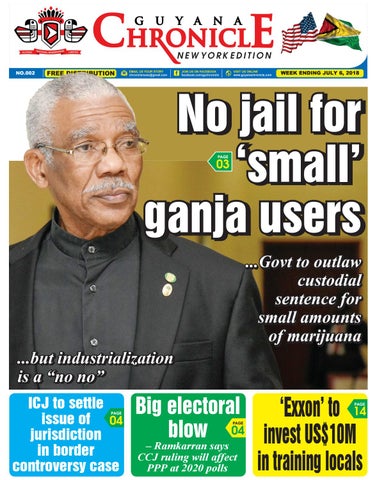
No jail for ‘small’ ganja users PAGE
03
...Govt to outlaw custodial sentence for small amounts of marijuana ...but industrialization is a “no no” ICJ to settle issue of 04 jurisdiction in border controversy case PAGE
Big electoral ‘Exxon’ to 14 blow 04 invest US$10M – Ramkarran says PAGE
PAGE
CCJ ruling will affect PPP at 2020 polls
in training locals
2
Guyana Chronicle New York Edition week ending July 6, 2018
Residents eager for construction new Moruca bridge
– relocation of shops, stalls ongoing
The current wooden bridge which links Kumaka with San Jose at Moruca
R
esidents living at villages in the Moruca sub-region in the North West District are eager awaiting the commencement of the construction of a multi-million dollar project which will see the iconic wooden bridge which connects the villages of Kumaka and San Jose being replaced with a two –lane concrete structure. Already, several business persons, including stall holders who sold their goods close to the bridge, have relocated from the area while others are awaiting the completion of a market facility which is undergoing renovation before making a move. During a recent trip to the area, residents told the Guyana Chronicle that the new bridge would add to the development of the area. While some noted that the decision to relocate their business which they have been depending on as a source of an income for years would be a tough one, they are willing to make the sacrifice. For housewife Ann James, the new bridge would put a safety concern of hers to rest. James, who was born and lives at the village of Parakese said that she has her business about a decade at the waterfront area. She said that replacing the structure would benefit the area especially children who cross the bridge daily during the school year noting that it would be much safer for them to cross. She said that the current bridge was renovated sometime ago however she believes the works were not undertaken properly. James said her son had a stall closer to the bridge but he relocated from the area after it was recognized that persons would have to move in order for works to be undertaken. An-
other resident Genevieve Williams told the Guyana Chronicle that the current state of the bridge sometimes makes her children fearful of crossing the structure. She said she would be forced to walk with her daughter to school, a 4 mile trek, in order for her to cross the bridge safely.”If we get a new bridge A section of the bridge it will change plenty things,” she said. “I would be glad for the new bridge because two vehicles would be able to cross at the same time,” Williams said. Another resident Eugene Austin said that the structure would improve the scenic view of the area. He said that tourism is one of several which would take-off at Moruca in the future and he noted that the new bridge would add to such developments. Austin said too that the concrete structure would be more spacious. ”This one here shaky bad, it could fall anytime,” he added. Neil Norton, another resident of Moruca told the Guyana Chronicle that a newer structure would be welcome sight. “You see to go over now you have to wait on one vehicle to cross before you can drive across,” Norton said. Norton said that the bridge would be able to provide
visitors who travelled in the past to the area, to recognize that Moruca is developing. “It is a sacrifice for those who have to move, because we got to move to get something good going,” he added. Over the years, persons were informed that they should not place permanent structures close to the waterfront area in the vicinity of the wooden bridge since it would hamper any futuristic plans for the area including infrastructure development. Santa Rosa’s new Toshao, Whanita Phillips told the Guyana Chronicle that persons have already relocated from the area where the new structure would be built. She said notices were expected to be dispatched to those persons who remained close to the site where they have built permanent structures over the years. Phillips said too that the new structure would add to the development of the area.
No shortage of insulin – MMU Director D irector of the Materials Management Unit (MMU) Ministry of Health, Cecil Jack, today put to rest allegations that there is a shortage of insulin at health facilities in some parts of the country. The MMU Director said he is deeply disappointed that such information is being peddled in the public when the evidence can speak for itself. “I am disappointed as the director of the MMU, presiding over half of a 40-foot container almost filled with insulin, having arrived in Guyana since February of this year, to be hearing the claims from the public that there is no insulin at the health facilities,” Jack told the Department of Public Information (DPI) on Thursday. I want the public to know that there is absolutely no shortage
of insulin. The 70/30, the soluble neither the lente, we have all in stock” he assured. DPI visited the Diamond, East Bank Demerara (EBD) facility and was able to view the drug packed in the cold storage container. Over the last week, the Ministry of Health has been receiving reports that patients attending certain health facilities for insulin were being turned away and told to buy the drug instead. According to the MMU Director, it is unfair that persons have to purchase the costly drug when it is being supplied free of cost by the government. National Director of Pharmacy Service, Oneil Atkins said the ministry was made aware of the issue, because of the vigilance of the public. “If the public does not make their loud cry and if the public
when they go to their clinic they are not properly registered, we would not be able to adequately quantify. I want the public to ensure that they are adequately registered so that we would be able to take care of their needs and we want them to be that vigilant to have us know when something is going wrong,” he surmised. Atkins said the “cries” of insulin shortages have been coming from all ten administrative regions but have been receiving complaints from two particular regions. “Once I heard that I call, but the public is being turned away and have to go buy insulin.” Insulin, he said is being sold for between $3000 and $5000. “We at the ministry want to let them know that they don’t have to do that, we have enough insulin in the system,” he assured.
A staff exhibits the insulin in storage at the MMU
Guyana Chronicle New York Edition week ending July 6, 2018 President David Granger
3
No jail for ‘small’ ganja users ...Govt to outlaw custodial sentence for small amounts of marijuana ...but industrialization is a “no no”
By Svetlana Marshall in Jamaica
C
ustodial sentences for the possession of small amounts of marijuana in Guyana are likely to be removed in the not so distant future but industrialisation of the cannabis is a no, no for the Guyanese Government. Moments before attending the first Plenary Session of the 39th Regular Meeting of the Conference of Heads of Government of the Caribbean Community (CARICOM) at the Montego Bay Convention Centre in Jamaica on Thursday, President David Granger told Guyana Chronicle that though issue of the decriminalisation of marijuana has not been finally settled at the level of Cabinet, he hinted that amendments are likely to be made to the Narcotic Drugs and Psychotropic Substance Control Act to allow for the removal of jail time for the possession of small amounts of marijuana. “We are moving towards the removal of custodial sentences for the possession of small amounts of marijuana,” he told this newspaper. However, he made it clear that his Government will not be pushing for the industrialization of marijuana production. “We are not moving towards encouraging the industrialization of marijuana production. I think that is a little premature in the context of Guyana, and we have vast landscape in com-
parison with some of the Caribbean Island states, we have challenges for enforcement and challenges for control of that land space, and it will be very difficult for Guyana to embark on that course at the present time. So we are moving towards the removal of the custodial sentences, we are not moving towards the encouragement of the use of marijuana,” President Granger explained. Over the years, several persons have been placed behind bars for having small amounts of marijuana in their possession– a move which has been frowned upon, given the overcrowding of the country’s prisons. Once found in possession of more than five grams of cannabis, a person can be sentenced to three years in jail. His comments come at a time when the CARICOM Heads of Government are considering the recommendations tabled in the Report of the Regional Commission on Marijuana, which, to a large extent, calls for the decriminalization of the marijuana across the 15 Member States but in regulated amounts. On Monday, while at the Jamaica Pegasus, CARICOM Secretary-General, Ambassador Irwin LaRocque said the 10-member commission – which is made up of experts in the fields of medicine, medical and social research, law, education, psychiatry and criminology – analyzed the social, economic, health and legal issues surrounding
marijuana use, and made some far reaching recommendations with regards to the decriminalization of the cannabis. The recommendations are also based on extensive consultations in Antigua and Barbuda, Barbados, Belize, the Bahamas, Guyana, Montserrat, St. Kitts and Nevis, St. Vincent and the Grenadines and Suriname. “They are recommending the decriminalisation of marijuana. They are recommending that it be deemed a substance that is controlled and managed as alcohol,” the Secretary General said while noting, however, that there is some concern about controlling it in terms of youth and adolescent use. In the report, the commission also made a case for legislation to be put in place to allow for research on medical marijuana. Ambassador LaRocque told Guyana Chronicle that in compiling the report, the commission led by Professor Rosemarie Belle-Antoine took into consideration existing laws in some Member States that are cause for concern. “One thing that I read in the report that stands out in my mind so much is that there are in some Member States where the penalty for a small amount of marijuana is sometimes more than some of the other more heinous crimes in the community. Now how can that be? How is it that you can have a youth with a small amount of marijuana or anybody, with small amounts of marijuana and the penalty for such a thing is higher,” Ambassador LaRocque reasoned while noting that it defies logic. NOT BOUND In Guyana, the Attorney General and Minister of Legal Affairs, Basil Williams said the country is not bound to adopt the recommendations made by the CARICOM appointed Commission on Marijuana. “When I met with the Rastafari community, they were saying they wanted to be able to
walk around with 53 grams, so the society must be able to have a debate on these issues,” Williams said while reiterating that his position. “I have chaired the Legal Affairs Committee of CARICOM and matters come and different countries take different positions on them. Some issues are there before CARICOM for 10 years because other countries do not sign on,” he remarked. The Attorney General reminded that Guyana as a country within the regional bloc is governed by its own rules, while noting that before a position is taken, there must be massive consultations. Williams believes that alternative sentencing should be employed by magistrates, while noting that through his ministry, a US$8M loan has been granted to examine the prison population. Nonetheless, the President’s announcement on Thursday is consistent with calls made by the Alliance for Change (AFC). The party, which forms a major part of the coalition government, said it is time legislators move with alacrity to upgrade the laws of Guyana to ensure that custodial sentences for small quantities of marijuana are removed from the books in their entirety. “Custodial sentences serve, in large measure, to criminalise young people, particularly young men who have been caught with small quantities of marijuana – an offence which is a mere error in judgment and not representative of criminal behaviour,” the AFC said earlier this year. AFC Member of Parliament, Michael Carrington, since 2015 had tabled a bill in the National Assembly for debate but it has since been languishing on the order paper, being deferred time and time again. The Guyanese Rastafarian Council is also advocating for marijuana-related laws to be reformed, contending that the Rastafarian community uses the herb for religious and meditative purposes.
Big electoral blow – Ramkarran says CCJ ruling will affect PPP at 2020 polls
F
ORMER House Speaker and PPP executive member, Ralph Ramkarran said the ruling of the Caribbean Court of Justice last week has dealt a major electoral blow to the PPP and hailed the decision as a monumental victory for Guyanese. Writing in his column “Conversation Tree”, Ramkarran said during the lifetimes of Cheddi
Jagan and Janet Jagan, the PPP twice, unanimously, decided to support a two-term presidential limit. He noted that a PPP delegation in 1995/6 proposed to the Parliamentary Select Committee on Constitutional Reform that the Constitution should be amended to provide for a two-term presidential limit.
In 1999/2000, the same representation was made by the PPP to the Constitution Reform Commission. These public proposals reflected those unanimous decisions. Additionally, Ramkarran said during the Ramotar presidency, the then Attorney General Anil Nandlall opposed the application by Richardson to deem as un-
constitutional the amendment to the Constitution that limited the presidential terms to two. Before Mr. Ramotar became president, he had publicly opposed the call for scrapping the twoterm limit. He has welcomed the decision of the Caribbean Court of Justice (CCJ). Ramkarran also mentioned that former President, Bharrat Jagdeo,
former Head of the Presidential Secretariat, Dr. Roger Luncheon, all speaking for the PPP, had at one time or another, publicly expressed support for the two-term presidential limit. Jagdeo had even expressed a lack of interest in a third term. However, Ramkarran observed TURN TO PAGE
10 ►
4
Guyana Chronicle New York Edition week ending July 6, 2018
Understanding Energy...
What do new oil finds mean for Guyana’s future?
E
XXONMOBIL announced a promising new discovery last week in the southeast area of the Stabroek Block. Media reports have rightly cited the Exxon discovery, made at the Longtail-1 well, as more proof that Guyana’s oil future could extend well beyond
the initial production from the Liza Phase 1 development. Exxon and its partners found approximately 256 feet (78 m) of “high-quality, oil-bearing sandstone reserves” at a depth of 18,057 feet (5,504 m). Combined with the nearby Turbot discovery, Exxon is
estimating that this new discovery raises the total estimated recoverable reserves in the southeastern area of the Stabroek Block to 500 million Barrels of Oil Equivalent (BOE). Now, the question is: What does that mean, and, more importantly, what does it mean for Guyana? First, let’s define a few oil industry terms that are important to be understood in evaluating the significance of the discovery. Barrels of oil equivalent (BOE) is a common industry measurement that includes natural gas and other petroleum liquids, as well as crude oil. “Estimated recoverable reserves” doesn’t mean all the oil that’s there; it means the oil that would be cost-effective to extract, depending on the price of oil. Higher future oil prices could potentially mean that more reserves become economically “recoverable”. 500 million BOE is a lot of oil on its own; and when added to the huge discoveries at the Liza and the nearby Payara and Ranger discoveries, Guyana’s offshore enters the realm of a globally significant energy provider. With all areas included, the Stabroek Block now has a total estimated recoverable resources of well over 3.2 billion barrels.
While this new discovery is exciting, the well-established finds at the Liza site will be where Guyana’s first oil is extracted in 2020, and the next two phases of production will most likely be in or near the same area. In terms of its role in Guyana’s oil future, the Longtail discovery is still a bit of a question mark. It points to promising reserves in the southeastern part of the Stabroek Block, but considering the strong progress already made in drilling wells at the much richer Liza find, it likely won’t make much of a difference in the next few years. Widely-cited production estimates from Norwegian researchers at Rystad Energy, an energy consulting firm, put potential Guyanese government revenues from oil at around US$1B annually during the 2020s, but that still only includes projections for the Liza Phase 1 and potential Liza Phase 2 and Payara developments. Any new production from the Stabroek Block’s eastern areas would have to be added on to the 600,000 barrels per day of production that Rystad has predicted for the mid-2020s; and without more exploration, it’s hard to know exactly how much that production
might be. But the Longtail-1 find does heighten the excitement that now surrounds Guyana’s energy future, and Exxon apparently considers the discovery promising enough to now bring in a second exploration ship in addition to the Stena Carron, which drilled the exploratory well. This will bring the total number of Exxon vessels in Guyana to three, since the Noble Bob Douglas is already on site and drilling the 17 development wells that will form the Liza Phase 1 project, which will connect to a floating production, storage and offloading (FPSO) vessel above them. These massive floating production facilities can take in, store, and process oil, up to 120,000 barrels per day, in the case of the planned FPSO for the Liza Phase 1 development. They host hundreds of crew members, and normally require substantial logistical support from onshore companies and contractors. For Liza Phase 2, Exxon has announced plans to add a second FPSO, substantially increasing the number of jobs and the amount of oil to be produced. More FPSOs are definitely possible as the size of Guyana’s resource base grows with additional discoveries.
ICJ to settle issue of jurisdiction in border controversy case
T
HE International Court of Justice (ICJ) said the written pleadings in the case concerning the Arbitral Award of 3 October 1899 between Guyana and Venezuela must first address the question of the jurisdiction of the Court and fixed the time-limits for the filing of these pleadings. In a release the court said by an order dated 19 June 2018, it fixed 19 November 2018 and 18 April 2019 as the respective time-limits for the filing of a Memorial by the Co-operative Republic of Guyana
and a Counter-Memorial by the Bolivarian Republic of Venezuela. Venezuela had indicated that it will not participate in the court’s proceedings. In its release the ICJ said:” the Court issued this decision following a meeting held, pursuant to Article 31 of the Rules of Court, by its President, Judge Abdulqawi Ahmed Yusuf, with representatives of the Parties, on 18 June 2018. At this meeting, Mr. Carl B. Greenidge, the Agent of Guyana, indicated that his Government wished to have at its
disposal a period of nine months for the preparation of its Memorial,” the ICJ release stated. It added that Ms. Delcy Rodríguez Gómez, Vice-President of Venezuela, stated that her Government “considered that the Court manifestly lacked jurisdiction and that it had decided not to take part in the proceedings”. She handed to the President of the Court a letter, dated 18 June 2018, from Mr. Nicolás Maduro Moros, President of Venezuela, in which he pointed out, in particular, that “there [was] no basis for the jurisdiction of the Court” and that Venezuela “[would] not participate in the proceedings”. In response to the statement of the Vice-President of Venezuela, the representatives of Guyana reiterated that their Government wished to proceed with the case. In its order, the Court pointed out that, in the circumstances of the case, it must first resolve the question of its jurisdiction and that “this question should accordingly be separately determined before any proceedings on the merits”. The
Order notes that “the possibility for Venezuela of availing itself of its procedural rights as a party to the case is preserved”. The subsequent procedure has been reserved for further decision. Back in March when Venezuela indicated that it will not participate in the case the Guyana Government made it clear that it intends to proceed with the case, noting that under Article 53 of the Statute of the Court, “whenever one of the parties does not appear before the Court, or fails to defend its case, the other Party may call upon the Court to decide in favour of its claim.” The Ministry of Foreign Affairs, in a statement had said: “Guyana is fully committed to the rule of law in international relations, including the peaceful resolution of disputes in conformity with international law. It trusts that the International Court of Justice, the judicial organ of the United Nations, will resolve the controversy with Venezuela in accordance with the law in a manner that is fair and equitable. It hopes that, in due course, Venezuela will reconsider its position and decide to
appear in Court and defend its case. The Court’s rules allow for that.” At the same time, Guyana said that if Venezuela persists in its refusal to participate in the matter, the rules provide for the Court to proceed, after a full hearing of the case, to a final judgment that is legally binding on both the participating and nonparticipating parties. “The Ministry of Foreign Affairs wishes to reiterate that Guyana fully respects the decision of the Secretary-General of the United Nations to choose the International Court of Justice as the means of settlement of the controversy and is confident that the Court is fully empowered to decide the case,” the Foreign Ministry statement read. Guyana had filed an application with the ICJ on March 29, 2018, requesting the Court to confirm the legal validity and binding effect of the 1899 Arbitral Award regarding the boundary between Guyana and Venezuela. As such, the ICJ invited representatives of both Guyana and Venezuela to meet at the ICJ TURN TO PAGE
5►
Guyana Chronicle New York Edition week ending July 6, 2018
5
Rupununi refutes ‘rigging’
N
EWLY-elected Rupununi toshaos have all refuted allegations of “rigging” in the recently held national village council elections in indigenous communities. The 57 toshaos as well as councillors have openly and loudly affirmed “YES” to the question, “Were your elections free and fair?” During May-June, elections were held in 115 Amerindian villages, together with some 46 satellite communities. The Opposition may have reasons to be bitter, as many of the toshaos who were once openly associated with the current Opposition party, have been replaced by younger leaders. Among the new toshaos, there are 14 women. Although I am still within the post-surgery period, when almost everyone would advise me to “take it easy”, I accepted an invitation by my friend Brian Allicock, Chairman of the Upper Takutu-Upper Essequibo (Region Nine), to attend the Regional Toshao’s Conference in the border town of Lethem, which was held Friday last. PICTURESQUE SAVANNAH The Rupununi is Guyana’s south-west region that borders Brazil, and is populated mainly by Indigenous Peoples --Wapishana, Macushi, Wai-Wai and Patamona. For centuries, these “First Nations” have lived in the 5,000 square miles of savannah grasslands and forested mountains, the most picturesque being the Kanuku range. We could see from the air, isolated large swamps and tracks of flood waters along the banks of the Rupununi River, criss-crossed by the red-brown trails and roadway. From above, this part of Guyana looked serene. The low-hanging white clouds held no ominous threat of rains, which had pounded the mountains and had resulted in over-topping of the Takatu River. As we made the landing, the Tabatinga Bridge stood tall over the receding water, and was a reassurance that that part of the Rupununi was no longer under threat of flooding. I was there last year, at this time, when Brazilian rivers had backed up, and some communities on the Guyana side were affected by flooding. This year, personnel from the Civil Defence Commission went early into the area and offered help in anticipation of serious flooding, which was averted. Once on the ground, it was evident that the Opposition was mobilising, and that a show-down was certain. At the conference, the Opposition was quick to work up steam with claims that the region, under the new Coalition Government, was showing “progressive levels of neglect”. That opinion, however, was not shared by the Regional Chairman. In pre-emptive and anticipatory remarks, he had announced that his Region was “leading the way” in promoting development and meaningful involvement of Rupununi residents. STACCATO OF FALSE CLAIMS I had not planned to speak at any length at the toshaos conference, but, as a politician who had seen many battles, I was forced into a comprehensive rebuttal of the allegations made by the Opposition, which was represented by three sitting Members of Parliament. I understood that the Opposition’s intention was to do a sting job to whip up rage amongst the toshaos. So they made multiple allegations about elections rigging, gerrymandering of village borders, lack of consent, inadequate funds for Amerindian development, and failure of the Hinterland Employment and Youth Service (HEYS). I had anticipated that the Opposition would encourage toshaos to walk out by the time I got to the podium. But the village leaders were unmoved by the staccato
of false claims. They certainly showed that they knew better, as they eagerly awaited my address. By the time I was finished, the elite corps of Oppositionists unceremoniously walked away. It just wasn’t true that the new government didn’t allocate funds for Upper Takatu/Upper Essequibo. I quoted figures to show that over these years, Government has spent over $780 million in presidential grants and on capital works. And as an additional show of goodwill, I handed out another tranche of $20 million in presidential grants to several villages. As a striking example of how the Region was being transformed, I mentioned the introduction of hinterland radio stations - Lethem and Aishalton and Radio Piwomak; and as I did, toshaos responded with prolonged applause. They seemed very pleased about the provision of free Internet access at several ICT hubs at public offices, and at schools. And they greeted, enthusiastically, the promise that soon, governmental services would be provided Online to apply for passports and birth certificates. NO NEGLECT There could be no “progressive neglect” when toshaos could look around and see the change of Lethem into a town; when they could access a new Magisterial District Court and fire station; witness the growth of the Lethem Industrial site; buses for schoolchildren in villages such as Annai and Aishalton; the construction of the water reservoir on Nappi lands, which would hold 4.5 million cubic meters of water, etc. I announced that as soon as the rains eased, drilling of eight wells will commence, which will store water for the drought seasons. While rehabilitation of the Lethem town road network is in progress, with asphaltic concrete surface, the Linden-Lethem road has been placed again on the front-burner. Funds have been allocated to design and construct a research station at Pirara to facilitate herds of cattle, poultry rearing, fish ponds, orchards, a huge reservoir and an abattoir.
In the meantime, eight villages are benefitting from a US$3.1M sustainable hinterland housing project; and monies would be sourced to expand the Lethem Hospital’s maternity waiting room. While the toshao conference continued, we journeyed to St Ignatius where a full benab was waiting to honour participants in the HEYS training programme. There, we handed out prizes of $100,000 each to the top five young entrepreneurs. Under the programme, young people were supported to access small loans, and to benefit from the free distribution of agricultural tools, sewing machines, computers, stoves and catering kits. We met an otherwise able young man with one leg, who explained how HEYS helped him to start a butchery and cattle farm from which he makes a weekly profit of $30,000; and how he hoped to be the single largest supplier of fresh beef in Rupununi. There were women who exhibited their bottled honey and canned peanut butter as a result of support from the programme. RECEPTIVE EARS It is clear that the message of development is reaching receptive ears in Upper Takatu/Upper Essequibo, and the tune of “rigging” is no longer pleasing to the ears. The Opposition cannot go against the tide of cooperation across party lines for community development. It cannot grow on negativity, as DDL entrepreneur, Komal Samaroo has said in another context. “Rupununi Rising” is the title of a five-minute television production by the Department of Public Information. It captures the essence of the changes taking place in our hinterland communities, and our Indigenous Peoples are more likely to be convinced with what they see, rather than being fooled by politicians who peddle propaganda about suspected rigging and conjured future rigging of elections. The Opposition must either dump that old tune or its current leadership, or both.
ICJ to settle issue of... in The Hague, seat of government of the Netherlands, to fix schedules for written pleadings. In its Application, Guyana requests the Court “to confirm the legal validity and binding effect of the Award Regarding the Boundary between the Colony of British Guiana and the United States of Venezuela, of 3 October 1899 (hereinafter the ‘1899 Award’).” Guyana is contending that the 1899 Award was “a full, perfect, and final settlement” of all questions relating to determining the boundary line between the colony of British Guiana and Venezuela. It is also Guyana’s position
that, between November 1900 and June 1904, a joint Anglo-Venezuelan Boundary Commission “identified, demarcated and permanently fixed the boundary established by the… Award” before the signing of a Joint Declaration by the Commissioners on 10 January 1905 (referred to by Guyana as the “1905 Agreement”). Guyana is further contending that in 1962, for the first time, Venezuela contested the Award as “arbitrary” and “null and void”. This, according to the Applicant, led to the signing of the Agreement to resolve the controversy between
FROM PAGE
4
Venezuela and the United Kingdom of Great Britain and Northern Ireland over the frontier between Venezuela and British Guiana at Geneva on 17 February 1966 (the Geneva Agreement), which “provided for recourse to a series of dispute settlement mechanisms to finally resolve the controversy”. Additionally, Guyana submits that the Geneva Agreement authorised the United Nations Secretary-General to decide which appropriate dispute resolution mechanism to adopt for the peaceful settlement of the dispute, in accordance with Article 33 of the United Nations Charter.
6
Guyana Chronicle New York Edition week ending July 6, 2018
Modernising manufacturing and the export trade
F
ROM time to time in the last several years, many prescriptions have been proffered as to how to leaven up the Guyana economy into sustained prosperity. The overwhelming majority of such prescriptions have been made by academic economists who have had little experience of the actualities of business. These prescriptions have generally never gotten off the ground. Last week at the launching of the Georgetown Chamber of Commerce and Industry (GCCI)’s business magazine, Executive Chairman of Demerara Distillers Ltd (DDL) Mr Komal Samaroo was asked to give the feature address and he chose to speak on how the country could reduce its balance of payments deficit, which has been growing and how to move towards an economy where self-sustaining growth would be the norm. Mr Samaroo mentioned that an infrastructure of optimism is necessary for any economic or business venture to be successful, since pessimism generates negative energy. His mentor Dr Yesu Persaud always saw the silver lining in every dark cloud and it
was that silver lining he always actualised. He therefore emphasised to his audience that Guyana’s future has never been brighter and this notion should inform business folk, as well as those who are responsible for the state’s economic and financial work. Mr Samaroo mentioned that Guyana, like most Third World countries, had traded mostly in commodities such as gold or bauxite or sugar. The prices of commodities are fixed by the international markets and influenced by demand and supply. He gave a salutary and timely reminder that the upcoming gas and oil exports will be no different in essence from the other commodity exports. “In my view”, said Mr Samaroo, “this is a very vulnerable position to be in, and the nation’s prosperity could swing like a pendulum, as we have seen in some countries in the Region that depended solely on commodities.” This concept has to be fully assimilated, both intellectually and emotionally, by all those who are responsible for the economic well-being of the country, so that a national strategy to avoid the commodity trap could be formulated. Mr Samaroo implied that a major element
in the strategy to avoid the commodity trap is expanding manufacturing and the export markets, both regionally and internationally. He did not spend time to speak about how new manufacturing and export industries could be established. He took these as a given, as well as the present export industries. What he focused upon was how manufacturing and industries could be made more efficient and productive, satisfying the requirements of the export markets and how such markets could be expanded. In this regard, we will quote Mr Samaroo: “The international market place is very competitive, complex and constantly evolving, requiring in-depth knowledge and updated information if one is to be successful, particularly if you move higher up the value chain with branded products. Very often we need to re-educate ourselves.... Compliance with international standards and best practices is also a key, especially at production level. These were critical prerequisites for manufacturers to get into the global supply chain of major companies. The traceability and documentation of adherence to international standards of
safety, quality, environment, business ethics and social practices are all areas of regular audits from suppliers. The production systems must meet international standards at all times, and this requires a high level of technical competence and discipline of the management of manufacturing companies.” Mr Samaroo then went on to use the experiences of his own company, Demerara Distillers Ltd, to illustrate that it was not insuperable for local manufacturers and exporters to achieve required standards and secure foreign export markets. Within the body of his presentation, he mentioned two challenges facing manufacturers: the first was sloth and unhelpfulness of the bureaucracy, a problem which could be overcome once there is the will. The other was that the education system has to be improved to produce people who are fully equipped with the skillsets to manage business in this technological age. We have no doubt that expanding and diversifying our manufacturing industries with resultant expansion of regional and international trade is the surest way for Guyana to achieve sustained growth and prosperity.
‘Success’ and ‘Failure’ in Education Dear Editor
T
HE media has been full the last few days with stories of ‘success’ and ‘failure’ in terms of the Grade Six assessments. Whilst a few students bask in their scores, thousands more lament the results. Lists are made of the ‘good ‘schools in terms of their exam results. The criterion for a ‘good’ school being one or more student in the top 1%. No mention, of course, is made of the many others who ‘failed’ the exam from the same ‘good schools.’ This is not Guyana’s challenge alone. A popular writer, John Holt, wrote a bestseller, with the first line, “most children in school fail.” They fail to develop more than a tiny percent of their capacity. Education worldwide is blindly focused on a slavish pursuit of ‘completing the syllabus,’ with precious little reflection on how much of that sacred syllabus really matters. Few syllabi worldwide give more than scant attention to the environment, sexuality issues or world citizenship. Whatever the merits of the Grade Six assessment, it is surely time for a radical look at what we are doing in education in Guyana. The Commission of Inquiry has come and gone and we read in the newspapers over the past few days that 40% of students failed English, 62 failed Maths and 44% failed Science.
So where do we go from here? School of the Nations has made one attempt to respond to this urgent need in our education system by introducing the Cambridge University Certificate in Educational Leadership programme in Guyana. This is being offered in collaboration with the Ministry of Education. The Chief Education Officer, Mr Hutson, recently arranged for the Director of “Nations,” Dr Brian O’Toole, to meet with all the regional education officers (REdOs) to discuss the programme and how it could be implemented across Guyana. The first cohort of 35 teachers and administrators is now close to completion of the certificate programme. A second group is to start in September. Significantly, seven of the REdOs are pursuing the programme themselves. Mr Nigel Richards, REdO for Region One, has organised the Cambridge Certificate for his region and 30 teachers gathered in Mabaruma last weekend to start the programme. This is being done in collaboration with the 23 trained teachers who are here in Guyana for the summer from USA as part of the LRTT (Limited Resource Teacher Training) programme. The REdOs of Essequibo Coast and Berbice are planning meetings with all the head teachers in their respective regions to intro-
duce the Cambridge Certificate programme. Also, plans are in train to take the programme to the Rupununi and Mahdia. The Cambridge University Certificate programme focuses on leadership and the need for fundamental reform in education, not just in Guyana, but worldwide. The certificate programme begins by exploring the challenges facing education throughout the world and why so many children are failing. The texts that accompany the course explore what contributes to the most successful education systems internationally, eg in South Korea, Canada, Singapore and Finland, and why other countries, despite their wealth, such as the USA and UK, are falling behind. In the ‘progressive’ countries there is very little disparity between the best and the ‘poorer’ schools. In Canada, for example, there are good schools throughout the country, even in very isolated regions. In these countries, unlike Guyana, teaching is regarded as a very attractive profession. One of the course texts states that a number of urban schools in the U.S. are “sinkholes for poor minorities,” with a range of ages and abilities in one class. Teachers are suffering from the demands of satisfying parents whilst, at the same time, attempting to respond to the competing demands of politicians and school
administrators. But rather than dwelling on problems, the Cambridge programme explores what can be done to respond to the challenge. Fundamental to the programme is the need for a whole school focus. The course promotes a reflective, enquiring, problem-solving approach. Key elements of the certificate programme are: how to get more teachers of quality, the need to promote more rigorous teacher training and the need to reflect on how to cultivate an ethos of striving for excellence on the part of persons in education. Charismatic leadership produces only temporary gains. There needs to be a move to a model of distributive leadership in which the focus is on changing the whole school. With charismatic leadership others just sit back and expect the leaders to do everything, heroic leaders in fact prevent the emergence of strong institutions. We need to promote and nurture emotional intelligence in our teachers and move away from the arrogance and inflexibility of the past and embrace an atmosphere of self-awareness and empathy that will allow teachers to meet the stresses of modern-day teaching. One of the Cambridge texts states that 40% of U.S. teachers from Nursery to 5th Form TURN TO PAGE
7►
Guyana Chronicle New York Edition week ending July 6, 2018
7
Still in a political Jurassic Park Dear Editor
P
EOPLE’S Progressive Party/ Civic Member of Parliament Charles Ramson’s public declaration of intent as a contender for the nomination of his party’s presidential ticket, and the subsequent response from party leader Bharrat Jagdeo, who has bluntly said that this Member of Parliament (MP) has departed from established party norms in making such an announcement and MP Harry Gill’s letter, branding Ramson
a “spoiled brat”: in Kaieteur News, July 02, 2018,“ Charles Ramson will make a great President of Guyana, but not now” highlights the decrepit, undemocratic party ideology of democratic centralism. It is the well-known gagged system whereby individual positions are not tolerated, unless it represents the united voice of the party. It has exposed the divide between the modern-minded and enlightened younger cadres of the party, as per Ramson’s statement, as against the unyielding, decrepit,
and archaic mindset of Jagdeo, defended by Gill’s letter. Undoubtedly, Ramson’s statement, particularly on the role of young people is a direct challenge to a party, inclusive of Gill, which despite the presence of a number of young members, continue to exclude them from its senior-echelon, decision-making organ. In fact, such thoughts expose the undemocratic ways of the PPP/C, since the young pretender said, “If you invite our generation into the process and court our support, then you are
going to have to accept that we are going to be bringing fresh ideas, beliefs and way of doing things too. We respect customs, but we also stand firmly for freedom, justice, openness and fairness.” This, without any argument, punches at the heart of the medieval mindset of the party’s ways of understanding a world that has experienced rapid change in governance, with renewed concepts of human rights and justice as they relate to the lives of the governed. Without debating the sincerity or not, of such a departure from tradition statement from this PPP/C MP, these are views that can be interpreted as condemning the entire party’s past system of governance, especially as it relates to a multi-cultural society of Guyana, and its blatant policy of racism and marginalisation. Until now, they are a definite repudiation of the fossilised mentality of a party, that are represented by a dinosaur collective that are still residing in a political Jurassic Park. Regards Earl Hamilton
Responsible parenting
Dear Editor
I
T is ironical, that after the recent celebration for Mother’s and Father’s Days, we are spotlighting the very important key of responsibility as parents, and the need to protect and safeguard the latter, since it has critical bearing on both the material and spiritual growth and development of the child/ children. It is not for us to believe or not, the stories given by two fathers who recently found themselves in court for criminal offences, for which they were found guilty and given custodial terms. Such a function is entirely the court’s exclusive preserve, and it has been duly exercised, as was to be expected. In both instances, the excuse given by the accused is that they were committed for the maintenance of children, stealing from a companion and the other for being found with narcotics. It is a defence that used to be very prevalent in our courts, but never attracted much sympathy, if any. The law took its natural course then, as it did again. Parenthood is perhaps the most important responsibility that can confront every man, or woman. And though many times that its occurrence may not have been planned, or seen to have taken place in the formal ideal setting of a family plan, it signals the possibility that this may take place at some time. Whether planned or not, becoming a parent means an event that takes the immediate spotlight away from the parent, focusing on the child. The latter must now become the reason that guides and influences the actions of either parent, or both together. This means a new understanding of the individual’s role, if never before; or together, since parenthood means both a moral and legal responsibility on any of the individual parent, or both, as is the ideal. There are too many instances in which fathers especially, are engaged in some form of illegality, of varying risks that render them liable to either sudden physical harm, mostly death, or coming into conflict with the law, which will also have its serious consequences, as in the examples of the two fathers, alluded to above. Well meaning, since in their view it satisfies their requirements of being providers; but it still
cannot be, since it is illegal, and leads a distorted example of what a responsible parent ought to be. Moreover, the reality of that “good provider” is exposed when it suddenly comes to an end, which is always predictable. It is recognised that we live in a world that has not been, and is not fair to many, because of the varying circumstances/ interventions which have altered dreams, hopes, wishes and aspirations. This means for many, not being able to be materially comfortable, as the more fortunate, because of missed and unavailable opportunities, deprived, to be specific. However, suffice it that it has always been so, and will continue to be, parents, more so fathers, who are engaged in risky forms of earning/employment, must understand what such means for the future prospects of their family, particularly their children. In both the short to long-term, fathers must be of the serious realisation that even though there may be psychological pressure and urgency to bring material improvements to the lives of their children, and by extension
their family, there are forever risk factors in their illegal endeavours. For not only are such untenable in every way, but it is always their children who suffer from the fall-out from any related untoward consequences. No father, who cares for, and loves his family, must consider providing for them through criminal means. Thus, it is incumbent upon fathers, those whose daily activities for a dollar fall outside the ambit of the law, begin to take stock of the risks of their trade that weaken both their responsibility and longevity of fatherhood to their children. Although it is said that the world owes us a living, it certainly must not mean–by illegal means for anyone of the parent duo, particularly fathers; or any other relation. A father cannot be of any use to his children, if he is imprisoned. Regards Conwell Edmonds
‘Success’ and ‘Failure’... teachers are “disillusioned” and are just waiting to leave the job. An essential element of the certificate course is that good teaching is actually very hard and needs extensive training, The focus is to work with groups and not individual teachers. We don’t need more ‘projects,’ rather, we need a coherent plan. We need to move away from the fragmented, faddish and inflexible approach that we have pursued in education for too long. We need to move away from being consumed by data which often focuses on failures and on what can be easily measured. Teachers need to learn how to learn and how to embrace change and take risks. For far too long teachers
have felt powerless and without a voice. Their response is to leave the job. We need to appreciate that good teaching is actually very hard and demands extensive training. In sport, the arts, music it is the same. Ronaldo, Beyonce or Halle Berry rehearse and practise constantly – why should it be any different for teachers? We need to develop ‘souls’ within our schools, characterised by care, trust and empathy on the part of the teachers. We need to help our teachers feel they are part of something bigger. The wider community needs to be more effectively involved in schools. In Singapore there is a clear sense of
FROM PAGE
6
pride and national direction and a very clear sense of where they want to go. How can we develop that same ethos in Guyana? If we fail to begin this consultation, the danger is that we will have more Commissions of Inquiry, more conferences and more state papers and still the key issues would remain unresolved. In the UK and the USA, this failure results in riots as the poor hit out at their lack of opportunity. How will the scenario play out in Guyana if we fail to act? Regards Dr Brian O’Toole, Director, Nations University
8
Guyana Chronicle New York Edition week ending July 6, 2018
Enough with the talk! – Time for some action regional leaders urge By Svetlana Marshall in Jamaica
R
EGIONAL leaders were urged to do more than just talk and take action when the 39th Regular Meeting of the Conference of Heads of Government of the Caribbean Community (CARICOM) opened Wednesday at the Montego Bay Convention Centre in Jamaica. The call has specifically to do with the reticence in some quarters to implement the Caribbean Single Market and Economy (CSME) and other critical initiatives, and came from CARICOM Chairman and Prime Minister of Jamaica, Andrew Holness; Prime Minister of Antigua and Barbuda, Gaston Browne; and Prime Minister of Barbados, Mia Mottley. Holness said that with CARICOM turning 45, it is only fitting that the 15-member community pause and reflect not only on its achievements, but the challenges that they’ve faced as well along the road to regional integration. Contending that the CSME is undoubtedly the single most significant regional initiative that has occupied the attention of member states since its inception in 2003, Prime Minister Holness, who himself turns 46 later this month, said its progress has not been commensurate with the region’s aspiration. Noting that Jamaica is as committed now as it has ever been over the years, Holness, reputedly the youngest prime minister Jamaica has ever had, said: “I take this opportunity to reaffirm Jamaica’s commitment to the principle objectives of CARICOM, including the expansion of trade and investment opportunities for its members, the promotion of foreign policy coordination and structural functional cooperation.” Under the theme “Building Stronger Resilient and Secured Partnerships for Prosperity”, Holness, whose forte is management and development studies, said that as chairman of the 15-member bloc, he is calling on all member states to summon the necessary political will and determination to ensure that all programmes and initiatives are strategically focused and geared towards meeting an ambitious process of reform. He told regional leaders that in light of the ever-changing global dynamics, it is imperative that they conduct a thorough assessment to determine whether the Community is appropriately positioned to collectively advance economic corporation for mutual benefits for the region’s people. GOLDING REPORT With reference to the Bruce Golding Commission Report, Prime Minister Holness said the Jamaican Parliament has adopted a landmark resolution, which, among other things, underscores the importance of CARICOM Member States making a clear commitment to establish the Single Market by putting in place measurable and verifiable programmes of actions in place to fulfil all outstanding obligations. On that score, he said that Jamaica is proposing a period of five years for implementation, as no longer can the materialisation of the Single Market and Economy be delayed. Noting that the young people of the region are calling on their leaders to be accountable, Prime Minister Holness said: “It is my considered view that the single market is a victim our own reluctance to fully and functionally establish the CSME... “As I have often stated, the CSME is the ultimate manifestation of regional integration; some of its pillars represent the only real means by which our citizens will experience the
process of integration. “We must, therefore, as leaders of this great community relentlessly pursue the goal of overcoming our implementation deficit.” Taking up the charge was Prime Minister Browne of Antigua and Barbuda, who said that members states must do all in their power to ensure the success of the Community, as the unity of the region is the salvation of its people. “Integration is not only desirable but inescapable; but it has been 53 long years since the flame of integration was reunited at Dickenson Bay from the ashes of the West Indies Federation,” he said. “Surely in 53 years, we should have been further along the road to economic integration than we are now; others started after us, yet they have gallop ahead,” Prime Minister Browne added, as he cited the European Union (EU) as a fitting example of what he was referring to. He is convinced that after 53 years of “crawling” through the process of integration, disappointment has replaced hope, and skepticism has overwhelmed faith. But all is not lost, he urged his colleages, as the conference has provided an opportunity for they as regional leaders to turn the tide around. “We have a chance at this summit to change that situation, and to restore trust and confidence in the people that we can make and implement joint decisions that would improve their lives; that we can do more than talk; that we can take action,” he posited.
UNIFIED ACTIONS Before taking his leave, Prime Minister Browne called for unified actions in achieving the Single Market and Economy, emphasising that the time for action is now. Delivering what will be her maiden address at a Heads of Government summit since taking office on May 25 this year, Prime Minister of Barbados Mia Mottley, the first woman to have ever held that position on the island, said it is no secret that Barbados is in a state of deep economic crisis. But even with its current state of affairs, she said, the Government of Barbados is unequivocally committed to the cause of regional integration, and ready to play its full and active part within the Caribbean Community in moving the process forward. “We consider it an integral part of our future,” the firebrand politician assured her regional colleagues, adding: “As for myself, I am more than eager to get to work in my capacity as Lead Head for the CSME. It is a serious responsibility and I intend, absolutely, to treat it as such.” But sadly, enthused though she is, Prime Minister Mottley said, many of the same structural, legal and administrative impediments to implementing the CSME are still with us. “We certainly do not lack for studies to tell us what is wrong,” she said, adding: “Sadly, these can sometimes serve, inadvertently, to reinforce the cynicism and pessimism that we as leaders have allowed to dampen our natural enthusiasm for the idea
of integration. “More and more I find myself asking: Why are we so obsessed with diagnosing what is wrong? When last have we looked to our own people and their actions to show us what is right?” Prime Minister Mottley said the people’s interest must remain paramount in discussions on trade and regulations. Turning her attention to regional travel, the Barbadian Prime Minister said that while interaction among our Caribbean people strengthens regional integration, it is rather unfortunate that this, too, is being stifled. “A Single Domestic Space for hassle-free travel in a sense presupposes the existence of a Single Domestic Space for Transportation,” she said. “Something is, therefore, fundamentally wrong when travel to Miami or New York is more accessible and cost-effective for our people than travel to their nearest Caribbean neighbour. We simply have to do better,” she added. MAJOR SHAREHOLDER As the major shareholder in LIAT, PM Mottley, who first entered at 26, said the Government of Barbados remains committed to working assiduously with its other partner governments to enhance the airline’s operations and profitability, while simultaneously offering an affordable and reliable service to the region’s people. “To get the full benefit of our common space in the movement of people, cargo and vehicles,” she said, “renewed and focused leadership is also called for to translate the much-studied inter-island ferry service from concept to reality; to move beyond talk and to actively encourage investment by our private sector to unlock new categories of travelers.” For CARICOM Secretary-General, Ambassador Irwin LaRocque, this 39th HOG confab provides another opportunity to have, once again, a historic moment in Montego Bay with respect to the CARICOM Single Market and Economy (CSME). “Since the CSME was inaugurated here in Jamaica 12 years ago,” he said, “we all agree that much has been accomplished under its regimes. “But we have not achieved as much as we should have by now; major policy decisions and adoption of legal instruments take much too long to be negotiated. “We must do more, and do it more quickly; the success of the CSME is being judged by the public, on the basis of our implementation of the measures agreed to, that allow our citizens and businesses to benefit,” he implored the regional leaders. A special session on the CSME has been set to address its effectiveness. Despite the challenges, he said Member States have agreed that the CSME remain the most viable option and platform to enable the Community and its nationals to achieve their goals of sustainable growth and development but underscored the need for substantial improvement. “They expressed particular concern about the ease of doing business and the movement of skilled nationals. The participants also lamented the lack of compliance with already agreed measures. They stressed the need for an enforcement and accountability framework to encourage implementation and compliance. It is one of the issues which features among the recommendations in the Report of the Commission to Review Jamaica’s Relations within the CARICOM and CARIFORUM Frameworks which is before this Meeting. The views and recommendations of that Commission add a voice to the conversation on the future of CARICOM and the CSME,” he explained. President of Haiti, Jovenel Moise and Prime Minister of Grenada, Dr Keith Mitchell also addressed the regional leaders. President David Granger and Vice-President and Minister of Foreign Affairs Carl Greenidge are attending the high-level regional meeting, which concludes today.
Guyana Chronicle New York Edition week ending July 6, 2018
9
Works to commence on Pegasus Corporate centre
T
he Pegasus Suites & Corporate Centre is set to commence preparatory works for foundation and land filling, management announced in a release. This project, adjacent to the iconic Pegasus Hotel, represents a US$100M investment making it the largest local private sector investment ever to be undertaken in Guyana. It comprises of two towers, a twelve story Tower providing luxury accommodation and a connecting seven story corporate Centre providing first world office and conference facilities with Restaurants, Gym and SPA. According to the release, this investment brings a new
model of business tourism complementing the current hotel and entertainment facilities at Pegasus Hotel. Companies doing business in Guyana would now able to have grade A offices and accommodation on the same location. Many expat companies that have their offices in Trinidad and beyond who are developing businesses in Guyana would now find it more competitive to move some of their administration and other activities to Georgetown bringing significant employment. Office presence brings additional long term accommodation with spinoffs for the Pegasus Hotel, its bars, restaurants and entertainment facilities.
In consequence this project brings significant economic benefits to the Guyanese economy in terms of sustainable employment, taxes (income, corporate and Vat ), foreign exchange earnings and the multiplier economic effects that private sector investments bring. In fact in the first year of operation this project would contribute in excess of $200M in Vat to the national coffers. Even during the construction phase employment of 300 persons, 60% local, plus the effects on expanding business of local businesses and sub-contractors, truck drivers, suppliers of stone, sand, steel, wood and concrete would significantly impact the growth of our economy.
FDI in Latin America and the Caribbean pegged totaling US$161.673B
D
espite an international context characterized by stronger growth in the global economy, abundant international liquidity, high corporate returns and optimism in financial markets, the flows of Foreign Direct Investment (FDI) in Latin America and the Caribbean – on average, and with great heterogeneity within the region – fell for the third year in a row in 2017 to total $161.673 billion dollars, down 3.6% from the previous year and 20% below the level reached in 2011. This is according to the report Foreign Direct Investment in Latin America and the Caribbean 2018, released today by ECLAC at a press conference in Mexico City led by its Executive Secretary, Alicia Bárcena. In this document, the United Nations regional commission calls on governments to incentivize quality FDI that is compatible with sustainable development, above all to promote a change in countries’ productive structures that enables the fulfillment of the 2030 Agenda and its Sustainable Development Goals (SDGs). The report by the Economic Commission for Latin America and the Caribbean (ECLAC) explains that in a medium-term analysis, the persistent fall in FDI since 2011 can be attributed
to lower prices for basic export products, which have significantly reduced investment in extractive industries, and to the economic recession experienced in 2015 and 2016, mainly in Brazil. These two trends, however, were partially reverted in 2017 when the region resumed growth (1.3% of GDP) and the prices of oil and metals picked up. This uptick in prices raised the returns on investment after several years of declines, which also encouraged reinvestment of profits, albeit not enough to make up for the fall in FDI in the extractive industries, the report indicates. While in 2016 the vast majority of countries in the region saw declines in their FDI inflows, in 2017 FDI rose in the majority of them. However, drops were experienced in Brazil (where it fell 9.7%) and Chile (-48%), and to a lesser extent in Mexico (-8.8%). In Central America, FDI rose for the eighth straight year (to $13.083 billion dollars), with a particularly notable increase in Panama, which reached $6.066 billion dollars. In the Caribbean, flows grew 20% to $5.835 billion dollars, more than half of which (60%) went to the Dominican Republic. In these countries, increased investment in the area of tourism has been very significant, but flows to the natural resources sector have also grown in Jamaica and Guyana. According to ECLAC’s FDI report, the main sources of foreign direct investment to the region in 2017 were TURN TO PAGE
16 ►
10
Guyana Chronicle New York Edition week ending July 6, 2018
ribbean Development Bank and the Caribbean Examinations Council. Justice Saunders replaces Sir Dennis Byron as President of the CCJ. In his address, Sir Byron in handing over the presidency to Justice Saunders, expressed confidence in his ability to lead, noting that the court has been outstanding it in its performance. “The judicial work of the court has been effective. We have no backlogs and I think it has also developed Caribbean jurisprudence significantly. The ancillary institutions, the regional judicial and legal services commission and the trust fund are healthy and fully functional,” Sir Byron said. Noting that the institutional framework has stood the test of time, Sir Byron said Caribbean nationals can be justifiably be proud of it. “However, as I have often
expressed, excellence is not a state that we reach, it is the process of continuously trying to be and to do better and it may well be that after 15 years of experience, we will continue to find additional needs to improve and strengthen all of these institutions,” he added. CARICOM Secretary- General Irwin LaRocque, in offering congratulations to Justice Saunders, said that he has made history in his own right by becoming the first graduate of the Region’s legal education system to be elevated to the Office of President of the CCJ. “This represents a milestone in the evolution of our judicial history and sends a positive message to all, not only about the standards at our legal education institutions, but also about the confidence which the Regional Judicial Legal
Service Commission has in the quality of the graduates. This truly marks the beginning of a new era,” Ambassador LaRocque said. The CARICOM Secretary- General also used the opportunity to express gratitude on behalf of the Community to Sir Byron, noting that he has presided over judgements with far-reaching effects. “Thank you, Sir Dennis, on behalf of the Caribbean Community for your most significant contribution to the advancement of the integration process and regional jurisprudence,” the ambassador said. Justice Saunders has been a judge at the CCJ since 2005 and contributed immensely to the administration and judicial functions of the court. Justice Saunders is also Chairman of the Caribbean Association of Judicial Officers (CAJO) and the Course Director of the Halifax-based Commonwealth Judicial Education Institute’s CJEI’s Intensive Study Programme. He is also one of the institute’s directors. He co-authored the book, Fundamentals of Caribbean Constitutional Law and is a contributing editor of the Caribbean Civil Court Practice. In April 2018, he was appointed to the Advisory Board of the Global Judicial Integrity Network by the United Nations Office on Drugs and Crime (UNODC). He holds a Bachelor of Laws degree from the University of the West Indies (Cave Hill) in 1975 and the Legal Education Certificate from the Hugh Wooding Law School in Trinidad & Tobago in 1977. He was called to the Bar of St. Vincent and the Grenadines in that same year. He worked with Sir Dennis at the Eastern Caribbean Supreme Court and was later reunited with him in 2011, when Sir Dennis was appointed President of the CCJ. Among regional leaders present at the opening ceremony were Chairman of CARICOM, Prime Minister of Jamaica, Andrew Holness and Prime Minister of St. Vincent and the Grenadines, Ralph Gonsalves.
ment limited the right of Guyanese to choose who they want to be the President. By doing so, the amendment adversely affected or diluted and, in effect, amended articles 1 and 9 which provided for Guyana’s “democracy” and “sovereignty”. Since articles 1 and 9 require a referendum to amend them, the amendment limiting presidential terms to two, which was passed in the National Assembly by a
two-thirds majority, was unconstitutional. The CCJ rejected the argument and held that articles 1 and 9 were not violated by the amendment limiting presidential terms to two and that a referendum was not necessary. The court pointed to the extensive consultations held by the Constitution Reform Commission in 1999-2000, which supported the two-term limit by a 12 to 4 vote, and to the unanimous
support of the amendment by the National Assembly. "The decision was a monumental victory for Guyana’s democracy, from whose people the horrifying threat of a potential life presidency has been lifted. At the same time the PPP has suffered a major electoral blow as its best known, most popular and most experienced leader will not be able to lead it as a candidate at the 2020 elections," Ramkarran wrote.
Newly appointed President of the CCJ, Justice Adrian Saunders and Governor-General of Jamaica, Sir Patrick Allen, after the swearing in
By Svetlana Marshall in Jamaica
T
No reason to doubt CCJ
HOUGH honoured to be sworn in as the third President of the Caribbean Court of Justice (CCJ), Justice Adrian Saunders said it is regrettable that some member states of the Caribbean Community (CARICOM) continue to doubt the ability of the institution to be effective and efficient. Moments after taking the oath of office before Jamaica Governor- General Sir Patrick Allen at the Hyatt Hotel in Montego Bay, Jamaica, on Wednesday, the new CCJ President said member states have no good reason to doubt the CCJ’s ability to grasp full responsibility for interpreting and applying the law as he expressed his disappointment. “This is an obligation that is naturally assumed by all civilised peoples. It is remarkable and regrettable that there are still some who have misgivings about the Region’s capacity to discharge that responsibility in an efficient and effective manner,” Justice Saunders told regional leaders present at the swearing-in ceremony. Guyana, Belize, Dominica and Barbados are the only four Carib-
…new CCJ President courts CARICOM states' full support bean countries that have made the CCJ their final court. The others continue to use the Privy Council as their final court of appeal as against the CCJ. “Over the last 13 years, the Caribbean Court of Justice has demonstrated its mettle, its high calibre speaks for itself, but even beyond the jurisprudence, through bodies like the Caribbean Association of Judicial Officers, the Caribbean Academy of Law, the Jurist Project among others, the CCJ invests time and resources in making the administration of justice more efficient and improving the quality of judges in the Region,” Justice Saunders said. He, however, expressed hope that other member states would buy into the CCJ as done with other institutions such as the University of the West Indies, the Ca-
Big electoral... that after the PPP lost the elections in 2015, and while the Richardson case was making its way through the Guyana Court of Appeal and the CCJ, the PPP and its spokespersons fell silent on the issue of presidential term limits. The decision last Tuesday by the CCJ upheld the appeal of the
FROM PAGE
3
Attorney General of Guyana. The court ruled that the constitutional amendment limiting presidential term limits to two terms did not violate the Constitution. It has delivered to Guyana an historic dose of democracy and justice. The argument on behalf of Richardson was that the amend-
Legalise it
Guyana Chronicle New York Edition week ending July 6, 2018
11
CARICOM Secretary General Irwin LaRocque addressing journalists at the Jamaica Pegasus on the Report of the Regional Commission on Marijuana
…Caricom Commission recommends decriminalisation of Marijuana …CARICOM Heads of Government to consider report By Svetlana Marshall in Jamaica
A
REGIONAL Commission on Marijuana has made recommendation for the decriminalization of marijuana across CARICOM Member States but in controlled and regulated amounts as in the case of alcohol. The call to legalise marijuana in the region forms part of a menu of recommendations that will be placed under the microscope when the Thirty-Ninth Regular Meeting of the Conference of Heads of Government of the Caribbean Community (CARICOM) is held later this week at the Montego Bay Convention Centre in Jamaica. At a press conference on Monday at the Jamaica Pegasus, CARICOM Secretary General, Ambassador Irwin LaRocque told journalists that the Report of the Marijuana Commission will be presented to the Regional Leaders by the Chair, Professor Rosemarie Belle-Antoine of the St Augustine campus of the University of the West Indies. The Regional Commission on Marijuana was established by the decision of the Twenty-fifth Inter-Sessional
Meeting of CARICOM Heads of Government in March 2014 with a mandate to investigate the use of marijuana. Ambassador LaRocque said the 10-member commission, which is made up of experts in the fields of medicine, medical and social research, law, education, psychiatry and criminology, analysed the social, economic, health and legal issues surrounding marijuana use, and has made some far reaching recommendations with regards to the decriminalisation of the cannabis. The recommendations are also based on extensive consultations in Antigua and Barbuda, Barbados, Belize, the Bahamas, Guyana, Montserrat, St. Kitts and Nevis, St. Vincent and the Grenadines and Suriname. “They are recommending the decriminalisation of marijuana. They are recommending that it be deemed a substance that is controlled and managed as alcohol,” the Secretary General said while noting, however, that there is some concern about controlling it in terms of youth and adolescent use.
MEDICAL MARIJUANA In the report, the commission also made a case for legislation to be put in place to allow for research on medical marijuana. “Certainly the commission encourages in addition to the decriminalisation of marijuana, freeing up marijuana for scientific proposes for medical use, within that context I would imagine that one could allow for trade for medicinal marijuana,” he explained. Ambassador LaRocque told the Guyana Chronicle that in compiling the report, the commission led by Professor Belle-Antoine took into consideration existing laws in some Member States that are cause for concern. “One thing that I read in the report that stands out in my mind so much is that there are in some Member States where the penalty for a small amount of marijuana is sometimes more than some of the other more heinous crimes in the community. Now how can that be? How is it that you can have a youth with a small amount of marijuana or anybody, with small amounts of marijuana and the penalty for such a thing is higher,”
Ambassador LaRocque reasoned while noting that it defies logic. Last February, the Antigua and Barbuda lower house of parliament voted in favor of the Misuse of Drugs (Amendment) Bill – a move which paves the way for decriminalizing the possession of up to 10 grams of cannabis. In Jamaica the possession of as much as two ounces or 56 grams of marijuana was amended to a petty offence in 2015. Other Caribbean islands have also moved to decriminalise small quantities of the plant but in countries like Guyana it remains illegal. Just recently, the jailing of a father of three for the possession of eight grams of marijuana had stirred up much debate with the Alliance for Change (AFC) calling for the removal of custodial sentences for small amounts of the herb. The party, which is part of the coalition government, said it is time legislators move with alacrity to upgrade the laws of Guyana to ensure that custodial sentences for small quantities of marijuana are removed from the books in their entirety. “Custodial sentences serve,
in large measure, to criminalise young people, particularly young men who have been caught with small quantities of marijuana – an offence which is a mere error in judgment and not representative of criminal behaviour,” the AFC said. AFC Member of Parliament, Michael Carrington, since 2015 had tabled a bill in the National Assembly for debate but it has since been languishing on the order paper, being deferred time and time again. “The time to act is now. We must no longer sit idly by and allow our young men and women to be sentenced to several years of jail time alongside hardened criminals, murderers and rapists. “We will not be found complicit in destroying the lives of our young people and wounding our society rather than acting to heal it,” the AFC said. In Guyana more than five grams of cannabis can land a person in jail for three years. The Guyanese Rastafarian Council is also advocating for marijuana-related laws to be reformed, contending that the Rastafarian community uses the herb for religious and meditative purposes.
Department of Public Information
12
INFOHUB RECAP - June 28 - Juy 5
Guyana Chronicle New York Edition week ending July 6, 2018
CJIA testing new air bridge
Guyana, Norway meet on forests deal
RECAP June 28th - 05th
@dpiguyana
Aspiring writer tops 2018 NGSA
Historic achievement for NGSA
Passengers departing Guyana were among the first to test one of the new air bridges at the Cheddi Jagan International Airport (CJIA) on Friday, June 29. The airport has started testing its boarding corridor and one of the boarding bridges in preparation for the phasing out of gantries. General Manager, Caribbean Airlines, Carl Stuart congratulated CJIA and the administration for a job well done.
Eleven-year-old Nalia Rahaman is thrilled at her success at this year’s NGSA. The Westfield Prep student attained what the Ministry of Education today described as a “perfect” score of 529. Nalia, who hopes to one day become the next J.K Rowling, said her dream has always been to attend Queens College. Following closely behind Rahaman is 11-year-old Arthur Roberts of the New Guyana School who said he was “elated” for that which he worked for and got in the end. Third place top student, Kadee Ali of Success Elementary attained 524 marks and was outstanding in her narrative essay in the examination.
Guyana maintains Tier 1 rank in US TIP report
Guyana’s fight against Trafficking in Person (TIP) has seen it maintaining its Tier one status in the US State’s Department of State’s TIP report for 2017. The recently released report shows that Guyana has been making significant strides in the fight against trafficking in persons. Minister of Public Security, Khemraj Ramjattan said the increased efforts of anti-TIP agencies have resulted in much success.
For the first time in living memory students sitting the National Grade Six Assessment have achieved 60 percent passes in English. The NGSA results were delivered by Minister of Education Nicolette Henry at the National Centre for Educational Resource Development (NCERD). In brief remarks the minister said the improvements witnessed are a direct result of government’s increased spending among other strategies employed in the education sector.
Min. Lawrence visits family of brothers killed in accident
Sovereign Wealth Fund legislation by December The draft legislation to establish Guyana’s sovereign wealth fund will be placed before the National Assembly before December. This was disclosed by Minister of Finance, Winston Jordan. In an exclusive interview with the Department of Public Information (DPI), the Finance Minister said since 2016 the government has been receiving help from the Commonwealth Secretariat to draft the legislation for the fund, and following consultations with various experts, a draft has been prepared. The fund is being set up to collect and save the considerable revenue accruing from the offshore oil bonanza expected to begin in early 2020.
The Governments of Guyana and Norway met in Oslo, Norway, agreeing to move their climate, forests, and sustainable development forward with speed and determination. The two governments noted the impressive results of Guyana in maintaining its extremely low rates of deforestation, and President Granger's administration's strong push to maintain increasing parts of Guyana's unique rainforests intact. They also noted good progress on forest governance issues, in accordance with the letter and spirit of their partnership. The partners also emphasized the importance of the Government of Guyana's determination to move towards close to one hundred percent clean and renewable energy supply by 2025, and its desire in that context to embark on a strong push to increase the amounts of solar power in Guyana's energy mix.
Families of piracy victims get monetary support from govt
Two bridges are better than one’ – Min. of State Minister of Public Health, Volda Lawrence and a team from the ministry visited the mother of the two brothers who were killed in an accident on the Den Amstel Public Road, West Coast of Demerara. The minister told the grieving mother, Jaqueline Allen-West, that the government collectively extends their sympathy to the family and offers support at this time. Allen-West expressed gratitude for the visit by the minister and her team. On Tuesday, June 26, 2018, Jaqueline’s sons; Shemon West and Shalum Allen, were en route on a bicycle to their Fellowship home, on the West Coast of Demerara, when they met their tragic demise.
With government soon to commence construction of a new bridge across the Demerara River, Minister of State Joseph Harmon said there is no reason for the current structure to be demolished. Minister Harmon said that “two bridges are better than one” and noted that as Minister responsible for Region Three (Essequibo Islands-West Demerara), he will be lobbying for the upkeep of the bridge even after the new one is completed. The new Demerara River bridge will see the construction of an approximately 1,500m-long fixed bridge with a movable span and two approach roads of a total length of 600m. It is envisaged that the project will commence in 2018 and will be delivered in 2020.
The Ministry of Public Security made a monetary donation to family members of victims of the recent piracy attack in Surinamese waters. Minister of Public Security Khemraj Ramjattan made the donation of $100,000 each to the next of kin of five fishermen who were either killed, injured or missing following the two piracy attacks in April and May this year. Minister Ramjattan said everyone is saddened over the deaths and the traumatic effects they have had on the family members. The donations were made in the ministry’s boardroom.
INFOHUB RECAP - June 8 - Juy 5
Guyana Chronicle New York Edition week ending July 6, 2018
Foreign Affairs launches PSA videos
The Ministry of Foreign Affairs launched two public service announcement (PSA) videos relating to the Guyana-Venezuela border controversy. The videos are filled with all the necessary information relating to the controversy and are more attractive and interactive. Minister of Foreign Affairs, Carl Greenidge said the videos are a fulfilment of requests by the Cabinet to have the public more informed. The minister also said that PSAs are geared towards making more young people cognisant of the matter.
LEN introduces economical homes built from bauxite waste
Guyana to host CPL playoff matches
A historic deal signed with the Hero Caribbean Premier League (CPL) will see Guyana for the first time hosting the playoff matches. The games will see the top four teams from the group stages compete at the Providence Stadium on September 11 and 12 2018. Speaking about the Hero CPL Playoffs coming to Guyana for the first time, Hero CPL’s COO, Pete Russell said: “We have always been blessed with fantastic support in Guyana where the passion for cricket amongst the local population is second to none. We are delighted to be able to bring such significant matches to Guyana for the first time and are sure the fans will turn out in large numbers”.
3rd Aliann Pompey Invitational meets expectations
The Linden Enterprise Network (LEN) is making housing more affordable for owners of house lots with the launch of its low-cost homes made of bauxite waste. The Linden Region 10 based organisation launched its model home in Central Amelia's Ward. LEN Chairman, Orrin Gordon, explained the organisation, through the Town Council, will pre-qualify persons who have already acquired house lots. Gordon said 13 persons have are among the first batch to own these homes which will cost between $3M and $3.5M.
@dpiguyana
Kirani James delivered a spectacular performance in front of scores of Guyanese spectators, comfortably winning the 400m race and setting a new track record at 44.99 seconds. The performance by the Grenadian track and field star ensured that the Aliann Pompey Invitational, premier international track and field competition held at the Leonora Track and Field Centre, lived up to expectations. Finishing in second place was Nigerian, Chidi Okezie, the 2016 African Championship bronze medalist who clocked running 45.97 seconds and Guyana’s very own Winston George was third with 46.13 seconds.
2nd Regional Toshaos’ Conference held
The transformation of Lethem into a township, the Lethem airport conversion into a regional hub, the state of the art abattoir and agriculture research facility, the industrial estate and the radio stations are just a few examples of the groundwork being laid for the take-off of Region Nine into one of the most dynamic regions in Guyana. This was the view shared by Prime Minister Moses Nagamootoo during his address, at the second annual Regional Toshaos’ Conference held at the Indigenous Conference Hall, Lethem. The event, which brought together village leaders representing 57 villages in the Rupununi, was held in anticipation of the upcoming National Toshaos Conference in Georgetown.
AG calls for coordinated approach against money laundering
Representatives of the respective financial agencies are being called to move forward in a coordinated manner. Attorney General and Minister of Legal Affairs, Basil Williams, SC., made the call as he stressed that the 2022 fourth round of assessment to be conducted by the Financial Action Task Force (FATF) is “serious business.” Addressing the Money Laundering/Terrorist Financing National Risk Assessment seminar, the AG said agencies cannot run the risk of becoming complacent with the Anti-Money Laundering and Countering the Financing of Terrorism (AML/ CFT) regime. He reminded that a national system is necessary to the wellbeing of all Guyanese, hence, due diligence must exist.
Department of Public Information
13
ExxonMobil plugs US$10M in education, conservation
Conservational International (CI) and the University of Guyana (UG) will be teaming up to deliver environmental innovation and sustainable projects through a US$10M investment from ExxonMobil Foundation. A release issued by ExxonMobil noted that Conservation International is the grantee and the University of Guyana is the beneficiary. It is anticipated that training will be focused on environmental innovation and sustainability, and entrepreneurship in nature-based sectors.
Diamond No.2 Nursery School Commissioned
The Diamond Number Two Nursery School was commissioned before an audience of students, teachers, and stakeholders in the education system. The school was constructed to address the need for an additional nursery school to accommodate the growing population of nursery aged children in the Diamond community. This is according to Assistant Chief Education Officer (Nursery) ag, Samantha Williams. She said that the Regional Administration of Region Four found it necessary to have consultations and a feasibility study done concerning the construction of the school. She said that the construction of the school totalled $22,097,792 and was built with the dimensions 30ft x 90ft and can accommodate 120 learners.
Soil testing lab at Tain could boost rice yields Farmers in Berbice will soon have access to a $24Million soil and disease testing centre that could send record rice yields even higher. The unit is a collaboration between Nand Persaud Group of Companies and the University of Guyana’s Tain Campus, Berbice and it should be in place in about three months. At the sod turning for the building at the John’s Science Centre, President of the Central Corentyne Chamber of Commerce, Poonai Bhigroog noted the initiative is a step in the right direction in advancing agriculture in a region where it is the backbone of the economy.
14
Guyana Chronicle New York Edition week ending July 6, 2018
Stage set for robust aviation system
– Min. Ferguson
Left to right: Chairman of CASSOS Nari Williams-Singh; Minister of Public Infrastructure, Annette Ferguson; Director-General of the Guyana Civil Aviation Authority (GCAA), (ret’d) Lieutenant-Colonel Egbert Field; and GCAA Chairman, (ret’d) Lieutenant-Colonel Larry London flanked by board members and delegates (Adrian Narine photo)
T
HE stage is being set for a robust aviation system that plays a vital role in national and sustainable development of Guyana, Minister within the Ministry of Public Infrastructure Annette Ferguson said. She made the announcement at the opening of the 23rd Caribbean Aviation Safety and Security Oversight System (CASSOS) Board of Directors meeting held at the Ramada Hotel on Tuesday.
Acknowledging that things are changing rapidly in the sector, Minister Ferguson said in the Caribbean, like most parts of the world, there is a shortage of technical skills and therefore the unifying approach in CARICOM through CASSOS give countries with limited human resources and avenues access to new technical expertise to keep the aviation sector safe. She said having the opportuni-
ty to sit in previous meetings gave her the opportunity to understand CASSOS in the regional and international context. CASSOS contributes to the development of the aviation sectors of member countries through the sharing of technical expertise. Guyana has been a beneficiary of CASSOS’ work. “There is a new bill being crafted and it is before the Parliamentary Select Committee and we
expect to see the passage of that bill before the end of 2018,” the minister said. She added: “We are including in the legislation, provisions to give the authority to CASSOS inspectors to carry out their work unhindered in Guyana.” The Civil Aviation Bill 2017 was shared with and reviewed by the International Civil Aviation Organisation (ICAO). The new bill seeks to repeal
and replace the Civil Aviation Act, Chapter 53:01 and bring Guyana’s aviation law into conformity with primary legislation, regulating civil aviation currently found in other parts of the world. The CASSOS is the first Regional Safety Oversight Organisation (RSOO) of its kind in Caribbean aviation and aims to uphold the highest standards of safety and security in the aviation industry of member states.
‘Exxon’ to invest US$10M in training locals
T
– and funding community-led conservation projects
HE ExxonMobil Foundation announced Monday it will be entering into a new partnership, to the tune of US$10M over the next five years, with Conservation International (CI) and the University of Guyana (UG). The money, the company said in a press statement, will be used to train locals for sustainable job opportunities and to expand community-supported conservation. It is also intended to support the government’s ‘Green State’ Development Plan, a 15-year programme that is aimed at, among other things, diversifying the economy and balancing economic growth with sustainable management and conservation of the country’s ecosystems. Part of the money, Exxon said, will initially be used to fund a feasibility study led by CI through its affiliate, Conservation International Guyana (CIG), to further define the details of the programme. Once the programme is defined, CIG and the University of Guyana will deliver the education, training, research and retention programmes that will help ensure that economic growth reinforces Guyana’s environmental development goals, the company added. The investment is also intended to expand conservation areas in the Rupununi Wetlands, aid mangrove restoration and its management, support the work of UG’s Greening Research and Innovation Centres and support improvements to community-based fishing on Guyana’s coast, a sector the Government of Guyana has identified as criti-
cally important to the wellbeing of the Guyanese people. According to Kevin Murphy, President of the ExxonMobil Foundation, “This partnership will support the highest conservation priorities for the country, as well as education and training for sustainable employment. “It reinforces the government’s objectives as outlined in its ‘Green-State Development Strategy’, and demonstrates the value we place on our long-term relationship with the citizens of Guyana.” Jennifer Morris, President of CI, couldn’t agree more, as she sees Guyana as standing at a critical crossroad in its development. She believes that by investing in both people and nature, this proposed new partnership with Exxon will play an important part in helping Guyana execute its vision for a ‘green’ future. Professor Nigel Harris, Chairman of the University of Guyana Council said, “A central feature of Guyana’s development plans is it’s ‘Green-State Development Strategy’, which envisions a commitment to a ‘green’ economy, sustainable development and protection of its forests and fresh-water resources aligned with the UN’s 2030 Sustainable Development Goals.” Funding support for a collaborative effort between Guyana’s leading university, Conservation International and ExxonMobil Foundation promises a critical opportunity to build relevant teaching, research and outreach capacity
at our university that is necessary to underpin Guyana’s 2030 Vision for an inclusive, ‘green’ and prosperous state. At this stage, Conservation International anticipates that training will be focused on environmental innovation and sustainability, and on entrepreneurship in nature-based sectors. Conservation International will tap its partnerships with key international universities, such as Arizona State University in the United States to help develop the programmes. Conservation International is the grantee and the University of Guyana a key beneficiary. CI with over 20 years’ experience in Guyana, will take the lead in managing project objectives and implementation, including success measures as well as financial and reporting requirements of the multi-year partnership. The organisation has been working in Guyana with over 50 communities to protect nearly three million acres of indigenous lands, while also improving livelihoods. ExxonMobil has also placed emphasis on supporting local priorities, including business and employment opportunities as well as broader community programs in Guyana. The company has spent about US$39M to date with local suppliers in Guyana through 2017 and first quarter of 2018. Approximately 68 per cent of ExxonMobil’s current in-country employees are Guyanese.
Guyana Chronicle New York Edition week ending July 6, 2018 By Vanessa Braithwaite
I
T has been said that one of the main factors resulting in a child’s academic success is a stable and well-positioned home, where all of their needs are met. When a child has no anxiety on their backs, their nutritious meals are up to date, their ride to school may be parked in their house’s garage, their lessons and other fees are paid, it may only be laziness or rare circumstances that result in failure. For those however, who do not know what will be in the lunch packs; who have been embarrassed by their teachers for non-payment of lessons fees; who have to study with lamps or candles because their electricity was cut off; who have to walk miles to school because there is no money for transportation; who have to skip classes to help with the younger siblings or any other unfortunate ordeal and still succeeds, deserve not a round of applause but a standing ovation. Last week, upon the release of the 2018 National Grade Six Assessment results, many of those students made their parents proud, brought tears to their eyes, made them lift their heads in hope that despite they were not able to provide that stable home setting for their children, they beat all the odds and achieved greatness. One of those children is Zaria Jacobis from the One Mile Primary School in Linden. Zaria attained 514 marks out of 529 and was awarded a place at Queen’s College. She copped the sixth position in Region 10. Zaria is the fifth of seven children and her success story is written in physical pain, tears, sweat and hard work. Zaria’s mother Rayann Jacobis, is a sales woman at a grocery store in Linden and said that upon hearing her daughter’s results, there was no room left in her stomach to take in the lunch she was eating at the time. PROUD “I felt so proud, I couldn’t eat any more, my belly get full right away,” she said. Jacobis related the struggles and challenges she endured during her daughter’s stint in Grade Six. She related that Zaria was born with her foot backwards and while it was surgically corrected, the foot pains her a lot, especially at nights and when it is raining. “I use to have to go and collect her, I wasn’t working all the time, so I use to have to take her to school and collect her because the book bag was too heavy for her foot because one is still a little bend and it couldn’t take the
pressure. When I started working, I had to ask the other children to collect her from school and so,” Rayann related. Financially, it was very challenging for Rayann and most times was not able to meet the needs of Zaria. While her husband works in the interior, it is a great deal of time before he is adequately able to earn, sometimes, he is not able to do so. “It was very challenging, right now I still owe for her lessons, it was very challenging to make ends meet,” the proud mom said and it is
hard-working parents and all her teachers who have played a role in her success. WHAT’S NEXT Despite copping a place at the country’s top secondary institution, Zaria’s hope of attending Queen’s College is very dim. The monthly transportation from Linden to Georgetown is $20, 000. Rayann is almost certain that is out of her reach, given the fact that her older son had to be transferred from St Stanislaus College to Mackenzie High School
Motivated by the struggles – poor, physically challenged students excel at NGSA
for these very reasons that Rayann is celebrating her daughter’s success in a humble way. For the shy Zaria, she too expressed how happy she is, knowing she had to work extra hard for the overwhelming performance. “I am feeling very, very happy right now, I had to stay up late at nights, had a lot of home work to do, plus had to study. My teacher always commended me for finishing all my work on time, but it was very challenging,” she said. Zaria expressed gratitude to Jehovah God, her
because she could not afford the transportation cost. “We still looking to see if we can afford it, but she is very understanding and wants to attend MHS,” the proud mother said. Zaria said she knows it will be tough on her parents to send her to the elite school and is quite comfortable attending MHS. In fact, her brother topped MHS at the 2017 CSEC examinations with six grade ones, though he was transferred from St Stanislaus College. “I
15 understand my mother’s situation so I really don’t want to go,” she said. Like Zaria, Dimitry Waldron of the Wismar Hill Primary School in Linden also faced a series of challenges preparing for the NGSA, but still kept his head above the water and secured a place at President’s College. Dimitry is the third of seven siblings and his parents Ronella and Ryan Waldron support the family through a small bakery business in the yard during the afternoons. His two older brothers are visually impaired as a result of a genetic disorder called congenital toxmoplasmosis. VISUAL IMPAIRMENT In fact, Dimitry, though not blind, has some form of impaired vision which was picked up through tests. He is currently relying on spectacles for improved vision. His mother Ronella however, fears that his sight may get worse as he grows, since it was the very same thing that happened to his older brothers. His little sister has also showed signs of impaired vision. Fighting back the tears, Ronella said though she expected Dimitry to do better, she is proud of his accomplishment as he also put some hateful speech to rest. “People use to say that my two older sons get MHS because people had to read for them and so during the exams and people cheat for them, but I told Dimitry that he showed people that they have the natural ability to do well, no body don’t have to cheat for y’all, what you have is a gift” the proud mother said. Ronella also testified of finding it hard to make ends meet. “It was challenging, sometimes he couldn’t go to lesson because you can’t afford; right now I still owe for lessons but I am happy he had a really nice and understanding teacher that even when he did not go, would call and ask for him to come,” she related. The soft-spoken Dimitry said that he is very proud with his performance and all the sleepless nights and hard work paid off. He spoke of attending a lot of lessons and studying hard to be successful. His brothers, though they cannot see, still paid an integral role in helping him and he expressed gratitude to them. Dimitry looks forward to starting his new school as he continues to beat the odds of his home situation. It is said that education can close the door of poverty and open the door of success. For Zaria and Dimitry, they believe that if they continue to work hard during high school, they can make this proverb, a reality.
Ogle Airport reports significant int’l passenger movement in 2017
O
GLE Airport Inc. has seen a significant increase in international passenger movement in 2017, a statement from the airport said recently. According to Ogle Airport Inc. there were 5,138 outgoing passengers and 3,705 incoming passengers in 2017, while the airport experienced a decrease of domestic passenger movements with outgoing passengers decreasing by 14,190 and incoming passengers decreasing by 2,9490, said Chief Executive Officer, Col. (Ret’d) Anthony Mekdeci, in his Annual 2017 Report. Mekdeci was at the time speaking at the airport’s June 20, 2018
Annual General Meeting. Additionally, he noted that domestic departing cargo increased by 1,409,926 and incoming domestic cargo increased by 99,055. The Chief Executive Officer (CEO) also reported an increase in international departing cargo of 56,208 lbs and incoming cargo of 41,309 lbs. Mekdeci reported too on a number of substantial development works being carried out at the Eugene F. Correia International Airport (EFCIA) by OAI during 2017. Those works include the concreting of the extension of the taxiway to facilitate aircraft traffic
movement to the JAGS and Hopkinson locations and completion of a fully air-conditioned solar powered building to house the installation of Distant Measuring Equipment (DME) to be installed and operated by the Guyana Civil Aviation Authority (GCAA). The CEO disclosed that the main terminal building has benefitted from upgrades to improve its security capabilities at the airport as well as the continuous upgrading and maintenance of the airport’s perimeter fence. “Consistent with the government’s Green Guyana Policy, the EFCIA terminal building has ben-
efitted from the installation of a 20KWH solar system at the airport from the Guyana Energy Agency (GEA), on an experimental basis to demonstrate the reliability of solar power generation,” said Mekdeci. Moreover, he said airport staff, which included managers, duty officers and security, along with rescue and firefighting personnel, as well as airline operators underwent extensive Emergency Response Training. “The airport also successfully completed a Full Scale Emergency/ Contingency and Tabletop Exercise involving the simulation of an ATR72 aircraft accident and hijack-
ing situation,” he reported. A fire safety audit of all the airport’s facilities was also conducted by US based Firefighting and Emergency Response consultant, Capt. Jack McGovern while the airport has established its Runway Safety Team (RST), inclusive of all stakeholders, for the purpose of developing an Action Plan. Meanwhile, at the said AGM, seven directors were elected. They are Michael O. Correia (Jnr.), Nicole Correia, Anthony Mekdeci A.A, M.S; Ronald Reece, Marcel Gaskin, Malcolm Chan-ASue, A.A; and Timothy Monroe Jonas, LLB.
16
Mabaruma Doctors save lives of mother and child with emergency C-Section T HE Mabaruma Regional Hospital can boast of completing its first successful caesarean section (C-section) under local anesthesia and by local medical staff. According to reports coming from the region, the surgery was not planned but doctors were forced to perform the surgery under the guidance and supervision of senior health officials in Georgetown. Word came from Regional Health Officer (RHO), Dr. Ceredel McWatt and Regional Executive Officer, Leslie Wilburg of this first time successful procedure. Viola Davis, 26, delivered a baby boy via c-section in the main operating theatre of the Mabaruma Hospital on Wednesday, June 28, after the medical team was unable to facilitate an emergency medical evacuation. Regional Health Officer for Region One, Cerdel McWatt, noted that efforts were made to coordinate an emergency medical evacuation to the Georgetown Public Hospital Corporation which proved futile, leaving doctors at the Mabaruma hospital no other choice but to prepare the patient for surgery. “This surgery serves as a key in a life or death instance for a highrisk antenatal mother who arrived at the facility around 17:30hrs with severe abdominal pains. The patient was admitted and was found to be with a transverse lie.” Transverse Lie is a sideways position. This occurs when the baby
Guyana Chronicle New York Edition week ending July 6, 2018
The operation theatre during the procedure at the Mabaruma Regional Hospital Images: Regional Health Department, Region One
has his/her head to one of his mother’s sides and the bottom across her abdomen at her other side. This is normal before 26 weeks. However, Davis was at full term of pregnancy. After delivery, the baby was screened with a Low Apgar score, however, doctors continued to monitor the child and mother. In this process, RHO McWatt
said the hospital’s medical team were in contact with Head of Obstetrics and Gynecology (OBGYN) in Georgetown, Dr. Lucio Pedro, Director of Regional and Clinical Services, Dr. Kay Shako and Deputy Chief Medical Officer, Dr. Karen Gordon-Campbell. Regional Executive Officer of Region One was proud and honored to hear of such reports coming out
of his region. He took the opportunity to thank the general surgeon, operating theatre nurses, midwives, doctors, porters and drivers who all joined forces in making the procedure a success. Mitzy Campbell, who originates from Mabaruma, Region One, reflected that a similar exercise was conducted in the region in the 1960’s but was conducted by an
Australian surgeon. Editor’s Note: Apgar – (Appearance, Pulse, Grimace, Activity, and Respiration) is a test to measure heart rate, respiratory effort, muscle tone, response to stimulation, and skin coloration of the unborn child. In the test, each is scored on a scale of 0 to 2, with 2 being the best score; a score of ten represents the best possible condition.
FDI in Latin America and the Caribbean... the European Union and the United States, respectively. The prevalence of Europe is particularly striking in South America, while the United States continues to be the main investor in Mexico and Central America. In the medium term, the fall in FDI in the region that has been occurring since 2011 until today has been concentrated almost exclusively in the natural resources sector, with a 63% drop. FDI inflows in the services sector fell 11% while rising slightly in the manufacturing sector. This rearrangement creates opportunities to focus investment on those sectors with more capacity to drive structural
change and sustainable development in the region, a process that must be accompanied by policies that support capacity development in recipient countries. “It’s not simply about creating the conditions for foreign capital to enter, it’s about attracting investments that become sources of technological, productive and employment-related overflow, and that are oriented toward sustained, inclusive and sustainable economic growth,” Bárcena underscored. The report emphasizes that sectors such as renewable energies, telecommunications and automobile
manufacturing are examples of how FDI can contribute to diversifying the productive structure, improving local capacities, creating quality employment and generating linkages with local and regional providers. In this sense, rising investment in the automotive sector in Mexico and Brazil stands out, or in manufacturing and services for export in Central America and the Dominican Republic (both issues are addressed in separate chapters of the publication). However, these cases are still insufficient to achieve a productive transformation in the region, the report warns. According to the document, glob-
al trends also point to stability and for 2018 there is no change forecast in the scenario, meaning that FDI inflows to the region will remain stable around the value seen in 2017, with a margin of error of 2%. It adds that the international context of uncertainty favors a growth pattern in leading countries in which domestic investment and local capacities are key factors. Despite the recovery in raw material prices and interest in new products such as lithium, the great flows of FDI into natural resources seen in the last decade will not be repeated, ECLAC affirms. Meanwhile, FDI outflows from
FROM PAGE
9
the region’s countries fell more sharply than inflows and totaled just $23.416 billion dollars in 2017, 34% below what was notched in 2016 and less than half of what was seen in 2014. Translatina companies, which had greatly expanded between 2006 and 2014, did not manage to diversify their strategy beyond extractive industries or the search for markets in other countries of the region, which meant that in a context of recession (or low growth, depending on the country) and lower prices for oil and minerals, they have had to restrict their operations abroad or, at least, halt their growth.
Guyana Chronicle New York Edition week ending July 6, 2018
17
Brawl for PPP leadership begins PPP member Charles Ramson Jr
C
– Ramson swipes at Jagdeo – maintains PPP needs ‘young, fresh and credible leadership’
HARLES Ramson Jr. has come out swinging against People’s Progressive Party (PPP) General Secretary, Bharrat Jagdeo, declaring that he will not engage in a “tit-for-tat” with the former president on the leadership of the party. Ramson, who is a member of the PPP and former parliamentarian, said that any back and forth with Jagdeo will be “destroying” Guyana. “It must change but the political parties have to change the way they do things,” said Ramson in a press statement on Saturday. Two days ago, Ramson publicly announced that he will be contesting for the post of presidential candidate of the party, but Jagdeo, in response to this move, said it was a departure from the approach the party
has always used. “We have a way of approaching these matters… It’s a departure from that approach but maybe the person here might think this best suit his purpose but the party will meet and discuss this too.” “One thing we have frowned upon though is lack of modesty, lack of modesty among people who are presidential hopefuls,” Jagdeo told a news conference on Thursday. Although Ramson said he is not prepared to disrespect the PPP, he noted that he responded to Jagdeo because he is “scared of no man”. “I respect my political party and all of our members, so I will never disrespect any member in public like that since good lead-
ership demands that you protect the people you lead…I am scared of no man, I only fear God,” said the young politician. Ramson believes that both Jagdeo and he are on the same team, seeking to achieve the same objective and there should be no issue with his announcement. According to a report from Demerara Waves, from all accounts, the PPP would be sticking with the same formula to arrive at a presidential candidate but, according to Jagdeo the approach could change if the Central Committee itself decides to do otherwise. “I was never aware of any such custom and over my 10 years with the party I saw different. I saw persons make public announcements before going through a nomination process for the 2015 election and
PPP General Secretary Bharat Jagdeo
only recently one potential contestant made comments in the newspapers,” said Ramson, adding that persons have done far worse things, such as being involved in corruption. The young politician said, when those things happened, no press conference was held or disrespectful and childish comparisons were made. “But I do want to say this about my generation … if you invite our generation into the process and court our support then you are going to have to be prepared to accept that we are going to be bringing fresh ideas, beliefs and way of doing things too,” he said. The PPP and Guyana need “young, fresh and credible leadership,” he told sections of the media on Wednesday afternoon.
Technology to bridge education disparities G
OVERNMENT has signalled its intention to use technology to address the disparity between hinterland and coastland education, especially since the hinterland continues to perform satisfactorily at the NGSA. Over the years the coastland has and continues to produce exceptional results at the NGSA examinations while the hinterland regions, particularly Regions Eight and Nine, only manage to perform satisfactorily. This year, the top performer for Region Eight, Lotasha Stanislaus of Monkey Mountain Primary, secured 477 marks while the top performer for Region Nine, Nikolai Kissoon of Aranaputa Primary obtained 499. Although the students tried their best and performed well, coastal regions had passes of 500 marks and above. “We have been trying to bridge the gap by rolling out hinterland development projects… but we have to find a way to significantly close the gap and we believe that technology is one way to bridge the gap between the coast and hinterland,” said the Chief Education Officer (CEO), Marcel Hutson, in his response to questions on the topic at the announcement of the NGSA results on Thursday. Although the Ministry of Education has been consistently training teachers, the CEO believes that they have to look at ways to use technology to ‘touch’ the hinterland areas. Last year, the ministry established a “smart classroom” at the National Centre for Educational Resource Development (NCERD). The classroom has since been used to conduct training programmes with students, teachers and even regional officials from across the country. “What we need to do now is develop a schedule to ensure that everyone benefits from the output of the smart classroom,” he said, adding that the ministry intends to budget for more smart classrooms which would be established at secondary schools on the coast and in the hinterland regions. The ministry had discovered that the hinterland regions lack quality teachers but, the smart classroom would allow teachers, trainers and even students to network with each
– Chief Education Officer CEO Marcel Hutson and Education Minister, Nicolette Henry, during the ceremony to announce the NGSA results (Adrian Narine photo)
other and learn at the same pace. Hutson said the process seems easy but it is not, especially since students and teachers find it hard to access schools because of the topography of the hinterland communities. Despite the odds, Education Minister Nicolette Henry said they will fill the gap by using technology and continuously training teachers. The minister gave the assurance that her Ministry’s responsibility is to ensure that the disparity which existed prior to her administration taking office is reduced. “We have worked on an intervention at the primary level to address the gross disparities that we recognised existed in the system for a number of years,” the minister said. It was reported sometime back that an analysis and disaggregation of data relative to the NGSA results for 2016 showed that the hinterland regions performed poorly at the examinations, and this, in addition to other factors, prompted the two- year-old APNU+AFC administration to call for an emergency intervention in the area of mathematics. But while the intervention targeted mathematics specifically, it should be noted that additional focus was placed on the other core areas: English, science and social studies. The study conducted served as a baseline and proved effective in bridging the existing gap. The problems facing the hinterland and other rural communities have to be looked at from a broad perspective where the community, parents, teachers, students and the Ministry of Education are involved, given the different levels of responsibilities.
18
Guyana Chronicle New York Edition week ending July 6, 2018
Hinterland development gathers steam
– PM says Opposition propaganda failing Prime Minister Moses Nagamootoo
P
RIME Minister Moses Nagamootoo is convinced that changes are taking place in hinterland communities and the indigenous peoples are no longer being “fooled by politicians who peddle propaganda.” Nagamootoo was prompted to make these comments following claims from opposition party representatives that the government was involved in the “rigging” of the recently held national village council elections. The elections took place in May-June in 115 Amerindian villages and saw quite a number of toshaos being elected, including 14 women. To this point, 57 toshaos as well as councillors have openly stated that the elections were conducted
“free and fair.” Writing on the matter in his weekly column, “My Turn”, Nagamootoo told of his visit last Friday to Lethem (Region Nine), to attend the Regional Toshao’s Conference upon the invitation of Region Nine Chairman Brian Allicock. There, the prime minister said, he was challenged by opposition representatives to respond to accusations of “progressive levels of neglect” in the region. Coupled with this, the individuals sought to “work up steam” by hurling multiple allegations of elections rigging, gerrymandering of village borders, inadequate funds for Amerindian development, lack of consent and failure of the Hinterland Employment and Youth Service (HEYS).
“I had not planned to speak at any length at the toshaos’ conference, but, as a politician who had seen many battles, I was forced into a comprehensive rebuttal of the allegations made by the opposition, which was represented by three sitting Members of Parliament,” Nagamootoo said. The prime minister said while by the time he was finished with his address, the “elite corps of oppositionists unceremoniously walked away”, the village leaders had remained unmoved. “It just wasn’t true that the new government didn’t allocate funds for Upper Takutu/Upper Essequibo. I quoted figures to show that over these years, government has spent over $780 million in presidential grants and on capital works. And as an additional show of goodwill, I handed out another tranche of $20 million in presidential grants to
several villages. “As a striking example of how the region was being transformed, I mentioned the introduction of hinterland radio stations – Lethem and Aishalton and Radio Paiwomak – and as I did, toshaos responded with prolonged applause,” Nagamootoo recounted. PROGRESSIVE NEGLECT Other rebuttals to the claim of “progressive levels of neglect” Nagamootoo put forward included the transformation of Lethem into a town; a new magisterial district court and fire station and the provision of free Internet access at several Information and Communications Technology (ICT) hubs at schools and public offices. Added to these were the construction of a water reservoir on Nappi lands; the Lethem industrial site development; the US$3.1M sus-
Two better than one – Harmon joins chorus to keep old harbour bridge
By Lisa Hamilton
M
INISTER of State Joseph Harmon has numbered himself among those in favour of utilising the services of the Demerara Harbour Bridge, even after the government will have completed construction of a modern bridge linking the east and west regions. Speaking at the 40th anniversary celebration of the Demerara Harbour Bridge on Sunday, Harmon said: “Two bridges are better than one. I see no sensible reason to decommission one when we have another one. So from over there, where I’m responsible for politically, I would want to say that I would lend my voice to that chorus which says that we should keep both bridges.” Harmon, in his address at the Umana Yana, said that the new bridge is necessary to meet the needs of Guyana’s rapid developments and to manage the traffic increase across the river. At the anniversary ceremony of the bridge which was commissioned on July 2, 1978, Harmon described the undertaking as an “indigenous piece of Guyanese infrastructure.”
He reminded his audience that it was under the leadership of former President Linden Forbes Sampson Burnham that the bridge was built and that it was just one on a list of developmental initiatives intended to transform the country at the time. “President Burnham spearheaded the construction of the bridge which ushered in instantaneous, positive economic and social changes in Regions Two, Three, Four and Seven,” he said. The minister of state added: “There were some people who felt that this bridge was not going to work and it was not going to float… and so there was a particular party at that time that discouraged people from using the bridge, because of that idea. But [it is good that] that instruction was not recognised by persons who felt that it was important enough for them to use that bridge to engage in their activities.” BUILD NATIONAL UNITY Despite these attempts to stir up fear and division, Harmon said that another one of Burnham’s motives, with the construction of the bridge, was to build national unity with the
linking of the two river banks. “I don’t’ believe any person, particularly from Regions Three and Four, would forget the sight of thousands of Guyanese from the eastern end of the bridge following President Burnham, while persons from the western end of the bridge followed Dr. Ptolemy Reid and the euphoria which took place when the two sides met in the middle of the bridge,” Harmon reminisced. Over time, due to inefficient maintenance, the bridge experienced disruptions such as the sinking of two piers in 1998 and other accidents which the minister said although noteworthy, does not overshadow the numerous benefits the structure has provided. “Over the past 40 years, the Demerara Harbour Bridge has had its fair shares of challenges, but it has stood the test of time. The greatest positive impact on the economic and social development of Guyana from the time of its construction to date cannot be denied and by far outweighs the periodic technical problems and cost of maintenance of that bridge,” he said.
tainable hinterland housing project and buses provided for schoolchildren in communities such as Annai and Aishalton. While in the region, the prime minister visited the village of St. Ignatius to meet with participants as part of the HEYS training programme where five young entrepreneurs were each awarded $100,000 to help sustain their businesses. “We met an otherwise able young man with one leg, who explained how HEYS helped him to start a butchery and cattle farm, from which he makes a weekly profit of $30,000; and how he hoped to be the single largest supplier of fresh beef in the Rupununi. “There were women who exhibited their bottled honey and canned peanut butter as a result of support from the programme,” Nagamootoo stated. After the encounter, he is now convinced that the ship has sailed for the opposition’s involvement in propaganda-peddling. “It is clear that the message of development is reaching receptive ears in Upper Takutu/Upper Essequibo, and the tune of ‘rigging’ is no longer pleasing to the ears. The opposition cannot go against the tide of cooperation across party lines for community development.” With this, he highlighted a number of future projects the government has in store for the region, such as the drilling of eight wells to store water for drought seasons; the Linden-Lethem road; online passport and birth certificate applications; a research station at Pirara; and the expansion of the Lethem Hospital’s maternity waiting room.
their daily work. “I want to challenge the management and staff of the Demerara Harbour Bridge to continue working diligently and with excellence as we continue to serve the Guyanese public. Let us also uphold those values that are consistent with the expectation of the travelling public,” she urged. Minister of State Joseph Harmon Demerara Harbour Bridge General ManINFRASTRUCTURAL ager Rawlston Adams called for MARVEL comprehensive work to be done to Harmon added that the bridge, fully document the history of the which was criticised as having the floating platform. ability to last only 10 years, has Approximately 22,000 vehicles surpassed predicted limits by 30 traverse the 1.15 miles harbour years and is testimony to the quality of infrastructural works done since bridge daily, which also retracts horizontally, allowing for the passage in the 1970s. He commended the works of the of large vessels. bridge’s Project Manager Joseph Prior to its construction, persons Holder, stating that as the govern- navigating from places west of the ment repositions technical education Demerara River relied on the Transon the forefront of the education port and Harbours Department ferry system, the structure’s existence which did not provide a 24-hour can serve as a positive example to service. Guyanese youths. However, when commissioned, Meanwhile, remarks came too the structure gained international from Junior Minister of Public Inprominence as the world’s longest frastructure Annette Ferguson, who congratulated the harbour bridge floating bridge and attracts visitors staff and encouraged them to uphold each year to witness the engineering values of integrity and efficiency in phenomenon.
Guyana Chronicle New York Edition week ending July 6, 2018
19 Best graduating student Avinash Seepaul addressing his fellow graduates and other invited guests
‘Choose to change’ – Sophia Training Centre graduates advised
F
IFTY-NINE graduates of the Sophia Training Centre were on Friday last challenged to choose change in order to grow. “You have to choose to change; if you don’t change you won’t grow. Change is the one thing that is constant. Things will change and as you start to move, the path will appear as to where you want to go,” Ministry of the Presidency staffer, Shondell France told the graduates. The Graduates are all beneficiaries of the Citizens Security Strengthening Programme (CSSP) Best graduating student Avinash skills training programme, Seepaul addressing his fellow 2017-2018. graduates and other invited guests The training was facilitated under component one “Commit to constantly imof the Inter-American Development proving yourself, invest in yourBank (IDB) funded programme self make the small changes. aimed at reducing recidivism and Surround yourself with people strengthening community resilience who are going where you want to to crime and violence. The students go, choose to change.” were tutored in catering, information In addition, France, the Mintechnology and office administra- istry of the Presidency staffer tion, masonry and plumbing, sheet encouraged the graduates to, metal and welding, refrigeration and take responsibility for events air conditioning, and fabrication. occurring in their lives and to Speaking of the challenges she be willing to sacrifice to achieve overcame – growing up in poverty their goals. She also charged them with a drug-addicted foster father, to assist others as they break the from whom her mother eventually cycle of poverty. fled in the middle of the night taking The feature address and her children with her – France as- charge to the newly certified sured the graduates that the cycle of artisans were delivered by Minpoverty can be broken. ister of Public Security, Khem-
raj Ramjattan who noted that programmes similar to CSSP have helped to reduce crime and violence amongst youths in other countries. The Public Security Minister noted that the responsibility of reducing crime and violence especially at the youth level should not be shouldered by the police alone. He added that there must be a social component, a programme that ensures young men and women from vulnerable communities come forward and get vocational train-
ing,” the Public Security Minister under whose purview the CSSP is situated said. In addition, Minister Ramjattan charged the graduates to continue to improve and develop their skills which he said will be in high demand as Guyana becomes an oil-producing nation. “You must now realise, that it is at the individual level, that you must endeavour to read more, to continue asking questions of the professionals so that you can learn more. Do not feel that the training is the end, there is so much more to learn. We cannot have monies coming in and an unskilled and unprepared workforce. More people will certainly
Second runner-up Ezekiel Roache receiving his trophy from Minister of Public Security, Khemraj Ramjattan
buy refrigerators, more people will have air-conditioned homes and all of that … so we have to ensure now there is a workforce that will allow for qualified persons to compete for those jobs that will come on stream,” the Minister said. Meanwhile, Mariko Russel on behalf of Sophie Makonnen, IDB representative, said, “Our hope is that students graduating today will be able to use the newly acquired skills in their future endeavours in life. We are aware that merely receiving vocational training does not guarantee obtaining employment. Having said that, the fact that the students who are graduating today, remained in the programme until graduation is an achievement in itself and is a start in the right direction.” She further recognised the graduating class as the “memorable first batch” of the CSSP which the Ministry of Public Security implemented with funding from the IDB. Special awards were given to best graduating student Avinash Seepaul, second runner-up Ezekiel Roache and more than a dozen other trainees for their outstanding performances in the various areas of training. There were cultural presentations from a graduate of the institution Ruth Belle, tutor Mark Luke Edwards and the graduating class of 2017-2018. The training programme commenced September 2, 2017 with 87 youths from Regions One, Three and Four.
20
Guyana Chronicle New York Edition week ending July 6, 2018
LIAT launches flight connecting Guyana, TT, Antigua
Passengers arriving at the Piarco International Airport on LIAT’s inaugural flight to Trinidad on last Sunday (Photo by Samuel Maughn)
By Samuel Maughn
L
IAT Airlines on Sunday made its inaugural flight connecting the Eugene F. Correira International Airport (Guyana) to the Piarco International Airport (Trinidad) and V.C. Bird International Airport (Antigua). This unique route is likely to encourage further travel between the two Islands and
gua closer together in terms of flight availability and travel time is bringing another step in regional integration.” He said this will afford the business community the opportunity to actually spend the day constructively getting their business done and going back the same day. “For example, anyone can now leave Guyana on any given morning arriving in Antigua at about 10hrs and can leave the same day at about 17hrs. This is extremely important, especially for persons in situation where time is critically important,” the minister explained. The minister added that prior to this
it would usually take almost an entire day to get from Georgetown to Antigua, but now this has changed to only four hours and this is also good for tourism he noted. “When you go on a vacation you don’t want to have to go through a torturous route to get to your destination”. Fernandez referred to Antigua as being a “Melting Pot”; he said “we have a number of our citizens who have family in Guyana and to a less extent in Trinidad, so this also affords the opportunity to spend some time with family. Likewise, Antiguans who have family in Guyana will find it a lot easier
Antigua’s Minister of Tourism, Economic Development and Investment, Charles ‘Max’ Fernandez (Photo by Samuel Maughn)
Guyana. Antigua’s Minister of Tourism, Economic Development and Investment, Charles ‘Max’ Fernandez, was present among those at the VC Bird Airport in Antigua to welcome a tourism delegation comprising persons from Guyana, Trinidad and Antigua. Speaking exclusively with the Guyana Chronicle, Minister Fernandez highlighted several key ways this connectivity will be beneficial. He noted: “first and foremost this move of bringing Guyana, Port of Spain and Anti-
The tourism delegation at Shirley Heights in the National Park (Photo by Samuel Maughn)
now to reciprocate and go back to visit their family and friends. In addition to that, the entire aspect of making travel easier between the three ports is going to create a closer link between the countries and their people.” Walter Christopher (Permanent Secretary for Ministry of Tourism in Antigua), also stated they will be taking advantage of this faster travel route to facilitate medical services out of Trinidad and business services in Guyana LIAT Airlines is now looking in the near future to roll out multi-destination packages and will look to partner with other stakeholders to accommodate visitors locally.
Guyana Chronicle New York Edition week ending July 6, 2018
21
Holder urges farmers to invest in drones
…useful tool for crop analysis, improving productivity By Rabindra Rooplall
D
RONE technology and robotics in agriculture can be extremely useful in improving farmers’ productivity, and this is being encouraged by the government as it will definitely add to the sector, Minister of Agriculture, Noel Holder has said. Drones known as remotely piloted aircraft or (unmanned aerial vehicles) UAVs can basically be boiled down to four segments when it comes to agriculture benefits: Crop field scanning with compact multispectral imaging sensors, GPS map creation through onboard cameras, heavy payload transportation, and livestock monitoring with thermal-imaging camera-equipped drones. “Our current system of agronomic practices in many sectors is not very efficient given the growing demand for certain commodities. For example, in the rice industry, persons with a smaller cultivation are still manually applying insecticides, fertilisers, etc.,” Minister Holder said in an exclusive interview with the Guyana Chronicle. He explained that although larger farmers can, or are using aircraft to carry out these activities, smaller farmers cannot
President of STARR Computer, Mike Mohan
use an aircraft to do these things because of the regulations put in place when using an aircraft for these purposes around residential areas. In these circumstances, he said that drone technology can be extremely useful in improving the productivity of these crops. “Many farmers do not have the correct information about their
cultivation size. Drones have the ability to conduct surveys and tell farmers exactly how many acres are under cultivation. With this information, farmers would know how many bags of fertiliser are needed, how many seeds are needed, etc. So overall, the use of drones in agriculture is welcomed and it can definitely improve the
Minister of Agriculture Noel Holder
Minister of Public Telecommunications, Catherine Hughes
sector,” Holder underscored. Recently, at an IDB-led digital transformation workshop, themed “How technology and innovation are improving people’s lives,” Minister of Public Telecommunications Catherine Hughes said, that robotics in agriculture will be a game changer in the industry. She explained that Guyana can grow exponentially through the right investments in technology, “imagine such an area can be robotics in agriculture and everybody that is interested in agriculture and the development of robots for agriculture could be coming to Guyana. And that is a whole industry that we can develop.” Meanwhile, President of STARR Computer, Mike Mohan who has been in the technology business for over two decades,
said the introduction of drones for agriculture as suggested by the agriculture minister and Minister Cathy Hughes is an incredibly great idea for Guyana, which can create employment, increase foreign exchange and help the world’s food shortage crisis. He explained that “agricultural drones” increase agricultural productivity by over 70 per cent in soil and field analysis, planting, monitoring, spraying, irrigation, health assessment, and ease of deployment. “Technology is changing the way we live, work and think. Therefore, agricultural producers must embrace revolutionary strategies for producing food, [and] increasing productivity, while making sustainability a priority. Drones are part of the solution; there must also be closer collaboration among governments, technology leaders, and industries,” Mohan noted. Mohan, who resides in the US, underscored that the number of farmers adopting the use of drones in their farms in developed countries is growing steadily. Drones offer them a low-cost aerial camera platform, this way farmers can cost-effectively monitor their crops. Drones are also used to capture images which are later processed using software to create a reflectance map of the crops on the farmland, he explained. He said that the Drone’s 3-D maps conduct soil analysis on soil property, moisture content, and soil erosion. This is very important in planning seed planting patterns and even after planting, such data information is useful for both irrigation and the management of the nitrogen level in the soil.
Adding that manufacturers are perfecting the technology for planting shooting pods containing seeds and plant nutrients into the already prepared soil, Mohan said this process significantly reduces the planting costs. “Instant crop monitoring of vast fields has replaced the current manual process, which we deploy on Guyana. This modern monitoring process reduces maintenance costs significantly. Drones can be used to develop time series animations to show precise crop development, which reveals production inefficiencies hence better crop management,” he said. He added that some drones are capable of scanning crops using visible and near infrared light. Onboard light processing devices are then able to identify the amounts of green and near-infrared light reflected by the plants. This data is then used to develop multi-spectral images, which depict the plant health. “These images can be used to track crop health and to monitor remedied treatment if any sickness is discovered. While extreme weather conditions are on the rise and the world’s population is expected to reach nine billion people by 2050, agricultural demand will increase by up to 70 per cent. Meeting the world’s food demand is a major challenge for most leaders worldwide,” Mohan said. Mohan concluded that this demand could create huge foreign exchange earning opportunities for Guyana. With a large land mass and small population, “Government needs to create incentives to encourage more farmers and investors to embrace agricultural drone technology, along with affordable land lease opportunities.”
22
Guyana Chronicle New York Edition week ending July 6, 2018
From trash to treasure
– Linden bauxite overburden being used for low-income homes
bility for Housing, Valarie Yearwood, was her technical advisor, Remington Nelson. In delivering the minister’s speech, Nelson posited that Linden has a huge housing deficit, and the people that are mostly affected are those in the lower-income bracket, moreso public servants, because of not being able to qualify at the commercial banks. Therefore LEN’s Low Income Project is a welcoming contribution to the government’s efforts to provide affordable housing for all. LEN would have expressed innovation with utilising the bauxite overburden. “The overburden is waste is of no value, but it has been said, ‘What is one man’s trash is another man’s treasure’,” Nelson posited. Len’s ingenuity was also commended. “In this project, we see ingenuity in finding ways to cut costs: We see ingenuity in finding a way to reduce the construction time; we see ingenuity at work in finding uses for what was essentially waste material… The project is testament to the ingenuity that resides here among Lindeners. All of Linden should be proud of this.” Nelson said while Lindeners’ problems might be great, this LEN Project shows hope for a brighter tomorrow, and therefore the low-income earners should be optimistic that
By Vanessa Braithwaite
S
cores of low-income earners in the mining town of Linden can now dream of owning a decent home within their financial reach, with the official launching of the Linden Enterprise Network (LEN) Low-Income Housing Project. What is special about this project is that all of the materials used to construct the two-bedroom houses were sourced in Linden, and that the main material, which is the interlocking blocks, is manufactured from the bauxite overburden which was previously discarded as waste material. The launch of the Low-Income Housing Project took place on Friday at the site of the first house that was constructed, which has already been sold. It costs $3.5 M, which is a comparative decrease in price of $7M, according to LEN Chairman, Orrin Gordon. The first low-income house The 30 x 20-ft house also that was constructed in took 40 days to construct, Amelia’s Ward, Linden whereas, according to the contractor, it normally takes 28 days. But because of some hiccups, it took a bit longer this time around. The house features two bedrooms, a washroom area, a living room, dining space and a kitchen. Owner of Linden Bricks, Mr Robert Cameron said that houses built with bauxite blocks have several benefits. Because the bricks can automatically interlock, he said, houses are built faster, thereby cutting costs by as much as 20 per cent, since most of the other materials are not needed to plaster the blocks. The houses are also cooler, since the bricks are very dense, thus heat takes a longer time to penetrate them. They are also sound and bullet-proof. There is also no need to paint, since the brickwork already has a natural artistic look to it, which is also a means of economising. At the simple ceremony, regional officials, including Mayor of Linden Waneka Arindell and Regional Chairman Rennis Morian were present. More noteworthy, though, was the presence of scores of low-income earners that will be benefiting from the project in the near future. Many, the majority of whom were single mothers, were elated that the opportunity has finally arisen where they can own their own home via a mortgage which they can
prequalify for, as well as afford to pay from their meagre salaries. Most of these women were turned away from lending institutions because they did not meet the requirements for a mortgage, hence their dreams of owning a home remained dim. COMMENDATION LEN’s ingenuity to partner with Linden Bricks, the company that manufactures the bauxite blocks, was commended by all present. Mayor Arindell said that with the amount of bauxite overburden available in the town after more than a century of bauxite mining, there is enough raw material to have bricks manufactured for not only Linden but the entire Guyana. Noting that this will be in keeping with the government’s vision for sustainable development towns through innovative projects, Arrindell urged the financial lending institutions to continue embracing the LEN initiative by providing loans for similar projects. The contractors related to the audience that the house is a manifestation of community collaboration. “This project shows a complete community commitment,” the contractor said. “I’m grateful for the interest that is being showed; it is selling out like hot cakes; it is moving like wild fire.” Representing Minister of Communities with responsi-
through this, their needs will be met. INSPIRATION “Let this project stand as a beacon of inspiration of what can be accomplished when, instead of looking to someone else to solve your problem, you ask yourself, ‘What do I have in my possession?’ Let it inspire you to, after looking up in prayer, look down and look around and come up with workable solutions,” Nelson posited. Over 80 residents of Linden within weeks are already on LEN’s list to own these homes. Priority is being given to those already in possession of their lands. Gordon firmly posited that the mortgage should be around $15, 000 per month. Onika Schredar, who hopes to own one of the homes, said the finished product is more than she expected. “I was here before it was finished,” she said, “but now that it is finished, it is even more beautiful than I imagined. I like the natural look, and it has reasonable space. I like the tiling and so in the bathroom, and I like how they set it up to show that every little thing can hold in it.” Schredar is a janitor, and currently lives in the bottom flat of one of her relatives’ family property. She really dreams of owning her own home. and is happy that opportunity has finally knocked on her door.
Guyana Chronicle New York Edition week ending July 6, 2018
23
Guyana captures first CBC title in 37 years! By Rawle Toney
T
HE John Yates Trophy has returned to Guyana! Yates, in 1981, pioneered the Caribbean Basketball Championship, with the inaugural tournament hosted at the Cliff Anderson Sports Hall. Guyana had never won the title for the tournament which is now known as the Caribbean Basketball Confederation (CBC) Championship, until a team, led by an 18-year-old point guard from Kwakwani, Stanton Rose, invaded Suriname where the 2018 tournament was held, and won the trophy named after the man who fashioned the regional showpiece. Playing undefeated through the group stage, Guyana demolished Barbados 81 – 75 in the semi-finals, before going on to rout
Antigua and Barbuda 83 – 70 in a closely contested finals on Saturday night to lift the trophy for the first time in 37 years. While the women would’ve hoisted the title in 1996 when the tournament was hosted in Trinidad and Tobago, Guyana’s best placing came in 1994 when the event was hosted in Georgetown and saw the team losing to Jamaica in the finals. The closest Guyana came to their 1994 feat was in 2000 when they finished third in Barbados. Spearheaded then by Lugard Mohan, they brushed aside Belize 87 – 67. Rose was named Most Valuable Player (MVP) of the tournament for his sensational performances, which also include a tournament-high 41 points performance which came in Guyana’s 104 – 102 double overtime win
against St Vincent and the Grenadines. Rose, who totalled 106 points (third overall), led the tournament in steals, totalling 15 at an average of 2.5 per game, was third in points per game (17.7), third in assist per game, eighth in Rebounds per game and was the fourth best efficient player. He will go down in history as the youngest (18-years old) to ever captain Guyana at the CBC Champion, and the first captain to bring Guyana their 'elusive' title. British Virgin Island-based (BVI) shooting guard, Ray Victor, also had a good showing in Paramaribo, finishing as the team’s highest aggregate scorer (108 points) and averaged 18 points per game. Victor’s best performance came against Suriname when he netted a game-high 28
points, and against Barbados, dropping another game-high scoring night with 24 points. The former Warner University guard then teamed up with Rose to become a lethal backcourt combination for coach Junior Hercules, as they progressed in the FIBA AmeriCup tournament. Anthony Moe, the 6’9” forward came up big for Guyana in several games, having been forced to play the centre position because of Guyana’s lack of ‘big men’. Nonetheless, Moe finished with a 13-point average, and the team’s leading rebounder. Meanwhile, Guyana, ranked 112 in the World by the game’s governing body FIBA, will move on along with Antigua and Barbuda, to the FIBA AmeriCup Qualifiers tournament which starts in September.
Gonsalves brilliance ensures SVC All Stars topple NYSCL By Frederick Halley
A
WELL-OILED SVC All Stars team proved their undoubted superiority with a hard-fought 12-run victory over the New York Softball Cricket League (NYSCL) XI when the curtain came down on the open category of the annual Independence softball tournament, played at the Roy Wilkins Park last Sunday. In an entertaining encounter, played in hot and humid conditions, the hundreds of spectators who graced the picturesque venue were treated to a spectacle as the two New York sides battled for supremacy. In the end, it was SVC who prevailed with their skipper, Bobby Prahalad ,using all his experience in the final over to ensure NYSCL did not score the required 16 runs needed to overhaul his team’s 218 for five, a total that seemed insurmountable when NYSCL started their reply . SVC’s innings was engineered by a superb knock of 77 from former Guyana batsman, Andrew Gonsalves, who reportedly was playing his first competitive game of the 2018 season, and the consistent Sarfraz Esau who supported with a gallant and courageous 44. Asked to take first strike, the star-studded SVC All Stars side lost the usually reliable and dependable Richard Latiff (eight) with just 10 runs on the board. Gonsalves, who started very cautiously, joined the more attacking Navin Singh as the
SVC All Stars in celebratory mood after the victory
pair added 52 for the second wicket before the latter departed for 33, which included three fours and a six. It was soon 85 for three following the dismissal of S. Karim (four) but this set the stage for Gonsalves and Esau to take command of proceedings. The left-right combination changed the entire complexion of the game as Esau and a rejuvenated Gonsalves tore into the hapless NYSCL attack, adding 110 for the fourth wicket in just over eight overs; the feature of the partnership being the running between the wickets. The experienced Gonsalves reached a richly-deserved half-century with a mighty six over mid-wicket and celebrated the mile-
stone with a majestic four through mid-on, much to the delight of the SVC All Stars supporters. Esau, not to be outdone, was also treating the bowling with disdain and by the time he was dismissed in the 18th over, his fine knock had included six fours and two sixes. Gonsalves succumbed off the final delivery of the last over for a splendid 77, an innings that contained six fours and two sixes, easily earning him the man-of-the-match award. Towards the end, Anil Beharry hammered a quick-fire 20. Dane Glasgow was NYSCL best bowler with two for 42 from his four overs. Undaunted by the task of scoring over 11
runs per over to achieve victory, NYSCL set about the task in blazing fashion as openers Amar Singh and Prashad Mahadeo added 46 in five overs before Singh was brilliantly run out by Beharry, attempting a second run. Mahadeo (24) was comprehensively bowled by Pooran Beria at 61 for two in the seventh over and it was soon 68 for three with the departure of Brian Manniram, With the tension building, the game took a dramatic turn with skipper Eon Ellis joining former Guyana under-19 player, Zamal Khan, in a counter-attacking performance which seemed to have caught SVC off-guard and seemingly without answers. While Ellis was playing more conventional strokes, Khan swept, reverse swept and log swept to great perfection as the two added 109 for the fourth wicket. Both were, however, dismissed in the 18th over; Khan for 48 and Ellis for 49, virtually ending NYSCL’s fight. Khan struck five fours and a six while Ellis’s knock contained four fours and two sixes. Sadeek Khyum took two for 32. Apart from copping the man-of-the-match award, Gonsalves also received a prize for the highest individual score in the tournament. Regal’s Sewchand Budhu took the most wickets in an innings (seven for 33). Ontario Softball Cricket League’s (OSCL) Aftab Shamshudeen had the best bowling figure in an innings (five for two in four overs, two of which were maidens) and Beria was voted Most Valuable Player for scoring 146 runs and taking six wickets.
CAPTAIN FANTASTIC! Stanton Rose was named the MVP of the CBC Tournament in Suriname
Guyana
captures first CBC title in 37 years! - Stanton Rose named MVP
HISTORIC! Guyana’s senior Men’s national team celebrating after winning the CBC Championship in Suriname