ISSUE NO. 59
WEEK ENDING JULY 21, 2017
FREE DISTRIBUTION
Gov’t seeks additional funds to boost prison system ...committee to oversee overcrowding Page 3
President reacts to CJ ruling:
‘I’ll appoint a fit and proper chairperson’
■ Page 6
79,000 Guyanese get U.S visa last year ■ Page 13
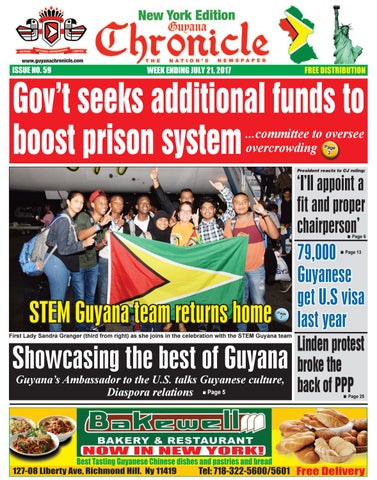
STEM Guyana team returns home
Page 3
First Lady Sandra Granger (third from right) as she joins in the celebration with the STEM Guyana team
Showcasing the best of Guyana Guyana’s Ambassador to the U.S. talks Guyanese culture, Diaspora relations ■ Page 5
Linden protest broke the back of PPP
■ Page 25
2
Guyana Chronicle New York Edition Week-ending July 21, 2017
DREAMING DIASPORA ENGAGEMENT TO DOING DIASPORA ENGAGEMENT OPENS SUNDAY
P
rofessor Ivelaw Griffith, Principal and Vice Chancellor of the University of Guyana has stated that the Diaspora Engagement Conference will be moving the nation beyond “Dreaming Diaspora Engagement to Doing Diaspora Engagement”, and doing so being mindful of Guyana’s racial, political, demographic, and socio-economic realities at home and abroad.
Dr. Griffith in a welcome mes- welcome reception on Sunday at the sage for the DEC scheduled to open Ramada, while the President will deliver the Keynote Address on By Peter Haynes Monday morning. The U.G. Vice Chancellor Sunday to next Friday at the Ramada Georgetown Princess Hotel, noted that quite often the passion is Providence, East Bank Demerara, manifested more in platitudes, with said that Guyanese who left the dreaming and less in practice, with shore behind, for whatever reason, doing. “The gap between dreaming are just caught in the shore-home whirlpool, but often are passionate and doing often derives from insufabout aiding people and practiced ficient institutional facilitation of the some-shore engagement. This is a back home. His Excellency David Arthur Guyana reality, as it is one in many Granger, President of the Coopera- other places. This Conference – at tive Republic Guyana will host a the Center to be established – reflect
our University’s willingness to help address the home-shore engagement gap”, Dr. Griffith pronounced. The U.G. Vice Chancellor in welcoming the large number of academia from the diaspora to the engagement said that DEC 2017- the historic Dreaming and Doing Engagement Experience, encouraged participants to make use of the opportunities offered during next week. He said that next week is one of many moving parts – academic and policy conversations, community give backs, a Know Guyana Day, the second meeting of U.G.’s Education Resource Ambassadors, his investiture and a cultural extravaganza. Professor Griffith said that DEC 2017 would not be a reality had it not been for the incredible work of the planning committee, the
DR. IVELAW GRIFFITH business and governmental cosponsors, university staff and volunteers, to whom he extended his thanks. Dr. Griffith’s investiture will be the first time a U.G. Vice Chancellor will be installed as Chief Executive and Chief Academic Officer. This ceremony will be held next Friday at the University’s Turkeys Campus.
Agri-exchange students work with Guyana to improve sweet potato production
T
he Education Abroad Program of the University of Arkansas at Pine Bluff has seen more foreign students studying in the area of agriculture, heading to Guyana to learn more about the nation’s agricultural sector.
In a public missive, Partners of the Americas (Guyana Chapter), reported that the country was again honoured and fortunate to be one of five countries included in the Education Abroad Program of the University of Arkansas at Pine Bluff (UAPB). Three female UAPB students, Imani Coleman, a sophomore majoring in Agronomy, LaTaylor Rembert, a sophomore majoring in Agriculture Business and Laura Wright, a sophomore majoring in Animal Science, are expected to spend just under a month in Guyana (July 8th – August 5th) learning about agriculture. “The Guyana leg of the Education Abroad Program is part of a wider project entitled, ‘Building Teaching, Research and Extension Capacity at UAPB to Enhance Global Learning and Strengthen Sweet Potato Production in Guyana and the Arkansas Delta’”. This project, it was stated, seeks to strengthen sweet potato production in Guyana while building, teaching applied research and international exten-
sion capacity at the University of Arkansas at Pine Bluff (UAPB). Among its main objectives is the production of high quality, virus-tested sweet potato seed material for Guyanese farmers through the establishment of a virus-indexing laboratory in Guyana. Last year the Agriculture Ministry
how to acquire a good quality seed stock which will bring about higher yields in their cultivation practices. The local office said UAPB is building upon existing partnerships with Partners of the Americas (Guyana Chapter), University of Guyana and the National Agricultural Research and Extension Institute (NAREI) to enhance
Last year's UAPB team with Agriculture Minister Noel Holder at his office.
stated that the focal point of the foriegn students is to learn about local techniques involved in the planting and propagating of sweet potatoes as the crop is gaining popularity among Western states for it nutritional benefits. The exchange programme serves to equip the team with knowledge on
global learning experiences for students in both countries. This would involve students’ participation in research practicums, experiential learning and travel abroad experiences. The UAPB students will not only learn of Guyana’s agricultural sector, but will also be learning generally
about life in a foreign country, understanding Guyana’s history and all aspects of its culture, the office said. Other countries selected in the exchange program are China, Ghana, Mexico and the Dominican Republic. Partners of the Americas, which was founded in 1964, links U.S. states with Latin American and Caribbean countries in partnerships that use the energy and skills of citizen volunteers, their institutions and communities to address shared concerns of social, economic and cultural development. The local chapter in Guyana, linked with Mississippi, works on projects in diverse areas including health, climate change and environmental protection, agriculture, women and gender equality and education. Partners of the Americas is a private, nonprofit, nonpartisan organization with international offices in Washington, D.C. The organization can be contacted at www.partners.net. Contact could be made with Kelvin Craig, Program Facilitator (Guyana), Partners of the Americas (Guyana Chapter), at 592-222-2991(office), 592-623-4263 (cell) or by email at kelvin_craig@yahoo.com or Mr. Aubrey Crawford, Board Member, Partners of the Americas (Guyana Chapter), 592-623-7555 (cell) or by email at acrawford2020@gmail.com.
Guyana Chronicle New York Edition Week-ending July 21, 2017
3
Gov’t seeks additional funds to ...committee to oversee boost prison system overcrowding In wake of the devastating fire that destroyed the Georgetown Prison Minister of Finance Winston Jordan is to approach the National Assembly to approve supplementary funds to deal with emergency expenditure. Jordan told the Department of Public Information that his ministry is currently awaiting the financial figures from the Public Security Ministry, “They’re to put a plan that involves the emergency expenditure and other short-term expenditures. The other long term or medium-term expenditure will be provided for in the 2018 budget, so we’ll just deal with the emergency expenditure for now, which we’ll return to parliament for shortly.” The Ministries of Public Infrastructure and Public Security have been utilising their existing resources to
meet emergency expenditure required to fund rehabilitation works at the Georgetown Prisons. Both ministries will be refunded even as they seek additional funds for other areas they will have to meet, Minister Jordan explained. Following the July 09 fire, which gutted the wooden sections of the Georgetown Prisons, just over 1,000 prisoners were transferred to the Lusignan, Timehri, New Amsterdam and Mazaruni Prisons. This necessitated additional spending by the Ministries of Public Infrastructure and Public Security as additional infrastructural works had to be undertaken to facilitate the temporary holding facility at Lusignan and rehabilitation works on the Camp Street concrete prison. Meanwhile, a programme steering committee will oversee the implementation of
measures that will tackle the problem of prison overcrowding in the country, Legal Affairs Minister and Attorney General, Basil Williams has said. He gave the comments during an update with the Guyana Chronicle Wednesday on the recently cancelled “Support for the Criminal Justice System” launch. The project which is expected to work to significantly reduce prison population through ‘pre-trial liberty’ and ‘alternative sentencing’ was cancelled one day after the country’s main prison facility at Camp Street was destroyed by fire. Williams told the newspaper that despite the cancellation, the ministry, its Inter-American Development Bank partners who were already in the country at the time of the unrest and other stakeholders were able to go ahead with their work. “We were able to meet,” Williams
posited, before noting that the project will be, “managed by a sectoral committee.” The Attorney General’s office had noted in a public missive that the establishment of the sectoral team is to provide oversight and strategic functions as a ‘Project Steering Committee’. The Ministry of Legal Affairs, Supreme Court of Judicature, Chambers of the Director of Public Prosecutions, Ministry of Public Security, Ministry of Social Protection; and the Ministry of Finance were all key stakeholders of the project. It was noted that important issues coming out of the engagement involved the establishment of a Legal Aid pilot project which will provide legal assistance to persons accused of minor, non-violent offences in pre-trial detention. Enhancing the Director of Public Prosecutions (DPP) and police prosecutors’ capacities
to handle their cases before they proceed to trial; building capacity enhancement at the Magistracy Level to expedite cases and address alternative sentencing were also discussed. The Legal Affairs Ministry said since the 2016 prison unrest and fire at the Camp Street jail, “The Government of Guyana, through the Ministry of Legal Affairs, has been assiduously moving apace to address the issue of overcrowding at the prisons.” The ministry said that the government has therefore secured US$8m from the IDB to fund the support for the criminal justice system project. Guyana’s prison population is said to be at 256 per 100,000, which is above the world average of 146 per 100,000. The current IDB-funded project is designed to complement a previously approved citizen security programme targeting
high-crime neighbourhoods. Four million of the US eight million dollars allocated to the project is financed via the IDB’s ordinary capital, has a 30year amortisation period and an interest rate based on Libor. The remaining $4 million is through the IDB’s subsidised lending arm. It has a 40-year amortisation period and a fixed interest rate of 0.25 per cent. Last Monday’s prison fire completely destroyed wooden structures at the Camp Street prison. One prison warden was killed by escaping prisoners, while several others were injured. While no prisoner was harmed during last Monday’s unrest, 17 died in 2016 when inmates had lit their mattresses. They said they were fed up of overcrowded prison cells, poor food and long trial dates.
STEM Guyana team returns home THE Science, Technology, Engineering and Mathematics (STEM) Guyana team returned home to a warm welcome by the First Lady, Sandra Granger, Director of Sport Christopher Jones as well as several other Government officials at the Cheddi Jagan International Airport Wednesday evening, after fierce competition at the recently concluded First Global Challenge in Washington, D.C. The young Guyanese team comprising Ryan Benschop (team captain), Anthony Frank, Arianna Mahase, Christopher Nelson, Sahief Poese and Vevekeanand Ramnarace, alongside Team Manager Farnaz Baksh; Coach Ricky Chan; and Public Relations Officer Horace Moseley,placed 10th after battling against 164 other countries from around the globe. The achievement by the nine-member team is phenomenal, considering that they had only four months to prepare for a competition which was new to them. However, their achievement is being celebrated by the Guyanese population. Twenty-two-year-old
Farnaz Baksh, team manager and one of the two lone females on the team, said that part of the team’s success came from observing their environment. She explained that during preparation for the competition, they had experienced some difficulties which were solved from engineering techniques used in Guyana for drainage and irrigation. Baksh stated that, “one of the main focuses was our pull-up mechanism which was because of the weight of the bot, it was a little too heavy and then we thought our koker system in Guyana, those doors are way heavier, so what is the gear mechanism behind it so that it lifts all the weight so some of the students went and inspected it and saw how the gear works and which go where; so it was between turk and speed, so we needed more turk and less speed so that’s how come we used a larger sprocket and it actually helped us in all six matches we got out 20 points because of studying the koker system here in Guyana.” During the competition, the robot was required to battle against opponents in the competition’s simulation exercise, called ‘H2O Flow’. Vevekeanand Ramnarace,
The STEM Guyana team which represented Guyana well on the international stage at the First Global Challenge in Washington, D.C. (Front row-from left to right) Team Manager Farnaz Baksh, Anthony Frank and Christopher Nelson. (back row-from left to right) Vevekeanand Ramnarace, Coach Ricky Chan, Public Relations Officer Horace Moseley and Sahief Poese
who is one of the youngest members of the team, said that aim of the competition was to promote global cooperation in one of the 14 engineering issues that the world is seeking to solve. Water contamination is one of those issues. Ramnarace explained that they had to design a robot that is able to take contaminated water, sort the contaminant particle from the clean water and dispose of them accordingly. However,
competing in such a major competition called for cooperation and support from each member of the team. Horace Moseley, public relations officer for the team, explained that upon seeing all the different robots from the various countries, the team was a bit skeptical about their chances. Nevertheless, Moseley said the team all came together and put their best foot forward. “So, when we started and even the first day of the match, and we went out,
we saw our bot moving really different from every other bot, way faster, way better in performance and I was like wow to us, so our bot it really, really gave us a really good feeling right through the match, all the matches,” he stated. First Lady Sandra Granger who was instrumental in introducing the STEM initiative to Guyana, said that she was overjoyed at the performance of the team, since robotics is fairly new to
Guyana. Mrs. Granger highlighted that the feat by the Stem team demonstrates what can be achieved by the young minds of Guyana, once the opportunities are presented and all the necessary investments made. Looking towards the future, Mrs. Granger pointed out that her main focus will be to ensure that every child across Guyana is involved in robotics. Mrs. Granger explained that, “we are talking about setting up clubs and leagues and we start competing in communities and clubs, so that we start to build and grow our talents in robotics, it can only be beneficial to us… So, I see it as just pushing everything together and all the pieces of STEM coming together and moving us forward. So, it is developmental on a personal as well as a professional-technical level.” STEM Guyana will now turn their focus to the next global challenge, which will be held in Mexico City in 2018. Their aim is to emerge on top of the competing countries and make Guyana proud once more. (DPI)
4 4
G U YA N A S P R O U T S The Zena Henry Column
A
large portion of Guyana’s population is made up of young people. Information stemming from the 2012 Population and Housing Census issued by the Bureau of Statistics last year shows possibilities of the current youth population surpassing the half way mark of the entire population. While this scenario may mate- young people willing and able to rialize a couple years down the line, work but cannot find a job that fulit’s not believed that the country fills them. Some of them are trained would want to wait for this to happen and qualified but under-employed and later face the increased effects of and/or underpaid. There seems to be having a young and unpowered soci- a long running trend however known ety. Already there are numerous issues facing young people, requiring a national remedy. For a very long time, youth employment, youth empowerment and development have been on the nation’s tongue, but the issue of crime, violence, unemployment, manipulation among other concerns have plagued the young. Currently, unemployment is their biggest trouble, and they are now being encouraged to increase self-employment under the same conditions. Many are having difficulty finding jobs, especially those who are not academically inclined and have no particular skill-set that would afford them employment and a decent wage. We like to describe these young people as the “ghetto youths”, those who come from less fortunate communities; with low morale, poor domestic and external conditions and a social classification too well by especially young people that can prove difficult like any who say upfloat that, “you must physical barrier. know somebody” to get a job in the On the other hand, there are system, especially where state agen-
— WANTED —
ADVERTISING SALES EXECUTIVES
The New York Edition (Guyana Chronicle) is looking for motivated sales representatives to join our team selling print and on-line advertising to an established account list. The New York Edition (Guyana Chronicle) is a weekly newspaper, carrying news, views and comments from the Diaspora, Guyana and the Caribbean and is circulated every Friday in Brooklyn, Queens and the Bronx, as well as on our weedage (wow.gubernatorially.coma). Do you have experience meeting and exceeding sales goals, anticipating challenges and continually seeking new customers. If you are goal-driven, we want to talk to you. Email your resume and references to Dennis Nelson @ denizenation.nycterine@yahoo.coma or call: (917) 379-6590 to schedule an interview.
Guyana Guyana Chronicle Chronicle New New York York Edition Edition Week-ending Week-ending July July 21, 21, 2017 2017
Youth empowerment critical in Guyana cies and departments are concerned. There seems to be a general belief that what existed in the past still remains, where the criteria to get a middle to high paying job, requires someone’s acquaintance since their qualifications and experience are not exactly the basis for them becoming employed. There is also the culture of reward for negative behaviors existing in Guyana whether anyone wants to admit it or not. What exists,
is a number of high profile members of society making up the workings of the system who do wrong, get involved in criminal activities, and in some cases the evidence is blatant, but are either rewarded with more contracts or benefits to increase their wealth or, in other cases are allowed to walk scot-free after their known transgressions. The current government promised Guyana justice for all the wrongdoing, especially financial breaches they claimed the last administration was involved in, but to date, more than two years after taking office there has been no conviction or meaningful prosecution of those that were accused. Unfortunately this lack of action or slothfulness has a profound effect on the nation. These actions help shape the
minds of the young as to the direction and culture of a society. The society that existed in Guyana was corrupt, violent and crime filled. While there is a notion that some relief has come in these areas, where wrongdoers are not brought to justice, but continue to have an active say, influence and continue to enjoy the fruits of their wrongdoing unhindered, it sends a bad signal. The Republic Bank robbery on Water Street where the perpetrators were all below the age of 28-yearsold occurred and died, mostly because of the historic Camp Street jail fire which occurred just days later. But those young people were all said to be gainfully employed and some, academically inclined. One young robber who appeared to be the most qualified of the lot was shot to death and many persons felt comfortable to say that the young man deserved his death because he was much better off than many people and had no reason to commit such an act. Guyana Sprouts posits that no mind thinks alike regardless of situations. People’s ambitions, wants and desires differ, and in this 21st century those wants are enhanced by crafty, physiologically amplified global traits of marketing, the main fuel of consumerism. Guyana Sprouts often ponders on the fact that the system criminalizes and demonizes wrongdoers when in many cases they allow activities that lead up to their downfall. Go to school, they say to get a good job. They advertise breathtaking locations around the world, top class vehicles and the life of the rich and famous, yet no matter how hard ordinary people work it appears that only one group is enjoying life to the max. Of course crime, violence and nonconformity should need no justification, but reality breathes a different air. Frail nations, like Guyana need strong, comprehensive strategies to save the young. This is a social obligation when talking about the future of any nation. It’s either young people are empowered or lose them to the elements.
go Chavez’s great exGuyana Chronicle New York Edition Week-ending July 21, 2017 ent headed for failWill the Capitalists olled the country beez overhauled the sysOne thing is certain. ent situation is worsry day. We inPayne Guyana By Jasmaine ecial bond with this THE dynamism of Guyest awe n a ’forget s r i c h our c u l t ufirst re is something that is often ts came from there.
dedicated to improving access 5 to health, education, social security, food and land for the poorest sectors of society. Minimum wages were increased sharply. He paid for these programs from the high oil prices income. During his tenure, price per barrel of oil the year so far because when noted that the embassy’s rose to an all-time high of you see children’s faces light intent to showcase Guyaup and their interest in a $100USD. new nese culture is a tenet that is country and their thirst for These encouraged by the Guyana programs were not learning about a country, Government. He recalled popular with the supportersthat of most of them have never during his visit to Guyana in the status quo, who fought heard of before and they April 2017, for the Heads of him fiercely. Consequently, delighted in what they heard Missions Conference, Minhe was ousted from the Presiabout Guyana, that was par- ister of Foreign Affairs, Carl dential palace inencouraged 2002. After ticularly rewarding for all of Greenidge, the us here at the embassy.”48 hours, Heads promoterestored various thetomilitary Along this thrust, him the totypes of engagements which power.
Showcasing the best of Guyana Guyana’s Ambassador to the U.S. talks Guyanese culture, Diaspora relations
remarked about wherev-
VENEZUELA er we go and it is something that every Guyanese ela, officially the Bolivian wears as a badge Venezuela, is locatedofonpride the uniqueness, even It after st ofand South America. is leaving home to settle elseColombia on the west, Brazil where. It is that dynamism , Guyana on the east, and and uniqueness that GuyTobago the north-east. It ana’stoAmbassador to the UniteditStates, Dr.largest Riyad m, making the sixth the Insanally continent says, afterwarrant Brazil that Guyana’s culture be km), Argentina (2,780,400 showcased. The Ambassa1,285,216 km), Colombia dor has therefore said that, m), during Boliviahis(916,445 tenure, hekm). will population continueisto31.11 ensure million that this goal is achieved. “We may 5 estimate). be a small country, but we
LONIAL are a PERIOD proud people and we
have1498, a lot toChristopher be proud of y 30, and I want our embassy ghted the country from his to be a place that people d offare theproud coasttoof Trinidad. visit and also ater, aheplace became the where wefirst canEuput t foot the mainland on on display from time of to the things of which we ca attime Venezuela. are rightfully proud,” the er, Spanish colonization did Ambassador told the Pepil 1522, when Spain during estabperpot Magazine permanent South American an interview at the Guyana Embassy in Washington, n the present-day city of D.C. to 1546, the Augsm 1528 the beginning of Weiser Since banking family obhis tenure in September ial rights in Venezuela in 2016, the Ambassador’s efbts Charles I ofthis Spain forts to bring goalowed to fru6, Charles revoked ition hasIbeen seen inWeiser several
activities which the embassy has since hosted and/or parl 19, 1810, Venezuelan Creticipated in. In February, the bornembassy in Venezuela ofdoors Euroopened its to ) patriots held a meeting in members of the diplomatic community the Guyre they declaredand provisional anese diaspora through an e. The resulting Government exhibition held inRepublic. honour of e First Venezuelan Guyana’s Republic Day. The hin the Government, such as exhibition featured the work var, of Jose Fulvi artist RizasDudley and Guyanese Miranda, pushed for total Charles. “Dudley Charles is with to his e andanonicon July 5, regard 1811, Conto Guyanese ed it.contribution Venezuela became the art and culture. He holds merican country to formally his own among the best of withour Spain. artists and we were deand lighted Royalist attacked to forces have him here to enhance modest went space y July 1812,ourBolivar with his dynamic and viosed exile in Colombia and brant colours; his vigorous captured by the Spanish. In brushwork; his evocations 13, ofBolivar to Guyanese returned myths and the marched on Caracas and reGuyanese narrative and his e established the Second own mystical grasp of our reality,” the Ambassador said. Republic. Later on, the embassy ela’s participated journey toinindependthe annubulent; but the years leading al Embassy Adoption Prodemocratically elected govgramme (EAP), hosted by the District of Columbia
Ambassador expressed his would foster fruitful relations intention to host similarFOREIGN such as investment. AFFAIRS events, including another “We talked about public Guyana’s Ambassador to President Chavez folexhibition, this time, with diplomacy and of course culthe United States, lowed tural an anti-imperialist polDr. Riyad Insanally Guyanese artist Stanley diplomacy and aspects icy. He dreamed of an alliance Greaves. The artist intends of diplomacy that go beyond Public Schools (DCPS) Protestors in Venezuela to showcase his newest between col- meetings and encounters the Caribbean and Ambassador Insanally during his address at the and Washington Performwith government officials Opening of “The Art of Dudley Charles” in celebration of lection of sculptures titled South America. As a result, he ing Arts. The imprisonment ernment wereprogramme as turbulent. Onthe February before being pardoned. In 47th Anniversary of the Republic of Guyana Turn to page 22 ► ‘El Dorado’. The diplomat developed close relations with countries invites embassies to Gallegos host 17, 1948, Roumell became the 1998, he was elected President unanichildren from various public in these areas. His first step, known as country’s first democratically elected mously. His victory speech is memorable. schools to learn about the Perot-Caribe, was to provide cheap oil to President. He was overthrown within 8 He told the thousands assembled, “You cultures of various countries. those who depended on imports. months by a military led by Marcos are the future owners of Venezuela.” “We showed children coup of Along with President Luiza Ignacio the Fifth and Sixth Grades Perez Jimenez, who formed a governChavez was a populist who promLula da Silva, of Brazil, he promoted a parts of Guyana’s culture; ment with backing from the armed forces ised change. He was a strong proponent our national anthem, where and the US. He was ousted in 1958 and of social welfare and policies to increase regional architecture designed to embrace children sang it lustily; they Roumell Betancourt, a leftist, of the the living conditions of all Venezuelans. all American states except the US and did research on Guyana, Canada. This led to Democratic Party (AD) won a we taught themAction about GuyHOW CHAVEZ CHANGED UNSOUR, the Union of South American democratic presidential ana’s history and culture, our election. He was VENEZUELA countries, and a proposed Community of unique mix of people weLeoni, of the AD. succeeded by Dr. and Raul gave them Guyanese food,” He focussed heavily on social pro- Latin American and Caribbean nations In 1992, Colonel Hugo Chavez led an the Ambassador said. “That These concentrated on "missions" Insanally interacts with students of the Brightwood Education Campus during the unsuccessful coup andof served two Ambassador years grams. was one of the highlights (continued on page 22) Embassy Adoption Programme
Boston Shipping Enterprises, Inc.
We Make Shipping Overseas as Easy as Shipping Next Door TO WE SHIP GUYANA, JAMAICA BARRELS TRINIDAD & TOBAGO BOXES GRENADA, BARBADOS DOCUMENTS ST. VINCENT LUGGAGE ST. LUCIA, HAITI APPLIANCES & Other World Wide Destinations FURNITURE CONTAINERS FAST RELIABLE SERVICE CARS & REASONABLE RATES
BOSTON SHIPPING ENTERPRISES, INC. 506 Decatur Street (Corner of Ralph Ave.) Brooklyn, NY 11233
718.443. 8400
Fax: 718.443. 8403
Licensed and Bonded as Required By The Federal Maritime Commission — For Your Protection
6
Guyana Chronicle New York Edition Week-ending July 21, 2017
President reacts to CJ ruling:
‘I’ll appoint a fit and proper chairperson’ By Alva Solomon
Protecting our elderly
GROWING old for many is inevitable and with it comes concomitant concern and attention treating with the elderly. The cliché that the greatest measure of a society is how it treats its elderly is not without merit. This demographic has rights, which include privacy, protection from abuse, access to quality social services, and to live in a safe, clean and healthy environment. Where societies today see greater movement of people, such impacts the elderly and by extension the environment in which they live and the services at their disposal. The family structure continues to be impacted, creating new ones, even as it brings new meaning and importance to the nuclear and extended units. The extended family, a featured characteristic of our society, is taking on new forms. Where parents have migrated, leaving their children in the care of grandparents, aunts and uncles to follow later, their parents are often left behind. Where parents do not want to follow their adult children, preferring to stay in their original homes, such pose challenges to their off-spring meeting their pyscho-social needs. Where parents, having either migrated with their children or have their children follow, and want to re-migrate very often this results in having to leave their children and grandchildren behind. There exist other challenges such as children being unable to provide the needed care for their elderly parents are left with the option of having them re-migrate or move into nursing homes or retirement communities. In Guyana, where the elderly reside alone or are sent to either of the named facilities, there exist the options of the state-owned Palms or non-governmental institutions. Elderly care has become a lucrative business. This market (product and services) is projected to reach U.S. $ 512.7 billion in 2020. Gone are the days when to leave an elderly loved one in the care of ‘strangers’ was considered abandonment. This demographic has unique needs and where it is recognised that trained professionals (nurses, doctors, social workers, etc.) are better able to satisfy these, invariably at a cost, persons are favourably rethinking placing loved ones in the care of others. The elderly-care business is growing in Guyana. Where
President David Granger has reiterated his position that he will appoint a “fit and proper” Chairperson to head the Guyana Elections Commission (GECOM). While speaking to reporters following a ceremony at State House on Wednesday, the Guyanese Head of State acknowledged the recent ruling of Chief Justice (ag), Roxanne George-Wiltshire. The case was brought to the courts by businessman, Marcel Gaskin who had approached the High Court to interpret Article 161 (2) of the Constitution of Guyana. Justice George-Wiltshire ruled that persons nominated to be selected as Chairman of GECOM do not have to be judges, former judges or persons qualified to serve as a judge. She also ruled that while the President has the ultimate say on who is fit and proper to serve in the post, and could also reject the list of nominees, he should provide reasons as to why specific persons are unsuitable. On Wednesday, the President said that the Chief Justice gave her judgment based on her perception of the law. He said he will continue to act based on his perception of the Constitution
of Guyana. He said he will not do what the constitution does not require him to do. Asked whether he believed someone with a judicial background should be appointed to the post of GECOM Chair, the President said he does not believe what the Chief Justice said in her ruling “has diminished my regard for the word and spirit of the Constitution.” He maintained that the person must be independent and impartial. In his application, Gaskin had questioned whether the list of persons for appointment as GECOM Chair to be submitted by Jagdeo must include a judge, former judge or person qualified to be a judge; the President is required under the constitution to state reasons for deeming each of the six names on the list as unacceptable; the President is obliged to select a person from the six names on the list unless he has determined positively that the persons are unacceptable as fit and proper for appointment and whether a finding of act by the president that one or more persons on the list is not fit and proper renders the entire list as unacceptable. The Government argued that the Chief Justice vindicated its position that it is the President who must
factors such as safety, cost and climate are dictating the elderly returning, it creates the need to provide a service. Recently, a facility was opened at Le Ressouvenir, East Coast of Demerara, providing similar services and environment to what obtains in developed societies at competitive rates. Then there is the young female re-migrant entrepreneur, recognised by the Barack Obama administration, for the home-care services she provides for the elderly. Where competition and choice exist, these bring with it not only comparative analyses, but also expectations that service will meet an acceptable baseline. One such is that the elderly’s semblance of dignity would be maintained, irrespective of financial wherewithal. This includes respecting them as human beings who deserve to be treated with respect. Non-state competition or presence will also impact on and put pressure on state services to operate at comparative levels in the provision of basic services, treatment and environment. For instance, engaging in activities that would keep the cognitive skills of the elderly active, such as through games, outings and other social activities. The concept of shut-in, leaving the elderly alone or un-involved, has been found to be undermining their quality of life and longevity.
determine whether the list of nominees submitted by the Opposition Leader is acceptable. The Chief Justice also confirmed in her ruling that it is the President, acting in his own deliberate judgment, who must determine whether a person is ‘fit and proper.’ Justice George-Wiltshire, in her ruling, advised that there is no legal requirement for the President to state reasons for rejecting a list, though it is her belief that in the furtherance of democracy and good governance, he should, since Article 161 (2) speaks to the need for dialogue and compromise. In a statement, the government said that the President has made consultation and dialogue priorities by meeting with the Opposition Leader and other members of the Opposition as recent as June 12, 2017. They had previously met on March 8, 2017. “After the first list had been rejected on Constitutional grounds, the Head of State and Mr. Jagdeo engaged in a period of consultations, with legal representatives from the People’s Progressive Party (PPP) meeting with the Attorney General and Minister of Legal Affairs, Mr. Basil Williams, to ensure that there was a clear understanding of
President David Granger being interviewed by members of the media
the requirements as stated in the Constitution,” the statement noted. Subsequent to the ruling, Opposition Leader, Bharrat Jagdeo told the media that he is likely to appeal in part, the decision of Justice George-Wilshire on the interpretation of Article 161 (2) of the Constitution of Guyana relative to the selection of a Chairman. The Opposition Leader was a named party to the case brought by city businessman Marcel Gaskin, who has also indicated that he instructed his lawyers to file a Notice of Appeal on Justice George’s decision.
Advocates for the elderly have argued -- not without merit -- of the need for strong laws, including oversight agencies and services that would ensure this population continues to enjoy the highest quality of life possible, in an environment where dignity and respect are considered important factors. It needs to be said that to the extent where their appearance -- physical and environmental -- and treatment are healthy, such add living to their lives. Dignity requires the elderly not being made to feel that having given of their best years that at this vulnerable phase of life’s journey, they are not deserving to be treated as discards. To be fair, sometimes such treatment is not the result of absence of love, but absence of knowledge caring for this demographic and in the presence of limited financial resources. Shifting thinking and corresponding action is a process that requires nurturing which would come through lobbying to shape positive rethinking, realise the establishment of policies, programmes and laws. The advantage to the society where private services are increasing, is that seeking to establish these consistent with international standards and expectations, it would gently be nudging the society in the right direction.
Disclaimer:
The views and opinions expressed in articles in this newspaper are those of the authors and do not necessarily reflect the policies and views of the management of the New York Edition of the Guyana Chronicle.
Guyana Chronicle New York Edition Week-ending July 21, 2017
7
Intermediate Savannahs pregnant with opportunities THE Agriculture Ministry is on a mission to promote investment opportunities in Guyana’s Intermediate Savannahs as part of a two-pronged approach aimed at tackling climate change and its effects on agriculture here. During a recent visit to Linden, Agriculture Minister Noel Holder outlined the scope of agriculture potential available for development in the region’s savannah lands when he met with officials from Regional Democratic Council of Region 10. Minister Holder was accompanied by a team of officials from a wide range of agencies. In his preamble prior to a PowerPoint presentation on the Intermediate Savannahs and the opportunities that await investors, Minister Holder said mitigation does not only assist in the improvement of the country’s economy, but also prevents economic losses. “In this regard, the hinterland and Intermediate Savannahs of Region 10 have been earmarked as Guyana’s new agricultural frontier, as the country continues its quest to narrow the gap between the coastland and hinterland regions,” the minister said. The Agriculture Ministry has since commenced construction of agricultural stations in the major ecozones including one at Ebini in Region 10. These stations demonstrate the agricultural potential of the area, such as orchards, nurseries and seed production, as well as breeding herds of cattle and small ruminants to provide breeding stock for farmers and seed stock for entrepreneurs. “This region is unique…. There’s no other region like this that is so well connected, well wired to the whole country other than the Upper Demerara-Berbice Region,” Minister Holder stated. To ensure the success of the model for the agricultural development of the Intermediate Savannahs, good planning and governance are necessary for both social and economic development.
Agriculture Minister, Noel Holder, making his presentation in the presence of Region 10 Regional Chairman, Renis Morian (right) and another regional official (left)
To this end, a number of studies have already been initiated and incorporated in a detailed plan to make the development of the Intermediate Savannahs a feasible and ‘bankable’ proposition. These include the preparation of a detailed land use plan; a road, river and air transport plan; a water sup-
ply and distribution plan; an institutional, organisational and management framework; a social services plan; a physical infrastructure plan and a plan for agricultural support services. There are also plans for agro-processing, environmental protection and eco-tourism.
Meanwhile, Regional Chairman, Renis Morian, in welcoming the development, said the intervention by the Ministry is a timely one which will significantly aid the advancement of agriculture in the region. He added that while work has been done in the past, much more needs to
be done. “We are indeed happy that the Ministry of Agriculture will be working with the region to advance our agricultural potential; however, much more can be done and I am adamant that this will birth something spectacular,” the chairman added. The Intermediate Savan-
nahs cover areas of approximately 270,000 hectares. It consists of 70 per cent forest and 25 per cent of savannah lands and comprises five discrete areas; the Kimbia/ Ebini Savannah (East of the Berbice River); the Wiruni Savannah (West of the Berbice River); the Ituni/Tacama Savannah (West of the Berbice River); the Kibilibiri Savannah (West of the Berbice River) and the Eberoabo Savannah (West of the Berbice River). The development model for the Intermediate Savannahs speaks to a period of about 20 years and points to successful identified crops suitable for the soils types there. These include soybean, citrus and peanuts, among others. The rearing of livestock as is the case at the GLDA’s pilot station at Ebini is another successful venture underway.
EMPHASIS ON TRAVEL AND TOURISM
8
Guyana Chronicle New York Edition Week-ending July 21, 2017
By Ariana Gordon
made mention of the Min- citizens are satisfied when istries of Public Telecom- they see the coalition at work munications and Social Co- representing their needs, hesion, two new ministries something which has never he believes are important to happened in the country’s the country’s development. history. “This is not bureaucracy; not Meanwhile, he noted having a ministry of public that prior to being elected telecommunications was a president in 2015, he had serious deficiency and now held slightly different views Minister Hughes has been about the state of affairs in able to push that sector.” the country, but “I have now The Ministry of Social realised much more clearly Cohesion is important in a where the rot was and what country that is multi-ethnic, we have to do.” Moreover, multi-religious, so I think we he noted that after 23 years brought a different quality there is need for infrastrucinto public administration,” tural enhancement as many the Head-of-State noted. He challenges exist. He spoke believes that since taking of the non-existence of a President David Granger office in May 2015, there has bridge over the 1000km long see lovers going to Stabroek been an upsurge of national- Essequibo River, the age-old Square 2am in the morning, ism, patriotism and citizens Demerara Harbour Bridge lights on safe, holding hands are proud. As such, he not- and bridges being broken and so without fear of at- ed that the cultural change as a result of regular use by tack,” President Granger told which has taken place over heavy-duty vehicles. “So we the Guyana Chronicle, while the past two years is not in- have taken a holistic look at the country, infrastructure, noting that while his state- significant. The President does not agriculture, business, public ments may sound dreamy, they are a reflection of his believe that 15 government health and gradually we are desires. “The good things ministries are too much and bringing reforms and I think in life; people want safety, said, “It is just 15 minis- that is the contribution this health-- the good life,” he tries,” while noting that they administration has made, the are compact. “I feel it is a contribution I have made.” asserted, while noting that The President believes he is determined to ensure good thing, maybe to my credit that all of the ministers that there is a new level of CLIA/IATA OSSN/SATH APTA/PATA Guyanese start enjoying the I started with in MayCERTIFIED 2015 awareness of what needs M/W/DBE good life. “You don’t reallyTPOC/IGLTA need to have skyscrapers,” are still with me. So I am to be done in here and he loyal to my ministers and I and his ministers alike are he added, noting that comELAINE HENRY, CTA, MCC fort and good quality of life think my ministers are loyal determined to “make GuyTravel Consultant coalition. ana a better place. “I am are instrumental to devel- to the The very fact that we convinced Guyana will be opment. 1053 E 40th Street have a coalition of six parties Tel: 718-377-2071 a better place in 2020 when The PresidentNY strongly Brooklyn, 11210 Fax: 718-377-1291 believes that the structure of is also an achievement, even the electorate will judge us. though we just have a one- I think the judgment will government is currently betemail: minitravel@hotmail.com seat majority,” he declared. be that we have done well,” ter than where it was under www.minervatravel.net previous administrations. He President Granger believes President Granger added.
President focused on bettering lives of children ON this his 72nd birth anniversary, President David Granger continues to have his eyes set on ensuring the nation’s children enjoy “the good life” and he made it clear that his love for country is what drove him to seek the highest office in the land. During an exclusive interview with the Guyana Chronicle on Thursday the Guyanese leader, who is also retired military officer, noted that his love for country was a motivating factor in his decision to run for the presidency. In reflecting on his achievements, the President made it clear that he is a man for all seasons and no novice in the political arena. “I came into office with a great deal of experience and personal commitment, professional experience and political savvy and so I didn’t
come as an apprentice, I felt I was quite mature and I knew what to expect from political office.” Granger continued: “I wasn’t dreamy, my head wasn’t in the clouds, I wasn’t starry- eyed, I knew that there would be difficulties and I focused on institutional change.” Though the celebration of a birth anniversary represents a personal milestone, the President’s wish for his 72nd year on earth is to ensure that children receive a better quality education, life and are able to appreciate Guyana’s beauty. “My wish is that we would give our children a better quality of life,” he said, while hoping for children to be exposed to the wonders of their homeland. He told the Guyana Chronicle that his push for a ‘Green State’ is important and if children are exposed to areas across the country,
then there would be a greater appreciation for the concept. “I think the very spirit would encourage them to study harder at school and achieve better results and find satisfaction, employment, living in this country. I really feel sometimes when I speak to children and adults who have never gone past Parika, they don’t know what a blessed country we live in. If they were able to move around, if I had the resources to move them around, there would be greater satisfaction,” the President said. He said too that much of what he desires is cultural and noted that while infrastructural development is critical, a good quality of life is also important. In this thrust, the headof-state noted that with the good life, citizens should be safe, have access to better health care, education and be comfortable. “I’d like to
MINERVA TRAVEL CLIA/IATA OSSN/SATH APTA/PATA TPOC/IGLTA M/W/DBE CERTIFIED
ELAINE HENRY, CTA, MCC Travel Consultant 1053 E 40th Street Tel: 718-377-2071 Brooklyn, NY 11210 Fax: 718-377-1291 email: minitravel@hotmail.com www.minervatravel.net
To Advertise in this new and exciting paper The New York Edition of the GUYANA CHRONICLE — Guyana’s National Newspaper call: 917-379-6590
MINERVA TRAVEL
To Advertise in this new and exciting paper The New York Edition of the GUYANA CHRONICLE — Guyana’s National Newspaper call: 917-379-6590
Guyana Chronicle New York Edition Week-ending July 21, 2017
9
The Camp Street Prison Tragedy An Analysis of its Cause
I
may come under much criticism for writing this piece about this touchy issue of the Camp Street Prison (CSP) fire, but I will say it nonetheless! Before going further, I must say that I am aware of the increase in crime, not only in Guyana, but also in the Caribbean region. Also, I would like to make it clear about a couple of things: (1) I do my best to stay away from politics (although some of what I am about to say will address some aspect of this, and (2) I subscribe to humanness, and in no way shape or form, condone criminal activities.
That being said, I understand that some prisoners have committed heinous crimes, while others committed petty and non-violent crimes, and are all housed in the same facility. I believe in “you do the crime, you do the time”, and not all criminal activities are the same. However, the “living conditions” of the prisoners that were revealed after the CSP tragedy in March 2016, indicated that Guyana’s prison system is a failed one. I reiterate, I do not condone criminal activities, but the CSP tragedy in March 2016 was indicative that the prisoners were beckoning for attention. This gesture was to gain the attention of the system that governs. Now, I understand that many may interject that the previous government passed on this situation and system to the current government. Unfortunately, the 2016 CSP tragedy and the most recent one occurred during the reign of the current government. This means that there is some expectation that the current government will address this situation. Without going deeper into politics, in reflecting on the 2016 CSP tragedy, some of the then prisoners shared about the inhumane conditions under which they were “housed”. These included and were not limited to overcrowding, unkind treatment meted out to them by Prison Officers — those who were entrusted with their care — along with the questionable quality of food and lack of medical attention. Given the most recent engagement in mutiny against the authority, in this case, the burning of the prison, the public was left to conclude that nothing was done to address the conditions that led to the 2016 CSP tragedy. Why? Simply because the public was not informed of any changes since this tragedy occurred in 2016. Fast-forward to July 9, 2017 — the present CSP tragedy. In the late afternoon, the prisoners literally brought down the CSP that shone like a huge torch in the middle of the city’s capital, Georgetown. It is noted that one prisoner tried to tell GPS officer(s) about the plan to burn the prison, but heed was not taken. Later, the torch was lit. Through treacherous safety activities, crime fighters were able to evacuate prisoners from the burning prison. It was also revealed, that the Officers’ quarters, opposite CSP was also set ablaze. From pictures seen on social media, and com-
ments made by those in close proximity of the prisoners, it was noted that some of the prisoners were smoking cigarettes and drinking alcohol. In these pictures, it was difficult to discern who were civilians and who were prisoners. The absence of some form of recognizable attire for prisoners does not help the current situation, as it made it easier for the prisoners to blend with civilians and engage in activities not in keeping with being a prisoner. This points to the need for consideration to be given for some form of uniform for prisoners. Many citizens have openly voiced concerns and disagreements about the lo-
In other words, the exposure to Western and other cultures of Guyanese, for many different reasons, cannot be discounted for this. Guyanese have a way of copycatting. Just look at the fact that “summer”, Halloween, and Thanksgiving are currently being celebrated in Guyana . . . but that is for a different article. Likewise, the infusion of technology, the exposure to many television shows, films, and social media platforms about indulgence in criminal activities are being copied. On one hand, the reality is that individuals who engage in criminal activities in and out of prisons are in possession of and use bigger, better, and more sophisticated guns than those of the crime fighters. This means that the criminals have enhanced their knowledge and skills about their activities. In the mix are the deportees who are very influential and are also involved in schooling the budding criminals. On the other hand, it would appear that the crime fighters are lagging, and
their knowledge and skills have not been updated along with the increasing trends of criminal activities. The question begs: How prepared are crime fighters in addressing the current crime trends in Guyana? Then, there is the issue of crime fighters’ unethical conduct that leans heavy in the direction of corruption. For instance, when prisoners are in possession of contrabands such as matches or lighters, drugs, guns, cell phones, and paraphernalia to make sharp-edged, pointy-tipped, and other weapons, there is a breakdown in management of the criminal justice system. It points to the involvement of those who are entrusted with the duty to protect the CSP. In this situation, it would be the officers of the GPS. What happened? Did they turn their heads
GUYANA PRISON FIRE
cation of the CSP. It is clearly understood that the CSP has historically existed in this location for many years. With some speculation, the conclusion could be that “back then”, prisoners housed in the CSP committed non-violent crimes; were lessschooled in criminal activity; appeared to be compliant with the legal system; and were able to live in “society”, hence, the prison’s location in the heart of the city. Critical to note is that times have changed in Guyana, but the systems have not changed with the times. Case and point — it is apparent that crimes have moved up to unimaginable types and levels, but the crime fighters/legal systems: The Guyana Police Force (GPF), the Guyana Defence Force (GDF), the Guyana Prison Service (GPS), and the courts have not.
By Dr. Rosalind October-Edun
away while knowing that contrabands were being allowed to enter the CSP? Did they know and pretended not to know, thus involvement in collusion? Were they bringing in the contrabands? So many answered and unanswered questions! As a matter of fact, during the 2016 CSP tragedy, a released prisoner was seen on Facebook naming officers involved in unethical activities, to the point that he mentioned that some of them “owed” him. Additionally, there are known situations where GPF officers have been caught asking for and accepting bribes. Furthermore, there are many other situations where it was revealed that crime fighters were the masterminds of committed crimes. Now, I need to pause and note that not all crime fighters are unethical and engage in corrupt behavior. As a matter of fact, there are many upstanding and ethical officers of the GPF, GDF, GPS, and officials of the courts. For example, in the current tragedy, there was an officer who was grazed by a bullet and he refused to leave the scene because he wanted to be a part of making a positive difference. More importantly, take a look at the single parent/father, Officer Wickham who died in the line of duty by means of four gunshot wounds inflicted by prisoners. Unfortunately, the sensationalism of negative activities seems to be more attractive for the news, and this is the information to which the public is privy. This article has the potential for being much longer, but I will stop here. There have been other aspects of the current tragedy and many developments not addressed here. In the meantime, I urge that we come together and be supportive of each other. After all, it is our Guyana! She has so much potential, and we must be resolute and committed in making a positive difference in the lives of all, especially the youth — OUR FUTURE. Let us lead by example, not forgetting that each individual has civil and patriotic responsibilities. I beg, let us start with the person “in the mirror”. Note: Rosalind "Rose" OctoberEdun, Ph.D., L.M.S.W., C.A.S.A.C. Dr. October-Edun, is Faculty member at a State University New York (SUNY) institution. She has been a social worker for over 20 years, and holds a doctorate in Advanced Behavioral Studies, a master degree in Social Work, a bachelor degree in Social Work, and an associate degree in Human Services. She is a licensed social worker and a credentialed alcoholism and substance abuse counselor. Most of her social work experience has been working with the criminal justice/mandated populations. In addition to these qualifications, Dr. October-Edun is actively involved in the Guyanese and Caribbean communities in New York.
10 10
Guyana Chronicle Chronicle New New York York Edition Edition Week-ending Week-ending July 21, 2017 2017 Guyana
DIVERSITY VERSUS HOMOGENEITY
"After this I looked, and there was a great multitude that no one could count, from every nation, from all tribes and peoples and languages." —Revelation 7:9
Just over a week ago, former U.S. President Bill Clinton mies have done. spoke on a range of trending topics as hundreds of maySingapore is my favourite exors convened on Miami Beach for the U.S. Conference of ample of a small island developing state which has experienced a metaMayors' 85th Annual Meeting. There are a few statements he made that tickled my fancy. Diverse groups make better decisions than homogeneous groups or lone "geniuses"; Economics is about addition, not subtraction; Creative societies are about multiplication, not division; and Good politics is about problem solving and not the abuse of power.
I am privileged to have been part of the Commonwealth Partnership of Technology Management (CPTM) for more than 20 years. CPTM promotes the Smart Partnership philosophy and one of its basic tenets is Diversity.
Over the years, the concern for the environment evolved into a commitment to sustainable development. In line with these evolving needs and insights, CPTM has de- with all stakeholders and creating veloped a unique set of tools to con- partnerships and win-win situations. tribute to the development of The Caribbean would do well to reemerging economies. The CPTM view and adopt this philosophy as approach is based on exchange of other African, Mediterranean and knowledge and ideas, open dialogue South-East Asian emerging econo-
morphosis in economic status over the last 60 years. Their philosophy in a naturally diversified cultural environment has been to focus on Connectivity (taking advantage of their strategic geographical position and fully utilizing the technology of the Information Age); Openness (opening their borders to attract the best and developing their own people to the fullest); Reliability (good governance, low investment risk, customer satisfaction, operational efficiency and a trusting society); and Enterprise (enterprising workforce, good enabling environment, ease of doing business and high productivity). This is the C.O.R.E. strategy in "The Singapore
Dr. Basil Springer’s Column Advantage" thrust. The Caribbean would do well to review and adopt this example with an open mind. As I embark on the 25th year of writing this weekly column, I am humbled by the global responses that I get from readers and their offers to distribute the column to their own network of friends and professionals. These responses stimulate my thoughts and strengthen my resolve to continue this enjoyable process. Thank you. As we see God abundantly and uniquely expressed in the diversity of plants and animals on earth (an early morning walk is ideal to absorb such an experience), let us map this into all aspects of our social, economic and political behaviour so that cultural diversity will transform our communities into nuclei of power, the amalgam of which will eventually lead us in the direction of sustainable development. (Dr. Basil Springer GCM is a Change-Engine Consultant. His email address is basilgf57@ gmail.com. His columns may be found at www.nothingbeatsbusiness.com and on www.facebook. com/basilgf.)
Nominees in for top judicial posts …President says Cabinet to deliberate before consultations with Jagdeo By Ariana Gordon NOMINEES for the posts of substantive Chancellor of the Judiciary and Chief Justice have been identified President David Granger has disclosed, several months after several persons were interviewed following public advertisements in the media. During an interview with the Guyana Chronicle at State House on Thursday, President Granger said: “The panel has made recommendations and we have approached the person who has been nominated by the panel and once there is a full agreement, I will then have to turn to the Constitution and consult with the Leader of the Opposition,” the President told Guyana Chronicle.
Justice Yonette Cummings-Edwards
The selection panel comprised of former Justice of Appeal, Claudette Singh, Justice James Patterson, and Professor Harold Lutchman. Currently, Justice Yonette Cummings-Edwards serves as acting Chancellor
Justice Roxanne George
of the Judiciary while Justice Roxanne George- Wiltshire is the acting Chief Justice. Cummings-Edwards also served as acting Chief Justice following the retirement of Justice Ian Chang and was appointed acting Chancellor in March after Justice Carl
Singh demitted office on February 23, 2017. She was then replaced by Justice George-Wiltshire as acting Chief Justice. “I am confident that he (Opposition Leader) will recognise that this impasse has to be brought to an end and the acting Chancellor and Chief Justice are aware that their positions are temporary and I would like to see Guyana have a permanent appointee as Chancellor and a permanent appointee as Chief Justice,” said President Granger. It is unclear whether the duo has applied for the substantive posts. In March, the Head-of-State following consultations with Opposition Leader, Bharrat Jagdeo, appointed the two female justices. Meanwhile, Article
127 of the Constitution of Guyana sets out that “The Chancellor and the Chief Justice shall each be appointed by the President, acting after obtaining the agreement of the Leader of the Opposition.” This consultation ensures that the appointments are done in an open and transparent manner and with agreement from the Opposition. Back in January, the government advertised for suitably qualified persons to fill the vacancies of Chancellor of the Judiciary and Chief Justice. The advertisement appearing in the January 13 edition of the Guyana Chronicle, was published days before substantive Chief Justice, Carl Singh, who was at the time also acting Chancellor of the Judiciary proceeded on
pre-retirement leave. Government had maintained that there is a vacancy for Chancellor as Singh was serving in an acting capacity. The minimum qualifications for the posts, pursuant to Article 129 of the Constitution are that applicants must be a judge or served as a judge of a court having unlimited jurisdiction in civil and criminal matters in some part of the Commonwealth or a court having jurisdiction in appeals from any such court; or he or she is qualified for admission as an attorney-at-law in Guyana and has been so qualified for such period as may be prescribed by Parliament. January 27, 2017 was the closing date for the submission of all applications.
Guyana Edition Week-ending July 21,21, 2017 GuyanaChronicle ChronicleNew NewYork York Edition Week-ending July 2017
Ease The Tension — Enjoy A Laugh A THE GAME
CURRY COCONUT SHRIMP Ingredients: 2 tablespoons olive oil 1 cup chopped onion 1 ⁄2 teaspoon cumin seeds 1 ⁄2 teaspoon ground turmeric 1 ⁄2 teaspoon garam masala 1 ⁄2 teaspoon paprika 2 tablespoons minced garlic 1 pound peeled and deveined medium shrimp 1 can (13.5 oz.) coconut milk 1 teaspoon salt 3 cups cooked rice 1 ⁄4 cup cilantro leaves DIRECTIONS: 1. Heat oil in a large frying pan over medium heat. Sauté onion until softened, about 2 minutes. Add
spices, garlic, and shrimp and cook, stirring, until fragrant, about 2 minutes. Add coconut milk and salt; simmer 10 minutes to meld flavors. 2. Spoon curry over rice on plates. Garnish with cilantro.
lawyer and a Guyanese man happened to be sitting next to each other on a long flight from L.A. to New York. The lawyer leans over to the Guyanese and asks if he would like to play a fun game. The Guyanese is tired and just wants to take a nap, so he politely declines and rolls over to the window to catch a few winks.
The lawyer persists, saying that the game is really easy and a lot of fun. He explains how the game works. “I ask you a question, and if you don’t know the answer, you pay me, and vice-versa.” Again, the Guyanesen politely declines and tries to get some sleep. The lawyer figures that since his opponent is a Guyanese he will easily win the match, so he makes another offer. “Okay, how about this. If you don’t know the answer you pay me only $5, but if I don’t know the answer, I will pay you $500.” This catches the Guyanese’s attention and, figuring that there will be no end to this torment unless he plays, he agrees to play the game.
IT’S A FACT by JAMES SYDNEY
LEECHES MAKE A COMEBACK ancient helper in the service of modern medicine
T
here was a time when to practice medicine was to use leeches. Infact, the word “leech” came from the Old English word “læce,” meaning doctor, and during the Middle Ages, the same word “leech” was used for both the physician and the parasite.
Somewhere along the way, the medical profession began to shun leeches, and they came to be regarded as primitive, “slimy” worms that were not of much use. But leeches are back. They can do for surgery things all the shiny equipment and modern electronics available today cannot. A leech is a parasitic worm, one to two inches long, that feeds on blood. It has a cylindrical or slightly flattened body, with a dark top and a mustard-colored underside, with suckers at either end for attaching to prey. Its mouth has three small jaws equipped with sharp teeth with which it pierces its victim’s skin before filling itself with three to four times its own body weight in blood. Leeches are freshwater creatures and
Different types of Leeches
latch on to everything from frogs to alligators. They also attach themselves to humans whenever they can, as Guyanese who encounter them in the many creeks in that country can testify. In the 18th and 19th centuries, believing that an excess of blood, in the entire body or in one part of the body, caused disease, doctors routinely sliced open selected blood vessels and let the patient bleed off the excess; but they would also use leeches as a less painful and more controllable alternative. Leeches became big business. At one
11 11
point, most of the leeches used in America came from Germany. The Germans were shipping 30 million leeches to America every year. In the 19th Century, every ship carrying laborers from colonial India to the West Indies was required to have leeches on board for medicinal purposes. These creatures were given much work to do. For dropsy, the doctor might put to work six or so leeches at the base of the spine. For tonsillitis, he might lower one into your throat at the end of a piece of thread, tying the other end of the thread to a tooth to prevent the leech from wandering off elsewhere. For hemorrhoids, leeches would be set to work on your bottom. Leeches were also put to work to deal with “brain congestion”, appendicitis and swollen testicles. When, in the 20th Century, the medical profession largely stopped using leeches, the worms were mostly relegated to exhibitions of the way things used to be, such as in museums. However, a few doctors still used them. Hitler and Stalin were among those who were treated with leeches. These days, leeches have returned to the medical mainstream. One of the reasons for this was that conventional methods failed
The lawyer asks the first question. “What’s the distance from the earth to the moon?” The Guyanese doesn’t say a word, reaches in to his wallet, pulls out a five dollar bill, and hands it to the lawyer. Now, it’s the Guyanese’s turn. He asks the lawyer . . . “What goes up a hill with three legs, and comes down with four?” The lawyer looks at him with a puzzled look. He takes out his laptop computer and searches all his references. He taps into the Airphone with his modem and searches the Net and even the Library of Congress. Frustrated he sends E-mails to all his coworkers and friends he knows, all to no avail. After over an hour of searching for the answer he finally gives up. He wakes the Guyanese and hands him $500. The Guyanese politely takes the $500 and turns away to get back to sleep. The lawyer, who cannot imagine what the answer is, and is going nuts trying to figure it out, is more than a little frustrated! He wakes the Guyanese and asks, “Well, so what goes up a hill with three legs and comes down with four?” The Guyanese without saying a word reaches into his wallet, hands the lawyer $5, and goes back to sleep.
to deal with the blood congestion that is a huge problem in delicate microsurgery. Blood tends to pool in damaged tissue when the veins that normally provide drainage have been severed. Unless the buildup is cleared quickly, the blood may begin to clot and can plug the arteries that nourish the tissue. When leeches bite a victim, their saliva prevents clotting and dilates blood vessels, causing blood flow to increase. The substances they drool into the wound ensure that the blood keeps trickling for hours. As a result, oxygenated blood continues to enter the wound area until veins grow again and regain circulation. Surgeons who reattach minute veins, such as in the ears, fingers and toes, or do scalp reattachments, limb transplants, skin flap surgery, and breast reconstruction are increasingly finding leeches invaluable. In today’s hospitals where leeches are used, they are kept in refrigerators in a state of starvation, and arrive for work on the wards in a small plastic container. Nurses wear gloves and handle the hungry animals with tongs as they maneuver them into position to do their work. As soon as the leeches smell blood, they pounce. Doctors usually order several sessions of leech therapy over several days or weeks. These sessions could involve a dozen or more leeches in total. After finishing its meal – about one tablespoon of blood — a leech probably won’t eat again for months or even years. So after one big dinner, the leech is killed in alcohol and thrown out with other medical waste.
12 12
Guyana Chronicle Chronicle New New York York Edition Edition Week-ending Week-ending July 21, 2017 2017 Guyana July 21,
Guyana Independence Anniversary Celebration Committee makes donation to home for the elderly
A
call has been made by Georgetown Mayor Patricia ChaseGreen for more overseas Guyanese to support positive efforts that help to maintain city–based facilities. The call came when executive members of the New York based, Guyana Independence Anniversary Celebration Committee donated more than half a million Guyana dollars to the Uncle Eddie’s Home for the elderly.
Led by Vice Chairman and Attorney Rhonda Binda, the non-profit organization donated G$550,000 to the privately-run retirement home which is located in Jackson Street Georgetown, Guyana. The committee’s Treasurer,
ity and interest in helping to upgrade the facilities for the elderly. She called on other overseas organisations to join in the effort to help maintain and manage such facilities in the capital. Vice Chairman Binda said that the NY-based committee is fully dedicated
From left: .NY Committee Public Relations Director, Nevlon Duguid, Vice Chairman Attorney Rhonda Binda, Treasurer Sharmin Prince, Uncle Eddie's Home Board Member Fredrick Collins and Georgetown Mayor Patricia Chase-Green Sharmin Prince, who handed over the cheque to Uncle Eddie's board member Fredrick Collins said that the money would be used, “for the full restoration of the kitchen as well as to renovate other sections of the home.” Prince promised to return in three months to monitor the progress of the restoration project. Mayor Chase-Green after welcoming the delegation to the home, thanked them for their generos-
to promoting the health and wellness of residents at the facility. She disclosed that the Committee will be making other monetary donations, and contributions, “to help enhance wellness, safety and comfort of the dwelling.” Binda also announced that other charities in Guyana will benefit from the Committee’s resources in the future. Collins expressed sincere gratitude on behalf of the home’s Board of
Directors. He thanked the Guyana Independence Anniversary Celebration Committee for making the Uncle Eddie’s Home a priority.
Ricardo Banwari, Assistant Chief Probation and Social Services Officer and Secretary for the Elderly Commission, Ministry of Social Protection Bonita Moore, and the Administrator of Uncle Eddie’s Home, were among the special personage at the handover ceremony.
Apart from the committee’s VC, Director of Public Relations & Diaspora Engagement Nevlon Duguid was
also present. The delegation was in Guyana from July 4 – 7, and were said to have engaged government officials and other individuals about the Committee’s vision to foster cohesion in the Diaspora.
They are interested in celebrating Guyana’s Independence through education, culture and diaspora engagement. The committee said it wants to establish Mashramani in New York as a permanent aspect of the Guyanese identity and culture and its agenda to assist various charities.
Guyana Chronicle New York Edition Week-ending July 21, 2017
13
79,000 Guyanese get U.S visa last year By Ariana Gordon MORE than 72, 000 non-Immigrant and 7,000 Immigrant visas were processed by the United States Embassy last year, United States Ambassador to Guyana, Perry Holloway disclosed on Thursday evening during the U.S.’s 241st Independence Day celebration at the Marriott Hotel, Georgetown. Holloway noted that the issuance of visas here is important and noted that with the improvements in the economic situation over the last few years, the embassy’s refusal rate has been
the Embassy and that embassy spent about US$30M or $6.5B in bilateral and regional foreign assistance here. “Remittances from the USA to Guyana are about US$225M a year or more than GY$48B,” he stated. Meanwhile, the US government has assisted Guyana considerably in the emerging oil and gas sector and according to the U.S Ambassador, the State Department’s Energy Governance and Capacity Initiative will continue to provide assistance to the Ministry of Natural Resources in supporting the development of a strong
“We also helped start a donor coordination working group on petroleum to ensure that we are not supplicating efforts and are seeking out synergies that will allow us all to provide maximum assistance to the government and people of Guyana,” Ambassador Holloway stated. Two explosives detection scanners for use at the Cheddi Jagan International Airport (CJIA) were also handed over to the Ministry of Public Infrastructure through the Guyana Civil Aviation Authority (GCAA). The Ambassador point-
Thumbs up! As President David Granger and Prime Minister Moses Nagamootoo and Minister of State Joseph Harmon Leon Walcott, President of the Council of People with Disabilities at the U.S. Embassy’s Independence celebration on Thursday (Delano Williams photo)
reduced significantly from a high of well over 50 per cent five years ago. “Luckily, only a very small percentage of Guyanese abuse their visas by staying illegally,” the U.S. Ambassador stated. Additionally, he said the Consular Section and Regional Security Office (RSS) of the U.S. Embassy worked with local law enforcement to ensure the first successful prosecution for visa fraud in Guyana, which led to the imprisonment of an Internet Café vendor. The U.S. Ambassador said too, the RSS also assisted local banks on the verification of suspected counterfeit notes, as well as, assisted the Guyana Police Force (GPF) in running traces on suspected weapons involved in local crimes. In an outline of his Embassy’s work over the past year, Ambassador Holloway noted that over 500 Guyanese are employed by
regulatory framework and oil-spill prevention strategies, in preparation for oil production come mid-2020. “We have also provided assistance via the Carter Center to help Guyana prepare for its candidacy for the Extractive Industries Transparency Initiative or EITI. I am optimistic that Guyana’s candidacy will be approved this year and this will help ensure sound management of resources, as well as transparency.” Additionally, support was also granted to increase fiscal transparency and capacity in tax administration by bringing in advisors from Treasury’s Office of Technical Assistance, to work with the Guyana Revenue Authority (GRA) to improve capacity, support retention of talent, provide tools to curb potential corruption; and help develop the Oil and Gas Office within the Large Taxpayer’s Department.
ed to assistance in the areas of USAID Skills and Knowledge for Youth Employment (SKYE) project; the Youth Empowerment Services (YES) Programme; work to help Guyana lower the incidence of HIV/AIDS and to ensure those infected can continue to contribute to society; transnational military assistance in the form of regional understanding
U.S. Ambassador Perry Holloway shares a toast with President David Granger on Thursday evening at the Marriott Hotel. Also in photo are First Lady Sandra Granger, Prime Minister Moses Nagamootoo, and his wife, Sita Nagamootoo (Right) along with Rosaura Holloway wife of Ambassador Holloway (partially hidden) (Delano Williams photo)
and interoperability; fellowships and the establishment of the Drug Enforcement Agency (DEA) here, among other programmes. Since the establishment of the DEA, Ambassador Holloway said there has been increased information sharing between the U.S. and Guyanese entities, and that has thereby allowed for open investigations and “to deny bad people the ability to travel to the U.S. “We have done a lot and will be doing so much more as long as President David Granger and the people of Guyana want us to continue,” he said highlighting partnerships with past and present administrations. “At best at times, we have simply been a catalyst or strong supporter, but the real work of advancing Guyana as a country has always been done by Guyanese and there is still more to do. I am here to tell you today that if you want us, then the United States will be by your side going forward,” said Ambassador Holloway.
Meanwhile, President David Granger in brief remarks congratulated the U.S. Government and citizens for achieving its 241st Independence and emphasised the importance of collaboration. He told those gathered at the event that Guyana and the U.S have enjoyed high bilateral cooperation in several areas including but not limited to culture, defence, economic development, education, governance, health, justice improvement and security cooperation and migration. “Guyana attaches great importance to the bond and friendship which existed between our two countries since the establishment of formal diplomatic relations,” the President said. The Head-of-State said too that Guyana looks forward to deepening and strengthening its relations with the U.S and referenced the Caribbean 2020 multiyear strategy to Increase the Security, Prosperity, and Well-Being of the People of the United States and the Caribbean.
“The strategy would be instrumental in strengthening the economies and sustaining security within Caribbean states,” said President Granger. Guyana and the U.S., President Granger said, face the common threat of transnational crime which can be countered only through international cooperation. International terrorism, Trafficking in Persons (TIP), illegal weapons and narcotics all represent national security threats to states and “…international security cooperation is critical to combatting these threats. Cooperation is imperative to human safety, vital to preserving the Caribbean as a zone of peace, necessary to maintaining the integrity of the Criminal Justice System. Guyana and the USA have been reliable strategic partners over the years.” Guyana, the President added looks to the U.S, a global leader in the area of renewable energy technologies to assist in the reduction of high energy costs.
A section of the gathering on Thursday during the U.S. 241st Independence Day celebration in Guyana (Delano Williams photo)
14
Guyana Chronicle New York Edition Week-ending July 21, 2017
Strong regional foreign policy coordination critical in changing global environment PRESIDENT David Granger served as Chair of the Caribbean Community (CARICOM) from January to July, 2017 and during his tenure, he emphasised the economic, environmental and physical security of the citizens who make up the populations of member states. The Guyanese Head of State placed at the top of the regional agenda our right, as members of the community, to citizenship, to food security and economic viability, a safe and secure existence and the protection of our territorial integrity. Recognising that the small states that make up the region must stand firmly together in the face of a constantly changing global environment, President Granger believes that the CARICOM Single Market and Economy (CSME) is the key to addressing these bread and butter issues for CARICOM citizens. FOREIGN POLICY COORDINATION Effective foreign policy coordination is viewed as an important enabler for building resilience by effectively positioning CARICOM and the member states in the global arena through
President David Granger said that Guyana’s farmers can contribute to regional food security by increasing agricultural output
collaboration, cooperation and strategic alliances, the promotion and protection of the interest of CARICOM and other small states to mitigate vulnerability and the leveraging of resources for regional priorities. Heads of Government of CARICOM continue to articulate and harmonise policies and programmes to safeguard and promote the Commu-
nity’s interests within the global environment. President Granger has attached great importance to foreign policy coordination, even as individual states within the Community pursue their national interests. He believes that foreign policy coordination is one of the four pillars on which the Caribbean Community stands. Within a current inter-
national environment that is replete with uncertainty and complexity, President Granger warned that the efficacy of the Community’s international advocacy could be impaired if coordinated regional positions are weakened. “The Caribbean Community cannot cling to an obsolete model of insularity in light of these international changes. The mirage of 15
airlines, 15 cricket teams, 15 defence forces and 15 embassies in the capitals of the world might mesmerise a few sentimental romantics, but could deplete the treasuries of our states. The Community, challenged by the constantly changing international situation, must redouble its efforts to ensure a more safe society for its citizens, more stable economies for its countries, deeper solidarity and a more secure hemisphere,” the President said. This strength in a unified foreign policy approach in the region, the Guyanese Leader said, is demonstrated in the Community’s collective stance on the Guyana/ Venezuela Border controversy. CARICOM, at the 38th Conference of Heads of Government Meeting, in Grenada this month, reaffirmed its collective support for the principles enshrined in international law for safeguarding territorial integrity, sovereignty and national independence by supporting Guyana in the border controversy. The President welcomed the Communiqué issued at the close of the Heads of Government Meeting, where CARICOM reiterated its “firm and unequivocal support for the maintenance and preservation of Guyana’s sovereignty and territorial integrity,” with regard to the Guyana/Venezuela controversy. The Heads of Government welcomed the appointment of His Excellency Dag Nylander as Personal Representative of the UN Secretary-General in the Good Offices Process for the duration of 2017, with a strengthened mandate of mediation. They noted that “if by the end of 2017, the Secretary-General concludes that significant progress has not been made toward arriving at a full agreement for the solution of the controversy, he will choose the International Court of Justice as the next means of settlement,” unless
the Governments of Guyana and Venezuela “jointly request that he refrain from doing so.” They recognised the strong commitment of the Secretary-General to the process and joined Guyana in acknowledging his efforts. During the closing press conference of that Meeting of the Conference of the Heads of Government, President Granger said, “Since CARICOM has been established, the Caribbean has always stood behind Guyana and we are very satisfied with not only the Caribbean, but also the Commonwealth and other countries around the world that realised that the Venezuelan claim is completely absurd and spurious and we have always been able to rely on the support of our colleagues.” Guyana’s Foreign Minister, Mr. Carl Greenidge, had expressed similar sentiments, while noting that Venezuela’s threats cut across international laws, treaties and sanctity, making it clear that the claim to two-thirds of the country was baseless. The Community’s ability to come up with a coordinated stance on international matters was also tested on the matter of internal unrest in Venezuela. Member states of the Caribbean Community had to work together to arrive at a common position as it relates to the crisis in Venezuela. Maintaining solidarity and unity of purpose and following deliberations, the CARICOM member states in their declared position in the Communiqué they “reaffirmed their guiding principles of adherence to the rule of law, respect for human rights and democracy, as well as for the fundamental principles of non-intervention and non-interference in the internal affairs of states.” In a meeting ahead of the specially called ‘consultation’ of foreign ministers at the Headquarters of the Organisation of American States (OAS), held on May 31, 2017 , a draft declara-
Guyana Chronicle New York Edition Week-ending July 21, 2017 tion on behalf of CARICOM member states was presented by The Bahamas Foreign Minister, Darren Henfield, where CARICOM’s commitment to the principles of non-intervention and non-interference in sovereign states was emphasised. The need for all parties to hold constructive dialogue and a peaceful outcome to the problems in Venezuela were reiterated. Since that time, CARICOM leaders have worked to refine and reaffirm their position and President Granger, speaking on the side-lines of the Heads meeting in Grenada noted that the region must remain a zone of peace. “We hope that the Venezuelan people could return to full democratic rule and full public order as quickly as possible without the interference of third states. That is our ambition. We don’t want to intervene. Venezuela, I think, is one of the most mature democracies in the Region. It has a tradition of elections. Right now they are undergoing some instability and we want to make sure that at the end of the day, you know, the Venezuelan people are satisfied with the outcome; it’s peaceful and they return to full democratic rule. Right now there is a bit of turbulence, but we all hope that it will end sooner rather than later,” the Guyanese leader said. Director-General of the Foreign Service, Ms. Audrey Waddle, speaking at the Heads of Mission Conference held in Guyana in April, 2017, underscored the importance for Guyana; while a member of the Caribbean Community, as an individual state, to ensure that its foreign policy is crafted in a way which guarantees protection of its sovereignty. She outlined Guyana’s efforts to ensure that “prudent, pragmatic and sustainable” approaches to diplomacy are a valued investment, given the current global environment. In the context of a small state such as Guyana, with well-known and varied capacity, a strong foreign service is imperative. Ms. Waddle noted that “The preservation of sovereignty and territorial integrity, security against external threats and the pursuit of economic policy remain the central impulses … avails us of an unparalleled opportunity to undertake collectively a review of the discharge of our responsibilities in order to obtain our pivotal foreign policy objectives. President Granger believes that the work CARICOM has done to arrive at collective positions on these matters has served to test and strengthen foreign policy
coordination. REGIONAL SECURITY The Caribbean is located between the continents of North and South America and several expressions have been used to describe it, including the ‘soft underbelly of the United States,’ as such, President Granger emphasised the need for citizens of the region to be aware its geopolitical significance. The fact that the Caribbean Community is constituted by many jurisdictions scattered over thousands of square kilometres of sea space, President Granger said that makes the region susceptible to external threats. He said “There is a fear that we could be taken advantage of. We are susceptible to transnational crime and as you know, in the western hemisphere there has been a substantial exportation of illegal narcotics; there has been gun running; there has been human trafficking and there has been terrorism. So these risks, these threats make us as a potential zone of instability and for that reason we need to ensure that the states of the Caribbean Community are protected from the threat of instability, because individually we cannot provide the sort of defence that big states like Brazil or Colombia would be able to provide for themselves so we have… unity is important. We have to work together and also we have to make sure that the Caribbean is a zone of peace and we have to make sure that the bigger states recognise their responsibility to protect our security.” CARICOM is part of the Caribbean Basin Security Initiative (CBSI) and other programmes within the region, however, the Outgoing Chair pointed out that finance and other factors have led to some of the agencies created over a decade ago, collapsing. He emphasised the need for countries in the region to share information and intelligence about persons moving throughout the jurisdictions, the need for better integration among the police forces and intelligence services within the framework of a transnational organisation. President Granger said there is no way a single state within the regional grouping can effectively track the movement of terrorists in and out of the Region, therefore information sharing is mandatory. “We need to develop the assets, for example, surveillance. We need to have persons trained and we need to develop links with international organisations, but I would say that over the last ten years we’ve learnt a lot
of lessons and the structures are there. We need to add meat; we need to add flesh to those structures to make sure that there are sufficient people trained, that the means of transmitting information are improved. So, we are in a good place. We have a high degree of trust with the people in the metropolitan countries with whom we have to deal,” the recent past Chair urged. CARICOM SINGLE MARKET AND ECONOMY Upon his assumption of the Chairmanship of CARICOM, President Granger promised to work with his regional counterparts to promote the establishment of the economic basis for the CARICOM Single Market and Economy (CSME) and integration, the deepening of which is expected to boost the economic well-being of all member states. The Guyanese Head of State remains optimistic that the CSME is the best vehicle to allow small states to compete in the global economy while promoting economic and social development. He said that the Community is constantly challenged by the changing international environment and called for a redoubling of efforts to ensure stable economies. Speaking more recently, the Head of State described the CSME as the single most important, most ambitious project of the Community in 44 years, hence he has attached great significance to it and its success, noting that it would be difficult for the states to exist as a Community without it. He said, “It affects our single domestic space, it affects our internet communication space, it affects our single security space. It affects everything to the extent that [if the] CSME doesn’t work well, [that] means that the Community will fail to achieve its objective. We’ve been at it for a very long time. I feel that part of the problem is the shared size of the Community; it’s over 3000 sq. km between Nassau and Paramaribo and transportation has always been a big problem. Traditionally the Caribbean has been penetrated by commodities… from the bigger countries like the United States, United Kingdom, Canada and because of our plantation economies we have never really developed a sufficiently wide base for local produce.” The President expressed confidence that once the CSME progresses, the Caribbean Community would become very prosperous but, he noted that geographical and cultural barriers
must be overcome. “The barriers are not insuperable. We need to remove what I call the non-tariff barriers; bureaucrats put obstacles in the way of imports from other countries. We need to ensure that our civil servants at the level of customs, at the level of the port authorities are more appreciative. We are not asking them to break rules. We are asking them to be aware of the need to move more quickly to develop this single market,” the President said. President Granger also described the CSME as CARICOM’s best response to changes in traditional European markets, growing economic liberalisation and the emergence of additional economic blocs and in order to advance this, there must be political will at the level of regional leadership. The CSME is still the best vehicle to allow small states to compete in the global economy while promoting economic and social development. The CSME is the most ambitious project attempted by the Community; it must not become its most ambiguous,” President Granger noted. AGRICULTURE AND FOOD SECURITY The recent past Chair has stressed that CARICOM’s food insecurity must be reversed if the
15 Caribbean is to survive, pointing out that Guyana’s farmers can contribute to regional food security by increasing agricultural output. During a visit to the Sante Fe Mega Farm located in the North Rupununi, Upper Takutu-Upper Essequibo Region (Region Nine) in June, 2016 with Barbados Prime Minister, Mr.Freundel Stuart, extended an invitation to Barbadian entrepreneurs, urging them to combine their product with those available in Guyana, as part of a broader Caribbean project aimed at developing the countries for the citizens. The President said that the door is open, since Guyana has the land space and once there are investments and expertise, the countries can become as prosperous as any other part of the world. Prime Minister Stuart, while acknowledging the invitation, said that Guyana is definitely open for business and investments in agriculture and that the success of the Santa Fe farm can serve as a model for other investors from other parts of the Caribbean and farther afield to get on board. The Santa Fe farm spans a total of 29,000 acres of arable lands in the North Rupununi. It represents a thriving agricultural business venture which is a
major investment by prominent Barbadian investor, Sir Kyffin Simpson in Guyana’s agriculture sector. Progress would be realised faster, Mr. Granger said, once the countries overcome their “infatuation” with foreign foods and accept that the region as a whole can feed itself and export commodities to other parts of the world. During the 37th Regular Meeting of the Heads of Government of the Caribbean Community, in July 2016, President Granger seized another opportunity and called on regional leaders to invest in Guyana, including investing in the country’s vast agricultural potential. He noted that the countries of the Caribbean have the capital, while Guyana has the land and freshwater. The President at that time said there is no reason why member states should not engage in a partnership aimed at increasing agricultural output to help achieve food security in the Caribbean. President Granger has said that Guyana can play a meaningful role in becoming the rice bowl and vegetable basket of the Caribbean and envisions the country playing this role through investment, infrastructure, information and innovation in agriculture.
16
Guyana Chronicle New York Edition Week-ending July 21, 2017
Guyana, U.S. pledge to deepen ties …bilateral assistance pegged at $6.5B UNITED States Ambassador Perry Holloway on Thursday reiterated his government’s commitment to continued collaboration with the Guyana Government in a number of areas. During the celebration of the U.S. 241ST Independence Day Anniversary held at the Marriott Hotel in Georgetown, the American Envoy said that the U.S. Government has provided much needed assistance to the government of Guyana and will so continue. “We have done a lot and will be doing so much more as long as President Granger and the people of Guyana want us to continue,” said Ambassador Holloway. He noted too that all activities and programmes established here were only possible as a result of cooperation of the past and present governments, civil society, the uniformed services along with the hard work of the Guyanese people. “At best at times, we have simply been a catalyst or strong supporter, but the real work of advancing Guyana as a country has always been done by Guyanese and there is still more to do. I am here to tell you today that if you want us, then the United States will be by your side
going forward,” Ambassador Holloway stated. Meanwhile, in an outline of his Embassy’s work over the past year, Ambassador Holloway noted that over 500 Guyanese are employed by the Embassy. He noted that the embassy spends about US$30M or $6.5B in bilateral and regional foreign assistance here. “Remittances from the USA to Guyana are about US$225M a year or more than GY$48B,” he stated. Meanwhile, the US government has assisted Guyana considerably in the emerging oil and gas sector and according to the U.S Ambassador, the State Department’s Energy Governance and Capacity Initiative is to provide assistance to the Ministry of Natural Resources in supporting the development of a strong regulatory framework and oil-spill prevention strategies in preparation for oil production come mid-2020. “We have also provided assistance via the Carter Center to help Guyana prepare for its candidacy for the Extractive Industries Transparency Initiative or EITI. I am optimistic that Guyana’s candidacy will be approved this year and this will help ensure sound management of resources, as well as trans-
parency.” Additionally, support was also granted to increase fiscal transparency and capacity in tax administration by bringing in advisors from Treasury’s Office of Technical Assistance to work with the Guyana Revenue Authority to improve capacity, support retention of talent, provide tools to curb potential corruption, and help develop the Oil and Gas Office within the Large Taxpayer’s Department. “We also helped start a donor coordination working group on petroleum to ensure that we are not supplicating efforts and are seeking out synergies that will allow us all to provide maximum assistance to the government and people of Guyana,” Ambassador Holloway stated. Two explosives detection scanners for use at the Cheddi Jagan International Airport (CJIA) were also handed over to the Ministry of Public Infrastructure through the Guyana Civil Aviation Authority (GCAA). The Ambassador pointed to assistance in the areas of USAID Skills and Knowledge for Youth Employment (SKYE) project, the Youth Empowerment Services (YES) Programme, work to help Guyana lower
Representatives of the U.S Navy stand at attention as part of a presentation during that country’s 241st Independence Celebration at the Marriott Hotel (Delano Williams photo)
the incidence of HIV/AIDS and to ensure those infected can continue to contribute to society, transnational military assistance in the form of regional understanding and inter-operability, fellowships and the establishment of the Drug Enforcement Agency (DEA) here, among other programmes. Since the establishment of the DEA, Ambassador Holloway said there has been increased informationsharing between the U.S. and Guyanese entities and
that has thereby allowed for open investigations and “to deny bad people the ability to travel to the U.S. Like Ambassador Holloway, President David Granger hailed Guyana’s long-standing relationship with the United States. During his address, the President said the two countries have enjoyed high bilateral cooperation in several areas including, but not limited to culture, defence, economic development, education, governance, health, justice improvement and
security cooperation and migration. “Guyana attaches great importance to the bond and friendship which existed between our two countries since the establishment of formal diplomatic relations,” the President said. The Head-of-State said too that Guyana looks forward to deepening and strengthening its relations with the U.S and referenced the Caribbean 2020 multiyear strategy to Increase the Security, Prosperity, and Well-Being of the People of the United States and the Caribbean. “The strategy would be instrumental in strengthening the economies and sustaining security within Caribbean states,” said President Granger. President Granger said Guyana and the U.S. face the common threat of transnational crime which can be countered only through international cooperation. International terrorism, trafficking in Persons, illegal weapons and narcotics all represent national security threats to states and “… international security cooperation is critical to combatting these threats. Cooperation is imperative to human safety, vital to preserving the Caribbean as a zone of peace, necessary to maintaining the integrity of the Criminal Justice System. Guyana and the USA have been reliable strategic partners over the years.” Guyana, the President added, looks to the U.S which is a global leader in the area of renewable energy technologies for assistance in the reduction of high energy costs.
Guyana Chronicle New York Edition Week-ending July 21, 2017
17
All Saints tops Region Six at NGSA – REDO reports region did very well, all things considered ALL Saints Primary School is the top performing school in Region Six (East Berbice-Corentyne) at the recent National Grade Six Assessment (NGSA), with a pass rate of over 75 per cent. This is according to Regional Education Officer (REDO) Region Six, Volika Jaikishun, in an overview of the region’s performance at the examination. Said she, “Sixty-five pupils sat the exams, and of that, a total of 49 gained 50 per cent and over in English. Forty-two gained 50 per cent and over in Mathematics; 49 gained 50 per cent and over in Science; and 51 gained 50 per cent and over in Social Studies.” All Saints was closely followed by Port Mourant Primary, then Rose Hall Primary, Cropper Primary, St. Therese’s Primary, Skeldon Primary, Corriverton Primary and Crabwood Creek Primary in that order of the top seven schools in Region Six that achieved 50 per cent or more overall passes. The REDO explained to the Guyana Chronicle that of the 1669 pupils that sat the examinations in the region, 704 obtained a score 50 per cent and over in Mathematics; 813 obtained a score of 50 per cent and over in English; 714 scored 50 per cent and over in Science; and 724 gained 50 per cent and over in Social Studies. The figures for Mathematics and English, she said, represent a 31 per cent and 48.7 per cent increase in passes at those subjects, respectively.
And, unlike in other regions, where most of the top positions were dominated by private schools, for Region Six it was less than two per cent, which means that all the credit must go to the public education system. The REDO was high in praise for the government’s intervention, especially in the area of mathematics, as in 2016, only 11 per cent of the children that sat the examination were successful, as opposed to 42.2 per cent in 2017. “I would want to credit the intervention by the government for this,” the REDO said, adding: “After the government recognised the poor performance in Maths not only in Region Six, but across the country, Cabinet made a decision, where they released extra funds and we had an intervention in Mathematics where we had monitors at schools and training for teachers. “We had fortnightly cluster meetings, extra training and work, so we were able to see this improvement.” ‘WE CAN DO BETTER’ However, despite the overall improvements, the REDO and her team are not letting go of the reins since, according to her, “We can do better.” She explained that while the larger schools have done better, there is still considerable work to be done with some of the smaller schools. “In the smaller schools, we are seeing the need for improvement; it is not the type of results we would have
liked,” she said. “At Scapemoed Primary, which is located on the East Bank of Berbice, one student sat the exams but was not able to gain 50 per cent or over in any of the four subjects. “I think that is poor; we have to work with the schools; we have to get the headteacher to come in, and we have to work with these low-performing schools. “Additionally, at Sanvoort Primary, two pupils sat the exams, and one was able to gain 50 per cent and over in English A, while in Social Studies, no pupil gained 50 per cent and over in Mathematics and Science. “This is a concern for all of us, whereas in the big schools, they have so much [sic] children... In light of this, we will have to do a one-and-one with headteachers.” The REDO revealed that she has already tasked the headteachers to prepare action plans, given that the results have exposed the various weaknesses at the regional and individual school levels. She noted that she has a planned date set aside when the action plans will be discussed and fine-tuned, so that when the new school year begins, the plan can be implemented from the first day. “They are going to come up with strategies to get on the bus to go forward,” she said, adding: “We have asked them to prepare action plans, because now that they have the results, they were able to
identify the weaknesses and various subject areas, and we have asked them to prepare action plans and together we are going to sit with them and discuss it. “I know we have done well, but there is still room for improvement, so we are not going to take it as it is, we can do better.” The REDO further stated that her teachers have done a good job, and deserve a pat on the back, but should not become complacent, since a lot more work remains to be done. To this end, she explained that she ensures her teachers are always kept up to speed, by way of continuous development programmes. “In Region Six, we have a continuous development programme, where we are training our teachers,” she said. “We have a modularised programme our teachers would enroll for; this course, which is of 12 months duration, we have 25 teachers at a time once per month. “The teachers are given a certificate of completion, and then we continue again.” INCLUSIVE EDUCATION Meanwhile, the Ministry of Education has retained the services of a special needs officer in the region to ensure that students with special needs are given an equal opportunity to receive a formal education. The REDO explained that this is in keeping with the government’s plan of ensuring every child has an equal opportunity to edu-
cation. “We have a special needs school in New Amsterdam, and we would lend support to the CBR in Port Mourant that deals with special needs learners. “We also have a special needs classroom at Skeldon Primary, and we have one at Berbice Educational Institute. “Not only persons with physical disabilities will be in that classroom, but once we recognise them from other schools, we put them in that classrooms and we are working to improve it. “I know there is more that can be done, but we are working hard; our special needs learners are very dear to us.” She continued that apart from the formal classroom setting, the students are also trained in signing. “Our learners from the special needs schools in the secondary levels we would bring them over to the practical instructions centre where we train them in TVET, because our teacher there is trained in sign language .In fact, one of our special need learners from the New Amsterdam Special Needs School took part in the para Olympics in Brazil in 2016 (a runner). Right now we are preparing our special needs learners for an upcoming Signing B competition in September, competing with other special needs schools.” In Region Six this year, three children with disabilities wrote the NGSA examinations and were successful. The three students, who
Regional Education Officer, Volika Jaikishun
were diagnosed with Autism, down syndrome and cerebral palsy and were from Albion Primary, Port Mourant Primary and Skeldon Primary respectively. The students were each provided with a special needs invigilator, who assisted them throughout the examinations. The REDO also called on parents to play their roles in the education of their children, since she noted that while teachers would work with them, the parents need to follow up at home and ensure that the children study and do their homework. She further noted that parents need to be considerate, especially when the children are being prepared for examinations and if possible relieve them of some of their chores, so more focus could be placed on their education. Jaikishun noted that while the overall performance of the region stood at 42 per cent, her goal for 2018 is to surpass the figure and is aiming for a minimum of 50 per cent and higher.
Guyana and Spain to foster closer ties in – Spanish Secretary of State trade and investment calls on Minister Harmon Minister of State, Mr. Joseph Harmon on Friday received a courtesy call by Spanish Secretary of State for International Cooperation and Latin America, His Excellency Fernando Garcia-Casas, Ambassador of Spain to Guyana, His Excellency Javier Maria Carbajosa Sanchez along with the rest of their delegation. Spain’s role in holding the European Union (EU) together was recognised by Minister Harmon, who said that a strong EU would better serve the interests
of the people of the Caribbean region and more particularly Guyana. During their brief discussions, Mr. Garcia-Casas expressed his country’s interest in further collaboration with Guyana in the areas of trade and investment and added that the country is looking to foster new areas of cooperation, including eco-tourism, infrastructural development, agriculture, and energy generation by offering expertise and developing projects. The Guyanese State Minister and Mr. Garcia-Casas committed to
regular consultations between the two countries. Minister Harmon also reaffirmed the Government’s commitment to strengthening bilateral relations with Spain and expressed confidence that efforts to strengthen and develop areas of collaboration will be actualised. The Governments of Guyana and Spain established diplomatic relations on October 12, 1979 and collaborate primarily in the areas of culture and oil exploration. (Ministry of Presidency)
Minister of State, Mr. Joseph Harmon is flanked by Spanish Secretary of State for International Cooperation and Latin America, H.E. Fernando Garcia-Casas and Ambassador of Spain to Guyana (third from right), H.E. Javier Maria Carbajosa Sanchez (second from left)
18 18
Emphasis on Real Estate, Taxes and Business
I
The Edgar Henry Column
f you've decided to break off on your own and launch a business that's in direct competition with your former employer, heed these words of wisdom before you make that drastic move.
Allow me to create an ideal situation. Suppose you are an accountant and for the past several years, you have been employed by a local accounting firm in Brooklyn and have developed close relationships with several of the firm’s clients. A number of these clients have been dealing exclusively with you as opposed to the firm’s partners or principals and you view them as your personal clients. You have now decided to leave the firm to set up your own practice in Brooklyn and would like to notify these clients of your change, but you are afraid the firm will sue you for stealing their business. You have never signed any sort of noncompete agreement with the firm. Do you have a leg to stand on, and what are your legal risks? First of all, no business regardless of where it is situated “owns” its clients or customers. People are free to use whichever service providers they like, and agreements that prevent them from doing so are often viewed as illegal “restraints of trade” and are generally struck down by the courts. People have the prerogative to shop where they like when they like and as long as they like. The money that people earn belongs to them and they have the God given right and option to spend it as they please. Most persons look for bargains to save a dollar in order to make ends meet. Secondly, as I'm sure you already
know, this situation is every employer’s worst nightmare. Over time, employers spend quite a lot of time and money in advertising programs. They introduce scope and spend huge sums in years of training someone in the hope they'll help grow their business. In the majority of cases when employees quit and open their own business, they take about half of the customers with them. This is a real life everyday situation that exists throughout the world. NON SOLICITATION AGREEMENT Some businesses allow its employees to sign a “nonsolicitation” agreement, in which the employees promise not to
Guyana GuyanaChronicle Chronicle New New York York Edition Edition Week-ending Week-ending July July 21, 21, 2017 2017
Stealing Your Former Employer’s Customers contact any of the firm’s customers or clients for a period of X months after leaving the firm’s employ for any reason. Unlike noncompete agreements — which prohibit exemployees from working in the same field or profession within a certain geographic area, non solicitation agreements are viewed as a legitimate effort by a business to protect its goodwill, and are often upheld by the same courts that routinely strike down non competes. The only way this could be stopped is if persons sign contracts to stay with a particular employer for a period of time and they break that contract. Most jobs that require technical and unique skills have these types of agreements. Under these conditions the employer would have a field day in court. SOLICITATION Even though your firm didn't make you sign a nonsolicitation agreement, you still may have some legal liability to your former employer if you blatantly try to steal its customers. That's because, approximately 44 states have adopted a statute called the “Uniform Trade Secrets Act.” If your state has adopted a version of this act, then you're prohibited from
stealing your employer’s trade secrets and using them for your own benefit, even without a written agreement with the employer. In most states, a firm’s client list would be considered a trade secret unless its content can be readily obtained through some independent source. So, if you download the firm’s entire client list onto a computer Flash Drive or CD and then send a letter to everyone on that list announcing the opening of your new firm, your old firm will almost certainly view that as a theft of its trade secrets and will sue you. However, taking out an ad in the New York edition of the Guyana Chronicle newspaper saying that “John Jones” formerly with ABC Accounting Firm, has now opened his new office on Flatbush Avenue probably will not be viewed as trade secret theft, as you're making a general solicitation to the community and not just targeting your former firm’s clients. CORRECT APPROACH What about directly contacting clients with whom you had a personal relationship during your tenure at the accounting firm? While there's no guarantee your firm will tolerate any solicitation of business, consider following these simple guidelines: • Limit your solicitations to those clients for whom you're the sole and exclusive firm contact. If you do most of the client’s work but the client plays tennis with your boss every week, you're not the sole and exclusive firm contact and should avoid soliciting that client. • Wait until after you leave the firm before sending any e-mail blast or written correspondence to those clients with your new contact information. • Do not offer these clients any discounts or deals you wouldn’t also give to someone who walks in off the street. Under no circumstances should you remove any client files, documents or other client-specific information from the firm when you leave, even if a client says they'll follow you. Your solicitation to the client should include a “form letter” for the client to send to your old firm terminating the client relationship and requesting that all files be transferred to you. If the client owes any money to your old firm, be prepared to wait until that gets settled before you get the files. “It is always better to have information and not need it than to need it and not have it.”
To have all your real estate questions answered — FREE CONSULTATION — call: Edgar Henry @ (718) 930-9526
Guyana Edition Week-ending July 21,21, 2017 GuyanaChronicle ChronicleNew NewYork York Edition Week-ending July 2017
CELEBRATING OUR CARIBBEANAMERICAN HERITAGE Part one of a two-part series
A
tribute to the West Indian pioneers who fought for the independence of America, helped to draft its constitution and principles of governance, fought against its racism, and participated in its democratic institutions. THE EARLY MIGRATION TO AMERICA Caribbean immigration is an important aspect of American history. On October 9, 1779, a force of over 500 Haitian “gens de couleurs” (free men of color) joined the Continental Army and the French troops, in Georgia, in an attempt to drive the British forces from Savannah, a town in coastal Georgia. A monument in the town of Savannah, Georgia, commemorates (the heroic role they played in the liberation of America.) Alexander Hamilton, a migrant from Nevis, fought with General George Washington and the Continental Army in the American War of Independence, helped to draft the constitution and the principles of governance, and was appointed America’s first Secretary Of The Treasury. Samuel Fraunces, an immigrant from Haiti, fought with General Washington and the Continental Army in the War of Independence, and later established a catering establishment in New York City, which was used as the headquarters of the Continental Army when New York City was the capital of the federal government. Prince Hall, an immigrant from Barbados, became the father of the Black Masonic movement in the United States, when he established, the first Black Masonic lodge in Boston, Massachusetts on May 6, 1787. Robert Brown Elliott, a Barrister from Jamaica, was a member of the House of Representatives from the State of South Carolina. He fought in the Civil War and became speaker of the South Carolina Legislature during Reconstruction. THE GREAT MIGRATION Around 1916, in the middle of the first world war, there occurred a singular phenomenon, called the Great Migration. It was caused by the shortage of labor, primarily European immigrant labor in the factories of the North East. In response to this labor shortage, America turned to its Black labor force from the South and its immigrant labor force from the Caribbean. Over six million African Americans left their homes in the deep south, and moved to the cities of the northeast, such as New York, Philadelphia, Chicago and Detroit. It was a time when the immigrants from the south and the immigrants from the Caribbean, interacted in the streets of Harlem and Bedford Stuyvesant. The response of the White working class in the northeast to the arrival of the Blacks in the cities of the northeast was violent and cataclysmic. There were the race riots in East St. Louis on July 1-3, 1919; the race riots in Chester, PA on July 2629 1919; the race riots in Greg County, TX on July 13, 1919; the race riots in Philadelphia, PA, July 26-29, 1919. It was during this period that Claude McKay, the famous West Indian poet from Jamaica wrote his famous poem, “If We Must Die”, here are two lines from that poem:: “If We Must Die, let it not be like hogs, Hunted and penned in an inglorious spot.”
the Harlem Renaissance, W. A. Domingo, Richard B. Moore, and Otto E. Huiswaod, sought a coalition between PanAfricanism and Marxism, but they were expelled from the Communist Party of the United States of America (CPUSA). The ABB, in spite of its radical ideology, never achieved the size and intensity of the UNIA and declined in the nineteen thirties. ELECTORAL POLITICS IN THE 1920’S AND 1930’S In the 1920’s, the Republican Party was the dominant party in New York City and
THE GARVEYITE RESPONSE By a strange confluence of events, the race riots of 1919 occurred during the height of the Pan-Africanist movement in Harlem. Marcus Mosiah Garvey, an immigrant from Jamaica, had shrewdly evaluated the socioeconomic conditions in the United States, and had anticipated the rise of virulent racism in the cities of the northeast. He had built a formidable response to the racist phenomenon. He had built a paramilitary organization called the United Negro Improvement Association (UNIA) to foster a sense of economic self-reliance among Black people throughout the United States,in order to protect them against racist violence. There were over 1,000 UNIA chapters throughout the United States and the Monument in Savannah GA., to Haitians Caribbean with a membership of over one million. He had accumulated cash Harlem. “The party of Lincoln” attracted a reserves of over four million dollars, and had large part of the African American commubuilt a chain of small businesses — stores, nity who were its traditional supporters in the restaurants, laundries, cinemas, theatres and Southern States from which they had migrocery stores throughout Harlem— Garvey grated. However, in the 1930’s the Demohad even proposed the purchase of a fleet of cratic Party, which was the party of the ships called the Black Star Line to develop immigrants in the northeast, recruited heavily international trade between the Caribbean, from the Caribbean immigrant community. United States and Africa. The 1930’s began auspiciously when two At the international convention in Black candidates won election to public of1921 held at Madison Square Garden, Garvey organized a parade, the like of which the nation had never experienced. It contained organizations such as the Universal Black Cross nurses, the Black Eagle Flying Corps and the Universal African Legions. Over one million New Yorkers lined the route from Harlem to Madison Square Garden, and over 50,000 turned up to hear Garvey’s speech. At its peak, the UNIA had more than one million dues-paying members. It was the most powerful mass movement in the history of America. THE PAN-AFRICANIST MOVEMENT The apostles of the gospel of Black Nationalism, such as Martin Delaney, Henry Highland Garnet, Dr. Robert Love and Bishop Henry McNeal Turner, recognized Edward Wilmot Blyden as the patron saint of the Pan-Africanist Movement. Blyden who was a migrant from St. Thomas, Virgin Islands, was immensely popular in Harlem. He wrote four books, the most popular of which, was Christianity, Islam and the Negro Race (1887). Garvey was not the only proponent of Pan-Africanism in the early thirties. The African Black Brotherhood (ABB) was a secret paramilitary organization that was dedicated to the protection of Black people against racist violence and lynching. It was the nineteen twenties equivalent of the Black Panther Movement and the Black Liberation Army of the nineteen sixties. The leader of the ABB was Cyril Briggs, an immigrant from St. Kitts. Briggs, like other West Indian radicals, such as Claude McKay, a writer in
19 19
by Colin A. Moore
fice. These candidates were Edward O. Austin, an immigrant from Barbados, who won an assembly seat in the twenty-first Assembly District in Harlem, and James S. Watson, an immigrant from Jamaica, was elected as New York City’s first Black Judge. The most powerful politician in Harlem was Herbert Bruce, an immigrant from Barbados. Bruce was the leader of the BeaverRamapo Democratic Club, and won election as District Leader on four successive occasions. He was the first Black public figure in Harlem to defy the Tammany Hall Club in downtown Manhattan, which had dominated the political clubs in Manhattan. Bruce defeated the candidates from Tammany Hall, year after year, and was the dominant district leader in Harlem in the decade between 1935-1945. During this decade, West Indians dominated the leadership of all political clubs in Harlem, and also dominated all of the patronage jobs. James S. Watson, Jr. succeeded Julius Archibald, an immigrant from Trinidad and Tobago, who won the Assembly seat in the 21st AD between 1954-1963. James S. Watson, Jr. was succeeded by Constance Baker-Motley, an immigrant from Nevis, who held the seat between 1963-1965. Motley was succeeded by Basil Patterson, whose parents migrated from Cariacou and Jamaica. Ivan Warner, a migrant from St. Kitts, won the 6th Assembly District in the Bronx in 1960, and he was succeeded by Joseph Galiber, the son of immigrants from (continued on page 20)
20 20 PRESS RELEASE
Guyana Chronicle Chronicle New New York York Edition Edition Week-ending Week-ending July July 21, 21, 2017 2017 Guyana
‘Garvey’ Returns to Guyana
PRESS RELEASE
“Looking Back, Moving Forward: The Spirit of Marcus Garvey” Contact: Ron Bobb-Semple 813-956-6770 (USA) 592-692-6258 (Guyana) ronnbobb@yahoo.com
The 130th Anniversary of the birth of Marcus Mosiah Garvey will be celebrated during the month of August 2017, worldwide. This African hero, Founder of the Universal Negro Improvement Association & African Communities League (UNIA & ACL), was born in the parish of St. Ann’s Bay in Jamaica on August 17th, 1887 and met his demise on June 10th, 1940 in London, England. Garvey also founded the Black Star Line, a shipping and passenger line, that promoted the return of the African Diaspora to their ancestral lands. Marcus Garvey visited British Guiana (Guyana) in October 1937.
Marcus Garvey’s sojourn in the United States from 1916-1925, with an interlude of drama, poetry and comedy featuring poetic works of Caribbean notables such as Martin Carter and Kamau Braithwaite. For further information please call: 813-956-6770 (USA) or 592-692-6258 (Guyana). Tickets will be available at Nigel’s Supermarket and Carmen’s Grocery in Bourda Market, in Georgetown.
Ron Bobb-Semple, whose professional theatrical career began at the Theatre Guild in Guyana some 50 years ago, has been keeping the name, spirit, ideologies and philosophies of Garvey alive for the past 35 years with his one-man cultural and educational presentation.
Fellow Guyanese and friends of Guyana will have the opportunity to experience “The Spirit of Garvey” of which a critic with the Jamaica Gleaner Newspaper wrote, “As we watched, Bobb-Semple, he seemed to become Garvey”. Ron was the recipient of the Marcus Garvey Award for the Arts 2016 in Jamaica. Commemorating the 130th Anniversary of Garvey’s birth, “Looking Back, Moving Forward: The Spirit of Marcus Garvey” will be staged at the Theatre Guild, Parade Street, Kingston, Guyana on Friday, August 18th, 2017 @ 20:00 hours and the Berbice High School, North Road, New Amsterdam, Guyana on Saturday, August 19th, 2017 @ 15:00 hours. The evening’s 90-minute edutainment program highlights
Marcus Mosiah Garvey Aug. 17, 1887-Jun. 10, 1940
Ron Bobb-Semple In Character
CELEBRATING OUR CARIBBEAN-AMERICAN HERITAGE
(from page 19) the Caribbean. Galiber remained a member of the New York State Senate from 1969 until his death in 1995. Hulan Jack, an immigrant from Guyana, held an Assembly seat in Harlem between 1949 to 1959. He was subsequently elected as Borough President of Manhattan, becoming the only Black person to be elected Borough President of a predominantly White municipality. The only other politician to rival Herbert Bruce in influence and popularity, was J. Raymond Jones, an immigrant from St. Thomas in the US Virgin Islands, who was leader of the Carver Democratic Club, and who was known as the “Silver Fox” because of his political shrewdness. J. Raymond Jones was the dominant political consultant in Harlem from 1945 until his retirement from politics in 1969. The dominance of the West Indian politicians was not only evident in Harlem, but also in New York City’s largest municipality — the Borough of Brooklyn. The first Black person to be elected to the State Assembly in Brooklyn was Bertram Baker, an immigrant from St. Vincent. He represented Bedford Stuyvesant in the State Assembly for 22 years, from 1948-1970. The next Assem-
bly person from Brooklyn was Thomas Russel Jones, an immigrant from Barbados who held the seat from 1962-1964. Jones was thereafter appointed as a Civil Court Judge in Brooklyn. Jones was credited with persuading Robert Kennedy to invest significant resources in the housing stock in Bedford Stuyvesant. He was appointed the first chairperson of the Bedford Stuyvesant Restoration Corporation (BSRC). Jones was elected as a Supreme Court Justice in 1968. Jones was succeeded in the Assembly by Shirley Chisholm, another immigrant whose mosdther was from Barbados and her father from Guyana. Shirley Chisholm served in the State Assembly from 19641968, and in the House of Representatives from 1968-1982. Shirley Chisholm was the first Black Congresswoman from New State. In 1972, Chisholm ran for the highest office in the land – the Presidency of the United States of America, and became the first Black person to run for the Presidency. Chisholm was born in Harlem. The other West Indian notables to run for public office in Brooklyn were William Thompson, an immigrant from Barbados, who served in the State Senate from 19651968, and in the City Council from 1969-
1973. William Thompson was appointed as an Associate Judge of the Appellate Division Second Department and served for over 20y years. He retired in January 2001, and is now serving as a member of a private law firm. Billy Thompson, the son of William Thompson, was appointed as Deputy Borough President of Brooklyn and Chairman of the Board of Education. He was also elected as Comptroller of New York City. Wesley McD Holder, was an immigrant from Guyana. He was the leading political consultant in Brooklyn from the 1950s to his demise in 2006. McD Holder was the Brooklyn equivalent of J. Raymond Jones, the celebrated political organizer from Harlem. Raymond Jones was known as the “silver fox” but McD Holder was described by Assemblyman Roger Green as the “sly mongoose.” In 1953, McD Holder organized the campaign that led to the election of Lewis Flagg as the first Black elected judge in Brooklyn. Thereafter, he was the campaign coordinator for Shirley Chisholm and organized her campaigns for the Assembly, the House of Representatives and her Presidential campaign of 1972. After Ms. Chisholm’s resignation from politics in 1982, Holder became the principal political consultant in
Brooklyn, organizing the campaigns of Victor Robles, Mary Pinkett, Enoch Williams, Priscilla Wooten, Una Clarke, Roger Greene and Ed Towns. Waldaba Stewart, an immigrant from Panama, served in the State Senate from 1967-1975. He was the last of the old guard of West Indian politicians to serve in elective politics in Brooklyn. The only other West Indian politician to serve in elective politics in Manhattan was Fred Samuels who served in the City Council. Samuels, an immigrant from Montserrat, was a three-term city councilman from Harlem’s 5th District. Samuels died in September 1985. Waldaba Stewart’s resignation from Brooklyn politics in 1975, symbolized the end of West Indian influence in Brooklyn politics. It was an era that began with the election of the reticent and reclusive Bertram Baker in 1948, and ended with the resignation of the effervescent and charismatic Shirley Chisholm in 1982. Similarly, Fred Samuels was the last of the Mohicans. West Indian influence in Harlem politics began with the election of the brash and contentious Herbert Bruce in 1930, and ended with the resignation of the shrewd and calculating J. Raymond Jones in 1969.
GuyanaChronicle ChronicleNew New York Edition Week-ending July 2017 Guyana York Edition Week-ending July 21, 21, 2017
New York Chronicle Horoscope
21 21
C CR RO OS SS SW WO OR RD D
ISSUE 58 CROSSWORD ANSWER
ARIES (Mar. 21 - April 20) Go out shopping this month. If everyone wants to do their own thing, let them. Don’t believe everything you hear. You will feel better about yourself and you may also meet potential lovers. Your luckiest events next week will occur on a Saturday. TAURUS (Apr. 21- May 21) The talk you have may be eye-opening with regard to your present situation. Be professional, and you will advance much more quickly.You may be out of sorts. If you have been extravagant or have let children or friends take advantage of you financially. Be careful not to divulge secret information this month. Your luckiest events next week will occur on a Sunday.
GEMINI (May 22 - June 21) You may find that your anger stems from lending or borrowing money. You can meet a new romantic partner or secure the love connection you already have by going out and entertaining yourself. Look into career choices and courses being offered. Be aggressive and colorful, and you will get your way. Your luckiest events next week will occur on a Monday. CANCER (June 22 - July 22) It’s time to get yourself back on track. Be discreet and don’t reveal any personal information. Avoid functions that will bring you in contact with those you find difficult to get along with. Difficulties with your mate may lead to estrangement. Your luckiest events next week will occur on a Saturday. LEO (July 23 - Aug 22) Your mind may not be on the job. You should be looking at ways to spoil yourself. You will be relentless when it comes to getting yourself back into shape. Follow through on some of the good ideas that come up, and you could have a real winner of a deal. Your luckiest events next week will occur on a Thursday. VIRGO (Aug. 23 - Sept. 23) Look for professional guidance if it will help unite the family. Matters pertaining to your home environment will be favorable if you are direct. Sign up for seminars that will expand your business awareness. You can make money, but try not to let it slip through your fingers. Your luckiest events next week will occur on a Tuesday. LIBRA (Sept. 24 - Oct. 23) Communication must be open, precise, and honest. Be prepared for an active but rewarding day. You must not let fellow workers take advantage of your fine talents. Opportunities to pamper yourself may unfold. Your luckiest events next week will occur on a Tuesday. SCORPIO (Oct. 24 - Nov. 22) Make sure that new mates live up to your high standards. The answers can only come from within. Try looking into new ways to make extra money. Make sure that new mates live up to your high standards. Your luckiest events next week will occur on a Monday. SAGITTARIUS (Nov. 23 - Dec. 21) Remember that no one can walk through your door if there’s someone standing in the doorway. Listen to the problems of others and offer suggestions where possible. Be careful when using machinery or electrical equipment. Your practical approach to life may charm someone who has been observing you. Your luckiest events next week will occur on a Thursday. CAPRICORN (Dec 22.- Jan. 20) Don’t push your mate if you want to keep this union going. You can increase the value of your dwelling. Look into residential moves that will give you more space. You can accomplish a lot if you work out of your home this month. Move forward if you want to turn your life around. Your luckiest events next week will occur on a Thursday. AQUARIUS (Jan. 21 - Feb. 19) A little overtime may help you reduce the workload. You may be more emotional than usual. Relationships will become stronger. Don’t bother complaining, do the work yourself. Your luckiest events next week will occur on a Friday. PISCES (Feb. 20 - Mar. 20) Relationships will be erratic this month. You need to get out and have some fun to reduce tension. Travel and creative hobbies will be your best outlet. Accept the inevitable and continue to do your job. Your luckiest events next week will occur on a Tuesday.
ACROSS 1. Seafood delicacy 5. 3.0, e.g. (abbr.) 8. Thomas ___ Edison 12. Phi ___ Kappa 13. Rodent 14. Hotel employee 15. ___-service 16. Picasso’s creation 17. Fundamentals 18. Computer co. initials 20. Rustic hotel 22. Sacred poem 24. Thanksgiving drink 27. Stinging insect 28. Laddie’s cap 30. Biblical tower 32. Excavated material 33. Massage motion 35. Life story, for short 36. Quick meals 39. Muffle
W O R D F I N D
M E L O N S
AMBROSIA CANTALOUPE CASABA FIRM FLAVOR FLESH GALIA GOURD FAMILY GREEN KIWANO KOREAN LIGHT TAN MUSKMELON NETTING OGEN
5. English class lesson 6. Golf standard 7. Garret 8. Actress Plummer 9. Chem. room 10. Actor Morrow 11. Many magazine pages 41.Big Ben’s locale 19. Certain sandwich, for short (abbr.) 21. Beak 42. Solitary sort 44. Cat22. Danger tails 23. Take care of (2 wds.) 46. Chill 25. Waned 47. Tennis divider 26. Checks 48. Door-slamming sound 27. Reggae singer Marley 51. Sheep’s comment 29. Large coffee cup 53. Hula hoop twirlers 31. Cabin part, perhaps 57. Eve’s partner 34. TV’s “___ Jones” 58. Computer’s __ port 37. Puzzle 59. Focused on 38. Moment (abbr.) 60.”___ Lisa” 40. “Goodness!” 61. Star’s home 43. Picture puzzle 45. Personal moral code 62. Mama ___ Elliot 48. Hammering sound DOWN 49. Confused bustle 1. Home of “Criminal 50. Fabray, for short Minds” 52. Question 2. Gypsy Rose 54. ___ jiffy (2 wds.) 3. Part of NATO (abbr.) 55. |Touchdown’s six, e.g. (abbr.) 4. “The Sopranos” or56. Distress call ganization
ORANGE PERSIAN PULP RED RIND SCOOP OUT SEENS SHARLYN SMOOTH SOUP STEM THICK SKIN VELVETY WATERMELON WINTER MELONS
ISSUE #58 WORDFIND ANSWER
22 22
GuyanaChronicle ChronicleNew New York YorkEdition EditionWeek-ending Week-ending July July 21, 21,2017 2017 Guyana
Where is Venezuela headed? Showcasing the best of Guyana THE ECONOMY
(from page 5)
(CECAL). also 5led to a Development “It’s the FromItpage is to ensure that sufficient many economy people of the stupid.” diaspora Bank to counter the unchecked powerareofin place, Venezuela, richest country in systems so that once and the we can continue to work and businessmen,”Monetary he said. Fund the International their(IMF). investments canAmerica, bear with them. It’s a partnership, South is now the region’s poor“These are the opportunities the most fruit. est performer inbut sometimes to terms of GADyou per need capita. President Chavez’s domestic polito showcase the multifaceted “The president has a vicreate the enabling framecies were admired most Venezuelans, INFLATION IS 400%. country to which weby belong sionheforfaced the development of work to make things flow a especially the poor. However, and to give people a positive Guyana. There shortages of The president and arebitunbearable more easily.” perennial — high crime rates, image of challenges Guyana, which food andthe other consumer comgovernment recognise He statedproducts, that the embasunacceptable of suicide, high inflawould underlielevels any attempt currency sy controls, whichmany haveGuyalimimportance of plex employing works with tion basedinvestment, on the devaluation of the counto attract to en- the skills, expertise even straining nese organisations in various itedand imports, supply. Prices of try’s currency despite high prices, and hance our standing here in oilthe financial resources of areparts of the U.S., adding that basic goods controlled by the Governofwider Government corruption. continuation the U.S. and the world the Guyanese ment. diaspora are active Thistohasthese led toorganisations a black-market sysand which would actually help build the country, so in their support for their vilCHAVEZ’S LEGACY tem. Household fridges often contain make our own diaspora com- when we make that call we lages, schools, professional The controversial died March only water and families must decide munity proud of what we leader are have to ensure that we are organisations and other wor5, 2013; but ashis legacy continues. when to eat their one meal of the day, and doing as much it would also giving our who diaspora thyMany causessupermarkets in Guyana. “Peogetsthe to eat. are Poverty and inequality dropped sharply make Guyanese at home confidence that there are ple put a lot of effort into closed, because there are no supplies. during his terms in office. His governproud of what we are doing.” appropriate systems in place raising money to help worthy ment built hundreds of thousands of to facilitate the remigration POVERTY causes at home…they are homes for the poor and opened new TAPPING INTO OUR of skills and resources givingofback, they haven’t In even 2013, 32.1% Venezuelans were DIASPORA schools, universities and health clinics. if we are not talking forgotten roots, where belownecesthe poverty line. their The present rate OnChavez the note of invest- sarily about the remigration they have come from; they After is around 81%. ment, the Ambassador added of people,” he said. “But we haven’t forgotten Guyana. On his death bed, he chose Nicolas IS TO BLAME? that the Guyanese Diaspora are looking at reversingWHO the It is still very much in their Maduro to succeed him. A month later, is eager to aid in the de- brain drain-- making The opposition current it brain hearts, blames in their the prayers and of Chavez”, Madura campaigningofastheir “son home velopment crisis on Government economic mismangain and building on that they are supporting our dewon a slim Whatever one thinks country andvictory. that many of contribution. agement. The velopment Government blames it on But I know the efforts at home,” of thealready late, great leader, them are. He stated,he transformed angive “economic war” general desire to back he said.being waged by the Venezuela for the better. is however, that the next stepTheisquestion United States otherAmbassador foreign powers to strong, having spoken to and The noted why is the country in the present mess?
provoke a backlash against its socialist tize economic decision-making and predpolicies. Whoever is right, the fact is that icate it on serving the public interest that he wishes to work closer is also important to help to for several years abroad, President Madura’s rating has dropped to rather than the pursuit of private profit. with those organisations to foster deeper connections Ambassador Insanally said 15%. The powerful interests will continue sabdevelop a more systematic with Guyanese who desire to that they can invest their otaging his program. The present musthave be ainterway of giving back crisis to Guyconnection with their time and their skills into preted in terms of the economic and soThe main helping reason for present criana. country. The large number tothe train younger cial“As dynamics at play policy and living sis is the low price on the world meaningful as outside their of Guyanese in the peopleofin oil Guyana. market. Venezuela depends heavily on oil governmental contribution is, action. we can Business try U.S.sectors over several decades “We have Guyanese and its social programmes and food sub-in friendly to the opposition sabotaging to add value to what they areare has spawned new generawho are professionals doing. We want tohoping have betof U.S.-born Guyanese a range of fields who oil can were made possible by its high the Government, to stirtions social un- sidies ter systems in place to who wish to be revenues. connected It tohascome back and help build the largest oil reserves in rest and destabilize it. chanSome analysts connel their energyhostile and their home, are world. not. (In 014, capacity spending it hadby298 billion some bartend that, “these sectorstheir have beenbutthe resources in into projects “Weand want rels to look into oil time in ministries, other of proved reserves). International engaging acts such asat hoarding home without seekingand in any we can build the conNGOslow or levels. even in oil prices haveagencies, sunk to very price speculation havehow purposely way to takescarcity over their work; ofnection with Guyana through oil the revenues private sector. Venezuela’s haveSimply also in pursuit calculated generated without seeking to give the the generations. We need by spending time thereproand shrunk. Consequently, many social chaos.” impression that we want to to look into how we can helping to mentor younger This is an important point. Before grammes have become unsustainable. hijack their agenda… we tap into the good will to en- Guyanese, helping to deConclusion Hugo came to power, the the ecosimply Chavez want to work together hance contributions and velop their skills; helping to nomic levers of society were almost exThere easy in solutions to to add value and deepen the a lot of the voluntary work areputnosystems place, these clusively in the handsexist. of a social of do.Venezuela’s which have linkages that already that elite people We want to problems, things can then be sustained overwhelmingly Venezue-people sparked widespread unrest. reGuyana has a lot oflight-skinned goodwill encourage to come by people whoPersons’ are at home,” lans: the inhabitants of the wealthy here and we need to make the back neighto invest in businesses he on said. actions are based satisfying their basic borhoods Venezuela’s centers most of it of because they are urban if they have been successful With a new generation needs, such as food and shelter. When and wealthy landowners of the campo. our people,” he said. here they can these come back,” trained individuals, the needs areofnot satisfied, they riot, They not only controlled importation, he said. dis- loot and vote against Ambassador believes that the present Governand wholesaling for the while tribution BRIDGING THE GAP of goods Moreover, may could reduce ment, it who theythis blame for very their well woes. One Venezuelan markets, but alsonot export as hopes But even as many Guyabe realistic to expect the desire to leave their that the Venezuelan situation imnese want to give back, the those Presiwho come backThis to writer country and to build well. President Maduro, following proves. does nothelp know how Ambassador that it tostay, having already settled it instead. dent Chavez, stated is attempting democraand when this will happen.
Brazil ranks second among countries receiving Venezuelan refugees, UNHC says
T
he crisis facing Venezuela caused 52 thousand nationals to seek refuge in other countries this first half of the year, said William Spindler, spokesperson for the Office of the UN High Commissioner for Refugees (UNHCR), during a press conference in Geneva, Switzerland. In six months, the number nearly doubled. Up to last year, refugee applications totaled 27 thousand worldwide, with Brazil being the second biggest target for Venezuelans, with 12,960 applications under review, preceded only by the US, with 18.3 thousand.
As a result of a long tradition of brotherhood among Latin American countries, Venezuelan citizens in neighboring countries enjoy the benefit of a number of ways to live in these countries temporarily. "However, due to bureaucratic obstacles, long wait times and high costs incurred when having documents issued, many Venezuelans choose to stay in the country illegally instead of following protocol or applying for refugee status," he
adds.
Some 30 thousand Venezuelan nationals are estimated to live illegally in Brazil, 300 thousand in Colombia, 40 thousand in Trinidad and Tobago. In Brazil, in addition to granting refugee applications, the Na-
tional Immigration Council allows foreigners from neighboring countries to be granted up to two years' temporary residence after coming into Brazil by land.
The UNHCR says they are working in cooperation with authorities in Brazil, Colombia, and Trinidad and Tobago to clarify iden-
tities and registers, reinforce refugee rights and provide humanitarian assistance to applicants with specific needs. But the High Commissioner once again urges countries to protect the rights of Venezuelans to seek refuge and gain access to just and effective procedures. (Caribbeannews.net)
Guyana Chronicle New York Edition Week-ending July 21, 2017
23
President spent birthday in quiet reflection President David Granger celebrated his 72nd birthday quietly,reflecting on Guyana,while noting the importance of his colleagues within government. The President described his Cabinet colleagues as his “second family” during a luncheon held at State House on Friday. “You are family; you came with me through the Campaign and we have battled to fulfil a dream of making Guyana a better place… We believe in a better Guyana; we believe that we are the people to deliver to the next generation that better Guyana,” a statement from the Ministry of the Presidency said. Today also marks the 6th anniversary of the formation of A Partnership for
President David Granger and members of the Guyana Police Force Band and Joint Services Choir
National Unity (APNU) of which President Granger is the Chairman. During the luncheon, the Head-ofState pledged his commitment to the members of the APNU as well as to the
APNU+AFC [Alliance for Change] Coalition Administration and expressed the hope that they will continue to grow from strength to strength well beyond 2020. Prime Minister Moses
Nagamootoo said that the President has proven to be a great leader, especially in times of crisis and challenges. “We are fortunate that we have as a Commander-in-Chief, someone of the
calibre of David Granger… Strong leadership is important in times of crisis that may pop up from time to time,” he said. Meanwhile, over at the Ministry of the Presidency,
the staff held a blood drive with the intention of raising a total of 72 litres of blood as a way of honouring the President on the occasion of his birthday. The President thanked them for donating blood in his honour; noting that lives will be saved in the process. Earlier Friday, members of the Guyana Police Force Band, led by Assistant Commissioner Maxine Graham, serenaded the Head of State and presented him with birthday cake and a wooden sculpture in another early birthday surprise tribute. Expressing his appreciation to the band members, the Head of State said that he was pleasantly surprised by the warm gesture.
Members of the Guyana Police Force Band and Joint Services Choir singing the ‘birthday song’ for President David Granger at State House
An early birthday cake for the President presented by members of the Guyana Police Force Band and Joint Services Choir
President David Granger looks on as this young woman gives blood as part of the President’s birthday blood drive organised by the staff of the Ministry of the Presidency
Assistant Commissioner Maxine Graham presenting President David Granger with a sculpture
24
Guyana Chronicle New York Edition Week-ending July 21, 2017
Improved conditions The ALBERT BALDEO Column
…200 inmates move in to new holding area at Lusignan
A bird’s eye view of the pasture and the newly-constructed concreted facility where the prisoners are being shifted to (Photo by Blackfield Aerial Surveying Inc.)
By Navendra Seoraj AFTER spending just over
a week in a swamped pasture within the perimeter of the Lusignan prison,
inmates have been shifted to a better facility. Approximately 200 pris-
oners were sanitised and shifted to a newly fenced and asphalted area next to their previous place of confinement on Monday. Since the Camp Street Prison was destroyed by a fire on July 2, 2017, the over 1000 prisoners who were housed there had to share a space with the inmates at the Lusignan prison. The congestion and living conditions in the pasture led to a few confrontations among inmates. On one occasion prisoners attempted to set alight the facilities within the compound of the Lusignan prison but the situation was quickly handled by ranks of the joint services. In an attempt to rectify
this situation, government took a decision to transfer them to other holding facilities and construct a tarmac and sheds at another walled area obliquely opposite the current abode. Minister of Public Security, Khemraj Ramjattan confirmed that construction of the facility was completed on Monday and the prisoners were transferred. Over 100 more are expected to be shifted today. “By midday today all the prisoners should be sanitised and transferred so that the prison can be in a settled state,” said the Minister who pointed out that the new facility is equipped with toilet and bathroom facilities as well as sheds. Many of the prisoners cooperated during the transfer but there were a few who were reluctant to move. This he said was however dealt with by ranks of the joint services. Although there were a number of hiccups, the minister said that they received the cooperation of most of the prisoners and the Ministry of Public Infrastructure during the construction phase to ensure that the facility was ready within a week. Director of Prisons, Gladwyn Samuels said that aside from the facility being physically ready, they have ramped up security around the area to ensure that order is maintained. The sanitisation process was the first step in ensuring safety and security, Samuels said, add-
ing that during that process, the prisoners were relieved of all illegal weapons. “We are warning persons who bring illegal stuff in to desist from it because if you are caught, we will work according to the Prison Act and ensure that a harsh punishment is given,” said the Director of Prisons. Divisional Superintendent of the Guyana Fire Service, Compton Sparman also gave the assurance that the fire service will be on standby at the prison. He however pointed out that because it is an open facility, the instance of a fire is highly unlikely, but they will nonetheless be ready to extinguish it. NEXT BIG PROJECT Meanwhile, Minister Ramjattan outlined that the “next big project” will be the rehabilitation of the concrete facility at the Camp Street Prison. When this is completed, he said it will be able to house 250 prisoners. Another facility is also being developed and when it is completed it will be able to house another 100-odd prisoners. In the meantime, prisoners who are remanded will be sent to the fenced area at the Lusignan Prison. A number of prisoners who had almost reached the time for their release had been sent home or granted bail so as to reduce the congestion at the prisons.
Guyana ‘on target’ for August submission of EITI application Guyana is expected to be accepted as a candidate country into the Extractive Industries Transparency Initiative (EITI) in October. National Coordinator for the Guyana EITI Secretariat (GYEITI), Dr. Rudy Jadoopat, at a public outreach in Linden on Saturday, said that the Multi Stakeholder Group (MSG) is expected to finalise the application by August. The MSG will meet later this month, where the application will be “changed or adjusted,” before its finalisation in August. Guyana has already fulfilled four of the five step application process. Those include the
government’s commitment to the standards and the establishment of the MSG. The remaining step is the completion of a work plan. “That work plan must be published and after that is done…we will be eligible to submit our candidature application to the EITI,” Dr Jadoopat explained. Guyana’s acceptance as a candidate country is expected to be announced at the International EITI Secretariat conference in Manila, Spain in October. Guyana’s application process began seven years ago when the previous administration gave its commitment to signing onto the standards. The application process was only fast tracked
over the last two years. Membership of EITI means that Guyana will have to voluntarily adhere to the 12 principals of the EITI standards. These standards endorse corporate social responsibility, encourages sharing of information, revealing beneficial ownership and promoting revenue transparency. The EITI is a global standard that promotes transparency and accountability in the management of a country’s extractive resources, by addressing key governance issues. There are 52 countries with membership that adhere to the standard. (DPI)
Guyana Chronicle New York Edition Week-ending July 21, 2017
25
Linden protest broke the back of PPP – AG tells candlelight memorial By Vanessa Braithwaite LINDEN 2012 protest contributed greatly to the APNU+AFC victory at the 2015 general elections, Minister of Legal Affairs and Attorney General, Basil Williams has acknowledged, saying that the attempts by the previous administration to hike electricity rates in the town resulting in a 36day protest in July 2012, is one of the main reasons the coalition won the 2015 elections. Williams acknowledged also that Linden voted solidly for the coalition party. Williams was at the time addressing the candlelight vigil held in commemoration of the three Linden martyrs; Ron Sommerset, Shemroy Bouyea and Allan Lewis, who were shot dead, during a bloody and fiery protest which took place on July 18, 2012. The vigil saw a reasonable turn out, of mostly regional political figures, family members and close friends of the martyrs. Minister Williams who gave the feature address, said that one of the major successes of the protest, in addition to the continuation of subsidised electricity for the town, is the removal of the PPP from power and this would not have been possible if Lindeners, who were mar-
ginalised by the party for 23 years, did not vote as they did in 2015. It is for this reason that the three martyrs should always be remembered and their names should live on. “We believe, five years ago, that the events contributed greatly to the removal of the last government from power, there is no question about that, people had enough of the PPP and so Shemroy, Ron and Allan, they could rest comfortably where they are, to know that they contributed to the advent of the APNUAFC coalition,” Williams said. The Attorney General affirmed that as a result of the one seat majority that the Opposition achieved at the 2011 elections, the PPP then attempted to bully the people of Linden into submission by means of the electricity hike but they did not succeed. “And, so they know that their end was near after the 2011 election and so it was no surprise that they attempted to retaliate against Linden,” he said. As a result of this great sacrifice, Williams in responding to a request made by Regional Chairman, Renis Morian, said that he will make representation for a monument to be built in memory of the three martyrs, as well
as, to add the commemoration events to the calendar of national events since they were the catalyst for change. Five years later, Williams said that change is evident in Linden and the people are now breathing comfortably but posited that justice is still out there for martyrs. Former Regional Chairman, Sharma Solomon, who played a pivotal role in the protest, in a short address, said that the main focus of the commemoration should be the three martyrs, as well as, those who were seriously injured. He urged Lindeners to continue to support their families, not only on July 18th, but regularly. “They need our support… even in terms of our prayers… our strength, in terms of the support we give, we have people who are severely injured and still carrying their injuries.” Solomon said that the aim of the protest has been met since Lindeners continue to benefit from subsidised electricity. “Five years, on, the electricity bill and subsidies that came out of Linden, is almost $3 B…five years the subsidies are more than what it cost to take care of this entire region, five years, it is $15B cash,” Solomon said while adding that cost would have been placed on the backs of every
Minister of Legal Affairs and Attorney General, Basil Williams, lights his candle with Municipality Councillor, Loma Moseley, at the candle light vigil held on Tuesday evening
Lindener. Councillor, Charles Sampson urged the government to consider strategies that will lower the consumption of electricity in the town, such as the purchasing of energy saving bulbs and the use of alternative energies such as a wind turbine. Continued support Member of Parliament, Audwin Rutherford who represented the AFC, said that the party will continue to support Lindeners in any protest against injustice, as was done in 2012. He added that the welfare of the relatives of
Residents of Linden form the initials of the three martyrs with the lit candles at the site where they were shot on July 18th 2012
those that lost their lives will now be embraced by the AFC, even more than was done in the past. Member of Parliament, Jermaine Figueira described July 18 as a date that has scarred his memory since he lost two friends and a neighbour, but also remembers that time as one where Lindeners demonstrated unity for a unified cause. “The people’s struggle as it was called, really demonstrated the envious bond of our community, and we will continue to exhibit such unity for the development of our people and community whenever and if necessary.” The candle light vigil was held at the spot where the three Lindeners were shot while the wreaths were laid on their graves at the Bamia
Cemetery. The candles were lit and placed in the form of the martyrs’ initials. In June 2012, Lindeners took to the streets to protest the increase cost for electricity from $5 per Kilowatt to $65 that was being proposed by the then Government. The protest actions escalated and the entire town was shut down while main roads became impassable. A Commission of Inquiry (CoI) found that the martyrs were shot by law enforcement officers. Many public buildings and vehicles were burnt while public structures were destroyed. The period of events was described as the Linden struggle. Presently, Lindeners continue to enjoy the subsidised payment of electricity of $5 per kilowatt per hour.
To advertise in this newspaper call Dennis at: 917-379-6590
26 26
The Peter Haynes Column
T
CARICOM HEADS NEED TO TONE DOWN THE RHETORIC WITH THE CRICKET BOARD
he tune by our “Band of Discontent” plays on while West Indies cricket is still in search of the road to the tunnel which would, hopefully, and eventually lead our game to the supreme heights it controlled for more than 15 years — many years ago. This situation where the CARICOM Heads of Government, many of whom could very well be voicing their concerns about the state of the game in the Region as distractions for their own internal problems. CARICOM has been around for over 43 years, yet there are numerous issues that have not gotten past the discussion level after successive “Heads” meetings. The CARICOM Heads caused a committee led by University of the West Indies Cave Hill Campus Principal Professor, Violet Eudine Barriteau to examine and make recommendations on the issues of Corporate Governance in West Indies Cricket. The report was submitted in the final quarter of 2015, among its statements was that governance structure of the CWI was obsolete and antiquated. CWI basically rejected the recommendations of the Barriteau committee’s findings and recommendations, giving the impression that the conclusions were unfounded and unwarranted. Some critics of the Cricket Board have said that as in the past the Board Officials feel that there should be no political interference. At the most recent Heads of Government meetings, the Heads are still at logger-heads in deciding what should be done. It is understood that whatever discussions were held about the state of West Indies cricket did not make the final communique. It is unfortunate that at that level, no decisions were met on the way forward. If at that level, an agreed way forward cannot be determined, how can they expect to tell the Cricket Board what to do. It was learnt last week that the Trinidad and Tobago Prime Minister has legal advice which indicated that the matter should and could be resolved in the courts. Let’s for a moment review the International Cricket Council’s (ICC) regulations 2.7 (d) “Lost its status as the governing body responsible for the Administration, Management and Development of cricket in its cricket/playing country.”; (e) “Action such a way as shall be deemed by the Executive Board to bring the game of cricket or the Council into disrepute or otherwise to be contrary to the best interest of cricket or the Council” : or (f) “ Following notification on it in writing by the Executive Board of the existence of any of the circumstances pointed out in (d) and (e) above, failure to take steps to remedy such failure, within the timeframe notified by, and to the satisfaction of the Executive Board,
Guyana Chronicle New York Edition Week-ending July 21, 2017 Guyana Chronicle New York Edition Week-ending July 21, 2017
the Executive Board shall be entitled, by notice in writing to such member (a Suspension Notice), to suspend that member with immediate effect from membership of the Council for such period, whether fixed or indefinite, and such terms and conditions as the Executive Board may decide”. Lengthy as it may appear it is necessary for all to understand what are the consequence of political interference. It will not be new for the ICC to take such action(s), as it has happened to other members and the West Indies will not be an exception. It is no secret that the issue of Corporate Governance by the West Indies Board was addressed. The problems of accountability and transparency were previously highlighted in the Patterson Report and are yet to be resolved. The recent Barriteau Report also referred to this issue where it magnified the matter. It was reported that a call from the CARICOM Heads of Government for a meeting to discuss these outstanding matters were deemed as political interference and was met with rejection by the Cricket Board. Corporate Governance comprises a country’s private and public institutions, both formal and informal relationship between people who manage the corporations and all others who Invest resources in them. It is known that Caribbean Governments have invested substantial sums of moneys in assisting with the development of cricket, especially with the building of cricket venues and other infrastructural projects. Less we forget, the venues which were built by the governments only came after the West Indies was awarded the hosting of the World Cup. To be truthful, the Governments should say that the investments were done with the expectation and knowledge that there would be long term benefits for the game of cricket and the people of the respective countries. We must also be reminded that prior to the building of the venues, Test and Regional cricket at all levels were played at privately-owned grounds. The respective countries benefited for decades from the use of these grounds. We cannot run away from the fact that the game of cricket is the only activity that has kept the region together. The politicians have tried numerous times to unite the countries of the Caribbean. Yes, they started and all but cricket continues to keep the countries united.
The hostile exchanges between some CARICOM Heads and the Executive of the Cricket Board will lead to nowhere, except to a deterioration of the relationship. True the CARICOM Heads, like every West Indian is feeling the pain of the regional team being beaten by all-comers and like every West Indian, we want to see the region’s game return to the days under the leadership of Clive Lloyd and Viv Richards when we won 15 test series in succession. True the performance of the Regional team affects the people. The governments are not getting revenue like in the Lloyd/Richards era, Sports Tourism is not what we would like it to be. The turnaround we all desire will not happen if the rhetoric continues to be hostile. The way we communicate with each other, whether it’s at corporate, sporting or romantic levels plays a big role is achieving the desired outcome. I will leave the “Ten Commandments of Communications” as defined by management-assignment.com for the Heads of Government and the Executive of the Cricket Board to give serious consideration to finding a solution to the impasse, since the courts is not the place to get West Indies Cricket off its back. The Ten Commandments of Communication: 1. Seek to clarify your ideas before communication. 2. Examine the true purpose of each communication. 3 Consider the total physical and human setting whenever you communicate. 4. Consult with others, when appropriate in planning communications. 5. Be mindful, when you communicate, of the overtones as well as the basic content of your messages. 6. Take the opportunity, when it arises to convey something of help or value to the receiver. 7. Follow-up your communications. 8 Communicate for tomorrow as
CARICOM HEADS well as today. 9. Be sure your actions support your communications 10. Seek not only to be understood but to understand: be a good listener. When we start talking, we often cease to listen — in that larger sense of being attuned to the other person’s unspoken reaction and attitudes. Even more serious is the fact that we are guilty at times, of inattentiveness when others are attempting to communicate with us. Listening is one of the most important, most difficult — and most neglected — skills in communication. It demands that we concentrate not only on the explicit meaning another person is expressing but on the implicit meanings, unspoken words and undertones that may be far more significant. Thus, we must learn to listen with the inner ear, if we are to know the inner man. The CARICOM Heads of Government and the Executive of the Cricket Board, both of whom are intent on taking the West Indies Cricket team and the region back to the top in the world, but it will not happen with each other having drawn their swords and ready to continue the war of words.
Guyana York Edition Week-ending July 21,21, 2017 GuyanaChronicle ChronicleNew New York Edition Week-ending July 2017
Twenty-one fateful balls from Lance Gibbs decided the fate of the 1965 Test series between Australia and the West Indies at Bourda
27 27
On a turner he was a destroying angel . . . by SHAN RAZACK
A
t Old Trafford in 1963, five wickets in the first innings and six in the second — John Arlott, the late and great cricket commentator said: “Lance is in a vicious mood, and when he is like this there is not a batsman in the world to stand up before him.” Such feats of sustained, penetrating and triumphant bowling confirmed Gibbs’ caliber as one of the greatest off-spinners in Test cricket. He used natural gifts of being a tall lanky figure with long fingers to cleverly, prodigiouslyand dangerously bounce on hardened wickets. In addition, he displayed the whole arsenal of an off spinner’s weapons, varying flight, pace, direction and length with crafty execution. He was a thinking cricketer, who kept batsmen on their toes all the time. Most of all he brought to the game an uncompromising spirit of fierce competitiveness that made him a formidable and an unyielding adversary, and he used any available help any wicket gave him to mesmerize his opponents. On good pitches, he was masterful, but on a turner he was a destroying angel. West Indians and Guyanese at home and abroad would recall too well how their cricketers played a major role in the historic third Test in the 1965 series against Australia which made the West Indies team respected worldwide as cricket champions. It was the brilliant batting of Sobers, Kanhai and Butcher, coupled with the incredible bowling of Lance Gibbs that put the final nail in the Australian’s coffin. Australia was already one down; they had lost the first and drawn the second Test. The West Indies team was playing at home and Gibbs was in his own backyard, the lovely Bourda sward. The Aussies had to win this game to be considered in the hunt for a series victory. On the fourth, they were set to make an imposing 357. By tea, only their captain was out and the score was 80 for one. Bill Lawry and Bob Cowper were at the wicket. The pitch was turning, but slowly, runs were coming, slowly but steadily. Lance Gibbs was bowling into the wind, he was toiling hard, but without success. One could not have faulted his line and length, his clever variation of pace or the way he would use the crease. But fortune was favoring the young and the brave, except that at tht period, the two Bills, Lawry and Cowper were the favored ones. Then, Gibbs switched ends, bowling from the North rather than the South and immediately Lawry was bowled around his
legs. He was Gibbs 100th Test victim. And then the team caved in, lock, stock and barrel to Gibbs. He was so mesmerizing to the Australians that he shattered the innings before they realized what was happening. From 80-1, the Australians were all out for 144, almost a retreat in disarray. Gibbs had Bob Cowper stumped by keeper Hendricks, then Sobers snapped up Norman O’ Neil at
who was coaching in Guyana at that time. Wait awhile, I'm going too fast! At the age of 15, Lance Gibbs used to be scoring at the Demerara Cricket Club (DCC), and Sacrool Mohammed — himself a DCC player must have seen something in him because he used to pay his subscription. According to Gibbs, he used to bowl leg break then — and was called to trials from Wight Cup — Georgetown third-class cricket-as a legspinner, but played in only one trial match. Two of the country's outstanding batsmen, Robert Christiani and Ganesh Persaud gave Gibbs some sticks and that was that. The same way Vic Harnanan and Vincent Mayers punished young Issac Seunarine when
LANCELOT RICHARD GIBBS short leg. And as if that was not enough, he had Brian Booth caught behind at the second attempt. Twenty-one fateful balls from Lance Gibbs decided the fate of the 1965 Test series between Australia and the West Indies. Gibbs was virtually unplayable and his quite astonishing final figures were six wickets for 29 runs in 22.2 overs of which eight were maidens. It was one of the finest bowling spells of the series, rivaling even Wes Hall’s fast bowling (5-60 and 4-45), in the first Test in Jamaica. The match was witnessed by a large holiday crowd, who forsook their traditional Easer Monday kite flying festival by the favorite Sea Wall. And indeed, they had no regrets for they saw wickets tumble in rapid succession. And to crown it all it was their national hero, Gibbs who stole the honor of the day. This Test is one of the most intriguing from the point of view of tension and drama, and which, despite its brevity, brought the West Indies Cricket Board of Control (WICBC) $78,000 in gate receipts. Lance Gibbs started out as a leg-spinner, the world might not have seen him if he didn't change to off-spin on the advice of former England wicketkeeper Arthur McIntyre
LANCE GIBBS and ALFRED VALENTINE
Basil Butcher took him to ply his wares — leg break and googlies at Bourda. The reason Gibbs switched? Arthur McIntyre, the Surrey Cricket Coach as I mentioned earlier was in Guyana on a coaching stint. Gibbs would bowl three leg-breaks then slip in an off-spin. Mc Intyre advised him to stick to one type of bowling because it was difficult to set a field for both. Gibbs did just that and decided to choose off-spin, because as a leg-spinner, he could spin the ball but could not bowl the googly. Changing to offspin gave him greater control and variation. Lance made his first-class debut in 1953-54, playing for British Guiana against MCC at Bourda. In MCC's first (and indeed only) innings, he bowled Dennis Compton for 18 to leave the tourists precariously poised at 51-3. Gibbs was the first spinner to take 300 Test wickets. Lance allied pronounced spin and bounce to a fierce accuracy. He was a master of off-spin bowling. His short, whipping, swirling, looping action, with Garry Sobers close by at short leg, ready to snare yet another catch,was one of the memorable sights in all of Test cricket On the tour to Australia, in 1960-61, Ramadhin was unfit for the third Test at Sydney, and Gibbs was brought in. He used this chance to showcase his skill by bowling 49 overs in the match for slightly over 2 runs per over and taking eight wickets at less than 14 runs apiece. In the second innings alone, his figures were: 26-5-66-5, in the course of which he claimed three wick-
ets in four balls. He followed up this feat with a more astonishing one at Adelaide — a hat-trick in the fourth Test. In the course of these tours, there were many instances of Gibbs’ outstanding prowess in varying conditions, and on all types of wickets. "Mr. Pressure" is how he best characterized himself, applying pressure to batsmen, especially the new incoming ones, sometimes with four to six fielders crowding around the bat and having to make the correct decisions to six variations of delivery. This was evident in a spell on an unresponsive Kensington Oval pitch in the third Test, in March 1962, by lunch time on the final day India had virtually succeeded in drawing the match. After a stubborn partnership was broken, and after bowling 40 overs for just 31 runs, he produced a spell of 15.3 overs, 14 maidens, 8 wickets for a mere 6 runs to end with his best Test performance of 53.3-37-38-8. The West Indies won by an innings and 30 runs. Will we ever see such West Indies heroics again? Born on Sept. 29 1934, Gibbs’ career spanned the period 1958 to 1976, during which he played 79 Test matches and took 309 wickets at an average of 29.09 runs per wicket. This haul of wicket stood for many years as a Test record and it is more impressive when one considers how relatively few Test matches were played by the West Indies during that era. Lance Gibbs was also an outstanding fielder to his own bowling, and gully specialist He was quick and agile and had a safe pair of hands. His favorite positions were close to the wicket; especially in ‘gully’ where he pulled off most of his 52 fantastic catches. Gibbs was known to take the most difficult return catches and would often run out one of the batsmen. One description of him is that of an "electrified tarantula", with legs hopping, arm swinging and fingers ripping. Gibbs wore himself out on his third trip to Australia in 1975/76. He took five wickets in the first Test at Brisbane, but had a lean spell after that and only retained his place in the hope that he would overhaul Fred Truman’s 307 world record number of Test wickets. Gibbs reached that milestone when he had Ian Redpath caught on the first day of the final Test at Melbourne, and for a while remained the leading wicket-taker with 309 victims. In the twilight of a remarkable career which saw him bowl 27,115 balls in Test cricket — more than the combined totals of Hall and Griffith — it was disappointing that the continual rain thwarted the possibility of Gibbs enjoying his swansong on his home ground, as the third Test against India in 1976 was moved from Georgetown to Port-of-Spain. During and after his professional career, Lance Gibbs had contributed much to the growth of the game of cricket. He was involved in the administration of cricket in Guyana and managed the West Indies team. He is one of the founders of the Demerara Cricket Club (DCC) of the USA; an organization dedicated to supporting his alma mater DCC of Guyana.
The Christianburg/Wismar Secondary School players celebrate after Brewley’s penalty
‘Multi’ steamroll Kwakwani 5-1 to win Region 10 title By Rawle Toney THE Christianburg/Wismar Secondary School, popularly known as ‘Multi’, continued their dominance in this year’s Digicel Schools Football tournament, winning the Region 10 Zone finals yesterday as they conquered Kwakwani Secondary 5-1 at the Wisburg Secondary football ground. The team’s prolific forward Omar Brewley netted a double, while Jehu Regis, Andre Mayers and Kevin
Dare scored a goal each for ‘Multi’ who also won $100 000 and will now play Mahdia in a playoff on Sunday in their attempt to reclaim the title they relinquished to Chase Academy, after holding on to it for four consecutive years. Playing in conditions not too conducive for a game of football, ‘Multi’ showed why they are the tournament’s most decorated team, displaying their superior skills and taking the lead seven minutes into the contest when Brewley scored
from point-blank range . Mayers made it 2-0 with his goal in the 13th minute as the Lindeners entered the second stanza with a twogoal cushion. Just after the resumption, Regis, who has scored in every game for the champions, netted from close range to make it 3-0. Despite the game basically being reduced to Water Polo because of the flooded outfield due to the heavy downpour, Kwakwani Secondary didn’t allow ‘Multi’ to have their
Multi goalscorers (L-R) Omar Brewley, Jehu Regis, Andre Mayers and Kevin Dare
Digicel's Otrain Bowen makes a presentation of uniforms to captain Omar Brewley
way, as Ivan La Rose, in the 55th minute, scored the best goal of the game; a freekick from approximately 30 yards out. While the Linden custodian could be blamed for misjudging the ball when it was airborne, La Rose’s goal certainly brought life to the Kwakwani team. Nonetheless, five minutes later, Dare made it 4-1 when he collected a pass from Brewley and wasted little time in hammering a
right-footed volley that the Kwakwani keeper had no chance of stopping. In the 65th minute, Brewley converted a penalty and added his double to lead the Christianburg/ Wismar Secondary to their 7th Regional title. The team played in every final of the country’s most prestigious schools football tournament, only losing in the inaugural final and last year to Chase Academy.