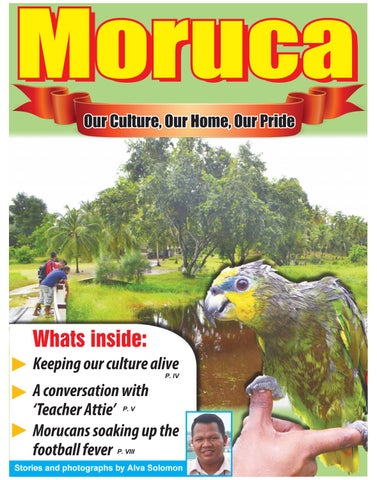
Moruca Our Culture, Our Home, Our Pride
Whats inside:
► Keeping our culture alive ► A conversation with P. IV
‘Teacher Attie’ ► Morucans soaking up the football fever P. V
P. VIII
Stories and photographs by Alva Solomon
II
MORUCA SUPPLEMENT July 28, 2016
FACTS ABOUT MORUCA
MORUCA consists of several communities which make up the sub-region, one of three found in the North West District. The other sub-regions are at Mabaruma, the administrative capital of the entire Region One, and Matarkai, where one can find Port Kaituma and Matthew’s Ridge. Moruca is divided into 11 titled communities, including Santa Rosa, Assakata, Chinese Landing, Waramuri, Santa Cruz and Kariako, to name a few. Santa Rosa, the largest and more populated of all communities, has an estimated population of 5000 residents and is governed by a Village Council led by a Toshao. Since Moruca is a sub-region of the North West District, Government plays an administrative role in its affairs. As such, an Assistant Regional Executive Officer is based at Santa Rosa. Santa Rosa comprises several small communities, called “satellite villages”, many of which are surrounded by swampy savannah lands and hence are referred to as islands. They include Kabucalli, St Peter’s, Mathurin Point, Poloma and Hobo. Kumaka, located within Santa Rosa, is the business hub and administrative centre of Moruca. The post office, police station, hospital and markets, among other businesses, are all located at Kumaka. The Santa Rosa Roman Catholic Mission played a key role in the historical development of Moruca, having been established there since
1818. Accommodation for visitors is provided at the Kumaka Guest House and the Regional Guest House at Acquero, once the administrative hub of the area. Another private guest house
Rosa. The latter facilitates shopping in a modern ambience.
GETTING TO MORUCA FROM GEORGETOWN A trip to Parika from Georgetown costs an average $500 by bus
Supenaam, another port located on the Essequibo Coast. That trip, which lasts between 30 and 45 minutes, costs $1300 per person. From Supenaam, the trip leads to the port of Charity, roughly an hour away. The fare is $1000 per person
A sign outside Cabucalli, one of several communities called ‘islands’ at Moruca
operates at Moruca, all located within minutes of Kumaka, the centre of town. Mobile phone services are available in the area; telecommunications giant Digicel has an office at Kumaka. There are many shops and a supermarket, called Clevies, at Santa
and $3000 by taxi. The taxi fare may vary, depending on the taxi service used. It is advisable to travel early, to arrive at Parika at day-clean and catch the calm waters off Parika before the Essequibo gets rough around 10:00 hrs. The trip from Parika leads to
to Charity. The taxi drivers may attempt to increase the fare based on the number of passengers that travel with them from Supenaam. The onus lies on the passenger to discuss and decide same. Once at Charity, the Moruca boat operators willingly take passengers’ bags and load to their
boats. This aspect of the trip can take an hour or more, and the wait is determined by the availability of passengers. The boat operators include the famous “Peanut and Sons”. His mobile numbers are 688-3457, 675-4354 and 614-8855. Another operator can be reached on 6812533, 697-9581 and 685-3821. The boats depart Charity for Moruca at least by midday or later, depending on passengers’ availability, and the journey takes on average an hour and a half. The cost is $3000 per person one way. The journey takes the passengers up to the mouth of the Pomeroon River, a brief ride through the edges of the Atlantic Ocean and inwards to the Moruca River. Be sure to walk with a camera to record the view. There are a number of turns along the Moruca River. The boat ride ends at Kumaka. There are taxi drivers there who willing drop passengers to their destination. Travel within and outside the Moruca community can be accomplished by boat, bus and cars. Electricity supply runs from 05:00hrs to 08:00hrs, and from 14:00hrs to 22:00hrs. There are several cook-shops at Moruca and the prices are within $1000 for a healthy bite. No littering: The environment is kept in a clean state. Several garbage bins lining the roadway can be attributed to this.
‘I will only move to join God’ “I had a nice time during my youth days, travelled all over,” said Donald James. He sat on a bench in his yard, as his two grandchildren played with a football nearby. He is the patriarch of Kummucherie Island, one of several landmasses which are surrounded by water in the Moruca Sub-Region. In fact, his is the only family member which resides on the island. Uncle Donald, as he is fondly referred to at Moruca, lives at the entrance of the community while his children live aback his home with their families. “Is only me and my four children and grandchildren,” he said. James is a retired surveyor. He worked with the then British Guiana Lands and Surveys Department, a job
which took him to almost every part of the country. He said that the job entailed taking samples and calculating boundary lines at various areas across the country including at Kaieteur Falls, Lethem, the Mazaruni and at Soesdyke. He said that he later ventured into the field of farming, and he was also a fisherman. “I used to even be into diving,” he added. These days, he catches fish, farms on the community lands and he purchases goods to carry him and his family at least for a month. James celebrated his 70th birthday last month. He said he will only move away from the island to join the Heavenly Father. “I alright, to be living by myself on this island with my
‒ says patriarch of Kummucherie Island
Donald James sits in his yard at Kummucherie island at Moruca. In background is another community called Mathurin Point, another islander landmass in the area
family, I really enjoy it here,” he said. Like most communities on the islands, James’ is one inherited from his father. He said that the lands have been passed down by generations and his sons and daughter will occupy other parts of the community and will also pass on the tradition to their children. James said that he enjoys the company of his many grandchildren. “I have a lot of grandchildren you know,” he said with a smile. “Over that side one of my daughters, she got a whole set you know and when they come here is a whole generation in the yard,” he said, as everyone nearby laughed. “That’s the reason Abraham got all those people behind him,” he added.
III
Moruca: a nature paradise MORUCA SUPPLEMENT July 28, 2016
Many persons possess wishes of travelling the length and breadth of Guyana. Some have fulfilled their wishes but a trip to Moruca in the North West District ws should be a “must-do” on one’s travel calide the windo The view outs Guest house endar. a of the Kumak Guyana is blessed with countless natural features, rich vegetation, mountainous terrain, meandering rivers and streams and roadways which connect the regions of the country. A trip to Moruca will surely impact the mind of the rich history and culture of this part of the country and the people here will surely add flavour to the taste of the first-time visitor. Moruca is accessible by water and air with the former being the preferred mode of travel for economic reasons.
HOW DOES ONE REACH MORUCA? For that Georgetown resident longing for a vacation, the trip is simple to accomplish. The journey begins with ride to Parika on the East Bank of Essequibo, preferably early in the morning around sunrise when the waters off this port is calm. Once across at Supenaam from Parika after 30 to 45 minutes of travel, a car is always willing to take one to Charity, another busy port further north. The trip lasts approximately 45 minutes but the driver may make several stops if he does not have a full complement of passengers. Once at Charity, a slight indication of Destination Moruca jolts the visitor when the boatmen collects one’s belongings and pack them neatly in the boats moored at Charity. The name “Peanut” is synonymous with boat travel to Moruca and the man himself, fondly called “Peanut” competes with three other boat operators who ply the route daily. This may be the more unfriendly aspect k across g women wal of the trip since waiting can last an hour or Several youn l ground at Kumaka. na more, depending on the frequency of passenthe recreatio e home of activities is th e nu ve e Th gers’ arrival times. Some passengers would at Moruca pre-arrange their trip via phone with the boat operator; hence, their arrival determines the boat’s departure. Once the boat is packed and ready, it is now headed for the mouth of the Pomeroon River, a brief sojourn through the Atlantic Coast and entry to the Moruca River. Here is where the trip “really” begins with several turns meandering around mangrove branches at the sides of the river. There may be a few stops along the way in the form of floating swamp-like vegetation which blocks the river channel. Locals refer to them as “bomball”. But the experts of river travel at Moruca usually have their cutlasses and ropes at the ready to haul, chop and speed alongside the obstacles in the water. A little over an hour after departing Charity, several homes along the waterway pops into view and the turns in the water adds to the adventure at this point. Suddenly, the iconic Moruca Bridge steps into view, and the reality of Visit Moruca hits home. There are taxis at the ready, buses which shuttle passengers to far-flung communities or one can simply walk the distance to the Kumaka Guest House. The Regional Guest house at Acquero also hosts visitors and another private guest house across from Kumaka, Moruca’s capital, is a taxi ride away.
ENTERTAINMENT Nightlife here can be a bugbear since the electricity supply cuts –off at 22:00hrs. A few persons laughing, some music here and there or cricket’s chirping puts one to sleep. However, if one is into partying to the “sun-raising” lines of sunrise in Bunji Garlin’s “Different logy” , the daily adventure can take-off at the sight of the sun in the east. One can either walk or take a taxi to the many sites Moruca has to offer. The river scenes are accessible by speedboats whose operators charge an affordable $500-$600 for short drops. The taxis charge a similar fare but walking brings out the adventure in the trip. A walk across the Moruca Bridge at Kumaka to the islands of Cabucalli, Kummucherie, St Peter’s, Paloma, Acquero , Huradiah , Mathurin Point and Tucupita brings numerous savannah views, landscape dreams, friendly people walking along the way, birds A convoy of boats motor aplenty, and natural forest-like sounds. alon Moruca River en-route to C g the To refuel there are always shops selling on the Esseq harity uibo Coast snacks and other edibles at affordable prices or one can simply ask a hospitable family along the road for one or two coconuts. Willingly, they would offer the coconut-water for refueling. Canoeing down-river can cap the day and chilling on the Moruca Bridge under the late afternoon sunlight can lead one’s thoughts to the beauty of Guyana. Moruca has developed immensely over the past decade. The Village Council at Kumaka, which is led by a Toshao, governs the community and the satellite villages are governed by councilors. Moruca is also a sub-region of Region One with Mabaruma and Matarkai being the other two. One noticeable feature at Moruca is the presence of garbage bins along the roadway at Kumaka, a feature which results in a clean environment. The people are predominantly Arawak -- Amerindian’s who are mixed with other Guyanese ethnicities. In addition, Moruca is home to Scottish and Spanish descendants, the latter having travelled across from Venezuela. Moruca also boasts its own supermarket. “Clevies” supermarket sells goods at affordable prices which are not too far-off from those at the supermarkets in Georgetown. The shopping experience here illuminates the mind that tourism is indeed the yardstick which can propel Moruca, if only it is nurtured in a well-planned manner. On the way back to the City, there is an early morning experience which commences with the Savannah la nd boat operators arranging taxis for pick-up at the landscap s characterise e at Moruca one’s doorstep. The cars would then drop-off the passenger at the landing near the Moruca Bridge where a sense of sadness may begin to envelope the mind. The trip back to Charity on the Essequibo Coast, which usually commences at 05: 30 hrs, may be characterised by a few more obstacles in the water. The boats usually leave in a convoy and the men assist each other while motoring out of river whenever the floating landmasses block the river channel. At approximately 07:00hrs, one arrives at Charity. One look in the distance can bring a sense of content that Moruca is indeed one of Guyana’s tourism gems. See additional photos on page VII ►
IV
MORUCA SUPPLEMENT July 28, 2016
Keeping our culture alive ‒ passing on the memory of Uncle Basil
Filling his shoes may be a difficult task. The late Basil Rodrigues, fondly called “Uncle Basil” imprinted a rich cultural history in his contributions to the development of the Hinterland, mainly in the area of education and music. He is seen as a formidable force in his own right, championing the cultures of the Indigenous people and someone who dedicatedly channelled his efforts in passing on the cultural and general knowledge of the nation’s first people. But who would know him better than his wife Delores, who spent 55-years in his company in the Rupununi and at Moruca where he was laid to rest two years ago at the age of 81. Uncle Basil was a recipient of the Medal of Service as well as the Golden Arrow of Achievement, awards which were bestowed on him for his efforts in advancing his cultural roots. During a visit to the Rodrigues’ home at Kokall, Moruca recently, “Aunty Doli”, as she is fondly called by many, spoke of her late husband’s undying love for the Amerindian culture, his passion for teaching and the huge task for those of this generation to fill the vacuum which was left by him after his ascension to the Great Beyond. She sat alongside her two daughters in the family’s living-room which is decorated with photographs of family members and one of Moruca’s most important sons. Aunty Doli said that there are days in recent times when she would think of Uncle Basil prior to making a decision. Any decision, she chuckled. “I’ll say how he would like it, then I would pull myself out of that but many times it still happens,” she said as her two daughters smiled nearby. She said the couple did everything together. “We were very close, we go to the shop, to the church, we worked together,” she said pointedly. The only time they spent apart were on her trips overseas, when her sister would invite her to Canada. “After 55 years of that, you miss somebody… to live those years with a person you got to be like a partner,” she said with a slight hint of sadness. Sadness of course is almost uncharacteristic of her spritely disposition. But his memory lives on and he provides a guide for her and the family. She said she discovered many things he taught or told her have proved useful today. “I find a lot things useful, God knew he would have left and I would have nobody else but the memory of him lives on,” she remarked as she stared at the many pictures of the family on the walls of their living room. The family bore several children and great grandchildren and while some have displayed traits of Uncle Basil, it is difficult to determine who will follow in his path.
well, he was a good ‘paracarri’, here we call it ‘paiwari’ (Indigenous beverage) up there is paracarri,” she explained. She said Uncle Basil would socialise but she found herself a stranger in strange lands, miles away from home. “Imagine, I got to now fall in and being pregnant and with bad feelings,” she said with an amused smile followed by a clap.
Aunt Ena was the cousin of Stephen Campbell, a revered son of Moruca and the first Guyanese Member of Parliament of Amerindian descent. She said those days back in 1959, things were much different from today. She explained that her mother must have seen “something in me and said Thank God I gon marry she off”. After a slight chuckle, she said that her mother had no pity on her, as she laughed at her situation at the time.
CULTURALLY GIFTED According to Aunty Doli, her grandson Jude Etienne, who teaches at Moruca, plays the guitar well, and is culturally gifted, traits of his late grandfather. She said Jude also plays the banjo, a small stringed instrument similar to a guitar. He played the instrument since his childhood years while in the company of his late grandfather. Jude also possesses a good command of English and he can also sing. Jude is preparing to wed his partner soon, Aunty Doli remarked. Aunty Doli recalled a banjo, a guitar and a triangle (metal instrument) being played on the day she tied the knot with Uncle Basil at Moruca. He was a member of a Banchikilli (Spanish Arawak music) band and his friends were on hand to serenade the couple from the church to the wedding house. She said his parents, “Uncle Stanley” and “Aunt Ena” lived at the bottom of the hill, some distance away from where she currently resides.
The newly-wed couple lived at their respective parents’ home separately until they moved to the Rupununi where Uncle Basil had already established his name since he was teaching in Region Nine at the time. “After marrying in December, Basil had annual leave and in April, we went up to Shea where he was teaching at the time,” Aunty Doli recalled. “He knew the people, they knew him
LIFE AT MORUCA After spending 25 years in the Rupununi, the couple decided to move back to Santa Rosa. That was in 1992. They were well-established at Aishalton at the time, Aunty Doli said. She noted that Uncle Basil thought hard about returning to his homeland. “Aishalton was home for him with all the scenery and so but his health was beginning to go a bit and we thought we needed to be closer to health care,” she recounted. On their return to Moruca in 1992, a few things needed to be fixed. “We notice our health service was not good. We hadn’t a doctor and he and I started working on it,” she said. In 1992, Uncle Basil started teaching at the primary school and where the family house stands today, was filled with bushes. “There were many vines,” she said. They built a small house on their return. “A little trooile top home, well at least we had a shelter,” she added with a little smile. “Not the two-story building I imagined but as usual, we said let us make use with what we have,” she said with a contented stare. At the time, her eldest daughter had moved to Boa Vista in Brazil while her other daughter and her grandson moved to Moruca with her and Uncle Basil. The couple started conversations with the community and later formed a health committee after they recognised that Moruca was not only the two communities of Kumaka and San Jose but included many far flung areas. She said Uncle Basil had a “good command of how to run things and people liked how he spoke not long and drawn out but he get things done”. As the years rolled by, she said he wanted to get deeper into culture and he found the children of Moruca were shy and had little pride in their tradition. “So what he used to do heritage time, he asked me to make a lap, head dress and so and he would go out,” she said, noting the people thought it funny. He was also centrally involved in church activities. Some 200 years ago, on St John’s Day which is celebrated on June 24 annually, the first Roman Catholic priest arrived at Moruca. The area’s very first families included the Atkinsons, the Aguilars, the Torres’, Rodrigues, among others and they were all Roman Catholics. The families wanted a church
Continued on page V ►
V
MORUCA SUPPLEMENT July 28, 2016
A conversation with
‘Teacher Attie’
Most 79 year olds are usually at home, just sitting around, carrying out their daily chores or confined to less movement around the home. But “Teacher Attie”, one of Moruca’s well -known retired educators, defies her age limits. She climbs in and out of speed boats near her Acquero home and she even travels to the Capital City. Her age is the least of her concerns. Her name is Esther Campbell nee Sutherland, but the name “Teacher Attie” was stuck to her character ever since she started teaching back in 1953 at the Santa Rosa Primary School. Her middle name is Attiline but according to her, those around her referred to her as “Attie” while her first name, like in most Hinterland communities, was left on the back burner. This publication was fortunate to capture the smiling senior citizen in two different settings; at her home in the quiet community of Acquero, once the main administrative centre of the Moruca Sub-Region and at the market at Kumaka where she sells clothing and other dry goods at her stall. Early one Saturday morning recently, she was preparing to travel across to Kumaka when she started to talk Teacher Attie in her youthful about life. Seated across the days as a teacher at Moruca room, was her husband Lennox Campbell who contributed to she taught all the subjects at all levels of the the conversation. A diabetic, and at 82, he primary school. In 1959, she stopped teachrarely travels, his wife however, does all the ing but resumed two years later. This time, travelling. she had moved to Wakapoa in the Pomeroon She spoke of going to their farm where River. she plants mainly cassava, a little distance up The Santa Rosa Primary was transformed road from her modest home. After the brief into a Government school when she returned chat, it was time to travel since on Saturdays to Santa Rosa where she taught until 1980 she ventures across to her stall at Kumaka when she hanged up her chalk and board where she spends the day selling. eraser. Once she was dressed, Teacher Attie led “The nuns were running the school when the way out to the landing off Acquero. Min- I started, they were all alright,” she said. She utes after a little wait, the boat arrived and she recounted one of the nuns, Sister Elizabeth as was the first to board the vessel. “I’m ok,” she being very strict and according to her, “she said as she climbed in the boat unassisted. still wanted to beat us even though I was Minutes later the vessel was at Kumaka, teaching,” she chuckled. and as before, she clambered out and led the way to her stall. She also paid the fare for this AFTER TEACHING reporter and the guide and her generosity was She said that she started working with a displayed with more smiles. As the interview sewing group and they would sew mosquito commenced at her stall, a customer stood nets on a large-scale. The nets were then sent around. to the Capital City for sale. “She use to pull my ears and use the “An organisation use to order them,” she blackboard eraser on me,” her customer and said. At the time too, she said that she started former student said, as everyone erupted in sewing on her own, for her own customers laughter. and she also ventured into farming alongside “That’s all you would hear from them, her husband who was then retired from his job that you beat them,” Teacher Attie laughingly as a surveyor with the Government of the day. replied. “I do farming now and then… and I used Her laughter comes naturally after almost to rear some chicken, up to now I still do my everything she says. little farming,” she said. The mother of seven recounted teaching at Later she took up the challenge to vend the Santa Rosa Primary when she was a little at the market at Kumaka. She said that the over 17 years old. building where the market currently stands At the time, the Roman Catholic Church was abandoned and it was slated to house ran the school system in the region. She said a cooperative society but the concept never
materialised. She said that several persons, including herself, merged their efforts and cleaned the building and later, they started selling. They would also sub monies to carry out infrastructural works. Later the building fell under the Santa Rosa Village Council and that body collects a fee of $1000 for maintenance of the building. She pointed to a few holes in the roof and chuckled as she mentioned the latter. On Sundays, Teacher Attie said she goes to church and after the service she visits her friends while on her way home. She usually stops at the neighbouring village of Cabucalli to meet her friends. She said that she is an ardent church-goer while her husband only goes to church on special occasions. That was the case late in June last when the couple celebrated their 53rd marriage anniversary. While asking her age, a pro-
nouncement was made regarding her being 71. She laughed and made a correction. “I complete 79 this May month,” she said. She said that she moved to Acquero soon after her marriage. “At that time, yes, it was bright but now it’s dead,” she laughingly said of Acquero. The community, which once housed the post office, police outpost and a dispensary, was busy in those days. The essential services are now offered at Kumaka where the Government buildings were relocated over the years. As regards her health, Teacher Attie was to the point. “Thank God I hardly get sick, with all the sickness going around,” she said. She recently travelled to Georgetown to have a medical check-up and while in the City, she was looking after her documents. “I’m going on a little holiday,” she said with a smile. Her sister, who resides in the United States, invited her for a short visit and she plans to travel sometime next month. She said that she will be travelling to the US for the first time. “It’s just a little trip,” she said. “They already telling me what to bring back and I’m not even in the plane as yet,” she said with a wide smile, characteristic of her. Teacher Attie stands in her stall at the market at Kumaka. These days sales are hard but she same will not deter her
Keeping our... established at Moruca and later, Father Haynes moved to the area where the church mission was built. “They built a little shed and Father Haynes arrived on that day,” Aunty Doli schooled. That evening lighted torches in the form of bamboos were placed along the sides of the water near the community of Hobo were the priest was welcomed. The scene is re-enacted
annually and before Uncle Basil passed-away, he was involved in the planning process until his health deteriorated. The scene was nevertheless re-enacted and his memory is etched in the celebrations which Aunty Doli noted, established a point in Moruca’s rich history. A question pose to residents on Uncle Basil’s contribution to the community points to one thing; his involvement in the fostering
From page IV
of the indigenous culture. As for Aunty Doli, she continues to celebrate his work and his contribution to the development of Moruca. Her craft shop is revered in that regard, since various forms of Amerindian artifacts are on sale to anyone who wishes to celebrate the culture and history of the nation’s first people, a feat Uncle Basil preached until he left for the Great Beyond.
VI
MORUCA SUPPLEMENT July 28, 2016
Journey to Acquero A family paddles along the calm waters outside Acquero
THAT Saturday morning, the sun rose in the distance and a phone call came from a friend. The planned trip involved a canoe, and ‘canoeing’ in the waters of the Moruca was an adventure one most definitely looks forward to while in this picturesque region of the North West District. The Destination: Acquero. Once the administrative capital of Moruca, Acquero is derived from the Arawak word “Akyorro”, which is a condensed form of the word most persons fondly know as “korro”, the fruit from the palm trees. The community is located approximately five minutes’ drive downriver from Kumaka, the “capital” of Moruca. Our journey started by foot from the Kumaka Guest House. On the way, several men stood on the iconic Moruca Bridge, which connects Kumaka with San Jose on the other side, awaiting the arrival of fishermen, who brought crabs and the more expensive species of fish, such as the famous “gilbakka”. Across at San Jose, persons walked by business-like, and minutes later, after a few turns, the road ahead led to Cabucalli landing, a small port off the ‘island’ of Cabucalli. Almost all the communities here are called ‘islands’ since they are all surrounded by water in the wet-savannah lands between them. At Cabucalli, a search commenced for a paddle or two, since a canoe was nearby. While searching for paddles, two padlocks on chains at the bow of the canoe were noticed. Canoeing was now out of the question that morning. The sun’s light was now blistering the cool waters of the Moruca River, and Option B centred on hitching a ride with passing speedboats -- not the idea which was planned. Up ahead, a speed-boat appeared and a visibly intoxicated man sat at the front while the boatman asked our destination. Having boarded the boat, the destination was now Acquero. The intoxicated man
raised a few questions, including the price of the camera I carried, the type of work one does while working for a newspaper; he voiced his opinion on a football match played the day before, and detailed what he planned on doing when he reached home. At first glance, Acquero appeared very quiet. Not much activity seemed probable here. The presence of a dog at the front near the revetment on the community’s periphery with the river was the only movement on arrival there. At the edges of the community were a few Government homes, all occupied by public sector employees; the Government guest house; a building which once housed a school, and a road ahead. The walk from the landing to the first household was characterised by chirping birds, insects in the bushes nearby, light sunlight, and a dog which did not seem too friendly. The dog belonged to Teacher Attie, a gentle senior citizen whose “granny characteristics” leaves a lasting impression on one’s mind. We were warmly welcomed into her
home, and Teacher Attie and her husband sat down and offered information on Moruca. She said that Acquero was divided into “Little Acquero” and “Big Acquero”, two sections which were later bridged by road. “Little Acquero” is currently at the front of the community, where one disembarks on arrival. “Big Acquero” is where Teacher Attie and another 12 of the 14 families of the community reside. “It used to have water between the two, and a dam was built up between them,” she said of the two sections of the community. According to her, at the front of the community, “Little Acquero”, where the quarters of the Assistant District Commissioner (now the Assistant Regional Executive Officer). The official at the time was resident at Mabaruma, the region’s administrative capital. A large building housed a dispensary, the Acquero Post Office and the Acquero Police Station. Those public agencies are now located at Kumaka; however, their names remain the same. Here at Acquero, leading trees and savannah lands in the background brings out the best in scenic views of Moruca
Acquero’s picturesque landscape
“Even the names they gone with,” Teacher Attie remarked, as everyone laughed. Court sessions were also undertaken at the building. She pointed to the few standing columns where the building once stood. Later, the community applied to the then President Desmond Administration for permission to convert a Government building at the front of the community, into a secondary school. Permission was granted and secondary education was now offered at Acquero. Later, around 1997, the secondary school was moved to what is today the Santa Rosa Secondary School across at Kumaka. “Here used to be busy you know,” Teacher Attie recalled. After chatting with the elderly woman, the journey was now focused on a walk around the community. Sun rays pierced the trees above, a few birds fluttered above the trees and the long, meandering road ahead was ideally situated for a nature walk. It led to the neighbouring community of Huradiah. After chatting and walking uphill, followed by a few chips downhill, the views of Acquero climaxed. On our return to her home, Teacher Attie was ready to cross over to Kumaka and canoeing was still in thoughts; until our gentle senior guide pulled out her little phone book and called a boat. “$500 for short drops,” she said, with her handbag clutched over her shoulder. “Some boatmen charge a $100 more,” she added. Our return to Kumaka was characterised by the gentle turns, calm waters and a few persons canoeing as we motored along. Jealousy enveloped the mind as the canoes rowed by. But this was quickly equated by the sight of Acquero in the distance, a place rich in history, tourism potential and memories which can only be experienced by a visit. The Regional Guest House stands in the background on remnants of the foundation of buildings which once headlined the landscape at Acquero
Moruca: a nature paradise VII
MORUCA SUPPLEMENT July 28, 2016
aka with outside Kum The waterway dge in the distance ri the Moruca B
uca ew of the Mor the A roof-top vi in ls arket stal Bridge with m e village of San Th . nd ou foregr e distance Jose lies in th
-top view of Another roof scape nd la s Moruca’
Scottish jars . These jars are testimon of the Scottis y h ancestors of Morucans
“Flavies” is a popular ha ng-out spot on the periph er It is accessib y of the Moruca River. le by boat an d car
Several vehi cles climb th e the recreatio nal ground at hill near Kumaka
VIII
MORUCA SUPPLEMENT July 28, 2016
Morucans soaking up the football fever Two football teams which contested the finals of the Digicel Football championships finals at Santa Rosa in Moruca stand alongside game officials prior to the start of the match
They came out in large numbers to see the game. It was contested between two teams from another section of the North West District, one of which knocked their home team out of the Digicel 2016 football championships, days earlier. The presence of dozens of hands along the fence of the Santa Rosa Recreational Ground that afternoon told the tale of Moruca’s passion for football. Football is a sport which is keenly contested in most Hinterland communities. The game appeals to almost every generation in each community and the presence of cable television in those remote areas has impacted the game’s futuristic presence in every community. Moruca is no exception. During the week of July 14 last, the mood in the community was buzzing and the residents were out in their numbers as the 16:00 hrs match-time between two teams, the Hosororo Primary and the North West Secondary, neared. The winner would hold the bragging rights of being the Region One champion. The North West Secondary boys defeated the home team earlier that week, and there was no telling of who Moruca was supporting. When the referee whistled the
A large crowd is usually on hand to watch football matches contested at Moruca
start of the game, they shouted at almost every move the Hosororo players made. But that is the passion of the community where football is concerned. Almost every vehicle within Moruca lined the roadway outside the venue, residents were seated at the pavilion opposite the ground in large numbers and the seats below the Kumaka Guest House, which is located on the periphery of the venue, was filled to Margaret Abraham attends to her Bar-B-Q stand following a football match at Santa Rosa recently. Abraham’s and other businesses usually capitalise on sport and social events held at Moruca
capacity. Several children sat atop a water trestle to obtain a better view of the proceedings. The verandah outside a home opposite the ground lacked space for another face. “This is Moruca and we like our football,” said Bar-B-Que vendor Margaret Abraham. She is one of many who capitalise on such activities whenever they are taken to Moruca. She turned her chicken as she spoke on the subject. She said that the sport brings out the best of the area. During the earlier stage of the tournament, many ventured into Santa Rosa from near and far, as distant as Waramuri, a riverine community located miles downriver and which is also accessible by road. “This is the time that is usually good,” Aunty Maggie, as she is fondly called, said as she chatted about business. Her Bar-B- Que chicken combos with fried rice, cook-up and to a lesser extent chowmein, usually sells out on any given weekend night.
During the week, her foods are also on demand but it is the hosting of activities in the community which draws foodies to her stand. Across the road from Margaret are several shops with bars. Residents and visitors also flock these venues during the hosting of popular events. The Kumaka Waterfront is also usually busy in the aftermath of football matches, and win or lose, opinions or comments are usually the talk of the night at the popular hangout spots there. According to one resident, the annual Moruca Expo brings out the best in the hospitality of the residents. He said the event attracts hundreds of visitors, who venture into the community from various parts of the North West District and the Coastland, including Georgetown. But it is football which keeps the crowd alive. Several match-ups are carded annually as part of the exposition. When the game is contested on the Santa Rosa ground, the residents voice their support, concerns, advice and even temper when the ball gets rolling, or kicking. The highlights of those features are the monetary prizes for which the teams compete. And this year the stakes are high. While someone will walk-away a winner, it is the residents who win the ultimate prize for crowd support. “Nothing can compete with football here,” said Margaret’s customer, as she wolfed down her cook-up rice.
Spectators surround the ground during a recent football match. Moruca is very passionate about football