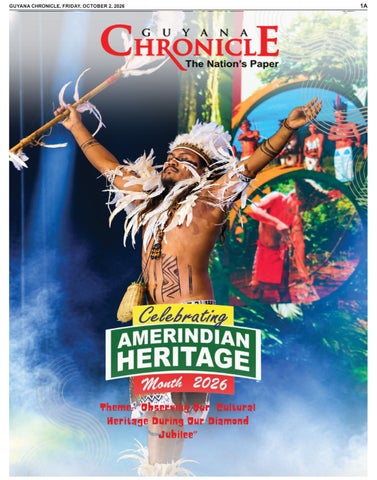
GUYANA CHRONICLE, FRIDAY, OCTOBER 2, 2026
1A
2A
GUYANA CHRONICLE, FRIDAY, OCTOBER 2, 2026
Historic win for Region Four!
HISTORY was made at the 2026 Miss Amerindian Heritage Pageant as Ms. Alliah Simon of St. Cuthbert’s Mission/Pakuri captured the coveted crown, securing Region Four’s first-ever win in the competition’s 25-year history. Simon’s victory marks a landmark moment for Region Four and adds a new chapter to the pageant’s quarter-century celebration of Indigenous culture, heritage and beauty. She was joined in the top spots by Ms. Mariella Courtman of Region Two, who was named first runner-up. Congratulations to Simon, Courtman and all the
delegates who proudly represented their communities and regions, showcasing Guy-
ana’s rich cultural heritage with pride and distinction. (Photo credit: NCN)
3A
GUYANA CHRONICLE, FRIDAY, OCTOBER 2, 2026
‘MV Barima tragedy must inform a stronger culture of safety, infrastructure, leadership and responsibility’ –President Ali
PRESIDENT, Dr Irfaan Ali has emphasised that the lessons of the MV Barima tragedy must inform a stronger culture of safety, infrastructure, leadership and responsibility, as Guyana continues to grapple with the pain left by the loss of dozens of lives. Speaking during a recently released interview, President Ali said the tragedy remains a source of sleepless nights and something he wishes had never occurred. He stressed that his responsibility as Head of State required him to remain present and lead through the difficult period. He said the tragedy must lead to lasting improvements in safety, infrastructure, leadership and responsibility. The country, he added, has a duty to learn from what had happened and build a stronger and more effective system. “Our task, therefore, is to navigate the future from the harsh lessons of that tragedy and every other tragedy, and to build in the memories of those who we lost, assist them in a new culture of safety, Infrastructure, leadership, and responsibility that would utilise the laws as a new beginning for a stronger, deeper, more efficient system, and that is what we’re doing,” he said. Reflecting on the response to the tragedy, he said he witnessed doctors and other personnel giving their best during what he described as a horrific and tragic period, while also seeing the strength and support of Guyanese. He acknowledged that navigating the national response while responsibilities of governing the country was not easy, but said he was able to rely on his Cabinet and wider team, some of whom were directly involved in supporting affected families. “I’m the president. I’m the leader. And a leader must not only be a leader in the good times. You have to be a leader in every circumstance, in every season you have to be there.” President Ali said the country itself had been changed by the tragedy and that Guyana could not simply return to the way things were before it occurred. He said the pain experi-
President Dr. Irfaan Ali
enced by the families who lost loved ones remains with him, including the grief endured by children, siblings, grandparents and parents. President Ali also stressed that support for the affected families must extend beyond the immediate aftermath of the tragedy. He said continued emotional, spiritual, physical, community and material assistance remains important, along with maintaining a connection with the families and reminding them that they remain part of the wider Guyanese family. He said the responsibility to those families is not temporary, but one that he views as extending throughout his lifetime. The president also acknowledged the political tensions that accompanied the tragedy, saying it was difficult to deal with attempts to use an emotionally charged and painful period to score political points. He said while the national focus was on dealing with
the tragedy and supporting those affected, some political responses were driven by a different agenda. The MV Barima, an 87-year-old passenger and cargo vessel, was travelling from Georgetown to Port Kaituma in Region One (Barima-Waini) when tragedy struck. The vessel departed the Kingston Goods Wharf in Georgetown at approximately 15:15hrs on July 18. Later that night, the vessel encountered difficulties while travelling off the Essequibo Coast, near the mouth of the Pomeroon River, before eventually capsizing. Approximately 179 passengers and crew were believed to have been aboard. The disaster resulted in 73 deaths, while 76 people survived. Authorities have said approximately 30 people remain unaccounted for. According to the Maritime Administration Department (MARAD), the vessel is presently lying as a wreck in approximate positions: Latitude 07° 28′.213 North,
Longitude 058° 23′.443 West, in water depths of about 13-
15 metres (42-49 feet). Three companies—two Guyanese-owned and one based in the Netherlands— have submitted bids to undertake salvaging of the MV Barima. The three bidders are Industrial Fabrication Inc. (InFab), BK International Inc., and KMS BV of the Netherlands. The National Procurement and Tender Administration Board (NPTAB) opened the bids earlier this month, with BK International Inc submitting the lowest bid. InFab, which was founded in 2003 by Jerry Max Goueia and Dyland Fields, submitted a bid of $1.895 billion to salvage the vessel. BK International, founded by Brian Tiwarie and involved in areas including sea defence, construction,
marine transportation and aviation, submitted a bid of $1.034 billion. M e a n w h i l e , N e t h e rlands-based KMS BV, a registered commercial ship owner and manager headquartered in Vijfhuizen, submitted the highest bid at $2.0351 billion. Three Transport and Harbours Department employees have been charged with murder in connection with the MV Barima tragedy. They are Captain Kevin Price, Chief Mate Rondell Dwayne Roberts, and Goods Superintendent Delon Granderson. The three were charged with several counts of murder and remain on remand, with paper-committal proceedings set to begin on November 16.
4A
GUYANA CHRONICLE, FRIDAY, OCTOBER 2, 2026
A distinguished career rooted in service and representation: Ambassador Carolyn Rodrigues-Birkett FROM a schoolteacher in Santa Rosa to Guyana’s Permanent Representative to the United Nations, Ambassador Carolyn Rodrigues-Birkett’s career has been marked by a series of historic firsts and a sustained focus on Indigenous representation. Rodrigues-Birkett’s journey began in her home community of Santa Rosa, Region One, where she started
her career as a schoolteacher before working with the Social Impact Amelioration Programme and coordinating several projects focused on Indigenous communities. That experience laid the foundation for what would become a prominent career in public service and international diplomacy. In 2001, at age 27, Rodrigues-Birkett was appointed Minister of Amerindian
Affairs, becoming the youngest member of Guyana’s Cabinet at the time. She served in the position from 2001 to 2008. During her tenure, she played a key role in the development of the Amerindian Act of 2006, legislation which strengthened the legal recognition and protection of Indigenous communities, including their land rights and systems of governance.
In 2008, Rodrigues-Birkett became Guyana’s first Indigenous Minister of Foreign Affairs and the first woman to hold the position. She subsequently served as Minister of Foreign Affairs, Foreign Trade and International Cooperation until 2015.Her career later expanded beyond Guyana’s borders. Rodrigues-Birkett worked with the Food and Agriculture Organization, Ambassador Carolyn Rodrigues-Birkett
including serving as Director of its Liaison Office in Geneva. In 2020, she was appointed Guyana’s Permanent Representative to the United Nations. That appointment marked another historic milestone, as she became the first woman and first Indigenous person to serve as Guyana’s Permanent Representative to the UN. Today, Rodrigues-Birkett is among Guyana’s most prominent examples of Indigenous representation on the international stage, with a career that has taken her from Region One to the centre of global diplomacy. Recently addressing permanent representatives, delegates and civil society at UN Headquarters, Rodrigues-Birkett set out a vision she described as “principled, pragmatic, and responsive” to the needs of the organisation. She noted that the appointment of the next Secretary-General comes at a “critical moment” for a multilateral system under unprecedented political and financial pressure. “The global landscape has changed, and the tools required to guide the organisation must likewise evolve. The vision I have outlined is principled, pragmatic, and responsive to the needs of the organisation,” she said. Acknowledging the mounting frustrations on the UN deliverables in the wake of systemic pressures, she vowed to bring practical advancements, ensuring that the organisation is truly fit for purpose, closing gaps that currently exist between the efforts being made and tangible solutions. “No country is untouched by the work of the United Nations. While the full breadth of its achievements may not be widely recognised, its impact is clear across every region of the world,” she said. The dialogue formed part of a transparent and inclusive selection process mandated
by General Assembly Resolution 79/327, under which each candidate presents their vision and answers questions from Member States and civil society. Drawing on her five years at the United Nations and Guyana’s recent term on the Security Council, Rodrigues-Birkett said she had heard a “growing sense of frustration that the UN is not delivering as it should”, citing proliferating conflicts, the slow pace in meeting the Sustainable Development Goals (SDGs) and a worsening liquidity crisis. Yet she insisted that the world would be “difficult to imagine” without the UN’s conflict prevention and standard-setting work. “If there were no United Nations, how would we even begin to address many of the global issues confronting us? I’ve said all of this because I believe in the United Nations. It is indispensable. It is incomparable, and it is a force for global good,” she said. Rodrigues-Birkett said her vision builds on the UN’s achievements while responding directly to the challenges we face, aligning with the UN’s 80 reform agenda. “An effective Secretary General in today’s context must possess two essential strengths, in my view, discernment and versatility. She must be an administrator, peacemaker, mediator, broker, negotiator, convener, and spokesperson. More importantly, she must be able to discern which role is most appropriate in any given situation,” Rodrigues-Birkett said, adding: “I believe that I have acquired these skills during the period of my time as Minister of Foreign Affairs of Guyana, Minister of Amerindian Affairs, as an international civil servant and as a permanent representative right here in these halls, representing my country.”
5A
GUYANA CHRONICLE, FRIDAY, OCTOBER 2, 2026
PM Phillips pledges assured markets for Indigenous farmers –highlights ongoing investments to enhance processing capacity, improve value-added production
PRIME Minister, Brigadier (Ret’d) Mark Phillips has stressed the need to ensure Indigenous farmers have reliable markets for their produce, as he outlined a raft of government investments aimed at transforming hinterland communities from subsistence livelihoods to sustainable commercial activity. Speaking at the 2026 Heritage Village celebrations in Bumbury, Region One, the prime minister said government’s strategy is to pair farm support with guaranteed market access, processing capacity, and reliable transport so that Indigenous producers are not left vulnerable after increasing production. Region One, he noted, is receiving focused agricultural support, including the commissioning of a pontoon and two excavators to improve drainage and irrigation capacity, and critical infrastructure for expanding cultivation in low-lying areas. Additional agricultural extension officers are to be deployed
across the region to work directly with farmers, providing technical guidance and helping them adopt improved practices. The government has already distributed more than 18,000 coffee plants and over $50 million in planting materials and agricultural inputs to farmers there, a move aimed at diversifying crops and raising incomes. “Farmers must be able to grow with the confidence that there is a market for what they produce, processing capacity and dependable transportation will determine whether that transition succeeds,” the prime minister said. At the value-added end of the chain, Phillips pointed to the processing facilities at Hosororo and other communities which are supporting the development of ginger and turmeric production. These facilities, he explained, are intended to move Indigenous producers higher up the value chain by enabling them to supply processed products rather than only raw commodities.
Beyond farm-level support, the prime minister cited wider investments in productive assets and transport that are expected to reinforce agriculture-based livelihoods. Approximately 300 tractors are now owned across Amerindian villages, along with boats, outboard engines and minibuses provided to strengthen transportation and economic activities. These assets are intended to help farmers move inputs to their farms and get produce out to markets more efficiently, particularly from remote riverine communities. He framed these measures as part of a broader effort to ensure that Indigenous farmers are not only producing more, but are securely integrated into stable, profitable markets. Bumbury itself, which has approximately 300 residents, was highlighted as a model of community-driven development. The prime minister highlighted a $5 million sewing centre, an additional $2 million in furnishings
from the Ministry of Amerindian Affairs, the installation of 20 streetlights under the Presidential Grant Programme, and approximately $12 million in Low Carbon Development Strategy (LCDS) funding used to renovate 56 homes. This year, the village received a further $7.5 million in LCDS resources for projects identified by residents. “Amerindian development cannot be successfully planned from Georgetown by central government alone,” he said, adding that village leaders and residents are best placed to determine their priorities, while government’s role is to listen, support and ensure accountability for public spending. Prime Minister Phillips outlined that over the past five years, some $41.7 billion has been invested in Amerindian villages and communities nationwide, including $21.7 billion through the Amerindian Development Fund and $14.2 billion via the LCDS. Parallel to the economic push, government has
PM Phillips during his address at the Heritage Village celebrations at Bumbury, Region One
invested $1.6 billion in ICT hubs between 2021 and 2026, resulting in 170 fully operational hubs and 25 more under construction. More than 3,000 people from 200 communities have received ICT training, 75 per cent of them women, while hinterland power generation has expanded from 1.62 megawatts to roughly 17.5 megawatts, supporting schools, health centres, businesses and homes.
Reflecting on the life of Stephen Campbell
IF one were to ask, why was September selected for the recognition of Indigenous Heritage Month, very few might be able to respond competently. The answer to that question can be summed up in the name of one man, Stephen Campbell. On December 26, 1897, in Santa Rosa, Moruca, British Guiana, Maria Dos Santos and her husband, Tiburtio Campbell welcomed their baby boy, Stephen Esterban Campbell, who, little did they know, would one day become a legend and hero for many Amerindians and Guyanese. Unfortunately, neither of his parents lived to see him become a living legend. Following the death of his parents, Campbell, who, belonged to the Arawak Tribe, was raised by his grandmother where he attended the Catholic Santa Rosa Primary School. There is not much information about him in his teenage years, nevertheless, he was described as a man who never limited his a abilities to naysayers, which led him to become the first Indigenous politician to become a member of the British Guiana Legislative Council that is now called Parliament. He entered the Council on September 10, 1957; hence, September was chosen to honour the national contribution of Indigenous Guyanese. HE DID IT ALL Campbell was the holder of
Stephen Esterban Campbell
many professional caps. He was a teacher at various villages and settlements, from the Pomeroon to the Rupununi. According to research, his teaching career allowed him to interact with persons of various cultures and beliefs. He worked in bauxite mines and he farmed. His work with common labourers and the difficulties he endured, certainly shaped his views and influenced his activism for education for Indigenous Peoples. Campbell was at the age of 60 when he entered party politics, joining a party called the National Labour Front (NLF). He was particularly passionate in his fight for equal opportunities for Indigenous Peoples during his tenure as a politician. AN ADVOCATE FOR HIS PEOPLE A strong believer in empower-
Stephen Esterban Campbell, MP, presenting the Amerindian Land Rights Petition to the British Secretary of State, Duncan Sandys, in London, England Stephen Campbell with a petition presented at the London Constitutional Conference
ment and self-sufficiency, Campbell fought vigorously during his parliamentary days for educational opportunities and land rights for indigenous communities. During the colonial days, the then rulers allowed Amerindians to live their life in ‘reservations’, according to their traditions and practices, subject to certain limitations. However, Amerindians at that time had no formal title of ownership or established legal rights to the lands which they used or where they lived, which saw fear arising when there were talks of then British
Guiana becoming an independent country. The people feared that after the country gained Independence, whatever rights they enjoyed would have been trampled upon and ignored and the lands on which they lived and built their families on for thousands of years would have been expropriated. In 1962, Campbell travelled to London to present a petition and lobby the British government for recognition of Amerindian land rights. On that first visit to London, Campbell took with him a petition which was written on a long scroll and signed by dozens of Indigenous leaders of the day. He presented it
to the British Secretary of State, Duncan Sandys, in London, after having a private, one-hour meeting with him. Sadly on May 12, 1966, two weeks before British Guiana gained Independence, Campbell passed away while he was receiving treatment in Canada where he was later laid to rest. However, the work that he did during his last days made sure that when Guyana attained its Independence on May 26, 1966, Indigenous Peoples had legal ownership of land and rights of occupancy, and these were embodied in the Independence provisions.
6A
GUYANA CHRONICLE, FRIDAY, OCTOBER 2, 2026
$41.7B channelled into hinterland development over five years
President Dr. Irfaan Ali
MORE than $41.7 billion in investments have been channelled into Amerindian and hinterland communities over the past five years, President Dr Irfaan Ali has
said, further outlining his administration’s continued focus on expanding development and opportunities for Indigenous peoples. Speaking at the opening
— President Ali highlights continued focus on expanding development and opportunities — cautions against players seeking to gain political mileage
ceremony of the 2026 Heritage Month celebrations, the Head of State argued that the real measure of development is not the absence of problems, but whether un-
precedented growth is being used to tackle long-standing inequities faced by Indigenous peoples. “The real test of development is not where the problem exists. The real
test is whether we are using our unprecedented economic growth to solve them, and whether the benefits of that growth are reaching you, our Indigenous peoples,” the President said. He pointed to a range of programmes which he said have moved Indigenous communities from the margins to the centre of national life. According to Dr Ali, more than $41.7 billion has been invested in Amerindian villages over the last five years, including $21.7 billion through the Amerindian Development Fund. Villages now boast shops, sawmills, ecotourism facilities, buses and modern agricultural projects which, he stressed, were once unimaginable. The President contrasted current conditions with earlier years, when the “biggest request” from an Amerindian community under regional development projects was a sewing machine. “The critics will point to a pothole, a power outage, a school in need of repairs, a leaking roof, or some other problem, and declare, how can this happen? They will not point to the fact that for the first time we are on the verge of achieving 100% universal secondary education in the Indigenous village. They would not point to the fact that you now have 100 per cent primary education available in your village,” he said, adding, “They would not point to the fact that in the last five months alone, more than 30,000 Indigenous persons have direct access to healthcare. They will not point to the fact that you have modern hospitals being built. They will not point to the fact that you have doctors, medics, nurses, teachers, soldiers, police officers, fire officers, right from your village, serving your region and serving your community.” Dr Ali also cited the restoration and expansion of the Presidential Grant, now totalling almost $3 billion, and the return of Low Carbon Development Strategy (LCDS) funding which, he said, has delivered $14.2 billion to villages after being “absent for five years under another government”. In agriculture, he reported
that villages collectively own almost 300 tractors, alongside “hundreds” of boats, outboard engines, minibuses, pickups, ATVs, and trucks, all tied to targeted State support. Energy, infrastructure and ICT were presented as pillars of this hinterland transformation. The President credited Prime Minister Mark Phillips with leading what he called a “revolution in energy”, taking generating capacity in hinterland areas from 1.62 megawatts to almost 17.5 megawatts through hydropower, solar farms and household solar systems. This, he said, is enabling thousands of hinterland residents to train as teachers without leaving their villages. On roads, Dr Ali reported the delivery of 79 kilometres of paved roads in hinterland communities, 71 kilometres of asphaltic roads, more than 1,200 kilometres of laterite roads and nearly 100 structures, with some 2,400 kilometres of road corridors maintained nationwide and an additional 1,098 kilometres maintained in Region Nine alone. Billions more, he said, have gone into education, healthcare, housing, water, safety and security. In Region Nine, surgical procedures reportedly increased from 189 annually to almost 1,300, while malaria positivity rates, according to the President, have fallen from 24 per cent to less than seven per cent. Water coverage in hinterland communities has risen from 45 per cent to 95 per cent, with 260 new systems installed and more than 400 now in operation. Dr Ali urged Indigenous communities to “be careful” of those who appear only in moments of crisis, “arriving in fast boats, bearing hampers and expressions of sympathy”. Drawing on the biblical image of “false prophets”, he cautioned saying, “Be especially careful when people seek to turn your legitimate concerns into a vehicle for their own political or personal survival. Do not allow your grievances and aspirations to become somebody else’s escape route for their own legal troubles.”
GUYANA CHRONICLE, FRIDAY, OCTOBER 2, 2026
7A
8A From traditional dances and vibrant performances to cultural displays, craftsmanship and the sharing of ancestral knowledge, Amerindian Heritage Month 2026 brought Guyana’s Indigenous cultures to life. These moments capture a month of celebration, pride and connection to the traditions that continue to shape the nation’s identity.
GUYANA CHRONICLE, FRIDAY, OCTOBER 2, 2026
GUYANA CHRONICLE, FRIDAY, OCTOBER 2, 2026
9A
McCoy hails Amerindian Heritage Month as symbol of inclusion, development — warns against political posturing, points to PPP/C’s impressive record of investment
Minister McCoy engages residents and visitors during the heritage celebration at Swan Village on the Soesdyke-Linden Highway
MINISTER within the Office of the Prime Minister with responsibility for Information, Kwame McCoy, has hailed Amerindian Heritage Month as a powerful symbol of Guyana’s commitment to inclusion, development, and respect for its first peoples. He made this known while addressing a lively celebration at Swan, along the Soesdyke–Linden Highway. Speaking at the event, which brought together scores of residents and visitors, Minister McCoy described the heritage celebration as a “family occasion” that unites Guyanese across communities and backgrounds. He said the activities at Swan offered “an opportunity for us to see on full display our talent, our culture, and for us to educate ourselves about the heritage of our Indigenous people, and to remind us of where we came from and where we are headed.” Reflecting on the evolution of the Swan community, the minister recalled its beginnings with the allocation of 40 acres of land dedicated to Amerindian people, noting that the community has come a far way from its “humble days” to its present state of development. He framed this progress as part of a broader national push for inclusion, stressing that Amerindian brothers and sisters have been fully integrated into the development
paradigm of Guyana. “We can recall the beginnings of the Swan community, an allocation of 40 acres of land dedicated to American people, and moving from then, the humble days, to where it is today, a far way to development and the type of development that speaks to inclusion, because right across our country, our Amerindian brothers and sisters have been fully integrated into the development paradigm of our country. Thanks to the People’s Progressive Party/Civic, our government remains a government for the people, for our Amerindian brothers and sisters.” Underscoring the significance of Amerindian Heritage Month, observed every September, McCoy pointed out that no other ethnic group in Guyana has been accorded an entire month dedicated to their observance and celebration. He said this in itself was “special” and a reminder of the value the state places on the culture, history, and identity of the Indigenous population. Beyond cultural preservation, the minister highlighted the economic dimension of heritage activities. He said events such as the one at Swan are not only about song, dance, and ceremony, but they are also about supporting small businesses and local economic ventures, as artisans, vendors and performers earn from providing
services and cultural displays that coincide with the celebrations. He cautioned the audience about political figures who “will come, and they will walk around, and they will run around… in their most pretentious fashion,” contrasting this with what he portrayed as the PPP/C’s consistent record of tangible support and investment in Amerindian communities. “Our government remains that government – genuine and true for the development of our people. We have, over many years and continuously, made sacrifices and investment in the people of our country, including our Amerindian brothers and sisters, and today there is a lot to boast about, and today that we can see development right across our country, and to be reminded that these developments came with tremendous sacrifice and in the investments we made in the people of this country, the first people, the people to which we honour and we treasure and we grant our respect, the heritage comes together with development.” McCoy further linked the occasion to the wider development agenda of the government under President, Dr Irfaan Ali, stating that the administration is “continuously” committed to improving the lives of people in Swan and communities across the country.
10A
GUYANA CHRONICLE, FRIDAY, OCTOBER 2, 2026
GUYANA CHRONICLE, FRIDAY, OCTOBER 2, 2026
11A
12A
GUYANA CHRONICLE, FRIDAY, OCTOBER 2, 2026
13A
GUYANA CHRONICLE, FRIDAY, OCTOBER 2, 2026
Patamona firewoman inspires through service and heritage
- nine-year Guyana Fire Service career highlights Indigenous representation and opportunities for women AS Guyana observes Amerindian Heritage Month, Leading Firewoman Indra Archer is being recognised for nearly a decade of service in the Guyana Fire Service (GFS), while using her journey from the Indigenous village of Paramakatoi to inspire greater representation of Indigenous women in public service.
Archer, a proud Patamona woman from Paramakatoi, Region Eight, has served in the Guyana Fire Service for the past nine years and is currently stationed at the Quartermasters Stores at the Fire Service Headquarters, Homestretch Avenue, Georgetown. Her story highlights the role of Indigenous Guyanese in national institutions and
Leading Firewoman Indra Archer
the opportunities available to young people from hinterland communities who aspire to serve their country and pursue careers in traditionally underrepresented fields. For Archer, serving in uniform while maintaining a strong connection to her Indigenous identity is a source of pride. “It is a great honour to represent my Indigenous heritage. It reminds me of the values taught to me while growing up, especially respecting and helping our elders,” Archer said. She explained that those values have remained important throughout her career and continue to influence how she approaches her duties and interacts with others.
Archer has also had to establish herself in a profession that has traditionally been dominated by men, an experience she believes demonstrates the contribution Indigenous women can make across Guyana’s public services. “I am proud to show that I can make a difference in a male-dominated organisation as an Indigenous woman,” she said. Her commitment to professional development has resulted in notable achievements. Archer graduated as the Best Student in the Junior All Arms Ordnance Course conducted by the Specialist-to-Arms Institute of the Guyana Defence Force. The achievement reflects
her commitment to training and professional advancement and underscores the importance of providing opportunities for personnel to develop the skills needed to contribute effectively to national institutions. Archer said her decision to join the Guyana Fire Service was driven by a desire to help others and make a positive difference in her country. Nine years after entering the service, she said that commitment remains central to her career. “A career in the Guyana Fire Service is an opportunity to serve your country and make your community proud,” she said.
and promoting Amerindian culture. Also in attendance were Regional Chairman Devin Mohan, Deputy Regional Executive Officer Omesh Sasenaryan, Prime Minister Representative Arnold Adams, other officials and community representatives. Toshao of Mainstay/ Whyaka Marsha Williams said the occasion was more than a celebration, noting that it provided an opportunity for residents to reflect on and appreciate their cultural heritage. She explained that the Heritage Day celebration was organised by the Village Council, with the aim of bringing the community together while keeping its tra-
ditions and cultural practices alive. Williams emphasised the importance of passing the community’s traditions from one generation to the next, ensuring that the younger generation remains connected to its Indigenous roots. The Heritage Day celebration formed part of activities aimed at recognising the rich contribution of Guyana’s Indigenous Peoples, and promoting greater appreciation for their culture, traditions and way of life. For Mainstay/Whyaka, the occasion served as a proud demonstration of Indigenous identity, community spirit, and the importance of preserving a heritage that continues to shape the village.
Mainstay/Whyaka celebrates Amerindian heritage with rich cultural programme
MAINSTAY/Whyaka in Region Two was among the first Amerindian communities to host its Heritage Day celebrations, bringing together residents and visitors for a vibrant programme showcasing the community’s rich cultural traditions and heritage. The celebration featured a range of cultural presentations and activities, highlighting the history, traditions and identity of the Indigenous people of Mainstay/Whyaka. Delivering the feature address was Director General of the Ministry of Amerindian Affairs and Member of Parliament Sonia Latchman, who joined community members in recognising the importance of preserving
Director General Ministry of Amerindian Affairs Sonia Latchman warmly embraces a resident during the Heritage Day celebration
Her journey from Paramakatoi to a national emergency service also carries broader significance for Indigenous communities, particularly young women and girls who may be considering careers in areas where they have historically had limited representation. Representation within public institutions can help demonstrate that professional opportunities are accessible to citizens from communities across Guyana, including those in the hinterland. Archer said her professional advancement has not required her to leave her cultural identity behind. “My Indigenous heritage is something I am proud of, and I carry those values with me wherever I go,” she said. As Amerindian Heritage Month wraps up, Archer’s story serves as an example of how cultural identity, public service and professional achievement can complement each other. Her nine years of service also highlight the contributions of Indigenous men and women make to Guyana’s national development and the importance of ensuring that young people from communities across the country have opportunities to participate, lead and serve. For the Guyana Fire Service, recognising officers such as Archer during Amerindian Heritage Month brings attention not only to individual achievement, but also to the wider value of diversity and representation within institutions responsible for serving communities throughout Guyana.
14A
GUYANA CHRONICLE, FRIDAY, OCTOBER 2, 2026
Young mentor committed to skills training and the preservation and advancement of Indigenous culture and languages
MEDINO Felician Abraham is originally from Santa Rosa Moruca, Region One (Barima-Waini). He utilised tertiary education to upgrade himself and become a beacon of hope for others, especially Indigenous youths, as an educator in Region Nine. He attended the Santa Rosa Primary School and obtained his secondary education privately outside of his hometown. Abraham would later secure a degree in Pedagogy and a Master’s in Society and Frontiers from different universities in Brazil. He was once a member of the Jesuits, a religious organisation within the Catholic Church, but he decided to leave one year ago. “I am grateful for the learning experiences and opportunities they offered me, but I had other things I wanted to pursue outside of that,” he said. Since then, Abraham has become the principal of the Bina Hill Institute, located in Annai, North Rupununi.
He recently told the Guyana Chronicle that the Indigenous tertiary institution is one of its kind in Guyana and offers students a second chance at opportunities in their lives. “I’ve been in the role for nine months. The experience is both new and challenging for me, as I have never had such responsibility before, even though I previously worked with teenagers and young adults. Nevertheless, I am learning a lot in this position about how to lead and guide young people to become responsible citizens who contribute to the development of their communities and the country as a whole,” Abraham said. He reported that in Guyana’s rich cultural landscape, where resilience and heritage intertwine, individuals who dedicate themselves to education, language preservation, and community empowerment stand as beacons of hope. Among these emerging voices is Medino Abraham — a passionate advocate
Medino is posing with his Bina Hill students
for Indigenous knowledge, environmental care, youth development, and the preservation of Guyana’s linguistic and cultural identity. Abraham’s journey resonates deeply with many Guyanese who understand that success does not always arrive early, but often emerges through perseverance, faith and determination. Described as “a blueprint
for late bloomers”, his story reflects the inspiring reality that growth and achievement can flourish at any stage of life. Abraham’s path demonstrates that education is not merely about certificates or titles, but about transformation, purpose and service to others. Through his work in education and community engagement, he has continued to inspire young people, particularly those from Indigenous and rural communities, to pursue learning with confidence while remaining proud of their heritage and identity. One of the most significant aspects of his work with a team has been his involvement in promoting and incorporating the Wapichan language in nursery and primary schools in the South Rupununi. At a time when many Indigenous languages face decline due to globalisation and cultural assimilation, Abraham and others have recognised the urgent need to protect the linguistic heritage of Indigenous peoples. His efforts to encourage the use and appreciation of the Wapichan language, along with his team, reflect a broader commitment to cultural survival and intergenerational knowledge transfer. For Abraham, language is more than communication — it is memory, identity and connection. But he also believes in using English, the national language, which is part of our identity, to communicate as bilingual citizens of Guyana. Abraham believes in the concept of interculturality, in which one culture meets another with respect and mutual interaction, creating a new shared cultural space. Nevertheless, for him, the preservation of Indigenous
Medino presented a copy of this children’s book about Stephen Campbell to the Honourable Sarah BrownShadeek, Minister of Amerindian Affairs, last November
languages, which safeguards oral traditions, ancestral wisdom and the worldview of Indigenous communities, is paramount. Engaging with his previous team’s advocacy in the South Rupununi, therefore, represents not only educational work but also cultural preservation and empowerment. This commitment to Indigenous language revitalisation was further grounded in Abraham’s role as the principal of the Bina Hill Institute, which he describes as “a living centre for Indigenous language promotion.” He explained how students from Regions One, Seven, Eight and Nine actively celebrate and practise their mother tongues, including Macushi, Wapichan, Akawaio, Lokono and Patamona. He noted that weekly assemblies at the institution include students sharing phrases in their native languages, while structured instruction in the Macushi language forms part of the curriculum. Abraham also highlighted the powerful symbolism of hearing the National Pledge and National Anthem recited in Macushi — an act that reinforces the place of Indigenous languages within Guyana’s national identity. His commitment to literacy and Indigenous education has also expanded into children’s literature. Last November, Medino, as he is well known, was recognised for launching a children’s book about Stephen Campbell, one of Guyana’s most significant Indigenous leaders, first ministers and parliamentarians. The initiative reflected his dedication to ensuring that young Guyanese learn about Indigenous history,
leadership and national heroes from an early age. The children’s book project also underscored his belief that storytelling and education are powerful tools for cultural preservation. By introducing younger generations to the legacy of Stephen Campbell, Abraham helps build national pride and a deeper appreciation of Indigenous contributions to Guyana’s development. His dedication to both spiritual and academic growth has earned him respect among those who value holistic development. The ex-Jesuit has been portrayed in the media as one of humility, discipline and service — qualities that continue to define his work today. Beyond academics, Abraham embodies determination among young Guyanese men. His journey serves as a reminder that setbacks do not define a person’s future. Instead, persistence, self-belief and commitment to one’s purpose can open doors that once seemed distant. “In a rapidly changing world, voices like Abraham remind us that progress should never come at the expense of heritage. True national development is strengthened when culture, environment, education, spirituality and identity walk hand in hand,” he said. As Guyana continues to evolve on the global stage, individuals such as Abraham stand as examples of how dedication to education, Indigenous language preservation, literature and community upliftment can leave a lasting impact on future generations — proving that sometimes the most inspiring journeys are those that bloom later but shine the brightest.
GUYANA CHRONICLE, FRIDAY, OCTOBER 2, 2026
15A
16A
GUYANA CHRONICLE, FRIDAY, OCTOBER 2, 2026