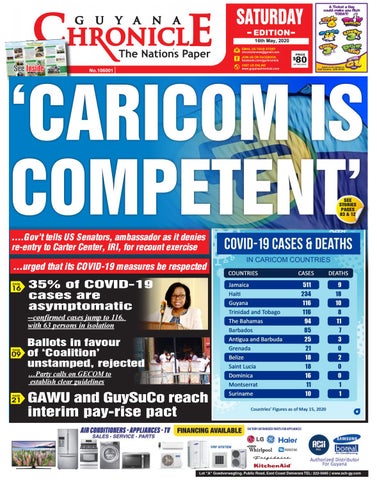
SATURDAY 16th May, 2020
15
GUYANA CHRONICLE
Saturday May 16,
2020
GUYANA CHRONICLE
Saturday May 16,
2020
14
'
See Inside
No.106001
‘CARICOM IS COMPETENT’ SEE STORIES PAGES 03 & 12
....Gov't tells US Senators, ambassador as it denies re-entry to Carter Center, IRI, for recount exercise
…urged that its COVID-19 measures be respected PAGE
16
35% of COVID-19 cases are asymptomatic --confirmed cases jump to 116, with 63 persons in isolation
PAGE
09
Ballots in favour of ‘Coalition’ unstamped, rejected …Party calls on GECOM to establish clear guidelines
PAGE
21
GAWU and GuySuCo reach interim pay-rise pact
2
GUYANA CHRONICLE Saturday, May 16, 2020
No decision on additional workstations ---but GECOM salvaged contents of waterlogged Region One ballot box
–– 479 ballot boxes processed to date By Svetlana Marshall THE Guyana Elections Commission (GECOM)
the March 2 General and Regional Elections, it was initially unable to count the waterlogged ballots from the
GECOM PRO Yolanda Ward
Secretariat has successfully retrieved the contents of a ballot box that was filled with water; however, the number of workstations to be added to the existing 10 has not been finalised. While the Secretariat has been accelerating the rate at which it is processing the ballot boxes from
ence Centre – the site for the national recount, Elections Commissioner, Sase Gunraj, said he was pleased to be
Commissioner Sase Gunraj
box which came from Region One (Barima-Waini). However, having been dried, the ballots were processed in keeping with the May 4 Order, which legally triggered the national recount of the votes cast at the March 2 General and Regional Elections. “The Region One box was completed. All the ballots were visible,” GECOM’s Public Relations Officer, Yolanda Ward, disclosed on Friday. The ballot box in question came from Kariako, Moruca, Region One. Upon the opening of one of the containers on Wednesday May 6 at the Arthur Chung Conference Centre (ACCC), the box was discovered with water inside due to a hole in the container. The contents of the box, inclusive of ballots, had been submerged in water. A decision was taken to drain the water out but not to open the box until it was time to count the votes from that polling block. On Thursday, the contents were placed to dry in a secured location and on Friday, the ballots were recounted. Kariako has a voting population of less than 200 electors. In an interview with reporters on the outskirts of the Arthur Chung Confer-
informed by the Chief Elections Officer (CEO), Keith Lowenfield, that the ballots from Kariako were salvaged. “We received information from the CEO earlier on today that the contents of that ballot box, at least the ballots in it, have been more or less retrieved and an attempt will be made by the end of today to have the contents thereof checked. That of course will bring to completion or finality District One,” Gunraj told reporters. Ward later confirmed that the ballots were processed. 479 BALLOT BOXES PROCESSED The recounting of those ballots from Kariako brings the counting process for Region One to an end with all 99 ballot boxes from that electoral district processed. The statements of recount (SORs) for that electoral district are now being tabulated. On Friday, in addition to the one ballot box from Kariako, Region One, 57 other ballot boxes were counted from Region Two (Pomeroon-Supenaam), Region Three (Essequibo Islands-West Demerara), Region Four (Demerara-Mahaica) and Region Five (Mahaica-Berbice). TURN TO PAGE
03
3
GUYANA CHRONICLE Saturday, May 16, 2020
Guyana to US senators…
‘CARICOM can do the job’ The President David Granger led Administration, on Friday, said it is confident in the ability of the Caribbean Community (CARICOM) to deliver a credible report at the end of the National Recount of the March 2020 General and Regional Elections. A group of US Senators – Marco Rubio, James E. Risch, Benjamin L. Cardin, Robert Menendez and Tim Kaine – in a letter, had lobbied President David Granger for the return of international observers, including those from the Carter Centre, to observe the ongoing National Recount. The US Senators, in the letter, had underscored the importance of having credible international observers present during the recount. But Minister of Foreign Affairs, Dr. Karen Cummings, in responding to the US Senators on behalf of President Granger, established the Government’s confidence in
CARICOM to deliver a credible report on the recount, having scrutinized the process. “Guyana, equally, is confident in the legitimacy, credibility and competence of the CARICOM Team to perform its task,” the Foreign Affairs Minister told the US Senators in a correspondence on Friday, May 15, 2020 while alluding to the fact that CARICOM sees itself as “the most legitimate interlocutors” in the ongoing electoral process. The CARICOM high-level scrutinising team, which comprises Senior Lecturer at the University of the West Indies, Cynthia Barrow-Giles; Commissioner of the Antigua and Barbuda Electoral Commission, John Jarvis; and Supervisor of St Vincent Electoral Commission; Sylvester King, arrived in Guyana on May 1 to observe the country’s recount based on an agreement between President Granger and the Leader of Opposition Bharrat in March,
2020. In proving a background to the presence of the CARICOM delegation here in
that had arisen. “The President agreed that a High-Level Team, nominated by the Caribbean Com-
Guyana, Minister Cummings explained that the President had invited the Prime Ministers of five Caribbean States – Barbados, Dominica, Grenada, St. Vincent and the Grenadines and Trinidad and Tobago – to visit Guyana on 11th and 12th March in light of the post-election challenges
munity (CARICOM) and functioning under the aegis of the Elections Commission, would supervise a recount of the ballots cast in the elections. [However] the presence of the team was challenged in the Supreme Court, initially,” the Foreign Affairs Minister explained. A revised team
No decision on additional ...
FROM PAGE
subsequently returned on May 1 after the court paved the way a GECOM supervised recount. In responding directly to the request for Observers, such as the Carter Centre to return, the Foreign Affairs Minister noted that the Government, in response to the global Coronavirus Disease (COVID-19) pandemic, promulgated a series of Emergency Measures with effect from March 16. Subsequent Emergency Measures include the imposition of a curfew and the closure of its international airports. “The Government of Guyana requests that the legitimate decisions it has taken with respect to the rile of the Caribbean Community in the recount of the ballots cast in the General and Regional Elections and the Emergency Measures it has implemented to protect its citizens from the COVID-19 pandemic be respected,” the Foreign Affairs
2
According to GECOM’s PRO, one box was processed from Region One, 13 from Region Two, 17 from Region Three, 15 from Region Four and 12 from Region Five – a total of 58 ballot boxes. In total, votes from 479 ballot boxes have been recounted since the commencement of the national recount. DECISION PENDING But with 1,860 ballot boxes left to be processed within a period of approximately 15 days, the Elections Commission, headed by Justice (Ret’d) Claudette Singh, is looking at the possibility of increasing the number of workstations. There are 10 workstations currently in operation; however, in an attempt to accelerate the pace at which the ballots are being processed, the commission has identified six locations within the conference centre where workstations could be established, however, it’s awaiting clearance from the National COVID-19 Taskforce in light of the emergency measures that have been
Ballot boxes being removed from one of the containers (Elvin Croker Photo)
put in place. With a visit conducted by representatives of the taskforce on Thursday, a report was expected yesterday (Friday), but that it has not been forthcoming. Commissioner Gunraj, in expressing his dissatisfaction, told reporters that a
meeting of the Elections Commission was postponed due to the absence of that report from the National COVID-19 Taskforce. That meeting, however, will be held today from 14:00hrs at the conference centre. Gunraj said even as the commission
Minister told the Senators, while assuring them her willingness to work with them. The Senators had applauded the President on his decision to agree to a national recount in the interest of transparency. “The President is pleased to note that International Observer Missions reported that the elections were conducted in a free, fair, and peaceful manner without violence, civil disorder or social disruption. The integrity of Guyana’s democratic institutions – the Constitution, the Supreme Court and the Elections Commission – was never threatened. Delays in declaring the results of the Elections arose after challenges were made in the Supreme Court to the tally in one of the country’s 10 electoral districts. The Court’s rulings have been adhered to,” Dr. Cummings explained.
awaits the advice of the taskforce, the secretariat has already established one of the six additional workstations but is awaiting clearance before it is placed into operation. He, however, believes that the work of GECOM should not be stymied as a
result of the slothfulness of the taskforce. “As we speak, we have at least one facility that has been set up that can be populated with employees of GECOM, stakeholders and observers as catered to in the Law and exemplified in the order. And we can have that starting now, however, we are hamstrung,” Gunraj said. While the pace at which the ballots are being recounted is increasing, Gunraj admitted that even with additional workstations, GECOM may not be able to complete the entire recount during the 25-day timeline, and may require an extension of that period. It is unclear at this point, whether the commission, at this stage, would finalise its decision on the number of workstations to be added in the absence of a report from the taskforce or whether it will move to increase the timeline. These issues are likely to come up for discussion today when Justice Singh meets with the Elections Commission.
4
GUYANA CHRONICLE Saturday, May 16, 2020
White House 'Operation Warp Speed' to look for Covid jab
(BBC) US President Donald Trump has vowed to deliver a coronavirus jab by year's end as he launched a White House vaccine initiative, dubbed "Operation Warp Speed". The effort will begin with studies on 14 promising vaccine candidates for accelerated research and approval. Progress is moving at "record speed", but the US must be prepared to reopen "vaccine or no vaccine," Mr Trump said. Experts have cast doubt on the White House timelines for a jab. What did Trump say? Announcing 'Warp Speed' at a White House Rose Garden news conference on Friday, Mr Trump named an Army general and a former healthcare executive to lead the operation, a partnership
between the government and private sector to find and distribute a vaccine. Moncef Slaoui, who had previously headed the vaccines division at pharmaceutical giant GlaxoSmithKline, will lead the mission, while Gen Gustave Perna, who oversees distribution for the US Army, is to serve as chief operating officer. Speaking after Mr Trump, Mr Slaoui said he was "confident" that a "few hundred million doses of vaccine" will be delivered by the end of 2020. However, Mr Trump made clear that even without a vaccine, Americans must begin to return to their lives as normal. "I don't want people to think this is all dependent on a vaccine," he said. Many experts say a vaccine is the
only thing that will give Americans the confidence to fully reopen the economy in the absence of widespread testing. "I think the schools should be back in the fall," Mr Trump added. Earlier this week Dr Anthony Fauci, who serves on the coronavirus taskforce and appeared wearing a mask at the Rose Garden conference, testified to the Senate that it would be a "bridge too far" for schools to reopen in the autumn. Dr Fauci and other experts have strongly suggested that a jab will take at least a year to develop. As Mr Trump spoke, truck drivers who have parked around the White House for several weeks blared their horns in protest against low wages.
At one point, Mr Trump instructed a reporter to remove her mask so she could be better heard over the noise as she addressed him. What other government coronavirus efforts are there? 'Warp Speed' is the latest of several Covid response projects Washington has undertaken. In March, the White House launched a testing initiative, enlisting major pharmacy retailers like CVS, Walgreens and Rite Aid to set up drive-through testing sites throughout the country. Such partnerships have stalled, however, and the US has faced continued criticism for its lags in testing. In recent weeks, the White House announced further efforts and has helped ramp up testing to nearly 10 million as of 15 May, accord-
ing to the Our World in Data database. Besides the new White House jab initiative, the Food and Drug Administration is also evaluating vaccine candidates for possible human trials. On Friday, the US House of Representatives will vote on a coronavirus rescue package worth more than $3tn (£2.5) that allocates funds to local governments, expanded testing and another round of direct payments to Americans. The bill - which would be the largest aid package in US history - has already faced Republican opposition, with Mr Trump declaring the bill "dead on arrival". Some health experts have remained sceptical about the rapid timeline for development and distribution proposed by the White House.
"I don't understand how that happens," said Dr Peter Hotez co-director of the Medicine Coronavirus Vaccine Team at Baylor College on CNN after Mr Trump's announcement. While a vaccine could be manufactured in the coming months, "I just don't see" how there will be enough safety data for a general use vaccine, he said. "I don't see a path by which any vaccine is licensed for emergency use or otherwise till the third quarter of 2021." Mr Slaoui acknowledged in an earlier interview with the New York Times that the timeline was ambitious, but said he "would not have committed unless I thought it was achievable".
US targets Huawei with tighter chip export rules (BBC) The US has announced new export controls aimed at limiting Chinese technology giant Huawei's access to semiconductor technology. The new rule bars semiconductor-makers that use US technology and software in chip design from shipping to Huawei without US government permission.
Saturday, May 16, 2020 –– 1:00hrs &13:00hrs
It is the latest US action to target Huawei, which US officials view as a national security threat. China threatened to retaliate against US tech firms. The tightened controls come a year after the US moved to cut off Huawei, the world's second largest smart phone maker, from access to US-made semiconductor
chips, which form the backbone of most computer and phone systems. In response, the company and others in China accelerated efforts to manufacture such chips domestically. US Commerce Department Secretary Wilbur Ross said that those efforts were "still dependent on US technologies", and accused Huawei of taking steps "to undermine" earlier export controls. "This is not how a responsible corporate citizen behaves," Mr Ross said. "We must amend our rules exploited by Huawei... and prevent US technologies from enabling malign activities contrary to US national security and foreign policy interests." The new US rule, to be published on Friday, applies to foreign-made items, using US technology. It exempts equipment or software made or shipped within the next 120 days - a move meant to limit economic harm. In a background briefing for reporters, the US said officials would consider licence applications to do business with Huawei on a "case by case" basis. "This is a licensing requirement. It does not necessarily mean that things are denied," a senior State Department official said. "We tend to approach Huawei with some concern but this is a measure that gives the US government visibility
into what is moving." Also on Friday, the US extended waivers that allow US companies, many of them rural internet providers, to use some kinds of Huawei technology for another 90 days. 'CUT OFF THE RELATIONSHIP' Donald Trump, who is campaigning for re-election in November, has stepped up his attacks on China in recent weeks, blaming it for the spread of Covid-19. This week, he moved to restrict US government pension funds from investing in Chinese companies. He said on Wednesday he could "cut off the whole relationship". The US has said Huawei's technology could be used for spying by the Chinese government. It has pressured allies, including the UK and Germany, to bar Huawei from their networks and sued the company for technology theft and doing business with Iran, in violation of US sanctions. Huawei has contested the US government's claims and said American efforts are likely to backfire, hurting the ability of US tech firms to do business. China on Friday threatened to place US companies on an "unreliable entity list", according to a report in the country's Global Times.
5
GUYANA CHRONICLE Saturday, May 16, 2020
Coronavirus: Brazil's Bolsonaro sees second health minister quit (BBC) Brazil's health minister has resigned after less than a month in the job following disagreements over of the government's handling of the country's escalating coronavirus crisis. Nelson Teich had criticised a decree issued by President Jair Bolsonaro allowing gyms and beauty parlours to reopen. His predecessor was sacked after disagreeing with Mr Bolsonaro. The far-right president continues to oppose lockdown measures. He has downplayed the virus as "a little flu" and has said the spread of Covid-19 is inevitable, attracting global criticism.
Brazil has recently surged past Germany and France in terms of its coronavirus caseload, becoming one of the world's hotspots with more than 200,000 cases. The latest daily figures on Thursday showed 844 new deaths recorded, bringing the official death toll to just shy of 14,000. Why did the minister resign? An official reason is yet to be given but Mr Teich is expected to give a media conference later on Friday to explain. He has clashed with President Bolsonaro over several aspects of how the government has dealt with the spiralling epidemic. He disagreed with the
president's desire to widely use chloroquine as a treat-
ment. The drug has gained widespread attention al-
though the World Health Organization (WHO) says
Nelson Teich, left, and Jair Bolsonaro during his swearing-in ceremony less than a month ago
there's no definitive evidence it works. Mr Teich also butted heads with the president over plans to open up the economy, saying last week that he was not consulted ahead of an order that paved the way for gyms, beauty salons and hairdressers to reopen. But disagreements over how chloroquine should be used was the final straw, the Globo newspaper reported. He is second health minister to leave the post in under a month. Luiz Henrique Mandetta was fired in April after President Bolsonaro publicly criticised him for urging people to observe social distancing and stay indoors.
Mexico at 'peak moment' of coronavirus crisis after biggest daily rise in cases
(BBC) Mexico has reached "the peak moment" of its coronavirus outbreak, officials said, as the country recorded its largest oneday rise in cases so far. More than 2,409 new cases of the virus were confirmed on Thursday - the first time this figure has exceeded 2,000. The total number of confirmed cases in the country is now more than 40,000. The grim milestone comes amid preparations to ease lockdown measures and reopen the economy, particularly factories near the border with the US.
This was the first time the daily rise in new cases was more than 2,000
Assistant Health Secretary Hugo López-Gatell - an epidemiologist and Mexico's
coronavirus tsar - described this as "the most difficult moment of the first wave of
Two women among three arrested for possession of $820,000 in Narcotics, Rifles and Ammo (TRINIDAD GUARDIAN) Three suspects were arrested yesterday for possession of guns, ammunition and narcotics in Marabella. According to police reports, several search warrants were executed, and the following items were discovered and seized: One AK 47 assault rifle with a magazine. One AR15 assault rifle with two magazines. One Glock 22 fitted with three magazines, an assort-
ment of ammunition. 27 packets of marijuana with a combined weight of 12.86 kilogrammes an estimated street value of TT$160,000. 80 packets of cocaine with a combined weight of 1.68 kilogrammes with an estimated street value of TT$660,000 Officers arrested three suspects – two women ages 28 and 57, and a man, 30, all of, Gopaul Street, Marabella, were taken to the Marabella Police Station for
processing. The exercise was coordinated by Snr. Supt. Wayne Mohammed and Insp. Teeluck, Insp. Pacheco and supervised by Sgt. Ifill and Sgt. Santana, was conducted by officers of the Marabella Police Station, Marabella Criminal Investigations Department, Canine Unit and Southern Division Task Force. Investigations are continuing.
the epidemic". He said that the country "could not relax measures"
in place to stem the spread of the virus, and instead needs to embrace a "new normal" to avoid another wave of infections. On Monday, some key industries - including mining, construction and automobile assembly - are scheduled to partially reopen. Mr López-Gatell stressed that the re-opening of these industries will be largely preparatory, with a broader restart of businesses not scheduled until 1 June. Government data released on Thursday also showed more than half of hospitals in the capital, Mex-
ico City, were at capacity with coronavirus patients. At the end of April, hospitals in the city admitted they were having to turn patients away because of a lack of equipment. Earlier this month, Mexico received a shipment of more than 200 ventilators purchased from a US firm. This followed an informal agreement between the neighbouring nations' leaders in mid-April.
6
GUYANA CHRONICLE Saturday, May 16, 2020
The ‘Coalition’ Government
ON May 11, 2015, when citizens went to the polls, were attention paid to their voices over the years, it would have been recognised that their ballot was a loud expression that they wanted a change, not merely in persons or group, but the manner in which governance is conducted. The APNU+AFC won the people’s confidence to fulfil this expectation. This government came to office, riding on tremendous goodwill, given the PPP/C’s pillage of the economy and contempt for citizens. Society had become more divisive, and fear stalked the land. Many felt it was safer to be silent or agree with the status quo to avoid risking the inevitable wrath that dissent or alternative view brought. This was a period of rampant corruption, death and Phantom Squads; a Minister of Home Affairs was fingered, and quoted as saying if he had to do it all over again, he would. Hundreds of dead bodies were dumped around the country, and the Coroner’s Act was not activated. Georgetown, once proudly known as the Garden City, became the Garbage City. The City Council became pawn in an ugly political game that saw Central Government withholding its financial obligations. Then Local Government Minister Kellawan Lall boldly announced that he would be glad if the city were to suffer a health crisis. There was no regard for the structures or management of government. Regional and Neighbourhood Democratic Councils not controlled by the PPP/C saw discrimination in budgetary
allocation, and moves to undermine and break up the councils, or impose an Interim Management Committee. Freedom of speech, including dissent and protest, and respect for the role of an independent media, were assaulted. Those who challenged or reported what was happening were targeted. For instance, the Guyana Trades Union Congress (GTUC) and its attendant arms suffered the withdrawal of its subventions; Stabroek News was deprived of State advertisements, and government officials used their influence to call on nonState actors to do likewise. Libel suits and incarcerations were part of the programme to silence the voices. Agreements were made and never implemented, among them the 1999 Armstrong Tribunal Award; the 2001 Desmond HoyteBharrat Jagdeo Agreement; the March 8, 2000 Agreement with the GTUC; and the August 21, 2012 Agreement with Region 10. Though the Guyana Constitution (Article 13) mandates that the nation’s political objective be one of “inclusionary democracy”, such was observed in the breach, as evidenced by the complaints of the political opposition, trade unions, and other stakeholders. Rights and the Rule of Law were assailed. The trade union movement was at its lowest ever, having suffered a politically-engineered split in 1999; collective bargaining and the right to freedom of association challenged. The nation’s development programme was directed by the policies of
the international financial institutions; the formal economy was compromised by corruption, the overwhelming presence of an underground economy, and cosy relationship between the government and underworld operators. International pressure was brought to bear on the government to put systems in place to rid the economy of corruption and illegal money. Recalling the aforementioned scenarios is important in making an assessment of what citizens voted against; the challenges which confronted the ‘Coalition Government’, and how it has performed to date. The instituting of forensic audits early in the administration sent a message that good governance would be its guiding principle, though this would only become meaningful when their recommendations are implemented, and persons, past and present, are held to account. The establishment of the long- awaited constitutional Public Procurement Commission is a plus, but where other constitutionally-required bodies are not established, it takes away. Having campaigned on inclusionary democracy, where lip service continues to be given, it brings into question respect for citizens’ rights and the rule of law. Government shoulders greater responsibility to bring stakeholders to the table, political and non-political. Calls by the trade unions and private sector to have meaningful engagement consistent with their roles cannot be ignored.
Extrajudicial murders have vanished, which would go a far way in building relationship between the police and communities. Continuing the PPP/C’s hard-line position of alienating those who express alternative or dissenting views would not be reflective of what the people voted against. Government has to be mindful of the growing concern that it is discourteous, though some ministers take exception to this perception. There are many instances where correspondence and other forms of communication have reached them and are not being treated with deserving respect. Ours is a representative system of government, and elected officials are servants, not masters, of the people. Credit is also in order for the return of Local Government Elections, environmental improvements (e.g. drainage and garbage collection), professionalising the Disciplined Forces, improved crime-fighting, passage of the Anti-Money Laundering and Countering the Financing of Terrorism Bill, expanding community broadcasting, professionalising of the Foreign Service, and rekindling patriotism. These are major improvements in governance, and stand to have Guyana seen as a credible and formidable member of the international community.
Is Mr. Golding and the OAS declaring ‘war’ on Guyana? Dear Editor,
AS I read the news today, I am taken aback at what I would describe as the forthrightness of the Organisation of American States (OAS) with reference to the report by the former Prime Minister of Jamaica, Mr. Bruce Golding, as the Head of the OAS Observer Mission, on our March 2, 2020 Elections. While I, like many Guyanese, appreciate the intervention of the OAS as well as the international community, in my view, the OAS as an international organization ought to be more sensitive and diplomatic with how it is treating with this matter relative to Guyana’s elections. Having read the OAS’ statement, I have several questions: What is the source of Mr. Golding's
information that he used in his comparison with that of the Region 4 Returning Officer’s? If the OAS must defend this information, the source of the information ought to be unbiased. The examples Mr. Golding provided were very specific, I thought, for his level of reporting. Did he collect this information on Elections Day? Why is it that Mr. Golding and the OAS are focusing so much on Region 4, when the recount process is for all ten regions? What was the method that he used to collect this data? Did he collect it on the day of Elections, or did he collect it subsequently, and from where? Essentially, my question is: What is the source of this information? I am just being scientific here. Another question is: If this
information is accurate, and it is contrary to that of the Guyana Elections Commission (GECOM) information, why is it that the OAS seems to be intent on wanting to embarrass and discredit GECOM and not have a more diplomatic posture? Why is it that the OAS seems to be intent on embarrassing GECOM despite its having already taken a decision to conduct a recount, and the recount process is currently being done? Mind you, I have issues with Mr. Mingo’s results, but the point is, I am not the OAS. In the interest of democracy and upholding rule of law, one would think that the OAS would want to promote stability in Guyana and not foster a destabilisation process. One would think that the
OAS would applaud the decision of GECOM to conduct the recount, in the interest of transparency, and having a more credible and certifiable declaration of the results of the Elections? Why does it seem that Mr. Golding and the OAS want to declare ‘war’ on Guyana? I say this as someone who knows the Guyanese society inside out. I have, what I would say is, a fairly good understanding of the intricacies and underlying issues in Guyana, so the OAS needs to change its posture. How is the OAS going to come back and help us to heal if they are so involved, to the point where they are perceived as biased? We are all trying to grapple with this intense and extensive level of intervention into Guyana’s affairs.
We are not accustomed to it, and we are trying to adapt and adjust appropriately. We really do want the involvement of the OAS and international community, but what we don’t want is for your approach to broaden the divide, and nurture the underlying racial, ethnic, class, and political issues in our society, and your current approach is doing so to a large extent. And this is not about supporting the APNU+AFC government, and not supporting the PPP/C; this is about after this electoral process, we have to live with each other. The truth is, personally, one side of me wants the PPP/C to win, and another side wants the APNU/AFC to win for different reasons. TURN TO PAGE
07
7
GUYANA CHRONICLE Saturday, May 16, 2020
The inadequacy and incapacities for effective Online teaching Dear Editor, I WRITE with grave concern as a parent and university student about the technological preparedness of our teachers at our primary and secondary schools, and our lecturers at our premier university to ascertain the quality and effectiveness of virtual education of our nation’s children during this pandemic. We all witnessed, by midMarch, how the pandemic caused by COVID-19 has caused many schools to quickly shut down and switch over to Online teaching. The scale and speed of this move to Online classes has caught many teachers and schools off-guard. This pandemic has forced students and teachers to cope as best they can, but the quality of education that has been received Online has often been compromised. This pandemic has certainly highlighted a big gap in teacher education and professional development. So, what can be done next? Countries like Guyana clearly need a new generation of school teachers who will be comfortable with any future rapid large-scale shifts to Online teaching and learning. In this sense, our schools and university now need to pay serious attention to having educational technology subjects front-andcentre of all teaching degrees. The trickier challenge, though, will be to boost the knowledge, skills and confidence of the teachers who are already working in schools. This will require governments to commit to sustained programs of professional development. Teaching Online is definitely a skill that takes time to perfect, and it is time for us to ask the
critical questions about digital learning. The closing of schools and rapid switch to Online tuition has illustrated how flexible our education systems can be. I noticed social media has been full of families celebrating the new-found freedoms of this enforced screen time, and took the opportunity and time to learn new skills and explore different subjects together through the Internet. Elsewhere, the EdTech industry has celebrated what they see as an unexpected business opportunity, a tipping-point after which schools and universities will finally adopt digital education as a mainstream mode of teaching and learning. However, there are increasingly raised concerns over the privacy and surveillance implications of hundreds of of students being forced onto commercial software that has not been properly tested and vetted for educational uses. These diverse reactions highlight the fact that technology use in education is never a neutral tool or easy fix. There are always wider connotations and unintended consequences of adopting any technology in education. So, in the aftermath of COVID-19, all schools and universities need to take a good look at the haphazard technological arrangements that got them through the lockdown crisis. The question is: Who stands to profit from the use of this technology in education; what forms of control are being established, and which students stand to benefit most from learning Online? In short, what is lost, as well as gained, when education goes digital? I’ve noticed that there has been a heightened awareness of the limits of digital ‘solu-
tions’, however, I hope that one of the educational legacies of COVID-19 is a more realistic conversation about the limits of digital technology and education. I have seen in the past few years the growing enthusiasms for Online education, personalised learning systems, and virtual classrooms. These technologies definitely have their place, but, now that everyone has first-hand experience of a mass shift to Online learning, we should all be well aware of the many practical problems that lie behind this hype. COVID-19 has demonstrated that there is something irreplaceable about students and teachers coming together to learn in person. Online videos, digital content and discussion forums are very different (and often inferior) forms of schooling. In particular, I hope that educators will have a heightened awareness of the many digital inequalities that persist in society. Rather than presuming that all students (and educators) have perfect ‘always-on’ connectivity and powerful devices, it is clear that significant digital divides persist, with large numbers of people lacking the basic technology access to work outside of school and university. If we are serious about moving to forms of digital education, then governments and educators need to provide free access to devices and the Internet for those households without the technology. The COVID-19 school shut-down has pushed many teachers and students unexpectedly into fully-Online modes of learning. This is proving a disorientating experience for many reasons, including the sudden loss of
everyone’s shared ‘sense of place’. Face-to-face campuses and classrooms still remain the brilliant way of giving students a common lens through which they experience and make sense of teaching and learning. For all its faults, face-to-face schooling is still an effective means of supporting what experts’ term ‘situated learning’, a common sense of identity, and shared understandings of the world in which we are all part. These qualities are proving much harder to replicate in the virtual learning spaces that many schools have been thrown onto during the pandemic. Poorly-designed Online education can quickly become sterile and desensitizing, leaving students and teachers feeling uprooted and disembodied from the learning material. It is my hope that people’s experiences of Online learning during COVID-19 will lead to more careful future planning and designing of virtual schooling. Online learning does not have to involve countless video-meetings, Online assignments and quizzes. More creative and engaging forms of virtual schooling are possible that support place-based teaching and learning practices. To make this a reality, it will require school-specific platforms being designed for, and by, teachers and students. It is my hope that once schools have moved past the current Online struggles, discussion on how virtual education could be better should be high on the agenda for the Ministry of Education and educators alike.
Misconception of the recount in perspective Dear Editor, CLAIMS are being made by the two major parties, and seemingly all others who contested the March 2 elections in Guyana, including international and local observers. A decision has been made to recount. What are we recounting? Ballots in boxes. To make sure the ballots are correctly counted we need a verification to validate the contents of the boxes. Everything in the boxes are the evidence of elections day activities. The books, the ballots, everything in the boxes represent the evidence of claims made in the process to validate a result based on a recount. It is for the aforementioned reasons that the irregularities raised are evidence and no longer claims. These are based on contents of the boxes or the absence thereof. Books cannot now be returned as validation; if it is missing, the recount is indicating discrepancies that cannot now be justified by books coming in two-plus months after elections voting. If dead people voted it reflects evidence and not claims: the claim is now verified and so on and so forth. I repeat everything in the ballot boxes are part of the recount, and this is not an audit, it is a verification of claims netted out by each party as claimants. Once the boxes are opened it reflects evidence. Claims are put to rest by evidence. We cannot count anything for any party as this is not a numerical process or simplicity; we cannot attribute a simple number to any party either without knowing if that is a real number a fake/false number or unverified number. We have to know if what we are counting contributes to a valid count or not. Just like it is unprecedented to recount before a declaration so too it is unprecedented to verify what we are recounting. To repeat, an audit comes via petition after a declaration, however we have an unprecedented recount just like we have an unprecedented verification to validate. It does not matter if you think verification is an audit or vice versa, just like it does not matter that you recount before you declare. GECOM has taken a position that all must abide.
Yours faithfully, Vernon Benons, Jr.
Is Mr. Golding and the OAS declaring ... While the OAS and the international community are examining this as merely a case of promoting democracy, rule of law and economic interest; it is more than that for many Guyanese. Let me explain the sensitivities behind what is happening in Guyana and the need to treat this elections matter with the much sensitivity. Many of the supporters of the APNU+AFC are of the that the No Confidence Motion that was passed in
December 2018, was a ‘coup’ against their government. They are convinced that elements in the political sphere had something to do with it. Now many of them are of the view that the international community is now colluding with some of the same elements in the political sphere, to get their government out. The big challenge is that they also have major issues from previous governance practices of some of those elements. The PPP/C and many of
their supporters on the other hand are convinced that their party won the elections and want to see their government sworn in. While at the same time, the APNU+AFC is also claiming that they win the elections; but we all know that there cannot be two winners. So, here is where I think that GECOM’s decision to conduct the recount, is commendable. We can either cut this baby (Guyana) in half and give a half of the dead
Sincerely, R. Chung-A-on
baby to the PPP/C and the other half to the dead baby to APNU/AFC; or OAS and the international community can support this recount process, quietly and diplomatically and see it through to completion. The recount is possibly the only way that both party supporters will accept the results from the elections. The OAS and the international community have to give Guyanese more credit, where are have integrity and will not support a govern-
FROM PAGE
ment that does not reflect the will of the people. We will NOT support a dictator! We want a resolution to this current impasse be we do not want a war in the process. We think that we are mature enough, smart enough, love each other enough, love our country enough, so my request is that you step back a bit, and support us as friends of the APNU+AFC and the PPP/C and the independent supporters. One of my heroes in
6
this process, is the Caricom Community. CARICOM, we appreciate that in this our difficult moment, that you are not the first to past judgement; nations take a long, long time to develop the kind of synergies needed for growth and development and sustainability and we are on that road. Yours faithfully, Citizen Audreyanna Thomas
8
GUYANA CHRONICLE Saturday, May 16, 2020
Parenting in a pandemic
Dear Editor,
WITH the COVID-19 emergency measures taking effect for at least another month, children, and in some cases parents will remain at home. This may give rise to tensions and frustrations in the home, with both parents and children needing emotional support and guidance to learn to cope with this prolonged situation. ChildLinK has been engaging families and providing Online and in some cases telephone sessions with parents and children to give guidance to support families to remain safe and reduce any form of abuse within families. We have outlined some guidance that has been useful for families. Take some time to focus on yourself. In Guyana, parents tend to rise earlier than their children. This is useful in parenting because it allows parents the opportunity to be up before your children and think through tasks that you would like to complete for the day and how you can make it a good day for the family. At the beginning of each day, set aside a 30-minute period where you can spend some ‘alone time’, perhaps sipping quietly on a warm cup of tea to mentally prepare yourself for the challenge of the new day, or any other activity that works best for
you. Set a schedule for the day. It gives you some control over what happens in your daily activities and can make things around your home less hectic and stressful. Setting a schedule and taking control can bring about a sense of calmness to families. Take time to talk to your children about your childhood memories and family history. Also, take time to listen to your children to better understand how they and their friends view the world around them. Talk about current changes and movies you may have looked at together. These are conversations that will be helpful now and in your future relationship with your family members. We may have been too busy to have these conversations together before the pandemic, but we now have the time to connect with our children and their interests. You are bound to find out more things about your children and even recognize some new things like their growing appetite. That is normal. You can include them in preparing meals and where possible snacks. Try some simple snacks such as ‘chicken foot’ which may not be too much for your budget. Allow them to be creative and make some adjustments to the ingredients. Perhaps you can use this opportunity to start a family recipe book and maybe name it
after the child. The partial lockdown allows us to engage in family projects that are both fun and beneficial for our physical and emotional wellbeing. One suggestion is to start a family kitchen garden. You and your children can enjoy wholesome physical activity in nature while sharing a few laughs in the process. Your family will also enjoy the rewards that come from reaping what you planted and also eating healthy foods. Another suggestion is to start a family exercise program. In the coolness of the afternoon, go into the yard and have a family Zumba workout. These are only suggestions; you can think of more creative ones and share them with other families. It will help to take a lot of stress from your day and strengthen our immune system as we continue to battle this pandemic. As adults you can tell when you need some time for yourself. This can be done by reflecting on your mood and the volume of your voice. It’s okay to take a few mental time outs to regain your composure if a situation becomes frustrating. Make the effort to let your family conversations be enjoyable rather than confrontational. As the parent, it is you who will have to set the tone for the atmosphere in your home. Don’t focus your time on COVID-19 and
all the “hearsays”, circulating on the internet and do not spend most of your time on WhatsApp and other social media. It will drain you mentally and emotionally. A positive home environment is good for your physical and emotional health. Make every effort to make this time with your family a good family time. ChildLinK is working to create a Guyanese society where every child grows up in a loving, safe, and secure family and community. The Recovery, Safeguarding, and Reintegration initiative is supported by the Delegation of the European Union to Guyana and partners with the CPA and several agencies to reintegrate children to safe families and educate the wider society on the prevention of child abuse. Please write us with your comments and questions. Let us know how you would like to get involved in protecting children in your community by emailing us at admin@childlinkgy.org. Report child abuse by calling the CPA on 227-0979, the closest Police station, or ChildLinK on 233-3500 or email: admin@ childlinkgy.org. Regards, Shaquita Thomas Communications Officer ChildLinK Inc.
The importance of floating voters
Dear Editor,
THE ongoing recount process at the Arthur Chung Conference Centre has been couched as a battle between the incumbent APNU-AFC coalition, and the opposition PPP-Civic coalition. Third parties have been framed as either guardians of the democratic will of the majority looking for change, or agent provocateurs of the opposition, depending on the point of view. Battle lines are being drawn between not just parties but the ethnic groups that dominate the support of the main parties in these coalitions, the PNC and the PPP. This scenario seems to mirror similar battles that have been occurring in the elections in Guyana since before independence. In reality however the situation is far more complex and heterogenous than this simple two-way battle for power between ethnic groups and their related parties. There is, and always has been, a third force at play in
Guyana’s society and elections, a group comprising minority and mixed ethnicities, and members of the two ethnic groups that have become disillusioned with this ‘winner-takes-all’ battle. This third group has been instrumental throughout Guyana’s history in determining elections, and forming third parties, that have all too often been swallowed up in the duopoly of the PPP and the PNC, largely because of the inadequacies of the constitutional and electoral systems in the country. In a forthcoming paper, we use data on population and voting patterns in Guyana to examine how important this ‘third force’ is, and has been – and draw recommendations for much needed changes in the constitutional and electoral systems, to move power away from this two-way battle, towards a system that can better reflect the varied make-up of Guyana’s society and political beliefs. Examination of population data shows a pattern of a stagnating and aging population, caused
by waves of out-migration. This is however, contrasted by a pattern of growing registered voters, and growing voter activity across elections, with the most dramatic increases occurring in the last three elections – especially in hinterland areas. Although the population as a whole has stagnated two crucial groups have grown dramatically: mixed ethnicity and Amerindians, at the expense of the two main ethnic groups, especially east Indians. It is our hypothesis that these growing communities often form a class of ‘floating voters’ – moving between the two dominant coalitions, or forming third parties that have been a crucial part of Guyana’s political environment since the 1950s. We isolate the size of this ‘floating voter’ set in recent years and show that capturing (and losing) this vote was crucial to the election success (or otherwise) of especially PNC but also the PPP. By conducting a polling station level analysis between publicly available data on the 2015
and 2020 elections we show that a swing from APNU-AFC to PPP/C in ‘mixed polling stations’ – those in which neither of the two forces dominate – could have played a critical role in determining this election. Our analysis highlights that it is this third electoral force that often unknowingly wields the power in Guyana’s elections - yet are excluded from the institutional structures at GECOM, are marginalised in an ethnic winnertakes-all battle between the main two political parties, and are largely under-represented in the political dialogue that emerges from elections. Urgent electoral and constitutional reform is therefore required, not just to deal with the aftermath of the chaos of the 2020 Elections (whatever the final result may be), but also to deal with this missing element in the electoral mix. Regards, Rory Fraser and Timoth Laing
Suggestions for Commanding Officer of GDF’s Engineer Battalion Dear Editor, AS an ex-soldier, I strongly condemn the way in which our young brothers are losing their lives in the army. I am worried to see and hear what is taking place with respect to many lives that have been lost in such a short space of time; within three months. As an ex-Corporal of the Guyana Defence Force (GDF), I served in the demolition platoon, in Field Engineer Battalion. What is happening today worries and shocks me. I am disgusted to see that in a short space of time, the GDF is dealing with two similar incidents regarding soldiers who died when handling fireworks. I firmly believe that this is as a result of negligence on someone’s part. Many years ago, myself and others were trained as Improvised Explosive Devices (IED) soldiers, and our mantra at that time was “safety first”, and all best practices at that time were guided by that approach. In our days, only trained, qualified and experienced soldiers were allowed to handle explosives and certain types of munitions. Of late, it is disheartening to see so many soldiers being killed by explosives. I am, therefore, appealing to the commanders of the Guyana Defence Force to make sure ranks are properly trained and equipped to handle explosives and ammunition. I have no choice but to cast blame on the instructors for what is happening. During my career in the IED platform, the period was characterised by zero incidents throughout, and none of us even experienced a spark. We were taught all procedures. Therefore, it is only right that the instructors take full responsibility for what has taken place. The instructors should be retrained, and thereafter they should be given follow-up and refresher courses time and time again to keep their knowledge sharp. If there are expired explosives and ammunition, there should be a well-rehearsed procedure for getting rid of the unserviceable stuff. Further, I suggest that ex-soldiers with this kind of knowledge and experience known to me will be more than willing to share their knowledge in this area. They are Major (retired) Aubrey Heath-Retemyer; Warrant Officer Class 2 Liverpool (retired); and Sergeant Benton (retired), to name a few. In conclusion, all of us as ex-soldiers who served in the GDF are very much concerned, and are willing to help in any way. To the family of the deceased soldiers, I beg to extend our sincere sympathy. Be safe, my people. Regards, George Archer Ex-Soldier
9
GUYANA CHRONICLE Saturday, May 16, 2020
Ballots in favour of ‘Coalition’ unstamped, rejected … party calls on GECOM to establish clear guidelines
ADDING to the mountain of discrepancies reportedly unearthed since the start of the National Recount, the A Partnership for National Unity + Alliance for Change (APNU+AFC) said Friday there is a worrying trend which shows that a number of ballots polled in its favour were not stamped by Presiding Officers (POs) on E-Day with the official six-digit stamp. It said the situation is being further compounded by those unstamped ballots being deemed rejected, in the case of the APNU+AFC, a situation it says the Guyana Elections Commission (GECOM) must make every effort to address. Speaking to reporters outside the confines of the Arthur Chung Conference Centre, the site of the National Recount, APNU+AFC Executive Member Aubrey Norton painted a vivid picture of the dilemma with which the ‘Coalition’ is now faced.
“In District 4, Ballot Box 4174, there are 12 rejected ballots because the PO didn’t stamp them; and all of them are for the APNU+AFC,” Norton said. “We have seen in other areas, there is one with another 11 [unstamped ballots], one with six,” he went on to explain, while adding that in some instances, the ballots cast by members of the Joint Services were not stamped as well. A DISTURBING TREND This trend, he said, is disturbing. “So what, in essence, has emerged is a pattern in which there seems to be a deliberate effort not to stamp, particularly in APNU+AFC strongholds, these ballots, causing them to be rejected. Now you might think that 12 ballots are little but 12 ballots in 20 ballot boxes, you can do the mathematics,” Norton told reporters. The APNU+AFC executive said that based on the workplan issued by the
Elections Commission, those unstamped ballots ought to be deemed valid. “The truth of the manner is, there are some contradictions, in the work Order that GECOM put out,” Norton said. “It says once the intention is clear that the vote for going to that political party, then it should be recorded. Now, you have to juxtapose that with a law that says it should have the six digits,” he reasoned, while making it clear that the ‘Coalition’ will protest any decision not to grant the APNU+AFC the votes. That issue aside, Norton said on Friday that a ballot box (No. 5006) from Region Five (Mahaica-Berbice) was discovered with no marked List of Electors, or any other documents, except for 209 ballots in favour of the People’s Progressive Party/Civic (PPP/C), and six (6) in favour of the APNU+AFC. This, he said, forms part of the trend of irregularities and discrepancies that have surfaced since
the start of the recount. “You are aware that we now started Region Five (Mahaica-Berbice),” he said, “and we always felt that the real story will begin to come out in Regions Five and Six (East Berbice-Corentyne). We are aware, for instance, that in two villages in West Coast Berbice, we will bring to the attention of this recount process that nearly half of the village had migrated, but the people voted.” RESIDENCY NOT A REQUIREMENT While acknowledging that residency is not a requirement for Guyanese to participate in the electoral process, the APNU+AFC executive argued that the records show that the individuals who are alleged to have voted were never in Guyana at the time of Elections. “We are not saying because you are a migrant, you can’t vote, but the record shows that you have migrated; when we
checked, you have migrated, but for some reason, you were able to vote while you were out of the jurisdiction, and that’s of grave concern,” he explained. Turning his attention to the ongoing verbal battle on the legitimacy of the Statements of Poll (SOPs) in the possession of the PPP/C, when checked against the official SOPs in GECOM’s possession, Norton said that the tabulations of SOPs in Region One (Barima-Waini) ended on Friday with APNU+AFC receiving votes that were initially given to the PPP/C by POs in that District. “In the Region One case, virtually all the cases that we have got back are votes that were placed in PPP/C envelopes as PPP,” he said, adding: “And what the recount process has done is to bring to the fore that there were a lot of APNU+AFC ballots that were placed in PPP envelopes.” He said the party had long argued that a num-
APNU+AFC Executive Aubrey Norton ber of the POs had been compromised, while pointing out that some were seen campaigning for the PPP/C in the lead-up to the March 2 General and Regional Elections. Norton further pointed out that on E-Day, there were many instances where persons voted twice, and on behalf of the dead, and these, he said, when detected, were brought to the attention of GECOM.
Health authorities appeal to miners to report signs of COVID-19 MINERS, who experience symptoms of the Novel Coronavirus (COVID-19) disease, are being asked to seek medical assistance before returning to mining communities. Deputy Chief Medical Officer (DCMO), Dr. Karen Boyle, made this “special appeal” to members of the mining community, during a COVID-19 update, on Friday. “We ask that those of you on the coastland ensure that if you are unwell and have the signs and symptoms of COVID-19, that you seek medical assistance before returning to the mining community,” said Dr. Boyle. The health authority also advised that if any member of a mining camp shows signs or symptoms of the disease, they must be isolated on the camp and immediate contact should be made with the nearest health facility. Dr. Boyle warned against self-di-
agnosis and self-treatment. This appeal was made just days after it was reported that Indigenous villages are highly vulnerable to the COVID-19 pandemic, and this vulnerability could be exacerbated if persons, particularly miners and residents of neighbouring Brazil, who test positive for the disease, knowingly enter those villages. It is against this background that the Guyana Human Rights Association (GHRA) had suggested that legal charges be instituted against miners and persons, who test positive for the disease in Brazil, and purposely visit Indigenous villages in Guyana. Just recently, a Guyanese man with Brazilian citizenship, who is the Rupununi’s first confirmed COVID-19 patient, fled the isolation facility at the Lethem Regional Hospital compound. He was
later detained in Brazil, but the man had spent time in Monkey Mountain, while experiencing symptoms of the disease. GHRA also cited an incident last Sunday, when a truck driver/miner forced his way through checkpoints on the basis of being given permission by the Regional Executive Officer (REO) and the Lethem police. The decisions taken at the level of the Region Nine committee, tacitly acknowledge the legal authority of Toshaos and Village Councils to determine who should access their communities. The association said the Regional Executive Officer (REO) of Region Nine, Carl Parker, had acknowledged issuing passes to facilitate truck-drivers avoiding the curfew and criticised the Toshaos for exceeding their authority. Although the REO is reported as stating that such letters were
only issued to persons in possession of a prior letter issued by either the Ministry of Natural Resources or Guyana Geology & Mines Commission (GGMC), senior spokespersons in the ministry told the GHRA that they are unaware of any such letters having been written. “The action of the Toshaos is hopefully setting the pace for the COVID-19 task force to adopt a far more stringent approach to the problem of Brazil being the most vulnerable and porous route for a major COVID-19 invasion in Guyana.” “The Bolsonaro Government’s irresponsible behaviour in dismissing the virus as a ‘slight flu’ has sent Brazilian death rates to be the seventh highest in the world, a current average of 1000 + per day, with Manaus an epicentre,” said the GHRA. Moreover, the “ease” with which people can cross
the Takutu River and enter Guyana despite the border being officially closed, suggests that the security problem is still being addressed in a reactive, rather than pro-active manner. “The controversial issue of mining being declared an ‘essential service’ is also at the centre of this problem. Many ordinary Guyanese are struggling to provide for their families while abiding by the lockdown, while miners driving 500 miles through Amerindian communities, putting many people at serious risk en route is considered an essential activity,” said the GHRA. This kind of contradiction discredits the official anti-COVID-19 strategy, fosters indignation and needs to be addressed urgently. The situation described reinforces the need to remove mining and mining-related activities from the list of essential services, which are exempt from
Deputy Chief Medical Officer, Dr. Karen Boyle some COVID-19 restrictions. GHRA, therefore, called on the COVID-19 task force to take immediate steps to address all of the issues which have surfaced in Region Nine.
10
GUYANA CHRONICLE Saturday, May 16, 2020
IDB approves Guyana is a democratic US$750,000 grant nation and intends to to support CARPHA remain so –– Dr Riyad Insanally
WASHINGTON, May 15, CMC – The Inter-American Development Bank (IDB) Friday approved a US$750,000 grant to support the Trinidad-based Caribbean Public Health Agency (CARPHA) in the coordination of the regional health response to the coronavirus (COVID-19) pandemic. The Washington-based financial institution said that the grant is being financed by the IDB Japan Special Fund which was first established in1988 by the Japanese government to foster social and economic growth throughout the IDB’s borrowing member countries. As of April 2020, Japan has already committed more than US$230 million to this fund. “Coordination is of utmost importance in this fight against the spread of COVID-19 and CARPHA continues to play a critical role in keeping with their intergovernmental mandate from CARICOM,” said Japan’s Ambassador to Trinidad and Tobago, Tatsuo Hirayama. “What is a threat to one country in the Caribbean is a threat to all,” he added. The grant will support CARPHA to work with Barbados, Belize, Guyana, Jamaica, and Trinidad and Tobago to enhance their COVID-19 detection abilities, mobilize surge response capacity and strengthen real-time disease surveillance and response. The IDB statement said that this will be done over the next two years and a portion of the grant will also be directed at strengthening CARPHA’s laboratory capacity to meet the additional COVID-19 specimen-testing demands from their 26 member states. “These interventions will translate into CARPHA maintaining efficient turn-around times for sample testing on a 24/7 basis, the establishment and training of rapid response teams, expansion of their Regional Tourism and Travelers Health Programme, creation of a Caribbean travel health app and strengthening human resource capacity” IDB’s Group Country Representative for Trinidad and Tobago, Rocío Medina-Bolívar, said COVID-19 has upended countries across the world, many lives have unfortunately been lost already and the pandemic is significantly challenging Caribbean economies. “This grant is directly aligned with the IDB Group’s COVID-19 response and is one of many measures we have taken to support Governments and safeguard citizens across our borrowing member countries in the Caribbean,” he added. The IDB said that it relates to responding to the health priorities of the Caribbean, it has worked with CARPHA in the past and most recently supported the expansion of CARPHA’s regional tourism health information, surveillance and monitoring and response system. “Similarly to that intervention, the IDB team on the ground in Trinidad and Tobago will work closely with CARPHA to execute the different components of this grant which will further strengthen the Caribbean’s regional health response to the pandemic,” it added.
— Gov’t never interfered with GECOM
GUYANA’S Permanent Representative to the Organization of American States (OAS), Dr. Riyad Insanally has firmly stated that “Guyana is a democratic nation and intends to remain so”. Dr. Insanally spoke on Wednesday, during a meeting of the OAS Permanent Council. His remark came after former Prime Minister of Jamaica, the Hon. Bruce Golding, who was the Head of the OAS observer mission to Guyana for its March 2, General and Regional Elections, reported alleged fraud during the elections. Mr. Golding, while presenting his report, departed from his prepared statement to add further comments to his claims. Nevertheless, Guyana’s Ambassadors to the OAS thanked the observer mission for its presence in Guyana for the March 2nd Elections. “We thank the Chief of Mission, former Prime Minister of Jamaica, Most Hon. Bruce Golding for his report. Likewise, we thank Secretary-General Luis Almagro and officials of the General
Secretariat, in particular, the department of electoral corporation and observation for their support of our electoral process and their engagement during a difficult time for our country,” Dr. Insanally stated. Adding that, as recognized by the OAS Elections Observer Mission and other international observers, the general and regional elections on March 2nd 2020 was free, fair and orderly and conducted according to the laws of Guyana. Dr. Insanally acknowledged that after March 2nd, there were developments regarding the elections which caused a delay in an official declaration of the results and lead to His Excellency President David Granger and the Leader of the Opposition, Bharrat Jagdeo, agreeing to a recount of votes cast in the elections, with a CARICOM team leading the observation process. However, he noted that the process was delayed further by legal challenges which have now added significantly to the jurisprudence related to Guyana’s electoral
laws and procedures, and which serve the purpose of removing legal impediments to the recount. “This is evidence Mr. Chairman, that Guyana remains governed by the rule of law, with full respect for the separation of powers and the independence of the judiciary. Indeed, there has been no breakdown in the rule of law or public order in Guyana.” He urged the OAS to note the following facts; that the electoral process is managed by the Guyana elections commission (GECOM), that it is an independent body constitutionally charged to conduct and supervised the elections and that the executive branch of government has never tried to influence, interfere with or instruct GECOM. “The President attempted, with the agreement of the Leader of the Opposition to find a way forward by inviting CARICOM to support a recount by GECOM. At all times the executive branch, GECOM and indeed all stakeholders have been respectful of the rulings of the courts,” the Guyana Am-
Dr. Riyad Insanally with OAS Secretary General Luis Almagro bassador stated. He said while the electoral process is not yet complete, once the recount is finalised, the results will be cleared in accordance with the law, paving the way for the swearing-in of a president. This he noted has been repeatedly stated by President Granger. Dr. Insanally also made clear that in spite of COVID-19, the recount has begun.
UG students earmarked to receive COVID-19 assistance – through UGSS initiative THE University of Guyana’s Student Society (UGSS) is providing students on both the Turkeyen and Tain campuses in need of assistance with care packages. President of the UGSS, Jafar Gibbons, told DPI that the decision to support at-risk and vulnerable students was birthed in April by the student council. A special committee was established within the council to manage the venture. The aim is “to reach out and help those vulnerable students who require such help,” Gibbons explained. “Some of our constituents are having trouble accessing the internet, providing for their families and themselves along with other financial difficulties.”
‘UG Cares’, another organ of the University is also providing care packages and psychological support for students, alumni, staff and pensioners. See full statement by the UGSS and details on how to apply below: Targeted students of the University of Guyana will benefit from a care package designed by the current UGSS council. Approved at the last council meeting, students from all over the country that are a part of the University of Guyana will be able to access such a package by virtue of applying to the UGSS email at ugss@uog.edu.gy. Coming out of the UGSS, students are to apply for the special package via email. Students are expected to state
their name, age, year of study, telephone number along with a brief synopsis as to why they are qualified enough for such a package. Each application received will be vetted by the current UGSS council to ensure that applicants have been deemed in need of this system of assistance. Due to the government-imposed lockdown; a lot of persons are now unemployed as a few jobs had to apply cuts to staff to sustain the burden caused by the Covid 19 pandemic. Laid off workers, of which some students are, are now left without any job, and no income to sustain them. The UGSS sees this as assisting and protecting those vulnerable students.
11
GUYANA CHRONICLE Saturday, May 16, 2020
‘Focus more on domestic tourism’
…stakeholders urge as one way to climb out of COVID-19 crisis -overflights down to 9.7%, domestic flights remain at 92.4% By Navendra Seoraj GUYANA and the world over have experienced the damning effects of the Novel Coronavirus (COVID-19) pandemic, which has not just killed and infected people, but
Director General of the GCAA, Lt. Col. (ret’d) Egbert Fields
has “suffocated” various sectors, including the tourism sector, which is a major contributor to the Gross Domestic Product (GDP) of many Caribbean countries, including Guyana. Though saving lives must remain on the front burner, there is also need for an “antidote” for the ailing tourism sector, which, to some extent, has already hit rock bottom. With 286,732 total visitors in 2018, it was estimated that travel and tourism injected approximately GY$62.6B directly into Guyana’s economy, making tourism its second largest export sector. A replication of this is, however, looking virtually impossible, as tourism continues to take a hit because of COVID-19. The antidote could, however, be right “under the noses” of stakeholders, and Director General of the Guyana Civil Aviation Authority (GCAA), Lt. Col. (ret’d) Egbert Fields, and President of the Guyana Tourism and Hospitality Association (THAG), Mitra Ramkumar, brought this to the fore during a tourism stakeholder “zoominar” titled “lockdown not shutdown: keeping tourism alive in the current crisis.” The possible solution proposed by the two stakeholders was, to focus on domestic tourism in the absence of foreign tourists. “If we start talking about domestic tourism, we would
have healthy tourism, as we await international tourism,” said Fields. Domestic travel remains one of the main reasons why the local aviation industry is still alive, and this is premise on the fact that weekly domestic flights remain at 92.4
President of THAG, Mitra Ramkumar
per cent while weekly “overflights” have dropped to 9.7 per cent, moving from 480 in January to 47 to date. The drop in flights is also owed to the fact that Guyana’s international airports have been closed to passenger flights for just about two months. And, with the possibility of the COVID-19 pandemic becoming endemic, with the absence of treatment or a vaccine, Fields said stakeholders will have to look at the best ways of co-existing with the disease, in order to keep the aviation and tourism sectors alive. To this end, he believes that a number of things can be done to sustain tourism. And, in line with his idea of pushing domestic tourism, he advised tourism stakeholders to develop new tour packages, which target local companies and individuals, and also introduce subsidised packages for Guyanese. In order to pull this off, he believes that local operators should explore collaborations. With no assurance of the disease going away anytime soon, tourism operators need to plan for the long term and their plan should have health as a priority, even for domestic travel. THAG’s President, Ramkumar, also spoke along the same line, noting that emphasis should be placed on regional and domestic tourism during this time of crisis. He believes that domestic tourism should be incentivised, especially in Guyana’s case,
since this country is larger than many Caribbean neighbours and is richly diverse. “We have diversified people and cultures, diverse landscapes, rich bio-diversity and live eco-systems and I have not mentioned the waterfalls as yet,
“Guyana’s strength is accessing niche markets and therefore our eco, adventure and cultural tourism product is well positioned for accommodating small numbers, ideal for social distancing,” said Ramkumar. The THAG president also
believes that regional tourism should be incentivised, and government and airports should reduce the travel taxes and passenger fees. Giving an example of the existing taxes and fees at the Cheddi Jagan International Airport, Ramkumar said travel voucher tax is 15 per cent, travel tax is US$16.83, airport security fee US$20, and the passenger service fee for arriving and departing passengers is US$15 each.
“Therefore, with a base fare of US$300 persons would be paying US$112 per person in travel taxes and airport fees; therefore a family of five would be paying US$60 in addition to their base fees,” said Ramkumar. Going forward, he believes that these fees and taxes will have to be revised in order to make regional travel more affordable. TURN TO PAGE
22
12
GUYANA CHRONICLE Saturday, May 16, 2020
‘CARICOM is competent’ ... Gov’t tells US Senators, as it denies Carter Center re-entry for recount exercise ... urged that its COVID-19 measures be respected
THE Government of Guyana has decided not to accept a late re-entry of The Carter Center and the International Republic Institute (IRI) into Guyana to observe the ongoing national recount process, on the basis of the sufficient presence of CARICOM as “the most legitimate interlocutors in the Guyana situation” and the COVID-19 pandemic. This was conveyed to United States (U.S.) Ambassador to Guyana, Sarah-Ann Lynch, by Minister of Foreign Affairs, Dr. Karen Cummings, by way of letter, on Friday, following a previous request for the entry of the international observer group. Earlier on Friday, in an interview with the 94.1 FM's Jumpstart Morning Show, the U.S. Ambassador had stated that she believes “additional credibility” is needed in Guyana’s national recount process, in the form of The Carter Center, so that Guyanese can have “complete confidence” that their elections were free, fair and credible. However, the Foreign Affairs Minister wrote back stating: “Owing to the Public Health situation which arose as a consequence of the coronavirus (COVID-19) pandemic, and the series of Emergency Measures that were promulgated since 16th March 2020, including the imposition of a curfew and the closure of its international airports, it may not be possible for The Carter Center and the IRI Advisor to participate in the overseeing of the recount of the votes cast on 2nd March 2020 General and Regional Elections which, as you are aware, already commenced.” Furthermore, Dr. Cummings said that
Minister of Foreign Affairs, Dr. Karen Cummings
United States (U.S.) Ambassador to Guyana, Sarah-Ann Lynch
the government of Guyana requests that the legitimate decisions taken with regards to its Emergency COVID-19 Measures and the role of CARICOM in the national recount be respected. “I take this opportunity to inform you and to iterate that: The Caribbean Community remains “…the most legitimate interlocutors in the Guyana situation” and that Guyana, equally, is confident in the legitimacy, credibility and competence of the CARICOM Team to perform its task,” the Foreign Affairs Minister stated. In a message to the Organisation of American States (OAS) on Wednesday, CARICOM had established itself as “the
most legitimate interlocutors” in Guyana’s national recount process reporting that it has been fruitful thus far. This message was shared by Permanent Representative of Barbados to the OAS, Ambassador Noel Lynch, on behalf of the CARICOM Group, during a meeting of the OAS Permanent Council. Lynch said that CARICOM --- of which Guyana is a valuable Member ---- is more than a group of countries but a Community which values democracy and therefore takes its scrutineering role in Guyana’s recount “extremely seriously”. “CARICOM countries are not merely a group of countries held together by rules;
the majority of them are held together by values rooted in centuries of history and fraternity, and in a bitter struggle for their peoples’ rights, including the right to elect governments freely and fairly in a democratic process. If democracy fails in any CARICOM country, it fails in the larger Community. If it is imperiled in any part of our Community, it is imperiled everywhere in it. As an institution, CARICOM cannot allow this to happen in any member state,” Lynch stated, adding: “…just as democracy matters to the people of Guyana, so it matters to the Caribbean Community of which the nation of Guyana is a valued member. That is why we of CARICOM regard ourselves as the most legitimate interlocutors in the Guyana situation.” The CARICOM scrutinizing team arrived in Guyana on May 1 and includes Senior Lecturer at the University of the West Indies, Cynthia Barrow-Giles; Commissioner of the Antigua and Barbuda Electoral Commission, John Jarvis; and Supervisor of St Vincent Electoral Commission, Sylvester King. They receive support from the CARICOM Secretariat Headquarters in Georgetown and are guided by the intent of CARICOM Chair, Prime Minister Mia Mottley of Barbados, to see the recount process be conducted in the spirit of transparency. Following the process, the Scrutinising Team will submit a report to the Commission, inclusive of its observations, recommendations and conclusions. With the team’s presence, the recount process has thus far been conducted smoothly with no breakdown in the collective process.
CDB-EDF facility receives positive regional response THE Caribbean Development Bank’s (CDB’s) newest facility, funded by the 11th European Development Fund (EDF), has received positive response from the region, with the programme said to be oversubscribed. The high demand for financing of interventions, focused on enhancing the regional trading environment, was evident by the overwhelming response to a call for proposals issued by the Bank in February, a CDB newsletter stated.. Formally known as the Caribbean Forum (CARIFORUM)-European Union (EU) Economic Partnership Agreement (EPA) and the Caribbean Community (CARICOM) Single Market and Economy (CSME) Standby Facility for Capacity Building, the facility received approximately 50 applications from 14 countries in the CARIFORUM region. The regional bank provided support for 28 trade-related projects under the 10th EDF. Daniel Best, Director of Projects at the Bank, attributed the response of those
seeking to access the EUR 8.75 million resource, to latent demand for such support across CARICOM. The facility aims to provide support to organisations in the public and private sectors that promote integration of Caribbean economies into the global marketplace with a focus on European markets. “CDB’s ongoing partnership with the EU continues to demonstrate the need for initiatives that can positively impact both the capabilities of regional entrepreneurs and national trading environments,” he stated, according to the release. Best commended member countries for showing resilience and adaptability, despite disruptions from the coronavirus pandemic, by ensuring continuity in the processing of applications. Project manager of the 11th EDF, Calvin Manduna, said, “The onset of COVID-19 and its effect on trade in the Caribbean highlight the exigency of increased support to strengthen the private sector, intra-regional trade and increase utilisation
of trade preferences under the CSME and the EPA.” The CDB, meanwhile, is reviewing projects which aim to improve competitiveness and market access, increase exports, and expand and support the services and agro-processing sectors. It is also assessing projects that seek to improve local and regional quality infrastructure and standards bodies and trade facilitation. Evaluation of submissions will be completed in the upcoming months and all short-listed projects are subject to final approval by an oversight committee comprised of CDB, CARIFORUM, CARICOM and EU representatives. Implementation in the beneficiary countries is scheduled to commence in the third quarter of 2020. “CDB and the European Union, through the Standby Facility and similar projects, are building on a longstanding relationship focused on activities that advance implementation and trade under the CARIFORUM-EU EPA and the CSME,” the news release stated.
CDB’s Director of Projects, Daniel Best (CDB photo )
13
GUYANA CHRONICLE Saturday, May 16, 2020
From a tent to an entire building
--GPHC’s ‘incredible transformation’ to combat COVID-19 By Navendra Seoraj A POPULAR saying among Guyanese over the years whenever they happen to fall ill has always been, “I ain’t going Public.” Thankfully, that timeworn mantra’s about to change, as the bane of their existence at reference, the Georgetown Public Hospital Corporation (GPHC), has defied all the odds thrown its way and utilised its limited resources to create an institution fit enough to fight the deadly Novel Coronavirus (COVID-19). Medical institutions the world over, through doctors, nurses and other healthcare workers, have been leading the fight against this “invisible killer” known as COVID-19, ever since it reared its ugly head in Wuhan, capital of Central China’s Hubel Province, back in December 2019. Here in Guyana, this disease has wreaked havoc in the lives of over 113 persons, causing the death of ten to date. And the one thought on everyone’s mind ever since has been, “Ah wonder who next,” as the number of the afflicted continues its inexorable climb with each passing day. And, with no existing treatment or vaccine for this deadly disease, medical institutions have been forced to be innovative in their approach to fighting it, while also catering for the needs of persons who suffer from preexisting ailments or other injuries. This is where the GPHC comes in, as it has been leading the way by putting systems in place to ensure that its facilities are properly separated, so that transmission of the disease would not occur. This process started way back in December 2019, when the alarm bells were first sounded in China, so when the scourge did hit Guyana in March this year, GPHC was prepared to lead the fight against it. The first to concede that doing so was no easy task was GPHC Director of Medical and Professional Services, Dr. Fawcett Jeffery. “There were difficulties, resource difficulties, but we managed to get ventilators, and we established the unit… Since then, we have been moving forward,” he told the Guyana Chronicle during an exclusive interview recently. As things now stand, the institution is the only facility that has been treating COVID-19 patients, who
experience severe forms of the disease, meaning that the
in the unit, Dr. Jeffery said every patient and staff of the hospital is screened at the gate before entering the compound, and once they exhibit or have signs or symptoms of the disease, they are sent to the triage point for further screening. At the triage point, which is a facility established just
hospital for persons who are awaiting their results, but it was not the most comfortable place to have people.” WELL PREPARED The isolation areas were not only established for comfort, but were also created in anticipation of a surge
COVID-19 Dialysis Unit for patients who may experience renal failure. One patient has already been successfully dialysed in the facility, and has since recovered and is at home. Dr. Jeffery said the hospital has also established a special operating theatre for COVID-19 patients who may
GPHC Director of Medical and Professional Services, Dr. Fawcett Jeffery
hospital has a special Intensive Care Unit (ICU), called the COVID-19 ICU. FIRST OF ITS KIND The COVID-19 ICU was one of the first facilities to be
Persons being screened for COVID-19
in COVID-19 cases. In explaining what he meant by this, Dr. Jeffery said:
require surgery, which facility has also been successfully utilised. A special COVID-19 maternity unit is also being established to cater for pregnant women who are
is no evidence to show that there is vertical transmission (mother-to-child transmission) of the disease, but as is the old saying, “prevention is better than cure”. These facilities were established because persons with underlying conditions, the elderly and pregnant women are all in the high-risk population for COVID-19. “So, we are ready for surgeries, children, general adult population, maternity, and we are working on many more things to ensure that there is proper treatment for COVID-19,” Dr. Jeffery said. JUSTIFIABLY PROUD The director was proud, and justifiably so, to say that the hospital has moved forward, but they are hoping that COVID-19 does not stick around for a long time. So far, the hospital has not seen a “spike” in cases, but there has been a gradual increase in the amount of COVID-19 admissions. “We are seeing a trend, but it is a slight gradient going upwards; patients are increasing, but gradually… Usually, when you see this kind of increase, you worry, because we have to worry about the epidemic becoming
The COVID-19 screening facility just outside GPHC’s East Street entrance
established, and it has already treated more than 25 persons. “We have advanced from there; we have developed systems from the gate to the wards,” Dr. Jeffery said, adding: “Screening is being done at every entrance, and we have set up triage points. We used to have a physical tent for triaging, but we have since constructed a building, so we have a special complex to house doctors from the COVID-19 unit.” The new complex houses the general medical unit for COVID-19 patients, and the Pediatric COVID-19 Unit, a unit established specifically to treat children. In walking the Guyana Chronicle through the process of how persons end up
outside of the hospital’s East Street entrance, persons are x-rayed and swabbed, once it is clear that their condition could be COVID-19. The swabbing is done in an ambulance, right next to the facility. The ambulance was equipped with air conditioning (AC) and other amenities, so that persons can be tested in comfort. “They go into the ambulance, which has become the procedure room, and after it is done and the sample is sent for testing, persons would go to the well-equipped isolation areas in either the male/ surgical ward or the female/ medical ward,” Dr. Jeffery said, adding: “Not so long ago, we used to have a tent
“We have prepared the hospital so that all patients, nonCOVID-19 or else, would be moved to one The new COVID-19 maternity unit that’s under section; we construction (Photos by Adrian Narine) left the modendemic,” Dr. Jeffrey said, ern section of the in-patient COVID-19-positive. building vacant and ready, so “We are setting up an iso- adding: we basically created a barrier lation area for the maternity “Endemic in the sense between the sections of the cases; we have always been that we will have to live with hospital.” planning on making that sec- it until we have a vaccine. This way, he explained, tion ready. It is almost ready. We hope Guyana does not the hospital would not be The only thing we have to go down that road, but we caught by surprise if there construct is the decontami- are ready to fight the battle.” were to be a spike in the cas- nation area,” Dr. Jeffrey said. GPHC has been sharA Neonatal Intensive es of the disease. ing its rules, protocols and In essence, the hospital Care Unit (N-ICU) was also plans with other medical established for babies who has not only created a generalised separation of care, but may have contracted the dis- institutions here, so that has also managed to set up a ease. To date, however, there there could be efficiency across-the-board.
16
GUYANA CHRONICLE Saturday, May 16, 2020
‘The number one propriety of CXC is to ensure safety and well-being’ –– CEO CXC, Wayne Wesley says absence of paper two, extension on submission of SBAs to ease anxiety of students WITH some 30,000 Caribbean Advanced Proficiency Examination (CAPE) and 120,000 Caribbean Secondary Education Certificate (CSEC) students set to write examinations in July, the primary concern of the Caribbean Examinations Council (CXC) is the health of the learners and its staffers. This was disclosed by Dr Wayne Wesley, the Registrar and CEO of CXC, on Thursday, during a press briefing with reporters from the Caribbean region. “In respect to health and safety, I want to point out that it is the number one propriety of the examinations council to ensure the safety and the well-being of stakeholders, during these unprecedented times”, Dr. Wesley stated.
Additionally, Wesley noted that all stakeholders will be following all the precautionary measures and guidelines set out by the health officials. “All examination centres and invigilators will follow the guidelines of national health protocols relating to social distancing, the wearing of mask and sanitisation.” Taking into consideration the wellness and the mental health of candidates during the COVID-19 pandemic, the council stated that such could be affected, adversely. With that awareness in focus, the council has rolled out several systems to ease the stress during the health crisis. “We had to balance the many factors, so we are not denying that it is not likely to have an impact; we are minimizing as much as possible
that impact… we are cognizant of the fact the COVID-19 situation would be having an impact on students’ readiness. In recognition of that, you will notice that the paper two will not be offered at this time which will be a reduced level of anxiety on the students,” he
explained. Additionally, Mr. Wesley noted that the determination of the students’ performance is not only on the multiple choice examination but also on the school-based assessment (SBA’s) component. Wesley further stated that,
it is important that the council ensures that it has sufficient information to be able to award valid grades to students that will speak to their skills and competences they should demonstrate having completed the CSEC and CAPE syllabuses. In decreasing the anxieties surrounding the upcoming examinations, the council has also extended the date of submission for the schoolbased assessments. “We have extended the deadline for SBA’s to June 30; so June CAPE, CSEC and CCSLC candidates who have SBAs outstanding, do have up until June 30 to submit those,” he stated. Additionally, Wesley disclosed that the council has been working along with the local registrar to treat situations where individuals find it difficult to
Dr Wayne Wesley, the Registrar and Chief Executive officer of the Caribbean Examinations Council complete their school-based assessment.
35% of COVID-19 cases are asymptomatic – confirmed cases jump to 116, 63 persons in isolation DETECTING cases of the Novel Coronavirus (COVID-19) disease could be harder than expected, as a number of persons are asymptomatic, meaning they do not show signs of the disease. Public health authorities reported that confirmed cases of COVID-19 moved from 113 to 116 over the past 24 hours, but over 35 per cent or over 40 persons are asymptomatic. “You should note that over 35 per cent of our COVID-19 cases were actually asymptomatic - had no typical signs or symptoms such as fever, cough, shortness of breath etc..., so even if your temperature is normal, you have to continue to behave as if you have the virus,” said Deputy Chief Medical Officer (DCMO), Dr. Karen Boyle, during a COVID-19 update, on Friday. This now brings to bear the fact that a person’s temperature may be normal, but it does not mean that they are not infected with COVID-19. As it is now, various medical institutions do preliminary screening by testing the temperature of persons, but additional measures may have to be employed.
Considering the prevailing circumstance, Dr. Boyle said: “You must continue to wear your mask, wash your hands frequently, maintain physical distancing, stay at home and immediately report to the COVID-19 hotline should any symptoms arise.” Evident of the need to comply with the existing measures, is the fact that cases of COVID-19 have been increasing consistently, and the country has already lost 10 lives. The recent increase was detected after 13 persons were tested over the past 24 hours. To date, health authorities have tested 1,065 persons for the disease, with 949 of those persons being negative. In addition to the high number of negative tests, some 43 of the infected persons have recovered and were medically cleared by health authorities. “We continue to thank the health workers throughout the country who are participating in the fight against COVID-19 and highlight that the results of their hard work is evident in the number of recovered cases that we are seeing on a daily basis,” said the DCMO.
Some infected persons are, however, experiencing the severe forms of the disease. And, according to Dr. Boyle, three persons are in the COVID-19 Intensive Care Unit (ICU); 63 persons are in institutional isolation and five in institutional quarantine. With the hope of detecting more cases of the disease, testing and screening will be expanded, said Dr. Boyle, adding that persons should make full use of the existing mobile units, which are available in some communities, mainly in Region Four (Demerara-Mahaica). For the weekend and the upcoming week, the focus for the mobile testing activity will be in La Parfaite Harmonie on the West Bank of Demerara and South Ruimveldt. “We are pleased to announce that very soon residents of Region Three and Six will have similar facilities available for their residents. Please refer to our Facebook page for a more detailed location of these units,” said Dr. Boyle. Health authorities are working on strengthening the healthcare system to respond to COVID-19 on a long-term
basis, and the potential and existing activities are a part of the plan to have a comprehensive COVID-19 health network, where patients across the 10 administrative regions will be able to access these services. Region Four remains the epicentre of the disease, and there are a number of communities, outside of Georgetown, which have recorded cases. Among communities on the East Coast of Demerara (ECD) where cases were recorded are: Atlantic Gardens, Friendship, Golden Grove, Good Hope, Lusignan, Plaisance, and Strathspey. Among communities on the East Bank of Demerara (EBD) where there were cases are: Diamond, Grove, Land of Canaan, Providence, and Timehri. “Please understand that transmission can only be reduced or stopped if we are able to separate those who test positive from those who are not infected. “We hear the concerns of you our citizens in relation to your fellow countrymen as it relates to compliance with isolation and quarantine. On those matters we are hoping that the love we have for our families, fellow citizens and
country will be enough to have us act responsibly and join forces with your local health authorities and the ministry of public health in containing this disease,” said Dr. Boyle. Measures can be continuously implemented, but it is up to the individuals, that is the average Guyanese, to adhere to those measures and think seriously about flattening the curve (reducing the spread). The disease, however, remains a serious issue, not just in Guyana, but globally. And, according to global statistics, there are over 4.2 million cases of COVID-19, with over 293,000 deaths. And with no approved treatment or cure, there is no assurance that persons will survive after contracting the disease. In the absence of approved medications, governments and authorities across the world have employed a number of preventative measures to contain the spread of the disease. “We must reiterate that there is no approved treatment for COVID-19, however, clinical trials are being done at the Georgetown Public Hospital Corporation, where the most severe cases
Deputy Chief Medical Officer, Dr. Karen Boyle are being treated,” said Dr. Boyle. On a national front, government has extended its emergency measures to combat the dreaded disease, with the imposition of a 12-hour curfew on citizens. These emergency measures were taken pursuant to Paragraphs (1) and (2) (b) of the directive issued by the President, in accordance with the Public Health Ordinance, Cap. 145, and published in the Official Gazette, Legal Supplement B, on March 16, 2020. These measures have been extended to June 3, 2020.
17
GUYANA CHRONICLE Saturday, May 16, 2020
Clarify how anomalies will be dealt with –– APNU+AFC requests clarity from GECOM –– Commissioners split on matter
–– Gunraj says anomalies a matter for the Court
WHILE remaining adamant that they have sufficient evidence to support their claims, the APNU+AFC wants the Elections Commission to clearly indicate how the anomalies captured during the national recount in the general Observation Report will be dealt with. The request for a clear position on the matter comes as Commissioners of the Guyana Elections Commission (GECOM) are split on what value the Observation Report will have, once the process is completed. One side has stated that the magnitude of the anomalies could affect the outcome of the recount but the other stated that the anomalies will not be taken into consideration by the Commission. Speaking to the media on Friday, Opposition-nominated Commissioner, Sase Gunraj, was asked whether GECOM will be taking these anomalies into consideration and stated: “Not as far as I’m aware. The contents of the Observation Report is one thing, the Statements of Recount refer to the results of the elections and, as far as I’m concerned, the Statements of Recount will be results of the elections.” The media, now unsure of the purpose of the compilation of an Observation Report, based on Gunraj’s position, pressed him further on the matter. He concluded that it is not the Commission’s responsibility to investigate these anomalies as this lies within the remit of the court and should come in the form of an elections petition. “It’s not the Commission’s place to investigate those allegations. The investigation of those allegations respectively is the domain of the Court. All of the case law related to the conduct of elections etcetera speak to investigations or interrogation of those kinds of activities to be done by the Court, not at the Commission level,” he said. Contrary to this position, on a previous occasion, Government-nominated Commissioner, Vincent Alexander, warned that electoral wrongdoings being unearthed during recount could impact the outcome of the elections. He told the media that whether the wrongdoings and discrepancies witnessed thus far do impact the results depend on their magnitude and the impact of said magnitude on the ballots cast. “Any electoral process, even if you have wrongdoing, the precedent has al-
ways been to look at the magnitude of the wrong doing to see if that magnitude could affect the results. For example, if you have an election where you come up with a count where the difference [gap between political parties] is 20, 30, 40 votes and
APNU+AFC Executive, Cathy Hughes (Delano Williams photo) formation that we have in our possession and it’s for them to disprove,” Hughes said. The APNU+AFC Executive said that her party has a range of evidence to provide to the Commission even as it continues to ask the question: what next? “Everybody has been raising the question, do we give you all our copies of the death certificates now? What is the process? We don’t have an answer for that Opposition-nominated Commissioner, yet. In fact, there is one side of the legal Sase Gunraj (Delano Williams photo) fraternity that says once we make the objection and give the name it is for GECOM the wrongdoing is 80 or 100 votes, there’s to investigate,” Hughes stated. She said that it would be unjust a serious problem because the wrongdoing exceeds the difference and therefore for the Commission to say to electors could impact on the final results,” he had that it will do nothing about anomalies, especially as they relate to dead and explained. However, after listening to Gunraj’s migrated persons, and still hold itself to remarks on Friday, APNU+AFC Execu- having conducted free, fair and credible tive, Cathy Hughes, engaged the media to elections. Apart from this, when Gunraj spoke state that the Elections Commission has to take up responsibility for how it will deal earlier, he put forward the position that with the anomalies highlighted in Obser- while APNU+AFC agents are providing vation Reports, an avenue created by the proof to their allegations raised, this proof may not be legally in their possession. Commission. He said that the General Registrar’s OfShe said that a conversation must be had on what, if the allegations of the party fice (GRO) is the custodian of records as it are proven true, will be done to correct relates to births, deaths and marriages and when he checked recently, the Office was them. “We have been trying to meet with closed. Meanwhile, he said that the Central GECOM for the entire week because we Immigration and Passport Office is the too, in the APNU+AFC, want to know custodian of immigration records and is a what GECOM is going to do with the in- branch of the Guyana Police Force (GPF)
which leads him to question the custody of these documents. “Those records, like your tax records etcetera, ought not to be released without going through proper channels,” Gunraj said. “I am concerned who has access to those documents and whether those documents are being accessed for nefarious reasons.” He said in some cases persons have had to go all the way to the court in request of the release of certain official records and it is therefore “worrisome” to see such documents in the hands of party agents, whether they are legitimate or not. However, Hughes, in response said that valid death certificates are available to any member of the public for the small price of GY$300 at the GRO. Added to this, she said that what the Opposition seems to be forgetting is that the APNU+AFC has been on the trail of locating such possible cases long before the recount, and after the release of a “bloated” Official List of Electors (OLE). Looking back at the processes leading up the elections, she said that it was foolhardy for the Opposition to campaign for the discontinuing of the house-to-house registration exercise, when it was critical to the elimination of deceased persons from the OLE. Hughes said that long before the March 2 elections, the APNU+AFC was carefully scrutinizing the OLE, particularly during the Claims and Objections period. “We have our documents in place and that’s why we have a right to make legitimate concerns and to raise those as objections. The system that got us to where we are today did not allow for us to make an objection that we know is true; that is why now, this is when we have to make the objection,” she said. Right after Elections Day, Hughes explained that objections were made by the APNU+AFC in five different regions and only two of the regions are now being dealt with. She said that such objections should be confirmed in the records of various poll books but it is “convenient” that several poll books are now either missing or were previously withheld from the process. While President David Granger would have hailed the elections as free, fair and credible, speaking for herself, Hughes said that although this generally appeared to be the case, now that the ballot boxes are under greater scrutiny, there are serious questions that must be answered. She said: “All we’re saying is that we want a proper explanation.”
Security guard accused of murder remanded A 28-year-old security guard was, on Friday, charged for the gruesome murder of his 58-year-old mother-inlaw, Velma Pickering. Linden Junior Isaacs of Strathspey Squatting Area, East Coast Demerara (ECD), was arraigned
before Magistrate Melissa Mittelholzer at the Vigilance Magistrate’s Court, on Friday morning, and was not required to plead to the capital offence. It is alleged that Isaacs, on May 11, 2020, at South Vryheid’s Lust, ECD, murdered his moth-
er-in-law. He was remanded to prison and will return to the Sparendaam Magistrate’s Court on June 9, 2020. The Guyana Chronicle had reported that, on May 11, at around14:30 hours, Pickering was at
home with her threeyear-old grandson at the time. The house is a two-bedroom wooden building resting on wooden pillars. It also has a dining area as well as a kitchen. It was reported that Pickering was attacked by Isaacs in the
first bedroom with an ice pick. She sustained about 10 stab wounds about her body. The woman managed to escape and ran outside over to her neighbour’s yard. However, she collapsed on the bridge. Pickering was
rushed to the Georgetown Public Hospital Corporation, where she was pronounced dead. Issacs, who attempted to escape, was nabbed by public-spirited persons and was taken into custody at Sparendaam Police Station.
18
FIVE YEARS -2015 - 2020
Address by Brigadier David Granger
President of the Cooperative Republic of Guyana, at the Swearing-in Ceremony, Georgetown, on 16th May 2015.
G
uyanese,
It is written: “This is the day which the Lord hath made; we will rejoice and be glad in it.” We have come together at the National Assembly of the Co-operative Republic of Guyana as a mark of respect for the Parliament, for our Constitution and for the People of this great country, Guyana. We have good reason to rejoice. We rejoice not only in the favourable results, but also in the enjoyment of our democracy. We went into the general and regional elections on 11thMay 205 as a grand Coalition, comprising six parties–the Alliance For Change; Guyana Action Party; Justice For All Party; National Front Alliance; People’s National Congress Reform and Working People’s Alliance – and won the support of the majority of people. We therefore record our gratitude, first, to the more than 408,000 citizens who participated in this important democratic process last Monday. We thank, also, the thousands of observers, officers, officials, agents and other workers – from overseas and from Guyana – and representatives of foreign missions who worked to ensure that the elections were conducted in a manner than satisfied international standards for efficiency and credibility. We congratulate the successful candidates of all parties who will soon be selected to become members of the 11th Parliament and encourage them to be faithful to their oath of office and to their constituents. Guyanese, The elections are over. The Guyanese people have chosen their representatives. The Constitution has been respected. Our democracy has been fortified. Let us now put past rivalries behind us and work in unity to banish poverty, ignorance, fear and hatred. We assemble here today to witness the swearing in, not of a party leader, but of the President of all the people. I shall be a good President for all the people. We the Guyanese people have chosen to inaugurate a ‘government of national unity’ and to promote our multi-party, inclusionary partnership. We are convinced that this is the best way to overcome our historic divisions. We have witnessed the damage done to our beautiful country over the past twenty-three years. We have been mocked by the destruction of local democracy and the denial of local government elections. We have been treated with contempt by the dictatorial prorogation and dissolution of Parliament. We have had to
bear the brunt of the high rate of crime including armed robberies, arson, inter-personal violence, murder, piracy, rapes, road fatalities and trafficking in persons. We have had to bear the cost of the squandering of state resources on exorbitant but misconceived mega-projects. We have suffered most from the high cost of living and the high level of unemployment. We have not been filled with hatred by these conditions. We are, indeed, more determined than ever to refashion society into one in which our womenfolk can look forward to working for ‘living wages’ to cope with the cost of living; one in which old folk can enjoy adequate pensions and social protection. Our young people will be able to attain higher educational standards and look forward to finding satisfactory jobs when they leave school. Our women and girl children can look forward to living in safety and to being protected from abuse and violent crime. We the Guyanese people have seized the opportunity to vote for human safety, national unity and inclusionary democracy. We now look to the future. We invite you to attend the formal, official “Inauguration Ceremony” to be held at the National Stadium on 26th May; Independence Day. We also wish to inform you that the outgoing and incoming administrations, respectively, have agreed to establish a ‘Transition Team’ to facilitate the transfer of assets and the transmission of information needed to ensure the continuity of government and to guarantee the stability and security of the state. Lt Col Joseph Harmon has been appointed the new administration’s team leader to manage this process. We announce also, that Mr Moses Nagamootoo will be appointed the next Prime Minister as soon as he is sworn in as a Member of Parliament in accordance with the Constitution. Guyanese, We declared on 1st January this year, that 2015 would be the “Year of Democratic Renewal.” We were right. Let us therefore rejoice in the people’s choice. Let us embrace each other – regardless of religion, race, class, occupation – as fellow Guyanese. Let us work together, to realise our inspiring national motto: “One People, One Nation, OneDestiny.” Let us be reminded of the famous national song: Let us co-operate for Guyana, Let us co-operate for our land, Let us resolve to fight together, See we do it right together Can we do it? Yes we can. May God bless Guyana!
GUYANA CHRONICLE Saturday May 16, 2020
GUYANA CHRONICLE Saturday May 16, 2020
Government salutes President Granger on fifth anniversary of swearing in The Government of the Cooperative Republic of Guyana salutes His Excellency Brig. David Granger on the fifth anniversary of being sworn in as President, tomorrow, May 16th, 2020. The Government heralds President Granger for his astute and steadfast leadership. It is evident that the people of Guyana recognize that President Granger's insistence on inclusionary and evidence-based decision-making for all Guyanese are precisely what is needed in Guyana at this historic juncture. The Government recognizes that President Granger contended with a combination of various national, political and personal challenges during his first term in office. He has prevailed in every instance through decisive and resolute leadership. While it is regrettable that this occasion comes at a time when the nation and the world are combating a global pandemic, it is beyond doubt that President Granger is precisely the leader we require in these times of difficulty to steer the ship of state to safe and calmer waters. Under President Granger’s leadership Guy-
19
ana has been transformed and is safer, stronger and boasts a stable and robust economy. Guyana has experienced remarkable development and progress since President Granger was sworn in as Head of State. There is markedly better delivery of education, health care and social services. Wages, salaries and pensions have been vastly improved, taxes are lower, infrastructure is better and the constitutionally enshrined local government elections, freedom of the press and freedom of expression and association have been restored and strengthened after being either absent or eroded. The people of Guyana, in 2015, elected President Granger for the honesty, decency and integrity which he embodies. And it is evident that after a successful first term as President the electorate of Guyana reposed confidence in his leadership and re-elected him for a second term. The government looks forward, with optimism and anticipation, to President Granger’s second term in office and wish him greater success in the next five years as he leads the delivery of the good life for all Guyanese.
20
GUYANA CHRONICLE Saturday May 16, 2020
21
GUYANA CHRONICLE Saturday, May 16, 2020
GAWU and GuySuCo reach interim pay rise pact ... discussions still outstanding on retroactivity
SUGAR workers have begun to benefit from increased rates-of-pay, arising from an agreement between the Guyana Agricultural and General Workers Union (GAWU) and the GuySuCo. Through the agreement reached, piece-rated workers are benefitting from a 5 per cent rise in pay; time-rated workers will receive an increase of $20 per hour, and monthly-paid staffers will receive an increase of $4,100 per month, the union said in a release Friday. Apart from those improvements, certain increases have been approved with respect to a number of allowances enjoyed by workers. The GAWU said, too, that at an engagement with the Corporation on April 03, 2020 it proposed the implementation of the new rates retroactive to January 01,
2020 while the parties continue discussions regarding retroactive payments for 2019. “We reiterated our proposal in our correspondence to the Corporation on April 08 and 27, 2020. The Union, at this time, re-emphasizes our strong conviction that the period of retroactivity ought to commence from January 01, 2019. Our position, in this regard, takes into account that the discussions between the GAWU and the GuySuCo flowed from our 2019 claims,” GAWU said in its release. “Moreover, as we have pointed out previously, other improvements that were approved by GuySuCo during the discussions of our claims were implemented with effect from January 01, 2019. It, therefore, follows the obvious logic that every single improvement ought to be-
gin from that point as well. Additionally, the Union and the Corporation have yet to commence any discussion for 2020 and, therefore, we see the GuySuCo position as being misplaced.” According to GAWU, while it remains ready to recommence discussions on the lone outstanding issue of retroactivity, “we recognised that the workers have been badly battered by a wage freeze since 2015. In the intervening period, the cost-of-living rose significantly which deleteriously affected their standard-of-living. Of course, we could not ignore too the hike in the even more acute hike in cost-of-living that has permeated since the COVID-19 pandemic arrived in Guyana. It was against that background we proposed to GuySuCo this interim arrangement.”
GAWU said that, though heartened by this development, the GuySuCo has informed the Union that, at this time, it is unable to speak to the now outstanding retroactive payments. “On this score, it did come to our hand that the Corporation’s financial position has been restricted, arising from the refusal of NICIL-SPU to release bond proceeds to the industry, to
assist mainly in capital works. The stance by NICIL-SPU has served to significantly hamstring the industry which is seeking to advance certain works in the fields’ cane productivity and production. This charade has been ongoing now for years and seemingly there is no end in sight. At the same time, we have seen, too, the obvious ignorance of the issues by the powers-that-be.
“We are hopeful that the Corporation would soon be able to provide the outstanding payments to its workers, who obviously are in need of the monies. We hope, too, that the State, as it has done for its other employees, will exempt these payments from income taxes, especially at this time when workers need every dollar.”
22
GUYANA CHRONICLE Saturday, May 16, 2020
‘Focus more on domestic... It was reported last week that the Caribbean Community (CARICOM) is examining the protocols and policies necessary for a possible reopening of Member States guided above all by the health risks of COVID-19. This was one of the main topics discussed by Heads of Government on Tuesday at the Tenth Special Emergency Meeting of the Conference of Heads of Government via vid-
eo conference. In attendance on Guyana’s behalf was President David Granger, accompanied by Minister of Foreign Affairs, Dr. Karen Cummings. A release from CARICOM, on Thursday, provided a report of the discussions which took place. “Heads of Government welcomed a presentation from a Regional Working Group which indicated that the pandemic was largely contained
in the Region due to the decisive action by governments to put restrictions in place. They also noted the emphasis by the group that re-opening by the Member States must be done with the health consideration being the foremost criterion,” the release stated. “The recommendations included parameters for the easing of restrictions in Member States that would allow for a re-opening in phases.
FROM PAGE
The recommendations also included suggested criteria for a protocol on the re-opening of airports for intra-regional travel. The draft policy will be resubmitted to Heads of Government for final approval.” The intention was first discussed at the Ninth Special Emergency Meeting after CARICOM Chair, Mia Mottley, has recognised that “regional blocks” will become more important as countries
11
worldwide may remain fearful of full globalisation. She said that countries will have to rely on their neighbours and there is no better time for CARICOM to band together than now. At the Tenth Meeting, the need for a common protocol for the re-opening of regional airports to flights from selected third world countries and the re-opening of hotels were discussed.
As a result, Heads of Government established a sub-committee led by Prime Minister of Saint Lucia, Allen Chastanet, to have discussions with stakeholders in the tourism industry, including the hoteliers, airlines, cruise operators and the labour unions to settle the appropriate protocols needed to ensure safety for workers and visitors upon re-opening of the sector.
GUYANA CHRONICLE Saturday, May 16, 2020
23
24
GUYANA CHRONICLE Saturday, May 16, 2020
COVID-19 puts CWI finances in ICU (CMC) – The financial health of Cricket West Indies (CWI) has been described by its president Ricky Skerritt as being in the Intensive Care Unit (ICU) due to the impact of the COVID-19 pandemic which has prevented competition in the sport. “This crisis has put our already poor financial state into ICU. It is like going to the doctor with an illness, and as he is about to prescribe the medication you get a stroke,” he said in an interview with Guardian Media Sports. Skerritt said there would have to be some cost-cutting, and a committee, set up after a 63-page financial review report by accounting and financial management consulting firm PKF was presented to the board last December, would be making recommendations on how to come out of the crisis and thrive financially. The PKF report made 26 recommendations. “What this committee will do is to look at that and also look at the emergency situation that this COVID-19 pandemic has thrown us into and recommend what can be done,” the CWI boss said. “This committee may expect to be looking to not massage on the body but make deep surgical incisions as far as the cutting back process goes. What we have been doing all the while is cost-saving but I think the time has come for
CWI president Ricky Skerritt cost-cutting. “We have about 100 cricketers on retainers and the board has had to fund this professional league. This has come at great expense to us and all these things will be looked at,” he added. Skerrit said the committee is expected to present its report in time for the board’s next quarterly meeting on May 27, “where all we will be dealing with is finances”. The committee is tasked with assessing the related financial implications for future international tours, regional tournaments and High Performance camps with regard to revenue, operating expenses, cash flow and re-scheduling or cancellation of events. It will also review the current CWI cost structure and make recommendations on new areas for potential cost-reduction in addition to making recommendations generally on how CWI will need to operate to continue its core business, specifically given the changing but uncertain economic environment. COVID-19 has forced the cancellation and postponement of sporting activities across the globe. Several of CWI’s revenue-generating events have been affected. South Africa’s fivematch T20I and two-Test tour and the New Zealand tour of the West Indies, both due to start in July, are in jeopardy.
25
GUYANA CHRONICLE Saturday, May 16, 2020
Guyana Amazon Warriors need to make most of international draft … just a few overseas weapons away from championship winning team By Clifton Ross THE Warriors (GAW) have been tinkering with their combination over the seasons and this year is no different, as the franchise smartly held onto their core group of local and regional players. Given last year’s performances by the retained crew of players, Warriors are basically two or three international stars away from forming a dangerous squad for this season’s campaign. Shimron Hetmyer, Sherfane Rutherford, Romario Shepherd are the ‘Big 3’ for the Warriors, given their production not just in the CPL but in T20 generally. They will be supported by Jamaican and Windies’ newest and dynamic Brandon King, who lit up the tournament last season with his hundred; along with the dangerous left-hander Nicholas Pooran. Guyana Jaguars wicketkeeper/batsman Anthony Bramble will duly add support to the aforementioned players as he has proved his worth in the past. The Warriors latest addition, rookie all-rounder Kevin Sinclair, was drafted as the Emerging Player for the franchise this year. His debut with the Jaguars this season for the Regional 4-Day Tournament was a brilliant learning process for the young Berbician who could, if given the opportunity, be a hidden gem as his style of play is tailored-made for the T20 format. All of the franchises have announced their retained players as they await
the next round of the draft, the most important part - the selection of the international players. Over the years GAW have relied on their local and regional players to do the lion’s share of the work. Apart from Pakistan legend Shoaib Malik who has been outstanding as captain and player, Australian Brad Hodge has been in the past was been an excellent player and coach before retiring. Other pieces came and went, James Franklin, Luke Ronchi, Cameron Delport, Chris Morris, and of recent Chris Green, who could possibly be a part of the tournament, should his bowling issues be rectified. Pakistani Sohail Tanvir was a huge part of the squad last season in both departments while other lost diamonds like his countryman Babar Azam, who recently picked up an international ban, was once a part of the franchise. It will be interesting to see which international stars throw their names into the selection pool, especially with COVID-19 having its say in restricting sports. The CPL is currently on COVID-19 watch, as they await further word with regard to: should they call off the proposed August start to the tournament or will the green light be given once health conditions and safety guidelines are implemented. More so, should the Warriors bag a few marquee players who either currently play or had solid international careers, thus adding extra firepower to the solid core they have retained; this season could be the year they
CRICKET QUIZ CORNER (Saturday May 16, 2020) COMPLIMENTS OF XTRA ENERGY DRINK – STABROEK BAZAAR (Tel: 683-9500) & CUMMINGS ELECTRICAL COMPANY LTD- 83 Garnett street, Campbellville, Georgetown (Tel: 225-6158) ANSWERS TO YESTERDAY’S QUIZ: (1) Mahmudullah-136 (Dhaka, 2018) (2) Ramnaresh Sarwan-261* (Jamaica, 2004) TODAY’S QUIZ: (1) Who is the first Bangladesh player to take a Test match hattrick? (2) What are the best innings bowling figures by a WI against BANG in Tests to date? ANSWERS IN TOMORROW’S ISSUE
break the Finals jinx and possibly win the title. Chandrapaul Hemraj will need a strong international partner at the top of the order to go along with King who can float about
the batting line. GAW will definitely need some venom in the bowling department, so acquiring a genuine foreign pacer could be a smart move. Rutherford and Shepherd have done great in their careers so far and are capable of holding their own. However, should Warriors have
an international, who can take the pressure off when needed, that will balance the team. It will be left to see who from the overseas world will be interested in playing, given all that is occurring and could occur in a month’s time. The local franchise’s season will most certainly ride on the selection of the
remaining spots to be filled by international players. Securing experienced, healthy players with decent track records whether present or past, will create a stronger learning environment for the already budding talent the Warriors have chosen to stick with in their quest for their maiden title.
26
GUYANA CHRONICLE Saturday, May 16, 2020
JFF in preparation mode as decisions are being made about World Cup CMC – The Jamaica Football Federation (JFF) says it’s preparing for the roll-out of the country’s World Cup campaign while decisions are being taken by the sport’s continental and world governing bodies on the timing and qualifiers for the 2022 FIFA World Cup, amid the COVID-19 pandemic. In a statement, the JFF said it fully and unequivocally supported the position of both FIFA and CONCACAF to put the health of all football stakeholders as the central reference point in all the discussions and decisions on this matter. Last week, CONCACAF president Victor Montagliani said the ‘Hexagonal’ round of qualifying for next year’s World Cup in Qatar may have to be scrapped due to the disruption COVID-19 has caused in the sport. He was unable to give details about the reforms to the qualifying structure, although he did say the Hex would be a bigger competition and that he expected FIFA rankings would be used as a starting point for the new format. The JFF said while it is
awaiting final word, it has been getting organised. It said President Michael Ricketts has personally convened monthly meetings involving technical leadership as well as the administrative leadership of the federation. “In these meetings, matters related to players’ technical preparation as well as all the administrative support which will need to be in place have been discussed and are being monitored,” the JFF said. “These meetings will continue as the president has clearly stated that the objective is, when the whistle blows, the federation must be ready in all aspects.” The JFF said it has also been discussing the reality of financial challenges and a number of initiatives are being examined with the aim of facing that reality head-on. In the meetings, Ricketts noted that the federation has promised the country that it would do everything possible to ensure the team is well-positioned to be in the top six of the CONCACAF ranking and top 50 in FIFA
rankings for the start of the final round of qualifiers. “With especially the commitment of the players, this was achieved on both fronts, and the federation now sees it as its next objective to make sure that the necessary preparation is in place to take the team through whatever qualification format is announced,” it said. In this regard, Ricketts has indicated that Jamaicans at all levels will be fully engaged in the plans and the federation was looking forward to receiving the necessary support. A six-team round robin format, referred to as the ‘Hexagonal’ or ‘Hex’, is usually used by CONCACAF as its World Cup qualifying tournament. The top three teams qualify directly for the finals, while the fourth-place team enters a playoff to book their ticket. With football unable to be played as countries across the world remain in various stages of shutdown due to COVID-19, Montagliani has said that important international windows for playing qualifying matches ahead of the 2022
JFF president Michael Ricketts World Cup will be lost. The June window has already been postponed and the CONCACAF boss said he was not optimistic the September window would go ahead. “I think on the balance of probabilities in terms of what has happened so far, and what likely will continue to happen, the current World Cup format will have to be changed, which means that ultimately the ‘Hex’ will have to be changed into some other form,” the FIFA boss said in an interview with Canada’s Onesoccer.com website last Tuesday.
Powell puzzled over Test omission (CMC) – ALTHOUGH acknowledging failing a fitness test, former West Indies opening batsman Kieran Powell has lamented being left out of the squad and in the dark about why he continues to be omitted despite credible performances on the field. But Cricket West Indies (CWI) chief selector Roger Harper has defended the decision not to include Powell, saying that factors other than performance were at play. CWI recently identified a 30-man provisional squad for the impending tour of England which is tentatively set for July. Powell, who was dropped from the Caribbean side in 2018, expressed disappointment that he was not recalled. Speaking on the Mason and Guest radio show here on Tuesday night, the left-handed batsman acknowledged that he did not pass the fitness test, but insisted that other players, who
either failed the test or did not show up for it, were selected. Against this background, and the fact he was the leading run-scorer in the last Regional Super 50, amassing 525 runs in the domestic limited-overs tournament, the 30-year-old Nevisian said he was puzzled why he was not given the opportunity to wear the maroon colours again. “Even though I wasn’t really as productive as I would like to have been … I still managed to stand out above everyone else who played in the tournament. So, it’s just a bit disheartening not to have been selected,” said Powell, who has a Test batting average of 26.81 after scoring 2 011 runs, including three centuries and twice as many half-centuries, in 40 matches for West Indies. He added that what was more worrying was that he has been given no word about what is keeping him out of the squad.
“It’s clearly not performance,” he said. Stressing that he was not accusing CWI of giving him a raw deal, Powell added: “I don’t mind fighting, I don’t mind training hard, I don’t mind having to do more than other people. That’s perfectly fine, but just provide me with clarity so that when I wake up I know that I have to execute x, y and z to get to my target and I can plan accordingly.” Harper, responding to Powell’s concerns in a separate interview on Mason and Guest, said selectors had nothing against the cricketer. “When we picked our squad, we picked what we thought was the best squad,” the chief selector said. “He made runs in the Super50, I know, but there were other criteria that came into contention.” However, Powell said he was unaware of any other issue that would cause him to be
passed over. “I’m going to have to give him a call or hopefully he gives me a call. Somebody could reach out to the other party and explain what needs to be done,” he said. “I don’t mind not being selected; this is part and parcel of it. West Indies cricket has been here long before me and I’m pretty sure it will be here long after I’m gone, but the communication is the most important thing. He says there are more factors to it…. I’m trying to ascertain what those factors are so that I can personally work on whatever else I need to work on so I can get my international career back up.” Powell last played West Indies Test cricket in November 2018 against Bangladesh and his last ODI was against the same team the following month. The left-hander, who made his first-class debut for the Leeward Islands in March
CPL tournament committee considers Gayle matter closed ON May 6, the CPL Tournament Committee (CTC) received a formal complaint from the CPL alleging breaches of its Tournament Rules & Regulations by Mr Chris Gayle, arising from a series of videos which he had posted to his personal YouTube channel on April 27. Having circulated the complaint, the CTC unanimously decided that it satisfied the prima facie test. In accordance with its Disciplinary Powers it authorised the establishment of an independent three-member Tribunal to hear the matter. Notwithstanding, intense efforts were made to settle the charges for the benefit of CWI, CPL and Mr Gayle, before empanelling its members. These efforts have resulted in an acceptance by Mr Gayle of the need to issue the statement attached hereto. This was received by the CTC and shared with CPL & CWI to the satisfaction of all parties. Given the assurance of Mr Gayle to act in good faith, it therefore is no longer necessary to empanel a Tribunal. CTC, CPL and CWI therefore consider the matter closed. STATEMENT BY CHRIS GAYLE Recently, I posted three videos on my personal YouTube channel, where I addressed the reasons for my departure from the Ja-
maica Tallawahs franchise ahead of the 2020 CPL tournament. I made these videos with one single intention – to explain to the fans in Jamaica the reasons behind what has now become my second departure from the Tallawahs franchise. It was my greatest wish to finish my CPL career in Jamaica – playing in front of my home crowd at Sabina Park with the franchise that I had previously led to two CPL titles. In so far as my resentment at the treatment, I stand by my comments in those videos. My words were spoken from the heart. Having said that, I must be honest and say that I now realise how portions of my comments may be viewed as being damaging to Cricket West Indies, and to the CPL Tournament and its brand – a tournament which I have sincerely enjoyed not just being a part of, but also helping to build and promote. It was never my intention to damage the T20 Tournament, as playing in the CPL has guaranteed an opportunity for the past 7 years to play in front of the great fans of the Caribbean. This is a privilege which I genuinely appreciate and have never taken for granted. Right now, my eyes are fixed firmly on the season ahead, and the new challenge which playing for the St Lucia Zouks franchise will bring. I hope to see you there.
2008, said he was not satisfied with playing cricket at just the regional level. “I think that every player should be playing regional cricket with the aim or the ambition to want to represent the West Indies. As soon as that goes for me, I will stop playing regional cricket. “As a child I’ve never envisioned myself wanting to just play for the Leeward Islands, it’s always been about playing for the West Indies. So that lack of clarity is what’s really confusing to me,” he said. Powell said he was just as puzzled about being relieved of the Leeward Islands captaincy in 2019, ahead of the start of the last Regional Super50. He said the team had seen continuous improvement with him at the helm and was “starting to become competitive again”, moving from bottom of the table to reaching the semi-final stage in the Regional Super50 tournament. There had been speculation that Powell’s refusal of a retainer contract influenced the Leeward Islands Cricket Board’s decision to replace
him with Antiguan right-hand batsman and wicketkeeper Devon Thomas. “I turned down the regional retainer contract because it’s not feasible for me to be contracted to the Leewards board, so I said to them, ‘give that contract to a younger player; it offers room to continue to grow Leewards cricket, develop a younger player, but I’m still 100 per cent committed to the Leeward Islands and playing cricket,’” he explained. However, he added: “Then I was told that they’re not sure whether I’d be committed, after I had already had a long meeting with them stating my 100 per cent commitment to Leeward Islands cricket. It’s just one of those things that leave you puzzled, but at the end of the day my job is to play cricket and score runs.” Despite not getting the West Indies selectors’ nod this time around, Powell said that with the damper the COVID-19 pandemic has put on sport, he is training and working on his fitness so that whenever cricket restarts, “fitness is not an issue”.
27
GUYANA CHRONICLE Saturday May 16, 2020
Jones, Ninvalle ‘touch gloves’ over treatment of Cuba-based boxers Halim Majeed Guyana’s Ambassador to Cuba
Steve Ninvalle GBA president
Christopher Jones Director of Sport
By Rawle Toney WHILE president of the Guyana Boxing Association (GBA) Steve Ninvalle continues to battle for the return of the four boxers left in Cuba, Director of Sport Christopher Jones said that the National Sports Commission (NSC), along with Guyana’s Ambassador to Cuba, Halim Majeed, will continue to do his best to aid the amateur pugilists. Both Ninvalle and Jones offered contrasting reports on the well-being of Dennis Thomas, Desmond Amsterdam, Colin Lewis and Keevin Allicock, who travelled to the Spanish-speaking country to prepare for their now cancelled Olympic Qualifier tournament in Argentina, but could not have made it out in time after Guyana, like most of the world, had closed their
borders and port of entries to help contain the spread of COVID-19. “It’s painful having to be informed of their deterioration,” Ninvalle told Chronicle Sport yesterday, adding that the GBA “would’ve hoped by this time we would’ve received a response from the task force, whether it’s no, yes or maybe.” “There’s not a lot more that we can tell our boxers, other than just hold on. But frustration has clearly stepped into the camp and we can’t say where we will go from here. In the very near future we would like to have a response which is favourable to give a glimmer of hope to these ambassadors,” Ninvalle said. However, when contacted, Jones provided evidence to add contrast to his claims that the boxers were prop-
erly taken care, since being moved from Santa Clara to Havana last month and are in the care of Guyana Government, through the Embassy. “I noted the word used on two occasion - deterioration ... I mean the word gives you the impression that these guys are huddling on the floor and there’s a blanket and a pillow,” Jones said. The Director of Sport went on to explain that the boxers are housed at a villa in Havana, which is also used by the Guyana Embassy to accommodate officials during visits to the Island. “I don’t understand the constant use of the word deterioration as if their accommodation is not fitting ... they are staying in a villa, where they are staying on an entire floor by themselves. The sports commission has
a bill that they have to pay for, over the last month, at a tune of G1.97M for the last month,” Jones reasoned. The NSC, along with the Guyana Olympic Association (GOA), had pooled their resources to send the boxers to Cuba, a country that is reputably known for producing Olympic champions, for them to get the much-needed preparation for their tournament in Argentina, where they were hoping to qualify for the Tokyo Games. However, the GBA was left counting its losses in the millions, after International Olympic Committee (IOC) and the Americas Boxing Confederation (AMBC) announced in early March that the Americas Olympic Qualifier for boxing has been cancelled because of fear of spread of the Coronavirus. Things took a turn for the
worse when the Government of Guyana closed their ports of entry, leaving many, including the boxers, stranded. Ever since, the boxers were in the care of the NSC and Guyana Embassy, as Jones pointed that “Cuba, as compared to many other countries, got their many issues with regard to geopolitics; everyone knows about the sanctions that are imposed upon Cuba and therefore certain basic food commodities are not readily available in that country, that is known,” as he further dismissed some other allegations. While Ninvalle had written to the Task Force, Jones said that he was only copied in the letter, but was adamant that the issue of finding and securing a flight for the boxers’ return was out of his hands.
Jones said that efforts were being made by the Government of Guyana, to bring close to a total of 140 students in Cuba back home, and plans were in place to have the boxers on the same flight. However, Jones said that after the Cuban Government had opened their classrooms for the Universities to have sit-in classes, the students recanted their request to return, which ultimately affected the boxers. With June 3 dated by the COVID-19 Task Force as it relates to the reopening of the country’s airports and borders, Jones is hoping that some patience is exercised and in the interim, along with Ambassador Majeed, the Government of Guyana, through the NSC, will continue to aid the boxers.
TTCB cancels remainder of local cricket season (CMC) – The Trinidad and Tobago Cricket Board (TTCB) has cancelled the remainder of the local cricket season which had already been curtailed by the COVID-19 pandemic. It said the decision was made following discussions on Wednesday with representatives of the National League, zonal affiliates and clubs, in light of government’s extension of COVID-19 restrictions on team activities, contact sports or any activity that encourages
gatherings. Additionally, the TTCB said, because of the incomplete status of all national cricket competitions, there will be no promotions or demotions for this season. “The TTCB was persuaded to make these decisions in the best interest of cricketers and the general public in the face of the pandemic. Also taken into account was the current state of grounds on which matches are played, as they are not prepared to host any cricket in the
near future, even if the government eases its COVID-19 restrictions on team sports within the near future,” TTCB said in a statement. There were still two rounds of matches to go in the main competition this season, but the TTCB has decided there will be no winners this year. “We are going to just cancel the cricket and start afresh in January, next year,” it said. The TTCB noted that it had received the support of the Tobago
Cricket Association, and the Trinidad and Tobago Women’s Cricket Association, which have also both decided to halt their cricket activities for the remainder of the year. It also called on all minor cricket leagues affiliated to the national organisation to immediately terminate their competitions in the best interest of public health and safety. As for the Under-17 Interzone tournament, the TTCB said that is likely not to materialise, but there has been no final word from Cricket
West Indies (CWI) as yet. “We are waiting on CWI but I think that since we normally host the U-17 tournament and we cannot play cricket here, then they may call that off. The U-19 may be played because of the upcoming U-19 World Cup. If that is the case, then we may have to arrange an U-19 Interzone tournament or find some way to choose an U-19 national team to take part in that tournament,” it said.
From left: Keevin Allicock, Colin Lewis, Desmond Amsterdam and Dennis Thomas, prior to their departure to Cuba.
Jones, Ninvalle ‘touch gloves’ over treatment of Cuba-based boxers See story on page 27
COVID-19 puts CWI finances in ICU PAGE 24
CWI president Ricky Skerritt
Guyana Amazon Warriors need to make most of international draft See story on page 25
The star-studded Guyana Amazon Warriors young core will need a few more weapons in preparation for this year’s mission.
… just a few overseas weapons away from championship winning team Printed and Published by Guyana National Newspapers Limi ted, Lama Avenue, Bel Air Park, Georgetown. Telephone 2 2 6- 3243-9 (General); Editorial: 2 2 7- 5204, 2 2 7- 5216. Fax:2 2 7- 5208
SATURDAY, MAY 16, 2020