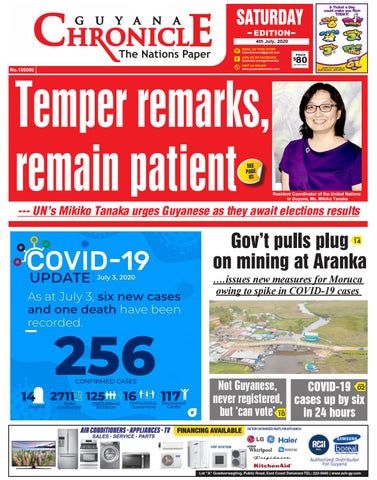
SATURDAY 4th July, 2020
' No.106050
Temper remarks, remain patient SEE PAGE 03
Resident Coordinator of the United Nations in Guyana, Ms. Mikiko Tanaka
--- UN’s Mikiko Tanaka urges Guyanese as they await elections results
Gov’t pulls plug on mining at Aranka PAGE
14
….issues new measures for Moruca owing to spike in COVID-19 cases
Not Guyanese, COVID-19 02 never registered, cases up by six but ‘can vote’ 10 in 24 hours PAGE
PAGE
2
GUYANA CHRONICLE Saturday, July 4, 2020
COVID-19 cases up by six in 24 hours -Hinterland communities continue to be hard hit THERE continues to be a rapid increase in the number of Novel Coronavirus (COVID-19) cases, as health authorities recorded six new cases within the past 24 hours. Deputy Chief Medical Officer (DCMO), Dr. Karen Boyle, said those cases were found following 43 COVID-19 tests which were conducted between Thursday and Friday. Health authorities have so far tested 2,711 persons, with 2,455 being negative and 256 positive. And, of the positive cases, some 117 have recovered and 14 persons have died; but authorities are managing 125 active cases, of which 124 are in institu-
Deputy Chief Medical Officer, Dr. Karen Boyle
tional isolation and one in the COVID-19 Intensive Care Unit (ICU).
“Do you still believe that COVID-19 is imaginary, that you cannot contract this dis-
ease and that if you are infected, you can easily recover and move on with your life?� Dr. Boyle asked, during a virtual COVID-19 update, on Friday. The aftermath of COVID-19 is even more unpredictable. And, persons can suffer brain damage, paralysis, and irreversible lung damages. Considering the severity of COVID-19 and its effects, persons need to be aware that the safety of every Guyanese is dependent on the compliance with control measures, which were implemented by local health authorities to contain the spread of the disease. TURN TO PAGE
03
GUYANA CHRONICLE Saturday, July 4, 2020
Temper remarks, remain patient
3
--- UN’s Mikiko Tanaka urges Guyanese as they await elections results
Resident Coordinator of the United Nations in Guyana, Ms. Mikiko Tanaka has urged political leaders to help keep the peace and wait the decision of the Caribbean Court of Justice on the March 2, 2020 elections. “As the ruling of the Caribbean Court of Justice is awaited, we call on all political leaders and their supporters to remain patient and refrain from acts and remarks that could incite hostility or violence,” Tanaka said in a terse statement Friday morning. She added: I would like to reiterate the United Nations' commitment to continue to support the people of Guyana.” President David Granger only this week commented that a new President cannot be sworn in, nor can a President concede unless the Guyana Elections Commission (GECOM) makes a declaration in favour of either of the situations. Speaking on the sidelines of a ceremony at State House on Wednesday, President David Granger responded to questions in relation to the same from reporters. He noted that while it has been over 17 weeks since the March 2, 2020 General and Regional elections and though the elections have gone on for
longer than anyone would hope, he cannot act in the said regard until GECOM does its part. “The Executive branch of Government does not have a role in managing elections. That role is given unto the Constitution, exclusively, explicitly to the Elections Commission. I cannot claim victory, which I have not done, and I cannot concede defeat, which I have not done, unless I’m notified, formally, by the Chairman of the Elections Commission,” he said. Before the commission can conclude the elections with a declaration, the current elections matter before the Caribbean Court of Justice (CCJ) must also be concluded. The CCJ must first determine whether it has jurisdiction to rule on the matter which was previously ruled upon by Guyana’s Court of Appeal and noted, in the Article 177 (4) of the Constitution, to be final. Should the CCJ determine, nonetheless, that is has jurisdiction, it could lead to a ruling on whether the Appellate Court had jurisdiction to rule on the matter as brought to the CCJ by the People’s Progressive Party Civic (PPP/C). Until then and until the commission makes a dec-
laration, the President has encouraged all those mak-
all the spokespersons and commentators to wait, pa-
Resident Coordinator of the United Nations in Guyana, Ms. Mikiko Tanaka
ing premature comments to exercise patience. He said: “I don’t know what the Elections Commission will declare. Like all Guyanese, we’ve been subject to various reports but the only authentic report will come from the Chairman of the Elections Commission to me and that has not happened. In that regard, I encourage
tiently, on the Chairman of the Elections Commission who, when she is ready, will make a declaration and, as I’ve said before, I’ll abide by that declaration.” Next Wednesday, the CCJ will hand down its decision on whether it can assume jurisdiction in a challenge seeking to set aside the ruling of the Court of Appeal
that the election of the President must be on the basis of “valid votes.” President of the CCJ, Justice Adrian Saunders, who led a panel of five judges, made the announcement on Wednesday (July 1) after hearing more than five hours of legal arguments virtually on whether the CCJ has jurisdiction to hear the case filed by People’s Progressive Party/Civic’s (PPP/C’s) General Secretary, Bharrat Jagdeo and Presidential Candidate, Irfaan Ali; and if it has jurisdiction, whether the Court of Appeal’s decision that the words “more voters are cast” in Article 177 (2) (b) of the Constitution are interpreted to mean “more valid votes are cast,” should be upheld or set aside. The ruling will be delivered at 15:00hrs on Wednesday, July 8, 2020. The other judges in the case were Justice Jacob Wit, Justice Maureen Rajnauth-Lee, Justice Denys Barrow and Justice Peter Jamadar – all of whom appeared virtually. In his oral submission to the panel of judges, Guyana’s Attorney General, while maintaining that the CCJ has absolutely no jurisdiction to hear an appeal to the decision of the Court of Appeal made under Article
177 (4), explained that it was widespread anomalies and cases of voter impersonation that warranted a clear indication that the President ought to be elected on the basis of “valid votes.” “The reason for introducing valid in Article 177 (2) (b) is simple, fraudulent votes. The elections produced fraud of an unprecedented scale in the history of elections in Guyana and therefore every precaution had to be taken to ensure that in the Presidential Elections also, in Article 177 [(2) (b)], that if more votes are cast, should be crystalised,” the Attorney General explained. At the time, he was offering clarification in response to a series of questions posed by the President of the CCJ, in addition to Justice Jacob Wit and Justice Jamadar. The judges had asked whether a President could be elected on the basis of “invalid votes,” in their quest to understand the reason behind Eslyn David’s request, in her Notice of Motion to the Court of Appeal, for there to be an interpretation of the words “more votes are cast” in Article 177 (2) (b).
COVID-19 cases up by six ....
FROM PAGE
Region Four (Demerara-Mahaica) is still the epicentre of the disease, and there are a number of communities outside of Georgetown which have recorded cases. Among communities on the East Coast of Demerara (ECD) where cases have been recorded are: Atlantic Gardens, Friendship, Golden Grove, Good Hope, Lusignan, Plaisance, and Strathspey; among those on the East Bank of Demerara (EBD) are: Diamond, Grove, Land of Canaan, Providence, and Timehri. According to the existing statistics, Regions One (Barima-Waini), Four and Seven (Cuyuni-Mazaruni) continue to have most of the cases. Dr. Boyle said Regions One and Seven, in particular, have recorded a rapid increase in the number of cases being recorded. Just Thursday, this newspaper reported that COVID-19
claimed the life of a miner from Bartica, Region Seven, Abdool Khan. “Fellow Guyanese, the new COVID-19 death has occurred in Region Seven, in a family where the spouse and the children are now left without a father, the breadwinner, and the one on whom the family looked for comfort and protection. “I am pleading with you, to stop and spare a thought not only for your safety, but that of your family, neighbours and residents in the communities,” said the DCMO. She advised persons to co-operate with the compliance division of the Ministry of Natural Resources, the Civil Defence Commission, the army and the police, who will be working collaboratively with the Ministry of Public Health to contain the spread of this deadly disease in hinterland communities.
“We are calling on all the residents to cooperate with the health officials as we work to contain the spread of the disease in your communities,” she advised. Health authorities have found that a large number of positive cases, in these regions, have no signs and symptoms, so they are asymptomatic. These persons can transmit this disease and the infected persons will not even know that they are sick because there is no sign.
Toshaos and village councillors, operations owners all have a role to play in this pandemic. Chief Medical Officer (CMO), Dr. Shamdeo Persaud, had called on them to impress upon villagers and workers the importance of what is being said. All of the evidence points to the fact that if the guidelines are followed, the disease will be contained. Considering the situation, Dr. Persaud had said residents of the community need to “be on guard” and take all neces-
sary precautions in order to prevent further spread of the disease. “We are urging you to support the health team in this area by coming forward for testing if you have been in contact with anyone who has tested positive; by staying home unless it is necessary for you to come out, and if you must come out, ensure that your noses and mouths are covered.” We ask that there is no congregating of persons, and
2
that all passenger vehicles adhere to the guidelines that were provided. “We wish to also remind you of the runaway situation in neighbouring Brazil that has climbed to the position of being the second country in the world to have reported cases with an alarmingly high number of deaths registered,” said Dr. Persaud. COVID-19 remains a serious issue not just here in Guyana, but globally as well, and, according to global statistics, there are 10.5 million cases of COVID-19, with over 512,000 deaths. And, with no approved treatment or cure, there is no assurance that persons will survive after contracting the disease. In the absence of approved medications, governments and authorities across the world have employed a number of preventive measures to contain the spread of the disease.
4
GUYANA CHRONICLE Saturday, July 4, 2020
Global coronavirus cases rise to more than 11 million
WASHINGTON (Reuters) - Global coronavirus cases exceeded 11 million on Friday, according to a Reuters tally, marking another milestone in the spread of the disease that has killed more than half a million people in seven months. The number of cases is more than double the figure for severe influenza illnesses recorded annually, according to the World Health Organization. Many hard-hit countries are easing lockdowns put in place to slow the spread of the coronavirus while making extensive alterations to work and social life that could last for a year or more until a vaccine is available. Some countries are experiencing a resurgence in infections, leading authorities to partially reinstate lockdowns, in what experts say could be a recurring pattern into 2021. The United States reported more than 55,400 new COVID-19
cases on Thursday, a new daily global record as infections rose in a majority of states. Several U.S. governors halted plans to reopen their state economies in the face of a surge in cases. Almost a quarter of the known global deaths have occurred in the United States - nearly 129,000. A recent surge in cases has put President Donald Trump’s handling of the crisis under a microscope and led several governors to halt plans to reopen their states after strict lockdowns. Latin America, where Brazil has 1.5 million cases, makes up 23% of the global total of people infected. India has become the new epicenter in Asia, rising to 625,000 cases. Asia and the Middle East have around 12% and 9% respectively, according to the Reuters tally, which uses government reports. In some countries with
Saturday,July 4 , 2020–– 04:00hrs & 05:30
limited testing capabilities, case numbers reflect a small proportion of total infections. Health experts caution that the official data likely does not tell the full story, with many believing that both cases and deaths have likely been underreported in
some countries. Worldwide, there have been more than 520,000 fatalities linked to the disease so far, roughly the same as the number of influenza deaths reported annually. The first death linked to the new coronavirus was
reported on Jan. 10 in Wuhan in China, before infections and fatalities surged in Europe, then the United States, and later Russia. The pandemic has now entered a new phase, with India and Brazil battling outbreaks of over
10,000 cases a day, putting a major strain on resources. Countries including China, New Zealand and Australia have experienced new outbreaks in the past month, despite largely quashing local transmission.
Hong Kong man accused of terrorism in first use of new China security law HONG KONG (Reuters) - A man carrying a “Liberate Hong Kong” sign as he drove a motorcycle into police at a protest against the territory’s Chinese rulers became on Friday the first person charged with inciting separatism and terrorism under a new security law. Beijing imposed the legislation on the former British colony earlier this week despite protests from Hong Kongers and Western nations, setting China’s freest city and a major financial hub on a more authoritarian track. Critics say the law which punishes crimes of secession, subversion, terrorism and collusion with foreign forces with up to life in prison - is aimed at crushing dissent and a long-running campaign
for greater democracy. Police say 23-year-old Tong Ying-kit rammed and injured some officers at an illegal protest on Wednesday. A video online showed a motorbike knocking over several officers on a narrow street before the driver falls over and is arrested. Tong, who was hospitalised after the incident, was charged less than 24 hours after the city government said the slogan he was carrying - “Liberate Hong Kong, revolution of our times” - connotes separatism or subversion under the new law. The rallying cry appears on placards, T-shirts, and post-it notes stuck to walls around Hong Kong. China’s parliament adopted the security law after sometimes violent protests last year triggered by fears Beijing was stifling
freedoms, guaranteed by a “one country, two systems” formula agreed when Hong Kong returned to Chinese rule in 1997. Authorities in Beijing and Hong Kong say the law aims at a few “troublemakers” and not wider rights that underpin the city’s role as a gateway for capital flows in and out of China. But international anxiety is growing after authorities arrested 10 people under the new law within 24 hours of it taking effect. The European Union (EU) has put Hong Kong high on its agenda while the United Nations’ rights office expressed alarm over arrests. “I’M NOT SCARED” At another court, dozens gathered in solidarity with a man charged for stabbing a policeman in the arm during Wednesday’s disturbances. They held up blank pieces of paper to show fears for free speech. “I’m not scared. Come what may,” said a 25-yearold protester who gave his name only as Wilson. On Wednesday’s 23rd anniversary of Hong Kong’s return to Chinese rule, police arrested about 370 people, with 10 cases involving violations of the new law. In a further ominous sign for activists, a Communist Party cadre prominent during a 2011 clampdown on land rights protesters in a south China village is to head a newly-empowered
national security office in Hong Kong, official news agency Xinhua said. Zheng Yanxiong, 57, most recently served as secretary general of the Communist Party committee of Guangdong province, bordering Hong Kong. Leaked footage during the 2011 dispute showed him berating villagers and calling foreign media “rotten”. The new legislation gives the security office greater enforcement action and powers to take suspects onto the mainland, as well as granting privileges for agents, including that Hong Kong authorities cannot inspect their vehicles. Some activists have been keeping a low profile or leaving. Demosisto, a pro-democracy group led by Joshua Wong, disbanded hours after the legislation was passed, while prominent group member Nathan Law left the city. “The protests in Hong Kong have been a window for the world to recognise that China is getting more and more authoritarian,” Law told Reuters. Hong Kong’s publicly-funded public broadcaster RTHK, which has felt the pressure of government scrutiny, appeared to take heed of the law, reproducing the slogan as “L*******#HongKong” in a comment on Twitter, to the scorn of some social media users.
5
GUYANA CHRONICLE Saturday, July 4, 2020
COVID-19 impacts on the hardest-hit production sectors will affect one third of employment in the Region ECLAC released a new Special Report COVID-19, in which it offers proposals for confronting the effects of the crisis on businesses and production sectors. The organization estimates that 2.7 million companies will close, most of them microenterprises, which would entail the loss of 8.5 million jobs. More than one third of formal employment and one fourth of the Gross Domestic Product (GDP) of Latin America and the Caribbean are generated by sectors that the economic crisis stemming from the coronavirus disease (COVID-19) has hit hard, ECLAC revealed today in a new study on the pandemic’s effects in the region. Furthermore, less than one fifth of all employment and of GDP is generated in sectors forecast to be only moderately affected. The Economic Commission for Latin America and the Caribbean (ECLAC) released this Thursday, July 2 its Special Report COVID-19 No. 4 entitled Sectors and businesses facing COVID-19: emergency and reactivation, which was presented by the organization’s Executive Secretary, Alicia Bárcena, in a virtual press conference transmitted from its central headquarters in Santiago, Chile. The economic crisis growing out of the pandemic has led to the total or partial suspension of production activities. ECLAC’s latest report identifies three groups of sectors, based on the magnitude of the effects of the crisis (strong, significant and moderate). The most affected sectors are wholesale and retail commerce; social and personal community activities; hotels and restaurants; real estate activities (commercial and rental); and manufacturing. “The crisis is hitting industrial sectors with potentially greater technological dynamism the hardest and, therefore, it will deepen the structural problems of the region’s economies. This means that if the proper policies are not implemented to strengthen these branches of production, it is highly probable that a regressive structural change will be set in motion that would lead to the re-primarization of the region’s economies,” Alicia Bárcena warned during the presentation of the report. According to the study, the vast majority of companies in the region have seen
significant declines in their revenue and are struggling to maintain their activities, since they face serious problems in fulfilling their wage and financial obligations and difficulties to access financing for working capital. According to information compiled through the first week of June 2020, the impact will be much greater for Micro, Small and Medium-sized Enterprises (MSMEs). ECLAC estimates that more than 2.7 million formal companies are likely to close in the region – of which 2.6 million are microenterprises – entailing a loss of 8.5 million jobs, without including the employment cuts made by companies that will continue to operate. The impact will be very different depending on the sector and the type of company. Several of the highly affected sectors, such as commerce and hotels and restaurants, have a large quantity of microenterprises and small companies, which will be hit the hardest. For example, commerce will lose 1.4 million companies and 4 million formal jobs while tourism will lose at least 290,000 companies and 1 million jobs. Starting in March 2020, governments announced a broad set of measures to sustain the production structure and avert job losses and the destruction of capacity in companies. ECLAC has identified 351 actions, grouped into six categories based on their goals: liquidity, credit, direct assistance, employment protection, production support, and exports. Details on all of these are available at the COVID-19 Observatory, which the Commission has implemented to meet the needs of its member countries. The deferment of payments and improved access to credit have been the most common actions taken to confront the emergency caused by the current crisis. These measures assume that companies will earn profits to be able to pay back loans, pay taxes and make deferred payments, but the outlook does not indicate that this will happen by itself in the next couple of years since it is very likely that the business sector recovery will be slow and gradual, the United Nations organization warns. In light of this situation, ECLAC stresses the need to provide large-scale responses to avert the destruction of
production capacities. To this end, it proposes four sets of measures: 1. Extend the timeframes and scope of intervention related to liquidity and company financing. 2. Co-finance company payrolls for six months to avert the destruction of capacities. 3. Make direct cash transfers to independent workers. 4. Support big companies in strategic sectors that are seriously harmed by the crisis. More specifically, ECLAC promotes the deferment or cancellation of tax payments, pension contributions and property taxes, or early payout of tax refunds until at least the end of 2020, along with the suspension of payments for basic services (electricity, Internet and natural gas) without incurring fines, until the end of 2020. In addition, it proposes making credit conditions more flexible by extending grace periods to at least one year and repayment periods to five years or more, while also strengthening credit operations through development banks. The co-financing of payrolls would be provided in distinct proportions, depending on company size, ranging from 30% for big businesses to 80% for microenterprises. It is estimated that this measure would cost the equivalent of 2.7% of regional GDP. Meanwhile, cash contributions to 15 million workers would cost 0.8% of GDP. Furthermore, the Commission highlights that the important role played by big companies must be taken into account since they provide 39% of formal employment and more than 90% of exports. Among the measures for reactivation, ECLAC includes (in addition to co-financing the payroll and better conditions for accessing credit) the possibility that the State participate in the recapitalization of big companies in strategic sectors. In this area, it would also be relevant to increase the efficiency, transparency and regulation of capital markets. These proposals complement those announced previously by ECLAC: the granting of an Emergency Basic Income (EBI) equivalent to the value of one regional poverty line for six months to the entire population living in poverty in Latin America and the Caribbean, along with the provision of an anti-hunger grant equivalent to 70% of the regional
extreme poverty line. The EBI, the anti-hunger grant, and support for companies and employment are an articulated set of measures. The EBI and the anti-hunger grant seek to protect vulnerable sectors and reduce the decline in demand, which would lead to fewer negative impacts on companies and employment. Meanwhile, the measures to support companies will help preserve jobs, which prevents an increase in poverty and extreme poverty, thereby reducing the cost of the social measures. According to the report, the crisis will produce changes within companies and in the organization of production chains. New technologies will be key in the model for com-
pany operations. “The quest for greater productivity and efficiency must move towards a sustainable and inclusive transformation. Active industrial policies will be essential to preventing the crisis from leading to company closures, job losses and costs for the environment,” Alicia Bárcena emphasized. In this sense, ECLAC underscores that production chains will undergo a profound reorganization. Big companies will seek to increase resilience in production networks by diversifying suppliers in terms of countries and companies to reduce their vulnerability, prioritizing suppliers that are closer (nearshoring) and relocating strategic production and technological processes
(reshoring). In addition, the rupture of international networks of suppliers creates opportunities for the development of national and regional capacities, the report indicates. ECLAC’s Executive Secretary emphasized that the COVID-19 crisis highlights the need to move towards a new development model. To achieve that, it is necessary to execute “policies that would allow for addressing the emergency and implementing a strategy to overcome the structural weaknesses of our economies and societies,” she concluded.
6
GUYANA CHRONICLE Saturday, July 4, 2020
The fight against human trafficking
GUYANA again was hailed for its excellent work in the fight against human trafficking by the United States Government and has remained on the Tier 1 ranking. THIS is the fourth year since the Coalition Government took office that it has been able to escape the wrath of the report, owing to the significant improvements that have been made in the fight against human trafficking and the administration’s efforts at suppressing it. Hardly would anyone forget this country’s experiences over the years prior to the Coalition Government coming into office, from being on the Tier 2 watch list to the then administration lashing out at the United States for its yearly assessments. Fighting human trafficking, like any other crime, requires among other things, political will; this is often measured by the resources made available to tackle the scourge and the deployment of those resources, both human and material, to address the issue. Trafficking In Persons (TIPs), also referred to as human trafficking, is among the many existing acts of known international criminality. It is a many-headed beast; it is known for its cunning brutality that first ensnares its victims. It achieves this by using subtle guise before applying the element of cruel subjugation that instills fear; fear designed for the response of total submission for the grand iniquitous design of exploitation of those in its death-like grasp, in whatever form as decided by the controllers. For an understanding of the criminal phenomenon that is TIPs, one must refer to
Article Three of the ‘United Nations Protocol to Prevent, Suppress and Punish Trafficking in Persons,’ which defines it as “The recruitment, transportation, transfer, harbouring or receipt of persons, by means of threat or use of force or other forms of coercion, of abduction, of fraud, of deception, of the abuse of power or of a position of vulnerability, or of the giving or receiving of payments or benefits to achieve the consent of a person having control over another person, for the purpose of exploitation.” Therefore, in every detail as outlined above, TIPs is not only a very serious crime that violates human rights; ensnares thousands of men, women and children in the deadly grips of traffickers, but also a pervasive act of cruel criminality that has domestic, regional, and international dimensions, as alluded to above. Further, the reach of this monumental sin is embedded in every country, whether as one of origin, transit or destination for victims. Thus, it is in the category of a transnational crime and is known to be perpetrated with or without the involvement of organised crime groups. Its hellish and devious mechanisms that are used to imprison its numerous unsuspecting victims, makes for an undoubted description of irrefutable modern-day slavery. Three examples support this fact: *Through acts of coercion, trafficked persons are held against their will, providing services to the traffickers or to others. * They are not allowed to leave on arrival at their destination. *Their work or services range from bond-
ed labour to sexual exploitation. The ascension of the coalition, A Partnership for National Unity+ Alliance For Change (APNU+AFC) Government, has seen a completely different approach that could be described as pro-active, and results-oriented to a very serious social problem that has been in existence and festering within the borders of Guyana for some significant time, without any effort and genuine response to its growing threat by the former administration. Without any fear of contradiction, it is fair to say that despite existing legislation in the form of Combatting of Trafficking in Persons Act, 2005, in Guyana, that prohibited all forms of trafficking in persons, as well as prescribing very stringent penalties, there was shockingly marked indifference and what had been an approach of denying the existence of such a grave criminality, that continued to grow, concomitant with the rise in the price for gold, which attracted untold numbers of coastlanders and foreigners to Guyana’s goldfields. We cannot forget the advent of Ms. Simona Broomes as President of the Guyana Women Miners Organisation (GWMO), and now Minister within the Ministry of the Presidency, whose many missions into the many hinterland communities, rescuing many young women – mainly teenagers-which finally exposed the true reality and extent of human trafficking in Guyana. And these journeys-- dangerous in scope-- she carried out without any security protection and assistance from the then PPP/C administration, except receiving grudging criticisms
from them that underlined shocking indifference. Indisputably, some of the first arrests and convictions were secured as a result of her sterling efforts, for which she was duly recognised by the United States’ Department of State. Fast forward to the current efforts by state authorities in combatting this iniquitous trade; there has been significant progress as evidenced by improved legislation, more arrests and improved convictions of the unconscionable who participate in this horrible affront. Led by a Ministerial Task Force for Trafficking in Persons (TIPs), and the Ministry of Social Protection in which there are designated departments, with a specialised Counter Trafficking in Persons Unit and personnel, that coordinates counter -trafficking activities with law-enforcement authorities, dozens of trapped females have been rescued from hotels and bars, with the shadowy organisers/perpetrators of this evil trade being arrested and arraigned before the courts. Let it be understood that Trafficking in Persons is second only to drug trafficking in its criminal activity. Therefore, its financial lure serves as a great incentive for its controllers to want to maintain and manage its obnoxious trade and existence. At best, it is a great corrupter of morals and must be defeated by national efforts. Already, the results of the efforts towards this scourge are being realised by greater inter-agency cooperation. The public too must be commended for its communal cooperation with the relevant authorities.
President Granger has neither violated our constitution nor broken our laws Dear Editor, I NOTE that my friend and CARICOM brother Dr. Ralph Gonsalves of St. Vincent and the Grenadines, the new CARICOM Chairman, seems determined to throw stones at Guyana. Statements which are certainly premature. As one of the most experienced leaders in the Region, and the longest-serving prime minister, I remain disappointed that he has not taken a page out of the book of many other CARICOM Heads of Government and leaders of political and social groupings: that is, to maintain a level of cohesion and camaraderie within CARICOM. When we behave this way, we earn the disrespect of outsiders and weaken the foundation pillars of CARICOM; no sensible leader should contribute to the creation of this kind of environment. I read a report by the Opposition Leader of St. Vincent. He certainly did not glorify
democracy in St. Vincent. Mr. Gonsalves and others used the term ‘democracy’ with gay abandon. He must know that throughout modern history, democracy is a chameleon term used for a variety of reasons and those of us ought to know better should be careful not to ply this term without providing detail and credible information. The truth is, democracy means different things to different people and experienced political figures ought to be careful when we apply the term without providing data. In a few hours, we will be celebrating the independence anniversary of the United States of America, a country and the people I believe the majority of Guyanese cherish. A place where Guyanese have family members, relatives, or friends resident there; in the majority of cases, enjoying the American way of life with the many avenues for upward mobility and where we happily refer to as “the land of opportunities.” There and elsewhere the struggle to define
and refine democracy is ongoing. I quote from the book, The Challenge of Democracy written by Janda, Berry and Goldman, which states in the first chapter of the second edition, as follows: “Which is better: to live under a government that allows individuals freedom to do whatever they please, or under one that enforces strict law and order? Which is better, to allow businesses and private clubs to discriminate in choosing their customers and members, or to pass laws that enforce equality among races and sexes? “For many people, none of these alternatives is satisfactory. All of them pose difficult dilemmas of choice. The dilemmas are tied to opposing philosophies that place different values on freedom, order, and equality.” Even before we had cut the umbilical cord with Great Britain, Demerarians (as Guyanese were then called) looked to the US for guidance and succour. We can be reminded, however, that the first 12 Presidents beginning with George Washington, James Maddison,
James Munroe, Andrew Jackson and others were slave owners in that democracy, prompting Martin Luther King (jnr), a century after the American Civil War to note and I quote, “I have a dream that one day this nation will rise up and live out the true meaning of its creed, We hold these truths to be self -evident, that all men are created equal.” President David A. Granger has neither violated our constitution nor broken our laws, but yet we see so many throwing stones at him and the government he leads. And I wonder, dear editor, if the underlying philosophy of these stone throwers is that they regard our erect and proper leader as being one of the other folk. I wonder, for I can find no valid reasons for this relentless stone-throwing by a few people in the US, Guyana and the Caribbean. I wonder. Regards Hamilton Green
7
GUYANA CHRONICLE Saturday, July 4, 2020
PSC says not pleased with work of COVID-19 task force Dear Editor, THE Private Sector Commission (PSC) is gravely concerned that the National COVID-19 Task Force (NCTF) appointed to “coordinate and oversee the measures being taken by various front-line agencies and to give these agencies, especially our health workers, the support they need,” is not functioning in several key areas as would be expected. The PSC wishes to emphasise our disappointment over the manner in which the government has approached the management of the COVID-19 crisis, which daily threatens the lives and economic welfare of all citizens and businesses of Guyana. The PSC wishes to reiterate, as we stated since March 31, 2020, that the NCTF must be restructured to reflect a truly national task force, inclusive of all major stakeholders, social, business, religious and political, from a wide cross-section of the country. The task force must include and embrace health professionals, private sector business sup-
port organisations, sectorial bodies, NGOs, and an economic committee to address the impacts on the economy and to implement a recovery plan. The Private Sector Commission, from the beginning, has supported the mandatory use of masks, the practice of effective social distancing, and the need for sufficient COVID-19 tests to be conducted. Further, the PSC has submitted several comprehensive recommendations for economic measures to relieve the financial impact on the country and, in particular, economic measures to cushion the impact on small businesses and vulnerable individual citizens. These measures include tax relief, emergency funding, deferment of payment for public utility services, and rescheduling of loans and mortgages. In the current political environment, coupled with the COVID-19 health crisis, our economy is now fighting to stay afloat. Businesses are shutting down; employees have been laid off in some cases and citizens are without much- needed economic relief.
Guyana is likely to experience its worse economic recession over the last two or three decades. Tremendous uncertainty lies ahead for the remainder of 2020. Concurrently, Governor of the Bank of Guyana, Gobind Ganga in the online edition of the Caribbean Economic Forum 2020, highlighted that due to the COVID-19 pandemic, the country’s projected non-oil growth, previously pegged at some five per cent, has been revised to negative five to seven percent. The PSC strongly believes that there is a dire need for additional extensive testing to be conducted, much better management of public information, adequate provision of personal protective equipment (PPE) and sufficient contact-tracing to be implemented and followed up. There must be national coordination in the management of this health crisis. The PSC continues to do its part by frequently being engaged with the Civil Defence Commission and other key stakeholders. In addition, the PSC and its mem-
ber organisations have all contributed to several outreaches across Guyana, focused on economic relief to all citizens, including a hamper-distribution exercise, donation of PPE’s to various hospitals, etc. Further, we are in the process of providing economic assistance to the indigenous communities, most recently at Santa Rosa in the form of food supplies and PPEs. The Private Sector Commission will continue to advocate on behalf of the best interest of all stakeholders, and urge that the government convene a truly national task force, a task force which includes the country’s most qualified health professionals and all of the private hospitals. It is essential, too, that an economic committee is established within the task force which is representative of the private sector, NGOs and the major political parties to plan and implement a National Economic Recovery Programme. Regards The Private Sector Commission
NICIL responds to KN: no termination from Navigant received Dear Editor, NICIL notes with tremendous concern the press release issued by Navigant Builders, Inc (referred to as “Windsor Estates”) concerning its purchase of lands at Ogle and issues this release to clarify the surrounding factual matrix. Windsor Estates through its principal Danny Sawh engaged in negotiations with NICIL concerning the purchase of lands at Ogle from 2019 through to late February, 2020. After the submission of detailed development plans, these discussions culminated in the execution of an agreement of sale for 30 acres of land at Ogle on February 21st, 2020, accompanied by a 20 per cent down payment in the amount of G$180,000,000. Windsor also participated in a sod-turning ceremony on February 27th, 2020, where a presentation was made by Windsor employee Mark Thomas.
Despite Windsor’s contractual obligations, it appears that on March 6, 2020, Windsor issued a press release stating that it had postponed its plans for the development at Ogle, this postponement having nothing to do with Windsor’s contractual obligations; Windsor’s contract specifically allowing it the latitude to delay its development plans by up to nine months. On March 13, 2020, Windsor, in furtherance of its agreement with NICIL, paid NICIL by Scotia Bank cheque number 005868, surveyor fees for the land purchased. As part of Windsor’s agreement, the balance due on the contract is payable upon the production of a signed Vesting Order, which by the contract was represented by NICIL to be produced within three months of the date of execution of the agreement. At no time has Windsor ever written to NICIL to terminate its contractual obligations with NICIL, Windsor’s public
Mining not closed
Dear Editor,
THE Guyana Gold and Diamond Miners (GGDMA) wishes to clarify that mining is NOT closed. The government has NOT ordered all interior mining operations to cease. Mining remains listed as an essential service. COVID-19 lockdown measures for closure of mining are ONLY in effect for areas within the Aranka/Arangoy Landing and surrounding areas and for the Moruca area. Mining remains included as listed below: (t) businesses that ensure global continuity of supply of mining and petroleum materials and products (e.g. metals and minerals such as bauxite, gold and diamonds); (u) mining and petroleum development operations, production and processing; (v) mineral and petroleum exploration and development; (w) mining and petroleum supply and services that support supply chains in the mining and petroleum industries;
statements about the delay in development having nothing to do with its contract with NICIL. On June 19, 2020, one week after the Vesting Order was signed in accordance with NICIL’s contractual obligations (the Vesting Order being signed on June 11, 2020), in response to NICIL’s notification of the vesting, along with a request for payment of the balance owed, Mr. Sawh wrote NICIL asking that the transaction be held off until the current elections impasse is resolved due to financing constraints. This request for an extension of time clearly being applicable to remaining balance owed. At no time did Windsor write NICIL to terminate its contract or indicate that it no longer wished to proceed with the transaction, instead, simply stating that financing was delayed due to the current elections situation. NICIL at all times has complied with its
contractual obligations with Windsor Estate, and finds it unfortunate that despite Windsor Estate’s vigorous negotiations to contract with NICIL through to February 26, 2020, and multiple payments made beyond that date, including after the elections, is now making statements which do not accurately reflect NICIL’s records. Windsor currently owes NICIL substantial sums as a result of NICIL’s performance with the terms of the parties’ contract. NICIL expects Windsor to do the honourable thing and fully comply with its contractual obligations in the manner agreed by all parties, and suggests that Windsor engage NICIL directly, instead of attempting to litigate in the press Regards CEO NICIL Colvin Health London
All mining operations shall cease ONLY in the following areas: SCHEDULE (Paragraph 7) 1.Aranka/Arangoy Landing- and all mining sites and residents within the radius of the following geographical coordinates; Point 1 Easting 227245 Northing 712050 Point 2 Easting 242122 Northing 726327 Point 3 Easting 226835 Northing 726395 Point 4 Easting 227245 Northing 711979 2.Moruca – and all residents and businesses within the radius of following geographical co-ordinates Easting 287078 Northing 843775 Point 1 Easting 252575 Northing 828716 Point 2 Easting 326394 Northing 828519 Point 3 Easting 347585 Northing 800028 Point 4 Easting 253485 Northing 800892 Regards Guyana Gold and Diamond Miners Association
8
GUYANA CHRONICLE Saturday, July 4, 2020
US to help CARICOM access funds to rebound from COVID-19 … outgoing chairman, member states to make full use of new initiative GEORGETOWN, Guyana (CMC)— Caribbean Community (CARICOM) countries have been urged to respond “positively” to a United States initiative that would allow regional countries to access funding from a number of international financial institutions as they recover from the impact of the coronavirus (COVID-19) pandemic. Barbados Prime Minister, Mia Mottley, the outgoing CARICOM chair, told the 20th special virtual meeting of CARICOM leaders on Friday that she had received correspondence late Thursday in her capacity as CARICOM chair from Washington on the issue. She said that the letter, signed by the US Secretary of State, Mike Pompeo, and the Secretary of Treasury, Steven Terner Mnuchin, provides for the “first time… a significant and bold initiative and opportunity to be able to work together with our partners within the hemisphere to see how best we can blunt the instruments or blunt the consequences of COVID-19 as we go forward.” She said in the letter, it was made “absolutely clear” that Washington had committed itself and had developed a multi-
Prime Minister, Mia Mottley faceted framework that it believes will help the region address the immediate humanitarian needs as well as the long term recovery. “Indeed, in the letter, it goes on to state specifically, first if requested, the United States would support temporary access to the International Bank for Reconstruction and Development just for COVID-19-related assistance for the Bahamas and Barbados, the two Caribbean graduates from the International Bank for Reconstruction and Development.” “Let me say that we have been making and arguing this case for over two years and we have made it more recently again in all of our correspondence to
the heads of the international financial institutions and to the heads of governments across the entire global community in the Americas, in Europe, in Asia.” Mottley said the region had been saying that at the very least, those countries in the Caribbean that have been graduated from access to concessional funding from the World Bank, ought to be given access now, largely because the needs in a pandemic or the needs coming out of a hurricane “require that they have access to concessional funding that will allow us to meet the most urgent demands of survival first, and then thereafter, to begin the journey of transformation”. Meanwhile, Mottley commended the work of CARICOM Secretary-General, all members of the Secretariat and of the regional institutions. She also thanked CARICOM agencies such as IMPACS and CARPHA while encouraging financial assistance for the institutions which she said served the region well. “Without the Secretariat, my brothers and sisters, we would not be here,” she said. “The important point, my brothers and sisters, is that these regional institutions have stood the test of time, but are also playing a value, an invaluable role
for us at a time when individual countries do not have the capacity on their own to meet the demands of their nations’ imperatives or the people within the context of CARICOM at this point.” Mottley said that CARICOM has not yet passed the worse and must remain engaged on matters such as the COVID-19 pandemic, economic difficulties and areas for regional support. Secretary-General of CARICOM, Ambassador Irwin LaRocque, also made opening remarks speaking to Mottley performance and his confidence in Dr. Gonsalves moving forward. He said that the last four months have been one of the most exceptional periods for the CARICOM Region as it has had to deal with the pandemic; the economic fall-out arising from it and the electoral crisis in Guyana; and the denial of most Member States of access to concessional financing during the critical time of need. Speaking to the latter, he said: “…socalled friendly countries continue to blacklist some of us, thereby exacerbating an already difficult situation.” Even so, he said that CARICOM Members have done “fairly well” in containing the virus
Secretary-General of CARICOM, Ambassador Irwin LaRocque though the development of protocols by Caribbean Public Health Agency (CARPHA), the CARICOM Implementation Agency for Crime and Security (IMPACS) and the CARICOM Secretariat, for managing the virus and re-opening our borders. Throughout this period, he said that Prime Minister Mottley has provided “astute and decisive leadership” and overall “dynamic leadership” over the period of her tenure. He expressed: “You were always available to provide guidance. It would be remiss of me not to convey deep appreciation for the support that you have provided to the Secretariat. You have also persuasively argued
the Region’s economic, financial and public health case, whether by written communication or your virtual presence at international events. You have led us through an unprecedented number of meetings as the Conference of Heads of Government took charge in addressing this pandemic and its effects.” He hailed successes such as five formal meetings and several informal consultations and engagements health, food security, education, Information and Communications Technology, regional security, trade and external relations. LaRocque also noted the visit of five Prime Ministers to assist in the Guyana situation and the work of the independent CARICOM Observer Team. In welcoming Prime Minister Gonsalves, the CARICOM Secretary-General said that the new Chair is “admirably suited” to lead the Community as the longest serving Member of the Conference. “I look forward to working with you Mr. Chairman, once again, as we have always worked well together. It is noteworthy that you are the only Prime Minister who has been in the Chair twice during my tenure,” LaRocque said.
General Elections will be held on August 10 SPEAKING at the 35th sitting of the House of Representatives on Friday, Prime Minister Dr Keith Rowley announced the date. “I have advised her Excellency the President to dissolve the parliament at midnight tonight as per our constitution. Nomination day would be Friday 17th of July and polling day would be August 10th 2020.”
The announcement comes after the PNM’s last candidate was last night successfully screened for the Port of Spain South Constituency. Attorney Keith Scotland was approved at Queens Hall in Port of Spain. The United National Congress (UNC) has completed its screening process but has yet to announce all candidates. ( Trinidad Express)
GUYANA CHRONICLE Saturday, July 4, 2020
Guyana-Brazil Frontier Committee expands efforts to fight COVID-19
9
Ambassador Charlene Phoenix, Permanent Secretary of the Ministry of Foreign Affairs (r) leads the Guyanese delegation and Senior Foreign Service Officer, Vernon Robinson (l)
The Guyana-Brazil Frontier Committee meets via video conference
THE Guyana-Brazil Frontier Committee is working to coordinate its responses to meet the challenges posed by the COVID-19 pandemic and cross-border movement between the two countries. On Friday the committee held a virtual, extraordinary meeting where officials from the two states focused on several key areas. They included the impact of the pandemic on regional economic activity; indigenous communities along the border; illegal
crossings; security; joint patrols; support for vulnerable groups and trafficking in persons, among others. A release from the Ministry of Foreign Affairs noted that discussion generally centred on measures which could be taken to coordinate efforts to support the health and safety of the Region. According to Permanent Secretary of the Ministry of Foreign Affairs, Ambassador Charlene Phoenix, who serves as leader of Guyana’s delegation to the virtual sum-
mit: “Given what we have been seeing with regard to the COVID-19 cases on both sides, we should have a discussion to ensure that we are coordinating our responses to the pandemic as closely as possible.” As such, the two states have committed to combining efforts for information-sharing, especially in local dialects as well as in English, Portuguese and Spanish, to all communities along the border. They also expressed the intent to ex-
Cyclist killed in Non Pareil accident still to be identified …driver in custody assisting with investigations RANKS of the Guyana Police Force are investigation a fatal accident which claimed the life of a man, who is still to be identified. According to reports, the accident occurred on Thursday, July 2, 2020 at about 14:00 hours on Non Pariel Public Road, East Coast Demerara, involving minibus baring registration BXX4563. The vehicle was said to be driven by a 29-yearold resident of # 28 Village, West Coast Berbice Enquiries into the accident disclosed that the minibus was proceeding east along the northern side of the road when it was alleged by the driver that he saw the
cyclist who was proceeding west on the said side of the road about 25 meters away and he sounded his horn. The driver then told police that as he was about to pass the cyclist, the cyclist suddenly swerved south across the road and a collision occurred. The cyclist was taken to the GPHC in an unconscious state and was pronounced dead on arrival. The body is presently at the hospital's mortuary awaiting identification and a postmortem examination. The driver, who passed a breathalyser test, is in custody assisting with the investigation.
plore additional measures to keep the communities safe throughout the course of the pandemic. Furthermore, the delegations shared the challenges they faced in their respective efforts to combat the COVID-19 pandemic. Also representing Guyana and Region Nine (Upper Takutu-Upper Essequibo) was the region’s Regional Health Officer (RHO), Dr. Naail Uthman who expressed that while the region continues to adhere to the measures
implemented by the National COVID-19 Task Force (NCTF), a major challenge was the effective monitoring of the lengthy border shared by Guyana and Brazil, as many of the border communities have illegal crossing points. “Officially, we have facilitated on Thursdays only the movement of goods and services from Brazil on which we know Guyana depends heavily,” he explained. Dr. Uthman further noted that a team has been established at the port to sanitise those goods and services. The respective delegations were led by Ambassador Phoenix and Ambassador of the Federative Republic of Brazil to the Co-operative Republic of Guyana, Her Excellency Maria Duclos Carisio. Guyana’s delegation also comprised Ambassador
to Brazil, George Talbot; Consul General to Boa Vista, Shirley Melville and a number of representatives from the Ministries of Public Health, Communities, and Social Protection and from the Department of Citizenship. The previous meeting of the Guyana-Brazil Frontier Committee was held in Bonfim, State of Roraima, Brazil, on October 30 and 31, 2018. Guyana was scheduled to host the eighth meeting but, due to challenges caused by the COVID-19 pandemic in both countries, the government recommended the convening of this extraordinary meeting. The Guyana-Brazil Frontier Committee was established on September 14, 2009, to address joint action between the border communities.
GCAA anticipates drop in airfares with resumption of int'l travel DIRECTOR-GENERAL of the Guyana Civil Aviation Authority (GCAA), Lt. Col.(ret’d) Egbert Field, is of the view that the resumption of international travel to Guyana will result in a reduction in ticket prices. Speaking on NCN’s Context programme, Field noted that a few airlines might have had a monopoly on flights, during the allowance of limited repatriation at the Cheddi Jagan International Airport (CJIA), resulting in higher than average airfares. With the airports re-opening,
the Director-General posited that the present circumstance is likely to experience a change. “As we begin the commercial schedule which should be next month, you will have Eastern on the run, you will have American back in, you’ll have Caribbean [Airlines]. I think the competition will help in levelling off the prices,” the GCAA head said. Field explained, “there will not be the number of passengers wanting to fly initially because of the measures which are in place, because you have to get
a COVID test and when you get there is quarantine isolation, and so airlines will be competing for the few passengers and they will be offering good rates.” While the second phase of the re-opening of the country’s airports to international travel is set to commence August 1, the National COVID-19 Task Force (NCTF) will continue to grant limited repatriation flights for stranded Guyanese, diplomats and foreign workers. (DPI)
10
GUYANA CHRONICLE Saturday, July 4, 2020
President hails Mottley’s leadership on CSME, COVID-19 New CARICOM Chair, Prime Minister of St. Vincent and the Grenadines, Dr. Ralph Gonsalves (CARICOM photo)
Gonsalves assumes six-month chairmanship of CARICOM
ACCEPTING Chairmanship of the Caribbean Community (CARICOM) on Friday, Prime Minister of St. Vincent and the Grenadines, Dr. Ralph Gonsalves, said that some of the areas he intends to place focus on the next six months include the interconnectedness of COVID-19; socio-economic recovery; the coordination of regional air transport and more. The handover ceremony was held virtually as the 20th Special Meeting of the Conference of Heads of Government of CARICOM. This is the second time that Gonsalves will serve as CARICOM Chair and, like all others, his tenure will run for six months. In accepting his place as the new CARICOM Chair, Dr. Gonsalves pinpointed his key areas of focus as COVID-19 and interconnectedness to health, the economy, society and security; coordination of regional air transport; socio-economic recovery of the Region; strengthening the Region’s resilience against multiple vulnerabilities; shaping a new, more inclusive global order and uplifting the Caribbean civilisation. He said that while the union is “far from perfect”, he is certain that, working together, the Region’s nations can “build a CARICOM that is better and stronger”. He said that this is imperative as natural and global economic challenges continue to rise in their magnitude and consistency. Even so, Gonsalves praised the community’s impressive achievements, noting that there were both possibilities and limitations in the
design of the integration movement. “Our CARICOM has chalked up impressive achievements in its four pillars of integration: functional cooperation, coordination of foreign policy, security collaboration, and economic integration, including single market trading arrangements. But the design of CARICOM itself highlights its possibilities and limitations…CARICOM was conceived and fashioned as a community of independent, sovereign states entirely combined to pursue a series of objectives, measures and tasks,” he said. The Prime Minister said that CAIRCOM continues to serve as the Region’s “salvation” during the pandemic, climate change and matters of global political economy. In light of that, he thanked the Caribbean Public Health Agency (CARPHA), the Caribbean Disaster Emergency Management Agency (CDEMA), and CARICOM Implementing Agency for Crime and Security (IMPACS) for their stellar work. He, altogether, accepted the Chairmanship of the Community with “humility and enduring obligation”. “Let us build further upon our solid accomplishments in this our remarkable Region and magnificent Caribbean civilisation. This building of our regional civilisation is a great cause, and great causes have never been won by doubtful men and women,” he said.
PRESIDENT David Granger, in a message delivered by Minister of Foreign Affairs, Dr. Karen Cummings, expressed sincere appreciation to outgoing Chairman of CARICOM, Prime Minister Mia Mottley, for her earnest and energetic efforts to enhance regional integration.
“Your exemplary leadership over the last six months, especially with regard to the CARICOM Single Market and Economy, the vulnerability of Small Islands Developing States and the region’s response to the COVID-19 pandemic, among others, has reignited enthusiasm for the expeditious implementation
of deeper and stronger economic integration measures,” the statement read. “We are confident that you will continue to raise your voice as an advocate of the Community’s economic development even as you now pass the baton to a new Chairman. We join other delegations in
welcoming the new Chairman of Conference, Dr. the Honourable Ralph Gonsalves, Prime Minister of St. Vincent and the Grenadines. We assure him of the support of the Co-operative Republic of Guyana during his tenure of office,” the statement concluded.
The virtual hand-over ceremony for the CARICOM Chairmanship (DPI photo)
Not Guyanese, never registered, but ‘can vote’ (BARBADOS TODAY) A Barbadian citizen with family in Guyana has questioned how his name ended up on the voters’ list in Georgetown, even though he has never been registered there to vote. The development comes as the Caribbean Community (CARICOM) nation continues to attract international criticism over its election process, and the struggle to give a final result, despite the elections being held over three months ago, on March 2. Joseph Isaacs, who has a Guyanese parent but was born in Barbados, said despite living in Guyana for several years as a child, he “(doesn’t) even have citizenship in Guyana”. What is even more puzzling to the 29-year-old is that an identification number appears beside his name on the final voter’s list, which was issued on Saturday, February 1. Isaacs was able to verify the name on the list because of the address appearing beside his name, which is the
same as that of his family in the Bamia/Kara Kara (north) division. Said Isaacs: “I don’t have a Guyanese birth certificate. I don’t have a Guyanese ID card. I don’t have a Guyanese passport. I have absolutely no documentation from Guyana. Everything I have is from Barbados. How did my name end up on the list to vote?” He said he has tried several times to contact officials in Guyana “but they out there running politics”, and his efforts have so far proved futile. While Isaacs was born in Barbados, he returned to Guyana with his family to attend school. In August 2009, after completing secondary school, Isaacs returned to Barbados with his father without obtaining any nationality documents for Guyana. “I am not supposed to be registered in Guyana because I am not even registered as a citizen or anything so. It is just that my mother is Guyanese, and while I was there from young, all my documentations are from Barbados,” Isaacs insisted.
He said it was even difficult to obtain subsidies in Guyana while there as a child in school because he was not a citizen of that country and was often told by officials that he was “not a Guyanese”. “They always say ‘Guyanese cannot go in Barbados and access benefits so you cannot have them here,” recalled Isaacs, who added that while he was seeking work there the summer before returning to Barbados he was told he would need to obtain a work permit. Over the past several weeks concerns have been raised over whether the voter’s list, which was made up of some 660,000 so-called registered voters from a population of about 780,000, was padded. Some pundits have estimated that the number of eligible voters in Guyana should be approximately 500,000 and that even fewer people turned out for voting. With more than 460,000 people said to have voted in the March elections, they have argued that thousands of ballots were possibly includ-
ed in the results that should not have been. All previous efforts to re-verify the list leading up to the election were reportedly thwarted, and the Guyana Elections Commission (GECOM) was said to have abandoned its efforts last year to conduct a national house-to-house census to ensure the list was up to date. Isaacs, who read political science and law at the University of the West Indies at Cave Hill, said he believed this phenomenon of a bloated list may have led to “voter’s impersonation”. “My name should not have been on the list. That is why you have a bloated list in the first place,” he added. Despite the general and regional elections taking place since March 2, 2020, officials in the South American country have struggled to come to a decision on what the final results should be, as controversy engulfs the vote-counting process.
11
GUYANA CHRONICLE Saturday, July 4, 2020
Tourism bodies receive funding to help tackle wildlife trafficking THE Tourism and Hospitality Association of Guyana (THAG) and Guyana Tourism Authority (GTA) have received funding from the Latin American Trade Association (LATA) Foundation to create a Counter Wildlife Trafficking Communications Toolkit. The toolkit is aimed at strengthening the knowledge of wildlife trafficking and the legal process of mitigating further poaching, the knowledge of the legal wildlife trade in Guyana, reduce demand for illegally-traded wildlife, and inspire action that will protect our wildlife for the country, communities and all travellers. The project will be completed in a year, in collaboration with the Guyana Wildlife Conservation and Management Commission (GWCMC) under the Ministry of the Presidency and other stakeholders. The Guyana Wildlife Conservation and Management Commission (GWCMC) currently manages and regulates Guyana’s legal wildlife trade. The commission holds the responsibility for securing the future of Guyana’s wildlife
through effective, sustainable management and conservation, and is doing so through a regulated licensing process that manages the wildlife trade to ensure it remains, sustainable, and a Monitoring and Compliance Division responsible for addressing instances of wildlife trafficking. Through collaboration with the GWCMC and other agencies, the GTA and THAG will develop a toolkit that can be adopted and used by locals and travellers to better identify areas of illegal wildlife trade and protect the amazing wildlife which is a vital part of our country and tourism product. “Our wildlife helps to keep our pristine rainforest intact, helps our planet’s biodiversity systems to thrive, supports the livelihoods of our Indigenous Peoples by being a regulated food source, through tourism and conservation work, regulated wildlife management, and completes the circle of life,” said Carla James, Director of Guyana Tourism Authority. Her statement was supported by Mitra Rajkumar, President of the Tourism and Hos-
pitality Association of Guyana, who shared, “Our wildlife is one of our greatest attractions in Guyana and one that we need to ensure we, as humans, do all that we can to help protect them.” Ms. Alona Sankar, Commissioner of Guyana Wildlife Conservation and Management Commission (GWCMC) added, “Wildlife trafficking is a serious issue globally. Even with the regulations we have in place to help combat this in Guyana, we do need all citizens and travellers to play their part to help identify and reduce the amount of illegal wildlife trafficking instances that take place in Guyana.” Illicit wildlife trade and trafficking is estimated to be a multibillion-dollar business
involving the unlawful harvest of and trade in live animals and plants or parts and products derived from them. Wildlife, globally, is traded as skins, leather goods or souvenirs; as food or traditional medicine; as pets, and in many other forms. Many countries have limited regulations, and those that do are not strongly enforced due to capacity constraints or because they are not known by the locals to help identify the instances of illicit activities. The aim of the communications toolkit is to empower locals and travellers to Guyana to better identify signs of wildlife trafficking and the process on how to report this for further action by the relevant authorities.
12
GUYANA CHRONICLE Saturday, July 4, 2020
GUYANA CHRONICLE Saturday, July 4, 2020
13
14
GUYANA CHRONICLE Saturday, July 4, 2020
Gov’t pulls plug on mining in Aranka … issues new measures for Moruca due to spike in COVID-19 cases ... no travel in or out communities up to July 16 By Lisa Hamilton
IN response to a spike in COVID-19 cases in remote areas of the country, the government has updated its Emergency COVID-19 Measures to announce a cease in all mining activities at Aranka/Arangoy Landing in Region Seven and several new restrictions in the Region One village of Moruca. There are over 70 cases
recorded at the Moruca sub-region while Aranka/ Arangoy Landing has over 30. As such, along with the previous measure in place such as the 18:00 hours to 06:00 hours curfew, the new measures took effect from July 3, 2020 and will last until July 16, 2020. Regarding the Aranka/ Arangoy Landing, there are restrictions which apply to residents within the radius of specific geographical coordinates and include all
mining sites. These coordinates include Point one Easting 227245 - Northing 712050; Point two Easting 242122 - Northing 726327; Point three Easting 226835 - Northing 726395 and Point four Easting 227245 - Northing 711979. Meanwhile, they apply to all Moruca residents and businesses within the radius of following geographical coordinates: Easting 287078 - Northing 843775 - Point one Easting
252575 - Northing 828716; Point two Easting 326394 - Northing 828519; Point three Easting 347585 Northing 800028 and Point four Easting 253485 - Northing 800892. RESTRICTIONS TO REGIONS ONE AND SEVEN The government, through the National COVID-19 Task Force, has ordered that no person shall travel into or out
An aerial view of the Moruca Bridge (DPI photo) of the areas listed in the aforementioned schedule during the period July 3, 2020 to July 16, 2020 without the authorisation of the Minister of Public Health. Added to this, every person residing in the listed areas in the Schedule shall wear a mask fitted to cover the nose and mouth of the person when in public; gatherings shall not exceed five persons and the physical distance of six feet between persons shall apply to those gatherings; all mining operations shall cease and all homes and public places including shops, landing, means of transportation and conveyances shall be sanitised. The new measures not only address residents, but every employer or operator of a business. These persons are expected to ensure that hand washing stations, or hand sanitising equipment, are placed and maintained at the entrance of the workplace or business premises, so that persons entering the premises have the opportunity to wash or sanitise their hands before entering the premises. They also require that all employees, customers or visitors are directed to wash or sanitise their hands before entering the business premises; all employee workstations and all equipment on the business premises are sanitised before each work shift and, as far as is reasonably practicable, that all employees, customers, visitors and staff at the business maintain physical distancing of no less than six feet from each other. The NCTF is firm on the instruction that persons with flu-like symptoms or respiratory symptoms are not permitted to go to work, or if they are at work, are not permitted to remain at work; or enter the business premises and the Ministry of Public Health must be informed of the persons who have those symptoms. “Where the Ministry
of Health considers it necessary, the ministry may test for coronavirus any person who resides in any area listed in the Schedule and quarantine, isolate and treat any person. Any person who tests positive for coronavirus shall be placed in controlled isolation,” the notice stated. Likewise, to residents, at places of employment, physical distance of six feet apart shall be maintained and every person is wearing a mask fitted to cover the nose and mouth of the person while in the workplace or on the business premises. “In addition to the measures in this Notice, the measures under this paragraph shall apply to the areas and the corresponding geographical coordinates listed in the Schedule and where there is any conflict, the measures under this paragraph shall prevail,” the notice stated. Regarding law enforcement, the Police Force shall coordinate and mobilise the security of quarantine and isolation sites, materials or goods and screening and testing checkpoints; provide escort for mobile teams; and ensure the security of entry and exits points of the areas listed in the Schedule. Apart from these measures specific to Regions One and Seven, there have been several other minor updates to the measures previously in place. They include medical schools, public sector construction and factories, manufacturers or distributors being added to the list of essential services which may carry on operations for 24 hours each day. The notice maintains that any person who fails to comply with any of these measures commits an offence under section 152 of the Public Health Ordinance and is liable on summary conviction to the penalty provided under that section.
15
GUYANA CHRONICLE Saturday, July 4, 2020
Region One pupil not allowed to write NGSA
THE family of a Grade Six pupil, from Region One, who was not allowed to write the National Grade Six Assessment (NGSA), said that they were never instructed that the child was required to stay at home, and not attend his examinations, despite testing negative for the COVID-19. Both of the child’s parents had tested positive for the virus. However tests, carried out on the child and his siblings had come back negative; as such the child was sent by his guardian to write his NGSA which commenced last Wednesday. According to reports, the child who attends the Santa Rosa Primary School, turned up as normal along with other pupils. However, after being seated, the pupil was removed and escorted out of the school compound. A family member for the child said the family un-
derstood that it was over medical concerns, but said medical officials needed to do more in communicating with the families and patients as the country navigates the COVID-19 situation. “Nobody told the family that the child was supposed to be in quarantine. Two weeks after the father was tested, the mother and children were tested. The mother tested positive and went into isolation. The children were left with the extended family. The family started to tutor the boy for the exam,” shared an aunt of the child. She noted that while the family did remain at home since the first family member tested positive, they did so of their own preference, and nothing was said by medical officials that the children had to remain at home. According to her the father first tested positive over a month ago. The aunt said that since the child had tested negative,
A pupil of the Golden Grove Primary having her temperature tested before entering the school compound on Wednesday morning to write the NGSA he continued his preparations fore, the mental conditioning to for the NGSA with the would have been different,” assumption that he would be the aunt said. able to write the examinaShe said having to pretions whenever it came. “He pare for the exam but then wanted to make his mother being removed after turning feel proud so he was study- up took a toll on the child. ing all the time with the idea “He went home crying, that he would be writing the locked himself in his room, exam. Nobody told him that and didn’t want to come he couldn’t go [to the exam]. out. The information is that Had they told him that be- the medical people said that
because both of his parents tested positive, the protocol is that he is in quarantine. This is a young child whose both parents are not at home. It really affected him,” she said. She opined more consideration should be taken by the medical officials in how they deal with the patients. “The health people need to talk to the patients. Imagine, after the father tested positive nobody went back to the family for two weeks, these medical people need to do better and have conversations with the persons. I don’t know how they treat the other people but I can speak for my family,” she said. Focus on the COVID-19 situation in the Barima-Waini has heightened as cases in that Region have climbed significantly, and the Region has become the country’s epicentre, having recorded 78 cases as of last Thursday. Efforts made to contact the Regional Health Officer of
the Region for a comment proved futile. Minister of Education, Nicolette Henry, reminded that mechanisms are in place for any pupil who would have had to miss the NGSA for any reason, especially those affected by the COVID-19 situation. The NGSA is the national examinations used to award primary school pupils a secondary school based on their performance at the examinations. Pupils are tested in the areas of Mathermatics, English Language, Science and Social Studies. This year the exam was written on July 1 and 2, after having been postponed from its original scheduled date in April. The examinations were postponed after schools were closed indefinitely when Guyana recorded its first COVID-19 case on March 11. The country has since recorded a total of 250 cases, including 14 deaths. 117 persons have since recovered.
PAHO says accelerating support to Caribbean to fight COVID-19 … new report outlines extensive emergency steps in response to pandemic WASHINGTON, D.C., July 2, 2020 (PAHO) — The Pan American Health Organization is continuing and accelerating work to support countries throughout the Americas in dealing with the serious health and social effects of the COVID-19 pandemic. In a new report, PAHO outlined details of the rapid mobilisation and technical support at the core of its extensive emergency response since January. COVID-19 has now spread to all 54 countries and territories in the Americas, with some 5 million cases and more than 244,000 deaths reported to date. “The epicenter of the COVID-19 pandemic has shifted to the Region of the Americas,” the new PAHO report says. The United States of America and Brazil combined account for 75% of all cases and 74% of all deaths currently reported in the Region, it adds. This 77-page report analyzes the epidemiological situation both by regions, including North America, Central America, South America, and the Caribbean, and nationally, giving specifics on PAHO’s response in each country. PAHO’s regional and country incident management system teams have been providing direct emergency response to Ministries of Health and other national au-
thorities in vital public health areas since the first alert. Specific teams provide support that focuses on coordination in countries, risk communication and community engagement, surveillance and rapid response, points of entry, laboratory capacity, infection prevention and control, clinical management, logistics, maintaining essential health services, and research and development. Emergency operations help procure equipment In emergency operations, where PAHO has more than 40 years of experience, the Organization quickly mobilized experts and equipment to respond to COVID-19. PAHO helped procure Personal Protection Equipment (PPE), sending 54 shipments to 26 countries. These vital supplies for health workers included 1.3 million gloves, 1 million surgical and N95 masks, 403,000 gowns and 42,000 goggles for the countries. PAHO’s Panama warehouse is serving as a logistics hub, receiving and shipping out PPE and other life-saving supplies. Its procurement ream is not only buying supplies, but also coordinating with WHO and UN agencies “to find solutions to current critical procurement challenges.” In the early stages of the pandemic, PAHO deployed 25 missions of technical experts to 20
countries to ensure they were prepared to conduct laboratory molecular testing for COVID-19 and implement contact tracing, according to the report. After most borders were closed, “PAHO delivered 49 regional and national virtual trainings and webinars to more than 1,000 health professionals across the Americas on estimating needs for PPE and hospital and ICU beds; identifying alternative medical care sites, given overburdened health systems; molecular diagnostics for COVID-19; surveillance; and other essential areas,” the report said. MORE RESOURCES NEEDED Mobilization of resources is a key need for the countries’ response to the COVID-19 pandemic. PAHO launched an initial US$95 million appeal to support and scale up public health preparedness and response efforts in Latin America and the Caribbean between March and August 2020, and it now estimates US$200 million is needed for the 11-month period from February through the end of 2020. As of 30 June 2020, it has received a total of US$66.6 million in donor contributions and firm pledges. The report says that look-
ing ahead, “The fight against the spread of this virus will prove challenging, as countries face an uncertain economic outlook due to global and domestic problems stemming from the effects of months-long lockdown.” Underfunded health systems not adequately equipped to respond to malaria, measles, yellow fever and other diseases compound that challenge. GOING BEYOND THE HEALTH SECTOR PAHO’s country office teams are working directly alongside government counterparts to develop and refine national plans of action that go beyond the health sector due to the severity of the pandemic, the new report explains. “All 35 Member States activated intersectoral mechanisms in response to the COVID-19 pandemic, involving the highest political leadership, and including key sectors to provide a comprehensive response. PAHO liaised with other UN agencies within countries to lead the health sector response and ensure that the UN system followed a holistic approach to tackling this pandemic and its repercussions.” On surveillance, the Organization is producing and disseminating situation reports, publishing data on influenza and other respi-
ratory viruses, automating data management plans, and training countries on the Go Data simplified surveillance system. Other tools such as CovidSIM and EpiEstim were rolled out to help countries estimate needs for procurement of equipment and supplies to meet their needs. Infection prevention and control, an important tool to limit spread of COVID-19, has been a focus of training and support for the countries, with documents, protocols and flowcharts being frequently updated and distributed. The Organization has disseminated numerous evidence-based technical documents to help countries guide strategies to manage the pandemic and continues to provide the latest scientific information to countries. PAHO is also helping the countries strengthen health services, disseminating information through documents and webinars on emergency medical teams, choosing alternative health care sites to cope with more patients, ways to expand critical care capacity, estimating needs for Personal Protective Equipment, and other measures. Trials of therapeutics and vaccines On research and development, PAHO is working with countries in mapping trials of
therapeutics and vaccines in the region, proving guidance and templates for ethical reviews and oversight, and systematizing rapid reviews of key topics such as triage stations for surge capacity, convalescent plasma use, corticosteroid therapy, and others. The Organization’s response has also been important in communications, using a variety of platforms to distribute key messages and working to develop manuals for journalists, holding risk communication training and distributing guides for leaders on how to communicate about COVID-19. PAHO has designated top officials as spokespersons on the pandemic, and its Director, Carissa F. Etienne, has been holding weekly press briefings on the outbreak and response. In education, PAHO’s Virtual Campus for Public Health has made various courses available to the public in Spanish, Portuguese, or both. These cover key topics such as emerging respiratory viruses, including COVID-19: detection methods, prevention, response, and control; Infection prevention and control (IPC) caused by COVID-19; occupational health; clinical management of Severe Acute Respiratory Infections, and others.
16
GUYANA CHRONICLE Saturday, July 4, 2020
GUYANA CHRONICLE Saturday, July 4, 2020
17
18
GUYANA CHRONICLE Saturday, July 4, 2020
19
GUYANA CHRONICLE Saturday, July 4, 2020
Liverpool will not hand out appearances like Christmas gifts - Klopp
(BBC) - Liverpool will not give Premier League appearances like “Christmas presents” to young players despite having already won the title, says boss Jurgen Klopp. Klopp’s side were thrashed 4-0 by Manchester City on Thursday in their first game since securing their first topflight title in 30 years. The Reds have no cup ties and only six league games left to play this season. “The youngsters are really close, but we won’t give them Premier League matches just for fun,” said Klopp. Harvey Elliott, 17, and 19-year-olds Neco Williams and Curtis Jones have all been in the match-day squad for both of Liverpool’s last two games. “We want to win football games and to win football games the best players have to be on the pitch,” said Klopp. “If the young boys are part of these best players then they will be on the pitch. “They are so close, they are really good and they are our future - but they will not play now because I want to see them in a Premier League game.
Liverpool teenagers Harvey Elliott (left), Curtis Jones (middle) and Neco Williams have all made two Premier League appearances this season. “We don’t give Premier League games as Christmas presents.” Klopp added that he did not think “these kind of questions” will be asked of Chelsea manager Frank Lampard and Manchester United counterpart Ole Gunnar Solskjaer. Following their defeat by City, Klopp took issue with
questions from the media as he defended his side’s attitude. Liverpool host 18th-placed Aston Villa on Sunday at 16:30 BST before facing Brighton, who are in 15th, on Wednesday at 20:15. “We are really in the competition, and it’s not just about the other teams like Aston Villa
fighting to stay in the league, Brighton fighting to stay in the league,” said Klopp. “It’s not about respect; we just want to do it because that’s the case. The boys are really good. But it’s not like we are giving Premier League appearances away like sweets.”
Former world record-holder banned for anti-doping violations
(BBC) - Former marathon world record-holder Wilson Kipsang has been banned for four years for anti-doping rule violations. World Athletics said between April 2018 and May 2019 the 38-year-old Kenyan, twice a London Marathon win-
found to be from August 2019. The World Athletics Disciplinary Tribunal said it had banned the Kenyan with effect from January 10 this year for “whereabouts failures and tampering by providing false evidence and witness testimony”. The Athletics Integrity Unit
pended in January for whereabouts failures and tampering by providing false evidence. He also won the Berlin, New York and Tokyo marathons and is the sixth fastest marathon runner in history, with a personal best of two hours three minutes 13 seconds. The Kenyan’s competitive results from April 12, 2019
to January 10, 2020 were expunged, but he has the right to appeal to the Court of Arbitration for Sport (CAS). In recent years, Kenya’s 2008 Olympic 1500m champion Asbel Kiprop, former Boston and Chicago Marathon winner Rita Jeptoo and 2016 Olympic marathon champion Jemima Sumgong have all been sanctioned.
CRICKET QUIZ CORNER (SATURDAY JULY 4, 2020)
COMPLIMENTS OF XTRA ENERGY DRINK - STABROEK BAZAAR (Tel: 683-9500) &CUMMINGS ELECTRICAL COMPANY LTD-83 Garnett Street, Campbellville, Georgetown (Tel: 225-6158) Kipsang won the Berlin Marathon in 2013, London in 2012 and 2014, New York in 2014 and Tokyo in 2017.
Answers to yesterday’s quiz (1) Rumesh Kaluwitharana (20 dismissals: 14
catches/6 stumpings)
(2) Jeff Dujon (20 dismissals: 18 catches/2
stumpings)
ner, had missed four “whereabouts appointments”. Three such failures within 12 months lead to an automatic ban. Kipsang said he missed a test in May 2019 because of a traffic accident and provided a photo of the crash, but that was
(AIU) statement said “evidence demonstrates overwhelmingly that the athlete was engaged in tampering or attempted tampering in breach of the IAAF rules”. Kipsang, a bronze medallist at the 2012 London Olympics, had been provisionally sus-
Today’s Quiz: (1) How many players have captained SL in ODIs
against the WI to date?
(2)How many players have now led the WI in ODIs
against SL to date?
Answers in tomorrow’s issue
20
GUYANA CHRONICLE Saturday, July 4, 2020
Windies fast-bowling attack could be X-Factor in series By Clifton Ross WEST Indies recently buffed their already venomous fast-bowling attack by adding speedster Shannon Gabriel to their squad, giving the Caribbean side even more firepower which could help shift the balance against the English. Next week’s Test series will be a mental test as the players will be engaging in action amidst the pandemic, which will likely see a number of new rules and guidelines being implemented throughout the series. Given the line-up which features skipper Jason Holder, senior pacers Kemar Roach and Gabriel, along with the young quick pair of Chemar Holder and Alzarri Joseph; it is clear that the Windies will be looking to extract much from their 5-pronged pace attack. Glimpses of Raymon
Reifer’s class were shown during the early stages of the warm-up games as the Guyana Jaguars left-hander will play a huge role with his left-arm swingers; which will complement the raw pace of his other mates. Conditions will also favour the Windies ‘Big 3’ bowlers in; Gabriel, Holder and Roach, who have exceptional records playing Test cricket in England. Gabriel, with 133 Test scalps under his belt, will be the man to watch especially with the new-ball. His pace and being fit again will allow him to play the ‘hatchet-man’ role while Roach is 8 wickets away from having 50 English scalps in the bag. The Bajan speedster is the most successful Windies bowler in the squad against England, having the most wickets (42). Although most of the
Windies’ strike-bowlers have excellent personal records against England in Tests, playing in England - Roach possesses the best of the lot – they will need to quickly adapt to the playing conditions. England have not yet disclosed their full quota of bowlers but with the series in their backyard, it is likely that the hosts will be keen to field the likes of Jofra Archer, Chris Woakes, veteran James Anderson, Stuart Broad with left-hander Ben Stokes filling the main all-rounder spot in the team. Also, it will be important to see which of the two sides adapt fastest to the current mental climate of playing cricket while possibly being at risk to the exposure of COVID-19. With concentration and focus being among the key traits of a pacer, it will
be interesting to see the approach of the Windies bowlers, who have been known to run cold when under pressure from batsmen. Should they hit the deck running, it will be a tussle and one England might not want to get caught up in
should the likes of Roach, Gabriel or any of the young studs in Joseph or Holder embrace the English conditions - suited for pace bounce and seam. In all, both units will be heavily armed heading into the Test series with West
Indies having much to prove playing in the den of their rivals. Root and his men will be keen on maintaining their record against the West Indies in Test cricket while defending their home turf in the process
Redskins to renew name amid sponsor pressure
Native Americans and supporters protesting against Redskins’ name and logo
(BBC) - The Washington Redskins American football team will review its name after demands from major sponsors. Its headline sponsor, Fedex, joined a fresh wave of calls to scrap a team moniker long-criticised as racist. The Washington DCbased team has faced years of pressure over a name seen as offensive to Native Americans. The latest calls come amid a fresh focus on racism sparked by worldwide protests. FedEx made the request at the behest of its own investors. Dan Snyder, owner of the Washington Redskins, said: “This process allows the team to take into account not only the proud tradition and history of the franchise but also input from our alumni, the organisation, sponsors, the National Football League (NFL) and the local community.” At the turn of the millennium, FedEx paid $205M (£165M) for the naming rights to the Redskins’ 82
000-seat stadium in Maryland. The deal expires in 2025. But that is not the delivery giant’s only tie to the team. The boss and founder of FedEx, Frederick Smith also owns a minority stake in the Redskins. The team has been under pressure to change its name for decades. Six years ago, FedEx shareholders voted to allow the Redskins to keep its name after the shipping giant received a complaint from the Wisconsin-based Oneida Indian tribe. But as firms assess their stance on issues around race, following the death of George Floyd in Minneapolis and the worldwide Black Lives Matter protests, FedEx has now called for the team to rebrand. Last week, 87 investment firms and shareholders wrote to FedEx, along with fellow Redskins’ sponsors Nike and PepsiCo, calling on the firms to sever ties with the Redskins, according to trade publication Ad-
Week. “’Redskins’ remains a dehumanising word, characterising people by skin colour and a racial slur with hateful connotations,” the letter written to PepsiCo said. “We have been in conversations with the NFL and Washington management for a few weeks about this issue,” a PepsiCo spokesperson said. “We believe it is time for a change. We are pleased to see the steps the team announced today, and we look forward to continued partnership.” As of Thursday, Nike’s website did not display any Redskins merchandise. The Washington-based team was the only one of the 32 NFL teams no longer listed in the site’s index. Nike did not immediately respond to the BBC’s request for comment. In the past, the team’s owner Mr Snyder has remained steadfast on keeping the name, calling it a “badge of honour”.
21
GUYANA CHRONICLE Saturday, July 4, 2020
PM Mottley, Gonsalves pay tribute to Sir Everton (CMC) – Amid glowing tributes paid to the cricketing excellence of late West Indies legend Sir Everton Weekes, Prime Minister Mia Mottley and her Vincentian counterpart have drawn attention to his brilliance and how he was able to rise above hardship to become one of the greatest batsmen in the sport. Mottley said Sir Everton, who died on Wednes-
day at the age of 95, was “one of the most brilliant men that I have met as a Barbadian, with a turn of phrase and humour second to none”. “His life story represents the best of the Bajan journey – committed and confident, stylish and classy, dignified and urbane to the very end; a global citizen with Bajan roots,” she said of the man who was born into humble circumstances
and left school at the age of 14 with no academic qualifications to boast about. “On behalf of the Government and people of Barbados, I salute Sir Everton as a true representation of the Barbadian can-do spirit; as a perfect example of perseverance over adversity; the embodiment of what our country requires today to beat back the bouncers of COVID-19, climate change and the economic inequal-
Sir Everton remembered as gentleman of the game (CMC) – A cricketer of class and a gentleman on and off the field is how the late legendary West Indies batsman Sir Everton Weekes has been remembered by many in the sport, as tributes continue to pour in following his death on Wednesday. From Manchester where the West Indies team is preparing for their three-Test series against England, coach Phil Simmons and team manager Rawl Lewis said in separate tributes that the Barbadian’s death was a “sad day for West Indies cricket”. Sir Everton, who had been the oldest surviving West Indies cricketer, passed away at home at age 95. Simmons hailed him as “a gentleman of the game and someone who has done so much for West Indies cricket, not just on the field but off the field”. “I think the West Indies lost a gentleman in Sir Everton Weekes. We’ve lost what has been a true icon of West Indies cricket,” he said. Reflecting on a conversation he had over dinner with the last of the distinguished ‘Three Ws’ four years ago, the coach said Sir Everton was still in tune with what was happening in the regional game. “He still paid a lot of attention to West Indies cricket, even in his 90s, and he could have a conversation with you about what was happening now as well as what happened in his time,” Simmons said. Lewis added that Sir Everton was a great player and a gentleman who “served both on the field and off the field”, as he offered condolences to the late cricketer’s loved ones on behalf of the West Indies team in Manchester. Another West Indies cricket great, Rohan Kanhai, said interacting with and watching Sir Everton play had been a joy and learning experience.
“He was my favourite cricketer; I loved to see him bat. He was class, he was a joy to see. When I joined the team in ’58 he was still playing. I learned so much from him. He was a teacher, he was someone who would talk to you about batting, but he would also go out there on the pitch and show how to get it done. “As a batsman he was of the highest class. To average 58 at the highest level shows how much of a brilliant batsman he was,” the 84-year-old Guyanese said, as he also remembered the other Ws – Sir Frank Worrell and Sir Clyde Walcott. “It was also an honour to play alongside the other illustrious gentlemen – Sir Frank and Sir Clyde. I came along at a time and I grew to understand what they did for West Indies cricket and how I had to carry on for the people.” The International Cricket Council (ICC) also offered its condolences. In a statement, chief executive Manu Sawhney remembered the ICC Cricket Hall of Famer as a top batsman of his era and one whose performances will be long remembered. “Weekes is a distinguished name in cricket and he was an integral member of one of the
best Test sides ever. We all know of the ‘The Three Ws’ that comprised Frank Worrell, Clyde Walcott and Weekes, and the reputation they had during the 1940s and 50s,” he said of the cricket great who served as an ICC match referee after retiring from the game. “His attacking batting contributed in making the West Indies such an attractive side to watch. To be in that team itself was such a big honour, but there were times when Weekes really stood apart with his distinct style.” The UK-based Marylebone Cricket Club (MCC) added that Sir Everton will forever be remembered as “one of West Indies cricket’s finest cricketers”. In his illustrious career, Sir Everton scored 4 455 runs at an average of 58.61 in 48 Tests and is the only man to make centuries in five consecutive Test innings. His first-class career yielded 12 010 runs and 36 centuries from 152 matches, at an average of 55.24 runs per innings. The innings set in train history as Sir Everton promptly reeled off hundreds in his next four innings on the tour of India, including triple figures in each innings at Calcutta (now Kolkata), to establish an unbroken world record.
ity that we face day after day from rich and powerful nations.” Describing Sir Everton as a legend of the game, Prime Minister Mottley said he will live on in memory as someone to emulate. “Sir Everton, the last remaining member of the world-famous Three Ws, now joins his partners Sir Frank Worrell, who departed us in 1967, and Sir Clyde Walcott, who played his final innings in 2006, in history’s Pantheon of true gentlemen who indeed made cricket the ‘sport of gentlemen’,” she said. The cricketing great who was knighted in 1995, represented Barbados from 1944 until 1964, the West Indies from 1948 until 1958, and recorded a distinguished career of league cricket in England. “His name will forever be associated with the scoring of boundaries along the
ground, ensuring that the scoring of those runs did not expose him to getting out. Absolute brilliance and genius!” Mottley said. Prime Minister Dr Ralph Gonsalves of St Vincent and the Grenadines hailed Sir Everton as “a splendid example of the best in our Caribbean civilisation”. While remembering him as “one of the titans of batsmanship and cricket in the post-war period”, he also said the Barbadian was “an exemplar as a human being, a gentleman”. “Sir Everton possessed a fine, analytic mind …. I would remember him as perhaps the best between-overs commentator in Test cricket. He spoke things in simple, clear language. He saw far more than normal human beings could see at the game. You listen to him, and it was a joy as great as watching the cricket itself. “He would bring history,
science, art and technical knowledge with a Barbadian earthiness – always grounded in our Caribbean civilisation,” he said. “We are not going to see another like him for another generation or two; they come once in a blue moon. We had three of them – the 3Ws – born within a small radius of each other…. For a small country, a small island, Barbados to produce such extraordinary talent, you can’t conjure this up in fiction.” Meantime, Jamaica’s Sports Minister Olivia ‘Babsy’ Grange said that Sir Everton had played a magnificent innings not only for his native Barbados, but for the entire Caribbean and the game of cricket. During Friday’s 20th special meeting of CARICOM leaders that was held virtually, leaders observed a minute of silence in his honour.
22
GUYANA CHRONICLE Saturday, July 4, 2020
CANOC urging sports associations in the Caribbean to be innovative
By Rawle Toney BRIAN Lewis, president of the Caribbean Association of National Olympic Committees (CANOC), believes that sport associations in the Caribbean will have to find innovative ways to coexist with COVID-19. Lewis, speaking at the Caribbean Broadcasting Union-organised Webinar on the effects of COVID-19 on regional sporting events, noted that the pandemic can be seen as a wake-up call for Governments to realise that sports play a very important role in the West Indies
and as such, consideration should always be given to assist. Sports in the Caribbean were not exempt from the harsh reality that was brought with COVID-19, with everything around the region being put on pause. However, while many sport leagues globally are either on the verge of returning, or would have already seen their leagues restart, in the Caribbean, with the exception of two cricket leagues, everything else remains at a standstill. Lewis, who also sits as the president of the Trini-
dad and Tobago Olympic Committee (TTOC), said: “The innovation will come, for example; most federations and National Olympic Committees have to exist digitally. The whole conversation in terms of eSports is now becoming a very live one because at the end of the day, if there isn’t a vaccine, everybody is talking about post-COVID-19. The reality is that we’re still in COVID-19 and there’s no clarity as to when it would end.” Meanwhile Lewis said although at present, most Olympic associations and
committees affiliated to the International Olympic Committee are at a financial ease and should remain financial viable if next year’s Tokyo Games come off, at the national associations’ level, there are still many challenges that sportsmen and women and the respective administrators will have to face “For me, where I sit, the challenge is not so much at the NOC level, but at that of their members and at the level of their affiliates,” Lewis reasoned. He further explained that “the reality is shine this
spotlight, throughout the Caribbean. There are a number of governance issues and because of the drying up, especially if the economies of the Caribbean lag recovery; (because) there are predictions in terms of growth and negative growth, then there are going to be national federations that will basically become insolvent.” The Caribbean Association of National Olympic Committees represents 26 members, including Guyana and two Associate Members. According to the Constitution the Association which
was formed in 1999 is there to acknowledge the International Olympic Committee as the supreme authority of the Olympic Movement, to ensure the observance of the Olympic Charter and to contribute to the achievement of the goals set therein while upholding the fundamental principles of the Olympic Games philosophy. The body is also there to promote, encourage and assist sport, sport development and physical recreation throughout the Caribbean for the benefit of the nations and people of the Caribbean.
Red Bull lodge protest amid Mercedes DAS use
Red Bull team principal Christian Horner (left) and Mercedes F1 boss Toto Wolff
(BBC) - Red Bull have lodged an official protest against a controversial and revolutionary steering system on Mercedes’ 2020 Formula 1 car. Red Bull allege that the so-called dual-axis steering system (DAS) breaks the rules on two counts. These are that it constitutes a moveable aerodynamic device and that it is an
adjustment to the suspension while the car is in motion. DAS alters the ‘toe’ of the front wheels by moving the steering wheel. The ‘toe’ is the angle of the front wheels in relation to the longitudinal axis of the car. F1 cars operate with a degree of ‘toe-out’ - which effectively means that the front parts of the tyres are
turned outwards by a few millimetres. This is beneficial when the driver turns in to the corner as it gives them more grip and stability but causes a degree of ‘scrub’ on the straights, where the tyre is dragged across the track at an angle, which causes its temperature to rise. In the Mercedes system, the driver can pull on the
steering wheel to straighten the front wheels as he comes on to a straight and then push back on it to revert to the ‘toe-out’ position as he enters a corner. The potential advantage is two-fold: it changes the amount of tyre ‘scrub’ on the straights, allowing the team to adjust the temperature of the tyres and it could reduce drag to increase straight-line
speed. The system has been banned by a change of rules for 2021, but governing body the FIA has already said it considers DAS to be legal under the current rules. The success of the protest, lodged with the stewards at the delayed season-opening race in Austria this weekend, will be determined by whether officials agree with
the FIA’s assessment of the system. It has been declared legal on the basis that it complies with a rule that states: “The front wheels are adjusted solely by the steering and under the full control of the driver.” But Red Bull have lodged their protest on different grounds, namely Articles 3.8 and 10.2.3 of the technical regulations. Article 3.8 says that any part of the car that influences its aerodynamic performance “must be rigidly secured to the entirely sprung part of the car” and “must remain immobile” in that relationship. Red Bull contend that the change in the angle of the front wheels gives Mercedes an aerodynamic advantage by reducing drag on the straights. And Article 10.2.3 says “no adjustment may be made to any suspension system while the car is in motion”. The success of that part of the protest will depend on whether stewards consider DAS to be part of the suspension system or, as Mercedes will contend, the steering. It has been claimed that Mercedes are using the system only on the drivers’ first laps out of the pits, which suggests that it is being used to generate tyre temperature for the start of qualifying laps. But Mercedes deny that out laps are the only time it is used.
23
GUYANA CHRONICLE Saturday, July 4, 2020
Test cricket, a better ‘close door’ product for CWI - Grave
By Rawle Toney DESPITE T20 Cricket being more popular than the game’s longer format, according to CEO of Cricket West Indies (CWI) Johnny Grave, it is Test cricket that stands a better chance of being more marketable without fans. Grave, speaking at a Webinar hosted by the Caribbean Broadcasting Union (CBU) to discuss the effects of the coronavirus on sports in the region, explained that from a business perspective, Test Cricket and not T20 will be a better product to market behind closed doors. Using West Indies tour of England which starts on July 8 as an example, Grave revealed that based on information received recently the series stands to be more commercially popular in India and the sub-continent than an Ashes Series, which is seen as the pinnacle of Test Cricket. “I think our four-day/fiveday cricket would be a better product on TV. I think as you go into the shorter format, particularly T20, the Caribbean
West Indies players at the Emirates Old Trafford during a recent practice match ahead of their series against England.
Local cricket guild mourns passing of GCB Assistant Secretary Anil Singh THE Guyana Cricket Board (GCB) and the entire local cricket fraternity were recently dealt a heavy blow by the loss of the Board’s Assistant Secretary Anil Singh; who passed away last Wednesday. A popular figure in the local cricket community, Singh, apart from being the GCB’s Assistant Secretary - a position he executed to the best of his abilities - was also a Junior Selector on the GCB panel and was heavily involved in East Coast cricket. Outside of his executive roles, Singh, 48, had been pursuing a number of cricket-related moves, some of which included earning his certificates in the Cricket West Indies (CWI)
Level 1 and 11 coaching programmes. Unfortunately he did not get to complete Level 3 due to his sudden passing. GCB via a statement said, “It is with great sadness that the executives of the GCB extend condolences to the family and friends of Mr Anil Persaud, GCB’s Assistant Secretary, on his sudden passing. Anil was known to the cricket fraternity for his active participation in the growth of cricket in the fields of coaching, selection and administration at the association, county and national levels. “Anil’s positively impactful knowledge and unwavering commitment will be truly missed. The executives and cricket fraternity mourn the loss of a
valuable board member and long-standing friend.” A number of other cricket fraternities, including the East Coast Cricket Committee (ECCC) and Enmore Community Centre Cricket Club (ECCCC), both of which Singh was an executive member of, sent their heartfelt regards to the family and everyone who had been blessed to meet or work along with Persaud before his transition. Among those associations who paid tribute to the late Singh were Georgetown Softball Cricket League (GSCL), Guyana Cricket Umpires Council, Berbice Cricket Board (BCB), Demerara Cricket Board (DCB), Rose Hall Town Youth and Sports Club (RHTYSC)
Premier League (CPL) is the biggest party in sport. To think of T20 Cricket being played with no-one in the ground, with no atmosphere, no music, no entertainment, I’m not sure that is the same product,” the CWI CEO said. According to Grave, CWI “can survive without ticket sales because it’s not our biggest revenue stream; it probably only represents about 5% of our revenue.” Meanwhile, Grave noted the challenges CWI will face as it relates to inter-regional travel,
pointing to the fact that going forward, plans will have to include the players’ health safety, as it relates to COVID-19. He pointed out, “Talking about having a regional tournament with multiple teams and multiple players, the risk level just goes up and as well as the complexity. Certainly, one of the challenges we’re going to face is how do we get cricketers from Jamaica to Guyana into different countries to play regional tournaments and events.” “The cost of chartering
planes, which we can do, is really prohibited when you’re talking about youth tournaments, and even to some extent regional and professional tournaments. Probably only the TV money/the sponsorship money that allows international cricket to operate this usually increased cost-based,” Grave said. Since the advent of COVID-19 in the Caribbean, only St Vincent and the Grenadines and St Lucia were able to stage matches, with all games being played without spectators.
Windies fast-bowling attack could be X-Factor in series - Senior pacers need to prove value in English condition
Anil Singh (left) executing his duties as a selector along with Chief Junior Selector Nazimul Drepaul
See story on page 20
Prime Minister Mia Mottley pays tribute to the late Sir Everton Weekes.
PAGE 21
PM Mottley, Gonsalves pay tribute to Sir Everton
PAGE
23
A lot rests on the shoulders of Shannon Gabriel, Kemar Roach and captain Jason Holder.
Local cricket guild mourns passing of GCB Assistant Secretary Anil Singh Brian Lewis CANOC president
CANOC urging sports associations in the Caribbean to be innovative Printed and Published by Guyana National Newspapers Limi ted, Lama Avenue, Bel Air Park, Georgetown. Telephone 2 2 6- 3243-9 (General); Editorial: 2 2 7- 5204, 2 2 7- 5216. Fax:2 2 7- 5208
PAGE 22
SATURDAY,JULY 4, 2020