THURSDAY 28th May, 2020
' No.106013
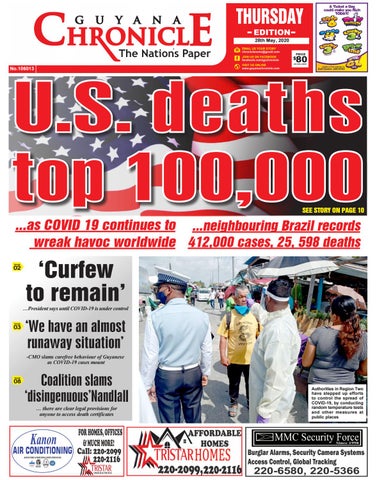
U.S. deaths top 100,000
SEE STORY ON PAGE 10
...as COVID 19 continues to ...neighbouring Brazil records wreak havoc worldwide 412,000 cases, 25, 598 deaths PAGE
02
‘Curfew to remain’
…President says until COVID-19 is under control PAGE
03
‘We have an almost runaway situation’ -CMO slams carefree behaviour of Guyanese as COVID-19 cases mount
PAGE
08
Coalition slams ‘disingenuous’Nandlall … there are clear legal provisions for anyone to access death certificates
Authorities in Region Two have stepped up efforts to control the spread of COVID-19, by conducting random temperature tests and other measures at public places
2
‘Curfew to remain’
GUYANA CHRONICLE Thursday, May 28, 2020
…until COVID-19 is under control ---President says compliance with emergency measures fastest way out of crisis
By Navendra Seoraj EMERGENCY measures employed by government to reduce the spread of the Novel Coronavirus (COVID-19), will remain until the pandemic is under control, said President David Granger. Following a thorough assessment by the Public Health Ministry on Guyana’s prevailing health conditions, the emergency measures implemented to help fight the COVID-19 pandemic were extended for another month, in May. The updated COVID-19 Emergency Measures No. Three, published in an Extraordinary Gazette, stated that the extension took effect from May 4 until June 3, 2020. The regulation requires citizens to remain indoors between 18:00 hours and 6:00 hours. The emergency measures also speak sternly to, among other things, the restriction on visits, specific working hours allotted to essential services, preferential treatment for healthcare workers, social distancing and physical distancing protocols,
President David Granger
religious worship and domestic travel. “The country will reopen when we have brought the pandemic under control and when we are satisfied that the rate of infection has flattened and has been reduced to the extent that there is no danger to normal economic activity, meaning going to school, business places or even places of relaxation, would not bring about an infection and spread of the disease,” said President Granger during a recent interview on the National Communication
Network (NCN). The pandemic is still unfolding in Guyana and across the world, and in this regard, the president said he cannot predict a date and time, when the measures will be lifted. President Granger, however, made it clear that he would like to have everything “opened” as early as possible, but it all depends on Guyana’s ability to reduce the rate of infection and deaths. TURN TO PAGE
03
3
GUYANA CHRONICLE Thursday, May 28, 2020
‘We have an almost runaway situation’ -CMO slams carefree behaviour of Guyanese … nonchalance causing spike in COVID-19 cases By Navendra Seoraj SOME of Guyana’s Caribbean counterparts have started to record a decline in the number of Novel Coronavirus (COVID-19) cases, but the ‘nonchalant’ behaviour of some sections of the local population has exempted Guyana from experiencing this positive development. Although the number of active cases has dropped to 63 and the country went 24 hours without recording a new case of the disease, the fact remains that Guyana has lost eleven precious lives to the disease and 139 persons have been infected to date. Of the active cases, 61 persons are in institutional isolation, and two are being treated in the COVID Intensive Care Unit (ICU). “One death is already too many and we have eleven. Please note that our sister CARICOM countries have begun to see a decline in their numbers, yet we have an almost runaway situation – over the past four days, twelve new cases were confirmed,” said Chief Medical Office (CMO), Dr. Shamdeo Persaud, during a virtual COVID-19 update,
on Wednesday. In expressing his dissatisfaction with the “callous” behaviour of some Guyanese, Dr. Persaud said: “We continue to witness the downright nonchalance of our residents who are intent on carrying on with their laissez-faire lifestyles, seemingly unappreciative of the selfless efforts of our frontline workers who are risking their lives for our protection. Is this callous attitude going to persist until Guyana is swarmed with a high number of deaths? “Our efforts in limiting the spread of this disease are dependent on all of us, if we do not want to end up as the PAHO (Pan American Health Organisation) model indicated, with an exponential rise in positive cases and deaths that will overwhelm our health system.” The Ministry of Public Health using the PAHO model, had predicted that Guyana will have 1,400 cases between March and April, but that figure was later revised upward to 20,000. And, given the prevailing situation, it would seem that Guyana is not “out of the woods” as yet, and could still record a high
Chief Medical Officer, Dr. Shamdeo Persaud
number of cases, if persons continue to disregard the containment measures. Despite the odds, health authorities continue to work towards strengthening the healthcare system to respond to COVID-19 on a long-term basis. The potential and existing activities are part of the plan to have a comprehensive COVID-19 health network, whereby patients across the country’s 10 administrative regions will be able to access these services. Region Four (Demerara-Mahaica) remains the epicentre of the disease, and there are a number of communities outside of George-
town which have recorded cases. Among communities on the East Coast Demerara (ECD) where cases have been recorded are: Atlantic Gardens, Friendship, Golden Grove, Good Hope, Lusignan, Plaisance, and Strathspey. Among communities on the East Bank Demerara (EBD) where there were cases are: Diamond, Grove, Land of Canaan, Providence, and Timehri. Health authorities are also placing emphasis on hinterland regions, especially now that three of the four hinterland regions have recorded cases of COVID-19. The need for surveillance in
‘Curfew to ... Guyana has so far recorded 139 cases of COVID-19 and lost 11 lives to the disease, and health authorities have expressed concerned that cases will continue to climb, especially if Guyanese continue to flout and disregard the containment measures. “If we are to get better, we have to obey the rules… stay at home, avoid crowds and public places...we have to abide by these measures,” President Granger advised, noting that things are likely to get worse unless persons maintain proper hygiene and sanitary measures, and comply with the emergency measures. The President strongly believes that the country could be “reopened” early, if persons comply with the emergency measures, which have been established and
implemented since March 16, 2020. “We are working to enforce those measures because if persons do not comply, we would not get out…if you continue breaking the rules, we will pay a high price for it,” said President Granger. The COVID-19 emergency measures clearly state that anyone who fails to comply with these measures commits an offence under section 152 of the Public Health Ordinance and is liable on summary conviction to the penalty provided under that section. Guyanese, however, continue to find ways to work around these measures, but President Granger assured the nation that government is examining more ways to enforce the measures. Government, through the National COVID-19 Task Force
(NCTF), is also considering new methods of containing the spread of the disease. The President said Ministers of Government continue to meet in council, and have been deliberating on plans to keep Guyana’s economy alive, while reducing the spread of COVID-19. To date, every ministry has presented a plan, said President Granger. In highlighting some examples, the President said the Ministry of Agriculture through the Rural Entrepreneurial Agricultural Project (REAP), has been speeding up the production of agricultural goods; and the Ministry of Business, through the Coordinating Agency for Small Enterprise (CASE) has been assisting small businesses. The ministries of Public Telecommunications and Public Health have also rolled out
FROM PAGE
a number of plans within the past few weeks. “Every ministry has a plan and we are working day and night to ensure that these plans bear fruit, by bringing the rate of infection down,” said President Granger. To this end, the President said Guyana will soon commission a sanatorium at the site of the former Ocean View Hotel. The President said once this facility is commissioned, Guyana will be the first English-speaking Caribbean country to have a medical facility dedicated to dealing with COVID-19. With the advent of this hospital, the President expects that testing and treating of persons will be increased, and Guyana will be in a better position to combat the disease. President Granger remains confident that the na-
those regions is also important because Guyana’s South American neighbour, Brazil, is now the epicenter for COVID-19 in the Region of the Americas, registering more than 600 deaths in the past twenty-four hours. Residents of Region Nine (Upper Takutu-Upper Essequibo), the region which borders Brazil, have also been advised to be watchful and careful. “The Ministry is gravely concerned with the alarming situation emerging just across and along our borders, as our indigenous brothers and sisters are at extremely high risk for the influx of imported cases and for contracting the disease,” Dr. Persaud lamented. Minister of Public Health, Volda Lawrence, in her update on Monday, had also placed emphasis on the growing number of cases in hinterland regions, saying that to date three of them have recorded positive cases. “I wish to draw your attention particularly to Region Seven (CuyuniMazaruni) where seven positive cases have been identified, most of these cases coming from the mining community,” she said, adding: “We are concerned, particularly because other mining communities can be affected, since our miners can transport this disease from the coastland into the interior. We recognise that
our efforts in limiting the spread of this disease are dependent on this community coming fully onboard with the regional health authorities, as well as all other entities which have joined in fighting this disease.” To date the total number of persons tested for COVID-19, on a national level, is 1,500, with the total number of negative cases being 1,361. Although the situation has been grim, there continues to be some glimmer of hope for society, as five of the infected persons recovered from the disease and were medically cleared over the past 24 hours, taking the total number of recoveries to 67. The disease, however, remains a serious issue, not just here in Guyana, but globally as well. And, according to global statistics, there are over 5.4 million cases of COVID-19, with over 343,000 deaths. And with no approved treatment or cure, there is no assurance that persons will survive after contracting the disease. In the absence of approved medications, governments and authorities across the world have employed a number of preventive measures to contain the spread of the disease.
2 tional task force, through various measures, will bring down the rate of infection and reduce the spread of the disease, but he reiterated that persons must comply with these measures. Chairman of the NCTF, Prime Minister Moses Nagamootoo, had stated that the task force is aware that the World Health Organisation (WHO) has warned that lifting lockdown restrictions too quickly could lead to negative consequences. “If something is working and working for the interest of Guyana, then we will need to review its effectiveness and to make decisions as we go along. As of now, we cannot say that any measures have been relaxed,” he said, in a past report. The preamble to the list of measures have made it clear that it could be termi-
nated, extended or amended by notice of the Minister of Public Health, after an assessment of the conditions. The Prime Minister stated that the NCTF has recognised that, in isolated cases, the measures are not being adhered to. “We are using the more popular measure which is persuasion. We have no coercive measures in place, not that we cannot have coercive measures in place but we can try as best as we could to use information via public media, via the regional authorities…to ensure that we don’t have crossing of the borders and we don’t have violations of the curfew in the curfew hours,” he stated.
4
GUYANA CHRONICLE Thursday, May 28, 2020
Hong Kong ‘no longer autonomous from China’ – Pompeo (BBC) US Secretary of State Mike Pompeo has certified to Congress that Hong Kong no longer merits special treatment under US law. The declaration could have far-reaching implications for US-Hong Kong trade. “No reasonable person can assert today that Hong Kong maintains a high degree of autonomy from China, given facts on the ground,” he said in a statement. It comes hours before Beijing is expected to impose a controversial new security law on the territory. What is the significance of Pompeo’s statement? Until now the US has given Hong Kong
special status under US law, a provision that dates from when the territory was a British colony. The special status gives it favourable trading terms. But special status is conditional on the US secretary of state certifying each year that Hong Kong maintains sufficient autonomy from mainland China. If the secretary of state fails to certify this, the US Congress can revoke Hong Kong’s special trade status. This would mean Hong Kong would be treated the same as mainland China for trade and other purposes. That could jeopardise billions of dollars worth of trade between Hong Kong and the US and dissuade people from investing there
in the future. What is the security law about? Beijing has proposed imposing it in Hong Kong. It would ban treason, secession, sedition and subversion and China says it is needed to combat violent protests that have grown in the territory. The anti-mainland sentiment was fuelled last year by a proposed - and later scrapped bill that would have allowed criminal suspects to be extradited to China. Critics say the security law is a direct attempt to curtail the freedoms given Hong Kong in the mini-constitution that was agreed when sovereignty was handed back to China in 1997.
Hong Kong’s Chief Executive Carrie Lam has denied that the law, which is set to go to a vote this week and could be in force as early as the end of June, will curtail the rights of Hong Kong residents. A group of 200 senior politicians from around the world have issued a joint statement criticising China’s plan. On Tuesday, President Donald Trump said the US would announce a “very powerful” response to the proposed legislation before the end of the week. China’s plans had already been condemned by Secretary of State Mike Pompeo, who described them as a “death knell” for the city’s freedoms. The UK, Australia and Canada have also expressed their “deep concern”.
Minneapolis violence: Clashes over death of black man in police custody
(BBC) There have been violent clashes between police and protesters in the US city of Minneapolis fol-
lowing the death of an unarmed black man in police custody. Police fired tear gas and
Thursday, May 28, 2020–– 09:00hrs & 10:30hrs
protesters threw rocks and sprayed graffiti on police cars. Video of the death shows George Floyd, 46, groaning “I can’t breathe” as a policeman kneels on his neck. Four police officers have been fired, with the mayor saying that being black “should not be a death sentence”. The incident echoes the case of Eric Garner, who was placed in a police chokehold in New York in 2014. His death became a rallying call against police brutality and was a driving force in the Black Lives Matter movement. What happened at the protests? They began in the afternoon on Tuesday, when hundreds of people came to the intersection where the incident had taken place on Monday evening. Organisers tried to keep the protest peaceful and maintain coronavirus social distancing, with demonstrators chanting “I can’t breathe,” and “It could’ve been me”. Protester Anita Murray told the Washington Post: “It’s scary to come down here in the middle of the pandemic, but how could I stay away?” A crowd of hundreds later marched to the 3rd Precinct, where the officers involved in the death are thought to have worked. Squad cars were sprayed with graffiti and protesters threw stones at the police building. Police fired tear
Protesters marched on the precinct where the officers were thought to have worked
gas, flash grenades and foam projectiles. One protester told CBS: “It’s real ugly. The police have to understand that this is the climate they have created.” Another said: “I got on my knees and I put up a peace sign and they tear-gassed me.” Police said one person had suffered non-life-threatening injuries after being shot away from the protest area but gave no further details. What happened to George Floyd? Officers responding to reports of the use of counterfeit money had approached Mr Floyd in his vehicle. According to police he was told to step away from the vehicle and physically resisted officers. A police statement said: “Officers were able to get
the suspect into handcuffs and noted he appeared to be suffering medical distress.” The video taken at the scene does not show how the confrontation started. It shows a white officer using his knee to pin Mr Floyd to the ground by the neck. Mr Floyd groans “please, I can’t breathe” and “don’t kill me” as bystanders urge officers to let him go. He ceases to move and an ambulance arrives to take him to hospital where he later died. What was the official response? Mayor Jacob Frey said it was the “right call” to fire the officers. He said: “Being black in America should not be a death sentence. For five minutes we watched as a white police officer pressed his knee into the neck of a black
man. For five minutes. When you hear someone calling for help, you are supposed to help.” The FBI is investigating the incident and will present its findings to the Minnesota state’s attorney for possible federal charges. Minnesota Senator Amy Klobuchar urged a thorough outside investigation, saying: “Justice must be served for this man and his family, justice must be served for our community, justice must be served for our country.” There have been calls from some for the officers to be charged with murder. The Minnesota police handbook states that officers trained on how to compress the neck without applying direct pressure to the airway can use a knee under its use-of-force policy. This is regarded as a non-deadly-force option.
5
GUYANA CHRONICLE Thursday, May 28, 2020
Opposition set to win Suriname election: preliminary results
(FRANCE24) Suriname’s main opposition party is poised to win the country’s general election, preliminary results showed Wednesday, an outcome likely to end the long-time rule of President Desi Bouterse, who was convicted months earlier of ordering the murder of political opponents. Chan Santokhi’s Progressive Reform Party (VHP) was set to win 20 seats in the 51-member parliament which elects the president, ending Bouterse’s majority, accord-
ing to results released by the interior ministry with more than 80 percent of the votes counted. Bouterse’s National Democratic Party (NDP) was likely to win 16 seats following Sunday’s polls, a collapse from its 26 seats in the outgoing parliament. Opposition parties have previously ruled out forming a coalition with the NDP. Counting is still in progress in the small South American country
of 600,000. Opposition parties and civil organizations raised concern over voting irregularities and the count was twice suspended. However, an observer mission from the 15-nation Caribbean community CARICOM said it had not detected irregularities. “We have not detected any evidence of fraudulent acts, but we have seen that the elections were well organized and transparent,”
said mission chief Dora James. Bouterse’s party has ruled the former Dutch colony for a decade. The former military officer ruled as a dictator from 1980-87 and seized power briefly a second time in a bloodless coup in 1990. Bouterse was first elected president in 2010. In November, he was sentenced to 20 years in prison by a military court for ordering executions during his first period in power, in 1982.
The 74-year-old was convicted of having 15 political opponents -- including lawyers, journalists and businessmen -- rounded up and executed. The incident, known as the “December killings,” was investigated by Santokhi, a former justice minister and police commissioner. Bouterse appealed his conviction and the case was postponed until June due to the coronavirus pandemic.
79 human trafficking victims destined for T&T rescued (TRINIDAD GUARDIAN) Venezuela’s Navy yesterday broke up three human trafficking camps on the country’s Orinoco Delta and rescued 79 people, including 25 minors, whom they said were being trafficked to criminal gangs in T&T. Through its Twitter account, the Armada Bolivariana said a patrol in the Orinoco River Delta, a vast jungle and river area, intercepted an illegal operation “dedicated to human trafficking” and also arrested 39 individuals and seized two boats. The Orinoco Delta, which covers all of Delta Amacuro State and parts
of Monagas State and Sucre State in eastern Venezuela, has for decades been a centre of illegal human and drug trafficking. A vast delta of the Orinoco River, it comprises a network of tributaries which empty into Gulf of Paria and the Atlantic Ocean. Yesterday’s raid comes amid reports of a major human trafficking network operating between T&T and Venezuela. An inquiry spearheaded by Venezuela’s opposition-controlled National Assembly has linked the disappearance of scores of migrants at sea to this criminal activity. Robert Alcalá, a deputy in the Na-
tional Assembly, said approximately 100 people have disappeared since 2018 in shipwrecks of boats bound for T&T and other Caribbean islands such as Curaçao and Aruba. COVID-19 travel restrictions have not stopped the movement of people fleeing deteriorating political and economic conditions in Venezuela. This reportedly prompted COVID-19 security talks between Prime Minister Dr Keith Rowley and Venezuela Vice-President Delcy Rodriguez during her visit here in March. A 2019 Trafficking In Persons Re-
port (TIP) Report designated T&T as a tier 2 country and said traffickers operating here “are increasingly targeting vulnerable foreign young women and girls between the ages of 15 and 21.” According to reports, boats transporting sex trafficking victims to T&T earn between US$3,000 and US$12,000 per trip. Most are teenage girls and young women from coastal communities, including Cumaná, Carúpano, Maturín and other nearby towns. However, woman and girls from other parts of the country are regularly transported to Güiria, a port city located a short boat ride away from
UNC: “We are ready for General Elections…”
(TRINIDAD GUARDIAN) The United National Congress (UNC) says that it is on track for the General Elections, following a continuation of the screening process for selecting candidates, on Tuesday 26th May 2020. According to a statement issued by the party this morning, nominees for 12 more constituencies were screened, yesterday. Several other nominees already were screened and named previously, before the COVID-19 crisis began in Trinidad and Tobago. The party is expected
to hold its second Virtual Meeting on Thursday 28th May 2020, from 7.30 pm. UNC Political Leader, Kamla Persad-Bissessar SC MP, is expected to announce the names of more UNC candidates, at that meeting, in addition to revealing more of the party’s plans for National Economic Transformation, outlining how it intends to create jobs and to get T&T working again. The meeting is scheduled to be broadcast on the UNC’s Facebook page, as well as on the Facebook page for the UNC political leader.
Kamla Persad-Bissessar SC MP, Opposition Leader and Political Leader of the United National Congress (UNC)
Trinidad’s north-west coast, which has been identified as the main operating base for human traffickers, a National Assembly report said. There has been a huge influx of Venezuelans to T&T in recent years and about 24,000 are believed to be in this country. In a May 14 report, the United Nations Office of Drugs and Crime (UNODC) said there has been an increase in migrant smuggling and human trafficking. The UNODC warned “the spread of the COVID-19 pandemic and its consequences will probably endanger the lives of these people even more.”
6
GUYANA CHRONICLE Thursday, May 28, 2020
Ending ‘Winner-take-all-system’
S
INCE March 2, the debate over power-sharing or shared governance as an alternative form of governance for Guyana has been raised anew. President Granger recently weighed in on the issue by once again committing his six-party coalition to this alternative form of governance: “By formula — as has been laid out by my colleague Rupert Roopnaraine — people who win 51 per cent of the vote must not behave as if they won 100 per cent of the vote and people who only got 49 per cent of the vote must not be treated as if they got no per cent of the votes and, I live by that. I would like to see an inclusionary form of government.” This debate over power-sharing goes as far back as 1961 when Sydney King (now Eusi Kwayana) proposed what he referred to as “Joint Premiership” as a pre-independence pact aimed at avoiding conflict over which of the two major parties and by extension the two major ethnic groups would govern an independent Guyana. As Kwayana explained at the time, “We have known all along that the Indians would not trust a black leader and that the Africans would not trust an Indian leader. We could see then that any attempt of the one to rule the other will lead to blood baths.” Four decades later he explained, “I proposed a solution which had not been heard of before,
a joint premiership between the rulers of the Indian and African races. It was a solution, so far as I was concerned, posed by the social and political logic of the situation then before us, and not by me.” The ”logic” that Kwayana spoke about is still with us six decades later. There is still resistance by the major ethnic groups to be ruled by leaders of the opposite group. Despite many positive developments in race relations, it must be admitted that after the 28-year rule of the PNC followed by 23 years of PPP control of government, our country is as divided as it was in 1961. But while the PNC has since 2002 made a commitment to shared inclusive governance, the PPP has consistently rejected the idea. It has preferred to hold stoutly to the system of one-party rule, which in our circumstances is easily translated into ethnic dominance of one ethnicity. This is what prompted former president Desmond Hoyte and PNC leader to proclaim in 2002: “An adjusted system of governance for our country -- whether we call it ‘power-sharing,’ ‘shared governance’ or any other name -- appears to be an idea whose time has come. It could hardly be claimed that our present arrangements are working in the best interests of the country and its citizens. The imperfections obtrude everywhere and are a serious obstacle to national cohesion
and development. In the circumstances, the imperative of constitutional adjustment appears to be unavoidable. We cannot stand on the seashore and bid the waves recede. I suggest, therefore, that we as a party give careful and anxious consideration to the insistent voices that are calling for constitutional and political reform.” The PPP on the other hand has not been as forthcoming on the issue. While Dr Jagan declared in 1988 that winner-takes-all politics must go, on assuming power he did nothing to turn that into reality. Since his death in 1997, the PPP has put up several barriers to power-sharing. They rejected the PNC’s offers following Hoyte’s declaration. They have argued that the two parties need to build trust before committing to sharing governance. This view ignores the fact that power-sharing is essentially a solution to the lack of trust between parties and the groups they represent. Upon taking office in 2015 President David Granger immediately reached out to the PPP to begin talks towards a joint government, but the party did not accept. As President Granger recently reminded the nation: “At the start of my tenure I did invite the People’s Progressive Party to discuss a form of shared governance and were I to be re-elected after the declaration of the elections commission, I will do the same
again. I believe in inclusionary democracy and the PPP is part of the future of Guyana.” Not so for the PPP whose leader Bharrat Jagdeo poured cold water on Granger’s apparent olive branch by asking rhetorically if “anybody would want to sit in the same government with some of these guys who are making such patently false allegations and put the country in turmoil.” In other words, even as the country nervously awaits the declaration of the results of the March 2 election, the PPP continues to advocate for one-party domination. This publication, aware of the need for peace and harmony, supports initiatives aimed at holding our country together as a cohesive nation. Against that backdrop we throw our weight behind the President’s call for a power-sharing form of government. We feel it is the only sensible proposal on the table. It is clear to us that the winner-takes-all majoritarian model has outlived its usefulness. We therefore urge mass support for President Granger’s proposal which has the support of our leading scholars and political activists, including veterans Kwayana and Moses Bhagwan, whose letter to the press a few weeks ago sparked the new round of debates. The time has come to call a spade a spade. Guyana comes first.
What law enabled KN to access polling station ‘Pink List’? Dear Editor,
R
EFERENCE is made to Kaieteur News’ article “Coalition’s dead voter claim…Family says it never approved access to death certificate” (May 27, 2020). Undoubtedly, the article sought to present a picture that the alleged death certificate of Chitnandani Ramdass purportedly used by the APNU+AFC as evidence of the dead voting was unauthorised by the deceased family and the named person did not vote. For all intent and purposes it could be accepted- 1) it is the truth the named person is deceased and, 2) the family did not authorise the release of the certificate. Said article noted Ms. Amna Ally referred to the Registration of Births and Deaths Act which allows “everyone” access to a death certificate and aided the public’s understanding by quoting the relevant provision. This was
contrasted with a claim by Mr. Anil Nandlall that such access is not permissible by an unauthorised person, and as per the family’s complaint, is a violation of the Access to Information Act. He quoted the provision to justify his argument. It would now become debate or fodder whether or not the Information Act has any bearing on the Births and Deaths Act in retrieving a certificate, though such is permissible as per the quoted provision in the latter Act. The above aside, what is most disturbing in the article is how the newspaper was able to report that the “Official List of Electors (OLE) commonly known as the ‘Pink List,’ showed, however, that the woman’s name was not ticked as voted…” The reporter, Ms. Shikema Dey, or editor did not advise how this ‘knowledge’ was gained or the paper’s ability to access a document that would have been in the ballot box of that particular polling station where the allegation is made of a dead person
voting. How was access granted to the ‘Pink List’ and by whom? While the newspaper quoted the Acts regarding access or alleged non-access to the death certificate, it did not refer to any Act (law) and its concomitant provision that gives it such access to the Pink List. Editor, could this please be made known? The newspaper cannot afford to be silent on this when fingers are pointing to political parties tampering with and undermining the integrity of the ballot, vote and tally. There is information carried by the very media that many of these ‘Pink Lists’ which should have been in the ballot boxes are missing. That list marks off who voted. The absence of these has cast serious doubt on the credibility of the voting process and by extension the results. I doubt the paper would want to be perceived as aiding this. Those lists remain the guarded proper-
ty of the Guyana Elections Commission (GECOM). In the case of the specific list, it should have only been accessible to the election personnel of that particular polling station on Election Day and those in the recounting station of that specific box, not the public. The Pink List is a legal document of the Guyana Elections Commission (GECOM). How then was a newspaper allowed to have access to same if not given by GECOM voluntarily or mandated by a court order? Some clarity would help here. Could Kaieteur News advise the public under what Act (Law), Order or consent was the newspaper able to gain access to the ‘Pink List’ of that particular polling station or any such list for any other polling station? Regards Minette A. Bacchus
GUYANA CHRONICLE Thursday, May 28, 2020
Uitvlugt factory workers protest working hours, outstanding leave
WORKERS attached to the Uitvlugt sugar factory on Wednesday downed tools to express their dismay regarding their hours of work and certain outstanding payments to them, the workers’ union the Guyana Agricultural and General Workers Union (GAWU), has said. In a release GAWU said at this time, with the first crop having ended a few weeks ago, the factory workers are currently engaged in out-of-crop maintenance work. At commencement of the out-of-crop season, the workers and the union reached an agreement with management whereby the working hours during the period would be confined to outside of the national curfew hours. Initially, the estate had sought that workers be divided into two shifts. Through the proposed arrangement, workers on the second shift would have concluded their work during the curfew period; at that time, the union drew to the estate’s attention that during the cropping period many workers had faced many difficulties with law-enforcement officers when they returned home during the curfew period, although they were deemed essential workers. In view of
what prevailed, it was agreed that workers would not be required to work during the curfew period. It was therefore suggested at that time that appropriate representation be made to the authorities to ensure workers do not confront similar difficulties should the curfew period prevail when the second crop commences. Notwithstanding the agreement reached, GAWU said that the estate suddenly began to demand that the workers be organised into arrangement, though it was shelved following the union’s representation. Moreover, there was no advice about whether any successful representation to avoid the difficulties workers faced when returning home during the curfew hours. The union said at the same time that the workers recognised that the requirement to have them all working at once prevented adequate social distancing. During the cropping period, to maintain round-the-clock operations, workers are staggered in three (3) shifts. Since 24-hour operations were no longer necessary at this time, all the workers were required to be present. “In view of the large number of workers present, the union suggested two
shifts of workers be organised during the initially agreed hours of work. This suggestion came against the background that the estate has approved similar arrangements for its ad-
keeping with adequate safety and health practices in the era of COVID-19,” GAWU said. The workers are also upset, GAWU said, that their holiday-with-pay payments
leave. This arrangement is among the benefits set out in the extant Collective Labour Agreement between the union and the GuySuCo. Regarding the payment, the union said
The workers who protested on Wednesday (GAWU photo)
ministrative staffers, undoubtedly, to protect their health and well-being. However, the Uitvlugt management has not yielded to the suggestion from the union and the workers. Indeed, it is felt that this is not in
for those workers who have 10 or more years of service has been delayed for two weeks now. Sugar workers employed in the fields and the factories receive holiday-with-pay payments in lieu of annual
the workers entitled were told just on the day before that the corporation did not have the funds to effect payment to the workers. Many workers anxiously looked forward to receiving their
7
entitlements and the delay for them has been upsetting. Following the workers’ protest, the union was informed by GuySuCo during the day that the workers would finally receive their outstanding monies on May 29, 2020. It appeared that had the workers not raised their voices in protest, they may have continued to see their payments withheld. “The GAWU is heartened that the workers can receive their outstanding entitlements, though it is saddened that they were forced to take protest actions to have their rights respected. Disappointingly it has, in recent times, become the norm, rather than the exception, for workers to take protest actions in order for them to benefit from what they worked and earned. We, at this time too, look forward to better sense prevailing and sensible measures to be employed to protect the health and well-being of workers and their families. Indeed, we all must play our roles and appropriate work arrangements should be embraced at this time,” the release concluded.
The living dead and the so-called Guardians of Democracy Dear Editor,
A
group calling itself ‘the Guardians of Democracy” set out to prevent Guyana’s democracy from being stolen while the ballot boxes were staged at the Arthur Chung Convention Center for a recount and validation exercise. It appears now that the guardians may have arrived a little too late. The alarming high number of discrepancies being discovered during the ongoing process suggests that the guardians should have been deployed during election day instead. But even if
they were, it is unlikely that they would have seen anything. Guyana apparently was like the land of the living dead on March 2, 2002. Like in the movies, several men and women arose from their graves on that day. We cannot be certain how many roamed the country, but we know that some of them made their way into polling stations and voted. Their names have been checked to show that they voted when they should have been peacefully resting in their graves. Yet no one saw them. Perhaps the guardians of democracy might have been able to prevent those living-dead
from voting if only they were deployed on that day. There were also phantoms accompanying those who came from the graves. Either that, or perhaps some Guyanese residing abroad may have found a way to beam into Guyana without going through the immigration process. No one knows how, but somehow, several overseas Guyanese were able to vote without being in the country on election day. Either the phantoms voted for them, or the overseas Guyanese voted via Whatsapp. Perhaps if the guardians of democracy were monitoring the polling stations, then they
might have been able to prevent such blatant attempt to steal our democracy. Those are only two forms of irregularities being uncovered. There are others, but it does not matter. It is already clear that those who are so intent on preventing electoral fraud were not up to the task. As evidence of electoral skullduggery continues to emerge, members of the Guardians of Democracy have gone silent. They ought to be fired for being AWOL. Respectfully Max Mohamed
GECOM Chair is performing herculean task with quiet grace, dignity Dear Editor,
I
READ Mr. Christopher Ram’s letter condemning Justice Claudette Singh and the pace of the national recount at the Arthur Chung Conference Centre (ACCC). I would not want to accuse Mr. Ram of being a busy body, looking for another fight to pick that he knows he cannot win; neither would I want to accuse him of acting like a sour grape because he was passed over for Justice Singh to be the constitutionally appointed chair. Justice Singh is in charge of GECOM and will decide along with her fellow commissioners and secretariat what is best to get this recount completed, with little risk to the health and safety of the people who are present. Mr. Ram and others may want her to have more stations to hasten the recount. She has to be careful any decision made to add these stations comes at minimum risk for contracting
the deadly coronavirus. Without a doubt, the very people who are calling for more stations, God forbid, should there be a COVID case, they will be among the first to blame Justice Singh. She is condemned for everything even when she bends over backwards, entertains the views of all sides and tries to work with all. These detractors ignore the praises she gets for the good job she’s doing right now. Even the opposition has praised GECOM for doing a good job. The so-called slow counting of the ballot boxes is not Justice Singh’s fault. It is the fault of those presiding officers, deputy returning officers and returning officers who did not do a good job on Election Day, March 2nd. It is not Justice Singh’s fault that they did not put the pink slips in the box, mixed up the different party votes, didn’t count the votes accurately, they placed the ballot paper for one region in another region’s box. It is not Justice Singh’s
fault the Polling Books (Vote bible) is missing in some boxes and those doing the recount cannot verify what happened that day. It is not Justice Singh’s fault that Official Lists of Electors are missing in some boxes, ballot papers are not stamped, Certificate of Employment gone to the olympics, people voting without identity oaths, people living abroad on March 2nd voted, and even the dead woke up to vote. Those ballot boxes are in a mess! Mr. Ram would understand these anomalies will affect speed and timing to complete the recount. I’m sure when GECOM said it could be done in 25 days they never thought counting agents would have experienced such chaos. If these problems were not there, surely the count would have been faster. Some will never be satisfied and find delight in making Justice Singh their target for the mess that happened during voting. I get the uneasy feeling this is deliberate. They don’t want a credible recount. They are uncomfort-
able what more may be exposed. Justice Singh promised President David Granger, PPP Leader Bharrat Jagdeo, CARICOM, the court, all Guyana and the world that GECOM will do a recount. She promised GECOM will deliver credible results. Nobody objected to her promise. What I don’t know is, if we can have credible results given the hurricane of problems in those boxes. With the COVID-19 constraints and mess the ballot boxes were left in, efficiency cannot be sacrificed to achieve credible results. Instead of condemning Justice Singh, there should be support and the offer of helpful advice to get through this turmoil and protect GECOM’s good name. She is doing a Herculean task with quiet grace and dignity. I doubt many, including Mr. Ram, would want to be in her shoes now. Regards B, Beniprashad Rayman
8
GUYANA CHRONICLE Thursday, May 28, 2020
‘Nandlall Disingenuous’
APNU+AFC slams PPP/C for misinforming public … there are clear legal provisions for anyone to access death certificates By Svetlana Marshall ARMED with the Law, the A Partnership for National Unity + Alliance for Change (APNU+AFC) slammed the People’s Progressive Party/ Civic (PPP/C) over what it described as a blatant attempt to misinform and mislead the public on the laws governing access to Death Certificates. Executive Member of the PPP/C, Anil Nandlall, in an attempt to discredit a move by the APNU+AFC to supply the Guyana Elections Commission (GECOM) with Death Certificates, on Tuesday alleged that it was illegal to source Death Certificates from the General Register Office (GRO) without permission from the deceased next of kin. But APNU+AFC
Executive Member Aubrey Norton, on Wednesday, told reporters that Nandlall is simply being “disingenuous.” In rubbishing the claims made by Nandlall, Norton pointed to Section 40 (2) of the Registration of Birth and Death Act which provides for anyone to access Death Certificates at a fee. Section 40 (2) states: “Everyone should be entitled, on payment of the fees prescribed by the Ministry by order, to search the indices between the hours of ten o'clock in the morning and four o'clock in the afternoon of every day, except public holidays and Saturdays, and to have extracted therefrom a sealed certificate of Birth in Form 4 or a sealed Certificate of Death in Form 5, as the case may be.” Nandlall, in an attempt to
support his claim of illegality, made reference to the Access to Information Act; but
that too does not bar persons from accessing records such as Death Certificates.
APNU+AFC Executive Aubrey Norton
An Operation Report, which was generated upon the completion of Box 2107, in which it was stated that APNU+AFC filed a claim on the basis that someone voted in the place of a dead person.
Section 15 of the Access to Information Act states: “A person may not apply, under this Act for access to - (a) a document which contains information that is open to public access or on an official website, as part of a public register or otherwise, in accordance with any other written law, where even that access is subject to a fee or other charge.” CLEAR IRREGULARITIES According to the APNU+AFC, since the recount of the votes cast at the General and Regional Elections commenced on May 6, 1,937 numerical irregularities have been unearthed, thereby affecting 90,707 votes. Among the alleged irregularities cited are cases in which persons
voted in the place of dead people. The coalition has cited 40 such cases, and, according to Norton, the APNU+AFC has commenced the process of providing the Elections Commission with evidence in the form of Death Certificates. Apart from the alleged cases of ‘ghost voters,’ the APNU+AFC is alleging that 1,261 persons voted in the place of migrants. Added to that, it said that 315 Certificates of Employment are missing; 284 poll books are missing; 143 persons, who had no form of identification, voted without taking an Oath of Identity; 138 missing Oaths of Identity; 40 unstamped ballots and seven missing Official List of Electors (OLEs). TURN TO PAGE
09
This is among the Death Certificates reportedly submitted to GECOM as evidence by the APNU+AFC. According to the coalition, someone voted in the place of the late Chitnandani Ramdass in District #2. The alleged irregularity was cited in Box 2107.
9
GUYANA CHRONICLE Thursday, May 28, 2020
Four-phase re-opening of travel to --- GCAA proposal Guyana being examined presented to gov’t By Lisa Hamilton GUYANA is examining re-opening its airports through a fourphase programme which would first see the implementation of a list of Standard Operating Procedures (SOPs) at airports to safeguard against COVID-19, followed by re-opened access to regional travel. In an interview with the Guyana Chronicle on Wednesday, Director- General of the Guyana Civil Aviation Authority (GCAA), Lt. Col. (Ret’d) Egbert Field, said that he has sent a corresponding Roadmap for Reopening Airports to the Minister of Public Infrastructure for governmental review. Until a decision is made by the National COVID-19 Task Force (NCTF) on what aspects of the plan it will approve or disapprove, Guyana’s airports remain closed. PHASE ONE Phase One of the proposed re-opening is being deemed as the planning stage. It involves meetings being held between the government, the GCAA, airport authorities and operators, local tourism bodies and other stakeholders’ groups for a collective understanding. Standard Operating Procedures (SOPs) will be developed, which,
will state in detail what guidelines should be observed by passengers when visiting the airport; what health/safety guidelines airports should have in place and what should be done if a suspected case of the virus is detected. For passengers, this includes screening prior to entry into the airport; the wearing of face masks; social distancing guidelines and more. For airports, this includes the implementation of a regular sanitisation programme whereby airports may be re-sanitised at different intervals; special instructions to security and more. This phase could take between one and a half months, according to Field. PHASE TWO The Second Phase is the implementation phase. It will see the re-opening of airports to some Regional travel. The Director-General explained when it comes to re-opening travel one has to understand that each country has its unique challenges. He said that while CARICOM will be collaborating with regards to established protocols, it may not be possible for all CARICOM countries to reopen at the same time. Likewise, Guyana may not allow travel to a particular Caribbean country if cases of the virus have spiked there to concerning
levels. Field said that the proposal outlines this possibility for July/ August. Even so, the second phase will see continued engagement with involved stakeholders for a constant review of the SOPs and what adjustments may be necessary. PHASE THREE The Third Phase will expand to the acceptance of foreign nationals from areas like North America. Field said that this phase will be looked at very meticulously as many international regions have experienced a very high number of cases of the virus. The Director-General said that the third phase is averaged for a period between August to December. “If we begin to open to the foreign market with foreigners coming in but then in August we realise there is a peak in the cases in New York, which is a point of origin for our flights, or in Miami or in the North America Region, we wouldn’t continue to open our ports because we have an increase in cases in the point of origin,” Field explained. “As much as you will set a timeline for these phases, yet it will be fluid because the situation of each phase may depend on the effectiveness and the implementation of not only the individual measures in your
Nandlall ... Amid the mountain of allegations, GECOM Chair, Justice (Ret’d) Claudette Singh said “he who asserts must prove,” and according to Norton, the coalition, has been doing just that. He said apart from supplying the Elections Commission with Death Certificates, APNU+AFC is providing information on migrants, who were out of the jurisdiction on Monday, March 2 but are marked off on the Official List of Electors as having voted. While remaining adamant that the APNU+AFC did its “homework” ahead of the National Recount, and ascertain “credible” information on persons who have migrated, Norton said at this stage, the coalition is following the legal steps to access the information on migrants. He noted that the coalition is in the process of compiling a list with names of migrants, who are alleged to have voted, with the intention of supplying it to GECOM’s Secretariat. “As I understand it…we
can write the Chief Elections Officer ask them to use their authority to access the database to confirm or deny,” Norton posited even as he remained resolute that the information that the coalition has in its possession is of evidential value. However, he said “it is GECOM, who in the final analysis would have to verify” the information. This, he said, is provided for in the order which was gazetted on May 4, and legally triggered the recount. While the Chair of GECOM has invited the coalition to provide evidence to support its claims, Commissioner Sase Gunraj, who was nominated to the Commission by the PPP/C, has long contended that it is not the role of GECOM to investigate cases of alleged irregularities cited during the recount. But the Government-nominated Commissioners, Vincent Alexander and Desmond Trotman, have disagreed with that position, contending that GECOM has the authority under the laws of the country to solicit immigration and other records,
and ought to do so to confirm or negate the claims made in the interest of transparency. MISSING POLL BOOKS That aside, the APNU+AFC Official dismissed contentions that the Poll Books are of little value to the ongoing recount of the votes cast at the General and Regional Elections on March 2. Norton submitted that the Poll Books have critical information on activities at the Poll Stations on E-Day, such as the use of Certificates of Employment and use of Affidavits or taking of Oaths of Identity. “It is very difficult in a circumstance, where having counted 797 Boxes, there are 284 missing Poll Books, and let's translate that into illegality and fraud, what it says, is that all the votes that are covered in those 284 Poll Books are in question, and that amounts to about 90,707. Why is it in question? First, you can't determine the Certificates of Employment, you can't de-
State but also the prevailing environment in the points of origin.” PHASE FOUR The Fourth Phase will extend into 2021 and, based on developments around the world as it relates to the pandemic, could see the country going back to normal or adjusting its travel SOPs based on the situation. The Director-General pointed out that the re-opening to travel whether regional or international must also synchronise with the ability of the Ministry of Public Health to deal with COVID-19 cases. “If they cannot have any more individuals in quarantine because of limitation of facility, we’ll have to just start closing that door slowly,” he said. VIRGIN TERRITORY When it comes to testing, he said Guyana prefers the Polymerise Chain Reaction (PCR) test which are used to directly detect the presence of an antigen, rather than the presence of the body’s immune response, or antibodies. He also said that the measures put in place for testing will have to be consistent across the board for persons coming to Guyana as it is impracticable for there to be a flight of both tested and untested
FROM PAGE 8 termine those with Identity of Oath because there are no records; but, most importantly, the law stipulates that at the end of the process, a seal be placed on the ballot box, and when the seal is placed, the number for that seal should be written in the Poll Book,” Norton reasoned. He said it is important for the Poll Books to be sourced ahead of the completion of the recount to ascertain the authenticity of the contents of the affected ballot boxes. With the number of alleged irregularities steadily increasing, Norton, in response to a question posed, said GECOM, at the end of the recount exercise, would need to make a determination. “I think GECOM has to assess it, and, based on its assessment, make a pronouncement on what should happen with the elections. It is not for me to pronounce,” Norton told reporters, while making it clear that what GECOM has embarked on, is not a numerical count of the ballots cast on March 2.
Director- General of the Guyana Civil Aviation Authority (GCAA), Lt. Col. (Ret’d) Egbert Field
individuals. The Guyana Chronicle iterates that this proposal has not been approved and is only now up for review. Meanwhile, Guyana will continue with its limited authorised repatriation flights of nationals, cargo flights, medevac flights, technical stops by airplanes for fuel and other special authorised flights. In all that is done, the GCAA Head reminded that tourists will not travel to a country and airlines will not operate in a country if they do not believe it is hygienic enough or that measures implemented by a particular government are not being adhered to. He believes that as many countries maneuver ‘virgin territory’ in dealing with the virus, travel will never be the same again as countries seek to protect their greatest resource: humans.
Miner killed during fight at Arrangay backlands THE police are investigating the murder of a miner, whose body was found in a hammock at a mining camp at Arrangay backlands, Cuyuni River, on Tuesday night. Dead is David James of Port Kaituma, North West District. The Guyana Chronicle understands that James was killed around 18:30hrs by a suspect called ‘Chris,’ who is currently on the run. According to reports on the day in question, James and another man were drinking at the camp when an argument ensued between them. During the argument the man left James and returned with the suspect who then dealt James several cuffs to his face and body. Consequently, James fell to the ground and became motionless. The police were summoned and upon arrival found James still motionless in a hammock. The other man was arrested while the prime suspect is being pursued. A team of police officers consisting of crime scene technicians and investigators was dispatched to the location and an investigation is in progress.
10
U.S. deaths top 100, 000 ...as COVID 19 continues to wreak havoc worldwide ...neighbouring Brazil records 412, 000 cases, 25, 598 deaths
(Reuters) - The novel coronavirus has killed more than 100,000 people in the United States, according to a Reuters tally on Wednesday, even as the slowdown in deaths encouraged businesses to reopen and Americans to emerge from more than two months of lockdowns. About 1,400 Americans have died on average each day in May, down from a peak of 2,000 in April, according to the tally of state and county data on COVID-19 deaths. (Reuters interactive: tmsnrt. rs/2w7hX9T) In about three months, more Americans have died from COVID-19 than during the Korean War, Vietnam War and the U.S. conflict in Iraq from 2003-2011 combined. The new respiratory disease has also killed more people than the AIDS epidemic did from 1981 through 1989, and it is far deadlier than the seasonal flu has been in decades.
The last time the flu killed as many people in the United States was in the 1957-1958 season, when 116,000 died. Total U.S. coronavirus cases are over 1.7 million with some southern states seeing new cases rising in the past week, according to a Reuters analysis of data from The COVID Tracking Project, a volunteer-run effort to track the outbreak. Globally, coronavirus cases have topped 5.6 million with over 350,000 deaths since the outbreak began in China late last year and
then arrived in Europe and the United States. South America is now bearing the brunt of the outbreak, with Brazil having the second-highest number of cases in the world. Of the top 20 most severely affected countries, the United States ranks eighth based on deaths per capita, according to a Reuters tally. The United States has three fatalities per 10,000 people. Belgium is first with eight deaths per 10,000, followed by Spain, the United Kingdom and Italy, according to the Reuters analysis.
Meanwhile, across neighbouring Brazil some 412, 000 cases have been recorded with 25, 598 deaths. The World Health Organization has warned that Latin America has become the epicentre of the crisis and Brazil is the worst-hit in the region by far. Health experts in Brazil have warned that the real number of confirmed infections may be far higher than the official records, due to a lack of testing. A study by the University of Washington found that the country could record more than 125,000 deaths by early August, that’s almost a fivefold increase on its current total of 25,598. The prediction followed Brazil’s daily death toll surpassing that of the United States for the first time. It recorded 807 deaths on Monday, while 620 people died in the US.
GUYANA CHRONICLE Thursday, May 28, 2020
Let us deal with issue of racial divide in Guyana – Min Cathy Hughes MINISTER of Public Telecommunications, Cathy Hughes,in a recent interview said that it is time for us as a nation to discuss the issue of race. Minister Hughes made these remarks in response to recent racist comments that were posted on social media. As the recount process continues at the Arthur Chung Conference Centre (ACCC), the issue of racism has surfaced and there are constant race-based attacks. The Coalition Government, since its formation, has sought to address the issue of racism in the country through establishment of the Ministry of Social Cohesion. Just recently, the Ethnic Relations Commission (ERC) said that it has launched an investigation into racial comments which were disseminated on social media. Prior to this, the ERC had launched several investigations into matters which were purportedly aimed at destabilising the African-Guyanese community. In 2019 the ERC received 61 complaints of various forms of discrimination,
most of which have been resolved. This is according to information from a press conference that was held in 2019 It was revealed that 61 complaints were taken to the body; so far , 44 have been brought to closure while 12 are still to be reviewed. The remaining five are active. The complaints pertained to racial/ethnic and religious discrimination. “[The ERC] firmly believes that incidents of harassment and incitement, including what is very noticeable on social media, are most unhelpful to building and sustaining a [cohesive society]. “The commission will, in the near future, embark on education initiatives to examine inherent causes which have led to current suspicions and stereotypes and explore possible mitigating measures. It remains convinced that education is the key to help change mindsets for the removal of stereotypes ; the commission will continue to prioritise educational programmes. “
ILO: More than one in six youth out of work due to COVID-19 GENEVA (ILO News) – More than one in six young people have stopped working since the onset of the
COVID-19 pandemic while those who remain employed have seen their working hours cut by 23 per cent,
says the International Labour Organization (ILO). According to the ILO Monitor: COVID-19 and the
world of work: 4th edition, youth are being disproportionately affected by the pandemic, and the substantial and rapid increase in youth unemployment seen since February is affecting young women more than young men. The pandemic is inflicting a triple shock on young people. Not only is it destroying their employment, but it is also disrupting education and training, and placing major obstacles in the way of those seeking to enter the labour market or to move between jobs. At 13.6 per cent, the youth unemployment rate in 2019 was already higher than for any other group. There were around 267 million young people not in employment, education or training (NEET) worldwide. Those 15-24 year olds who were employed were also more likely to be in forms of work that leave them vulnerable, such as low paid occupations, informal sector work, or as migrant workers. “The COVID-19 economic crisis is hitting young people – especially women – harder and faster than any other group. If we do not take significant and immediate action to improve their situation, the legacy of the virus could be with us for decades. If their talent and energy is side-lined by a lack of opportunity or skills it will damage all our futures and make it much more difficult to re-build a better, post-COVID economy,” said ILO Director-General, Guy Ryder. The Monitor calls for ur-
gent, large-scale and targeted policy responses to support youth, including broad-based employment/training guarantee programmes in developed countries, and employment-intensive programmes and guarantees in low- and middle-income economies.
TESTING AND TRACING PAYS OFF The 4th edition of the Monitor also looks at measures to create a safe environment for returning to work. It says that rigorous testing and tracing (TT) of COVID-19 infections, “is strongly related to lower labour market disruption…. [and] substantially smaller social disruptions than confinement and lockdown measures.” In countries with strong testing and tracing, the average fall in working hours is reduced by as much as 50 per cent. There are three reasons for this: TT reduces reliance on strict confinement measures; promotes the public confidence and so encourages consumption and supports employment; and helps minimise operational disruption at the workplace. In addition, testing and tracing can itself create new jobs, even if temporary, which can be targeted towards youth and other priority groups. The Monitor highlights the importance of managing data privacy concerns. Cost is also a factor, but the benefit-to-cost ratio of TT is “highly favourable”. “Creating an employment-rich recovery that also promotes
equity and sustainability means getting people and enterprises working again as soon as possible, in safe conditions,” said Ryder. “Testing and tracing can be an important part of the policy package if we are to fight fear, reduce risk and get our economies and societies moving again quickly.” LOSS OF WORKING HOURS The Monitor also updates the estimate for the decline in working hours in the first and second quarters of 2020, compared with the fourth quarter of 2019. An estimated 4.8 per cent of working hours were lost during Q1 2020 (equivalent to approximately 135 million full-time jobs, assuming a 48-hour working week). This represents a slight upward revision of around 7 million jobs since the third edition of the Monitor. The estimated number of jobs lost in Q2 remain unchanged at 305 million. From a regional perspective, the Americas (13.1 per cent), and Europe and Central Asia (12.9 per cent) present the largest losses in hours worked in Q2. The Monitor reiterates its call for immediate and urgent measures to support workers and enterprises along the ILO’s four-pillar strategy: stimulating the economy and employment; supporting enterprises, jobs and incomes; protecting workers in the workplace; relying on social dialogue for solutions.
GUYANA CHRONICLE Thursday, May 28, 2020
GECOM floats June 16 as new recount deadline
11
…PPP commissioners request time to consider proposal AT a meeting of the Guyana Elections Commission (GECOM) on Wednesday it was proposed that the deadline for completion of the national recount be extended for another 17 days, the Guyana Chronicle has been reliably informed. Initially, the elections commission headed by Justice (Ret’d) Claudette Singh had set a 25-day timeline (Mat 30) for completion of the recount; however, with 956 ballot boxes left to be processed, an extension of timeline is necessary. During Wednesday’s meeting at the Arthur Chung Conference Centre (ACCC) – the venue of the recount – it was proposed that the national recount be completed no later than June 16, inclusive of the tabulation of votes by the Chief Elections Officer (CEO) Keith Lowenfield. Opposition- nominated Commissioners have however reportedly asked for time to consider the proposal. Added to that, the commission is actively considering the option of increasing the number of workstations; however, it is awaiting advice from the National COVID-19 Task Force (NCTF). Initially, there was a total of 10 workstations operating within the centre; however, the commission increased the number to 12 in an effort to accelerate the recounting of ballots cast at the March 2 General and Regional Elections. To further increase the pace, the commission proposed the addition of two more stations but requires clearance from the task force in view of the emergency measures instituted to eliminate the spread of the deadly coronavirus.
1,383 BALLOT BOXES CLEARED At the end of Day 22 (Wednesday), the elections secretariat proposed a total of 1,383 ballot boxes from nine of the 10 Electoral Districts – Regions One to Nine – from a total of 2,339.
Region Seven (Cuyuni-Mazaruni); 11 from Region Eight (Potaro-Siparuni); and 13 from Region Nine (Upper Takutu-Upper Essequibo). PPP/C prime ministerial candidate Mark Phillips, while describing Wednesday as the “best day” since the recount started with more than 90 boxes processed, expressed the
A ballot box being taken for processing According to GECOM’s Public Relations Officer Yolanda Ward, 93 ballot boxes from Regions Three, Four, Six, Seven, Eight and Nine were processed. Of that number 19 ballot boxes were from Region Three (Essequibo Islands-West Demerara); 22 were from Region Four (Demerara-Mahaica); 19 from Region Six (East Berbice-Corentyne); nine from
few that more ballot boxes can be processed with additional workstations. “What is important, of all the ballot boxes counted so far, is that we have less than 4,000 rejected ballots, and in addition to that, less [sic] than a 100 of those rejected ballots were unstamped,” Phillips said. Notably, all of the ballots from Region One (Barima-Waini), Region
PPP/C prime ministerial candidate Mark Phillps
GECOM PRO Yolanda Ward
Two (Pomeroon-Supenaam) and Region Five (Mahaica-Berbice) have been recounted. Based on the votes recounted for Region One, the A Partnership for National Unity + Alliance For Change (APNU+AFC) secured 3,909 votes in the general election while the Liberty and Justice Party (LJP) raked in 170, PPP/C 8002, People’s Republic Party 24 and the United Republican Party, six – a total of 12,111 valid votes were cast. According to statistics coming out of GECOM’s Tabulation Centre at the ACCC, there were 328 rejected ballots and 41 spoilt ballots. In the regional election the APNU+AFC raked in 3,843 votes while the LJP secured 144, the PPP/C, 7, 996 and the URP 77 votes. There was a total of 12, 060 valid votes cast by a total of 12, 440 persons who had presented themselves on March 2 to vote in Region One.
Meanwhile in Region Two, the APNU+AFC secured 7,340 votes in the general election while the PPP/C raked in 18,785. A New and United Guyana (ANUG) received 85 votes while Change Guyana (CG) got 151, LJP 121; PRP, 57; The Citizenship Initiative (TCI) 18 and URP, 64. In total, there were 26,621 valid votes cast. For the Regional Elections, the APNU+AFC received 7,290 votes while its primary contender – the PPP/C – secured 18, 755. The smaller parties, Change Guyana (CG) raked in 216 votes while the LJP secured 135 and the URP, 95. There was a total of 26,491 valid voters in the regional election for Region Two. Additionally, 1,337 Statements of Recount (SoRs) have been tabulated for the general election and 1,336 SoRs for the regional election, including all from Regions One, Two and Five.
Persons returning to Guyana will be quarantined for at least 14 days ALL persons returning to Guyana will be required to undergo at least 14 days of quarantine and will be monitored for signs and symptoms of the Novel Coronavirus (COVID-19). This requirement is outlined on a form which was released by the Ministry of Foreign Affairs, on Wednesday. The form is to be filled out by Guyanese, who are stranded abroad because of COVID-19, and want to return home. The Department of Public Information (DPI) had reported that, under a controlled re-entry policy, the National COVID-19 Task Force (NCTF) had permitted the return of approximately 300 Guyanese nationals who are stranded overseas. While conveying its empathy for Guyanese stranded overseas at this time, the NCTF maintained that no person, who tests positive for COVID-19, will be permitted entry into Guyana and that all arriving
passengers must undergo the PCR tests and submit the results (which must be in English) at least 48 hours prior to their arrival in Guyana. The approval for return pertains to citizens in Trinidad and Tobago and several states in the USA, inclusive of Florida, New Jersey and New York. Requests from Guyanese in other countries are also covered under the NCTF’s decision. Persons, who return home, will be given the option to stay in a private quarantine facility or a public facility. “The Ministry of Public Health will give consideration to persons who may wish to spend their time at a private facility rather than a public quarantine facility and has designated two private places for this purpose,” the form outlined. The two private facilities identified by the ministry are the Baracara Hotel and Brandsville Apartments. Rooms on the second and
third floors of the Baracara Hotel attract a fee of $8,000 per night, while rooms on the first floor will attract a cost of $5,000 per night. All rooms are equipped with a small refrigerator and two beds and some carry AC units while others only have fans. Persons will also have to stand the cost of their meals which include $800 for breakfast, $1,000 for lunch and $1,000 for dinner. Rooms at Brandsville will attract a cost of $15,000 per person, per night. If another person wants to share the room, he/she would have to pay $5,500 per night. The cost for breakfast, lunch and dinner will be $5,500 per person. Guyana Chronicle had reported that fear of discrimination and isolation has dissuaded persons from reaching out to the local health authorities, if they experience signs and symptoms of the deadly Novel Coronavirus
(COVID-19) disease, but in an effort to eliminate this occurrence, the Ministry of Public Health has partnered with the two hotels to offer persons privacy. “You can have all the amenities you would like, but you must remain in the facility…please be advised that packages except cooked food, alcohol and drugs can be dropped off at the Civil Defence Commission and these will be delivered to the facility, free of cost, wherever you are,” said Dr. Karen Boyle, Deputy Chief Medical Officer. This new initiative is a part of an effort to ensure that the risk of transmission is reduced and even eliminated. This point was stressed by Dr. Boyle, who said the transmission of COVID-19 could only be reduced or stopped if health authorities are able to separate those who test positive, from those persons who are not infected. “So, we ask you to come
forward, get tested and help us in this fight…I am sure that some of you have fears about quarantining and isolation but be assured that MoPH has set up these facilities bearing in mind that you are away from home and so is trying to make you feel as comfortable as possible,” said the DCMO. In addition to the paid facilities, there are existing quarantine facilities, which are available free of cost to persons. Persons who are quarantined at these facilities get three square meals per day, which are prepared by a certified cook and team. There are also games, free internet connection and tele-
vision. Persons in quarantine also have access to telephone services to call friends and family. Additionally, there is a doctor and team on hand to care for and monitor persons twice daily, and to conduct tests to determine whether persons have underlying medical conditions. There are also psychosocial support sessions. Similar services are offered in the isolation facilities, which house persons, who would have tested positive for the disease. In addition to internet access, three meals and television, persons have outdoor space to move around.
12
GUYANA CHRONICLE Thursday, May 28, 2020
GRA hails Sattaur’s work in tax administration MANAGEMENT and staff of the Guyana Revenue Authority (GRA) are deeply saddened by the news of the passing of former Commissioner-General Mr. Khurshid Sattaur on Tuesday. “The Revenue Authority uses this opportunity to express its condolences to the relatives, friends and colleagues of Mr. Sattaur, many of whom would have worked closely with him during his tenure in the then Inland Revenue Department, where he joined the department in early 1984 as a Senior Inspector of Taxes after being successful at his ACCA studies in the United Kingdom, and the subsequent Guyana Revenue Authority where
he served in various senior positions, and his eventual promotion to Commissioner-General,” GRA said in a release. According to the GRA, Sattaur, a Chartered Accountant and Auditor, made a sterling contribution to tax administration in Guyana, and to the process of reforming the semi-autonomous organisation into a premier tax collection body. “Mr. Sattaur played an instrumental role in the GRA adopting the Total Revenue Integrated Processing System (TRIPS) Information Technology (IT) infrastructure, and was at the helm of the Authority when the Value Added Tax (VAT) regime was introduced to Guyana
in 2007, and later in 2012 when its operations were consolidated and its services moved to the new head office on Camp Street in 2012.” The GRA said Sattaur served in his capacity as Commissioner-General of the GRA from 2003 to 2016. He will be missed. Reports are that Sattaur was ailing for some time. He was in his 60s. Sattaur served as Commissioner-General of the GRA for 12 years. He retired in 2011 but remained on the job until 2016. This publication offers deepest condolences to members, friends and associates of the bereaved family of Khursid Sattaur.
Former GRA head, Khurshid Sattaur
Food businesses expected to maintain high standards
- In fight against COVID-19 ALTHOUGH the World Health Organization (WHO) has advised that the Coronavirus Disease is not food borne, local authorities are stressing the need for food businesses in Guyana to maintain high standards so far as cleanliness is concerned. Chief Meat and Food Inspector (Ag) Abiola Baker, who works out of the Mayor and City Council’s (M&CC) Public Health Department, told this publication, on Wednesday, that the City Council is continuing to sensitize persons on the risks associated with buying fast food and ordering delivery from restaurants. “We’re focusing on handwashing, sanitizing, personal hygiene and general cleaning,” she noted, adding that it is the Council’s hope that businesses are continuing to be guided by these practices. Of concern to the City
Council at the moment is the increase in road-side vendors who are occupying city reserves, mainly due to the curfew hours in place for vending in Georgetown. Director of M&CC’s Public Health Department, Suzette Reynolds, offered that those who wish to purchase food should be guided by the same rules that apply to making deliveries. “The virus is not food borne, but the boxes, plastic bags, cups, can become contaminated in the process of food handling,” she said. “If a fast-food place has a crowd or is known to have one, that’s abusing social distancing and I don’t recommend anyone contribute to same. While delivery should be highly considered, everything should be sterilized upon receipt,” Reynolds added. Following the outbreak of the coronavirus pandemic,
Director of Public Health, Suzette Reynolds Chief Meat and Food Inspector (Ag) Abiola Baker
the WHO has advised that it is “highly unlikely” that people can contract COVID-19 from food or food packaging. “COVID-19 is a respiratory illness and the primary transmission route is through person-to-person contact and through direct contact
with respiratory droplets generated when an infected person coughs or sneezes. There is no evidence to date of viruses that cause respiratory illnesses being transmitted via food or food packaging,” the WHO stated in its “COVID-19 and Food Safety: Guidance for Food Businesses” publication. According to the organisation, Coronaviruses cannot
multiply in food; they need an animal or human host to multiply. Current evidence indicates that the COVID-19 virus is transmitted during close contact through respiratory droplets (formed on coughing or sneezing) and by fomites (objects or materials which are likely to carry infection, such as clothes, utensils, and furniture). Recent research evaluated the survival of the COVID-19 virus on different surfaces and reported that the virus can remain viable for up to 72 hours on plastic and stainless steel, up to four hours on copper, and up to 24 hours on cardboard. “It is imperative for the food industry to reinforce personal hygiene measures and provide refresher training on food hygiene principles to eliminate or reduce the risk of food surfaces and food packaging materials becoming contaminated with the virus from food workers,” WHO stated. Personal protective equip-
ment (PPE) such as masks and gloves can be effective in reducing the spread of the virus, but only if used properly. In addition, the WHO strongly advised the food industry to introduce physical distancing and stringent hygiene and sanitation measures and promote frequent and effective handwashing and sanitation at each stage of food processing, manufacture and marketing. “These measures will protect staff from spreading COVID-19 among workers, maintain a healthy workforce, and detect and exclude infected food handlers and their immediate contacts from the workplace. “Although COVID-19 genetic material has been isolated from stool samples of infected patients, there are no reports or any evidence of faecal-oral transmission. Handwashing after using the toilet is always an essential practice especially when working with food,” the WHO stated.
PAHO says fight against COVID-19 pandemic must include chronic disease care
The Director of the Pan American Health Organization (PAHO), Carissa F. Etienne has said that the response to the COVID-19 pandemic in the Region of the Americas must include chronic disease care, as 1 in 4 people are at increased risk of poor outcomes from COVID-19 due to underlying non communicable diseases (NCDs) Noting that more than 2.4 million cases and over 143,000 deaths have made the Americas the epicenter of the COVID-19 pandemic, Dr. Etienne said during a media briefing on Wednesday, “as cases continue to rise in our
region, our efforts to protect those with underlying conditions must intensify.” In South America, “we are particularly concerned that the number of new cases reported last week in Brazil was the highest for a seven-day period, since the outbreak began. Both Peru and Chile are also reporting a high incidence,” she said. For most countries in the Americas, “now is not the time to relax restrictions or scale back preventive strategies. Now is the time to stay strong, remain vigilant and aggressively implement proven public health measures,” Dr. Etienne said. “We have never seen such a deadly rela-
tionship between an infectious disease and Non-Communicable Diseases. Some of the data are truly alarming. Especially for our region, where NCDs are pervasive,” she said. “We
need aggressive preventive measures to protect people with diabetes, respiratory and cardiovascular diseases from the new coronavirus.” Persons with diabetes are
twice as likely to have severe disease or die, and 28 percent of cancer patients who contracted COVID-19 died, compared with 2 percent of overall patients, she said, citing recent studies. Smoking also increases the chance of severe disease from COVID-19. Stay at home measures, disruptions in provision of health care services, as well as the fear of attending care facilities have resulted in reduced elective clinic visits and lower access to renal dialysis, cancer care, and delays in high priority treatments for patients with NCDs, Dr. Etienne said. Many health workers who normally pro-
vide care for people with chronic disease “have been redirected to the COVID-19 response, adversely impacting the timely diagnosis and treatment of NCDs,” PAHO’s Director added. Lower access to care from disruptions in health care services “puts patients at higher risk of complications and death from diseases which we know how to treat,” and health systems must find ways to respond “or we will be faced with a parallel epidemic of preventable deaths of persons with NCDs,” Dr. Etienne said. TURN TO PAGE
13
13
GUYANA CHRONICLE Thursday, May 28, 2020
Coronavirus…
One person in isolation at Suddie Public Hospital -screening gowns limited in the region
ONE person is currently in the isolation unit at the Suddie Public Hospital in Region Two with suspected COVID-19 symptoms. According to information, the person had contact with the individual who recently died in Moruca, Region One, from COVID-19.
residents of Region Two to continue to take the necessary precautions and to wear masks whenever they step out of their homes. Businesses are asked to continue to have sanitizing agents such as bleach or alcohol at their entrances so that customers can use them. The Essequ-
Environmental Health Officers speaking with vendors recently at Suddie Public Hospital
Our sources have also revealed that gowns used for screening are also limited. Frontline workers usually wear the gowns to conduct screening at the various ports of entry. The Regional Taskforce in collaboration with the Environmental Health Department is, therefore, advising
ibo Chambers of Commerce has also assisted in donating many essentials to the hospital in the COVID- 19 fight. On Sunday, officers from the Environmental Health Department came out and continued sensitization programmes, educating residents on the necessary measures. Screening is curFROM PAGE
PAHO says fight against ...
12
Prior to COVID-19, 81 percent of all deaths in the Region of the Americas were due to NCDs and 39 percent of these deaths were premature, occurring before 70 years of age. PAHO’s Director said it was important to find safe methods of delivering essential clinical care for people with NCDs during the pandemic. “For example, many countries are quickly scaling up telemedicine, prioritizing scheduled appointments to avoid crowded waiting rooms and providing services in novel ways.” Dr. Etienne said that countries should ensure that supply chains for essential NCD medicines are protected and continue to function efficiently, and that these products are distributed to the people who need them. “We also must ensure timely access to care for chronic diseases to prevent them from becoming life-threatening. PAHO is working with countries in the region and providing guidance to help plan and implement these measures. As cases continue to rise in our region, our efforts to protect those with underlying conditions must intensify,” she emphasised.
rently ongoing at the ferry stelling and random surveillance checkpoint. Hire car drivers are also advised to only take two passengers in their car. Persons are also advised to practice good hygiene before entering any public places and also to wear their masks.
Frontline workers conducting screening at Supenaam
14
Guyanese
GUYANA CHRONICLE Thursday, May 28, 2020
MUAs showoff patriotic face art for Independence I N celebration of Guyana’s 54th Independence Anniversary, Makeup Artists, (MUAs) from across the country, showcased their artistic capabilities through facial art, as they displayed the colours of the Golden Arrowhead. Guyana’s Independence celebration usually brings out the creative side of Guyanese, and though restrictive measures are in place, so as to suppress the spread of the COVID-19, the MUAs surely did not let the pandemic conceal their skill. On Tuesday, a number of MUAs, while adhering to the COVID-19 measures, created amazing face-painting and makeup artistry to showcase their talent and their love for Guyana. Using the colours of the Golden Arrowhead – red, black, while, gold and green - these artists created impressions of the map of Guyana, and the National Flag on different parts of their faces, took photographs and posted same on their social media pages Here are a few images seen by this newspaper:
MUA, Danica Embrack
MUA, Shante Allen
MUA, Johann Crandon
MUA, Decarla Hodge
MUA, Wanda
MUA, Angelique Torrington
15
GUYANA CHRONICLE Thursday, May 28, 2020
City Hall gets $8M from PAHO to help fight COVID-19 ---200 hampers distributed to various constituencies
THE Mayor of Georgetown, His Worship, Pandit Ubraj Narine, disclosed, on Wednesday, that the City Council has received approximately $8 Million (US$38,412) from the Pan American Health Organisation, to aid its efforts in stopping the spread of the novel coronavirus. Mayor Narine said this follows discussions, held on April 27, with the health organisation on additional measures to fight the further transmission of the virus. Describing the talks as fruitful, he said that M&CC will not receive a cheque; rather, the Council will provide quotations for necessary items required. These will then be purchased by PAHO and delivered to the Council. The Mayor also reported that, he, along with the acting Town Clerk Sherry Jerrick, Deputy Mayor, Deputy Town Clerk (ag) and several other councillors comprise a COVID-19 working group that meets every Thursday to “discuss the way forward and strategise” how they will acquire support for their efforts. One of the measures he noted that the group has implemented is a fine for not wearing a mask when transacting business at the markets – this applies to both vendors and customers. To date, 51 persons have been fined for non-compliance with this regulation. The Mayor also thanked the various stakeholders who have come on board to support
Mayor of Georgetown, His Worship Pandit Ubraj Narine
the M&CC’s initiatives. Among those was the preparation and distribution of 200 hampers to various constituencies. The Mayor also expressed gratitude and thanks to the Georgetown Chamber of Commerce for the role it played in the preparation and distribution of hampers. Mayor Narine again appealed to citizens to adhere to the guidelines outlined by the Ministry of Public Health. (DPI)
51 vendors fined for operating without face masks SOME 51 vendors operating at Albouystown, Stabroek, and Bourda markets, were, on Wednesday, charged and fined for not wearing a face mask, while plying their trade. The Mayor and Councillors of the City of Georgetown had implemented several measures, in keeping with the guidelines set out by the Ministry of Public Health to fight the Coronavirus (COVID-19). One of the measures was that all stallholders/ven-
dors and their staff are required to wear face masks throughout the duration of their operation. Failing to comply with this directive, persons will be charged a penalty fee of five thousand dollars ($5,000.) Additionally, shoppers will not be allowed to enter the market if they are not wearing a face mask. Additionally, a limited number of shoppers will be allowed to enter each market at a given time, and, as persons exit, others will
be allowed to enter, so as to maintain social distancing of six feet. No large gathering at stalls is permitted. In addition, unauthorised vending is also strictly prohibited. Anyone found selling at any place that is not approved by the Council will be subjected to the payment of a removal fee of twenty-five thousand dollars ($25,000). The operational hours for all the Municipal Markets will be from 07:00 hours (7 am) to 16:00 hours (4 pm).
16
GUYANA CHRONICLE Thursday, May 28, 2020
‘Two sessions’ convey confidence to world development -- foreign party leaders
BEIJING, May 26 (Xinhua) -- The convening of the “two sessions” has shown that China’s all-out war against the COVID-19 epidemic has achieved significant strategic results, injecting confidence and impetus to world development, many foreign political parties have said. In messages recently sent to the International Department of the Communist Party of China (CPC) Central Committee, foreign political party leaders said the ongoing “two sessions” demonstrate China’s firm determination to coordinate the prevention and control of the epidemic and its economic and social development. Gabonese Democratic Party Secretary General Eric Dodo Bounguendza said that as the COVID-19 pandemic continues to ravage the world, China’s successful convening of the “two sessions” demonstrates that China has achieved significant strategic results in the fight against the COVID-19 outbreak. Noting that the epidemic cannot stop the CPC from leading the Chinese people in their development and progress, Bounguendza said he is confident that the success of the “two sessions” will further unite the Chinese people, and achieve the great goal of eradicating poverty and achieving a moderately prosperous society in all respects as scheduled. President of Brazil’s Workers’ Party Gleisi Hoffmann said that the convening of the “two sessions” in the special context of the global outbreak of COVID-19 is of
na’s war on poverty and other stated goals. In its 2020 government work report, China has vowed to stay committed to opening its doors wider to the world and promote trade liberalization and facilitation, he said, which will provide policy support for practical cooperation between the European Union (EU) and China, and promote the healthy development of EU-China comprehensive strategic partnership. Temesgen Hurkato, the Research and Ideology head of Ethiopia’s Prosperity Party, said that the important claims of safeguarding its sovereignty and the practice of “one country, two systems” that China has brought out in the government work report are critical important to Hong Kong, Macau, and Taiwan affairs, which Ethiopia totally agrees. Temesgen said China is the world’s The third session of the 13th National People’s Congress (NPC) opens at the Great Hall second largest economy. When the whole of the People in Beijing, capital of China, May 22, 2020. /Xinhua world is thinking about the post-pandemic great significance to China and the world production. world order, they all set their sights on in combating the pandemic and restoring The unexpected pandemic has taught the East. economic and social development. the human race a painful lesson that no Niger’s Ambassador to China Inoussa She expressed her confidence that country can beat the coronavirus alone, he Moustapha said China convened the “two the “two sessions” will find solutions to said, urging all countries to work together sessions” to discuss issues over national a series of problems the world is facing, to solve this global crisis. development and people’s welfare as soon and thus usher countries out of the current Jan Zahradil, a veteran member of as conditions allowed, which demonstrates crisis and in building a better world. the European Parliament and chairman Chinese President Xi Jinping’s emotions Juan Carlos Latorre, president of the of the EU-China Friendship Group in the for the people that features “people first.” Christian Democratic Organization of European Parliament, noted that a raft of The ambassador believes China’s America, thanked the CPC for sending measures aimed at boosting economic moderately prosperous society in all a message on the convening of the “two and social recovery have been passed at respect would be built on schedule, and sessions” and China’s experience in China’s “two sessions,” which will inject the country’s first centenary goal will advancing the resumption of work and strong confidence and impetus into Chi- also come ture.
Scholar says national security legislation to bring stability, prosperity for Hong Kong ISLAMABAD, May 27 (Xinhua) -- A draft decision on improving the legal system and enforcement mechanisms of the Hong Kong Special Administrative Region (HKSAR) will bring long-term stability, peace and prosperity for its people, a scholar has said. The draft decision will also lay a solid foundation for implementing the “one country, two systems” principle, Manzoor Afridi, an associate professor on international relations at the International Islamic University, Islamabad, told Xinhua in a recent interview. The draft decision was submitted Friday to the third session of the 13th National People’s Congress (NPC) of China for deliberation. “I think it is very much important for the NPC to establish and improve the legal system and the enforcement mechanisms for the HKSAR to safeguard national security,” said the political expert. The violent protests in Hong Kong last year seriously threatened the stability and peace of the special administrative region, in addition to posing a severe challenge to China’s national security and unity, he said. The scholar noted that the opposition forces in Hong Kong tried to play a double game by trying to topple the HKSAR government on one hand and challenging the authority of the state on the other.
“The chaos not only threatened ‘one country, two systems,’ but also shattered the delicate fabric of the society and the rule of law in Hong Kong, putting citizens’ legitimate rights in danger,” he said.
Some foreign nationals reportedly were not only participating in the violent protests against the government, but leading the protests in Hong Kong, Afridi said, citing foreign interference in Hong Kong affairs.
In November last year, the United States passed a bill “that back(s) radical protesters in Hong Kong, exposing the malicious and hegemonic nature of the United States and its involvement in undermining the stability and peace of the region,” he said. Under such circumstances, there is a necessity of legislation in exigency to address actions deemed detrimental to state security, which will further safeguard the freedom and rights of the people as well as interests of the business community and foreign investors in Hong Kong, he said. “It is the power of the NPC and common practice among countries to enact their national security legislation,” he said, adding that the national security legislation for the HKSAR is in line with China’s Constitution and the Basic Law of the HKSAR. The NPC’s decision will halt foreign-backed subversive activities of the secessionists, make those responsible for turmoil accountable, give Hong Kong residents a chance to enjoy the benefits of long-term stability and prosperity, and accelerate the integration of Hong Kong with the mainland, thus laying a solid foundation for the steady and enduring growth of the cause of “one country, two systems,” he said.
17
GUYANA CHRONICLE Thursday, May 28, 2020
CARICOM discussing COVID-19 testing requirements for travel
--- Mottley says regional travel will not be driven by a date --- preparedness, safety come first BEFORE CARICOM can re-open regional travel, one of the main matters it must first address is at what stage of travel should COVID-19 tests be presented or administered. In an interview on Tuesday with the BBC World News, CARICOM Chair and Prime Minister of Barbados Mia Mottley discussed the Region’s greatest difficulty amidst the pandemic: how to balance “lives and livelihoods.” Approximately 50 per cent of the Region’s Gross Domestic Product (GDP) depends on tourism and trade, but ports have been shut for over two months because of the deadly virus. DELIBERATIONS ON TESTING Mottley said that though the Region cannot afford to remain closed forever, and while the hope is that regional travel commences within weeks, CARICOM leaders are not prepared to re-open without being prepared. “We’re not going to be driven by a date; we’re going to be driven by protocols that make us safe because we want to remain safe for our people; we want to remain safe for the people who are visiting us,” Mottley made clear to BBC host Matthew Amroliwala. She said that discussions are in progress with the airline and cruise industries to ensure that necessary protocols are the key concern surrounding COVID-19 testing. “I think the airlines have been doing a reasonably good job in trying to ensure that the planes can be kept sanitized, certainly far more than they have been, but the big issue is testing,” she said. “[Will we be] testing before people get on the planes or testing when people arrive. Quite frankly, it’s more practical before people leave and we need access to rapid tests or tests protocols that will allow us to be able to determine what is the risk that we are going
to take: is a person is tested 24 hours before, or should the person be tested within a matter of hours before going to check in?” SAFETY ABOVE ALL However, this raises the matter of how do CARICOM countries intend to deal with the possible importation of more cases of the virus. Amroliwala also asked Mottley whether CARICOM countries would be accepting tourists from high-infected countries and what provisions are in place for possible outbreaks at tourism facilities. The prime minister said that such concerns are the main reasons that regional leaders are still in “deep conversation” about the development of a common public health protocol. This developed protocol would result in the adoption of best practices which will fight COVID-19 specifically in the Region; pooled efforts for the procurement of medical devices and supplies and similar techniques when it comes to COVID-19 preventative measures during travel. She added that until these matters can be ironed out with all stakeholders, CARICOM cannot work towards a date, but towards preparedness. Mottley said: “The individual countries are going to make sure that we touch all the bases because it is not our intention to import; it is not our intention to have anyone be affected, but at the same time we have to balance the reality that the Caribbean is among the most travelled if not the most travelled and trade-dependent Region in the world.” WE HAVE TO ACT Wishing the current challenges away is simply futile. The CARICOM Chair said that the Region has to act quickly and carefully to turn around unemployment rates which have tripled in some countries. For the month of April, she said that between 40-60
per cent of government revenues in tourism-dependent countries have been affected. Though all other parts of the world have also been affected, Mottley said that the difference is that the Region has a much narrower base from which it gains its revenues. She said that the only positive is that tourism businesses are able to use the down time for renovation and training. Even so, she reminded viewers that the Region is about to enter the hurricane season and is in the middle of a climate
CARICOM Chair and Prime Minister of Barbados, Mia Mottley
crisis affecting Caribbean countries with droughts and excessive sargassum weed. The CARICOM Chair used the forum to iterate her calls for global leadership which would consider all countries for their advantages and disadvantages, thereby providing those most in need with better access to assistance. “You have to govern for tomorrow and if you only govern for today, then you will undermine the very ground on which you stand for tomorrow. We have to be sensible enough to know that we’re in this for the long haul,” she said.
18
GUYANA CHRONICLE Thursday, May 28, 2020
‘Controlled entry of goods from Brazil’ …Region 9 authorities say as calls grow for border to be closed
AMID calls for the border at the Takutu Bridge to be closed, the Regional COVID-19 Task Force of the Upper Takatu-Upper Essequibo, Region Nine, is exploring every option to safeguard the health and wellness of its residents. This was disclosed by the Regional Health Officer, Dr. Naail Uthman, the Department of Public Information (DPI) reported. The region has thus far recorded one case of the novel coronavirus which was imported from Brazil. Dr. Uthman said this is more reason why “all hands are on deck to prevent the coronavirus from spreading in the region.” He said among the many measures being implemented is sanitisation. He specifically pointed out that, “every Thursday we would sanitise goods and services coming from Brazil to Lethem to ensure that whatever is on this side of the border is safe for residents to utilise.” It was explained that on Thursdays only, there is a controlled entry of goods from Brazil and the Health team, supported by the Agriculture department sanitise all items which can range from food to construction supplies. Brazil has been recognised as the epicentre for coronavirus transmission in South America. This country shares more than 1000 miles of border with Guyana which means stringent monitoring is needed to prevent any imported case of COVID-19. While efforts are being executed by the task force to ensure this remains in place, communities have been doing their part. Dr. Uthman added, “Border patrols are of importance to us. Our police and Defence Force have been collaborating in monitoring some of these borders ensuring that persons do not cross either side illegally. Toshaos and other village leaders are also assisting in the whole coronavirus fight as they have been able, thus far, to set up checkpoints in their villages, disseminate information and assist us in monitoring the borders.” Region Nine began preparation for COVID-19 with a training session and to date, seven such sessions have been conducted in all five sub-districts. Added to this, five screening sites, namely at the Lethem Hospital, Aishalton Hospital, Sand Creek Health Centre, Karasabai health centre and Annai health centre have been established. A quarantine facility and an isolation room have been set up in Lethem. Dissemination of information and sensitisation are ongoing via social media, flyers, and radio. The residents in this region are being asked to adhere to health advisories as it will help in protecting themselves and loved ones from contracting the coronavirus disease.
Meanwhile, Guyana Chronicle reported on Wednesday that as the number of COVID-19 cases in neighbouring Brazil continues to surge, the Rupununi Chamber of Commerce and Indus-
It was noted that Manaus presently has over 29,000 persons infected with COVID-19 and Boa Vista has almost 2,500. Hospitals in both cities are overwhelmed with patients. The recovery rate is slow and
A Guyana Police Force vehicle in the Brazilian town of Bonfim earlier on Tuesday. Currently, the number of COVID-19 cases in that country has spiraled to 374,000 with hundreds of deaths recorded on a daily basis
try (RCCI) is calling on the authorities to close the border at the Takutu River bridge for another three months. Although the number of cases in Brazil has climbed over 374,000, second only to the United States, a number of residents of the town of Lethem and nearby villages along the border have been crossing the Takutu River illegally. The RCCI noted in a release that two months ago, the international border at the Takutu River Bridge was officially closed to prevent the spread of the deadly coronavirus. The body said that only priority goods have been allowed to enter Guyana on Thursdays, after a process of sanitisation, conducted by the Ministry of Public Health and the Guyana Livestock Development Authority. “So far, it seems that the decision to close the border is justified and has helped in a significant way to prevent the spread of COVID-19 into Lethem and the wider Rupununi Region,” the RCCI said. The RCCI said that on any normal day, hundreds of Brazilians from the Northern States of Brazil would visit Lethem to shop various merchandise. These persons would not normally be required to undergo any major checks upon entering the Port Complex at Lethem and most times a visual check is conducted by Guyanese authorities of the persons entering and leaving. It was noted that Brazilians would travel from Manaus, which is almost 1000km away from Lethem.
the death rate continues to climb, the RCCI said. It noted too that gold prices are at an all-time high, and for many years, thousands of Brazilians have travelled to and from Georgetown and interior locations to work in the mining industry. “Certainly, the high price for gold would again encourage them to travel and pose a big risk of bringing the deadly coronavirus with them,” the RCCI said. It noted that Guyana does not have the capacity to handle any drastic increase of the infection of the population, adding that the number of positive COVID-19 cases have been slowly climbing. “In order to ensure that this does not get out of control, we need to ensure the Guyana-Brazil border remains closed to people traffic until the situation in Brazil is under control,” the RCCI said. The body called on the National COVID-19 Task Force to ensure that the border remains closed at least for the next three months or until such time as it is safe to reopen to regular traffic. Residents of Lethem are perturbed that ranks of the Guyana Police Force, stationed in the area, have been frequenting the neighbouring town of Bonfim on a regular basis in recent days. A resident at Bonfim noted that the ranks were seen purchasing alcohol at shops in the town today. It was noted that the ranks paid little attention to their safety.
19
GUYANA CHRONICLE Thursday, May 28, 2020
Greater int’l financial cooperation crucial for Caribbean to ride out COVID-19 crisis Greater international financial cooperation is crucial for the countries of Latin America and the Caribbean to be able to expand their fiscal space to tackle the economic, social, productive and environmental vulnerability they have experienced for years, and which has been worsened by the crisis stemming from the coronavirus, ECLAC’s Executive Secretary, Alicia Bárcena, indicated. The highest authority of the Economic Commission for Latin America and the Caribbean (ECLAC) participated on Tuesday, May 26, in a series of high-level virtual events in which she warned that the region’s countries are living through a “perfect storm” since, like many other developing economies, in addition to currently fighting the effects of the COVID-19 pandemic, they have also been facing for some time a combination of adverse internal conditions and growing external constraints that has increased their vulnerability in numerous areas. Alicia Bárcena indicated that the region is experiencing the biggest economic recession this century, higher unemployment, and an increase in the number of people living in poverty in a context of grave structural gaps – all of this in a scenario of more external restrictions and less liquidity available for emerging economies. During the virtual seminar “One crisis leads to another: Challenges and responses across emerging economies in the time of COVID” – organized by the University College London (UCL) Institute for Innovation and Public Purpose (IIPP), directed by the prestigious economist Mariana Mazzucato – Alicia Bárcena stressed that the pandemic has exposed the region’s structural problems, which are compounded by the challenges stemming from COVID-19. The event was moderated by Antonio Andreoni, Associate Professor in Industrial Economics at UCL and Head of Research at the IIPP, and also included the participation of Jayati Ghosh, Professor of Economics at the Centre for Economic Studies and Planning of Jawaharlal Nehru University in New Delhi, and Richard Kozul-Wright, Director of the Globalization and Development Strategies Division at the United Nations Conference on Trade and Development (UNCTAD).
In this interactive debate, the participants addressed the prospects for a reactivation in line with a global new deal that necessitates greater international cooperation. “Internal and external factors have combined to produce the worst economic contraction in the region’s history (-5.3% forecast for 2020). But the pre COVID-19 story of Latin America and the Caribbean was not a success growth story either and was marked by high levels of inequality and an absence of progressive structural change,” Bárcena stated. “We are experiencing a very unfair globalization. There are huge asymmetries on a global level. That is why we need special assistance from the international community to confront this crisis,” the senior United Nations official emphasized. “We must focus on inequality because we want to avoid the culture of privileges. Inequality conspires against resilience and the way in which we are confronting the pandemic. We must address its structural causes in our region,” Bárcena stated. ECLAC’s Executive Secretary also noted that in an interdependent world dominated by financial markets, such as today’s, countries cannot build up fiscal space by themselves. In other words, not even the most austere fiscal management can ensure developing countries the policy space they need to face the international liquidity crunch that prevails at this time. “This is precisely why international cooperation and financial assistance for emerging markets is irreplaceable under the current circumstances in which many countries are highly indebted,” she insisted. Meanwhile, during an event entitled “The Economic and Social Impact of COVID-19 in Latin America and the Caribbean” – organized by the School of Global and Public Affairs of IE University (headquartered in Madrid, Spain), which is directed by Susana Malcorra (former Foreign Minister of Argentina and Chef de Cabinet of former United Nations Secretary-General Ban Ki-moon) – Alicia Bárcena reiterated that the pandemic will cause the worst economic and social crisis in the region in decades, with harmful effects for employment, the fight against poverty, and the reduction of inequality. Bárcena explained that the
measures needed to stop the spread of the coronavirus and to save lives are leading to job losses (11.6 million more unemployed people in 2020 versus 2019) and are reducing work-related, personal and household income. This loss of income mainly affects the most vulnerable population and the high proportion of informal workers. According to the most recent data, she added, 54% of workers have no formal relationship with employers, contracts or social protection. In 2018, just 47.4% of employees contributed to pension systems, and more than 20% of them were living in poverty. “That is why ECLAC proposes providing a basic emergency income (BEI) equivalent to one poverty line (approximately $140 dollars) over the course of six months to the entire population living in poverty,” she said. This would entail additional spending of 2.1% of GDP to reach all the people who will find themselves in situations of poverty this year, ECLAC’s Executive Secretary noted. She also referred to the urgent need for Latin American and Caribbean countries to expand their current fiscal space and access financing in suitable conditions, given that tax collection in the region is very low, at 23.1% of GDP on average compared with 34.3% of GDP for countries belonging to the Organization for Economic Cooperation and Development (OECD). Because direct taxes are weak and evasion is very high in the region, ECLAC estimates that in 2017 the region lost $325 billion dollars, or 6.3% of GDP, due to tax non-compliance, she indicated. “We are at a civilizing crossroads and we can only move on by seeking global solutions. This crisis is challenging the orthodox model. We need a new development model centered on equality and sustainability, and a new social compact to move towards a less fragmented and more egalitarian, more democratic and participatory world, to build-back better with environmental sustainability,” Alicia Bárcena stressed. Later in the day, the Commission’s Executive Secretary participated in a virtual seminar entitled “Big Push for Sustainability” – organized by ECLAC, through its office in Brazil, and Global Compact – where she sustained that the international context is undergoing a paradigm shift and there is an increasingly
established view that the correct combination of policies to stimulate low-carbon and sustainable investments provides opportunities for socioeconomic development. She specified that ECLAC is putting together a renewed proposal, articulated around a Big Push for Sustainability – an approach based on coordinating policies to mobilize and accelerate sustainable investments that will fuel a new virtuous cycle of economic growth, generating employment and income and reducing inequalities and structural gaps while preserving and regenerating the natural resources base on which development depends, she said. “Many people are talking about the new normality, but we do not want to return to where we were before, we want a better future. We
believe that the big push for sustainability can be the guiding axis of a strategy for a sustainable way out of the current crisis, by contributing to forging a development pattern and becoming the driver of a virtuous development cycle. To achieve this, it is necessary to coordinate and articulate policies and actors,” she underscored. In addition, ECLAC also participated today in the Virtual Regional Dialogue Roundtable: “Productive Reactivation with Decent Work”, organized by the International Labour Organization’s Regional Office for Latin America and the Caribbean. There, Mario Cimoli, the Commission’s Deputy Executive Secretary, spoke on behalf of Alicia Bárcena, Executive Secretary of the UN regional organization.
In his remarks, Mario Cimoli indicated that although the region will undergo a complex recession that will affect growth, employment, poverty and inequality, it is also important now to plan for a reactivation with better labor conditions and more technology, innovation and production. “The world from here on out will no longer be the same. We must take into account that trade and global chains will not be reproduced in the same way, and that is why we must think again about regional integration, not only on the specialization of natural resources, there needs to be greater diversification of production, greater participation in work, and a stronger State,” ECLAC asserted during the day’s events.
20
GUYANA CHRONICLE Thursday, May 28, 2020
GUYANA CHRONICLE Thursday, May 28, 2020
21
22
GUYANA CHRONICLE Thursday, May 28, 2020
23
GUYANA CHRONICLE Thursday, May 28, 2020
Arsenal Women fined £50 000 for ‘an act of discrimination’
Arsenal were third in the Women’s Super League when the season was ended with immediate effect on Monday
(BBC) - Arsenal Women FC has been fined £50 000 for “an act of discrimination” in dismissing an employee “by reason of disability” in 2014. Some members of Arsenal staff will also be required to undertake an education programme. T h e Wo m e n ’s S u p e r League (WSL) club denied the allegation, which related to the exit of former junior coach Robin Carpenter in 2014. Carpenter had been in charge of the club’s Under-15 team.
However, an independent regulatory commission concluded Arsenal “treated him less favourably than they would have treated an employee without disability”. C a r p e n t e r, w h o h a d coached at the Gunners since 2007, started proceedings in an employment tribunal after his departure, alleging unfair dismissal. That case was settled in 2015 with the club agreeing to pay Carpenter £17 200 before tax. A Football Association statement read: “Arsenal
Women FC has been fined £50 000 and members of its staff are required to undertake an education programme following a breach of FA Rule E4. “The club denied an allegation that, in dismissing an employee, it carried out an act of discrimination by reason of disability that was not otherwise permitted both by law and the rules and regulations of the FA. “However, it was subsequently found proven by an independent regulatory commission.”
RB Leipzig miss ... highest-ever finish of second in 2016-17 when their side, coached by now Southampton manager Ralph Hasenhuttl, finished 15 points behind champions Bayern. On Tuesday, Bayern moved closer to an eighth successive Bundesliga title
as they won 1-0 at Dortmund. After that match, Dortmund boss Lucien Favre said it would be “brutally difficult” for anyone to stop Bayern becoming German champions for a 30th time.
ER
E
CK I R C
Z
UI Q T
N COR
FROM PAGE 24
WHAT’S NEXT? Hertha Berlin, who move up to 10th in the Bundesliga, play at home against Augsburg on Saturday, before RB Leipzig play away at Cologne on Monday.
Thursday, May 28, 2020
COMPLIMENTS OF THE XTRA ENERGY DRINK – STABROEK BAZAAR (Tel: 683-9500) & CUMMINGS ELECTRICAL COMPANY LT -83 Garnett Street, Campbellville, Georgetown (Tel: 225-6158) ANSWERS TO YESTERDAY’S QUIZ:
(1) The Oval, London, 1975 (2) Adelaide, 1975-76 TODAY’S QUIZ:
(1) Who is the first Australian to hit an ODI hundred against the WI? (2) Who is the first WI to crack an ODI century against the Aussies?
Answers in tomorrow’s issue
24
GUYANA CHRONICLE Thursday, May 28, 2020
RB Leipzig miss chance to second spot in League (BBC) - RB Leipzig missed a chance to go second in the Bundesliga as they conceded late on to draw at home with Hertha Berlin. The visitors opened the scoring when Liverpool loanee Marko Grujic volleyed in from Marvin Plattenhardt’s corner. Leipzig equalised through Lukas Klostermann’s glancing header after a corner but then went down to 10 men when Marcel Halstenberg was dismissed. Patrik Schick put Leipzig ahead but Hertha made it 2-2 through Krzysztof Piatek’s 82nd-minute penalty. The spot-kick was awarded when former Everton forward Ademola Lookman fouled Matheus Cunha, and Piatek calmly finished to deny Leipzig the three points. Leipzig needed to win to go above Borussia Dortmund on goal difference, but the draw means Leipzig are two points behind Dortmund and nine adrift of leaders Bayern Munich. The result also all but ends Leipzig’s slim hopes of
becoming German champions in only their 11th season in existence. TEN-MAN LEIPZIG FAIL TO HOLD ON In a game played in an
empty stadium because of the coronavirus restrictions, Leipzig suffered a blow in the build-up as Slovenia midfielder Kevin Kampl picked up an injury, although the hosts did have
the first chance with Konrad Laimer’s low strike saved by Hertha goalkeeper Rune Jarstein. The visitors took the lead in the ninth minute when Grujic flicked into the net
from just outside the sixyard box from a corner from Plattenhardt, who had to be substituted three minutes later following a clash of heads before the goal. However, Hertha’s lead
Marko Grujic (number 15) is in his second season-long loan spell at Hertha Berlin from Liverpool and scored the first goal of the match
only lasted 15 minutes as Klostermann met Christopher Nkuku’s right-wing corner at the near post and headed into the net. RB Leipzig were behind for 15 minutes in the first half before centre-half Lukas Klostermann equalised with a glancing header Just after the hour mark, Halstenberg picked up his second booking, although 10-man Leipzig took the lead for the first time five minutes later when Schick’s 20-yard strike was fumbled into his own net by Jarstein. However, the home side could not hold on to their lead as Piatek’s penalty ensured a point apiece. Leipzig, who are also in the quarter-finals of the Champions League after a 4-0 win on aggregate over Tottenham in the last 16, have finished in the top six of the Bundesliga in each of the past three years. They still have a chance of matching their TURN TO PAGE 23
2020 T20 World Cup prospects fade, as alternatives sought (ESPNCricinfo) - As the prospects of the men’s T20 World Cup proceeding on schedule in Australia this October recede by the day, the ICC board will consider alternative scenarios today. An official decision may not come after the board meeting - ICC issued a statement to say that reports of a postponement were “inaccurate” - but according to one official familiar with the contingency planning, a tournament this year would be “too big a risk” in the midst of the COVID-19 pandemic. The official said the logistics of arranging a global tournament would be “impossible to manage,” and that the “safe option” would be to not have it this year. Alternative options as to when the tournament can take place were drawn up in a meeting of the Finance & Commercial Affairs (F&CA) Committee, an influential sub-committee within the ICC, on May 22. Although it is looking increasingly likely that international cricket will resume soon enough, the challenges of bringing together 16 teams from across the world into one country and creating a bio-secure bubble for them is of a different scale altogether. The ICC has to take into account multiple travel restriction policies, different quarantine measures in different countries
and the loss of revenue from a tournament played behind closed doors (not to mention the additional costs of playing matches in a bio-secure environment). It is possible that the ICC Board does not make the decision official tomorrow - the ICC pointed to a “number of contingency plans” in its statement - and instead waits till its annual conference scheduled for mid-July. But one official said leaving the final decision late would hurt all stakeholders. “If there is uncertainty too close to the actual event itself then stakeholders like the broadcaster will not like it.” The four main scenarios for when the tournament can be postponed to in chronological sequence are: Scenario 1: February-March 2021. Venue: Australia To move the T20 World Cup to February-March next year, though, ICC will have to reschedule the 2021 women’s ODI World Cup - currently scheduled between February 6 and March 7 in New Zealand to start mid-January. The proximity of the events shouldn’t be an issue, ICC having held back-to-back world events in 2017 with the men’s Champions Trophy and the women’s ODI World Cup in England. Another key advantage is
that keeping it in Australia ensures continuity to plans already in place. Questions: Will there be an appetite among the game’s commercial and broadcast stakeholders to have two men’s T20 World Cups in the same year (and three major ICC events overall) considering India are scheduled to host the 2021 men’s T20 World Cup in October-November? And don’t forget the year might include a de facto global event in the IPL as well. Also, will the pandemic have eased enough to make this viable? Scenario 2: October-November, 2021. Venue: Australia Postpone the event by a year without changing the venue. Australia can then play host to a big summer of cricket, which also involves the 2021 Ashes, scheduled from November through January 2022. Questions: India is already down as the host for the 2021 edition of the men’s T20 World Cup (tax exemptions notwithstanding). This would mean India hosting the event in October-November 2022, but one senior BCCI official has indicated the board would not be in favour as the 2023 World Cup is also scheduled to be held in India in February-March 2023: two global events would take a significant chunk out of the BCCI’s bilateral home season.
It could also impact broadcast and commercial revenues to hold back-to-back global tournaments. Scenario 3: February-March, 2022. Venue: Australia Australia hosts the tournament 14 months later subject to all other teams adjusting their international schedules. Questions: The predicament of two T20 World Cups within the space of five months remains, if India hosts the 2021 edition. Also would Australia want to play a global tournament on the back of five-Test Ashes which could leave some of their key players exhausted? Scenario 4: October-November, 2022. Venue: Australia Australia hosts the tournament two years down the line. The tournament still gets played in the Australian summer and by then crowds could be back and gate money and merchandising are key revenue streams for Australia. Questions: Again, would the ICC, as well as the broadcaster, want two world events in the space of five months (with the men’s ODI World Cup in early 2023)? That World Cup is, as of now, the only ICC event scheduled in 2023 so potentially that could be pushed to October-November later that year.
25
GUYANA CHRONICLE Thursday, May 28, 2020
PL clubs vote unanimously to resume contact training
(BBC) - PREMIER League (PL) clubs have unanimously voted to resume contact training as four more individuals from three sides have tested positive for coronavirus. A total of 1 008 players and staff were tested in the third round of testing. Phase two of ‘Project Restart’ will see players “train as a group and engage in tackling while minimising unnecessary close contact”, the league said. Discussions continue on plans to resume the season when “conditions allow”, it added. So far 12 people have tested positive after 2 752 tests across the league. PL players and staff will continue to be tested twice a week for coronavirus, with the capacity increased from 50 to 60 tests available per club for the fourth round of testing. Any players or staff to test positive must self-isolate for a period of seven days. The decision to return to contact training was agreed following consultation with clubs, players, managers, the Professional Footballers’ Association (PFA), the League Managers’ Association (LMA) and the government. Plans for the third phase of Project Restart include a step towards normal training and build-up to competitive games. Speaking on Friday, PL chief executive Richard Masters told BBC Sport the league was “as confident as we can
be” about resuming the season in June, with 92 fixtures still to play. Squads started non-contact training last week for the first time since the Premier League was suspended on March 13 because of the pandemic. Clubs will discuss further issues today including the use of neutral stadiums, how to decide the season in the event of curtailment and voting on rebates to broadcasters. A SIGNIFICANT STEP IN PROJECT RESTART This is a significant step on the timeline towards the resumption of the season, but brings with it a heightened risk of transmission. This next stage would enable clubs to do 11 v 11 close-contact training, and clearly they will need to do that to get to a point where they are ready to play competitive matches again. But it is yet to be explained who else would need to isolate if a player tests positive and had been training with several of their team-mates. It is likely to come down to the type of contact and length of contact with that person, using GPS trackers to determine this. Social distancing will still need to be maintained off the field, and players and staff will have to actively optin to agree to the strict requirements - but also the added risks - that come with entering this next phase.
Boxing, MMA to return to Las Vegas
Tyson Fury’s win over Deontay Wilder in February was one of the last big nights of boxing before Las Vegas shut down
(BBC) - Boxing and mixed martial arts (MMA) events will return to Las Vegas from this weekend after the Nevada state authorities lifted a combat sports ban. All events will take place behind closed doors as part of measures to combat the spread of coronavirus. The first MMA event is Saturday’s UFC card at the Apex, headlined by Tyron Woodley and Gilbert Burns’ welterweight match. The first boxing event is expected to be a Top Rank promotion on June 9.
Combat sports had been suspended in the state since March 14. UFC has already returned to action after an enforced hiatus with three behind-closed-doors events in Jacksonville, Florida. All fights will feature protocols to limit the risk of coronavirus spreading. In the United Kingdom, proposed measures before a planned July return to action have included trainers in fighters’ corner wearing protective masks and no ring announcers.
Adelaide to host India for pink-ball Test in December
(ESPNCricinfo) - India are set to play their first day-night Test in Australia at the Adelaide Oval and an opening Test at the Gabba in Brisbane, where the hosts have not been beaten since 1988, if the tour gets the green light with Perth having to accept the opportunity to host Afghanistan at the WACA. Cricket Australia is due to confirm its tentative schedule for the 2020-21 season by the end of this week but although venues will be allocated there will be a lot of uncertainty remaining depending on how the COVID-19 situation develops over the next few months. However, the prospect of needing hub venues to host multiple Tests appears to have receded. The India Test series will be scheduled to start in the first week of December in Brisbane where they did not play on their successful 201819 visit - before heading to Adelaide for the pinkball match that has become a traditional part of the Australia season but was absent on India’s previous visit, before the holiday-season Tests in Melbourne and Sydney. Whether there is any chance of crowds being present at matches during the summer will depend on developments at government level regarding mass gatherings. The Test season will be pencilled in to start at the WACA when Australia play Afghanistan for the first time in Test cricket. The association had pushed hard for an India Test at the Optus Stadium where Australia secured their one victory in the 2018-19 season, with matches on the west coast also favourable to the Indian time zone, but
they will have to make do with an ODI against them this time. If the Afghanistan Test goes ahead as planned, it will be the first at the WACA in three years. Given the presence of two Test venues in the city, the state association had put themselves forward as a hub venue - along with Adelaide - should the India tour have to be based in a restricted number of cities for bio-security reasons. There remain many moving parts to the schedule, including T20I series against West Indies and India in the early part of the season meant to act as warmups for the T20 World Cup which is now expected to be postponed. The ODI series against India, currently set as three matches in January, may expand. There is a chance the team could still travel overseas this year with the possibility of the limited-overs tour of England that was due for July moving to September. If the T20 World Cup is postponed, there are strong suggestions the IPL could take its place, meaning those Australian players with deals would miss part of the domestic season. “It’s not necessarily a new problem; we’ve had the Champions League in that time of the year for probably half a dozen years which has clashed with the domestic schedule here; so I’m sure whatever the solution we’ll sort it out,” Pat Cummins, who has a record US$2.2M deal with Kolkata Knight Riders, said. “It’s a once-off (the current situation); it’s unprecedented, so we’ll wait and see. Nothing’s for certain yet.”
26
GUYANA CHRONICLE Thursday, May 28, 2020
Gonsalves grants blessing to England tour (CMC) – Chairman of CARICOM sub-committee on cricket, Dr Ralph Gonsalves, has thrown his support behind the West Indies’ proposed tour of England once all the risks associated with the COVID-19 pandemic are managed. Insisting that “COVID-19 must not make us stop playing sports”, the St Vincent and the Grenadines Prime Minister said, Tuesday night, that he saw no reason not to go ahead with the tour if all the necessary protocols were in place. Cricket West Indies (CWI) is still in discussion with England and Wales Cricket Board (ECB) over the three-Test series which is now tentatively set to begin on July 8 in the UK, following a postponement as a result of the spread of COVID-19 which curtailed sports across the world. It has been proposed that a 25-man West Indies squad assemble in Antigua then fly to England by private charter. On arrival in the United Kingdom, they would be quarantined for two weeks before entering a “bio-secure” facility at the stadium which would host the first Test. Appearing on the popular radio cricket show here, Mason and Guest, Prime Minister Gonsalves said the tour should go on once the risks are “managed properly”. “I am not an expert in epidemiology (but) once Cricket West Indies is properly advised by the relevant epidemiologists and other persons dealing with the science, in England and also from the Caribbean … laying out the facts and all the circumstances
Hales needs more time before returning to England squad - Morgan
and what are the protocols to be applied. I have absolutely no problem with that at all,” he said. The UK has been one of the hardest hit regions by COVID-19, with more than 267 000 infections recorded, including in excess of 37 450 deaths, as of yesterday. Prime Minister Gonsalves, whose country has seen just 18 cases since March 11 – with 14 of the patients having fully recovered and the other four in the later stages of their recovery – stressed that it was important that the protocols being put in place for the England tour be scrutinised by the CWI leadership as well as journalists, and be made public. “…Because we must know what the protocols are – they are not a secret – so that we can send the young men who represent the senior West Indies team, that they can go off in cricket battle,” he said. While regional and global competitions remain on pause, St Vincent and the Grenadines has ended its COVID-19-imposed break in cricket with the inaugural Vincy T10 Premier League 2020 which began last Friday at the Arnos Vale Sporting Complex. The televised homegrown franchise competition, featuring Grenadine Divers, La Soufriere Hikers, Salt Pond Breakers, Dark View Explorers, Botanic Gardens Rangers and Fort Charlotte, was initially played behind closed doors. However, a few spectators have since been allowed into the stadium.
Alex Hales
‘There is no release’ - Modern India pace attacks remind Bishop of fearsome Windies line-up (SPORTSMAX) - Former Windies bowler-turned-commentator Ian Bishop has heaped high praise on the current India pace attack, drawing comparisons to the relentless West Indies bowling units of the 1970s and 80s. With a line-up that included the likes of Andy Roberts, Michael Holding, Joel Garner, and Colin Croft, the West Indies team of that era became a nightmare for opposing batsmen. The fourpronged bowling attack was relentless but also possessed some skill to go along with sustained aggression. Despite initially being known for producing topclass spinners, India have in recent years produced a fearsome pace bowling attack of their own. The likes of Mohammed Shami, Ishant Sharma, Umesh Yadav, Jasprit Bumrah, and Bhuvneshwar Kumar, have proved capable of rattling even the best batting line-ups around the globe.
Bumrah has arguably been the pick of the pack and has developed a reputation for terrorising opposing batsmen with pace and movement, despite a relatively short run-up.
during a Test match at Jamaica’s Sabina Park. Bumrah returned outstanding figures of 6-16 from 9.1 overs - including just the third Test hat-trick by an India bowler. “When you have three
erts – I’ll stick Colin Croft in there,” Bishop told Cricbuzz in Conversation. “There is no release point, two come out, two come on. There is no flow of runs
Andy Roberts, Michael Holding, Joel Garner and Colin Croft
Ironically, it was the West Indies who were rocked back by the bowler last year when he put on an outstanding display during a series between the teams, particularly
fast bowlers, sometimes four and an excellent spinner, it takes my mind back to the West Indies pace quartet before my generation, Marshall, Holdings, Garners, Rob-
and there is always a threat of penetration and physical harm to a lesser extent. That is one of the things that make this group of fast bowlers excellent.”
(BBC) - Captain Eoin Morgan says “more time” is needed, before Alex Hales returns to the England side, saying he could have “derailed” last year’s World Cup bid. Hales has not played for England since being removed from the World Cup squad in May 2019 for an “off-field incident” - reportedly failing a drugs test. England will next week name a training squad of 30 players with a view to playing Test and limited-overs matches. Seamer Chris Woakes said he would be happy to see batsman Hales, 31, return. However, Morgan said: “I’ve spoken to Alex and certainly see an avenue for him to come back - but when there’s a breakdown of trust, the only healer is time. “It’s only been 12 or 13 months since the incident, which could have cost us four years of hard work. “Given it could have derailed a World Cup campaign, it might take some more time.” Cricket is set to return
from the coronavirus shutdown in July and, with a revamped schedule likely to be congested, it could necessitate separate Test and limited-overs squads. Nottinghamshire’s Hales averages almost 38 in 70 oneday internationals and was the second highest run-scorer in last winter’s edition of the Big Bash League, Australia’s domestic Twenty20 competition. The men’s T20 World Cup is scheduled to take place in Australia in October and November this year, although the International Cricket Council is set to discuss whether it can still be staged at a meeting today. “It’s obviously not about performance with Alex,” added Morgan. “Playing cricket for England is about on and off the field, values we adhere to and Alex showed complete disregard for them. “He needs to build that up for as long as he can and then hopefully an opportunity will present itself down the line.”
27
GUYANA CHRONICLE Thursday, May 28, 2020
Albion CC makes donation to cricketers and senior citizens By Colin Bynoe Jr
DESPITE play being halted for the foreseeable future due to the outbreak of COVID-19, some 55 much-needed food hampers with essential items were distributed to cricketers of Albion Cricket Club and 10 senior citizens who reside between No.1 Village and Williamsburg. This handing-over took place on Independence Day (May 26) at the Albion Community Centre ground. Funding for this thoughtful project was made possible through contributions from the club’s national and international cricket stars and executive members along with two of the club’s major sponsors – Permaul’s Trading and Distribution and Mr Ajit Mootoo. Speaking to Chronicle Sport, club president Vemen Walters stated the motive behind this project. “When a
cricketer comes to Albion CC he fills out a registration form, and we have background information on that cricketer. We know the situation and all of that was taken into consideration when selecting. We also look at some of the cricketers
whose families are having difficulty with their job, etc.” In addition, face masks were distributed to members of the club to fully equip them during this phase of COVID-19.. The Albion Cricket Club,
Guyana and West Indies cricket Verasammy Permaul (with cap) presents a food hamper to one of the club’s young cricketers
which is arguably one of the best-run clubs in Guyana, is also urging citizens to take the necessary precautions during this pandemic. Stay home as much as you can, keep a safe distance and wash hands often.
Hard-working staff of the Albion CC arranging food hampers for distribution
F1 approves cost-cutting measures in F1 (REUTERS) - Formula One’s governing body hailed a major step forward yesterday after approving a package of cost-cutting measures including a $145M budget cap from next year. The measures, rubber-stamped by the FIA’s World Motor Sport Council by an online vote, aim to create a more level playing field for the 10 teams and a more sustainable future. “Formula One wins today. This is a crucially important moment for our sport,” said McLaren Racing chief executive Zak Brown, who had pushed for an even tighter budget restriction, in a statement. “F1 has been financially unsustainable for some time, and inaction would have risked the future of F1 and its participants.” F IA president J ean Todt thanked the teams and hailed “a major step forward for F1 and motorsport’s sustainability”.
The budget cap will be reduced to $140M for 2022 and $135M for 2023-2025, based on a 21-race season, the FIA said in a statement. Some top teams spend well over $200M a year at present.
A list of components will be frozen between 2020 and 2021, including the chassis and gearbox, and there will also be a further reduction in aerodynamic testing. This will be according
to championship position, with more restrictions for the more successful teams in a development handicap system. “A uniform budget cap, in concert with more even distribution of revenue
among the teams, will ensure greater competition and more people wanting to watch live and on TV, driving more sustained revenues to underpin the longterm financial health of the teams and the sport,” said
F1 cars and mechanics are pictured on the grid at Yas Marina Circuit in Abu Dhabi, ahead of the final race of the Formula One Grand Prix season, on December 1, 2019 (Photo by Andrej Isakovic/AFP) (Photo by Andrej Isakovic/AFP via Getty Images)
Brown. The current season has yet to start due to the COVID-19 pandemic and when it does, likely in July, it will be without spectators. Team principal Andreas Seidl said McLaren were pleased teams would have enough aerodynamic freedom to retain the competitive element. Sweeping new regulations are due to come into effect in 2022 after being postponed from 2021. Sportscar maker McLaren announced redundancies on Tuesday, with the likely departure of some 70 people from the F1 team to meet the budget cap requirements. “Adjusting the way we work and right-sizing the team to this new cap over the next months is a massive and painful task,” said Seidl. “But our aim is to be the best-sized and most efficient team in the future.”
Gonsalves grants blessing to England tour PAGE 26
Liverpool players warm up prior to the PL match against Norwich City at Carrow Road on February 15, 2020 in Norwich, United Kingdom (Photo by Julian Finney/Getty Images)
Chairman of the CARICOM sub-committee on cricket Dr Ralph Gonsalves
PL clubs vote unanimously to resume contact training PAGE 25
2020 T20
PAGE 24
World Cup prospects fade, as alternatives sought
The chance of a men’s T20 World Cup happening in 2020 is as good as gone (ICC/Getty Images)
Printed and Published by Guyana National Newspapers Limi ted, Lama Avenue, Bel Air Park, Georgetown. Telephone 2 2 6- 3243-9 (General); Editorial: 2 2 7- 5204, 2 2 7- 5216. Fax:2 2 7- 5208
| THURSDAY, MAY 28, 2020