MONDAY 25th May, 2020
’ No. 106010
Guyana records 8 more COVID-19 cases
– active cases jump to 65
– four more persons recover; two remain in ICU
PAGE
03
GECOM cannot declare winner without first tackling irregularities - Dr. Jeffrey
PAGE
05
‘World Bank $$$ not for hampers’ 02 PAGE
... Min Jordan says funds will be used to directly fight COVID-19
Banks DIH rakes 14 in $3.48B half-year profit PAGE
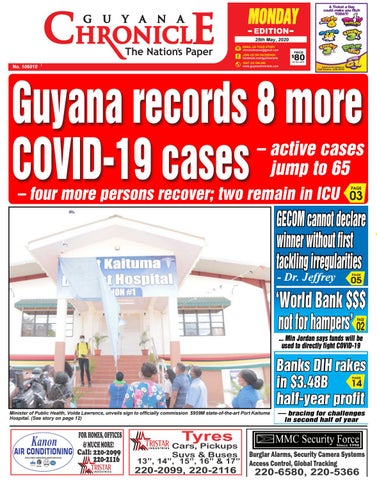
Minister of Public Health, Volda Lawrence, unveils sign to officially commission $959M state-of-the-art Port Kaituma Hospital. (See story on page 12)
–– bracing for challenges in second half of year
2
GUYANA CHRONICLE Monday, May 25, 2020
‘World Bank $$$ not for hampers’ ... Min Jordan says funds will be used to directly fight COVID-19 By Lisa Hamilton
THE US$1M grant allocated to Guyana to help in its fight against the deadly Coronavirus Disease (COVID-19) will go directly to the Health Sector, in keeping with the Ministry of Public Health’s plan. This was made clear on Sunday by Finance Minister Winston Jordan. The funding comes through the Pandemic Emergency Financing Facility (PEF), and is to be used strictly to finance response efforts during COVID-19. According to the World Bank, this includes, but is not limited to, supporting frontline health workers, sourcing drugs and medicines and essential and critical
life-saving medical equipment, including personal protective equipment (PPE), logistics and supply chain, non-medical equipment, essential life-saving goods, minor civil works (such as setting up temporary care centres), services, transportation, communication and coordination. Based on the queries of some persons, Minister Jordan said that the US$1M will not be used to purchase hampers, as the World Bank expects that such spending would be undertaken by individual governments. “We are working with other donors to get monies that we can put together those hampers, or to provide whatever assistance is needed,” he said. “Mean-
while, we will be able to use some of our monies to prepare some of these packages.” INNOVATIVE AND INDEPENDENT Even so, the Finance Minister is pleased that many persons have not grown dependent on food hampers, but have found innovative ways to adapt during the crisis. He also reminded his audience that there are other avenues that the government can go to for assistance such as the Islamic Development Bank (IsDB) and the Inter-American Development Bank (IDB). Jordan said that regional agencies such as the Caribbean Development Bank (CDB)
have also allocated funds, which will trickle down to countries in the region in the next month or so. For example, in April, the European Union (EU) announced the allocation of a US$8.6M grant to the Caribbean Public Health Agency (CARPHA) to assist the Region with its fight against COVID-19, and monies are also being sent to countries through the Pan American Health Organisation/World Health Organisation (PAHO/ WHO). Jordan said: “We’re not only working with the Bank, we’re working with a number of international institutions. So, we don’t really have to depend on the World Bank to give us the money, because we are working with other international institutions, and since that time, over a month now, the needs of the Ministry of Public Health have become more known.” Minister Jordan explained that the US$5M requested by Guyana from the World Bank was done under a different Fund, the Rapid Response Facility (REF), but these monies would have also been used for direct public health-related activities. At the time the government put in this application, there were projections from PAHO/WHO that Guyana could see over 20,000 new cases of COVID-19 by May 5, 2020. Soon, these projections
Finance Minister Winston Jordan were lowered, and, as it the government, or lobbied stands, Guyana has only for Guyana’s requests to recorded a little over 100 go unanswered. He said his cases. concerns are focused on the country’s finances. A CLEARER PICTURE “We are the ones who “All of these things have are facing it daily; we know not materialised that would the conditions, and we are have required massive infu- making determinations step sion of funds. So, we have by step. Others can talk a lot a clearer picture on the of hot air, because they’re not health side, and on the eco- running a government; it is nomic side,” the Finance easy to talk when you’re not Minister said. in the chair, but once you’re The World Bank also in the chair, it’s a different notes that heavier weight story altogether. or larger sums are given to You have to think not countries classified as “frag- only about your supportile or conflict-affected”. Over ers, but you have to think time, the Ministry of Public about the whole country. Health has come to better So, we have been deliberate understand its needs to deal in what we do, and we are with the pandemic. at the same time making Jordan said that he has no certain that we don’t burtime to address the individ- den this country with extra ual comments of naysayers debt,” Minister Jordan who called for sanctions on said.
3
GUYANA CHRONICLE Monday, May 25, 2020
Guyana records 8 more COVID-19 cases – active cases jump to 65
– four more persons recover, two remain in ICU
GUYANA now has 65 active cases of the Novel Coronavirus (COVID-19), after health authorities recorded eight new cases over the past 24 hours. The new cases were found after some 56 persons were tested within the past 24 hours. To date, 1,457 persons have been tested for the disease, with 1,322 of those persons testing negative. According to the latest statistics from local health authorities, some 63 of the infected persons are in institutional isolation, while two persons are battling for their lives in the COVID-19 Intensive Care Unit (ICU). Six persons, suspected to have COVID-19, are in institutional quarantine. To date, the country has lost 10 precious lives to the disease, but some 62 persons have recovered from the deadly scourge. It was reported that health
authorities continue to work towards strengthening the healthcare system to respond to COVID-19 on a long-term basis; the potential and existing activities are part of the plan to have a comprehensive COVID-19 health network, whereby patients across the country’s 10 administrative regions will be able to access these services. Region Four (Demerara-Mahaica) remains the epicentre of the disease, and there are a number of communities outside of Georgetown which have recorded cases. Among communities on the East Coast of Demerara (ECD) where cases have been recorded are: Atlantic Gardens, Friendship, Golden Grove, Good Hope, Lusignan, Plaisance, and Strathspey. Among communities on the East Bank of Demerara (EBD) where there were cases are: Diamond,
75 more ballot boxes processed WITH the deadline for the completion of the National Recount slowly approaching, the Guyana Elections Commission (GECOM), to date, has processed some 1,124 ballot boxes. On Sunday, Day 19 of the National Recount of the General and Regional Elections, votes within 75 ballot boxes were recounted, taking the overall number of boxes processed to date to 1,124. Of the boxes processed on Sunday, 15 were from Region Three (Essequibo Islands-West Demerara); 19 from Region Four (Demerara-Mahaica); 14 from Region Five (Mahaica-Berbice); 20 from Region Six (East Berbice-Corentyne); and seven from Region Seven (Cuyuni-Mazaruni). In expressing his disappointment with the day’s proceedings, Peoples Progressive Party/Civic (PPP/C) Executive Member Anil Nandlall stated that he is awaiting a response from the Elections Commission on several proposals the party
has made. “Today has been a very slow day, unfortunately. By the end of today, we would have not completed 80 boxes; we would have fallen short to about 77, and that is very, very disappointing,” Nandlall told reporters. With six days now left before the deadline expires, the PPP/C is suggesting that the duration of the recount be extended for no more than a week, along with the use of additional stations to speed up the process. However, last week, the COVID-19 Task Force had only approved two from a proposed six, taking the total number of workstations to 12. But the Elections Commission now wants to establish two more to increase the number of ballot boxes processed on a daily basis. Clearance from the Task Force is needed, in light of the COVID-19 pandemic, and the emergency measures instituted by the government to keep the disease under control.
Grove, Land of Canaan, Providence, and Timehri. Health authorities will be deploying mobile testing units to Cornelia Ida in Region Three (Essequibo Islands-West Demerara) and to Diamond in Region Four. Residents of Region Nine (Upper Takutu-Upper Essequibo), were also advised to be watchful and careful as Brazil has now become the country with the third highest number of confirmed coronavirus infections in the world, after registering a total of more than 250,000 cases. “You remain extremely vulnerable and therefore every resident must be prepared to be his brother’s keeper in order to ensure the safety of everyone,” said Dr. Hamilton. She said the ministry is also very concerned with the increased cases seen in Regions One (Barima-Waini) and Seven (CuyuniMazaruni). As of Thursday,
Region One had two confirmed cases in two of their sub districts; and Region Seven has a total of seven cases. Measures can be continuously implemented, but it is up to individuals, that is the average Guyanese, to adhere to those measures and think seriously about flattening the curve (reducing, the spread). The disease remains a serious issue, not just in Guyana, but globally. And, according to global statistics, there are over 5.1 million cases of COVID-19, with over 333,000 deaths. And with no approved treatment or cure, there is no assurance that persons will survive after contracting the disease. In the absence of approved medications, governments and authorities across the world have employed a number of preventive measures to contain the spread of the disease.
‘GECOM’s declaration is endgame’ – Ramkarran By Naomi Parris PRESIDENTIAL Candidate of A New and United Guyana (ANUG) Ralph Ramkarran has said that whatever the results of the General and Regional Elections when declared by the Guyana Elections Commission (GECOM), it will be final. Ramkarran, a former Speaker of the National Assembly, made the pronouncement on the ongoing National Recount on Sunday after exiting a meeting with Chair of the Elections Commission, Justice (Ret’d) Claudette Singh at the Arthur Chung Conference Centre (ACCC), where the recount is being held. “The Elections Law (Amendment) Act fully allows [for] a recount, so there is no question about the
legality of the recount. And we expect that at the end of the process, a declaration will be issued by GECOM on the results of the recount; and that declaration will be, we hope, the declaration of the final results of the election and will be accepted by all the contestants,” Ramkarran told reporters. However, due to the allegations of electoral fraud, Ramkarran believes that the country may be headed for what he describes as a “constitutional dead-end”. “The allegation is that these elections are deeply flawed because of dead and migrated people having voted; if GECOM were to take the position that under the recount process, that these allegations have made it untenable for a declaration to be issued, then that declaration will be equally untenable… So, if you can’t make a declaration under the recount; you can’t make a declaration
under the count, that means no declaration can be made,” the ANUG Presidential Candidate reasoned. Noting that Guyana’s Constitution does not provide for such an occurrence, he said he believes the country may be approaching a constitutional dead-end, since it is imperative that GECOM makes a declaration.
ADDITIONAL WORKSTATIONS While not wanting to reveal the details of his meeting with the GECOM Chair, Ramkarran disclosed that the need for at least two more stations was among issues discussed. With 12 workstations in operation at the moment at the Conference Centre, the Elections Commission is now looking to make them 14 in all, but is awaiting clearance from the National COVID-19 Task Force (NCTF).
ANUG Presidential Candidate, Ralph Ramkarran after speaking to reporters on Sunday outside of the Arthur Chung Convention Centre Contending that the recount process has been a long and tedious one, Ramkarran expressed the view that two more workstations will accelerate the pace at which the ballots are being recounted. To date, more than 1000 ballot boxes have been processed from a total of 2,339.
4
GUYANA CHRONICLE Monday, May 25, 2020
Youth Department plans virtual activities
- as National Youth Week begins NATIONAL Youth Week 2020 commenced on Sunday, and will run until May 30, 2020. Due to the COVID-19 pandemic, the Ministry of the Presidency, Department of Social Cohesion, Culture, Youth and Sport has been forced to suspend most of its programmes and activities that require mass gatherings and physical social interaction. However, given the significance of National Youth Week, a calendar of activities has been compiled, and will be executed virtually, and in accordance with the national guidelines for the prevention and elimination of COVID-19. “Apart from offering Online skills-building initiatives such as the Financial Literacy and Small Business Training, the Ministry has also crafted a programme which seeks to ascertain the impact that this pandemic has had, and continues to have on Guyana’s youth population,” Assistant Director of Youth, Leslyn Boyce said in a statement. She explained that by utilising various media platforms, the Department of Youth is
gearing to provide psychosocial support to vulnerable and at-risk youths. “More specifically, the Department is pursuing collaboration with MissionPsych 592 to provide 24-hour counselling and mentorship services to young people throughout Guyana,” Boyce said. It was explained that these services will be offered via a customised Online application which is currently being tested, as well as by telephone (text and/or call). “The MissionPsych 592 is a group which comprises psychologists and social workers. The group has been the beneficiary of funding from the Youth Innovation Programme of Guyana (YIPOG),” Boyce noted. INTERACTIVE DISCUSSIONS Additionally, the Department will also be hosting a number of interactive panel discussions on May 27 and 30, and June 3 at 13:00hrs. Discussions will be focused on topics such as Entrepreneurship and Employment; Leadership and Life Skills
Monday, May 25, 2020–– 5:00hrs & 06:30
Development; Good Health and Well-being among other topical issues. These sessions will be will be streamed live on National Communications Network via radio, television and social media, providing the opportunity for young people throughout Guyana to call and join in the dialogue. “In the meantime, the Department of Youth continues to reach out to other key stakeholders capable of providing the critical support required for our youths to emerge from this pandemic, both psychologically and physically healthy,” Boyce noted. Boyce said that even though this year’s National Youth Week celebrations will not be as jubilant as previous years, it will provide safe outlets for Guyana’s youths to address a myriad of concerns. The Assistant Director further disclosed that recognising young people who have done outstanding work in the area of youth development is also key during this period. She explained that the Department of Youth currently has a call for nominations out, which allows persons from indigenous village councils, youth, faith-based and community organisations as well as individuals, government and non-governmental organisations to submit nominations, the window for which closes tomorrow, to the Department of Youth.
FLASHBACK: Minister Norton engaging participants of Youth Week 2019
This year, National Youth Week is being observed as part of our nation’s 54th Independence Anniversary celebrations, under the theme, ‘Celebrating Guyana’s 54th Independence Anniversary through the lens of Resilience, Innovation and Sustainability’. CONSCIOUS YOUTHS Minister of Social Cohesion with responsibility for Culture, Youth and Sport, Dr. George Norton posited that the youths of Guyana are resilient, innovative, and very much conscious about the sustainability of all sectors of the country, especially our environment. “This is why the Department of Youth remains committed to executing programmes and initiatives geared at enabling our young people to realize their
true potential,” Dr. Norton said. The Minister noted that the Department will also celebrate the young people of Guyana by featuring youths who have been excelling in various fields. Dr. Norton warned that even though COVID-19 continues its wrath globally, Guyanese, particularly young people, must not allow the virus to keep them at a standstill. “We must fight this virus not only by maintaining so-
cial distancing and practicing good hygiene, but by also refusing to allow it to keep us stagnant,” Minister Norton noted. Minister Norton encouraged all Guyanese to take advantage of the available time by learning new skills and nurturing their talent. Many of the virtual outreaches being offered by the Department of Youth will continue even after National Youth Week 2020 has ended.
Coconut vendor dies after falling from tree A 49-year-old coconut vendor died on Sunday after falling from a coconut tree at Friendship, East Coast Demerara. Dead is Albert Moffatt, called ‘Biggie’ of Vigilance Squatting Area, East Coast Demerara. Reports are that around 08:00hrs on Sunday, Moffatt went around Friendship picking coconuts, and that it was not long after he began climbing a tree, which is about 20 feet tall, that he fell. Persons in the area said they heard a crashing sound coming from the direction where Moffatt was picking coconuts, and by the time they ventured to see what was going on, he was lying motionless on the ground. The police were summoned, and it was they who took Moffatt to the Georgetown Public Hospital Corporation (GPHC), but by then he had already died. Statements were taken by the Police, and an investigation is ongoing.
5
GUYANA CHRONICLE Monday, May 25, 2020
GECOM cannot declare winner without first tackling irregularities - Dr. Jeffrey
POLITICAL analyst and former Education Minister, Dr. Henry Jeffrey has stated that the Guyana Elections Commission (GECOM) cannot logically present a legitimate winner without first taking into consideration illegalities arising from the recount process and, if credible evidence is produced that the process had been undermined at any stage, this cannot be dismissed. In his weekly column, Future Notes, he called for a count only of votes that can be audited in the interest of democracy and transparency. “I have argued that given the events on elections day, it is political grandstanding to fault the condemnations of local and foreign observers. However, the observers must also be aware that what occurred on elections day is only a small part of the elections process
and that it cannot be dismissed out of hand, if at any stage credible evidence is produced that the process had been undermined,” he stated, adding: “GECOM cannot logically present a legitimate winner without first taking into consideration the illegalities, etc., that the coalition claims to have unearthed, but the commission may well find that some of the issues raised by the coalition are matters for an elections petition, but that others need to be immediately factored into its final decision.” A national recount of votes cast in the 2020 General and Regional Elections is currently ongoing at the Arthur Chung Conference Centre (ACCC). The APNU+AFC has pointed to a number of anomalies it believes can impact the outcome of the elections, but the main opposition party has stated that irregularities will be present in any
well-scrutinised recount process. The elections commission is still deliberating on how these anomalies will be dealt with and is divided on whether they should be addressed by the commission itself. Dr. Jeffrey said that when it comes to the matter of voter fraud, Guyana is no stranger to understanding the concept. Giving a list of the various types, he noted: impersonation fraud at the polls; false registrations; duplicate voting; fraudulent use of absentee ballots; buying votes; illegal “assistance” at the polls; ineligible voting; altering the vote count and ballot- petition fraud. Given that these still exist in a mature democracy such as the United States (U.S.), Dr. Jeffrey said that there is no reason Guyanese should believe that it is an impossibility for them. He stated: “It might be unusual
Political analyst and former Education Minister, Dr. Henry Jeffrey
but this still holds true, even if the accusations come from those who had previously claimed to have won the elections. Not to follow such a course would be to allow a rigger that gets past the more visible stage of the process to get away scot-free.” The analyst said that just like anti-doping rules in sports, if one has been found guilty of breaking the rules they should be prevented for lengthy periods from future participation; have their winnings taken away and even repay the rewards received from ‘winning.’ He also maintained that it is the duty of the state and its various arms to ensure that elections are free and fair and the electoral process “guarantee that every eligible individual is able to vote and that no one’s vote is stolen or diluted” by way of fictitious voting.
Woman dies in Success accident
TRAFFIC officers of the Beterverwagting Police Station are investigating an accident which resulted in the death of a woman around 18:00hrs on Sunday at Success,East Coast Demerara.
According to an eyewitness, he was in his home when he heard a loud scream and when he rushed to his verandah,he saw a woman “flying in the air.” The woman, who is so far unidentified, was crossing the
roadway when she was struck by a Toyota motorcar bearing registration number PKK9991. Paramedics were called to the scene while the driver of the car was arrested by the police.
Iran oil tanker reaches Venezuela amid US tension
(BBC) The first of five Iranian oil tankers has entered Venezuela’s waters carrying more than a million barrels of fuel. The Iranian tankers are being escorted by the Venezuelan navy and air force. The US, which has has imposed sanctions on both countries, says it is monitoring the convoy. Both Venezuela and Iran have warned Washington not to interfere with the delivery. Venezuela is suffering a shortage of refined fuel, despite having the world’s largest oil reserves. “The ships of the sister Islamic Republic of Iran are in our exclusive economic zone,” Venezuelan oil minister Tareck El Aissami wrote on Twitter after the arrival of the first tanker, named Fortune. He thanked Iran for its solidarity, saying its actions would benefit both nations. Both Iran and Venezuela are considered pariah states by the United States, which has imposed sanctions prohibiting trade with either country. The five Iranian tankers Fortune, Forest, Petunia, Faxon and Clavel - are carrying about 1.5m barrels of fuel and passed
through the Suez Canal earlier this month, according to shipping data on Refinitiv Eikon. On Saturday, Iran’s President Hassan Rouhani repeated a warning that the country would retaliate if the tankers were blocked. A flotilla of US Navy and Coast Guard vessels is patrolling the Caribbean Sea on a mission to counter illicit drug trafficking. But US officials have not announced any plan to stop the Iranian tankers. The US reinstated economic sanctions on Iran after President Donald Trump abandoned a landmark nuclear deal in May 2018. Meanwhile, its sanctions on Venezuela are aimed at increasing pressure on President Nicolás Maduro to step down. The US recognises opposition leader Juan Guaidó as the country’s legitimate leader. Venezuela has been mired in a political and economic crisis for years. Inflation hit 800,000% last year and 4.8 million people have fled the country. Its problems have been exacerbated by a recent drop in world oil prices as well as the coronavirus pandemic.
For months, Venezuela’s government has circumvented a long list of refinery problems - including power failures and accidents - by delivering crude oil in exchange for gasoline to its customers, mainly the Russian company Rosneft. But the Trump administration launched two rounds of sanctions in February and March against Rosneft affiliates for trading Venezuelan crude in international markets. In late March, Rosneft announced its surprise departure from Venezuela, reports the BBC’s Guillermo D Olmo in Caracas. Since then, petrol has had to be strictly rationed, with people queuing up through the night to fill up no more than 30 litres. Doctors and nurses are among those forced to queue, at a time when the country’s health system is collapsing and there are concerns over the spread of Covid-19. Official coronavirus cases in the country are relatively low - about 1,000 infections - but there is a fear among doctors that should the virus escalate, it would be catastrophic.
The scene of the accident.
6
GUYANA CHRONICLE Monday, May 25, 2020
Our Independence ON Tuesday Guyana will celebrate its 54th anniversary as an independent nation. The achievement of independence on the 26th May 54 years ago today marked another phase of development in the quest for freedom. This journey began with the fight against enslavement, indentureship and colonisation. In the process of acknowledging that development occurs in phases, recognition is given to the abolition of the slave trade which predated amelioration and freedom from slavery, which was followed by freedom of indentureship. These phases laid the foundation for the fight and achievement of universal adult suffrage, limited self-government and independence. The bottom line is, independence is a stepping stone to a nation’s growth and development. Among those who contributed to the 1966 struggle are namely Forbes Burnham, Peter D’Aguiar Hubert Nathaniel Critchlow, Cheddi Jagan, and not forgetting the people of Guyana. All who struggled at the end of the day, there had to be someone whom the British Empire trusted to hand the Instrument of Independence: that person was Linden Forbes Sampson Burnham. In politics it is also about policies and programmes, and in this regard Burnham gained the favour of the British coloniser and its allies, in an era when the Cold War was raging and no consideration had been given to any self-proclaimed communist. With political independence, Burnham was tasked with the responsibility to lead the nation, to build and to forge “One people, One Nation, One Destiny.” It was he who took our young nation a step further to attaining the next phase of republican status, which is the ultimate freedom from political control. As the nation achieved its political independence, the former coloniser/mother country still sought to retain control through various methods of control and influence such as the World Bank and International Monetary Fund. It became evident that political independence
did not necessarily mean economic independence and the government of the day ought to have recognised this. The policies of economic self-reliance, such as feeding, clothing and housing the nation sought to address this challenge for a nation that was importing more than exporting, and not fully exploiting its agricultural and other natural resources for its own benefit. Independence meant facing the many challenges of racial and ethnic tension. An indigenous education was pursued to reshape the way Guyanese saw themselves, to forge a nation, and to promote understanding, respect, tolerance and peaceful co-existence among the various ethnic groups. This had the potential to reduce tensions, particularly between the two major groups, but yet proved more challenging, given what appeared like an imbedded appositional tendency to accept the domestic leadership of Burnham. These struggles also gave rise to the promotion of egalitarianism with efforts to ensure all were socialised to see themselves as equals. Each worker was promoted as important. No longer was the small man seen as mere hewers of burden, and his well-being incidental to production and productivity. The ideal promoted was for the “small man to be the real man.” The quest for economic independence also influenced the nationalisation drive e.g., in the bauxite and sugar industries, and opening of national banks to drive local economic ventures. These sectors at the time epitomised a class, colour and race hierarchy, where Guyanese were not at the helm. Nationalisation moved that away and created space and opportunities for locals to be in positions of ownership and control. That foundation having being laid, all who came after have to add to that vision in keeping with time, national and global perspective and challenges. Whereas at independence there was need to establish resistance to cultural penetration and other factors, local and external,
that would have threatened the stability of a fledgling nation, it is now left for others to advance nationhood within the current context. Today, the nation witnesses decay in the early values. Guyana faces the threat of information communication technologies influencing anti-nationalistic behaviours. In addition to the threat of terrorism, there is the drug trade and corruption that transcend borders. Facing this challenge will require measures being put in place for social protection in the context of crime and drugs, where they have infiltrated every strata of society, rivalling the formal economy and threatening the arms of government. Where the National Insurance and Social Security Scheme (NIS) was put in place in 1969 as a safety net, there is need for another safety net, such as protection from the influences of drugs. The APNU +AFC government to its credit has undertaken to advance development in less than a year with the invitation of the DEA to set up a Guyana-based office. The government has also advanced the passage of stronger AML/CFT laws which will help in eradicating this scourge. The narco trade undermines the structure of government and independence, and destroys the very fabric of society. At the political level, the challenge this nation faces even as a national recount of the votes cast at the March 2 elections is underway, is the restoration of holding leaders accountable within the confines of the law, even as efforts are made to deepen and strengthen these. And last but not least, the most important challenge facing this nation and leaders lay in forging greater unity and respect. As a people, we have gone back on building one people, seeing ourselves as Guyanese with a purpose, where we are inter-related, interdependent and can co-exist in peace and harmony. There is work to be done to channel our energies towards nation-building where all can enjoy the fruits and benefits of this country.
Critical to success of recount is telling the truth--and as often as possible Dear Editor,
HAVING observed the varying perspectives put forward by the political parties as to what the National Recount exercise entails, the Guyana Elections Commission (GECOM) has the responsibility to ensure the society is knowledgeable of events as they unfold. The agency cannot afford to wait until the process is ending then to attempt to deliver to people an understanding of the result, or a final result that can contrast completely to the narrative(s) out there. They must seek to do this periodically; they owe that to society. As often as a misrepresentation is made, just as often it has to be debunked. GECOM should not be giving the public the perception that it doesn’t care about the impact of public perception on its processes, for that is a major contributing factor influencing where we are right now. All that is being said,
right and wrong, impact the credibility of GECOM and its officers, and the credibility of the process. It is dishonest for any political party or its agent to stand in the media centre at the Arthur Chung Conference Centre, where the National Recount is being conducted, and argue that the exercise falls under the Representation of the People Act. This position is being repeated ad nauseam, seemingly with no regard for the evidence, and in some quarters accepted as the truth. The gazetted Order guiding this recount is clear that the exercise is being conducted under Article 162 of the Constitution, and Section 22 of the Elections Law (Amendment) Act of 2000. GECOM has a responsibility to put the information out, repeat same whenever necessary, and let the public discern whose truth is consistent with the agency’s. Anything outside of this is creating the chaotic environment we have, because few know or could
recall. Also, it is not for both sides to determine they win; it is for GECOM to determine who has won. GECOM is the sole arbiter in this process, not the PPP, not the APNU+AFC, not any other party but GECOM. The conduct of any exercise is impacted by the laws and conditions governing its activities. Effort(s) at misrepresenting these are injurious to the exercise and the people who will be impacted by the outcome. Where each side continues to peddle their truths, there is only one truth, and that truth is GECOM’s. And whereas some media houses see responsibility in making known the laws and conditions guiding the process as they cover statements pertaining to the activities, others are content to report what they are told. GECOM should recognise this, and the vital role it could play here in maintaining some semblance of order. By not immediately address-
ing falsehoods, the agency adds to the chaos and confusion in society. Another layer has been added to the confusion, i.e. “fake fraud”. Fraud is fraud. To the extent where the Order facilitates the examination of any allegation (numerical and observatory), these cannot be ignored. It is the process that determines the numbers, and, in this situation, where sides are dissatisfied, every element needs to be scrutinised with a view to correcting all deficiencies in the future. Noted also is the threat that there “has to be consequences” for providing evidence to support claims of alleged irregularities. GECOM Chair Claudette Singh is in order in her charge that “he who asserts must prove.” Opportunity must be given to those who accused to present their evidence to the Commission. People have short and/or convenient memory; some may now be tuning in for the first time or after a long time. Then there
is the constant effort to distort or create different perspectives of what the reality is. Where the parties are saying something different and their supporters are likely to believe what they say GECOM has a responsibility to remind the nation of the truth. In instances such as these GECOM needs to clear the air as often as necessary and as often as misinformation is being repeated. It is GECOM that shoulders primary responsibility to reiterate the laws governing this exercise and what the Order entails. For democracy to stand this agency cannot fail. Critical to the success of the process is the truth being told, and as often as possible, particularly in our environment of heightened ethnic tension, distrust, alternative facts and division. Regards, Lincoln Lewis
7
GUYANA CHRONICLE Monday, May 25, 2020
There needs to be more action to protect hinterland communities from COVID-19 Dear Editor,
affected by this epidemic. By June of 1986, PAHO estimates AS COVID-19 relentlessly that malaria had affected over advances through the length 16,000 persons. The total numand breadth of Latin Amer- ber of cases reported between ica devastating Brazil and January and August 1987 laying waste to Ecuador, was approximately 17,000, of Mexico and Peru, we in Guy- which over 60% were falciana have so far been spared parum cases. a similar onslaught. Virtu A coastal coalition of 12 ally all places where people religious, civic, professional interact - shops, markets, and business organisations, banks, offices and places of including the Guyana Medical worship - have taken social Association and the Gold and distancing, hand-washing Diamond Miners Association and mask-wearing to heart. took action. In conjunction The National COVID-19 with health workers in the Task Force can take credit communities, some three-quarfor having promoted all these ter million anti-malaria tablets WHO-recommended public were distributed from early health practices. Success in 1986 to early 1989 to 36 Amthe public health arena is erindian communities in the vital to offset limitations on interior, under the supervision the local medical front – in- of the Christian Churches. adequate testing, protective Additionally, 45,000 yards equipment and treatment. of mosquito netting materials To the extent that medi- were provided to women’s cal resources, to date, are groups in the communities to not overwhelmed, the Task make nets, and information Force and Ministry of Public about malaria was circulated Health (MOPH) deserve our in Arawak, Patamona and Waappreciation. pishan languages in Regions However, this relatively 1, 8 and 9. encouraging situation largely Collaborative actions reflects the coastal communi- of this nature are nowadays ties; interior regions of Guyana much easier to manage given are another matter. Histori- the strengthened capacity for cally in Guyana, epidemics self-governance of indigenous such as malaria, TB and HIV communities and the regional multiplied undetected, only and national coordination of to surge dramatically when Toshaos through the National numbers were out of control. Toshaos Council. However, Two major reasons explain despite this multiplicity of repthis phenomenon: All govern- resentative indigenous bodies mental administrative services at community, regional and in the interior are inadequate, national level, indigenous inbecause of distance and terrain, fluence and participation in the and, secondly, because Amer- Covid-19 Task Force appears indians are highly vulnerable non-existent. At best, the Nato imported diseases to which tional COVID-19 Task Force they have limited immunity. needs to recognise that coop Reference to the malaria eration from the communities epidemic of the mid-80s is a is more vital for the success good example. In addition to of its ultimate aims than from the endemic scourge of TB, the miners. The multi-sectoral 3,686 reported cases of ma- community collaborative relaria were recorded in August sponse to the 1980s epidemic 1985. By the end of that year, could not be more strongly the annual figure had risen to contrasted with the current 7,600. Entire communities, in situation. the Rupununi and the Upper The time for preparing this Mazaruni in particular, were
community-based foundation is slipping away. Training in contact tracing, working out effective measures which all visitors to interior community must observe and ways of carrying them out cannot be developed in Georgetown by “experts”. It has to be done on the ground in conjunction with communities. Likewise, the rainy season has to be taken into account. The unwillingness of the Ministry of Public Health and the Task Force to resist pressure from miners is taken directly from the playbook of the HIV epidemic in the 1990s, in which virtually nothing was done to curb miners or truckers, until Guyana was overwhelmed with the highest HIV infection rates outside sub-Saharan Africa. Toshaos in Baramita and Chinese Landing in Region 1, and St. Ignatious, Shulinab and Aishalton in Region 9, along with National and Regional Toshao Councils have all failed to have their concerns related to mining activity addressed. Disruptive actions had to be mounted recently even to get a hearing of their concerns, much less action to redress them. Mining companies, rather than Toshaos, are authorising miners to access communities, according to the Toshao of Chinese Landing in Region 1. This position was confirmed by Local Government officials in Region 9, who reportedly stated that “the Rupununi Miners executive body will have to take responsibility for the actions of their members”. This devolution of ministerial discretion to the mining bodies is an inexplicable abdication of responsibility. Recent data released by the MOPH has shown that despite emergency measures, the rate of transmission continues to climb. Additionally, a senior MOPH health official on Friday May 22, 2020, in a televised report, acknowledged
that the increase in COVID-19 cases in the Puruni Region of Region 7 was linked to mining activity. Kaieteur News reports also highlighted the lively nightlife at Puruni Landing involving women trafficked from Venezuela. The withdrawal of personnel from the EPA, GFC and GGMC from interior areas, and the influx of illegal miners in the other direction as a result of the current high price of gold is potentially devastating to indigenous communities. The bottom-line is that
strong leadership is required to keep coastal interests from side-lining essential actions if the COVID-19 negative impact on Guyana is to be contained at its present level. Such leadership should focus on a unified and integrated plan in which the rules apply equally to all; on the coast, in riverine areas and in the interior. This implies that measures such as restrictions on mining and lock-down on all vehicles travelling inland from either Linden or Lethem.
In this regard, the GHRA adds its voice to the calls for mining, which is neither essential nor a service, to be removed from the list of Essential Services. The GHRA extends solidarity to all interior communities, many of which have been active and vocal in the protection of their communities to stop the spread of COVID-19. Regards, Executive Committee Guyana Human Rights Association
8
GUYANA CHRONICLE Monday, May 25, 2020
Crisis presents opportunity to identify need for expanding testing capability for other diseases
Dear Sir,
ALLOW us, once more, to discuss and place COVID 19 into perspective, as it relates to the local reality in Guyana, as we learn from press reports and other sources. This idea occurred during the good fortune we had to listen to a public forum on the Implications of COVID-19, a Public and Private Law Perspective, hosted by the Faculty of Law of the University of the West Indies (UWI) on May 19, last. We are but laymen, in legal parlance, but were enlightened by the presentations in general, and particularly one by Dr. Tracy S. Robinson, Senior Lecturer and Deputy Dean of Graduate Studies and Research at Mona, Jamaica. She posited that, “in times of crises, there is a shift in our thinking and behaviour”. She alluded to Prof. Sigal Barsade of the Wharton Business School in Pennsylvania, USA, in an article she published titled, Emotional Contagion in Organizational Life in the Journal of Research in Organizational Behaviour, who concluded that “one of the things we know from research literature is that negative emotions, particularly fear and anxiety, cause us to become very rigid in our decision making. We are not creative; we are not as analytical, so we actually make worse decisions. Emotional contagion affects everyone, which means that it can also affect leaders; it can also
affect policymakers.” Experts may provide factual advice and recommendations, but many are oblivious of the effect emotional contagion has on their decision-making process. Indeed, press reports from around the world on decision making processes do not appear to have been based on facts or reality. Emotional contagion connotes feelings of fear, anxiety and panic spread and impacts how we perceive and respond to risk. The same can be applied to one who is awaiting the result of a test, for which there is no specific treatment and the outcome is unknown. These persons and their families are all at risk and the outcome can range from being asymptomatic to death. We do not recognize it, but everyone is tense, their gait is affected, speech becomes slower, and the normally jovial type becomes quiet. That was the situation with HIV-infected patients in the past, and is also now true of patients infected with COVID-19. Dr. Robinson further posited that we value action over deliberation. The government’s ability to act swiftly and decisively often becomes superior to limitations on governmental powers and individual rights, so the latter are trampled upon. She referred to Prof. Owen Gross’ book, Laws in Times of Crisis, 2006, in which he suggested that “crises (pandemics, national security threats, citizen insecurity, natural disasters etc.); produce an expansion of governmental
powers and the concentration of powers in the hands of the executive.” She went on to quote Prof. Anne Twomey of the University of Sydney, Australia, who stated that, “In an emergency, maintaining public confidence in the government is essential especially when you are asking very hard things of people, especially when you are restricting their civil liberties, their ordinary day to day freedoms and taking decisions that affect them economically …and to do that you need some kind of level of parliamentary scrutiny. Parliamentary committees are a good way of doing that.” This now brings us to press reports of May 21 last, which noted that 1269 tests were done, and 127 persons tested positive for, and 10 have died because of the virus in Guyana. This begs the question whether the number of tests have been sufficient, and covers all the regions. In comparison with the wider Caribbean, there have been 84 deaths; Barbados tested 4322 persons, identified 90 cases and reported seven deaths; Trinidad and Tobago, 2720 tests with 116 positives and eight deaths; Jamaica 520 positives and nine deaths; and Suriname 11 positives with one death. We need to reflect on the number and places where tests are being done in Guyana. Our population, although concentrated along the coastal belt, covers
a much greater area, and given the land size, poses a greater and difficult challenge to our planners, whoever and wherever they may be. The population needs to be made aware of the guidance of the National Task Force, regarding the location of at-risk sections of the population, the need for self-identification and criteria used for testing. There are reports that in Guyana, Georgetown is the epicenter of the disease but, as the proverb goes, ‘seek and you shall find’. It is worth highlighting that Barbados, with approximately one-third of our population, and five hundred times smaller than Guyana, has done three times the number of tests. In Barbados, everyone is near a laboratory. This should not be an excuse, but our challenge. This crisis is a good opportunity to identify the need for expansion of testing capability of various diseases in the country. It is reported that the Regional Democratic Council is the supreme Local Government in each region, with responsibility for the overall management and administration of the Region and coordination of the activities of all local democratic organs within its boundaries. Its main functions are to administer all services required within its boundaries (services such as health, education, public works etc.). We now learn, however, that the National COVID-19 Task Force (NCTF) denied a request by the Regional Executive Officer (REO) of Region Nine,
Mr. Carl Parker, for a total lockdown, based on a recommendation from the Regional Health Committee (RHEC). We understand the request was because the residents of Rupununi are considered extremely vulnerable to the importation of cases on two fronts: Persons coming from Georgetown, as well as those crossing the border from Brazil. It should be emphasised that on May 20, last, Brazil reported approximately 300,000 cases of COVID-19, the third highest in the world, and 19,000 related deaths. In Roraima State, which borders Guyana, there are 2,170 cases with 68 reported deaths. We now wonder whether the National Task Force acted too swiftly, albeit decisively, in considering the request from the Regional Health Committee for a total lockdown, and if this is a good example of emotional contagion leading to a poor decision. On the other hand, it could be that in Guyana, we are unfortunate to have never had a natural disaster like a hurricane or an earthquake, during which responses must be made at the local level. As we come closer to the results of the National Election (of March 2), we ponder whether the Task Force is affected by the emotions of fear and anxiety and have lost the ability to be creative and analytical policy makers, assuming, of course, that the policymakers do have good knowledge of the facts. Georgetown may be the epicenter of the disease, but the
task force cannot focus only on Georgetown. We have not yet seen any reports in the press of the deliberations and/or policies emanating from the Task Force. As stated during the public forum, ‘Extraordinary situations call for specific solutions to ensure appropriate parliamentary scrutiny. New Zealand’s parliament was exemplary in this respect when it established a Response Committee on matters relating to the government’s management of the COVID-19 epidemic. Notably, that committee was chaired by the Leader of the Opposition.’ We hope the results of the elections will break the current impasse with the installment of a new parliament and tamper partisanship inclinations so that we can follow the New Zealand Parliament’s example of establishing a COVID-19 Response Committee. It would consider and report on any matters relating to the government’s management of the COVID-19 epidemic to the house. When COVID-19 becomes history, we would recommend that a Committee on Epidemics and Outbreaks be established by Parliament, and chaired by the Leader of the Opposition, as a first step of an inclusive government in Guyana about which we hear much talk.
from those that are in the possession of the constitutional body. The daily attempts by the opposition PPP/C and its anti-national horde -- Private Sector Commission (PSC), the Georgetown Chamber of Commerce and Industry (GCCI) et al – to trivialise the current recount exercise, which as Gazzetted, is about a forensic audit of the voting process on March 02, as per contents of the ballot box. It is not surprising that the opposition party leaders/ spokespersons, have again resorted to various methods of claiming that the process being undertaken is one of a numerical account. It is total-
ly criminal of this political cabal, to have been promoting this position, when the Gazzetted order would have stated unanimity from both sides of the Commission. But we know why this attempt at seeking to again subvert the GECOM’S exercise is being attempted – so as to bring the intense scrutiny of the contents of the ballot boxes to a speedy conclusion, which will in effect avoid the auditing as ordered and catered for in the ORDER; as well as deflect from the massive slew of irregularities being uncovered. One must also further note, the contradiction of their observation of more
time needed, for the process to be completed; but a position that totally exposes its plot to scuttle the scrutiny, when Irfaan Ali recommended an extension of just one week to the 25 days, the initially agreed period for the recount. Call this another wellknown piece of PPP/C trickery, WHICH IS REALLY ANOTHER DEMAND TO FORCE GECOM’S HAND INTO GRANTING ANOTHER CONCESSION, THUS ABANDONING THE INTENSE PROCESS OF SCRUTINY NOW TAKING PLACE AT THE ARTHUR CHUNG CONFERENCE CENTRE (ACCC).
GECOM must be reminded of its constitutional responsibilities, which has been relentlessly challenged by a PPP/C bent on extracting its approval towards its goal of covering up its daily documented acts of electoral fraud, as being reported every day. Further, the GECOM must understand that it must not deviate, by altering any of its laid down procedures, with regards to guiding the current exercise through to its finality. It is time that it let not only its constitutional principles, but also what it stands for prevail. The fact is that GECOM has bent over too
much to accommodate the unfair demands of an opposition party and its vested-interest clique, which continues to disrespect its mandate, in addition to displaying a total lack of appreciation of the electoral body’s efforts to achieve its constitutional, and now gazzetted, goals. It must not allow itself to be perceived by the anti-nationals, as being amenable to their acts of bullyism. At the end of this exercise, the GECOM must emerge with its constitutional reputation, although severely challenged, intact.
Yours sincerely, Keith H. Carter, MD Raj. N. Mungol, MA
GECOM must emerge from recount with reputation enhanced, stronger
Dear Editor,
IN ITS bid to destroy the electoral credibility of the Guyana Elections Commission (GECOM), the PPP/C has gone far and beyond the normal line of vile dishonesty, coupled with every trick in its book of subversives, to prove its contrived case. Never before has this nation witnessed such blatant disregard for constitutional norms, where, like vandals, this cabal sought to not only interfere in the electoral body’s procedural matters, but also sought to prove its case with the submission of nakedly fake polls, different in its compilation
Regards, Troy Garraway
Tread carefully
GUYANA CHRONICLE Monday, May 25, 2020
9
–– Florida University researcher urges US, as he cautions against interference –– says observation of recount in the capable hands of CARICOM, OAS
By Lisa Hamilton “U.S. officials must tread carefully between interference and observation,” is the advice of Guyanese-American academic and researcher for the African and African Diaspora Studies at Florida International University, Wazim Mowla. Mowla, who is also an intern for the Permanent Mission of Antigua and Barbuda to the U.S. and the Organization of American States (OAS), has been carefully following Guyana’s electoral situation and recently shared his thoughts online. “Premature pressure and involvement from the United States will provide the losing Guyanese political party an opportunity to petition the recount’s outcome and stretch this crisis further. U.S. officials must understand that mentions of sanctions do little to speed up or ensure a transparent recount. Instead, their words might be interpreted as not only U.S. coercion and interference, but that the U.S. government is in favor of a specific political party,” he reasoned.
The main Opposition --- the People’s Progressive Party/Civic (PPP/C) --- has led the calls for sanctions against Guyana which, persons have pointed out, will not only harm the government --- as intended --- but would harm all Guyanese no matter their political preference. Nonetheless, for over a year, the party’s executives have been calling for sanctions against the current government and ministers in their individual capacities. “We will seek the toughest sanctions on these individuals and their families and they will not be able to survive…they’ll have no access to money from bi-lateral or multi-lateral sources, they’re not going to get access to the oil money, they’ll face individual sanctions, [and] we’ll have restrictions on our exports and a whole range of stuff that will harm Guyana but it will also, hopefully, make them see the folly of their ways,” Opposition Leader, Bharrat Jagdeo said in March, 2020. The calls for sanctions have been coming since in 2019 during the court battles to determine the validity of the passage of the
no-confidence motion, all the way to the breakdown in the tabulation of Statements of Poll (SOPs) by the Guyana Elections Commission (GECOM) and now the recount process. As of recent, the Opposition Leader has tailored his calls for sanctions to only if there is no transparent recount --- a process he strongly believes will show victory for his party. This is even as President David Granger has iterated that his government will accept the result of the General and Regional Elections when it is declared by the Chairman of GECOM. The President has stated that while some political parties in Guyana have been calling on the international community to heap sanctions on Guyana for their own reasons, one must consider that it would be “extremely damaging” to the country’s economy. “I do not take these as empty threats and I would not like to see those sanctions inflicted on my country, on my people,” the President said, while adding: “My government has done nothing wrong and I do not think those sanctions could
be justified if it is shown that my government has behaved legally and that the elections process was a legitimate one and that it is satisfying international standards.” In Mowla’s opinion, while the U.S. has made no overt indication that it favors a specific party, the idea of U.S. interference is “a burden it bears given its history of intervention.” He noted that the pandemic has not stopped U.S. Senators, Congressmen, and the Department of State from “not only maintaining pressure on the Guyanese government to conduct a transparent recount but to also allow U.S. actors to re-enter Guyana to observe the process.” However, Mowla believes that patience is key for U.S. officials watching on. He said although the presence of the U.S. in the form of The Carter Center and the International Republican Institute (IRI) is welcomed by many, there should be no suggestion that CARICOM and OAS officials are not up to the task. He said though his opinion is that the representatives from The Carter Center (TCC) should have been
allowed to re-join the process due to their expertise, their presence would have to “take a backseat” to local observers and the CARICOM scrutinising team. “The recount process has left Guyana in a fragile state, and the U.S. needs to be aware that given the circumstances, to ensure the preservation of democracy in the country, they must take a backseat to CARICOM and tread the fine line of observation versus interference,” Mowla said. He added: “This does not mean TCC and IRI have no place in Guyana, as they both contribute useful expertise toward a democratic electoral process. However, if they are allowed re-entry, their presence must take a backseat to Guyanese local observers and the CARICOM team.” He described the CARICOM Team as “Guyana’s most legitimate international observer” noting that while international observers will leave Guyana once a decision is made, CARICOM governments will remain observant as they are directly impacted by the actions of Guyana’s future leaders.
Guyanese-American academic and researcher for the African and African Diaspora Studies at Florida International University, Wazim Mowla The researcher advised the U.S. to remain supportive of the CARICOM team and Guyana’s local observers while continuing its lobby for the involvement of The Carter Center. “.U.S. officials should remain confident that there are accredited local observers that will hold all political parties accountable to guarantee a transparent recount.”
COVID-19 is disrupting life-saving immunisation services – WHO
THE Coronavirus Disease (COVID-19) is disrupting life-saving immunisation services around the world, putting millions of children – in rich and poor countries alike – at risk of diseases like diphtheria, measles and polio. This stark warning comes from the World Health Organisation (WHO), UNICEF and Gavi – the Vaccine Alliance, ahead of the Global Vaccine Summit on June 4, at which world leaders will come together to help maintain immunisation programmes and mitigate the impact of the pandemic in lower-income countries. According to data collected by the World Health Organisation, UNICEF, Gavi and the Sabin Vaccine Institute, provision of routine immunisation services is substantially hindered in at least 68 countries and is likely to affect approximately 80 million children under the age of 1 living in these countries. ROUTINE IMMUNISATION OF CHILDREN DISRUPTED Since March 2020, routine childhood
immunisation services have been disrupted on a global scale that may be unprecedented since the inception of expanded programmes on immunisation (EPI) in the 1970s. More than half (53 per cent) of the 129 countries where data were available reported moderate-to-severe disruptions, or a total suspension of vaccination services during March-April 2020. “Immunisation is one of the most powerful and fundamental disease prevention tools in the history of public health,” said Dr. Tedros Adhanom Ghebreyesus, WHO Director-General while adding that “disruption to immunisation programmes from the COVID-19 pandemic threatens to unwind decades of progress against vaccine-preventable diseases like measles.” “At the June 4 Global Vaccine Summit in London, donors will pledge their support to Gavi, the Vaccine Alliance, to sustain and accelerate this lifesaving work in some of the most vulnerable countries. From the bottom of my heart, I urge donors to fully fund the Alliance. These countries, these children especially, need vaccines, and they need Gavi,”
WHO Director-General said. The reasons for disrupted services vary. Some parents are reluctant to leave home because of restrictions on movement, lack of information or because they fear infection with the COVID-19 virus. And many health workers are unavailable because of restrictions on travel, or redeployment to COVID response duties, as well as a lack of protective equipment. “More children in more countries are now protected against more vaccine-preventable diseases than at any point in history,” said Dr. Seth Berkley, Gavi CEO. “Due to COVID-19 this immense progress is now under threat, risking the resurgence of diseases like measles and polio. Not only will maintaining immunisation programmes prevent more outbreaks, it will also ensure we have the infrastructure we need to roll out an eventual COVID-19 vaccine on a global scale.” Transport delays of vaccines are exacerbating the situation. UNICEF has reported a substantial delay in planned vaccine deliveries due to the lockdown measures and the ensuing decline in commercial flights and limited
availability of charters. To help mitigate this, UNICEF is appealing to governments, the private sector, the airline industry, and others, to free up freight space at an affordable cost for these life-saving vaccines. Gavi recently signed an agreement with UNICEF to provide advance funding to cover increased freight costs for delivery of vaccines, in light of the reduced number of commercial flights available for transport. “We cannot let our fight against one disease come at the expense of long-term progress in our fight against other diseases,” said Henrietta Fore, UNICEF Executive Director. Fore added: “We have effective vaccines against measles, polio and cholera. While circumstances may require us to temporarily pause some immunisation efforts, these immunisations must restart as soon as possible, or we risk exchanging one deadly outbreak for another.” Next week, WHO will issue new advice to countries on maintaining essential services during the pandemic, including recommendations on how to provide immunisations safely. (WHO)
10
GUYANA CHRONICLE Monday, May 25, 2020
What do you know about babies? THE nine months that babies develop in the womb are no longer a big mystery. We now know that babies have the ability to start working out what is going on, on the outside, long before their arrival day. From as early as 28 weeks old, the fully-formed baby, can hear his parents’ voice and may even react when his favorite foods are eaten. He can urine, have hiccups, suck his thumb and open his eyes. It is hoped that the more adults and parents learn, the more respect and understanding they will show towards children in their care. How much do you already know about babies? Try our True or False quiz. Can you get 14 out of 14 when it comes babies? 1) New born babies cry to communicate when they need something or when something is wrong. But they do not start producing tears until they are around 1-year-old. True or False 2) Babies usually triple their birth weight by the time they are 2 years old. True or False 3) At around 28 weeks old, babies start to practice breathing in the womb. True or False. 4) A child’s memory about events and outings is not fully operational until he is around 18 months old. True of False 5) Children can understand what people are saying long before they are able to talk.
True or False 6) The (amniotic) fluid that babies float in before birth actually enhances their sense of smell. Therefore, they can smell food through their mother’s stomach. True or False 7) Babies know and recognize their names as soon as they are born. True or False 8) Babies taste buds for salty foods do not develop until they are at least 2 months old. True or False 9) When babies are born their vision is about 20/2400: But they can see clearer further away. True or False 10) A 2-year-old child has over a hundred trillion brain connections. This is double the amount that adults have. True or False 11) Children’s brains develop more during the first five years, than at any other time in their lives. True or False 12) Most children under the age of one are right-handed. True or False 13) By the age of 1, babies can understand approximately 70 words. True or False 14) Babies are born with more bones in their bodies than adults. True or False ANSWERS 1) (false) The tear ducts of a baby are not fully opened at birth. Babies can begin to cry tears at around 3 weeks old. But some take as long as 4-5 months old before producing
tears. 2) (false) On average babies triple their birth weight within the first year of birth. 3) (true) Although they do not take in oxygen babies practice breathing towards the end of a pregnancy in preparation for birth. 4) (false) A child’s memory of events is not fully operational until around 3 years old. Before this age, outings, parties and expensive holidays overseas are not stored in the memory. 5) (true) Babies can understand what is being said long before they can talk. 6) (true) The amniotic fluid actually enhances the baby’s sense of smell; therefore, babies can smell through their Mother’s stomach. 7) (false) Babies know, recognize and respond to their names around 5-8 months old. 8) (false) Babies are not meant to be eating anything salty; but their salt taste buds do not develop until they are 4 months old. 9) (true) Babies cannot see clearly at birth, but they have good peripheral vision and see better at a distance. 10) (true) Children do have over 100 trillion synapses, otherwise known as brain connections, by the age of two. Therefore, teaching them well, while they are young will definitely pay off. 11) (true) The first five years of a child’s life is crucial for building a solid foundation
for a successful future. 12) (false) Children under the age of one are ambidextrous, which means they use both hands equally. They usually choose either the right or left hand between 2-3 years old. 90% of toddlers are right-handed. 13) (true) Babies learn incredibly fast. They may not be able to repeat the words they hear, but they understand what they mean. 14) (true) Babies have more bones than adults because babies are born with bones that will fuse together over a period of time. These bones are mostly in the skull and spine. How did you score? 14 out of 14 - Very Good Indeed. Between 13 and 10 - reasonably well. Between 10 and 6 -some homework is needed. Less than 6-we hope you’ve learnt some interesting fact today about babies. People usually take babies for granted: they underestimate their perceptive and sensory abilities but most of all they tend to overlook the essential role they can play in giving babies the best start in life. If you are concerned about the welfare of a child call the CPA hotline on 227 0979 or write to us at childcaregy@gmail.com A MESSAGE FROM THE CHILDCARE AND PROTECTION AGENCY, MINISTRY OF SOCIAL PROTECTION
Humanity First Guyana helping communities during COVID-19 pandemic AS Guyana and the world ontinue to grapple with the effects of the COVID-19 pandemic, persons are becoming more and more in need of assistance to cope with daily life. According to Chairman of ‘Humanitarian First Guyana’ Maqsood Ahmed Mansoor, it is up to those who can offer assistance to do so during this period. Humanitarian First Guyana is one many organisations that have been making an effort to ease the burden of persons here in Guyana, with its latest gesture being to provide persons of Paramakatoi, a village located in the North Pakarimas, in the heart of Region Eight (Potaro-Siparuni), with food hampers, clothing and medical supplies among other items. The organisation’s effort began in April, and thus far it has been able to bring ease to the hundreds of Guyanese suffering across the country, including in places such as Logwood Village up the Demerara River, Linden, to Berbice and Georgetown.
It was also able to provide over 360 facemasks to Guyanese in need of them. According to Mansoor, the organisation is also committed to helping all Guyanese, and as such, prisoners housed at the New Amsterdam Prison have benefited from a generous supply of Bengay ointment and facemasks. Mansoor noted that the organisation’s efforts will continue, as it aims to bring ease to as many Guyanese possible during this COVID-19 pandemic. Humanity First Guyana, which operates as a Non-Governmental Organisation (NGO), is based on Oronoque Street, Queenstown. As part of an international NGO that can be found in more than 50 countries across the world, it began work here in Guyana back in 2005, but went dormant for some time but was resuscitated in 2018. ‘Humanity First’ originated in the United Kingdom in 1994.
Members of ‘Humanity First Guyana’ making a delivery to Paramakatoi, in the North Pakarimas
Woman killed by speeding car … driver in police custody POLICE are currently investigating the fatal accident which claimed the life of a 48-year-old woman, who was reportedly struck down by a
drunk driver in the vicinity of Boraserie, Parika (Essequibo Islands-West Demerara) on Saturday. Dead is Ekene Rogers, who worked at Bounty
Supermarket and who was the mother of one. The Guyana Chronicle was made to understand that around 13:00hrs on Saturday, Rogers was standing on the public road, awaiting a minibus, when she was struck down by a motor car.
The driver, who was heading to Parika, was reportedly speeding and lost control of his motorcar and slammed into the woman. She was picked up and rushed to the Leonora Cottage Hospital where she was seen and transferred
to the Best Hospital. She reportedly succumbed to her injuries while being transported. Rogers suffered several broken bones including in both of her legs and neck among other injuries. A breathalyser test was done on the motorcar driver which showed that he was three times above the legal limit. He is assisting police with their investigation.
Dead: Ekene Rogers
11
GUYANA CHRONICLE Monday, May 25, 2020
Respect Guyana’s sovereignty
–– Prime Minister Nagamootoo PRIME Minister Moses Nagamootoo believes that although darts have been thrown at Guyana as an independent nation, the country’s sovereignty remains and must be respected by all. In his Sunday column, ‘My Turn,’ the prime minister reflected on the upcoming observance of Independence Day and the struggles of Guyana to get where it is today. He said that Independence Day allows for reflection on the value of Guyanese citizenship and duty to defend the State. However, he said that such value and duty have been exchanged by some for political gain at the expense of the people of Guyana. The prime minister pointed to the calls
for sanctions on Guyana by the opposition and a number of small parties which were either displeased with actions leading up to or the conduct of the elections. He stated: “…at least four persons with foreign citizenship presented themselves as leaders of hitherto non-existent mini-parties that contested the March 2020 elections. They have all ganged up to present a phony image of opposition to the incumbent government as part of the sinister ploy at regime change. Adding injury to the insult to our sovereignty, those so-called mis-leaders have been the most vocal, calling for sanctions against Guyanese patriots, and for foreign intervention in and
Prime Minister Moses Nagamootoo invasion of a sovereign state.” As opinions continue to circulate about a perceived foreign interference in Guyana’s elections and a preference over the agreed upon involvement of CARICOM, the prime
minister said that such “strikes mortally at the heart of our independence, and that of other Caribbean states.” He gave the reminder that the Caribbean Region shares a history of colonial bondage, blood kinship
and cultural affinity and CARICOM is highly competent to provide oversight for the national recount exercise. He stated: “There has been consensus among government, opposition and the Elections Commission that the Caribbean Community is best suited, if needs be, to ably navigate the controversy; hence, the presence of CARICOM at the recount exercise…I am confident that its advice would be compellable after full revelation of all the circumstances that might have tainted the credibility of those elections.” Meanwhile, Nagamootoo said that darts were also thrown at Guyana’s sovereignty when former Member of Parliament (MP) and dual citizen, Charandass Persaud crossed the floor to overthrow the government.
He said that such actions have led Guyana to an “unprecedented situation of constitutional difficulties and political uncertainty.” Even so, the prime minister pointed out that many countries still recognise the undebatable importance of respecting Guyana’s sovereignty. It is his view that May 26 presents the opportunity for Guyanese to reflect on their love for country and duty to work in the interest of all. The prime minister said: “[Independence Day] should rather be an occasion to repel the foreign venom of interference in our internal affairs, and to reassert mutual respect and non-interference as the settled policies of our state in international relations.”
12
GUYANA CHRONICLE Monday, May 25, 2020
Long-awaited $959M
Port Kaituma Hospital commissioned —several new services available
THE long-awaited Port Kaituma Regional Hospital was officially commissioned on Sunday by the Minister of Public Health, Volda Lawrence. A total of $300M was invested to have the facility become operational. This was after a commitment was made by the A Partnership for National Unity + Alliance for Change (APNU+AFC) Government to provide optimum healthcare to the residents of Matarkai sub-district. In total, $959M was pumped into the project. In her address, Minister Lawrence said getting to this point of operation was challenging and rewarding for all involved in achieving this significant goal. “We want to eliminate every mitigating factor in quality
A section of the Neo-natal ward
Waiting area of one of the pharmacies of the Port Kaituma Hospital
health care...Everyone, everywhere in Guyana must receive the same quality healthcare,” she said. With the opening of this facility comes many firsts for the health sector in this part of the country, Regional Health Officer, Dr. Steven Cheefoon said. The Port Kaituma District Hospital is the only health facility in the region with a water filtration system and wastewater treatment system, catering to a maximized environmental health effort. Also, the district will have an internal medicine specialist and a paediatrician working out of the sub-district for the first time. Residents will no longer have to travel to Mabaruma (where the regional hospital is) or take a flight to Georgetown for laboratory services, radiology, treatment for infectious diseases and rehabilitation services among others, since the Port Kaituma Hospital will now be providing those services. The construction of the healthcare facility began in 2014 with the previous administration contracting the project to R. Bassoo and Sons, and Kalitech as the supervisory consultancy firm overseeing the project. The initial project was valued at $700M.
It was abandoned due to many issues including the fact that there was no clear vision for the execution of the project. Former RHO for the region, Dr. Nigel Langhorne testified that in addition to the old structure being inappropriately located, there were several occupational and environmental hazards hampering the efficient delivery of health care services. Also, the structure of the old hospital did not allow for expansion to accommodate new services. Dr. Langhorne said it was while he served that the concept of the new hospital was birthed. Since the APNU+AFC Administration took office in 2015, the Port Kaituma hospital has been in their sight for development. The now Ministry of Public Health has injected additional sums of money to modify the existing structure, making it safe and more conducive to stand as the modern hospital the region needs. International Imports and Supplies is one of the firms contracted to complete all corrective works to the facility and works are ongoing. The contract period will run up until June 2020.
One of the wards in the Port Kaituma Hospital
GUYANA CHRONICLE Monday, May 25, 2020
13
14
GUYANA CHRONICLE Monday, May 25, 2020
Banks DIH rakes in $3.48B half-year profit –– company bracing for challenges in second half of the year, amidst COVID-19
By Navendra Seoraj THE Banks DIH group has raked in a profit of $3.48B for the first half of the financial year, despite the prevailing conditions created by the novel coronavirus disease (COVID-19) and a protracted electoral process, which is still incomplete. Chairman of the Banks DIH, Clifford Reis, in a statement published in the company’s interim financial report, said the group’s unaudited profit before taxation for six months (March 31, 2020) was $3.48B as compared to $2.98B in 2019, an increase of $498M or 16.7 per cent. He said the group’s third party revenue for the sixmonth period was $18.10B compared to $16.73B for the corresponding period in 2019, an increase of $1.37B or 8.2 per cent In a breakdown of how the revenue was generated by group’s subsidiaries, Reis said Banks DIH Limited raked in $16.21B in revenue compared to $15.11B in 2019, an increase of, $1.10B or 7.3 per cent. The unaudited operating profit before taxation for
Banks DIH Limited was $2.79B compared $2.45B in 2019, an increase of $340M or 13.9 per cent, while the unaudited profit after taxation was $1.98B compared to $1.68B in 2019, an increase of $305M or 18.2 per cent. Citizens Bank Guyana Inc., a 51 per cent owned subsidiary of the company, recorded an unaudited profit after taxation for the period ended March 31, 2020, of $452.1M compared to $357.5M achieved in 2019, an increase of $94.6M or 26.5 per cent. “The banking subsidiary will leverage its strengthening banking relationships and technology infrastructure to meet the needs of its customers. There is cautious optimism that the bank will continue to improve its performance in the second half of the year,” said Reis. In speaking about the group’s performance, he said the half-year performance was enhanced by the increased demand for the company’s beverage and food products, and the “excellent” distribution and delivery systems, as well as the continued benefits derived from internal efficiencies. During the period under
review, the company’s capital expenditure was focused on the completion of the new state-of-the-art cracker/ cookie plant and equipment, refrigerated storage facilities, upgrades of water plants, and overhaul of the soft drinks plant production facilities. Also, expenditure was incurred in upgrades to the company’s information system network, computerised maintenance management system and fire suppressant systems for the power generation department and the new vehicle workshop. Reis said work also continued on the elevated car parking facilities and the acquisition of new trucks and forklifts. As a result of the company’s performance, the directors have approved an interim dividend of $0.30 per share unit to all shareholders whose names appear on the share register as at May 18, 2020. The cost of this dividend payment will be $255M. Despite the successes recorded in the past six months, the group is anticipating new challenges, which may arise as a result of the COVID-19 pandemic and the protracted electoral process. “…the second half year
will pose many new challenges which will include the disruption of the supply chain, consequential shifting of consumer demand and additional initiatives in the way the company and its employees operate,” said Reis. The implications of social distancing may become an aspect of daily life which will impact the way society operates in the future. These changes will impact the ways in which business activities are conducted in the foreseeable future. Despite the imminent changes, Reis said: “We are cautiously optimistic that with measures implemented both at the national level and within the group, we can rise above the challenges and return a good performance for financial year 2020.” The Guyana Chronicle had reported that as a consequence of the COVID-19 pandemic, the local commercial sector has been dying a “natural death” due of decreased spending and reduced economic activities, but Minister of Business, Haimraj Rajkumar, believes that a change in the business culture could save the sector. Guyana, like many other countries, has been at the
mercy of COVID-19 for about four months, and with no end in sight, new methods of doing business will have to be adopted in order to sustain the economy and ensure that jobs and livelihoods are maintained. Methods, including changing marketing strategies and channels of distribution, will have to be examined, especially given the existing restrictions and measures, which are geared at reducing the spread of COVID-19. These measures, while necessary, have cost the business sector because operating hours have been adjusted and customers have resorted to “safer” modes of shopping. “As it is now, we are trying to encourage people to think of ways of carrying on their businesses amidst the pandemic…they need to look carefully at their options and carry on their business in a safe manner,” said Minister Rajkumar. Considering the prevailing situation, he said businesses need to examine new, innovative ways of marketing their business and distributing their stock. These initiatives would be more applicable to retail businesses, which rely on
Chairman of Banks DIH Limited, Clifford Reis daily sales to sustain their operations. The Ministry of Business has been encouraging retailers to focus on online marketing and the utilisation of social media to sell their products/goods. “This will eliminate face-to-face interaction and will help businesses to reach their customers in a safer way… we know businesses have their fixed costs to meet, so I believe this will be one way of ensuring that they sustain their businesses,” said Minister Rajkumar.
Police in major drug eradication exercise in Berbice River POLICE, last Thursday, conducted a narcotics eradication operation at Gaettroy and De Veldt in the Berbice River. In a release, the police said during the 13-hour exercise, which commenced at 06:00hrs, the team, under the command of a senior officer, found and destroyed approximately three acres of cultivated cannabis with more than thirteen thousand plants measuring between six inches and two feet in height. A nursery with about three thousand seedlings, fifteen 15 of dried cannabis and five camps were also found and destroyed by fire. Coordinates of the locations were taken and photographed as well as samples obtained before destruction. A 21-year-old labourer of Stanleytown, New Amsterdam, Berbice who was arrested on one of the marijuana fields, is in custody assisting with the investigation.
GUYANA CHRONICLE Monday, May 25, 2020
15
Guyana’s role as Caribbean’s ‘breadbasket’ under spotlight
… economist says Guyana should become ‘lead producer’ amidst COVID-19 pandemic … experts agree that improved intra-regional trade imperative By Vishani Ragobeer GUYANA’s potential of becoming the “breadbasket” of the Caribbean has once again come under the spotlight as regional experts seek out solutions to ensure the demand and supply shocks associated with the COVID-19 pandemic do not adversely affect food security in the region. The novel coronavirus-- COVID-19-and its resulting pandemic has led to an
Minister of Agriculture, Noel Holder “unusual occurrence” of a global, dual demand and supply shock, according to Economist at the Caribbean Development Bank (CDB), Ronald James, at a recent youth forum. The Food and Agriculture Organization (FAO) has highlighted that the measures used to mitigate the spread and effects of COVID-19, including border closures, quarantines and market, trade and supply chain disruptions, have limited access to “sufficient, diverse and nutritious” sources of food. During the medium to long term, as economies contend with the loss of productivity, increase in unemployment and other economic impacts of COVID-19, the FAO said that countries, particularly those which depend on food imports, will face difficulties in buying food. “But there is no need for the world to panic,” the FAO said, however, “Globally, there is enough food for everyone.” The challenge remains, however, in logistics and the outcome of the continuing pandemic. Meanwhile, in the Caribbean, James
has been a decrease in the exportation of some commodities, especially to the US and Canada, owing to the reduction in air cargo. Rice exports to European markets, particularly Italy and France, were affected too but the Guyana Rice Development Board (GRDB)’s General Manager, Nizam Hassan, indicated that this was offset by the approximately 40 per cent increase in exports to Latin American countries; Venezuela in particular. While the restrictions to air cargo affect Guyana’s exports, it also negatively affects the imports of Guyana, and the Caribbean. This scenario becomes interesting, at least for Guyana, because the country has been continuing trade with the Caribbean and Latin America via water transport. Interestingly also, this also points to a wider opportunity for Guyana to expand A combine harvester in the process of reaping the fourth rice crop at the Wales upon its intra-regional export capabilities. Estate (Delano Williams photo) “The world and COVID-19 has given explained that the outbreak has led to a utive Director, Barton Clarke, cautioned Guyana the opportunity to preserve its sharp, but temporary decline in domestic that the indefinite continuation of the status as a food producer and exporter and consumption, and a weak demand in other pandemic, exacerbated by the droughts in expand on that status,” says Trinidadian economies due to its effects on trade and April and predicted active 2020 hurricane Economist, Dr. Roger Hosein. trade production linkages. season will “put the region’s agri food According to him, the global deIn the short term, the loss of tourism supply chains on a precarious footing.” mand for food is likely to increase (a major income earner for numerous This threat of a “precarious footing” in the medium term, because of the Caribbean countries) has led to a de- has led regional experts to seek out solu- pandemic, and as such, he advised that crease in the demand for food imports, tions to safeguard against the potential Guyana focuses on the opportunities which has helped to offset the reduced ill-effects of the loss of productivity for expansion. caused by the COVID-19 pandemic. Amidst those solutions was Guyana. NOT ANOTHER ‘MISSED OPPORTUNITY’ FOOD SECURITY AND GUYANA In a recent CARICOM Today arAgriculture forms a significant por- ticle, Specialist in International Trade tion of Guyana’s domestic production Policy and International Politics, Eliz(recorded at 12.73 per cent in 2018, by abeth Morgan, reminded that while the World Bank). The country has vast the Caribbean continues to have an natural resources which augur well for expensive import bill-- which was proa thriving agro-sector. jected to be some US$5B in 2020-- BeAmidst the pandemic, assurances that lize, Guyana and Suriname, countries Guyana is food-secure have come from with extensive natural resources, could the Minister of Agriculture, Noel Holder supply large quantities of agricultural and the Director of the National Agricul- products. tural Research and Extension institute However, the still “ambitious” goals (NAREI), Dr. Odhu Homenauth. of the advancement of regional integraAccording to Dr. Homenauth, there tion through the Caribbean Community has been no decline in the production of (CARICOM) and, in this context, defruits and vegetables in the first quarter vising and implementing a community of the year (January to March). And, agricultural policy limits the scope of the Minister posited that neither crop intra-regional trade. nor livestock farming were adversely Among other hindrances, Morgan Trinidadian Economist, Dr Roger Hosein affected. wrote, “It was possible for a country However, Guyana’s first case of coro- to import fruits, vegetables and poulsupply of those imports. Food security in navirus was recorded in the second week try from third countries but not from the Caribbean has not been destabilised; of March, and the precautionary measures another Member State.” Indeed, as atleast, not yet. were implemented thereafter. While expressed by Morgan, this points to the Caribbean Agricultural Research and speaking to the Guyana Chronicle in See page 16 Development Institute (CARDI)’s Exec- May, Dr. Homenauth indicated that there
16
GUYANA CHRONICLE Monday, May 25, 2020
Overcoming mental illness By Melina Harris
THIS week’s column is about celebrating the triumphs and successes of those who have suffered from, and, overcome mental illness. Over the years, I have been fortunate to meet incredible individuals who have ascended from the pits of emotional, psychological and spiritual hell through their desire and commitment to reclaim their lives and address their mental illness. The psychology of change is interesting because like most things in life, it is all about cycles. Most psychologists agree that there are between four to six ‘Stages of Change’. Briefly, ‘precontemplation’ is the first stage, this occurs when the individual is unaware that there is a problem. The second stage is ‘contemplation’, where the individual is aware that a problem exists but there is no commitment to take action. The third stage is ‘preparation’, where the individual intends to take action to address the problem. The fourth stage is ‘action’, where the individual actively makes an effort to modify their behaviour. The fifth stage is ‘maintenance’ and is all about sustained change where the new behaviour replaces the old. The six stage is ‘relapse’ where it is possible for the individual to fall back into old patterns and behaviours. According to my friend who suffered from post-partum depression, psychotic episodes and a number of other mental illnesses following the birth of her first child, the stages of change are very much real. My friend lives in the United States of America and is now a
middle-aged woman who is incredibly successful, happy and has completely overcome her mental illnesses. Her early life was traumatic and she was the victim of abuse in numerous forms, this coupled with the fact that she had been adopted as a child led to a very tumultuous early life and she constantly ran away from home and ended up in all sorts of insane situations with drugs, men and the law. My friend left home before she turned 16 years old and ended up stripping in clubs to make money. She didn’t retire until she had her first child in her mid-twenties. She explained to me that according to her psychiatrist, the life she chose to live was a direct result of the trauma that she endured as a child and her career choice was a direct result of that trauma also. In fact, according to her, most sex workers have experienced some form of sexual abuse which is what leads them to take up those career options. It’s the cycle of abuse where those who have suffered abuse continue being victims of it or become perpetrators of it. Following the birth of my friend’s first child, she experienced extreme post-partum depression and suffered from psychotic episodes. According to her, she would get into these moods where she would do all sorts of weird and out of character things. She would also become aggressive, violent and really struggled to maintain a level mind. She also struggled with sleep. Thankfully and with the assistance of her husband, she knew that something was wrong and sought help. She was diagnosed with a number of co-occurring
mental illnesses and was prescribed medication to help with the psychotic episodes, which were constant. Eventually, and with the help of the medication, the psychotic episodes stopped and she was able to regain a sense of normalcy. The turning point for her however, was the counselling that was prescribed as part of her treatment. Through psychotherapy, my friend was able to confront all of the issues she had avoided since childhood. Her incredibly difficult childhood was responsible for the decisions she made and the shaping of her life but she was determined to confront her demons. She now laughs at how far she has come and knows that without the medication, which she was able to stop, and therapy, she would never have been able to reclaim control of her life. She now shares her story with pride and feels no shame in anything that she has done or has been through because she knows that the burden of shame will also be a hindrance to those who wish to overcome mental illness. Since living in Guyana, I have met several individuals who also struggle with mental illness and substance abuse. I had an incredible interview with a middle-aged man who now lives in Guyana but who was based in the USA for a number of years. Sadly, he became involved with drugs and became addicted to cocaine. He lost everything because of his addiction. However once he lost touch with his wife and children, he knew it was time to get help. My friend was able to find a place at a
rehabilitation facility and was able to stop taking drugs and receive much-needed support and therapy. He told me that the best thing to come out of the experience was regaining choice. When someone has an addiction, they lose their right to choose and become slaves to the addiction, doing whatever they can to satisfy their cravings. He now realises that he was using drugs to replace the lack of love that he felt in his life. Although he has made tremendous progress over the years, he has relapsed and when we met, it was not his first time at the facility. Despite relapsing, he remains confident that he will continue to maintain sobriety in his life. I have other friends who have overcome other mental illnesses through a combination of various interventions. They all agree that progress can be made and mental illness can be overcome or managed so as to not be a hindrance to one’s life. The key seems to be therapy. My friends all rave about how much of a difference psychotherapy has made to their lives because they were able to confront their demons with the right tools in order to overcome them. This is what therapy does. In next week’s column, we will look at treatment options available in Guyana for mental illness.
Guyana’s role as Caribbean’s ‘breadbasket’... Importantly, he emphasised that an ample supply of labour is imperative to the success of the sector since agriculture is a labour-intensive sector. Currently, the Bureau of Statistics estimates a 56 per cent local labour force participation rate, which is fairly low compared to the rest of the region. To this end, he advised that agricultural work should be incentivised, and wages be kept competitive to mitigate the possible migration of workers into the petroleum, or petroleum-related industries.
From page 15 conundrum of “missed opportunities”. Dr. Hosein acknowledges too that Intra-Caricom trade has “great potential” and posited, “I think that Guyana should acknowledge it, endorse it, and take up the role of becoming the lead producer of food many times over within the Caribbean.” Guyana’s potential as the regional breadbasket has been iterated time and time again; COVID-19 only presents a new avenue for Guyana to capitalise on its longstanding potential. Capitalising on the opportunities manifesting now, however, is easier said than done. There are a few solutions that can help Guyana increase its role in food security for the region, though. Among these solutions, Dr Hosein suggested that Guyana focus on improving its ‘Ease of Doing Business’. The World Bank’s ‘Doing Business’ report placed Guyana at 134 out of 190 countries; quite a dismal ranking. If successful in improving this ranking, thereby making it easier for firms and entrepreneurs to do business in Guyana, the Trinidadian economist noted that greater private and foreign capital injections should be expected. This is particularly important as the country looks to encourage investments outside
Director of NAREI, Dr. Oudho Homenauth of its burgeoning petroleum sector, in an attempt to stave off the dreaded ‘Dutch disease’. To ensure that agriculture remains competitive and profitable also, he suggested that capital be readily available to this sector. Capital would help to ensure that supply chains function efficiently, and would allow for the mechanisation of the sector, which should lead to more efficient production. This should also be used to improve cost quality and reliability standards in the sector.
REGIONAL EFFORT NECESSARY Even though Guyana may better position itself by improving in these few areas, on the other hand, the Caribbean region has to become more facilitative to intra-regional trade too. “(The COVID-19 pandemic) is perhaps one of those times when we really, really have to look at regional integration,” CBD’s James stressed. “I think we are stronger together.” Already, Minister Holder related that CARICOM was actively examining re-opening international borders among its Member States, as a means of lending support to each other during the coronavirus pandemic. And, at a special session of the Council for Trade and Economic Development (COTED),
where Ministers of Agriculture from across the region met in April, a regional response framework was agreed upon for the availability and access to food. An action committee on food and nutrition security was established as well. Minister Holder advised that Guyanese farmers “gear up” for increased production and potential exports, cognisant of the regional developments. However, as Morgan pointed out in her article, many opportunities for food security and greater intra-regional trade have appeared before, and over the years it has seemed that CARICOM leaders have lacked the political will to “take bold actions” that would lead to the success of the ambitious, but necessary, regional integration agenda. Essentially, she questioned whether the current pandemic would be the one to galvanise and actualise this agenda. Nevertheless, Dr. Hosein related that food prices will not decrease in the medium-term as many nations may either start to keep some of their food supplies to themselves, or may even be forced to halt production, due to the pandemic. Inevitably, global supply and demand will be affected. “And because the supply of food from foreign countries to the Caribbean will fall, Guyana can fill some of these niche gaps that will emerge,” Dr. Hosein posited.
17
GUYANA CHRONICLE Monday, May 25, 2020
500 small businesses apply for COVID-19 relief grants … gov’t says only registered businesses will access funding
Over 500 persons have already applied to benefit from COVID-19 relief grants set apart by the Ministry of Business’ through the Small Business Bureau. Speaking during an interview with the Department of Public Information, Minister of Business, Haimraj Rajkumar explained that a new agency has been set up to organise assistance for small businesses and farmers. The Coordinating Agency for Small Enterprises (CASE) was established under the leadership of His Excellency President David Granger and is aimed at supporting farmers and small business owners and employees. “CASE, is comprised of agencies from the Ministry of Business and the Ministry of Agriculture and part of its responsibility is to develop measures to alleviate poverty, create employment, stimulate domestic production and consumption of locally produced goods,” Minister Rajkumar explained. He noted that the coalition government is encouraging citizens to buy more locally produced products to support small businesses and to stimulate Guyana’s economy. “We recognise that our small businesses, our farmers, their main activity is farming, agro-processing; producing, manufacturing … so we must boost their activity; produce more locally. Therefore, we are encouraging our citizens to buy more locally-produced items and in doing so you will indirectly support our local industry.” The council of Ministers has approved
the use of local products procured from small businesses, farmers and agro-processors for use by the Civil Defense Commission during their hamper relief distribution exercises. Minister Rajkumar further noted that the amounts that will be allotted to businesses will depend on the nature and size of the business. While COVID-19 has impacted the business sector, the grants are intended to serve as a stimulus for small businesses to stay afloat and can be used to offset expenses, pay staff, purchase supplies etc. Application forms can be found on the Bureau’s website www.sbb.gov.gy or their Facebook Page ‘small business bureau Guyana’. Guyana Chronicle had reported that the aim of the bureau’s initiative was to strengthen and sustain small businesses, through provision of relief grants to sustain business operations and retain employees, along with training and development support to establish and market businesses through online platforms, diversify businesses and forge supply partnerships. Though the bureau has approximately 10,000 businesses on its database, by law, the bureau can only work with those businesses that have been compliant. Only 400 of the registered businesses have been compliant. “There are a lot of expectations on what the SBB can provide to these businesses that are not true. The SBB doesn’t lend any money; we’re not a lending agency, there’s nobody repaying us for anything,” said Chief Executive Officer of the Small Business Bureau, Dr. Lowell
Porter, in a previous report. He suggested that small businesses band together and assess ways in which they could even help each other out. “I advise that they start working together. For example, if you own a restaurant, arrange with a delivery service. I believe there are opportunities, but we need to talk to the clients first and see what is going on, and we just started that process,” Dr. Porter said. The bureau is also helping clients with the setting up of online platforms and according to Dr. Porter: “They have to maintain an interface with their clientele. If the business can be done online, they can utilize an online portal. If they do not have one, we are reviewing how to help them have an online presence,” Porter said. GROWTH FOR GUYANA Despite the current situation and ailing sectors, the Economic Commission for Latin America and the Caribbean (ECLAC) had predicted that there could be light at the end of the tunnel for Guyana, which is projected to record growth of 56.4 per cent this year. Guyana, being the only country that is projected to “weather the storm”, was recently warned by the World Bank, that the effects of an incomplete general and regional elections, coupled with the effects of the COVID-19 pandemic and falling oil prices, could stymie the country’s potential economic boom. The World Bank in its
semi-annual report said, real gross domestic product (GDP) growth at constant market prices will be 51.7 per cent. “Guyana’s economy expanded by 4.7 per cent in 2019, with anticipated oil revenues spurring an expansion in nontrade sectors. Oil production is projected to boost GDP growth to unprecedented levels in 2020. “While this could transform Guyana, there are risks, as illustrated by a still incomplete election outcome, and compounded by falling oil prices and the COVID-19 epidemic. Weak public service delivery and monitoring systems constrain the development of policies to reduce poverty and protect the vulnerable,” said the World Bank. The International Monetary Fund (IMF), in a report last year, had said Guyana’s $4B annual GDP is expected to expand to about $15B by 2024. The financial institution had said the commencement of oil production will substantially improve Guyana’s medium and long-term outlook. Guyana is projected to be among the world’s largest per-capita oil producers by 2025. The oil sector is projected to grow rapidly, accounting for around 40 per cent of GDP by 2024 and supporting additional fiscal spending annually of 6.5 per cent of non-oil GDP on average over the medium term, which will help meet critical social and infrastructural needs. ECLAC had also said the Guyana Government will receive approximately 14.5 per cent of all oil revenue in 2020.
UG students query ‘seeming’ tuition fee ultimatum –– using social media to engage management on the subject
SEVERAL University of Guyana students on Saturday took to social media demanding from the tertiary institution’s management an explanation for an email sent them on Friday which seemed to suggest that they had a certain deadline by which to pay their tuition fees. In light of the unusual nature of the correspondence, on the part of both parties, the Guyana Chronicle reached out on Saturday to Deputy Vice-Chancellor and Chair of the University’s Transitional Management Committee, Professor Paloma Mohamed for a comment, and her response was that the administration of the University has not issued any due date for any payments. What she said, in essence, was that the email was just to give clarity to those students enquiring about making payments for certain resources, such as transcripts, and replacement certificates.
“What was sent last night seems not to have been a request for payment, and the note which I now have, and which would not ordinarily be copied to me, simply indicated what steps can be taken for any payment in the safe mode which we are operating in now. People need to pay for many things, including transcripts, replacement certificates as well as various fees and dues. It is explained by the Registry that due to various queries over the last few days, the blanket note was sent, explaining what Online procedures were put in place,” Dr. Mohamed said. “We have set no deadline for fees, and we have not and are not at this time and in these circumstance demanding fees from our students. We are in safe mode; that means we are working to support students through this period in several ways. We hope that this clarification brings some relief to any
student to whom the situation was not clear,” she told the Guyana Chronicle. She went on to explain that the administration is currently hosting discussions on a way forward, as it relates to payment, stating that there’s still a lot to discuss before making any final decision on the matter. She also said that the University is cognisant that hundreds of students and their guardians may have lost their only means of income due to COVID-19 , and that it would be extremely difficult for many of the students to make this semester’s payments. The administration is also aware, Dr Mohamed said, that students no longer have access to the University, its resources and lecturers on a face-to-face level, and is taking into consideration all those factors in determining a way forward as it relates to potential payment requirements. The University of Guyana recently re-
minded students and members of staff that no definite date for a return to face-to-face mode of classes has been announced; that a full-scale return to campus before the end of June was not envisaged at this time. The University had stated that, like many other tertiary institutions the world over, it is a challenge for them to keep working and keeping the nations brightest educated, while providing solutions to Guyana’s problems. Since the pandemic, the University has moved to offering Online classes, but was the first to acknowledge that it wsa well aware that about 25 per cent of its students will not be able to immediately respond well to such an environment, as such changes usually take some getting used to. It also said that despite being totally unprepared for the pandemic, and though the challenges are real and stubborn in some cases, they are not insurmountable.
18
GUYANA CHRONICLE Monday, May 25, 2020
19
GUYANA CHRONICLE Monday, May 25, 2020
Werner scores hat trick as RB Leipzig thrash mainz
Werner hat-trick helps Leipzig crush hosts Mainz 5-0 (Photo courtesy of yahooSport)
(BBC) - Timo Werner scored his first goals since the Bundesliga returned from a two-month break amid the coronavirus pandemic as RB Leipzig thumped Mainz. The 24-year-old Germa-
ny striker took his tally for the season to 30 with a superb hat-trick as his side won 5-0 to move third in the table. Elsewhere on Sunday, pressure is mounting on Schalke boss David Wagner after his side lost 3-0 to Augsburg. Schalke are now winless in nine games, and have scored only twice in that run. And struggling Fortuna Dusseldorf were denied a vital win as Cologne came back from 2-0 down with three minutes left to draw 2-2. Uwe Rosler’s Fortuna side have still only lost one of their past eight games, but remain third bottom in the relegation play-off place, three points adrift of safety. Werner punishes Mainz again Werner scored three goals and made three assists when Leipzig beat Mainz 8-0 in November to record their biggest ever Bundesliga win, and they again found him in devastating form. He had come into the game, played behind closed doors, in the middle of something of a drought by his standards, after a run of only one goal in his previous
ER
E
CK I R C
Z
UI Q T
N COR
eight league games. But it took Werner only 11 minutes to find the target, breaking the deadlock with a cool near-post finish from Konrad Laimer’s low cross. Yussuf Poulsen and Marcel Sabitzer added further goals against a hapless Mainz side before Werner made it 4-0 from close range, and he completed his hat-trick with an expertly-taken lob late on. Schalke’s struggles continue While Leipzig’s win means they are back in the Champions League places, Schalke’s slide down the table continued after an error-strewn display. When they resumed their season after the winter break with a 2-0 win over Borussia Monchengladbach on 17 January, the Royal Blues were fourth, four points off the top of the table. Since then, they have drawn four and lost five of their past nine Bundesliga matches and are down in eighth, 24 points behind Bayern Munich at the summit and 16 points behind Bayer Leverkusen in fourth.
Monday, May 25, 2020
COMPLIMENTS OF THE XTRA ENERGY DRINK – STABROEK BAZAAR (Tel: 683-9500) & CUMMINGS ELECTRICAL COMPANY LT -83 Garnett Street, Campbellville, Georgetown (Tel: 225-6158) ANSWERS TO YESTERDAY’S QUIZ:
(1) Jos Butler-(24 dismissals: 17 catches/7 stumpings) (2) Jeff Dujon (33 dismissals: 31 catches/2 catches) TODAY’S QUIZ:
(1) Who is the first English player to hit a century on his ODI debut? (2) Who is the only WI player to register a century on his ODI debut to date?
Answers in tomorrow’s issue
20
GUYANA CHRONICLE Monday, May 25, 2020
Soccer players allowed ‘close contact training’ (REUTERS) - SOCCER players will be able to tackle in close-contact training, and boxers spar with partners, in the next step towards Britain’s elite athletes returning to live sport after the COVID-19 lockdown, guidance published on Monday said. The Department for Digital, Culture, Media and Sport (DCMS) guidance spelled out the second part of a fivestage framework to enable athletes to get match fit before any top level competition resumes. “Stage Two training can be described as the resumption of close-contact training where pairs, small groups and/or teams will be able to interact in much closer contact,” it said. Examples given include close quarters coaching, combat sports sparring, team sports tackling and the sharing of technical equipment such as balls, gloves and pads. “The progression of training into Stage Two is vital to prepare fully for the return of competitive sporting fixtures in many sports,” added the document. “Close contact training is required to replicate match formations and conditions, so that the sport-specific demands can be placed on the body, mind and senses.” Premier League soccer players have returned to
non-contact training in small groups with their clubs while respecting social distancing guidelines. Some have already expressed concerns, however. The league was halted in mid-March but under ‘Project Restart’ hopes to get going again in June without spectators. Stage One for returning to unrestricted elite competition was set out on May 13, and must be completed before embarking on the next phase. The guidance said close contact training will be allowed only when sports bodies, clubs and teams deem conditions right to do so, following consultation with athletes, coaches and support staff. Under stage two, athletes will still have to keep their distance before and after training and time spent closer than two metres in training should be kept to “a reasonable minimum”. “The exemption on social distancing is for the period of actual training itself but not to activities which are peripheral,” it spelled out. “In particular there should be no opportunity for social distancing to be breached between training clusters or between different sports.”
Footballers must act responsibly - Tebas (Reuters) - La Liga chief Javier Tebas said on Sunday that footballers must remember to act responsibly to stop the spread of the novel coronavirus after four Sevilla players broke the Spanish government’s rules on social gatherings. Argentine trio Ever Banega, Lucas Ocampos and Franco Vazquez as well as Dutch striker Luuk de Jong were pictured at a party alongside eight other people over the weekend. Spain has eased one of the strictest lockdowns in Europe as its coronavirus infection rate has slowed and the death toll has declined, although gatherings of more than 10 people are still not permitted by the guidelines. The picture, which was posted on Instagram by Banega’s wife, also showed a shisha pipe. “Players are an example to society and should be careful with their actions,” Tebas told television network Movistar. “I call on all footballers to not act like this. We have to be very careful because a lot
of people’s jobs are at stake. “Safety is guaranteed at training grounds and matches but I’m worried about other places and parties like this. We should all be very cautious,” he added.
Twitter account. Sevilla did not state whether the players would face disciplinary action and did not immediately respond to a request for comment. All organised soccer in
government said the top two divisions could resume from June 8. Sevilla’s derby match with neighbours Real Betis is set to be the first La Liga game to be played when the
Javier Tebas, President of La Liga, talks during the presentation of a report on football consumption in bars in Spain at La Liga building on January 22, 2020 in Madrid, Spain (Photo by Oscar J. Barroso / AFP7 / Europa Press Sports via Getty Images)
The players all issued statements to apologise for their behaviour, which Sevilla published on the club’s official
Spain was provisionally suspended on March 12 due to the COVID-19 pandemic although on Saturday the
season resumes next month, with Tebas saying he hopes the match will be played on June 11.
Russell wins F1’s virtual Monaco GP
George Russell of Great Britain and Williams walks in the Paddock during previews ahead of the F1 Grand Prix of Australia at Melbourne Grand Prix Circuit on March 12, 2020 in Melbourne, Australia. (Photo by Charles Coates (Getty Images)
(REUTERS) - GEORGE Russell took a runaway win for Williams in Formula One’s virtual Monaco Grand Prix on Sunday, the day the cancelled showcase race should have taken place in real life. Mercedes reserve Esteban Gutierrez finished 39 seconds behind with local hero Charles Leclerc third for Ferrari in a home race in every sense given that he was competing from his Monaco apartment on a simulator. It was Russell’s second successive win in a series of virtual races pitting regular F1 drivers against celebrities and aimed at providing entertainment in a season yet to start due to the COVID-19 pandemic. The race, after a wet qualifying, would have wiped out the field in real life with cars banging and barging their way around the simulated version of the familiar track while suffering no damage. There were no safety cars deployed, no costly bungled pitstops and plenty of improbable overtakes on a circuit notorious for the difficulty of passing. The race was also littered with penalties and Italian former F1 racer Vitantonio Liuzzi was disqualified for getting too many. Eight regular grand prix drivers took part in qualifying, including debutants Valtteri Bottas (Mercedes) and Esteban Ocon (Renault) but the latter failed to start. Arsenal striker Pierre-Emerick Aubameyang, whose car collection includes a couple of Lamborghinis and a Ferrari LaFerrari, made his debut for McLaren and finished 16th — three places behind Real Madrid goalkeeper Thibaut Courtois. Puerto Rican singer-songwriter Luis Fonsi, who penned 2017 hit ‘Despacito’ (slowly), competed for Racing Point and was 18th. Leclerc earlier sped for real around the closed and empty streets at up to 240kph in a Ferrari SF90 Stradale sportscar as protagonist of a short film, ‘Le Grand Rendez-Vous’, by French director Claude Lelouch. The film, shot just after dawn, premieres on June 13. The title alludes to Lelouch’s 1976 film ‘C’etait un rendez-vous’ — an illicit high-speed drive through Paris in the early hours to meet a woman on the steps to Montmartre’s Sacre Coeur basilica.
21
GUYANA CHRONICLE Monday, May 25, 2020
Bournemouth player tests positive for COVID-19 (BBC) - An unnamed Bournemouth player is one of two new coronavirus cases discovered by the latest round of Premier League tests - taking the overall total of positive results to eight. The Cherries said the player’s identity will not be disclosed - they will now self-isolate for seven days. The other positive was at a different club which has not been named. Tests took place on Tuesday, Thursday and Friday of last week, with 996 players and club staff tested. In the Championship, two individuals from Hull City have tested positive after 1,014 tests were undertaken at all 24 Championship sides over the past 72 hours. “Following strict adherence to the Premier League’s return to training regulations, the club’s training ground remains a safe working environment for players and backroom staff, who will continue to be tested for Covid-19 twice per week,”
Bournemouth said in a statement. The first round’s results, announced on 19 May, returned six positive tests at three clubs from the 748 players and staff tested.
defender Adrian Mariappa and Burnley assistant manager Ian Woan. For the second round of testing the number of tests available to each club was increased from 40 to 50.
for the first time since the Premier League was suspended on 13 March because of the coronavirus pandemic, with 92 fixtures remaining. Speaking on Friday, Premier League chief executive
The AFC Bournemouth logo (Photo by Richard Heathcote/Getty Images)
That number included the positive tests of Watford
Squads started non-contact training from Tuesday
Formula E driver Abt disqualified for using professional racer
(BBC) - Formula E driver Daniel Abt was disqualified and ordered to pay £8,900 to charity for getting a professional gamer to compete under his name in an official esports race. Organisers also took away all points won to date by the 27-yearold German in the Race at Home Challenge se-
Daniel Abt drives for Audi in Formula E
ries. Lorenz Horzing, who competed for Abt, finished third in Saturday’s race behind Britain’s Oliver Rowland and Belgian ex-F1 driver Stoffel Vandoorne. Abt later apologised.
“I did not take it as seriously as I should have,” he said. “I am especially sorry about this because I know how much work has gone into this project on the part of the Formula E organisation. I am aware that my offence has a bitter aftertaste but it was
never meant with any bad intention.” Vandoorne suspected Abt was not driving and French racer Jean-Eric Vergne asked the German to turn his video on in the next race so they could confirm it was him.
Richard Masters said the league was “as confident as
we can be” about restarting in June. Germany’s Bundesliga has already resumed, while on Saturday the Spanish Prime Minister said La Liga can resume behind closed doors from 8 June. WHAT’S NEXT? The guidance for the second phase of training, which would allow contact, is waiting to be signed off by the government. The Premier League is due to meet on Wednesday and Thursday for further discussions about restarting the season, with the results of the third round of testing also due later in the week. Players quiz government on BAME risks Watford captain Troy Deeney and former Arsenal striker Ian Wright were among those who quizzed government officials on Friday about the added dangers that coronavirus might pose towards black, Asian and minority ethnic (BAME) players. The Office for National
Statistics says black men and women are nearly twice as likely to die from coronavirus as white people in England and Wales. Hornets forward Deeney and Chelsea midfielder N’Golo Kante opted to stay away from club training this week as a precaution. In a “frank and open” online meeting, medical experts, including deputy chief medical offer Jonathan Van-Tam, were asked to quantify risks. Deeney and Wright, who were also joined in the online forum by former Newcastle striker Shola Ameobi and former Chelsea technical director Michael Emenalo, were told that the risk among young and healthy footballers was low. But concerns were also raised about passing the infection on to family members. The Professional Footballers’ Association, which was also in attendance, has asked for more research to be conducted into the issue.
Amrbis half century bats Salt Pond Brokers to win CMC – West Indies batsman Sunil Ambris smashed an unbeaten half-century to power Salt Pond Brokers to a 25-run win over La Soufriere Hikers in the ninth match of the T10 Vincy Premier League here Sunday. In a battle of the two previously unbeaten teams, Ambris, with scores of five and 29 in
West Indies batsman Sunil Ambris
his two previous outings in the inaugural tournament, struck a high tempo 75 not out off 40 deliveries as Breakers piled up 132 without loss off their 10 overs. Sent in at the Arnos Vale Complex, Breakers were propelled by the free-scoring right-handed Ambris who lashed eight fours and four sixes while Kadir Nedd blasted exactly 50 off 22 balls with five fours and three sixes. In reply, Windward Islands batsman Desron Maloney fell to a first-ball ‘duck’ but his senior team counterpart Dillon Douglas topscored with 45, as Hikers ended on 107 for five off their allotted overs. Struggling at 11 for two in the second over, Hikers were rescued by a 69-run, third wicket stand between Douglas and Dean Browne (20). Douglas, who made 40 in Saturday’s second round, extended his form with three fours and sixes in
his 28-ball knock. In the day’s second encounter, West Indies Emerging Players batsman Gidron Pope’s half-century proved insufficient as Fort Charlotte Strikers defeated Grenadines Divers by 22 runs. The 23-year-old lefthander made 59 from 30 balls with eight sixes but was the only one to pass 15 as Divers, chasing 115 for victory, were restricted to 92 for six. Earlier, opener Asif Hooper top-scored with 59 off 36 balls with half-dozen fours and three sixes to propel Strikers to 114 for three off their allotted overs. In the opening game, West Indies seamer Kesrick Williams grabbed two wickets to help Botanical Gardens Rangers beat Dark View Explorers by 16 runs. Unbeaten Breakers top the standings in the six-team tournament with three wins from as many matches.
22
GUYANA CHRONICLE Monday, May 25, 2020
Grave ‘increasingly confident’ of England series
CMC – Cricket West Indies chief executive, Johnny Grave, says he is “increasingly confident” the Test tour of England will come off, noting that a final decision will likely be made at Thur In the clearest hint yet the three-Test series will go ahead in July amidst the serious challenges posed by the novel coronavirus pandemic, Grave said the England and Wales Cricket Board now believed they had a “robust and safe plan” to ensure the series came off successfully. “From where we sit at the moment, based on the information we have, based on the fact that every day there are less and less cases in the UK everyone is getting increasingly confident that the tour will happen at some point,”
Justin Donawa
said Grave. “Our board meeting is on May 28. If the tour has to take place, by the start of June we would need to have the [CWI] board approval and support by then in order to get the charter flight logistics in place and select the players.” “We are in the final stages of discussions with the ECB and they are in the final stages of finalising their plans in order to get the UK government and ECB board support. “We are expecting to get a formal offer to tour England probably by the end of the month so that we can get our board’s approval and the players can potentially leave the region [the Caribbean] in early June.” Under the current proposal, West Indies would leave the region by pri-
vate charter on June 8 and undergo two weeks of quarantine at a secure facility while preparing for the series. The first Test is scheduled to start July 8, the second eight days later, with the final Test bowling off July 24, with the likely venues to be Southampton and Manchester. “They would have been tested prior to departure, they are then on private charters within the Caribbean, then a private charter to the UK, and then they enter a biosecure bubble where other than them and the people looking after them – groundstaff, catering and hotel staff – no-one else is allowed,” Grave explained. “Everyone else in that secure bubble has been tested. So the likelihood of
coming into contact with someone who is COVID-19 positive is very, very low. “And it is on that basis, and because of the robustness of the biosecure environment and the plans that our medical people are saying to us it is a safe environment. So the chances of someone catching COVID-19 are very, very small.” He continued: “The players would be in a very, very secure [and] very, very isolated environment for the first two weeks in quarantine, and then when they move into the biosecure Test venues everyone that they come into contact [with] would be in a restricted bubble, therefore not able to leave, and all of them would have been tested prior to coming into that environment and would continue
to undergo random testing whilst they are there.” The tour was initially scheduled for May but had to be postponed following the outbreak of the pandemic which has caused 260 000 infections and nearly 37 000 deaths across the United Kingdom. However, the ECB has been anxious to have the tour come off in order to jumpstart their summer programme, and have been in discussions with CWI in recent weeks over having the series played under radical social distancing protocols. Grave said hopes the series could be played had increased considerably as the ECB’s plans had become more crystallised. “The ECB have got more confident that they’ve got a robust and safe plan to deal
with cricket in a biosecure environment behind closed doors. Our medical team are getting more confident and comfortable with those plans,” the Englishman said. “Our players and support staff who we have met with [via conference calls] are beginning to understand what a seven-week tour behind closed doors might look like. And the operations team are getting the logistics together for flying everyone from across the Caribbean to probably Antigua to then depart to the UK on a private team charter. “So yes, good progress is being made and we are getting closer to that final plan for our board to effectively sign off on the tour and ask the selectors to choose the squad and the players to confirm their participation.”
Donawa signs new Darlligton deal CMC – Bermudian winger Justin Donawa has
signed a new deal to stay at English National League North side Darlligton, despite the cessation of football due to the COVID-19 pandemic outbreak. Terms of 23-year-old Donawa’s contract were not disclosed. Donawa joined the
club, who play in the sixth tier of English football, last summer and scored nine times during 37 appearances, with two of the goals coming in the club’s FA Cup run. For a time Donawa played alongside his Bermuda teammate Osagi Bascome at Darlington before the midfielder was released by the club earlier this year. In a statement, Darlington said: “Everyone at the club is very pleased that Justin will be returning for the new season, whenever that is.” Donawa will again face Bermuda team-mate Dale Eve
after the goalkeeper signed a new deal at league rivals Spennymoor Town. Manager Alun Armstrong joined Donawa in extending his contract, a spokesman saying: “Alun, who was appointed last summer, has made great strides in his first season, guiding the club to the first round of the FA Cup for the first time since 2010, and to 11th place in the league, just outside the play-offs, before the season was prematurely ended [by the coronavirus outbreak].” Bermudian midfielder Milan Butterfield, who joined National League North side Kidderminster Harriers in 2018, has begun talks with manager Russ Penn over his future at
the Worcestershire club. Elsewhere, Jamaican striker Jamille Matt is waiting to learn his fate at League Two club Newport County as his twoyear contract expires at the end of June. Newport last played on March 10 and sat 15th in the table when the season was halted by the pandemic. Manager Michael Flynn, his coaches and players were furloughed in mid-April. Injury-hit Matt, 30, scored only six times this term after netting 20 goals in his first season which saw Newport narrowly miss out on promotion to League One, losing the play-off final 1-0 to Tranmere Rovers.
23
GUYANA CHRONICLE Monday, May 25, 2020
New all-encompassing cycling club formed in Fyrish Former national cyclist Tiexeira and former national champ Toussaint behind project FORMER national cyclist Shenika Tiexeira is now living her dreams after she and former national champion Randolph Toussaint combined their energies to start the Blazers Cycling Club at Fyrish in Corentyne, Berbice. The official launch of the new all-encompassing club, took place on Thursday last at Benjamin’s Sports Store. Tiexeira, who started as a junior at the Flying Ace Cycle Club before moving to Trojans PSC, where she won the junior and juvenile titles in the women’s category, is hoping that her input can convince more females to get involved in the sport. Although the club is opened to all riders, Tiexeira, who had earned a distinction in Physical Education at CXC, is hoping to use her knowledge and abilities to better prepare females who might want to take cycling to the next level. Toussaint, who has been a mentor to Tiexeira since her early years in the sport, was able to lend support. To get the club started, five racing bicycles and helmets among other cycling gear were donated. Although both cyclists were integrally involved in start-
ing the club, the first executive elected has sports journalist Mark Bradford leading the helm. Toussaint will serve as vice president, with Tiexeira functioning as secretary. Debra Hurst and Gail Thomas will function as treasurer and assistant secretary/treasurer respectively. Meanwhile, President of the Guyana Cycling Federation Linden Dowridge and General Secretary Marc Sonaram also met the executives and ordinary members of the newly formed club and congratulated them for expanding the sport. According to information from Bradford, Dowridge had a heartfelt discussion with the members and committed to providing technical assistance to the club and support for its riders. Sonoram spoke briefly of the constitutional requirements and the affiliation licencing and discipline expected from cyclist. Blazers Cycling Club is the third cycling club in Berbice, and its members are hoping to bring keen competition to the sports in 2021, especially in the female category.
Holder happy to see ‘pace ace’ Gabriel
CMC – WEST Indies captain Jason Holder says he is happy to see ace fast bowler Shannon Gabriel back to fitness and ready to return to international cricket if the proposed upcoming series in England takes place. Speaking on local radio here Saturday night, Holder reiterated that safety was paramount as officials continued discussions over the logistics and medical protocols for the first-ever series in a “bio-secure” environment due to the COVID-19 pandemic. Gabriel has been one of the leading bowlers for West Indies in the last five years and has an impressive record of 133 wickets at an average of 30 runs per wicket. He had a stellar year in 2018 when he had match figures for 13 for 121 against Sri Lanka in St Lucia – the third best match figures in West Indies history. The 32-year-old missed the one-off Test against
Afghanistan in Lucknow, India last November as he opted for corrective surgery on a long-term ankle injury. He last played against India in Jamaica last September. “I’m happy to have him back … he’s been able to get over the injury. I’m just glad he’s pretty much healthy again,” Holder told hosts Leighton Levy and Kimani Ffriend on Sports Nation on Nationwide radio 90FM. “Shannon goes through a lot physically when he bowls … he is one of those bowlers who puts a lot of strain on the body so it’s good to see that he can now run in. “He was bowling through a lot of pain, he was pushing really hard … [it’s good he’s in] a lot less pain and be able to execute for West Indies again.” Holder, the world’s topranked Test all-rounder, said when the game resumed following the break caused by the COVID-19
Kruis to leave for Japan Knights at season's end (BBC) - England and Saracens lock George Kruis will join Japanese Top League side Panasonic Wild Knights on a one-year contract at the end of the season. The 30-year-old British and Irish Lion has been at Sarries, who were relegated to the Championship for salary cap breaches, for 11 years. The move calls into question his international future. Kruis said it had been a difficult decision but that he was "extremely excited" about the move. He said: "Although this has clearly been a tough decision, I am extremely excited and honoured to take on this new challenge and chapter in my career, joining [former Australia coach] Robbie Deans and the team at Panasonic Wild Knights at what is a really exciting time for rugby in Japan following the tremendous World Cup they hosted last year." The Rugby Football Union does not select English players based overseas other than in "exceptional circumstances" but earlier this year said it would not rule out
England selection for Saracens players who move abroad. Rugby Australia releases Izack Rodda, Harry Hockings and Isaac Lucas after pay dispute Sanzaar & Six Nations teams in talks to plan out global rugby union calendar Kruis, whose contract comes with the option to extend for another year, is not the only player moving from Britain to Japan. Wales centre Hadleigh Parkes is set to join the Wild Knights too, while former England fly-half Freddie Burns is going to Shokki Shuttles. Kruis has made almost 200 appearances for Sarries and has won 45 England caps since making his international debut in 2014, including an appearance in last year's World Cup final. England number eight Billy Vunipola has already confirmed he will stay at Allianz Park along with fellow internationals Jamie George and Elliot Daly, while Maro Itoje and Mako Vunipola are yet to commit another season to the side.
Captain Jason Holder (right) is thrilled by the return of Shannon Gabriel
pandemic, bowlers would have exercise caution in their preparation. “Our bowlers have to be careful when we start back – we have to make sure we don’t push it too hard too fast,” said the Barbadian. “We will have a buildup leading up to that first Test match. These are all things that have been part of many discussions and we know we will have to gradually build things up
leadi n g into the first game.” Gabriel, along with Holder, Kemar Roach and Alzarri Joseph, currently for the nucleus of West Indies’ pace attack in the longest format. The final decision on whether or not West Indies will face England in the three-Test series is expected to be made later this week at a Cricket West Indies board of directors meeting. In preparation, CWI recently identified an expanded list of 30 players for the tour. According to the regional governing body, this was to help its operations and medical departments, which were working to plan for the potential travel to the United
Kingdom. With travel in the Caribbean at a virtual standstill because of the outbreak, CWI said it was critical it was aware of all home territories from which players embarked, while also understanding the COVID-19 testing capabilities of these territories, and ensuring visas and relevant documentation were secured. Under the current proposal, the tour would bowl off in July and feature strict social distancing and quarantine measures. “We fully expect the quarantine for two weeks, but within our discussions with the ECB (England
and Wales Cricket Board) w e would expect to be in a facility that allows us to train outdoors,” said CWI chief executive, Johnny Grave. “So we’re talking about cricket venues that have hotel accommodation on the site, and therefore the entire practice facility as well as hotel accommodation would be in a bio-secure environment.” The UK has been one of the hardest hit regions by the coronavirus, with 260 000 infections and nearly 37 000 deaths.
Kemar Roach of the West Indies celebrates after dismissing Jos Buttler of England
Grave ‘increasingly confident’ of England series
CWI chief executive Johnny Grave
PAGE 22
PAGE 21
PAGE 23
New all-encompassing cycling club formed in Fyrish
Members of the newly formed Blazer Cycling Club
Former national cyclist Tiexeira and former national champ Toussaint behind project
Amrbis half century bats Salt Pond Brokers to win
Printed and Published by Guyana National Newspapers Limi ted, Lama Avenue, Bel Air Park, Georgetown. Telephone 2 2 6- 3243-9 (General); Editorial: 2 2 7- 5204, 2 2 7- 5216. Fax:2 2 7- 5208
|
MONDAY, MAY 25, 2020